‘As the study makes clear, the problem being solved was not a problem of talent, but one of price: Scientific employers had become alarmed that they would have to pay competitive market wages to U.S. Ph.Ds’
26 CLINTON, BUSH, OBAMA , BIDEN: HOW U.S. ADMINISTRATIONS ENABLED INDIA’S RISE THROUGH AMERICAN SYSTEMS
A decades-long policy arc that sabotaged America’s workforce while advancing India’s global economic strategy
31 U.S. PRESIDENT JOE BIDEN: INDIA IS ‘THE MOST IMPORTANT COUNTRY IN THE WORLD TO ME’
32 INDIA’S LOBBYING MACHINE The hidden force behind U.S. labor and immigration policy
34 CORPORATE LEVERAGE: HOW INDIA’S IT FIRMS BECAME WEAPONS OF POLICY AND PRESSURE
36 THE TRANSPARENCY DEFICIT
37 THE SILENT TAKEOVER OF U.S. COMPANIES
40 KEY U.S. OFFICIALS ADVOCATING PRO-INDIA POLICIES
42 TRUMP AIDE STEPHEN MILLER VENTS ON INDIA: ‘THEY ENGAGE IN A LOT OF CHEATING ON IMMIGRATION POLICY THAT IS VERY HARMFUL TO AMERICAN WORKERS’
43 THE SYSTEM TAKEOVER When Silicon Valley left America
45 IMMIGRATION POLICY PLUS DEI: A TOXIC COMBINATION THAT’S RUINING AMERICAN LIVES
46 WHEN FOREIGN LABOR ACTUALLY TOOK HANDS-ON CONTROL OF AMERICA’S LABOR SYSTEM
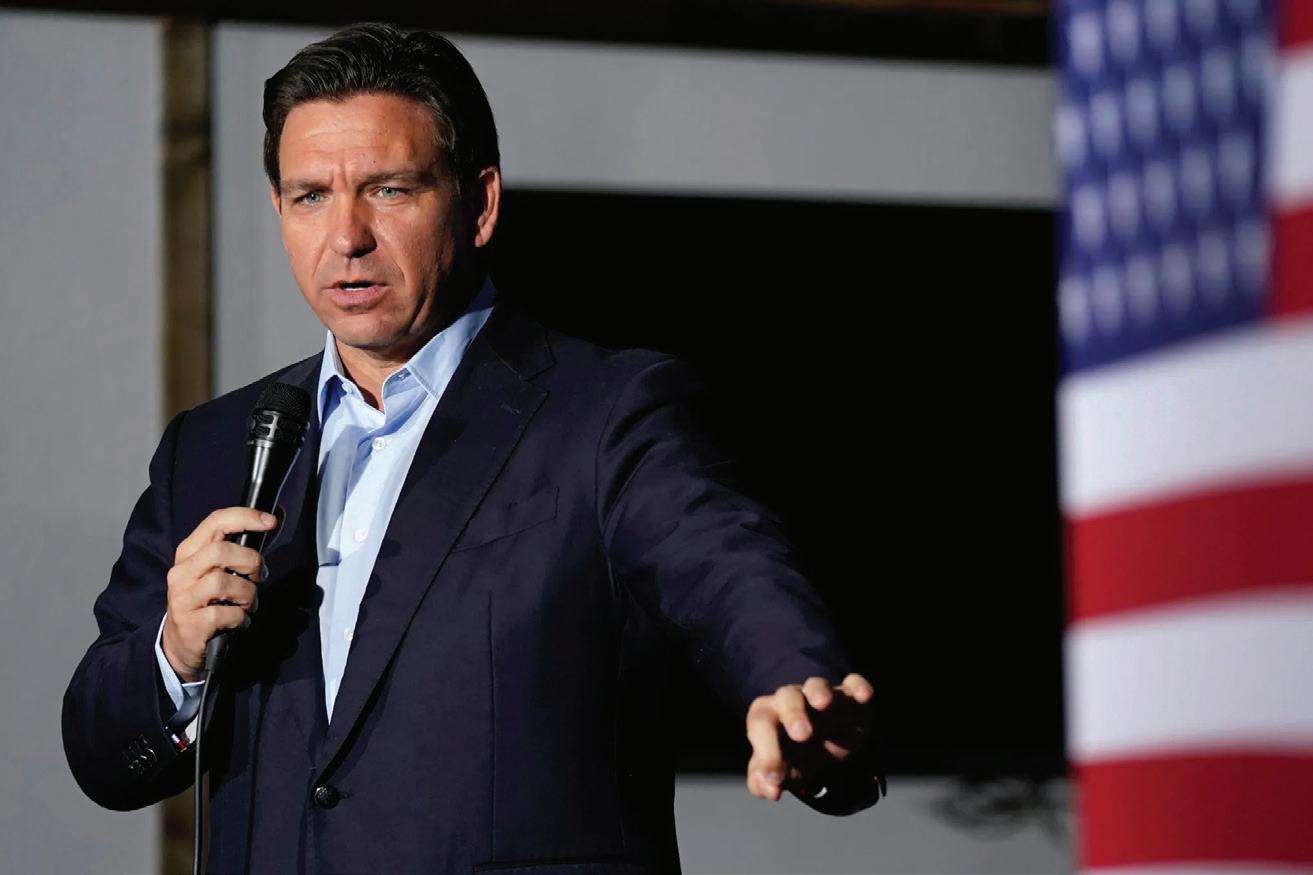
48 ‘INDENTURED SERVITUDE’: GOV. RON DESANTIS ATTACKS H-1B VISA PROGRAM AS ‘TOTAL SCAM’ ‘A lot of these Republicans say, You can have a million people plow in. As long as it’s legal, that’s good. Is that REALLY good?’
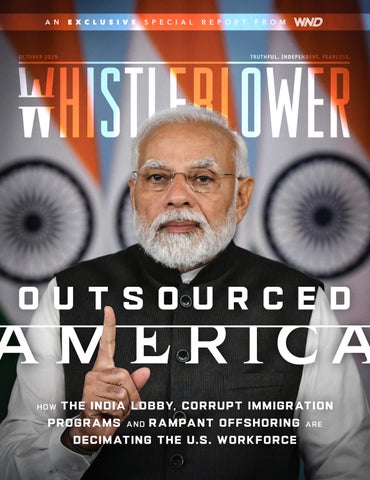
ON THE COVER: Indian Prime Minister Narendra Modi
50 ‘THE AMERICAN DREAM’ FOR SALE
How Miles Education turned U.S. student visas into a foreign hiring pipeline
53 THE BROKEN SYSTEM
The ‘paper’ trail: Inside the legal framework fueling foreign worker pipelines
56 IT’S NOT JUST ABOUT JOBS. IT’S A NATIONAL SECURITY RISK
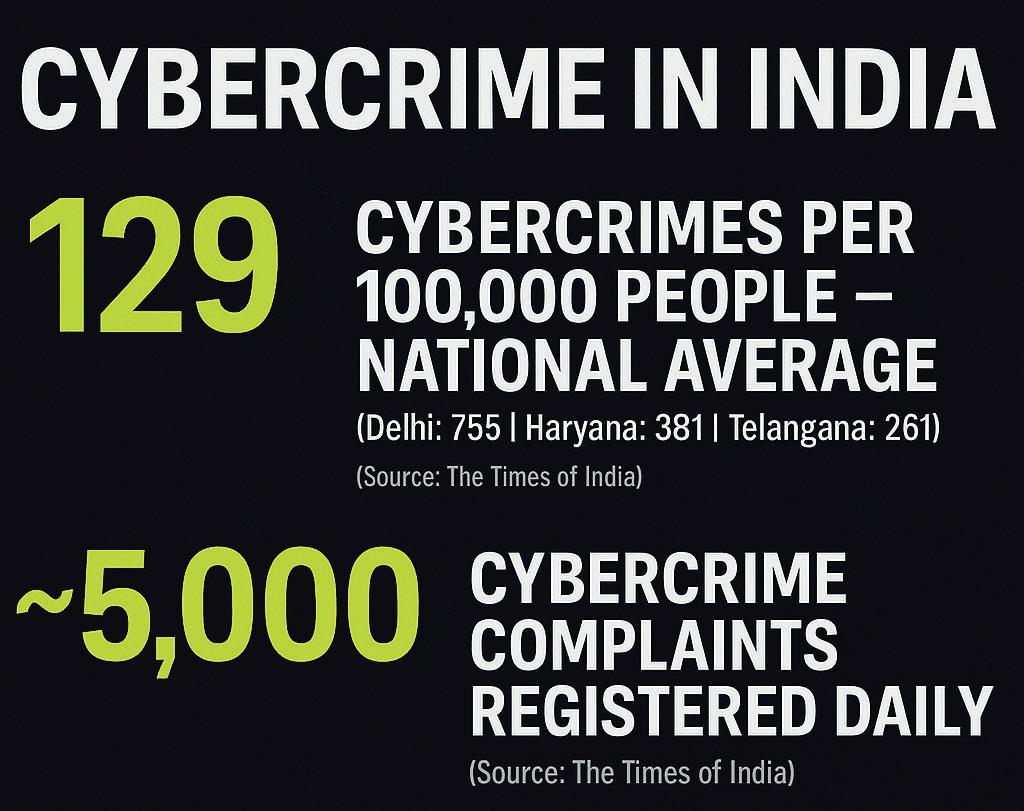
58 CYBERCRIME IS RAMPANT IN INDIA
59 WHY CLOROX IS SUING AN INDIAN COMPANY FOR $380 MILLION
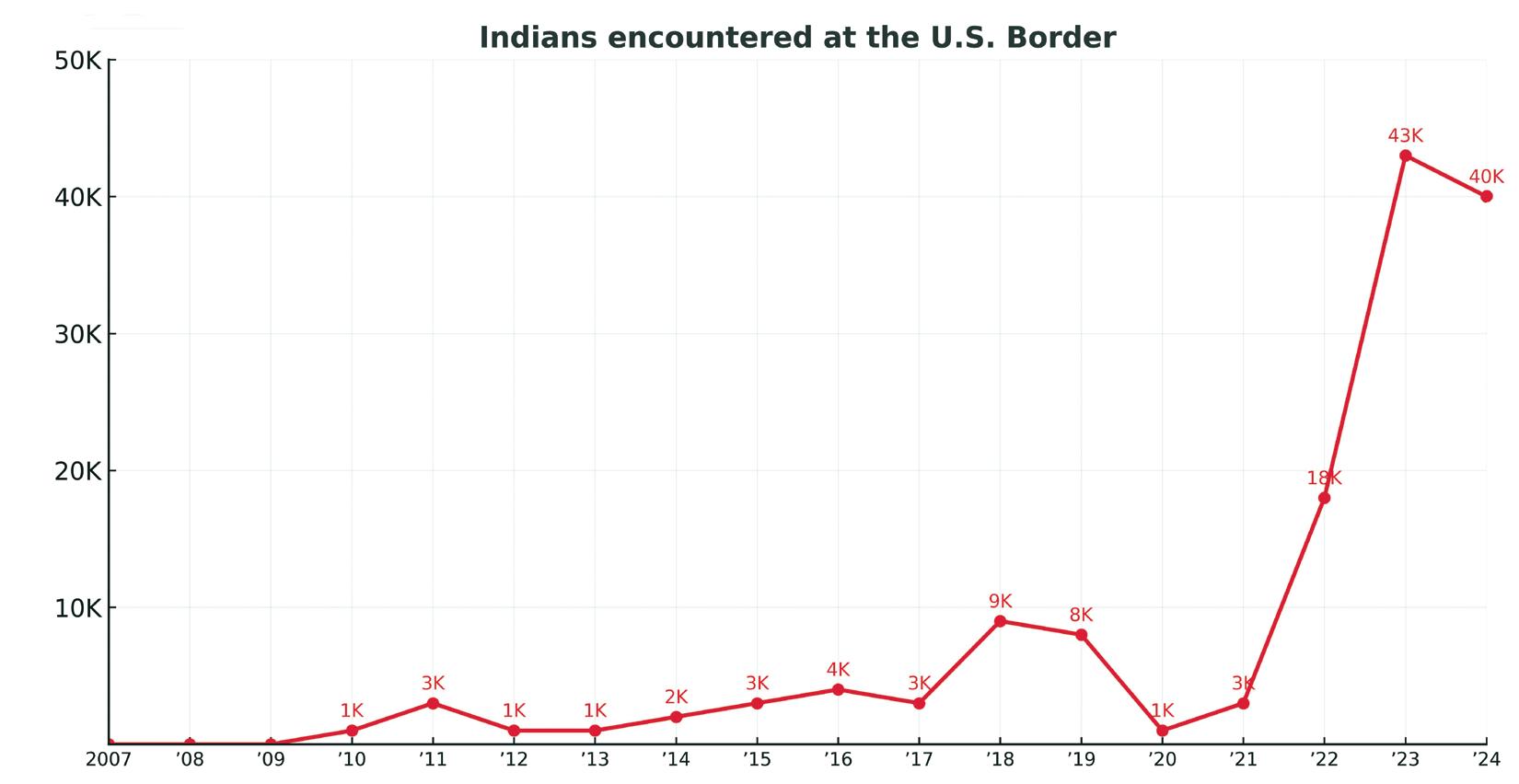
60 INDIA IS ALSO A LEADER IN ILLEGAL IMMIGRATION TO AMERICA By
Amanda Bartolotta
62 TRUMP: THE ‘DISRUPTION’ THAT GAVE AMERICAN WORKERS HOPE
Annual subscriptions are $59.95. Digital subscriptions also available for $24.95. To order, please visit WhistleblowerMagazine.com For CUSTOMER SERVICE, email WBhelp@WND.com
NOTE TO READERS: All stories headlined in red above are part of this major Whistleblower report by Amanda Bartolotta, a senior investigative journalist at WorldNetDaily who specializes in systemic immigration fraud, visa abuse and the corporate-government networks responsible for the massive displacement of American workers.
ABOUT THIS ISSUE: The other (and largely invisible) half of America’s immigration crisis
MOST AMERICANS, if asked to identify the single biggest problem currently wracking their nation, probably would point to the overwhelming crime, corruption and chaos directly resulting from years of staggering levels of illegal immigration.
After all, until January of this year, the Biden administration perversely, some even say treasonously, not only allowed but essentially invited and enabled millions of illegal aliens—including tens of thousands of convicted murderers, rapists, gang-members and sex-traffickers, not to mention large hordes of surly, tight-lipped, military-age Chinese men—to freely cross the U.S.-Mexico border to spread their criminality and treachery throughout America. And don’t forget the legions of cartel-linked drug-smugglers responsible for this nation’s current epidemic of fentanyl poisoning, the No. 1 cause of death of Americans 18-45.
Fortunately, President Donald Trump has taken mighty strides to stop the madness, virtually sealing the southern border and deporting many illegal-alien criminals. Meanwhile, his Department of Homeland Security is working to track down the “nearly 448,000 unaccompanied alien children who entered the United States illegally over the last four years,” many of them victims of sex trafficking and other abuses, as Homeland Security Inspector General Joseph Cuffari recently testified before Congress.
So, illegal immigration—or to put it more candidly, the intentional, fullscale foreign invasion of America engineered and enabled by today’s deranged Democratic Party—remains a massive and ongoing problem for decent, lawabiding Americans.
But then there is the other, largely invisible half of America’s immigration problem, about which most Americans know virtually nothing.
And that is the focus of this very special and expanded Whistleblower report.
Titled “OUTSOURCED AMERICA: How the India Lobby, corrupt immigration
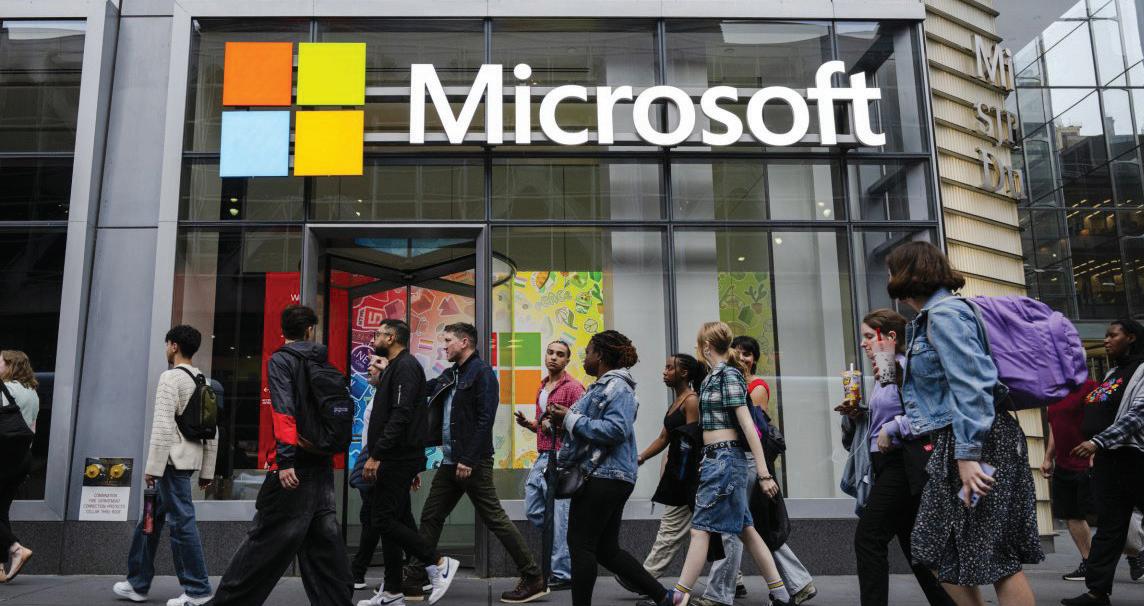
programs and rampant offshoring are decimating the U.S. workforce,” this in-depth report does not merely focus on the few outrages that occasionally manage to make headlines— such as Microsoft’s recent expulsion of thousands of American workers in favor of cheaper foreign techies. Rather, Whistleblower exposes in extraordinary detail, a result of months of original investigative reporting, exactly how and why MILLIONS of qualified, educated and experienced American workers have been facing a silent but devastating crisis: being intentionally excluded from their own country’s workforce.
The whole massive yet vexingly underreported issue is laid bare and documented here, in the sincere hope the Trump administration will act to end this huge and ever-growing injustice—the invisible other half of America’s immigration crisis. ■
—Whistleblower Editors
India is China
IN 1980, no one asked the American people if they wanted to put China first or make China great at the expense of the American middle class.
China was looked to as a large market for selling American products, not making them. We imported Chinese products made by Chinese workers, and we exported to China American products made by American workers. The American middle class was strong and manufacturing was a powerhouse of the U.S. economy.
Then American corporations became multinationals, wanting cheap labor despite the cost to Americans and the middle class; the federal government wanted to achieve good relations with China and world peace.
What we achieved, however, is the gutting of the American middle class. An estimated 80,000-90,000 factories closed in small and rural communities across the U.S., and over 5 million good-paying jobs left our shores.
America built China’s economy from a Third World nation to a global economic powerhouse. In so doing, we also built China’s military might.
These outcomes could have been predicted. The simple check on foolish decisions would have been to put the American people and their prosperity and wellbeing first, above grandiose globalist visions. Indeed, there is no more robust and reliable policy guide than placing the growth and stability of the American middle class first. Truly, the wealth and size of the middle class is the plumb line of our nation’s strength and the American Dream.
Is India really China 2.0? The answer is yes. What offshoring America’s manufacturing to China did to our skilled blue-collar working class— destroying it—India is actively pursuing, with the help of our “American” multinational corporations: the destruction of our white-collar middle class. The government of India is building its own middle class and economy both by massively replacing American workers with Indians in the U.S. and by offshoring American jobs to India.
LABOR DUMPING. This is similar to China’s dumping of products priced below-market with the intention of putting competitors out of business, followed by controlling that market and pricing going forward. India—and U.S. corporations—have been “dumping” Indian workers into the U.S. since Y2K (1999). This cheap “temporary” labor started the corporate addiction.
Today, India dominates the American labor market in foreign tech staffing companies, in domestic HR departments and in the workers themselves.
For India, labor dumping is an economic strategy. Multiple nefarious practices, from the collusion with American businesses to the manipulation of our immigration system to siphoning the wealth of Americans for India, are all too real.
PROPAGANDA. For decades the Big Immigration propaganda machine has determined the narrative. Politicians have bought it, as have the media and even regular Americans. That is changing.
Fact: There is no “high-skilled worker shortage” in America. American grads outperform Indians, Chinese and Russians. Yet 1.7 million American STEM (science, tech, engineering and math) graduates are unemployed—pushed out for foreign workers, almost all of them from India.
FREE MARKET. Do we have a “free market” in the U.S.? Not for jobs and labor. The job market for Americans is America. Unsurprisingly, Americans don’t want to emigrate en masse to foreign nations to work; they want to work in America, their beautiful country, where, as Americans, they pursue their American dream.
Consequently, the job market for Americans is the total of jobs available domestically. What about the labor market? American mul-
tinational corporations have abandoned loyalty to their country’s people, the American labor force and their families. Thus, the labor market is virtually the entire world of 8 billion people. Practically, the labor market is from the 1.45 billion population of India (and to a far lesser extent, China) for white-collar jobs.
You can see the problem here: The U.S. federal government is distorting the market by flooding the U.S. labor pool with millions upon millions of foreign workers, pushing high-skilled white-collar professionals out of American jobs and suppressing the wages and salaries for all. The job pool is limited, while the labor pool is virtually infinite!
THE AMERICAN DREAM. Is the American dream for the 8 billion people of the world? Well, no. That would be an impossible flight of fancy. In reality, mass immigration steals the American dream from all Americans other than the most wealthy. The American dream is really not the dream of the top 1% to 2% of super-wealthy, it’s for the other 98%—the creation of a real, burgeoning, healthy and happy middle class is the invention of America.
Yet for 60 years we have been demolishing the very core of what set America apart, ever since our founding era, from all other nations on earth. Those words, “middle class” and “small business,” should be stamped on our hearts and brains as touchstones of American greatness.
Here’s a test: What happened in 1965 that began the decline of the black middle class? The same thing that destroyed the white middle class: the 1965 Immigration and Nationality Act opening the floodgates of immigration.
Big Immigration yells “racism” when Americans notice they are being replaced with Indians or that they are a minority in their workplace. But nobody claims “racism” when Americans rightly point out that China is our nation’s most formidable and dangerous adversary, and thus unchecked Chinese immigration poses a potential threat to our national security.
Today, increasingly, Americans want for mass Indian immigration, offshoring to India and Indian worker importation to end, or to be massively curtailed, because India has now become the problem.
India is China 2.0.
It’s time to take a stand. Are we, as President Trump has repeatedly said, in a new “golden age of America”? Or is our future more in line with what India’s Prime Minister Narendra Modi recently proclaimed: “This is
Asia’s century”? Especially when such global dominance is being so aggressively pursued by ravaging the American workforce?
The U.S. politician who steps up and holds the line, making the end of uncontrolled mass immigration and offshoring the center of his or her platform, will be a genuine national hero. The same goes for America’s political parties. ■
Elizabeth Farah is the co-founder, CEO and editor-in-chief of WorldNetDaily and host of “The Elizabeth Farah Show,” viewable on Rumble (Rumble.com/c/ ElizabethFarah) and on WND.com. Follow her on X at X.com/ElizabethFarah
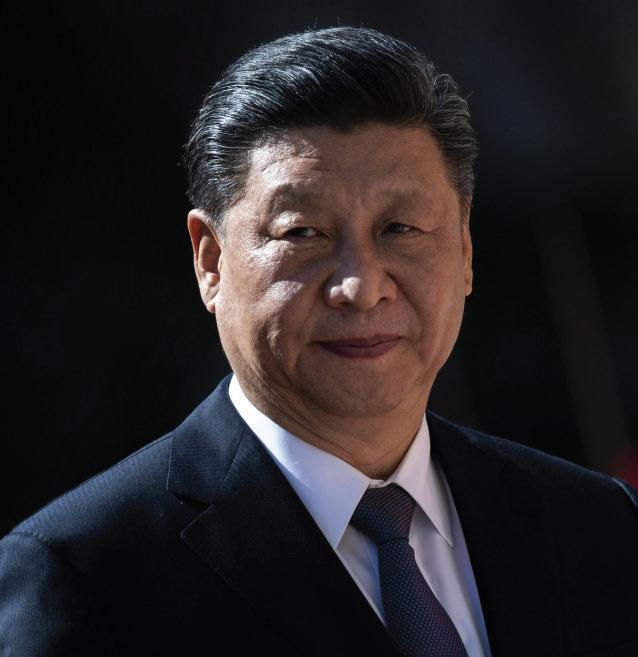
Chinese President Xi Jinping
OUTSOURCED
How the India Lobby, corrupt immigration programs
OUTSOURCED America
and rampant offshoring are decimating the U.S. workforce
THIS SPECIAL WHISTLEBLOWER INVESTIGATIVE REPORT exposes a coordinated, multi-decade campaign by the government of India, affiliated lobbying networks, multinational corporations and complicit politicians to profoundly reshape the U.S. labor market, economic policy and immigration systems in India’s favor—at the direct expense of millions of American workers, as well as America’s sovereignty and national security.
Through a detailed analysis of public records, government data, insider case studies, firsthand testimonies and more, this report presents indisputable evidence that America’s workforce, enforcement systems and job protections have been systematically and intentionally undermined. The result is not just economic harm, but a major structural realignment of who controls employment in the United States of America.
This investigation will expose a coordinated, systemic restructuring of the U.S. labor market, engineered through legal immigration loopholes, offshoring strategies, corporate lobbying and foreign government influence, especially on the part of India and its affiliated actors. It documents how this system is not accidental or organic, but deliberately built, maintained and expanded to benefit foreign interests while massively displacing U.S. workers, hollowing out domestic opportunity and compromising America’s national security.
CONTINUED FROM PAGE 7
The report aims to:
1. AWAKEN AMERICANS to a hidden structural labor takeover that’s unfolded quietly across two decades.
2. EXPOSE HOW LEGAL FRAMEWORKS HAVE BEEN EXPLOITED by multinational corporations and foreign governments, particularly India’s state-backed economic agenda.
3. SHOWCASE PERSONAL AND NATIONAL-LEVEL HARM, combining powerful and emotional testimony, macroeconomic data and insider insights.
4. EQUIP POLICYMAKERS, JOURNALISTS AND CITIZENS with a full view of how deeply the infiltration has spread, from visa systems to trade policy to data security.
5. CATALYZE REFORM by documenting that what is happening is not just unfair and immoral, but legally enabled, economically devastating and geopolitically reckless.
CORE FINDINGS
1. WORKFORCE DISPLACEMENT BY DESIGN
India’s national policy has long prioritized labor export as a strategic tool. Through state-backed programs like Skill India, Make in India and the National Career Service (NCS), India has built a powerful infrastructure for the sole purpose of mass-producing and placing foreign workers into Western economies, chiefly the U.S., under the guise of “global talent.”
2. WEAPONIZATION OF U.S. VISA PROGRAMS
The H-1B, L-1, F-1 OPT and green card systems have been profoundly and scandalously repurposed to serve as gargantuan labor funnels. These programs are no longer fulfilling legitimate temporary or specialized labor needs, but are used to permanently bypass American workers—often via consulting firms, shell employers and coordinated corporate hiring schemes.
3. CORPORATE COLLUSION AND POLICY MANIPULATION
Major U.S. tech, finance and consulting firms have aligned with Indian multinationals and lobbyists, e.g. the National Association of Software and Service Companies (NASSCOM), the Confederation of Indian Industry (CII) and the U.S.-India Business Council (USIBC), to push for continual visa
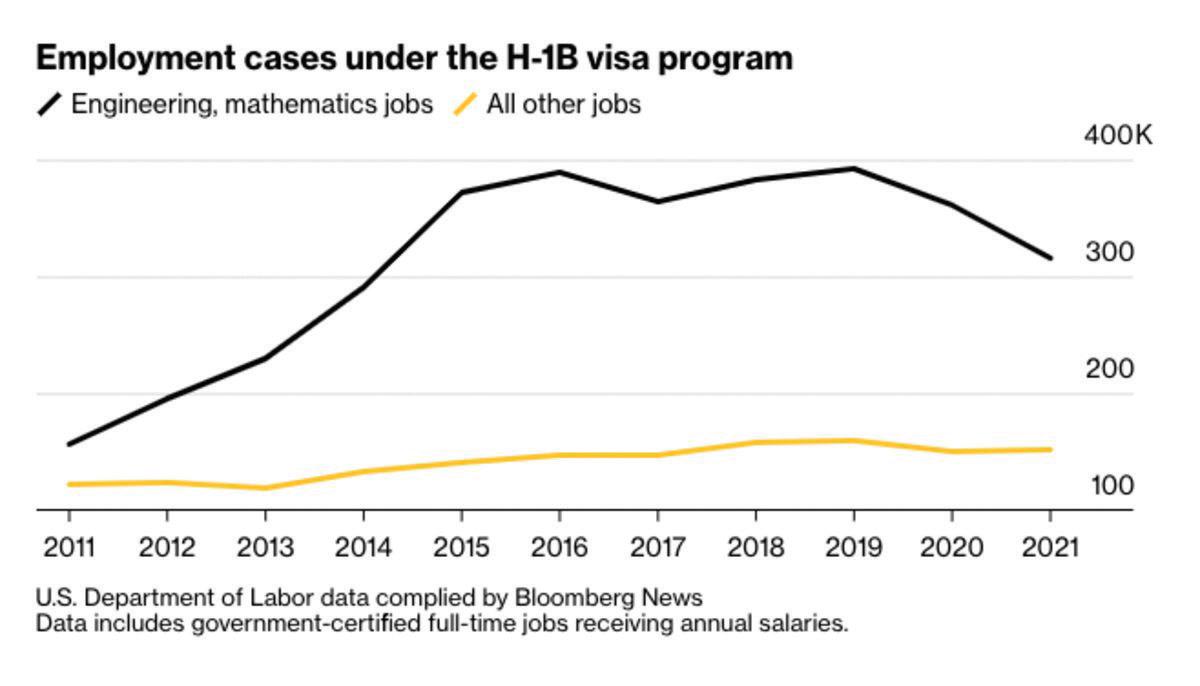
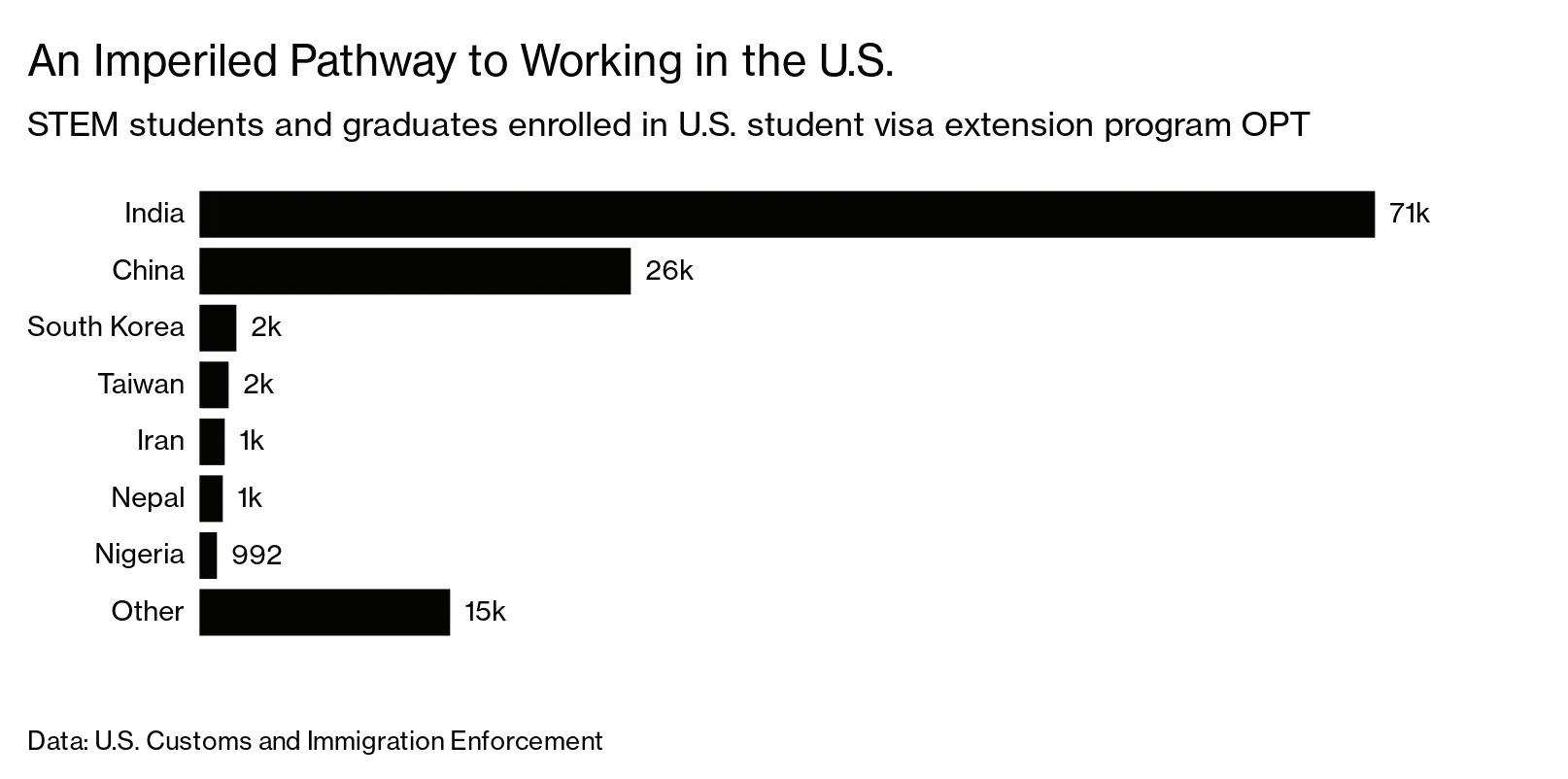
Source: Bloomberg
expansion, trade protections and offshoring incentives. These corporations have actively lobbied against reform, diluted labor protections and outsourced entire business units—all while pocketing U.S. taxpayer subsidies.
4. FOREIGN CONTROL OF CRITICAL U.S. INFRASTRUCTURE
Shockingly, India-based contractors now develop, maintain and control U.S. government systems used for immigration processing, healthcare, finance and education. Thus, foreign nationals—many employed under the very visa systems being abused—have access to sensitive citizen data, internal servers and classified records, creating a profound national security risk.
5. MASSIVE FRAUD AND CYBERCRIME EXPOSURE
India has become the global hub for U.S.-targeted tech support scams, IRS impersonation frauds and identity-theft rings. These criminal operations exploit the very staffing pipelines and outsourcing contracts detailed in this report, with many perpetrators having direct access to U.S. platforms and customer systems.
6. REGULATORY CAPTURE AND FAILURE OF ENFORCEMENT
Ironically, agencies meant to protect U.S. labor, like the Department of Labor, the U.S. Citizenship and Immigration Services (USCIS) and even the White House Council of Economic Advisers, have outsourced core functions to contractors employing foreign visa holders. Meanwhile, enforcement against fraud, discrimination and misrepresentation has collapsed under pressure from corporate and foreign lobbying.
IMPACT ON AMERICANS
• MILLIONS OF U.S. WORKERS ARE DISPLACED across IT, engineering, healthcare, finance, education and customer support.
• THOUSANDS OF AMERICANS ARE BEING HUMILIATINGLY FORCED TO TRAIN THEIR FOREIGN REPLACEMENTS, often under threat of losing severance and/or reference.
• YOUNGER WORKERS ARE LOCKED OUT, mid-career professionals aged out, and veterans sidelined in favor of fulfilling foreign labor quotas.
• SENSITIVE NATIONAL DATA IS COMPROMISED, systems are breached and legal recourse is diminished due to offshore contracting and foreign immunity.
• ENTIRE COMMUNITIES ARE BEING HOLLOWED OUT with falling wages, disappearing career tracks and rising underemployment … despite “job growth” headlines.
WHY THIS MATTERS NOW
All of this is not merely an immigration issue; it is a sovereignty issue. This is not about “globalization”; it is about systemic harm to, and replacement of, literally millions of Americans. The schemes detailed in this investigative report reveal how the American workforce was not simply left behind, but actively and intentionally shut out through policy, partnerships and relentless foreign pressure.
Without urgent intervention, these trends will accelerate under the next wave of AI-driven outsourcing, corporate automation and global labor arbitrage, further deepening the widespread injustice, undermining the rule of law and eroding trust in the government of the United States. ■
Amanda Bartolotta is a senior investigative journalist at WorldNetDaily specializing in systemic immigration fraud, visa abuse and the corporate-government networks responsible for the displacement of American workers. Her work exposes the immigration industrial complex and its role in eroding U.S. labor protections, suppressing wages, and threatening the long-term sovereignty and economic security of the United States.
Outsourcing the American Dream
How legal immigration programs and offshoring are hollowing out the U.S. workforce
“I went from a high-performing, valued employee, who was able to help and support his family and friends, to an unemployed individual who was required to lean on his friends and family to survive, oftentimes transferring some or all of my stress to them. I will tell you very clearly and honestly, that there were a number of occasions during which I considered ending my life.” —MATTHEW J. CULVER, DISPLACED AMERICAN IT WORKER
ACROSS THE COUNTRY, millions of American workers are facing a silent crisis. Behind every rejection email and closed job listing lies a disturbing truth: Qualified, experienced U.S. workers are being systematically excluded from a labor market increasingly structured to favor foreign labor and offshoring by design.
Job seekers often encounter what appear to be abundant opportunities, but many listings are “ghost jobs” already filled, reserved for foreign visa candidates, or used to meet legal posting requirements. Applicants may apply to hundreds of positions, only to receive automated rejections or complete silence. For many, the system distinctly feels as though it was never built for them at all.
While the U.S. government officially reports a 4.2% unemployment rate, this figure conceals far more than it reveals. It excludes part-time workers seeking full-time jobs, those earning below a livable wage and millions who have given up looking for work after being repeatedly passed over. Shockingly, according to the Ludwig Institute for Shared Economic Prosperity (LISEP), the real unemployment rate, when factoring in underemploy-
ment and low-wage work, is closer to 24.3%. That means nearly one in four working-age Americans is effectively shut out of the economy.
This is not due to any lack of effort or ability on their part. Many have earned degrees, built careers and applied relentlessly for positions. But today’s labor system increasingly routes jobs through visa pipelines, offshores entire teams or restructures roles to legally exclude American workers from consideration.
In 2024, the U.S. approved 5.58 million foreign work authorizations through programs like H-1B, L-1,
STEM OPT and others, while only 2.2 million net new jobs were created. That’s nearly three foreign work permits for every actual U.S. job.
Likewise, between 2022 and 2024, the U.S. economy added 9.7 million jobs while approving over 18 million foreign work authorizations. These work authorizations are approved without any system in place to determine whether there are enough jobs to justify the demand for foreign labor, nor any safeguards to monitor how these approvals will impact the American workforce.
That means millions of Americans—college graduates, laid-off professionals, veterans, parents returning to work—are now competing with an endless pipeline of cheap foreign labor. Very simply, the current system is not built to put Americans first.
The H-1B program was originally designed to fill temporary gaps in specialized fields, but it has evolved into a long-term labor substitution machine. Companies now use it to legally bypass qualified American workers, hiring foreign labor for six years or more, often with green card sponsorships that extend their stay indefinitely.
Alongside L-1 and OPT, the H-1B has created a legal framework that
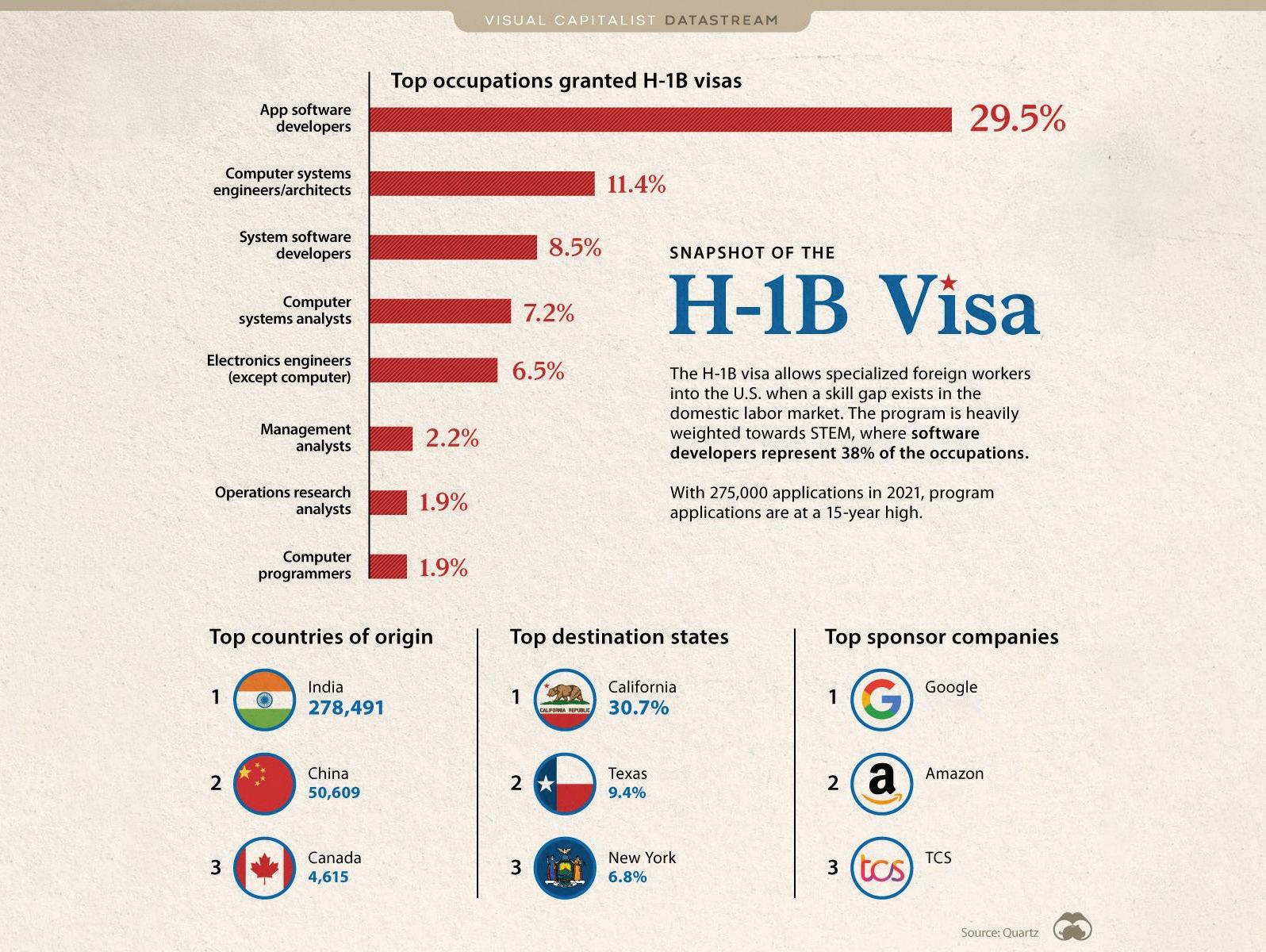
enables large-scale replacement of U.S. workers, even amid widespread underemployment. In 2024 alone, employers requested over 800,000 H-1B visas, including 256,000 for software developers, despite a net loss of 2,440 U.S. software developer jobs.
Tied to their employers through their visa, these foreign workers cannot freely change jobs or negotiate higher pay, making them a cheaper and much more controllable workforce—a dynamic many are comparing to indentured servitude.
CONTINUED ON PAGE 12
THE CORPORATE INCENTIVE: CHEAPER LABOR, FEWER PROTECTIONS
“The H-1B program offers these employers the opportunity to lower labor costs by substituting cheaper H-1B workers for Americans.” —PROFESSOR RON HIRA, ASSOCIATE PROFESSOR AT ROCHESTER UNIVERSITY
For corporations, the appeal is simple: Hire foreign workers at lower wages, avoid protections that apply to American workers and lock in a compliant labor force. Most H-1B hires are labeled “entry-level,” even when the jobs require advanced skills, making it legal to pay far less than what experienced Americans earn.
Meanwhile, the Optional Practical Training (OPT) program, originally designed for short-term training, has become another backdoor to longterm foreign employment. Employers pay no payroll taxes for OPT workers and the program has no labor protections. That makes hiring foreign graduates much cheaper than hiring Americans.
WHOLESALE DISPLACEMENT DISGUISED AS ‘RESTRUCTURING’
At Microsoft, thousands of American employees were laid off between 2023 and 2025, just as the company expanded operations in India and filed tens of thousands of H-1B applications. Disney and Southern California Edison required laid-off workers to train their foreign replacements brought in through visa programs. These patterns are widespread and documented. (See “IT engineer fired by Disney and required to train foreign replacement breaks down during Senate testimony” on page 13.)
In 2024, a federal jury found Cognizant guilty of discrimination against U.S. workers while favoring Indian H-1B holders. Infosys settled a $34 million visa fraud case, and Tata Consultancy Services is facing ongoing complaints with the Equal Employment Opportunity Commission from Americans terminated and replaced under similar models.
A SYSTEM BUILT THROUGH FOREIGN INFLUENCE
What this data reveals is far more than just a disturbing employment trend. It points to a coordinated and intentional structural shift in U.S. labor policy, one driven by relentless lobbying and foreign influence.
At the center of this shift are efforts tied to the government of India, working in concert with Indian multinational corporations and diaspora-linked policy groups. These actors have strategically lobbied for expanded access to U.S. visa programs, expedited processing, reduced oversight and weakened labor protections—all changes that lower barriers for foreign labor while sidelining American workers.
And the problem is ever expanding: Visa-driven hiring has now infiltrated not just tech, but also finance, healthcare, education, consulting, government contracting and administrative functions. Backed by bilateral agreements and global education-to-employment pipelines, this model is now embedded into corporate hiring systems across multiple industries.
F-1 VISA: A nonimmigrant student visa that allows foreign nationals to study full-time at U.S. academic institutions. Most international students in the U.S. are on F-1 visas.
OPT (OPTIONAL PRACTICAL TRAINING): A work authorization granted to F-1 visa holders after graduation. It allows up to 12 months of employment in a field related to the student’s major, without needing employer sponsorship.
STEM OPT EXTENSION: A 24-month extension of OPT for graduates in Science, Technology, Engineering and Mathematics (STEM) fields. Combined with the original OPT, STEM students can work in the U.S. for up to 3 years after graduation, making them highly attractive to employers seeking low-cost, visa-free labor.
H-1B VISA: A temporary work visa for foreign professionals in “specialty occupations” like tech or engineering. Though originally intended to fill labor shortages, companies often use H-1Bs to undercut wages and replace U.S. workers.
L-1 VISA: A visa that allows multinational corporations to transfer employees from foreign offices to the U.S. Often used to avoid hiring Americans, L-1 workers are not subject to prevailing wage requirements.
GHOST JOB: A job listing that appears open but is already filled, reserved for a foreign visa candidate, or posted only to meet a legal requirement, but not to hire an American applicant.
This evolution marks a profoundly ominous shift in U.S. labor policy from a citizen-first framework to one optimized for “global labor mobility.” But for American workers, all this amounts to ever-growing unfair competition, restricted career mobility and rapidly diminishing access to the roles they once held.
THE BOTTOM LINE: AMERICANS WERE NEVER EVEN CONSIDERED
U.S. law no longer guarantees Americans a fair shot. It guarantees corporations a cheaper alternative. The system is broken and American workers are paying a very high price.
The following sections of this WHISTLEBLOWER report detail how that system was designed, codified and deployed. They document exactly how foreign lobbying campaigns, trade agreements and corporate partnerships reshaped the rules of employment in the United States, and how legal frameworks never intended to prioritize American workers are now being expanded and repurposed to realign the U.S. labor market—not for the benefit of America and Americans, but to serve foreign strategic and economic objectives. ■
DIVE DEEPER!
To view original source data for WHISTLEBLOWER's exclusive investigative report on “OUTSOURCED AMERICA,” go to WND.com/OutsourcedAmerica and access our archive of compelling documents, charts, graphics and other evidence.
IT ENGINEER FIRED BY DISNEY AND REQUIRED TO TRAIN FOREIGN REPLACEMENT BREAKS DOWN DURING SENATE TESTIMONY
LEO PERRERO, former information technology engineer at Walt Disney World, was on top of the world until he was informed by Disney that he was going to lose his job to a foreign replacement. Worse, Disney insisted Perrero and his co-workers train their replacements or lose their severance.
While testifying before the Senate Subcommittee on Immigration and the National Interest on the subject of “The Impact of HighSkilled Immigration on U.S. Workers,” Perrero broke down when describing the devastating impact on him and his family of being fired and replaced by a lower-cost foreign worker. (Watch video above) ■
How India uses trade deals and corporate lobbying to funnel its workforce into America
NOT THAT LONG AGO, America began closing its factories and offshoring its manufacturing base to China. At the time, it was framed as “economic modernization”—a natural shift in a globalizing world. But the actual results were felt quickly and deeply: Millions of American jobs disappeared, entire communities lost their livelihoods and the foundation of this nation’s industrial economy began to seriously erode.
A stunningly similar crisis is unfolding today, but instead of assembly lines, it is entire career categories that are being displaced. The difference now isn’t just job loss, but the scale of foreign competition inside U.S. borders. Each year, millions of foreign workers are legally brought into the U.S., often to fill the very roles American workers have been educated and trained to fill.
Middle-class strongholds like tech, engineering, finance and research are being systematically restructured, outsourced and hollowed out. The same economic forces that once shuttered factories are now reshaping whitecollar professions.
Whether they wear steel-toed boots or business suits, American workers are being pushed out. Layoffs, stalled careers and restructuring have become the norm. The job titles may vary, but when opportunity vanishes, the unemployment line looks the same for all Americans.
INDIA’S RISE THROUGH AMERICAN SYSTEMS
Over the past two decades, India has emerged as a central figure in global technology, labor and industrial supply chains. Its rise is often credited to innovation and entrepreneurship. But a closer examination reveals a broader and much more troubling picture, one that includes the systematic use of America’s legal, economic and immigration frameworks to accelerate India’s ascent. Through bilateral agreements, lobbying, diaspora influence and regulatory capture, India has established itself as a labor-export powerhouse. Its goal: Dominate global labor and service markets … using American systems.
THE TRADE DEAL THAT TURNED AMERICANS INTO COMMODITIES
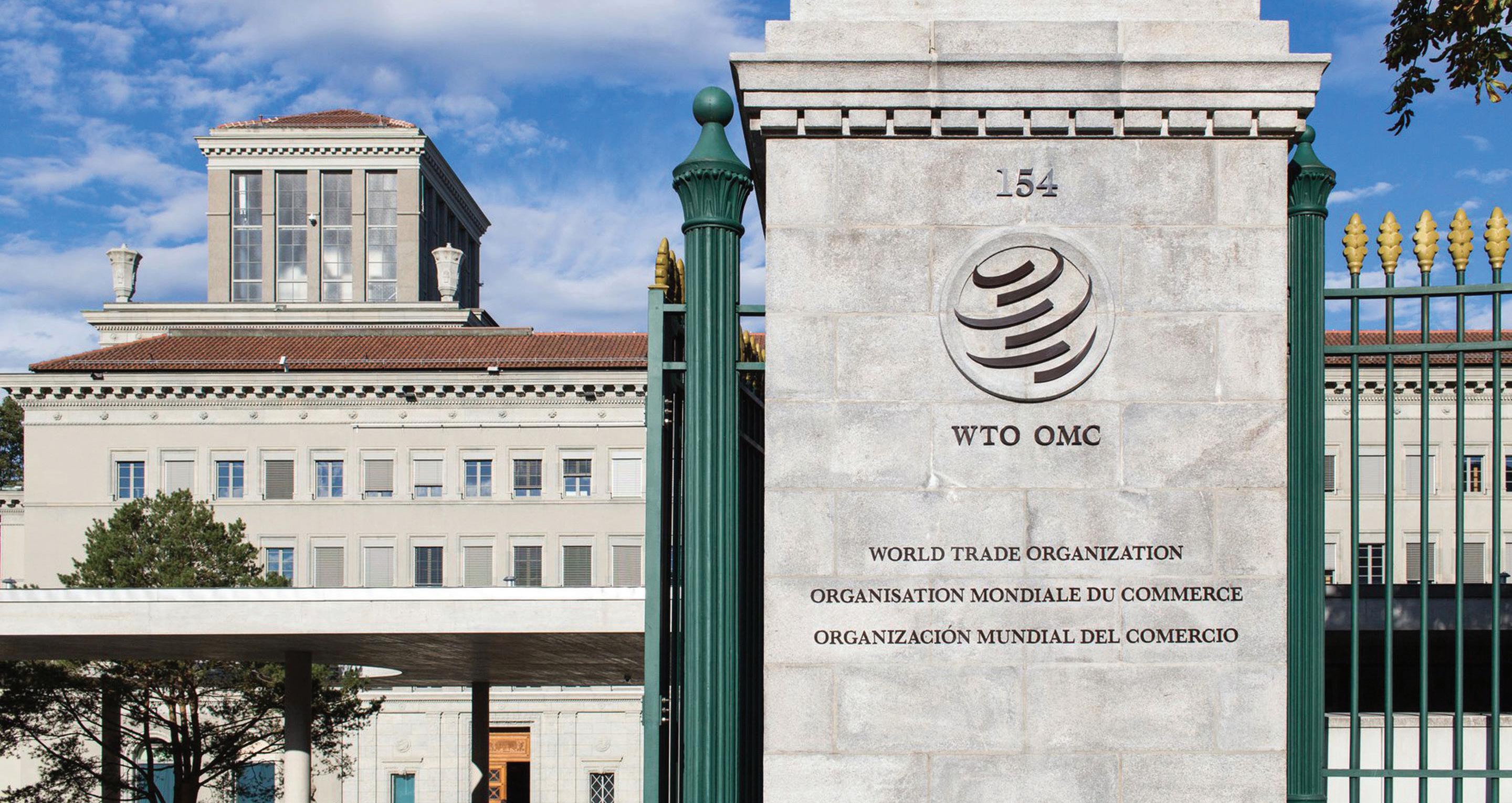
Back in 1996, the United States made a commitment at the World Trade Organization (WTO) under a framework called the General Agreement on
Trade in Services (GATS). Tucked inside that agreement was something called Mode 4, a provision that allowed countries to send their workers temporarily across borders to supply services. For India, this was an opening, a legal foothold for expanding its labor exports using U.S. visa programs.
At the time, the U.S. agreed to “bind” its existing annual cap of 65,000 H-1B visas, which in reality simply amounted to a legal baseline number in global trade law, open to later increases, which have occurred several times since. The U.S. also broadened its commitments to include L-1 intra-company transfers and B-1 business visitor visas, essentially turning immigration categories into trade concessions. These were no longer just domestic policies; they were legally binding promises to foreign governments. ■
WTO (WORLD TRADE ORGANIZATION): An international organization formed in 1995 to regulate trade between nations. The WTO sets binding rules for how countries trade goods and services. The United States is a founding member.
GATS (GENERAL AGREEMENT ON TRADE IN SERVICES): A global treaty under the WTO that governs how countries open their service sectors (such as finance, information technology and education) to foreign providers. GATS includes commitments called “modes” of service delivery.
MODE 4 (TEMPORARY MOVEMENT OF NATURAL PERSONS): One of the four GATS “modes,” Mode 4 allows countries to commit to accepting foreign workers “temporarily” as part of international service trade.
BINDING (IN TRADE LAW): When a country makes a “binding” commitment under the WTO, it is making a legal promise. For example, binding the U.S. to accept 65,000 H-1B visas per year meant it could not later reduce that number without facing penalties or challenges at the WTO.
INDIA’S USE OF TRADE AGREEMENTS: India treated access to U.S. visa programs as a trade right, not a domestic immigration issue. By embedding visa access into WTO agreements, India secured legal leverage over U.S. immigration quotas through trade law.
Embedding offshoring through ever-expanding visa access
“There is another area which India needs to focus upon, and that is overseas employment. Last year nearly eight lakhs [800,000] Indians got jobs in overseas market ... The fruits of economic growth can be realized only when adequate jobs are created.”
—SANDIP SEN, CHAIRMAN, CII NATIONAL COMMITTEE
AS INDIA REDEFINED U.S. VISA ACCESS as a matter of trade rights thanks to the WTO, it simultaneously turned its focus inward, realizing its most powerful export might not be products, but people.
“There is a need to mold a workforce that not only possesses technical competencies but also excels in critical thinking and soft skills, ensuring resilience and adaptability in the face of evolving job markets. Skilling has a huge role to play as an enabler in the development of a nation, which leads to an increase in productivity and competitiveness.”
—ATUL KUMAR TIWARI, SECRETARY, MINISTRY OF SKILL DEVELOPMENT AND ENTREPRENEURSHIP, GOVERNMENT OF INDIA
Despite its massive working-age population, India had a major skills gap. Only 5% of its workforce had marketable skills, while 80% of engineering graduates lacked employer-required competencies. But rather than raise its standards, India successfully lobbied the WTO to lower them. Officials argued for job experience in place of degrees and pressed for acceptance of Indian credentials abroad.
THE EXPORT STRATEGY: TRAINING INDIAN WORKERS FOR OVERSEAS JOBS
“ Growth without jobs leads to social and political unrest.”
—YANAMALA RAMAKRISHNUDU, FINANCE MINISTER, GOVERNMENT OF INDIA
India set a national goal to train an astonishing number of people—500 million—by 2022 for overseas employment. CII (Confederation of Indian Industry) and AICTE (All India Council for Technical Education) signed memoranda of understanding with U.S. tech giants including Microsoft and Amazon to embed Indian labor into digital sectors. Training programs were often fast-tracked, replacing experienced American professionals with cheaper, credentialed Indian labor.
“CII’s three-pronged initiative of Skill India, Make in India and Digital India will transform the very employment scene of the country … 11 Memoranda of Understanding (MoUs) were signed with prestigious companies to improve the skilling ecosystem.”
—DR. ARUN CHATURVEDI, MINISTER FOR SOCIAL JUSTICE & EMPOWERMENT, GOVERNMENT OF INDIA
Back in 2002, India’s Ministry of Commerce had made a stunning admission to the WTO. Speaking on behalf of the Indian government, Dr. Rupa Chanda explicitly credited the H-1B and L-1 visa programs for helping India build its offshoring industry. According to her, the U.S. visa system was no longer just a pathway for workers, it had become an engine to grow India’s entire tech sector by siphoning jobs and knowhow out of the United States.
“In India’s case, the onshore supply of services by Indian service suppliers has helped build up offshore supply capabilities. ... Through the temporary movement of natural persons, developing countries such as India have
acquired reputational advantages and client bases that have led to a follow-up offshore demand for services.”
—DR. RUPA CHANDA, MINISTRY OF COMMERCE, GOVERNMENT OF INDIA
So what had been intended as a temporary exchange of services was being used, by India’s own admission, to create a long-term strategy to convert jobs that once supported American families into Indian exports.
India submitted a detailed list of demands aimed at reshaping U.S. immigration policy to advance its own labor export model. These proposals covered visa processing, wage rules, education standards and tax treatment, all designed to make it faster, easier and cheaper for Indian workers to enter and stay in the U.S.
India made it crystal clear: Its workers’ presence in America wasn’t temporary anymore. It was a strategic step to build long-term offshore delivery capabilities back home. As Indian officials explained:
“In the software sector, in an offshore project for supplying software services, it may be necessary for some software professionals to be present onsite for various reasons including: client comfort; emergency or critical application; regular monitoring; and obtain[ing] around the clock productivity (keeping in mind the time differences).”
In plain terms, Indian workers were embedded inside U.S. firms to win contracts, build relationships and shift operations overseas, turning American job sites into launchpads for massive Indian offshoring. Visas were no longer just work permits. They were part of a much broader strategy to convert U.S.
employment into Indian exports.
While some U.S. policymakers claimed these programs addressed skill shortages and would help reduce offshoring, India told a very different story, confirming the exact opposite: These very visas were fueling offshoring, not preventing it, transforming American industries into remote service hubs for Indian labor. India then used this reality to push for even more—expanded visa access, fewer restrictions and relaxed rules to embed ever more of its workforce into the U.S. economy.
This, of course, directly contradicts decades of deceptive public messaging. What was sold as a temporary solution has become a permanent labor pipeline, one that has reshaped American industries, suppressed U.S. wages and displaced its workers, all without the consent—or even the knowledge—of the people most affected. ■
India makes big demands of the World Trade Organization
Ironically, in its official submissions, India strenuously argued that U.S. immigration laws—some of the most open and generous in the world—were major obstacles to its offshoring model, describing America’s visa policies as among the “most critical barriers” to the growth of its software industry. India’s demands to the WTO for eliminating these “barriers” included:
• ELIMINATE LABOR MARKET TESTS THAT PRIORITIZE AMERICANS
• ELIMINATE WAGE RULES TO PROTECT AMERICAN WORKERS
• ELIMINATE VISA CAPS AND WAIT TIMES
• RELAX EDUCATION AND SKILLS REQUIREMENTS
• GIVE INDIA ACCESS TO U.S. GOVERNMENT CONTRACTS MEANT FOR AMERICAN PROVIDERS
• EXEMPT INDIAN VISA WORKERS FROM CERTAIN TAXES
• CREATE NEW “GATS VISA” TO BYPASS U.S. IMMIGRATION LAW ENTIRELY
Ultimately, even though it failed to get official World Trade Organization agreement with its many demands, India nevertheless managed to exploit, manipulate and radically expand its use of the existing system—especially America’s ill-conceived immigration laws—to accomplish the same end goals.
How America’s Judeo-Christian culture is rapidly being replaced
IT’S A CORE TRUTH ABOUT AMERICA, though shunned and despised by most people caught up in today’s perpetually angry, “diversity”-obsessed culture: The United States of America, whatever its faults, has long been the freest, most prosperous, most generous, most welcoming and most Christian nation on the face of the earth.
For generations, fully nine out of ten Americans self-identified as Christian, believing that the Ten Commandments and the Sermon on the Mount provide the perfect guideposts for a good life and a great society.
But today there’s a problem—a very big problem.
This uniquely God-blessed nation is being radically transformed right before Americans’ eyes. One of the biggest reasons is the astonishingly rapid importation into the country of never-ending hordes of people holding values utterly opposed to everything America represents. And this concern goes even beyond the obvious—like importing sex-traffickers, drug-dealers and gang-bangers who spread crime and chaos everywhere they go.
America’s cultural and spiritual fabric itself is being altered.
Consider that the first two Commandments of God are “Thou shalt have no other gods before me” and “Thou shalt not make unto thee any graven image … Thou shalt not bow down thyself to them, nor serve them.” (Exodus 20:3-4)
Yet in Sugar Land, Texas, the Sri Ashtalakshmi Temple recently erected the third-tallest statue in the entire United States of America—an immense 90-foot
statue of the Hindu god “Lord Hanuman.” In truth, most Christians would regard this gigantic half-monkey/half-human “god” as a grotesque, blasphemous, demonic “graven image” created for people to “bow down” and “serve” it.
Designed in India and largely manufactured in China, the 90-ton statue represents the Hindu god who, according to the temple’s website, is intended to unite people and communities together. After all, the site explains, the monkey god “played a significant role in the birth of the wind god, Vayu” and is a devoted companion of Rama, Hinduism’s “supreme being.”
As Newsweek reported, “The statue’s unveiling marks rapidly changing religious demographics
in the U.S., with surveys showing a decline in the proportion of Americans who identify as Christian and a rise in those who say they are ‘nothing in particular’ or belong to religions which are followed by a minority in the U.S.”
Fact: Recent polls do indeed reveal fewer and fewer people living in America self-identifying as Christian. Yet since “nature abhors a vacuum,” it follows that if people are not following Christ, they will follow someone or something else. Hence, less than 300 miles away from Sugar Land, Texas and its gigantic Hindu monkey-god idol, another religion has been on the rise: A Muslim planned community called EPIC City, about 40 miles northeast of Dallas, had its construction temporarily blocked by Gov. Greg Abbott, Texas Attorney General Ken Paxton and U.S. Sen. John Cornyn. Then on June 19, Abbott signed a law (HB 4211) restricting radical Islamic “Sharia law” communities. The planned Muslim city—in the heart of America—would have included 1,000 single and multifamily dwellings, a K-12 school, a community college, a sports facility and a shopping center. The already existing mosque there, the East Plano Islamic Center (EPIC), was intended to be the nucleus of EPIC City.
Although nearby residents of Collins, Texas, weren’t thrilled about the prospect of having to listen to loud Muslim calls to prayer and Arabic music blaring over loudspeakers, that might have been the least of their problems: Fourteen centuries of Islamic history paint a pretty clear picture of
the intrinsically expansionist nature of Islam. If that sounds judgmental or “Islamophobic,” consider that the Texas EPIC mosque’s leader and “scholar in residence,” Yasir Qadhi, rejects any form of government that doesn’t conform to the principles of Islam—including America’s.
Oh yes: Qadhi also has praised the Taliban, denied the Nazi Holocaust, called democracy “illegitimate,” advocated for “sharia supremacy,” raised money for terrorist groups and referred to Christians as “filthy polytheists” whose lives “hold no value.”
For those who wonder what EPIC City might look like, explains veteran columnist Don Feder, “there’s a model 1,200 miles to the north in
CONTINUED ON PAGE 19
Houston suburb now home to a 90-foot-tall statue of Hindu god Hanuman
Dearborn, Michigan, America’s first Muslim-majority city. The Wall Street Journal calls Dearborn the ‘Jihad Capital’ of the United States. … Shouts of ‘Death to America’ are frequently heard at pro-Palestinian protests in Dearborn. A video of an event hosted by the Palestinian Youth Movement showed participants pledging to sacrifice themselves ‘to end this American empire.’”
For the United States of America, founded centuries ago and held together ever since by widely shared moral and religious values, this is sheer insanity. After all, the U.S. already has enough problems with its own home-grown malignant religions attempting to replace Christianity. For example, America’s public school system has become a beachhead for—believe it or not— satanism. Somehow, the Salem, Massachusetts-based satanic organization “The Satanic Temple” has managed to set up on-campus “After School Satan Clubs” in public schools across the United States of America—including California, Ohio, Connecticut, Tennessee, Pennsylvania, Colorado and New York.
Even more broadly, “leftism” (or “progressivism,” “socialism,” “Marxism” or “communism,” all different names for the same deranged ideology), in reality possesses all the attributes of a religion. And this dark, seductive but always enslaving belief system increasingly is dominating major American institutions, especially education—which may explain why some public schools are welcoming After School Satan Clubs.
Coming back to the Hindu-Indian “invasion,” the focus of this groundbreaking Whistleblower Special Report, a serious question must be asked— one that reaches beyond even the immediate and most obvious injustice of depriving millions of American citizens of their livelihoods: What does it mean for America’s core Judeo-Christian culture, on which all its major institutions, values and laws (including its Constitution) have long been based, when the nation comes to be inhabited by tens of millions of people—
SUBSCRIBE TO
legal or illegal—with no loyalty to America and its core founding values and faith, but who instead bring with them profoundly un-Christian values and loyalties?
What kind of nation will result?
The answer, unfortunately, is already becoming clear. ■
David Kupelian is Managing Editor of WorldNetDaily, Editor of Whistleblower and bestselling author of “The Marketing of Evil,” “How Evil Works” and “The Snapping of the American Mind.”
If you appreciate what you see in these pages, please subscribe to Whistleblower—print or digital. Whistleblower is unique among news publication, for two reasons:
One, each edition focuses a 10,000-watt investigative spotlight on a single topic of absolutely crucial importance—but either ignored or grossly distorted by the “mainstream” media—thus becoming a definitive and uncompromisingly truthful Special Report on that particular issue.
And two, Whistleblower provides not only courageous journalism, but the kind of rare analysis and deep insight and understanding seldom found elsewhere—which in turn points to genuinely enlightened, God-honoring solutions to America’s most vexing problems.
The brutal truth buried beneath the WTO commitments
How Americans were forced to surrender their jobs
INDIA’S 2002 PRESENTATION to the World Trade Organization didn’t just confirm American workers’ gravest concerns, it exposed the super-ambitious strategy behind their deliberate displacement.
Jobs weren’t lost by accident; they were exported under international trade law. Through the 1996 GATS Mode 4 agreement, the U.S. had legally committed to a giant pipeline of supposedly “temporary” foreign workers, opening the floodgates for India to massively embed its labor into the American workforce using visa programs like H-1B.
But the strategy went even further. India didn’t just move jobs overseas. It undercut American wages to make its labor more attractive both offshore and onsite. While Americans were dishonestly told there was a “skills shortage,” India’s own officials admitted the real issue was price, not qualification. The goal was clear: Displace U.S. workers, redirect wages and build a gargantuan labor export economy by exploiting America’s own policies.
While American workers were being pushed out, many were forced to train their foreign replacements under threat of losing severance. They were gagged by non-disclosure agreements, shamed as xenophobic for demand-
ing fairness and ignored by the very officials tasked with protecting them. The truth wasn’t hidden; it was laid bare in international presentations, trade papers and memos. U.S. policymakers saw the data. They heard the warnings. But they let it happen anyway.
The damage wasn’t theoretical. The stories of displaced American workers are now preserved in court filings, medical records and autopsy reports. By 2002, Congress had clear evidence that U.S. immigration channels had been repurposed into tools for foreign labor replacement.
CONTINUED ON PAGE 22
Lawmakers could have intervened and reformed the system, or at the very least slowed the bleeding. But they didn’t.
In 2003, Kevin Flanagan, a Bank of America programmer, was told he would lose his job, but only after training the foreign worker set to replace him under the very visa programs India had openly promoted. On his final day, after packing his things, Kevin sat in his truck in the company parking lot next to a 12-gauge shotgun. Then he took his own life. His father later said, “Kevin losing his job with Bank of America was the defining event in his decision to end his life.” Congress had time to stop this. Its members were warned, but they chose to protect the pipeline—and Kevin paid the price.
OUTSOURCED AND OVERLOOKED:
THE QUIET COLLAPSE OF U.S. TECH JOBS
In the early 2000s, thousands of Americans were laid off, forced to train their foreign replacements, then cast aside. Some, like Kevin Flanagan, never recovered. While his family mourned his ultimate loss, India’s media treated his death as a footnote. The Times of India downplayed the tragedy, calling it an “extreme step” by someone unable to adapt to globalization.
The article cited 800,000 American jobs lost to outsourcing in a single year and mocked the backlash as ironic. Americans, it argued, had once praised borderless capitalism and now couldn’t handle the consequences. Kevin’s suicide wasn’t framed as the result of predatory labor practices or broken immigration policy, but rather was portrayed as proof the U.S. needed to “accept change.” His father’s heartbreak was brushed off as emotional politics. (See “Death by outsourcing” on page 23.)
By 2004, the issue forced its way into Congress. A House Committee on International Relations hearing exposed how the L-1 visa, originally intended for high-level executive transfers, was being abused as a low-cost labor channel. Rep. Tom Lantos condemned companies for “cynically abusing” the visa, describing how Americans like Kevin Flanagan were ordered to train their replacements before being let go. Chairman Henry Hyde opened the hearing by asking whether globalization’s “competitiveness” must “by necessity translate into irredeemable job loss for American workers,” warning that job loss had become “a matter of homeland security.”
The hearing exposed a deep contradiction: India was demanding fewer restrictions on visas in global trade forums, arguing that labor market protections were “unfair.” But back home, U.S. officials were uncovering rampant abuse. Lawmakers revealed that L-1 visa issuances had tripled over two decades, with no numerical cap, no adequate oversight and shocking levels of fraud. One U.S. consulate found that 90% of L-1 visa petitions it investigated were fraudulent.
Even with this evidence, the system remained unchanged. India continued to lobby for expanded access. U.S. corporations protected their pipelines. And American workers like Kevin Flanagan were left behind—displaced, ignored and, in the eyes of foreign media, disposable.
MANUFACTURED CONSENT: GASLIGHTING A NATION TO JUSTIFY OFFSHORING
While thousands of American IT workers were being laid off and forced to train their foreign replacements, U.S. officials and tech industry leaders actively downplayed the threat. Chris Israel, deputy assistant secretary of Commerce, defended offshoring alongside Infosys in 2004, calling it “necessary” for competitiveness and dismissing job loss concerns as “short-term protectionism.” Industry voices like Harris Miller of the Information Technology Association of America (ITAA) echoed this in Congress, brushing off warnings from top analysts at global research firms Gartner and Forrester, who projected a staggering $126 billion in U.S. wages would be lost to offshoring by 2015. By 2006, India had captured 85% of the global outsourcing market, with American firms fueling 70% of that demand. Even as U.S. trade officials warned of downward pressure on wages and the collapse of countless middle-class jobs, government reports portrayed offshoring as a net gain for GDP, exports and shareholder profits. India, in turn, used this framing to demand still looser visa rules and permanent access to U.S. labor pipelines.
“The outsourcing and H-1B visa debate ... the free movement of people ... should not be an India debate. The U.S. should understand the Indian professionals with their skills and talent add competitiveness to its industry. The U.S. will require 17 million IT knowledge professionals and this could be best served by India. ... Therefore, there should not be restrictions on H-1B visas. Both Demo-
crats and Republicans appreciated our view, but their fear of loss of jobs is palpable. We need to tackle it with more data and arguments.”
—SUNIL BHARTI MITTAL, CONFEDERATION OF INDIAN INDUSTRY (CII) PRESIDENT
India didn’t breach the system, it exploited it to the max. Loopholes, vague statutes and chronic failures in visa oversight gave India’s workforce a backdoor into America’s labor market. Despite dire whistleblower warnings, media reports and official findings of visa fraud, the programs were never fixed, only protected. In Washington, corporate lobbyists drowned out the pained voices of American workers.
The result: The heartless and wholesale replacement of American workers with lower-paid—and often less qualified—Indian workers became the new normal. (See “Prominent mathematician/economist Eric Weinstein unearths plot to ‘orchestrate lower wages’ for American scientists” on page 24.) ■
DIVE DEEPER!
To view original source data for WHISTLEBLOWER's exclusive investigative report on “OUTSOURCED AMERICA,” go to WND.com/OutsourcedAmerica and access our archive of compelling documents, charts, graphics and other evidence.
DEATH BY OUTSOURCING
ON APRIL 17, 2003, 41-year-old software developer Kevin Flanagan was fired from his job at Bank of America’s Concord, California division. The same day, after clearing out his personal effects and putting them in the back of his Ford Ranger, Kevin sat in the front seat of his pickup that was parked inside the company’s garage, pointed a 12-gauge Remington shotgun to his head and pulled the trigger.
Tom Flanagan, Kevin’s father, said his hard-working son was distressed over his job being sent overseas. “He knew for a year that Bank of America was dumping programmers and tech people, and he knew it was coming, and he knew people from India were brought into his building and trained to do his job and sent back to New Delhi.”
A programmer his entire working life, Kevin was a casualty—one of many—of the outsourcing epidemic that has overtaken American businesses in pursuit of higher profits obtained through paying lower wages to foreigners. But Americans like Kevin Flanagan become the collateral damage.
As Chronicles magazine senior writer Pedro Gonzalez notes, “Bank of America made Flanagan’s severance contingent upon him agreeing to train his replacement. It was a humiliating session that lasted for months.” He adds:
Here was a man who had done everything we tell people to do in life in order to succeed. Go to school. Work hard.
Flanagan studied computer science and philosophy at California State University in Long Beach. By all accounts, he was bright and competent. He was the kind of person who operates under the old belief that the American dream comes to those who strive for it. He was wrong.
Why pay a hard-working American an honest wage when you can replace him with someone who can be paid less and exploited?
That’s what Bank of America did. That’s what a lot of companies still do today. ■
WHY do current U.S. immigration and visa policies so clearly and egregiously favor foreigners over American workers, especially STEM (science, technology, engineering and mathematics) graduates? Is it accidental—or purposeful?
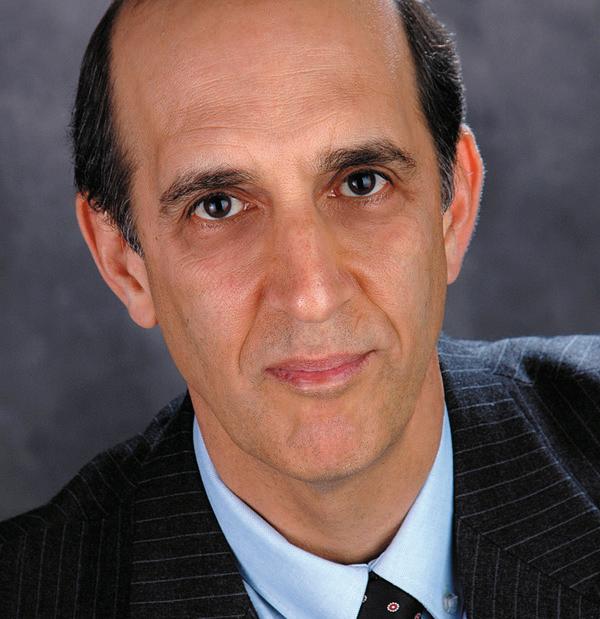
In 2017, during Donald Trump’s first term as president, Dr. Eric Weinstein, renowned mathematician, economist and managing director of Thiel Capital, embarked on an in-depth study of “How and Why Government, Universities, and Industry Create Domestic Labor Shortages of Scientists and High-Tech Workers.” In his 11,000-word final report, Weinstein reveals the shocking reasons the widespread assumption that American STEM graduates would be in high demand in an increasingly technological age turned out exactly the opposite—widespread job loss among U.S. citizens in the tech sector.
“In the late nineties,” writes Weinstein, “in the course of research into immigration, I became convinced that our U.S. high-skilled immigration policy simply did not add up intellectually. As I studied the situation, it became increasingly clear that the groups purporting to speak for U.S. scientists in Washington, D.C.”—he cites the National Science Foundation, the National Academy of Sciences, the Association of American Universities and the Government-University-Industry-Research Roundtable—“actually viewed themselves as advocates for employers in a labor dispute with working scientists and were focused on undermining scientists’ economic bargaining power through labor market intervention and manipulation.”
“By 1998,” Weinstein explains, “it was becoming obvious that the real problems of high skilled immigration were actually rather well understood by an entire class of policy actors who were not forthcoming about the levers of policy they were using to influence policy.” Rather, he writes, they “appeared to be feigning incompetence by issuing labor market studies that blatantly ignored wages and market dynamics and instead focused on demographics alone.”
Weinstein’s conclusions are stunning:
During the late 1990s I became convinced that in order to orchestrate lower wages for scientists, there would have to have been a competent economic study done to guide the curious policy choices that had resulted in the flooded market for STEM PhDs. For this theory to be correct, the private economic study would have had to have been done studying both supply and demand so that the demand piece could later be removed, resulting in the bizarre ‘supply only’ demographic studies released to the public. Through a bit of economic detective work, I began a painstaking search of the literature and discovered just such a study immediately preceded the release of the foolish demography studies that provided the public justification for the Immigration Act of 1990. This needle was located in the haystack of documents the NSF was forced to turn over when the House investigated the NSF for faking alarms about a shortfall.
PROMINENT MATHEMATICIAN/ECONOMIST
ERIC WEINSTEIN UNEARTHS PLOT TO ‘ORCHESTRATE LOWER WAGES’
FOR AMERICAN SCIENTISTS
‘As
the study makes clear, the problem being solved was not a problem of talent, but one of price: Scientific employers had become alarmed that they would have to pay competitive market wages to U.S. Ph.Ds’
It turned out that the study, titled “The Pipeline For Scientific and Technical Personnel: Past Lessons Applied to Future Changes of Interest to Policy-Makers and Human Resource Specialists,” was both undated and had no author’s name attached to it. Weinstein called the National Science Foundation and demanded to speak to the study’s author, and after some obfuscation was eventually put through to an economist named Myles Boylan. Curiously, notes Weinstein, “As the study makes clear, the problem being solved was not a problem of talent, but one of price: Scientific employers had become alarmed that they would have to pay competitive market wages to U.S. Ph.Ds with other options. The study’s aim was not to locate talent, but to weaken its ability to bargain with employers by using foreign labor to undermine the ability to negotiate for new Ph.Ds.”
“That study,” Weinstein reveals, “was a key link in a chain of evidence leading to an entirely different view of the real origins of the Immigration Act of 1990 and the H1-B visa classification.” He explains:
In this alternative account, American industry and Big Science convinced official Washington to put in place a series of policies that had little to do with any demographic concerns. Their aims instead were to keep American scientific employers from having to pay the full U.S. market price of high skilled labor. They hoped to keep the U.S. research system staffed with employees classified as “trainees,” “students” and “post-docs” for the benefit of employers. The result would be to render the U.S. scientific workforce more docile and pliable to authority and senior researchers by attempting to ensure this labor market sector is always flooded largely by employer-friendly visa holders who lack full rights to respond to wage signals in the U.S. labor market.
The correlate of these objectives were shifts in orientation toward building bridges to Asia and especially China, so that senior scientists, technologists and educators could capitalize on technological, employment and business opportunities from Asian (and particularly Chinese) expansion. This, in turn, would
give U.S. scientific employers and researchers access to the products of Asian educational systems which stress drill, rote learning, obedience and test-driven competition while giving them relief from U.S. models, which comparatively stress greater creativity, questioning, independence and irreverence for authority.
Weinstein ends by expressing hope that President Trump will consider revising America’s current visa policies to make them more favorable to Americans and less favorable to major employers who favor cheap, fearful, compliant and obedient foreign workers over Americans. ■
Whistleblower readers may download Eric Weinstein’s entire report at: www. ineteconomics.org/uploads/papers/ Weinstein-GUI_NSF_SG_Complete_ INET.pdf
Clinton, Bush, Obama, Biden
How U.S. administrations enabled India ’ s rise through American systems
A decades-long policy arc that sabotaged America ’ s workforce while advancing India ’ s global economic strategy
UNTIL THE EARLY 1990 s , India was largely seen as an aid-dependent economy, its global identity shaped more by food shortages and foreign assistance than by economic clout.
That changed in the 1990s, when India began liberalizing its economy—with significant support from the United States. President George W. Bush endorsed India’s entry into the global nuclear order, while President Barack Obama formally backed India for a permanent seat on the United Nations Security Council. These moves signaled a shift in Washington’s posture from managing India as a developing economy to positioning it as a strategic partner.
Over the past quarter-century, the United States has gradually built a transnational economic architecture that has given India extraordinary access to American labor markets, investment channels and industrial policy. From Bill Clinton’s administration through Joe Biden’s, U.S. policies presented under the banners of globalization, innovation and partnership helped accelerate India’s global ascent by embedding its workforce and firms into the U.S. economic core. American support gave India legitimacy in multilateral forums, capital access through favorable trade terms and a steady channel of U.S. corporate investment that fueled the rise of its tech and service sectors.
Through visa expansions, bilateral frameworks and deepening public-
private engagements, India transitioned from a trade beneficiary to a structural participant in U.S. labor supply chains. What began as targeted programs in tech and education became a much broader strategy, enabling Indian firms and workers to integrate into many key American sectors. The outcome is a reordering of labor and trade flows with lasting implications for U.S. economic security, competitiveness and policymaking.
It all began under President Bill Clinton, whose policies laid the initial framework for integrating India into America’s labor, technology and trade systems.
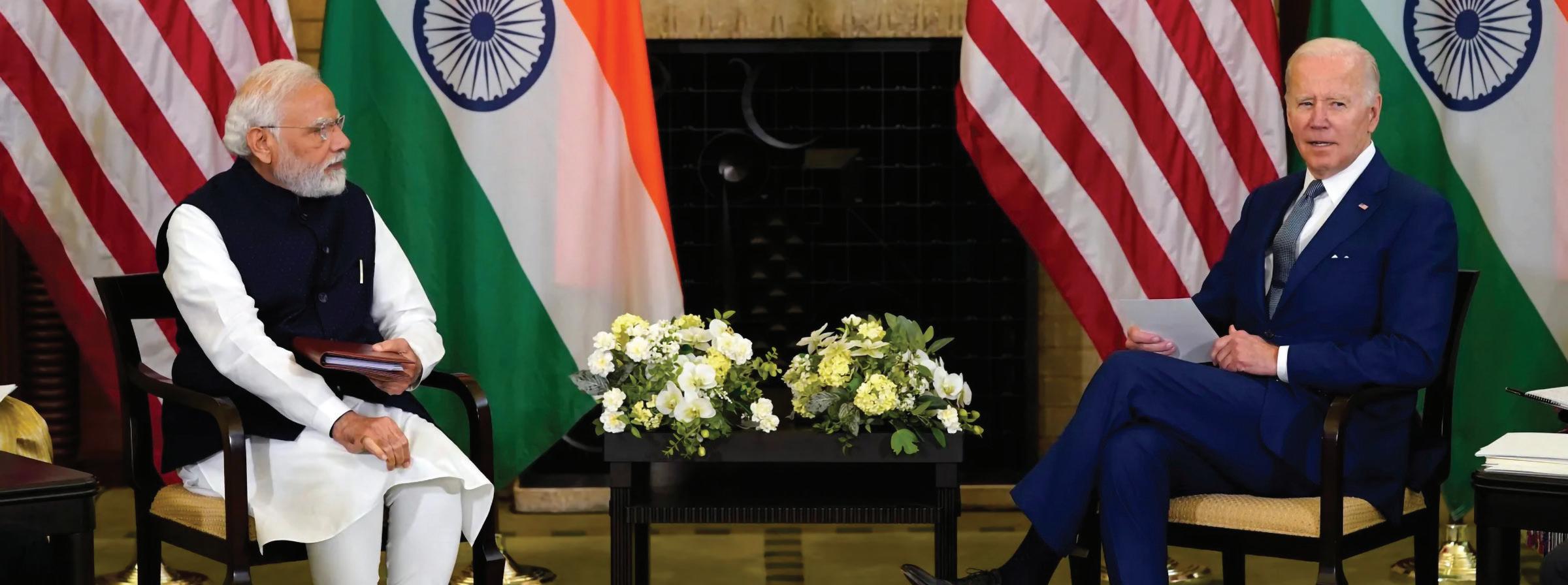
President Joe Biden meets with Indian Prime Minister Narendra Modi , May 24, 2022
CLINTON ADMINISTRATION (1993–2001): DEREGULATION DISGUISED AS DIPLOMACY
“We are a nation of immigrants.” —PRESIDENT BILL CLINTON
Bill Clinton’s 2000 state visit to India helped shift the U.S.-India relationship from one focused on aid to one focused on trade and workforce partnerships. During his presidency, the U.S. increased the number of H-1B visas— temporary work permits for skilled foreign workers. These increases were marketed as a way to fix labor shortages in tech.
At the same time, Clinton warned that this could backfire. He admitted that increasing visa numbers might hurt U.S. workers and allow bad actors to take advantage of the system. But his administration pushed ahead anyway, and Indian outsourcing companies used the expanded visa system to place more workers in U.S. jobs while building operations offshore.
By the time Bill Clinton left office, India’s share of U.S. work visas had surged. Indian companies were firmly embedded in American tech firms. And visa pipelines became a permanent feature of the U.S. labor market, especially in high-skilled fields.
”There is no way to legislate against reality. Outsourcing will continue. . . . We are not against all outsourcing; we are not in favor of putting up fences.” —SEN. HILLARY RODHAM CLINTON
BUSH ADMINISTRATION (2001–2009): LOCKING IT IN
“People do lose jobs as a result of globalization... You don’t retrench and pull back. You welcome competition.” —PRESIDENT GEORGE W. BUSH
Under President George W. Bush, the U.S. deepened its alliance with India, advancing major deals in nuclear energy, defense, science and tech. But behind the headlines, another transformation was unfolding: India’s labor force was becoming structurally embedded in the American economy.
It was also the Bush administration that represented the U.S. in the WTO’s Doha Round negotiations. In 2002, India submitted a formal proposal demanding that the U.S. liberalize its temporary worker visa system, reducing barriers to labor market entry for Indian service professionals. Rather than challenge the framework, U.S. officials engaged in what became a fiveyear debate over how much of the American economy, its jobs, industries and service sectors, could be offered in exchange for limited concessions. India, meanwhile, refused to open its own markets to the same degree. Yet despite the imbalance, the Bush administration pressed forward with bilateral diplomacy, choosing strategic alignment over economic reciprocity. Thus India’s labor export model gained global legitimacy while American job protections were left on the sidelines.
Thus, India’s use of U.S. work visas surged. By 2007:
• Indian nationals made up over 54% of approved H-1B visas
• L-1 visa approvals from India jumped from 9,306 (2000) to 41,000 (2007)
These programs quietly fueled offshoring in tech, customer service, finance and even healthcare. U.S. companies raced to shift jobs overseas:
• IBM’s India workforce grew from 3,000 (2002) to 53,000 (2007)
• Accenture, Microsoft, Oracle and Citigroup followed with mass hiring in India
Meanwhile, offshoring expanded far beyond IT:
• Tax returns prepared in India rose from 25,000 (2003) to 400,000 (2005)
• U.S. hospitals outsourced radiology work to Indian doctors earning $20,000/year, compared to $315,000 for Americans
• By 2007, India’s business process service exports hit $8.4 billion, with 67% driven by U.S. firms
The result: India’s top IT firms, TCS, Infosys, Wipro, Satyam and HCL, became not just contractors, but core infrastructure for Fortune 500 companies and U.S. government systems. Strategic partnership with India was no longer just about diplomacy. It was reshaping the foundation of American employment.
CONTINUED ON PAGE 28
As late-night comedian David Letterman put it, “President Bush is on an eight-day tour of Asia. He’s visiting American jobs.”
OBAMA ADMINISTRATION (2009-2017): BUILDING
THE PIPELINE MUCH BIGGER
”We know that we can’t put the forces of globalization back in the bottle. We cannot bring back every job that’s been lost.” —PRESIDENT BARACK OBAMA
Barack Obama campaigned on protecting American jobs. But once in office, his administration accelerated policies that deepened foreign labor access and empowered global outsourcing, especially through India.
During his 2010 state visit to India, Obama praised India’s rise and endorsed its bid for a permanent seat on the U.N. Security Council. His administration removed multiple Indian firms from the U.S. Entity List, opening the door to sensitive U.S. technologies in defense, nuclear energy and cybersecurity. The message was clear: India wasn’t just a partner, it was now embedded in America’s trade, labor and technology policy.
At home, the shift was just as stark. In 2015, the U.S. Citizenship and Immigration Services (USCIS) began issuing work permits (EADs) to H-4 dependent spouses of H-1B holders, 84% of whom were Indian. A year later, the Department of Homeland Security (DHS) tripled the OPT period for foreign STEM graduates from 12 to 36 months, bypassing the H-1B cap and labor protections. These actions massively expanded employment pathways for Indian nationals without requiring proof that no qualified American workers were available.
The result was a seismic demographic shift. Between the Bush and Obama presidencies:
• H-1B approvals for Indian nationals surged 126.7%, reaching 70% of all such visas by 2016.
• F-1 student visas to India rose 132.6%, driven by OPT.
• H-4 visas skyrocketed 219% after EADs were introduced.
Despite campaign promises, Obama never imposed real restrictions on H-1B abuse or offshoring-linked tax incentives. Instead, U.S. policy increasingly favored global corporations with Indian labor pipelines. India’s share of the U.S. labor market grew, while American workers were left behind. Behind polished language like “shared prosperity,” America’s economic infrastructure was being radically restructured. Indian firms absorbed U.S. contracts, talent pipelines and intellectual property, while keeping their own markets protected.
The U.S. government had the tools to correct the course. But it chose global alignment over American jobs.
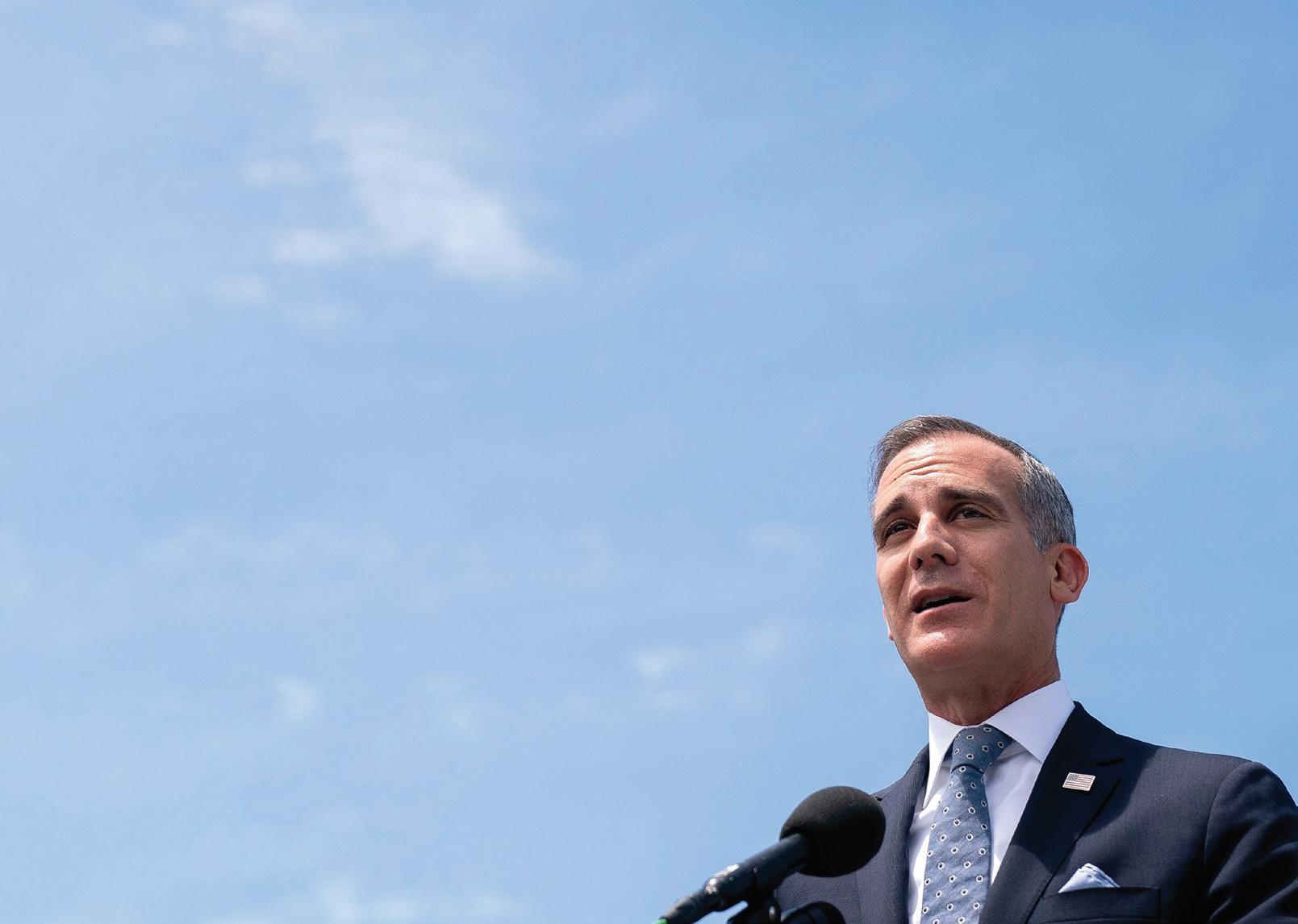
BIDEN ADMINISTRATION (2021–2024): FULL INTEGRATION India is “the most important country in the world to me.” —PRESIDENT JOE BIDEN, ACCORDING TO THEN-U.S. AMBASSADOR TO INDIA ERIC GARCETTI
“President Biden was directly involved in many of the achievements in the IndiaU.S. partnership including the U.S.-India Civil Nuclear Agreement, the designation of India as a U.S. ‘Major Defense Partner’ and the U.S.’ support of India’s permanent membership on the U.N. Security Council. Indian industry feels that with President Biden and Prime Minister Modi at the helm, the two countries would play a strong role in re-shaping the global economic agenda together.” —UDAY KOTAK, PRESIDENT, CONFEDERATION OF INDIAN INDUSTRY (CII)
In 2013, then-Vice President Joe Biden stood in New Delhi and declared, “India is no longer an economic island and will continue to rise as an economic power. ... Together we transformed the bilateral relationship into a global partnership.” He urged both nations to “stay the course.” A decade later, as president, Biden delivered on that promise, advancing a sweeping agenda that restructured U.S. immigration, trade and industrial policy to align with India’s global economic ambitions.
Following Biden’s election in 2020, Indian media and lobbying groups welcomed his presidency as a strategic victory. The U.S.-India Political Action Committee (USINPAC) and other Indian-American advocacy organizations pushed aggressively for expanded visa access and economic integration. One prominent Indian analysis called
the election “a win-win for India,” predicting that no matter the outcome, Washington would move in India’s favor. That prediction proved accurate. The Biden administration acted swiftly to expand immigration pathways that disproportionately benefited Indian nationals. Visa and green card approvals surged, while U.S. companies accelerated offshore hiring. (See “U.S. President Joe Biden: India is ‘the most important country in the world to me’” on page 31.)
KEY CHANGES UNDER BIDEN’S PRESIDENCY INCLUDED:
• H-1B visas awarded to Indian nationals surpassed 78% of all visas worldwide issued by the U.S.
• F-1 student visa usage by Indians grew 386%, aided by changes to Optional Practical Training (OPT)
• H-4 dependent visa approvals rose 240%
• Tens of thousands of green cards were issued at ports of entry through “family reunification”
• The number of foreign-born college graduates employed in the U.S. doubled to 10 million by 2023
These shifts coincided with sweeping layoffs of American professionals in the tech and finance sectors, triggering concern over who truly benefited from the Biden administration’s immigration “reforms.”
Meanwhile, trade and investment flows between the U.S. and India expanded dramatically. Between 2020 and 2024, U.S. imports from India rose by more than 60%, service imports increased by nearly 50% and the trade deficit widened by over 30%. U.S. multinational corporations grew their Indian workforces by 23%, even as they laid off American workers and moved highvalue operations abroad. These moves were actively encouraged by the Biden White House under the policy of “friendshoring,” which positioned India as the preferred destination for supply chain realignment away from China.
This strategic pivot wasn’t just rhetorical. The U.S.-India “Innovation Handshake” launched collaborative efforts in AI and semiconductor development, while a separate agreement between the U.S. Small Business Administration and India’s Ministry of Micro, Small and Medium Enterprises allowed Indian firms to enter U.S. markets with federal facilitation. Though marketed as “mutual partnerships,” these programs often funneled taxpayer-backed incentives into Indian companies without equivalent return for American workers or industries.
India’s top foreign policy officials were transparent about the country’s strategy. In a 2022 speech, External Affairs Minister Dr. Subrahmanyam Jaishankar stated:
“China’s rise is especially instructive for India. ... A competitor willing to take greater risks ... got a decade’s head start in economic growth and a more favorable geopolitical balance.”
That remark reflected India’s own ambition to replicate China’s playbook, leveraging American distraction and strategic openness to capture long-term trade, labor and capital advantages. Under Biden, that plan greatly accelerated. The administration revised visa rules, fast-tracked green card approvals and encouraged federal investment into Indian public-private ventures.
THE COST TO AMERICAN WORKERS AND TAXPAYERS
In 2022, Biden signed an Investment Incentive Agreement (IIA) with India. Within one year, India became the top destination for U.S. International Development Finance Corporation funds: $3.6 billion across 100+ projects, $820 million in new projects by 2023.
Remember when, in 2024, President Biden told Hurricane Helene victims the federal government wouldn’t be providing additional aid? While thousands of American families were left without homes or hope, just days later the Biden administration approved $50 million in housing aid—not for Americans, but for India, to support affordable homes for lower- and middle-income families there.
This wasn’t an isolated act. Under Biden, the U.S. International Development Finance Corporation (DFC) more than doubled its financial
commitments to India, reaching over $9.5 billion. While Americans struggled to rebuild, India reaped the benefits of U.S. taxpayer-backed investments and foreign development priorities.
In defense, the imbalance continued. The Biden-backed INDUS-X initiative, aimed at fostering U.S.–India defense collaboration, directed federal funding into Indian startups like Pixxel, PierSight and Zeus Numerix. Yet India still refuses to sign key nonproliferation treaties or enforce export control safeguards. There are no binding restrictions to prevent misuse or militarization of transferred technologies. At the same time, U.S. firms remain largely locked out of India’s tightly controlled defense procurement ecosystem.
While the “CHIPS and Science Act,” passed by the U.S. Congress in 2022, was promoted as a U.S. industrial policy to boost domestic semiconductor production, its implementation quietly extended major benefits to India. With U.S. taxpayer money, American tech companies receiving CHIPS Act subsidies expanded operations in India rather than exclusively on U.S. soil.
India signed semiconductor collaboration deals with the U.S., including through the U.S.–India “Innovation Handshake,” channeling joint R&D, workforce development and investment directly into Indian firms. Indian semiconductor startups such as Sahasra and Tata Electronics gained global visibility and secured partner access through U.S. government-linked forums, including engagements facilitated by the Department of Commerce.
Ironically, the CHIPS Act helped solidify India’s role in the global semiconductor value chain, even as American workers and manufacturers were led to believe the law’s primary goal was to bring jobs and innovation back home.
By 2024 India processed 1.4 million U.S. visa applications, a record high in
H-4 EAD: An Employment Authorization Document (EAD) issued to the spouses of H-1B workers, allowing them to work in the U.S. without employer sponsorship. Introduced under Obama, this significantly expanded foreign labor access.
ENTITY LIST (U.S. COMMERCE DEPT.): A national security tool that restricts the export of sensitive technologies to certain foreign entities. The Obama administration removed several Indian firms from this list, granting them access to U.S. defense and tech intellectual property.
USINPAC: U.S.-India Political Action Committee, a lobbying organization advancing pro-India policies in Washington, often by influencing immigration, trade and investment laws.
INVESTMENT INCENTIVE AGREEMENT (IIA): An agreement enabling the U.S. International Development Finance Corporation (DFC) to fund private projects in partner countries. Under Biden, billions were directed to Indian initiatives while domestic crises were underfunded.
a single year. India’s services sector added 4 million of 8.1 million new domestic jobs, drove over 55% of value added and secured most foreign direct investment. India gained global labor access, trade dominance and supply chain integration, while maintaining barriers against foreign firms. American policy, driven by geopolitical aims, facilitated India’s rise, but left behind American labor, oversight and leverage.
4 U.S. PRESIDENTS BUILT INDIA’S ECONOMY USING AMERICA’S JOBS AND TAX DOLLARS
From Clinton to Biden, U.S. presidents made decisions that profoundly reshaped the American workforce, redirected taxpayer money and prioritized foreign interests, especially India’s, over that of their own country and its citizens. Clinton expanded visa pipelines that opened
MAKE IN INDIA / ATMANIRBHAR BHARAT: Protectionist programs launched by India to build self-reliance, expand domestic manufacturing and restrict foreign firms. U.S. aid under Biden indirectly funded these programs, despite their barriers to American companies.
CHIPS AND SCIENCE ACT: A 2022 U.S. law that allocated $280 billion to boost semiconductor research and production in the U.S. Despite its reshoring intent, many implementation pathways funneled benefits into India’s tech ecosystem.
INDUS-X: A U.S.–India defense collaboration initiative launched under Biden. Though branded as mutual innovation, U.S. funding helped scale Indian defense startups while India retained restrictions on foreign defense procurement.
“FRIENDSHORING”: A policy strategy encouraging the relocation of supply chains away from adversarial nations (like China) to allied countries (like India). In practice, this enabled more U.S. firms to offshore operations to India with government backing.
the door for offshore labor. Bush negotiated trade deals that locked American jobs into a global system India refused to reciprocate. Obama enabled visa workarounds that displaced U.S. graduates and handed sensitive tech to foreign firms. Biden then completed the handoff, approving aid, contracts and industrial partnerships that fueled India’s rise, even as Americans lost careers, their income and housing.
Each successive administration advanced policies that made India stronger—while leaving American workers to bear the crushing cost. ■
DIVE DEEPER!
To view original source data for WHISTLEBLOWER's exclusive investigative report on “OUTSOURCED AMERICA,” go to WND.com/OutsourcedAmerica and access our archive of compelling documents, charts, graphics and other evidence.
U.S. PRESIDENT JOE BIDEN: INDIA IS ‘THE MOST IMPORTANT COUNTRY IN THE WORLD TO ME’
ON AUG. 22, 2023, diplomat Eric Michael Garcetti, who served as U.S. ambassador to India under President Joe Biden, spoke at the Indiaspora G20 Forum event held in New Delhi.
Garcetti praised and highlighted the close collaboration between the U.S. and India in various fields, from technology to trade to the environment and even to space. And he said President Joe Biden told him India is the most important country in the world to him.
During his keynote address, Garcetti said the following:
U.S. INTERNATIONAL DEVELOPMENT
FINANCE CORPORATION (DFC): The U.S. government’s development bank. It provides financing to private companies in foreign countries. Under Biden, India became the top recipient of DFC funds, surpassing even traditional U.S. development allies.
U.N. SECURITY COUNCIL
SEAT (INDIA): A major diplomatic milestone backed by the Obama and Biden administrations. U.S. support for India’s permanent seat signaled a major geopolitical realignment, but it occurred without any reciprocal commitments from India on trade or labor.
“He (President Biden) told me, when he asked me to come here to serve, he said, this is the most important country in the world to me, I think something that no American president has ever uttered in the history of our two countries. Indian Americans constitute 6% of taxpayers in the U.S.”
Garcetti’s remarks came just a month before Biden’s visit to India for the G20 Leaders’ Summit held in New Delhi.
“From technology to trade, from the environment to women’s empowerment, from small businesses to space, we used to say the sky is the limit,” said Garcetti. “But now that we are working together in space, not even the sky is the limit! From the seabed to the heavens, the U.S. and India are a force for good and a powerful force to move this world forward.”
Regarding his “dream” of living in India, Garcetti said he always wanted to come to the country, live in Bodh Gaya and pursue a Buddhist studies course, reported the Indian media company Asian News International (ANI).
“But politics got in the way. I got elected to the student council and I said I promised I’d serve. So my India dream kind of died, or so I thought. But the universe has a curious way of connecting people and dreams, and now suddenly, I’m living that dream here,” he said. (Watch video above) ■
India ’ s lobbying machine
The hidden force behind U.S. labor and immigration policy
“In this world of all against all, India’s goal should be to move closer towards the strategic sweet spot. Advancing national interests by identifying and exploiting opportunities created by global contradictions, to extract as much gains from as many ties as possible, leveraging the external environment to address bilateral imbalances. Here, the weaker player solicits or manipulates stronger forces to [its] advantage.” —DR. S. JAISHANKAR, MINISTER OF EXTERNAL AFFAIRS, GOVERNMENT OF INDIA
DESPITE BEING ON THE OTHER SIDE OF THE WORLD, the United States hosts the largest Indian diaspora on record, over 5 million strong, thanks to years of lobbying and favorable visa pipelines. Many are enrolled in India’s Overseas Citizen of India (OCI) program, giving them quasi-dual citizenship and positioning them to serve India’s interests, even if they were born and raised in the U.S.
India deploys multiple federal ministries, including External Affairs, Commerce and Skill Development, that are dedicated to influencing U.S. labor and immigration policy. At the center are groups like the Confederation of Indian Industry (CII), NASSCOM and the U.S.-India Business Council (USIBC), which openly lobby U.S. officials to expand visa quotas, ease tech transfer restrictions and shape trade rules in India’s favor. These groups are reinforced by diaspora-led organizations like USINPAC, Indiaspora and the Overseas Friends of BJP, which mobilize Indian-American voters, fund campaigns and help drive narratives in Washington.
But India’s lobbying doesn’t stop at the federal level. State-level chambers of commerce, especially in New Jersey, California, Florida and Texas, sign memoranda of understanding with Indian ministries, welcome business delegations and build investment pipelines that literally prioritize Indian interests over American workers. Groups like the Asian American Hotel Owners Association (AAHOA) and regional Indian cultural councils exert major polit-
ical influence through donations, voter blocs and regulatory lobbying. Through this apparatus, India has quietly gained influence over U.S. policies on labor mobility, outsourcing, tech transfer and trade. This campaign is often framed as “partnership,” but the real objective is to promote India’s rise—even at America’s expense.
STRATEGIC LEVERAGE: HOW INDIA USED PROMISES OF TRADE TO EXTRACT U.S. TECHNOLOGY AND CAPITAL India’s success in shaping U.S. immigration policy through global trade forums was only the beginning. Over the following decades, it expanded this model, using prom-
ises of trade, investment and strategic alignment to unlock access to American technology, capital and defense infrastructure. What resulted was a series of one-sided agreements that transferred critical U.S. assets to India under the illusion of mutual benefit.
“I can confirm that we will be complying with all requirements of the request for proposal (RFP) we have received from the Indian Air Force and that includes technology transfer for the AESA radar. We are very well positioned to establish a longterm relationship with the Indian Air Force and the Ministry of Defense.” —CHRIS CHADWICK, PRESIDENT, BOEING INTEGRATED DEFENSE SYSTEMS
The Boeing-India agreement was a defining example, when Boeing, under pressure to secure India’s $10+ billion fighter jet contract, agreed to transfer the classified AESA radar system to India’s state-run Hindustan Aeronautics Limited (HAL). Initially deemed too sensitive for export, the technology was offered anyway, alongside a phased plan to shift manufacturing to India, producing up to 30,000 components there by 2020.
As Boeing’s president, Chris Chadwick, stated, “We are very well positioned to establish a long-term relationship with the Indian Air Force and the Ministry of Defense.” India’s 50% offset requirement for large defense contracts effectively forced such transfers, turning the U.S. defense partnerships into
a pipeline for Indian industrial gain. India’s carefully constructed image as a rising innovation powerhouse masks a stark gap in performance. Despite aggressive selfpromotion, India ranked just 40th in the 2022 Global Innovation Index, trailing far behind its Western and Asian competitors. In truth, India’s rise has depended not on breakthrough innovation or open markets, but on extracting what others have built, technology, capital and access through promises of partnership it rarely honors.
As India’s defense ministry once stated alongside CII: “It reflects the power India can wield ... by being ready to spend multi-billion dollars on a single deal.” ■
Indian Air Force: Boeing delivers 11th C-17 Globemaster to India
Corporate leverage: How India’s IT firms became weapons of policy and pressure
INDIA’S MULTINATIONAL TECH CORPORATIONS —firms like Infosys, Tata Consultancy Services (TCS), Wipro and Cognizant—opened U.S. delivery centers, hired a token number of local employees and showcased these sites as symbols of “mutual benefit” in the context of U.S.-India economic ties. But behind the marketing narrative, their operations were built on a different model: a neverending pipeline of foreign labor.
These companies staffed their U.S. centers primarily with Indian nationals on temporary visas, H-1B, L-1, B-1 and OPT, while systematically displacing American workers and offshoring contracts under the banner of “globalization.”
“Infosys, for instance, is said to have almost 90% of their 15,000 employees in the U.S. on such visas. If these visas become too expensive to obtain, it will compel Indian IT companies to significantly alter their business models. They will either have to hire many more local Americans, which would be expensive, or find ways to do more work offshore. Any such changes would put Indian IT companies at a disadvantage against their global competitors who have a strong American presence.”
—AMEET NIVSARKAR OF NASSCOM
Even as Indian companies admitted their dependence on imported labor, they publicly claimed to be creating American jobs. In WTO filings and U.S. trade talks, India promoted these firms as pillars of U.S.-India cooperation while privately threatening to offshore even more work if visa rules were tightened.
These corporations were not neutral economic players. They operated in tandem with Indian government ministries, academic institutions and trade bodies to implement India’s workforce export model. Their executives regularly appeared at diaspora events like the Indian holiday “Pravasi Bharatiya Divas” and used India’s Overseas Citizenship of India (OCI) program to maintain strategic influence over Indian-origin professionals embedded in American institutions.
With decades of state support, these companies perfected the offshoring model. TCS and Infosys pioneered 24/7 development cycles through hubs in Bangalore and Hyderabad, shifting sensitive U.S. contracts, sometimes involving defense, healthcare and finance, to India. Cognizant, Wipro and Tech Mahindra followed suit, taking over
Working at Infosys Limited, USA
high-value government and corporate work and quietly relocating execution to India.
India’s narrative management was deliberate. Public-facing reports like “India Roots, American Soil” framed these companies as job creators. But behind closed doors, executives admitted that hiring Americans was “too expensive” and that visa limits would simply trigger more offshoring. Their strategy was to normalize labor arbitrage while covering up the massive scale of American displacement.
When some U.S. lawmakers attempted reforms, India responded swiftly and aggressively. In 2015, the Confederation of Indian Industry (CII) denounced new visa fees for heavy users as “highly discriminatory and punitive” and “specifically geared towards India and Indian-centric technology companies,” while insisting that “visa fees should be applied in a non-discriminatory, non-protectionist manner to all companies that use the visa programs.”
When portraying Indian companies as victims didn’t block reforms, India escalated its response: Officials resorted to economic threats.
Ron Somers, then-president of the U.S.-India Business Council (USIBC), blasted the reforms in lockstep with CII:
“Unfortunately, Congress has targeted Indian firms and used them to pay for unrelated U.S. initiatives by imposing large and discriminatory fee increases on 50/50 firms,” he said, referring to companies whose U.S. workforce was made up of 50% or more visa holders.
India even issued direct threats. If the U.S. moved to restrict foreign labor use, American companies operating in India could face backlash. The
message was clear: If you protect U.S. workers, your companies will pay the price abroad.
“The specific targeting of Indian companies could create unintended consequences, including a backlash against U.S. companies operating in India,” they warned.
At the same time, industry lobbyists like Somers polished the campaign with softer language, pushing for more access in the name of cooperation: “We hope that the Congress and Administration will work constructively with the private sector to design an H-1B visa program that fosters deeper trade and investment and drives continued growth, job creation and innovation here in the United States.”
However, the goal wasn’t cooperation. It was protection of a foreign labor pipeline at all costs. ■
The transparency deficit
FOR MANY YEARS, certain major companies have been held up as India’s justification for deeper access to the U.S. labor market. They have played the victim, crying discrimination when their visa access was challenged, distorting the economic reality of offshoring and benefiting from layers of lobbying and legal protections that American workers could not match. Much of this process occurred under the radar, aided by a lack of transparency and a revolving door of corporate influence. Indeed, immigration policy in the United States is now shaped more by foreign-funded lobbying groups and offshore firms than by the very workers it’s supposed to protect. They include the following:
U.S. Litigation History
2011: Charged with H-1B abuse and citizenship discrimination
2008–20: Wage & Hour violations; wage theft fines for over $6 million
2019–25: FCPA violations – $2 million bribe to Indian government
2021: Shareholder bribery settlement
2023: Visa fraud whistleblower –ongoing
2017–24: DOJ lawsuit for discrimination against U.S. citizens
2013: Visa/I-9 fraud –$34 million settlement
2019: CA visa/tax fraud settlement –$800,000
2019: Securities class action –active/settled
2023–25: McCamish data breach –$17.5 million settlement + lawsuits
2024–25: Trade secrets case with Cognizant – ongoing
Employer Immigration Profile: Offshore Business Model
Employer Immigration Profile: H-1B History
Employer Immigration Profile: L-1 Visa History
Employer Immigration Profile:
Employer Immigration Profile: Green Card History
202,878 H-1B petitions
8,129
5,122
10,504
The silent takeover of U.S. companies
INDIA HAS NEVER HIDDEN THE FACT that its relationship with the global Indian diaspora is strategic. This isn’t about culture or pride; it’s about power. Whether through lobbying, influence campaigns or investment schemes, India has designed a global system where Indian-origin individuals, especially in the U.S., are activated to serve India’s national goals.
The Indian government refers to its diaspora as “investible”—that is, as a resource to be leveraged. This includes:
• Intellectual capital (tech CEOs, engineers, researchers)
• Political influence (elected officials, donors, policy advisers)
For example, the nation’s Overseas Citizenship of India (OCI) program gives foreign nationals of Indian origin a privileged legal and economic foothold inside India. This dual-access system is not available to the average American. It creates a class of individuals who can influence public policy in the U.S. and profit in India, often on both ends of the same deal.
This isn’t speculation: India has openly encouraged its diaspora to push favorable policy abroad and to redirect investments and technology back home. Indian-origin CEOs, political donors, academics and even elected officials are described as “assets” by Indian agencies tasked with advancing India’s global position. These individuals operate as unofficial ambassadors, helping India gain access to contracts, capital and global influence.
This strategy is playing out in real time. Some of the most powerful companies in America are now led by Indianorigin executives who have deep ties to India’s development agenda. Under their leadership, billions in U.S. corporate investments have been funneled to India, along with jobs, research centers and innovation that once supported American workers and communities.
Google CEO Sundar Pichai
SUNDAR PICHAI (GOOGLE CEO 2015 TO PRESENT)
Directed over $10 billion into India via “Digital India.” Opened major R&D hubs in Bangalore and Hyderabad while cutting American jobs.
SATYA NADELLA (MICROSOFT CEO 2014 TO PRESENT)
Announced a $3.3 billion investment in India’s AI ecosystem in 2024, during mass U.S. layoffs. Microsoft India now anchors its global delivery and engineering operations.
ARVIND KRISHNA (IBM CEO SINCE 2020 AND CHAIRMAN SINCE 2021)
Shifted IBM’s core business to India, where it now employs more people than in the U.S. The company is actively working to transition as many roles as possible to India. IBM CEO Arvind Krishna has previously highlighted the country’s importance as a global technology hub and the latest job cuts are expected to further increase hiring efforts in India, particularly in cloud computing, infrastructure, consulting and sales roles. It currently advertises more job openings in India than in the U.S., signaling its ongoing commitment to move many of its operations to the region.
SANJAY MEHROTRA (MICRON TECHNOLOGY CEO 2017 TO PRESENT)
In 2023, Micron laid off about 10% of its global workforce, including substantial U.S. headcount reductions (voluntary layoffs, salary cuts, halted bonuses) amid semiconductor demand decline. Mehrotra led a $2.75 billion investment in India’s semiconductor industry, while U.S. facilities face cuts.
All of this isn’t coincidental. It’s the result of a coordinated, government-backed strategy. India has used the U.S. work visa system to funnel Indian nationals into American companies, gain insider access and embed influence networks at the highest levels. Meanwhile, Indian-origin CEOs have steered corporate resources, strategic projects and workforce development into India, displacing American talent in the process.
India’s own official documents confirm this intent. The goal is not just influence, but dominance. And thanks to decades of very favorable policy, legal frameworks like the OCI program and deep diaspora integration into American institutions, it’s working. What was once American intellectual property, innovation and opportunity is now being exported and rebranded as Indian growth.
These are not just names on a corporate roster. They are conduits in a
global system designed to extract value from America and reroute it to India, with full legal protection and zero accountability to the American people.
THE FOREIGN ENTERPRISE OPERATING INSIDE AMERICAN GATES
From Silicon Valley boardrooms to the halls of Congress, Indian-origin power brokers, CEOs, lawmakers, policy advisers and bureaucrats have
SHANTANU NARAYEN (ADOBE CEO DECEMBER 2007 TO PRESENT)
2022–2023: Public statements confirmed Adobe’s intent to run global operations from India’s regional headquarters in Noida/Bangalore.
RAGHU RAGHURAM (FORMER CEO OF VMWARE)
Expanded VMware’s India engineering footprint, centralizing core infrastructure development in Bangalore.
ANJALI SUD (VIMEO CEO JULY 2017—AUGUST 2023)
Advocated remote-first and outsourced talent model. Supported tech and product development from India-based teams during major U.S. restructuring.
NIKESH ARORA (PALO ALTO NETWORK CEO 2018 TO PRESENT)
Invested heavily in security R&D and partnerships, including major expansion in Bangalore engineering operations; U.S. headcount impact less clear due to public filings veiling location data.
REVATHI ADVAITHI (FLEX CEO 2019 TO PRESENT)
Expanded manufacturing and logistics in India as part of Flex’s “India-first” global supply chain model.
quietly but consistently advanced India’s interests from inside the very institutions meant to serve the United States and its citizens.
When Indian-origin lawmakers advocate for unlimited foreign worker visas, when U.S. tech executives shift jobs and intellectual property to India, when Indian-linked nonprofits and trade coalitions help rewrite American policy to benefit India’s economy, and when influential legal and academic advisers appear at Pravasi Bharatiya Divas celebrations to pledge loyalty to India’s growth, this is not representation. This is foreign alignment. And when that alignment weakens American competitiveness and security, it becomes a direct threat.
No sovereign nation would tolerate another country’s operatives, regardless of how they are packaged, redirecting its economic systems, workforce pipelines and legislative priorities to serve a foreign agenda. While China’s influ-
ence operations have sparked widespread investigations, hearings and legislative countermeasures, India’s influence has been veiled in the language of democracy, diplomacy and friendship. Yet India’s model is built on the same mechanisms: visa abuse, intellectual property extraction, regulatory capture, diaspora loyalty and trade manipulation. ■
Key U.S. officials advocating pro-India policies
INDIA’S EXPANDING INFLUENCE IN AMERICAN POLITICS has not been limited to diplomats or trade envoys; it has been significantly advanced through Indian-origin U.S. political figures who actively advocate for India’s economic, labor and geopolitical priorities.
These individuals often promote policies that mirror India’s foreign policy demands, from visa expansions to technology cooperation, and are frequently highlighted by Indian media and government-backed diaspora campaigns as strategic assets.
Indian consulates, trade bodies and diaspora groups such as the U.S.-India Business Council (USIBC), Indiaspora and USINPAC maintain close relationships with these elected officials, treating them as extensions of India’s soft power apparatus. They include:
U.S. REP. RO KHANNA, D-CALIF.
A key figure representing Silicon Valley, Khanna has maintained deep coordination with Indian government officials. He has advocated for greater tech and labor integration, supported H-1B expansion and spoken at multiple diaspora forums aligned with India’s national strategy. Khanna has positioned himself as a congressional liaison for deepening U.S.-India innovation ties.
U.S. REP. AMI BERA, D-CALIF.
A longtime member of the House Foreign Affairs Committee, Bera has championed the U.S.-India defense, health and trade partnerships. He supports expanded visa access for Indian workers and regularly participates in consular and diaspora engagements that promote India-centric cooperation.
U.S. REP. RAJA KRISHNAMOORTHI, D-ILL.
Krishnamoorthi has endorsed lifting visa caps for Indian nationals, advocated for trade policies favorable to India and routinely appears at economic forums focused on U.S.India business alignment. His positions echo India’s priorities in global labor mobility and market access.
U.S. REP. PRAMILA JAYAPAL, D-WASH.
Jayapal has introduced and supported immigration reform bills that would remove per-country caps, ease green card backlogs and increase family-based migration, all measures that overwhelmingly benefit Indian nationals. While she has occasionally critiqued India’s domestic politics, her legislative focus remains favorable to India’s demographic and policy goals.
U.S. REP. SHRI THANEDAR, D-MICH.
Thanedar has publicly promoted closer ties with India and has received diaspora political support. His rhetoric and outreach emphasize bilateral investment, business collaboration and policy alignment in ways that support India’s economic rise.
U.S. REP. SUHAS SUBRAMANYAM, D-VA.
Since his 2024 election, Subramanyam has been welcomed by Indian media and consular networks as a key political asset. He has expressed support for bilateral cooperation on technology, immigration and innovation that aligns with India’s global workforce and tech export strategies.
VIVEK
RAMASWAMY,
PUBLIC FIGURE, 2026 REPUBLICAN CANDIDATE FOR OHIO GOVERNOR
Ramaswamy, a Hindu, has publicly supported the U.S.-India technological and defense alignment and echoed India’s push for strategic partnership and greater access to U.S. markets, capital and intellectual property. He has been widely celebrated in Indian media and at diaspora forums as a future power broker in U.S.-India affairs. Ramaswamy criticized American culture for “venerating mediocrity over excellence,” arguing that this mindset contributes to a shortfall in top-tier engineering talent domestically. His comments place him at the intersection of political and cultural debates over immigration, meritocracy and America’s role in attracting global talent.
Each of these officials has, in public and legislative forums, aligned themselves with policies that reflect India’s stated trade, immigration and innovation goals. Whether through support for expanded foreign worker access, advocacy for bilateral tech investment, or alignment with India-funded lobbying groups, their roles reinforce India’s strategic influence over U.S. policymaking. While individual actions may be framed as serving “shared interests,” the structural impact has disproportionately favored India’s labor export model and economic rise, often at the expense of American workers, industries and policy autonomy. (See White House Deputy Chief of Staff Stephen Miller’s take on India’s “cheating on immigration policy” on page 42.) ■
TRUMP AIDE STEPHEN MILLER VENTS ON INDIA:
‘THEY ENGAGE IN A LOT OF CHEATING ON IMMIGRATION POLICY
THAT IS VERY HARMFUL TO AMERICAN WORKERS’
ON A RECENT BROADCAST of Fox News Channel’s popular “Sunday Morning Futures” show, White House Deputy Chief of Staff Stephen Miller rattled off a host of very troubling policies in which India is currently engaged.
While discussing President Trump’s difficulty in bringing Russia’s three-and-a-half year war on Ukraine to an end, Miller said:
“So now we’re in a position of economic strength, to deal with Russia and to deal with this war that [Trump] inherited from Joe Biden, who is responsible for this travesty. The whole Democrat Party is responsible for this travesty in Europe. So what [Trump] said very clearly is, that it is not acceptable for India to continue financing this war by purchasing the oil from Russia.
“People will be shocked to learn that India is basically tied with China in purchasing Russian oil. That’s an astonishing fact.
“India portrays itself as being one of our closest friends in the world, but they don’t accept our products, they impose massive tariffs on us, we also know they engage in a lot of cheating on immigration policy that is very harmful to American workers. And of course we see, again, the purchasing of [Russian] oil.
“So President Trump, he wants a tremendous relationship, and has had always a tremendous relationship with India and the prime minister, but we need to get real about dealing with the financing of this war.” (Watch video above) ■
The system takeover
When Silicon Valley left America
“Big Tech operates on the model of ‘do whatever you want and count on the lobbyists and the lawyers to fix it later.’ They do not care about the rule of law. They do not care about America. They don’t care about freedom. They certainly do not care about working people. They care about POWER and they care about MONEY.”
—U.S. SEN. JOSH HAWLEY, R.-MISSOURI
OVER THE LAST TWO DECADES, India created a plan to get its workers into high-paying tech jobs in the U.S. This wasn’t random. It was built step-by-step, with the help of America’s biggest tech companies, Microsoft, Amazon, Meta, Google and others.
“We are aiming to provide skill training to the one lakh [100,000] students in the next year. The main objective of the program is to train the students to complete their education, improve other skills and get jobs successfully. It was first-of-its-kind of program to train students with Amazon support in the country. The state government is providing skill training to students and unemployed youth with large organizations like Siemens, Dassault, Google and Amazon across the state.”—KOLLU RAVINDRA, MINISTER FOR LAW AND JUSTICE, SKILL
DEVELOPMENT, GOVERNMENT OF INDIA
These companies signed formal agreements called Memoranda of Understanding, or MoUs, with the Indian government. These MoUs allowed India to set up large-scale training programs, job pipelines and recruiting systems designed to feed workers into U.S. companies. While American workers were being laid off, these same tech companies were investing heavily in training Indian workers.
Although India called this “skill development,” it ended up giving India influence over who gets hired in the U.S. tech sector.
HOW INDIA GOT INSIDE THE U.S. HIRING SYSTEM
• India didn’t just train workers. It built systems to make sure they got hired, even ahead of Americans.
• India signed deals with job platforms like LinkedIn and Monster.com, giving them access to millions of Indian students.
• These platforms used AI to help Indian students build resumes and apply for jobs around the world, including in the U.S.
• LinkedIn, which is owned by Microsoft, created a program in India that let students apply for global jobs even without traditional college degrees.
• Indian platforms also trained students to beat resume software used by U.S. companies, teaching them how to use keywords and formatting to get through the filters.
Why does this matter? Because job platforms like LinkedIn are the main way people find jobs today. When those platforms work with foreign governments, it gives those countries a head start in the hiring race.
HOW INDIAN RESUMES WERE MADE TO WIN India trained students not just in skills, but in how to beat resume filters. Students learned how to:
• Copy the exact keywords from U.S. job ads
• Add fake or exaggerated experience
• Use fast-track certifications to look qualified
These certifications weren’t always backed by real job experience, but they helped candidates get through the software filters that screen applications.
WHY WOULD INDIA WORK THIS HARD TO SEND WORKERS ABROAD? Because it’s part of a bigger plan, a strategy India calls “brain gain”:
• Train workers using global standards.
• Send them to rich countries (like the U.S.) through work visa programs.
• Have them send money back, build India-based companies and eventually return home with knowledge and business connections.
India has even placed corporate executives in college classrooms to make sure students are being trained for the exact jobs U.S. companies want.
HOW U.S. COMPANIES HELPED BUILD THIS SYSTEM
“Companies in the West prefer to hire Indians. The relationship between Indian workers and businesses abroad is mutually beneficial. Abroad companies rely on Indian talent because there is a shortage of skills in their country.”
—MINISTRY OF LABOR AND EMPLOYMENT, GOVERNMENT OF INDIA
These tech companies weren’t just hiring foreign workers. They were involved in designing the whole system—helping write the training programs, build the job boards, run the resume filters and shape the hiring process.
Here are some examples of what they did:
• MICROSOFT launched a program to train 10 million Indians in AI and cloud skills, with a $3 billion investment.
• AMAZON held hiring events across India and used Indian job boards to recruit for jobs that could have gone to Americans.
• META (FACEBOOK) signed an agreement to train Indian professionals in AI and gave India access to its AI tools.
• SALESFORCE, CISCO AND ADOBE all signed deals to train and hire Indian professionals in areas like cybersecurity, software and digital operations.
These deals were signed between 2018 and 2025 and each one gave India more access to U.S. hiring systems through long-term government-to-corporation partnerships that continue to shape the future of hiring.
‘DIVERSITY, EQUITY AND INCLUSION’ PROGRAMS SERVE AS A HIRING WORKAROUND
India also tapped into U.S. corporate diversity goals. U.S. companies often fawn over their commitment to “Diversity, Equity and Inclusion” (DEI), and India exploits that language to market its workforce. For example:
• Programs like Microsoft and SAP’s “TechSaksham” have trained tens of thousands of Indian women in AI and cloud computing.
• Amazon’s “Women of the World” initiative has created job funnels for Indian women in cybersecurity and software.
These programs have been described as helping women, but they also create hiring pipelines for foreign workers at a time when American women in tech have faced layoffs. (See “Immigration policy plus DEI: A toxic combination that’s ruining American lives” on this page.) ■
IMMIGRATION POLICY PLUS DEI
: A TOXIC COMBINATION THAT’S RUINING AMERICAN LIVES
AMERICAN ENTREPRENEUR and software engineer Marc Lowell Andreessen played a pivotal role in shaping the early internet, having co-created the first widely used web browser with a graphical user interface, Mosaic.
Recently, the “American Optimist” podcast, hosted by billionaire venture capitalist and entrepreneur Joe Lonsdale, brought Andreesen on as a guest. In less than one minute, Andreesen described how the lethal combination of bad U.S. immigration laws and DEI—that is, “diversity, equity and inclusion,” the neo-Marxist framework designed to make white people feel guilty for being white and to favor so-called “marginalized” and “underserved” communities—literally is destroying the futures of countless young Americans.
MARC ANDREESSEN: “Nobody wants to talk about it, but I’ve started to talk about the intersection of DEI and immigration that has really warped our perceptions on high-skilled immigration over the last 50 years. You look at the foreign enrollment rates at the top universities, which went from 2 or 3 or 4 percent 50 years ago or whatever to 27% or 30% or 50% ...”
JOE LONSDALE: “Columbia’s over half ...”
MARC ANDREESSEN: “… 70% or whatever it is. And so there’s been this massive transformation in who gets educated. And then there’s been this massive transformation of who gets admitted through affirmative action and—as we now know it—DEI. This goes straight to the political divide in the country, which is: If you’re parents of a kid where I grew up [rural Wisconsin] and you’ve got a smart kid and you think you’re going to get them into, you know, a top university in this country, like you’re fooling yourself.
“There is this really fundamental question, which is: What level of untapped talent exists in this country that a combination of DEI and immigration have basically cut out of the loop for the last 50 years? And how long can we have this story to everybody in the Midwest and in the South that says, ‘Sorry, because of historical oppression, your kids are SOL.’” (Watch video above) ■
When foreign labor actually took hands-on control of America ’ s labor system
THE U.S. DEPARTMENT OF LABOR (DOL) is supposed to defend the American workforce. But behind closed doors, it has outsourced the very systems that control who gets to work in this country, handing them over to private contractors, many of whom staff their projects with foreign workers on H-1B visas.
One system in particular, the Foreign Labor Application Gateway (FLAG), has become the backbone of employment-based visa processing. It handles H-1B applications for temporary specialty workers and the PERM process that enables those workers to apply for green cards and permanent residence. In short, FLAG is the gatekeeper for foreign labor access to the U.S. job market.
But the public never voted to hand that gatekeeping role to H-1B-staffed private contractors.
The very people who benefit from importing foreign workers are now the ones running the systems that decide whether more are allowed in. This is not theoretical, but is confirmed by Labor Department contracts and performance records. The contractors building and maintaining these systems, some of them Indian outsourcing firms, are themselves among the biggest users of employment-based visas.
This presents an obvious conflict of interest: How can the system be trusted to protect American workers if it’s being engineered by those who profit from bypassing them?
FOREIGN-BUILT, FOREIGN-OPERATED AND OPTIMIZED FROM WITHIN
In 2023, a website appeared called PERMtimeline.com. It was marketed to immigrants and foreign job seekers looking for updates on green card progress and labor certifications. But the site did more than track timelines; it was
publishing real-time data pulled directly from the U.S. Department of Labor’s systems, showing live case progress weeks or even months ahead of when the government makes such data public.
Its founders said so themselves: “Our platform utilizes the Department of Labor’s query system to deliver accurate and timely data. … As immigrants ourselves, we deeply understand the uncertainty and stress associated with this process.”
That raises a serious question: How did they get that access? Who gave it to them? And how could that be legal?
This immigrant-run platform gave foreign nationals an insider’s view into the labor pipeline, while everyday Americans, the very people these jobs should benefit, are left in the dark. The Department of Labor’s public-facing disclosure site reveals only a portion of cases, and that only after final decisions are made.
PERMtimeline, by contrast, shows case data up to nine months ahead.
This is a naked data leak, not a transparency tool. And it’s coming from inside the system.
THE LABOR DEPARTMENT’S SECRET RULE CHANGES
In February 2025, DOL quietly updated the FLAG platform. The update included a provision allowing employers to withdraw PERM cases after they had already requested government review, so long as the case had not yet been forwarded to the Board of Alien Labor Certification Appeals (BALCA).
In other words: If the employer feared rejection, or was caught violating fair recruitment standards, it could hit delete, wiping the case from public view, removing it from DOL’s audit trail and keeping it out of official reports. The system now allows failed labor certifications to be scrubbed from history.
At the same time, the Department of Labor removed key disclosure fields from its PERM data files. The old version of Form 9089 record layouts included job descriptions, skill requirements and education credentials, details that watchdogs could use to detect discrimination, fraudulent recruitment, or fake job postings meant only for visa workers.
BOUGHT AND PAID FOR: HOW THE U.S. DEPARTMENT OF LABOR WAS CAPTURED BY CORPORATE LOBBYISTS
While American workers were locked out of their own labor system, the gates were wide open for another group—the lobbyists. Behind every policy shift, rule change and data blackout lies a well-funded influence machine, one
that directs millions of dollars into lobbying the very agency tasked with defending the U.S. workforce— namely, the Department of Labor.
What most Americans don’t realize is that the Labor Department doesn’t just receive policy direction from Congress; it is also subject to intense corporate lobbying efforts, often by the very firms that profit from visa expansion and labor arbitrage. These are the same companies displacing U.S. workers, outsourcing American jobs and building the visa systems from within.
According to data from the Senate Lobbying Disclosure database and OpenSecrets, over the last decade major visa-dependent corporations and immigration law firms have funneled tens of millions of dollars into lobbying efforts focused on the Department of Labor.
According to data from the Senate Lobbying Disclosure database and
CONTINUED ON PAGE 48
‘INDENTURED SERVITUDE’:
GOV. RON DESANTIS ATTACKS H-1B VISA PROGRAM AS ‘TOTAL SCAM’
‘A lot of these Republicans say, You can have a million people plow in. As long as it’s legal, that’s good. Is that REALLY good?’
FLORIDA GOV. RON DESANTIS recently attacked America’s current H-1B visa program, highlighting the practice of U.S. companies firing American workers to hire cheaper foreign employees.
Said DeSantis: “A lot of these Republicans say, ‘You can have a million people plow in. As long as it’s legal, that’s good.’
“Is that really good?” asked the Florida governor. “Doesn’t it depend on WHY they’re coming in? Like for example, you have some of these tech companies that are laying off American workers and then they’re importing H-1B visa people to work for cheaper. I think that’s a TOTAL SCAM.”
DeSantis added: “Is that good policy for us as a country—to have Americans put out of work, and then to bring in H-1B visas? And then you have chain migration from the H-1B, so H-1B is bringing in other folks.”
As for the foreigners taking jobs from Americans, De-Santis added, “It’s almost like indentured servitude, because you can’t leave the company—and the companies love it because they save a lot of money off of it.
“But that’s not putting American people first.”(Watch video above) ■
OpenSecrets, over the last decade major visa-dependent corporations and immigration law firms have funneled tens of millions of dollars into lobbying efforts focused on the Department of Labor. Their goals are clear: Block visa caps, weaken labor market tests, hide recruitment data and keep the green card pipeline wide open.
This money isn’t just symbolic; it has real-world consequences. When the Department of Labor issued new guidance allowing PERM employers to withdraw cases without audit trail exposure, there was no public debate, no congressional oversight and no worker protections considered. But inside lobbying reports, those rule changes had already been requested months in advance.
A MODERN-DAY RETURN OF INDENTURED SERVITUDE
In 2024, a record 1.33 million Indian students went overseas for higher education, with 1.32 million in 2022. The U.S. foreign student program was established to allow qualified international students to temporarily enter America “solely for the purpose of pursuing a full course of study.” However, this program has increasingly been repurposed into a de facto foreign worker pipeline, driven not by educational goals but by lobbying from corporations seeking access to lower-cost labor.
The Optional Practical Training (OPT) and STEM OPT programs, which began as short-term internships, now authorize foreign nationals to work in the U.S. for up to three years after graduation, without the wage protections or caps that apply to traditional employment-based
visas like H-1B. Notably, Microsoft, Amazon, Google and Meta are among the top employers of these foreign student workers, with India representing the largest country of origin. In 2024 alone, nearly 1.6 million foreign students were registered in the U.S. and 381,140 had employment authorization through some form of practical training. The STEM OPT population grew to 122,101 workers by 2023, far beyond the 12,000 annual applicants originally projected by DHS when the program launched in 2008.
The consequences of this transformation are significant. The program literally incentivizes employers to hire foreign students over U.S. graduates by offering payroll tax exemptions, resulting in an estimated $4 billion in lost Social Security and Medicare revenue annually. Oversight is also dangerously weak: More than 7,400 ICE-certified schools depend on Designated School Officials (DSOs) to manage student records, but many face institutional pressure to avoid strict compliance. Fraudulent practices such as “Day 1 CPT,” which allow foreign students to work immediately upon arrival, further erode the program’s academic foundation. Meanwhile, national security concerns mount as foreign nationals work in sensitive sectors without the scrutiny that accompanies standard employment visas.
The Optional Practical Training (OPT) and STEM OPT programs have become permanent backdoors into the American labor market. For many Indian nationals, OPT is no longer an educational bridge; it’s a recruitment mechanism, feeding pre-selected candidates directly into the hands of offshore-driven employers. Staffing firms and tech service providers routinely bypass fair recruitment standards by prearranging offers through student visa holders, securing pliable labor at reduced wages without offering the same opportunities to qualified American candidates.
And it doesn’t stop there. Under the guise of nonprofit education and research, many entities have exploited the H-1B cap-exempt loophole. The H-1B visa cap was created by Congress to limit the number of foreign workers entering the U.S. annually, capped at 85,000 since 2004. But a major exemption was carved out for nonprofit research institutions, government
labs and universities. This exemption, originally intended to support academic research and public interest work, has now become a legal backdoor. Today, for-profit companies can bypass the cap entirely by partnering with nonprofit “hosts” and hiring foreign workers under concurrent employment agreements.
Behind these models lies a disturbing trend: a modern-day return of indentured servitude. Many Indian workers brought into the U.S. under OPT, cap-exempt H-1Bs, or sketchy third-party arrangements are subjected to long hours, below-market wages and restrictive employment terms. In some cases, they’re trapped by debt, tied to employers through illegal bond agreements, or threatened with visa cancellation if they complain. Meanwhile, American workers, once protected by wage standards, recruitment rules and labor market tests, are being sidelined, silenced, or simply ignored in the name of “global competitiveness.” (See “‘Indentured servitude’: Gov. Ron DeSantis attacks H-1B visa program as ‘total scam’” on page 48.) ■
Source: OpenSecrets.org
‘ The American Dream ’ for sale
How Miles Education turned U.S. student visas into a foreign hiring pipeline
YET ANOTHER IMPORTANT PIECE OF THE PUZZLE: Miles Education Pvt. Ltd., an India-based company, has engineered a commercial labor pipeline into the United States under the pretense of “education.” In collaboration with U.S. universities, large employers and licensing bodies, Miles has transformed the F-1 student visa and STEM OPT programs into a profit-driven employment scheme that circumvents immigration and labor regulations, at the direct expense of American workers.
Here’s how it works: Indian nationals seeking the American Dream simply pay Miles Education $40,000 to $50,000 to enroll in Miles’ accounting and finance programs that are relabeled as STEM degrees, making them eligible for three years of U.S. work authorization under OPT and STEM OPT. Miles prearranges these students’ job placements through partner employers, marketing them as “visa-free hires,” meaning no H-1B sponsorship, no payroll tax obligations and no long-term accountability. When the work authorization expires, companies are encouraged to offshore the same jobs to India, a strategy Miles openly advertises as a way to “save up to 65%.”
EACH PARTY PLAYS A DISTINCT ROLE IN THE SCHEME:
• Miles Education and its subsidiaries act as the labor broker, selling access to U.S. work authorization.
• Universities provide the necessary F-1 visa sponsorship and STEM designation.
• Employers gain access to a pre-vetted foreign workforce without adhering to standard U.S. labor protections.
• Official U.S. licensing boards and educational affiliations are used to create the appearance of legitimacy while skirting regulatory enforcement.
HOW MILES ADVERTISES TO EMPLOYERS TO HIRE FROM ITS FOREIGN ‘TALENT POOL’ INSTEAD OF AMERICANS
Miles Education openly promotes its foreign “talent pool” to U.S. employers as a cheaper, more compliant alternative to hiring American graduates. Miles promotes a foreign workforce not just as an option, but as a superior, cheaper and legally exploitable alternative, a campaign designed to incentivize the displacement of U.S. workers.
“Better and more committed talent pool”: This claim is a direct insult to American workers, marketing foreign nationals as inherently more valuable than U.S. graduates and encouraging employers to bypass domestic talent based on nationality, not merit.
“Salaries lower than domestic talent since prevailing wages do not apply for OPT”: Miles openly boasts that OPT workers are exempt from federal wage standards, instructing employers to hire “fresher” foreign talent for as low as $40,000/year, far below fair market wages. The message is clear: Don’t hire Americans—hire cheaper foreign labor
with no legal wage floor.
“No FICA taxes [employer payroll tax savings of 7.65% per year = 22.95% over 3 years]”: Employers are told they can avoid paying into Social Security and Medicare when hiring OPT workers. This isn’t just a cost-saving pitch, it’s a deliberate attempt to drain public resources while profiting from tax-exempt labor that American workers fund, but with which they cannot compete.
“No VISA formalities”: Miles describes OPT hiring as “visa-free,” eliminating the need for employer sponsorship, labor market tests and compliance audits. It offers to handle training paperwork, turning a federal oversight process into a meaningless formality.
THE IMPACT: A SYSTEM RIGGED AGAINST AMERICAN WORKERS
Miles Education is using U.S. visa loopholes to offer what amounts to a discount labor scheme offering a fully assembled system to legally bypass U.S. labor protections. It encourages companies to reject American graduates in favor of foreign workers marketed as low-cost, tax-free and easily replaceable. It exploits every available loophole in the F-1 and STEM OPT programs, using universities as visa sponsors and employers as willing participants.
This model destroys the foundation of fair hiring in America. It displaces domestic talent, suppresses wages and eliminates pathways for recent graduates to access entry-level careers. Worse, it invites systemic abuse, where foreign workers are locked into underpaid roles with no bargaining power, while American workers are shut out entirely.
HOW THE BUILD FELLOWSHIP USES A NONPROFIT LOOPHOLE TO BYPASS U.S. VISA LAW
Likewise, the U.S.-based Build Fellowship operates as a privatized immigration channel under the guise of a nonprofit educational initiative. It leverages a legal loophole in the H-1B visa program—known as the “cap exemption”— to help foreign nationals sidestep the federal visa lottery and bypass wage
and labor protections designed to safeguard American workers.
The model works by placing foreign workers into nominal parttime roles at university-affiliated nonprofits. These token positions trigger the cap-exempt H-1B classification. From there, Build facilitates a concurrent H-1B arrangement in which the same foreign worker is employed full-time at a for-profit company. This allows firms to hire foreign labor without going through the standard H-1B process, which includes numerical caps, prevailing wage requirements and competitive lottery selection.
Build Fellowship charges employers significant fees for this workaround, billed at $12,000 quarterly, marketing it as a legal solution to access “top talent.” In practice, it functions as a paid visa brokerage system. The nonprofit provides little to no educational oversight, while the so-called “fellows” are placed directly into full-time private-sector roles at companies like Otter.ai, the Boring Company and Hopper.
This model violates the intent of U.S. immigration law. The H-1B cap
CONTINUED ON PAGE 52
exemption was created to allow universities, nonprofits and research institutions to access cheaper foreign workers, not to serve as a legal workaround for private-sector hiring. But in the Build model, there is no real nonprofit function. The “fellows” are placed in full-time, private-sector roles and the nonprofit affiliation exists only to trigger the exemption.
According to Build Fellowship, once Build Fellows are approved for a cap-exempt H-1B and begin the Fellowship, their full-time employer can immediately file a concurrent H-1B outside of the lottery.
In other words, the “fellowship” is a vehicle for reaching an end goal— that of unrestricted access to foreign labor, bypassing caps, labor market tests and wage-level enforcement.
What makes this model especially alarming is that American universities, nonprofits and employers are actively participating in and profiting from a system that markets indentured labor to the U.S. private sector.
The Build Fellowship’s promotional materials frame this as an innovative immigration solution, but the fine print tells a different story: By placing foreign nationals into token nonprofit roles to exploit the cap-exempt H-1B loophole and then funneling them directly into full-time private-sector positions via concurrent employment, Build is offering companies a labor pool that is cheaper, less protected and legally dependent on sponsorship.
Build’s own words say it clearly: “An employee with a work visa … is much less likely to leave than another employee who has less incentive to stick around.”
WHY THIS MATTERS
By misusing the cap-exempt rule, Build Fellowship allows companies to avoid the legal and regulatory safeguards that protect American workers, such as wage requirements, recruitment standards and visa caps. It creates a two-tiered hiring system whereby some companies follow the rules … and others pay to bypass them.
THIS HARMS U.S. WORKERS IN SEVERAL WAYS:
• It displaces qualified American job seekers who must compete against a labor pool admitted through a loophole.
• It undermines wage standards by allowing employers to sidestep the wage protections tied to cap-subject H-1B visas.
• It erodes public trust in both the immigration system and nonprofit sector.
By turning immigration nonprofit loopholes into a hiring tool, immigration policy into a pay-to-play business model and worker dependency into a selling point, the Build Fellowship model exposes how far U.S. institutions have drifted from their public mission, willing to sell out American jobs and
human dignity for tax breaks, labor flexibility and access to low-cost, docile workers. Without reform or enforcement, it opens the door to widespread abuse and puts American workers at a growing disadvantage in their own labor market.
STRUCTURAL FAILURE: WHEN LOOPHOLES BECOME STANDARD OPERATING PROCEDURE
The cases of Miles Education and the Build Fellowship are not isolated. Rather, they are emblematic of a much deeper systemic problem. These programs are not just exploiting loopholes in U.S. immigration and labor law; they are thriving because of them. What they reveal is a largely unregulated system whereby work authorization can be monetized, manipulated and marketed, often under the guise of education or nonprofit activity. Far from being outliers, these models represent a growing norm: Foreignbased and domestic actors using legal technicalities to bypass fair hiring standards, displace American graduates and profit from cheap, dependent labor. Until these loopholes are closed and enforcement is restored, American workers will continue to be sidelined by a system that was never meant to be sold off to others. ■
DIVE DEEPER!
To view original source data for WHISTLEBLOWER's exclusive investigative report on “OUTSOURCED AMERICA,” go to WND.com/OutsourcedAmerica and access our archive of compelling documents, charts, graphics and other evidence.
The broken system
The ‘ paper ’ trail: Inside the legal framework fueling foreign worker pipelines
“Permanent labor certification is subject to the condition that there are not sufficient United States workers who are able, willing, qualified and available to accept the job opportunity and that the employment of the alien will not adversely affect the wages and working conditions of U.S. workers similarly employed.” —IMMIGRATION NATIONALITY ACT (INA) 20 CFR § 656.1(B)
TODAY, THE H-1B AND PERM PROGRAMS both serve as mechanisms through which American workers are routinely sidelined on a massive level.
The H-1B program, intended for temporary high-skilled roles, does not require companies to test the labor market or demonstrate that no U.S. worker is available. As long as the employer files a Labor Condition Application and agrees to pay the prevailing wage, it can bypass American applicants entirely, legally excluding them from the process.
The PERM process, on the other hand, is meant to provide a safeguard. As the gateway to permanent residency for foreign workers, it requires employers to conduct good-faith recruitment, advertise the job and certify under penalty of law that no able, willing, qualified and available U.S. worker applied. If a single qualified American meets the listed job criteria, the application must be denied.
In theory, this is the firewall that prevents permanent displacement of U.S. workers. In practice, it’s increasingly being treated as a formality to be worked around.
Following mass layoffs, many companies now initiate what are informally known as “PERM pauses.” These pauses are not about caution; they are a calculated strategy to avoid triggering Department of Labor audits. DOL guidance requires additional scrutiny if layoffs occurred in the six months prior to a PERM filing. To sidestep that, employers delay filings just long enough to check “No” on layoff disclosures. Meanwhile, recruitment and paperwork continue behind the scenes and once the audit window closes, green card applications are submitted in bulk, often for jobs recently held by U.S. citizens.
This strategy is not hypothetical. According to EEOC filings, Amazon cut 49,763 U.S.-based employees between 2022 and 2023. During that same period, the company was approved for over 50,000 H-1B Visa workers, including 18,143 continuation filings. Google and other major tech firms followed a similar pattern.
The broader data paints an even more troubling picture. According to the National Center for Science and Engineering Statistics (NCSES), 91.73% of STEM-related layoffs since 2020 have impacted American-born citizens. Of more than 2.56 million layoffs, just 0.99% affected nonimmigrant visa holders and only 0.16% of the estimated 15.7 million foreign-
born STEM workers on temporary visas were affected at all.
These numbers expose a system that, far from protecting U.S. workers, facilitates their replacement.
When examined together, the legal structure of H-1B and PERM and the deliberate strategies used to circumvent their intent reveal a systemic failure. American workers are being laid off in record numbers, yet no law requires they be considered for rehiring. No policy ensures they are given priority for roles they once held. And no agency is meaningfully enforcing the spirit of protections written into law.
What remains is a labor pipeline that is fully operational—and fully detached from the American workforce it was designed to protect.
BROADER ISSUE OF ENFORCEMENT AND ABUSE
Under federal PERM regulations, employers sponsoring foreign workers for green cards must conduct good-faith recruitment to test the U.S. labor market. But what that recruitment actually looks like reveals everything.
In 2021, the U.S. Department of CONTINUED ON PAGE 54
Justice and the Department of Labor reached a $14.25 million settlement with Facebook after finding the company had violated PERM labor certification requirements. According to the government’s investigation, Facebook structured its recruitment process in a way that discouraged U.S. worker applications. Job postings were limited to print newspapers and applicants were required to submit résumés by physical mail, excluding the company’s online job portal, where most active U.S. applicants typically apply.
In 2023, Apple agreed to a $25 million settlement after the Department of Justice’s Immigrant and Employee Rights Section concluded that Apple similarly restricted PERM job postings. Roles were omitted from Apple’s public careers site and applicants were required to submit resumes via mail, with electronic submissions wholly disregarded in some cases.
“Creating unlawful barriers that make it harder for someone to seek a job because of their citizenship status will not be tolerated.”
—PRESIDENT JOE BIDEN’S ASSISTANT ATTORNEY GEN. KRISTEN CLARKE, DOJ’S CIVIL RIGHTS DIVISION
These findings highlight recruitment structures that met the letter of the PERM requirements while reducing the likelihood of receiving applications from qualified U.S. workers. Both cases have been referenced in broader policy discussions on labor certification integrity and domestic workforce protections.
While Facebook and Apple faced public accountability, many of their peers, who used the same exact methods, as evidenced in newspaper ads, quietly shifted their practices after the fact. Some removed the mailing requirement; others began posting to internal portals. But changing tactics only after fellow tech companies were penalized does not undo the original violation. Nor does it erase the fact that these companies knowingly excluded American workers from permanent job opportunities, violating the very premise of the PERM labor certification process.
Amazon ad for new personnel requiring applicants to submit applications via postal mail rather than the company’s online hiring portal typically used by U.S. applicants. This tactic makes it appear there are very few U.S. applicants for the job openings.
Requiring Americans to mail in resumes wasn’t the only tactic used by employers to exclude U.S. workers from jobs. Employers also employed a method known as batching, a strategy designed to flood the green card system with foreign worker applications while evading fair hiring requirements. Amazon, for example, used just 3,875 prevailing wage determinations to file over 21,000 PERM appli-
cations, often tying hundreds to a single job ad. In one case, a single round of ads in the Seattle Times, combined with a mail-in resume requirement, justified 585 green card filings for Software Development Engineer II roles, effectively shutting out American applicants through procedural design.
Google used similar tactics. Between July 2021 and January 2023, the company obtained 4,487 certified green card applications, of which 4,216 were batch filings. All of these positions were never posted on Google’s own careers page, all but denying U.S. job seekers even the chance to apply. In addition, many ads used for PERM recruitment were vague, omitting key educational or experience requirements listed in the official applications. This misalignment violates Department of Labor transparency standards and invalidates the recruitment process under multiple legal precedents.
These are just a few of the many ways the system has been manipulated to sideline American workers in favor of foreign labor. Instead of hiring based on merit, companies have exploited legal loopholes to build low-cost, long-term foreign labor pipelines, undermining fair competition and violating the spirit of U.S. labor laws.
If there were truly a shortage of skilled American workers, then following the law and conducting goodfaith recruitment wouldn’t be an obstacle. Employers would have no need to manipulate job ads, inflate requirements or hide opportunities from qualified U.S. candidates. But when companies like Microsoft, Amazon and Google routinely violate recruitment standards, bypass labor
protections and rely on legal loopholes to avoid hiring Americans, their entire narrative is called into question. If they have to rig the system to keep Americans out, maybe the “shortage” was a lie from the start.
THE TRUTH BEHIND THE ‘SKILL SHORTAGE’ NARRATIVE
“Countries with fast growing economies have [a] ‘skills gap’ where there are not enough native workers with the requisite skills. Even though these countries can afford to hire talent from other countries, there is a marked preference for Indians. This is because the Indian education system produces talent that meets not only the indigenous demands, but also the demands of the global businesses.” —MINISTRY OF LABOR AND EMPLOYMENT, GOVERNMENT
OF INDIA
The prevailing narrative used to justify high levels of employment-based immigration is that U.S. employers simply cannot find the “specialized talent” they need domestically. Yet a review of over 330,000 employer-sponsored green card applications reveals a very different story. According to Department of Labor PERM disclosure data, 40.5% of these positions required no prior experience whatsoever and 62.2% listed standard, non-specialized job qualifications. Even more striking, 80.9% of employers were willing to accept applicants whose experience was in an entirely different occupation. In other words, these were not highly specialized jobs. They were jobs any qualified American could do if they had been given the chance.
The data also reveals a troubling concentration of national origin. Of all professional green card applications, 63.5% were for individuals born in India. Over 53% of applicants had already earned degrees at U.S. universities, meaning the same workforce employers claim they “can’t find” is often trained here on U.S. soil. The result is a self-reinforcing labor funnel: Employers filter out Americans through procedural barriers, hire lower-cost
foreign workers through the visa pipeline and use the pretense of a talent shortage to justify doing so.
India’s dominance in the outsourcing market stems not from superior skills, but from cost-cutting, often at the expense of quality, ethics and safety. Despite the rhetoric of “high-skilled talent,” U.S. government data shows that outsourcing giants like Cognizant, Tata and Infosys primarily use the H-1B visa program to fill low-level roles, not advanced ones. In fact, fewer than 20% of Cognizant’s visa holders since 2020 held a master’s degree and most were hired at the two lowest wage levels. Numerous lawsuits and EEOC complaints have revealed systemic discrimination favoring Indian nationals over Americans, while internal job ads and visa filings show that experience is often not even required. ■
CII (CONFEDERATION OF INDIAN INDUSTRY): A powerful Indian business lobby that advises the Indian government and partners with U.S. corporations, think tanks and global trade forums to shape policies favorable to Indian businesses and labor.
USIBC (U.S.-INDIA BUSINESS COUNCIL): A Washington-based advocacy group representing U.S. and Indian corporations that heavily influences bilateral trade and immigration policy.
NASSCOM: India’s IT industry trade group, central to lobbying for H-1B and labor mobility access to the U.S.
G20/B20: Global economic forums where India has pushed international labor mobility, DEI narratives and workforce cooperation as global goals, often shaping U.S. and EU frameworks.
IPEF (INDO-PACIFIC ECONOMIC FRAMEWORK): A trade pact initiative in which India lobbied to include “people-to-people ties” and labor flexibility, enabling greater movement of its workforce into partner economies.
AICTE (ALL INDIA COUNCIL FOR TECHNICAL EDUCATION): India’s higher education regulator, which signed MOUs with global corporations to push Indian graduates into foreign workforces, including through “skills recognition” policies.
DIGITAL PUBLIC INFRASTRUCTURE (DPI): A government-led digital model exported by India through World Bank and U.N. partnerships, used to standardize labor, financial and identity systems across borders, embedding Indian tech in global frameworks.
It ’ s not just about
jobs. It ’ s a national security risk
WHAT’S BEING EXPOSED HERE isn’t just about a massive epidemic of offshored jobs, lost paychecks and broken American lives. It goes deeper. The issue directly affects U.S. national security, data protection and the personal safety of everyday Americans.
Over the past two decades, U.S. companies across multiple industries— from tech and banking to healthcare and education—have shifted core operations to India. These include software development, IT management, customer service, financial processing and even government-related support. In parallel, thousands of foreign workers from India entered the U.S. through employment visa programs like H-1B, L-1 and OPT. They now hold jobs inside critical systems that store and handle sensitive American data.
While public discussion mostly centers around economics or competition, another major—and perhaps even more alarming—danger lies in what happens when foreign workers, especially those tied to high-fraud jurisdictions, gain access to U.S. systems and infrastructure.
India has long been flagged by the U.S. government for weak protection of intellectual property (IP), data privacy and enforcement standards. For years, the U.S. Trade Representative (USTR) has placed India on the “Priority Watch List” in its Special 301 Report, a designation reserved for countries with serious deficiencies in safeguarding trade secrets, digital rights and sensitive technologies. India’s inclusion in these reports highlights persistent problems: Rampant software piracy, insufficient IP enforcement, large-scale counterfeiting operations and inadequate legal protections for foreign companies. While these issues were once considered a trade irritant, today they pose serious risks to U.S. national security, especially when coupled with massive outsourcing of critical data systems and technology services to India.
A SYSTEM FUELED BY FRAUD Indeed, India is facing a nationwide cyber fraud epidemic. According to government figures:
• In 2024, India reported more than 3.6 million cybercrime cases, totaling over $2.8 billion in fraud losses.
• High-value cases surged. Fraud involving losses of $1,200 or more rose more than 300% in a single year.
• From January to June 2025, the country continued to lose $160-180 million per month, mostly tied to scam networks and digital crimes.
Many of these crimes are not staying within India. They’re being directed at Americans, especially elderly and vulnerable citizens.
U.S. VICTIMS TARGETED BY INDIA-BASED CALL CENTERS
India has become the global hub of large-scale phone and tech scams that hit U.S. households every day. The tactics include:
• Impersonating government agencies like the IRS, Social Security and the FBI.
• Threatening arrests, demanding payments via gift cards, wire transfers or mailed cash.
• Using voice-over-IP (VoIP) and caller ID spoofing to make the calls appear to come from U.S. numbers.
According to the FBI, Americans lost over $10 billion to phishing and fraud in 2022 alone, including more than $3 billion from seniors. (See “Cybercrime is rampant in India” on page 58.)
REAL CASES INCLUDE:
• Two Indian nationals convicted in 2025 for running a fake Social Security scam targeting U.S. retirees.
• A call center operator sentenced to 20 years in U.S. federal prison after stealing nearly $9 million from Americans.
• Scam runners picking up cash from victims’ homes and mailing centers, some netting more than $600,000 in a single operation.
These networks operate out of office parks in Indian cities like Mumbai, Ahmedabad and Gurgaon, often disguised as tech support or BPO (business process outsourcing) firms.
HOW OUTSOURCING BREACHES
AMERICAN SECURITY SYSTEMS
Some of the most sensitive data leaks in recent U.S. history were tied to offshore workers in India.
• In 2025, a subcontractor working for COINBASE in Indore, India was caught taking smartphone photos of customer accounts. She sold the data to hackers. The breach affected
over 69,000 U.S. customers, exposing names, addresses, partial Social Security numbers and ID documents. Coinbase estimated the damage could reach $400 million.
• Also this year, hackers infiltrated the servers of an Indian IT company managing U.S. COLLEGE ADMISSIONS SYSTEMS. Fraudulent payment messages were sent to students and databases were erased.
• Indian platform ZOOMCAR has admitted to a breach that compromised data of 8.4 million users. While passwords and payment info weren’t included, contact and location data were exposed.
• The CLOROX COMPANY recently filed a staggering $380 million lawsuit against Indian company Cognizant for alleged “gross negligence” in a massive 2023 cyberattack. (See “Why Clorox is suing an Indian company for $380 million” on page 59.)
In each case, the attackers gained access because U.S. companies had outsourced key infrastructure and gave offshore staff high-level clearance, often with minimal oversight.
CYBERCRIME IS RAMPANT IN INDIA
Between October 2023 and September 2024, India detected over 369 million malware events at an average rate of 702 potential threats per minute.
Ransomware attacks globally have increased by 24% compared to the previous quarter. Ransomware spikes were highest in India (379%), followed by the U.S., UK and Canada (each 100%), and Australia (66%), according to the Gen Q2/2024 Threat Report.
On average, about 5,000 cybercrime complaints were registered in India daily, the Times of India reports.
The Indian Computer Emergency Response Team (CERT-In) reported approximately 1.59 million cybersecurity incidents in 2023, a significant rise from 53,117 incidents in 2017. ■
LITTLE ACCOUNTABILITY OVERSEAS
India has several agencies tasked with fighting fraud and cybercrime. But their own data shows how overwhelmed they are:
• Of 5,900+ financial crime cases tracked by India’s top enforcement agency, only 31 trials had concluded as of 2023.
• Most cybercrime cases involving U.S. victims stall or disappear entirely once they cross Indian borders.
• While joint enforcement agreements exist, extraditions are rare and prosecutions inside India often fail due to lack of evidence sharing or political interference.
Despite these problems, India continues to push for expanded contracts, looser visa restrictions and ever greater access to U.S. data and tech jobs.
THE NATIONAL SECURITY THREAT
Thus, the danger isn’t just that American jobs are being lost. Far from it. It’s also that American networks, financial systems, health records and infrastructure are now being managed by foreign nationals tied to a country with one of the highest cybercrime rates in the world.
• Workers overseas often have full access to U.S. servers, customer accounts and internal systems.
• Many earn a fraction of what an American employee would make and some have been caught accepting bribes to leak data or sabotage systems.
• Several outsourcing companies have direct connections to criminal organizations or fraud rings, according to law enforcement investigations.
When the people running America’s critical systems are outside the country, under different laws and in jurisdictions with weak enforcement, the U.S. loses control of its own security.
REAL PEOPLE ARE PAYING THE PRICE
This issue touches every part of Americans’ daily life. The impact includes:
• Seniors losing retirement savings to fake IRS calls.
• Students scammed during college application season.
• Veterans’ medical records exposed.
• Laid-off American workers watching their jobs handed to offshore contractors who later leaked customer data.
(See “India is also a leader in ILLEGAL immigration to America” on page 60.) ■
WHY CLOROX IS SUING AN INDIAN COMPANY FOR $380 MILLION
IN A SAN FRANCISCO COURTROOM, the Clorox Company recently dropped a legal bombshell—a $380 million lawsuit against Indian-American information technology company Cognizant, alleging gross negligence in a 2023 cyberattack.
In the complaint dated July 22, 2025, Clorox contends a hacker simply called Cognizant’s helpdesk, lied about being an employee and was handed network credentials—no identity verification, no oversight, just a password transfer. The resulting massive cyberattack ended up paralyzing Clorox’s operations, costing upwards of $49 million in remediation and much more in lost business.
Cognizant, though officially headquartered in New Jersey, was founded in Chennai, India in 1994, and now employs over 250,000 people across India, providing everything from software development to helpdesk services for global corporations. Industry analysts have warned that shifting U.S. companies’ sensitive customer data offshore exposes Americans to significant privacy risks. India lacks comprehensive data privacy laws or an enforcement body like the Federal Trade Commission.
In Clorox’s telling, the hacker didn’t crack advanced encryption or “spear-phish” executives. He just called Cognizant on the phone and lied about who and what he was. That was enough. Cognizant agents reset the account, handed over passwords and reopened Clorox’s VPN access without a single identity check. Agents reportedly said phrases like: “Here’s the password … Welcome …”
DIVE DEEPER!
To view original source data for WHISTLEBLOWER's exclusive investigative report on “OUTSOURCED AMERICA,” go to WND.com/OutsourcedAmerica and access our archive of compelling documents, charts, graphics and other evidence.
Bottom line: U.S. companies outsourcing to India may unknowingly be entrusting critical personal identification information (PII) to far-away work environments with less accountability and weaker deterrents to crime.
Clorox’s case could foreshadow more lawsuits, more revelations and a broader re-evaluation of whether Americans’ personal identification information should be in the hands of unmonitored call centers thousands of miles away. ■
INDIA IS ALSO A LEADER IN ILLEGAL IMMIGRATION TO AMERICA
“At the same time a full industry of agents and brokers facilitating this illegal migration sprang up in India. India’s Home Ministry looked the other way since this issue of illegal migration is much more a burden for receiving than sending countries.”
—DEVESH KAPUR, STARR FOUNDATION PROFESSOR OF SOUTH ASIA STUDIES, JOHNS HOPKINS UNIVERSITY SCHOOL OF ADVANCED INTERNATIONAL STUDIES
DUE TO GREEN CARD BACKLOGS, visa restrictions and super-high competition, legal immigration pathways to America have tended to tighten for Indian nationals. In response, a booming underground pipeline has emerged facilitating massive illegal Indian migration to the U.S.
A network of middlemen smuggles Indians through countries with lax visa rules—such as Turkey, Serbia and Nicaragua—before routing them to the U.S. via Mexico or Canada. Agents operating from Indian cities like Jalandhar admit to sending many clients through these dangerous and expensive journeys. And according to a Washington Post report, the demand has only increased as legal routes become more difficult to exploit.
Incredibly, India has now become the third-largest source of undocumented immigrants in the U.S., despite having no direct border with America. Many of these migrants come from India’s middle class, financing their travel by selling land and borrowing heavily. The cultural normalization of this illegal path is deeply entrenched, driven by economic pressures and the growing perception that migration—by any means, legal or illegal—is the only way out. In 2023 alone, Indian apprehensions at the U.S. border surged to 43,000, a 40-fold increase from just four years earlier. A growing share of these crossings now occurs at the northern U.S.-Canada border.
KEY FACTS:
• India ranks #3 in undocumented immigrant populations in the U.S. (725,000), after Mexico and El Salvador, according to Pew Research.
• Border apprehensions of Indians increased from around 1,000 in FY 2020 to 43,000 in FY 2023.
• In FY 2024, 36% of Indian apprehensions occurred at the U.S.-Canada border, up from 4% the year before.
• Canadian diploma mills contributed to 20,000 Indian nationals entering Canada and disappearing, many heading to the U.S.
FROM ILLEGAL TO LEGAL: THE ASYLUM PIPELINE
“The vast majority of asylum seekers are economic migrants who face limited economic opportunities at home and thus seek employment opportunities abroad. We can be confident of this claim since we see very little evidence of India’s poor marginalized communities or those from regions with ongoing anti militancy operations by the government among asylum seekers.” —DEVESH KAPUR, STARR FOUNDATION PROFESSOR OF SOUTH ASIA STUDIES, JOHNS HOPKINS UNIVERSITY SCHOOL OF ADVANCED INTERNATIONAL STUDIES
Source: U.S. Customs and Border Protection Nationwide Encounters
Asylum is a humanitarian legal protection designed to shield individuals who face genuine persecution in their home country due to their race, religion, nationality, political opinion or membership in a particular social group. Under U.S. and international law, it is meant to offer refuge to those fleeing serious harm or oppression—not to serve as a backdoor for job seekers or economic migrants. But increasingly, that’s exactly how the system is being used, especially by Indian nationals arriving through unauthorized channels.
Data from the Organization for Economic Co-operation and Development shows asylum requests soared from 5,340 in 2021 to over 48,110 in 2023. This 801% increase in the last two years is not rooted in any corresponding crisis or persecution in India. In fact, similar patterns are seen in other high-income destination countries, including Canada, the United Kingdom and Australia, where Indians now rank among the top nationalities seeking “asylum.”
Likewise, data from the Transactional Records Access Clearinghouse (TRAC) reveals that Punjabi speakers, originating largely from affluent regions like Punjab, filed 66% of all Indian asylum cases, whereas truly marginalized groups are essentially absent. The cost of using these illicit routes, ranging from 30 to 100 times India’s per capita income, means only families with substantial assets, often in land, can afford the journey. This skew toward wealthier origin communities underlines the reality that most asylum filings are economic in motivation, not driven by genuine fear of persecution, and thus a clear abuse of the system.
FROM LEGAL TO ILLEGAL: VISA OVERSTAYS AND STUDENT WORKAROUNDS
Not all undocumented Indian nationals cross borders illegally. A significant portion arrive legally on student, tourist, or business visas and simply overstay. In 2023, India led all countries in student and exchange visa overstays, with 7,000 Indian nationals remaining in the U.S. past their authorized
period. According to U.S. immigration analyst Jessica Vaughan, India was one of four countries with the highest number of overstays among 32 reporting nations.
Many of these overstays are tied to abuse of the Optional Practical Training (OPT) and Curricular Practical Training (CPT) programs, which allow student visa holders to work after graduation. Although never authorized by Congress, these programs now support over 540,000 foreign workers, many with minimal oversight. Fraudulent institutions, often called “visa mills,” issue I-20 forms and fake credentials to facilitate entry. In fact, the Center for Migration Studies found that 60% of undocumented immigrants today originally entered legally, but later fell out of status, indicating a systemic failure in tracking visa compliance. ■
Trump: The ‘ disruption ’ that gave American
FOR MANY AMERICAN WORKERS caught in the crosshairs of the foreign labor pipeline, one of the few moments of relief came during the first Trump administration. While the system had grown for years under both political parties, President Trump was the first major leader to publicly call out the abuse of the H-1B visa program and the outsourcing of American jobs to foreign labor contractors, especially those tied to India’s tech sector.
His administration implemented reforms that slowed the pipeline: increasing denial rates for questionable visa petitions, cracking down on visa fraud and pushing for changes that prioritized American workers. For the first time in years, some U.S. tech professionals felt seen and protected.
Unsurprisingly, Indian outsourcing firms sounded the alarm. Headlines in India spoke of “visa chaos,” “restricted access” and a “Trump disruption” that threatened their entire offshoring model.
It wasn’t a full solution, but it marked the first serious pushback against the system. For American tech workers, it was a welcome shift from silence to action, from indifference to enforcement. Job losses slowed. Outsourcing firms grew cautious. U.S. employers began to feel pressure to justify their hiring practices.
The takeover of the American labor market through India’s immigration-industrial complex is no accident; it’s a strategy. And undoing that strategy requires more than promises. It requires political courage, legal enforcement and leadership willing to prioritize American workers over global outsourcing contracts.
Many now hope that President Trump’s second term will lead to him finishing what he started: to close down the loopholes, dismantle the foreign labor funnels and return control of the American workforce to the American people. Trump’s Sept. 19 proclamation, titled “RESTRICTION ON ENTRY OF CERTAIN NONIMMIGRANT WORKERS” and which imposes a $100,000 fee on all new H-1B petitions, is an important step in the right direction. For all those who have watched their careers, communities and opportunities disappear under the weight of this wretched system, the Trump administration stands as the one remaining hope of finally setting things right and putting America—and Americans—first.
CONNECTING THE DOTS
This journalistic investigation has traced the rise of a global labor system that, while promoted as “international cooperation,” ultimately has served to displace American workers and undermine domestic opportunity and security. What began as economic engagement with India was quickly transformed into a full-scale workforce replacement strategy, one that spanned visas, trade policy, corporate lobbying and institutional capture.
This report began by documenting how India built the foundation for a global labor funnel. Through government-backed programs like “Skill India,”
workforce councils and partnerships with U.S. agencies and universities, India positioned itself not as a country sending talent abroad for opportunity, but as a nation deliberately and aggressively exporting labor as a geopolitical and economic strategy.
It then laid out how the U.S. visa system became the primary delivery mechanism. Programs like the H-1B, L-1 and F-1 OPT were repurposed to import tens of thousands of Indian workers annually, often with the help of multinational staffing firms and consulting giants. These programs were presented to the public as ways to fill talent shortages, when in reality they were engineered to bypass American workers entirely.
Next, the investigation revealed how U.S. corporations took advantage of the system, outsourcing critical jobs, signing offshore contracts and expanding operations abroad while laying off experienced American staff. Companies lobbied against visa reform, partnered with Indian multinationals and reshaped their workforce strategies to prioritize cheap, imported labor over longterm investment in American talent.
The report also has exposed how the U.S. government played an important role, not only through policy decisions, but through direct outsourcing of enforcement functions. Key agencies like the Department of Labor and USCIS contracted with private firms that employed the very foreign workers the system was supposed to regulate. Immigration systems were handed over to entities with absurdly obvious conflicts of interest.
American workers hope
Most importantly, the investigation has tried to document the human cost. Thousands of Americans have been forced to train their foreign replacements. Skilled professionals have been pushed out of their chosen industries. Job seekers have been shut out of positions in their own communities. Career pathways have collapsed, wages have stagnated and hope has disappeared. Many have never returned to their former careers.
This hasn’t been the result of poor planning or isolated abuse. It is a system, designed, funded and protected by powerful interests. It has been promoted as progress, while functioning as a quiet, calculated erasure of American labor.
The India Immigration Industrial Complex, as revealed throughout this exposé, did not just impact a few industries. It reshaped the rules of employment, weakened national labor protections and handed critical control of U.S. hiring systems to foreign interests that do not care about the United States of America. The consequences have already reached every corner of the U.S. workforce and the full impact is still unfolding.
THE ONE THING AMERICA MUST DO BEFORE IT’S TOO LATE
There are more than a billion people of working age in India. That’s not a statistic. It’s a reality of staggering scale—each person with hopes, families and dreams of a better life. India, in its quest to become a developed nation, has moved mountains. In just a few decades, it has transformed itself into a global economic force, one that builds, scales and exports at a pace that few could have imagined. No one can deny India’s extraordinary rise. In some ways, its leaders have done what every country’s leaders are expected to do: Put their own country first.
But here in America, this nation’s governmental and corporate leaders have neglected to put their own nation—and the people they represent— first. They’ve shipped away America’s manufacturing. They’ve handed over tech. They’ve offshored millions of jobs and, more quietly, have “onshored” millions more, through visa programs, global hiring quotas and corporate pipelines that literally prioritize foreign labor over American workers.
Last year, the United States created about 2.2 million jobs. Yet in that same year, this nation approved more than 5 million foreign workers to join America’s labor force. Meanwhile, millions of Americans were unemployed. Tens of millions more were underemployed, working part-time or multiple low-paying jobs, or working for less pay than what they trained for, aging out of relevance in a system that is importing their replacements.
All of this in a nation with 212 million working-age citizens. With new graduates entering the workforce every spring. With veterans looking for second chances. With parents trying to return to work after caregiving. With Americans from every walk of life asking the same question: When will it be our turn again?
There’s a familiar life lesson that’s relevant here: When a plane is in trou-
ble and losing cabin pressure, passengers are always told to put on their own oxygen mask first, before helping anyone else. Not because they don’t care about others. But because they cannot possibly help others if they’re unconscious.
Right now, America is running out of air.
And it hasn’t put its mask on yet.
This isn’t about blame. It’s not about hating another nation for wanting to improve itself. Most at fault are the U.S. policymakers and elected officials who have failed to fight for Americans. Who opened the floodgates without guardrails. Who let foreign interests shape domestic priorities. Who looked the other way while entire industries were hollowed out.
And now that all those failures are coming to light, Americans cannot afford to sit back any longer. It’s the uncomfortable truth that Americans cannot carry a billion people on their shoulders while their own are collapsing. America cannot build India’s future while abandoning its own people.
Yes, a billion dreams deserve dignity, but so do 212 million here at home. And the hard truth is this: If America’s political and business leaders don’t put their own nation first, if they don’t protect Americans’ jobs, their people and their right to a bright and stable future, this nation won’t just fail its own citizens.
It’ll fail everyone.
It’s time to put the oxygen mask on. Before it’s too late. ■