develop the first Leadership Venture, was one of four alumni who met with the students in Washington, along with Tammi Simpson ’91, Calvin Awkward ’06, ’09L, and Bennett Ross ’83. Toussaint Crawford ’03 saw the students in Lexington. The alumni shared details about their past leadership experiences and answered questions. “We would ask them things like, ‘What difficulties did you encounter as a woman, or someone of a different race, in your field? What advice do you wish you had received [at] W&L? What did you take away from your time at W&L?’ ” said participant Melina Knabe ’17. “It was very, very helpful, especially when they talked about the opportunities at W&L.”
Athletics Leadership Development Program
Team captains face a number of challenges, many of them surprisingly complex: How do you align the goals of individual players with the goals of the team? Can you hold a teammate accountable for his or her actions and still preserve a friendship? And what do you do when Greek loyalties interfere with teambuilding? Questions like these spurred Brooke Diamond O’Brien, women’s lacrosse coach, and Scott Abell, head football coach, to start an extracurricular program in the Athletics Department. It held its first meeting last September. Created for captains and team leaders, the academy requires participants to attend one monthly meeting, keep a journal, and plan a team-managed communityservice project. The monthly meetings, which have included talks by former San Diego Chargers coach Bobby Ross and former pro basketball player Nancy Lieberman, are devoted to various aspects of leadership development. “The students really want the information. They want to lead well, but it’s something I believe is a learned skill,” said O’Brien. “The idea of the Leadership Academy is that most of our participants are sophomores and juniors, with the idea that they’ll have the information and will have learned the skills before they’re really thrust into that leadership position within their athletic team.” Mike Walsh, W&L’s former athletic director, and Burr Datz ’75, former director of leadership development, began discussing the importance of leadership training in the 1990s. They subsequently 18
W&L
Alumni
Magazine
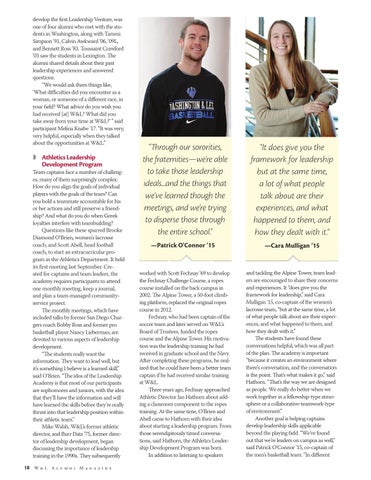
“Through our sororities, the fraternities—we’re able to take those leadership ideals...and the things that we’ve learned though the meetings, and we’re trying to disperse those through the entire school.” —Patrick O'Connor ’15
worked with Scott Fechnay ’69 to develop the Fechnay Challenge Course, a ropes course installed on the back campus in 2002. The Alpine Tower, a 50-foot climbing platform, replaced the original ropes course in 2012. Fechnay, who had been captain of the soccer team and later served on W&L’s Board of Trustees, funded the ropes course and the Alpine Tower. His motivation was the leadership training he had received in graduate school and the Navy. After completing these programs, he realized that he could have been a better team captain if he had received similar training at W&L. Three years ago, Fechnay approached Athletic Director Jan Hathorn about adding a classroom component to the ropes training. At the same time, O’Brien and Abell came to Hathorn with their idea about starting a leadership program. From those serendipitously timed conversations, said Hathorn, the Athletics Leadership Development Program was born. In addition to listening to speakers
“It does give you the framework for leadership but at the same time, a lot of what people talk about are their experiences, and what happened to them, and how they dealt with it.” —Cara Mulligan ’15
and tackling the Alpine Tower, team leaders are encouraged to share their concerns and experiences. It “does give you the framework for leadership,” said Cara Mulligan ’15, co-captain of the women’s lacrosse team, “but at the same time, a lot of what people talk about are their experiences, and what happened to them, and how they dealt with it.” The students have found these conversations helpful, which was all part of the plan. The academy is important “because it creates an environment where there’s conversation, and the conversation is the point. That’s what makes it go,” said Hathorn. “That’s the way we are designed as people. We really do better when we work together in a fellowship-type atmosphere or a collaborative-teamwork-type of environment.” Another goal is helping captains develop leadership skills applicable beyond the playing field. “We’ve found out that we’re leaders on campus as well,” said Patrick O’Connor ’15, co-captain of the men’s basketball team. “In different