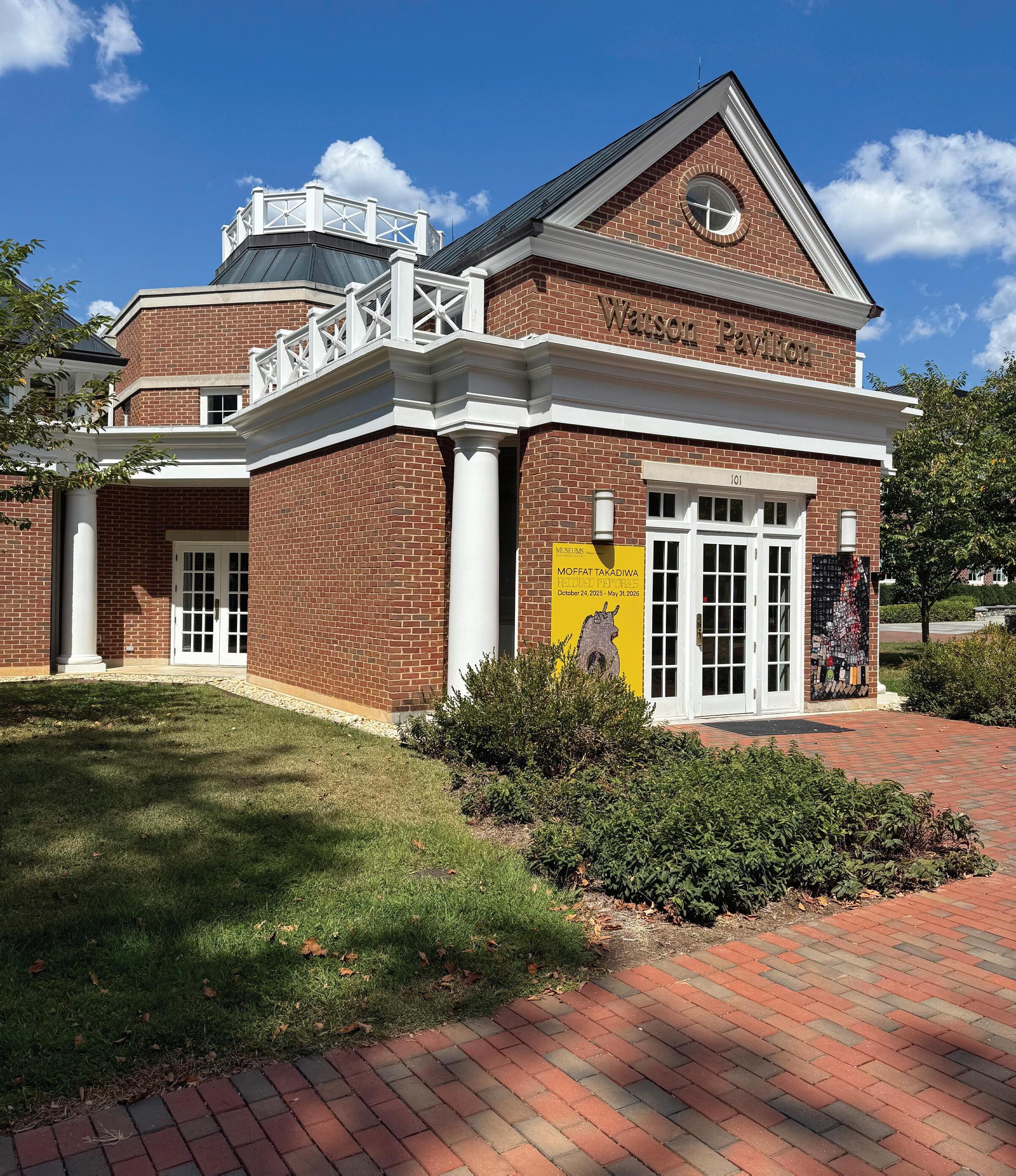
This catalogue is presented in conjunction with the exhibition Moffat Takadiwa: Recoded Memories at the Watson Galleries at Washington and Lee University, October 24, 2025 – May 31, 2026.
The Art Museum at Washington and Lee advance learning through direct engagement with the collections and facilitate an interdisciplinary appreciation of art, history, and culture.
Art Museum at Washington and Lee 204 West Washington St. Lexington, VA 24450 artmuseum.wlu.edu
All rights reserved. No part of this catalogue may be reproduced, stored in a retrieval system, or transmitted in any form or by any means, whether electronic or mechanical, including photocopying, recording, or otherwise, without written permission from the Museums at Washington and Lee.
Published by Washington and Lee University
Editor: Cherry Pickman
Content Editor: Jessica Luck and Laura Lemon
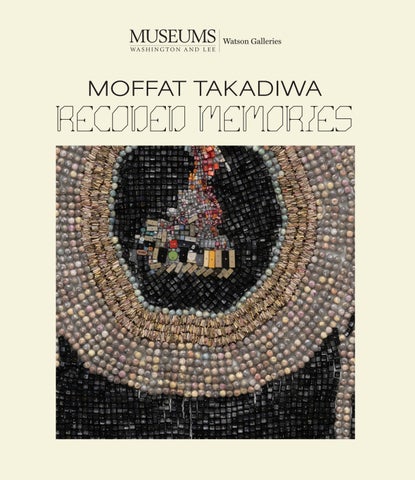
Front cover: Moffat Takadiwa, Pregnant Picasso Bull, 2024
Image courtesy of the artist and Nicodim Gallery
MOFFAT TAKADIWA RECODED MEMORIES
Preface
MEAGHAN M. WALSH, LOUISE C. HERRESHOFF CURATORIAL FELLOW IN AMERICAN ART
The Art Museum and Galleries at Washington and Lee is delighted to present Moffat Takadiwa: Recoded Memories at the Watson Galleries. There is perhaps no artist better apt to represent the Art Museum’s 2025-2026 theme, “Materiality & Transformation” than Zimbabwean artist Moffat Takadiwa (b. 1983, Hurungwe). This year’s theme highlights our environmental impact and how we shape the world that we live in. In his practice, Takadiwa transforms post-consumer waste into monumental wall sculptures, weaving these castoff materials into kaleidoscopic tapestries. Equal parts cultural critique, political protest, and celebration of community, his sculptures speak to the power of art as a vehicle to enact change on a local, regional, and global level.
Recoded Memories has brought together artists and scholars from across the globe, from Takadiwa and his team in Zimbabwe and Nicodim Gallery in Los Angeles and New York to the Art Museum team in Lexington and our guest curator Clement Akpang in Washington, D.C. (by way of Nigeria!). As an academic museum, we want to bring our community in conversation with artists and cultures from across the globe and create opportunities for creativity and intellectual discourse within the museum space. As such, Recoded Memories will offer an array of programs that will allow the W&L community to engage with Takadiwa’s work on a variety of levels. The show began in early October with two weeks of academic engagement led by Dr. Akpang. He brought students “behind the scenes” through class tours during installation, spoke on curatorial practice in classroom visits, and shared his knowledge as an artist and art historian in lectures. The exhibition will culminate with a study abroad class led by Sandy de Lissovoy (associate professor of art) and Isra El-beshir (director of Art Museum and Galleries) in Zimbabwe, where a group of W&L students will work with Takadiwa and his team at the Mbare Art Space, visit the source sites where Takadiwa collects his material, and experience Zimbabwean culture firsthand. All of this is foregrounded in a truly striking exhibition that features 10 sculptures by Takadiwa, including three never-before-exhibited works Hanging by the Thread and Reminiscence of Tengwe Farms (a and b). We hope that you enjoy Recoded Memories as much as we enjoyed putting this exhibition on for you. ■
Director’s Acknowledgments
ISRA EL-BESHIR, DIRECTOR OF ART MUSEUM AT W&L
I am incredibly fortunate to have a community of thoughtful partners who have helped realize Moffat Takadiwa: Recoded Memories. I am indebted to Rachel Du, the former visiting curator of Asian art (Fall 2024), who served as the catalyst for Recoded Memories and first introduced me to Moffat Takadiwa’s remarkable body of work. Through her initiative and vision, we collaborated with Yan Yu, the former director of Nicodim Gallery in Los Angeles, to bring Takadiwa’s exceptional artwork to Washington and Lee University.
A profound thank you goes to the teams at Nicodim Gallery in Los Angeles and New York for the many hours spent collaborating with the museum team on this exhibition. Thank you to Yan Yu, Ben Lee Ritchie Handler, Gabriela Magdaleno, Zack Spencer, and Ryan Castle from Nicodim Gallery for their curatorial guidance and professionalism.
A heartfelt thank you to Dr. Clement Akpang, from the Corcoran School of the Arts & Design, for guest curating the exhibition, contributing an insightful essay to help deepen our appreciation and understanding of Takadiwa’s work, and lending his expertise in modern and contemporary African art to shape the exhibition’s narrative for our W&L community and museum audience. I am especially thankful for Dr. Akpang’s enthusiasm for visiting with classes in Africana Studies, Anthropology, History, and Art History, and providing guided tours to our campus stakeholders.
Additionally, we are fortunate to have gained the support of many individuals who have helped produce this guide and exhibition design. Thank you to Cherry Pickman, editor; Jessica Luck, editorial director at W&L, and Laura Lemon, assistant editor at W&L, who assisted with copy editing; Billy Chase, senior graphic designer at W&L; Reba Miller, web content manager at W&L; Popcorn Cauley, Michael Rhodenizer, Bennett Arthur, and Steven Pruett from University Facilities; Kevin Remington, manager of photography at W&L, and Jacob McGlauflin from OG Pressmore for his spectacular vinyl work. Finally, our sincere appreciation goes to the design team at SABI studio for translating our vision into a stunning visual expression through their marketing design: Adama Kamara, strategic communications consultant; Neha Mathew, graphic design lead; and Abel Woldegebriel, graphic designer.
I am deeply honored to be part of a community of devoted faculty and students at Washington and Lee University who have contributed to the success of the exhibition. I am immensely grateful to Sandy de Lissovoy, associate professor of art, who enthusiastically partnered with Takadiwa and Dr. Akpang to collaborate with students in his ARTS 231: Introductory Sculpture course in creating woven sculptures made from repurposed waste sourced from Zimbabwe, and to Andrea Lepage, professor of art history and department head, for her shared commitment to student engagement, enduring support, and generosity. Thank you to Mark Rush, director of international education, for his continued and unwavering support in museum programming with international artists. A special appreciation goes to students Avery Dennard ’27, Nora Kuhn ’26, Brendan Thorpe ’27, and Zhihuan Yan ’25 for assisting with object selection and Takunda Mawere ’28 for generously visiting Mbare Art Space in support of our vision to bring students to his hometown of Harare in 2026.
This project could not have come to fruition without the heart, dedication, and tireless efforts of my staff. Thank you to Meaghan M. Walsh, the Louise C. Herreshoff Curatorial Fellow in American Art, for project managing the installation and providing curatorial guidance; James Ito, museums registrar; Robert Forsberg, visitor services and operations manager; Rachael Marks, administrative assistant; and, last but not least, Jessica Wager, curator of academic engagement, who introduced us to Dr. Akpang, thanks to a fortuitous encounter at the Association for Academic Museums and Galleries’ conference earlier this year
On behalf of the museum team and Washington and Lee, we offer our deepest gratitude to Takadiwa for his collaborative spirit, generosity in sharing his work, humility, and willingness to engage with our students. We are grateful to him and his team at the Mbare Art Space for their assistance, especially Tafadzwa Chimbumu and photographer Tatenda Kanengoni.
We wish to thank all those who have contributed to Moffat Takadiwa: Recoded Memories, named here and beyond, and for the financial support provided by the Department of Art and Art History, the Class of 1963 Scholars in Residence Program, and the university’s Museum Art Fund. ■
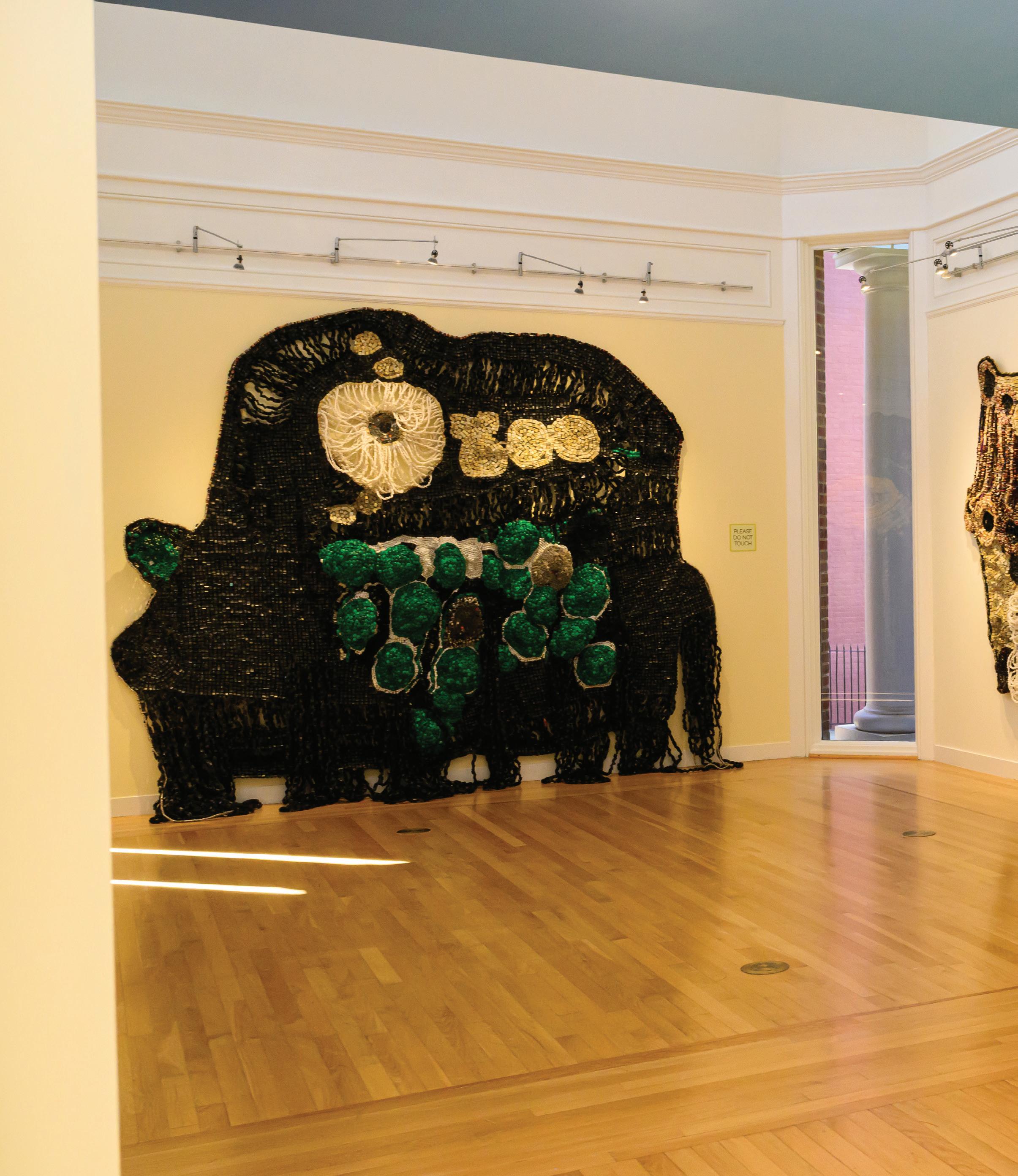
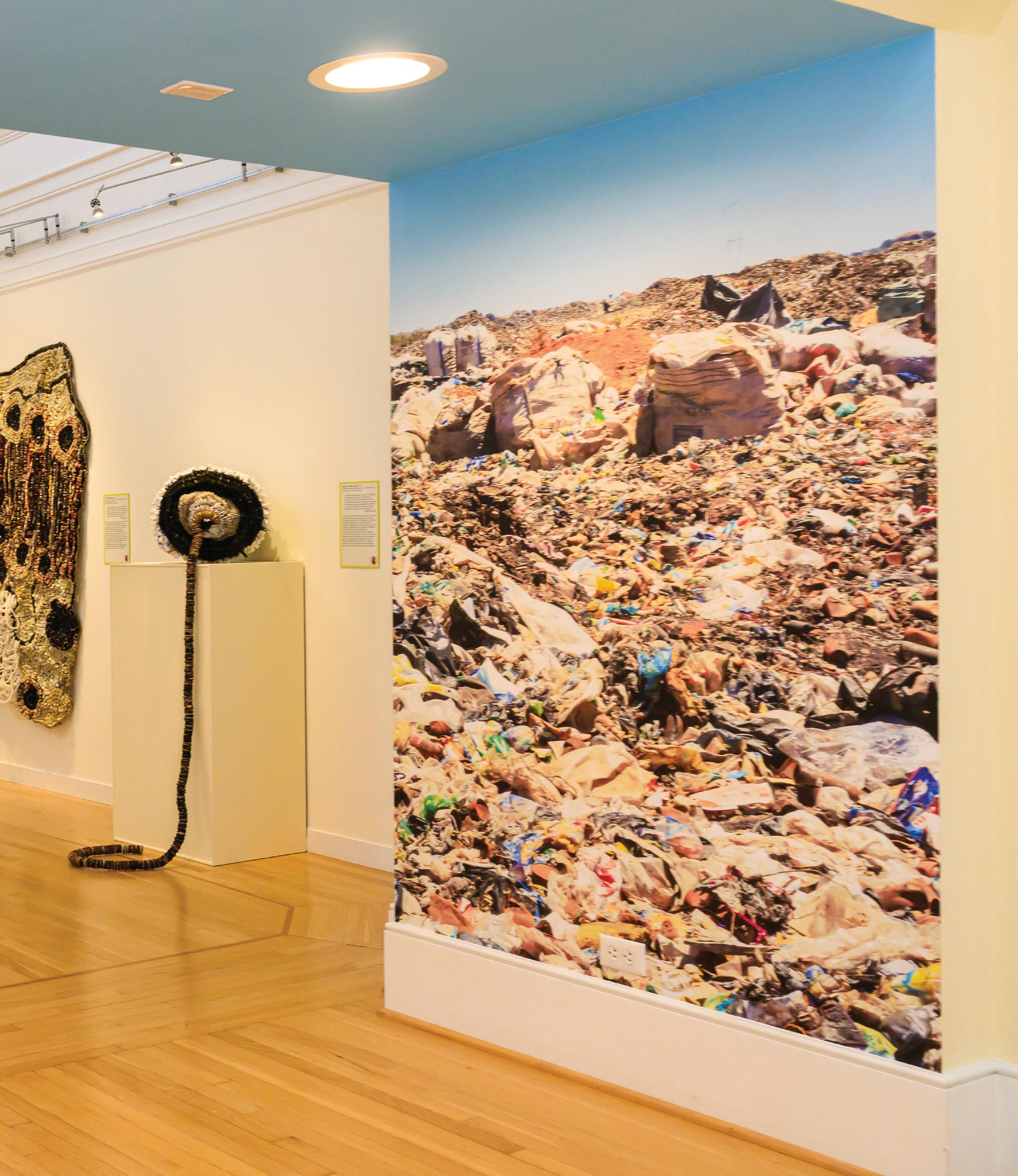
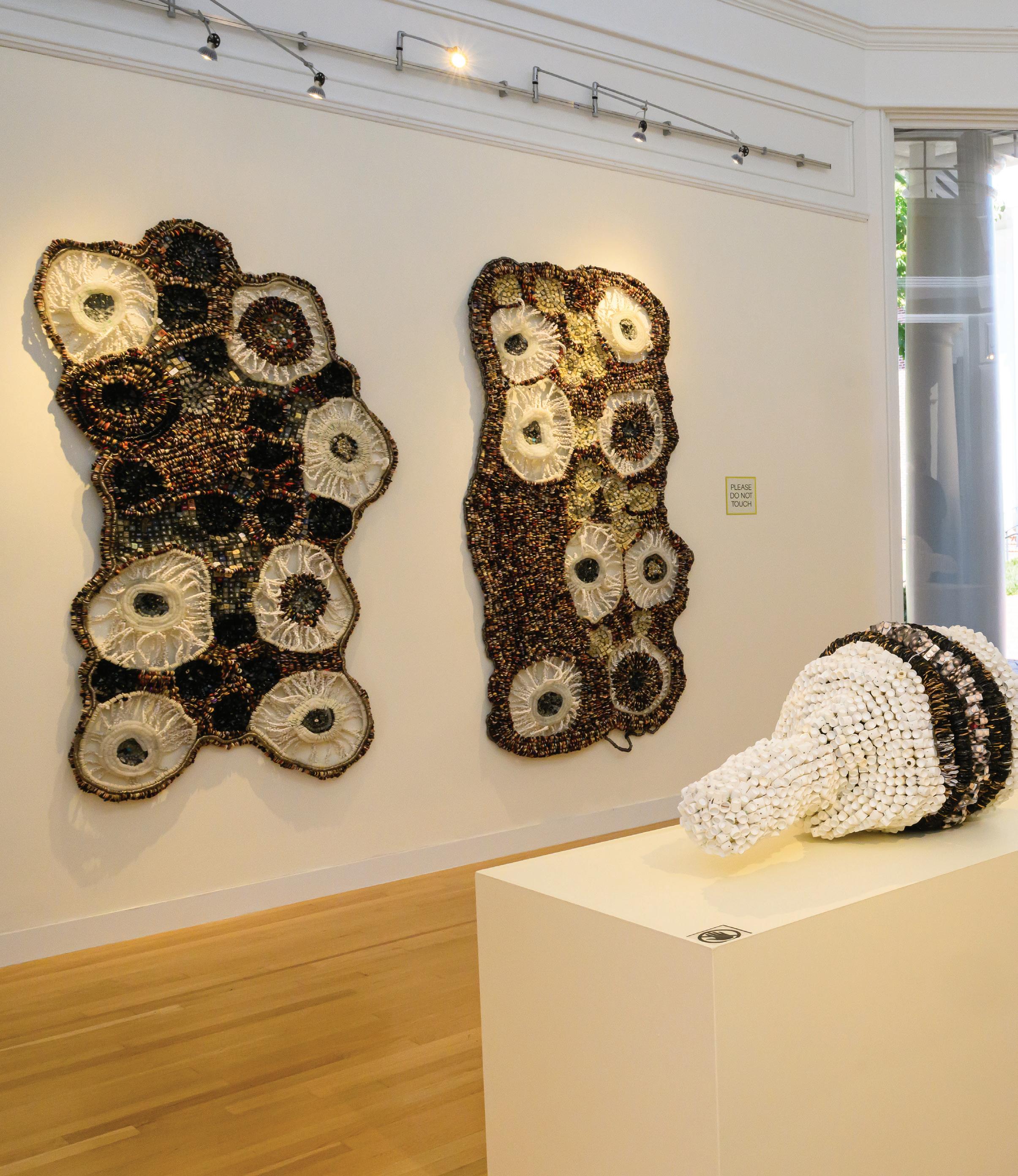
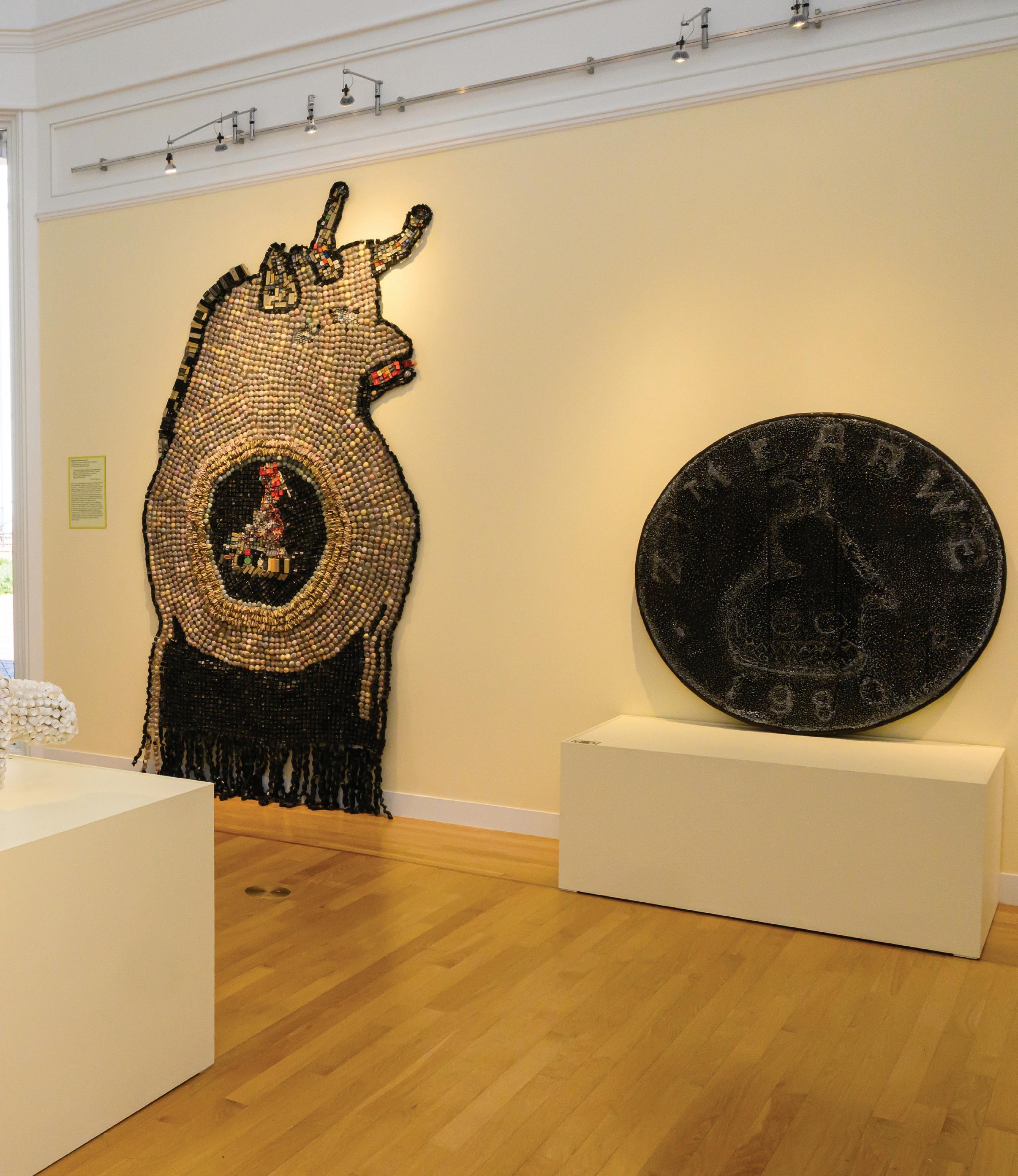
Moffat Takadiwa: Recoded Memories. Watson Galleries, Washington and Lee University, Lexington, VA. Photography credit: Kevin Remington, University Photography.
I am not just making objects, but statements meant to change the lives of my people, the image of my country, and the world at large.
MOFFAT TAKADIWA
About the Artist
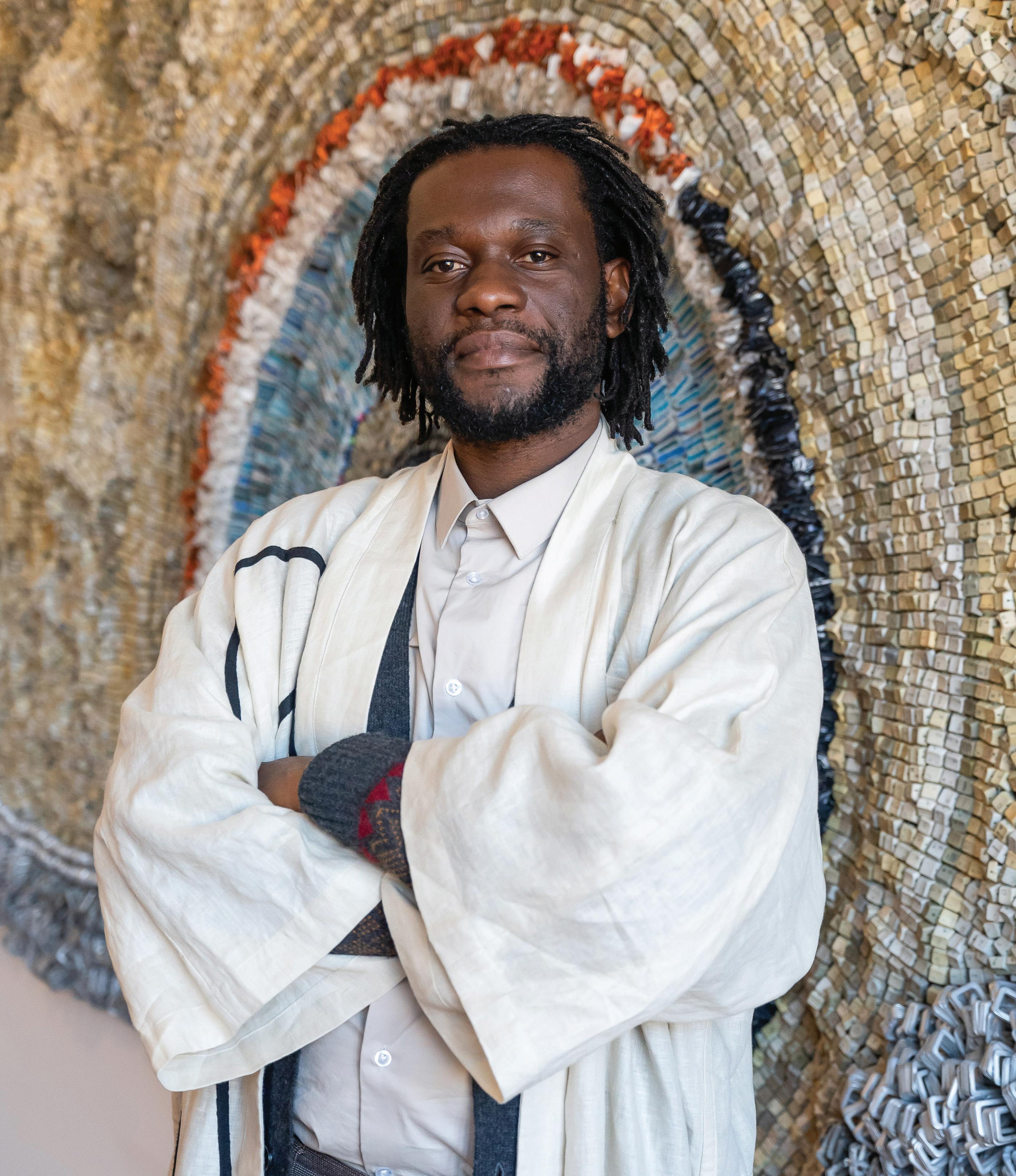
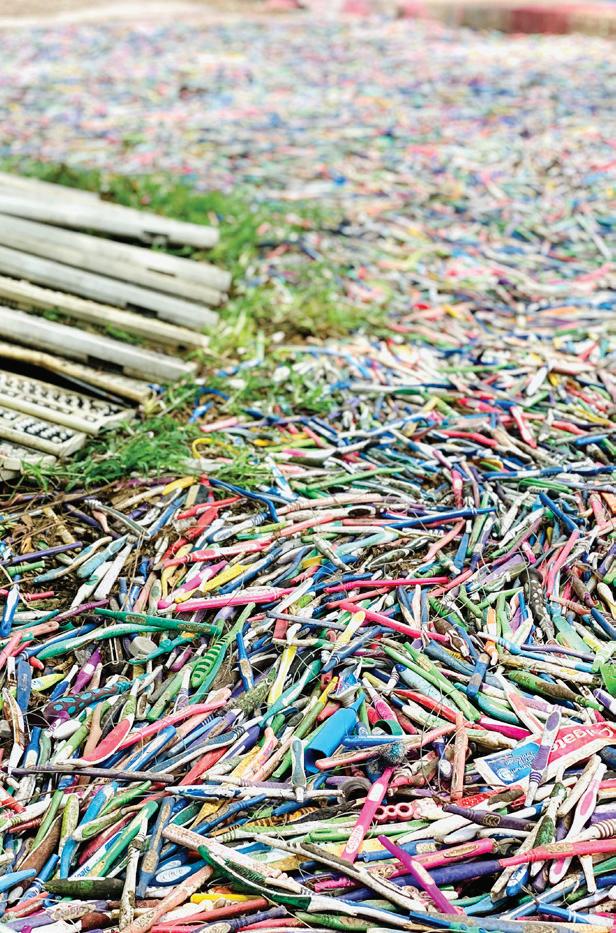
Moffat Takadiwa (b. 1983, Hurungwe) lives and works in Harare, Zimbabwe. Takadiwa transforms post-consumer waste – such as computer keyboards, bottle tops, toothbrushes and toothbrush tubes, – into lush, densely layered sculptures and tapestry-like wall works and sculptures. A prominent voice from the postindependence artist generation in Zimbabwe, Takadiwa’s work centerstages his Korekore heritage while engaging with themes such as consumerism, inequality, post-colonialism and the environment. Takadiwa is also a founder of Mbare Art Space in Harare where he plays a major role in mentoring the growing artist community, establishing the world's first artistic center dedicated to repurposing reclaimed materials.
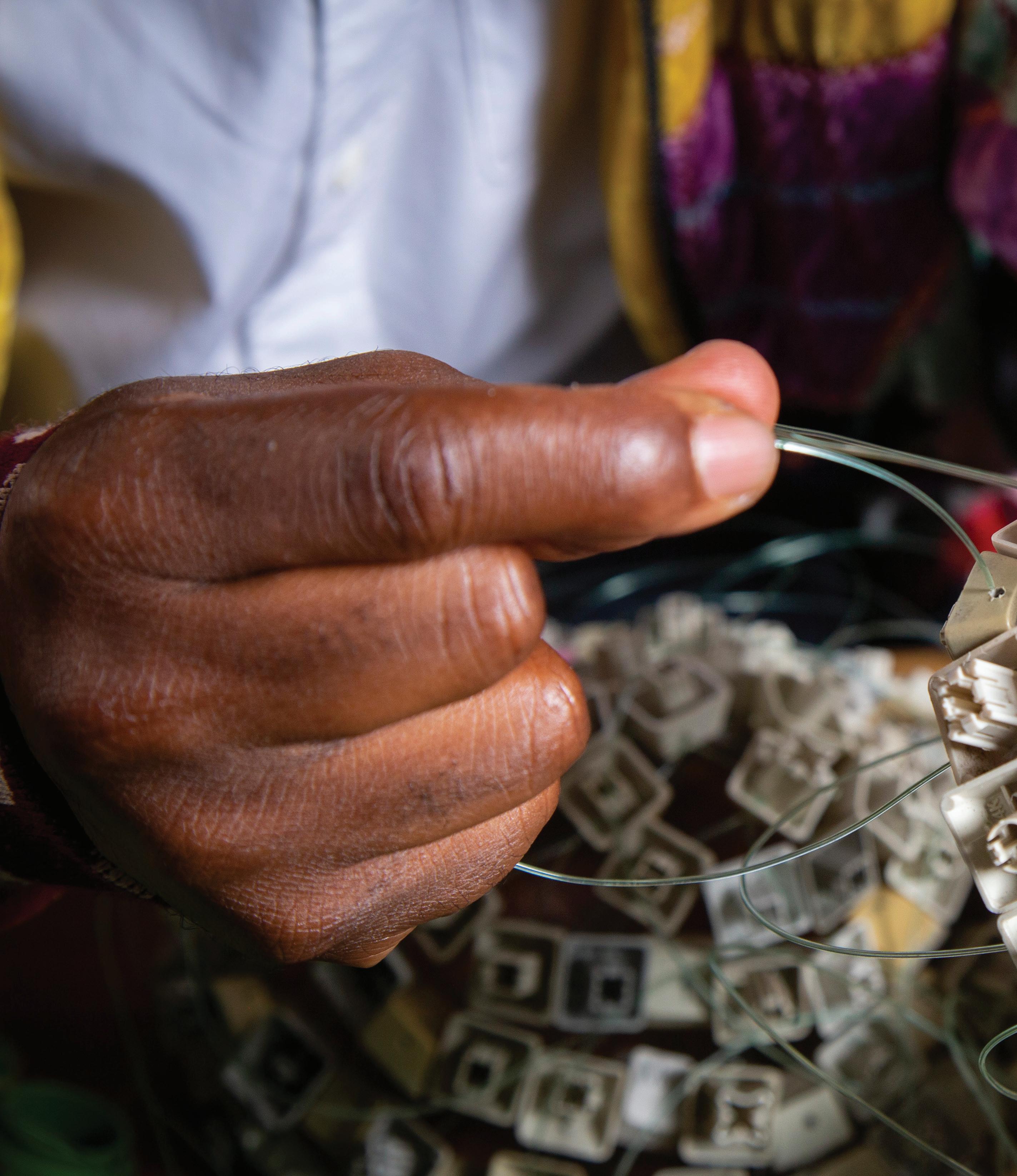
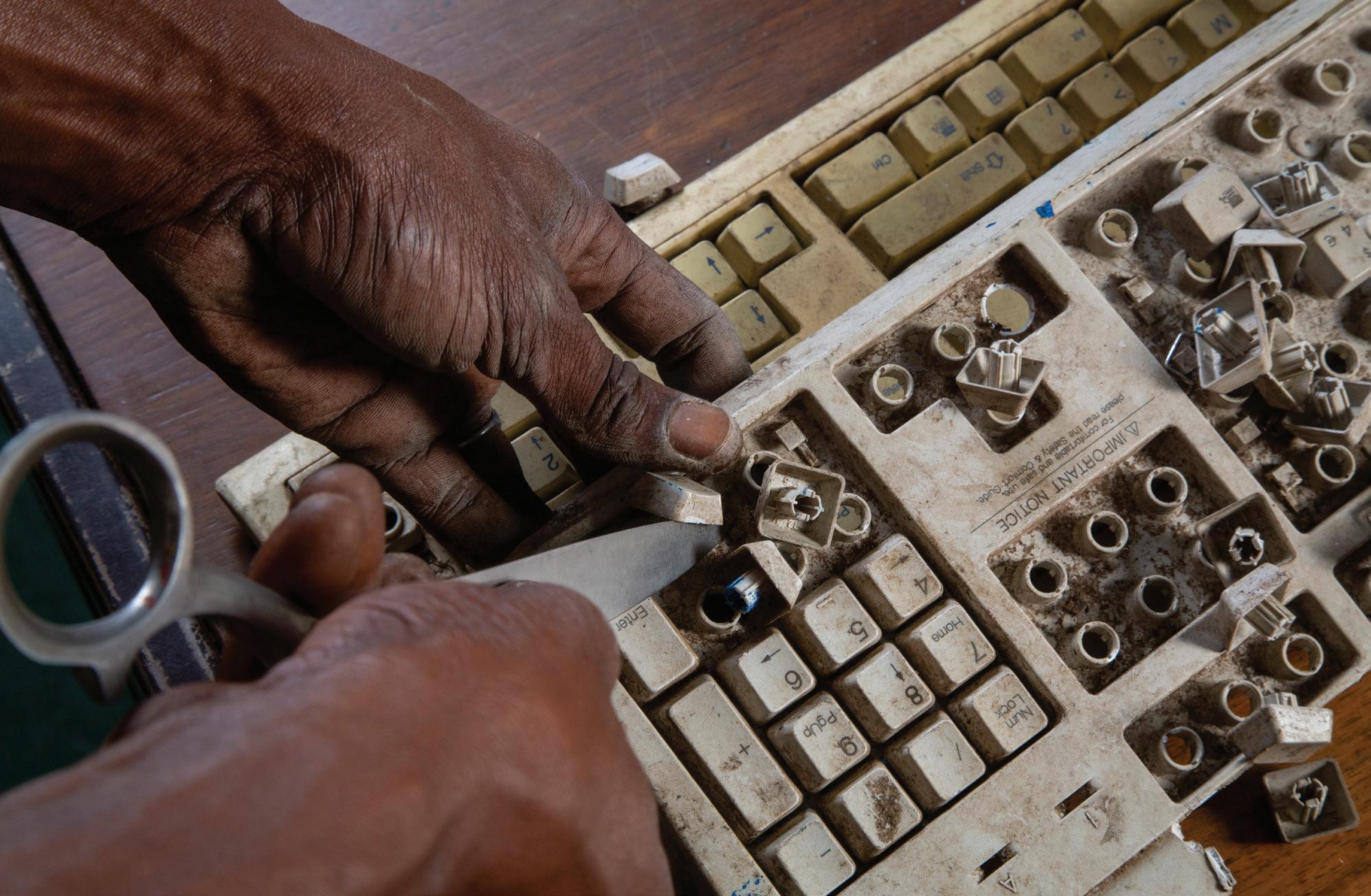
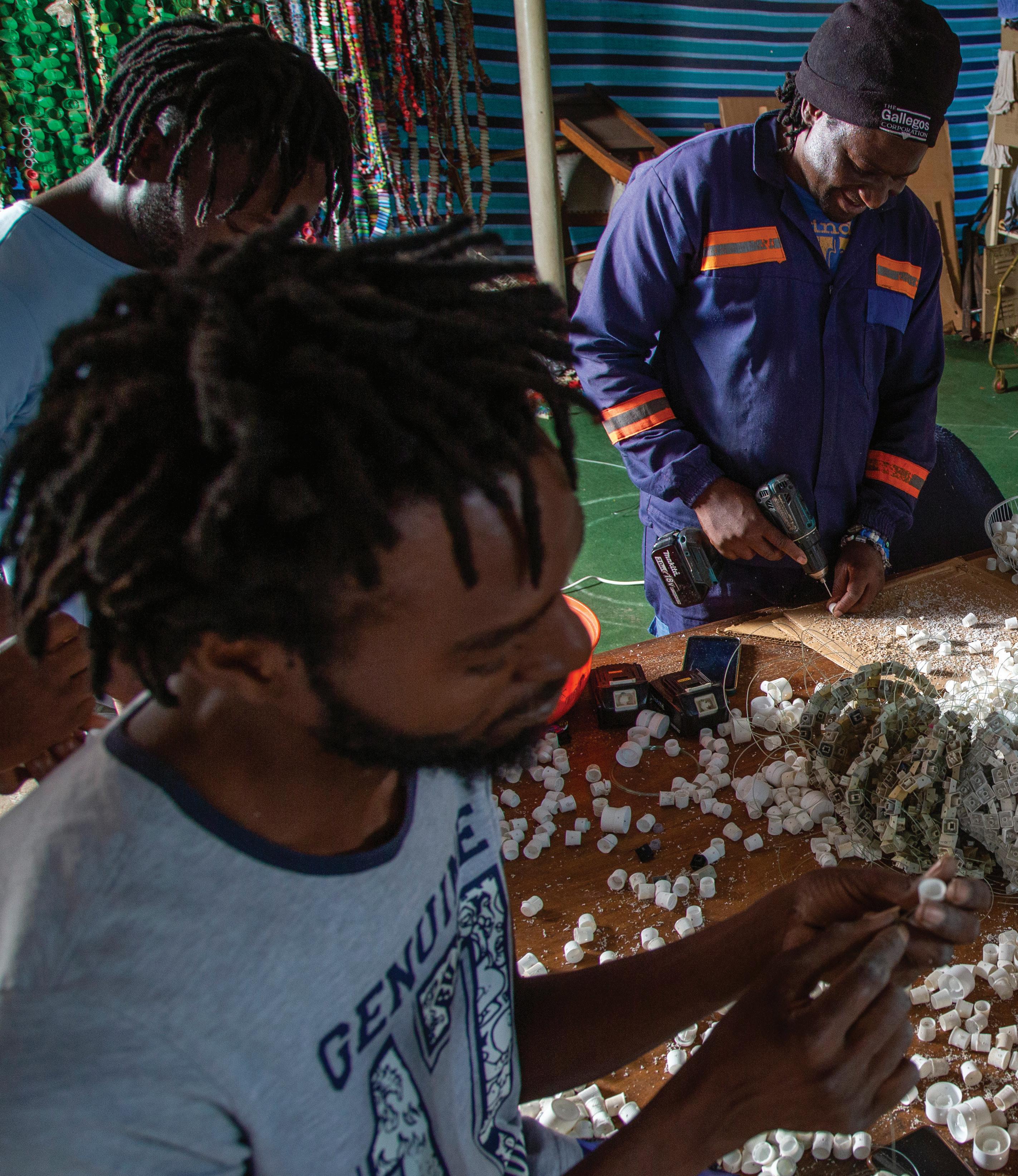
Artist weaving computer keys together. Courtesy of David Brazier and Mbare Art Space.
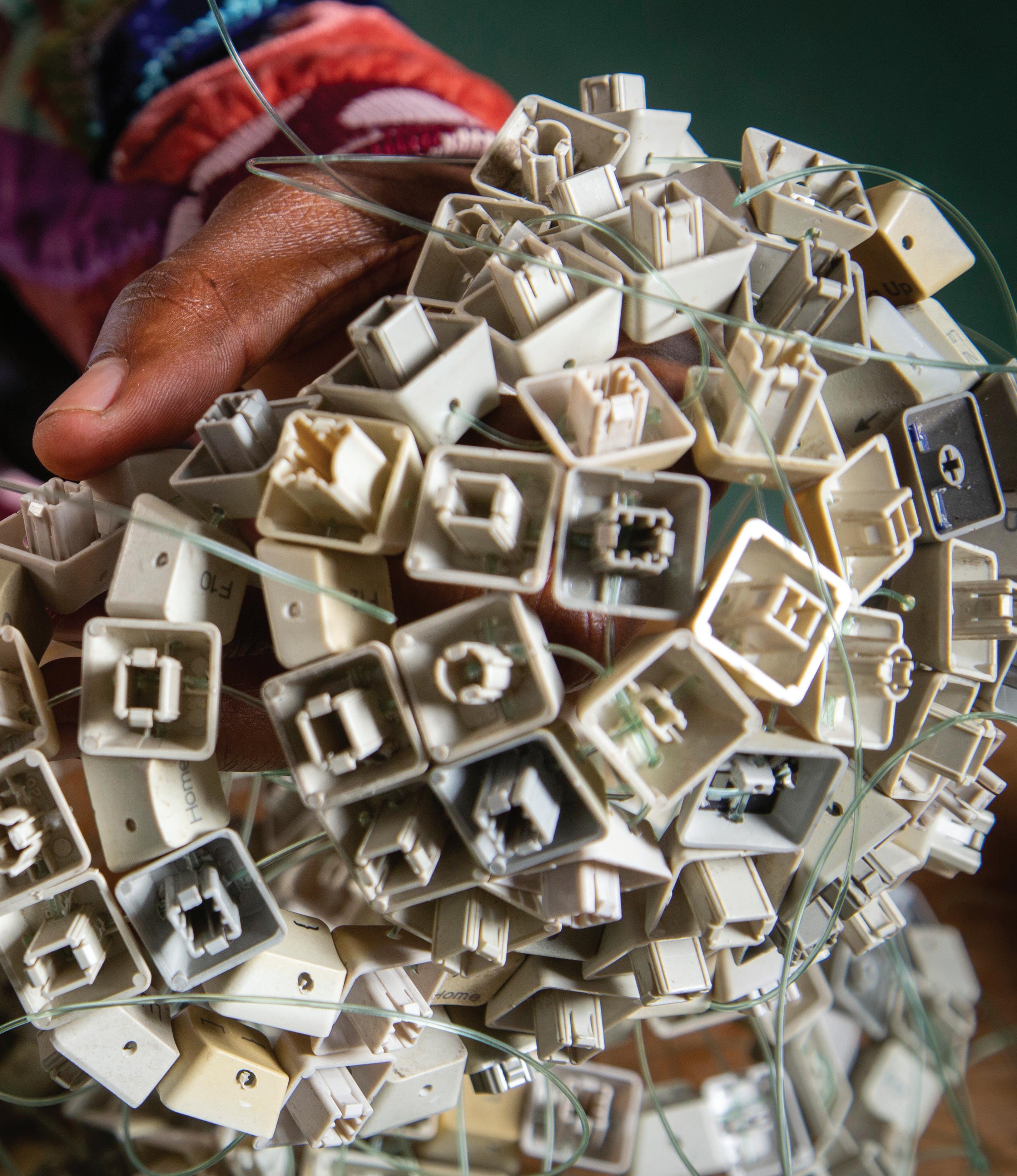
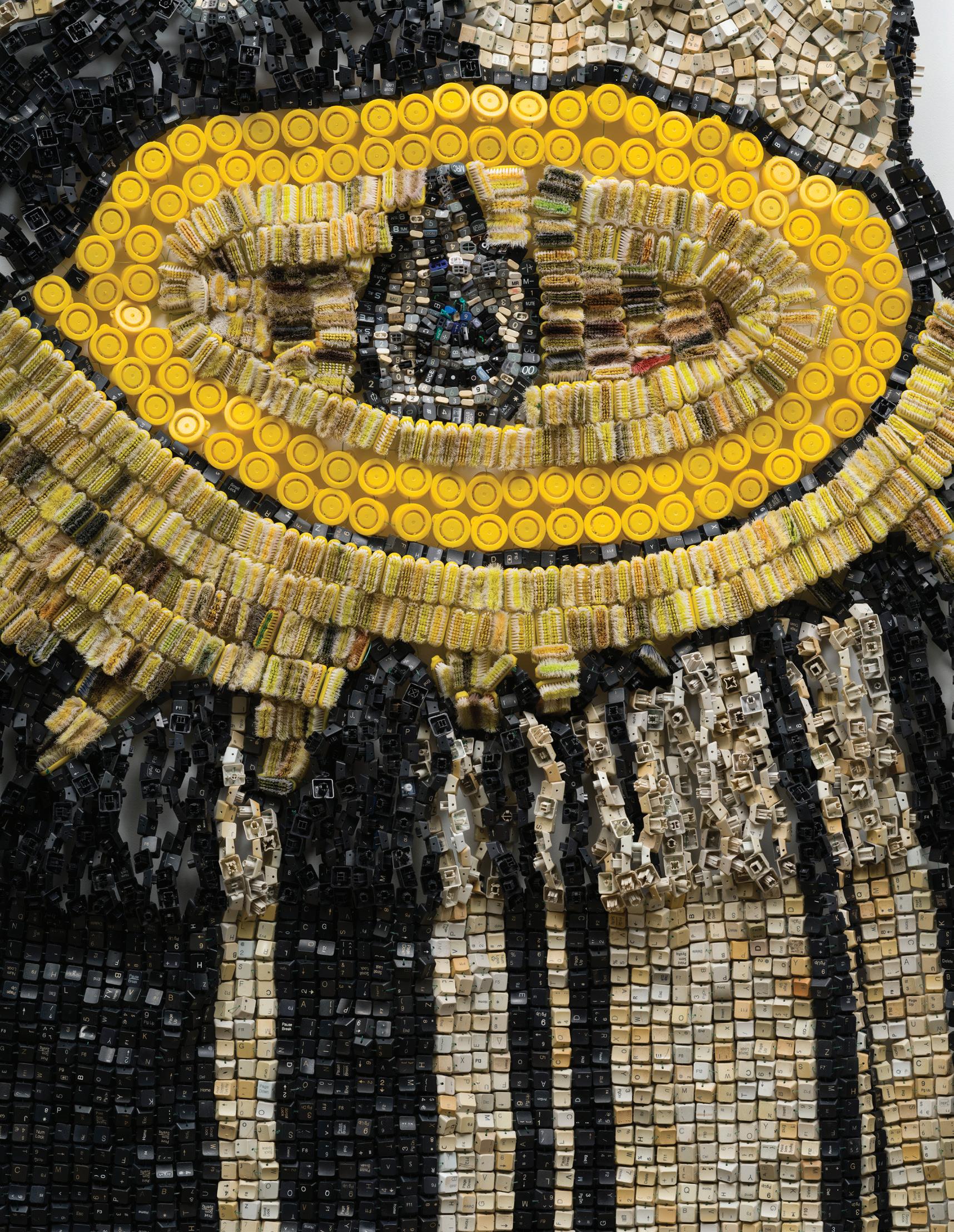
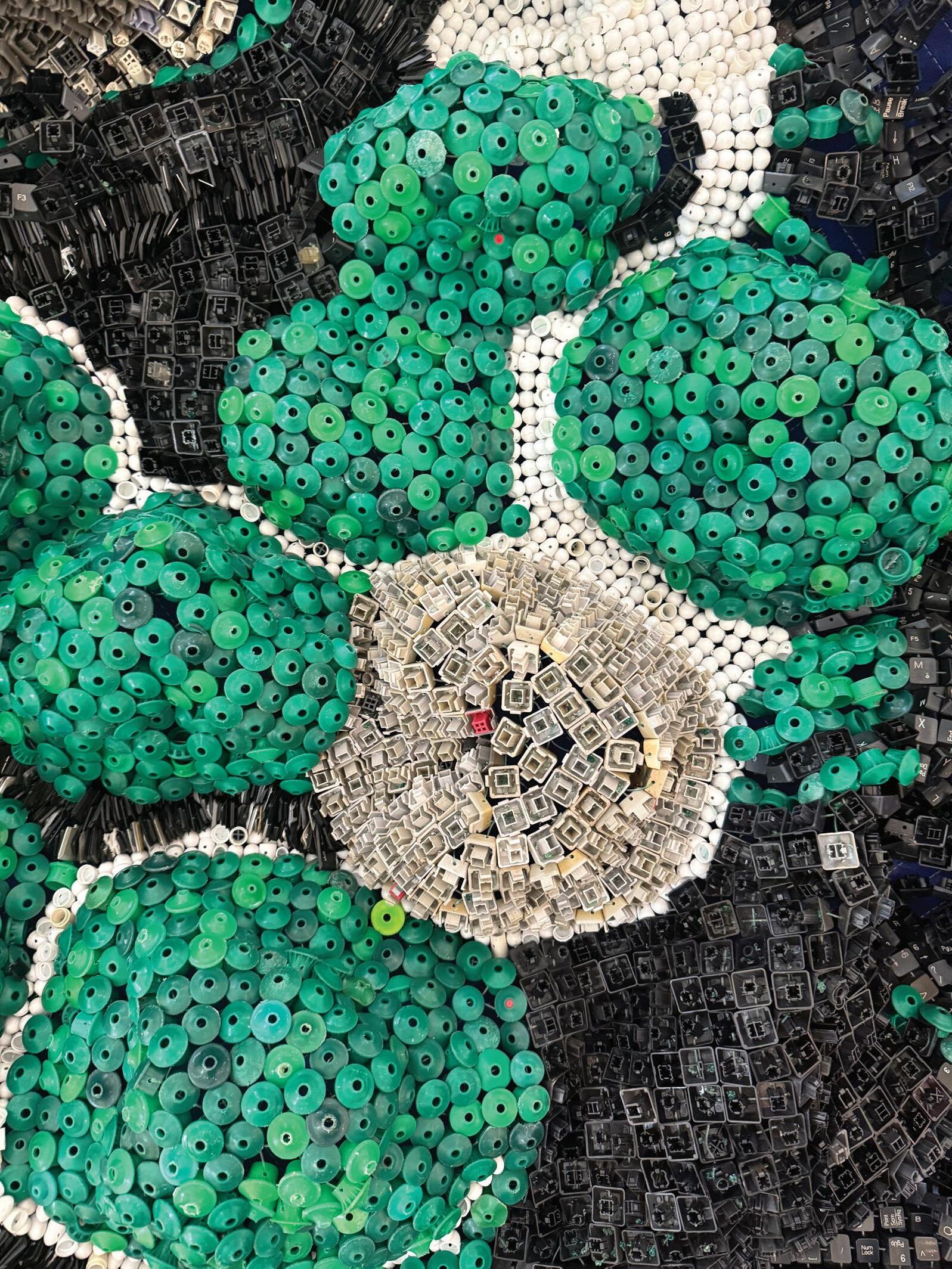
Detail of Moffat Takadiwa, Big Brother Africa, 2024. Courtesy of the Artist and Nicodim.
Curatorial Statement
CLEMENT AKPANG, PHD, GUEST CURATOR
Zimbabwean artist Moffat Takadiwa (b. 1983) is celebrated for his sophisticated manipulation of postconsumer waste into visually compelling and provocative sculptural works. Recoded Memories, Takadiwa’s first solo exhibition at the Art Museum and Galleries at Washington and Lee University, invites viewers to explore the connections among waste, modern materialist culture, memory, urban decay, and Indigenous epistemologies reinterpreted through contemporary art. Recoded Memories foregrounds the ideological and narrative weight of Takadiwa’s works, offering audiences a glimpse into Zimbabwe’s past and present, Korekore, the artist’s kin and subgroup of the Shona in northern Zimbabwe, aesthetics and ethics, as well as the impact of global systems of power on Africa, ecological disruption, belonging, and the transient concept of home.
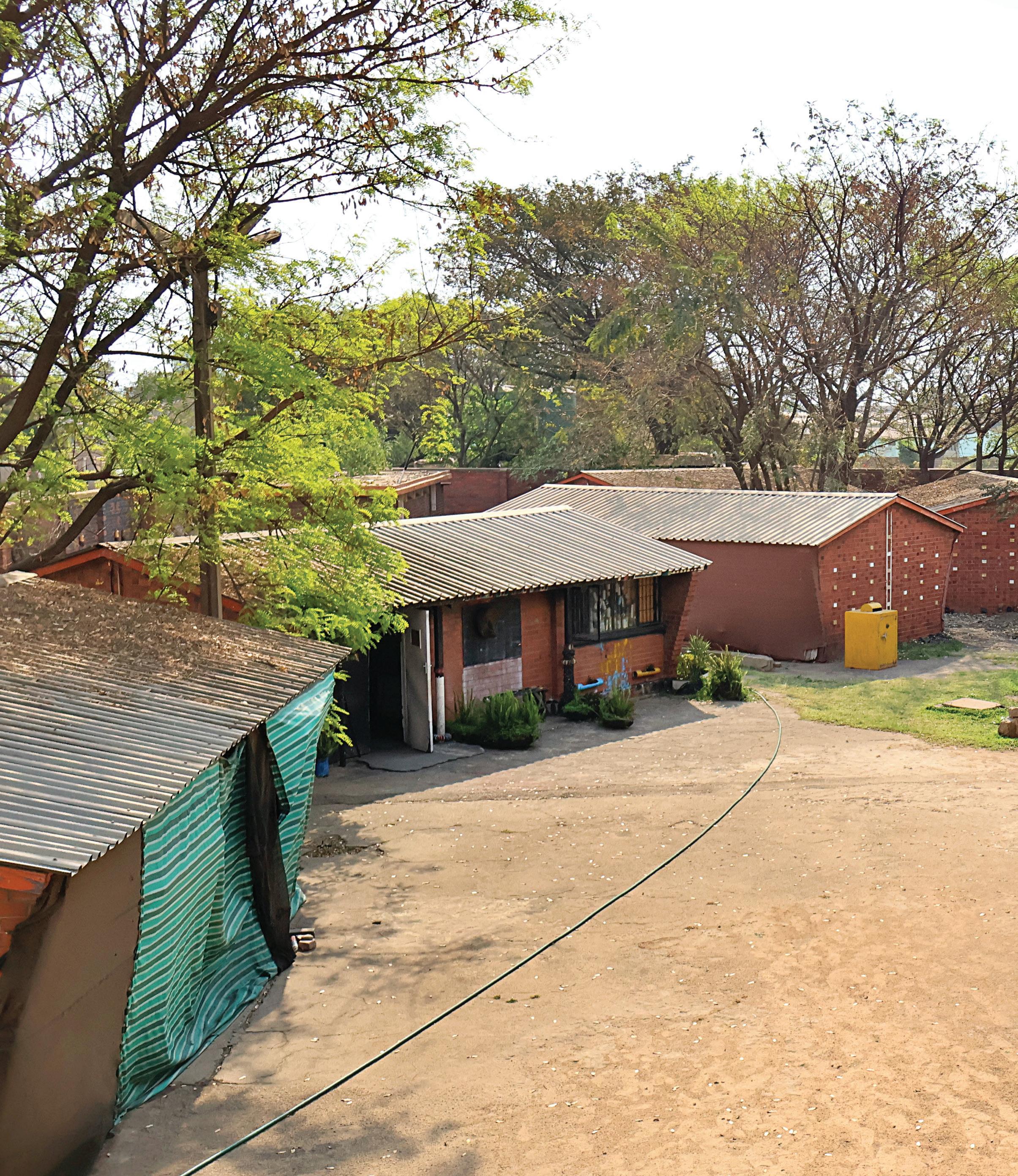
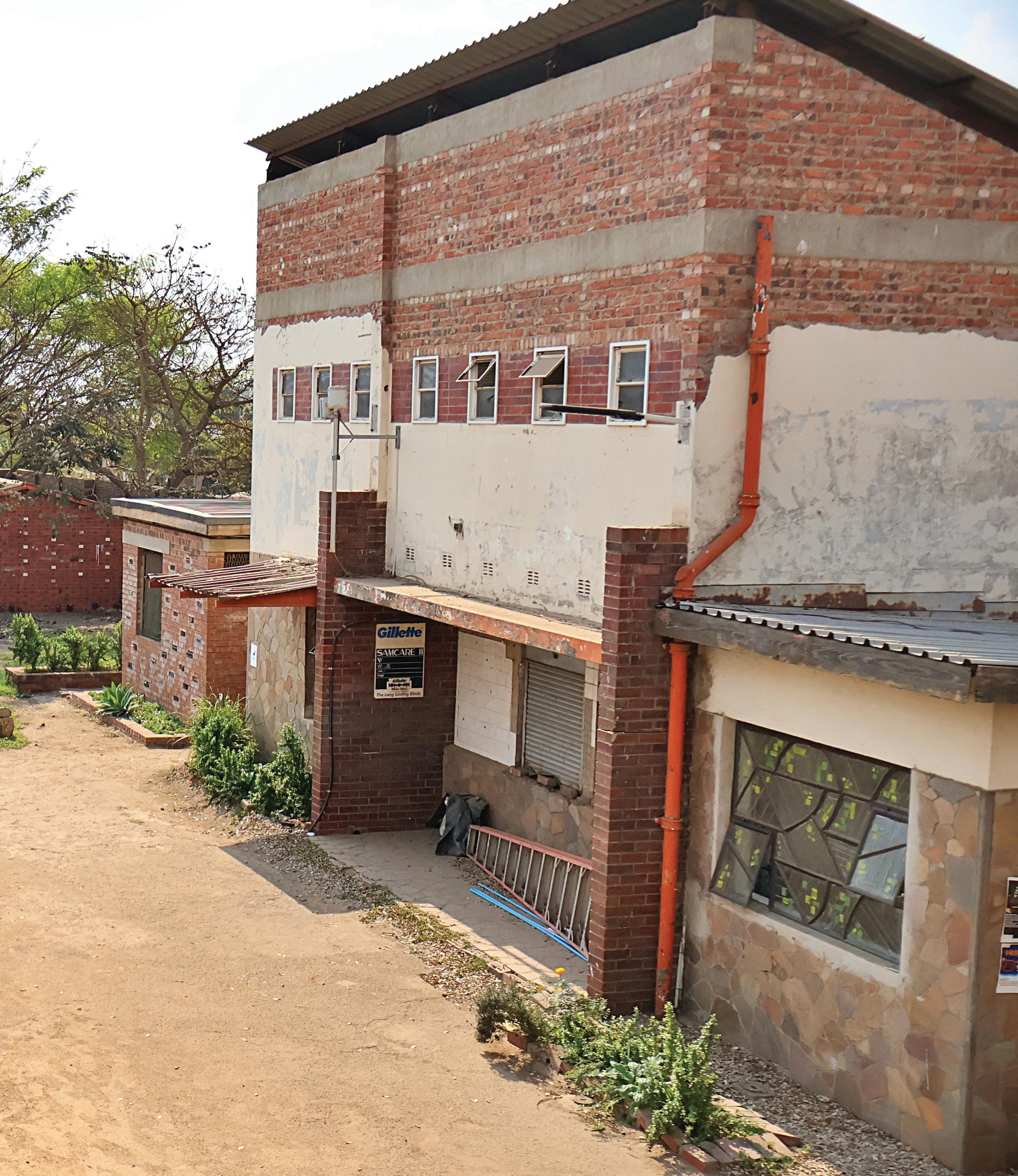
Takadiwa reconstructs computer keys, VHS tapes, toothbrushes, plastics, and other discarded objects into meticulously assembled, intricate compositions rich in texture and rhythm. These mosaiclike forms are not merely aesthetic spectacles; they are symbolic juxtapositions that evoke personal, social, cultural, and political histories as well as offer commentary on Africa’s disadvantaged global entanglements. To advance these complex ideologies, Takadiwa’s practice draws from Indigenous worldviews of material care, respect for the land, and those that consider objects as constituent parts of a vital force in connection with humans and nature.1 Working from Mbare Art Space, a repurposed colonial-era beer hall, and inspired by Korekore beliefs, he reconfigures found objects to interrogate issues in postcolonial Zimbabwe and the broader Global South, exploring themes related to Indigenous cultures, identity, migration, displacement, ecological injustice, sustainability, memory, hyper-consumerism, and the capitalist commodification of people and places.
While Takadiwa’s growing international reputation has centered on the materiality of his art and his creative profundity, such
1 Placide Tempels, Bantu Philosophy, trans. Colin King, foreword by Margaret Read (Paris: Présence Africaine, 1959).
2 Takadiwa, interview by Isra Elbeshir (February 2025).
3 Moffat Takadiwa, "Moffat Takadiwa," ON | OFF, accessed August 4, 2025, https://onoff.tasawar. net/moffat-takadiwa/?utm_ source=chatgpt.com
4 Takadiwa, interview by El-beshir.
5 Sabelo NdlovuGatsheni, Epistemic Freedom in Africa: Deprovincialization and Decolonization (New York: Routledge, 2018).
emphasis risks eclipsing the conceptual depth of his practice and its underlying cultural and ideological explorations. As he asserts, “The materials I use have narratives attached to them.”2 If examined through a strictly formal lens or mere enchantment with materiality, those narratives can be overlooked. Recoded Memories does the opposite. It emphasizes the cognitive strategies behind Takadiwa’s material choices, consciously situating each piece within its context. This exhibition encourages viewers to engage not only with the objects themselves but also with their encoded ideologies, which reflect Indigenous aesthetics and philosophies, histories of extraction, material accumulation, colonization, neocolonial waste economies, migration, and the concepts of memory and home.
The exhibition’s title, Recoded Memories, conveys Takadiwa's restaging of found objects into vessels of remembrance and commentary. These materials, once symbols of prestige, social stratification, archives, and exploitation, are imbued with new cultural, social, environmental, and political meanings. In his words, “my work reflects my community and gives me memories of my people…they often tell a story.” 3 Reclaimed computer keys, for example, serve as visual metaphors: “I use computer keys to speak about language. When displaced, people face the difficulty of a new language. Language can become one of the first vehicles to connect back to home or to a memory of what you call home.”4 By reimaging these electronic castoffs, Takadiwa invites viewers to consider how language can be a force of reclamation, continuity, and critique, recoding the past into urgent statements about the present.
The exhibition showcases works that articulate the artist’s sustained exploration of history, memory, and social circumstances, offering a constellation of sculptures that bear the influence of Korekore epistemologies; knowledge systems that Sabelo Ndlovu-Gatsheni — Takadiwa’s countryman and an advocate of Indigenism — argues are ontological.5 Korekore beliefs and practices lie at the heart of his inspiration, serving as the foundational core from which his creative vision and expression emerge. “I am borrowing the basketry weaving of the people of Hurungwe (part of the Korekore ethnic group) in my
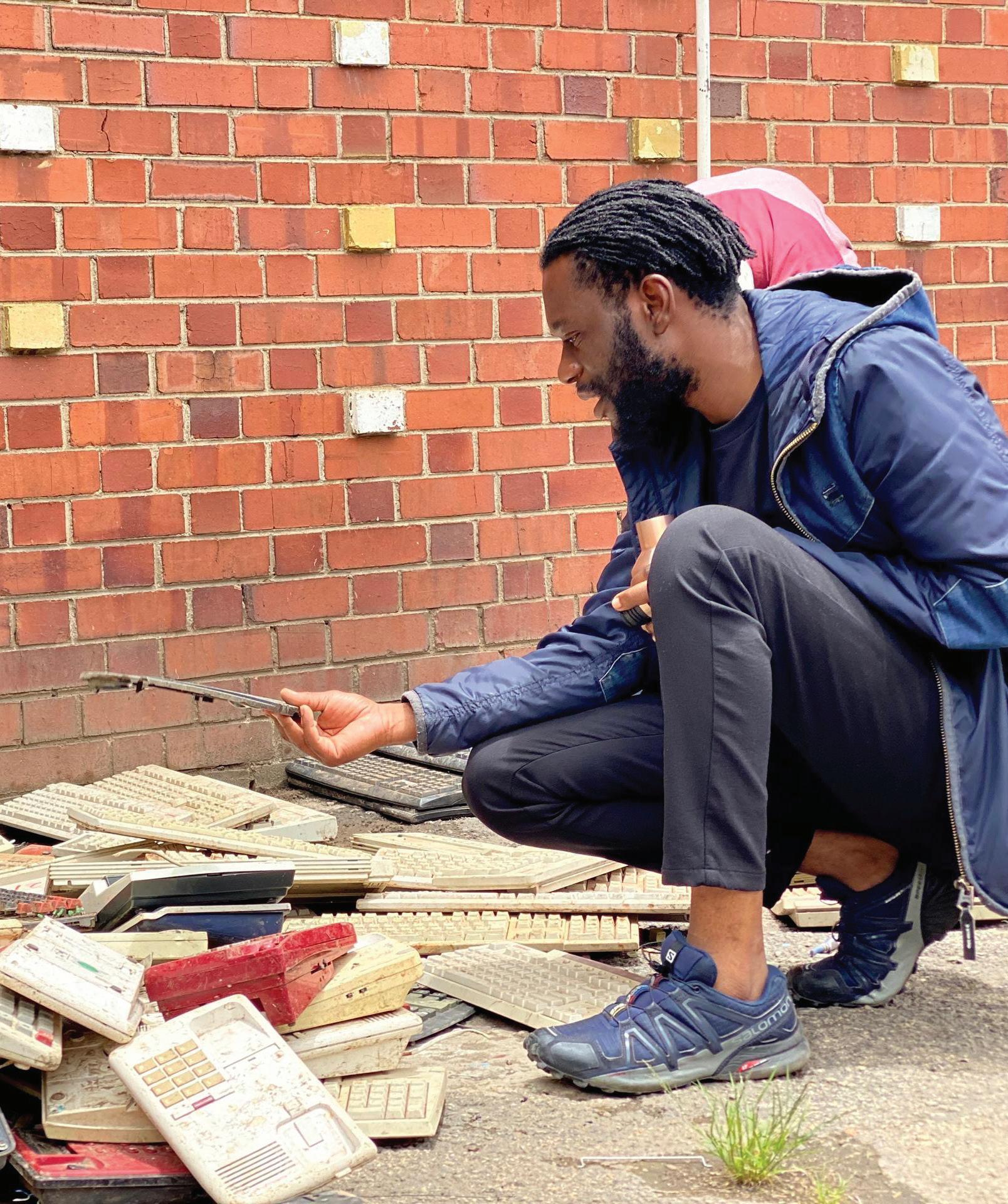
Moffat Takadiwa sifting through source materials. Harare, Zimbabwe. Courtesy of Mbare Art Space.
6 Daily Maverick, “Zimbabwean Artist Draws ‘Inspiration from Rejection’ to World Stardom,” Africa-Press , August 1, 2021, https://www.africapress.net/zimbabwe/all-news/ zimbabwean-artist-drawsinspiration-from-rejectionto-world-stardom
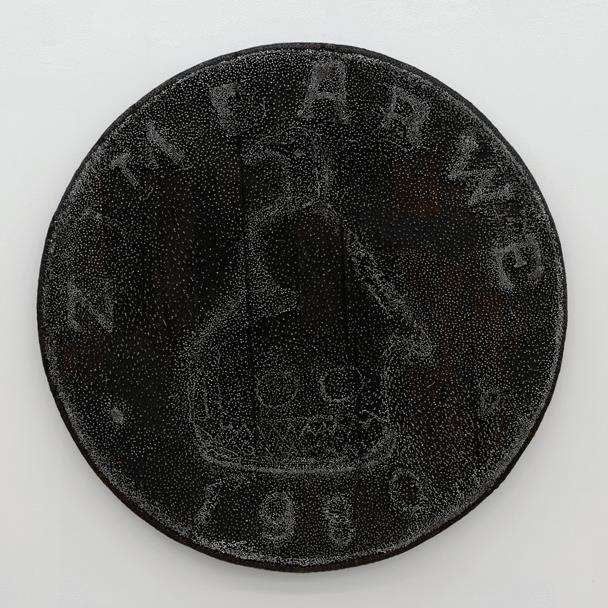
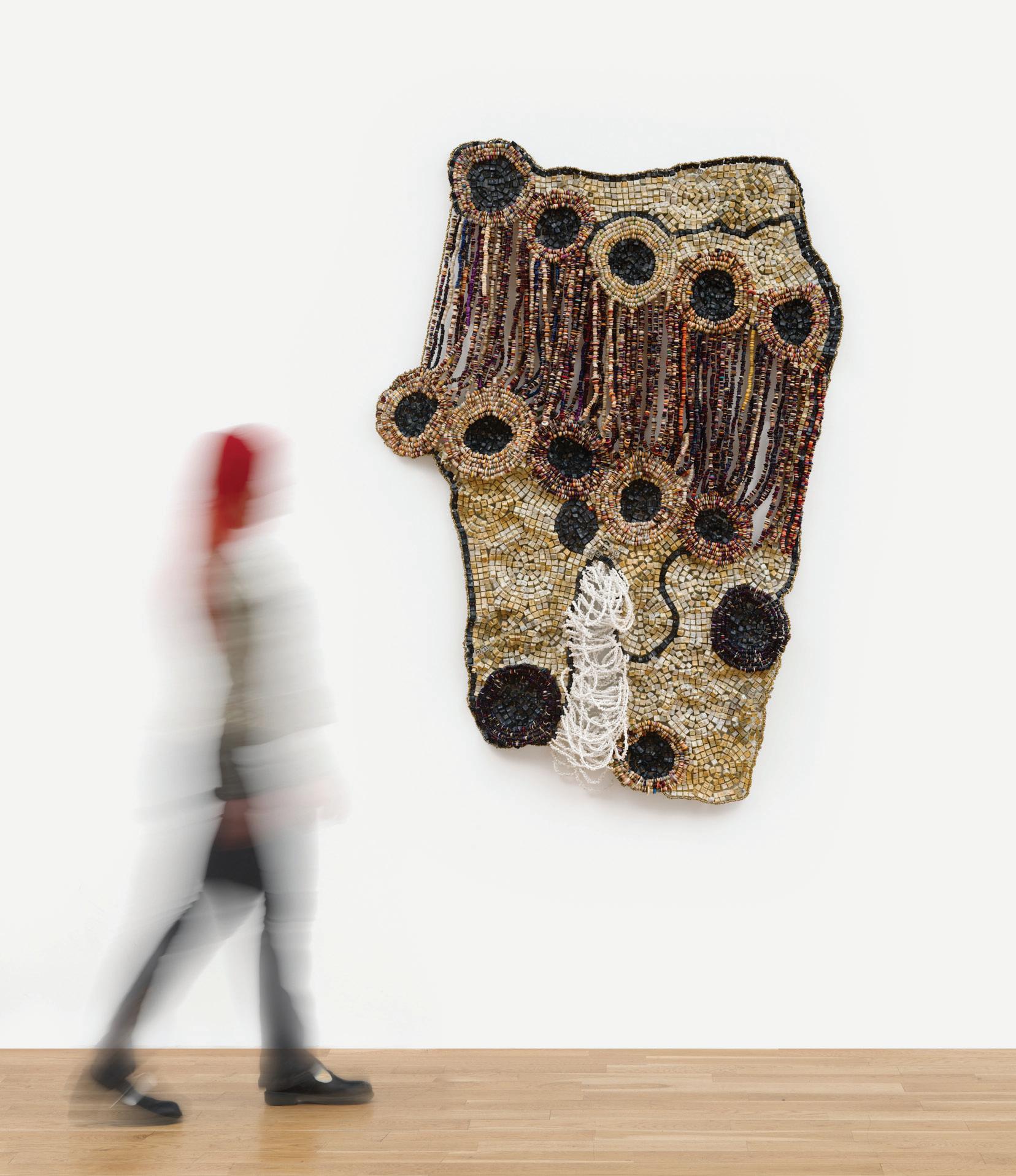
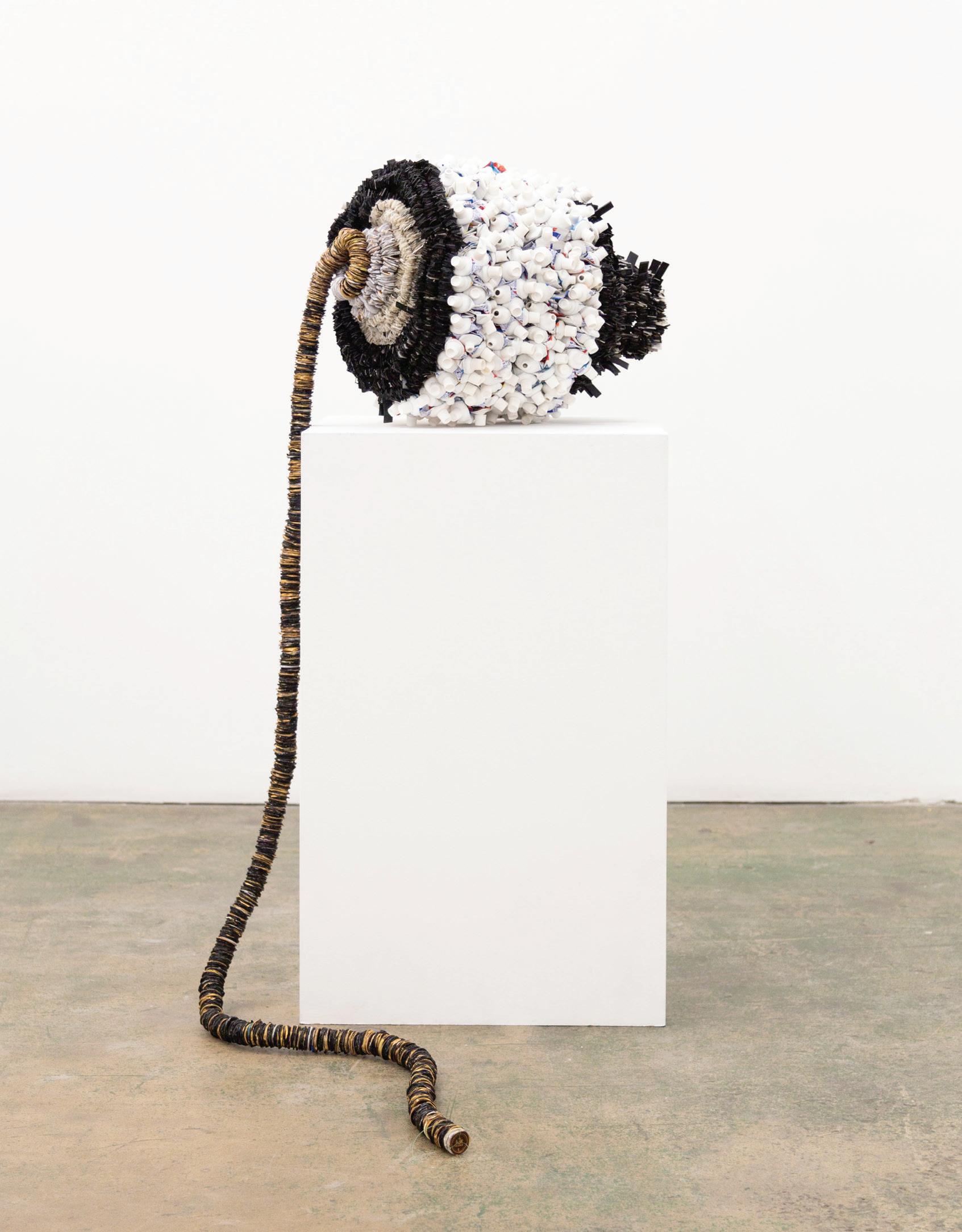
work. It’s loaded beyond a pattern, as it was used to carry a lot of information. Some of the patterns were used in mathematics, recording of one’s wealth, singing, and dancing. This is a way I elevate discarded materials.” 6 Each work contributes to a broader curatorial narrative that centers memory as a vehicle for cultural, historical, and social commentary. Shereni Ihombe (2023) conveys Shona marriage rituals, especially the symbolism of gupuro (a token to finalize divorce) in the form of a ten-cent coin with its weighted significance in Zimbabwean cosmologies. Hanging by the Thread (2025) examines the intersection of land, labor, and power through the allegory of farms in Zimbabwean history, both colonial and post-independence. Fashion Brands (b) (2025) foregrounds how practices of accumulation and disposability function as misguided markers of social status and contribute to the perpetuation of inequality. The Object of Influence (2021) series — crafted from bottle caps, toothpaste tubes, and golf tees — reflects on the ways that global brands’ castoffs infiltrate daily life in Zimbabwe, displacing Indigenous materials and cultural values with Western materialism and consumerism. Takadiwa presents these objects as vessels for contemplation, aiming to disrupt Western mindsets and rekindle a connection with African consciousness. His works question neocolonial waste economies and how imported detritus and secondhand goods shape life in the Global South,
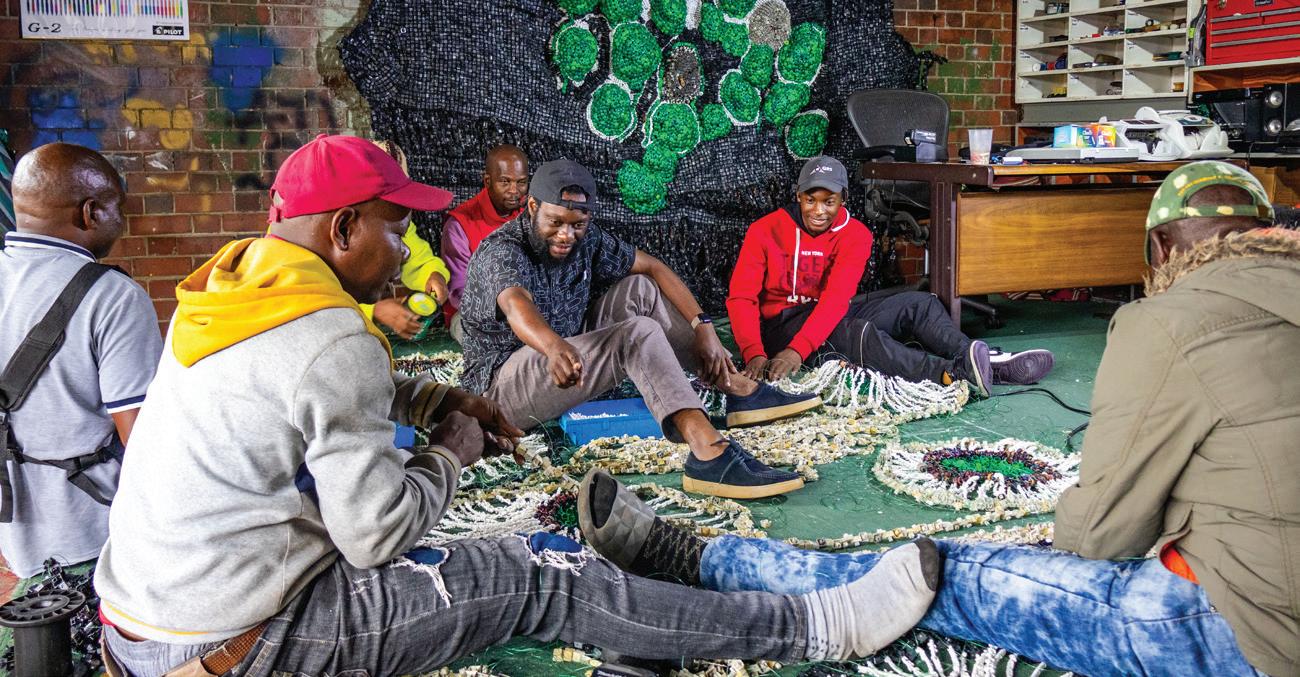
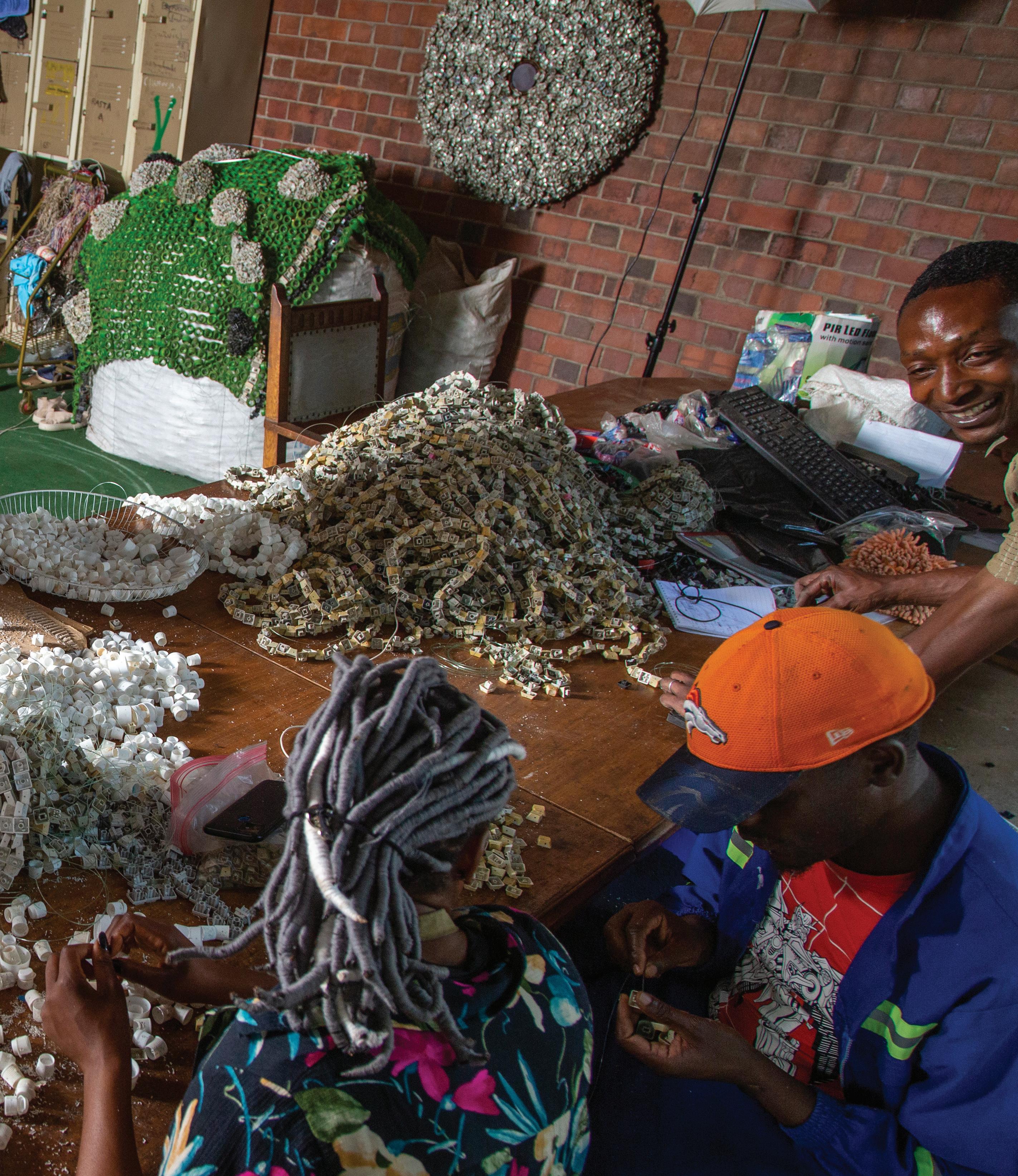
Artist and his studio team at Mbare Art Space, with Hanging by the Thread on the back wall. Courtesy of Mbare Art Space.
Moffat Takadiwa, Shereni Ihombe, 2023. Courtesy of the Artist and Nicodim.
as well as the significance of the artist returning such waste to the West as a form of spiritual resistance.
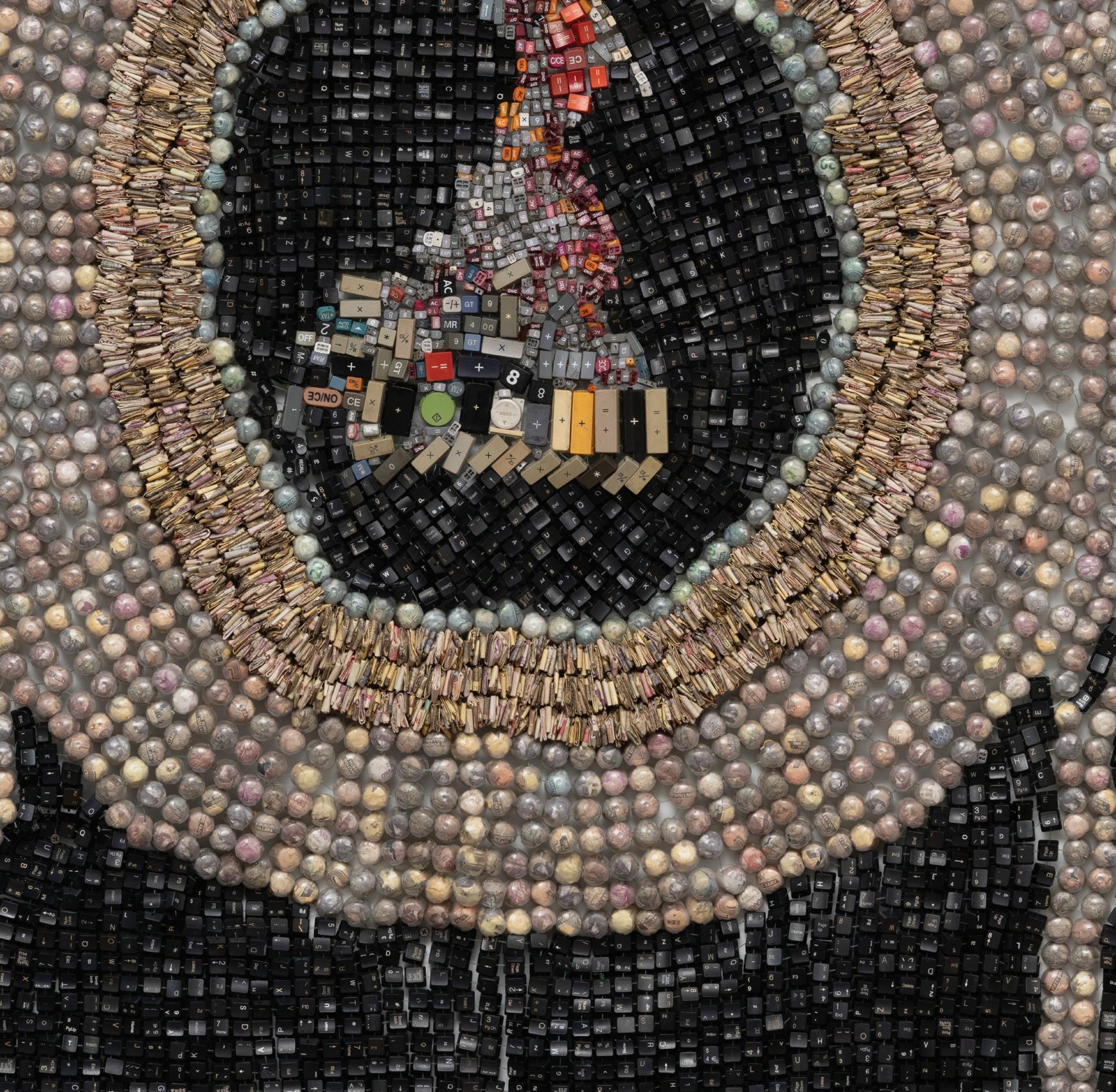
In other selections, such as Pregnant Picasso Bull (2024), Takadiwa reworks the Spanish painter’s decapitated bull from Guernica (1937) to critique the violence of globalization that the West often ignores, which manifests in environmental destruction and cultural desecration. Inside the bull is a pixelated rooster, which once symbolized political freedom and Africa’s hope of becoming a superpower. Now commodified into a global fast-food icon, it represents Africa’s aborted acceleration to modernity and the burden of being engulfed in detritus and postconsumer objects created by global superpowers. Big Brother Africa (2024) evokes layers of memory and power dynamics, providing viewers with entry points to understanding Africa’s hierarchically structured landscape, in which a few powerful nations often monopolize smaller countries. It also reflects on the ongoing relationship with international networks of exploitation — entanglements that continue to impede the continent’s development.
Interpreting Takadiwa’s work requires understanding the lineage and narrative resonances of his materials and the artistic ecosystem in Mbare, where they are created. His art is centered on people and places, culture, memory, social critique, and ancestral continuity. In addition to using computer keys to explore language, displacement, and the concept of home, Takadiwa engages a system of symbolic juxtaposition. In Shereni Ihombe, he highlights Indigenous cosmologies through material memory. Fashion Brands (b) critiques the legacy of consumer excess and the afterlives of postconsumer detritus dumped in African urban spaces by high-GDP nations. Reminiscence of Tengwe Farms (a and b) addresses Zimbabwe’s agrarian histories, post-independence decline, and the prevalent question of land ownership. Through his reimagining of Korekore weaving and the ethics that underpin it, Takadiwa anchors his work in ancestral knowledge systems, offering a culturally rooted critique of Western capitalist commodification, its destructive impacts on Africa, and forging new possibilities inspired by traditional customs.
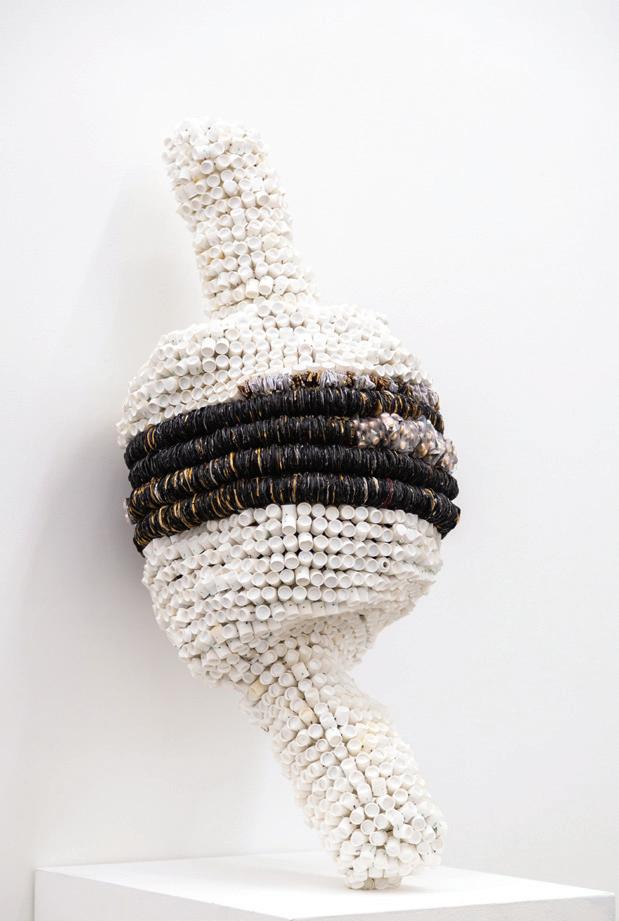
Moffat Takadiwa, Object of Influence (5I), 2021. Courtesy of the Artist and Nicodim.
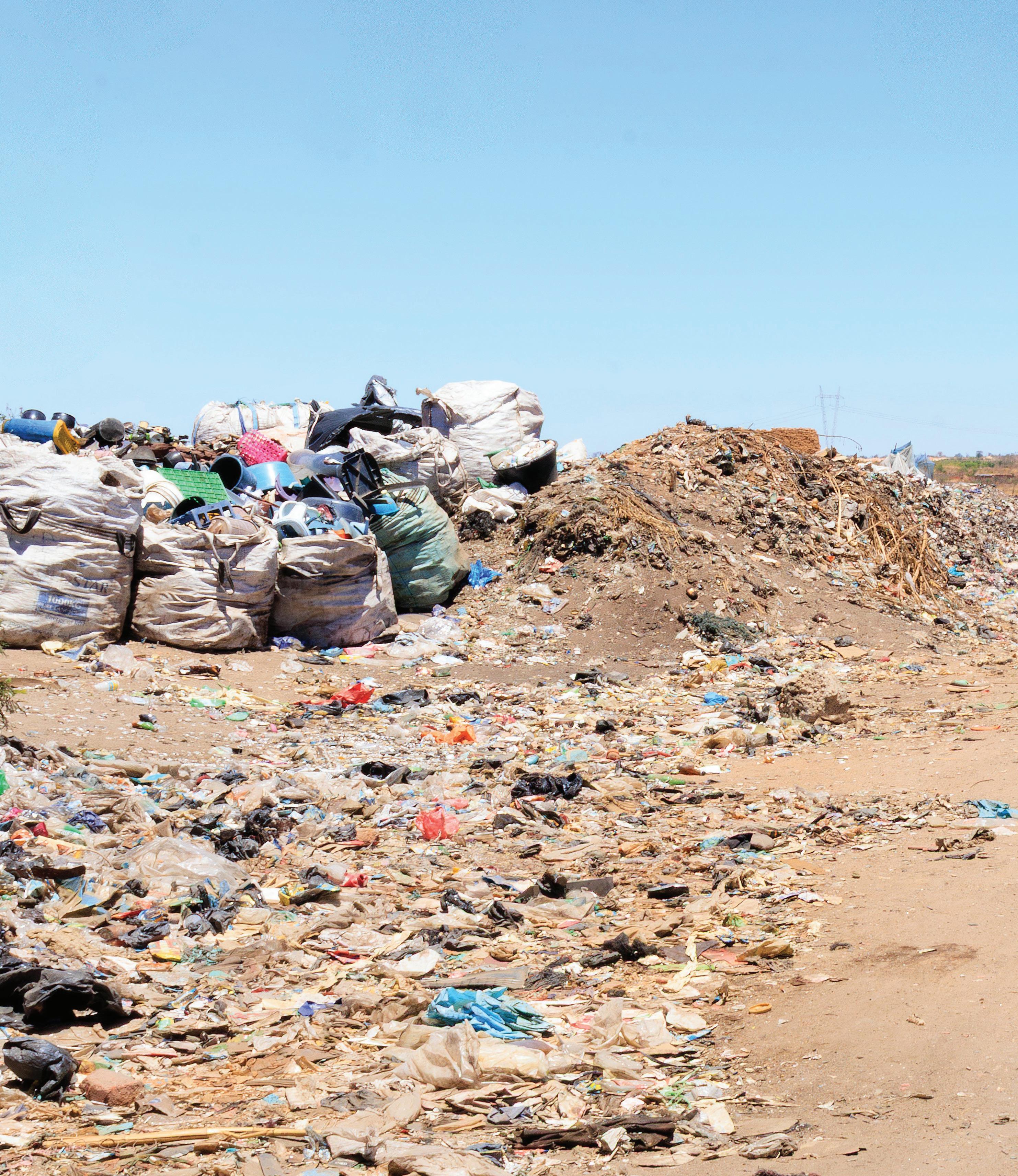
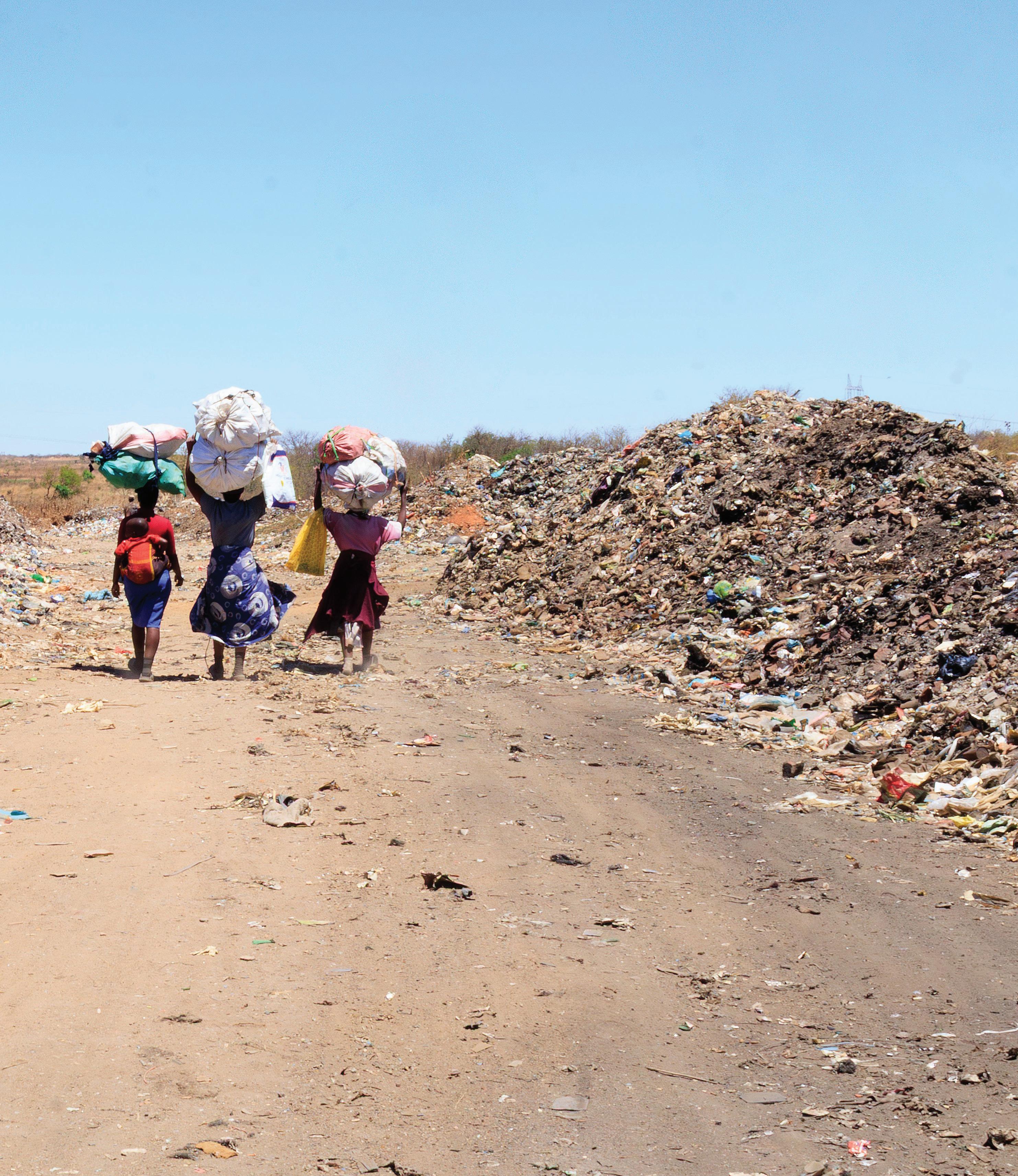
Dump site, Harare, Zimbabwe.
Courtesy of Tatenda Kanengoni, Mbare Art Space.
7 Daily Maverick, “Zimbabwean Artist Draws ‘Inspiration from Rejection’ to World Stardom.”
8 Matthew Akormedi, Julius Fobil, and Jochen A. Müller, “Health Risks and Environmental Burdens of Informal E-Waste Recycling in Agbogbloshie, Accra, Ghana: The Case of Children,” Environmental Pollution 209 (2016): 238–45.
9 Takadiwa, interview by El-beshir.
That sense of possibility manifests in his Mbare Art Space, an artistic ecosystem that promotes cocreation and youth empowerment while allowing for diverse Indigenous beliefs to flourish. Reminiscing about this dimension of his practice, Takadiwa said, “I am fascinated by the almost spiritual aura that surrounds people who are required to repeat the same task over and over, day after day. The rhythms and sounds create an alternative sensory experience. The multiple hands that contribute to the production of my works are symbols of a related community, collective empowerment, and an emancipation from global and local exploitation.”7 For Takadiwa, the Mbare Art Space is a communal hub that places art at the heart of the community, a space for decentralizing art and knowledge, and a counter-institution that redistributes resources, education, and creative opportunities. It nurtures and promotes a collective vision of social transformation through art. More than that, it serves as a spiritual center, a place where discarded objects and marginalized communities are reimagined and revitalized through creativity. By centering his army of helpers in his practice, he enacts the Korekore principles of helping others and building community, which Takadiwa believes should be the essence of art, one that is committed to the well-being of the locals.
Recoded Memories also reflects Takadiwa’s contribution to broader global discourse, such as waste colonization — the intentional export of detritus from high-GDP countries to lowerincome countries, particularly in Africa. While on the surface, this practice is framed as trafficking in secondhand products to help the economies of so-called developing nations, in reality, it leads to toxic contamination, environmental degradation, cultural erasure, and health crises, including respiratory epidemics. 8 Takadiwa’s reappropriation of electronics waste highlights the extractive nature of capitalism and its consequences, while also engaging with sustainability discourses. As he notes, “most resources come from Africa and are shipped to the global North, where they are turned into finished products. These products are only sent back to the continent when they are either half-used or discarded as waste. My work sends these objects back to the West to continue the cycle of materials.”9
Artist’s studio floor. Courtesy of Geri Kam, Mbare Art Space.
Moffat Takadiwa, Fashion Brands (b), 2025. Courtesy of the Artist and Nicodim.
10 David N. Pellow, “Environmental Inequality Formation: Toward a Theory of Environmental Injustice,” American Behavioral Scientist 43, no. 4 (2000): 581–601.
11 Boaventura de Sousa Santos, “Epistemologies of the South and the future,” From the European South: A Transdisciplinary Journal of Postcolonial Humanities 1 (2016): 17–29; Achille Mbembe, Out of the Dark Night: Essays on Decolonization, trans. Daniel Mandell (New York: Columbia University Press, 2021).
12 Clement E. Akpang, “Cultural Ramifications of the Found Object in Contemporary African Art,” International Journal of Multiculturalism 2, no. 1 (2021): 50–74.
13 Takadiwa, interview by El-beshir.
Sociologist and environmental justice advocate David Pellow argues that capitalism not only exploits environments in the Global South but also erases histories, cultures, and identities.10 By sending these objects back to the West and invoking Korekore ethics of material sharing, Takadiwa challenges modern hyperconsumerism and individualism, presenting reuse as a socially and environmentally sustainable practice. This aligns with the work of thinkers like Portuguese sociologist Boaventura de Sousa Santos, who calls for the reclamation of Indigenous knowledge systems to address contemporary global issues, as well as Achille Mbembe’s theories in planetarity, which promote the “universal sharing of the benefits of life on Earth.”11
Takadiwa’s works further challenge the applicability of Western art historical narratives to African art. Too often, African artists working with discarded objects are erroneously compared to European avant-gardes, such as Marcel Duchamp or Man Ray, which trivializes their practices as imitations.12 Recoded Memories challenges such framing. It portrays Takadiwa as a conceptual force whose “glocal” practice, rooted in Zimbabwe and resonant worldwide, provides a critical perspective on global discourses about sustainability, memory, waste colonization, and power dynamics, grounded in its own authentic and contextual foundation.
The works on display invite viewers to look beyond their visual spectacle to recognize discarded materials as vehicles of meaning and embodiments of histories, identity, memories, and agents of critique. The exhibition creates a dialogic space between Zimbabwe and Lexington — both regions boast a rich agricultural legacy characterized by historic farms and a connection to community and sustainability. It also establishes a link between global policies and local consequences, and between the fourth industrial revolution and the destruction of the Global South. In Takadiwa’s words, the works endeavor to “evoke thought and ignite diverse conversations.”13 Recoded Memories aims to leave visitors with a renewed awareness of their relationship to hyper-consumption, the transformative power of art, and the contributions of African artists to global discourses through a local lens. ■
Removing keys from a computer keyboard in preparation for drilling and assembly. Courtesy of Mbare Art Space.
Clement Akpang is an assistant professor of art history in the Corcoran School of the Arts & Design at The George Washington University. His teaching and research interests include modern and contemporary African art from the early twentieth century to the present, with particular emphasis on expressions of avantgardism, African modernisms, and the cultural significance of found objects in art. His first book, Nigerian Modernism 19001965: Anti-Europeanization, Nationalism and Avant-garde Art (University of Calabar Press, 2019), explores the intersection of modern art, nationalism, and decolonization politics in Nigeria. His forthcoming book, Iconology of the Found Object in Contemporary African Art: Strategic Appropriation and Contestation, features a chapter on Moffat Takadiwa’s use of post-consumer waste in his artistic practice.
Exhibition Introduction
CLEMENT AKPANG, PH.D., GUEST CURATOR
Zimbabwean artist Moffat Takadiwa (b. 1983) transforms postconsumer objects into sculptures rooted in Korekore worldviews that honor material care, respect for the land, and the interdependence of humans and nature. Working from Mbare Art Space, a repurposed colonial-era beer hall in Harare, his practice draws upon Shona philosophies that view objects as active participants in a cyclical vital force, sustaining connection and perpetual life rather than waste.
Takadiwa’s work responds to the overwhelming presence of global refuse in African cities, where imported plastics, obsolete electronics, and discarded car parts from Europe and North America accumulate in toxic landfills. These sites embody the legacies of a capitalist system built on accumulation, disposability, and the exploitation of low-GDP countries. From this detritus, he forges new pathways of value and purpose, embedding Korekore ethics of continuity into objects otherwise marked for erasure.
Recontextualized into mosaiclike, rhythmic forms, these materials articulate layered meanings through visually dazzling installations. “The materials I use have narratives attached to them,” Takadiwa explains. His works speak to postcolonial realities of identity, migration, sustainability, and commodification, while also evoking themes of displacement, memory, and
belonging through reimagined iterations using waste material.
Recoded Memories, Takadiwa’s first solo exhibition at the Art Museum and Galleries of Washington and Lee University, explores the afterlives of objects as vessels of history and cultural activation. Central to the exhibition are computer keys, which symbolize language, migration, and memory within global systems of exploitation. As the artist notes: “I use computer keys to speak about language, the first vehicle to connect back to home or a memory once displaced…they speak to the records of the past.” Through such materials, Takadiwa reinterprets Korekore traditions of care and reuse to critique hyper-consumerism and its creation of toxic ecologies. His works operate as cultural mnemonics, probing the entanglement of displacement, sustainability, and home under globalization’s waste politics. By tracing the cyclical journey of resources extracted from Africa, consumed in the West, and returned as waste, Takadiwa exposes the hidden violence of global capitalism. In transforming discards into artworks, he insists on memory, continuity, and the possibility of renewed relations among people, materials, and the planet. Recoded Memories ultimately invites audiences to consider how Indigenous ways of knowing might reshape our relationship to consumption, and as Takadiwa suggests, “evoke thoughts and ignite diverse conversations.”
Detail of Moffat Takadiwa, Hanging by the Thread, 2025. Photo credit Meaghan Walsh.
Moffat Takadiwa: Recoded Memories. Watson Galleries, Washington and Lee University, Lexington, VA. Photography credit: Kevin Remington, University Photography.
Moffat Takadiwa, Object of Influence (5D), 2021. Courtesy of the Artist and Nicodim.
Exhibition Checklist
Recoded Memories
October 24, 2025 – May 31, 2026
Watson Galleries
1. Fashion Brands (b), 2025
Computer and laptop keys, toothbrushes, buttons, and various accessories
72 x 53 inches
2. Pregnant Picasso Bull, 2024
Zimbabwean bank notes encased in bottle caps, calculator and computer keys
107 1/8 x 50 x 2 3/8 inches
3. Big Brother Africa, 2024
Toothbrushes, computer and laptop keys
98 3/8 x 55 7/8 x 2 inches
4. Object of Influence (5D), 2021
Colgate tubes, laptop keys, and pill bottle tops
28 x 16 inches
5. Object of Influence (5I), 2021
Colgate tops and pill bottle tops
43 x 18 x 18 inches
6. Shereni Ihombe, 2023
Nails, clothing reverts, and railway wood
39 x 39 x 3 inches
7. Hanging by the Thread, 2025
Computer and calculator keys, bottle tops, and nail clips
118 x 106 3/8 x 7 7/8 inches
8. Reminiscence of Tengwe Farms (a), 2025
Computer and calculator keys, clothing buttons, and nail clips
68 7/8 x 39 x 4 inches
9. Reminiscence of Tengwe Farms (b), 2025
Computer and calculator keys, clothing buttons, and nail clips
70 7/8 x 39 x 4 inches
10. Echoes of Freedom, 2024
Calculator and computer keys, belt buckles
76 3/4 x 55 1/8 x 4 3/4 inches
Artist’s studio team at Mbare Art Space. Courtesy of David Brazier and Mbare Art Space.
Artist Biography
EDUCATION
2008: Diploma in Fine Art, Harare Polytechnic College, Zimbabwe
SELECTED SOLO EXHIBITIONS
2025: Second Life, Nicodim, New York
2024: Possible New Dawn, Nicodim Annex, Los Angeles
2024: Vestiges of Colonialism, Galeria Nicodim, Bucharest
2024: Tales of the Big River, Galerie Edouard Manet, Centre d’art contemporain, Gennevilliers
2023: Zero Zero, Semiose, Paris
2023: Vestiges of Colonialism, National Gallery of Zimbabwe, Harare
SELECTED GROUP EXHIBITIONS
2025: Not All Travellers Walk Roads — Of Humanity as Practice, the 36th edition of the Bienal de São Paulo, curated by Prof. Dr. Bonaventure Soh Bejeng Ndikung.
2025: Tukku Magi: Rhythm’s, Latvian Museum of Art, Riga
2024: Avantgarde & Liberation, Mumok, Vienna
2024: Stranieri Ovunque – Foreigners Everywhere, the 60th edition of the Venice Biennale exhibition, curated by Adriano Pedrosa, Venice
2022: The Bull, Semiose, Paris
2022: Brutalized Language, Nicodim, New York
2021: Witch Craft: Rethinking Power, Craft Contemporary, Los Angeles
2021: Mr. Foreman you have destroyed the farm, Semiose, Paris, France
2019: Son of the Soil, Nicodim, Los Angeles, CA
2024: Color is the First Revelation of the World, Orange County Museum of Art, Costa Mesa
2024: signifying the impossible song, Southern Guild, Los Angeles
2023: Feeling Without Touching, Nicodim, New York
2023: A Love Letter to LA, curated by Storm Ascher, Superposition Gallery, Phillips Auction House, Los Angeles
2023: Africa Supernova, Kunsthal KAdE, Amersfoort
2022: Nous sommes tous des lichens, Musée d’art contemporain de la Haute-Vienne – château de Rochechouart
2021: This is Not Africa: Unlearn What You Have Learned, ARoS Museum, Denmark
2020: INXS: Never Before Seen Major Works by Simphiwe Ndzube, Moffat Takadiwa, Zhou Yilun, Nicodim, Los Angeles, CA
2019: Thread., Long Beach Museum of Art, Long Beach
AWARDS
2016: Award of Merit, Cottco Exhibition and Prize, National Gallery of Zimbabwe, Harare
2012: Award of Attendance, Zimbabwe Olympic Committee, Harare
2010: Award of Merit, Peace Through Unity Exhibition, Gallery Delta, Harare
2019: Stormy Weather, Museum Arnhem, Arnhem, The Netherlands
2019: Second Hand: Selected Works from the Jameel Art Collection, Jameel Arts Centre, Dubai
2019: Material Insanity, Museum of African Contemporary Art Al Maaden, Marrakech
2018: The Eye Sees Not Itself, Nicodim, Los Angeles
2017: Chinafrika. under construction, Museum for Contemporary Art Leipzig
2008: Special Prize, Enriching Women, Gallery Delta, Harare
2009: 2nd Prize Walls, Special Mentions, Peace Through Unity Exhibition Delta, Harare
SELECTED PUBLIC AND PRIVATE COLLECTIONS
Roc Nation Collection, Los Angeles
CC Foundation, Shanghai
Centre National d’Art Plastique, Paris
Collection of Art of European Parliament, Brussels, Belgium
National Gallery of Zimbabwe, Harare
Mbare Art Space, Harare, Zimbabwe. Courtesy of Mbare Art Space.
Moffat Takadiwa in front of one of his wall tapestries Re-Reading Korekore. Courtesy of David Brazier and Mbare Art Space.