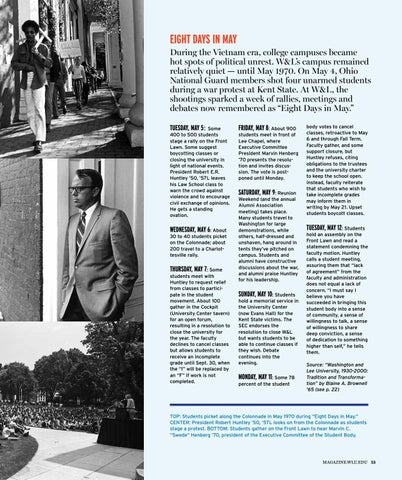
EIGHT DAYS IN MAY During the Vietnam era, college campuses became hot spots of political unrest. W&L’s campus remained relatively quiet — until May 1970. On May 4, Ohio National Guard members shot four unarmed students during a war protest at Kent State. At W&L, the shootings sparked a week of rallies, meetings and debates now remembered as “Eight Days in May.” TUESDAY, MAY 5: Some
FRIDAY, MAY 8: About 900
400 to 500 students stage a rally on the Front Lawn. Some suggest boycotting classes or closing the university in light of national events. President Robert E.R. Huntley ’50, ’57L leaves his Law School class to warn the crowd against violence and to encourage civil exchange of opinions. He gets a standing ovation.
students meet in front of Lee Chapel, where Executive Committee President Marvin Henberg ’70 presents the resolution and invites discussion. The vote is postponed until Monday.
WEDNESDAY, MAY 6: About 30 to 40 students picket on the Colonnade; about 200 travel to a Charlottesville rally.
THURSDAY, MAY 7: Some students meet with Huntley to request relief from classes to participate in the student movement. About 100 gather in the Cockpit (University Center tavern) for an open forum, resulting in a resolution to close the university for the year. The faculty declines to cancel classes but allows students to receive an incomplete grade until Sept. 30, when the “I” will be replaced by an “F” if work is not completed.
SATURDAY, MAY 9: Reunion Weekend (and the annual Alumni Association meeting) takes place. Many students travel to Washington for large demonstrations, while others, half-dressed and unshaven, hang around in tents they’ve pitched on campus. Students and alumni have constructive discussions about the war, and alumni praise Huntley for his leadership.
SUNDAY, MAY 10: Students hold a memorial service in the University Center (now Evans Hall) for the Kent State victims. The SEC endorses the resolution to close W&L but wants students to be able to continue classes if they wish. Debate continues into the evening. MONDAY, MAY 11: Some 78 percent of the student
body votes to cancel classes, retroactive to May 6 and through Fall Term. Faculty gather, and some support closure, but Huntley refuses, citing obligations to the trustees and the university charter to keep the school open. Instead, faculty reiterate that students who wish to take incomplete grades may inform them in writing by May 21. Upset students boycott classes.
TUESDAY, MAY 12: Students hold an assembly on the Front Lawn and read a statement condemning the faculty motion. Huntley calls a student meeting, assuring them that “lack of agreement” from the faculty and administration does not equal a lack of concern. “I must say I believe you have succeeded in bringing this student body into a sense of community, a sense of willingness to talk, a sense of willingness to share deep conviction, a sense of dedication to something higher than self,” he tells them. Source: “Washington and Lee University, 1930-2000: Tradition and Transformation” by Blaine A. Brownell ’65 (see p. 22)
TOP: Students picket along the Colonnade in May 1970 during “Eight Days in May.” CENTER: President Robert Huntley ’50, ’57L looks on from the Colonnade as students stage a protest. BOTTOM: Students gather on the Front Lawn to hear Marvin C. “Swede” Henberg ’70, president of the Executive Committee of the Student Body.
MAGAZINE.WLU.EDU 15