Page 8 For 28-29 days every year, American history’s traditional focus on a long list of white men with a few smatterings of white women here and there is replaced with an appreciation for all of the numerous contributions African Americans have made to our country. This appreciation is very important to many, myself included, because it is a celebration of the immense contributions of Black Americans. Being that Black History Month is so vital, both to history and to African American morale, celebrating it is equally important. How is one to celebrate it, and what exactly are we celebrating? . First, the beginning: Black History Month began as Black History Week in 1926. It was started by Carter G. Woodson, a Harvard trained historian, in 1926, and it took place during the second week of February. Much like Black History Month, it served two core functions: to recognize and celebrate African American excellence. To truly understand the value of Black History Month, we need to dig a bit deeper into the precise reasons as to why it began. According to Carter G. Woodson, by teaching about African American history, the African American race could be preserved within society. “If Black people’s achievements were simply glossed over, the entire race could be ignored, and any value our race held could be easily dismissed. However, by focusing on the greatness that African Americans have achieved despite the challenges that we’ve faced, our race is given its due credits, which will (ideally) cause us to be treated more respectfully.” According to ABC News, Black History Week was expanded to Black History Month in February 1969, and became federally recognized in 1976 after President Gerald
Black History
by Ryan Parker R. Ford decreed that it should be a national observance. That recognition brings us to today, where Black History Month is celebrated nationwide, including in schools. Among the many schools that celebrate Black History Month is ours, where the contributions of black people throughout history are celebrated by the decorating of doors and the hanging of posters. Posters and door decorating are not the only ways in which Black History Month was celebrated at WLHS. There was a wall in the lower lobby dedicated to monumental black people and events, and classes included teachings about black achievements in their curriculum.
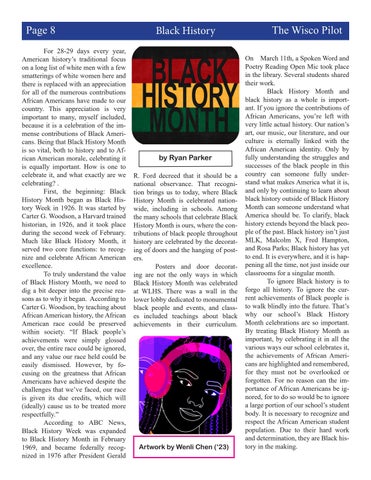
Artwork by Wenli Chen (‘23)
The Wisco Pilot On March 11th, a Spoken Word and Poetry Reading Open Mic took place in the library. Several students shared their work. Black History Month and black history as a whole is important. If you ignore the contributions of African Americans, you’re left with very little actual history. Our nation’s art, our music, our literature, and our culture is eternally linked with the African American identity. Only by fully understanding the struggles and successes of the black people in this country can someone fully understand what makes America what it is, and only by continuing to learn about black history outside of Black History Month can someone understand what America should be. To clarify, black history extends beyond the black people of the past. Black history isn’t just MLK, Malcolm X, Fred Hampton, and Rosa Parks; Black history has yet to end. It is everywhere, and it is happening all the time, not just inside our classrooms for a singular month. To ignore Black history is to forgo all history. To ignore the current achievements of Black people is to walk blindly into the future. That’s why our school’s Black History Month celebrations are so important. By treating Black History Month as important, by celebrating it in all the various ways our school celebrates it, the achievements of African Americans are highlighted and remembered, for they must not be overlooked or forgotten. For no reason can the importance of African Americans be ignored, for to do so would be to ignore a large portion of our school’s student body. It is necessary to recognize and respect the African American student population. Due to their hard work and determination, they are Black history in the making.