How Early STEM Mentorship Shapes Future Innovators and Leaders

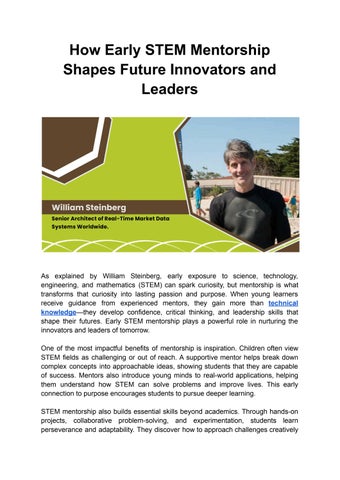
As explained by William Steinberg, early exposure to science, technology, engineering, and mathematics (STEM) can spark curiosity, but mentorship is what transforms that curiosity into lasting passion and purpose. When young learners receive guidance from experienced mentors, they gain more than technical knowledge—they develop confidence, critical thinking, and leadership skills that shape their futures. Early STEM mentorship plays a powerful role in nurturing the innovators and leaders of tomorrow.
One of the most impactful benefits of mentorship is inspiration. Children often view STEM fields as challenging or out of reach. A supportive mentor helps break down complex concepts into approachable ideas, showing students that they are capable of success. Mentors also introduce young minds to real-world applications, helping them understand how STEM can solve problems and improve lives. This early connection to purpose encourages students to pursue deeper learning.
STEM mentorship also builds essential skills beyond academics. Through hands-on projects, collaborative problem-solving, and experimentation, students learn perseverance and adaptability They discover how to approach challenges creatively
and how failure can be a stepping stone rather than a setback. These lessons are fundamental for innovation, where trial and improvement are part of every breakthrough.
Another key influence is representation and encouragement. Mentors from diverse backgrounds provide role models for students who may not otherwise see themselves reflected in STEM careers. Early mentorship helps bridge gaps in access and opportunity, especially for underrepresented groups, creating a more inclusive pipeline of future scientists, engineers, and technology leaders.
Leadership development is another outcome of mentorship. As students grow under guidance, they often begin mentoring others, participating in STEM clubs, competitions, or community projects. This cycle promotes communication, teamwork, and a sense of responsibility—qualities that are essential for future leaders in any field.
Ultimately, early STEM mentorship is an investment in the future. By nurturing young talent, mentors help students imagine bigger possibilities and equip them with the tools to pursue ambitious goals. These mentorship experiences plant the seeds for innovation, shaping individuals who will lead advancements in technology, science, and society Supporting mentorship programs today means empowering the problem-solvers and visionaries of tomorrow