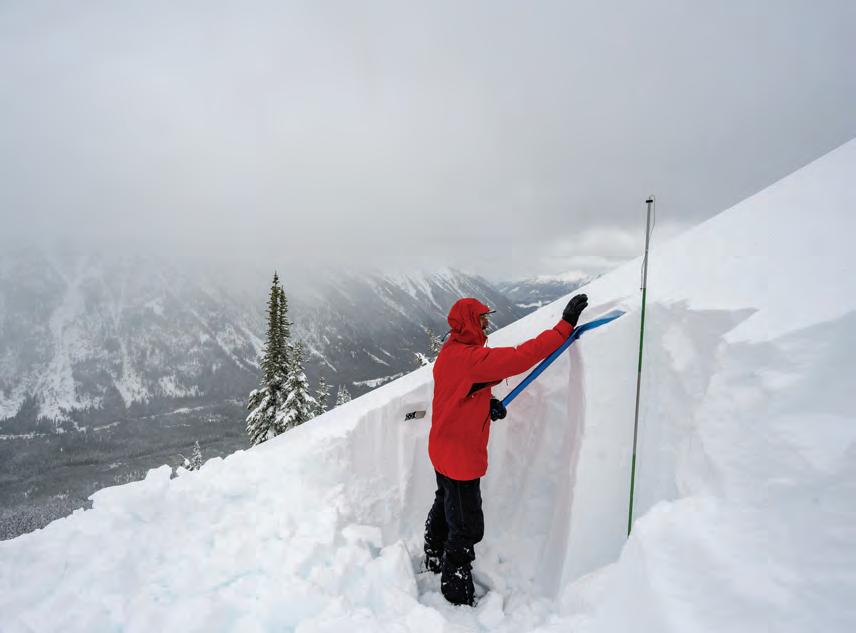
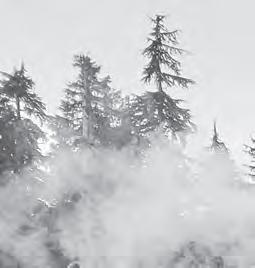
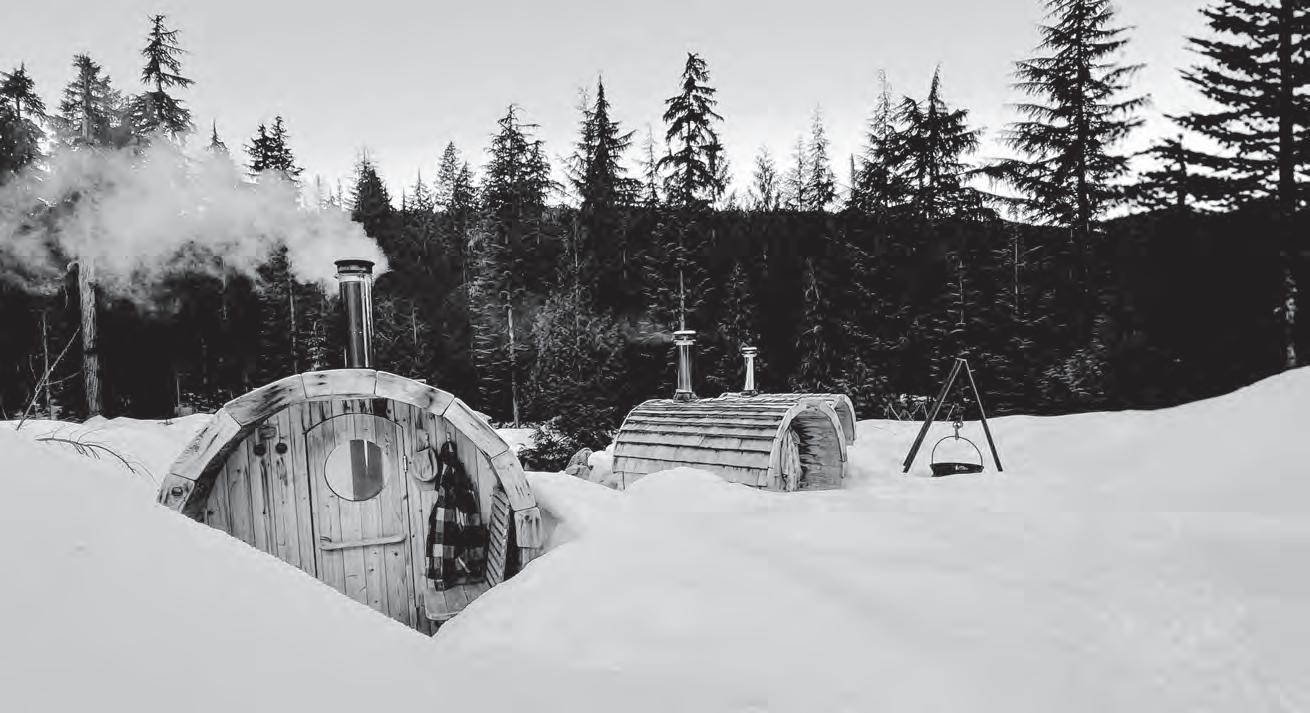
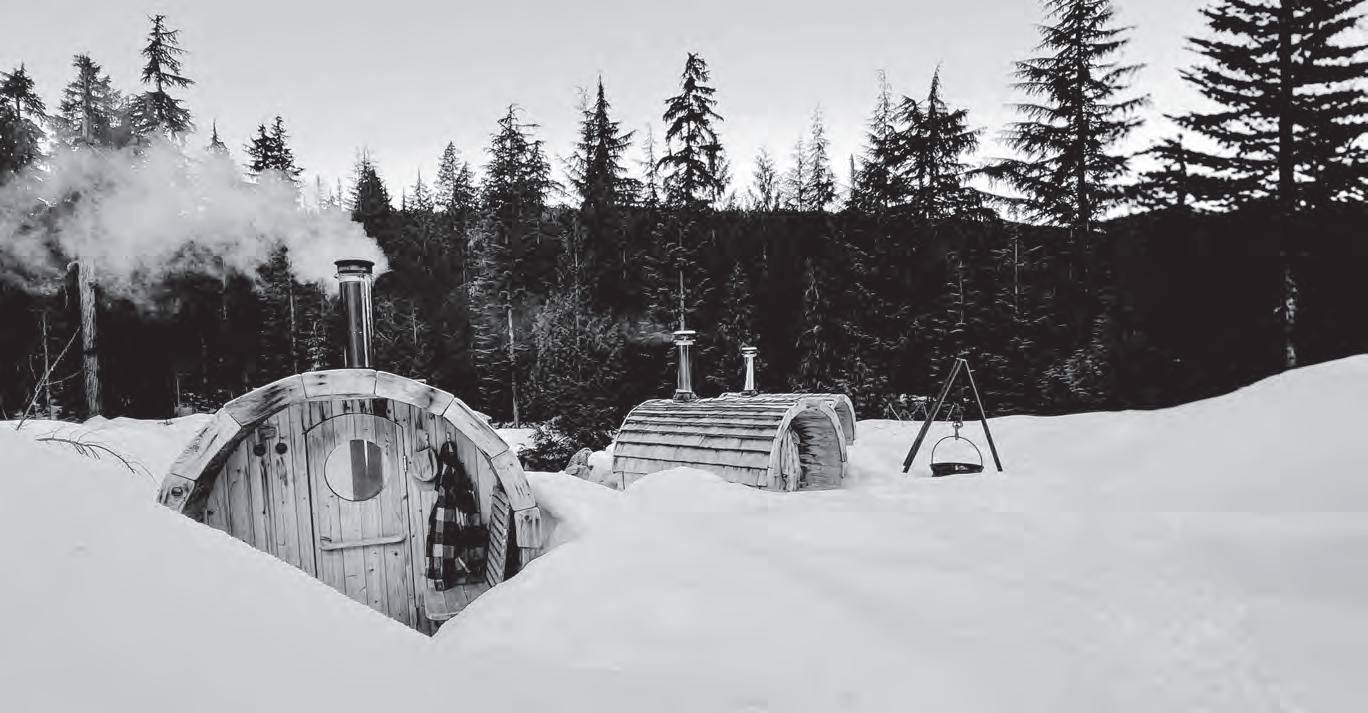
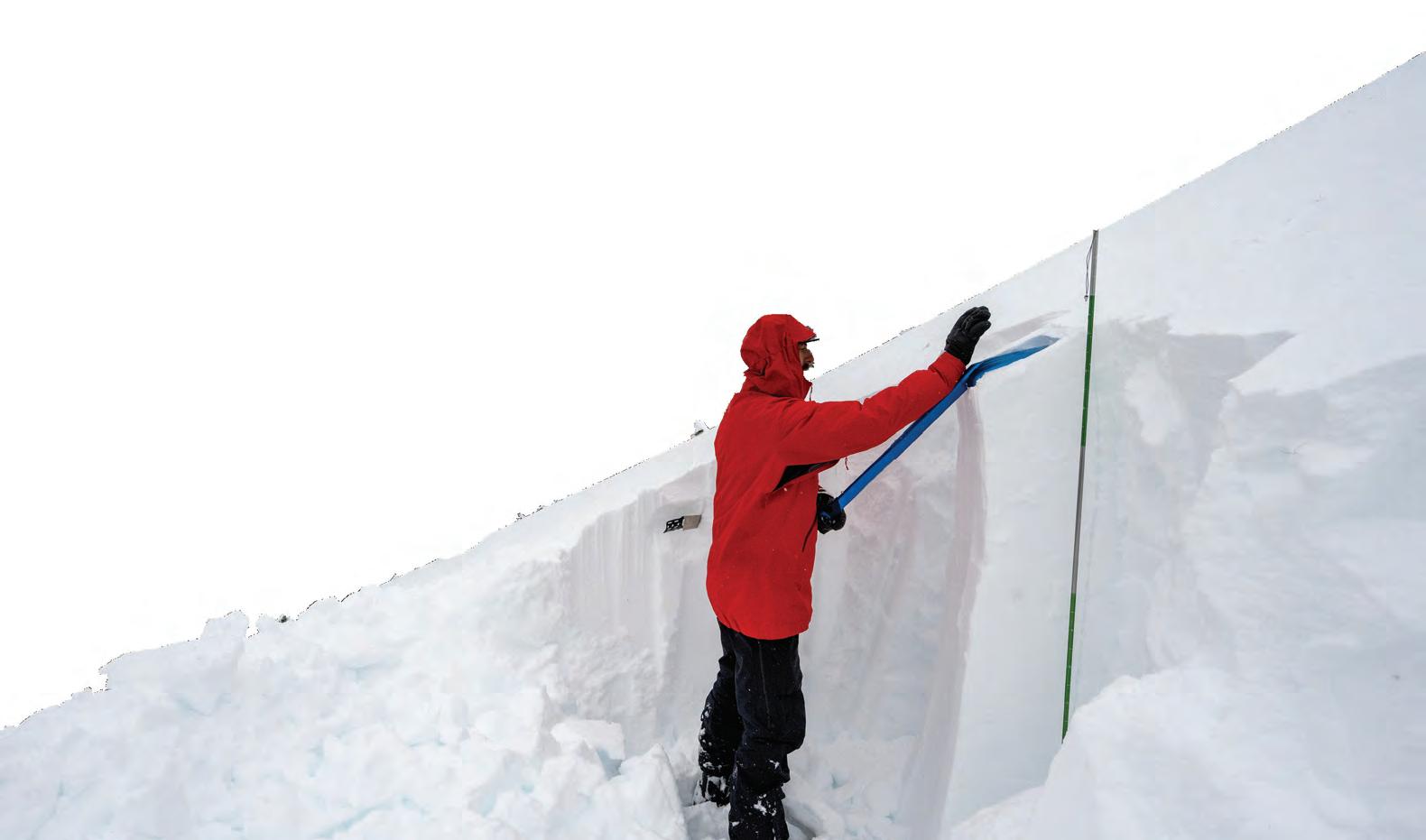
The experts reading Whistler’s snowpack. - By Caroline Egan
06 OPENING REMARKS While Whistler keeps one eye on the snow forecast, editor Braden Dupuis explores the strange history of sky-watching.
08 LETTERS TO THE EDITOR This week’s letter writers weigh in on Whistler’s 2026 budget, and the rezoning of the Northlands.
20 RANGE ROVER With no snow in sight, what better time for your annual Christmas nonfiction primer courtesy of Leslie Anthony?
46 PIQUE’N YER INTEREST In which Vince Shuley delves into the wild world of right to repair.
12 COMPLETE COMMUNITIES A recent report to Whistler’s mayor and council identifies local neighbourhoods ripe for infill and investment—and uneven access to amenities.
13 PAY TO PLAY The Resort Municipality of Whistler is proposing doubling the mill rate for recreation properties in a bid to “make tourism pay for tourism.”
30 SPRING OF THINGS Whistler’s Max Oughtred reflects on a recent fifth-place finish at the Trampoline World Age Group Championships.
34 HIDDEN COLLABORATIONS Multidisciplinary artist Taylor Smith is partnering with the Whistler Contemporary Gallery for a speaking engagement at the Hilton on Dec. 13.
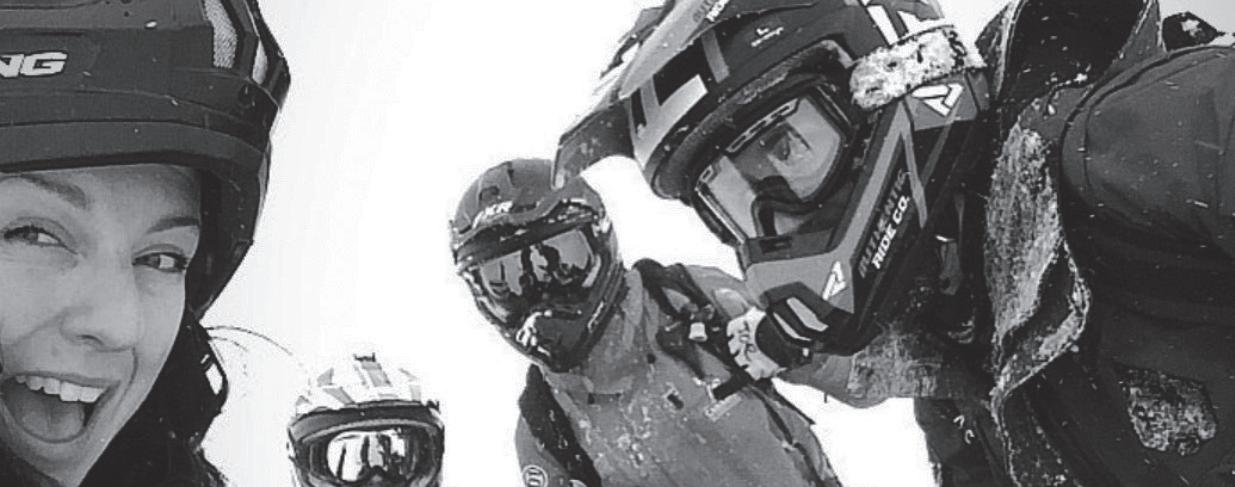
COVER I don’t read very much, but when I do it’s usually something to do with the snowpack. - By Jon Parris // @jon.parris.art
Publisher SARAH STROTHER - sstrother@piquenewsmagazine.com
Sales Manager SUSAN HUTCHINSON - shutchinson@piquenewsmagazine.com
Production Manager AMIR SHAHRESTANI - ashahrestani@piquenewsmagazine.com
Art Director JON PARRIS - jparris@piquenewsmagazine.com
Advertising Representatives
TESSA SWEENEY - tsweeney@wplpmedia.com
ANDREW BUDRESKI - abudreski@piquenewsmagazine.com
Digital/Sales Coordinator KATIE DOUGLAS - kbechtel@wplpmedia.com
Reporters
LUKE FAULKS - lfaulks@piquenewsmagazine.com
DAVID SONG - sports@piquenewsmagazine.com
Office Manager HEIDI RODE - hrode@wplpmedia.com
Classifieds and Reception - mail@piquenewsmagazine.com
Contributors G.D. MAXWELL, VINCE SHULEY, LESLIE ANTHONY, GLENDA BARTOSH, ANDREW MITCHELL, LISA RICHARDSON, LIZI MCLOUGHLIN, TOBIAS C. VAN VEEN
Founding Publishers KATHY & BOB BARNETT www.piquenewsmagazine.com
From leeches to supercomputers— why we still doubt the forecast
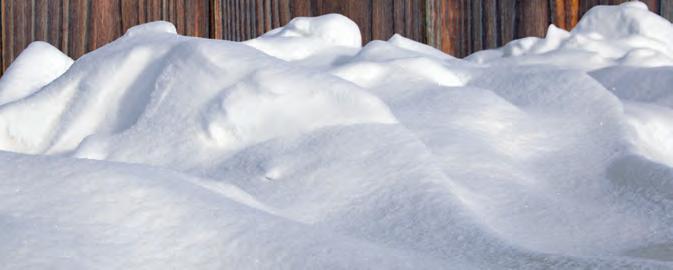
AS PIQUE PREPARED to go to press on the morning of Dec. 10, a thin layer of freshly fallen snow blanketed the valley floor for just the third or fourth time this season— while a smattering of early morning rain threatened to wash it all away.
Par for the course so far this winter. The 2025-26 ski season isn’t even a month old, and the Wet Coast is living up to its name. Early pre-season forecasts predicted a warmer-than-normal
BY BRADEN DUPUIS
winter, with the coldest periods in late November, early December, and early February. Whether those outlooks hold— or what bounties Ullr delivers—remains
But then, weather forecasting has always occupied a strange place in the public imagination. It’s science, technically. But on the receiving end— the audience side—it often feels closer to divination. You check the forecast, you plan your day, and half the time you’re still walking into a headwind you weren’t warned about.
That’s the contradiction. Forecasts are more accurate than they’ve ever been—today’s five-day outlook rivals a three-day forecast a generation ago. We have supercomputers parsing global atmospheric data in real time and satellites covering every inch of the planet.
And yet people don’t trust the forecast. Meteorology has improved; public expectation has inflated. The gap between the two is where the frustration lives. And if this is us at our best, what were we doing before?
SMOKE AND FEATHERS
Long before barometers and supercomputers, humans read the sky
the only way they could: by watching patterns and clouds. According to NASA’s Earth Observatory, civilizations like the Babylonians, around 650 B.C.E., tried to divine the weather from cloud shapes, celestial phenomena, and halos around the moon.
By 340 B.C.E., Aristotle was writing treatises on wind, clouds, storms, and rain—sometimes impressively intuitive, often deeply wrong. Without instruments, everyone leaned on signs that felt poetic: low-flying birds, odd smells, moon halos. Some had a half-plausible basis (shifting pressure really does affect birds and insects), but most of it was folklore and vibes—forecasting driven by good wishes more than good data.
SCIENCE AND SIGNALS
The breakthrough came in the 17th century. In 1643-44, Italian physicist Evangelista Torricelli invented the mercury barometer—humanity’s first tool to “measure the weight of the air.”
Reliable thermometers and early
approaching storms.
Then came the Royal Charter Storm of 1859, which killed more than 800 people and sank or damaged 200 ships. It proved forecasting wasn’t a novelty; it was a necessity. Weather prediction shifted from folk wisdom to science-pluscommunication.
LEECHES AND LAVA LAMPS
Even with scientific breakthroughs, people (of course) kept trying bizarre methods. The most infamous: the 19th-century tempest prognosticator—a ring of glass jars, each containing a live leech. When air pressure dropped, the leeches supposedly got agitated, climbed the jars, and triggered tiny hammers that rang bells. More bells = bigger storm. Inventor George Merryweather proudly displayed it at the 1851 Great Exhibition in London.
It’s delightfully absurd—one of those inventions that makes you wonder if humanity isn’t a fundamentally unserious species. (Odds that Whistler
EQUATIONS AND BALLOONS
By the early 20th century, the field formalized. Vilhelm Bjerknes laid down equations describing how the atmosphere behaves. Lewis Fry Richardson dreamed of forecasting by solving those equations mathematically—an idea ahead of its time.
Radiosondes (weather balloons) arrived in the 1920s and ’30s, giving meteorologists vertical slices of the atmosphere instead of just surface readings.
By mid-century, operational forecasting was real. Numerical models, plus widespread ground and airborne observations, telegraphs, radio, and satellites, allowed for meaningful predictions of storms, fronts, and pressure systems.
That’s the lineage behind today’s forecasts—the ones that tell you “rain in the valley, snow above 1,500 metres.” It all grew from leech bells, primitive instruments, and centuries of stubborn trial and error.
[W]ithout all that experimentation, failure, brilliance and persistence, we’d have no shot at outsmarting the weather in a place like Whistler, where a couple degrees can be the difference between powder and a downpour.
hygrometers followed, giving actual data on temperature, humidity, and pressure. But one station wasn’t enough. Weather travels, and only when people started sharing simultaneous observations across distances—thanks to the telegraph in the mid-1800s—did forecasting grow teeth.
Out of this came the first real forecast services. Britain’s Met Office (founded 1854) used barometers, wind observations, rain gauges and— crucially—telegraphed reports to draw early charts of pressure systems and
Blackcomb has a secret leech-barometer tucked away at Pig Alley? Not zero.)
Other semi-scientific tools included “storm glasses” (sealed chemical bottles that changed appearance with pressure or temperature—basically 19th-century lava lamps) and the usual grab-bag of folk sayings: red skies, ringed moons, twitchy animals.
People were doing what people always do—trying to make sense of every last thing, in this case projecting it on an unpredictable sky.
When modern forecasts miss, calling for snow but delivering rain; predicting calm but delivering gales, it can feel like those old ghosts still whisper in the clouds. You wonder if we’re not just waiting on leeches to ring bells after all.
But without all that experimentation, failure, brilliance, and persistence, we’d have no shot at outsmarting the weather in a place like Whistler, where a couple degrees can be the difference between powder and a downpour. n
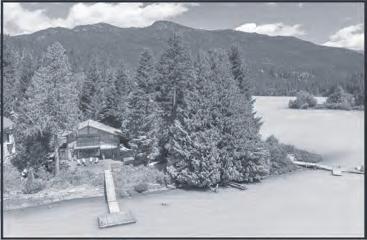
OwningonGreenLakemeansfront-row access to Whistler ’s mostbreathtaking waterfront living —and thisproper ty capturesitall. Setonan11,316sq.ft. lot with116 ft.oflakefrontage, this west-facing retreat enjoys all-daysunanduninterruptedviewsofWhistler Blackcombandthesurroundingmountains. Enjoyquiet morningson yourprivatedock, year-roundrecreationat yourdoorstep,andtherareprivacy that comeswitha quietcul-de-saclocation. Thebeautifully renovated3 bed/2-bathhomeoffersopen,air ylivingspacesanda brand-newdeckdesignedtotakefulladvantageofthe scener y. With exceptionalredevelopment potential, this is acovetedopportunitytoexperiencethetrueGreen Lakelifestyle.
Askingprice$4,600,000 9249LakeshoreDrive
JUSTLISTED:4bd,3barenovated home offeringcomfort&accessibility withlegalsuite &elevator.Perfect for extended familyor rentalincome.
Suggestions for Whistler’s 2026 budget
This letter was sent to Whistler’s mayor and council, and shared with Pique
I am sitting here reading about the Resort Municipality of Whistler’s (RMOW) challenge of increasing revenues to help offset the ridiculous proposed jump in property taxes. I have a few thoughts.
1. Staff Wage Freeze: during this time we have seen most if not all of the folks trying to make a living in this town seeing their earnings impacted with the recent flux in the economy. I think it would not only be smart financially to have a wage freeze for all staff making over $75,000 per annum, but it would also be a way to show empathy that we are all in this together. There seems to be a strong sentiment in this town that the only ones in a bubble are the staff at the RMOW.
2. Class 8 Property Mill Rate Increase: I too believe tourism should pay for tourism, however you hopefully are checking with the province in regards to this as we were provided with special tools under the Resort Municipality Initiative (RMI) to do exactly this and the province might
“Be very wary of unintended consequences which could affect the RMI.”
- GRANT LAMONT
see this as a desperate double dip to address runaway spending. Be very wary of unintended consequences which could affect the RMI. As someone who has been
when you are spending other people’s money. However, with a staff wage freeze and this potential additional $3.1 million we might be able to keep these tax increases to a reasonable level. Just check with the province first, which I hope the council is doing.
Grant Lamont // destination development project director, Mountain Bike Tourism Association
Northlands numbers deserve closer look
Beedie Living claims its proposed Northlands rezoning will bring major benefits to Whistler, but the numbers and the impacts deserve a closer look.
The Resort Municipality of Whistler (RMOW) reports a $77-million land-value increase resulting from the rezoning, yet none of the assumptions behind that figure have been shared with the public. Meanwhile, the two top longstanding community priorities remain clear: replacing the aging Whistler Racket Club (WRC) and adding employee housing.
dealing with the province on tourismrelated spending, things are very tight.
As a past member of council, I realize how hard it is making choices
If Beedie’s rezoning application is denied, they still retain the right to build a hotel under the existing zoning. This zoning would require them to provide a substantial amenity package: the equivalent of a 16-court tennis facility (this was before pickleball was on the scene) a large spa, a golf teaching
Backcountry Update
AS OF WEDNESDAY, DEC. 10
This week, the trend of winter up high and soggy autumn down low continued. While snow coverage is decent in the alpine, there is still little to no snow below 1,000 metres. Expect rugged, rugged travel with stumps, rocks, alders, and open creeks aplenty until you get above 1,500 m.
A stormy period earlier in the week improved alpine riding conditions, but it also brought elevated avalanche danger, and some wet snow followed by crust formation around treeline.
Heading into the weekend, a spell of lower freezing levels, calmer winds, and minimal precipitation should temporarily lower avalanche danger—but that won’t last long.
The weekend forecast calls for a return to warm, stormy, and windy weather, which will likely bump avalanche danger back up at higher elevations. Lower elevations will remain wet and snow-free.
Whenever there’s a significant dump of new snow or rain, stick to mellow terrain for a few days to give the snowpack time to adjust to the new load. Winter storms are classic conditions for increasing avalanche danger, and natural avalanche cycles are typical, so give it some time to stabilize.
If you’re heading into the backcountry this weekend, check the avalanche forecast—it’s updated daily at 4 p.m. on avalanche.ca, or on the Avalanche Canada mobile app. And be sure to check it again in the morning, because it’s updated if the weather we got is dramatically different from the forecast.
Always travel with a partner, carry essential avalanche rescue gear (meaning avalanche transceiver, shovel, and probe), plan for early darkness and challenging exits, and consider taking an avalanche course early in the season to strengthen your knowledge, decisionmaking, and companion rescue skills. n
CONDITIONS MAY VARY AND CAN CHANGE RAPIDLY
Check for the most current conditions before heading out into the backcountry. Daily updates for the areas adjacent to Whistler Blackcomb are available at 604-938-7676, or surf to www.whistlerblackcomb.com/mountain-info/snowreport#backcountry or go to www.avalanche.ca.
NickDavies, Whistlerlocal andexperiencedfamilylawyer practisingacrossBCandYukon. Callat 604-602-9000 or visit www.macleanlaw.ca
Spacious st udioin WhistlerVillagewith greatamenities, locationandrevenue. $299,000
academy, and 27 staff housing units. The current estimated cost of delivering these amenities is at least $50 million.
According to Beedie’s current proposal and the RMOW’s public communications, it appears the RMOW is prepared to grant the valuable Phase 1 zoning in exchange for a $40- to $50-million Community Amenity Contribution (CAC). This deal would effectively allow the developer to gain the $77-million increase in land value, while the community receives no additional value beyond what’s already required by existing zoning. How is this a win for Whistler?
Beedie has proposed contributing $14.4 million towards 70 employeehousing units on the site. Affordable housing is (likely) the biggest flashpoint in Whistler, but it’s essential to look at the broader context. Whistler has hundreds of affordable and employee units in active development or approval, representing more than $100 million in construction currently underway. The mayor and council, RMOW and provincial government, the Whistler Housing Authority, and the Whistler Development Corporation are focused on affordable housing. More than 84 per cent of employees are housed in Whistler, according to a recent Pique article. Very few, if any, resorts can make that claim. There will always be
demand for more and the various levels of government and civic organizations are working hard to deliver.
Beedie’s plan to eliminate the WRC from the Northlands site is a major loss for the community. The estimated cost to replace the WRC is $25 million. Beedie’s
a temporary stopgap that has survived more than 30 years through sheer determination (and duct tape)! There is no alternative funding source waiting to be tapped. If we miss this opportunity, it’s gone for good.
Let’s not let this happen! We can
“Beedie’s plan to eliminate the WRC from the Northlands site is a major loss for the community.”
- ANSA AHMED
current offer for recreation is $10 million, spread over 10 years. The result? A $15 million negative CAC. In other words, the proposal leaves Whistler $15 million short to restore what’s being taken away— funding impossible to replace.
We have a now-or-never opportunity to replace the aging WRC, which was never intended to last over three decades. It was
create a winning solution that provides both employee housing and replaces a thriving facility. The Whistler Tennis Association, the Sea to Sky Pickleball Club, and community experts have already done groundwork on feasible models and are ready to support both the RMOW and Beedie.
The first essential step, if the
Write to us! Letters to the editor must contain the writer’s name, address and a daytime telephone number. Maximum length is 450 words. Pique Newsmagazine reserves the right to edit, condense or refrain from publishing any contribution. Letters reflect the opinion of the writer and not that of Pique Newsmagazine. Send them to edit@ piquenewsmagazine.com before 11 a.m. on Tuesday for consideration in that week’s paper.
rezoning is to be granted (and the WRC located offsite), is to identify a viable land site. Kicking this decision down the road will only increase costs, delay construction, and risks leaving Whistler without any facility for years. Any rezoning agreement must also stipulate that Beedie builds the replacement facility before demolishing the existing one. This request is not unreasonable. It simply protects taxpayers and ensures the community finally receives the amenities it has long been promised.
Let’s create a true legacy for Whistler— an indoor (as I write this, it is raining cats and dogs instead of snowing) recreation and social hub that welcomes residents and visitors of all ages, supports a diverse range of activities, and strengthens Whistler for decades to come.
Ansa Ahmed // Whistler n
FOR THE RECORD
An article in last week’s Pique (“Whistler council reinstates $719K of project and operations spending”) implied an additional 887 municipal staff hours in 2026 would cost $2.4 million. The extra hours are in fact equivalent to roughly $50,000 in additional salary and benefits. Pique regrets the error. n
SchoolRegistrationforthe2026/2027
School YearOpensJanuary20th-23rd,2026
Kindergarten,FrenchImmersionPrograms,and AllNew Students to theDistrict
SchoolDistrictNo.48(SD48)is welcomingregistrations fortheupcoming2026-2027school year startingJanuary 20th,2026, at 8:00amandendingJanuary23rd,2026, at 4:00pm.
Therewillbetwokey steps:
Step One: Parentsand Guardianswillbeaskedtofilloutan onlinewebformthroughtheschooldistrict website. This includesbasiccontactinformationsuchasname,email address,physicaladdressandstudentnameandgrade. Parentswillregisteras anew studenttothedistrictora currentstudent registeringfor French Immersion.
St ep Tw o: Ma ke an a ppoi nt me nt to co mple te yo ur registrationatyour Englishcatchment school by booking onlinethroughthedistrictwebsite or by contactingthe schooldirectly.
Note -FrenchImmersionregistrationsmustbecompleted th ro ug hyou rEnglish ca tc hmen ts chool ,n ot th eFre nc h ca tc hmen ts chool .For C u ltural Jo urne ys an dLearnin g Expeditions, co mple te yo ur re gist ra tiondi re ctlyat St’a7mes School.
Pleasenote thefollowingimportantinformation:
•A lotte ry systemwillbeused to dete rmin ep riorit y placemen to rd er fo ra llpre- re gist ra tion sont he webform. Thiswillprovidea more equitableprocess wherespace maybelimited.
•Parentsandguardianswillhave 10days to complete th eregistrati onproces satt heircatc hments chool . After10days,thepriorityplacementorderobtained fromthelotterywillbe forfeited.
•Parentsan dg ua rd ianswh om is st he availabilit yof thewebformcanregister by contactingtheir English catc hments choo ltob ookanappointment. In this case,a timeanddate stamponthe registrationform willdeterminepriorityplacement order.
Formoredetailedinformationvisit: www.sd48seatosky.org or contactyourEnglishcatchment schoolprincipal. We encourageparentsandguardians to registerassoonas possibletohelpschoolsplan forSeptember2026.
Tr udyAlder
March5th,1939– November27th,2025
Tr udy, born GertrudProchaska nearherfamily’shometownof Kindberg, Austria,hada lifefull of adventure, evenasit wasshaped by theeventsand aftermathofthe war. Shelovedrockclimbing, skiingand mountaineering. Sheexcelledatschool,hadmany friends andwas acelebratedregionaltrackandfieldchampion.
Tr udycametoCanadaonanadventure tripin1966andstayed. Herloveofthe outdoorsledhertothemountain town of Whistler. Sheand herhusband HelmutSalmhoferbecamecaretaker softhe TyrolLodgefortwoyear s—they were some of Whistler’s firstfull timeresidents. Formanyyear s, shewas acherished skiinstr uctorat Whistler skischool.Inher sparetime, shewasanaccomplishedski racer, andanavidcross-countr yskier,bikerandkayaker.
Tr udy, along with HelmutandherbrotherUli, star teda constr uction company. Theybuiltmany housesin Whistler, specializingina Tyrolean style. Hertra ditional painting andcarving canstillbe seen on many ofthem.Later,Trudy wasa realtorfor a number of year sandstudiedinteriordesignatBCIT.
She waspassionate aboutwilder ness adventures,andsome of her most memorableexperiencesincluded paddlingtheYukon Riverwith Helmut(beforehepassedawayin1975),divingwithmanta raysin theCaribbeanandmanykayakingtripsalong BC’s west coast.
In1979, Tr udymet PeterAlder,thenthegeneralmanager of WhistlerMountain.Theyweremarriedin1981at theWhistlerSkiers Chapel.Peter wasfromSwitzerland andthoughtheywerenever able todeciphereachother’s German dialects,PeterandTrudy hadmuch incommon, includinga strongsenseofcommunity,and aloveof bigdogs. They were acharismaticcouple,and both very involvedin building Whistler’s community. They werehappily marriedforty years untilPeter’s deathin2021.
ACelebrationof Lifeis plannedfor February 14thanddetailswill be postedtotheSquamish FuneralChapelweb sitesoon. Inlieuof flower s, donationsto Whistler Clinic ortheWhistlerFood Bank will beappreciated. To writea condolence tothefamily, pleasevisit www.squamishfuneralchapel.com.
Whistler report identifies neighbourhoods ripe for infill and investment
COMPLETE COMMUNITIES REPORT FINDS UNEVEN ACCESS TO AMENITIES, DEVELOPMENT HEADROOM ACROSS THE RESORT MUNICIPALITY
BY LUKE FAULKS
Local Journalism Initiative Reporter
ON AVERAGE, a Whistler resident lives just 360 metres from a transit stop and 350 metres from a park. But whether that means they live in a “complete community” depends on which neighbourhood they call home.
On Dec. 2, council received the final report from the 2023-2024 Complete Communities Program, a provincial initiative designed to help local governments assess how well different neighbourhoods support livability, sustainability and smart growth.
“Complete communities are described as communities or areas within a community, which provide a diversity of housing to meet identified community needs and accommodate people at all stages of life and provide a wider range of employment opportunities, amenities and services within a 15- to 20-minute walk,” explained planning analyst Mia Bojic.
The Resort Municipality of Whistler report follows that framework to analyze whether each neighbourhood offers these features and where they fall short.
KEY FINDINGS
Funded by a $120,051 grant from the Union of BC Municipalities and prepared with Licker Geospatial Consulting Ltd., the Resort Municipality of Whistler’s report evaluates 10 defined “areas of interest” in Whistler for their completeness.
Here’s a breakdown of how each area performed:
Emerald Estates and Environs
While Emerald showed strong redevelopment potential, it faces significant challenges across all completeness dimensions, with limited access to daily needs and underdeveloped infrastructure.
Rainbow, Baxter Creek, Alpine and Nicklaus North
This area offers “substantial development” headroom and solid access to amenities and transit, but its low housing density and gaps in pedestrian infrastructure reduce its overall completeness.
Nesters, White Gold, Spruce Grove, Whistler Cay and Tapley’s Farm
With excellent access to services, schools and transportation networks, this area scored highly on completeness, although some low-density zones still hamper full connectivity.
Whistler Village and Village North
The dense, walkable and amenity-rich village core exemplifies completeness, but with few remaining opportunity sites, future growth is limited.
Blackcomb Benchlands
The Benchlands benefit from high housing density, strong transit coverage and proximity to amenities, though pedestrian connectivity is weak in certain pockets, and the area is largely built out.
Blueberry Hill, Alta Vista, Brio and Sunridge Plateau
These neighbourhoods have a reasonably diverse housing mix and strong cycling infrastructure, but suffer from weak access to shops, parks and other daily needs.
Wayside and Whistler Creek North and South Creekside’s lower elevations offer good amenity access and development potential, yet high-elevation areas lack transit coverage and have gaps in active transportation infrastructure.
Alta Lake Road, Twin Lakes, Nita Lake Estates, Stonebridge, Alta Lake Station and Rainbow Park
Large undeveloped parcels here provide flexibility for future land-use planning, but current infrastructure, transit and proximity to community services are lacking.
Spring Creek, Bayshores, Millar’s Pond and Kadenwood
This area has some potential for infill and offers reasonable cycling connections, yet it remains constrained by weak transportation infrastructure and poor access to amenities.
Cheakamus Crossing and Function Junction
Though these neighbourhoods are close to schools and daycare facilities and use land efficiently, they face limitations in redevelopment potential, housing diversity and access to transit and services.
STRATEGIC VALUE AND STAFF INTERPRETATION
Staff also noted how the report sometimes contrasted with other planning tools, like the municipal land inventory, to help generate a more comprehensive picture of Whistler’s future planning needs.
Case in point, while the municipal land inventory flagged Alpine as lacking connectivity, the Complete Communities assessment showed it
had “fairly strong” access to retail and services—suggesting it may merit greater planning focus in future strategy work, according to staff.
The report came with four recommendations for council moving forward:
First, to direct investment to areas with the largest needs across the housing, transit and amenity lenses; plan new growth to improve access to daily needs rather than just adding units; incorporate more localized data and improved mapping in future iterations; and expand on this work through technical studies and ongoing monitoring.
DATA-RICH, BUT JUST A START
Councillors welcomed the report as a useful analytical tool, but noted it raises questions around growth targets and transportation capacity.
“When I look at the overall projection here of the [50-per-cent] growth, obviously I want to see: What does that mean in terms of our highway traffic capacity? What does that mean in terms of hitting the sweet spot with our infrastructure and guest experience?” said Councillor Arthur De Jong.
Mayor Jack Crompton highlighted the value of the housing density comparisons between neighbourhoods.
“The part that jumped out at me was housing type by neighbourhood,” he said, pointing to more multifamily units around the core areas of Whistler Village, Benchlands and Creekside. He and De Jong urged proximity to ski lifts—key to visitor flow and transportation dynamics—should also be considered in future strategy work. n
Whistler proposes doubling mill rate for recreation properties in bid to ‘make tourism pay for tourism’
CLASS 8 OPERATORS LIKE VAIL RESORTS WOULD CONTRIBUTE $3.1M
ANNUALLY TO RMOW PROPERTY TAXES UNDER 2026 BUDGET SHIFT
BY LUKE FAULKS
Local Journalism Initiative Reporter
THE RESORT Municipality of Whistler (RMOW) is proposing a significant change to its property tax structure as part of its draft 2026 budget. Council is recommending the mill rate for Class 8 recreation properties like ski hills and golf courses be set at 20 times the rate paid on residential properties.
That multiplier was previously set at 10 times in 2025.
“This is about fairness,” said Mayor Jack Crompton. “We’re asking tourism to pay for tourism, so we can build a more sustainable system where those who profit from our visitors pay for the infrastructure and supports they need.”
A mill rate refers to the amount of tax payable per $1,000 of a property’s assessed value. If the mill rate is 1.0, property owners pay $1 for every $1,000 of assessed value. Municipalities may apply multipliers to this base rate depending on the class of property. A 20x multiplier means a property pays 20 times the base residential rate.
According to RMOW figures, the change would increase the Class 8 share of Whistler’s property tax base from three per cent to five per cent and generate approximately $3.1 million in tax revenue in 2026.
BUDGET PROCESS AND COUNCIL RATIONALE
In an interview, Crompton described the proposal as a response to long-term structural issues in how Whistler funds its tourism-driven infrastructure.
Tourism infrastructure funding often relies on revenue sources like the Resort Municipality Initiative (RMI) and the Municipal and Regional District Tax (MRDT), but long-term maintenance costs are typically left to the municipality.
“It is expensive to welcome three million people every year to
a community of 15,000 people,” Crompton said. “Last year, we cleared 80 kilometres of road throughout the winter season, and that cost $100,000 in salt and sand alone. That can’t be left just for residential property taxpayers and small business.”
RMOW staff confirmed approximately 12 properties currently fall under Class 8. That classification is determined by the B.C. Assessment Authority, not by the municipality.
Crompton said council has not received alternate proposals from Class 8 operators and that most feedback has focused on broader funding models for tourism.
According to staff, the mill rate change for Class 8 will reduce the yearover-year tax increase for residents from 8.4 per cent to 6.7 per cent.
Of the $3.1 million anticipated from Class 8 in 2026, 75 per cent will be directed to capital reserves, with $250,000 towards Whistler’s employee housing efforts. The 2026 budget includes $114 million in operating expenses, $50 million in project funding and $62.4 million in projected property tax revenue.
The 2026 budget also proposes increasing the rate for Class 2 Utilities to the maximum permitted under provincial law: $40 per $1,000 of assessed value.
TIMELINE FOR APPROVAL
Final adoption of the 2026 budget is expected in January. On Dec. 16, Council will provide direction to staff to draft the Five-Year Financial Plan Bylaw. Community members are invited to submit feedback on the budget proposal in the weeks leading up to that meeting.
“We need to ensure our large tourism operators contribute equitably to the cost of the visitors that drive their profits,” Crompton said. “I feel pretty strongly that an equitable distribution of taxation is a big part of delivering smart tourism. That’s something that matters to this council, and [to] our community, and [to] the province.”
$4,595,000 4 4.5 SQFT:3,511
•Brightsouth west viewsona 20,000sqft+lot
•Vaulted ceilingsandexpansive windows
•Designedwithseamless flowandtimeless elegance
•Every detailthoughtfullyappointed
GOING UP? Twelve Class 8 operators would contribute five per cent of Whistler’s tax base under a new multiplier; residential increases would in turn be held under seven per cent.
PHOTO BY ASCENTXMEDIA / ISTOCK / GETTY IMAGES PLUS
WHISTLER |S QUAMIS H| NO RT HS HORE |V ANCOUVE R| OKANAGAN
Whistler moves to match higher Squamish tipping fees to prevent trash trek
‘IT
HAS BEEN SURPRISING TO US IN THE PAST HOW FAR SOMEBODY WILL DRIVE TO SAVE A FEW DOLLARS’
BY LUKE FAULKS Local Journalism Initiative Reporter
WHISTLER’S mayor and council gave first, second and third readings to a spate of solid waste tipping fee changes for 2026 on Dec. 2, aiming to cover rising costs, reduce emissions and prevent the District of Squamish’s (DOS) higher rates from driving waste up the highway.
“Most categories will see a five-percent increase to cover the rising expenses and fund facility improvements,” waste operations coordinator Tim Nassar told council. “These changes aim to align Whistler’s rates with the DOS to discourage waste haulers from seeking lower fees and reduce unnecessary transportation emissions.”
If adopted during an upcoming council meeting, the new rates are scheduled to take effect on Jan. 1, 2026.
RISING COSTS AND REGIONAL COORDINATION
During the meeting, general manager of infrastructure services James Hallisey noted, “It has been surprising to us in the past how far somebody will drive to save a few dollars.”
In response, to prevent undue pressure on Whistler’s disposal facilities, the Resort Municipality of Whistler is proposing raising fees as part of a “community alignment” with the DOS. Among the biggest changes are:
FOOD SCRAPS, up 88 per cent to $150/tonne; LAND-CLEARING WASTE, up 15 per cent to $140/tonne; MATTRESSES, up 36 per cent to $30 each; MINIMUM CHARGES, up 17 per cent to $7/load; OFF-RIM PASSENGER TIRES, up 25 per cent to $15.
Another set of waste products have been shifted simply to reflect disposal and operational costs and the RMOW’s wastereduction goals.
BIOSOLIDS, up five per cent to $264/tonne; CLEAN WOOD, up five per cent to $210/tonne; TREATED WOOD, up five per cent to $244/tonne; YARD WASTE, up 23 per cent to $43/tonne; INVASIVE SPECIES, down 14 per cent to $36/tonne; REUSABLE WOOD down 50 per cent to $75/tonne.
The steep drop in reusable wood fees follows a pilot project that ran from midJuly to October of this year. The program separated drop-off and pick-up areas were set up for clean, untreated wood without fasteners or adhesives. Materials in good condition were available for free.
“At the end of the pilot, there was zero [re-usable wood] left. None of that went to our clean wood or landfill waste, which is what I would deem as successful,” said Nassar.
The 23-per-cent increase in unchipped yard waste fees is meant to offset the cost of handling, grinding and transporting that material. The rate remains low compared to the DOS because the material is used by Whistler’s composting system.
Rate changes also continue to use fee structures to encourage proper separation and discourage contamination. For example, invasive species tipping fees are lowered to discourage mixing them with yard waste, while unchipped yard waste fees are raised to reflect higher processing costs.
“Differential tipping fees support the RMOW Climate Action Plan by creating incentives for recyclables to be recovered instead of going into a landfill,” a staff report stated.
Fees for recyclables like mixed paper, containers, and glass will remain at $0 to support diversion efforts.
“Keeping landfill waste and mixed waste charges set appropriately will encourage diversion of this waste to better alternatives and will reduce greenhouse gas (GHG) emissions associated with landfill waste,” the staff report said.
A report to council earlier this year flagged that Whistler’s landfill-related methane emissions rose by 23 per cent in 2024. Methane is a planet-warming GHG roughly 28 times as potent as carbon dioxide at trapping heat in the atmosphere.
CONCERNS ABOUT ILLEGAL DUMPING
Councillors raised concerns about whether Whistler’s fees, if not properly aligned across the region, could lead to waste migration or illegal dumping in nearby forests and service roads.
“We know that happens. It puts pressure on the ecosystems of these areas,” said Councillor Jen Ford. “The more that we can do as a region, [the] better I think we can manage our budgets and manage our waste.”
Staff confirmed the RMOW does not always set fees in advance through collaboration with the DOS, but acknowledged it would be beneficial.
“We haven’t been forward-looking as much as maybe we could be,” said Hallisey.
The bylaw will return for adoption at an upcoming council meeting. If adopted, the changes will be publicized through RMOW’s social media, newsletters and website. New signage will also be installed at the transfer station. n
Restaurant Association backs Beedie’s Northlands proposal
SUPPORT LETTER CITES EMPLOYEE HOUSING, ECONOMIC BENEFITS
BY LUKE FAULKS Local Journalism Initiative Reporter
THE RESTAURANT Association of Whistler (RAW) has formally endorsed Beedie Living’s proposed mixeduse residential development at 4500 Northlands Boulevard, calling the project a “thoughtfully designed” response to the community’s workforce housing and childcare needs.
The Northlands is a 5.2-hectare parcel of land north of the village core, currently zoned for hotel use. The Resort Municipality of Whistler (RMOW) is currently considering whether to rezone the lot for residential and commercial use—paving the way for redevelopment— or to continue public consultation.
In a letter to Whistler Mayor Jack Crompton and council dated Nov. 25, RAW chair Eric Griffith outlined the association’s “strong support” for the development and urged council to move it forward without delay.
“The proposed mix of townhomes, apartments, childcare, and public spaces [respects] neighbouring properties and aligns with the Official Community Plan,” Griffith wrote in a letter to council. “Keeping this a residential development close to the Village reflects the community’s needs while complementing the surrounding uses.”
Should rezoning occur, Beedie’s current concept for 4500 Northlands includes 288 residential units in a mix of townhomes and apartments and up to 70 units of dedicated employee-restricted housing, an on-site childcare facility, landscaped open spaces, and pedestrian connections to surrounding amenities. Once the site has been rezoned, the developer estimates construction will take six to eight years.
For the Restaurant Association— whose members include the cafes, restaurants and hospitality businesses at the heart of Whistler’s service economy— the availability of employee housing remains a critical issue.
“Central to RAW’s vision is ensuring that the people who serve our guests and fuel our local economy can live and work in Whistler,” the letter states. “This proposal makes a meaningful contribution toward that goal by delivering up to 70 units of dedicated employee housing. These homes will allow more of the people who welcome guests in our community to live locally, reducing commuting barriers and supporting long-term staff retention.”
Many local businesses, including restaurants, hospitality and other servicesector operations continue to struggle to secure a stable, longterm workforce. That challenge is partly driven by the province-high wages required to live in Whistler; according to a 2025 report, residents need to make $29.60 or
more to cover basic needs like housing, food, transportation and childcare without chronic financial stress.
A 2020 laboursurvey snapshot by the Whistler Chamber of Commerce found 68 per cent of businesses with 50 or more employees lacked adequate staff during summer and anticipated being understaffed heading into the winter. Even before COVID, the resort’s seasonaltourism model meant local businesses relied heavily on nonpermanent staff, including temporary and foreign workers.
The workforce crunch is not a Whistleronly phenomenon. The foodservice sector in B.C. shed some 10,800 jobs between September 2023 and September 2024.
Griffith emphasized housing shortages are directly linked to staff turnover and business challenges across the sector. According to the RMOW’s 2024 Interim Housing Needs Report, the community needs 1,572 new homes within five years, and more than 5,600 units over the next two decades to meet current and projected demand.
The letter also highlights the inclusion of a new childcare centre as a major benefit for local working families—particularly parents employed in service-based roles who often face limited options for care.
“Accessible childcare is critical for many of our members’ employees, particularly in a resort town where servicedriven work is the norm,” Griffith wrote. “By reducing barriers for parents to fully participate in the workforce, this amenity strengthens the stability of the hospitality sector and the broader community.”
The proposed childcare facility is expected to serve both residents of the new development and the surrounding community.
Beyond housing and childcare, RAW noted the project’s potential to generate significant ongoing economic benefits once completed.
A developer-commissioned study found the development is expected to contribute roughly $25.9 million per year in local economic impact and support more than 300 jobs during construction and 209 jobs after completion. RAW cited those figures in its letter to council.
“These benefits will flow to restaurants, cafes, retailers, and other businesses, strengthening the vibrancy and resilience of our resort economy,” the letter states. “Delaying this project means foregoing these economic gains, reducing business revenue, and missing the opportunity to address Whistler’s housing needs.
“The Restaurant Association of Whistler believes this project aligns with Whistler’s needs and values, and we respectfully urge council to support the proposed development at 4500 Northlands.”
B.C. outdoor tourism sector worth at least $4.8B, says report
HIKING,
SKIING AND OTHER OUTDOOR PURSUITS ARE PROVING BIG BUSINESS, THOUGH CLIMATE CHANGE POSES MOUNTING RISKS
BY STEFAN LABBÉ
OUTDOOR AND ADVENTURE tourism
contributed $4.8 billion to B.C.’s economy in 2023, a new government report says.
The data—which includes everything from direct spending to the cost of transportation, food and lodging— shows outdoor and adventure tourism represents 1.5 per cent of the province’s gross domestic product.
“We’ve heard this sector is growing— both in participation and economic value,” Tamara Davidson, environment and parks minister, said in a statement.
“The new data confirms outdoor recreation is more than just leisure; it’s an opportunity to diversify our economy in a way that is both sustainable and inclusive.”
The value of B.C.’s outdoor and adventure tourism market was not far off other major sectors, such as forestry, which generated $6.7 billion in exports in 2023.
The report was backed by market research firm Leger, which worked with BC Stats to carry out surveys. Outdoor recreation was counted as any activity that engages with nature and the outdoors, such as visiting parks, hiking,
viewing wildlife, water sports, skiing, motorized recreation and RV camping. Adventure tourism, meanwhile, included travelling more than 40 kilometres to carry out any of those activities.
Money spent directly on outdoor activities accounted for 40 per cent of the $17 billion in revenue generated by the sector in 2023. The other 60 per cent came from transportation, accommodation, shopping or food.
The spending was also found to have generated about $3.2 billion in wages and salaries and $2 billion in taxes for the province and municipalities.
ECONOMIC IMPACT EXCLUDES INTERNATIONALS
The measure is likely a conservative estimate because it only includes direct spending from B.C. residents and visitors from Alberta. It excludes money spent by those employed in the sector, as well as spin-off economic activity like gear manufacturers and profits made in the construction of new tourism infrastructure.
Previous polling found that by 2023 nearly seven in 10 B.C. adults took part in some form of outdoor recreation. By comparison, a similar study in the United States found 54 per cent of U.S. residents took part in outdoor
participation in 2022.
Ryan Stuart, who leads community engagement for the Outdoor Recreation Council of BC, said the economic data is the first estimate of the businessgenerating potential of the sector in about a decade. He said it validates what many in the outdoor recreation community have suspected all along: as recreation spots get busier, the sector’s economic impact is growing.
“It was a kind of blank spot on the map,” said Stuart. “This really shows that the outdoor economy is a really big player in British Columbia.”
OUTDOOR REC SECTOR FACES UNCERTAINTIES
The report comes amid a number of rising indicators that show climate change is threatening the status quo of outdoor recreation.
Several of B.C.’s coastal ski resorts are poised to be early casualties of humancaused climate change, with average winter temperatures expected to cross the zero-Celsius threshold by mid-century.
In a separate 20-year analysis, event disruptions linked to climate extremes were found to climb by 86.5 per cent between 2023 and 2024, with British Columbia leading in Canada.
Marathons in Vancouver and Victoria were also recently projected to see a 14 per cent drop in the chance of optimal running conditions by 2045, making them the hardest hit in the country.
Stuart said the challenge climate change poses to outdoor groups and participants is “huge.”
“It’s definitely something that’s on all of their minds,” he said.
A RUSH TO ADAPT
In response, ski resorts are adapting by heavily investing in snowmaking equipment—which can tap B.C.’s hydroelectricity and water—and diversifying with year-round attractions, such as a mountain coaster at Cypress Mountain near Vancouver.
Stuart said one cross-country ski club near Smithers has worked with FireSmart BC to clean out underbrush and widen trails. The idea is to make summertime access easier for firefighters in case a wildfire approaches.
He also pointed to anglers working to maintain river flows for salmon and nature groups getting involved in the planting of drought-resilient species.
“They’re trying to find ways to adapt,” said Stuart. “It’s the challenge of how do you go about doing that?” n
FIFTY YEARS OF
Hugh Smythe
AUGUST 1, 1947-
The Resort Municipality of Whistler from time to time recognizes certain persons in the community who have contributed of themselves to help make Whistler a better place for all to enjoy.
The community recognizes these outstanding contributions by declaring them: “Freeman of the Resort Municipality of Whistler.”
BY G.D. MAXWELL
IF YOU WEREN’T HERE at the time or aren’t a student of history, it’s hard to believe there almost wasn’t a Whistler. At least what we see and live as Whistler. But the Whistler we know, the one we display to the world, owes its very existence to two moments, two decisions that could have easily gone the other way. And if they did? Poof! No Whistler. Maybe a struggling, regional ski hill. Maybe a historical footnote.
The second decision was successfully convincing the provincial government to step in and bail out an all-but bankrupt Whistler Village in 1983. A life-saving event that’s been well described in earlier instalments of this series.
What Hugh Smythe has described as probably the most gut-wrenching decision he’s ever made was the first... several years before that.
Hugh was born in Vancouver. His father, being a bank manager, the family moved around, doing stints in Nanaimo, Vernon, Alert Bay and New Westminster where Hugh spent his high school years.
A friend’s uncle, Ralph Latham, convinced his nephew and Hugh to join the volunteer ski patrol at Mt. Baker, when Hugh was in Grade 11, and Whistler’s volunteer patrol the next year, 1966’s midJanuary opening. Hugh was hooked.
In the fall of 1966 he finagled a “paid” position on the patrol... sort of. “It was an act of significant persistence,” he recalled. Eric Lomas, Whistler’s ops manager, replied by letter turning him down: “We’ve got all the patrollers we need.”
Hugh countered: “Well, how about if I patrol for room and board?” Lomas replied, saying all the beds in the construction trailer used as employee housing were full. No dice.
Persistence—”What if I sleep in the firstaid room and move all my stuff out to my car every morning then bring it back every night?” Bingo, an offer Eric couldn’t refuse. Shortly thereafter, 28-year-old Jack Bright arrived as Whistler’s first general manager and said, “We need to pay this guy.” The $2.50 an hour Hugh received thereafter was his biggest (percentage) raise ever!
During Hugh’s earlier period at Baker, he first met Al Raine. “The forest service had an office in the same building I stayed in. Al and Joe Czizmazia, ski coaches training on weekends, were sleeping in the parking lot in Joe’s Volkswagen bus,” Hugh recalls. “When the rangers would leave, I’d let Al and Joe in. They’d cook their dinner and sleep on the
floor or table until 4 a.m. then get up, clean everything and go back to their van.”
Al Raine would play a significant role in Hugh’s life a few years later.
The following fall, 1967, Hugh, while the youngest member of the Ski Patrol, was made its head. “They were all older than me,” he says. Something about taking the leadership role sparked a passion in Hugh. He became intensely interested in the business of skiing: “what made it tick, grooming, staffing, safety. You know, the business of skiing.”
So Hugh knuckled down. Spent evenings studying management through BCIT. Never before a “serious” student, he was now motivated, interested in learning everything he could.
He got a chance to put that learning to work. In 1974, 26-year-old Hugh and his boss, Dave Matthews, won the contract to operate bankrupt Fortress Mountain near Calgary. That led to a partnership with Aspen when Hugh got them to agree to buy half the mountain from the Federal Business Development Bank.
In 1976, the B.C. provincial government was preparing to call for bids to develop Blackcomb Mountain. Hugh’s friend Paul Mathews, founder of Ecosign Mountain Resort Planners, put together a group to make a bid and invited Hugh to be part of it. Hugh had tried to interest Aspen but they didn’t bite.
Al Raine, who was B.C.’s Ski Area Coordinator and Whistler alderman by then, wanted Aspen to take another look. Aspen changed their mind. That put Hugh in a bind: hitch himself to the Aspen bid or stick with Blackcomb Ski Corp., the group Paul had put together.
After much soul-searching, Hugh went with Aspen. Their bid, through Canadian entity Fortress Mountain, won the development rights on Oct. 12, 1978.
That decision of Hugh’s was the first decision upon which the future of Whistler hinged. Aspen’s parent, 20th Century Fox, was drowning in money, profits from 1977’s first Star Wars movie. It was their financial strength that kept Blackcomb, after opening for the 1980-81 ski season, from itself spiralling into bankruptcy.
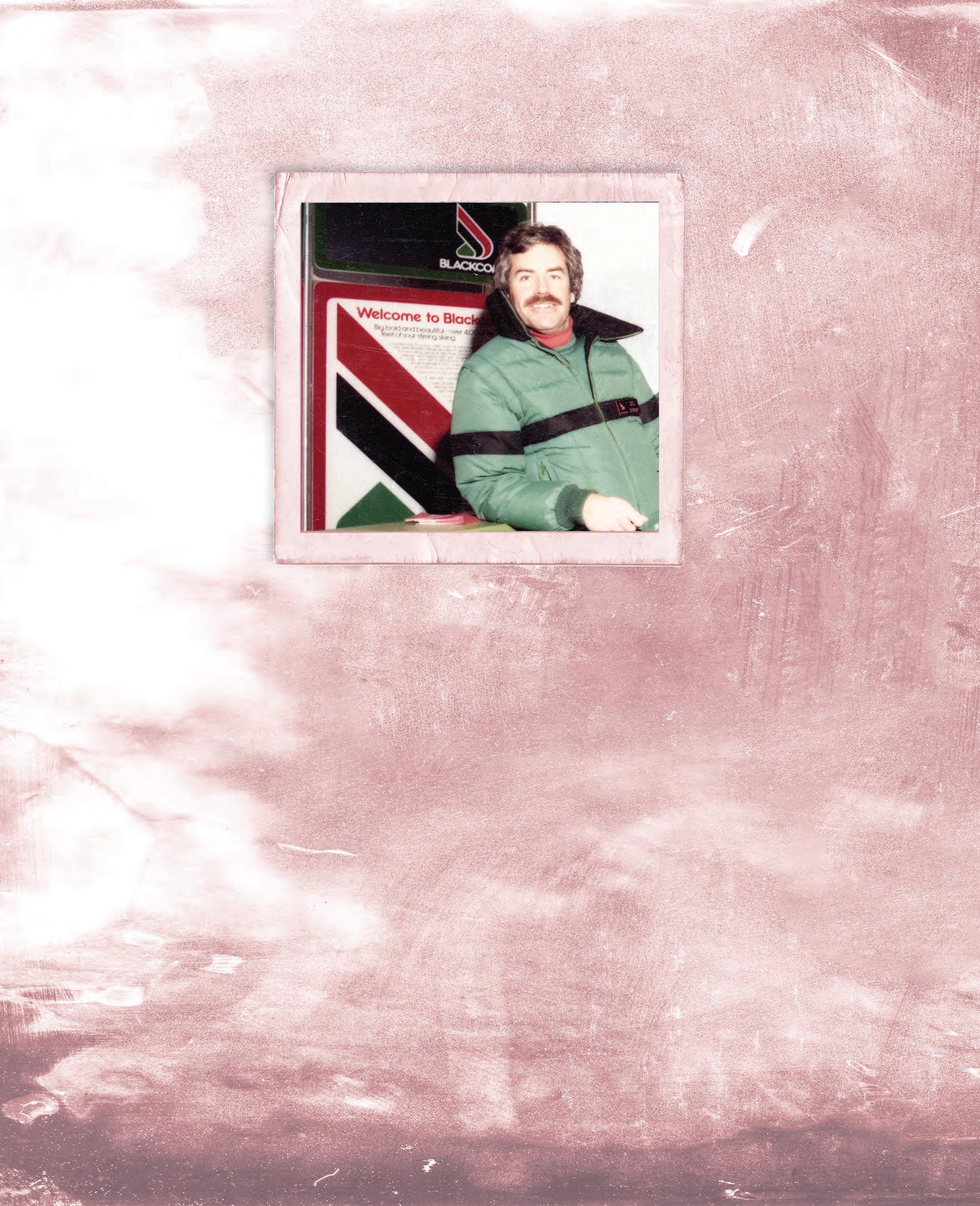
When Blackcomb opened, Franz Wilhelmsen laughed. “Over 4,000 feet of soul-stirring skiing,” Blackcomb’s marketing pitch bragged. Yeah, but the top of it just touched treeline. No alpine. And in January, 1981, no snow. “We were closed for part of the first season,” Hugh remembers.
Blackcomb welcomed 54,200 skiers in 1980-81. They’d projected 225,000. Interest rates passed 20 per cent. There’s every reason to believe without the deep pockets of Aspen— 20th Century Fox—the mountain would have shuttered, failing in the next few years. If that had happened, it’s not a stretch to imagine the provincial government would have been less likely to sink money into Whistler Village. Good luck or good planning, Hugh’s decision and Aspen’s willingness were fundamental to making Whistler what it is today.
But Hugh was far from done. He competed against well-established Whistler with what he had—a firm belief in providing superior servicing to Blackcomb’s skiers, better food, a willingness to listen to the best ideas of his staff, friendlier atmosphere, hustle, moxy and a bit of larceny when the situation called for it.
That combination might best be described by the decision to develop 7th Heaven. The idea, outrageous, was brought to Hugh in the spring of 1985 by patroller Peter Xhignesse, who wanted to sell him on skiing the south-facing slope. Hugh heard him out. Explored the area with him. Decided despite the aspect, the wind and
the many rocks, it had potential. Aspen didn’t agree and wouldn’t fund a lift there. So, a bit of larceny. Remembering a rusty, unused, grounded T-bar at Fortress, Hugh decided they wouldn’t really miss it. In short order, it somehow reappeared on Blackcomb, 7th Heaven opened, and the rest is history.
But Aspen wanted out. In 1986, Hugh found Joe Houssain and convinced him Intrawest should be in. Houssain agreed and Intrawest invested big time—new lifts, new terrain, new condos, a deal for CP’s signature hotel. Twentyseven million dollars invested for the next season brought new detachable quad chairs: The Wizard, Solar Coaster and 7th Heaven and the Horstman Glacier T-bar! When the 1987-88 season wrapped up, Blackcomb had scooped 54 per cent of skier visits, surpassing Whistler. In 1996, Intrawest purchased Whistler Mountain and began to pump millions into upgrading its lifts and terrain. Hugh and his team managed the merger of two very different corporate cultures into a cohesive Whistler Blackcomb, which rapidly became North America’s No. 1 ski destination.
Intrawest also bought many of the other ski mountains in North America and built unrelated resorts in far-flung places. Behind their expansion was the steady hand and vision of Hugh Smythe who, among other astute moves, sent his friend and former ski-patrol buddy, Roger McCarthy to run Mont Tremblant... and turn it around and into the most successful of Intrawest’s eastern resorts.
Hugh’s last legacy was helping facilitate the construction of the Peak 2 Peak gondola. The idea took root in 1997 when Hugh and Paul Mathews visited Zermatt. Convincing Fortress Investment Group, who then owned control of Intrawest, to invest the $51 million the gondola would cost was a stroke of good luck and good timing. By the time the gondola was opened in 2008, the devastating effects of a global economic crisis had probably halved the value of Fortress’ investment and helped bring about an all-too-brief period of Whistler Blackcomb being a publicly traded corporation.
Hugh retired in March 2009. “I was blessed to have a career that was all growthoriented,” he says. The fallout of 2008’s downturn meant severe pull backs were necessary across Fortress-Intrawest’s empire. “That wasn’t what I wanted to do,” Hugh says. Now he does what he wants to do, skiing many days and travelling many more.
In 2010, Hugh was inducted into the Canadian Ski Hall of Fame. Fourteen years later he was awarded the Freedom of the Municipality. “It was a huge honour and a big surprise,” he says. “I thought it went to people who were really involved in a lot of community building.”
It is. Hugh was. Always will be.
This is Part 15 in a 21-part series recognizing Whistler’s Freedom of the Municipality holders, in honour of the Resort Municipality of Whistler’s 50th anniversary. Watch for the others in the weeks ahead, and find them all at piquenewsmagazine.com. n
PHOTO COURTESY OF THE WHISTLER MUSEUM AND ARCHIVES
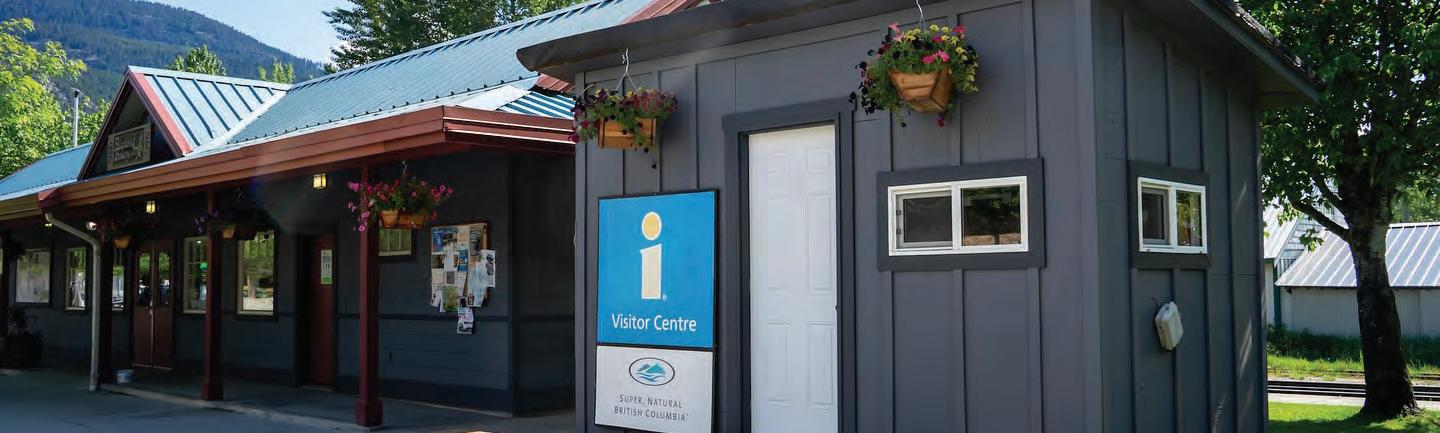
Pemberton’s new downtown visitor centre sees 70% decline in traffic amid signage, safety challenges
TOURISM PEMBERTON OUTLINES VISION FOR TRAIN STATION MOVE, DIGITAL OUTREACH AND ENHANCED COLLABORATION WITH LIL’WAT NATION AFTER THE CENTRE’S FIRST SEASON
BY LUKE FAULKS
Local Journalism Initiative Reporter
TOURISM PEMBERTON’S new visitor centre location is facing some early hurdles.
The new kiosk, located downtown next to Blackbird Bakery, opened this year in a small building donated by the Pemberton chapter of the Men’s Shed. The new facility replaces the old, Chamber-of-Commerce-managed facility on the south side of Highway 99 that shuttered in 2024.
“We refurbished it, moved it downtown to a temporary location,” recalled Tourism Pemberton executive director Gus Cormack. “We ran for four and a half months this year [and] served 1,821 travellers.”
Those 1,821 travellers represented a 70-per-cent decrease in overall traffic compared to the old highway site, which Cormack and chief administrative officer Elizabeth Tracy attribute to the lateseason installation of new signs directing towards the new location and the new location’s lack of sani-dump hook-up.
“It’s hard for us to ascertain how much of [the decrease] is because RV traffic isn’t using the sani-dump,” Cormack explained. “Those people would come through, they’d use those facilities, then go into the Chamber [of Commerce] building on the highway there.”
The Village is in the process of evaluating sites for a new sani-dump hook-up in town.
Still, Cormack told council Tourism Pemberton received positive feedback on the new location from residents.
“When people see the [centre] downtown, and they see us making a very proactive effort to engage in tourists, we heard generally from public
who was willing to talk to us that they were impressed by the efforts that were being made by tourism, government and the village to invest in that,” he said.
Tourism Pemberton’s vision for the location moving forward includes community safety efforts and funding commitments for infrastructure upgrades, Cormack told council during a Nov. 28 delegation.
THE NUMBERS
Of the 1,821 visitors served over 704 hours of operation, 50 per cent were B.C. residents, 11 per cent from the U.S., and 31 per cent from Europe. Nearly 80 per cent were same-day visitors, with just four per cent staying two nights.
Cormack called that an opportunity: “We could do a better job of encouraging people to stay longer in town and increase their spend while they’re here,” he said. Mayor Mike Richman agreed.
Visitors most often sought maps and directions (33 per cent), followed by information about site facilities like washrooms (20 per cent) and attractions or tours (14 per cent).
SAFETY CONCERNS SURFACE
Cormack and Tracy noted safety at the new location has been an issue.
“A big concern for our staff was safety at this location, at times. The RCMP were called three times at that location,” said Cormack. He said the incidents underscore the need to train staff to deal with some of those concerns in future.
Tracy was more blunt. “I was around the visitor centre a lot this summer. I was watering the flower pitch every day. And what I’m seeing is not the welcome [we want] for a visitor,” she said. “There’s open drinking, drug use, [and you’ve] got an ambulance pulling up.”
Council members acknowledged the long-term nature of the issue, linking it to systemic challenges.
“We’re not going to stop people engaging in this behaviour tomorrow,”
said Councillor Laura Ramsden. “It is a symptom of our society. There’s a long and storied history.”
Tracy said staff are working with RCMP and Lil’wat education and employment leads, and exploring more trauma-informed, culturally sensitive supports. Richman noted RCMP “really increased their foot patrols and presence [at the centre] this summer” and that “it was a lot better than it was last year.”
“I think we’re all hopeful that with the presence of the visitor centre that sort of activity around there will change, and I think it did change the vibe a little bit,” Richman added. “We’ll continue to work with [RCMP] on that.”
NEW CONNECTIONS WITH THE NATION
Tourism Pemberton highlighted collaboration with the Lil’wat Business Group (LBG) as a positive outcome from the new centre. Two summer staff came from the Nation’s employment group, which Cormack said “really helped create a good working relationship with Lil’wat.”
The recently re-branded, LBGmanaged Hitching Post Motel became a member of Tourism Pemberton earlier this year. Motel manager Melanie Montgomery was appointed to the board in November. Future plans for collaboration include enhanced Lil’wat storytelling through new signage and interpretive material at the train station.
“Putting the Lil’wat story front and centre; I think it’s a nice way for us to create good collaboration,” said Cormack.
RENOVATION, BRANDING AND MRDT ON THE HORIZON
Tourism Pemberton has partnered with the Village to apply for a $130,000 grant to renovate the train station that houses Blackbird Bakery to include a permanent kiosk with enhanced washroom facilities. Should the grant move ahead, the group is eyeing completing construction mid-way through summer 2026.
CAO Tracy said the temporary booth will remain until at least October 2026, providing operational continuity during potential renovations.
Tourism Pemberton is also looking at adding souvenir sales, pop-up activations downtown, and increased digital outreach. Council and staff discussed opportunities to formalize a communitywide branding strategy.
“How do we actually brand the community?” asked Councillor Katrina Nightingale. “Would we engage the community, Lil’wat, and the Arts Council?”
Tourism Pemberton has been using the “Adventure Begins Here” tagline the Village has long had emblazoned on its welcome signs, but said broader engagement would require coordination and resources.
Cormack also pointed to a biggerpicture item: securing the Municipal and Regional District Tax (MRDT) from local accommodations.
Cormack estimated the accommodation-based tax (up to three per cent on short-term stays) could generate between $100,000 and $800,000 annually for Pemberton, depending on local compliance and approvals.
“Tourism is a $30-million-a-year industry in Pemberton [and] we’re uncoordinated in that approach,” Cormack said. “If we coordinated it, [the] returns would be significant.”
MRDT revenues must be spent on tourism marketing, programs, and projects, with the potential to support infrastructure or housing under certain conditions. Cormack said Tourism Pemberton is engaging local accommodation providers to position itself as the designated recipient.
Council was broadly supportive.
“We need to make some positive moves forward,” said Richman, although he noted Pemberton’s Project Development Infrastructure Fund, which contributed $10,000 towards the centre in 2025 is “way oversubscribed” heading into next year. n
CENTRE OF ATTENTION The new centre operated out of a refurbished, temporary structure donated by the Pemberton Men’s Shed this summer.
PEMBERTON
‘Messy feelings can make for messy art’
HOW LOCAL PRACTITIONERS AND COMMUNITY PARTNERS ARE BRINGING ART THERAPY TO THE SEA TO SKY
BY LUKE FAULKS Local Journalism Initiative Reporter
A SERIES OF SMALL, closed groups in Pemberton have brought together residents who are grieving deaths, relationships, health challenges and other major life changes to work through their emotions.
But instead of starting with words like a traditional therapy session, participants begin with paper, paint, clay and collage.
Art therapist Angela Walsh Noble says she has watched people who struggle to talk about their feelings settle into the simple act of making something with their hands. It’s a role she was inspired to take on after working as a high school art teacher.
“I saw how a kid who might struggle in other areas, other subjects, or maybe even just in their personal lives, could come into a classroom, into the studio, and just make art and have a really powerful, almost healing experience,” she says. “Even for myself, I get into a state of mind where time passes, and I don’t even know it, and it just, it’s a way to just calm right down and be very present.
“Art can be a healing force. I think most artists from all stripes, whether they’re musicians or visual artists or performers or poets, will tell you that once you’re in, when you’re in the zone of creating you are in, you are in a different state altogether.”
The current grief and loss groups run in partnership with the Sea to Sky Hospice Society (SSHS) are temporary— part of Walsh Noble’s art therapy practicum—but they have introduced a form of mental-health support local partners hope to keep building on.
SO WHAT IS ART THERAPY?
Art therapy is a self-regulated mentalhealth profession in Canada—there is currently no provincial regulatory college for art therapists, so practitioners who take on the title typically complete graduate-level training and register with professional bodies like the Canadian Art Therapy Association or the BC Association of Clinical Counsellors.
The Canadian Art Therapy Association describes it this way: “Art therapy combines the creative process and psychotherapy, facilitating selfexploration and understanding.”
In practice, that means people use imagery, colour and shape alongside conversation with a trained therapist to explore experiences that can be hard to put into words.
Per the association, art therapists work with individuals, couples, families and groups of all ages in settings ranging from schools and counselling agencies to hospitals and elder-care facilities. Research cited by the organization suggests art therapy can support people dealing with issues such as grief
and bereavement, trauma and posttraumatic stress, depression and anxiety, addictions, developmental disabilities, acquired brain injury and the impacts of physical illness.
For Walsh Noble, the heart of the work is less about producing “good art” and more about giving people a different way to encounter their own feelings.
“I really do believe that a person coming in to see me is already an expert on themselves,” she adds. “I’m not there to fix them, I’m there to hold space, and I maybe add some guidance if it seems like something that would land well with the client, maybe a little psychoeducation, if needed.”
Walsh Noble is now completing a postgraduate art therapy diploma through the Vancouver Art Therapy Institute. Her program combines coursework with extensive supervised practice—300 hours of direct client connections and 300 hours of indirect, behind-the-scenes work like planning and assessment.
WHY BRING ART THERAPY TO PEMBERTON?
SSHS program coordinator Jody Kramer said the idea for a grief and loss art therapy group took shape through conversations with Whistler Community Services Society (WCSS), which runs grief support groups several times a year.
“WCSS mentioned that they had been working with Angela to try to bring a grief and loss art exploration group to Whistler,” Kramer recalls.
“We struggled to find an affordable space in Whistler with a sink, with privacy, with accessibility, all of that,” she added. “Then [we] realized that Pemberton had no hospice grief support programs, and it was so much easier to
“No one gets through this world without grieving something or losing something, right?” Walsh Noble says. “What I’ve witnessed so far is the power of people coming together to be together in a space where they can make something.
“We chat, we laugh, we cry, we make,” she adds. “And then there’s just something lovely about seeing people support each other and knowing that they’re not alone.”
From the hospice society’s side, Kramer says participant response to the Pemberton program has been strong.
find an appropriate space, and partners willing to provide the space with no cost to our small non-profit society.”
The SSHS-Pemberton has focused on small, closed groups that meet weekly over four or five weeks. The sessions are flexible.
“I usually start the group with a bit of a theme or a thought,” Walsh Noble says. “I usually read a passage or a poem. Check in with people, see where people are at and then we make art for an hour, an hour and a half.”
She keeps a wide range of art materials available and leans toward an “open studio” approach.
“I really believe in open studio choice, and I was like that as an art teacher,” she says. “I loved teaching skills. That’s important. But then it’s up to someone to determine how to use this. ‘Do you want to use it? Or would you rather use that other thing we learned the other day? What is your message? What do you want to say? And how do you want to say it?’”
In the room, not everyone arrives feeling confident about art.
“A lot of people come and haven’t made art since they were children,” she says. “Some haven’t made art for a while, or they were told, ‘Oh, your art isn’t good.’
“But in art therapy, it’s not about making good art. Messy feelings can make for messy art, and that’s OK. We’re making art that that often takes place of words that we can’t say or we don’t know are there. And the art can provoke some really interesting symbolism, and wonderful things can happen there.”
GRIEF, COMMUNITY AND WHY SOMEONE MIGHT CHOOSE ART THERAPY
The grief and loss groups are built on the idea that loss is universal and often isolating.
“The direct feedback from participants and volunteers who attended was overwhelmingly positive, with people sharing that they appreciated having this safe space to share their raw emotions, and being offered the avenue of art materials as a way to process and express those emotions without any fear of judgment or consequences,” she says. “I also got feedback from clinicians in Pemberton, to tell me that they heard about the program, and had already heard from clients that it was so very helpful.”
For those unsure whether art therapy is for them, Walsh Noble emphasizes that no artistic experience is required.
“You do not need to be an artist to come to art therapy,” she says. “If someone is held up because of the art part, there’s no judgment. No, I’m not interpreting your art. You’re doing that for yourself, if you want to.
“It’s just about being present and making art and connecting with yourself.”
WHAT’S NEXT
Kramer says after the positive reception from clients, SSHS is looking at ways to continue offering art therapy programs in Pemberton.
“We know that grief has an impact on physical pain, and plays a significant role in family systems and addiction,” Kramer adds. “My hope is that we can continue these programs, and that the programs give people a language with which to understand and process their grief, and that it extends into helping to heal family and community members, too.”
Walsh Noble’s final session in her current series will run on Dec. 9. At that point, she’ll have completed the 300 hours required for her practicum.
Still, she hopes to keep her practice rooted in the Sea to Sky. Alongside plans for more grief and loss groups with SSHS and ongoing work with Lil’wat Health and Healing Centre, she said she would like to offer open studio-style groups for different ages and needs.
“That’s my dream,” she says. “Just to have an open studio where people can come and make art and just be together and find community and healing.” n
GOOD GRIEF Former teacher and art therapy student Angela Walsh Noble has teamed up with the Sea to Sky Hospice Society to help locals working through loss and grief.
PHOTO BY FABIO PRINCIPE / ISTOCK / GETTY IMAGES PLUS
Your Christmas nonfiction primer
WELL, ANOTHER Atmospheric River is on the way so it’s clear that serious snow isn’t coming Whistler’s way—at least for a while. But guess what is coming, no matter what? That’s right, Christmas.
And so, as I do every year since they stopped paying me to write a dedicated piece on the subject, I’m devoting column
BY LESLIE ANTHONY
space to listing good nonfiction books for those who still prefer their information factual and delivered by talented humans—not summarized in a potentially error-filled sentence by an AI assistant.
This year’s picks start with music then veer into various looks at life on Earth—each lyrical in its own way.
Living in the Present with John Prine, by Tom Piazza, Norton 2025
If you were into country-folk during the 1970s, you know who John Prine is. If not, you’ll still recognize some of the American singer-songwriter’s work as recorded by artists like John Denver, Joan Baez, Johnny Cash and Bonnie Raitt. One of his generation’s most influential songwriters, Prine stirred love, life and current events with satire and social commentary, also penning achingly tender love songs and melancholy ballads. His death from COVID in April 2020 was one of the pandemic’s first celebrity losses, signalling for many the danger of a virus that could cut life short in an instant. It also cut short the biography author Tom
Piazza had been working on. Meeting up in spring 2018, Piazza and Prine headed out on a Florida road-trip-cum-interview that evolved into a deep friendship—the reason this unfinished memoir evolved so easily into an intimate narrative of the artist’s final years. Anyone who loves John Prine will love Piazza’s folksy, easyreading portrait of the beloved American poet-musician.
The Tree of Life: Solving Science’s Greatest Puzzle, by Max Telford, Norton 2025
In the same way the Human Genome Project lightened the load on any one scientist by distributing the work of sequencing our species’ DNA blueprint among numerous laboratories around the
only species with a chin; like where our backbone comes from and why, strictly speaking, we’re “really” fish. If that doesn’t pique your interest, you need a curiosity transplant.
Strata: Stories from Deep Time, by Laura Poppick, Norton 2025
Laura Poppick is obsessed with deep time. Which means she’s obsessed with the rock strata that record it. Which means she’s obsessed with how rock comes and goes. Which, of course, means she’s obsessed with deep time. If you’ve identified this circularity as a window into the 4.5-billion-year lived reality of Earth itself and everything on it, you’ve caught the drift of this deeply layered look
This year’s picks start with music then veer into various looks at life on Earth—each lyrical in its own way.
world, sorting out the even bigger question of Earth’s tree of life is a pan-global enterprise. From the first biochemical inklings of replication to LUCA, the Last Universal Common Ancestor that links the six recognized biological kingdoms of archaebacteria, eubacteria, protists, fungi, plants and animals, thousands of scientists are investigating various twigs, branches and trunks of the tree. In breezy, accessible prose, evolutionary biologist Max Telford takes us inside this effort to elucidate how life endlessly diversified from a single point, a notion first articulated in a casual drawing by Charles Darwin. Telford offers insights into numerous forms both primitive and complex and the planetary conditions that set the stage for their origins. There’s also plenty to learn about humans—like why we don’t have wings but are the
at our planet’s cyclical underpinnings. As Poppick writes: “Over time, these subtle transformations build, erode, and rebuild the world anew. We live our lives within recycled landscapes and those recycled landscapes live within us.” This lyrical, well-researched volume veers from fieldwork to labwork and back, painting a picture of deep time within which, as one reviewer put it, “rock has never felt more alive.”
Life Sculpted: Tales of the Animals, Plants, and Fungi That Drill, Break, and Scrape to Shape the Earth, by Anthony J. Martin, U. Chicago Press 2023
Somewhere in the Bahamas is a beautiful, sandy beach made of… parrotfish poop. That’s because parrotfish, with their grinding teeth, evolved to graze on coral
reefs, nourished by the live bits but, in the process, bio-eroding the hard calcium carbonate structures to either fall to the bottom or be swallowed and pooped out as what we’d call sand grains. This happens across the tropics. Likewise, across the aquatic and terrestrial world animals and plants are breaking, digging, scraping and drilling into rocks, reefs, soil, wood and each other. This is the subject of an engaging book that’s both witty and academic in equal measure. Martin loves to play with words and pop-cultural tropes, and what better arena to do so than one filled with tales of how life— often surreptitiously—sculpts (and poops) the world we live in?
Super Natural: How Life Thrives in Impossible Places, by Alex Riley, Norton 2025
Sharing crossover themes with the previous three science books, Alex Riley’s ode to adaptation circles the planet to show us how life, prosaically, always finds a way. From scorching deserts to frozen seabeds, from the highest Himalayan peaks to the hadal ocean depths, habitats that appear hostile to life indeed find it flourishing. Wood frogs awaken each spring from solid blocks of ice; ants sprint through midday heat under a Saharan sun that would be lethal to any other animal; painted turtles pass months without breathing at the bottom of icecovered lakes; and to survive without food on barren islands, snakes shrink and regrow organs—even their hearts. Riley examines ecosystems on every continent to show how, at nature’s furthest limits, creatures exquisitely adapted to endure unimaginable deprivations of water, oxygen, food and sunlight, as well as extremes of heat and cold, pressure and altitude, use astonishing ingenuity to rewrite the rules of biology.
Leslie Anthony is a Whistler-based author, editor, biologist and bon vivant who has never met a mountain he didn’t like. n
STOCKING STUFFERS Some new reading picks just in time for the holiday season.
PHOTO BY LESLIE ANTHONY
DRIPA’s unintended consequences
BY ROB SHAW
WHEN THE BC NDP government passed the Declaration on the Rights of Indigenous Peoples Act (DRIPA) into law in 2019, it went out of its way to say, repeatedly and explicitly, that it should not be used by a future court one day to strike down other provincial laws.
“There will be no immediate effect on laws,” said then-Indigenous relations minister Scott Fraser.
“We are not creating a bill here that is designed to have our laws struck down.”
Still, there was much confusion on the issue. New Democrats admitted they would not be able to control what judges might do when a First Nation used DRIPA as a tool to challenge other laws in court.
“Bill 41 is not bestowing any new laws. … The legislation does not create any new rights. … It does not bring the UN Declaration into legal force and effect,” were just some of the phrases Fraser used, as he shepherded what was then Bill 41 through the house.
Fast forward almost seven years, and the thing New Democrats said wouldn’t happen has in fact happened.
The BC Court of Appeal last week struck down the Mineral Tenures Act, because it said a lack of consultation and accommodation with First Nations over a new online mineral claims-staking system violated DRIPA.
All of B.C.’s laws are now “justiciable” over whether they violate the Indigenous rights set out in DRIPA, the court ruled in a split two-to-one ruling. That’s something judges will decide on a caseby-case basis—of which, suddenly, there is expected to be many.
Premier David Eby sharply criticized the ruling, saying it was an overreach by judges into the sensitive issue of Indigenous reconciliation, which is to be handled by elected governments in the legislature.
“To be frank, it is absolutely crucial that it is British Columbians through their elected representatives that remain in control of this process, not the courts,” he said.
“Too much rides on it in terms of our province’s prosperity and certainty going forward.”
New Democrats hailed themselves as “the leader in the world” on Indigenous rights when they crafted DRIPA in 2019.
It promised to “take all measures necessary to ensure the laws of B.C. are consistent with the declaration,” including requiring free, prior and informed consent of First Nations on projects, removing colonial language from laws, rooting out systemic racism and enshrining a duty to consult and accommodate Indigenous communities in government decisions.
But it would all take time, the government said. It would happen over many years (perhaps as many as 20), with
annual reports and no set deadline.
During debate in 2019, thenOpposition BC Liberal MLA Mike de Jong asked Fraser if, until then, “none of the provisions in Bill 41 could be used to strike down existing legislation?”
“What you’ve described, captures our intention,” said Fraser.
“You can’t tell the courts what to do specifically,” the minister added. “But our commitment and intention is to bring our laws into alignment with the UN declaration over time.”
Prophetic words, as the courts begin to sail into the jurisdiction of MLAs at the legislature.
The latest ruling effectively declares open season on using DRIPA as a hammer with which to smash any B.C. law, opening up the floodgates to court challenges, judicial rulings, appeals and counter-appeals.
B.C. may appeal the mineral tenure case all the way to the Supreme Court of Canada, said Eby. Or it could amend DRIPA, he said.
“I think it just as likely, or perhaps more likely, that we would proceed with amendments to provide clarity around what was clearly intended when we introduced this legislation,” said the premier.
Legal opinions are a dime a dozen. But there were several prominent lawyers back in 2019 who warned publicly that DRIPA set an impossible standard for government to ensure every statute and regulation that affected Indigenous people was consistent with DRIPA.
MLAs spent 20 hours over five days debating the bulk of the bill in the house.
Much of it centred on whether DRIPA gave First Nations a “veto” over projects by requiring government to obtain their free, prior and informed consent—a debate still playing out today, with varying answers.
There was also debate over whether DRIPA would impact private property rights—perhaps the hottest topic of 2025 after the courts ruled Aboriginal title sits above private property rights in the Cowichan Nation’s victory over lands in Richmond.
“A person with a fee simple interest in lands that are within the traditional territory of an Indigenous group, need not become afraid that somehow Bill 41 and the attachment of the UN declaration are going to negatively impact that person’s fee simple interest in their lands?” de Jong asked in 2019.
Fraser: “That’s correct.”
In theory anyway. Almost everywhere you look, the big issues of DRIPA are still playing out in court seven years later, often in ways that are totally contradictory to what New Democrats in government said would occur at the time.
“We’re hoping we as a model can show how to do this right,” Fraser said at the time.
Unfortunately, it looks like the opposite occurred. n
GI VE AW AY CO NTES T
Enter fora Chance to WIN Our WeeklyHoliday Giveaways!
Thegrand prizeisvaluedat $1020 Winner to bedrawnMonday,Dec22
Enteroncetoqualifyforallthe availableprizesatthe time ofentry.
FORECASTING STOKE The experts reading Whistler’s snowpack
By Caroline Egan
Most winters you’ll see Whistler Blackcomb (WB) receive an average of about 10 metres of snow at mid-mountain elevation; measured right at the Pig Alley Weather Station on Whistler Mountain. The first snowfall typically arrives sometime between October to November whereas March lives up to the madness by delivering the deepest snow. Major blizzards dumping 25 centimetres or more in a single day occur two, maybe three times per year.
However, averages only tell part of the story. An entire network of snow professionals works behind these numbers daily, interpreting conditions and keeping the Sea to Sky’s community safe in and out of bounds. These forecasters, guides and operators take complex snowpack science and translate it into regular powder hound language.
READING THE MOUNTAIN, PLANNING THE SEASON
Work begins long before opening day at the resort. Bjorn Pelissier, Whistler Blackcomb’s snowmaking and summer trails maintenance manager, says monitoring starts as soon as the first flakes hit higher elevations, months before the resort even opens.
“From that point onward, our operations teams including snowmaking, grooming and patrol are actively assessing conditions, tracking weather patterns and preparing the mountain,” Pelissier says.
Adam Mercer, WB’s senior patrol manager, explains different teams focus on different forecasting aspects. Patrol monitors environmental factors that change the snowpack and support avalanche mitigation decisions. The teams aren’t formal meteorologists, but they’re skilled in advanced local weather forecasting and partner with professional meteorologists who provide custom forecasts for the area.
“Much like farming, our operations teams are constantly tuned in to the environment—watching the weather, anticipating what’s coming and adjusting our plans accordingly,” Mercer says.
There are two main types of forecasts to look at: Long-range and short.
Long-range forecasts guide strategic planning which, in Coastal climate, means only providing general patterns for 10 days. Planning can include placing snow guns, outlining priority zones, when to make major snow production pushes and how quickly we can transition from one snowmaking phase to the next. While long-range forecasts help guide decisions, they don’t determine daily operations. Short-range ones do.
“Each day we look at wet bulb temperatures, humidity, wind and predicted overnight cooling to determine where we can effectively make snow,” Pelissier says. “Real-time conditions always take priority and plans often adjust during the shift based on actual temperatures and weather patterns.”
This can cause a great deal of last-minute adaptations within the resort. Shortrange forecasts only become accurate about three days out.
“One cold snap or one significant snowfall in that short-range period can make a huge difference in our ability to make enough snow to support terrain opening,” Pelissier says.
SCOUTING THE SNOWPACK DAY IN, DAY OUT
Beyond those resort boundaries you can find independent forecasters who fill gaps throughout the corridor. Evan Stevens, with the Association of Canadian Mountain Guides and owner of Zenith Mountain Guides, embodies the commitment required to dial-in local backcountry conditions.
Stevens and his business partner, pro athlete Eric Carter, publish weekly newsletters and host monthly snowpack discussions which have become a cornerstone for the region’s backcountry crew.
“People are sponges when it comes to backcountry information, knowledge, conditions,” Stevens says. “If you’re not tuned in in your social circles or professional circles to be working with, or lucky enough to be friends with, people who are snow professionals, it can be really hard to get that information.”
Stevens mentions how important he believes accessibility is when it comes to understanding the conditions. Creating those forecasts requires constant vigilance. Between Stevens and Carter, they spend nearly every day of winter in the mountains, filing professional observations and monitoring weather stations.
“The only way we can make high-level decisions on these conditions is we stay tuned into it,” he says. “That’s my job. But everyone else, the average ski-tour weekend warrior, whoever, you can’t necessarily do that.”
For weather forecasting, the team works with Jason Ross, a local meteorologist who spent years with Environment Canada.
DIALING-IN THE DANGER RATING
While local forecasts offer specialized regional data, Avalanche Canada’s bulletins remain the backbone of backcountry safety across Canada. Ryan Buhler, forecast program manager for Avalanche Canada, says creating forecasts involves a nuanced understanding of synthesizing weather, avalanche activity and snowpack conditions.
Forecasters analyze data from hundreds of stations across Western Canada—skihill installations, highway monitors and snow pillows operated by hydrologists. Throughout all these systems, they keep their eyes peeled for three major components that affect snowpack the most.
“There’s the weather component, avalanche component and the snowpack component,” says Buhler. Forecasters begin by looking at weather actuals (the data received from weather stations and the like) which means combing through hundreds of different weather stations. From there, precipitation, wind and temperature data all merge together to decide the level of avalanche safety… or danger.
There’s a variety of weather trends that can destabilize the snowpack, but the most obvious one is major snow storms.
“As soon as we get a major snow storm, we expect the avalanche danger to increase. But there’s more nuanced things, more complicated weather factors, and they are directly related to the snowpack,” adds Buhler. “So when we have weak layers in the snowpack, that sort of changes things. You can have avalanches releasing when it warms up, or when the sun comes out, if there are weak layers present in the snowpack.”
Weather data alone doesn’t tell the whole story. The majority of observations come from highway forecasters, ski patrollers and mountain guides sharing data through professional networks. According to Buhler, all of the avalanche professionals in Canada share this information with each other. They rely on one another to build as accurate a bulletin as possible.
READING BEYOND THE COLOURS
Reading those bulletins requires more than glancing at colour-coded danger ratings. Each forecast lists up to three avalanche problems, and understanding these problems is essential for dialing-in terrain selection.
“The colour on the map is not enough information to make good decisions,”
LEVELLING UP: EDUCATION AND RESOURCES
Both Stevens and Buhler highlighted expanding educational resources across the region. Avalanche Canada-affiliated State of the Snowpack Discussions launched in Whistler this season, with the next event happening Jan. 13.
Stevens’ monthly discussions in Squamish, now collaborating with the State of the Snowpack initiative, create space for direct engagement with snow professionals.
“Being able to get people there and ask questions and be engaged, it’s really cool to get people excited and help them learn and make safe choices,” Stevens says.
Beyond reading forecasts, Buhler stressed carrying the essentials—transceiver, probe and shovel—is only the first step.
“It’s not enough to just be carrying it. You need to know how to use it,” he says. “Most avalanche professionals try to do a practice at least once a week.”
Stevens recommended hiring certified Canadian mountain guides through the Association of Canadian Mountain Guides for those seeking training.
Avalanche Canada’s website offers a “Find a Course” tool listing more than 600 courses across the country. The organization also provides online education modules, archived webinars and a youth education program.
The organization recently completed consolidating Canada’s entire avalanche fatality history into one searchable database. Records stretch back to Jan. 1, 1782.
CROWDSOURCING THE CONDITIONS
Avalanche Canada encourages the public to submit observations through its Mountain Information Network (MIN) reports.
“We don’t need detailed snowpack summaries, just a photo or two. A photo tells the forecasters in our office so much information,” says Buhler.
Not only that, but they actually read each and every single MIN report that passes through their offices. The Sea to Sky region generates a noticeably high submission volume. Combined with regional bulletins MIN reports offer localized data for specific valleys.
“Our regions are quite large,” Buhler says. “If you’re going to one valley and you find some MIN reports, it’s going to definitely give you some more localized information than these larger regional bulletins will.”
NAVIGATING THE NEW NORMAL
Whether at the resort or in the backcountry, snow professionals emphasize the importance of patience and real-time conditions over assumptions. At Whistler Blackcomb, Pelissier noted early season climate has always been highly variable,
“What’s beneath the surface isn’t always obvious. The danger is very obvious during a major snowstorm, but it’s after the storm that things get complicated … people might not realize how unstable the snowpack is.” - Ryan Buhler
Max Oughtred reflects on fifth-place finish at Trampoline World Age Group Championships
THE 16-YEAR-OLD ATHLETE TRAINS OUT OF WHISTLER GYMNASTICS
BY DAVID SONG
ONE LOCAL GYMNAST is riding high after experiencing his first international competition.
That young man is Max Oughtred, who placed fifth in the double-mini category of this year’s Trampoline Junior and Age Group World Championships. Held from Nov. 13 to 16 in Pamplona, Spain, the event united athletes of varying disciplines from all around the globe.
Oughtred tried his best not to harbour concrete expectations going into Worlds. Minor injuries proved to be a distraction at times, but he focused on managing his feelings and relied upon years of training on the hard days.
The 16-year-old wanted to soak in his opportunity and discover what it’s like to represent his nation—a mindset that paid off.
“[I reminded myself]: I know what I’m getting into and I’m ready for this,” Oughtred said about his approach. “I
earned this, and I deserve to be going. It really helped settle my nerves and I was focusing on the right things. In turn, I had good results. I’m really happy with fifth place … I’m over the moon.”
So is his Whistler Gymnastics coach, Blake Mould, who added: “It was absolutely amazing. I couldn’t have expected anything close to what he did.
associated with a trip to Pamplona. Friends, loved ones and club members donated nearly $7,350, more than the $6,800 Oughtred expected he would require.
“It was amazing to see how our community all came together,” remarked Mould. “We all were celebrating every little victory in the training leading up to [Worlds]. It was a great atmosphere
“This club is like my second family ... I’ve shed blood, sweat and tears in this gym for many years.”
- MAX OUGHTRED
Being on that world stage is definitely a change. It’s way more nerve-racking than competing inside your province, at national championships or anything like that. I was ecstatic for him and couldn’t be more proud.”
‘MY SECOND FAMILY’
It takes a village to raise an athlete and Oughtred thanked his grandmother, Amanda Shaw, for helping him establish a GoFundMe page to cover the notable costs
inside of the gym before Max left, just making sure everything was as best as possible. It was super positive.”
Oughtred has lived in Whistler since the 2010 Olympic Games and began his gymnastics journey at three years of age. On the cusp of his 10th birthday, he switched to trampoline after watching freestyle skiers and snowboarders land their aerial manoeuvres. Now he’s familiar with the rigours of competition and feels his dedication will serve him well in all regards going forward.
Furthermore, Oughtred coaches elementary-age kids at Whistler Gymnastics as he strives to be a better leader.
“This club is like my second family,” he revealed. “I spend so much of my life here and I’ve shed blood, sweat and tears in this gym for many years. I’m wearing my heart, my feelings on my sleeve out here. My coaches and teammates have all been there to support me all along the way … and it feels really good to give back to the community.
“I think starting out with gymnastics is a really good way to go, especially for younger people—learning the right way to move is quite important. I know a bunch of people who started in gymnastics and moved to soccer and all other sports.”
Mould believes Oughtred is already a solid role model.
“Max is a pretty natural-born leader,” he said. “He takes command of the group and is great with the little kids. They all look up to him massively because they also see him train in the gym, so they know what he’s capable of on that trampoline. It’s amazing to see him start raising that next generation of athletes.”
Visit gymcan.org/canada-deliversstrong-performances-at-the-2025trampoline-junior-and-age-groupworld-championships for more results from Worlds. n
MAX POWER Max Oughtred at the 2025 Trampoline Junior and Age Group World Championships in Pamplona, Spain.
PHOTO COURTESY OF STEPHEN SHORE
Jack Crawford braves adverse weather for seventh at Beaver Creek super-G
SPORTS BRIEFS: ALEXANDER MANAGES CAREER-BEST 10TH IN DOWNHILL; CRANKWORX ANNOUNCES SLOPESTYLE SUPER LEAGUE
BY DAVID SONG
STIFF WINDS and low visibility truncated Dec. 5’s World Cup super-G event after just 31 athletes, but Jack Crawford was one of them. The Whistler Mountain Ski Club (WMSC) product finished in one minute and 8.07 seconds, good enough for seventh place at Beaver Creek, Colo.
Vincent Kriechmayr secured gold (1:06.77) for his tenth career World Cup victory in super-G. Fredrik Moeller obtained silver for Norway (1:07.33) and Raphael Haaser joined his Austrian compatriot Kriechmayr on the podium with bronze (1:07.80).
Crawford dropped in after a 30-minute weather delay as fog and flat light posed additional hurdles. All three medallists were among the first 10 racers to tackle Beaver Creek’s iconic Birds of Prey venue.
Switzerland’s Franjo von Allmen experienced a spectacular crash but was able to return to his feet. The event was ultimately called off after four weather-related interruptions.
“The race was pretty tough,” Kriechmayr told reporters. “The first 14 racers, they had similar conditions, but after the break and after the crash from Franjo—I hope he’s well—it wasn’t that fair anymore. I have to tell the truth. Of course, you want to have similar conditions for everyone.”
Cameron Alexander, fresh off a career-best 10th in the Beaver Creek downhill (see related item below), was unable to finish.
ALEXANDER MANAGES 10TH IN BEAVER CREEK DOWNHILL
Cameron Alexander returned to FIS World Cup downhill racing on Dec. 4 for the first time since going down injured last season, and early returns were promising.
The WMSC alum finished 10th in a time of one minute and 31.11 seconds. It is his best-ever World Cup finish in Beaver Creek, Colo.
Marco Odermatt grabbed gold (1:29.84), Ryan Cochran-Siegle took silver (1:30.14) and bronze went to Adrian Sejersted (1:30.53).
“Felt good to be racing downhill and to feel like myself in the start gate on race day,” said Alexander in a press release. “A top 10 today is a great place to start from, especially when I know I left some time out there with how I skied. Feel like I’m in a great spot heading into the downhills this season and the super-G.”
With two downhill Crystal Globes on his record, Odermatt had no problems on a Birds of Prey course shortened by adverse weather conditions. The Swiss athlete had this to say about his 48th
World Cup victory: “That was just a perfect day for me. I really felt good this morning. It was two tough training runs the last two days. I didn’t really feel so comfortable the last two days skiing down the pitch, but today the light was so much better.”
Brodie Seger placed 15th for his third consecutive top 25 in Beaver Creek, and was the only other Canadian to register World Cup points.
CRANKWORX ANNOUNCES SLOPESTYLE SUPER LEAGUE
Crankworx and the Freeride Mountain Bike Association (FMBA) are doing away with their Slopestyle World Championship and replacing it with a brand-new format: the Slopestyle Super League (SSL).
The inaugural 2026 campaign will have five Gold and Diamond-level events in its regular season: Christchurch in February (Gold), Rotorua in March (Diamond), Europe in May (Gold, location TBA 2026), Europe in July (Diamond, location TBA 2026) and Whistler in August (Diamond).
“We are ecstatic to launch the Slopestyle Super League and are confident it will elevate the highest level of the sport for athletes, event organizers, and fans alike,” said Crankworx World Tour managing director Darren Kinnaird. “Having Whistler serve as the last competition of the regular season before heading into the playoffs is incredibly special. And we cannot wait to give Mont-Sainte-Anne the true Crankworx welcome it deserves as we host the grand finale of the inaugural Slopestyle Super League in Beaupré, Quebec.”
All results will count towards SSL standings. After the regular season, the top three men and top two women qualify automatically for SSL Finals (to be held in September at Mont-Sainte-Anne, Que.) while men ranked No. 4 to 15 and women ranked No. 3 to 8 overall head for Round One of the playoffs (scheduled for late August in Silver Star, B.C.).
Round One is slated to feature 18 men and nine women, including nine athletes drawn from FMB world rankings. Meanwhile the Finals will showcase 10 men and five women, with one of each being crowned SSL champions.
A press release elaborates: “The [SSL] is the result of an extensive review of the FMBA competition framework, incorporating input from the FMBA Advisory Board, event organizers, and athlete representatives...the introduction of the SSL marks a milestone moment for slopestyle mountain biking. By simplifying the structure, increasing competitive opportunities, and establishing a clear progression toward a season finale, the SSL provides a more compelling framework for athletes and fans.” n
#5-8021 Mons Rd Whistler BC (ab ove Barney s Automotive)
Gift ideas for the Avid Rider
Get jolly with fresh holly…
AND MORE EASY-PEASY WAYS FOR THE HOLIDAYS
THE PRESSURE MOUNTS —hotter than a potsticker at Purple Panda ChiThai Bistro in the village, or a delicious siopao straight from your own oven (that’s a steamed bun, for all you non-Filipinos).
Rents have blown through the ceiling. Now food costs are shooting so high you can barely afford a good old-fashioned “turkey” dinner—even if you make it a roast chicken. (And another five- or six-
BY GLENDA BARTOSH
per-cent hike is expected!) Good chance you and your credit cards are maxed out, or close to it—just over half of Canadians now struggle to pay their bills.
Then oh boy, here comes that holly-jolly time of year. It’s meant to be a wonder-filled moment of hope and generosity connecting with family and friends to counter these darkest of nights and greyest of days in this neck of the woods.
But with all these pressures, and barely a nano-slice of time or energy to spare, my gift to you once again this time of year is to lighten your load with an idea or three for easy-peasy holiday giving and fun that won’t stress you, or poor Mother Nature: Gifts that “disappear” and won’t end up in a landfill; ideas for holly-daze fun that will dazzle and not daze you.
THE BEST THINGS ARE STILL FREE
When it comes to gifts and special meals to share with loved ones, you don’t need to spend to impress. Like forget the 400 smackers for a bottle of Dom Perignon— and that’s at the liquor store!
You know the old saying—the best things in life are free, or darn close to it, and that goes double this time of year. Even the simplest gifts express kindness and care, or maybe I should say they especially do. Like cooking up a favourite dish and sharing it with a neighbour. Offering to clean a snow-bound sidewalk, especially for someone who can’t. Simply helping to babysit or walk the dog.
More good gentle giving: In the name of your giftee, donate to causes they believe in. Any amount is welcome, in light of the crises we face—in Gaza, Ukraine, Sudan; in our natural world.
Toronto-based IDRF—”people helping people”—is one of the most effective agencies I’ve found assisting in Gaza and beyond. Ditto the Canada-Ukraine Foundation working in Ukraine.
Closer to home, an annual membership to the very good Whistler Naturalists, or the equally good Arts Whistler make excellent gifts. Likewise, namesake donations to WAG, Whistler’s animal shelter. Plus there’s a very special giving opportunity that’s just opened up at whistlermuseum.org to help the Whistler Museum create its impressive new 15,000-square-foot facility.
And don’t forget that while the Sea to Sky might seem like some perfect, idealized place to live, the food banks in Squamish, Whistler and Pemberton are deluged. They welcome any contributions—in volunteer time, food or cash donations. Whistler Community Services, which runs Whistler’s food
bank, notes donations over $25 receive a tax receipt, and monetary donations generate more bang for our bucks than food donations.
LOCAL IS SO LOVELY
A recent New Yorker cartoon features a delivery guy at the door with a package. He’s wryly telling the tenant he could have easily bought the same thing in the store downstairs. Ahem…
When it comes to real-time shopping, at Christmas or beyond, vote with your dollars to keep those authentic local businesses alive, or they won’t survive.
If you missed the Holiday Market, Arts Whistler is holding two special Arthentic holiday shopping days, Dec. 23 and 24, 12 to 4 p.m. at the Maury Young Arts Center. Perfect for lastminute gift hunters. Likewise, the gift shops at our fabulous Sk_wx_wú7mesh Líl_wat7ul Cultural Centre (SLCC) and Whistler Museum, where you’ll find unique gifts for people of all ages. And considering that cartoon above, don’t forget Whistler’s other excellent local shops, including Armchair Books. With thousands of titles on offer, especially by local authors, you can’t go wrong. Books along with subscriptions to your favourite publications—like this one!— are some of the original thoughtful gifts that keep on giving, and giving.
But don’t forget, it’s not just “shop local.” The bigger mantra is still “buy Canadian.” Liz McDonald, in The Squamish Chief, details how to cut your own Christmas tree on Crown land— with a permit, of course. Another good journo, Bob Kronbauer, suggests rural “u-saw” tree farms, like you can find in Langley. Or look for the distinctive “BC Tree” tag. All good ways to ensure you’re
not buying a U.S. tree.
Then when it comes to festive fun, there’s plenty on offer in the Sea to Sky.
Invent your own rituals. Wander the lit-up village plazas and walkways. If things get too wintery, tour the sparkly hotel lobbies. For a little variation, Britannia Village just south of Squamish has decked its halls in fine festive fashion—lovely to experience in an old mining town from 1900.
And don’t forget the beautiful Candlelight: Christmas Classics concerts Arts Whistler will host Dec. 19 at the Maury Young Arts Centre. Take a friend and you won’t have a thing to wrap. Likewise, the special 37th annual Christmas Eve Carol Service 6:30 p.m. at the Westin Resort and Spa—one of the longest-running events in town. Whistler Children’s Chorus and Whistler Singers sing their hearts out at this interdenominational celebration of community and the spirit of peace and goodwill.
As for those delicious siopao steamed buns that always remind me of our amazing local Filipino community and all they’ve been through this year, you can pick up the best at two Vancouver locations: New Town Bakery on Cambie or Goldilocks Bakery on Main.
Lucky for Whistler, Goldilocks’ siopao are also available at the Egido family’s Cebu De Oro Services and Mini Grocery in the village. Grab some for quick, easy— and very affordable—snacking while you finish those holiday gifts. Tie on a fresh sprig of holly or green branch or two and it will all say…
Merry Christmas to all, and to all a good night!
Glenda Bartosh is an award-winning journalist who still gets excited at Christmas. n
TO ALL A GOOD NIGHT! Our four-legged friends know that keeping things simple makes the season bright.
PHOTO BY EYEEM MOBILE
MEADOW PARK SPORTS CENTRE
the days that fit your schedule.
R REGISTERED FITNESS
have a separate fee and a defined start and end date.
is required for the entire set of classes.
I INCLUDED FITNESS These classes are included with your price of admission for no extra charge.
Multidisciplinary artist Taylor Smith visits Whistler on Dec. 13
SMITH
IS PARTNERING WITH WHISTLER CONTEMPORARY GALLERY FOR A SPEAKING ENGAGEMENT AT THE HILTON
BY DAVID SONG
AS THE HOLIDAYS draw near, Whistler Contemporary Gallery (WCG) is bringing in Taylor Smith for a meet-and-greet.
Smith is a contemporary artist based out of a large studio in Indianapolis, Ind. From a young age she was curious about how objects hint at the stories of people who used or possessed them.
Smith’s mother, herself an artist who attended the late U.S. filmmaker Andy Warhol’s first gallery show in 1962, nurtured these creative impulses. The family travelled at length, and as a young adult Smith landed in Germany to study her passion.
She was educated at Berlin’s Academy of Fine Arts and even collaborated with Keith Haring on his famous 1986 Berlin Wall mural: an experience that introduced her to “the power of materiality, surface, and cultural memory” and “permanently shaped [her] voice as an artist.”
Nowadays, floppy disks are Smith’s signature medium. She paints on them, keeping them out of landfills while imbuing
them with imagery reflective of North American pop culture and the contrast between digital and natural realms.
“Floppy disks are one of my favourite materials because they hold such a rich duality: they were once cutting-edge technology, and now they’re almost archaeological,” Smith says. “I love that they are physical containers of memory, tiny vaults filled with data that once mattered to someone, yet we can no longer access or read. There’s something profoundly poetic in that.
“Rather than opening them, I prefer to preserve that mystery. I see the sealed data as a kind of hidden collaboration across time with the anonymous person who once owned the disk. My inspiration often comes from the tension between digital decay and cultural nostalgia. I’m fascinated by how quickly technology becomes obsolete and how fast our collective memory adapts.”
MEMORY AND IDENTITY
Not a one-trick pony, Smith is interested in virtually anything that might carry history: especially if it’s an object destined to become waste. She upcycles as many items as possible, both as an artistic philosophy and an environmental commitment.
She deals in large-scale oil painting,
screen print, collage, and mixed media utilizing commercial packaging, printed scraps and found materials.
“Memory—how we hold it, lose it, distort it—runs through almost every piece I make,” explains the Hoosier.
“My work often reflects on American cultural identity, especially the myths and imagery surrounding the ‘American Dream,’ the frontier, pop icons, and the landscapes of the Mountain West. I also explore nostalgia and the uneasy beauty of technological obsolescence.
“Over the years, my imagery has evolved from pure abstraction into a contemporary reinvention of pop art infused with glitched digital textures, fashion logos symbolizing wealth and status, cinematic references and moments of humour or longing. At its core, my work is an attempt to bridge personal history with collective memory.”
In 2023, one of Smith’s floppy disk paintings (named “Campbell’s Tomato Soup Disaster in Red”) was exhibited at the Cleve Carney Museum of Art in Chicago, Ill. alongside two original Warhol pieces. Smith will always remember seeing her work next to that of the great American artist whose reinterpretation of everyday objects has been foundational to her own development.
She hasn’t visited Whistler yet, but expects to fit right in as a person who
loves mountains and skiing.
“The idea of experiencing the legendary Whistler terrain and the vibrant artistic life that has been incredibly appealing to me. I’m looking forward to finally exploring the area, meeting people, and immersing myself in the unique energy of the Sea to Sky region,” says Smith. “Partnering with Whistler Contemporary Gallery is truly an honour. The gallery is exceptional not only in its beauty and presence, but in the calibre of artists it represents.
“The space has the ability to elevate contemporary work, and it has long been a dream of mine to collaborate with a gallery that values innovation, storytelling, and bold visual expression. The team there has a reputation for curating world-class exhibitions that resonate deeply with both locals and international visitors. Showing in Whistler during December, when the town is full of energy and winter spirit, feels like the perfect moment to share my newest paintings and meet the community.”
Visit the Hilton on Dec. 13 at 4 p.m. to meet Smith and listen to her discuss her portfolio. The event is free, but pre-registration is required and can be done at eventbrite.ca/e/ meet-greet-cocktail-event-with-taylorsmith-tickets-1657862694949?aff=oddt dtcreator. n
HIDDEN COLLABORATION Indianapolis-based contemporary artist Taylor Smith.
PHOTO BY GRACE SMITH
The Bookshelf: Welcome to the Neighbourhood by Clea Young
BY KATHERINE FAWCETT
ONE OF THE BEST things about shorter days and longer nights in the fall is that when you go for evening walks in the dark, it’s easier to spy into your neighbours’ homes through their lit windows.
Or, you could save yourself the trouble, and crack Clea Young’s subtle but powerful new collection of short stories. Welcome to the Neighbourhood opens front doors, pulls back the living room curtains, and cracks open bedroom shutters to shed light on just how extraordinary ordinary people really are.
The stories are set against the lush, salt-misted backdrop of Vancouver and the surrounding mountains, but the true weather here is inner life—grief, jealousy, tenderness, loneliness, and the awkward bravery it can take to get through a day.
Young’s characters aren’t perfect, and that’s the point. There’s arrogance, insecurity and bad behaviour mixed up with good intentions, kindnesses, love and clothing exchanges. There is addiction and contradiction. Snooping, judging and cheating. Neighbours strain against each other, friends have falling outs, and strangers share intimacies they never intended. These are people— mostly, but not all, women—who make mistakes, sometimes spectacularly. Young writes them with such precision and empathy, you can’t help but care.
Her prose is agile, moving from hilarious banter to luminous description, as characters stumble to find meaning and connection. Some stories, like Crows, Kittens and Mint Juleps, zip back in time to a childhood of wild dreams and broken friendships. In the story In Loco Parentis, Teja is an education assistant whose spontaneous interaction with a specialneeds child is caught on video. In the title story, Welcome to the Neighbourhood, an invitation thrown out at a strata meeting turns horrifying.
In Weekend Guest , the narrator is on an isolated beach with her new friend Holly, and Holly’s surly, teenaged daughter Fiona. The narrator takes a cold dip and contemplates Fiona from a new perspective:
“I went under held my breath. My skin tightened around my bones and my brain emptied of everything but elemental shock. Sweet summer. Dull bliss. This was exactly what I needed. My reset button pressed. My judgments overturned like buckets of sand. Why should Fiona be polite in the way I wanted her to be? Why wish away her self-centredness? Holly was right; it would strip away from her soon enough, and wasn’t it a mesmerizing study in the meantime? What advice did I have to give? You are lovely now but it won’t last. Don’t squander your beauty, but do share it—with the right people. Don’t invest in
it, because it isn’t yours to keep. No, these were things she had to learn on her own.
I regained my footing and looked back toward the shore. Fiona had usurped my place on the blanket, head in Holly’s lap. My body tingled. Oh, to not have a body. To not care about being seen.”
Ever present social media static, economic uncertainty, and ecological threats are inescapable in Young’s neighbourhood, but the real drama here is intimate: a gaze held too long, a kind gesture misinterpreted, a friendly offer that conceals resentment, the emotional insecurity that drives us all slightly crazy. The collection captures that awkward truth that proximity does not always make connection easier—it often sharpens the edges.
Not every story lands with the same punch, but even the quieter ones hum with resonance. When the book ended, I was left wondering about these characters as though they really did live just around the corner. And whether I’d dare knock on their door.
Clea Young’s stories have been included in Best Canadian Stories 2025 and three volumes of The Journey Prize Stories. Her work has appeared in Event, Grain, The Fiddlehead, The Malahat Review, The New Quarterly, Prairie Fire and Room. Teardown was her first collection of stories, Welcome to the Neighbourhood, her second. Clea completed an MFA at the University of British Columbia and lives in Squamish, B.C.
The Bookshelf is presented by the Whistler Writing Society, hosts of the Whistler Writers Festival. Katherine Fawcett is a Squamish-based author, teacher and musician. She has had many short storied featured in Pique Newsmagazine and her latest book is The Swan Suit. n
Resort Municipality of Whistler NOTICE Inter-Municipal Transfer ofFire Truck
The Resort Municipality of Whistler (RMOW) intends to provide assistance tothe Squamish-Lillooet Regional District (SLRD) by transferringownership of one fire truck to the Birken FireProtection Service, pursuant to sections24, 26 and94 of the Community Charter.
The transfer constitutesa voluntary inter-governmentalgift made solely for public and community benefit, to support fire protection, emergency response and other public-safety purposes.
Mitchell Hunter Deputy Fire Chief
Resort Municipality of Whistler Whistler.ca/council
OFF THE SHELF Welcome to the Neighbourhood by Clea Young. IMAGE COURTESY OF THE WHISTLER WRITING SOCIETY
Resort MunicipalityofWhistler
JointheClimateActionand EnvironmentCommittee
We areseekingavolunteermemberatlargetoservefora two-yeartermbeginningJanuary26,2026.
Here’s a quick look at some events happening in Whistler this week and beyond. FIND MORE LOCAL EVENT LISTINGS (and submit your own for free!) at piquenewsmagazine.com/local-events
CANDLE-MAKING
HOLIDAY CANDLE-MAKING WORKSHOP WITH TALLU & CO.
Guided by Katherine Evans, founder of Tallu & Co. and a leading voice in modern wellness, you’ll explore the art of candle-making as a mindful ritual, blending scent, intention, and design to create something truly personal. Enjoy a glass of fine wine as you craft your own custom candle and luxury room spray (a $75 value) in a serene, festive setting. Celebrate the season with connection, creativity, and conscious luxury at one of Whistler’s most inspiring venues.
> Dec. 12, 5 p.m.
> Audain Art Museum
PORTOBELLO AFTER DARK
Get ready to put your stomach and your brain to the test! Portobello is unleashing the ultimate pairing: All you can eat ribs, combined with a hilarious and challenging trivia or comedy bingo, all hosted by the legendary Laugh Out Live team! Enjoy this epic culinary and comedic mashup, featuring special comedy performances woven throughout the evening for a night full of flavor and laughter.
> Dec. 12, 6 p.m.
> Portobello
QUESTION EVERYTHING TRIVIA NIGHT
Hosted by comedian Ari Issac, this pop culture trivia night features 10 lively categories, interactive games, and mystery prizes ranging from drinks and food to gift cards and private parties! Seating is limited and walk-ins are first come, first served. Themes are made fun and accessible for everyone, so check @qetrivia for updates.
> Dec. 13, 4:30 p.m. and Dec. 16, 7 p.m.
> Pangea Pod Hotel
A WHOLE LOTTA LED
A Whole Lotta Led are bringing their incomparable tribute to Led Zeppelin back to Whistler for a face melting night of old school rock n’ roll. Start your winter off right with this legendary early season party at Dusty’s! This show always sells out, so don’t wait, get your posse together and get your tickets now!
> Dec. 13, 9:30 p.m.
> Dusty’s Bar and Grill
COMMUNITY CHANUKAH CELEBRATION
Join Whistler Public Library for Whistler’s seventh annual Community Chanukah Celebration, hosted by Ira Pettle! Whether you’ve celebrated your whole life or you’re not quite sure how to celebrate, this party is for you. There will be games, music, and activities for all ages. If you have your own menorah, bring it along for a community menorah lighting at 4 PM.
> Dec. 14, 2:30 p.m.
> Whistler Public Library
WEDNESDAY NIGHT SPECIAL AT WHISTLER OLYMPIC PARK
Take advantage of discounted tickets and rentals on Wednesday nights from Dec. 10 to March 4, 2026. Spend time on the well-lit trails or light up your journey with a headlamp. Explore under the beautiful starry skies of the Callaghan Valley and when you need a break, stop by the fully-licensed café in the Day Lodge and indulge in delicious specials.
> Dec. 17, 3 to 9 p.m.
> Whistler Olympic Park
THE PEOPLE’S FILM PRESENTS: THE MUPPETS CHRISTMAS CAROL & DIE HARD
The Muppet Christmas Carol returns to the big screen for one cozy, joy-filled night in the theatre. Join Kermit, Miss Piggy, Gonzo and the full Muppet crew as they retell Dickens’ festive tale with heart, humour and just the right amount of chaos. Later that night, the People’s Film is bringing Die Hard back to the big screen for the ultimate explosive holiday viewing. There will be popcorn for all, and the signature cocktail for the evening is the Spiced Nakatomi featuring spiced rum, cranberry, lime, ginger ale.
> Dec. 17 at 5:30 p.m. (Muppets) and 8 p.m. (Die Hard)
> Maury Young Arts Centre
LIVE MUSIC: SKIITOUR APRAVES SERIES
Get ready for Whistler’s ultimate après event back at the GLC! Hailing from the snow-covered peaks of Whistler, SkiiTour brings upbeat, feel-good house music that keeps the energy grooving, all while serving a nostalgic retro ski vibe. This event sells out every time, so grab your tickets now before they’re gone!
> Dec. 17, 4 p.m.
> Garibaldi Lift Co.
GREEN SCREEN HOLIDAY PHOTOS
Create your own holiday photo at the Whistler Public Library! Participants may choose their own background, print the photo on site, and decorate a festive photo frame. The only rule? Don’t wear green as you won’t show up on the Green Screen! This program is for all ages and will be first-come, first-served! No registration required.
> Dec. 18, 3 to 5 p.m.
> Whistler Public Library
ARTHENTIC HOLIDAY SHOPPING NIGHT
For one night only! A festive evening of shopping and saving at Arthentic, home to Whistler’s largest collection of local artisan-made goods. Don’t miss this opportunity to shop thoughtfully, save big and celebrate the incredible Sea to Sky artisans. Complimentary sparkling wine for the first 50 shoppers!
> Dec. 18, 4 to 7 p.m.
> Maury Young Arts Centre
MUSEUM MUSINGS & ASTROLOGY
Santa slays the mountain!
BY BRONWYN PREECE
He sprang to his sleigh, to his team gave a whistle…
Their hundreds of eyes—oh! how they twinkled!
Their dimples, how merry!
Their cheeks were like roses, their noses like cherries!
Their droll little mouths were drawn up like bows, as, together, they rode up the gondola in droves
Sporting beards on their chins as white as the snow…
Then away they all flew, down the slopes with skis and boards, all donned up in red and white… (some outfits loose and baggy, others mighty tight!)
The annual Dress Like Santa Day: another sleighing sight!
FOR MORE than 20 years, Whistler Blackcomb has hosted this colourful, costumed and cheer-fuelled Christmas tradition. Just as its name suggests, every year on one mid-December day, this year on Friday, Dec. 19 snowboarders and skiers are encouraged to dress up like
Mr. or Mrs. Claus and take to the slopes.
Merriment and holiday-spirit spread amongst ‘Ho, Ho, Ho’ing participants as they gather at the base of Whistler Mountain. From the young to the stillyoung-at-heart, the all-ages event has steadily grown in popularity since its inception (exactly what year that was is hard to pinpoint, as it remains a glorified extension of previously established on-mountain Santa-spotting happenings)… but, the early 2000s seems to be the general consensus.
Once at the top, the Santa slopestylers travel together from the Roundhousecum-North Pole to the base of Emerald Chair—where a group photo is taken.
As per tradition, a free lift ticket is awarded to the first 100 people who arrive in full attire. This number has grown from an original 50 free tickets, to 75, to its now 100: handed out to the pipe-toting, black-belt bulging, and boot-wearing crew. With great Whistler flair, custom costume-modifications have made this a Santa Spectacle, sanctioned under a “Creative Claus” (with… “A wink of his eye and a twist of his head/Soon gave me to know I had nothing to dread!”).
The Whistler Mountain Hostesses definitely skied with St. Nick. Beginning in the 1974-75 season, the program “specialized in fun”… and dressing up as elves and touring the slopes with Santa
Free Will Astrology
ARIES (March 21-April 19): Home is a building you live in. It’s also a metaphor for the inner world you carry within you. Is it an expansive and luminous place filled with windows that look out onto vast vistas? Or is it cramped, dark, and in disrepair, a psychic space where it’s hard to feel comfortable? Does it have a floor plan you love and made yourself? Or was it designed according to other people’s expectations? It may be neither of those extremes, of course. My hope is that this horoscope will prod you to renovate aspects of your soul’s architecture. The coming months will be an excellent time for this sacred work.
TAURUS (April 20-May 20): During the construction of the Brooklyn Bridge in 1872, workers made an uncanny discovery: They could detect approaching storms by observing vibrations in the bridge’s cables. The massive metal structure was an inadvertent meteorological instrument. I’m predicting that your intuition will operate with comparable sensitivity in the coming months, Taurus. You will have a striking capacity to notice subtle signals in your environment. What others regard as background noise will reveal rich clues to you. Hot tip: Be extra alert for nuanced professional opportunities and social realignments. Like the bridge workers, you will be attuned to early signs of changing conditions.
GEMINI (May 21-June 20): Sloths are so energyefficient they can survive on 160 calories per day: the equivalent of an apple. They’ve mastered the art of thriving on minimal intake by moving deliberately and digesting thoroughly. Life is inviting you to learn from sloths, Gemini. The coming weeks will be a good time to take an inventory of your energy strategies. Are you burning fuel frantically, or are you extracting maximum nourishment from what you already possess? However you answer that question, I urge you to experiment with being more efficient—but without depriving yourself. Try measuring your productivity not by speed and flash but by the diligence of your extraction.
Dig deep and be thorough. Your nervous system and bank account will thank you.
CANCER (June 21-July 22): The Danish concept of arbejdsglæde refers to the happiness and satisfaction derived from work. It’s the joy found in labour itself, not just in its financial rewards and prestige. It’s about exulting in the self-transformations you generate as you do your job. Now is an excellent time to claim this joy more than ever, Cancerian. Meditate with relish on all the character-building and soulgrowth opportunities your work offers you and will continue to provide.
LEO (July 23-Aug. 22): In the deep Pacific Ocean, fields of giant tube worms thrive in total darkness around hydrothermal vents, converting toxic chemicals into life-sustaining energy. These weirdly resilient creatures challenge our assumptions about which environments can support growth. I suspect your innovative approach to gathering resources in the coming months will display their adaptability. Situations that others find inhospitable or unmanageable will be intriguing opportunities for you. For best results, you should ruminate on how limitations could actually protect and nurture your development. You may discover that conventional sustenance isn’t your only option.
VIRGO (Aug. 23-Sept. 22): For a long time, scientists didn’t understand why humans have an organ called the appendix. Most thought it was useless. But it turns out the appendix is more active than anyone knew. Among other functions, it’s a safe haven for beneficial gut bacteria. If a health crisis disrupts our microbiome, this unsung hero repopulates our intestines with the helpful microbes we need. What was once considered irrelevant is actually a backup drive. With that in mind as a metaphor, here’s my question, Virgo: How many other parts of your world may be playing long games and performing unnoticed services that you haven’t understood yet? Investigate that possibility!
was a part of their mandate. “We had the greatest job in the world,” recalls founding hostess Leanne Dufour.
The program morphed into the Ski Friends (also Santa’s helpers!) in the late ’80s and then further into the present-day Mountain Host program.
Off the slopes, Santa has announced his arrival in other less-than-conventional ways throughout Whistler’s history. In 1980, the “jolly old elf” cruised in by chopper, dropping down from the skies—heralded
by helicopter—only to be mobbed by a group of candy-coveting children.
Dating back even further… The children of the one-room Alta Lake schoolhouse (first opened in 1933) would also receive an annual visit from Father Christmas. It is fair to speculate that trapper and railway section-gang worker, Billy “Santa” Bailiff, likely arrived by horse or on foot. Remembered as a “gentle man,” Billy— famed for his “Stellar Jay Pie” and “potato water bread”—was the unanimous choice as the Santa stand-in with his plump figure and round, rosy cheeks.
Billy died in 1958 and the baton of community Kris Kringle seems to have been passed onto to Jack Biggin-Pound, who settled in McGuire (an old mill town from the 1930s, two kilometres north of Brandywine Falls), staking a claim there on Crown land in 1961. Jack recalled, “Never again will Myrtle Philip [Founder of Rainbow Lodge, the first tourist attraction in the Whistler area, opened in 1915] undo my flies, to the great amusement of everyone, to stuff a pillow in to make me a more portly Santa Claus for the school children. They all tried hard but I don’t think ever found out who Santa was.”
The mystery of who Santa was, or is, either singularly in our schools—or in plural, plummeting down the hill remains part of this town’s mountain magic. n
LIBRA (Sept. 23-Oct. 22): In the coming months, you’ll be asked to wield your Libran specialties more than ever. Your allies and inner circle will need you to provide wise counsel and lucid analysis. For everyone’s sake, I hope you balance compassion with clarity and generosity with discernment. Certain collaborations will need corrective measures but shouldn’t be abandoned. Your gift will lie in finding equilibrium that honours everyone’s dignity. When in doubt, ask: “What would restore harmony rather than merely appear polite?” True diplomacy is soulful, not superficial. Bonus: The equilibrium you achieve could resonate far beyond your immediate circle.
SCORPIO (Oct. 23-Nov. 21): The Hubble Space Telescope is a school bus-sized space observatory orbiting 320 miles above the Earth. There, it observes the universe free from atmospheric distortion. Its instruments and detectors need to be recalibrated continuously. Daily monitors, weekly checks, and yearly updates keep the telescope’s tech sharp as it ages. I believe it’s a good time for you Scorpios to do your own recalibrations. Subtle misalignments between your intentions and actions can now be corrected. Your basic vision and plans are sound; the adjustments required are minor. For best results, have maximum fun as you fine-tune your fundamentals.
SAGITTARIUS (Nov. 22-Dec. 21): Leonardo da Vinci painted his iconic Mona Lisa on a thin panel of poplar wood, which naturally expands and contracts with changes in humidity. Over the centuries, this movement has caused a crack and measurable warping. One side of the classic opus is bending a bit more than the other. Let’s use this as a metaphor for you, Sagittarius. I suspect that a fine quality you are known for and proud of is changing shape. This should be liberating, not worrisome. If even the Mona Lisa can’t remain static, why should you? I say: Let your masterwork age. Just manage the process with grace and generosity. The central beauty may be changing, but it’s still beautiful.
CAPRICORN (Dec. 22-Jan. 19): “Apoptosis” is a word referring to programmed cell death. It’s a process by which your aging, damaged, or obsolete cells deliberately destroy themselves for the benefit of your organism as a whole. This “cellular suicide” is carefully regulated and crucial for development, maintenance, and protection against diseases. About 50 to 70 billion cells die in you every day, sacrificing themselves so you can live better. Let’s use this healthy process as a psychospiritual metaphor. What aspects of your behaviour and belief system need to die off right now so as to promote your total well-being?
AQUARIUS (Jan. 20-Feb. 18): Which parts of your foundations are built to strengthen with age? Which are showing cracks? The coming months will be an excellent time to reinforce basic structures so they will serve you well into the future. Don’t just patch problems. Rebuild and renovate using the very best ingredients. Your enduring legacy will depend on this work, so choose materials that strengthen as they mature rather than crumble. Nothing’s permanent in life, but some things are sturdier and more lasting than others.
PISCES (Feb. 19-March 20): Along the Danube River in Europe, migrating storks return each spring to rebuild massive nests atop church steeples, roofs, and trees. New generations often reuse previous bases, adding additional twigs, grass, roots, and even human-made stuff like cloth and plastics. Some of these structures have lasted for centuries and weigh half a ton. Let’s make this a prime metaphor for you in the coming months, Pisces. I see your role as an innovator who improves and enhances good traditions. You will bring your personal genius to established beauty and value. You will blend your futuristic vision with ancestral steadiness, bridging tomorrow with yesterday.
Homework: Tell me what you like and don’t like about my newsletter. Newsletter.FreeWillAstrology.com.
SNO, SNO, SNO Santa on the slopes of Whistler in 1994.
PHOTO COURTESY OF THE WHISTLER MUSEUM / INSIGHT PHOTOGRAPHY COLLECTION
SENIORBOOKKEEPER– Ensuresaccurate,compliantfinancialoperationsandanalysiswhile maintainingefficientsystems,accountability,andteamalignmentwithcompanygoals.CPA or workingtowardsdesignationpreferred.$30-35perhour.
Love agoodchallenge?Passionateaboutthe placeyoucallhome?TourismWhistlerislooking forcommunity-loving,mountain-appreciating, environment-respectingpeopletojoinourteam.
TheSpecialist, Digital Marketing &Promotionsuses data-driventhinkingandanaudience-focused approachto execute TourismWhistler’s paid marketinganddataacquisitioninitiatives.This role worksacrosspaidsearch,social,display, and videoplatforms;supports real-timecampaign optimization;andassistswithanalyticsand reporting. TheSpecialistalsoleadspromotions andcontestsdesignedtocapturefirst-partydata andstrengthenpersonalizedmarketing.
Ourteamofpeopleis whatsetsusapartfromotherbuilders.As wecontinue to growasthe leaderinluxury projectsinWhistler,ourteamneeds to expand withus. We are currentlyhiring:
Labourers ($20-$30hourly)
CarpentersHelpers/Apprentices1st to 4th year ($25-$35hourly)
We promotefrom withinandarelooking to strengthenouramazingteam.Opportunitiesfor advancementinto managementpositionsalwaysexistfortheright candidates.Don’t missout onbeingable to build withtheteamthatbuildsthe mostsignificantprojectsinWhistler.
Send your resume to careers@evrfinehomes.com. We lookforward to hearingfrom you!
EVERY FALL , when the summer activities wind down and the winter is yet to kick off, I try to set myself up with a few projects. These projects can be anything from DIY builds to studying a new language to simply being up on my seasonal chores. A few weeks back, however, it was a trip to my vehicle dealership that prompted a fall project I hadn’t attempted before. Let me set that scene.
BY VINCE SHULEY
I bought my truck new in 2021, so the last few years I haven’t thought much about servicing it at the dealership with routine oil changes, tire rotations and safety checks (some that didn’t feel particularly necessary). I wanted to maintain a clean service record in the dealership’s system, should I choose to upgrade my truck to a newer vehicle in the first few years of ownership. Given the significant price increase of new trucks lately, that will no longer be the case. This truck and I are now in it for the long haul, which means I need to get ready for the ensuing maintenance that comes with long-term vehicle ownership.
My most recent visit to the dealership revealed I needed new front disc brakes (a fact I was already aware of with a pulsing brake pedal and vibrating steering), which they quoted me as a fix of more than $900 of parts and
labour on my Tacoma. Never shy to shop around, I declined the work. There had to be a cheaper way to get through this annoying-yet-necessary fix.
I happen to be in the fortunate position of having a mechanic as a friend, so I promptly got him on the phone to see what I was going to get myself into.
“Dude, if you can service a pair of mountain bike brakes, you can replace the pads and rotors on your truck.”
Just what I needed to hear. I’ve serviced and bled my Shimano brakes enough times to feel confident in that task. How much harder could it be for a vehicle? After getting some tips from my mechanic friend, I dove into YouTube to see how different home mechanics were tackling the project. I figured if the job could fit into a two-minute YouTube short, I had a chance. But it needed some specific tools. I invested in a floor jack, a pair of three-tonne jack stands, a
its challenges. As any Sea to Sky mechanic will tell you, rust is prevalent around here, even in vehicles just a few years old. So you need to be ready to get your hands dirty, bust some rust and break some seized bolts and pins loose. But overall, it was not a terribly complicated process. I gained some experience and know-how with my vehicle, and most significantly, I saved more than $600 compared to getting fleeced by the dealership.
What I also learned during this project was that I was exercising my right to repair, a federal law regulated by the Competition Bureau of Canada. Without this agency, companies can put measures in place to make sure only their own authorized dealers can perform the work, such as specialized tools or software keys not available to the public or other mechanic shops. Curbing such anti-competitive behaviour helps keep
After getting some tips from my mechanic friend, I dove into YouTube to see how different home mechanics were tackling the project. I figured if the job could fit into a two-minute YouTube short, I had a chance.
caliper spreading tool, a breaker bar and some sockets. I figured all these tools would come in handy in the future, so not a completely sunk cost. I sourced new brake pads and rotors online for just over $250. By far the biggest cost was my time, which took about six hours, plus the time to research the work and order the right parts.
Of course, the job was not without
prices down for consumers, letting them source their own repair vendor (such as a non-dealership mechanic shop) or performing the work themselves with aftermarket parts and tools. As vehicles go more electric (even new gas-powered vehicles have an inordinate amount of electronics and software on board), the right to repair needs to—and should—be upheld.
But of course, in our capitalist society, there’s also a lobby against the right to repair. In 2023, a study titled “The Economic Downsides of ‘Rightto-Repair’” was commissioned by the National Association of Manufacturers (NAM) in the U.S. While this study reeked of paid consultant obfuscation, it did have some points. In the context of farming equipment, it claimed that Original Equipment Manufacturers (OEMs) already provide the necessary diagnostic and repair tools to consumers, and that “bypassing the proper channels for repair will come at a steep cost to quality, performance, consumer safety, and the broader U.S. economy.” Other considerations included that third-party modifications of equipment can make equipment noncompliant to environmental standards, as well as stifling innovation by having to create a replicable supply chain for aftermarket suppliers.
Ironically, I think NAM misses the point of the right to repair, that we choose to not take multinational OEMs at their word that they will provide access to repairs out of the goodness of their hearts. Does the right to repair go a bit too far in some cases and ultimately make things more expensive for the consumer? Possibly, though I’d argue that’s more of an edge case that requires an exception to the rule, rather than killing the rule altogether.
In the meantime, I’m researching the next job I can tackle on my truck. I’ll never be completely independent of a qualified mechanic’s skillset, but knowing and maintaining my brakes alone to avoid the dreaded Sea to Sky corrosion has made this DIY venture worth it.
Vince Shuley feels ready to tackle an oil change. n