

CEO’S MESSAGE

It seems like the world now, more than ever, is driven by data. Are you looking to buy a new dishwasher? You want reviews! Taking a family vacation? You want ideas for where to go and which attractions are the most popular. Are you looking to open or expand a business? You want to know what the market outlook is, the availability of qualified employees, and host of other data.
And I bet you expect to have access to that data almost instantly.
But remember the days of slow connections while trying to make a customer transaction? Or the spinning wheel of death when you tried to watch a Netflix movie? Those are almost a thing of the past like party line telephones.
There are two key contributors to those things becoming not-so-fond memories: reliable fiber optic connections and regional data centers. I talk a lot about DCN’s fiber optic connectivity but haven’t spent as much time talking about data centers. That is, until recently because with the interest in North Dakota by crypto and artificial intelligence data centers it’s been a hot topic.
MAKING SENSE OF THE DATA CENTER DISCUSSION
From the local coffee shops to the North Dakota State Capitol, recently there has been a lot of talk about data centers. But not all data centers are alike, and some terms are being used interchangeably even though they are talking about very different things. As a data center provider in North Dakota for more than 20 years, at DCN we are doing our part to help people understand the conversation.
First, let’s look at three key types of data centers for the North Dakota discussion:
DCN BOARD OF GOVERNORS CHANGES
After serving as CEO/ general manager of North Dakota Telephone Company, based in Devils Lake, since 2019, Rodney Hoffmeyer has retired.
Hoffmeyer joined NDTC in 1979 as an installer/ repair technician. Over the course of 45 years, he witnessed many changes to the industry and carried his varied perspectives to his CEO/GM role. He joined the DCN Board of Governors when he assumed leadership of NDTC.

TeeJay Kurtz took the reins of NDTC on March 1, 2025, and simultaneously joined the DCN board. Prior to his GM/CEO appointment, Kurtz served primarily in outside plant roles at NDTC for more than two decades.

“Rodney has been a valuable voice on our Board of Governors and we’re grateful for his service,” says DCN CEO Seth Arndorfer. “I’m also looking forward to seeing how TeeJay’s perspective will positively impact the work of our board.”

DATA CENTER STORY,
con’t from page 1
• AI (often called hyperscale): large facilities engineered for largescale workloads to train, deploy, and deliver artificial intelligence applications and services.
• Crypto: large facilities dedicated to validating cryptocurrency transactions.
• Regional: typically, smaller facilities that are located closer to the end user. These are often co-location facilities that rent out space to house the data of other companies.
DCN falls into the last category but there are both crypto and AI data centers in the state. What do those differences mean in practical terms? Physical space, cooling, power, and fiber network capabilities seem to be the most common discussion points, but the numbers can get so big it’s hard to comprehend. This chart gives an overview of some of the needs of the three types of data centers and – to put it in a relatable context – a typical North Dakota home.
Obviously, North Dakota has open spaces that can support even massive AI facilities. However, the AI and crypto data centers tend to generate a significant amount of noise, which can impact residents if a large-scale data center is placed too close to residential neighborhoods.
From the power perspective, North Dakota has abundant resources to
generate power, but some data center needs are so large there is concern. That’s why the legislature is considering doing a study in 2025-’26 relating to the impact of large energy consumers, like data centers, on the state’s electrical grid.
Another reason North Dakota is a great choice for data centers is the natural cooling Mother Nature provides several months of the year. The hardware that consumes the power generates a great deal of heat, so proper cooling is necessary to keep the temperature stable and allow the equipment to run at peak performance. With an average annual temperature of just above 40 degrees, the natural environment in North Dakota is an ally in the process. North Dakota is fortunate that we have an immense amount of fiber optics currently in place that can connect data centers. Over the past quarter century, DCN and its 13 Owner companies have invested billions of dollars in a 70,000+ mile fiber optic infrastructure. That is the equivalent of following I-94 from Fargo to Beach about 197 times!
Redundancy, the item on the chart you may be least familiar with, is related to both power and connectivity. This is the backup that is available to ensure that if any single element fails, the data center has backup mechanisms that will take over without causing downtime. That’s one aspect where DCN’s Tier III data centers shine. While industry standard for uptime is 99.982% of the time, DCN guarantees uptime of 99.999%, aka “five nines.” How big of a deal can .017% be, right? It’s the difference between 1.6 hours of downtime and 5.26 minutes. Time when your employees can’t work, and your business isn’t making money.
Let’s be clear: there is plenty of fiber in the state to serve everyone. As the conversation around data centers continues to grow, it’s important to recognize the unique roles each type plays and the strengths that North Dakota brings to the table. While crypto and AI facilities may grab headlines with their massive power and space needs, regional data centers like ours have a strong history of serving North Dakota businesses and play a critical role in providing reliable, high-speed connectivity.

DCN PROMOTES TEAM MEMBERS
Three DCN team members were recently promoted.
Erik Brousseau has been promoted to transport engineer while Trudy Boelter has been named sales support lead and Lisa Fisher has been named wholesale/wireless sales analyst. Brousseau works from the Network Operations Center in Bismarck and Boelter and Fisher are in the Fargo office.

In his new role, Brousseau is responsible for leading the planning, implementation, and maintenance of DCN’s state-ofthe-art network infrastructure. This includes providing input for building and improving the transport network, preparing specifications for new equipment, and overseeing network changes or upgrades as well as installation of equipment. Brousseau joined DCN in 2013 a transport technician. Prior to that, he was a customer data technician for a multi-state telecommunications company for 13 years. Brousseau earned AAS degrees in electronics and power plant technology from Bismarck State College and is certified as an Optical Communications–Professional through Ciena and Certified Fiber Characterization Engineer through Light Brigade. In addition, he has certification in DC power and grounding.

As sales support lead, Boelter provides direction and supervision of the sales support team while supporting the day-to-day activities of the sales account executives and other sales staff. She also serves as a liaison with the accounting department to ensure accurate and timely billing. Boelter joined DCN in February 2024 with more than 20 years’ experience in the telecommunications/broadband industry. She holds an associate degree for network support specialist from Aaker’s Business College (now Rasmussen College) and is a MEF Carrier Ethernet Certified Professional.
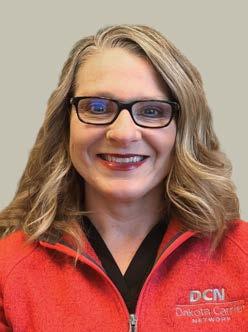
In the wholesale/wireless sales analyst position, Fisher supports the wholesale/wireless manager with quoting and entering opportunities into Salesforce. She also coordinates wireless upgrades and wireless new site builds and maintains DCN’s lit building list/price book in ConnectBase. Fisher has been a DCN sales support representative since January 2017. Prior to DCN, she worked at a national broadband company for almost three years and at a national office supplies retailer for nearly a decade. She attended North Dakota State University and is certified as a Project Management Professional through the Project Management Institute.
“Promoting team members is inspiring because it means that not only are we invested in them, they are invested in DCN,” says Seth Arndorfer, DCN CEO. “Erik, Trudy, and Lisa have shown leadership in their previous positions and commitment to our values of reliability, responsiveness, and relationships, and it’s great to see them taking on new roles and responsibilities.”
CEO’S MESSAGE, con’t from page 1
As our main story explains, while data centers all house data, there are some pretty important differences between the ones in the news and regional data centers like DCN’s in Fargo and Bismarck. I did a search on Amazon for books about data centers and in a split second it shared over 10,000 results. Everything from “Data Center for Beginners” to books on designing data centers to “The Great Data Center Adventure” for kids. So there is obviously interest beyond our borders but there is also a lot of information that people are trying to understand.
What we’re saying here isn’t meant to be comprehensive. It’s to give you a baseline understanding of key points in the discussion and you can dig into what matters most to you, your business, or your community. Know that my door and phone line are always open if you have questions about what DCN is doing with data centers or what we see happening in North Dakota and our industry.
As you will also see, we’ve been busy promoting team members and hiring new ones. As we’ve grown, we’ve discovered opportunities for some reorganization that we think will help to better serve our customers and Owner companies alike.
Spring is a time to refresh and renew, and I always look at this newsletter as a chance to renew my connection with you. I hope you are able to take a deep breath of the fresh air and enjoy all the wonders that spring has to offer!

DCN HIRES TWO IN NOC
A transport technician and an application analyst have been hired as part of the DCN Network Operations Center (NOC) team in the Bismarck office.

As a transport technician, Jon Herreid supports DCN’s high-quality, state-ofthe-art transport network. His key responsibilities include monitoring network performance, setting up and maintaining services, and troubleshooting technical issues to ensure seamless connectivity. In addition, he works with advanced telecommunications technologies, works with local and national providers to manage network operations, and installs and maintains critical equipment at other NOCs and remote locations to ensure reliable communication infrastructure.
Herreid earned an Associate of Applied Science degree in cybersecurity and computer networks from Bismarck State College. Prior to joining DCN, he was a welder in the manufacturing industry for almost a decade.

In the application analyst role, Nate Fries is responsible for the administration of DCN’s network monitoring applications; performance dashboards, report generation, data analysis, and ensuring compliance with service agreements; and coordinating issue resolution and training users on internal and external applications.
A North Dakota native, Fries earned an Associate of Science in Information Technologies from Southern New Hampshire University. Prior to joining DCN, he worked in education and early childhood roles for seven years.
“Jon and Nate are going to be great assets to the team,” says DCN CEO Seth Arndorfer. “It’s exciting to see people choosing to change their career track and join the broadband industry. This is a dynamic time to be in this industry and I expect them to excel.”
