WAKE BAR FLYER
MY THREE YEAR BREAK: Working for the White House WCBA member Wiley Nickel reflects on his time working in D.C. • PAGE 3 XXXIIX No. 2 • MARCH/APRIL 2012
Message from the President:
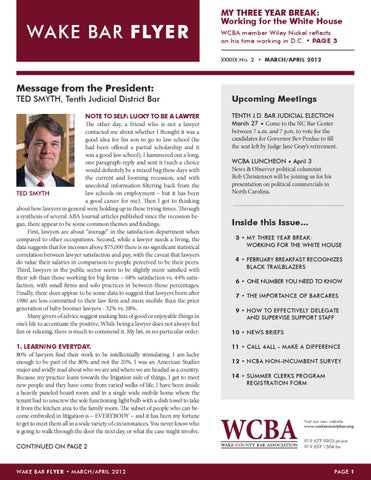
TED SMYTH, Tenth Judicial District Bar
Upcoming Meetings
NOTE TO SELF: LUCKY TO BE A LAWYER The other day, a friend who is not a lawyer contacted me about whether I thought it was a good idea for his son to go to law school (he had been offered a partial scholarship and it was a good law school). I hammered out a long, one paragraph reply and sent it (such a choice would definitely be a mixed bag these days with the current and looming recession, and with anecdotal information filtering back from the law schools on employment – but it has been a good career for me). Then I got to thinking about how lawyers in general were holding up in these trying times. Through a synthesis of several ABA Journal articles published since the recession began, there appear to be some common themes and findings. First, lawyers are about “average” in the satisfaction department when compared to other occupations. Second, while a lawyer needs a living, the data suggests that for incomes above $75,000 there is no significant statistical correlation between lawyer satisfaction and pay, with the caveat that lawyers do value their salaries in comparison to people perceived to be their peers. Third, lawyers in the public sector seem to be slightly more satisfied with their job than those working for big firms – 68% satisfaction vs. 44% satisfaction, with small firms and solo practices in between those percentages. Finally, there does appear to be some data to suggest that lawyers born after 1980 are less committed to their law firm and more mobile than the prior generation of baby boomer lawyers - 32% vs. 58%. Many givers of advice suggest making lists of good or enjoyable things in one’s life to accentuate the positive. While being a lawyer does not always feel fun or relaxing, there is much to commend it. My list, in no particular order:
TENTH J.D. BAR JUDICIAL ELECTION March 27 • Come to the NC Bar Center between 7 a.m. and 7 p.m. to vote for the candidates for Governor Bev Perdue to fill the seat left by Judge Jane Gray’s retirement.
1. LEARNING EVERYDAY. 80% of lawyers find their work to be intellectually stimulating. I am lucky enough to be part of the 80% and not the 20%. I was an American Studies major and avidly read about who we are and where we are headed as a country. Because my practice leans towards the litigation side of things, I get to meet new people and they have come from varied walks of life. I have been inside a heavily paneled board room and in a single wide mobile home where the tenant had to unscrew the sole functioning light bulb with a dish towel to take it from the kitchen area to the family room. The subset of people who can become embroiled in litigation is – EVERYBODY – and it has been my fortune to get to meet them all in a wide variety of circumstances. You never know who is going to walk through the door the next day, or what the case might involve.
11 • CALL 4ALL - MAKE A DIFFERENCE
CONTINUED ON PAGE 2
WAKE BAR FLYER • MARCH/APRIL 2012
WCBA LUNCHEON • April 3 News & Observer political columnist Rob Christensen will be joining us for his presentation on political commercials in North Carolina.
Inside this Issue... 3 • MY THREE YEAR BREAK: WORKING FOR THE WHITE HOUSE 4 • FEBRUARY BREAKFAST RECOGNIZES BLACK TRAILBLAZERS 6 • ONE NUMBER YOU NEED TO KNOW 7 • THE IMPORTANCE OF BARCARES 9 • HOW TO EFFECTIVELY DELEGATE AND SUPERVISE SUPPORT STAFF 10 • NEWS BRIEFS
12 • NCBA NON-INCUMBENT SURVEY 14 • SUMMER CLERKS PROGRAM REGISTRATION FORM
Visit our new website: www.wakecountybar.org 919.677.9903 phone 919.657.1564 fax
PAGE 1
WAKE BAR FLYER XXXIIX No. 2 • MARCH/APRIL 2012 President, Wake County Bar Association THEODORE C. EDWARDS II President, Tenth Judicial District Bar THEODORE B. SMYTH President-Elect THOMAS H. DAVIS, JR. Secretary JENNIFER A. MORGAN Treasurer ALLAN B. HEAD Immediate Past President CHRISTIE SPEIR ROEDER Board of Directors P. COLLINS BARWICK III HEIDI C. BLOOM ASHLEY K. BRATHWAITE MADISON (MATT) E. BULLARD, JR. JUDGE LORI G. CHRISTIAN MICHELLE S. COFIELD HOWARD J. CUMMINGS MARK A. FINKELSTEIN STEPHANIE A. GASTON NANCY L. GRACE ROBIN M. HAMMOND ELIZABETH R. HARRISON GREGORY L. HINSHAW THOMAS C. KILPATRICK E. HARDY LEWIS MARIA M. LYNCH STACI T. MEYER R. DONAVON MUNFORD, JR. ASHLEY MATLOCK PERKINSON WILLIAM W. PLYLER PAUL A. SUHR BETTIE KELLEY SOUSA BO THOMPSON THOMAS C. WORTH, JR. Young Lawyers Division J. T. CROOK ABA Delegate ROGER W. SMITH, SR. Executive Director WHITNEY von HAAM Wake Bar Flyer Editor LUCY AUSTIN Tenth Judicial District Bar Councilors NICHOLAS J. (NICK) DOMBALIS CARLYN G. POOLE JOHN M. SILVERSTEIN CYNTHIA (CINDY) L. WITTMER JOHN N. (NICK) FOUNTAIN DAVID W. LONG SALLY H. SCHERER DONNA R. RASCOE
Message from the President, continued
NOTE TO SELF: LUCKY TO BE A LAWYER 2. IDEALISM PERSISTS. Only about 16% of lawyers feel that they are not contributing the public good in the profession. Once again, I feel lucky enough to be in the 84% here. While my efforts are not always successful, and rarely efficient, every once in a while something good can come of one’s efforts to make the world a better place. Non-profit Boards appreciate having a lawyer among them. Hopefully my forays into assignments from Legal Aid have been worthwhile for the client. My observation though is that most lawyers deliver their best source of assistance to the worn out, discouraged and downtrodden among us when they linger on the phone a few extra minutes or stand on a curb and patiently listen and then in a few brief sentences provide some insight or legal advice to somebody who needs some guidance. That never shows up on a time sheet, and is very difficult to quantify, but just about everybody I know on the right day will patiently listen to somebody’s problem and try to help them out without sending an invoice. Our local Bar is working hard to get more people involved in an organized fashion to assist those who need our help in these trying times. 3. LAWYERS MAKE GOOD FRIENDS. Lawyers by training are in the business of listening and rendering advice. When you seek advice or support from a fellow lawyer, they already have the predisposition, and they have the ability to relate to someone fairly similarly situated. As a litigator, it is not uncommon to walk down the hall or get on the phone and talk about a procedural or substantive issue that is of some stress or concern. The willingness of lawyers to speak with each other on this and to candidly and compassionately compare notes has been perhaps the most surprising and rewarding aspect of the practice of law. I suspect that my experience is not unusual, and that we each have a group of people whom we contact regularly (and in all likelihood who contact us regularly) for informal advice and support. I hope that trend continues, and certainly in Wake County it has been a pronounced, observable phenomena over the last three decades that I have been fortunate enough to experience. 4. MORE GOOD FORTUNE. While they certainly don’t tell you in the brochure how many hours it takes to be President of the Tenth Judicial District, the good news is that those hours are spent with some really great people. I have immensely enjoyed the serendipitous circumstances that have placed me in constant brain-storming interaction with Ted Edwards, my co-President. Fantastic, talented volunteers freely give their time in various positions and assignments to make our local Bar a better place. A lot of experience and a lot of enthusiasm gets channeled through our local Bar organization. Finally, we have an enthusiastic and innovative Bar staff working very hard to bring us closer together in efficient and thoughtful ways. It will be interesting to see whether that law school applicant ends up going to law school, and how he feels about the practice in 20 years. Thank you for your support of our local Bar. WBF
© 2012 Wake County Bar Association & Tenth Judicial District Bar.
NEXT BAR FLYER DEADLINE: APRIL 15, 2012
WAKE BAR FLYER • MARCH/APRIL 2012
PAGE 2
MY THREE YEAR BREAK: Working for the White House
BY WILEY NICKEL | Nickel, pictured above with President Barack Obama and Vice President Joe Biden, took a three year “break” from the practice of law, joining the campaign for President Obama in the summer of 2008 and subsequently working in the Advance Office of the White House planning President Obama’s major speeches and events. IN THE SUMMER OF 2008, I was asked to join the Obama campaign. Prior to the 2008 election, I had worked as a California prosecutor and then as a civil litigator and was involved in a handful of very bitter lawsuits in California. The rough and tumble life of a Presidential campaign was actually a nice vacation from the harsh tone of many of those lawsuits. The opportunity to join that Presidential campaign seemed like a once in a lifetime opportunity, and I jumped at it. For the last three years, the job allowed me to travel all over the United States and all over the world with President Obama. My job was to produce major events for President Obama as part of his advance team. On a normal campaign or White House trip, a team of around six to 12 staffers would be sent a week ahead of Senator Obama (and later President Obama) to plan all of the details and logistics for his visit. Among other things, these staffers handle the event planning, event management, press logistics, crowd logistics and motorcade drivers for a presidential visit. The Secret Service sends a team of agents to work on security, and the military sends a team of communications staffers to handle the web of technical things surrounding a Presidential visit. I can’t really talk about the various military and Secret Service roles, but it’s safe to say that there are a ton of people involved with a typical Presidential visit (as anyone who has been stuck in traffic due to a Presidential motorcade can attest). My role was a lot more rock and roll than law or policy. The job was similar to someone who produces large concerts (just substitute an Obama speech for a Foo Fighters show). The closest description to my job might be an event planner on speed. We normally had only days to accomplish what most people would spend months planning. At one point, I planned a 100,000-person rally in just three days
WAKE BAR FLYER • MARCH/APRIL 2012
and was the largest event I had the opportunity to produce. It was then-Senator Obama’s final campaign speech in front of a crowd in Manassas, Virginia. The event went into the late hours of the night before Election Day and provided great momentum, eventually leading to a win in Virginia. My job ended up taking me all over the country and the world. I produced major foreign policy speeches in Ghana, Japan and Brazil. At times I even traveled in the Presidential airplanes and helicopters. I produced campaign and official speeches for audiences of 25,000 to 100,000 people. The job took me to places as diverse as Michigan’s Upper Peninsula to talk about the Administration’s commitment to rural broadband access to places as far away as Broughton High School in Raleigh where we pushed for health care reform in a local town hall meeting (a nice trip where I actually got to stay in North Carolina and work from home). Working for the White House is definitely an adventure. You could be sitting at home and receive a call that you necessitated jumping on a plane to some new city by the next morning. How about a week-long trip to Paris? Or maybe you’d like to handle a big Labor Day rally in Detroit with Aretha Franklin warming up a great union crowd? What about spending a million bucks to plan and organize a 10,000-person Obama campaign staff thank-you party with Jay-Z performing? It was certainly a great ride. In the end, the constant travel was just too much. On average, I would spend two to three weeks away from my wife and our home in Cary. So finally after this three-year detour, I am back to practicing law in the Great State of North Carolina. Now, I have opened up my own criminal practice and am very happy to spend weeks at a time in one place. WBF
PAGE 3
FEBRUARY BREAKFAST RECOGNIZES BLACK TRAILBLAZERS IN WAKE COUNTY ON THE MORNING OF FEBRUARY 15, more than 40 members of the Tenth Judicial District Bar came to the Mecca to hear three local trailblazers share the history of black lawyers in Wake County. Judge Cressie Thigpen, Kaye Webb and Geoff Simmons shared their memories of those who came before them in Wake County and related stories and lessons from their careers. Thigpen currently serves on the Court of Appeals, and practiced in private practice for 35 years before sitting on the bench. He also served as president of the N.C. State Bar. Simmons has been a solo practitioner for the bulk of his career, having started with the legislature and a one-year stint for Governor Hunt, and later served as the Wake County Bar Association’s first black president in 1990. Kaye Webb spent many years working for the Attorney General’s office and NC Central University, and became one of the first women – and the first black woman – elected to the State Bar Council in 1986. Thigpen kicked off the event by giving an overview of some of the early black lawyers practicing in Wake County including Samuel Mitchell, Romallus O. Murphy and Herman Taylor, who practiced on Hargett Street near the Hamlin Drugstore, and as Thigpen explained, “represented kids who were marching for civil rights at the time.” Thigpen recounted Taylor to be a flashy attorney with a thriving practice who was known for being dressed extremely well. Across the street from Mitchell, Murphy and Taylor’s practice, was Fred J. Carnage, a dapper dresser, who did mostly real estate work. It was Murphy and George R. Greene, who had both worked hard to join the Wake County Bar Association and were successful in their mission in 1967. At the October 1967 WCBA meeting, J.
WAKE BAR FLYER • MARCH/APRIL 2012
Allen Adams introduced a motion to strike the word “white” from the WCBA constitution, eliminating the exclusionary reference. A similar change was made the same year in the North Carolina Bar Association (NCBA). Prior to this change and shut-out from either the local bar association or the NCBA, black lawyers had formed two associations: In 1935 the Old North State Bar Association and in 1954 the North Carolina Lawyers Association, which later became the North Carolina Association of Black Lawyers. These trailblazers were not only effecting change in the bar associations, Carnage was later unanimously chosen by the Raleigh City Council to serve a six-year term on the school board – a first for African-Americans in Wake County, and Greene went on to become the first black person elected to the District Court bench. Taylor was the first black person in North Carolina to be admitted to practice before the United States Supreme Court. Dan Blue, with whom Thigpen practiced, was the first black person to serve on the WCBA Board of Directors. Webb noted to attendees that her volunteered time – which was spent with the WCBA, NCBA and the National Bar Association, among others – has been focused on the diversity of the profession in terms of race, gender, culture and practice area, and is something that she continuously works on. She explained that it was important to network broadly, if you were working to make a difference and increase diversity, by getting involved in different groups. Simmons explained that the “black lawyers in Wake County tried to make a difference, and they had a lot of ties to Eastern North Carolina.” He recounted some of the important people who made
PAGE 4
“
Although we as lawyers can fight against each other and represent our clients zealously, we still can be collegial to each other.
” - JUDGE CRESSIE H. THIGPEN, JR. -
PHOTO CAPTION | Left: WCBA Past President Geoff Simmons talks about his Eastern North Carolina roots, as fellow panelists Kaye Webb and Judge Cressie Thigpen look on. a difference in his life included his first and second grade teachers, who not only suggested law would be a good field for him, “as much as he likes to talk,” but they also had ties to other law-related individuals in Raleigh, such as civil rights attorney Sam Mitchell, John Baker (Raleigh’s first black police officer) and John Baker Jr. (Raleigh’s first black sheriff). In closing, Thigpen recounted the story of a 15-year case that he was involved in with the Black Agriculture Extension against the State of North Carolina. After an initial hard-fought, six-week trial, Judge DuPree judged against him. The case ended up going to the US Supreme Court, where he won 9-0. Opposing counsel in the case was Howard E. “Howdy” Manning, Jr., who later became Thigpen’s mentor as a judge, and had written a letter on Thigpen’s behalf following the tumultuous 15-year case. As Thigpen noted, “Although we as lawyers can fight against each other and represent our clients zealously, we still can be collegial to each other.” WBF PHOTO CAPTIONS | Right, beginning at top: Judge Cressie Thigpen recognizes those members of the profession who came before and on whose shoulders all members of the profession stand. Following the presentation Judge Thigpen enjoyed the memories of other attendees, remembering their interactions with African-American luminaries in the Bar. Simmons and Webb speak with Smith Debnam attorney Connie Carrigan following the panel discussion.
WAKE BAR FLYER • MARCH/APRIL 2012
PAGE 5
One Number You Need to Know BY ERIK MAZZONE
ERIK MAZZONE is the Director of the Center for Practice Management at the North Carolina Bar Association.
LEARNING TO LOVE METRICS did not come easily to me. I majored in English and Philosophy in college and have always thought of myself as a “big picture” rather than a “detail” person. Metrics seemed to fall decidedly into the “detail” category. Having a big picture orientation can be supremely unhelpful at many of life’s little junctures, such as assembling IKEA furniture or balancing a checkbook. Or managing a law firm. As lawyers, we tend to grasp concepts quickly and make connections between facts or ideas readily. Most of us don’t, however, come prepackaged with a hardcore orientation toward metrics or data analysis – which I will define loosely as the ability to tease actionable information out of a barrage of numbers. Luckily, you don’t need a Ph.D in statistics to benefit from using metrics in law practice management. Keeping track of a few key indicators can help you better make important decisions in planning for and running your firm. When I first started keeping track of metrics, I went a little overboard, as I am prone to do. I started keeping track of all kinds of stuff and looking for relationships between arcane and seemingly unrelated bits of data. What happens to an attorney’s billable revenue in a month where she is issued a new computer? Beats me, but if the question titillated you, you can imagine how easy it is to fall prey to searching for hidden secrets in your firm data. To keep things simple, I’m going to suggest that you start using only one new metric in 2012. It is a metric I’m guessing most of you don’t currently calculate, it is easily calculated, and 99% of the firms I consult with already possess the underlying data (which is well more than half the battle). That’s the good news. The bad news is that once you know this number, you can’t un-know it. And knowing it may cause you to look differently at the way you run your firm and the folks you have on your team. It is Revenues Per Employee (RPE). Well, that didn’t sound so bad (or so hard to un-know, for that matter.) So, let me elaborate. Most firms that I visit with have the underlying data to make this calculation readily available. It’s a simple calculation of gross revenues divided by the total number of employees over a given period of time, say a year. A lot of firms already per
WAKE BAR FLYER • MARCH/APRIL 2012
form a similar calculation for partners, associates and billing paralegals, but then lump all of the other employees into “overhead” which is a little like deciding whether a baseball team is successful based on the individual batting averages of all of the players. It misses one key ingredient – how is the firm as a whole performing? There are a lot of different ways to track firmwide performance, so why is RPE so special? RPE is an important metric for three reasons. First, RPE scales to rising or dropping revenue environments. In a time where not every law firm can be assured of increasing gross revenues year over year, RPE allows you to look at how efficiently you are using your human capital – which is almost always the biggest expense for a law firm. Whether revenues are down 20% or up 20%, RPE remains a static metric that allows you to determine whether growth was actually profitable or whether a decline in revenues was necessarily a bad thing. As a lot of firms realized over the past four years, increasing gross revenues may be sexier, but increasing profitability is a lot more important. Second, tracking RPE drives innovation and investment in infrastructure and systems. RPE induces us to think harder about the default solution, we as lawyers, devise for almost every problem, which is to throw bodies at it. Law practice has lagged in the adoption of technology to simplify routine tasks and improve efficiency. A lot of legal technology experts believe that is because lawyers are cheap or anti-innovative. I don’t believe either of those explanations are true. I think lawyers just operate in a system that rewards a firm’s growth in size (as measured by the number of employees) in a whole bunch of significant normative ways. Overacquisition of human capital just doesn’t necessarily do much to help the bottom line, and in most cases actively hurts it. Third and finally, RPE allows us to compare apples to apples. Tracking RPE gives lawyers a relevant basis of comparison between firms of different sizes, in different practice areas and in different locations. For those of you who have been around the NCBA long enough to remember the last Economic Survey that the Association conducted in 1998,
PAGE 6
you’ll recall that one of the frequent criticisms is that most economic information relevant to a 50 lawyer firm in a big city is not terribly relevant to a 7 lawyer firm in a small town. RPE makes it easier to understand the relative efficiency of your firm compared to others. The Law Practice Management Section is undertaking a new Economic Survey this year and I hope that RPE will be one of the questions asked. So, here’s where I get to the hard to un-know part.None of this matters much in a vacuum. Once you’ve calculated your RPE, what are you supposed to do with it? I’ve talked with a lot of firms about RPE and there is a wide range in performance. The highest RPE I’ve seen is in excess of $200,000, though it is much more common for me to see an RPE of just north of $100,000. Whatever your firm’s RPE turns out to be is not, alone, dispositive in whether changes need to be made. Ultimately, It all comes down to partner compensation. If the folks who own the firm are happy with what they’re bringing home and how much they’re working, I wouldn’t get wrapped around the axle about RPE. On the other hand, I talked to a lot of firms in 2011 where the partners were working harder than ever and taking home less compensation – and that’s not anybody’s ideal scenario. Once you decide to improve RPE for your firm, it’s pretty clear that whether your gross revenues go up or down, you are going to have to do more with less to move that needle. There are a lot of ways to do more with less and none of them are easy or simple, but they are doable. Ultimately, reviewing and improving RPE is a good, if sometimes painful, process for a law firm to go through. Your firm will emerge from the process leaner and more efficient; you may have fewer bodies around the water cooler; and you will probably develop greater reliance on technology. It’s not better or worse than doing business the way it was done before; it’s just adapting to the new terrain. WBF
WAKE BAR FLYER • MARCH/APRIL 2012
AS A REMINDER: The Importance of Our BarCARES Benefit BY TED EDWARDS, WCBA PRESIDENT AS LAWYERS, WE ARE A RESOURCE for others when they need help, but where can we go when things get difficult for us? Sometimes every lawyer faces hard questions and challenging circumstances. How can we tell our colleagues that we are feeling overwhelmed, inadequate or just burned out? How can we effectively deal with our clients’ issues when we are occupied with our own personal problems? Who can we tell that our child is struggling with drug abuse – that our marriage is ending – that caring for our aging parents is becoming an increasingly heavy burden? The reality is that we are all bombarded with stressful situations on a regular basis. Often, we are able to manage those situations, but there are times when all of us will need help. Many of us have developed strong support networks through our law firms, churches, civic organizations, families and friends, but there are often situations when we still feel alone. The good news is that help is available. As members of the Tenth Judicial District, we have access to the BarCARES program (Confidential Attorney Resource and Enrichment Services). I urge you to learn more about this valuable resource and to utilize it when necessary. BarCARES provides assistance to attorneys and their families dealing with a broad range of personal difficulties such as depression, anxiety, stress, alcohol or drug abuse, marital or relationship problems, parenting concerns, coping with the loss of a loved one, job stress, workplace conflicts, career dissatisfaction, job burnout and financial issues. In short, BarCARES provides a resource for the problems that we all face in our everyday lives. Getting early assistance in addressing these problems can improve the quality of our personal and professional lives and may prevent them from mushrooming into a crisis situation. BarCARES is a confidential, professional, short-term counseling program which is provided at no cost to members of the Tenth Judicial District Bar. If you are also a member of the Wake County Bar Association, free assistance is available for your immediate family members. BarCARES is administered by HRC Behavioral Health & Psychiatry, PA, one of the oldest and largest clinical practice groups in the Southeast. The counselors who participate in BarCARES are licensed professionals bound by the confidentiality requirements of their profession. Neither the Tenth Judicial District nor the Wake County Bar Association receives identifying information regarding the members who utilize BarCARES. Each member of the Tenth Judicial District can receive three free visits each year. Family members of Wake County Bar Association members can also receive three free visits each year. Often, three visits will be sufficient to resolve the situation, but if the issue requires a longer process, BarCARES will work with you to identify options that are covered by your health insurance plan. There is no shame in seeking help. Who among us has a problem-free life? It is the wise person who recognizes threats to his well-being and proactively takes steps to reduce the potential negative impact brought about by those threats. Sadly, many of us have firsthand knowledge of what happens when people don’t seek help. Recent studies have shown that nearly a quarter of attorneys under 36 admit to daily drinking and over twenty percent of lawyers over 36 drink alcohol every day. It is estimated that 40 to 70 percent of the cases before the Grievance committee and the Disciplinary Hearings Commission involve attorneys who are dealing with either substance abuse, clinical depression or other mental health issues. Just as it is important for each of us to pay attention to our physical health needs, we also have a professional responsibility to insure that we maintain our mental health as well. BarCARES is here to help. BarCARES is available 24 hours a day, seven days a week at 1-800-640-0735. WBF
PAGE 7
History.
North Carolina Lawyers Trust Us.
33 years of service.
Mutual.
Created for lawyers, by lawyers.
Value.
Our bottom line.
Bonnie Weyher and dan McLaMB, yates, McLaMB & Weyher, L.L.P.
www.lawyersmutualnc.com connect With us
919.677.8900 LAWYERS MUTUAL
LIABILITY INSURANCE COMPANY OF NORTH CAROLINA
800.662.8843
How to Effectively Delegate and Supervise Support Staff BY CAMILLE STELL IN AUGUST 1984 I STARTED MY CAREER AS A PARALEGAL. I walked into my office on the first day and there was a file sitting on my desk with a note in green ink inviting me to draft responses to interrogatories. I briefly thought about leaving. I wasn’t sure I was competent to work on real files that involved real clients. Looking back, I’m very glad I stayed. The green ink was my first introduction to Walter Brock, the attorney who provided that first assignment and who would go on to become a great teacher and mentor. If you have paralegals or other legal staff who work for you, I’m going to share some tips on how to effectively supervise your staff. HIRING | How do you hire a good paralegal? Many firms have set standards for paralegals – hiring paralegals who have graduated from a paralegal program or who have completed a certification exam. There are more than 20 paralegal programs in the state, the majority of those programs are offered in community colleges located across the state. It would seem that it is not unreasonable to set hiring standards that would require paralegal education. North Carolina also has a certification exam. There are more than 4000 NC certified paralegals. Visit the NC State Bar website to learn more. If you hire someone without paralegal education, you should invest in an ethics class or CLE program for them. Paralegal CLE classes are widely available. Multiple state-wide and local paralegal associations offer classes. Paralegals who work for Lawyers Mutual insureds can take our CLE classes for free. There are many online resources; again some of those are free. Many legal vendors also offer free or inexpensive CLE. Don’t forget to do a background search and reference check. Many paralegals or support staff are involved in accounting functions, especially with the trust account. Make sure that the person who handles this responsibility has passed the smell test. SUPERVISE | The NC Rules of Professional Conduct require that you supervise your employees but what does that mean? A key component of supervision is proper training. All attorneys want to hire someone who can “hit the ground running”. Providing proper training on the front end saves you time and money. Talk to your new hire about your practice, your clients and your ethics. Let them shadow you as you talk to clients on the phone or have them sit in on client meetings. Share forms, documents and letters that will be helpful as they begin drafting documents. Careful supervision of a new employee means that you spend a lot of time talking with them about their assignments and the desired outcome. It means that you carefully proof everything that they do. Careful supervision means that you read the documents that you sign. After you are comfortable with your paralegal’s skill level, you can begin to trust more. It may be fine to sign a stack of letters or routine motions while you are on the phone. You know if your paralegal has questions, she will pull those documents aside. Careful supervision does not mean that you blindly sign every piece of paper that your staff puts in front of you. Remember, it’s your law license (and insurance deductible) at risk. Is your office set-up conducive to hearing your paralegal on the phone or as she interacts with clients or other co-workers? My office was right across the hall from Walter’s office. He could hear my phone calls, I could hear him as he talked with clients. This was helpful as I was learning how the legal process worked and what our clients’ common questions might be. TEACH | Do you remember being in elementary school and asking your teacher how to spell a word? I do. Her response was to look it up in the dictionary. I remember thinking to myself, “how can I look it up if I can’t spell it?” Walter taught me not to walk in his office and ask an open ended “how do I do this” question. If I had a service question, I walked in his office, rulebook in hand, and said, “I’ve read Rule 4 but I’m not sure what step to take next”. He was very willing to walk through an explanation of how to apply the rule, but not as keen to do my homework for me. This was perhaps the most valuable lesson he taught me.
WAKE BAR FLYER • MARCH/APRIL 2012
CAMILLE STELL is the Director of Client Services for Lawyers Mutual. Recently selected as a Lawyers Weekly 2011 “Leaders in the Law” award recipient, Camille has more than 20 years of experience in the legal field, as a paralegal, legal recruiter and business developer. Contact Camille at 800.662.8843 or Camille@lawyers mutualnc.com.
CONTINUED PG. 10
PAGE 9
CONTINUED FROM PG. 9 | You should also provide your paralegals with learning opportunities. Help them to expand their skill set. Never use your paralegal for legal research? If she’s been to paralegal school, in all likelihood, she’s taken legal research classes. Talk with your paralegal about how to expand her skills to more effectively deliver legal services to your client. Provide feedback following an assignment. Initially, this takes a lot of time. But after a while, your paralegal begins to understand what you need whether it’s a particular writing style or a way of organizing trial notebooks. This is another place where spending time on the front end pays off in more efficiencies later. OWNERSHIP | Teach your paralegal to own the work product. It’s not about completing a portion of the task as quickly as possible then adding it to the stack on your desk so that you can do more work. It’s about taking the assignment and producing a finished product. If there are questions along the way, a good paralegal takes the responsibility for getting the necessary information to keep the project moving towards completion. Your commitment to the project means being available when she has questions so she can keep the project moving. SAFEGUARDS | If your paralegal has responsibility for the trust account or financial records, make sure checks and balances are in place. Do not have a signature stamp. Be involved in the process. Make sure that if the bank has a problem, that they notify you. Remember, you are not just practicing law, you are running a business and these are steps most diligent employers would take. Having a paralegal in your office can help you more effectively deliver legal services to your clients. Careful supervision of your paralegal protects your law license. WBF BREAKFAST DISCUSSION: The Art of Jury Selection – Wednesday, March 21 – 7:30 a.m. The Mecca Restaurant – 13 E. Martin St., Raleigh We will hear from a number of distinguished Wake County trial lawyers from a variety of practice areas. They will discuss their philosophies, goals and practical tips in the process of jury selection. These insights should not be missed! BREAKFAST DISCUSSION: Best Practices of Managing a Law Firm | Wednesday, April 18 – 7:30 a.m. The Mecca Restaurant, 13 E. Martin St. Raleigh Hear from local experts from the State Bar, a malpractice insurer and from a law firm on how to set up procedures and practices to manage a law firm and avoid pitfalls. Further, there will be discussion of resources when advice is needed in confronting uncertain situations in the practice. This breakfast will be great for newer lawyers looking for good ideas to carry them through their careers in managing their practices.
WAKE BAR FLYER • MARCH/APRIL 2012
Wake Women Attorneys WAKE WOMEN ATTORNEYS invites you to attend its upcoming monthly luncheons on Thursday, March 8, 2012 and April 12, 2012. Lunches are held at 12:00 pm at Sitti located at 137 S Wilmington St. Raleigh, N.C. 27601. Telephone: (919)239-4070. In March, Beth Voltz and Nancy Bromhal from SAFEChild (Stop Abuse For Every child) will be joining us to share SAFEChild’s mission and story with attendees. SAFEchild is Wake County’s only non profit child abuse prevention agency that provides direct services to families. SAFEchild works with parents, families and caregivers to create nurturing environments for children, free from abuse and neglect. With the ultimate vision of eliminating child abuse in Wake County, SAFEchild delivers support and education to families by helping them break negative parenting patterns, improve communication and relationship skills, and take advantage of community resources. The speakers will share SAFEChild’s mission and history. For our April luncheon, WWA is hosting its biennial judges’ forum. We invite all candidates of judicial races in our area to come for lunch and meet our members and guests. Each candidate will be given the opportunity to introduce himself or herself to the group. This is a great opportunity to get to know, or get reacquainted with, our judicial candidates before the primary elections in May. Lunch is $13.00/members; $17.00/non-members. WBF
Bettie Kelley Sousa named Chair of the American Board of Certification BETTIE KELLEY SOUSA, Partner with Smith Debnam Narron Drake Saintsing & Myers, LLP, was named Chair of the American Board of Certification (ABC) at a recent meeting of its Board of Directors in La Quinta, California. Accredited by the American Bar Association, ABC administers the only nationwide certification of legal specialists in the fields of creditors' rights, business bankruptcy, and consumer bankruptcy. Licensed since 1981, Ms. Sousa focuses her practice in the areas of business litigation and creditors’ rights and has been a Board Certified Creditors' Rights Specialist since the certification was first available in 1993. She has served on ABC's Board of Directors since 2002, on its Executive Committee since 2004, and has held the offices of Secretary, Treasurer, and President Elect, and most recently the Board's President. Smith Debnam is a midsized North and South Carolina law firm with its main office in Raleigh. The firm’s practice includes Corporate and Business Law, Business Litigation, Foreclosures, Creditor Representation, Collections, Commercial & Residential Real Estate, Construction Law, Employment Law, Equipment Leasing & Finance, Family Law, Estate Planning & Administration, Immigration Law, and Professional Negligence. WBF
PAGE 10
WAKE BAR FLYER • MARCH/APRIL 2012
PAGE 11
CALL 4ALL – MAKE A DIFFERENCE
Your Opportunity to Provide Pro Bono Services to the Neediest – Please Join Me in Signing Up BY DEBORAH HILDEBRAN-BACHOFEN | Member of WCBA Public Service Committee and the NCBA Small/Medium Firm Recruitment Subcommittee of the Call 4ALL Task Force “Every lawyer has a professional responsibility to provide legal services to those unable to pay. A lawyer should aspire to render at least 50 hours of pro bono publico legal services per year.” Rule 6.1 of the N.C. Rules of Professional Conduct WITH BUDGETARY CUTS, a slowed economy, and high unemployment, the overwhelming need for volunteers to provide pro bono legal services for the poor is undisputed and has been well-publicized among the legal community. The 4ALL Task Force of the North Carolina Bar Association Foundation and Legal Aid of North Carolina (LANC) have partnered together to inaugurate a new program, Call 4ALL. The Call 4ALL program is uniquely different from the 4ALL Program which started in 2008 and is the statewide service day that North Carolina lawyers take calls from the public at seven call centers throughout North Carolina. The 4ALL service day was March 2, 2012 this year. The Call 4ALL program has been designed to provide attorneys with an easy way to fulfill their pro bono obligations with a limited scope of engagement to clients who have been pre-screened by LANC. In most instances, Call 4ALL attorneys will volunteer to talk with clients through approximately one-hour telephone consultations, from the attorney’s office or even from the comfort of the attorney’s home, and at the frequency he or she designates. The attorney is not obligated to provide continued representation beyond the initial consultation and written summary to LANC concerning the consultation. Malpractice insurance will be provided by and through LANC on all cases referred through the Call 4ALL Program. In summary, the volunteer is provided: 1) the pre-screened client, 2) the legal issue, 3) training, if needed, 4) malpractice insurance, and 5) the time commitment per client is limited. How easy is that? Attorneys can volunteer to participate in the Call 4ALL Program by going to the website www.call4allnc.org and 1) then going to the link on the left side to the “Call 4ALL Online Application” and simply completing the on-line application, or 2) going to “Click HERE to download the volunteer sign-up form”, printing out the application, and returning the completed application to the North Carolina Bar Association. Sign up and make a difference! Wake County’s own Martin Brinkley, the current President of the NCBA, spoke at the January WCBA luncheon about attorneys’ pro bono obligations, the 4ALL Program and this new Call 4ALL Program. He stated that “[a]fter co-chairing the first 4ALL effort five years ago, I came to the conclusion that the real triumph of 4ALL WAKE BAR FLYER • MARCH/APRIL 2012
has been the lesson every lawyer who takes a shift on the telephones learns in silence. It is this: Talking to a real person, helping him or her sort out hard facts, giving common sense advice, and above all listening with a warm and beating heart is well within every lawyer’s skill. Discovering that we are capable of bringing the lifting power of our profession to bear on the life of a stranger is a magnificent gift. It gives us the chance, as Emily Dickinson said, “to stop one heart from breaking, to ease one life the aching, to cool one pain, to help a fainting robin unto his nest again – and not to have lived in vain.” He implored fellow Wake County attorney’s to sign up for this Call 4ALL Program. LANC staff members usually select cases with the following legal issues: private landlord/tenant, public and subsidized housing, Medicaid, disability and non-disability issues in Social Security matters, consumer collections, employee rights, custody, guardianship and simple estates. If the volunteer attorney doesn’t practice in one of these areas of legal need, at the volunteer’s request, LANC will provide substantive legal training opportunities and the volunteer will receive free CLE hours. The services rendered will be similar to the 4ALL call in day. After learning more about the program and the impact of the volunteers, I immediately signed up to join them. Read several interesting examples of the cases handled through this program: •
Wake County’s Gray Styers worked with a client who was alleged to have committed insurance fraud. The client’s father found out that his sister had taken a life insurance policy out on him. The father requested that the beneficiary be changed to the client. The insurance company was not able to send the forms before her father was hospitalized, but the client was able to fill out the forms and have her father sign them before he died. Styers represented the client in court and secured the insurance benefits of $25,000 for his client.
•
Wake County’s Steven Epstein helped a client that was living in a low-income apartment with her children. She paid a $200 security deposit and a monthly rent of $315. The landlord chose to terminate the lease after 6 months. The client never received an accounting of her security deposit and did not have any further communication with her landlord. She recently went to rent a different low-income apartment only to find out that her former landlord had reported to the Credit Bureau that she owed over a $1,000 from the remainder of the terminated lease. Epstein contacted the landlord and demanded refund of the client’s security deposit. The landlord agreed to fix the client’s credit and return the $200 security deposit. All in time for the holidays. PAGE 12
•
Katherine Tenfelde’s client was working as a maintenance worker. The client would often travel up to 3 hours to perform repair work. He used a company car and had a gas card to perform his job. He was paid for his time travelling to the job site and for his time there but not for his time driving back to the work place. The client talked to his boss and was told that he had better get a lawyer if he was going to pursue this nonsense. The employer also threatened to fire the client. The client filed a complaint with the Department of Labor. Soon after, the client was fired. The company fought the client’s unemployment claim. Tenfelde represented the client in a REDA claim.
•
Wake County’s Kellie Army was referred a client who had some medical issues. He was having an adverse reaction to his medication and was out of work on FMLA for over a year. The client’s leave ran out and his employer sent him a letter stating that if he missed another day, they would assume that he had quit. The client missed another day and was terminated. Army walked him through the employment hearing process and instructed him on how to represent himself at the hearing. The client felt empowered and won his unemployment benefits.
•
Thomas Anderson helped a client that was going through marital separation. She ended up moving to South Carolina to be with family while her son stayed in North Carolina with the father. The estranged husband passed away leaving her son living with their aunt. The aunt refused to give the child back to the client alleging that she was the legal guardian and that the father in his will had left the son to the aunt. Anderson advised the client she was wrong and that the client was the natural guardian of her son. He helped the client understand her rights and regain custody of her son.
•
Letha McDowell was referred a client whose boyfriend passed away. They had two children, but the boyfriend’s life insurance policy did not designate a beneficiary. McDowell called the insurance provider with the client. The Customer Service representative was not being cooperative and was demanding proof of guardianship, even though this is not required by North Carolina law. McDowell then contacted the N.C. Insurance Commissioner and assisted the client in filing a complaint.
More information, a video and FAQs about the program can be found at http://www.ncbar.org/public-pro-bono/call-4all.aspx. The rewards are immeasurable for you and the clients you help. Attorneys are the only ones who can provide this service. Almost everyone during their lifetimes needs help from others, especially those less fortunate. Sign up and make a difference! WBF Charlotte Personal Injury firm with Raleigh Office is looking for shared office space. Firm maintains one-full time employee. Would need two offices or space large enough to accommodate two workstations as well as regular access to a conference room. The building must also offer free parking. Ideally we like to utilize a common receptionist. If you have such space available, please call Zachary P. Deason at 704-225-8700. WAKE BAR FLYER • MARCH/APRIL 2012
THE NCBA NON-INCUMBENT SURVEY IS HERE BY MIKE WEDDINGTON | Past Chair, NCBA Administration of Justice Committee WCBA/TENTH Judicial District Bar Association members should by now have (or very shortly will have) in their email the survey form distributed by the NCBA Administration of Justice Committee for evaluation of non-incumbents who have filed to seek election to a trial court bench seat. If you haven’t received your survey, don’t hesitate to let the NCBA know via nonincumbent@ncbar.org. This survey seeks your input as to non-incumbent candidates for election to the Superior and District Court benches. In order to collate the results of the survey and vet them statistically to be able to publish them in advance of the upcoming May 8 primary, your help is needed in getting your survey form completed and returned as soon as possible. Completion of the survey will not take much of your time as the survey form has been simplified, containing fewer questions and asking for no demographic information or narrative comments. The anonymity of respondents to the survey will be protected, responses being by an anonymous number rather than the name of the respondent. The survey includes six assessment categories that are essentially identical to the categories in which trial court judges were assessed by the bar in the Judicial Performance Evaluation (“JPE”) survey completed last year with results being published in January of this year. These categories are: integrity and impartiality; legal ability; communication; professionalism; administrative skills; and overall performance with survey subjects being rated on a scale of 5 through 1, corresponding to “Excellent,” “ Good,” “Average,” “Below Average,” and “Poor.” A response of “DNK” is also available where one does not know the candidate’s ability in a particular category. The results of the survey will be published in graph format as soon in April as the vetting process for the responses can be completed. These results will be available via the NCBA website, www.ncbar.org. As with the JPE survey, the success of the non-incumbent survey depends on the level of participation of lawyers in responding. The aim is to complement the JPE survey and bring to North Carolina voters some meaningful information they need to make informed and educated choices when electing our trial court judges. Please give your whole-hearted support to this important effort. WBF PAGE 13
2012 Wake County Bar Association – Young Lawyers Division SUMMER CLERKS PROGRAM REGISTRATION FORM *Please fax or mail by May 25, 2012* Law Firm / Agency Name: _______________________________________________________________________ Contact Name & Title:___________________________________________________________________________ Contact Email:_________________________________________________________________________________ Contact Phone: ________________________________________________________________________________ Clerk Name (add additional names, if necessary)
Clerk Email or Phone
June 7th Seminar ONLY
Full Summer YLD*
1. 2. 3. 4. 5. 6. 7. 8. SUMMER CLERK ORIENTATION PROGRAM Thursday, June 7, 2012 | 1 p.m. – 5 pm. North Carolina Museum of History Auditorium (5 E. Edenton Street)
The YLD is pleased to continue the tradition of providing Wake County’s summer clerks with a true insider’s view into our local legal community. Outstanding speakers from various aspects of the profession are slated to speak on topics of interest to our summer clerks! The program will begin after lunch (on your own) with registration starting at 12:45 p.m. This program is provided by YLD free of charge but courtroom attire is suggested and advance registration is required. For additional details, please contact Ashleigh Black (ablack@rl-law.com).
FULL SUMMER YLD
The YLD offers additional opportunities for the area’s summer clerks to meet their fellow clerks as well as attorneys and other members of the legal community at a nominal cost* per clerk. This includes access to four monthly socials connecting young lawyers from all over Wake County. It is a great way to complement each firm or agency’s own summer program, by providing a venue to meet clerks, attorneys from other firms and groups as well as local judges. MONTHLY YLD SOCIALS (business casual attire): • May 3 | Natty Greene’s (505 W. Jones St.) 6:00 p.m. • June 7 | Tyler’s Taproom (Seaboard Station, following the Summer Clerk program) 5:30 p.m. • July 12 | Place TBA 6:00 p.m. • August 2 | Place TBA 6:00 p.m.
*Full Summer YLD registration is $30 per intern/clerk. Please complete this form and enclose a check payable to WCBA-YLD (Memo: 2012 YLD Summer Clerk Registration) to: Whitney von Haam, Executive Director, Wake County Bar Association | P. O. Box 3686, Cary, NC 27519-3686 (Registration forms not requiring payment are faxed to Ms. Von Haam’s attention at 919-657-1564.) WAKE BAR FLYER • MARCH/APRIL 2012
PAGE 14