The independent newspaper of Washington University in St. Louis since 1878 THURSDAY, DECEMBER 2, 2021
VOLUME 143, NO. 12
CAMPUS CONSUMERISM
How materialism has skyrocketed during the pandemic (Scene, pg 4)
WWW.STUDLIFE.COM
BASKETBALL’S BACK
LEAVING OMAHA
Takeaways from the first three weeks of the men’s and women’s seasons (Sports, pg 5)
Our review of the original play written by Carter Lewis (Cadenza, pg 6)
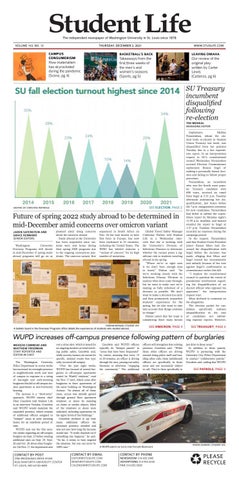
SU fall election turnout highest since 2014
SU Treasury incumbent disqualified following re-election TED MOSKAL MANAGING EDITOR
sequenced in South Africa on Nov. 24 but now known to have first been in Europe, has now been confirmed in 23 countries, including the United States. The WHO has labeled omicron a “variant of concern” for its high number of mutations.
Global Travel Safety Manager Catherine Dalton told Student Life in a Wednesday interview that she is working with the University’s Division of Infectious Diseases to determine whether the variant poses a significant risk to students traveling abroad in the spring. “Where we’re at right now is we don’t have enough data to know,” Dalton said. “So we’re working closely with the Infectious Disease Division to analyze what does come through, but we want to make sure we’re making as fully informed of a decision as possible. We don’t want to make a decision too early and then prematurely jeopardize students’ experiences for the spring, but we also want to take into account that things continue to change.” Dalton noted that her team is considering three main factors
Sophomore Mishka Narasimhan, whom the student body re-elected to Student Union Treasury last week, was disqualified from her position Tuesday due to a late expenditure report. In an interpretation request to SU’s constitutional council Wednesday, Narasimhan accused Election Commissioner sophomore Bonnie Segel of making a personally biased decision and failing to follow proper procedure. Narasimhan, an incumbent who was the fourth most popular Treasury candidate with 698 votes, received an email from Segel at 2:31 p.m. Tuesday afternoon announcing her disqualification, just hours before the 7 p.m. inauguration ceremony for new candidates. Narasimhan had failed to submit the expenditure report by Monday night’s 11:59 p.m. deadline, and instead emailed the report to Segel at 1:27 p.m. Tuesday. Narasimhan recorded no expenses during the campaign period. In the request, Narasimhan said that Student Union President junior Ranen Miao had discussed the disqualification with Segel before the decision was made, alleging that Miao and Segel treated her inconsistently and unfairly because of her vote against Segel’s confirmation as commissioner earlier this fall. “I implore the constitutional council to question the extent of presidential involvement regarding the disqualification of an elected official who opposed his appointee,” the interpretation request read. Miao declined to comment on the allegations. The election packet for candidates specifically outlines disqualification in the case of candidates not submitting expense reports. However,
CURRAN NEENAN | STUDENT LIFE
SEE OMICRON, PAGE 3
SEE TREASURY, PAGE 2
SEE ELECTION, PAGE 2
GRAPHIC BY CHRISTINE WATRIDGE
Future of spring 2022 study abroad to be determined in mid-December amid concerns over omicron variant JADEN SATENSTEIN AND GRACE KENNARD SENIOR EDITORS Washington University Overseas Programs will decide in mid-December if spring study abroad programs will go on as
planned amid rising concerns about the omicron variant. Study abroad at the University has been suspended since students were sent home during their spring 2020 programs due to the ongoing coronavirus pandemic. The omicron variant, first
A bulletin board in the Overseas Programs office details the experiences of students who studied abroad.
WUPD increases off-campus presence following pattern of burglaries MEHEER COMMURI AND MATTHEW FRIEDMAN STAFF REPORTER AND EDITOR-IN CHIEF The Washington University Police Department in recent weeks has increased its overnight presence in neighborhoods north and west of campus in response to a string of late-night and early-morning burglaries this fall at off-campus student apartments in non-University housing. The increase is a “short-term” approach, WUPD interim chief Dave Goodwin told Student Life in an interview Tuesday. Goodwin said WUPD would maintain the expanded presence, which consists of additional officers assigned to “hotspot” areas in early morning hours, for an indefinite period of time. WUPD sent out the first security memo regarding an off-campus burglary on Sept. 23 before sending additional ones on Sept. 25, Sept. 26 and Oct. 26 about other burglaries. On Nov. 17, the department sent
out a crime alert, which is issued for an ongoing incident or trend involving public safety, Goodwin said, while security memos are meant for specific, isolated events that typically occurred off-campus. “Over the past eight weeks, WUPD has learned of several burglaries in off-campus apartments rented by WashU students,” read the Nov. 17 alert, which came after burglaries in three apartments of the same building on Washington Avenue. “In almost all of these cases, access was initially gained through ground floor apartment windows or doors by standing on chairs or nearby objects. Most of the windows or doors were unlocked, including apartments on the upper levels of the buildings.” Goodwin declined to say how many additional officers the increased presence entailed and was not sure how long the increase would last. “It really depends on if something else happens,” he said. “So far, it seems to have negated the situation, but you can never be 100% sure.”
Goodwin said WUPD officers typically do “hotspot patrols” in “areas that have been frequented” by crimes, meaning that every 15 to 20 minutes, an officer is driving through the area, passing out safety literature or otherwise “engaging the community.” The additional
officers will strengthen that existing presence, Goodwin said. “While those other officers are driving around doing police stuff and handling other calls, those [additional] officers are specifically in those areas and not necessarily subject to call. They’re there specifically to
A WUPD patrol car turns onto Forsyth Boulevard.
CONTACT BY POST
CONTACT BY EMAIL
CONTACT BY PHONE
ONE BROOKINGS DRIVE #1039 #320 DANFORTH UNIVERSITY CENTER ST. LOUIS, MO 63130-4899
EDITOR@STUDLIFE.COM NEWS@STUDLIFE.COM CALENDAR@STUDLIFE.COM
NEWSROOM 314.935.5995 ADVERTISING 314.935.4240 FAX 314.935.5938
just drive in those areas.” In addition to those patrols, WUPD is partnering with the University City Police Department to conduct “collaborative patrols,” Goodwin said, adding that WUPD
SEE PATROLS, PAGE 3
KIVANC DUNDAR | STUDENT LIFE
2 STUDENT LIFE
GRACE KENNARD & ORLI SHEFFEY | SENIOR NEWS EDITORS | NEWS@STUDLIFE.COM
theFLIPSIDE THU 2
SUNNY 68/43
FRI 3
SAT 4
SUNNY 70/38
MON 6
PARTLY CLOUDY 43/29
MOSTLY SUNNY 51/38
TUES 7
SHOWERS 47/33
SUN 5
SHOWERS 60/30
WED 8
PARTLY CLOUDY 41/31
EVENT CALENDAR THURSDAY 2 Centering Equity in Urban Biodiversity, Climate Justice and Eco-Literacy Virtual Event, 4 p.m. This event is hosted by The Center for Race, Ethnicity and Equity (CRE2). Catherine Werner, sustainability director for St. Louis City will present. Thirii Myo Kyaw Myint Reads from Her Fiction Virtual Event, 8 p.m. Thirii Myo Kyaw Myint is the author of “The End of Peril, the End of Enmity, the End of Strife, a Haven,” a novel, and a book of creative nonfiction titled “Names for Light: A Family History.” In order to attend you must register online.
FRIDAY 3 Washington University Dance Theatre: ‘Return’ Edison Theatre, 8 p.m. After a year of hiatus, Washington University Dance Theatre has returned to the Edison Theatre. Occurring annually, this concert dance showcase features guest and resident artist choreography performed by Performing Arts Department student dancers. There will be shows Friday and Saturday at 8 p.m. on Sunday at 2 p.m. Tickets are free for students. Frisky Friday Zenker Wellness Suite, Sumers Rec 303, 9 a.m. Frisky Friday is a weekly program created by Habif Health and Wellness Center that creates space for students to speak with a sexual health expert about safer sex and pleasure in a safe and confidential environment.
SATURDAY 4 In Conversation: Artists Deborah Roberts and Adrian Octavius Walker with Adrienne Davis Virtual Event, 11 a.m. The Outwin artists Deborah Roberts and Adrian Octavius Walker speak with Adrienne Davis, William M. Van Cleve Professor of Law in the School of Law and Professor of Organizational Behavior & Leadership in the Olin Business School. Both artists use portraiture to depict the complexity of Black subjecthood, exploring themes of race, identity, beauty and gender politics..
TUESDAY 7 Behind the Scenes Lab Tour with William Tolman Virtual Event, 12 p.m. William Tolman, vice dean of research and entrepreneurship and William Greenleaf Eliot Professor of Chemistry will be leading a virtual tour of the Tolman Group Laboratory. This tour, part of the Power of Arts & Sciences series, will feature conversations with students about their processes as well as a live chat with the researchers in the lab. Register online to receive access to the Zoom.
WINTER FORECAST 2021-2022 Josh Warner | Staff Writer December is shaping up to be much warmer and a touch wetter than average. The confidence in this is high. A jet stream ridge will settle over the central US, leading to alarge swath of warm temperatures in America’s heartland. Additionally, storms that ride alongthe jet stream will generally impact this region, and thus December may see frequent precipitation. The precipitation, however, will come in small, quick batches, and should largely be confined to rain. There should be few travel issues if you’re leaving St. Louis for winter break. Check out studlife.com by the end of the semester for our full winter forecast.
QUESTION OF THE WEEK ‘TIS THE TIME TO BE THANKFUL! ARE YOU ON GOOD TERMS WITH YOUR FIRST-YEAR ROOMMATE? Here are the results from this week’s poll. Check out our Instagram for next week’s question.
Yes: 46.4% No: 32.1% Kind of: 21.4% Check our Instagram this week for next week’s question! Responses will be published here every Thursday.
THURSDAY, DECEMBER 2, 2021
SU’s most competitive fall election in years sees an uptick to 34% voter turnout TED MOSKAL MANAGING EDITOR Turnout in Student Union’s fall elections shot up to 33.84% for a race involving a higher than usual number of candidates and with the divisive issue of Greek Life abolition on the line. Over the last five years, turnout has generally hovered between 15% and 25%. The last fall election with a similar level of engagement took place in 2014, with 35.4% turnout. “The stakes felt much higher than normal,” Election Commissioner sophomore Bonnie Segel wrote in a statement to Student Life. “Instead of everyone on the ballot getting elected simply because they decided to run, this election really was in the hands of the voters.” A total of 48 candidates participated in the election, with 22 students running for eleven positions in SU Treasury, 20 students running for eleven SU Senate seats and six students running for five positions on ArtSci Council. This level of competition is a sharp contrast to last fall’s election, which included just 30 candidates —14 candidates for Treasury, 11 for Senate and five for ArtSci Council. One reason for this higher level of competition was disagreement over the future of Greek Life on campus. Student Union’s current platform calls for the abolition of Greek Life at Washington University, and SU Senate passed a resolution calling for the dehousing of fraternities last year. However, a number of candidates this
fall argued that reform, rather than abolition, is the best way forward. “I think it’s important that we all hold Greek Life accountable, but at the same time, I think it’s important that we’re able to see the positive impact that Greek Life has on this campus,” sophomore Ned Dybala, who was elected to Senate, said at the SU candidate forum, Nov. 15. Other candidates disagreed. Sophomore Maddy Kish, who won a Senate seat, described fraternity houses as “sites of violence and trauma [that] should not have a place on our campus” in the voter guide emailed to students ahead of the election. The election yielded mixed results regarding Greek Life. Of the 13 candidates who expressed pro-reform or other proGreek Life positions in the voter guide, during the forum, or otherwise publicly identified themselves as members of Greek Life, two were elected to positions in Senate and three were elected to positions in Treasury. All six of the candidates endorsed by Abolish Greek Life WashU (AGL) in a Nov. 18 Instagram post were elected. The same post from AGL listed the names of candidates whom the organization identified as members of Greek Life, writing, “They do not represent student voices and should not serve in our student government.” Sophomore Aidan Stutts, who won a seat in Treasury, disagreed, arguing that the election results were indicative of the student body’s
desire for a larger Greek Life presence on campus. “I know many people would love to see the return of [Greek Life] events, which would require SU to take a more favorable stance on Greek Life,” he wrote in a message to Student Life Tuesday. Two initiatives aimed at boosting engagement this fall were the expansion of the voting period from 24 hours to 96 hours in order to give students more time to vote and the voter guide, a document that gave candidates a chance to explain their policy positions in more detail. Segel added that she hopes the voter guide will continue to have an impact even after the election. “[I] hope that this guide will serve as a way to hold the newly elected members of SU accountable,” she wrote. “Since we all have access to their campaign goals, it will be interesting to see which representatives actually follow through.” Segel said that the increased competition of this year’s election made it a much more engaging race for students, and she hopes to replicate this fall’s success in future elections. “To me, there is little to no reason to vote in an election when the results seem predetermined,” Segel wrote. “It is my goal that future students will look to this election as proof that anyone can run for Student Union and win, and these elections will continue to be competitive so that students can truly feel like their vote matters and feel excited to exercise their right to vote.”
TREASURY from page 1 Narasimhan said Segel had let similar incidents such as late candidacy applications and missing the mandatory candidates’ meeting go by with just warnings. Segel declined to comment on her reasoning and the situation in general, citing a desire to avoid influencing the constitutional council’s adjudication process. Narasimhan’s argument to constitutional council will focus on two main points, first that the election commission did not meet until after the inauguration ceremony, giving her no time to dispute the decision. “The election commissioner’s responsibility constitutionally is to consult the election commission with any big
decision, and that really wasn’t done until after the inauguration happened, and certainly not before she sent the disqualification final decision email to me,” Narasimhan said. Narasimhan’s second point hinges on the fact that SU has no precedent for disqualifying a candidate after votes have been cast. Student Union advisor Peggy Hermes, who has worked with the organization for five years, said she could not recall a similar instance. “[The votes for me], which would essentially be nullified after the disqualification is made, could have gone to someone else had I not been in the race, so there’s just a lot of things… that we could clear up with con[stitutional] council,”
Narasimhan said. Chief Justice of the constitutional council sophomore Julia Cleary said that the council does not comment on active cases, but will release a full opinion after a trial. Currently, only 10 of the 11 seats in SU Treasury are filled. The Student Union constitution details that the speaker of the Treasury, currently junior Max Roitblat, is responsible for appointing a student to fill vacant seats. However, Narasimhan hopes that filling such a vacancy will not be necessary after the constitutional council hearing. “Right now I’m just focused on getting my spot back,” she said. Kasey Noss and Orli Sheffey contributed reporting.
CURRAN NEENAN | STUDENT LIFE
Students discuss funding appeals during the Nov. 16 Treasury meeting. Eleven Treasury positions and 11 Senate positions were up for election.
THURSDAY, DECEMBER 2, 2021
GRACE KENNARD & ORLI SHEFFEY | SENIOR NEWS EDITORS | NEWS@STUDLIFE.COM
OMICRON from page 1 as they analyze the developing data on the variant throughout the next two weeks: transmissibility, severity of illness and the efficacy of vaccines against omicron. The University is also assessing the feasibility of different programs by monitoring the entry and movement restrictions in host countries. Dalton noted that her team decided not to offer multiple programs due to restrictions and concerns over programs’ ability to ensure student safety. There were programs in China, Denmark, Germany, Hong Kong, the Netherlands, Singapore, South Korea and Spain that did not make it through the review process, Dalton wrote in a follow-up email to Student Life. “Other programs in Denmark, Germany, the Netherlands and Spain were approved,” Dalton wrote. “However, those that did not make it through the review were those that did not yet have experience supporting study abroad students during COVID. The programs in China, Hong Kong, Singapore and South Korea that did not make it through were due to strict entry requirements or border closures in those countries.” On Tuesday, Overseas Programs sent an email regarding the mid-December decision to students planning to study abroad in the spring and said that “we strongly recommend that you get a booster shot in preparation for your departure.” “Many countries are revising their definition of ‘fully vaccinated’ to include a booster shot,” Overseas Programs said. “Not being ‘fully vaccinated’ could
significantly hinder your experience, as well as add costs to maintain the necessary testing regimen to be able to participate in your local community.” The University has also prepared for the possibility of the developing COVID-19 situation forcing students to travel home or shift to remote learning after their programs begin. “The Study Abroad Offices and the International Travel Oversight Committee worked hard to identify programs that had their own continuity plan of, ‘We will go hybrid. We will offer whatever it may be within their plans to make sure that students’ academics aren’t interrupted,’” Dalton said. “Again, similar to WashU, right? There’s still classes that have the remote option if you’re not feeling well. We looked for programs that were doing the same thing so that students’ academic experience wasn’t significantly interrupted.” Some students have been frustrated with the University’s communication regarding the status of spring study abroad programs. Junior Hannah Leibovich is planning to participate in the Sam Fox Florence Semester program in the spring and said while it was frustrating to not hear the program was on until mid-October, she understands it’s a complicated decision. “It was frustrating, but at the same time I want to be empathetic because, if I were an administrator at a school or working on a study abroad program, I would also be very stressed about deciding whether or not to let these students go,” Leibovich said. “And so, I understand that it’s
STUDENT LIFE 3
PATROLS from page 1 not an easy decision.” Junior Shira Lyss-Loren is participating in a program in Chile through School for International Training (SIT) in the spring and said she receives information from both SIT and the University. “WashU’s communication has definitely been more frequent… I guess technically better communication because I’m getting more of it but without a whole lot of actual information,” Lyss-Loren said. “It’s been a lot of, like, ‘Stay flexible. Stay on your feet. You don’t know what’s going to happen. Always have a backup plan.’” Lyss-Loren said that while the flexible messaging works for some things, like registering for spring classes, things like housing are not able to be as easily adjusted. In regard to COVID-19, Lyss-Loren also noted that she’s waiting until winter break to get a COVID-19 vaccine booster shot in hopes of having the highest possible resistance to the virus throughout the program. Leibovich said that she’s trying not to think about the possibility of the Florence Semester program being canceled because studying abroad is a big portion of her vision for the rest of her time in college. “If it gets canceled, I kind of spent this semester expecting to not be here next semester and my vision of the rest of my time at WashU, a big part of that is spending a semester away in Italy and so not going would be… it would kind of really shake me.” Orli Sheffey contributed reporting.
is also doing outreach to landlords and the St. Louis Metropolitan Police Department. WUPD and UCPD will be assigned to work together during the peak times of criminal activity. When asked about the benefits and consequences of the additional patrols, particularly in relation to communities of color, Goodwin focused on police presence as a deterrent. “Our job when we work with University City is presence — we want to be seen, number one,” he said. “With burglaries in particular that presence is very important; you hope to convey a sense of that community strength that is there.” While 68% of white respondents to the public safety committee’s survey last fall reported feeling comfortable or very comfortable in their interactions with WUPD, 50% of Black respondents and 55% of Hispanic/Latino respondents reported that level of comfort. When asked again about students of color potentially
feeling unsafe with increased police presence, Goodwin said that “We approach our patrol in such a way to our fair and impartial policing, that really, our engagement is due to somebody’s actions. Not their appearance, not their clothing… It is clearly what they are doing that prompts the response, not anything else.” Research has shown that implicit bias, the automatic associations people make between groups of people and stereotypes, has significant influence on the outcomes of interactions with citizens and police. Students walking near the Ackert Walkway overpass to University City Wednesday afternoon expressed mixed reactions to the increased patrols. “It definitely seems like a viable solution,” junior Jonny Chiu said. “I’m happy that the school is actually doing something about this.” Still, Chiu said he did not think the expanded police presence would completely stop crimes, adding that students should continue to make sure their windows and doors
Welcome pharmacy
remained locked. “I don’t know how effective it’s actually going to be, but I don’t know that WUPD increasing their patrols is necessarily a bad thing,” senior Patrick Doyle said. “It seems like a pretty standard response.” Graduate student Francisco Tijerina was critical of the expanded patrols. “It’s a natural response to crime rising, but it’s not really addressing the issues from the root,” Tijerina said, adding that the University contributes to economic inequality in nearby neighborhoods that helps lead to crimes. Tijerina said that he worried about the effects of increased patrols. “I think it provokes more discrimination against Black and other minority populations and a lot more reification of white, hegemonical power,” he said. “The response is insufficient to the problem and only provokes more social anxiety toward the populations that don’t feel safe around the police,” he said. Orli Sheffey and Nina Giraldo contributed reporting.
to your (and
go-to
holiday gift shop).
W A R N IN G
:
r. a
S o
m an y
gi ft
op ti
ons , ever
yone will wonder wher
e
you
nt we
we take short
CURRAN NEENAN | STUDENT LIFE
The office of Overseas Programs. Study abroad programs have been canceled since the onset of the COVID-19 pandemic in March.
local
walk
ng pi op sh
is th
ye
bear bucks
from campus
millbrookrx.com/w
ashu
VOLUME 143, NO. 12 Matthew Friedman Editor-in-Chief editor@studlife.com Jayla Butler Em McPhie Ted Moskal Isabella Neubauer Managing Editors Grace Kennard Orli Sheffey Senior News Editors news@studlife.com Olivia Poolos Julia Robbins Senior Scene Editors scene@studlife.com
Reilly Brady Jamila Dawkins Senior Forum Editors forum@studlife.com
Brian Cui Curran Neenan Senior Photo Editors photo@studlife.com
HN Hoffmann Kamala Madireddi Jaden Satenstein Senior Multimedia Editors
Grady Nance Senior Sports Editor sports@studlife.com
Jordan Coley Grady Nance Senior Copy Editors copy@studlife.com
Sabrina Spence Senior Social Media Editor
Jordan Coley Gracie Hime Senior Cadenza Editors cadenza@studlife.com Sarah Wang Senior Design Editor design@studlife.com
Vivienne Chang Senior Engagement Editor Ani Kesanapally Senior Diversity, Equity and Inclusion Editor
Nathan Springman Senior Web Editor Reilly Brady Christine Watridge Kamala Madireddi Angela Xiao Designers
Adrienne Levin Coleman General Manager a.coleman@studlife.com
Copyright © 2021 Washington University Student Media, Inc. (WUSMI). Student Life is a financially and editorially independent, student-run newspaper serving the Washington University community. Our newspaper is a publication of WUSMI and does not necessarily represent the views of the Washington University administration.
4 STUDENT LIFE
SCENE
OLIVIA POOLOS & JULIA ROBBINS | SENIOR SCENE EDITORS | SCENE@STUDLIFE.COM
THURSDAY, DECEMBER 2, 2021
A look at campus consumerism: ‘It’s just going to get worse’ LAWRENCE HAPEMAN CONTRIBUTING WRITER The increasing pressure and uncertainty present in everyday life over the past years has made it increasingly tempting to devote as little brain power as possible to mundane tasks. Any shortcut we can take to make the immediate future easier sounds like a merciful reprieve that, just for a moment, allows us to breathe. These shortcuts manifest in many different behaviors, often affecting our everyday consumption and impulsive decision-making. One of those shortcuts has been quite prevalent in the mail and receiving room for a while now. Eric Walker, a mail support specialist at the Hitzeman Mail Center, is more than familiar with the upward trend in online ordering on campus. Package reception on campus has dramatically increased this
year from the last, but he said it wasn’t an unexpected change. “The amount of online ordering, as every year, has been going up exponentially,” he said. “And this year was without a doubt the most we’ve ever seen.” Although he was initially hesitant, Walker said he was acutely aware of how cleanly integrated into our lives online ordering has become. “It’s funny, when Amazon started I told everybody, ‘Nobody’s going to buy stuff online. That’s just a ridiculous trend! It’s never going to work,’” he said. “And now Jeff Bezos is, what, the richest man in the world?” Heidi Kolk, former associate director of the American Culture Studies program and an assistant professor in the Sam Fox School of Design and Visual Arts, echoed similar observations about the heightened consumerism that
has assimilated into our lives, partially due to COVID. “I think that the circumstances of the pandemic have been such that what we might call anxiety-induced consumption online, some might even call it panic buying… [has] been normalized,” Kolk said. “Some of the habits and outcomes of that system of consumption have been integrated into our daily lives in ways that are comforting to us.” When people feel threatened or otherwise trapped by their circumstances, Kolk explained, their reliance on convenience and excess will become stronger and more difficult to break. Whether caused by the pandemic or simply the mundane cycle of work and academics, people feeling like their options are limited “leads to two behaviors: one, people indulge [in] expensive meals
out, but they also indulge in delivery. Lots and lots of delivery,” she said. Andrew Storch, a senior in Kolk’s course Living in a Material World, shared his thoughts about a consumption log that he and his classmates kept track of this semester. Although he did his best to find poor habits and improve them, Storch was still aware of the seemingly inescapable components of consumerism that surrounded his life. “I really have lessened my consumption, but also am aware of how the pandemic has fueled a change in consumption that relies more heavily on online purchasing and the ease at which we can order anything so simply,” Storch wrote in an email to Student Life. This observation is consistent with what Kolk said she had been seeing long before the pandemic began.
“There’s this quality of ‘unthinking default’ to these patterns,” she said. “And even when they realize that [the patterns] aren’t healthy, they aren’t good for the community, they aren’t the best idea in terms of cost, there are too many factors they feel they don’t quite control that create the circumstances of dependency on a system of convenience, proximity and instant results.” Despite his acknowledgement of deeply ingrained habits of consumption, Storch is confident that individuals are capable of meaningful change. For Storch, the key is simply being aware of careless impulses when they are triggered. “I think for me, as well as other people I know who were already conscious of their consumption, the pandemic enforced minimizing excess consumption and truly
GRAPHIC BY TUESDAY HADDEN
understanding how so much of our consumption is unnecessary,” he said. Walker, however, isn’t optimistic about a decrease in student consumerism in the form of online ordering. While he expressed confidence in the capabilities of the mail room staff, he had a clear prediction about how the mail room’s workload will change going forward: “I think it’s just going to get worse, really,” he said.
Izagani Omega Pi: WU’s first ‘fratority’ promotes student bonding WILLIAM LABRADOR STAFF WRITER “Our basic thing is everyone’s welcome,” freshman Izagani Aquino said. “Everyone can join. Everyone can come hang out.” Aquino was referring to Washington University’s first “fratority”: Izagani Omega Pi (IOP), which he created during the first week of the semester to help freshman find community during this transitional period of their lives.
So far, IOP has hosted several activities to promote freshman bonding including organizing mixers, trips and commemorating a bathroom in Seigle Hall to their organization. The group now boasts over 300 members within the class of 2025. Aquino’s goal was to create a social group on campus that would adopt certain aspects of Greek Life, such as forming close bonds between members, while remaining a wholly inclusive group. “My first few weeks
coming into WashU, it was fun to keep meeting a lot of people, but it was lonely at the same time because no one really knows you,” freshman Emily Swoboda said. “Since no one really knows you, it’s a lot of tiring, small conversations.” Swoboda ended up joining the fratority this semester. “It felt like when a kid’s like, ‘Wouldn’t it be crazy if we did this?’ and then does it,” she said. “They don’t feel very Greek Life, but just like a lot of people getting to do
fun things and trying to build community. So I thought it was kind of genius and it’s really fun.” The fratority exists as a group open to all Class of 2025 students as a way of providing companionship and community to whatever activity a member may want to get involved with. “It can be awkward at times to have an excuse to start a conversation or have people to go with to something happening on campus,” Aquino said. “I guess there’s some anxiety for students in those first couple of weeks trying to figure that out. So in some ways as well, the fratority can be defined as a means for having everyone involved.” When asked about her favorite fratority memory, freshman Ella Brody mentioned the time the fratority went on the University sponsored first year zoo trip. “Izagani kind of hijacks everything as a fratority event in a good way. We went to the zoo, and we made it onto the WashU Instagram with our hand sign. Everyone in the fratority went to the zoo together, and it was a crazy trip.” In addition to doing a number of activities together as a group, IOP created a “fratority paddle,” a satire on a Greek Life pledging tradition. The paddle has symbolic meaning, Aquino said. “[It’s] basically just a scrap piece of wood that someone in the fratority found. We had a paddle decoration night where we painted the paddle, and then on the backside of the paddle, we’ve been getting everyone in the fratority to sign it. So it’s kind of another example that everyone’s involved. We’ll run into you, you can
COURTESY OF IZAGANI AQUINO
Izagani Omega Pi members gather in a residential hall as part of one of their organization’s activities during the fall semester to bond.
sign it, and show that you’re part of this with us.” “It sounds kind of stupid and cheesy,” he continued. “But having the paddle there is that way of showing if you need something to fall back on, if you need someone to hang out with, or just anyone to talk to you, there are all these signatures and people here that are willing to have that conversation with you.” While IOP seemed like an odd idea at its conception, many freshmen have changed their opinions. “My initial impression was: ‘What is this guy doing?,’” freshman Andrew de las Alas said. “But then I realized, pretty much after he said so, that the message of it was just to try to spark some social interaction. I think both because everybody’s new and also coming out of a pandemic where a lot of people
were either inside or sequestered in some way, it really jump-started a lot of social interaction.” Aquino echoed similar sentiments about the social opportunities that IOP is bringing to students. “I’m a strong believer in those small moments of acknowledgment,” he said. “That someone knows you’re there is a huge part of making you feel like you belong somewhere. I know people that are in Model UN and then they’ll see other Model UN people in front of BD and they’re saying ‘hi’ to each other. That’s what community is. It’s not necessarily those huge moments. It’s just kind of like little moments of acknowledgment that you’re part of something together, and the fact that I’ve been able to see that on campus, I think says that it’s been successful to a degree.”
COURTESY OF IZAGANI AQUINO
Founder of IOP, freshman Izagani Aquino, sits at a table outside of BD to advertise for the fratority in its first semester as an organization at Washington University in St. Louis.
THURSDAY, DECEMBER 2, 2021
GRADY NANCE | SENIOR SPORTS EDITOR | SPORTS@STUDLIFE.COM
SPORTS
STUDENT LIFE 5
It’s three weeks into basketball season: Here’s where WashU’s teams stand GRADY NANCE SENIOR SPORTS EDITOR Nearly three weeks into the winter season, the Washington University men’s and women’s basketball teams have shown a glimpse of what to expect. As both teams begin to settle back into competition, let’s look at what’s happened in their seasons so far. The women’s team has stumbled out of the gate, but their unattractive 1-4 record does not reflect how competitive their games have been. Three of their four losses this season have come by margins of three points or fewer. With a few shots falling their way, the record could easily look much better. A win in their most recent matchup against Illinois Wesleyan hopefully signals that the team can begin closing games. On the offensive side, junior Maya Arnott has been at the center of the action, leading the team in points, rebounds and free throw opportunities. Juniors Naomi Jackson and Molly Gannon have continued their deep-ball shooting from the 2019-2020 season with eight each, and sophomore Jessica Brooks has made an impact in her first taste of competition as well. Many aspects of the Bears’ offensive perfor-
mance, however, have yet to find their rhythm. The Bears’ three-point shooting percentage has varied greatly in the early season, with two performances below 18% contrasted with a stellar 47% mark in their win against Illinois Wesleyan. Similarly, their turnover rate has hindered some of their closing opportunities. In three of their four losses, the Bears have suffered more turnovers than their opponent — most importantly, those turnovers came late. They’ve turned the ball over more in the fourth quarter than any other time in their games thus far, which explains some of their late fades. If the team wants to lock down wins down the stretch, they’ll need to tighten up in the final minutes. The Bears didn’t make the NCAA tournament in the 2019-2020 season and posted a 7-7 record in the University Athletic Association within their 14-11 overall record. While that was a down year, WashU has retained four of their five starters from that season. With that experienced core, complemented by young contributors like Brooks and sophomore Lauren Chao, they hope to post a stronger year and make a push for the UAA title they last captured in the 20182019 season.
After a thrilling buzzerbeater win opened their season against Millikin, the No. 20 men’s basketball team has shot out to a 5-1 record going into December. A loss to Webster in their second game marked two straight outings with a field-goal percentage under 35%, but the Bears have since found their rhythm, shooting above 40% in all of their last four games and above 50% in three of them. The strength on the offensive end is due in no small part to their three-point shooting. Led by graduate student Jack Nolan, the Bears are shooting an astounding 42% from three, and while that number may fade slightly as the season goes on (in past years they’ve typically hovered around 37%), expect the deep ball to factor heavily into WashU’s success. Along with Nolan’s teamleading 20 points per game, senior forward Justin Hardy has been a leader on the attack, averaging 14 points and leading the team in rebounds and assists. Since the Bears’ loss to Webster, their increased efficiency on offense coupled with strong defensive play all around has led to some lopsided scores: they’ve won two games by 30-point margins, and the other two came by 22 and 18-point margins. WashU is currently the
highest-ranked UAA team, ahead of No. 22 Emory, the only other top-25 team. Every UAA competitor currently has a winning record, setting the stage for a competitive slate of matchups come January and February. After COVID brought a heartbreaking stop to the Bears’ deepest run in the NCAA tournament since 2009 in the 2019-2020 season, the strong start brews hope that they can pick up where they left off. While the team has lost three of the starting five from that season to graduation, many key contributors like Hardy, Nolan, senior Charlie Jacob and senior Kameron Mack remain to bridge the gap. With new faces making immediate impacts, such as freshman Hayden Doyle, who has started every game this season, the Bears have much to be excited about moving forward. For both teams, that excitement includes playing in front of a crowd. The men’s and women’s matchups against Hendrix College and University of Wisconsin-Superior, respectively, will be the first Friday night home games in nearly two years — an experience both squads have undoubtedly missed. With the stands filled and hopes high, the Bears hope they can deliver two wins and build momentum early in the season.
GRACE BRUTON | STUDENT LIFE
Senior Justin Hardy finishes through contact in a 2019 game against Coe College.
OPPORTUNITIES OPPORTUNITIES OPPORTUNITIES
ROOM AND BOARD
...
...in exchange for personal care assistance to a professional male who uses a power wheelchair (no lifting required). Assistance needed mornings and nights. Share a 2 bedroom furnished apartment 1 block from Wash U. Includes utilities, internet, WiFi, parking and washer/dryer. Reply to: rar3679@yahoo.com
SPONSORED BY:
Are you talking to me?
PUZZLE Mania
A discussion on transforming businesses through conversational AI LEADERSHIP PERSPECTIVES SERIES
December 14 at 12:00 PM CT • VIRTUAL EVENT Register: Olin.wustl.edu/leadershipperspectives
6 STUDENT LIFE
CADENZA
THURSDAY, DECEMBER 2, 2021
JORDAN COLEY & GRACIE HIME | SENIOR CADENZA EDITORS | CADENZA@STUDLIFE.COM
In ‘The Science of Leaving Omaha,’ the cast outshines the script JORDAN COLEY SENIOR CADENZA EDITOR On November 18, the Performing Arts Department put on “The Science of Leaving Omaha,” an original play written by Senior Playwright-in-Residence Carter Lewis. The threeperson show was performed in the A.E. Hotchner Studio Theatre. The play follows Iris (junior Melia Van Hecke), a young woman who works the overnight shift at a funeral home. The set consists of beautiful orange walls, a cozy section of sentimentals from her boss Mrs. B and, in the middle, a table with a body bag on it. The night of the story, Mrs. B has instructed Iris to work overnight, because they have a
body on hand and she believes a body cannot go to “the other side” unless someone is with them. Iris occupies her time by working on a short story about why Omaha is a “suck ass” town that she desperately wants to leave behind. Iris is incredibly neurotic and a bit child-like, but the night is progressing just like any other night. She spends every shift alone, except for when Sally the security guard (freshman Taylor Miller) comes to check up on her. After some time during this seemingly normal shift for Iris, someone aggressively starts banging on the door. Knowing it’s not Sally, Iris tells the person they can’t be there as the person becomes more and more aggressive. Unprotected, Iris calls Mrs. B
to tell her what has happened because that’s all she knows to do. Suddenly, the man (senior Nathaniel Holmes) breaks in through the window, exclaiming that he needs to get into the building because the dead body is actually his sister Ruth Ellen. The man tells Iris his name is Baker — not Mr. Baker, which Iris automatically calls him even after he crawls through her window — and he constantly asks what’s going to happen to Ruth Ellen so he can know everything about the process. Iris is uncertain, and her uncertainty makes Baker increasingly angry; the more she apologizes for her lack of knowledge, the more he berates her for not knowing. Though neurotic from the beginning, the true extent
COURTESY OF THE SOURCE
Carter Lewis, center, with the cast of “The Science of Leaving Omaha.” Photo by Danny Reise.
of Iris’ nervousness becomes clear during this scene, thanks in part to a stellar performance by Van Hecke. Eventually, Baker reveals that Ruth Ellen is his wife, not his sister, and he only lied so Iris would let him in. They’d only been married for 27 hours, but after getting into trouble at a bar, they ran away, and Ruth Ellen died on the run. Afterwards, Baker and Iris agree to work together to figure out the cremation process, and they have a sweet but strange conversation about the hardships of their lives and their views on love. Iris reveals her mom was an absent alcoholic, and Baker talks of how he and Ruth Ellen were both estranged from their families. With Van Hecke’s beautiful acting, Iris opens up about her fears of never being loved and never leaving Omaha. Afterwards, the plot of the play gets a bit convoluted and falls apart once it has to pick a concrete direction. Baker and Iris suddenly, and shockingly, decide to run away together, but right before they can leave, Sally the security guard comes to check on Iris and senses that she’s not alone. To shorten a long and narratively illogical story, Sally and Baker fight about whether or not Baker should go into police custody for breaking in. Iris’ most courageous and outspoken moment of the show is when she defends Baker from her friend. In what is perhaps the most confusing part of the show, Baker suddenly sprints
out of the building and is subsequently shot and murdered by the police. Sally follows him out, gunshots go off in the distance, and Iris falls to the floor in tears. From the moment Holmes stands onstage as Baker, he is captivating, and I found myself rooting for him despite his lack of character depth because of Holmes’ superior acting. Van Hecke also captivated the audience the entire show, giving a nuanced portrayal of a deeply anxious and
and, quite frankly, insensitively disrespectful. While Iris spends a lot of time on the phone with Mrs. B, audiences never see or hear the character, which makes it clear that she is purely a plot device. Iris makes jokes that sound like they came from an old man, and the Sally character feels out of place in the show, like a failed attempt at comedic relief. The cast of “The Science of Leaving Omaha” is truly stunning, but the show itself lacks similar merit.
‘30’, belting, crying
afraid young woman. The actors’ performances made up for the fact that the script itself was lackluster in multiple ways. In addition to the improbability of the story line, a one-off line about eating disorders felt unnecessary
Scan the QR code to read more about Adele’s new album
drink. dine. play.
WEEKLY BAR, RESTAURANT AND FUN GUIDE
V LARGE SPECIALTY OR UNLIMITED TOPPING PIZZA
13
$
WE ARE THE DELIVERY EXPERTS!
7018 PERSHING AVE 314-726-3030 CLAYTON/WASH U
Happy Holidays F R O M
G A L L E R I A
6
C I N E M A S
99
EACH CODE: 9025
OPEN LATE! SUN-THURS 10:30AM-12AM FRI & SAT 10:30AM-1AM
OPEN S
D ECEMBER
314-725-0856
1 7
O PENS
DECEMBER
2 2
galleria6cinemas@gmail.com
THURSDAY, DECEMBER 2, 2021
FORUM
REILLY BRADY & JAMILA DAWKINS | SENIOR FORUM EDITORS | FORUM@STUDLIFE.COM
STUDENT LIFE 7
STAFF EDITORIAL
How your participation in Greek Life enables continued harm
T
his weekend, Sorority and Fraternity Life will host three open houses advertising Greek Life to students. Washington University’s Campus Life office advertised the open houses via posting a flyer on their Instagram on Nov. 23. This is in preparation for spring rush, when students –– including freshmen, who cannot rush in their fall semester –– vie for places in the campus’s various Greek Life organizations. This year’s spring rush will not occur until after the winter holidays, but some chapters have already added members to their organizations this semester. During the first weeks of school, members of the Chi Omega national organization came to campus to recruit students to join the sorority. They had success; Chi Omega’s Instagram page features a post with the new pledge class on their bid day from Sept. 24. But Chi Omega nationals recruiting at the beginning of the school year is not a common occurrence. It is a consequence of the events of the last two years on this campus –– in particular, July of 2020, when Chi Omega’s executive board circulated a statement that current members would deactivate their membership. This fall, the national organization was
not merely recruiting; they were building the chapter from scratch, effectively recolonizing it. And they were far from the only Greek Life organization to suffer a severe drop in membership. Those of us who attended WashU before the summer of 2020, this year’s junior and senior classes, likely remember the issues surrounding Greek Life that came to prominence that summer. Those newer to the University likely do not. So before you decide to rush, here is a summary of the issues with Greek Life on WashU’s campus for the last two years. In September 2019, a new fraternity colonized WashU: Delta Chi. Student Life’s Editorial Board felt that the presence of another fraternity, at a time when other universities were downsizing their Greek Life presence, was cause for concern. Even before then, administrators and students had been made aware of the widespread sexual violence among fraternities, and only the year before, in 2018, a fraternity was expelled from campus due to possession of firearms. That expulsion prompted a compilation of headlines about negative Greek Life incidents on campus — a long list. Following Delta Chi’s arrival on campus, the Editorial Board once
again called for change in WashU’s handling of Greek Life in early 2020. A @blackatwashu Instagram post from June of 2020 accusing a Chi Omega member of racist words and actions brought the issue into the campus spotlight. Greek Life was founded on exclusion, and arguments to that effect led two sororities, Alpha Omicron Pi and Pi Beta Phi, to disband. In fraternities and sororities that did not disband, over 50% of members dropped. Students protested the organizations, calling for abolition. In one Student Union survey from the summer of 2020, 65% of student respondents favored Greek Life abolition, though Campus Life dismissed calls for abolition in favor of reforming the organizations. And while the Women’s Panhellenic Association has made some reforms to the recruitment and bidding process, systemic change has been slow, if existent at all. Prior to 2021’s spring rush, Student Life reported that sororities had between five and 42 active members; before the summer of 2020, all had more than 100. The Editorial Board called for students to abstain from rushing. Ten months ago, we wrote in that editorial that “Greek Life should have no place on our
GRAPHIC BY TUESDAY HADDEN
campus.” We stand by this statement. We understand that, for many underclassmen, Greek Life appears to be a perfect way to form community and engage in the WashU social scene. Particularly for freshmen and sophomores — who are further removed from the Greek Life activism of the summer of 2020, and for whom forming connections has been unusually difficult — we recognize the allure of an organization that promises you instant community. However, as we
wrote earlier in the semester, clubs and activities with friends offer these benefits. Better yet, they do not come with the weight of years of systemic racism, queerphobia, socioeconomic discrimination and other forms of exclusion. As chapters like Chi Omega move on from the past and recruit new classes, it is tempting — but unacceptable — to forget why Greek Life participation has been so fraught for so many years. To underclassmen considering rush: Given this
heavy history, is Greek Life worth it? The answer, plain and simple, is no. By participating in Greek Life, you continue a system which has oppressed and otherwise harmed large segments of the population. You participate in an organization whose founding and, indeed, current activities, was based in and perpetuates racism. The prospect of social community, which can be found elsewhere, does not justify the continuation of Greek Life on campus.
OPINION SUBMISSION
How to help someone in crisis (even if that someone is you) LAURA HOLT, PhD STAFF PSYCHOLOGIST, HABIF HEALTH AND WELLNESS CENTER
Editor’s Note: This article deals with suicidal ideation and suicidal thoughts.
I
f you’re having a harder time at Washington University than you’d thought you would, you’re not alone; college is difficult, and often packed with first-time challenges related to more than just academics — first loves, first jobs, first financial challenges. All these firsts can be a brutal test of your resilience at a time when you are also making big changes, studying challenging academic programs, planning your career and learning how to be an adult human — no pressure! Thoughts of suicide can show up in those overwhelming moments when what we’re asked to cope with eclipses our skills to carry it. CDC research revealed 25% of college students thought seriously about suicide last year, often after a big painful loss like a breakup, failed class or big financial setback. LGBTQIA+ students can
experience the same pains compounded by family rejection and internalized heterosexism. As a college student, you may experience multiple challenges and feel so overwhelmed it feels hopeless; in later adulthood (with a fully developed prefrontal cortex and the confidence in your own resilience that a few more years of successfully overcoming adversity will bring) you’ll bounce back quicker, but coping with suicidal ideation in college can be a key skill to stay alive until then, to give you the opportunity to get better at getting through overwhelming pain. If it’s you: Shrink your focus. What you’re struggling with is overwhelming right now, so just concentrate on getting through the moment alive. See if you can even improve the moment: get something to eat, wash your face, go for a walk, take a nap. Almost half of people who decide to attempt suicide will try to do so within 20 minutes of making that decision, so a good question to ask yourself is “What can I do to make it through the
next 20 minutes?” Future you may be able to figure out how to cope with this in a way you’re not seeing right now. This goes triple if you’re not sober, because alcohol and other drugs have a way of twisting our pain and making it seem even more hopeless. Check your self-talk. Imagine your closest friend comes to you and tells you they’re in so much pain they want to die and that they feel lost and hopeless. What would you tell them? How would you try to show them gentle love and compassion? Do you talk to yourself that way? In a competitive environment it’s easy to get frustrated with ourselves, but in a crisis it’s important to be kind and patient. Call or text a crisis line. You can call us at Habif anytime at 314-935-6666 or text the national Crisis Text Line at 741-741. Crisis counselors talk with you about what’s hurting and help you figure out a plan to cope with it shortterm to stay safe. Going to the hospital may be part of that plan if it’s the best way to help you live through that moment, but often crisis counselors can help callers identify skills and
OUR VOICE: EDITORIAL BOARD
resources they already have that will help; it’s pretty much their entire deal. Talk to someone else if you’re not sure about calling a crisis line. Isolation drives up suicide risk; connecting with others is important for getting through overwhelming moments. Another big suicide risk factor? Feeling like a burden. Sometimes people don’t reach out for support with big pain because they’re worried it’ll burden others, but if you’ve ever had a friend turn to you for support, you may know that instead of feeling like a burden, it feels connecting and important to get to help that friend. Commit to getting help. What do you need to be different about your life for it to be less overwhelming? Do you need to heal? Are you missing something you need? Do you need to learn a new skill, like how to connect with others or how to moderate your drinking? If you can identify ways you want to change your life, that’s a great first step! Skills you need can be learned via therapy at Habif, TimelyCare or selfguided tools like books or videos, so you can get
better at coping with pain and feel more hopeful. If it’s a friend you’re trying to help:
Listen, validate, reflect; don’t jump to solutions. If you notice someone’s acting off, let them know what you’re seeing and ask them an open-ended question to invite them to talk to you about it: “You seem down, how’s it going?” When someone we care about is in pain, it’s natural to want to try to solve it for them or minimize it hoping they’ll feel better, but that usually backfires and shuts the conversation down. Imagine a pinball game where it’s your job to just keep the ball on the table by flipping it back into play; you can keep them talking by reflecting what they’re saying (“It sounds like you’re really scared about this class”) and validating their pain (“I’d be so hurt if that happened to me, too”). Your goal is to let them process what they’re experiencing, not stop them from experiencing it. Ask them directly about suicide if you’re worried. If someone is using a lot of stuck, hopeless language or mentions not wanting to
be here, check in with “Are you thinking about killing yourself ?” Asking so clearly communicates your concern and willingness to have that conversation, and if they are thinking about suicide, their risk decreases once they start sharing that with you. Sometimes concerned people worry they’ll give someone the idea if they ask about suicide, but that’s just not how it works; asking decreases risk. Help them get help. It can be scary to hear someone you care about is thinking about suicide, but know that in that moment they’re not alone with their pain, and that is a big deal. Ask them what they’re thinking about doing to get help to get through this awful time, and be ready to provide suggestions like checking out the TimelyCare app or talking to a Habif crisis counselor (we’re here 24/7), a faith leader, a trusted RA or a family member. It’s important not to keep suicidal thoughts a secret; if you need help navigating supporting a friend (and taking care of yourself !), call us to talk it through. Additional resources can be found at studlife.com.
YOUR VOICE: SUBMISSIONS
Staff editorials reflect the opinion of a majority of editorial board members. The editorial board operates independently of our newsroom and includes members of the senior staff.
Senior Copy Editor: Grady Nance Senior Cadenza Editor: Gracie Hime Senior Sports Editor: Grady Nance Senior Social Media Editor: Sabrina
Managing Editor: Isabella Neubauer Senior Forum Editors: Reilly Brady, Jamila
Senior DEI Editor: Ani Kesanapally Senior Multimedia Editors: HN Hoffmann,
Dawkins
Jaden Satenstein
Spence
We welcome letters to the editor and opinion submissions from our readers. Submissions may be sent to forum@studlife.com and must include the writer’s name, class and email or phone number for verification. We reserve the
right to print any submission as a letter or opinion submission. Any submission chosen for publication does not necessarily reflect the opinions of Student Life, nor does publication mean Student Life supports said submission.
6 STUDENT LIFE
STUDENTS, FACULTY & STAFF:
Get the app. Stop the spread. MO/Notify lets you know if you’ve been in contact with someone who tests positive for COVID-19, even if you don’t know them. The Bluetooth technology doesn’t track your location or reveal your identity. Only anonymous data is exchanged.
Learn more at monotify.com
THURSDAY, NOV 4, 2021