&
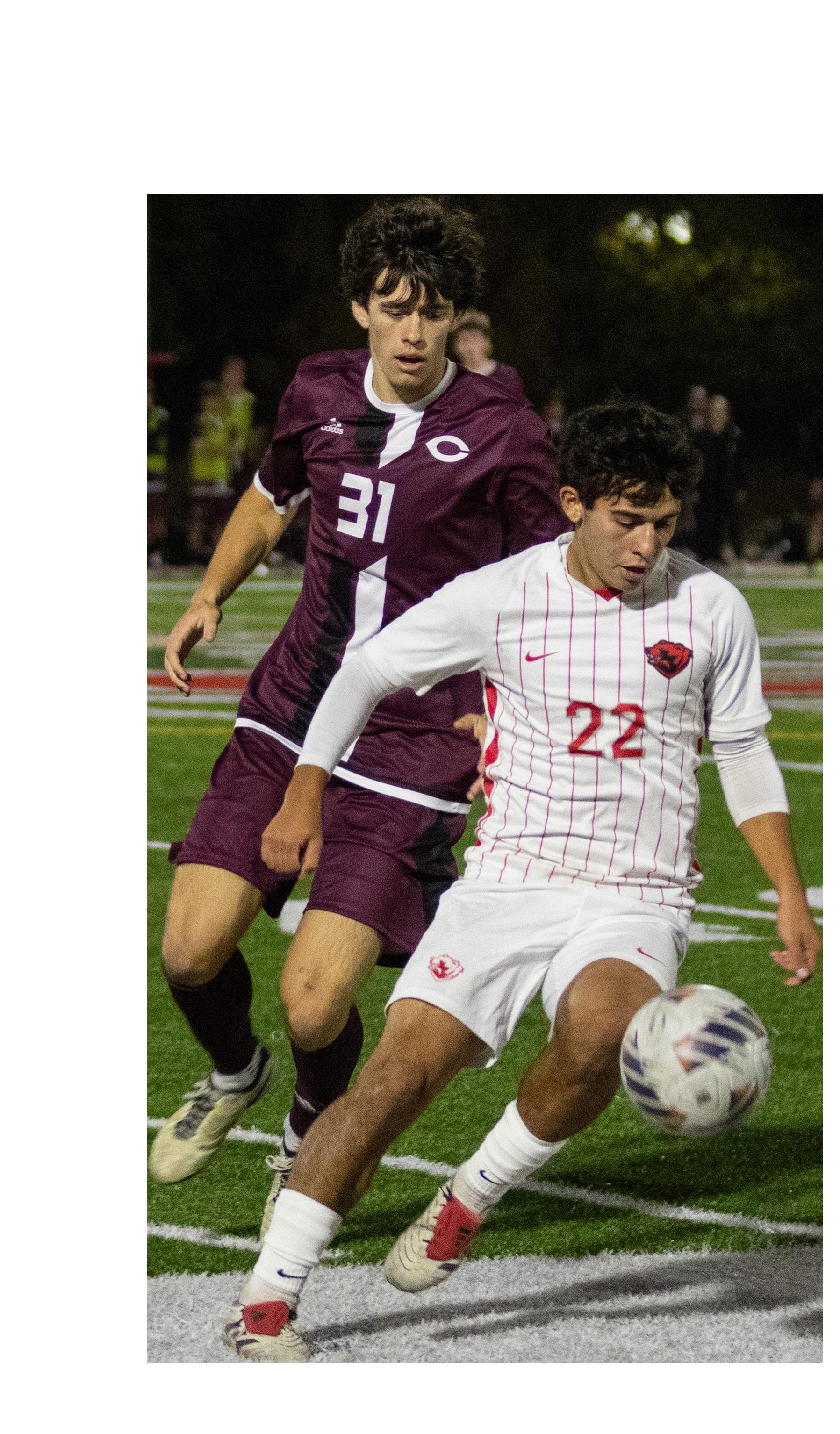
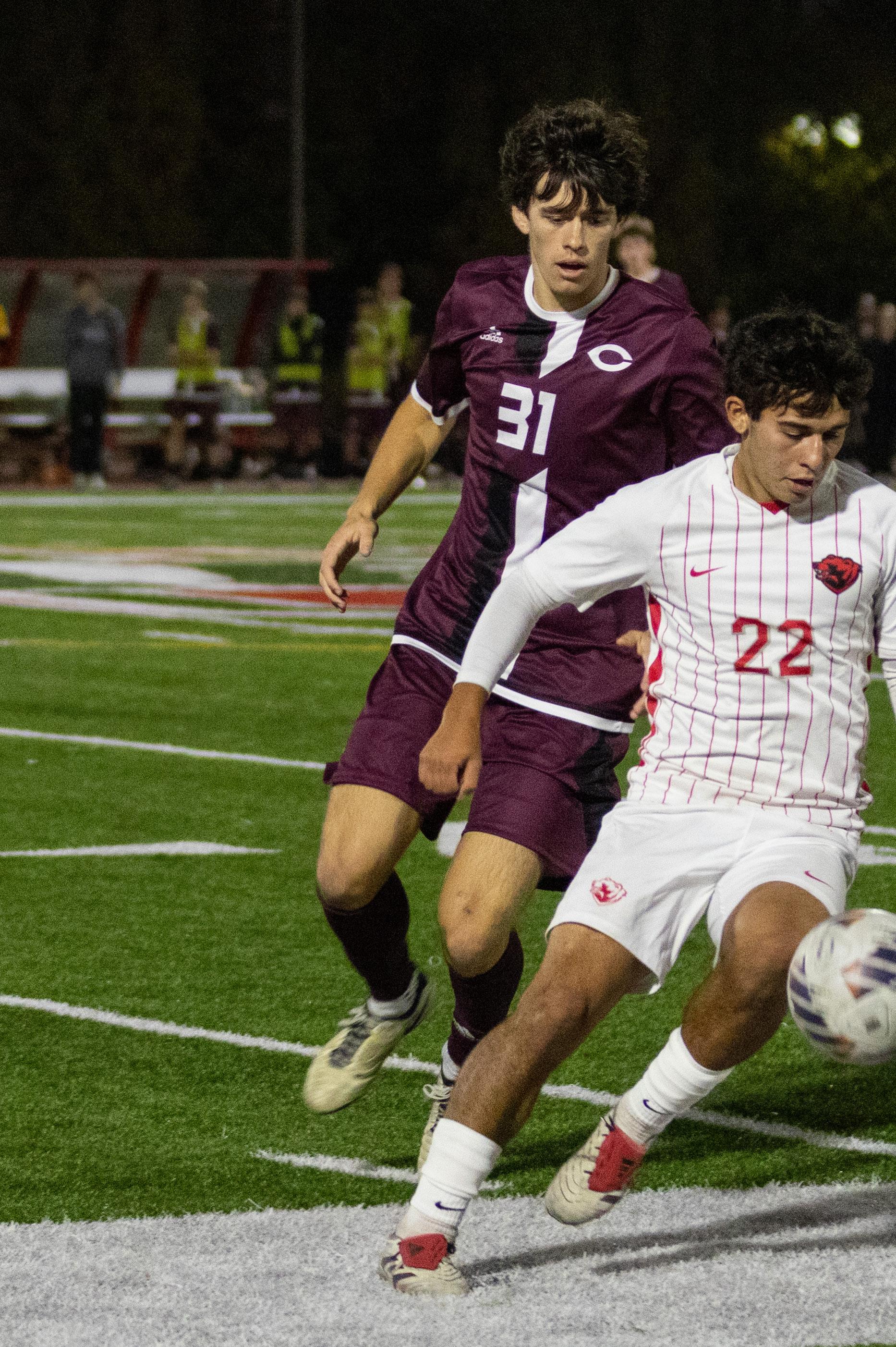
The last time the WashU men’s soccer team made it to the Sweet 16 was the year most of the first-years on the current team were born: 2007. After two hard-fought wins this past weekend, the Bears have made it back to the round of 16. WashU won both contests by small margins, defeating the University of Wisconsin–Whitewater in a penalty shootout and eking out a 1-0 win over the University of Chicago on Nov. 15 and 16, respectively.
“We’re really excited at another chance to get to play with each other,” junior goalkeeper Cal L’Hommedieu wrote to Student Life. “This group has so much fun competing and playing for each other, we want to keep doing that as long as possible.”
Even though twotime University Athletic Association (UAA) defensive player of the year junior Quentin Gomez was suspended because of a red card in the previous game, the WashU defense remained strong against UW–Whitewater, only giving up three shots on goal.
Coming out of halftime, the physical matchup continued — the two teams combined tallied 26 fouls in the game. Still, regulation ended in a 0-0 draw.
The Bears and Warhawks then proceeded to two 10-minute overtime periods, where the Bears played more energized than in the 90 minutes of regular time. Still, neither
team found the back of the net, sending the match to a penalty shootout.
With both their seasons on the line, L’Hommedieu and Austin Waite, the Warhawks’ first-year goalie, matched up head-to-head. After a goal and a miss from each team in the first two rounds of the shootout, Whitewater needed a goal to take control of the contest.
With the WashU advantage on the line, L’Hommedieu stepped up with the biggest save of his season, deflecting the shot off the post before ultimately swatting the ball off the goal line to keep the Bears ahead in the shootout.
“It’s easy in overtime and [penalty kicks] to think about all the ‘what if’s, but I try to stay in the present moment and just make the next save,” L’Hommedieu wrote.
In a crucial spot, with WashU’s tournament run on the line, it came down to senior Zach Susee, the fifth WashU penalty taker. The keeper dove right while Susee fired the ball into the left corner of the net, giving WashU a 3-1 penalty kick win and keeping their tournament run alive.
WashU then went on to face conference rival UChicago. After a tightly contested game on Nov. 8 where the Bears won 1-0, two of the top teams in the country went to battle once again.
Despite it being less than 24 hours since the Bears’ 110-minute game, both teams brought the physicality from the opening whistle.
“Going into the game, we knew that it would be very physical because we were playing UChicago,” Gomez
preview
wrote to Student Life. “It’s always fun when we have a chance to play a game like that, because it shows how much each individual will leave out on the field.”
With a strong defensive contest in the first half, both teams needed a spark to earn a spot in the Sweet 16. After a Maroons’ goal in the 55th minute was called back for being offside, WashU turned up their level of play and aggression. With the clock trickling down, the Bears got on a fast break when the ball found junior forward Ethan Wirtschafter in the box after a cross and deflection off of the Maroons’ centerback. He quickly buried a shot into the bottom right of the goal for his first career postgoal, his 14th goal of the season, and the goal that would ultimately send the Bears to the Sweet 16.
“It felt great to score, and be able to help my team,” Wirtschafter wrote. “This is my job as a striker is to score and we all knew a goal was coming.”
With only 10 minutes remaining, WashU sat back, patiently playing defense to prevent any counterattacks. With each second that went by, the Bears could taste the feeling of victory coming closer and closer, and with one final shot out of bounds by the Maroons, WashU secured a 1-0 victory and a Sweet 16 berth.
“It means a lot to continue to be able to push our season on another week,” Bordelon wrote in a statement to Student Life. “We feel we are a top team that is embracing the opportunity to compete.”
SURVIVE ADVANCE
No. 1 women’s soccer cruises into 10th consecutive Sweet 16
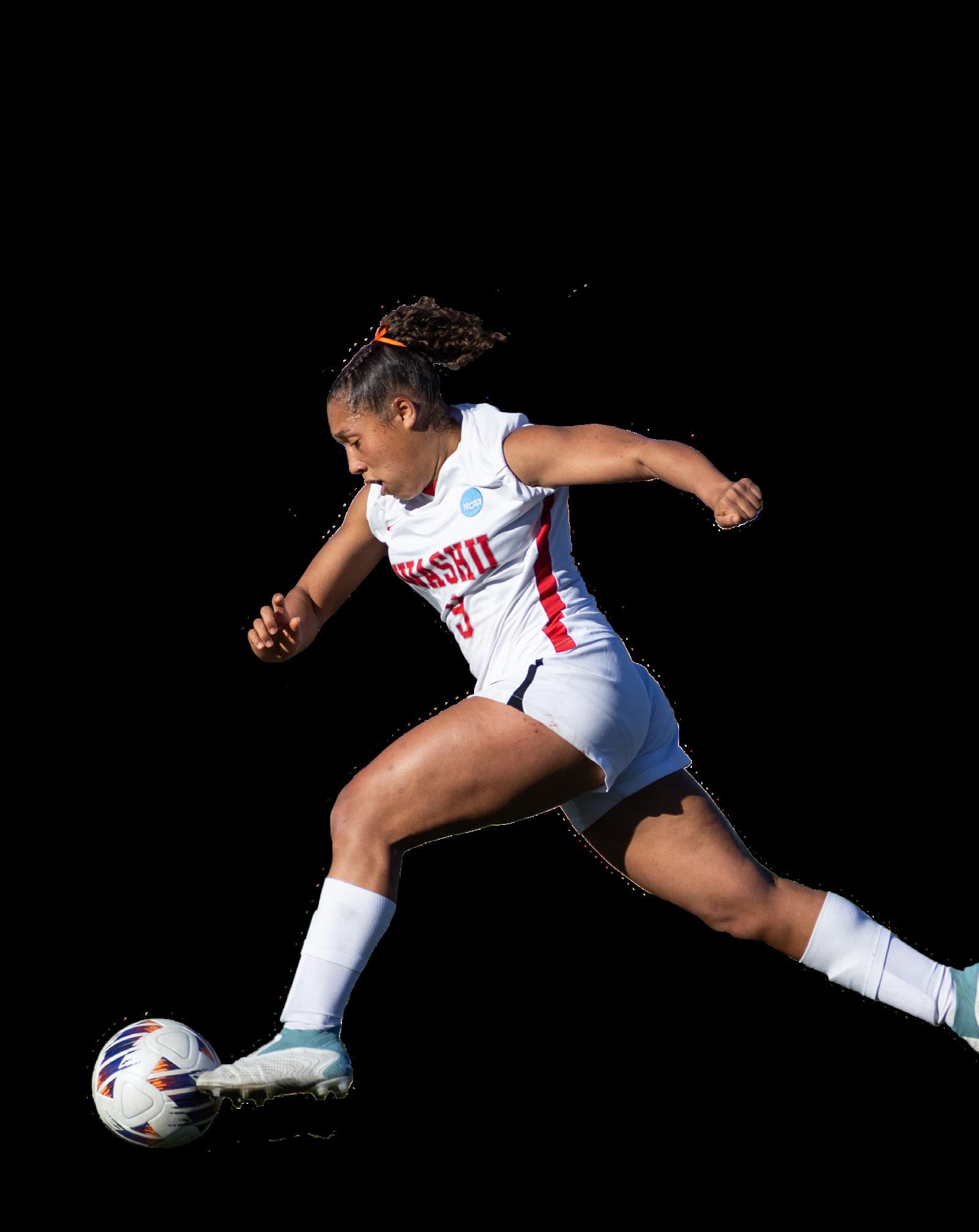
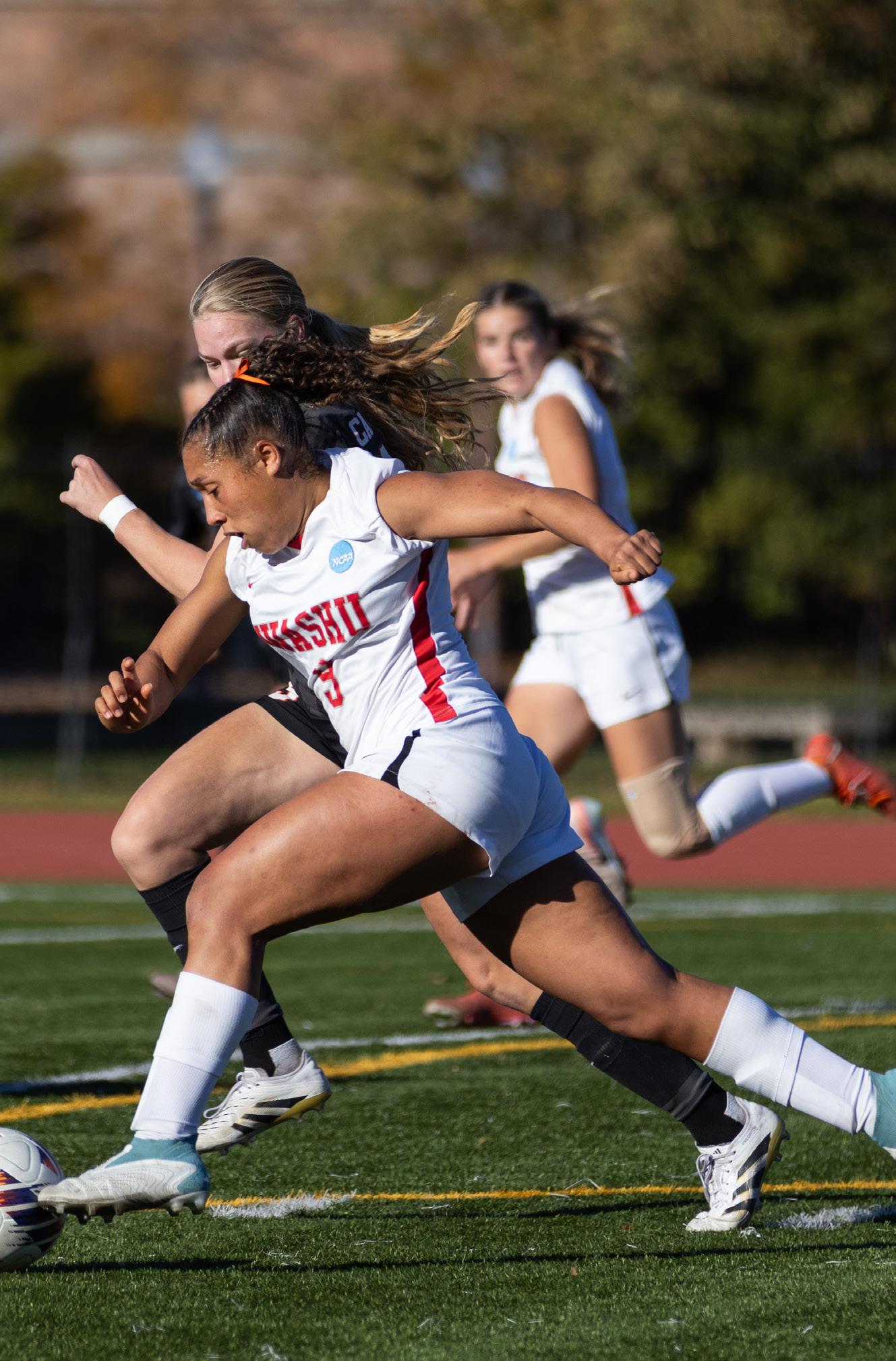
As the reigning Division III women’s soccer national champions, the No. 1 WashU women’s soccer team came into the first weekend of the NCAA tournament with high expectations. All they did was blow those expectations out of the water, defeating Wilmington College and North Central College in convincing fashion.
WashU is returning to the Sweet 16 for the 10th consecutive season after a dominant weekend in which they beat their opponents by a combined 12-1 margin. The Bears took 73 shots in two games, more shots than some programs had throughout the entire season. Their defense contained two conferencechampionship-winning opponents to just six shots. Once again, the Bears proved that they are the team to beat in the D-III tournament.
“We scored a lot of goals, and we only gave up one,” head coach Jim Conlon said after defeating North Central. “That’s the key to giving ourselves a chance [to win], is not giving out many goals. I’m excited for what the girls did.” WashU vs. Wilmington
The Bears’ weekend began with a 7-0 shellacking of Wilmington. WashU got off to an immediate attack; within the first minute of the game, WashU hit the post twice. In the
fourth minute, senior forward Grace Ehlert scored WashU’s first goal of the game. Senior forward Ella Koleno extended the WashU advantage to two with a goal in the 20th minute.
“[Ehlert and Koleno] are such a spark for our team,” sophomore midfielder Cami Colpitts said after the Bears’ win over North Central. “They’re running to every ball and playing defense even though they’re forwards. They’re the heart of this team.”
The Bears rattled off 24 shots in the first half, but the Quakers’ defense held WashU to two goals in the first 45 minutes. While Wilmington mostly contained the potent WashU attack in the first half, the dam broke in the second. In the 59th minute, sophomore forward Olivia Clemons broke through the Wilmington defenders to bring the score to 3-0. After Clemons’ goal, Conlon made a line change, bringing in the Bears’ reserves for the final third of the contest. WashU’s reserves outscored their typical lineup, scoring four goals in 30 minutes. Junior midfielder Anna Rosato scored a brace to double her career goal total, first-year midfielder Ridley Newton scored her second goal for WashU, and senior forward Kerrigan Ferland converted a penalty kick to seal a dominant 7-0 win for the Bears.
In the win, WashU took 44 shots on goal, the most in a single game since
Conlon retook the head coaching job in 2021. The Bears’ seven goals also set a program record for the most goals ever scored in an NCAA tournament game. WashU vs. North Central
It took the Bears’ offense longer to crack the North Central defense, which held the Bears’ attack to just one goal in an early season matchup. However, as has become routine throughout the season, WashU turned on the jets toward the end of the game. Ehlert deposited a midrange shot into the net right before halftime, giving WashU an advantage that they would never relinquish.
WashU scored four goals in the second half, all of them coming within 12 minutes of each other.
Koleno scored her second goal of the weekend in the 55th minute, placing a perfect ball past the right post. Colpitts then scored a textbook shot from the edge of the box, picking the right corner to increase WashU’s lead to three.
“I had been taking chances the whole game,” Colpitts said. “I’m just happy that one went in, and happy that we were able to put up so many goals against such a great team.” Clemons and firstyear forward Heidi Fesler both scored to round out the Bears’ offensive performance, and despite conceding a goal in the 87th minute, closed out a convincing weekend to advance to the Sweet 16.
Women’s soccer preview
BRI NITSBERG
MANAGING PHOTO EDITOR
WashU’s new provost embroiled in lawsuit over alleged discrimination at previous university
SARA STRASSBERG
CONTRIBUTING WRITER
STAFF WRITER
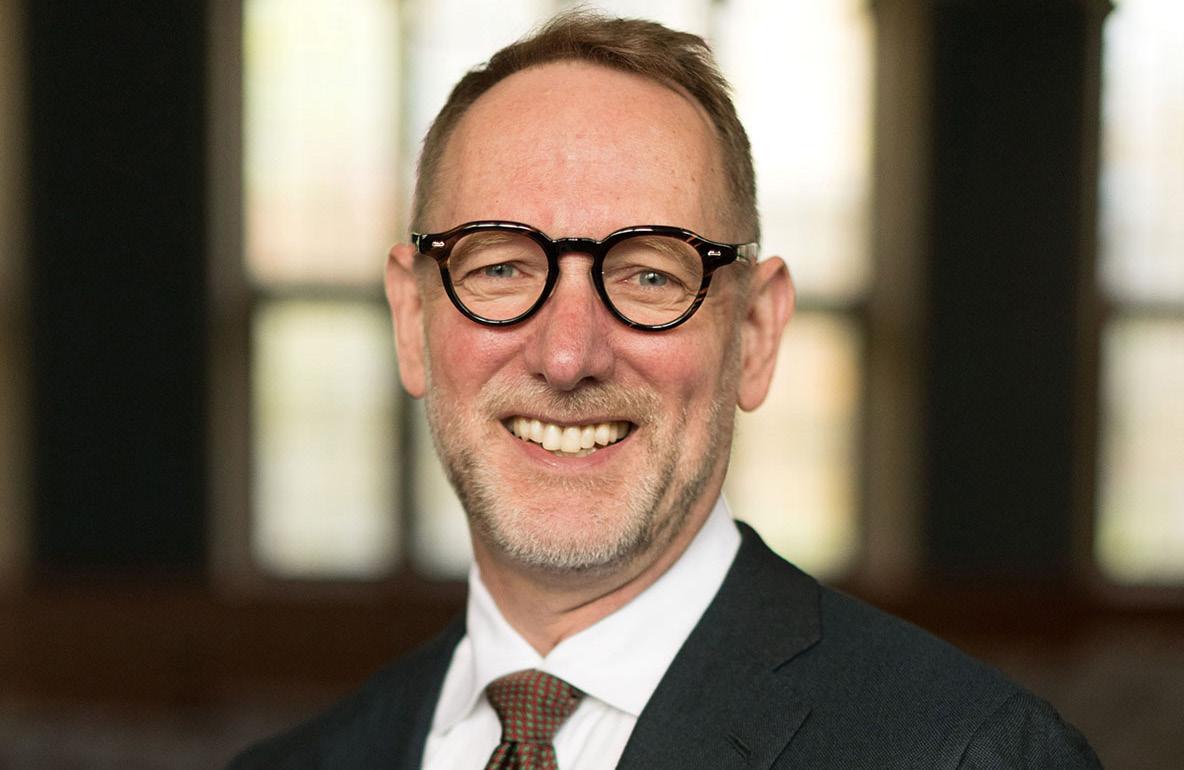
A law professor at the University of Michigan filed a petition with the U.S. Supreme Court asking it to hear her racial and gender discrimination case against the University of Michigan and Mark D. West, WashU’s provost and executive vice chancellor for academic affairs, on Oct. 27. West previously served as the Dean of Law at the University of Michigan from 2013 to 2023 before being appointed as WashU’s provost this June.
Laura Beny, the professor, filed the original lawsuit with the U.S. District Court for the Eastern District of Michigan in 2022. She alleges that West, during his time at Michigan, subjected her to improper and discriminatory disciplinary action, baselessly suggested she might have access to weapons, and sent her emails which she alleges constitute sexual harassment.
The district court found that Beny failed to provide sufficient evidence establishing West did not “honestly believe” in his reasons for taking disciplinary action. As such, the court granted summary judgment with prejudice to West, effectively resolving the case without allowing a jury to consider it and preventing Beny from bringing the same lawsuit again. Beny then appealed the dismissal to the U.S. Court of Appeals for the Sixth Circuit, but the court affirmed the district court’s decision this July.
Now, her petition asks the U.S. Supreme Court to reevaluate the “honest belief doctrine” under which employers are exempted from discrimination trials by demonstrating they “honestly believed” their reasons for disciplining an employee, even when presented
evidence suggests discrimination occurred.
Beny’s attorney Amos Jones says the petition raises questions for WashU, where West is currently serving as provost and executive vice chancellor.
“Why was West just made the provost of Washington University in St. Louis amidst this grotesque scandal?” Jones asked in an interview with The Edu Ledger.
West declined to comment on the allegations in the petition and referred Student Life to WashU’s Vice Chancellor for Marketing and Communications Julie Flory.
Flory pointed to the U.S. Court of Appeals for the Sixth Circuit decision from July, which she wrote “clearly indicates that the allegations in this lawsuit were not substantiated.”
Flory did not say whether WashU was aware of the allegations when West was hired.
Chancellor Andrew D. Martin praised West at the time of his appointment in August 2025. He said he had known West for “more than a decade” and had “great trust in his leadership, judgment, and academic credentials.”
Martin also told The Source that there was no search committee to appoint Provost West.
“In our current, fastmoving environment, we knew we needed to take prompt action to recruit the most talented and qualified individual to serve as our next provost. A long, complicated search would have taken our focus away from our mission-focused work.
We’re extremely fortunate that Mark was already on our radar, so we could act quickly in bringing him here,” Martin told The Source.
WashU had hired its two previous provosts through a formal search process, conducting a “national
search” when it hired Beverly Wendland in 2019 and employing an advisory committee to select Holden Thorp in 2013.
In an email to Student Life, Flory noted that while the University did not appoint a search committee in 2025, West still met with several administrators before being hired.
“Chancellor Martin has a long-standing professional relationship with Provost West and was highly confident that he was the right person for the job. Although there was no formal search committee appointed, Provost West did meet with school deans and an extensive list of University leaders and faculty prior to his appointment,” Flory wrote in an email to Student Life.
Timeline of Beny’s Case
Beny’s dissatisfaction with the Michigan Law School’s diversity practices led to incidents in 2018, when she received her first disciplinary notice after disrupting an academic conference. In the lawsuit, she stated that she was speaking out to challenge “racial and gender institutional inequities that the student [organizers] were perpetuating” by inviting mostly white males to speak at the event.
In 2019, she received a second disciplinary warning after allegedly “verbally abusing” Dean West’s administrative assistant, resulting in a one-year delay of her sabbatical eligibility as a sanction.
In 2021, Beny made “several informal complaints with law school administrators” tracing her grievances with West to a series of email exchanges starting in 2008, which were reported by both courts.
West sent Beny multiple emails between 2008 and 2010, when he served as associate dean, which Beny describes as “insensitive,
inappropriate, sexist, and racist.”
Both courts recount details of these emails, including one in which West wrote, “I almost broke [your brother’s] neck just to prove that I could do it” after meeting Beny’s brother at her tenure party. In another, he told her, “I’m going to put [your baby’s] picture on my desk and tell everyone it’s mine.” He also emailed that the law school’s communications office was “all over [his] ass” to get her to do a photo shoot because of her “beauty,” signing off, “Your humble minion, Mark XOXOXO.”
In January 2022, an anonymous student filed a complaint alleging Beny was unprepared and tardy to her Enterprise Organization class. Beny refused to meet with administrators while a complaint she had filed was pending and withdrew from her teaching responsibilities on Feb. 15, 2022, writing to her students that “I am unable to teach at this law school anymore while subjected to arbitrary abuse and retaliation.”
Beny then sent what the appeals court described as “dozens of personal attacks to individual members of the law school faculty,” in which
Beny allegedly threatened other faculty members.
West sent a third disciplinary notice to Beny on March 31, 2022, citing her “willful refusal to perform her duties as a tenured professor,” her “retaliation against students in her [Enterprise Organization] class,” and her “continued harassment of colleagues.”
“The concern that you might have access to weapons is a frequent topic of discussion among faculty members,” West wrote in the disciplinary letter.
While there is evidence of Beny calling professors and making threats via emails in the district court’s ruling, no evidence was presented that established Beny had access to weapons.
As part of the sanctions, Beny’s salary was frozen until June 30, 2027, meaning she continues to earn her existing pay but is barred from receiving any raises. She was also prohibited from receiving summer research funding and denied eligibility for sabbaticals. Beny has, as of now, withdrawn from teaching responsibilities at the University of Michigan Law School.
“She has been deprived of at least approximately
$200,000 cumulatively [since 2022],” Jones wrote in an email to Student Life.
In her lawsuit, Beny pointed to Mathias Reimann, a white male tenured professor as a comparator. She furnished evidence of his alleged abusive behavior towards his administrative assistant, including pounding her desk, referring to himself as “her master,” calling her an “idiot,” and making inappropriate comments about her weight.
The district court affirmed Beny’s claim and found that Reimann’s “alleged conduct is similarly severe to Beny’s,” but that he “was not similarly disciplined even though officials were aware of his conduct.”
The case has continued with Beny’s lawyers filing a petition with the Supreme Court in late October. They ask the U.S. Supreme Court to reevaluate the “honest belief doctrine” and the erosion of the right to a jury trial, which they claim occurred in the previous rulings.
Beny’s petition is now among the thousands before the U.S. Supreme Court, which will decide in the coming months whether to hear it.
Unexpected closure of Habif’s Quadrangle Pharmacy frustrates students
left with no advance notice.
Habif Health and Wellness Center’s Quadrangle Pharmacy, located on the South 40, closed indefinitely due to its pharmacist unexpectedly leaving WashU on Nov. 5.
According to Habif
Executive Director Cheri LeBlanc, the pharmacist
This closure means that students who usually go to Habif to pick up their medications will now have to transfer pharmacies. The Habif website describes Quadrangle Pharmacy, LLC as being located in the Student Health Center and available to all faculty, staff, and students of WashU and their dependents.
A WashU sophomore who wanted to remain
anonymous due to medical privacy concerns was getting all four of their medications from Quadrangle Pharmacy before the closure, but, due to a lack of communication, did not transfer their medications in time.
“I called my doctor, and it was too late, and she couldn’t do anything because [the pharmacy] was closed … so then I just went the weekend without
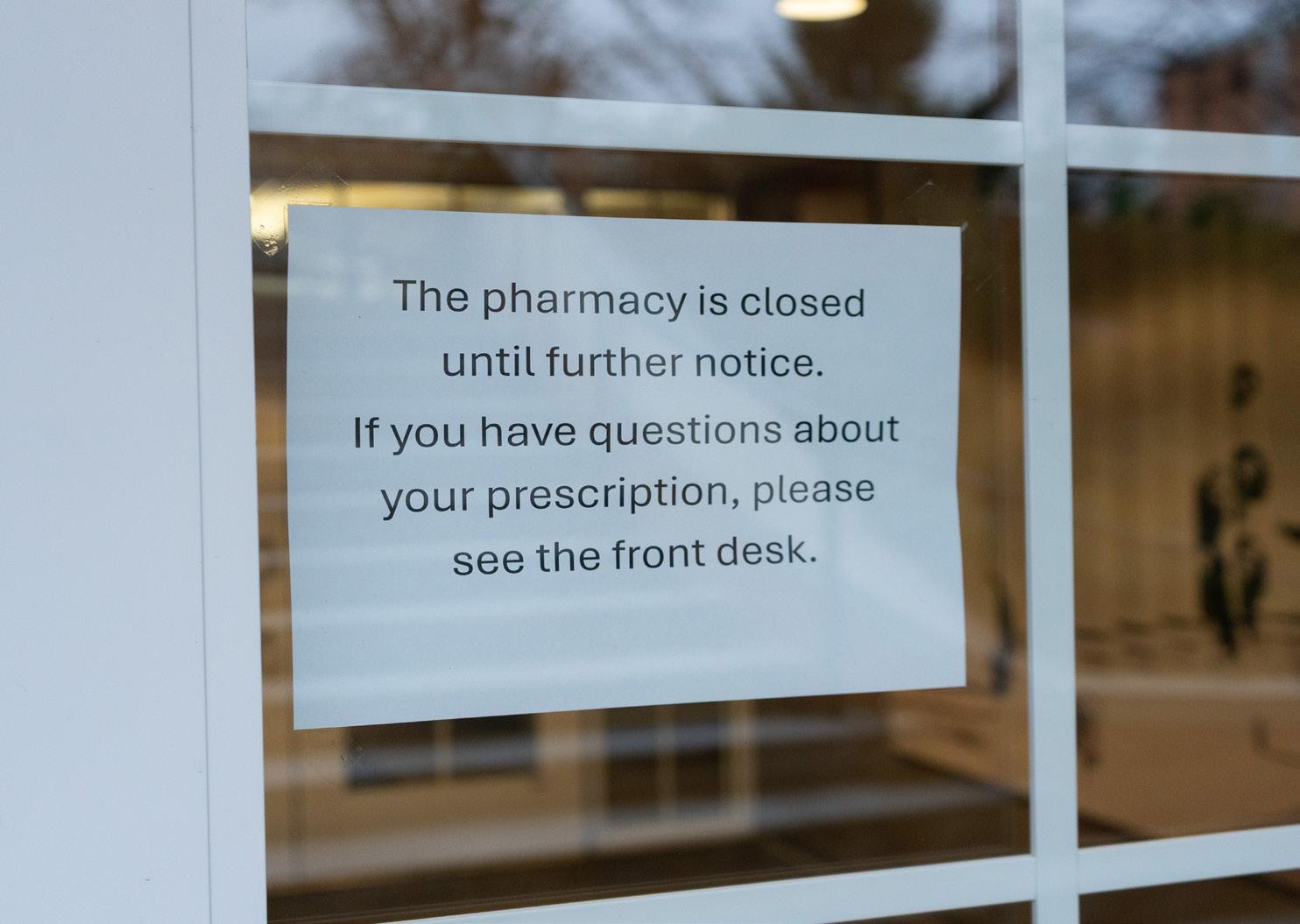
the medications,” they said. “I was very stressed. I was upset. I still have no idea why they were closed or what happened.”
According to LeBlanc’s email comment to Student Life, Habif reached out to all students with prescriptions waiting at Quadrangle Pharmacy and arranged transfers to pharmacies of their choice. Habif also reached out to students who had filled prescriptions with the pharmacy to alert them of the need to transfer their refills to another pharmacy. Without a certified pharmacist, Habif is not able to distribute the remainder of the medications they have in stock.
They wrote in an email that the closure was “due to unforeseen circumstances” and suggested alternative pharmacy options, including CVS on the Delmar Loop and other large namebrand pharmacies. However, the anonymous student said they never received the above email, nor any other notice of the closure, and found out about the closure after calling Habif.
First-year Peter Eiswert
emphasized the lack of transparency between Habif and the student body, especially around the specific reasoning for the pharmacy’s closure.
“I don’t know what’s going on. I don’t know why they’re closed,” Eiswert said.
The sophomore student felt that Habif was not helpful in figuring out a solution to their dilemma caused by the pharmacy’s unexpected closure.
“I had three [medications] that were going to run out by that time. So I sent an email, and [Habif] said, ‘We can’t do anything for you, including we can’t transfer them out for you. So you have to call your doctor and get your doctor to transfer them to a different pharmacy,’” they said.
In addition to not knowing why they were closed and dealing with the transfer process, Eiswert said that the other pharmacy locations were less convenient for him as a student living on the South 40.
“Having my meds there [at Habif] is very helpful. I can just walk down there and get them, but they
were closed without a lot of warning, and then I had to change … to the CVS on the Loop,” Eiswert said. “I haven’t even gone yet because it’s kind of a hassle to get there.”
WashU does not allow first-years to have cars on campus. Options for getting to the pharmacy on the Loop include the WashU Delmar Loop Shuttle, which drops students off approximately two minutes walking distance away from the CVS. Otherwise, the walk to the CVS on the Loop from the South 40 is approximately 30 minutes, according to Google Maps.
LeBlanc said the health center hopes to reopen the pharmacy as soon as possible; however, it could take a while due to the approval process for opening a position for hire.
“At this time, all open positions in the University need to be reviewed for approval to fill the position and post it,” LeBlanc wrote. “We are currently waiting on this process. If approved, we will then work as quickly as possible to fill the position and reopen.”
PHOTO COURTESY OF THE SOURCE
Provost West is at the center of a legal controversy over alleged discrimination and harassment of a professor.
Student Union fall 2025 election sees lowest turnout in the past decade
TANVI GORRE NEWS EDITOR
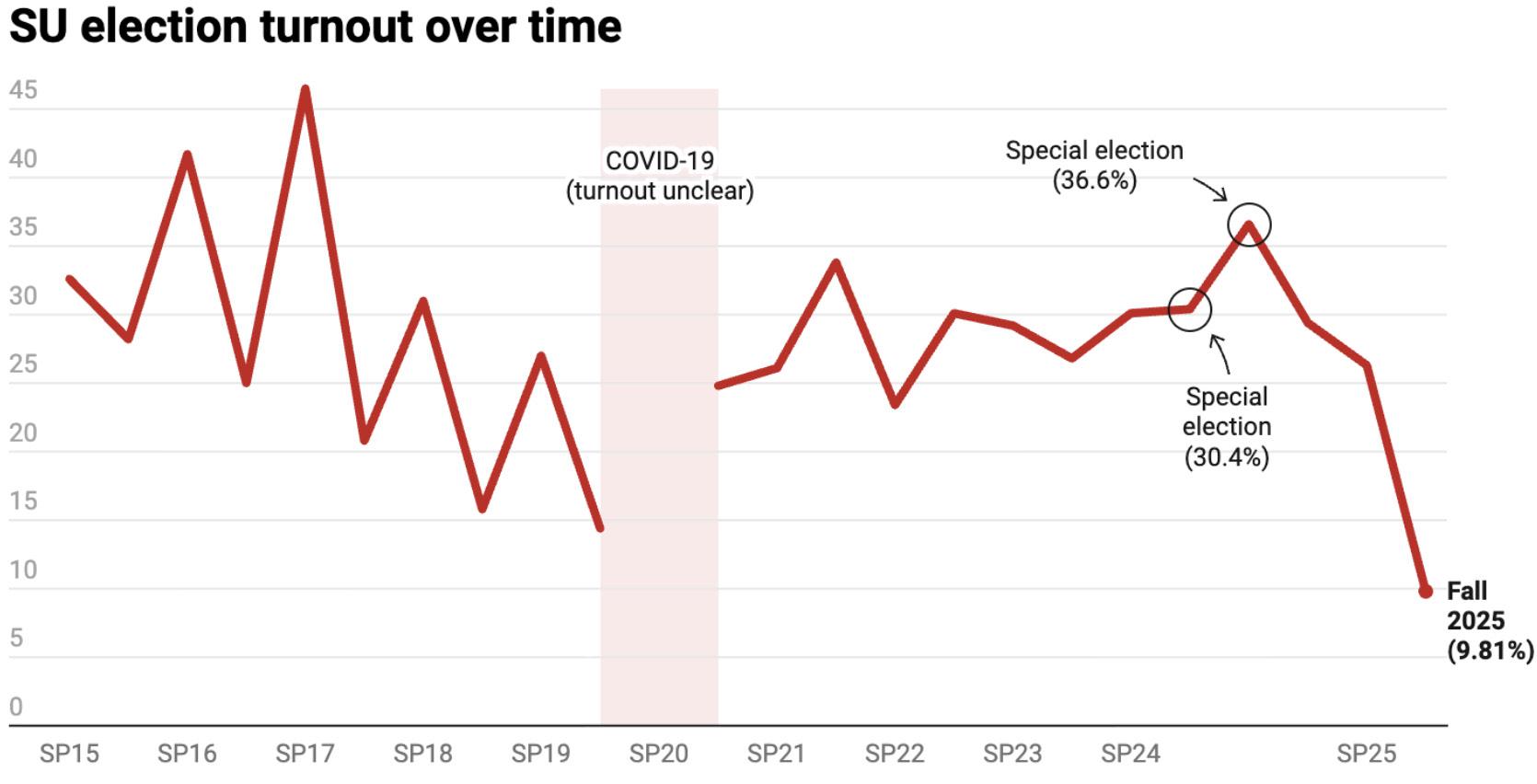
This semester’s Student Union election saw the lowest student body turnout since at least the spring of 2015, with 9.81% of the student body voting for 12 new senators, 12 new Treasury representatives, and members of the Arts & Sciences Council.
With the exception of the 14-candidate race for Senate, every position up for election this semester was uncontested. Some positions, such as Arts & Sciences Council vice presidents of academic outreach, public relations, and finance, did not have any candidates run for the office. Election Commissioner, senior Rachel Gwon, attributed decreased turnout to the fact that fewer candidates ran this semester.
“The lower candidate pool this semester likely contributed to the drop,” Gwon wrote in a statement to Student Life. “Moving forward, the Election Commission is collaborating with the [SU] Executive Board to broaden outreach beyond Arts & Sciences and strengthen engagement across all schools.”
According to junior and Speaker of Senate, Emaan Sayied, five of the 12 eligible senators reran in this semester’s election. Sayied, in a statement to Student Life, said this phenomenon
is normal in SU elections. “I think SU elections [are] very underclassmen-heavy too — a lot of students looking to get involved see it as an interesting space to help improve the student experience,” Sayied wrote. “It’s also just true that a lot of people in SU have multiple commitments and might drop it for timing reasons as well.”
Of the five senators up for election, junior and former senator Jace Slone was not slated to return to his office.
“Ultimately, I think it comes down to me,” Slone wrote in a statement to Student Life. “I didn’t do a
great job in convincing students about the problems within SU.”
First-years Meishu Han and Tzipora Guttman led the Senate race with 640 and 622 votes, respectively.
As for the Treasury race, junior Varun Vadhera, firstyear Andrew Hermann, and sophomore Emma Hait took the lead, with Vadhera garnering 662 votes and Hermann and Hait obtaining 659 votes each.
All candidates in the running for Treasury, including eight Treasury representatives, were elected to the body. Junior and Speaker of Treasury Romen Der Manuelian interpreted the
low number of candidates as a double-edged sword.
“On one hand, it indicates there is less interest in joining Treasury,” Der Manuelian wrote in a statement to Student Life. “On the other, it shows that Treasury has proven so capable, competent, and effective over the past semester that there isn’t a major push to oust current members of Treasury.”
This election also passed an amendment that increased Treasury’s oversight of the vice president of finance with 72.24% of 245 votes. Formerly, only the vice president of finance could change rules that govern equitable and
consistent allocation of money from Treasury, and under this new amendment, Treasury can alter these guidelines with a two-thirds vote.
Gwon said SU and Election Commission are committed to working together to bolster turnout and student engagement in SU elections in the semesters to come.
“We are continually working to refine outreach strategies and make voting more accessible and visible across campus.”
This Tuesday, there was a constitutional interpretation request regarding the election results. The contents of this request and the
MELLMAN, TANVI GORRE | NEWSLETTER EDITOR, NEWS EDITOR
SOURCE: STUDENT UNION | CREATED WITH DATAWRAPPER
Compared to the previous semester and special elections, this semester’s election marks the lowest student body turnout in years.
outcome will be publicized after the SU Constitutional Council investigates the matter.
Gwon declined to comment on the contents of the constitutional interpretation request.
Senate: Meishu Han, Tzipora Guttman, Anna Lieberman, Wade Trivisonno, Inti Vega, Jason Tang, Aayan Shehzad, Stella Larson, Hsalaw Soe, Elma Northern, Fadumo Hussein, Saara Engineer
Treasury: Varun Vadhera, Andrew Hermann, Emma Hait, Jonathan Lewin, Avery Vail, Molly James, Katelyn Moss, Ally Lee, Clifton Chiang, Katie Cho, Amanda Plaxe, Casey Ference Arts & Sciences
Council: President: Sonali Sharma
Vice President of Programming: Izyan Ali
Vice President of Administration: Kaylee Baek
Vice President of Academic Outreach: No candidate ran for this position Vice President of Public Relations: No candidate ran for this position
Vice President of Finance: No candidate ran for this position
WashU MSA hosts roundtable discussion on current events and context of the conflict in Sudan
PETER EISWERT CONTRIBUTING WRITER
November 13, members of the WashU Muslim Students Association (MSA) met in Lopata House for a roundtable discussion on media representation of the crisis in Sudan as well as the recent escalation of violence.
The event was hosted by the MSA to discuss the Rapid Support Forces’ (RSF) violent siege of el-Fasher, the last major city in Darfur not under RSF control. The RSF is a paramilitary group that formed as a result of ethnic tensions with governmental support during the 2003 Sudanese Genocide in the Darfur. The group has been in civil war with the Sudanese Armed Forces (SAF), the official Sudanese army, since April of 2023.
“WashU says ‘by name and story,’[but] I want people to spread that in the sense of being intellectually curious and having conversations and dialogues with people. Ask more questions,” said Mahid Abdulkarim, junior and president of the MSA.
Riley Herron
Sydney Tran
Editors-in-Chief editor@studlife.com
Elizabeth Stump Managing News Editor news@studlife.com
Will Rosenblum
Managing Scene Editor scene@studlife.com
Sylvie Richards Managing Forum Editor forum@studlife.com
Matt Eisner Managing Sports Editor sports@studlife.com
Kate Westfall Managing Design Editor designers@studlife.com
Astrid Burns Special Issues Editor
First-year Muhaned Munsor echoed this call for greater awareness. As a resident in Sudan during the 2019 civilian-led revolution against leader Omar al-Bashir, Munsor lamented the resurgence of violence in the past months and years.
“It’s really heartbreaking to see how a moment of victory in 2019 transformed into this tragic war,” Munsor said. “I feel like there’s not enough awareness about it.”
These remarks come as there has been an uptick in mainstream news coverage of the Sudanese conflict; however, a large portion of the night was spent on dissecting why the conflict does not get greater attention.
David Warren, lecturer of Middle East Studies and Arabic, spoke about the connection between the United Arab Emirates (UAE) and the conflict as well as the cultural tensions behind the civil war.
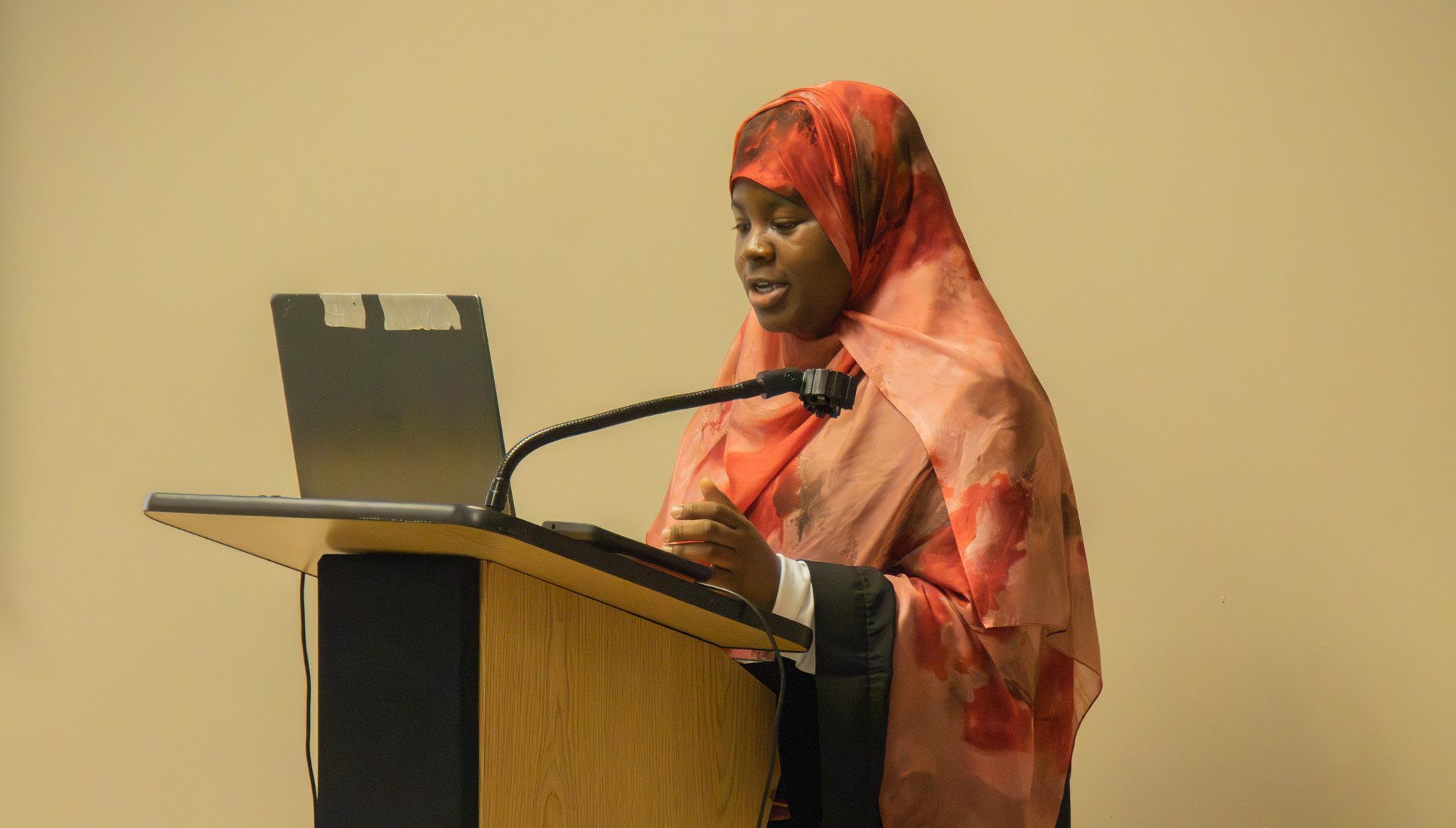
these ethnic tensions.
One of these militia groups, the Janjaweed, who primarily claimed Arab heritage, took advantage of this governmental support to inflict enormous violence onto non-Arab communities in the region.
Warren then noted the complex historical drivers of
“In the early 2000s, [there were] uprisings against the central government by marginalized western communities that got suppressed by militias created by the central government,” Warren said.
Mia
AnaElda
“The conflicts take on a racial tone in terms of construction which [combines with unequal access to] resources as well. It also has older conflicts in terms of identity, postcolonialism, and conflicts around domestic Sudanese politics.”
Students also noted how
recent focus on the violence in Gaza as well as Western societies’ ignorance of African issues may have contributed to reduced coverage of Sudan.
Abdulkarim said the event aligned with the mission statement of MSA which is to strengthen the Muslim community through education, service, and activism.
“One of the most important things [about MSA] is that we dedicate everything toward education,” Abdulkarim said. “We do have people sitting together having fun, but the main focus of it is that people walk out of it knowing a lot more about something that they didn’t know about before.”
HANNAH DORVAL | DESIGNER
Speakers at the MSA event called for greater recognition of the crisis in Sudan at an event last Thursday.
TIM
SPORTS WEEKEND IN REVIEW
Loss
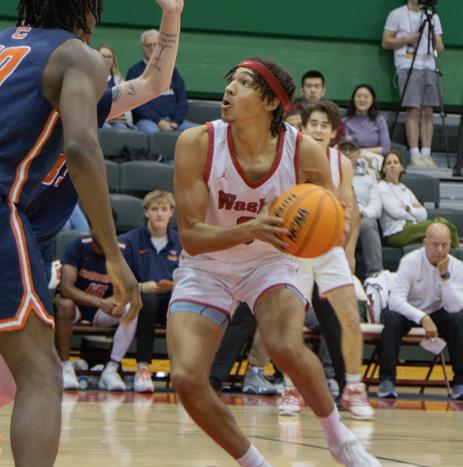
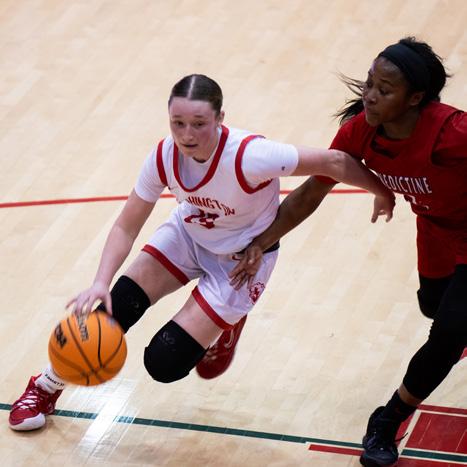
The women’s basketball team dominated Benedictine and Elmhurst to win the McWilliams Classic.
TOURNAMENT PREVIEWS
Volleyball
ANNA CROOK STAFF WRITER
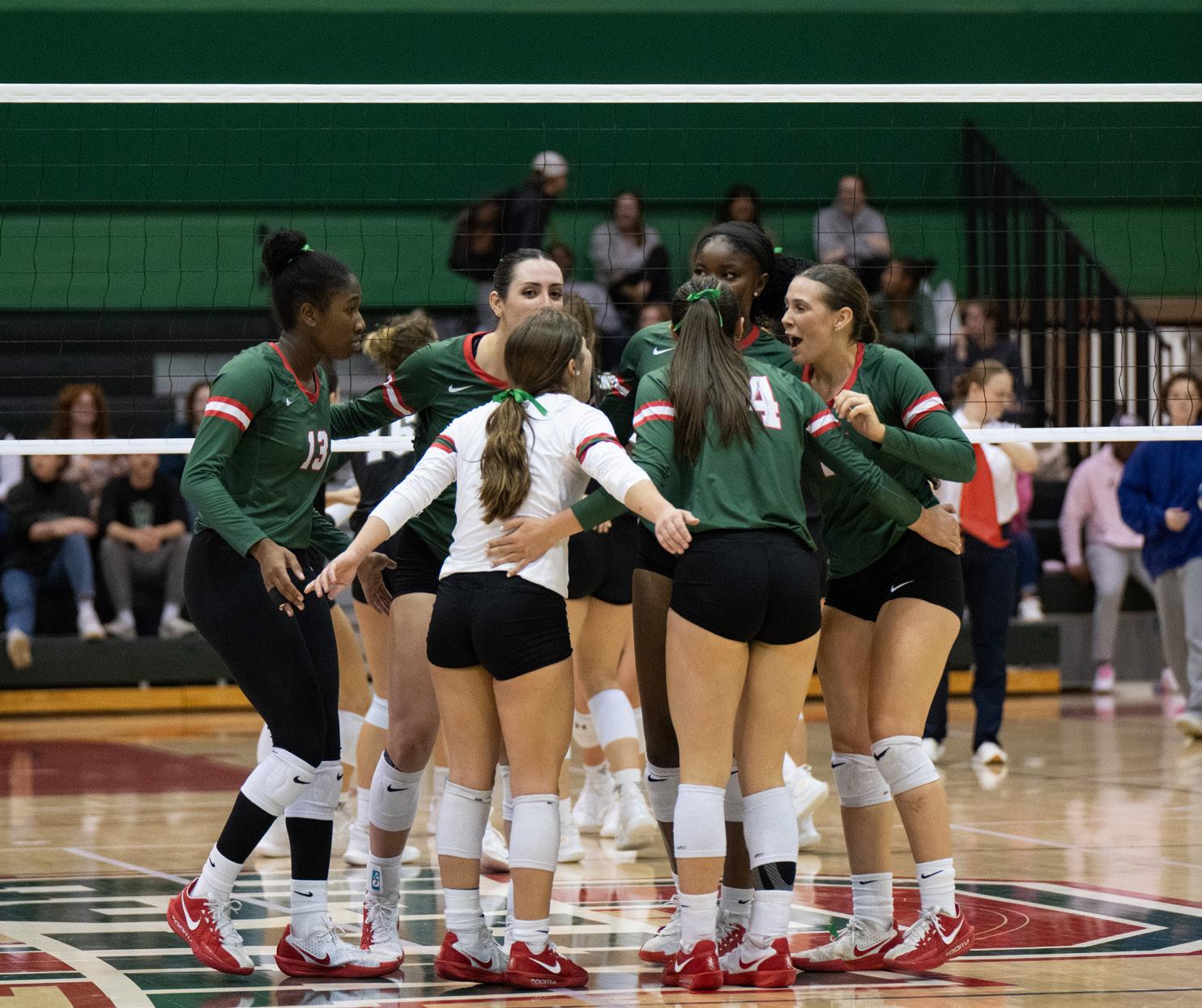
For the fourth consecutive season, the No. 21 WashU volleyball team has made the NCAA Division III tournament. The Bears are headed to Oshkosh, Wisconsin, where they will take on the College of Saint Benedict on Thursday, Nov. 20 at 11:30 a.m.
After a second-place finish in the University Athletic Association (UAA) Championships, the Bears put up another solid year, going 22-8 with a 7-3 conference record. Beyond regular-season success, they are also a team with plenty of postseason experience. However, the Bears have also historically exited the tournament early, falling in the second round in
their last three appearances.
This year, the Bears hope to make a deeper run. With 13 returning players, WashU has plenty of experience, but this is not the same team that fell short last year. Senior Sam Buckley continued to dominate this season and eclipsed 5,000 assists this season en route to being named to the allUAA first team. Junior Ellie Laird has stepped into her new position as libero, while first-years Nia Jones and Abby Krause have given the Bears new offensive depth. What is not new is their first-round opponent, Saint Benedict. The Bears defeated the Bennies in the first round of last year’s NCAA tournament in a dominant, three-set victory. However, this year’s Saint Benedict team should
not be underestimated. Finishing the season on a six-game winning streak, the Bennies are coming off of their second consecutive Minnesota Intercollegiate Athletic Conference championship.
If WashU advances, they will take either the No. 22 University of Dubuque or Cornell College in the second round on Friday, Nov. 21. Dubuque lost just four times in the regular season, and its junior outside hitter Delainey Winkel was named the Midwest Player of the Year by the American Volleyball Coaches Association. Cornell struggled in the early weeks of the season with losses to both Saint Benedict and Dubuque, but won the Midwest Conference with a seven-game winning streak to end the year.
ROMAN
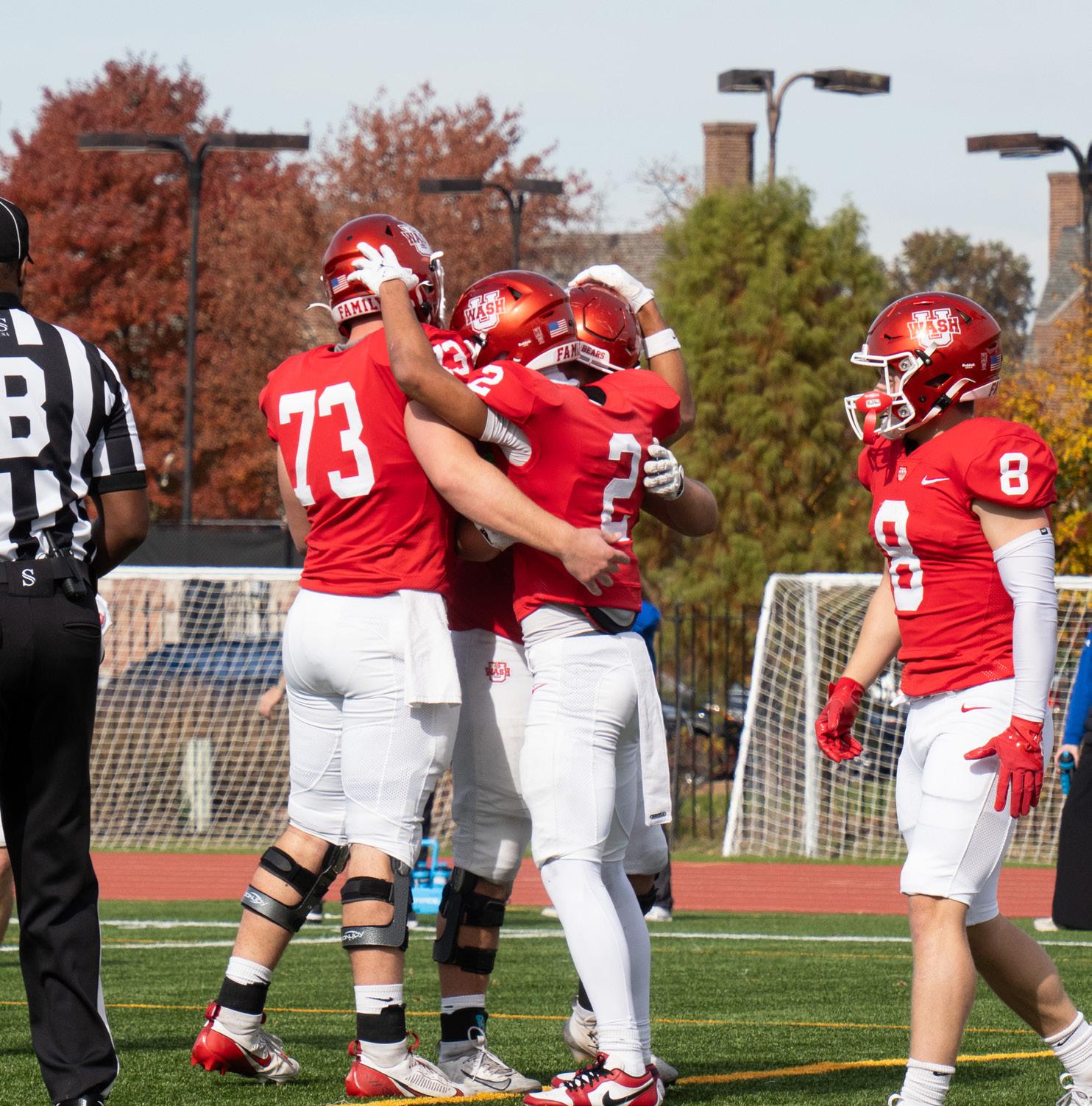
The WashU football team is gearing up to participate in the fifth annual Culver’s Isthmus Bowl on Saturday, Nov. 22 at 2 p.m. This year, the bowl will feature WashU, which is the thirdplace finisher in the College Conference of Illinois and Wisconsin (CCIW), and the University of Wisconsin–Stout, which is the sixth-place team in the Wisconsin Intercollegiate Athletic Conference (WIAC). This will be the first matchup ever between the two programs.
WashU’s football season featured many ups and downs. Boasting a dominant 8-2 record, the Bears capped off their regular season on Saturday, Nov. 15, with a resounding victory against Augustana College. Despite their excellent record, the Bears fell short of qualifying
for the Division III postseason in their last season as members of the CCIW.
Junior quarterback Levi Moore led the Bears’ offense this season. Moore took the reins this year as permanent starting quarterback, and he quickly asserted himself as a powerful dual-threat QB. Moore threw for over 1,500 yards and 18 touchdowns, in addition to rushing for 620 yards and a CCIW-best 17 rushing touchdowns. Junior receiver Makael Carter led the team with eight receiving touchdowns and 581 receiving yards. Throughout the season, WashU has proven to be a well-rounded, driven team. Now, the Bears aim to channel that consistency and edge into one final statement performance in the Isthmus Bowl.
Stout’s 2025 season flew under the radar for the most part. The Blue Devils finished with an overall record of 5-5,
including a 3-4 record in the WIAC. They closed the regular season on a three-game losing streak. But Stout is better than their record suggests, keeping games close against some of the best teams in D-III.
For Stout, their offense has largely revolved around senior quarterback Adam Moen. In his second year as Stout’s starting quarterback, Moen threw for over 2,200 yards and 11 passing touchdowns. Similarly to Moore, Moen showed prominence as a rushing-threat quarterback, racking up 651 rushing yards, and a WIAC-leading 14 rushing touchdowns. Senior linebacker Blaine Seidl led the team in solo, assist, and total tackles. With playmakers like Moen and Seidl on both sides of the ball, the Blue Devils enter the Isthmus Bowl poised to challenge WashU with a balanced, hard-nosed approach.
Cross-country
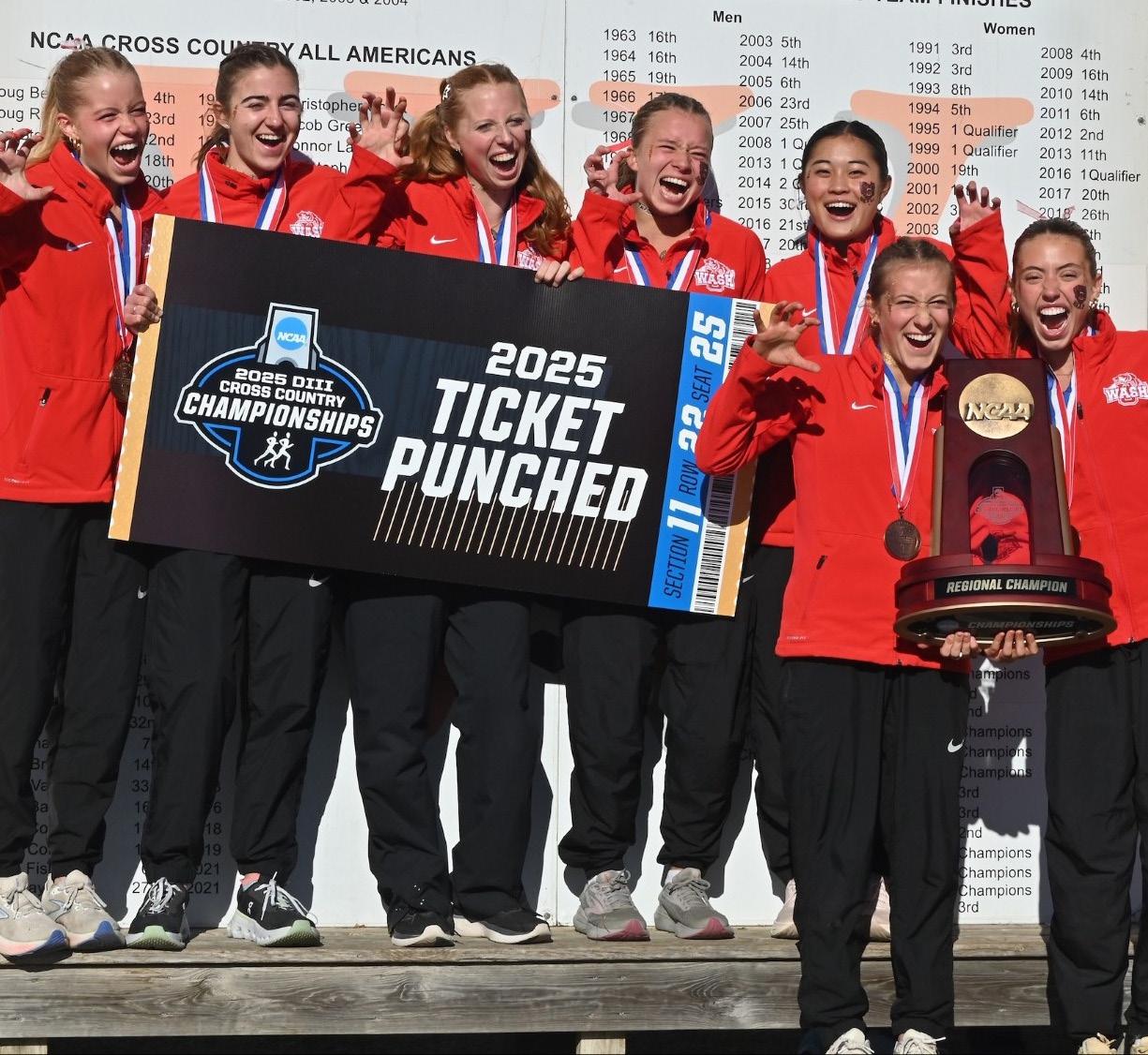
On Saturday, Nov. 22, the women’s and men’s cross-country teams will compete in the NCAA Division III Championship meet at Converse University in Spartanburg, South Carolina. The Bears will compete against runners from the top D-III teams across the country.
Just the weekend before, the women’s cross-country team showed that they are capable of the competition by winning the NCAA Midwest Regionals for the first time since 2022, giving the Bears an automatic bid for nationals. Sophomore Lucinda Laughlin was the Midwest regional champion with a time of 21:29, and senior Jillian Heth snagged
second place with her collegiate personal record of 21:30 in the 6,000-meter race. The women’s team features strong depth, including seniors Katie Rector and Riley Clark, and sophomores Sally Carrington, Maddy Lee, and Lauren Raley. All five of WashU’s scored runners placed in the top 20, and every runner competing at regionals received AllMidwest regional honors.
The men’s team placed fifth at regionals, snagging an at-large bid to nationals.
Senior Conor Daly was the first finisher for the Bears, placing 19th with his season-best time of 24:56 for the 8,000-meter race. Four of the Bears were awarded All-Midwest Regional Honors for placing in the top 35. The men’s team will also look to first-years Max Sudrzynski and Rishi
Shadaksharappa to lead the team, both of whom placed at regionals. Ranked fifth in the Midwest region and 25th overall in the U.S. Track & Field and Cross Country Coaches Association NCAA D-III coaches’ poll, the men’s team will be competing against tough competition at nationals and have an uphill battle waiting for them. Although they have come close, most notably coming in second place in 2018, WashU men’s cross-country has never won the national championship. Since 2021, they haven’t broken tenth place. The women’s crosscountry team has won two nationals, in 2011 and 2018. In the past two years, the Bears have come in 13th and 10th place. This season, WashU looks to get back to the top of D-III.
Led by senior Sam Buckley and junior Ellie Laird, volleyball will face Saint Benedict for the second straight NCAA tournament.
BOBBY KAPLAN | STAFF PHOTOGRAPHER
Junior receiver Makael Carter (center) and the Bears will play in the Culver’s Isthmus Bowl on Nov. 22.
BEN GANZ | STAFF PHOTOGRAPHER
The women’s cross-country team won an at-large bid to Nationals at the NCAA Midwest Regional tournament.
Making an impact: WashU men’s basketball’s inspiring connection with a St. Louis teenager
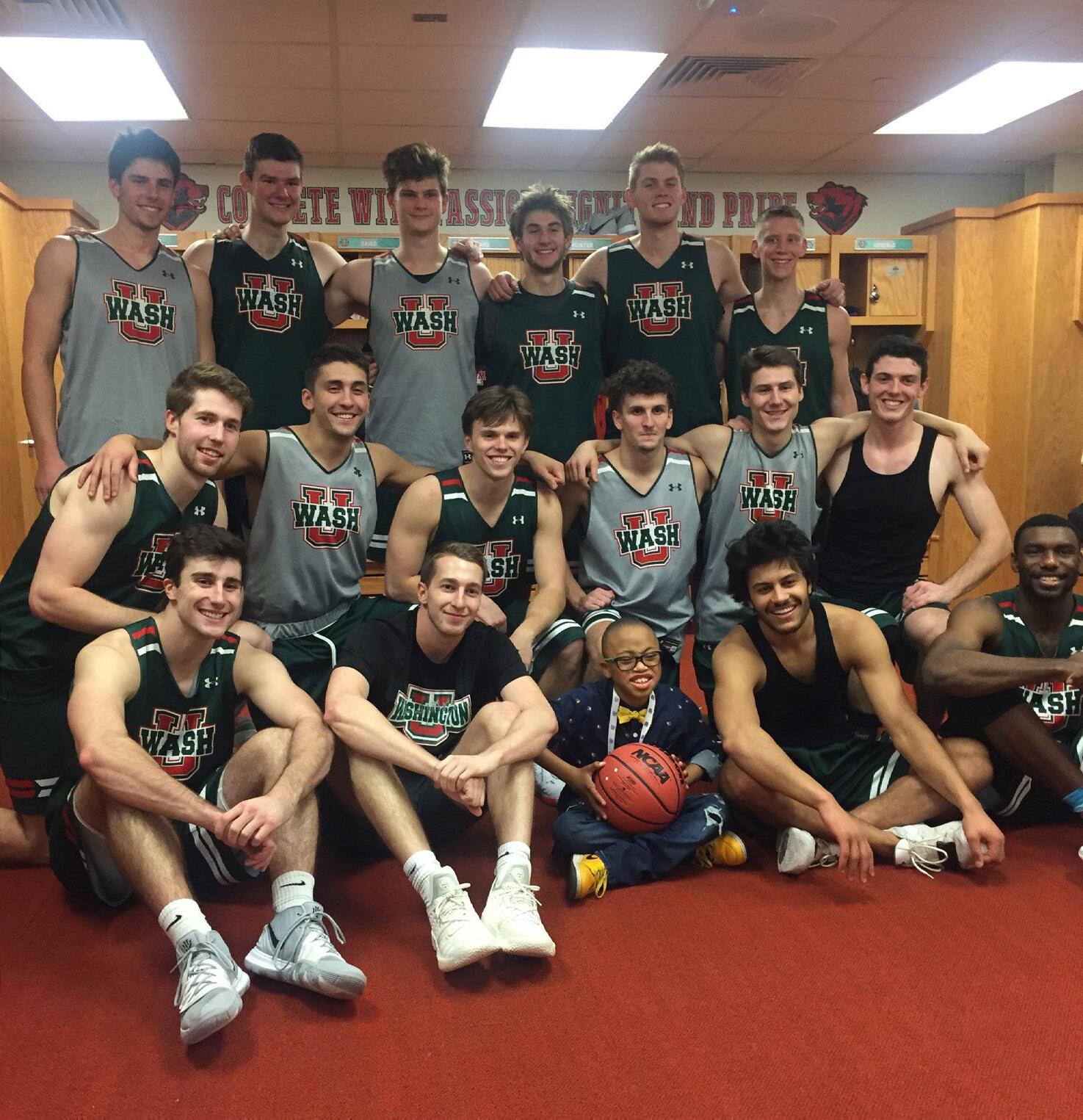
Every four years, new names go on top of lockers in WashU men’s basketball team’s locker room. However, since 2019, as players have come and gone, one name has stayed: Gavin Porter.
Porter, then 10 years old, joined the team in 2019 through Team IMPACT, a national organization that pairs children with serious health issues with NCAA teams. Porter, who was born premature, was diagnosed with cerebral palsy at a young age.
Porter’s connection to WashU was strong prior to Team IMPACT. His mother, Mia Malcolm, and his grandmother are both WashU alums. Along with being a fan of wrestling, Porter has always loved basketball. So after getting in touch with Team IMPACT, Malcolm ultimately decided that WashU’s basketball team would be a perfect fit. The team agreed.
Days after being paired with the team, Porter was officially “drafted” to WashU. Ever since, he has been an integral part of the Bears’ squad that most recently made it to the NCAA Division III Final Four.
Malcolm still remembers the draft day, one of the first times she had felt that her son was accepted by a sports team.
“It was [Porter] and then a little girl who had got matched with the women’s basketball team at WashU, so they had a draft day, and Gavin signed the paper. We
PUZZLE PUZZLE
still have his draft paper; it’s framed in his bedroom, and they gave him a jersey. They had a locker for him and all these things. It was very cool that they did that for him, and he’s just been locked in ever since.”
Just over a year after Porter signed with the team, the COVID-19 pandemic swept across the country, cancelling WashU’s basketball season. However, a pandemic would not break Porter’s bond with the squad. While in-person experiences had to be put on hold, Gavin kept in regular contact with the team, who sent him videos and text messages. Toward the end of the pandemic, they surprised Porter on his birthday, meeting him outside his house — one of the first times they had seen him since the pandemic started.
“We hadn’t seen him for so long, you know, we’d been obviously apart,” head coach Pat Juckem said. “And so our guys drove over to his house, and we met outside, and we hadn’t seen him for quite a while and brought a present and cake. You could see what this meant to both [him and the team].”
Nearly seven years later, Porter is now a sophomore in high school and continues to be involved with the WashU team. Most recently, he has attended team practices and scrimmages to meet the team and share his story. After home games he attends, Porter spends time in the team room and breaks down the Bears’ huddle.
Mania
Juckem participated in the Team IMPACT initiative in his previous job as head coach of the University of Wisconsin–Oshkosh men’s basketball team, and his relationship with Porter has spanned the entire length of his coaching career at WashU. Porter, Juckem, and generations of WashU men’s basketball players have been inspired by Porter’s relationship with the team.
“He was so elated [to be with the team], because some of his physical disabilities are hard,” Juckem said. “But his mom shared after how meaningful it was for him to participate, not just to observe, but to participate and play along with our guys. And our guys were so, so caring and looked out for him and made sure that he had success.”
The team has also gone out of their way to spend time with Porter. When Porter graduated from eighth grade, the team and Juckem were there to cheer him on, a moment his mother vividly remembers.
“They came to his eighth grade graduation,” Malcolm said. “It’s just been such an amazing experience that Gavin gets to be wrapped in that kind of love from these guys. And it helped to build his confidence so much.”
Another way Porter has been able to engage with WashU athletics is through Bear Cubs Running Team, a program that seeks to improve the well-being of children with health challenges through running and other activities. Senior basketball player Jonathan
Coffy served as Porter’s mentor with Bear Cubs.
During this time, Coffy learned that Porter was a fun-loving and active kid.
The two quickly bonded over a love for wrestling.
“I got to know more about him in terms of what he likes. … He’s a big WWE fan,” Coffy said. “I learned that he really likes John Cena, so he made up a handshake. And I learned that he’s a very active kid, he likes sports, but he also just likes to run. He’s a little bit of a jokester, too.”
Seeing Porter’s growth over the last four years has also been fulfilling for
Coffy, who has developed an even stronger relationship with him after Bear Cubs.
“It’s also been crazy to see him grow up, because I’ve been around Gavin for about five years now,” Coffy said. “He’s a high schooler. … It’s just so crazy to see his growth and his development. He’s becoming a young man. It’s been really fulfilling.”
The Bears have inspired Porter, and he considers them to be “his team.”
However, Porter’s biggest inspiration has been Justin Hardy, a WashU basketball player who passed away from cancer in 2022,
during his senior year at WashU. Porter has drawn on Hardy’s courage and determination to inspire him to be HardyStrong during times he has been sick.
“He still remembers Justin and he’ll talk about Justin, even though Justin passed away, and it gives him strength to know that Justin was so strong,” Malcolm said. “And he’s like, ‘Mommy, I’m strong. Like Justin.’ The last time he had a procedure, he had to go into the hospital. He’s like, ‘Don’t worry, because I’ll be strong. Like Justin.’”


LEWIS RAND SENIOR SPORTS EDITOR
Gavin Porter poses with the WashU men’s basketball team in 2019.
PHOTO COURTESY OF PAT JUCKEM
FORUM
More parties for sapphics, by sapphics
I (Kaylee) tragically found myself the day before Halloween with no costume and no plans, recovering from my first situationship with a woman. I coped with this combo by Instagram doomscrolling, which presented me with the solution to all my problems. Final Girls Club was listed among my recommended accounts. The account is dedicated to sapphics in St. Louis, and in their bio was news of a sapphic Halloween party that night.
Sapphics as a community don’t typically get events tailored to us, despite the applicability of the term. It includes all non-men who like nonmen, meaning the label encompasses multiple identities, like bisexual and nonbinary, all of which provide a demand for parties.
Because of the large sapphic demographic of WashU students and the lack of sapphic parties, we had to go because we didn’t know when the next one would be.
This was a party for
people like us, exactly when we needed it. Among the mutual followers of the Final Girls account, we (Lyn and Kaylee) found each other. We work together at Student Life and were casual friends, but we had no clue we were both queer. We also did not have many sapphic acquaintances at WashU. We got in contact on Instagram and formed a group of WashU students to go to the event with, creating a little network of sapphics just from the followers of the account. Walking into the party, we immediately recognized familiar faces, revealing even more mutuals we had no idea were queer. The most commonly used phrase of the night was “Oh my gosh, I didn’t know you were gay!” Suddenly, we knew two to three sapphics in each of our social circles. The community already existed; we just needed a way to see it. When we are able to find sapphics to befriend, we are also able to find sapphics to date. We identify as femme sapphics, meaning people tend to perceive us as straight. However, in a sapphic space, queerness is assumed, and people see us in a more authentic
way. People can approach feminine women in these spaces without having to figure out if they’re gay.
We can express our interest in others confidently and safely. At other parties, any expression of sapphic intimacy can and will be sexualized by men. In a space not built for us, we will never be able to comfortably and safely pursue people romantically.
It might seem trivial, but it is important to have sweaty dance floors where queers can make out, too.
PDA is not everyone’s favorite thing, but sapphics have just as much of a right to show affection and have intimacy.
Still, any fun has its limits. As is stereotypical of insular queer communities, some people at the party realized how much their ex gets around. Also, due to space limitations, many people were stopped at the door, yet there were many cis men in attendance.
On one hand, these men are taking limited spots from sapphics. On the other hand, policing who can and cannot enter seems contrary to the spirit of inclusivity in the queer community. For us, the simple solution would be to host more sapphic

events. People won’t crowd a single event thinking it’s the only sapphic event of the year, and there will be room for everyone who decides to attend.
This Halloween, we connected with many other sapphics. We formed individual bonds (including between us two) as well as a network of sapphics at
WashU. This shows how the more sapphics who create community events, the more connections we will be able to make with each other.
The Final Girls party showed us just how much sapphic WashU students needed a place to meet, dance, and flirt in a safe, fun environment. However,
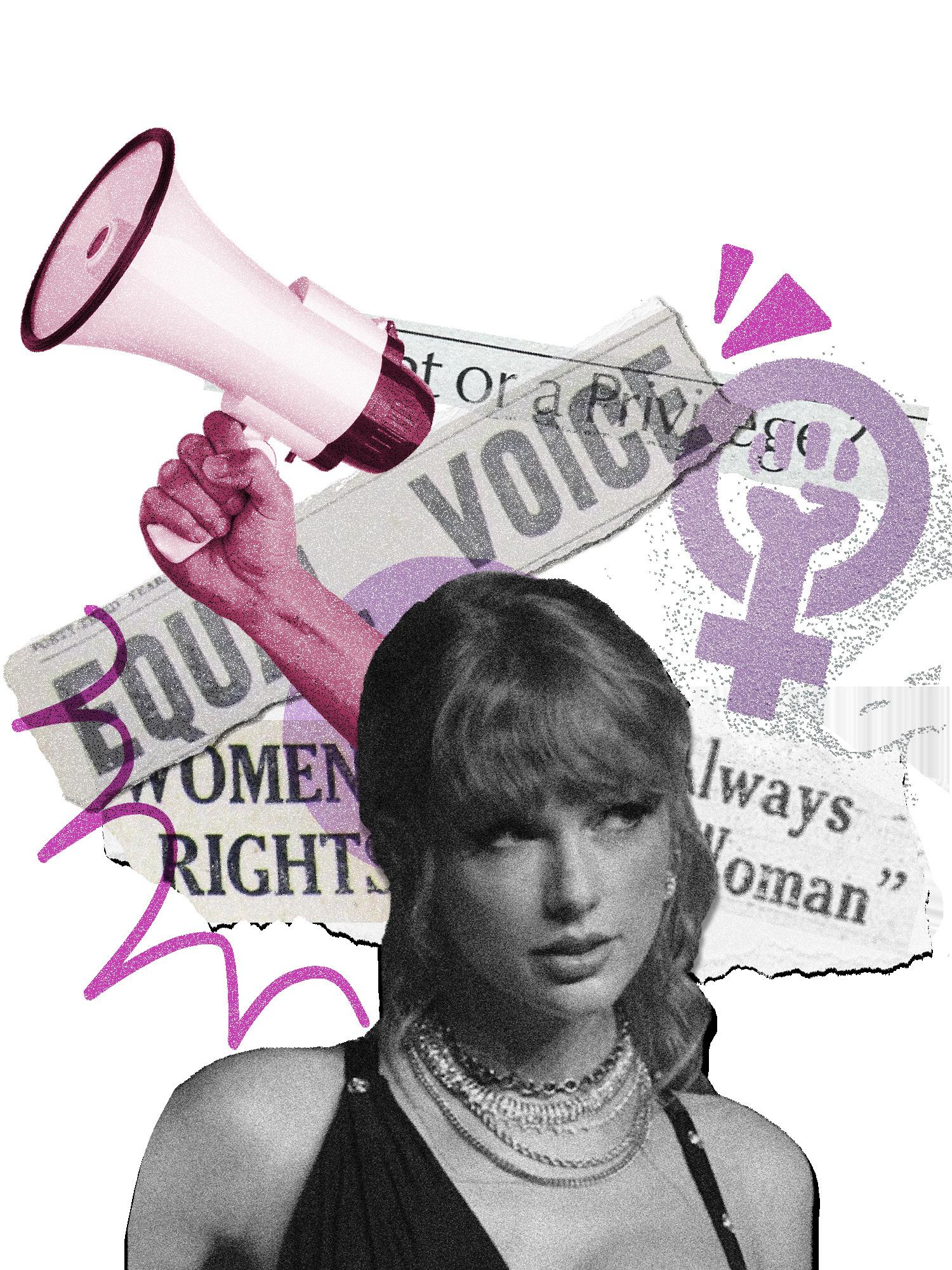
Taylor Swift and our obsession with celebrity feminism
There is no feminist debate more exhausting than the one about Taylor Swift. People dissect her dating life, her activism (or lack thereof), her whiteness, her wealth, and her brand and write full dissertations about a woman whose political engagement, while not insignificant, operates within the carefully managed limits of PR-approved activism.
If you are one to criticize Taylor, I am right there with you. Her activism is the highly produced, corporatepride version of feminism, be it her pastel-colored allyship of the LGBTQ+ community through her song “You Need to Calm Down” or her periodic voterregistration pushes. She does not challenge the systems that she benefits from. She uses feminism when it flatters her image, not when it costs her anything. She is a billionaire artist with global influence and should be doing more. While there are valid critiques of Taylor Swift’s feminism, what is most alarming and absurd to me is that she has become the site of our feminist projections in the first place. We treat her like the definitive case study of 21st-century feminism, as if the entire movement could be measured by one pop star. We see it in headlines that treat each of her album eras like a new feminist milestone; in the thousands of opinion articles that support or criticize her, making the same cyclical arguments every time; and in social media comment sections where people argue about structural inequality through a single lyric from one of her songs. We have let celebrity
feminism — the public, branded feminist advocacy by famous figures — encompass the entire feminist movement. In celebrity feminism, we end up centering the people least affected by inequality because it’s easier to critique and worship them than to talk about actual feminist issues — ones that aren’t as glossy or clean. We outsource feminist politics to celebrities, then act shocked when the results are shallow. Of course they are. Most celebrities care more about their image, money, and fame than actual issues of substance.
movement by attaching politics to a famous face while making sure the “progress” does not threaten the systems that produce those faces in the first place. The corporations, studios, and platforms that promote celebrities understand that a soft, palatable feminism draws in their audience without challenging their own practices. It makes feminism “aesthetic” while keeping it politically harmless.
Mainstream feminism has always had a
celebrity problem. What’s new is the degree to which celebrities have become the primary focus of feminist arguments. We’ve reached a point where celebrity feminism is not another conversation; it is the entire conversation. If every feminist debate centers on someone famous, then we never have to be accountable for our own contradictions, cowardices, or complacency. The celebrity becomes the stand-in for our political fantasies and failures. Yet, we cling to celebrity feminism because it lets us be
politically expressive without being politically involved.
Instead of introducing people to feminism, celebrity-centric debates create the false sense that having an opinion about a famous woman is activism. These views flatten decades of feminist work into branding opportunities for people with less incentive to challenge the structures that benefit them. The movement then becomes shallower, not more accessible. I am not defending celebrities, nor am I say-
we can’t let this be the peak of our sapphic nightlife. This hosting role is not isolated to Final Girls. If you feel called to start a sapphic community club or open your apartment to sapphics of WashU, then do it! We have to let our gay Halloween party be the start of a wave of sapphic events, not the end.
advocacy. But their contributions, however significant or shallow, cannot be the measure of a movement.
Feminism is supposed to live beyond the latest entertainment cycles. When we obsessively monitor celebrities’ choices, we shrink feminism into something so fragile and unserious that a pop star’s silence becomes a symbol of existential crisis.
The real feminist work, the kind that changes institutions, policies, and relationships, happens in places with no cameras and PR. It is slow, thankless, and collective. It takes shape in union meetings, community clinics, student groups, courtrooms, classrooms, and living rooms. It looks like supporting survivors of domestic abuse, sexual assault, and harassment in our community, advocating for fair policies in our workplace or university, and holding the institutions we are a part of accountable to the values they claim to uphold. It can be paying attention to who gets interrupted in meetings, whose labor disappears into the background, and who is always expected to “compromise” — and choosing not to let that slide.
Feminism cannot be outsourced to the wealthy, because a real feminist movement is built by people who do not have the luxury of believing feminism is optional.
Celebrity feminism tells a story of empowerment that’s individually appealing but structurally useless. It creates the illusion of progress in the feminist
ing we shouldn’t critique or analyze celebrities and how they impact the world.
Wealth and influence come with responsibility, and celebrities should be held accountable for their silences and lack of
So the next time you’re pulled into another endless debate about Taylor Swift’s supposed political obligations, especially on social media, pause and reflect inward. What small action, within your own reach, would matter more than micro-analyzing the ideology of someone who doesn’t care about what you think?
LUCIA THOMAS | DESIGNER
SCENE
Words of wisdom: Insights into the success of WashU’s ranked Scrabble player
JUNIOR
On a campus overrun with Wordle, New York Times Connections, and other word-based games, one student is going back to the basics and relishing in the tilebased classic, Scrabble.
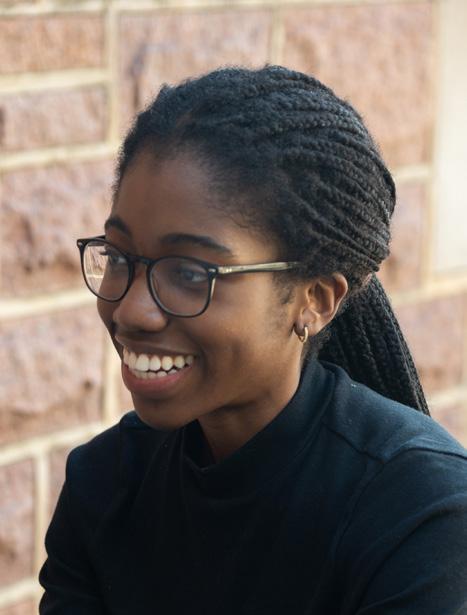
Sophomore Cherish AmbyOkolo is a ranked player by the World English Scrabble Players Association (WESPA) and has accumulated accolades from various competitions. However, for Amby-Okolo, the intellectual sport is more than just a competition; it’s a chance to explore a passion, overcome adversity, and build community.
Early on in her childhood, Amby-Okolo began to appreciate Scrabble for its poised nature and scholarly dimension.
“Growing up, I lived in Nigeria, and the Scrabble scene is very large over there,” Amby-Okolo said.
“I had the opportunity to observe Scrabble and was fascinated by how they were thinking.”
When Amby-Okolo finally got her hands on tiles, she went straight into action
by learning strategy and technique. All the practice could only mean one thing: the competitions were calling her name.
“I was able to play my first tournament at a school and had a small rating. I was seven years old, so I was really young and not that good, but it was a nice way to get my feet in,” AmbyOkolo said.
In the many years since her first competition, she has become an experienced player, travelling around the world to Dubai, France, and Australia to face off against other word connoisseurs.
While the competition has instilled a spirit of determination in Amby-Okolo, she still values the importance of teaching others to love the game and wants to see them succeed as well.
According to her, the bestkept strategy secrets are only most useful when others are invited to learn from them.
“My initial strategy is just to get a huge head start,” Amby-Okolo said. “So, if I have bad letters at the very beginning, my first instinct is to get rid of as many of them as possible and play the long words because each bingo over seven-letter
words gets an additional 50 points.”
But beyond having the smartest moves or most recognition, for Amby-Okolo, Scrabble is an opportunity to build connections with her peers and mentors. Some of those connections even gave her a few friendly faces to recognize on campus as a new student last year.
“There’s a [lecturer] here, his name is Brian Garnett, and he also plays competitively. I knew him as a competitive Scrabble player before I knew him as a professor,” Amby-Okolo said. “It was nice coming in and knowing someone.”
Fostering connection with like-minded peers has also shown Amby-Okolo what it means to stick to a passion despite adversity. She has learned to navigate an environment where her underrepresentation can be used as a vehicle for change.
“Scrabble was and is still a super adult-maleheavy dominated sport. I am a girl in a sea full of men,” Amby-Okolo said. “Having interviews like this brings more outreach to the sport and gets more people inspired to play.”
Regardless of whether
you’re looking for a community or to leave a lasting legacy, Amby-Okala believes that having a deep commitment to an activity is the best way to develop a sense of purpose, as she has done with Scrabble.
“To everyone, even if it is not Scrabble, whatever you do, try to find some meaning in it. Try to find some joy in it because it can really permeate,” Amby-Okolo said.
While St. Louis might not be the optimal destination for aspiring Scrabble players, Amby-Okolo has compiled a list of resources for those looking to play in the community.
“St. Louis unfortunately isn’t the biggest Scrabble scene; however, if you go to a website called CrossTables, they have maps of Scrabble events in your city,” she said.
As Amby-Okolo continues to make her mark on the Scrabble community, she is also creating an environment for others who love words to come together and bridge barriers. The impact of Scrabble extends far beyond the borders of the game. Amby-Okolo encourages anyone who might be
looking for a new pastime, mental exercise, game to bring to a hangout, or sense of belonging to look to Scrabble as the perfect place to start.
“It’s a communal bonding game. No matter if you’re playing online or in person, you’re kind of bonding with somebody else.”
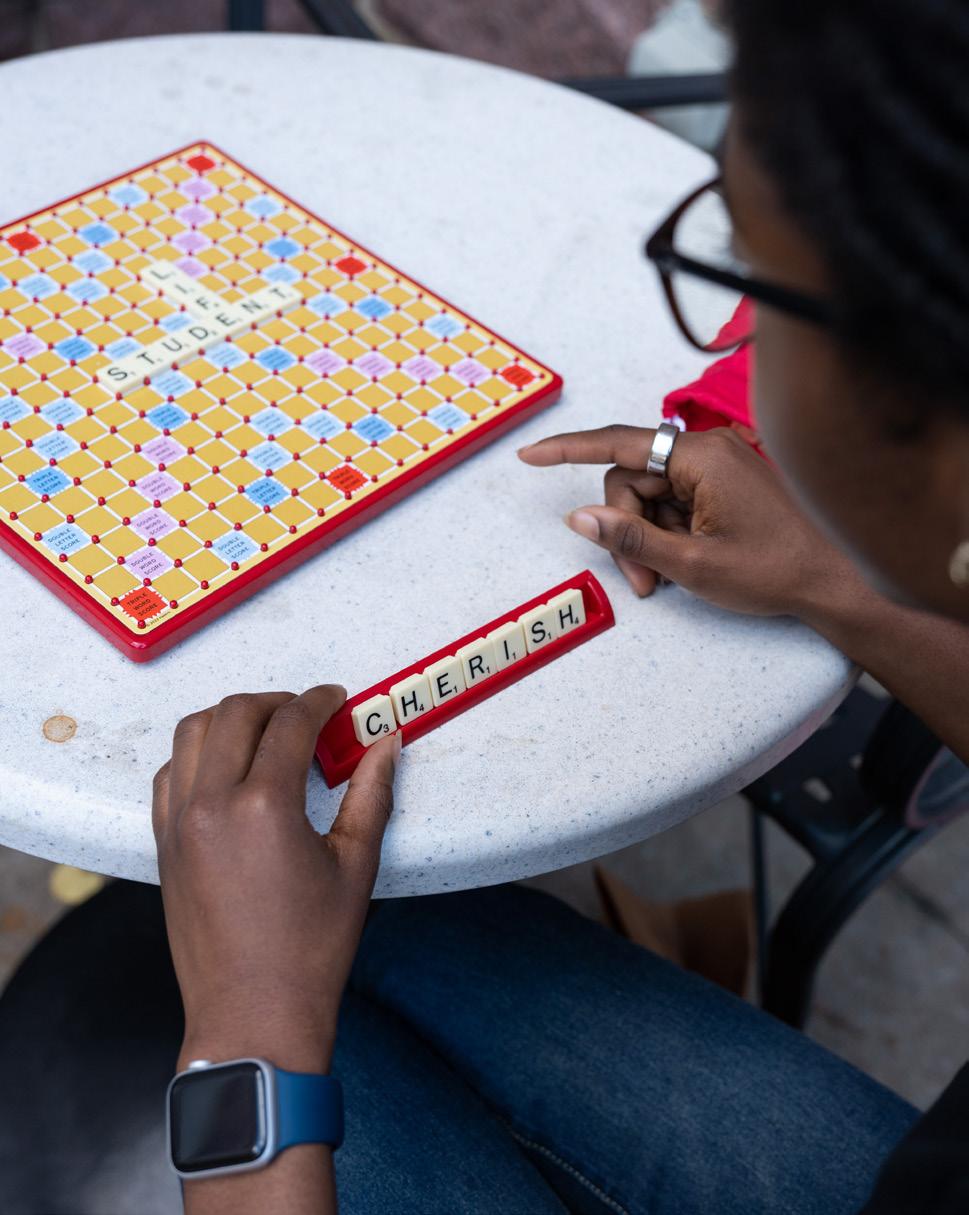
shows off her tile rack and board.
‘something is happening’: PAD dances through uncertainty
SOPHIA HELLMAN
SCENE EDITOR
SENIOR
What does it look like to come together? In the face of uncertainty and an indeterminable future, how can we come to terms with our anxiety? How do
we experience the passage of time? What is it to wonder? When gazing at the stage during the Performing Arts Department’s (PAD) recent showcase, “something is happening,” one approaches such questions during an artistic display
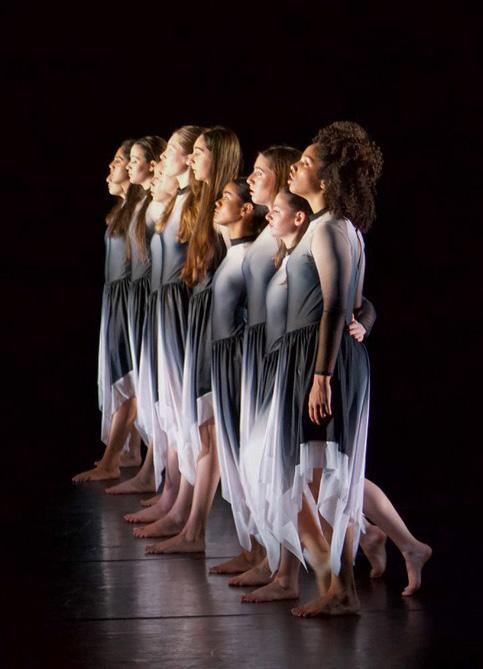
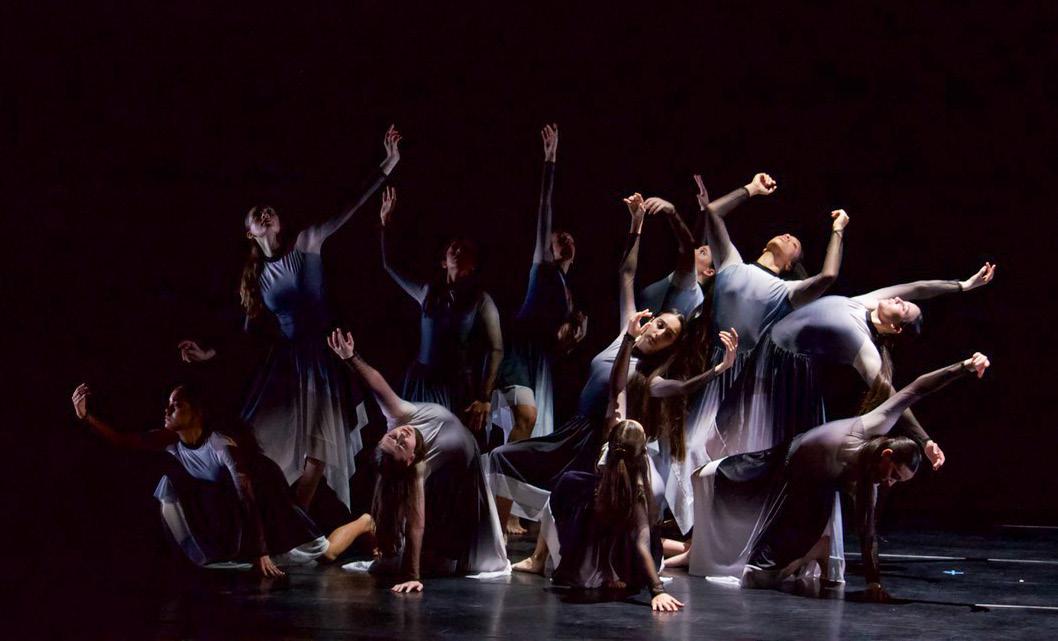
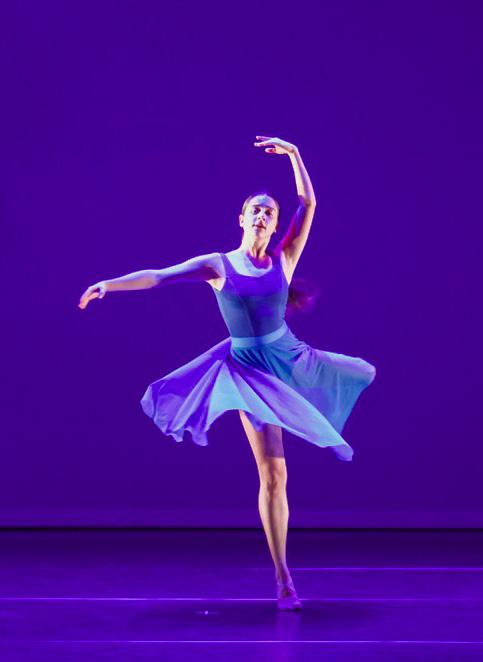
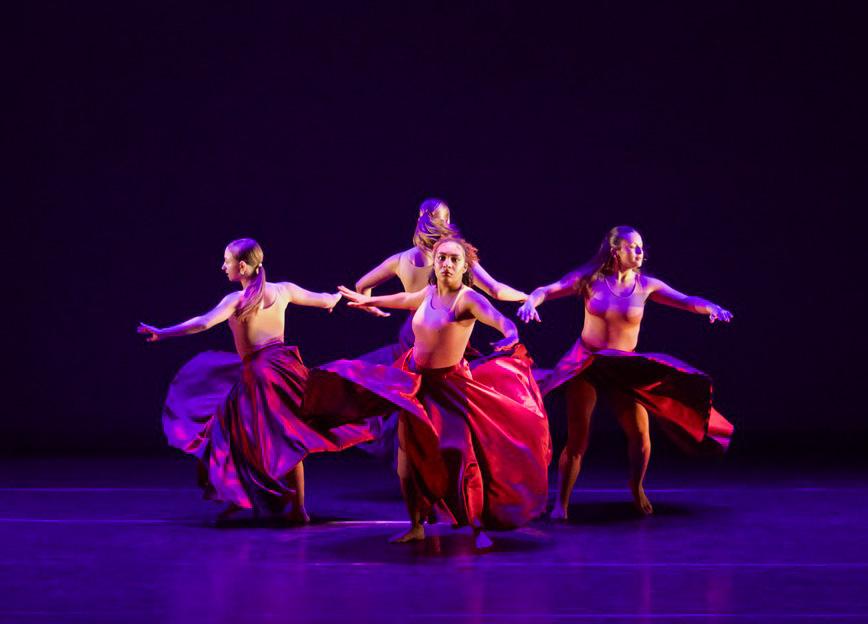
“Nucleus,” pictured above and below, echoed the concepts of unity from the previous pieces. Directed and choreographed by Marchant, it featured additional movement materials made by dancers. The dancers wore matching black and white gradient dresses with loose, shifting streams of fabric hanging free. To the tune of a rich violin hymn, dancers spiraled and spun together and apart, mimicking the flow of electrons and atoms through the air. Relating the “part” to the “whole,” dancers formed bonds with one another, facing each other, standing still despite being fixed in the middle of a rotating spiral of energy. In “Nucleus,” the abstract performance feels ubiquitous, or universal. The dance ended with the rotation of one dancer slowly finding their way back to form a circular formation.
of curiosity and future-oriented inquiry.
From Nov. 14 to 16, the Washington University Dance Theatre put on a live showcase featuring five different performances, including choreography from resident artists
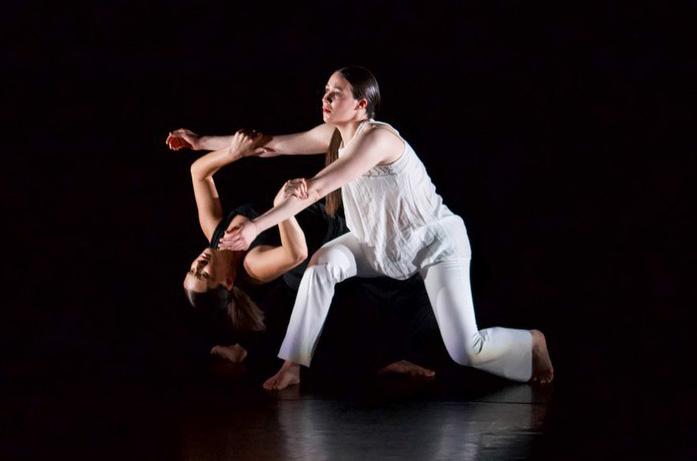
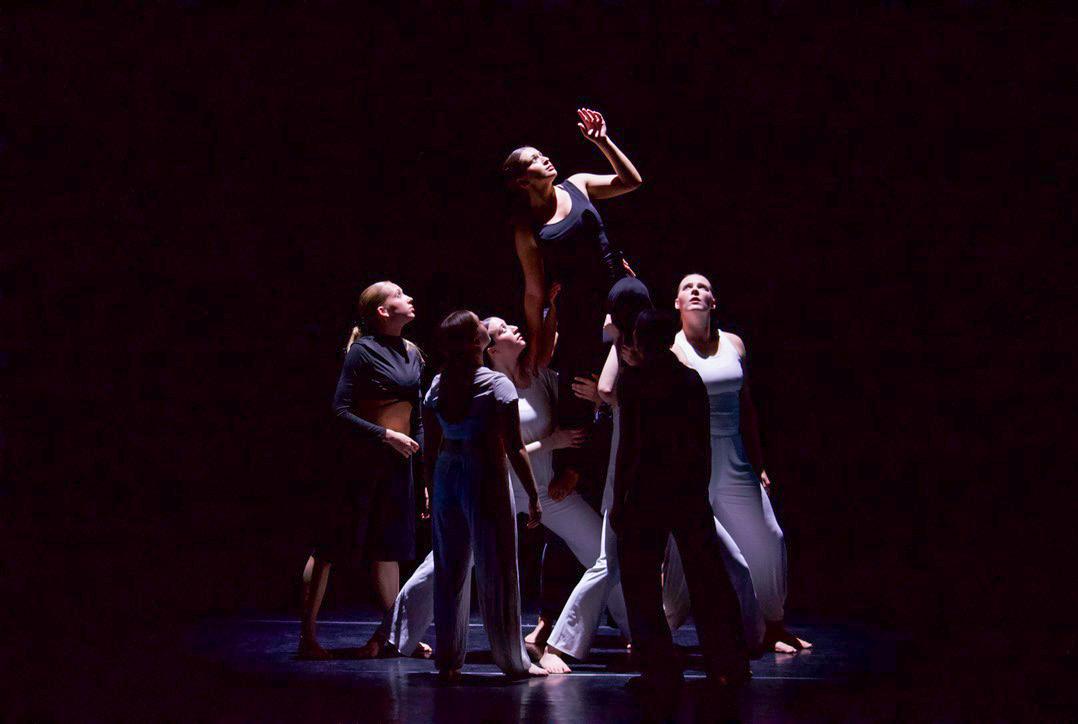
Elinor Harrison and David Marchant, graduate student Liz Lloyd, and guest artists Ron K. Brown and Xi Zhao. According to Artistic Director David Marchant, each performance explored concepts of the moment, an unknowable future,
curiosity, and the “evocative feeling of anticipation that something is happening.”
“something is happening” does not ignore the uncertainties we face. Instead, it explores different worlds of thought that allow us to ask deeper questions about ourselves and how we react to the directional flow of time. In worlds of changing constellations, internal expression, orbiting moments, and spiritual grounding, something is definitely happening. Now, what happens next?
BRI NITSBERG | MANAGING PHOTO EDITOR
Cherish Amby-Okolo
St. Louis’ comedy scene hits its stride as Flyover Comedy Festival hits eight years
Comedy used to largely ignore St. Louis; it’s the kind of city national tours skipped on the way to New York or Chicago. The city has talent — real talent — but for a long time, the St. Louis comedy scene felt like an open secret that locals knew how to find, but no one else thought to ask about.
That notion felt noticeably outdated this weekend at the Flyover Comedy Festival, which took over the city from Nov. 13 to 16. In a lot of ways, Flyover is exactly what shifted the perception in the first place. When it launched back in 2017, the festival was one of the first things to pull the local scene into the national spotlight; suddenly, touring comics who used to skip (or fly over) St. Louis were building stops around it. The festival was created with a pretty simple intention: to give a scattered but talented comedy community a central place to gather and finally be seen. This year, more than 150 comedians spread across 10 stages scattered through multiple neighborhoods into a rotating playground of stand-up, improv, sketch, and chaotic hybrid shows that defied categorization.
The festival’s roots harken back to when the St. Louis comedy scene looked completely different.
Flyover co-founder Zach Gzehoviak remembered years when comics packed into tiny backrooms for open mics with nothing tying the individual venues together. The idea for a festival floated around for a while but seemed untenable at the time, with no real infrastructure to hold it together. Everything finally clicked when The Improv Shop, one of the city’s key comedy venues, left its old Euclid Avenue
every year. The 2025 festival featured everything from polished touring headliners to acts pushing the boundaries of comedy into stranger and more inventive territory.
Audiences packed into Stifel Theatre, Delmar Hall, The Pageant, and City Winery — a run of major venues paired with comedians who, 15 years ago, would have never put St. Louis on their tour map.
But the magic of Flyover is more than the big names. The charm sits in the offbeat corners, the shows that
anyone had time to reconsider what they submitted. At Improv Shop Side, sketch troupe Disco Horses from New York leaned so hard into surrealism that traditional punchlines barely mattered, and their bits mutated into physical comedy, musical cues, and escalating nonsense that somehow still landed. And in between it all, improv teams stretched a single audience suggestion into full story arcs — characters, plot twists, and callbacks included — the kind of high-wire improvisation that only
“Audiences packed into a run of major venues paired with comedians who, 15 years ago, would have never put St. Louis on their tour map.”
location for a bigger, twotheater space in The Grove.
“That move really set everything off,” Gzehoviak said. “The city suddenly had enough stages close together to build something real.”
What emerged, the Flyover Comedy Festival, now brings major national acts through St. Louis
11/13 WINNERS

KAN
could only succeed in front of a St. Louis crowd that has grown up with this festival. On Saturday night at Urban Chestnut, Comedy Central with Steve Furey built an entire show around anonymous audience confessions, which were then projected onstage and turned into rapid-fire commentary by the host before
works when an audience is right there with them at every moment. The mix of polished and unpredictable material is what gives Flyover its personality.
Nowhere captured that better than The Improv Shop on Friday night. Performers ducked in and out of greenrooms, crowds drifted from one space to
CAPTION CONTEST
First Place:
I’ve been watering this for you while you’re gone.
Darren Jacobs, WashU Parent
Second Place:
How Bear and Brookie lurk trying to catch me in a sting for smuggling black market caviar.
Sean Henry, Current WashU Student
Third Place: I must be growing a dogwood tree because I just heard it bark!
Elaan Bader, Current WashU Student
of growth
another, and the energy carried straight from one act to the next. Improv Jam kicked things off with a burst of collective chaos. Writer’s Block, a show built around a staged reading of an original halfhour pilot followed by a completely improvised episode of the same concept, delivered tight and sharply different rhythms. A rapid-fire run of stand-up acts kept the night rolling without a pause. Then ASSSSCAT, the festival’s longform improv headliner, took the stage and reminded everyone why the longform structure still hits like magic even when it’s performed at the highest level.
By the end of the night, the room had taken on a new vibe. What started as a run of tightly packed shows settled into something looser and more familiar, with performers and audiences drifting together as if the whole building belonged to them. It felt less like a festival closing out the night and more like a community falling into place. That atmosphere is a big part of what makes Flyover resonate beyond the stage.
Flyover now stretches far beyond a single weekend. The submission process has become competitive enough that performers
around the country talk about getting into the festival as a benchmark. Local comedians who once thought success required moving away now treat St. Louis as a place where careers can meaningfully grow. The city has not turned itself into the next Chicago or New York, but it is building something different — a scene shaped less by big institutions and more by a tight community that treats experimentation as the norm. Flyover has become the place where that identity shows itself, and a weekend that puts the city’s collaborative, experiment-heavy comedy culture on full display.
“This community always had the talent. Flyover just gave it a place to gather,” Gzehoviak said.
Flyover’s name may nod to an old stereotype, but the festival has rewritten what “flyover country” means. St. Louis has become a city where comedians actively want to return — a place where audiences show up, performers take risks, and the scene keeps getting stronger.
Eight years in, the city is not asking for permission to be part of a national conversation anymore. It is always in it, and if the energy of this year’s festival is any sign, St. Louis is not done climbing.
Caption this! Enter this week’s contest
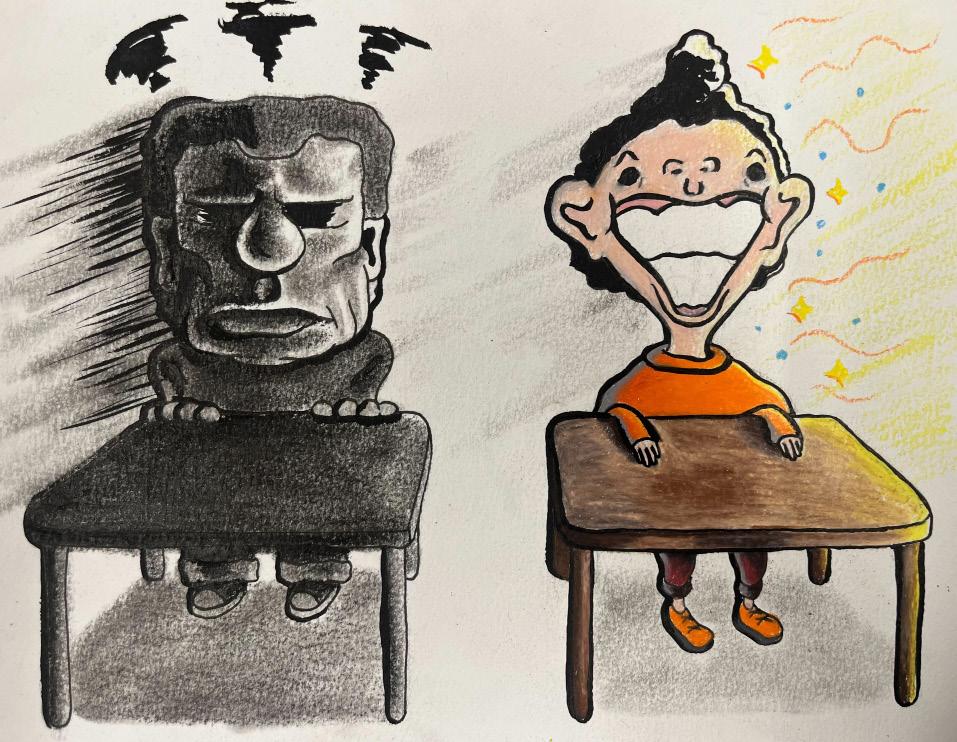
Scan the QR code to enter your submission by 11:59 a.m. on Tuesday.