Wednesday, November 6-12, 2019 - // no. 028
Puerto Rico and the Caribbean
www.theweeklyjournal.com
LOCAL SAVINGS AND CREDIT COOPERATIVES SEE INCREASE IN ASSETS P14 PUERTO RICANS: SECOND LARGEST HISPANIC GROUP IN U.S. P12 TREASURY ANNOUNCES INCREASED REVENUE FOR AUGUST, SEPTEMBER P17
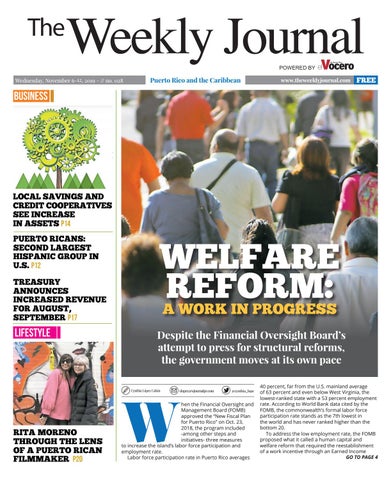
WELFARE REFORM: A WORK IN PROGRESS Despite the Financial Oversight Board’s attempt to press for structural reforms, the government moves at its own pace
W Cynthia López Cabán
RITA MORENO THROUGH THE LENS OF A PUERTO RICAN FILMMAKER P20
clopez@wjournalpr.com
@cynthia_lope
hen the Financial Oversight and Management Board (FOMB) approved the “New Fiscal Plan for Puerto Rico” on Oct. 23, 2018, the program included -among other steps and initiatives- three measures to increase the island’s labor force participation and employment rate. Labor force participation rate in Puerto Rico averages
40 percent, far from the U.S. mainland average of 63 percent and even below West Virginia, the lowest-ranked state with a 53 percent employment rate. According to World Bank data cited by the FOMB, the commonwealth’s formal labor force participation rate stands as the 7th lowest in the world and has never ranked higher than the bottom 20. To address the low employment rate, the FOMB proposed what it called a human capital and welfare reform that required the reestablishment of a work incentive through an Earned Income GO TO PAGE 4
The Weekly Journal > Wednesday, November 6, 2019 >
2
Estado Libre Asociado de Puerto Rico | Gobierno Municipal Autónomo de Carolina José CARLos APontE DALMAu, ALCALDE
¡PRONTO!
Oportunidad única en el Centro Urbano | 21 locales comerciales | 2 niveles | Cisterna de agua | Seguridad Estacionamientos | Horario extendido | Generador eléctrico para locales comerciales Precios de alquiler bien competitivos
Espacios comerciales disponibles para arrendamiento.
3
/ Wednesday, November 6, 2019
A WEEK IN REVIEW NEW RULES FOR ISSUING GOV’T DEBT
>Courtesy
>Courtesy Ports Authority
>Archive
Gov. Wanda Vázquez sent a bill to the Legislative Assembly to set limits on government debt issues and restrict the use that will be given to the money borrowed. The bill defines the collections or transactions that will be considered when calculating the margin established by the Constitution to issue debt, and states that the government can only borrow to invest in capital improvements. The proposal will also establish that the government may refinance its current loans only if it achieves savings in the payment of interest, and that no loan or bond may have a life of more than 30 years.
CHAMBER OF COMMERCE PRESIDENT APOLOGIZES FOR REMARKS ON MINIMUM WAGE
After his public remarks on a bill to increase the minimum wage resulted in a barrage of criticism and a group of retailers leaving the Puerto Rico Chamber of Commerce, José Ledesma issued a public apology. “Being as how I am the president and sole spokesperson of an organization that represents the voice and actions of private companies, I must clarify that the CoC does not oppose measures that represent an economic relief to the labor force, but, in this historical moment, when the private sector is being asked to assume the responsibility of absorbing a large part of the labor force as opposed to the government being downsized, increasing the minimum wage would be untimely, “ Ledesma said in a statement. “It was never my intention to downplay the challenges faced by people who work for minimum wage,” he added
Powered BY El Vocero de Puerto Rico, 1064 Ave Ponce de León 2nd floor San Juan, PR Postal Address: PO Box 15074, San Juan, PR 00902
FERRIES DEL CARIBE TO BUILD NEW $15M PASSENGER, CARGO TERMINAL IN SAN JUAN
Ferries del Caribe signed a development agreement with the Puerto Rico Ports Authority to build a new 50,000 square-foot terminal at Pier 15 in San Juan. The $15 million project includes an area for U.S. Customs and Border Protection, boarding and landing gateways and loading and batching facilities for storage and processing of containers. The project will generate about 100 new jobs during the construction phase. The new terminal should be operational in 2021. Ferries del Caribe services about 120,000 passengers, 57,000 cargo containers and 20,000 export vehicles annually.
President Salvador Hasbún shasbun@elvocero.com
Human Resources Director Arlene Rolón, PHR arolon@elvocero.com
Managing Editor Yennifer Álvarez yalvarez@wjournalpr.com
Comptroller Félix A. Rosa frosa@elvocero.com
Traffic Director Ilia M. Pérez Centeno iperez@elvocero.com
Multi-Platform Digital Director Stephanie Gómez Álvarez sgomez@elvocero.com
Production Director Eligio Dekony edekony@elvocero.com
Editorial Director Juan Miguel Muñiz Guzmán jmuniz@elvocero.com
Multi-Platform Graphic Director Héctor L. Vázquez hvazquez@elvocero.com
Phone: 787-622-2300, 787-721-2300 Customer Service: 787-622-7480
4
CONTINUED FROM PAGE 1 Tax Credit (EITC) that was eliminated in 2014, a reformulation of the Nutritional Assistance Program (NAP) to include a work requirement, and an ambitious workforce development program to retrain, mentor and guide underserved populations as well as to ensure that employees have the skills and knowledge to support current and future businesses and industries. “EITC and NAP reform are projected to increase economic growth by 0.15 percent by FY2021, and education and workforce development opportunities are projected to add an additional 0.26 percent from FY2033-2058,” indicated the Board on page 8 of the revised fiscal plan. However, eleven months later, in the midst of the bankruptcy’s legal proceedings, the federal entity requested a risk report addressing the restoration of fiscal and financial help from the government of Puerto Rico and once again blamed the government for its “limited political will to make radical improvements in the private sector labor environment,” thus affecting the fiscal plan’s projections. Government officials interviewed by THE WEEKLY JOURNAL rejected this assertion while recognizing the vast challenges the island faces as it tries to emerge from a decade long economic depression; recovers from the damages caused by Hurricane Maria, which are estimated at over $100 billion; handles the restructuring process of its $70-billion plus debt load; and recoups from government instability. “I disagree with that statement... We’ve had challenges, but we’ve made progress in certain areas. We’ve only been at the helm of the government for three years and we’ve managed to formulate and approve legislation to tackle different issues,” indicated Omar J. Marrero, executive director of the Puerto Rico Fiscal Agency and Financial Advisory Authority (Aafaf, by its Spanish acronym).
/ Wednesday, November 6, 2019
A Work Credit
earns approximately $12,180 annually. With EITC, highlighted the FOMB, the woman can qualify for up to $1,500 in additional take-home pay per year, effectively raising the minimum wage by more than 12 percent. The island’s tax regime contemplated an EITC from 2007 to 2013, but the past administration ditched it when it approved its Tax Reform in 2014 amidst a heated debate on tax exemptions. Marrero didn’t know the exact number of families that would benefit from this initiative, but the nonprofit organization Espacios Abiertos that promotes democratic practices in Puerto Rico estimated that about 412,000 families could claim the work credit. It also pointed out that for every $1 invested in the credit there is an economic return of $1.50 to $2. “We’ve had some differences with the Board because we have worked responsibly and on this particular matter are about to unveil the guidelines and eligibility requirements,” insisted Marrero.
Seven months before his resignation amidst the scandal caused by a leaked chat and allegations of malfeasance, former governor Ricardo Rosselló Nevares enacted a Tax Reform that included a work tax credit. “The EITC was approved as part of the Tax Reform on Dec. 2018. It will take effect during the next tax filing period, ending April 15, 2020. Soon, the Treasury Department will publish the guidelines and eligibility requirements,” said Marrero, who is also the Chief Financial Officer of the Government of Puerto Rico. The Earned Income Tax Credit is a tax credit for low and moderate-income working people designed to encourage and reward work as well as offset payroll and income taxes. Twenty-nine states, plus the District of Columbia, have established their own EITCs to supplement the federal version of the credit. Puerto Rico’s EITC provides a maximum credit of between $300 and $2,000, Workforce depending on family Development size and configuration. Secretary According to the of Economic FOMB, the program -Omar J. Marrero, executive director Development Manuel is projected to cost of the Puerto Rico Fiscal Agency and A. Laboy recognized approximately $200 that due to the million per year, but Financial Advisory Authority ongoing concerns the initiative “will expressed by the increase formal labor force participation significantly, providing a positive Financial Board, staff from the Department of Economic Development and Commerce (DDEC, by return on the investment.” its Spanish initials) meets regularly with members For instance, a single mother with two children of the entity. working at minimum wage for 35 hours per week “We are in constant communication with the FOMB team. In fact, a few weeks ago, the Board summoned us to a meeting and the team in charge of the workforce development program presented an overview of the status of the work outlined in the Fiscal Plan,” Laboy said. As part of the roadmap that the agency is elaborating, he mentioned three initiatives: training programs promoted and funded by the Workforce Innovation and Opportunity Act (WIOA), the apprenticeship program and the Memorandums of Understanding (MOU) with other agencies. Laboy explained that the $120 million WIOA grant supports the training programs for dislocated workers at the 15 workforce consortiums across the island. Following WIOA requirements, a 32-member State Board for Workforce Development was finally instituted last May, approving over $6 million for training in the technology, aerospace, medical and construction sectors. “In an effort to maximize resources we are Surima Quiñones, head of Adsef, indicated that the proposal is in the final stages of the federal approval establishing job centers or one-stop centers in the process. >Twitter
I disagree with that statement... We’ve had challenges, but we’ve made progress in certain areas. We’ve only been at the helm of the government for three years and we’ve managed to formulate and approve legislation to tackle different issues.
/ Wednesday, November 6, 2019
different regions so a person that is looking for employment can acquire the skills needed or the certifications required to re-enter the labor market, all in one place,” Laboy indicated. Laboy also dismissed the FOMB’s claim that the government had not reported MOUs for training or certification programs for adults or youth development. A couple months ago, he said, the DDEC, the Department of Family Affairs and the Administration of Socioeconomic and Family Development (Adsef, its Spanish initials) signed an agreement to give service priority to the Nutrition Assistance Program (NAP) and Temporary Assistance for Needy Families (TANF) beneficiaries at job centers around the island. Other MOUs are in the works to integrate unemployment services at the job centers and to support the work of the Institute of Statistics, as well as other initiatives with the University of Puerto Rico and the Labor Department.
In a September report, the Financial Board stated that no apprenticeship programs were signed on June 2019, but Laboy indicated that seven are registered and another one is in process. The registered programs are in the aerospace, construction, manufacturing, leisure and hospitality sectors. An apprenticeship is a program that trains a worker to become skilled in a particular trade. Most of the training is done while working for an employer who helps the apprentices learn their trade or profession, in exchange for their continued labor for an agreed period after they have achieved measurable competencies. “Parallel to that, we continue working with a series of grants from the Federal Department of Labor, in addition to the WIOA funds that are already allocated for Puerto Rico,”, Laboy insisted. At the time of this interview, he could not provide the number of people participating in these programs and initiatives.
5
second year, the NAP recipient that doesn’t comply with the new requirement will see his benefit reduced slowly until it phases out on the fourth year. Beneficiaries that comply, on the other hand, will continue to receive the supplemental help. “We want to encourage autonomy and selfmanagement so people don’t have to depend on the NAP. We are aiming for it to become additional support to work,” said Quiñones. Under this proposal, the new work requirement applies to able-bodied individuals ages 18-50, but it excludes mothers with children 5 years and younger, homeless and disabled people, as well as caregivers of elderly parents and family members. According to the Adsef, 1.2 million people on the island receive NAP benefits and 172,000 already work. While the number fluctuates month to month, close to 130,000 NAP beneficiaries would need to fulfill the job requirement.
NAP Job Requirement
Omar Marrero, executive director of the Fiscal Agency and Financial Advisory Authority defended the government’s performance in light of criticism over its lack of political will to implement reforms. >Carlos Rivera Giusti
While the fiscal plan explicitly requested for the job to begin during the current fiscal year, the Family Affairs Department and the federal Food Nutrition Service (FNS) are working on a four-year program similar to the ones adopted in other states. The Financial Board specifically called for NAP beneficiaries to begin working 80 hours per month after three months of benefit collection. This work requirement applies to able-bodied individuals ages 18-59 and can be satisfied with paid work, voluntary work, training, education or job searching. “A delay in the implementation as required by the Fiscal Plan, will likely result in a delay or nouptick in economic growth, given that the Fiscal Plan projects an increase in economic growth by Fiscal Year 2021 as a result of the successful implementation of the work requirement and the EITC,” insisted the FOMB’s executive director Natalie Jaresko in a letter to the Family Affairs Secretary Glorimar Andújar on Dec. 17, 2018. The following day, Christian Sobrino Vega, former ex officio representative of Puerto Rico before the Board, responded by accusing the board of undue interference in policy making issues and arguing that the implementation of the work requirement as proposed “could lead to an increase in immigration.” Surima Quiñones, head of Adsef, the agency within the Family Affairs Department that administers the program, confirmed to THE WEEKLY JOURNAL that to this day the FOMB hasn’t approved the Family Affairs Department’s proposal to adopt a 4-year transition process. “We are trying to reach a happy medium between the FOMB and the FNS. We are working on a proposal that follows the guidelines established in the Code of Federal Regulation,” insisted Quiñones. She also indicated that the proposal is in the final stages of the federal approval process. In the meantime, the first stage of orientation and information gathering began last month. After the
Secretary of Economic Developement Manuel Laboy indicated that his team has met with the FOMB’s team for updates and to answer questions about workforce development initiatives. >Archive
6
/ Wednesday, November 6, 2019
Puerto Rico Air Cargo Industry Could Take Off The Government Accountability Office evaluates the possibility of turning the island into an air carrier hub
T Cynthia López Cabán
clopez@wjournalpr.com
@cynthia_lope
hree representatives from the Government Accountability Office (GAO) descended on the island to study the possibility of establishing an air carrier hub in Puerto Rico, easing federal regulations for air cargo operations on the island and opening the door to new economic opportunities. As part of the analysis, ordered by a congressional legislation approved last year, the officials evaluated the island’s capacity to sort, handle and consolidate transportation to and from the United States. During the four-day visit, Heather Krause, director of GAO’s Physical Infrastructure team, Travis Thomson and Sean Peck met with officials from the Ports Authority, the Department of Economic Development and Commerce and Aerostar Airport Holdings, the private company that administers the Luis Muñoz Marín International Airport (LMM). During the meeting with the executive director of the Ports Authority, Anthony Maceira, the trio reviewed aspects of international air cargo services between the United States and countries in Africa, Europe, the Caribbean Basin, Europe, Central and South America. Maceira explained that the conversation included details of the type and value of the cargo currently managed on the island, the main air
cargo carriers, routes and airports used. the House of Representatives and the Committee Aside from mentioning the island’s strengths, on Commerce, Science and Transportation of Maceira pointed out that Puerto Rico has the the Senate no later than a year after the date of longest airstrip in the Caribbean at the Aguadilla enactment of this Act. International Airport and excellent runways at the Aside from supporting the study, the LLM airport in Carolina, Mercedita in Ponce and government has made other moves in an effort to the José Aponte Airport in Ceiba. developed the air cargo industry. These key attributes, according to Maceira, place Gov. Wanda Vázquez Garced and the Secretary Puerto Rico at the forefront of becoming a hub of Economic Development Manuel A. Laboy for air cargo and passengers that could serve as a recalled that last June the government of Puerto bridge between the Caribbean region, Central and Rico asked the U.S. Department of Transportation South America and Europe. to waive or exempt the island from the restrictions “We continue to work to maximize the assets imposed by the air cabotage laws. of the Port Authority, always encouraging greater A dispensation for compliance with these economic activity and job creation,” he said. regulations, noted Vázquez, would help create Resident Commissioner, Jenniffer González the platform needed to turn the island into an Colón, who proposed air cargo hub. “It the amendment to would undoubtedly the Federal Aviation make Puerto Rico an Administration important player in Reauthorization Act this activity throughout of 2018 that paved the Caribbean region, the way for the study including Central on international air and South America, cargo markets, praised generating significant the worked of local additional economic officials. activity for the island,” “The Census Vázquez insisted. Information Center However, the efforts at the University of to transform Puerto Puerto Rico’s Cayey Rico’s international campus estimates that airports into centrally -Resident Commissioner if Puerto Rico were located hubs for air Jenniffer González Colón given the chance to passengers and cargo tap into cargo-growth flowing between opportunities it could Europe and Latin have an economic impact of $405.3 million,” America have encountered the opposition of the González highlighted. Air Line Pilots Association (ALPA), that sees the She also indicated that this initiative island’s proposal as threatening to U.S. jobs and is supported by the Fiscal Oversight and businesses. Management Board. Yet, the government’s petition is nothing new, GAO must submit its final report to the Alaska and Hawaii already benefit from similar Committee on Transportation and Infrastructure of regulatory relief.
The Census Information Center at the University of Puerto Rico’s Cayey campus estimates that if Puerto Rico were given the chance to tap into cargo-growth opportunities it could have an economic impact of $405.3 million.
7
/ Wednesday, November 6, 2019
Aguadilla Airport Beats Previous Passenger Traffic Record
With two months left of the year, the most recent data showcases greater volume than the entirety of 2018
T
>Courtesy Ports Authority
The Weekly Journal Staff
newsroom@wjournalpr.com
he Rafael Hernández International Airport in Aguadilla announced a record number of passenger traffic, higher than the number reported in 2018. To date, more than 617,000 passengers have travelled through this northwestern airport. This number surpasses the roughly 608,000 reported by the end of 2018, even with November and December left, which comprise one of the island’s busiest travel seasons.
The airlines JetBlue, United, Skyhigh, and Prinair have expanded their operations and increased their flight frequencies this year in the island’s second main airport. Presently, those airlines offer flights to New York, Newark, Orlando, Ft. Lauderdale, and the Dominican Republic. Ports Authority Executive Director Anthony Maceira said, “once again, again we surpassed the previous record of 608,831 passengers in Aguadilla. We continue working to maximize the use of our assets and, in the case of Aguadilla’s airport, we continue to invest in improvements that allow us to bring more airlines and flight frequencies.” Moreover, Carla Campos, executive director of the Puerto Rico Tourism Co. (PRTC), affirmed that this represents a “historic moment” for the region. “The teamwork between the PRTC, the Ports Authority, state and municipal agencies, airlines, operators, and managing companies that provide services, both to the airport and the visitors arriving on the island, help us to continue boosting tourism activity in all touristic regions,” Campos said.
8
/ Wednesday, November 6, 2019
How to Rebuild Puerto Rico in Times of Crisis
Business owners and developers discuss recovery tactics and upcoming projects
C Giovanna Garofalo
ggarofalo@wjournalpr.com
@giopgarofalo
ontractors, developers, business owners and investors gathered to discuss the island’s path moving forward, recovering from the impact of Hurricane Maria in 2017 and the economic recession and outstanding public debt that have hindered multiple sectors and prompted a mass migration, dramatically altering Puerto Rico’s demographic and financial prospects. During the forum ‘Think Big: Building in the Time of Crisis’, moderated by Waleska Rivera, guests Randy Noel, chairman of the National Association of Home Builders (NAHB); Nydin Watlington, CEMEX Legal and Public Affairs Manager in Puerto Rico; and PRISA Group CEO Friedel Stubbe, concurred that the most efficient way to rebuild a stronger, more resilient Puerto Rico is to invest in natural disaster preparedness, adapt to new demands brought forth by the age of acceleration— as coined by The New York Times commentator Thomas L. Friedman—and cater to the workingclass sector to prevent further migration and the displacement of locals, also known as gentrification. Noel, a Louisiana native, explained that after the impact of Hurricane Katrina in New Orleans in 2005, the city’s population dropped from roughly 600,000 to about 300,000 residents. Since then, the city has invested in better flood gates, sewer and drainage systems. Moreover, a new generation of business owners revitalized the city with an upsurge of restaurants and other service establishments. The once devastated city now has an estimated 475,000 residents and growing, with “twice as many” restaurants and locally owned businesses.
“I think the investment that helped New Orleans thrive is that there were so many people—and when I say people I mean 20-year-olds to 30-yearolds—that came to the city to help and never left… So, it completely changed the dynamic of the population and the economy because those people were out doing things that were at a much, much higher level… Now we’ve got all kinds of new technology companies that have come in,” he said. However, Noel observed that one aspect that could have been addressed differently was the rebuilding of spaces for the workingclass population, given that the market value increased to the point that many of these were unable to return, and the increase in available condominiums and rentable buildings that have led to a traffic issue that will cause another upsurge in real estate prices. “A word of advice,” he said, “address the workingclass folks and give them space to live in because they’re going to be critical to boosting these outstanding developments that are coming.” Watlington echoed this sentiment as she affirmed that—although Cemex has disaster protocols and essential products to overcome natural disasters, such as generators and fuel— the “determining factor” that enabled the global cement company to serve its clients and “work the projects fairly quickly” was its workers. Regarding Puerto Rico’s outlook, she noted that the island has “a lot of potential” but, for other global players to consider investing, it needs to have an economic development plan that ensures a highly competitive market. “I think it’s up to us to make better, more sustainable, more resilient construction in Puerto Rico. We are here, so innovation should never stop. We need to embrace this challenge, we need to be part of the revolution… Let’s build a better Puerto Rico together,” Watlington asserted.
I think it’s up to us to make better, more sustainable, more resilient construction in Puerto Rico. We are here, so innovation should never stop. -Nydin Watlington, CEMEX
District Live an Example for Future Developments
Meanwhile, Stubbe observed that companies and politicians need to look to collaborations that lead to the construction of new places where
From left: Waleska Rivera, Friedel Stubble, Nydin Watlington, and Randy Noel. >Courtesy
residents and visitors alike can interact, while considering these spaces’ potential for digital marketability and people’s need for entertainment. As an example, he pointed to PRISA Group’s $125 million investment in District Live, an upcoming entertainment destination at the Convention Center District that is expected to open in 2020. This project, already in progress, will include The Pavillon, a performance an events venue with a capacity of up to 6,000 spectators; an Aloft Hotels resort with 175 loft-like guest rooms; a Caribbean Cinemas VIP establishment, with eight screening rooms with reserved seating, a bar and lounging area; Daylight Nightclub by entrepreneur Shimmy McHugh, supposedly the first day and night club on the island; a rum micro-distillery; a café that will serve authentic Puerto Rican coffee; The District Studios, a radio and television broadcasting station with a view of the Central Plaza; Kids Zone, a family friendly attraction which will also offer childcare services; an urban zip line by Toro Verde that extends from the Convention Center to the Central Plaza; and a variety of restaurants.
9
/ Wednesday, November 6, 2019
Grow, Live, Dream: A New Business Proposal For Guaynabo
The municipality’s rebranding is part of efforts to promote the city as a place to invest for business owners
T Claudia Guerrero Negrón
cguerrero@wjournalpr.com
@cguerreronegron
o promote Guaynabo City as a place to invest in, move to and build a life is the new proposal for the municipality’s rebranding as a new economic hub in Puerto Rico to “grow, live and dream.” “Municipalities used to depend on the economic help that the central government provided. That has been [in the process of being] eliminated, so municipalities have had to reinvent themselves and become self-sufficient; this rebranding is part of that,” said Guaynabo Mayor Ángel Pérez. In an effort to present Guaynabo as the best city to invest and open a business, a series of measures have been established, such as ordinance Num. 4 from 2018-2019, which states that according to the sales volume and investment that the business represents to the municipality, certain tax benefits could be granted. “For example, you have the opportunity to have a tax benefit in terms of CRIM, (Centro de Recaudación de Ingresos Municipales by its acronym in Spanish), but it has to be an investment of more than $5 million in infrastructure and generate a sales volume, based on that activity, of at least $15 million,” said Raúl Torres Gómez,
director of Guaynabo’s economic development best way for the municipality to generate economic office. activity; therefore, facilitating and speeding up Torres added that there is another permit processes is also part of Guaynabo’s incentive designed to help rebranding initiative. entrepreneurs receive up to a 60 “At this moment, we have asked percent tax exemption on their the OMB [Office of Management municipal taxes and those and Budget] and Economic on assets. This incentive is Development Secretary Manuel not straightforward in the Laboy to allow us to create a sense that various factors, task force whereby we can such as where the business train and certify a group is located in Guaynabo, of individuals so they can the type of business, grant provisional permits investment amount and for the health and firefighter generated sales inspections, which take the volume, all help longest to be approved,” to determine the the mayor added. amount of the tax Based on 2018 U.S. exemption to be Census Bureau data, received. Guaynabo has an estimated The mayor population of 83,787 added that due to people, a drop of 14.4 the low volume percent since April 2010, that is usually when the municipality had generated in sales 97,918 residents. Guaynabo during the first residents are relatively six months of well-off compared with the a new business islandwide average, as the operation, the median household income municipality will was $34,060 a year. The help business Census reports that the owners with median household income in -Angel Pérez payroll expenses Puerto Rico is $19,343 a year. through a In 2018, the municipality also Otero, Guaynabo Mayor consortium registered 2,034 business structure. establishments, employing According to 38,450 people. Pérez, having businesses open their doors is the —Reporter Rosario Fajardo contributed to this report.
Municipalities used to depend on the economic help that the central government provided. That has been being eliminated, so municipalities have had to reinvent themselves and become selfsufficient, this rebranding is part of that.
10
/ Wednesday, November 6, 2019
Only Two Percent Approval Rate on FEMA’s Alternate
Procedures Projects
FEMA recently approved over $2.1 million for Ponce to rebuild the Ponce Port security gate. >Archive
These projects are focused on permanent works in areas such as roads, bridges, water control facilities, government buildings (central and municipal), parks and recreational facilities, among others. “We are continuing to move obligation funding Rosario Fajardo rfajardo@wjournalpr.com @RosarioWJournal forward and speed up recovery [after Hurricane Maria],” Chávez said in an interview with THE cknowledging that there is still a WEEKLY JOURNAL. “In the next few months, you will see a bigger jump in funding approved. We long way to go, Ottmar Chávez, are focusing on expediting smaller projects of the executive director of the $123,000 or less.” He added that about 60 percent Central Office for Recovery, of the pending projects are placed in this category. Reconstruction and Resiliency Despite the delay in the process, he explained (COR3), reported that about that “all eligible sites will be reimbursed. No 186 FEMA permanent money will be lost.” works projects have Due to the Puerto been approved since Rican government’s September, bringing financial difficulties, the current total there was no “rainy to 200 approved day” fund when Maria initiatives thus far. hit over two years This is a big ago, which is the main improvement from reason for the delay September, when in permanent works, only 14 of these Chávez indicated. so-called alternate “Any other state starts procedures projects working [on these had been approved for projects] and then gets funding, according to reimbursed by FEMA. a document released We don’t have the in October by the -Ottmar Chávez, executive resources or the capital U.S. Government to do that.” Hence, Accountability Office director of COR3 the need for the fixed(GAO) on disaster cost estimates before recovery in the U.S. permanent works projects begin, he said. mainland and the territories. According to FEMA, the agency has obligated There are just over 9,500 alternate procedures $5.9 billion to date for Puerto Rico as part of its projects in Puerto Rico that are awaiting FEMA Public Assistance program. approval, Chávez said. Thus, only two percent of As of October, the latest approvals included these permanent works projects, under the Public over $24.3 million for the Puerto Rico Department Assistance Program, have been approved to date.
COR3 ramping up approvals for smaller projects
A
We are continuing to move obligation funding forward and speed up recovery [after Hurricane Maria]. In the next few months, you will see a bigger jump in funding approved. We are focusing on expediting smaller projects of $123,000 or less.
of Natural and Environmental Resources for “emergency protective measures” at various sites. Nearly $2.3 million were approved for the municipality of Arroyo to begin rebuilding the Arroyo Sports Complex, and over $2.1 million were approved so that the municipality of Ponce could rebuild the Ponce Port security gate. About $717,000 were also approved for the municipality of Arecibo to begin permanent work on Victor Rojas Avenue. Unlike the standard Public Assistance program whereby FEMA funds the actual cost of a project, the Public Assistance alternative procedures allow awards for permanent work projects to be made on the basis of fixed-cost estimates to provide financial incentives for the timely and costeffective completion of work, according to the GAO document. FEMA officials in Puerto Rico and the U.S. Virgin Islands (USVI) have said that the development of a “cost factor” for use in the fixed-cost estimating process had slowed the pace of FEMA obligations for permanent work projects. “Specifically, these factors are intended to ensure that the costs associated with implementing projects in Puerto Rico and the USVI are sufficiently captured when developing the fixed-cost estimates for alternative procedures projects,” states the GAO document. In July 2019, FEMA approved the use of a cost factor designed to account for “location-specific” construction costs in Puerto Rico to ensure that fixed-cost estimates for alternative procedures projects are accurate, according to the GAO document. “This cost factor consists of cost indices to apply to urban, rural and insular (the islands of Vieques and Culebra) areas of Puerto Rico… These cost indices will compile location-specific construction costs for each of these three areas.” The Oct. 11 deadline for finalizing the fixedcost estimates was extended by the federal government, but the new date has not been established yet, Chávez said.
11
/ Wednesday, November 6, 2019
Wharton Professor Confident About the Strengths of the U.S. Economy
U.S. economy, and hence, Puerto Rico’s. individual and depends on that person’s resources, With regard to the trade war, Marston believes it investment goals, age and other personal would still be a “serious dispute” today even if the circumstances, among others. U.S. election results had been Marston gave the example different in 2016, since trade of a fictitious individual whose Rosario Fajardo rfajardo@wjournalpr.com @RosarioWJournal with China is so imbalanced. investment strategy is to have a The U.S. exports $120 billion a portfolio comprising 75 percent year in goods and products to stocks and 25 percent bonds. hile a Wharton finance With regard to the Communist country, while Since the stock market has been professor does not the trade war, Richard the Sleeping Giant exports $540 reporting bullish returns—the see the U.S. economy Marston, a finance million worth of items to the U.S., Dow Jones Industrial Average’s going into a slowdown professor at Wharton, he indicated. year-to-date gains are up almost or recession in the near believes it would still “I am concerned that the 18 percent, as of Nov. 4—this future, he foresees risks be a “serious dispute” damage may already have individual’s portfolio may now down the road. today even if the U.S. been done, as CEOs are holding comprise 90 percent stocks and “The U.S. economy is strong, employment is election results had back decisions, they don’t 10 percent bonds. strong. Unemployment is low and there is a vibrant been different in 2016, make orders, they don’t open In this scenario, Marston labor market,” said Richard Marston, a graduate since trade with China factories… Manufacturing has advises the individual to of Yale College and the Massachusetts Institute is so imbalanced. The slowed down,” he said. “rebalance” his/her portfolio so of Technology. While the nation’s gross domestic U.S. exports $120 As such, he advises that the ratio of stocks and bonds product (GDP) may slow to 2 percent or 3 percent, billion a year in goods “rebalancing” portfolios at this is 75 percent to 25 percent. other economic benchmarks remain positive, he and products to the time to minimize a possible The finance expert also said indicated. Communist country, economic slowdown. investors need to stay with “The housing market is also healthy and while the Sleeping Giant Marston, a finance professor their individual strategies and household net worth has recovered. It is now 29.2 exports $540 million at the Wharton School of the weather any storm that may percent higher than during the financial crisis [of worth of items to the University of Pennsylvania, who occur. “The stock market is up 90 2007-2008],” he added. U.S., he indicated. also specializes in private wealth percent since the last recession. However, Marston sees two risks on the horizon, management, recently gave a This recovery happens every which could have a negative impact on the U.S. presentation before a select group time there is a recession. If you economy: the economic risks associated with the of clientele at Banco Popular. The event was part of miss out on the [inevitable] rally, you have done ongoing U.S.-China trade war and the political risks Banco Popular’s efforts to educate its clients about a disservice to your portfolio,” he said. “Stay with associated with President Trump’s impeachment economic and financial issues as to help them make your strategy.” inquiry in the U.S. House. There are many “twists informed decisions about their portfolios. and turns” related to these two events, which Rebalancing one’s portfolios is different for each Mixed Reports on the U.S. Economy understandably have wider implications for the On the positive side, U.S. employers added a solid 128,000 jobs in October, even though a strike against General Motors—now settled— caused tens of thousands of workers to be temporarily counted as unemployed, according to the Associated Press. The unemployment rate went slightly up from 3.5 percent to 3.6 percent. The federal government also revised its estimate of job growth for August and September upwards by a combined 95,000, suggesting a healthier employment market than many had thought, the AP said. However, the U.S. economy slowed to a modest growth rate of 1.9 percent in the summer as consumer spending downshifted and businesses continued to trim their investments in response to trade war uncertainty and weakening global economy. Consumer spending, which accounts for 70 percent of economic activity, grew at a solid 2.9 percent rate in the third quarter, but it was still a slowdown after a 4.6 percent surge in the second quarter, the AP reported. Richard Marston, a Wharton finance professor >Courtesy of Banco Popular
“Rebalancing” is the word of the day
W
In fact...
12
/ Wednesday, November 6, 2019
Number of Puerto Ricans Living Abroad Keeps Growing About 5.6 to 5.7 million people born on the island or with family here call the United States home
T Cynthia López Cabán
clopez@wjournalpr.com
@cynthia_lope
he trend started in the early aughts; Puerto Ricans began to migrate to the United States. Today, they constitute the second-largest Hispanic group in the country, accounting for 10 percent of its Latino population, according to an analysis of census data conducted by the Pew Research Center. Not only that. The survey revealed that in almost two decades the Puerto Rican population in the U.S. increased 65 percent, growing from 3.4 million to 5.6 million. At the same time, the number of Puerto Ricans born on the island and that now live on the mainland grew by 27 percent, from 1.3 million in 2000 to 1.6 million in 2017. About 5.6 million Puerto Ricans lived across the United States, with the population concentrating in Florida (20 percent), New York (20 percent) and New Jersey (8 percent). Across the Atlantic, other 3.4 million boricuas lived on the island besieged by financial problems and plowed by hurricane Maria towards the end of the year. The wave of expatriates keeps swelling. Last month, an analysis from the Census Information Center at the University of Puerto Rico’s Cayey campus showed that the island’s population shrank a 4.3 percent in 2018, the biggest decline in modern history and a reflection -in part- of the massive migration that took place after Maria. As a result, the island’s population dropped to 3.1 million residents, while in the United States there were 5.7 million Puerto Ricans. While Puerto Ricans hold second place, Mexicans constitute the largest Latino group in the U.S., with a population of 36.6 million and accounting for 62 percent of the entire Hispanic community in 2017. Five other groups have more than 1 million people each:
Salvadorans, Cubans, Dominicans, Guatemalans and Colombians. Despite Trump’s anti-immigration and antiLatino discourse, the Hispanic population reached 59.9 million in 2018, up from 47.8 in 2008. This makes Hispanics in the United States the second fastest-growing ethnic group after Asian Americans. Hispanics also made up 18 percent of the U.S. population in 2018, up from 5 percent in 1970.
will be eligible to vote, just slightly more than the 30 million voters who are black. For Asians, the population is expected to be about 11 million, more than double what it was in 2000. In Florida, a key state, the number of Hispanic registered voters increased 6.2 percent since the 2016 presidential election, to a record 2.1 million people. Latinos now make up a record 16.4 percent of Florida’s registered voters, up from 15.7 percent in 2016. The number of Hispanic registered voters has grown more than three times as fast as the overall number of registered voters in the past two On Track to Become Largest Group years. Eligible to Vote Puerto Ricans, noted Pew, have been the For the first time, Latinos are on track to become state’s fastest-growing Hispanic-origin group the largest racial group to be eligible to vote in the over the past decade. A total of 208,000 2020 presidential election. Earlier this year, Pew registered Puerto Rican-born voters were eligible projected that by next year, 32 million Hispanics to participate in the 2018 midterms. However, turnout didn’t live up to the expectations. Puerto Ricans lagged other Hispanic groups in voting. While American politicians are flirting with the Latino and Puerto Rican vote to secure a share of this important voting sector, on the in millions island, the demographic decline is causing 59.9 concerns among policy-makers, academics, demographers, economists and other experts.
Hispanic population reached nearly 60 million in 2018 47.8
Worrisome Outmigration Trend
35.7
22.6 9.6
1970
14.5
1980
1990
2000
2008
2018
NOTE: Population estimates for 1990-2018 are as of July 1 for each year. Hispanics of any race. Source: Pew Research Center analysis of 1970-1980 estimates based on decennial censuses (see 2008 report “U.S. Population Projections: 2005-2050“), US intercensal population estimates for 1990-1999 and 2000-2009, and U.S. Census Bureau Vintage 2018 estimates for 2010-2018.
The situation is so serious that four months after approving a new fiscal plan for the commonwealth, the Financial Oversight and Management Board (FOMB) revised its economic and demographic projections, recognizing the complexities and uncertainties surrounding the island’s ongoing debt restructuring process. In the unexpected about-face, included in a report filed last September as part of the mediation phase, the FOMB pointed out that the fiscal plan endorsed in May assumed the continuation of the pre-hurricane Maria downward trend in population, “decline accelerates over the next five years due to economic uncertainty, resulting in a 2 to 2.5 percent annual decline until fiscal year 2024 and 33 percent total decline by fiscal year 2049.” The FOMB also recognized that the trend in outmigration and lower fertility rates could result in even more pessimistic downside scenarios, affecting the island’s chances of economic recovery.
13 < The Weekly Journal > Wednesday, November 6, 2019
Constant updates online 24/7. TheWeeklyJournal.com
Visit us for updated content on our 24/7 platform.
WeeklyJournal
The
14
/ Wednesday, November 6, 2019
Puerto Rico’s Cooperative Sector Reports Growth Assets increased by more than 3 percent in the last four years despite the island’s financial challenges
P Giovanna Garofalo
ggarofalo@wjournalpr.com
@giopgarofalo
uerto Rico’s savings and credit cooperatives had increased their assets by roughly $260 million by the end of September 30 (2019-Q3) compared to the last quarter of 2015 (2015-Q4), as Cooperatives contributed $169 million to social causes in 2018, or $20 million more than in 2017. >Courtesy informed by the Cooperatives Supervision & Insurance Corp. (Cossec by its myriad of other financial challenges in the public “other assets.” When comparing the data collected Spanish acronym). and private sectors. from 2015-Q4 to 2019-Q3, it is apparent that both During a roundtable held on Nov. 1 at the “These are really positive data when taking into the categories of loans and “other assets” grew by public entity’s account the situations roughly 1.1 percent and 1.5 percent, respectively, premises in San that the island is whereas liquid assets were curtailed by 1.2 Juan, several officials experiencing because percent. revealed that normally when we Specifically, the assets of 2019-Q3 were cooperatives’ total see that an economic distributed into $5.1 billion in loans, $1.1 billion in assets amounted to situation contracts we “other assets,” and $2.6 billion in liquid assets. By $8.765 billion in 2019notice that there are contrast, the assets of 2015-Q4 were distributed Q3, which reflects a tendencies of [asset] into nearly $4.7 billion in loans, $736 million in 3.05 percent upsurge reduction. This has “other assets” and $3.2 billion in liquid assets. from the tally in not been the effect Asked about this particular development, Aulet 2015-Q4, $8.5 billion. on cooperatives,” said Robles explained, “the loan portfolio increased by Looking back further, Juan Aulet Robles, roughly $500 million in the last three years and the most recent data Cossec’s vice president nine months. The effect of liquid assets dropping is of this sector shows of tech support. caused because I am lending and I am converting -ASEC that cooperatives’ As of the third [liquid assets] into another type of asset.” assets are 93 percent quarter of the present Moreover, Cossec Vice President Pedro President Eddie Alicea Sáez higher than in 2001, year, 58 percent of Roldán stated that this drop in liquid assets is despite the economic assets were loans, also attributed to cooperatives’ low delinquency recession that hit Puerto Rico in the mid-aughts, 30 percent were liquid assets—cash, savings and rates—3.41 percent—as well as their diversified the astounding public debt, Hurricane Maria and a investments—and 12 percent were categorized as products and financial services, as demonstrated
Cooperatives are the ideal tool and have been able to show it with their growth, credibility and solidity, which is evidenced in the financial statements that are delivered at each meeting.
15
/ Wednesday, November 6, 2019
by the reduction of closed membership cooperatives experienced over the years. Aulet Robles had previously explained that there are two main types of cooperatives, open membership, which don’t require contractual commitment; and closed membership, in which equity investment is automatically maintained in proportion to use. Of the latter, Aulet Robles said that it’s a model that tends to hinder growth, so they merge with larger, open-membership cooperatives to improve their services. “That is why we see that out of 65 closedmembership cooperatives that were available in 2001, today there are 36, which is the largest drop ever seen. This is due to the fact that cooperatives themselves, their boards of directors, seek to improve services to their enrollments to expand new offers and new financial products,” Cossec’s vice president of tech support said. He added, “it is highly important to emphasize that this type of transaction is transparent to members. Members don’t lose; on the contrary, they earn many more services and many more products.”
Cooperatives’ Distribution and Member Demographics
Data reflects that the number of non-owners has dropped in the last three years while memberownership has risen. As informed during the roundtable, Cossec registered more than 1 million cooperative member-owners in the savings and credit sector for 2019-Q3. Of these, 51.6 percent were men, nearly 47.8 percent were women, and 0.49 percent were non-profit organizations, of which most are speculated to be churches and other religious establishments. In comparison, cooperatives had 980,226 member-owners in the last quarter of 2016. The same sector also documented 217,717 members without ownership in 2019-Q3, in contrast to 315,348 registered non-members in 2016-Q4. As for cooperatives themselves, Aulet Robles outlined that there are 113 main offices, 153 branch and service offices and 201 ATM locations. These are scattered throughout 76 of Puerto Rico’s 78 municipalities, with Guánica and the municipal island of Culebra as the exempt of cooperative representation. Cooperatives are the third-largest financial institution in Puerto Rico, right behind Banco Popular and FirstBank. The Office of the Financial Institutions Commissioner (OCIF by its Spanish acronym), ruled that cooperatives have $8.7 billion in assets, $5.1 billion in loans and $5.9 billion in deposits. THE WEEKLY JOURNAL asked if the cooperative sector expects to experience further growth due to possible upcoming mergers in the banking sector, such as FirstBank’s alleged interest in acquiring Santander and Oriental Bank’s acquisition of Scotiabank. “We see a tendency of growth and that could be a possibility,” Aulet Robles replied. Moreover, he informed that an actuary
From left, José Julián Ramírez, Eddie Alicea Sáez, Glorimar Lamboy and Pedro Roldán discuss the continuous progress of cooperatives. >Courtesy
recommended Cossec to require that cooperatives have $191.3 million in regulatory liquidity, but the public corporation established $200 million, $8.7 million more than suggested. In 2019-Q3, cooperatives had collective liquidity of $2.6 billion, with nearly $1.6 billion in excess liquidity.
Cossec Vice President Pedro Roldán highlighted cooperatives’ diversified products and financial services. >Courtesy
Cooperatives’ Social Impact
Eddie Alicea Sáez, president of the Cooperative Executives Association (ASEC by its Spanish acronym), stated that cooperatives have a solid “social commitment” with communities, having invested more than $77 million in multiple activities to the financial benefit of their members. In 2018, ASEC contributed $840,776 to environmental efforts, $950,988 to different donations, $2.4 million by lending their office spaces to multiple activities and $73 million in dividends and economic benefits to their members. Other contributions include $148,093 to youth cooperativism, $13 million in free insurances to their members, $2.5 million toward educating their members and communities, and $327,334 in volunteering and community support. As contained in the most recent Annual Report of Cooperatives’ Social Impact, these financial institutions contributed roughly $169.8 million to social causes in 2018—$20 million more than the $149.8 million donated the year prior. “Cooperatives are the ideal tool and have been able to show it with their growth, credibility and solidity, which is evidenced in the financial statements that are delivered at each meeting. We request that we are allowed to participate in that process,” Alicea Sáez said. Cossec is a public corporation created by Act 114-2001 tasked with monitoring savings and credit cooperatives in their operations, products and services. The institution is also responsible for safeguarding the rights and prerogatives of all cooperative associates and protecting their economic interests and the right to be well-informed; developing and implementing regulations for the cooperative sector; secure the shares and deposits to all credit unions, and ensuring the economic solvency of cooperatives, particularly those specialized in savings and credit.
16
/ Wednesday, November 6, 2019
Artificial Intelligence Could be Key to Puerto Rico’s Economic Growth Study aims to demystify misconceptions about AI to boost productivity earnings and create new jobs
A Giovanna Garofalo
ggarofalo@wjournalpr.com
@giopgarofalo
new study by Ducker Frontier revealed that Puerto Rico could create between 26 and 34 percent additional jobs with the successful implementation of artificial intelligence (AI) in the public and private sectors. On Nov. 5, during the second annual Microsoft AI+ Tour held at the Sheraton Hotel and Casino in San Juan’s Convention District, Pablo González, director of Ducker Frontier Latin America, discussed with THE WEEKLY JOURNAL the entity’s most recent analysis of Puerto Rico’s advancement in adopting AI and other emerging technologies. AI, as defined by Microsoft Caribbean General Manager Herbert Lewy, is an amplification of human ingenuity, “a tool that allows humans to achieve more and improve the things we normally do.” The continuous progress of this booming technology has prompted a myriad of concerns and dystopian scenarios regarding automation, such as computers rendering humans obsolete at a plethora of jobs and services, thus amplifying economic disparity. “People think that if an algorithm can do 30 percent of our tasks they will get fired from their jobs. The study intends to demystify this perception and shed light on some issues… We also wanted to measure something that is almost never measured, which is the creation of new industries and, therefore, jobs that do not exist today to reach a net effect of how it will affect job availability in Puerto Rico,” González explained. According to González, a thorough AI implementation in all sectors would be able to simplify tasks and boost productivity earnings. For example, the study concluded that the public sector could obtain productivity earnings of 92 percent, while the tourism sector could see increased productivity earnings of 77 percent. Moreover, incorporating AI into the island’s different economic sectors would fill the
context, he noted that Puerto Rico’s economy hasn’t grown by more than 2 percent since 2002. However, these numbers can only be achieved by successful training and by redefining the island’s educational model, Lewy warned. The Microsoft Caribbean general manager shared some key findings from several sources, such as DXC Technology Co. and The Economist, which revealed that 30 percent of the professionals that would be required to address the projects that will be generated by means of digital transformation would not be available. That is to say that there will be a noticeable gap unless the issue is addressed with urgency - by educating people on the skills that are necessary to adopt these technologies promptly. “If Puerto Rico manages to transform itself unemployment gap of 466,000 people in the labor faster, this gap [between the island and other market due to the creation of new industries that neighboring countries] is likely to create an this technology would generate. When asked to international competitive advantage,” Lewy stated. specify which sectors would create more jobs On this topic, González said that Puerto Rico’s thanks to AI, González affirmed that business main challenge is to services would retain local talent, and increase by 50 percent; to create startups that manufacturing—which extend their services is a key player in the to the Caribbean, Latin local economy—would America and even the rise by 33 percent; U.S. mainland. and trade, hotels and “Perhaps Puerto Rico tourism would see a may lag a little behind 29 percent upsurge in the United States, new jobs. but it is the leader “In Puerto Rico right when we compare it now, 50 percent of to Latin America. It -Microsoft Caribbean General jobs are high-level, has the highest rate which is well above any Manager Herbert Lewy of university students, other country in Latin for example; it has the America and could second-highest rate of be raised to 58 percent. There would be gains in digital skills in the population and it has the highest re-qualification in all sectors. This means that the rate of companies’ use of digital tools,” he said. average salary would increase in all sectors which, González also stated that companies should in turn, has an impact on the economy because continue investing in device connectivity and people would be inclined to spend more money,” computing power because this will allow them to González affirmed. improve their data collection and algorithms. “Data The regional Ducker Frontier director observed is the new currency,” Lewy added. that the consensus among economists is that
Puerto Rico can benefit greatly at the structural level with the opportunities brought by technologies such as the cloud or artificial intelligence.
Puerto Rico’s economy will have grown by 1.6 percent in 2030, but with optimal AI use it could grow by 2.7 percent or even 3.8 percent. For
Ducker Frontier Latin America Director Pablo González and Microsoft Caribbean General Manager Hebert Lewy affirm that Puerto Rico’s economy and business productivity would increase significantly with the implementation of AI. >Courtesy
17
/ Wednesday, November 6, 2019
Treasury Reports Strong Revenue Collections for August and September
There were two main revenue drivers for Puerto 2018 to 628.6 million, for an uptick of $3 million. Rico. The first was corporate income taxes, which However, THE WEEKLY JOURNAL analyzed the totaled $924.9 million in the third quarter (July to numbers and found drops in collections during 3Q September) period, a $524 million Y-O-Y increase. 2019, namely in collections on the sale of motor “This increase is due in part to a non-recurring vehicles, cigarettes and alcoholic beverages. Rosario Fajardo rfajardo@wjournalpr.com @RosarioWJournal capital gains transaction for a Revenues from car sales went considerable amount made by down from 120.7 million in 3Q a corporate entity,” Treasury 2018 to 89.6 million for 3Q 2019, he Department of the said, declining to identify the representing a drop of 31.1 Treasury has reported that company. million. preliminary revenues for August The second revenue driver Collections from cigarettes There were and September were more than was individual income tax and alcoholic beverages, also two main revenue $100 million higher than those collections. “During [3Q 2019], went down by 14.8 million and drivers for Puerto for the same months in 2018. revenues in this category totaled 17.4 million, respectively, during Rico: corporate According to Treasury figures, $445.9 million, which indicates the same Y-O-Y comparisons. income taxes and preliminary net revenues to the island’s General individual income an increase of $67.5 million Another drop was seen in the Fund in August and September totaled $773.6 tax collections. compared to the same period area of the sales and use tax million and $985.5 million, respectively, a yearlast year. This reflects a surge (IVU by its Spanish acronym). For over-year (Y-O-Y) increase of $103.3 million in in this category during these 3Q 2019, IVU revenues totaled August and $152.5 million in September. months, which was anticipated $287.9 million, representing a “With these collections, the [third quarter of by other employment and participation indicators $12 million Y-O-Y decline that “mainly reflects a 2019) ended with revenues that totaled $2.81 that show encouraging behavior for the economy,” change in the way that collections are registered,” billion. Compared to the same period during the Parés said. Treasury said. previous fiscal year, this reflects an increase of Law 154 excise tax collected on foreign The implementation of a new methodology to $563.4 million, or 25.1 percent,” Treasury Secretary controlled corporations showed a slight increase report IVU collections implies the publication of a Francisco Parés said. for the third quarter (3Q), from 625.9 million in new report, which presents the periods from July to September of this fiscal year and incorporates the changes required by the bond restructuring of the Sales Tax Financing Corp. (Cofina by its Spanish acronym) and Cofina’s Third Amended Adjustment Plan under Title III of Promesa,” the agency added. According to the Treasury chief, a main difference of the new methodology is the “biweekly payments pending the filing of returns and overpayments by large taxpayers, so the reduction with respect to the previous fiscal year is mainly attributed to the discrepancy between periods with different methodologies.” As such, the recent IVU collection results cannot be compared with previous reports in other fiscal years, Parés noted. With respect to tax collections from car sales, Puerto Rico’s United Automobile Importers Group (GUIA by its Spanish acronym), has reported a continuing decline in new car sales, with a 9.5 percent decrease in September compared to the same month last year. GUIA reported new car sales of 7,546 units in September, compared with 8,335 units sold in Sept. 2018. For the year, GUIA is reporting a 2.2 percent decrease in new car sales. The Department of the Treasury in Old San Juan >Josian E. Bruno Gómez
Third Quarter 2019 revenues increase by 25.1 percent Y-O-Y
T
In fact...
18
/ Wednesday, November 6, 2019
NICK PASTRANA, JD
San Juan Realty Group President
RIDING THE TOURISM WAVE THROUGH AIRBNB
T
he latest industry report performed by the Puerto Rico DMO brings great news to the tourism industry. Demand for lodging and the total revenue made by the lodging sector has increased. Interestingly, short-term rentals have increased their share of the lodging industry from 15 percent in 2017 to 26 percent in 2019. One would think that larger participation of short-term rentals in the market would translate into not only less market share but also less revenue for hotels, but the data shows otherwise. Hotel sector revenues have remained nearly unchanged during the same time period. This last data point illustrates how, without affecting the total hotel sector revenue, almost all of the aggregate demand has been supplied by short-term rentals. It also illustrates how the market dynamics of the conventional tourism industry have been disrupted with the arrival of short-term rental platforms. Absent of shortterm rental platforms, hotels used to manage an excess in demand by bumping up the price per night and thus increasing the overall hotel sector revenue. Not doing so would be managerial nonsense. Therefore, for decades the number of rooms available on the island remained relatively
stable. Today, with the incursion short-term rentals into the market, the way the tourism industry responds to an increment in demand has materially changed. Nowadays, in order to catch up with new demand, supply is being increased through new short-term rental units. After all, it is easier to convert existing properties into short-term rental units than building new hotels. The new supply brings prices back to equilibrium. This new market dynamic is great news for the tourism industry altogether because it makes staying in Puerto Rico more affordable and thus more attractive for a larger pool of tourists. In addition to a further increase in demand, it also diversifies lodging alternatives and experiences. Understanding these trends will be critical for both hotels and shortterm rentals owners. Hotels will have to accentuate what makes them different from short-term rentals. As a result, the market standard of service will improve. On the other hand, short-term rental owners need to understand that even if today’s excess in demand is translating into more profits, the increasing supply that follows will require them constantly revise their pricing strategy and service standard if they want to thrive. Better prices and ever improving quality throughout competition will make Puerto Rico Tourism outlook look even brighter in the future.
COLONIAL APT. ON SAN SEBASTIÁN STREET
VILLA MONTAÑA, ISABELA
19th century, 1 bedroom apartment on the corner of San Sebastián and Cruz Streets. 721 sq. ft., high ceilings, balcony, mezzanine and direct access to the interior patio. Already producing income through short-term rentals. For more information and photos please contact Nick Pastrana at (787) 562-1235.
Condo hotel villa at the exclusive Villa Montaña Beach Resort. 3 bedrooms, 3.5 bathrooms, 3,537 sq. ft. For more information and photos please contact Nick Pastrana at (787) 562-1235.
ART DECO APARTMENT IN OCEAN PARK XXX
Modern Art Deco apartment conveniently located on San Miguel Street, just 5 blocks away from Ocean Park Beach. For more information and photos please contact Nick Pastrana at (787) 562-1235.
19
/ Wednesday, November 6, 2019
By Ricardo Álvarez-Díaz
By Teresita Fuentes, CPA
Architect and Vice Chairman Board of Directors of Invest Puerto Rico
Challenging your “WHY” in order to be recession proof
“When we are no longer able to change a situation, we are challenged to change ourselves.” -Viktor Frankl
W
ith all the talk about a possible recession in the U.S., it seems like the right time to seriously consider several preparation tactics for your business. In my experience, the key to surviving and even thriving during the next possible retraction cycle is to do an introspection exercise and ask yourself if you are vested and emotionally willing to navigate the enormous challenges that any medium or small business will need to tackle in 2020. In short: What is your why? For years, I’ve challenged the passive notion that professional success or failure in any business occurs mostly outside of anyone’s control. It is true that there are external factors that influence your professional exposure and potential success, including the varying economic cycles, but none of these factors should dictate your final success outcome. It must come from within. It is my strong, personal belief that anyone with a clear sense of self and a sound business plan can take control of his or her own future and, ultimately, become successful in any business. But let’s be honest. I only learned these lessons in retrospect. On paper, my original business plan was doomed to fail. I had founded a company without any substantial professional nor even personal connections within the field. Furthermore, I chose Puerto Rico, a small market which has been undergoing a recession for the last thirteen years. In fact, it wasn’t until our firm almost went extinct in 2008, that I realized that I had to do something differently. I had no choice but to internalize, decide and develop a roadmap for survival. The decision was easy; either I was willing to fight
and hone a viable business strategy in order to survive—or I would go extinct. Only after a long and laborious, soul-searching process was I finally able to confront the existential question: Why do I do what I do? I know this sounds simplistic but, when was the last time you really asked yourself this question? This introspection exercise is meant to force you to revisit some areas or aspects of yourself that you may not have taken the time to address in years. Like, why do you choose to do what you do? Jim Collins’ Hedgehog Concept, developed in his book Good to Great, states that for a company to attain sustainable success, three things are required: skill, passion and economic remuneration. Asking why is a combination of both passion and skill. If you have skill without passion you could make money, but you will become miserable doing it. If you have passion and no skill it at all, it would be difficult to attain economic remuneration. But if you identify your skill, you have a passion for it and clients are willing to pay you for it, you will have found your “why“. Business is hard. But when you are good at something, have a passion for it and can get paid for it, you will have the resilience necessary to make your business recessionproof. As business owners, we need to keep asking ourselves “why do we do what we do” throughout our lifetimes so that we can make the necessary tweaks and adjustments to grow both as professionals and as people. It’s never too late to know yourself and to discover what you are truly passionate about in life. It all starts with yourself. Even with all the outside chaos - if you want to be recession-proof- you need to start looking within.
T
Tax on Inventory… Another Patch on the Quilt?
he problem in Puerto Rico is that the taxable base should be broadly defined in order to increase the efficiency and fairness of our tax system, so that tax rates can be reduced. Puerto Rico has a serious tax evasion problem. From property taxes to creative tax planning and outright unethical practices, some accounting practices on the island foster tax evasion, while a broken system fosters these questionable accounting practices. Puerto Rico’s property tax system is long overdue for a true reform. However, the thought of property tax reform is like calling the Boogie Man on most politicians. Politicians are more scared of talking property tax than some kids are of the Boogie Man, that’s why we hear a whole lot of noise and see a whole lot of nothing when it comes to property tax reform. Mayors, and rightly so, are adamantly against property tax reform, mainly because the legislature can’t figure out a budget that makes sense and provides for the needs of municipalities. The executive branch is then stuck playing politics trying to keep everyone happy, and the ones who lose are… you guessed it, “El Pueblo”. When business owners are faced with the question of paying large amounts of money in property taxes for inventory that they don’t absolutely need, they would rather not have the inventory. It makes perfect business sense—the rates of insurance are lower, taxes are lower, the risk of loss is lower and operating costs overall are lower. Business immediately remind us that when Puerto Rico is faced with a disaster such as Hurricane Maria, having low inventories of batteries, medical supplies and other necessary articles is downright dangerous. Since the administration of the property taxes was transferred from the Department of the Treasury in the 90s, the structuring of the Municipal Revenues Collection Center (CRIM, by its Spanish acronym) to handle property taxes, was done in such a rush that the adequate infrastructure to administrate the tax by this agency was not well thought out or executed. One of the complaints of business owners is the excessive amount of taxes they pay in Puerto Rico. Particularly the property taxes
applied on inventory adds insult to injury as you are paying taxes well in advance of selling the goods. Generally, when a tax becomes confiscatory, creativeness to evade the tax kicks in. Municipalities are already be losing revenues due to these practices. Furthermore, a struggling economy has an effect on property taxes due to reduced investments and soft housing market. This is why the island needs to reform its burdensome and complicated tax system. Since Hurricane Maria hit, business owners got together and voiced their concern regarding excessive property taxes and the connection between these burdensome costs and the lack of inventory of basic goods on the island. The central government, legislators and mayors have been scrambling to identify sources of revenue in an already ailing local economy in order to address a substitute or modification of the property tax on inventory, while at the same time trying to avoid the Oversight Board’s reductions in appropriations to municipalities Consultants for the United States Treasury Department, Gary Cornia and Lawrence Walters, who studied Puerto Rico’s property tax system during 2018, concluded that CRIM needed to be completely overhauled and that the tax on inventory should be repealed. Their report cited low compliance rates, a large number of properties that were not registered or appraised, overly generous tax exemption policies, unreasonable burdens of business property and outdated and inconsistent property valuation methods. Among their recommendations, they stated that the island needed a senior political leader to spearhead a property tax reform which includes monitoring CRIM operations, better information sharing with CRIM, and a modernized property valuation system among other changes. A reform like this could take about a decade. In the meantime, the legislature is rumored to be working on legislation to address property taxes on inventory, but it should not surprise anyone that whatever legislation is introduced, it may present the usual disconnect between tax policy and operation. No one knows whether the bill will only address inventory taxes or if it will reform the entire property tax system; hopefully its not just another patch on the quilt.
20
/ Wednesday, November 6, 2019
Puerto rican Filmmaker Mariem Pérez documents the life of Oscar Winner Rita Moreno ‘The Girl Who Decided to Go for It’ will air in February of 2020
O Jorge Rodríguez
jrodriguez@elvocero.com
@JorgeVocero
n February 2020, Puerto Rican filmmaker Mariem Pérez will become the first female chosen to direct, write and edit one of PBS’ American Masters series, Rita Moreno, The Girl Who
Decided to Go for It. The series, which took seven months to film, has already spent a month in post-production editing and will spend one more month being edited, color corrected and getting an animation added. During the 14 days that Pérez spent filming Moreno, she was able to take note of how friendly this Oscar winner from Juncos, Puerto Rico really is. “We [Pérez and the crew] noted that Moreno is a great personality with vast knowledge; she’s a woman of great conversations, very happy and very knowledgeable about a woman’s place in the United States and Hollywood. Although she’s got a Caribbean spark, she was sexually harassed and faced
From left, Mariem Pérez, director of the upcoming docuseries on Rita Moreno, with renowned actor Morgan Freeman, co-producer Pedro Jun Lopez and director of photography Ilia Vélez. >Photos Courtesy
prejudice for being Latina and female,” revealed Pérez. It is often said that opportunity knocks late and leaves early but, if one is able to make the right impression, the amazing feat obtained by this director can be accomplished. Pérez was at the right place at the right time because her son Marcel, whom she had with filmmaker Carlitos Ruiz, stars in a Netflix series in which Moreno plays his grandmother. “PBS had just released Ben de Jesús’ Raul Juliá: The World’s a Stage. One day, while watching Marcel on set, I come to find out that one of the series’ producers is looking for directors. I tell him, ‘I’m not just Marcel’s mom, I’m also a filmmaker’. I asked him for a chance and out of the ten people they interviewed, they chose me. That’s how this year-long process got started. It all happened really fast; a lot of interviews and back and forth until I got the job. This [project] has entailed a lot of research, following a diva’s hectic days, filming and getting to know her,” stated Pérez. Although documentaries are not scripted, for Mariem, it was important to have a sort of outline. She wanted specific details on Moreno’s life: her humanity, her personal life, her life with her family, Moreno without make-up and driving; all so that she could uncover who Moreno really is, eventually discovering an authentic Latina. “I was able to feel the things she lived that made her stronger, more traumatic, harder. I was also able to understand her struggles in Los Angeles and that captivated me. I admire her because she is Puerto Rican, because as a nation we feel she represents us. One can only hope to achieve all that she has,” said Pérez. “I’ve seen her every day without makeup, fragile, vulnerable; I came to know her lines. The woman you see made up is energetic, ready to entertain. Seeing her other said made everything click for me. That’s when I came to understand that my biggest hurdle would be to tell a tale that no one knew. She has been pretty open on the internet, what could I do so that people would get her everyday life? Showing who she is from the moment she
/ Wednesday, November 6, 2019
21
wakes up, capturing those intimate moments when she’s having her morning coffee in her pajamas; she allowed us in to the point that she gave us the keys to her home so that we could be there when she woke up,” added Mariem. “She stopped acting so she could be herself. It took us a lot of hours to capture those precious moments. She’s very agile at 87. We went with her to Washington, D.C., Berkeley and Los Angeles for work and I could barely keep up. She was full of energy all day and went to the theater at night. Having been a dancer turned her into an athlete. She naps three times a day and leaves you speechless; she wakes up completely refreshed, with her battery recharged. She can last a long time. She’s also very direct and doesn’t like to sugarcoat anything. She’s hard-working, very critical; she questions everything, something she also does with her work. It’s also wonderful that she’s very reserved, she doesn’t open up easily” said Pérez of the EGOT status actress.
Julie Silver, Pedro Juan López, Anthony Ortiz, Ilia Vélez and Mariem Pérez Riera along with Puerto Rican icon Rita Moreno, center.
I never imagined that one day I would be given the chance to document the life of the most important woman for Puerto Rico,who also happens to be an important figure of American cinema. -Mariem Pérez, Puerto Rican filmmaker
The filmmaker went on to say that because the crew was Puerto Rican, Moreno enjoyed speaking Spanish as it made her remember her childhood, and the things that her parents, aunts and grandmother used say. This made her get closer to the crew, which accompanied her to a meeting she had with the U.S. Congress at which she requested money for art programs in schools. “She was asked why she brought us along and replied ‘Because I wanted to! I don’t trust you but I trust them, my fellow Puerto Ricans!’,” recalled Pérez.
During filming, Pérez had the chance to talk to Moreno about her turbulent 8-year relationship with Marlon Brando. She also talked about her husband of 47 years, Dr. Leonard Gordon, who is survived by their daughter, Fernanda Luisa, and their grandchildren, Cameron and Justin. The documentary will include a clip of Steven Spielberg’s version of West Side Story, in which Moreno is acting as well as sharing producer credit with Lin-Manuel Miranda. “The documentary isn’t finished yet. While filming I experienced prejudice for being a woman and having an accent. It is ironic because white people think that one is ignorant and yet, we are bilingual. Rita lived her whole life facing this prejudice whilst I never imagined that one day I’d get the chance to document the life of the most important woman for Puerto Rico, who also happens to be an important figure of American cinema. The documentary will air in February of 2020 and, from what we’ve seen of West Side Story, Moreno is great in it. She may even get another Oscar for the same film!,” said Pérez who, very much like the title of the documentary, is also going after what’s hers.
The filming of the upcoming docuseries took place in locations such as Los Angeles and Washington, D.C.
22
/ Wednesday, November 6, 2019
Wilo’s Thanksgiving Offer:
A Different yet Traditional Menu Wilo Benet’s menu is a blend of North American classics with a Puerto Rican twist
W Claudia Guerrero Negrón
cguerrero@wjournalpr.com
@cguerreronegron
ilo Benet has put every ounce of experience and expertise he has acquired into the production of Wilo Eatery and Bar at Galeria San Patricio. His 28
years of cooking have allowed him to elaborate a delicious Thanksgiving menu offer for his patrons. “This offer was inspired by the traditional North American Thanksgiving. For example, there’s turkey stuffing with bread, cranberry relish and gravy...but there are also Puerto Rican elements like rice with onion and bacon,” said the chef. After thinking long and hard about how to combine both cultures harmoniously into a menu, the result ended up being a blend of familiar North American recipes with a marked Puerto Rican twist. The menu includes 10-12 pounds of boneless turkey breasts and shredded turkey hip, three pounds of cornbread, Italian sausage and apricot stuffing, six pounds of rice with onions and sherry, a green salad, six pounds of marshmallow and pecan sweet potato purée, a pound of gravy, half a pound of cranberry apple relish compote and, for
dessert, croissant bread pudding. The offer costs $249, and can serve 12 of your closest family members for a different, yet traditional Thanksgiving celebration. Benet believes delivering the turkey in this manner, shredded and boneless, allows for more bang for your buck, as with whole turkeys a great deal of its weight is its bones. With the offer, you receive 10-12 pounds of pure meat. Split evenly between 12 people, it ends up costing $20.75 per person, and Benet assures there will be plenty leftovers. There’s also a variety of exquisite sides you can request with your order. These are the classic rice with green pigeon peas, or “gandules”, for $15, potato salad for $20, mac and cheese for $20, and curried carrots also for $20. There are also desserts like key lime pie for $35, pecan pie for $45 and vanilla custard, or “flan”, for $20. Some items can be
23
/ Wednesday, November 6, 2019
Rice with bacon, onion and sherry >Photos Courtesy Wilo’s Eatery and Bar
substituted, like the croissant bread pudding for the vanilla custard as they have the same price. Guava and vanilla sauces for $12 each are also available. All orders will be delivered cold, because Benet believes that the best way to ensure the freshness of the food is through refrigeration.
call (787) 365-4431. All orders made after Wednesday, Nov. 20 are charged an extra 30 percent. All cancellations must be made 48 hours or more in advance. Only 50 percent of the amount paid can be reimbursed. Although Wilo Eatery and Bar in Galería San Patricio is a sit-down restaurant, there is also a grab and go market where fully cooked and chilled, packaged foods in a variety of sizes are sold. There is also a bowl bar where you can request classics like corned beef, ground beef or “picadillo”, chicken fricassee and steak with onions. A variety of add-on ingredients are available to personalize your order. At Wilo, there really is something for everyone with an extensive menu of options that go from affordable to more pricey. There are vegan and
vegetarian options; premium meat cuts like certified angus beef tenderloin and 12 oz. prime New York strip; fish and seafood items such as spicy crab salmorejo spaghetti and Maine diver scallops; salads; and an appetizer menu with over 25 items ranging from $8 to $30. Wilo Eatery and Bar is a place for all tastes, moods and cravings. “You can stay, you can grab and go, you can spend a lot or not that much, it doesn’t matter. There is something for everyone. It doesn’t have to do with money, it really just depends on your mood,” said Benet. And of course, signature cocktails and classics like crowd favorite “La Mula de Wilo’s”, which has Tito’s vodka, orange marmalade, sesame oil and ginger beer, can be found at the bar.
>Gabriel López Albarrán
The offer was designed with the purpose of easing Thanksgiving Day. The only thing you’ll need to do is take out that dirty platter you haven’t used in a while to plate all of the food -Wilo Benet, Wilo Eatery and Bar owner
“The offer was designed with the purpose of easing Thanksgiving Day. The only thing you’ll need to do is take out that dirty platter you haven’t used in a while to plate all of the food,” said Benet. To place an order or request more information,
Wilo’s Thanksgiving stuffing is a blend of cornbread, Italian sausage and apricot.
24
/ Wednesday, November 6, 2019
Vendimia’s Flavorful Thanksgiving Menu
salad with goat cheese, nuts, fruit and prosciutto. The soup will be a turkey blanquette soup with vegetables and brioche bread, Claudia Guerrero Negrón @cguerreronegron cguerrero@wjournalpr.com and the appetizer, shrimp canelloni hen thinking about au gratin. The preparing a main dish, the Thanksgiving meal, star of the show, many things come is a wild roasted to mind. Spending turkey marinated time with family, with spices, ginger, delicious food and honey and butter Vendimia is located at 1350 F.D Roosevelt Ave. San Juan the Macy’s Thanksgiving Day Parade are in a Chardonnay >Photos by Gabriel López Albarrán things that might pop up. What may also wine reduction with come to mind is the extensive day of cooking a beef and lamb dessert. required in order to enjoy a delicious meal stuffing, accompanied by a green apple and If it is an entire prepared meal for the on that familysweet potato salad. whole family you are looking for, you can call gathering day. For dessert, there’s (787) 998-5220 and a request pricing which When a restaurant sweet potato bread will vary depending on the amount of family like Vendimia, a pudding with coconut members. The restaurant will also feature premium culinary and black pepper ice other dishes on Thanksgiving Day at reduced powerhouse, cream. prices for those who are not huge turkey prepares a The menu will fans. Thanksgiving menu, be available on “We are not anglo-saxon but at the end of the it is a no-brainer to Thanksgiving Day at day it is about giving thanks, so this is a menu order it, especially Vendimia from 12 that was prepared with our rich flavors. The when that menu p.m. onward, but is turkey’s marinade is a bold combination that I is elaborated with also available upon created,” said Guzmán. the flavors that chef request to enjoy at Vendimia is located at 1350 F.D Roosevelt Wilson Guzmán is home. At $45 per Ave. in San Juan and opens on Mondays from used to including in person, it includes a -Wilson Guzmán, Vendimia owner 12 p.m. – 4 p.m., Tuesday through Thursday his regular Vendimia choice between the from 12 p.m. to 10 p.m., Fridays from 12 p.m. to menu. salad, soup and 12 a.m., Saturdays from 5 p.m. to 12 a.m. and To start off, the menu will include a spinach appetizer to begin with, the main dish and the Sundays from 12 p.m. to 6 p.m.
The menu features bold marinades and creative desserts
W
We are not anglo-saxon but at the end of the day it is about giving thanks, so this is a menu that was prepared with our rich flavors. The turkey’s marinade is a bold combination that I created.
25
/ Wednesday, November 6, 2019
Make Room for Thanksgiving Desserts
S
Yennifer Álvarez Jaimes
yalvarez@wjournalpr.com
@yalvarezjaimes
haring desserts is a favorite holiday tradition. If you don’t bake but still want to be an amazing guest at Thanksgiving and Christmas dinners, here are two places at which to get delicious holiday desserts that you can also give as gifts:
Pecan Pie >Photos Courtesy Lucía Patisserie
Lucía Patisserie
Sweet Potato & Meringue Loaf
625 Ponce de León Ave., San Juan (787) 230-0808 info@luciapatisserie.com
*Orders must be placed by Saturday, Nov.16 and picked up on Wednesday, Nov. 27 or Thursday, Nov. 28
Double Cake Flourless ChocolateHazelnut tart
Quesito >Photos Courtesy Double Cake
1852 Loíza St., San Juan (787) 998-9368
Vegan Cornbread
Gluten Free Carrot
Apple Almond Tart
Pumpkin Pie
26
/ Wednesday, November 6, 2019
A $16 Story
>Courtesy Número Uno Beach House
An Afternoon in Ocean Park
Damian LaPlaca
R
damian.laplaca@gmail.com ecently, I took my newly adopted rescue puppy for a late afternoon walk by the beach. I left my phone and wallet at home; took my keys, the ninepound dog and a clean and empty bright yellow poop bag. After Toby did his business, I walked the loaded and tightly-tied bag to the gimbaled trash can on wooden stilts at the entrance to the beach. Close to the can I noticed what appeared to be a $10 bill folded around other cash. Recognizing the confidentiality of the circumstance, in one fluid movement I dropped the bag into the can and picked up the beach treasure. A la Harry Chapin in Taxi I stashed the bill in my shirt. I had been meaning to go to Número Uno Beach House, formerly Pamela’s, in Ocean Park, after it had been repaired by new owners following Hurricane Maria. We made a
beeline down the beach, and anyone who has walked a dog on a beach knows a beeline is not a straight line. I knew I had enough cash for at least a beer but how much I had was still to be discovered. At the open-air entrance to Número Uno we were both welcomed; a dog friendly beach bar in my hood with newly found cash, how can life get better. I unfolded my findings, a $10, a $5 and $1. Plenty for an upgrade to a delicious passion fruit mojito and a nice tip for the cute 20-something waitress with short shorts. Toby got smooches. A friendly woman stopped by our table and asked me several questions about the mojito and whether I am a tourist or resident before explaining the reason for her curiosity. Sharie and her husband are part owners of Número Uno. I explained that I was enjoying the mojito at someone else’s expense and would be happy to return some other time with my own money. Sharie encouraged me to return the next day for a fundraiser to benefit the Bahamas and bring a non-perishable item in return for which Número Uno would give a free sangria. New owners with a heart, and in my opinion, owners running a
5-star beach bar. I had my own Dorian-St. Thomashurricane-sailboat misadventure and since the Bahamas is badly in need of help, I swiped all the canned food from my mostly bare cupboard and made my way back to Número Uno, this time with some cash of my own. I took a photo of the sangria as evidence of my charitable contribution in the event of a 2019 audit. I forked over some bills of my own for a cold beer, gazed through the beach entrance to see undulating ocean waves, swaying palm trees and people enjoying a Sunday at the beach, and decided that life is grand. Beer will do that. To the person who left me the beach bills: I left home that day without money, returned without money and never had so much fun with $16 of someone else’s money. Or $16 period. Moral of the story: clean up after your dog and you might get a free mojito, a tax deduction and new friends. Damian LaPlaca is from upstate New York and he began his career in Puerto Rico right after law school clerking for the United States District Court. After suffering 30 winters practicing law in Boston, he has finally moved to San Juan permanently. He practices law in Puerto Rico and lives in Condado. He enjoys sailing and exploring the island.
27
www.elvocero.com/revistas/mirame
< The Weekly Journal > Wednesday, November 6, 2019
It's your moment to shine.
28
/ Wednesday, November 6, 2019
Puerto Rican NAVIGATION SCHOOL
Expands to
Florida
After opening 28 teaching centers on the island, Mar Navigation Academy prepares to open four more in Florida
A Christian G. Ramos
cramos@elvocero.com
@cramossegarra
fter operating 28 teaching centers, and becoming the leading navigation school in Puerto Rico, Mar Navigation Academy prepares to open four teaching centers in Florida. “We embarked on this adventure in 2016 with just four centers. During the past three years, we have grown exponentially and established ourselves all over the island, Vieques and Culebra included. According to the Department of Natural Resources and Environmental Control (DRNA by its Spanish acronym), we are the largest school in terms of courses offered and student quantity,” said Maribel Acevedo, president of the academy.
According to Acevedo, things have gone so well for the business that she has decided to expand operations all the way to Miami, Tampa, Fort Lauderdale and Orlando in Florida. “We’ve been trying to expand into Florida for a year. We recently received our certification and are ready to open four new schools in December,” she stated. “The opening of the schools will create additional jobs. During this first phase, we will be transferring employees from Puerto Rico to Florida, but we hope to eventually hire new staff. We currently generate 11 jobs but are hoping to grow that number,” said Acevedo. She went on to say that the four new academies in Florida will offer the same services that they offer in Puerto Rico. Amongst these services is the course on navigation strategy and safety and the obtaining of the license. This basic course, certified by the National Association of State Boating Law Administrators (Nasbla), the DRNA and the state of Florida, can be taught to anywhere between 50 to 150 people at a time. Acevedo also said that, as part of the course, students must complete 20 hours of navigation practice and pass a test in order to receive the certification that enables the student to obtain the
license. After having received the certification, students must wait 10 days to apply for the license, which, if obtained in Puerto Rico, may be used on the mainland. Navigation licenses are expedited to people 12 years of age and older. “Our certifications allow us to offer the United States license for use in Puerto Rico and Florida. We take care of everything. With this license, our students can operate jet skis and boats that measure up to 65 feet. It is a recreational license and, if obtained in Puerto Rico, our students can navigate in Florida,” she added. Acevedo stated that she has plans to continue expanding the company within Puerto Rico and the mainland, as well as adding new courses like the Basic Life Support (BLS) and first aid course. She is also hoping to add more hands-on classes. “Our mission [with this course] is to promote safety so that we can avoid complications or be ready to confront them. Through the BLS course, we will be teaching how to assist others in the case they shall suffer respiratory or cardiac arrest, they shall need ventilation, chest compressions or assistance when choking. The course will be open to children and adults; although it’s a basic course, it’s very complete,” she concluded.
29
>Photos Archive
/ Wednesday, November 6, 2019
30
/ Wednesday, November 6, 2019
Maluma 11:11 World TouR Colombian singer Maluma is bringing his world tour, 11:11, to Puerto Rico’s premier concert space— the José Miguel Agrelot Coliseum. A Latin Grammy award-winning singer, Maluma rose to fame with songs like “Felices los 4” and “El Perdedor.” His most recent production features collaborations with the likes of Madonna, Ricky Martin, Ozuna and more. When: Saturday, Nov. 9, 8:30 p.m. Where: José Miguel Agrelot Coliseum, 500 Arterial B St., San Juan
Gustavo Cerati and Soda Stereo TributE Puerto Rican rock band Sintonía Retro will host a tribute to Gustavo Cerati, the Argentine singer-songwriter who led Soda Stereo, one of the most popular and influential Spanish-language rock bands of all time. Tickets: www. ticketerapr.com When: Saturday, Nov. 9, 9 p.m. Where: Hard Rock Café, 1214 Ashford Ave., San Juan
Crypto MondayS Weekly events focused on promoting Blockchain in Puerto Rico. Panelists from all over the globe share their experiences and knowledge. Free Admission. When: Monday, Nov. 11, 7 p.m. Where: The Red Monkey, 252 Cruz St., Old San Juan
SALSA jangueO Check out the salsa jangueo, killer sunset views, awesome bites, refreshing cocktails and unforgettable vibes! Free Parking. When: Wednesday, Nov. 6, 7:00 p.m. Where: Drift, PR-187 km 8.1, Loíza
Aventura ViequeS Aventura Vieques is a new LGBTQ+ weekend event in Vieques. Vieques is a sleepy beachside paradise where wild horses roam free and beaches are postcard perfect. Famous for its black sand beach and Caribbean sunsets, Vieques will finally have its own LGBTQ weekend! For more info: www.aventuravieques.com When: Thursday, Nov. 7 to Sunday, Nov. 10 Where: Vieques
31
/ Wednesday, November 6, 2019
Light the Night, San JuaN When you or someone you love hears the words “you have cancer” it’s one of the darkest moments in your life. The light and warmth generated by the Leukemia and Lymphoma Society of Puerto Rico delivers hope in time of despair, community in place of loneliness and life-saving research & support for cancer patients and their families. - Registration and event activities: 4:30 p.m. - Opening ceremony: 6 p.m. - Walk begins: 6:15 p.m. - Fireworks: 6:45 p.m. When: Saturday, Nov. 9, 4:30 p.m. Where: Paseo Caribe, 15 Luis Muñoz Rivera Ave., San Juan
El Morro, Keystone to the Spanish EmpirE Visitors will understand the pivotal role that the Castillo San Felipe del Morro played for the Spanish Empire during the colonization era. The tour is offered in English and starts at the fort’s main plaza. Although the tour is free of charge, entrance fee to the Forts is $7.00 for visitors 16 years-old and over. Hosted by San Juan National Historic Site. When: Saturday, Nov. 10, 10:30 a.m. Where: 501 Norzagaray St., Old San Juan
Movida AndanzA Movida Andanza explores several current socio-political issues through four pieces. The contemporary dance show will open with a piece conceptualized and directed by Rosa Luisa Márquez based on the poem “Puerto Rican Obituary” by Pedro Pietri. Musical directors Rafael Martínez and Ray Santana will be in charge of the music.The show will integrate art by artist Antonio Martorell. When: Friday, Nov. 8 to Sunday, Nov. 10, 8:30 p.m. Where: Teatro Victoria Espinosa, Del Parque Street, San Juan
Spayathon for Puerto RicO The Spayathon for Puerto Rico is a high-quality, high-volume spay/neuter initiative spearheaded by The Humane Society of the United States (HSUS) in collaboration with 28 different organizations and the government of Puerto Rico. In addition to a spay/neuter surgery, each animal treated also receives essential vaccines. All of these services are provided at no cost to the pet owner. For more info: https://www. humanesociety.org/spayathon When: Various dates available until Nov. 17, 6 a.m. to 4 p.m. Where: Humacao, Cidra, Ponce, Culebra and San Sebastián
Kids Class Rainbow Pasta 101 Join Chef Stephannie Haddock in this hands on experience designed for children who have the desire to learn how to cook. There they will learn recipes for making tomato sauce, meatballs and colorful pasta. For more info: 787 946-3116 When: Saturday, Nov. 9, 11 a.m. Where: Atelier Cocina Abierta, #58 Caribe St., Condado