PROFILE
JEN UNDERDAHL: FROM MODELMAKER TO MARVEL MAESTRO By TREVOR HOGG
Images courtesy of Jen Underdahl TOP: Jen Underdahl, Vice President of Visual Effects and Stereo, Marvel Studios. (Photo: Jose Armengol)
36 • VFXVOICE.COM FALL 2019
Marvel Studios Vice President of Visual Effects and Stereo Jen Underdahl was born in Pullman, Washington, and lived in Portland and Okinawa before her family settled in Seattle where she attended high school. Underdahl played basketball, volleyball and rowed throughout high school and into college at UCLA. A favorite pastime was watching Ray Harryhausen movies, such as Jason and the Argonauts and Clash of the Titans, on television. “I was mesmerized by the battling skeletons, Bubo the Owl, Medusa, the Kraken being petrified by Perseus, and Pegasus. But I also liked the Sinbad movies too and remember repeat matinee showings of Sinbad and the Eye of the Tiger as well as Clash. Seemed like movies stayed in theaters longer back then because I felt like my summers were somewhat defined by those two releases.” Underdahl’ s early film influences were defined by the science fiction and action genres where special effects helped to drive the storytelling. “Like every other kid growing up in the late ’70s and early ’80s, my mind was blown away by Star Wars, Planet of the Apes, Blade Runner, Raiders of the Lost Ark, and everything else Steven Spielberg. “In 1982, I spent a year in Okinawa, and we had Casablanca and The Wizard of Oz on VHS. Needless to say, I can recite both beginning to end!” The feature debut of Ethan and Joel Coen was a revelation for her. “I was a freshman in high school when I saw Blood Simple, and after I saw that film something fundamentally shifted. I started seeing the medium as something more complicated and interesting. In Seattle, there was no shortage of art-house theaters and I would make my way down to the Market Theater whenever I could. The 4th Man [A Dutch film], Twist and Shout [a Danish film] and Blue Velvet are some that come immediately to mind and which had a lasting impact.” After college, Underdahl taught English for five years, at the same time cultivating a fascination with how art represents and contextualizes the human experience. “Growing up outside of Los Angeles you don’t really ever think of filmmaking as something you can actually do as a career, particularly since I grew up in a world where putting food on the table was the primary objective. “I was 30 and did not want to continue in education as a career. I finally found the courage to pursue something I wanted to do instead of something I had to do. What I wanted to do was to build things. I didn’t know what that was going to look like, but I wanted to sculpt, weld, mold, hammer and paint. When I called an acquaintance, who was a special effects tech, to ask how one could get into doing what she did, she brought me out to PA on a couple of commercials. From there, it was making sure I kicked ass on every job so I could get the next gig and so on. Though I already had the aptitude and years of experience working with power tools, I learned a ton about being on set and working under production pressures while working in practical effects. “The official break into the visual effects industry came when I ran into long-time friend Nancy Bernstein at a sushi restaurant downtown,” recalls Underdahl. “She was running Digital
Domain at the time, and their miniature shop was crewing up for some big sequences on The Day After Tomorrow. Nancy asked if I wanted my name in the hat, and I leapt at the chance. It was on that show where I really started to learn lot more about materials and fabrication, and worked with brilliant artists who were kind enough to teach me the nuances of the job. I loved it. Every minute of it, even the motion-control shoots.” With the rise in the quality of CGI, the modelmaker shifted her focus and became a digital effects coordinator at Digital Domain. “A team of about 10 artists had been working for several months on the building collapse beat in Stealth. We fabricated enough pieces to create two versions of the 30-foot replica to be assembled on top of a 30-foot platform so that once the bomb was set off, the building would implode and drop into a crater created by the explosion.” After seeing the end result during a monthlies screening, the producers decided to do the shot entirely CG. “It didn’t take much of a leap to see that the flexibility for filmmakers and the speed at which large-scale effects could be done [digitally] were only going to increase as time went on.” An introduction to digital filmmaking took place for Underdahl by working with Clint Eastwood’s frequent collaborator, Michael Owens (Hereafter), and accelerated with Lana and Lilly Wachowski (The Matrix). “Flags of our Fathers and Letters from Iwo Jima needed to be photorealistic while Speed Racer was meant to be super arty and trippy. I got pretty excited seeing the breadth of applications of the medium. “During the final delivery of Speed Racer, the Wachowskis and their VFX team would review dailies from other vendors like ILM, Sony Pictures Imageworks, BUF and Rising Sun Pictures in our screening room at Digital Domain. Seeing how much of the work was done elsewhere and observing the creative relationship between the directors and their VFX team, I started to realize I didn’t want to be a vendor and only see a slice, I wanted to see how the whole pie is made.” After leaving Digital Domain, Underdahl was the Lead Visual Effects Coordinator on Percy Jackson & The Olympians: The Lightning Thief, where she met the Second Unit Visual Effects Supervisor Christopher Townsend (Ninja Assassin). “Chris and I formed a really solid working relationship on that show. When Chris got hired by Marvel Studios, he asked if I wanted to join him and his producer, Mark Soper, as the production manager. We finished the visual effects for Captain America: The First Avenger together.” A trio of Marvel Studios executives are responsible for the establishment and success of the Marvel Cinematic Universe: President Kevin Feige, Co-President Louis D’Esposito and Executive Vice President of Physical Production Victoria Alonso. “They are true filmmakers,” remarks Underdahl. “Because so many of us have worked in their system for so long now, and t he workflow is so well established, we can just knuckle down and get the job done, which allows all of us to do great work.” The projects keep on getting bigger in scope. “Captain America: Civil War was a giant one. It was often referred to as ‘Avengers 2.5.’ But when Avengers: Infinity War and
“I was 30 and did not want to continue in education as a career. I finally found the courage to pursue something I wanted to do instead of something I had to do. What I wanted to do was to build things. I didn’t know what that was going to look like, but I wanted to sculpt, weld, mold, hammer and paint.” —Jen Underdahl, Vice President of Visual Effects and Stereo, Marvel Studios
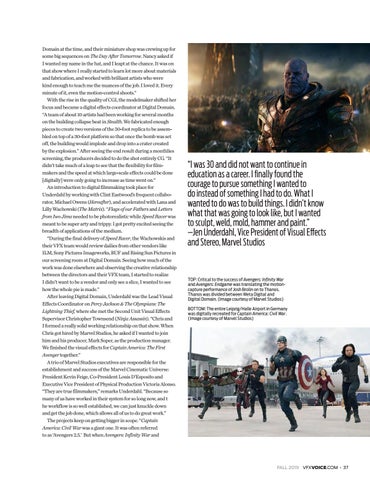
TOP: Critical to the success of Avengers: Infinity War and Avengers: Endgame was translating the motioncapture performance of Josh Brolin on to Thanos. Thanos was divided between Weta Digital and Digital Domain. (Image courtesy of Marvel Studios) BOTTOM: The entire Leipzig/Halle Airport in Germany was digitally recreated for Captain America: Civil War. (Image courtesy of Marvel Studios)
FALL 2019 VFXVOICE.COM • 37