Pressure mounts to de-ICE Williston
BY JASON STARR Observer staff
Those who want to rid Williston of its Immigration and Customs Enforcement (ICE) presence are appealing to town leaders and pressuring a local landlord in a campaign that has crescendoed as ICE’s tactics have gotten more aggressive, and in some instances deadly, in out-of-state operations.
Williston’s White Cap Business Park is home to ICE offices where agents reportedly conduct online surveillance in support of federal immigration detentions and deportations. The building is owned by White Cap

Ventures LLC, which has offices in Burlington. Activists are calling on people to pressure the owner to terminate the lease.
“We need you all to contact the property manager … and demand that he cease collaboration with ICE and cancel the lease!,” one social media post urges, listing the cell phone number of property manager Normand Stanislas.
Neither Stanislas nor White Cap Ventures owner Graham Goldsmith returned messages from the Observer seeking comment.
“Your property is currently being used for research that violates the privacy of communities



across the nation and enables the countless illegal arrests and constitutional rights violations being committed by ICE,” the social media post continues. “Please do the right thing — you do not have to be complicit in ICE’s unlawful operations.”
White Cap Ventures has thus far been unmoved. In fact, it has reacted with increased security and warning signs at the building.
‘I WANT THEM TRESPASSED AND ARRESTED’
Williston is no stranger to immigration policy protests. Activists by the hundreds have
gathered repeatedly on Harvest Lane, where ICE operates another surveillance center out of a non-descript office building.
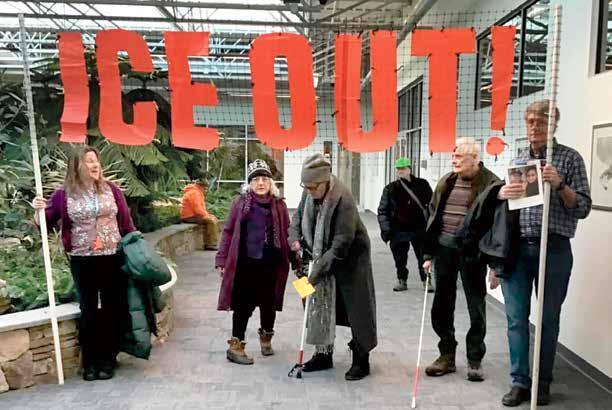
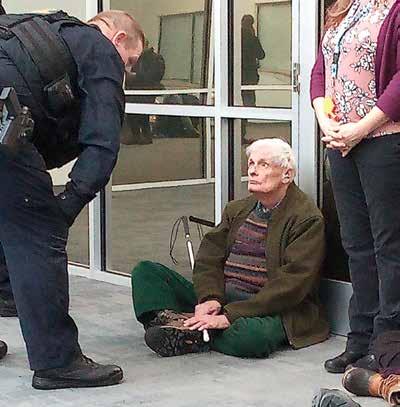
The White Cap Business Park is different, though. There, ICE shares office space with several other businesses, including a café, a doctor’s office, a fitness center and a physical therapy practice. So when protesters showed up in the atrium last Thursday for a four-hour sit-in, blowing whistles every 90 seconds in recognition of people who they said have either died in ICE custody or have been killed by ICE, there was immediate backlash.


An article in the Jan. 22 edition of the Observer headlined “Table set for Town Meeting” mistakenly reported that the town budget proposal for the upcoming fiscal year includes a new part-time administrative assistant and new human resource software. Those expenses were part of an initial draft of the budget in December but were removed during selectboard deliberations in January.




An informational session about the proposed expansion of Williston’s library and concurrent improvements to the Village Green will take place in the Dorothy Alling Memorial Library Community Room this Saturday, Jan. 31 from 1-2 p.m.
Attendees will learn about the proposed project — up for a bond vote on Town Meeting Day — including how it got started, the needs it addresses, the project cost and fundraising efforts to offset $1.5 million of the bond.
Town Manager Erik Wells, Library Director Kevin Unrath, Project Architect John Hemmelgarn and Capital Campaign Committee Chair Karla Karstens will give a short presentation, followed by time for questions. Light refreshments will be served.






Current Homeowner? Ask about our referral program.
PH International, a nonprofit based in Waitsfield, is seeking host families for two exchange programs taking place this year. In May, students from East Asia and the Pacific Islands will visit Vermont. In July, the Youth Ambassadors-Africa program will welcome 95 young people aged 15-18 and adult mentors to visit New York City, Birmingham, Ala., and Vermont.
The Vermont portion of the exchange will be focused on developing a better understanding of participatory democracy. While the students are in the U.S., they will be developing a community action plan that they will implement upon their return to their home communities.
Hosting commitments are typically a week or less in duration. To learn more, visit www. ph-int.org.
The Education and Enrichment for Everyone (EEE) lecture series will resume with a Feb. 13 presentation from government
and public policy experts Frank Reagon and Linda Fowler. Their talk is entitled “Whatever happened to checks and balances in the U.S. government?”
The series continues with weekly Friday presentations through May 1. All events take place from 2-3 p.m. at Faith United Methodist Church, 899 Dorset St., South Burlington and on Zoom.
For a list of future speakers and more information, visit https://eeevermont.org.
The Vermont Electric Co-op is seeking candidates to join its board of directors. The 12-member board represents towns across the co-op’s service territory, with board members each serving four-year terms.
The board seat representing Williston, Bolton, Essex, Hinesburg, Huntington, Jericho, Milton, Richmond, Shelburne, Starksboro, St. George, Underhill and Westford is up for election.
“VEC board members have a broad range of perspectives and enjoy learning about and influencing energy issues,” said Rebecca Towne, VEC’s chief executive officer.
Directors receive a stipend and mileage reimbursement for attending monthly committee and board meetings and have additional training opportunities to learn more about energy issues and the cooperative utility model. The board generally meets in the afternoon on the last Tuesday of each month at VEC’s headquarters in Johnson.
The deadline for candidate applications is March 11. The election opens on April 14, closes on May 7, and results are announced at the Annual Meeting of the Membership on May 9. To apply, visit vermontelectric.coop/about/vecboard-of-directors-election or email lkinney@vermontelectric. coop
Vermont Electric Cooperative is a non-profit, member-owned electric distribution utility that provides electric service to approximately 33,000 members in 75 communities.

A group of Williston actors has been rehearsing for the Lyric Theatre Company’s upcoming production of ‘Frozen.’ Pictured front row (from left to right) are: Emily Nelson, Molly Nelson, McKenna Adams and Jenn Adams; and back row (from left to right) are: Martin Hain, Peter Carlile, Kevin O’Brien, Bill Fidler and Rory Craib. They will join other cast members in presenting shows at the Flynn in Burlington April 9-12. For tickets, visit flynnvt.org or call 802-86-FLYNN.

for pickup Sunday, February 8
EVENT
SATURDAY, JAN. 31
Village Vibrancy Library Project info session. Learn about library expansion proposal on the Town Meeting Day ballot. 1-2 p.m. Dorothy Alling Memorial Library.
MONDAY, FEB. 2
Legislative update. Join Reps. Erin Brady and Angela Arsenault for a community conversation about the current legislative
session. 6-7:30 p.m. Dorothy Alling Memorial Library.
TUESDAY FEB. 3
Williston Selectboard meeting. 7 p.m. Town Hall. Agenda at www.town.williston. vt.us.
TUESDAY FEB. 3
Williston Planning Commission meeting. 7 p.m. Town Hall. Agenda at www. town.williston.vt.us.
THURSDAY, FEB. 5
Williston-Richmond Rotary Club
breakfast meeting. Speakers: Sean Leach and Lesley Adams, Vermont Odyssey of the Mind. 7 a.m. Williston Federated Church. RSVP to rotaryclubofwillistonvt@gmail.com.
Salad:
Vermont Little Leaf Mixed Green Salad with Citrus Vinaigrette. Served with Baguette and Butter
Entree Choice:
10 Ounce Braised Boneless Beef Short Rib with a Red Wine Demi Glaze, Garlic Yukon Gold Mashed Potatoes, Green Beans, Baby Carrots and Roasted Shallot Or…
Boursin Cheese Stuffed Chicken Breast with a Caramelized Sweet Onion Jus, Garlic Yukon Gold Mashed Potatoes, Green Beans and Baby Carrots.
Dessert:
Flourless Chocolate Cake Slice, Two Chocolate Dipped Strawberries and Raspberry Coulis

BY ERIN PETENKO VTDigger
The U.S. Postal Service in Vermont has quietly implemented changes to the way mail is processed that are expected to further slow down the delivery speed of many mail categories for Vermonters.
Vermont is the latest region to join Regional Transportation Optimization, a new strategy that ends evening collection of mail that’s more than 50 miles away from regional mail centers.
Last week, a postal service spokesperson did not answer questions about when the new program was expected to come to Vermont. But on Jan. 16, the postal
service filed data in response to questions from the U.S. Postal Regulatory Commission that shows the program has already been implemented in every zip code in the state.
Regional Transportation Optimization is one part of the Delivering for America plan, a years-long strategy of service cuts and other changes that began in 2021 under former Postmaster Louis DeJoy.
The postal service has said the plan is essential for making its operations efficient and financially self-sustaining. But critics of the program say there’s been a lack of transparency in how the plan could affect the speed and quality




of service throughout the country.
Steve Hutkins, an advocate who runs the Save the Post Office website, said there have been no signs at post offices or other notices to customers letting them know that their mail will be sitting at the back of the post office overnight.
“The Postal Service doesn’t want the public to pay any attention to this change in its transportation policies and the slower service standards (delivery times) that the change is causing,” Hutkins said via email.
Postmarks now could be



applied to mail a day later than customers expected — meaning that a bill payment could be considered past due, or even a mail-in ballot could be disqualified, Hutkins said.
How does Regional Transportation Optimization work?
The closest regional processing center for Vermont isn’t in Vermont. It’s in Springfield, Mass., more than 40 miles from the state border, Hutkins said.
Previously, the postal service would send postal trucks to post offices twice per day — once in the
morning, the other in the evening — to pick up mail and bring it to Springfield, Amy Gibbs, a strategic communications specialist for USPS, said via email. The new plan eliminates that second pickup, meaning that any mail that arrives at the post office after the morning pickup will stay at the post office until the following day.
The postal service has published a map revealing the effect of this change, Hutkins said. For firstclass mail, USPS has shifted many parts of Vermont from a two-day

service standard to a three-day service standard, and it can take up to five days to reach other parts of the country.
There are some exceptions, Hutkins said. Local mail in places close to Vermont’s two Local Processing Centers, located in Burlington and White River Junction, could
“You
Elizabeth Newman Hinesburg
still go to those facilities and be processed more quickly than mail going to Springfield. The postal service proposed closing the two local centers in 2024, but abandoned the plan after political pushback.
The one-day additional delays in local deliveries come as USPS is also redefining the postmark. On Dec. 24, 2025, the postal service changed its rules to clarify that the postmark does not “inherently or necessarily align with the date” that the piece of mail came to the postal service.
One key concern for opponents is how both these changes could combine to affect mail-in ballots, since election officials often

rely on postmarks to determine whether a ballot was received on Election Day. On Jan. 15, 16 U.S. senators sent a letter to USPS expressing fear that this change could mean more mail-in ballots being rejected.
In an email, USPS spokesperson Gibbs said the new postmark system does not “signal a change in postmarking procedures,” but only tries to “improve public understanding of the information postmarks convey.”
Hutkins, a retired New York University professor, began Save the Post Office in 2011 when he learned his local post office was threatened with closure.
How would he describe the last 15 years for the post office?
“It’s been: Things get worse slowly, you adjust to it as things go by, and it all gets slower than it used to be,” he said.
Much of that slowdown has been pinned to former U.S. Postmaster General Louis DeJoy. When DeJoy resigned in February 2025, U.S. Senator Peter Welch issued a statement that said “Good riddance.”
“DeJoy’s restructuring plan has led to unacceptable mail delivery delays across Vermont, especially in rural areas of the state,” Welch said in the statement.
Yet it remains to be seen what next steps the newly appointed Postmaster General David Steiner will take, Hutkins said. Before his appointment, Steiner served on the board of FedEx, one of USPS’s top competitors, for over a decade.


Have these changes had an effect on on-time performance? The postal service’s own dashboard shows hardly any change to the percent of first-class mail, the cheapest category of mail for letters, postcards and envelopes, that has arrived within service standards in the Vermont-New HampshireMaine region. But Hutkins noted that the standards themselves have changed, making it hard to draw conclusions from the limited data available.
For some Vermont communities, staffing levels at the post office appears to be a key reason for delays. Montpelier residents have complained about delayed mail and packages in recent weeks when four postal routes were left vacant by a staffing shortage.
Hutkins said that the overall level of postal workers hasn’t changed much over the years, but retaining part-time workers has been a longstanding challenge. He cited a 2016 USPS report that found the annual
turnover rate for non-career employees was over 40%.
“It’s a really hard job,” he said.
Elizabeth Newman of Hinesburg said that her mail delivery has improved since 2023 and 2024, when she was only getting mail just once a week. But even now, a single mail carrier getting sick seems to lead to all the mail in town coming to a halt.
She said she’s one of many people in town who have switched to paying her bills online whenever she can.
“Regularly, we were having to call our credit card companies, and they hadn’t received stuff or it was delayed,” she said.
Regarding the potential effects of the regional transport and postmark plan, she said it was hard for the average customer to understand because the postal service was like a “black box” of information.
“You can never find out what happened or why,” she said.

BY REP. ERIN BRADY AND REP. ANGELA ARSENAULT
As we write this update, it feels almost strange to be discussing state legislative matters while the emotional, physical and economic damage being done to Americans by the Trump administration is reaching terrifying new heights.
We hear the phrase “uncertainty at the federal level” in countless conversations every day, but that’s hardly accurate anymore. There are, in fact, a few certainties: ICE is targeting communities of color in heavily Democratic cities and states, terrorizing citizens — including young children — and making everyone less safe. We are certain that federal funds are being illegally delayed and withheld as a form of political retribution, harming the most vulnerable Americans. We are certain that several recent federal actions, including the expiration of the Affordable Care Act subsidies, are a massive regressive transfer of wealth from low-income and working families to the wealthiest Americans.
We remain committed to making progress on Vermont’s interrelated affordability challenges, which include the highest healthcare costs in the nation, a dire housing shortage, and unsustainable increases in property taxes due to our education funding system. However, the Legislature must also work to prevent or mitigate the harm caused by the Trump administration. And, just three weeks into the 2026 session, we’ve already begun to do just that.
Last week, in response to dramatic, non-evidence-based changes to federal vaccine guidance, we both voted “yes” on H.545. This bill, which was requested by the Vermont Commissioner of Health, authorizes the Vermont Department of Health to recommend immunization schedules that may vary from those of the Centers for Disease Control and Prevention. It also provides for continued insurance coverage of Vermont-recommended immunizations. The bill now moves over to the Senate, where it will need to be voted on again before reaching the governor’s desk.
Community Newspaper Since 1985
P.O. Box 1401, Williston, VT 05495 | 802-489-5499
ADVERTISING
Rick Cote, Associate Publisher rick@willistonobserver.com 802-373-2136
EDITOR
Jason Starr
editor@willistonobserver.com
PRODUCTION & DESIGN
Jan Kenney
jan@willistonobserver.com
PUBLISHER
Susan T. Cote
susan@willistonobserver.com
BILLING INQUIRIES
Michael McCaffrey
office@willistonobserver.com
ADVERTISING SPACE DEADLINE
Friday at 5 p.m. for the next Thursday issue rick@willistonobserver.com, 802-373-2136
CLASSIFIED ADS
Deadline is Friday 5 p.m. There is a fee for business, real estate, help wanted and legal ads. Free classifieds must be 25 words or fewer and are printed on a space available basis.
SUBMISSIONS & LETTERS
Deadline is Monday noon for Thursday issue. News/ story tips are welcomed. Letters to the Editor should be 300 words or fewer and include your name, address and a daytime phone number so that we can verify the letter’s author.
The Williston Observer reserves the right to edit or refuse submissions or advertising. Opinions expressed in the paper are those of the writer and do not necessarily reflect the opinion of the
The House Health Care Committee is working on another bill that covers ground that would ideally be covered by the federal government — this one in the realm of prescription drug costs. H.577 would enable Vermont to partner with other states through a program called ArrayRx to increase negotiating power with manufacturers, leading to lower drug prices. Anyone with a Vermont address would be eligible to use the ArrayRx multi-state drug discount plan. This discount would be available at no cost to the consumer and reduces the price of most generic medications by 80%, and brand-name drugs by 20%. The program would be administered by the treasurer’s office.
Another issue the Legislature is attempting to address, though with considerable limits to available remedies, is, of course, the actions of ICE in our communities. We’re proud that the Williston selectboard passed a resolution condemning the unconstitutional surveillance and enforcement activities of ICE, and grateful to all the community members who spoke and acted in support of the resolution.
As you may have heard or
read, there are two relevant bills currently being considered by the Senate Judiciary Committee. Both bills were also introduced in the House. S.209 would add government buildings, schools, shelters and health care facilities to the list of locations where a person is not subject to a civil arrest, including for immigration purposes. S.208 proposes to establish minimum identification requirements for all law enforcement officers working in Vermont. Those requirements include wearing a badge with the officer’s name or badge number, and prohibit the wearing of masks or personal disguises while performing the officer’s duties.
It appears likely that these bills will pass the Senate, though there are no guarantees. If they do cross over to our body, House Judiciary (the committee on which Angela serves) will take them up and we would both support their passage.
Shifting gears to education, we were appalled to learn that our school district, CVSD, is being targeted by the federal government in an attempt to sow division and chaos, rather than improve educational opportunities for all students. The Trump administration has opened an investigation
into 18 educational entities across 10 states over Title IX policies related to transgender athletes.
The Vermont Agency of Education and the Vermont Principal’s Association both direct schools to allow students to participate in sports in accordance with the student’s gender identity. We appreciate Superintendent Bunting’s clear response: “It is our job to welcome the identities of all of our students. Growth and belonging are core to any educational organization and we are grateful for each and every student who is in our district.”
This kind of deliberate fear-mongering by the federal government siphons critical time, attention and money away from the real work that Vermont school leaders, the Agency of Education and the Legislature are trying to do: bending the cost curve of education and ensuring that we have a strong, stable public education system that serves all students.
The House and Senate education committees have been taking extensive testimony on the implementation of last year’s sweeping Act 73 and the work of the Task Force on School Redistricting. As see LEGISLATURE page 9
Member:


BY ERIK WELLS Williston Town Manager
Greetings Williston community.
Town Meeting 2026 is coming up in just over a month on March 2-3. Ballots for early voting will be available by mid-February in the Town Clerk’s office. To preview Town Meeting, this message will be a general overview of ballot items up for consideration. Further outreach and information sharing will be taking place over the next month. You can always reach out to me at ewells@willistonvt.org or (802) 876-1168 with any questions.
See you at Town Meeting.
TOWN BUDGET (ARTICLE 5)
The $17 million Fiscal Year 2027 budget for consideration is a 6.75% increase from fiscal year 2026. The proposed budget increase is largely driven by higher personnel costs to maintain essential town services. These costs come in the form of wages and benefits determined primarily by inflation and labor contracts.
Personnel costs are about two-thirds of the entire budget. Other larger expense increases include professional services (like

information technology) and materials.
The overall goal of the town administration and selectboard in developing this budget has been a focus on affordability and maintaining the core services that residents rely on every day, with data-driven service expansion around public safety. It reflects careful planning for growth and long-term financial stability for the town.
During the current fiscal year, two new positions were added to the Fire Department to allow peak staffing shifts to be filled beginning in February. These new shifts are designed using data from several years tracking service demand and overlapping calls. The goal is to have added capacity to address a second emergency call when one occurs instead of relying on mutual aid.
Williston Fire had 2,681 calls for service in calendar year 2025. That represents a 41 percent increase since 2021. A total of 1,802 of last year’s calls (67%) were medical.
In 2025 there were overlapping emergency calls 28% of the time for Williston Fire, an increase from 24% of the time in 2024. These two new positions will be funded using increased ambulance revenue





to reinvest back into service delivery to meet this added demand.
The FY 27 budget proposal includes both positions, which will continue to be funded with ambulance revenue. If these positions are not factored into the overall
The overall goal of … this budget has been a focus on affordability and maintaining the core services that residents rely on every day, with datadriven service expansion around public safety.

budget expense increase, then the budget increase amount is 5.3% compared to FY 26.
The budget proposal includes about $9 million to be raised in municipal property taxes. This is an increase of $570,000 in tax revenue (6.2%). The estimated municipal
property tax rate is a 2.4 cent increase per $100 of assessed property value, or about $24 per $100,000 of assessment. For a median assessed homeowner in Williston ($300,000 home assessment) that is estimated to be a $73 increase for the year, or $6 per month. Municipal property taxes make up about 17% of a property tax bill in town, with the education property tax covering the rest.
For a complete overview of the budget proposal and line by line breakdown, please visit town.williston.vt.us/townmeeting.
The Village Library Vibrancy Project is an investment in Williston’s future. The project ensures our community has the spaces it needs to learn, gather, grow and stay connected for decades to come.
Williston’s population has grown 50% since the last expansion in 1998, and library visits have increased 92% over that time. The project will renovate and expand the Dorothy Alling Memorial Library and transform the Village Green into a more welcoming, safe and vibrant public area for

Because Rice is small, every student benefits from close relationships with teachers. Through her work on the school newspaper, Logan discovered a passion for journalism and helped advocate for the addition of a class to Rice’s course offerings. Recognizing her initiative, one of her teachers nominated her to attend a national journalism and media conference in Washington, DC, which was an exciting and meaningful experience!
Actively enrolling for ‘26-’27 school year, schedule a tour or shadow day online!

bessette@rmhsvt.org
Enough … It’s not acceptable for American citizens to be killed by federal agents for exercising their God-given and constitutional rights to protest their government.
At best, these federal immigration operations are a complete failure of coordination of acceptable public safety and law enforcement practices, training and leadership. At worst, it’s a deliberate federal intimidation and incitement of American citizens that’s resulting in the murder of Americans. Again, enough is enough.
The president should pause these operations, de-escalate the situation, and reset the federal government’s focus on truly criminal illegal immigrants. In the absence of presidential action, Congress and the courts must step up to restore constitutionality.
Gov. Phil Scott

Kevin Conger will be making his second trip to the Special Olympics USA Games, representing Williston and Vermont at the Minneapolis, Minn., event in June.
The CVU graduate first competed in the USA Games as a basketball player with the CVU unified team in 2018, when the event was held in Seattle. This year, Conger was chosen by Special Olympics Vermont to compete in Track and Field.
His marquee events are 100-meter and 200-meter runs, and the long jump.
“It is very exciting to have the opportunity to represent the state in a (sport) that I truly enjoy,” said Conger.
Vermont plans to send a delegation of 31 athletes and coaches, who are currently raising funds for the trip. For Conger, that means using a skill he developed at CVU and has turned into a business.
Built on a lifelong love of gameshows, Conger started Games With Kevin (www. gameswithkevin.org) last year — offering live, interactive presentations of classic gameshows for school groups, senior

centers and summer camps. This year, he’s doing gigs with each of the six schools in the Champlain Valley School District.
“It is very exciting to have the opportunity to represent the state in a (sport) that I truly enjoy.”
Kevin Conger
He also started a fundraising series to support his trip. Once a month through May, he is hosting gameshows at the Shelburne town library with a fundraising goal of $2,000. The first event was held Jan. 18, and the next one is scheduled for Feb. 15. Donations can also be made at https:// www.specialolympicsvermont.org/ usagames.
Jason Starr

With years of experience and a strong focus on preventive care, Dr. Nick Sherman and Dr. Miranda Fritz provide thoughtful, personalized veterinary medicine in Richmond, Vermont.
Richmond Animal Hospital is locally and family owned offering comprehensive care—from routine wellness and preventive services to surgery and all aspects of small-animal health.
We’re thrilled to be part of the community and look forward to meeting you and your pet(s).
appointment.
continued from page 6
we said in December, we will continue to advocate for finding ways to responsibly reduce the cost of education in Vermont, but we will not sacrifice education quality to do it.
We remain open to ideas and even maps, but will hold the line at honoring the work of districts like ours that have followed legislative mandate after legislative mandate, cut dozens of positions over the past two difficult budget years, and continue to do their very best to serve the youngest members of our community in these difficult times. We support the responsible budget
continued from page 7
all.
Voters are asked to consider authorizing up to $13.9 million in bonded debt for the project. The total project estimated cost is $14.45 million, with the selectboard committing $550,000 of funds on hand to be used toward the Village Green part of the scope. A capital fundraising campaign is also underway, and any funds raised will decrease the amount of the bonded debt to undertake.
This project is the result of three years of community driven planning, extensive public input, and professional design. It directly responds to what nearly 1,000 Williston residents told town officials: Keep the library in the village, expand it to meet our needs, and make the Village Green more usable and connected.
To view the project design and complete scope, watch an overview video and learn more about the “why” behind the project, please visit our website,
the CVSD board has worked hard to create this year.
As Erin said in committee last week, “The reason maps and this entire education conversation is so hard is because they’re not just about school districts, this is really about the entire future state of Vermont.”
We support regional approaches to education (a similar strategy is being used in the health care sector) that respect Vermont’s rural geography, community identity and limited statewide capacity for major structural change. We are excited about the possibility that comprehensive regional high schools can bring to all Vermont students. More schools like CVU, that operate at scale, can offer advanced coursework,
willistonlibraryproject.org.
This article asks to establish a reserve fund to be used for emergency medical training for Fire Department staff at the advanced and paramedic levels, along with community medicine. Think of this as a savings account for this sole purpose, and funds that are designated to it stay in the fund until they are used. This article doesn’t commit any initial funds to the reserve, it creates it.
The article asks to assess a half cent tax on the grand list with the funds raised to be deposited into the town’s Environmental Reserve Fund. It is estimated that about $110,000 would be raised through this tax levy.
The town had this ballot question at Town Meeting 2025, and it was approved. Extra cents on the property tax levy for a specific use must be approved annually.
The selectboard has placed this question for consideration again in 2026. The fund
world languages, technical education, mental health services and extracurricular opportunities, especially in small or rural districts that cannot sustainably provide these offerings alone.
Unfortunately, Gov. Scott’s budget does not allocate any funding for educational facilities. This is concerning since the reconfiguration and consolidation of some schools around the state is absolutely critical for achieving scale and improving student outcomes. Some new schools will necessarily be a part of any successful transformation.
We feel the heaviness of these times. We know that Vermonters are struggling to afford everyday essentials and remain
is utilized to conserve and protect open land in Williston. Since its inception in 1990, the town has conserved over 3,000 acres — about 16% of the total land area.
Voters are asked to consider amendments to the Town Charter to eliminate the
hopeful against the backdrop of federal chaos and cruelty. As we navigate an intense legislative session, we’re encouraged by the growing activism in our community and grassroots efforts to support one another. We are hosting a legislative update and community conversation on Monday, Feb. 2 at the Dorothy Alling Memorial Library from 6-7:30 pm. Hope to see you there. Please reach out anytime (erin.brady@ vtleg.gov; angela.arsenault@vtleg.gov) with your questions, concerns or ideas.
Erin Brady and Angela Arsenault represent Williston in the Vermont House of Representatives.
Office of Elected Lister and instead have the Town Assessor perform all the duties of the listers defined under state statute.
The current elected listers are supportive of this proposed change. Educational requirements and complexity of property appeals have increased in recent years, making this model the recommended structure moving forward.




While federal incentives have sunset, installing residential solar panels can still make sense for a household budget — and the environment.

BY REED PARKER Williston Energy Committee
As the end of 2025 slipped away, so did the lucrative 30% federal income tax credits from which homeowners could benefit if they installed a solar panel system on their home. Homeowners are now faced with making the decision to go solar based on their individual ability to purchase a system and their personal belief that it is the right thing to do.
So, what are the solar panel options for homeowners in 2026?
Let’s first look at the cost of
installing a solar system using a zero dollar down, 3% low interest 20-year loan. Using the U.S. Department of Energy “SunShot” solar estimator, we modeled a home in Williston with a $150 per month electric bill, a shingled roof and excellent exposure to the sun.
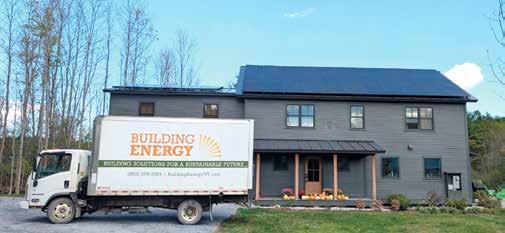
“SunShot” calculated the home would require a 19-panel, 7.6-kilowatt system with a cost, after any incentives, ranging from $16,000 to $20,000. The loan cost would be between $91 and $110 per month, and the new system would reduce the electric bill to $17 per month (a $133 reduction). Including a modest 3% utility inflation factor, the homeowner would see an almost $20,000 savings over the 25-year lifetime of the system. While not as good as having the previous potential 30% income tax credits, it is well worth looking into.
There is an additional benefit of solar for households that have electric vehicles and/or battery storage. Combining solar generation with battery storage can enable the homeowner to charge a vehicle and possibly reduce the


peak electric load for a heat pump or hot water system. (It’s important to note that, for this article, we did not contact any local solar contractors, and costs need to be verified for your home before proceeding).
While individual tax credits for solar power installations have vanished, the July 2025 federal tax bill retained them for solar leasing. This resulted in another solar option for homeowners named “Solar as a Service” (SaaS). Using the SaaS model, the homeowner obtains the cost savings of using solar without any upfront cost or loan payment, as the solar installation company retains ownership of the solar panels. As reported by the New York Times in its Dec. 9 “Climate Forward” newsletter, SaaS is a growing option for U.S. homeowners led by the California based company SunRun.
Using the SunRun model, the company leases the product to the homeowner at a fixed price (lease payment), which includes the panels, installation and ongoing maintenance. The SaaS model



The director of the Saint Michael’s Leahy Institute for the Environment, Kristyn Achilich, discusses environment and community
BY JENNA WILBUR Community News Service
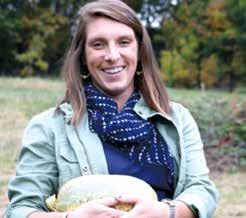
When you enter Saint Michael’s Leahy Institute for the Environment, the first thing you notice is the table just inside the doorway: baskets of produce, mason jars of flowers, tinned hand salves and a refrigerator stocked with vegetables, all offered on a help-yourself system.
Beyond it, tall windows frame the teaching gardens, shelves hold nature-based learning materials and pictures of the Winooski River line the walls.
It’s a space rooted in the local landscape, which is exactly how the director of the institute Kristyn Achilich, approaches her work.
“We know we’re connected to, and thereby hold a responsibility for, the

watershed,” she often tells her students.
Her work spans farming, ecological restoration, sustainability, and education to support the needs of families and learners in Winooski and beyond. She recently sat down for a Q&A.
Q: When you think about the Winooski River and the surrounding watershed, what role do you see it playing in the community’s identity or daily life?
A: Our ecosystem, our rivers and our mountains very much shape our lives. Some of us moved here and feel a responsibility to do well by the land. Generational Vermonters grew up on the land, the land raised them. It’s a different mentality around land ownership and land stewardship, but the call is the same.
The original settlers of Winooski, the Abenaki, help us understand the relationship of the people to the land. Onion City is a descriptor given to this place by the people who walked the land every day.
Ramps, a type of wild onion, only grow in mixed hardwood forest areas
along river banks. Winooski was originally wild with onions. Environmental and social events depleted them, but if you know where to look and how to harvest responsibly, you can still find them.
We have a food forest at St. Mike’s developed and stewarded by students. We hope this one small installation gets us a few steps closer to a reciprocal relationship with our native elders and community.
Ecologically diverse fields, meadows and forest mean better river health, healthier invertebrates and fish. City planners can embrace these methods or dedicate dollars to staffing positions with these skills. Dam removal has been hugely successful at restoring downstream health in the U.S.
Q: How can environmental education, especially hands-on learning, help people feel more connected to the environment and their local communities?
A: The engagement of students working in their community is a developmentally appropriate pedagogy. Agriculture becomes not the outcome but the tool to engage folks, repair land we’re using as our classroom and make intergenerational connections. That’s how we raised communities 80 years ago, in a community of care.
When you work the land shoulder-to-shoulder with students, those connections stay. It feels really natural, like what I need to do. Here’s hoping we can
see WINOOSKI page 13




Rebates and financial support for home weatherization and purchases of efficient heating systems and appliances in 2026 have been announced by Efficiency Vermont.
“Improving your home’s energy efficiency in 2026 is an investment that will pay off for years to come,” said Peter Walke, Efficiency Vermont’s managing director. “It’ll pay off literally with lower energy bills, with improved comfort and with lower emissions thanks to more deliberate energy use. And by lowering demand, it supports a more affordable electricity system for everyone connected to our shared grid.”
Incentives and solutions that can help Vermonters achieve energy savings include:
Free resources to prioritize energy investments. Understand
continued from page 10
has allowed SunRun to add about 30,000 installations in the U.S. in each of the last two quarters
current offers or diagnose high bills by calling Efficiency Vermont’s energy advisors. You can also schedule a free Virtual Home Energy Visit with an Efficiency Vermont energy expert to get personalized advice and a list of next steps toward your goals.
Up to 90% cash back on weatherization projects. Air sealing and insulating your home lowers energy bills, makes a home more comfortable year-round, and improves indoor air quality. Weatherization also makes it easier to embrace clean technologies like heat pumps. Increased weatherization incentives are only available through the end of 2026 or while funding lasts.
Rebates for heating systems that work for your household. Save up to $475 on a ductless
of 2025.

“mini split” heat pump, or save up to $2,200 on a ducted heat pump. Or opt for advanced wood heating with a wood or pellet stove (and a $400 rebate), or get $6,000 off central wood heating systems.
Save up to $1,000 on water heaters that use heat pump technology. Get a $600 discount when you upgrade to a heat pump water heater, bringing the efficiency and savings of a heat pump to the hot water needed in your kitchen, bathroom and laundry room. Income-eligible households can get an additional $400 back.
Create a healthy home with appliance rebates. Control your home’s temperature and save on energy bills with up to $100 cash back on a smart thermostat. Or manage moisture in your home with up to $90 off a dehumidifier. You can also get up
In a Nov. 9 article, SolarTech (Solartechonline.com) compared several options for solar, noting that SaaS contracts can run from 10-20 years with potential consumer savings of 5% to 20% when compared to utility bills. SolarTech went on to report that, globally, use of the SaaS model “reached $4.2 billion in 2024 and is projected to exceed $12.8 billion by 2030.” Their article noted that SaaS installations are currently growing annually at a rate of 25% to 35%, driven by the European and Asia-Pacific markets.
It will be interesting to see if the SaaS model takes off in
to $400 off a heat pump clothes dryer or washer/heat pump dryer combo unit. If you’re already planning for summer, get up to $150 off a window AC unit.
Businesses can save on energy investments, too. Businesses can get up to $25,000 in additional funding for custom projects or take advantage of increased incentives for pre-approved LED lighting projects. These incentives are only available for projects completed by November 2026.
Low-income households may qualify for additional support, including a voucher for up to $1,200 for replacing one eligible household appliance (like a refrigerator, freezer or clothes washer). Additional offers include free weatherization through the state’s Weatherization Assistance
Vermont.
Programs, and free efficient products like LED light bulbs and water-saving devices.
Vermont lenders can also help you achieve your energy goals with financing that removes up-front costs for home energy projects. Low-interest home energy loans offer up to $25,000 for home energy upgrades, with 0% interest for income-qualified borrowers. Or you can pay off a project on your utility bill using the Weatherization Repayment Assistance Program.
Additional rebates may also be available from your electric or gas utility.
For more information and to contact Efficiency Vermont for advice and details on rebates and other programs, visit efficiencyvermont.com or call (888) 921-5990.
A surviving feature of the federal “Solar for All” legislation is the Affordable Community Renewable Energy (ACRE) program, which is being endorsed by several Vermont utilities. Funding from ACRE enables a utility to develop a community solar array that will benefit income-qualified residents who would not have been financially able to install their own solar panel system. If you are interested in this program, please contact your electric utility company.
While we don’t know what electricity will cost in the future, we can be almost certain that the costs will rise. Actions by the Vermont Public Utility Commission, through its biennial review of solar net-metering rates, may affect costs in the future. We certainly believe that the U.S. solar market will continue to thrive despite the loss of individual tax incentives, and we hope that SaaS or programs like ACRE will become a common option for consumers.
As a result, the use of solar will continue to benefit homeowners by enabling them to make use of the power of the sun.
To participate in Williston’s energy future, reach out to your Williston Energy Committee at energy@willistonvt.org or attend a public meeting held on the second and fourth Wednesday of each month.
The agenda for upcoming meetings is posted on the Town of Williston website (www. town.williston.vt.us). For more information, visit https://www. willistonvtenergycommittee.org.
continue to educate and share resources with our immediate community and mobilize students to support our community.
Several years ago, we partnered with the DREAM program. We connected with families and educators in the Winooski School District. Students visited our farm, learned about farming in this climate, performed reciprocal service, built social capital, and took food home. They shared their cultures with our St. Mike’s students. They’ve visited on several occasions since.
Q: For an average person who wants to get involved in local sustainability, where is a good place to start?

A: I recommend the local schools. They’re community epicenters. City Market, the Intervale Center, and the Vermont Community Garden Network have volunteer programs. By going to these places and washing squash, you get exposed to the world, but you also get membership hours to increase your discount at the co-op; it’s a circular economy type of thing. But really, one question will lead to another.
Talk to people. Talk to the vendor at the farmers market or the clerk at the grocery store. Churches, community centers, the YMCA — there are so many

intersection points. You just have to take initiative, go there and do the thing. Be the connector and learn by doing.
Wilbur is a senior studying Environmental Studies with a minor







CLOCKWISE (l to r): Chittenden Charge goalie Maddie Roy shrugs off a Bellow Falls Academy (BFA) shot during the Charge’s 5-0 win against the Comets on Jan. 14 at Cairns Arena. The Chittenden Charge is a combination of players from CVU, MMU, and South Burlington. Outside of the goal, Maeve Gilbert tangles with BFA’s Marley Johnson; Leah Schut works behind the goal against BFA’s Emma Caster; Hadia Ahmed gets off a shot; and Devin Taylor looks for a shooting lane in front of BFA’s Haylie Lanfear.
OBSERVER






CLOCKWISE (l to r): CVU’s Luke Bouyea begins his match with MMU’s Owen Bouchett at 144 lbs. during the Redhawks’ 54-30 win over the Cougars on Jan. 21 in Hinesburg. CVU’s Jameson Wilhite-Keene takes the “up” position at a restart with MMU’s Sammitt Hintze at 150 lbs. CVU’s Luke Helmer ties up MMU’s Tolkien Lawlor at 106 lbs. CVU’s Isaac Helak clashes with MMU’s Grayson Hebert at 190 lbs. CVU’s Jasmeet Badwal gets out of position against MMU’s Noah Bouchett at 175 lbs. CVU’s Liam Moller gets the advantage over MMU’s Channing Girard at 113 lbs.



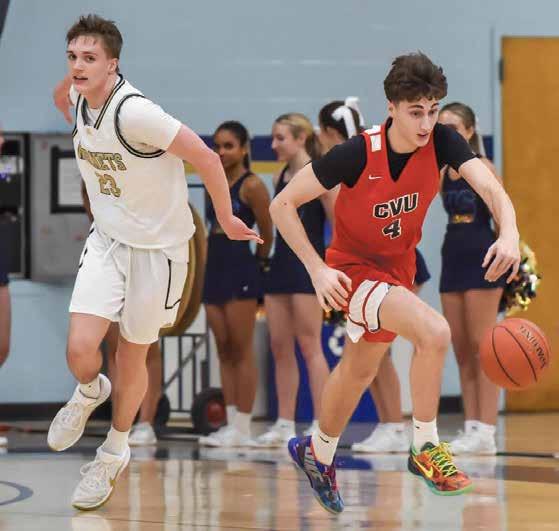
TOP (l to r): CVU’s Brady Gangl looks to start a fast break during the Redhawks’ 41-32 win over the Hornets Jan. 23 in Essex. Adrian Paliling puts up a scoop shot against Essex’s Sam Bent.
B OTTOM (l to r): CVU’s Connor Dubois puts up a shot over Essex’s Evander Mosley. CVU’s Prodige Bikule gets past Essex’s Sam Bent for a reverse layup. Tyler Simons makes his foul shots.





Dorothy Alling Memorial Library hours:
• Monday and Wednesday: 9 a.m.-7 p.m.
• Tuesday, Thursday, Friday: 9 a.m.-6 p.m.
• Saturday: 10 a.m.- 3 p.m.
Visit www.damlvt.org to register for programs. Need help? Call 878-4918 or email daml@damlvt.org.
Children in fourth grade and younger must be supervised by someone over 16 years of age.
STORYTIME
Tuesdays, Feb. 3 and 10. Drop in for stories, songs and fun.


BABY TIME
Wednesday, Feb. 4, 10:30-11
a.m. Suggested ages 0-18 months. Enjoy gentle literacy, bonding and socializing activities.
AFTER SCHOOL GAMES & PUZZLES
Wednesday, Feb. 4, 2-3 p.m. Relax with games or puzzles after school.
MUSIC AND PLAYTIME
Thursdays, Feb. 5 and 12, 10:30-11:30 a.m. Drop in for music and stay to play.
SATURDAY STORYTIME
Saturday, Feb. 7, 10:30-11
a.m. Start your weekend off with Cindy’s storytime.
AFTER SCHOOL MOVIE
Wednesday, Feb. 11, 2-3:35 p.m. Rated G. Go the distance in this classic-Greek-myth-meetsDisney epic.
LIBRARY VILLAGE VIBRANCY
PROJECT OPEN HOUSE
Saturday, Jan. 31, 1-2 p.m. Join Town Manager Erik Wells, Library Director Kevin Unrath, Project



Architect John Hemmelgarn and Capital Campaign Committee Chair Karla Karstens to learn about the proposed Library Village Vibrancy project, including the genesis of the project, the needs it addresses and the project cost and financing. Light refreshments served.
READ TO A CAT (TROOPER)
Monday, Feb. 9, 3-4 p.m. Call to sign up for a 10-minute session to read to (or hang out with) Trooper the therapy cat.
READ TO A DOG (ROCKO)
Thursday, Feb. 12, 3-4 p.m. Call to sign up for a 10-minute session to read to (or hang out with) Rocko the therapy dog.
For online programs or to join a book club, email daml@damlvt.org.
ADULT WINTER BOOK BINGO
From Jan. 2 to Feb. 20, stop in at the front desk and get a book bingo card or download one at www.damlvt.org. Read your way to bingo, fill out the card, and bring it back to be eligible for some fun prizes.




TEA CLUB: MILKY OOLONG
Each month we will highlight a true tea (made with tea leaves) and provide a sample, a description of the tea’s history, and instructions on brewing and tasting.
LOVE AT FIRST SENTENCE
Feb. 1-14. Don’t judge a book by its cover! Come see our display of wrapped books with just the first lines revealed and a few clues to the book. Take home this “blind date” and see if you’ve found your match.
SEATED TAI CHI WITH ADINA (ONLINE)
Thursdays, 1-2 p.m. Learn Tai Chi done entirely in a seated posture and do it from your own home. Email daml@damlvt.org for more information or to sign up for the class link.
ADULT MEDITATION (ONLINE)
Friday, Jan. 30 and Feb. 6, 12-12:30 p.m. Join our guided meditation to relax and re-center.
ADULT CRAFTERNOON: ROSE MILK BATH BOMBS
Tuesday, Feb. 3, 2-3 p.m.
Make this luxurious little treat for yourself or a loved one.
SPANISH CONVERSATION (ONLINE)
Wednesday, Feb. 4, 5-6 p.m. All skill levels welcome.
MAH-JONGG
Friday, Feb. 6, 1-3 p.m. All skill levels welcome.
LET’S TALK ABOUT IT
Saturday, Feb. 7, 12-1 p.m. Join this group to discuss topics that may include community events, current events, hobbies, etc. This group meets monthly every first Saturday.
LIFE STORIES (ONLINE)
Wednesday, Feb. 11, 2-3:30 p.m. Storytelling is a fun way to connect with people. Join our online group.
PAINT AND SIP CRAFTEREVENING: VALENTINE’S DAY CARDS
Wednesday, Feb. 11, 6-7 p.m. For those who can’t make it to our Crafternoons, come to our evening casual craft. Watercolors and ideas available for Valentine’s Day cards.








Nebraska, a midwestern state, was the 37th state admitted to the Union, on March 1, 1867. On its eastern edge, Nebraska is mostly bordered by the Missouri River.

Native American tribes, including the Omaha, Ponca, Pawnee and Sioux, lived in the area for thousands of years. Europeans traded with the native people through the 1700s, and in the mid-1800s, the United States established the Nebraska Territory, which included parts of what is now Colorado, North Dakota, South Dakota, Wyoming and Montana.
Later, Native Americans were forced to give up their land and move to reservations, opening up the region for American settlement.
When African Americans started moving north in the late 1800s, Nebraska offered jobs in railroads, meat-packing and other industries. Since then, it has been a center for civil rights activism.
Farming is important to the state, with people raising beef, pork, wheat, corn (maize), soybeans and sorghum. Many large companies are also headquartered in Nebraska, including

Cabela’s, Union Pacific Railroad and insurance company Mutual of Omaha.
Nebraska is the only state that has a unicameral legislature, which means it has just one house. Legislators are called senators, and they are officially nonpartisan. In other words, when they run for office, they have no party affiliation with Democrats or Republicans.
Nebraska is known as the Cornhusker State. The University of Nebraska Cornhuskers football team has a loyal fan base, with Memorial Stadium selling out all its 85,000 seats for every game since 1962.
Nebraskans also love to explore the state’s natural wonders, such as the Sandhills, a large area of sand dunes in north-central Nebraska.
Others enjoy canoeing on the rivers

crossing the state or visiting Chimney Rock, a landmark that weary travelers watched for as they navigated the Oregon and Mormon Trails. When they sighted this sandstone hill, they knew they were about halfway through their 2,000-mile journey.
Words that remind us of Nebraska are hidden in this puzzle. Some words are hidden backward or diagonally, and some letters are used twice. See if you can find:

Next Week: Counting the birds
• William Cody, or Buffalo Bill, started his famous Wild West Show near his home in North Platte. Experts believe this was the first true rodeo in America.

He got his nickname because he was so skilled at hunting buffalo. He also rode for the Pony Express, drove horses for wagon trains and later helped found Cody, Wyoming.

• Red Cloud was the chief of the Oglala Lakota (Sioux) tribe that followed the buffalo across the Great Plains. He won important treaties protecting his people’s land. He later became an important diplomat from the Lakota to the U.S. government. Unfortunately, the U.S. later broke many of their treaties. This proud leader died on a reservation.
• Kool-Aid was invented by Edwin Perkins in 1927 in Hastings. He changed his soft drink syrup, Fruit Smack, into a powder to make it easier to ship. Today, Kool-Aid is Nebraska’s state soft drink.
Nelson: What rank did the ear of corn reach in the Army? Nancy: Kernel!



Niles: What does a baby corn call his dad? Nina: Pop-corn!

people raising beef, pork, wheat, corn (maize), soybeans and sorghum. Many large companies are also headquartered in Nebraska, including
they knew they were about halfway through their 2,000-mile journey.
Words that remind us of Nebraska are hidden in this puzzle. Some words are hidden backward or diagonally, and some letters are used twice. See if you can find:
ACTIVISM, BUFFALO BILL, CHIMNEY, CORNHUSKER, FARM, FOOTBALL, KOOLAID, LINCOLN, MIDWEST, NEBRASKA, NONPARTISAN, OMAHA, RED CLOUD, RESERVATION, SANDHILLS, SIOUX, UNICAMERAL.
Nebraska Corn Casserole
You’ll need:
• 1 (15-ounce) can of corn, drained
• 1 cup cheddar cheese, grated
• 1 cup milk
• 3 tablespoons all-purpose flour
What to do:
• 1 1/2 cups breadcrumbs
• 2 eggs, beaten
1. Combine all ingredients in a large bowl. Mix well.
2. Pour into a greased 9-by-9-inch casserole dish.


3. Bake in a preheated 425-degree oven for 30 to 40 minutes. Serves 4 .
Use the letters in the boxes to make a word with the same meaning as the clue. The numbers in parentheses represent the number of letters in the solution. Each letter combination can be used only once, but all letter combinations will be necessary to complete the puzzle.
1. it turns the light on (6)
2. make clean and shiny (6)
3. “Youth” singer Shawn (6)
4. shocked (9)
5. what a dog wags (4)
6. bad news at the dentist (6)
7. crime solver (9)

At the library:
Nelson: What rank did the ear of corn reach in the Army? Nancy: Kernel!
Niles: What does a baby corn call his dad? Nina: Pop-corn!

A new study finds that the giant seaweed bloom stretching across the Atlantic Ocean near the equator has surged in mass to about 42 million tons, a 40% jump from 2022, while a centuries-old sargassum patch farther north is rapidly shrinking. Researchers say shifting climate conditions are driving the change, with warming seas, Amazon River floods, African dust and wildfire smoke acting as fertilizers. The expanding Great Atlantic Sargassum Belt continues to foul beaches in the Caribbean, Mexico and parts of Florida. Meanwhile, the northern Sargasso Sea patch has declined since 2015, as marine heat waves push water temperatures too high for healthy growth.
Look in your local newspaper for news about farmers in Nebraska.




By Jim Miller
Dear Savvy Senior,
What treatments are recommended to help with tinnitus? I started noticing a subtle ringing in my ears about 10 years ago, but it’s gotten much more bothersome since I turned 60.
Ringing Ronnie
Dear Ronnie,
Tinnitus is actually one of the most common health conditions in the country. According to the National Institute on Deafness and Other Communication Disorders, around 10 percent of the U.S. adult population over 25 million Americans experience some form of tinnitus.
For most people, tinnitus is merely annoying, but roughly 5 million people struggle with chronic tinnitus and 2 million find it debilitating.
While there’s no cure, there are a range of different strategies you can employ to reduce the symptoms to make it less bothersome. Here’s what you should know.
WHAT IS TINNITUS?
Tinnitus (pronounced TIN-a-tus
or tin-NIGHT-us) is the sensation of hearing a ringing, buzzing, roaring, hissing or whistling sound in one or both ears when no external sound is present.
The sounds, which can vary in pitch and loudness, are usually worse when background noise is low, so you may be more aware of it at night when you’re trying to fall asleep in a quiet room.
Tinnitus itself is not a disease, but rather a symptom of some other underlying health condition. The best way to find out what’s causing your tinnitus is to see an audiologist, or an otolaryngologist a doctor who specializes in ear, nose and throat diseases (commonly called an ENT). The various things that can cause tinnitus are:
Hearing loss, which is the most common cause.
Middle ear obstructions usually caused by a build-up of earwax deep in the ear canal.
Side effects of many different prescription and over-the-counter medicines like aspirin, ibuprofen, certain blood pressure medicines and diuretics, some antidepressants, cancer medicines and antibiotics.
Various medical conditions such as high blood pressure, vascular disease, diabetes, allergies, thyroid problems, ear or sinus infections, Meniere’s disease, Lyme disease, fibromyalgia, otosclerosis, temporomandibular joint


(TMJ) disorder, a tumor, an injury to the head or neck, traumatic brain injury, depression, stress and more.
TREATMENT STRATEGIES
There are many ways to treat tinnitus, depending on the cause. For example, if your tinnitus is caused by a wax build-up in your ears or a medical condition like high blood pressure or a thyroid problem, treating the problem may reduce or eliminate the noise.
Or, if you’re taking a medication that’s causing the problem, switching to a different drug or lowering the dosage may provide some relief. If you have hearing loss, getting a hearing aid can help mask your tinnitus by improving your ability to hear actual sounds.
Another strategy that can help suppress or mask the sound so it’s less bothersome is “sound therapy.” This can be as simple as a fan or white noise machine, or you can use sound therapy apps like ReSound Tinnitus Relief, myNoise or NatureSpace.
Cognitive behavioral therapy and psychological counseling can also be helpful, as can tinnitus retraining therapy (TNT). This combines counseling and sound therapy to train your brain to ignore the sound in your ears. The new MindEar app offers TNT.
There are even new innovations like the FDA-approved device Lenire (lenire.com) that uses electrical stimulation of the tongue to alleviate symptoms.
There are also certain medications that may help. While there are no FDA approved drugs specifically designed to treat tinnitus, some anti-anxiety drugs and anti-depressants have been effective in relieving symptoms.
Your audiologist or ENT can help you figure out the best treatment options.
Another thing you can do to help quiet the noise is to avoid things that can aggravate the problem like fatty foods, salt, artificial sweeteners, sugar, alcohol, tonic water, tobacco and caffeine. Also be sure to drink plenty of water as dehydration can worsen symptoms. And protect yourself from loud noises by wearing earplugs.
Send your questions or comments to questions@savvysenior.org, or to Savvy Senior, P.O. Box 5443, Norman, OK 73070.

BY DEBORAH J. BENOIT Special to the Observer
It’s that time of year — seed packet displays are appearing everywhere, from grocery stores to farm and garden supply centers. Garden catalogs are arriving in our mailboxes, featuring common and exotic vegetable and flower seeds. There’s so much temptation.
If you’re a gardener, or want to be one, you likely already have a collection of seed packets from previous years. Before you purchase new seeds, take the time to go through your collection and determine which are likely still usable and which you’ll want to replace.
Seeds contain everything needed to produce a new plant. As they age, their viability — how likely a seed is to germinate — lessens. How old is too old depends on the type of seed and the conditions under which they’ve been stored.
Check your seed packets for a “packed for” date. That’s the year the seeds were intended to be planted. Seeds purchased this year will be dated for 2026, but that doesn’t mean any leftover seeds at the end of the season should be disposed of. Most seeds are viable for an additional year or two, some more, depending on the type of seed.
Just as important, perhaps more so, is how seeds are stored. The best way to store seeds is in a cool, dark and dry location. A sealed glass jar or metal storage container will keep out moisture and help keep seeds safe from mice and other hungry rodents. Temperatures around 40 degrees are optimal for storage. If you choose to store seeds in the refrigerator, be sure to keep them
in an airtight container to avoid humidity.
Testing the viability of seeds is easy to do. You’ll need around 10 seeds, a half sheet of paper towel and a sealable plastic bag. Wet the paper towel thoroughly, then ring out excess moisture. Lay it on a flat surface. Place the seeds in a line about an inch away from the long edge of the paper towel. Fold the paper towel over the seeds, and fold it over again to enclose the seeds. Place the folded paper towel in the plastic bag and seal it. Make a note on the bag of the date the test began, the type of seed and the expected date for germination. The anticipated number of days to germination can be found on the seed packet. Add that number to the start date to get the expected germination date. Place the plastic bag in a warm place (such as the top of the refrigerator). Check the bag every few days to be sure the paper towel hasn’t dried out. On or after the expected germination date, carefully open the folded paper towel to check how many seeds have germinated. If less than half, consider purchasing new seed.
If you’re ready to plant, seeds that have germinated can be transferred to a seed starting tray. There’s no need to remove the paper if the sprouted seed is attached to it. Just carefully cut around the seed and gently plant the paper with the sprouted seed.
Deborah Benoit is a UVM Extension Master Gardener who volunteers as a garden columnist and participates in Bennington County Extension Master Gardener Chapter activities.


TODAY’S HISTORY:
• In 1861, Kansas was admitted as the 34th U.S. state.
• In 1891, Queen Liliuokalani inherited the throne from her brother, Kalakaua, becoming the last monarch of the Hawaiian Islands.
• In 2002, President George W. Bush described Iran, Iraq and North Korea as part of an “axis of evil” in his State of the Union address.
• In 2009, then-Illinois Gov. Rod Blagojevich was convicted on charges of corruption and removed from office in an impeachment trial before the Illinois Senate.
TODAY’S FACT:
• Edgar Allan Poe’s famous poem “The Raven” was first published in the New York Evening Mirror on this day in 1845.




















RABIES BAIT
continued from page 2
tive effort between Vermont and the U.S. Department of Agriculture Wildlife Services to stop the spread of the potentially fatal disease.
RABIES BAIT
continued from page 2

brain that infects mammals. It is most often seen in raccoons, skunks, foxes, and bats, but unvaccinated pets and livestock can also get rabies. The virus is spread through the bite of an infected animal or contact with its
The week-long bait drop is a cooperative effort between Vermont and the U.S. Department of Agriculture Wildlife Services to stop the spread of the potentially fatal disease.
saliva. If left untreated, rabies is almost always fatal in humans and animals. However, treatment with the rabies vaccine is nearly 100 percent effective when given soon after a person is bitten by a rabid animal.
So far this year, 23 animals in Vermont have tested positive for rabies, and 14 of those have been raccoons.

According to wildlife officials, rabid animals often show a change in their normal behavior, but you cannot tell whether an animal has rabies simply by looking at it. People should not touch or pick up wild animals or strays – even baby animals.
saliva. If left untreated, rabies is almost always fatal in humans and animals. However, treatment with the rabies vaccine is nearly 100 percent effective when given soon after a person is bitten by a rabid animal.
SHELBURNE DAY continued from page 4
tuktu.us/become-a-tuktu
Shelburne Historical Society will have a display and president Dorothea Penar will lead a cemetery tour at 1 p.m. Food vendors round out the event with everything from coffee and lemonade to burgers and creemees. Kids will enjoy meeting animals from Shelburne Farms, craft projects, and
SHELBURNE DAY
face Towards burne-Hinesburg head the Golf depending land.
Rotary’s

So far this year, 23 animals in Vermont have tested positive for rabies, and 14 of those have been raccoons.
Rabies is a deadly viral disease of the brain that infects mammals. It is most often seen in raccoons, skunks, foxes, and bats, but unvaccinated pets and livestock can also get rabies. The virus is spread through the bite of an infected animal or contact with its

According to wildlife officials, rabid animals often show a change in their normal behavior, but you cannot tell whether an animal has rabies simply by looking at it. People should not touch or pick up wild animals or strays – even baby animals.





continued from page 4 face Towards burne-Hinesburg head the Golf depending land.
Shelburne Historical Society will have a display and president Dorothea Penar will lead a cemetery tour at 1 p.m. Food vendors round out the event with everything from coffee and lemonade to burgers and creemees. Kids will enjoy meeting animals from Shelburne Farms, craft projects, and


Rotary’s

“They were blowing their whistles so loud that they were plugging their own ears,” Katie Bushey, owner of Simply Divine Café, said. “They were scaring off my customers. They scared everyone in the building.”
Bushey said she was forced to close the café early that day.
“Everyone has freedom of speech, but there’s a way to protest and be nice about it, and there’s a way to be extremely obnoxious and not care about the local businesses that you are affecting,” she said.
Stanislas, the property manager, called Williston Police to the scene. But according to Officer Audrey Currier’s report from the incident, he was unsatisfied with their hands-off response.
“I want them trespassed and arrested,” he told police, according to the report.
“At one point, Stanislas alluded to wanting to go start physically removing people himself,” the police report states. “He was advised that he would be subject to arrest for assault if he began putting his hands on people.
“Several building tenants advised that their patrons were either scared of the protest or that it disturbed their workday.”
Police attempted to de-escalate the situation, asking the protesters to stop blowing whistles and move their demonstration outside. They also called the State’s Attorney’s office and were advised that the protesters’

actions are Constitutionally protected, and they could not be lawfully arrested.
Stanislas said he planned to meet with the State’s Attorney, the Governor and the Williston Town Manager, according to police. An account of the protest from the organizing group — the Vermont chapter of the national protest group 50501 Movement — said that protesters “continued to exercise their right to protest with banners and singing until around 4:30 p.m. when they left the office park of their own accord.”
Protesters read a statement during the protest that said, in part: “The disturbance caused by our presence here is only a tiny fraction of the life-changing disruption that ICE visits on black and brown communities every day … With this nonviolent protest, we hope to prevent future
violence from ICE and help fellow Vermonters find the resolve needed to stand up for each other.
“The Town of Williston expresses its formal opposition to ICE activities within Williston and Vermont …” Williston Selectboard
“White Cap Business Park, we demand that you find your courage, cancel the lease with ICE, and prioritize the rights and safety of your neighbors above your own profit and comfort.”
In the days since the protest, new signs have been posted

around the property noting that the building is privately owned and is for the use of tenants, customers and guests. Other “activities or gatherings” are prohibited, as is the use of photography, video or audio recording, signs say. Bushey, the café owner, said employees in the business park are now being more vigilant about who enters the building.
“There’s been a plan put in place for everyone’s safety.” Bushey said. “The rules are changing.”
Meanwhile, White Cap Ventures has an application pending with the Williston Development Review Board to expand the business park. Jacque Larose, an engineer working on the expansion for White Cap Ventures, said of the expansion: “The leading use would be public administration.”
Two days before the White Cap protest, another group of activists entered Williston Town Hall to speak during a regular Tuesday meeting of the Williston Selectboard. They had come from a larger protest earlier that afternoon with hundreds of people outside ICE’s Harvest Lane office.
They urged the selectboard to adopt a resolution condemning ICE’s surveillance and enforcement practices, while acknowledging the agency’s presence in town.
“The Town of Williston expresses its formal opposition to ICE activities within Williston and Vermont,” the resolution states, affirming the town as a “safe and welcoming community for all individuals …”
The resolution was written by Christine Hallquist, a former Democratic candidate for governor, according to a report in VTDigger. The resolution goes on to state that ICE’s online and artificial intelligence-enhanced surveillance “threatens the Constitutional First Amendment rights of Vermonters, and anyone residing within the U.S. to engage in political dissent and peaceful protest.”
The selectboard passed the resolution unanimously and plans to sign it during its Feb. 3 meeting, according to Town Manager Erik Wells.
Blaine Paxton was part of the group urging the board to pass the resolution. His involvement in the issue began back in October, when he first contacted White Cap Business Park owner Graham Goldsmith.
“My hope was that he would be willing to discuss a possible negotiated solution to cancelling the lease with ICE,” Paxton said.
While Goldsmith did not return his calls, Stanislas, the property manager, did.
“He stated that ICE has a longterm lease at White Cap and that the terms of the lease would make it difficult to cancel,” Paxton said.

Ownership of the Harvest Lane ICE office changed hands last year from Burlington’s Pizzagalli Properties to a Washington D.C. company, Easterly Government Properties, Inc., that specializes in leasing property to government agencies.
50501 Movement is planning more anti-ICE protests for this Saturday, Jan. 31, in part, it said, as a response to the killings earlier this month of Alex Pretti and Renee Good in Minnesota.