Williston
ECRWSS PRSRT STD US Postage
PAID
Permit #15 Williston,VT 05495 POSTAL CUSTOMER
DECEMBER 23, 2025
WILLISTON’S NEWSPAPER SINCE 1985
Fresh ideas for Old Creamery Road
Residents offer solutions to speeding, pedestrian safety BY JASON STARR Observer staff
Old Creamery Road residents came out in force Dec. 2 with concerns about speeding and pedestrian safety to inform a new Chittenden County Regional Planning Commission traffic study. A roughly 2-mile connector between Route 2A and Oak Hill Road, Old Creamery provides a cut-through for a variety of destinations around Williston, Hinesburg and South Burlington. It’s also a rural neighborhood with residents who are finding it increasingly scary to walk and bike along the road. The speed limit is posted at
35 mph, but “(drivers) do whatever they want because it’s a long, straight, nicely paved road,” said Peter Brooks, who lives on nearby Sunset Hill Road. Brooks was one of more than a dozen residents who spoke Dec. 2 at Town Hall, when the Williston Selectboard hosted engineers from the Chittenden County Regional Planning Commission (CCRPC) to kick off the study. An online survey garnered about 70 responses, project manager Nicole Fox said. “There are a good number of residential neighborhoods that feed onto Old Creamery Road, which creates potential conflicts between the folks who want to be out and about in their neighborhood and folks who are using it to get from Oak Hiill Road to Route 2A and back as sort of a bypass of I-89,” Fox said.
Resident Tim Walker said he often feels unsafe simply pulling mail out of his mailbox on the side of the road. “They fly down there and have almost hit me half a dozen times,” he said. “They are going to work in the morning and coming home in the afternoon, and they don’t care about Old Creamery Road. They have other things on their mind.” Shirley Fortier has lived on the road since before it was paved and has seen traffic and driving speed increase over the years. Currently, about 3,200 cars travel the road daily, according to CCRPC engineers. Fortier noted that a reactive speed sign police occasionally place on the road that tells drivers how fast they are going can
Principal Katherine Riley gave an assessment of the policy last Tuesday during a meeting of the Champlain Valley School Board. Administrators put the policy into place at the start of this school year after a series of board deliberations on the subject last year. The policy bans student cellphone use in all classrooms, study halls, hallways, the library and the cafeteria. Previously, phones use was governed on a teacher-by-teacher basis, and allowed in all common spaces. “It’s improved the classroom
environment in the ways we were hoping it would,” Riley said. “It’s much easier to build relationships without the phone policing that had been going on.” Students being phone-free has also eliminated daytime incidents of digital harassment in the form of social media posts, unkind memes and screenshot shares, she said. “Those are still happening, but (students) are not seeing it throughout the day,” she said. Riley polled the roughly 30 members of the student council, and found a level of frustration,
see CREAMERY page 3
WWW.WILLISTONOBSERVER.COM
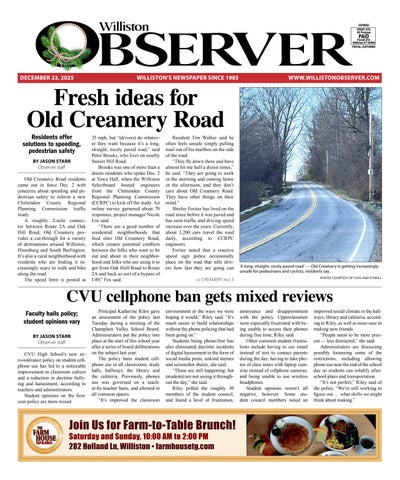
‘A long, straight, nicely paved road’ — Old Creamery is getting increasingly unsafe for pedestrians and cyclists, residents say. PHOTO COURTESY OF FUSS AND O’NEILL
CVU cellphone ban gets mixed reviews
Faculty hails policy; student opinions vary BY JASON STARR Observer staff CVU High School’s new zero-tolerance policy on student cellphone use has led to a noticeable improvement in classroom culture and a reduction in daytime bullying and harassment, according to teachers and administrators. Student opinions on the firstyear policy are more mixed.
Join Us for Farm-to-Table Brunch! Saturday and Sunday, 10:00 AM to 2:00 PM 282 Holland Ln, Williston • farmhousetg.com
annoyance and disappointment with the policy. Upperclassmen were especially frustrated with being unable to access their phones during free time, Riley said. Other common student frustrations include having to use email instead of text to contact parents during the day; having to take photos of class notes with laptop cameras instead of cellphone cameras; and being unable to use wireless headphones. Student opinions weren’t all negative, however. Some student council members noted an
improved social climate in the hallways, library and cafeteria, according to Riley, as well as more ease in making new friends. “People seem to be more present — less distracted,” she said. Administrators are discussing possibly loosening some of the restrictions, including allowing phone use near the end of the school day so students can solidify afterschool plans and transportation. “It’s not perfect,” Riley said of the policy. “We’re still working to figure out … what shifts we might think about making.”
Page 2 •
Williston Observer • December 23, 2025
Dangerous Characters
Chapter 1: Homicide and Revenge: A Neighbor’s View of Sally, Delia, and Charlie EDITOR’S NOTE: The following is excerpted from local historian Elizabeth A. Allen’s new book “Dangerous Characters: The Life and Crimes of Williston’s Notorious Outlaw Duo.” The book is available at www.lulu.com/ shop. BY ELIZABETH A. ALLEN On August 26, 1865, fourteen-year-old Laura was thinking about apples. She and her father Chauncey Brownell, a justice of the peace, exited their farmhouse in Sucker Hollow, Williston, Vermont. They were going to check on the Fameuses and Northern Spies in the family apple orchards. Laura knew that the small, sweet Fameuses would make excellent eating when ripe, whether raw, cooked, or pressed into cider. The Northern Spies— harder, crunchy, and more tart— were better for desserts. A peculiar person hurried toward Laura and her father. About five feet tall and in her late sixties, the woman was physically robust and strong despite her small size. She wore a rag carpet as an apron. A man’s broad-brimmed straw hat, drawn down close over her head, concealed her face. Forgetting about apples, Laura perked up. Despite the woman’s attempt to hide her identity, Laura recognized her immediately as Sally Griswold, a local legend.
About fifteen years before, Sally and her husband Ephraim caught what was then known as “the gold excitement.” Their adopted daughter Delia, Sally’s niece, shared their enthusiasm. After all, she was Sally and Ephraim’s legal heir and thus entitled upon their deaths to any wealth they might acquire. After Delia married Charlie Potter in 1849, Sally and Ephraim sailed south, crossed the Isthmus of Panama by rail, and then sailed north. Landing in California, Sally and Ephraim established themselves in El Dorado County and set to work making money. Back east in Williston, Delia and Charlie hoped that Delia’s parents would find a fortune. Sally dug for gold herself, but she did not gain her wealth from mining. While Ephraim mined, she ran a public house, serving food and alcoholic drinks to the richest prospectors. In fact, even after Ephraim came back to Williston by 1853, Sally stayed in California, cooking, earning, and, most of all, saving. Laura glanced eastward. On a parallel road nearby, in a lordly position atop Juniper Hill, sat
the mansion that the Griswolds had built around 1856 with their Californian funds. It was the showplace of the region, a two-story house in the Greek Revival style with red brick veneers. White pillars and green blinds highlighted the imposing facade. The front doorbell, a novelty in an area where even door knockers were sparse, attracted further attention. Sally welcomed callers inside to see her silver plate, mahogany furniture, Brussels carpets, and second-story ballroom.
Or at least Sally had formerly welcomed callers. As time passed, she seemed to take less pride in her fine possessions. She had closed off her richly draped rooms. She avoided her dining room and ate in the kitchen. Laura suspected that the change had to do with Delia and, more specifically, her husband Charlie. He was an untrustworthy, mean-spirited scoundrel. The two had an unhappy marriage. Delia, Charlie, and their two children had moved into Sally and Ephraim’s splendid house earlier that year in the spring. Charlie was supposed to help with farmwork and Delia with housework. Things had not gone as planned. Now Sally was speaking to Laura’s father. Unnoticed, Laura listened in. Sally talked about how her property had been tricked away. Money had been stolen. Sally had protested, and she had been literally beaten down in response. Who could have intimidated such a formidable woman? Laura was baffled. Despite Laura’s shock, her father remained calm. He was known around town for his good judgment. He listened to Sally, comforting her and giving her advice.
A Community Celebration for All Art | Music | Joy
BRUNCH
SATURDAY-SUNDAY 9 A.M.-1 P.M.
DINNER WED-THU 5-8 FRI-SAT 5-9 SUN 4-8
1840 West Main Street Richmond 802.434.8686
BURGERS ARE BACK!
December 31
Downtown Burlington 12pm–12:30am
Tickets on Sale Now HIGHLIGHTBTV.ORG
$18 / $20 day of Kids 5 & under FREE
THURSDAYS ONLY $5 DRAFT SPECIALS
Vermont Comfort Food and Drink — kitchentablevt.com/menu
Sally cut her visit short, saying that she had sneaked away from her farm. At this admission, Laura’s father looked worried. Laura, however, felt sure that all would go well if her father’s counsel was followed. The next morning, Laura descended the stairs for 7:00 a.m. breakfast. A Sucker Hollow neighbor rushed in. “Why—what’s the matter, Jerome?” asked Laura’s father. “You seem in a hurry.” “I’d guess you’d be in a hurry,” replied Jerome, “if you knew your neighbors was killed and dead and lyin’ in their own blood!” He blurted out the few details that he knew. He had gone over to help Sally milk the cows and seen her corpse in the calf shed. Later that day, Laura crept away to see the aftermath for herself. Without asking permission, she ran up the mile-long hill to the Griswold place, slipped into the kitchen, and listened to the subdued talk indoors and out. She inspected the wooden fastener that held the Griswolds’ back door closed. The catch had been whittled down, and she had heard people say that the modified catch indicated that Sally’s killing was done by someone familiar with her and the house. Laura peeked into the calf shed where Jerome had discovered Sally’s body. Though the corpse was gone when Laura looked in, the dark red bloodstains remained, discoloring the straw in the calf pen. Charlie went on trial for Sally’s murder. The jury acquitted him, but Laura always thought he had something to do with it. Months after his acquittal, Charlie stopped Laura and her father in their buggy. He set his foot on the wheel, preventing Laura and her father from driving on. Laura stared in silent horror at Charlie, the first real villain she had ever seen. Charlie, who had never forgiven Laura’s father for charging him with murder, berated Brownell, blaming him for his misfortunes. The subject of Sally’s killing came up. “Still, you know, Charlie—that whittled catch looked bad,” Laura’s father pointed out. “It showed ’twas an see DANGEROUS page 6
December 23, 2025
•
Williston Observer •
Page 3
Gov. Scott pitches $75 million property tax buydown
Creamery
continued from page 1
backfire. “Some (drivers) treat it as a challenge,” she said. “They want to see how high it will go.” Angela Arsenault said she is a daily walker along Old Creamery Road, and asked engineers to consider road-widening to better accommodate pedestrians and bikers. “There is no shoulder. There is nowhere to go if you are a walker or a cyclist,” she said. “A little widening would be nice.” Other ideas to improve the situation included: speed bumps, choke points that force cars to slow down and a lowering of the speed limit. “I don’t see a solution to this except significant changes to the actual road surface — traffic-calming measures where you force cars to navigate around an obstacle,” Brooks said. “That really makes a big difference, and I think we really need those on Old Creamery Road.” The CCRPC team, along with its engineering contractor Williston-based Fuss and O’Neill, plan to return to Town Hall in February for a presentation of upgrade options. The public will have a chance during that meeting to comment on the different ideas presented, Town Manager Erik Wells said.
BY ETHAN WEINSTEIN VTDigger Gov. Phil Scott’s administration wants to use $75 million to dampen next year’s projected 12 percent average property tax increase. The funds — unused and rolled over from this year’s state budget — could cut the average projected spike by more than a third. “We have a large education funding challenge, which is the governor’s top priority this year,” Adam Greshin, commissioner of the Vermont Department of Finance and Management, told lawmakers in the House Appropriations Committee on Tuesday. Buying down property taxes — which pay for public education in Vermont — has become the norm in Montpelier in recent years. Last year, lawmakers and Gov. Scott allocated more than $100 million to keep the average property tax bill nearly flat. Even with the annual cash injections, average education property taxes have risen more than 40 percent across the state in the last five years, according to the Vermont Tax Department Critics of spending one-time money warn the practice only delays confronting
Building homes, changing lives in Northwest Vermont.
the problems at hand, like the ever-growing costs of education and health insurance, preventing structural changes. About half of next year’s projected 12 percent average property tax increase comes from an expected jump in school spending, though districts are still in the process of formulating their budgets for the 2026-27 school year. The other half of the looming spike is the result of last year’s buydown — the use of one-time money that leaves the state in a relative fiscal hole this year. At his weekly press conference Wednesday, Scott called the $75 million proposal “just step one,” though he would not say specifically how his team might propose limiting property tax increases further. Scott’s proposal will require legislative approval. Lawmakers return to Montpelier in the beginning of January. How lawmakers will handle the expected property tax increase likely depends on the fate of Act 73, the law passed last year that sets in motion generational change to how education in Vermont is governed and funded. The biggest changes proposed in the legislation depend on lawmakers creating new, consolidated school districts this coming legislative session, a daunting task
with an uncertain fate. Scott, House Speaker Jill Krowinski (D-Burlington) and Senate President Pro Tempore Phil Baruth (D/P-Chittenden Central), all of whom supported Act 73, have said in recent weeks that lawmakers must follow through with the education reforms initiated by the new law. Whether they all agree on putting onetime money toward property taxes isn’t yet clear. In a statement Wednesday, Krowinski said a property tax buydown “carries real risk.” “I have deep concerns that without structural changes, we’re simply putting a Band-Aid on a much larger problem and setting ourselves up for greater pain down the road,” she added. “I am committed to finding ways to lower the tax burden for Vermonters this year, but I believe it must be a part of a broader, long-term strategy that helps provide our students with a quality education at a cost Vermonters can afford.” Baruth declined to comment on the administration’s buydown plan, saying he hadn’t yet had time to review it. — Shaun Robinson contributed reporting.
104 Robin Hood Dr., Swanton 528 Essex Rd/Route2A, Williston 414 Route 7, Milton vermonthabitat.org @greenmountainhabitat
will your house be bursting at the seams after the upcoming holidays? Every item donated and sold at our three ReStores goes directly towards building more affordable homes in northwest Vermont. Please think of us when you are wanting to make more room in your basement, closets, or garage after the holidays. FREE pick-up available!
Locations in Swanton, Williston, and Milton!
Shop local. Help local.
Consider Rice for High School Now enrolling for the ‘26-’27 school year. Take a tour or schedule a Shadow Day and find:
• Excellent Academic Programs
• Competitive Sports Teams
• Homework & Accountability
• Clubs, Art & Music Programs
• Small Classes (avg. 16 students)
• Strong Community, Faith-based Values
• Calm, Structured Environment
• Over $850k in Financial Aid!
Find out about our upcoming events for prospective families
bessette@rmhsvt.org 802-862-6521x2246 rmhsvt.org
Page 4 •
Williston Observer • December 23, 2025
THINKING SUSTAINABLY • ACTING RESPONSIBLY
GREEN
A new solar power option on the horizon BY REED PARKER Williston Energy Committee Here comes the sun. The winter solstice has just passed, and the sun is beginning its long trek north. As each day becomes longer, the sun will bring us additional light and warmth and enable more generation of electricity through solar panels. As you look around, you’ll see hundreds of solar panels on roof tops and on ground mounted installations. Due to technical improvements, cost reductions and tax incentives, solar power installations in Vermont have grown to over 10,000, generating enough power for the equivalent of 76,000 homes (22.5 percent of the state’s 335,000 homes). Locally, many apartment buildings, hotels and commercial properties have solar panels, helping reduce the electric requirements for running these properties. With these successes
in place, let’s look at a promising new option for future solar power production. First introduced in Europe about 10 years ago, plug-in solar (also known as “porch solar” or “balcony solar”) has boomed to about one million installations. Led by Germany’s “balkonkraftwerk” (“balcony power plant”) trend, small solar panels are installed on the balcony and porch railings of apartments and homes, generating electricity for residents across Europe. In addition to Germany, the Netherlands, France, Italy and Spain are seeing significant adoption of plug-in solar technology. Adoption in the U.S. is limited currently, with only Utah having legislation in place to allow for installation of plug-in solar. HOW IT WORKS
A homeowner installs a plug-in solar energy kit outside his home in Houston.
Plug-in solar panels use the same technology as traditional home solar panels, in which electricity is generated when
PHOTO BY DAVID J. PHILLIP/ASSOCIATED PRESS
sunlight hits silicon cells in the panel, creating direct current (DC). The DC electricity then runs through a microinverter and is converted into alternating current (AC), which we use in our homes and businesses. The primary difference from rooftop solar is that plug-in solar devices are physically much smaller, generate less electricity, don’t require special wiring to connect to your home and are designed for the homeowner to install as a do-it-yourself project. Due to their lower output capacity, plug-in solar panels are often installed in strings of two to four units with a maximum capacity of about 1,200 watts. This amount of electricity will not power your entire home or apartment. A typical 400watt system might generate between 1.2 and 1.8 kilowatt-hours (kWh) per day, according to Liam Cope of EngineeringFix. com, depending on local sun hours and
weather, which could offset the electric requirements for a typical refrigerator. Getting the electricity from a plug-in solar system to your home requires a power cord and an outlet. What we commonly refer to as a 110V outlet in our homes becomes the point of input for the electricity generated by the plug-in solar system. A standard heavy duty 110V power cord runs from the micro-inverter to your outlet allowing the electricity to flow seamlessly into the grid. Once connected, you are now reducing the amount of electricity you need from your utility. SAFETY – A CRITICAL CONSIDERATION
Whenever you are dealing with electricity, safety is an absolute must. While plug-in solar components can be cobbled together by a homeowner, it is critical that anyone considering installing this type of see SOLAR page 5
Brand new state-of-the art facility! ACCEPTING
NEW
PATIENTS!!! 426 Industrial Ave. Suite 132, Williston LOCALLY OWNED • VETERAN OWNED
DR. WILL DOWLING, DMD
Request appointment at 802dental.com or call 802-266-1515
December 23, 2025
•
Williston Observer •
Page 5
SPORTS
Redhawks rise above Wolves
CVU’s Jameson Yandow, left, cuts towards the South Burlington goal during the Redhawks’ 4-3 overtime win over the Wolves on Wednesday at Cairns Arena. CVU’s Owen Daley, right, tangles with South Burlington’s Drew Phillips, in gray, behind the cage. Above, CVU’s Brady Jones wins the draw from South Burlington’s Trey Smith. OBSERVER PHOTOS BY AL FREY
Charge jolt Highlanders The Chittenden Charge celebrate a goal during their 8-2 win over the Highlanders on Saturday at Cairns Arena. Below, Cadence Tessier makes a pass from behind the Harwood net.
Order Online for Pickup or Delivery
OBSERVER PHOTOS BY AL FREY
The Kismet Building • 373 Blair Park Road • Suite 101 • Williston
Solar
continued from page 4
system consider a complete system that has been certified by Underwriters Laboratory and is available from a reputable dealer. This would include the solar panels, rack mounting system, micro-inverter, power cord and most importantly, an anti-backflow device that detects when the electricity level drops or shuts off in your home. This last safety component prohibits your electricity from flowing backward through the meter to the outside power lines. Without this, any utility line repair person or electrician working on your home could be seriously injured or even killed.
PAYBACK ON YOUR INVESTMENT
Payback time depends on several factors, including equipment cost, capacity and ability to generate electricity (sunlight, shade, cloud cover, utility rates etc.). Initial estimates are that a DIY installed plug-in solar system will be paid back in about five years through the production of electricity by the system. REGULATIONS — VERMONT NOT QUITE READY
All states, including Vermont, regulate how a person may connect a solar installation to the electric grid. As we noted above, Utah is currently the only state that has a law in place that allows for a resident to install plug-in solar. Several states, including Vermont, New Hampshire, Pennsylvania and New York,
are considering similar laws. In Vermont, the proposed legislation for the 2026 session is being sponsored by Sen. Anne Watson (D/P-Washington) and Rep. Kathleen James (D-Bennington). Contact these legislators for details. Plug-in solar is an exciting technology that will help Vermonters inch forward toward a greener environment. But, with legislation still pending to allow plug-in solar installation, we caution you to please hold off on buying a system from any retailer at this time. To participate in Williston’s energy future, reach out to your Williston Energy Committee at energy@ willistonvt.org or attend a public meeting held on the second and fourth Wednesday of each month. The agenda for upcoming meetings is posted on the Town of Williston website (www.town.williston.vt.us). For more information, visit: https:// www.willistonvtenergycommittee.org.
Comprehensive Dentistry Quality Care for Your Entire Family
Gentle, Expert Dental Care for your Beautiful Smile ACCEPTING NEW PATIENTS Emergencies seen promptly. We now contract with all major dental insurances.
165 Dorset Street South Burlington, VT
802-860-3368
www.dorsetstreetdental.com
Page 6 •
Williston Observer • December 23, 2025
Dangerous
GUEST COLUMN
continued from page 2
UVM steps up for in-state students BY SEN. BERNIE SANDERS In the wealthiest country in history, the United States should have the best educational system in the world. We don’t. Sadly, we are falling further and further behind in terms of how we educate our young people — from childcare to graduate school. One unfortunate example: The U.S. used to lead the world in the percentage of adults with a college degree. Today, we are in 11th place behind countries like Japan, South Korea, Canada, the United Kingdom and Switzerland. In a highly globalized economy, that is not a prescription for a strong American future. It is a prescription for failure. Today, many hundreds of thousands of bright young people who wish to go to college never get the chance — not because they are unqualified, but because they cannot afford the outrageous cost of higher education. That is why I am encouraged to see efforts across our state to help working class Vermonters access a tuition-free college education. For
decades, the Community College of Vermont and our state college system have opened doors for Vermont students, regardless of income, to continue their education. The good news is that the University of Vermont is now joining that effort through its UVM Promise program.
Vermont students from families earning less than $100,000 a year can attend UVM tuitionfree. When it launched in 2022, UVM Promise covered tuition and fees for admitted students from Vermont families earning up to $60,000 a year — ensuring working class students would not be burdened with a lifetime of debt. Now, UVM has expanded the program to include students from families earning up to $100,000 a year, without requiring
any additional paperwork. Let me repeat: Vermont students from families earning less than $100,000 a year can attend UVM tuition-free (visit www.uvm. edu /st udentf inancialser vices/ uvm-promise). Because UVM does not consider a student’s financial status during admissions, Vermont students do not have to worry that their family income will be held against them. It has long been my view that it is absurd, cruel and counter-productive to the best interests of our country to saddle young people with a lifetime of student loan debt as the “reward” for getting a college education. That is why I have introduced the College for All Act, which would eliminate undergraduate tuition and fees at public colleges and universities for 95 percent of students in America. This legislation would also triple investments in work-study and
www.willistonobserver.com P.O. Box 1401, Williston, VT 05495 | 802-489-5499
EDITOR Jason Starr editor@willistonobserver.com PRODUCTION & DESIGN Jan Kenney jan@willistonobserver.com
ADVERTISING SPACE DEADLINE Friday at 5 p.m. for the next Thursday issue rick@willistonobserver.com, 802-373-2136 CLASSIFIED ADS Deadline is Friday 5 p.m. There is a fee for business, real estate, help wanted and legal ads. Free classifieds must be 25 words or fewer and are printed on a space available basis.
PUBLISHER Susan T. Cote susan@willistonobserver.com
SUBMISSIONS & LETTERS Deadline is Monday noon for Thursday issue. News/ story tips are welcomed. Letters to the Editor should be 300 words or fewer and include your name, address and a daytime phone number so that we can verify the letter’s author.
BILLING INQUIRIES Michael McCaffrey office@willistonobserver.com
The Williston Observer reserves the right to edit or refuse submissions or advertising. Opinions expressed in the paper are those of the writer and do not necessarily reflect the opinion of the paper.
A publication of Twin Ponds Publishing LLC
Member:
BANG
Burlington Area Newspaper Group
Bernie Sanders represents Vermont in the United States Senate.
Merry Christmas!
Williston’s Community Newspaper Since 1985
ADVERTISING Rick Cote, Associate Publisher rick@willistonobserver.com 802-373-2136
allow student aid to cover essential expenses like room and board, food, transportation and more. To be clear, there are many excellent professions open for people who do not wish to go to college — jobs we desperately need, jobs that cannot be outsourced and jobs where workers can earn very decent incomes. But the reality is that many careers do require a college degree. And any young person who wants to pursue those careers should be able to do so, regardless of how much money their parents have. The University of Vermont is moving in exactly the right direction. I hope more colleges and universities across America will follow its lead.
HOME
HEART
802-471-2586
inside job.” Charlie froze, glowering. Then he dropped his foot from the buggy wheel with a bang and stalked off. Relaxing, Laura and her father rode on. Charlie apparently retaliated against the Brownells for Laura’s father’s words. A man from the nearby Foster place arrived with sad news the next day. The Brownells’ two Morgan horses, Ethan Allen and Black Betsey, were dead. “Must ’a’ been poisoned,” said the man. “There they lay in their stalls stiff!” Laura’s father instantly suspected the culprit: Charlie Potter. Even though the Morgan horses had been the family’s pride and joy, Laura’s father pursued no legal action. He hated lawsuits. His daughter’s memory was more bitter, however. Laura always remembered that Charlie had allegedly poisoned Ethan Allen, a noble beast that she had loved. In her mind, Charlie Potter was a coward, a scoundrel, and a killer. She suspected that Delia was not much better.
MAY YOUR HOLIDAYS BE FILLED WITH WARMTH, LAUGHTER, AND UNFORGETTABLE MEMORIES WITH LOVED ONES.
HAPPINESS bit.ly/selling-made-easy
December 23, 2025
•
Williston Observer •
Page 7
LETTERS TO THE EDITOR Turf trouble First, and importantly, we register our thanks to Eli LesserGoldsmith, his Healthy Living family and the group of investors Eli is putting together to build an artificial playing surface field at CVU ($5.5 million). Secondly, please join me and the Hinesburg Conservation Commission in asking the Champlain Valley School Board to abandon the turf project. The Hinesburg Conservation Commission cites many health and environmental hazards due to chemical toxicity to the Hinesburg area, and specifically to groundwater used as a drinking source. I agree. I have heard significant testimony about the dangers of these chemicals during my 20 years in the Legislature. Water quality was my “committee of jurisdiction” in the Vermont House, along with other environmental issues. I add an additional and significant concern regarding artificial turf fields: We must be concerned with the athletes’ health while using these surfaces. There is significant evidence that artificial turf increases the incidences of broken bones, skin abrasions leading to infections, inhalation of tiny rubber particles with micro plastics and torn ligaments and tendons. Concussion incidences also tend to be greater while falling on artificial turf than on well managed real grass turf. Many professional and collegiate venues have torn out their artificial surfaces and reverted to well managed grass turf fields. Perhaps we can look forward to Eli and his well meaning consortium installing a well constructed healthy field for our community athletes to enjoy. I know healthy and better is their heart-felt goal! Jim McCullough Williston
Socialize health care I am writing concerning my present situation with healthcare. I am 70 years young, and I am a retired physician assistant. I practiced medicine for 41 years. In those years I have seen medical practice go from a respected, patient-oriented profession to one run by businesses whose overriding concern is profits. Many physicians are dropping out of healthcare because they are demoralized by the amount of paperwork
required by medical insurance companies. Now, my Medicare supplement plans have dried up here in Vermont. Prior to 2026, I paid for my Medicare, and supplements did not cost me extra. I am now forced to pay over $2,400 per year for coverage that does not even include eye care, dental or hearing benefits. Up from 0.5 percent to 6.4 percent of my fixed annual income. This is obviously due to United Health and Vermont Blue’s inability to make what to them is a satisfactory profit. It is well known that the United States is the only industrialized nation on earth that allows medical insurance companies to make a profit (read “The Healing of America” by T.R. Reid). These companies made a record profit of $74 billion dollars in the U.S. in 2024! Imagine what our healthcare system would become if these profits were returned to the patients in need of care. I have heard many times from doctors I have worked with over the years that “socialism doesn’t work”. I’m certain that this attitude is based on the fact that doctors would not make the annual income that they now receive. Doctors around the world get by with less annual incomes than in the U.S. And guess what? Public schools, V.A. Health and Medicare are all government funded and are relatively efficient socialist systems. Every organization has its problems but nowhere else in the civilized world do citizens go without free basic health care. Additionally, if catastrophic illness occurs, people do not go broke spending all their savings in perpetuity. We need to wake up as a country and force our elected officials to stop bowing down to the multibillion dollar medical insurance lobby in Washington. Only then will we be able to revamp our health system so that everybody will receive the care they deserve as taxpayers and citizens of the United States. Gerry Ortego Williston
Valuing new Americans Deportations from New England are up tenfold in 2025. Do we really believe that all of these 10,000 immigrants (and more) posed a threat to national security and our local safety? The President of the U.S. calls an entire nationality “garbage.” He
blames all Afghans for the horrific act of one individual. He would have us believe that our neighbors are bad people, that they are here to go on welfare, deal drugs, commit crimes and destroy the sense of (white) “America.” History shows how this can play out — pogroms, ethnic cleansing, even genocide. That is not the America we know and love. Many of us know our Somali and Afghan neighbors to be hardworking folks committed to raising their families in a country of peace and fairness. Let’s stand by these new Americans and remind our local, state and federal officials that we value these newcomers’ humanity, and their presence here in our communities. Bruce Wyatt Williston
An education on school reform In his recent column (“Highlighting success and seeking partnership” Dec. 11), Champlain Valley School District Superintendent Adam Bunting countered National Assessment of Educational Progress (NAEP) data showing Vermont’s educational decline with data that show that district student performance on certain metrics is exceptional when compared to statewide averages. However, he doesn’t address concern about Vermont’s “highest staffing ratio in the country — 3.4 to 1. Also, while believing that “education should transcend politics,” he attributes some of the decline in statewide student performance to the change from “a commissioner to a secretary of education”. Notable by its absence in his column is mention of the Picus Odden report and its evidence-based findings. Commissioned by the Legislature in June 2024, this report was released by the Joint Fiscal Office four months later. Its Executive Summary states that Vermont spends roughly $400 million more than necessary and that, if staffing ratios and school district scale were based on its model, student performance could be improved. It is this report and its recommendations that inform the narratives of Gov. Scott and the well-intentioned legislators disparaged in Bunting’s letter. Until we transcend the self-interested politics and special interests that have stymied efforts to
transform the delivery of education in Vermont, we will continue to see inefficient spending and school budget defeats, all to the detriment of too many Vermont students. While we can applaud CVSD for being better than average, we must strive to give all Vermont students optimal educational opportunities. It is time we support our legislators and the administration in transforming Vermont education with Act 73. Robert Finn Shelburne
Affirming genderaffirming care On Thursday, the U.S. Department of Health & Human Services proposed rule changes to Medicare and Medicaid that seek to eliminate access to medically necessary care for transgender youth. One of these rules, if allowed to go into effect, would prohibit hospitals receiving Medicare and Medicaid funds from providing gender-affirming care to patients under 18, while the other would stop the flow of federal Medicaid funds to cover that same care. But let’s be clear: It is still legal to provide this necessary health care to trans youth in Vermont. Moreover, Vermont’s responsibility to provide access to affordable health care for all kids does not change based on federal Medicare and Medicaid rules. The Trump administration knows it does not have
the power to single-handedly ban gender-affirming care for youth, so it is targeting critical funding instead. With these proposed rules, the Trump administration is trying to threaten health care access for everyone unless providers abandon trans youth. That’s not governance — it’s extortion. These are still just proposals — not official policy — and they are now subject to a public comment period. Vermonters can and should raise their voices against this administration’s latest bullying tactic. We’re working with Vermont lawmakers and community stakeholders to develop creative and compassionate solutions that ensure this life-saving care remains available and affordable to all who need it. Our state has taken great strides to ensure that all Vermonters have the freedom to determine their own life course and can access the health care services they need. Trans youth are no exception. We have seen hundreds of unlawful federal actions challenged in court, many of which are paused before they take effect and are ultimately struck down. Vermont institutions must continue to heed their obligations under state and federal law. When faced with questionable executive actions like this, Vermonters expect their leaders to resist pre-emptive compliance and respond with solutions aligned with our values and consistent with our rights and liberties. Monica Allard ACLU of Vermont
MOVE
BETTER
FEEL
BETTER
PERFORM BETTER
THE REGION’S PREMIER SPORTS PHYSICAL THERAPY, INJURY PREVENTION & FITNESS TRAINING 80 MAIN STREET 358 DORSET STREET SUITE 7 SOUTH BURLINGTON WATERBURY
32 COTTONWOOD DR SUITE 101 WILLISTON
802.399.2244 VASTASPORTS.COM
Page 8 •
Williston Observer • December 23, 2025
OBITUARY
Richard H. Côté Richard H. Côté died on December 17, 2025, at his home in Auburn, N.H. surrounded by family. Born in Beaumont, Quebec, on May 18, 1930, to Louis Emile Côté and Marie Reine Fortin, Richard was the fourth of thirteen children. After his formal education ended with the completion of the eighth grade, Richard became responsible for the family’s herd of dairy cows as his father delivered their milk and that of other nearby farms to buyers in Quebec City. His responsibilities grew, along with the family’s dairy herd, when they moved to Lennoxville, Quebec in 1944, and again when the family emigrated to Vergennes, Vt. in 1950. In 1956 he married Fabienne Brochu, a native of Saint Philibert, Quebec. They met as pen pals when he responded to her ad in
“L’action Catholique.” They fell in love over a nine-month correspondence. The fifth time they saw each other in person was their wedding day. Over the next 65 years they built a wonderful life together and raised five children. When Richard’s family sold their dairy farm in 1957, he went to work as a carpenter on the expansion of the Wrightsville Reservoir Dam in Montpelier, Vt. and subsequently traveled to Massena then Niagara Falls, N.Y., where he found work on the Saint Lawrence Seaway and the Niagara Falls Power Plant. When the Niagara Fall project was completed, Richard and Fabienne moved to Derry, N. H., and Richard began working on bridges for the construction of I-495. In 1962, Richard launched Hayline Trucking, delivering Canadian hay to farms throughout New England, and subsequently became an independent, long-distance commercial truck driver. Richard and his family attended Saint Thomas Acquinas Church, in Derry, where he made many close friends. He especially enjoyed raffling off a truckload of firewood for their annual Christmas Fair. He later cut wood to give to “the old people” while living in Auburn. Richard was always saying “thank you” for even the smallest gesture, like a cup of coffee or help with putting his coat on. Everyone who had occasion to interact with him found him endearing. In 2004, Richard and Fabienne moved from Londonderry to
kitchensandbathsbypolli.com (802) 482-5777
fire with some hot cocoa and s’mores. This event is free. Come and enjoy the fun. Saturday, Jan. 17, 5-7 p.m.
Auburn, N.H. He spent time re-building stone walls at the Côté homestead as well as other properties along Pingree Hill Road. Richard was predeceased by his wife, Fabienne, his parents and eight of twelve siblings, as well as his first-born child, Michel, who died at birth. He is survived by his five children: Anne (Kevin McManus) of Bow, Monica Côté (Fred Hogan) of Penacook, Irene (James Côté-Wurzler) of Shelburne, Vermont; Alan (Carrie Rouleau Côté) of Auburn, and Rick (Susan Tomlinson Côté) of Williston, Vermont, fourteen grandchildren: Alan McManus (Holly), Sean McManus (Allyson), Audrey McManus Hubbell (Nick), Patrick McManus, Julia McGrath (Patrick), Eric Côté-Porter, James Wurzler, Michael Côté-Wurzler, Colin Côté-Jennsen (Mary Beth), Patrick Côté-Wurzler (Laura), Matthew Côté-Wurzler, Anna Morrissey (Michael), Jacqueline Duane (Greg), and Nathan Côté (Amy), as well as twenty-one great-grandchildren (and two more en route!) A Mass of Christian Burial was celebrated at 11 a.m. on Monday, Dec. 22 at Saint Peter Parish, 567 Manchester Road, Auburn N.H. A public viewing was held prior to the mass with burial following the service at Forest Hill Cemetery, East Derry, N.H. The family would like to thank the staff of Amedisys Hospice and Cornerstone Caregiving for their loving care of Richard. In lieu of flowers, donations may be made to a charity of one’s choice.
FAMILY PROGRAMS DANGEROUS GIRLS
COMMUNITY EVENTS RECREATION & PARKS MASTER PLAN WORKSHOP
Monday, Jan. 12, 5:306:30 p.m. at the R.E.C. Zone, 94 Harvest Lane. Share your ideas about what new amenities and facilities can be added to Williston’s parks, and where they should go. This workshop is part of a Recreation & Parks Master Plan project. SNOWPERSON BUILDING CONTEST
From Jan. 1-31, anytime the snow flies, get outside and show off your snow-building skills. Build a snowperson, a snow creature, a snow animal or any snowy creation in a local park, or in your own yard. The more creative, the better. To enter the contest, take a picture of your creation and email it to recreation@willistonvt.org. All entries will be posted on the Rec Department’s Facebook page, and the picture with the most likes wins a prize from contest sponsor Turner Toys! FAMILY SKATE & COCOA/ S’MORE NIGHT
Grab your skates and the whole family for a fun evening of outdoor skating at Village Community Park. Glide across the ice, enjoy the wintery weather, and warm up alongside the
decksandporchesbypolli.com (802) 482-5777
Ages 14-plus. This program offers a combination of kickboxing and grappling. You’ll learn real fighting while bouncing to sweet tunes and laughing with new friends. Wednesdays, Jan. 14-Feb. 4, 6:30-7:30 p.m. $95. Instructor: ONTA Studio. MATRIX WORKSHOP
Ages 14-plus. An Introduction to Matrices and Transformations. In this workshop, you will discover what a matrix is and how they are used on your computer. We will look at images and simple geometric shapes as matrices, go over how they interact with each other and are used by the computer and more. Mondays, Jan. 5-Feb. 2, 3:30-5 p.m. Instructor: Michael Opperman. $30. VECTOR WORKSHOP
Ages 14-plus. An Introduction to Vectors and Motion. In this workshop, you will discover vectors and some basic uses for games and animation. You will learn how to create various objects and shapes with vectors, as well as a projectile with accurate collision effects. Thursdays, Jan. 8-Feb. 5, 3:30-5 p.m. Instructor: Michael Opperman. $30.
ADULT PROGRAMS A MATTER OF BALANCE
Ages 50-plus. This program is see WRP page 9
windowsanddoorsbypolli.com (802) 482-5777
802.482.5777 | polliconstruction.com
December 23, 2025
WRP
continued from page 8
designed to help older adults feel more confident about preventing and managing falls. You will be instructed by a trained facilitator to build strength, improve balance and develop strategies for staying active and independent. Wednesdays, Jan. 14-March 4, 1-3 p.m. Free. Preregistration is required. Instructor: Elizabeth Arms. SENIOR COMMUNITY MEALS
Ages 60-plus. Preregistration is required; space is limited. The Recreation Department and Age Well are offering free meals on Tuesdays from 12–12:30 p.m. Check-in begins at 11:30 a.m. with meals served at noon. Following lunch, enjoy a free senior-focused program. Check out the meal menu online at www. willistonrec.org.
Instructor: ONTA Studio Staff.
BONE BUILDERS
TAI CHI
Ages 50-plus, Tuesdays and Thursdays, 10-11 a.m. Free. Instructors: Ann Naumann and Joyce Oughstun.
Ages 18-plus. Come strengthen your body, regulate and build physical energy, and cultivate your mental concentration and spirit with this gentle and nourishing practice. Thursdays, Jan. 22-March 26, 6-7 p.m. $99. Instructor: ONTA Studio Staff.
Ages 18-plus. This program mixes training techniques from multiple martial arts, including Filipino stick fighting, kickboxing and Jiu-Jitsu, to create a fun, non-competitive environment where participants can learn practical self-defense skills. Perfect for both beginners and those with a prior martial arts background. Tuesdays, Jan. 13-Feb. 3, 6:30-7:30 p.m. $95.
Ages 50-plus. Wednesdays and Fridays, 10-10:45 a.m. Free. Instructor: Jazmine Averbuck.
PICKUP PROGRAMS
ZUMBA GOLD
Come out and play, stay fit and meet new people. These programs are open to all experience levels, meeting once a week through May. Register at www. willistonrec.org. — Basketball: There are programs for men 20-plus, men 30-plus and women 19-plus. — Table Tennis: adults 18plus. Players should bring their own paddles (a limited number of loaner paddles are available). — Volleyball: adults 18-plus.
Ages 18-plus. Thursdays, 8:45-9:45 a.m. Free. Instructor: Ciara Gregory.
JAZZERCISE CARDIO SCULPT
SELF DEFENSE KICKBOXING INTRO
SENIOR STRENGTH & FUNCTIONAL MOBILITY
Instructors will show you how to take it high or low. Cardio Sculpt Low, Tuesdays and Fridays, 8:30-9:30 a.m. and Mondays and Wednesdays, 11 a.m.-12 p.m. Cardio Sculpt High, Tuesdays and Wednesdays, 4:455:45 p.m. and Sundays, 8:30-9:30 a.m. Instructor: Kit Sayers. TAI CHI INTRO
Ages 50-plus. Mondays, 9:3010:30 a.m. Free. Instructor: Adina Panitch.
YOUTH PROGRAMS SWIM LESSONS
Ages 6 months-2.5 years. The Recreation Department and The Edge on Morse Drive in Essex are teaming up to offer preschool group swim lessons. The lessons introduce swimming techniques and increase safety skills around the water. Lessons are on Saturday and Sunday mornings. Dates and times at www.willistonrec.org. RECKIDS BASKETBALL
Ages 4-5- Coed. This is a parent/child program designed to teach the fundamentals of the
game. Each week youngsters will be introduced to new skills and fun activities that will enhance their learning. Instructors: Rec. staff. Fridays, Jan. 9- Feb. 6, 5:15-6 p.m. $42 ROOKIES BASKETBALL
Kindergarteners. There are separate boys and girls programs. The programs meet on Saturdays in January and February. The hour sessions consist of practice and scrimmages. Parent volunteers are needed to coach — sign up to coach when registering your child. Saturdays, Jan. 10- Feb. 14. Boys, 8-9 a.m.; girls- 9:10-10:10 a.m. Early bird registration by Jan. 4 to get pricing of $48. NINJA INTRO PROGRAMS
•
Williston Observer •
Page 9
GIVE LOCAL When the year draws to a close and the holidays are upon us, it’s a great time to think about ways to give back, to support the health and wellbeing of our community and beyond. The Observer has compiled a list of local non-profits that would welcome your help. Scan this QR code to find the list on our website.
Ages 4-15. There are separate programs for different age levels. Come try a four-week introduction to Kids Martial Arts. The programs help girls and boys realize their full potential in an environment that is playful, supportive and fun. Instructor: ONTA Studio Staff. Programs are offered Tuesdays, Wednesdays, Thursdays and Saturdays.
Williston
Serving our community since 1985
Let it snow!
~ Celebrating 20 Years in Stowe ~ 91 MAIN STREET, STOWE ~ 802.253.3033 ~ FERROJEWELERS.COM ~ STOWE@FERROJEWELERS.COM @FERRO_JEWELERS_STOWE ~ FACEBOOK.COM/FERRO.JEWELERS
www.WillistonObserver.com
Page 10
•
Williston Observer •
December 23, 2025
SAVVY SENIOR
Chair yoga: safe, simple and beneficial
By Jim Miller Dear Savvy Senior, I’ve been hearing a lot about chair yoga lately. My New Year’s resolution is to improve my health and get moving again, but I have trouble getting down on the floor. What can you tell me about this type of yoga? Arthritic Abby Dear Abby, If you’re looking for a safe way to get active again but find traditional exercise routines difficult, chair yoga may be the perfect fit. Chair yoga is a gentle form of
yoga that’s done either sitting on a chair or using the chair for support while standing. It adapts traditional yoga poses so they’re accessible to people who may have limited mobility, balance issues, or difficulty getting down on the floor. This practice helps improve flexibility, strength and balance, boosts circulation and mobility, and promotes relaxation while reducing stress. This makes it an effective and safe way to stay active and support overall well-being at any age. A typical chair yoga session begins with simple seated postures, such as gentle twists, stretches for the arms and legs, or movements that open the hips and shoulders. These exercises loosen stiff joints, improve posture and increase flexibility in areas of the body that often become tight with age. It can also include standing poses like modified lunges or gentle balance work, with the chair always nearby for stability. Breathing
exercises are often incorporated throughout the practice, encouraging participants to slow down, deepen their breath and cultivate a sense of calm. Sessions usually end with a short period of guided relaxation or meditation, leaving participants refreshed and grounded.
Medicare Advantage plan, you may be able to access classes for free through SilverSneakers.com. If attending an in-person class isn’t an option, you can also practice chair yoga at home. There are chair yoga apps and many videos you can access on YouTube to guide you through a routine.
HOW TO GET STARTED
To get started, you just need a sturdy chair without wheels and preferably without arms, and some comfortable clothes. The goal with chair yoga is to stretch, not cause pain. So go only as far as feels comfortable and don’t push beyond your limits. If possible, consider joining a local chair yoga class. Many local senior centers, YMCAs and community recreation centers offer chair yoga as part of their wellness or fitness programs. Some yoga studios and gyms may offer gentle yoga or chair yoga too. And if you’re enrolled in a
CHAIR EXERCISE OPTIONS
As an alternative to chair yoga, there are chair exercises you can add to your routine that can help improve strength and balance, reduce joint pain and prevent falls. To execute some of these exercises, you’ll need some resistance equipment like light dumbbells, water bottles, soup cans or resistance bands. — Sit-to-stand: For this exercise, sit at the edge of the chair, feet hipwidth apart. Stand up without using your hands, then slowly sit back down. Use hands lightly on the chair
or use a walker or cane if needed for support. — Seated marches: Sit tall and alternate lifting one knee at a time toward your chest. — Seated bicep curls: With elbows tucked in, curl weights towards shoulders, then lower with control. — Seated overhead press: Press weights overhead from shoulder height, then slowly lower. — Seated leg extensions: Extend one leg straight out and hold for 2-3 seconds, then lower and repeat. — Heel raises: Lift heels off the floor, pause, and lower back down. For noticeable benefits, these exercises should be performed at least three days a week, doing three sets of 8 to 12 repetitions. Send your questions or comments to questions@savvysenior.org, or to Savvy Senior, P.O. Box 5443, Norman, OK 73070.
Small Animals and Exotics Urgent Care General Medicine & Surgery Imaging & Laboratory Dentistry House Calls
Comfort, Care & Companionship
CARE SMILE!
that will make your pet
66 Knight Ln Suite 10, Williston 802-404-8210 hello@sugarmaplevet.com
Monday-Friday 8:00AM-5:30PM sugarmaplevet.com
Discover the benefits of a companion suite at Maple Ridge. Exceptional care, services, and amenities + the comfort of companionship and the value of affordability.
Ask for Jane (802)347-6871 Call today: or email: jsamuelsen@mapleridgeessex.com
Maple Ridge Memory Care 6 Freeman Woods, Essex Junction, VT 05452 MapleRidgeEssex.com
December 23, 2025
•
Williston Observer •
Page 11
CROSSWORD • SOLUTION ON PAGE 14
TODAY’S HISTORY:
• In 1783, George Washington resigned as commander in chief of the Continental Army. • In 1823, the poem “A Visit From St. Nicholas” (better known as “’Twas the Night Before Christmas”) was first published anonymously in the Troy (New York) Sentinel. The poem was later attributed to Clement C. Moore. • In 1954, the first successful kidney transplant was performed at Brigham Hospital in Boston. • In 1986, the lightweight composite aircraft Voyager completed the first nonstop flight around the globe without refueling.
TODAY’S FACT:
• In 2006, an original handwritten copy of “A Visit From St. Nicholas” was sold in a private sale for $280,000.
SOLUTION FOUND ON PAGE 14
We’re proud of our smiles! We believe that our state-of-the-art, impeccable skills; cheerful, approachable attitudes and ability to handle all your dental needs under one roof means a visit with us will always leave you with a beautiful smile. 75 Talcott Rd., Ste 20, Williston • 802- 662-5966 • DRGOOSEVT.COM
• Comprehensive Dental Care • Implant Placement & Restoration • Crowns, Partials, Dentures
• Whitening, Veneers • Clear Braces • TMD, Sleep Apnea & 3D Imaging • Smile Design & Restoration
release dates: Dec. 27, 2025-Jan. 2, 2026
Page 12
•
Williston Observer •
52 (25)
December 23, 2025
Next Week: The 2026 Calendar!
Issue 52, 2025
Founded by Betty Debnam
Bet on Nevada
Red Rock Canyon
Mini Fact:
The Las Vegas Strip is just over 4 miles long. The first casino was built there in 1931.
The Red Rock Canyon National Conservation Area is about 17 miles from the Las Vegas strip. This area in the Mojave Desert has harsh dry conditions, rugged landscapes and sand dunes that have turned to rock over the years.
photo by Matthew Field
Our 36th state, Nevada, joined the Union on Oct. 31, 1864. It is the driest state, with average annual rainfall of only 7 inches. It is home to parts of the Mojave (mo-HAWvee) Desert and many mountain ranges.
Indigenous tribes including the Southern Paiute, Mohave and Gosiute (GO-shoot) lived in the area before Europeans arrived. Francisco Garcés, a Spanish missionary, explored the area in the 1700s, and Nevada became part of Alta California, a territory of Mexico, in 1804. After the Mexican-American War, Nevada became a U.S. territory named after the Sierra Nevada mountains.
Natural resources
The largest known silver strike in the U.S. was in 1859 near Virginia City. Silver and gold discoveries brought in thousands of people. Mining is still a major industry in the state, with gold the most important mineral mined there, along with copper, gypsum and lithium.
Working in Nevada
Tourism is important to the state. Las Vegas, in Nevada’s southern tip, is the largest city and is famous for the Strip, a long street of casinos, resorts and hotels where people enjoy gambling, elaborate shows and nightlife. About 650,000 live and work in Las Vegas.
Things to see
photo by Mobilus In Mobili
Nevada in history
• Hoover Dam (above), near Boulder City on the Nevada-Arizona border, is considered one of the seven modern engineering wonders of the world. It was completed in 1936 and stands 726 feet high. It took less than five years to complete. • Lake Mead is the largest human-made lake in the U.S., formed by the building of Hoover Dam. It has about 550 miles of shoreline and is in both Nevada and Arizona. • Lunar Crater Volcanic Field is one of the places where Apollo astronauts trained for their trip to the moon.
photo by Matthew Dillon
Reno and Lake Tahoe also attract visitors with scenic settings and outdoor activities, such as snow skiing, hiking and biking. Agriculture is a major industry in other parts of the state. Ranchers and farmers raise cattle, sheep, hay, alfalfa, dairy products and vegetables.
Red Rock Canyon was built by events that took place about 65 million years ago. Two plates, or slabs, of the Earth’s crust crashed together with such force that the older plate of gray limestone jammed up over the younger plate of red sandstone. This caused a red stripe to appear. The canyon gets its name from this stripe. The red color is caused by the rusted iron ore in the rock. About 600 million years ago, this desert area was covered by ocean waters. Although there is little water there today, it is filled with life. Animals include the kangaroo rat, coyote and desert tortoise.
Resources On the Web:
• bit.ly/3JHeJzM • youtu.be/YYUmU8bM1_Y • bit.ly/3XbBrTH
The Mini Page® © 2025 Andrews McMeel Syndication
Try ’n’ Find Observer rack locations Mini Jokes
Hannaford Williston Price Chopper Words that remind us of Nevada are hidden in this puzzle. Some Shell Gas Station (Essex Rd) Essex/Essex Jct. Healthy Living Williston Adams Farm Market Essex Automotive Quality Bake Shop words are hidden backward or diagonally, and some letters are Simon’s Mobil Williston Neville: Why did pioneers Simply Divine Café Home2Suites Aromas of India Five Corner Variety Riverwagons? Road Beverage used twice. See if you can find: go west in covered Chef’s Corner
Island Homemade Ice Cream Sonesta
BIKING, CANYON, Dorothy Alling Memorial N M RKorner V Kwik P CStop K D E SSunoco E RStation T K Y CASINOS, CATTLE, LibraryDAM, E E EMarriott N ECourtyard J C C A TTown T ofLWilliston E N Offices X DESERT, GOLD, HOOVER, UPS Store Men At Wok Fairfield Inn V A V O E R E V A J O M Y Z L Rick Cote at CallLAKE, Folino’s Pizza l LAS VEGAS, MEAD, ai em A D LM&TY Bank H T C R G NVermont I I Meat K &SSeafood Z or (802) 373-2136 erver.com Williston Coffee Shop Ramunto’s Gardener’s Supply bs nO to MOJAVE, NEVADA, is D D I N S Y T L A S V E G A S Rick@Will es would like copiRENO, Green Mountain Bagel if you PLATES, SHEEP, A Q SRehab A Gym C A A R N G N I K I B n for your locatio E U A C H I E C D P L A T E S SILVER, SKIING, TAHOE, K U S O N I S A C G O L D S O TOURISM. A U E J O K M S I R U O T Z I
Hannaford Nora: They didn’t want to wait 40 years for a Richmond Inn at Essextrain! Cumberland Farms Mac’s Market Richmond Free Library Martone’s Deli Richmond Market
Eco Note Williston
Prehistoric elephant migration routes that once stretched freely across East Africa are being choked in parts of Kenya by roads, railways, farms and electric fences,
city and is famous for the Strip, a long street of casinos, resorts and hotels where people enjoy gambling, elaborate shows and nightlife. About 650,000 live and work in Las Vegas.
shoreline and is in both Nevada and Arizona. • Lunar Crater Volcanic Field is one of the places where Apollo astronauts trained for their trip to the moon.
On the Web:
• bit.ly/3JHeJzM • youtu.be/YYUmU8bM1_Y • bit.ly/3XbBrTH December 23, 2025 • Williston Observer • Page 13
The Mini Page® © 2025 Andrews McMeel Syndication
Try ’n’ Find
Mini Jokes
Words that remind us of Nevada are hidden in this puzzle. Some words are hidden backward or diagonally, and some letters are used twice. See if you can find: BIKING, CANYON, CASINOS, CATTLE, DAM, DESERT, GOLD, HOOVER, LAKE, LAS VEGAS, MEAD, MOJAVE, NEVADA, PLATES, RENO, SHEEP, SILVER, SKIING, TAHOE, TOURISM.
N M R V P E E E N E V A V O E A D L Y H D D I N S A Q S A C E U A C H K U S O N A U E J O L O N E R
Neville: Why did pioneers go west in covered wagons? Nora: They didn’t want to wait 40 years for a train!
C K D E S E R T K Y J C C A T T L E N X R E V A J O M Y Z L T C R G N I I K S Z Y T L A S V E G A S A A R N G N I K I B I E C D P L A T E S I S A C G O L D S O K M S I R U O T Z I S V C A R E V O O H
Eco Note Prehistoric elephant migration routes that once stretched freely across East Africa are being choked in parts of Kenya by roads, railways, farms and electric fences, triggering fatal conflicts between humans and the pachyderms. Conservationists say more elephants are dying from clashes with people than from poaching for ivory, as expanding infrastructure and settlements block elephants’ historic access to food and water. Farmers are protecting their fields from the elephants with beehives and chili pepper bombs.
Cook’s Corner
What to do: 1. Place chicken pieces in glass 2-quart casserole dish. 2. Cover with wax paper. 3. Cook in microwave oven on high for 12 minutes. Turn chicken over. 4. Combine pineapple, soup and raisins. Pour over chicken. 5. Cook in microwave oven, uncovered, on high for 10 to 12 minutes more. Serves 4.
7 Little Words for Kids Use the letters in the boxes to make a word with the same meaning as the clue. The numbers in parentheses represent the number of letters in the solution. Each letter combination can be used only once, but all letter combinations will be necessary to complete the puzzle.
1. mixture of red and yellow (6) 2. black-and-white bear (5) 3. pasta with filling (7) 4. doing laps in the pool (8) 5. bad guy (7) 6. candy-filled target (6) 7. not wearing shoes (8)
BAR
NGE
AIN
MM
OLI
SWI
EFO
PAN
PIN
VILL
ORA
ING
OT
RAVI
DA
ATA
Answers: orange, panda, ravioli, swimming, villain, pinata, barefoot.
DIRECT CREMATION SERVICES Locally Owned & Operated On Site Crematory Providing Compassionate Care at Affordable Prices for Over 100 Years
Service Charge $1,065 Crematory $ 390 Medical Examiner Permit $. 25 Certified Death Certificate $. 10 Transit Permit $. 5 TOTAL Direct Cremation Charge $1495* *Transfers from Chittenden, Franklin, and Grand Isle counties (AND Jeffersonville & Cambridge) are $1495.
dcsvt.com | 802.878.2220 A Member of the A.W. Rich Funeral Home Family awrfh.com
For later:
Look in your local newspaper for articles about events in Nevada.
Happy New Year from The Mini Page!
Photos from the Williston Observer are available for purchase!
INCLUDED SERVICES AT NO EXTRA CHARGE
• FREE SIGNATURE HIGH QUALITY “GOING HOME” URN
• NEWSPAPER OBITUARY NOTICE ASSISTANCE
• LIFE TRIBUTE PLACEMENT ON OUR WEBSITE STAFF IS AVAILABLE 24/7
All other Vermont Counties $1995 802.879.4611 57 Main St. Essex Jct. VT 05452
adapted with permission from Earthweek.com
The Mini Page® © 2025 Andrews McMeel Syndication
• 1 (10 3/4-ounce) can condensed cream of chicken soup • 3/4 cup raisins
©2025 Blue Ox Technologies Ltd. Download the app on Apple and Amazon devices.
You’ll need: • 1 (1 1/2- to 2-pound) boneles chicken, cut in pieces • 1 (8-ounce) can crushed pineapple, drained
* You’ll need an adult’s help with this recipe.
Pineapple Chicken
802.849.6261 1176 Main St. Fairfax, VT 05454
AlFreyPhotography.com
Place your order online or email afrey202@gmail.com
AL
Page 14
•
Williston Observer •
Notice of Self Storage Lien Sale Access Self Storage of Williston AGENT FOR BOYER FARM MINI STORAGE Boyer Farm Mini Storage 161-397 Pioneer Drive Williston, Vermont 05495 The contents of the following self storage unit will be sold at public auction on December 27, 2025 at 10 a.m. Michael J. Whitney Unit 30, 10’x20’ The unit will be opened for viewing and sold as one lot, by sealed bid to the highest bidder, cash only, contents to be moved within 24 hours Access Self Storage of Williston reserves the right to reject any bid lower than the amount owed by the tenant.
Hire Local.
Find workers right in your neighborhood. Advertise in The Observer.
December 23, 2025
CLASSIFIEDS CLASSES INTERMEDIATE WATERCOLOR CLASSES—
starting Jan. 16 in Richmond with Kathleen Berry Bergeron. 6 weeks. Fridays 10-12:30. Please contact paint78@ hotmail.com for details.
LEGAL
TOWN OF RICHMOND SELECTBOARD NOTICE OF PUBLIC HEARING The Richmond Selectboard shall hold a public hearing on Monday, January 5, 2026 at 7:00 p.m. to hear public comment on proposed amendments to the Traffic Ordinance. This hearing may be attended in person at the Richmond Town Center located at 203 Bridge St. Richmond, VT or by phone or online via Zoom Zoom Meeting: https://us02web.zoom.us/j/87049402861? pwd=8QRqbbeFONGMsfilj3QLukGhKq VIK2.1 Meeting ID: 870 4940 2861 Passcode: 512472 Join by Phone: +1 929 205 6099
Copies of the proposed ordinances are available at the Town Clerk’s Office, 203 Bridge Street Richmond, or by calling 434-5170, and under “Ordinances & Policies” at www.richmondvt.gov. All interested persons may appear and be heard. Persons needing special accommodations or those interested in viewing the ordinance should contact the Richmond Town Manager’s Office (802) 434-5170. Summary of Changes to Traffic Ordinance • All Changes are in Section 4. Location of Stop Signs. • Additions are bolded and underlined. Deletions are bolded with a strikethrough. • Stop signs will be installed at: - TH #01 (Huntington Road) eastbound at the INTERSECTION of TH #01 (Bridge Street) - TH #01 (Bridge Street) southbound at the INTERSECTION of TH #01 (Huntington Road) • Stop signs exist at the following locations. Wording has been changed in the Ordinance to achieve consistent description of stop sign locations: - TH #03 (Cochran Road) westbound
at the INTERSECTION of onto TH #01 (Huntington Road) - TH #34 (Thompson Road) northbound onto at the INTERSECTION of TH #03 (Cochran Road) - TH #57 (Westall Drive) eastbound onto at the INTERSECTION of TH #56 (Southview Drive) • Stop signs exist at the following locations but they were not included in the Ordinance: - TH #56 (Southview Drive) northbound at the INTERSECTION of TH #59 (Joan Ave) - TH #61 (Greystone Dr.) northbound onto TH #03 (Cochran Road)
LEGAL NOTICE OF SERVICE OF PROCESS BY PUBLICATION STATE OF VERMONT, CHITTENDEN COUNTY In the General Court of Justice District Court Division In and for Mitchell County, North Carolina
EMMALINE JACKSON STIER v. LEWIS NEIL STIER To: LEWIS NEIL STIER, Defendant Take notice that a pleading seeking relief against you has been filed in the aboveentitled action. The nature of the relief being sought is as follows: ABSOLUTE DIVORCE. You are required to make defense to such pleading no later than January 27, 2026, and upon your failure to do so, the party seeking service against you will apply to the Court for the relief sought. This the 11th day of December, 2025. Michael Puterbaugh Attorney for Plaintiff NC Bar No. 60519 Pisgah Legal Services P.O. Box 2276 Asheville, NC 28802
To place a classified ad, email rick@willistonobserver.com or call 802-373-2136. Deadline for classifieds is Monday.
25 CV 001237-600
Happy Holidays!
Yum!
Williston Observer’s monthly section featuring some of the best eateries and restaurants in the area!
Thank you for supporting our family-owned business. We wish everyone in our community a peaceful holiday season and a Happy New Year.
email Rick@ willistonobserver.com or 802-373-2136.
Call Rick at 802-373-2136 or email rick@willistonobserver.com to have your eatery included!
Your Local Source for Print, Mail and Promo
CROSSWORD SOLUTION Puzzle found on page 11
SUDOKU SOLUTION Puzzle found on page 11
Williston
Serving our community since 1985
Want to advertise? Ads, Service Directory, classifieds and yard sales.
Contact Rick Cote rick@willistonobserver.com or call 802-373-2136
RABIES BAIT but unvaccinated pets and livestock can also continued from page get rabies. The virus2is spread through the bite of an infected animal or contact with its The week-long bait drop is a cooperative effort between Vermont and the U.S. Department of Agriculture Wildlife Services to stop theBASEMENT spread of SYSTEMS the potentially fatal 0 disease. • Basement Waterproofing • Crawl Space Rabies is Repair a deadly viral disease of the • Sump Pump Systems • Foundation Repair brain that infects mammals. It is most often • Spray Foam Insulating • Egress Windows seen in raccoons, skunks, foxes, and bats, but unvaccinated pets and livestock can also getNorthern rabies. The virus is spread through the ..Dasemenll® bite of an infected animal or contact with its Responsible Waterproofing �� <:;
Matt Clark's
saliva. If left rabiesbyis looking almost alan animal hasuntreated, rabies simply at ways fatal in humans and animals. However, it. People should not touch or pick up wild treatment rabiesbaby vaccine is nearly animals orwith straysthe – even animals. 100 percent effective when given soon after a person is bitten by a rabid animal. SERVICE DIRECTORY So far this year, 23 animals in Vermont CREDIT CARDfor PROCESSING have tested positive rabies, and 14 of those have been raccoons. According to wildlife officials, rabid animals often show a change in their normal behavior, but you cannot tell whether an animal has rabies simply by looking at it. People should not touch or pick up wild animals or strays – even baby animals.
creemees. Kids will enjoy meeting animals from Shelburne Farms, craft projects, and December 23, 2025
•
Williston Observer •
SHELBURNE DAY
�-� ��--
iilllo...
face T burn BUILDING SERVICES Shelburne Historical Society will have a head BEAGLE BUILDERS, display and president DorotheaLLC Penar will the lead a cemetery tour at 1 p.m. Food ven- Golf dors round out the event with everything depe WINDOWSto & DOORS from coffee and lemonade burgers and land DECKS, PORCHES & SUNROOMS creemees. Kids will enjoy animals Rota formeeting rates: call 985-309 REMODELING & ADDITIONS from Shelburne Farms, craft projects, and beaglebuilders@gmavt.net 802-453-4340 CALL US! 802-355-0807
Health
CONSTRUCTION
Health
ANTIQUES ANTIQUE SHOP
RESIDENTIAL PAINTING
PLEASANT VALLEY, INC.
RESIDENTIAL PAINTING
Roofing Siding & Trim Work Siding Carpentry Repairs Renovations Painting & Staining Painting Decks & Porches Decks Outdoor Structures 802-343-4820 802-343-4820 www.pleasantvalleyvt.com www.pleasantvalleyvt.com
Insured/References Experience Since 1977
Shelburne A Multi Dealer Shop A Multi Dealer A Multi Dealer Shop rates: callShop 985-309 MassageWorksVT for
Health
ANTIQUES WANTED Decluttering? Downsizing?
Roofing CORBIN PALMER Spring Cleanup && Mulch Siding Lawn Maintenance FUNERAL HOME & CREMATION SERVICES Renovations Landscape Design SHELBURNE FUNERAL CHAPEL Painting Stonework & Planting Family owned and operated since 1921 Decks Mini Excavation Pre-planning services available 802-343-4820 802-343-4820 209 Falls Road, Shelburne, VT www.pleasantvalleyvt.com www.pleasantvalleyvt.com
tel 865.0010 tel 985.4440 bittnerantiques.com • 2997 Shelburne Road • Shelburne
HOME IMPROVEMENT Funeral / Cremation
TREE SERVICES Health
(802) 985-3370
REMODELING ♦ CUSTOM CABINETRY CORBIN & PALMER DECKS AND PORCHES ♦ SMALL JOBS
Open Mon - Sat 10-5 Sun 11-4 5CornersAntiques.com Open5CornersAntiques.com Mon-Sat 10-5 • Sun 11-4
5CornersAntiques.com Intro Offer for New Clients 5CornersAntiques.com
ANTIQUES Health
We can help you discover, learn about and sell: WATCHES • JEWELRY • COINS • SILVER • ARTWORK
Since 1988
BARBERSHOP Insurance
Nancy Marconi
☛ MIKE’S CLASSIC BARBERSHOP LLC
Certified Massage Therapist Quality Men’s Road Haircuts 64 Steeplebush Shelburne BY APPOINTMENT ONLY
MassageWorksVT MON/WED/THURS/FRI: 8AM - 6PM
Tim Gould PT, MS, DPT
Brian Bittner • 802-489-5210 • info@bittnerantiques.com South Burlington Shelburne Wednesday-Friday, with walk-ins to sell Thursdays 23 San Remo Drive
802.878.6167
802.878.6167 802-985-8984 Deep Tissue, Hot Stones11 Maple 802.878.6167 Street, Street, Essex Junction, VT VT 11 Maple Essex Junction, or email advertising@ Maple Street, Essex Junction, VT cell 338-7001 & Swedish Massage 15611Open Mon -Mon Sat 10-5 SunJunction 11-4 Railroad Street #3, Essex Open - Sat 10-5 Sun 11-4
Health
PLEASANT VALLEY, INC.
Nancy Marconi F CC FFC ASteeplebush NTIQUES ANTIQUES 64 Road A NTIQUES
IVEIVEORNERS ORNERS ORNERS Certified Massage Therapist IVE
service directory Tom Tavares
South Burlington, VT 802-864-9082 tavares.tom56@gmail.com
Build / Remodel LANDSCAPING Funeral / Cremation
or email advertising@
Monkton, VT
l-�n�fu!?n!!Ym":Js�!:.l, E Build / Remodel
Page 15
continued from page 4
service directory ®
166 Athletic Drive
www.DeePT.com
SAT: 8AM - Hot 1PM Stones Deep Tissue, & Swedish Massage Located within Sola SalonRd Studios 4281 Shelburne
802-985-8984 cell 338-7001 Office: 985-2453
2141 Essex Road, Williston • (802) 318-6477 PO Box 476, Shelburne Cell: 363-0590 Intro Offer for New Clients BOOK ONLINE: MIKESCLASSIC.GLOSSGENIUS.COM titus@titusinsurance.net Fax: 985-8620
1/9/14 9:12 AM PRUNING AND REMOVALS
INSURANCE Insurance
DEE.PT.bCARD.2.4x1.5FINAL.indd 12
E IMPROVEM RT ’S HOM A EN T SHELBURNE FUNERAL CHAPEL W TE
PT, MS, DPT
www.judsonclimbs.com
Pre-planning services available (802) 999-4240 | MAPLEWOOD363@GMAIL.COM | WILLISTON 209 Falls Road, Shelburne, VT References Free Estimates Fully Insured (802) 985-3370
JUDSON’S TREE SERVICE South Burlington 23 San Remo Drive tel 865.0010
HARDWOOD FLOORS
Shelburne 166 Athletic Drive tel 985.4440
LOCAL INDEPENDENT OWNER/OPERATOR
www.DeePT.com
FLOORING
Covering Your Life’s Journey Email: info@turnbaughinsurance.com 4281188 Shelburne Rd Lane, Suite Office: 985-2453 Allen Brook 1, Williston PO Box 476, Shelburne Cell: 363-0590 turnbaughinsurance.com/contact titus@titusinsurance.net Fax: 985-8620
LAND MAINTENANCE
PAINTING
DEE.PT.bCARD.2.4x1.5FINAL.indd 12 PAINTING INTERIOR
Sales • Install • Repair • Refinish Luxury Vinyl Planking
Russ Walker Cell: 802-556-2177
11 Blackberry Road • Essex Jct, VT 05452
35 Years Experience • Fully Insured
802-862-1600
T CH T E ED S
802-922-3545 (call or text) Tim Gould judsonkimble@gmail.com
S Family owned and operated since 1921 S
1/9/14 9:12 AM
Forestry Mulching Services for private and commercial projects
Driveways, Ponds, Land Clearing, Trails, Farms, Ski Areas, Natural Disaster Recovery, Logging Cleanup, Invasive Vegetation, Excavation
WALLS•CEILINGS•TRIM•CABINETS•DRYWALL REPAIR Professional•Reliable•Free Estimates•Since 2005 WWW.VTPAINTERS.COM (802) 825-1578
Fa La La St
802
ww
PL
Discounted Winter Pricing Customized & Affordable Services Since 1988 Free estimates • Fully insured
PL
Fa La La St
802
ww
an dA 19 ntiq 40 ue tch s-1 Po es 980 ck . R s et am ole M an ilt x, ilita d d o O
FUNERAL HOME & CREMATION SERVICES
Rota
Visit Visitour ourwebsite websitefor formore more information: information www.vtlandmaintenance@gmail.com www.vtlandmaintenance.com Brian Washburn Email: vtlandmaintenance@gmail.com 802-434-4533 • 802-373-1755 (cell) Brian Washburn: 802-434-5533 • 802-373-1755 (cell)
Page 16 •
Williston Observer •
December 23, 2025
desiderata by Max Ehrmann ©1927 This is the original text from the book where Desiderata was first published.
The staff of the Observer wish our readers and advertisers all the joys of the season, peace and happiness throughout the coming year. Williston