Contents Editor:
Stephanie Shehan editor@vegascannabismag.com (702) 622-8001
Editor’s Note
8
Resources
10
Events
12
Dispensary Map
14
Medical
16
Essential Oils
18 20
Publisher:
Bill Shehan bill@vegascannabismag.com (702) 589-1282
THSI
Contributing Writers:
Becca Nichols Derek J. Connor Dr. Kit Hopper Stone Miggy Fourtwenty Nate Lund Sharon Letts The Happy Chef
Danielle Vitale O’Brien Dr. Aseem Sappal Dustin Amato Jason Sturtsman Mindi Griffiths Pamela Jayne Shelly Berkowitz
Web Design: Stephani Ortiz - Cast Design Team Photographer: Dabsel Adams - DabselAdams.com Artists: Cliff Maynard Trog Cartoonist: Neal Warner Cover Photo: Albino cannabis plant photographed by Logan Pochatko at the Nevada Pure cultivation facility.
Value $4.95
Vegas Cannabis Magazine, LLC 1631 E. Sunset Road, #C-104 Las Vegas, NV 89119 Editorial: (702) 622-8001 Advertising: (702) 589-1282 Fax: (702) 977-7135
www.VegasCannabisMag.com
Legal
22
Grow
24
Dispensary Spotlight
26
Industry
30
Stand Up for Cannabis
32
Oaksterdam
34
HT World Cannabis Cup
36
Tokin with the Infamous
38
Emerald Cup
40
The Happy Chef
44
Rocko Glass Interview
46
Terp Wars
48
Vegas Cannabis Magazine, LLC features content about marijuana, hemp, and marijuana-related products and information. In addition, we feature articles, legal information and medical news relevant to the cannabis industry. All content within our publication and on our website is for educational and entertainment purposes only and should not be considered personalized legal or medical advice. Both the printed publication and the website are intended for those over the age of 18. Vegas Cannabis Magazine, LLC assumes no responsibility for the advertisements within this publication.
VEGASCANNABISMAGAZINE 702VCM 702VCM
editor’s note The New Year is upon us and we are seeing an influx of newlyopened, state-licensed, medical marijuana dispensaries. Local patients now have a wide array of facilities to visit, a good selection of products to choose from and thankfully, some of the prices are beginning to become more competitive. We are even starting to see some dispensaries carrying concentrates and edibles. This is good news for all of our local patients who have spent quite a while awaiting the opportunity to purchase legal, lab-tested marijuana. This year is also an election year and legalizing marijuana in Nevada is on the ballot. Some patients believe that legalizing marijuana will impede on the rights of patients. Others believe that recreational marijuana is the way to go. Legislative bills are difficult to read and often confusing. Ideally, our local lawmakers should be open to a question and answer session to inform locals of the benefits and also the ramifications of these upcoming bills. Throughout the year, as we work alongside Las Vegas NORML, we will feature updates and information relating to the upcoming election and what changes we may be looking at. Each of us here at Vegas Cannabis Magazine is a Nevada medical marijuana patient. We created this magazine to be a voice for local patients and we invite reader questions as well as contributions. The things that are important to our readers are the same things that are important to us and we are here for you. Please feel free to email or call us anytime. Or, stop by our office at 1631 E. Sunset Road, #C-104 and say hi – we look forward to meeting you. Be sure to support the advertisers within the magazine as well, without them, this publication would not be possible. When visiting, let them know that you saw them in Vegas Cannabis Magazine! Here’s to another awesome year!
Stephanie Shehan NEVADA MEDICAL MARIJUANA PROGRAM What You Need to Know ... To Request a Patient Cardholder Application If you wish to request a medical marijuana patient registry application packet, please click on FORMS in the column on the right and select “Application Request Form.” Print, fill out and send or remit in person the Request Form, with $25 to: Nevada Division of Public and Behavioral Health ATTN: Medical Marijuana Division 4150 Technology Way, Suite 104 Carson City, Nevada 89706 Approved Conditions for Medical Marijuana in Nevada • Acquired immune deficiency syndrome (AIDS) • Cancer • Glaucoma • Post-traumatic stress disorder (PTSD) • Cachexia (general physical wasting and malnutrition from chronic disease) • Persistent muscle spasms (including multiple sclerosis) • Seizures (including epilepsy) • Severe nausea • Severe pain (the most commonly reported condition) For additional information, please call (775) 687-7594.
resources PATIENT SUPPORT & INFORMATION: WECAN: Wellness Education Cannabis Advocates of Nevada, Meetup.com/WeCan702/ is free to join and provides a platform for people to post and discuss ideas in a controlled environment, www.WeCan702.org or https://www.facebook.com/wecan702. LAS VEGAS NORML: The world’s largest organization working to reform marijuana laws. Membership: www. lasvegasnorml.com/membership, Information: www. lasvegasnorml.com, Contact: staff@lasvegasnorml. com. LAS VEGAS CANNABIS INFO CENTER: Provides referrals for all your cannabis needs including doctors, lawyers, legal dispensaries and classes. LVCIC also provides on-site classrooms and studio where the patient’s privacy is their priority, (702) 761-6770, www. lvcic.com, www.CannabisCafeTV.com. THE HUMAN SOLUTION LAS VEGAS CHAPTER: Grassroots network of people that support each other through the trials faced as cannabis consumers. Working to educate the public and end prohibition, www.facebook.com/pages/The-Human-Solution-LasVegas-Chapter. COMPASSION AWARENESS PROJECT: Discounted medical marijuana license program, monthly meetings, workshops (HIPPA compliance, CPR, cultivation), information on accessing medicine, www. CompassionAwarenessProject.org, (702) 335-0020. COMPASSION NEVADA CONSULTING: Assistance with obtaining a Nevada medical marijuana card, 2800 S. Highland Dr, Las Vegas, NV, (702) 506-6379. NEVADA MEDICAL MARIJUANA PROGRAM: For information about obtaining your Nevada Medical Marijuana card visit http://health.nv.gov/ medicalmarijuana.htm. DOCTORS: ULTIMATE “U” MEDICAL: Medical recommendations and renewals, office assists with every step of the medical marijuana process, 8660 Spring Mountain Road, Suite 101, Las Vegas, NV 89117, (702) 3539777, www.ultimateumedical.com. GETTING LEGAL: No medical records required, 99% approval rate. Pay just one low price and they take care of the process for you, 2619 W. Charleston Blvd, #100, Las Vegas, NV 89102, (702) 979-9999, www. GettingLegal.com. DR. GREEN RELIEF: Affordable evaluations, $80 with medical records, $125 without medical records, (702) 707-2375, drgreenrelief.com CAM CARE: Registration services & 2 physicans on staff 5 days a week to help patients obtain their cards. Also offering a variety of services to promote complete wellness, 2923 W Charleston Blvd, Las Vegas NV 89102, (725)777-3631. LAS VEGAS MEDICAL MARIJUANA CONSULTANTS: Visit any Diversity location or call (702) 313-7273 for more information, www.LVMMC. com. KARMA HOLISTIC HEALTH FOUNDATION: 9111 W. Russell Road, Suite 120, Las Vegas, NV 89148, (702) 388-1119, www.khhf.org.. GOLDSMITH HEALTHCARE LTD: 5375 S. Ft. Apache, Las Vegas, NV 89148, (702) 425-5191.
Have a company, organization or website that could benefit medical marijuana patients? Email your info to editor@vegascannabismag.com. NURSES: ASK NURSE JUHLZIE: Schedule a personal & private informational and educational medical cannabis consultation with a certified cannabis registered nurse of the ACNA in Nevada and United States. (406)7482624, www.AskNurseJuhlzie.com. ATTORNEYS: AMANDA CONNOR: Connor & Connor PLLC, provides legal services to medical marijuana patients and medical marijuana businesses, 2450 St. Rose Pkwy, Ste 120 A, Henderson, NV, www.connorpllc.com, (702) 750-9139. CHRISTOPHER TILMAN: Tilman Law Office, 1211 S. Maryland Pkwy, Las Vegas, NV 89104, (702) 2144214, www.christophertilman.com. INSURANCE: LP INSURANCE: Jane Anthony, www.LPIns.net, 8925 West Russell Road, Las Vegas, NV 89148, (702) 3659800. KAERCHER INSURANCE: Karen Canton, www. kaercherinsurance.com, 9555 Hillwood Drive, Suite 140, Las Vegas, NV 89134, (702) 304-7891. PREMIERE DISPENSARY INSURANCE: (855) 5072622, www.premieredispensaryinsurance.com. GROW: GREENSPOT HYDROPONICS: 3355 W. Lake Mead Blvd, North Las Vegas, (702) 463-6000, Open Mon-Fri, 10am-7pm and Sat 10am-6pm. MEDIGROW NV: Professional cultivation education, (702) 606-9059, www.MediGrowNV.com. Also provides in home grow consultations. AAA INDOOR GARDEN: 2 W. Charleston Blvd, Las Vegas, NV 89102, (702) 450-4769, www. vegasindoorgarden.com. BEST HYDROPONIC SUPPLY: 6818 W. Cheyenne Ave, Las Vegas, NV 89108, (702) 750-9300, www. besthydroponicsupply.com. ADVANCED GARDENS HYDROPONICS: Two locations: 7850 S. Dean Martin Dr, #506, Las Vegas, NV 89139 and 3111 S. Valley View, Ste. V-103, Las Vegas, NV 89102, www.aghydro.com, (702) 247-4769. EDUCATION: CANNABIS TRAINING INSTITUTE: All courses are available online. In-person training and group discounts are also available, www. cannabistraininginstitute, (206) 293-8112. OAKSTERDAM UNIVERSITY: Coming soon to Las Vegas, www.oaksterdamuniversity.com, (510) 2511544. NURSE JUHLZIE: Book a Certified Cannabis Registered Nurse for your next training event for your organization. providing nursing-based information and educational services for patients, organizations, medical professionals, and corporations, (406)7482624, www.AskNurseJuhlzie.com. DISPENSARIES: EUPHORIA WELLNESS: 7780 S. Jones Blvd, (702) 960-7200, www.euphoriawellnessnv.com. LAS VEGAS RELEAF:2244 Paradise Rd, Las Vegas, NV 89109, (702) 209-2400, www.LasVegasReleaf.com.
Vegas Cannabis Magazine • January 2016 • 10
INYO FINE CANNABIS DISPENSARY: 2520 Maryland Pkwy #2, Las Vegas, NV 89109, (702) 707-8888, Open M-Sat 10am-8pm & Sun 11am-5pm, www. InyoLasVegas.com. NEVADA WELLNESS CENTER: 3200 S. Valley View, Las Vegas, NV 89102, (702) 470-2077, Open M-Sun 10am-8pm, www.nvwellnessctr.com. NEVADA PURE: 4380 Boulder Hwy, Las Vegas, NV 89121, (702) 444-4790, Open 7 days a week, 10am10pm. THE OASIS DISPENSARY: 1800 Industrial Rd, #180, Las Vegas, NV 89102, (702) 420-2405, www. TheOasisDispensary.com. THE APOTHECARY SHOPPE: 4240 W. Flamingo Road, Las Vegas NV 89103, www. TheApothecaryShoppe.com, (702) 740-4372. THE SOURCE-LAS VEGAS: 2550 S. Rainbow Blvd. Suite 8, Las Vegas, NV 89146, Mon-Sat: 10am-6pm and Sun: 11am-5pm, (702) 708-2000, www.thesourcenv.com. NEVADA MEDICAL MARIJUANA: 3195 St. Rose Pkwy, #212, Henderson NV 89052 and 1975 S. Casino Dr, Laughlin, NV 89029, (702) 737-7777, www.nevadamedicalmarijuana.com. THRIVE CANNABIS MARKETPLACE: Coming soon, 2755 W. Cheyenne Ave, North Las Vegas NV and 1112 S. Commerce St, Las Vegas NV 89102, (702) 8032420, www.thrivenevada.com. SAHARA WELLNESS: Coming soon, 420 E. Sahara Ave, Las Vegas, NV 89104. MEDIZIN: Coming soon, www.medizinlv.com. SILVER STATE RELIEF: 175 East Greg St, Sparks, NV 89431, www.SilverStateRelief.com. SIERRA WELLNESS CONNECTION: 1605 East 2nd St, Ste 103, Reno, NV 89502, www. SierraWellnessConnection.com. LABS: DIGIPATH LABS: (702) 209-2429, info@digipath.com, www.digipathlabs.com. CULTIVATION: GREEN THERAPEUTICS: Coming soon, www. GTNevada.com. GREEN LIFE PRODUCTIONS: Sustainable, organic, cannabis cultivation, located in Pahrump, NV, www. GreenLifeProduction.com. EVERGREEN ORGANIX: Cultivation & production, (702) 550-4855, www.evergreenorganix.com. WEBSITES: www.dpbh.nv.gov/Reg/Medical_Marijuana/ www.lvmmn.com www.leafly.com www.allbud.com www.safeaccessnow.org www.mpp.org www.Parents4Pot.org www.norml.org www.AskNurseJuhlzie.com www.420insight.com www.open4cannabis.com
events
Interested in having your event listed in Vegas Cannabis Magazine?
Send listing via email to editor@vegascannabismag.com W.E.C.A.N. 702 PATIENT SUPPORT GROUP: 2nd Saturday of the month, Coffee Bean and Tea Leaf, 4550 S Maryland Pkwy Ste A, Las Vegas, NV 89119 and 3rd Saturday of the month, 1440 E Highway 372, Pahrump, NV, for patients, caregivers and those that are curious about becoming a patient. “WHAT IF CANNABIS CURED CANCER”: Movie screening, 4th Thursday of each month at Herbally Grounded, 4440 W. Charleston Blvd, 7pm, www.cannabiscures.org. CONNORS FALL FARMERS MARKET: The District at Green Valley Ranch, Thursdays 4pm-8pm, 2240 Village Walk Drive, Henderson, NV 89052, www. connorsfarmersmarket.com. DOWNTOWN 3RD FARMERS MARKET: Fridays 9am-2pm, 300 East Stewart Avenue, Las Vegas, NV 89101, www.Downtown3rdfarmersmarket.com. DOWNTOWN SUMMERLIN FARMERS MARKET IN THE PAVILION: Saturdays 9am-2pm, 2070 Park Center Dr, Las Vegas, NV 89135, www. downtownsummerlin.com/event. WOMEN GROW LAS VEGAS: 1/7, 6-8pm, The Oasis Dispensary, 1800 Industrial #180, Las Vegas, NV 89118, order tickets online at eventbrite. com/e/women-grow-las-vegasjanuary-signature-networking-eventtickets-19107546185, $25. ASD SMOKE & VAPE CONVENTION: 2/28-3/2, Las Vegas Convention Center, http://www.asdonline.com.
CHAMPS TRADE SHOW: 2/2-2/4, Las Vegas Convention Center, www. champstradeshows.com. HIGH TIMES SOCAL MEDICAL CANNABIS CUP:1/30-1/31 and 2/5-2/7, two cups in SoCal this year, NOS Event Center, San Bernardino, CA, www. cannabiscup.com/socal. OAKSTERDAM INDOOR HORTICULTURE SEMINAR: 3/11-3/14, The Plaza Hotel, Las Vegas, 510251-1544 to register or online at www. oaksterdam.com/lasvegas2016. ABRA CA DABS: 3/26-3/27, NOS Event Center, San Bernardino, CA, www. abracadabsfestival.com. BROOKLYN BOWL LAS VEGAS: BECK: 1/7, 9pm, $75+ WYCLEF JEAN: 1/8, 9pm, $35+ ERYKAH BADU: 1/15, 9:30pm, $59.50+ WARREN G WITH KRAYZIE BONE: 1/17, 9pm, $25+ STICK FIGURE WITH FORTUNATE YOUTH & KATASTRO: 1/23, 8:30pm, $15+ IRATION WITH ANUHEA: 1/31, 8pm, $30+ Located at 3545 Las Vegas Blvd. South, Las Vegas, www.brooklynbowl.com/ las-vegas. AMERICAN GLASS EXPO (AGE): 1/26-1/28, ageshowusa.com INTERNATIONAL CANNABIS EXPERIENCE (ICE): 1/26-1/28, Alexis Park Hotel, education, entertainment and competition, internationalcannabisexperience.com.
LOW COST
PARALEGAL SERVICES (702) 439-5333 DIVORCE * DOMESTIC PARTNERSHIP CHILD CUSTODY/SUPPORT * MODIFICATION SEALING OF CRIMINAL RECORDS BANKRUPTCY * PROBATE
WWW.LOWCOSTPARALEGALSOLUTIONS.COM 720 E. Charleston Blvd, Ste. 140 Las Vegas, NV 89104
On the corner of Charleston & 8th Street Vegas Cannabis Magazine • January 2016 • 12
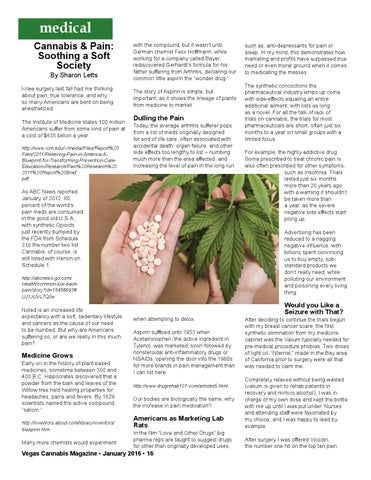
medical Cannabis & Pain: Soothing a Soft Society By Sharon Letts
Knee surgery last fall had me thinking about pain, true tolerance, and why so many Americans are bent on being anesthetized. The Institute of Medicine states 100 million Americans suffer from some kind of pain at a cost of $635 billion a year. http://www.iom.edu/~/media/Files/Report%20 Files/2011/Relieving-Pain-in-America-ABlueprint-for-Transforming-Prevention-CareEducation-Research/Pain%20Research%20 2011%20Report%20Brief. pdf
with the compound, but it wasn’t until German chemist Felix Hoffmann, while working for a company called Bayer, rediscovered Gerhardt’s formula for his father suffering from Arthritis, declaring our common little aspirin the “wonder drug.” The story of Aspirin is simple, but important, as it shows the lineage of plants from medicine to market.
Dulling the Pain
Today, the average arthritis sufferer pops from a list of meds originally designed for end of life care, often associated with accidental death, organ failure, and other side effects too lengthy to list – numbing much more than the area affected, and increasing the level of pain in the long run
As ABC News reported January of 2012, 80 percent of the world’s pain meds are consumed in the good old U.S.A., with synthetic Opioids just recently bumped by the FDA from Schedule 3 to the number two list. Cannabis, of course, is still listed with Heroin on Schedule 1.
Medicine Grows
Early on in the history of plant based medicines, sometime between 300 and 400 B.C. Hippocrates discovered that a powder from the bark and leaves of the Willow tree held healing properties for headaches, pains and fevers. By 1829 scientists named the active compound, “salicin.” http://inventors.about.com/library/inventors/ blaspirin.htm
Many more chemists would experiment
The synthetic concoctions the pharmaceutical industry whips up come with side-effects equaling an entire additional ailment, with lists as long as a novel. For all the talk of lack of trials on cannabis, the trials for most pharmaceuticals are short, often just six months to a year on small groups with a limited focus. For example, the highly addictive drug Soma prescribed to treat chronic pain is also often prescribed for other symptoms, such as insomnia. Trials lasted just six months more than 20 years ago with a warning it shouldn’t be taken more than a year, as the severe negative side effects start piling up. Advertising has been reduced to a nagging negative influence, with billions spent convincing us to buy empty, substandard products we don’t really need, while polluting our environment and poisoning every living thing.
http://abcnews.go.com/ Health/common-low-backpain/story?id=15458693#. UJ1JUVL7Q3w
Noted is an increased life expectancy with a soft, sedentary lifestyle and cancers as the cause of our need to be numbed. But why are Americans suffering so; or are we really in this much pain?
such as, anti-depressants for pain or sleep. In my mind, this demonstrates how marketing and profits have surpassed true need or even moral ground when it comes to medicating the masses.
when attempting to detox. Aspirin sufficed until 1953 when Acetaminophen, the active ingredient in Tylenol, was marketed, soon followed by nonsteroidal anti-inflammatory drugs or NSAIDs, opening the door into the 1960s for more brands in pain management than I can list here. http://www.drugrehab101.com/articles5.html
Our bodies are biologically the same, why the increase in pain medication?
Americans as Marketing Lab Rats
In the film “Love and Other Drugs” big pharma reps are taught to suggest drugs for other than originally developed uses,
Vegas Cannabis Magazine • January 2016 • 16
Would you Like a Seizure with That?
After deciding to continue the trials begun with my breast cancer scare, the first synthetic elimination from my medicine cabinet was the Valium typically needed for pre-medical procedure phobias. Two doses of light oil, “Nternal,” made in the Bay area of California prior to surgery were all that was needed to calm me. Completely relaxed without being wasted (valium is given to rehab patients in recovery and mimics alcohol); I was in charge of my own dose and kept the bottle with me up until I was put under. Nurses and attending staff were fascinated by my choice, and I was happy to lead by example. After surgery I was offered Vicodin, the number one hit on the top ten pain
numbing chart. http://www.drugabuse.gov/drugs-abuse/ prescription-drugs
Already under the influence of the anesthesia, I’d be adding this other pain killer to the mix, further lowering my heart rate, causing me to feel light-headed, be further constipated, possible seizure, problems with urination, stomach pain, itching, jaundice... the list goes on. http://www.drugs.com/sfx/vicodin-side-effects. html
(Note on Dosing: If it’s your first time using a concentrated cannabis medicine, you will want to start with a small amount, wait an hour, then take more, as needed. You may need to lie down and go to sleep. You cannot overdose and your heart will not stop, as with prescription pain pills.)
Post-Surgery Sting
After surgery I continued taking the oil - one to two droppers full every one to two hours was all that was needed for breakthrough pain. And being a natural non-inflammatory and anti-infection medication, there was no swelling to speak of from day two post-surgery and no fear of infection. At night I continued using Rick Simpson Oil (RSO), which gave me a good night’s sleep, allowing me to wake up without swelling, stiffness or pain.
stop your heart, as do most prescription pain meds.
Big Pharma: Drug Dealers to the Masses
Had I opted for the Vicodin post-surgery, the outcome would have been much different. I would have been swollen longer, constipated for sure, completely wasted the first several days, with no appetite to speak of, and my immune system would have been challenged at a time when my body needs it the most. After taking the highly addictive pharmaceuticals for the required amount of time - one to two tablets suggested up to four times a day, up to two months post-surgery, chances are I might have wanted more. This seems to be a given, as you can’t search for Vicodin online without finding withdrawal information at its side. A docudrama on television tells the story of a young woman who went from being an injured college athlete on full scholarship, to turning tricks in a motel for heroin when her health insurance and subsequent OxyContin prescriptions dried up. Did she begin her pain management with the Oxy? No, she started with Vicodin – gateway drug to heroin. In CNN’s ground-breaking documentary, “Weeds,” Dr. Sanjay Gupta shares prescription pain meds take someone’s life every 19 minutes in this country, yet he said he could not find one documented death by cannabis.
http://thechart.blogs.cnn.com/2012/02/22/ dr-gupta-in-depth-the-truth-about-presciptionaddiction/
The Center for Disease Control (CDC) reports prescription drug overdose is the leading cause of injury death, tallying more traffic deaths with more drivers under the influence of big pharma behind the wheel. Among children under the age of six, the CDC reports a whopping 40 percent presenting to the ER poisoned by prescription meds.
Got Research?
As a species, humans aren’t the sharpest tool in the shed. We put things in our mouths before fully realizing dangers. We put things in our mouths when we know something is dangerous - and if it tastes good or feels good, we keep on doing it. With legalization spreading like wildfire across the country in my lifetime, it seems that public perception may be turning around sooner rather than later on cannabis as good medicine. Hopefully, it will at least open the doors for real research, and more real medicine being made with proper dosing figured out. While the rest of America quells the daily pain of living through the colored glasses of modern medicine, I’ll continue to use the green, and encourage others to do the same. Sharon Letts started in this world as a gardener, ended up a writer/producer, and continues to advocate for the freedom to garden every seed bearing plant. You can find her on Facebook, LinkedIn & Twitter @lettsgarden.
I also continued my daily regimen of ingesting raw leaves daily in a green drink during the day – a treatment I began with my cancer scare a few months prior to surgery - easing constipation caused from the anesthesia. For after wound care I used a cannabis salve made with additional healing herbs. Most dispensaries or collectives carry salve, typically used for minor aches and pains, cuts, bug bites, rashes, skin tags, etc. (For skin cancer, RSO is the treatment.) As noted above, if it’s your first time ingesting a concentrated cannabis medicine, you will want to start with a small amount, wait an hour, then take more, as needed. The strong medicine allows you to sleep so your body will heal. And you cannot overdose, for cannabis does not
Vegas Cannabis Magazine • January 2016 • 17
essential oils Seasonal Discomforts & Essential Oils By: Shelly Berkowitz
Reflexologist & Holistic Health Counselor Tis’ the season of seasonal discomforts! Maybe you are feeling the angst right now as you are reading this article. Hopefully by reading this, you may find a natural way to deal with those seasonal discomforts that affect your household. Start by getting extra rest so your body isn’t so stressed. Did you know I just read in Prevention Magazine that a sleep deficit can worsen seasonal irritations and stress? In a 2008 experiment, researchers at Ohio State College of Medicine found that allergy sufferers had more symptoms after they took an anxiety-inducing test, compared with when they performed a task that did not make them tense. Alcohol can also be added on to the naughty list to get that nose a blowin! Alcohol can raise the risk of perennial allergic rhinitis by 3% for every additional alcoholic beverage consumed each week, Danish researchers found. According to Richard F. Lockey, MD, a doctor of the division of allergy and immunology at the University of South
Florida College of Medicine, avoid alcohol when your symptoms are acting up. According to the Mercola.com website, an estimated 80% of your immune system is located in your gut, so supporting your digestive health is essential to also supporting your immune system, which is your primary defense system against ALL disease, including allergies and asthma. Processed food, GE (genetically engineered) ingredients and synthetic additives all decimate the beneficial bacteria in your gut, thereby having a negative effect on your immune system. Ideally, you’ll want to avoid processed foods, focusing on organic, locally-grown foods instead, and include fermented food in your diet to optimize your gut flora. They even suggest sublingual allergy drops and different foods and herbs to alleviate symptoms. According to a study in PubMed.gov, in February of 1999, lavender oil inhibited immediate-type allergic reaction in mice and rats. In an article from Dr. Lisa Watson in March, 2010, her evidence showed that eating citrus fruits regularly can decrease the symptoms of allergies and asthma. She believes this is likely due to the vitamin C and bioflavonoids that are abundant in citrus fruit. In January of 2001, a study on PubMed.gov shows that peppermint oil may be clinically effective in alleviating the nasal symptoms of allergic rhinitis. Why am I talking about these 3 types of oils? Because I have seasonal discomforts (along with 3 rescue kitties) and use a blend of lavender, lemon and peppermint to alleviate my issues. It’s easy, safe and I have experienced zero sideeffects, unless I get the peppermint oil too close to my eyes…so please be careful! I also use very high-grade essential oils, and do not recommend using any of the essential oils you find at your grocery or dollar store.
Vegas Cannabis Magazine • January 2016 • 18
These can have harmful effects if ingested and/or utilized topically…so again, PLEASE BE CAREFUL. How do I use them? I put 21 drops of each oil in a rollerball and use when I start to feel a little itchy this or watery that. I can also use them in a capsule and through the essential oil company I use, they have capsules that are already made up. They are amazing and make this blend even easier to use. So my wellness tips to you in 2016 to help your immune system help itself are: STOP eating so much sugar…it’s not helping your gut flora and fauna and adds to an unstable immune system; START eating more whole fruits & veggies; Make it a GOAL to get more rest every week;. Get out and EXERCISE at least 15 minutes a day. DRINK more water and less alcohol, especially when you are feeling your seasonal discomforts kicking in. EXPLORE holistic alternatives to some of the overthe-counter remedies and your body will thank you. May you all have a safe, healthy and loving New Year ahead! For consultations or more information about how to use or purchase essential oils, please contact Shelly Berkowitz, Reflexologist & Holisitic Health Coach at (714) 514-3737. Shelly can also be reached via email at ahealthyresidual@yahoo. com and her website can be viewed at www. mydoterra.com/shellyberkowitz. You can also find her on Facebook at A Healthy Residual FDA Disclaimer: The information, advice, statements, and testimonials made about the essential oils, blends, and products mentioned on this web site have not been evaluated by the United States Food and Drug Administration (FDA). The information on this site and the products listed are not intended to diagnose, treat, cure or prevent disease, nor are they intended to replace proper medical help. It is always recommended to consult with a healthcare professional before starting any regimen with essential oils. User submitted testimonials are based on individual results and do not constitute a guarantee that you will achieve the same results - what works for one may not work for another.
thsi News From the Front Lines:
The Human Solution International
By: Miggy Fourtwenty, Danielle Vitale-O’Brien, Mindi Griffiths & Becca Nichols Prison Outreach:
Let’s face the facts, snail mail is archaic by most people’s standards. The cumbersome chore of writing a letter, addressing the envelope, affixing proper postage, and putting it in the mail box seems a bit ridiculous in the age of electronic mail and instant messaging. For a portion of the American population, the US postal service is still their primary source of communication. They are the forgotten victims of the war on drugs, those serving time in the prison system for a plant. Unfortunately, family and friends find it difficult to maintain relationships with their loved ones for an array of reasons. Sometimes family members are angry with the inmate for committing a crime. Often, people who are incarcerated have little to talk about or tend to be gloomy, making communication emotionally draining. The average person, who has never experienced being locked up for an extended period of time, is unable to comprehend the degree to which people in prison count on “mail call” as their days go by. The entire family suffers when a loved one is incarcerated causing a strain on communication. The right to freedom of speech as written in the First Amendment is, in essence, the only constitutional right an inmate has left. Providing an avenue for a fellow cannabis warrior to exercise this freedom is rewarding. Ordinarily, removal of communication is used as a form of punishment, but all prisons are required by law to provide the inmates with access to the U.S. Postal Service, even during punishment periods, where email communication and visits are disallowed. Writing to an inmate gives them a link, which is often the only one they have, to the outside world. Your letter may be the only kind-hearted human contact the person in prison for cannabis receives that day, or even that month.
NO VICTIM = NO CRIME = NOT GUILTY NO ONE SHOULD GO TO JAIL FOR A PLANT Now that you know why you should write to a cannabis POW (prisoner of the drug war), how do you locate your new pen pal? With a quick Google search one can locate many organizations that can help connect you with non-violent prisoners from across the country. It is wise to verify all addresses of inmates prior to mailing. For federal inmates go to http://www.bop.gov/inmateloc/. Each state has a web site to verify state prisoner addresses. You may also email voicesofthecannabiswar@gmail.com for one-on-one assistance.
National News: Tennessee
Michael Brooks is a resident of a small town in Tennessee where any form of cannabis use is illegal, including medical marijuana. Michael found a cure for his life-threatening Hepatitis C by using cannabis oil. Michael learned that he had Hepatitis C several years ago after suffering physical issues to the point of being unable to participate in his two young sons lives most days. At one point, he was bleeding from his eyes due to acquired hemophilia as a result of Hepatitis C. Michael was taking all of the traditional pharmaceuticals he could in hopes of finding some relief to no avail. Michael shared, “I have been known to smoke cannabis, but had never heard of cannabis oil”. Brooks was fortunate enough to not only learn about the healing benefits of cannabis oil, but to also have access to a continuous source of oil. After using oil for a short time, Michael was feeling dramatically better and was able to discontinue the medications. Six months ago, at a routine doctor’s appointment a blood test was run which is standard for those suffering from Hepatitis C. The blood test showed that Michael’s Hepatitis C was undetectable and unfortunately reflected high
Besides having a direct impact on the inmate’s life, communities will benefit as well, as the prisoner’s chances of successful reentry into society are improved when a connection to the outside world is maintained throughout their incarceration. Also, the more they know about what is going on in the “real world”, the easier it is to fit in with society, those of us who have not been in the black hole of the penal system.
Vegas Cannabis Magazine • January 2016 • 20
THC levels as well. These high levels of THC were reported to family services and his two sons, Damon, 18 months and Elijah, four months at the time were removed from their home. Family services sites Michael’s cannabis use as the reason for removal. Six months later, his children are still in the state’s custody and Michael has been oil free for those six months with his symptoms returning. He and his children are allowed two hour visits only twice a month for which he must travel 70 miles. Michael continues to abide by all the states requirements in the hopes that his children will soon be returned to their home. His hope is that his heartbreaking ordeal will bring about even the smallest of changes in Tennessee’s cannabis laws because then it will have been worth it. Michael needs help financially to assist him in paying his court costs and getting to his monthly visitation with his children. If you can help please visit: https://www.gofundme. com/https-fbcdn-prof.
Kansas
Well known activist, author and healer Shona Banda who lost custody of her 11-year-old son in March after her son spoke up in school during an anti-drug presentation given by counselors and police officers at his school, waived her right to a preliminary hearing last month when the State of Kansas prosecutor tried you force her son to testify against her. She is facing trial on January 11, 2015. Shona is requesting court supporters to stand in solidarity behind her in the courtroom, as well as donations to assist her in fighting the fight of her life, which can be made by visiting: https://www.gofundme.com/supportshonahttps://www.gofundme.com/supportshona.
legal Cannabis and Kids: Are Minors Allowed to Use Medical Cannabis in Nevada? By: Derek J. Connor Esq.
Having a child stricken with a serious illness is every parent’s worst nightmare. For some conditions, medical cannabis may offer these children and their families a glimmer of hope. Unfortunately, in this instance the federal government has decided to come between doctors and their patients. According to federal law, it is illegal to provide cannabis to anybody, for any reason, even situations where a child’s life is at risk. In spite of the federal prohibition, Nevada state law does allow for the compassionate use of medical cannabis, including by children. However, before a child may legally use medical cannabis, the child and their parents must complete the state application process. The application process for a minor is essentially the same as it is for a regular patient, except that minors are required to include a written statement from the child’s custodian (who has responsibility for the child’s healthcare decisions) acknowledging that the child is applying for a medical marijuana patient card and giving the child permission to do so. The child’s custodian must serve as the child’s caregiver and receive a caregiver card. Both the parent and the child must
be eligible to receive medical marijuana patient registry identification cards. Parent caregivers should beware that minors are not permitted to enter Nevada licensed medical marijuana establishments. Consequently, parentcaregivers should leave the minor-patients at home when traveling to a Nevada licensed medical marijuana establishment to purchase medical cannabis products. Parentcaregivers should also be aware of the numerous risks associated with treating their children with cannabis, both medical and legal. Treating children with medical cannabis can have serious legal repercussions including, violations of child custody agreements, issues relating to firearm possession, the child’s ability to
EXPERIENCED ATTORNEYS ASSISTING BUSINESSES AND
PATIENTS WITH NEVADA’S COMPLEX MARIJUANA LAWS AND REGULATIONS.
CONNOR & CONNOR PLLC _____________________________________________________________________________
ATTORNEYS AT LAW
710 Coronado Center Drive, Suite 121 Henderson, NV 89052 www.connorpllc.com (702) 750-‐9139 /ConnorConnorPLLC @Connor_pllc Connor & Connor PLLC
Vegas Cannabis Magazine • January 2016 • 22
participate in extracurricular activities such as sports, driving under the influence, and federal criminal prosecution among many others. Only your child’s doctor can advise if cannabis can help your child. Parents who are considering a cannabis based
treatment course for their child should first consult with a Nevada licensed physician. Parents should then consult with a qualified Nevada licensed attorney who understands Nevada’s complex marijuana laws and regulations. Parents who are in a shared custody situation should also consult with their family law attorney. Derek J. Connor Esq. is the cofounder of Connor & Connor PLLC along with his wife, Amanda N. Connor Esq. Derek practices primarily in the areas of medical marijuana, civil litigation, business law and criminal defense.
grow Cloning Compound Comparison By: Chris Egan
With all the products on the market for growing, it can be a challenge figuring out which ones will work best for you. Now that the cannabis industry is really starting to take root (yeah, a rooting pun in an article about rooting compoundssorry, I’m a grower, not a comedian), there are endless options now for growers that were not available just a decade back. More products are hitting the market for every aspect of growing, and cloning is no different. There’s a wide variety of cloning compounds available now. So to start the New Year, I thought we at MediGrow would review four rooting compounds and share our results with the readers of VCM. First off, it must be understood that the four rooting compounds we cover (Growth Technology Clonex, Supernatural Rootburst Powder, Mad Farmer’s Root It and Green Cross Hydroponics Rooting Gel) all share the same active ingredient (Indole-3-butyric acid), but in varying concentrations. It also should be stated that I’ve had success using some of these products in the past, with no problems. For this article, I compared each of these products side-by-side, using the same genetics and conditions for all. Each rooting compound was applied to three clones (2 planted in coco and 1 in rockwool), and clones were kept under the same conditions. Growth Technology CLONEX Rooting Gel (Indole- 3- Butyric Acid listed at 0.31%) In my mind, the most widely known one was a good place to start. If you’re unfamiliar with Clonex, it comes in a bottle or pouch, depending on how much you want to purchase. The product itself is a purplish translucent gel, with a consistency not unlike that of a raw egg. It covers the clone cuttings well (its gel consistency helps here). Also, due to its color, there is no mistaking how much coverage you’ve got on your cutting. It’s important to note that this product should be protected from light and air when storing it. If not stored correctly, it will dry out, or at least have its effectiveness impacted. Clonex also has a line of other
products to help with the cloning process. While these products do work great, I have always had great success with just their rooting gel alone. Clonex has been my go-to for cloning for years, always reliable and easy to work with. In our side-by-side comparison, clones using Clonex rooting gel had roots showing through the coco plugs on day 11 and showing in rock-wool on day 13. Mad Farmer ROOT IT Rooting Gel (Indole-3- Butyric Acid listed at 0.54%) This was a new one for me. I’ve never worked with any cloning compounds from Mad Farmer before. I was excited to try something new, especially since I got it for free from a friend who owns a hydro shop here in Vegas. I’m always willing to try new stuff out to see if it works better for me. ROOT IT looks like really watery yellow dish soap, and it smells funky too. It was difficult to tell how much of my cutting was covered (mostly due to its color), and with its watery consistency, it kept running off of the cuttings. ROOT IT produced roots in coco on day 13 and rock-wool on day 16. As with Clonex, it is advised to protect this product from light when storing. Supernatural Rootburst Powder (Indole-3-Butyric Acid 0.8%) Supernatural Rootburst Powder was one of the first cloning compounds I’ve ever used. It’s a pastel blue powder that comes in a clear resealable bag. As with all rooting compound, it’s easy to use, but due to it being a dry powder, I would recommend dipping your cuttings in water before dipping into the Supernatural Rootburst Powder. The blue color does help to show the coverage on your cuttings. I never realized how important the color was before having to deal with the Mad Farmer product. This one was by far the least temperamental compound of all four that I tested. I’ve been using the same bag of Supernatural Rootburst Powder for years with no special attention paid to storing it. In this comparison, clones with Supernatural Rootburst powder had roots showing in coco on day 13 and rock-wool on day 15. Green Cross Hydroponics Rooting Gel (Indole-3- Butyric Acid 0.31%) This product was also new for me. I have never worked with any other Green Cross products before. As with the Mad Farmer, this was also given to me by a friend who wanted me to try it and see what results I got. This was by far the most unique product of all that we compared, both in
Vegas Cannabis Magazine • January 2016 • 24
consistency and texture. If you have never seen it before, it’s translucent, has a light green color and is thick almost jelly like. Suspended in the gel, there are particles giving it almost a candy-like look. The Green Cross did cover the cuttings well without running off like the Mad Farmer did. Its green color could make it difficult to see, but its thickness and consistency should do a lot to help see what coverage you’ve gotten on your cuttings. Green Cross was the surprise of our side-by-side comparison. In coco, it produced roots on day 8 and rock-wool on day 10! I typically will see roots in 12-14 days so I was surprised to see roots in the coco on day 8. As with others, it is recommended that you protect this product from light when storing it between uses. Each of these products in this comparison was able to successfully root out clones in 2 weeks or less, with each product having its pros and cons. Overall, however, a clear winner emerged in the contest: Green Cross Hydroponics Rooting Gel. Roots emerged on average 4 days faster than the other products, the consistency of the gel allowed for adequate coverage on the clones, and made the coverage visible. In our side-by-side comparison, Growth Technology Clonex came in #2. Growth Technology Clonex, like Green Cross Hydroponics Rooting Gel, had the consistency and visibility, but took 3 more days to show roots. Supernatural Rootburst powder came in at #3. It was not as easy to apply as the gel-based cloning products, but the color of the powder still made it easy to see on the clones. It did not produce roots as quickly as the gel-based products, but does not have as many storage requirements as the other products. ROOT IT came in #4 in our comparison. It took longer than the other products to produce roots, it had a watery consistency that was hard to work with, and there was no advantage in storage requirements. This was by no means a completely scientific comparison of these products, but we did the best we could to level the playing field for all the products. Your own results may vary some when using any of these products, and we encourage you to try a side-by-side comparison of your own to find the product that works best for you. Chris Egan, is the co-owner of Medigrow, a Nevada grow school, established in 2008. For more information, visit MedigrowNV.com.
Expires 1/31/16
spotlight This month’s dispensary spotlight takes us to INYO Fine Cannabis Dispensary. Here is what we found out about INYO: ABOUT INYO INYO’s partnership is rich with business experience and they are proud to call Las Vegas home. In addition, they have partnered with some of the most reputable cannabis experts in the Industry to help guide them through the learning and challenges that are present in this new industry. The combination of skill sets, passion and commitment is the magic of INYO.
and longest running commercial growers of cannabis. Soon, they will be providing Nevada patients with some of the world’s best cannabis. Look for the Sweet Goldy Brand soon! PRODUCTS INYO offers a wide array of affordable keepsakes that let the world know you visited one of Las Vegas’s first legal dispensaries. From t-shirts and lighters to the fundamental delivery systems of papers and pipes. INYO also offers a selection of beautiful glass pipes and of course, a variety of vape pens as well.
QUALITY ASSURANCE INYO staff personally visits each of the cultivation centers they purchase product from and get to know the growers and their processes before securing any of their products. Not every product makes the cut. INYO, along with the growers make sure they do everything they can to ensure they produce the best flower possible.
NEW PATIENT PROCESS A first time visitor to INYO will be asked to complete a small amount of paperwork and to provide their medical professional’s recommendation and government issued identification. INYO will always be about education - all staff is professionally trained by certified government winning courses through Americans for Safe Access and the Cannabis Training Institute. INYO’s budtenders receive frequent refresher training as new research becomes available. The state of Nevada and INYO understands after becoming the first state to require terpene testing that this plant is much more complicated than a simple indica or sativa classification.... The INYO staff is trained to have those discussions with each patient who is interested.
IN THE WORKS INYO’s cultivation build out is underway beginning with the details of an energy efficient, environmentally responsible design under the guidance of their master grower - one of the country’s most talented
MEDICAL ADVISEMENT Dr. Michelle Sexton is a board advisor for INYO. Dr. Sexton is one of the most internationally known researchers on the subject of cannabis giving INYO an edge on educating patients.
LOCATION 2520 South Maryland Parkway #2 Las Vegas, Nevada 89109 PHONE (702) 707-8888 HOURS 10am - 8pm M–S
11am - 5pm Sunday
www.InyoLasVegas.com
DISCOUNTS INYO offers a customized, rewards program based on patients buying patterns that texts them personally. INYO also offers a military discount to veterans. GIVING BACK INYO Fine Cannabis Dispensary holds regular promotions to raise funds for Veterans Village of Las Vegas. On Veteran’s Day, INYO teamed up with Green Life Productions to sell 1-gram prerolls of Hog and Fire Alien Kush: they raised $2,000 in one day, and 100% of the proceeds went to Veterans Village. Proceeds from INYO’s “5 Days of Christmas” sale also went to Veteran’s Village. NEW PATIENT ADVICE FROM INYO Visit all the stores....go where you are comfortable, challenge your budtender’s knowledge - expect the best - and don’t settle until you get it. Oh....and make sure INYO is on that list!
Menu Flower:
Bubble Gum SFV OG Sage n’ Sour RKS Chem 91 Trainwreck Golden Goat Green Life #1 Snow Dog Enzo Kush Bubba Kush Lavender Afterlife OG Pre-98 Bubba Kush
Fire Alien Super Skunk GSC (Cookies) Gorilla Glue #4 Cheese Fire Alien Kush Platinum Blue Dream Purple Haze Strawberry Cough Pennywise Grape Stomper Cookie Cross Northern Lights 9 lb. Hammer
Concentrates:
inyolasvegas Inyo Fine Cannabis Dispensary inyodispensary
JUJU Joints Ghost Train Haze JUJU Joints Blue Dream Tahoe Cherry Pie + Purple D Wax Purple D Shatter (CO2) 9 lb. Hammer Kief Lavender Kief Fire Alien Kush Kief
Edibles:
Oatmeal Cranberry Cookie Miniatures (3 pk) Chocolate Chip Cookie Miniatures (3 pk) Coconut Chocolate Macaroon Bites (5 pk)
industry Bet It All on Green: Cannabis Expertise by the Glass
magnifier, do the trichomes appear to be mostly milky white with more than 30% as amber-colored, indicating that it was harvested at the right time?
By: Jason Sturtsman
As a frequent attendee to wine and beer tastings, along with creating my own wines and beers, the established system of wine and beer appreciation also applies to cannabis consumption. It may sound odd that descriptions of “pine”, “barnyard”, “dark cherries”, and “fruit forward” have anything to do with cannabis. When you first approach a glass of wine you follow the four S’s: see, swirl, smell, and sip. When you initially get that delicious, fat nug of cannabis; “see” what colors the cannabis is made up of including various shades of purples, reds, yellows, and greens. Color should appear vibrant and even, with no areas of gray. Does the cannabis appear to be properly dried, with the stem snapping when bent or appear to be wet and not ready for smoking? Trichomes are those sticky mushroom like crystals that coat the bud like Tinkerbell’s fairy dust, best seen under magnification. Do the trichomes appear to be visible or broken because of rough handling? If you have the ability to use a small
Instead of “swirling” your glass of wine to increase aeration before smelling, you must break your bud apart before you “smell”. Another technique is to place a small amount in your clean hands rubbing them together with the cannabis, then cupping your hands as you smell or taking the bud apart and placing your nose close to the cannabis bud. Cannabis has over 200 terpenes – aroma and flavor profiles in the plant, along with THC and CBD. When you “smell” the cannabis, you may experience citrus, berry, diesel, pine, cheese, or apricot among many other luscious smells. Poorly cured cannabis will smell as hay or will have no scent at all. When you finally “sip” the cannabis, you experience the joy of inhaling a bouquet of nature’s love for you. The preference should be on using hemp based rolling papers or a vaporizer to ingest the cannabis. Metallic or chemical flavors indicate that the cannabis was not properly flushed with water, before the final harvest. If the cannabis burns as a gray ash instead of black, this indicates that there is a minimal amount of impurities or excessive fertilizer leftover in the cannabis. When smoking the cannabis, if it pops and sizzles or the smoke is harsh in your throat, it is of poor quality. In Nevada, all of our licensed dispensaries are required to provide testing results to the patients, which will dramatically increase the quality of the cannabis consumed, resulting in connoisseur couture cultivated cannabis. It will be up to the patient to take notes on what strains they enjoy, just like they would their favorite wine varietals, vintage, and winery. Jason Sturtsman is a Nevada Independent Cannabis Laboratory Advisory Committee Member (ILAC), the Wellness Education Cannabis Advocates of Nevada (WECAN), Vice President and also owner of Healthcare Options for Patients Enterprises (HOPE), a Cannabis Cultivation and Processing Facility, and Manager at Las Vegas Releaf, a local Dispensary. He can be reached at JasonS@wecan702.org for comments or questions.
Vegas Cannabis Magazine • January 2016 • 30
THE LARGEST INVENTORY IN NEVADA
FREE CONSULTING FOR COMMERCIAL GROW OPERATIONS
Mention this ad and get
CENTRAL LOCATION 3111 S VALLEY VIEW Suite V-103 Las Vegas, NV 89102 (On Desert Inn West of Valley View)
40% off
SOUTH LOCATION 7850 S DEAN MARTIN DR #506 Las Vegas, NV 89139 (Off I-15 North of Blue Diamond)
all CLONING products! *Expires 1/30/16.
HOURS Mon-Sat: 10am-7pm Sunday: 11am - 5pm
702-247-grow (4769) | sales@aghydro.com
International Cannabis Business Conference By: Dr. Aseem Sappal
On February 13-14, Oaksterdam University will be at the International Cannabis Business Conference (ICBC), as they return to San Francisco to prepare the latest information on legalization efforts across the globe, including recently legalized states like Colorado and Oregon as well as upcoming legalized states like California and Nevada. California recently enacted statewide commercial medical regulations for the first time and the state is a hotbed of activity on the repeal of cannabis prohibition for adults. The California Medical Marijuana Safety & Regulations Act went into effect Jan. 1st, 2016, creating even greater opportunity for the 8th largest economy in the world. “Regardless of your marijuana business, the ICBC will help provide you the tools to succeed,” said conference producer Alex Rogers, CEO of Northwest Alternative Health, and who has a long history of promoting successful marijuana events in the United States and abroad. “We aren’t an expo. We are a conference that merges the industry with activism to work towards policies that benefit the entire community, not just a select few.” Last year’s ICBC in San Francisco was a sold-out success that included Oaksterdam Executive Chancellor Dale Sky Jones; travel guru Rick Steves; renowned neuroscientist Dr. Carl Hart; and a host of successful cannabis industry and activist pioneers. 2016 is slated to be an even bigger year for the ICBC and the cannabis industry in general. “The industry is competitive, businesses that fight for sound policies, will thrive,” said Debby Goldsberry, a conference organizer, Oaksterdam faculty member, and the executive director of Magnolia Wellness, a medical cannabis collective. “We must always work to keep safe access to patients and keeping people out of prison at the forefront of marijuana policy.” “The reasons for this are simple. It’s the right thing to do and it is good for business,” said Anthony Johnson, executive director of Oregon’s successful legalization campaign. The ICBC attracts attendees from around the world and will provide engaging updates about the latest developments from around the globe, with exciting developments in Canada, Europe, and elsewhere, helping set the stage for international reform. The first 500 ticket purchasers will also have special access to an exclusive VIP event with Tommy Chong and Bay Area hip-hop legend Del the Funky Homosapien. For tickets or more info, visit www.internationalcbc.com or call 888-920-6076. From everyone at Oaksterdam University and the International Cannabis Business Conference, we wish you a blooming and fruitful 2016! Dr. Aseem Sappal is Provost and Dean of the Faculty at Oaksterdam University. For more information about Oaksterdam University, visit www. Oaksterdam.com.
High Times World Cup Negril, Jamaica By: Nate Lund The first ever World High Times Cannabis Cup was hosted in beautiful Negril, Jamaica along 7 Mile beach, in the Jamaican parish of Westmoreland. Just a short 50-minute flight from Miami, Negril is a must travel to destination where you can enjoy an amazing time amongst the locals for a REAL LIFE island experience. Food carts & local restaurants lined the streets and the nightlife was easy to find with Margaritaville just a couple of miles from our hotel! Waking up early on Saturday, we enjoyed a Jamaican breakfast of rice, eggs & bacon, and then hit the beach for a quick swim. Shortly after, we headed over to the High Times World Cannabis Cup which we arrived at via horseback. Upon arrival, we were met with a warm downpour of island rain. But that did not stop us as we trekked & sloshed, booth to booth mingling with other attendees and enjoying competition entries. We were lucky enough to be able to smoke connoisseur quality Ganja and even try authentic Jamaican edibles! All of the booths had been provided cover so there was plenty of space to stay dry & medicate. Sunday we paid one of the locals to drive us out to visit Orange Hills where we spent the day walking through the lush Jamaican forest to a local Ganja farm guided by our Jamaica RDB team member, Goose Denam. He walked us through an AMAZING garden full of Jamaican Blueberry & OG’s. This was an experience we had dreamed about for well over a decade and finally got to enjoy! Visiting a Ganja Farm in Jamaica is a must when in Orange Hills, Negril. Jamaicans themselves will tell you “The best herb comes from Orange Hills Mon! So go check it out canna- travelers! Also, while you are in the area, be sure to stop by famous Rick’s Cafe and jump off the cliffs. The 2015 High Times World Cannabis Cup was held in conjunction with a Rootz Rastafari Reggae event that was in its 27th year functioning on the Island. On one side, all of the Jamaican growers & booths were intertwined through a beautiful area full of trees and shade, where you could find anything from Ital Food to Jamaican Ganja to a local piece of art or woodwork. On the other side you had High Times Cup booths and sponsors who had entered the local competition inland in the states and, were here waiting to hear those results, in conjunction with the results for the locals-only Jamaican farmer’s competition. The awards ceremony was an amazingly well planned event that featured an impressive stage built directly on the beach. There were winners in a range of different categories such as best flower, best concentrate, best hash and more. As the ceremony neared its end and we began to make our way back to the hotel, my wife and I excitedly went over our vacations events. Not only did we have an AMAZING High Times World Cannabis Cup Jamaica Experience but, as I hugged her tight and looked into my beautiful high school sweetheart’s eyes, we both couldn’t help but smile & think back at what a landmark moment this was for us. Ten years ago when we were married, we enjoyed our honeymoon right here in the same place. It was the perfect end to an exciting Jamaican adventure and the celebration of our 10-year anniversary together. Make sure and book tickets early for next year and we will see everyone there! Thank you High Times Magazine, Vegas Cannabis Magazine, My Family & Team RDB, First Place Bubble Hash Winner – JR, Brett Bogue &Apothecary Genetics, Medicinal Mike & Nug Life Radio, Orange Hill Genetics, Pony Boy & Los Marijuanos, Microbe Life Hydro, New Age Nutrients and Leaf of Life Lollies
Also, be sure to check out Goose Denam on Facebook for Ganja Tourz
Tokin’ With the Infamous
I often say things like, “I know high people in places”, and it’s true, I do. I also know people in high places. What I am most proud of, however, is knowing humble people in important places; those who walk the walk, rather than just talking the talk. People who know and grow, rather than show and go. Kandyman is not only an elite cannabis breeder and grower; he is a full fledged member of the home team. I met Kandyman many years ago, through our mutual friend, Pakelika. Most of you know Pakelika as ‘The Visual Assassin’, the larger than life persona who commanded the stage at every Kottonmouth Kings show for fifteen plus years. To us though, he was just our friend, Big P. Kandyman and I recently sat down and seshed up as he told me about his experiences as a cannabis grower and breeder. Joints were lit, bongs were hit, and edibles were consumed. It was a good day. Hopper: How long have you been growing and breeding? Kandyman: I’ve been growing for about fifteen years, and breeding for twelve.
Hopper: Over all those years, can you estimate how many crops, how many pounds you have grown? Kandyman: Oh man, that’s tough to say. All of my stuff is indoor, not outdoor, so that makes a big difference. I don’t know, probably into the hundreds of thousands, easily. Hopper: And to think of all of the patients you have helped with that. Kandyman: Yeah, that’s not even including all that I’ve given away to patients. Hopper: What is your philosophy on growing? Kandyman: I believe that it is all about genetics. With today’s technology and equipment, and all of the information available, it doesn’t take a rocket scientist to do it, so it really boils down to genetics. Hopper: How have you seen the cannabis scene change over the years? Kandyman: Cannabis has become more mainstream, both in a good way and also in a bad way. In a good way, with legalization, decriminalization, and non-violent offenders being freed. Those are all really great things. I think that the cannabis industry, in itself, is getting a little too greedy. It’s all about the money and ticket sales. They don’t really have much for the vendors, the growers, or the breeders. There are just so many of them (Cups) nowadays. You don’t know who won the cup last week, or the one that was two weeks ago, or the one that was three weeks ago… Hopper: Yeah, there are way too many now. Kandyman: Yeah, eventually this whole thing is going to end up falling in on itself. Hopper: Speaking of Cups, you have won countless awards over the years. I know you are backing away from the mainstream, but if there were to be a true Breeders Cup, would you enter, or are you just completely over the whole ‘Cup’ scene? Kandyman: I think I would come out for something like that. If it was something prestigious like that and it was one of a kind and set the elites apart from the rest. Because that’s the difference between competing with ten elites, and competing with fifty people who are just growing someone else’s strain.
with
Hopper: I’ve known you for a long time now, and you are the first person I know who did CO2 extracted concentrates, years before anyone else, with the Kings Kandy. Tell us about that. Kandyman: That was a mistake sent from God, actually. It wasn’t something that was planned. It was actually a mistake that led me to that process, and so I took that process a little further and ended up basically creating the first crumble from California. For the first two months, the stuff was so gnarly looking; I mean it was blonde, like true ear wax type stuff. Back then, everything was all bubble hash, so when I took it to the collectives, they wanted nothing to do with it. They said that no one would smoke it because it looked like crack. Then, after about two months, when people started trying it, they couldn’t keep it on the shelves. Hopper: I can back that statement 100%. When you would bring the Kandy down to San Diego, to The Green Door, it would be pre-sold out before you even got it to me. It was definitely a point in the industry, where product got elevated to the next level. The standard of quality was raised by leaps and bounds because of your product. You have grown for celebrities. Did they have any input into the strains and crosses? Kandyman: Every time a celebrity has approached me to make a strain, they always just basically said “do what you do, you’re the master grower”. Then again, I’ve had people from the Santa Cruz/ San Francisco area call me up and say they’ll pay ten or twenty grand for a strain, no problem. Then they start throwing out these strain names that just would not go good together. I know that they would not taste good after they’re crossed. Hopper: So you advise them on that? Kandyman: Yeah, I advise them. That’s when they say to go ahead and take the reigns and run with it. Hopper: So we have to talk about this new project in the works. We’re bringing back the KingsBlend. It’ll be called the KingsBlend Resurrection. I’m stoked to be doing this with you; you’re the best in the biz. Kandyman: I’m honored to be part of the KingsBlend, and be the one to bring it back. It’s going to go down in the record books. Hopper: I knew you were the most qualified person to do it. Any shout outs before we finish up this joint, and roll the next one? Kandyman: Everyone who has supported me over the last fifteen years and stuck by me through thick and thin. It’s your inspiration that keeps this whole movement going, so I just want to say thank you. Hopper: The most important shout out that we both want to throw out, because he was a huge part of both of our lives, is to Pakelika. RIP to the most Giant. Kandyman: Yes. Love you, brother. Miss you every day man.
2015 Emerald Cup Santa Rosa, CA
Photos: Dabsel Adams - DabselAdams.com
Photos: Dabsel Adams - DabselAdams.com
Pick Up Your Copy of Vegas Cannabis Magazine at the Following Locations: FULLY STOCKED GREEN RACK LOCATIONS Vegas Cannabis Magazine 1631 E. Sunset Rd, #C-104, Las Vegas Aces High 7240 W. Lake Mead, Las Vegas Cloud Wars Smoke Shop 4130 S. Sandhill Rd, #A-9, Las Vegas Still Smoking Smoke Shop 2605 S. Decatur Blvd, #107, Las Vegas AAA Indoor Garden 2 W. Charleston Blvd, Las Vegas
Smoke’s Poutinerie Pawn Plaza, 725 S. Las Vegas Blvd, Las Vegas
I&H Smoke Shop 2400 S. Jones Blvd, #15, Las Vegas
Holley’s Cuppa Coffee Bar The Gramercy, 9275 W. Russell, Las Vegas
Nafees Puffs & Gifts Smoke Shop 8846 S. Eastern Ave, #103, Las Vegas
Pink Box Doughnuts 7531 W. Lake Mead Blvd, Las Vegas Rita’s Italian Ice Spring Valley 5415 S. Rainbow, Ste. D, Las Vegas Grinders Pizza Lounge 5625 S. Rainbow, Las Vegas Ultimate U Medical 8660 W. Spring Mountain Rd, Las Vegas 8 Ball Bail Bonds 1114 S. Main Street, Las Vegas One Love Vapors 6814 W. Cheyenne, Las Vegas Best Hydroponic Supply 6818 W. Cheyenne Ave, Las Vegas
Getting Legal 2619 W. Charleston Blvd, #100, Las Vegas
Goldsmith Healthcare 5375 S. Ft. Apache, Las Vegas
Tony Marc’s EATS 6700 W. Charleston, Unit C, Las Vegas
Jass Smoke Shop 7250 S. Durango Dr, Las Vegas
Diversity Tattoo 2310 S. Las Vegas Blvd, Las Vegas 300 S. Decatur Blvd, Las Vegas 8505 S. Eastern, Las Vegas 3041 S. Las Vegas Blvd, Las Vegas 4401 N. Rancho Drive, Las Vegas 6910 S. Rainbow Blvd, Las Vegas Gorilla Radio Smoke Shop 4225 S. Eastern Ave, Ste. 5, Las Vegas Hiptazmic Studio (Inside the Arts Factory) 107 E. Charleston, #105C, Las Vegas Smoke Signals 8200 S. Maryland Pkwy, #110, Las Vegas Life Saver Vapor 4825 W. Flamingo, #11 Las Vegas Bargain Smokes + 5516 Boulder Hwy, #2D, Las Vegas Tony’s Mexican Food 5752 S. Fort Apache, Las Vegas Inyo Fine Cannabis DIspensary 2520 S. Maryland Pkwy, #2, Las Vegas Community Oasis 1800 Industrial Rd, #102, Las Vegas Money Plays 4755 W Flamingo Rd, Las Vegas Mailboxes Plus 4080 Paradise Rd, #15, Las Vegas Einstein Bros Bagels 4626 S. Maryland Parkway, Las Vegas The Source Dispensary 2550 S. Rainbow Blvd. #8, Las Vegas The Apothecary Shoppe 4240 W. Flamingo Rd, Las Vegas Nevada Pure 4380 Boulder Highway, Las Vegas Green Spot Hydroponics 3355 W. Lake Mead, North Las Vegas
Las Vegas
Advanced Gardens Hydroponics 7850 S. Dean Martin Dr, #506, Las Vegas 3111 S. Valley View, Ste. V-103, Las Vegas
City Smoke & Vapor 1775 E. Tropicana, #8, Las Vegas Amigo Smoke Shop 1610 E. Charleston Blvd, Las Vegas Rainbow Smoke & Gift Shop 1725 S. Rainbow, #8, Las Vegas 24 Hour Smoke Shop 511 E. Charleston Blvd, Las Vegas Art Square 1017 1st St, Las Vegas VIP Smoke Shop 4075 Durango Rd, #107, Las Vegas High Roller’s Cigar 4480 Paradise Road, Las Vegas Diamond Smoke Shop 8544 Blue Diamond Road, #105, Las Vegas Cigars & Smokes 505 E. Windmill, #1-F, Las Vegas Liberum Studios 6745 S. Eastern Ave, #1, Las Vegas
Dope Ass Glass 6100 Mountain Vista, Las Vegas
Discount Smoke & Vapor 7231 S. Eastern, #C, Las Vegas
D’s Smoke Shop 6545 S. Ft. Apache, Ste. 140, Las Vegas
Z&Z Smoke Shop 4180 S. Jones Blvd, #7, Las Vegas
Hippie Livin Smoke Shop 6530 S. Decatur, Ste. 120, Las Vegas
Town Square Smoke Shop 6085-B S. Rainbow, Las Vegas
Euro Market & Deli/Smoke Time 5625 S. Rainbow Blvd, Las Vegas
North Las Vegas
Karma Holistic Health 9111 W. Russell Rd, Ste.120, Las Vegas Dr. Green Relief 7200 Smoke Ranch Rd #120, Las Vegas Quick Draw Tattoos 7150 S. Durango Drive, Las Vegas
A&K Smoke Shop 655 W. Craig Rd, #112, North Las Vegas A1 Tango Smokes & Gifts 7350 W. Cheyenne Ave, #101, North Las Vegas Cigars & Smokes 5546 Camino Al Norte, #14, North Las Vegas
Henderson
Smoke Shop n’ Cigars 4965 W. Tropicana #103, Las Vegas
Nevada Medical Marijuana 3195 St. Rose Pkwy, #212, Henderson
Smoke Shop 3103 N. Rainbow, Las Vegas
D’s Smoke Shop 716 Center Street, Ste. 140, Henderson 690 N. Valle Verde, Ste. 6, Henderson
Vape Avenue 5965 W. Tropicana, Ste. A, Las Vegas Smoke Factory Smoke Shop 6130 W. Charleston, Las Vegas Sabi Smoke Shop 6010 W. Cheyenne, #9, Las Vegas Rainbow Smoke & Gift Shop 1725 S. Rainbow, #8, Las Vegas A&H Smokes & Cigars 2300 N. Rainbow, Ste. 111, Las Vegas
Anthem Smoke Shop 2515 Anthem Village Dr, Henderson Red Rock Smoke Shop 10090 S. Eastern Ave, Henderson Hello Neighbor Smoke Shop 1850 E. Serene Ave, #107, Henderson
Pahrump
Happy Hydroponics Supply 1500 E. Highway 372, Pahrump
Rainbow Smoke Shop 2550 S. Rainbow, Ste. E13, Las Vegas
St. Clair Vapes 1141 S. Highway 160, Ste 7, Pahrump
JR Smoke Shop Inc. 2097 N. Jones Blvd, Las Vegas
Tattoo Shop 101 S. Frontage Rd, Ste. B, Pahrump
Hawaiian Smokes & Cigars 5060 Boulder Hwy, #120, Las Vegas
Sparks
Las Vegas Releaf 2242 Paradise Rd, Las Vegas,
Vapor 2 6125 W. Tropicana, Las Vegas
Nevada Wellness Center 3200 S. Valley View, Las Vegas
The Arts Factory 107 E. Charleston Blvd, Las Vegas
Euphoria Wellness 7780 S. Jones Blvd, Las Vegas
Smokes Mart 9355 W. Flamingo, Las Vegas
Sunrise Hospital & Medical Center 3131 La Canada, Las Vegas
Fantasy Cigars and Smokes 8665 W. Flamingo Rd, #119, Las Vegas
Cam Care 2923 W. Charleston, Las Vegas
Smokers 4 3300 E. Charleston Blvd, Las Vegas
Mary Jane Medical/Beautiful Laser Lounge 1321 S. Rainbow Blvd, Ste. 280, Las Vegas
Cigars & Smokes 7345 S. Durango, #102, Las Vegas
Silver State Relief 175 E. Greg St, Sparks
California
Oaksterdam University 1734 Telegraph Avenue, Oakland
Oregon
The Other Spot 5431 SE 72nd Avenue, Portland
Interested in carrying Vegas Cannabis Magazine? CALL NOW - (702) 589-1282
420 directory
(702) 558-8547
Send Smiles!
6955 N Durango, Ste. 1111 Las Vegas, NV 89149 www.atwistedtulip.com
CUSTOM PRINTING
Business Cards • Postcards Banners • Flyers and more!
(702) 622-8001
STOP INFLAMMATION
Inflammation proceeds all illness, disease and cancer. Inflammation causes pain. Ease pain naturally at:
www.EasePain.today
Chris Asberger Realtor
www.ChrisAsberger.com (702) 201-3936 ChrisAsberger@aol.com