

![]()


●Applicantspreviously told admissions cycle would go ‘as planned’
● Senior college sta unaware of reasons for decision
● Vet department head says ‘we will not take this lying down’
Nick James
Associate Editor
No o ers have yet been given to applicants for the 2026 Cambridge Veterinary Medicine course, despite the School of Biological Sciences (SBS) recommendation in December that this admissions cycle go “as planned”.
Instead of receiving o ers, applicants still under consideration were sent a short email on the day that they expected to hear whether they had been successful (28/01).
e email said: “Your application is still under active consideration. We will ensure that we issue you with a nal decision on your application as soon as possible. ere is nothing further you need to do for now.”
e sending of this holding text was recommended by the Colleges’ Standing Committee, an intercollegiate committee composed of several senior College members as well as senior central University members, including the director of undergraduate admissions.
e business of the Committee is con dential. Varsity has asked why the Committee came to its recommendation, but has not been given an answer.
One applicant who received the holding email told Varsity that they were “surprised” by it, adding: “I did assume we would receive a decision considering they told us in December that they would be taking on the 2026 cohort, despite the possibility of the vet course closing.”
ey continued: “I feel as though if the University knew they wouldn’t be able to give us a clear decision about applications on the 28th, they could’ve maybe communicated this to us prior, as then there would be less shock and confusion about the whole situation.”
A spokesperson for the University said: “We understand that the current situation may feel uncertain for applicants still under active consideration, and we appreciate their patience. ere is no further action required from them at this time. We will provide further updates as soon as we are able to.”
In December 2025, the SBS voted 11 to zero to recommend ceasing the course, with two abstentions, on the basis that “there was no viable long-term solution” for the “sustainable delivery of clinical services”. However, they told all applicants and current students that they also recommended “the admissions process for October 2026 entry proceeds as planned”.
Varsity understands that many senior College members, particularly admissions tutors, have been kept largely uninformed over the rationale behind the Committee’s recommendation. College admissions tutors were also given no prior notice when the SBS emailed vet applicants directly during this year’s interview season about their recommendation.
Prof Mark Holmes, the head of the Veterinary Medicine Department, told Varsity that he too has heard “almost nothing” about the decision to delay making any o ers for the 2026 cohort. He added that “the University are doing everything they can to stop the course without going to Regent House” – which is the governing body of the University – because “they know that they won’t have the votes to close the course”. Holmes described such moves as “undemocratic and uncollegiate”. He also said: “We will not take this lying down, and we will do this, not just to protect the Vet School, but to protect our colleagues across the University, because who are they coming for next?”

While students and supervisors are swept up in the motion of Lent Term, the University’s decision making bodies have been at a standstill. Having delayed the decision on its divestment from conventional weapons for a second time, the University Council faces criticism from academics, as issues of governance and ethical investment remain hotly debated (p.3). Another crucial decision delayed is whether to accept the School of Biological Sciences recommendation to close the vet school – with this year’s applicants being left in the dark about their o ers as a result. (p.3)
Perhaps these delays re ect the intractability of the two sides to the debates – a University with a responsibility to be scally prudent, and activist sta and students who want to see the institution put social responsibility rst. In each case, protest and campaigning has failed to convince decision makers to change tact.
Cricket enthusiasts, however,
might nd more reasons for optimism in this week’s edition, as the Protect Fenner’s Action Group is slowly pushing back against Hughes Hall’s plans to develop land near the historic pitch. e college are now claiming that there will be no impact on the playing of sport there, though the Cricket Club remains unconvinced. (p.5)
Beyond institutional rows, we highlight the novel discovery of Queens’ mathmo Kevin Barreto, the rst person to use AI to solve a previously unsolved mathematical problem (p.12).
With Valentine’s Day approaching, Vulture provides the necessary reading to get you swooning. An Honorary Fellow of Homerton College, Carol Anne Du y’s approach to romance provides thoughtful musings on modern day love (p.23), while an appreciation for living among a lm worthy set draws attention to the beautiful architecture that surrounds us daily (p.28). Holly Hardman emphasises the importance of platonic love

(p.20), while another instalment from Auntie Alice proves that having a relationship is not all it’s cracked up to be (p.20).
Style extends beyond clothing in Fashion this week, as the potential of our belongings to say something about our individual fashion choices is highlighted (p.27). e power of appearances is further explored in Music, with a poignant tribute to the power of Bowie (p.25).


So whether you’re here for the latest on divestments, or relationship advice from our Agony Aunt, take a leaf out of the University’s book and pause, because amid the delays, debates, and discoveries, there’s still plenty to love.


editors Ellie Buckley & Calum Murray editor@varsity.co.uk
deputy editors Bibi Boyce &Joss HeddleBacon deputyeditor@varsity.co.uk
vulture editors Emily Cushion & Mary-Anna Im magazine@varsity.co.uk
news Alex Brian & Ell Heeps (Senior); Neve Wilson, Bela Davidson, Alessia Fietta & Maria Eduarda Paixão (Deputy) news@ varsity.co.uk
comment Duncan Paterson & Ben Lubtish opinion@varsity.co.uk
features Daisy Stewart Henderson & Frida Bradbrook features@varsity.co.uk
interviews Tara Buxton interviews@ varsity.co.uk
science Pooja Gada & Ruby Jackson science@varsity.co.uk
sport Keane Handley & Sam Ho sport@ varsity.co.uk
lifestyle Georgia Gooding & Ella Howard lifestyle@varsity.co.uk
arts Emma Gower & Ryan Vowles arts@ varsity.co.uk
fashion Jess Gotterson & Flossie Bullion fashion@varsity.co.uk
fashion shoot co-ordinator Caterina Siciliano-Malaspina
film & tv Amanda Ljungberg & Otto Bajwa-Greenwood lmandtv@varsity.co.uk
music Francis McCabe & Daniel Kamaluddin music@varsity.co.uk
theatre EleanorBaldwin& ElsieHayward theatre@varsity.co.uk
photography editors Amika Piplapure & Eve McEwen
illustrations editors Lyra Browning & Jordan Inglis sub-editors Alessia Fietta, Marnie McPartland & Juliette Berry subeditor@ varsity.co.uk
associate editors WilfVall, Ben Curtis, Charlie Rowan, Sophie Ennis, Daisy Bates & Anuk Weerawardana, Nick James associate@varsity.co.uk
business manager Mark Curtis business@ varsity.co.uk
varsoc president Wilf Vall president@ varsity.co.uk
varsity board Dr Michael Franklin (Chairman), Dr Tim Harris, Michael Derringer, Mark Curtis (Company Secretary), Sophie Ennis, Hugo Gye, Wilf Vall & Anuk Weerawardana (Directors), Lotte Brundle (Guest) & Zoah HedgesStocks (Guest)
Charlie Rowan Associate Editor
he University of Cambridge has delayed a decision on whether to divest from companies involved in weapons production for the second time in just over two months, leaving the future of its arms investments uncertain. he vote, originally scheduled for late November, was postponed to early February after the University Council – the University’s policy-making body, comprising the vice-chancellor, academics, and student representatives – failed to reach an agreement. At its meeting on Monday (02/02), the Council again did not reach a decision, and it remains unclear when the issue will return to a vote.
According to multiple sources present at the meeting, which focused on the indings of the Working Group on Investment’s report published in October, the delay came after some Council members questioned whether the University’s ‘funds of funds’ investment model can, in practice, accommodate arms divestment. Because the model delegates investment decisions to third-party fund managers, members raised concerns about the extent to which the University can impose ethical restrictions on its investments.
Varsity understands that the Council was nevertheless told that the funds-of-funds structure has allowed divestment in other contexts, and that no clear case has been made for why arms manufacturers would be treated diferently. Members were also advised that, if the Council were to decide in favour of divestment, the investment framework would be required to give efect to that decision.
Professor Jason Scott-Warren, a member of the Council, said: “I remain hopeful that the Council will vote to divest from manufacturers of legal
weapons, on the grounds that it is now commonplace for such weapons to be used in illegal ways. A charity cannot risk the possibility that part of its funding might come from unlawful activities.”
Another Council member warned that continued delay risked wider consequences for the University’s governance. “he university owes it to its community to make a decision about its investment in arms. he Regent House has expressed a concern about these investments, as have the students. hese considerations have emerged all across the collegiate university in all the colleges as well.”
hey continued: “At some point someone will have to make a decision. And who does will have signiicant consequences for the governance of the university. If the Council decides, it accepts its responsibilities as the strategic body of the university. If the CUETB [Cambridge University Endowment Trustee Body] does, the university abdicates its agency over its investments. And if the Regent House does, the university’s investment becomes resolutely subject to its internal democracy.”
A University spokesperson said: “he University Council had a constructive discussion with the Chair of the Cambridge University Endowment Fund Trustee Body, during which a wide range of views on all sides of the issue were again expressed. he Council and CUEFTB will continue to work together on a way forward.”
he Working Group on Investment was established in July 2024 to examine Cambridge’s ties to the arms industry through its £4.2bn Cambridge University Endowment Fund (CUEF), which is managed separately but wholly owned by the University.
In October, the Council approved the report’s central recommenda-

tion to divest from companies that manufacture weapons illegal under UK law, including chemical, biological, and cluster munitions. his marked the irst time Cambridge excluded investments on the basis of arms production. he report did not, however, recommend divestment from manufacturers of “conventional weapons,” noting that CUEF’s current exposure to such companies is already below 1% of total investments.
Instead, it set out three options for the Council. he irst was to impose no new restrictions, arguing that limiting exposure would be inappropriate “during a period of increasing risk to the security of the United Kingdom and its allies”, with the University merely monitoring holdings and publishing a transparency report if exposure exceeded 1%.
he second proposed a formal 1% “carve-out,” committing the University to keep investment in conventional weapons manufacturers below that threshold at all times and “as low as possible” in line with Cambridge’s values.
he third, most far-reaching option was a phased move towards full divestment from all weapons manufacturers on ethical grounds. he Working Group’s review was initially due to conclude by the end of Michaelmas 2024, after the University pledged to act “rapidly” in a statement urging students to end a pro-Palestine encampment. he review – chaired by Downing Master Dr Graham Virgo – did not conclude until July 2025.
Meanwhile, in October, Cambridge Students’ Union issued an open letter calling for full divestment and held a student referendum on campaigning against University investments and collaborations linked to “occupation and weapons manufacture”. Students voted overwhelmingly in favour, though turnout was low.
Last year, King’s College became the irst Cambridge college to commit to full divestment from arms companies, a move its Provost, Gillian Tett, described as “a positive result from a process that engaged voices from all areas of our community”.
Wilf Vall and Nick James Associate Editors
Serial rapist, child sex ofender, and human traicker Jefrey Epstein attempted to contact Cambridge academics to discuss funding research on multiple occasions, Varsity can reveal.
Newly released documents from the US Department of Justice show an email exchange between Epstein and an intermediary attempting to organise a Skype call with a Cambridge researcher to discuss his work.
Epstein’s intermediary used the name “Jefrey Stein” to avoid the researchers becoming aware of his crimes, and was described as a friend “who sponsored research from time to time”. Epstein’s associates failed to set up a meeting on two attempts. here is no indication that any research grants were ever made, and no evidence of any wrongdoing by the researchers or the University of Cambridge.
he disgraced inancier was known to pursue the “smartest of the smart” academics to ofer support to pursue cutting-edge research. In a 2017 interview with Science, he expressed a desire
to assist researchers who want to develop “new theories of biology or some new form of mathematics”.
he exchange took place in 2018, ten years after Epstein plead guilty to procuring for prostitution a girl below age 18 in Florida, and one year prior to being arrested for sex traicking and conspiracy to traic minors for sex in New York.
he 2019 indictment against Epstein alleged he traicked and sexually abused over a dozen underage women. he inancier hanged himself in prison before standing trial.
Following his death, a series of declassiied documents have detailed Epstein’s relationship with powerful figures including Peter Mandleson, Elon Musk, and Bill Gates.
he latest release of iles also appear to show that Epstein planned a visit to the University of Cambridge in September 2010, where he asked to see academics including “dawkins, rees”. These names
appear to refer to the biologist Richard Dawkins and the astronomer Lord Martin Rees. While Dawkins has never held a position at Cambridge, Rees was Master of Trinity College from 2004 to 2012 and is still associated with the University.
However, Varsity found no evidence that the trip to Cambridge actually took place, nor is there any evidence of wrongdoing by the academics mentioned.
Epstein had wide-reaching ties to multiple elite universities, having donated nearly $9 million to Harvard before his irst conviction, and $800,000 to the Massachusetts Institute of Technology over a 20-year period – including after pleading guilty to sex ofences.

Several professors across American universities were mentioned in the newly released iles, including what is believed to be Harvard’s Martin Nowak, who emailed Epstein
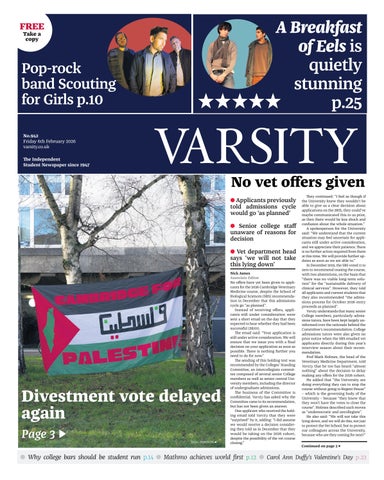
in limbo after committee recommends not to make any ofers yet
Continued from front page
Responding to the Standing Committee’s recommendation, Rudi Bruijn-Yard, co-President of the University Veterinary Society, told Varsity: “Preventing the immediate acceptance of students onto the course stems the lifeblood of the department which relies on an annual stream of applicants to accommodate costs and graduate vets and damages the likelihood that ofer holders will choose to study here.”
He added: “he news is circulating at the moment amongst the students and is particularly disheartening for the younger years who fear how their education may now be afected as the previous SBS council agreement guaranteed a 2026 cohort of vet students, and yet the University now appears to be preparing for an eventuality that might exclude even those that have undergone the current application cycle from attending.”
he Colleges’ Standing Committee’s recommendation comes after University members attended a discussion on 13 January chaired by the deputy vice-chancellor to express their concerns with the conduct of the School of Biological Sciences (SBS) and their recommendation to stop the veterinary medicine course.
Contributions in the discussion came from heads of departments, senior tutors, Vet School academics, as well as vet students. Most of the contributions urged the General Board not to accept the recommendation, and criticised the SBS’s conduct in delivering news of it.
“our spy was captured after completing her mission,” to which Epstein replied “did you torture her”. It is unclear exactly what they are referring to.
Ex-Harvard University President Larry Summers was also implicated in a 2025 release of iles. he documents indicated that Summers corresponded with Epstein until the day before the inancier’s 2019 arrest for the alleged sex traicking of minors.
Following the publication, Summers resigned from his teaching roles at Harvard, expressing “regret” and “shame” for his interactions with Epstein. Epstein’s ties to Cambridge academics previously made headlines after court documents revealed that he emailed his partner, Ghislaine Maxwell, to ind evidence disproving allegations that Professor Stephen Hawking had been involved in an “underage orgy”.
A later release of iles pictured Hawking – a former Lucian Professor of Astrophysics and Trinity Hall Alumnus – at an event on Epstein’s private island, a site allegedly used to traic underage women.
here was also a Royal College of Veterinary Surgeons council meeting last month where its president said that the Vet Schools Council was “receiving quite a lot of questions from students who are currently in the mix, around whether they should or shouldn’t continue [at Cambridge]”.
He added: “I think it’s quite diicult for us to advise in any way as to what the likely outcome is for any students applying this year.”
The University’s General Board is expected to make a decision about the SBS’s recommendation to stop the Veterinary Medicine course at the end of this month.

Wilf Vall Associate Editor
A Cambridge academic who said that Black professors would “disappear” from Harvard under a meritocracy told a court he was treated “less favourably” for his views, and that his College “actively encouraged” protests for his sacking.
Dr Nathan Cofnas, a former research associate at Emmanuel, is suing the College for belief discrimination, claiming the College cut ties with him over protected philosophical beliefs. He argued the dismissal also breached his human rights, violating his rights to freedom of belief and expression, and argued that even if the College’s actions were lawful, they were neither necessary nor proportionate given the strong protection for academic expression.
Cofnas was dismissed from his position in March last year after publishing a blog post on his own website that prompted widespread backlash. He wrote that under a meritocracy, Black people would “disappear from almost all high-pro le positions outside of sports and entertainment,” and the number of black professors at Harvard would “approach zero”.
He alleged that the College’s administration was “actively encouraging protesters” against him after during the fallout over the blog. e College rejects this claim and Cofnas declined to provide examples of this conduct. e academic further claimed that Cambridge’s Philosophy Department was “siding with the protestors” and encouraging further action to have him removed.
His legal claim is being supported by the Free Speech Union, a UK-based or-
ganisation which has previously taken legal action over the issue of free speech at other universities, including the University of Essex.
Cofnas, who was hired by Emmanuel in 2022, characterises his views as “race realism” and advocates for the preservation of “racial distinctions” through a “hereditarian revolution” against the “DEI [diversity, equality and inclusion] devil”. He also called for an end to the “war on nature” and for people to “accept that talent is not distributed equally within or across groups”.
Lawyers acting on behalf of the College told Cambridge County Court on Wednesday (28/01) that the College’s Fellowship Committee – a governing body of academics – believed the post “amounted to a rejection of DEI policies and, in its entirety,
amounted to a call to action encouraging others to reject DEI values.” ese actions were read as a rejection of College members to uphold a “culture of respect” which promises to provide “a welcoming and inviting environment for all”.


e College also argued that Cofnas used an “aggressive” tone in claims that relied on “sweeping generalisations, blunt assertion, and an absence of evidence”.
e College said the post had a “severe” impact on Black students, and that “it was reasonable to take action in relation to the Blog given its adverse impact on members of the College community and a range of core objectives that the College must strive to achieve.”
Following the publication of the post, the College sent an email to all students to “reassure minority groups, particularly black students, that they belonged at Emmanuel on merit”.
Cofnas argued that this correspondence attributed “explicitly extremely in ammatory views to me that I do not hold” and believed it labelled him “a pseudo-scholar”.
58 students


made formal complaints about the contents of Cofnas’ blog post, a petition demanding his dismissal gathered more than 1,200 signatures, and a protest was held outside the Philosophy Faculty.
Cofnas told the court said he believed “Cambridge was a very strong free speech University. at is why I accepted the position at Cambridge,” but claimed the University’s handling of protests failed to uphold this principle.
Emma initially defended Cofnas’ academic right to express his views, but later cut ties, saying the blog rejected DEI, and con icted with its core values.
Varsity previously revealed that Cambridge’s disciplinary body, which is separate from the College, dismissed all 58 complaints against Cofnas after its investigation found no breach of university rules and that the blog did not amount to discrimination or harassment.
e investigation was conducted under the University’s freedom of speech policy, which was adopted last year. e policy is said to safeguard academic freedom and allow scholars to “question and test received wisdom, and to put forward new ideas and controversial or unpopular opinions” without the risk of losing their jobs.
After the College’s decision to cut ties with Cofnas, 14 academics, including ve from Cambridge, wrote to e Times urging the College to reinstate him.
e trial took place on the 28th-30th of January, with a judgement expected in the coming weeks.
Emmanuel College declined to comment.
Alexander Brian Senior News Editor
e feminist society at Corpus Christi has rechristened itself to no longer bear the name of a male alumnus.
Despite long being colloquially known as Corpus FemSoc, its o cial name until recently was the Isherwood society, named after author and Corpus alumnus Christopher Isherwood.
Explaining their reasoning for removing his name, the society o cers said they “felt that our Feminist Society should not be named after a man, even if only on papers and JCR budgets”.
“A man’s name does not accurately represent the reasons why feminism should be and IS central to our current politics and social experiences,” they continued.
e society is now named after Margaret Andrew of Chesterton, who in 1349 donated land to the gilds of St Mary and Corpus Christi in her deathbed will. ree years later, these gilds merged to form a joint gild from which the College originated. Her gift is therefore the earliest documentary evidence of the College’s existence.
e society told Varsity that they chose Margaret Andrew because they “wanted to emphasise the fact that even though it took Corpus a while to admit women, they have always played a vital role – almost like a metaphor to the treatment of women in society as a whole”.
Corpus Christi agreed to admit women in 1980, with the rst female students matriculating in 1983.


Senior News Editor
Cricket players, alongside the Protect Fenner’s Action Group (PFAG), have raised concerns about the revised development plans for the Hughes Hall estate.
Hughes originally acquired two pieces of land from the University in 2024, at a reported cost of £3 million. hese pieces of land do not include the cricket ground.
he initial development plans included a new building for accommodation and teaching space, to be built on the Fenner’s cricket ground. In August 2024, PFAG launched a petition against the plans, which garnered nearly 5000 signatures.
In response to residents’ and cricketers’ concerns, Hughes has recently revised its development plans. According to the College’s website, most of the development will now be located on brownield land, which has previously been developed on. he College says this will reduce “the building footprints within protected open space”.
he College is also seeking to refurbish Covent Garden Hall, which it says will involve “relocating the Fen-
ner’s Maintenance Store adjacent to the Indoor Cricket School”. It says this will take place “in conjunction with the University Sports Service and the Cambridge University Cricket and Athletics Club”.
Fenner’s was designated a Protected Open Space in 2018, as part of the Cambridge Local Plan. Building on this class of land is strictly limited, with certain exceptions such as for “educational need”.
Laurie Bristow, President of Hughes Hall, said: “We are committed to working closely with Cambridge University Cricket and Athletic Club, the University of Cambridge, the local community and University Sports Service to ensure the development beneits both the College and the wider area.
his project will ensure that Fenner’s remains the proud home of cricket in Cambridge, safeguarding the playing and spectating of sport at Fenner’s for future generations.”
One of the College’s aims is to improve its accommodation provisions. According to a webpage dedicated to information about the development, only 34% of Hughes students are able to be accommodated on site, with the
remainder renting privately in nearby accommodation.
he new development seeks to increase this proportion to 50%. he plans include building a new accommodation block at the end of Mortimer Road, as well as a new, permanent, porters’ lodge.
In a letter sent to nearby residents on 16 January, seen by Varsity, the College said it will “ensure that access to cricket at Fenner’s is retained, recognising its importance to the University and the city,” and invited local residents to attend a drop-in session at Hughes, where members of the project would explain the plans further.
Concerns are once again being raised regarding the plans. Anthony Hyde, the secretary of Cambridge University Cricket Club (CUCC), said: “I think that the proposals described on the Hughes
Hall website just show a preliminary development, and not the full extent of the proposed Hughes Hall expansion of the land purchased.”
On the development website, the College states: “As the land purchased is not part of the cricket ield there will be no impact on the playing of sport at Fenner’s and the College has a contractual obligation to maintain a no-build zone in accordance with the condition that development cannot in any way impact the play of cricket at Fenner’s.”
Hughes continued: “The project provides an opportunity through the development of a permanent Porters’ Lodge to ensure smooth access to Fenner’s – balancing its open character with the need to maintain safety and security across the cricket ground, wider College estate and surrounding neighbourhood.”
Varsity reported last year that Fenner’s cricket ground has seen a decline in the number of home games played there over the last few years. Players have complained that the condition of the pitch has deteriorated, and that they regularly struggle to access the cricket ground for training and matches, as the gates at the Mortimer Road entrance are frequently closed.
Simon Calla-
ghan, a player for CUCC, said: “We must make sure the proposed developments, on and around Fenner’s do not happen. Open space is critical to both the city’s and the University’s culture and wellbeing.”
he development project is being led by Feilden Fowles, an architectural irm responsible for the new dining hall at Homerton College, as well as renovations at several Oxford colleges.
he dedicated website provides a provisional timeline for the development. Further drop-ins, covering speciic topics such as biodiversity, will be held in February and March, before a planning application for the renovation of Covent Garden Hall is submitted in March. Planning permission for the remainder of the works will be sought in the summer.
John Phelps, a chairperson of Cambridge St Giles Cricket Club, said: “Fenner’s is potentially a fantastic asset for Cambridge and the community in general. he cricket community remains concerned about the restrictions to access and use of the ground as these developments progress.”


Alexander Brian and Ell Heeps
Senior News Editors
e billionaire tech entrepreneur and right-wing activist Peter iel delivered a series of talks entitled ‘ e Antichrist Lectures’ in Cambridge last week.
e lecture was organised by Faculty of Divinity professor and Reform UK adviser James Orr, and held in the Ramsden Room of St Catharine’s College.
In a post published on X on Saturday (31/01), Orr wrote: “What a privilege to host Peter iel in Cambridge this week for a stunningly original and erudite series of lectures. iel is the walking antidote to the modern multiversity. e highlight of our academic year.”
e event was reserved to those personally invited by Orr, and its contents remain secret. However, recordings of the four o -the-record talks iel delivered in San Francisco on the same topic were obtained by e Guardian and Washington Post
Thiel describes the antichrist as “an evil king or tyrant or anti-messiah who appears in the end times”. He claims that this gure will cause the Armageddon by weaponising concerns about issues such as climate change,
nuclear war, and arti cial intelligence to justify consolidating their power and forming a one-world state.
While he has never been speci c about the identity of the antichrist, he has suggested several names, including environmental activist Greta unberg, whom he described as a “luddite who wants to stop all science,” and philosopher Nick Bostrom, who writes about the dangers of AI.
iel’s lectures draw on a variety of sources, including biblical passages, French philosopher René Girard, and Nazi thinker Carl Schmitt. According to e Guardian, he also references video games, TV shows, and e Lord of the Rings, as well as conversations with gures such as Elon Musk and Benjamin Netanyahu.

e San Francisco lectures were delivered in September and October 2025, with tickets priced at $200. Previously, iel discussed his views on the antichrist with e New York Times, and at the universities of Oxford, Harvard, and Austin.
According to Wired, the tech baron was attending and giving speeches on the topic as far back as the 1990s. He delivered a lecture at the Academy of Moral and Political Sciences in Paris last Monday (26/01). iel made his fortune as


the co-founder of PayPal, and by investing in Facebook, SpaceX, and OpenAI through his Founders Fund. He also co-founded the tech company Palantir, which has contracts with the Pentagon, ICE, and the NHS.
Student activists in Cambridge have been heavily involved in campaigns against Palantir’s relationship with the NHS. ese have also involved political societies, with the Cambridge Young Greens describing the “platforming of a billionaire” who has provided “mass surveillance” technologies to the US and Israeli governments as “disappointing”.
iel has also played a signi cant role in US politics, and is often credited for JD Vance’s rise to the vice-presidency.
e billionaire has had close ties to Donald Trump for almost a decade, and is massively nancing this year’s Republican midterm campaigns.
James Orr was appointed as a senior adviser to Nigel Farage in October, and has previously come under re for his “racist and derogatory” remarks about Arabs and Palestinians. is is not the rst time iel has delivered a talk in Cambridge. In 2024, he was invited to speak at the Cambridge Union. e resulting protest, which drew hundreds of people, disrupted the event and prevented iel from leaving the building for over an hour afterwards.

Alexander Brian and Calum Murray
Senior News Editor & Editor-in-Chief
Students and activists protested outside a talk with the Reform UK adviser Jack Anderton organised by the Cambridge University Conservative Association (CUCA) last Friday (30/01).
Anderton, 25, has worked as a social media adviser to Reform UK, helping to establish Nigel Farage’s TikTok account.
His lecture began by addressing the protests outside, which he claimed “barely 15” people had attended. He said that while some of the demonstrators were “evil”, most of them shared his concerns about Britain’s decline.
As Anderton’s talk continued, protesters outside chanted “CUCA, CUCA shame on you, you are racist through and through”. Later, former Cambridge Union president Sammy McDonald addressed the crowd, stating: “We are here today because of a profound moral failure on the part of the Conservative Association.”
e co-chair of the Cambridge University Labour Club (CULC), Alex Parton, also spoke. He claimed that several CUCA members were unhappy with the society’s current leadership for inviting Anderton, as well as YouTuber Tom Rowsell, who was linked to pagan organisations holding “eugenicist beliefs”, to speak. CUCA has since cancelled the event with Rowsell and apologised for issuing the invitation.
Anderton’s talk was delivered to around 30 people in the Babbage Lecture eatre. e event formed part of
Anderton’s ‘New Dawn’ university tour, which he said was inspired by the assassinated conservative activist Charlie Kirk.
During his speech, Anderton said that immigration should be reduced to “practically zero,” blaming immigrants for housing and job shortages.
CUCA chairman Oscar Lingwood then quizzed him on his support for Reform rather than the Conservatives. Anderton argued that the Conservatives and Labour have destroyed the country, driving voters towards newer parties like the Greens and Reform.
Members of the audience then questioned Anderton. One of the speakers was maeve Halligan, co-founder of the controversial Cambridge University Society of Women, whose membership is restricted to “biological women”.
An Instagram post by CULC at the start of term criticised comments made by Anderton on his blog, where he wrote that “Britain would be better o ” had it stayed neutral in the Second World War rather than ghting Nazi Germany, and that “in the coming Meritocracy” the country could and should “regain” some of its former colonies.
CUCA’s Chairman, Oscar Lingwood, told Varsity: “CUCA invited Jack as he is an important, young advisor for Britain’s most popular political party. It is a pity that rather than being able to engage with him maturely, as Anderton himself hoped for, some decided instead to protest and attempted to get the event cancelled.”


We are a European consultancy firm focussed on analytical and quantitative topics and the development of sustainable solutions to bring about positive change for our clients.
What does d-fine offer you?
- Diversity: Work with clients on topics ranging from financial engineering and machine learning through to climate risk and healthcare
- International: Collaborate in project teams staffed across Europe
- Education: Acquire new skillsets to broaden your technical and professional repertoire
Who do we look for?
Master’s or PhD-level graduates in STEM fields


Andrew Knight News Correspondent
St John’s College, along with Christ Church, Oxford, lost £700,000 in the 18 months following their purchase of an historic estate in 2023.
his includes a £450,000 reduction in the estate’s market value, as well as expensive renovation works, inancial statements show.
Land registry documents show Parlington LLP, a joint venture between John’s and Christ Church, purchased the 1,700-acre Parlington Estate in West Yorkshire for £30 million in December 2023. his was at least £10 million more than it had been valued at by its previous owner, according to the Association of Real Estate Funds.
Since then, property services irm Savills has revised down the estate’s market value by almost £450,000, according to Parlington LLP’s accounts. he accounts suggest this is primarily based on rental income from the small number of historic properties on the estate.
One of the estate’s largest properties, a four bedroom house, was renovated in 2013 and is currently rented out at £2,950 per month. Since December 2024, the colleges
have submitted applications to refurbish six other properties, which would incur signiicant expenses. An unredacted quote submitted in one application suggests the cost of installing 49 “highperformance timber windows” in four properties could exceed £150,000.
hese costs partly explain Parlington LLP’s losses of almost £700,000 –£350,000 per college. he colleges’ inancial statements indicate these losses have been deducted from their endowment funds, used for scholarships and charitable donations.

he considerable premium paid by the colleges to acquire the Parlington Estate could represent its ‘hope value’, an increase based on the likelihood of future development.
Renshaw Watts, a former independent consultant to the estate’s previous owners, the M&G UK Property Fund, said the company launched a campaign to sell the estate in January 2023.
M&G had already spent around a decade unsuccessfully
attempting to develop the estate. Early planning discussions started in the 1990s, commencing “in earnest” around 2015, Watts said.
M&G submitted its irst formal proposal for ‘Parlington Village’ to Leeds City Council in 2016. Although the council initially approved the plan, it later backtracked after baclash, as well as heritage and environmental considerations.
he reaction of John’s students has been mixed. One postgraduate student expressed “confusion” at the “wildly risky and irrelevant” spending. Another said he was “curious” about a possible renewable energy installation on the estate, and did not deem the investment “massively controversial”.
Parlington sits in the rural outskirts of Leeds. Much of the estate was designated a grade II Registered Park and Garden by Historic England in 2017.
John’s Master Heather Hancock has held numerous senior roles involving rural land management, including nonexecutive board member at the Department for Environment, Food & Rural Afairs.
Hancock and her husband are also non-executive director and chairman, respectively, of Yorkshire-based land consultancy Rural Solutions, which has participated in planning consultations in villages located near Parlington. Approached for comment, Parlington LLP denied consulting either Hancock or Rural Solutions in relation to the purchase.
All relevant parties were contacted for comment.

Rhea Goel News Correspondent
A group of Lucy Cavendish students have received compensation after their house was left without reliable hot water and heating for over a month, in a dispute that escalated into a rent strike.
For most of December and January, residents did not have hot water, which also prevented the heating system from working properly.
One resident contacted the College in January, writing: “As these issues remain unresolved after more than a month [...] we feel it is necessary to raise a formal complaint.”
heir email mentioned a “prolonged lack of a basic essential service –particularly during winter,” claiming that the lack of hot water disturbed dish-washing, laundry, and the house’s heating system. hey went on to say that the temperature in the house averaged “around 13°C, for over a month”.
Lucy initially directed students to use communal shower facilities in other parts of the College, which residents complained were “approximately a 20-minute walk away”.
Later, a temporary shower trailer was installed, which residents described in their email as “substandard” and “extremely cold”. he student continued: “I have personally fallen ill as a result”.
Lucy rents its Hinsley Lane accommodation from St John’s College.
In an email to residents, the Lucy accommodation team conirmed that a “progress meeting” had taken place on 9 January between Lucy, John’s, and Collegiate AC, which manages the accommodation on behalf of John’s.
Later emails from the accommodation team clariied that the pump system had failed, and that it was proving diicult to source “key replacement parts”.
Responding to the initial complaint, the College wrote: “We recognise the impact this situation has had […] and are sorry for the inconvenience this has caused,” further stating that “the interim arrangements have not provided the level of amenity expected”. he College later ofered 25% compensation to the afected residents, which was rejected. he student described the ofer as “not satisfactory,” and told Lucy that residents would remain on rent strike until their request of 75% compensation was granted, or they were given “a satisfactory answer” as to why this was not possible. he rent strike has since ended. Residents told Varsity that they received 50% compensation for the afected period.
In a separate incident at Lucy Cavendish, students were told on the 16 January to delay their return to College due to a portion of the city experiencing water supply issues. Lucy Cavendish College was contacted for comment.

A sweet-toothed thief was arrested last Wednesday (28/01) for stealing 29 Lindt gold chocolate bunnies from Sainsbury’s on Sidney Street. Cambridgeshire Police chased after the 36-year-old culprit, and said an officer was just a “hop, skip and jump behind him” before making the arrest. The chocolate bunnies were taken into custody as evidence. Police claimed the suspect “thought he could make a clean getaway with a basketful of bunnies,” but footage released of the pursuit revealed it lasted just 30 seconds.
A group of Cambridge scientists have shared their experiences of rejection and setbacks in their careers for a new book. Catz pathology professor Adrian Liston’s new work, Self-Doubt: An Anthology of Experiences in the Biomedical Sciences, draws on the testimony of past and present members of his lab group. e academics recalled personal challenges, including chronic health conditions and cultural expectations, alongside professional struggles, such as trying to secure research funding.
Researchers at Addenbrooke’s have developed a 3D imaging system to help nurses monitor premature babies in neonatal intensive care. e camera combines RGB (which captures visible light), depth (for 3D perspective), and infrared imaging (which works well in the dark). Machine learning and pose estimation technology is then used to create 24-hour recordings. e system tracks hips and shoulders as key points to detect developmental abnormalities and monitor the health of premature babies.
Biased’ ChatGPT prefers Cambridge to Oxford
A study by researchers at the Oxford Internet Institute has identi ed bias in large language models (LLMs) by asking ChatGPT to provide one-word answers to questions about Oxford and Cambridge. e study found that ChatGPT associated Cambridge with being more “relaxed, socially mobile and industrious” than Oxford, which it associated with more alcohol and a livelier nightlife. ChatGPT also rated wealthier regions of the world as “better”, “happier” or “more innovative” than less wealthy ones.


e end of Oxford admission tests

Oxford University has abandoned its own admissions tests and will instead adopt standard tests used by Imperial and Cambridge. e system will apply to subjects that already require entry exams, including sciences, mathematics, history, and PPE. A university spokesperson told Oxford Mail: “ e university is continually reviewing its admissions processes and practices to ensure they best meet the needs of the University, schools, and applicants.” David Gibbon, director of Oxford and Cambridge Tutors, said “removing some of the perceived mystique and individuality away from an application will bene t candidates who might be less familiar with the Oxford admissions process”.
Cardi uni bans men’s cricket team
Cardi University’s men’s cricket team has been banned for the rest of the academic year following a Student Union investigation into misconduct at an initiation event. Allegations included degrading behaviour such as ushing players’ heads down the toilet, forcing them to eat raw onion, and encouraging excessive alcohol consumption. e incident took place at the start of the academic year. Committee members responsible for the cricket team at the time of the incident will be permanently banned from representing Cardi University, even if the team is reinstated. e University stated it has a “zero-tolerance position on initiation-type behaviour”.
Sikh Society provides free food to over 2,000 people
A community kitchen organised by the University of Birmingham (UoB) Sikh Society provided free food to more than 2,000 people on Monday (02/02). e event celebrated Langar, a Sikh tradition of o ering free vegetarian meals to everyone, regardless of background. Running for over 20 years, the event included vegan options including lentil soup, vegetable curry, and chapatis, all prepared locally. UoB commented: “Beyond providing free food, the event serves as an educational and cultural opportunity, helping attendees gain a deeper understanding of Sikh principles and fostering inclusivity across the university.”
Alexander
Brian Senior News Editor
he University’s disciplinary body held four hearings for cases of sexual misconduct in 2025, during a period in which 21 students made complaints.
his represents an increase from 2024, when no disciplinary meetings were held despite eight complaints being made.
In order for a perpetrator of sexual misconduct to receive “serious sanctions” such as temporary or permanent exclusion, the University’s disciplinary body – the Oice of Student Conduct, Complaints and Appeals (OSCCA) – must hold one of these hearings.
Without a hearing, a student discipline oicer (SDO) can only hand out minor sanctions, such as requirements to attend a consent course or write a letter of apology to victims.
Freedom of information requests reveal that two minor sanctions were imposed last year. hree cases were also completed under the Informal Complaints Procedure for Student Misconduct, which allows a non-contact agreement to be agreed between two students.
OSCCA is the University’s central disciplinary body. In addition to sexual misconduct, the body deals with issues such as reviews of examination results, itness to study procedures, and complaints.
More serious allegations, such as sexual assault and rape are intended to be dealt with by the police. However, in
2023, Varsity reported that colleges had “actively discouraged” students from reporting sexual assault allegations to the authorities, instead referring them to OSCCA.
he student campaign group End Sexual Violence (ESV) said that the increase in the number of sexual misconduct reports “doesn’t represent an increase in the number of cases across the University but rather suggests that students might feel more comfortable this year to last in terms of reporting cases of sexual misconduct to OSCCA”.
increase in sexual misconduct hearings was “promising,” but said there were still steps to be taken.
MTM’s recommendations include ensuring “more than one person” considers “the outcome of every viable investigation,” standardising “trauma-informed language in communication with the involved parties,” and making “no-contact orders between involved parties postinvestigation standard”.
hey also want the University to “introduce appropriate sanction options to relect the severity of sexual misconduct,” to “provide all involved parties with the same considered evidence post-investigation,” and to “present all parties, not just the respondent, with the opportunity to appeal the investigation’s outcome”.
he group also responded positively to the increase in disciplinary meetings, noting that those cases would have been discussed by a board, rather than a single SDO. ESV added: “his is an improvement from last year and shows that the University has potentially relected and improved upon the criticisms it has previously faced.”
However, EVA also criticised the fact that there were close to “17 cases in the past year where the outcome was decided by a singular individual”. Some of the 21 cases from 2025 have yet to be concluded.
Another campaigning group, More han Misconduct (MTM), agreed that the
In September, the Oice for Students (OfS) published the results of a national survey of 50,000 inal-year undergraduates carried out in January 2025. he survey showed that 25% of students experienced sexual harassment during their studies, while 14% experienced sexual assault.
Of those who faced harassment, over half said their experience involved someone connected to their university or college. Only 13% made a formal report to their institution, of which 47% said their experience was good, compared to 39% who said they had a poor experience.
he OfS also said that women were three times more likely to experience sexual harassment than men, and that gay, lesbian, and bisexual students were
more than twice as likely to experience sexual misconduct as heterosexual students.
his comes after the OfS introduced a new policy in August demanding universities ensure “that investigations undertaken and decisions made in respect of incidents of harassment and/or sexual misconduct are credible, fair and otherwise relect established principles of natural justice”.
he OfS told Varsity that the new guidelines mean “all universities and colleges registered with the OfS must publish and maintain policies and procedures that set out the steps they will take to prevent and address harassment and sexual misconduct. his includes enabling students to report incidents, providing support for those afected, and letting students know how incidents will be handled.”
25%
he percentage of UK students who said they experienced sexual harrassment during their studies
Universities are also now required “to deliver understandable and evidencebased training for staf and students”. hus, in Michaelmas, Cambridge students received an email from Prof Bhaskar Vira, Senior Pro-Vice Chancellor, asking them to complete online sexual harassment training.
EVS argued that sexual misconduct
reporting procedures could be improved by increasing communication between college and University bodies.
he society explained: “When students report, they can choose to either report via the University or via their college, but this can result in signiicantly diferent experiences as college policies can difer hugely from each other. We would push the University to work more closely with colleges in cases of sexual misconduct, and ensure there is a greater degree of uniformity to students’ reporting experiences.”
hey also expressed concerns that the University has not committed to maintaining funding for the HVSS (Harassment and Violence Support) service, which ofers conidential practical and emotional support to students who have experienced sexual harassment, domestic abuse, or religious/racial discrimination.
EVS told Varsity: “Cambridge needs to ensure the HVSS remains a permanent service and that it is suiciently funded to continue providing support.”
A spokesperson for the University said: “here is no place for sexual misconduct at the University of Cambridge. We always take allegations seriously, providing support for those afected and clear systems for reporting incidents. he Oice of Student Conduct, Complaints and Appeals has also increased its investigative capacity, thanks to funding for an additional investigator.”
Learn more about us and our roles at our programs and events. No nance experience needed. We look for a passion for critical thinking and
problem-solving – people
Learn more about Jane Street:

Picture this. It’s 2008, Christ’s College May Ball, and headlining alongside e Wombats are Scouting for Girls, a new pop-rock band that everyone is talking about. After their set, you head to the food tents, aunting a Topshop dress that perfectly compliments your nonexistent eyebrows. Beside you in the queue are the musicians themselves, who are practically boy band royalty. e only guests not in black tie, they stick out like sore thumbs posing next to you in the Survivor’s Photo. Your friends will be so jealous.
Ball in 2018 (“we were better behaved there”). Stride describes how they carefully target those shows for students: “ ere are gonna be people there who literally only know ‘She’s So Lovely’,” so they play more interactive songs, more covers. ese performances resulted in the band playing some wealthy students’ “super swanky 21sts”, which are “the most fun you can have” according to Stride. “When you get it right, one of those shows is as good as playing Wembley Arena”.
vals is de nitely audience-focused: “we know what people want”.
❝
the year of analog media, then Stride is its biggest fan. “ e value of music has been diminished so much now because the barrier to entry is so low”. ink back to 20 years ago, Stride tells me, when you had to pay £15 for one album: “ e smaller songs, the B-sides sometimes became more important to you than the big songs”. Now, he remarks, nobody really listens to albums all the way through: “When you get to an artist’s shitter songs, you think, well I could be listening to ‘Let It Be’, you know?”
thousand miles per hour, but he’s attentive too – he asks about my degree, where I’m from, and my own musical background. Typical Brits, we compare the sunny weather in LA to the intermittent drizzles of the English countryside. He often sets his treadmill screen to show him the South Coast, he confesses, missing the pebbly beaches of Sussex.
Still, Stride looks forward to playing their B-sides for audiences on the band’s jam-packed 2026 tour. “We’re at a really great level of success now,” says the singer and producer “where we get looked after really well, we play shows to amazing crowds […] but we don’t play anything to click track; we don’t have a big light show”. ese shows, Stride suggests, are the perfect blend of intimacy and excitement.
We got chucked out because we weren’t wearing tuxedos ❝
As teenage buddies, Stride, Ellard, and Churchouse started the band “wanting to be like Oasis orBlur,” the singer remembers. ey honestly thought it was going to happen, receiving a record label in Stride’s university years. en, they were dropped. “It took another six years before we got another chance”. By the time they got a deal again at around 26 years old “everybody had written us o ”. With care in their hearts, friends and loved ones told the band to give up on their dream. So when Scouting for Girls nally made it, “it was a riot”.


e story told from the inside sounds slightly di erent. For Roy Stride, the lead singer of Scouting for Girls, it’s a blurry memory. “We got chucked out because we weren’t wearing tuxedos,” Stride tells me. Dejected, the members returned to the tour bus, and told the tour manager, a “pretty old school guy” who had tour managed the likes of Madness and e Smiths. “He phoned up the Entertainment Manager and went ballistic,” remembers Stride. “He was like, ‘performing animals? Is that what we are? You just bring us in, make us sing, and tell us to fuck o ? ’” 20 minutes later, the committee stood apologetically outside the bus, their president in tears. ey let the band members in after the ranting phone call, who took full advantage: “I drank more champagne that night than I’ve ever drank entire life”.


The early 2000s poprock sensation have played many Oxbridge Balls in their time, including Jesus May


Scouting For Girls’ upcoming tour celebrates the anniversary of 2010 alEverybody Wants to Be on TV frontman is excited to revisit their older tunes, but the revival, he tells me, is not that di erent to their usual sets: “to be honest, we return to them quite frequently anyway!” ey’ve never been the sort of band who doesn’t like playing their big hits: “I much prefer playing a big song that everybody knows than a new song that nobody knows.” is perspective doesn’t prevent Stride from embarking on new projects: “I love writing the new stu ; I love recording it” – yet the band’s approach to big shows and festi-


If 2026

It’s true – Scouting for Girls’ greatest hits take you back to the poprock- lled haze of the early 2000s. For many Gen Z-ers, they soundtracked childhood. If you’re anything like me, you sang along to ‘ is Ain’t a Love Song’ when it played on the car radio, ‘She’s So Lovely’ immediately brings to mind a human-sized olive running across the seafront in Angus, ongs and Perfect Snogging, and ‘Elvis Isn’t Dead’ accompanied your teenage angst after you broke up with your rst girlfriend (just me?). I ask Stride how it feels to produce such nostalgia in listeners, to which he laughs with relief: “I thought you were gonna say, ‘what does it feel like to be so old?’” e band, says Stride, was a “nostalgic project” since its inception in 2005, so he’s “really happy to plug into that”. Memories of their genesis bring the singer back to the golden age of CDs. “We sold a million CDs just in the UK, which is a ridiculous gure –nobody would even sell 10,000 CDs now!”. He reminisces that there was a “shared culture back then,” so playing their older songs creates a special togetherness in audiences. really is in my bum . eir them the UK, which is a ridiculous sell


e 46-year-old from West London remembers the band’s prime with fondness too. “Headlining Wembley Arena in 2011 was massive for us,” the performance just round the corner from where he and his bandmates grew up. “It was the peak of where we got to as a band”.


Scouting for Girls is formed of three childhood friends: drummer Peter Ellard and bassist Greg Churchouse have played alongside Stride since the start. “We’re godparents to each other’s children,” Stride tells me, “and it’s probably the best thing about this whole thing – a friendship that’s 35 years strong.” e frontman stresses that he’s the creative one, always coming up with new ideas, while his bandmates are “very good” at calming him down.

I can imagine this dynamic between the members easily. From the moment we meet, Stride is a bundle of intense energy. It’s clear that his mind travels at a


I much prefer playing a big song that everybody knows than a new song that nobody knows


is tumultuous experience has led Stride to create his own philosophy of fame. “Talent plays very little part in success in music, and in anything really in life. It’s the people who keep going and making their own luck”. God-given gifts are rare: he doesn’t often encounter them even within his more collaborative work. Stride has also written for bands such as One Direction and 5SOS, and worked on Seafret’s ‘Atlantis’, which recently blew up on TikTok and has since accrued over a billion streams on Spotify. He knows the industry inside out: “It’s the writers who keep going every single day who write that magic song”. My conversation with Stride has meandered almost e ortlessly from English degrees to songwriting, to our mutual distaste for stadium shows. It’s strikingly unawkward, nothing like the usual experience of talking to a stranger. We land on Scouting for Girls’s most famous songs, ‘She’s So Lovely’and ‘ is Ain’t a Love Song’, which Stride reveals “took almost two years to write, from the moment we got the rst hook”. You can become “trans xed,” says Stride, “with why a song becomes successful, rather than just writing a great song”. at’s what he’s trying to return to now, he says rmly: “falling more in love with music”.


One of the most proli c mathematicians of the 20th century, Paul Erdős, proposed over a thousand mathematical conjectures throughout his career: the Erdős problems. Around 40% have been solved, but none by AI – until last month. To the surprise of many mathematicians, it was in fact the world’s rst fully autonomous AI solution to an open mathematical problem (a problem recognised by researchers yet to be solved). And the mathematician that solved it? Kevin Barreto, a second-year Queen’s Mathmo.
Kevin began tackling Erdős problems in earnest in November 2025, after seeing that an AI startup, Harmonic, had obtained a partial solution to an Erdős problem using their AI system, Aristotle. “You know, maybe there’s some low-hanging-fruit problems that would be within reach of an undergrad,” Kevin said he thought at the time.
❝When one is entirely con dent in their proof, no congratulations are needed
By early December, he’d already solved one Erdős problem without using AI, in his eld of specialty, number theory, and obtained a partial result on another. His work quickly gained attention on a forum dedicated to cataloguing Erdős problems, earning him congratulations from Terence Tao, whom many consider to be the greatest living mathematician – although Kevin was “actually rather nonchalant” about it.
“When one is entirely con dent in their proof, no congratulations are needed; the mathematics speaks for itself.” Encouraged, he began experimenting with using AI to solve these problems.
Collaborating online with a hobbyist mathematician, Liam Price, the pair eventually identi ed a promising candidate problem that ChatGPT-5.2 solved entirely without human intervention. Kevin then fed the proof into Aristotle, which automatically formalised it in Lean – a programming language used to quickly verify the logic of mathematical proofs.
After Kevin excitedly posted the result on Twitter on Christmas Day, another forum user quickly discovered the problem had actually already been solved. Undeterred, the pair continued their work and within weeks, achieved a fully autonomous AI proof to a genuinely unsolved problem, Erdős problem #728–albeit using arguments similar to earlier work. Since then, AI has gone on to fully solve several more Erdős problems and contributed to many others. For some of the problems which Erdős considered more interesting or di cult, he o ered prizes of up to $10,000, but Kevin believes these are currently far out of reach for today’s models.
Directly solving problems is not the only way AI can assist mathematicians. Large Language Models’ (LLMs)
‘deep research’ modes have also proved transformative for literature review, unearthing obscure but relevant results that might otherwise be missed, and helping researchers avoid retreading old ground. e rapid progress of LLMs over the past year has made their potential in maths and science increasingly clear. Systems that once struggled with basic reasoning are now highly capable of undergraduate and even competition mathematics – as any Mathmo or Natsci behind on their problem sheets will know. However, Kevin’s work marks a further step.
While these models will undoubtedly continue to improve, Kevin argues that a “fundamentally new architecture” is needed to achieve true mathematical superintelligence – one capable of tackling the deepest unsolved problems in mathematics, such as the Millennium Prize problems. Trained on existing work, today’s LLMs are adept at cleverly combining known ideas. is may be enough to solve Erdős problems, but cannot produce the completely novel concepts required for the hardest problems; partly because these ideas are so foreign that they would require entirely new mathematical language, which LLMs are inherently incapable of creating, to even express.
Kevin’s work is striking but equally compelling is Kevin himself. He may look like a typical Mathmo, but his path into research is far from conventional. He comes from a working-class immigrant background and is the rst in his family to attend university, with parents who left school early. He has always had a clear passion for mathematics – by thirteen, he knew he wanted to be a mathematician, and by seventeen he was obsessively reading the newest research in analytic number theory. Yet he has no Olympiad background, having been comparatively average at school maths competitions, and entered Cambridge only after being accepted into Queen’s through the summer pool, after a rejection from Trinity.
❝
I felt like I could make a bigger contribution to maths by trying to make a machine that can do what I can't
Arriving in Cambridge, Kevin hoped to eventually pursue a PhD under James Maynard, a Fields medallist in the eld of analytic number theory. But his rst year was derailed by mental health struggles, and he failed the Tripos exams. After taking a gap year, he was allowed to resit rst year, this time achieving a 2:ii. He is blunt about the experience: “Tripos is not my thing,” a judgment he attributes to having very speci c mathematical interests and being someone who is “not very good at
❝
I think there is a far too competitive atmosphere in Cambridge
thinking of ideas on the spot.”
At Cambridge, it becomes ingrained in students that Tripos ranks re ect mathematical potential, making it unthinkable that someone outside the top of the cohort could already be capable of original research. I confess that I was expecting Kevin to be someone who ew through the tripos with ease and thus had time on his hands to do such work. Kevin describes how this attitude can turn toxic, recalling instances of top-ranked students deriding those lower down the Tripos despite their deep passion for the subject. “I think there is a far too competitive atmosphere in Cambridge. […] I have felt that the words I speak are dismissed by peers or faculty simply because I am not as well-performed on Tripos as they are. It’s like people will tactfully refuse to help each other, such as on example sheets, just to help secure their ranking above that person.”
Kevin is not the rst to show that Tripos rank is an imperfect predictor of research ability. He points to the example of Klaus Roth, Britain’s rst Fields medallist, who graduated with a thirdclass degree and was advised by his supervisor to abandon mathematics altogether. “ e Tripos is genuinely a good way to test mathematical ability,” Kevin re ects, “but it’s a form of mathematical ability I don’t possess.” His struggles with the tripos also pushed his turn to AI: “it got to a point where I felt like I could make a bigger contribution to maths by trying to make a machine that can do what I can’t.”
After being allowed to return to Cambridge following his gap year, Kevin now faces the opposite problem: securing approval to take another year out to continue his work at a leading AI research lab. Companies including OpenAI and DeepMind, as well as specialist maths AI startups such as Harmonic, have approached him directly, actively courting him, something Kevin says is “actually rather overwhelming […] it has been a long-time dream of mine to eventually work at DeepMind after seeing the revolutionary accomplishments they’ve made.” He is quick to add, however, that xAI is o the table – he “will not be helping Elon Muskrat.”
For many in STEM, these labs are the ultimate place to work, akin to a modern-day Manhattan Project or Bell Labs. Unsurprisingly, positions are so competitive that they’re e ectively inaccessible to most students, and undergraduate placements are essentially unheard of. Again, unsurprisingly, Kevin is being considered as a special exception. He is now weighing whether to drop out to pursue this work, although he is worried that eventually he “may get bored of this AI for maths stu ” and want to return to his original dream of doing a PhD – a path that would almost
certainly require nishing


It has been a transformative few months for Kevin whose work has now been featured in the New York Times and the New Scientist. As recently as last November, he wrote that it would be a dream of his

simply make a minor contribution to an Erdős problem. Despite this, he remains very humble. “I’m not cracked,” he insists, adding that “anyone interested in these problems could have done this.” I’m still deciding whether I believe him.
Speaking to Kevin, I found myself genuinely inspired – not only as a physicist increasingly weary of the Tripos grind – but by the picture he paints of the extraordinary years that lie ahead of us in science and mathematics.


For years, su erers of dysarthria, a speech disorder characterised by slurred, mumbled and quiet speech, have relied on brain implants or eye tracking programs to communicate. Last week, a team led by researchers at Cambridge published the results of their new wearable device, Revoice, that could revolutionise the lives of patients unable to communicate fully.
Dysarthria is caused by damage to the nervous system, and is a common result of many neurological diseases including stroke, ALS and Parkinson’s. Revoice is a choker-like device worn around the neck that senses laryngeal muscle vibrations, as well as carotid pulse signals. is means that the wearer is able to silently mouth words or phrases that can be interpreted by Revoice, while the pulse monitor interprets the emotional state of the individual.
Limitations of wearable technology for dysarthria patients until now include the need for the user to pause between each word to give the system time to interpret it. Revoice uses a
Dhruv Shenai and Jessica Adams present some of the latest scienti c developments
high-resolution method that allows the wearer to ‘speak’ uidly. As well as this, devices so far have only been able to provide 1:1 translation, dictating word-for-word what the person is saying. While this is practical for healthy people (on whom the technology is often tested), for those with neurological conditions, it can be very demanding, both physically and cognitively, to put together a full sentence. Revoice uses two AI agents: one to reconstruct words from the mouthed speech, and the other to expand these words into a full sentence, taking into account context clues such as emotional state and the weather. In one test, “we go hospital” was translated into: “even though it’s getting late, I’m still feeling uncomfortable. Can we go to the hospital now?”
While this was just a small study, with ten healthy people and ve stroke patients, the model achieved a per-word accuracy of 96.3% and the participants reported a 55% increase in satisfaction. e development of Revoice provides hope for dysarthria su erers looking to regain their voice.


Ba-bam-bam-Ba-bam-bam. at’s the sound of the sweet ‘music’ I fall asleep every night to: the pounding bass of Rose Crescent’s infamous La Raza. And I am hardly the only casualty. Most Cambridge students endure a similar acoustic assault, from street buskers to house parties to construction work. Yet while we adjust, acclimatise, and adapt to our noisy everyday, our bodies are not so una ected. In more ways than one, our bodies keep the score.
10 dB increase in tra c noise raised the odds of hyperactivity, inattention, and peer relationship di culties. Noise may even a ect reproductive health. A 2024 cohort study found that long-term exposure to noise in women aged 35-45 was associated with an increased risk of infertility, while other research has linked high noise exposure to adverse birth outcomes.

taking place. In essence, chronic noise exposure keeps the body in a low-grade state of alert, quietly wearing it down over time.


a 60 dB conversation; it’s one ful. Yet legal reporting


Our bodies are being exposed to sound levels they were never meant to withstand. According to the World Health Organisation, sustained noise above 55 decibels (dB) – about the loudness of a refrigerator or a quiet residential street – increases the risk of stroke, type 2 diabetes, and even dementia. (As I write this, La Raza is currently hitting 77 dB). Long-term exposure to noise has already been linked to 12,000 premature deaths and more than 48,000 cases of new ischaemic heart disease across Europe. In England alone, road tra c noise accounted for 100,000 Disability Adjusted Life Years (DALYs) lost in 2018, with one DALY representing the loss of one year of good health. Noise, in other words, is far more than a nuisance. It’s deadly.
We think we’ve ‘gotten used’ to noise, but perception adapts faster than physiology
But how does noise actually harm us?


e


extends beyond the physical to the cognitive. In children, a 2018 study found that aircraft noise was associated with poorer reading ability, weakoral comprehension, reduced long-term memory. Adolescents show similar vulnerabilities: a 2019 study reported that every


Nursery is often the rst place children learn how to share – and perhaps this includes more than toys! For the rst time, scientists have quanti ed that babies can share up to 20% of their microbiomes with each other, within the rst four months of nursery.
is result is unexpected because it implies that babies share their gut microorganisms with each other at a higher rate than with their families after birth. e research team analysed faecal samples from babies attending a nursery in Trenco, Italy, both before and during their rst few months. ey found that the babies’ microbiomes became increasingly similar, re ecting their similar diets at nursery, and also transmission of bacteria via social interactions.
e microbiome consists of trillions of bacteria and microorganisms. ey are critical for the development of our immune system, possibly in uencing our sleep, mood and cog-
Despite these harms being well-documented, noise is still not treated as a serious health issue. While air pollution and diet routinely appear on lists of major public health risks, noise rarely does – even though it a ects far more people. Part of the problem is habituation: we think we’ve ‘got used’ to noise, but perception adapts faster than physiology. Our stress response stays switched on even when our awareness fades. To the body, there is no di erence between a motorcycle revving outside our window and a lion growling in the dark; both activate the same ght-or- ight cascade.
maa
Compounding this, the very system we use to measure noise obscures the true scale of harm. e decibel scale is logarithmic: every 10 dB increase represents a tenfold jump in sound intensity, and therefore in biological impact. A 120 dB rock concert is not twice as loud as

times more powerthresholds set by the WHO and other regulators sit far above the levels where health damage truly begins. e result is a
world in which technically ‘safe’ noise saturates daily life while silently


Noise may be invisible, but its effects are anything but. We need to start treating it as the health crisis it has quietly become. Until then, I’ll be wearing ear-


Research suggests that when sound enters the auditory system, it can activate the brain’s stress circuits – particularly pathways involving the amygdala and the sympathetic nervous system. is activation triggers the release of stress hormones such as cortisol and adrenaline, initiating the body’s ght-or- ight response. While this system is designed to protect us in moments of real danger, repeated activation over months and years places sustained pressure on the cardiovascular, metabolic, and immune systems. Sleep o ers little escape: even at night, the brain continues to register noise, and studies show that nighttime noise can fragment sleep and disrupt the body’s normal ‘repair’ processes from


Looking for an intellectually challenging career option?


Kick
start your career as a patent atorney with us


nition too. Despite its importance, the microbiome remains underresearched, particularly in early childhood, where rapid biological and neurological development is taking place.
e nursery study assessed 134 people, including 41 babies, their parents, siblings, teachers and pets. e researchers observed sharing of microorganisms not only between babies, but also between babies and pets, and even from other babies to parents via their own children. is repaints our understanding of the microbiome, suggesting that it is far more socially dynamic than previously thought.

Training as a Patent Atorney is a career path that will enable you to combine your understanding of science with legal expertise.
You will leave the lab environment yet remain at the cuting edge of science and technology, applying your knowledge and skill in a commercial context. You will help to protect intellectual property assets and grow businesses.
Whilst this level of microbial sharing may alarm parents already anxious about nursery illnesses, it isn’t necessarily a bad thing. Instead, it may be a necessary step towards building a diverse and resilient microbiome. So the next time you accuse a baby of not sharing, think of microbiomes!

J A Kemp is a leading firm of UK and European Patent and Trade Mark Atorneys with ofices in London, Oxford, Cambridge, Paris and Munich.
Visit our website for more information about training as a Patent Atorney.
jakemp.com/careers/trainees


n paper, the decision to keep Downing Bar student-run looks like a victory for the 332 students and alumni who criticised the College’s original plans to scrap the Bar Committee. Issues were raised and voices were heard; it seems like a success story. However, the outcome should not blind people from the core question that this controversy has revealed – why should student spaces need defending at all? e student bar is the centre of college life, and symbolises much more than just a service. Amid the essay deadlines, Week Five blues and homesickness, the bar promises comfort. Although it may only be for some, the importance of this space is not founded on alcohol, but the socialising and entertainment that it provides. e guarantee of seeing a friendly face at the end of a tiresome day is enough to transform one’s mindset. Of course there are multiple other bars and pubs around Cambridge to go to, and you might be equally assured to recognise faces at the local spoons. But the magic of the student bar lies in its workforce, a workforce that is predominantly made of the student body. is fact entirely di erentiates the student bar from any other social space within the city as, for once, the students themselves are being put rst. Instead of prioritising pro t, student bars focus on accessibility, relieving the intense pressures placed on many by the cost of living crisis. e knowledge that you can comfortably get a pint for around £3 from your college instead of double the price elsewhere is invaluable. Whether
❝
you choose to drink alcohol or not, the student bar provides an environment where people can convene equally, without the fear of exclusion due to nancial concerns. Cheaper drinks are not just a perk, but a mechanism of social equalisation.
e student bar gives the college community agency and power over one of the most important social aspects within university that makes stu-dent feel very de-


It is not just the price of alcohol dent bars a prized institution. Student management allows real responsibility and ownership within College life. College infrastructure can often tached from the student body, decisions are made and plans changed by illusive gures without much communication with the people who will actually be a ected by their actions: us. erefore, the student bar gives the college community agency and power over one of the most important social aspects within university. To take this away, and replace it with the catering department (in Downing’s case) would be to hollow out a student-run institution and replace it with administration.
Where does it end? If a student bar is no longer run by its core demographic,
what could happen to the JCR, bops and welfare programming? It’s already evident that students are slowly being pushed to the edges of their college life. e use of college facilities outsourced to companies for conferences, weddings and summer schools highlights the University’s prioritisation of revenue over student life. is professionalisation of social spaces narrows the scope of student life, subtly reinforcing the university’s common expectation that students should be studying, not socialising.
e social aspect is not the only crucial element of the student bar, it also becomes an informal welfare space. Many students are far more likely to seek comfort in familiar communal spaces when they’re feeling lonely or burnt out instead of going straight to a welfare o cer. Being among peers creates an atmosphere of ease, where support for one another can grow organically without the need for formal infrastructure. e welfare team is of course crucial to college life, but the student bar provides another outlet to reduce isolation. By professionalising these places, and removing student management, these spaces risk losing their importance. If the bar is managed primarily through the lens of e ciency and pro t, what happens to its integral social support?
e importance of the student bar is clearly an inter-generational sentiment. e strength of the alumni reaction to the Downing Bar proposal is telling of that fact, as 106 alumni challenged the proposed changes. ese graduates did not mobilise in defence of student-management purely out of sympathy, but
because they recognised and remembered the integral role that the student bar plays in college life. eir threat of ceasing future donations and breaking ties with the college itself, signi es just how valuable social spaces are in creating a memorable university experience. Memories aren’t made because things are e ciently administered, but because things bring joy, friendship and community.

Although Downing College did not succeed this time in removing student management, their proposal re ects the threats that the student community is facing surrounding their personal agency. If the University is serious about student welfare, it must recognise that student-run spaces are crucial to cultivating an environment of trust and happiness. e student bar grants us a sense of ownership within an institution that can often feel distant and detached. Removing this simply creates a fractured relationship between the student and the collegiate bodies. For a university that prides itself on producing independent thinkers and future leaders, it should not be afraid of student autonomy.


The Cambridge University Conservative Association’s invitations of young Reform Advisor Jack Anderton and “eugenicist” Tom Rowsell sparked outrage across the student body, a backlash strong enough to force a hasty climbdown by its chair, who abruptly cancelled the talk with Rowsell. Anderton’s appearance would still go ahead and looked set to deliver a showdown between the controversial online commentator, who has called for “mass deportations” as the solution to the problems faced by Britain’s young people, and a crowd of angry protesters. In a previous appearance in York, hundreds of students turned up to protest. Instead, the event drew a relatively small crowd, of around thirty, and the protest outside, while certainly passionate, boasted even fewer. Members of Cambridge antiracist and socialist organisations chanted their desire to throw both CUCA and Jack Anderton “into the sea,” while Anderton spoke about his desire to reduce immigration to “practically zero”.
While perhaps the least remarkable stop on Anderton’s controversial ‘A New Dawn’ tour, it still managed a mention in the national press – with Cambridge University Society for Women (CUSW) co-founder ea Sewell remarking in e Telegraph that “the university’s Labour club organised a protest demanding the de-platforming of a guest speaker”. CUSW continue to make a name for themselves denouncing a supposed culture of censorship among the University’s student body.
Yet it was not CULC’s protest that
Trying to turn this into another row over free speech and cancel culture is missing the point
struck me as infantile, but rather CUCA’s decision to hold the event in the rst place. My feelings were validated in a later conversation with one of the protest’s ringleaders – the student I spoke to was not a proponent of cancel culture, and did not believe deplatforming speakers like Anderton was an appropriate response.
What he was protesting instead was the fact that CUCA had chosen to give Anderton a voice without proper scrutiny. If the intellectually dubious and morally abhorrent ideas that Anderton expresses about immigrant and minority communities in the UK could not be challenged inside the event – political society talks are rarely spaces for proper debate – then it was only fair that students got to express their disapproval from outside. Anderton’s security presence was so heavy that they could scarcely get close enough to drown him out. Trying to turn this into another row over free speech and cancel culture is missing the point. CUCA’s leadership has chosen to throw the society’s weight behind Anderton – they have chosen to be in uenced by him. It is rare for a political society to invite a speaker they do not agree with – CULC are hardly issuing invitations to revolutionary communists. CUCA’s invitation of Anderton implies that they, to some extent, agree with him.
consider the ideas promoted by individuals like Anderton to be the antithesis of their Conservatism. CUCA is famous for producing Cambridge’s ‘ma a’ of young tories, men who would later hold senior posts under atcher. It provided an early political education to big-wigs of the atcher and Major governments,

the country are increasingly turning to Reform – with Conservative societies at Newcastle, York, and Durham recording dismal turnouts as right-wing students ock to their Reform counterparts. is is underpinned by some evidence showing a shift among younger voters towards Reform. While suggestions that young people are exhibiting a “Reform surge” are rather overblown, young men in particular, diverging signi cantly from young women, are showing rising levels of support for Reform, with around 20% of young men choosing them in recent polls, the same number as Polanski’s Greens.
It is not hard to imagine that the message of agitators like Anderton is playing a part in this. He taps into very real anxieties young people have about economic insecurity and barriers to secure careers, home ownership, and family life. Yet he misdirects this anxiety towards an undeserving target – Britain’s migrants and minority ethnic communities.
CUCA’s leadership, various sources in political societies have alleged, stand at odds with many of their members, who
people like Norman Fowler, Michael Howard, Kenneth Clarke, and Norman Lamont. If CUCA continue down their current path, and reject sensible Cantabridgian conservatism in favour of the ethnonationalist beliefs of Reform’s most extreme agitators, they will be providing the next generation of young Cambridge tories with a very di erent political education. is comes as uni Tory societies across
What Reform lacks currently is a proper intellectual foundation beyond simple populism, o ering little in terms of a comprehensive political plan. People like James Orr appear to be trying to change this – and now CUCA have chosen to throw their institutional weight behind the movement. I hope that members who feel uncomfortable about this might feel con dent enough to challenge the party’s rhetoric. Simply letting themselves be swept up in the tide is cowardice.


If you’re ever bored, I’ve got a niche pastime for you. Pick any controversial gure who visited Cambridge and have a laugh over the rant they posted on Instagram immediately afterwards about how hostile and anti-intellectual Cambridge students are. From Braverman to Shapiro, this literally happens almost every time – I’m not joking. It makes me think CUCA did Tom Rowsell a favour by cancelling his event; goodness me, the kind of reception he would’ve received if some UCLS members found their way into that one…
Observing this phenomenon got me thinking – are we really too hostile? Generally speaking, I don’t often feel particularly compelled to express some deep level of sympathy for political gures that likely want to make a ruthless viral clip or straight up mockery out of their opponents just as much as we do (putting extreme cases of personal disrespect or physical violence aside). But I do think hostility is plaguing us in some other way – we have embedded it not just into our external political actions, but into our internal political thought, and that’s a more dire mishap than you think.
Almost every conversation that I hear from your classic Sidge-loving Cambridge leftist is entirely glued to the con nes of ‘oppressor versus oppressed’, ‘good guy versus bad guy’, etc. (insert any overly simplistic binary you want). It’s not a slogan representing their political position, or a helpful signpost as to what the position roughly is, it is the position itself. What’s particularly ironic is that this
❝
very same person would’ve likely just come out of a lecture that taught them, in some way, to think more critically than this. Speaking about the world’s most pertinent issues in this way within the walls of one of the world’s best universities is almost insulting.
Don’t worry, I can hear you. I can, somehow, already hear your objection. It’s one I get quite a lot, actually. It’s the biggest, most common, and most irritating misunderstanding of my stance. It’s the assumption (or, by some people, the declaration!) that I’m some kind of centrist who pleads for deradicalisation on important topics. at I’m the guy asking the left (and right) to just ‘chill’ and be a little less extreme in their actions, or indeed in their thinking.
not extremity that I inherently despise, but closed-minded, unsympathetic, almost robotic politics that judges political righteousnessonascaleofaudiblehatred. Still can’t help yourself? Still can’t believe that I’m not asking you to hold more centrist positions? Can’t equate ‘sticking it to the man’ with anything other than screaming, shouting, and a big banner with your terribly reductive opinion on it? Fine, in that case, I’m pretty happy to opt out of the whole ‘sticking it to the man’ thing anyway.
ably gets your thoughts out there in the right way.


As reported by Varsity, Cambridge vice-chancellor Deborah Prentice was overtaken as the highest-earning Russell Group vicechancellor in the country last year, with her overall pay decreasing from £577,000 to £507,000. Irene Tracey of Oxford took the title from her, earning a neat £666,000 in the past year. Overall, we are seeing a marked increase of vice-chancellor pay above in ation; the median base salary for university vicechancellors across the United Kingdom has increased to £350,000, while in the same period Russell Group universities laid o 7,000 sta between them. is comes during a di cult few years in the British education economy; the Labour government, looking down the cracks in the sofa, have lowered the repayment threshold for student loans down to £25,000 for students who started a degree either during or after 2023, as well as extending the repayment period from thirty to forty years after graduation. e moral of the story is, however, that nances in education are coming under more intense scrutiny than ever before.
Of course, Oxbridge operates on a di erent level nancially compared to most academic institutions; high up in the stratosphere of billion-pound endowments and hundreds of acres of property assets, Oxford and Cambridge compete for who put the most number of zeroes on the bottom line of
If you want to hit ‘the man’ where it hurts, you have to re actual bullets, not just loud blanks ❝
e national living wage is around £28,000 per annum before tax. at is 18 times less than Prentice’s annual wage
But don’t let yourself restrict your thoughts to just this – to just that slogan you put on your banner. And if you extend that hostility you showed whoever it was that pissed you o at the Union that one time into the way you think, contextualise, and reason about issues, then yes – I’m afraid you’re getting a little too hostile. You’re losing the admirability of political passion and gaining a depressingly narrow politics which talks past, rather than to its opponents.


Again, let me do some pre-emptive damage control. Banners with your opinions on it are cool. Slogans, chants, shouting, screaming, passion, all of the above: great. I should probably do more of that, to be honest. Act in this way all you want – it’s effective, ad-


My favourite anecdote about this is being praised at the Cambridge Union after a short oor speech I made about Israel/Palestine. A man approached me after the debate to praise my “somewhat moderate take” on the issue. He completely misunderstood the point I was making, as do most who, complimentary or pejoratively, identify me as a centrist. On that particular occasion, I ended up just smiling awkwardly while the man introduced me to his wife. So let me say something now that I wish I would have said then – on the issues that I care about, I’m pretty much anything but a centrist.


I just think there’s more to radical activism than pure hatred and ranting. It’s


prob-
mirable, and


Sticking it to the man should be about action. It’s about rowdy, loud, uncomfortable, in-your-face activism that makes those who’d normally stick a boot up our throats think twice about doing so. But it’s not a philosophy – it can’t be. If it becomes one, we automatically limit our thinking about every important issue to binaries that immediately erase the credibility of whatever it is we want to say (or shout).
the nancial statements. As such, when there is this much money on the line, it’s important to clarify what it is that vice-chancellors actually do.
ey are, e ectively, the chief executive of the university; Prentice is at the helm of an eight-hundred year-old academic institution, and her responsibility is making sure that it is still around for many years to come. ere is an argument to say that a di cult job correspondingly deserves signi cant monetary recompense, not only to attract suitable candidates that are capable of weathering the unprecedented challenges facing universities.
However, the recent paltry pay increase o er of 1.4% for University and College Union members (the UK’s largest trade union for sta in post-secondary education) encourages us to now ask a slightly di erent question; are vicechancellors worth their pay, at the expense of other lower-paid jobs in higher education? Since 2021, the University has been accredited as a Living Wage employer, and as such University employees at the bottom end of the pay scale, living and working in one of the most expensive places to live in the United Kingdom, outside of London, are guaranteed the national living wage of £13.45 per hour, or around £28,000 per annum before tax. To put this into perspective, that is eighteen times less than Prentice’s annual wage. Of course, this is not as stark a di erence as might be seen in other universities or businesses operat-

ing with similar levels of wealth, but it feels di erent at Cambridge, where its obligations and intentions as an institution are centred around furthering the pinnacle of education, academic development and research. is requires investing in people and the perceived value that they would bring to the university, and Prentice is managing very difcult and volatile responsibilities, but it feels like they are identifying too much value at the top, not distributing it throughout. These financial difficulties have been a long time coming; in 2023, Prentice herself warned that the University is risking “losing unbelievable talent” as a consequence of the dropo in funding for PhDs, reducing the numbers of academics entering the workplace. For those who do go on to become academics, the proposed 1.4% pay increase o er comes nowhere near matching current in ation, meaning academics are still losing money in real terms, while the University boasts a comprehensive income increase of almost £100million last year, signi cantly above


“Justice for x”, “Free y”, “all eyes on Z”; these are (mostly) cool slogans – but they are not political positions. If you want to hit ‘the man’ where it hurts, you have to re actual bullets, not just loud blanks. Sticking it to the man, then, isn’t really all that, especially when ‘the man’ keeps you up all night and dictates every single thought you have. at sounds more like the ex you’re still hung up on than whichever political enemy you’re currently trying to defeat.


in ation. For an institution that is supposed to be operating cautiously in the current nancial climate, the University seems to be rewarding those at the top while forgetting or disregarding those who prop it up. Try operating a University without professors, teaching sta , administrative employees or maintenance sta .


in their 2024-2027 “People Strategy” report, the University articulated their long-term strategy sd s “review of current pay structures and pay policies” and “proactive action to further reduce pay gaps”. Yet by making many redundant and rewarding their own through the excuse of “talent attraction” and “reward and recognition,” their approach appears disingenous. Every time they choose to invest in the leadership talent economy, they turn away potentially brilliant academics who simply cannot justify the diminishing real wages o ered by the University coupled with the high cost of living. Logically, if they applied the same idea of “talent attraction and retention” to their sta , not just leadership, they would make wages sustainable. e University cannot maintain itself in the long term whilst neglecting the people that are its foundations.
they
Iknew that Trinity had a reputation for being good at maths when I applied; what I didn’t understand was the distinct Cambridge mythology of the trinmo. Indeed, trinmos (maths students at Trinity College, for the uninitiated) seem to possess a sort of divine status at this University, evoking hushed awe among STEM students. Unfortunately, as a lowly historian, I don’t understand what they actually do, or what sets them apart on a mathematical level. When I was working at interviews week, I had the opportunity to ask prospective trinmos what it was
that drew them to Trinity. It wasn’t the prestige, or even the maths itself, that kept coming up. It was what one applicant described as the “mathematical community” at Trinity. I got the sense that if you love maths, Trinity is the place to be, and, perhaps, the place to belong. For a start, there are simply a lot more
Maths and life are a bit like church and state
maths students at Trinity than anywhere else. Currently, there are 43 in rst year alone. For third-year student Anthony, this means that “you can have a whole friendship group of trinmos and it’s only like an eighth of the cohort”. Sida, also in third year, echoes this. In his experience: “Trinity maths does feel like a community” because “everyone’s incredibly hard-working and a dream-

tation for maths relates to its association with Maths Olympiads. PhD student Kada highlights:
alongside their studies. One student said she sees it as a “universal university experience of not knowing how to balance things” which improves over time. Another confesses: “We like to do a bit of drinking,” including while answering UK Maths Challenge questions for fun. However, Lingde’s answer to the question of how he balances life and maths was blunter: “I don’t.”
Trinity” because of its association with Olympiads. Yet the reality is “not everyone has the opportunity to do these Olympiads, but if you can do the maths, you can still get in”.
had made through Olympiads to apply to Trinity. As an international student, Huyen, found these preexisting friendships invaluable because she had “zero friends and relatives in the UK” when arriving at Trinity. First year Aanya told me that Trinity felt like a “second home” when she applied. However, there’s also a certain degree of pressure attached to this association, particularly for students who haven’t participated in Olympiads. In Kada’s words, despite having “made it” to Trinity, “one still compares oneself to others”. Despite this intensity, a lot of students were eager to point out that trinmos don’t actually do maths all day, every


er”. However,
Sam, a second year, suggests “such an enormous cohort” means it’s “hard to escape” conversations about maths, which “infects the culture of Trinity”. He believes: “maths and life are a bit like church and state, and shouldn’t be con ated,” which can be hard in an environment where many “get home from lectures and go to lunch and talk about Trinity’s formidable repu-
“Maths applicants to Trinity are usually decorated with Olympiad medals”. Lingde, in his third year, says that he and his friends were “drawn to apply here” because “a lot of us came from Olympiad backgrounds”. Another student told me she felt a sense of “peer pressure in a nice way” from friends she concedes
Sida mentions a “big culture of climbing, badminton, and poker,” though he that “the maths can get quite demanding at times”. Other students described themselves and their peers taking part in activities such as sport and music at a high level
Whatever the reality, Anthony believes that trinmos are probably viewed as “quite tryhardy” and “a bit cliquey” by maths students at other colleges. Lingde concedes that the reputation is “probably negative, but negative in a friendly way (I hope!)”. Sam went further, stating: “I wouldn’t describe the reputation as sexy” because it triggers assumptions that “you will only talk which are “mildly cor-
only about maths,” rect”. Lizzie, a third year, believes the reputation comes from maths applicants to Cambridge being told “don’t apply to
Trinity may appear even more intense for female maths students, who are very much in the minority. Aanya tells me that while “the guys respect me and know I’ve earned my place,” she feels some pressure as a woman in such a male-dominated subject to “ t into a certain mould”. She feels some expectation to “set an example” for younger girls, through which she believes she has “made a positive impact”. Huyen
stressed that the “gender imbalance doesn’t correlate to Trinity being biased,” while Lizzie has “been in the minority my whole life,” having attended a maths school, so feels it “hasn’t made much of
With all this considered, I was left wondering what maths actually means to these students. Anthony described pure maths to me as “maths for the love of the game”. Huyen enjoys maths because it’s “not emotionally taxing,” and instead “makes me feel peaceful”. For third year omas, maths is a “very pure form of problem solving” which produces “beautiful” results, meanwhile Lingde emphasises that “maths at university is creative” in a way which people might not realise based on their experiences
❝ Applicants to Trinity are usually decorated with Olympiad medals
ed third year lectures in my rst year to satisfy my curiosity”. But it isn’t always that clean cut. Although Lizzie described maths as “de nitely a passion,” she feels it was borne out of the fact that “I like to do very hard things in general”. Sam’s decision to study maths was more pragmatic; he feels “engineering would have been as interesting, but doesn’t have the prestige”. He found writing his

The concept of “maths for the love of the game” echoes the fact that most of the students I interviewed were motivated to study maths at Trinity by passion, rather than employ-

ability or prestige.
One student told me: “To do so much of the same thing, I think you do have to love it”. For Lingde, it was the natural choice because “I love maths” and “I’m good at maths”. ere’s de nitely a sense that most of these students are deeply passionate. For instance, Kada “attend-
very personal statement frustrat-

had a romanthough he con-
life to studying it in a highly intense endownsides. e pressure and competibeing one of the best, and being sur-
it’s also uniquely heartening to encoun-
ing because “I had to pretend I’d tic love for it since I was six,” cedes he’s “probably an anomaly”. So, while a deep love for maths does seem pretty standard among the trinmos, stereotypes of one type of student, who lives and breathes maths In a way, the trinmos are emblematic of Cambridge: being good at something, and devoting at least three years of your vironment. As we all know, this has its tion that come with, to put it bluntly, rounded by others who are also among the best, shouldn’t be downplayed. But ter a group of people who are so driven and passionate. Despite the trinmos’ mythic reputation, there’s something cal community” at Trinity, which even the humanities students among us may

distinctly human about the “mathemati-
If the area of the outside square is 100cm², what is the area of the inside square?
What percentage of respondents successfully solved this?

(8)
66 College named after the first bishop of New Zealand
67 Addenbrookes is ours (8)
DOWN
1 Home to a duck pond (8)
2 By means of (3)
3 ____ology: the study of world origins (4)
4 Another thing studied by the Institute of Astronomy (6)
5 The Red ____, a local pub (4)
6 A torso muscle, sing. (2)
7 A bike alternative (3)
8 _____ Majesty (3)
9 A prefix meaning ‘relating to mountains’ (3)
10 Master of Letters: M____ (4)
11 An abbreviation preceding a founding year (3)
15 Serves a queen and makes a sweet substance (8)
19 Two initials of Byatt, Booker Prize winner and Newnham alum (2)
22 Mentioned in Varsity's ‘Seoul food’, of course
24 Greek restaurant on Mill Road, or a yogurt dip (7)
25 The world's second largest body of water, abbr. (2)
26 Sing a choir, and you might get one! (4)
27 Upper house of parliament, abbr. (2)
28 Master's or PhD student (2)
ACROSS
8 Renter s set right after greeting, circling about (5) 9Prematurely at 0? Nifty! (7)
Most of Nigerian u is defeated by certain bodily defence (10)


college newsletters or undergraduate essays (6)
A Cambridge alum & ‘Mamma Mia! Here We Go Again’ director, familiarly (2)
Web version of Cambridge's foreign lamguage hub (8)
Charlie Chaplin's instrument of choice (5)
Bridge ___ Sighs (2)
59 A Costa Ricn phrase: pura ____ (4)
61 Hot chocolate, anyone? (6)
63 A classy formal outfit, for example
30 Precedes Catharine's, Edmund's, and John's (2)
32 Homonym of rowing essential (3)
34 The last college to accept female students (9)
38 H

Mainsbury’s is decked out in obnoxiously bright stalls of chocolates and cards, which can only mean one thing: the lead-up to Valentine’s is among us. is year, though, I’ve found myself thinking about how a holiday dedicated to romantic love could actually draw attention to the need to give the same kind of appreciation to the other forms of love in our lives – especially friendships.
Galentine’s is something at the core of Valentine’s itself
A few months ago, I saw a TikTok of a woman explaining her decision to move out of her shared apartment with her boyfriend. She was in her 20s and believed she had limited time left to live with her best friends. Now, I’m not saying that the concept of living with your friends in your 20s is controversial or original. e idea of a group of single friends living under one roof has been widely represented across many media forms (picture any American sitcom ever), but I would say that deciding to move out of your home with your partner is rarer. It is this active choice to give more of your time and attention to your friendships over your relationship which I nd the most interesting. e widespread cultural phenomenon that is ‘Galentine’s Day’ has made those who celebrate it dedicate a day to friendships. Unbeknownst to me until recently, the concept was actually popularised in 2010 by the TV show Parks and Recreation, where the lead character organises an event on February
13th to celebrate her female friends. Galentine’s has since morphed from a ctional plot point to something at the core of Valentine’s itself, becoming a day focused on the shared camaraderie between a group of single friends.
Such a celebration carries a message of independence and appreciation for one’s friends at a time in the calendar when romantic love takes the main stage. is prioritisation of friendship should be focused

on more, regardless of whether one has a ‘real’ Valentine’s of their own or not. Because if anyone needs a reminder to pay more attention to one’s friends, it’s those who pay Galentine’s less notice. e label of ‘hypocrite’ is not one I accept lightly. I’d be lying though if I didn’t admit that upon entering my rst university relationship, I quickly realised that any accusations I’d previously made towards a friend about spending too much time with her boyfriend would not be misplaced if they were now aimed at me. It’s very easy, alarmingly easy actually, to fall into an ‘attached at the hips’ relationship. e chaotic nature of third

year soon made me realise how easy it is to go a concerningly long time without seeing friends. When your days are full of libraries, lunches and lectures, and your dinners and date nights are dedicated to your partner, days can pass you by before you realise you’ve not seen your friends. While I will always see one or two here and there, it is almost impossible to get the group together. And this is not to say my relationship, or anyone’s, is to blame, but it has de nitely made me more aware of the situation. So, I have since made a promise to myself (and I wrote it in my New Year’s diary entry so you know I’m serious); I refuse to let it be this easy for that friendless time to pass unnoticed and unresolved. I promised that I will make an active e ort to give time and attention to my favourite people, because if I can’t do it now, when we already have the privilege of sharing years in the same tiny cooped-up college, when can I?
❝
I refuse to let it be this easy for friendless time to pass unnoticed and unresolved
While Amy Poehler’s character may have used her ‘Galentine’s’ brunch as a cause to abandon partners and celebrate friends for one day, I think such an attitude would not be amiss outside of Valentine’s. ere’s no need to abandon our relationships, but we must celebrate our friendships as well.
Ah yes. V*lentine’s Day. My absolute favourite day of the year!!

I simply welcome the sight of beds decorated with roses and initials spelt out with condoms, getting jumpscared by the literal creatures that appear on gorgeous girls’ Insta stories, and the returns queue at Pandora the following day. Unfortunately for me, though, I’ve had to sacri ce my journalistic integrity to write this Valentine’s special – I regard it as charity work, considering the ever-so-full sea of sh that is the Cambridge dating scene. So, with that said, let’s unpack your

emotional baggage!


“I’ve got a situationship who I’m on-o with, but I want a full-time boyfriend. Do I give him the ultimatum or just have the balls


Repeat after me: if he wanted to, he would. It sounds like you’ve probably already asked him “what are we?!” and my darling, you’re simply setting yourself up for humiliation, while being continually strung along. Face facts: you’re never going to be able to change a man with an avoidant attachment style – he’s only going to keep you around for as long as he can keep his options open. And you deserve better than that! However, if he’s 6’5”, LOADED, good in bed and (did I say) LOADED, I say continue to milk the situation as best you can.

your friends – NO SOs ALLOWED (basic answer, sorry). And whatever you do DON’T text an old zzled-out ame, or the person who leaves you on delivered for days, in search of someone to share your loneliness with. Personally, my Valentine’s Day plans consist of going to see Wuthering Heights, (yes, I know the adaptation looks horrendous, but I can’t miss seeing Margot Robbie and Jacob Elordi prove, once and for all, that the ttest people come from down under) and hanging out with my parents. So, maybe wallowing with a tub of ice-cream in front of the TV Bridget Jones-style isn’t that sad, comparatively.
Maybe
wallowing with a tub of ice-cream in front of the TV isn’t that sad


“I can’t stand the thought of another Valentine’s alone… What can I do to avoid spending the evening by myself, stu ng my face with ice-cream in a single slump?”

Have a night out/night in with

I’d like to clarify the parents are visiting to see a show I’m directing, not because it’s Valentine’s Day – we’re not that dysfunctional!


If you’re feeling truly wretched, sometimes the only solution is to look at other peoples’ relationships. Look at some of the scum that women date, settling for absolute bread crumbs as they put up with poor hygiene and football tantrums, and prepare to spend their lives patting him on the head and swearing they’ve nished… Frankly, the grass is not always greener.
“My boyfriend is a sweetheart, but he’s terrible in bed; I must admit he’s sel sh. What do I do?”
What do you mean? Women don’t have sexual desires so you must be seriously mistaken. You should be grateful that he’s even willing to try and please you, while being ignorant to the simple instructions you give him! If you can’t tell, I’m being sarcastic, but what I’m trying to say is to dump him! After all, life is just too short to su er continual disappointment at the hands of a mediocre man. It’s better to be alone than to wish you were! ❝

Romola Goldfarb details her love for this
Special Agent Dale Cooper famously extols, “a slice of cherry pie and a cup of co ee. Damn good food. Diane, if you ever get up this way, that cherry pie is worth a stop” in the opening monologue of David Lynch’s beloved nineties TV show, Twin Peaks. ese immortal words, spoken about the Lamplighter Inn, are also ones I have often repeated myself – though in my case, I’m usually referring to e Cherry Pit on King Street.
I rst came across this establishment in February of 2025, at the glowing recommendation of a foodie friend. His description sounded almost too good to be true – a new cafe on King Street selling vinyl records and sweet, American-style pies. Now, Cambridge has no shortage of cafes, but one that specialised in pie? Well, the American in me just had to take a look.

e exterior, painted a bright butter yellow with a cheerful sign spelling ‘ e Cherry Pit: Music - Pies - Co ee’, promised a bit of sunshine on what was otherwise a cold, grey, winter’s day. Inside was a wall of vinyl, displaying a wide array of artists to browse through. Immediately, I was transported to the diners I had visited so many times through the screen in lms like When Harry met Sally, and Pulp Fiction.


behind a counter all day, listen to good music and chat to cool people was always the ultimate dream. Over the years, I managed to save up enough money to make it a reality!”

Music, central to that dream, leads our conversation to the soundtrack of e Cherry Pit’s creation.
“As I was getting to the nal stages of the Cherry
❝ I was transported to the diners I had visited so many times through the screen
Pit, I was listening a lot to ‘At Last’ by Etta James,” Ellis says. “ e Cherry Pit was that great love child that had come along, at last.”
American pop culture is the lifeblood of e Cherry Pit, so I ask Ellis how she de nes that in uence.


A kind of cultural nostalgia made it instantly familiar, but the quality of that damn ne pie and co ee has kept me coming back. e menu consists of pumpkin, pecan, apple (gluten-free), and cherry pies, as well as typically one wild-card specialty pie. From that rst visit, what I can only describe as a love story of truly epic proportions unfolded between my pie and me. Soon, it became a weekly treat. For the rst time, I was a regular somewhere, I “knew a place."


rough my visits, I’ve been lucky enough to get to know e Cherry Pit’s owner, known rst among my friends simply as “the pie lady,” and then by her actual name, Ellis. Much of e Cherry Pit’s charm must be owed to her, not least because all pies are made by her (alone, by hand, from scratch and in house), but also because of her warmth and openness. Always friendly and down for a chat, she was kind enough to sit down with me and talk all things Cherry Pit.


“Put simply, it’s American movies, music, and literature – but it’s more than that. It’s a feeling,” she explains. “Some kind of nostalgic, romantic pang in the soul. Describing it doesn’t really do it justice –something has to make you feel it. I wanted to give people that feeling in a physical space. It can be beautifully cinematic here, and what’s even better is that everyone brings their own plot.”


about the process of opening the café. e Cherry Pit is a distinctive presence on King Street, and I’m curious about what led her to create something so singular.


“Before the Cherry Pit, I worked a freelance corporate gig doing graphic design for big music and tech companies like Spotify,” she tells me. “I loved it, but wanted a change. Owning a place where I could sit


What began as a personal dream has become a shared space, one where music hums softly, pies are crafted with care, and strangers become regulars. Great food, yes, but more than that. It’s a place


Emma:
Far from its typical invocation of springtime love and grand gestures of romance, this painting always reminds me of something a little more personal. A version of this painting is featured in a collection of decorative plates in my grandparents’ dining room, its dancing girl forever watching over our family meals and celebrations. It is a painting I associate with love, with the feeling of being enveloped by safe arms and warming conversation, because of the endless moments the painting has watched over in my life. I nd it funny that a painting so clearly meant to evoke romantic a ection reminds me instead of familial bonds, of the music, laughter and food that bind as much as blood. It makes me realise the endless possibilities of interpreting paintings, as they are framed di erently by the lives of each beholder. I hope you’ll take an extra moment today to think about what this image might mean to you. Although perhaps it just makes you think of e Festival of Living Art from Gilmore Girls. I can’t blame you if it does.
Ryan:
Renoir's paintings are both loose and unthinkably tight: simultaneously textured with fur-like brushstrokes and smooth as porcelain. His landscapes are the same. e Renoir in the Fitz landscape room seems more real than any eld I’ve encountered outside. He would draw the eye by painting some elements in focus, and some blurred. In this dance, the only two objects picked out in full


clarity are the skin of the two dancers, and the red stitching of the dress. e trees and seated gures appear motion blurred, as the spinning woman is rendered with the clarity of a statue. is is why Renoir’s genius extends to storytelling. He puts the viewer in the position of the male lover: unaware of the meaningless blur of drinkers and woodland, totally focused on the girl. e man, forgetting himself, is pictured in anonymity. e woman, framed by her bonnet and draped in silk, dominates both our experience,


Zoe Gilbert’s Folk is a novel which imagines what it would be like to live inside the “dream-world logic” of folk stories. Each chapter is a standalone folk tale, but the locations and characters are shared throughout. As we begin talking, I want to know how Gilbert felt about turning her novel into something completely di erent: a piece of classical music. She is candid about how surprised she was by the idea. Soprano Claire Booth emailed Gilbert saying that she’d Folk and was desperate to sing a version of it. Booth got in touch with award-winning composer Helen Grime, and the trio sat down together just before lockdown. It must be scary for a writer to entrust their world to someone else in this way: what if Grime’s sonic landscape didn’t align with the way Gilbert felt about her prose? Yet the pair's worlds “do align, perhaps atmospherically, perhaps tonally”. e music gives colour to Gilbert’s stories in the same tone as her own descriptions: “It feels like going back into the book.”
to realise that they were being lied to.


read

Turning a novel into lyrical form is a unique challenge. Gilbert says it felt di erent to writing poetry; with poetry, words are usually more charged with sound and ambiguity. Writing a libretto required stripping back her stories to their "key", as she puts it. Gilbert took the story ‘Water Bull Bride’ rst, and began picking out phrases that were simple enough to be grasped on rst hearing. Helen Grime’s music would provide all the subtext and counterpoint. Gilbert tells me that one story in Folk has an unreliable narrator. She had to rework the whole narrative perspective for the libretto, because there wasn’t enough time for the audience
I ask Gilbert how she wrote Folk in the rst place. Set on the isle of ‘Neverness’, the novel borrows from Manx lore, a place where Gilbert clearly feels that the folk song tradition is still thriving. As she wrote, she found ballad rhythms slipping into her prose. We start discussing how appropriation has long been a tetchy issue surrounding folk tales and songs. Gilbert describes how in the 19th century, “highbrow” culture started to idealise the “purity” of working-class art. At the same time, class-based moral judgements in uenced how the stories were recorded.
“Our records are polluted. A certain type of person was going round collecting them, and so the stories might be the politer versions of the originals. There were probably versions where the collector started to realise where the story was going, and then changed it halfway through to suit their type of morality, so you get these funny mangled variations.”
❝
e music gives colour to Gilbert's stories
e question of which folk tales are true to their roots is clearly just a distraction for Gilbert. e oral tradition allows for mutability, unlike the apparent sanctity of the written word. Nevertheless, Gilbert thinks that it’s important for contemporary artists such as herself and Helen Grime to acknowledge where their work deviates and plays with what came before. Classical composers such as Béla Bartók, Leoš Janáček, and Percy Grainger re-imagined folk music. However, in taking Gilbert’s novel as its starting point, Helen Grime’s piece is twice removed from what we might consider an ‘original’ folk tale. Gilbert says that when Grime was composing the score for Folk, she wrote her own folk-style jig and then “pulled it apart, so that she’d have something that gives an echo of folk music, but didn’t take someone else’s line”. is reminded Gilbert of her own writing process: taking an existing story and unpacking its layers of subtext, bringing new elements into the fold.
Why is it that so many artists have been drawn to adapting folk tales? I’m surprised to nd that Gilbert doesn’t see the stories themselves as sacred. She thinks that the simplicity of their narratives, which are “full of reductive archetypes and stereotypes,” along with their “dream-world logic,” allows other people’s imaginations to play around and “decide what’s really going on”. is is a process that would be hard to replicate with a modern novel, where realist description usually invites us into a world already furnished with detail and colour. Gilbert is, however, romantic about the folk tradition, calling it a “limitless porridge pot of inspiration”. It makes me wonder if she is just another middleclass writer who idolises the ‘authenticity’ of this tradition, while packaging and sanitising it for a di erent audience. But Gilbert isn’t re-telling folk tales – she’s nding a place where their style and logic can meet that of the novel. e same goes for Grime’s song cycle. At its performance at the Aldeburgh Festival last year, I could hear how motifs and rhythms common to folk song were transformed and blended with those of modern classical music. A melody is not translated into a di erent genre; instead its rhythmical and harmonic soundworld informs the composition. As we near the end of the interview, I ask Gilbert what she learned from the process of adapting her novel. She says that the challenge is guring out how much to give an audience, and how much they can ll in for themselves. e same goes for her musical collaborators. Gilbert enjoys “leaving masses of space” for her collaborators. She is currently writing a new libretto for composer Huw Watkins, where her job is to “extract and ri ” on the life of a musician who was persecuted by the Nazis because he was married to a Jewish woman. Gilbert is not yet sure how she can “tell a story like that” in a libretto; it seems to demand more narrative speci cs than was required of Folk Once again, I am struck by how re ective Gilbert is on her own craft. She approaches each project with deep respect for the agency of the stories she wants to tell, and for the people who tell those stories with her.
If we look to canonical literature for relationship advice, what do we get? Shakespeare tells us we should die for each other – romantic, but perhaps a bit impractical when relationships become so intense that it’s your degree getting sacri ced. e idea of throwing a party to impress the person you like is more attributed to Charli xcx than Fitzgerald these days. And Austen’s Emma, the matchmaker, is really out of a job now that Hinge is about.
❝
Love is thus not the subject of poetry, but the very verse itself
If you, like me, are feeling like some of these books are getting a little bit hard to relate to, I’d suggest reading a more contemporary (and perhaps far rawer and realer) writer: Carol Ann Du y. I’m a long-term fan of hers, having made it past the ambivalence we all developed towards ‘War Photographer’ in GCSE English. Your teachers won’t have shown you the romance of Rapture, her 2005 poetry collection, but sometimes we have to choose love over war.
In ‘You’, the collection’s rst poem, Du y proclaims that “Falling in love / is glamorous hell,” a sentiment we might all do well to accept this
Valentine’s Day. ere are de nitely levels to this glamour – your rst meal as a couple may have been a formal dinner, or it may have been a 3am trip to Van of Life – but I think all love is beautiful. Du y’s oxymoronic notion of love also reminds us that relationships are inherently di cult, and this is especially true at uni. If your parents question your dating life every single break, try asking them which they’d compromise out of weekly essays, lectures, supervisions, seminars (all of which contribute to good grades), and a love life (which often contributes to crying in Spoons).


rupting this ow, however; my friends always insist that there is a ‘right time’ to respond, and that texting too early or too late is a situationship’s death sentence. And all good sentences must close with kisses, according to Du y, who “look[s] for your small xx, / feeling absurd”. Indeed, it seems like a romantic text is a short poem – we search for the same patterns to signify feelings, including the punctuation marks of a kiss or an emoji heart (or a ‘<3’, if you’re feeling vintage).
from that of Cupid’s arrow. Without the cushioning of a preliminary noti cation, Du y’s words are capable of instantly wounding when released: “I twirl the phone, / then squeeze the trigger of my tongue.” Many of us at Cambridge are in long-distance relationships outside of term time, and understand how words often get lost in translation when they’re travelling hundreds of miles down a phoneline. Sometimes, Du y feels, the best thing to do is to speak in person, and in ‘December’ she reminds us that there’s always a (very expensive) way of doing so: “ e train rushes, ecstatic, / to where you are.”


Du y is certainly aware of the hellish nature of 21st-century love, and this later becomes epitomised through her amusingly accurate knowledge of texting etiquette. In ‘Text’, Du y poeticises the perils of the talking stage: “We text, text, text / our significant words.”


Du y shows that texting has a kind of rhythm to it, that classic I-text-you, you-textme-back sequence. Beware dis-


Du y draws attention to the phone as a vessel for the verse of, for instance, an Instagram DM, but in ‘Quickdraw’, it mobilises to become a weapon: “I wear the two, the mobile and the landline phones, / like guns, slung from the pockets on my hips.” If phones previously harboured the heart, they now harbour bullets, capable of a shot rather different
For me, the long Cambridge summer has always lent itself to a few too many LNER trips from Norwich to Newcastle, in an attempt to permeate the “endless northern rain between us / like a veil” (‘Bridgewater Hall’). I feel better about it now that I’m justi ed by my favourite poet. is justi cation roots itself in the importance of human connection. It is only when together that you can “look love full in the face,” as Du y does in ‘River’ – this isn’t something that can be replicated over a blurry FaceTime call. And it’s not always something that can be replicated in words. In ‘Bridgewater Hall’, Du y calls the world “love’s metaphor” – love is thus not the subject of poetry, but the very verse itself, and does the writing for us. You might nd love in the trees who “kiss and throw away their leaves” (‘ e Love Poem’) or “a hair of your head on my sleeve” (‘Presents’), or show it by making “any tea, for you, any time of day” (‘Tea’). And you might lose it, feeling it “ owing always somewhere else” like the river (‘Unloving’). But to want, seek, have, give, and lose love – all things that happen to the speaker of Rapture – is to know that it’s real.


Francis Mccabe goes down the rabbit hole of Warhaus' heartbreak-throughs

With seven glasses of sangria a oat in my stomach, the smug Belgian sun begins to pencil down in increasingly sharper rays on Rock Werchter Festival 2025.


e steady ow of people around my sprawled position on the sun-bleached grass begins to wean as thousands and thousands are drawn into the large tent just beyond my feet.


e speakers seem louder than usual. Out there, in the dark, opens up the sultry and atmospheric sound of Warhaus: the attractive, dusky


e haunting feminine echo behind Devoldere’s lyrics on tracks like ʻLeave with ʼ and ʻMachineryʼ is the whisper of Sylvie Kreusch, pictured next to Devoldere on the album’s cover in equal gloomy, enigmatic disinterest. Putting two-and-two together (and some internet investigation) pins her as Devoldere’s object of infatuation, which only becomes more apparent as the album develops.
Devoldere’s songs either recognise the desperation in himself, asking whether “there[’s] something I could do / To involve me into you,” or yield the gasp of giving up, “I gave what I could”. Most painfully of all, the music is crushingly self-conscious


e soundscape is punchily dramatic, thunderous, moody
voice of Maarten Devoldere swarmed with the bombastic, cinematic sound of his band.

Next thing I know, cloaked in hot red light, microphone pressed to his upper lip, he’s descending into the crowd, clutching a karaoke machine. Mounting it halfway into the ten-thousand-strong swathe of people, he speaks in Belgian with sprinklings of English: “‘Frank Sinatra - ʻMy Wayʼ? or Whitney Houston - ʻI Wanna Dance with Somebodyʼ?“ e audience chooses the latter: out erupts a cacophonic rendition of Houston’s most famous song. How did we go from the reddened, temperamental love-haze of Warhaus to this? I’m hooked.
Devoldere’s rst album as Warhaus is strikingly titled We F**ked a Flame into Being (2016): so much for nuance. I’m surprised by the rst track: ʻI’m Not Himʼ. Yes, the soundscape is punchily dramatic, thunderous, moody and certainly love-sick – the addictive sonic cocktail the rest of the album continues to e ectively employ – but Devoldere punctuates his closing lyrics with a glancing moment of exposure, of self-consciousness: ‘Who said you could stop? She’s worth four minutes of your time, isn’t she? ’
closing


He proceeds, tortuously elongating the song with bassy agony as he counts: ‘ ree thirty… ree forty…’ is kind of musical longing doesn’t exist unrecognised: it’s self-referential, and there’s a shame in it.


Devoldere reembraces his devotional beginnings but maintains his turn inwards, trawling through the memories that made him.


It’s that time of the year, we’re rapidly approaching Valentine's. Whether you’re spending it with a Val, Gal or a Pal, Varsity’s eclectic music writers have you covered with an equally eclectic mix of songs, for the smitten, the heartbroken and the purely platonic: Looking to roll back the tempo? Finley Quaye’s ‘Even After All’ hums with a warm, shimmering reverb that communes right to the heart. With a topping of Quaye’s highly personable spoken word halfway through the track’s mellow and melodic four minutes, this song vibrates with that sort of perfect peace the luckiest nd in that special someone.
‘Wild Is the Wind’, written in the middle of Bowie’s highly controversial in White Duke era, closes one of his most experimental albums. Whether you read it as lamenting a love that’s always tortuously here and there, or a paean to a transcendent relationship, Bowie’s new language of love is as moving as it is innovative.

Listening, it’s hard not to confront the existence of an un inching transparency, a highly self-referential, honest brutality: “when pornography is looking back at us” Devoldere declaims that “We’re a strip club, honey, where the names are real”: seductive sensuality needn’t come at the cost of a loss of identity.


Wolf Alice’s anthemic ‘Don’t Delete the Kisses’ sounds like blurry polaroid pictures and getting drunk in the park. It is the perfect encapsulation of the intensity and anxiety of teenage love. It is one of those songs that surrounds you; turn up your headphones to maximum volume and brace yourself for a nostalgia trip.


– So why not write such a grotesque song” – countless songs existing as both a lustful panegyric and a self-directed elegy. e o cial music video for ‘ e Good Lie’ ends in a hollow note, as two trenchcoated sleuths discover the burnt-out corpses of two lovers caught in the act, immortalised and immolated by the self-destructive burning of their love.


On the same video, one of the top comments from 6 years ago reads: “Warhaus de nitely improved our sex life. Great and hot tracks”


Following this rst album with Warhaus (2017), Devoldere continues to mine Kreusch, consistently described in the media surrounding Warhaus as his ‘muse’. is sort of love is beautifully overwhelming. It can also be brutally overbearing. e album makes us painfully aware that in these atypical love ballads, we’re only hearing one voice.
Warhaus took a ve-year silence after this, broken with the release of Ha Ha Heartbreak in 2022. It’s a breakup album. Kreusch had stepped away from the project somewhere along the ride: speaking to Sam Steverlynck, of Extra Extra Magazine, she says that “Warhaus was his story, not mine. […] It’s also about valuing yourself.”
Taking some time, Devoldere has stepped out of the emotional artistic tempest from which he composed his rst two albums: this one is re ective, intermittently scathing, appreciatory, and, not least of all, hopeful. It’s a turn of the face out of the tear-stained dark and towards the sun.


I’m not too surprised when I read that Devoldere had been experimenting with hypnotism while writing, attempting to capture the creations of his subconscious in real time. While the roots of Warhaus’ music often lie in destructive passion, Karaoke Moon is soundtrack to the slow, self-sickening realisation of ageing rockstardom – that “when you’re 35, it becomes sad if you’re hanging on to that lifestyle.” (Talking to Brize Ezell of
Listening, it's hard not to confront the existence of an un inching transparency
PopMatters).


e Ben Folds Five boast an already stunning discography, but there’s a particular ray of sunshine that emerges for the love-sick. ‘Kate’ is a piece of prime Americana, of un inching bravado balled up with a childlike infatuation, a pianocharged praising of pot-smoking, drum-playing, dandelion-adorned Kate.
‘Guys’ has all the trappings of a too-twee indie love song, but it’s all about the deep love we have for our happens. Platonic love so often goes unsung, but e 1975 are clear about their friendship: “you’re the love of my life […] you guys are the best thing that ever happened”. It’s a song about the sudden urge to call your friends late at night, or, a few beers deep, to bring out the ‘I love you’ speech’.
e uid, sun-soaked basslines of Bel Cobain’s ‘Leader’ seem to mimic those rst edgling stumbles of summer romances. Winding along with wine-fuelled (wrong?) decisions, this song glistens with the heady heat of that someone you just can’t quite forget.


Retaining the characteristic, often stormily climactic build of the previous two albums, the sound becomes smoother, measured, more controlled. Tracks like ʻOpen Window’ and ‘Shadow Play’ amuse the musical aesthete in their arrangement alone, whilst songs like ‘Batteries & Toys’ and ʻBest I Ever Had’ will chime with the heartbroken listener.
Somewhere within Warhaus’ coming-on 10-year range of discography is a lesson about passion. It’s music that makes you double over at the sullen symphonic culmination of each song, a face twisted with pain that isn’t even yours. It’s music that holds within it the su ocation of a muse, the catastrophic pain of her loss, and the glittering hope for self-growth.

If it were possible to sum up an entire philosophy of life in a single song, e Beatles’ ‘ e Long and Winding Road’ must come pretty close. McCartney manages to capture in his voice a simultaneous feeling of hope as well as despair at waiting since “a long, long time ago”. Love is presented as a kind of fate, a guiding light that will bring the speaker home “to your door”. It’s just a masterpiece.
ese are just a few of our favourites but there are many more minutes of listening in our playlist!
With the release of Karaoke Moon (2024) a new, blurred gure steps into frame: ‘Emely’. And I’m quick to sigh –straight back to square one. But, continu-


Perhaps We F**cked a Flame Into Being got something right in its abrasively desirous and in-your-face concept: capturing the ickering, momentary, breathless beauty of an artistic ame and all the creative catastrophe it can come to ignite.

Poised, lithe, on the edge of the stage, swathed in billowing white fabric, he glares out at his audience with glittering intensity: it’s no wonder every ’lectric eye in the Hammersmith Odeon clings to David Bowie. I’m only watching a YouTube clip of this 1973 ‘Moonage Daydream’ performance, but I’m spellbound too. Ten years after his death, his magic hasn’t worn o . As he declaims lyrics that slip innuendo into sci- gibberish, and waltzes in strange synergy with silky-haired guitarist Mick Ronson, you feel you’re watching something extraordinary. Someone beyond human.
‘Space personas
his waltzes
e word ‘alien’ orbits Bowie, a constant association. His rst hit, ‘Space Oddity’, which coincided almost to the day with Neil Armstrong’s rst step on the moon, entwined him with space in the cultural imagination. He was both complement and antidote to the macho space race obsession of his era, populating the stars with a colourful, kooky cast: a Starman, a Spaceboy, a Martian rocker and his arachnid entourage. Bowie’s inventions boogied beyond ag-planting American and Soviet forces. And, shifting among personas and from folk to rock to soul to experimental soundscape to pop, all in one absurdly productive decade (the 1970s), his creative capacity seemed superhuman, too.
Many of Bowie’s seminal tracks – ‘Sweet ing’, ‘Station to Station’, ‘Blackstar’ – are kaleidoscopes that ash with cryptic meanings, as though he’s

speaking otherworldly tongues. It’s his look, too: his vivid makeup, angularity, and asymmetric gaze. No wonder he made such a convincing extra-terrestrial he’d rehearsed the role
science of an older, female shoplifter as she “hot with worry, slyly slips a tin of a stewing steak” from
in e Man Who Fell to Earth
Even though your eyes insist he more than human, your ears suggest he’s more human than anyone.
must be
the supermarket shelf. e full weight of her panic and indignity trembles in Bowie’s 22-year-old voice
It would be easy to frame this as two clashing sides of Bowie’s artistry: the alien aura, disguising the human soul. But I


Mundane human heartache is the constant undercurrent of Bowie’s music: running from the tortured fraternal tenderness of ‘Bewlay Brothers’ in 1971 to the nostalgia of 2013’s ‘Where Are We Now?’. In ‘I Would Be Your Slave’, a tense beat and simmering strings ow over a tumult of feeling, as religious doubt pours out in the lexicon of a spurned lover. Who knows if it’s introspection or ventriloquism? Bowie inhabited ordinary people, as well as aliens: take ‘God Knows I’m Good’, which exposes the pained con-


Every year on the anniversary of Bowie’s death, one interview clip circulates
again: an interviewer


apotheosis. Experimental till the last, Bowie overlays a dark, pulsing, jazz-rock sound with lyrics proclaiming his godlike ascension to the stars. At the same time, grappling with mortality, he is at his most confessional. e nal lyric of his nal song – in a way, the last words of Bowie: “I can’t give everything away”. His voice reverberates, behind them, a spacey guitar melody seems to oat up to a better place.


asks if his shoes are men’s shoes or women’s. “ ey’re shoeshoes silly,” Bowie


On the ten-year anniversary of Bowie’s death, at


In a time like the 1970s, Bowie’s androgyny was part of


Mundane human heartache is the constant undercurrent of Bowie’s music


After all, to become alien is to align oneself people –
with alienated those on the social margins or disconnected form their own lives.


Just over a decade ago now, and mere days before he died,
Bowie released Blackstar: his


my favourite pub in Camden, a Bowie tribute band played to a gleeful reception. I will never see him live, or experience a venue electri ed by his alien presence. But belting ‘Changes’ in tandem with a jubilant, multi-generational crowd softened my jealousy for that rapturous audience in the Hammersmith Odeon e alien in Bowie set him apart. e human in Bowie still brings us together.


ABreakfast of Eels was published in 2015 by a 60-year-old playwright, Robert Holman. is fact feels tting, as while Eels is set in the modern day and its two characters are both young, the play possesses a lived-in texture. It opens with a pair of English boys who are ostensibly both children and both brothers. ey’re grieving the recent loss of ‘Daddy’, and preparing to attend his funeral. We gather that Daddy was a successful lawyer, owning the expensive Highgate home in which much of this piece is set, and that he raised rather articulate children.
Penrose depends upon stoical Francis, querying him constantly, obeying his command, looking up to his every word. It echoes the fraternal dynamic of Peter and Edmund Pevensie in Narnia calling familiar patterns within British dramatic writing. What follows, however, is invigoratingly strange and refreshing. ere’s an airy, liminal quality


to the story as this duo are depicted living somewhat lackadaisically. e stagnancy allows a delicate, nely paced unfurling of their past through dialogue. It also curates a dreamlike aura, which means that when informational shocks appear, they hit harder. For example, Francis is not, in fact, Penrose’s biological brother, but the live-in gardener. We understand shortly after that he is 14 years Penrose’s senior, and grew up in Northumberland. Further revelations about both are interwoven precisely, right up to the very end of the story, which layers the airy vibe with an impressive psychological, interpersonal density. In the second act, Holman creates really striking
moments by leaning into the strange nature of their true relationship, turning the tables between helper and helped constantly, and exploring the di culties involved.
edges of the stage.


Whether you’re a devoted regular or an occasional playhouse visitor, you will be familiar with one of live theatre’s greatest pleasures: its spontaneity. Part of the irresistible magic of theatre is the unpredictability of live performance, the knowledge that no two nights on stage are ever quite the same. But with such magic comes mishap. It is no secret that thespians are a superstitious bunch. From whispered backstage taboos to rituals performed before stepping into the lights, theatre culture is riddled with beliefs designed to ward o disaster and invite good fortune. Many of the well-known superstitions can be traced back to Elizabethan culture, and they continue to in uence the way performers and audiences experience the stage. So, without further ado, here are some of the most popular and beloved theatre superstitions:
1. Don’t you dare wish us luck!
In theatre wishing someone “good luck” before a show or an audition is practically a curse. e correct send-o for a performer is, of course, “break a leg!” While admittedly this phrase can seem a little counterintuitive, even fairly aggressive, it carries a rich history. e phrase, generally traced back to the early 1900s, has accumulated a


Director Andreas Marcou is granular in attention to detail and cohesive in vision. His choreography of actors doesn’t fear the stillness of conversation that dominates the play. Rather, he sets up choices which can sustain a scene, cleverly using levels and occasionally integrating props around which they can interact. He marries the technical mediums well. It’s clear from the very rst moment, as the parcan lights dim and a mu ed piano track – which had just about crept into discernibility during the preset – ourishes in volume and melody right on cue. All the technical choices, in fact, appear intentional without drawing attention to themselves. From Penrose’s comically ill-planned funeral blazer to Francis’s grey, loosehanging cardigan in the nal scene, Helen Lyster’s costumes brilliantly accompanied the text’s hints and obfuscations about age and maturity. Lighting designer Jasper Harris’s various onstage lamps add great dynamism, as they give warmth and realism to a scene set in a study, while also ominously framing a scene set outdoors when dispersed towards the
Ultimately, though, what makes this production breathtaking are its utterly outstanding performances. Francis may spend much of his time lost in himself, but Jaysol Doy interprets him with complete clarity. His physicality is gentle and careful, like that of an experienced carer. His pacing, gait, and posture all construct an appropriately calm demeanour, yet his eyes do so much to reveal inner turmoil. Rafael Griso is a revelation as Penrose. He has a mountain of lines to deliver, and not once does he stumble or hesitate. On the contrary, it seems he knows this boy backwards. He embodies the unselfconscious movements of youth without appearing parodic. He imbues erratic monologues with direction and purpose in his sharp tonal choices. His earnest delivery, in particular, of the lines “To love. To be loved. Di cult things. To be a pupil. To be a teacher. To learn. Di cult things” made poignancy from abstraction in a stunning way that will stay with me. As time leaps between the narrative vignettes, he subtly matures the characterisation such that, by the nal act, the worldly-wise young man Penrose becomes feels earned and bookends the piece beautifully.
A Breakfast of Eels is simply a gem. e deft, understated text is staged in a way that’s subtle, emotional, lived-in, and interesting. e production rarely steps a foot wrong, and I can’t wait to see the dramatic projects its creators take on next.
– Barney Sayburn


wind up in the cast point literal ‘legs’, such


host of origin stories over the years – each more dramatic than the last. One of the more entertaining theories suggests that wishing someone to “break a leg” before an audition is hoping they (get it?). Others point to more as those of the curtains that frame a proscenium arch of the stage. A show successful enough to earn repeated curtain calls and a standing ovation would see them raised and lowered until, metaphorically at least, they break. is tradition is also particularly distinctive in its international reach and variety.

over the role. Others in the same performance were apparently injured when real knives were accidentally used instead of props for King Duncan's death. is curse extends well beyond the early modern period, as the Old Vic’s 1937 production proved similarly ill-fated when a falling stage weight narrowly missed killing Laurence Olivier, with the death of the theatre manager adding to the misfortune. Talk about unlucky… Should one accidentally speak the play’s name aloud, tradition dictates a remedy: exit the theatre, circle it three times, maybe even spit on the ground for good measure, and knock to be invited back in.
prompt sharper focus, more diligent line learning, or simply the reassuring belief that once you hit rock bottom, the only way to go is up.
No other work in Shakespeare’s canon has as


In France, performers are wished a phrase dating back to the days of horse-drawn carriages, when a street piled high with manure outside a theatre signalled a well-attended performance. And that’s theatre culture for you – even the strangest well-wishes are taken as the highest compliment.
2. Double, double toil and trouble… Most notorious of the theatre superstitions is the curse of Macbeth. When performing this Shakespeare’s tragedy, actors are careful to avoid uttering its name inside the theatre, opting instead for the euphemism 'the Scottish play'. No other work in Shakespeare’s canon has as ominous a performance history as that of Macbeth e play has long been plagued with illness, disaster and even death, reportedly being banned at one point by James I. Legend has it that the actor who played Lady Macbeth on the play’s opening night died, forcing Shakespeare himself to take
3. A bad dress rehearsal means a good opening night


Few theatre superstitions are invoked with quite as much desperation as this one. Less rooted in ancient ritual, this superstition’s origins are murky (perhaps the invention of a quietly panicking drama teacher or director in need of morale-boosting). e saying will be familiar to anyone involved in student theatre; Cambridge companies frantically attempting to pull a production together mere hours before opening night, armed with little more than blind faith and caffeine. e saying tends to surface only after a disastrous dress rehearsal, usually o ered as consolation to a de ated cast by someone determined to restore faith in the production. Is there any truth to it? Who can say? A bad dress rehearsal may


Alongside these best known superstitions sit others concerned with objects such as peacock feathers and mirrors, which are considered cursed and unwelcome within the theatre space. Ultimately, whether rooted in religious belief, coincidence, or collective anxiety, theatre rituals persist because they o er performers a sense of control in such an inherently unpredictable art form. At the end of the day, these rituals are less about concrete facts and more about fostering a sense of community to power a company through the worst of times.
Superstitions may just be a part of our utterly irrational theatrics, but of course, we cling on to them… just in case!


Whenever fashion is brought up as the topic of conversation, be that at the dinner table, the library, or the pub, it’s nearly always about clothes and how we use them to showcase our individual style: “I love your scarf! Where’s it from?” or “Wow those jeans are so cool!” Style, we assume, lives on the body. But what about the fashion that remains rmly o it?
Individual taste, alongside personality, is easily deduced from a person’s everyday attire, but it is also inevitably fused with the objects in our possession: they are an immersive expression of our personal aesthetic. Style is extensive; it can reach far beyond the wardrobe and into our everyday belongings, rendering them fashionable in ways that exhibit our character and directly compliment the wardrobes we already so carefully curate.

When I asked a group of friends and family what they would use to describe my style, I was met with the answers “bright,” “vibrant,” “uplifting,” “fun,” “colourful,” “sunset,” “warm,” “light,” “soft,” and “pretty”. My college wife emphasised my “springtime palette,” while my sister called my style a sure example of “dopamine dressing”. Dopamine dressing adopts a psychological outlook on fashion: enclothed cognition suggests that our clothing can


determine how others perceive us, as well as inuencing our own thoughts and feelings on a daily basis. Wearing bright colours and joyful patterns in this way is rumoured to increase dopamine levels and serotonin production, leaving you feeling energised and optimistic.


If what we wear can shape how we feel so much, it makes sense that the possessions and accessories around us can do the same: style is a visual language that spills into our surrounding objects. Dopamine décor has even made a name for itself. Let me share some examples of my own : my pink and red bath mat is loud and proud; ‘Get Naked’ is emblazoned across its u y surface. My hand towels involve the same brightly coloured stripes I gravitate towards in my wardrobe, while my bath towels mirror the softer, sage green tone I wear when I want to feel slightly calmer – both demonstrate the colour palettes I gravitate most towards. One foot in my bathroom

and you’d easily gather my vibe. My theory isn’t purely bathroom-based. Kitchenware is another obvious outlet for self-expression, individuality and creativity; like a wardrobe, it’s full of equally important choices to be made every single day. Which mug will I use? Which plate should I choose? My breakfast plate is an ode to the French A-level gone by. ‘Le petit déjeuner’ is written over a blue and white checkered background, embellished with a tiny croissant, jam pot and maple syrup bottle. Each object in your possession is an emotional time capsule like this one; big or small it will inevitably hold a memory, whether that be the memory of buying it, the people who’ve used it, or a reminder of past phases gone by.
My mugs, in matching vibrant colours, were bought with my mum before starting at Cambridge. As a result, they were chosen for their cheerful, encouraging slogans (‘Hug in a mug’ and ‘Rise and shine’ww) which now remind me of her with every sip. My water bottle is dotted with wild owers, matching my bed sheets, pillowcases,
and cushions. Together, these are all a continuation of my wardrobe's aesthetic. Style doesn’t need to stop at our sleeves then, it can live on in the space around us. Mine lives on in my bedside lamp, fashioned from a Gordon’s White Peach gin bottle, patchwork make- up bags made from old pairs of jeans and the dreamcatcher on my wall. ese things don’t just demonstrate the evolution of our style but of our self. Just like our clothes, we grow up with them and then grow out of them, so that even when they no longer accurately re ect who we are, they remind us of the journey it took to get there. What I’m advo- cating for is some self-re ection – we could all bene t from thinking about our favourite possessions and how these, consciously or unconsciously, contribute to our overall sense of style and mirror our fashion choices. Whatever your style may be, minimalist and neutral, vintage-inspired or dark and gothic, let it seep into your surroundings and become your entire ecosystem, not just an out t. e things you choose to buy should be the ones you’re naturally attracted to, those that will enhance your sense of self, self-con dence and remind you every day of exactly who you once were, and who you have become.


As soon as February arrives, it’s pretty di cult to forget that Valentine’s Day is imminent. Maybe you want to celebrate a relationship, maybe you want to impress someone in your lectures that you fancy, or maybe you’re delighted (or horri ed) to see masses of pink hearts and owers everywhere as you go about your day. Whatever your plans are, the holiday excellent oppornity to re-examine the styles that we deem romantic, or even sexy. Although Valentine’s Day might initially inspire you to lean into all that is pretty, dainty, and elegant, I can’t help also associating it with some more audaciously sexy stu . One look in the direction of any Ann Summers or Victoria’s Secret con rms the theory that leather is just as on trend as lace is. It’s probably unsurprising that these Valentine’s styles have their roots in lingerie and underwear design, but incorporating them into your everyday looks can be a great way to give your style an extra sexy edge at this time of year.
Lace - e regal and charming
more than they covered up, lace is sexy because you can see through it – it is almost always transparent to some extent. It is this juxtaposition between the traditional and deliberately revealing aspects of lace which make it particularly sexy and impactful, an excellent ingredient in any Valentine’s look.
Leather - e bold and sexy

Worn in military contexts since ancient times, and more recently as the armour of the radical and rebellious, leather has maintained a fearsome, erotic, and typically masculine connotation. is contributes to its prominence in the larger subcultural history of alternative and even fetish fashion, alongside other materials like latex and PVC. Leather items, such as jackets and boots, that have broken into mainstream fashion, as well as the more unusual leather harnesses and underwear, are all informed by this varied history in which its association with alternative LGBT+ and fetish counter-cultures played a key role. e political (as well as cultural) signi cance of these groups can be emulated by remembering their fashions, and although I’m not suggesting you don a harness for your supervision on Feb 14th, involving leather in your Valentine’s look can certainly make a powerful statement.
your favourite designers who are at least a little bit edgy have probably been inspired by fetish and bondage wear at some point, notably ierry Mugler, Alexander McQueen, and Vivienne Westwood who worked with Malcolm McLaren on the SEX boutique, frequented by a whole host of in uential punk celebrities. A staple of combat dress, luxury items, fetish wear, and mainstream celebrity looks, leather remains a symbol of status and power, and can make any Valentine’s look far more exciting.
❝
Maybe in choosing your Valentine’s out ts, as in choosing a partner, opposites can attract
age, or context does not allow you to properly experiment and create exciting looks. Often, it is through abandoning the typical masculine context in which leather is worn, or bringing lacy lingerie into your everyday looks, that you can discover what you nd romantic or sexy. So, there’s really nothing stopping you from bringing together these contrary styles. Maybe in choosing your Valentine’s out ts, as in choosing a partner, opposites can attract.
Neither - Get naked!

Perhaps the more popular option for a romantic look, lace makes up the uniform of any lover of the delicate. Lacy fabrics have been in and out of fashion for centuries, exuding regality and intricate beauty. As if this wasn’t enough to make it a very tting Valentine’s staple, lace also has a history as a part of burlesque and pin-up fashion, and has since become the status quo in any lingerie shop. Much like shnet tights, which were initially worn by showgirls and revealed

Both - Do opposites attract?

As is often the case, what began in more controversial subcultural spaces steadily made its way onto the runway, then into the lingerie shop, before ending up a part of the mainstream wardrobe. Any of
Both leather and lace are wrapped up in traditional divisions of masculine and feminine, old and new, even dark and light, and as a result some of the sexiest looks come from pushing these boundaries, and combining these di erent aesthetics. Just as leather’s roots in fetish are no reason not to wear it in your regular wardrobe, lace’s traditional association with femininity should not limit it to solely feminine styles. Restricting fashion to speci c ideas of gender,

Although fashion can be excellent at capturing and amplifying sensuality, there is of course nothing that rivals the human body. Pieces that daringly incorporate mesh and other transparent materials, or are made eye-catching by carefully placed cut-outs, are very e ective if you want to spice up a look. And, as much as it can be a lot of fun to explore the di erent fashions with which you can channel the romance of Valentine’s Day, it’s easy to get a bit bogged down in how overwhelm-ingly consumerist the whole a air can be. Tastefully balancing intimacy with consumerism can prove very di cult, and Valentine’s Day poses this challenge. For many lingerie brands, there’s a ne line between celebrating the colourful history of sexy fashion, and commodifying a holiday which is supposed to be devoted to love. Perhaps, in the face of this, the sexiest thing you can dress yourself in on Valentine’s Day is a state of undress.
Like many people,
recent viewing of Philipa Lowthorpes’s is for Hawk at the Picturehouse proved no di erent. I grinned to myself as the camera panned down King’s Parade. I questioned when the protagonist, Claire Foy, drove down Trinity Lane as if seeking an actual destination and not a dead end. ese moments, and many more, constantly reinforced to me that it is in nitely comforting to see something so familiar on the big screen. H is for reminds you that where we are in the city of Cambridge isn’t the grey, eight-week abyss that we commonly take it for: it’s the birthplace of antique and recent history, and a lm set that we get to
one that simmers in unaddressed waters and often goes undetected until your entire world comes

Originally written as a book, H is for Hawk was a memoir by Helen MacDonald. In both the book and the lm, the plot maps Helen’s (Claire Foy) descent from stoic grief to internal collapse in the wake of their father’s sudden death (Helen uses they/them pronouns, but the character in the lm uses she/her pronouns). Her increased isolation is compounded by professional uncertainty: Helen’s Cambridge fellowship is also at risk as she struggles to fall back into her normal rhythms. However, while Helen neglects her own needs, she transfers much of her a ection towards her avian friend: her Goshawk, Mabel. e bird acts as a sort of support structure for Helen, and the lm tracks their increasing bond until Mabel has to eventually leave for the spring for her feather change, leaving Helen to face her depression
e fact that the complex and profound events of the lm all occur within the small scope of Cambridge bears additional signi cance. Helen wanders the cobbled streets with Mabel on her shoulder, she trains her on Jesus College grounds, and eventually, as her depression worsens, locks herself in collegeowned accom-
modation. roughout these scenes, the audience gets a sense that Helen is constantly expected to carry on. is rings particularly true at Cambridge, where emotional resilience in the face of a heavy workload often feels like the only way to go. is can be clearly perceived in Helen’s actions. At rst, her university duties act as an emotional blockade. However, as her various obligations begin to slip, her grief begins to consume her and everything in her life fully. By the end, she doesn’t even have the strength to pack her house and doesn’t truly address her own career failings.
On January 29th, e Only Fruit, anew short lm written and directed by Madeleine Whitmore and produced in association with Silver Street Productions and Cambridge Arts Initiative and Collective, premiered in the Queens’ Fitzpatrick Hall. e lm follows a single evening in the lives of three young people, Luce, Kizzy, and David, as tensions around intimacy, sexuality, and emotional honesty unravel. e lm is emblematic of Cambridge student lmmaking, and the appetite for emotionally ambitious work.
e lm opens in the aftermath of unsatisfactory sex between Luce (Annie Rainbow) and Kizzy (Enya Crowley). e pair lie in bed circling, but struggling to name, the rift between them. Kizzy senses Luce retreating both physically and emotionally, while Luce struggles to articulate what exactly feels misaligned. From here, the lm introduces David (Rob Monteiro), Luce’s expartner, who still lingers in the periphery of her life, buoyed by a quiet hope that their relationship might be rekindled.
In an awkward but revealing kitchen conversation between David and Kizzy, Rob Monteiro deftly balances humour and restraint. He plays David with a gentle awkwardness that makes his lingering presence feel intentional rather than intrusive. Similarly, Enya Crowley’s performance is especially strong, solidifying Kizzy as a character with interiority and agency beyond her relationship with Luce. Crowley noted that it was important to avoid Kizzy becoming a “stereotypical […] lesbian character,” and that care is evident in the soft back-and-forth rhythm of the scene.
One line in particular stands out: “You know crumpets aren’t inherently better.” What might initially register as throwaway humour takes on metaphorical weight, becoming an unintentional but symbolic articulation of sexual preference without hierarchy. Whitmore has cited in uences ranging from Polly Barton’s Porn: An Oral History,
Like all of us, I have had many hiccups during my three years at Cambridge. And while I am not trying to say that completing an undergraduate supervision essay while sick is the same as trying to maintain normalcy when grieving the loss of your father, that feeling of “if I start to neglect this one thing, everything will collapse underneath me” does resonate between the respective experiences. As someone graduating in ve months, the foundations of my life feel increasingly hard to maintain, and the looming presence of the future lingers in everything I do. It is easier to ignore this feeling and to commit to the moment. But, much like in the lm, that future (but also the past behind me) is still there and the more it’s ignored the more pertinent and terrifying it becomes.
Part of why the lm feels like it has an even more personal touch is because part of it was lmed right on my doorstep. ere are quite a few scenes

Part of it was lmed right on my doorstep
Gough). is was lmed on Jesus’ Chapel Court, my abode at the time of lming. I remember trying to leave my staircase for a lecture but being stopped by a crew member from leaving because a scene was being lmed. Claire Foy was outside the door to my home with an actual Goshawk! For all I know, that was the shot that made it into the lm. It was a surreal experience, and so when that scene played in the cinema, not only could I see my second year home, I could have been in that shot in some way. is is obviously a hyperspeci c emotional response, but it’s a microcosmic version of the feeling evoked by cinematic depictions of Cambridge that ripple through us all. e broad setting and the individualised plot combine to create an allegory applicable to student experience, and then to life itself. I compel you to watch this lm. Even as an artefact distinct from Cambridge, its depiction of the invisible, yet slowly consuming, aspect of grief is often underrepresented and extremely moving. However, even as a speci cally Cambridge artefact, I ask that you let it be personal, let it be nostalgic, let it resonate.
David and Kizzy into the same physical position. Whitmore stressed that the intention was not to imply interchangeability but present the complexities of love, and the complicated weight it bears towards both individual expression and romantic unity.
While the love Luce feels remains constant,

to James Baldwin’s writing on heterosexual sex and the frequent dissonance he notes between physical intimacy and emotional truth. Whitmore even pointed towards less conventional in uences. She humorfully cited an Instagram reel capturing a conversation between Baldwin and Nikki Giovanni which depicts lovers seeing both the best and worst of each other. is is reinforced through the lm’s visual language, such as a match cut swapping
its sexual and emotional expression shifts. Whitmore emphasised that she was not attempting to represent every bisexual experience, but instead focusing on Luce’s struggle to conceive of oneself as “two things at once”. It is distinctions like these which allowed the lm to feel intensely personal: torn between the desire to be understood and the fear of being seen too clearly. I would further argue that Annie Rainbow’s performance was central to
this e ect. While Annie spoke about this being her rst transition from theatre to lm acting, noting how rehearsal processes di ered, particularly in how romantic tension and intimacy is reoriented away from a live audience and into subtle, internal shifts that lm can capture, she played her role like a natural.
Formal choices in the lm helped to further support the general intimacy that it delivers.
Director of Photography Finlay Wyer – with a precocious eye for detail that goes far beyond the amateurish expectations of student lmmaking – outlined how he has decided to lm many scenes on two cameras simultaneously. Finlay argued that this allowed for uid cutting between angles while preserving the integrity of extended performances. Similarly, lighting plays a particularly important role. Despite lming at various times throughout the day, Wyer maintains the illusion of evening by creating a contrast between beams of cold and warm light across faces using a mix of handheld lights, LEDs, and gels. e post-production colour grade that leans into pinkish-red hues creates a visual warmth that feels tting for a story about intimacy, connection, and vulnerability.
e Only Fruit is a con dent and thoughtful work. Supported by a strong creative team, including Assistant Director Ella ornburn, Intimacy Coordinator Sophia Orr, and sound operators Millie Hine and Sam Fowler, the lm demonstrates a level of care and ambition that speaks to the growing vitality of Cambridge’s student lm scene.


For nearly 200 years alumni have chosen to take up membership of a spacious and elegant private club in the heart of London. The Oxford and Cambridge Club in Pall Mall is the perfect place to meet for a drink, entertain friends and colleagues in magnificent surroundings, play squash, take a break, host a party or just find a quiet corner to prepare for a meeting. A thriving social scene, sports facilities, a lively calendar of events including talks, tastings, dinners and balls, an exceptionally well-stocked library, extensive wine cellars and more than 40 bedrooms mean our members use their club for recreation, relaxation and business - and now you can too. For details on membership or a tour of the Club house on Pall Mall, please visit www.oxfordandcambridgeclub.co.uk or call 020 7321 5110 Oxford and Cambridge Club @oandcclub
7 February
Nouvelle Vague Arts Picturehouse, 2:50pm
9 February
Hamnet + Max Richter: Scientist of he Soul Everyman, 7:30pm
9 February
RBO Live: Woolf Works Arts Picturehouse, 7:15pm
11 February
Is his hing On? discussion evening with Bradley Cooper and Will Arnett he Alexandra Arms, 7:00pm
17 February
Discover Preview: Wasteland Arts Picturehouse, 8:50pm
8th February
Kula Shaker Cambridge Junction, 7:00pm 11th February
Suede Corn Exchange, 7:30pm 14th February he Riles Mash, 6:30pm 17th February
Maximo Park Corn Exchange, 7:30pm 19th February he Dears he Portland Arms, 7:00pm
7 February
Magdalene life drawing Magdalene College, 7:00pm 12 February
Cambridge Arts Festival 2026: Gallery Crawl Beginning at SOHO Fine Art, 5:007:00pm
13 February
Bridging Binaries: LGBTQ+ Tour Museum of Classical Archaeology, 2:00pm 14th February
Adult ArtLab Kettle’s Yard, 10:00am 18 February
An Evening with Sean Gilbert Waterstones, 6:00pm
7 February
Oxbridge Onstage ADC heatre, 9:00pm
12 February
It Takes Two ADC heatre (Larkum Studio), 8:00pm 10-14 February
Wasted Corpus Playroom, 7:00pm
13-15 February
Assassins Trinity Hall Lecture heatre, 7:30pm 15 February
Like Rabbits (rehearsed reading) Trinity College Old Combination Room, 7:30pm


What is a woman? e answer has become deeply politicised recently. Yet last April the Supreme Court sought to relieve the country of the ambiguity, ruling that the legal de nition of ‘woman’ resided only in biological sex. It also stressed that transgender women would still be protected elsewhere in the Equality Act, but the ruling didn’t pass without controversy.
ese decisions have extraordinary implications for people’s lived experiences. And there’s no better example of this than how the ruling completely reshaped something as seemingly super cial and insigni cant on a national scale as Cambridge college sport.
It’s almost a year on, and the University’s way of navigating it hasn’t exactly been uncontroversial, lacking clarity and e ciency. Amid a re-entry into ambiguity, I turned to college footballers to understand how Cambridge has gone about navigating its sports scene, and the effects of this ongoing process on those who cherish the collegiate system as an invaluable escape from academic life.
❝ e University set standards and then expected us to nd a solution
To rst understand the issue and its handling, I sat down with former Cambridge University Women’s Association Football League (CUWAFL) league secretary Kata Csiba. She explained that the ruling led to a change in the league’s constitution over the summer, making only biological females eligible to play. What followed was several captains’ meetings which discussed the option
of a mixed league, which would allow all genders to play.
Csiba clari ed: “ e mixed league option, while proposed with the best intentions to ensure no one is excluded from playing college football, did raise concerns about not being a suitable long-term solution.” She added that: “An initial proposed vote in October came at relatively short notice, and there were requests from captains to postpone it to ensure that both captains and players have adequate time to seek advice, including from senior members of their colleges and university.”
Yet as I suspected after my chat with Csiba, almost every aspect of this process seemed to fail in satisfying those involved, and for an interestingly vast array of reasons too. Downing women’s captain Mia Lee echoed a common complaint: “ e University and its legal team didn’t seem to want to speak to individuals and students; it was all mediated, which doesn’t give us much room to try to work through it.” Perhaps most interesting, however, was Lee and men’s captain Nim Paz’s shared passionate views on the lack of cross-gender integration in the decision-making process.
Lee emphasised: “It felt more like the University set standards and then expected us to nd a solution within that, without giving us a voice to try to sort this out more broadly. We have not had the opportunity to speak as a league of captains to the University or in collaboration with the men’s teams to nd a solution, which, given one of the proposed solutions is a mixed league, would surely be bene cial to discuss.”
Paz then commented on the “ba ing di erential treatment” involved in the process, and shared how the men had a very di erent involvement. He emphasised his “surprise” over the issue not being formally on the agenda for their captains’ meeting, adding: “With us, it took a men’s captain randomly raising it for there to be a discussion on it. e discussion was disappointing [and] didn’t really go anywhere, and then we moved
back on to other stu .”
Why was such di erential treatment so disappointing? Paz clari ed: “It feels very much like the league know the men are and will be less involved, because they’re less a ected, and they’ve just tried to lean into that and hope there isn’t enough communication between us and the WNB side for us (or them) to realise how much of the weight of this is falling on them. e burden of ghting for inclusivity – and now rebellion against the league – is falling entirely on the WNB side.”
is perspective was again mirrored by women’s captain Lee, this time moving on to complaints about the decision itself: “It feels as though this is another issue that has ushed out women’s spaces in sport by putting all the pressure on women to solve. is isn’t an issue that should only implicate the women’s teams, and with the option to move to a mixed league, this is exactly what would happen. ere would be no college-level WNB only team that is truly inclusive.”
e decision-making process, and the decision itself, has been unacceptable from a student satisfaction standpoint. e most interesting complaint, echoing across my conversations, was over the decision adding an unnecessarily large amount of seriousness to an endeavour that ordinarily is anything but serious.
Mia put this bluntly: “Downing has been beaten by teams with trans women before, and we have also been beaten by teams of only cis women. e end result is the same: we came, we played, we had fun, and left. Now it seems that college football is becoming fun for just one type of woman.”
Teammate Izzy Cheetham shared a similarly spirited insight: “College sport should be a safe and inclusive space where people can come together to enjoy themselves, rather than becoming a site of exclusion or politicisation.
e Women and Non-Binary Football League has provided a supportive and welcoming environment for many, so it’s disheartening to see it a ected by the
recent Supreme Court ruling.”
Speaking to Downing’s JCR President Isabella Lawrance, this view extended beyond college footballers themselves.
“At college level,” she said, “sport is not about elite competition but about so much more, and keeping it a space where everyone feels welcome is vital […] it’s inclusive and welcoming to anybody who wants to give it a go.” It was this, above anything, that seemed to have been lost as a result of the decision.
Almost everyone I spoke to also raised the “di cult and sensitive questions” that the decision now seems to force out of students. ere seems to be a mutual confusion as to whether players are expected to be asked about, or even to prove, their biological sex.
Religious concerns were prevalent too, with some players whose religious laws restrict them from playing with men being left in the dark.
❝College sport should be a safe and inclusive space where people can come together
e number of disappointments expressed made it unsurprising to hear about Csiba’s decision to step down as League Secretary at the end of last term.
“It was a very di cult decision for me,” she remarked, although staying true to her rm stance on the issue: “I had to accept that the toll this role had taken on me was too much for me to continue.”
Her resignation stated she felt “unable to ful l the role of League Secretary, due to […] the personal e ects the rule changes have had. […] A league secretary’s role is not only to organise xtures but promote the league, which I would struggle to currently do.”
So where does college football currently stand on this issue? At the start of this term, it was announced that the following would be held:
● A Cuppers’ competition: An 11-a-side competition for women and non-binary students assigned female at birth, following the FA eligibility conditions for women’s football.
● A College 7’s Outdoor League: A small sided (7-a-side) mixed gender league that will take place on the new Grange Road pitch on ursday evenings.
Whatever developments there have been – and will be – it’s clear students are largely tired of it all. Endless emails, votes, delayed decisions, and general bureaucratic nonsense have ooded the lives of those who just want to chase a ball around a eld every weekend. Perhaps all that would be forgiven by students if the decision yielded satisfactory outcomes, but it’s clear that’s hardly been the case.


Who would you describe as your sporting hero?
Probably Allyson Felix. We would always be glued as a family watching the athletics on television. ere is even a photo of Allyson Felix and I from a Diamond League event. She has been a real advocate for women in sport post-pregnancy, especially regarding sponsorship deals and highlighting how di cult they can be to maintain during this period.
Following the Lionesses’ back-toback Euros wins, how can these signi cant achievements be a force for change and inspiration? Firstly, they provide considerable representation, which means people now believe what they dream is possible. More people are going to watch these games at pubs and talk about players like Leah Williamson and Alessia Russo. is success is important for young girls who want to participate in football. Additionally, the funding and sponsorship will hopefully improve and help sustain football clubs as a result of these wins. If we reach a point where girls consistently start playing at a really young age, the quality and standard of women’s football will be transformative. e earlier that girls play football, the more clubs become accessible, and the more sponsorship there will be.
Shifting the focus to CUAFC, how would you describe the environment within the women’s side? It is incredibly inclusive and accepting. I believe this is cultivated from the top down by individuals who hold inclusionary stances, as well as the attitudes of the amazing players we have year on year. is is a massive strength of the club.
What is your philosophy as captain?
It is important to lift each other up on and o the pitch, in training and in matches. I want to create an environment where players are excited to play. Emphasising quality and encouragement within a training session is equally important. On the pitch, people are looking to you to set the tone, and if you’re down, the only way to look is up. I believe in respecting your teammates whilst holding each other to account.
What is your prediction for this year’s Varsity game?
My con dence for Varsity is up, and I think it will be a very close game and will be one of the most thrilling games we have seen in a long time. All of my positive energy is going towards getting a win.

This Wednesday saw the Netball Blues hold o a late ghtback against Worcester to secure a much-needed win in their relegation battle in BUCS Midlands Tier. Standout performances from Georgia Baker and Nat McEvoy secured a 61-59 win for the light blues, a result that could spark some momentum heading into the back end of the season.
Going into this game o the back of a defeat at the death against Loughborough, Cambridge knew that a win was required here against title chasers Worcester to keep their season a oat. e Blues arrived with intent, racing into a 7-4 lead after ve minutes. is was followed by a well-read interception by


goalkeeper Nat McEvoy shortly after. On form throughout the game, Georgia Baker backed up this momentum with a great shot to put Cambridge 12-8 up halfway through the rst quarter. is positive start triggered a strong response from Worcester, who capitalised on Cambridge’s missed passes towards the end of the quarter. Worcester got their noses in front to lead 16-17, following a late goal before the rst interval.
During the second quarter, the light blues came roaring back and set the tone for the rest of the game. While the game had its ebbs and ows, Cambridge asserted their con dence from this moment forward. e light blue co-captains led from the front: secure,

Sam
sophisticated interplay from Izzy Howse and ve interceptions from Nat McEvoy gave Cambridge a solid foundation to keep up their ght. Consecutive turnovers from the Blues brought the home out t 34-29 ahead at half-time.
A well-worked goal looked to give Cambridge some continued momentum in the early moments after the break, assisted by Izzy Howse and scored by Lucy Walker. However, Worcester provided some strong resistance and drew level at 38-38 halfway through the third quarter. Yet again, the light blues’ dominant, assertive defensive performance was the backbone of this win, visibly sapping the con dence of the Worcester attack. A urry from Cambridge in the last ve
ollowing the Lionesses’ Euros win in 2022, there has been a 56% increase in the number of women and girls participating in football, with 77% of schools now providing equal access to football for girls. is has been supported by the announcement of £68.4 million in government funding to improve grassroots facilities, aiming to sustain the growth of the women’s game. e Lionesses then backed up their 2022 victory by retaining the trophy this recent summer.
I sat down with the Cambridge University Women’s Blues Football Captain, Lara Branston, to discuss the progression
minutes of the quarter brought the light Blues 50-44 going into the last quarter. ough trailing, Worcester never looked out of the game, as they again fought back to level the score with Cambridge in the closing minutes. Following a brief lecture from the umpire following sideline dissent, the home team edged ahead to 60-57, with less than three minutes remaining. A certain déjà-vu was on everyone’s minds following the light Blues’ last-minute loss against Loughborough last week, where they had dominated periods of the game. However, the home out t maintained possession in the nal two minutes to hold o a ghting Worcester. is showing of grit and determination to seal a crucial win was
of the women’s game, her footballing experience, and sporting inspirations.
To start, you have achieved an amazing feat in captaining the Blues. Could you talk to me about your footballing journey?
Since I can remember, I’ve always played with my brother and my dad. When I was in year ve, my family moved to the US, where football is massive. My friend, who was also from England, asked me to play in their ve-a-side team as they were short of numbers. I was probably very bad…
After moving back to England, I joined Wargrave Women and Girls FC
a major positive and keeps Cambridge alive in the league. Overall, this was far more cohesive performance than the more scrappy display against Loughborough last time out. Next week, the light blues will face an even tougher challenge when they play league leaders Birmingham. With every match crucial to Cambridge’s survival, they will provide incredibly sti competition, having lost only once all season. A loss next week would all but seal the Blues' fate to relegation next season. at said, if the Blues play in the same manner as they did against Worcester, there is no reason that they cannot cause an upset.
near Reading and had the opportunity to play football at school. I attended a state school where football was the main sport, and we had a really good set of girls’ football teams. I had the privilege of captaining our 1st team in Year 13 and playing for Reading FC Development throughout secondary school. At university, I have played a variety of positions but am currently sitting at central defensive mid eld. I’m hoping to pursue a master’s here in Cambridge after nishing my degree in geography.