

![]()


Calum Murray and Duncan Paterson
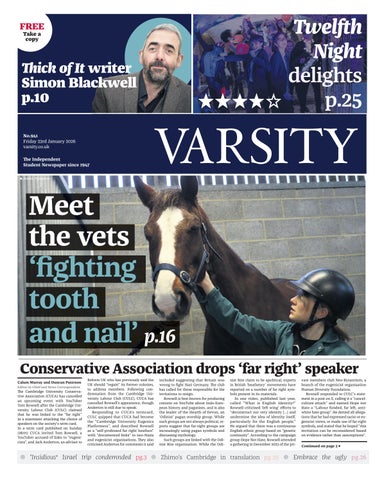
Editor-in-Chief and News Correspondent e Cambridge University Conservative Association (CUCA) has cancelled an upcoming event with YouTuber Tom Rowsell after the Cambridge University Labour Club (CULC) claimed that he was linked to the “far right” in a statement attacking the choice of speakers on the society’s term card. In a term card published on Sunday (18/01) CUCA invited Tom Rowsell, a YouTuber accused of links to “eugenicists”, and Jack Anderton, an adviser to
Reform UK who has previously said the UK should “regain” its former colonies, to address members. Following condemnation from the Cambridge University Labour Club (CULC), CUCA has cancelled Rowsell’s appearance, though Anderton is still due to speak.
Responding to CUCA’s termcard, CULC quipped that CUCA had become the “Cambridge University Eugenics Platformers”, and described Rowsell as a “self-professed far right heathen” with “documented links” to neo-Nazis and eugenicist organisations. ey also criticised Anderton for comments it said
included suggesting that Britain was wrong to ght Nazi Germany. e club has called for those responsible for the invitations to resign.
Rowsell is best known for producing content on YouTube about Indo-European history and paganism, and is also the leader of the Hearth of Devon, an ‘Odinist’ pagan worship group. While such groups are not always political, reports suggest that far-right groups are increasingly using pagan symbols and discussing mythology
Such groups are linked with the Odinist Rite organisation. While the Odi-
nist Rite claim to be apolitical, experts in British ‘heathenry’ movements have reported on a number of far right symbols present in its materials.
In one video, published last year, called “What is English Identity?”
Rowsell criticised ‘left wing’ e orts to “deconstruct our very identity […] and undermine the idea of identity itself, particularly for the English people.”
He argued that there was a continuous English ethnic group based on “genetic continuity”. According to the campaign group Hope Not Hate, Rowsell attended a gathering in December 2023 of the pri-
vate members club Neo-Byzantium, a branch of the eugenicist organisation Human Diversity Foundation.
Rowsell responded to CULC’s statement in a post on X, calling it a “cancelculture attack” and named Hope not Hate a “Labour funded, far left, antiwhite hate group”. He denied all allegations that he had expressed racist or eugenicist views, or made use of far-right symbols, and stated that he hoped “this invitation can be reconsidered based on evidence rather than assumptions”.
Continued on page 3 ▶

As we return to a new year in Cambridge, you’ll have found that much is the same: our rooms are as we left them, the unseasonable queue outside Jack’s just as long. We also return to a University changed. Over the break, Cambridge’s vets received news of their department’s intended closure, and students at Trinity Hall learned of their college’s controversial ‘outreach’ plans.
At the heart of these issues are real people. Across this issue, we see students making their voices heard as Cambridge is left with a lot to answer to. In Comment, Keane Handley warns (p.14) that Trinity Hall’s leaked admissions policy is symptomatic of the University’s failure to uplift state-educated applicants. On p.16, Frida Bradbrook speaks to Cambridge’s current and former vets, putting human faces to the much-reported story.
Week One was not yet underway when news broke that Cambridge’s Conservative Association was inviting (p.3)
‘far right’ speakers to populate its term card. De-
bates over platforming speakers with views many students consider harmful were reignited, and hint at fears that the student right is turning to extremes.
Another story illuminating tensions in the student body is the controversy (p.3) over a trip to Israel taken by 20 Oxbridge students. Students who attended faced backlash from peers, with student groups claiming that the purportedly ‘non-partisan’ trip failed to deliver an adequate portrayal of the realities of the situation in Gaza.
ese events placed Cambridge students at the heart of di cult moral dilemmas, and force us to question and whether we have the right, as a student body, to push back against the voices we perceive as dangerous.

In Vulture, we emphasise the lighter side of Cambridge life. Our Blind Dates column is back (p.20), with a pairing that sends at least a few sparks ying. Paired with a cosy stew recipe (p.20) and some tips to spice up your 20s (p.21),
this Lifestyle spread is certainly one to warm the soul.
Clashing colours and trashy looks take a starring role in this week’s shoot, as our Fashion Editors go against the ‘clean girl’ grain, calling for an urgent return to ugliness (26-27). is week also welcomes in a new theatrical calendar, as Milly Kotecha checks out Twelfth Night at the newly-renovated Marlowe Arts eatre (p.25).


Whether you’re looking for a playlist for your winter walks or an investigation into Cambridge’s essay-writing businesses, we urge our readers to remember that, as Cambridge continues to nd itself embroiled in national debates, their voices are as important as ever.


editors Daisy Bates & Calum Murray editor@varsity.co.uk
deputy editors BibiBoyce&JossHeddleBacon deputyeditor@varsity.co.uk
vulture editors Ellie Buckley & Emily Cushion magazine@varsity.co.uk
news Alex Brian & Nick James (Senior); Neve Wilson, Bela Davidson, Ell Heeps & Maria Eduarda Paixão (Deputy) news@ varsity.co.uk
comment Duncan Paterson & Ben Lubtish opinion@varsity.co.uk
features Daisy Stewart Henderson & Frida Bradbrook features@varsity.co.uk
interviews Tara Buxton interviews@ varsity.co.uk
science Pooja Gada & Ruby Jackson science@varsity.co.uk
sport Keane Handley & Sam Ho sport@ varsity.co.uk
lifestyle Mary Anna Im & Georgia Gooding lifestyle@varsity.co.uk
arts Emma Gower & Ryan Vowles arts@ varsity.co.uk
fashion Jess Gotterson & Flossie Bullion fashion@varsity.co.uk
fashion shoot co-ordinator Caterina Siciliano-Malaspina
film & tv Amanda Ljungberg & Otto Bajwa-Greenwood lmandtv@varsity.co.uk
music Francis McCabe & Daniel Kamaluddin music@varsity.co.uk
theatre EleanorBaldwin& ElsieHayward theatre@varsity.co.uk
photography editors Amika Piplapure & Eve McEwen
illustrations editors Lyra Browning & Jordan Inglis sub-editors Alessia Fietta, ShonaWhelan & Juliette Berry subeditor@varsity.co.uk


associate editors WilfVall, Ben Curtis, Charlie Rowan, Sophie Ennis & Anuk Weerawardana associate@varsity.co.uk
business manager Mark Curtis business@ varsity.co.uk
varsoc president Wilf Vall president@ varsity.co.uk
varsity board Dr Michael Franklin (Chairman), Dr Tim Harris, Michael Derringer, Mark Curtis (Company Secretary), Sophie Ennis, Hugo Gye, Wilf Vall & Anuk Weerawardana (Directors), Lotte Brundle (Guest) & Zoah HedgesStocks (Guest)
Continued from front page
CUCA cancelled the event hours after CULC published its statement on social media, with its co-chair, Oscar Lingwood, stating: “[Rowsell’s] associations, beliefs and statements make any association with this person inappropriate and untenable”.
hey emphasised that “many members of the society as a whole do not feel comfortable freely associating with Mr Rowsell” and that CUCA “does not align or support any of the institutions or views associated with Mr Rowsell”.
CULC also criticised the invitation of political commentator Jack Anderton due to remarks he made in a blog post arguing that “Britain would be better of” had it stayed neutral in the Second World War rather than ighting Nazi Germany,
and that “in the coming Meritocracy” the country could and should “regain” some of its former colonies. CULC’s statement said that these comments were “an insult to the thousands of servicemen who died ighting against antisemitic tyranny”.
In a separate post, Anderton called for “mass deportations” as a means of restoring “hope to a generation of British youth”.
Anderton, 25, has worked as a social media adviser to Reform UK, helping to establish Nigel Farage’s TikTok account – which has 1.3 million followers – and writing a column for he Daily Mail. He has been credited with helping Luke Campbell become the Reform mayor of Hull and East Yorkshire.
Anderton is still due to speak in Cambridge on 30th January. His visit forms
part of his ‘A New Dawn Tour’, in which he plans to visit several right wing university societies, including Reform UK societies at Edinburgh, York, and Durham, to give talks on the topic of “Britain and its future”. His tour has already faced signiicant protest, with Anderton claiming that he was targeted by 400 protestors, some of which were ailiated with campaign group Stand Up To Racism during his visit to York.
Anderton said: “hough I may be protested by left-wing activists, I’m excited to speak to young people at Cambridge. hey know the system is broken, they know their future has been stolen, and they want to build a better Britain”.
CUCA also faced backlash for the invitation of a speaker last year, when it was forced to reschedule a planned event with Suella Braverman after “unprecedented security and logistical diiculties”
amid student protests. Braverman at the time condemned student protesters for using “threats, intimidation, and mob-rule tactics” to force CUCA to postpone the event.
CUCA’s decision to invite these controversial speakers follow multiple cases of student Conservative societies switching support to Reform UK.
Newcastle University Conservative Society decided to merge with the Reform UK society before the start of the academic year, and reported a “tenfold increase” in student participation, while the University of York’s Conservative society reported losing around half of its members to the York Reform Society.
Support for Reform has risen among young men, while Conservative support among under-25s remains stubbornly low.
A group of Cambridge students have recently returned from a trip to Israel organised by the Pinsker Centre, during which they met Israeli President Isaac Herzog.
he Centre invited 20 students from Oxford and Cambridge on a free eightday tour of the country. Alongside Herzog, students met Israel’s deputy foreign minister Sharren Haskel and former deputy prime minister Dan Meridor.
hey also attended discussions with the Palestinian Christian academic John Munayer, who is involved in interreligious activism, and the Arab-Israeli colonel Shadi Khalloul, who describes himself as a “patriotic Israeli” and advocate for “Christian Israeli – Aramaic rights”.
While visiting the site of the 7 October massacre, participants spoke to the survivor Shalev Biton. hey also met Meirav Leshem Gonen, the mother of Romi Gonen, who was held hostage by Hamas.
he Pinsker Centre previously ran yearly trips to Israel for Oxbridge students, but was unable to in 2024 due to the war in Gaza.
Formerly known as the Pinsker Centre for Zionist Education, the organisa-
tion was founded in 2016 by Elliot Miller, who told Jewish News that he hoped to “transform the way in which we promote the case for Israel on campus”.
Today, the Centre describes itself as a “a non-partisan think tank focusing on global foreign policy, especially the Middle East”. he Israel trip is similarly depicted as an opportunity “to learn about one of the most complex geopolitical conlicts in the world from a balanced, non-partisan policy perspective”.
Ifan Peredur Morgan, one of the students on the trip, claimed that participants heard a wide range of viewpoints:
“We visited the West Bank and East Jerusalem, and went close enough to Gaza that we could just about see the rubble.
“We met with Palestinians from each of these areas, and with varying opinions; and with Jewish Israelis of varying opinions. We also met with members from various minority communities (religious, ethnic) within Israel and Palestine. (Regrettably, we were not able to meet with Hamas members).”
However, the trip has received backlash from local Palestinian activists, with the Cambridge Palestine Solidarity Campaign (CPSC) arguing that the Palestinian voices on the trip failed to ofer an alternative perspective.
Regarding the tour guide who showed students around the West Bank, the CPSC said: “he Palestinian journalist embraces a ‘both sides’ narrative, which ignores both the underlying structural causes of what is now a 2nd ma-
jor catastrophe (Nakba) for Palestine […] and the fundamental diference between occupier and occupied.”
“he meeting with President Herzog sends a particularly alarming message, having had warrants submitted in the UK for his arrest, from groups including the Hind Rajab Foundation, for complicity in war crimes and much more,” they added.
he Pinsker Centre ofers a ‘Policy Fellowship’ to around 15 students each year, who write articles for national media outlets, host campus events, and attend seminar days. Participants also spend three days in Washington DC, where they visit American lawmakers, and institutions such as the pro-Israel lobby AIPAC and the American Enterprise Institute.
his year, the three Policy Fellows at Cambridge are Morgan, Dan Vollborth –former Chairman of the Cambridge University Conservative Association (CUCA) – and Amar Singh Bhandal.
Bhandal told Varsity that he joined the Israel trip because “misinformation from both sides left me in some doubt as to the truth of the situation in Israel and the Palestinian territories and so I wanted to see if I could ind answers for myself”.
“I had hoped for easy answers to my questions about the Middle East. In this regard I was disappointed. Day by day, even hour by hour, my mind was changed by conlicting narratives that have left me unsure about what a real solution for Israelis and Palestinians looks like,” he continued.
he trip has also received criticism from the left of student politics. A spokesperson for the Cambridge Young Greens told Varsity: “Given the history
of the Pinsker Centre, we denounce the Israel tour as nothing but a propaganda trip.”
he University of Cambridge Left Society (UCLS) said: “Grooming the next generation of leaders with expensed dinners and plush hotels, mere miles away from an active genocide […] is both insidious and dangerous.”
Bhandal recognised that the trip was likely to receive criticism, telling Varsity: “Frankly, I am focussed on what Israelis and Palestinians had to say, rather than student voices in the West which are often detached from the reality on the ground.”
he Pinsker Centre said that student criticisms of the trip were “outrageous and unsubstantiated”.
One of the Centre’s main activities is arranging speaker events at UK universities. For example, in 2022, they organised Dan Meridor’s appearance at the Cambridge Union, which was criticised in an open letter and by protesters outside the event.
In November 2023, the Centre coordinated an open letter signed by 10 conservative societies, including CUCA, expressing solidarity “with Israel against the horriic actions taken by Hamas terrorists,” and with “the global Jewish community during this dark time of rising antisemitism”.
he letter went on to argue that deaths of Palestinian civilians are “an inarguable tragedy, but they are a tragedy caused by the terrorists who chose to launch this senseless and barbaric attack on Israel”.

Bela Davidson Deputy News Editor
St John’s College has submitted plans to completely redevelop Wolfson Court, its accommodation campus on Clarkson Road.
he campus will eventually house students from Newnham, Lucy Cavendish, and St John’s. Currently, there are no students living in the accommodation block.
Originally built in 1971, the site was irst owned by Girton College. St John’s acquired the accommodation from Girton in 2017, and has since let rooms to students from various colleges, including Lucy Cavendish.
Plans for the redevelopment have been in the works since November 2024. he project is spearheaded by St John’s and MICA Architects.
MICA Architects have worked with several other Cambridge colleges on redevelopment projects, including ‘Project Agora’ at Gonville & Caius, a future development masterplan at Christ’s, and – most recently – a masterplan for Sidney Sussex.
he latest planning application for Wolfson Court was submitted to Cambridge City Council in December 2025, and is currently awaiting approval.
St John’s shared that the old Wolfson Court buildings, including additional developments added to the campus in 1990, are “dated, ineicient, and no longer it for purpose in their current form”. he College noted that the buildings lack accessible facilities, such as lifts and adequate space. Additionally, due to an ineicient boiler and the age of the property, the running costs of the current buildings are “extremely high”. he College stated that they have carried out “extensive studies,” which have shown that the most sustainable and carbon-eicient approach to refurbishing Wolfson Court is a complete demolition and redevelopment.
In a letter expressing support for the development, Lucy Cavendish shared that, with their current facilities, they are only able to house 80% of their fulltime students in college accommodation.
Lucy Cavendish went on to state that “there is a demand for at least 300 additional rooms,” which could be optimally supplemented by the new development.
One Lucy Cavendish undergraduate expressed interest in the Wolfson Court development plan, but shared concerns about rent rises, saying: “I do wonder about price, especially as this is another building being built with John’s.”
St John’s is known as Lucy Cavendish’s largest landlord, letting several properties to the College.
A 2023 Varsity investigation revealed that Lucy Cav had one of the most expensive average rents of all Cambridge colleges, and that the average St John’s rent was two thirds that at Lucy Cavendish.
“I’m generally happy with the quality of accommodation, so expansion of good housing is great – so long as it doesn’t mean a rent hike,” stated the Lucy Cav student.
he determination deadline for the planning application is 23 March.
St John’s College was contacted for comment.
Nick James Senior News Editor
A group of 26 Cambridge academics, including two Nobel prize winners, have said in a letter to the education secretary that they are “deeply concerned” by delays in implementing a complaints scheme for the Freedom of Speech Act.
he letter, signed by almost 400 academics from across the UK, warns that these delays mean “universities can disregard their [Freedom of Speech Act] duties with impunity”. It also alleges that the complaints scheme has been “kicked into the long grass, with real consequences for academics at the sharp end”.
In 2023, the Freedom of Speech Act received royal assent under the Conservative government, with most provisions enacted by 1 August 2025. However, the implementation of section eight of the Act, which established a scheme for individuals to lodge complaints with the Oice for Students (OfS), has been delayed by the Labour government, who are seeking to amend it.
Section eight also gave the OfS the power to recommend what action be taken in response to complaints, including the levying of ines.
he letter to the education secretary argues: “he complaints scheme was designed as a low-stakes route to resolve alleged breaches of free speech and academic freedom. hrough its accumulating precedents, it would also have served as a practical guide to help the higher education sector navigate the new statutory duties. Without it, the promise of [the Freedom of Speech Act] will remain unfulilled.”
he letter also calls for the government to “set out immediately a timetable for legislation to amend and implement the complaints scheme” as well as implementing the original section eight as an “interim measure”.
Among the Cambridge academics who signed the letter are the molecular biologist Sir Gregory Winter and physicist Professor Brian Josephson, who are both Nobel prize winners.
Other notable signatories include the history professor Robert Tombs, the physician Sir Stephen O’Rahilly, and the theology professor Richard Rex.
Professor Matthew Kramer, who also signed the letter, told Varsity he did so because: “Unlike most activists on the left and the right of the political spectrum (especially the left, in university settings), I am robustly supportive of the principle of freedom of expression.”
He added: “If that principle is to be given efect at a practical level, there must be adequate means of enforcing the duties that are imposed by it. he complaints scheme envisioned in the Higher Education (Freedom of Speech) Act would provide adequate means of enforcing those duties. A government that does not move expeditiously to implement that scheme is not supportive of the principle of freedom of expression.”
Meanwhile, Professor Richard Bourke, another signatory, told Varsity: “I support free speech within the law, though I can’t see that this is controversial. What has concerned me more speciically are the moral constraints placed on freedom of teaching, hiring, and research, which were hard won by universities historically, but which have been compromised by an atmosphere of ideological absolut-

ism that gained traction on either side of the ‘culture war’ over the past decade.”
Despite delays implementing the complaints scheme, the Freedom of Speech Act has already been used to ine the University of Sussex £585,000 for iring Professor Kathleen Stock over her views on gender.
The OfS director for freedom of speech, Arif Ahmed – who is also a former professor at Cambridge – said that the University of Sussex had “signiicant and serious breaches of the OfS’s requirements,” and that “substantial monetary penalties are appropriate for the scale of
wrongdoing we have found”.
Professor David Abulaia told Varsity that he supported the “excellent work” of Ahmed, and added: “he failure of the government to implemement a proper complaints procedure undermines the Higher Education (Freedom of Speech) Act”.
Responding to the letter, Daniel Zeichner, the Labour MP for Cambridge, told Varsity: “Labour is committed to the principles of free speech and academic freedom. It’s important that the Act is implemented carefully to ensure that it works in practice.”
Ell Heeps Deputy News Editor
Cambridge is one of only three universities – and the only UK university – to rank in the top ten for every subject in the latest Times Higher Education (THE) World University Rankings by Subject, released earlier this week.
he University was also ranked best in the world for psychology, overtaking Stanford, which took the top spot in 2025.
Only Cambridge, Harvard, and Stanford ranked in the top ten for all 11 subject areas, with Cambridge making improvements on the previous year in several subjects. Cambridge also achieved this title last year.
he THE subject rankings are published at the beginning of every year. A university’s performance in each subject area is assessed on 18 diferent performance indicators, including studentstaf ratio, research productivity, and institutional income. he weighting of each factor varies according to subject – less weight is given to paper citations in arts and humanities compared to engineering, for example.
he criteria cover ive “core pillars”: teaching, research environment, research quality, industry, and international outlook. he previous ive years of a university’s research output are considered.
First place in every subject area remains entirely dominated by UK and US universities, with Cambridge and Oxford ranking irst in three subjects between them. Oxford placed irst in computer science and medicine.

Alexander Brian Senior News Editor
A Cambridge professor has accused the University of bypassing “democratic structures,” following its decision to ignore the results of two votes by University members.
Jason Scott-Warren, an English professor at Caius, told Varsity that the University Council has found a way to “impose its will without check”.
is comes after the Council decided in advance that two votes of the Regent House – the governing body comprising Cambridge sta and academics – would have no binding e ect over its decisions.
e rst vote – or ‘Grace’ – was initiated by 156 members of the Regent House last June, regarding legal injunctions against protests on University land. At the time, Cambridge had secured a fourmonth injunction that covered Greenwich House, e Old Schools, and the Senate House Yard.
e Grace demanded that the University “not apply for an extension to the present interim injunction or for any further injunctions aimed at curtailing protest on University premises”. However, in July, Cambridge extended its injunction by a year and expanded it to include Chestnut Tree Lawn, which was occupied by pro-Palestine activists in June.
e Grace also asked the University not to take protesters to court “in the event of an alleged breach of the injunction,” and to enter “into dialogue with students who take conscientious action”.
At the same time, 94 members of the Regent House initiated a second Grace,

demanding that “the list of members of the Vice-Chancellor’s Guild of Benefactors be made public”.
Since 1998, individuals who donate over £1 million and companies who donate over £1.5 million to the University have been invited to join a Guild of Benefactors. However, the membership of this group has been secret since 2014.
Scott-Warren claimed that this secrecy may be designed to prevent “reputational risk” caused by accepting donations from controversial entities. In response, the University told Varsity that it “has robust due diligence procedures to scrutinise strategic relationships, donations, and sources of funding”.
In July, the University Council agreed to submit both Graces to the Regent House. However, it also said that, even if they were approved, they would not “bind the Council”.
e Council justi ed ignoring the injunctions vote by asserting its “exclusive authority to conduct legal proceedings on behalf of the University”. It also claimed that, as “the trustee body of the University and the University’s principal policy-making body,” it had sole authority to decide whether to publish the membership of the Guild of Benefactors.
No action has therefore been taken, despite both Graces passing in December – the injunctions proposal by 826 votes to 757, and the benefactors motion by 985 votes to 562.
Scott-Warren told Varsity: “ e proper procedure, should the Council not wish to accept a Grace, is for a Report to be published setting out the case for rejection, which is then subject to a vote of


Regent House. e Council has invented a new method, which involves passing and then ignoring the Grace.”
e University Council argued that publishing the membership of the Guild of Benefactors would “damage its ability to fundraise,” and create “a list of highnet-worth prospects” for use by other institutions. It also noted that the University would need to gain members’ consent under GDPR (General Data Protection Regulation) laws, which would likely be refused by anonymous donors.
In response, the initiators of the Grace wrote that it “would not prevent donors from remaining anonymous, should they so wish, and foregoing the option of being elected to the Guild”.
They also argued: “The Council’s claims that GDPR rules make publication of the membership list impossible, and that a signi cant loss of revenue will result from its publication, are unevidenced.”
Scott-Warren added that the Council’s prerogative over legal a airs “was clearly intended to apply to routine matters, not to the imposition of injunctions that could land a student in prison for up to two years”.
However, the Council has argued that restricting its options for dealing with protests would likely con ict with its duties “to act in the University’s best interests, and to ful l the responsibilities placed on them by the Statutes and Ordinances and applicable law”.
It added that it “remains committed to dialogue with students of the collegiate University,” citing the representation of students in a Working Group to evaluate the University’s arms investments.


e University initially agreed to establish this Working Group in exchange for the disbanding, in summer 2024, of the encampment that Cambridge for Palestine (C4P) had set up in front of King’s College.
In October, the Working Group published a report recommending the University cut ties with companies manufacturing “weapons illegal under UK law,” but not conventional weapons. e University Council has delayed a vote on the extent to which it will divest from arms until February.
e Working Group’s report was initially scheduled for publication in Michaelmas 2024. at November, C4P responded to news that it had been delayed by occupying Greenwich House, the University’s nancial centre. Activists also set up encampments
at Trinity, Magdalene, and St John’s, leading all three colleges – in addition to the central University – to demand High Court injunctions against protests on their land. In November, Varsity revealed that legal action against protests had cost the University and its colleges more than £400,000.
e University has claimed that the injunctions are necessary to allow students to graduate and sta to undertake their work: “Any claim that the University is trying to restrict protest or sti e debate is ridiculous – there are many ways protests can take place and voices can be heard.”
However, the authors of the Grace argue that injunctions represent “a signicant assault on the right of protest, and hence on the human rights of freedom of expression and assembly, in the UK”.


StepintoaworldofcalmatGreshamHouseWellness,theESPApartnerspawithinTheGonvilleHotel.OurESPAtrainedtherapistsofferacuratedmenuofmassages,facialsandbodytreatmentsdesignedtorestorebalance, relaxthemindandrevitalisethebody.
Tomakeyourexperienceevenmorespecial,enjoyacomplimentaryglassofProseccowitheverytreatment.

Whetheryou’reinneedofdeeprelaxation,skinrenewaloramomentofindulgence,letustakecareofyou. BookyourESPAtreatmenttodayandunwindinunderstatedluxury.

Nick James Senior News Editor
A report by the O ce for Students (OfS) has found that Cambridge is following national trends in awarding a higher proportion of rst class degrees, but it may have also been the most di cult institution in the country for students to secure a rst in 2024.
e report found that Cambridge students graduating in 2023-24 were 8.7 percentage points less likely to receive a rst when compared to the average sector attainment baseline from 2010-11, with the e ect of explanatory variables accounted for. e OfS referred to this score as “unexplained attainment”. e variables that the report controlled for included students’ entry grades – such as A-levels – as well as subjects and ages.
For 2023-24, Cambridge had the widest negative unexplained attainment gap from the 2010-11 baseline of all 143 English degree-awarding institutions measured. is indicates that for 202324, Cambridge graduates were the least likely to receive a rst compared to the 2010-11 national benchmark, once accounting for explanatory variables.
e data therefore suggests that for 2023-24, Cambridge could have been the most stringent institution when it comes to awarding rsts. However, Cambridge’s unexplained lack of rsts could also be due to other factors not accounted for within the modelling.
e report also indicates that Cambridge’s negative unexplained attainment gap has narrowed since 2010, when it was 16.6% below the national average. Despite having the widest negative unexplained attainment gap in 2023-24, the report also found that Cambridge is following national trends in awarding a higher proportion of rsts. In 2010-11, 26.1% of the grades awarded were rst class, compared to 33.3% in 2023-24, and a peak of 48.8% in 2019-20.
According to their analysis, the OfS believes part of this rise is ‘unexplained’ when compared to how many rsts were awarded in 2010 and accounting for controlled variables.
Cambridge still gives out a comparable proportion of rsts to Oxford, where 34.1% of degrees are rsts, and both institutions gave proportionally fewer rsts compared to Durham (at 39.6%), UCL (at 41.0%), and Imperial (at 52.5%) in 2023-24.
According to the report, the universities of Durham and East London have recorded the largest unexplained increase in rsts since 2010-11, with Cambridge’s increase sitting around the average for English institutions. However, most universities have seen a drop in proportion of rsts since the years when exams were disrupted by Covid.
e OfS says that Cambridge’s grade in ation could be because of changes to how exams are graded, or because of other factors such as improved teaching.
Responding to the OfS report, a


◀ Proportion of rst class degrees
spokesperson for the University of Cambridge noted that the OfS’ ndings do not take into account di erent assessment types, stating: “ e OfS analysis compares current outcomes to a historical sector baseline using a speci c statistical method. It does not capture di erences in assessment models or institutional approaches to maintaining standards, and should not be interpreted as a judgement on academic quality or student achievement.”
After publishing the report, Jean Ar-

nold, deputy director of quality at the OfS, said: “We encourage all institutions to continue to review their marking and assessment policies to ensure their awards properly re ect student achievement and protect public con dence in higher education.”
However, not all have con dence in the OfS’s report. Paul Ashwin, professor of higher education at the University of Lancaster, told Times Higher Education that “this is a very political document answering policymakers’ concerns about
grade in ation”.
He added: “I’m not sure it particularly says anything meaningful about grade in ation, given that you can only talk meaningfully about grade in ation at the level of the programme.”
A spokesperson for the OfS told Varsity: “English higher education has a deservedly great reputation, and we welcome the continued e orts of institutions to preserve that reputation and maintain public con dence in the value of a degree.”


We are a European consultancy firm focussed on analytical and quantitative topics and the development of sustainable solutions to bring about positive change for our clients.
What does d-fine offer you?
- Diversity: Work with clients on topics ranging from financial engineering and machine learning through to climate risk and healthcare
- International: Collaborate in project teams staffed across Europe
- Education: Acquire new skillsets to broaden your technical and professional repertoire
Who do we look for?
Master’s or PhD-level graduates in STEM fields


Alexander Brian Senior News Editor
Sta unions in Cambridge will not go on strike this January over pay after their national ballots failed to reach the required turnout.
e three trade unions representing academic and support sta at the University – the University and Colleges Union (UCU), Unison, and Unite – balloted for joint strike action in November.
e unions declared their intention to obtain a six-month mandate for strike action after the Universities and Colleges Employers Association (UCEA) o ered them a 1.4% pay rise in May.
After a six-week ballot, the UCU revealed on 5 December that turnout had failed to reach the legal threshold of 50% for strike action. In the end, only 39% of members participated in the vote.
Of those who did participate, 70% said they supported strike action, while 83% backed action other than strikes.
e Unison ballot also failed to reach the required turnout. A spokesperson told Varsity that “despite over threequarters of UNISON members who voted at Cambridge backing strike action,” they would therefore not “be taking strike action at this stage”.
Unite did not respond to Varsity’s requests for comment. However, no strike dates have been announced.
Responding to the news, Jo Grady, the
UCU’s general secretary, told members: “Our immediate next steps must be to understand why more members did not engage with the ballot. While it is true that the 50% turnout is a legal threshold imposed upon us, we must aim for signi cantly higher in ballots if we want to create the leverage required to win.”
A spokesperson for the UCU added: “A strong majority of our members backed strike action in response to unfair pay, worsening conditions, and widespread threats to jobs across the sector. It will be particularly disappointing for those who voted for action that, despite this clear mandate, we are not able to proceed.
“Across the country, our members are working tirelessly to defend their jobs and protect their universities from damaging cuts. It is past time for both politicians and employers to stop undermining our higher education sector and start working with us to safeguard its future.”
Raj Jethwa, the UCEA’s Chief Executive, commented: “UCEA had signalled our willingness to work with the unions on key areas had they not balloted for industrial action. e failure to meet the threshold, as well as the fact that nearly a third of UCU members did not support strike action, will no doubt be a point for re ection.”
Employers and unions must work together, Jethwa said, “rather than nger pointing or attempting industrial action


to create disruption and su ering for students, especially when their members do not back this approach”.
In September, the UCU issued a joint statement alongside other higher education unions describing the UCEA’s pay o er as “insulting” and recommending members vote ‘yes’ to strikes.
e statement continued: “Higher education workers cannot continue to pay the heavy price of a failed market system through the continued erosion of their pay, their employment conditions, and threats to their jobs.”
While acknowledging that “the pay uplift clearly does not re ect the true value employers place on sta ,” Jethwa described the o er as “the only prudent option” given the pressures facing the higher education sector.
e campaign reached Cambridge in November, when around 40 activists gathered outside Great St Mary’s Church to urge sta to support strike action.
Some UCU leaders have criticised the decision to organise a national ballot as distracting from local disputes over job cuts, which have produced record turnouts. e UCU Left bloc has instead argued that “the central problem” is that union members “don’t believe that our leadership is willing to lead a serious ght”.
e results of the UCU ballot mirror its online consultation in August, in which 61% of members supported strike action, but the turnout was only 32%. e last time the UCU went on strike in Cambridge was in February 2023, when they also launched a Marking and Assessment Boycott. A re-ballot in November achieved a turnout of only 43%, preventing strikes from continuing into 2024.
However, non-academic sta represented by Unite engaged in industrial action several times in early 2024. Cambridge supervisors also won a 15% pay rise that June after threatening a supervision boycott.
A new round of pay negotiations is set to start in spring. Cathy Yearsley, the secretary of Cambridge’s Unison branch, told Varsity: “Cambridge and the other employers need to get back round the negotiating table and make a decent offer to sta .”
While the three sta unions in Cambridge currently have no plans for strike action, they are leading a campaign to ‘Save the Vet School’ after the School of the Biological Sciences recommended ceasing the veterinary medicine course in December.
ey are also deciding whether to take further action over the handling of redundancies at the MRC Epidemiology Unit, part of Cambridge’s School of Clinical Medicine.

A Downing deception Cambridge recently featured in one of Britain’s favourite reality TV series. A contestant on this year’s series of The Traitors, Hugo Lodge, is an alum of Downing College, and was chosen as a Traitor; he was ‘banished’ by the group in the third episode, after murdering his fellow players Netty and Ben. Lodge matriculated as a law student at Downing in 1992, and now works as a barrister. He told the College that “meeting my fellow players reminded me very much of Freshers’ Week. It was completely acceptable to just talk to people and learn more about them”.
New conference construction
e biopharmaceutical company AstraZeneca has submitted plans to Cambridge City Council for a new six-storey o ce block to be built at Cambridge Biomedical Campus. e plans include o ces for 736 members of sta , alongside a 200-person conference centre, a 450-seat auditorium, and a restaurant. In the planning documents, the company said the o ce building would “not only serve AstraZeneca, but also make a lasting, positive contribution to the Cambridge Biomedical Campus and the city’s scienti c and architectural landscape”.
A seal pup found on a doorstep has been nursed back to health by Dr Rachael McKinney, Homerton’s director of studies for Clinical Veterinary Medicine. e young pup, named Cold Call, was found outside a house in Gorleston at the start of January. Seal pups are often rescued during the colder months, having been separated from their mothers during a storm. Cold Call has been recovering at the RSPCA East Winch Wildlife Hospital, where McKinney works as a veterinary clinician. McKinney said: “Cold Call is recovering very well and learning to eat sh for herself now.”
Corpus fellow makes a clerical discovery
A Corpus Christi fellow discovered the only known surviving copy of a popular 14th-century spiritual text. Dr Timothy Glover’s recent study identi es Shrewsbury School’s copy of Emending of Life, written by Richard Rolle, as the only complete copy. He found that other known copies, previously thought to be complete copies by Rolle, are instead abridged versions by other writers. Rolle is described by the University as “the most widely circulated English writer of the late medieval period,” though the name lacks notoriety today.

Shakespeare actors locked in wage duel
Actors at the 2024 Cambridge Shakespeare Festival are locked in a dispute with the organisers after not being paid. Instead, they were provided with free accommodation in student rooms and £50 for living expenses. Festival director Dr David Crilly said the actors had “free choice” over whether they were there or not. Actress Sarah Campbell, who appeared in Hamlet and Richard II, took the case to an employment tribunal. e tribunal ruled that the actors were there as volunteers, not workers, despite a 2022 tribunal for the same issue nding that the actors were workers entitled to a wage. Performing arts union Equity has criticised the decision.
Cambridge United ght inequality through ‘United for Cambridge’ partnership
Cambridge United Foundation and Cambridge United have set up a new partnership, United for Cambridge, to expand the club’s community work. e initiative will bring together local organisations, which will each contribute £5,000 a year to support 15 pre-existing programmes, ranging from gender equality initiatives to youth mentoring. e partnership aims to double the reach of these programmes to 20,000 residents a year by 2027. Members of the network will also get the chance to attend events throughout the year focused on addressing inequality in Cambridge.
Solar park for Cambridge bin lorries
Construction has begun on a £6.1 million renewable energy solar park to power electric bin lorries for Cambridge and South Cambridgeshire. e scheme includes a one-megawatt solar system and battery at the council’s Waterbeach Depot, supplying 36 electric vehicle charging points. e project will allow the Greater Cambridge Shared Waste service to increase its eet from four to 18 electric lorries, helping cut council emissions. e solar park is expected to supply 59% of the depot’s energy demand from renewable sources, and provide a 40% net gain in biodiversity through measures including wildower planting and new hedgerows. e scheme is due to be completed by the end of the year.

Bela Davidson rounds up student news from across the country
Microsoft at Manchester
e University of Manchester has announced the launch of an AI partnership with Microsoft. is makes Manchester the rst university in the world to provide their entire student body and sta with access to Microsoft 365 Copilot. e University reported that this partnership marks the progression of Manchester’s leadership in AI research, and is a facet of a “wider digital and AI transformation programme”. Vice-Chancellor Duncan Ivison said of the initiative: “ e great universities of the 21st century will be digitally enabled – this partnership represents a signi cant step on that journey for Manchester.” e project will come into force by summer 2026.
A cockroach infestation was discovered in a Cardi student at, and experts have warned that the problem may get worse. Cardi Council reported that 144 pest control requests were made in the last year, marking an 80% increase from previous years. e pests were speci cally identi ed as German cockroaches, one of the most common and fastest-breeding cockroach species in the UK. One south Wales-based pest control expert commented that, in the last eight to nine months, he has seen around 150 German cockroach cases. Prior to this year, the expert stated that he could “count on one hand the number of German cockroach problems [he’s] had in a ve-year period”.
e University of Aberdeen has revealed that, later this year, it will open a new campus in Mumbai, India. e Scottish university reported that, in 2025, it received permission from the Indian government to proceed with plans for their Mumbai campus, located in the suburb of Powai. e University aims to open the facility in August 2026, with classes to commence the following month. Aberdeen’s new principal, Professor Peter Edwards, explained that “global engagement” is a large goal for the institution. Aberdeen Mumbai’s website lists the undergraduate courses on offer, including business management, computing science, data science, and economics. ey also list postgraduate courses, including an arti cial intelligence MSc and an MBA.
● Cam lecturers work for essay writing businesses, Varsity told ● Cambridge students can earn hundreds of pounds per essay
● Some undergraduates also admit to paying for essay writing
Nick James Senior News Editor
A number of students at Cambridge are involved with businesses which write essays for student clients, Varsity can reveal. Varsity has also heard that lecturers may write for such services.
Barclay Littlewood, who is the CEO of some of the UK’s largest essay writing businesses, claimed that “so, so many” lecturers and senior academics from Cambridge write for him, though Varsity was unable to independently verify this claim.
Littlewood said that their motivations were to “write and enjoy academia and be paid for it as well”.
He added: “It’s a problem with the system because […] quite often there’s far too many academics and not enough jobs for them.”
Varsity’s investigation also found that some Cambridge students pay for essay writing services, while many others work for these businesses.
Littlewood told Varsity that there are “plenty of people that write for us from Cambridge,” and can earn anywhere from £160 to £600 per essay. Again, Varsity was unable to independently verify these claims, but could verify that students were earning similar rates at other essay writing services.
Essay writing services, sometimes referred to as ‘essay mills’, o er bespoke essays which can be purchased by students. e cost of these can vary depending on size, quality, and time available to write them. Varsity understands that prices are normally between £100 and £1,500.
Varsity heard from several students who work for essay writing companies, with the majority doing so to earn extra money.
One of them said: “I only engage in it sparingly to avoid suspicion, and use anonymous means to make rst approach.”
ey added that they “had no [moral] concerns whatsoever,” and that “you have to be extremely stupid to get caught,” since “the customer should never know who you are”.
£1,500
How much some essay writing businesses charge for essays
e student also claimed that “it is a myth that students who purchase these services want a top grade. ey are lazy and/or incompetent and are always happy to get a middling grade that doesn’t arouse suspicion”.
Some Cambridge students also admitted to Varsity that they had used essay writing services, mainly because they were struggling with their work.
Littlewood claimed that many Cambridge students use his services, saying: “By the very virtue of the fact that they go to Cambridge anyway, these guys are intelligent people, they want to do the best that they can.”
He added: “So for them, if they can squeeze a few extra percentage points on their grade, they’ll do it. And if they have the money to do it, you know, why wouldn’t you get an opinion from someone who’s studied in that area for 20 years as a professor or a lecturer?”
£600
How much some students could earn writing a single essay
Littlewood said that a lot of his clients are international students studying at English-speaking universities. Varsity found a similar trend at other essay writing sites that it was able to access.
Many of Littlewood’s clients are “high-net-worth” individuals who will “end up spending thousands of thousands of pounds” over the course of their studies.
As of 2022, it is illegal to provide essays to students which are passed o as their own work in higher education in England. However, many essay writing businesses, including Littlewood’s, do not believe that they are breaking the law as they do not intend for students to pass the essays o as their own. Instead, they are provided as “model answers,” which students can use to help develop their own work.
Littlewood acknowledges that people do “abuse” his services, but says that he bans customers who make it clear that they will pass the essays o as their own work.
Despite the change in law, Varsity was able to contact a di erent essay writing service while posing as an English university student wanting an essay that would be passed o as their own work. e service did not question the use of the essay, and o ered an Oxbridge graduate or a PhD holder from a Russell group university to write it.
In the 2023-24 academic year, Cambridge’s O ce of Student Conduct, Complaints and Appeals upheld 18 cases of exam “irregularities,” but it is not clear whether any of these were linked to essay writing services.
Littlewood is concerned that the new legislation is unproductive, and is advocating for more regulation in the essay writing space rather than the banning of it.
“We know there’s a demand, but if we regulate it, then we can give you all the names of people that order, we can give you the essays, and then they will lose something against their nal mark because they’ve had assistance. And ob-

viously you can then check if they’ve plagiarised our work,” he said.
Littlewood added that banning essay writing services pushes students to “unscrupulous operators” and “underground” essay services. When the government announced the law change in 2022, it stated that one of the reasons was that they had evidence that “some essay mills seek to blackmail students who use these services”.
$40,000
Average order for PhD writing according to Littlewood
Littlewood also claims that the current law is “unenforceable” due to challenges proving that clients are students at English universities who intend to pass the work o as their own. Since the law changed, there have been no prosecutions.
As AI continues to develop, more students are using it to help with their academic work. A Varsity survey from April 2025 found that 61.3% of Cambridge students had used AI tools to assist with academic work.
As a result, Littlewood said that PhD
writing services are becoming a larger part of the business, since AI “is not quite there for dissertations, [or] for PhDs”.
According to the PhD Writers’ website, which Littlewood owns, their writers can help with PhD proposals, theses, and original research.
Littlewood said an average order for PhD writing is “about $40,000”.
In response to the growing uses of AI, Littlewood has also created a new AI tool which claims to produce essays up to a rst class level. Its website says that the model is “trained on over 100,000 essays and expertly programmed under the guidance of former university lecturers to deliver precise, academically robust results every time”.
Varsity was able to produce accurate, detailed, and well referenced essays, but it is unclear whether they would all achieve a rst class mark at Cambridge. Obtaining a rst class mark in many humanities subjects requires original thinking, or going beyond the core literature, which the AI tool has not yet perfected. For a slightly higher fee, the new service o ers a “grade guarantee,” which means that it will give students a refund if the essay does not meet the selected standard.
e University of Cambridge was contacted for comment.
All students were kept anonymous to protect their identities for this article.
Simon Blackwell sees his acceptance into Cambridge as nothing less than life-changing. e prominent Churchill alumnus, whose screenwriting has produced critically-acclaimed television shows such as e ick of It, Peep Show, and Veep, looks back on his university years with nostalgia. Our conversation begins there, thick with anecdotes from his student days, before we discuss his rather unconventional life path. Just how did Blackwell go from leaving secondary school with no quali cations, to applying to Cambridge, to writing some of the biggest comedy shows of the early 2000s?

After getting into Churchill College, Blackwell explains, he started to conceptualise his life as “two separate entities” divided by his Cambridge o er. Blackwell strongly advocates for people to apply even if they don’t believe they’re the typical Oxbridge student. “ e more people who apply,” Blackwell explains, “the more normal it is that there are kids from state
about trying it in case I was lousy at it.”
Blackwell recalls how this sense of anxiety de ned his academic time here too. “When we had tutorials with other colleges,” he elaborates, “I barely said anything, partly because I had a much stronger South London accent in those days.” is feeling of insecurity will still ring true for many students at Cambridge. Blackwell’s accent has been “smoothed out” now, he says regretfully.

Cribb was “the premier Dickens guy in the whole university”. “ ere’s been a lot of good luck along the way,” Blackwell smiles.
❝
schools at Cambridge


As a counter to ‘easy peasy lemon squeezy’ , he wasn't sure it was going to work


feel as real as possible, while still allowing jokes,” he outlines.
‘I can't make anything more bizarre than it already is’ ❝


he pursued


Reflecting on his time at Cambridge, Blackwell discusses how his passion for writing during his time here.


In his third year, he helped set up a university-wide literary magazine called Written Terms. “People from all di erent colleges contributed poems and stories,” he explains. But fear held him back from


joining the Footlights, he continues: “I’d always


wanted to be a comedy writer, but I was always nervous


Having left school at 16 without any quali cations, it was thanks to the incredible Inner London Education Authority (ILEA), that Blackwell was able to take evening classes (for just £1 per course for the year!) – a massive reduction from the average price of courses which could be up to £400. He then decided to apply to Cambridge, “because it was one of the only universities I’d heard of then”. It feels fated that he was interviewed by Tim Cribb – an Emeritus Fellow at Churchill. In his interview, when asked what he had read, Simon described his appreciation for the comedy in Dickens. It just so pened that


Touching on his screenwriting projects, we discuss his work producing the adaptation of David Copper eld with Armando Iannucci. “It had such a meaning for me,” Blackwell explains, “to be able to adapt for the cinema the book that got me into Cambridge.” He notes: “It’s possibly my favourite gig I’ve done because it was such fun to do,” having the added challenge of adaptation – something he


forward are rejected by your colleagues. Yet rather than seeing this process as demoralising, Blackwell views it positively. “If you’re in a team,” he explains, “you’re free to try stu out. ere’s a safety net,” though it did mean occasionally “having to kill some of your darlings”. One particular memory he has of o ering a suggestion in a team is the famous “difcult di cult lemon di cult” line from In e Loop, which Blackwell thought of while having a cigarette outside. As a counter to ‘easy peasy lemon squeezy’, he wasn’t sure it was going to work, but decided to o er it anyway. It’s now one of the most resounding lines from that lm – a testament to the importance of this “safety net” structure. Blackwell’s positive mindset when it comes to his screenwriting is impossible to ignore. “You always think ‘I could have been funnier’ or ‘this could have been di erent,’’’ he explains,“but I think that’s healthy. It gives you a goal”. Hopefully you won’t make those mistakes again, and you can produce something better”. It’s a life lesson that many of us could bene t from hearing.


Ever the promoter of Dickens’ works, Blackwell is eager to recommend as one of the Victorian giant’s funnier works. “People tend to value the bleaker, darker ones because they value those more than comedy,” Simon noted. Blackwell does believe that this is changing, especially because “we’re seeing more comedy from around the world,” making it easier for audiences to enjoy new pieces. He stresses the talent needed for comedy acting – it is “certainly one of the hardest things


Blackwell has previously spoken about the process of screenwriting in a team, and how often the lines


I’d always wanted to be a comedy writer, but I was always nervous ... in case I was lousy at it ❝
We tried to create a community of failures


His re ections on his journey into screenwriting are similarly inspiring. Despite Blackwell's apprehensions about comedy writing, he decided to “give it a go” in his 30s and, “touchwood, I got a career out of it”. For many of us looking towards post-grad plans, it is relieving to hear of a trajectory that doesn’t involve having your life mapped out by the time you’re 20.


Aside from the Dickens adaptation, Blackwell comments on his other screenwriting projects. Recently, he has been transitioning away from a comedy focus on producing more emotional pieces. “I like to think that if you lifted all the jokes out,” he explains, “there would still be a story that you would want to hear the end of”. is is precisely the drive of his current projects. “I want the audience to care and for it to

When it comes to comedy, Blackwell re ects on the importance of representation such as his work on Breeders – a show that seeks to provide an authentic representation of the di culties of parenthood. “What we were saying to parents is that we all make mistakes,” he explains, “we were trying to create a community of failures.” For Blackwell, one of the ways to connect with people is to underline how “we’re all in the same boat. Everyone’s winging it.” is re ection reminds Blackwell of an anecdote from his time working on e ick of It, where improvisation led to self-doubt in the actors, one of whom then went up to Ianucci and said, “everyone else is brilliant at improvisation, but I can’t do it.” Remarkably, “as it turned out, every single member of the cast at some point had gone up to Armando in private” and expressed the same insecurity. Despite everyone feeling like an anomaly, it was the complete opposite. Blackwell’s progression to more dramatic, emotional pieces feels like a natural one for him, not least because he feels it has become increasingly hard in recent years to produce comedic pieces about politics. Following Brexit and the rise of Trump, Blackwell felt it became virtually impossible to continue in this speci c eld of screenwriting. Talking about his work writing satire for Veep, he notes how “we were constantly saying, ‘well, she wouldn’t say this because she is the most powerful woman in the world’, and ‘her advisors would stop her from saying that’”. Now, the same just simply is not true. Blackwell sums it up perfectly: “I can’t make anything more bizarre than it already is.”
Although Blackwell is unable to reveal details about upcoming projects, he remains active in the screenwriting business and continues to thoroughly enjoy it. “I do a job that I love,” he emphasises, “it is an enormous privilege”.
Quite cyclically, we return to Blackwell’s time at Cambridge at the end of our conversation. He paints a beautiful picture of a student version of himself walking to Sainsbury’s in town. It was snowing heavily, and he thought, 'wow, I’m just going to Sainsbury’s and I’m in a postcard. It’s just so beautiful.' Blackwell’s enduring gratitude sticks with me long after our interview. It’s something we Cambridge students can often forget, that among the deadlines and seemingly endless essays, even our Mainsbury’s trips are romantic.


Lucy George
As the Master of Gonville & Caius, and Director of the Cancer Research UK Children’s Brain Tumour Centre of Excellence, Professor Richard Gilbertson occupies two of Cambridge’s most demanding roles. Despite this, he found time to speak with me about his work balancing academic leadership and life-saving research.
How has your rst term as the Master been?
I really enjoyed it, actually! It’s very di erent from the jobs I’ve done in the past. I’ve run cancer centres in the US and the UK, but when you’ve got a lot of very talented people all together in an academic pressure cooker, the issues you face are the same. It’s also nice to be dealing with not just a medical subject like cancer, but lots of di erent subjects. What was the process of becoming Master like?
It began with Fellows asking me: “We’ll be looking for a new Master. Would you be interested in doing it?”, then I met with the President, and he said: “Would you be interested in doing it?” and I said: “Well, yeah, potentially!” ere was a series of quite intensive interviews with di erent groups. Housekeeping, fellowship – every possible facet of college you can imagine, you interviewed with. en they shortlisted six or eight people, and it came down to be sort of like Dragons’ Den. ere were 121 fellows, and you give a ve-minute pitch, then they vote. e President rang me that evening and said I’d been elected! It was very funny, because that was in June of 2024, but they can’t elect you any more than 6 months before the current Master steps down. So although I was elected in June, I had to wait another year before they elected me again. It’s


Pooja Gada covers the latest scienti c research, from monogamous mammals to the earliest evidence of human re-making
Mammals, mating, and monogamy: how faithful are we?
From Coldplay’s kiss cam to Lily Allen and David Harbour’s divorce, 2025 seems to have been riddled with cheating scandals. Despite monogamy feeling culturally natural to humans, in delity remains widespread – raising the question: are humans naturally monogamous?
A new study from the University of Cambridge, led by Dr Mark Dyble, set out to answer this. By analysing ethnographic data from over 100 human populations
a very weird process – there’s a whole year of thinking: “What happens if they say no?”
What’s your typical day like as the Master?
Well, there’s no typical day. I’m half time at the college, half time in my lab, although really, there’s no such thing as half time. You’re full time in every job you do.
If there was a typical day, I would usually spend mornings in my lab, meeting PhD students and postdocs, and doing research analysis. en the other half of the day, I’d be in college, typically chairing the council meeting or another committee meeting. I also still do quite a lot for government and outside of Cambridge, so it depends on what else I’m doing outside of college. It’s very varied, which is really helpful.
❝
She died of a disease called medulloblastoma, and I’ve worked on it ever since
What inspired you to start working on childhood brain cancer?
When I went to medical school in Newcastle, I knew I wanted to do hospital medicine, and I knew I wanted to do research, but I thought it would be some kind of adult specialty. Newcastle put medical students on the wards from
alongside genetic data from more than 30 mammal species, the study examined how monogamy has evolved independently across mammals.
To quantify monogamy, Dyble calculated the proportion of full siblings relative to half-siblings. is provides a robust genetic proxy for mating behaviour: monogamous populations tend to produce many full siblings, while promiscuous or polygamous systems generate far more half-siblings. By this measure, humans ranked 7th out of 35 species for monogamy, with 66% of siblings sharing the same parents. Humans far outperformed our ape cousins, chimpanzees (4%) and gorillas (6%), but were on par with meerkats (60%). e most faithful mammal was the humble Californian deermouse, which forms inseparable, lifelong bonds, and scored 100%. By contrast, Scotland’s Soay sheep came last, with just 0.6% full siblings. As Dyble puts it, humans “sit comfortably” in the “premier league of monogamy,” while most other mammals “take a far more promiscuous approach to mating.”
Yet human monogamy has not remained xed over time. Across centuries and civilisations, the proportion of full siblings varies dramatically –from just 26% at an Early Neolithic site in the Cotswolds to 100% in several Neolithic populations in northern France – suggesting delity is exible,


Gilbertson

week one, and I got randomly assigned to a children’s ward. I never thought I’d do paediatrics.


en I was randomly assigned a patient. She was a little girl called Katie, who was dying of a brain tumour. And in my rst two weeks on the ward, I watched a family go through the death of their child from a brain tumour, and it completely changed my life. She died of a disease called medulloblastoma, and I’ve worked on it ever since.
What are the key questions your research is trying to answer?


I began my career thinking that cancer was completely abnormal. en I went through the discipline of learning that childhood cancer is very, very similar to normal tissue. What this made me realise is that a lot of cancer is probably normal. It’s in the wrong place at the wrong time, but it’s still normal.


treatments, is great. In terms of running a cancer centre and a college, it’s been genuinely helping other people to be excellent in what they do, and to achieve their potential. It doesn’t matter if you don’t get the credit for it –


We know that one in two adults will get cancer, but when you’re talking about a phenomenon where one in two of the population gets something, is it right to call it abnormal? Is it actually normal? If it’s occurring as part of a normal process, your whole academic and intellectual approach to the disease is very di erent. So, how abnormal is cancer? at’s an important question. What has been the most rewarding part of your career so far?


In terms of research, it’s been the joy of discovery, and bringing some clarity and understanding to a disease that’s devastating for families like Katie’s. Being able to be part of that, and to help develop


not biologically predetermined. Why, then, did monogamy evolve at all? Across mammals, monogamy is closely linked to how much fathers invest in caring for their o spring. In large-brained primates, o spring are costly to raise and remain vulnerable for long periods, making male infanticide both more likely and more damaging. Some species, such as chimpanzees and bonobos, reduce
❝ Human delity relies heavily on social, cultural, and religious norms
this risk through promiscuity, creating paternity confusion so that no male can be certain an infant is not his own. Humans, by contrast, tend towards paternity certainty through monogamy, increasing the likelihood that a single male will invest in and protect his o spring.
Evolution may explain why monogamy emerged, but not how it is maintained. A 2019 review suggests that human delity relies heavily on social, cultural, and religious norms. When
these weaken, serial monogamy or polygamy often follows. Monogamy, then, is neither purely biological nor purely cultural, but driven by both. In nature’s dating pool, the Californian deermouse may be rare – but the Soay sheep is never far away.
Humans discovered re far earlier than thought
Over a hundred thousand years ago, a group of hunter-gatherers huddled around a small clay pit on land that is now England. Together, they struck a spark that would ignite a revolution in human evolution.
An archaeological team, led by the British Museum, has uncovered the earliest known instance of humans deliberately creating re – over 400,000 years ago. e discovery, made at the Paleolithic site of East Farm Barnham in Su olk, pushes the origins of re-making back by more than 350,000 years – far earlier than previously thought. At the time, Britain was inhabited not by Homo sapiens but by an early Neanderthal species; our own ancestors would not arrive for another 350,000 years.
Buried beneath layers of ancient clay, lay three crucial clues that support the researchers’ claim. First, they unearthed int hand axes showing signs of repeated heating: cracking, reddening, and spiral fractures. Second, fragments of iron pyrite (or


just watching it happen is brilliant. You get joy out of seeing people being really successful, and that, for me, is almost more rewarding than your own success.


fool’s gold) were discovered alongside them. When struck against int, iron pyrite produces sparks, functioning as a primitive Stone Age lighter. e third and most decisive clue came from the surrounding sediment. Researchers identi ed a thin layer of reddened clay embedded among the otherwise yellow-orange soil. is red colour stems from haematite, a mineral that only forms when iron-rich sediments are heated to high temperatures.
Geochemical analysis revealed the layer had been exposed to short, intense bursts of heat exceeding 700ºC, consistent with small wood res repeatedly built in the same spot. Pyrite is also extremely rare in the local landscape – it is not present in a database of more than 33,000 rock samples from Barnham, suggesting it was transported deliberately to the site for re-making. But why was the ability to harness re so transformative? e ability to cook food – particularly meat – increased the energy extracted from diets. is energy surplus supported brain growth that would otherwise have been too metabolically expensive to maintain. ese larger brains enabled more complex thinking, social bonds, and cooperation, likely driving the emergence of early language. From those rst sparks emerged the foundations of Homo sapiens – us.
Cast your mind back to week eight: you’re lying in bed, most probably ill. It feels almost impossible to drag yourself to the library to nish the nal essay of term. e term’s almost done, the end is in sight, yet you simply cannot seem to get it done. It’s a feeling almost every Cambridge student is familiar with –burnout. Hopefully you’ve had a chance to recover over the vacation, but can science help us understand how we can avoid burnout in the rst place?
Burnout refers to a state of mental and physical exhaustion caused by exposure to long-term stress. It’s de ned by three main components: exhaustion, cynicism, and ine ciency.
Prolonged stress can result in irregular activity in the prefrontal cortex, the region of the brain responsible for attention, memory, reasoning, and decision making. Meanwhile, hyperactivity in the amygdala, another area of the brain, triggers the increased release of the stress hormone cortisol.
exhaustion manifests itself as the feelings we nd ourselves all too familiar with – fatigue, reduced work e ciency, and cynicism towards work.
Stress also plays an important role in the activity of our immune system. Prolonged stress can result in persistent
tic of burnout. Engaging in activities outside your tripos, such as returning to the hobby you dropped, attending a society event, or taking a walk outdoors, can be a reminder that your degree isn’t everything.
Alongside this, getting adequate sleep and exercise is crucial for maintaining both physical and mental wellbeing. It can also be bene cial to conserve energy by prioritising more important tasks, while lowering expectations for less critical ones, or skipping them altogether where possible.
low-grade in ammation, contributing to chronic pain, gut issues, fatigue, and worsening pre-existing autoimmune conditions or allergies. Sustained cortisol levels may also suppress your immune system, making minor illnesses more frequent and your recovery slower, possibly explaining why you haven’t been able to shake o the freshers’ u since the beginning of term.
Traits sometimes associated with having a ‘type
personality are often more likely to burnout
ese responses a ect ‘mental energy’, a model representing our capacity for cognitive functioning. Mental energy is nite, and tends to be depleted by our body’s responses to stress. People with burnout spend more energy performing cognitive tasks and need more time to
recover from the resulting mental exhaustion. is
Tendency to burn out stems from a complex combination of internal and external factors. Six major features of work have been identi ed as risk factors for burnout: unsustainable workloads and limited opportunity for rest, lack of perceived control, insu cient recognition and reward, lack of support, inequality, and con ict between personal values and the work being done. ese make it harder for people to nd meaning in their work, leading to disillusionment and cynicism.
Personal characteristics, including genetics, health, lifestyle and personality type, govern how an individual responds to prolonged stress. People who are perfectionists, competitive, and ambitious with a desire for control – traits sometimes associated with having a ‘type A’ personality – are often more likely to burnout.
e environment someone grew up in also matters. A protective, supportive environment gives individuals a sense of control over their surroundings, and increases purpose, optimism, and tolerance – all traits that are helpful in resisting burnout. By contrast, people who grew up exposed to high levels of social stress show less well-developed coping mecha-

Unsurprisingly, the amount of sleep you get a ects burnout as well. Insucient sleep further depletes your energy resources, reducing cognitive capacity, making you more susceptible to burnout. Burnout in turn can make it harder for you to fall asleep due to anxiety and emotional dysregulation, generating a vicious cycle. So, what can you do about it? Limited research has been done on the e ectiveness of strategies to cope with burnout. Studies often involve small groups of participants and very little follow up. Despite this, burnout has been shown to improve following implementation of a variety of
Re-evaluating your relationship with work can be helpful. e heavy Cambridge workloads can often result in a loss of passion for your subject, but reminding yourself why you chose your degree in the rst place can oppose the cynicism that is characteris-
to reduce
take a break. is can mean frequent short breaks, such as stepping away from your laptop every once in a while, or a longer break for a complete reset. Take care of yourself, and perhaps (armed with some evidence-based tips) you’ll be able to dodge week more mental strain and imperformance, so talking to a therapist or counsellor could help as
Talking to people is also important, demonstrated by the large role that limited social interaction plays in causing burnout. Speaking to a friend could o er comfort, and consider talking to your DoS or supervisor to potentially reduce your workload, or excuse a few badly written essays. Cognitive Behavioural Therapy has been shown

One of the most effective remedies, however, is to
Looking for an intellectually challenging career option?
Kick start your career as a patent atorney with us

Training as a Patent Atorney is a career path that will enable you to combine your understanding of science with legal expertise.
You will leave the lab environment yet remain at the cuting edge of science and technology, applying your knowledge and skill in a commercial context. You will help to protect intellectual property assets and grow businesses.
J A Kemp is a leading firm of UK and European Patent and Trade Mark Atorneys with ofices in London, Oxford, Cambridge, Paris and Munich.
Visit our website for more information about training as a Patent Atorney.
jakemp.com/careers/trainees


The cries of reverse discrimination are as old as time, the chief concern of those who fear progress having gone too far. Its repeated use is because it strikes a chord with some, some who look around and might see their privilege being gently pulled from beneath them.
e cries were made by the Director of Admissions at Trinity Hall, looking to recruit from elite private schools for better ‘quality’ applicants. It left me incensed, yet unsurprised. As the story broke it sparked backlash from social mobility experts and groups, including the 93% Club, whose work is vindicated at moments like this. eir recent Class in the Act campaign seeks to make social class the tenth protected characteristic under the Equality Act of 2010, with the 93% Club founder, Sophie Pender, claiming classism is the “last acceptable form of discrimination.”
Classism is so embedded at Cambridge. ose who seek to a rm the status quo are making classism smarter, harder to spot. is is until the likes of Marcus Tomalin, Trinity Hall’s Director of Admissions, let the mask slip in this pursuit of better ‘quality’ applicants from elite private schools.
Tomalin argues that the best students from such schools arrive at Cambridge “with expertise and interests that align well with the intellectual demands.” Some old-fashioned classism, maintaining an inferiority complex that many students from working-class backgrounds feel, but to hear it out loud is painfully surreal. It vindicates all who have been
accused of ‘waging class war’ or creating division and causing problems where there are none, when the evidence every now and then becomes apparent for all to see.
It has been argued that this is a slap in the face to state school students, but it is equally so to the outreach teams of every Cambridge college who spend every day ghting to dispel myths, and allay concerns of 16 and 17 year olds who think Cambridge isn’t for ‘people like me’. ey are thrown under the bus and their is work undermined by headlines like these.
were reportedly outraged; one saying it “risks returning Trinity Hall to the boys’ club culture of the past.”
I have been in the position too often where an anecdote, or worse a headline like this one, is presented to me as I seek to assure prospective applicants Cambridge can be a welcoming place for them. My most common response is one I shouldn’t have to give, that these anecdotes and headlines are the reason why you should apply, to gradually change the institution yourselves.
proved approach. However, with initiatives such as Dr Tomalin’s, there is a real fear of going backwards, keeping classism commonplace at the University of Cambridge.
Perhaps we are getting too comfortable in our gowns, in our supervision rooms, in our ideas. Could that be why this sentiment is seeping from a senior admissions o cer’s mouth? Cambridge is coming too close to seeing its bubble burst, too close to noticing its status quo should not be seen as normal.


There is an emerging problem at Cambridge of men having difculty engaging in discussions on gender in social and academic settings – or so says a deeply defensive piece Varsity published in December 2025 claiming men are unable to develop “a sense of self” within discourse. It argues it’s impossible for them to engage in, or withdraw from, discussion without being considered “arrogant”, “passive”, “performative”, “suspicious” (pick your favourite) – and makes this assumption on behalf of all men but without any indication of their agreement (I certainly know some who wouldn’t). is is not an unfamiliar complaint; consider how many times we hear the phrase ‘you can’t say anything these days’. Yashraj Garg's article takes a more delicate tone, but the sentiment feels parallel.
It’s a shame that some men feel cut o from gender discourse at a university renowned for animated debate, but I have good news: this separation is self-in icted! To quote Colin Firth as Mr Darcy: “ e fault is mine and so must the remedy be." Some good advice for the men in question, I think. ey must rectify their di culties with engaging in discussion, beginning with renouncing their non-existent victimhood.
e false victimhood I speak of is born from a confusing – and insulting – paradox: these men assume, before they even try to speak, that they will be understood incorrectly, and punished unfairly. So, their behaviour supposedly becomes “softened” and “delayed” – a substantial issue at an institution where discussion is a big part of the teaching. However, this kind of avoidance would make no
❝ is is a slap in the face [...] to the outreach teams of every Cambridge college ❝ Some men confuse harmless learning errors, or controversial ideas, with real moral error


simultaneously


ese headlines are read by prospective students, with national newspapers quoting straight from the heart of this institution: you are not welcome here. Perhaps if you are in a University target area like the North East but prefer the songs of the Gallowgate End to Mozart, your interests might be best served elsewhere. It also then simultaneously paints the arts as the rightful preserve of the elite, which working class eyes, ears and minds aren’t tuned to.


Despite great strides being made by the college Outreach departments, who work closely with student ambassadors who often want to address the concerns of their younger selves, I can’t help but think that they are doing so with their hands tied behind their backs. ose who hold the rope assert their authority in meetings, in spite of opposition from academics who, for the most part,


sense to any emotionally mature student at this University – keep your language respectful, your mind open, and you can’t really go wrong. Given the high-pressure atmosphere, feeling nervous to speak is a normal part of life for many people here – myself included. Yet it’s our responsibility to overcome this nervousness, or to recognise it as a warning sign that what we wish to say will be unwelcome, and understand why that is the case.
So, the paradox can only be explained by assuming some men confuse harmless learning errors, or controversial ideas, with real ‘moral error’: they think they will be punished for expressing a genuine, logical thought because they don’t realise that sometimes their contributions are in fact disrespectful and make for hostile discussion. Anyone would and should expect backlash for showing a lack of respect for a large group of people, but I am hard pressed to think of anyone I know who would accuse a man of arrogance or passivity for a minor learning mistake, or for expressing a minority opinion. is is a university after all; lack of knowledge should never be feared, and informed ideas should be encouraged – they certainly are in my experience. ere concludes my rst suggestion to men: consider whether your hesitancy to participate is normal academic nerves, or a subconscious awareness that you’re about to be incredibly disrespectful. is is a major reason why I am very thankful for the supervision-style of learning we have at Cambridge, but again I fear men’s self-prescribed victimhood, such as Garg's claims that gender culture has led men to “lose con dence in their ability to do anything at all,” acts as a


Has Cambridge University done too much patting itself on the back for the progress it’s made, that we’ve forgotten to push for more? Recently, state school targets were removed, which would prove e ective if those from workingclass backgrounds feel properly welcomed with an alternative,

In reaction to the backlash, Trinity Hall said that there has been “no change,” they’ve simply “[added] some schools to the email lists.” is response ignored Dr Tomalin’s quotes in the leaked memo. is is where the damage had been done. It was emblematic of the handling of classism at Cambridge. I can only hope that those prospective students who saw those comments also saw the de ant response from across the University student body, particularly those from working-class backgrounds.


I also hope those that feel targeted by the false rhetoric of being ‘de-aligned’ with your subject feel emboldened in your rage. You should be daring to diversify the interests those in this place have to o er, to lead with your own intellectual way of thinking, all in the name of being proudly working-class. It’s time for this University to continue opening its doors and minds, not retreat and cower at the prospect of working-class excellence, but rather, nally embrace it.
barrier to their own growth. Supervisions make us expose ourselves and our ideas to the real world, and to people who will challenge us. Sometimes it’s not questioning from supervisors and peers that is the challenge, but the mere prospect of speaking these ideas out loud. An essay alone is much too safe a place for real learning to happen, whereas supervisions force us to consider reactions to our arguments and either develop our ideas, or realise our mistakes. If men hesitate to express their ideas during supervisions, I suggest they exit their pity party, stop blaming their unwillingness to speak on the presumption that women will misunderstand them, and, as before, consider: what are the real reasons my points might not be received well by others? An aversion to criticism suggests an aversion to education.
It is possible to gain greatly from a supervision while not being particularly vocal, as well. e article makes this sound counterintuitive to men, claiming they are forced into “reputational self-protection,” and implying they feel robbed when their input is not required. However, it is essential to learn the skill of when it is best to speak, and best to listen. If your priority in a supervision is to meet a quota of words to say out loud, are you really learning? I suspect the quality of men’s contributions might increase if they become less watered down with scattershot ideas generated for the sake of speaking.
e most disappointing aspect of the issue presented in Garg's Varsity article however, for everyone on the receiving end of gender discrimination, is the hint of weaponised incompetence. Garg
claims that being “unsure how to inhabit themselves in [gender] frameworks […] will not make [men] better allies – it will only make them quieter.” I fear the implication here is that men need stepby-step instructions on how to engage in academic discussions, and their own social and moral development, before we are allowed to request their support in dismantling gender hierarchies. is is the rst time I’ve seen such a display of weaponised incompetence, but upon reection there may well be a substantial male absence in the campaign against gender discrimination. No particular instances of active male participation spring to my mind – is no news good news? What’s more, male silence on gender inequality would be to their own detriment; punitive prescribed gender norms, fewer parental rights, toxic attitudes towards mental health – perhaps these and other issues will encourage men to enter gender discourse.
It’s a shame that an issue about individual men’s comfort has been made out of the much wider, deeper issue of gender inequality – because, as with many sociological topics, discussion about gender necessarily contains discussion about gender inequality. Men should always be invited to be part of the discourse on gender, but they must recognise their privileged position within the issue. e more discussion thrives, the more Cambridge thrives, but we need to understand that the topics we study are not our personal playgrounds, but the very real structures we all live in. e least we can do is approach them with respect, and take responsibility for our behaviour in these discussions.


Anyone who has been lucky enough to open a Cambridge acceptance email in their life has probably had to ght the urge to pat themselves on the back and tell themselves “well done, you’re set for life now”. e urge is so strong because almost everyone around you is assured that this email is your ‘golden ticket’ into any job you want.
Well, according to Vice-Chancellor and President of KCL Shitij Kapur, a degree is a lot less ‘golden’ than many of us would have thought; it’s a necessary ‘visa’ required to enter the working world rather than a ‘passport’ of privilege one can use to thrive in it.
While even Kapur admits that the university attended is a relevant factor that determines a graduate’s social mobility, it seems as though many of us are learning the hard way (through inboxes lled with rejection emails) that there’s at least some truth to the fact that the inherent value of a Cambridge degree is rather small on its own two feet.
So, perhaps the ‘golden ticket’ is dead. But this death is not one from a tragedy, it’s the most liberating thing to happen to higher education in a good while.
When we demand that our degrees be guarantors of social mobility, we inadvertently shackle ourselves to an insultingly narrow de nition of worth. We are agreeing that the primary value of a Cambridge education lies in its ability to satisfy an HR department at Goldman Sachs. We turn ourselves into human capital, constantly polishing our ‘visas’ with extra-curricular box-ticking


and resume-padding, terri ed that if the stamp isn’t quite shiny enough, we will be deported back to the precariousness from which we hoped to escape.
But what happens when the visa fails? What happens when, as Kapur suggests, the degree no longer guarantees the destination?
Paradoxically, we are set free. If the degree is no longer a reliable transaction, then the transactional mindset itself becomes redundant. If the ‘golden ticket’ won’t necessarily get you through the chocolate factory gates, you might as well stop staring at the wrapper and start enjoying the chocolate.


In embracing the ‘visa’ mindset, we reclaim the right to do our degree properly, as opposed to just doing it in the way that the job market instructs us to. In a world where a rst class degree doesn’t automatically buy a house or a career, the pressure to choose ‘safe’ modules or ‘marketable’ subjects evaporates – because, well, who cares about those? We are liberated to pursue the obscure footnote, the radical theory, or the ancient language for no other reason than that it is fascinating, beautiful, challenging, or true.
nation’s top universities tells you it’s just a travel document is a beautiful act of quiet rebellion. It’s an assertion that our minds are not for sale and that our value is not determined by a starting salary. We often assume that comments like Kapur’s are supposed to dampen our spirits with a dose of real-


As the guy essentially telling you to embrace the horrors of the job market, it will likely come as no surprise to you that I’m a Philosophy student. Yes, I’m one of those who studies the ‘unpro table’ degree – and I’ve never felt so good about that fact now that we’re in a world where whatever I do at university doesn’t guarantee me success.

ism, so we try to defend against it, refute it, hide from it. Yet, in reality, it accidentally hands us a manifesto for studenthood. If the degree is no longer a guarantor of social mobility, then we no longer have to perform the exhausting dance of the ‘socially mobile’ student. We don’t just have to be anxious applicants, we can also be authentic learners.


To study a ‘fake degree’ in an age where the Vice-Chancellor of one of the
It won’t end with


If you happen to wander through Market Square on a sunny Saturday afternoon, it is pretty much the picture-perfect representation of a small British city, full of small local businesses and frequented by happy shoppers buying their artisan cheese or second hand books. It also serves some of the best food in Cambridge, bringing in a variety of international cuisines perfect for sampling. However, should you nd yourself coming out the other side of the market, you are in a completely di erent world. Gail’s. T.K. Maxx. McDonalds. Wander a bit further: Popeyes. ShakeShack. Wingstop. It suddenly feels like the market exists in a bubble surrounded by the dominating presence of chains and fast food restaurants.
What about if you want something other than food? No worries, you are in luck; you can go to a Harry Potterthemed gift shop (strange considering that none of the lming ever actually took place here).
I’m not going to act like large businesses are a bane on humanity, and that we must reinforce the boundaries of the Cambridge bubble by eradicating them. ey bring employment and are often a fundamental part of any British town centre.
However, as the streets of Cambridge all start to look the same, as the businesses and their owners here are being increasingly forced to operate in the same tourist economy, Cambridge risks being ‘Disney- ed’ For the Senior Bursars of our colleges, it makes sense; they are obliged, by the college’s charitable status, to maximise nancial returns on investments. Which is going to bring in more cash? Renting to
❝ You might as well stop staring at the wrapper and start enjoying the chocolate ❝
What does the city of Cambridge want to be, and what does it want to look like?


a chain, like Wingstop, with pretty-much guaranteed round-the-clock customers and established running costs, or a local start-up?
Unlike big businesses, the local places cannot bear the brunt of the ever increasing cost of living and running a business. Earlier this month, the Cambridgeshire Chamber of Commerce published a report on the anxiety surrounding business rates, a tax charged on most commercial properties. Over a third of rms are worried about increased costs, with concern highest in the hospitality sector.
In just the past year, two much-loved independent businesses and Caius tenants have been forced to shut down. Harvey’s Cafe succumbed to their inabiity to pay college rents, despite a popular campaign urging students to support their business. Another Cambridge institution, Gardies, o cially closed at the start of this academic year,and while there are some indications it may return, I am rather pessimistic.
It begs the question, what does the city of Cambridge want to be, and what does it want to look like? Two years ago, when AstraZeneca announced the investment of two hundred million pounds into the area, pledging the creation of a thousand jobs, it was supposed to be a landmark moment for a nationalised industry; as their own CEO said, it was meant to “demonstrate our ongoing condence in UK life sciences.” But the investment was paused, and the company moved on from Cambridge to invest fty billion dollars into medicines manufacturing in the USA. So that didn’t work. But it also seems to be trying to promote this fantastical city, full of amazing buildings and clever students that you can

So, perhaps what many of us suspected is now con rmed: that piece of paper really is just a piece of paper, and not a whole lot more on its own. But maybe the golden ticket’s death is exactly what we needed to actualise the real value
This doesn’t mean that the LinkedIn networkappeasing internship grind has to stop, or that a general attitude geared towards employability shouldn’t be encouraged. It just means that we can genuinely separate that world from the world of higher education. e former is an undertaking for whoever wishes to tackle it, and is a whole universe in itself; the latter is exactly what it says on the label. So, instead of hopelessly con ating the two, we can pursue them each for what they actually are.


take a picture of as you are drifting down the Cam, the punter shouting random, and usually false, facts at you about the Mathematical Bridge or the ugliest buildings on the river.
But that also doesn’t work; it pushes out the people who actually live here full time. Often, it feels like Cambridge students lose sight of their somewhat temporary status in the city, something I too have definitely been guilty of. I push past tourists wandering down Silver Street with my college pu er on, muttering how annoying they are under my breath, despite the fact I moved here only just over three years ago.
On my way to get a haircut at Mr. Politos, a favourite of Queens’ students, chatting to my barber, everything suddenly becomes contextualised. His parents moved here from Pakistan years ago, and have since set up a restaurant on Mill Road, which he also works in.
He complains about the increasing costs of living, how the area has changed since he, a local born here, was young. And suddenly, I realise that Cambridge needs to be about these types of places, and that students need to support those who are actually part of the town’s vibrant identity.

People don’t usually read their emails at the start of the Christmas holidays. e days of frantically checking deadlines and messaging your supervisor at 2am are temporarily put on hold as you try to spend time with family. Cambridge’s current and prospective vets, however, were suddenly disturbed by a mid-December email informing them of the School of Biological Sciences’ (SBS) intention to close the veterinary course by 2032.


e reaction was immediate and visceral. e o cial statement from the Department of Veterinary Medicine condemned the recommendation as “hasty, unjusti ed and awed”. e Cambridge University Veterinary Society (CUVS) echoed this sentiment, criticising the “dismissive and totalitarian approach” of the SBS. Many felt blindsided. As one nalist put it: “I don’t think any of us expected this to happen.” e timing made it feel vet students were from Cambridge and so “no one had their support sources” during what the student described as a “pretty distressing time”.
❝ There is no shortage of people who are eager to talk about their love for the school
are “ ghting tooth and nail to keep us open,” Trepanier says. Within days of the recommendation, students and staff launched the ‘Save the Vet School’ website to collect statements


Vet’, describes his years at Cambridge as “among the happiest in my life”. Less than a week before the news broke about the vet school, he was at a reunion dinner for 2015 graduates, noting that the good turnout was a “clear testament to the fondness with which we remember our time at the vet school”.
Lucy Goodwin-Grieves, an equine vet, was initially reluctant about going to Cambridge, accepting the o er only after her mother’s insistence that “you really can’t turn Cambridge down”. She, too, ended up loving the system and describes how, as someone with a more working-class upbringing who “didn’t have much con dence academically,” Cambridge helped her realise “the world was my oyster”.
tercalation year also gives students an opportunity to step into scienti c research. is, according to Bardsley, means that Cambridge “doesn’t just teach you to be a clinician but a veterinary scientist”. While he is currently working in practice, the framework he gained in his pre-clinical years has often been more useful to him than his clinical training. He nds himself returning to the rst principles of natural sciences when struggling with a di cult case. Without it, he worries that graduates elsewhere “don’t have as strong of a pre-clinical framework,” leaving them exposed when “the case isn’t straightforward”.
and natural sciences, recognising the interconnectedness of human, animal, plant, and ecosystem health. Caddy's research embraces this model as she studies the immune systems of babies of all species. When vets talk about One Health, Covid-19 is never far from the conversation – a reminder of how easily disease can cross from animals to humans. e department warns that another pandemic is likely and argues that veterinary research will be central in tackling it. Goodwin-Greaves worries this is poorly understood: “We are all so


❝ Cambridge attracts the ʻbest educators we have in our profession

Although current students will be able to nish their studies, the future is now shadowed with uncertainty. Laurent Trepanier, a fth year student, fears that “an abrupt closure will surely lead to many sta leaving to seek new work, thus seriously impacting the educational quality of the remaining cohorts”.


worse. Most in support of the school. More than a thousand responses poured in from clients, students, sta , vets, and

's rankings for veteri-
Yet resistance to the closure goes beyond sentimentality. At a time of rising pet ownership and a national shortage of vets, closing one of the UK’s leading training centres feels, to quote Goodwin-Grieves, “absolutely bonkers”. e department is ranked rst in the Higher Education nary courses worldwide. Ollie Bardsley – a recent Cambridge graduate and supervisor in the Physiology department – argues that while he has met plenty of professors from other universities, Cambridge attracts the “best educators and teachers we have in our profession”. Goodwin-Greaves believes the school imbues students with a contagious passion for their subject, producing a particular kind of graduate – one with the “desire to change the world for the better”.


at scienti c grounding can also redirect careers entirely. Talking to graduates, most describe growing up with a love of animals and recall deciding to work with them at a young age. e common assumption was that studying Veterinary medicine led to one path and one path only: becoming a vet. Yet during their pre-clinical years, Cambridge students often develop an itch is was the case for Sarah Caddy, who, at 18, assumed she would be working at a clinic after university – but is now at Cornell College of Veterinary Medicine in New York, studying maternal and neonatal anti-viral immunity. She notes: “If I hadn’t had that spark at the Vet School I would probably still be at Bury St Edmunds working at a practice.” While that remains the desired career for many, she feels she is “making much more of a di erence here than I am as a rst-opinion practitioner,” and credits Cambridge for helping her achieve her “dream job”. Caddy is just one example; the CUVS note that it’s “no surprise that all four of the UK-educated vets working for the United Nations are Cambridge graduates”. Cambridge veterinary research extends beyond animal welfare. The department’s unique One Health ap-
❝


e reason for the planned closure cited by the SBS was that there was “no viable long-term solution that guaranteed financial sustainability, educational excellence and practical implementation”. Speaking at an online discussion on the 13th January, Jon Simmons, Head of the SBS, defended the decision. He argued that while signi cant progress was made in terms of responding to the issues raised by the Royal College of Veterinary Surgeons (RCVS): “Maintaining high-quality clinical training long into the future will be severely challenging”. He also referenced the nancial viability of the hospital, which is “losing over £1 million a year”. Simmons asserted that the recommendation followed extensive consultation with a group “which included four senior vet school sta and other colleagues”. is reasoning has largely failed to satisfy students and staff. Both


ere is no shortage of peo-
ple who are eager to talk about their love for the school. One nalist recalls the thrill of a consultation where for “the rst time I properly felt like a vet”. She loved the extensive support from supervisors and the “camaraderie” within her cohort. ose who graduated years ago and have now forged a career in veterinary medicine are no less attached to the place.
Ben Simpson-Vernon, a small-animal practitioner known online as ‘Ben the


Another pandemic is [...] veterinary research will be


detached from our food, our medicines, our vet healthcare, our own healthcare, we don’t know the background working of what happens to create those services […] people are not aware of the conse-
Much of what makes the Cambridge vet school unique, they say, comes from its distinctive structure. In the rigorous pre-clinical years, vet students study alongside medical and natural sciences students. e mandatory in- proach integrates veterinary, medical, the


As the University deliberates, concern continues to ripple outward. On a local level, the decision has impacted people like Lucie Allcutt at the Cambridge Cat Clinic, who describes herself as “deeply saddened and disappointed” by the recommendation. She notes that the Vet School is her “preferred local referral center,” and that the students who visit her clinic are a “re ection of what a good vet school Cambridge is”. Beyond Cambridge, a coalition of 20 vet organisations, led by the British Veterinary Association, has published an open letter opposing the closure. Further a eld, Caddy recalls New York colleagues reaching out to her in disbelief when the


Browsing the ‘Save the Vet School’ website, the scale of the reaction becomes obvious. It's palpable how much the School means to so many. With this support, Cambridge vets remain hopeful that the recommendation could be reversed. ey won’t let the vet school be put down without a


If the area of the outside square is 100cm², what is the area of the inside square?
What percentage of respondents successfully solved this?

Across:
1 A lively, restaurant- lled road called ‘ e Mile’ by its residents (4)
4 Not an ice cream shop, exactly (5)
8 2016 is back; is this dance move? (3)
11 An account that protects savings from UK tax (3)
12 By the hearth (8)
13 Vessels for tap water, often (7)
17 Home to the Big Apple (2)
18 Might eat this on 25 Jan (6)
19 Not a PG (2)
20 Drive 2 hours east and you'll nd one (5)
23 Hope you ____ your 39 Down! (3)
24 Make formals feel more formal (5)
25 In Paradise Lost, Milton's is blank (5)
26 Kung ____ (2)


27 Liverpool or Cambridge United (2)
28 Number of crowns on the Peterhouse crest (5)
29 An alternative to kg (2)
31 Cambridge Union dining spot (6)
33 Always welcomed in their college (6)
35 Partakes in the famous Varsity race, for example (4)
36 Criterion for mature colleges (3)
37 Top Spotify artists' initials (2)
38 Like the texts you'd nd in squire (5)
42 Sherlock Holmes' college, some say (12)
44 Check their website to nd a new society (2)
45 A sudden sense of fear or alarm (5)
47 A bicycle essential (6)

49 Namesake of a little lane (6)
50 Degree-granting institution (3)

51 ____ @3 in the English Library (3)
52 An expression of gratitude: TY__ (2)
53 First college to have its own chapel (8)
56 An answer to an email (2)
58 Something you might text if you're running late (3)
60 Hughes Hall crest has two (3)
61 Only a 15 min train ride away! (3)
62 A comedic genre of theatre (6)
Down:
1 Freshers' Week to Bridgemas (10)
2 Observer of a falling apple, familiarly (5)
3 Co ee cup size (5)
5 Compare abbr. (2)


6 Metropolia entryway, sometimes (10)
7 A text apology (3)
8 A way to describe Sidney St and Hobston St (9)
9 Commercial abbr. (2)
10 Recently-established policy hub (7)
14 ____ Leventis Library (2)
15 An Olympic type of skating (6)
16 Spanish word for ‘that’ (3)
19 Like forgetting your umbrella on a rainy day (11)
20 An excuse for missing lectures (9)
21 ‘I before E, except after C!’ (3)
22 Might be near 12 Across (3)
26 Found on your keys, maybe (3)
30 Start fresh (9)
32 Like a craft society (4)
34 6-year course abbr. (3)
39 Might be open-book (5)
40 A fine gentleman synonym (4)
41 Judi Dench is an honorary fellow at this college (7)
43 A french pastry, Cambridge style (6)
46 A parent, or 49 Across, in a way (5)
47 Justification for visiting another college (4)
48 A TikTok format showcasing the mundane and exciting (4)
49 A South Asian garment and topic of a recent Varsity fashion article (4)
54 Replaced by the GCSE in the 80s (2)
55 Birthplace of Jennifer Lawrence, and fried chicken, allegedly (2)
57 Emmanuel abbr. abbr. (2)
59 Neither two, nor too (2)
‘Unity through diversity’: Cantabs ghting for human rights Daisy Stewart Henderson speaks to Mosaic, the student-led Afghanistan aid charity
As a student, it’s easy to feel powerless in the face of the world's atrocities. In 2021, the Taliban took full control of Afghanistan, triggering an ongoing humanitarian crisis in which human rights, particularly those of women, have been horri cally violated. We all saw the headlines. But from our position in Cambridge, almost ve years after the Taliban takeover, what on earth can we do about it?
Mosaic Global Foundation is a charity dedicated to promoting peace and cooperation in Central Asia. Zalmai Nishat, the organisation’s founder and executive chair, describes its vision as “state institutions unbound by any one religion, ethnicity, or language; we believe true unity is attainable through the embracing of diversity,” a tenet which the name Mosaic re ects. Indeed, Nishat believes: “pluralism, secularism, and coexistence form the essence of the state and its institutions.” Mosaic’s e orts in the region have involved creating an “inclusive, diverse and democratic civil society platform for Afghanistan,” and empowering “women leaders to e ectively campaign
for recognition of ‘gender apartheid’ in Afghanistan.” In the UK, Mosaic supports the integration of Afghan refugees.
❝ We have a duty as Brits who have been so involved in the region
Much of Mosaic’s work is far more local than you might imagine. Mosaic runs the annual Cambridge Afghanistan Series (CAS), and hopes to hold an additional conference this year on Afghanistan's ‘gender apartheid’ at Girton. Mosaic also runs underground schools in Afghanistan, combating the Taliban’s repression of girls’ education. Excitingly, they are "starting a lasting partnership with Impington Village College” to operate these programmes across Afghani-
stan, says Nishat, whose vision is "to expand it to other schools in Cambridge and beyond”. It's truly remarkable that local secondary schools are contributing to the ght against the Taliban for girls’ education, and a powerful reminder that anyone can a ect change.
Given its Cambridge link, Mosaic is always seeking volunteers from the University. “A number of students have remarkably assisted Mosaic to deliver its mission in Cambridge,” Nishat says, encouraging students to “get involved in any areas of Mosaic e orts” that interest them. Peter Murphy, a third year from Trinity College, stresses how bene cial Cambridge student's skills – “organisation, written English, lobbying” – are to the project. For third year King's student Rade Meech-Tatic: “it was really exciting to ... play a small part in facilitating such bold, history-shaping discussions” through Mosaic. Murphy believes that by becoming involved, students can become “lifelong friends of Afghanistan,” and develop experience “pertinent to any career with any global slant, which is pretty much any job that anyone in Cambridge will be doing in two years time.”
When volunteering, Meech-Tatic was
“immersed in the heart of the discussion about Afghanistan’s future”. Murphy was also drawn to how Mosaic is “building a future for Afghanistan by building a future for refugees in the UK,” while simultaneously “helping countries develop on their own two feet to prevent the traumatic act of movement”. To him, this was a refreshing alternative to a recent “emphasis on regime change rather than regime building”. Mosaic’s approach is also “culturally-sensitive,” and not about imposing “Western values on Afghanistan”. Instead, Murphy highlights how they “holistically work towards Central Asian and Afghan people ... to promote stability”.
But what if you have no connection to, or knowledge of, the region? Murphy believes: “We have a duty as Brits who have been so involved in the region to understand Central Asia.” For MeechTatic, it was "empowering" to "put some of my 'ivory tower' tripos knowledge to meaningful practical use” as a volunteer. Cambridge University Mosaic Afghanistan Society (CUMAS) has been founded as the organisation's student branch, and there’s a real eagerness to get anyone willing on board, alongside a heartfelt appreciation of all involvement. Even for a crisis which often feels hopeless and remote, you can make a di erence right here in Cambridge.
▼ CHAIRMAN OF THE JOINT CHIEFS OF STAFF VIA FLICKR


You met at 10am at the Botanic Garden… not a typical rst date!
Not really, but it was a good time! How was it when you guys met?
Good! We were quite talkative the whole time –and it was raining, so I held the umbrella for the both of us.
Very rom-com! Did he appreciate that? Who knows? I thought it was a nice gesture, though.
And where’d it go from there?
Well, we sat in the café for most of it because it was raining!
I know, sorry! It didn’t go how you expected, then?
Not really – but it was okay! And the date as a whole?
Well, it’s a blind date, so I didn’t go in expecting anything, but he’s de nitely nice!
You’d both wanted the date to be in nature –did you have much else in common?
I’d be up for seeing where things go – I’m actually going for dinner at his college tonight, so maybe we’ll see each other again later… A possible encore, then!
Very possibly! He was actually the one who bought the co ees, so I did joke that the second round was on me.
So, you’ve left the door open?
Yeah, it was a joke, but I think I would love to know him better?
Did he encourage that?
He didn’t say no!
What would you rate the experience e from one to ten?
I’d say an eight – it was solid!


We both do humanities, and he’s a big reader, but I’m not sure there’s too much in common to be honest. I think we’re both neurodivergent?
In general, how would you describe him?
What were your initial thoughts?
He seemed cool – really chatty and personable. It was a little awkward at rst, but I feel like the conversation owed quite naturally.
Did you have a lot to talk about?
I mean, we yapped for about 2 hours. We both talked about our special interests, like linguistics for him, and my diss topic and Doctor Who.
e back-and-forth was quite equal, then?
Yeah. He seemed interested in what I had to say, and I was the same.
Did you have any shared hobbies? No! I mean, he does gospel choir – which I did not know existed – and he’s not a rower like me. Plus,

he’s from the hill, so just miles away.

Any particularly nice moments?
He held his umbrella over my head, which was really sweet!

Did that help build a vibe? What’s the verdict, chemistry-wise? I’m not sure. I don’t generally form an immediate opinion, but I thought we got on and he was nice!

Golden retriever, kind, and he’s got a spark about him when he talks about things he’s passionate about.
And what do you think he thought of you?


Zero idea, honestly! We do have a lot of di erences.

Would you guys hang out again?


What did you make of him? I found him very bubbly, very friendly — just a really sweet guy. And what do you think he thought of you?
I don’t know what impression I made. I think he liked me — he texted afterwards asking if I wanted to meet up, so we did! He met some of my friends.


How’d that go, then? Alright, I think — we were sat next to each other, and he chatted quite a lot to my friends, but I had to leave quite early because I was really tired.
How’d you guys leave things? I think fairly open-ended?
Any plans to reach out?
I’m not really set in my opinions at the moment, so we’ll see… Well, how would you rate the date from one to ten?
A solid seven – it was fun!
(names anonymised)
Something horrifying happened over the vacation: I turned 23. is step, along with the revelation that Lent marks the midpoint of my degree, prompted a soulsearching that can only be described as a quarter-life crisis. Suddenly, I found myself asking who I was beyond facts about Pericles and Gustav Stresemann. I’ve seen the e ects of the quarter-life crisis take hold of friends. One has become a proud plant parent. Another now crochets. us, it seemed that it was my turn to set o on a quest for purpose.
Plant parenthood
I should preface this by saying I have a disastrous track record with plants, one which became evident when I was given a sapling to take care of in primary school. I placed it in the sun, showered it with love – only for it to promptly die on me. I was so upset by this that I made my parents bury it and hold a funeral in the garden. Subsequent attempts at horticulture have yielded similar results. In hindsight, this was a bad idea from the beginning, but the concept of looking after another creature seemed like the answer to my search for meaning. Plus, my dad had given me some plants as a moving-in present at the start of the year, which the lady in the shop assured him were beginner-friendly. So, as I named my new arboreal
companions and placed them in my at, I promised myself: this time, things would be di erent.
It was my turn to set o on a quest for purpose
Apparently, they were not beginner-friendly, as mould sprouted and the leaves browned. At one point, I just stopped watering them. When my mum picked me up at Christmas, she took one look at the shrivelled things and demanded in horror to know what I had done to them.
e plants are now thriving with my parents, and I’ve learnt my lesson: no more green- ngered endeavours.
Running Michaelmas was marked by my stubborn attempts to run around Newnham and, despite slow progress, I remained determined. e (likely adrenaline-induced) buzz of excitement after every run had me feeling like maybe this
could nally be the antidote to my ennui, and I hoped to use the vacation to improve my running prowess. is hope was, quite literally, brought crashing down.
Nothing good happens on Sidney Street. In fact, maybe it heard me calling it “the worst street in Cambridge” (a statement I stand by) because it decided to exact revenge. It got this payback by bringing me tumbling down, face- rst, and leaving me sprawled out on the pavement in front of a gaggle of tourists. And, though I’d like to think I fell gracefully, the stares I received suggested otherwise.
A month later, and my knee is still bruised as I await a physio appointment. Nothing will make you feel old like having to explain that you’re limping because you had a fall.
Baking
Since starting Cambridge, the closest I’d gotten to the beloved craft was watching e Great British Bake O . But, in the darkest days of my degree, I’d always dreamed of packing it all in and opening a bakery. So, I gured, maybe now was nally the time to indulge my passion. Reader, I’m happy to announce we had a success! Cracked and glossy on the top, gooey in the middle, these brownies were worthy of a

Paul Hollywood handshake. But, much as I’d love to say I’ll keep this hobby up throughout term, I just can’t see how I’d nd the time. I can hardly tell my supervisor I haven’t written my essay because I was too busy perfecting choux pastry. Alas, my Bake O dreams will have to wait another day. So, did I learn anything from this experiment? I don’t know. Perhaps trying to nd my life’s purpose at 23 was overly ambitious, and maybe that’s the moral of the story: right now, despite my feelings of existential dread, it’s ok not to know.


Serves four-six. Prep and cook time: one hour
Ingredients:
● Chorizo – one full ring (225g), diced fairly small to speed up rendering the fat
● Onion, courgette, carrot, red pepper – two small / one large of each, diced
● Tomato paste – 2tbsp
● Smoked paprika (hot) – 1-1.5tsp, depending how spicy you’d like it
● Dried oregano – 2tsp
● Dried red lentils – 150g
● Chopped tomatoes – one tin, good quality
● Chicken/vegetable stock – one cube/stockpot dissolved in 800ml water
● Fresh parsley – 20g, roughly chopped
● Yoghurt and lemon (optional)
Method:


are cooked, and the stew is at your desired thickness. Add some water if it’s too thick, or crank up the heat to evaporate some water if it’s too thin.


● Season with salt and plenty of fresh black pepper. Finish with fresh parsley, the crispy chorizo bits and, optionally, a dollop of yoghurt and a healthy squeeze of lemon.
Notes:


● Chorizo substitute – e chorizo is the protagonist here, so removing it would fundamentally change the dish. You could, however, use olive oil to fry the veg, and double the lentils to make a spicy lentil stew.
● Veg base – is is just one possible vegetable combination. Use whatever you have to hand, or whatever you like! Leek, celery, aubergine would work well.


● Add the chorizo to any high sided pan (wok/cast-iron/ saucepan), with a tiny splash of oil to get it going. Bring it up to a medium heat, and fry for one -to- ve minutes, stir-ring constantly to make sure it’s not catch-ing on the pan. Once it’s starting to look crispy (slightly golden) swim-ming in a bath of its own making, remove, leaving all the oil inside the pan, and set aside.
● Add all your veg with a pinch of salt. Bring up the heat in the chorizo fat to medium high, and cook vigorously until the water has evaporated. is is when you stop seeing any bubbles of water coming out, the veg is just starting to develop colour, and it goes from sounding like a downpour to a crackling re. It should have reduced volume by about half.
● Potatoes – one of the best ways to give it a bit more oomph. Just make sure to use a waxy potato (Charlotte is the easiest to nd) as starchy potatoes (Maris Piper or King Edward, for example) will break down and become lost in the sauce. Add along with the lentils and stock.
● On lentils – a tin of drained green lentils would also work. You could also substitute with a tin of chickpeas if that’s more your style.
● To serve – I served with buttered bread for a substantial dinner portion, but it is very versatile. You could use this as a pasta sauce, served over rice, just eat alone (perhaps with potatoes). I often do multiple things with the same batch to keep the leftovers interesting!


● When you reach this point, turn the heat down to medium-low and cook for 10 minutes, stirring regularly. Scrape o any-thing that is sticking to the bottom of the pan (the fond), and if it looks like it’s starting to burn, add a drop of water and scrape o . e bitter avour you get from burning fond is very unforgiving, so really watch this (especially if you’re using non stick).
● Add the garlic for the last two minutes.
● Once the veg looks lightly golden, add the tomato paste, paprika and oregano, and fry for one-totwo minutes to remove the bitter rawness of the tomato paste and bloom the dried spices.
● Add the chopped tomatoes, the 800ml stock, lentils and around ¾ of the reserved chorizo. Simmer on a low heat for around 20 minutes until the lentils


In middle school, every Chinese child studies the famous Chinese poem ‘Saying Farewell to Cambridge Again’. e poem, which contains “ e willow is gold on the Backs” and “To dream? Take a punt upriver,” was written as the poet, Xu Zhimo, was leaving King’s for the nal time to return east. He died in an air crash near Jinan three years later at the age of 34, and is remembered as the father of modern Chinese poetry. Whilst at King’s, he fell in love with English romantic poetry, and abandoned his study of economics to become a poet.
two accompanying volumes, Kingsman Stuart Lyons (matric. 1962) has produced a complete translation of Xu’s work, interwoven with commentary, that captures not just the meaning, but the rhythm and idiosyncrasy of the verse. Meeting with Lyons in his home, he con rmed that his is the rst English translation for most of Xu’s 201 poems.
In ‘春’ (chūn, Spring), Xu writes about walking in the meadows behind King’s, envying the lovers in the grass. I think Xu’s poetry appeals to me because, like my favourite painters, he is capturing familiar experience: in the spring, he walked along the backs between Garret Hostel Lane and Silver Street, he noticed birdsong, and felt lonely. Despite being written
in Chinese over a hundred years ago, ‘春’ seems to be about my life. anks to my attempt at Mandarin GCSE I am aware of ‘radicals’: small motifs which appear across many characters, implying meaning. In ‘春’ (Spring), the same ‘silk’ radical纟appears on the left in ‘缱绻’ and ‘绸缪’ in “到处是缱绻, 是绸缪” (And love is everywhere, – and being in love). Lyons tells me that these radicals “imply that falling in love has to do with a silkiness in the relationship”. ough impossible to translate this implication and visual rhyming, Lyons captures this with tools such as alliteration, and where this isn’t possible, the e ects are explained in the notes following each poem.
Reading Chinese requires you to pick out individual visual objects, each regularly spaced and distinct
In his poem ‘ ’ (yè, Night), Xu’s admiration for Lake has never made it west. In Xu Zhimo in Cambridge, and
Wordsworth is unambiguous. e poem follows a bird who, arriving at Dove cottage in the Lake District, listens to the conversations of Wordsworth through the window. Lines of Wordsworth’s ‘Personal Talk’ are quoted, and stand out for being quoted in English. Like the majority of Xu’s work, the poem


In Chinese a word can be repeated twice for emphasis or cutesiness. For example, ‘我看看’ is literally ‘I look look’, but means something like ‘I’ll have a peek’. Xu uses this to near endless poetic e ect. is can be subtle to a native speaker, but the challenge to the translator is to convey this e ect in a language in which doubling words is much less natural. Of 22 instances in the poem ‘Wild West Cambridge at Dusk,’ Lyons translates six of them directly. e outcome sounds so bizarre that it’s as if you are able to read the Chinese – it’s genius.
“一个大红日挂在西天
紫云绯云褐云
簇簇斑田田
青草黄田白水
郁郁密密鬋鬋
红瓣黑蕊长梗
罂粟花三三两两”
“a big red sun hangs on the western sky purple clouds crimson clouds brown clouds mottled elds in clusters lie green grass yellow wheat white fens lush lush dense dense shagginess red petals black stamens long stems poppies in ower in two and threes…”
Appropriately, Lyons won an award for his translation of this poem. In line ve, Lyons tackles the duplicated characters head-on, and subverts the rhythm at the end of the line: “Xu wrote ‘lush
lush dense dense shaggy shaggy’, which would be awful.” Instead, the double gg and ss in ‘shagginess’ capture the visuals.
Literally translated, the third line reads “green grass yellow eld white water”. Lyons described how he needed to empathise with Xu: “What is he really looking at here, out at Sawston. He’s describing the white fens;” pleasingly, this half-rhymes with ‘stems’. But there is something else fascinating there. e dissection of the landscape into grass, eld, and water, or of the poppies into petals, stamens, and stems, is unusual to say the least. Lyons believes this teaches us something about China: “A European may see Flanders Fields as a mass of red poppies. Xu notes the distinct parts of the individual poppy.” Perhaps this arises from language: reading Chinese requires you to pick out individual visual objects, each regularly spaced and distinct, whereas English combines items (letters) to form meaning in a less regular way. In translating this, Lyons told me “the Chinese poetry has got to rule, I’m an intermediary.”
Lyons said that he “got a grade A in GCSE Mandarin at the age of 38,” and that “translating was a question of going through the dictionary with a magnifying glass”. Despite this, Lyons said he’s “not afraid of translating Chinese,” and evidently he has no reason to be. Having related to Xu through 201 poems, Lyons described him as “brilliantly precocious, a world-citizen, but very impetuous”. For Xu: “ ings had to be as he wanted, he didn’t have mature judgement, either with women or academic relationships.” As is so often the case, it seems artistic brilliance arises in a awed character. For me, Xu is the model for the beauty that only cultural mixing can achieve. Lyons’ books are already sparking renewed interest in Xu, both in the west and among tourists from east Asia. e interaction between Cambridge and China is closer now than ever, and much of this is owed to Xu’s legacy. Lyons’ trilogy allows us English speakers to understand both Cambridge and China in a new way, and to see our town from the other side of the world.
Xu Zhimo in Cambridge, Last Farewell to Cambridge, and 201 Poems are available to purchase at the Shop at King's and He ers.

Oh do you have time to linger for just a little while out of your busy and very important day for the gold nches that have gathered in a eld of thistles for a musical battle, to see who can sing the highest note, or the lowest,


and not for mine and not for the sake of winning but for sheer delight and gratitude— believe us, they say, it is a serious thing

or the most expressive of mirth, or the most tender?

eir strong, blunt beaks drink the air as they strive melodiously not for your sake

just to be alive on this fresh morning in the broken world. I beg of you, do not walk by without pausing to attend to this rather ridiculous performance.


It could mean something. It could mean everything. It could be what Rilke meant, when he wrote: You must change your life.
Emma For most of us here in Cambridge, it is truly a


rare occurrence to “have time / to linger / for just a little while”. Yet there is something compelling, something imploring about Oliver’s sloping lines that makes me want to do just that. Perhaps it is the sonorous invocation of “a musical battle,” or the simple vivacity of the natural world, but either way I nd myself slowing down to drink in the poem’s words. It makes me realise that the poem is the very vessel through which we can achieve this state of presence and appreciation of the moment. It causes us to look inwardly by looking outwardly, a re ection upon how “it is a serious thing / just to be alive.” I hope the poem inspires you to try and take time out of “your busy / and very important day”. Or maybe, by reading this, you already have.


Gold nches represent Christ, salvation, hope, – the list really does . But I refuse to engage in a symbolic reading of this lovely little poem; instead what I found was a message of persistence. Perhaps because it is January and I have forgotten what a hazy summer’s day feels like and the speci c colour of blue that comes along with it. Because, if there was ever a message for the bleak midwinter it would be that “it is a serious thing / just to be alive / on this fresh morning / in the broken world.” As my mum would say: “Do not wish your life away.” Do not wish it were March, or July, or two years from now. Savour the numbness resting on the tip of your nose, savour the chapped lips and scalding them on too-hot tea. Perhaps you do not have to change your life. Perhaps you just need to remember that there are hot chocolates and thick socks to enjoy now and snow drops and lighter evenings to look forward to later.


Last weekend, a small, peaceful, courtyard gallery in Oaxaca surprised me with its highly intentional stance on de ning, categorising and exhibiting art. e Runo Tamayo Museum of Pre-Hispanic Art is home to works of artistic beauty and skill that remain awe-inspiring to anyone who chooses to gaze upon them.
“ e ancient art of Mexico undoubtedly possesses an immense importance as an archeological, historical and cultural artefact. But above all, today it exists because of its independent artistic value, accessible to anyone open to receiving it.”
Translated from Spanish, Fernando Gamboa’s words introduce us to the collection’s ethos as soon as we enter: art should be respected for art’s sake.
There is power in viewing these works as art rst and history
Art should be respected for art's sake
ornate pieces of function or religious artefacts, Western collectors and curators are quick to forgo the artistic value of such objects in favour of heralding them as evidence of an exotic otherness.


ists discourages true engagement.


second. Many mainstream galleries are pseudo-sacred spaces reserved for the ‘ ne arts’ of Europe from the last few centuries, or the abstract creations of today’s elusive elite. Meanwhile, the legacies of non-European cultures are often relegated to museums, separated as much by geopolitics as chronology. Whether dealing with


Of course, historical context is important to understand and appreciate art. But it is possible to frame artefacts in a way which honours this without denying them their status as artworks. After all, I think it is a truth many are reluctant to admit that beauty, especially unfamiliar beauty, is often what draws us towards other cultures.

Rococo furniture, Greek urns and Portuguese tiles are just a few examples that are framed and studied as artistic marvels. eir descriptions re ect the complex techniques used to create such beautiful things. ey are positioned alongside paintings, sculptures, and frescoes which solidify their place among named eras and celebrated movements. Undoubtedly, this imbues them with an inextricable artistic presence, and the respect that comes with this status. At the same time, sweeping categories can swallow entire realities from the global South, from stolen, homogenised ‘tribal art’ to whole regions condensed into a single exhibition hall. Artworks are indiscriminately grouped together and accompanying information is almost always purely historical. Context is often too dense to be properly taken in – or revealingly absent. Either way, this forced distance between us and the art-


e Ru no Tamayo Museum rejects this hierarchy in several ways. Firstly, the organisation of its broader gallery geography is intentionally minimal. ere are no named titles or time periods to categorise the rooms, which would atten the diversity within. e collection also refuses to order works by culture, allowing them to exist and be appreciated as art before all else. Instead, the museum follows a chronological structure sin rigidez (without rigidity), inviting the viewer to approach each piece individually with curiosity and to learn about its speci c historical and cultural context. Admiration leads and information follows, just like in the Louvre or the National Gallery.


en comes the labelling. It is usually at this point that many exhibitions disappoint me, with descriptions that either leave you in the dark or overwhelm you with jargon. But the Ru no Tamayo collection sticks to a clear, consistent, and refreshingly human style of explanation. Historical details are neatly informed, as well as a simple description of the artwork’s content. Even the given categories of pre-Classical, Classical and post-Classical are a subtle de ance of umbrella terms like ‘pre-Hispanic’ and ‘pre-Colum-


bian’. Prioritising art history over colonial history communicates the breadth and diversity of the period, instead of presenting a binary ‘before and after’ around a central axis of Spanish colonisation. I nd the similarities between these and modern Mexican artworks emerge more naturally when viewed on a timeline, as proof of a continued legacy and deep cultural roots, rather than the echoes of a distant past.


My favourite part about the words o ered to contextualise these works is the explicit celebration of skill, craftsmanship, and beauty. “ e central gure is one of the most impressive on record, both for the extraordinary complexity of its attire, and for the artistic excellence of its execution.” ese labels encourage subjectivity and foster our closeness with the wider collection. Instead of an inherently beautiful conglomerate, we must appreciate the fruits of individual artists’ labour. e uncomplicated exhibition of pre-Hispanic art in this gallery creates a space for admiration and human engagement. I found myself enjoying the intricate facial expressions, hyper-stylised gures, and clever transformations of people and animals into functional objects, without feeling obliged to wade through excessive historical detail. Allowing this ancient art be consumed as art is a simple but powerful subversion of cultural hegemonies. It says, let us be close to beautiful things, and celebrate them.
an


To be adventurous in our listening habits is a conscious e ort, and one that can prove especially challenging as we enter Lent. With cold weather, mock exams, and looming deadlines, it can prove all too easy to revert to our comfort playlists. However,there are many easy ways to integrate musical discovery into the packed Cambridge schedule. ese e orts make for New Year’s resolutions that won’t be ditched within the rst month. Keep on theme
❝
I found the themes to be like a factory reset of my listening tendencies
Every few months or so, I try to limit my streaming to a theme based on any gaps that I’ve observed. One November a couple of years ago, I listened exclusively to tracks from the 20th century after noticing that modern alternative music was dominating my playlists. ese themes may initially seem restrictive, but I found them refreshing, like a factory reset of my listening tendencies. Not only was I directed to exciting new tracks within my chosen categories, but I gained a greater feel for what I truly wanted to listen to. is year, one of my goals is to exclusively stream non-English tracks for a month. ere’s plenty more to explore across continents and
This winter, I’ve walked through wind and rain, through that fuzzy sort of frost
which then melts into rain once more, through the Fens in the cool morning and across Parker’s Piece on frozen black nights. It has been me, my Uggs and my Sony
genres, so I’m ever excited to dedicate a month to streaming music from around the globe.
Track your trends

Keeping track of your streaming habits monthby-month can give you a greater feel of both what you’re drawn to over time, and what your playlists are missing. After many years of trying (and failing) to organise my streaming history, I recently started to curate monthly playlists, featuring repeat favourites and new discoveries from the month. roughout Michaelmas, I xated on a cycle of soft, soothing releases, such as the likes of Allie X’s Happiness Is Going To Get You and Sleep Token’s One Create an album bucket list
can be well over a half-hour round trip, ample time to listen to the average album. Even if you do have to stall a little to nish the nal track, it’s a worthwhile endeavour.
Last year, Sleep Token’s Even in Arcadia became the soundtrack to my Cambridge experience; from

Streaming albums in full can seem like a daunting prospect, but it’s an achievable feat.
For many of us, the walk to and from lectures


headphones against the frozen world. us, I feel rightly experienced enough in seasonal soundscape curation to instruct you on what you should be listening to this winter should you decide to take a few chilly, seasonal walks, too.
‘Winter Spring Summer Fall’ – e Post-

‘Lights Out’ – Broadcast


‘Past Self’, documenting the thrills of forging deep connections with like-minded people, to the raw outlook on extrinsic pressures of ‘Caramel’. his album covered the full picture of success with all of the necessary nuance. e power of the album has inspired me to immerse myself in many more of these sonic narratives, both old and new. At the same time, I’ll also be taking next year as an opportunity to fully explore some albums that have been on my radar for a longer time. Over the past year, I’ve been a regular listener of Bob Vylan’s Humble As e Sun, but have yet to dip my toes into their prior release, Bob Vylan Presents e Price Of Life. Some old family favourites also feature on the bucket list, from Songs In e Key Of Life to Dire Straits’ Brothers In Arms


From exploring new genres, artists and releases to refreshing on past loves, there are plenty of creative ways to engage with music in the new year. A simple album bucket list or themed streaming month could even introduce you to your top artist of 2026…

of the greatest features of walking with music is the ability to imagine. e landscape trans gures under the spell of song, and all of it – the music, the snow, your painfully frozen ngers – are swept up in the romance of imagination. With this sad and sultry track, Domino engages the frosty land of her dreams just as much as she does ours.


is one is for those walks when you want to feel particularly sentimental. Perhaps you are ambling slowly beneath the bare arms of trees who you remember in full autumn bloom, thinking about the past year, memories of seasons passed as the year comes to a close. It does not matter that Tim Yehezkely is actually crooning softly about winter melting into spring, and it’s only halfway through winter presently. Her voice is soft enough to feel like the snow that may or may not be falling as you walk; the image of a “heart in hibernation” is seasonal enough to make it tting.
Sometimes it can be comforting to feel as if the world is closing in on you. is is the exact feeling Broadcast channels with ‘Lights Out’ – especially in the Maida Vale sessions version. ere’s a cool, desolate sparseness to the synth; it almost sounds like an alarm at the end of the world, and you are roaming a wintry wasteland with only Trish Keenan’s soft voice to keep you sane.
‘Winter Lady’ – Leonard Cohen
Winter is not complete without at least a dash of Leonard Cohen. In ‘Winter Lady’, Cohen lulls us into a lush winter world su used with old folklore and ill-fated love. A guitar plays in one ear as if sounding from somewhere far o , and a ddle sings in the other. ‘Winter Lady’ (and the whole album, I believe) is nely tuned for mornings spent looking out of the window at a frozen garden with something warm to drink in your hand.


i and the ❝
‘Everyday’ – Yo La Tengo And en Nothing Turned Itself Inside is yet another album that seems to stretch across seasons. It is at once a record of those last few days of summer – that odd uneven time (term courtesy of Plath) – and warm autumn dusks. Yet still it manages, in the eerily melodic ‘Everyday’, to perfectly soundtrack a good winter walk. Four or ve o’clock, cutting across the Fens and it is already dark, in that sudden, all-at-once manner with which night descends in winter. So when you want to feel slightly moody, slightly eerie, I’d advise you look rst at ‘Everyday.’


‘Land of my Dreams’
– Anna Domino


If you want to feel like a lonely older woman roaming the frozen streets of ’80s New York, wrapped in a sleek mink coat and musing on your distant older lover, then wow, we have something in common. Let me advise you to look no further than Anna Domino’s reimagining of Aretha Franklin’s earlier hit, ‘In the Land of My Dreams’. One


Winter is not complete without at least a dash of Leonard Cohen
Here is my list. I don’t profess to be particularly diverse. Winter brings out a terrible sentimentality in me, and it re ects in some of my soppy choices here. For this, I would ordinarily apologise. But, I ask you, if winter is not the time to be soft and sentimental, then when is?
Scan to listen to the playlist in full!

Marlowe Arts’ Twelfth Night opens exactly as you’d expect: the curtain rises, a ship is wrecked, and the plot is set in motion. en, abruptly, the words ‘what you will’ are revealed to hang from the ceiling. is subtle shift re-frames the production: as the audience, we must make of Twelfth Night what we will.


are would atloss
I was immediately captivated by the humour that eo Francis and Toby Trustred, playing Sir Toby Belch and Sir Andrew Aguecheek respectively, were able to bring out, particularly through their over-the-top physicality. In a play I nd so genuinely funny, it’s always enjoyable to hear the audience laughing along, and I tribute this to the cast’s excellent chemistry. A stand-out moment for me was the tricking of Malvolio, a scene delivered exquisitely by all performers involved. ough Eddie Adams (Malvolio) commanded the stage, the ‘conspirators’ still drew my attention, hiding behind potted plants and mimicking Malvolio in an explosion of liveliness and humour. roughout the play, there was a strong sense of each actor being completely present onstage, which created a real sense of immersion.
I was, in turn, touched by many of the moments of quiet emotion that the play’s actors brought out. Enya Crowley’s opening scene as Sebastian felt deeply tragic as they mourned the potential loss of their twin sister, a moment that took place during a romantic encounter between Sebastian and Antonio (Max Parkhouse).


With so many productions delicately circling around their undefined relationship, I appreciated the commitment of director Michael Oakley in establishing their dynamic clearly.
That said, there were a few moments which brought about a disconnect. While Feste (Stella Williamson) was dressed in modernstyle clothing, eating from a Kellogg’s box, Viola (as Cesario – H Sneyd) seemed to don Victorian uniform. This interplay between modern and traditional came through in some of the acting performances, too, making the time period


di cult to place.
Where the staging faltered for me slightly was in the slightly unnecessary changes to the ‘what you will’. e lowering of the ‘w’s to hide behind made sense, but the continual removal and addition of a plant pot to the ‘o’ (which seemed to serve no purpose besides set dressing) soon became tedious. Similarly, the use of the ‘o’ as a sort of mirror for Viola and Sebastian to see each other through felt a bit on the nose, and in a production that veered away from stylisation, it felt out of place.
Having said that, my favourite motif was the use of red heart balloons in every romantic scene. What began as three or four balloons falling from the ceiling suddenly became a blanket of balloons at the end of the rst act, with Malvolio happily dancing around and leaving delicate kisses on each. is level of camp really suited the extravagant performances, and was delightful to watch.
It would be a disservice not to mention Stella Williamson’s dulcet tones as Feste. Music was very


much at the forefront of this production, and Williamson was given ample opportunity to bring Feste’s songs to life. While this worked for the most part, I do think that the ‘catch’ song with Sir Toby and Sir Andrew felt too clean and rehearsed for what was supposed to be a drunken trio whose singing wakes up the house.

As the chaos of the nal scene unfurled, and Feste closed the show with “a hey ho, the wind, and the rain,” I re ected on my miserable journey to the Arts eatre in the rainy weather. But I did not leave miserable – rather, with a smile from this joyous production. If I had to say one thing about Marlowe Society’s Twelfth Night, beyond its stellar performances and subtle motifs, it’s that it is a genuine treat to watch.


Does this look ugly? A bit trashy? Tasteless? Really stupid? ese are the usual questions I’ll be asking you when we go clothes shopping together, but perhaps more unusually, the answer I’m always looking for is a resounding yes. Ugliness is nothing new to fashion, and designers and cultural icons have been abandoning and experimenting with traditional ideas of taste and beauty for many years. However, lots of people still struggle to see the bene ts of inviting ugliness into their personal wardrobes, even though we’re all probably starting to get a little tired of the meticulously slick ‘clean girl’. As we start to see the world around us ll with soullessly perfect AI images, ugliness is perhaps more urgently needed than ever before.
In opposition to the clean girl, we propose a fashion of lth. Acknowledging lth as an alternate aesthetic category to beauty allows you to incorporate the ugly and trashy into your wardrobe in a deliberate and informed way, preserving how fun, varied, and interesting fashion can be. If you ever struggle with the ever-growing con nes of aesthetic perfection, look to the colourful history of ugly and trashy style, and get a little more lthy!
and cultural all tired us as incorporate
Of course, we can’t talk about lth without bringing up the man christened ‘the Pope of Trash’, American lmmaker, writer, and artist John Waters. When it comes to lth and bad taste, Waters literally wrote the book, explaining in Shock Value: A Tasteful Book About Bad Taste the importance of using your stylish and tasteful instincts to understand the value of good bad taste. “Bad taste is what entertainment is all about,” Waters writes, “To understand bad taste one must have very good taste.”
Applying this ethos to your personal fashion allows you to remain interested and invested in style, while opening your wardrobe far beyond what is generally deemed trendy or pretty. And, Waters’ many cult


❝
Look to the colourful history of ugly and trashy style, and get a little more ilthy!
ilms certainly showcase how efective this can be.
“Filth is my politics, ilth is my life!” exclaims Divine in Waters’ cult ilm Pink Flamingos (1972), declaring her investment in her coveted title, the “Filthiest Person Alive”. Filth is the highest accolade for the central characters in the world of Pink Flamingos, just as to be criminal and grotesque is to be beautiful in another of Waters’ most famous cult ilms, Female Trouble (1974). he reverence Waters’ characters have for ilth is undoubtedly what makes them so inluential and admired – as well as detested, of course. And this kind of bad taste isn’t
diicult to achieve. Once you start getting into ugly fashion, you’ll realise pretty quickly how limited people’s ideas of what is apparently ‘tasteful’ are, and how easy it really is to tip over into ‘bad taste’. As Waters instructs: “Get on the fashion nerves of your peers, not your parents – that is the key to fashion leadership.”
Being deliberately trashy doesn’t just mean moving beyond traditional ideas of beauty and taste, but making an efort to reject them. But is studying in one of the world’s oldest universities, so closely interwoven with tradition and elitism, a totally inopportune environment for this? If anything, Cambridge is exactly where students should be getting a little ilthier. Recognising (and perhaps becoming a little tired with) traditional ideas of taste and beauty is key to understanding the allure of abandoning them. Uniquely surrounded by historic architectural beauty and academic perfection, it’s especially important that we know how to celebrate ilth.
here are plenty of past examples of this desire to reject traditional standards of aesthetic judgement, and one certainly worth mentioning is camp. In camp taste, as Susan Sontag famously attempts to outline, the world is an aesthetic


phenomenon evaluated not in terms of beauty but stylisation. Artiice, extravagance, and glamour is championed by camp where all seriousness fails. Sontag explains that camp doesn’t simply turn ordinary standards of good and bad taste on their heads, though. Instead, it ofers a supplementary set of aesthetic standards for art – and life. Regardless of how diicult it is to outline what actually is (or isn’t) camp, this is what we must take from the camp sensibility – the possibility of fashioning your own set of aesthetic standards which dethrone the serious and traditional, without relying on any sense
❝
Condemning ugliness is only holding your sense of personal style back
of superiority. Sontag explains that camp taste, like bad taste, “identiies with what it is enjoying”. Waters similarly emphasises that we should be looking up to bad taste: “I’m in awe of really bad taste because I don’t have that freedom.” An appreciative attitude towards the world’s eccentricities, in place of a perspective of superiority, characterises trashy style.
Condemning ugliness in fashion and refusing it in your wardrobe is only holding your sense of personal style back. here is no real reason not to create an aesthetic judgement basis where you decide what is beautiful and stylish. In fact, by rigorously dedicating yourself to beauty and perfection, you stray dangerously close to becoming terribly boring. Embracing a fashion of ilth can be as simple as refusing this pressure – and having faith in your own bad taste!


Across 2025, we saw the return of beloved directors, the revitalization of lm genres, and many daring or bizarre risks. What has made 2025 a standout year in recent memory, though, has been the sheer hope and excitement accompanying our gradual return to watching these lms on the big screen. Audiences are rewarding and celebrating good cinema, and Varsity’s Film & TV team are here to highlight the lms that topped their list.
Few lms in recent years have felt as ambitious or emotionally resonant to me
Otto Bajwa Greenwood: Battle After Another
My favourite lm of 2025 undoubtedly remains Paul omas Anderson’s One Battle After Another. e lm opens with the militant fervour of a resistance group called the ‘French 75’. e movement rapidly unravels, however, as their uncompromising opposition to fascism places them squarely in the sights of the fanatical racial fetishist Colonel Lockjaw (Sean Penn). Forced to live o grid, the lm follows the now pathetic, former ‘French 75’ revolutionary, Bob Ferguson (Leonardo DiCaprio), as he tries to make a new life for himself and his daughter Willa (Chase In niti). However, when his long-standing nemesis returns and Willa disappears, the onceradical activist is thrust into a desperate search, as both father and daughter are forced to confront the lingering consequences of their shared past.

weed-smoking nuns, Anderson’s comic writing, Michael Bauman’s innovative cinematography (you know the scene), and Johnny Greenwood’s suspense- lled score make this lm a modern classic. Dan Porritt: e Ballad of Wallis Island e Ballad of Wallis Island sticks out to me from 2025 as an unexpectedly moving portrait of nostalgia and acceptance. It follows Herb McGwyer (Tom Basden), a folk musician invited to perform on a remote Welsh island by secluded superfan Charles Heath (Tim Key). Building on their 2007 short comedy lm, Basden and Key add to this story Herb’s former musical and romantic partner Nell Mortimer (Carey Mulligan), who has been invited without Herb’s knowledge to ful l Charles’ dream of reuniting the acoustic duo. Reopened wounds and the struggles of communication are blended with the laughter of the lm’s origins.

Key’s brilliance as a comedic actor has always been clear in the ne-tuned awkwardness of his characters created for television, but the emotional landscape on his face during moments of silence in WallisIsland proves that his knack for the subtleties of British interactions stretches far beyond the comic.
Myriad one-liners from the folk fanatic (“To paraphrase e Beatles, there goes the sun” being a favourite) are balanced by the screenplay’s power in leaving things unsaid. Basden’s original songs ll in the blanks; Mulligan’s hesitance giving way to harmonising conveys just as much as the lyrics the pair are singing.
Heidi Lewis: Wake Up Dead Man: A Knives Out Mystery

relationships. e lm’s victim Je erson Wicks (Josh Brolin), emerges as terrifyingly powerful with his booming voice and claws sunken deep into his followers, and his early downfall is satisfying. Knives Out continues building its legacy as one of the most engaging murder mystery franchises in recent cinematic history, with the newest edition cementing this position.

Ruby Redwood: Bugonia Bugonia is a rigidly tense and tightlyplotted lm whose intensity made my palms sweat in the cinema. Its story follows a reclusive, bee-keeping conspiracy theorist (Jesse Plemons) who abducts the CEO of a large pharmaceutical company (Emma Stone), whom he believes to be an alien threatening humanity and the population of honeybees. Plemons’ character, Teddy, attempts to extract a confession from the CEO, Michelle, and force her to organise a meeting with her fellow ‘Andromedans’, a goal which is frustratingly challenged by Michelle’s persistent denial of any alien-hood in a series of tactfully suspenseful dialogues.
Yorgos Lanthimos’ directing, Will Tracy’s writing, and several outstanding performances converge to induce a perfect soup of emotions, none of them moderate. Teddy’s manipulation of his vulnerable autistic brother Don is completely heartbreaking to watch, but it remains one example of the lm’s poignancy among many moments which are genuinely distressing, enthralling and exciting.
Sinners
One of my favourite elements of the lm remains its modernity. Despite being loosely based on omas Pynchon’s (1990), the lm reworks the book’s political satire and cultural paranoia into our contemporary moment. Whether it is liberating an immigration detention centre, exploring the enduring resistance against white supremacy, or capturing
Rian Johnson catches lightning in a bottle for the third time with this thrilling sequel. is time, rather than a luxury estate or a secluded island, Johnson captures a deliciously anticipatory atmosphere by setting his story in a church. Father Jud Duplenticy (Josh O’Connor) joins the collection of Johnson’s heroes as a genuinely good, if somewhat awkward and misguided, protagonist, caught in the wrong place at the wrong time. Jud’s hilarious yet heartwarming dynamic with the formidable detective Benoit Blanc (Daniel Craig) shines amongst the tension, a breath of fresh air in between the drama.
Martha Delacroix (Glenn Close) serves up a fascinating performance, a complicated and morally grey character. Driven by rage, love, passion and devotion, Martha is perhaps unexpected amongst the captivating entourage of characters. e personalities of the cast balance out perfectly, with ridiculous one-liners, arguments, and strained
A satire not limited to confronting corruption, censorship, capitalism, queerness, generational trauma, religion, and class mobility
Daniella Adetoye: Sinners
Ryan Coogler’s Sinners stands out as one of the most striking lms of 2025. Set in Jim Crow America, it follows twin brothers Smoke and Stack (both played by Mi-


as
chael B. Jordan) as they return home to open a juke joint. What begins as a historical drama soon fractures into something more surreal, blending Southern gothic horror, and social allegory. It is impossible to ignore the lm’s technical precision, from its meticulously choreographed one-shot to Ludwig Göransson’s pulsating score which heightens the lm’s sense of dread and inevitability. Music is central to , with the juke joint functioning as a site of resistance, connection, and communal survival. rough this space, Coogler explores the unifying power of Black music across time and place, weaving together jazz, blues, traditional African rhythms, rap, and rock. In doing so, the lm transcends the violent racial oppression that de ned the 1930s. Few lms in recent years have felt as ambitious or emotionally resonant to me – it lingered in my mind long after its soaked nal act.

Amanda Ljungberg: A Useful Ghost A Useful Ghost was the most a ecting experience I had at the cinema in 2025. You do not expect this from the at, absurdist tone it leads with, but director Ratchapoom Boonbunchachok deftly manoeuvres a quaint, quiet metaphor into something entirely moving. A Useful Ghost is thoroughly, even shockingly political, but you will not need an in-depth knowledge of ai social history and contemporary politics to enjoy or appreciate it. Tragically deprived of the chance to compete in the Foreign Film Category at the Academy Awards, but deservedly winning the Grand Prix at Cannes Critics’ Week, this is a satire not limited to confronting corruption, censorship, capitalism, queerness, generational trauma, religion, and class mobility. March’s wife Nat dies from pollution sickness, which has already claimed another worker at their family factory. When Nat is reincarnated into a vacuum cleaner, she must prove herself the eponymous ‘useful ghost’ to her disapproving in-laws by colluding with rst the factory owners, then politicians and military gures, to erase other ‘vengeful’ spirits which survive by lingering in people’s memory. is is ultimately about the struggle to preserve cultural memory and voice, and the sacri ces one makes and justi es in the desperation of making for oneself the peaceful, loving homes and freedoms one is born deserving. It is a deeply ai lm, uniquely outspoken at that, but A Useful Ghost will resonate with anyone who cares about accountability, originality, and justice.


For nearly 200 years alumni have chosen to take up membership of a spacious and elegant private club in the heart of London. The Oxford and Cambridge Club in Pall Mall is the perfect place to meet for a drink, entertain friends and colleagues in magnificent surroundings, play squash, take a break, host a party or just find a quiet corner to prepare for a meeting. A thriving social scene, sports facilities, a lively calendar of events including talks, tastings, dinners and balls, an exceptionally well-stocked library, extensive wine cellars and more than 40 bedrooms mean our members use their club for recreation, relaxation and business - and now you can too. For details on membership or a tour of the Club house on Pall Mall, please visit www.oxfordandcambridgeclub.co.uk or call 020 7321 5110 Oxford and Cambridge Club @oandcclub
25 January
Blonde Venus Arts Picturehouse, 2:10pm
26 January
Alexis Langois talk on Les Reines du drame Robert McCrum Lecture heatre, 5:15pm
29 January
Priscilla, Queen of the Desert and postilm social ALB (Clare Hall) bar, 7:30pm
1 February
I’m No Angel Arts Picturehouse, 14:00pm
3 February 1984 Arts Picturehouse, 13:00pm
27 January
Marmozets MASH, 7:00pm
29 January
Max and Evelyn Forbes concert Kettle’s Yard, 8:00pm
30 January
he Orielles he Portland Arms, 7:30pm
3 February
Matt Storm he Blue Moon, 7:30pm
4 February
Big Sexy Noise he Portland Arms, 7:00pm
24 & 31 January
Magdalene life drawing Magdalene college, 7:00pm
28 January
Kettle’s Yard Late Kettle’s Yard, 6:00-7:00pm
30 January
Edgar Allen Poe discussion Waterstones, 6:00pm
3 February – 1 March
Kindred Land exhibition Fen Ditton 15 February
Submissions deadline for Robinson College Art Fest, theme: PASSAGES, all media accepted
25 January
Cambridge Impronauts: Quickire ADC heatre (bar), 8:00pm
27 – 31 January
A Breakfast of Eels Corpus Playroom, 7:00pm
28 31 January
Addenbrooke’s Charity Pantomime Robinson heatre, Hills Road Sixth Form, 7:30pm
31 January
Hatch Newnham Old Labs, 7:00pm
4 February
A Cauldron of BATS Queen’s Black Box, 8:00pm


Back in sunny September, topight Fulham laboured to a 1-0 win over our local Cambridge United in the League Cup. Under the Craven Cottage lights, I watched the Us work Fulham hard, but ultimately the outcome re ected the three-division gap between the sides and no massive cup upset took place.
erefore, it came as a genuine surprise to discover that the same xture in the women’s game was on far more equal ground. e two play in the fourth division of women’s football, with Cambridge having been established there for over a decade. Fulham only achieved promotion last season but are historically a huge name in the women’s game, having been the rst full-time professional women’s team in Europe in 2000. ey had immense success, achieving an unbeaten domestic treble, but within ve years their controversial owner Mohamed Al-Fayed pulled funding, and the side was soon dissolved.
❝ e emptiness re ects the diculty of creating a shared identity
Struck by this starkly di erent context, and intrigued by what this juxtaposition might teach us about women’s football in England, I headed to Fulham’s rearranged league xture at Cambridge. It was an experience that revealed rsthand how o -pitch decisions continue to hold the women’s game back.
‘Home’ fans had to trek to St Neots, a town some 20 miles west of Cambridge
where the match was being played, battered by the wind and rain plaguing the December afternoon. Fulham entered as league leaders, trying to defend an incredible 35-match unbeaten league run spanning nearly two years, having only dropped points once this season. Cambridge conversely had not won a game since September, and despite the hosts enduring another 4-1 loss, there were so many wider positives to take from the match experience. e atmosphere at the ground was remarkably warm and friendly, with the sta and fans open to talk about their passions for the team. It was wonderful to see parents bring their children, both young girls and boys, to the ground, getting them involved with their local women’s team. A few dogs even roamed around the ground; the family-oriented feel was clear.
It was also heartening to see that many Fulham fans had travelled up, and to see them mingling well with the home supporters. is provided a welcome change from much of the toxicity which often plagues men’s football, as while fan tension is exciting, its worst excesses are often on display.
e game also challenged many fans’ prejudiced assumption that the women’s game is an inherently inferior sport, that it is slower and less engaging. In light of the limitations of an extremely soft pitch and the semi-professional status of the players, it was a fantastic watch. e quality on display was clear, with clinical nishing, creative air and strong defensive work from both sides. e match was largely competitive, and while Fulham displayed more technical quality, having signed multiple players from the second division over the summer, Cambridge fought hard and mitigated the disparity admirably.
Nevertheless, the pervasive challenges facing the women’s game were starkly noticeable. e game was played out in front of around 150 fans in St Ne-
ots, compared to 6000 at a Cambridge United men’s match two days before. Such a paltry gure could have been due to the biting weather, the xture being rearranged, or misplaced allegations that simply ‘no one cared’. But these claims distract from far wider issues.
❝ 'Home' fans had to trek to St Neots, some 20 miles west of Cambridge
St Neots is neither in Cambridge, nor easily accessible by public transport. No trains link the two, only connected by a 45-minute bus. is is extremely likely to put o prospective fans; a 20 mile journey is a far bigger commitment than attending a game in the city. Earlier this season, a record 1074 supporters piled in to watch the women’s side take on QPR at the Abbey stadium, the rst of two matches scheduled to be hosted there for 2025/26. ere is evidently not a lack of interest in the team.
Instead, the emptiness at St Neots reects the di culty of creating a shared identity across the club. Cambridge United are a team deeply embedded in the local area, with the Abbey being walkable for most fans, and accessible by public transport and park & ride. erefore, it is a very impactful detachment to play so far outside of the city, as it meaningfully detracts from the cohesion between the men’s and women’s teams. is distance is less important for many other clubs, like their capitalbased opponents Fulham, whose fans typically come from a much wider catch-
ment area. ey can justify playing most of their matches at the secondary ground – South London’s Motspur Park – as it is comparatively far closer to the average fan who is unlikely to live in Fulham itself.
is is part of a wider issue in women’s football. Only four Women’s Super League (WSL) clubs consistently use their clubs’ main stadiums, and in the latest round of the women’s FA Cup just three out of 16 ties will be played at club’s principal grounds, despite many men’s teams playing away. A prominent example is third division AFC Bournemouth women hosting WSL leaders Manchester City some 30 miles away from Bournemouth in Totton, all in order not to ‘overuse’ the pitch – a precaution unlikely to justify postponing a men’s match.
❝
It reinforces that the women’s team is peripheral
is is despite clear evidence of strong demand – Bournemouth women sold over 7000 tickets to a fourth division match last season. Indeed, Charlton Athletic’s infamous scheduling of three games in four days shows it is possible; ultimately it comes down to the right attitude of respect.
Hosting a match like Cambridge vs Fulham in a smaller town allows fresh locations to access traditionally bigger clubs, building a di erent kind of grassroots movement. But if less than 200 attend when the league leaders come to town, it reinforces the idea that the women’s team is peripheral, not prioritised.
is is all despite support for women’s sports having grown enormously. e Lionesses have sold out Wembley, the Red Roses have sold out Twickenham, and Arsenal Women have averaged over 35,000 fans this season – outdoing more than eight men’s Premier League teams.
ere is a huge opportunity now to take responsibility for the errors of the past and build something new, on recently blossoming foundations. Women’s football was banned for over 50 years in this country, with the women’s game professionalising only in the last decade.
Fans have a crucial part to play in showing that they do want to support the team. However, Cambridge United women's game against Fulham demonstrated the choices that clubs need to make in order to take their women’s teams as seriously as they should be. Hosting matches in the city is not going to solve all of the problems, but it is a huge (and deserved) sign of respect for the team, it provides much more fertile ground for the fanbase to grow, and it uni es a club beyond their men’s team – making it a much more inclusive part of the local community.


Who is your favourite Netball player?
Izzy: Beth Cobden – she’s an England international who was part of the winning squad at the 2018 Commonwealth Games, which means she’s pretty awesome. More than this, however, is the fact that she’s come back from three ACL tears. Returning from this sort of injury three times shows her amazing level of resilience.
Nat: Lorraine Kowalewska because the rst ever Netball game I watched in person was a Surrey Storm game where she got player of the match. She plays how I aspire to, as she was quite physical and made turnovers when it really counted. I met her afterwards, and she was just really nice!
Nat, despite only being a second year, what is your favourite moment playing netball for Cambridge so far?
Nat: My favourite moment was our most recent match against Oxford at home in the league. We had ve minutes left and were three goals down, despite being up the whole game. I remember looking at the clock and thinking: ‘How has this happened? ’ However, Izzy made a key turnover, which inspired a late ghtback. In the last 30 seconds, we were passing it to each other frantically, playing possession, trying not to lose it! Everyone just played so well, and it was a great way to end the term.
As captain, you often have to select the team and make mid-game substitutions, do you nd this particular aspect di cult?
Nat: Going into the season, we had to be very clear about our values: everyone should be prepared to go to an away match and not get game time,. When that does happen, it’s de nitely di cult, but I don’t feel there is any animosity towards us, as everyone is very understanding that selection can be tricky. We want to create an environment where we place an emphasis on player welfare without detracting from performance.
Izzy: I think people appreciate that it’s a really tough position to be in, playing on the court and then having to make a decision of who goes on and o . at’s why the teamwork between us is so important. Being co-captains gives us the condence to make di cult decisions. ere are certainly instances where we have probably made wrong selections, but it’s our job to hold our hands up and apologise for where we didn’t get things right.

The Cambridge sporting calendar is getting into the business end. Fresh from success on the slopes in France, the light blues head into a jam-packed schedule of Varsity showdowns and season-deciding BUCS clashes this Lent. e University ranked 19th in the country out of 170 in 2025, securing 12 BUCS titles and reaching 8 BUCS nals, and will be looking to replicate such success in 2026.
With a new term underway, there’s a tangible sense of momentum around University sport, as training intensity ramps up and rivalries are renewed across courts, pitches, rivers and rings. ere are a host of xtures against the dark blues to look forward to in the coming weeks, following on from a 2025 that saw Cambridge triumph across disciplines and set the benchmark once more. It all culminates just after the term’s close on the ames, as the waters between Putney and Mortlake ripple with rivalry once more. Cambridge will be looking to plunge Oxford to new depths
by making it three clean sweeps in four years, rea rming their recent dominance on the biggest amateur stage of all. Before that, however, there’s plenty to get excited about as Cambridge aim to make it another special sporting year to remember and inter-collegiate competition also heats up.
e rst Varsity battles commence in February with the University Sports Centre playing host to the Men’s and Women’s powerlifting showdowns on the 7th. is kicks o a busy February Blues schedule, as Cambridge’s gymnasts look to go back-to-back after securing the double last March. In rugby, both the Men’s and Women’s Union sides will hope to achieve the same feat in standout matches at Saracens’ StoneX Stadium on the 28th; while the League sides will be hoping to wrestle back the bragging rights two weeks prior, in what promises to be another ercely contested encounter.
March brings a change of pace and scenery as the Lent Bumps take centre
stage on the Cam. One of the most distinctive events in the Cambridge sporting calendar, Bumps racing combines tradition, spectacle and erce college rivalry, drawing crowds to the riverbanks. For many students, it’s their rst taste of large-scale University sport, whether rowing, marshalling, or cheering on their college crews, and it remains a de ning highlight of Lent term.
By March, the Cuppers competitions will also be reaching a crescendo, with Fitzwilliam hoping to have wrapped up the Men’s Football Premier Division title yet again, and a double still on the cards. e inter-collegiate sport crown is still up for grabs, with Downing College hoping to cling onto top spot having secured four titles last term.
ere are four light blue out ts sitting top of the tree in their respective BUCS leagues, looking to see out Lent Term in style by picking up where they left o in Michaelmas. e Men’s Football rst team are vying for promotion, kicking o the term with a crucial top of the table
clash against University of East Anglia. e Hockey Men’s 2, Netball Women’s 4, and Ultimate Women’s 1 teams are also in pole position as we head into Lent. Meanwhile, Varsity rivalry returns to the ring as Oxford and Cambridge trade blows once more, with 13 bouts taking place at the Cambridge Corn Exchange for the 118th chapter of a boxing spectacle that dates back to 1897. e Men’s and Women’s Blues Football teams are also looking to continue their dominance over the dark blues on 20th March at the newly-developed Grange Road. e rst teams will be hoping to add to a fruitful ‘Super Sunday’ at Oxford City’s ground on March 1st for the second and third teams – maintaining last year's performances, which saw CUAFC named the University’s club of the year.
ere is also plenty going on away from the spotlight, all part of what makes Cambridge’s sports o ering so enticing. Alongside all the elite competition, Varsity and college rivalries, the University’s ‘Give It a Go’ sessions are running
throughout the term, o ering students the chance to try something new and become part of the sporting community – from Pickleball to Volleyball – an initiative that over 1000 students took part in last term.
ere is also the heart-warming opportunity for Cambridge to unite once more and line the streets in support of those participating in the Cambridge Half Marathon on Sunday 8th March. It’s an event that sees vital funds raised for many worthy causes across the 13.1 mile course which passes through four University colleges – reminding us of sport’s power as a platform to share stories, raise awareness and embrace challenges.
With so much on o er – from Varsity clashes to college competition and beginner sessions – Lent term is the perfect time to get involved, get active, and be part of another memorable chapter of Cambridge sport.


Sam Ho speaks to Netball coCaptains Nat McEvoy and Izzy Howse
Collaboration is essential to any team sport, even more so at a high level. is quality is underpinned by Cambridge Ladies’ Netball Club (CULNC) co-captains Nat McEvoy, a second year Engineer, and Izzy Howse, a fourth year Earth Scientist. I sat down with the pair to discuss playing for professional franchises and last-ditch victories against Oxford.
What is your Netball background?
Nat: I rst started playing netball in year four when I went to a camp with my older sister, who played goal defence. When they made everyone line up in their
respective positions, I just stood with my sister because I had no idea what was going on. From that point on, I have always played goal defence or goalkeeper.
As a younger teenager, the coaches tried to push me out to wing defence as I was a late bloomer, but now that I’m 5′11", I believe I suit my position! I used to play for Surrey Storm and had the opportunity to trial for England after GCSEs, but I stopped playing franchise during sixth form to focus on my academics.
Izzy: I went to school in Leeds, where I played for the Leeds Rhinos netball franchise prior to starting university. I play centre and wing defence. In the
past, I have represented England at U19 level, where I predominantly played wing defence, but I moved to centre when I started competing in Next Gen [English netball’s second division] for London Mavericks. I’d love to play Super League Netball [the top tier] postCambridge, but whether I get there is another question…