By
FLEXIT Mobility Solutions Inc. officially took over the Multi-Deck Parking (MDP) Building on Nov. 16, a day after the contract between UST and private contractor and operator Selegna Holdings Inc. expired.
The new operator kept the student rate at P40 for the first four hours and P15 per hour for succeeding hours.
But it imposed a new overnight parking rate of P1,000 on top of the regular rate, significantly higher than the old base rate of P50.
Charles Isaac Deita, FlexIT chief executive officer, explained that the high overnight rate was meant to discourage outsiders from using the MDP for longer parking.
FlexIT discovered that more than 100 of the car park’s 600 slots were occupied by outsiders who had practically turned the slots into their garages, said Deita, a former faculty member of UST Junior High School.
“There are outsiders within the range who park here simply because it’s cheaper. Now, the Thomasians who are supposed to benefit from the parking facility are not being served,” he told the Varsitarian
“We need to cater to as many Thomasians as possible. We only have 600 slots. And 100-plus of these are already occupied by those non-UST users who parked their vehicles not only overnight but used the slots as their garage,” he added.
Deita said the company was aware of parking rate concerns and aimed to balance service quality with affordability.
‘No interruption’
The transition will not interrupt daily use of the facility and the new operator is expected to implement new security, payment, and traffic-flow systems, UST Facilities Management Office (FMO) director Fr. Dexter Austria, O.P. told the Varsitarian
“We are currently cleaning the whole area, and we’ll check the overall status—including the engineering and architectural aspects,” he said. FlexIT, a 15-year-old company, provides security and parking management services to clients in the retail, manufacturing, and property management sectors. Clients include SM Supermalls and Alfamart convenience stores.
The company plans to introduce innovations to improve daily operations, such as cashless payments and accommodations for electric vehicles, noting that these would be implemented gradually to avoid congestion at toll booths.
“We target it by phase as soon as the FMO reaches out to us about their plans,” Deita said.
Deita, who served as secretary of the UST Junior High School from 2015 to 2017, emphasized that operations would remain aligned with existing University policies.
“Kung ano man ‘yong existing protocols of the University, we will adopt it since this is part of the University,” he said, noting the importance of the MDP to Thomasians.
Major establishments at the MDP building were told to cease operations and pull out on Nov. 15, when the University ended its contract with the carpark’s private contractor and operator.
The list covered all car park restaurants, cafes, and stores, namely Lawson, Starbucks, Cozy Nook, Chowking, Tapa King, Subway, Muramasa, Pancake House, Eva’s, KyuKyu Ramen, Icebergs, Bonchon, and Apple retail store Power Mac, based on an Oct. 21 memo sent out by the car park firm, Selegna Holdings Corp., a copy of which was obtained by the Varsitarian
Food establishments will resume operations and deal with the Office of the Vice Rector of Finance.
Makati-based Selegna Holdings operated the MDP for 20 years since the structure was completed in 2005.
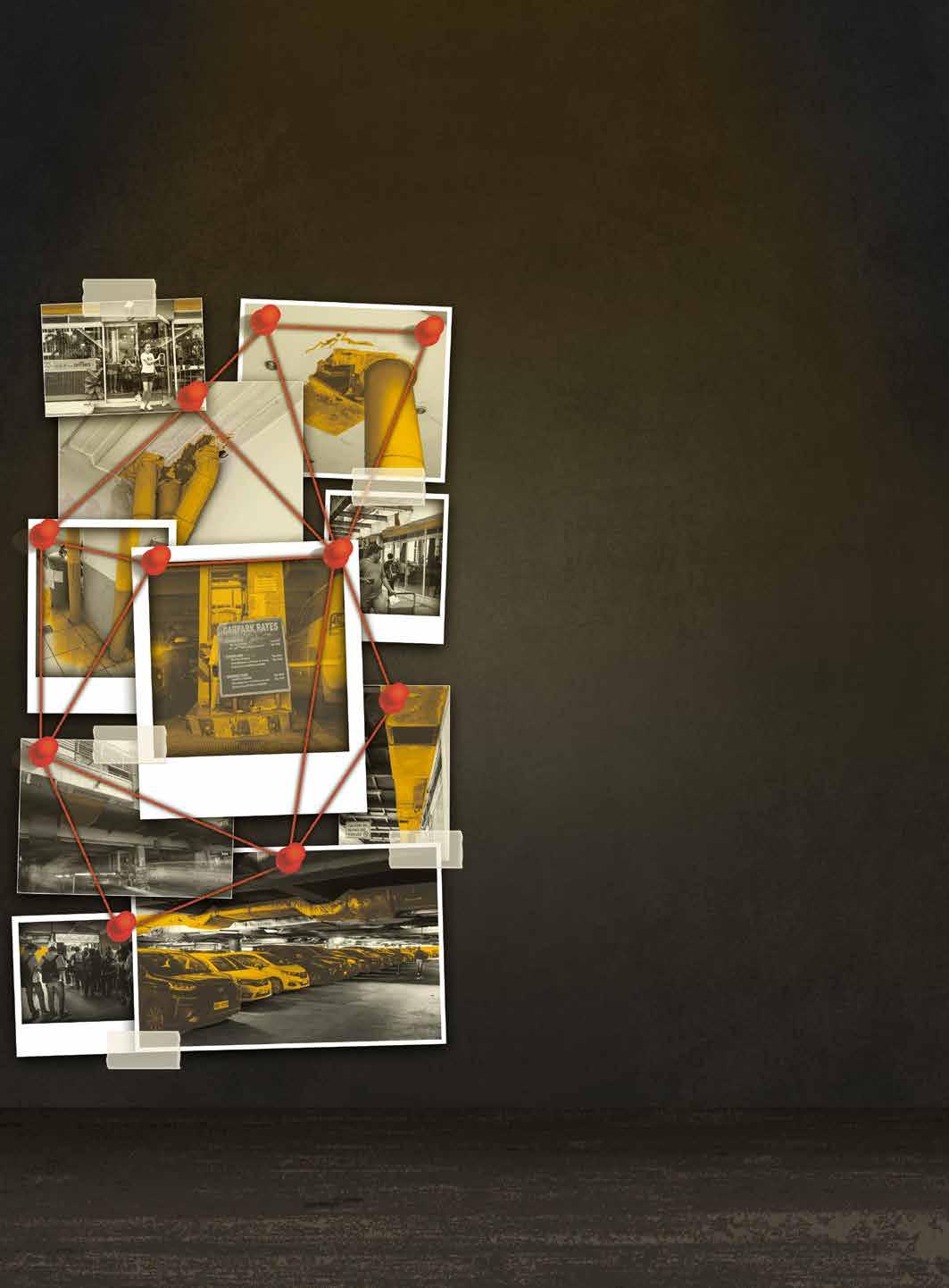
Leaks, corrosion, and deteriorating fixtures have prompted the University to begin rehabilitation work in the 20-year-old UST car park, Austria told the Varsitarian
This came ahead of the expiration of the University’s extended contract with Selegna Holdings on Nov. 15.
To address safety concerns and complaints, Austria said the FMO took the initiative to address maintenance issues that had been left unattended by the operator.
He said the FMO oversaw repairs on the facility’s sewage treatment plant.
“Selegna has been the operator since time immemorial kasi siya ‘yong proponent [sa contract], [and] I’m not quite sure if they have done anything,” Austria said.
UST scores higher but slides down in 2026 interdisciplinary science rankings
By Amador Denzel M. Teston
THE UNIVERSITY ranked in the 351-400 band of the 2026 edition of the Times Higher Education (THE) Interdisciplinary Science Rankings, which measure universities’ contributions and commitment to interdisciplinary science research.
UST ranked within 251 to 300 in the 2025 edition.
It was followed by Mapúa University, which placed in the 601–800 bracket, down from its previous 501–600 ranking.
A total of 25 Philippine schools took part in the rankings, of which 23 earned “reporter” status, an increase from nine reporter schools recorded last year.
Overall participation rose to 911 universities in 94 countries, up from 749 schools in 92 countries in the previous cycle.
The survey was conducted by THE in collaboration with Schmidt Science Fellows to promote scientific excellence and encourage cross-disciplinary collaboration.
“The Interdisciplinary Science Rankings (ISR) 2026 highlight how universities worldwide are deepening their commitment to interdisciplinarity—strengthening established systems while enabling new entrants to build capacity and impact,” THE said in its report.
The rankings assessed schools’ performance in 11 metrics grouped under three pillars, each representing a stage in the research process: inputs (19%), process (16%) and outputs (65%).
Under the inputs metric, schools’ interdisciplinary science research funding (8%) and industry funding (11%) are measured. The measure of success (4%), physical facilities (4%), administrative support (4%), and promotion success (4%) make up the process criterion.
The outputs pillar, which carried the biggest weight, evaluated the volume of interdisciplinary science research publications (10%), their proportion among all publications (5%), utility outside the discipline (5%), publication quality (20%), and reputation (25%).
Despite the slip in rank, UST scored higher this year, achieving a 41.2-43.2 overall score from its previous rating of 39.8-42.5.
UST scored 66.1 in input, 66.7 in process, and 29.6 in the output metrics.
Data from Elsevier’s Scopus database and other indexed publications covering 2020 to 2024 were used to measure research output, with citation data extending to 2025. Universities needed to produce at least 100 interdisciplinary research publications to qualify for ranking.
The United States’ Massachusetts Institute of Technology topped the global rankings for the second consecutive year, followed by other schools from the United States: Stanford University and California Institute of Technology. Singapore’s Nanyang Technological University took fifth place and is the highest ranked universi-
By Alexandra S. Demaisip
THE UNIVERSITY’S radio broadcasting arm, UST Tiger Radio, won four awards at the 2025 International Student Broadcasting Championship (ISBC).
Communication senior Amara Medrano, a Tiger Radio jock and Tiger TV talent, bagged the People’s Choice Talent Award, a category that drew more than 50,000 voters.
Brianna Valdez, a communication senior and programming head of Tiger Radio, was named Best Content/Program Director, along with Alfie Mulcahy of the University of Salford in the United Kingdom.
John Maverick Morales, also from the communication program and a voice talent at Tiger Radio, won Best Voiceover.
Creative writing senior Joseph Earl Quintana was recognized for Best Copywriting Script.
Other Thomasians named ISBC finalists were:
Julian Iñigo Felipe – Best Video Execution
Loise Van Bantolo – Best TV News or Sports Feature
• Kathleen Vallo – Best Social Media Execution
• Lhiera Nicole Trinidad – Best Podcast Talent

• Naomi Ravago – Best Newcomer On-Air
Amber Denise Cruz – Best Established Podcast (Tiger Radio: Off Air)
• Mylferd Supnet, a senior announcer of Tiger Radio, said the achievements serve as a reminder for the online college radio station to “push forward and to strive for more.”
“We have been venturing a lot in
Sixty-four are named ‘Distinguished Thomasians’
By Alexandra S. Demaisip
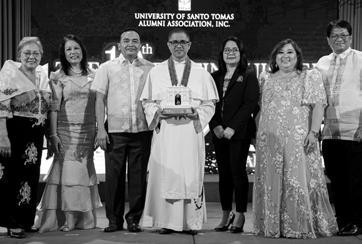
SIXTY-FOUR UST graduates were honored at the 10th Distinguished Thomasian Alumni Awards Night held on Saturday, Nov. 22 at the Dr. Robert C. Sy Ballroom of the Buenaventura Garcia Paredes, O.P. Building.
The awardees from different alumni associations were selected by the UST Alumni Association Inc. (USTAAI).
Among the 54 distinguished Thomasian alumni honorees were Cebu Archbishop Jose Palma and Novaliches Bishop Antonio Tobias from the UST Alumni Priests Association.
Faculty members Assoc. Prof. Faye Abugan of the Faculty of Arts and Letters, former College of Nursing dean Susan Maravilla, and Asst. Prof. Antonio Etrata Jr., chair of the UST Department of Marketing Management, were recognized.
Other distinguished Thoma-
sian alumni, such as Fr. Christopher Aytona, O.P., UAAP Season 88 program committee head, and Fr. Roman Santos, O.P., rector of Colegio de San Juan Letran Calamba, were feted.
The association added recognitions of 10 young alumni achievers in its milestone year.
Among the 10 awardees were Hanna Andres, mayor of Rizal in Nueva Ecija, broadcast journalist Mon Gualvez, and former UAAP courtside reporter and news anchor Diane Querrer.
USTAAI President Dwight Ramos said the awards night was in keeping with a “cohesive and vibrant” vision of serving the University, country, and the Church.
“Under one Thomasian spirit of solidarity, we are therefore glad to gather tonight as one family and honor those among us who have gained respect and ad-
terms of radio…and [there’s] so much more to be seen in [the] international stage,”’ Supnet said.
“People are saying that radio is dying…but ‘yung mga awards, ‘yung mga finalists, even not only from Tiger Radio, but from all of the radio stations around the world who have been trying, is the manifestation that radio is still alive,” he added.
The ISBC winners were announced on Nov. 18 via livestream.
The panel of judges was composed of 62 media practitioners from around the world.
Tiger Radio was named as Station of the Year in the inaugural ISBC held in December 2023.
ISBC, a global talent discovery and development platform across campus radio broadcasting, video and digital content creation, and e-sports broadcasting, was launched in October 2023 by Australia-based Ramp Media.

By Louisse Raye Shara C. Santos
FOR YEARS, Marie Carisa “Cai” Ordinario wrote stories on the economy and educated students on the intricacies of economics, finance, and agriculture.
Ordinario, a veteran journalist and faculty member at the UST Department of Journalism, passed away on Nov. 17 at the age of 45, after battling colon cancer.
Prof. Jeremaiah Opiniano, chair of the UST Department of Journalism, remembered Ordinario as someone who “strives and quietly perseveres in doing better news reporting.”
“Cai represents efforts by Thomasian business journalists to produce better economic journalism. Her stories provide pointed implications to policymakers, businesses and ordinary Filipinos. Stu-
dents she had handled may have been lucky to feel the pulse of daily business journalism,” said Opiniano.
Ordinario completed her undergraduate studies in journalism at the University in 2002, and was a reporter and news editor for the Varsitarian
Known by her students and colleagues as “Ma’am Cai,” Ordinario handled courses on business and economic reporting, macroeconomic indicators, and media and society.
Christian Patrick Laqui, a journalism alumnus and a reporter at PhilStar.com, said Ordinario was a very compassionate and kind teacher.
“Naiintindihan niya mga struggles namin and never niya kami pinagdudahan. Sa pagtuturo niya
EDITOR: VINCE ALFRED M. PILLAGARA
By Sydney Venice V. Berba
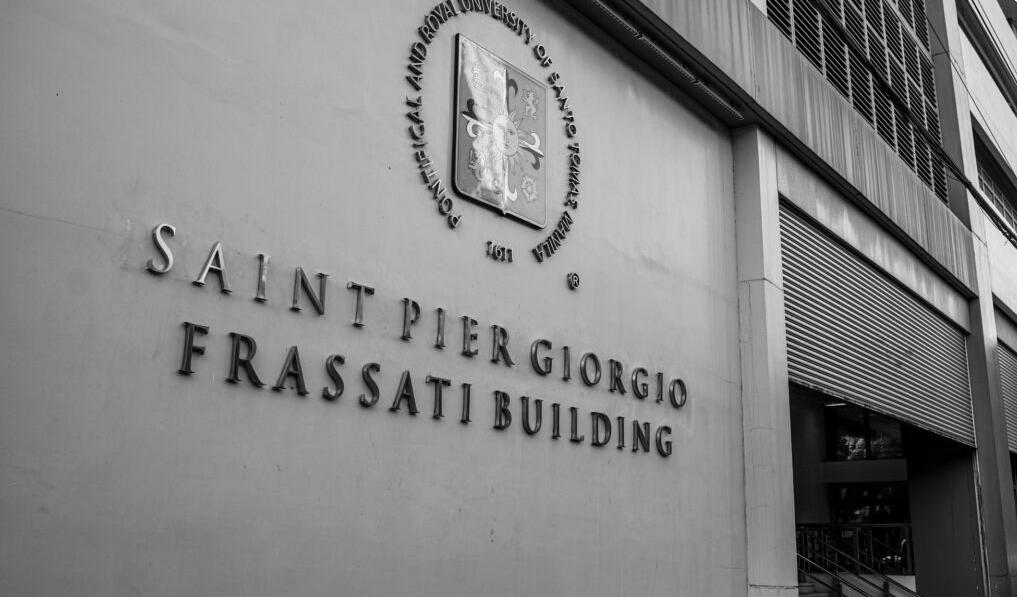
THE UST Blessed Pier Giorgio Frassati has been officially renamed the Saint Pier Giorgio Frassati Building following the Italian youth’s canonization.
The University announced the name change to kickstart adjustments in official records, building signages, and institutional communications.
“The University formally declares: That the edifice formerly known as the Blessed Pier Giorgio Frassati Building shall henceforth bear, in all official documents and institutional usage, the name Saint Pier Giorgio Frassati Building,” the Office of the Secretary General said in circular released on Nov. 21.
The renaming is “[in] grateful
acknowledgment of the Church’s definitive recognition of [Frassati’s] sanctity and in continuity with the University’s tradition of honoring witnesses of the Gospel and exemplars of faith, hope and love,” it added.
The updated name on the España side of the building was installed on Nov. 19, marking the first public display of the structure’s new name.
Standing at 22 stories, the Saint Pier Giorgio Frassati, O.P. Building is the tallest among all UST structures.
The building opened at the start of Academic Year 2019-2020 to welcome Grade 11 students of the Senior High School department. Construction began in October 2017.
It later became home to the students of the College of Information and Computing Science (CICS)
following the academic unit’s inauguration in 2021. It also houses the Office of Information and Communications Technology and the Educational Technology Center.
The building is the first UST structure to be erected outside the
walls of the Manila campus since the end of World War 2. A “link bridge” connecting to the main campus was completed in March 2021.
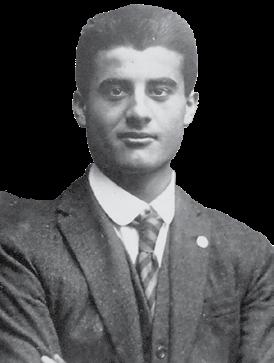
Pope Leo XIV canonized St. Pier Giorgio Frassati, along with St. Carlo Acutis, at St. Peter’s Square in the Vatican on Sept. 7 — his first canonizations as pontiff.
Frassati was beatified by Pope John Paul II in 1990 and was called the “Man of the Eight Beatitudes” for his commitment to living the virtues of the beatitudes through a life of prayer, social advocacy, and service to the poor.
He died in 1925 at the age of 24 after contracting polio while caring for the sick.
Frassati is the patron saint of the youth and athletes; his feast is commemorated on July 4.
By Alexandra Gabrielle C. Mansineros
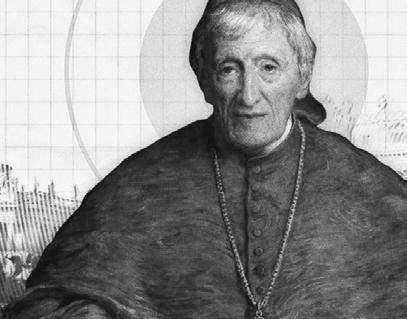
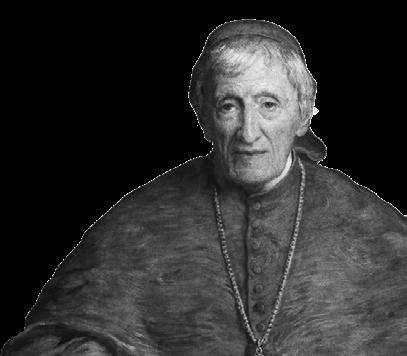
JOHN HENRY Newman, proclaimed co-patron of Catholic education by Pope Leo XIV, is a model for all people who are passionate for the truth, a UST theologian said.
Pope Leo declared Newman, a 19th-century English cardinal, a Doctor of the Church on Nov. 1 at St. Peter’s Square.
Fr. Cecilio Vladimir Magboo, O.P., regent of studies of the Dominican Province of the Philippines, said the integration of holiness and wisdom of both St. Thomas Aquinas, the patron saint of Catholic education, and Newman, the new co-patron, should be emulated by Thomasians.
“To be educated and to be holy, they can be together. The higher that you learn, the more that you should become holy,” the Dominican priest said.
Magboo said Thomasians should learn from the two saints who were “passionate about the truth and sought it wherever it could be found,” a core tenet of the University as embodied by the motto, “Veritas in Caritate,” or truth in charity.
Senior high student behind Acutis song hopes to ‘bring a glimpse of heaven on earth’
By Reya Vincent P. Misa
MUSIC HAS always been inseparable from faith. A quiet moment in front of the tomb of St. Carlo Acutis in Assisi, Italy, stirred within a UST Senior High School student. The melody that would later emerge from this experience would echo across school assemblies, parish halls, and social media feeds.
Maria Sophia Roldan, a 16-year-old student from the Music, Arts, and Design track, traveled to Italy in May 2024 for a concert tour, during which her choir visited the resting place of the teenage millennial saint.
There, she found the inspiration to compose “To Be Closer to Jesus,” a choral piece that captures the spirit of Acutis’s famous line, “The Eucharist is my highway to heaven.”
“It was really meant to be. When we visited his tomb, I suddenly had this melody… [Then] everything fell into place,” Roldan told the Varsitarian in an interview.
For her, Acutis’s relatability was central to the tone of her composition: “Seeing a saint dressed in jeans, sneakers, and a sweater sends an amazing message that everyone can live a holy life,” she said.
“It’s not just for priests or martyrs. It’s within everyone’s reach because the Lord is the Lord of everyone,” she added.
Roldan particularly found inspiration in the millennial saint’s zeal to evangelize.
“He dragged his parents and relatives to Mass. He brought people closer to Jesus,” she said.
She emphasized that music remains one of the most potent forms of evangelization.
“[As the saying goes], when you sing, you pray twice. A melody can make people reflect and pray more deeply. Music is a prayer itself,” the senior high student said.
She said her mission as a Thomasian artist was shaped by the University’s mission to preach truth through beauty.

Magboo, who teaches at the Faculty of Sacred Theology, said the example of the two patrons of education should help students and professors combat relativism in truth, or the belief that there is no absolute truth and only personal interpretations of reality.
“For us in the Catholic institution,
we know the truth is there. We know that the truth is Christ… Every search for truth is guided by what St. John Henry and St. Thomas would tell us — the faith that we have,” he said.
The proclamation of Newman, the 38th saint to be named Doctor of the Church, was made during the closing Mass of the Jubilee of the
For us in the Catholic institution, we know the truth is there. We know that the truth is Christ.
Every search for truth is guided by what St. John Henry and St. Thomas would tell us.
Fr. Cecilio Vladimir Magboo, O.P. REGENT OF STUDIES OF THE DOMINICAN PROVINCE OF THE PHILIPPINES
World of Education, coinciding with the Solemnity of All Saints. Newman will also be venerated as patron of Catholic schools, along with St. Thomas Aquinas, the “Angelic Doctor.”
“Newman’s impressive spiritual and cultural stature will surely serve
“God gives you your gifts, use them for good. I hope more people will use their talents to inspire those growing distant from the Church and bring them back to God. Through our gifts, we can bring a glimpse of heaven here on earth,” Roldan said.
Roldan is a member of the Young Voices of the Philippines (YVP), a children’s choir founded by her parents, Conservatory of Music faculty member Maria Theresa Roldan and Jude Roldan, an alumnus of the University.
Lester Mendiola, director of the Jesuit Music Ministry, wrote the lyrics of Roldan’s composition.
St. Carlo Acutis, dubbed the “first millennial saint” and “Patron of the internet,” devoted his life to the Eucharist from a young age and created a website cataloging over 150 Eucharistic miracles worldwide.
He died in 2006, at the age of 15, due to leukemia. He was canonized a saint on Sept. 7 by Pope Leo XIV, along with another young Italian layman, St. Pier Giorgio Frassati. WITH REPORTS FROM ALEXANDRA GABRIELLE C. MANSINEROS
All three branches of government—the executive, Congress, and Supreme Court with the Comelec and constitutional bodies—are complicit in the grand larceny perpetrated against the Filipino people.
THE PHILIPPINES is falling not because of a single catastrophic failure. We are dying from something quieter: government branches that pretend to function and protect us.
The executive that pardons and recycles the corrupt, the Commission on Elections – a constitutional body – and the Supreme Court – have basically laid down rulings that allowed all of these party-list pretenders and charlatans to make a mockery of the party-list representation provided by the 1987 Constitution, and shelters political dynasties, and the judiciary that restores political rights even to convicted plunderers.
These three branches, once designed to check one another, now operate like a single machine built not for accountability but for accommodation. Everything appears orderly on paper: separation of powers, checks and balances, independent commissions — yet in reality, these structures have been reduced to ornaments that legitimize impunity.
Such revelations have sparked a nationwide outcry. In September, simultaneous protests declared war against the massive government corruption in flood-control-related projects.
This outpouring of public anger shows not just disappointment, but a breaking point in trust. We are beginning to see not isolated scandals, but a pattern: grand projects with grand budgets, followed by failed execution, empty
dikes, ghost projects, and no meaningful accountability. All under the power of the three branches of the government: the legislative, the judiciary, and the executive.
In August, President Marcos Jr. revealed that from July 2022 to May 2025, the administration had disbursed P545 billion for flood-control projects nationwide across 9,855 projects.
An audit by the Department of Public Works
of wealth and contracts — in an ostensibly competitive public-works system — demands sober scrutiny.
The DPWH oversaw not only the implementation of these works but also certified their completion. Because DPWH officials, from undersecretaries down to district engineers, serve at the pleasure of the president, the agency’s chain of command created a culture where loyalty and
These three branches, once designed to check one another, now operate like a single machine built not for accountability but for accommodation. Everything appears orderly on paper: separation of powers, checks and balances, independent commissions — yet in reality, these structures have been reduced to ornaments that legitimize impunity.
and Highways (DPWH) found that out of 8,000 projects physically inspected nationwide, 421, or about 5%, were “ghost projects,” infrastructure initiatives that either never existed or were never built. Of those 421, the commission has prioritized 80 projects tied to what the President called “notorious” top contractors.
Even more stark: just 15 contractors received 20% of the entire P545-billion flood-control budget — roughly P100 billion. This concentration
political usefulness often outweighed technical competence.
Under this structure, contractors could secure projects not through engineering merit but through political endorsements, and completion reports could be produced even when the actual project existed only on paper.
As investigators later found, DPWH offices became the sites of widespread tampering and destruction of records, an act condemned by the
newly formed Independent Commission for Infrastructure (ICI) as a “direct assault on government transparency.”
The legislative branch, meanwhile, has long transformed the national budget into a marketplace of influence. These politicians allegedly inserted pet flood-control projects into the budget, projects often duplicative, unnecessary, or technically unsound — and steered them toward favored contractors, including companies owned by families of congressional representatives.
The mechanics were simple: insert the project, award the contract, collect the percentage.
During Senate hearings, contractors Sarah and Curlee Discaya claimed they were forced to surrender 25% in kickbacks to at least 17 members of the House and several DPWH officials to secure contracts.
The claim remains under investigation, but it aligns with a long-standing commission culture embedded in public works. Worse, when the scandal finally reached Congress, the House abruptly ended its own inquiry and turned over documents to the ICI—an act seen by many as self-preservation by those who had helped design the very appropriation schemes under scrutiny. By September 2025, the outcry forced the formation of a temporary watchdog: the ICI, endowed with sweeping powers to summon offi-


Cornerstone
SOFIAH SHELIMAE
J. ALDOVINO

CATHOLIC STUDENTS have been told in recent weeks to “stay out of politics” after several Catholic universities, including UST, joined nationwide rallies condemning alleged corruption in flood-control and public works projects.
After the Sept. 21 anti-corruption protests at Luneta and the EDSA Shrine, in which thousands marched under the banners of church groups and Catholic schools, critics immediately resurfaced the familiar warning: “The Church should not interfere in the State.”
The criticism intensified after UST held its first university-wide walkout in more than 20 years on Sept. 29.
Hundreds of Thomasians gathered at the UST Plaza Mayor, praying, singing, and demanding accountability. A solidarity night followed on Oct. 3, with faculty, administrators, alumni, and students condemning corruption and affirming support for future actions.
Yet online commentators and opinion writers have accused Catholic schools of violating “neutrality,” insisting that priests, religious, and students had no business at rallies touching on government wrongdoing.
In an earlier statement, “When the Waters Rise, So Must We,” the University called the scandal a “betrayal of public trust” and urged Thomasians to speak out. Yet even as bishops, the Catholic Educational Association of the Philippines, and dioceses publicly encouraged Catholic schools and youth to participate in these non-partisan protests against corruption, a familiar criticism resurfaced.
Commentaries and social media posts made continual reference to “upholding the constitutional separation between Church and State,” as they questioned why priests, religious, and Catholic students were being “interfering” in political matters. The tone ranged from polite concern to open irritation, but the message was clear: Catholics, especially the young, should keep their heads down and stay out of politics.
The attempt to silence Catholic schools by invoking “neutrality” is selective. The Civil Service Commission’s reminders to government employees and the Department of Education’s bans on partisan activity apply to state personnel, not to private institutions like UST. Yet the rhetoric spilled over, as if Catholic universities surrender their rights once they become visible in the streets. Neutrality, in this argument, has become less a legal principle and more a tool to discourage
public conscience.
But what exactly is improper about a Catholic university speaking against the misuse of public funds? What is inappropriate about students and faculty demanding honesty in governance, especially when the consequences of corruption — floods, displacement, and risk to life — fall on the most vulnerable?
Catholic social teaching offers an answer that is both older and more demanding than any modern complaint. The Second Vatican Council’s Gaudium et Spes affirms the right to assemble and to defend one’s rights against abuses of authority. Pacem in Terris grounds the same right in human dignity.
Put plainly, Catholic teaching does not say, “Stay in your lane.” It says, “You have the right — and at times the duty — to act together in public for the common good.”
The separation of Church and State prevents the State from imposing religion; it does not forbid churches or believers from speaking on moral issues. It certainly does not require Catholic students to surrender their rights once they step off campus.
Catholic universities therefore bear a serious responsibility. They claim to form consciences in the light of the Gospel, and that formation cannot end at the classroom door. A university that teaches the preferential option for the poor but falters when its students act on it produces not disciples but dissonance.
The recent Thomasian walkout and solidarity night underscore that this need not be the case. Faculty associations warned that silence is complicity. Students prayed, studied, marched, and spoke
out, all expressions of the same conviction: human dignity is not up for negotiation. UST declared corruption “a theft from those in most need,” and for once, its mission and its students’ actions told the same story.
Contemporary Church teaching points in the same direction. In a 2024 address to the Centesimus Annus Pro Pontifice Foundation, Pope Leo XIV said the Church’s social doctrine must bridge “polarizations” and be rooted in concrete encounters with the poor.
History also affirms that faith and protest are not enemies. Thomasian martyrs — St. Vicente Liem de la Paz, Bl. Buenaventura García Paredes, St. Domingo Ibáñez de Erquicia, among others — did not die for procedure but for truth. Their stories expose as fragile any notion of a “safe” Catholicism that is silent and conveniently blind to public sin.
Seen from this perspective, Catholic students at anti-corruption rallies are not anomalies. They show that Catholic universities are, at least in part, forming consciences capable of recognizing injustice and acting when human dignity is threatened.
To tell Catholic students to keep their heads down is to misunderstand the very education these institutions promise. Faith does not end where civic responsibility begins. When UST called the corruption scandal “a betrayal of public trust,” it did


EVERY YEAR, around 20 tropical cyclones enter the Philippine Area of Responsibility. As of now, the country has already faced—by some counts—21 typhoons. They affect hundreds of thousands of families across the archipelago.
On top of storms, 2025 has brought major earthquakes. A magnitude-6.9 quake struck Cebu on Sept. 30, devastating parts of Visayas; days later, a strong quake rattled Davao Oriental. Floods and landslides remain recurring threats across low-lying and mountainous provinces, often worsened by inadequate drainage or flood-control systems.
What these disasters have in common is that they can — to a considerable extent — be anticipated, monitored, and mitigated. That makes the work of scientific agencies critical.
DOST’s service agencies, Pagasa and Phivolcs, are on the front lines of disaster preparedness, yet their budgets do not meet operational needs. Pagasa, for example, has only 11 of 19 Doppler radars fully functional, limiting its ability to monitor typhoons and heavy rainfall.
Phivolcs operates about 125–130 seismic and
volcanic monitoring stations, far below the roughly 300 experts say are needed for adequate national coverage.
Without extra funding, these agencies cannot repair or expand equipment, update hazard maps, or improve early-warning systems for vulnerable communities.
Though the DPWH received a P1.1 trillion budget for 2025—an 11.7% increase from the previous year— flood-control failures persist, showing that money alone does not guarantee safety.
The issue is not that DOST’s budget is smaller than DPWH’s, but that its resources do not align with urgent operational needs. Properly funding scientific agencies ensures that disaster monitoring, hazard mapping, and early-warning systems complement public infrastructure, translating investment into actual protection for Filipinos.
Underinvestment in DOST does not imply other agencies lack scientific capability; rather, it weakens the nation’s ability to anticipate, monitor, and respond to natural hazards.
Pagasa and Phivolcs consistently deliver critical warnings under resource constraints—rain, shine, or fault rupture—proving their efficiency and reliability. If there is ever a sector worth prioritizing for budget increases, it is these scientific agencies.
This year, DOST was granted a budget of P28.77 billion, a 6.6% increase from its previous 2024 budget of P26.9 billion. Included in this allocation is
Phivolcs with its P887 million allocation, and Pagasa with a P1.9 billion budget.
Despite the DPWH’s big budget, we’ve seen a breakdown in the flood-control system that has resulted in communities being in systems that fail, and communities remain exposed. The question then writes itself: how can the country pour staggering amounts into infrastructure yet still find itself submerged, isolated, and unprepared each time calamity strikes?
This situation calls for better allocation of budget to government bodies whose services are truly for the Filipino people, instead of for themselves, such as the Department of Science and Technology (DOST) and its service agencies who in the middle of calamities, are seen in action and not on vacation.
Although natural disasters like floods and earthquakes remain unpredictable, Pagasa and Phivolcs still handle their monitoring and dissemination to the public, even when in the eye of the storm. With natural calamities growing more frequent and deadly, the government must stop treating science agencies as afterthoughts and start funding them more adequately as essential pillars of national survival. If there is any sector that has consistently proven it works for Filipinos — rain, shine, or fault rupture — it is the scientific community. And if there is any time to invest in them, it is now.
‘Ma’am Cai’
parang nagiging loveable ang business journalism,” he said.
“Noong first time kong magco-cover ng PSA (Philippine Statistics Authority) no’n for TV, hindi ko alam anong gagawin, siya [ang] nilapitan ko and she never hesitated to extend her help to me,” Laqui recalled.
The University honored the late academic staff in a Facebook post on Tuesday.
“Ms. Ordinario leaves behind a legacy of journalistic excellence, attested to by the various accolades she had received,” the post read.
Chander Ubalde, Ordinario’s cousin, remembered her as a happy and energetic family member.
“There’s always excitement building up towards the day she arrives [at our home in the province]. Mayroon kasing laging dalang pakulo, pa-games, chismis, biruan. She’s an important and necessary formula to make a family occasion momentous,” he told the Varsitarian
BusinessMirror, the newspaper where the late journalist served most of her career, remembered Ordinario as a reporter who “illuminated truths and inspired countless students and colleagues.”
“The awards notwithstanding, the most important trophies in ‘Ate Cai’s’ heart are embodied in the admiration and gratitude of countless aspiring young journalists whom she mentored in and out of the newsroom,” the business news outlet said in a Facebook post.
The UP College of Media and Communication also mourned the loss of the late educator in a post on Wednesday.
“She guided young journalists with patience and insight, reminding them that journalism is a public trust and a service to the people. Her presence in the classroom and newsroom was marked by humility, warmth, and an unwavering commitment to truth,” the post read.
Ordinario completed her master’s degree in communication at the University of the Philippines Diliman in 2019, where she served as a lecturer in business journalism.
The Economic Journalists Association of the Philippines (EJAP), where Ordinario served in various capacities, mourned its former president.
“We extend our deepest condolences to her family, colleagues and students. Her dedication to journalism and mentorship will be remembered,” the post read.
Institutions that Ordinario covered joined in mourning her passing. The Department of Economy, Planning, and Development, the economic planning body, honored the late economic journalist on Wednesday.
“Ms. Ordinario was a brilliant and dedicated journalist whose work illuminated complex economic and development issues with clarity and insight. Her ability to translate technical matters into compelling stories empowered the public to better understand the forces shaping our nation,” the post read.
The PSA remembered Ordinario, who advanced their advocacies by raising public awareness through her reports on statistics and the economy.
“With Cai’s passing, the PSA has lost a steadfast ally in ensuring truth and balance in the reporting of national statistics and economic issues. It has been a privilege for us to collaborate with her,” said National Statistician Claire Dennis Mapa.
Ordinario’s remains were cremated on Nov. 19. A memorial was held on Nov. 19 and 20 at the Immaculate Heart of Mary Parish (Claret
By Elihoenai Hazael B. Cortez and Amador Denzel M. Teston
VETERAN WRITERS urged budding poets and storytellers to craft and inhabit personas in their creative works to deepen expression and expand narrative perspective during the Varsitarian’s 20th Creative Writing Workshop.
Multi-awarded poet and screenwriter Jerry Gracio said adopting personas allows poets to clarify their message and communicate it more effectively.
“Sa akto ng pagsusulat, mayroon tayong gustong sabihin, gustong ipahayag. Kapag maliwanag na sa writer kung anong gusto niyang sabihin, saka [siya] mag-iisip kung paano ito sasabihin based sa persona na pipiliin,” he said.
“A writer should be able to assume other personas and other voices,” Gracio added.
Palanca awardee Mark Angeles

and UST Publishing House deputy director Paul Castillo emphasized the importance of language choice and developing metaphors that resonate with contemporary readers.
“Trabaho nating lumikha ng mga bagong metaphor pero importante din i-document ‘yong mga metaphor na ginagamit ng kabataan ngayon,” Angeles said.
“As a writer kailangan mong pag-isipan kung paano maintindihan ng reader ‘yong akda, hindi ka puwedeng madamot—’yong language, ‘yong words dapat may paraan ka kung paano siya papapasukin [sa mga mambabasa],” Castillo added.
Fictionist Sarge Lacuesta, president of the Philippine Center of PEN International, said personas help expand a story’s world-building, reminding fellows that writing does not need to be limited to personal experience.
Renowned writer and copyright advocate Beverly “Bebang” Siy reminded fellows against editorializing in their narratives.
“Ikaw as an author, pinapasok mo ‘yong sarili mo sa kuwento,” she said during the Katha panel. “Hindi ka na gumagamit ng device or point of view para sabihin ‘yong gusto mong sabihin.”
Creative writing professor and fictionist Chuckberry Pascual urged writers to be deliberate in choosing their point of view.
“Tandaan natin, kapag gumamit tayo ng first person [point of view], kasama sa pagbuo ng tauhan ‘yong pananalita niya. ‘Yong boses niya, dapat consistent,” Pascual said.
The one-day workshop, held Nov. 14 at the George S.K. Ty Function Hall of the Buenaventura Garcia Paredes, O.P. Building, serves as a preparation for student writers seeking to join the Varsitarian’s Gawad Ustetika, the country’s longest-running campus literary derby set to mark its 41st year in 2026. WITH REPORTS FROM BILLY ANDREI P. RAMOS, MICAH G. PASCUA, SOFIA GABRIELLE G. ROSARIO, AND ALEXANDRA GABRIELLE C. MANSINEROS

Out of 103 entries, 12 Thomasian writers were selected as fellows for the workshop:
KATHA
J-Rhic Tanghal, Kianna Althea Fortin, Hannah Faith Lorenzo
TULA
Denver Emanuel Gastanes, Clark Vinz Pino, Ayesha Julia Java
POETRY
Charlize Ann Lavastida, Juliana Mae Jamito, Nicole Claire Mendoza
FICTION
Nashley Gayle Anteojo, Lhieran Nicole Trinidad, Raymond Vince Manaloto
The Varsitarian holds the 20th Creative Writing Workshop, the annual seminar-fellowship fellowship based on submitted literary pieces in the categories of Fiction, Katha, Poetry, and Tula, on Nov. 14.
By Sofia Gabrielle G. Rosario
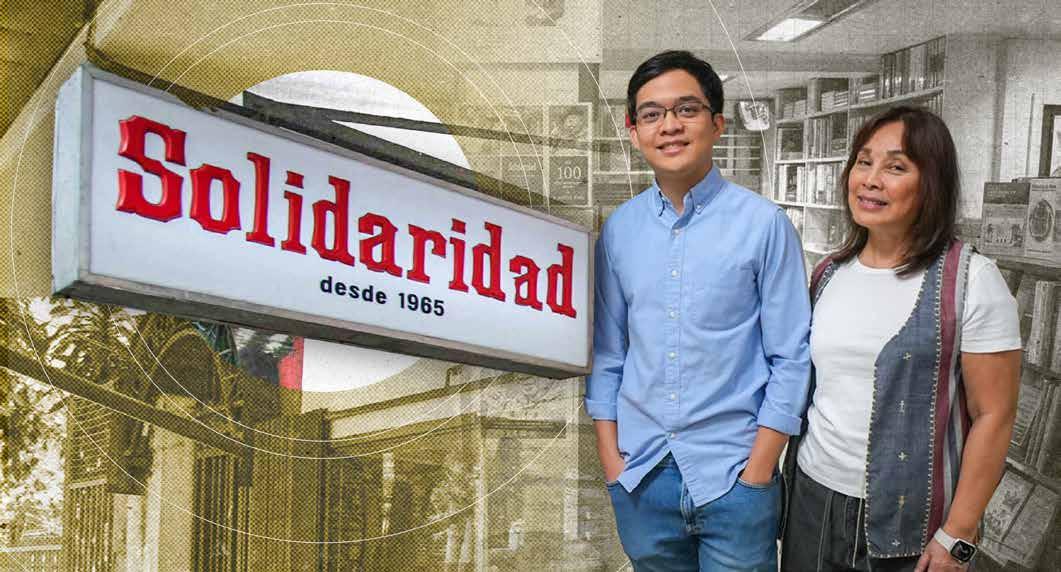
SOLIDARIDAD BOOKSHOP, a cultural and literary landmark founded by the late National Artist for Literature F. Sionil José, has been sold and is set to transition to new ownership following the signing of sale documents on Friday, Nov. 21.
Rep. Leandro Legarda Leviste of Batangas, son of Sen. Loren Legarda who is a longtime family friend of the Josés, became the new owner of Solidaridad Bookshop after four months of negotiation.
Antonio “Tonet” José, eldest son of the late literary giant, said the transition would not alter the bookshop’s operations.
“The new owner will continue the bookshop. Everything that it was before. They’ll continue everything,” he told the Varsitarian Tonet said regular events, including book launches and the monthly Poets & Playwrights, Essayists, and Novelists (PEN) meeting, would continue under the new management. Personal memorabilia, including photographs and notable sayings of the late national artist, will remain on display.
“And then they’ll continue ‘yong Filipiniana section namin. Everything will be the same,” Tonet said.
Founded in 1965, the Solidaridad Bookshop is regarded as “Asia’s biggest little bookshop,” as it holds the country’s most extensive Filipiniana collection curated by the late national artist himself.
Throughout its six-decade history, the bookshop served as a literary saloon where writers, academics, politicians and cultural figures gathered to discuss culture, politics, and social issues.
It also housed the Philippine Chapter of the International PEN,
which José founded in 1957.
Leviste, founder of Solar Philippines and a lawmaker representing the first district of Batangas, vowed to preserve Solidaridad’s history and continue its literary mission.
“We hope they (José family) can remain involved and help ensure that the bookshop’s operations stay true to its history and the legacy of F. Sionil José,” Leviste said in a statement on Facebook.
According to Tonet, the final transfer of ownership will depend on the completion of business licensing, after which the shop will reopen to the public.
While Tonet said in June the sale
would include the building, bookstore, and fixtures for P38 million, he did not disclose the final price.
The Varsitarian broke the news that Solidaridad was up for sale in June 2025.
José, who passed away in 2022 at age 97, was a native Rosales, Pangasinan. He is known for his “Rosales Saga,” a five-volume series of novels that covers a century of Philippine politics and society.
The literary titan served as editor in chief of the Varsitarian from 1948-1949. WITH REPORTS FROM FRENCHSHIELD SHAYNE G. DELOVIERES AND MA. IRISH F. FERY


Alumni night FROM PAGE 2 ►
miration in their life and work after passing through the Arch of the Centuries into the world,” Ramos said.
The alumni coffee table book titled “Thomasian Icons: Bridges of Faith, Hope, and Love,” featuring success stories of recognized alumni, was officially launched.
“Every page is a manifestation of success achieved through passion, unwavering dedication, and hard work. There is no shortcut to success but hard work. Every page of this book speaks of competence, compassion, and commitment,” USTAAI Chairman Evelyn Songco said.
Dr. Robert Sy, the UST AAI chairman emeritus, said the achievements of the awardees, who received a replica of the Arch of Centuries, were a “testament to their hard work, dedication, and passion.”

By David Nigel C. Cortes

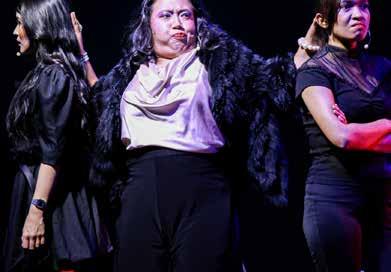
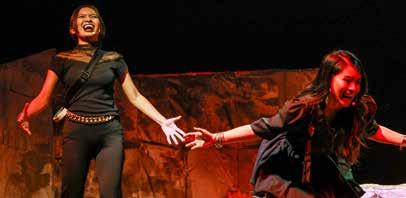
► Teatro Tomasino stages the “Absurdo: Event Day” by BJ Crisostomo and “Joe Cool: Aplikante” by Joshua Lim So, to kick off their 48th season.
— PHOTO BY VIO NEIRO M. VILLAESCUSA
IN ITS 48th year, Teatro Tomasino, the University-wide theater guild, is staging a twinbill production on contractualization and dehumanization that its directors say leans into the absurd.
“Kontrata Kontra Tao” features Palanca-winning “Joe Cool: Aplikante” by Joshua Lim So, and “Absurdo: Event Day,” a play first performed in The Virgin Labfest 2022, by B.J. Crisostomo.
“Joe Cool: Aplikante,” the winner
of Dulang May Isang Yugto at the 62nd Carlos Palanca Memorial Awards, follows Joe Cool and his unexpected job application process.
“And to think na nasa early 2010s pa ‘yung piece … the text itself, relevant pa rin naman siya, pero the creative process and the artistic process of [Teatro Tomasino in making ‘Joe Cool: Aplikante’] more reachable to the masses is something to look forward to sa staging namin na ito,” director
TEATRO TOMASINO PAGE 10 ►
“To you, our distinguished Thomasian alumni, we all look up to you. For us, [the replica of the Arch of the Centuries] is a symbol of our alma mater’s contribution to the country and the world, as thousands of alumni have passed through here over the centuries.” he said.
The Distinguished Thomasian Alumni Night, which started as a gathering in 2010 to support the University’s quadricentennial celebration in 2011, became an annual celebration to recognize successful alumni in their respective fields.
UST Hospital gets P7.4M late Covid aid from DOH
By Czeantal Naomi P. Delos Santos
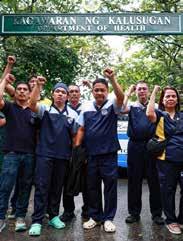
THE DEPARTMENT of Health (DOH) released P7.43 million in health emergency allowances (HEA) to UST Hospital on Nov. 13, ending months of delay that had prompted protests from healthcare workers.
The payout covers benefits of UST Hospital workers who served at the height of the Covid-19 pandemic.
In October, the Ugnayan ng Nagkakaisang Manggagawa ng UST Hospital (UNM-USTH) estimated that P7.8 million in HEA funds remained pending for release.
The allowances were withheld despite the hospital’s complete submission of requirements, the hospital union said.
The release took two years of appeals from hospital employees, represented by the UNM-USTH and the United Private Hospital Unions of the Philippines.
The groups blamed the government’s “faulty system,” which left them waiting for allowances due from 2023.
During an Oct. 28 protest at the DOH, union leaders said UST Hospital personnel were waiting for at least one month’s worth of allowances, part of a seven-month backlog of pandemic-related benefits.
Hospital employees also reported in October that some outsourced staff had been excluded from the list or received lower amounts than expected, despite their service throughout the pandemic.
Under Republic Act No. 11712, all healthcare workers, regardless of employment status, are entitled to monthly HEA benefits during the Covid-19 pandemic and other declared public-health emergencies, ranging from P3,000 to P9,000, depending on their risk exposure.
In a Facebook post, the UNMUSTH expressed gratitude to members who joined them in their recent protest.
“Bunga ng mariing pantindig sa karapatan at matibay na pagkakaisa ng mga manggagawa ng UST Hospital,” it said. “Ito ay panalo ng mga manggagawa.”
In September, the Department of Budget and Management released the Special Allotment Release Order to DOH, worth P6.77 billion, to be used to settle HEA.
The DOH had said it had been working to “process and reconcile pending HEA claims nationwide.”
By Luis Angelo N. Palma and Amador Denzel M. Teston
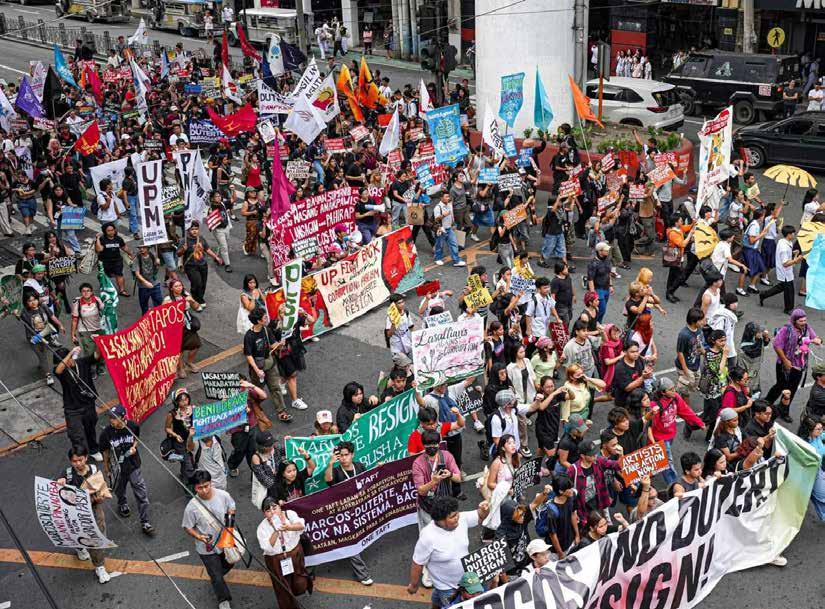
STUDENTS FROM schools across the University-belt (U-Belt) area mounted the National Day of Walkout Against Corruption on Nov. 21, ahead of a larger anticorruption protest on Nov. 30 at Rizal Park (Luneta).
The protest was initiated by the Youth Rage Against Corruption (YRAC) alliance, which is calling for the resignation of President Ferdinand Marcos Jr. and Vice President Sara Duterte.
Tiffany Brilliante, national convener of YRAC, said the protest was joined by various student councils and youth organizations to call for the ouster of top officials involved in massive corruption.
“Iisa ‘yong malinaw na mensahe ng mga kabataang estudyante mula sa iba’t ibang pamantasan na
lumahok ngayong araw—para kay Marcos Jr., Sara Duterte, at sa lahat ng sangkot sa korapsyon sa ating bansa, sa ating gobyerno: mag-resign na sila sa pwesto dahil sa malinaw na pagtataksil sa tiwala ng mamamayan,” she said.
“Malinaw sa mga kabataang estudyante na ito ay pagnanakaw sa ating kinabukasan,” Brillante added.
Kabataan Rep. Renee Co, called for accountability from the two highest officials of the country amid shakeup controversies in Malacañang and issues on corruption.
“Kailangang mag-explain ni Marcos Jr., kailangan niyang managot sa mga nangyayari…imposibleng walang go-signal from the very one on top,” she told the Varsitarian “That’s why tayo, ang panawagan, lahat ng sangkot dapat managot, especially ang mga nasa tuktok, si President Marcos Jr. and even
‘‘
Ang mga flood-control projects ay limpaklimpak na at bilyon na ang ninakaw nila. Ito na ang panahon upang ipaglaban natin kung ano ang dapat.
Hindi na dapat tayo nagpapaapi sa mga korapsiyon na nagaganap ngayon.
VP Sara Duterte.”
Contingents from UST assembled in front of the St. Raymund de Peñafort Building and marched along Dapitan and Padre Noval Street before meeting the main body at España Boulevard.
Central Student Council President Annie Agon said the Thomasian contingent joined the protest to embody UST’s core values and to oppose institutions and leaders who, she argued, did not uphold the same principles.
Agon said that students continue to struggle for academic freedom, calling out moves to give space to anti-insurgency agency National Task Force to End Local Communist Armed Conflict during a recent forum on “terror-grooming” in UST.
“Mas gusto nilang bigyan pa ng academic space daw ang
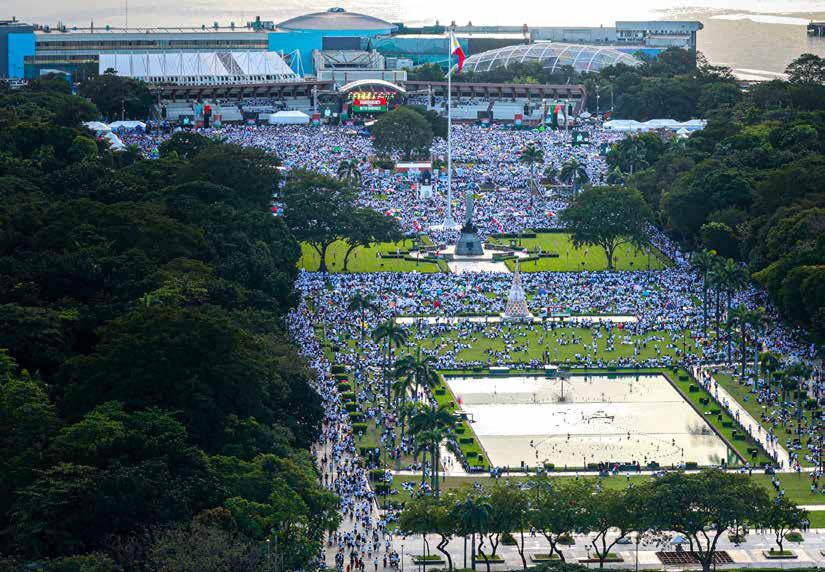
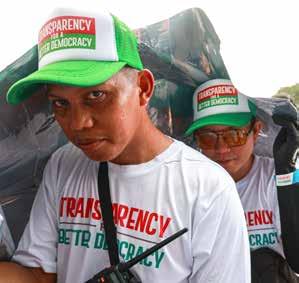
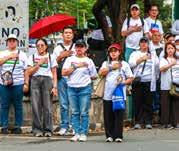
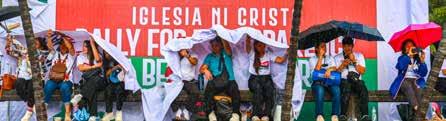
Thousands of members of the religious group Iglesia Ni Cristo (INC) flock to the Quirino Grandstand in Manila on Sunday, Nov. 16, for the two-day “Rally for Transparency and A Better Democracy” following the anomalous flood-control projects.
PHOTOS BY VIO NEIRO M.


EDITOR: BILLY ANDREI P. RAMOS



By Chalssea Kate C. Echegoyen
WASHINGTON — THE Varsitarian’s UAAP sports feature video “Superstar” earned raves at the College Media Association (CMA) Film and Audio Festival during MediaFest25 at the Grand Hyatt Washington on Oct. 16.
Tom Grant, founder of the festival and professor at the University of Alabama, praised the entry as a standout production that resonated with powerful storytelling and visuals.
“It was incredibly well-shot, and some of the shots were magically mystifying,” Grant told the Varsitarian in an interview after the screening.
“It’s so nice to see how the video showed all the great things happening at the University. It put a wonderful face on all the athletes. It was just beautifully well done,” he said.
The video, titled “‘Superstar’ –UAAP Season 87 Second Semester Primer,” was part of the CMA Pinnacle Awards’ sports feature (audio/visual) category and went on to win first place at the Pinnacles on Oct. 17, besting entries from US college publications.
It was followed by Appalachian State University’s AppTV in second place and the University of Kentucky’s KRNL Lifestyle + Fashion in third.
Produced and directed by incumbent Varsitarian editor in chief Chalssea Kate Echegoyen and former editor in chief John Ezekiel Hirro, the piece spotlighted Thomasian athletes competing in UAAP Season 87’s second-semester events.
Video editing was done by Jeremy Edera, former photo editor, and Paul Pinili, former photographer.
The visuals were captured by a team of videographers, including former photographers Alexis Alibogha, Mikyla Rosette Bernabe, Karla Maningas, Paul Pinili, Jeremy Edera, current photo editor James Magboo, and staffers Chloe Ibanez and Djenhard Sapanhila.
Grant also noted that the entry stood out among submissions from major U.S. universities, highlighting its creativity and depth.
“In America, we often think sports storytelling is our domain,” he said.
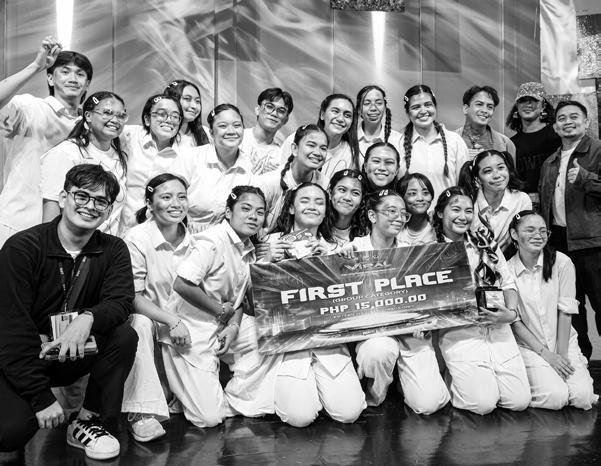
► UST Psychology’s Archetypes clinches their second consecutive championship in the group category, while the duo Performative Males of the College of Architecture emerges as champions
“But seeing an entry from another country excel beyond expectations was inspiring. The best, in this case, came from the Philippines.”
Varsitarian assistant publications adviser Felipe Salvosa II, who nominated the video to the Pinnacles, said “Superstar” drew from the 97-year-old publication’s tradition of creating UAAP primer videos to boost school spirit and reinforce UST’s standing as a collegiate sports powerhouse.
“Every year, we try to remind Thomasians that sports excellence is part of our DNA,” Salvosa said. “Superstar carried that tradition forward—not just as a video, but as storytelling that celebrates determination, faith, and school pride through the lens of student journalists.”
‘‘
Seeing an entry from another country excel beyond expectations was inspiring. The best, in this
case, came from the Philippines.
Tom Grant MEDIAFEST25 FESTIVAL FOUNDER
The CMA Pinnacle Awards, one of the most prestigious student media competitions in the United States, recognize excellence in student-produced journalism across seven divisions: Creative, Features, General, News, Opinion, Promotion or Advertising, and Sports.
Founded in 1954, the College Media Association is the leading professional association for collegiate media and student publication advisers in the US. WITH REPORTS
FROM KARIS M. TSANG AND CARLO JOSE H. RUGA

Psych dance troupe wins back-to-back titles in Salinggawi dance competition
By Kirsten Therese C. Barrameda
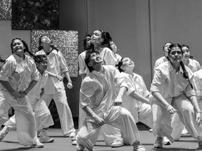
THE PSYCHOLOGY dance troupe, Archetypes, from the College of Science brought home anew the championship crown at “Danscene XXXVI: Viral,” the annual University-wide dance competition, on Nov. 15 at the Medicine Auditorium of the San Martin de Porres Building.
The Archetypes secured a back-to-back championship title in the group division with their routine rooted in emotion, fluidity, and expressive storytelling through the melody of Cup of Joe’s “Multo.”
“Nag-set kami ng theme na
as an inspiration to new generations whose hearts thirst for the infinite, and who, through research and knowledge, are willing to undertake that journey,” Pope Leo said in his homily.
Anglican turned Catholic Before converting to Catholicism in 1845, Newman was an Anglican priest. He led the Oxford Movement, a major religious reform within the Church of England that aimed to restore traditional Catholic beliefs, practices, and sense of apostolic succession in Anglicanism.
gawin siyang parang movie…we want to give the people an experience—gusto lang namin tumagos’ yung message,” Hiro Marutani, Archetypes choreographer, told the Varsitarian
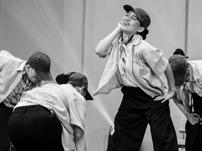
The Nursing Dance Troupe, whose routine drew inspiration from the recent trend of “performative male,” an internet archetype that refers to the pretentious performance of men to appear attractive to women, placed second.
Clinching third place was the Engineering Dance Troupe, whose performance was inspired by the realities of poverty and corruption.
The Performative Males from the College of Architecture placed first in the solo-duo category, fol-
In 1847, he was ordained a priest. He was made cardinal by Pope Leo XIII in 1879.
He wrote “The Idea of a University,” a book that tackled liberal education and advocated for the cultivation of intellect, conscience, and moral character.
The work also called for the inclusion of theology alongside the sciences as a vital component of the university curriculum.
Newman died of pneumonia on Aug. 11, 1890, at the Oratory in Birmingham, England. He was beatified by Pope Benedict XVI in 2010 and canonized by Pope Francis in 2019.
WITH REPORTS FROM VINCE ALFRED M. PILLAGARA
lowed by the College of Architecture’s KAT in second place, and the College of Engineering’s Sorokin in third.
Sorokin and the Engineering Dance Troupe also bagged the People’s Choice Award and Best in Costume, respectively.
Other participating performers were the Commerce Dance Troupe, Oneshade Dance Squad, Comach Precom Dance Troupe, the College of Science Dance Troupe, and the Pharmacy Dance Troupe.
The event also featured performances from UST Prime, UST Sinag Ballroom Dance Company, and “Tawag ng Tanghalan” semi-finalist Lucky Galindez.
ty in Asia and outside of the United States. India is the most represented country in the ranking, with 88 institutions ranked.
For this year’s rankings, the interdisciplinary scope was broadened to cover any research project that comprises multiple scientific disciplines, or one or more scientific disciplines combined with one or more of the following non-Science, Technology, Engineering, and Mathematics disciplines: social sciences, education, psychology, law, economics, or medical and health, THE said.



Editorial
FROM PAGE 4 ►
cials, freeze suspect assets, and recommend criminal charges.
What began as technical negligence or mis-planning soon revealed itself to be a systemic racket — a mechanism by which public funds meant for climate resilience, disaster mitigation, and public safety have been funneled to a tight circle of contractors, political actors, and officials. The mockery of “climate change adaptation” served as cover; the dikes and drainage projects we were promised became conduits for rent-seeking and plunder.
Those implicated stretch across the political spectrum: sitting and former senators, multiple lawmakers, and even top House leaders — including the Speaker and four of Quezon City’s six representatives — all reportedly tied to the diversion of billions in public funds.
The scheme was hardly complex. Lawmakers would insert pet projects into the national budget, steer these
Teatro
Angel Ocampo said in an interview with the Varsitarian Ocampo, a fourth-year literature student, said “Joe Cool: Aplikante” echoes a universal experience among jobhunters and members of the workforce.
“What makes it more relevant today is tayo as audiences, or as students na malapit na mag-trabaho, mas nakikita na natin ‘yung realities ng future natin if we stay stagnant sa realities na meron tayo ngayon.”
“Absurdo: Event Day” follows two
to favored contractors, and then pocket their share of the proceeds. In several cases, congressional figures are suspected of profiting from companies they or their families themselves owned, which conveniently secured flood-control and other public-works contracts.
And it did not end with politicians. Engineers and contractors were likewise complicit, siphoning off funds and leaving behind a trail of more than 400 “ghost projects” — undertakings that existed only on paper, in addition to numerous substandard structures that put many communities at risk.
One glaring example is a P95-million project in Bulacan, certified by DPWH as “100 percent complete,” but upon inspection by the ICI, no structure existed at all. Communities—especially along rivers, coasts, and low-lying areas— remain exposed to dangers from heavy rainfall and rising sea levels, not due to nature alone but because funds meant to protect them were siphoned into private pockets.
Even with the ICI now filing graft and plunder complaints against lawmakers, DPWH officials, and contractors, the path to justice remains uncertain. In a legal system where influence, money, and political alliances routinely shape outcomes, prosecutions alone will not fix a structure designed to shield wrongdoers.
History has shown how cases drag on for years, how impeachments falter despite public pressure, and how the Supreme Court’s overly technical rulings often blunt momentum for genuine accountability. To claim that the judiciary is innocent in this mess is untenable; its selective application of the law—vigilant in some cases, blind in others—has helped entrench a culture where the powerful rarely fall, and the aggrieved are left to fend for themselves.
For years, we’ve seen how accountability mechanisms such as impeaching public officials became harder to conduct despite strong political will, with the Supreme Court
dousing its decisions in hifalutin legal technicalities, hammering the last nail into the coffin that could have given the people more trust in the country’s accountability measures.
Today, the country once again faces the prospect of corrupt officials being marched back into jail cells. Yet we must confront a deeper question: why do these politicians manage to climb back into power in the first place? The answer lies in an architecture of corruption—an interconnected system in which executive control, legislative patronage, and judicial permissiveness work together to preserve the status quo.
Unless this architecture is dismantled—not merely patched, not merely inspected, but rebuilt entirely—the cycle will continue. The Philippines is not simply losing money; it is losing trust, safety, and its democratic foundations. No number of new dikes or drainage canals can save a nation whose institutions have allowed themselves to rot from within.
what a Catholic university should: read events through the lens of moral truth and invite its community to respond.
A Catholic university worthy of its name does not raise timid or apathetic members. It forms citizens whose conscience refuses to retreat when the common good is at stake — whose faith is strong enough to stand in the streets: unafraid, unashamed, and unwilling to let truth go undefended.
project coordinators who continue to work during the imminent end of the world.
Director Marga Alfar, a secondyear communication student, views the play as a reflection of the chaos and confusion experienced by the working class amid burnout.
“Pinapakita [sa ‘Absurdo: Event Day’] kung paano nagpapatuloy ‘yung mga tao sa pag-sunod ng routines and rules, na kahit alam naman nila sa sarili nila na hindi na siya nag-make sense, ginagawa pa rin – which mirrors the frustrations of living in a world na puno ng red tape, inefficiency, and burnout,” she said.
Despite the differences in the context, both plays tackle bureaucracy and capitalist power.
“We would love for the audience to realize that these issues are what the everyday working class is experiencing,” Teatro artistic director Ingrid Joyce told the Varsitarian Joyce, an English language studies graduate and the guild’s former artistic director, said bureaucracy is a pervasive presence that students also tend to experience, even if it is fleeting.
“[Bureaucracy] is something that you will experience. You have no choice until the day that you become
part of the working class,” she said.
The twinbill production incorporates Brechtian theater, a production style that pushes the audience to reflect critically on what they are seeing on stage.
“Kaya siya [ganoon] ka-absurd kasi we are pushing for the elaborate, exaggerated broken system that is masked by bureaucracy with something supposedly systematic, pero underneath it all, it’s all just the absurdity of being overworked and underpaid,” Joyce stated.
“Kontrata Kontra Tao” ran from Nov. 22 to Nov. 25 at the Benavides Auditorium.
gold after a 24.65-second performance in the 50-meter freestyle. In the girls’ competition, Zichi Daiz, Santor, and Taylor Saliba pulled off a podium sweep for UST in the 200-meter breaststroke to claim gold, silver, and bronze medals, respectively.
Tintin Uy scored silver in the 50-meter backstroke after posting a time of 32.11 seconds, while teammate Loreen Palmos earned bronze in the same race.
Santor secured another gold after clocking 2:22.92 in the 200-meter butterfly, while teammate Sinag Cuevas finished third for bronze in the race.
During the heats of the same event, Santor broke the six-year UAAP record of 2:24.04 — previously held by former Female Tigershark Camille Cuico — with a 2:19.45 finish.
Rookie of the Year Jamie Sy also took silver in the 50-meter freestyle after a 28.42-second finish.
The quartet of Alex Rejuso, Saliba, Cuevas, and Sy produced a time of 4:40.52 to settle for silver in the 400-meter medley relay.
EDITOR: ROB ANDREW L. DONGIAPON
Junior Tigersharks
cement UAAP HS swimming dominance with 5th straight golden double
By Joaquin Edgardo A. Cortez
NEW CLARK CITY, Tarlac — The UST Junior Tigersharks continued their reign of dominance, seizing a historic fifth straight golden double in the UAAP Season 88 swimming tournament at the New Clark City Sports Hub’s Aquatic Center on Sunday, Nov. 9.
The Junior Male Tigersharks accumulated an 18-9-12 gold-silver-bronze medal haul for 630 points to conclude the season, while the Junior Female Tigersharks racked up an 11-10-11 tally and 580 points for the team’s 10th golden double — the most in league history.
To close out the season, the boys’ team amassed a 4-1-1 medal tally, while the girls’ squad added a 2-4-3 haul on Day 4.
This marks UST’s second golden double of Season 88, following the UST Junior Woodpushers chess team, which captured its first-ever titles last October.
“Of course, I am incredibly proud of this team,” UST head coach Caezar Alcantara told the Varsitarian. “Pero hangga’t kaya namin, gusto naming i-extend ang mga titles. Kung pwede naming gawin hanggang 10-peat, why not?”
Patricia Santor was hailed MVP for the third consecutive time after capturing six golds and a silver ahead of her move to the collegiate ranks in Season 89.
Junior Male Tigershark Aishel Evangelista also defended his MVP plum after collecting six golds and a bronze this season.
In the boys’ division, Kristoff David bagged a gold medal in the 50-meter backstroke after a 27.33-second finish. Julian de Kam also pocketed bronze, registering a time of 29.48 seconds in the same event.
Gabe Sy snared gold with a time of 2:27.64 in the 200-meter breaststroke. Sam Villanueva took silver after clocking 2:18.08 in the 200-meter butterfly.
The quartet of David, Sy, CJ Valenzuela, and Joseph Ciudadano finished with a time of 4:03.83 in the 400-meter medley relay to grab another gold medal.
UST’s Tim Capulong brought home

The UAAP holds the groundbreaking ceremony of the “Home of the UAAP” on Oct. 24 in Pasig City.

By Joaquin Edgardo A. Cortez
THE UAAP officially began construction on its dedicated arena on Friday, Oct. 24, in Pasig City.
Tentatively named the “Home of the UAAP,” the arena will be built on a 1.8-hectare property along Amang Rodriguez Avenue owned by Akari Lighting and Technology Corporation.
The groundbreaking ceremony was attended by officials from all eight UAAP member schools.
UAAP President Fr. Rodel Cansancio O.P. said the groundbreaking marks the start of a new chapter for the league as it establishes a permanent home for its competitions.
“(This) marks a historic milestone for the UAAP as we break ground on the Home of the UAAP,” Cansancio said. “On behalf of all eight member schools, we are deep-
cease to exist,” Austria said.
A preliminary assessment of the building revealed structural issues, including leaking canopies, exposed panel boards, and loose safety grills.
Initial rehabilitation work began on Oct. 17, focusing on the structural components at the rear portion of the car park. Repairs on the front canopy and Ruaño Drive are expected to follow during the Undas Break on Oct. 30 to Nov. 4.
Selegna Holdings declined to comment when contacted by the Varsitarian by phone.
Structural investigation
A second phase of structural investigation began in November, encompassing the building’s mechanical, electrical, and other related systems.
“Rest assured that UST car park operations still continue—it will not
The UST car park opened in 2004. It is managed by Selegna Holdings, which reported a net income of P14.2 million in 2024.
The car park’s build-operate-transfer contract became the subject of litigation after Selegna Holdings sought corporate rehabilitation in 2006.
In 2015, UST and Selegna Holdings reached a compromise deal, the details of which were not disclosed publicly.
However, the end of the contract in November 2025 or 20 years after the completion of construction represents an extension from the original 15-year timeframe.
According to Selegna Holdings’ financial statement, the MDP had a net book value of P59.02 million at the end of 2024.
The four-story car park can accommodate about 360 vehicles, with two levels housing more than 25
ly grateful to our partner Akari for making this vision a reality.”
The arena, being developed through a partnership among Athletica Asia, ASYA Design, R.S. Caparros Associates & Co., and Redviper Ventures, will have a seating capacity of 8,074 and will host indoor competitions from the league’s 18 sports.
“With the Home of the UAAP, we take the next bold step. More than just a sports venue, it will be a true home — a space of belonging, and a place where champions and icons will be nurtured,” UST Rector and Season 88 Chairman Fr. Richard Ang, O.P. said.
For years, the UAAP has relied on renting venues such as Araneta Coliseum and the Mall of Asia Arena for mainstream sports, while using facilities such as Rizal Memorial Sports Complex, Ninoy Aquino Stadium, and New Clark City Stadium for other events.
food concessionaires. Commercial tenants include fast-food and casual dining restaurant chains such as Chowking, Pancake House, Icebergs, and Tapa King.
Once the contract expires, the food establishments will be placed under the supervision of the Office of the Vice Rector for Finance, Austria said.
Amid safety concerns, the UST-Alfredo M. Velayo College of Accountancy moved to the Albertus Magnus Building in 2021.
Frustrations, inconvenience Thomasians expressed frustration with the carpark’s poor condition.
Political science senior Dazzel Panganiban, a car park user for over a year, complained about the persistent leaks and poor ventilation.
“Hindi ko alam saan nanggagaling ‘yong mga tulo, especially kung pedestrian ka, and even inside,

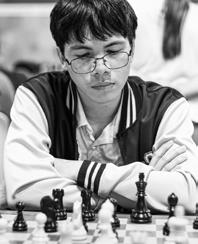
UST Male Woodpushers capture 5th straight UAAP crown
By Joaquin Edgardo A. Cortez
THE UST Male Woodpushers reasserted their UAAP supremacy, clinching their fifth straight championship after demolishing the UP Fighting Maroons, 3.5-0.5, to cap their UAAP Season 88 men’s chess tournament campaign at the Adamson Gym on Sunday, Oct. 19.
With the feat, UST joined the elite ranks of FEU and La Salle as the only teams to capture five consecutive titles in UAAP men’s chess history.
In Season 88, some basketball games were held at Ateneo’s Blue Eagle Gym and UST’s Quadricentennial Pavilion because of the FIVB Men’s Volleyball World Championship.
The new facility will feature a smaller court on its upper level, allowing multiple events to take place simultaneously and helping ease the league’s scheduling load.
The arena’s facade will include an infinity-shaped design representing the eight member schools and will be fitted with LED lights that change to display the colors of the winning university.
In addition to serving as the league’s headquarters, the complex will feature commercial spaces to establish it as both a sports and entertainment hub.
The arena will also be available for other professional and collegiate leagues to use.
Completion is targeted for 2027, in time for UAAP Season 90.
maraming pools of water. Tapos ‘yong ventilation, as in, super bad–sobrang init,” he said.
Engineering sophomore Marco Paolo Raper doubted whether the carpark was being properly maintained, noting visible cracks and dirt buildup.
“Meron na akong nakikita at napapansin [na cracks], lalo na ‘yong mga dumi,” he said.
For Jaime Miguel Mendoza of the Institute of Physical Education and Athletics, long lines and limited parking spaces were the main concerns of car park users.
“‘Yong inconvenience ko is palaging puno. Like 12 onward, tapos the line’s always long,” Mendoza said.
He also raised concerns about high parking rates, despite discounts being offered to students.
The carpark under Selegna Corp. charged a rate of P40 for the first two hours and P15 for each succeeding hour or a fraction of an hour.
The Male Woodpushers held the top spot all season long with 16 match points and 27.5 game points, powered by an 8-2-0 win-loss-draw record.
“Sila ‘yong nagkulay ng trophy nila; nakuha nila ‘yon by their own effort,” UST head coach Ronald Dableo told the Varsitarian. “’Yong puso, ‘yong laban, talagang ginawa nila ‘yong part nila.”
FIDE Master Christian Mark Daluz copped silver in Board 1, drubbing Arena FIDE Master Francois Magpily of UP to finish his stellar Season 88 campaign. Chester Reyes was hailed as Season 88 MVP, extending UST’s MVP streak to four years after clinching gold in Board 2. Jan Clifford Labog took down John Venturas of UP in Board 3. Also winning gold was Lee Roi Palma on Board 3, while Mark Reyes captured gold after pummeling UP’s Meison Gailo in Board 4.
Rounding out UST’s individual gold medals was Allan Hilario in Board 6, who went undefeated to cap his Season 88 campaign.
ELCAC kaysa sa aming mga student council na inelect mismo ng estudyante … na hindi man lang inuuna ang welfare ng students, hindi man lang inuuna ang welfare ng mga Pilipino,” Agon said.
Among those who joined the demonstration on España Boulevard are students from the National Teachers College, Far Eastern University, University of the East, and Eulogio “Amang” Rodriguez Institute of Science and Technology.
Students from the University of the Philippines Manila, Philippine Normal University, De La Salle University, Mapua University, Lyceum of the Philippines University, and other groups convened at Recto Avenue, before heading out to Mendiola.
According to YRAC, an estimated 700 student protesters participated in the program held at the Mendiola Peace Arch.
On Nov. 30, the youth protesters will again join in the “Protestang Bayan Kontra Kurakot,” marching from Luneta to Mendiola in a renewed call against corruption.