
Preserve the Harvest: Canning Goat Meat at Home
Callie Adams and Andrea Schmutz
Introduction
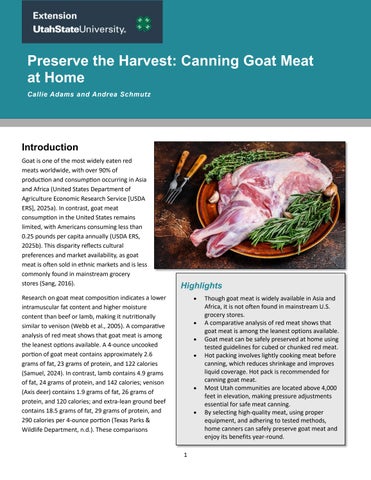
Goat is one of the most widely eaten red meats worldwide, with over 90% of production and consumption occurring in Asia and Africa (United States Department of Agriculture Economic Research Service [USDA ERS], 2025a). In contrast, goat meat consumption in the United States remains limited, with Americans consuming less than 0.25 pounds per capita annually (USDA ERS, 2025b). This disparity reflects cultural preferences and market availability, as goat meat is often sold in ethnic markets and is less commonly found in mainstream grocery stores (Sang, 2016).

Highlights
Research on goat meat composition indicates a lower intramuscular fat content and higher moisture content than beef or lamb, making it nutritionally similar to venison (Webb et al., 2005). A comparative analysis of red meat shows that goat meat is among the leanest options available. A 4-ounce uncooked portion of goat meat contains approximately 2.6 grams of fat, 23 grams of protein, and 122 calories (Samuel, 2024). In contrast, lamb contains 4.9 grams of fat, 24 grams of protein, and 142 calories; venison (Axis deer) contains 1.9 grams of fat, 26 grams of protein, and 120 calories; and extra-lean ground beef contains 18.5 grams of fat, 29 grams of protein, and 290 calories per 4-ounce portion (Texas Parks & Wildlife Department, n.d.). These comparisons

• Though goat meat is widely available in Asia and Africa, it is not often found in mainstream U.S. grocery stores.
• A comparative analysis of red meat shows that goat meat is among the leanest options available.
• Goat meat can be safely preserved at home using tested guidelines for cubed or chunked red meat
• Hot packing involves lightly cooking meat before canning, which reduces shrinkage and improves liquid coverage. Hot pack is recommended for canning goat meat.
• Most Utah communities are located above 4,000 feet in elevation, making pressure adjustments essential for safe meat canning.
• By selecting high-quality meat, using proper equipment, and adhering to tested methods, home canners can safely preserve goat meat and enjoy its benefits year-round.


highlight goat meat’s nutritional advantages, particularly its low fat and calorie content, making it a healthy red meat option for home preservation.
Goat meat is lean and comparable to lamb and venison; goat meat can be safely preserved at home using tested guidelines for cubed or chunked red meat developed by the United States Department of Agriculture (USDA) and the National Center for Home Food Preservation (NCHFP). Canning is a method of food preservation that uses heat and airtight containers to destroy microorganisms and enzymes, allowing food to be stored safely at room temperature for extended periods (USDA, 2015). Although goat is not listed individually in USDA canning guides, its muscle density and composition are comparable to other lean red meats, such as lamb and venison. Therefore, it is appropriate to use validated procedures for cubed or chunked red meats when canning goat at home (National Center for Home Food Preservation, n.d.).
Why Goat Is Not Listed Separately in USDA Canning Guides
• Limited U.S. research: The USDA and NCHFP only publish recipes that have undergone controlled heatpenetration studies. Researchers have not yet tested goat individually.
• Comparable meats: Goat shares physical and nutritional characteristics with lamb and venison, both of which are included in the USDA’s Complete Guide to Home Canning.
• Safety standard: All low-acid meats, including goat, must be pressure canned. Boiling water canning does not safely preserve them.
Preparing Goat for Canning
1. Select high-quality, chilled goat meat. Choose meat that is fresh, firm, and free of off odors. Trim away visible fat, gristle, bruised spots, and any discolored areas. Meat should be chilled to 40 °F or lower soon after slaughter to prevent spoilage and ensure safety during canning (National Institute of Food and Agriculture [NIFA], n.d.).
2. Cut meat into 1-inch cubes or strips.
3. Hot pack (recommended): Brown lightly in a small amount of fat, or roast until rare. Pack into jars and cover with boiling broth, water, or tomato juice.
4. Raw pack (optional): Pack raw cubes into jars without liquid. The meat will produce its own juice during processing.
5. Always leave 1-inch headspace.
6. Add salt if desired (½ teaspoon per pint; 1 teaspoon per quart). Salt is optional for pressure canning and is used solely for flavor. It does not contribute to meat safety or preservation. The recommended amounts help season the meat without overpowering its natural flavor or affecting texture (NIFA, n.d.).

Equipment Needed
• A pressure canner (dial-gauge or weighted-gauge).
• Mason-type jars with two-piece metal lids.
• Jar lifter, canning funnel, and headspace tool.
• Reliable altitude chart for adjusting pressure (see Utahspecific table in the “Utah Altitude Considerations” section).
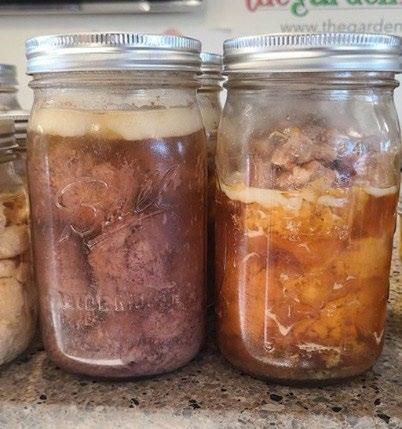



Notes. Hot packing involves lightly cooking meat before canning, which reduces shrinkage and improves liquid coverage. Raw packing skips precooking, saving time but often results in more air pockets and less uniform texture. Both methods are safe when pressure canning properly; choose based on your preference for convenience or quality.
Figure 1. Hot Pack (left) vs. Raw Pack (right)
Processing Instructions
Follow USDA/NCHFP times for “meat, strips, cubes, or chunks.” Table 1 indicates adequate processing times and gauge pressure amounts.
Table 1. Processing Times and Gauge Pressure Amounts
Jar size
Sources: USDA, 2015; NCHFP, n.d. *Dial-gauge adjustments:
• 12 lb (2,001–4,000 ft)
• 13 lb (4,001–6,000 ft)
• 14 lb (6,001–8,000 ft)
• 15 lb (8,001–10,000 ft)
Utah Altitude Considerations
Most Utah communities are located above 4,000 feet in elevation, making pressure adjustments essential for safe meat canning. At higher altitudes, water boils at lower temperatures, which means standard boiling temperatures are not sufficient to destroy harmful bacteria such as Clostridium botulinum. Pressure canning allows food to reach temperatures above 240 °F, which are necessary to ensure safety and prevent botulism (Memmott & Petersen, 202). Table 2 shows elevation examples from selected cities across the state as well as dial- and weighted-gauge pressure requirements.
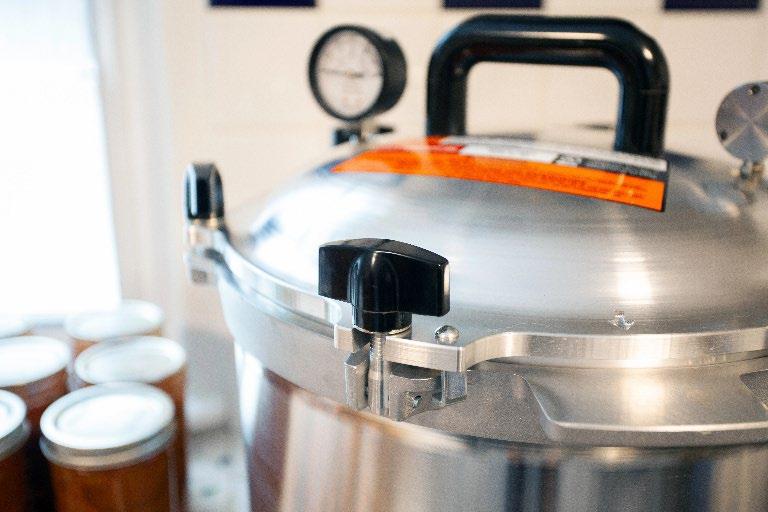
Table 2. Utah Elevation Examples Across Utah and Pressure Gauge Requirements
For county-specific elevations and recommended adjustments, refer to the USU Extension Utah Altitude Chart by County (Memmott & Petersen, 2012) and the following altitude canning adjustments summary.
Utah Altitude Chart for Canning Adjustments
Tables 3 and 4 (Memmott & Petersen, 2012) provide pressure gauge settings for pressure canning at varying elevation ranges, plus altitude-based time adjustments for boiling-water canners.
Table 3. Pressure Canner Adjustments
Table 4. Boiling Water Canner Adjustment
–8,000
8,001–10,000
1,001–3,000 +5 minutes
3,001–6,000 +10 minutes 6,001–8,000 +15 minutes
8,001–10,000 +20 minutes
Note. These adjustments ensure that foods reach and maintain safe internal temperatures despite slower heat penetration at higher elevations.
Safety Notes
• Use pressure canning for goat and other meats. Low-acid foods like meat must be pressure canned to reach temperatures above 240 °F, which are necessary to destroy Clostridium botulinum, the bacteria that cause botulism. This is especially critical at higher altitudes, where boiling temperatures are lower and insufficient for safe preservation (Memmott & Petersen, 2012).
• Adjust processing pressure carefully for your altitude. Use a dial-gauge or weighted-gauge pressure canner and refer to altitude-specific recommendations to ensure safe internal temperatures are achieved.
• Do not add thickeners (flour, starch) to liquid before canning. Thickeners can interfere with heat penetration, increasing the risk of under-processing and microbial growth.
• Ensure jars seal within 12–24 hours; refrigerate or reprocess unsealed jars immediately. Proper sealing is essential to prevent spoilage and ensure shelf stability.
• For best quality, consume within 12–18 months. While safely canned meat can last longer, texture and flavor may decline over time.
Frequently Asked Questions
Q. Why can’t I find goat in USDA or NCHFP charts?
A. Goat has not been tested individually, but research shows its properties are comparable to lamb and venison, so validated lean-meat guidelines apply.
Q. Can I preserve ground goat meat?
A. Yes. Follow NCHFP/USDA directions for ground or chopped meat, which require precooking and hot packing.
Q. Can I preserve goat meat on the bone?
A. No tested recipe exists for bone-in meat. For safe heat penetration, cut the meat off the bone and cut it into cubes.
Conclusion
Although the USDA or NCHFP does not specifically list goat meat canning guidelines, you can safely can it at home by following validated procedures for cubed or chunked red meats, such as beef, lamb, venison, and pork. Due to its lean composition and nutritional similarity to other tested meats, goat is well-suited for pressure canning. Always use a pressure canner, never a boiling water bath canner, to ensure temperatures reach levels necessary to destroy Clostridium botulinum. Adjust processing pressure based on your elevation, following USDA and USU Extension altitude guidelines. By selecting high-quality meat, using proper equipment, and adhering to tested methods, home canners can safely preserve goat meat and enjoy its benefits year-round.
References
Memmott, M., & Petersen, A. (2012). Utah altitude chart by county. Utah State University Extension. chromeextension://efaidnbmnnnibpcajpcglclefindmkaj/https://extension.usu.edu/sanpete/files/Utah_Altitude_Chart_by_ County.pdf
National Center for Home Food Preservation (NCHFP). (n.d.). Meat, strips, cubes, or chunks. University of Georgia. Retrieved September 3, 2025, from https://nchfp.uga.edu/how/can/preparing-and-canning-poultry-red-meats-andseafoods/meat-strips-cubes-or-chunks/
National Institute of Food and Agriculture (NIFA). (n.d.). Canning meat, poultry and game [PNW361]. https://www.nifa.usda.gov/sites/default/files/resource/Canning%20Meat%20Poultry%20and%20Game.pdf
Samuel, F. U. (2024, October 16). Goat: A healthy meat option. Alabama A&M University and Auburn University. https://www.aces.edu/blog/topics/animals-urban/goat-healthy-meat-option/
Sang, F. C. (2016). An evaluation of goat meat consumption in Tennessee. Tennessee State University. https://digitalscholarship.tnstate.edu/dissertations/AAI10243606
Texas Parks & Wildlife Department. (n.d.). Comparative nutritional data for meats. https://tpwd.texas.gov/huntwild/hunt/wildgame-recipes/nutrition.phtml
United States Department of Agriculture (USDA). (2015). Complete guide to home canning [Agriculture Information Bulletin No. 539]. https://nchfp.uga.edu/publications/publications_usda.html
United States Department of Agriculture Economic Research Service (USDA ERS). (2025a). Livestock and meat international trade data. https://www.ers.usda.gov/data-products/livestock-and-meat-international-trade-data
United States Department of Agriculture Economic Research Service (USDA ERS). (2025b). Livestock and meat domestic data. https://www.ers.usda.gov/data-products/livestock-and-meat-domestic-data
Webb, E. C., Casey, N. H., & Simela, L. (2005). Goat meat quality. Small Ruminant Research, 60(1–2), 153–166. https://doi.org/10.1016/j.smallrumres.2005.06.009
In its programs and activities, including in admissions and employment, Utah State University does not discriminate or tolerate discrimination, including harassment, based on race, color, religion, sex, national origin, age, genetic information, sexual orientation, gender identity or expression, disability, status as a protected veteran, or any other status protected by University policy, Title IX, or any other federal, state, or local law. Utah State University is an equal opportunity employer and does not discriminate or tolerate discrimination including harassment in employment including in hiring, promotion, transfer, or termination based on race, color, religion, sex, national origin, age, genetic information, sexual orientation, gender identity or expression, disability, status as a protected veteran, or any other status protected by University policy or any other federal, state, or local law. Utah State University does not discriminate in its housing offerings and will treat all persons fairly and equally without regard to race, color, religion, sex, familial status, disability, national origin, source of income, sexual orientation, or gender identity. Additionally, the University endeavors to provide reasonable accommodations when necessary and to ensure equal access to qualified persons with disabilities. The following office has been designated to handle inquiries regarding the application of Title IX and its implementing regulations and/or USU’s non-discrimination policies: The Office of Equity in Distance Education, Room 400, Logan, Utah, titleix@usu.edu, 435-7971266. For further information regarding non-discrimination, please visit equity.usu.edu, or contact: U.S. Department of Education, Office of Assistant Secretary for Civil Rights, 800-421-3481, ocr@ed.gov or U.S. Department of Education, Denver Regional Office, 303-844-5695 ocr.denver@ed.gov. Issued in furtherance of Cooperative Extension work, acts of May 8 and June 30, 1914, in cooperation with the U.S. Department of Agriculture, Kenneth L. White, Vice President for Extension and Agriculture, Utah State University. July 2024 Utah State University Extension
The authors did not use generative AI in this content’s creation. This content should not be used for the purposes of training AI technologies without express permission from the authors.
November 2025
Utah State University Extension
Peer-reviewed fact sheet