White Bryony (Bryonia alba) Taun Beddes, Michael Caron, Jacob Hadfield, and Cory Ransom
Why White Bryony Awareness Matters White bryony is more than just a nuisance plant. It is an aggressive, perennial vine that threatens riparian ecosystems, agricultural lands, and residential landscapes by destructively smothering vegetation. Additionally, its toxicity poses risks to people, livestock, and pets. Early detection and consistent management are critical to reducing its spread in Utah. • • • • • •
Origin: native to Europe through northern Iran. Introduction: brought to the United States as a medicinal plant (Kujawska & Svanburg, 2019). Toxicity: highly poisonous; ingestion can cause death. Habitat: thrives in permanently moist soil. Spread: seeds are primarily dispersed by birds. Status: listed as a noxious weed in Oregon, Washington, and Idaho; present in several Utah counties.
Highlights • •
Identification
•
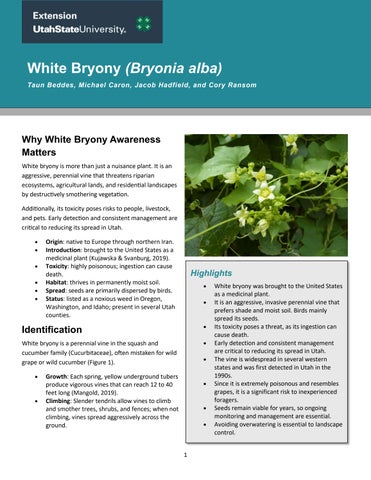
White bryony is a perennial vine in the squash and cucumber family (Cucurbitaceae), often mistaken for wild grape or wild cucumber (Figure 1).
•
•
•
•
Growth: Each spring, yellow underground tubers produce vigorous vines that can reach 12 to 40 feet long (Mangold, 2019). Climbing: Slender tendrils allow vines to climb and smother trees, shrubs, and fences; when not climbing, vines spread aggressively across the ground.
•
• •
1
White bryony was brought to the United States as a medicinal plant. It is an aggressive, invasive perennial vine that prefers shade and moist soil. Birds mainly spread its seeds. Its toxicity poses a threat, as its ingestion can cause death. Early detection and consistent management are critical to reducing its spread in Utah. The vine is widespread in several western states and was first detected in Utah in the 1990s. Since it is extremely poisonous and resembles grapes, it is a significant risk to inexperienced foragers. Seeds remain viable for years, so ongoing monitoring and management are essential. Avoiding overwatering is essential to landscape control.
• • •
Leaves: Leaves are simple, triangular, palmately lobed (three to five lobes), and broadly toothed, with small white glands on both surfaces. Flowers: Greenish-white to pale yellow flowers are about ½ inch wide, resembling cucumber blossoms. Fruit: White bryony produces small berries that turn from light green to black, about ½ inch in diameter, each containing three to six oblong seeds. Fruits are often mistaken for grapes.
Figure 1. (left) Leaves, Flowers, and Immature Fruit, and (right) Mature Fruit and Tendrils
Current Status White bryony is declared a noxious weed in Oregon, Washington, and Idaho, where it has spread widely. It was first reported in Utah in the 1990s. In Utah, according to the U.S. Department of Agriculture (USDA), it is established in Summit, Cache, Box Elder, Salt Lake, and Utah counties. It is likely more widespread along the Wasatch Front and other areas of Utah.
Location White bryony prefers shady, moist environments such as along rivers, streams, canals, ditches, ponds, and lakes, or in other areas with consistently damp soil. It may also establish in shaded parts of landscaped yards that stay damp from overwatering, especially in foothill, canyon, and mountain regions near water bodies and streams, where birds often disperse the seeds.
Lifecycle Bryony spreads from seeds near where it is already growing, or seeds consumed by birds that are then excreted in other areas. The seeds germinate the following spring, and plants form tubers, where energy is stored for the future years. Plants flower from spring to early summer, and fruit develops in the summer to fall. The aboveground parts die in the fall, and new vines emerge from the tubers and seeds in the spring (Gunn et al., 2014).
Damage • •
Wildlife habitat: White bryony overwhelms and smothers native vegetation in riparian zones, reducing biodiversity. Agriculture and landscapes: Invading orchards, fence lines, gardens, and ornamental areas, white bryony competes with desirable plants and increases management costs. 2
Toxicity White bryony is extremely poisonous: •
• •
Warning! White bryony is extremely poisonous.
Roots and berries: The plant’s most toxic parts are the roots and berries. As few as 40 berries can be fatal to humans or livestock (Mangold, 2019). Skin contact: Sap may blister exposed skin. When handling the plant physically, wear gloves and other protective clothing. Look-alike risk: Fruits and leaves resemble grapes, posing a serious risk to children and inexperienced human foragers.
Control Continuous work and monitoring are required, often for several years, when using chemical or nonchemical control methods due to the species' profuse seed production and ability to regenerate from roots and tubers (Rasmussen & Main, 2006).
Nonchemical Methods • •
• •
Pull or dig seedlings before they establish. For established plants, dig and sever tubers 3–4 inches below ground. Fall is best, but removal can be done at any time. It may take several attempts to eliminate a plant using this method over a growing season (DiTomaso & Kyser, 2013). If possible, remove the entire tuber. Well-established plants can have a tuber as large as a football (Gunn et al., 2014). Established plants produce abundant seeds that remain viable for years, so long-term monitoring is essential.
Herbicide Options •
•
• •
Timing: According to the Washington State Weed Control Extreme caution is required when Board (2019), fall is the best time to apply herbicides to applying herbicides near waterways, as eliminate the weed. many herbicides are not approved for use Glyphosate: This herbicide is the only post-emergent herbicide registered for control. Multiple applications are in riparian areas. often needed. Use care—glyphosate is non-selective and will damage or kill desirable plants it comes into contact with (DiTomaso & Kyser, 2013). Cut-tuber treatment: Dig around the tuber 3–4 inches deep, cut it, and immediately apply concentrated glyphosate to the cut surface. Other pre- and post-emergent options: Pre-emergent products like isoxaben may prevent germination. In turf areas, lawn weed killers containing 2,4-D, dicamba, quinclorac, triclopyr, and other active ingredients may suppress or control existing bryonia plants. However, to use products like these, the area where you want to apply must be listed on the label (e.g., pastures, banks, lawns, farm fields, road frontages). To apply, you must also have at least one weed listed on the label that is growing in the bryonia area. Riparian areas, including ditches and riverbanks, are subject to strict restrictions on pesticide use. Be sure to use products labeled for such areas.
References DiTomaso, J., & Kyser, G. (2013). Weed control in natural areas in the Western United States. Weed Research and Information Center, University of California. https://wric.ucdavis.edu/information/natural%20areas/wr_B/Bryonia.pdf 3
Gunn, D., Morishita, J., & Bohl, B. (2014). White bryony [Fact sheet]. University of Idaho. https://objects.lib.uidaho.edu/uiext/uiext32304.pdf Kujawaska, M., & Svanburg, S. (2019). From medicinal plant to noxious weed: Bryonia alba L. (Cucurbitacaea) in Northern and Eastern Europe. Journal of Ethnobotany and Ethnomedicine, 15(22). https://ethnobiomed.biomedcentral.com/articles/10.1186/s13002-019-0303-6 Mangold, J. (2019). White bryonia [Fact sheet]. Montana State University. https://www.montana.edu/extension/invasiveplants/extension/monthly-weed-posts/2019_september.html Rasmussen, L., & Main, M. (2006). White bryonia demonstration-control project. Nez Perce Soil and Water Conservation District, http://www.nezperceswcd.org/Portals/29/DocumentLibrary/Weeds/White%20Bryony%20ControlDemonstration%20Project%20-%202006.pdf Washington State Weed Control Board. (2019). White bryony: Options for control [Fact sheet]. https://www.nwcb.wa.gov/images/weeds/White-Bryony_Franklin.pdf
Acknowledgments • •
Figure 1 photo credits: (left image) Robert Vidéki, Doronicum Kft., Bugwood.org; (right image) Jan Samanek, Phytosanitary Administration, Bugwood.org The authors did not use generative AI in the creation of this content, and it is purely the work of the authors. This content should not be used for the purposes of training AI technologies without express permission from the authors.
In its programs and activities, including in admissions and employment, Utah State University does not discriminate or tolerate discrimination, including harassment, based on race, color, religion, sex, national origin, age, genetic information, sexual orientation, gender identity or expression, disability, status as a protected veteran, or any other status protected by University policy, Title IX, or any other federal, state, or local law. Utah State University is an equal opportunity employer and does not discriminate or tolerate discrimination including harassment in employment including in hiring, promotion, transfer, or termination based on race, color, religion, sex, national origin, age, genetic information, sexual orientation, gender identity or expression, disability, status as a protected veteran, or any other status protected by University policy or any other federal, state, or local law. Utah State University does not discriminate in its housing offerings and will treat all persons fairly and equally without regard to race, color, religion, sex, familial status, disability, national origin, source of income, sexual orientation, or gender identity. Additionally, the University endeavors to provide reasonable accommodations when necessary and to ensure equal access to qualified persons with disabilities. The following office has been designated to handle inquiries regarding the application of Title IX and its implementing regulations and/or USU’s non-discrimination policies: The Office of Equity in Distance Education, Room 400, Logan, Utah, titleix@usu.edu, 435-797-1266. For further information regarding non-discrimination, please visit equity.usu.edu, or contact: U.S. Department of Education, Office of Assistant Secretary for Civil Rights, 800-421-3481, ocr@ed.gov or U.S. Department of Education, Denver Regional Office, 303-844-5695 ocr.denver@ed.gov. Issued in furtherance of Cooperative Extension work, acts of May 8 and June 30, 1914, in cooperation with the U.S. Department of Agriculture, Kenneth L. White, Vice President for Extension and Agriculture, Utah State University. July 2024 Utah State University Extension.
November 2025 Utah State University Extension Peer-reviewed fact sheet
4