Business at Work SOUTHERN
MISS
FALL 2023 ISSUE
SHAPING THE
FUTURE of SALES
EDUCATION
p. 16
ADAM DOLEAC
From Hitting Home Runs to New Hit Singles | p. 6
WEATHERING THE STORM:
The Remarkable Story of Ka'Lon Duncanson | p. 20
Dear Alumni and Friends of Southern Miss Business As we reflect upon the remarkable journey of the past year, I am honored to extend my warmest greetings and heartfelt gratitude to each and every one of you. Southern Miss Business at Work is not merely a compilation of data, statistics, and accomplishments; it is a testament to the unwavering spirit and dedication of our community. First and foremost, I would like to express our profound appreciation to our generous donors. Your support has not only enabled us to sustain our mission but also allowed us to dream bigger and reach higher. Your commitment to the College of Business and Economic Development is the bedrock upon which we build futures, and we are deeply grateful for your trust in our vision. To our graduates, you are the embodiment of our collective aspirations. With wings spread wide, you soar to new heights, both in the classroom and beyond. Your endeavors are not only personal victories but also a source of immense pride for us! As you delve into the pages of this issue, I encourage you to celebrate with us the achievements, milestones, and stories that have defined our year. Each page is a testament to the passion,
dedication, and resilience of Southern Miss Business. In this issue, you will see many examples of the applied experiences in which our students engage. In the College of Business and Economic Development, we believe in the power of hands-on learning. These opportunities not only enrich our students’ education, but also prepare them for the challenges of an ever-evolving professional landscape. You will also read about recent scholarly contributions our dedicated faculty members have made. Their relentless pursuit of knowledge and innovative solutions continually push the boundaries of what is possible. Their work not only enhances our academic reputation, but also contributes to the betterment of society as a whole. Together, we have achieved much, but our journey is far from over. With your continued support, we will reach even greater heights, setting new records, breaking new ground, and shaping the future of business education. Thank you for being an integral part of our shared success. Warm Regards,
J. Bret Becton, Ph.D. Dean
#16 BEST ONLINE MBA
PROGRAMS IN THE SOUTH
Fortune Education, 2023
#19 MOST AFFORDABLE ONLINE MBA
Fortune Education, 2022-23
#1 IN THE STATE and #44 IN THE NATION for
BEST ONLINE BACHELOR’S IN BUSINESS
U.S. News and World Report, 2023
TABLE OF CONTENTS 3 Chuck and Rita Scianna Make $1M Investment in Southern Miss Business Initiatives
4 Beyond the Books: How Guest Speakers Are Elevating the
26 Student Scholarships, Awards, and Accolades 28 Saying Goodbye to the States and Ciao to Study Abroad
College Learning Experience
6 From Hitting Home Runs To New Hit Singles: Adam Doleac 10 Remembering Amy Johnson Sevier 12 Year in Review 14 Alumna of the Year, Nell O'Neal Murray Young Alumna of the Year, Allie Williamson
15 Entrepreneur of the Year, Jonathan Jones
32 FLIGHT TAKING
A Pilot's Journey to Academic Success Earning His Doctorate and Empowering Fellow Aviators
Inspired Leaders Series Welcomes Alumnus Jan Larsen
16 Shaping the Future of Sales Education 20 Weathering the Storm: The Remarkable Story of Ka'Lon Duncanson
24 STUDENT
INTERNSHIPS
36 The Hatchery: Where Inspiration Strikes 38 From Challenges to Triumph: Delta Sigma Pi Shines Bright
40 Biloxi Shuckers Baseball: This Minor League Team Is Making a Major Impact on Southern Miss Business
43 Eagle Scholars Program:
Transforming Future Leaders
45 Reshaping Business Education:
Innovations in Southern Miss Business Curriculum for the Future of Work
50 Faculty and Staff Awards and Accolades
Faculty Research
47
UNDERSTANDING THE IMPACT OF NIL ON ATHLETE-STUDENTINFLUENCER ROLES
48
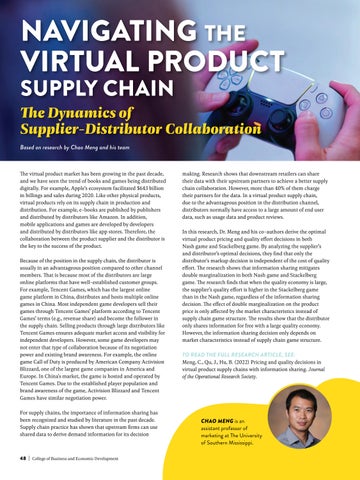
NAVIGATING THE VIRTUAL PRODUCT SUPPLY CHAIN
49
FEAR AFTER BEING FIRED
Fall 2023 Issue | 1
Vision We will be a recognized leader in providing business educational experiences that inspire and empower business scholars and students to fearlessly lead on the national and international stage.
Mission Our purpose is to develop leaders who leverage an entrepreneurial mindset to create value and innovative business solutions. We ensure that all students have applied experiences that build the knowledge and develop the skills needed to succeed and lead in the global marketplace. We support economic development by advancing knowledge through influential scholarship and collaboration with our communities.
Values AUTHENTICITY
We stay true to who we are and always act with integrity.
UNITY
We respect others’ perspectives and work together to strengthen our community.
RESILIENCY
We persevere by being relevant, tenacious, and adaptable.
PASSION
We nurture passion and inspire boldness.
RESOURCEFULNESS
We foster curiosity, creative problem-solving, and forward thinking to meet challenges head-on.
GRAPHIC DESIGNER — Hanna Schloemer PROJECT LEAD AND EDITOR — Bailey Harris ASSISTANT EDITOR — Makenzie Crampton PHOTOGRAPHERS — Kelly Dunn, Paul Lijewski, Ana Cortes
2 | College of Business and Economic Development
CHUCK AND RITA SCIANNA MAKE
$1M Investment
IN SOUTHERN MISS BUSINESS INITIATIVES
Southern Miss Business received a $1 million investment from Chuck and Rita Scianna in 2023. The Sciannas are long-time champions of the University. They have generously supported college-specific initiatives on several notable occasions, including an investment of $6 million during the Building Better Business campaign to fund a new home for the college on the Hattiesburg campus. Completed in 2015, the facility is aptly named Scianna Hall.
“
The Sciannas continue to invest in the future of business education at Southern Miss. We are grateful for their ongoing support, generosity, and friendship. Their support will have a significant impact on the college for years to come. Dr. Bret Becton Dean, College of Business and Economic Development
About a third of the funding will establish the Scianna Business Leadership Program to provide promising business students with learning experiences to cultivate leadership and professional skills. Students selected for the program will also receive a scholarship to assist with tuition and expenses. Outside the classroom, the program will offer various supplemental experiences, such as one-on-one mentoring and coaching, interactions with business professionals, and off-site trips. The program’s experiential learning components will enhance their collegiate experience and positively affect their real-world readiness after graduation. The program has already begun with its first cohort of students in fall 2023. Another portion will support the Scianna Student Managed Investment Fund, a live portfolio management program that develops financial analysis skills through rigorous equity research. Other initiatives include: •
Investment management-related workshops and competitions
•
High-profile guest lecturers from the financial sector
•
Trips to metropolitan financial hubs
The remainder of the investment creates lasting support for the College of Business and Economic Development. The Scianna CBED Excellence Endowment supports students, faculty, and staff within the college, advances research, and enhances student experience. A native of Bay Saint Louis, Miss., Chuck earned his bachelor’s degree from Southern Miss in 1975. He is the owner and president of Sim-Tex, LP in Waller, Texas, one of the leading suppliers of API-certified oil country tubular goods.
Fall 2023 Issue | 3
BEYOND THE BOOKS
How Guest Speakers Are Elevating the College Learning Experience In our commitment to providing real-world preparation to our business students, the 2022-23 academic year witnessed a remarkable number of industry professional guest speakers within our classrooms on both the Hattiesburg and Gulf Park campuses. With an impressive tally of 174 documented guest speakers, we saw a staggering 4,797 student impressions. These interactions have proven invaluable, showcasing the importance and impact of guest speakers on the class environment. The guest speakers hailed from a wide range of professional fields, all of which had relevance to the programs offered here in the College of Business and Economic Development. This diverse group of industries offered students a broad view of the potential career paths awaiting them beyond the classroom. Notably, nearly half of the guest speakers were Southern Miss alumni. By inviting alumni back to share their experiences, students are exposed to tangible examples of how their education at Southern Miss can shape their futures. Three-fourths of the guest speakers visited with the students face-to-face, while the remaining speakers connected virtually. The virtual option offered a flexible approach, breaking down geographical barriers and enabling students to engage with guest speakers from across the country. These virtual speakers joined the classroom from Idaho, Texas, Illinois, Ohio, Tennessee, North Carolina, South Carolina, Georgia, Florida, and Louisiana. The impact of these guest speakers on the class environment is significant. Their presence adds a layer of practicality to the theories and concepts being taught by their professors. The guests introduce real-world relevance into the curriculum by sharing their firsthand experiences, success stories, and realistic challenges. They also share valuable insights into industry trends, technological advancements, and the skills required to succeed in their professions. They are looked upon as role models, inspiring students to pursue their passions and achieve greatness. They showcase the possibilities that await students upon graduation, giving them a glimpse into their endless career options with a business degree.
GUEST SPEAKERS REPRESENTED THESE INDUSTRIES: Technology and software Data analytics Workforce development and education Entertainment and media Sports and athletics Pharmaceuticals Government and legal sectors Logistics Hospitality, food, and beverage Economic development Accounting Banking and finance Insurance Retail
As we look toward the future, we remain committed to continuing this tradition, ensuring that our students are fully equipped for the challenges and opportunities that lie ahead.
Guest Speaker Overview
48%
of guest speakers were Southern Miss alumni.
4 | College of Business and Economic Development
In our commitment to real-world preparation, we hosted 174 guest speakers during the Fall 2022 and Spring 2023 semesters, resulting in approximately 4797 student impressions.
75%
of guest speakers visited with students in person while
25%
connected virtually.
A L EX A N D R I A D I L L AR D
VP and General Merchandise Manager, Dillard's Inc.
A N NE M AR I E D I L L AR D
VP of Online Experience and Digital Marketing, Dillard's Inc. J OE Y WA L KER
Customer Solutions Manager, Fastenal
M A X DR AUG H N
CEO, Heartwood Capital HUGH M O LOT S I
Founder and CEO, Ujama Inc. TOBY B A R KER
Mayor, City of Hattiesburg
CHRI S PH A R I S
Corporate Partnership Coordinator, Biloxi Shuckers
H AG A N WA LKE R
Co-Founder and CEO, Glo Pals
K IM B E R LY F O NTAN
CFO, Entergy Corporation
JARVI S WI L B ER T
Sales Representative, Eli Lilly
DU S T I N TAT E A N D R AC H E L DAVI S
Taymas Taqueria
Fall 2023 Issue | 5
FROM HITTING
Home Runs TO New Hit Singles How Southern Miss baseball player, Adam Doleac, broke the mold of conventional business student success stories and ventured into the world of country music in Nashville, Tennessee
6 | College of Business and Economic Development
While Adam Doleac has been a music lover for as long as he can remember, he didn’t always see himself pursuing a career in what was once just a passion project. Although his path to stardom has been anything but predictable, it seems that fate has consistently guided him to where he was always meant to be. The Hattiesburg native had intentions of accepting a scholarship to play golf at another university; however, joining the baseball team during his senior year of high school changed everything. Southern Miss extended a baseball scholarship offer, and Doleac found himself embracing a new sport and a new path. Doleac explored other degree programs before establishing himself as a management major. The desire to acquire versatile skills applicable to any industry drove his decision. When reflecting on his time in the management program, he fondly recalls the late Amy Sevier having an incredible impact on him, comparing their relationship to the admirable student-teacher connections seen in feel-good movies. Outside of coursework, Doleac dedicated most of his time to baseball. He quickly found rapport amongst his teammates and coaches. Coaches Corky Palmer and Scott Berry played an integral role in Doleac’s growth as an athlete, student, and young man. While on the road to away games, Doleac often brought his guitar with him to play during down time. He even started a band with some of his fellow teammates called Silky Smooth, playing a few sold out shows at local bars in Hattiesburg during their off season. Doleac describes his final year on the team as a Cinderella story. Halfway through the season, Coach Palmer made the announcement that he would be retiring as head coach after dedicating the last 12 years of his career to Southern Miss Baseball. Before his retirement was made public, the team’s record stood at around 15-16, the worst regular season Doleac could remember during his tenure. However, Coach Palmer’s announcement ignited a fire within the team. From that moment on, they didn’t lose another game until sometime in the Regionals. Doleac vividly recalls the sense of invincibility that led the team all the way to the College World Series, saying, “We just kept winning—we could not lose and didn’t believe we could lose.” Although they didn’t win the National Championship, Doleac cherished the experience. The College World Series in Omaha presented a grand stage, an atmosphere of cheering fans, and an energy that captivated him. He described the feelings as something bigger than himself, and that feeling stayed with him. After that, Doleac desired a career that manifested that unrivaled feeling. Competing in front of 30,000 people at the College World Series helped prepare him for his future in music. He explained the parallels between the hard work, time management, and strategic planning required in both the role of a student-athlete and an up-and-coming artist.
In 2021, Doleac had a full-circle moment where his love for music and baseball converged. ESPN reached out to Doleac after the release of his hit single, “Famous” caught their attention, leading to an opportunity to write the College World Series theme song, “Key to the City.” He went on to perform live in Omaha on the same field he once played on. Fall 2023 Issue | 7
Doleac knew that moving to Nashville was a risk, but he welcomed the challenge to successfully make a name for himself. After releasing a few songs, he was discovered by Sirius XM’s The Highway as a “Highway Find” with his song, “Whiskey’s Fine.” This validated his desire to stay in Nashville and kept him focused on his goal to make it big. Doleac put the skills he learned at Southern Miss to good use by managing himself under an LLC before signing with Sony Music Nashville, a turning point in his journey that propelled him into the spotlight. Even now, Doleac is extremely handson when it comes to the business side of his career. There are several business components integrated into his roles as singer, songwriter, and producer. His business knowledge has benefitted him immensely while pursuing his ambitious professional endeavors in the music industry. The traction he was gaining slowed when the pandemic brought the world to a screeching halt. Doleac made the most of it, joining the star-studded softball team called “The Recoupables” made up of country musicians like Jordan Davis, Chris Lane, Hardy, Jon Langston, and Jameson Rodgers. The release of his debut album, “Barstool Whiskey Wonderland,” was delayed for two years but was finally released in September 2022. The album features 18 songs, including the gold-certified song, “Famous,” which was inspired by Doleac’s wife, MacKinnon. Now, he has appeared on stage in venues throughout the Music City, including appearances at the Grand Ole Opry. He has toured alongside Ryan Hurd, Scotty McCreery, Mitchell Tenpenny, Carrie Underwood, and the Zac Brown Band to name a few. He has found a love for writing songs that he didn’t know he had, finding
8 | College of Business and Economic Development
inspiration while on the road. He has written hundreds of songs, some of which have been recorded and performed by renowned artists such as Lainey Wilson, Gabby Barrett, Nate Smith, Darius Rucker, and Kane Brown. While Doleac has come a long way from the young adult who thought he would pursue golf, he stays humble through all the success he’s found throughout his journey. From shining under the lights of the ballpark to shining in the lights on stages in Nashville, Doleac proves that you can hit a home run as a Southern Miss Business student looking to pave your own way in this world.
With his music career on the rise, Doleac is taking risks in the apparel industry by surprising Hattiesburg with his modern take on a traditional collection tailored to Southern Miss fans. Doleac partnered with Southern Miss to launch the Southern Made Collection, uniquely featuring Doleac’s college baseball number and the vintage Golden Eagle iconography while paying homage to his hometown. This business venture reflects Doleac as an artist; his time at Southern Miss, including his baseball career; and his creative side, which he skillfully balances with his business-forward mindset. The collection can be found at Campus Book Mart on Hardy Street and Barnes & Noble on campus. Doleac says he couldn’t pass up the great opportunity to combine where he currently is in life with where he came from.
“
My favorite part about music is the bigger you get,
THE MORE GOOD
YOU’RE ABLE TO DO. Doleac returned to the Hub City in October 2022 to perform for Southern Miss Homecoming, reuniting with his alma mater, coaches, friends, and family members.
Fall 2023 Issue | 9
REMEMBERING Amy Johnson Sevier The College of Business and Economic Development was saddened to lose one our most active and dedicated faculty members. Over the course of nearly three decades, Ms. Amy Johnson Sevier became an integral part of our college community and was a much respected and beloved professor, mentor, colleague, and friend. She approached her roles as educator and colleague with utmost dedication, consistently going above and beyond to guide students on their journey to becoming professionals and to provide unwavering support to her colleagues in their pursuits. Despite her selfless nature, Amy was able to prioritize her own growth and achievement by pursuing a doctorate—a challenge she took on with pride and passion. During her 27-year career at USM, Amy taught more than 9,000 students in her management courses, leaving behind an impactful and enduring legacy. She had a heart for students and student success. In addition to being exceptional in the classroom, she supervised many honors thesis projects, coordinated internships, encouraged study-abroad experiences, and engaged in countless other activities to foster student growth. Amy was especially supportive of our Professional Attire Fund, which is designed to help students in need purchase professional attire needed to be successful in many business careers. Amy faithfully and consistently contributed to this fund for years, enabling numerous Southern Miss students to be able to afford their first professional business suit. This support allowed students to excel in interviews and start their careers with confidence. Those who knew Amy were well aware of her impeccable sense of style, which further underscored her commitment to professional excellence. As a colleague, Amy was always supportive and took any opportunity to celebrate her colleagues’ accomplishments. Her commitment extended beyond mere awareness of college activities; she actively championed her peers’ programs and projects. Amy believed that elevating her colleagues would invariably raise up the entire college. For many of us, Amy was more than just a fantastic colleague – she was a friend. Within our college, we’re fortunate to be surrounded by many colleagues we admire and respect, but forming true friendships can often be a challenge. Amy, however, managed to establish such deep connections and would certainly be called a friend by many within the college and across the broader USM community. Written by Amy’s close friends and colleagues, Jamye Foster and Russ Willis.
"Professor Sevier was an incredible mentor who took time to invest not only in her students' education but also their personal lives and goals. Her patience, leadership, and drive assisted me in writing an honors thesis that not only passed, but left a lasting impression on me about hard work and achievement." Laura Kirkman Tramell (Class of 2017)
"Ms. Sevier was a shining example of what every professor, educator, and mentor should aspire to be. She was dedicated to USM and her students, and she combined her sharp intellect and academic rigor with immense compassion for those fortunate enough to sit under her instruction." David Jordan (Class of 2017)
“I consider myself lucky to have known Amy Sevier. She was among the most kind-hearted, generous, and caring people I know. She always had a smile on her face and a joke to tell, even when things were tough. I will always remember our conversation about her love of all things British and our love for Japanese stationery. I will forever be grateful for her friendship and support.” Dr. Gallayanee Yaoyuneyong (Southern Miss Colleague)
10 | College of Business and Economic Development
In memory of Amy’s dedication to uplifting her students and colleagues and to pay tribute to her commitment to helping students get the attire needed to successfully launch their professional careers, we ask you to contribute to one of Amy’s passion projects — The Professional Attire Fund. Once we reach $25,000 in donations, we will be able to name it the Amy Sevier Professional Attire Fund, and guarantee that students will be supported annually. What a wonderful way to honor the memory of our beloved Amy!
"I am very thankful for the business suit fund, as it allowed me the opportunity to represent Southern Miss on multiple occasions in the Professional Sales Program. The fund enabled me to engage with the business world, and I was able to establish some very important connections. I encourage the growth of this fund so that more of my fellow peers can network confidently." Landon Elkins (Class of 2023)
You can donate to this scholarship in several ways: If you would like to pay by check, please make check payable to the USM Foundation. In the memo line, reference the Amy Sevier Professional Attire Fund (Fund # 2283). Please mail check to the following address: USM Foundation, 118 College Drive #5210, Hattiesburg, MS 39406.
You can also make a donation online at
usmfoundation.com/eaglesuitfund.
If you should have any questions about how to make a donation, please contact Russ Willis at russ.willis@usm.edu. Fall 2023 Issue | 11
YEAR IN REVIEW Fall 2022
Southern Miss Cruisin'
Welcome Back Cookout
at Gulf Park
Entrepreneur of the Year
Etiquette Dinner
Golden Idea Weekend
Experience Business Casually (Hattiesburg)
Hospitality Week Encounter Management
August
Dillard's Tour
October
September
Golden Idea Mixer
November
December Commencement Ceremonies
Caesars Superdome Tour Business Career and Internship Expo
School of Accountancy Meet the Firms Halloween Bash
Tailgates v. Liberty Sept. USM USM v. Northwestern State v. Arkansas State (Homecoming) Oct. USM USM v. Louisiana v. Georgia State Nov. USM USM v. South Alabama 12 | College of Business and Economic Development
Beta Gamma Sigma Induction
Spring 2023 Southern Tire Mart Tour
School of Leadership Crawfish Boil
Experience Business Casually (Gulf Park)
Inspired Leaders Series
The Hatchery's Founders Society First Meeting
January
School of Marketing Confidential
February
College Awards Ceremony
Ingalls Shipbuilding Tour
Commencement Ceremonies Etiquette Dinner
March
April
May
Launch of CheckPoint Monthly Pitch Event Student Research Showcase
Pause and Paws Economic Outlook Forum
Alumni of the Year Beta Gamma Sigma Induction
Fall 2023 Issue | 13
My undergraduate degree in marketing and MBA from Southern Miss has served me well for a lifetime.
ALUMNA OF THE YEAR
Nell O'Neal Murray Nell Murray was selected as the 2023 Southern Miss Business Alumna of the Year. She has spent her life’s work on business and economic research, marketing, project development, educational innovation, and community development. She spent 15 years in higher education administration and another 10 years researching and teaching at The University of Southern Mississippi. Through her professional consulting activities with Murray Consulting Services, she has provided clients assistance with marketing, public relations, strategic planning, research, project development, grant writing, project administration, disaster recovery and mitigation, and economic development for more than 40 years. She has served a range of clients from county and municipal government, higher education, K-12 education, manufacturing, business, engineering, and medical services, and successfully secured millions of dollars in funding for her clients from multiple grant opportunities. Nell is a member of the Southern Miss Business Advisory Council and served as its president from 2020-22. Nell is known for her dedication to working with young people to assist them with career and education choices. Nell is quick to relate the pivotal role that Southern Miss Business played in her career choice and the preparation for that career.
YOUNG ALUMNA OF THE YEAR
Allie Williamson
Allie Williamson was recognized as the 2023 Southern Miss Business Young Alumna of the Year. She is the owner and CEO of Southern Domestic Diva, a multi-service cleaning company operating out of Nashville, Tennessee, and Southwest Mississippi, offering services for residential, commercial, and rental properties. After working in the hospitality industry for several years and offering cleaning services on the side, Allie decided to pursue her passion full-time and formed Southern Domestic Diva. In 2019, she expanded her business and opened a new division of the company, serving Southwest Mississippi and her hometown of Monticello. Allie has grown an empire made up of more than 70 women serving more than 800 clients. The company’s goal is to be the one-stop shop for all cleaning needs. With more than 10 years of cleaning experience, Southern Domestic Diva provides unmatched cleaning services, which always includes a touch of Southern hospitality. 14 | College of Business and Economic Development
ENTREPRENEUR OF THE YEAR
Jonathan Jones Jonathan Jones, CEO of Jones Capital, was recognized as the 2022 Boardman Distinguished Entrepreneur of the Year. His guidance, philosophies, and values drive the firm’s culture and strategy. He joined the company in 2003, working his way from assistant controller to CEO as he helped establish a broader vision for the company’s future. Under Jonathan’s leadership, Jones has grown to become more acquisitive and now includes a wide range of middle-market operating companies and direct real estate investments. Jones began as a family business with a simple mission: to help communities, provide jobs, and enhance lives. Today, Jones carries on that mission by being a growth-oriented, value-added capital partner to businesses and management teams that share their common values and vision for long-term, sustainable growth that benefits all stakeholders—customers, communities, employees, and shareholders. Jonathan is in constant pursuit of personal and professional growth through mentorship, affiliation with industry associations, and continual learning. Jonathan is an Ernst and Young Entrepreneur of the Year national finalist and an active member of the Young Presidents Organization, which is the world’s premier peer network of chief executives and professional leaders who inspire business, personal, family, and community impact.
INSPIRED LEADERS SERIES WELCOMES ALUMNA
Jan Larsen
This year’s Inspired Leaders Series welcomed alumna Jan Larsen, who has built a successful career in the medical sales industry and works in the Interventional Cardiology Space with Boston Scientific. This series invites industry leaders to share their insights with the campus community and answer the question, “What inspires you?” During Larsen's presentation at Southern Miss, she shared advice on what she wished she would have known when she was a student at Southern Miss. Her wisdom on the importance of creating a personal brand, how to stand out among peers, and the power of being humble and kind were some of the points that resonated with the audience. While in town, Larsen also had dinner with a group of select students and spoke with the current class of Eagle Scholars. Throughout her career, Larsen has been a top sales representative for the cardiology division, consistently ranked in the top 10% of the sales force. In 2022, Jan was honored by Boston Scientific as the Global Volunteer recipient for her volunteer work with HeartGift, a nonprofit organization that raises funds to assist with surgery costs for children with congenital heart disease, where care is non-existent. Additionally, she’s been a President’s Club recipient on eight occasions, the record for any female sales representative within the division, and was named Sales Representative of the Year for the cardiology division in 2012, 2018, and 2022. Fall 2023 Issue | 15
SHAPING
THE FUTURE OF SALES EDUCATION Southern Miss Business is establishing itself as a formidable contender among nationally recognized sales programs
The Professional Sales Program at Southern Miss is transforming the landscape of sales education, providing students with the skills, resources, and opportunities needed to excel in the field. With a state-of-the-art Professional Sales Lab, a comprehensive sales certificate program, collaborative initiatives, and impressive achievements in collegiate sales competitions, Southern Miss is shaping the next generation of sales professionals. At the heart of the program lies the Professional Sales Lab, a cutting-edge facility meticulously designed to replicate realworld sales scenarios—a corporate office with reception, a hotel lobby seating area, or a coffee shop worktable. Within the lab, students have access to three recording rooms, enabling them to evaluate their mock sales calls and gain feedback from faculty and industry coaches. Additionally, the lab’s live broadcasting capabilities facilitate virtual interactions with judges and company recruiters. The carefully curated environment fosters an immersive atmosphere for reviewing sales case studies and conducting in-depth review sessions.
UNDERGRADUATE CERTIFICATE IN PROFESSIONAL SELLING The Undergraduate Certificate in Professional Selling is offered to students across all disciplines, providing a pathway to success in sales no matter the degree path. Comprising of four courses— Introduction to Professional Selling, Sales Management, Advanced Professional Selling, and a relevant elective—the program offers a comprehensive lesson in both sales’ theory and
16 | College of Business and Economic Development
practical application. Students can expect a learning experience that transitions from foundational sales strategies to live sales scenarios, both face-to-face and virtually, with industry professionals. A crucial goal of the certificate is for students to gauge their interest and strengths within a sales career while also networking with prospective employers. Recognizing the value of interdisciplinary collaboration, the School of Marketing spearheaded a joint venture alongside the School of Media and Communication. STRATCOM Week 2022 kicked off a new curriculum offering at Southern Miss that includes a Media Sales track, integrating sales education with the dynamic world of media. This track offers students the opportunity to optimize their degree plan electives and earn the Professional Selling Certificate. Media Sales Day was hosted in Scianna Hall as part of the week-long event series. The event was facilitated by marketing, sales, and entrepreneurship faculty from Southern Miss Business. Dr. Kristina Harrison and Mr. Kevin Buckley welcomed three media sales industry alumni for a panel discussion on transitioning from the classroom to their careers.
Enrollment in the Undergraduate Certificate in Professional Selling at Southern Miss saw a
40%
INCREASE
from 2022 to 2023.
2022-23 Competitions Attended Lagniappe Sales Challenge, hosted by Southeastern Louisiana University » Sherwin-Williams Speed Selling Round Winner, Anna Grace Gieger LevelUp! Marketing Simulation Competition, hosted by HubSpot (virtual) FROM LEFT TO RIGHT:
Don King, Account Executive for iHeart Media; Aimee Murry, Divisional Communications Director for Salvation Army; LeAnn Vance, Media Sales Consultant for WDAM-TV
» First in Sales Revenue, Kaela Barnicle and Dawson Cudd » Highest Scoring Individual Competitor, Colby Wynn National Collegiate Sports Sales Conference, hosted by Baylor University and the Atlanta Hawks » #10 in Team Speed Selling
EXCELLING ON THE NATIONAL STAGE: COLLEGIATE SALES COMPETITIONS Across the United States and internationally, collegiate sales competitions are becoming the main stage for university sales programs. Operating off a limited case study, competitors are given a specific objective to uncover prospect needs, navigate the inevitable objections, and obtain the proper level of buyer commitment. Typically sponsored by recognized corporations, these competitions serve as a platform for students to demonstrate their sales and negotiation skills while engaging with industry professionals and peers from other institutions.
» #12 in Corporate Sales Division, John Michael Travers » #25 in Ticket Sales Division, Holden Hewes » #49 in Ticket Sales Division, Ryan Theriot Redbird National hosted by Illinois State University (virtual) Bayou Sales Challenge hosted by Nicholls State University » Pressure Round Winner, Ashley Mitchell American Marketing Association Sales Competition, sponsored by Sherwin-Williams » 1st Place Winner of the Sales Competition, Kaela Barnicle
Southern Miss Business participated in six competitions over the 2022-23 academic year, placing in four of them. Business students John Michael Travers, Holden Hewes, and Ryan Theriot attended the 2023 National Collegiate Sports Sales Conference (NCSSC), claiming a No. 10 ranking in Speed Sells as a team. Individual honors included Travers taking the No. 12 ranking in the Corporate Sales Division, as well as Hewes and Theriot taking the No. 25 and No. 49 spots in the Ticket Sales Division. These students were coached by Dr. Chris Croft and Mr. Kevin Buckley as they prepared for this competition.
Our students incurred minimal costs to attend a multitude of sales competitions due to the generous support of our 2022-23 corporate sponsors Cintas, Jones Logistics, Fastenal, and Federated Insurance.
Fall 2023 Issue | 17
One standout achievement came during the 2023 AMA Sales Competition where Kaela Barnicle secured first place. The American Marketing Association (AMA) hosted its annual International Collegiate Conference in New Orleans, where hundreds of business students gathered to network, workshop, and compete in a variety of competitions. The 2023 AMA Sales Competition provided 60 sales students with a platform to showcase their sales and communications skills. Waitlisted competitors came from university sales programs across the United States and included representation from Canada and the Caribbean. Barnicle graduated in May 2023 with her bachelor’s degree in healthcare marketing and an undergraduate certificate in professional sales. Continuing as the sales and healthcare marketing graduate assistant, she will pursue her MBA at Southern Miss with the end goal of working in medical device sales. Barnicle made it through the first round, uncovering buyers' needs and overcoming objections in 10 minutes to present a customized pitch in the final round. Only 18 students advanced to the final round, where eight judges observed each sales
performance. Utilizing her sales prowess, researching product knowledge, and unrelenting persistence, Barnicle clenched the top spot. Barnicle’s remarkable performance and win in the Sales Competition category showcased her exceptional sales abilities and the quality of training provided by the Southern Miss Professional Sales Program. Reflecting on her achievement, Barnicle expressed her excitement and gratitude for the opportunity to compete in the conference and sales competition. She credited her success to the countless hours spent in the Professional Sales Lab and the unwavering support of her professors. “The Southern Miss Professional Sales
Program has been a great addition to my degree, and I am grateful to be a part of it,” said Barnicle.
Mr. Kevin Buckley, Barnicle’s sales coach and professor, stated that since the beginning of her time in the program, she was an active team player, attending class sales roleplays and other collegiate competitions fully prepared. Buckley went on to say,
“This competition placement at AMA is a culmination of all her past efforts and what I consider the true embodiment of Southern Miss grit.”
SALES FORECAST—WHAT’S NEXT FOR THE PROGRAM Looking ahead, the Professional Sales Program at Southern Miss is committed to continuously enhancing student opportunities and achievements. The program aims to participate in at least two university sales competitions each semester, fostering a culture of excellence and striving for consistent top-four placements, a goal coined #ToTheTop4.
“Being a member of the sales program provided me with hands-on, life-changing experience that allowed me to jump right into a senior-level sales role as soon as I graduated college. To say I am thankful for my time in the program is an understatement. I wouldn’t be where I am today without the program, as well as the leaders who invested their knowledge and time into my growth and career path.” — Anna Grace Gieger
18 | College of Business and Economic Development
Following her excellent performance during the Senior Sales Challenge, Anna Grace Gieger was offered a position with Howard Technology Solutions as an outside sales account executive, servicing Mississippi’s state and local government. This role is typically filled by those with previous professional sales experience.
Furthermore, the program plans to facilitate internal competitions for Southern Miss students, such as the Selling Seymour Pitch for freshmen and sophomores, and the Senior Sales Challenge for graduating seniors. In three to five years, the vision is to create an established cycle of professional development opportunities that formally train students as collegiate sales competitors. After earning a reputable career in sales, these program graduates will return as sales alumni partners continuing to provide our students with the latest in sales strategies and technologies. In fact, several first-year graduates have already proposed dates to return in the fall. As the program expands and evolves, there are plans to increase the number of recording rooms in the Professional Sales Lab from three to five and closing off a space for teams to meet and strategize, positioning Southern Miss to host regional collegiate sale competitions. Additionally, the introduction of a sales social club will offer students a platform for professional networking. With a commitment to continuous improvement and a vision for the future, the program is poised to make a lasting impact in the sales industry.
The inaugural Senior Sales Challenge took place this spring, providing graduating seniors a platform to showcase the sales skills they have learned in a live sales pitch with roleplaying buyers. The top scorer in each room claimed a spot in the Final 3 cut. The finalist then had 20 minutes to close the sale with the key decisionmaker. Anna Grace Gieger came out on top with the highest judge-based score. In addition to Cintas, the title sponsor, providing roleplaying buyers, 10 other professionals virtually participated as scoring judges from Phreesia, Jones Logistics, Howard Technology Solutions, Sherwin-Williams, and Walt Massey Automotive Group.
SALES STUDENT TRAINEE
SALES FACULTY AND COACHES
MR. KEVIN BUCKLEY Professor of Practice, Marketing
DR. CHRIS CROFT Assistant Professor, Sport Management
DR. KRISTINA HARRISON Assistant Professor, Marketing
SALES STUDENT COMPETITOR
SALES ALUMNI MENTOR
DR. KELLI KING Assistant Teaching Professor Healthcare Marketing
SALES STUDENT COACH SCAN HERE TO LEARN MORE Fall 2023 Issue | 19
WEATHERING THE
STORM The Remarkable Story of Ka'Lon Duncanson
In the face of adversity, some individuals rise to the occasion and embark on journeys that redefine their lives. Ka'Lon Duncanson, an international student hailing from Freeport, Bahamas, is one such individual. He has unwavering optimism, a magnetic personality, and a smile that will light up a room. His journey stands out as a testament to the power of determination and the pursuit of education. This is the inspiring story of a young student who defied the odds, found his purpose, pursued his passions, and is now poised to leave a lasting impact on the world.
20 | College of Business and Economic Development
FINDING HOME AWAY FROM HOME: DISCOVERING SOUTHERN MISS Ka'Lon's path took an unexpected turn when Hurricane Dorian hit the Bahamas and devastated his home in 2019, leaving him without a job and an uncertain future. Before the hurricane, deemed the worst natural disaster in the country’s recorded history, he was working as a scuba diving instructor and planned to become a boat captain. A fateful trip to Mississippi led him to a life-changing decision to pursue higher education at Southern Miss.
He traveled to Waveland, Mississippi, to visit a family he met while working in hospitality in the Bahamas. Cynthia Mahner, whom he now affectionately calls his “Mississippi Mom,” welcomed him with open arms. Cynthia’s daughter had attended Southern Miss and introduced Ka’Lon to the university. From the moment he set foot on the Gulf Park campus, he knew he had found a place that felt like home. Introduced to the quaint, warm atmosphere of Southern Miss, Ka’Lon’s decision to pursue a bachelor’s degree in marketing began to take shape.
toward leadership roles. It started with his election as the vice president of Judicial Affairs for the Student Government Association (SGA) at Southern Miss. Today, he proudly serves as the president of SGA at the Gulf Park campus, leading initiatives that enhance the student experience and promote equality and inclusivity. Ka’Lon was recently re-elected for a second term as president. Through his leadership, he continues to amplify the voices of his fellow students, advocating for positive change and a continuous improvement of the campus experience.
He quickly overcame the initial uncertainties of moving to the United States and got involved on campus. His authentic personality and passion for helping others naturally drew him
Fall 2023 Issue | 21
LEADING WITH A PURPOSE Ka’Lon works part-time in the Office of Student Affairs. He has maintained this position throughout his time at Southern Miss and speaks fondly of his supervisor, Jessica Langston. While working in the office, he playfully joked about starting a social student organization comprised of individuals who share his enjoyment of scuba diving. From these passing comments, Fins and Flippers was born. What began as a social group for scuba diving enthusiasts rapidly evolved, inviting new members interested in ocean conservation initiatives. Now, the organization prides itself on being centered around promoting peer relationships, emphasizing environmental stewardship, and facilitating memorable experiences. The group can often be seen leading beach cleanups and raising awareness about the importance of preserving the world’s natural beauties. This year, the group fundraised to obtain the necessary scuba diving teaching license and insurance, making it accessible and affordable for students interested in learning to scuba dive while promoting their deep appreciation for ocean conservation and marine life.
22 | College of Business and Economic Development
In addition to his extracurriculars, Ka’Lon’s commitment to academic excellence is evident in his membership in the Honors College, designated as an Honors Keystone Scholar. For his thesis research, he investigates what scuba divers value in their diving experience and explores innovative ways to promote diving on the Mississippi Gulf Coast. Guiding him throughout this journey is his thesis advisor, Dr. Bradley Winton, who Ka’Lon said has played a pivotal role in supporting his scholastic success. Despite the challenges of balancing an active schedule full of responsibilities as a studious student leader, Ka’Lon’s disciplined approach has proven to be effective. He meticulously organizes his schedule using a planner and takes personal days to reflect on how he is feeling physically, emotionally, and mentally. He often re-evaluates his involvement to ensure that he is making the most impactful use of his time. His ability to make difficult decisions and prioritize his commitments demonstrates the maturity and wisdom that has propelled him to success.
FROM LONDON TO WASHINGTON D.C. Broadening his horizons further, Ka’Lon embarked on the British Studies Program during the summer of 2022—an experience he describes as life-changing.
“It was an eye-opening, unique experience coming from a smaller country, just a dot on the map, to a big country like America, and then going to the U.K., which is much older. It changed my perspective on life. It changed my perspective of the world.” While reminiscing on the month-long trip, he shared that the program exposed him to a wealth of opportunities for personal and professional growth, immersing him in a culture rich in history and providing unique experiences. From engaging in roundtable discussions at the British House of Parliament to attending panel discussions at the prestigious London School of Economics, Ka’Lon seized every chance to expand his knowledge and form lasting connections with peers along the way. This experience, combined with his interests ignited during his management and business law courses, paved the way for his next summer adventure: The Fund for American Studies (TFAS) D.C. Summer Programs. Ka’Lon embarked on an eight-week academic internship experience during the summer of 2023 in the nation’s capital. The program’s three pillars—academics, internships, and connections—provided him with the well-rounded opportunity to deepen his understanding of public policy and economics. Over the summer, he gained real-world experience through a paid internship, earned three credit hours from George Washington University, heard from countless guest lecturers and professionals, and networked with and lived alongside college students from across the country. TFAS works with more than 300 top organizations in Washington, D.C., for academic internship placement. Ka’Lon was placed at Caterpillar Inc., the world’s leading manufacturer of construction and mining equipment. As an intern in the Government and Corporate Affairs Division, some of his responsibilities included developing a strategic plan to advocate a bill on Capitol Hill, sitting in on Congressional briefings and hearings, researching current industry-related issues, and attending various events with policymakers and industry leaders. Ka’Lon will complete his undergraduate degree in December 2023 and is torn between starting his career or pursuing a master’s degree. As he approaches the culmination of his undergraduate journey, he stands at a crossroads, contemplating the limitless possibilities that lie before him. Regardless of the path he chooses, one thing is certain: Ka’Lon Duncanson will continue to leave a lasting impact on the lives of those around him, forever reminding us that our circumstances do not define us—our determination does. Fall 2023 Issue | 23
STUDENT
School of Accountancy Students Land Spring Internships with Public Accounting Firms
Internships
Abby Attaway KPMG LLP, Jackson, MS
Bailey Weatherly TMH CPA and Consulting Firm, Hattiesburg, MS
Parker Harrington TMH CPA & Consulting Firm, Hattiesburg, MS (not pictured)
Janki Patel HORNE, Hattiesburg, MS
Haley Milstead Voss and Associates PLLC, Hattiesburg, MS Justavius Tate TMH CPA and Consulting Firm, Hattiesburg, MS
Jarrett Lea Haddox Reid CPAs and Advisors, Ridgeland, MS
MADISON CALKINS COMPLETES SUMMER SALES INTERNSHIP WITH LILLY Madison Calkins was selected for the prestigious 10-week Lilly Summer Sales Internship designed to give students real-world experience in pharmaceutical sales. Calkins is a marketing student from Daphne, Alabama. She is pursuing a minor in social media content and strategy and a professional selling certificate.
This incredible internship has taught me so much and allowed me to connect with students attending universities nationwide, from UCLA to Virginia Tech! Madison Calkins, Sales Intern with Lilly
24 | College of Business and Economic Development
Internships are the primary entry point into a sales career at Lilly, with many interns receiving full-time offers. As a sales team member, interns sell across multiple disease focus areas while choosing a unique career path that suits their interests and skills. While in Indianapolis at Lilly Corporate Headquarters, Calkins participated in intense sales training that included mastering the language of pharmaceutical sales and participating in roleplay scenarios. Next, she participated in field-based training in the Gulf Coast region alongside three fellow interns, calling on Hattiesburg and South Jackson territories.
THREE SOUTHERN MISS BUSINESS STUDENTS SELECTED FOR INTERNSHIPS IN DUBLIN, IRELAND
THREE SOUTHERN MISS BUSINESS Southern Miss proudly partners with EUSA to place students STUDENTS SELECTED FOR in a seven-week internship program in Dublin, Ireland. INTERNSHIPS INcompetitive DUBLIN, IRELAND Students go through a highly selection process to determine if they are a good fit for the program based not only on their qualifications, but also their confidence in living independently in a new country for close to two months. Students get a multifaceted opportunity that doubles as an internship and study-abroad experience, staying on campus of the University College Dublin. Dublin is home to governmental, for profit, and nonprofit entities from around the world who choose to have their European headquarters in Ireland’s capital. This location is optimal as Dublin is a member of the European Union, English speaking, and has a low corporate tax rate, not to mention its historic and architectural charm. Ten students from Southern Miss participated in the program this summer, three of which were business students.
Colby Felix is from Ocean City, New Jersey, and is getting his undergraduate degree in marketing. Anna Roberson is from Crystal Springs, Mississippi, and majoring in hospitality and tourism management. DeAnthony Dickerson is from Starkville, Mississippi, and is earning his bachelor’s degree in entrepreneurship.
Anna Roberson was placed at the Stephen’s Green Club, a premier private members club. Through this internship, Roberson and a fellow intern from Boston, Massachusetts, have gotten a glimpse into the world of private club management, networking with employees of the club, as well as members from all around the world. Her responsibilities include event planning, membership management, and reception. When explaining why she pursued this opportunity, she shared that she hoped this would help her narrow down what career path interested her most. Roberson often spent her free time sightseeing and exploring the beautiful countryside, visiting places like Wicklow, Kilkenny, and Galway. She also took a trip to Edinburgh, Scotland, to see Edinburgh Castle and hike Arthur’s Seat.
Mr. Russ Willis traveled to Ireland to see all the Southern Miss students who were completing Dublin internships. While there, he was able to visit Roberson in her element at Stephen’s Green Club.
This internship has allowed me to see into the world of hospitality from a perspective that I have never had before. Anna Roberson
Fall 2023 Issue | 25
STUDENT SCHOLARSHIPS, AWARDS and ACCOLADES 2022-23 A S S O C I AT I O N OF I NTER N AT I O NA L CERTI FI ED PROFES SI O NA L ACCOUN TA NT S (A I C PA) LEG ACY S C H O L A R S H I P Patrick “Tyler” Pittman
ONLY STUDENT FROM A MISSISSIPPI COLLEGE OR UNIVERSITY
HE IS THE
M S C PA H A M P KI N G SCHOL ARSHIP
TO EARN ONE OF THE COVETED AWARDS.
Haley Milstead
M I S S I S S I PPI YO U N G B A NK ERS O R R I N S WAY Z E S C H O L A S T I C AWA R D F I N AL I S T PATR IC K DAV IS MEMORI AL S C HOL ARS H I P
Emma Warren
Emilee Hoang and Dakota Wild
2022-23 PC AO B S C HO L A R S HI P Ada’Shea Hunt
This is the FIFTH
YEAR IN A ROW
that a SOUTHERN MISS
BUSINESS STUDENT HAS BEEN SELECTED FOR THE HONOR.
M S C PA R A L PH F. N E E LY SCHOL ARSHIP
River Howell 26 | College of Business and Economic Development
Graduate School Hall of Fame
S TAY IN TH E ‘S I P F E LLOW S Tyler Howard and Amber Tran
Emilee Hoang (Master of Business Administration and MS in Sport Management)
Jose Barboza (MS in Economic Development)
2023 U N D ERG RADUATE S YMP OS I UM O N R ESE A R C H AND CREATI VE ACTI VI T Y
Patrick Tyson; 1st Place in Consumer Behavior Category Clancy Slay; 2nd Place in Consumer Behavior Category Landon McFarland and Haeden Overby; Tied for 3rd Place in Consumer Behavior Category Left to right in photo: Haeden Overby, Landon McFarland, Clancy Slay, Patrick Tyson
University Student Awards Ceremony
Shaylee Ferguson — Phi Kappa Phi Silver Bowl Baylie Busby — Hall of Fame, Who’s Who Joe Lee Flynt — Who’s Who Ka’Lon Duncanson — Who’s Who Olivia Wallace — Who’s Who Abby Attaway — Who’s Who Aubrey Johnson — Who’s Who Jonathan Jenkins — Who’s Who Ashley Mitchell — Who’s Who Clancy Slay — Best Citizen Award, Who’s Who Elizabeth Jones — Leave It Better Than You Found It Award Ana Patino — Who’s Who Kaela Barnicle — Who’s Who
Fall 2023 Issue | 27
SAYING GOODBYE to the States and
CIAO
to STUDY ABROAD
28 | College of Business and Economic Development
Fall 2023 Issue | 27
BUSINESS AND CULTURE IN ITALY For more than two weeks, 16 business students visited Milan and Florence, Italy, soaking up Italian culture while visiting with business executives from a range of industries. First, students arrived at the world's fashion capital, where they observed the rich history and luxury of Milan. While there, the students met with an economist from Intesa San Paolo, the communications team of Campari, the COO of Uniqlo Italy, and more! Students chose to spend their free time exploring the city, attending mass at the Duomo di Milano, touring Castello Sforzesco, shopping at the Galleria Vittorio Emanuele II, and more. Among their business visits in Milan, the class favorite was the production tour and chocolate tasting at Guido Gobino in Turin, Italy. Before arriving at their next destination, students took the time to explore other regions of Italy, such as Rome and Venice. While in Rome, students visited St. Peter's Basilica, the Colosseum, the Trevi Fountain, and more. Next, our students visited the birthplace of the Renaissance— Florence, Italy. Located along the banks of the Arno River, Florence is a bustling city full of captivating history, art, and culture. Students learned about the production of leather goods from the world-renowned Scuola del Cuoio, enjoyed a cappuccino while visiting the Mokaflor Espresso Academy, and were taught what to look for when distinguishing authentic Italian olive oil from others at Frantoio dei Colli Toscani. In addition to the fantastic business visits, the students viewed the iconic statue of David at the Accademia Gallery, visited the Uffizi Gallery, and explored Bobili Gardens. Drs. Jamye Foster and Kimberly Goodwin spearheaded this year's program, and thanks to them, the students received expert recommendations on where to find the best gelato!
Fall 2023 Issue | 29
BRITISH STUDIES PROGRAM Eighteen of our business students spent a month in London, England—a global powerhouse for finance, business, and entrepreneurship. The students were fully immersed in international business, gaining valuable insights from esteemed British institutions like Lloyd's of London, the British Parliament, Wimbledon, the Wedgwood Factory, and Twinings Tea. While learning about and navigating the intricacies of the British business, political, and economic landscape, the students also had the chance to absorb the vibrant atmosphere of one of the world's most dynamic cities. Dr. Kristina Harrison and Ms. Julia Bradley led students on a fascinating journey into British history, culture, and the intricacies of the international business landscape. Guided walking tours covered financial districts, Silicon Roundabout, and sustainability-focused businesses. Beyond London, students visited Bath, a city acclaimed for its architecture, preserved Roman remnants, and filmworthy scenery. Students also ventured to Cambridge, home to one of the world's most respected universities, where they enjoyed a historyfilled boat-punting adventure through the city's heart. Weekends provided an opportunity to explore nearby cities and countries, such as Amsterdam, Italy, Stonehenge, Switzerland, and Paris. This kaleidoscope of experiences not only deepened their understanding of international business, but also enriched their personal growth through immersion in diverse cultures and captivating landscapes.
THE SALVATION ARMY NATIONAL HEADQUARTERS is a globally recognized nonprofit. It addresses social issues through charitable efforts, including extensive outreach programs, creating positive change for vulnerable communities.
30 | College of Business and Economic Development
EY LONDON, part of the global Ernst & Young network, is a prominent professional services firm. Specializing in consulting, auditing, and tax services, it shapes strategies, enhances financial transparency, and fosters growth for companies in London's dynamic business landscape.
A total of
$70,368
in scholarships were awarded to business students who participated in this summer's studyabroad programs.
36
TWININGS TEA, founded in the 18th century, is among the world's oldest tea companies. Its rich history and exceptional brand image make it a symbol of British tea culture, globally celebrated for high-quality products.
An Eagle Fever fundraising campaign, led by Mr. Russ Willis and the Southern Miss Business Study Abroad Task Force, raised more than $9,000 in study-abroad scholarship funds during the month of October 2022. This successful campaign surpassed the $7,500 goal thanks to the generosity of 82 donors from nine states, with donors from as far as New York and Colorado. Fall 2023 Issue | 31
Taking
FLIGHT A Pilot’s Journey to Academic Success, Earning His Doctorate and Empowering Fellow Aviators Written by Whitney Holeman Branch
As children, we are often asked the clichéd, yet exciting, question: What do you want to be when you grow up? Many dream of becoming teachers, doctors, or athletes. Although the majority of us ultimately stray from these starstudded roles as our perspectives and aspirations shift through adolescence and adulthood, Dr. Brian Sajdak never second-guessed what he would be.
32 | College of Business and Economic Development
PRE-FLIGHT CHECK While growing up in a suburb northwest of Chicago, Illinois, Brian and his family would drive past O’Hare International Airport and Midway Airport on their way to see his grandparents. As he watched the planes take flight, he knew at the ripe age of five he would become a pilot one day. Every plan was set in place to achieve his childhood dream. In 1989, Brian started his undergraduate studies at the University of Illinois, where he was a student at the Institute of Aviation. After that, Graduate School was always the next stop on his itinerary. Brian revved up the dot matrix printer and compiled 120 application packets to mail to every institution he could find in magazines with an aviation program and graduate school. The odds were in his favor when he received several responses. Northwestern State University (NSU) in Natchitoches, Louisiana, rose to the top of the list. NSU’s Master of Education program enthralled him, and they had an aviation program. He knew this path would help him achieve his goal to operate a training department for a major airline company in addition to his career as a pilot.
Another sign he was on the right path, Brian would meet his future wife of 23 years via an introductory flight at NSU.
CLIMBING TO ALTITUDE Pilots take different paths to ultimately fly in the big leagues with major airline carriers like FedEx, UPS, United, or American Airlines. Pilots choosing the civilian route often attend an Institute of Aviation and become flight instructors, like Brian did. He was selected for a competitive graduate assistantship position at NSU, where he was provided the opportunity to teach students how to be instructors. Brian strategically chose a specialty area in computer science, communications, and aerospace—areas he felt provided the knowledge needed to train pilots more effectively. Brian also earned his secondary 6-12 teaching certification. Post-graduation from NSU, Brian taught at the high school level, molding young minds before landing a pilot seat with a commercial passenger airliner and then ultimately becoming a cargo pilot for FedEx. He remains with the international shipping giant to this day, but that’s not where the fun stopped. Brian was selected as a pilot volunteer for the philanthropic company Orbis International through his connections with FedEx. Philanthropy is close to Brian’s heart. From his perspective, it is just as important as being a husband and a father; he chooses to lead by example. For nearly two decades, Brian has volunteered repeatedly for the annual St. Jude Golf Tournament sponsored by FedEx. He has even made this a family affair, with his wife and two sons joining the efforts.
underutilize their human capital (their people). Employees quietly quitting is commonplace due to frustrations of not being utilized to their full potential. These leadership experiences, coupled with a tragic personal loss due to pilot error, ushered Brian to investigate ways to improve aviation safety. He quickly discovered it’s very difficult to make changes within the walls of an organization. He understood the need to join a program that taught students about using human capital to improve individuals and systems within an organization. Brian’s knowledge of aviation was critical to his research and his future work. He has been a human factors instructor for over a decade, and the knowledge from his career as a pilot, instructor, and evaluator was intertwined with his research and dissertation.
“I very clearly remember thinking to myself, these are my people. This is my program. This is why I’m at this school because no one else could do that.” Brian’s research focuses on using imagery practice, also known as visualization, to improve airline pilot situational awareness. Many pilots use the method of “chair flying” for certain emergency procedures. However, there are no specific training techniques into the methods to imagine a flight prior to flying to improve situational awareness. These lacking techniques could reduce errors that lead to potentially fatal accidents. While completing his Ph.D. as a full-time pilot was challenging, Brian successfully defended his dissertation titled “Airline pilot situational awareness performance improvement through imagery practice,” in the spring of 2023, earning him the accolade of Ph.D.
THE APPROACH In the fall of 2019, Brian made the decision to explore doctoral programs in pursuit of earning his Ph.D. He aimed to become a better learner and a better researcher, so he decided to tilt his ailerons and explore various avenues. Being a pilot for an international carrier allowed him the opportunity to consider doctoral programs all over the world. During a visit to one of the Big Ten Universities he was considering, Brian was explaining his interests in change leadership and organizational management. They directed him to look into The University of Southern Mississippi because they offered a program that sounded just like what he was looking for. He knew within a short period of time that he had found his place and his program at Southern Miss. That “it” program was the Human Capital Development Ph.D. program offered by the School of Leadership on the Gulf Park campus. Brian has maintained a curiosity for improving pilot performance by understanding how they learn. Through his leadership positions, he has witnessed various aviation organizations
“I had the support of every professor. I had the support of every staff member, and in particular, Dr. Annulis. She was a staunch supporter of me."
GROUNDED Since successfully defending his dissertation, Dr. Sajdak has been working with his co-author and USM’s Human Capital Development graduate director, Dr. Quincy Brown, to publish his dissertation research. He is also working to publish another article co-authored with Dr. Bradley Winton, assistant professor of management in the School of Leadership, and Dr. Wendi Lord, one of his fellow classmates, titled “Job change decision regret in
Fall 2023 Issue | 33
the great resignation and its effect on job satisfaction.” He continues to serve as a pilot and flight instructor for FedEx, along with his commitment to Orbis International. His next flight with Orbis will take him to Dubai in the United Arab Emirates, then down to Zambia in South Africa, where he’ll assist the Orbis team of professionals on their next humanitarian mission. He has also entered a new business endeavor with Resilience Pro, a startup company that focuses on aviation risk assessment and risk mitigation.
While he’s not flying around the world or donating his time to help others, Brian is family-focused at home in Hernando, Mississippi, and enjoys mountain biking, running, and water sports.
CRUISING ALTITUDE Orbis International is a nonprofit organization that brings people together to fight avoidable blindness. A staggering 90% of all vision loss is treatable or preventable. Considering the world’s population, that is nearly one billion people, with many living in low- to middle-income countries across the world. Orbis International’s network of members mentor, train, and inspire local teams to fight blindness in their communities via the Orbis Flying Eye Hospital, equipped with a state-of-the-art teaching facility with an operating room, classroom, and recovery room all on board the aircraft. The MD-10 used by Orbis International was donated by FedEx. Eyesight is one of the most important senses to a pilot, so Brian holds this cause close. This opportunity allows Brian to be a part of something that gives back to international communities. He dedicates a month of cumulative time to this admirable organization each year. This isn’t simply flight time, but also includes remaining on location for about a week to assist staff with anything they may need. The most recent post-pandemic program was executed in May 2023, when Brian and the Orbis International team traveled to Can Tho, Vietnam. While international flights were grounded during the global pandemic, the team participated in domestic programs in Oshkosh, WI, and Northern California. Not every pilot is granted this opportunity. A very small group is chosen to volunteer with Orbis, and Brian is honored to be chosen to participate in this innovative and commendable cause.
34 | College of Business and Economic Development
Interested in earning a Graduate Degree from Southern Miss Business? We offer a variety of graduate degrees and certificates.
Master of Business Administration (MBA)
Master of Science in Economic Development (MSED)
#20 BEST ACCELERATED
SOUTHERN MISS WAS THE
Fortune Education, 2023
to offer a master’s program in economic development
ONLINE MBA PROGRAMS
#83 BEST ONLINE MBA
PROGRAMS FOR VETERANS
U.S. News and World Report, 2023
#43 BEST ONLINE MBA PROGRAMS
Fortune Education, 2023
Southern Miss Business featured on list of
10 ONLINE MBA PROGRAMS THAT COST LESS THAN $16K RANKED MBA PROGRAM WEBSITE CHAMPIONS IN THE SUN BELT CONFERENCE
Blue Owl, 2023
Master of Professional Accountancy (MPA)
100% PLACEMENT RATE
for all MPA students seeking employment The MPA program offers a FLEXIBLE
HYBRID CLASS FORMAT
FIRST IN THE NATION
Master of Science in Logistics, Trade, and Transportation (MSLTT) The Logistics, Trade, and Transportation program can be completed 100% ONLINE.
Master of Science in Sport Management (MSSM)
#13 BEST ONLINE MASTER’S IN
SPORT MANAGEMENT PROGRAMS
Intelligent, 2023
Master of Science in Human Capital Development (MSHCD) The Human Capital Development master’s program offers
TWO DELIVERY METHODS— EXECUTIVE FORMAT AND ONLINE.
We also offer... Doctor of Philosophy in Human Capital Development Graduate Certificate in Economic Development Graduate Certificate in Business Foundations Graduate Certificate in Sport Security Management Graduate Certificate in Instructional Technology and Design Fall 2023 Issue | 35
THE HATCHERY
Where Inspiration Strikes The Hatchery at Southern Miss has quickly grown from a simple idea to become the prominent hub for our campus community of entrepreneurs and innovators. The Hatchery’s energy and engagement reached new heights this year through an action-packed schedule of dynamic speakers and entrepreneurial experiences.
LOGAN MILLER
Entrepreneurship (May 2023) Germantown, Tennessee Logan Miller, a founding member of the Founders Society, has demonstrated an unwavering entrepreneurial mindset throughout his academic tenure at Southern Miss. In addition to regularly attending Hatchery networking events, Logan has served as a respected CheckPoint panelist, generously sharing his insights and experiences to inspire other aspiring student entrepreneurs. His passion was officially recognized and celebrated by the School of Management as the recipient of their "Most Entrepreneurial Spirit" award. While in the midst of his junior year, Logan, alongside his brother Dylan, embarked upon his own entrepreneurial journey with his dad’s footsteps as his guide. Despite the challenges of balancing academic commitments and extracurricular activities, their efforts enabled the operation of a 24/7 laundry business and resulted in a remarkable 20% increase in revenue within their first year of ownership.
WHAT’S NEXT Advisory Board – Selection and onboarding of The Hatchery’s Advisory Board will conclude fall 2023. Board membership will be composed of esteemed entrepreneurial faculty, accomplished alumni, and key stakeholders who play a vital role in the university’s entrepreneurial ecosystem. Leveraging their expertise and guidance, The Hatchery aims to unlock new heights of opportunity, spark greater innovation, and empower a broader student audience to create lasting economic and social value. CheckPoint Expansion – The introduction of Round 2 funding will offer additional support to student entrepreneurs who have successfully tested their ideas with Round 1 funding. This funding will serve as a crucial runway, allowing ventures to progress to the next level of development on their FlightPath journey. With the help of Round 2, ambitious students will gain access to the necessary resources and enhanced support required to further develop and scale their innovative projects.
FLIGHT PATH JAN. 2023
FOUNDERS SOCIETY FORMED / CHECKPOINT ROUND 1 CREATED 36 | College of Business and Economic Development
NOV. 2023
Goal: 10 STUDENT
STARTUPS LAUNCHED
WHAT’S NEW
Golden Idea Weekend The Golden Idea Pitch Competition’s top 11 finalists were granted seed funds, mentorship, and other resources to mold their ideas and pitches over an extended weekend. Golden Idea Weekend concluded with students presenting their final pitches to a panel of judges and live audience. 1st Place Award of $2,500 - Candace King, Ph.D. Candidate, STEM Education 2nd Place Award of $1,500 - MaryKatherine Wilkinson, Freshman, Forensic Anthropology 3rd Place Award of $1,000 - Mona Fendereski, Ph.D. Candidate, Cell and Molecular Biology
FlightPath
Startup Spotlight:
QUONVO™
Jackson, Mississippi In response to a lack of “robust” conversations post-lockdown in K-12 education, Candace King and Waikinya J.S. Clanton understood teachers and students were stuck in disengagement. Candace joked to Waikinya about wishing there was a video game that would “reactivate” soft skills lost during the lockdowns. This quip would ultimately open the door to the two turning a card game concept developed by Waikinya into QUONVO™, a quote-based conversation starter card game with a unique twist.
Founders Society – Students with existing businesses craved a community of likeminded students that share their passion for entrepreneurship and innovation, so The Hatchery formed the Founders Society. Monthly dinner meetups allowed student founders from all corners of campus to connect, network, and discuss topics relevant to the stage of their business development.
Holding multiple degrees in non-business fields, Candace shares that The Hatchery provided a safe space for her to confront and dismiss her fears about entrepreneurship. Candace recognizes, “If you don’t like something, be willing to change it instead of just complaining about it.” As she discovered, entrepreneurship provided a means of doing just that.
CheckPoint Round 1 – In response to the need among students to test the market potential of their ideas, The Hatchery developed the first round of CheckPoint to fund simple market experiments. Round 1 is a monthly pitch opportunity, offering aspiring student entrepreneurs $500 in seed funds. Three students, Brea Craddolph (Anthropology and Sociology), Derika Barnes (Health Sciences), and Aayush Gautam (Computer Science), were awarded CheckPoint Round 1 funds to kickstart their FlightPath journeys and support their proposed market experiments.
the entrepreneurial mindset, noting the similarities between skills used by cutting-edge scientific researchers and those used by entrepreneurs.
“The challenge arises when you begin to turn an idea into a realistic business model. You must balance creativity with realworld practicality.” Candace affirms The Hatchery in teaching students “Teaching students to develop an entrepreneurial mindset is [a way to] strengthen their resilience, resourcefulness, and their ability to be solutions-oriented.” “The Hatchery has been the saving grace for QUONVO™,” reflects Candace, a doctoral candidate in STEM education from Jackson, Miss. With a need for capital and a hint of uncertainty of how she would perform in a business competition as a non-business major, Candace entered The Hatchery’s Golden Idea Pitch Competition in fall 2022. Little did she and her QUONVO™ co-founder know that she would claim first place, providing $2,500 to fund purchase orders for their business.
Vision
MAY 2024
Goal: 25 STUDENT
STARTUPS LAUNCHED
SEP. 2024
Goal: CHECKPOINT
Elevating the spirit of entrepreneurship within the Southern Miss community, empowering all students to create enduring economic and social value.
ROUND 2 ADDED
Fall 2023 Issue | 37
FROM CHALLENGES
TRIUMPH
TO Delta Sigma Pi Shines Bright Over the course of a transformative year, the Southern Miss Delta Sigma Pi chapter emerged as a beacon of success and leadership after embarking on an extraordinary journey of growth—overcoming challenges and celebrating remarkable achievements. Post-pandemic, the Gamma Tau chapter struggled with both membership and their financial standing, as did many other student organizations. The newly elected student leaders of the chapter knew they would have to work hard to get the organization back to the caliber it once was, and as the year went on, the chapter proved to be an unstoppable force. The chapter hit the ground running, organizing several successful events, from community service efforts that benefitted their philanthropic partner, Ronald McDonald House of Jackson, to hosting a multitude of guest speakers, fundraising initiatives, and recruitment activities. The chapter ended the year with 23 newly initiated members, doubling their membership numbers. During the fall semester, the chapter returned to national "good standing" after three years of "on guidance" status. The chapter was also recognized as an accredited chapter for the 2021-22 academic year in accordance with the Delta Sigma Pi Chapter Management Program (CMP). This is the first time the Gamma Tau chapter has earned any designation since 2015. The chapter ended the 2022-23 academic year as a "Chapter of Excellence"— the highest designation of the CMP.
38 | College of Business and Economic Development
As the year went on, the Gamma Tau chapter remained steadfast in their pursuit of excellence, participating in several conferences and meetings in places such as St. Louis, Missouri; Knoxville, Tennessee; and Houston, Texas. During the LEAD Provincial Conference, Southern Miss captured the prestigious Provincial Outstanding Financial Operations for a Collegiate Chapter Award presented by the national office. This award is presented to a chapter that plans and implements the most comprehensive program of fundraising and financial management. Winning this award was a testament to the chapter’s overall excellence and their success at bouncing back from the challenges they faced just a short time ago. Celebrating their achievements and acknowledging the contributions of their members, the Gamma Tau chapter organized the 2023 Alumni and Senior Appreciation Banquet. This gathering brought together collegiate members and distinguished guests, including former Delta Sigma Pi grand presidents and alumni, Bill Tatum '79 and Mitch Simmons '09. Both Tatum and Simmons shared inspiring anecdotes from their personal journeys. They also presented recipients with new awards named in their honor. The inaugural Mitch Simmons Excellence in Leadership Award was presented by Simmons to Emma Warren, while the Bill Tatum Excellence in Recruitment Award was presented to Madalyn Sanders. Several other outstanding members were recognized for their exemplified excellence in leadership, dedication, and fraternal spirit.
CONFERENCE ATTENDANCE October 2022
2023 Alumni and Senior Appreciation Banquet Award Recipients Outstanding Pledge Paranovecia Ducksworth
Emerging Leader Award Alec Dufriend
Outstanding Brother Jasmin Prince
Rose of Deltasig Fraternal Spirit Awards Jasmin Prince, Gabi Scardino
The banquet culminated with the crowd singing "Happy Birthday" to Tatum, who had celebrated his 86th birthday just a few days prior. Tatum was then honored with a Lifetime Achievement Award on behalf of the Gamma Tau chapter in recognition of decades of exemplary service and commitment. In his acceptance speech, he pledged a donation to the chapter’s leadership fund to assist with the chapter’s attendance at national events and conferences. Alumni in attendance came together to mirror his generosity and a total of $2,800 was raised for the chapter in that one night. Looking ahead, the Gamma Tau chapter envisions a future filled with continued membership growth and philanthropy. They aspire to enhance their outreach programs, foster collaboration with other campus organizations, and expand their impact within the local community. As the Gamma Tau chapter of Delta Sigma Pi continues to soar to new heights, their journey serves as a testament to the transformative power of a shared vision, resilience, and determination to make a difference.
By winning the R. Nelson Mitchell Outstanding Chapter award, Southern Miss is considered one of the top 5 chapters in the country, out of more than 220 chapters.
President Abby Attaway, Senior Vice President Devin Rodriguez, and District Director Mitchell Overby attended Delta Sigma Pi LEAD School; LEAD School events are engaging, fast-paced forums for building skills that cover leadership topics, serving those in attendance well during their membership with Delta Sigma Pi and beyond into their professional careers.
January 2023 Newly elected president, Devin Rodriguez traveled to St. Louis, Missouri to join over 200 collegiate chapter presidents while attending the Presidents’ Academy.
March 2023 Four Gamma Tau members attended LEAD Provincial Conference in Knoxville, Tennessee. These students were able to network with brothers and alumni from the Southern Province while developing their professional skills. During the conference, Southern Miss was recognized as the “Provincial Outstanding Financial Operations for Collegiate Chapter” award for the academic year.
August 2023 President Devin Rodriguez went to Houston, Texas, for Delta Sigma Pi's 55th Grand Chapter Congress, where hundreds of Delta Sigma Pi brothers were in one place learning, leading, and socializing. During the trip, the USM chapter was honored with several awards: Provincial Awards (Southern Province) •
R. Nelson Mitchell Outstanding Chapter
•
District Director of the Year Mitchell Overby
Regional Awards (Central Gulf ) •
Most Improved Collegiate Chapter
•
Outstanding Financial Operations
•
Outstanding Alumni Relations
•
Oustanding Professional Activities
•
Outstanding Service Fall 2023 Issue | 39
BILOXI SHUCKERS BASEBALL
This Minor League Team Is Making a Major Impact on Southern Miss Business
The Biloxi Shuckers Minor League Baseball team and Double-A affiliate of the Milwaukee Brewers has been making a splash on the Mississippi Gulf Coast since its inaugural 2015 season, winning three division titles, three first-half titles, and two second-half titles. They currently have the number one prospect in baseball for 2023, raise thousands of dollars for the American Cancer Society each year, and host memorable first pitches by individuals such as the Seattle Seahawks Edge Rusher, Derick Hall.
40 | College of Business and Economic Development
While the team is making a significant impact both inside and outside the ballpark, the organization has also made noteworthy strides in forming essential relationships with Southern Miss Business and our nationally recognized Sport Management program. In fall 2022, Dr. Sabrina Reed’s Sport anagement and Leadership course partnered with the Biloxi Shuckers for a semester-long collaboration project. For this unique project, sport management students virtually collaborated with the Biloxi Shuckers to assist with the development of new strategies that attract fans of the average student’s age range. Based on their career interests, the students were partnered with a Biloxi Shuckers staff member from an area such as ticket operations, corporate partnerships, sales, community relations, ballpark entertainment, media relations, retail, stadium operations, and marketing. The students met with the staff members frequently throughout the semester to collaborate on innovative ideas that had the potential to be executed prior to the 2023 season that awaited the team. Some of these ideas included revamping the suites, ways to reach a younger market for ticket sales, building media relations outside of the Biloxi area, improving the online storefront interface, and revitalizing the “Kids Krewe.” As the semester concluded, the feedback from the students was overwhelmingly enthusiastic, as the majority believed the project to be enriching and valuable. The project provided students with a direct line to industry professionals, allowing them to network in a new way that was more relaxed and less intimidating. After the semester ended and the project was complete, some students continued to keep in touch with the staff members that they had grown to know so well. For the Shuckers, this project allowed them to connect with the next generation of employees and fans. With any team in sport, understanding the next generation of fans is essential to the team's success. Hunter Reed, general manager of the Biloxi Shuckers, says that the student-led brainstorming allows the organization to gain a fresh, new perspective. The impact that the organization is having on Southern Miss’ campus has clearly left a lasting impression, seeing as the Shuckers now employ five Southern Miss graduates and current students in their corporate offices. Alumna Makenzie Crampton currently serves as the marketing and social media coordinator for the Minor League organization. Crampton returned to Southern Miss in 2019 as a nontraditional student pursuing a Bachelor of Liberal Studies with a minor in marketing. After taking Creative Marketing and Principles of Marketing and becoming involved with several organizations, such as the Southern Miss Business Student Ambassadors and Women Eagles in Business, she knew she wanted to get more involved with Southern Miss Business. From there, she was selected for a marketing internship with the Dean’s Office of the College of Business and Economic Development, which she continued throughout her graduate career, assisting with the college’s promotional efforts and social media platforms, as well as designing innovative marketing strategies.
“
My hope is for Southern Miss and the Shuckers to expand and continue working together for years to come.” Hunter Reed, General Manager of the Biloxi Shuckers
After completing her undergraduate degree, Crampton entered the MBA Program at Southern Miss while also pursuing a graduate certificate in sport security management. During this time, she served as a graduate assistant in several departments in the college, learning valuable skills relevant to both marketing and the sport industry that she has been able to apply in her current role. Crampton also landed an internship as a game day property assistant with Southern Miss Athletics, where she contributed to game day and event operations. Within her professional role at the Shuckers, Makenzie generates consumer interest to increase attendance and fan engagement, analyzes the market to implement the team's marketing strategy, and oversees all team social media accounts. Her role also requires her to manage and maintain the overall integrity of the Biloxi Shuckers brand, collaborating with the ticket sales, sponsorships, retail, community relations, and media relations departments on content strategy, execution, and more.
Fall 2023 Issue | 41
Crampton isn’t the only Golden Eagle to work for the Biloxi-based baseball team. Two additional Southern Miss alumni and two currently enrolled students work for the Biloxi Shuckers, with varying skills and academic backgrounds, allowing them to diversify strengths and work across departments. Zachary Cardenez, Account Executive and Community Engagement Committee chairman, graduated from Southern Miss with a Bachelor of Arts in communication and a minor in Spanish. Not only does Cardenez contribute to a significant portion of the organization’s ticket sales, but he also chairs the Community Engagement Committee, assisting in the advancement to further the advancement of the Biloxi Shuckers’ relationship with the Mississippi Gulf Coast. Elliot Walkington, group sales trainee for the Biloxi Shuckers, is a Southern Miss Business alumnus who graduated in 2022 with his MBA. Walkington says, “I've always wanted to work in sports, and I truly believe Southern Miss Business fully equipped me with the skills and experiences to take on this role as group sales trainee with the Biloxi Shuckers.” Two part-time Biloxi Shuckers employees balance their positions while pursuing their degrees as Southern Miss business students. Shea Sigworth, the organization’s promotions assistant, has been with the Biloxi Shuckers since 2019. She attends USM’s Gulf Park campus and is pursuing a degree in general business. Joshua Sumrall is enrolled in the Southern Miss online marketing program and is a creative services trainee with the Shuckers, creating content for the team that is utilized for social media purposes, gamedays, advertising, and more.
“After enrolling in the online Marketing program at Southern Miss, I have come to appreciate the strong sense of community that permeates the university. As an online student, establishing meaningful connections with faculty can be challenging; however, Southern Miss has defied this expectation. Over the past year, I have discovered that the institution deeply values personal interactions and support. Thanks to this exceptional environment, I credit my successful acquisition onto the Creative Services team with the Biloxi Shuckers to the invaluable teachings of my professors. Through their guidance, I have acquired essential knowledge, honed my communication abilities, and developed my professional skill set.” — Joshua Sumrall, Southern Miss Business Student
Southern Miss Business and the Biloxi Shuckers continue to hit it out of the park with their evolving partnership. Southern Miss Business and the Biloxi Shuckers have a considerable impact on one another, resulting in a strong relationship that continues to grow each year and has proven to be beneficial by not only contributing to the growth of current students, but also to the growth of current and future employees.
42 | College of Business and Economic Development
Left to right: Julian Atehortua Martinez, Baylie Busby, Icie Cockerham, Andrew Myers, Landon McFarland, Charla Thomas, Clancy Slay, Emma Warren Bottom left: Yasmine Ware
EAGLE SCHOLARS PROGRAM
Transforming Future Leaders
The Eagle Scholars Program at Southern Miss stands out as a shining example of the power of transformation. Students selected for the program work to polish their soft skills and emerge as professionals ready to embark on their next journey. With up to $10,000 in annual scholarship funding and a range of professional and personal development activities, the program provides a nurturing environment for growth. Thanks to the generosity of our donors, over 20 scholarships have been pledged, resulting in the selection of nine exceptional 2022-23 Eagle Scholars.
Fall 2023 Issue | 43
Over the course of the last academic year, this tight-knit group of business students networked with several guest lecturers who selflessly gave their time to lead workshops and share their expertise. The students honed their practical abilities under the direction of a team from Southern Farm Bureau and learned about building a personal brand from Grace Kent Johnson, founder and president of Bread Agency. They also heard from finance executive and alumna, Julie Johnson Hayden, and welcomed banking customer service consultant and alumna, Becky Amacker DeGeorge. In the spring, the workshops continued as more remarkable guest speakers came to campus to interact with the group. First up was Steve Novak, the senior director of business partnerships at BILL, a cutting-edge technology company in San Jose, California. Drawing from his extensive interviewing experience, Novak shared invaluable insights into mastering the art of interviews. His practical advice resonated deeply with the scholars, equipping them with the tools to excel in the competitive job market. Corporate trainer, Missy Washam, from the Maxwell Leadership Group, took center stage next. With her wealth of experience, Washam uplifted and inspired the scholars, emphasizing the importance of intentionality. Her words struck a chord, as she gracefully wove together motivation and practical strategies for success.
44 | College of Business and Economic Development
Jan Larsen with Boston Scientific captivated the scholars with a workshop on recognizing and appreciating different workstyles. Using the "Working Genius Assessment," each scholar gained valuable insights into their individual workstyle preferences. Larsen's energetic and entertaining approach made the workshop an unforgettable experience. The final guest speaker, Leslie Stevens, the esteemed owner of LWS Business Solutions, provided guidance on finding one's purpose. Sharing lessons from her own journey and experiences, Stevens sparked a fire within the scholars, helping them uncover their passions and align them with their career paths. In between visits from guest speakers, the students delved into the pages of Brene Brown’s Dare to Lead and Sarah Frey’s The Growing Season, engaging in vibrant discussions and personal reflection. As Dr. Joe Paul transitioned into his role as the 11th president of The University of Southern Mississippi, the program sought out a new director and mentor for the Eagle Scholars. In January 2023, Mr. Russ Willis, a beloved faculty member in the School of Management, was selected as the new director of the Eagle Scholars Program and has taken to the role naturally.
RESHAPING
BUSINESS EDUCATION
Innovations in Southern Miss Business Curriculum for the Future of Work In a rapidly evolving business landscape, staying ahead of the curve is crucial for success. Southern Miss Business continues to revolutionize its business curriculum to equip students with the skills and knowledge needed to excel in the dynamic world of business. With a focus on innovation, accessibility, and tailored learning experiences, we are introducing exciting changes across multiple programs.
THE NEW UNDERGRADUATE ORGANIZATIONAL LEADERSHIP PROGRAM The BSBA in organizational leadership will teach students to navigate new challenges around the rapidly developing Blue Economy. The program’s diverse and multidisciplinary approach unlocks limitless potential, bounded only by one’s imagination and commitment. As part of this program, students will be guided in applying modern leadership skills in the ever-evolving organizational environment, enhancing decision making capacity, and developing a solid base for workplace communication. The program encourages handson experiences in focus areas such as organizational logistics, decision analytics, human capital development, and strategic marketing communication. Southern Miss Business is determined to train the next generation of innovative leaders for our coastal businesses. The program aligns with our Coastal Operations pillar, “Supporting the Blue Economy,” and focuses on overcoming the socioeconomic changes impacting the Mississippi Gulf Coast. This distinctive program will be offered in a modified executive format on the Gulf Park campus, combining in-person
experiences with supplemental online coursework. Students will have the opportunity to engage in experiential learning by visiting and connecting with Blue Economy organizations along the Gulf Coast. These real-world and project-based learning partnerships will foster relationships between potential employers, students, and USM.
STUDENTS CAN NOW EARN THEIR UNDERGRADUATE ACCOUNTING DEGREE FULLY ONLINE Southern Miss Business is offering students the flexibility to earn their undergraduate degree in accounting 100% online. The exciting initiative will begin enrolling students in the online format as early as fall 2023. This program aims to meet the market demand for accountants while providing working adults with the opportunity to earn their degree without disrupting their full-time jobs. Students with prior college credit or a degree in another field may be eligible to earn their accounting degree in as little as two years. With the same faculty who teach on-campus courses, students can expect the same high-quality education in the online program. The online accounting curriculum will emphasize theory, data analytics, analytical tools, and problem-solving methods. Students will develop core leadership, business, and accounting competencies. The Southern Miss School of Accountancy is separately accredited by the Association to Advance Collegiate Schools of Business (AACSB). One percent of accounting programs worldwide have earned the honor of separate AACSB International accounting accreditation. In addition, Southern Miss will be the only AACSB-accredited university in Mississippi offering a fully online bachelor's degree in accounting, setting USM apart in providing accessibility and flexibility to aspiring accountants.
Fall 2023 Issue | 45
INTRODUCING THE ENTREPRENEURSHIP MINOR FOR NON-BUSINESS MAJORS The School of Management received final approval during the spring semester to roll out its highly anticipated minor in entrepreneurship. This exciting development paves the way for non-business academic majors to explore the world of entrepreneurial innovation and unleash their creative potential. The program officially launched in fall 2023, marking a significant milestone in the College’s commitment to nurturing an entrepreneurial mindset across campus. Tailored to the needs of non-business students, the entrepreneurship minor offers a unique opportunity for individuals from diverse academic backgrounds to gain an experiential education in value creation and business development. The program emphasizes collaboration, creating a vibrant environment for sharing and advancing innovative ideas. Moreover, this collaborative approach reflects the dynamics of real-world entrepreneurial ventures, bringing together individuals with varied perspectives, experiences, and expertise. By equipping non-business students with the tools and knowledge needed to turn their ideas into reality, the program opens a world of possibilities. Whether students aspire to start their own businesses, join startups, or become intrapreneurs within existing organizations, graduates of the entrepreneurship minor will gain the mindset, skills, and confidence necessary to become “value creators” in any field.
46 | College of Business and Economic Development
TAILORED FOR SUCCESS: REDESIGNED MBA CURRICULUM Students beginning their MBA in the fall 2023 semester will benefit from a newly redesigned curriculum that better reflects the demands of a modern and global business environment. Following months of collaboration between academic and business sector leaders, the new MBA curriculum consists of 30 hours instead of 33 hours and includes one accounting prerequisite, removing the statistics and finance prerequisites. Program updates feature a combination of a strong 15-hour business core area plus a 15-hour focus area, allowing students to tailor their MBA to their current or next position. Adding a focus area allows students to declare a formal certificate in areas like economic development, sport security management, or instructional technology. There are also opportunities to take elective courses in subjects such as communications, public health, supply chain, and logistics. Program leadership plans to develop new areas of emphasis in future semesters as the MBA program continues to grow. The MBA program, available in-person at the Hattiesburg campus and fully online, is designed to prepare students with the knowledge, skills, and entrepreneurial mindset to enter their desired career field or advance in their current sector.
Understanding the Impact of NIL on
ATHLETE/ STUDENT/ INFLUENCER ROLES
Based on research by Alison Fridley and her team Traditions in college sports are changing due to legal and legislative challenges by Name, Image, and Likeness (NIL) rights. College athletes can now benefit financially for their notoriety by becoming influencers, which may come in the form of endorsing products or services by posting on social media or appearing in commercials. This new influencer role is complicating their other roles as student-athletes. Dr. Fridley and her team’s research explores the conceptual and theoretical shifts resulting from the introduction of the influencer role, considering the existing literature on athlete-student role theory. The influence of NIL continues to grow and take shape as conversations between the NCAA, state legislators, athletic administrators, and other stakeholders persist. NIL rights and pay-for-play restrictions have rationalized limiting athletes’ participation benefits to educational, physical, mental, and social with the goal of protecting them from exploitation. However, several lawsuits exposed how the NCAA have exploited athletes themselves, such as Jenkins v. NCAA in 2014, O’Bannon v. NCAA in 2015, and NCAA v. Alston in 2021. To understand the challenges these student-athletes could face, we can use role theory to better understand the relationship between athlete, student, and influencer roles. Role theory suggests that when individuals have multiple roles that place similar demands on scarce resources, such as time, they prioritize one role over the others. Role conflict, the clash between roles that requires an individual to prioritize one role to satisfy the other, is a common occurrence and exists in various forms, such as balancing work and family. For college athletes, conflicts can arise between their roles as athletes and students. Athletes may struggle to find a balance between their sport and their academics, which can result in
them feeling stressed or overwhelmed. In fact, some athletes could become so engrossed in their athletic role that they neglect other aspects of their lives. Now, the introduction of the investment-heavy influencer role through NIL adds another layer of complexity for college athletes. These individuals must now juggle being an athlete, a student, and an influencer. All of these resource-greedy roles require significant time and energy investments, leading to psychological and sociological issues. If they spend too much time on one role, it may come at the expense of the others. Without intentional interventions designed to help athletes balance the load of being an athlete, student, and influencer, the influencer role may inevitably engulf the others. As time is a finite resource, athletes must take time away from other aspects of their lives to fulfill the role of influencer. A plethora of research must be completed to bridge the gap between theory and research to guide coaches, educators, and other support systems in assisting athletes through this transition. TO READ THE FULL RESEARCH ARTICLE, SEE: Fridley, A., Springer, D., Stokowski, S., Anderson, A. (in press) Athlete-student-influencer: How the introduction of NIL in intercollegiate athletics further complicates applications of role theory. Sociology of Sport Journal.
ALISON FRIDLEY is an assistant professor of sport management at The University of Southern Mississippi. Fall 2023 Issue | 47
NAVIGATING THE VIRTUAL PRODUCT
SUPPLY CHAIN
The Dynamics of Supplier-Distributor Collaboration Based on research by Chao Meng and his team
The virtual product market has been growing in the past decade, and we have seen the trend of books and games being distributed digitally. For example, Apple’s ecosystem facilitated $643 billion in billings and sales during 2020. Like other physical products, virtual products rely on its supply chain in production and distribution. For example, e-books are published by publishers and distributed by distributors like Amazon. In addition, mobile applications and games are developed by developers and distributed by distributors like app stores. Therefore, the collaboration between the product supplier and the distributor is the key to the success of the product. Because of the position in the supply chain, the distributor is usually in an advantageous position compared to other channel members. That is because most of the distributors are large online platforms that have well-established customer groups. For example, Tencent Games, which has the largest online game platform in China, distributes and hosts multiple online games in China. Most independent game developers sell their games through Tencent Games’ platform according to Tencent Games’ terms (e.g., revenue share) and become the follower in the supply chain. Selling products through large distributors like Tencent Games ensures adequate market access and visibility for independent developers. However, some game developers may not enter that type of collaboration because of its negotiation power and existing brand awareness. For example, the online game Call of Duty is produced by American Company Activision Blizzard, one of the largest game companies in America and Europe. In China's market, the game is hosted and operated by Tencent Games. Due to the established player population and brand awareness of the game, Activision Blizzard and Tencent Games have similar negotiation power. For supply chains, the importance of information sharing has been recognized and studied by literature in the past decade. Supply chain practice has shown that upstream firms can use shared data to derive demand information for its decision
48 | College of Business and Economic Development
making. Research shows that downstream retailers can share their data with their upstream partners to achieve a better supply chain collaboration. However, more than 40% of them charge their partners for the data. In a virtual product supply chain, due to the advantageous position in the distribution channel, distributors normally have access to a large amount of end user data, such as usage data and product reviews. In this research, Dr. Meng and his co-authors derive the optimal virtual product pricing and quality effort decisions in both Nash game and Stackelberg game. By analyzing the supplier’s and distributor’s optimal decisions, they find that only the distributor's markup decision is independent of the cost of quality effort. The research shows that information sharing mitigates double marginalization in both Nash game and Stackelberg game. The research finds that when the quality economy is large, the supplier’s quality effort is higher in the Stackelberg game than in the Nash game, regardless of the information sharing decision. The effect of double marginalization on the product price is only affected by the market characteristics instead of supply chain game structure. The results show that the distributor only shares information for free with a large quality economy. However, the information sharing decision only depends on market characteristics instead of supply chain game structure. TO READ THE FULL RESEARCH ARTICLE, SEE: Meng, C., Qu, J., Hu, B. (2022) Pricing and quality decisions in virtual product supply chains with information sharing. Journal of the Operational Research Society.
CHAO MENG is an assistant professor of marketing at The University of Southern Mississippi.
FEAR
AFTER BEING
FIRED
The Power of Resilience in Overcoming Unemployment Based on research by Alex Scrimpshire and his team
Losing a job has been listed as one of the top 10 most traumatic life experiences. There are numerous negative outcomes that the newly unemployed may experience. For example, unemployed individuals generally possess lower mental well-being and worse relationships at home than those who are employed. Not knowing where the next paycheck will come from or how to survive financially until it does, can take a toll on the wellbeing of people. Some of the tolls are emotional, like anxiety, stress, anger, and fear. Others are physical, like hospitalization, excessive weight and alcohol problems, and overall poor health. As witnessed in recent events, such as the COVID-19 pandemic, where unemployment levels were high, being unemployed can be especially daunting and fear-inducing as the prospect of getting another job is hindered by the overall economy and the closure of many businesses. Understandably, then, these negative outcomes can be components of a larger, underlying problem, one of fear. When individuals lose employment, they likely will experience fear regarding the inability to pay bills, a spouse’s reaction to the bad news, a stigma associated with being unemployed, or a general reduction in the standard of living, among others. Additionally, individuals also fear the future, where prospects for obtaining a new job are bleak, and even if a job is found in a timely manner, it may not be at the same pay and benefit level to which the individual is accustomed (e.g., underemployment). Because of this, Drs. Scrimpshire and Lensges decided to study the impact fear has in response to impacting time to reemployment. In cognitive psychology, fear has been described as a reaction to a threatening situation. Contrary to common belief, fear can have both negative and positive outcomes. Certainly, fear can promote a negative response where the individual becomes paralyzed or immobile. This type of fear is the one that keeps an individual from applying for jobs or perhaps even leads to avoiding the job market altogether, ensuring their unemployed state. However, their research
suggests fear can also promote a positive response from individuals who wish to avoid the negative consequences of unemployment. Dr. Scrimpshire and his team suggest that those individuals who have high levels of resilience, the ability to bounce back from negative life experiences, and possess high levels of flexible adaptation, tend to be those who use fear in a positive manner and quickly find new employment. This is because those high in resilience will be those who are uncomfortable with their current fearful situation and resolve to quickly change their status of being unemployed. They possess high levels of positive adaptative traits in the face of setbacks and will exhibit positive search attitudes, perhaps adopting the mindset of starting anew and even having the opportunity of obtaining a better job. This will fuel them to apply for more jobs, be more willing to be proactive and ask for new jobs, and be more likely to use their networks in job-seeking. As such, this research seeks to inspire anyone going through unemployment to seek a more resilient attitude to quickly find new employment. TO READ THE FULL RESEARCH ARTICLE, SEE: Scrimpshire, A. J., Lengses, M. (2022). Fear After Being Fired: Moderating Role of Resilience in Lessening Time Between Employment. Personnel Review, 51(9), 2129-2141.
ALEX SCRIMPSHIRE is an assistant professor of management at The University of Southern Mississippi. Fall 2023 Issue | 49
FACULTY AND STAFF Awards and Accolades DR. NELL ADKINS MSCPA Outstanding Educator of the Year Award by the Mississippi Society of Certified Public Accounting
ONLY ONE ACCOUNTING EDUCATOR IN MISSISSIPPI RECEIVES THIS DISTINGUISHED AWARD EACH YEAR
CYNTHIA CROSBY
RUSS WILLIS
DR. HEATHER ANNULIS
2023 Campus Being a Difference Award by the NASBA Center for the Public Trust at USM
Southern Miss Sun Belt Conference Faculty of the Year Nominee by USM Student-Athletes
Women in Higher Education Mississippi Network (WHEMN) Leadership Award
DR. MELINDA MCLELLAND
DR. JOANNA CAO
DR. GALL AYANEE YAOYUNEYONG
Joseph A. Greene Excellence in Teaching Award by the College of Business and Economic Development
50 | College of Business and Economic Development
Louis K. Brandt Publications Award by the College of Business and Economic Development
Leadership in Research Award by the College of Business and Economic Development
DR. BL AISE SONNIER
DR. BANU BAS
DR. QUINCY BROWN
Leadership in Research Award by the College of Business and Economic Development
College Service Award by the College of Business and Economic Development
College Service Award by the College of Business and Economic Development
BUSINESS ADVISORY COUNCIL RESEARCH AWARD RECIPIENTS
JOYCE POWELL
Dr. Wei Wang, Dr. Alex Scrimpshire, Dr. Bradley Winton, Dr. Banu Bas, Dr. Kristina Harrison, Dr. Chao Meng, Dr. Brigitte Burgess, and Dr. Alison Fridley
Outstanding Staff Member by the College of Business and Economic Development
ASSOCIATION OF COLLEGE AND UNIVERSITY EDUCATORS The ACUE Faculty Development Institute at Southern Miss is an intensive professional faculty development program offered to enhance teaching practices. The program was founded by leaders in higher education to advance instruction, support college educators, and promote student success. Congratulations to the Southern Miss Business faculty who were recognized for their progress during the fall 2022 and spring 2023 ACUE Celebrations. Dr. Jim Evans, Dr. Brandon Allen, Dr. Brigitte Burgess, Dr. Dana Hart, Dr. Kristina Harrison, Alexis Stoner, Dr. Chad Miller, Dr. Carsten Schmidtke, Dr. Jennifer O’Sullivan, Dr. Reginald Wilson, Dr. Chris Croft, Dr. Sharon Rouse, Jamie Gavin, Dr. John Kmiec, Dr. Melinda McLelland, and Dr. Alison Fridley Fall 2023 Issue | 51
Nonprofit Organization U.S. Postage
PAID
COLLEGE OF BUSINESS AND ECONOMIC DEVELOPMENT 118 College Drive #5021 Hattiesburg, MS 39406
New Orleans, MS Permit 1273
Southern Miss Business Southern Miss College of Business and Economic Development
Southern Miss Business
Southern Miss College of Business and Economic Development
@southernmissbiz
USM.EDU/BUSINESS E O E / F/ M / V E T S / D I S A B I L I T Y U C 8 5 5 6 5