
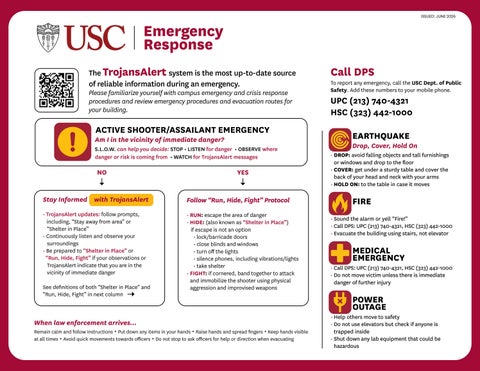
The TrojansAlert system is the most up-to-date source of reliable information during an emergency. Please familiarize yourself with campus emergency and crisis response procedures and review emergency procedures and evacuation routes for your building.
Am I in the vicinity of immediate danger?
S.L.O.W. can help you decide: STOP • LISTEN for danger • OBSERVE where danger or risk is coming from • WATCH for TrojansAlert messages
• TrojansAlert updates: follow prompts, including, “Stay away from area” or “Shelter in Place”
• Continuously listen and observe your surroundings
• Be prepared to “Shelter in Place” or “Run, Hide, Fight” if your observations or TrojansAlert indicate that you are in the vicinity of immediate danger
See definitions of both “Shelter in Place” and “Run, Hide, Fight” in next column
Remain calm and follow instructions
• RUN: escape the area of danger
• HIDE: (also known as “Shelter in Place”) if escape is not an option
• lock/barricade doors
• close blinds and windows
• turn off the lights
• silence phones, including vibrations/lights
• take shelter
• FIGHT: if cornered, band together to attack and immobilize the shooter using physical aggression and improvised weapons
• Put down any items in your hands
• Raise hands and spread fingers • Keep hands visible at all times • Avoid quick movements towards officers • Do not stop to ask officers for help or direction when evacuating
• DROP: avoid falling objects and tall furnishings or windows and drop to the floor
• COVER: get under a sturdy table and cover the back of your head and neck with your arms
• HOLD ON: to the table in case it moves
• Sound the alarm or yell “Fire!”
• Call DPS: UPC (213) 740-4321, HSC (323) 442-1000
• Evacuate the building using stairs, not elevator
• Call DPS: UPC (213) 740-4321, HSC (323) 442-1000
• Do not move victim unless there is immediate danger of further injury
• Help others move to safety
• Do not use elevators but check if anyone is trapped inside
• Shut down any lab equipment that could be hazardous
Supporting members of the university community and helping those who may be distressed or struggling in any way is a USC Trojan Family value. If you know of someone (student, colleague, or co-worker) who is expressing signs of distress, please contact:
Campus Support and Intervention: (213) 740-0411
Note with regard to applicable privacy laws: USC administrators, faculty and staff may disclose information to an appropriate third party about a student that otherwise may be protected under FERPA when there is a significant and imminent threat to the student or other individuals. The information disclosed must be the “minimum necessary” and must be made to a person or department that may lessen the threat.
• explicit statements about harming someone
• disturbing messages by email, text, or another source
• potential domestic violence
• displays of paranoia
• suicidal thoughts or actions
• self-harm
• alarming coursework content
• disruptive or abrasive behavior toward others
• making implied or direct threats toward others
• stalking
• financial problems
• struggling academically
• recent personal tragedy
• mood changes: irritable, sad, anxious, withdrawn, disoriented, angry or hostile
• unexplained absenteeism
• Note your observations and interactions with the person.
• Contact CSI, DPS or the Office of Threat Assessment
Contact: Campus Support and Intervention (213) 740-0411
Office of Threat Assessment (213) 740-0243
Dept of Public Safety (213) 740-4321 UPC (323) 442-1000 HSC
• Note your observations and interactions with the person.
• If you feel safe meeting privately, you may express your concerns calmly and refer the individual to campus support services, such as Counseling or Mental Health Services in USC Student Health or the Center for Work and Family Life.
• Whether or not you meet with the person directly, refer the incident to Campus Support and Intervention.
Contact:
Campus Support and Intervention (213) 740-0411
WorkWell Center (213) 821-0800
Counseling and Mental Health Services, USC Student Heath UPC (213) 740-9355 / WELL
• If you experience, witness or become aware of a bias incident against a person/persons based on their race, gender, religion, disability, sexual orientation, ethnicity, national origin or gender identity
• If you are made aware of a sexual assault, domestic violence or gender-based harm incident as reported by a student or colleague
• Inform the person before they provide details of their account that you as an educator/employee are required by law to report the incident. Staff and faculty who do not hold a legal confidential privilege have a personal responsibility under all circumstances to notify OCRC of any sexual assault, domestic violence or gender-based harm incident.
• If the individual prefers to speak confidentially, direct the person to confidential resources*
• If the person prefers to speak with you, actively listen, be empathetic, make no promises or conclusions and take notes.
• If you become aware of a student/faculty/staff person who has been to campus with a serious communicable illness
• Support the person in following directions from health care providers for isolation. If you are concerned about the risk to yourself and others, contact USC Student Health for assistance.
• When communicable diseases are identified, health care providers take steps to ensure that they will not be spread in the community even if medical confidentiality does not allow specific information to be shared.
• Use the Communicable Disease Reporting Form (https://uscsthealth.info/disease-reporting) to notify public health officers at USC.
Contact: OCRC (Office of Civil Rights Compliance) (213) 740-5086
Contact: OCRC (Office of Civil Rights Compliance)
(213) 740-5086
CARE-SC (Confidential Advocates, Resources, Education Support Center) (213) 740-9355 / WELL
* Medical providers, counseling services or religious officials acting in that capacity are all examples of confidential resources. USC Student Health medical, counseling and sexual assault survivor services at Engemann and Eric Cohen Student Health Centers, and the WorkWell Center, are all confidential resources at USC.
Contact: USC Student Health (213) 740-9355 / WELL

Department of Public Safety
(24-hour assistance) ....................................UPC (213) 740-4321 / HSC (323) 442-1000
Campus Support and Intervention ........................................................ (213) 740-0411
USC Student Health (24-hour assistance) .................................................................
Counseling, Medical, Sexual Assault, Survivor Support (UPC & HSC) .. (213) 740-9355/WELL
Office of Civil Rights Compliance .......................................................... (213) 740-5086
Online Bias or Hate Reporting ............................................................... bit.ly/uscbias
Chief Threat Assessment Officer .......................................................... (213) 740-0243
WorkWell Center ............................................................................... (213) 821-0800
Trojans Care for Trojans (TC4T) Online reporting when concerned about someone............................... bit.ly/tc4t
Office of Community Expectations ......................................................... (213) 821-7373
USC Mobile Safety app Download for easy contact with emergency responders and crime reporting

Emergency Response