tics, gymnastics, gymnastics. Here Greg wants us to do well in school. He encourages us to have a social life, to go out and have a good time. He says gymnastics is not the rest of your life . It's something to learn from."
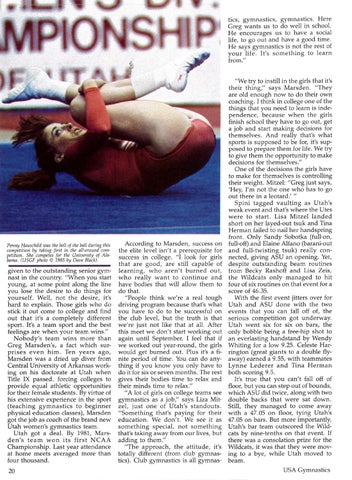
Penny Hauschild was the bell of the ball during this competition by taking first in the all-around competition. She competes for the University of Alabama. (USGF photo Š 1985 by Dave Black).
given to the outstanding senior gymnast in the country. "When you start young, at some point along the line you lose the desire to do things for yourself. Well, not the desire, it's hard to explain . Those girls who do stick it out come to college and find out that it's a completely different sport. It's a team sport and the best feelings are when your team wins ." Nobody's team wins more than Greg Marsden's, a fact which surprises even him . Ten years ago , Marsden was a dried up diver from Central University of Arkansas working on his doctorate at Utah when Title IX passed. forcing colleges to provide equal athletic opportunities for their female students. By virtue of his extensive experience in the sport (teaching gymnastics to beginner physical education classes), Marsden got the job as coach of the brand new Utah women's gymnastics team. Utah got a deal. By 1981, Marsden's team won its first NCAA Championship . Last year attendance at home meets averaged more than four thousand. 20
According to Marsden, success on the elite level isn' t a prerequisite for success in college . "I look for girls that are good, are still capable of learning, who aren't burned out, who really want to continue and have bodies that will allow them to do that. "People think we're a real tough driving program because that's what you have to do to be successful on the club level, but the truth is that we're just not like that at all. After this meet we don' t start working out again until September. I feel that if we worked out year-round, the girls would get burned out. Plus it's a finite period of time. You can do anything if you know you only have to do it for six or seven months. The rest gives their bodies time to relax and their minds time to relax." "A lot of girls on college teams see gymnastics as a job," says Liza Mitzel, just one of Utah's standouts. " Something that's paying for their education . We don' t . We see it as something special, not something that's taking away from our lives, but adding to them." "The approach, the attitude, it's totally different (from club gymnastics). Club gymnastics is all gymnas-
"We try to instill in the girls that it's their thing," says Marsden . "They are old enough now to do their own coaching. I think in college one of the things that you need to learn is independence, because when the girls finish school they have to go out, get a job and start making decisions for themselves. And really that's what sports is supposed to be for, it's supposed to prepare them for life . We try to give them the opportunity to make decisions for themselves ." One of the decisions the girls have to make for themselves is controlling their weight. Mitzel: "Greg just says, 'Hey, I'm not the one who has to go out there in a leotard .' " Spini tagged vaulting as Utah's weak event and that's where the Utes were to start. Lisa Mitzel landed short on her layed-out tsuk and Tina Herman failed to nail her handspring front. Only Sandy Sobotka (full-on, full-off) and Elaine Alfano (barani-out and full-twisting tsuk) really connected, giving ASU an opening. Yet, despite outstanding beam routines from Becky Rashoff and Lisa Zeis, the Wildcats only managed to hit four of six routines on that event for a score of 46 .35. With the first event jitters over for Utah and ASU done with the two events that you can fall off of, the serious competition got underway. Utah went six for six on bars, the only bobble being a free-hip shot to an everlasting handstand by Wendy Whiting for a low 9.25. Celeste Harrington (great giants to a double flyaway) earned a 9.55, with teammates Lynne Lederer and Tina Herman both scoring 9.5 . It's true that you can't fall off of floor, but you can step out of bounds, which ASU did twice, along with two double backs that were sat down. Still, they managed to come away with a 47.05 on floor, tying Utah's 47.05 on bars. But more importantly, Utah's bar team outscored the Wildcats by nine-tenths on that event. If there was a consolation prize for the Wildcats, it was that they were moving to a bye, while Utah moved to beam. USA Gymnastics