Climate-Smart Insights In the Northern Food Ecosystems
CLIMATE-SMART INSIGHTS IN THE NORTHERN FOOD ECOSYSTEMS
Publications of University of Oulu Kerttu Saalasti Institute 4/2025
Peetu Virkkala1, Pauliina Björk1, Ossi Kotavaara1, Thomas Ejdemo2, Nerine Mary George2 & Marja Malmi3
1: University of Oulu; Kerttu Saalasti Institute / 2: Luleå University of Technology; Department of Social Sciences, Technology and Arts / 3: ProAgria Northern Finland
Climate-smart agriculture is an integrated approach to food production and processing that focuses on the dimensions of sustainable development to improve food security and sustainability globally. It aims for an agricultural future by addressing the voices of different types of stakeholders in the food sector. (Palombi & Sessa, 2013) To understand how this climate-smart agricultural future could look in the Nordics, we analyzed the climate-smartness of food producers and processors through an Interreg Aurora project in Northern Finland and Northern Sweden. This report summarizes the main findings of this project to shed light on the climate-smart realities in the Nordic food sector.
The report is split into two insight areas: visualization of food production (DATA) and overview of climate-smart practices (INTERVIEW) in the area.
For the DATA insights, we conducted a regional analysis of the current state and development opportunities in Arctic food value chains by utilizing food-related register data. This led to the creation of an interactive food sector dashboard (www.oulu.fi/my/climatefood) from which this report visualizes some of the most insightful and compelling findings. These visualizations help illustrate the distinct characteristics of food manufacturing in the Nordic region.
For the INTERVIEW insights, we first interviewed food producers and processors in Northern Finland and Northern Sweden to evaluate their current climate-smart practices and then interviewed Finnish and Swedish technology providers to identify challenges and opportunities for technology adoption in the Nordic food sector. This led to the creation of thematic analyses from which this report highlights some of the most prominent ones in order to shed light on climate-smart practices and opportunities in the Nordic food sector.
Together, these insights can support many different types of stakeholders in the Nordic food sector. For example, the results can be utilized by food producers and processors to learn from each other’s climate-smart practices, by development organizations to improve cross-border collaboration in the food sector, and by policymakers to develop agricultural policies that better take into account the realities of the Nordic food sector. Without further ado, we wish you interesting and insightful moments with the report!
DATA INSIGHTS: Food production and processing in Northern Finland and Northern Sweden
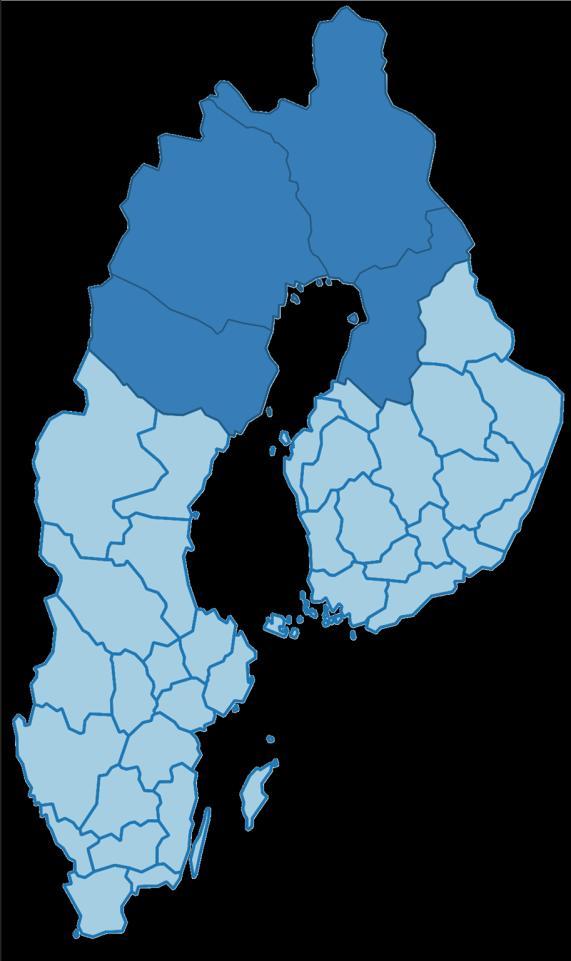
Food production in Northern Finland and Northern Sweden plays a crucial role in regional food security and rural vitality, as it significantly contributes to the local economy. This report covers the regions of Northern Ostrobothnia and Lapland in Finland, as well as Norrbotten and Västerbotten in Sweden. To map both the opportunities and the vulnerabilities in the current state and within the structural development, we provide selected new data-based insights into primary production and processing of food in the Nordic region.
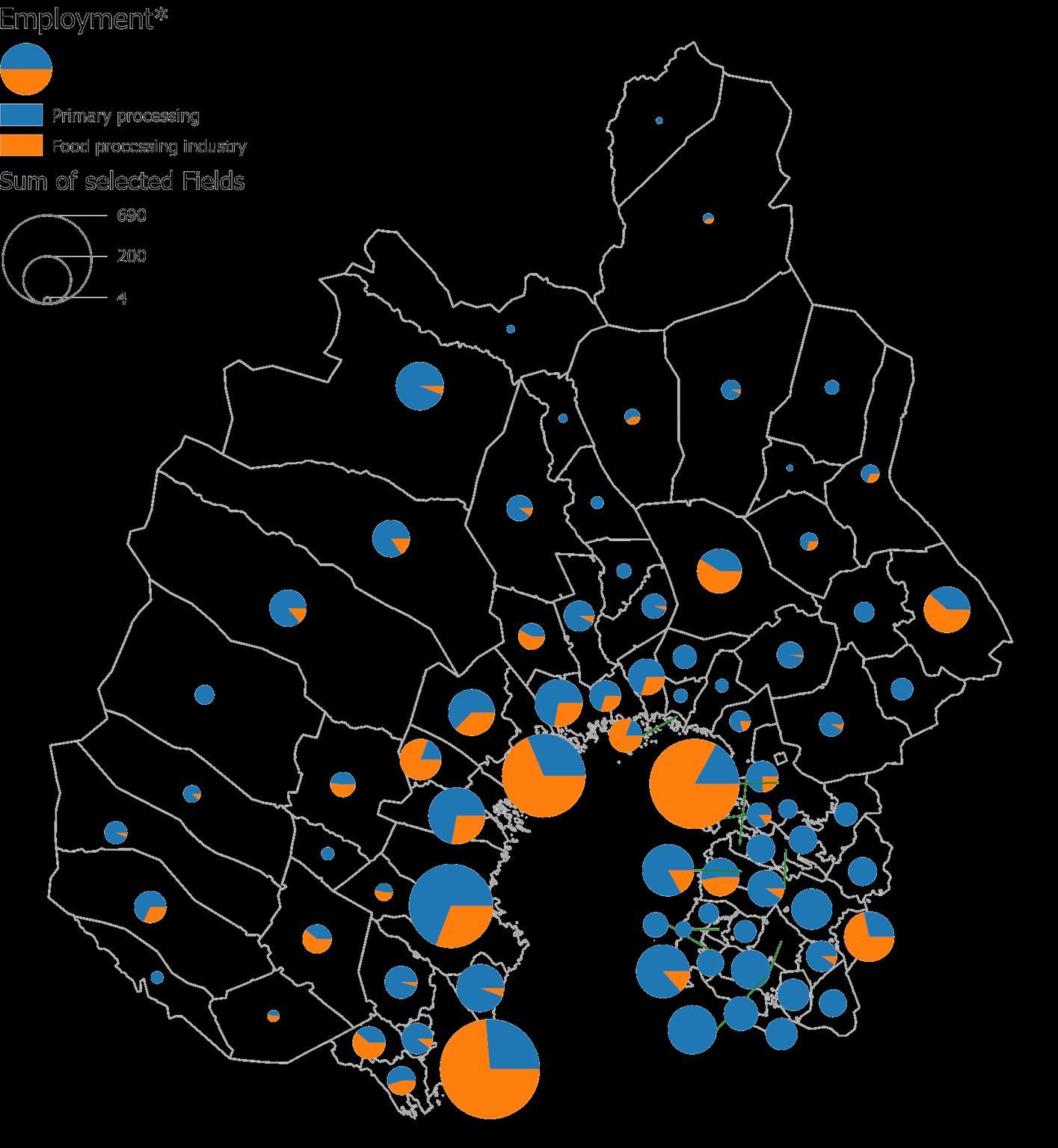
We present views on employment and turnover in primary production and the food processing industry on the regional and municipal levels. Food production and processing have concentrated, but differently, as processing is emphasized in cities and primary production in regions close to coastal and southern areas. We offer a closer look at the structure of farms and agriculture-related enterprises, as well as the food processing industry, with key figures by enterprise size. Most farms in the area are distinctively small. The declining number of farms and the increasing share of retiring farmers can be considered as the main challenges for the area’s future. It is important to deepen understanding of how large-scale farms can develop in a way that ensures economic sustainability or growth.
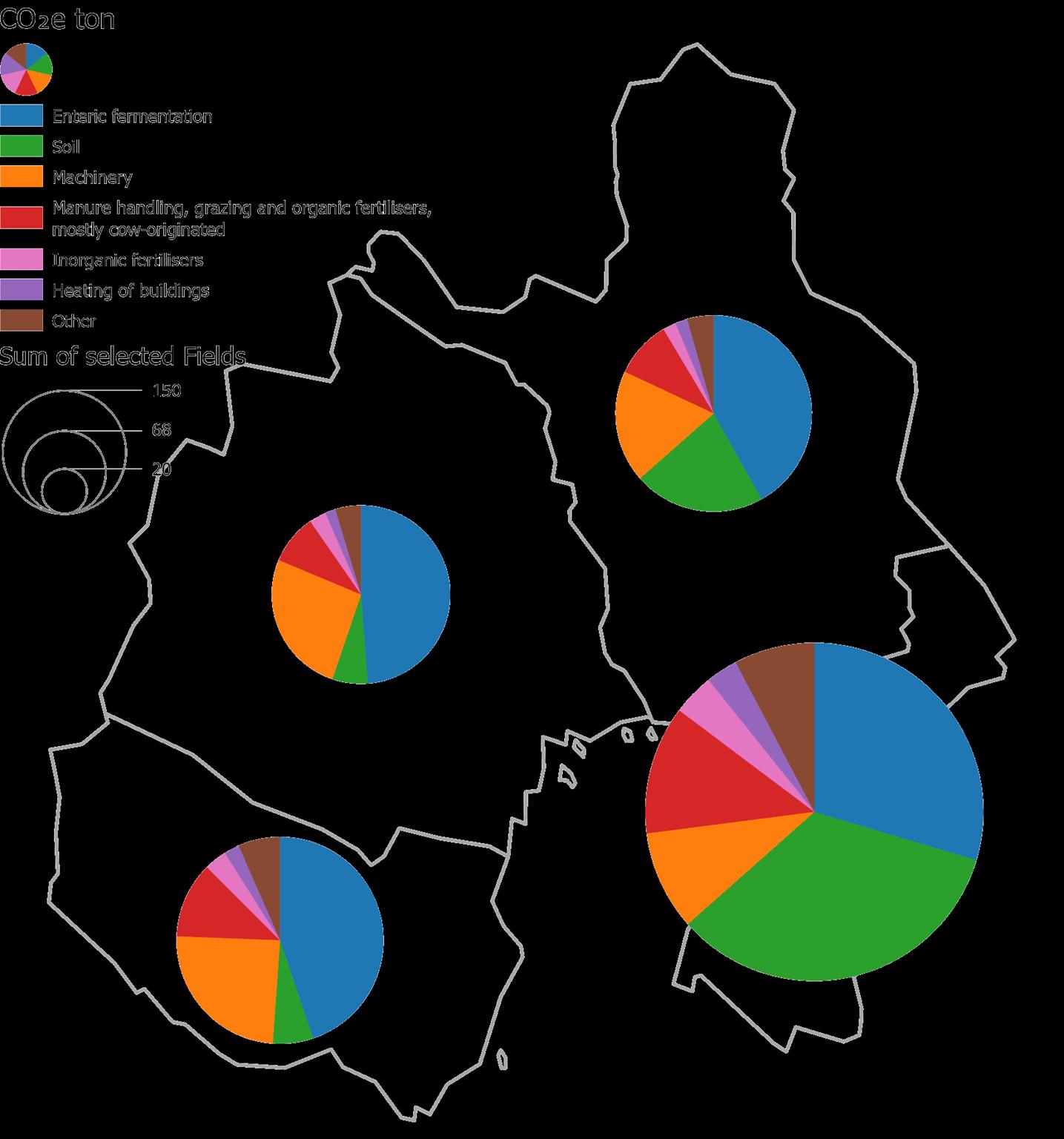
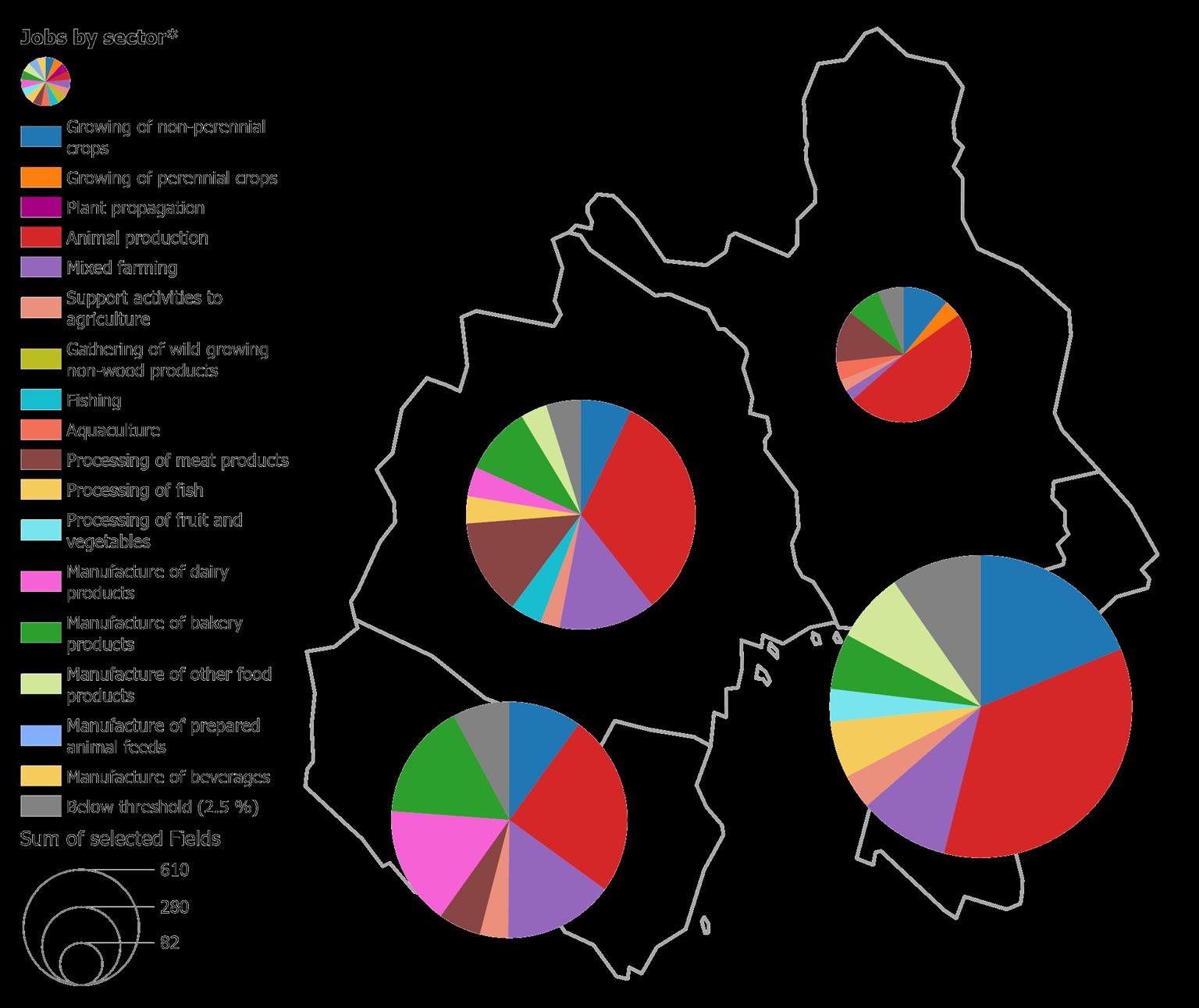
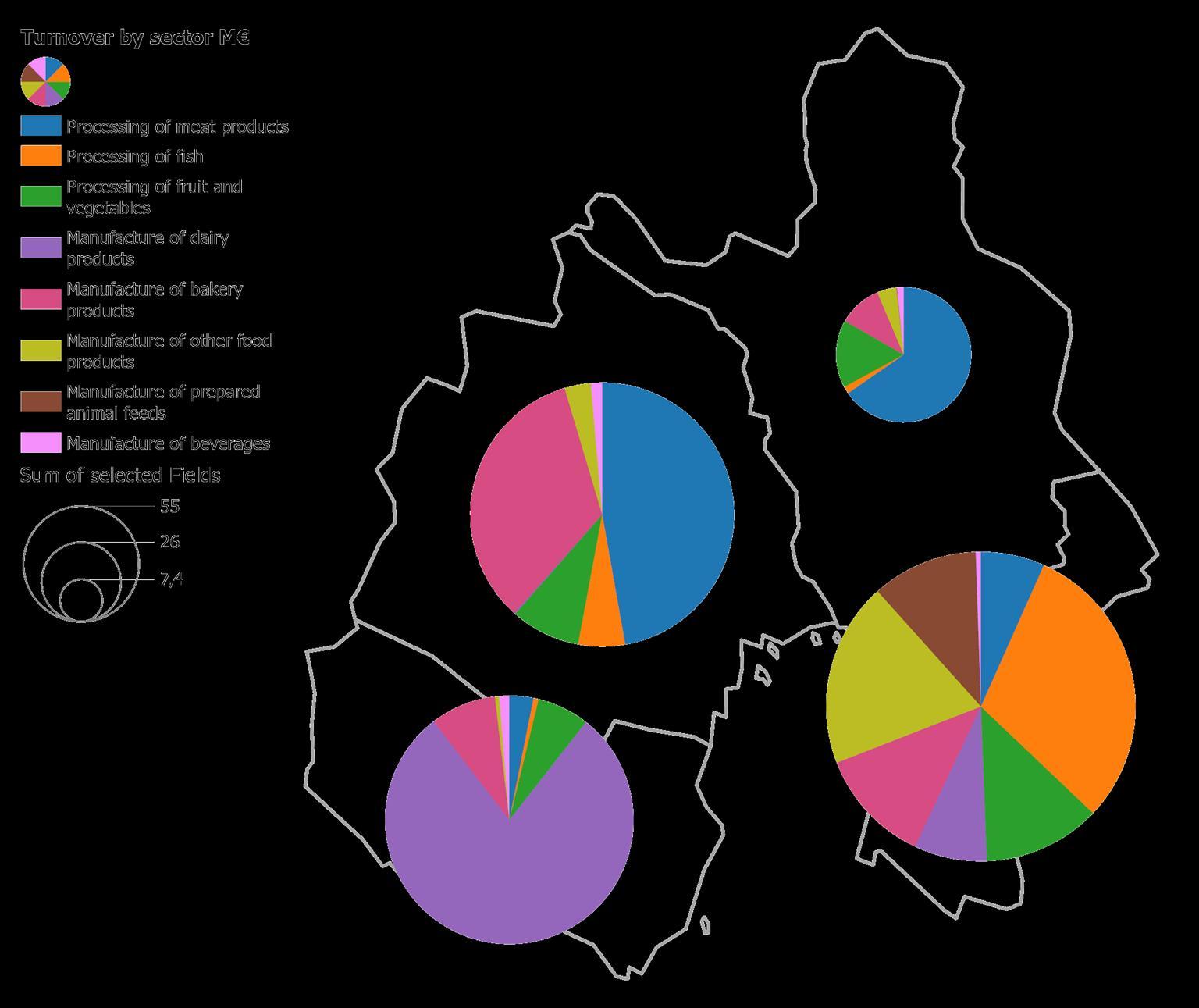
We take a regional overview of meat, milk, and field production crops, which shows the strong emphasis on cattle farming. The majority of the field crop area is connected to animal feeds. Also, the majority of jobs in primary production are in the animal farming sector, and the majority of turnover in food processing comes from meat processing, with dairy also being notable. Together with peat soils from Northern Ostrobothnia, cattle enteric fermentation produces the main part of agriculture-related greenhouse gas emissions.
In addition, we provide an overview of horticulture key figures dominated by black currant, strawberry, and carrots, as well as commercial fishing dominated by Baltic herring in Finland and vendace in Sweden.
Lapland
Northern Ostrobothnia
Norrbotten
Västerbotten
FOOD
The total value of food production in the area exceeds 1000 million euros. There are over 6000 jobs in the primary food production sector and 3500 in the food processing industry. Northern Ostrobothnia is the largest region in food production, but Västerbotten and Norrbotten together are larger than Lapland and Northern Ostrobothnia together. Northern Ostrobothnia produces the largest volumes in meat and milk production, field crops and horticulture areas, and in catches in commercial fishing.
Jobs in primary production Jobs in food processing industry
Jobs in the food sector in the project area Turnover in the food processing industry
Lapland Norrbotten
Northern
Finnish data is from 2023, Swedish turnover data from 2024, and Swedish jobs data from 2021. Jobs are person equivalents from Finland and represent headcounts from Sweden. Data sources are Statistics Finland microdata and Statistics Sweden purchased data. Turnovers are not available from agriculture, and also, data may not have full coverage due to data availability.
In the area, food primary production is mostly located in coastal areas and in the southern part of Northern Ostrobothnia. The most important food processing industry locations are Oulu, Umeå, and Luleå. In Northern Ostrobothnia and Lapland, 4.5% of the firm’s working hours were spent in food production and processing. 1,8 % of the employed people in Norrbotten and Västerbotten (also including the public sector) worked in food production and processing. (Jobs and turnovers are typically registered to the headquarters location of the firms).
Primary production and food processing industry employment by municipality
Finnish data is from 2023, Swedish turnover data from 2024, and Swedish jobs data from 2021. Finnish jobs are person-equivalents, and Swedish jobs are mean headcounts. Data sources are Statistics Finland microdata and Statistics Sweden purchased data.
MOST FARMS ARE VERY SMALL
The size of a primary production enterprise* is very small on average. Most of the enterprises have no employees at all nor do they have any registered work for entrepreneurs. Also, part-time entrepreneurship is common. In Finland, solo entrepreneurship is typical. Very few enterprises in primary production have at least 10 employees.
Sizes of companies in agriculture in Northern Ostrobothnia and Lapland Sizes
Zero entrepreneurs or employees
Part-time entrepreneur (max. 0.5 FTE), no employees
Sole entrepreneur (0.5-1.5 FTE)
Entrepreneur with part-time employee
Two entrepreurs (1.5-2 FTE), no employees
Entrepreneur with at east one full-time employee
At least part-time employee, no entrepreneur SME (10-249 employees)
FTE = Full Time Equivalent. SME = Small and Medium-sized Enterprise. Data sources: Statistics Finland microdata for employment, year 2023. Statistiska centralbyrån (SCB), 2024. Please note: Swedish numbers are ”workplaces” and Finnish numbers are business IDs. Natural Resources Institute of Finland (LuKe) and Jordbrukverket open data for farmer-side industries (2024). *enterprise here is a business ID in the enterprise register, with the main branch being in primary production.
FARMERS’AVERAGE AGE IS HIGH, AND AMOUNT OF FARMS IS DECLINING
In Northern Ostrobothnia and Lapland, the largest age group in farming is 55-64 years old, while in Norrbotten and Västerbotten, the largest age group is even higher, 65 and over. In total, in the area, over 65 is the largest age group in farming. A large share of farmers over 65 years old also partly explains the large share of enterprises with zero employees or entrepreneurs. Also, the number of farms has been declining, especially in Northern Ostrobothnia and Lapland, where the number of farms has declined by over 40% in 15 years, while in Norrbotten and Västerbotten the decline has been smaller.
Number of farms by farmers age group
Under 25 25 - 34 35 - 44 45 - 54 55 - 64 65 and over
Data sources are the Natural Resources instutute of Finland (LuKe) and Jordbrukverket open data for farmers aged from the year 2024. Number of farms from Finland: Statistics Finland, numbers of farms. Number of farms with field area, Sweden: Jorbruksverket (Note: years between 2007-2019 between 3-years only).
MEAT AND MILK PRODUCTION
Almost 20 million kg of beef, 15 million kg of pork, and over 600 million liters of milk are produced yearly in the area. Northern Ostrobothnia is the largest meat and milk producer in the area. The reindeer herding area extends from the study area to Jämtland in Sweden and Kainuu in Finland. Lapland is the largest producer of reindeer meat with 1,56 million kg. Norrbotten, Västerbotten, and Jämtland are approximately equal-sized producers with more than 300 tkg each. Chicken meat production is not available by region, but there are a total of 145 000 chickens in the project region; 85 000 chickens in Västerbotten, 48 000 in Norrbotten, 12 500 in Northern Ostrobothnia, and none in Lapland.
Meat production, million kg
Norrbotten and Västerbotten* Lapland
Data sources are the Natural Resources Institute of Finland (LuKe) and Jordbrukverket open data. Meat and milk production figures for 2023 are expected for reindeer Reindeer meat regional production data is from Paliskuntain yhdistys, Finland (2022-2023), and from Sametinget, Sweden (2020-2021) Milk production from Sweden is based on milk used by Norrmejerier, according to their yearbook 2023, which also includes some parts of Jämtland and Västernorrland. Chicken or egg production data is not available at the regional level.
GREENHOUSE GAS EMISSIONS
Main sources of greenhouse gas emissions from agriculture are from ruminants (cow, sheep, reindeer), enteric fermentation, and also from soil in Northern Ostrobothnia. Machinery and manure handling impact about 10% each. While Northern Ostrobothnia is producing the largest volume of agricultural greenhouse gas emissions in the project area, there is no declining trend. In northern Sweden, the declining trend in emissions is connected to the diminishing number of cows. These emissions are from local production and do not cover e.g., imported feeds or fertilizers and their raw materials.
CO2e emissions data from the year 2023 are from the Finnish Environment Institute (Syke) and Sveriges Meteorologiska och Hydrologiska Institut (SMHI) open data.
CO2e emissions by region
FIELD CROP AND HORTICULTURE PRODUCTION AREA
The largest field areas are used for growing animal feeds: silage, hay, crops harvested green (shown in the graph as “fodder”), and also most of the barley. Oats and potatoes are the most important crops for human consumption, with fields located mostly in Northern Ostrobothnia. The largest horticulture areas are used for black currant, strawberry, and carrots. Tomatoes, cucumbers, and spices are grown in greenhouses; the region has almost 500 000 square meters of greenhouse area.
Crops by field area, 1000 ha
Horticulture in open land, ha
Source: is from the Natural Resources Institute of Finland (LuKe) and Jordbrukverket open data Finnish data 2023, Swedish data 2022 ”Other” in open land horticulture includes small areas of Broccoli, Sea buckthorn, Chokeberry, Red currant, Swede, Parsnip, Kohlrabi, Garlic, Apple, White currant, Cauliflower, mostly in Northern Ostrobothnia. Crops harvested green are also silage
COMMERCIAL FISHING
The main catch in commercial sea fishing is Baltic herring, with the fishing harbors located mostly in Northern Ostrobothnia. The Baltic herring’s main use is for animal feeds, and the producer price is relatively low at 0.24€/kg. In Norrbotten, the main interest of commercial sea fishing is in vendace, which is coveted for its roe (Kalix löjrom).
The total production of aquaculture from northern Finland is 2 million kg, which is mostly rainbow trout. The total catch in commercial lake fishing in Lapland, Northern Ostrobothnia, and Kainuu regions is 1 million kg; the main catches are vendace, pikeperch, European whitefish, pike, roach, and perch. Also, the recreational fishing catch size is noteworthy.
From northern Sweden, regional or lake-based commercial fishing statistics are not available. Commercial lake fishing is small-scale. Economically important catches include whitefish and arctic char. Detailed regional data on aquaculture production is not available, but there are facilities in northern Sweden that produce arctic char and rainbow trout.
CATTLE FARMING, CATTLE FEEDS, DAIRY
AND
BEEF
INDUSTRY TOGETHER ARE THE MOST IMPORTANT SECTOR
The largest volumes in food production in the area are associated with cattle farming, including the production of animal feeds and the food processing industry. The importance can be measured in terms of jobs in cattle farming, growing crops for animal feed, and the processing of beef and dairy products. Also, the turnover of the beef and dairy products industry is higher in total compared to other sectors. So is the field area used for growing crops for animal feed. Cattle farming also receives the highest amount of farming subsidies.
Jobs by sector in primary production and food processing industry
Finnish enterprise data is from 2023, and Swedish jobs data is from 2021. Jobs are person-equivalents. Data sources for enterprise data are Statistics Finland microdata and Statistics Sweden purchased data Primary production data is from the Natural Resources Institute of Finland (LuKe) and Jordbrukverket open data CO2e emissions data is from the Finnish Environment Institute (Syke) and Sveriges Meteorologiska och Hydrologiska Institut (SMHI) open data.
Cattle farming is also the main source of CO2e emissions from local food production, as enteric fermentation, soil and manure handling, and is the largest component of the emissions. This does not cover imported animal feeds or fertilizers. There were 122 400 cows in Northern Ostrobothnia, 25 500 in Lapland, 34 100 in Västerbotten, and 14 800 cows in Norrbotten in 2024, in total almost 200 000.
Turnover by sector in food processing industry
Turnovers are fully available only from the food processing industry. Every region has its own specialization: The main industry in Lapland is meat processing, the processing of fish in Northern Ostrobothnia, dairy in Västerbotten, and the meat and bakery industry in Norrbotten (these numbers include only companies having their headquarters in the region). Finnish enterprise data is from 2023, Swedish turnover data is from 2024. Data sources for enterprise data are Statistics Finland microdata and Statistics Sweden purchased data
INTERVIEW INSIGHTS: Climate-smart practices in Northern Finland and Northern Sweden
Goals
In order to understand the current state of climate-smart practices and identify how technologies could enhance Nordic food producers and processors climatesmart activities, we conducted two types of interviews in Northern Finland and Northern Sweden: thematic technology provider interviews and semi-structured food producer and processor interviews. Main insights of these interviews are split into two themes:
THEME 1: Technology providers
Technology can be utilized to improve efficiency, reduce waste, and enhance sustainability in different types of food value chains. Adoption of technological solutions varies in different regional contexts and different raw material chains. Through the thematic interviews, we examined how different types of technologies can be utilized to support the competitiveness, sustainability, and resilience of Nordic food producers and processors.
THEME 2: Food producers and processors
Climate-smart agriculture is an approach to food production that aims to make food manufacturing more secure and climate-friendly. It examines food production and processing through three dimensions of sustainable development in order to contribute comprehensively to sustainable development (Palombi & Sessa, 2013).
Climate-smart agriculture has different meanings in various contexts. This means that climate-smart agriculture is context-dependent, and in order to understand and develop climate-smart agriculture globally, we have to understand climatesmart agriculture from different viewpoints.
In order to do this, we set out to understand climate-smart agriculture from a Nordic perspective by focusing on Northern Finnish and Northern Swedish food producers and processors. In line with the climate-smart agriculture approach (Palombi & Sessa, 2013), we examined climate-smartness through three dimensions of sustainable development:
• Economical dimension: activities that aim to increase the profitability and competitiveness of food producers and processors in order to produce wellbeing in society.
• Social dimension: activities that aim to increase the well-being of employees, customers, and the community in order to produce well-being in society.
• Environmental dimension: activities that aim to minimize the environmental impact of food producers and processors in order to save natural resources.
THEME 1: TECHNOLOGY PROVIDERS
Technology providers have a vital role in advancing climate-smart food systems by offering innovations that enhance efficiency, reduce environmental impact, and strengthen competitiveness across the food value chains. 12 technology start-ups and small enterprises were contacted in order to identify how their technologies such as precision agriculture tools, sustainable container-based systems, and feed-based solutions for CO₂ could be utilized by food producers and processors. This led to the identification of different types of benefits, challenges, and cooperation opportunities between technology providers and food producers and processors that can be utilized to increase technology adoption in the food sector.
OVERVIEW OF FINDINGS FROM TECHNOLOGY PROVIDER INTERVIEWS
Technologies' benefits for producers and processors
Challenges that hinder the use of the technologies
• Accurate crop health and yield maturity assessments
• Efficient land and resource management
• Enhanced decision-making through data-driven insights
• Potential for early detection of issues (e.g., pests, drought stress)
• Reduced labour and scouting time
• Reduced transportation costs and carbon footprint
• Improved food quality and nutritional value
• Enhanced social and environmental impact through community integration
How to improve co-operation with food sector?
• Fast technology change
• Limited existing infrastructure (e.g., small farm size)
• Lack of tailored support
• Limited willingness to invest in new technologies due to cost sensitivity
• Short operational windows due to climate constraints
• Lack of awareness or understanding of technology benefits
• Foster collaborations between tech providers and farming cooperatives
• Increase funding and support for climate-smart agricultural technologies
• Promote pilot projects demonstrating technology and practical benefits
• Develop shared service models to reduce individual costs
• Simplify regulatory pathways for technology use in agriculture
THEME 2: FOOD PRODUCERS AND PROCESSORS
To better understand food producers and processors' climate-smart practices in Northern Finland and Northern Sweden, we interviewed producers and processors from 7 raw material chains from both countries (a total of 28 interviews). The raw material chains included: Non-Wood Forest, Grains (Barley, Oat & Rapeseed), Potato, Beef, Reindeer, Fish, and Milk. The interviews were conducted as semistructured interviews, and their results were analyzed through a qualitative thematic analysis.
The analysis led to the identification of different types of climate-smart themes and corresponding examples of climate-smart best practices. The themes included:
• Two environmental themes: Decrease emissions and the Use of resources
• Two social themes: Working environment and Community development
• Three economic themes: Efficiency, Strategy, and Investments
The themes and their corresponding best practices are summarized on these two pages. The detailed description of each theme and best practices can be found at the end of this report (Appendix). Together, these descriptions help to illustrate different perspectives on climate-smart practices that Nordic food producers and processors utilize in their day-to-day activities.
PRACTICES
Working environment
Community development
Societal contributions
Sharing resources and lessons learned locally
Favouring locality
ECONOMICALLY CLIMATE-SMART PRACTICES
Towards the climate-smart future in the Nordics
Within this report, we have presented the insights on climate-smart agriculture from data and interview perspectives in the Interreg Aurora region. Our results indicate that there are many things that Northern Finnish and Northern Swedish food producers and processors can learn from each other to create a more resilient food ecosystem in the region.
Main insights from data and interview perspectives
DATA
The combination of small farms and an ageing farmer population may challenge the sector’s future vitality, requiring proactive measures to ensure generational renewal and sustainable growth.
One insight is that Northern Finland has more farms and a greater diversity of crops compared to Northern Sweden. One explanation is that Finland has had a more ambitious support scheme and a focus on maintaining relatively high rates of self-sufficiency.
The climate impact of local production is not declining as it should. The biodiversity impact is also important to keep in mind.
INTERVIEW
New technologies play a crucial role in promoting climate-smart practices. More collaboration is still needed between technology providers and the food sector to realize their benefits fully.
Food producers and processors in Northern Finland and Sweden are conducting many different types of climate-smart practices. There are many things we can learn from each other now and in the future.
Both Finnish and Swedish food producers and processors are eager to learn from each other. New types of avenues should be built for this collaboration to increase opportunities for future cross-border collaboration.
Our findings highlight both practical and research avenues for future food sector activities in areas such as food security and rural resilience. Overall, the findings emphasize the benefits and the potential for cross-border collaboration between different types of food sector stakeholders across the Interreg Aurora area.
“Climate-smart agriculture increases productivity and resilience, reduces greenhouse gases, and enhances the achievement of national food security and development goals”
Palombi & Sessa (2013)
REFERENCES & APPENDIXES
1: Palombi, L., & Sessa, R. (2013). Climate-smart agriculture: sourcebook.
APPENDIX: CLIMATE-SMART THEMES AND CORRESPONDING BEST PRACTICES
ENVIRONMENTAL
1. Decrease emissions (Emissions are decreased)
Best practice: Close to close mindset in everyday activities
Keeping production, processing, and consumption geographically close to reduce unnecessary transportation. It emphasizes local value chains, resource efficiency, and sustainability.
“Close-to-close mindset is at the core of our operations. In this way, we ensure that our raw materials or products are not transported back and forth unnecessarily.” – Grain producer
Best practice: Limiting the use of artificial substances
Deliberately designing farming or production practices to minimize environmental impact before it occurs.
“Sustainable fishing is already responsible in itself because it reduces the amount of phosphorus and methane in waterways and increases fish stocks.” – Fish producer
2. Decrease the use of resources (Use of resources is decreased)
Best practice: Optimization of processes
Deliberately improving production workflows to reduce resource use and waste before inefficiencies occur.
“We aim to a lean-based way of working. The lead time of i.e cheese bread production batch could be tightened. That means less use of electricity, less working time, less everything.” – Milk processor
Best practice: Utilization of sustainable energy solutions
Proactively adopting renewable energy sources to reduce dependency on non-renewable power and lower environmental impact.
“Bought solar systems for our facilities. We can produce about 40 or 50,000 kilowatt-hours per year. And we are using up about 100, so we can produce about half.” – Reindeer producer
Best practice: Efficient use of raw materials
Proactively maximizing the value of all inputs to reduce waste and increase overall resource efficiency.
“Raw material is also there on the by-product side, yes indeed, selling it as dog food, it is nevertheless a fairly valued material for pet dogs. You can get a good amount of financial income from it as well. And then of course the blood, yes, you get that financial income from that too.”
–
Reindeer
processor
Best practice: Operating according to natural cycles
Aligning production and farming activities with seasonal and ecological rhythms to enhance sustainability and reduce environmental impact.
“Considering the use of natural resources solely from an efficiency perspective is risky. Responsible use of raw materials is not possible if we don't respect the natural cycle of their renewal.” – Fish producer
SOCIAL
1. Working environment (Design of the working environment)
Best practice: Employee involvement
Actively engaging all employees, regardless of their role, in the company’s processes, decisions, and development.
“We build everything from a customer and consumer focus and try to ensure that everyone does the right thing. Everyone is important. Everyone can be involved and influence in both big and small ways.”
– Milk and Meat Producer
2. Community development (Contributions to the community)
Best practice: Societal contribution
Refers to the practice of giving surplus or unsold products to charitable organizations instead of discarding them.
“We have reduced wastage in such a way that we have similar ones, where it is like we are no longer delivering to the store, but there are still days that if there are similar ones left, then we deliver that, for example, through [a waste food distribution] project, so we've started from there. They go to charity in advance or something like that.”
– Non-wood forest processor
Best practice: Sharing resources and lessons learned locally Means providing guidance, advice, and practical experience to others in the local community to help them start or improve their activities.
"I think I'm pretty good at sharing what I know and have been through. For example, I give tips to someone who wants to start making syrup or other products.” – Non-wood processor
Best practice: Favoring locality
Means prioritizing purchases and collaborations within the local community to support local producers and businesses.
“I buy berries locally from women here in Jokkmokk. It feels good to support them, especially those who don’t have full-time jobs. I collaborate with other local producers and businesses, which is very important for networking and finding new ways to collaborate.”
– Non-wood processor
ECONOMICAL
1. Operational efficiency (Optimization of operational activities)
Best practice: Supply chain optimization
Strategically coordinating all stages of production and distribution to reduce costs, improve efficiency, and minimize waste.
“Focusing only on fresh products would require significant scaling. By coordinating production and distribution carefully, we can lower costs, work more efficiently, and reduce waste.” – Reindeer producer
Best practice: Process integration
Connecting and aligning different production processes to streamline, improve, and enhance overall operational efficiency.
“By coordinating planting, harvesting, and storage activities, we can make better use of equipment and labor, reduce waste, and ensure smoother operations throughout the farm.” – Potato producer
Best practice: Production & packaging design
Designing production methods and packaging to maximize efficiency, reduce waste, and minimize environmental impact.
“We use the SRS system we have in Sweden in our packaging. SRS plastic containers circulate within a shared system used by everyone.” – Fish producer
Leveraging online platforms and digital tools to reach customers efficiently, expand market access, and improve sales performance.
“We expanded to an online store so people around Sweden can visit our store and get our meat home delivered to them.”
– Reindeer producer
Best practice: Product certifying
Ensuring products meet recognized standards or certifications to guarantee quality, safety, and sustainability for consumers.
“The organic subsidy system help us to get a slightly better price for the final product. The customers appreciate that it is produced in a controlled organic manner.” – Meat producer
Best practice: Sustainability communication
Effectively sharing information about environmental, social, and economic practices to inform stakeholders.
“We always explain to our customers how our methods protect the environment while ensuring the highest quality potatoes. Transparency is key.” – Potato producer
3. Investments (Financial practices that improve climate-smartness)
Best practice: Regular financial monitoring practices
Systematically tracking and reviewing financial performance to ensure stability, identify risks early, and support informed decision-making.
“We are constantly renewing devices according to what is reasonable and profitable, so that we look for limit values there, so that we know at what point something should be renewed.” – Fish producer
Best practice: Regular investments to operating methods
Continuously upgrading equipment, processes, and technologies to improve, maintain, and support sustainable operations.
“We invested in biogas technology long before it became common. It required a financial commitment, but in five years, it will pay off because we have continuously improved and adapted it. It allows us to reduce costs and become self-sufficient in electricity.” – Milk producer
“Implementing climatesmart agriculture can be a major driver of a Green Economy and a concrete way to operationalize sustainable development.”