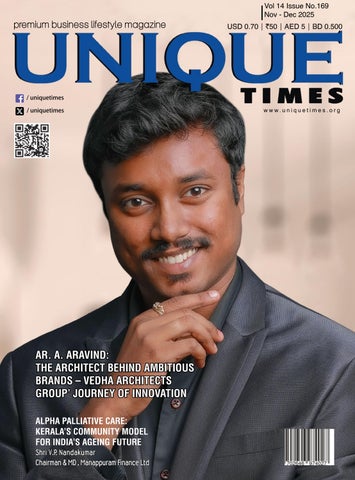
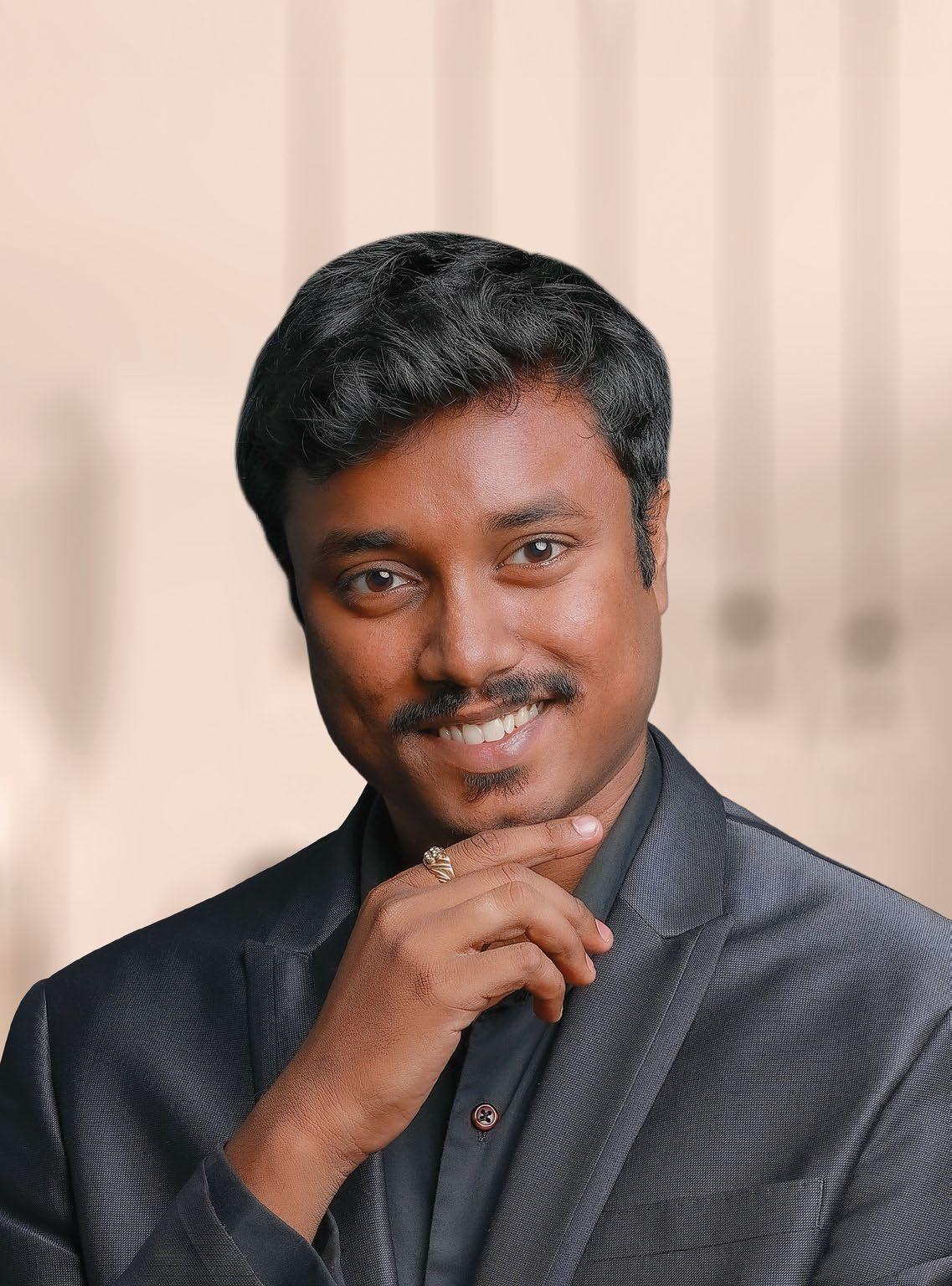
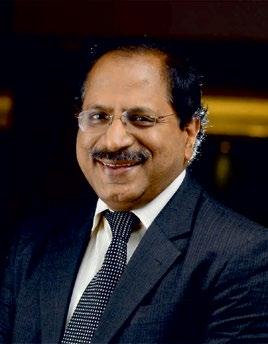
is not based on concrete and steel, and the elements of the soil. It's based on wonder." – Daniel Libeskind Passion, purpose, and vision are the cornerstones of every remarkable creation. In architecture, these qualities do more than define structures—they breathe life into spaces that inspire, comfort, and endure. Architecture, at its core, is about translating emotions, aspirations, and identities into spaces that stand the test of time. Each project reflects empathy, foresight, and innovation, creating homes, workspaces, and destinations that are as personal as they are timeless. Through this approach, true architecture becomes more than constructing buildings—it becomes a way of enriching human life. This month’s cover story celebrates these principles through the journey and vision of Ar. A. Aravind, Founder & Principal Architect of Vedha Architects.
This month’s edition presents V.P. Nandakumar, Chairman & MD of Manappuram Finance Ltd. offering valuable perspectives on “Alpha Palliative Care: Kerala’s Community Model for India’s Ageing Future.”
In addition, it features our regular segments on travel experiences, beauty insights, and reviews of books, along with engaging and thought-provoking articles that provide business inspiration.
“Reading well is one of the great pleasures that solitude can afford you.” -Harold Bloom
Wish you a joyful reading experience!
Cover Photograph Ar. A.
Meta Rolls Out New Anti-Scam Measures Across Platforms
Meta has launched a robust set of anti-scam initiatives across WhatsApp, Messenger, and Facebook to enhance user safety against online fraud. WhatsApp now alerts users during screen sharing with unknown contacts, while Messenger uses AI to detect suspicious messages. Meta has also expanded passkey authentication for secure biometric logins and improved security checkups. Targeting senior citizens, the company has extended its “Scams Se Bacho” campaign with multilingual awareness content and partnered with the Department of Telecommunications and Saksham Senior to conduct safety workshops. Emphasising vigilance, seniors are urged to verify sources and avoid sharing personal data. In response to rising cyber fraud, Meta removed 23,000 scam-linked Facebook Pages and accounts in India and Brazil in March 2025. WhatsApp is also testing new limits on chats with unreplied contacts to reduce spam and phishing risks.
Reddit Sues Perplexity and Others Over Unlawful Data Scraping
“Nothing is impossible, the word itself says ‘I’m possible’!”
Audrey Hepburn
Reddit has filed a lawsuit against AI firm Perplexity, Lithuania-based Oxylabs UAB, Texas startup SerpApi, and proxy service AWMProxy, accusing them of illegally scraping millions of user comments for commercial use. The company called the operation an “industrial-scale, unlawful” data extraction scheme, highlighting growing tensions over AI training data practices. This is Reddit’s second major lawsuit against the AI sector, following its case against Anthropic in June. Perplexity, which runs an AI “answer engine,” rejected the allegations, arguing it doesn’t train AI models and lawfully accesses public data. It accused Reddit of “strong-arm tactics” to force payment deals. The dispute underscores broader industry challenges around data sourcing, as Reddit has already signed licensing agreements with Google and OpenAI—key revenue streams since its IPO—while AI firms face mounting scrutiny over how they collect and use online content.
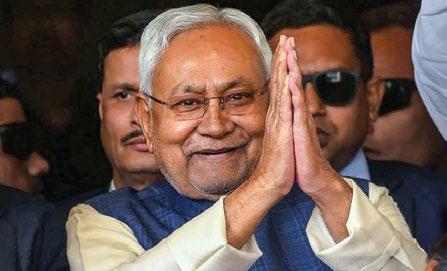
Nitish
Kumar
Promises 10 Million Jobs, Highlights Bihar’s Development Ahead of Polls
Bihar
Chief Minister Nitish Kumar, speaking at a public rally in Danapur, vowed to generate 10 million job opportunities for the state’s youth within the next five years. Citing achievements under the BJP-led NDA government, he said one million government jobs and four million employment opportunities have already been created. Emphasising improvements in peace, education, and healthcare, Kumar noted the appointment of 2,58,000 teachers through the BPSC and expanded free medical services at primary health centres, now serving over 11,600 patients monthly. He highlighted women’s empowerment initiatives, with 12.1 million women receiving `10,000 each to start ventures and top performers eligible for `2 lakh. Kumar also credited his government for doubling medical colleges to twelve and enhancing infrastructure across Bihar. The state elections are set for November 6 and 11, with results on November 14.
Amazon to Cut 30,000 Corporate Jobs in Major Cost-Reduction Drive
“If you want to succeed you should strike out on new paths, rather than travel the worn paths of accepted success.”
John D. Rockefeller
Amazon is set to lay off around 30,000 corporate employees globally, its largest job cut since eliminating 27,000 roles in 2022. The move, part of a sweeping cost-cutting plan, reflects CEO Andy Jassy’s strategy to shift from pandemic-era expansion toward long-term profitability. The layoffs, affecting nearly 10% of Amazon’s 3.5 lakh corporate staff, will heavily impact the People eXperience and Technology (PXT) division and consumer business units. Managers in affected teams have been instructed to undergo communication training before employee notifications, expected via email. Jassy, known for driving efficiency and AI adoption, aims to streamline operations through automation and reduced corporate overheads. Since assuming leadership in 2021, he has prioritised “unregretted attrition” and lean structures, aligning Amazon with other Big Tech firms like Meta and Google in embracing AI-powered efficiency amid economic uncertainty.
Ola Electric Faces Police Complaint After Employee’s Suicide Allegations
OlaElectric founder Bhavish Aggarwal and senior executive Subrath Kumar Das have been named in a police complaint following the death of employee K. Aravind, who allegedly accused them of workplace harassment in a 28-page note before dying by suicide. Filed by Aravind’s brother in Bengaluru, the complaint claims he faced extreme work pressure. Police records show Ola deposited `1.7 million into his account a day after his cremation, which the company says was his full and final settlement. Ola maintains that Aravind never lodged any formal grievance and has challenged the FIR in Karnataka’s top court. The incident adds to the challenges faced by the SoftBank- and Temasek-backed firm, which is grappling with slowing sales, regulatory scrutiny, and rising competition. Ola Electric’s shares have dropped nearly 30% since its August 2024 market debut.
Trump, Modi Discuss Trade and Energy Amid U.S. Pressure on Russian Oil Imports
“Success in management requires learning as fast as the world is changing.”
Warren Bennis
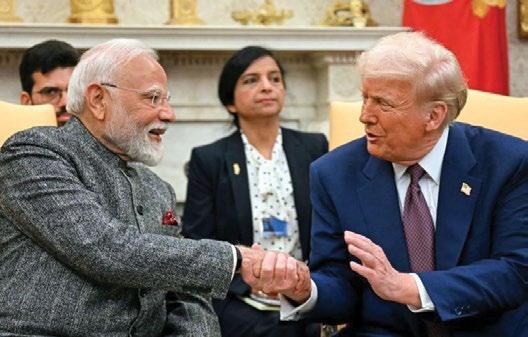
U.S.
President Donald Trump said he held talks with Indian Prime Minister Narendra Modi on Tuesday, focusing mainly on strengthening trade ties between the two nations. Trump told reporters that the discussion also covered energy cooperation, with Modi assuring him that India would reduce its oil imports from Russia. “He’s not going to buy much oil from Russia. He wants to see that war end as much as I do,” Trump said, referring to the ongoing conflict in Ukraine. The U.S. has recently intensified pressure on India to scale back Russian crude purchases, imposing tariffs on certain Indian exports to reinforce its stance. India, along with China, remains one of the largest buyers of Russian seaborne oil. The talks highlight ongoing efforts by Washington to align global trade and energy strategies with its geopolitical objectives.
Former Georgian PM Irakli Garibashvili Charged with Money Laundering Amid Political Turmoil
Former Georgian Prime Minister Irakli Garibashvili has been charged with large-scale money laundering, becoming the first senior figure from Georgia’s ruling elite to face prosecution. Authorities reportedly seized $6.5 million in cash from his residence during a police raid. Garibashvili, a close ally of billionaire ex-premier Bidzina Ivanishvili, served as prime minister from 2013 to 2015 and again from 2021 to 2024. The offence carries a prison term of up to 12 years. The charges come amid escalating political unrest and accusations of authoritarianism against the ruling Georgian Dream party. Pro-Western opposition groups have accused the government of aligning with Moscow, despite the absence of diplomatic ties. Garibashvili had previously defended closer relations with Russia, criticising NATO’s expansion as a trigger for regional conflict.
Angel Bianca Agustin from Philippines Shines Bright as Miss Asia Global 2025 Winner
Angel Bianca Agustin from Philippines was crowned SAJ Group Hotels & Resorts DQUE Watches Miss Asia Global 2025 at a glittering ceremony held on November 4th in Kerala (India). The Miss Asia 2025 crown was awarded to Kavya Bali from India, while Neha Balqiz from UAE and Ashwarea Ullas from Kuwait claimed the first and second runner-up titles, respectively. Conceptualized and executed by Pegasus Global Pvt Ltd under the visionary leadership of Dr. Ajit Ravi, the event epitomized global elegance and organizational brilliance. The winner was crowned by last year’s titleholder, Tamanna Bharat. Sajan Varghese (CMD, SAJ Group of Hotels) crowned the Miss Asia 2025 winner, Mini Sajan (CEO, SAJ Group of Hotels) crowned the first runner-up, and Dr Jolly Antony (Chairman, Vibe Munnar Resorts & Spa) crowned the second runner-up. The coronation took place in the presence of Pegasus founder Dr. Ajit Ravi. The esteemed judging panel featured Punam Chetry, Aileena Catherin Amon, Tamanna Bharat, Tereza Zakova and Varsha Reddy. Several subtitle awards were also presented, celebrating talent, beauty, and cultural diversity among contestants.
Neha Balqiz from UAE Crowned as Miss Glam Universe 2025
Neha Balqiz from UAE emerged victorious as the winner of the prestigious SAJ Group Hotels & Resort DQUE Watches Miss Glam Universe 2025, held on November 4th in Kerala (India). Ashwarea Ullas from Kuwait was declared the first runner-up, Livya Liffy from India won the second runner-up title, and Rozaliia Nizamova from Bashkortostan secured the third runner-up position. The Miss Glam Universe 2024 titleholder, Tereza Zakova, crowned the new winner. Sajan Varghese (CMD, SAJ Group of Hotels) and Ajit Ravi (Chairman, Pegasus Global Pvt. Ltd.) crowned the first runner-up, while Mini Sajan (CEO, SAJ Group of Hotels) crowned the second runner-up. Preethi Prakash Parakkat (MD, Parakkat Jewels) and Deepthi Vijayakumar (MD, Aiswaria Advertising) crowned the third runner-up. The coronation took place in the presence of Pegasus founder Dr. Ajit Ravi. The judging panel featured Punam Chetry, Aileena Catherin Amon, Tamanna Bharat, Tereza Zakova and Varsha Reddy. Subtitles and continental titles were also conferred, marking an evening that celebrated beauty, intelligence, and global diversity.
UK Regulator Sues Crypto Exchange HTX for Unauthorised Promotions to British Consumers
Britain’s Financial Conduct Authority (FCA) has filed a civil lawsuit in London’s High Court against global crypto exchange HTX, formerly known as Huobi, accusing it of illegally promoting crypto asset services to UK consumers without authorisation. The regulator said HTX breached Britain’s financial promotions regime, part of broader efforts to safeguard investors and market integrity. Founded in 2013 and advised by Chinese entrepreneur Justin Sun, HTX remains on the FCA’s warning list. Sun, a key backer of the Trump family’s crypto venture World Liberty Financial, reportedly spent over $75 million on its tokens, with analysts linking a “SUN” wallet to Trump’s “$TRUMP” memecoin. The lawsuit also names four “persons unknown,” believed to include HTX’s owners, operators, and promotional heads.
AR. A. ARAVIND: THE ARCHITECT BEHIND AMBITIOUS BRANDS – VEDHA ARCHITECTS GROUP’ JOURNEY OF INNOVATION
“Turning Intangible Emotions into Tangible Experiences through Thoughtful Architecture – Vedha Architects Group Leads the Way.”
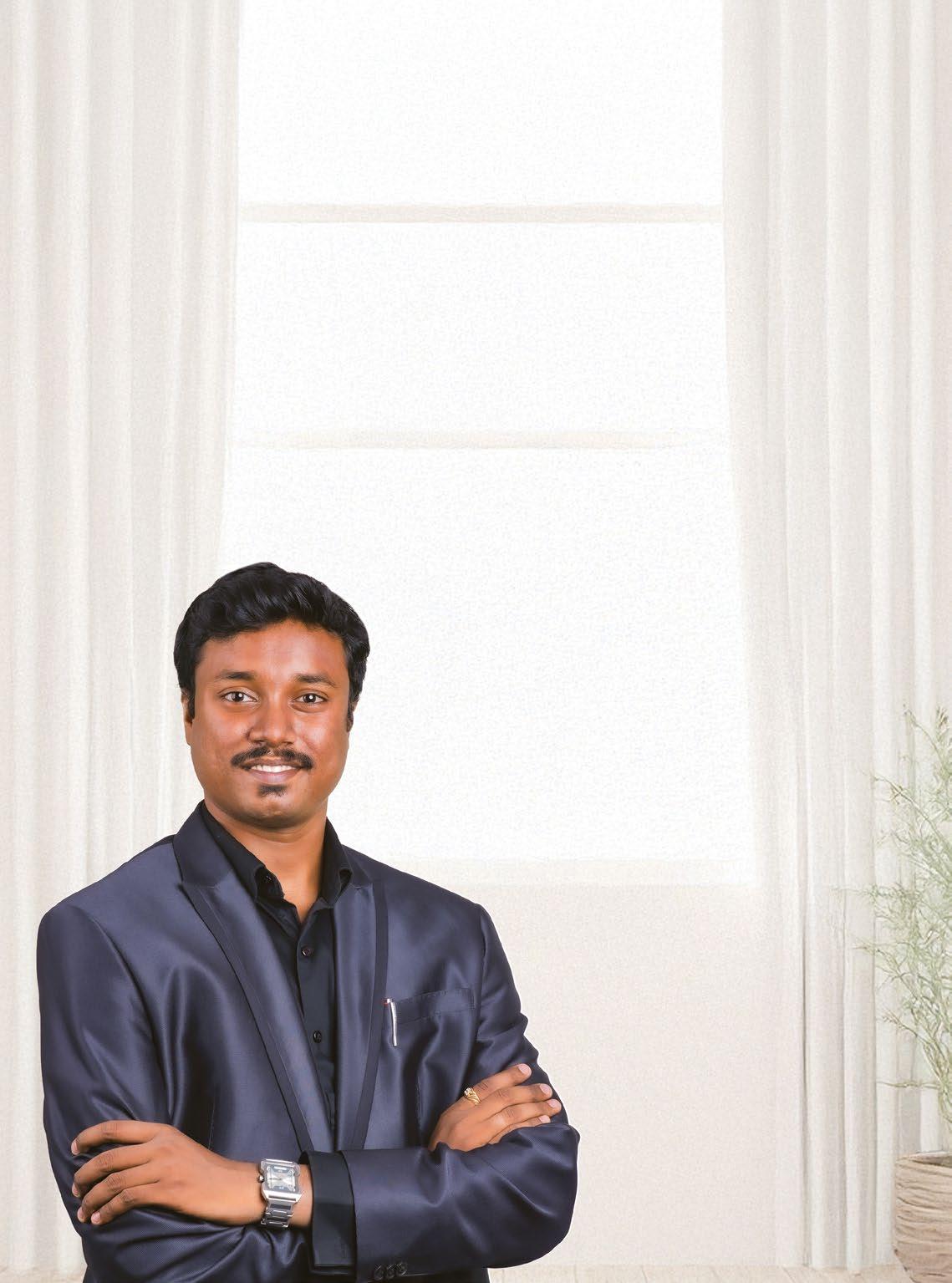
In a world where architecture is often reduced to numbers, materials, and deadlines, Ar. A. Aravind, Founder & Principal Architect of VEDHA Architects, sees something deeper. For him, architecture isn’t about following trends—it’s about creating spaces that speak to who you are.
Ar. A.Aravind’s belief is clear and inspiring: “Every person is unique, so their space should be too.” This simple truth has guided his journey—from studying at the National Institute of Technology, Calicut, trained in Mumbai with the worldrenowned Ar. Nuru Karim into building VEDHA Architects Group, a practice that now spans Kerala, Tamil Nadu, Karnataka, Telangana across India for the past 8+ years. But VEDHA is more than just a firm—it’s a vision brought to life through shared passion. Ar. Amrithavarshini ER, Creative Head of VEDHA Architects Group, brings creativity, uniqueness, life sensitivity and precision to every design, while Ruthira Kumar, Chief Innovation Officer, ensures that creativity and experimentation remain at the heart of the firm’s work, Ar. Aishwarya, who has grown with the firm’s humble roots, now leads Design Operations—shaping the future with passion, precision and dedication, a key force driving firms creative excellence. Ar. Vamshi Krishna heads Project Development with unwavering commitment in building turning concepts into exceptional spaces
with focus and care.
Together, they’ve built more than beautiful spaces—they’ve built experiences that reflect individuality, emotion, and purpose. At VEDHA, architecture becomes a journey of transforming intangible emotions into tangible experiences, crafting spaces that are as personal as they are timeless.
The Philosophy of Architecting Lives
The cornerstone of Ar. Aravind’s vision lies in a belief that architecture is not an exercise in construction but in human expression. He often describes his practice as “architecting lives,” a phrase that captures his deeper approach to design. For him, a home is not just a shelter but the stage on which love, memory, and identity take root. A resort is not merely a retreat but an experience of harmony with nature. A commercial space is not just a place of transaction but a statement of character. This approach has made Vedha Architects stand apart in a competitive field. Rather than producing designs that follow generic patterns, Ar. Aravind ensures that every project tells its own story. No two projects are ever the same, because no two lives are ever the same. In his view, architecture that fails to express individuality risks becoming irrelevant.
Fusing Tradition with Modernity
One of the most striking aspects of Ar. Aravind’s work is his ability to bring together elements that might
seem contradictory. He embraces traditional Indian principles such as Vastu and divine proportions, while also incorporating the latest innovations in material technology, sustainability, and climate-sensitive design.
In doing so, he creates spaces that feel both timeless and contemporary. A Vedha building may use cutting-edge construction techniques, yet its proportions echo the harmony of ancient temples. Its interiors may be luxurious, yet they are oriented to maximise natural light and airflow in ways that reduce dependence on artificial systems. For Ar. Aravind, tradition is not something to be preserved in a museum—it is a living knowledge system that can and must evolve with modern needs.
This philosophy reflects a larger truth about architecture itself. Throughout history, India’s built environment has been shaped by a blending of traditions—from temple architecture to Mughal palaces, colonial structures to post-independence modernism. Ar. Aravind sees himself as part of that continuum, contributing to a 21st-century vision where the past and the future can coexist in powerful dialogue.
Biophilia: The Signature of Connection
If there is one thread that runs through all of Ar. Aravind’s projects, it is biophilia—the human need to connect with nature. For him, nature is not a backdrop to design but its foundation. He believes that spac-
One of the most striking aspects of Ar. Aravind’s work is his ability to bring together elements that might seem contradictory. He embraces traditional Indian principles such as Vastu and divine proportions, while also incorporating the latest innovations in material technology, sustainability, and climate-sensitive design.
es should not separate us from the environment but bring us closer to it.
In practical terms, this means designing buildings with generous natural light, carefully calibrated ventilation, organic built forms, and materials that foster a healthier indoor environment. But beyond the technical, there is also a spiritual quality to his work. To step into a Vedha-designed home or resort is to feel an immediate sense of calm, as though the building itself is in dialogue with the trees, the wind, and the landscape around it.
Ar. Aravind describes this as creating “living, breathing ecosystems.” His buildings are not monuments to human ambition but sanctuaries where people and nature meet in quiet harmony. This biophilic approach does more than elevate aesthetic value; it enhances well-being, reminding us that architecture at its best does not dominate life but nurtures it.
From Vision to Timeless Spaces
At Vedha Architects, every project begins with a deep understanding of the client’s life, aspirations,
and future. Ar. Aravind believes that architecture is not merely about creating walls and roofs—it is about crafting experiences that endure through time. This philosophy comes alive in Vedha’s signature three-stage process, the Design Diagnosis Report (DDR).
The DDR is not just a design blueprint; it is a strategic roadmap. It starts with identifying what you need today, while also envisioning what your space must deliver after five or ten years. As Ar. Aravind often emphasises, “we cannot renovate every year, so we design for the future you aspire to live in.” By anticipating long-term needs, Vedha ensures that each structure remains relevant, functional, and inspiring for decades to come.
Once the vision is clear, the second stage—detailed architectural design—aligns every creative possibility with the client’s budget. Here, form and function meet financial practicality, ensuring that the design remains innovative without compromising feasibility. The final stage focuses on execution, where Vedha’s team guarantees timely delivery, pre-
mium quality, and a lifetime commitment to their work.
For Ar. Aravind, architecture is about translating intangible emotions into tangible spaces. A home or workspace should embody trust, comfort, and identity, reflecting not just a lifestyle but a philosophy of living. That is why Vedha Architects walks with clients every step of the way—from the spark of an idea to the final touch of execution—building not just structures, but legacies.
A Portfolio of Distinction
Each project carries the signature of Vedha’s multidisciplinary strength. While Ar. Aravind anchors the vision, Amrithavarshini ensures design finesse and contextual sensitivity, and Ruthira Kumar’s input in adopting advanced technologies and materials keeps the projects at the cutting edge. The result is a portfolio where no two projects are the same, yet all share a common thread of individuality and innovation. Among his most remarkable works is SIMTA Astrix, a 4,000 sq. ft. fenestrations and interior showroom that redefines how product display spaces can be both experiential
and functional. With its sleek design language and immersive interiors, the showroom goes beyond being a commercial space, offering visitors a sensory journey through form, light, and materiality.
Equally noteworthy is MJD Suites, a five-star luxury hotel in Vellarada, Thiruvananthapuram, with a capacity of 53 rooms. Here, Ar. Aravind demonstrates his ability to scale his vision—creating not just a hospitality project but a landmark destination. The hotel blends contemporary finesse with regional character, offering comfort and sophistication while staying deeply connected to its natural and cultural context.
In the residential segment, his creativity takes grand form in the Royal Mansion Residence, a sprawling 16,000 sq. ft. home that embodies luxury with soul. Designed as
much for living as for experiencing, the mansion balances opulence with warmth, making it a statement of refined taste without losing sight of intimacy and comfort.
On the commercial front, Vijaya Traders at Vytilla, Ernakulam, stands out as an interior products showroom that merges practicality with elegance. The space is designed to be both a retail hub and an architectural experience—inviting, dynamic, and inspiring for clients and designers alike.
Each of these projects, though different in scale and function, is united by Ar. Aravind’s unmistakable signature: spaces that do more than meet needs—they inspire, endure, and tell a story of their own.
The Challenge of Innovation
With every project being a
unique experiment, challenges are inevitable. For Ar. Aravind, the most pressing challenge lies in material innovation. He rarely repeats finishes or construction methods, constantly pushing his team to explore new possibilities. While this approach ensures originality, it also introduces complexity. Sourcing, testing, and applying new materials can extend timelines and increase costs.
Yet Ar. Aravind embraces these hurdles as part of the creative journey. He believes that true architecture cannot be achieved by playing safe. At the same time, he recognises that clients need reliability. To bridge this gap, he places strong emphasis on project management, clear communication, and defined responsibilities for all stakeholders. In his view, creativity without discipline
risks chaos, while discipline without creativity risks mediocrity. His leadership is about holding both in balance.
Sustainability as Responsibility
Ar. Aravind is deeply convinced that sustainability is no longer optional—it is the responsibility of every architect. He sees architecture not just as a reflection of lifestyle but as a force that shapes the planet’s future. This belief informs every aspect of Vedha’s practice, from solar integration and energy-efficient planning to the choice of materials and the layout of spaces.
His idea of sustainability is holistic. It is not just about green certifications or checklists but about designing spaces that are resilient, future-ready, and responsible. A Vedha home is built not only for comfort but for conscience. It reduces its footprint while enhancing the
quality of life for its occupants. In this way, Ar. Aravind places his work within a larger narrative—one that sees architecture as a moral duty as much as a professional craft.
The Man Behind the Vision
Despite his ambitious portfolio and growing recognition, Ar. Aravind remains a deeply grounded individual. Colleagues and clients describe him as someone who listens first and sketches later, who places dialogue above ego, and who is as much a collaborator as he is a creator.
Ar. Aravind is deeply convinced that sustainability is no longer optional — it is the responsibility of every architect. He sees architecture not just as a reflection of lifestyle but as a force that shapes the planet’s future.
His humility is matched by a quiet intensity. He approaches every project with an almost meditative focus, seeking not just to satisfy functional needs but to uncover the deeper aspirations of his clients. For him, architecture is an intimate process, one that requires trust, empathy, and patience. This is perhaps why his projects resonate so strongly with the people who inhabit them— they are not just designed but deeply understood.
Future of Indian Architecture
As India continues its rapid urbanisation, Ar. Aravind believes that architecture is entering a new era. This is not an age of choosing between tradition and modernity but one of integration. He envisions a future where architects push boundaries while also respecting roots, where cities grow taller but also greener, and where every building reflects not just economic growth but human well-being.
“Buildings are temporary,” he says. “But the lives lived within them—that’s where permanence lies.” It is a philosophy that redefines architecture from being a backdrop to being an active participant in human life. For Ar. Aravind, the true measure of success is not how long a structure stands, but how deeply it enriches the lives it shelters.
Architecting Futures
In a field crowded with blueprints and deadlines, Ar. Aravind stands out as a rare voice of purpose. His projects may differ in scale, style, and setting, but they share a common soul—a soul shaped by individuality, rooted in tradition, nourished by nature, and propelled by innovation
Palliative care is not about curing illness but about easing suffering and improving quality of life for those with serious or life-limiting conditions. It focuses on pain relief, symptom management, and holistic support — psychological, social and spiritual — delivered by teams of doctors, nurses, counsellors and social workers who treat patients and families with respect and compassion.
ALPHA PALLIATIVE CARE: KERALA’S COMMUNITY MODEL FOR INDIA’S AGEING FUTURE
A Quiet Revolution in Cancer and Elder Care
As India’s population continues to rise, the question of how we care for our cancer patients and elderly citizens has become one of the defining social challenges of our time. In Kerala, Alpha Palliative Care has built a community-led model of endof-life support that blends medical expertise with local compassion and participation.
Operating since 2005 and headquartered in Edamuttam, Thrissur, Alpha has grown into a movement sustained by committed doctors, volunteers, donors and civic groups — people who believe that dignity in dying deserves the same purpose and organisation that we apply to dignity in living.
It operates 26 palliative care link centres and one hospice in Kerala. The organisation has set its sights on nationwide expansion, aiming to extend services to several Indian states by 2030 and achieve full national coverage by 2040.
Rethinking Care at the End of Life
Palliative care is not about curing illness but about easing suffering and improving quality of life for those with serious or life-limiting conditions. It focuses on pain relief, symptom management, and holistic support — psychological, social and spiritual — delivered by teams of doctors, nurses, counsellors and social workers who treat patients and families with respect and compassion.
Once associated primarily with cancer, palliative care now addresses a wide range of chronic and terminal conditions, from organ failure and neurological disorders to the various ailments that accompany advancing age.
Practical Initiatives that Make a Difference
Punarjani is a physiotherapy programme that helps patients regain mobility after paralysis, strokes, cerebral palsy and other neurological disorders. Ojas is a van-based transport service that ensures continuity of therapy for patients who cannot travel. Alpha also runs a dialysis care programme, with over 2,000 dialysis sessions carried out every month for patients with kidney ailments.
The Alpha Hospice Project pro-
vides a round-the-clock facility offering compassionate, end-oflife support in a serene, dignified setting. Together, these initiatives illustrate how targeted services — when anchored in community ownership — can meet complex needs affordably and humanely.
An Ageing Nation’s Growing Challenge
India, with a population approaching 1.4 billion and a life expectancy nearing 69 years, is experiencing a demographic shift that will significantly increase demand for long-term, compassionate care. With an already large senior citizen population and a projected surge in the number of very elderly people by mid-century, families and health systems face mounting emotional and financial pressures.
Experts suggest that a large majority of palliative care beneficiaries will be older adults requiring continuous physical and emo-
tional support — an outcome that calls for both policy responses and community action.
Community Ownership:
The Heart of Alpha’s Vision
Alpha’s Community Ownership Model, refined over two decades, integrates home-based care, rehabilitation and essential services into a self-sustaining ecosystem driven by volunteers, local donors and civic groups. This grassroots approach reduces reliance on state infrastructure while fostering empathy, local accountability and resilience.
By opening its services to all — regardless of religion, caste or creed — Alpha demonstrates that inclusive care is both possible and practical when communities accept shared responsibility.
A Blueprint for India’s Future
The Alpha model offers impor-
tant lessons for policymakers and healthcare leaders: compassionate care can be cost-effective, community-anchored and scalable if supported by partnership and sensible planning.
Scaling the model nationwide will require collaboration between government, civil society and the private sector, but Kerala’s experience shows that the essential ingredients — organisation, empathy and local ownership — already exist in many parts of India.
Kerala’s example proves that community-driven healthcare can deliver humane, affordable and impactful outcomes. As Chief Patron of Alpha Palliative Care, I remain deeply grateful to every volunteer, caregiver and donor who has made this work possible. They remind us that when care is shared, healing goes beyond medicine and becomes an expression of our common humanity
Rajesh Nair Partner, Ernst & Young LLP
Sustainability thinking, much like Munger’s latticework of mental models, requires a multidisciplinary view. He urged leaders to “recognise that real-world problems don’t neatly lie within territorial boundaries” and that “a multidisciplinary attitude is required if maturity is to be effective”.
THINKING IN DECADES:
ESG AND THE ART OF
ENDURANCE
Sustainability and ESG (Environmental, Social, and Governance) are no longer optional doctrines or the “flavour of the month” fashionable topics. They now form the backbone of thoughtful business strategy—an imperative for long-term survival, ethical conduct, and resilience. As Charlie Munger once said, “It is remarkable how much long-term advantage we've gotten by trying to be consistently not stupid, instead of trying to be very intelligent”. That remark captures the essence of sustainable thinking: success depends not merely on brilliance but on discipline—doing what ensures endurance rather than chasing immediate gain.
The Long-Term Lens: Wisdom from Munger Munger believed deeply in patience and integrity as the cornerstones of business judgment. “The big money is not in the buying or the selling, but in the waiting”. His worldview aligns seamlessly with ESG philosophy, which is about “waiting right”—building businesses that appreciate slowly but stead-
ily through prudence, transparency, and fairness. By emphasising that “reputation and integrity are your most valuable assets—and can be lost in a heartbeat”, Munger calls out the moral dimension of enterprise. ESG-driven governance isn't a fad; it is reinforcement of this timeless truth that reputation is capital.
Sustainability thinking, much like Munger’s latticework of mental models, requires a multidisciplinary view. He urged leaders to “recognise that real-world problems don’t neatly lie within territorial boundaries” and that “a multidisciplinary attitude is required if maturity is to be effective”. Environmental responsibility, social equity, and sound governance are interconnected—not departmental checkboxes but systems dynamics. Businesses that address climate, community, and conduct holistically form antifragile institutions able to thrive amid complexity.
Decision-Making for a Future That Lasts: Kahneman’s Perspective
Daniel Kahneman’s behavioural insights remind us why ESG principles must be deliberately designed
into business systems. In his exploration of human decision-making, he revealed that most people rely on “System 1”—fast, intuitive thinking—that often leads to short-term fixes and bias. Sustainability requires “System 2”—slow, deliberate thinking—because it forces organizations to consider second- and third-order effects of actions.
Kahneman also warned about optimism bias: “Optimism is the engine of capitalism… but overcon-
fidence is a curse”. This cognitive distortion causes leaders to underestimate long-term risks—whether in environmental degradation or social backlash. ESG frameworks discipline that optimism by translating risk into measurable responsibility. They formalise what Kahneman called “effort commensurate with the importance of the decision” — injecting structured reflection into strategic thinking.
When companies embed sus-
tainability metrics, they counteract impulsive decision-making. They move from reactive responses to proactive stewardship—a shift from short bursts of growth to ongoing vitality. Kahneman’s philosophy of questioning decision processes— “spend some effort in figuring out why each decision did or did not pan out” —embodies what ESG reporting demands: not symbolic compliance but traceable learning from impacts.
Ray Dalio: Principles and Predictability
Ray Dalio’s worldview, articulated through Principles, is built on radical transparency, accountability, and systems thinking—exactly what ESG frameworks aim to institutionalize. “Don’t overweight first-order consequences relative to secondand third-order ones,” Dalio advised. Businesses that ignore long-term environmental or societal effects for near-term profit commit the same analytical fallacy Dalio warns against: mistaking immediate outcomes for sustainable results.
Dalio further observed that “for every mistake that you learn from, you will save thousands of similar mistakes in the future”. ESG is precisely this institutional learning codified. It helps corporations identify recurring patterns—resource depletion, governance weaknesses, supply chain inequities—and transform them into policies for resilience. He
taught that “doing big things well is more important than doing small things perfectly” —an ethical compass for ESG leadership, where the “big thing” is safeguarding planetary and societal systems.
Dalio’s insistence on facing reality, not wishful thinking, echoes sustainability’s pragmatic spirit. “Don’t confuse what you wish were true with what is really true”. ESG challenges corporate denial—forcing leaders to confront data on emissions, inequality, or labour violations rather than hiding behind quarterly reports. It institutionalises truthseeking.
Why ESG is the Foundation, Not a Fashion
When examined through the wisdom of these three thinkers, ESG is revealed as a philosophical progression rather than a managerial trend. Munger provides the moral discipline, Kahneman the cognitive humility, and Dalio the systemic rig-
our required to transition business from opportunistic to enduring.
Sustainability shifts businesses from extractive to regenerative logic. Traditional capitalism rewarded firms that maximised shareholder value by externalizing costs—polluting freely, squeezing labour, neglecting governance. Today’s markets, stakeholder expectations, and planetary limits redefine performance. A company that disregards carbon, community, and continuity forfeits its future cash flows; its “terminal value” literally declines. The ESG agenda brings deferred consequences onto today’s balance sheet.
Consider governance: Munger’s principle—“spend each day trying to be a little wiser than you were when you woke up” —underscores continuous improvement, not compliance. ESG governance frameworks like integrated reporting and ethical leadership development build exactly that culture of reflection.
Similarly, Kahneman’s reminder that decisions should be analysed post-outcome validates ESG’s disclosure standards, which measure not intentions but impact.
Social capital, often derided as soft, underpins long-term profitability. As Dalio noted, effective organizations are built by people “who work to be part of a mission, not just for a pay cheque”. ESG’s 'S'—the social component—fosters this purpose alignment. When employees feel ownership in a just, transparent mission, retention, innovation, and trust rise, creating flywheel effects Munger would classify as long-term compounding advantages.
ESG as Inversion Thinking
In Munger’s problem-solving vocabulary, “inversion” means asking, “what would cause failure?” and then avoiding it. The biggest risks to modern enterprise—climate collapse, social inequality, governance scandals—are ESG failures. Integrating ESG is thus the ultimate
inversion strategy: the avoidance of existential stupidity. It’s what Munger meant by “being consistently not stupid.”
Dalio, Kahneman, and Munger converge on one moral of modern capitalism: durability depends on self-awareness. Dalio’s radical transparency teaches institutions to chase truth until it’s uncomfortable. Kahneman asks them to combat optimism with evidence. Munger asks them to stay patient, ethical, and multi-disciplinary in their reasoning. ESG synthesises their philosophies into practice.
The Future of Responsible Capital
For business leaders today, the challenge is not why ESG matters—it’s how to internalise it so deeply that it becomes invisible, as natural as financial accounting. Sustainability needs no trophy language once it’s embedded in strategic DNA. Long-term investors already understand this; markets
increasingly discount short-term opportunists and reward governance maturity, ethical culture, and climate stewardship.
As Charlie Munger famously quipped, “To get what you want, deserve what you want”. ESG is about deserving success—earning legitimacy through balance, foresight, and fairness. Kahneman would remind us that intuition must yield to thoughtful design in complex systems; Dalio would insist that principles, not fashion, drive enduring outcomes.
Sustainability, therefore, is the intelligent course correction of capitalism—a reorientation from extraction to endurance, from shortsighted brilliance to compounded wisdom. It is less an ideology, more a return to reason, reflecting Munger’s quiet philosophy: that sound judgment, character, and patience will always outperform clever opportunism in the long arc of business history
Dr Arun Oommen MBBS, MS (Gen Surg), Mch (Neurosurgery), MRCS Ed (UK), MBA (Hospital administration), ENLS, DLitt(H), Phd(H), D Sc(H) Neuro Endoscopy Fellow Senior Consultant Neurosurgeon VPS Lakeshore Hospital Kochi, India.
Intermittent fasting (IF) is not a conventional diet; instead, it is a strategy for regulating the timing of your meals. The main emphasis of IF lies in when you consume food, rather than limiting particular foods or caloric intake.
DOES INTERMITTENT FASTING IMPROVE BRAIN POWER?
Intermittent fasting is a widely recognised dietary approach that alternates between fasting and eating periods and has been asserted to enhance weight loss, improve insulin sensitivity, reduce inflammation, promote longevity, and many more benefits. Research indicates it may also contribute to enhancing brain health and controlling or managing specific neurological disorders such as Alzheimer's disease, Parkinson's disease, stroke, and multiple sclerosis.
As a facility focussed on enhancing brain health and performance, The Brain & Performance Centre recognizes the significance of adequate nutrition and its direct impact on cognitive and physical capabilities. Implementing dietary modifications, such as intermittent fasting, supports brain health, encourages weight loss, and helps keep some specific illnesses under control.
There is considerable discus-
sion within the health and wellness community regarding the optimal diet for one's health. Given the multitude of conflicting viewpoints, determining whom to trust can be quite challenging. Fortunately, there exists an approach to eating that may assist in weight loss, enhance brain health, and potentially extend longevity, all without the need for stringent dietary limitations. Most importantly, it is not classified as a "diet" at all. This approach, referred to as intermittent fasting (IF), is rapidly gaining popularity, not only among dietary enthusiasts but also within the scientific community. Moreover, the relationship between intermittent fasting and brain health appears to become increasingly positive with each new study. Indeed, recent studies indicate that consistent intermittent fasting "can lead to structural and functional changes in the brain," which is an exceptionally encouraging result stemming from a
straightforward modification in our eating habits.
What is intermittent fasting?
Intermittent fasting (IF) is not a conventional diet; instead, it is a strategy for regulating the timing of your meals. The main emphasis of IF lies in when you consume food, rather than limiting particular foods or caloric intake. The concept is to enable the body to enter a fasting state for a designated period, which may offer numerous health advantages.
There Are Three Prevalent Methods of Intermittent Fasting:
Time-restricted eating: This method entails a specific timeframe during which you consume food as usual, followed by a fasting period. The most widely practiced approach is the 16/8 method, which allows for an 8-hour eating window and a 16-hour fasting period
(including the hours spent in sleeping). The consumption of any calories is believed to disrupt the fasting state. Variations such as 14/10 and 20/4 also exist.
Alternate-day fasting:
This technique involves alternating between days of normal eating and days where caloric intake is significantly reduced. Some individuals opt for a modified approach that permits approximately 500 calories, either consumed as a small meal or distributed throughout the day. 5:2 fasting:
Instead of alternating days, this method involves choosing 2 days each week to restrict caloric intake to approximately 500–800 calories per day.
What Effects Does Fasting Have On the Brain?
Intermittent fasting is highly beneficial for preserving brain health. Besides decelerating the ageing process, metabolic switching
enhances neuroplasticity within the brain. This improvement aids in optimising brain function and bolstering the brain’s resilience against injury and disease. Furthermore, intermittent fasting initiates a mechanism known as autophagy, which helps in controlling Alzheimer’s disease and Parkinson’s disease. Fasting can also eliminate brain fog and enhance mental clarity. Numerous individuals who practice fasting report experiencing clearer thoughts and elevated moods, which can positively influence the brain-gut connection and enhance overall happiness.
Fasting and Cognitive
Well-being:
Researchers have performed a relatively small number of clinical studies examining the impact of intermittent fasting on cognitive health. Nevertheless, extensive studies focused on religious fasting present promising findings regarding brain function in the context of ag-
ing and mental health issues. There is some evidence suggesting that intermittent fasting could enhance certain aspects of brain function as we age, particularly concerning mild cognitive impairment (MCI). MCI represents a stage preceding dementia and encompasses issues related to memory or cognitive processes, which are known to be reversible. The regular fasters experienced greater weight loss and enhancements in their metabolic profiles, along with differing social factors compared to the other participants, making it challenging to definitively attribute the improvements in brain function to any single factor. Nevertheless, researchers discovered that those who regularly fasted exhibited elevated levels of an enzyme potentially protective against cellular damage. Additionally, they showed increased levels of ketones, which serve as the energy source derived from fat reserves during fasting
periods.
Memory :
Studies conducted with rodents have demonstrated that intermittent fasting enhances the capacity of these animals to generate new brain cells, a phenomenon referred to as hippocampal neurogenesis. This process plays a crucial role in various aspects of memory, prompting scientists to extend their research to human subjects. In a small-scale study, volunteers aged between 35 and 75 who were overweight followed either an intermittent fasting regimen or a traditional calorie-restricted diet for a period of 4 weeks. The results showed enhancements in both groups concerning a cognitive function referred to as pattern separation, which assists the brain in distinguishing between similar memories. However, regarding recognition memory, participants in the intermittent fasting group demonstrated a decrease in their abilities after the study. The researchers concluded that a reduction in caloric intake might improve memory types related to hippocampal neurogenesis. Nevertheless, there was no evidence suggesting that this improvement was associated with the
specific mechanisms of intermittent fasting.
Enhanced Production of Brain-Derived Neurotrophic Factor (BDNF):
BDNF is a protein that aids in the survival of existing neurons and stimulates the formation of new neurons and synapses. Engaging in fasting can elevate BDNF levels, potentially resulting in enhanced cognitive abilities, learning, and memory.
Decreased Inflammation:
Intermittent fasting may assist in reducing inflammation throughout the body, including within the brain. Persistent inflammation has been associated with numerous neurological conditions, such as Alzheimer's disease, Parkinson's disease, and multiple sclerosis. By mitigating inflammation, intermittent fasting could diminish the likelihood of developing these conditions.
Autophagy:
During fasting intervals, cells experience a process known as autophagy, which entails the elimination and recycling of damaged cellular elements. This mechanism is crucial for sustaining optimal cellular function and may offer protec-
tion to the brain against age-related decline and neurodegenerative disorders.
Enhanced Metabolic Health:
Intermittent fasting can lead to improved insulin sensitivity and a decreased risk of type 2 diabetes. Given that diabetes and insulin resistance are correlated with an increased risk of neurodegenerative diseases, preserving good metabolic health can be advantageous for brain wellness.
Increased Resilience to Stress:
Intermittent fasting may bolster the brain's ability to withstand various stressors, including oxidative stress and inflammation. This enhancement could potentially lower the risk of developing brain-related disorders and foster overall brain health.
Possible Stimulation of Neurogenesis:
Some research indicates that intermittent fasting might encourage the development of new neurons in the hippocampus, a brain area linked to learning and memory. This effect could lead to improved cognitive performance and a decreased risk of neurodegenerative diseases. It is important to remember that although intermittent fasting may provide health advantages for numerous individuals, it might not be appropriate or beneficial for everyone. Certain demographics should approach intermittent fasting with caution or refrain from it entirely: pregnant or nursing women, individuals with a history of eating disorders, those with high diabetes or blood sugar concerns, severe migraine, children and teenagers, underweight persons or those suffering from malnutrition, individuals with specific medical conditions such as hypoglycemia, kidney disease, or liver disease, as well as athletes or those engaged in high levels of physical activity
MANAPPURAM UNIQUE TIMES
BUSINESS EXCELLENCY AWARD 2025:
CELEBRATING INNOVATION AND LEADERSHIP
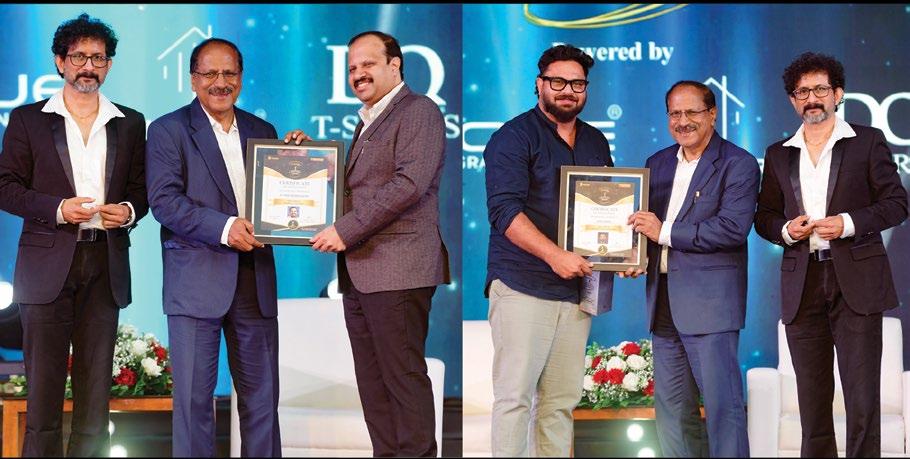
The Manappuram Unique Times Business Excellency Award 2025, held on November 4th, became a grand celebration of India’s entrepreneurial spirit — a night dedicated to honouring leaders whose vision and innovation continue to shape the nation’s economic future.
Organised by Pegasus Global Pvt Ltd under the leadership of Dr. Ajit Ravi, the event brought together dynamic entrepreneurs, thought leaders, and changemakers who exemplify the essence of excellence through their achievements and leadership journeys.
The ceremony was graced by V P Nandakumar, Chairman and Managing Director of Manappuram Finance Ltd, alongside Dr. Ajit Ravi, Chairman of Pegasus Global Pvt Ltd. Together, they presented the prestigious honours to individuals who have not only achieved remarkable business success but have also set new benchmarks for ethical and sustainable leadership.
Among the standout awardees was John Alukkas, Managing Director of Jos Alukkas Group, who received the Excellence in Business Vision & Expansion Award. Recognised for his exceptional foresight and commitment to growth, John Alukkas has been instrumental in steering Jos Alukkas into one of India’s most trusted and admired jewellery brands. His strategic acumen and ability to balance tradition with innovation have made him a defining figure in India’s retail sector.
The Excellence in Financial Leadership Award was presented to CA Vivek Krishna Govind, Senior Partner at Varma & Varma, for his outstanding contributions to financial governance and management. A respected name in the financial world, he has been a guiding force in shaping best practices, emphasising transparency, and fostering responsible leadership within the corporate ecosystem.
Each awardee’s journey reflected the enduring values that define
the Unique Times Business Excellency Awards — innovation, integrity, and impact. The platform continues to recognise individuals who go beyond profit to create meaningful change, uplift industries, and inspire others through purpose-driven leadership.
Beyond the glamour and recognition, the evening resonated with stories of resilience and reinvention. It celebrated entrepreneurs who saw opportunity in challenge, and leaders who translated ideas into tangible impact. The event reaffirmed that excellence is not merely an achievement, but a way of thinking — a constant pursuit of improvement, creativity, and purpose.
As the evening drew to a close, one message echoed across the hall: success is most meaningful when it inspires others. The Manappuram Unique Times Business Excellency Award 2025 stood as a testament to that truth — celebrating those who build, innovate, and lead with heart and vision
Manappuram Unique Times
Conclave 2025: Shaping the Future of a Cashless India
The Manappuram Unique Times Conclave 2025 turned the spotlight on the digital future of India’s economy, bringing together some of the sharpest minds in finance and technology. The event explored one of the most crucial topics of our time — the evolution of digital banking and taxation in a rapidly advancing cashless economy.
Organised by Pegasus Global Pvt Ltd under the visionary leadership of Dr. Ajit Ravi, the conclave stood out as a platform where knowledge met innovation. It wasn’t just a discussion — it was a deep dive into how technology, finance, and policy can collectively shape a smarter, safer, and more inclusive digital economy.
A
Power-Packed
Panel of Industry Leaders
The event featured a stellar lineup of speakers representing the pulse of India’s financial transformation. The panel included:
• V P Nandakumar, Chairman and Managing Director of Manappuram Finance Ltd
• Hari Velloor, Executive Vice President, ESAF Bank
• Keshav Mishra, CEO and CoFounder, 8byte AI
• Bobby Thomas Varghese, As-
sociate Director, EY Global Delivery Services
• Nikhil K G, CEO, Pentad Securities
The session was moderated by CA Vivek Krishna Govind, Senior Partner at Varma & Varma, who skillfully steered the dialogue, ensuring a dynamic exchange of ideas and perspectives.
Decoding a Digital Financial Future
The session explored the dynamic changes shaping the future of finance — from the rise of cashless transactions to the impact of fintech innovation and evolving taxation models. Experts emphasised how digital banking is driving financial inclusion, increasing transparency, and creating more efficient systems for individuals and enterprises alike.
The discussion also shed light on how India’s growing digital economy is setting new global standards in the adoption of secure and scalable financial technologies. As more citizens and businesses embrace digital transactions, the focus remains on building trust, safety, and simplicity in every interaction.
The Future of Taxation in a Cashless World
One of the most engaging parts of the session revolved around the
implications of cashless transactions on taxation. The panellists agreed that as the economy digitises, tax compliance becomes more efficient, transparent, and data-driven.
They also discussed how emerging technologies like blockchain can further strengthen the tax ecosystem by reducing loopholes and ensuring accuracy in financial reporting. Automation and digital records, they noted, are making taxation more predictable and less burdensome for both individuals and enterprises.
Shaping Tomorrow’s Economy
The Manappuram Unique Times Conclave 2025 wrapped up on an inspiring note, reaffirming its role as a catalyst for conversations that matter. By decoding the intersections of digital finance and taxation, the event once again proved why it remains a thought leader’s hub for those who envision the future of India’s economy.
As the curtains came down, one thing was clear — the dialogue initiated at the conclave will continue to ripple through boardrooms, policymaking circles, and digital platforms, driving India closer to becoming a truly cashless, connected, and empowered economy
Ravi Saini Associate Editor, Unique Times & CEO, RSW (Resetting Sustainable Wealth) Group
India is dotted with sacred sites that resonate with centuries of devotion. Spiritual tourism often takes the form of pilgrimages to these holy places, each offering a unique energy and insight.
India: The Ancient Cradle of Wellness and Spiritual Tourism
India, a land steeped in ancient wisdom, diverse spiritual traditions, and breath-taking natural beauty, has long been a beacon for seekers of holistic well-being. In recent years, this intrinsic appeal has blossomed into a thriving sector of wellness and spiritual tourism, drawing millions from across the globe in search of rejuvenation, inner peace, and profound cultural immersion.
The Roots of Wellness: Ayurveda and Yoga
At the heart of India's wellness tourism lies its unparalleled legacy of Ayurveda and Yoga. Ayurveda, the "science of life," is a 5,000-yearold system of natural healing that emphasises a holistic approach to health, balancing mind, body, and spirit. Travellers flock to Ayurvedic centres, particularly in Kerala, Goa, and the foothills of the Himalayas, to experience Panchakarma detoxification, personalised dietary regi-
mens, and therapeutic massages that promise to restore balance and equilibrium.
Yoga, born here millennia ago, is more than just physical postures; it's a comprehensive philosophy for harmonious living. From the serene ashrams of Rishikesh, the "Yoga Capital of the World," to countless studios across major cities, visitors can delve into various forms of Yoga, meditation, and Pranayama (breathing exercises). These practices offer not only physical benefits but also a pathway to mental clarity and spiritual awakening.
Spiritual Journeys: Pilgrimage and introspection
India is dotted with sacred sites that resonate with centuries of devotion. Spiritual tourism often takes the form of pilgrimages to these holy places, each offering a unique energy and insight.
• Himalayan Sanctuaries: The majestic Himalayas are home
to revered destinations like Badrinath, Kedarnath, Gangotri, and Yamunotri (the Char Dham), as well as the serene Buddhist monasteries of Ladakh and Sikkim. These journeys are as much about the challenging trek and awe-inspiring landscapes as they are about connecting with the divine.
• Varanasi (Kashi): One of the oldest continuously inhabited cities in the world, Varanasi, on the banks of the Ganga, is considered the spiritual heart of India. A boat ride at dawn, witnessing ancient rituals along the ghats, and exploring its labyrinthine alleys offer a profound glimpse into Hindu spirituality, life, and death.
• Buddhist Circuits: For followers of Buddhism, sites like Bodh Gaya (where Buddha attained enlightenment), Sarnath (where he gave his first sermon), and Kushinagar (where he passed away) form a powerful circuit that retraces the
footsteps of the enlightened one.
• Sufi Shrines and Sikh Gurdwaras: The Dargah of Ajmer Sharif and the Golden Temple in Amritsar exemplify India's pluralistic spiritual fabric, welcoming people of all faiths to experience their unique reverence and community spirit.
Beyond the Traditional: Emerging Trends
The wellness and spiritual tourism sector in India is continually evolving:
• Luxury Wellness Retreats: High-end resorts are increasingly integrating Ayurvedic treatments, Yoga, meditation, and healthy cuisine into luxurious packages, catering to a clientele seeking comfort alongside their quest for well-being.
• Mindfulness and Digital Detox: Recognising the stresses of modern life, many retreats now offer programs focused on mindfulness, stress reduction, and digital detox, encouraging participants to disconnect to reconnect.
• Adventure and Wellness:
Combining activities like trekking, nature walks, and white-water rafting with wellness practices provides a dynamic approach to rejuvenation.
• Culinary Wellness: Emphasis on sattvic (pure, wholesome) food, organic ingredients, and traditional Indian diets is becoming a significant draw.
Building a high-speed Bullet Train route directly connecting Kedarnath Dham to the Rameswaram Temple in Tamil Nadu will help further unite India. This visionary connectivity will attract both local and international tourists, promoting wellness, spiritual, and temple tourism. Ultimately, it will play a significant role in boosting India’s economy and strengthening cultural bonds across the nation.
The approximate straight-line distance between Kedarnath and Rameshwaram is about 2,383 km. The road distance is significantly greater at 3,173 km. The journey involves complex travel arrangements, often by a combination
of flights, cabs, and buses, taking around 19-22 hours to complete. With the introduction of the Bullet Train on this route, it should reduce the travel time to a maximum of seven hours.
The Transformative Experience
What sets wellness and spiritual tourism in India apart is its potential for deep personal transformation. It's an invitation to step away from the everyday, to immerse oneself in ancient traditions, to quiet the mind amidst serene landscapes, and to confront profound questions of existence. Whether through a rigorous Ashtanga Yoga program, a silent meditation retreat, or a vibrant pilgrimage, visitors often leave India not just refreshed, but profoundly changed, carrying a piece of its timeless wisdom within them.
As the world increasingly seeks meaning and balance, India continues to open its arms, offering an authentic and enriching journey into the self
Adv Sherry Samuel Oommen: This article is authored by Adv Sherry Samuel Oommen. He specialises in the Constitution, tax and corporate laws and has also cleared the final exams of the Institute of Chartered Accountants of India, the Institute of Cost Accountants of India and the Institute of Company Secretaries of India. He has also completed his Masters's Degree in Commerce, apart from obtaining a Post Graduate Diploma in Business and Corporate Laws from Symbiosis, Pune. The views expressly are personal and should not be construed as a legal opinion. sherryoommen@nashcp.com.
THE JURISDICTIONAL DEMARCATION FOR ARBITRATOR'S MANDATE EXTENSION: A CONFLUENCE OF JUDICIAL PRONOUNCEMENTS
I. Introduction
The Arbitration and Conciliation Act, 1996 (hereinafter referred to as "the Act"), stands as a pivotal legislative framework designed to foster expeditious and efficient dispute resolution in India. A cornerstone of this framework is the principle of minimal judicial intervention, ensuring that arbitral proceedings progress with autonomy and finality. However, the intricate interplay of various provisions within the Act has, at times, led to jurisdictional ambiguities, particularly concerning the appropriate forum for certain applications. One such critical area of contention has been the jurisdiction for extending the mandate of an arbitral tribunal under Section 29A of the Act. This
article delves into two significant judicial pronouncements of the Supreme Court's definitive ruling in Urban Infrastructure Real Estate Fund v. Neeklanth Realty Private Limited, 2025 INSC 1255 and the subsequent elucidatory judgment of the Kerala High Court in Offshore Infrastructures Limited v. Bharat Petroleum Corp. Ltd. Kochi Refinery, 2025 KHC 1119 and to meticulously analyse their holdings, legal reasoning, and the resultant clarification of jurisdictional boundaries. These judgments collectively underscore the imperative of adhering to the precise statutory definitions and the limited role of appointing courts post-arbitrator appointment.
II. Issue in Hand: The Juris-
dictional Conundrum of Section 29A Extensions
Section 29A of the Act, introduced by the 2015 Amendment, mandates a strict time limit for the completion of arbitral proceedings and the pronouncement of an award. While sub-section (1) prescribes a twelve-month period (extendable by six months with parties' consent), sub-section (4) empowers the "Court" to extend this period. Crucially, sub-section (6) further vests the "Court" with the power to substitute the arbitrator(s) while granting such an extension. The central legal issue that emerged, and which these judgments address, is: Whether an application for extension of an arbitrator's man-
Section 29A of the Act, introduced by the 2015 Amendment, mandates a strict time limit for the completion of arbitral proceedings and the pronouncement of an award. While sub-section (1) prescribes a twelve-month period (extendable by six months with parties' consent), sub-section (4) empowers the "Court" to extend this period.
date under Section 29A of the Act should be filed before the "Court" as defined in Section 2(1)(e) of the Act, or before the High Court or Supreme Court that initially appointed the arbitrator under Section 11 of the Act.
This question arose from the inherent tension between the High Court's or Supreme Court's power to appoint an arbitrator and the specific definition of "Court" for other applications under Part I of the Act. Previous interpretations, such as that in M/s. Lots Shipping Company Ltd. v. Cochin Port Trust Board of Trustees, 2020 (2) KHC 595, had suggested that the appointing High Court might retain jurisdiction based on principles of hierarchy or seisin. However, the recent pronouncements have decisively settled this jurisdictional ambiguity, reinforcing the statutory scheme of the Act. III. Contentions
The jurisdictional debate surrounding Section 29A applications typically involved two primary contentions:
• Argument for Appointing Court's Jurisdiction: It was contended that since the High Court or the Supreme Court had initially exercised its power under Section 11 to appoint the arbitrator, it retained a supervisory role or seisin over the arbitral proceedings. Therefore, any application for extension of the arbitrator's mandate, being a continuation of the arbitral process, should logically be made before the same appointing court. This argument often invoked the principle of "hierarchy of courts" or the notion that the appointing court would be best placed to assess the need for an extension.
• Argument for Section 2(1) (e) "Court" Jurisdiction: Conversely, it was argued that the Act provides an exhaustive definition of
"Court" in Section 2(1)(e) for most applications under Part I. Section 29A(4) and (6) explicitly refer to the "Court" for granting extensions and substituting arbitrators. Given the specific statutory language and the comprehensive nature of the definition, the power to extend the mandate, including the consequential power of substitution, must vest exclusively in the "Court" as defined in Section 2(1)(e), and not in the High Court or Supreme Court acting under Section 11. This argument emphasized strict adherence to the statutory text and the limited, specific role of the appointing courts.
IV. Legal Reasoning of the Courts
A. Supreme Court Judgment: Urban Infrastructure Real Estate Fund v. Neeklanth Realty Private Limited, 2025 INSC 1255
1. A preliminary issue on limitation decided on demurrer cannot be
permanently foreclosed
• A decision on demurrer is based solely on the averments in the plaint/statement of claim and assumes the facts alleged are true only for that preliminary stage.
• It does not prevent the issue from being re-examined with evidence in subsequent proceedings, especially when it involves mixed questions of law and fact like limitation.
2. Party autonomy under Section 19(2) of the Arbitration Act is not absolute
• The phrase “Subject to this Part” in Section 19(2) means that party autonomy is subject to the mandatory provisions of Part I of the Arbitration Act, including Section 43, which makes the Limitation Act, 1963 applicable to arbitrations.
• Parties cannot agree to a procedure that violates Section 3 of the Limitation Act, which mandates that a court or tribunal must dismiss time-barred claims.
3. An interim award that finally decides limitation on demurrer is liable to be set aside under Section 34
• The arbitrator’s decision to treat the demurrer-based ruling on limitation as final and binding was
contrary to the basic notions of justice and shocked the conscience of the court.
• The issue of limitation must be open to re-examination based on evidence, if warranted.
4. Principles of Order VII Rule 11(d) CPC apply to demurrer in Indian jurisprudence
• A demurrer in India is akin to an application for rejection of plaint under Order VII Rule 11(d) CPC.
• If the issue involves mixed questions of law and fact, the adjudication must be deferred to trial and cannot be decided at the threshold.
5. Partial setting aside of an award under Section 34 is permissible
• The court can sever and set aside only the offending part of an award if it is separable from the rest, without affecting the valid portions.
B. Kerala High Court Judgment: Offshore Infrastructures Limited v. Bharat Petroleum Corp. Ltd. Kochi Refinery, 2025 KHC OnLine 1119
The Division Bench of the Kerala High Court, in Offshore Infrastructures Limited, meticulously followed and applied the principles laid down by the Supreme Court in Chief En-
(NH).
1. Adherence to Supreme Court Precedent: The Kerala High Court explicitly acknowledged and relied upon the Supreme Court's definitive pronouncement, recognizing its binding nature.
2. Exclusive Jurisdiction of Section 2(1)(e) "Court": In alignment with the Supreme Court, the Division Bench held that applications for extension of an arbitrator's mandate under Section 29A must be granted by the "Court" as defined in Section 2(1)(e) of the Act. It unequivocally stated that the High Court, even if it had appointed the arbitrator under Section 11, does not possess the jurisdiction to entertain such applications.
3. Overruling of Previous Judgment: Significantly, the Kerala High Court expressly held that its earlier Division Bench judgment in M/s. Lots Shipping Company Ltd. v. Cochin Port Trust Board of Trustees, which had taken a contrary view, was no longer good law. This was a direct consequence of the Supreme Court's clarification, which rendered the reasoning in Lots Shipping (based on the "hierarchy of Courts" principle for mandate extensions by
gineer
the appointing High Court) untenable.
4. Emphasis on Statutory Scheme: The judgment reinforced the importance of adhering to the precise statutory scheme of the Act, emphasizing that the specific language of Section 29A, read in conjunction with the exhaustive definition of "Court" in Section 2(1)(e), leaves no room for ambiguity regarding the jurisdictional forum.
V. Inferences
The Supreme Court's judgment in Urban Infrastructure Real Estate Fund is a robust recalibration of arbitration law. It serves as a critical reminder that the pursuit of efficiency and procedural flexibility in arbitration cannot override foundational principles of substantive justice.
1. Demurrer is Not a Shortcut to Finality: In India, a decision on demurrer on a mixed question of law and fact is a preliminary screening mechanism, not a final adjudication. It does not preclude a full evidential examination later.
2. Party Autonomy Has Red Lines: The doctrine of party autonomy, though central to arbitration, is subservient to mandatory
statutes and fundamental policy. Parties cannot, by agreement, require an arbitrator to ignore the mandate of the Limitation Act.
3.Limitation is a Cornerstone of Justice: The Court reinforced that limitation is not a mere technicality but a substantive right that protects parties from stale claims. Any procedure that undermines a proper and conscientious determination of this issue is fundamentally flawed
VI. Conclusion
The judicial pronouncements in Urban Infrastructure Real Estate Fund v. Neeklanth Realty Private Limited, 2025 INSC 1255 by the Supreme Court and Offshore Infrastructures Limited v. Bharat Petroleum Corp. Ltd. Kochi Refinery by the Kerala High Court have brought much-needed clarity to a critical jurisdictional aspect of the Arbitration and Conciliation Act, 1996. The High Courts judgment definitively establish that the power to extend an arbitrator's mandate under Section 29A lies exclusively with the "Court" as defined in Section 2(1)(e) of the Act. The High Court or the Supreme Court, having appointed the arbitrator under Section 11, does not retain juris-
diction for such extensions.
This clarification is vital for ensuring jurisdictional certainty, streamlining arbitral processes, and upholding the legislative intent of minimal judicial intervention. By strictly interpreting the statutory definitions and distinguishing the specific roles of various judicial forums, the courts have reinforced the autonomy of the arbitral process and provided a clear roadmap for parties seeking extensions of arbitral mandates. The consistent emphasis on the exhaustive nature of the "Court" definition and the limited, specific functions of appointing courts strengthens the institutional framework of arbitration in India, promoting efficiency and predictability in dispute resolution.
The Supreme Court’s judgement ensures that the arbitral process remains a credible and just mode of dispute resolution, where speed and party choice are balanced against the unyielding pillars of fairness and the rule of law. It empowers tribunals to insist on proper procedure where necessary and reassures parties that their core statutory rights cannot be contractually waived away in the name of autonomy
CA Sreejith Kuniyil Founder, PravasiTax Solutions Pvt Ltd
The Death Certificate is the foundational document for all subsequent legal and financial procedures. It must be obtained from the municipal authority or hospital within 21 days of the person’s death.
CLAIMING YOUR LOVED ONE’S PROPERTY AFTER THEIR DEMISE
The days following the loss of a loved one are often filled with grief and confusion. Yet, amid that emotional storm, families are also faced with immediate practical questionsWhat are the next formalities? Who gets what? How do we access the accounts?
Imagine a young spouse loses their partner unexpectedly, with a small child and an elderly parent to care for. There is no Will. What follows is a procedural and emotional ordeal one that many families in India experience in the absence of proper estate planning.
In this article, we explain the steps the surviving family members need to take to claim the assets and property of a deceased loved one.
1. Obtain Death Certificate
The Death Certificate is the foundational document for all subsequent legal and financial procedures. It must be obtained from the municipal authority or hospital within 21 days of the person’s death. This certificate is required for
closing or transferring bank accounts, claiming insurance proceeds, initiating succession proceedings, and transferring property.
2. Secure Legal Heirship Certificate
Next, the family should obtain a Legal Heirship Certificate from the Tehsildar or Revenue Divisional Officer.
This certificate identifies the lawful heirs, typically the spouse, children, and parents in accordance with the applicable personal law. This certificate is essential for claiming deposits, pension benefits, and initiating property transfers. The time period to process takes around 10 to 30 days depending on jurisdiction and completeness of documents.
3. Collect All Asset and Liability Records
Once basic documents are in place, the family must compile a comprehensive inventory of the deceased person’s assets and debts. This should include all bank accounts, lockers, and deposits, prop-
erty ownership documents and registration records, insurance policies and retirement benefits including all the outstanding loans, tax dues, and credit liabilities
The next steps to be taken would depend on whether the deceased individual has left a Will or not. WHERE THERE IS NO WILL
4. Applying for Letter of Administration
If no Will exists, the lawful heirs must apply to the competent District Court for Letters of Administration under the Indian Succession Act, 1925. The Letter of Administration is a formal document that authorises heirs to collect and distribute the estate of the deceased.
To obtain Letter of Administration, you have to submit the following documents:
i. Death certificate
ii. Legal heirship certificate (along with marriage and birth proofs)
iii. A complete list of assets and liabilities
iv. An affidavit confirming no Will
exists.
The legal heirs can access the deceased person’s accounts or transfer property in their names only after the court verifies the claim and issues the Letter of Administration. Before any distribution, all the outstanding debts, bank loans, credit cards, taxes, and bills etc. must be settled by the legal heirs. The estate can only be divided after liabilities are cleared.
5. Distribution of Assets
When there is no Will, property is divided strictly as per the succession law applicable to the deceased person’s religion. The law decides who inherits, and in what proportion. Here, the deceased person’s wishes or what the family considers “fair” cannot change that outcome.
• If the deceased person were a male Hindu, Jain, Sikh or Buddhist, the Hindu Succession Act, 1956, would apply where the wife, children, and mother would inherit equally.
• If the deceased were a Muslim, the Muslim Personal Law
(Shariat) Application Act, 1937 would apply, which sets fixed shares. For example, upon the death of the father in a Muslim family with only one daughter, the wife gets 12.5%, the daughter 50%, and mother 16.67%, with the rest going to other male and female relatives. If there are two daughters, their share would be 66.67%.
If there were a son and a daughter, the son would receive double the share of the daughter. In such cases, the wife and daughter together may receive only around 40 - 45% of the total estate, while the rest goes to other relatives.
• If the deceased were a Christian or Parsi, the Indian Succession Act, 1925 applies, where the spouse inherits 1/3rd of the property and children inherit the balance in equal proportion.
In every community, the practical impact of dying intestate is the same, heirs must run from one office to another for certificates and legal documents. The estate remains frozen until the court’s permission is
obtained and family members who are unprepared and grieving face confusion and disputes. In addition to all of this, where succession law prescribes unequal shares, widows and daughters often find themselves financially insecure.
WHERE THERE IS A WILL
When a valid and properly executed Will exists, the settlement of the properties of the deceased follows a legally structured process. The key steps are as follows:
4. Locate the Original Will
The first step is to identify and secure the original Will. It may be kept in the deceased person’s personal locker, safe deposit box, or with the succession planning consultant. The original Will must be located as only the original document can be submitted for probate; copies are not accepted by the Court.
5. Identify the Executor
The Executor named in the Will assumes primary responsibility for managing and distributing the assets of the deceased. The Executor acts in a fiduciary capacity and must
ensure that the deceased person’s wishes are executed in accordance with law.
6. Filing for Probate
The Executor must file a Petition for Probate before the competent District Court having jurisdiction over the deceased’s last residence or where the assets are located. The petition should be accompanied by:
• The original Will;
• Death certificate of the deceased; and
• Identity and address proofs of the Executor and legal heirs.
The Court examines the Will’s authenticity, the testator’s capacity, and compliance with formalities such as attestation under Section 63 of the Indian Succession Act, 1925. Once satisfied, the Court issues a Probate Certificate.
The approximate time to get probate from the court in India generally ranges from 6 months to 2 years. If the Will is simple and uncontested, it takes around 6 to 12 months but in case of complex cases or those with disputes, it could take 1 to 2 years or more.
7. Administration and Distribution of Assets
The Probate Certificate grants the Executor legal authority to access and operate the deceased per-
son’s bank accounts, also to transfer immovable and movable assets. It also enables him to pay taxes, debts, and other liabilities, and distribute the estate in accordance with the terms of the Will.
The same principles apply across religions: when a valid Will exists, courts respect the deceased’s written instructions. Probate gives the executor authority; the process, though formal, prevents disputes.
How would this have been different if there was a Private Family Trust?
Creating private trust during one’s lifetime makes things even simpler.
In a trust, the property owner (referred to as Settlor) transfers assets to Trustees to manage the property for the benefit of family members (referred to as Beneficiaries). Upon death, there is no requirement for probate or Court interference. The Trustees continue managing and distributing assets according to the Trust Deed.
For example, if the deceased had created a private family trust:
i. The Trustees could instantly access funds for the beneficiaries mentioned in the Trust Deed.
ii. Minors or dependents would have continued financial
support without legal delay.
iii. There would be no public court process or contestation.
iv. The Trust could ensure assets are managed until the daughter’s adulthood or marriage.
A Will passes ownership; a trust ensures continuity. Together, they provide complete protection - the Will covers what remains outside the Trust, and the Trust safeguards ongoing family needs.
Leave Behind a Legacy of Responsibility
Estate planning is not a matter of wealth but of responsibility. It ensures that one’s intentions are honoured, dependents are safeguarded, and property transitions lawfully and efficiently. The measure of one’s legacy lies not just in wealth, but in foresight. A carefully drafted Will or Trust ensures that property passes smoothly, without confusion or conflict. For those without a Will, the law provides a framework but not necessarily one that reflects personal wishes.
As recognised in V.V. Chandrasekharan v. V.V. Indira and longstanding legal principles, “a will speaks from the death of the testator”. Estate planning is thus not about anticipating death but about respecting one’s own life and those of the generations to come
Rajiv Ambat is a well-known speaker and the author of the best-selling book ‘The Midriff Crisis’. As a lifestyle expert, Rajiv leads the team at SOLVEMyHealth, which includes experienced dieticians, exercise specialists, and medical doctors. Together, they help clients manage a wide range of health concerns through structured, scientific, and personalised lifestyle interventions. The team specialises in treating and managing lifestyle-related conditions such as obesity, diabetes, high cholesterol, fatty liver, and PCOS through customised diet and exercise plans tailored to each individual’s needs.
FIBRE: THE FORGOTTEN NUTRIENT IN THE MODERN KERALA DIET
Fiber is one of the most ignored nutrients in our diet, yet its absence shows up in many of the lifestyle problems we see today. In Kerala, our love for porotta and beef curry is almost cultural - and I’ll admit, I enjoy it just like any other Malayalee. Most of us know that maida is devoid of any fibre; there’s nothing wrong with having your favorite porotta once in a while, but the key to staying healthy is knowing where to draw the line and how to balance our meals so that we can enjoy our favourite foods without harming our health. The problem is that most of us eat porotta, white rice, and fried food far more often than vegetables, pulses, or whole grains. I have noticed that many of our clients take just two or three tablespoons of vegetable thoran or sabji on the side instead of a full bowl of it in their meals. This low fibre intake, combined with prolonged sitting and poor hydration, is one of the main reasons why constipation and piles have become so common today.
Across India, nearly 70% of people fail to meet their daily fibre requirement, and Kerala is no exception. Even though our state has better health indicators compared to many others, changing eating habits, especially the growing preference for refined and processed foods are tak-
ing a toll. Many studies have proven that reduced fibre consumption is linked to rising diabetes and hypertension, constipation and digestion issues.
But fibre deficiency is not just about digestion anymore; it’s a major lifestyle and metabolic health issue that impacts your gut health and by extension, sometimes - even your cognitive health. That said, overdoing fibre and adding too much of it is not a great idea either. So- how much fibre do we need daily? What are the simple ways to add adequate amounts of it to our meals?
What Exactly Is Dietary Fibre?
Dietary fibre is that part of plant-based food that our body cannot digest or absorb. Unlike carbohydrates, proteins, and fats, fibre passes through the stomach and intestines largely unchanged. It is found in fruits, vegetables, legumes, nuts, seeds, and whole grains. Even though fibre does not provide calories or direct energy, it plays several important roles in maintaining digestive and metabolic health.
There are two main types of dietary fibre - soluble and insoluble. Soluble fibre dissolves in water and forms a gel-like substance in the intestine. This helps slow down digestion, regulate blood sugar levels, and reduce cholesterol. Foods rich
in soluble fibre include oats, barley, apples, citrus fruits, beans, and psyllium husk. Insoluble fibre, on the other hand, does not dissolve in water. It adds bulk to the stool, helps food move smoothly through the digestive tract, and prevents constipation. Whole grains, wheat bran, vegetables, and nuts are good sources of insoluble fibre. Most natural plant foods contain a mix of both types. Why Fibre?
Fibre’s role in the body goes far beyond just keeping digestion smooth. It influences several systems from blood sugar and heart function to gut microbiome balance, and can even have an indirect impact on mood and mental health.
1.Improves Digestive Health: Fibre plays a direct role in maintaining a healthy digestive system. Insoluble fibre adds bulk to stool and helps it move smoothly through the intestines, preventing constipation and straining. Soluble fibre absorbs water and forms a gel-like consistency, making stool softer and easier to pass. Regular bowel movement also reduces the pressure in the lower rectum, which helps prevent haemorrhoids (piles).
2.Supports Gut Microbiome: Our gut (large intestine) is home to trillions of bacteria that influence digestion, immunity, and even mood. Certain types of fibre known
as prebiotic fibres serve as food for these beneficial bacteria. Our gut, also known as the second brain (enteric nervous system) plays a very important role in mood regulation and cognitive function, apart from digestion and nutrient absorption.
3.Regulates Blood Sugar: Fibre slows down the digestion and absorption of carbohydrates. As a result, glucose enters the bloodstream more gradually, preventing sudden spikes in blood sugar and insulin levels. This makes fibre particularly important for people with diabetes, insulin resistance, or those at risk of developing these conditions. Regular consumption of fibre also improves overall insulin sensitivity and helps stabilise energy levels throughout the day.
4.Improves Heart Health: Soluble fibre binds to cholesterol
and bile acids in the intestine, helping remove them from the body. This process reduces total cholesterol and LDL (“bad”) cholesterol levels, which are major risk factors for heart disease. High-fibre diets are also associated with lower blood pressure, improved circulation, and reduced inflammation - all of which contribute to improved cardiovascular health. Several studies have shown that people who consume more fibre have a lower risk of heart attacks and strokes.
5.Aids in Weight Management: Fibre adds volume to meals without adding extra calories. It increases satiety by slowing digestion and prolonging the feeling of fullness after eating. As a result, people tend to eat fewer calories overall without consciously restricting their intake. High-fiber foods such as whole
grains, legumes, fruits, and vegetables also require more chewing, which helps control portion size and improve digestion. Over time, this supports healthy body weight and prevents obesity-related conditions.
6.Supports Liver and Metabolic Health: Fibre, especially soluble and fermentable types, plays an important role in maintaining liver and overall metabolic health. When fibre is fermented by gut bacteria, it produces short-chain fatty acids (SCFAs) such as butyrate and propionate. These SCFAs help reduce inflammation, regulate fat and glucose metabolism in the liver, improve insulin sensitivity and reduce triglyceride buildup. A higher fibre intake also slows the absorption of sugars and fats from the intestine, preventing sudden increases in blood glucose and lipid levels. Over time, this
reduces the risk of non-alcoholic fatty liver disease (NAFLD), metabolic syndrome, and insulin resistance. In addition, a healthy gut microbiome supported by fibre lowers endotoxin release from the gut, reducing inflammation that can otherwise damage liver cells.
7.Reduces Cancer Risk: A diet rich in fibre has been linked to a lower risk of colorectal cancer. Fibre speeds up intestinal transit time, reducing how long potentially harmful substances stay in contact with the intestinal wall. The short-chain fatty acids produced from fibre fermentation also help protect colon cells and reduce inflammation. Long-term fiber consumption supports a cleaner, healthier gut environment, lowering the risk of not only colon cancer but also other metabolic and inflammatory diseases.
How Much Fibre Do You Need and How to Include Them?
According to the ICMR–NIN (Indian Council of Medical Research – National Institute of Nutrition), adults should consume about 30 grams of dietary fiber for every
2,000 kcal of energy intake,which translates to roughly 25 to 40 grams of fibre per day for most healthy adults. However, many surveys show that the average Indian consumes less than half of this recommended amount. The main reason is the dominance of refined grains, polished rice, and low vegetable intake in daily meals.
A simple way to improve fibre intake is to increase the proportion of whole-plant-based foods on the plate. For example, replacing white rice with brown rice or millets, choosing whole-wheat chapati instead of maida-based foods, and including a full bowl of vegetables instead of a few spoonfuls of thoran or sabji can significantly raise fibre levels. Adding fruits like guava, papaya, or banana, along with soaked pulses, lentils, or sprouts, also helps. Small additions like a tablespoon of flaxseeds or chia seeds in the diet can further boost daily fibre intake.
Many people who shift toward a high-protein, non-vegetarian diet end up unknowingly reducing their fibre intake. There is also a clear difference in fibre contribution between
vegetarian and non-vegetarian diets. Vegetarian meals naturally provide more fibre because they are plantbased, while non-vegetarian foods, though rich in protein, contain no fibre at all. The best approach is to include both kinds of foods in balanced amounts. i.e, getting quality protein from fish, eggs, or chicken while maintaining adequate plant foods for fibre, vitamins, and phytonutrients.
Fibre Content in Common Foods
• Cooked dal (toor, moong, masoor):
1 cup – 4 – 6 g fibre
• Whole wheat roti:
1 medium – 2 g fibre
• Brown rice:
1 cup (cooked) – 3.5 g fibre
• Oats (cooked): 1 cup – 4 g fibre
• Apple (with skin):
1 medium – 4 g fibre
• Banana: 1 medium – 3 g fibre
• Carrot (raw): 1 medium – 2 g fibre
• Green peas (boiled): ½ cup – 4 g fibre
• Chia seeds: 1 tablespoon – 5 g fibre
• Almonds: 10 pieces – 2.5 g fibre
• Flax seeds (ground): 1 tablespoon- 2.8 g fibre
• Mixed vegetable sabji: 1 cup – 3–5 g fibre
• Non-vegetarian foods (chicken, fish, egg, milk): 0 g fibre
Points to remember-
• Most animal foods contain no fiber at all.
• Plant foods, whole grains, pulses, vegetables, fruits, and seeds are the primary sources of dietary fibre.
• A well-balanced plate should include both protein and fibre sources, ensuring that while you meet your protein goals, your digestive and metabolic health are also supported.
While fibre is important, too much can also be harmful. Very high fibre intake can cause bloating, gas, or discomfort. It may also interfere with the absorption of minerals like iron, zinc, and calcium. The goal should be a balanced and gradual increase in fibre from natural sources, combined with sufficient water intake throughout the day
Anup V Menon Sports Analyst and Knowledge Partner
A script was getting rewritten at Sydney by Rohit and Kohli and I am sure we will continue to witness many new chapters being added to their glorious careers till they call it quits. Some scripts are not meant to be rewritten by the selectors or the pundits of the game. The players themselves hold the right to that pen. Rohit and Kohli certainly do.
BEYOND FORM AND FAME: THE RESURGENCE OF TWO ICONS
As any other cricketing fan, I too was looking forward to the ODI series in Australia to see the legends in action once again. Having watched them all these years, I knew that they would be up for a fight despite being out of action for a lengthy period. They had nothing to prove to anyone other than to themselves, more in terms of the hunger and the passion towards the game. During their time off from cricket, Rohit Sharma worked hard on his fitness shedding almost 11 kgs and was looking sharper and fit than ever. The physical transformation alone is proof of how much he wanted to make it a point. Virat Kohli, on the other hand has been a role model for all athletes when it comes to maintaining high standards of fitness and he continues to do so even while managing daddy duties at home. He would still give anyone in that Indian team a run for their money in terms of fitness. There was a renewed sense of purpose in the way they went about their job in
hand and it was visible in their eyes. However, to the dismay of the hardcore RO-KO fans, Kohli had a disastrous outing in the first two games and Rohit scraped through to score an unlike Rohit fifty in the second ODI after having failed in the first ODI. The series was lost and all the self-appointed cricket pundits, the team management and the media had their assertions and soundbites ready to be made public after the final dead rubber at Sydney. It goes without saying that all of them would have deemed it as RO-KO's final match in Indian colours. Obituaries were being written on their one-day careers. But then the script was too premature, inopportune and pre-emptive. What followed later on that beautiful sun kissed day in Sydney was a symphony of timing and temperament, a partnership that whispered greatness, a cricketing poetry in motion. It was cricket being showcased as an art and experience as grace. Their knocks silenced the doubts and sparked delight. Ro-
hit and Kohli made it their night at Sydney with an unbeaten 168 runs partnership with the former bringing up his 33rd century in ODI's and the latter remaining unbeaten at 74. They were statements made at those who doubted their place in the side.
To see an Aussie commentator teary at the end of that match at Sydney, knowing that Rohit and Kohli played their last on Australian soil speaks volumes about the kind of admiration and respect that the legendary duo has across the world. They were being celebrated as global treasures. A script was getting rewritten at Sydney by Rohit and Kohli and I am sure we will continue to witness many new chapters being added to their glorious careers till they call it quits. Some scripts are not meant to be rewritten by the selectors or the pundits of the game. The players themselves hold the right to that pen. Rohit and Kohli certainly do.
Now that leads us to the most important question. Did RO-KO de-
serve this kind of scrutiny and flak going into this series? Absolutely not. To start with, Rohit was ripped off from ODI captaincy by Gambhir and Agarkar, citing the future. I found it baffling, to say the least. The last tournament that Rohit led in ODI's, we came out victorious. Rohit was the Man of the Match in the finals as well. All along his tenure as captain, there was a method to his captaincy which helped us win many matches and almost made us invincible as a team. All of that was forgotten in a jiffy. He was still unassumingly good at it and was ready to take this team forward.
Whatever the reasons be, India still has a future in ODI's with Rohit and Kohli in the mix is anyone's guess. Rohit, to their surprise accepted the decision with all humility and went back to the nets and donned the pads. He was very clear in his mind that he wanted to play for India
in ODI's. No one other than Rohit or Kohli hold the right to call time on their illustrious careers. They hold the right to it. We are talking about two players who are the best ever to have played in this format. They have easily been the flag bearers of Indian cricket for more than a decade. If India are being counted as a threat in the cricketing arena today, we owe it to this amazing duo, who by means of their outstanding batsmanship and decisive leadership have moulded this Indian team into a unit which is being looked at with respect across formats. And to see the architects of that transformation being thrown stones at and questioned is beyond me by any stretch of imagination. A couple of bad outings doesn’t negate decades of performance. Their legacy transcends eras. It was almost amusing to see a couple of commentators change their tune after Sydney from dismissing their chances at the
2027 world cup to suddenly calling them certainties. All these talks of age slowly catching up and feet not moving should be put to rest. Let us all admire them as living legends. Rohit definitely has one eye on the 2027 world cup, as we all know that he has some unfinished business there. The heartbreak at the 2023 world cup final in Ahmedabad still lingers. If Virat remains passionate and hungry, he will also be certain to play a part in the 2027 World cup. Eagerly waiting to see many more lofted drives over extra cover, pull shots and straight drives from the bats of these class acts. If India goes all the way and clinch the title in 2027, that could be the perfect swansong to these once in a lifetime - legends who have defined an era of Indian cricket.
Until next time, Adios Amigos!!!
M R Rajeshkumar Lead - Partner, GatewaysGlobal Family Business Advisory. www.gatewaysglobal.com
Professionalising the family means creating systems and processes to create clarity where assumptions used to guide decisions. Professionalisation of the family starts with understanding the types of members in business families.
FAMILY BUSINESSGOVERNANCE IN FAMILY
When a well-established glove manufacturing business in Kerala crossed into its second generation, everything seemed to be going well on the surface. The company was profitable, their products were respected in the market, and the family was known in their community as a close-knit business family. But beneath that polished exterior, tensions were building. The brothers had never clearly defined their roles, the next generation was growing restless, and family discussions about business decisions often spilled over into dinner-table arguments. What had once been a shared passion was slowly turning into a source of friction.
Things reached a tipping point when one of the brothers’ sons was brought into the company without clarity on his responsibilities. His cousins, who were already working in the business, felt sidelined. At home, conversations between
spouses grew tense with some urging for their children to be “given a fair chance”, and others questioning why certain family members seemed to have more say than others. Quietly, frustrations that had been contained for years began to find their way into family gatherings and even celebratory occasions.
Soon, the ripple effects reached the business. Decisions slowed, trust eroded, and the unity - what had once been the family’s strengthwas now becoming its greatest challenge. Key managers began to leave, weary of navigating family politics. The business that once prided itself on its unity was now divided because the family hadn’t evolved as quickly as the business had.
In many ways, this family’s story isn’t unique. Across India, countless family businesses find themselves in a similar position where the business has outgrown the way the family functions. Success in the marketplace often masks the growing strain
within the family. When relationships and roles aren’t redefined to match the business’s evolution, even the strongest bonds begin to crack.
This is the point at which many family businesses find themselves when they move into the second or third generation. The company may be professionally managed, but the family itself is still operating on emotion, habit, and hierarchy. This stage of transition is what we call professionalizing the family.
What It Means to
Professionalise the Family
Professionalising the family means creating systems and processes to create clarity where assumptions used to guide decisions. Professionalisation of the family starts with understanding the types of members in business families. In most family businesses, there are typically three types of family members:
1. Family members not involved in the business-
They may not work in or own
shares of the company, but the business still affects their life and their sense of identity. They might also have a significant influence on the family. These members often become thought-partners for business leaders.
2. Family members who work in the business but are not shareholders-
These are members who work in different positions in the org. It could be custom custom-designed family members program or a specific business role. Most of the time, they’re treated as an employee or an employee plus.
3. Family members who are both shareholders and active in the business-
These are basically the ownermanagers. They carry multiple responsibilities of running the operations and safeguarding family and
ownership interests.
Each of these members should be treated differently when we create governance systems. The entitlements, benefits, compensation, and roles of members vary based on their involvement with the family business. While creating a family governance structure, these differences should be studied in detail, and policies and processes should be created specifically for each group. Professionalising the family means recognizing these different perspectives and creating a system that ensures everyone knows their place, role, and voice.
Why Governance Matters
Family constitution is one of the ways to implement what is called a Family Governance System most often In most families, the implementation of governance begins with introducing a formalised document
called a Family Constitution (also known as a Family Charter or Blue Book
This document becomes the family’s compass. It’s not a legal contract but a living, trust-based agreement that captures the family’s shared values, roles, and decision-making principles. It serves as a reference point during times of conflict or confusion – a way to return to what the family collectively agreed upon.
A well-crafted Family Constitution provides clarity on:
• Succession Planning
• Criteria for family members joining the business
• Conflict resolution processes
• Compensation and dividend policies
• Guidelines for CSR and philanthropy
A Family Constitution is not a static rulebook. It must evolve as the families evolve and be reviewed periodically to reflect new realities, next-generation participation, and changing strategies. It becomes a symbol of trust and pride, a reminder of the family’s roots and its commitment to continuity.
• Family councils, assemblies, and mentoring systems for the next generation.
It brings structure to conversations that would otherwise turn personal, helping families separate personal from professional.
The Process of Building Clarity
Creating this document isn’t about filling out a template. Each family’s constitution is unique, shaped by its culture, history, and interpersonal equations. The process often begins with one-on-one conversations to understand each member’s view of the family, business, and ownership. From there, group discussions gradually bring
everyone onto the same page, layer by layer.
For some families, this happens over a few months. For others, it can take years, depending on how harmoniously members can communicate and reach consensus. The process itself often heals old rifts by giving everyone a voice.
A Family Constitution is not a static rulebook. It must evolve as the families evolve and be reviewed periodically to reflect new realities, next-generation participation, and changing strategies. It becomes a symbol of trust and pride, a reminder of the family’s roots and its commitment to continuity. Where Facilitation Helps
This process requires a careful facilitation – someone neutral who can hold space for differing views and guide the family toward common ground. At GatewaysGlobal, we’ve seen firsthand how such clarity transforms both relationships and results. Families that once struggled to align have found renewed unity and purpose through the governance frameworks they build together.
Because in the end, Professionalising the Family isn’t about creating rules. It’s about creating consensus. When that consensus is created, both the family and the business can thrive for generations
Dolly Nina
Dolly Nina is the founder of THE IGNIST, a training company born out of a noble cause and spirit. She has a decade-long experience being a passionate mentor and entrepreneur.
The waiting period between vision and manifestation is not punishment; it’s quantum reconfiguration. It’s when your old energetic frequency — your habits, beliefs, insecurities, and fears — must dissolve before the new version of you can emerge.
The Physics of Letting Go:
How Entrepreneurs Transcend the Wait and Rise Stronger
Every entrepreneur begins with a spark — that electrifying surge when an idea first lands in the mind. You feel unstoppable, guided, chosen even. Your body hums with purpose, your sleep becomes secondary, and every cell in you whispers: this is it. And for a while, it is. You build, you hustle, you grind. You throw yourself into meetings, designs, launches, numbers. You climb steep emotional mountains powered only by conviction. But at some point, inevitably — it slows. The momentum dips. The outer world stops responding the way it used to. The people who once cheered fall silent. The results stop matching your effort. That’s when the
universe quietly invites you into what I call “The Sacred Wait.” The Hidden Science of the Pause : In physics, quantum tunnelling explains how a particle can pass through a barrier it shouldn’t be able to cross — by temporarily dissolving its old energetic state and reappearing on the other side, reconfigured. Entrepreneurs experience this too. The waiting period between vision and manifestation is not punishment; it’s quantum reconfiguration. It’s when your old energetic frequency — your habits, beliefs, insecurities, and fears — must dissolve before the new version of you can emerge. It’s not just business that’s being rebuilt; it’s you.
When the Grind Stops Working : One of the greatest myths of entrepreneurship is that constant motion equals success. We glorify hustle as if exhaustion were a badge of honour. But the truth is, the grind often masks fear — fear of slowing down, of facing silence, of being forgotten. Steve Jobs once said, “You can’t connect the dots looking forward; you can only connect them looking backward.”
The dots are often drawn in the stillness. It’s during the waiting phase — the one no one claps for — that clarity sharpens, courage deepens, and you start discerning what truly matters.
The Emotional Physics of Waiting : When the momentum fades, the mind panics.
It’s wired for control, so it tries to fix the silence by overworking. But the soul knows the deeper laws — that growth requires spaciousness. Here’s what’s really happening during the wait: 1. Purging Old Patterns: You start to see where your motivation came from — fear, validation, or survival. You face the egoic habits that once helped you rise but now limit your expansion. 2. Rewiring Beliefs: You’re taught to hustle for worth. Now you learn to receive from
worth. The brain is literally rewiring to hold success with calm, not chaos. 3. Developing Emotional Maturity: The universe withholds blessings not out of cruelty, but out of compassion. It prepares you to hold success without being destroyed by it — to stay grounded when abundance floods in. 4. Quantum Calibration: Your frequency is adjusting to match the vibration of the future you’re calling in. Just like in quantum physics, coherence takes time. The particles
— or patterns — must align before the leap happens.
The Real-Life Alchemy of Waiting
Sara Blakely, founder of Spanx, spent two years selling fax machines door-to-door while refining her idea. She called those years her “training ground in rejection.” The idea of Spanx came later, but the emotional muscle to build it was formed in the waiting.
Jack Ma, founder of Alibaba,
was rejected from dozens of jobs — including KFC. Those rejections weren’t failures; they were redirections. They cultivated humility, resilience, and perspective — qualities that later became Alibaba’s cultural DNA.
J.K. Rowling wrote Harry Potter as a single mother living off welfare. Her waiting period was steeped in despair, but it taught her endurance, compassion, and imagination — the exact energy that later built her billion-dollar universe.
Each of these people faced silence, stagnation, and self-doubt — the unseen but essential laboratories of transformation. There is a purge before the push. Before
every expansion, the psyche purges what cannot come forward. The relationships that no longer align fall away. The clients that drain you exit. The team structure cracks. Sometimes even your body breaks down to rebuild its rhythm. This is not collapse — it’s cleansing. If the blessing came before this purification, it would crush you. The pause is the universe ensuring your vessel is strong enough to carry the magnitude of what’s next.
The hardest part of letting go is the withdrawal — not from what’s lost, but from control itself. We’ve been trained to believe we’re self-made, that every delay means failure, that waiting equals weakness. But what if waiting is the
The hardest part of letting go is the withdrawal — not from what’s lost, but from control itself. We’ve been trained to believe we’re self-made, that every delay means failure, that waiting equals weakness.
work? Albert Einstein once said, “The most important decision we make is whether we believe we live in a friendly or a hostile universe.” If you choose the former, then the pause becomes sacred. You begin to see invisible support systems moving quietly behind the scenes — serendipities, meetings, insights, dreams — aligning precisely when you’re ready.
The Quantum Bridge. Letting go doesn’t mean doing nothing. It means doing what’s aligned, then stepping back so the field can respond. In quantum terms, once you release an intention into the field, the energy begins collapsing into form. But if you keep doubting, grasping, and forcing, you keep
disturbing the wave. True mastery is presence. It’s doing the work, then allowing the unfolding.
The Rebirth. When the breakthrough finally comes — the funding, the idea, the growth spurt, the “sudden” opportunity — it will feel effortless. But it’s not sudden. It’s the visible result of years of invisible calibration. The old self couldn’t have held it. The new self now can. And in that moment, you realise the wait was never empty — it was sacred architecture. Practical Guidance for Entrepreneurs in the Wait : Stay Grounded in Routine:
Even when outcomes stall, keep your daily structure. Con-
sistency regulates your nervous system and prevents emotional collapse.
Journal Every Shift: Document emotional triggers, breakthroughs, and intuitive nudges. Waiting is where your next business model often whispers its clues.
Detach from External Validation:
Progress doesn’t always look like metrics. It often looks like peace.
Relearn Receiving:
Practice letting help, ideas, and grace come to you. Entrepreneurs often confuse independence with isolation.
Trust the Timing:
Your dream is not denied; it’s being fortified.
The entrepreneurial path is not linear because life is not mechanical. It’s cyclical, cosmic, and responsive. The universe doesn’t rush masterpieces. It builds them in layers, shaping the soul before scaling the structure. So, if you find yourself in the in-between — where nothing seems to move — take heart. You are not being sidelined. You are being strengthened. The future you’ve imagined is already coded into your destiny. Your only task now — is to trust the physics of letting go. You got this!
ALL YOU NEED TO KNOW ABOUT PERSONAL SPACE
Though India boasts a rich culture dating back millennia, around the globe, Indians are trolled for being too intrusive and loud. To an extent, it is true as we generally lack the concept of personal space, which is sacrosanct in the West as well as in advanced societies. As more and more Indians travel abroad and take up well-paying white collar jobs, it is essential to know something about personal boundaries and the need to respect it and behave accordingly.
Now, what exactly is personal space? You can call it the physical as well as emotional perimeter within which a person is comfortable while interacting with others. Experts tend to describe it as a sort of safe zone where an individual feels that their autonomy and safety are safeguarded.
It is not all about physical buffer zones. Such a concept extends to the emotional realm also because setting up a mental line of control helps maintain the sense of well-being and individuality. Yes, of course, these zones are influenced by culture and social norms as well. Please bear in mind that maintaining your own personal space and acknowledging and respecting the safe zones of those around you, at the workplace as well as at the club or Metro station, is important to foster trust and mutual respect. It also takes your gentleman quotient several notches high.
Experts classify personal boundaries into different types, and it is essential to understand them and behave accordingly to promote comfort and mutual respect. Physical space is all about the physical distance one needs
to maintain from others to feel secure and at ease. On the other hand, emotional space refers to mental boundaries that protect feelings and regulate emotional energy.
Then you have what is called digital space, where the perimeter relates to privacy and interaction in digital communication and social media platforms. When you experience the need to have ample time to contemplate, plan, and process information, or simply to unclutter your mind, it is called mental space. On the other hand, the boundaries demarcated in social settings regarding the personal information that can be shared with close friends, in contrast to what can be shared with acquaintances, constitute social space.
Tips to Remember
When interacting with col-
Experts classify personal boundaries into different types, and it is essential to understand them and behave accordingly to promote comfort and mutual respect. Physical space is all about the physical distance one needs to maintain from others to feel secure and at ease. On the other hand, emotional space refers to mental boundaries that protect feelings and regulate emotional energy.
leagues, acquaintances, or peers, you need to pay attention to body language. Be alert when someone steps back or crosses arms, as it indicates intrusion into personal boundary. Before hugging or giving a peck on the cheek, it is respectful to ask permission. Unless you know the person personally
and he or she is quite close to you, never get into an intimate conversation or get too close. On social media platforms, do not bombard someone with messages. Give that person enough time to respond to each message. This refers to both work and casual settings. Be it friends or colleagues, give
each person personal time and do not pester them for a response. Also, be receptive to cultural elements that define personal spaces and even body language. Read about it, especially if you are planning to meet someone from overseas or before a business trip abroad
What if your next glowing-skin product wasn’t in a bottle but on your dinner plate?
Sweet potatoes — soft, colourful, and irresistibly wholesome — are nature’s way of saying, “beauty begins within”. Beneath that orange skin lies a powerhouse of nutrients that can smooth, firm, and brighten your complexion naturally. It’s no wonder beauty experts are calling it the next collagen booster in disguise!
The Glow Behind the Orange
What gives sweet potatoes their beautiful orange hue? It’s beta-carotene, a powerful antioxidant that converts into vitamin A (retinol) in your body — one of the most essential nutrients for healthy, youthful skin. Vitamin A helps stimulate collagen production, improving skin elasticity and reducing fine lines. It also supports cell turnover, helping to fade blemishes and give your complexion a smoother, more radiant ap-
pearance.
But the benefits don’t stop there. Beta-carotene also acts as a natural sun shield, protecting the skin from oxidative stress caused by UV rays and pollution. Think of it as a gentle, edible sunscreen that works from the inside out.
Nutrient Powerhouse for Skin and Hair
Sweet potatoes are more than a vitamin A source — they’re loaded with vitamin C, vitamin E, manganese, and potassium, each playing a role in skin and hair health.
• Vitamin C helps synthesise collagen, the protein responsible for firm and supple skin. It also brightens dull complexions and supports wound healing.
• Vitamin E, a potent antioxidant, protects skin cells from free radical damage, slowing down visible signs of ageing.
• Manganese supports enzyme function in collagen production, making your skin more resilient and plumper.
• Potassium helps balance hydration, keeping your skin soft and dewy.
Together, these nutrients form a natural cocktail for inner and outer glow — no lab-made supplements required.
Sweet Potato in Modern Beauty Formulations
It’s not just nutritionists who are celebrating this root; skincare brands are embracing sweet potato extracts and enzymes in their formulations, too. These ingredients are known for their gentle exfoliating properties, helping remove dead cells without irritation. They also deliver hydration and antioxidants directly to the skin barrier.
You’ll now find sweet potato appearing in face masks, moisturisers, and serums designed to rejuvenate tired, dry skin. Its enzymes are particularly beneficial for sensitive skin types that can’t tolerate stronger acids or retinoids.
Dr. Elizabath Chacko, MD-Kalpana International
Eat Your Way to Radiance
Incorporating sweet potatoes into your diet is an effortless (and tasty) way to feed your skin. Try roasting them with olive oil, blending them into soups, or even adding mashed sweet potato to smoothie bowls. Pairing them with healthy fats like avocado or nuts enhances the absorption of beta-carotene, making the nutrients even more effective.
For a simple beauty recipe:
Blend boiled sweet potato, a spoon of honey, and a dash of coconut milk for a quick DIY face mask. It hydrates, nourishes, and leaves your skin glowing — naturally.
The Bottom Line
Sweet potatoes are proof that nature’s best beauty secrets often come from the kitchen, not the lab. Rich in antioxidants and collagenboosting nutrients, they work from
the inside to fortify your skin’s structure and revive its natural luminosity. Whether you’re eating them or applying them topically, this versatile root is a true ally in your quest for timeless beauty.
So next time you spot a basket of sweet potatoes, remember — you’re not just looking at a healthy meal. You’re looking at nature’s sweetest secret to youthful, glowing skin
Aruna Rathod
Feature Writer | Travel, Food & Lifestyle
Cortina with the Dolomites in the backdrop is not only scenic but has witnessed the first world war. The mountain range forms the border of Italy and Austria, thus many a battles were fought here. Once you reach the snow clad mountains with the cable car at Funiva Lagazuoi, it’s snow everywhere.
CORTINA CALLING
This little
town in Northern Italy is famous for the Dolomites, a UNESCO World Heritage Site, and for its winter sports
While most tourists visit Italy to experience the beauty of the Renaissance, very few know about the Alps in Northern Italy. One of the better known resort towns to enjoy the snow is Cortina - which is located in the Belluno province in the Veneto region. It is approximately 160 kms from Venice.
Cortina promises plenty of action and is a great destination to relax after doing the rounds of Rome and Florence. Known as the Queen of Dolomites, it nestles in the middle of the spectacular mountains. The Dolomites are a mountain range located in North-Eastern Italy and in August 2009, these peaks were declared a UNESCO World Heritage site.
Situated at a height of 4015 feet, Cortina is the rich man’s playground during winter, where skiing and winter sports, make this beautiful town come alive. In 1956, it hosted the first Italian Winter Olympic Games. Come winters and the recesses in the mountains come alive with hot tubs and hotter parties of the rich
folks from all over the country. Even when its off-season (during European summers), there are things to do like biking, trekking and motorcycling. During the peak of winter most people come up here for skiing.
The village is ringed by spectacular Dolomite peaks which rise over 9,800 feet from the base area. Sunsets are picturesque, and if you want some action, check out the bobsled races and on-snow horse shows. Night action includes night clubs and discos.
How to reach Cortina
The best way to reach Cortina is from Venice. Since most tourists make Venice a stop on their itinerary (the buzz of Venice is magnetic), a small bus station next to Venice railway station has super luxury buses called the Cortina Express that ply to and fro during the day. The ride takes two-and-half-hours on a very scenic, winding road to reach the city centre in Cortina.
As the bus goes up smoothly, the majestic Dolomite mountains appear – grey in colour and as the sun sets, they turn a soft pink. In summer
only the peaks are covered in snow. The bus halts at the terminus and one has to walk just a few metres away to reach the city square.
There are good hotels to stay in the centre of the city square, one can just step down after dinner to stroll around, or shop or just chill out at the coffee shops. Cortina has some fine shops with traditional crafts and a superb collection for Christmas decoration. It also houses some designer labels on the shopping street as it attracts the rich and famous during winter.
In and around Cortina
Cortina with the Dolomites in the backdrop is not only scenic but has witnessed the first world war. The mountain range forms the border of Italy and Austria, thus many a battles were fought here. Once you reach the snow clad mountains with the cable car at Funiva Lagazuoi, it’s snow everywhere.
A short trek takes visitors to the places where the guns were placed during the war. If you can spare the time, take the five-hour trek into the areas in the hills where the armies
fought battles during the war. The walk takes visitors to all the strategic positions where troops fought in the ranges. The peak of the Piccolo Lagazuoi, has a cross erected in the memory of the soldiers. Leaving a small coin in the cracks of the wood is supposed to bring good luck, and so the surface of the cross shines with the hundreds of coins left by the tourists. Of course, this vantage point allows you a fantastic view of
the highest peaks of the Dolomites.
As a memorial to the tragic events of the war, the most extensive museum of the First World War has been set up in Cortina, consisting of the open air museums of the Lagazuoi, the 5 Torri, the Sasso di Stria and the museum of the Tre Sassi Fort. The museum complex extends to a radius of 5 kilometres and lets you discover the various aspects of the Great War in the mountains, in
one of the most breath-taking walks of the Dolomites.
After doing the rounds of various points, you can descend to the base station of the cable car – where the temperature is bearable around 15 degrees. The drive back to the hotel takes one through some amazing sites like a stone cliff, a small lake surrounded by pine trees and then it’s back to the hotel for a breather.
Depending on the number of
As a memorial to the tragic events of the war, the most extensive museum of the First World War has been set up in Cortina, consisting of the open air museums of the Lagazuoi, the 5 Torri, the Sasso di Stria and the museum of the Tre Sassi Fort.
days you are in Cortina, you could just spend an entire morning or afternoon exploring the fashionable village with its cobblestones, designer stores and some fashion labels, (if you are lucky there could be a sale). Stop by at a local café and enjoy the pleasant atmosphere, while sipping coffee. There are plenty of craft stores and souvenirs are well priced. If you want to soak in the atmosphere just sit at the central piazza, next to the church and admire the views.
Camping at sites is a popular way to spend days in the midst of nature in Cortina. Since the resort town offers activities and
beautiful views at every level, camping is a wonderful option, next to the gushing river, or on the foothills of the mighty Dolomites.
What to eat
And yes, red or white wine to accompany each dish is a must in Italy. Post desserts, which could be local delicacies or the worldfamous tiramisu, don’t forget to wash down every meal with the famous Espresso that packs in a punch.
For those who would like to ski, winter in Cortina is a great bet. Besides skiing, one can opt for a variety of activities like trekking, hiking which are refreshing and rejuvenating
You can have the famous Italian pizza and pastas but the region is famous for the local Ampezzo dishes like the Casunziei – stuffed with beetroot or spinach and ricotta cheese. The starters range from pâté of venison with pan brioche to wild boar ham with apple salad and warm salad with ham and balsamic vinegar; the first courses include canederli (a kind of dumpling) with cheese or speck, potato gnocchi in butter, and pappardelle in a hare coulis; for your main course, there is goulash with polenta or canederli, grilled beef chop, or venison stew with polenta.
Alchemy of Secrets
Author : Stephanie Garber
Price : `1,402 (Hardcover)
Stephanie Garber’s Alchemy of Secrets is an enchanting dive into a world where Old Hollywood glamour meets dark, glittering magic. Holland St. James is a captivating heroine whose journey from curiosity to courage unfolds against a backdrop of mystery, art deco allure, and urban legends that feel deliciously real. Garber’s writing sparkles with her signature lyrical touch, blending suspense, romance, and wonder into a story that feels both nostalgic and fresh. The tension between the two enigmatic men and the race against time to find the Alchemical Heart keep the pages turning effortlessly. While it leaves a few tantalising questions unanswered, the sense of intrigue only heightens the anticipation for what comes next. Alchemy of Secrets is a mesmerising start to Garber’s adult fantasy universe—beautifully written, full of charm, and impossible to put down.
Gone Before Goodbye
Author : Reese Witherspoon, Harlan Coben
Price : `663 (Paperback)
Gone Before Goodbye is a gripping and sophisticated thriller that showcases the perfect fusion of Reese Witherspoon’s cinematic storytelling flair and Harlan Coben’s masterful suspense. The novel follows Maggie McCabe, a talented surgeon haunted by her past, whose desperate attempt at redemption spirals into a pulse-pounding mystery. From the first page, the story hooks readers with its emotional depth, smart pacing, and sharp twists that only Coben could deliver. Witherspoon’s influence shines through in the vivid character work and cinematic atmosphere, making the story feel tailor-made for the screen. Maggie’s struggle for truth and justice is both heartbreaking and empowering, and her resilience makes her an unforgettable protagonist. Gone Before Goodbye is a stylish, emotionally charged thriller that keeps readers on edge until the final reveal—a triumphant debut collaboration between two powerhouse storytellers.
The Things Gods Break
Author : Abigail Owen
Price : `2,100 (Hardcover)
The Things Gods Break is a thrilling, emotionally charged sequel that raises the stakes in Abigail Owen’s dazzling mythological world. Lyra’s journey from mortal champion to the gods’ most coveted key is packed with danger, divine intrigue, and heart-stopping twists. Owen’s writing blends breathtaking action with deep emotional resonance, making Lyra’s strength and vulnerability equally compelling. The dynamic between Lyra and Hades simmers with tension and loyalty, adding rich layers to the story’s high-stakes mythology. Every challenge feels epic and cinematic, yet the heart of the tale remains powerfully human. With lush worldbuilding, clever pacing, and an ending that promises even greater revelations, The Things Gods Break cements Owen’s mastery of fantasy romance and mythic storytelling. It’s a captivating, beautifully written continuation that will leave readers breathless and eager for the next divine showdown.
Author : Ali Hazelwood
Price : ` 2,073 (Hardcover)
Mate is a captivating and emotionally charged sequel that proves Ali Hazelwood’s talent extends brilliantly into the realm of paranormal romance. Serena Paris is a fierce yet vulnerable heroine, and her struggle to survive between warring species adds depth and urgency to every page. Hazelwood’s signature wit and warmth shine through, even amid the darker themes of loyalty, identity, and sacrifice. The chemistry between Serena and Koen crackles with tension and tenderness, delivering a slow-burn romance that feels both primal and deeply heartfelt. Rich world-building and sharp dialogue make the supernatural politics feel refreshingly real, while the stakes keep readers hooked until the final twist. Mate is a perfect blend of romance, danger, and redemption—an addictive follow-up that deepens the universe of Bride and leaves readers howling for more.