A University College Student Association Magazine
the
Boomerang a University College Student Association Magazine | April 2013
Inside The Box Reporting to make a difference Liana Dobrica
A
t UCU, we hear constantly how we are tomorrow’s leaders. What we do all day long, though, is en-
joying the coziness of our bubble. There is a world outside for us to explore and engage in! To what extent do we care to make a difference?
sels. He is also a reporter; one who visits the
da Prata has been traveling all over the Middle
border between life and death, who pursues
East. He joined Egyptian protestors in Tahir
Far from intending to make any normative
objective and independent journalism above
square, he witnessed the overthrow of Ben Ali
claim about the Syrian conflict itself, I want to
in Tunisia, and he has sided with the rebels of
tell the story of one of the most inspiring peo-
Benghazi in Libya. His last mission has been
ple I have ever met. To understand him and his
mapping the insurgencies and following the
activity, though, we need to have a look at the
rebel movements in Syria. His articles offer a
background of the Syrian conflict.
all, and who really experiences the reality that he writes about. As a teacher in my high school, he always encouraged us to question and scrutinize how authorities (from school
“The sheerest kind of betrayal is that of letting
teachers to news agencies) portray the world
things go by whilst condoning
around us. His blog heading could be his mot-
detailed portrayal of these gruesome conflicts,
oneself for doing so”
to: “The true betrayal lies in follow-
with the scent of spilled blood and the cries of
Inspirational people can spur our ability to
ing the world as it goes and attempt-
make a difference. Pierre Piccinin da Prata is a
ing to justify it.”
historian and political scientist based in Brus-
the Tarik al-Bab hospital.
(Continued on page 06)
In these heated times, Piccinin
ASC is Asking for Money
Klementina Ristovska
S
eventh semester compensation covering part of the fees is currently available to UCSA Board members. Should future ASC members be entitled to the same advantage? If so, who pays the money? The
current ASC members and the UCSA Board stand on opposite sides on this issue. What are their arguments? Few of us realize that the decision to run for a position in one of our two representative bodies depends on more than just motivation to work towards the improvement of campus life and academics. Leadership experience, CV boost and networking opportunities are among the expected benefits that certainly cross candidates’ minds too, but something else has to be factored in: the seventh semester. More specifically, can they pay for the potential prolongation of their UCU studies? Currently, ASC and UCSA Board members are eligible for taking a two-course reduction per semester, which for most of them results in graduating a semester later. This costs money. The amount (when living on-campus) can range from approximately €5,440 to €9,200, if you happen to pay the non-EU fees. As installed in a GA resolution, UCSA Board members who need to take a seventh semester due to their service to the board, receive an accessibility subsidy that covers 50% of the Dutch tuition fees. This money is drawn from the UCSA budget. “The amount varies every year […] but it is approximately €900 per board member. This is only partial and members still have to pay room and board and other ex-
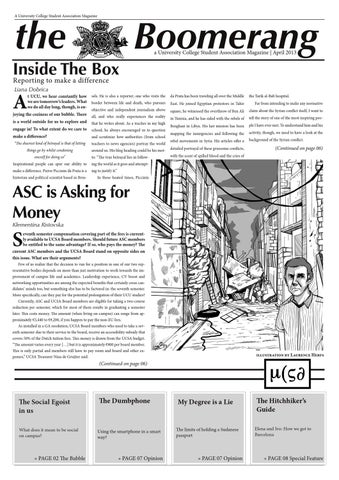
illustration by Laurence Herfs
penses,” UCSA Treasurer Nina de Gruijter said.
(Continued on page 06)
The Social Egoist in us What does it mean to be social on campus?
» PAGE 02 The Bubble
The Dumbphone
Using the smartphone in a smart way?
» PAGE 07 Opinion
My Degree is a Lie
The limits of holding a Sudanese passport
» PAGE 07 Opinion
The Hitchhiker’s Guide Elena and Ivo: How we got to Barcelona
» PAGE 08 Special Feature
the Boomerang | April 2013
02 The Bubble
No Words Please
Welmoed van Ens and Minh Tue Le Ngoc Our professor in Psychology, Mr. Brugman has been teaching at UCU for more than a decade. Sadly, he will be leaving us at the end of this semester, after a last last lecture that will undoubtedly be as fabulous as his classes. The Boomerang seized the opportunity to interview Mr. Brugman but under one condition: no words please!
How do you feel about wine?
How are you going to spend your retirement? Are you going to miss your students?
What do you think about the weather this year?
Are you ever going to give up smoking?
Art or p sycholog y?
What is your opinion on the Flynn effect?
A University College Student Association Magazine
The Social Egoist in Us
The Bubble 03 U Clone U
Welmoed van Ens
C
ampus culture is participatory, and the possibilities to conform to this norm are endless. Committee meetings, dinner dates, party nights and friendly conversations consume our time. We are constantly socializing and therefore, we boast, we are social.
Don’t get me wrong, I adore campus. From sitting down with people I barely know in dining hall and joining their conversations, to seeing familiar faces in the bar. I even find delight in watching gossip spread like fire, literally hearing a story travel from building to building. I relish the sense of community brought about by changing seasons, when everyone gathers outside to build snowmen or soak up the first rays of sun. But enough with the praise. Let me get back to our understanding of the concept ‘social’, which I happen to think is incorrect. We tend to measure ‘social’ by number of events attended, the size of our circle of friends and perhaps our extracurricular activities. This definition is so narrow that it strips social of its meaning and degrades it to a quantitative measure of social interactions. What happened to social as an attitude towards a community, towards life? Does ‘be-
ing social’ not involve considering the consequences of your actions for others anymore? Not really. Being social at UCU includes roaming around campus in the early morning, loudly and drunkenly reciting the lyrics to your favorite Carly Rae Jepsen song. With your friends, of course. Lest someone think of you as anti-social. Our interpretation of ‘social’ inevitably leads to egoistic behaviour. Having fun has become the holy grail of socializing, even if it happens at the expense of others. This surprisingly narrow minded attitude is completely incompatible with the intelligence and social skills that are supposed to define UCU students. Why can’t we all man up and invest two minutes a day in doing dishes and taking out the trash? What frustrates me is that confronting anyone about their noisy, smelly, messy or drunken behaviour is not accepted here, and will earn you a reply like: “We’re students, just deal with it.” Might I ask which divine authority has decided that students are magically excused from the responsibility to act as rational and considerate human beings? Why do students think that, to take full advantage of the freedom they have at college, it is absolutely necessary not to care about what anyone tells
them? My guess is that we are dealing with an epidemic of allergies. Not to nuts, dairy or pollen, but to any authority even vaguely resembling parental tyranny. Symptoms include (but are not limited to) refusal to do ones dishes, uncontrolled partying, and an aggressive attitude towards anyone who appeals to your responsibility as a member of our community. For some, college is where they finally break free from parental restrictions and redefine their identity. The allergies play a vital role in this process, so growing up and settling down seems to be the only cure. Still, can’t we put our youthful egocentrism aside for a second and look at the consequences? It is time for our community to redefine the ‘social’. Let’s include being thoughtful and considerate, and treating everyone we meet with respect. Let’s get into the habit of actually replacing the milk we “borrowed” from our unitmate for breakfast, and bringing our keys when we go out instead of frantically ringing doorbells at 4 in the morning. Let’s measure social by dishes done and hugs given. A little too utopian? Maybe, but to me, what you are willing to do for others is a better measure of how social you are, than whether or not you frequently visit the bar.
A column by Pretentious Pete
Time for one more piece of pure writing genius for this month’s Boomerang. Many reactions to my previous two articles directed to me were rather surprising to hear. They found my views to be “pretentious and snobbish”, at times even offensive. Some pitied me and said they now understood why I only have two friends. Now, I find this fairly amusing. It perfectly illustrates the sheer inability of so many students here to respect opposing points of view. Think of class discussions for instance. I usually have to go to great lengths arguing my point before the other side surrenders to my superior argumentation and impeccable ar-
ticulation (unlike most of them who take ages to form a sentence and their analogies and attempts for metaphors make so little sense). Either they give up followed by the familiar rolling of eyes or exchanging meaningful looks among them to neutralize their defeat, or I get cut by the teacher who obviously feels for my having to argue alone against half of the group almost every class. Dining Hall is another zone where you observe the stubbornness of UCU students. It is utterly annoying to see all the vegetarians and quasi vegans shrug and complain at the poor and is it that hard to see the absolute irrationality of insisting to pursue an unhealthy, ridiculous and potentially harmful diet? All they need to do is realize the falsity of their view and start enjoying mouth-watering meat dishes. There are plenty of reasons why I never opted for running for the Academic Student Council, as much as I would’ve appreciated the networking benefits and the opportunity to showcase my intellectual potential to relevant College Hall people. A major reason though is certainly the problematic requirement to cooperate with others and make concessions in the name of team work. Teamwork is impossible in a team comprised of arrogant students constantly overestimating the merits
of their viewpoints and reasoning. It would be ideal and much more productive than the current structure of this representative body if one could act independently and need not spend effort on persuasion of obstinate, lesser minds. Finally, even in the unit one bumps into the lack of cooperative spirit of others. I always insist and demand that all shared surfaces are kept clean and furniture must remain arranged in a specific way. What do I face every week? Others failing to see the plain logic of my explanations and going against it as if on purpose. This is why I await with passion the day I am allowed to finally move off-campus. I will relish the privacy of my own space, not plagued by the inconvenience, noise and anguish of living around ambitionless, alcoholpoisoned young men and superficial sorority chicks. The ultimate horror must be to live with a roommate. I can’t imagine sharing my personal space with someone completely obstinate who refuses to agree with my ways. The horror. *Pete’s name was picked at random, in service of the alliteration; any resemblance to real persons, from UCU or outside, is purely coincidental.
Eugenia Melissen Ferrer
I
t’s very likely that you know almost everyone by face on this campus. Although a seemingly insignificant fact, a closer face-inspection proves the contrary. For all those looking for their long lost clone: you have come to the right place. That’s right; sooner or later you’re bound to realize that this campus is swarming with life-sized replicas of YOU! The clones are harmless, don’t worry. They have human voices and similar interests as you. They have the same color hair as you, are of the same height and have scarily similarly shaped eyebrows. To draw from personal experience, I have already met three of my clones. I’ve also been stared at in the face for several minutes while being referred to as somebody else, a pretty intense experience. And I’m not alone. For weeks now, it seems like examples of clones have been spontaneously popping up everywhere. And that’s when you start to notice things. Clones are often friends, for instance. I’ve been told that people of the same height tend to form friendships, but I didn’t know this also applied to full-on near-identical appearance. I wonder if clones acknowledge the fact that they are so similar. Perhaps they are one step ahead of the rest, replacing terms like ‘best-friend’ of ‘buddy’ by ‘clone.’ It’s a shame clone has such a hollow emotionless ring to it – otherwise I’m sure more people would be following their example. The next thing you can’t help wondering is why this phenomenon exists. That’s when you can let your imagination run wild: could there be a secret plan behind the selection procedure at UCU, determined to develop and protect little UCU-übermenschen; capable clones that are sent to work for prestigious companies in different parts of the world? Are the clones simply the result of your permanent beer-goggles? Perhaps too many readings are distorting your perception of reality.Or something in the Dining-hall food makes us all resemble each other. Perhaps the bitter truth is that we are not as unique as we think we are in the end. A plausible reason, however, is that many of us have had more or less the same education and upbringing before arriving here, thus contributing to our interests, clothing style and possibly things like the gloss of our hair. And who knows? Perhaps we’re all unconsciously contributing to our cloneness by adapting to what we see around us; good old-fashioned group behavior. If law students all look the same to us, why is it so hard to believe that we do too? This article was meant to be accompanied by pictures of clones for clarification, but in the end your writer had to clone herself to finish the too many essays. So: next time you scan the crowd in dining-hall,in the bar or even in class, be sure to be extra alert. The.clones.are.everywhere.
the Boomerang | April 2013
04 The Bubble Debating as a Bicycle for the Mind
Columni
Student profile: Thom Wetzer
Roeland van Beek, Class of 2011
Julie Albers
S
teve Jobs might have compared the computer to a bicycle, but thirdyear Thom Wetzer (21) finds this metaphor just as applicable to debating. According to this experienced debater, “it develops a habit of mind that helps you with everything else in life.” Thom discovered debating at the age of 15, when he helped founding a debating society in high school. Encouraged by their teachers, students trained each other in debating techniques. Soon enough, professors and students from all over the country heard about the initiative and offered their help. Noticing his increased ability to listen, reason and persuade that came as a fruit of regular debating practice, Thom discovered a growing passion in himself. “I felt greatly empowered.” Before long, Thom was participating in major championships of competitive debates. In such competitions, you try to impress a team of judges with analysis and eloquence, while arguing in favor or against a motion. Starting small, Thom achieved a win after win: from the Dutch high school competitions to the world championships in Qatar. Eventually, talent and devotion paid off in the biggest challenge yet. Thom and his debating partner won the Dutch adult championships, beating former European and World champions. But debating tournaments weren’t the final station. Representing Mauritius at the Oxford Model United Nations in 2011, Thom received the Best Delegate Award. Debating skills proof very useful in MUNs, whose focus lies in cooperation with other teams, rather than persuading juries. “The goal is to represent the country that plays the most impor-
tant role in reaching the final solution to the problem.” All awards and triumphs aside, what is it exactly that makes debating so fascinating? “While you learn so many different things in high school, you never learn to apply all this information in a coherent way to real world problems,” says Thom. Being able to quickly analyze complicated problems gives traction to everything he already knows, he believes. Nowadays, Thom has breached out even further in his involvement. He is a trainer at the Dutch Debating Institute and a vicechairman of the foundation that selects and coaches the Dutch national debating team. Most importantly, he works as Associate Partner for Cogency. Cogency provides educational activities and organizes numerous tournaments, striving to implement debating in all layers of education. “Although we started as a small startup, we now work closely with 250 schools and universities.” Teaching has become an important aspect of Thom’s work, through which he hopes to convey the key lessons of debating. He sees reflective criticism as the crucial characteristic for every debater: “You mustn’t be afraid to be proven wrong,
because the continuous challenge of ideas lies at the heart of debating. Without this, you’ll stick with prejudice and platitude, instead of gaining more understanding.” Quickly analyzing problems and structuring your argument by using some humour are the finishing touches. “You can only learn these steps by people criticizing and encouraging you.” Even though Thom enjoys coaching the talented debaters from the Dutch national team, teaching children with social or mental difficulties remains the most rewarding. “They’re always very shy in the beginning, until they realize that they might actually have smart ideas.For the first time in a year, they speak in front of their class and are finally able to say what they think.” Some final tips? “Start debating. Just try it! Also, keep asking, remain reflective and open to new experiences and ideas and distrust general statements. As Sherlock Holmes said: ‘There’s nothing more elusive than an obvious fact.’”
Reader’s Letters Read our last cover story and disagreed on our conclusions? Care to comment on that campus column? Want to share some of your own experiences related to a topic we discussed? Then send your response to ucu.ucsa.boomerang@uu.nl. We would like to hear you opinion!
When I just started my internship, I came across a document titled “Things you should have done if you work at ProRail.” Riding along with an inspection train, visiting traffic control and changing a switch were a few. Even though I haven’t done any of those yet, I really like the idea. I think we should have such a bucket list for UCU, and tutors should support students in completing it. If it were up to me, sleeping on the quad for a night would definitely be on it. Going on exchange, no matter how much you like it here. Taking Introduction to Linguistics. Staying in the Bar until Closing Time, sober. Saying something at a GA. Being on campus when you have absolutely no homework to do. Having a random chat with the dean. Visiting your friends at home. Being in a campus performance. Playing Killer’s Kiss. And there’s so much more. People used to climb the fence of the Kromme Rijn swimming pool and go skinny dipping there at night, but that’s become harder after they made it an indoor pool. I myself wish I had joined some committees instead of being afraid my English wouldn’t be good enough
Take a first-year course in your third year
In response to “Behind the Walls”, by Victoria Peixoto Welcome to the land of UCU, a perfect college where students enjoy
have can be an unusual and hard experience to cope with, but that is
their life and end their studies with a Bachelors in Liberal Arts from the
absolutely normal. We all should keep in mind that we’ve been selected
best University College in the Netherlands.
from a group of people that desperately wanted to get here.In some way,
We take a lot of pride by these titles and, as UC students, we also make sure to present this life to “outsiders” – whether it’s UU students or prospective students - as near perfect in every single aspect. Open days are always hosted the day after a massive party, have you noticed? And most units make sure to play some music throughout the day, keeping the “chill and hung over” atmosphere going. But truth is, UC is not a perfect place for many students. Some of us
somehow, College Hall looked at all our applications and figured that we all had something in common. And honestly, we all do. We all strive for excellence, we may not be the best but we try to be among the best. Sometimes we flunk an exam, only to nail others. And it’s okay. There are people that get straight A’s, and that’s fine too. We all have difficulties, it is normal. Just don’t try to
do struggle to find their own place within the bubble. After all, not all of
compare yourself to others, no one’s life is perfect, we all have insecuri-
us are used to meeting so many people in such a short amount of time.
ties and we all have problems. The only difference is the way we deal
The many cultures, backgrounds, nationalities and experiences people
with them.
– if only someone had told me how much I’d regret that… If there’s one thing I’d recommend to everybody, that’s taking a first-year course in your third year. One that is completely unrelated to your major. Besides having something easy to take your mind off your thesis, it’s great to realize how much you’ve learned since you came here. Although I wasn’t supposed to, I often laughed at the discussions in my Neuroscience I course. On top of that, meeting twenty new firstyears was like a mini-Introweek I wouldn’t have wanted to miss: quite the opposite of a 300-level physics course with people I’d known since my first semester. Seriously, if you have any room at all, complete your curriculum with a course that’s fun and cozy.
A University College Student Association Magazine
EXCHANGE STORIES 05
Australia, April 2013 Australia. The land down under. Filled with extremely poisonous animals that could and would kill you at every possibility.
Felix Fr e
Unfortunately Australians don’t use the expression “throw some shrimps on the barbie”, however they do have the tendency to shorten every word they come across, and make everything as easy as possible for themselves (not in a lazy matter, mind you).
Coming to Australia a month early was a decision that I will be extremely happy about for the rest of my life. Being able to enjoy the wonders that are high summer on the Gold Coast, lying on the beach every day, splashing away squeamishly at the sight of, possibly, deadly jellyfish, and not daring to venture out at night for fear of being eaten by sharks. From 2 am hikes up mountains to enjoy spectacular sun rises, to having birds eating seeds from your hand to enjoying the thrilling rides of the famous Queensland roller coasters.
itag
Hom Univer e university: sity Co llege U trecht Host un Monas iversity: Clayton h University, Campu s, Austr alia
All in all, this experience has been an enlightening one, and one that I would definitely recommend to anyone who is thinking about going abroad. It’s not everyday that you get the opportunity to live in such a far off continent, country, and island, all in one. (One word of caution though: everything in Australia is about three times as expensive. If you come, enjoy the price of beer in the Bar, as here you’re very likely to spend about 10 Euros for the same amount. You will most likely end up drinking boxed wine; it’s ok though since that’s what every uni student does.)
The move from the far spaced out and quiet Queensland to the hustling, rowdy cityscape of Melbourne was quite a big change, but also much appreciated. Student life is invigorating, and immersing oneself in the culture of fellow students allows for the full appreciation of Australia.
Lima, April 2013
here – approximately 30 times the size of Utrecht. I live in Miraflores, an awesome place to go out and meet people from
Marius
“Lima?! Why do you want to go to Lima?!”
When people asked me this question I didn’t even know
Bischof
f
Hom Univer e university: sity Co llege U trecht Host u Pontific niversity: ia catolica universidad del Per ù, Peru
how to answer. I chose Lima because … well, because it sounded very exotic and I had always wanted to go to South America. When I got on the plane to here I didn’t really know what to think. My best friend from Brazil had told me that I shouldn’t expect too much, except for slums and a high crime
around the world. Nevertheless, there are equally striking but less positive aspects, too. The contrast between rich and poor is overwhelming but to me it makes the city highly interesting. Some parts of the city are very poor, whereas some neighbourhoods look like New York or London. PUCP, which is the university in am on exchange at, has over 30 000 students
rate. But, maybe unsurprisingly, he was wrong. It’s been about
and is very modern. We have five (!) big dining halls and over
a month now that I have been here, and it is simply amazing.
2000 courses to choose from. So far, I don’t miss Sodexo, I
Lima is big, bustling and vibrant. 9 million people live
must say.
06 COVER STORY Inside the Box (Continued) Liana Dobrica The Syrian conflict
The modern Syrian state was established after the First World War as a French mandate. Even though an independent parliamentary republic since 1946, a large number of (attempted) coups have shaken the emergencylaw-ruled territory since. Most constitutional protections for the Syrian citizens have long been abolished, something that is justified as being a necessary precaution due to the constant state of war with Israel. Simultaneously, security forces have been granted extensive powers of arrest and detention, predominantly used against human rights activists and critics of the regime. The one-party state has been embroiled in civil war resulting from the uprisings against President Bashar Al-Assad and his neo-Ba’athist government. For decades, they have been running more of a personality cult and ethnic type of favoritism rather than a concrete Arab-nationalist ideology. Great socio-economic discrepancies between government-affiliates and the rest of the population emerged. The chain of peaceful protests against Assad and his Alawite-sect government commenced in March 2011, and turned into the Free Syrian Army upon the crackdown of the Sunni Muslim-dominated Syrian Army. There are no clearly delimited fronts as con-
flicts run all over the country. The government and opposition forces alike have contributed to the deteriorating human rights situation. However, human rights groups as well as the United Nations have ascribed the majority of abuses to the Syrian government.
The imprisonment
“The trap closed within a few minutes and my journey to Hell began on that day towards five in the afternoon” In May 2012 Piccinin da Prata embarked on his third journey to Syria to evaluate the Syrian Liberation Front’s potential to overthrow the regime. For previous journeys to the country he had received a visa from the Syrian Embassy in Brussels – this time he crossed the Lebanese frontier at the Masnaa site, proceeding to the town of Jdaidit where it is possible to obtain a visa without any formalities. After a couple of days around the country, photographing the ruined rebel areas of Tal-Biseh and talking to fighters of the opposition, he presented himself at the army’s check-point in the area of the Homs Governorate. He was promised to be allowed into Tal-Kalakh. After two-hours waiting for permission to enter the city, some armed men arrived telling him that they would accompany him on his voyage. He describes getting into the car with them for French publication Le Monde (translation
the Boomerang | April 2013
human rights groups as well as the United Nations have ascribed the majority of abuses to the Syrian government by Tony Davis): “The trap closed within a few minutes and my journey to Hell began on that day towards five in the afternoon… From there, in the evening, I was moved to the centre of the Intelligence Service in Homs, where my personal possessions were removed from me in the first building, in which, already, I could hear muffled cries which troubled me, and I could well imagine what was happening there. Soon after, two agents led me to another building. The cries had stopped. There, they were washing off the ground what was quite clearly blood. Everything there was dirty and squalid; the doors, walls, floor-tiles, everything was filthy.”
chronicles as well as his experience in the infernal prisons of the Ba’athist dictatorship. For Piccinin da Prata, this journalistic endeavour merely represents the echo of the Syrian people’s cry of despair, a people that faces death day after day, feeling the general indifference of the Western public and tomorrow’s leaders. “I hope that the testimony of this book will arouse the interest of the public opinion with regard to the Syrian revolution. So far, it seems to have been taking place inside a box that no one wants to take the lid off.”
The plea for international involvement
In May 2012, Piccinin da Prata was arrested by the Syrian Intelligence Agency, tortured in Homs and held prisoner in Damas. Nonetheless, he has returned to Aleppo in July and August. The Belgian paper Le Soir has published thirteen chronicles telling the story of the merciless war between President Assad and the people of Syria, abandoned by the international community. Upon his return from Aleppo, he has published ‘La bataille d’Alep’ (the Battlefield of Aleppo), a book and documentary which comprise a new series of war
ASC is Asking for Money (Continued) Klementina Ristovska When it comes to ASC members, similar financial compensation is currently not in place. ASC members who need to extend their studies with one extra semester are expected to pay the fees in full. For several months now, ASC ’12-’13 has been negotiating the possibility for securing seventh semester compensation for future ASC members too. It may sound fair that members of ASC, our direct representatives in College Hall decision-making, receive equal treatment as theBoard in charge of the smooth running of our everyday campus life, but there is more to it: where should the money come from? ASC ’12-’13 proposes an extension of the UCSA budget’s accessibility subsidy to future ASC members with the same amount that is currently available to UCSA Board members. According to ASC Chair Pau Castellví Canet, they have drafted a proposal and presented it to the UCSA Board demanding the issue to be put to vote during a GA. “We faced the dilemma of which budget stream to request the amount from: the academic budget or the budget of UCU’s student association,” Student Assessor Rens Bakker said. “We have been working on this for months and on the basis of our investigation we decided that we want to consult the GA about it.” The UCSA Board, on the other hand, is reluctant to give away a chunk of the association’s budget before “all other possibilities”, including College Hall, have been exhausted. They have decided not to bring this to the GA in the form of a formal proposal subjected to a yes-or-no vote, which would result in a binding GA resolution. “The UCSA Board simply does not believe in the proposal. There are mainly two ways of bringing an issue to the GA, either via the
Board or by gathering 70 signatures. Because we do not believe in this proposal we will not suggest it to the GA,” UCSA Chair Noam Auerbach said. “We are not against a seventh semester compensation for future ASC members. The other way around: we greatly appreciate the work this ASC has done. We are just not agreeing that the money should come from the UCSA budget.” What are the arguments? “As student representatives it would strengthen our position to receive such endorsements from the student body through the Association, as the UCSA Board does,” Bakker said. “The UCSA Board has specific conditions of what exactly we need to discuss with CH first, in order for us to be able to bring it to the GA. But looking at the formal relationship between ASC and UCSA, we think it is clear that ASC can bring points to the GA without very strict conditions”. The UCSA Board gives four main reasons why they oppose ASC’s proposal to be put to popular vote at this point. “First, ASC and the UCSA are two separate bodies. They both represent the students but in separate ways. The reforms that took place two years ago were aiming to make them stand separate and equal. Therefore, the UCSA should not sponsor them,” Auerbach said. They also stress that the amount of money in question will pose a big burden for the UCSA budget. “It is a big amount and it will hurt the association,” Auerbach said. More important, according to UCSA Secretary Valeria Boers Trilles, is the fact that not enough has been negotiated with College Hall. “College Hall has not rejected paying for ASC’s seventh semester. They just need more details and they are willing to discuss it.” Auerbach added: “To bring it now to the GA is simply
premature. What if the GA says no? How can they [ASC] go to CH afterwards?” Finally, Auerbach brings up another point. “It’s a bit painful, but someone must say it: Who said that ASC members have to take an extra semester? What CH proposes, and we support as well, is that there should be an assessment of the workload.” He explains that unlike for UCSA Board members, it is not formally laid down that all ASC members should take a two-course reduction. “They [relevant CH staff] don’t mind ASC to have less courses, but in order to pay for that, they first want to have a true, open, honest discussion and an assessment process.” “The management has never questioned whether ASC has enough work for 30 hours per member per week, or whether ASC deserves a seventh semester for the work it does,” Castellví Canet said. “We work very closely with them and our work is very visible to them.” He explains that the discussion with CH was focused on the nature of ASC’s task and whether ASC should be the body that carries these tasks. “As an essential part of UCU’s quality management cycle, which UCU is by law obliged to have, ASC does many of the things on a daily basis that would need to be done by faculty members and staff if ASC were not there. We strongly believe that an independent student body as part of UCU’s quality management cycle is better than the alternative, in which the student opinion would not be represented independently. ASC’s main motivation for this step was the decline in interest among students to join ASC. “We’ve seen over the past years that it has been very hard to find candidates. Many decide not to run because of the financial burden of taking a seventh semester. I can’t blame them, especially now with the increase in fees
and changes with Studiefinanciering. In the future, this may pose a serious limitation for the quality of student representation,” Castellví Canet said. On this, Auerbach says that “people here don’t run because there is compensation available or not. People run because they want to be involved in a specific way. … We just saw not long ago that there were more candidates running for ASC than for the UCSA Board.” “This year we really invested a lot of effort in finding candidates,” Bakker said. “We started searching for people already a month in advance. We talked to so many people and fortunately we were successful. We had proper competition for two out of three positions now.” Bakker brings up another point. “We have seen in ASC that continuity is crucial. Almost all of ASC’s power depends on informal relationships that take years to grow. If one Board doesn’t do the job in CH well, everything collapses. Everything has to be started all over again.” It seems that in the core of this “professional dispute”, as Auerbach dubbed it, lies the difference in interests that the two bodies defend. “In times of financial challenges for UCU, we did not believe it to be the most responsible option to demand the amount from the academic budget, which covers courses, teachers, tutors, etc.,” Bakker said. Reversely, Boers Trilles warns that should the money be drawn from the UCSA budget “it will simply mean less DebateCo, less festival, less Bartenders Weekend, less PoliticsCo, less everything.” The UCSA Board stresses that they wish to continue the negotiations in the most constructive way. ASC said they will bring the proposal to a GA in the coming weeks, so the student body can have the final vote.
A University College Student Association Magazine
OPINION 07
The Dumbphone Dirk de Bekker
H
ail this world in which we can do our democratic duty by liking a facebook page about woman-emancipation in Iran, changing our profile picture to support gay marriage, and tweeting away our frustration about the harm Assad is inflicting on his own people. All this can be done from the metaphorical armchair, balancing your smartphone between the palms of your hands. As you might deduce from the slightly sarcastic tone there, I am not the biggest fan of smartphones. In fact, I consistently refer to the devices as dumbphones. Not because I’m an embittered old man who doesn’t manage to keep up with the technological developments of his time. No. It is for wholly different reasons. Reason number one is hidden in the very name I gave to the smartphone; it makes you dumber rather than more intelligent. You
need to find your way? Then let’s certainly use the navigation on the phone! You all of a sudden need to know which Louis of France was decapitated during the French Revolution? Come on, let’s google it! You need to win a music pub quiz? Take out that smartphone, and have it listen to the intros they’re playing!
member the route anymore, think about what they read on French history, or carefully listen to music. The smartphone has taken over that function. On top of that, the smartphone is an inherently anti-social device. After the invasion of laptops into our own bar, people are now actu-
ally whatsapping away on their smartphones, while sitting behind their laptop screens. Isn’t the bar meant to be a place where people relax after a long day, enjoying a cold beer while conversing with each other, or where people can sit all by themselves, dwelling on life? In such situations, smartphones function as a de-
fensive wall; when you’re sitting all by yourself, there is always the smartphone that can come to the rescue. It still looks like you have friends that way. But do you really? You might think that smartphones play an important role in creating democracy, spreading news of revolution, revealing injustice everywhere around this globe. At the same time, however, the smartphone has created a new tyrannical regime that exists in the abstract space of virtual life. It has the power of creating a generation of apathetic people, whose eyes have become hollow and bleak because of staring at that little screen for too long, whose thumbs have grown into the size of baseball bats by scrolling too much, and whose brains have shriveled to the size of rotten strawberries by not thinking on their own anymore. Well, I’m being realistic. The rise of the smartphone is a fact. But if you use your smartphone, please use it in a smart way.
I would’ve straight up sued my university for misguiding me. Now allow me to place the cherry on top of the cake. You know how they tell you you can now work wherever you want, you can go wherever you desire? Lies. I can’t even take a bus to London because of my Sudanese passport - my visa got rejected, to the surprise of no one. Not only that, no country will let me get rid of this passport. I thought by coming here maybe I could transfer to UCU, get a
about the awful conditions of the detention camps in Malaysia, no part of me is confused about how horrible being an illegal immigrant there would be. Here’s what I’m less sure of: how did my brother, a talented young man with a Malaysian Bachelor’s degree, end up being an illegal immigrant? No one wanted to bear the responsibility of hiring an immigrant, so he was left to the side. Why doesn’t my degree tell me that this wonderful ‘globalization’ means
the smartphone has created a new tyrannical regime At this point you might ask yourself: what is he talking about? Doesn’t the smartphone make you smarter in such instances? I argue it does not. For many people it has become such an automatic response to take out their smartphone when some thinking is required on their own part, they don’t even try to re-
My Degree Is a Lie Leena Mohammed
I
feel betrayed by my degree. My major is International Studies, which basically means being told over and over again how wonderful and, well, global, ‘globalization’ is. My experiences in Malaysia had me believe that to be relatively true. Yet, Utrecht showed me the other side of that coin. To clarify what living in Malaysia was like, let me tell you about myself first. I am going through an inscrutable identity crisis; I know for a fact that I will be an immigrant for the rest of my life – or at best (fingers crossed) a naturalized citizen. I do not have a sense of belonging to any nation. Malaysians have a complicated national identity. Ethnically they are mainly composed of Malay, Chinese, and Indian Malaysians. When a nation doesn’t hold one common ethnicity, you have a higher chance of blending in, yet there’s not an academic classroom out there that pays attention to this detail. No one tells you that if you’re African, you can pass as ethnically Malay or Indian - something that somehow has a significant positive influence on how comfortable you are living there.
I didn’t even realize how black I was till I became an unmistakable minority here. Was I a minority in Malaysia? Heck yeah; I just wasn’t aware of it very much. Here’s something else about Malaysia that got me fooled: their use of English. All children in Malaysia have to learn Malay, even if they are not ethnically so. A lot of people can ignore Malay however. You can find employment without it easily. You can enroll your kids at a private Chinese/Indian/International school and kick the language to the curb. So the common denominator between all Malaysians, or those that live in Kuala Lumpur, is English. Businesses, degrees, and services are all in English. If I call a standard operator, I will always be asked to press 2 for English. Want to guess if that’s the case in the Netherlands? It’s not. Funny,‘cause I remember writing more than one paper about how English is taking over. And that for the most part is true: in Saudi Arabia, all products at your local grocery shop will be described in English and Arabic. Here? Nope. I just thank the heavens I chose the Netherlands for exchange, instead of Portugal or France for example. Then,
I’m not even allowed to volunteer good job; build my life up from there. Turns out, I’m not even allowed to volunteer with my non-European status. It’s worse still in Malaysia. Immigration laws are draconic. My degree did have the decency to alert me to this, but again, it failed at details. What I’ve noticed about these academic disciplines (international studies and relations) is that they love tragedies. I learn
countries are more than willing to let you in for a short time to spend your money touring their land, or on a degree that was made significantly more expensive for you, but never let you in gain any prosperity of your own? I graduate at the end of this year, and I’ve got all fingers crossed that I’ll have more faith in what I spent the past four years studying than I do now.
Boomerang Debate
PRO:
Alba Maselff Tutors are just another indicator of our pampered UCU lives. If students at the UU can get by without a tutor, why can’t we? Are we incapable of figuring out the prerequisites for our courses? Would we be so much worse off by signing up on our own? At least that would teach us to fend for ourselves and take some responsibility. But no, we shudder at the thought of actually acting like the adults most of just pretend to be. Instead, we have a tutor to babysit us. Still, how many of your friends have the stories of ending up into the most random courses? “You know, Intro to Law was oversubscribed,
Proposition: The UCU tutorial system is not effective but no worries, I put you into Latin.” And tutors’ familiarity with the UCU system is often limited to their own department, if not their own field. Only your tutor teaches math and you want to major in philosophy. Oops! Even if you don’t expect anything from your tutor, either because you don’t care or have it all figured out, you are forced to deal with them. You have to endure their feigned interest in your academic performance or their holiday stories, and their suggestions considering your future. Suggestions you’ve tried already or that aren’t relevant to you and you’ve tried explaining that, but they just don’t seem to get it. By now you simply smile and nod, and regret having wasted another half hour of your time. Oh well… at least it’s another eight weeks until the next, pointless meeting!
CON:
Titia S. Petty Students don’t have a clue about the time their tutors invest in their tutees’ well-being. They moan about course-enrolment, claiming they could as well do it themselves. But are students familiar with UCU’s complicated administration, involving class sizes, pre-requisites, forms, approvals, exceptions? No, of course not! All we need is a 10-minute talk and we are put into the right classes - we even get multiple reminders, in case we forget! Sure, it doesn’t always work out, but tutors can hardly be blamed: They want what’s best for us, always try to help us achieve our goals, coming up with alternatives when needed. At all times there is someone looking out for you,
making sure you don’t mess up, so you can actually graduate in three years. Even if you are one of those independent, self-reliant UCU’ers who seemingly don’t encounter any problems, your tutor won’t bother you. Rather, they will always be present, available for you to visit them, ready to help. We might think we can handle everything alone, but everyone needs a chat occasionally, especially with someone other than a fellow student. Your tutor will be willing to listen, share some of their wisdom, and give you a new perspective. Such involvement in your life is priceless. Of course, not everyone is able to establish a close, personal relationship with their tutor – your characters might simply not fit together. Still, you bet they will do their best for you in your three years here; we should be a little more appreciative of having someone look after us like that.
08 SPECIAL FEATURE
the Boomerang | April 2013
The Hitchhiker’s Guide Elena Butti & Ivo Dimitrov
Y
ou did it. Ignoring frantic warnings from friends, screaming Skype calls with hyperventilating parents and the snowy weather, you are set to leave for your first ever hitchhiking competition to Barcelona. But now what? We are more than happy to share 24-hours-of-hitchhiking wisdom.
First, consider that the journey starts long before you physically leave campus. No one warns you about the range of emotions you go through even before you first put your thumb up. There is, of course, the initial enthusiasm of doing something completely crazy and badass –at least in your eyes - a full-on heroic quest for self-realization. Then there’s the intense bond to your partner(s) that you start feeling. Forever will you be connected through shared memories of enlightening experiences and endless gas station fun. Naturally, you spend hours coming up with team mascots, imagining how you’ll get a lift from Mr. Hollande himself, designing your winning speech, instead of actually doing useful things like planning your route. Around this time the doubts start creeping in. A day or two before leaving you will notice the below zero temperature. The thought of not having a good backpack might cross your mind, and your mother not packing your stuff. Soon, you will be in a state of frantic selfdoubt, thinking of your non-existent experience and youthful foolishness. You may even reach the point of panic attacks over not owning enough sweaters. Plus, your parents will decide now is the time for those stories about missing and dead hitchhikers – bless them.
Fortunately, midterm week is your saviour. You have no choice but to lock those worries in a dark corner of your mind to write your existential philosophy essays. But you will wake up one morning, midterms will be over and the whole world will expect you to set off. Rather than giving you the courage you need, your closest friends will use the minutes before departure to announce their secret bet against you, about whether you will arrive after four days, or not at all. You’ll show them when you return, gloriously victorious. And then you’re off. Bam! The world is a blur. There are teams everywhere, running to the gas station, jumping in front of cars, shoving their cardboard signs in people’s faces. All you can do is look at your partner, hoping they have some secret master plan. But no – your OCD planning urge didn’t kick in here, unfortunately. So, you are clueless. Where do you go? Sadly, your best bet is following others. Your enemies, you remind yourself. This is like the jungle, like war; all is fair to ensure survival. But keep in mind: the first hours are some of the worst. Especially when you see aforementioned enemies enthusiastically get into cars, while you just got flipped off by an incredibly charming truck driver. No worries, though. Soon enough you will find yourself in a car too, speeding along the Dutch highway, feeling intense love towards the beautiful, generous souls that decided to take you. You have already entered the hitchhiker’s trance: for the next 24 hours, you will let go of all notions of reality, all values and moral codes, everything you hold dear. Your sole mission in life is to arrive. To arrive first.
Slowly, you transform into hyper-competitive, victory-obsessed monsters. No breaks. No sleep. No food. Get those rides! But please, even if you are leading by 200 km, don’t you dare get arrogant. Don’t start calling your partner “winner” or texting your friends about your imminent success. And don’t even think about boasting on Facebook for all the other teams to see, using phrases like “losers”, “bow down!” and “you never stood a chance”. It will backfire - we’ve lived it. We spent five hours near Toulouse immediately after Ivo’s premature online victory dance. Also keep in mind the side effects of the hiker’s trance. Stuck and desperate, you will find yourself chasing a car with French students screaming: “They are UCUers! Stop them! STOP THEM!” You will risk your life crossing highways in the dark, beg fourth graders for a ride in their bus, and, at your low-
est point, consider hiding in someone’s trunk while they are drinking coffee. Anything, as long as you move forward. And then at some point, almost unexpectedly, you arrive. That’s it. The sole goal you had for the past 24 hours is accomplished. For one moment, the whole world will make sense to you, as you experience the euphoria of finally reaching your destination, having endured so much hardship. You will have achieved something big, using only your thumbs, an out-dated map and your fantastic French socializing skills. And when you look back at the pictures, you look like triumphant heroes, you rule the world. Just don’t look too closely: your might find out that you were so high on tiredness that, in your (almost) winners picture, you were holding your “Barcelona” sign upside down. Details.
further facts exist. Since they’re not physical, we won’t find our further facts in the physical world. So where do we look? Is our Self of a different substance? Is our soul floating around in a parallel universe? And if our Self is so radically different from our body, how do they interact? Alright, this isn’t working out too well. Maybe there is no further fact, and we should just accept that we are nothing more than a symphony of particles governed by the laws of nature. That seems less complicated, right? But what if due to technical problems the old You
is not destroyed when the new You is created?
The pros and cons of teletransportation Welmoed van Ens
F
riday comes around, and you are finally ready to return to your offcampus home after an exhausting week. Before embarking on your journey, you have one last look at the NS website – only to find out that your plans have been rudely subverted by the weather. Whether the sun has melted the rails, there are leafs on the tracks or the switches are frozen, it looks as if your train will be cancelled for today.
Luckily, the NS offers you an alternative. It has been secretly investing the money that it should have spent on its trains in a new form of transport. You can now teletransport yourself to your hometown for the same price as a train ticket. All you have to do is pull a lever. The teletransportation device will create a file of every last quantum particle that belongs to you. It will then obliviate the You in Utrecht, send the data to your hometown and reconstruct a You in the exact same configuration. If (after having considered the awesomeness of teletransportation) the idea of erasing yourself made you uneasy, you are not alone. In fact, the philosopher Derek Parfit wrote a chapter on just this feeling of unease. Let’s assume that teletransportation, unlike other services provided by NS, is completely reliable. Then why, does Parfit ask us, would we hesitate to pull the lever?
The answer is that we probably believe that we are more than a physical configuration. Can our thoughts, memories and feelings really be reduced to biochemical processes in our brains? Don’t we have a soul, a mind, a self? Yes they can, and no we don’t - is what Parfit would say. Parfit came up with a name for all these non-physical things, even though he thinks they don’t exist. He calls them “further facts” to our Self. Parfit believes we have no soul, ‘self ’ or mind, and thus that there are no further facts to us. Our Self is our brain and our body. If he is right, we should have no rational objections to teletransportation, as long as the NS makes sure our body (and thus our Self) is exactly the same before and after. It’s time to re-examine our dilemma. Up until now, we have been considering whether we would rather risk teletransportation or getting stuck in a blizzard. What it actually boils down to is whether you believe in a further fact or not. If you think your identity is to be found in the physical configuration of your body and your brain, teletransportation is the way. As long as the NS guarantees physical continuity, your Self is safe. But if you do believe there is something more to you, you should probably take a train and accept the three hours delay. Unfortunately, neither position is problem free. You could argue that there is something more to us than our physical body and that
Which one of them is the real You? Or are they both You? How can you have two Selves? Don’t worry, millennia’s worth of philosophy have not yet produced perfect answers to these questions. For now, let’s just stick with trains so we don’t run the risk of splitting, destroying, or cloning ourselves. And should you end up stuck in a blizzard or heat wave, I suggest you engage in some philosophical speculation to pass the time.
A University College Student Association Magazine
UCstyle 09 Minh Tue Le Ngoc and Fisayo Fadahunsi
Style ≠ Fashion? “La mode passé, le style reste’’
Style does not equal fashion. In fact, there is a vast gap between fashion and style. Fashion, is about clothes and their relationship to the moment. Style, is about you and your relationship with yourself. Fashion is in the clothes. Style is in the wearer.
-Coco Chanel
Last month we featured a piece about Laurence Herfs, a fashionista that uses not only clothes but art to express her style. That got us thinking... are clothes really necessary? Don’t worry, we’re not suggesting anyone runs around naked (unless you want to of course), but more questioning what it is that style really means. Does a difference between style and fashion actually exist? Starting from when we get up in the morning and decide how we’re going to look, style means something different to every person. While some may consider it a means of celebrating the self, a fight against invisibility, or an act of creative expression, others may simply ‘get dressed’ without putting much thought into it. Both are expressions of personal style, because they involve expressions of who you are.
When choosing who to feature in our monthly posts, we pick people for many different reasons. Sometimes it’s a wonderful jacket, an exquisite hat, other times, it’s a knowing face, or a confident stance. Not always are the person’s clothes something we would personally wear but they are always a standout to us, they tell us a story about their owner. Style is more character than clothes. It’s you making visible your inner self. As put by Coco Chanel: “fashion passes but style remains”. So go forth and be stylish!
UCstreetstyle This month, we asked fellow students to tell us 1) if they could raid anyone’s wardrobe, whose would it be and why? and 2) where they bought the outfit worn in the photo
Hanna Sbo, 1st year 1. I would raid the closet of the Dutch blogger of Love-aesthetics, Ivania Carpio. She has a very unique, minimalistic, yet feminine style that I admire the most. She has a wardrobe mainly made of second-hand clothes, where anything can go well together with any item. My goal would be basically to be able to choose anything from my closet with my eyes closed and still look nice as well. This allows me not think too much about dressing up in the mornings! 2. The clothes I am wearing are from different thrift stores from different countries. I used to go second hand shopping with my mom as a kid and it is still my favorite way to buy new items. This way my clothes are not only inexpensive but also one-of-a-kind. My faux fur jacket is from my hometown, Budapest, and my Mom spotted it for me. My shirt is a treasure from Berlin, the trousers and the backpack is from Ij Hallen in Amsterdam. I bought my shoes in Paris, as my boots were so uncomfortable, I had to get something to walk around in, so I got these in H&M for 10 euros.
Rosa Paardenkooper, 1st year
Chiaki Takenouchi, 3rd year
1. If Mary-Kate Olsons hippie-John-Lennon-glasses-gigantic-skirt period wardrobe would accidentally fall into Jimmi Hendrix’s and they together would end up in my closet, I definitely wouldn’t mind.
1. Definitely Maartje Eijlander’s. Most creative, fashionable, sexiest, cutest, arty, and original clothes can be found there. My dream is to fill up my wardrobe with clothes with her tags on. Although I like vintage and retro style, so in that sense, Zoey Deschanel’s wardrobe would be perfect to make a raid on.
2. I’m wearing a vintage coat that I bought at a thrift store in Den Bosch. The blouse is from a really dodgy indoor vintage market in Antwerp. I got the t-shirt at a Pete Doherty concert, it’s the biggest male shirt which I cut into pieces to make it look more feminine. The shorts are from H&M and the shoes from Vanilia. The bag is a souvenir from a holiday in Czech Republic.
2. Skirt and Jacket are from my favourite store in Japan, I “stole” the scarf from my grandmother’s collection (she does not need THAT many anyway), white top is from Forever 21, I bought the bag in this small store I discovered in Rome, and my shoes are from a store in Eindhoven, bought as my 20th birthday present (sorry I do not remember shops by names, but by how they look and where they are).
the theBoomerang Boomerang| |April May 2013 2012
10 COLOSSEUM A Little Peace of Utrecht History Januschka Veldstra
T
his year marks the 300th anniversary of the Vrede van Utrecht, the Peace of Utrecht; a series of treaties signed when we were still the Republic of the Seven United Netherlands. Ending the War of the Spanish Succession and Queen Anne’s War, what makes them so special is that peace was made around a table, rather than on the battlefield. The 11th of April, 1713, was a turning point in our world history. From then on, peace and freedom were not only fought for in combat with bloodshed, but also through diplomacy and negotiation. This year, the Netherlands celebrates this important development with an international program titled ‘The Art of Making Peace’. It is all about art and culture that deals with current affairs of our society. Since the early 1700s, after Charles II of Spain died childless, Western Europe was troubled by constant conflict and battle, as well as parts of North America. Louis XIV, the Sun King, saw Charles II’s death as an opportunity to expand the French empire, while opponents feared that an even bigger French rule would dangerously tip the scales of the European power relations. Particularly the Kingdom of England, and later the Kingdom of Great Britain, was opposed to any increase in France’s power, simulta-
ByJulie Albers and Welmoed van Ens
neously fighting the French over the colonies in North America. Long story short, it was a pretty unhappy time for Europe, and people were getting desperate for peace. Negotiations started on the 29th of January, 1712, in the city hall of our beloved Utrecht. One reason that this was such a great place for business were its two entrances, allowing King Louis and Queen Anne to make their fabulous entrees simultaneously. No need to play favourites by letting either one enter first. During these negotiations, the city hosted spectacles, open brothels, dinner parties, and countless other festivities. The stage ban that had been in effect was especially lifted during this time to allow for theatre, and the hospitality and entertainment industries were booming. If you are going to negotiate peace, it might as well be done decadently and in style, as was all the rage in Versailles at the moment. While festivities these days are not nearly as lavish as they were 300 years ago, there is still a lot to be experienced in celebration of peace in Utrecht during the coming months. For some interesting, thought-provoking, and educational activities surrounding the Peace of Utrecht, see ‘Five Times Peace of Utrecht’ on the next page.
Screaming Teenage-Doodles to Voice That Inner Rebel Laurence Herfs
I
am highly frustrated by how dominant the written word still is nowadays. Visuals are gaining popularity, though, and comics are the perfect answer to that clash. Hanging Rock Comics is just one example of the great things this combination can lead to. Comics combine writing and visuals into a whole new, and much more powerful, dimension of art and narrative. They can be both critical like journalism and relaxing like art. Sounds interesting? Next time you find yourself procrastinating on Facebook, Tumblr, or wherever you find your buzz, check out thisishangingrockcomics. You’ll find yourself both amused and bewildered by how cool comics can be. Tumblr is refreshing and can be designed and used according to your own taste. Personally, I’ve found some of the most amazing contemporary artists there over time. One of them is 18-year-old Taylor-Ruth, who publishes her thoughts in the form of doodles under the name Hanging Rock Comics. She’s raw, she’s rough, and she has opinions. She’s one of the coolest people I-don’t-actually-knowbut-really-would-like-to. Being a cartoonist myself, she’s my heroine beyond words.
Underappreciated Ethiopian Cuisine
She voices the frustrations of teenagers and young adults on love, life, bullying, sexuality, feminism, and Hollywood movies. Her style is dense, her words are handwritten and sometimes hard to distinguish. You need to be in the mood for her work, but Taylor-Ruth’s doodles have an edgy, refreshingly unprofessional dark touch to them. She’s not scared; not of the Internet’s harsh opinions nor those of her classmates. She just rages all over them. She’s indie, but not hipster; she’s nonmainstream, but not in that needy, attention-seeking way. I often find myself in complete awe of her way of face-palming society and our generation’s stupidity. That doesn’t mean that she feels better than us, or above us in any way. On Valentine’s Day she will draw a cartoon of her frustrated self eating ice cream, because she’s still one of us. She seems to be more too, though, because she can roll her eyes and step away from it all. She’s got what it takes to be a cartoonist: That way of looking on life from the outside for a split-second, snorting at it loudly. Find her comics here: http://thisishangingrockcomics.tumblr.com/
T
ired of plastic cutlery and cold pasta? Desperate to try something other than overcooked vegetables? Head into town and discover the unacknowledged gem of the Pauwstraat: Ethiopian restaurant Sunshine.
Hidden in what looks like the dodgiest ally of Utrecht at night, this restaurant is definitely worth a visit. Don’t be fooled by the humble (read: barely noticeable) sign above the entrance. Upon opening the door, you will be greeted by a smiling waiter and the sight of an adorably tacky bar, adorned with tropical fruits and Ethiopian flags. After you sit down at your table delighted to discover real cutlery, you will be informed that you won’t be using it. Ethiopians eat with their hands. We can heartily recommend the experience of a shared meal. It consists of many different dishes served on one big enjera, a sort of sour pancake. Even though we noobs found some of the food a little too spicy, the African banana beer you can use to wash it down makes up for it a lot. The warm and relaxed atmosphere is a welcome break from both moneymaking Dutch restaurants and Sodexo alike. It’s refreshing to try something completely different and Sunshine’s atmosphere of genuine hospitality more than makes up for its lack of fancy furniture. Whether it’s a cultural thing or due to the fact that the restaurant is a family business, they have a way of instantly making you feel at ease. If this wasn’t enough to convince you, you might be interested to know about the excellent price quality ratio. Sunshine offers you this experience at a price that is well within your student budget. Especially when you share a huge enjera with your friends, your meal - including drinks - will not exceed 15€. So step out of the bubble and your comfort zone, and enjoy the experience of Ethiopian dining!
A University College Student Association Magazine
COLOSSEUM 11 Say ‘Hi’ to Your Pelvis!
Promised Land A Review
Auke van der Veen
G
Ivo Dimitrov
rating: 3.5/4
us Van Sant has directed a very diverse array of movies, but Promised Land lies somewhere between mainstream and alternative, and it’s a job well done. The story deals with two salespeople visiting a rural town in an attempt to buy gas drilling rights from the locals. The process doesn’t go as easy as expected. In one of the first scenes we see the camera pan over a car driving along a country road, approaching a farm. The shot feels ominous. It’s like watching an action movie: the protagonist is a man with a mission, about to beat the bad guys, and you know he is doing the right thing. Nothing is less true. As colleagues Steve Butler (Matt Damon) and Sue Thomason (Frances McDormand, famous from Fargo) drive up to carry out their job, their true goal is simply to make money. Still, Steve is actually convinced that the farmers need the drilling profits. He knows what it is like when a farm goes to ruins: it happened to his grandfather. He firmly believes that the gas money will save the people, and with his persuasive talks he gets many of them to sign a contract, scaring them with stories of loans and poverty. Of course, there is resistance to these outsiders. In a beautiful scene in which one of the village politicians addresses the community about the drilling plans, an old man named Frank Yates (wonderfully played by veteran actor Hal Holbrook) criticizes the company by giving all kinds of information about environmental damage. Steve enters into a discussion with Frank, but slowly begins to understand that his company isn’t that great after all. Doubt creeps into his life, and his sales pitches begin to sound more and more insecure. This only gets worse when Dustin Noble (John Krasinski, who coauthored the screenplay with Damon), a young, inspiring environmentalist, becomes his enemy, even almost stealing his new near-girlfriend Alice (Rosemarie DeWitt). So far, so good. The story is exciting, the film techniques are more than fine – Van Sant truly has a knack for realistic representations – and especially Damon depicting a man with a fair share of moral doubts is fascinating. However, along the way, the plot takes an unfortunate and incredible turn involving Krasinski, which doesn’t contribute to the ending in any way. It is a shame they put it in, but nonetheless, you should make sure to go see the film and judge for yourself. Apart from this flaw, the movie stays true to its message and theme: Promised Land is all about choices. The choices of a struggling farming community and the choices of a man who is struggling with himself. In the end, it all boils down to one central question: What is the right thing to do?
Five Times Peace of Utrecht Cultural activities and festivities surrounded the peace negotiations in Utrecht 300 years ago, and have been a staple in the celebrations ever since. Here are some upcoming cultural events for your peaceful consideration. 1. Peace of Cake?
– 02.03-04.01, University Museum – Take a look behind-the-scenes of peace negotiations and play a game to experience it yourself! (The dilemma game is for 8 and over, so embrace your inner child).
2. Tracks to the Front; Trains in Wartime
– 30.03-01.09, Spoorwegmuseum Witness the influence of trains on warfare, and see what kinds of trains were used and for what purpose. They actually brought in trains from other countries for the exhibition.
3. City2Cities: International Literature Days
– 20.04-28.04 Lectures, theatre, music, film, and of course literature – the third edition of City2Cities connects Utrecht to Ber-
lin and Lisbon, inviting or performing the work of the big writers from those cities, such as Bertolt Brecht or António Lobo Antunes.
4. Making Peace
– 05.05-28.07, Sonnenborgh Museum A photo exhibition composed of photos provided by big news agencies from all over the world. There are five themes: disarmament and nonviolence, conflict prevention and resolution, economic and social justice, human rights, and sustainability.
5. BOMB
– 10.06-05.01, AAMU: Musem of Contemporary Aboriginal Art Blak Douglas and Adam Geczy use installation art to show the consequences of colonisation, nationalism, and the relationship between oppressors and the oppressed.
T
he promise of a strong body, replenished and in a complete internal harmony – how could I resist? Obviously, I want a robust inner core and powerhouse abs! Of course I desire flexibility and balance! And doesn’t everyone know how crucial welldeveloped pelvic muscles are nowadays? Before I knew it, I was convinced to join the Pilates cult and sign up for a class. Oh boy… I have to admit that I am rather susceptible to workout hypes, only to leave later bitterly regretting my enthusiasm. My last endeavour with yoga ended up with me falling asleep, after all. And let’s not bring up that time I couldn’t get out of bed for days after an hour of Zumba. But Pilates seems like a natural fit –little effort that still makes me feel like a super sporty workout god, justifying the two, possibly three, muffins in Dining Hall for dinner. Entering the overcrowded room, I observe attractive girls in spandex, confused housewives, suspicious guys, dads with that delightful midlife crisis look on their face. The last time I saw such a random collection of people was at 8AM in a Serbian karaoke bar. This variety surely testifies to the amazing results Pilates achieves with minimum effort, I tell myself. I obediently follow the instructions of my latest spiritual guru, a young blonde, casually talking and stretching her legs. Soon, I find myself on a mat, mesmerized by her monologue about “opening up our bodies” to “discover places we have never known before.” I already feel intense just watching her explaining breathing techniques, sensually moving her chest up and down. When she promises “a penetrating force, followed by a powerful release of energy” I just nod, unable to move even an inch. No wonder everyone is so deadly serious – this girl means business.
Before long, the rest of my class, too, is expertly pushing their hips up and down, breathing passionately, copying the teacher’s every movement. I follow suit and become part of the trance, taking in the electrified atmosphere while clumsily trying to assume the dolphin position. Over the next half hour, I find myself in increasingly complicated positions, forced to retract strange, unfamiliar muscles. It doesn’t help that the middle-aged women next to me seem pretty relaxed manoeuvring their loins like pros, while I sweat and tremble, feebly trying to hold my butt in the air. “It’s all about the core muscles! Feel them while you thrust your pelvis forward! So good, so intense, so much fun!” The delirious rant continues, but I can’t seem to join in on the ecstatic physical liberation that everyone around me is experiencing. I am pretty sure my buttocks weren’t designed to experience this pressure, constantly going up and down, side to side. By the time we are ready for the cooling down I am dead, feeling pain in weird places, unable to move the lower part of my body. “Don’t forget guys, you might not be feeling much right now, but we triggered all the right muscles. You have no idea what is going on in your body!” Oh, believe me, I do – this effort better show when I look in the mirror tomorrow. I leave feeling like a hero, thinking of her last words of advice: “You can always practice before going to bed!” I guess if anything, at least my sex life will be better off after this sensual workshop. Sign up for a try out class! Trainmore, Drift 9
A Poem for my Phloem By Jemima Puddle Duck
Water does not fly up you you are not a xylem... My Phloem. Active transport and glucose, I never knew you were so close. This is one big metaphore, My poetry skills are that hard core, Call me Wordsworth if you must, Because I can rhyme so hard you’ll bu(r)st. Back to the point - Phloem, The vain of my flower... ehem, So I’d love you forever, Because my love is moving from an area of low concentration to high, That’s the power of the phloem, That is flower power... Sweet as glucose.
vv
QUAD
QUERIES
the Boomerang | April 2013
What would you do to spice up the UCU festival? Meemee Ploem, 1st year
Anna Terra Verhage, 3rd year
Joshua Katz, exchange
“Vincent, in the quad”
“Do a dance to bring out the sun!”
“More free beer as well as acrobats around the Quad”
Giulia Marzacchi & Ottilia Nikula, 1st years
Bart Lutters, 3rd year & Laura Brower , Fabian Kemps (Leiden University College)
Lara Rösler, 3rd year
“A firebreather and summer”
“Have a big heated pool in the shape of a bathtub, lots of foam, big plastic ducks. Play duck, duck, ball!”
“I’d get a Jacuzzi for the Quad”
Luisa Kühlmann, Alumnus
Jelle van Dijk, 3rd year
Paula Ozola, 1st year
“Have a graffiti competition/workshop with the academic buildings as a canvas”
“I’d organise and play beach volleyball”
“Warmth (sun), kids, spicy food, naked people” Editors
The Boomerang Team 2012|2013:
Julie Albers Elena Butti Ivo Dimitrov Marina Lazëri Minh Tue Le Ngoc Klementina Ristovska Januschka Veldstra
Editor-in-Chief Klementina Ristovska Managing Director Elena Butti Off-Campus Editor & Secretary Januschka Veldstra Campus Editor & Treasurer Ivo Dimitrov Managing Editor Marina Lazëri Art and Layout Director Minh Tue Le Ngoc Layout Designers Emiel Stegeman, Daniëlle Bovenberg Cartoonist Laurence Herfs CAO Martijn Scholtemeijer
The Boomerang is now online! Visit, read and comment on ucsaboomerang.wordpress.com Contact: ucu.ucsa.boomerang@uu.nl