


The setting is the centre of Amsterdam. I just met this intriguing new individual. Quite impressed by their sense of style to be honest – jeans under khaki shorts flowing into a white button-up with deliberately mismatched buttons. No tattoos appeared on their exposed skin, but they had a small nose piercing. Hair was not particularly visible, but a curl or two were escaping from the sides of a military green baseball hat. And as my eyes travelled from their toes to the tip of their hat, I noticed the very symbol that provoked me to write this article – the red communist star.

In a time when weaponized misinformation is on the rise and social media is trying to plant radical ideas with hollow narratives and without too much background, it is important to be critical of ourselves and the ways we can make a change in the world.
My body was momentarily filled with discomfort. I didn’t want to engage right away in a lengthy conversation about the reasoning behind this choice of clothing. But time passed and my mind couldn’t let the thought slip away, so I just shot it out. I had nothing to lose – probably wasn’t going to see this person again. So I asked: “Why are you wearing a hat with this symbol?”.
on our campus, I decided to write this article.
This was supposed to be my outcry against the usage of soviet imagery in everyday life – about people who have read the communist manifesto, have been fired from their student jobs, and are now self-proclaimed fighters against the capitalist establishment. The only way to show their strong beliefs is to put on a hat with a red star and call themselves a freedom fighter.
Don’t get me wrong, it still boils my blood. But while I was fuming in anger, scrolling through Google Scholar to find evidence that would make my arguments flawless – the red star is a soviet symbol used primarily by the Red Army and other militaries – everything fell into place in my head.
it is. The red star is not a condemned symbol in the eyes of the public, it doesn’t bring the same negative feelings as the swastika or the roman salute. The red star is only one piece of evidence that shows how the discourse was muted. Though I worry that the world doesn’t see that this symbol carries decades of trauma, in my eyes and those of many others, I want to end this article with a personal apology.
It was contained in a cheesy narrative about a bunch of nations that escaped the hands of communism with little to no scratches, and now are enjoying the sunny days of their pro-European future. Lies, lies, and lies. But it is an easy story. That’s why it can be repeated and reproduced.

At that very moment, I realised that I knew the answer already – it was an expression of a political stance, a way of showing everyone that they were the embodiment of the worker's movement and they were ready to dismantle the oppressive capitalist structures that governed the cruel world that we live in. But of course, they didn’t say that. The words that came out of their mouth were: “Because I’m a commie”. How cute, right? After that, I chose not to further the conversation apart from making sure they knew about the origins of the symbol before I made further conclusions about them. They didn’t. ‘That’s fine’, I thought to myself, but I was still feeling the discomfort. After a bunch of random conversations with other lovely Eastern Europeans
I wasn’t mad at the people who were out of touch with the history of Eastern European totalitarian regimes. I was mad at the missing discourse.
The thing that fueled my anger the most was the inverted conversation – the generational trauma wasn’t trauma anymore. The lost lives of people in soviet concentration camps and the prosecution of hundreds of thousands in the name of protecting the regime are forgotten. It was contained in a cheesy narrative about a bunch of nations that escaped the hands of communism with little to no scratches, and now are enjoying the sunny days of their pro-European future. Lies, lies, and lies. But it is an easy story. That’s why it can be repeated and reproduced.
Now I’ve turned this article into a long-awaited outcry, so the world may hear our history as
Looking back at the situation, I realise I acted in one of the worst possible ways. I had an opportunity to make a dent in the discourse and what I did was stay silent, because I couldn’t pull myself together through the negative feelings I had and present my thought process behind an issue, which the other party didn’t even know existed. Dialogue with people within your reach about topics that have real historical and cultural gravity is needed now more than ever.
In a time when weaponized misinformation is on the rise and social media is trying to plant radical ideas with hollow narratives and without too much background, it is important to be critical of ourselves and the ways we can make a change in the world. Apart from everything, me and this person had way fewer differences than similarities and we probably could have had very fruitful conversations about anything else - but the self-proclaimed superiority of knowing one more thing than them was blinding.
Some final words: this article is about building and holding your community together, and there is no bigger victory for the ideas that you want to propagate, than a collective that’s involved and makes you feel heard.
Getting a job towards the end of my first year was easily one of the most humbling experiences of my life. In a matter of days, I had to go from the comforts of the academic bubble that my life was, to the many uncomforts of working a minimum-wage job in customer service. It was at that point of my education that I was sure I’d be able to balance both school and work, and being able to wait for that before getting a job is a privilege that many working university students don’t have. So please, keep in mind that although many people I spoke to shared my experience, it’s in no way a universal one. I’ve also changed my job from the moment I wrote this article and I can attest to the fact that yes, there are better places. But my points still stand.
I still think that everyone should work a minimum-wage customer service job at some point in their lives. And that’s for the simple reason that it teaches you how not to be an annoying customer who dehumanises people working in hospitality
Even though most of this article will be devoted to numerous complaints I have
First of all, getting a job is a sure and easy way to break out of the UCU bubble. Secondly, spending so much time in a place where academics literally do not matter is oddly soothing, it allows you to forget about the essay you need to hand-in in 3 days because table 7 wants 8 burgers - and that’s the only thing on your mind at that moment.
So please, be open to accommodating your working friends every once in a while. I promise we appreciate it.
Plus, working is fulfilling in a way entirely different to academics. I feel useful when I work, because I can physically see the results of my hard work, whereas academia often does not provide such palpable results (for me, at least). So in many ways, working in customer service is a very satisfying job. Which I think is the reason why so many people have such a love-hate relationship with it. When it’s great, it’s awesome, but when it’s shit you need to go non-verbal for 4 hours after your shift.
If I’m being honest, I still think that everyone should work a minimum-wage customer service job at some point in their lives. And that’s for the simple reason that it teaches you how not to be an annoying customer who dehumanises people working in hospitality, even more so than the industry itself

The main goal of most companies is to make customers – sorry, guests — forget that everything they’re eating is made and brought to them by human beings, not machines. And this brings me to my next point: the actual reality of working in (most) hospitality posi-
You always have to smile. Not a natural smile, of course, but a wide, fake smile that has to be plastered onto your face no-matter-what. A customer is yelling at you for nothing in particular? Smile! You’re tired and didn’t even have time to go to the bathroom in the last 4 hours? Smile! Your 40-year-old manager is hitting on you? Smile! A customer is making inappropriate remarks? You guessed it – smile!
At my previous job, I was never allowed to sit down. It didn’t matter how long my shift was, nor whether there were literally 2 people in the restaurant, nor whether I was eating – I could never sit down anywhere. The few times when I could attempt a strategic squat or try and sit down on a bench (only when my manager was not there) were my cigarette breaks. Which is why so many people in customer service smoke, you don’t have breaks to just go outside and breathe for two-and-a-half minutes. Because God forbid a customer sees you take a break. God forbid they wait for their food the extra 5 minutes that it takes you to drink a glass of water, take a deep breath, and fold in half to stretch your aching back. Because let me tell you, one of the worst kinds of pain is the pain that you feel in your whole body after being on your feet for hours and hours on end.
At my previous job, I was never allowed to sit down. It didn’t matter how long my shift was, nor whether there were literally 2 people in the restaurant, nor whether I was eating – I could never sit down anywhere.
Another issue with working while studying at UCU is the nature of how this university works. I understand that UCU specifically advertises itself as a highly demanding university where students are expected to do much of the work outside of class. I know, I know. But there’s a limit to everything. And I draw the line at all of the 4 courses you’re taking, not considering that, a) you have 3 other courses, b) There’s a limit to time outside of class we can devote to course work, and, c) that hundreds of pages of readings per week are enough. We don’t need weekly assignments to make sure we’re actually doing our readings – not in college, not when the whole point of it is that we are responsible for our own education.
But outside of class, the particular social aspect of UCU does not make working any easier, which is something that I’ve discussed with many people. I’m lucky enough to have friends who understand I have a job on top of my UCU workload (love you guys), but in many other cases, I’ve also encountered issues. The social life at UCU is quite intense, which is not necessarily a bad thing. But there is a certain lack of understanding towards people who are not available at all times - and many are often left bewildered at how that can even be the case.
continued on next page....
Those who cannot simply move their shift would still like to feel included in various plans and events, instead of feeling like a problem for asking people to try and place them outside of your working hours. Because sometimes, joining after your shift is not a feasible or a pleasant option. And unfortunately explaining the (social) reality of trying to balance academics, a social life and a job is rarely understood by those who have never worked.
The reason why many of us working students ask about plans a month or two in advance, is because we need to give our availability. And once you’re put on schedule, it’s often very tricky to change your shift. It’s not like we’re not spontaneous or willing to just go with the flow – I’ll gladly go with the flow as long as the flow does not interfere with my 8 hour shift this Saturday. And no, I can’t just say: ‘Nevermind, I have plans today! Won’t turn up to work, figure it out guys!’ -
The streets of my post-industrial communist town are furnished with shops run by immigrants who returned from Western Europe. All product descriptions begin with imported from Germany or authentic Italian. A resonance of the superior Western world, a lingering trace of the shared aspiration to be as “civilised” as these countries are. Why can they do everything better? is the conclusion of any political talk. We want to be Europeans so badly, to sit with the cool kids, the great minds, and the developed industries, that we import their products and export our common sense.
Your politicians will keep impoverishing you, especially when the Syrians go back to their country, or the Nepalese do not receive a liveable wage. The more power you allow them to abuse others’ human rights, the higher the chances they’ll abuse yours too.
To be European meant to raise the borders high for refugees in 2015 because now we can exclude them. The Romanian prime minister at that time, Victor Ponta, declared that “if there are countries that closed their border or built fences, we have the equal right to defend ourselves with similar measures”. Newspa pers were flooded with moral panic, and their comment sections were teeming with “go back to your country, don’t come to mine”.
To be European meant bringing workers from the Global South for construction, delivery, and hospitality, because they provide cheap labour, just like Romanians do for the Western world. It’s been predicted that in 2024 the number of foreign workers will reach 140 thousand, an increase of 40% from this year.
leave”. The correct answer? Both, depends on whether it’s a construction site in Cluj or an asparagus plantation around Stuttgart.
For some, the European dream in the 2010s was to work in Germany for three months and bring back a second-hand BMW to flaunt on the cracked roads of our
it’s really not how it works. And no, I can’t just call in sick. Because a week from now I’ll actually be dying from tonsillitis, physically unable to work, so I’ll have to call in sick then. Most of us need to meet a certain quota of hours per month, either to get DUO financing or simply afford groceries and other living expenses. So please, be open to accommodating your working friends every once in a while. I promise we appreciate it.
a report from 2019 crowned Romanians as the fifth largest diaspora in the world (considering the domestic population). During my childhood, my grandmother would go back and forth to work as a housekeeper in Italy so often that I call her Nonna (Italian for ‘grandmother’) to this day.

cities. For others, it was to praise the European protection of human rights, whilst joking at the dinner table about another domestic violence incident on the street.
Millions gave up hope by leaving Romania for Italy, Germany, Spain, and the UK... my grandmother would go back and forth to work as a housekeeper in Italy so often that I call her Nonna(Italian for ‘grandmother’) to this day.
The desire for recognition raised a collective amnesia around these experiences. Political disappointment removed the hope for possible recovery, including people’s will to be active citizens, to fight for their rights, to vote, and to address systemic issues.
Instead, the country imports an imperialist delusion from our European privileges to compensate for these disappointments. This fabrication of this superior moral ground led people to an illusionary idea that by acting superior, the quality of life will improve, and we will finally be like the West.
I hate to break it to you, but your politicians will keep impoverishing you, especially when the Syrians go back to their country, or the Nepalese do not receive a liveable wage. The more power you allow them to abuse others’ human rights, the higher the chances they’ll abuse yours too. Also, fun fact, your new German-imported carpet mostlikely comes from Syria. Check your labels.
To play a game, guess if the Romanians are the exploiter or the exploited here: “the employers took their passports to ensure they wouldn’t
Millions gave up hope by leaving Romania for Italy, Germany, Spain, and the UK, as

The price of food in the Netherlands rose by an average of 10.8 percent in 2022 alone. Many people have struggled to make ends meet in recent months, and it should not be a surprise that some of them resorted to coping strategies such as stealing. Among the most affected populations are the students:
“I only steal the most expensive products; I wouldn’t be able to afford them. And they just shouldn’t be so expensive. I’m quite anti-capitalist. They are making us pay for their insane profit margins.” (Dora, 19)
“Me, I only steal the small, cheap ones, I would be too scared to steal the whole bottle of olive oil like Dora” (Elle, 18)
“The only product I steal is zucchini. I don’t know how you’re supposed to pay for it. I could never find it on the register and there is no way to weigh it either.” (Francesco, 20)
“Fuck capitalism, it’s not like Albert Heijn will miss those twenty euros.” (Lisa, 20)
“Food is a human right; you should not be made to pay for it!” (Mateusz, 21)
Managing one’s monthly budget without going through the shame of being 20 and asking your parents for additional pocket money is undoubtedly difficult.
With the number of shoplifting cases rising by more than 30 percent last year, the Netherlands increased its posi tion in both the European shop lifting ranking (now second) and the most student-friendly countries ranking (fourth).
However, what strikes me as more concerning, is that the growing generation of the leftist privileged and educated youth who bear the weight of leading the post-cap italist transition lack the basic understanding of both capi talism and communism (not to mention zucchini-scanning skills).
“In the pursuit of dismantling the chains of capitalism, let us not succumb to the misguided path of pilfering from super
markets. Shoulder to shoulder, let us champion the cause of workers’ rights, fair wages, and the ultimate eradication of exploitation. However, guard against the temptation to misdirect your efforts, or worse still, be enticed by the illusion of personal material gain,” would probably respond the old Marx, tired of rising from his grave at every single misinterpretation of his words.
“And acquire the skill to autonomously register your zucchini at the self-checkout, for it is a stepping stone towards the emancipation from the shackles of dependency on the bourgeois cash register operator.”
Assuming the students are not bourgeoisie based on their parents’ incomes and occupations.
In that case, the advice might be more like “hang them all”, and the only call for the poor students would be to seek refuge in the Adam Smith building remaining strong in charging for the coffee from its vending machines.
Jokes apart, moving out of home and having to deal with the hardships of life without parents’ loving guidance and protection is hard for everyone. Living without five flavours of tea always within your reach, being exposed to peer pressure (steal counts are almost as popular as mice kill counts in the student dorms), the constant burden of living up to the ‘poor student’ stereotype, and, on top of that, managing one’s monthly budget without going through the shame of being 20 and asking your parents for addi
tional pocket money is undoubtedly difficult.
But most parents wouldn’t like their kids to steal. Or so I thought, until one of my unit mates called her mum after she successfully stole the two bottles of olive oil to let her know she cares for the family budget and saves up on her groceries.
The growing generation of the leftist privileged and educated youth who bear the weight of leading the post-capitalist transi tion lack the basic understanding of both capitalism and communism

“The only thing she told me was that she hoped she wouldn’t have to pick me up from a police station any time soon”.
So maybe at least parents wouldn’t like their kids to get caught. Given the recent statement issued by the Dutch police, this sounds like a valid concern.
“What many students don't know is that stealing can have major consequences for their future. First of all, you're banned from the shop and get a 181 euro civil fine.”
Fortunately, one 'shopping escapade’ can easily make up for the loss. Besides, “it’s only officially shoplifting when you walk out the exit gates. If you get caught before that you can always act like it’s an accident.” After all, who has never had trouble finding the right croissant at the self-check-out? Let them be the first to throw the stone.

But there is hope that justice will at least be imposed ethically under the eye of the modern-day robin hoods who are no longer roaming through the forests but grocery store aisles. Otherwise, they remain faithful to the original legend. As long as we accept, they are also the poor themselves. But, given the increasing prices of sushi and vegan Ben & Jerry's ice-cream, this should not pose any controversy.
I don’t want to be the one to break it to the original Robin Hood that the stolen items don’t find their way to the homeless people on the streets but student borrels and unit dinners.

Whatever happens, you can always rely on bread.
of it. It’s nothing on its own, but nevertheless, it holds the essence of bread. In its small volume you find, the crunch, the crust, the doughiness, the saltiness, the natural warmth; even old bread still retains at least a little bit of it (have you ever consumed cold bread?).
A message to all the Brotchen out there: you are recognized and appreciated, and even if
A message to all the Brotchen out there: you are recognized and appreciated, and even if you aren’t the star of any of the meals you're part of, without you all of them would lose their meaning.
While “Deutsche Qualitat” is mostly recognized when it comes to indus trial output, this label is as valid (or even more) when talking about bread. Germany had over three thou sand different sorts of breads scat tered over its territory, and its Bread Baking is recognized by UNESCO as a World Cultural Heritage. So how can I even tackle the task of writing an article about such a rich subject?
I would like to start by talking about one of my personal favourites, the Brotchen. The culture of Brotchen is something truly pecu liar. Everybody likes bread, though after tasting bread in the Netherlands the truth of this statement became less obvious to me. A Brotchen is a small bread, it’s smooth,

tertainment and the night show begins. That is how I got confronted with the infamous Bernd das Brot (Bernd the bread).
Bernd is a humanised depressed loaf of Bread. Toddler-sized and rectangular in shape, he has very small arms and feet, and big eyes with deep dark circles under them. His voice is deep and he somehow exists in a state of permanent confusion. In his lore he used to be part of a failed PR campaign for a bakery. This unfortunate development in his professional career led him to working a night job at KIKA.


sneak to the TV and watch some more of my favourite shows. However, between 9PM and 6AM, the German kids’ channel Kika stops broadcasting the traditional child-en
The show merely consists of him, a bread, in a white room getting put into different situations by the show moderators who only exist as an outside voice. Bernd stands out for his obvious lack of motivation and enthusiasm regarding more or less everything.
While every kid watching it for more than ten minutes usually ends up finding their cushion more entertaining than a babbling depressed loaf of bread monoliging in a minimalistic setting, this show was fundamental at giving people coming back late from work an entertaining and relaxing experience. The character is also relatable as it goes through the struggles of everyday life, all the while being fundamentally comical. The viewer is entertained but not overwhelmed, the sound is low, there is background music. The Bernd experience is truly unique.
This TV show is not only the epitome of German humour (yes, it exists) but also a


This article is perhaps old news. I was planning on writing it as the public transport strikes were ongoing in the Netherlands. For a time, you could barely catch a bus to Utrecht Centraal, and even if you did, you were met with a ghost-town of a station because all trains were cancelled anyway. Some friends and I had planned a trip to Antwerp then, but our train was cancelled literally the day before (and I’m still salty). After four months of on-and-off strikes, though, it seems the situation finally stabilised. But in truth, the situation is far from stable outside the Netherlands. Many regional train routes in the UK have been permanently closed for a year now because of strikes. The commuter train network in Sevilla is falling apart because of ongoing strikes. Buses and trams in major French, German, and Italian cities are only running for half the week because workers are on strike for the other half.
First, we bring public transport back into government hands. And then, on top of that, we ensure that these publicly-owned companies are organised along democratic principles.
I don’t think it’s controversial to say that we need to improve and expand public transport to make our cities more liveable and sustainable. And yet, it seems like the only thing
public transport workers. And to accomplish this, I think it’s time we take drastic action – it’s time to nationalise public transport.
Saying that we should nationalise public transport may sound redundant. Isn’t public transport already public? Well, sort of. Public transport – like the bus, tram, metro, and train – is called “public” to distinguish it from “personal” transport – like cars or bikes. Often, however, the public transport you’ll see running through your city won’t actually be owned by a public entity (like the city government), but by a private for-profit company showered with public subsidies. Or sometimes public transport may be owned by a public entity, but be run like a private company to turn a profit. In our neoliberal day-and-age, this isn’t just some cases, but the vast majority of cases.
For example, public transport in Utrecht is operated by U-OV, a brand of the private company Qbuzz, a massive public transport conglomerate that operates the bus networks of many Dutch cities. Qbuzz used to be owned by NS, the Dutch national train operator (itself a private for-profit company), but a couple years ago it was bought by FSI, the national (and actually state-owned) train operator of Italy. But even though Qbuzz is now technically owned by a public company, public transport in Utrecht still very much operates with

often threaten that if stricter labour regulations are enforced, they’ll have to cut down on service (to preserve their profits, of course). Governments, shit-scared of any disruptions to public transport, are willing to go along with private companies’ threats and keep labour standards low. Secondly, public transport unions stick out as particularly powerless. Again, this is because governments are terrified of confronting these private companies, so they intentionally choose to not engage with labour unions, thus silencing their demands.
If we really want to improve our public transport, discourage people from using cars, and make it so that our cities are not asphalt-ridden havens for lung cancer, we need to safeguard the rights and livelihoods of public transport workers.
All this means that public transport workers are left with little legal recourse and have virtually no bargaining power. If you read through unions’ demands from the strikes that happened last year, you’ll realise that NS workers experience the same kind of precarity that you would expect from a pizza restaurant that only hires 20-yearolds and under. And it took no less than 2 months of protest for these workers to get some minimal concessions from their corporate overlords, just barely enough for the unions to call off the strikes. Suffice to say, this kind of worker exploitation doesn’t a good public transport system make.
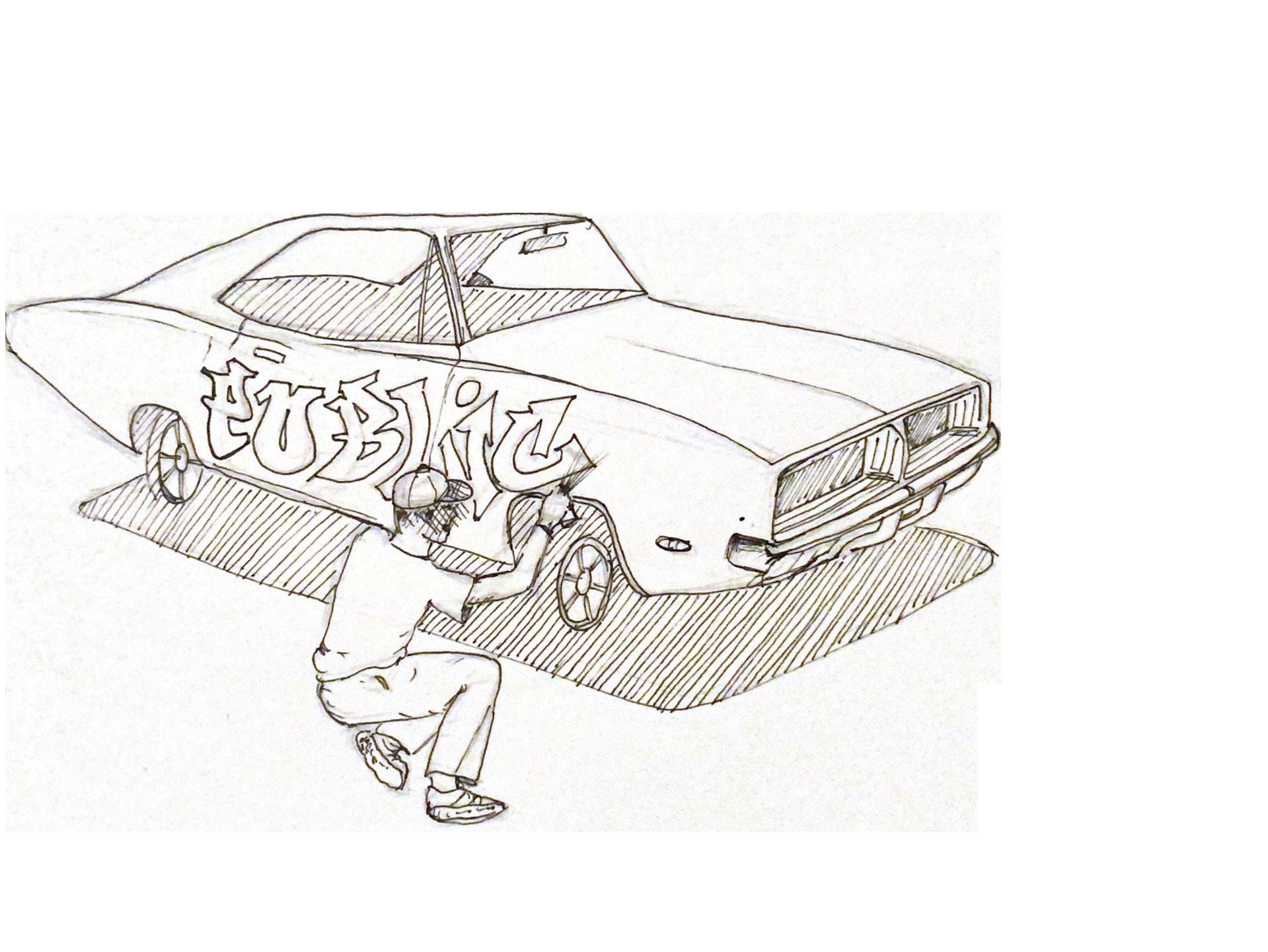
So, we nationalise public transport, we bring control back into public hands, we remove the profit motive, and problem solved… right? Well, not quite. It’s not like state-run public transport is devoid of issues. British Railways may be infamous for the catastrophic consequences its privatisation had, but I would argue that its situation was just as catastrophic before privatisation. At the very least, workers were just as unhappy and strikes were just as frequent. At the end of the day, government companies, even if they don’t have the same profit motive as private companies, are still organised along the same fundamental principles. They’re hierarchical, coercive, bureaucratic, unmoving, and unresponsive to the needs of their workers. Simply nationalising public transport won’t solve the problem.

It’s not a secret that private companies will squeeze the living guts out of their workers to reap a profit, but this is unusually true for public transport companies
Instead, I propose that we do nationalisation differently this time, what’s been called “Nationalisation of the 21st century”. First, we bring public transport back into government hands. And then, on top of that, we ensure that these publicly-owned companies are organised along democratic principles. The workings of these so-called ‘democratic workplaces’ are varied and difficult to explain, but I can try to summarise them.
The managers of these workplaces won’t be imposed by some elitist executive board, but will be elected by the workers. Important decisions pertaining to workers’ livelihoods, such as salary and working hours, won’t be made by the higher-ups in the state, but will be discussed and voted on by workers. The very structure of the company won’t be designed by some technical knowit-alls in the ivory tower, but will be a collaborative effort where every worker in the company is involved. There’d be no need for labour unions anymore, because the will of the workers would be integrated directly within the workings of the company.


There are two pieces of media that I’ve been obsessing over recently and naturally I’ve decided to make it everyone’s problem. Aristotle’s Nicomachean Ethics and Mitski’s My love is mine all mine may seem very different at first glance, but both had the same effect on me. I’ve read and listened to them dozens of times. I’ve tacked them to my walls. I’ve pinned them in my Spotify. I’ve pushed them down the throats of all my loved ones (my sincerest apologies to those patient souls). I just couldn’t get them out of my head.
Both pieces inspired in me a desperate need to bring them as close to myself as possible, to sit in them, and absorb them. After much obsession, it dawned on me that these texts attract me for the same reason: they reflect and shape how I understand love.
Love comes from our souls, and what is more ours than our own souls? Our character, belonging to our soul, is the only thing that can never be truly taken from us. It costs us nothing and is worth more than anything you could bargain for. Our actions, our love comes from our character and are equally ours.
Love is a concept that hardly needs introduction. It’s timeworn, it's cheesy, it’s unavoidable. I think it’s also reasonable to say that love is widely regarded as absolutely vital to living a bearable if not good life. However, like most of the concepts you’d think we’d

really want to have sorted out, almost everything we know about what love is, how we love, or why, is basically conjecture. Each person must seek to untangle their own ideas of love throughout their lives. Recently, I’ve been adopting a new understanding of love with the help of two of my favorite philosophers: Aristotle and Mitski.
Note that the result of my semi-intellectual efforts is a frankensteined philosophy that blends together my interpretations of how both philosophers would conceptualize love in a modern context. In my explanations I try to stay true to the general sentiments of both texts. However, the philosophy I sketch is very informal and subjective. I encourage you to take this article as food for thought and to look into the texts themselves if you want a more objective understanding of the authors.
Before we jump into the fray of things, it’s important to specify what kinds of love are being discussed. In her song, Mitski seems to address love in general, while Aristotle addresses love in friendship. I’ve decided to stretch Aristotle’s love in friendship to include all love between people, whether it’s platonic or romantic. It seems to me that in many cultures the basis for modern loving relationships is friendship. More than blood, title, or sex, friendship has come to define true love.
Just think of the sayings, ‘I married my best friend,’ or, ‘sisters by chance, friends by choice.’ In the Western world at least, it’s heavily implied that the love that comes from friendship can create a foundation for
It may sound flowery and untenable, but this ‘democratic workplace’ idea is nothing new. It’s been proposed by politicians, economists, and philosophers since the 19th century, and it’s already being put into practice successfully in many companies and organisations around the world. This kind of nationalisation model is the best and most feasible way to improve and expand public transport, while simultaneously enshrining workers’ freedom, agency, and wellbeing. And as a bonus, no one will ever again be subjected to their train to Antwerp getting cancelled literally the day before
all relationships. Aristotle's love in friendship could therefore reasonably encompass all relationships in which the friendship dynamic is foundational. The love that I discuss in this article should therefore be understood to apply to many forms of love.
We choose our actions over and over again and those actions embed themselves into our character...To Aristotle, love is a choice that’s intertwined with the deepest parts of ourselves. The active choice to love carves the act of loving into our very being.
Now, we can get down to the finer details. In My love is mine all mine Mitski doesn’t directly define what love is. Luckily, Aristotle does. In Nicomachean Ethics, Aristotle mentions three dimensions of love: our feelings, our actions, and our states of character. The feeling of love is described as the dimension with the least depth which may seem counteritive. Many modern people place a lot of weight on emotional ‘vibes’ and sparks. However, most of the ancient Greek thinkers argued that feelings without intention are passive, washing over us from time to time. Feelings don’t even require living subjects, “for love may be felt just as much towards lifeless things.” Aristotle specifies that love between people is more than a passing state devoid of agency.

continued on next page....
Aristotle says that love requires action. He claims that “mutual love involves choice.” Love isn’t something that passively floats through you. Love is something that you choose, and the choice to love comes from, and shapes, who you are. He elaborates that: “choice springs from a state of character; and men wish well to those whom they love, for their sake, not as a result of feeling but as a result of a state of character.”
In giving love you realize the value of what you have to give. It’s hard to judge your own character, but you can see your love in the joy that you bring the people you cherish.
In Nicomachean Ethics Aristotle describes ‘activities of soul’ coming from our ‘states of character’, implying that our characters are linked to our souls in that they dictate how we act and who we are at our core level. A key aspect of Aristotle's philosophy is that people’s characters aren’t inherently good or lovable. We choose our actions over and over again and those actions embed themselves into our character. Our choices are always cyclically coming from and returning to our characters like a boomerang. And although our feelings are also drawn from the same place, they do not shape the character the way choice does. To Aristotle, love is a choice that’s intertwined with the deepest parts of ourselves. The active choice to love carves the act of loving into our very being.
she doesn’t stop there. As an action, love is not a stagnant thing collecting dust in our ribs. In the first verse of My love Mitski sings,
Here before and after me
Shinin' down on me
Moon, tell me if I could Send up my heart to you?
So, when I die, which I must do Could it shine down here for you?
In the song, it can be assumed that her heart represents her love. She yearns to share her love with someone forever. This verse touches on an important aspect of love; love is something that you give. While we also receive love in mutual relationships, the most important part of a relationship is loving. In the song, Mitski expresses a
worth.” In giving love you realize the value of what you have to give. It’s hard to judge your own character, but you can see your love in the joy that you bring the people you cherish. When you meet someone divinely wonderful, you want to give them everything. You reach into your soul to figure out what you have to offer and suddenly realize how much is there. According to Aristotle, seeing your capacity to love and pushing it further changes you. “And in loving a friend men love what is good for themselves; for the good man in becoming a friend becomes a good to his friend.” In relationships we mold our soul into the shape of love for the benefit of another. By loving we become better people.
I believe that Mitski and Aristotle would agree that love is an activity of our souls, something meant to be given, and something that brings out the best of ourselves. However, there’s one more point that I wish to propose inspired by the first verse of My love in which Mitski talks about sending her heart to the moon. In her Genius interview, Mitski explained that she doesn’t want to die because she loves so much in life. She wished her love could be as eternal as the moon. This connects to a general human desire to preserve our souls or leave something lasting after death. What if we need look no further than our love?

This leads us to the title of Mitski song, My love is mine all mine. The title itself is a phrase she repeats over and over again throughout the song. In a Genius interview, she explained that during childhood she moved around a lot and suffered from the feeling that nothing was really hers. She also talks about how everything costs something or is ‘tradable’ in some way. Mitski realized that the only thing that was forever and always hers was her love. “My love is mine, all mine, all mine.” In essence she expresses a similar sentiment to Aristotle. Love comes from our souls, and what is more ours than our own souls? Our character, belonging to our soul, is the only thing that can never be truly taken from us. It costs us nothing and is worth more than anything you could bargain for. Our actions, our love come from our character and are equally ours.
Although Mitski claims her love as her own,
wish to give her love even when she would be unable to receive anything in return.
Aristotle similarly said, “In being loved, on the other hand, people delight for its own sake…. But [friendship] seems to lie in loving rather than in being loved … loving seems to be the characteristic virtue of friends, so that it is only those in whom this is found in due measure that are lasting friends, and only their friendship that endures.” What Aristotle explains in these sections, is that while everyone likes to be loved, truly loving relationships occur when both people focus on giving instead of taking. The emphasis is always on the active rather than the passive part of relationships.
Mitski expands on one of the positive effects of loving in her second verse. “My baby, here on earth, Showed me what my heart was
As an action, love is not a stagnant thing collecting dust in our ribs.
Love is a tradition that connects all people. Since ancient times, humans have been expressing what it is to love through music and writing. Thanks to them, we know that throughout time and across space humans of every size, shape, and background have lived for the love that we can give one another. Generation after generation, we choose to embrace. Love is passed down through family, art, friendships, spirituality, community, and acts of kindness. When we love others, we are participating in and continuing an eternal chain of human choice. Even in the face of cruelty, oppression, and death, our love can’t be taken from us because it is of our souls. It’s the one thing we always have and that we consistently choose to give. As long as we keep giving our love to one another, our souls will echo forever in the human choice to love, even when our time has long passed. Loving itself is the way that we send our hearts to the moon.
In the summer of 2021, when I was 17 years old, I met a man at a bar. He bought me a couple of drinks while we talked about movies, philosophy, books… I was immediately mesmerized by the way he spoke. He seemed so calm and collected, his words so pointed, his speech so eloquent; he was 32, after all. He did not hide his age. It was as if he almost prided himself in the act of being sincere with me about the fact; as if he was initially planning to lie (or at least beat around the bush) about it but, seeing as I was so mature for my age, he had made the honorable decision of coming clean. The whole interaction felt exciting to me. A grown man, an artist, was suddenly interested in what I had to say. Quite organically (or so I thought), we landed on the topic of Nabokov’s Lolita. He withdrew from making any strong claims as, I assume, he was looking for any sign from me that would indicate I was interested in something more than friendly conversation. I caught on and accepted his not-so-subtle offer. The truth is, at the time, I had neither read the book nor seen any of the film adaptations and so, in my eyes, Lolita had this halo of mystery around it which appeared enticing to my uninformed teenage mind.
We need to combat the general tendency to push women into becoming agreeable, and always saying yes, in fear of offending men. We must talk to each other, our girl friends, our sisters, our mothers; create a support system that will not resort to shaming and pointing fingers at the victims, but rather it will encourage them to fight back.
One of the first times we would meet in his apartment I wore a plaid schoolgirl skirt; I cringe at the thought of that, as well as at all the other much worse things I would eventually do in an attempt to comply with his peculiar requests.
The six stages of grooming are the following: targeting, gaining trust, fulfilling needs, isolating, sexualizing the relationship, and, last but not least, establishing control. Depending on each case, these so-called stages come in a myriad of different shapes and forms. In this one, our relationship was always sexual, and he was always in control. I do not find it productive to describe the details of how I was sexually assaulted by him, but
it feels important to note that much of the power he held over my head came directly from the times when we were intimate (if you can even call it that). I cannot say the element of trust was ever there with him. It was obvious, when looking into his eyes, that he had no regard for my level of comfort; the more frightened I looked, the more wine he would feed me, and so on, and so forth, until all the alarms that were previously going off in my head had been completely silenced.
No one taught me how to protect myself from the kindness of strangers. No one told me I could say no even if the person asking was doing so nicely. It is relatively easy to safeguard oneself from imminent danger when it is of an obvious nature, not so much when the danger in question is hidden in between lines of poetry and apparent shows of affection.
Another aspect that I find interesting is how easily he could inspire guilt in me. He managed to build an image of himself as this good man of exemplary behavior who was tempted by the advances of a young promiscuous woman. I can tell you now, although most definitely young, I was neither promiscuous nor a woman; but he somehow convinced me that I had been the instigator, that I had approached him at the bar, that I had kissed him, and he had tried to pull away. That I was guilty, and he was innocent. All of those instances were true, but only looked at in isolation. He twisted the facts in order to build a narrative of complete absolution not too different from that of Lolita’s Humbert Humbert, ironically enough.
In comes the final reflection. I will not sit here and continue to blame my 17-year-old self for not realizing that I was being subjected to the manipulation and abuse of a man that nearly doubled my age at the time. But, on the other hand, I will not paint myself as this clueless little girl who was unaware of the dangers of the big wide world. I was raised a feminist for as long as I can remember. My mom made me religiously repeat time and time again the different ways to get out of a dangerous situation – if I was returning home by train and a man walked into the empty car, if I was walking alone at night and ran out of battery, if I was ever approached by that one guy in my hometown who we all know and avoid because he’s a creep to little girls (and yet no one does anything about it). But no one taught me how to protect myself from the
kindness of strangers. No one told me I could say no even if the person asking was doing so nicely. It is relatively easy to safeguard oneself from imminent danger when it is of an obvious nature, not so much when the danger in question is hidden in between lines of poetry and apparent shows of affection. I dream of one day having a daughter but, at the same time, I am terrified of it; because, if my lived experiences today at 19 years old have taught me anything it is that, sooner or later, she will be exposed to this sort of danger. What to do then? What to equip her with in order to face the cruelties of the world?
I do not intend for this essay to end on such a bitter note, which is why I would like to call for a change in young people’s (and specifically young women’s) education when it comes to grooming. We need to combat the general tendency to push women into becoming agreeable, and always saying yes, in fear of offending men. We must talk to each other, our girl friends, our sisters, our mothers; create a support system that will not resort to shaming and pointing fingers at the victims, but rather it will encourage them to fight back. I no longer feel powerless, nor guilty. In retrospect, more than anything, I’m angry I wasn’t given the proper tools to fight back. If you have lived through a similar experience and see yourself reflected in the anonymity of this essay, know that you are not alone, and that it is never too late to fight back.


Feeling stuck with your life choices? Dreading that student loan payback? Or just plain refusing to start that essay due tonight? Fear not! I present to you the perfect solution: fake your own death and start a new life elsewhere! And since wikiHow suggests using ketchup as fake blood and a sudden injury to pull this off, I’m here with a fool-proof 5-step guide to help you escape student life.
Faking your own death isn’t a crime. It’s the false insurance claims, bogus police reports, and tax fraud that are. Stay on the safe side by moving to a nearby city, using cash, and scoring a job under the table.
Faking your own death, also called pseudocide, is a time-honored tradition to escape life’s eternal struggles (or just boredom). The OG pseudocide goes back to the 14th century when Joan of Leeds, a rebellious nun, escaped her convent using a “dummy” burial. Although little is known about her motivations – despite maybe being forced into a convent at age 13 – she paved the way and emphasized a key detail: the body.
Just like in your favorite TV shows, no body, no death; it also applies to your pseudocide. Sure, you wouldn’t ask someone grieving over a lost parent where the body is, but in our fake-your-own-death
journey, planning this out is essential.
Now, drowning or getting lost at sea might seem like an easy “body-less” exit strategy, but the police often tend to be persistent and look for the body until they find it – which happens often within a few weeks after the accident. A much smoother vanishing act would involve going for a hike and never going back. The simpler, the better.
Once you have an idea of how you want to die, it’s time to start planning out the rest, and don’t procrastinate like you do with uni assignments. According to Mr. Waltis, an Australian private investigator specialized in pseudocides, it could take up to 18 months to plan the perfect death. Disappearing in the digital age isn’t a cakewalk: social media, the use of credit cards, and facial recognition make things more difficult. It is however not impossible, if you start early enough.
Delete those credit cards and bank accounts, delete your emails, buy a new SIM card and most importantly withdraw cash. You might need up to $30,000 if you fancy hiring a professional fixer to help erase your physical and digital tracks. Student-budget friendly? Not really. Though cheaper options do exist, like the death kits from the Philippines for only $500, which includes a death certificate, witnesses of your death, and a fake autopsy. Crafting a new identity is crucial. Channel your inner Barbie because “You Can Be
Anything”! Create a very coherent and believable identity, including a new appearance. Take cues from John Darwin, a guy who went missing in 2002 after a canoe accident and managed to live for 5 years under another identity, right next to his wife Anne, enjoying his £250,000 life insurance. Sure, they got nabbed for fraud and got sentenced to 6 years of prison, but we’re not dwelling on that part.
Feeling stuck with your life choices? Dreading that student loan payback? Or just plain refusing to start that essay due tonight? Fake your own death and start a new life elsewhere!
Now, about legality – faking your own death isn’t a crime. It’s the false insurance claims, bogus police reports, and tax fraud that are. Stay on the safe side by moving to a nearby city, using cash, and scoring a job under the table. And, most importantly, snip all ties with your old life – friends, family, etc. –because as Mr. Waltis explained, “people get caught because they can’t cut ties with their previous lives.”
Et voilà! You’re now armed with the ultimate guide on how to disappear. Whether you’re looking to collect insurance money, dodge a pursuit, break free from jail, stir up online sympathy, or just for shits and giggles – you know how to.
November, 2023
Fall is approaching, the days are shorter, the work is harder, the air is colder. In short, it's high time for every girl I know to have a crisis. Last week, I came across an article that discussed social media aesthetics, and it made this statement: “My identity as a woman consists of the superficial things I consume. I don’t genuinely like the material constituents of my identity. I like the idea of liking the products and media I consume”. This hit a little too close to home for me, as I hope it does for you, and it made me think. When I introduce myself, what do I tell people?
Where is the line between innocently assimilating to popular culture and commodifying one's girlhood?
I would tell them that I would pray to novels like “When You are Engulfed in Flames” and “Pride and Prejudice”. I tell them that my favorite movie is Harold and Maude and that I live for Joni Mitchell and Jonathan Edwards. I love doing my makeup and partying and staying up late and smoking Marlboro Golds.

When these aesthetics are so heavily applied to women, they present the claim that these women are simple. They can be wrapped up in a bow and placed in the concrete box that is their aesthetic.
If you really think about it, what the fuck does that even mean? I introduced myself to you and all I've actually done is give you a list of things that I want to impress you with. My identity lies solely in the way I market myself
to others, and it's all by design.
I think that this is the true reason that social media is such a black hole. It allows women to present themselves as a “type”. It puts them boxes, watering down their inter ests, experiences, and identities into digestible archetypes like the clean girl, the messy girl, she's with the band etc. And it is an endless cycle of deceit. Girls are so busy squeezing themselves into these pret-a-porter versions of other people that they don't have time to experi ence any other version of girlhood. Once a girl begins to limit herself to a social media aesthetic, shoved into an unbreakable box, she has already gone down the rabbit hole of binding herself to something counterfeit.
Yet, I am hung up on this quote from Profundis, where Oscar Wilde wrote “Most people are other people. Their thoughts are someone else’s opinions, their lives a mimicry, their passions a quotation”. Where is the line? Where is the line between inno cently assimilating to popular culture and commodifying one's girlhood?

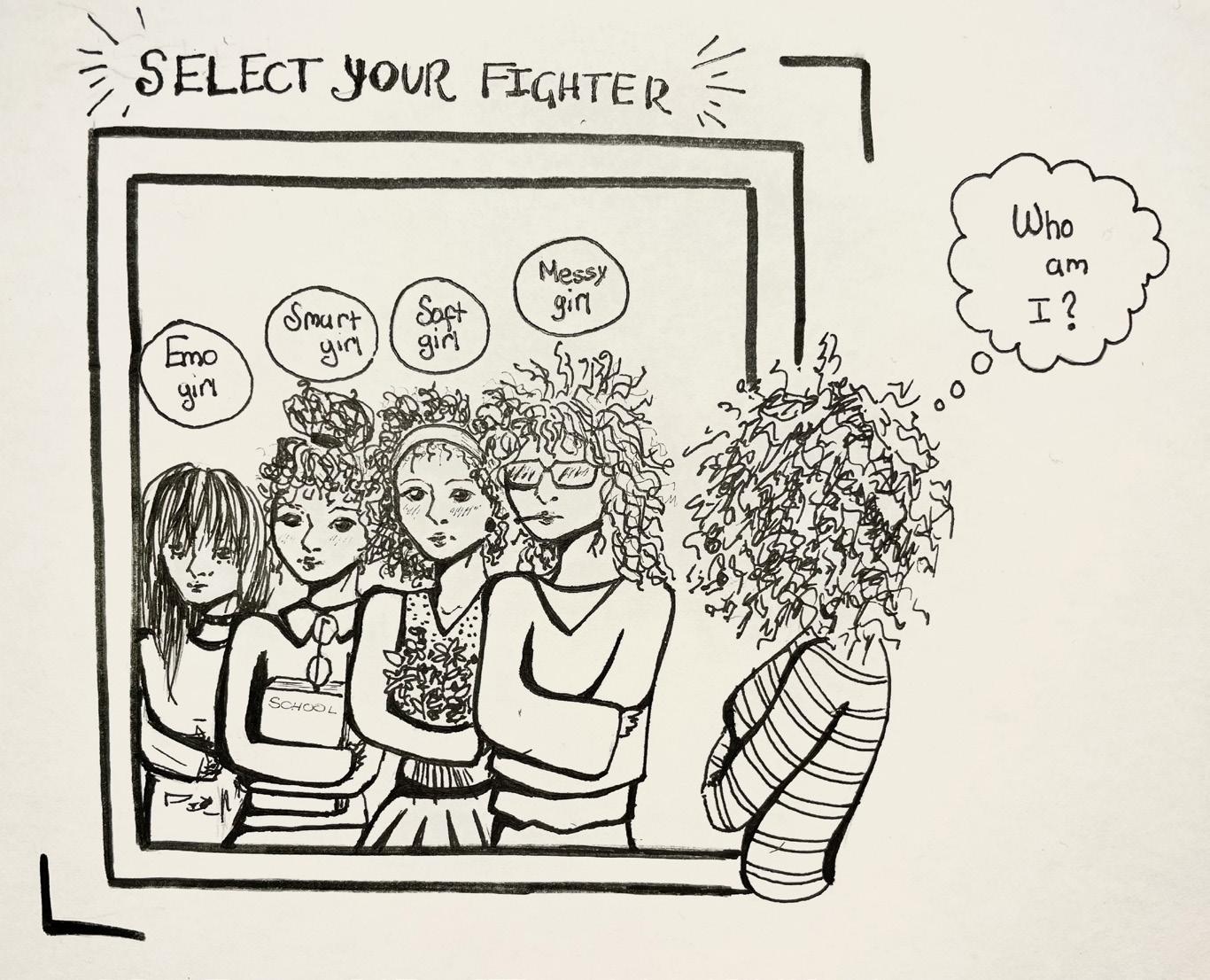
I think the media’s answer would be simple: The line is drawn at sex. Men can party all night, wake up and smoke Lucky Strikes while playing their guitars and reading Sartre. This is mysterious. They are complex, elusive, and attractive. Most importantly, they are human. These enigmatic and materially based behaviors do not define their identity, they are a starting point by which people are intrigued to learn more. These little quirks barely scratch the surface as to who these men are and what is interesting about them. Yet, when a woman presents a version of herself like this to the public, the general consensus is decidedly different. This woman is presenting herself as a type that the media will gladly shove her into. When she wakes up, hungover with her makeup still on in someone else's bed. When she rolls over and puts on a record and rolls a joint. When she sits on her balcony, half-naked, reading Nietzsche. When she does these things, she is markedly unmysterious. She fits perfectly into the “messy girl aesthetic”.
of any authenticity. When these aesthetics are so heavily applied to women, they present the claim that these women are simple. They can be wrapped up in a bow and placed in the concrete box that is their aesthetic. They are not humans, they are a fabricated version of girlhood, which is misrepresented, repackaged and presented by the media.
I introduced myself to you and all I've actually done is give you a list of things that I want to impress you with. My identity lies solely in the way I market myself to others, and it's all by design.
Where does the commodification of girlhood end? When will we, when will I, finally look in the mirror and see the shell of a girl wrapped up in a pretty aesthetic? It is exhausting living the manufactured life that social media has designed for us, to feign authenticity when all we are is a mimicry. Women have always been held to a moral and physical double standard. Social media exacerbates this pseudo-self. I hope this sends you into crisis too, if only for the fact that I do not want to be alone in this.
Have you ever cried at the news before? Here I’m paraphrasing a former professor when I ask this: have you cried and said: “I’m never watching the news again,” only to go back the next day, and the next, and the next?
If you answered “yes,” “kinda?” or any other affirmatory statement – congratulations! You’re living in the Fearscape. Even if you answered no, you probably still are and it just affects you less. The reason for this, of course, is that the Fearscape isn’t individual. It’s all around us, to varying degrees, but present regardless.
As long as you talk with other people about current events or partake in online discourse regarding basically any topic that is capital-I-and-R Important and Relevant, you are inside this system, and there is nothing you can do about it.
If it’s a moral imperative to focus on everything, then those who have trouble focusing on anything will, by and large, be perceived to be doing something they should not.
That sounds awful, doesn’t it? Especially with a name like that – I’d assume nobody wishes to be in the Fearscape if being outside is possible. Yet if you partake in any of the actions mentioned above, there is no escape. Unless a drastic change occurs in all journalistic media we consume and how we consume them.
Fearscape. It’s something many of us (based purely on conversations I’ve had with people I know) have experienced: the feeling that each day, there is something new to be threatened by, something else to be afraid of. Without regard to these events’ world-scale importance or personal relevance, the takeaway is this feeling of a threat breathing down your back. Feeling powerless because there is nothing you can do to help, or guilty because you could do something but choose not to. No matter if the journalistic piece is about
some reassurance that things are just average so my mind would finally allow me to disengage – but this relief rarely comes.
While I fundamentally disagree with the reluctant acceptance of problems around us – that's the mindset of many people – it’s normal and okay to filter consciously.

war and global warming or something more mundanely horrible, like a fatal freak accident, it gets thrown on top of the pile all the same.
Instead of waiting for change to occur by itself, there are two paths to be taken: finding methods to implement the change, or finding coping mechanisms. The former is not something that I can say anything world-shattering about: organizing protests, tearing down capitalism, etcetera. But for the latter, we must first understand what the Fearscape actually means, as well as why it influences us the way it does.
Though the word is barely used, dictionaries tend to define a fearscape as “a place or general atmosphere of fear.” Within this context, I wish to identify a specific subcategory by the capital F term: the News Cycle
Sometimes this pile topples. That’s when the only thing left to do is to cry, melt down or, as it always feels like the better option, to begin explicitly focusing on some of these events by either bringing them into whatever discourse you can or trying your best to help fix things.
Yet while there are so many important issues to focus on and to be constantly active about, it’s simply not possible to pay attention to everything within the Fearscape. Furthermore, at least personally, getting overwhelmed and upset tends to put me in a state where I delve further and further into whatever is going on in the world, seeking
The exploration of this state pushed me to wonder if its existence ties in with my neurodivergence and if other neurodivergent folk experience the same effect. I have ADHD: more the attention deficiency than the hyperactivity part, but the latter also presents itself at times. My brain partakes in a constant cycle of seeking stimulus and pushing the things that don’t provide it aside. In short, I cannot focus on most things as much as the neurotypical-centric society I live in regularly wants me to.
I have ways to circumvent or solve this problem in most cases but when it comes to the Fearscape, where guilt and shame can arise in just about anyone due to the inability to give events proper time and headspace, it’s incredible how quickly it can overwhelm me. It’s only logical: if it’s a moral imperative to focus on everything, then those who have trouble focusing on anything will, by and large, be perceived to be doing something they should not.
I promised coping mechanisms, though I’ve yet to find any reliable ones. But perhaps I can share the thought that sometimes helps me when the sheer amount of information becomes unprocessable: there is nothing wrong with picking and choosing. While I fundamentally disagree with the reluctant acceptance of problems around us – that's the mindset of many people – it’s normal and okay to filter consciously. The money made by reader engagement keeps the unimaginably capitalistic Fearscape Maintenance Machine running, but at the end of the day, the agency to decide what to engage with is your own. Don’t let it win.
Júlia-Janka Gáspárik, Hungarian Romanian, talks about her life in Transylvania
by Ștefania PicăThe door opens abruptly, welcoming a storm of energy through the hallway. I turn my head and I’m greeted by a big smile stuttering “Sorry for being late.” Júlia had just arrived from Amsterdam. As I took another sip of my free coffee, she took a few breaths and regained her full smile, accompanied by tired eyes.
Both of us have heard the jokes of ‘who was here first’, the cliché of all territories, especially in the Balkans. “Who cares who was here first?” she asks rhetorically, “We have always been here together.

Júlia-Janka Gáspárik has been the exchange coordinator at University College Utrecht for the past year. She is Hungarian and Romanian, born in Târgu Mureș, 114 km away from my hometown, Făgăraș, both in Transylvania, Romania. The region has a long record of being home to diverse ethnic groups, currently with a fifth of its population being of Hungarian descent and at least other 10 registered minorities.
In 1996, Hungary and Romania signed the Treaty of understanding, cooperation and good neighborliness, a crucial moment in the pacification between the two. However, the political tensions within Transylvania were not let to rest. Viktor Orbán, the Hungarian Prime Minister, extended his foreign populist policies pervasively in the region since 2011. In light of multiple efforts to strengthen Hungarian nationalism within the diaspora, the Prime Minister simplified the process of acquiring citizenship.
Orbán’s visits in Transylvania have become regular ever since, and his discourse has prompted the rise of autonomy ideals for
Romanian Hungarians and a sense of protection towards Hungarians from abroad.
Júlia resents this narrative, “I think people virtu ally became citizens of Hungary in a way, and they are not aware of Romanian poli tics and Romania.”
She tells the story of her upbringing in the middle of these politics with great admiration for her parents.
“Complex is the natural” was their mantra, debunking the myth of pure iden tities and prompting Júlia to cherish her access to both Romanian and Hungarian culture as an enriching experience. Her origin is Slovakian-Hungarian on her father’s side, with her surname being a Hungarian version of Gasparyk, and Saxon-Hungarian (i.e., German from Transylvania) with some Greek mixed in, on her mother’s side. “They both are everything that Romania is and that’s a great thing.”

same way, hostile towards the government and with a victim complex. […] We have so many things, what else should we need?”
Beyond her parents’ doorstep, the perspective was different. “I was also surrounded by people whose parents didn’t think the

She was born and raised in a city with a balanced distribution of Hungarians and Romanians. Her whole education and some facilities within the city were offered in her mother tongue. “As a kid I had all these inputs and sometimes it was difficult. […] But I don’t remember ever being made fun of. In my hometown, I went to a mixed basketball team. There, sometimes, it came out. Because we were half [Romanian] half [Hungarian] and we were friends, but whenever there was conflict, on both sides, it could come out.”
Júlia speaks with a mix of anger and disappointment about the divide in the region. As children, both of us have heard the jokes of ‘who was here first’, the cliché of all territories, especially in the Balkans. “Who cares who was here first?” she asks rhetorically, “We have always been here together. You go back in the history of Transylvania, there’s always been at least five ethnic groups. […] It’s a diverse place, and anybody trying to say the opposite, no matter which side, is just dumb.”
continued on next page....
Hearing Júlia’s anger about this division gave me a sense of relief. In my teenage years, my personal narrative of these tensions was inverted. I had Hungarian and Saxon friends, but somehow, they were the exceptions, and all other Hungarians just hated us, Romanians. The media and society fueled my brain with a non-existent rivalry, overshadowing everything else.
The media and society fueled my brain with a non-existent rivalry, overshadowing everything else. We found that this ethnic conflict between Hungarians and Romanians was everywhere but around us. The tensions were on the news and at elections, but in ordinary life, they stopped at sarcastic jokes in school breaks.
“I hear from older people that in the ‘60s and ‘70s, all kids spoke both languages in my hometown,” Júlia said with excitement. We found that this ethnic conflict between Hungarians and Romanians was everywhere but around us. The tensions were on the news
and at elections, but in ordinary life, they stopped at sarcastic jokes in school breaks.
I asked Júlia if she ever questioned her national identity. Without a second thought, she nodded. The first instance was when she moved to Cluj, the largest city in Transylvania, where she met people from Moldova. “They were very curious about us. […] ‘Why are you speaking Hungarian?’ And we responded, ‘Why do you ask why I’m speaking in my own language?’ This is such an odd question.”
These interactions multiplied when Júlia moved abroad to the Netherlands. “They first asked me where I’m from, and I always said, ‘Oh, I’m Hungarian from Romania’. [They would reply] ‘Okay, so are you Hungarian or Romanian?’ And I thought, ‘Well, why is it exclusionary?’” and the question transcended into one of passports and citizenships.
Júlia’s educational and career choices followed European culture. The key moment of this choice was the refugee crisis in 2015. “I remember in the news, the whole thing, […]
it triggered this completely different direction for Hungary about identity and about who’s European and who’s not European.”
She believes that her parents’ sympathy for diversity is the most European of values, and that a question aimed at gatekeeping people’s safety had no place in Europe. “And that’s when I thought I knew something, I have something to offer and that pushed me to want to talk about it. It gave me a lot of inspiration to promote that complex backgrounds can be embraced, and then, there’s no exclusive identities.”

Dear campus,
Now that it’s finally half-sunny outside, we thought it’d be a good time to release our Spring edition! My suggestion would be to lay down under a tree, the sun peaking between the leaves, and enjoy a few relaxing moments while you cruise through this edition – or you could just read it in your room, like I’ll most likely do.
For this edition, we’ve welcomed Yoan into our board, who’s now doing double-agent duty as Art & PR Manager with us, and PR Manager in SCOPE. Even if he has to split his commitment, his illustrations are gorgeous, his article (on the cover page) is great, and his general presence is hella fun to have around <3 we love you Yoan. I also want to thank everyone else on the board for their hard work during the past couple months, and also everyone who submitted articles or illustrations!
To close off, allow me to not-so-subtly hint that we’re gonna be looking for a new intern soon, so check our social media (via the QR codes below) in a few days if you’re interested ;)
Kind regards,
Pablo
Pablo Ruiz Delgado | Editor-in-Chief
Alicja Anna Chojnacka | Managing Editor
Mila Maria Grazia Frattini | Executive Editor
Yoan Panev | Art & PR Manager
Jasmine Yi Carder | Layout Manager


Butter chicken holds a special, coveted place in South Asian cuisine in that even those most unfamiliar with it are aware of the existence of butter chicken. It is considered, often amusingly so, as the typical go-to meal for many at South Asian restaurants around the world, despite the plethora and diversity of other available dishes. To be honest, this tendency of people, particularly from the West, to resort to eating it is entirely understandable. With its milder flavors and the familiarity for many of eating something with tomatoes and cream, it is, at least in my opinion, the perfect starting point and gateway for someone new to South Asian cuisine.
Readers may be (correctly) wondering why GastronomyCo is deciding to spotlight a dish that undoubtedly has received (and continues to receive) more than its fair share of attention. Well, if you have been keeping up with the latest food news
around the world (as we, committed members of GastronomyCo, do), you will know that while we can all come together today and appreciate the deliciousness of butter chicken, its origins have become a bit of a divisive topic in India. In particular, for two Indian families - both of whom are claiming that their forefather was the mastermind behind the creation of butter chicken.
The story goes back nearly a century ago to 1920s Peshawar, where restaurateur and chef Kundan Lal Gujral invented butter chicken for his restaurant Moti Mahal as an easy and effective way to not waste leftover tandoor chicken. That is, at least, according to the Gujral family who run the Delhi-based restaurant today (they moved in 1947 due to partition). A rival restaurant however, by the name of Daryaganj, trademarked the phrase ‘inventors of butter chicken’, with their version of events being that Gujral’s
partner, Kundan Lal Jaggi, who managed the kitchen, was the true inventor of the dish. The Gujral family filed a case against this to dispute their claim, even demanding $240,000 in damages.
Unfortunately for those of us deeply invested in this delicious drama, a ruling for this case from the Delhi high court will not come any time soon, due to the time taken to resolve high court cases. If you’re as disappointed to read this as I was writing it, then you can soothe yourself by making butter chicken on your own! More ‘authentic’ butter chicken, like almost every South Asian dish, is quite tricky and tedious, so I scoured the internet to find a more manageable recipe for UCU kitchens, which you can see below (if you do, however, want to challenge yourself, I recommend the butter chicken recipe from the blog Swasthi’s Recipes). Enjoy!
Taken from the blog ‘Gimme Delicious’
1. “Heat a large skillet/medium saucepan over medium-high heat. Add the oil, butter, and onions and cook onions down until lightly golden (about 3-4 minutes). Add ginger and garlic and let cook for 30 seconds, stirring so it doesn’t burn.
2. Add the chicken, tomato paste, and spices. Cook for 5-6 minutes or until everything is cooked through.
3. Add the heavy cream and simmer for 8-10 minutes stirring occasionally. Serve over Basmati rice or with naan.”
● 1 tbsp oil
● 1 tbsp butter
● 1 medium onion (diced)
● 1 tsp fresh ginger (minced/grated/use paste)
● 2-3 cloves garlic (minced/crushed)
● 2-3 boneless chicken breasts, cut into ¾-inch chunks
● 4 tbsp tomato paste
● 1 tbsp garam masala
● 1 tsp chili powder (or paprika, for a milder taste)
● 1 tsp Fenugreek
● 1 tsp cumin
● 1 tsp salt
● ¼ tsp black pepper
● 1 cup heavy cream


Thus far I’ve kept to reviewing books that I’ve recently read in order to capture my memories of them at their freshest. But for this review I’m not following that rule. Love in a Fallen City is both the name of a novella and its corresponding short writings collection written by Eileen Chang and translated by Karen S. Kingsbury. I read the collection in the winter of last year and really enjoyed it. Then, I let it rest in the back of my mind where it marinated, largely unnoticed. However, more and more Love in a Fallen City has returned to me in my moments alone. There are some books that instantly strike you and there are some that stealthily chip away at the concepts central to your life. Chang’s collection does both.
Eileen Chang was a prominent Chinese writer born into what I believe is one of the most interesting periods of recent history. Her life was inextricably tied to the ideological and political upheaval of mid-20th century China. Needless to say her story was anything but conventional or stagnant. Set into the same context,
her writing gives one the feeling of teetering on the edge. Whether it be between tradition and modernity, security and revolution, or restraint and freedom, it leaves an uneasy thrill.
Chang masterfully marries the effect produced by the atmospheric pressures of her time with her sleek, velvety prose and moody plots. The novellas and short stories in the collection mostly revolve around love and hold a beauty comparable only to the luster belonging to our objects of yearning. There’s that feeling when you find someone that’s entirely gorgeous, that has that something extra, aside from their physical perfections, for which there are many. When there is something in a tousle of unkempt hair, musky sweat laden perfume, or the haphazard gaze caught through puffs of smoke that makes you feel like the other has already seen through your bones, while you will never hold more than a whisper of them in return. An infatuation that’s addicting, desperate, and fleeting. Love in a Fallen City is writing that you long for, ravage in one night, and retreat from in confu-
As our beloved editor Katrina moves on to things beyond UCU, I’ve had the pleasure of taking over her music column. I’ve always looked up to her for her commitment to discovering new songs and artists, and always looked forward to reading about her findings. Carving out a little alcove for music, and putting it in print in the chaotic pages of The Boomerang, is something that I hope to continue and protect.
Now, onto the music. Recently, the weather has been quite a tease. Sunlight doesn’t last for longer than a day, and when it does, the wind comes howling in. Rainy days are most common. I don’t dislike them entirely: the most peaceful parts of my day consist of looking out to the rain, window ajar, sitting in bed. The drops sound like distant applause by a thousand hands, so it feels natural to find music to accompany that percussion.
Instrumental songs are often difficult to find, and transitioning them from a one-time listen to a ‘genre’ recurrently enjoyed is even more difficult. No words, or radio-successful jingle, no chorus stuck in your head, or extremely relatable sentences; all the transportation lies in the texture of the sound. I think we just need an entrance.
For me, the starting point was jazz. Discovering Miles Davis and John Coltrane, I got hooked on the almost cutting yet always balanced buzz of the trumpet and on the lower humming saxophone. The first time I listened to “It Never Entered My Mind” by the Miles Davis Quintet, everything around me seemed to zoom out. Immediately strong, the piano hauled my head and my heart to the same place, converging at the pit of my stomach.
A grounding feeling: no separation between ‘me’ and my body – no separation between body and music. Now, I listen to it every other afternoon, the break in between so that the trumpet can still surprise me at second 18 and the snare drum can still soothe me throughout.
But jazz isn’t the only access point. Single instrument instrumentals can also be wonderful. A friend introduced me to Hermanos Gutiérrez this summer, specifically their song “Nuevo Mundo”. The two-piece band takes influence from 1950s Latin American sound and carries us to foreign (to me) landscapes with their intertwined guitar strums. Travelling through music is such a gift, and their songs do just that.
A very different yet equally as compelling sound is that of Chilly Gonzales’ album “Solo Piano”

sion. Chang touches on many themes within the umbrella of love while surrendering nothing. I enjoyed and remember several of the stories in the collection, but there is one specific paragraph in the novella Love in a Fallen City which I will never forget. It is the reason behind this review. In that one paragraph, Chang expressed a feeling that’s been built into my gut since childhood, leaving me naked and somehow lighter than before.
If you want to delve into the heartache of first loves or simply run your brain through the smokey elegance of her writing, I need you to read this collection. It’s a whole experience. Also, if you do take my advice and pick up a copy, which you should, you must follow Chang’s instructions. If, before starting her story she asks you to, “go fetch will you please, a copper incense brazier, a family heirloom gorgeously encrusted now with moldy green, and light in some pungent chips of aloeswood,” there better be a text on your group chats inquiring after aloe incense. It will enhance the experience, trust me.

My mom used to wake me up on Sundays with the notes drifting into my sleep from the living room; by “Dot”, the fifth song in the album, I’d notice the sunlight tiptoeing over my eyelids together with the composition’s notes. His music takes me home: it’s warm, curious, and nostalgic. I wonder where it would take you.
Then, there are the ones I can’t really put into words. It’s difficult to explain why I cried because of the repeated 6-note piano sequence in “Maggot Brain” by Funkadelic. This instrumental, in its lack of words, holds something that takes away my own. It’s refreshing to have very little to say. And, finally, “Tezeta” by the Ethiopian musician Mulatu Astatke. It feels lighter than other songs I mentioned, and is the richest still. A blend of sounds across cultures and genres, leading you by the hand to a field of flowers.
With this bit of insight into what instrumentals are to me, I hope to have sparked the interest of those of you who haven’t explored it much. For the avid listeners, I wish that some reflections resonated, meeting me halfway in the music.
Something that irks me is how people call orcas ‘killer whales’, when they are not, in fact whales. Orcas are actually the largest member of the oceanic dolphin family. There are various theories as to why: I heard an unconfirmed one that it comes from ‘killer of whales’, and the ‘of’ got removed over time. I later found out that it is far more likely that the term ‘killer whale’ is a mistranslation of ‘whale killers’, the name Basque sailors in the 19th century gave to orcas. Still, this got me thinking of other linguistic instances where parts of a phrase are left out. This led me down a rabbit hole of linguistic ellipsis, and it turns out there are lots of variations - and more research needs to be done to understand all the mechanisms. That aside, linguistic ellipsis is when you omit one or more words from a clause or phrase, but doing so does not mean you can’t understand the context. Verb-phrase ellipsis is particularly prevalent in English. Here’s an
example (taken from Wikipedia): ‘John can play the guitar; Mary can, too’. The phrase without the verb-phrase ellipsis, and the more grammatically accepted one would be: ‘John can play the guitar; Mary can play the guitar, too’. But here’s the thing: if anyone said that to you (assuming you are a native English speaker), it might sound a bit weird, a bit too formal for the informal context in which you are learning about John and Mary and their guitar-playing capabilities. From a language-learning perspective, being fluent would require you to grasp these ellipsis.
Another very common occurrence of ellipsis in English, and most other languages, is in answers to questions. If someone asks you: ‘Who are you having dinner with?’ and, having been impressed by his prolific guitar skills and thus compelled to have dinner with him, you would answer ‘John’. This is a classic example of an answer ellipsis!
In the light of the ongoing genocide, it is our duty as students to criticise the institutions that directly or indirectly support the dehumanizing actions of the Israeli government. Among these institutions is the University of Utrecht, which finds itself entangled with Israeli universities involved in the violence against Palestinians. The situation is urgent, and now that Palestinians are being killed in Rafah, the last “safe zone" as designated by the Israeli government, we must recognize our agency and demand accountability from our university, even in the face of a seemingly hopeless power imbalance between the university management and us students.
As educational infrastructure crumbles under the weight of military aggression, over 600,000 Palestinian students are denied access to education. The word "educide," which refers to educational genocide, best describes the complexity of the eradication of Palestinians. The destruction of libraries, laboratories, and archives is not just an attack on physical structures but a deliberate assault on collective knowledge and Palestinian identity. Though UU’s only direct tie to Israeli universities lies in the exchange process (sending and receiving students), the complicity of our university extends beyond it.
Firstly, the Hebrew University of Jerusalem, Bar-Ilan University, and the University of Haifa benefit from EU grants and maintain ties with Utrecht University. All of these universities are built on the land of Palestinians, who were thus forcefully removed. To delve deeper into the problem of keeping ties with Israeli universities, there are two examples. For one, the University of Haifa hosts military schools. It has also revoked the master's degree of a student who criticised the actions of the Israeli government in his thesis, demonstrating its complicity in censorship and academic defamation. Another example is that of Bar-Ilan University, which has illegally settled on Palestinian land. Because of this, the University of Antwerp has cut its ties with this institution. Is it, therefore, too much to ask the University of Utrecht to do the same?
Furthermore, the connection to these institutions facilitates research collaborations and funding that support the Israeli military-industrial complex responsible for the oppression of Palestinians. University Utrecht's purported neutrality is a delusion in the face of such complicity. Genocide is not just a political issue but an ethical one. Therefore, the university’s

The full response would have been: ‘I am having dinner with John’. Anyone who has completed their language requirement knows this is how you should respond in a language class, but out in the wild, the full response is a bit too formal. Yet, we are still able to understand that you are having dinner with John, even though your reply was just ‘John’. The reason you omit the rest of the full response is because that information is redundant, so why repeat it? It just wastes time!
Linguistic ellipsis are interesting from language-learning perspectives, but also from how we automatically remove redundant information when we speak. As they say, time is money, and why waste money giving more information than you need to!

inability to dissociate itself from its Israeli partner universities is more than outrageous. Especially for a university that advertises its efforts to decolonize and equalise the curriculum and other systems within the university and spaces make these actions hypocritical. By not cutting ties with Israeli institutions, UU is undermining its own motto and supporting the oppression of Palestinians. Decolonization and equality cannot be mere academic pursuits; they must be reflected in our institutions' actions and values. It is time for the university to acknowledge its complicity and take meaningful steps towards justice and accountability.
As students, we cannot afford to remain silent. Our agency lies in our ability to demand transparency, accountability, and action from our university. We must call for an end to research funding and partnerships with Israeli institutions implicated in human rights violations. Together, as students committed to justice, we have the power to introduce change. Let us hold our university accountable and stand in solidarity with the oppressed, affirming our collective responsibility to act in the face of injustice.
There’s nothing like a mad woman. Seriously. If you have ever encountered a truly angry, outrageous, furious one, you know what I’m on about. I wonder if you have. It doesn’t seem to happen often. Or, at least, we don’t see it much. Wonder why?
Multiple studies have shown that women report higher rates of anger and that we feel it more intensely and persistently than men. Yet, we rarely see displays of female rage in public. With this in mind, the mismatch, the incongruence, the discrepancy, the inconsistency becomes rather sharp. There is a tendency amongst women to leave our anger unspoken, unvoiced, unrecognised, unheard. It seems that no one likes a mad woman. But can you tell why?
The idea that anger is unfeminine is anchored in the deepest, muddiest waters of the patriarchy. From a young age, girls are taught that anger is a reserved moral property of boys and men, who have come to use it as an assertion of masculinity, specifically “over the rights, words, and needs of children and women” (Chemaly, 2019). Because boys will be boys, you know. But you don’t raise your voice. Be compassionate. Don’t be rude. Don’t shout. Don’t be so dramatic, hysterical, unreasonable. I’d rather have a civilised conversation, so why don’t you try to calm down?
Women’s rage is undermined because it is deemed unproductive. I believe it is no coincidence, then, that anger is the emotion that best protects us from injustice. Men strive to deprive us of the power of our anger because they know it constitutes the assertion of what is important to us. And that’s
why they respond to it with mockery. Because, as Alice Cappelle (2023) puts it, “we hate patriarchy, but we hate it even more that we are not allowed to say that we hate it.” Men adopt mockery as a defence mechanism because, if they don’t take us seriously, maybe we will also back down.
All of the above comes to show how institutional oppression can reach even the most personal psychological experiences. That’s why women are so angry, then. You made them like that. And, from Mary Wollstonecraft to Virginia Woolf, we see this has been going on for a while. Think of the sixties, or second-wave feminism—that’s right.
During that time, society saw the culmination of angry, unapologetic women denouncing the oppression(s) they suffered from. This generation, underpinned by the expression of rage, gave birth to the angry feminist in the firm belief it would dismantle the patriarchy and that, once and for all, women would be freed from its reins. Despite the strength of such a message, it is crucial to acknowledge that second-wave feminism also had shortcomings. And not trivial ones. It prioritised the voices of white women and, often, white women who would condescendingly ask black women to repress their fury for the sake of stability. White women excluded women of colour from the right to be angry and, in doing so, they ended up demanding women of colour to do exactly what the patriarchy demanded all of us to do. bell hooks and Audre Lorde are only two of the many black women who, publicly unveiling the contradictions, put white, liberal, middle-class feminism into
After the appalling results of the Dutch general elections last year, one quote from the speech of Frans Timmermans, leader of GroenLinks-PvdA, left a strange aftertaste. When confronted with the PVV’s growth, he replied: “We are democrats. Democracy has spoken. Now the time has come for us to defend that democracy.” On the face of it, it’s a simple diplomatic expression: assuring opponents that you accept the outcome regardless of whether it’s in your favour, while reassuring your hardcore constituency that you’ll continue to take serious action.
It struck me as an empty statement, though. The simple dogma of “democracy has spoken,” precludes any nuanced view on why democracy might have made such a revolting verdict, and certainly doesn’t address the many factors that are currently threatening democratic systems. Meanwhile, his last statement specifies that democracy particularly requires defence right now, but cleverly avoids saying who democracy should be defended from. However, if you read between the lines, it’s perfectly clear who was meant, and in fact, I agree. Rightwing parties are a threat to democracy, and I think we should not mince words about that.
To investigate this claim, we need to understand the meaning and the aim of democracy. It is to put relatively more governmental power in the hands of the people. But simply allowing power to be wielded is not enough. If you’re allowed to vote, but can’t get time off work to do it, your country is effectively not a democracy for you. It follows that the government should actively endeavour to empower its residents and to facilitate their vote.
That’s it. This definition already excludes most conceivable conservative and economically right-wing movements, as well as the current Dutch government from being sufficiently democratic. It’s that simple.
A government which allows its residents to be put under such stress within work environments, housing crises and financial situations that they possess neither time nor energy to consider their political situation, cannot be sufficiently democratic.
A government which forces people like me to endure three and a half years of often debil-

question. Just as Lorde said in a 1981 speech that “Black women are expected to use our anger only in the service of other people's salvation… but that time is over”, hooks (2020) writes about how “Part of that colonizing process has been teaching us to repress our rage, to never make them targets of any anger we feel about racism”. And here comes the importance of owning one’s anger. Not only to defy the patriarchy, but to call out the racisms, ableisms, classisms and any otherisms that, to this day, feminists are fighting.
I think this is where I wanted to go. To the part where I tell you that anger is also female, that anger is also ours. So, to those who tell us to let it go, I warn you: by advising women to let go of their anger in favour of some softer, more respectable emotions, you are demanding that we accept injustice. And I can assure you, there is no way we are doing that. Be ready; beware. Because we know there is nothing more powerful than us making use of our “well-stocked arsenal of anger” (Lorde, 1981). And we will do so against every strain of oppression, and we will not apologise.
So now I address myself to women. We need to politicise our anger, taking the spirit of the outrageous second-wave feminist while acknowledging and surmounting its exclusions. We need to politicise our anger, but this time in the name of an honest sisterhood (hooks, 1986). So, let’s be angry. Let’s be dangerous. Let’s go out to the streets. In the name of all. And not only tomorrow, but on every occasion. It seems like the story of women’s anger hasn’t yet found its conclusion. So use it.

itating psychological stress before a simple intake at a clinic, disempowers all those people from fully realising and acting on their situation, and therefore is not sufficiently democratic.
A government which forces refugees to endure untenable living conditions while not giving them any say in the management of the country many of them have lived in for years is not sufficiently democratic.
A government which does not recognise injustices and attempts to solve them, one does not deem its residents equal enough to deserve equal well-being and equal functioning, leaves its citizens disempowered, and is thus effectively anti-democratic.
We often speak of injustices committed or facilitated by right-wing parties as if they are sad, but ultimately acceptable. Awful, but part of a legitimate democratic system. But I hope to make you consider that their power is, and has always been, of the authoritarian kind, and that when coming into action, perhaps we should treat it as such.


*Solutions for last edition

KEEP


