The
Boomerang November 2017
DUTCH HEALTHCARE: PAY TO PLAY? by Ingriin Rääk
I
t’s a Thursday night and a bunch of us are biking from a friend’s place to town. One of my friends accidentally drives into a car and falls, ending up with a concussion and bleeding from her head. The first thing I do, after helping her sit up, is ask my Dutch friend to call the ambulance – I mean, that’s what you’re supposed to do in that kind of a situation, right? The friend calls and talks to them what seems to be forever just to end the call and tell us that the ambulance is not going to arrive and if we really want to get our friend checked we can take a taxi
erlands.
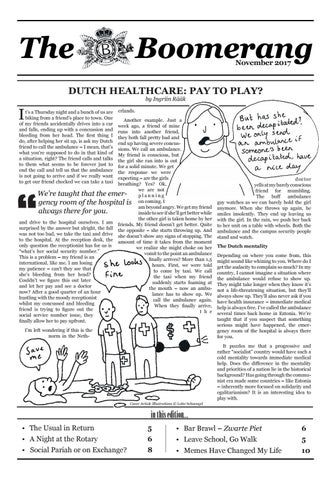
Another example. Just a week ago, a friend of mine runs into another friend, they both fall pretty bad and end up having severe concussions. We call an ambulance. My friend is conscious, but the girl she ran into is out for a solid minute. We get the response we were expecting – are the girls breathing? Yes? Ok, we are not We’re taught that the emerplanning gency room of the hospital is on coming. I am beyond angry. We get my friend always there for you. inside to see if she’ll get better while the other girl is taken home by her and drive to the hospital ourselves. I am friends. My friend doesn’t get better. Quite surprised by the answer but alright, the fall the opposite – she starts throwing up. And was not too bad, we take the taxi and drive she doesn’t show any signs of stopping. The to the hospital. At the reception desk, the amount of time it takes from the moment only question the receptionist has for us is we realize she might choke on her “what’s her social security number.” vomit to the point an ambulance This is a problem – my friend is an finally arrives? More than 1,5 international, like me. I am losing hours. First, we were told my patience – can’t they see that to come by taxi. We call she’s bleeding from her head? the taxi when my friend Couldn’t we figure this out later suddenly starts foaming at and let her pay and see a doctor the mouth – now an ambunow? After a good quarter of an hour lance has to show up. We hustling with the moody receptionist call the ambulance again. whilst my concussed and bleeding When they finally arrive, friend is trying to figure out the t h e social service number issue, they finally allow her to pay upfront.
“
I’m left wondering if this is the norm in the Neth-
Cover Article Illustrations © Lotte Schuengel
doctor yells at my barely conscious friend for mumbling. The buff ambulance guy watches as we can barely hold the girl anymore. When she throws up again, he smiles insolently. They end up leaving us with the girl. In the rain, we push her back to her unit on a table with wheels. Both the ambulance and the campus security people stand and watch. The Dutch mentality Depending on where you come from, this might sound like whining to you. Where do I get the audacity to complain so much? In my country, I cannot imagine a situation where the ambulance would refuse to show up. They might take longer when they know it’s not a life-threatening situation, but they’ll always show up. They’ll also never ask if you have health insurance – immediate medical help is always free. I’ve called the ambulance several times back home in Estonia. We’re taught that if you suspect that something serious might have happened, the emergency room of the hospital is always there for you. It puzzles me that a progressive and rather “socialist” country would have such a cold mentality towards immediate medical help. Does the difference in the mentality and priorities of a nation lie in the historical background? Has going through the communist era made some countries – like Estonia – inherently more focused on solidarity and egalitarianism? It is an interesting idea to play with.
in this edition… • The Usual in Return • A Night at the Rotary • Social Pariah or on Exchange?
5
• Bar Brawl – Zwarte Piet
6
6
• Leave School, Go Walk
5
8
• Memes Have Changed My Life
10
2
The Boomerang | November 2017
BUBBLE
The costs of pragmatic healthcare
them save money.
If you think that the unwillingness of the Dutch system to provide you with ambulance services has kept their healthcare spending low, then you’re wrong. The Netherlands is at the first place of percentage of GDP in healthcare spending in the EU, whilst Estonia is at the 19th. Bear in mind that ambulance is due to its nature the most expensive health care service everywhere. Therefore, the Dutch being stingy with their ambulatory services has in no way helped
Let me make this clear – this is not an article to criticize the Dutch health policies. It is an article to express my serious surprise and concern. The mentality towards the patients in the health services and ambulance here is scarily pragmatic and lacking
human compassion. So, next time you leave the house, make sure you have your social security number written down somewhere. Or you might have to wait for the help that we take for granted in post-communist countries.
Dutch healthcare among the best and most expensive by Charlotte Remarque The Netherlands spends more than 10% of its GDP on healthcare. The costs outrank those of every European country. The good news is that officially - according to an evaluation of 48 indicators - Dutch healthcare is the “best” available. Basic insurance covers nearly everything, waiting lists are short and those who cannot afford insurance receive free care. In the last years, however, the Dutch government has faced multiple healthcare
problems. The extravagant spending is not sustainable and cutbacks are in order. The budget for elderly and permanent at-home care has suffered most. As a result, the government’s austerity is hotly debated. Whenever these most vulnerable groups suffer it truly gets the people angry. The budget for emergency care is still largely intact. However, cutbacks have been made in the staffing of emergency call centers and in the salaries of part-
time emergency workers. Has this caused disgruntled, overworked and underpaid employees? Looking at Ingriin’s experiences, this seems likely. Dutch pragmatism is not at fault here, but rather the inevitable tightening of the welfare belt. Whether this is the way to go is up for discussion. Still it seems the Dutch system is determined to lose its position as second most expensive system in the world – with all the consequences that entails.
EDUCATION SPINNING OUT OF CONTROL by Kyle Gardiner
A
s of this year, Locke D has become a unique classroom at UCU. It’s a trial run for a new kind of classroom without the usual two-person desks set in a static semicircle. Instead, students now have their personal rolling and pivoting chairs, reminiscent of Wall-E. These pods are meant to enable the diffusion of fidgety energy, but one class has decided that the benefits are just not worth using them – not even for just one day a week.
“
...the class would never return to the playground of a space that is locke D.
There was an energy in the room that I have not witnessed in regular classrooms on a Friday morning at 11:00. However, once the novelty wore off, the atmosphere returned to normal and I did not notice a difference teaching in the Locke D classroom on Friday compared to teaching in the regular classroom on Wednesday.” But fidgeting and slow starts to class were not the reasons the class disliked the pods. The desks attached to the chairs in Locke D were too small for the papers, notes, and textbooks necessary, and just weren’t very suitable for exams. The physical space of UCU classrooms didn’t help either: many of our rooms are rather narrow, reducing mobility through bottlenecking.
A 300-level psychology course, Crime and Context, was assigned a different room for their classes. When they noticed that Locke D was free during their Friday timeslot, they opted to hold their 11 a.m. classes there instead. A half-semester later, however, a not-quite-anonymous vote decided that the class would actually rather not have class in Locke D anymore.
Chau insists that she doesn’t see anything wrong with the format, saying that on exchange to UC Irvine this chair pod style worked quite well in classes geared around projects, and smaller group discussion. However, UCU classes include lectures, values debate amongst the whole class, and the use of textbooks, which all make the pods inconvenient and overall, lacking the benefits.
The class’ professor, Alexis Aronowitz, recalls seeing the chairs and thinking “you’ve got to be kidding me.... the students are going to fidget, wiggle and bump into each other and this will drive me crazy when I am trying to lecture”. Despite this, Chau, a student, was surprised at how little students were distracted by the freedom to move. She noticed that as classes began there was above average movement and the commencement of classes would take slightly longer to initiate, but other than that, there wasn’t an issue with fiddling and jittering. Aronowitz concedes that “when we first moved to Locke and they sat in the new chairs, they were revitalized.
All this combined led to the group asking to return to a monogamous relationship with their Wednesday room, never to return to the playground of a space that is Locke D. Alexis maintains a neutral stance on which classroom style she prefers, but was surprised by the request, and says she “might have resisted the move, but their argument was very valid.” Of the 22 students, only 5 voted to remain. While the formal test period continues with the classes assigned to the room, this would seem to be a red flag for a wider implementation of spinning fidget-chairs at UCU, at least in combination with our current teaching format.
Correction: In the previous (October) edition of the Boomerang, it was incorrectly stated on page 1 that the UCSA had saved 50.000€ due to underspending. In fact, the UCSA has saved 90,000€ due to several years of underspending. Of this sum, the board is planning to invest 40,000€ this academic year.
A University College Student Association Magazine
BUBBLE
3
Lovely readers, The weeks have started racing by faster than ever. Weather-induced depression and a sisyphean workload have plunged most of campus into this special, lethargic feeling that words fail to describe. The closest approximation might be the drawn-out guttural groan “eechhuagh”. Ask a French friend for pronunciation help. Oh, if only there was something to brighten the darkening days of Dutch autumn. Hark! what light through yonder Dining Hall window breaks? Glistening white. Jet black. Yes, The Boomerang has arrived. This issue’s main story is about all of you funny people “literally dying”. The literally is meant literally. Dutch institutions tend to be impeccably organised. Yes, even the NS. However, when individual care is needed, a lack of lenience can be inconvenient at best, dangerous at worst. While allowing individual actors to freely decide on a case-to-case basis might be the nightmare of an organised teutonic society, it allows single cogs in the machine to show compassion where otherwise they might not. This freedom is what gives anonymous systems a whiff of humanity, to the benefit of users and providers. This edition’s Bar Brawl is equally fascinating. Both authors offer an excellent take on the Zwarte Piet issue. It is very easy at UCU to approach the discussion from diametrically opposite angles, precluding any consensus. Quite often I see the Zwarte Piet debate being unintentionally analysed from an American perspective; in the States, wearing blackface has completely different cultural connotations than in European countries, the majority of which have never experienced considerable black minorities until the mid-twentieth century. It is necessary to have a dialogue divorced from American cultural and historical influences. Dismissing Zwarte Piet based on an American cultural experience makes for a weak argument; dismiss it based on the Dutch experience, and your argument will stand strong.
Clemens Schally, Editor-in-Chief
TRASH TALKING by Yannick Overzee | Introduction by Emma Beroske Repower UCU is an energy movement for a climate neutral campus. With initiatives such as installing solar panels on our rooftops or increasing sustainability awareness, RepowerUCU also strives to encourage students to actively recycle and reduce their waste. Despite a growing trend towards recycling, a general reluctance can often be observed around campus. But is this a result of our laziness as students or are our campus’ facilities not promoting our efforts to become less wasteful?
“
Do we really have time to worry about recycling?
A quick look at most units says it all. Overflowing bins exposing their insides, and varied and passionless attempts at recycling piled up in a corner seem to be a norm. “It’s really not hygienic,” says Emma Beroske. UCU’s culture may appear to be one of extended laziness translating into a constant postponing of household duties. But with whom does the fault lie? Does it lie just with the student, or does campus infra-
“It’s not too bad. There are more possibilities for recycling than other places,” Elena added. “In town, there are specific times where you need to put your trash out, and if you do it at the wrong times you get fined. Here, it’s up to us,” said Anique Greijmans.
E
very University College Utrecht (UCU) student knows of the struggle that is walking across ‘the Quad,’ painfully trampling the gravel it is made of, wallowing in the misery of the act. Ironically, these complaints are directed towards a historic monument; each pebble that makes up this impressive field represents a fallen soldier of the Dutch nation. These students – politically engaged, adamant PC-Culture adherents and advocates of a greener future, do not limit their irony to this. One thing they seem to consistently forget is that, as we approach environmental Armageddon, every decision matters. And this includes the way one handles trash.
capacities of recycling bins are challenged on a regular basis, resulting in numerous trash bags surrounding them, and their contents spreading around campus because of it. But rather than disappointment, the general feeling is one of contentment.
structure account for this problem in more ways than one would think? Blaming students for their negligence is easy - after all, it is their trash. And does a group known for partying, binge-drinking and overachieving really have time to worry about recycling? But there is a different angle. What if this lack of interest was a symptom of another problem, rather than the issue itself? Some of this campus’ inhabitants do seem to care about taking care of their trash appropriately, and what’s more is that they do not seem to be a minority. When asked about this, Elena Blackstone said, “In Italy, nobody recycles, but people here are pretty sensitive about their recycling.” Where, then, does the problem lie? The obvious answer is that facilities on campus simply do not meet UCU’s needs. For one, the
Confusion about the existence of certain facilities and especially their location is, however, palpable. Specifically, the largest dumping place present on campus is surprisingly also the most hidden. Additionally, the fact that up until very recently this was the only place to dispose of plastic waste, makes it appear to many students that these places simply do not exist. One American exchange student from South Korea, Eleni Sardina, raised her concerns about this. “What most people wind up doing is throwing their plastic away with their other trash.” Given that plastic is such a major pollutant, that so few opportunities to deal with the waste exist seems irresponsible at best. Additionally, no place on this campus offers the chance to throw away cans and other metals, which Sylvia and You Hui found most surprising. So should we blame it on the will of students? For Lauren Loozeman, recycling does not require the effort some claim it does. “I’m used to it, at home we used to (continues on next page)
The Boomerang | November 2017
4
BUBBLE
need to take our garbage to a specific place as well […] I think it just depends on whether you’re used to it or not.” And this feeling is shared by a number of students.
How to Separate Trash: The Handy Guide
Is the issue of trash on campus a conflict between students’ intentions and the execution of said intentions? It might be, but that does not make it the main issue. Sure, putting in a little more effort might be a step in the right direction, but when it comes to leaving a mark on the environment, lacking the means to lighten one’s footstep is really the issue, especially when they are already mid-stride.
SOCIAL PARIAH OR EXCHANGE STUDENT? by Lexi Julien
“T
hat’s it, I’m going home.”
It’s 1 a.m. on a Thursday at the UCSA bar. My friend Anna* and I have been here for half an hour, and now I watch as she pulls her jacket over her shoulders and downs the last half of her beer. “We just got here!” I say, frowning as she slams her cup onto the counter. “It’s so early!”
“
We’re on exchange—we’re basically taboo.
Anna looks at me, then looks out at the dance floor, which has already become a pulsing mass of sweaty drunk bodies. “Yeah, but no one’s talking to us, and no one will,” she sighs. “We’re on exchange—we’re basically taboo.” Every semester, UCU opens its daunting iron gates to welcome 100 exchange students into its microcosm. These students, who hail from universities around the world, have been promised an unforgettable experience – a semester of learning at an elite liberal arts institution, of drinking copious amounts of cheap beer at the campus bar, and of a pulsing social life that will lead to lifelong friends and inclusion in an extraordinary community. Yet, upon arriving in Utrecht, visiting students do not always find exactly what was promised. “I feel like I’m in high school again,” says Chelsea, who’s here for one semester. “Everything is so cliquey; the only people open to being friends with me are other exchange students.” Chelsea’s words voice a widespread sentiment amongst disillu-
sioned exchange students. The social “bubble” is actually an impenetrable shell, and outsiders are unable to break into the communal circles that constitute it. “My home uni is fifteen times the size of this place, and the social scene there is not half as intimidating as it is here,” Olivia tells me during a class coffee break. “I went on exchange to experience something other than the UK—good thing the only friends I’ve made here also have British accents.” Though some UCU degree students agree, others argue that this is not due to the UCU bubble, but rather the nature of the students themselves. Third-year student Jacob observed that exchange students are often away from campus. “They’re just never around,” he explains. “They’re always travelling on the weekends or even during the week, so there isn’t really a chance to get to know them.” “I did the same thing when I was in the States for a semester—it’s a fact of the experience.” UCU strives to help its visiting students have the same experiences as those of its degree students and to feel included within the campus community. For example, exchange students participate in the annual “introweek” at the beginning of the semester, seven booze-filled days of introduction to UCU life, they live with degree students on campus, and can join almost all campus committees and organizations. Fiona, a third-year degree student, says that with this plethora of opportunities at their feet, visiting students have no excuse for feeling excluded from the social current of campus. “There are literally no barriers to entry at UCU,” she says. “I mean, the campus language is English—people on exchange who are complaining need to suck it up and just talk to people. It’s the same as making friends anywhere else.” Though Fiona’s points are valid, it is clear that many exchange students would be quick to disagree. After Anna takes her heated leave from the bar, I stay and finish the dregs of my drink—a sickly sweet concoction of Chocomel and Baileys liqueur. Scanning the room for familiar faces, I catch the eye of another exchange student, Briana. I wave her over and tell her about Anna’s dramatic exit. Briana shrugs her shoulders, giving me a halfhearted smile.
Illustration © Amu Endo
“During our second week here, a guy told me he didn’t want to waste time making friends with someone who was just going to up and leave in a few months,” she says, taking a swig from her bottle of cider. “So, yeah – ‘UCU, an inclusive community’… I’m calling bullshit too.” | Names changed
A University College Student Association Magazine
BUBBLE
N
STUDENTS AT UCU ARE MISSING OUT by Helary Yakub
ow don’t get me wrong. I don’t hate the Netherlands or the people in the Netherlands. It’s a beautiful country with very nice and very helpful people. Additionally, people at UCU are rather open to new friendships and conversation. And again— don’t get me wrong: there definitely are understanding and open-minded people at UCU, but diversity is a real issue.
“
It has been rather offensive to sit through some lectures
The one thing that concerns me about UCU is that there is essentially zero intellectual diversity on this campus. Other than very few individuals on this campus, everyone here essentially grew up with a very similar cultural, familial, and socioeconomic background. Due to the lack of intellectual diversity, almost everyone has the same opinions on polarizing issues. However, if you are only hearing your own perspectives being restated by other people, are you really growing? Studies have shown that within universities, an exposure to different people from different backgrounds is the best way to stimulate growth within an individual. UCU advertises that it is made up of 60% international students, but
they don’t clarify that most of these students came from international high schools. As an exchange student, I was excited to meet new students from different backgrounds. But that was definitely not the case. You don’t understand how tormenting it has been for me to sit through hours of students presenting their opinions on a topic without conceptualizing it for individuals beyond the “world” that they live in. The white middle or upperclass experience (regardless of country of origin) is not the same for Middle Easterners, Africans, Asians, or Latino/as. Personally, it has been rather offensive to sit through some of these lectures/student presentations. If there is no cultural competency taught alongside sensitive subject matters in this university, then what is it that students are really learning? If anything, this can lead to mis-conceptualizing – which is part of the problem rather than a solution. I should not have to persuade a classroom that domestic violence is a real concept only after presenting personal experiences. The experience might seem as a “myth” or an experience that “rarely happens” to some, but to me, it was very real. It was after this class that it became obvious to me that students at UCU lack exposure to people that
have gone through hardships or other forms of distress. Many students have created this “yeah that happens, but not realllllyyy” mentality. In class, homeless people are referred to as “these people”—even by the professor! This is a form of classism. It is not a bad thing to have privilege, we all have privilege in one form or another. But, you can’t solve an issue by seeing people who are exposed to hardships or prejudices as “the other.” Yet, this happens quite often on this campus. All I have to say after all of this is that students at UCU are really missing out. Missing out on exposure to students that grew up in different situations then they did. As an exchange student, I was really hoping to be challenged with varying opinions from people that grew up around the world. I was excited to expand my intellectual circle beyond how people view things in Southern California. But that didn’t happen during my time here. If anything, it was a very frustrating experience. I know that increasing the scholarship fund has been a topic discussed over the past several months, but this topic needs to be severely considered. This may not be the solution to everything, but it will at least add on to the much needed intellectual diversity and diversity of experiences that this campus needs.
THE USUAL IN RETURN by Florine Kist
A
t UCU, bribery is not just a useful tool for getting what one wants, but a unique artistic skill that students aim to first master, and then excel at. Some bring bribery to the next level by writing two page long essays stating precisely what they need and specifying what they have to offer in return. Less linguistically gifted others are fortunately allowed to take a successful shortcut. Because when it comes to bribing, there’s no easier audience than UCU students, and all it takes is four simple words: “The Usual in return.” Although these words are used more often than the word “like” is used by fourteen- year-old American girls, no one actually seems to know what “The Usual” is.
“
5
most likely candidates for the label “The Usual”. And with such a great diversity of all kinds of fairly unusual bribes, such as “the secret to eternal youth” and “thai sun-dried bananas dipped in chocolate”, we can’t expect anyone to truly know what “The Usual” is, let alone be certain that there is such a thing as “The Usual”. The only certain thing in uncertain times is that, whatever “The Usual” might or might not be, it does not really matter. Most would agree that the probability of actually receiving it is pretty close to zero. After all, bribery is a form of art, of which UCU students have obtained such mastery that empty words do the job.
Thai sun-dried bananas dipped in chocolate
Since “The Usual” has probably never been defined, I’ve set up a little Facebook investigation, searching for whatever it is UCU students generally have to offer. As expected, “The Usual” doesn’t turn out to be quite as universal as the term suggests, and ranges from somewhat ordinary stuff, like chocolate and beer, to rather unusual things. In straightforward terms, UCU students offer the weirdest, most random stuff in return for a favour. Whether it is an “angry British girl”, a “Fantastic Beast spoiler”, or “free mystery solving”, there is no limit to the concept of “The Usual”. It shifts from somewhat vague, i.e. “whatever small thing you want”, to utterly specific: “a firm handshake with prolonged eye contact.” Even though there still is no definition, there seems to be some sort of unspoken agreement making beer, wine and chocolate the most frequent bribes. Therefore they would be the
Illustration © Amu Endo
6
The Boomerang | November 2017
BUBBLE In Bar Brawl, two students tackle a controversial issue each month. Want to fight? Email us at boomerang@ucsa.nl or join us at the next writers meeting.
FOR THE SAKE OF TRADITION by Louis van de Mortel
I
grew up celebrating Sinterklaas in the United States. Looking back I am often surprised by the lack of criticism the Dutch community in the US received for the representation of Zwarte Piet. I think one of the main reasons this criticism lacked was due to the fact that Sinterklaas is a children’s holiday. Many children looked up to Zwarte Pieten, due to their fun and generous nature, and aspired to become like them. On the Sinterklaasjournaal, an annual Sinterklaas-themed television show, Zwarte Pieten are often the focus and the most amusing characters. To say that Zwarte Piet is an essential part of Sinterklaas is an exaggeration, but many people’s fondest memories of the holiday involved Zwarte Pieten. Perhaps this can to some degree explain why, as many polls have shown, the majority of Dutch people would prefer to keep Zwarte Pieten as they are. While there is certainly less attachment to Zwarte Piet among younger generations, it becomes clear that many Dutch people value this tradition enough to want to hold on to it.
“
Race is among the last things children should be thinking about during Sinterklaas
Perhaps I am too optimistic in believing that we can have it both ways. Those uncomfortable with Zwarte Piet can use whatever alternative they see fit, and those who want to continue using Zwarte Piet can do so. To ban Zwarte Piet would mean forcing people to give up a long-held tradition that they wish to continue. While people should be aware of the negative stereotypes associated with Zwarte Piet, I see it as their right to continue using Zwarte Piet if they wish to do so. I don’t believe people who want to continue the practice mean anything racist by it, or that children will draw negative stereotypes from Zwarte Piet. Race is among the last things children should be thinking about during Sinterklaas. These children, being raised in a more modern world, may grow up to see what is wrong about Zwarte Piet and wish to no longer participate in the practice. There is indeed a trend that younger generations are more open towards alternatives to Zwarte Piet. It is therefore likely that Zwarte Pieten will be abandoned sometime in the near future. But for now, it seems there are still many who wish to continue the tradition. Rather than force them to stop, I suggest we let people celebrate Sinterklaas the way they see fit.
A
AN INADEQUATE DISPLAY OF NOSTALGIA by Anahi Saravia Herrera
nother November, another 3 kilos of pepernoten consumed, another child dressed up as St. Nick’s trusty slave sidekick: Zwarte Piet. Let me start by saying that I am not Dutch and I’ve only experienced Sinterklaas as an outsider. Many might say that this means that I am not able to comment fairly on the Zwarte Piet situation. Having been privy to the many wildly inappropriate blackface images that cover newspapers, posters, food items, costumes and even toys all throughout November, I feel as though my perspective as an outsider might be a useful one.
“
Racial tensions are still very much tangible.
People who refuse to see that Zwarte Piet is a negative image seem to justify their position by claiming that he’s a symbol for Dutch culture and for childhood. Many say that what they remember of Zwarte Piet is his fun-loving nature and the memories he brings back to mind. He is a cultural symbol and one that many people have an emotional attachment to. This is not something that I am protesting. On the contrary: I think this is exactly what the focus of Sinterklaas should be, not a racially charged vessel that makes explicit reference to Holland’s sordid past. And no, please don’t tell me that Piet is just ‘dirty’ with soot. His big red lips, black skin and hoop earrings say otherwise about the stereotype of black people we are promoting. There is a difference between implicit and explicit racism. Someone who overtly proclaims and acts upon discriminatory ideas can be clearly identified as racist. What is usually the case, though, is that people hold unquestioned culturally constructed bias against a particular group of people. This is a bias that is not overt or even known to the person, but that is present in their attitudes and the way they view the status quo. It is this bias that shapes and is shaped by culture. When people say it’s not an issue to have blackface populate public cultural space, they don’t understand that it is symbols like that of Zwarte Piet that have shaped and continue to shape racial interactions and implicit racism in Holland. A symbol may seem innocent from the perspective of a white middleclass individual who has little knowledge of what it feels like to be oppressed. Still, we need to consider it as important in shaping the world around us. As much as we’d like to think we live in a post-racist world, we live in a postcolonial world where racial tensions are still very much tangible, and it’s our job to acknowledge that. Ultimately, just because it’s culture doesn’t make it good. I’d put people’s right to be protected from discrimination over the protection of your blissfully ignorant childhood memories any day. Illustration © Jarne van der Pool
A University College Student Association Magazine
LOCAL
7
FIVE EUROS AND THIRTY CENTS
B
A NIGHT AT THE ROTARY by Lotte Schuengel
elow the ceiling tiles of a room in the back of NH Hotels Naarden, I attend the weekly assembly of the local Rotary Club. Every Monday night their members convene and pay 20 euros each for the food. On today’s menu is satay on a stick and a limited number of spring rolls for the vegetarian.
“
In the past couple of years, this Rotary Club has been facing a fast-declining membership rate. They are working on strategies to attract younger members. The Rotary Club in Bussum has recently gained three 38-year old Vindicat alumni. Although Marjolein denies the corporal nature of this People still see us as cigarorganisation, she secretly waits for a similar smoking grumpy old men who miracle. Any attempt to get the girls from occasionally pull their wallet her yoga club to join, has failed.
out for a well in Kenya.
A little over twenty people have gathered tonight. The majority are over sixty and two-thirds are male. They sit themselves down randomly at three separate tables. Grey and red are the dominant colours. “Usually there are more people,” a lady named Marjolein tells me, “especially when we have an interesting guest speaker.” There is a guest speaker today too. Britta, from a foundation that bought a building for young adult people with a mental disability - to whom Britta refers as children. The chairwoman for this session is Effie, one of the younger members of Rotary Club Naarden. It is her job to ring a large iron bell and make an opening statement before people can start eating their satay. “Welcome to this special night,” she says, “we have two drinks nights you can sign up for today.” Two clipboards are passed around the room. You have to fill in yes or no next to your name. The first drinks night is organised because the doctors have declared one member’s wife cancer free. The other one is to celebrate
R
Paul’s birthday.
An older man blames the Rotary’s image. “People still see us as cigar-smoking grumpy old men who occasionally pull their wallet out for a well in Kenya. But for as far as I know only one of us smokes cigars.” A moment of silence before dinner. I look around but no one prays. Most people stare into the void or their satay. Then the bell rings once more and the chattering starts. The youngest member and the only vegetarian, Helena, turns to me. “We’ve often complained about the food. It’s bad and overpriced. But these people like tradition.” Another clipboard passes over our heads. This one is for the Lustrum on 21 October. It will be held on a boat and people are supposed to suit up and bring their partner - if they’re still alive. “Most of the time I ask myself: what am I even doing here?” Helena gestures at the other people in the room. “But then again, they are nice and interesting. I
Asking around, it becomes apparent that other members share this motivation. Marjolein likes the diversity of the group. “In my day to day life, all the contacts I have are people like me. Mothers in a schoolyard, the same age, living in the same kind of house, driving their kids to the same hockey club, working the same part-time office job. It’s nice to be around people of all ages.” I ask Marjolein why she thinks the Rotary Club has trouble finding new members. She sees a trend of extreme individualisation, especially in the younger generation. Digitalization is a problem as well. Social networks are established fast and without effort. The old-fashioned way is unattractive. There are other places to find social capital. “But I like it, to be away from home every Monday night.” Upon suggesting that perhaps not everyone has time for these weekly gatherings, she vehemently shakes her head. “Everyone has time, they just refuse to make it.” A glass filled with a thin layer of coins is shoved across our table. The man opposite us does not hesitate to pour his spare change in. “Usually it’s a piggy bank,” says Marjolein, “but the owner of the piggy bank is absent today. So the donations will have to be put in a glass.” At the end of the evening, the contents of the glass add up to five euros and thirty cents. Illustration © Lotte Schuengel
NOT EVERY PEDOPHILE IS A CRIMINAL by S. Däcker
obert M, the Netherlands’ most infamous sexual offender, was arrested seven years ago for the sexual assault of 67 small children. The children were under the age of two – babies and toddlers. Weeks ago, Robert M. was in the news again. He had managed to contact two major newspapers and the parents of his victims with a letter of apology. The public was outraged at M’s apology. It came across as insincere, and was immediately assumed to be a ploy to bargain for early parole. It was reminiscent of his earlier attempt to apologize, when he was still in the courtroom. He would scream and cry and try to kill himself on several occasions. On other days, he was eerily cheerful. Or he acted like a belligerent teenager, showing his middle finger to the judge. The result was that M’s distress was labeled “crocodile tears”, and any attempt to atone was dismissed.
“
think it’s important, at my age and their age, to have a club to belong to, to have friends. My husband doesn’t have friends because he puts no effort into his social capital.”
The disgust society feels at pedophilia is backwards and unhelpful The ostracism M has faced is disproportionate to say the least. It is characteristic of a larger problem: pedophiles are regarded with nothing but disgust and blame. I do not forgive M for his crimes. He hurt and raped almost seventy small children and should be punished for it. However, the visceral disgust society feels at pedophilia is backwards and unhelpful. We should never accept pedo-
philia the act, but we should acknowledge the existence of pedophilia the illness. One in every hundred men harbors sexual feelings for underage children. You definitely know somebody who struggles with these feelings in secret. He is forced to keep this a secret. We refuse to see a difference between men who were born with this preference and want to deal with it in a healthy way, and men who resort to crime. There is no social cushion, no sympathy in the psychiatric world, and rarely a professional who is willing to help. I would go so far as to say that this type of ostracism is what created Robert M. Had he been able to speak of his feelings to a professional or a family member without being labeled a monster, he might have gotten the help he needed to deal with his feelings safely, without harming children. Robert M, a criminal 67 times over, has sadly become the face of this debilitating illness. Do not allow his crimes to cloud your thinking. Not every pedophile is a criminal. Not every pedophile is a Robert M. Pedophilia is a mental illness like any other, and should be treated as such by society. Note from the editors: This article was submitted to us from what we understand is a disposable email. Per policy, we discourage anonymous publishing. As the article reflects a unique opinion, it was decided it would be published after recieving confirmation that the author is a UCU student.
8
The Boomerang | November 2017
LOCAL
A TROPHY REFUGEE by Annick van Rinsum A new initiative wishes to radically change the perception of refugees and make clear that they are of great value to our society. Whether it will live up to its name and be The Best Newcomer among foundations remains to be seen.
“T
his is utterly offensive!! The #Netherlands is trying to rate refugees wow! Do you think we’re asking to be rated who is better! OMG and calling us Newcomers won’t give you the justification of being nice here. #NL is taking this refugee crisis too far as a business and what a great life when you see entrepreneurs taking their opportunities through damaged human beings! One of my Dutch connections actually sent me a msg to suggest my name on the list to win some prizes thinking they’re doing good” states Kinda Hamwi in a public post on Facebook. The young woman fled the war in Syria and is now working at renowned advertising agency Wieden+Kennedy in Amsterdam. One of her Dutch Facebook friends responded: “I hear what you say but personally I think you eat this soup too hot.” In general, many people in Holland still have a wrong impression about refugees.”
works to protect the needs of refugees. She was happily surprised to hear an abundance of stories like hers. But she also noticed a discrepancy between the wealth of positivity surrounding the refugees that she met and the image that the average Dutch person has of asylum seekers. Unhappy about the media’s tendency to portray refugees as being helpless, uneducated, opportunistic, a terrorist, or all of the above, Mehrnoesh wanted to demonstrate to the Dutch that refugees actually add value and aren’t just a drain on taxes. By April, become an tion run team
the idea had official foundaby a sizable of volunteers. A web developer made the Best
Newcomer website for free and the owner of The Student Hotel, Charlie Macgregor, offered one of his hotels to host the central event that the foundation is working towards. This Best Newcomer award show is an entertaining show where the best newcomer in each of the categories arts, food, tech, sports and stars, will receive an award. To rebrand the refugee story, grim aspects such as the escape from war zones are glossed over. A professional photographer will make a beautiful photo exhibition of the nominees. No dreary dark pictures à la National Geographic, but colourful photos of laughing faces. Not just to show that refugees are people like you and me, but also to portray them as special and inspirational, like people you would find in glossy magazines. The foundation sees itself mainly as a platform for the refugees to express how they can enrich the Netherlands. In the future, the foundation would like to be able to help the refugees more practically by linking them to employers or offering them internships and traineeships.
This is what Founder Mehrnoesh Forouzandeh was thinking when she first coined the idea for ‘the best newcomer’ with a few of her friends in January this year. After she became a refugee at the age of eight, Mehrnoesh had always felt welcomed and encouraged by the Dutch people she met. From a young age, she was actively involved with the Dutch Council for Refugees, a national NGO that Illustration © Nina Gribling
Janneke Koninkx, one of the foundation’s board members said in an interview how honoured the refugees felt after being nominated for the foundation’s award. “It’s heart-warming, super beautiful, I’m even tearing up a bit. I find those people so powerful, that they have the strength to follow their dreams after having gone through so much. That’s a true inspiration to me”.
Follow us on Snapchat and keep up with campus happenings, and occassionally when we dare burst the bubble, happenings outside of campus too!
UCSA’s Winter Wonderland Tue, 28 November 1pm – 11pm Who said November is too early to celebrate this holiday season? ArtsCo’s Bitch & Stitch Wed, 29 November from 10pm till midnight Late night knitting... Yay! DanceCo Party Thu, 30 November 11pm – 2am As everybody and their mother is going to DanceCo’s Elysian dance performance.
MusicCo’s Open Mic Fri, 1 December from 10pm Special sinterklaas-themed open mic! MusicCo Board will help all the bands out that need an extra musician. Almost There Party Thu, 14 December 11pm – 4am Beacon of hope in dire times... TIP! Every Friday at 12:30 Tivoli organizes free classical concerts.
Get paid to write for us! The Boomerang has a budget to cover, partially or in whole, your costs for reviewing events, movies, music, games – anything you feel would be interesting for the campus community. Come by the open writers’ meetings every month to discuss your ideas with us, or email us at boomerang@ucsa.nl. Other articles are also of course very welcome, as are illustrations. We need (and want) you!
A University College Student Association Magazine
WORLD
9
LEAVE SCHOOL, GO WALK:
ON THE VALUE OF ESCAPING FOR A LENGTHY STROLL by Ben Maxwell Bowles
A
s deadlines, theses and potential careers loom, the escapist lure of anything-but-this creeps into our consciousness, tempting us away from a seemingly insurmountable stack of responsibilities. I watched all of Rick and Morty for the third time last week. Jesus. As my own form of escapism I would like to convince you that it’s OK to jump off the merry-go-round of life every now and then. But if you’re going to do it, do it properly.
“
I ate about 11 kg of peanut butter, 300 tortilla wraps and walked through 3 pairs of shoes.
If the opportunity presents itself, even in the vaguest of forms, then go. Live in the woods. Walk over some mountains. Sleep in a tent for a hundred days. Walk from sunup to sundown. None of these things require the kind of specialised knowledge you’ve been cramming into your brains for finals. In September 2014, I decided that six months later I’d walk the Appalachian Trail from Georgia to Maine. I plodded along its length of 3,500 kilometres, 15 kilometres of elevation change, through 14 states, over mountain ranges, through forests, fields and along roads. Over the course of four and a half months, I ate about 11 kg of peanut butter, 300 tortilla wraps and walked through 3 pairs of shoes. Why? Firstly, peanut butter is a fine, affordable source of protein. Second, because I was tired of normal life, I wanted a challenge, and it was something completely new. I was at a particular juncture in
my life, having dropped out of university and working a dead-end part-time job, that it felt like a decent “now or never” moment. I had no training and began my walk in a state of blissful ignorance, having previously spent no more than two nights in a tent on the hop. I decided to avoid fully acknowledging the potential physical and psychological hiccups I could face along the way and the reality that only one in five who attempt it complete the trail in its entirety. It’s all the little things that draw you in, knock you down, and build you up again: dodging bears, eating a pack of tuna every day for four months, potentially putting you off it for life, running up a mountain to catch the sunset, sleeping alone in a forest with just a sleeping bag and the rustling of a rodent eating tomorrow’s breakfast, lying on a park bench with a sprained ankle with 2000 kilometres to go, wondering if I’d ever finish. They’re each weird, wonderful and painful parts of the whole mad thing, and I miss them dearly. This isn’t meant to be an overcoming the odds “Dropout: A Life Transformed” feature. After finishing, I flew home, packed several bags full of crap I didn’t need and began a decent imitation of a functional student again. But if 2014 dead-beat drop-out me chose to pick up a bag of camping stuff and go full-on wilderness hiker-trash for a while, then so can you. It was great, I got a badge for my efforts, and it’s an excellent ‘fun fact’ icebreaker. Whilst your thesis probably shouldn’t wait, your career can. Take a month, or two, or six. We’ll be working until we’re dead: go and do something loco.
ENDE GELÄNDE: AN INSIDER’S VIEW by JiaJia ter Kuile ently they are already expecting a fight. My heart rate increases. Is this what is going to happen?
The media likes describing the violence in protest actions; the tension between Police and Activists. And it seems that a lot of activists like this attention. But is it worth it if activists become synonymous with the The goggles for pepperspray, image of anonymous rioters constantly trying to thwart the police? Then the system, the bags to protect against the core of the problem, stays beatings. unharmed, almost unnoticed. On the 5th of November, during the 23rd So why are most activists Climate Conference (COP23), a mass act of prepared to fight the police civil disobedience called Ende Gelände was instead of fighting for what held at the Hambacher coal mine. It is one they stand for, I wonder. of the most polluting mines in the world, As Gandhi said: “An eye just a couple kilometres from the location for an eye makes the whole of the COP23. Around 3000 people collab- world blind”. If all activists orated, with one goal: to shed light on the decide not to wear masks glue on politicians’ inertia to act on climate change, and while a few kilometres away, the climate is their fingers, literally being ruined. We wanted to show p r e p a r e d get that we have to stop fossil fuels and protect to arrested the climate, now. and go Yet something puts me off. I see people to court with goggles and straw bags. I ask what if necesthey are used for. As protection against the sary, we can, police, I hear. The goggles for pepperspray, as activists, the bags to protect against beatings. Appar- make a bigger
“
change, effectively, and without violence. We arrive at the mine. Our goal, a huge digging machine, lays 300 metres below us. I see a line of black dots aligned around the place we will enter. It’s the police. We start climbing down. Soon enough I see people running towards the dotted line, violently trying to break through. I see a person
Illustration © Claire Faber
I
t’s 10a.m. - we are marching towards the lignite mine we will occupy. Yells like “We are unstoppable, another world is possible” and “What do we want? CLIMATE JUSTICE! When do we want it? NOW!” are echoing through the crowd. So many people standing for the same goal, ready to come in action for a better world.
(continues on next page)
10
The Boomerang | November 2017
WORLD
smashed down, a knee pressing on his back. Big cloud. Pepperspray. Shit. I have to go there too. My friend and I climb down. Activists and police are running around us. Stay calm, I tell myself. My friend and I walk towards the police line. We agree that we will not fight the police if they get us. Two officers are standing in front of us. One
already runs away to catch another person. I smile at the other officer. He says that he can’t let us through. Obviously. We will still try though. Obviously. The officer grabs my friend. I dive in the opposite direction and crawl through the mud, under the conveyer belt, to the safe side. I look back. My friend is talking to the officer. I hear: “Alright go,
we lost already”. My friend follows me. The officer let him go. We laugh at each other in disbelief. We made it! And nobody is hurt. Activism comes in different forms and different activists have different norms and values. Some forms become very prominent, while others stay nearly unnoticed.
WHY I AM EMBARRASSED TO SAY I’M AMERICAN by Saskia Vrensen
T
hirty minutes ago, as I am writing this, 26 people were killed and many more injured in a mass shooting in Sutherland Springs, Texas. I’m going to take a wild guess that the gunman was an alt-right white supremacist (update: so far, I can only confirm that I was right about the white part), and also that media coverage of the shooting will be much less harsh than that of, say, coverage of shootings by radicalised Muslims. We have already seen this with the Las Vegas mass shooting, and we’ll see it again. This is the dystopian disaster-zone that many are trying to survive in. And this is only one of the reasons why I’m embarrassed when people ask me where I’m from; I’m embarrassed to be American. When people ask me where I’m from, I feel the need to structure my response along the lines of: “Just to let you know, I despise Trump more than I do Satan himself, I’ve never touched a gun, I don’t use the Christian religion as an excuse for unnecessary violence and political radicalism, I am pro-choice, I support the LGBT+ community, I believe in the scientifically proven phenomenon of climate change, I support immigrants and refugees no matter their religion or ethnicity, I’m not a flaming racist... but, back to the point, I’m American. Where are you from?” Obviously, I know that the majority of people do not assume
that all Americans are the racist, homophobic, politically incorrect imbeciles that are shown on FOX News. I know that I don’t need to make excuses for my nationality, because it isn’t the only thing that defines me. But when America looks the way it does right now, it’s difficult to explain that, no, I have absolutely no connection with the orange Roz from Monsters’ Inc (that slug lady with glasses) that is running my country. Most people are sympathetic, and they know that the majority of Americans didn’t vote for Trump and don’t agree with the current politics in the States, which is nice. But how did the once so successful and admired country become such a (pardon my French) fucking embarrassment? Why do I now receive looks of either disgust or pity when people discover I’m American? I don’t want to feel embarrassed about being American. I think it is important to separate America’s diverse culture and traditions (the nice ones, not the ones that celebrates the slaughter of thousands of Native Americans, I should clarify) from the current political climate, because while it may seem like it, America is not only its politics. But yes, its politics are ruining the lives of immigrants, African-Americans, the LGBT+ community, women, people who cannot afford healthcare, etcetera… which is why I am embarrassed to be American, and why I remind people almost daily; I’m only half American, OK?
A University College Student Association Magazine
ARTS&CULTURE
11
MEMES HAVE CHANGED MY LIFE
A SEMI SERIOUS LIFE STORY by Sven Bosma
A
s I sit on the couch, I exhale through my nose, slightly louder than usual, and quietly chuckle. My phone softly illuminates my childishly-amused face. “What?” my friend asks. “It was a meme,” I reply. “Show us,” the friend to my right says. I present my fellow memers with the most glorious me_irl meme. They too chuckle, and swiftly resume their own browsing activities. Together, we continue to chill in this fashion for a while, until the social guilt becomes too strong.
“
It’s Wednesday my dudes.
At this point, it dawns on me that we must be the first generation to spend time in this way: we’re together physically but have spread our attention elsewhere. And we all understand this; there isn’t a single group chat I’m in that hasn’t been the recipient of some relevant meme. Then of course, we all have those friends who are our go-to partners in memeing crime. If you’re unsure as to whether you have such a relationship, here are some tells: group chats with no words, just pictures and gifs (pronounced with the hard “G”-sound by the way); your list of Facebook notifications is populated by these people, with the text “… just tagged you in a post by …”; and finally, half the written responses are “yea haha I just saw that one.” Aside from friendly fun, memes are playing more of a role in life than we may notice. Time, in the first place, is semi-marked by memes for me. I know I’m halfway through a gruellingly slow week when I see the “It is Wednesday my dudes” frog pass through the communication channels. On a more abstract level, memes often
remind me of the flimsiness of time too, given their incredibly short half-life and highly dependent pop-culture relevance. Nothing really reflects the importance of cultural context like memes. Age gaps are bridged as well. There’s not much I (20) have in common with my younger sister (14), aside from a collective hatred of cucumber and our father’s taste in shoes (or, worst of all, a combination of the two). So we had something to bond over when comedian Michael Dapaah, AKA Big Shaq, made his appearance on BBC Radio 1’s Fire in the Booth, with his hit Man’s Not Hot. Over the past weekend, I (embarrassingly) had that on repeat in the car, driving my sister to and from her hockey matches, and we had great fun. As the saying goes, One man’s becoming an overnight hit-meme is another man’s basis for a wonky sibling relationship. Finally, with the moral panic over Pepe the Frog (R.I.P.) and his alleged ties to the alt-right during the US elections, memes truly entered the ‘adult’ world. Since a picture speaks a thousand words, I firmly believe that any political party capable of getting its social media team up and running with an understanding of current culture will be just a few witty, persuasive memes away from certain victory, regardless of the country. Even in the Wikileaks Vault7 dump, we saw that the CIA had files with memes, albeit outdated, together with plans for the structure of a Meme Warfare Centre (no, I’m not joking). People truly underestimate the persuasive power of memes. This is best illustrated by the decline of the edgy, internet-atheist movement, where most arguments are now promptly ended with a picture of Shrek, sporting the neckbeard and fedora. In all fairness, the group’s main activity was to shit on the Christian Mom’s of Kentucky Twitter account. I never let myself get hopeful for future events; but for future memes, there’s a world of untapped potential. Illustration © Aditya Agarwal
E
very year, mysterious question marks start appearing all over Utrecht. Yes, it is time again for what must be Utrecht’s biggest yearly music festival, Le Guess Who. Take a peek at the line-up and you’ll be surprised. No, not because it’s jam-packed with big names. It’s because you’ll face a wealth of names that don’t even ring the faintest chime in your cultured, hipster brains. “Ugh, why would I go to something like that? I’m a poor student and if I pay 40€ for a day I want to at least see the Chili Peppers and other badly aged, über-famous rock bands even my mother knows” What do you get for the price (125€ for four days)? On Friday alone, over 50 performances took place, spread over almost 20 venues. From classical Arabic chanting to avant-garde noise, punk-rock to Malian house, and Free Jazz to Ambient, you’ll return having experienced a musical epiphany. The programming is excellent and can hardly be topped in terms of diversity. I started the night with a mesmerising
WHO? NO CLUE by Clemens Schally renaissance string concerto by composer Carlo Gesualdo. These slowly morphing soundscapes provided a forceful contrast to the next performer, Weyes Blood, a Californian psychedelic pop artist. Cycling through the freezing rain brought me to the Stadsschouwburg, where Sekou Kouyaté, a Guinean Kora-player, performed. Based on the West African Griot tradition, he blended it with rock and jazz, sometimes even switching into ska rhythms. Groovy. Back at the Tivoli, every single bar was open, dance music flooding the spaces between concert halls. Plato had built up a mobile record shop, and Village Coffee and Music was serving fresh Espresso to the crowd. Between floors, an artist was explaining his gigantic portraits of African-American personalities to interested passersbys.
Shuffling into the Ronda hall, a middleaged man in a cow costume screams at the unimpressed public. Yup, not everything can be great. Luckily he was soon replaced by Kutmah, a British/American avantgarde producer and DJ. He finished the night with some impressively eccentric beats. Sounds great? You bet. One caveat remains. It’s packed. Really packed. Don’t believe that you can just jump from concert to concert, exploring the captivating diversity. Before you go, it’s necessary to plan out what you want to see, otherwise you will risk missing out on some of the best performances. Long lines outside halls were a common sight, suggesting quite a few fans were left disappointed. The solution? Be on time. As simple as that. If you keep that in mind, nothing will stop you from having an evening, or a weekend, of a lifetime. The music you’ll discover will have you curating Spotify playlists for months and the energy of the place will have you yearning for more. Illustration © Aditya Agarwal
12
The Boomerang | November 2017
QUAD QUERIES “What do you want Sinterklaas to put in your shoe?”
utch toasties”
“Amazing D
– Livian
“Condoms” – Martón
“New batteries for my vibrator” – Aja
“Vanilla c
oke”
– Timon
“Motivation”
” ve and hugs “Just some loudia
– Anja
– Cla
“My grand
ma’s chick
– Giulia
en dish”
“Candies ‘n’ ti
tties”
–Marianne
THE BOOMERANG BOARD Clemens Schally | Editor-in-Chief Meike Eijsberg | Managing Editor Charlotte Remarque | Executive Editor Laura Hoogenraad | Executive Editor Aditya Agarwal | Creative Director – Design Nina Gribling | Creative Director – Art Thomas Scassellati Sforzolini | Communications Director
“No blackface – admitting that the tradition is racist” – Anique
Illustration © Nina Gribling & Aditya Agarwal
GUEST EDITOR(S) Claire Querio Maya Homsy King Ben Maxwell Bowles With support from