The
Boomerang May 2020
To the Class of 2020 by Rosa Soeterbroek & Ronit Rosenberg
Roughly two years and eight months is the time we got to truly spend at UCU. Two years and eight months ago we moved into our first year units, starting a brand-new chapter of our lives. And for nearly three years we have tread this campus and made it our home. Two years and eight months ago, no one could have imagined that this would be the end of our undergraduate careers. There was no way to predict that something so fatal would single-handedly disrupt universities, travel, businesses and the proceedings of everyday life. But over the past weeks we have watched as COVID-19 has slowly affected everyone around the globe. And it is up to us, from the confinements of our self-quarantined rooms, to try to process these changes. What do they mean for us as a UCU community, and specifically for us as third years?
is one of bucket list-worthy lasts, making those UCU memories that will last you a lifetime. Unfortunately, we, the Class of 2020, will lack one such memory. We will not be walking at our commencement ceremony in front of all of our friends and family and we will not physically turn the tassel on our caps like those who have come before us, and those who will follow. Maybe we can have an actual graduation ceremony in September, or joining the class of 20201/2 in December. Hopefully, we won’t have to say our last goodbyes through a laptop screen… Even though our time at UCU has been cut short, there is something we would like to stress: we have some pretty amazing times to look back on. We can call ourselves lucky to be able to treasure the experiences we got to create over the
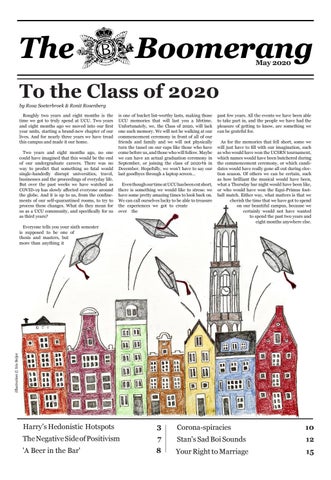
As for the memories that fell short, some we will just have to fill with our imagination, such as who would have won the UCSRN tournament, which names would have been butchered during the commencement ceremony, or which candidates would have really gone all out during election season. Of others we can be certain, such as how brilliant the musical would have been, what a Thursday bar night would have been like, or who would have won the Equi-Primus football match. Either way, what matters is that we cherish the time that we have got to spend on our beautiful campus, because we certainly would not have wanted to spend the past two years and eight months anywhere else.
Illustration © Iris Beijer
Everyone tells you your sixth semester is supposed to be one of thesis and masters, but more than anything it
past few years. All the events we have been able to take part in, and the people we have had the pleasure of getting to know, are something we can be grateful for.
Harry’s Hedonistic Hotspots
3
Corona-spiracies
10
The Negative Side of Positivism
7
Stan's Sad Boi Sounds
12
'A Beer in the Bar'
8
Your Right to Marriage
15
2
The Boomerang | May 2020
QUIET BUBBLE Why You Should Jump Off That Cliff (… Metaphorically) by Natalie Borcea If you’re reading this right now, there’s at least one thing I know about you for sure: you’re studying at UCU right now. Just like me. This also means that at one point in your life you made that pretty substantial decision about going to UCU. Just like me. I remember making that decision pretty well; I had my millions of lists and talked to so many of my friends about what to decide. I know that not everyone has gone through this; for some of you reading this, you knew right away what you wanted to do and where you wanted to go. For people like me, well… I guess we’re kind of decision freaks. In other words, I just really like to weigh my options… a lot. Maybe I did know it deep down in my heart that I wanted to go to UCU. But does that mean that I knew right away? Definitely not. Does that mean that I literally waited even after my high school graduation, long into my summer holidays, to make a definite decision? Definitely yes. Does that mean that my friends were even placing bets and taking guesses at where I was
going to go in the end? Well… also yes. Recently, I’ve had another one of those moments where the decision freak inside of me got out: I had to decide on an exchange destination, and with that, if I should even go on exchange at all. I have the proof of my indecisiveness in my phone once again - hours’ worth of voice messages to my friends and many messages and screenshots sent back and forth. Even my tutor has been able to enjoy all of my ramblings on all the pros and cons, even long after he thought I had already made a decision. I remember the feeling that I had when I finally decided I should just do it and make the most of it. After having weighed the pros and cons for a while, it was just like: I’m just going to go for it and we’ll see what happens. It felt like I was just closing my eyes, pushing aside any doubts that I had, and taking a leap of faith. It is actually fascinating how quickly your feelings on something can change. Even on the plane, on my way to my exchange destination, it
still felt like free-falling. It felt good that I was taking on this journey, but at the same time, I knew so my doubts could still become true. But then, the first few steps that I set on that campus, I suddenly felt light. And as the days progressed and I met new people there, and I went to my classes, and I slowly settled in, I felt even lighter. The thing is, looking back at my indecisiveness I can say that I’m glad I have always made those lists with my pros and cons. It is always important to weigh your options, especially when money and time play a huge role. But, when I finally stopped overthinking and I jumped off that cliff, I landed in what has been one of the greatest experiences of my life so far. So, if you’re a decision freak like me; it is always good to weigh your options. But if it is just keeping you where you are, keeping you at the top of that cliff even though you’re secretly dying to try it out; then it’s time. Time for you to jump.
Graduating: How to Let Go
Illustration © Doenja van der Veen
by Isabella Cassola Berger and Marie Claessen Well, here we are, in our last semester. Half-crushed by the weight of our thesis, half-crushed at the idea of not seeing our friends anymore and not knowing when (or if) we will see them again, we try to make it through each day, impending doom hanging over our heads. It feels almost as if UCU friendships have an expiration date: graduation. The idea that people come and go in our life is a cliché, but like many clichés, it holds some truth. After having put so much effort into building a social life here, it feels wasteful to just walk away from it. And it is a hard thing to accept. With people from the same year, it is different. We will all graduate and start a new chapter at the same time. However, being friends with lower years is slightly different; they will not be a part of our new chapter. It is almost as if we somehow are responsible, which makes us feel guilty. Although guilt sounds like a big word, we find ourselves lacking a better word to describe it. I befriended many people who were a year below me. Especially this year, my final year, I was aware that the friendships I was making were limited to the one year
expiration date. Within two semesters, I would be gone. What if I've taken their time from socialising with others? Others who would be there for the entire three years of their UCU experience, and who won’t bail out after a year. Was a friendship with me really worth it, since I’m leaving so soon? I feel like I’ve somehow tricked them into investing their time into a time bomb. And even if the friendship doesn’t end, it will change when they make UCU jokes I won't understand, or make SSS references I couldn’t be there for. I feel like I will be that parent who tries so hard to be part of their kid’s friend group but should just accept that they’re out of touch. Of course, some friendships will remain, and the memories will definitely still be there, but realistically, things will change. But, this semester we realised that that is okay. Change is unavoidable, so we might as well accept it. It is okay to feel sad about leaving. It is okay to be unsure about the next steps. It is okay to miss your friends. Remember when we just got to UCU and we were scared shitless? It all turned out okay, and so will this new chapter.
A University College Student Association Magazine
QUIET BUBBLE
3
Harry’s Hedonistic Hotspots Illustration © Tara Sitindjak
by Harry Mills YoYo! Bubble Tea Bovenvredenburgpassage 102 (Hoog Catharijne), Utrecht Cost: € Price to Calorie Ratio: Moderate
Welcome avid gastronauts, casual readers, and those of you who picked up this copy of The Boomerang in case the supply of toilet paper started running low again. In this second installment of the quarantine edition of Harry’s Hedonistic Hotspots, our adventures take us to somewhere tantalisingly out of reach, but drawing ever nearer. We’re going to a tea store that’s closed not because of COVID-19, but because it was never open in the first place. We’re going to… the future. I know that sounds like clickbait, and it pretty much is, but this month I’m going to be reviewing the bubble tea store YoYo! Back in January of 2020, as the US, Iran, and Reddit flirted with the idea of World War 3, it was announced that this popular establishment (with locations in Rotterdam, Amsterdam, and Den Haag) would be opening another location in Utrecht. Given the constraints of COVID-19, this plan has yet to come to fruition. Thus, it is necessary to journey into the future to review the (soon to be) hottest (and only) bubble tea store in Utrecht. So grab your nearest TARDIS, the tower elevator is a good alternative, and smash that alarm button like literally every boy at UCU. [Insert trippy time travel GIF, cool explosions, etc.] As the dust settles around you, you look up from the wreckage of your TARDIS to see Hoog Catharijne looming above. Unsure of exactly when you have ended up, you glance at the iPhone 73 in your pocket, which informs you that the year is 2026. Alexandria Ocasio-Cortez is president of the US (just kidding, it’s still an old white man), Flevoland’s back underwater, and Mark Zuckerberg just bought UCU.
You make your way through Hoog Catharijne like a moth, drawn irrevocably to YoYo!’s glowing pink sign. Upon your entrance, myriad bubble tea options gaze down at you from screens mounted above the counter. Milk teas, non milk teas, lattes. Earl grey, green jasmine, oolong. Taro, matcha, coconut. Behind the glass, rows of colourful toppings line the counter. You order the original YoYo! Milk Tea; sure it’s basic, but then again you’re the one in a bubble tea store. Once she has heaped a spoonful or two of tapioca pearls into your cup and filled it to the top with milky earl grey and some ice, the lady behind the counter hands it off to the robot beside her. For the better part of a minute, the robot rattles your cup back and forth like a professional maraca player, which it is. Ooh yea, spoiler alert, AI gained sentience in 2024; robots now live among us. In its spare time, this one plays in a cover band called Too Bot to Handle. As you take that first sweet sip of bubble tea, munching the chewy tapioca, you drift into a state of serenity. It’s almost good enough to distract you from the realisation that your TARDIS is definitely broken, and that you’re trapped in 2026. With bubble teas ranging from €3-5, depending on the type and size you order, YoYo! offers tasty and refreshing beverages for fairly reasonable prices. It’s a perfect way to treat yourself on a hot afternoon. If it’s food you’re interested in, YoYo! also serves onigiri, rice bowls, and even sushi burritos; although I cannot in good faith vouch for sushi burritos. Even though it is unclear when the Utrecht location will open, be sure to grab some YoYo! for takeaway next time you’re in Rotterdam.
Dearest Campus, I have never been particularly good at goodbyes. When I know one is approaching, I try to savour every ‘last time’; the last lesson of a favourite class, the last hug from a friend, the last page of a book, the last smile from my parents, the last kiss, the last walk with my dog, the last evening in the pub. I am on my sixth draft of this because I know it is my last editorial, and for some reason that means I cannot get words on the page in any way that makes sense. Like the rest of my year, I feel deprived of ‘last times’. We didn’t get much warning that by the end of our final semester, we would have to say goodbye to friends and memories that we hadn’t seen in months; our last times have come and gone and we weren’t afforded the liberty of recognising them for what they were. A wise someone told me the other day, “everything is more real during a transition”. I am inclined to agree, and perhaps this is why last times feel so important; equally, maybe this is why our loss of last times feels so unfair. The transition out of our years here feels less real when there are no concrete symbolic moments to ground it. Now is usually the point in these things when I drop in some uplifting anecdote to make reading it easier. I tried that in the last five drafts, but it sounded forced and not too genuine. I am usually an advocate for optimism, but this is a goodbye and, again, I have never been particularly good at them. Instead, I will round this off and keep it short but (not so) sweet. I want to thank the class of 2020 for being such a kind and supportive community these last months; I want to thank the entire student body for the same. I want to thank the Boomerang Board of 2019/2020 - Stan, Iris, Raf, Artöm, Julia, Maya, Ivan - for patiently listening to my ‘important voice notes’ and always, always getting shit done; you have made this year so much less stressful and I really miss our meetings in the Boom Room. I won’t say goodbye to you all yet, but I am thrilled to welcome our new board members: Justus as Executive Editor, Sam as PR, Sofie as Art Director and Khoa as Layout Director! With Stan at the helm, we will all look forward to reading what the Boomerang Board 2021 creates next year. And with that, I suppose I do have to say goodbye now. I think this may have been the most sentimental hodgepodge of words I could muster, but since it’s a ‘last time’… Yours always, Saskia Vrensen, Editor-in-Chief
4
QUIET BUBBLE A Snippet of My Productivity
The Boomerang | May 2020
Illustration © Maia Francisca
by Julia Silveira I am sitting here, at a table next to my dad as he sits through yet another conference call. It’s currently 9AM and I’m up early trying to get some work done – unsuccessfully. I give up and decide to write a little quarantine diary entry instead. This is something I’ve recently started doing, after being told by an article in the New York Times that you never know what impact ‘some random person’s daily journal’ might have. In all honesty, most of my entries aren’t too long and I only write when I’m feeling it (not necessarily on a daily or even weekly basis). Still, this has proven to be a rather insightful exercise.
Okay. It is now 10am. Creativity is proving to be a little bit difficult, given that I can’t hear
My little brother just dropped something. He keeps looking at me to check whether I’m actually doing anything. I think he’s on to me; he knows I’m being unproductive.
My parents moved to Portugal in January and we are currently staying at an Airbnb (which I guess is no longer an Airbnb but just a place that we’re renting) until our house is ready – but construction is taking much longer than expected. This has led to there being quite a bit of tension in my household. My parents are annoyed with the builder (who promised the house would be ready by the end of February) and all of the spaces in our temporary home are shared. I find that most of my days go by in a similar fashion. I wake up, eat, sit down with my dad, try to read something for class, inevitably fail at reading, go back to bed and try to read there, get distracted. Before I know it, I’ve done nothing all day and it’s 4pm. Not today though. Today I am going to tell myself that these little struggles can all be solved by some patience, creativity and planning.
it impossible to concentrate on any of the tasks I’ve set.
m y s e l f think. Writing this entry is helping me keep my patience and making me feel (but mainly look) productive, masking the fact I am not actually doing anything. As for planning, I’m not quite sure how to go about it. I’ve written down what I’m meant to be doing in a schedule template that my friend showed me on Excel, but am finding
2pm. I’m stressing over the lack of words added to the word document I opened days ago, for the paper draft I’m meant to hand in by 9am tomorrow. Meanwhile, my mom is on the phone, speaking at an elevated volume with a woman about a sink for the house we were meant to have moved to months ago. My parents are going to the store to get the sink because the builder is scared of getting coronavirus. When I ask if they’re scared, they tell me they have to go because we can’t stay in this Airbnb forever and if they don’t do it, no one will. To me, it really doesn’t seem like they’re scared of the virus at all. My dad keeps telling me that he thinks everyone will get it at some point. To which I tell him that I refuse to let my parents be part of this collective. If it were up to me, I would keep both of them in a germ-free bubble all day, away from the dangers of our modern-day society. Sadly, this is not possible, and I must instead accept that my parents are two grown adults who know how to live their lives and probably don’t need their daughter treating them like children, and constantly nagging them to wash their hands. It’s now 6pm and I actually managed to get quite a bit done. A solid two to three hours of work. Time to call it a day.
Before I Go; a Farewell to Campus by Emma van Schie During my last tutor meeting just after spring break, my tutor asked me if I had any advice for new students. This hit me like a small marble thrown with considerable speed – annoyingly hard – it made me realise that I was going to leave this place. You, dear Campus, have been both a home and a prison. I’ll be graduating this semester, which feels so strangely formless in a time like this. But here I am, writing this, inspired by the stories of my friends, for you. My farewell to campus. Chances are, you don’t know who I am. You might’ve seen my name flow by on UCU Students at some point, and I’ve tagged my fair share of friends on Confessions. But I’m no UCSA-person who attends GA’s and goes to the bar every Thursday... I digress. If you do know me, and have asked me what I think of campus, you’ll know that my usual response has always been along the lines of “Egh, campus sucks. This place feels like a community-wide popularity contest.” Everyone is better connected, wealthier, is on multiple boards, a BarCo chief, and has all the friends they’ll ever need. Everyone’s supposed to know everyone, and care
about it – yet I understand you may not feel this way. I did, and still do sometimes. Committees can feel cliquey and Campus FOMO is real. But for you this is home! And as you would be most excited about UCU you’d want to represent it as you’ve learnt to love it! And so the introweek parents, committee board members, and members of the UCSA who love the culture they found here, thrive and perpetuate it, in all its good, bad, ugly and beautiful. Like every community, this one you and I have been a part of has its distinct culture. And ours is one of pressure to be Out There and to Have Fun and to Excel. It’s stressful and sometimes even toxic. But our culture is also one of cohesion and connection – want to keep talking to that friend? Go to their room on campus with a cup of tea! Want to borrow literally anything? UCU Students is right there! You and I, we are lucky too. We have the opportunity to do and make anything we’d like here: be in that play, do that internship, start that committee, make those friends!
And you only need to go to Facebook to see how everyone has an opinion, and everyone has something to say, be it a well-meant addition or plain shitposting. And I have got to say it (ironically enough) the points we make, the stuff we argue over, it rarely if ever matters, and yet you come alive with discussion every time. It’s absolutely beautiful in its absurdity, stupidity and brilliance, and for that, I am truly thankful. So ultimately, do I have advice for new students? I’ll quote one UCU Students poster as he put it: ‘You have a long way to go and for many of us it gets worse, not better. No one else can tell you whether this is the right choice for you. Only you can figure it out; only you know exactly what you feel and notice.’ And I’ve noticed you, in all your good, bad, your ugly and your beautiful. Goodbye campus, see you ‘round.
A University College Student Association Magazine
QUIET BUBBLE
5
The UCU Crisis Team: Behind the Scenes
by Irene van de Hoef
It was the week before midterms when I was asked to be the student representative in the UCU crisis team. The first few meetings were overwhelmingly efficient: Which actions should we take? What are the scenarios we can think through? Who should be involved? Things started to move fast. Whereas Premier Rutte told everyone that the universities would not close on the Thursday afternoon of midterms, we received a letter just after 7 pm saying that the universities would shut until March 31st. At 7:55 I sent a WhatsApp message to the crisis team group chat, asking what I should tell the students in Voltaire when I hand out study snacks at 8 pm. “Come to College Hall for a quick briefing”, they tell me. It is dark and the doors are already locked, so Laurens and I get to enter College Hall through the big red front doors. In their office we find the managing directors, eating their pizzas while drafting an email to the students. It’s funny to see how the crisis meetings, the WhatsApp group, and an adrenaline overdose suddenly make the atmosphere so informal. On Friday morning, 11:15 am, I found myself in College Hall again with the rest of the Management Team, making the radical decision to move online for the rest of the semester. I felt the adren-
aline rushing through my veins. Is this really happening? Aren’t we rushing this decision? But the rest of the MT knew this was the only option. At 1:30 pm, the email to students went out after the UU’s approval: no more face-to-face education for the rest of the semester. Now, there was no way back. Just like the rest of the world, the UCU crisis team moved online after this decision. During the break and the few weeks afterwards, we saw each other on Microsoft Teams every morning at 9 am. Whereas the meetings were only focused on emergencies in the beginning, we too started to get accustomed to the new reality. We moved away from the strictly structured meetings that were mostly focused on direct actions towards more general policy items like reimbursements and scenarios for next semester. The decisions that we had to make were not necessarily easier, but at least a bit less immediate. Things also became more personal. Suddenly, I got to take a look inside of the members’ houses, and sometimes their kids or spouses appeared on screen. Over time, the WhatsApp group changed from an “urgent matters only” chat to a place where personal photos, art, music videos and jokes were shared as well. We even
had an informal borrel during which we played two truths and one lie to get to know each other better. It was nice to see how the people that run this college could also find support with each other. I know I speak for the entire ASC board when I say that we are very happy with how much we have been involved in the discussions around the current crisis. I know that many of my fellow UU student assessors did not get the chance to represent the student interest so directly, and I am convinced that ASC got a great deal done through this medium and the other meetings that we have been part of. Besides all the discussions we have been involved in, I also got to see a more personal and informal side of the people that run this college. The UCU crisis team consists of Dean James Kennedy, Managing Director Sjoerd Bosgra, Director of Education a.i. Susan te Pas, Policy Advisor Elsa van Straaten, Head Tutor Annemieke Meijer, Registrar Els Lemaire, Communications Officer Elisa Veini, Student Life Officer Mark Baldwin, Housemaster Maarten Diederix, and me, the Student Assessor.
What Happens to Your Secrets? by Mathilde Panis-Jones
As of the moment this article is sent to The Boomerang, I will no longer be Victoria number 8. After a year of reading your anonymous thoughts, three AM desires, kind well wishes, political rants, benign crushes, and your somber introspections; I am leaving UCU Confessions. Perhaps I would have followed in the footsteps of my beloved predecessor, gleefully coming out at the Class of 2020’s Commencement ceremony — but that won’t be the case this time. Not only because I’m convinced that our potential Zoom event riled with substandard internet connections would not be the right platform, but also because it would not allow for the type of conversation that should be had. In my first year, while I sat quietly in Introduction to Political Theory, we learnt about Plato’s Republic, and more specifically, his tale of the Ring of Gyges. Put it on, and you’re invisible and anonymous. The question that Plato asks is whether those who put on the ring will be civil, moral, and kind to one another. He thinks not. I guess UCU Confessions is our modern, bubble equivalent to Plato’s hypothetical experiment, and the Victorias end up being in the particularly special position of both “subject”, as a peer
of most submitters, and “impresario", as an administrator of content. We are trusted with this unique insight into students’ minds, their units and opinions, their classrooms and fraternities, their private lives — we unexpectedly feel as if we’re friends with every social group known to UCU. Victorias get the privilege of reading about the mortal coil of students’ firsthand: from dipping their stroopwafels in hummus, to sorority drama, to 4 A.M. suicidal thoughts. And this is where I found an issue in my role as Victoria: I could not do anything with the information I was receiving. My only role was to come up with a careful selection of about ten to fifteen funny-yet-not-childish, serious-yet-notdepressing, dramatic-yet-not-personal campus revelations and to post it on our public Facebook Page, which has accumulated a whopping 2,487 followers. I could not personally reassure the rape victim, or provide resources for the person seeking psychological help, or figure out who really needed a friend to talk to. I understand that UCU Confessions, from time to time, gives students some solace in knowing that someone out there is aware that they are not doing well. It has made and
continues to make certain things easier; owning up to mistakes, admitting faults, and disclosing traumatic events, all while not having to reveal one’s identity. I want those seeking help to have a voice, reassurance, and recognition; but I feel as though UCU Confessions falls short in fulfilling those expectations. Perhaps we should strive to come up with different mechanisms that would lead to more fruitful conversations about serious topics — all while still being able to embrace UCU Confessions for what it was initially set out to be: an entertaining, exclusive look into our beloved campus life, providing distraction for stressed-out students. I believe that this is a larger discussion that transcends the limitations of a humble Facebook page; and I have confidence in this student body’s ability and willingness to hold it. I am very proud to admit that the people in charge of this page take their role seriously. We giggle, hurt, and cry along with you — your words affect us, regardless of if they are posted or not. We try hard to give everyone a voice, to be neutral without being hurtful, to be conscious of what sort of discourse we perpetrate. I hope you feel as though your secrets are in good hands.
6
The Boomerang | May 2020
KEEPING POSITIVE
Campus in Corona-Times: How are We Feeling? by Justus Boesschen Hospers
Quarantine is a weird experience for everyone. On campus, however, the experience seems to be quite different from the norm. To find out how students are feeling about living on campus during corona-times, I decided to conduct a short survey. I received 22 replies, quite evenly distributed among years (around 30% first years, 40% second years, and 30% third years) and, unsurprisingly, mostly Dutch (about 70%).
up at 2 pm if I want to, not wash the dishes and masturbate anytime I want to”.
A similar positive feeling can be found in the answers to the question “Would you rather have spent quarantine somewhere else?” Using the same scale, the average response was 2.3 (leaning to no). Four students answered absolutely not, while no one answered absolutely yes. Some indicated they would rather have been with their family. Interestingly, others wrote that they had already been at their parents for a few weeks but heavily preferred campus. As put eloquently by one of the participants: “It's better than being at my parents because I can still wake
The answers to the question “Who are you spending quarantine with?” all came down to the following: their unitmates and closest friends. One poor soul is forced to self-isolate with “this guy who I absolutely am sick of but have to because he's my unitmate and all my friends are back home”. I was also wondering if people felt closer to their unit now that everyone’s forced to be home. The answers are a mixed bag. Out of the twenty responses to the question, exactly ten of them were positive while the others were negative.
Comic © Anna Tchitcherine
First of all, I asked people if they had enjoyed their quarantine on campus. They could answer using a numerical scale ranging from 1 (absolutely not) to 5 (absolutely yes). The average response of 3.9 indicates that most students seem to be quite happy. When asked for elaboration on this answer, they cited that they enjoyed being with their friends and having more time for hobbies and going outside.
Next, I want to point out a juicy contradiction in my findings. When asked if they had personally adhered to the rules set by the government, participants responded on average with 3.57 (leaning to yes). Yet, when asked if campus in general had adhered, they responded with 2.19 (leaning to no). Almost all participants wrote that they have at least a few times met up with more than 3 people and had a hard time keeping 1.5 meters distance from their friends. The general consensus seems to be captured by this particular response: “I've tried to be 1.5 meters away, but being the social butterfly that I am, it is quite hard”. Meanwhile, they back up their slightly more negative stance towards campus in general with the exact same arguments.
Participants’ top annoyances during quarantine are (in order) dirty units, annoying unitmates, and the lack of bar/parties. The bar was also mentioned in 10 out of 18 responses to the question “What do you miss most about non-quarantine campus life?” Other things that are dearly missed include: international students, committee events and the commencement ceremony. Lastly, I gave students the option to write a message to all of campus. I picked some of the most interesting responses and present them here to you in all their unedited glory: • • • •
• • •
Try the cheese sticks from Chris'. They're amazing. No gossip but just want to say the people with significant others are the real winners here. I’m jealous of you So many couples are def going to break up when this ends STOP GOING BACK AND FORTH BETWEEN YOUR HOMETOWN AND CAMPUS YOU DUTCHIES. YOU ARE THE REASON CORONA IS SPREADING My unitmate sucks. Communism is awful. Best time to try drugs bois Pls spend money at the bar when it opens the poor fucks are broke
A University College Student Association Magazine
Agony Aunt
KEEPING POSITIVE
7
The Negative Side of Positivism by Jill Roeleveld
My friend is dating a racist. They even acknowledge that they are racist. How do I convince them to break up with this dumbass? Dear Anon, The thing is, racism isn’t really one of those character traits that someone should be able to just ‘acknowledge’ and then move past in a relationship. Snoring? Sure. Obnoxiously loud chewing? Barely. But racism? That's a solid no. Now I’m not trying to blame your friend or make assumptions about them without knowing the full story; having feelings for someone really can make a person blind to their flaws to the point where, in their mind, the flaws “aren’t even that bad.” But once again, this is more than a minor ‘flaw’ that we are talking about. I think that the only way you can go about this is through having a direct conversation with your friend, explaining to them how this racism, even if seen in passing comments or jokes, is not and never will be okay, and that it is most definitely not something they can overlook in a relationship. Hopefully, by honestly confronting them about the situation, you’ll make them realise just how serious the issue is so that ties can be cut asap. But, if after this conversation they refuse to listen or do anything, there might be other issues going on. If your friend is too dependent on having a partner, or insecure in other aspects of the relationship, they may be willing to ignore the racism as a means of keeping their partner close or gaining validation, or perhaps they are too worried to initiate a breakup because of the pain it may cause them both. However, there’s also the possibility that your friend doesn’t see these racist views as too much of a problem, in which case, I think that says a lot more about your friend than it does about their partner; meaning it might be you, rather than them, that has to break off a connection. Hoi! How do I get motivated to do stuff now that everything seems to be shit?
When we have a strong emotion, it is most likely because one of our core values was involved. If, for example, a friend spilt one of your deeply personal secrets, you would likely feel angry. If you were to suppress this feeling and pretend it was no big deal, you would have a harder time realising that loyalty is very important to you. Therefore, we need emotions, both negative and positive, to gauge what our chief principles are. Author of The Subtle Art of Not Giving A Fuck, Mark Manson, claims that our values determine our actions, decisions and reactions. Why then, do we have a tendency to give each other advice which usually comes down to “Don’t be negative, stay positive”? It is considered acceptable to talk about the tears you shed over the cat who does not love you as much as
you love it, or the plate you smashed when you found out your favourite series was cancelled. Small problems like these are often exaggerated, and complaining about them is socially accepted. In fact, complaining about anything is considered fine, as long as it is kept light and breezy; you can talk about your traumatic childhood as long as you add a bad joke or sarcastic comment at the end. However, laughing at pain does not make it go away; all that does is ridicule our struggles by belittling them and casting them aside as unimportant or insignificant. We have come to view the experience of negative emotions as a negative thing, a forbidden phenomenon. Real frustration, sorrow or anger about big personal issues is considered too heavy to deal with. But not dealing with them does not make them go away. Instead, it causes deeper and more prolonged negative emotions. The truth is that life can really suck sometimes, and that is okay. It is okay to not be okay all the time. Feel your negative emotions, explore their meaning and their impact on you. Talk to someone you trust, even if that is your dog. The most important thing is acknowledging your feelings, and the best way to do that is to say them out loud or to write them down. So grab a pen, or call your mom, stop running from those painful truths and start confronting them.
Illustration © Lise Derksen
Dear Anon, Firstly, I just want to acknowledge the fact that you are most definitely not alone in feeling like every inch of motivation has been drained from your body. It seems that everywhere I turn there’s a new instagram post of someone mastering a new language, writing a debut novel or turning themselves into Picasso; whilst I on the other hand am sat on my bed starting my fourth Tiger King episode of the day. But we have to recognise that there is nothing wrong with that; we are facing a global pandemic, not a productivity contest, so don’t be too hard on yourself if you need to take a break from the shiteness of the world. Now that’s out of the way, here’s productivity tip numero uno: Routine. Getting yourself into some kind of daily routine, especially in the morning, can really help to boost productivity levels for the rest of the day. Whether that be going for a short walk or putting time aside to make yourself your favourite breakfast, setting small and achievable ‘tasks’ first thing can make you feel accomplished before the day has even really begun. Next - and I know this is a controversial one put a bit of effort into your appearance - not for anyone else, but for yourself. Don’t get me wrong, I basically live in my sweatpants, but on those days where I decide to try out that funky new instagram eyeshadow trend or pair up a new outfit combo, there’s no denying that I feel more like an actual human who is capable of doing actual human things. Lastly, and maybe most importantly, ditch the phone. Whilst it's obviously important to keep up to date with the news, being constantly bombarded with often tragic and negative reports can really take a toll not only on motivation, but on general well being; and when that’s paired with feelings of comparison and ‘not doing enough,’ it can be a recipe for disaster. So just know that it’s okay to take a step back and switch off from the outside world for a while; especially if doing so will help you and your inner one.
Negativity is a mood-killer. It is an unwelcome and uninvited guest to any social gathering. In order to maintain ‘good vibes,’ we abstain from sharing our struggles and instead delve into the world of shortterm pleasures. Smoking, drinking, partying and binging are means to satisfy our need for distraction and numbness. To feel or not to feel; that definitely should not even be a question. Feeling equals being alive. Feelings enable us to realise how situations impact us and why we deem them important.
8
The Boomerang | May 2020
KEEPING POSITIVE
‘A Beer in the Bar’ Tell me how you really feel The bar brawl. A rather aggressive segment where two sides, both alike in dignity, fight their corner. For this edition we wanted to mellow out - pause the bar brawl, lower our fists, put down the barstools and sit on them instead of throwing them at each other. Talk to each other about how we’re feeling - crack open a cold one and have a beer in the bar, not a brawl.
by Stanley Ward
But also being around other people is good, although it’s not exactly something you choose often I don’t initiate it as it happens organically but it helps.
How it’s easy to stop thinking and ignore, at least here, within the context and our privilege, that there’s a big percentage of the world that is suffering or grieving.
I’m sat in my living room, with two of my housemates, Simon and Arnoud. Noud for short. I’m on the couch with my laptop next to me, waiting for them to come sit down. They’ve both just got back from working out, and are making some lunch. Neither are celebrities (for now) but I feel like celebrities have enough interviews and are asked enough questions. I wanted to ask them both about coping mechanisms in a Covid-19 world, and create a space for reflection on what we’re feeling in this moment. I’ve been thinking a lot about coping mechanisms, about whether I should be wary of falling into depending on them, or should be rolling into whatever coping mechanism seems to work. I asked them both some questions, about this, and other things, and typed up what they said. Illustration © Iris Beijer
Also about my future I guess, I want to find a process which helps me realise what job I wanna do. Every so often I think about corona, how it’s become ingrained in our mindset.
When reading about historical events you think mindset changes completely, but it seems that life also just goes on. Noud: In the beginning I knew that things were gonna be different long-term but I guess I didn’t realise what this meant. I realised two or three weeks ago that it was gonna be a while until we’d have anything normal, especially in terms of the little things like going to the bar or playing open mic again. After that I was sad for a day but after that it was basically kinda over, so that’s quite fine. What worries you at the moment?
How are you feeling right now?
Simon: This feeling of nostalgia for the pre-corona situation I have, a nostalgia for all the things that were once deemed normal.
Simon: I woke up really anxious - I had one of those TV nights where you watch TV in bed, and instead of actually falling asleep you just transition into this weird dream state. I was finding it hard to focus, so I asked Noud to come exercise with me. Noud: Right now I feel like I’m just going with whatever. Hille [his girlfriend] is coming back tomorrow. Noud is smiling about this, being apart hasn’t been the easiest, as it isn’t for anyone. Exercising also helps calm me down. I ask Noud whether he feels different since the end of term. I feel a little different - like I’ve lost the structure that maybe was good, but I felt like that structure can actually be a burden. How do you feel about coping mechanisms? Simon: I believe in them. But sometimes it’s easy to follow them and forget about responsibilities. Like with academics - I’ve been ignoring it for weeks, and then having a horrendous three days where I do everything. Exercise is my biggest coping mechanism. It gives me my routine, and it helps me structure my day. Also going on bike rides - it gives me time to myself. We all live in Tower - we love it but there’s no real privacy.
Noud: I used to think I did believe in them, maybe I still do sometimes, but perhaps more subconsciously. My stress comes from work, so getting work done is my best coping mechanism: making a plan, putting it on paper, and doing it. Now I’ve finished everything for the semester. It's not that bad - I have a ‘plan’ for each day where I look at a list of ideas of things to do. I pick a thing from the list, and that’s my plan for the day. It’s not always doing the same things that helps, and not having a routine, but having stuff to do. If I want to do things spontaneously then I end up doing nothing. Simon: If I don’t have a plan, then it drains me. Having small things to do really helps. What have you been thinking about recently? Noud: Life after UCU & what it is I really wanna do. I’ve ordered some books on some things that really interest me. Simon: This summer, the uncertainty of it all especially when I’m trying to make plans.
for on.
I guess it’s a general nostalgia accentuated by pandemic - any limitation adds more value than it otherwise would have. But it’s not just nostalgia like ‘oh we used to be able to do that’ but also a nostalgia things that we will miss out
Noud: I’m the same - wondering how we’re gonna get through our last year, and if we’re gonna have any more opportunities to do classic UCU stuff. What excites you about the future? Simon: Being able to make fucking plans again. Noud: Gonna see Hille soon. Before we finish, what are you thinking about right now? Noud: Seeing my girlfriend. Noud laughs, and Simon gets up to check the stove. Simon: I’m hoping that my shakshuka turns out well.
A University College Student Association Magazine
KEEPING POSITIVE
9
A Day in the Life by Maya Homsy King I keep reading the news? The hours, days escape me. Are we in week 10 or 11? Oops, I missed a deadline, I’ll never finish my thesis. Does it even matter? It doesn’t seem like it matters anymore.
Could I borrow your cake pan? Sure, could I borrow your blender? Maybe I should take up painting, or write poetry. Shall I learn how to do a handstand? Let’s go somewhere. But where? We should stay home, it’s more responsible. If we go somewhere with lots of space, it should be fine, right? But what if it’s crowded? You know, everyone has lots of time these days. This is great, I can choose how my day goes. I have so much more time, I’ll do everything I never could before. I hate this, I can’t focus, I’m going crazy. Why do
Strange times, as everyone says. If you ignore it long enough, stay on campus, you almost forget the madness. Until there’s a call from your mother asking how you’re doing, saying that
she misses you, or a news headline pops up, or you venture to the supermarket and get yelled at for standing too close to someone while you’re looking at packages of pasta. The light of the sun every day is mocking, but it is the redeeming factor of these weeks. How is every day this beautiful, when turmoil seems to reign, when each nation is being turned upside down? The bubble is at once more defined than ever, and slowly but surely becoming blurred around the edges. Our little agglomeration of mismatched buildings, the iconic arched lettering, the gravel centerpiece, somehow seem forgotten. Their essence has dissipated. This place was the center of my world, occupied all the corners of my mind most days, and now the vibrancy, the aliveness of it, has been muted. The tranquil- fewer obligations-slow-motion life does have its upsides. Pies are baked, trees are climbed, rosemary and mint are planted. No longer do students rush from one meeting to the next, gulp coffee from the vending machines, show up to class drawn and tired. Life is not one large monotonous cloud on campus. It is just unrecognizable, and I think that is what is so unsettling.
A Corona Silver Lining by Saskia Vrensen My grandparents and I have an interesting relationship. I love them very much; I have beautiful childhood memories with them, catching fireflies on their back porch in the humid Midwestern summers and baking cupcakes topped with as many sprinkles as I wanted. I learned how to walk at theirs, holding myself up on their coffee table. Huge boxes of donuts or bagels with strawberry cream cheese for breakfast every day. Boxes in the mail every couple of months filled with little presents that reminded them of my sister and I. My grandma tries to guess whether it is me or my sister who answer each of their long distance calls; over the years, our once American accents have morphed so much that she now struggles to differentiate between the two of us. I used to spend two long, lazy months with them every summer, but now we are lucky if we see them once a year. I miss them very much. We have grown apart in the last few years. As I matured, formed my own opinions and discovered what I care about, it became clear that many
of these things contradicted theirs. Their fervent Catholicism to my new-found atheism; their fear of immigrants to my volunteering at the border; their traditional standards to my fourteen piercings; their vote for Trump to my hatred for him. In a tale as old as time, I cannot talk about the things I care about with my grandparents: it has led to one too many arguments. I have felt like, because of these concrete contradictions, they lost the pride they once had in me, their golden-girl granddaughter. It hurts when the people you love hate the things that you love.
"It hurts when the people you love hate the things that you love." They had planned an Easter visit across the pond, to see us and to see the tulips. It would be their last venture to Europe, their last taste of the life their daughter had made so many miles away from theirs. But then COVID-19 came, and their
plans crashed and burned. Now, my grandma will only see the tulips by way of the Keukenhof’s online virtual tour (once I have explained, step by step, how to access it). And I won’t get to see my grandparents for yet another year. This sob story doesn’t really match its title yet, so now for the silver lining; I have been calling my grandparents at least every week now, when before I would talk to them once a month at most. We still don’t really talk politics, but we do gossip about celebrities or discuss the books we are reading, reminisce about our mutual missing of my dog, chat about how my sister is surviving being stuck in the house with my parents (and vice versa). We somehow have found common ground via our little FaceTime sessions, catching up about nothing. And even if they aren’t proud of my politics or my piercings or my potential career choices, they are proud of this new person they’re getting to know after years of distance; at least that's what my grandpa posted as his Facebook status the other day.
Illustration © Anne van Wendel
When your living room becomes your Voltaire, your gym, your chilling area, your dining room, your social hub, it becomes messy surprisingly quickly. Even if there are only three people using it most of the time, and there are only ever three guests at a time. The tape marks in my living room from previous inhabitants are as familiar as my own hand, the small cracks spider-webbing across the ceiling, the residents of W courtyard walking in and out of their own living rooms. Inside, outside, back inside, coffee in the sun, lunch in the sun, supper in the fading light.
10 KEEPING POSITIVE SPREAD
The Boomerang | May 2020
Corona-spiracies and Why I Can't Stop Making Fun of Them by Gideon Frey
I love conspiracy theories! Especially Corona Conspiracies – how I enjoy them! A war against an invisible enemy makes people, who were inclined to doubt the moon landing or 9/11, go wild. In the corona crisis, conspiracy theories have exploded and are a staple of every news site – who can blame them? Conspiracy theorists tend to be inherently funny. They aren’t just hilarious – I think they exemplify so much of our current point in history. Conspiracies are the true folklore of the 21st century. In an incredibly complex world, more information brings more complexity, not less – conspiracies are the counterbalance. But, conspiracies have less to do with people’s relation to truth than people’s relation to power. You can believe in many things that are generally accepted as ‘wrong’, like astrology, nationalism, or that your happiness depends on the right GPA. However, conspiracies are a special kind of wrong; they come out of a situation of helplessness. Conspiracies don’t give people a feeling of power, rather, they stimulate a ‘power-fantasy’. The idea that corona is caused by 5G or built in a mysterious lab by the Chinese for world domination does not give power to the smart independent
thinker, who sees through the lies of the establishment. Instead, conspiracies deliberately attribute even more power to the establishment. People have felt defenseless to greater authorities since feudal societies. What people are now realising in the wake of this crisis, is that there actually is no one in charge. In that sense, conspiracy theories are fanfictions of global events, a way for the passive viewer to reimagine the content they are given. It's almost comforting to think that there is a cabal sitting in some hidden layer of a secretive European castle, because then at least someone knows what is going on, and is in control. There is something self-congratulatory about conspiracy theorists. They feel like they are smarter and know more than the sheeple who believe everything they are force-fed by the media. Who wouldn’t want to be the one genius to see through the lies of the lizard people? But here I catch myself doing that same thing – isn’t watching some idiot protesters stand in Den Haag (or even better, some neckbeard American showing off his long hard guns in public) coming from that same sense of self-congratulation? In a way, it’s very similar to an internet atheist thinking of themselves as a philosopher after
taking down some random 13 year-old in a YouTube comment. In this corona world, where I need to check the news daily for someone who can explain what the hell is going on, it’s a breath of fresh air when I can look at conspiracy theorists and say to myself “at least I am not that dumb”. In a world where nothing makes sense, I have someone to look down upon, and that makes me feel better in comparison. There are real dangers in conspiracy theories. If there are too many people refusing to get vaccinated because they think Bill Gates wants to control their minds, lives can be lost for no reason. But that does not mean that we are not compensating for something when we look down upon conspiracy theorists. Let’s be honest, we would like nothing more than to have Lizards, China, Chemtrails, or any other easy-to-understand actor to blame. We don’t want to live in a world without direction, subjected to forces that aren’t subject to reason. In a sense, we all secretly want to be some guy with a tinfoil hat shouting about the Illuminati – just because it’s a nicer folktale to believe.
Illustration © Sofie Ryan
A University College Student Association Magazine
11
PUZZLES BY LOGICO Modelling the Spread of an Epidemic by LogiCo Models describing the spread of infections in a population began to appear in the 20th century. Some of them are applicable now as well to the current situation with the COVID-19 pandemic. We will consider the simplest SIR model of the infection spread. It should immediately be noted that the model is just a rough approximation to reality, which does not take into account a huge number of factors that potentially affect the real picture. The SIR model considers a population of N people. At each moment in time, each person from this population belongs to one of three groups: group S consists of all people who have not yet been infected, then, as the virus spreads, they move to group I of infected people, and then to group R. Obviously, the total number of people in the population is equal to the sum of the numbers of these three groups: We need to simulate how the number of people in each of these groups varies with time. The model will have two numeric parameters. The first is the time during which a person is contagious. We denote it by Tinf and assume that after Tinf, a person inevitably moves from group I to group R. The second parameter is the number of healthy people who, on average, have time to infect an infected person during an illness; denote “infectiousness” by R₀. For measles, this parameter assumes very large values - from 12 to 18, for seasonal influenza, this parameter ranges from 1 to 2, and for the SARS-CoV-2 coronavirus, its value in the world average fluctuates around 2.2. We denote the number of “new” people in group S in one day by S'. Since the number of susceptibles can only decrease, the value of S' is always non-positive. Similarly, the daily replenishment of groups I and R is denoted by I' and R', respectively. Now, finally, let's build the SIR
model, assuming that all deaths in the population are caused by infection. The number of new infected S' is calculated based on the fact that each infected person from group I infects on average R0 people from group S during Tinf. This is written as follows:
where, recall, the number N is constant, and I and S depend on time. It is also clear that during Tinf, the number of cured or dead people increases in proportion to the number of infected people - once every infected person in Tinf days moves from group I to group R, then we can assume that from him passes in one day. Therefore:
Task (Send Answers to LogiCo via Facebook and Win a Prize) Write the equation for the function I'. Let at the very beginning the number of infected people be equal to I₀, and the number of susceptible ones At R₀≈2.5 and Tinf ≈ 3 days, what will be the growth rate of the number of infected? After what time does the number of infected people double? The growth in the number of infected cannot continue indefinitely. At some point, most of the people in the population will become infected or already sick, becoming immune to infection. Then the number of infected people in group I will reach a maximum. This is a very important point for predictive models, since it is then that the greatest load is expected on the medical system. We will designate this moment Tpeak.
What will be the number of people in group S at the time of Tpeak, if the size of the initial population is N? Our solution, even within the framework of the SIR model, is approximate, but it predicts the growth rate in the initial phase of the epidemic, as well as the position of its peak. Within the framework of this model, it turns out that the epidemic will last 3-4 months. However, the SIR model does not take into account the important feature of the viral infection that was already mentioned in the solution. After infection, the virus takes some time to multiply in the body of a new carrier. Therefore, for some time an infected person is not dangerous to others. The incubation period is the time from infection to the onset of symptoms of the disease. For coronavirus, the median incubation period is 5.1 days, and in 97.5% of patients the symptoms showed up to 12 days after infection or earlier. On the one hand, these data justify the two-week quarantine period, which was introduced in many countries as a measure to slow the spread of infection, but on the other hand, the incubation period in approximately 1% of infected individuals can be more than two weeks. The incubation period is taken into account in the SEIR model. Do not forget that all these are mathematical models that do not take into account the huge number of nuances that can potentially reduce or increase the rate of spread of the virus. It is important to remember that each of us can be a distributor of the infection without suspecting it and without having any symptoms. The best thing that can be done now to at least slightly lower this parameter R₀ is to follow WHO recommendations.
12 CULTURE
The Boomerang | May 2020
Stan’s Sad Boi Sounds :( by Stanley Ward My music taste isn’t the most inspiring or uplifting. Recently I’ve been listening to Elliot Smith’s Figure 8 on repeat and have convinced myself that Phoebe Bridgers is a genre. However, in the name of trying out positivity, I wanted to find an example of truly joyous music. I searched my soul and my Spotify saves, and found very little. That’s when I realised. The only thing that makes me truly happy is the 1992 musical comedy-drama ‘The Muppet Christmas Carol’ and it’s excellent soundtrack. It's not Christmas, not even close, and it’s a bit too hot outside for me, but that doesn’t matter. It’s time to roll into our coping mechanisms, escape reality, crank that goddamn fuzzy felt frog’s warbling tones like a fucking madman and then write a column about it. For those of you who haven’t seen this masterpiece, I’ll provide a brief description - it’s Dickens’ A Christmas Carol with Muppets and songs and also Micheal Cain is Scrooge. The film is perfect, but we’re not here for the visuals. We’re here for that sweet sweet audio nectar some call music. The Muppets Christmas Carol soundtrack boasts more lethal bangers than 100 gecs and Death Grips combined. So let’s break down the top 5. That’s right, it’s list time. 5. Christmas Scat - Kermit the Frog & Robin the Frog Around 23 seconds long, this piece of a cappella
jazz scat renders Miles Davis’ entire discography 2. One More Sleep ’til Christmas - Kermit redundant and arguably completes jazz as a the Frog genre. If there’s one thing I need in this new era of 4. Marley and Marley - Statler and existence, it’s a little hope. There’s something so Waldorf pure about the message of this song, invoking This bone-shaking, floor filling, musical machine both the beauty of childhood innocence, but is Scrooge’s warning from his recently deceased also the hope for a better tomorrow. To quote business partners in song form. Critiquing the the frog himself ‘the world is at her best when inherent selfishness and self-destructive nature people love and care.’ of capitalism, this combines a vaudevillian musical aesthetic with hard hitting bar after bar 1. Thankful Heart - Micheal Cain & of ghostly socialist truths. Take note Bezos. Muppet Ensemble Relentless. Right when you thought your feeble 3. It Feels Like Christmas - Ensemble human form couldn’t process any more raw This fat and soaring hymn for the ‘ways we musical power, Micheal Caine and the Muppet show love’ sung by the ghost of Christmas gang hit you with one last herculean anthem in present was able to help Scrooge begin to open the form of Scrooge’s redemptive number at the his heart - imagine what blasting this campus- tail end of the film. Just like how Scrooge was wide, 24/7 could do for us all! We could all learn transformed by his night of paranormal lesson from Scrooges’ second spiritual visitor in these learning, Thankful Heart and it’s ‘promise to times to find whatever joy and beauty we can in share the wealth’ will leave you forever changed the here and now, and recognise the kindness for the better. There’s even a beat switch and around us. some stanky horns at around the 1:15 mark to It may not be the right season, but if the song accompany Cain, who did not need to go as hard is true (and how could the Muppets lie) then as he does. ‘wherever you find love it feels like Christmas.’ Because of all the love we’ve shown each other I hope that all of you out there can either find in this difficult period, then this column is actu- some solace in singing Muppets, or find your ally pretty fitting. How about that for logical own A Christmas Carol, no matter what it is. gymnastics. Whatever gets us through the days right?
Important Opinions on Important Movies by Sam de Visser So it’s the end of the semester, and the academic year, and a lot of things, and we’re all still stuck inside and a lot of us are stuck in places we don't wanna be in and it’s all really bad and terrible and… yeah. So while last time I was kind of looking for escapism in movies, maybe this time I figured it could be cool to look at stuff that’s just really uplifting, and happy, and nice, to help take your mind off of things. Hence, I started going over my favourite comedies. Comedy is actually my favourite genre, precisely because it is easy to watch and digest. A lot of the time, I like to watch stuff that’s lighthearted and not very serious, because life is serious enough most of the time, especially now. But the result of that is I have a lot of favourite comedy movies, and I had a very hard time trying to figure out what to select for this column. Which is why I kind of moved away from more traditional, funny comedies in favour of a movie that’s just kind of stupid, and incredibly silly. The Happiness of the Katakuris (Takashi Miike, 2001) is a Japanese part stop-motion, part
live-action musical comedy horror film. Does that sound like a mix of genres and styles that makes absolutely no sense? You’re completely right! The opening scene of this movie starts off fairly traditional, then turns into weird horror and then transitions into a stop-motion sequence with horrible CGI. And that’s kind of emblematic of the whole movie, because it is a wild ride. Admittedly, it’s been a while since I last watched this film and the story was never really very clear in the first place, but I’m pretty sure it’s about this family who runs a hotel, but then all their guests end up dying. There’s some scenes that would’ve been very CGI-heavy in any other films - but here, the director’s just made them stop-motion. There’s several sing-and-dance numbers as well, including a karaoke scene, because why not? This whole thing hangs together from eccentricities and absurdity. (I’d even call it quirky.) But in the end, this movie doesn’t really have to make sense, because it kind of invites you along for the ride and it’s best to just sit there and take it.
Kind of sounds like I’ve chosen something escapism-related again instead of a comedy like I wanted to, and maybe I have, but this movie is also really funny just because of how ridiculous it is. It’s such an over-the-top mix of genres and styles that it feels like a bizarre dream, but not in a bad way. It’s kind of a testament to the stupidity of the human brain that people can come up with something like this, get it funded, get it made and have it entertain some college student halfway across the world. Don’t get me wrong, this isn’t a ‘so bad it’s good’ movie - The Happiness of the Katakuris is actually good at doing what it wants to do, it’s just that it wants to do such a strange combination of so many things. It’s funny when it wants to be, kind of scary when it wants to be, a surprisingly catchy musical when it wants to be. It’s a textbook example of a wacky movie, and that’s what makes it great. Do you need some light, quality entertainment? Look no further than this musical comedy horror film… because who’d even want to look any further?
A University College Student Association Magazine
CULTURE
13
Controlling the Brain with a Happy Accident by Julie Clar
“Oh shit, we screwed up,” was the first reaction of neuroscientist Guoping Feng before understanding that his experiment was a major breakthrough in optogenetics. In April, his team at MIT accidentally discovered a non-invasive way to control cognitive and behavioural processes, making “no part of the rodent brain off-limits” and paving the way for future Applications.
Sudoku
by LogiCo
While researchers have been actively trying to
So far, optogenetics has allowed researchers to activate specific neuronal networks in order to study the role of different neurons or to channel a desired behaviour, such as feeding. Researchers have even succeeded in manipulating memories in animal models. In addition, it has helped deepen our understanding of cognitive dysfunctions, such as schizophrenia and Alzheimer’s disease, by working towards a treatment. With Feng’s new development, it looks like optogenetics could extend its clinical applications directly to humans in the near future. Although it is still too early to tell, the
possibilities of using optogenetics in the human brain are endless— but so are the possible consequences. Although this advancement opens new avenues for research, the longterm and side-effects of introducing a foreign protein such as opsin in the human brain are still unclear. In addition, if researchers already know how to manipulate memories in animal models, it won’t be long until the same could happen in humans. At this point, it is not far-fetched to imagine a world where unwanted memory traces could be deactivated, or erased, in patients with post-traumatic stress disorder, for example. However, controlling memory poses ethical problems that often seem to override positive impacts. There is always with the underlying question: is it worth it?
Illustration © Sandra van der Meer
Optogenetics is a technique with which neurons in the brain can be controlled at will by light. In order to do this, the targeted neurons are genetically modified beforehand to produce light-sensitive proteins called opsins. At the neuron’s membrane, the opsin is then “triggered” by a specific wavelength of light, which either activates or deactivates its host neuron. However, given that light cannot easily penetrate tissue to reach the target neurons, optical fibers are implanted in the brain of the animal. This highly invasive procedure represents a major drawback for optogenetics because it can increase the risk of an infection and potentially damage brain tissue.
make the procedure less invasive, Feng and his team were simply tweaking an opsin to make it more sensitive to light without envisioning the outcome of their experiment. They then injected the preparation into the brains of mice and monkeys. Upon noticing that the cells were firing vigorously under a strong light source, they soon realized that this ultra-sensitive mutated opsin responded to external light, without the implant that had previously been necessary to reach the neurons.
14 WORLD
The Boomerang | May 2020
“Today, I was going to be killed.” by Rafaella Karadsheh
A few days after Jordan announced a national lockdown, one woman’s Facebook live video went viral, leaving everyone in the country shell-shocked. This 20 minute-long video showed a woman breaking down as she told her of domestic abuse. After divorcing her husband, she moved back with her parents with her youngest son, where both of them were subjected to a tirade of verbal and physical abuse from her mother and brother. They expected her to be financially responsible for them, and would abuse her if she failed to pay. She was stuck -- their threats and blackmailing made it impossible to seek help.
story about domestic abuse. This is a grim reality for many people. A survey conducted by the European Agency for Fundamental Rights (FRA) estimated that one in three women in the EU has experienced physical/sexual violence since the age of 15. However because it is often underreported, the statistics could be even higher. If that doesn’t sound bad enough, Euronews estimates that the number of domestic violence cases have risen by 30% in France alone. Counting Dead Women, a project in the UK that counts the number of women killed by men, has found that the number of domestic abuse killings have more than doubled since lockdown.
It wasn’t until she faced the threat of death that she reached her breaking point. However, because of the lockdown, the limited resources available for victims of domestic abuse became even harder to access. Fortunately, she managed to find refuge at a friend’s house, where she recorded her video and told the world about the tirade of abuse she had been facing her entire life. “My parents want to kill me,” she cried out in desperation. “If tomorrow you hear that Eman was killed by her brother, what will the world say? It was for [the family’s] dignity.”
While there are many organisations around the world that work to help victims of such violence, the lock downs due to CoronaVirus have made them difficult to access. This is especially true for countries that are under complete lockdown, like Jordan. As of today, millions of individuals are locked at home with their abuser(s), with no place to escape. But just because these organisations are closed, it doesn’t mean that help cannot be received.
Unfortunately this isn’t the only harrowing
If you know any friends or family who are quarantined in what may potentially be an unsafe environment, reach out to them. Make sure
they’re okay, and be ready to accept them into your home if they need to escape. Understand that circumstances are beyond their control, and offer them the support they need during these times. If you are suffering from domestic abuse and need help, here are some resources: Netherlands: Veiligthuis 24/7 free national hotline for domestic violence, child abuse, and elderly abuse: 0800 2000 France: Solidarité femmes hotline 3919 for help. If reaching them is not possible, please make use of this online chat for help https:// commentonsaime.fr/j-ai-besoin-d-aide/ le-tchat/ UK: Call 0808 2000 247, or visit http:// womansaid.co.uk/ for online help USA: Call the national hotline on 1-800-799SAFE (7233), or visit https://www.thehotline. org/ for online help https://www.hotpeachpages.net/europe/ also offers a list of resources for other European countries.
Silveira Linings
Illustration © Lea Litvak
My Entry into the Capitalist Machine by Julia Silveira This is a story about the first real job I ever had. Two summers ago, in 2018 just before I started my first year at UCU, I decided to spend my summer working at a beach place in Scheveningen. Not only did I hate this job, but I was also quite horrible at doing it. I found out very quickly that I lack a basic sense o f coordination and balance so needless to say, I ended up breaking a lot (and I mean A LOT) of things at the place. For reasons beyond my understanding, no one fired me, and I ended up having quite an active summer. I can’t say that I learnt much from the experience, though I did learn how to stop myself from crying as a reaction to someone being stern or angry with me, and to keep breathing through stressful situations (like when you decide to try and help your friend after she’s broken the coffee machine and she makes it look like you did it). The place was popular but pretty understaffed, so the scene was always hectic. Customers would often complain that the service was horrible, claiming they ordered hours earlier, and asking where their drinks were. I am told that I have a bit of a slow nature, which usually I don’t see as a problem, but it made this particular job
my own personal little hell. Nothing I did was ever good enough; I was always too slow. So, every day I would try a little bit harder, and do things a little bit faster - until I no longer cared. My tipping point was probably this one time where I threw a plastic bottle into the regular bin instead of recycling ( I swear I usually do recycle), and one of the
managers said, ‘don’t they recycle in your country?’ in an angry, condescending tone. My response was a weak ‘I’m sorry’. This was probably the first time I’ve ever felt like I didn’t belong somewhere, or at least the first time that really stuck with me. My mindset changed from ‘I desperately want the managers to like me’ to ‘let them fire me,
this job sucks anyway’ quicker than I’d like to admit. I often thought about quitting, but I had too much pride. I couldn’t let them see that they’d affected me in some way. It wasn’t just about earning a little money anymore, I made it about proving something to myself. If I couldn’t handle a temporary summer job, then there probably wasn’t much I could handle. I was very happy to start university in August, because it gave me a solid reason to finally quit my job without admitting defeat. We ended things on a good note and I was told to visit whenever I was around. Naturally, I have absolutely no intention of doing so (nor do I believe anyone expected me to). Whenever I’m in Scheveningen, I actively avoid the place because it brings back negative emotions and unwanted stress. Despite everything, I’m glad I stuck with it and didn’t quit as soon as things got a little difficult. The bit of money that I earned was very helpful during my first semester, a time where my relationship with DUO (the Dutch student loan system) was quite unstable and I was generally off to a rocky start. All in all, I’m very grateful for the experience, as it helped me pay my rent and taught me that, if people are paying you, they’re not going to like you very much if you suck at the job (regardless of how much they’re paying you).
A University College Student Association Magazine
WORLD
Your Right to Marriage in Times of Corona
15
by Jari van Tilborg and Saskia Vrensen
Human rights are fundamental rights that were codified into international and (most) domestic law after World War II. They are what legally protect you from, say, censorship, unfair trials (if you ever find yourself in that circumstance) or being prevented from becoming a Pastafarian (if you so wish). They’re clearly quite important. The legal mechanisms that oblige a State to protect, respect and fulfil your human rights are both regional - for example, the European Convention on Human Rights (ECHR) or the African Charter - and international - for example, the International Covenant on Civil and Political Rights - and States sign and ratify these instruments to formalise their obligations towards them.
Comic © Annelise van den Akker
After that one hundred word summary on human rights, let us jump right into derogations from them. A derogation, simply put, is a temporary pause on States’ obligation to uphold specific human rights during a ‘time of emergency’. What constitutes such an ‘emergency’ is (rather vaguely) provided for in the aforementioned instruments, as well as which specific rights are not derogable and the procedural steps that need to be taken in order to make such derogations legal. Which rights cannot be derogated from differ per regional instrument.
For example, in the American Convention on Human Rights, there are eleven non-derogable rights provided, whereas in the European Convention on Human Rights there are seven. This difference may be because one instrument combines multiple rights into a single provision, or because the other doesn’t even provide for some rights at all. The bottom line is that, in a time of emergency, States party to these instruments can temporarily be exempted from all rights provided in the respective Conventions other than those eleven or seven provided as non-derogable COVID-19 doesn’t just constitute an emergency because you can’t go to Oranjebloesem this year or because you can’t have random Tinder hookups anymore. For fear of flogging a dead horse, we won’t remind you of how seriously this pandemic can affect our personal, but also political lives. However, it clearly constitutes a state of emergency. State governments have had to kick into gear to combat the spread of the virus, as we have all seen here in the Netherlands and in our home countries. These measures had to be imposed quickly and efficiently. On the one hand, this was of course necessary to shield us from corona as much as possible, but on the other, it raises issues with regards to derogating
from the human rights that protect us all. In the face of COVID-19 - using the European Convention on Human Rights as an example more States have issued a declaration of derogation in the last two months than during the whole existence of the Convention combined. This can be seen as positive, as derogation clauses ensure that such limitations of human rights are legally limited and cannot be carried out arbitrarily by States. However, continuing with the ECHR as an example - not out of preference, but because its derogation clause is arguably the most problematic - there is no time limit set out in the provision as to when derogations should end. To translate legal jargon: this means that, strictly speaking, States can continue derogating from human rights for indefinite periods of time following a state of emergency such as this pandemic. Let’s not get our panties in a twist; we’re all anxious enough already with acute hypochondria. However, while this pandemic seems all-encompassing right now, bigger and more prolonged things are at play. So, be careful all you quarantined lovebugs: if you’re in a State party to the ECHR right now, they’re legally justified in refusing you the right to marry!
16 QUARANTINE QUERIES
The Boomerang | May 2020
"What is the first to thing you’re going e do when quarantin is over?"
at the bar” “Crazy nights na
“Coffee. Or Win e. At a cafe. With friends”
– Ali
– Mathilde
“Visit my grandma”
–Lamarana
and e Netherlands “Fly back to th le op pe tiful hug these beau
“Get schwasted in the bar”
– Rafaella
– Fie
“Sam's mom”
– Averly
of “See my friends outsi”de animal crossing
– Emma
“Play som
e live mu
– Arnou
d
sic”
ado masks" "Atrocious avoc - Liselotte
ddles"
“Get more cu – Pip
THE BOOMERANG BOARD Saskia Vrensen | Editor-in-Chief Maya Homsy King| Managing Editor Ivan Ryan | Executive Editor Stanley Ward | Executive Editor Artöm Obenko | Creative Director – Layout & Design Iris Beijer | Creative Director – Art Julia Silveira | PR Manager
Boomerang uses wind energy printers The Boomerang is a periodical newspaper. It comes out eight times a year.