the Boomerang a University College Student Association Magazine | December 2009 - I
Nature of Student Elections across the World Aboud Hamayel, Jaap Tromp and Rafaela Peteanu
“
A Chicken in Every Pot, A car in every garage,” “I like Ike”, “Yes, we can!” You probably know all these slogans already. They were used by American presidential candidates Herbert Hoover, Dwight Eisenhower and Barack Obama in their campaigns in 1928, 1952 and 2008, respectively, and have traveled around the globe. They’re concise, eloquent, spot— on. They have earned their users’ success. The exercise of democracy, however, is not strictly limited to parties and political figures but extends to Campuses across the world including our own. So what are the major differences in Political activism in Universities? Campus Elections in Lebanon/Palestinian Territories: Mirror Their Respective Societies Perhaps one of the most dramatic experiences at universities in Lebanon and Palestine is the Elections for Student Council, which looks like a Civil War for the untrained eye. The American University in Beirut and Birzeit University in Ramallah both have a highly politicized election, which in general are seen as important indications for the would be winner in the general election. Lebanon with its diverse religious groups and its legacy of civil war and destructive behavior seems to be still locked in the same old divisions as represented by the two main student blocks: the Hezbollah camp with its allies on one side, and the Christian-Sunni block on the other side of spectrum competing for student votes. Money is spend, offices are utilized, political slogans could be seen around the campus and rallies held by the different political camps, a weird sight. The operation of the Future movement for example includes a steering committee of about 30 students, a membership of about 500, 5 offices and thousands of dollars spend on gaining the best possible outcome. Of course lets not forgot the occasional fights, the throwing of bottles and the punishes that follow almost always any student elections. The view is not that different in Palestine with almost similar tensions rising between the leftist block, the Nationalist and the Islamist with the occasional fights,
Budget Cuts
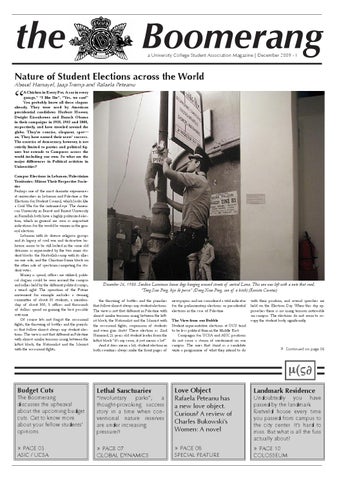
December 26, 1980. Sendero Luminoso leaves dogs hanging around streets of central Lima. This one was left with a note that read, “Teng Siao Ping, hijo de perra” (Deng Xiao Ping, son of a bitch) (Revista Caretas) the throwing of bottles and the punishes that follow almost always any student elections. The view is not that different in Palestine with almost similar tensions rising between the leftist block, the Nationalist and the Islamist with the occasional fights, suspension of students and even gun shots! These election as Zaid Hammad, 21 years old student leader from the leftist block “it’s my cause, it just means a lot”. And it does mean a lot, student election in both countries always make the front pages of
newspapers and are considered a vital indicator for the parliamentary elections or presidential elections in the case of Palestine. The View from our Bubble Student representative elections at UCU tend to be less political than in the Middle East. Campaigns for UCSA and ASIC positions do not cause a storm of excitement on our campus. The ones that stand as a candidate write a programme of what they intend to do
The Boomerang discusses the upheaval about the upcoming budget cuts. Get to know more about your fellow students’ opinions.
Lethal Sanctuaries
Love Object
“Involuntary parks”, a thought-provoking success story in a time when conventional nature reserves are under increasing pressure?!
Rafaela Peteanu has a new love object. Curious? A review of Charles Bukowski’s Women: A novel
» PAGE 03
» PAGE 07
» PAGE 08
ASIC / UCSA
GLOBAL DYNAMICS
SPECIAL FEATURE
with their position, and several speeches are held on the Election Day. When this day approaches there is no rising tension noticeable on campus. The elections do not seem to occupy the student body significantly.
» Continued on page 06
Landmark Residence
Undoubtedly you have passed by the landmark Rietveld house every time you passed from campus to the city center. It’s hard to miss. But what is all the fuss actually about?
» PAGE 10
COLOSSEUM
the Boomerang | December - I 2009
02 COLLEGE HALL Let the Gates Open
Folke Eikmeier and Sindhoo Rangarajan
L
ast weekend a thousand fresh faces walked through the campus gates. Open Day seems to have been a success from more than one quarter. It consisted of a campus tour and a information market upstairs in Dining Hall. There were different “booths” to represent the various establishments such as Student Life, UCSA, ASIC and quite interestingly the Roosevelt Academy. UCSA-CAO Harmke Kruithof was of the opinion that “there were lot of interesting and enthusiastic people which was good.” According to the budget ASIC got at the beginning of the year the total amount for 2009 marketing was €55, 000. Even the PR budget was not spared from the economizing as the amount to be spent on marketing next year is €50,000. The exact budget breakdown is unknown. However Harmke also estimated that part of the budget of the Open Day consisted of catering for the guests while Executive Officer of ASIC, Kees Oude Lenferink added that “College Halls probably doesn’t not know yet the details of the expenses.” The Open Day was a particularly exciting time for the PR team. The current PR team has around 100 students and they were brought together by Michiel Ruijgrok at the beginning of this year. This is part of College Hall’s new strategy
for making UC more approachable, transparent and famous throughout the country. “It is important for people to see” and “to attract students is part of our PR program”, said communications and web officer Sebastiaan Casse. He also added that “more requests are coming in for meeloopdagen”, College hall is also promoting “experience a day/class at UC.” Representing UC at the Open Day, among others, were 25 students of the PR team who were employed to give guided tours over campus. They were paid 9 euro gross per hour. The working hours varied between 5 to 12 hours with most working around 8. There were campus tours where groups of guests consisting of prospective students and their parents were shown around. Campus tours were given two times a day. Some of the perceived misconceptions regarding UC life such as “students can’t go off campus” and “friends can’t stay over” were put to rest by members of the UC-PR team. PR team member Manuel Buitenhuis observed that there were students that didn’t know what to do if they weren’t accepted to UC. “Everybody kept asking for hints and tips on their motivation letter”. Another general point of concern amongst many parents was the quality of the food in Dining Hall. Interestingly the PR team was briefed beforehand not to be overly negative regarding Dining Hall. On a more academic note, there were several mini-lec-
Decisions, decisions… Floris van der Burg
W
e all make decisions, every day, everywhere. All kinds of decisions, some are important, some are trivial. We, as thinking human beings, like to think that we make our decisions on rational grounds. That is, we weigh the pros and cons; we examine the evidence and look at the consequences. In making decisions, we predict the future. What we decide to do will affect the future, and we make our decisions based on what we believe the future will hold because of our decisions. Some outcomes of our decisions are easier to predict than others. And as certainty is something of a comfort to us, we like those predictable outcomes. Predictable outcomes are often problem solvers: if I pay my bills, my creditors will leave me alone. But the use of predictable outcomes to solve our problems often compromises the decision-making process. There is, after all, a considerable difference between arriving rationally at a previously undetermined conclusion, based on the available evidence, and arriving at a previously determined conclusion, based on the available evidence. It is the all important difference between a rational decision and the rationalization of a decision. The former is an open ended process, whereas the latter process has a fixed outcome. The problem is not that we are not full of good intentions; we are. Rather, the problem is that those pesky predictable effects are like a gun to our rational heads; they are the offer we cannot refuse, the horse’s head in our beds. Once such an influence on our
reasoning has come to our attention, it is almost impossible to arrive at a proper, unbiased, rational decision. And worse, we can no longer know if we have arrived at our conclusion through pure, rational means, or that we have been led by the rationalization of a foregone conclusion. How are we to trust our own judgment when it comes to rationally judging that which is irresistible to our future-obsessed minds? Are we, on the one hand, ever sure that we resisted temptation, because it was the rational thing to do? And are we, on the other hand, ever sure that in siding with the tempting alternative, we have done so because of pure, rational considerations? We are, so the saying goes, damned if we do, and damned if we don’t. So too is it with a currently hot topic at our beloved college: the single or double senior thesis. There is any number of good reasons to cite for and against the double amount of credits for the thesis. The difficulty is that at the time we are discussing the issue, there is one predictable outcome to the decision in favor of the double credits: it saves money. And we need to save money. But the argument on a topic like this should not rage in the financial arena. Instead, I think we all believe that this argument needs to be brought to a conclusion in the academic domain. Now that we know, however, that the double thesis may help ease budget cuts in other areas, how can we trust our own judgment? Are we forming our opinion rationally, or are we rationalizing our opinion? We have found the horse’s head in our bed. I do not envy the policy makers making this decision.
tures from the various departments organized throughout open day to which people could sign up so as to get a feel of UC. “I think that the science department information sessions went quite well,” says organizer of the science minilectures Paulina Rowicka. However, she also stated that the difficulty in recruiting volunteers to answer general queries about campus life was that “unlike giving campus tours, this task was unpaid.” Nevertheless “at each of the lectures there were about 20 or 30 high school students and parents present.” Head of PR team Michiel Ruijgrok also thought “letting the departments organize their program themselves, paid off ”. However, he also admits that “some streamlining has to be done with the scanning in of visitors… [and general] logistics. Communication between the departments and College Hall must be improved.” One particularly unforgettable encounter for the PR team consisted of a family bringing their twelve year old son, currently in his penultimate year of high school to look around campus as a prospective university for their son. PR studentemployee Maia Kenney expressed her genuine concern for the “ability of this kid to survive campus.” First year student Piotrek Sokol joked: “It was humiliating that we had to get our food at the back of Dining Hall.”
The Fallacy of Academia Emma Gans and Anton Kabisch
I
ntroduction to Academia has often been subject to negative criticism amongst first year students. Its twoweek argumentation section gives additional reasons for opposing the course. Taught in an uninspiring manner, and having little academic value, it is surprising that this section is still part of the academic program. This year, during the two weeks of argumentation class, students endured endless PowerPoint slides, decorated with list upon list of fallacies and other principles of argumentation. The section also included three assignments, in which students repetitively drew argumentation schemes and determined argumentation structures. Towards the end of the course, a highly regulated five minute debate was held, marking the end of two dreary and monotonous weeks for all Academia students. “There was nothing in the content of the argumentation section that will be useful in my further academic life or life in general” said Nick Mulder, a first year student. This opinion resembles the thoughts of most first year students who were asked about the argumentation section. The overwhelming majority agrees that the section was uninteresting and unhelpful. Then why does ‘argumentation’ still form part of the Academia Program? When our college was founded, it was decided that a course that would teach critical reasoning was a necessity for all students.
As a result, one mandatory full semester of argumentation was introduced. The content of the program was inspired by the teachings of a college of argumentation in Amsterdam: the ‘pragma-dialectics’. This school has developed an approach and certain guidelines to argumentation and managed to exert influence on many Dutch universities. However, beyond Amsterdam, the socalled pragma-dialectics are nowhere recognized as having adequate views on argumentation. Except, that is, by their Canadian counterparts, with which they have heated exchanges on whose way of arguing is the correct. Therefore in essence, ever since the foundation of this college, students have been taught principles of argumentation, which in any other part of the academic world are considered outright falsities or, at best, very doubtful. Although the argumentation section has been reduced from being taught one entire semester to a few weeks only, the value of these classes remains highly questionable. Floris van der Burg, a Philosophy and Academia teacher explains: “It is a terrible idea to teach semester after semester a form of critical reasoning that is not accepted as standard at universities worldwide.” It might be that students should be taught some form of critical thinking in order to improve their argumentation skills. The Argumentation course as it is taught now, however, does not at all succeed in doing so.
A University College Student Association Magazine
03 ASIC / UCSA Twelve Helpings of Anger Anton Kabisch
O
ver 250 students saw UCU’s most recent DramaCo production, “12 Angry Men”. Directed by Matthew de Beer, it was the fastest selling play ever to be put on at UCU and has received overwhelming positive feedback.
Intense, gripping, amazing. These were some of the comments that DramaCo’s most recent production received and they are in line with the general favourable impression people had of the play. “Twelve Angry Men” is plotted around a jury which has to vote on a murder trial case, and was put on by DramaCo over a period of three days, with a total of five performances. With more than 250 people watching the play, and being sold out within four days, this production has been one of the most successful ones ever to be performed at UCU. While other plays have been highly advertised using posters and other means of communication, minimal publicity was used for this one, showing that interest in it was very high. “I was well impressed with the performance for it was well acted and it kept me constantly engaged. Pure entertainment and great theatre,” said Casper van der Ven, a second
Students on Budget Cuts Aldona Bermúdez
U
pheaval about the upcoming budget cuts lead ASIC to hold a meeting about it on the 23rd of November, offering students an opportunity to raise questions on the topic and to give suggestions for solving the problem, in search of systematic solutions within a limited framework of choices. Students face the options of having more students or fewer classes. Budget cuts cannot be evaded. The discussion thus centered around what is less harmful. The reasons for cuts? The amount of money UCU receives per ECTS (money per course passed per student) has decreased over the years and housing costs have augmented. Approaches include three strategies. The first one is to increase the capacity of some classes and to cut others. This would save €348, 000, but would also involve cutting 26 classes, meaning that there would be more students per class. The downside of this? Teachers may no longer remember your name which, on a more profound level, equates to more superficial interaction during the course. An example of such an implementation would be merging Introduction to Academia and Academic English, a measure that would fit under strategy number two, which would increase the number of students in some classes. This would imply a different teaching method, of shared lectures on overlapping courses and two hours per week of motivating/paraphrasing lectures, in addition to extensive courses (one two-hour lecture per week for a group of eighty students). The rest of the time would be devoted to self-study. A course would consist of seven weeks, including one exam week and there would be no writing of papers. A third option is double crediting the research thesis. This way, there would be fewer students in other classes and more credits means more money for UCU from the government. In all three options, mandatory attendance remains a requirement. Cuts in classes mean thirty-six classes cut in the Social Science Department and two in Humanities, implying a loss of Liberal Arts & Sciences (LAS) curriculum and harder choices on students. SSC that would be cut are currently not too full 200 psychology, 200 anthropology or 300 politics. Basically, tracks that are
too big would be cut down. Some students suggested giving up the IR track (with the argument that it should not be studied by undergraduates), Essentials of Business Management or the 300 Public Economics, as well as shortening the Sociology of Migration course. Voting resulted in suggestions for cuts in 100 levels. The quality of 300 levels would otherwise be affected. In total, as a consequence of the budget cuts, there would be 36 lost classes, 6 extensive courses and € 481, 000 saved. The majority of the students present at the meeting voted in favour of more students per class instead of cuts in courses. However, more students per class does not mean that there will be no cuts in courses. Allowing more students will also cost classes. That is the trade off. This would then also force them to take 3 courses in a format they might not like. According to Niels Brants, chair of ASIC, a raise in tuition fee of about 1000 euro’s could in principle undo the consequences of the budget cut. The tuition fee is only used for educational purposes. Part of the tuition fee will go to electricity but only for the academic buildings. Tuition fee is not used for DH and Housing. In principle, reallocation of people working in College Hall is a possibility, however the budget for the administration is different than the budget for education and the policy does not allow for people in College Hall to be fired on the ground of budget cuts, but ceasing to hire people is a leeway. As such, ASIC and the College Council will write a proposal for College Hall to stop hiring people. Allowing students to live off-campus as another apotion was suggested by a student, but ASIC said taking off campus courses will not save any money. This meeting was followed by the Social Science lunch on the 25th, in which the topic was further debated. In short, the potential strategies to face the cuts are increasing the number of students per class up to 28 merging classes, and diversifying the format and increasing the number of credits for the research thesis. The principles are maintaining the LAS character of UCU, the vitality of certain courses for students to be able to be admitted to Master’s programs and the maintenance of balance between UCU-appointed and UUappointed teachers.
year student. Such positive feedback is especially impressive seeing how it was the first time that director Matthew de Beer has done directing work. The idea of putting on “Twelve Angry Men” stemmed from watching the movie adaptation, which helped Matthew realize that the simplistic nature and intense plot would allow for a great play at UCU. All the events take place in the jury room, and they derive their strength mostly from the dialogue, which makes the drama studio very well suited for the interpretation. De Beer said he was honoured to have played a role in entertaining so many people. “The most meaningful comment I received was from one of the actors, who was very thankful for me asking him to audition. What’s most valuable to me is to give these guys (the actors) something enjoyable to do.” Twelve Angry Men marks Matthew’s final involvement in a DramaCo production, as he is going to graduate this semester. He has previously been involved in Super Sticky Surfaces, as well as in two musicals. Directing “Twelve Angry Men” is the climax of his work with DramaCo and shows how one’s engagement and skill in a committee can grow over the semesters. Besides having produced “Twelve Angry Men”, Drama-
Co regularly performs “Super Sticky Surfaces” in the Bar. There are also ambitions to put on the “Vagina Monologues”, a sort of balance to de Beer’s most recent production, as it is female, rather than male dominated. Furthermore, DramaCo hosts several workshops throughout the year, with the scriptwriting one coming up soon. Those interested in acting, scriptwriting or directing can find out more by emailing UCSA. DramaCo@uu.nl or by contacting any of the DramaCo members.
MARJETA MARKOVIC
Success for the UCU Debating Union Michael den Drijver
T
he first semester is close to its end and, with it, the first half of this year’s debating ‘season’. Although the UCU Debating Union faces another half a year after the break, it can already look back at amazing results. The University College Dublin Intervarsity was the first tournament this year on the Union’s calendar. It proved to be a great experience for the first year debaters (Sophie Reddering, Zhong Sun, Esther Drees and Ties Dams), as there was a special competition for novice debaters before the main tournament. Second years Sharon Cornelissen and Michael den Drijver took part in the main section of the competition, where they ended up in the mid-range of the tab. Both, however, were proud of their results, especially since they were among the few non-native speaker teams in the competition. Following Dublin was Bath, which welcomed an entire first year delegation, consisting of Lucas Fleuren, Yourai Mol, Sjir Hoeijmakers and Richard van den Berg. Since the participants were first-time debaters, UCU did not end up high in the rankings. Yet, the experience will surely help them evolve and book success in the future. The Cambridge Intervarsity tournament, an annual tradition for the Union and one of the most prestigious debating tournaments in Europe was next on the agenda. Team UCU BV, with Joris Vincent (1st year) and Micha Beekman (3rd year), won the tournament in the “English as a Second Language” (ESL) category. In the ESL final debate on the motion “This House would allow the conception of children using the sperm of someone who
has died”, Joris and Micha defeated the teams Utrecht B, Bonaparte A and Bonaparte B. The latter two teams also included UCU alumni, making the already all-Dutch ESL final somewhat of a UCU derby. Oxford LLM won the final for native speakers, on the motion “This House believes that Western nations should use military force to rescue journalists captured by the enemy.” The two other UCU teams consisted of Louise van der Stok, Andrea Bos, Jordi Wiersma and Niko Schonebaum. Joris and Micha’s achievement is by far the best in the Union’s history, a success which will hopefully inspire future ones. The most recent achievement was made on our very own campus, where this year’s annual University College Debate Tournament took place. As it was hosted by the UCU Debating Union, there was an underlying pressure of winning on your own soil. This year, Amsterdam University College participated for its first time together with Roosevelt Academy and UC Maastricht. After three preliminary rounds, a thrilling final followed, which was held in the UCSA Bar. There, Joris Vincent and Micha Beekman, along with Sharon Cornelissen and Michael den Drijver defended UCU’s honor against RA and UCM on the motion “This House would extend the executive power of the government in times of crisis”. After a long adjudicator deliberation, the verdict proved to be a UCU sweep: Joris and Micha both won the tournament as best team and best speakers. All in all, the Union can be very proud of its achievements this far. With another half of the ‘season’ up ahead, UCU’s debaters are definitely looking forward to a great year.
the Boomerang | December - I 2009
04 UsCene Become Your Own Carrot
W
hat special occasion can attract students to put down a mattress on the Quad and lie on their back for hours peering upwards at the heavens? In the night of November 17th, an expected shower of meteorites offered a wondrous spectacle, and such an occasion. Meteorites are flashes of light in the sky, which occur when the earth passes through a stream of debris laid down by a comet circling the sun. The ice-particles of the debris burn up in the atmosphere of the Earth and it looks like stars are falling down. On the night of the 17th, our Mother Earth passed again through the trail of ice and rocks left behind by comet 55P/ Tempel-Tuttle more than five hundred years ago. The highest rate of sightings for this part of the world was predicted for between 22.34 and 22.44. At 22.15, a group of enthusiastic first-years established itself in the middle the Quad, some of them comfortably on couches, covered by a large blanket, others cuddling side by side on a mattress and feeling the cold from the ground rising up to their bodies. Lying on the Quad during an autumn night means several things. First of all, it’s cold. A frosty wind blows above and it seems like the earth itself greedily sucks up all warmth from below. Then, it’s a lot of fun. The conversation born of
ELLEN MULDER
Jaap Tromp
the urge to forget the cold is heart-warming: lost relationships, annoyance over Primus initiation singing-under-window-rituals and the hope to see at least one meteor. And last there is, of course, the sky. In cloudy Holland it’s easy to forget that the sky is in fact filled with hundreds of stars. The many patterns they form are quite a spectacle in themselves on a clear night. All kinds of moving things provided distractions: tiny moving red and white dots could be identified as airplanes, and big patches of light that raced over the sky – as birds reflecting light from below. But where were the meteorites? The promised big storm of falling stars did not happen, but occasionally one of the freezing spectators on the Quad saw a small light, flashing somewhere in the vastness of the nocturnal firmament. Some seemed to have a greater talent to see than others: “Ah I’ve seen one again!” “Where? Where? Ah, I want to see at least one!” Finally, at 23.23, a meteorite raced over the sky, leaving a long trail of light behind as it burned to oblivion in the upper layers of the atmosphere. The sight lasted for several seconds and was the only one to be seen by all star-watchers on the Quad. “Aaaah beautiful!” could be heard many times. This one sighting was worth the cold hours on the ground and stimulated the appetite for future star-watch-nights. The next shower of falling stars is predicted for the night of December 13th/14th.
Dining for a Better World Zoé de Kerangat
Y
ou might have seen them at the DanceCo performance on November 24th. Yes, those little pizzas, the glühwein, the noodle cups... Were you wondering what it was for? Here is your answer... The Cultural Cookery is a student initiative that started last semester with Frithjof Wodarg, Ricardo Martins, Phil Paiement, Sacha van der Zande and Joanna van Lynden. It is a student-run restaurant first held at the end of last semester at Café Averechts, during two sessions of four days. Three projects received the benefits of these events, in cooperation with “Happy Gift”, an organization supporting different development NGOs and also the neces-
sary juridical entity for such a project. Since the Cultural Cookery proved successful, four other students, Sindhoo Rangarajan, Ayana Fabris, Ieva Snikersproge and Ke Yan Wen decided to take over the project in Fall 2009. The independent and self-sustaining Lunga Lunga Youth Group was chosen this year to receive the proceeds. Lunga Lunga comes from the Nairobi slums in Kenya, and has different sustainable projects for the community, such as starting organic farming on a piece of land recently acquired, a bio-tower, or a vocational centre which teaches basic skills to the inhabitants of the slums. A first “trial” round of the Cultural Cookery will take place on December 21st and 22nd, still at Café Averechts (Lijsterstraat 49), in
preparation for Spring 2010. The location was found by the previous team and they accepted to host them mostly because their philosophy corresponds to the spirit of the project. Café Averechts is volunteer-run all year long, and all benefits go to a charity which changes every two months. Willing to offer an original meal and yet make something special out of those two evenings, the four students chose to use local ingredients in a creative to come up with recipes. They are also preparing some Christmas-themed musical entertainment. As far as organization is concerned, it is very much based on personal contact. “A friend who is a professional Chef is going to help us out” said Ieva. “From the DanceCo event we’ve learned
a lot already.” However, since they are not a committee, they could not get any funding from the UCSA, but were considered a community project by ASIC. They are also looking for food sponsors, which would allow them to increase the benefits that go to the group they chose. The Cultural Cookery is a beautiful and original example of a community project UCU students are involved in. If you feel like a nice dinner with your friends or family on December 21st and 22nd, don’t hesitate to make your reservation. The Cultural Cookery is also looking for volunteers in the kitchen and for the service, so if you feel like being part of the project in what will be a nice atmosphere, send the Cultural Cookery an e-mail and sign up!
SilkRoadCo shows In the Heat of the Sun Folke Eikmeier
“C
hange has wiped out my memories. I can’t tell what’s imagined from what’s real. My stories always play in the summer. People expose more of themselves in the heat.” – prologue of In the Heat of the Sun. SilkRoadCo’s second Chinese movie night featured a film set in the chaotic years of the Cultural Revolution. In the Heat of the Sun came out in 1994 and was the debut work of director Jiang Wen. The main character of the movie, Ma Xiaojun, nicknamed “Monkey”, is the son of a soldier who lives on a military compound in Beijing. Since fathers are often away for army missions and because schools’ and parents’ authority is affected by the chaotic atmosphere of the Cultural Revolution, Monkey and his friends are relatively free and lack discipline. He and his fellow young army kids spend their days roaming the streets of a depopulated Beijing, fighting other gangs, and Monkey often sneaks into other people’s houses by picking locks. One day, in one of those houses, Monkey sees the photo of the beautiful Mi Lan and falls in love with her. Since then, he observes her house every day until he finally meets Mi Lan, which leads to trouble with his gang friends. In the Heat of the Sun plays in the summer, an element visible from the slightly over-lightened images. The story is told as
the memory of Xiaojun who thinks back to the wild days of his youth. Both the constant idea of heat and Xiaojun’s insecurity about the authenticity of his memories give the movie a sense of unreality. The Cultural Revolution was a traumatic period in the history of China. Chairman Mao Tse-Tung encouraged youngsters and students to form revolutionary Red Guards. These groups were formed locally at schools and universities, spread communist propaganda and Mao-worship, and violently terrorized their teachers and sometimes even their parents. The movie is set in the period after the end of the reign of these groups when many of the Red Guards have been sent to the countryside to work on farms. The violence that held the country in its grip is only hinted and symbolized. In one scene for example, Monkey beats an enemy gang member on the head with a brick. SilkRoadCo Chair Sijia “Scarlette” Jiang said that adults and kids in the movie seemed to be in a free atmosphere, very different from the present situation and therefore almost incomprehensible to her generation. She sees In the Heat of the Sun as a symbolisation of the youth of a nation. “At that time, the country was in a crazy, naïve and violent state and it had to cool down again, just like these teenage boys in the movie,” Jiang said. All in all, SilkRoadCo made a good choice with this movie and they will hopefully keep on in future Chinese movie nights.
A University College Student Association Magazine
05 PHOTO ESSAY
DANIテ記 BOREEL
Portraits of Asia
the Boomerang | December - I 2009
06 COVER STORY Nature of Student Elections across the World Aboud Hamayel, Jaap Tromp and Rafaela Peteanu
» In the West as a whole, there has been a decline in political student activism. In the 1960s students demonstrated en masse against the Vietnam War and what they perceived as the narrow-minded political elite. In the 1980s students were the driving force behind the demonstrations against nuclear arms. The low turnout during the demonstration against the announced budget cuts by the Dutch ministry of Education is a sharp contrast to the past. Is there a defeatist attitude amongst students nowadays? Or have we just become lazy? The chairs of the two student representation organs at UCU, Niels Brants and Oleg Büller were asked to shed their light on this matter, being ‘hands-on’ experts. Both agree that student activism has declined over the last decade, but they disagree on the reasons. “Students are still engaged, they still have an opinion and think about issues in society”, said ASIC chair Niels Brants. “However, many believe that activism and demonstrations don’t work. They’re afraid that no one will listen to them”. USCA chair Oleg Büller agrees with Brants, but he believes that students have become lax. “I think it has more to do with laziness. I’m afraid that students would rather watch MTV, so to speak.” Büller feels that students have become a spoiled. “Students are not afraid to lose anything, that’s a good thing. However, I see this as a sign of overindulgence.” Contrary to Lebanon and Palestine, our student representatives do not stand for a political party or ideology. In election statements, candidates talk about how they would deal with issues on campus. There is no highbrow talk of idealism and ideology. “I don’t think it is relevant to talk about my political preference as a student representative”, says Brants. “The things that I propose in my election statement already represent my general view or ideology on things.” Büller claims that a focus on politics during student elections will frustrate the efficiency of UCSA and ASIC. “I’m afraid that we would concentrate too much on the ideological aspect
of our policies, whereas I stand for a pragmatic approach to things.” The Case of Peru One of the most powerful forces in every nation has always been its student body. Throughout time these almost-adults, lively and resourceful youngsters have shown that they can make a difference. From the 1989 revolution in Romania, when they occupied a central square in the country’s capital, to Bucharest, where they fought for the rights off all the citizens, and the more recent street revolts in Iran, when they demonstrated against what was believed to be election fraud, students have emerged as a force to be taken into account, an important ally in any political discussion. It comes as no surprise, therefore, that politics play an ever increasing role in student movements. In Peru, for instance, The Shining Path (Sendero Luminoso) is a landmark of the 1980s. A leftist organization aimed at achieving communism. Their means included declaring war on the state. This led the Peruvian government and the international community to categorize them as terrorists. A philosophy professor at the San Cristóbal of Huamanga University founded the organization. It appealed to many students through which professor Abimael Guzmán thought a major revolution could take place. Soon after, The Shining Path gained enormous influence over student councils in various colleges across the country. The youth was convinced of their own importance in making a change and of their right to take matters into their hands. Their power also grew due to the increasing number of citizens joining their ranks, but the brutality and violence of the organization’s actions eventually led to a decline in its popularity. Nowadays, a militant faction called Proseguir (“Onward”) is still active, and has claimed involvement with a series of attacks in Peru and abroad. What is essential in this case is how El Sendero Luminoso started: as a small-scale student organization. “What The Shining Path achieved,” one of the Peruvian students at UC said, “is that now,
students know they can do more radical things in order to have their voices heard.” The rigor-
ous control that college administrations exert over those who attend their institutions will be challenged by students who will try to get their way. Most Peruvian student councils have about 10 to 20% of the votes in matters related to their respective universities. If they are completely discontent with the results, they may recur to extreme actions. “Sometimes, they will cut their veins open and stand there, in front of the Dean, until he gives them what they want,” our source explained. Student protests are common all around the world. They mostly resume to occupying buildings, such as the recent case of the Berkeley Wheeler Hall being taken over by protesters, angry at the fee increases at the University of California. The matter of The Shining Path is quite a sensible one for Peru because it escaladed so fast and their members were being called terrorists. “The media has labeled them as terrorists, but to students nowadays, they’re more like a precedent: if they got what they wanted, why couldn’t we?” Violent manifestations are not the norm, but the exception. “Most protests are peaceful; it’s just in very important matters that the students would become violent or extreme.” Whether student bodies fight for lower fees, a better healthcare system, or against a government they do not believe in, students have the power to make a difference. Their strong belief in their ideas constitutes their advantage, while their ideals shape tomorrow’s world.
A University College Student Association Magazine
07 GLOBAL DYNAMICS Are we all Panglossians? Francesco Maiolo
I
n the attempt to account for the evils of the world, Leibniz claimed that “all is for the best, in the best of all possible worlds” (Essais de théodicée, 1710). God created the world and God is absolutely good, and omnipotent, he said. Hence, the work of creation is the best of all possible works, and the product of creation is the best of all possible products. In his novel Candide (1759), Voltaire mocked this kind of optimism and made a caricature of Leibniz: Dr. Pangloss, master in optimism. Probably, most of us would not adopt Leibniz’s point of view. We would rather sympathize with Voltaire’s irony. Nevertheless, we may try to determine whether we are Panglossians. We may, for instance, test ourselves against the standard constituted by knowledge economy. Apparently, the expression knowledge economy was first used in the late 1960s. As in a famous sketch by John Fortune and John Birds (‘Subprime crisis’), we may assume that whatever this expression means in particular circumstances, it must be a very good thing in general for the ‘economy’, and ‘knowledge’ to be related! Knowledge economy is both a product of the management of global information and communication, and a tool for increasing economic benefits. The circulation and application of this kind of knowledge in areas such as entrepreneurship, market-oriented research and development, software and product design, people’s education and skills levels etc. is now recognized to be one of the key sources of economic growth. Consequently, governments made knowledge economy their creed. In this context, the educational system of many countries, so far heavily dependent on government funds, has been put under pressure. Education, we are told, is worth nothing if it does not serve the purpose of economic growth. So, its major task ought to be assisting public and private institutions to obtain ‘better outcomes’ through ‘more effective strategies’. Let us face it: all we need is to foster know-how and forget know-why. The proof that this is the predominant view is given by the fact that if an area of knowledge is declared to be ‘dysfunctional’ in the light of economic growth, that area is doomed to perish regardless of its intrinsic value and importance. Are the areas of knowledge and approaches characterizing the liberal arts and sciences (LAS) philosophy in danger? Of course, they are in danger. Unless the education policy makers manage to prove that the latter contribute to economic growth. In order to do so, the LAS must be marketed as a commodity, that is, something eminently and indefinitely reproducible and replaceable. Is this process not a negation of the essence of the LAS philosophy? Yes! Well, no! According to a way of thinking that, unintentionally, proved to be very useful to knowledge economy ‘there are no essences’. So everything goes and the march of ‘the liberation from the dysfunctional’ continues. Why bother? Knowledge economy, like the world of Leibniz, established itself as the best of all possible concepts of knowledge. We might have defeated Leibniz’s optimism but only for replacing it with a more totalitarian form, the worst of all: unconditional optimism. Monsieur Voltaire, where are you? Can only a God can save us from the end of education as we knew it?
Lethal Sanctuaries Matthijs Maas
F
or years the penguin population on the remote Falkland islands was spiralling downwards, until the 1982 war brought a stunning yet effective refuge: 30,000 land mines were left behind on beaches and shores, and thus created a small haven safe from human activity for the penguins. The mines, which are not sensitive enough to be set off by the animals, have achieved what environmental organizations, millions of dollars, and armed park rangers can only dream of: keeping humans away.
Such “involuntary parks” – as dubbed by environmentalist Bruce Sterling – are a thoughtprovoking success story in a time when conventional nature reserves are under increasing pressure from poachers, logging corporations and the needs of native farmers. The rare locations are almost exclusively the heirlooms of darker chapters in human history, those of vicious conflict and largescale relocation and eviction. Though ecologically and geographically widely different, they all share a single property: we humans don’t go there. Examples besides the Falkland islands include the White Sands Missile Range, location of the Trinity nuclear test site in the US, and the European Green Belt stretching across central Europe, a remnant of no-man’s-land from the Iron Curtain era. Two locations in particular stand out for their percieved sheer deadliness. The Last Frontier: Korea’s DMZ The border between North and South Korea is one of the most heavily-fortified in the world. Officially known as the De-Militarized Zone (DMZ), the line was drawn at the 1953 Armistice Agreement along the 38th parallel. Guarded by 2 million soldiers, and bristling with landmines, barbed wire, and other counter-invasion measures, the 4-by-250 kilometre DMZ is a no-go zone to any human. The same does not apply to animals: many threatened species have found safety in the DMZ, which crosses a wide variety of geographical landscapes including mountains, rivers, and coastal areas. “This strip of land contains almost every type of ecosystem you can imagine,” claims ecologist Alan Weisman. “It has inadvertently become one of the most important wildlife conservation sites in the world.” Aziatic black bears and Amur Leopards are relatively common, as are some 320 bird species. Over 2,900 different plant species flower amongst the unexploded bombs. Endangered animal species which have settled in the ‘safety’ of the Zone include Steller’s sea eagles and even a small band of Korean tigers – a subspecies of the near-extinct Siberian tiger which is arguably the rarest animal on the planet. A complete lack of human presence in the area, combined with the heavy fortification of the border on both sides, has channelled natural
wildlife into this one narrow strip that is unique in all of Asia. Ironically, the only threat to its survival is the advent of peace; if the two Koreas were to cooperate closer together, this might coincide with a re-annexation and exploitation of the area. The DMZ Forum is an organization that aims to preserve the area’s natural state, and its founder Lee Seung Ho advocates the creation of a cross-border ‘Peace Park’: “The DMZ was once a symbol of conflict. It should now be turned into a symbol of peace.” The Nuclear ‘Wasteland’ of Chernobyl In the aftermath of the Chernobyl nuclear power plant explosion in April 1986— the nuclear fallout of which covered Belarus, Ukraine and Russia—tens of thousands were evacuated from the stricken area. Some have since returned to their homes under the watchful eye of doctors and scientists, but the 30-kilometer exclusion zone around the reactor remains prohibited to the general public. Consequently, despite containing some of the most radioactively contaminated land in the world, it has since seen a curious revival of pre-humansettlement food chain relations. Of course, the situation is not ideal: many animals initially died from the intense burst of radiation; large areas of pine wood turned ginger brown and died, leading to the nickname ‘The Red Forest’. The forest has since turned green again, however, through the reemergence of birch trees. Plants and animals have reclaimed former towns and factories, including the site of the explosion itself: birds allegedly nest near the ‘Sarcophagus’, the steel and concrete blast shield that encases the still-radiant reactor. Packs of wolves stalk the woods, while lynxes, eagle owls, and even bears—after centuries of absence—have re-colonized the area. Still, there is little scientific consensus on the exact state of the ecosystem; although animal life seems to flourish there in the absence of humans, studies seem to indicate increasingly high mortality rates and worrying mutations among the re-settled organisms. There have been unsubstantiated reports of a ‘forest of wonders’ containing mutated plants, such as trees whose branches twist around randomly rather than reach for the sky. Other reports call Chernobyl an ‘ecological sink’—where animals migrate but eventually die off. The high number of endangered species which have taken refuge there, however, appear to have a remarkable tolerance for the radiation. Overall, most scientists have come to the conclusion that the benefits to nature have far outweighed any harm from the radiation. The environmentalist James Lovelock even joked: ‘I have wondered if small volumes of nuclear waste from power production should be stored in tropical forests and other habitats in need of a reliable guardian against their destruction by greedy developers”.
the Boomerang | December - I 2009
08 SPECIAL FEATURE A review of Charles Bukowski’s Women: A novel
Women Lining Up Like Beads on a String Rafaela Peteanu
“If something bad happens you drink in an attempt to forget; if something good happens you drink in order to celebrate; and if nothing happens you drink to make something happen.” - Henry Chinaski
constant hang-over, Henry appeals mostly to women who ask for (almost) nothing. They aren’t looking for love, understand-
ing, or anything else a relationship might entitle; instead, they are satisfied with just a moment of pleasure, some eleven minutes
D
id you ever fall in love with the wrong guy? The one you know is not good for you, the one your mom told you to run away from? The one who seems interesting and mysterious, but is actually nothing more than a low-life, feeding off his tormented artist allure; the one who will make you suffer? Well, I did. His name was Henry Chinaski. I began to read Women: A novel during my first week at UC. I was more than curious after my boyfriend recommended it by saying he recognized parts of his own life in it. The protagonist of Charles Bukowski’s book is Henry Chinaski, a former postman and now a successful poet in his fifties. His life is populated with women, most of them admirers of his poetry, who line up for him like beads on a string. They inevitably seem to find themselves in Chinaski’s bed where he, somewhat bored, drunk or hung-over, picks them up calmly – but never for too long. Then he drinks again, and a new woman comes up; the cycle repeats. After the fourth female character, one begins to lose count; after the fourteenth, one becomes accustomed. And perhaps a bit provoked. It is up to the reader to decide if he dares to go beyond the explicit language and obscene scenes to try and understand the character. Because Chinaski is quite a character. Far from the Prince Charming ideal, with his hanging belly, wrinkles, and a
of evading their grim lives. What they and their favorite author share is a particular lack of fulfillment, a feeling of uselessness and of unimportance, combined with the need to cover that up somehow. The result is a carousel of feminine figures, going round and round and round until, due to a combination of speed and general dizziness, they get lost in the background. But somewhere in this constant haze of women and alcohol lies a very lonely and unhappy man who buries his dissatisfactions in blunt irony and vile language. The candid honesty and transparency of the novel may thus signify more than biographical inspiration – in the context they become a defense mechanism, a means of distracting one’s attention from the essential to the superficial, from the real problems to their temporary solutions. Perhaps this is why I chose to fall for Henry Chinaski: because I want to believe that I am able to see beyond the surface, not in order to change or to cure him, but merely to understand his struggle. When I had almost finished reading Women, one of my friends skimmed through it and said “How can you read that? It’s disgusting.” Indeed, Chinaski is definitely not a character one can easily tolerate – at least not for female readers. He is the type of persona one can either hate with every fiber of their being, or fall madly in love with, regardless of his multiple, self-observed flaws. I happened to choose the latter. But, whatever the reason, the certainty remains: if you’ll give him a few hours of your life, Henry Chinaski will provoke you. During this Christmas break, read Bukowski’s Women: A novel. It may not involve elves, reindeers or Scrooge, but it will definitely enrich you.
Towards a more accurate perspective on the Iranian Green Movement
Don’t Miss the Point! Babak Mohammadzadeh
L
ast summer, thousands of Iranians, young and old, believers and non-believers, went to the streets en masse, opposing the fraudulent presidential election that brought the clericalbacked Mr. Mahmoud Ahmadinejad an additional four-year term. In a display of brutal violence, the Iranian regime’s political establishment unleashed a ferocious crackdown on the demonstrators. The democratic flame, however, has been ignited and it remains to be seen whether the Iranian Ayatollahs can enjoy an untroubled future. For most of us, living in our sheltered environment, the bubble we may call the UCU campus, these demonstrations came as a shocker. After all, didn’t we expect Iranians to be scary, uneducated freaks concerned with Islamic fundamentalism, the building of a nuclear arsenal and the occasional burning of the US flag? Didn’t we expect to see gangs of bearded fundamentalists claiming martyrdom and wishing death and
destructions to all those infidels living in the west? Instead, we got something else to watch. We were shown how the Iranian masses were lured into participating in a sham election, only to be deceived by the fraudulent outcome. We were shown how thousands of educated and non-educated Iranians were stunned, aghast, even pissed off and had decided that now was the time to protest. They had expressed their views in the ballot box, unequivocally voting for ‘change’, better relations with the West and more freedom. And when they claimed their democratic rights on the streets in Tehran, Tabriz, Shiraz, Esphahan and elsewhere, they got severely beaten by electrified clubs. Dozens of Iranian souls were lost in the process. I was quite disturbed, therefore, after reading an article about the Iranian revolt in the last edition of the Boomerang. The article described the views of an Iranian-Dutch youngster who had migrated to the Netherlands in the eighties and had been barred from the country ever since. I wonder whether this arguably very interesting story, distracted our at-
tention of what we SHOULD be discussing. The article even went further, claiming that the journalistic media coverage of Iran was ‘simplistic’, claiming that for these elections, it was somehow biased. But I wonder if the Western coverage really is the point of the Iranian story. The Iranian people’s “Green revolt” against their clerical rulers has illustrated that in an ever globalized world, democratic norms and values are spreading well beyond their original birthplace. This is what we should be discussing instead. The idea that the international community should remain committed to those that suffer from authoritarian regimes is prevalent from Iran to Burma. With no hesitation, I conclude from this that democratic idealism has truly reached universal proportions. The role of the international community in all of this is of eminent importance. Iranians are in direct contact with us via satellite imagery and the vast landscape of the internet. We have ended up at a point where democratic culture is being claimed by a whole new Iranian generation. This generation wishes to live in a
pluriforme society. Each and every day, they crave for some breathing space, they crave to hear the music they want, to interact with the other gender. They wish to be as free as you and me. Indeed, the Iranian demonstrators feel demonstrably strengthened by the idea that the international community is watching over their fates. Turning away now, and focusing on trivial issues, like media coverage, will only deal a devastating blow to the emerging “Green movement”, hurling Iran and its people back to the Middle Ages. What remains for us in the West to do, is to stand by this new generation of youngsters and remember them. Remember their actions, their ideals and their braveness. If we do not stand by them, these brave young Iranians will waste away in the world’s most notorious prison, the Evin detentiary in Tehran. Now that is, I believe, what we SHOULD be discussing!
A University College Student Association Magazine
09 SPECIAL FEATURE The Holocaust of Surviving Auschwitz
The Complete Maus by Art Spiegelman Aleksandar Feodorov
V
ladek listens to little Artie’s story about his friends abandoning him after he fell while roller-skating and says “Friends? Your friends? If you lock them together in a room with no food for a week… THEN you could see what it is, friends!” Art Spiegelman’s Pulitzer-Prize winning comic (the artist himself does not like the term graphic novel) Maus is a semi-biographical, semi-autobiographical story of an Auschwitz survivor. Originally published in two separate parts in 1986 and 1992, it follows the story of Vladek Spiegelman, a Polish Jew, from his early adulthood, through his relationships and life before the war, to the occupation of Poland and his and his family’s hardships during the war, Auschwitz and finally the emigration to the US. Vladek tells his story in a series of interviews conducted by his son Artie. He starts his story with Lucia, a poor girl with whom he had a relationship and their consequent break up followed by his entering into a new relationship with Anja, his future wife. The story goes on with the start of the war and his participation before the occupation. After he gets out of a prison camp, the story focuses on Vladek’s life as a Jew in Nazi occupied Poland. It follows the difficulties he encountered daily trying to protect his family and escape death – the pogroms against the Jews, the hiding in “mouse holes” from the Nazis, bribing his way out of situations, etc. Until, finally, he and Anja are captured and deported to Auschwitz where the horrors of the death camps are going to take place. But what makes Maus one of the most powerful narratives about the Holocaust is
how Art Spiegelman deals with the period after Auschwitz. He tries to show the consequences of being a survivor and how this affects one’s close relationships with other people. Vladek is described as a neurotic and stingy, and surprisingly – a racist. He is a person always trying to save from everything possible, hating every occasion on which he is supposed to spend money. His imperfections are usually attributed to Auschwitz; but is it also possible that he was that way before the camp? Therefore, what part of Vladek actually survived? Artie, his son, also feels the consequences of Auschwitz – he has to deal with his mother’s suicide and with his overly pessimistic, Holocaust and two heartattacks surviving father, who is always unhappy and difficult to satisfy. Art Spiegelman takes a very interesting and unconventional approach to the biggest trauma in Europe for the last century. Apart from putting on paper his father’s personal accounts of the events, he also chooses the medium of a comic book. Most people, sadly perceive comics as childish and not ‘serious’ enough, but Spiegelman destroys this myth. Maus is everything but childish. Art wise, Spiegelam decides to draw the characters as animals. Jews are mice (idea which he actually takes from Hitler himself), Nazis are cats, and Poles are pigs, but like The Times wrote “they are all terrifyingly human.” In an interview for Intelligent Life he shared that his initial goal for the project, first drawn with a fountain pen, was to make readers feel like they were reading a diary. It is not surprising that Maus was awarded the Pulitzer Prize. It is a painfully personal story and a deep psychological investigation of a father-son relationship (and a lot more). And
its sincerity forces everyone who picks up the book to get involved with or at least try to imagine Vladek’s journey. It is definitely Spiegel-
man’s most important work and one of those few books that shape our understandings of modern art. A must read.
An American Jew in Tehran Arturo Desimone
“I
have a very different experience of Iran from Western foreigners living there, from foreigners in general,” says writer Tori Egherman, 49, while talking about the book she is working on, her memoirs titled An American Jew in Tehran. “They come as diplomats. They live there as expats working for an international company. Very few of them have lived there with families, have experienced being there as a non-Iranian in an Iranian family situation. That makes my experience different. It’s not academic, it’s not from a distance. It’s something I was thrown into and learned about in the mix.” “But I still maintained some distance,” says the diarist. “Because I am American, because I am Jewish, because I am a foreigner. I still maintained a kind of observer position there. And that’s unique, just being involved in daily life.” Tori, from Gary, Indiana, now resides in Amsterdam, the Netherlands, with her husband, Iranian visual artist Kamran Ashtary. She admits she first became interested in Iran as a teenager when the 1979 Iranian revolution featured in the news. The Shiite fundamentalist revolution overthrew Shah Pahlavi, a monarch who had taken over the country in a bloody 1953 coup with US-backing. She confesses to having made anti-Shah buttons and to shouting such slogans as “Shah Shah A-Go Go!” Egherman has published articles on art in academic journals and pays her share of the bills designing websites. She hopes after her current autobiographical project to devote herself more to literary fiction, her passion. An American Jew in Tehran, as the title implies, is about her being an American Jewish woman living in Iran from 2003 to 2007. Tori has led a nomadic existence. She’s lived all over the United States: in New York, the Florida Keys, Indiana, California. She also lived in Israel as a teenager. When asked if her experiences of Israel and of Iran bear any similarities to one another, she answers emphatically, laughing
“Yes! I think Iranians would be mortified to hear this answer. Iranians and Israelis share a lot of common traits. But Israelis are unbelievably rude and obnoxious. Iranians have taarof.” This is a Farsi word for the intricate cultural system of manners, customs and formalities that Persians resort to in social interactions. She describes her experiences of this phenomenon at length in her book. “In Iran people would ask me this question. I would tell them ‘Israelis are you without manners.’ Both cultures can be really warm and really generous. Both have a sense of humor, and share a kind of frustration with their own governments. Of course in Israel they elect their governments more fairly, so they can un-elect them as well.” Mahmoud Ahmadinejad, the current president of the Iranian Islamic fundamentalist republic, has infamously denied the Jewish holocaust and made many other disturbing statements about Jews in the media. I asked Tori if she ever encountered a hostile climate towards Jews, and towards her being an American and a Jew during her years in Iran. “My experience is that Iran is a tolerant culture. The regime, people like Ahmadinejad, seem to try to break down that tolerance and destroy it. I think they are doing their best to create an atmosphere of animosity against all minorities, particularly Baha’i.” Baha’i are adherents of a religion that originated in 19th century Persia. They have historically been a persecuted minority in Iran. “But of course Jews are really in the news because Ahmadinejad is just wild with his statements. While I was there I was afraid that maybe one day people would really start to believe these things, that one day these ideas won’t seem so crazy anymore after they bombard the population with them for long enough. “I didn’t experience any animosity or Anti-Semitism from people. Many Iranians I met loved to brag about the diversity they once had. Or the diversity they still have if they are lucky enough to be in a community that has Jews and other religious minorities. I encountered a longing for diversity. Iranians don’t
want to be a nation of Muslims. “When I talk to Jews and Baha’is, they say the regime is worse for them than the Shah was, but the people have become much more tolerant. “Right now in Iran most people feel discriminated against. Even the majority. So it’s easier to feel solidarity with a minority that’s being discriminated.” Tori organized demonstrations in Amsterdam last summer together with Iranians in the Netherlands. She commented on the democracy movement and the mass demonstrations that took to the streets all over Iran last June as a reaction to what the protesters alleged was an immense election-fraud on behalf of Ahmadinejad’s administration. “The protesters wanted reform of the system. They’ve had enough of revolution. They want their constitution and the rule of law to be honored. This movement is really speaking out in favor of the rights of minorities, including Baha’i, which is a very important aspect of this endeavor. They are very much calling for equal rights for women. There also seems to be a sense that change is going to be difficult and require much hard work. It is a mature movement.” Tori insists on calling the activists a Civil Rights campaign. “At least for Americans when we hear ‘Civil Rights Movement’ we think of people inside a country struggling to gain rights. There is nothing we can do outside the country other than listening to them, supporting them, promoting their cause, amplifying their voices, helping them by watching, by showing the world we’re watching, asking our leaders to negotiate in a way that keeps them in mind. But sanctions are not going to help, frankly, and neither is bombing.” Hopefully Tori will finish her book and publish it soon. It seems it will be a nuanced, helpful and interesting contribution to the debate about Iran.
the Boomerang | December - I 2009
10 COLOSSEUM Attractively Pragmatic Deniz Dirim
Kidnapped into marriage
Should I stay or should I go?
“K
ids, let me the story of how I met your mother. I was walking down the street this one day, when I saw a beautiful girl. So I kidnapped her, took her to my family, and convinced her to marry me.” This might well be what Ted Mosby would have said to his children, had the TV series How I Met Your Mother been set in Kyrgyzstan. Because, believe it or not, bride abduction is actually quite common in this part of the world.
H
ave you already been to the Rietveld Schröder House? Undoubtedly you have passed by the landmark residence every time you passed from campus to the city center. It’s hard to miss. But what is all the fuss actually about? The RSH is the only building to have ever been executed solely upon principals of ‘De Stijl’. This was a modern art movement that believed in retaining only that which is essential and, by doing so, creating a clean abstraction. Hence this style operates in purely primary colours (red, yellow, blue) and non-colours (white, black, gray) and employs only the most basic geometrical forms. ‘De Stijl’ soon became an avant-garde trend and was followed by big names such as: Theo van Doesburg, J.J.P Oud, and Piet Mondriaan. Gerrit Rietveld (1888-1964) lived in Utrecht all his life, and was a happily married aspiring architect when he met Truus Schröder-Schräder (1889-1985). Schröder was a talented, but unhappy, woman. She hated the house she lived in with her conservative husband and three children. Rietveld helped Schröder modify her house, and when Schröder’s husband died, the two ventured to find a new, more fitting, house for her. Fortunately for us, they did not manage to find anything to their tastes and thus it was decided that Schröder would build their own. The RSH is Rietveld’s first house and it has never been copied. It was built in 1924 as a tribute to ‘De Stijl’ and Schröder’s desired life. The RSH was made up from brick wood (for efficiency), cement (for financial purposes), glass (e.g. the glass post-box), and steel (considered an obscenely modern material at the time). The house is completely based on functionality; any form of decoration is considered frivolous. It was planned from the outset that every aspect would unite to form a “living machine”. For instance, the blueprints outlined the position of the telephone as much as the location of the bathroom.
The non-colour is used to reflect elements or to give the illusion of certain areas being more pronounced or recessed. The primary colours are employed to distinguish individual parts of the house (e.g. the ‘groceries window’, where the baker and the milkman would drop off the daily bread or milk respectively, is highlighted in bright red to stand out). The interior of the house, which perfectly matches its exterior, is attractively pragmatic. To live in the house, (what Rietveld would have called a conscious act), requires one to slide doors and pull out neatly tucked away surfaces. The second floor—the true living area—can transform one big open space into individual rooms for Schröder and her children (who, incidentally, were ashamed of living in this avant-garde house and often denied living there for fear of being teased at school.) within a matter of minutes. Each room is clever in its own right and can easily be adapted to one’s mood. The darkest room was painted bright yellow, whereas the study was given a black ceiling for hopes of better concentration. Schröder ‘s desire for geometry goes so far as replacing curvy curtains, with rectangular wooden planks. The RSH gains its beauty from light so the windows were often left uncovered to make the beautiful (then woodland) view possible. Rietveld’s furniture is spread all over the house, including an original of his most famous chair. A visit to the house is a telling experience for although the house can be considered limited in several ways it is still home to Rietveld and Schröder’s very own books, kettles, and kitchen utensils. (They had a wild affair and Rietveld moved in with her after his wife’s death). Though Rietveld officially gave up his Protestant background, one can discern his deep Calvinistic roots from the sheer sensibility of the RSH. Schroder died in her dreamhouse at age 96, and the current owner (The Centraal Museum Utrecht) has opened the icon to the public since 1987. And who would have thought that all of this witty charm and smooth elegance resides just around the corner!
On November 18th, UCU opened its 6th Annual Ethnographic Photo Exhibition. The Anthropology Event also included a lecture by Dr. Julie Mc Brien entitled “Why She Stayed: On Choice in Bride Abduction in Kyrgyzstan.” Mc Brien, who used to be part of the Peace Corps in Kyrgyzstan, introduced the audience to a little known issue: the kidnapping of young women, who are then persuaded into marrying their abductor. Outrageous as this might seem, it is actually a rather common practice in Kyrgyzstan, and the lecturer managed to offer quite a comprehensive overview of the tradition. Mc Brien began by outlining some of the main features of the kidnapped girls: middle to upper class, well-educated, most of them have traveled a lot and live in large urban centers. Of course, these features are not a must, and a clear overview is difficult to obtain, mainly due to the lack of research. At the moment, however, it seems that about 30% of urban marriages come about as a result of bride kidnapping, while up to 80% of the rural ones are a consequence of this action. So, why doesn’t anyone do something about this? Is this type of kidnapping legal in Kyrgyzstan? Why don’t the girls run away? And, most importantly, why would one want to steal his future wife, instead of going through the normal phases of a relationship? The questions were filling the air, and Mc Brien did her best to shed some light onto the matter.
First, she explained the steps of the kidnapping process: a young man decides to abduct a girl he likes and whom he then takes to his home, where his female relatives try to convince the woman to stay and become a part of the family. If, however, she opposes, one of her female relatives, usually an aunt, is called in, and she can either side with the kidnappers or with the girl, until one of the following is achieved: either the girl accepts to wear the white headscarf, indicating that she has agreed to get married, or she leaves. The practice, albeit illegal, is seldom reported to the authorities, as it seems that it has entered the local cultural phenomena, with justifications ranging from “it’s cheaper to kidnap a girl than to have a proper wedding,” to “I was kidnapped and stayed, so why wouldn’t she do the same?” or “it’s shameful if she leaves”. This last point is, perhaps, the most cited, as it is also double layered. On the one hand, if the girl leaves, it is directly implied that the family she has been kidnapped into is not a good one, so she is publicly disgracing them. On the other hand, since respect for the elderly is very important in Kyrgyz society, and since the woman’s family may also agree to the abduction, insisting on going back home is perceived as a sign of disobedience and of a faulty bringing up. Bizarre as the practice might be considered, Mc Brien also emphasized the ethnocentric quality of culture, pointing out that we should, perhaps, try not to impose a Western feminist agenda onto the matter. As she indicated, what one needs to ask him or herself in these situations is “are these girls indeed in need of saving?”, and that is a question only those directly involved can answer. For more information, check the references list at http://en.wikipedia.org/wiki/Bride_kidnapping or the following documentary http:// www.pbs.org/frontlineworld/watch/player. html?pkg=303_kyrgyz&seg=1&mod=0.
Balkanization at Kriterion Ayana Fabris
O
rganized by Balkan Buro and the Mara foundation, the Balkan Snapshots Film Festival invited artists from Bulgaria, Romania, the ex-Yugoslavian countries and Albania to Amsterdam to give the public a Balkan emotion at Kriterion, an independent cinema-café in front of the University of Amsterdam, from October 30 to November 1. Ten movies were screened among which the Palme d’Ór for Best Short Film at Cannes winner Here and There by Serbian director Darko Lungulov was one. It is believed that this piece marked the entry of the Balkan movies into the global film market. The Life and Death of a Porn Gang by Mladen Djordjevic was possibly the most provocative piece showed at the festival. With its grotesque critique of the porn industry in the Balkans and the snuff film myth – where people allegedly film reallife events such as suicide, murder and rape this was clearly not a movie for everybody. In fact, half of the audience left the room before the film was over. The festival programmer Goran Kljucevic’s choice to screen Nightguards by Bosnian Namik Kabil as the last show of all was questionable. The film was a rather slowly developing, uneventful story of two nightguards which did not exactly conclude this
extra-ordinary festival with a bang. Moreover, the constant projection of videos in Café Kriterion served more as space-fillers as opposed to conveying their messages to the people. The rakia or Balkan fruit brandy sold for a euro added to the atmosphere and so did the socialist currency system in Marks (1 mark=1.50 €, 1 feature =3 Marks, 1 concert = 2 Marks). Finance director Conrad Kockert’s ability to keep cultural events inexpensive and accessible can undoubtedly be applauded. Among other concerts organized during the festival, the two-hour delay of Macedonian Georgi Sareski and Dzijan Emin’s concert was a real shame. Perhaps the organizing team was still recovering from the turbofest the night before, a party arranged in the café where singer Darko performed a tadic’s yugonostalgia singalong. The debates and lectures with NGO’s representatives, such as Yannick du Pond for Parks foundation, and other experts, like former head economist for the World Bank Eastern Europe Sweder van Wijnbergen, were a good opportunity to gather more knowledge about the real social world depicted in the movies and cultural events. While Kriterion may be too small a location to host the festival and shows could have been better distributed over the three days, the Balkan Snapshots is fun. And extreme.
A University College Student Association Magazine
11 COLOSSEUM
Ballet: Stuck in the 17th Century? Emma Gans
“B
allet: an old-fashioned dance that is of no interest to our generation”. While this claim is often made, there is little truth to be found in this statement. It is true that it is a dance that has a long, rich history; but this does not mean that it remained unchanged. Classical ballet was introduced during the Renaissance, but it is an art form that has evolved through the ages. Despite holding on to the unique elements that formed the original foundation of classical ballet, it has increased its appeal to our generation. Ballet is a dance that captures elegance, grace and flow like no other dance can. It is able to portray emotion through subtle movements and can tell tales without using words. It greatly
emphasizes technique and the precise execution of the movements. This leads to a performance that is gripping even for the uncultivated eye. However, due to prejudices in society classical ballet often conjures up negative sentiments; to counter this, it is reaching out to appeal to a wider audience. Ballet has become more contemporary, not only in movements but also in story lines. For example, a ballet based on the life of composer Tchaikovsky deals with such themes as homosexuality. This is a topic that would not have been dealt with if Ballet would have remained unchanged. Also, contemporary ballet often deals with more abstract stories and plots, rather than the fairytales that it has traditionally been associated with. Furthermore, Ballet also evolved when it comes to costumes. For instance, choreographer Maurice Bejart collaborated with
Versarce. Combining ballet with avant-garde costumes adds a new dimension to the dance. It takes the art form to a new level that certainly deserves appreciation. An interesting new development that has become more frequent in theaters is the fusion of different disciplines of dance. Especially the blend of classical ballet and hip hop can lead to an interesting contrast. For those curious and wondering where to see Ballet performances, one of the main theaters in Utrecht is Stadsschouwburg Utrecht, which is located quite close to our campus, so it is easy to reach. If you do not mind a little more effort, you might like to take the train to visit Muziektheater Amsterdam: the home of the National Ballet.
Freezing Butt looking for Burning Stars
P
rocrastination, dullness, a sense of not being motivated. These things overtake many students regularly. To help them with this, psychology teacher Christel Lutz decided to inform the UC student body about human motivation, and more specifically about how we can motivate ourselves for our studies. Lutz named the session the “Carrot Talk”, using the carrot as a metaphor for both intrinsic and extrinsic motivation. She would like to see students becoming “their own carrot”, rather than being motivated by something external, like pressure from parents or the wish for a high GPA to get accepted into a prestigious graduate programme. The distinction between intrinsic and extrinsic motivation appeared to be crucial. Lutz claimed that students who are intrinsically motivated to study will perform better and get more gratification from their studies. We all know the feeling of being motivated to complete a task well.
You do something because you enjoy doing it, and nothing else. This is exactly the problem with study motivation. Although many students probably find the subject they study interesting, most of them do not always feel intrinsically motivated to write a paper or study for an exam. It is rare that we are so caught up in studying that the “reason” for which we study does not matter anymore. Often, we feel the pressure of a deadline or getting a good grade interfering with the original intrinsic motivation for studying. According to Lutz, this is because our intrinsic motivation is very fragile. Indeed, the moment one is offered a reward for an activity, his or her inner motivation is destroyed, and as a result, he or she tends to perform worse. Lutz claimed that the prospect of being graded on a paper badly influences the intrinsic motivation. However, her talk was not an argument in favour of the abolition of grades. Rather, she argued, for a change of students’ view on these very grades. If students are intrinsically moti-
vated for their studies, grades are no longer a reward or punishment, but an indication of their progress, she said. Of course an A would be nice, but a C would not be bad, as the student can perceive it as a sign that there is still room for improvement. He or she would not mind this, as long as there is the bliss of intrinsic motivation. But how do we attain this intrinsic motivation? Lutz claimed the best way is to set proximal goals for oneself. It is good to imagine yourself with your UC degree, or being a doctor in twenty years, but it is better to assign yourself smaller goals: to finish that paper before dinner, or to read twenty pages of philosophy before midnight. The key lies in becoming a habitual creature.
“Shut up about Anthony!” “I’m so sorry… But I’d carry you though. You don’t weight that much.” “Because we‘re such good friends,” I mumble. “Cherry…” “Hey, don’t call me that!” “I’m sorry miss. But do you… do you know if alcohol can cause hallucinations?” Charisa starts laughing out loud. ‘Alcohol-related psychosis is a secondary psychosis with predominant hallucinations occurring in many alcohol-related conditions…’ but also: ‘after a major decrease in alcohol consumption’ and ‘alcohol-related psychosis is often an indication of chronic alcoholism…’ Well, that’s not helpful. I’m obviously not an alcoholic. At least, not a chronic one. Voltaire is almost empty. It’s 1:17pm and I’m still not doing shit. Brian does the Peanut Butter Jellydance in a banana costume for Peter, Shaggy performs What’s Love live in Dar es Salaam and volunteers perform a flash mob tribute to Michael Jackson in Paris, Stockholm and Seattle. Even in Hong Kong. I should actually start reading stuff for History, and for heaven’s sake come up with a topic for my English presentation. But the image… I just can’t get it out of my head. He said something. Blood was dripping from the corner of his mouth, running
down the… Running down the window! I don’t shut down the computer and leave my bag behind as well. Just one check, that’s all, just to be sure. It shouldn’t take more than five minutes, I tell myself. I’ve still got a faint headache. Maybe Charisa was right. I just shouldn’t drink so much. Could I present about that maybe? Excessive use of alcohol among college students. Too much of a cliché, I think. Just imagine: David the moralist. The puking, hallucinating priest. A tall, pale boy crosses my way. Never seen him. It seems as if the weather has gotten a lot colder compared to when I entered the building. Dutch fall starting to kick in. Or winter even. The sooner I get back the better. It’s drizzling. The wet quad pebbles gleam and grate under the soles of my hiking boots. Taking long strides, I cross the quad as quickly as possible. I’m almost on the other side and then suddenly, I feel a tug on my foot. Next moment, I’ve fallen flat on my face. I try to struggle up but there is something tight around my foot, as if I had stepped into a noose. There’s only one person on campus who would be retarded enough to grab ankles without announcing.
SARA ESTÉVEZ
Folke Eikmeier
A Halloween story
Roots
Victor Evink Recap: David came back from the bar drunk and saw a terrible, wounded face pressed onto the outside of the bathroom window. He puked, and somehow must have found his bed.
“Man, you look as if you’ve seen a ghost!” Charisa shouts. I put my tray on the table. How the hell did she know? It takes a while before I realise that my face must look awfully disoriented. The remainder of unprocessed beer is still loitering through my body. “Let me guess, you just woke up.” “Yup. Slept through class.” I spoon some soup into my mouth, trying to reconstruct last night. I walked home alone, that was sure, because I’ve still got that message from Anthony that he left about an hour earlier. Once arrived, I showered. And then? I must have passed out. A terrible image appears in front of my eyes again. Pale-grey, swollen lips and eyes, covered with black, bloody scabs. “Are you okay?” Charisa twists one of her long, thin braids between her fingers. “Yeah, I’m ‘right. A bit nauseous.” “We’ll have to keep an eye on you next time. I don’t think Anthony is willing to carry you home every Tuesday.”
“Anthony, dude, what the !” Confusedly, I turn to look behind me. A white, scarred hand is sticking out of the cold, wet stones, clamped around my ankle. I scream. The hand clutches more tightly onto my leg and starts giving little, shaky tugs, dragging my foot into the stones. I frantically look around. Where is everyone? Where the fuck is that hand? I’m breaking into a cold sweat, I grip the pebbles with my hands and pull my leg as ferociously as possible. The hand drags steadily. I flounder, try to kick the hand with my other foot. I kick, and kick. And kick. Then, it finally gives up, withdrawing back into the earth. My heart races and it feels like my head explodes. In utter panic, I start running. Towards Dining Hall, towards college hall. Towards people. My phone, where’s my phone? I could call somebody at least. I realise it’s still in my bag. But I keep running. 1:25. People could still be hurrying towards the place for lunch. How is it possible that I’m still seeing nobody? The lights in the ASIC office are on. If UC is your nightmare, ASIC is… whatever, your bed to wet. I literally jump towards the entrance. But before I can grab the handle, the door opens To be continued…
QUAD
QUERIES
What is your New Year’s Resolution?
“To make someone particular on this campus happier than he already is.”
“I’m considering setting the ball low so I don’t disappoint.”
“Study Hard.”
Maja Olszewska, 2nd year, SSC
Sam Moore, 3rd year, HUM
Kie Hoyun, 1st year, SCI
“Work harder, get a job.”
“We’ll cut the budget and improve quality.”
“Graduating.”
Chris Ganz, 3rd year, HUM
Fried Keesen, Director of Education
Mariya Kamova, 3rd year. SSC
“Forecasting on my academic career.”
“I wish that the budget cuts will lead to an even better program.”
“Studying harder.”
Bekezela Edmore Punungwe, 1st year, SSC
Gerrit Dielissen, UCU professor
Kirsten van Dongen, 1st year, Technische Bestuurskunde, Delft University
The Boomerang Team 2009|2010: Editor-in-Chief Aboud Hamayel Managing Director Sindhoo Rangarajan Campus Editor & Treasurer Rafaela Peteanu Campus Editor & Secretary Zoé de Kerangat Managing Editor Aldona Bermúdez Art Director Andrea de Ruiter Lay-Out Manager Sarah Wells & Andrea de Ruiter CAO Heike ten Den