The
Boomerang March 2019
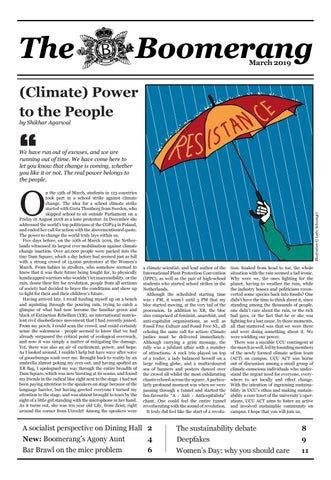
(Climate) Power to the People by Shikhar Agarwal
“
We have run out of excuses, and we are running out of time. We have come here to let you know that change is coming, whether you like it or not. The real power belongs to the people.
Illustration © Lotte Schuengel
O
n the 15th of March, students in 123 countries took part in a school strike against climate change. The idea for a school climate strike started with Greta Thunberg from Sweden, who skipped school to sit outside Parliament on a Friday in August 2018 as a lone protestor. In December she addressed the world’s top politicians at the COP24 in Poland, and ended her call for action with the abovementioned quote. The power to change the world truly lays within us. Five days before, on the 10th of March 2019, the Netherlands witnessed its largest ever mobilisation against climate change inaction. Over 40,000 people were packed into the tiny Dam Square, which a day before had seemed just as full with a strong crowd of 15,000 protestors at the Women’s March. From babies in strollers, who somehow seemed to know that it was their future being fought for, to physically handicapped warriors who wouldn’t let inaccessibility, or the rain, douse their fire for revolution, people from all sections of society had decided to brave the conditions and show up to fight for their and their children’s future. Having arrived late, I recall hauling myself up on a bench and squinting through the pouring rain, trying to catch a glimpse of what had now become the familiar green and black of Extinction Rebellion (XR), an international nonviolent civil disobedience movement that I had recently joined. From my perch, I could scan the crowd, and could certainly sense the solemness - people seemed to know that we had already surpassed the critical point of ecological overreach, and now it was simply a matter of mitigating the damage. Yet, there was also an air of excitement, power, and hope. As I looked around, I couldn’t help but have wave after wave of goosebumps wash over me. Brought back to reality by an umbrella almost poking my eyes out, and having spotted an XR flag, I apologised my way through the entire breadth of Dam Square, which was now bursting at its seams, and found my friends in the radical bloc right next to the stage. I had not been paying attention to the speakers on stage because of the language barrier, but having greeted everyone I turned my attention to the stage, and was almost brought to tears by the sight of a little girl standing with the microphone in her hand. As it turns out, she was ten year old Lily, from Zeist, right around the corner from Utrecht! Among the speakers were
a climate scientist, and lead author of the International Plant Protection Convention (IPPC), as well as the pair of high-school students who started school strikes in the Netherlands. Although the scheduled starting time was 1 PM, it wasn’t until 3 PM that my bloc started moving, at the very tail of the procession. In addition to XR, the bloc also comprised of feminist, anarchist, and anti-capitalist organisations, as well as Fossil Free Culture and Fossil Free NL, all echoing the same call for action: Climate justice must be delivered immediately. Although carrying a grim message, the rally was a jubilant affair with a number of attractions. A rock trio played on top of a trailer, a lady balanced herself on a large rolling globe, and a multicoloured sea of banners and posters danced over the crowd all whilst the most exhilarating chants echoed across the square. A particularly profound moment was when we were passing through a tunnel and started the fan-favourite “A - Anti - Anticapitalista” chant. One could feel the entire tunnel reverberating with the sound of revolution. It truly did feel like the start of a revolu-
tion. Soaked from head to toe, the whole situation with the rain seemed a tad ironic. Why were we, the ones fighting for the planet, having to weather the rain, while the industry bosses and politicians reconverted some species back into fossils? One didn’t have the time to think about it, since standing among the thousands of people, one didn’t care about the rain, or the rich bad guys, or the fact that he or she was fighting for a lost cause. In those moments, all that mattered was that we were there and were doing something about it. We were wielding our power. There was a sizeable UCU contingent at the march as well, led by founding members of the newly formed climate action team (ACT) on campus. UCU ACT was borne out of discussion among a small group of climate-conscious individuals who understand the urgent need for everyone, everywhere to act locally and effect change. With the intention of ingraining sustainability in UCU’s ethos and making sustainability a core tenet of the university’s operations, UCU ACT aims to foster an active and involved sustainable community on campus. I hope that you will join us.
A socialist perspective on Dining Hall 2
The sustainability debate
New: Boomerang’s Agony Aunt
Deepfakes 9
Bar Brawl on the mice problem
4 6
Women’s Day: why you should care
8 11
2
The Boomerang | March 2019
BUBBLE
Dear Campus,
Welcome back everyone! Whether you stayed on campus, went home, or got stuck in Germany during hitchhiking, I hope you enjoyed your well-deserved break. Rested, refreshed and ready, it is now time to get back to business. March has been an exciting month, full of political events. Just take a look at our cover! There was a week of calling attention to the government’s budget cuts, a weekend of marching in Amsterdam, and a day of voting for the Provincial and Water management elections. If, after all of this, your insatiable need for political participation is not yet satisfied, then worry not: UCU election season has started too! This month’s edition contains some articles that offer answers to questions you’ve long been pondering: why is AcquiCo sometimes called the ‘Equites of committees’? What happens in the ASC office after hours? What happens on the other side of the gate at the Kromhout army base? These secrets will be revealed to you on this page, page 3 and page 8. If, somehow, you’re still bored after, then turn to page 10 to find another delicious recipe. Although I hope you to read the paper you hold in your hands right now from cover to cover (don’t you all?), I also encourage you to keep an eye out for the upcoming April edition, scheduled to appear sooner than you think. It should include some exciting election specials … Happy reading! Yours sincerely, Meike Eijsberg , Editor-in-Chief
The future of Catering at UCU An interview with Maarten Diederix by Jamie March
“T
he UU is going to submit a request for tenders (RFT) at the European-level for a new catering company which means we need to start coming up with our demands, but we have nothing to offer.” As I sit down to speak with Maarten Diederix about how he thinks Dining Hall should be changed, we are joined by a number of students. A third year wistfully reminisces over the friendships she made, sitting with people she barely knew in her first year when meal plans were still mandatory. Since the €750 per semester meal plan was discontinued, Dining Hall has emptied out, and consecutive plans that have tried to revitalize it have only been moderately successful in recreating the social atmosphere it once had. “We need a bargaining chip to get a good deal, but we can’t promise the catering company any students. My suggestion is a mandatory credit of €150 per semester. That is low enough to be accepted without much remorse, but as a lump sum it is high enough to be accepted as a bargaining chip. I think Dining Hall should be changed into an old-fashioned Mensa, where you can get a huge plate of food for student prices. Not
only will the food be better and cheaper, but more people will start using Dining Hall again which is good for the social environment.” “This system would be able to handle the wide variety of dietary restrictions UCU students have. You would have a few options to choose from, and if they don’t suit you, you can always choose not to eat here and spend your credit on coffees. If you enjoy it, of course you can spend more [than the initial €150]. The idea is that by paying this lump sum and by having less fancy options, the caterer is guaranteed a minimum profit and the quality of food can increase.” “We should gauge the interests of the students, maybe with a survey, because this is just my personal opinion. I don’t know when the decision will be made and if so, who the new caterer would be. It’ll be a least a year before any changes are made, but we’re running out of time to start considering what we want.” We reached out to CAR who said that the UU is planning to move to a new caterer “from 2020 onwards.” From their current understanding it seems that if Sodexo would want to continue catering for the UU, they would have to reapply with a bid.
Too Tall, too Blond, too Dutch
AcquiCo’s dilemma: The trade-off between money and inclusiveness by Irene van de Hoef and Julia Zonneveld
S
uper Sticky Surfaces made it painfully clear: the members of the Acquisition Committee are not particularly diverse. Too tall, too blond, too Dutch. Just take one quick look at our committee and you can immediately tell that we are as Dutch as they come. We’ve even been called ‘the Equites of committees’. Although there is an explanation for the shift to Dutchness, AcquiCo is looking to change! AcquiCo was founded in 2013. The establishment of the committee was of a pragmatic nature: the UCSA experienced a budget deficit in 2013 and needed a team of students to minimize the shortage. To reduce the deficit, the committee began to establish professional relationships between companies and the UCSA, selling promotional opportunities and student CVs in exchange for money. Since 2013, AcquiCo has raised between €6500 and €9300 each year. This was done by giving companies exposure at UCU and in turn students would learn about companies, but most importantly, the UCSA’s budget deficit would be reduced. A win-win-win situation. Since the main goal was to earn money, fast, finding and approaching companies willing to work with us became crucial. It soon was clear that enterprises, especially regional ones, were more responsive when approached in Dutch. Since a substantial part of the companies we
contacted are based in the Netherlands, they not only preferred to communicate in Dutch but when requesting applicants for their events or workshops they required them to be fluent in Dutch too. Although the committee has had international members on its board in the past, we are often faced with the dilemma of choosing to make money or choosing to make an event open to everyone, Dutch or not, and consequently often receiving less money in return. Over the last few years, the budget of the UCSA has recovered and the funds raised by AcquiCo were no longer needed as much. Last year, the UCSA and AcquiCo came to an agreement to start donating 50% of these funds to the UCU Scholarship Fund. This change invoked new incentives to raise more money for us as board members. We were motivated to make a difference for our own students in a new fashion: through financial support. This year, we even changed the ratio to have 75% of our income go to the Scholarship Fund and 25% to the UCSA. We started the year off
in good spirits, determined to earn even more money for the Scholarship Fund. During the year, however, we had a couple of sessions where we evaluated our goals. Of course, raising money for the scholarship fund was a great objective, but we also wanted to guarantee the inclusiveness of our events. We put in a lot of effort trying to organise events with multinational companies, NGOs, or governmental organisations, in which we partially succeeded. However, we are not yet at the point where we want to be. The choice between money and inclusiveness is a tricky one. On the one hand, we are proud of the amount of money we raise for the scholarship fund. On the other hand, we would like our events to appeal to the broader audience that is UCU. Hopefully, future AcquiCo boards will continue looking for other ways to organise more events for international students, while providing the financial support that we do today. Illustration © Iris Beijer
A University College Student Association Magazine
BUBBLE
24 Hours in the ASC office by Jonathan Sendker, on behalf of ASC
3
Illustration © Meike Eijsberg
With elections coming up, we thought students might be interested in learning more about what ASC life actually looks like. What do we do in that office? Well, we’ve tried to sketch a representative day for you. Without further ado – here’s 24 hours in the ASC office! 09:00 - A new day. The office is empty until Jari arrives to do some work. Marco joins him around half an hour later.
with hummus. Before Janneke leaves, they talk about making a new silly video to promote the Ideal Semester survey. Yup, that’s happening.
have to attend, eh?). If anyone was in the office, you’d have to wonder why they’re not in the bar, socializing with teachers and students.
10:22 - Marco grabs his guitar and starts playing and singing in Italian. Bello?
14:00 - After lunch, Soomin has a brief meeting with one of the Social Science track representatives. She’s constantly in touch with her track reps, it’s admirable.
18:00 - Our meeting starts! Soomin’s late. When she arrives, flushed, she is greeted by fingersnapping and the mandatory hugs from Marco and Jonathan.
15:11 - The office is empty. We do have things to do other than just being there the whole day, you know.
18:03-20:00 - During our meetings, we talk about a lot of things. We start with a round of everyone sharing how they’re doing, followed by approving minutes, updates, reminders and ‘AOBs’ (Any Other Businesses – spontaneously arisen points that need to be discussed). Apart from that, here are some examples of what might be on our agenda:
10:24 - Jonathan drops by the office; an impromptu private performance of Ben E. King’s “Stand By Me” ensues. 10:25 - Jari tells everyone to shut up, they’re way out of tune and anyway, this is an office where people work. Jonathan decides to leave because he was really on his way to Jazzman’s anyhow (he likes the lattes there). 11:00 - Cas spends some time in the office preparing for the upcoming meeting with the Management Team (which consists of the Dean, the Director of Education, the Managing Director and, well, Cas). Meanwhile, Marco is working on the ASC computer, writing emails on behalf of the board. Jari’s planning election events. 12:11 Jari s c h e d u l e s something we call “1x1’s”. Those are monthly meetings we have where every board member talks to every other board member to give feedback on how our work together is going and anything that might be bugging them. After the individual talks, we then all sit down on the couches together for another hour, to discuss whatever came up (“sofa sesh”). These sit-downs are usually really beneficial for our internal functioning and also nice because, you know, we care about each other as people and want to know how everyone’s doing. 12:44 - Marco leaves to go to one of his fortnightly meetings with the chairs of UCSA and CAR. 12:45-13:45 - It’s lunch time. Janneke and Jonathan have office hours. Only one person shows up, and it’s a visitor asking where Campusplein 1 is. Classic. Janneke is reading a novel, and Jonathan is trying not to distract her. He finally settles on playing “Banana Pancakes” by Jack Johnson on his laptop and eating carrots
16:02 Jonathan has scheduled some time to work on the Theme Week report. We want to present the results of Theme Week in a conclusive document, with different sections and pie charts and student quotes and stuff. Jonathan is really into the whole project, so he’s the one working on it. It will be sent out to students, faculty as well as the management and hopefully it will become the starting point for change. Fun! 16:47 - The office is empty again. But that’s fine, because Afternoon in the Bar is happening, which is an event we organize (and thus kind of
1) The possibility of a second Student Life Officer on campus. We are in favor of this – what can we do to try and make it happen? 2) Do we want to be more transparent about the work we do to students? Do students care enough or are they happy we’re dealing with all this stuff so they don’t have to? What can we share and what is confidential? How should we go about it? 3) UCU is planning to increase the time faculty get to do research from currently 10% to 20%. How could this increased research time also benefit our education? Maybe instructors could involve students in their research, or present it in class? 4) Introweek. There’s a meeting about it soon, and ASC has a seat at the table. What interests and ideas do we have? 20:07 - Meeting finishes. Everyone leaves, except Cas, who wants to get some school work done in the office. 21:00-09:00 - The office is empty until the next day. Although, it’s a Thursday, so there’s a chance that Marco or Cas might stumble back in at 4 am. They live off-campus and sometimes, after a night at the bar, they just want to sleep on the couch…
4
The Boomerang | March 2019
BAR BRAWL
Stop the quantification obsession by Gideon Frey
F
rom the age of 10 our lives have been dominated by grades, but try giving an employee or academic a grade for a project and you would be considered crazy. One number can neither fully evaluate, nor can it give valuable feedback, but in an obsession with quantification we often forget this. This is also what most teachers will tell you. What makes a good assignment can usually not be boiled down to an excel sheet that the student must understand and optimize for. Even simple tests, while quick and dirty, often only represent the amount of bulimic learning one can handle: take in as much information as you can, and then puke it out. What is valuable often isn’t what is valued in our grading system – sometimes doing readings and discussing in class is more valuable than striving to avoid the horror of an A-, or even a B (*gasp*). Our obsession with the perfect GPA makes us care only about that for which we get rewarded, rather than what is rewarding. Getting good grades becomes an exercise in economic resource
“
Our obsession with the perfect GPA makes us care only about that for which we get rewarded, rather than what is rewarding.
distribution rather than learning – who would go to a book club with your lecturer if you can’t even put it on your CV? Why would you put effort into something if it’s “only worth 5%”? I believe that teachers, rather than having us jump through hoops, should be mentors, guiding rather than evaluating – but this does not mean that we should not be evaluated. Given the overall educational system, we still need grades to get into masters and pressure, while often toxic, can helps us learn, grow and improve. So are there realistic solutions? Many LAS universities in the US, and one in Twente, already work without grading. I do not think that that is possible here, but sometimes radical ideas can be de-radicalized to improve the status quo. To just mention one that Reed college, in the U.S. uses: their students get graded but don’t get the information, unless it is insufficient or they request it. Instead of having to neurotically focus on getting that A, students get qualitative feedback so they can focus on academic and intellectual purists as an end unto themselves. The other possibility would be to encourage academic areas, which are not (or less) influenced by grades and already work well (studentled-courses, book clubs, lectures, discussion rounds, etc); or why not create new spaces, like a project week, that only gets evaluated by pass/fail. Students and lecturers could broaden or deepen their interests in small seminars, learning skills like rhetoric, or work interdisciplinarily. I cannot claim that I have the end-all solution, but I can point to the need of a proper conversation with students, faculty and administration.
Grades should motivate, not instill fear by Sven Bosma
I
magine you’re in class with someone who is, nicely put, not as gifted on the topic as you are. They don’t do readings, mess about on laptops, and lack general interest. Deservedly, these types get around a C for the course. You, on the other hand, get an A ‘cause you’re awesome. In 99% of the cases we can assume that the student with an A is more competent than the student with a C (I said 99% of cases, there are exceptions, I know). There’s a certain drive in all of us to excel, and receive some kind of validation for that. Yes, learning should be the reward, but that A on a long paper feels real good, right? Now imagine the picture with non-traditional grading. The C student and A student would both have just “pass” as the quantifier of how well they did. This removes differentiation, which will destroy motivation since the smart student and the...lesser student are perceived as being of the same calibre now, and get the same label of validation. This to me looks like it’s bordering on some participation-trophy-bullshit. We can be honest about this
“
The “grading” we’ll receive in the real world is much harsher.
next point. Most students are in university because it increases prospects of employment and salary in the future, provided you’re not pursuing too fluffy, theoretical, or useless a degree. If everybody is increasing their employment prospects, employers need a way to know who the top dog is, and who won’t even be able to remember the order when the office sends them on a coffee run. Cue grades, which over a period of 3 or 4 years will establish some kind of consistency, giving a reasonable image of your competence. Evaluating everyone on an individual basis is a recruiting nightmare and highly time-inefficient. For some depth on an individual basis, companies have “tryouts” where you analyse cases, or internships. They’ll then base your hiring off of that. This means you still get your individual shot, but to avoid spending disproportionate time and resources on people who really have small odds of getting hired, they need a filter, which is the grading system. As for the problem of “pressure” caused by grading: fail an exam for once. You’ll feel true freedom once you find out the world hasn’t ended. This falling and getting back up is the process of failing forward, and learning how to fail is also valuable in life. So even failing grades should be kept. The “grading” we’ll receive in the real world is much harsher. As an academic, your article or research proposal will Illustration © Iris Beijer simply be rejected. In business, your project will fail and lose money. In medicine, your patient may die. The argument that “we won’t be graded in the real world” doesn’t hold. In the real world, the consequences of reality are your grades, so enjoy the symbolic letters or numbers while you can.
A University College Student Association Magazine
BUBBLE
Non Traditional Grades by Rafaella Karadsheh
As everyone is aware, ASC has taken up the task of asking students what their ideal semester would look like in order to potentially reshape the UCU academic system and to make it more stimulating. While many suggestions showed up, including switching to a UU block system, it is safe to say that the most drastic suggestion was to drop the traditional grading system and implement a pass/fail system.
A
s unusual as this sounds, this system has already been implemented in universities and colleges in the United States, many of them following liberal arts and science programmes. For instance, Prescott College in Arizona does not employ grades in assessing student performances within a course. Instead, they enlist evaluations from professors which entail students’ strengths and academic achievements, alongside their weaknesses. Such a system aims to utilise active learning, especially when students must execute their Senior Project. The previous evaluations from professors enables students to focus on their weaknesses and strengths so that they may perform their tasks optimally. Brown is yet another university that does not conform to traditional grading systems, but rather provides students with the freedom to select which grading system to adhere to. Students may follow a revamped traditional system, where the grades A, B, and C are used without any plus or minus signs in the grade. The grade “D” is not used, and failed courses are not
Arriving at UCU: A Class Shock by Sophie Wheeler
W
hen I was getting ready for my exchange year there were a number of things I was aware of: the importance of getting health insurance, potential cultural differences which may arise and DO NOT whatever you do, bring up the topic of Brexit in polite company. However, there were some things I was not prepared for: the intense workload, the overpriced cafeteria food, and the class shock. The idea that class difference would form the biggest obstacle to social integration rather than culture is something that had not occurred to me, until I first set foot on the UCU campus. Don’t get me wrong, British universities are not paragons of virtue when it comes to socioeconomic diversity. However, I have noticed a distinct difference in the way class is exhibited across the Channel. In Britain, despite the longstanding history of class division, overt expressions of class and class privilege are generally
recorded. Alternatively, students may opt for a satisfactory/no credit system, which is reflected on the external transcripts of students. A written evaluation may be requested for personal reflection, however it is not used as an indicator for academic progress, as Brown aims to instead encourage showing such achievements through the establishment of portfolios for students’ works. This system allows students to personalise their transcripts according to their strengths. Unsurprisingly, as an Ivy league school, Brown has high statistics for student success 80% of Brown students finish their education through graduate school or professional studies within 10 years of completing their bachelors degree. Their 92% acceptance rate into medical school and 91% acceptance rate into law school is above average for the United States. Pres-
“
All aspects of abandoning non-traditional grading must be evaluated before a decision is made
cott College showcases slightly lower albeit still high statistics - 81% of all graduates in the years 2010-2015 were employed or pursued a degree in graduate school while 79% of undergraduates throughout that same timespan were employed or continued their education at a higher level. That being said, newer grading methods can provide students with greater opportunities to actively practice what they learn in class, since their academic achievements are built on the portfolios they build throughout their time at university. Furthermore, by not being pressured to dedicate excessive amounts of time to study in
frowned upon. This disdain is further intensified by the fact that at University most students lean towards the left side of the political spectrum (think Labour and the Green Party.) As a result of this awareness of how class impact one’s life choices, any attempts to align oneself with the cause of the working class, even with the best of intentions, is treated with disapproval unless you also belong to the same socioeconomic class. Hence the term ‘champagne socialist’ being used in a derogatory manner against such people who are viewed as being somehow ‘hypocritical’ or ‘inauthentic.’ As a result, in order to champion the socialist cause without being viewed as a hypocrite one must be covert about any expressions of class privilege such as attending private school, expensive vacations and designer clothes. There is a running joke that at British universities students from middle class backgrounds will try their very best to hide this fact by for example wearing tattered, second hand clothing. Coming from this background, it was shocking to hear students talking unabashedly about their extensive travels, their experiences attending private schools, and other opportunities which many students from working class backgrounds would at the very least struggle to attain, if not be excluded from altogether. However, class privilege also shows up in more quiet, unassuming
5
order to obtain higher grades, students are less likely to be stressed, and for students suffering from anxiety, this may be better for their mental health. Yet these statistics don’t acknowledge the obstructive side of abandoning traditional grading systems. Letter/numerical grades motivate students to put in more effort into their studies. For example Student A studied 2 hours for a test, while Student B studied a total of 14 hours for a test. Should traditional grades be implemented, the difference in effort would be reflected in the grade differences. Therefore, students would be driven to put in more work to achieve higher grades. However, if both Student A and Student B received the same result, a “pass” or “satisfactory” as part of the pass/fail system, then students would be less likely to put in a great amount of effort because they would obtain the same results regardless. Additionally, traditional grading systems are recognised globally, and carry significant weight when it comes to applications for graduate school or professional jobs. As such, abandoning these evaluation methods could make it difficult for graduates to further their education and experience, as employers/graduate schools may not recognise non-traditional grading systems. That being said, all aspects of abandoning non-traditional grading must be evaluated before a decision is made. Taking into consideration the high statistics of success that Brown boasts, introducing a new system alongside traditional grading and offering students the freedom to select their method of evaluation would be the most successful course of action. This satisfies both sides - students who feel more driven by traditional grading systems may be evaluated as such, and those who feel constrained by them may opt for the alternate method. Our society is becoming increasingly competitive, and it’s time to change the way we evaluate ourselves to become more distinctive.
ways, such as receiving tutoring for an important exam, not having to work a part time job into your revision schedule or the ability to take on more risks. Risks such as studying a subject which is less likely to deliver a financial return or being able to gain experience through an unpaid internship, feeling safe in the knowledge that the net is there to catch you, should you need it. Now, this is not necessarily a bad thing, I am not for a second suggesting people be ashamed about the backgrounds from which they came. People cannot help being born into the upper or upper-middle class no more than I can help being born into the working class. However, I think there is something to be said about opening these conversations to people from other backgrounds and perspectives, rather than merely assuming that your experience is the norm. By excluding the topic of class from our discourse we are not resolving the issue of class but rather ensuring that the impacts of socioeconomic class on higher education go unacknowledged and unaddressed. I also think having more honest discussions about people’s backgrounds and the particular challenges they face by simply being at university is important to create a kinder, more inclusive campus here at UCU. Isn’t that something we all should strive for?
6
MARCHING THROUGH MARCH
The Boomerang | March 2019
Marching through March
What we demonstrated for, why, and what to do now by Meike Eijsberg
E
veryone who logged into their Facebook at the end of February or beginning of March has probably seen them: event invites to all kinds of big demonstrations and strikes taking place in the Netherlands in the month of March. As more and more of your friends clicked ‘going’, you started to wonder: “Cool! But why?” In this little overview of the 3 biggest marches, four students tell you what they demonstrated for, why, and what we can do now. The Women’s March, 9th of March What? The annual Women’s March took place in Amsterdam, the day after International Women’s Day. The march, unlike the name suggests, was one for all: every gender, every sexuality, race, class, etc. It emphasised the need to raise your voice for everyone, especially those who are unheard. “Unapologetically feminist, anti-racist, and inclusive,” was the motto of this passionate crowd. Ellen Vas and Fiona Wiggers were a part of it. Ellen decided to attend the march by herself, proudly. The vibe was ultimately positive. “I wouldn’t say it was a demonstration,” she says. “It was rather a get-together to make you feel like you’re not alone in this!” They certainly weren’t. According to the Women’s March Netherlands, around 15,000 people showed up, all supporting the cause and one another. Fiona, holding up a banner that said “Women hold up half the sky,” recalls a particular memory of a small toddler waving at everyone from her balcony. She received support through hundreds of waves in return. “She must have felt like a queen,” Fiona said. Why? Living in Netherlands, a country that has consistently ranked high in gender equality, sometimes gives the impression that we’re doing just fine. Although everything might seem near-perfect in the official reports, inequalities are still visible in society. This was exactly Fiona’s reason for going: “I want to stress that having equal rights on paper doesn’t mean you have equal opportunities and are taken equally seriously. There’s still a lot of changes to be made.” The Women’s March was important for Ellen too because she learnt a lot about gender inequality during her studies. Participating in the march was simply the next step. “I think it helps women to see that they’re not alone and that they’re worthy of getting every opportunity they deserve and feel fit for.” What can we do now? According to the European Commission, who published the annual report on the 8th of March in honours of Women’s Day, social and gender equality in the EU are increasing, but not fast enough. Some member states are even experiencing a decrease. The fight for gender equality is clearly far from
being over and we all ought to do our part to help the process. Fiona had a quite the lovely idea. She wants to see what she can do at UCU to change half of the academic buildings on campus into female names. “I don’t believe 7 buildings named after men are very inspirational for/or representative of a 70% female campus.” The Climate March, 10th of March What? The Climate March was a one of a kind. Never before had so many people gathered on the streets of Amsterdam to demonstrate in the name of the environment. Although it was raining cats and dogs, a record number of 40,000 showed up, proudly flashing colourful signs indicating their sense of urgency. Cold, wet and miserable, they screamed and chanted “red het klimaat, straks is het te laat,” as they stumbled on. The fact that the weather was so unfortunate may have strengthened the message. Some students definitely seemed to think so. “I think it was wonderful that so many people decided that this was something worth showing up for, despite the blistering cold and pouring rain,” says Jamie March. Why? It’s no secret that the Dutch government is behind on its quest for new and improved climate policies. The Netherlands is currently last on the EU list in sustainable energy production together with Malta and Cyprus. The political imperative of the matter is lacking, and this could have serious consequences for younger generations in the future. Although awareness has been increasing the last few years, we are not quite there yet. “It’s important to push forward this movement now and show the government and big companies what their population and clients’ priorities are,” Fiona explains. What can we do now? Time seems to be running out, but there remains hope. Jamie had a simple solution: “Vote!” A straightforward, but nevertheless correct response. The provincial elections might be over already, but the EU Parliament elections are coming up. Every vote counts, so if you want to make sure the EU will tackle climate issues in the future, then vote for a party who you think has the means to achieve this end. In the meantime, there are lots of other activities to join. The organisation of the Climate March set up a special website which it constantly updates with new things to do. Have a look yourself, via bit.ly/mars-terugblik (get a Dutch friend to translate it). The Education Strike, 15th of March What? Although technically not a march, but rather a stationary demonstration, the education strike that took place in the Hague was also a unique one. For the first time ever, students and staff from primary, secondary and higher education
all assembled for a nation-wide strike. Marco Minoni was one of many that was there on the fresh Friday morning. “The government keeps cutting funds year-after-year,” he explained. “They said they would reinvest it, which they are doing, but way less money than what they took away.” Money is indeed a crucial matter. The Algemene Onderwijsbond (AOb) therefore demanded a total of 4 billion euros for all sectors combined. Why? Why so much money? Because, time and time again, students and staff are victims of the annual budget-cuts and lack of educational investments. The government fails to accommodate for the constant inflow of students. There is a shortage of teachers, meaning some kids only have class 4 out of 5 days, simply because no one is there. Staff (and students) that are there, are experiencing the disastrous consequences. They must still produce the same output, which results in an increased workload. Clearly enough reasons. But why strike? According to Marco, “It shows how many people are affected by policy and changes.” He adds that, “In this case the aim was also to cause a bit of instability…The parents had to take care of the children because nobody was there at school. This creates awareness of the problem.” What can we do now? As it the case for all other causes, spreading the word always helps. Additionally, showing up for future demonstrations or strikes is never not appreciated. “I am definitely going to other ones…There was one in December, I also attended that one.” Marco said enthusiastically. Meanwhile, show support to your teachers! UCU may be in a somewhat privileged place where teacher-student dialogue (about this topic) is flourishing, but it doesn’t hurt to mention it. Marco certainly seems to think so: “[At the strike,] we were 4-5 students, and 2-3 teachers, and we stayed afterwards to hang out. That was really cool, because we should all support this together!” Are there more opportunities? For those with a heart for social justice, a need for urgency or those who simply get an adrenaline rush out of prancing around with a banner, there are always other chances. NOS once reported that an estimated average of 34 demonstrations, varying in scale and goal, take place in the country every week. The next few you can mark in your calendar are: 20 April 2019: March against animal testing, organised by Animal Rights 1 May 2019: March for Labour Day, organised by FNV. So grab a piece of cardboard, come up with an eye-catching slogan, and march on!
MARCHING THROUGH MARCH
7
Illustration © Vedika Luthra
A University College Student Association Magazine
sweet svensationsby Sven Bosma LONG-WEEKEND-TURNED-LIFE-LESSON This is a story starting with significant others meeting each other’s families, except this time it wasn’t me embarrassing myself in front of my better half’s mother. No, this time round it was the girlfriend’s turn to step up to the plate, as we flew out to my grandparents in England for a long weekend. Somehow I was still anxious for this, since my grandfather is a bit of a rascal. My grandmother often tells him to “behave himself, and not talk too much” before we go into places. Situations like this tend to have everyone on edge, all hoping they don’t say something to put the whole group off. But besides that, as my wise elders, I value their opinions. So I was hoping for a good impression, and smooth sailing all around. Now, my grandparents had a veterinary practice in earlier years, so they love animals. Actually, while my grandfather loves any kind of animal, my grandmother is a proper cat person, and tolerates dogs for the sake of my grandfather. My girlfriend loves animals too, particularly dogs, so the fact that my grandparents had a 6-month-old labrador puppy ties in well here. Rosie, as my...I guess dog-aunt, is called, was a lovely icebreaker of a puppy, and of course came along to pick us up from the airport. She was great, until we had to get in the car to get back home. Rosie is not the bravest in cars, and also has a slight issue with motion sickness. “But Sven, couldn’t she just stay at home for 2 hours?”, you ask. No, she could not. I don’t say aunt-dog lightly, she truly is my grandfather’s baby and I’m sure he loves her more than my brother or sister (not me of course). As for the actual weekend we spent there, there was nothing comparable to the series of blunders I had when meeting the girlfriend’s family. We took the dog on walks, went through quintessential English towns, had lunches and teas, and were entertained with many many stories, not to mention interactions between the puppy and the somewhat older cats. Once we heard my grandmother saying to dog-aunt Rosie “Sit...sit or be
killed”, my ever so observant girlfriend whispered to me “Sven...I don’t think Granny likes dogs that much.” I wonder where I’d be without these valuable insights, and statements of the obvious. Besides the truly lovely weekend away, I had quite a profound realisation. The drag of UCU, summer plans with friends, and all round business of life had made it such that I hadn’t seen my grandparents in over a year. Living in the Netherlands, with them a 35-minute flight away, this was honestly quite shameful, and it really brought up a deep sense of appreciation. Grandparents are part of your upbringing, from changing diapers to providing Legos to helping you with your UCU letter of motivation. At some point I realised “My brother and I ran naked through this living room, and now I’m asking my grandparents about their relationship with faith given their upbringing in Ireland”. This is a weird feeling, and I’m glad I at least speak to them on the phone a decent amount. I don’t know who’s reading this, but give your grandparents a call, if you’re lucky enough to still have them around. And Dutch kids, hop on a train, it’d really make their day. Somehow this column got derailed, but being a verbal wizard of sorts, I shall bring it full circle. This visit to the grandparents, to parade around my girlfriend and hear how lovely she is, I thought would mark a step into a new phase of life. The “I’m an adult and will be living my life how I see fit and will report back to you at regular intervals” kind of phase. But it doesn’t feel that way. Nobody’s going to stop me, which is good, but I know that, of my own volition, I’ll seek advice from grandparents. Everybody has something to teach, so be appreciative and take advantage of those elders in your life with tonnes of wisdom to share, and who are more than willing to talk to you. My grandmother was the one who told me ask out my better half, and look where that got me, she’s been the sort-of-premise of 2 columns now.
8
The Boomerang | March 2019
LOCAL
On the other side of the fence: a peek into the Kromhout army base by Sophie Martens
W
arrant officer Gert-Jan Rozeboom (56) has heard the stories: UCU students have drunkenly climbed the fences that separate campus from the new Kromhout army base. “We take our security very seriously, if we catch you, we will carry you over to the military police.” Rozeboom has worked for the Ministry of Defense for over 38 years and knows the Kromhout base like the back of his hand. He is accompanied by Jacqueline Spijkerman, senior communication advisor at The Royal Netherlands Army. Despite the occasional stories about disorderly students, Rozeboom characterizes the relationship between UCU and the Kromhout base as positive. Even stronger, he reckons that the Ministry of Defense would benefit from an even closer cooperation with UCU. For example, they would like to encourage students to join their workforce. By that, he doesn’t mean we should all join the army. Rather, the Kromhout base employs about 6600 civil servants from all disciplines. Lawyers, anthropologists, social psychologists and of course technicians are all there. As a matter of fact, only a quarter of all employees of the Kromhout base are actual soldiers. In total, the Kromhout base stations about a tenth of all the employees of the entire ministry, making it one of the biggest locations in the Netherlands. The base is equipped with many office buildings, as well as a dining hall, a military residence, sports facilities and even a bar. After all, their ‘campus’ is not so different
“
Most soldiers are pacifists, actually
from ours. When UCU had just obtained the old part of the base, military staff would still enjoy visiting our campus bar from time to time. “After a while, matters got out of hand, so we had to prohibit our staff from going to the campus bar any longer,” warrant officer Rozeboom recalls laughingly. Office buildings are filled with workspaces, because employees have no fixed desk. Conference rooms are made of glass, but often have their curtains drawn, because some information discussed at the army base is not intended for everyone’s ears. The Kromhout base is the headquarters of three important institutions. First of all, the army’s land forces, which are controlled and supervised from Utrecht. Further, the Kromhout base is home of the organisation in charge of material supplies, ranging from clothing to joint strike fighters. Finally, there is a supportive commando that makes sure all segments of the ministry can do their job efficiently, for example by taking care of mail services. Warrant officer Rozeboom himself functions
as the messenger between the ministry and the private services that manage the facilities. A usual day for him start at 7 AM, and continues uninterrupted until about 5 PM. He is responsible for the order and discipline on the base. In addition he forms the pivot in meetings between different parties like the municipality, local businesses and the ministry. Interestingly, Rozeboom characterizes himself as a pacifist. “Most soldiers are pacifists, actually,” he adds. “Our main purpose is to prevent war, and to protect what we cherish.” This can be summarized in the ministry of Defense’s three main objectives: protecting the country, assisting in case of national problems (think of floods) and undertaking international humanitarian action in case of emergencies abroad. To the question “Are we ready for war?” there is only one answer according to Rozeboom, “You never are.” In the past 25 years, the ministry of Defense has seen some serious cuts in their budget. Even though Rozeboom believes the
average soldier is still generally well-equipped, he does not deny that budgetary issues have become problematic. New techniques are advancing quickly, and it is vital to keep up with those. What the future will bring is uncertain, this is a matter of political choices. The Kromhout army base has taken up a special place in Rozeboom’s heart. It was built on a place where history was written. The base is full of monuments that are still intact, like the twelve-holes bridge and the bombproof guardhouse. Architects have even managed to recreate the same gleaming of the grassy hills. But beyond its aesthetics, there is something special about the mentality on the base. According to Rozeboom, society has changed drastically over the last couple of decades. Norms and values have been decaying in our present self-centred, individualistic culture. At the military, there is a different atmosphere. “That mentality, loyalty, connectedness among soldiers, that is something you find nowhere else these days.”
A University College Student Association Magazine
Keeping it lightheart-ed by Edward Barber
WATER IS SCARCE. LET’S SHIFT OUR PERSPECTIVE! Earlier this month I attended a talk at the UU Stadium Generale at Domplein entitled “Who’s got the right to water?” Delivered in a lecture format, legal scholar Dr. Daphina Misiedjan took us briefly through the contentious issue of ‘human rights to water’. The increasingly finite supply is starkly at odds with our persistent reliance on the substance for everyday household tasks, for agriculture and for industry. Questioning the practicality of universal access to such a basic human necessity may seem bizarre at first, but Dr Misiedjan was keen to emphasise, in legal terms, what a new and potentially problematic issue it is. The issue of a human entitlement to water first came to the fore in the modern era as a result of the Bolivian ‘Water Wars’ in 1999 and 2000. The people there were enraged by the privatisation of central city Cochabamba’s water supply system which ramped up water prices and allowed industry owners to discriminate on who needed or was owed the greatest quality and quantity of water. As a result of the protests, the privatisation was rescinded and the foremost figure in the movement, Evo Morales, was elected president in 2005. He also subsequently brought the issue of human rights to water into international discourse in 2010 by means of the UN. The UN now stipulates that it is under the remit of states to “respect, protect and fulfill”, when it comes to a country’s water supply and its citizens’ access. Naturally, it must also be “sufficient, safe and acceptable” but still, as Dr Misiedjan reiterated, this remains a huge task. The “acceptable” daily allocation of water per person worldwide varies hugely from 20 to 100 litres depending on occupation, regional climate and household numbers. It is an issue that is still rooted in power and inequality and the problem of the high standards now expected are further exacerbated by the stern competition of use. Now that we are considering the notion of base human rights to water, the central question is not only who has the right to water, but how do we allocate it and who bears that responsibility. One uplifting solution to this predicament is a fundamental shift of our perspective of the water supply problem from one of rights to one of obligation. In practice this means the active engagement of citizens worldwide in protecting natural water sources to supplement the work of states in distribution. This has been called the attribution of ‘personhood’ status for bodies of water, or legal guardianship adopted by independent groups or individuals. It acknowledges the intrinsic value of rivers and lakes, for example, as precious ecosystems and as natural features that are indivisible from their man-made surroundings. This legal status of course protects water sources from pollution and from use for arbitrary private purposes. Quality and quantity are both saved. Recent successes of this model have been seen in the cases of Great Lake Erie in the US and the Whanganui River in New Zealand. The latter assumed its own legal status as it was determined to be a spiritual ancestor of the local indigenous people. The water supply is thus protected and quantity and quality of distributed water in that region will not be compromised. So, the onus is on the state, but also more crucially, on us. If we consider water access as not only a right but also as something that we are obliged to cultivate and supply, then our chances of overcoming this issue are much higher.
WORLD
9
What Hillsborough Wasn’t by Aimée-Stephanie Reid
‘Y
ou’re joining us at Hillsborough on a beautiful sunny day for Liverpool v Nottingham Forest in this FA Cup semi-final.’ This sentence structure is one that is familiar to all avid football watchers; a comment on the weather, followed by the stadium, followed by the teams, followed by the match title. That’s all this sentence was meant to be, another comment at the start of 90 minutes of men kicking a ball about, not the prelude to a disaster. On the 15th of April at 14:50, with the longawaited match due to kick-off at 15:00, thousands of fans were still waiting to get in. In this age perfect rows of numbered seats didn’t exist, instead it was a series of large ‘pens’ where fans were left to find a spot themselves. This particular stadium had four pens available for the Liverpool fans, and at 14:50 two of these were
“
People from all over, but not people from Liverpool. They knew the truth while the rest of the country was fed lies. Only 23 years later did the people of The Sun apologise for disgracing the fans and the people of Liverpool. My father is a survivor of the disaster, but he and every other fan that day are the victims also. They will live, for the rest of their lives, with the memories of what they saw and experienced. My father witnessed his friends being trampled to death. He tried to help, as did many others, but they were stopped by the police, declaring people who were still breathing as “already dead”. Anyone who watches football already knows about Liverpool FC, the club with probably the most passionate fans, who no matter what will always support their club. The people of Liverpool worship Liverpool FC (unless you support
He tried to help, as did many others, but they were stopped by the police, declaring people who were still breathing as “already dead”.
already well over their capacity. A series of mistakes on that day resulted in these pens not being closed, and instead fans being actively pushed into them. What ensued was a crush where men, women, and children were being pushed against each other and the walls with nowhere to go for help. This day resulted in the death of 96 Liverpool football fans. 96 men, women, and children who should not have died. You are probably wondering why a match that happened 10 years before my birth means anything to me. This event was followed by false newspaper articles and police statements, which resulted in Liverpool fans for many years being branded murderers. My father was among those fans. A murderer of his friends, their relatives, and fellow Liverpudlians. ‘The Real Truth’ they called it. Fans pickpocketing the dead, beating up police officers and even urinating on the dead. They were branded, ‘murders’ of their own people. People all over England believed what they read in The Sun (a newspaper banned to this day in my house and any house in Liverpool).
Everton...but we can ignore them for now). Their home grounds of Anfield is their church, the manager of the time period is their God, the bond between the people and the club of Liverpool is unbreakable. But ask anyone in England about Liverpool fans in the 80s: “drunken scousers” (a nickname for those from Liverpool) they’ll tell you, and “hooligans”, a common insult. But what does it truly mean to be a “hooligan”? Had this not been the reputation of the fans, would the events of the day have unfolded in a different way? Would the coverage have been different after the event? This brief introduction to the disaster will never do it justice. If you really are interested in learning about the events I suggest joining DebateCo for our event What Hillsborough Wasn’t, on April 9th in Dining Hall. Here we will discuss the term ‘football hooligan’ with academics and football fans alike, and how the term impacts our view of football fans . This event will be held in memory of the 30th Anniversary of the disaster.
10
The Boomerang | March 2019
ARTS&CULTURE
Stan’s Sad Boy Songs Songs in transit: Top 5 tracks from the passenger seat by Stanley Ward
D
ear readers, here included is a list of songs which helped to fuel my various hitchhiking escapades, blasted through cheap headphones, phone speakers, and occasionally playing on loop in the back of my mind when my phone battery died. Anyway, as I sit on the hostel bed typing away my silly little thoughts, I hope that you, readers, appreciate the dedication in which I deliver my bullshit - it is all for you. 1. Talking Heads - And She Was Like most things, my journey started optimistically, reflected in this joyful classic from the mind of the great David Byrne. Due to numerous family car journeys soundtracked by the Talking Heads, travel by automobile will forever be associated with the summertime jangle of everyone’s favourite new wave stars. At this point of the outset of the trip, to paraphrase the lyrics, “the world was moving, and we were right there with it”. 2. Car Seat Headrest - Beach Life in Death Cut to the Saturday evening. After a mistaken loop around Germany, we were finally making some headway south, and as our drivers, a charming elderly couple, spoke zero English or German, I felt it socially acceptable to plug myself into the chaotic sounds of Car Seat’s
latest album (even the band’s name was fitting to the situation) in hope that the smashing guitars and howling vocals would prevent me falling asleep and missing our stop. Barrelling down the Autobahn with Will Toledo screaming into my ears helped power me through. If the band can deliver 13 minutes of multi-sectioned power pop/indie rock, I can sit in strangers’ cars for a few days. 3. Bright Eyes - Cassadaga After the first of many waits of multiple hours, once again, we were on the road, and as it was my shift to sleep, I turned to Bright Eyes’ country rock ode to spiritual escape. In particular, cuts such as ‘I Must Belong Somewhere’, a song about being out of place, ‘If the Brakeman Turns my Way’, which is literally about hitchhiking, and ‘Middleman’ felt pretty relatable as we headed south towards an uncertain destination. The surreal feeling of constantly moving seems consistently embedded in these tracks, with apparent influences of old time folk and winding strings and woodwind parts. The eerie production of Mike Mogis creates an ethereal unnerving sonic landscape which reflected my mental state at this point. Like Conor Oberst, I became the middleman - the grey areas were mine.
through each night, joining various strangers on late night hauls to business trips, meetings, or just returning home in the early hours. This cut from the Canadian outfit sparkles and glimmers like passing streetlights, with its delicate guitar, racing hi-hat, and intricate rhythmic changes. It also nicely carries a message for all travelers: look before it changes, because when it changes, it changes for good, a lesson we learnt well as our best laid plans were often foiled by unexpected changes. My favourite of these was being stuck in a sudden blizzard between the Slovenian and Croatian borders, which, while being incredibly inconvenient, was undeniably beautiful to watch. The transformation of the landscape around us from drab foggy hills into a glistening winter scene was truly amazing.
5. Bombay Bicycle Club - It’s alright now The day after finally arriving in Split, I was, to quote the poet Drake, “out like a light” until noon, by which time, everyone else had left. When I finally dragged myself outside, I was met with blue skies and sun, neither of which lasted too long. I enjoyed walking round the old town to find some good ol’ UCU people, with the sweet uptempo sound of U.K. indie pop standards Bombay Bicycle Club informing me with choppy synths and luscious harmonies that everything 4. The Barr Brothers - Look Before it was alright now. I had arrived; we had made it Changes all it took was everything I had. Making up for lost time waiting, we travelled
A University College Student Association Magazine
Brexit simplified: What the Hell Is Going On? by Ivan Ryan The UK voted to leave the EU in June 2016, so why hasn’t Brexit happened yet? Well, to put it simply: British politics is a mess.
T
he promise of a referendum was first put in place by Prime Minister David Cameron for the 2015 election in response to the growing influence of Eurosceptics in his Conservative party. Having won the election with an overall majority, plans were then set in place to hold a vote on the UK’s future relationship with the EU: to remain or to leave. Campaigning then kicked off featuring powerful slogans and politicians revealing their beliefs. In the months leading up to the referendum, support for remaining in the EU seemed to be strong, but as the day of the vote drew closer, polls increasingly predicted a majority vote for Brexit. When the results were clear, sharp divides were felt across the country. Scotland and Northern Ireland voted to remain, whereas England and Wales did not. Despite promising to stay on as prime minister, David Cameron resigned just weeks after the historic vote. Theresa May eventually became the new leader and decided to hold another election in an effort to strengthen her government. This backfired by causing her party to lose its overall majority in parliament, instead making it rely on the right-
wing DUP party based in Northern Ireland for support. Northern Ireland remains a contentious issue in the Brexit negotiations as it is separated from the rest of the UK and borders the Republic of Ireland, another EU member state. Leaving the EU could mean introducing custom checks along the Irish border, which could stoke fear and anxiety. The recent history of terrorism surrounding the idea of a border on the island remains as a scar and has thus intensely shaped the Brexit debate. The solution so far has been to introduce a backstop in the Brexit deal, where Northern Ireland would remain part of the European Customs Union unlike the rest of the UK. Opponents of the deal argue this would isolate Northern Ireland from Britain, threatening the government’s sovereignty over its own territory. Theresa May tried to pass this deal in Parliament earlier this March, where it failed by 149 votes. MPs also rejected the prospect of a no deal Brexit, further complicating matters. It is now highly likely the UK will postpone Brexit beyond the original date of March 29th because no deal has been agreed upon. This would mean the UK would participate in the upcoming EU elections, further making Brexit seem less likely. There have been increasing calls for a second referendum, with many people stating their position on the EU has changed. More than two years after the referendum, the outcome of Brexit still is not certain.
Recipe: Stuffed Sweet Potatoes by Michelle Verstraaten
Ingredients • 4 small sweet potatoes • 1 courgette • 200g minced meat • A few tbsp crème fraiche • Olive oil, salt & seasoning Directions 1. Preheat the oven to 190°C. 2. Thoroughly wash and dry the sweet potatoes and prick 3-4 times with a fork. 3. Drizzle with olive oil and salt and bake for 60 minutes or until soft and a fork easily pierces to the centre. 4. Towards the end of the baking time, heat some oil in a pan. 5. Fry the minced meat until browned. 6. Season with salt and any desired spice, e.g. “vleeskruiden” (meat herbs) 7. Chop the courgette and fry until soft. 8. When the sweet potatoes are cooked and soft, make a long deep cut in each one, from one end to the other. Cut or mash up the flesh inside. 9. Top with a few spoons of crème fraiche and the courgette/minced meat mix.
WORLD
11
Agony aunt Dear Auntie, Let me just preface this by saying I love my partner very much and I can’t imagine breaking up with them. However recently I have found that although we share the same values, we differ in terms of long term life goals. I want to get into a competitive career field and climb the corporate ladder. They say that they don’t really care about money and it shows. They don’t seem to make much of an effort at all in terms of trying to get good grades at university and they don’t have much motivation to do much at all besides eating and sleeping and playing games. I’m pretty sure it’s not a mental health issue because by their own account they have pretty much always been like this. But it’s starting to irritate me, and I don’t know what to do. I’ve tried discussing it with them and they are pretty dismissive. I don’t want to break up with them because I’m worried I might utterly ruin their self esteem and I suspect my reasons for wanting to take a break are selfish. In addition I feel I’ve already made a public display of being committed to this person and it would be difficult to break it off. Please help. Ok, this is a tricky one. Relationships are hard work and it is sometimes hard to differentiate between a little bump in the road and a real issue. You clearly do really love your partner and care a lot about them, but your future is something that is important for you, and you should not feel bad about feeling that way. Although saying this, we are all still only at the very beginning of working life. It is great that you have so much ambition now but for some people, it can come much later (this is what I tell myself!). So, you need to work out whether your partner is just going to be a late starter or if you have completely different life plans altogether. Even if you can’t imagine your partner having ambition in the foreseeable future you need to work out whether this is a complete deal breaker for you. Perhaps the whole yin and yang thing could be a vibe, opposites attract? But if you are already having issues with it then these feelings probably won’t go away. SO. You’ve said that you’ve already tried discussing it with them, but maybe give it one more shot and try and really talk about how you are feeling. Try not to make it seem like you are having a go at them for not being ambitious enough, but just genuinely say how you think it is a big difference and it is making you feel uneasy. You also say that you are pretty sure it isn’t a mental health issue, but I would just try and make sure that this is definitely the case. If it gets to the stage where you’ve discussed it with them and nothing has been resolved and you really can’t see a future with someone with such different plans from you then DO NOT FEEL SELFISH. If anything, this really is not a bad reason to break up with someone. Any kind of breakup can ruin someone’s self-esteem to a certain extent. But, inevitably, this can be overcome. It is also much better than this becoming a real issue and you starting to resent each other for it. Breaking up like this doesn’t have to mean the end to your relationship, just your romantic relationship. You still very much like aspects about this person so it doesn’t have to mean you are completely cut from each other’s lives. Also, if there is anything we have learnt from the Jordyn and Tristan scandal (sorry to lower the tone), it is that relationships and their issues shouldn’t be a public matter. Don’t worry about what other people think. In the grand scheme of things, they will care about it for a couple of days, but this is your life and your relationship. Sometimes you have to put yourself first. In need of advice? We will post a link where you can anonymously submit what troubles you, so watch out for that!
12
The Boomerang | March 2019
QUAD QUERIES or “What’s a popular e?” t a h u o y g in h t m a mainstre
“Being sober” – August
“Midterms got me way overthinking”
“Those flared pants all the gi rls are wearin they make me g, puke a little bi t inside” –W
essel
–Balthasar
“Mumble rap” – Louis
st”
“Avocado Toa
– Ivan
“Exerc is – Joan e”
“High School Musical”
na
– Emma
“Neoliberalism” – Jarne
“Toma
toes a
“Drake” – Vanessa
n – TJ d Beer”
“Star Wars ” – Marie lotte “I feel like I’m very m ainstream ” – Lieke
“Dutch music” – Annie
“The fuck
ing system man” – Keye
ariia “K-Pop’” – Mian iv V – ’” O “N
“Your mo – Lora
m”
”
“Anti-vaxxers – Bela
THE BOOMERANG BOARD Meike Eijsberg | Editor-in-Chief Charlotte Remarque | Managing Editor Thomas Scassellati Sforzolini | Executive Editor Sven Bosma | Executive Editor Lotte Schuengel | Creative Director – Layout & Design Iris Beijer | Creative Director – Art Jamie March | PR Manager
With support from Boomerang uses wind energy printers The Boomerang is a periodical newspaper. It comes out eight times a year.