the murphy institute
the exchange
tulane university
Volume 12, No. 1
Fall 2014
AC H I E V I N G PA R IT Y P O L I T I C A L E C O N O M Y H A S A N H I S T O R I C A L I M A G E as a masculine field of study. From its founders—
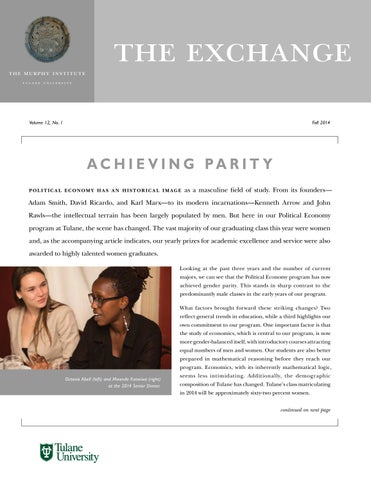
Adam Smith, David Ricardo, and Karl Marx—to its modern incarnations—Kenneth Arrow and John Rawls—the intellectual terrain has been largely populated by men. But here in our Political Economy program at Tulane, the scene has changed. The vast majority of our graduating class this year were women and, as the accompanying article indicates, our yearly prizes for academic excellence and service were also awarded to highly talented women graduates. Looking at the past three years and the number of current majors, we can see that the Political Economy program has now achieved gender parity. This stands in sharp contrast to the predominantly male classes in the early years of our program. What factors brought forward these striking changes? Two reflect general trends in education, while a third highlights our own commitment to our program. One important factor is that the study of economics, which is central to our program, is now more gender-balanced itself, with introductory courses attracting equal numbers of men and women. Our students are also better prepared in mathematical reasoning before they reach our program. Economics, with its inherently mathematical logic, Octavia Abell (left) and Mwende Katwiwa (right) at the 2014 Senior Dinner.
seems less intimidating. Additionally, the demographic composition of Tulane has changed. Tulane’s class matriculating in 2014 will be approximately sixty-two percent women. continued on next page