Ne w s
Sunday, May 19, 2019 | INVESTIGATIVE | THE TUFTS DAILY
5
Purdue executive held adjunct teaching role at Tufts PURDUE PHARMA
continued from page 3 it has a generally low rate of abuse when prescribed lawfully. “A lot of these people say, ‘Well, I was taking my medicine like my doctor told me to,’ and then they start taking more and more and more,” Haddox told the Associated Press in 2001. “I don’t see where that’s my problem.” In an interview with the Daily, Jane Ballantyne, a University of Washington Medical Center anesthesiologist who regularly gave lectures as part of Tufts’ PREP program, said Purdue vastly understated OxyContin’s addiction risk. She believes the company spread misleading claims about the drug’s addiction potential by suggesting that its “long-acting” preparation would make addiction less likely than other painkillers when, in reality, this difference was small and unproven, according to Ballantyne. Despite these concerns, Purdue’s efforts to convince the public that pain is undertreated were influential in leading to the drug’s overprescription, according to Ballantyne. The culture surrounding pain treatment changed in the 1990s, she explained, and many doctors’ caution surrounding opioids for chronic pain was replaced by interest in an effective painkiller. “Part of their promotional activity was very much to convince people not only that pain was undertreated and there was a crisis of undertreatment of pain, but also that you had a moral or an ethical obligation to treat pain as a doctor,” Ballantyne said. “If you didn’t, you were either a bad person or a bad doctor.” Haddox’s job as a Purdue executive was anchored in decades of research into pain management, driven by a belief that opioid painkillers are effective and pain is undertreated. In a landmark 1989 paper, he claimed that many people whom doctors accused of drug addiction are not addicts at all, but rather patients with an unmet need for pain treatment. This “pseudoaddiction,” which drives pain-stricken patients to show addict-like behaviors like asking for prescriptions incessantly, can be resolved through better pain management, Haddox wrote. Researchers funded by large pharmaceutical companies — including Purdue — began invoking Haddox’s “pseudoaddiction” term to support the notion that painkillers are under-prescribed. The idea is far from settled science, though: Some researchers have questioned the concept and, according to a 2014 review, no published study has proven the pseudoaddiction theory empirically, with most of its defenders reliant on anecdotes. Edgar Ross, the director of Brigham and Women’s Hospital’s Pain Management Center and another PREP lecturer, believes pseudoaddiction applies to, at most, an extremely small number of patients. Ballantyne, meanwhile, said pseudoaddiction is a problematic theory because it masks actual addiction, encouraging doctors to miss warning signs and dangerously over-prescribe medication. “There’s no such thing as pseudoaddiction. It’s just a concept,” Ballantyne said. “And it’s a bad concept because it encourages people to give more opioids.” Beyond the risk of addiction, Ballantyne believes OxyContin’s benefits were wholly overstated. She says most chronic pain patients are better served without OxyContin. “The risk isn’t worth taking, in my view, for most people,” Ballantyne said. “Most common pain conditions do better if you avoid opioids altogether.” By the time Haddox reached Tufts in the late 2000s, nationwide prescription opioid overdose deaths had more than doubled from 1999. As overdose deaths continued to increase, he acknowledged the problem. Haddox addressed the abuse issue by the 2010s, when concerns surrounding opioids became well-known. He wrote papers on abuse-deterrent opioids, an area of business
Other course notes indicate that students were taught about addiction and other potential risks of OxyContin use. One legal case study by PREP lecturer Srdjan Nedeljkovic, an anesthesiologist at Brigham and Women’s Hospital, described a chronic pain patient who should no longer take OxyContin. Efforts to reach Nedeljkovic for comment were unsuccessful.
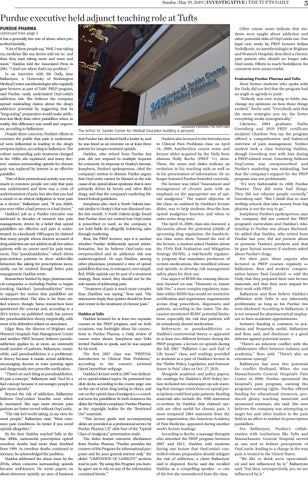
ALEXANDER THOMPSON / THE TUFTS DAILY
The Arthur M. Sackler Center for Medical Education building is pictured. that Purdue has declared itself a leader in, and he was listed as an inventor on at least three patents for tamper-resistant opioids. Haddox, who retired from Purdue last year, did not respond to multiple requests for comment. In response to Healey’s lawsuit, Josephson, Purdue’s spokesperson, cited the company’s motion to dismiss. Purdue argues that OxyContin cannot be blamed as the sole cause of an opioid abuse epidemic that is now primarily driven by heroin and other illicit drugs, and that the company’s marketing followed federal guidelines. Josephson also cited a North Dakota lawsuit similar to Healey’s that was dismissed earlier this month. A North Dakota judge found that Purdue does not control how OxyContin is prescribed or used, so the company is not held liable for allegedly bolstering sales through marketing. Ross, the PREP lecturer, says it is unclear whether Purdue deliberately spread misinformation, but he believes OxyContin was overprescribed and its addiction risk was underrecognized. He says Haddox, among other physicians, promoted a view of opioid painkillers that was, in retrospect, over-simplified. While opioids can be part of a treatment strategy, Ross noted, they should not be the sole means of addressing pain. “Treatment of pain is much more complex than [Haddox] was saying,” Ross said. “His statements imply that opiates should be front and center in the treatment of chronic pain.” Haddox at Tufts Haddox lectured for at least two separate courses in the PREP program, and on both occasions, was forthright about his connections to Purdue Pharma, a Daily review of course notes shows. Josephson says Tufts invited Haddox to speak, and he was unpaid for his work. The first 2007 class was “PREP234: Introduction to Clinical Pain Problems,” according to the course’s archived OpenCourseWare webpage. Haddox’s lecture week in 2007 was dedicated to opioid-related topics. He presented two slide decks, according to the course page: one on the use of urine drug testing in clinics, and one on the opioid class of analgesics — a medical term for painkillers. In both instances the slides list Haddox’s employer, Purdue Pharma, as the copyright holder for the “Restricted Use” materials. “This lecture guide and accompanying slides are provided as a professional service by Purdue Pharma L.P,” slide four of the “Opioid Class of Analgesics” presentation reads. The slides feature extensive disclaimers from Purdue Pharma. “Purdue provides the content of this Program for informational purposes and for your general interest only,” the slides’ “LIMITATION OF LIABILITY” sections read in part. “By using this Program you hereby agree not to rely on any of the information contained herein.”
Haddox also lectured in the Introduction to Clinical Pain Problems class on April 16, 2009, handwritten course notes and lecture slides acquired by the Daily from alumna Holly Roche (PREP ‘11) show. There, the notes and slides indicate an evolution in his teaching style as well as in his presentation of information: He no longer featured Purdue-branded curricula. His lecture was titled “Assessment and management of chronic pain with an emphasis on the appropriate use of opioid analgesics.” The stated objective of the class, as outlined by Haddox’s lecture slides, was to help students describe how opioid analgesics function and when to order urine drug tests. The April 16, 2009, class also featured a discussion about the potential pitfalls of upcoming drug regulation, the handwritten class notes show. Toward the end of the lecture, a student asked Haddox about the FDA’s Risk Evaluation and Mitigation Strategy (REMS), a risk/benefit regulatory program that mandates producers of certain medications, like modified release oral opioids, to develop risk management safety plans for their use. One aspect of REMS the ensuing discussion focused on was “Elements to Assure Safe Use,” a more complex regulatory mandate within REMS that would set restrictive certification and registration requirements across drug prescribers, dispensers and patients, according to the notes. The discussion mentioned REMS’ potential limitations, especially the risk that patients will be mistakenly denied medication. References to pseudoaddiction — Haddox’s controversial theory — appeared in at least two different lectures during the PREP program: a lecture on opioids during the fall 2007 “Palliative Care and End of Life Issues” class, and readings provided to students as a part of Haddox’s lecture in the “Public Policy, Legislative, and Forensic Issues in Pain” class on Oct. 27, 2010. Alongside academic and policy papers, the readings for Haddox’s 2010 Policy lecture included two newspaper op-eds warning that stronger restrictions on opioid prescriptions could hurt pain patients. Reading materials also include the 1996 statement co-written by Haddox that claimed opioids are often useful for chronic pain. A more tempered 2004 statement from the same organization, the American Academy of Pain Medicine, appeared during another week’s lecture readings. According to Roche, a massage therapist who attended the PREP program between 2007 and 2011, Haddox told students during one lecture that OxyContin’s controlled-release preparation should mitigate the risk of addiction, a claim Ballantyne said is disputed. Roche said she recalled Haddox as a compelling speaker — one of the few she remembered from the class.
Evaluating Purdue Pharma and Tufts Most former students who spoke with the Daily did not feel that the program had an angle or agenda to push. “Nobody was ever trying to lobby me, change my opinions on how these things worked,” Roche said. “Everybody said that the more strategies you try, the better everything works synergistically.” Likewise, 2004 graduate Hallie Greenberg and 2010 PREP certificate recipient Charlene Neu say the program offered a comprehensive and balanced overview of pain management. Neither student took a class featuring Haddox, though Greenberg met with him during a PREP-related event. Greenberg believes OxyContin was overprescribed and Purdue’s marketing was misleading, but that the company’s support for the PREP program was not problematic. “It’s very fashionable to vilify Purdue Pharma. They did some bad things. They did not educate people correctly,” Greenberg said. “But I think that to start reviling schools that take money from big pharma is not the way to go.” Josephson, Purdue’s spokesperson, says the company did not control the PREP program’s curriculum and Haddox’s relationship to Purdue was always disclosed. He added that Haddox, who retired from Purdue last year, did not present about or promote Purdue’s products and that he gave factual answers if students asked about Purdue’s drugs. For their part, three experts who lectured in PREP courses regularly — Ballantyne, Ross and workers’ compensation lawyer Paul Goodrich — told the Daily that they prepared their own lecture materials and that they were unpaid for their work with PREP. Ballantyne and Ross believe Haddox’s affiliation with Tufts is not inherently problematic as long as his Purdue ties were disclosed. According to Ballantyne, it is not unusual for pharmaceutical employees to have academic appointments. Industry funding is common in academia and frequently useful, Ballantyne and Ross said, and disclosure is a good defense against potential issues. “There’s an inherent conflict with the collaborative effort between industry and academia,” Ross said. “There’s also an enormous synergy.” Ballantyne has seen this potential for conflict firsthand. When she ran Massachusetts General Hospital’s Pain Center in 2000, Purdue sponsored the hospital’s pain program, earning the program’s naming rights. Purdue offered funding for educational resources, produced glossy teaching materials and sponsored seminars, she said. She now believes the company was attempting to target her and other leaders in the pain field in an effort to market its prescription painkillers. For Ballantyne, Purdue’s collaboration with institutions like Tufts and Massachusetts General Hospital served as one tool to bolster perceptions of OxyContin, leading to a change in the way pain is treated in the United States. “We like to think we’re open-minded and not influenced by it,” Ballantyne said, “but then, retrospectively, yes, we are influenced by it.”