Features
3
tuftsdaily.com
REBECCA HUTCHINSON | WHAT'S POPPIN'
Lessons from Buzzfeed
N
WIKIMEDIA COMMONS
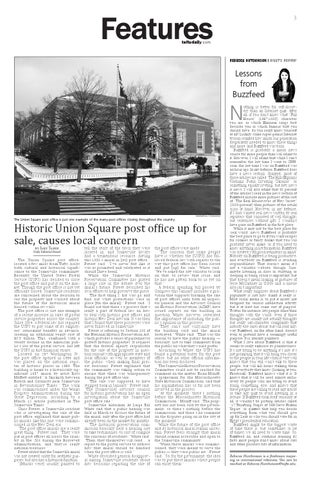
The Union Square post office is just one example of the many post offices closing throughout the country.
Historic Union Square post office up for sale, causes local concern by Jake Taber
Daily Editorial Board
The Union Square post office, located a few miles from Tufts, holds both cultural and historical significance to the Somerville community. Recently, the United States Postal Service (USPS) has decided to close the post office and put it on the market. Though the post office is not yet officially closed, Somerville residents are concerned about the decision to sell the property and worried about the future of the historical mural housed within its walls. The post office is just one example of a recent increase in sales of postal service properties across the country. Since 2006, a federal law has required the USPS to pay some of its employees' retirement benefits in advance, creating an additional yearly cost of $5.5 billion. This, combined with a steady decline in the American public's use of the postal service, has left the USPS in dire financial straits. Located on 237 Washington St., the post office opened in 1936 and was placed on the national register of historic places in 1986. The building is home to a historically significant 1937 mural by artist Ross Moffett entitled "A Skirmish between British and Colonists near Somerville in Revolutionary Times." The work was commissioned under the Works Progress Administration during the Great Depression, according to a March 12 article published in The Somerville Times. Chris Poteet, a Somerville resident who is investigating the sale of the post office, explained that many public murals, like this one, were commissioned in the New Deal era. "The post office murals are a really great thing," Poteet said. "They were put in post offices all across the country in the ’30s during the Roosevelt administration, and they're really national treasures." Poteet added that the Somerville mural was not created solely for aesthetic purposes, but also has a historical function. "[Murals were] usually painted to
tell the story of the town they were located in, and Somerville always had a tremendous resource, having this 1930's mural in [its] post office," Poteet said. "I've never felt like it was as promoted and celebrated as it should [have been]." While the Somerville Historic Preservation Committee has played a large role in the debate over the mural's future, Poteet described his own efforts to help preserve the piece. "The first thing I did was go and find out what protections were in place [for the mural]," Poteet said. "I found out that there's a process that's really a part of federal law on how to deal with historic post offices and historic New Deal artwork. It was then that I found that these processes were never followed in Somerville." Poteet is referring to Section 106 of the National Historic Preservation Act, which provides a series of guidelines to protect historic properties. It requires that the federal agency responsible for the sale of the property in question consult with appropriate state and local officials, as well as members of the public, when making final project decisions. Poteet explained that the community was taking action to ensure that there was transparency during the post office sale. "The sale was supposed to have stopped back in January," Poteet said. "The [Somerville] advisory council for historic preservation has an open investigation about the Somerville post office sale." Somerville Alderman At Large Bill White said that a public hearing was held in March to discuss the future of the mural, only after the post office had already been on the market for months. "The historical preservation commission basically held a hearing just to take testimonies, to sort of compile the concerns of residents," White said. "Then, they themselves will send ... a report to the postal service to address how that mural should be handled when the post office is sold." White described general disapproval among Somerville residents about how decisions regarding the sale of
the post office were made. "The concern that some people have is whether the [USPS] has followed federal law with regards to the way this post office has been closed and put [up] for sale," White said. "We've asked the city solicitor to look on that, to review that issue, and he has not gotten back to us yet on that." A federal spending bill passed by Congress this January includes a provision that supports blocking the sale of post offices until both an inspector general and the Advisory Council on Historic Preservation (ACHP) have issued reports on the building in question. White, however, reiterated the importance of including the public's opinion in this process. "They can't just willy-nilly have the building sold and the mural destroyed," White said. "That was the reason to have the public hearing — basically, just to take comments from the public on what they would prefer." According to White, the USPS has found a potential buyer for the post office, but no other official information has been disclosed. The Somerville Historic Preservation Committee could not be reached for comment on the matter. Brian Mcniff, a spokesman for the Massachusetts State Historical Commission, said that his organization has so far not been involved in the process. "At the moment, there's nothing before the Massachusetts Historical Commission," Mcniff said. "The property has not been sold by the government, so there's nothing before the commission, and there's no comment on the disputes going on in the city at the moment." While the future of the post office and its historical mural remain uncertain, Poteet feels strongly that mural should remain accessible and open to the Somerville community. "When those murals were commissioned, they were meant to serve the public — they were public art," Poteet said. "So, for the government, the idea was to put these murals where people can enjoy them."
othing is better for self-discovery than an Internet quiz. After all, if you don't know what "Full House" (1987-1995) character you are, or which Eminem songs best describe you or which famous butt you should have, do you really know yourself at all? Luckily, some super-genius Internet tycoon realized how much our generation desperately needed to know these things and more, and Buzzfeed was born. Buzzfeed is probably a major news source for more people than will admit to it. However, I will admit that while I can't remember the last time I went to CNN. com, the last time I was on Buzzfeed was an hour ago. In my defense, Buzzfeed does have a news section. Granted, most of those articles are called "The Hills Explains Vladimir Putin Invading Ukraine" or something equally riveting, but hey, news is news. I will also admit that 90 percent of the articles I read in the news section of Buzzfeed include more pictures of the cast of "The Real Housewives of New Jersey" (2009-present) than pictures of the actual crisis at hand. However, in my defense, if I had wanted real news written by real reporters that consisted of well thoughtout sentences without gifs, I wouldn't have gone on Buzzfeed in the first place. While it may not be the best place for 'real world' news, Buzzfeed is probably the best place to go to if you want recipes for cookies or fancy drinks that you will probably never make, or if you need to know anything in list formation. Buzzfeed was created with procrastinators in mind. Nobody on Buzzfeed is being productive, and everybody on Buzzfeed is avoiding responsibilities. That doesn't mean it's not a valuable website, though. Sure, maybe listening in class or studying or sleeping or being social is important, but that doesn't mean looking at pictures of Jesse McCartney in UGGs and a onesie also isn't important. What really surprises about Buzzfeed's popularity is just how dumb it really is. Most social media is, to put it nicely, not designed for serious intellectual activity, but it at least has some sort of purpose. Twitter, for instance, lets people share their thoughts with the world, even if those thoughts are usually not actually thoughts but really 140-character complaints that nobody else cares about, but will read anyway. Buzzfeed, on the other hand, doesn't even to pretend have a seemingly useful purpose. It is, literally, pointless. What I love about Buzzfeed is that it seems to really embrace its pointlessness. It's not trying to be anything it's not; it's not promising that it will bring you closer to the people in your life when it very well knows that you still won't talk to these people, but will kill hours stalking them and everybody they know (looking at you, Facebook). Buzzfeed knows what it is. It knows that it will be used almost exclusively by people who are trying to avoid doing something else, and knows that these people are willing to read any article or take any quiz to avoid listening in a lecture. If Buzzfeed took itself seriously at all, it wouldn't be posting articles called "17 Terrifying Stages of Self-Serve Frozen Yogurt" or quizzes that help you decide everything from what you should give up for Lent or who you should vote for in Egypt's presidential education. Buzzfeed might be the biggest waste of time there is, but sometimes (a lot of times) we all need to waste time. So, Buzzfeed on, and continue learning 82 facts most people don't know about cats and other priceless bits of information. Rebecca Hutchinson is a freshman majoring in international relations. She can be reached at Rebecca.Hutchinson@tufts.edu.