THE
STUDENT
LIFE
The student newspaper of the Claremont Colleges since 1889
CLAREMONT, CA
FRIDAY, MARCH 1, 2019
VOL. CXXI NO. 14
CMC mourns loss of two students
JULIA FRANKEL
TALIA BERNSTEIN • THE STUDENT LIFE
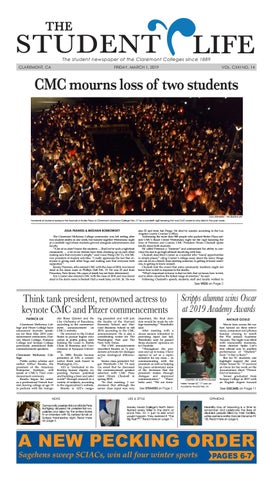
Hundreds of students surround the fountain in Butler Plaza at Claremont McKenna College Feb. 27 for a candlelit vigil honoring the two CMC students who died in the past week.
JULIA FRANKEL & MEGHAN BOBROWSKY The Claremont McKenna College community was left reeling after two student deaths in one week, but banded together Wednesday night at a candlelit vigil where students grieved alongside administrators and faculty. “A lot of us didn’t know the students … [but] we’re such a tight-knit community … a lot of my friends have been checking up on each other making sure that everyone’s alright,” said Grace Wang CM ’21, ASCMC vice president of student activities. “I really appreciate the fact that everyone is giving each other hugs and making sure that everyone feels supported.” Jeremy Peterson, who entered CMC with the class of 2018, was found dead in his dorm room in Phillips Hall Feb. 19. He was 22 and from Princeton, New Jersey. His cause of death has not been determined. Eric Cramer also entered CMC with the class of 2018 and was found dead in his dorm room in Beckett Hall a week later, on Feb. 26. He was
also 22 and from San Diego. He died by suicide, according to the Los Angeles County Coroner’s Office. Addressing the more than 500 people who packed Butler Plaza outside CMC’s Bauer Center Wednesday night for the vigil honoring the lives of Peterson and Cramer, CMC President Hiram Chodosh spoke fondly about both students. He called Peterson a “dreamer” and commended his ability to convince his dad to go high-altitude skydiving with him. Chodosh described Cramer as a scientist who “found opportunities in simple places,” citing Cramer’s college essay about the many things one can do on a bench, from meeting someone, to getting to know someone, to getting to know oneself. Chodosh told the crowd that some community members might not know how to feel in response to the deaths. “What’s important to know is that we feel, that we know how to feel, and to allow ourselves the fullest range of emotion,” he said. Following Chodosh’s speech, students, staff and faculty walked in
See VIGIL on Page 2
Think tank president, renowned actress to keynote CMC and Pitzer commencements PATRICK LIU Claremont McKenna College and Pitzer College have announced keynote speakers for their May 2019 commencement ceremonies. Harvey Mudd College, Pomona College and Scripps College previously announced their commencement speakers. Claremont McKenna College Public policy scholar and author Arthur Brooks, the president of the American Enterprise Institute, will speak at CMC’s 72nd commencement ceremony. Brooks began his career as a professional French hornist, leaving college at age 19 to perform with the Annap-
olis Brass Quintet and the City Orchestra of Barcelona, according to the commencement announcement on CMC’s website. He returned to the United States to pursue higher education in public policy, later holding the Louis A. Bantle Chair of Business and Government at Syracuse University. In 2009, Brooks became president of AEI, a conservative think tank based in Washington, D.C. AEI is “dedicated to defending human dignity, expanding human potential and building a freer and safer world” through research in a variety of subjects, according to the organization’s website. Brooks is AEI’s outgo-
NEWS Democratic presidential candidate Pete Buttigieg dicussed his presidential run, policies and vision for the United States in an interview with TSL before his talk at Scripps Wednesday night. Read more on page 2.
ing president and will join the faculty of the Harvard Kennedy School and Harvard Business School in fall 2019, according to the CMC announcement. He is also a contributing writer for The Washington Post and The New York Times. The CMC announcement described Brooks as “a passionate advocate for dialogue across ideological differences.” Senior class president Edgar Warnholtz CM ’19 said via email that he discussed the commencement speaker selection with CMC President Hiram Chodosh in spring 2018. “In that meeting, I understood that although the senior class input was very
important, the final decision would be made by college leadership,” Warnholtz said. After meeting with a dozen seniors interested in providing input last fall, Warnholtz said he passed those students’ opinions on to Chodosh. “Throughout the process and up to today, I have aspired to act as a representative for my class ... in communicating with the president as well as helping my peers understand some of the decisions that the president makes through dialogue and improved communication,” Warnholtz said. “We are fortuSee SPEAKERS on Page 3
Scripps alumna wins Oscar at 2019 Academy Awards NATALIE GOULD
COURTESY OF SCRIPPS COLLEGE
Helen Yenser SC ’17 won an Academy Award Feb. 24.
LIFE & STYLE Harvey Mudd College’s North Dorm flushed every toilet in the dorm at once Feb. 22 — just to see what would happen. They dubbed it “The Big Flush™.” Read more on page 11.
Movie fans across the nation turned on their televisions, computers and phones Sunday evening to watch the 91st annual Academy Awards. The night was filled with memorable moments, from director Spike Lee’s first official win to another performance of “Shallow” from “A Star is Born.” But for 5C students, one highlight topped the rest: Helen Yenser SC ’17 received an Oscar for her work on the documentary short “Period. End of Sentence.” Yenser graduated from Scripps College in 2017 with an English degree focused
See OSCARS on Page 11
OPINIONS Disability Day of Mourning is a time to remember and celebrate the lives of disabled people killed by their families, writes opinions editor Donnie Denome PZ ‘20. Read more on page 5.
A NEW PECKING ORDER Sagehens sweep SCIACs, win all four winter sports
PAGES 6-7
NEWS THE STUDENT LIFE
PAGE 2
Recount names 5C student as state Democratic delegate PEI PEI BARTH WU One month after accepting a narrow, 13-vote defeat in the California Democratic Party’s Assembly District Election Meetings, Shayok Chakraborty PO ’19 received an onslaught of phone notifications Monday informing him that he had actually won the election in a recount. Chakraborty didn’t know a recount was happening until he was informed of his victory, he said. “The party resources manager [at the California Democratic Party] basically just started recounting the ballots herself,” he said. “There were some [vote numbers] that were just really wildly off.” Chakraborty mounted a last-minute campaign for the ADEMs seat in January. Now, he’ll represent Democrats in California’s 41st Assembly District by voting on issues at the California Democratic Party Convention, including which candidates the party endorse for state office. ADEMs have no governing power and are not state officials. Chakraborty learned about ADEMs in December 2018 when Sam Horowitz PZ ’20, the president of Democrats of the Claremont Colleges, reached out to the College Community Action Network — a progressive student organization Chakraborty founded — about the election. But he had no plans of running until Karen May, a community organizer, contacted him about running to increase representation from Claremont and Upland in the ADEMs for California’s 41st District. “Historically what we’ve seen in [this assembly district] is almost ... all of the delegates have been from Pasadena,” Chakraborty said. He ran to change that and bring new voices to the California Democratic Party, he said. Chakraborty joined May as part of the East 41 Forward Slate, an alliance of five progressive ADEM candidates from the Inland Valley who
advocated for affordable housing policies, universal healthcare coverage, increasing funding for public education and addressing climate change, according to their Facebook page. CCAN mobilized to support Chakraborty and East 41 Forward’s campaign in just one week. The club spread information on Facebook and messaged so many people that Facebook shut down Chakraborty’s account the day before the election, mistaking his account for a spam bot, he said. At the polls, CCAN went down the line of people waiting to vote, trying to convince people to vote for East 41 Forward candidates. The first tally of the ballots showed that Chakraborty had lost by just 13 votes out of a total of 769, he said. Sometime in the last month, California Democratic Party Resources Manager Unique Wilson received a request for a vote recount from District 41, Chakraborty said. While counting the ballots, Wilson discovered sporadic discrepancies, including differences in hundreds of ballots, Chakraborty said. The recount moved Chakraborty, formerly the ninth place finisher, up to seventh place, securing him a seat by a six-vote margin, according to a final ballot tally. “I don’t think [the miscounting is] necessarily a conspiracy or foul-play,” he said. “It’s not clear who benefited in a lot of ways.” As a delegate, Chakraborty plans to bring student voices from the 5Cs to the state Democratic Party. Before the convention, CCAN plans to hold a forum to collect student opinions, which Chakraborty will bring to the party. “This is not just about a set of positions, this is about representing this community,” Chakraborty said. “[East 41 Forward] specifically ran on opening the party up to a different region, a different set of groups and experiences.”
Pitzer Student Senate pushes to make all bathrooms gender-neutral The Pitzer College Student Senate passed a resolution in support of re-designating all toilet facilities on Pitzer College’s campus as gender-neutral Feb. 3. Resolution 55-R-06, which “expresses support for and strongly urges the administration of Pitzer College to designate the all gender binary toilet facilities as being gender-neutral,” was approved with a 23-2 vote. There are 54 public bathrooms on campus. Thirty are already designated as gender-neutral facilities — and only one has multiple stalls, according to the resolution. Vice President of Student Affairs Mike Segawa said he is not sure whether the proposal is feasible in terms of costs, because it would be an unplanned renovation, but he said that “on a philosophical level, I think it’s terrific.” —Elinor Aspegren ASCMC increases student fee ASCMC increased its annual student fee by $40, from $245 to $285, at its Executive Board meeting Feb. 24. The fee increase is the first in over 10 years, and will raise
approximately $50,000 annually in additional revenue. — Marc Rod Pomona College to name new art museum after $15 million donor Pomona College will name its still-under-construction art museum the Benton Museum of Art, in honor of Trustee Janet Inskeep Benton PO ’79 , who donated $15 million of the $44 million necessary for museum construction, according to Wednesday’s press release. “Art is a passion of mine as an adult, something I didn’t explore fully as a student, and selfishly I’d love kids today to have more of an opportunity,” Benton told the Los Angeles Times. “My hope is that the new museum creates a stimulating environment for students to explore and engage with art in a deeply meaningful way,” she said in the press release. Pomona plans to begin moving its collection from the existing museum into the new building this fall, according to the Times. The new museum will also host works from multiple notable alumni, according to the press release. The new building is just one major coming shakeup for Pomona’s art museum.
MARCH 1, 2019
Dean of the College Audrey Bilger announced that Kathleen Howe, the longtime museum director, will retire in September, before the museum opens. Pomona will begin a national search for a new director in a month, Howe told the Times. — Marc Rod Pitzer Senate fills vacant positions Multiple students’ electronic devices were stolen from Pomona College’s Harwood Hall Monday. There were three cases of burglary and one case of grand theft — all of which remain open and have been forwarded to the Claremont Police Department, according to Campus Safety’s daily crime logs. Luke Meares PO ’21 reported his camera and lenses stolen, which totaled $2,600. Shaheed Muhammad PO ’21 had his iPad and wallet stolen after leaving his door unlocked for three minutes to go to the bathroom. Two individuals were arrested for possession of burglary tools and attempted theft. One of those individuals was also arrested for trespassing. — Laney Pope
Correction An earlier version of the Feb. 22 article about the Pomona Advocates program incorrectly stated that “one to five percent” of McCarthy’s decision had to do with the advocates being in violation of the Clery Act. She said instead that it had to do with a lack of training and “Clery issues.” Additionally, this article incorrectly stated that the Clery Center told McCarthy that advocates needed to undergo training with Project Sister. Instead, McCarthy said the Clery Center “communicated to us in a very clear way” through a published guidance that the advocates needed to undergo training to avoid being mandatory reporters. TSL regrets these errors.
Presidential candidate Pete Buttigieg brings his campaign to Scripps MARC ROD Pete Buttigieg, the mayor of a small midwestern city, sees many similarities between himself and 5C students, and he wants their votes for the U.S. presidency. The South Bend, Indiana mayor who recently entered the 2020 Democratic presidential primary came to Scripps College Wednesday to talk with journalist and Snapchat news head Peter Hamby. Although Buttigieg was there to talk about his new book, “Shortest Way Home,” his longshot presidential aspirations dominated nearly all of the discussion. Buttigieg stands out from the rest of the growing Democratic field; he’s just 37 years old, which would making him the youngest president ever, if elected. Buttigieg is openly gay, and has more military service under his belt than any president since George H.W. Bush. His highest elected office, however, is the mayor of South Bend, a city of around
102,000, according to the U.S. Census Bureau. In an interview with TSL prior to the talk, Buttigieg said his experiences as mayor, which include crafting policy proposals, running an administration and bringing people together during crises, have prepared him for the presidency. He said some candidates, including longtime senators, do not have such experience. Buttigieg said 5C students should vote for him because, like them, he has “a lot of stake in the decisions” that are currently being made by the federal government, and he does not share the attitude that he sees in many current politicians that the “consequences [of their policies] are someone else’s problem.” The United States needs to “make deep change in its political and economic systems” and must be willing to “entertain structural solutions,” Buttigieg added. “We need to build up a new sense of what freedom means, not just freedom from regulation, but freedom to live the life of one’s
choosing supported by good policy.” Buttigieg proposed a number of seismic changes to the U.S. political system, including abolishing the electoral college, granting statehood to Washington, D.C. and Puerto Rico and examining the setup of the Supreme Court — a reference to comments last week that he is open to the idea of adding seats to the nation’s highest court. Buttigieg also wants to address climate change as a security issue and an economic opportunity for sustainable industries, implement a “Medicare for all who want it” program as a step toward universal health care and re-evaluate U.S. standards for the use of force abroad. Buttigieg expressed empathy for students struggling with student loan debts, which he said he has dealt with as well. Buttigieg graduated from Harvard in 2004, according to the school’s Institute of Politics. “I understand what it means to be living with debt,”
he said. He proposed a plan for helping students address their debt and increasing the affordability of education, including allowing students to refinance their loans and expanding the Public Service Loan Forgiveness Program to “make sure the cost is not completely on the individual.” Buttigieg currently sits at a severe disadvantage in the Democratic primary. Currently, more than half of Democrats say they haven’t heard of him, and he had the support of just 1 percent of the party in a Feb. 24 Morning Consult poll. Until this week, he had been stuck at 0 percent. Buttigieg seemed undeterred, however, and said he plans to continue campaigning, focusing on the goal of gaining 65,000 unique donors to qualify for the Democratic debates beginning in June. “You start at zero and hope to go north,” he said. He added that he has been getting “good buzz” at speaking engagements and that it is still “very early” in the campaign.
Buttigieg also said his previous low profile could be an advantage that allows him to define his own image and campaign, rather than have it defined by others. “People want something totally new,” he said. To read the full article, go to tsl. news.
ELINOR ASPEGREN • THE STUDENT LIFE
South Bend, Indiana Mayor Pete Buttigieg discusses his presidential run ahead of his talk at Scripps College Feb. 27.
5C health care plan reduces coverage, increases costs in 2018-19 year JENSEN STEADY AND JASPER DAVIDOFF Costs are up and coverage is down for 5C students on the consortium’s Student Health Insurance Plan, a result of lower enrollment and higher usage rates. Starting this academic year, those on SHIP have to pay out-of-pocket to visit doctors off-campus who are outside the network of Aetna, SHIP’s health care provider. This is a significant change from SHIP’s previous policy, which used to cover 90 percent of those costs, according to plan details on the Pomona College student health website. SHIP cost $2,356 per student for the 2018-19 academic year, a 12.5 percent increase from last year’s price. Sharon Basso, Claremont McKenna College’s vice president of student affairs, said via email that the decrease in coverage was necessary to keep the program affordable; keeping the same coverage plan would have increased student premiums by 50 percent instead, which was “not a viable option for most students,” Basso said. SHIP premiums rose because of low enrollment — only 25 percent of 5C students participate in SHIP — and high rates of use among those enrolled in the plan, among other factors, according to Basso. The 5Cs’ insurance broker, Relation Insurance Services, re-evaluates coverage and alternative options annually, Basso said. Health insurance is mandatory for all 5C students. Students not enrolled in their own insurance policy or who do not provide proof-of-enrollment of that policy are automatically enrolled in SHIP. Following negotiations with Aetna, the plan also decreased the amount it pays for in-network medical charges after the deductible — the amount the consumer pays before the health care plan will start paying — from 100 percent to 80 percent, according to the 2017-18 and 2018-19 plan snapshots. In addition, patients’ out-of-pocket maximum for in-network coverage, which is the maximum cost a student would pay for their care, was increased from $5,000 to $7,350. No student on SHIP will have to pay any more money for in-network care if they have already spent $7,350 during the year. The new plan also covers fewer types of prescription drugs. The old plan covered 153 categories of drugs, while the new one covers 139 different categories. Drugs such as antiseptics, disinfectants and folic acid vitamins are no longer covered, and students must pay out-of-pocket for them. Many students rely on SHIP’s out-of-network coverage. Arielle Davis PZ ’18 said it was extremely helpful in treating her chronic condition. “When I was on last year’s version on the plan, I found the coverage to be fantastic, and my co-payments were minimal and reasonable,” she said.
VIGIL: ASCMC cancels weekend Wedding Party Continued from Page 1 silence across campus to the Athenaeum, where Peterson’s father, girlfriend and others spoke to a crowded room. Jason Peterson CM ’85, Jeremy’s dad, said his son gave him many gifts, including bringing adventure to his life. “He had me do so many things that I might not have done otherwise,” Jason Peterson said, encouraging students to think about all the positive things both Jeremy and Cramer had done. Madeline McCluskey SC ’21, Peterson’s girlfriend, described him as “such an amaz-
ing person” who always tried to make her feel better when she was upset. “Jeremy wouldn’t want us to be sad,” she said. In an email sent to faculty and staff Tuesday, the evening of Cramer’s death, Dean of the Faculty Peter Uvin said Wednesday classes would not be canceled, but attendance was not mandatory. Uvin said in his email that CMC debated canceling classes, but decided against it, because “everyone deals with stress and trauma in different ways, and some may seek the normalcy of a regular class or work schedule while others
may wish to take time to process their emotions.” Wang said ASCMC asked CMC’s administration to cancel classes, but was not successful. “ASCMC believes that we should take a pause and reflect and process everything,” Wang said. “The school believes that people have different ways to cope with grief.” Wang said only three or four students attended her class Wednesday. While her own professors were accommodating, Wang said many of her friends took midterms and had papers due that day. “The email yesterday gave a lot of discretion to the profes-
sors,” Wang said. Some CMC students expressed difficulty carrying on as usual. “The first loss was difficult, but getting that second email … was excruciating, and things got really heavy,” Chandlyr Denaro CM ’21 said. “I’ve noticed I’ve gotten a bit distracted, or found it hard to focus in classes, and the campus vibe and air has felt kind of somber.” Others said they were grateful for the support of fellow students. “The losses of our own bring shock and grief,” ASCMC President Maya Love said via mes-
sage, thanking student governments across the consortium for their support. “At the same time, though, I am proud of my colleagues and board as I have seen such compassion and [an outpouring] of support.” ASCMC canceled a Thursday party and Wedding Party, which was scheduled for Saturday night. All students who bought Wedding Party tickets will be refunded. “We felt that holding a giant party that celebrates love and contains alcohol in the middle of campus is just not right to do this weekend,” Wang said. ASCMC instead hosted an event in Marks Lounge Thurs-
day from 8 to 11 p.m. with board games, coloring supplies and a free food truck. A community gathering with the Dean of Students staff, the Resident Adviser team and the College Programming Board in the Athenaeum is set for Saturday from 7 to 10 p.m. For students across the 5Cs, Monsour Counseling and Psychological Services is located in the Tranquada Student Services Center, while an on-call therapist is reachable 24/7 for after-hours support at 909-6218202. Staff and faculty can call the 24/7 Employee Assistance Program number at 800-2345465.
NEWS THE STUDENT LIFE
MARCH 1, 2019
In Memoriam: professor emeritus Stuart McConnell HAIDEE CLAUER Pitzer College history professor emeritus Stuart “Stu” McConnell, an integral part of the college’s faculty for more than three decades, died Feb. 14 surrounded by family following a multi-year “courageous struggle to recover from a major illness,” Pitzer President Melvin Oliver told the community in a message on Pitzer ’s website. McConnell received his bachelor ’s degree from the University of Michigan, and master ’s degree and doctorate from Johns Hopkins University. He was an expert in American social and cultural history, labor history, Victoriana, nationalism and media history according to his staff profile. He also specialized in the Civil War and Reconstruction, and wrote a book entitled “Glorious Contentment: The Grand Army of the Republic, 1865-1900,” which the Library Journal acclaimed as “provocative social history.” Scripps College history professor Julia Liss, who taught a U.S. survey history course with McConnell, praised him as “patient, smart and demanding.” “[His] retirement celebration in October showed, in full force, how central teaching was to him and the impact he made on his students and colleagues.” she said. “Although his death is incredibly sad, he was able to provide a legacy through his students. No teacher could ask for anything more.” During his time at Pitzer, McConnell was awarded several federally funded Teaching American History grants, which brought elementary and high school teachers to Pitzer during summers to prepare them to teach their students, according to Tomás F. Summers Sandoval, Jr., an associate professor of history and chicana/o latina/o studies at Pomona College. “Stu’s love of history, of teaching and of working with others were all on display during those summers,” Sandoval said. McConnell was known for his thoughtful approach to teaching and critiquing writing, as well as creative assignments and events, according to Wendy Cheng, chair of Scripps’ American Studies Department, and a friend of McConnell. The two taught an introductory American studies course together in spring 2017. Jade Finlinson PZ ’15 was a student and advisee of McConnell. She is planning to pursue a doctorate
Scripps students evacuated after toilets flood dorm rooms HAIDEE CLAUER
COURTESY OF PITZER COLLEGE
Pitzer professor Stuart McConnell, who worked at the college for more than 30 years, died Feb. 14.
in history while continuing research she started under McConnell’s guidance. “I will always have Stu as a reader in my mind, and I will miss having his spirit and intelligence as a guide in my life,” she said. McConnell was also deeply dedicated to the discipline of history. In a video following his retirement promoting the “Stu Fund” for the department’s growth and development, McConnell said he “loved every minute of” his 30 years at Pitzer. Pitzer history and anthropology professor Dan Segal said McConnell was dedicated to promoting justice and including marginalized narratives in his courses. “Moreover, over the very decades when wealth and income inequality increased in the U.S., Stu insisted on teaching labor history, despite its unpopularity in those years,” Segal said. “Stu was a dedicated teacher, a gifted crafter of prose, a nuanced thinker and a person of the greatest decency. The world is different without Stu — in the worst of ways.” McConnell worked with the founding faculty of Pitzer, and helped to shape the history department, said Andre Wakefield, a Pitzer history professor. “He was really dedicated to the mission of the college,” Wakefield said. “He was a real Pitzer patriot.” Students characterized McConnell as a unique professor. “You don’t replace him. You just hope that others continue to honor him by doing their best impression,” Peter Cohen PZ ’92 said in a 2018 Pitzer College Magazine feature celebrating his retirement. Adam Taslitz PO ’21 studied with McConnell during his final semester teaching in fall 2018.
PAGE 3
About 35 Scripps College students living in the connected Frankel and Routt residence halls and the Senior Routt apartments were evacuated and moved to temporary housing for a week after two toilets flooded the dorms early in the morning of Feb. 23, according to administrators and students. A third-floor toilet in Frankel began gushing water into surrounding suites around 8:30 a.m., causing the fire alarm to go off twice within 15 minutes, according to Lucie Wharton-Moeur SC ’21, who lives in one of the affected suites. Students shuffled outside and returned to their rooms after the alarm was turned off, Wharton-Moeur said. But nearly three hours later, water began flooding out of Wharton-Moeur’s toilet in Routt, and she and her hallmates were evacuated.
Josh Reeder, Scripps’ director of facilities, said via email that the flooding was caused by a broken gasket, a “component of the fresh water supply line to the toilet.” Scripps’ Director of Residential Life Brenda Ice told students via email that they would be placed in temporary housing until this weekend, describing the problem as “more extensive than initially suspected.” Details of the temporary housing were not specified in the email, but described as “an open bed on campus,” in subsequent emails, Wharton-Moeur said. She’s currently staying with a friend. Justine Iwata SC ’21 lives in one of the evacuated suites in Routt, and said the carpet in her suite and common room was removed, but “no property has been significantly damaged.” All water in the Frankel and Routt Halls and Senior Routt apartments was turned back on for unaffected residents as of the afternoon of Feb. 23, Ice told students.
TALIA BERNSTEIN • THE STUDENT LIFE
Scripps College resdience halls flooded this week after toilets overflowed due to a blown gasket.
SPEAKERS: Cox ‘represented Pitzer’s core values’ Continued from Page 1 nate to have direct communication with President Chodosh on matters like these.” CMC spokesperson Peter Hong did not comment before press time. Brooks visited CMC’s Athenaeum in 2017 for the Res Publica Society Speaker Series. He spoke about capitalism and materialism at the “Abundance without Attachment” in early February. Pitzer College Transgender actress, pro-
ducer and advocate Laverne Cox will keynote Pitzer’s 55th commencement ceremony. Cox is a two-time Emmy-nominated actress and Emmy-winning producer, according to Pitzer’s announcement. She rose to prominence with her portrayal of inmate Sophia Burset in the critically acclaimed Netflix series “Orange Is the New Black.” “Cox is the first trans woman of color to have a leading role on a mainstream scripted television show and the first openly trans person to be nominated for an Emmy in an acting category,”
the announcement said. “She is also the first trans woman of color to produce and star in her own television show, VH1’s ‘TRANSForm Me,’ which was nominated for a GLAAD Media Award.” Pitzer’s graduating class traditionally selects its commencement speaker. Pitzer Student Senate and Senior Class Council member Claire Wengrod PZ ’19 said the Senior Class Council sent out a Google form in October 2018 asking Pitzer seniors to nominate speakers. From there, the council narrowed down a list of 25 choices to five realistic and
COURTESY OF AEI
popular candidates. The senior class then voted for Cox. “[The council] also felt that she represented Pitzer’s core values really strongly, especially social responsibility,” Wengrod said. In 2014, Cox received GLAAD’s Stephen F. Kolzak Award for her work promoting LGBTQ equality. The announcement on Pitzer’s website also described Cox as “a renowned speaker who encourages her audience to live more authentically.” Cox retweeted Pitzer’s announcement about her commencement speech, adding, “Can’t wait to see you all!”
COURTESY OF MELISSA HAMBURG
Left: Arthur Brooks, president of the American Enterprise Institute, a conservative D.C. think tank, will speak at the 2019 Claremont McKenna College commencement. Right: Pitzer College’s 2019 commencement speaker will be Laverne Cox, a transgender activist, award-winning producer and actress best known for her role in “Orange Is The New Black.”
Pitzer administrators hope to revamp Residential Hall Council program for next year SIENA SWIFT After Pitzer College’s Residential Hall Council program became inactive for the 2018-2019 academic year, administrators are attempting to revive and revamp the program. Previously, the campus was split into three blocs of residence halls, each with its own council. RHCs put on events for their halls and addressed student concerns about amenities in the residences. But they have been plagued by issues since as early as 2010, according to Kirsten Carrier, Pitzer’s associate dean of students. “It was obvious that we were not having as many students invest and be interested in being a part of our hall councils,” Carrier said. “It wasn’t something that they found either rewarding or necessary or exciting. Recruitment was always a problem.” Only six people expressed interest in running for the Hall Council for the 20182019 school year according to Carrier, which was not enough to hold elections.
Clint Isom PZ ’20, Pitzer Student Senate’s vice president of external affairs, said Residential Life administrators told him they chose to suspend the program for other reasons. “They told me that they didn’t implement [the RHCs] because they wanted to see what would happen if they didn’t,” he said. “I know Res Life has the capacity and resources to facilitate that and I do know they could set those Hall Councils up if they felt so inclined.”
Looking forward to next year, Carrier and Desiree Ross, the residence director for Pitzer, Atherton and Sanborn Halls, suggested a new hall council model in a presentation to Student Senate Feb. 17, according to Senate minutes. The new model would combine the three councils into one RHC with a budget of $5,000. Carrier and Ross’ proposed model is taken from the national Residence Hall Association model used at various colleges across the
country. Isom said he supported the model, but that the responsibility is on Residence Life to make the program work. Other students agreed, but first-year class representative Keely Nguyen PZ ’22 disagreed that an RHA could work at Pitzer. “The new model would theoretically work for a university or a large campus but it is unrealistic that Pitzer will successful achieve the new model,” she said. “I believe that the new proposal
JUSTIN SLEPPY • THE STUDENT LIFE
Pitzer administrators are attempting to revive the Residence Hall Council program after the program was inactive this year due to low interest.
is a waste of resources because it is a revamp of what has been dead.” Nguyen described Carrier and Ross’ proposal as “idealistic” and their $5,000 budget request as too high. In response to the program’s cancellation, Carrier said she hasn’t received any student complaints about the lack of RHCs this year. “I don’t believe people saw them as super necessary or functional,” Carrier said. However, both Isom and Nguyen said they have received student questions about the lack of RHCs this year. Nguyen also said the lack of RHCs has prevented students from making changes in their residence halls such as acquiring funding for cooking utilities. Isom said the changes particularly disadvantaged first years, who were generally active in RHCs. Carrier envisions the future RHC as a way for students to advocate for change or renovations within their specific residential communities, including in dining halls, as well as allocating
spaces for affinity groups. “I really don’t see [RHCs] as a programming body, I see them as an advocacy group,” Carrier said. “We have plenty of groups on campus that do programming and I’d much rather have this group focused on what needs to be improved.” Carrier and Isom both agree it is important to have RHCs for the 2019-2020 year. Isom said that if administrators are unable to set up a program, Pitzer Senate may do so. “If it’s not up and running next year, Senate is going to probably look into forming Hall Councils again and just having those managed by Senate,” he said. “I don’t think that’s Senate job necessarily but it is a disservice to the student body not to have some type of Hall Councils, especially for the freshmen.” Most of the 5Cs do not have residence hall governance structures, but Harvey Mudd College has Residence Hall presidents who are members of ASHMC, lead hall meetings and coordinate activities and services for the halls.
OPINIONS THE STUDENT LIFE
PAGE 4
Don’t judge people for using medication to treat mental illness
THE STUDENT LIFE KELLEN BROWNING, Editor-in-Chief MEGHAN BOBROWSKY, Managing Editor HANK SNOWDON, Managing Editor MARC ROD, News Editor LANEY POPE, News Editor JULIA FRANKEL, News Associate NATALIE GOULD, Life & Style Editor MABEL LUI, Life & Style Editor SCHUYLER MITCHELL, Life & Style Associate DONNIE DENOME, Opinions Editor ANIKKA VILLEGAS, Opinions Editor TORREY HART, Sports Editor NOAH SHAPIRO, Sports Editor DELANEY HARTMANN, Sports Associate
EAMON MORRIS CASSIE WANG, Production Editor JAMES KARSTEN, Senior Design Editor ANNE JANG, News Designer HELENA ONG, Life & Style Designer DAPHNE YANG, Opinions Designer JILLIAN BATIUK, Sports Designer OLIVIA TRUESDALE, Copy Chief NINA POTISCHMAN, Graphics Editor CHLOE ORTIZ, News Photo Editor TALIA BERNSTEIN, Life & Style Photo Editor AMY BEST, Sports Photo Editor
The Student Life, the oldest college newspaper in Southern California, is produced and managed by students of the Claremont Colleges and published weekly. The Editorial Board consists of the editor-in-chief and two managing editors. Aside from the editorial, the views expressed in the opinions section do not necessarily reflect the views of The Student Life. E-mail Letters, Questions, and Concerns to editor@tsl.news. Email tips to liaison@tsl.news; email advertising inquiries to ads@tsl.news and print subscription inquiries to subscriptions@tsl.news. TSL welcomes letters to the editor, which can be submitted by mail, email, or in person at Walker Hall 101 of Pomona College. Letters must be under 400 words (although when an issue is particularly salient, we reserve the right to allow letters to run at a longer length) and submitted by 4 p.m. Wednesday of the week of publication. We reserve the right to decline publication of submitted letters and will not accept anonymous letters, letters containing profanity, factually inaccurate letters, or letters making personal attacks. TSL also reserves the right to edit for spelling, punctuation and grammar. Letters may be signed by a maximum of three people. All letters become the property of TSL and may not be reprinted without prior permission from the Editorial Board. Singles copies of TSL are free and may be obtained at news stands around campus. Multiple copies may be purchased for $0.47 per copy with prior approval by contacting editor@tsl.news. Newspaper theft is a crime; perpetrators may be subject to disciplinary action as well as civil and/or criminal prosecution.
EDITORIAL BOARD
As 5Cs mourn, lean on those around you
Over the past week and a half, the death of two Claremont McKenna College students has shaken the 5C community to its core. As journalists — and more importantly, student journalists — on these campuses, we have the responsibility to inform our community about what is happening around us. With these tragedies, and any other event on campus, the public has a right to know the truth and how it may affect them. Nothing about reporting this tragic news has been fun. As students and members of the 5C community, we mourn alongside our peers. We, too, feel deeply for those suffering from these events. And we stand in solidarity with those directly affected. That being said, we still have a job to do — a job we take very seriously. We cover important stories, whether they’re happy or sad, serious or lighthearted, affect all students or just a few.
While it’s difficult to cover losing two of our own, it’s something we’re obligated to do. One of our missions is to represent student voices. Not doing so would be a disservice to our readers and journalism in general. Reporting on these tragic events is how we serve our community in trying times. Not only do we cover the tragedies, we also highlight how the community responds. This week, our front page story shows how the Claremont McKenna College community is rallying to support one another. We wanted to devote the main section of our newspaper to telling this story — to reflect how 5C students, and specifically CMC students, have come together during this hard time. The resilience of the community has amazed us, and it reflects the communal spirit of the 5Cs. When tragedies like these occur, it hits the Claremont Colleges especially hard,
given how small and connected they are. Many people know each other, and during hard times, it can be difficult to carry on. However, that closeness also gives us our greatest strength. Nowhere else is there a college community as connected and involved in each other ’s lives as we are here. In these terrible moments, we have the opportunity to lean on those around us — friends, administrators, professors, RAs, student governments and student leaders. No matter where you turn at the 5Cs, people are available to support and care for you. We urge everyone to lean on the people around you. Hug your friends, tell them you love them and find those who need support. There is a wealth of resources around us everyday — please, make use of them.
KenKen In a 4x4 KenKen, the numbers 1-4 will appear in each row and column exactly once. To solve, fill in according to the operation in the upper left-hand corner of each bolded area. For example, the bolded area with 5+ will include two numbers that add to 5.
THEA BAROVICK • THE STUDENT LIFE
LAST WEEK’S ANSWERS
MARCH 1, 2019
I have an alarm set for 9 a.m. every morning, and it isn’t to wake me up. It’s to remind me to take two pills, a 20-milligram capsule and a 10-milligram capsule. It’s funny that I still have trouble remembering — I’ve been on a similar cocktail since I was 12 years old. I know that I shouldn’t be ashamed of it. The meds are vital for stabilizing my anxiety and allowing me to function. Yet for some reason, particularly at the 5Cs, I still feel like I’m doing something taboo. Students at the 5Cs have a certain degree of awareness about mental illness. There isn’t a culture of shaming or a widespread belief that mental illness isn’t a real illness. For the most part, people are understanding — until you mention that you take medication. The first response is usually a barrage of questions. Have you ever tried going off them? Have you tried meditation? Have you tried aromatherapy? Have you tried praying? Have you tried going vegan? Trust me, friends, if they’re on medication, they’ve tried everything. It just didn’t work for them. Even if they haven’t explored holistic alternatives, people with mental illness don’t owe it to anyone to try different “treatments” — especially when another one is already working just fine.
Most antidepressants and anti-anxiety medications are called selective serotonin reuptake inhibitors. Essentially, these bad boys prevent the brain from throwing away a lot of the serotonin it produces (a lack of which is one of the major causes of depression). Yes, these medications alter your brain chemistry from what it was before you started taking them. But it’s altering the brain chemistry to work how it should, effectively and efficiently, without overabundances or shortages of certain chemicals. No one’s poisoning themselves by using antidepressants or anti-anxiety medications as prescribed. The long-term side effects of antidepressants are fairly hazy. What we do know from the self-reports on side effects is that they’re minor, with the most common being sexual arousal problems — the same problems associated with long-term use of marijuana. Even if there were enough evidence to suggest long-term negative physical effects of psychiatric medications, many people with mental illnesses would rather be physically unwell to some degree than unable to function at all. While some medications can cause debilitating side effects, the way the body responds to them varies from person to person and from medication to medication. There’s a contradiction at the 5Cs. You can loudly announce in a dining hall that you dropped
acid at Joshua Tree over the weekend, and no one will bat an eye. But if you say you’re on antidepressants, there’s a sense of judgment. Many people seem to think you’re poisoning your body, or that you’re leaning on a crutch that you can live without. Sometimes I think that’s true. I want to be off this medication someday. In a sense, it is a crutch. Still, no one asks people with broken legs if they’ve considered changing their diet. At this moment in my life, my prescription is something I need to function. Quite frankly, people who suggest others stop taking their medications and start trying something else are endangering the health of their peers. There’s little to no judgment of people who recreationally use drugs such as marijuana, shrooms or acid. But there’s a general sense of displeasure and doubt surrounding people who medicate legally to treat their mental illnesses. It seems that the second something becomes labeled as a medication, its use becomes suspect. Mental health needs to be destigmatized further, of course. But destigmatization does not make everyone with an opinion and a smile into a mental health professional with the right to provide alternative treatment solutions to those living with mental illness. Eamon Morris PZ ’22 is from Orange, California. His sister takes cool photos. Follow her on Instagram at @shotsbymag.
CATHERINE WARD • THE STUDENT LIFE
Give Bernie Sanders a chance CHRIS AGARD Sen. Bernie Sanders, I-Vt., recently joined the growing pool of candidates vying for the 2020 Democratic nomination for president. His decision has been met with its fair share of criticism. Some people opposed to Sanders’ campaign believe he is acting unreasonably and irresponsibly. I’ve seen journalists and students alike express concerns about his age, progressive policies and aptitude for generating polarization within his own party. During the 2016 presidential election, I was 17 years old and ineligible to vote. Nonetheless, I was enraptured by Sanders’ campaign. It was energized, and excited millions of young Americans. Rather than feeling obligated to support Sanders, voters were enthusiastic and believed in his message. The momentum Sanders captured three years ago remains, and is arguably stronger now. Within the first 24 hours of his announcement, the Sanders’ campaign raised $6 million. This figure alone is enough proof that he’s going to be a serious contender. T h e r e ’s l e g i t i m a c y t o Sanders’ popularity. His campaign was driven by grassroots efforts, addressing the growing inequalities in wealth that we see today in the U.S. His focus on health care, education and workers’ rights reflects a resistance to these inequities. The senator represented an alternative to the continued status quo that Hillary Clinton stood for. Many Democratic leaders
have since adopted his policy ideas and brought them to the forefront of political discourse, although this in itself is a double-edged sword. On paper, Sanders is much less unique than he was three years ago. But we have seen the faults and inconsistencies of candidates within the Democratic Party who aim to appeal to young voters. The current front-runner is arguably Sen. Kamala Harris of California, whose track record as San Francisco’s district attorney and California’s attorney general has come under intense scrutiny. Another leading Democrat, Sen. Elizabeth Warren of Massachusetts, has been the subject of much ridicule for her strange dedication to identifying with her miniscule amount of Native American ancestry. Liberal voters do not easily overlook the controversies of their leaders. It is a fine line to walk, as we should expect our politicians to always be on the side of what we believe is right. Some missteps are more forgivable than others, but all taint their reputations. That being said, a politician’s track record should be taken into account when considering how they will act if elected. Members of the Democratic Party try to find different ways to be appealingly progressive by using liberal buzzwords or youth platforms. As a voter, I find it challenging to know whether a candidate is being authentic or pandering to me. This is when their past political actions become important. What makes Sanders so valuable is his perceived au-
thenticity. In Congress, he maintains a long and proven track record that has been subject to minimal scrutiny. While it is true that he has passed less legislation than other prominent congresspeople, he has remained committed to his progressive agenda that advocates for the rights and equity of all people. Some would argue that despite his experience, he has never proven to be a true leader. But when given the opportunity, Sanders has provided leadership through powerful speech. A more substantial concern is his age — he’s 77 years old. Because of this, it is imperative that Sanders chooses a younger running mate whose policy ideas align with his and who shares his ability to engage with audiences. A final argument against Sanders is a residual one from 2016: he is too divisive of a figure. To this, I say that it is better to nominate a candidate who is divisive; it proves he has core beliefs and is not working to simply capture the votes of certain demographics. It is indicative of a vision, which is more likely to enact meaningful change than saying what he he needs to win. The 2016 election taught us that we cannot rely solely on a highly qualified candidate. The Democratic Party needs a leader who will energize those disillusioned by the current state of politics. And Sanders is that person. Chris Agard CM ’21 is from Atlanta, Georgia, and studies Philosophy, Politics and Economics. In his free time, he enjoys lauding Frank Dining Hall for its brunch, but only going once a semester.
OPINIONS MARCH 1, 2019
THE STUDENT LIFE
PAGE 5
Embracing grief, anger and hope on Disability Day of Mourning DONNIE DENOME One thousand, two hundred and eleven names. One thousand, two hundred and eleven disabled and chronically ill people who became statistics at the violent hands of others before their time — and then largely forgotten. Today, March 1, is Disability Day of Mourning. I have spent the last month planning a vigil for the 1,211 disabled people killed by their families and caregivers. The number comes from the list of names released by the Autistic Self-Advocacy Network, who have been tracking cases since 2014, although the list of deaths stretches back to the 1970s. Compared to the turnout last year, the response to my call for organizing help was amazing. While I’ve had little faith in disability allies at the 5Cs for a while now, individual contributions ranged from financial support to offers to distribute flyers to someone immediately responding when I asked for Spanish translation help with advertising. It’s so important that, at a time when abled playwrights and directors depict disabled children as puppets in plays like “All In A Row” rather than even consider casting a disabled actor and President Donald Trump’s government proposes changes that would essentially bar disabled immigrants with significant support needs from seeking citizenship, disabled people have continued community support. That begins with prosecuting and convicting people who kill disabled people, not excusing the killings. Disabled people face a multitude of problems beyond killings of members of our community. It’s still legal to pay disabled people subminimum wage, down to a pennies an hour, in sheltered workshops that teach no real usable skills, according to the Seattle Times. Twenty years after Olmstead v. L.C., a Supreme Court case that ruled that disabled people have the right to live in our communities whenever possible, rather than in separated and segregated institutions, true integration and home-and-community-based services are still not the reality. Most of all, when disabled
people try to fight against these injustices, we are too often silenced, shushed, accused of being abled outside agitators or told we’re too disabled to know what’s good for us. We’ve been at a tipping point for years now, where the killings of disabled people is the most heinous, but certainly not the only, symptom of the problem. In the fray of politics, the killings, the loss of rights, the torture goes unnoticed and unrecognized. I’ve told so many people about the Day of Mourning over the last few weeks and I hear nearly the same response from all of them: How can we live in a world where that is necessary? To quote Alice Wong, a disabled self-advocate and the founder of the Disability Visibility Project, “[Because] our lives are so easily forgotten, ignored and excluded … when we are alive, we have to fight for recognition and in death our lives are cast in stereotypes and clichés that robs us of our innate humanity.” When disabled people are viewed through the lens of stereotypes and low expectations, when we are perpetually seen as useless and drains on society, when we are only mentioned positively as inspiration porn, we cease to be unique humans and
start to be merely statistics and faceless bodies. And it’s not just the killings by family. In El Dorado Hills, California, Max Benson, a 13-year-old autistic student died after being placed in restraints at the Guiding Hands School. A preliminary investigation later found that the school had violated procedure. I have friends who knew Benson’s family. I know people, disabled and non-disabled alike, who were deeply affected by his death. Benson isn’t on the official Day of Mourning list of names. He’s not listed on the Day of Mourning website. I think he should be. Benson was supposed to be kept safe by the staff at Guiding Hands. Their violation of procedure, and neglect failed him and, ultimately, killed him. Benson died from the action and inaction of his caregivers. If we put Benson’s name on the list, though, I fear for how many more we would have to add. I am despairing. I am angry. I ache and rage for the 1,211 people listed on the Day of Mourning website and all the many more like Benson who aren’t listed because they don’t meet the criteria. But I am also hopeful. The
Actor Jussie Smollett weakens trust in media
question I got right after “how can we live in a world where that is necessary?” almost every time was “how can I help?” People volunteered money, time, art supplies, advertising help, translation assistance and emotional support. I asked for basic help organizing and received more offers than I could have imagined. I have seen how much people care. I have seen how much people want to help, even if they don’t have a direct connection to disability. I have seen how wonderful the community and our allies can be. We will hold strong together. We will fight for our rights. We will create a world where there truly is “Nothing About Us, Without Us.” --The 2019 Claremont Disability Day of Mourning Vigil will be held at the Pitzer Gold Student Center multipurpose room from 7 to 8:30 p.m. March 1. Donnie TC Denome PZ ’20, CG ’21 is a BA/MPH candidate from Sunnyvale, California. Their family’s six cats have an Instagram account @grittythekitty. To read the full version of this article, go to tsl.news.
JENNY PARK • THE STUDENT LIFE
Jasper’s Crossword: Reeling
CHRISTOPHER SALAZAR In a regrettable invocation of the post-truth political landscape, Jussie Smollett, the openly gay actor of Fox’s “Empire,” allegedly staged an assault on himself Jan. 29. The attack was said to have been orchestrated with the aid of two Nigerian brothers who posed as assailants disguised in ski masks, who issued racial and homophobic slurs to Smollett as they proceeded to pour bleach on his body and tie a noose around his neck. The barrage, as told by the now infamous performer, garnered widespread media coverage. Journalists, however, failed to defend their legitimacy when the hoax was revealed while a real anti-Semitic assault was captured on film and left unacknowledged. Here, the rise of victim culture and the notion that journalists are activists has culminated in a con that undermines journalism’s authority and the pleas of genuine victims. The gaffe is especially egregious considering that, on the same evening of Smollett’s fabrication, a Jewish man was assaulted by three unidentified people. Why this atrocity was unfit for national headlines — when antisemitism is on the rise globally — is unclear. Though, the fact that Smollett is a celebrity, and celebrities are often victimized, may have more power than hope would admit. Regardless, hate crimes have risen for three consecutive years since 2015, according to FBI reports. And it’s possible that President Donald Trump’s rhetoric is a non-trivial factor in its ascension. Yet, whether Trump is to blame is immaterial here. The salience of the present news media’s bias toward profitable reporting (read: headlines of the seemingly demonstrative and rationalizing sort) is relevant. Surely, the Smollett fiasco undermines the plight of genuine victims by shaping the collective dialogue along the contours of the boy who cried wolf parable. However, the episode also invites journalists
to keep tabs on how the story unfolds, given the discord between its origins and subsequent development. The incident, in other words, encourages prudence. But, regrettably, too many deadline artists fail to critically inquire. The effect delegitimizes an honorable profession and, to the dismay of progressive elites, ensures Trump’s re-election. That Trump has made a concerted effort to delegitimize journalism as a bastion of left-leaning, unquestioning zealots is obvious. Nevertheless, journalists, whether the majority actually lean left or be perceived to lean left, are not helping themselves or society when alleged crimes of the Smollett brand, absent the necessary evidence, too quickly rise to non-alleged status. To disregard the journalistic ethos in favor of the provocateur’s is foolish and unbecoming of an enterprise erected to nobly defend veracity, the voiceless and reign in the excesses of power. Just as soldiers are entrusted to protect their nation against foreign and domestic enemies, so too are journalists committed to guard truth against the indulgences of its adversaries, whether they’re of the embodied or abstract variety. In this regard, Smollett was an embodied antagonist given a platform because of a popular allegiance to a concept — victimhood — and the moral weight it confers. Except he wasn’t the victim, though he auditioned to become a martyr. Duped as the media was, one must wonder whether journalists are still de facto activists if their activism promulgates falsity and whether the lesson learned doesn’t sour. Still, the fortunate glimmer in this mess is how quickly the story circulated despite its seeming duplicity: there’s a growing desire for justice and progress. Nonetheless, caution is a virtue. Christopher Salazar PZ ’20 is a philosophy major from La Verne, California. He’s not one to proselytize, but he considers whiskey on the rocks sacrilege. To read the full version of this article, go to tsl.news.
Weekly Comic
JASPER DAVIDOFF • THE STUDENT LIFE
ACROSS 1. Those who celebrate Leslie Knope’s version of Valentine’s Day 5. McKellen and Somerhalder 9. Pirates’ ___ Park 12. Horse color 13. Genealogical diagram 14. Theatrical card issuer, for short 15. British behind 16. Tuned up, as a car [Best Makeup] 18. _____ the bacon 20. Choose 21. What’s under the Scripps Alumnae Field or the Pomona South Campus Athletic Field [Best Supporting Actress] 24. Five winds and four strings 25. French possessive 26. Weaving machine 28. Shows agreement 29. Giant African trees [Best Animated Short Film] 31. House freshman Ilhan 34. Simba’s wife 35. The Simpsons bartender 38. Fireside drink 40. Calling up [Best Supporting Actor] 42. Cry for more 44. Marine echo
45. Perfumed [Best Cinematography] 48. Sushi staple 49. Negations, briefly 50. Units of soap 51. “All you have to ____ stay” 52. Word between ready and go 53. One proposed “wall” material 54. Machiavellian means justification DOWN 1. Holds firmly 2. Some arteries 3. Light show elements 4. Slink (around) 5. Relationship status: “___ complicated” 6. Consist of 7. Geek 8. Quantity of seas or Cs 9. The Godfather’s Al 10. Required 11. Some new recruits 17. The Facebook ‘F’ and Twitter bird 19. Country singer McCann 22. Twelve 23. Expire, as milk 27. Niger neighbor
29. Broad brush, say 30. Bleats 31. Arctic and Indian 32. Famous Doctrine 33. Approach aggressively 35. Despicable Me creature 36. Tripping 37. Departure 39. Egyptians or Tunisians 41. Royals artist 43. And others, in a paper 46. Radio host Glass 47. Chi time 61. Enzyme add-on LAST WEEK’S ANSWERS
NINA POTISCHMAN • THE STUDENT LIFE
SPORTS PAGE 6
THE STUDENT LIFE
MARCH 1, 2019
HENS RULE
TIMOTHY LIU • THE STUDENT LIFE
Cameron Edward PO ’22 jumps into the arms of Vanessa Hsia PO ’22 following P-P’s victory in the SCIAC title game Feb. 23 at Roberts Pavilion.
Leong's dagger 3-pointer buries CMS for P-P's first ever title
HANK SNOWDON
With 46 seconds remaining in the women’s basketball SCIAC title game Feb. 23, the Pomona-Pitzer Sagehens (225, 16-2 SCIAC) were on the verge of winning the conference tournament for the first time in history, clinching a trip to the NCAA tournament and defeating archrival Claremont-Mudd-Scripps (24-3, 16-2 SCIAC). Leading by two, they needed one more bucket to ice the game. Enter Carly Leong PZ ’22. After streaking to the corner, Leong caught a skip pass from point guard Keilani Ikehara PZ ’19. With a defender in her face, the first-year guard rose up and drained a dagger three in front of her own bench. “That’s what she does,” P-P head coach Jill Pace said. “Carly has ice water in her veins.” The Athenas did everything they could to fight their way back into the game, scoring six points in the final minute, but ran out of time. When a Maya Love CM ’20 60-foot heave fell short at the buzzer, P-P erupted in celebration of the 60-57
victory. The loss snapped a 20-game win streak for CMS, which hadn’t fallen since Dec. 1, as well as a 12-game win streak in the Sixth Street rivalry dating back to 2013. “We always talk about focusing on each game,” Pace said. “This was the SCIAC Championship, so we were focusing on it being the SCIAC Championship. But it makes it a little sweeter with the rivalry to also get the win over CMS.” CMS defeated P-P twice during the regular season, 8574 Dec. 5 and 78-55 Jan. 24. The deciding factor in each contest was rebounding — the Athenas outrebounded the Sagehens 99-35 in both games combined. Determined to not allow the Athenas to control the glass, Pace said the Sagehens doubled their focus in preparation for the title game. “We learned we needed to rebound,” she said. “Rebounding was something we really emphasized in practice.” While CMS finished with a 43-34 rebounding advantage, the Sagehens’ inside play was enough to neutralize the Athe-
nas’ strength in the post. Amara Chidom PZ ’22 was a big part of the effort, finishing with nine points, 11 rebounds, three assists and six blocks in 31 minutes. “Amara is a beast down low,” Leong said. “She gets really gritty rebounds, and she’s also a great passer.” The title game was tightly contested throughout. Neither team led by more than six, and the rivals combined for 14 lead changes. Heading into the fourth, the game was deadlocked at 36. Love opened the final quarter with a layup to give the Athenas the lead, the last time CMS would find itself in front. Cameron Edward PO ’22 drilled a three-pointer with 7:52 remaining to give the Sagehens a 41-38 lead that they never relinquished. CMS twice cut the lead to one, but couldn’t manage to stop Leong on the other end. Corinne Bogle KG ’19 hit a jumper at 4:25 to make it 47-46, but Leong answered with a pair of free throws. Gloria Bates CM ’20 cut the lead back to one after scoring in the paint two minutes later, but Leong hit a layup and got
fouled on the next possession. A minute later, Leong hit the dagger three to ice it. CMS captain Ellery Koelker-Wolfe CM ’19 said the Sagehens’ ability to capitalize on the Athenas’ errors, along with P-P’s energy, was tough to handle. “They came in really pumped up, playing like they had nothing to lose,” she said. Ikehara, who received tournament MVP honors, led P-P in scoring. She poured in 16 points while adding four assists and four steals, and played almost the entire game, only taking a seat on the bench for the final six seconds of the second quarter. “[Ikehara] is the best point guard I’ve ever played with,” Leong said. “She makes amazing passes, she hustles, she’s a leader, she gets clutch steals. She does everything for us.” Leong, the SCIAC Newcomer of the Year, added 15 points — 10 of which came in the final quarter of play. Love led the Athenas all night, and finished with 20 points and 12 rebounds on 8-of22 shooting. Bates was the only other Athena in double digits, scoring 13 points in 21 minutes.
The SCIAC tournament title is the culmination of a rebuild Pace has orchestrated since she took over as head coach three seasons ago. In her first year the Sagehens finished a dismal 1-23. They improved to 8-17 last year, but their emergence this season, at least on paper, appears to be ahead of schedule. Pace credits their rise to the first-year class, led by Leong. “[The first-years] are sponges, they’re thirsty to learn, and they’ve taken everything that we’ve taught them — not just the coaching staff but the upperclassmen — and implemented it in practice and in games,” she said. Leong said finally knocking off the Athenas, after the seniors had lost to them eight times in four years, was the best feeling after the win. “It feels so good,” she said. “The seniors 110 percent deserve it; they’ve been through so much adversity.” With the win, P-P received the conference’s automatic bid to the NCAA tournament. The Sagehens are in Wisconsin, preparing for their Friday firstround matchup with the Uni-
versity of Wisconsin, Oshkosh. CMS found out Monday that its 24-3 season was not enough to secure an at-large bid. “We’ve been very consistent all year with our defense and ability to win games, and I would hope the [selection committee] takes that into account,” Koelker-Wolfe said before the bracket was released. “The level of play in the SCIAC has also elevated in recent years, and it’s not unreasonable to have two teams from Southern California in the NCAA tournament.” The Sagehens’ win could signify a rebirth of the Sixth Street rivalry for women’s basketball, which the Athenas have dominated since the turn of the century. CMS had won the last 12 matchups, and since 2000, P-P has only won six times in 40 tries. With P-P’s emergence, Pace said the rivalry is back in a big way. “It’s really fun,” she said. “To see a game that had a great crowd, and was a back-andforth game the entire time, is really what you want in a rivalry, and also represents our colleges so well.”
TIMOTHY LIU • THE STUDENT LIFE
Left: Keilani Ikehara PZ ‘19, P-P’s leading scorer in the title game, dribbles up the floor. Middle: Carly Leong PZ ‘22 is swarmed by CMS defenders as she shoots from the paint to help secure the P-P win. Right: Ellery Koelker-Wolfe CM ’19 fights for positioning underneath as Edward and Amara Chidom PZ ’22 defend.
SPORTS
MARCH 1, 2019
THE STUDENT LIFE
THE ROOST P-P swim and dive
PAGE 7
sweeps at SCIAC meet ALLIE GOULD Proving last year was no f l u k e , t h e Po m o n a - P i t z e r men’s and women’s swim and dive teams repeated as SCIAC champions Feb. 24, with both teams finishing in front of Sixth Street rival Claremont-Mudd-Scripps. The men kicked off the four-day meet at the Brenda Villa Aquatic Center in Commerce, California, by winning both the 200-yard medley and 800-yard freestyle relays Thursday. “We’re a big relay team and we like to take those relay wins,” Ryan Drover PZ ’19 said. “It really sets the tone going into the meet and for us.” The men would go on to win all five relays, which underscored what Drover found to be a theme of the competition — that it was a team effort. However, thanks to a rule change this year, that team effort came from fewer people. The number of swimmers from each team eligible to score points dropped from 24 to 18. This meant that several swimmers whose scores would have counted last year no longer contributed to this year ’s title, regardless of where they placed. The rule was implemented to curb the dominance of large teams like P-P and CMS, leveling the playing field in terms of roster size. Mackenzie Cummings PO ’19 explained that the policy could hurt morale. “We’ve tried really hard as a senior class to just get everyone excited for racing, no matter if you’re on the scoring team or not,” Cummings said. According to Sagehens h e a d c o a c h J . P. J e a n Pa u l
Gowdy, the change did not have much of an impact. “Ultimately, you have to go to the meet and perform well, and the kids you pick have to perform well,” Gowdy said. He said the entire team — not just the scorers — supported each other and competed hard all weekend. While the P-P men defeated second-place CMS handily, 1125.5 to 984.5, the women were in a much tighter race with their rivals. The Sagehens beat the Athenas 1114.5 to 1071.5. Despite the losses, CMS had a number of highlights. Augusta Lewis CM ’22 won both the 200-yard and 400-yard individual medleys in conference record times and was named SCIAC women’s Newcomer and Athlete of the Year. Mia Syme CM ’21 swept the distance freestyle events, lowering her own conference record in the 1,650-yard event and posting a time slightly off her record in the 500-yard. Both will advance to the NCAA championship. “I’m not exactly disappointed about the final results of the meet because I believe that we gave it our all and fought really hard, but I also am more determined and I really want the Athenas to win next year,” Syme said. “I’m pretty happy with my individual swims this year, but I want to drop time in the 500 this postseason.” For the Stags, Marco Conati HM ’21 won both the 50yard freestyle and 100-yard butterfly, qualifying for the national meet in the latter. Even with the change in scoring rules, no other teams threatened the Claremont squads — third place Occidental trailed the Athenas
by 564.5, while third place Redlands lost to the Stags by 396.5. The Sagehen women’s win avenged a loss to CMS during the regular season at their dual meet in December. “We tried to use that as fuel for the fire going into SCIACs, knowing that we had lost, but we had beat them before and could do it again,” Cummings said. A highlight of the meet for P-P came in Paddy Baylis’ PO ’22 narrow .02 second win in the 1,650-yard freestyle Sunday night. He swam the last length in 24.95 seconds for a come-from-behind win, a feat Cummings and Drover said is practically unheard of. “You don’t close a mile in a 24.9 to run down a guy by two body lengths when he’s one of the best swimmers in the country,” Drover said, referring to Cal Lutheran’s Ben Brewer. “You just don’t do that.” The entire team felt the excitement. “We were just losing it,” Cummings said. “It really set the tone for the rest of the night.” P-P — unlike CMS, which has been historically dominant — has seen a large improvement in its program over the past half-decade. “Five to six years ago we were pretty terrible,” Cummings said. “Everyone was out there to have a good time.” The current team is more accustomed to success, but that spirit has remained untouched. According to Cummings, the culture now consists of “dank memes,” “stupid” songs, silly cheers and being able to “swim fast while still having a lot of fun.”
COURTESY OF POMONA-PITZER ATHLETICS
Above: The P-P women’s team narrowly defeated CMS 1114.5 to 1071.5 at the SCIAC Championships, despite strong showings by individual Athena swimmers. Below: The P-P men’s team scored 1125.5 points, beating second-place CMS’ score of 984.5.
Sarah Jin PO ’19 has valued this consistency throughout her four years on the team. “The atmosphere and culture is still super supportive and loving,” Jin said. “We’re definitely more competitive now than we had ever been before, but the team environment itself has always been great.”
The team’s rapid rise is most clearly illustrated by its drastic increase in representation at the NCAA meet. Four years ago, P-P sent one person from the men’s side and one relay team from the women. Last year, they sent eight men and eight women. This year, they’ll send 17 swimmers and will likely
qualify several divers this weekend as well. “We’ve gone from a program that wasn’t competitive on the SCIAC level to a program that last year was top-10 in both sides [in] the country, and it looks like it’s going to keep moving in that direction,” Drover said.
Sagehen men come from behind, smash Oxy for first SCIAC title since 2008 GABBY HERZIG & KELLEN BROWNING Hours after their female counterparts clinched the team’s first SCIAC title in program history, the Pomona-Pitzer men’s basketball team’s chances of securing a Sagehen sweep looked bleak. P-P trailed Occidental 16-2 about a quarter of the way through the SCIAC championship game Feb. 23 at the Voelkel Gym, and everything the team tried was thwarted by a hungry, swarming Tigers defense. The Sagehens’ outside shots weren’t falling, and Oxy looked on pace to beat P-P for the second time this season. But the Hens (24-2, 15-1 SCIAC) proved why they’re conference’s top team over the final 30 minutes of the game, outscoring Occidental (22-2, 12-4) 66-29 the rest of the way to
ensure a blowout 68-45 victory in front of a raucous crowd and clinch a spot in the first round of the NCAA tournament. “The run we went on at the end of the first half was one of the best stretches of basketball our team has played together,” said Micah Elan PZ ’20, who was named the tournament’s MVP. “It was an incredible experience to feed off each other and the crowd’s energy.” The comeback was sparked by the hot shooting of Sagehen guards Elan and Daniel Rosenbaum PO ‘19, who had 21 and 14 points respectively, while combining to shoot 7-of-18 from three. James Kelbert PO ’20 added energy and hustle off the bench and finished with eight points on 4-of-6 shooting and three steals. “We talk all the time about it being a 40-minute game,” head coach Charles Katsiaficas
AMY BEST • THE STUDENT LIFE
Above: Alex Preston PO ‘21 rises up to dunk the ball in the Sagehens’ 68-45 win over Occidental. Bottom left: Sagehens cheer from the bench near the end of the game. Their victory marked the team’s first SCIAC championship since 2008. Bottom right: Daniel Rosenbaum PO ‘19 squares up against a defender during the SCIAC championship game Feb. 23.
said of the team’s early-game struggles. “So we reminded each other that its a 40-minute game.” By the time those 40 minutes were over, Katsiaficas’ starters were enjoying the victory from the bench, courtesy of a large second-half lead. The reserves were subbed in with 2:35 remaining after forward Alex Preston PO ’21 extended the margin to 65-40 with a thunderous dunk that sent the crowd into a frenzy. Preston finished with 12 points, three rebounds, two blocks and two steals. Guard Corbin Koch PO ’19 chipped in a strong all-around effort, with eight points, eight boards, four assists and two steals. P-P took a nine-point lead into halftime, and Oxy never seriously threatened again. The Tigers’ last-gasp push came with 12:30 remaining, when they scored five straight to cut the lead to 13, giving the vocal Occidental contingent — which nearly rivaled the home P-P crowd in size — something to cheer about. But out of a timeout, Elan and Rosenbaum nailed three of their next four attempts from beyond the arc to slay the Tigers for good. “I’m happy for the guys more than anything,” said Katsiaficas, watching his team pose with their SCIAC championship T-shirts. “They deserve it, they earned it, they went out tonight and took it.” The team, which won the conference title for the first time since 2008, is in Washington for its NCAA tournament game Friday against the University of Texas at Dallas. Saturday’s game capped a historically dominant season
for the Sagehens. Katsiaficas, named the SCIAC Coach of Year, led the team to a program-record 25 wins this season, which included an impressive 18-game win streak and 16 conference wins. Last year ’s bitter loss to Claremont-Mudd-Scripps in the SCIAC title game left the returning Sagehens eager for revenge; after letting a championship slip through their fingers, they knew the amount of work and dedication it would take to get a second chance to vie for an automatic NCAA berth. Friday night, the Sagehens were locked in a close battle with Redlands (15-11, 10-6 SCIAC) until the very last seconds in the SCIAC semifinal game, straining to hold off a late charge from the Bulldogs. P-P ultimately secured a spot in the finals with a 79-77 win. The full team effort displayed Saturday was a perfect representation of the fiery spirit that fueled P-P basketball throughout the entire season. “We have been working really hard, not just this season but over the summer and in the offseason to be able to get to this point,” Rosenbaum said. “The game last night was a culmination of all that work that everyone got to see.” The Sagehens’ recent grind brought the team closer than ever. As the P-P student section began to sing farewell to the Tigers during the final minutes of Saturday’s game, the subtle smiles exchanged by the players made this clear. “I love and trust every guy on the team, and we all play for each other,” Elan said. “That is something that makes this team so special.”
SPORTS THE STUDENT LIFE
PAGE 8 WATER POLO
SCIAC blazes trail for DIII water polo Conference to forgo NCAA tournament for new Division III championship
MARCH 1, 2019
P-P Athlete of the Week Men’s Swim and Dive Will Abele PO ’20 Rolling Hills Estates, California Abele was on fire at the SCIAC swim and dive championships, contributing to wins in the 400-yard medley relay, 400-yard freestyle relay and 800-yard freestyle relay, while notching individual wins in the 500-yard freestyle and 200-yard freestyle. His time of 4:27.60 in the 500-yard freestyle was good enough to qualify for the NCAA Division III Championships in March. Abele also finished second in the 200-yard butterfly. Abele racked up the most points of any individual in the meet, contributing 63 points to the Sagehens’ team title.
TORREY HART Two teams in the SCIAC will be among the invitees to the first-ever USA Water Polo Division III National Championship in the 2019-20 season, the national governing body announced Tuesday. SCIAC water polo programs, which are members of the NCAA, have agreed to forgo any potential appearance in the NCAA Water Polo Championship next season in favor of competing in the new DIII Championship, interim Claremont-Mudd-Scripps Athletic Director Mike Sutton CM ’76 told TSL. By joining the new tournament, the conference hopes to inspire other DIII schools to sponsor water polo programs. The NCAA currently holds a mixed division tournament that often pits top DIII schools against DI superpowers; SCIAC champions have frequently reached the postseason only to be flattened by star-studded DI squads. The NCAA would likely give DIII its own tournament if participation grows to 40 men’s and women’s teams, respectively, Sutton said. There are currently fewer than 50 men’s and women’s NCAA DIII water polo teams in the nation combined, as the sport tends to slip to the club level at smaller institutions. The new tournament, run independently from the NCAA, will also feature two teams from the Collegiate Water Polo Association — a single-sport conference that spans the eastern U.S. — the announcement said. NCAA DIII water polo has
AKSHAYA AMARNETH • THE STUDENT LIFE
Adam Gross PZ ’21 passes the ball during the Claremont-Mudd-Scripps vs. Pomona-Pitzer men’s water polo game in 2017. SCIAC water polo teams will not compete in the NCAA tournament next season.
long lacked a viable season-ending national championship. At one point, there was a self-funded women’s tournament called the Collegiate Three Championship, mostly won by SCIAC teams. But through the 2018-19 season, every DIII conference champion received a bid for the open NCAA tournament. The Pomona-Pitzer men played in the NCAA tournament last fall before falling to DI Long Beach State in the opening round. The two CWPA schools selected for the new tournament do not have the exact same agreement as the SCIAC teams, but are generally unlikely to receive an NCAA tournament bid anyway, because their conference includes strong DI teams. The idea of fining a DIII CWPA team “a couple thousand dollars” should they opt to attend the NCAA tournament has been discussed, according to Sutton.
A SCIAC team will host the first edition of the championships, once in December 2019 for men and the other in May 2020 for women. Hosting responsibilities will then rotate to a CWPA team every other year. Sutton, who coached CMS water polo for 19 seasons and is heavily involved with the NCAA as a member of its DIII swimming committee, said the new tournament resolves an issue that has plagued DIII programs since the 1980s. Sutton said that in his coaching days, CMS’ athletic director was not optimistic about sending DIII athletes to vie with powerhouse DI schools at the NCAA tournament. “He said, ‘Okay, that’s great. How long are you going to enjoy that? Is that a really a good experience for our team, to take your team of non-scholarship athletes and have to line up with the number one team in the country
or whatever it is?’” Sutton likewise questioned the efficacy of competing against higher divisions. “Do you legitimately have a chance to win [the NCAA tournament]? And so how are you framing that with your athletes? Is it okay to just show up? Are you giving 100 percent effort? All those questions are out there,” Sutton said. “I think all of us in our conference have experienced basically getting dissed by the bigger programs.” Missing out on the NCAA tournament in the near future could be a necessary sacrifice to grow the sport in the long term. “That’s what volleyball was able to do. They used the Molten Championship,” said Sutton, citing the DIII men’s tournament that ran from 19972011. “So we’re kind of on that same path. So we’ll see what happens.”
Stags fall in overtime heartbreaker, season ends in conference semifinal
Augusta Lewis CM ’22 San Anselmo, California Lewis earned both the SCIAC Newcomer of the Year and the SCIAC Swimmer of the Year awards at the conclusion of the SCIAC Championships last weekend. At the meet, she won both the 200-yard individual medley and 400-yard individual medley, setting new league records in both events, while swimming top-10 times in Division III. Lewis also finished a close second in the 200-yard breaststroke in a nationally ranked time. She will look to continue her standout rookie season at the NCAA Division III Championships this month.
TSL welcomes nominations for Athlete of the Week at sportseditor@tsl.news
The King’s decline: James looks flawed amidst Lakers’ struggles KELLAN GRANT
AMY BEST • THE STUDENT LIFE
Kele Mkpado CM ‘20 (No. 33) and his teammates suffer on the sidelines during the Stags’ 64-62 loss to Occidental in the SCIAC semifinal game Feb. 22.
Despite a heroic comeback, the second-seeded CMS men’s basketball team (19-7, 13-3 SCIAC) came up short against the third-ranked Occidental Tigers (22-5, 12-4 SCIAC) in overtime of the SCIAC semifinals Feb. 22, with a spot in the championship on the line. Entering the tournament as two-time defending SCIAC champions, forward Ryan Kusch HM ’19 said the Stags had high hopes. However, a resilient effort from Occidental, which CMS had narrowly beat twice during the regular season, made another conference title impossible. That isn’t to say, though, that this season was a failure for the Stags. Five seniors graduated from the team last year, including two-time SCIAC Player of the Year Michael Scarlett CM ’18, which left the Stags unsure how to navigate a team full of fresh faces and many young players. “We had to replace a lot of people, but I think everyone did a good job of preparing during the off-season and really stepping up,” Kusch said. Because of this, according to Kusch, the Stags weren’t picked as a strong contender within the SCIAC during the
Women’s Swim and Dive
COMMENTARY
CMS MEN’S BASKETBALL
UMA NAGARAJANSWENSON
CMS Athlete of the Week
pre-season, despite previous seasons’ dominance. They exceeded these expectations by finishing second in the SCIAC during the regular season, he said. Kusch said the Stags ultimately learned how to work together, largely relying on their defense. CMS currently leads the nation in fewest points allowed per game at 60.2. Players said the team’s ability to bounce back during games was another crucial factor to their regular season success. “One of the biggest strengths this season was our resilience, being able to overcome early deficits and not put our heads down,” Miles President HM ’20 said. President was recently chosen to the All-SCIAC second team. The Stags showcased their resilience down to very end, as they stormed back to force overtime against Oxy. With two minutes left in regulation, they trailed the Tigers by nine points, but a series of three consecutive three-pointers by President, Mitchell Kirsch CM ’21 and Mark Sui CM ’19 sent the game into overtime. The game was tied with three seconds remaining in overtime, until a last-second shot from Oxy’s Austin Dewitz sunk the Stags. The loss made the seniors’ final game much more emo-
tionally charged than they were expecting, Kusch said. “It was a sad moment because we wanted to win, we expected to move forward in the SCIAC tournament and past the tournament,” he said. “But after [the game] I just spent time reflecting on different moments, whether it’s the last time walking off the court, last time in the locker room. All of those moments.” Although they failed to win the SCIAC tournament title, the Stags still consider the year to be a successful one, as they only lost three regular season conference games: two to Pomona-Pitzer and one to Whittier. “Going into it we always expected to win, and unfortunately that wasn’t the case. One game doesn’t define the success of our season,” Kusch said. The Stags are optimistic going into next season, looking to a strong returning lineup as well as multiple talented underclassmen, according to both Kusch and President. “We have a lot of young players who may not have gotten that much time and will be able to step into larger roles,” Kusch said. “ I expect future success, and hopefully a better ending to future years than we had this year.”
When Lebron James chose to sign with the Los Angeles Lakers last July, it was widely considered to be just the first step in the team’s return to relevancy. No one expected him to win a championship right away, without another star to serve as his right-hand man. Yet having the best player in the world did bring along some expectations. The Lakers have not only failed to meet those expectations; they have reached a new low. The Lakers came out of the All-Star break with an emotional win over the Houston Rockets, the current No. 5 seed in the Western Conference, and the team seemed to be rejuvenated from the time off. Any hope that this was the case diminished quickly, however, as LA dropped its next game to the Anthony Davis-less New Orleans Pelicans — during which they allowed 69 points in the first half alone — and then followed that performance with another loss, this time to the tanking Memphis Grizzlies. With just 22 games remaining in the season and, ahead of Thursday’s games, two teams separating them from securing the No. 8 seed in the West, a Lakers playoff appearance seems unlikely. James has played in the NBA Finals the past eight seasons, a remarkable streak that will almost certainly be broken this year. That’s the least of James’ and the team’s problems, though. If the Lakers can’t find a way to get it together, if they can’t regain the team chemistry shared before James’ groin injury Dec. 25, if the King is not only dethroned, but kicked out of the kingdom altogether, a true crisis for the Purple and Gold will ensue. Suddenly, their young and promising core doesn’t look so promising, and the greatest player of this generation doesn’t look so great. Which impending star free agents would want to sign themselves up for such a circus? Not Kawhi Leonard, not Kyrie Irving, not Kevin Durant, not Klay Thompson … the list
goes on. While some premier players might give the Lakers a glance simply because of their glitz, glamor and Hollywood life, most would likely immediately write them off. If LA isn’t able to figure it out, they won’t just be sacrificing a playoff appearance, but also any hope of a championship in the near future. While everyone should be held accountable for their poor and uninspiring play, the Lakers’ burden for the rest of the season will fall largely on one guy: LeBron. It seems unreasonable to ask more from a player who still manages to record a triple-double even on an “off night,” as James did against the Grizzlies Monday, but simply racking up offensive stats has proven to be unsuccessful for LA. Most visibly, their defensive intensity needs to improve, and believe it or not, that starts with James. There were multiple instances in the loss to the Grizzlies Monday night in which the entire Lakers squad looked confused and disoriented on the defensive end. In each of these possessions, James’ effort, or lack thereof, was the most conspicuous factor. James seems to have fallen into a trend of taking possessions off. Whether it has something to do with his age, early-season injury, or some other factor, his movement and defensive rotation looks lazy and uninspired. Often, he is caught sitting in the
lane with a significant distance separating him from his defensive assignment. This leads to wide open opponent shots and confusion for James’ teammates on numerous occasions. James can go on and on about how his “playoff mode” has been activated — in some sense it has, when looking at the offensive portion of his game — but if his effort doesn’t improve defensively, then it all lacks meaning. The Lakers’ fate right now seems clear: they will look disoriented the rest of the season and won’t attract a superstar free agent this summer. For LA’s long-term plans, they desperately need James’ full presence on both ends of the court. If they get that for the rest of the season, and the squad looks less dysfunctional over that span, the Lakers will have a good chance at seeing the postseason. Even if they don’t make the playoffs, but look more like a unified team in this final stretch, they just might be able to lure in the likes of a Leonard, Irving or other top player come July. The Lakers’ future rests on James’ shoulders, but whether he’s up for the challenge is yet to be seen. If he’s not, then the Lakers got the short end of his fouryear contract: Instead of signing one of the greatest players of all time, they will have received an aging professional with basketball closer to the bottom than the top of his long list of priorities.
PHOTO COURTESY OF WIKI COMMONS
Due to the Lakers’ disappointing season, Lebron James might not make it to the NBA Finals, let alone the playoffs, for the first time in nine years.
LIFE & STYLE MARCH 1, 2019
THE STUDENT LIFE
PAGE 9
5C group tackles disability issues and works to build allies ARIEL SO The Disability, Illness and Difference Alliance, a 5C group for disabled students and their allies, is working to promote awareness surrounding disability issues, confront ableism and improve the experiences of disabled students on campus. Led by co-presidents Manya Singh SC ‘19, Donnie Denome PZ ‘20 and Carly Hanna SC ‘22, DIDA previously focused on changing policies to ease the accommodation process for disabled 5C students, which includes students asking for extended time on exams, note-taking assistance and early access to class readings. (Disclaimer: Denome is TSL’s opinions editor.) But Singh said last year’s advocacy efforts were largely unsuccessful. Because most schools weren’t responsive to policy proposals, she said, the group is turning its emphasis toward forming stronger allies and gaining support from younger leadership, while increasing active participation. This year, DIDA will be holding events like ally training, a Halona retreat, Disability Day of Mourning Vigils, a Motley gathering and a pool party to destigmatize disability and celebrate all body types. It plans to continue its Disability Speaker Series, which brings professionals, activists and disabled people to campus to discuss current issues regarding disability. “We’re going to try and make [events] as fun and uplifting as possible,” Singh said. “We know the campuses are full of politically minded people who are really pas-
sionate, and I think disability just hasn’t been an issue that’s at the forefront of people’s minds. … If you’re interested in politics, or you’re interested in sociology [or] women’s studies, all of those things are encompassed in disability rights, too.” To combat ableism, or discrimination against people with disabilities, Singh believes the colleges should implement more “universal design” classrooms that would allow general accessibility to all disabled students — including those with limitations in hearing, vision, speech, learning and mobility. She cited the importance of installing microphones, door openers, working elevators and air conditioning in buildings for cases in which too low or too high temperatures could be threatening to students’ health, such as those with severe allergies. Singh said Pomona College is still setting up braille signs for blind students and there are currently no available interpreters on 5C campuses to support deaf speakers who require sign language. She said she had to personally search through a registry to find an interpreter for Benjamin Lewis, a deaf lecturer in American Sign Language from UCLA, who spoke at the speaker series. Singh said that disabled students sometimes have to deal with other people’s ignorance; for instance, professors may “out” students by telling them to put their laptops away if they don’t have accommodations. DIDA also hopes to address what it perceives as a lack of
health care on campus, as there are only three doctors available through Student Health Services. Singh said students should have the freedom to identify however they’d like, since DIDA is inclusive of everyone, including those with disabilities, differences, acute or chronic illnesses, medical issues or mental illnesses. “Within the club, we feel like ‘disability’ isn’t a bad word,” Singh said. “When it comes to choosing it as a label, there’s a certain degree of privilege that people like me with an invisible disability can [have]. Whereas other people with other kinds of disabilities that are visible or audible, you know, they can’t choose.” DIDA’s co-presidents hope to increase club participation but recognize the difficulties of recruiting more students. “I think because of the nature of disability and how much work it is just managing classes and all of your doctor appointments and all of your medical care, it’s hard for lots of disabled students on campus to be part of DIDA,” Singh said. After Singh graduates, Hanna will take over the leadership role, along with other members. She said she hopes to revamp DIDA as a safe space for people to connect and understand each other. More importantly, she wants to strengthen relationships between students, administrators and faculty. “We want DIDA to be a space for people across the spectrum [and] a space where we can critique the 5Cs and larger society and create cre-
FOOD COLUMN
Coates’ fried chicken sandwiches are motherclucking good
STEPHANIE DU • THE STUDENT LIFE
The Old Bae Sandwich and the Hot Clucker Sandwich from Coates Fried Chicken and Burgers, a new restaurant in the Claremont Village.
STEPHANIE DU Standing in place of Grizzby’s Donuts in the Claremont Village is a new restaurant: Coates Fried Chicken and Burgers. Run by the same owners of Grizzby’s, Coates serves fried chicken sandwiches, burgers and hot dogs. For vegetarians, they offer the Impossible Burger. I have to admit, I wasn’t too excited by this new Village eatery. Don’t get me wrong — I love fried chicken — but I was a little disappointed to discover that my favorite donut place had closed down. It turns out that owners Travis Flood and Matt Fong thought their business would do better if they sold burgers. So, they reconfigured their donut fryer into a chicken fryer and officially opened Coates Fried Chicken and Burgers in January. The name “Coates” comes from the owners’ beloved bike shop in Pomona, Coates Cyclery, which closed in 2017. Evidence of their love of cycling can be seen throughout the restaurant. A large red
banner with an image of a bicyclist and a cycling shirt hang above the shelves of cutlery. On the top shelf, a model of a bicycle stands next to a wooden sign of Coates Bicycles. I sampled the Old Bae Sandwich and the Hot Clucker Sandwich. The OBS contained fried chicken, Old Bay seasoning, tomato, red onion, pickles, lettuce and Coates’ house sauce, also known as Ma’s sauce. The fried chicken was perfectly crispy and juicy, and the Ma’s sauce was creamy and garlicky. The pickles complemented the chicken well, but I wished there was more acidity to cut through the fattiness of the chicken. The HCS essentially had the same ingredients, but the chicken was smothered in Claremont Hot Sauce. Although I enjoyed the spicy kick and overall flavor, I was a little disappointed that the sauce diminished the chicken’s original crispiness. The softness of the buns contrasted with the crispiness of the chicken, providing a welcome juxtaposition in texture. The juice from the fried chicken and the sauce also
gave the buns a nice flavor. But I do wonder how would the sandwich be different if the buns were replaced by biscuits — a product that Grizzby’s Donuts sold before its closure. The fries, which came in the combo, were delightfully seasoned and crispy. They was a little too salty for my taste, but the crunchiness made up for it. As a dessert fiend, I had to try the salted chocolate chip cookie. The cookie was very chocolatey and chewy, which made for a delightful sweet finish. The salt crystals enhanced the flavor of the chocolate and balanced the distinct toffee notes of the cookie. Although I miss Grizzby’s Donuts, my initial apprehension for Coates has turned into contentment. It is always extremely satisfying for me to bite into an ever so crunchy and juicy hunk of fried chicken. Stephanie Du SC ’21 is a biology major. Her hobbies include cooking, baking, traveling and eating all kinds of foods.
DONNIE DENOME • THE STUDENT LIFE
Students from the Disability, Illness and Difference Alliance paint a mural on Walker Wall celebrating disability and body positivity Feb. 23.
ative solutions,” Hanna said. “Just because someone identifies as being disabled doesn’t mean that they’re hindered, or that they have a lower quality of life, or that they’re not in complete control of their future.” Hanna emphasized the importance of enabling others to join the dialogue about disability issues without fear of navigating the language surrounding these conversations. “I would really like there to be more conversations about disability; I would like all students to feel comfortable engaging about disability,” Hanna said.
Hanna’s personal health condition required her to undergo surgery two to three times a year; she said she used to hide her illness by covering up any signs of its visibility. But she also realizes how liberating it can be to free herself by talking about her own experiences. DIDA aims to help disabled students advocate for themselves, either by finding ways to address their needs or remaining approachable to students. The organization is confidential and has no obligation to report to administrators. “[T]he other part of support
we want to [provide] here is that, sometimes, it’s not the physical or mental barriers of disability that are most difficult for students,” Hanna said. “It can be the social barrier, and the stigmatization and ableism that is the hardest. … And we want to be a resource for both.” For more information, students can visit DIDA’s Facebook public page, closed group and website, or email them directly at didaclaremont@gmail.com. Their weekly meetings are Sundays 3 p.m. at the Student Disability Resource Center located in Tranquada Student Services Building.
Five things you didn’t know about amusement parks MADY COLANTES
dors give out free hot chocolate.
I recently visited Universal Studios Hollywood, and while my inner child was delighted by the snowy Hogsmeade Village and towering Hogwarts castle, the broke college student in me was horrified by the price of a measly hot dog (over $11!). I refused to shell out that much money for some processed meat on a paper plate, so I went the whole day without eating. I do not recommend doing this. I do, however, recommend taking advantage of the 5Cs’ proximity to some of the world’s best amusement parks. Not every college student gets to live a quick Uber away from Disneyland, Universal Studios, Knott’s Berry Farm and Six Flags Magic Mountain. Here are some fun facts about the parks that are close enough for us lucky Claremont students to enjoy.
2) Magic Mountain is truly one of a kind. With 19 roller coasters, Magic Mountain has the most rides out of all the world’s theme parks. Impressively, this isn’t the only record it holds: It’s also home to the very first 4D roller coaster. Built in 2002, the ride X2 allows riders to rotate 360 degrees at any moment, independent of the track’s orientation. Other record-breaking rides that the park hosts include Crazanity, the world’s tallest pendulum ride; the New Revolution, the first looping roller coaster; and Full Throttle, both the tallest and the fastest looping coaster.
1) A little rain never hurt anyone. I know that for most Southern Californians, a bit of rain means breaking out ponchos or waiting indoors for the apocalypse to pass. A rainy day, however, is one of the best times to visit an amusement park, because the lines will likely be incredibly short. It’s also a good time to hop on one of the water rides at Disneyland — who cares about getting wet on Splash Mountain or Grizzly River Run when you’re already soaked? I also know from personal experience that when it rains at Universal Studios Hollywood, some ven-
3) You want to save money… Amusement parks live up to their reputation of being stupidly overpriced, but there are easy ways to save money. Pomona College, Pitzer College and Claremont McKenna College students can get discounts to Universal Studios Hollywood — using your student email, you can save $35 for a season pass and up to $45 for a day pass. As I learned, bring your own food and water to avoid spending astronomical amounts of money at the parks. Disneyland and Universal Studios both allow guests to bring in bottled water and snacks. 4) ...but some things are worth it! You should be wary about spending too much at parks, but there are just some things you have to splurge on. As you can guess, Knott’s Berry Farm began by selling, well, berries. When
lines for berries (and fried chicken, their other speciality) got too long, rides and attractions were added to occupy waiting guests. While visitors now wait for the rides instead, delicious berry treats — like their famous boysenberry pie — are still available and certainly worth the hype. 5) Celebrities abound — even someone with a 5C connection There’s a reason that, as a Pomona student, I’m naturally drawn to Disneyland. The first Disneyland ticket was actually bought for $1 in 1955 by Roy O. Disney, Walt Disney’s brother and the father of Pomona alum Roy E. Disney. Meanwhile, the first studio tours given at Universal Studios Hollywood were conducted by famous filmmakers or relatives of celebrities — director of “Saturday Night Fever” John Badham, for example, was one of the first tour guides. Of course, celebrities can still be sighted at the parks today. Eddie Redmayne, Dick Van Dyke and Hilary Duff are among the stars to have visited Universal Studios Hollywood within the past four months. Whether you’re a thrill-seeker looking for record-breaking roller coasters, or someone content to enjoy the sights while indulging in boysenberry pie, Southern California’s amusement parks can treat you to a study break that’s unique, nearby and incredibly fun. Mady Colantes PO ’22 is from Seattle. When not in shock over the lack of rain in Claremont, she enjoys reading and getting too excited over small things.
NINA POTISCHMAN • THE STUDENT LIFE
LIFE & STYLE PAGE 10
THE STUDENT LIFE
MUSIC COLUMN
MARCH 1, 2019
BOOK COLUMN
In My Book: The burnout blaze spreads to reading Indie music is the place behind the bleachers: A week of nobody-gets-you radio SAMANTHA RESNICK
ANNA KOPPELMAN This week, I found myself regressing into the angst of my high school self. I tattooed my headphones into my ears and walked around with the eternal dread of knowing that nobody quite gets me. It was so bad that I repeated the phrase, “they are trying to ruin my artistic vision” more than 100 times. The vision in question? All of them: My improv troupe not saying yes to my scene initiation, editors not liking my writing and my “friends” not wanting to eat lunch at 11:30 a.m. instead of the normal 12:15 p.m. This is all to say that for the past seven days, I was a walking cloud of crying-inthe-shower-level distress. Which means the music I was listening to this week was the crème de la crème of sad girl, nobody-gets-you radio. Normally in such a state, I would have had to settle for a playlist full of both Conor Oberst and Phoebe Bridgers songs. But luckily for me, the two saddest indie superstars decided to release an album together under the band name “Better Oblivion Community Center” Jan. 24. So this week, I got to sit in the shower and cry along to not just any lyrics, but lyrics that perfectly encapsulated my pain. Take the chorus from their song “Sleepwalking”: “Is this having fun? / It’s not like the way it was / I thought that you loved this stuff / Or did I make that up?” Which truly encapsulates how I felt while writing this very column. Or take their song “Dylan Thomas,” with the lyrics: “Put my footsteps on the pavement / Starved for entertainment / Four seasons of / revolving doors / So sick of being honest / I’ll die like Dylan Thomas.” These lyrics either capture the death of poet Dylan Thomas, or the monotony of self-loathing thoughts that run through your head. S o m e t i m e s , yo u t h i n k o f nothing but your own flaws until you are so sick of the voice in your own head that you grow grateful for whatever drama the Kardashians are offering that week. Speaking of poets, I taught poetry to a group of high schoolers this week. At first, all I could think to myself was, “I’m glad I never have to be 15 again.” There was one girl who, in my two-hour class, managed to recite from memory a paragraph from the second Twilight novel. (It was a piece of writing that truly spoke to her.) She then tried to pass off the most famous quote from “The Perks of Being a Wallflower” (“We accept the love we think we deserve”) as her own and wrote an entire poem that was really just her comparing herself to a rose. Think: “I am soft like a petal but can hurt people like a thorn.” But as I looked at her tiedye sweater and watched her constantly check her phone under her desk, all I could think was, “I miss that.”
Oh, the nostalgia for the never-ending emotions of being a 15-year-old girl who loves to read poetry. How the world drapes you in this colossal feeling of being misunderstood, so wrapped up in your own pain that you see the entire world as a ready-to-grab metaphor. And in just as swift a motion, I heard a voice in my head softly whisper, “she never left.” As I walked back from my dorm, I began to think about myself at 15 and how the only thing that saved me from the pain of being so entirely isolated was music. And then I think about me now. I am 19 and always upset over one thing and excited over everything else. I keep looking for answers or justifications or really anything to cure the angst of always feeling a little bit misunderstood, and I remember why I fell in love with music in the first place — for the indescribable feeling of finding just the right song that speaks to you. And suddenly, I find myself somewhere between the edge of the Pitzer College and Harvey Mudd College c a m p u s e s , m a r ve l i n g a t the magic of indie music. Somewhere in this great big world, there will be people who get it — who understand how you are feeling enough to write about it. Indie music never runs from the feeling of being misunderstood. Instead, it writes itself into a cultural knowledge of the pain and joy and beauty and distress that simply comes with breathing. I think about myself lying on the mounds closing my eyes as I fall into the sound of BOCC, and I think about all the people who wouldn’t get Phoebe Bridgers and Conor Oberst and their music — people who wouldn’t even take the two seconds to Google and try to understand it. I realize that the artists who create this music aren’t writing for the people who misunderstand them. They’re writing because they believe that someone out there will plug their headphones in and be hit with the saving grace of finding a soundtrack to their emotions. Indie music is the metaphorical place behind the bleachers. It’s for the weirdos and losers who get to hum along to someone else’s pain and simply know they understand it. I find hope in the fact that artists continue to create obscure music with long band names and vulnerable soundtracks. Not everything has to be for every audience — it can instead be a call to the weird, obscure, music-loving loners just like me. Anna Koppelman PZ ’22 is just a lone girl trying her hardest to make Nora Ephron proud. If you are looking for her, she’s probably either listening to the newest Vampire Weekend songs or promising one of her friends that she is about to start meditating again “really soon.”
KYLA WALKER • THE STUDENT LIFE
Images of ash-tipped matches are blazing across the internet as the buzz around burnout continues, thanks to articles by Buzzfeed News, The New York Times and TSL. These pieces highlight the rise of optimization culture, with millenials fizzling out from 18-hour-days and the constant push, push, push for preeminent productivity. Burnout is seen as a direct consequence of this incessant hustling — the constant need to make each moment as efficient as possible. I had always thought reading was safe from this insidious cultural shift, as if books existed on some higher spiritual plane. They were my defense against the bombardment I felt by pressures in every other area of my life. This mindset changed the moment I entered the desolate, desert landscape that comes when you burn out, and then keep going. What scared me was not being burnt out — of course I was, after spending multiple nights in a row in the flickering fluorescents of the library’s fourth floor, studying through meals and blinking away my body’s boundaries. No, what shocked me was that during this period, I didn’t even want to read. And that brings me to a satellite phenomenon of my generation’s optimization cult practice: book burnout. Perhaps I should have seen this coming (see “Fahrenheit 451”: Books are notoriously flammable), but reading now felt like another pressure, another task to be crossed off of some trendy bullet journal. Instead of offering a means of escape, books began to weigh heavy in my hands. In other words, reading had morphed from something fun to something forced — just another marker of personal achievement. Last summer, the Telegraph reported on a flurry of activity in the literary social media sphere, as writers and readers alike criticized
UGEN NORBU YONTEN • THE STUDENT LIFE
author Will Self for “book bragging.” Self claimed that he was reading 60 books at once, a number that far exceeds the 12 books Americans read on average in a year. While most of the backlash centered on the “disrespect” Self paid to each book by spreading his attention so thinly, this is representative of a larger trend in the book world: annual book targets. The Goodreads website is just one of many that hosts a reading challenge pushing participants to set specific yearly book goals. Do any of us really have the time for 50 books a year? Cue the revival of speed reading, a seductive practice that promises to save you time while reading. Coined by American school teacher Evelyn Wood in the ’50s and ’60s, the term sprinted all the way up to President John F. Kennedy, who sent his staff to Wood to be trained in the art. Yet by the ’90s, her ideas had petered out.
Until recently. The iPhone app store is now brimming with programs that promise to “increase your reading efficiency” and “help you read faster than ever before.” As a student, I understand the necessity of skimming certain texts. How else can we ingest the pertinent points of 300+ pages of weekly class readings without becoming library-chained creatures? However, I believe book b u r n o u t o c c u r s w h e n we let optimization tools such as speed reading bleed into the activity of reading books purely for personal enjoyment. There, it is quality, not quantity that matters. This is why I refuse to set some annual number of books I need to read (sorry, Goodreads). While I am in full support of the sentiment behind the campaign, this tendency of measuring our reading habits by quantifiable goals evokes the fiscal targets of a company. It treats reading a certain
number of books as a sign of successful optimization. Furthermore, setting a goal that I inevitably fail to meet only serves to remind me that I am not a perfectly refined automaton. And reading is the one area of my life that I would like to save from my generation’s hustle culture. Preventing burnout requires stepping back and taking a break from the constant push for productivity. For readers, that means reading. But the moment we try to optimize reading — by speed reading, by measuring ourselves against a set number — we ruin the ability for it to be restful and rejuvenative. So if someone asks me how many books I’ve read or, God forbid, my words-per-minute stats, then I will happily and honestly tell them: “I have no idea.” Samantha Resnick PO ’19 likes reading words, and sometimes, she likes writing them, too.
YE OLDE STUDENT LIFE
From 1982 to 2019, tuition hikes have remained a hot topic MICHAEL HE When I stumbled upon this October 1982 article on Pomona College tuition hikes, it struck me that it was still very relevant today. Tuition increases have consistently been a hot topic. I wanted to know: Do student loans define my generation better than social media, progressive movements and rising inequality? Data from the National Center for Education Statistics show that the average cost of private college education rose from $19,454 in 1985 to $39,011 in 2015, adjusted to 2015’s inflation rate. Therefore, getting a college degree for many families is very expensive. College is often an essential step to securing high paying jobs, even if paying the costly bill can be a painful process. Families now spend from a fifth to over half of their annual income on college bills, and this statistic will likely get higher over time. Student debt amounts to over $1.52 trillion, but the tuition hikes at the 5Cs represent different realities compared to many other universities. Student loans are often lumped together, but there are wide discrepancies within them — after all, three types of colleges exist in the U.S. There’s the selective private (such as the Ivy Leagues, elite liberal arts colleges and well-regarded technical-focused univer-
sities), the selective public (such as the UCs) and all other higher education institutions (such as non-selective public, private, community and for-profit universities). As the 1982 article describes, the tuition increase is a “reflection of an increase in overall expenses to the college” as the “tuition rises at a rate slightly higher than rate of inflation of the same period.” The 14.5 percent increase in Pomona’s price was matched with a 17 percent increase in average financial aid award. Pomona did not use tuition revenues for financial aid until 1978. By comparing the sticker price of $9,072 and average need-based award of $6,500, it seems like students receiving financial aid pay around one-third of the actual cost. You can compare the ratio to today’s rate of $71,978 (tuition, room and board, fees) and $48,930 (average financial aid, no loan). While the numbers have changed, the scale remains relatively the same. This is interesting, given how much Pomona’s student demographics have altered over time. Being a beneficiary of Pomona’s need-blind and need-based financial aid policy, I’d like to personally thank the college for providing me and many students an excellent and more affordable education. Michael He PO ’22 constantly fights his urge to slack off and procrastinate, but once in a while does something productive and nice. Talk to him!
LIFE & STYLE MARCH 1, 2019
THE STUDENT LIFE
What your mama didn’t tell you: A body positivity discussion for National Eating Disorders Awareness Week YASMIN ELQUTAMI The Scripps Eating Disorder Alliance and Tiernan Field House collaborated to host Gloria Lucas, activist and Nalgona Positivity Pride founder, at the Motley Coffeehouse Feb. 26 for the event “Eating Disorders and Body Love: The Things Mama Didn’t Tell You.” The event was open to all 7Cs and took place during National Eating Disorders Awareness Week. It featured a workshop led by Lucas that attempted to explain how historical trauma and colonialism has affected people of color and indigenous people’s relationships with their bodies, as they deal with current societal body ideals and the dominant narratives surrounding eating disorders. Nalgona Positivity Pride is a Xicana-indigenous body-positive organization that provides education and community support concerning eating disorders. Founder Lucas said her intent was to “connect eating disorders to a social justice framework … and talk about who is never at the table in eating disorder awareness.” “I realized nobody ever told me this history,” Lucas said. “If you go to a general provider of mental health, they are going to tell you, ‘You have a problem.’ They’re not going to look at 500 years of societal oppression. They’re not going to look at cur-
rent health disparities. They will say, ‘You have a problem.’” Students and organizers appreciated the event’s focus on intersectionality and inclusivity. Clarissa Ann-Ylagan SC ’19, founder and president of the 5C-inclusive Scripps Eating Disorders Alliance, said via email that she wanted to foster conversations “rooted in empathy.” She believed the event fulfilled the original mission of NEDA Week: To “increase inclusivity in the eating disorder community” by using inclusive validation, “especially [for] those whose stories have not been widely recognized.” Added body positivity advocate Malak Afaneh PO ’21: “Often, these movements or events … focus on one narrative which becomes the model narrative for everyone’s voices. But when it comes to eating disorders, our connections to food, connections to body, connections to body image — mind, body and soul — are all different. It’s important to have an event that characterizes all these different narratives of people and how they deal with this struggle.” Attendees noted the context of eating disorders awareness at the 5Cs. “It’s important to have [events in spaces] like this — at Scripps, at the Motley — that are historically very white,” Motley community intern Andrea Flores SC ’21 said. “We should acknowledge that
there are students from [indigenous] backgrounds that are having a hard time navigating these spaces, and that that struggle is physically, mentally and spiritually taking a toll on their bodies.” Students also recognized the general importance of engaging with mental health campaigns such as NEDA Week. “NEDA Week gives me hope,” Ann-Ylagan said. “It is encouraging to know that there is a national movement committed to expanding the conversation, increasing understanding and empathy and encouraging those suffering towards recovery.” Afaneh highlighted the ability of large campaigns to hold communities accountable for the well-being of individuals. “If [someone sees] someone acting differently, instead of thinking, ‘I should reach out,’ they shut the person out,” Afaneh said. “This week promotes accountability in the sense that people are held accountable of how they respond to others. Now, instead, they can say, ‘Because I care about mental health and because I care about you, we can go forward together.’” The Scripps Eating Disorders Alliance is open to all students, faculty, and staff at the Claremont Colleges and those interested can join anytime. For more information, email scrippsedalliance@gmail.com.
MEGHAN JOYCE • THE STUDENT LIFE
Gloria Lucas presents “Eating Disorders and Body Love: The Things Mama Didn’t Tell You” at the Motley Feb. 26.
PAGE 11
Money Matters Week supports first-gen, low-income students CATHERINE WARD Saturday will mark the end of the fourth annual Money Matters Week at the 5Cs, a week devoted to understanding class consciousness and combating classism. The week was organized by the First-Generation, Low-Income (FLI) Scholars at Pomona College, previously known as the Questbridge Pomona Chapter, and highlights how the colleges engage in activities considered to be classist — discrimination on the basis of social class — like gentrification and anti-labor union policies. This year, Money Matters Week embraced the theme of intersectionality. E a c h y e a r, t h e w e e k begins with a class consciousness awareness photo campaign. For the past two years, organizers have partnered with schools like Bowdoin College, Amherst College, the University of Southern California, Swarthmore College and Yale University to host simultaneous photo campaigns and class awareness events. Despite Money Matters Week primarily being held at Pomona in the past, there was a push in 2019 to have events at other colleges. “One of the most important things for us to recognize was at other schools there are no first-generation, low-income exclusive spaces, whereas at Pomona we have the Nest,” Alezandro Ruvalcaba PO ’21 said. “We wanted to recognize [that] an FLI experience at [Claremont McKenna College] is not the same as at Scripps [College] or at Pomona.” The week began with a panel held Monday, which included Victor UltraOmni PZ ’19, Tia Koonse, a legal and policy research manager at UCLA’s Labor Center, and Suyapa Portillo, an associate professor of Chicano/a-Latino/a Translational Studies at Pitzer. The event was held at Scripps’ Humanities Auditorium and was followed by a Q&A session. Other events held during
ELINOR ASPEGREN • THE STUDENT LIFE
Julián Villaseñor PO ‘21 performs during an open mic night event for Money Matters Week.
the week included a screening and discussion of “Screaming Queens,” a documentary about transgender and drag queens fighting police harassment in San Francisco, a faculty mixer to discuss the needs of FLI students in the classroom and a poetry and spoken word open mic night for FLI students. “I think it’s really important, if it’s an event you feel comfortable attending, to show up and express your support and solidarity,” Ruvalcaba said. She said students should keep in mind that “attending [these events] is a commitment to intervene when classist actions arise and to step in even when there are not FLI students in the room.” The goal of the faculty mixer was to have a conversation about a major problem for FLI students at the 5Cs: classism in academic spaces. “In the classroom there is an ambivalence for students from FLI backgrounds because you go into seminars and you’re discussing intimate things like healthcare or medication and people express that they don’t think that people deserve those because of whatever reason, and you take it personally,” Ruvalcaba said. Often, FLI students are put in positions where they have to “[battle] to represent people and communities that you
are coming from,” Ruvalcaba said. “We want to make the classroom a more intimate space, and we have the power to really change the way FLI students experience Pomona and the Claremont Colleges.” While the organizers believe the week is valuable, they also recognize that it can be a burden for many FLI students to put together. “Something that has been sitting on my mind throughout the week is a lot of us have an extreme amount of responsibility both here and at home. A lot of us send money back home to pay the bills and in a way act as guardians,” said Ayleen Hernandez PO ’20, a co-coordinator of the event. “Taking the time to raise class consciousness is an additional labor that isn’t compensated for what it’s worth.” The week wraps up with a dance on Friday at Dom’s Lounge titled “Mo’ Money Mo’ Problems.” The aim of the dance is to celebrate the resilience of FLI students and highlight the costs of throwing social events. “Throughout the week we’re having really heavy discussions and discouragement comes in,” Hernandez said. “We constantly battle with feeling [like] we don’t belong and being in this state of mind, so we really wanted to have a space where FLI students could rejoice and really celebrate their identities.”
Oh, S#!% — In name of curiosity, Mudders OSCARS: Idea began flush all toilets in dorm at the same time with high school United LANEY POPE
One night at dinner, Lukas DeSimone HM ’20 approached Skipper Gonzalez HM ’19 with a “sus” idea: “What would happen if we flushed every single toilet in our dorm at once?” After hearing the plan, “I pretty much dropped my fork in my hand while he was saying it,” Gonzalez said. “It was one of the most incredible things I had ever heard.” From there, they proclaimed it was “email time,” referring to the unofficial email group for North dorm often used for planning ridiculous and silly events. On Feb. 22, the two pranksters put their plan into action. Harvey Mudd College’s North Dorm flushed every toilet in the dorm at once — known as The Big Flush™ — just to see what would happen. Despite the imagination and impressive scale of the proposal, the flushers did not expect anything to come of it, assuming the toilets were often used in unison because of residents’ similar schedules.
“We felt in the moment like we had stopped time” –Skipper Gonzalez HM ’19 They did, however, come up with absurd hypotheticals, and “went around interviewing people,” asking them what they thought might happen, Gonzalez said. Some students predicted the whole dorm would blast off in a jet of water, or perhaps it would start snowing or “poop rockets” would emerge. Buzz surrounding The Big Flush™ grew after Gonzalez sent out the email to his dormmates — more than two weeks
in advance — which included the idea, a list of hypotheses and multiple photos of toilets. They settled on Feb. 22 during the dorm barbecue at 5:32 p.m. At least one-fourth of North residents showed up to participate in The Big Flush™ — at least one person per suite — and some other students from East and West dorms came to watch and show their support. “We also turned on all the showers before, [but] that was not in the original plan. Someone yelled that and then [the idea] just propagated through the halls,” Gonzalez added. After debating how to effectively synchronize the flushing, the participants landed on yelling through the halls towards the central courtyard and “just count[ing] down from 20,” Gonzalez explained. And finally, a few seconds after the countdown had reached zero, people began to shout down to the courtyard with reports of showers turning off and toilets failing to flush. “We felt in the moment like we had stopped time,” Gonzalez said. Thirty seconds later, another student screamed that there was “brown water in the sink.” Ambiguous orangy-brown water — thought to be either “doo doo water” or rust water — began to fill the toilets and sinks around the building. After the completion of The Big Flush™, everyone “was just running all over the place, screaming because we had a non-zero effect in this community event,” Gonzalez said. They even “got some applause” from onlookers from East Dorm, DeSimone said. Luckily, the brown water never overflowed the toilets or sinks, and “it only took a couple more flushes — not simultaneously of course — to get everyone’s toilets
back to normal,” Gonzalez said. Despite the absurdity and unorthodoxy of the event, DeSimone and Gonzalez agreed it did foster a sense of community among the dorms. “Because of cultural differences, [East Dorm and North] … sometimes butt heads,” Gonzalez said. “This event stuck out as a time where we actually got along with them a lot better than usual.” Both Gonzalez and DeSimone have lived in North throughout their time at Mudd, and described a close-knit dorm community.
“In the absence of both Greek life and sufficient amount of time to join clubs, [Mudd students] have found strong culture in the dorms [we] live [in],” Gonzalez said. Even The Big Flush™ was an opportunity for them to unite as a North community. “I was definitely motivated to turn this into an event just out of the absurdism to be had in us joining together in a community to do such a mundane and somewhat gross task of flushing our toilets at the same time,” Gonzalez said.
TALIA BERNSTEIN • THE STUDENT LIFE
Photo illustration: Kevin Proudfoot HM ‘21 flushes a toilet in Harvey Mudd College’s North Dorm.
Nations conference
Continued from Page 1 in creative writing, and currently attends the University of Southern California in pursuit of a master’s degree in screen and television writing, according to her LinkedIn page. Yenser was a classmate of some current Scripps students just a few years ago. “It’s one thing to see a taboo yet informative and super important movie get the Oscar,” Sondra Abruzzo SC ’19 said. “It’s another to know that someone who went to Scripps at the same time you were there was up there on that stage receiving the award with her team.” In an interview with ABC7 News, Yenser’s high school English teacher Melissa Berton, who produced the documentary, explained their journey to the Oscars. According to Berton, Yenser attended a United Nations conference in high school to advocate for women and girls. There, she heard about a machine made by Arunachalam Muruganantham that creates sanitary pads at a much lower cost than commercial brands. Back in California, Yenser and her fellow students, with the help of Berton, began a Kickstarter campaign for their new nonprofit, “The Pad Project,” to provide Hapur, India with one of the machines, Berton said. According to their high school, Oakwood School, as their fundraising went on, the students and Berton decided to create a documentary. The film chronicled the struggle faced by young girls in India when they first get their peri-
ods — many are forced to drop out of school as a result of stigmatization — and highlighted the impact of the pad-producing machine for which Yenser helped raise money. Berton said they never ex-
“It’s one thing to see a taboo yet informative and super important movie get the Oscar. It’s another to know that someone who went to Scripps at the same time you were there was up there on that stage receiving the award with her team.” –Sondra Abruzzo SC ’19 pected the film to go all the way to the Oscars, as it was originally intended as a marketing tool. However, “Period. End of Sentence” received “Best Documentary” at enough qualifying festivals to secure an Academy Award nomination and eventual win. Yenser is listed as an executive producer of the film, and credits herself with creating the tagline “periods should end a sentence, not a woman’s education.” The documentary is available on Netflix. Watching Yenser’s success made Abruzzo “even prouder of the amazing women I go to school with. It underscores the fact that each of us has the potential to do incredible things once we start forging our own paths after Scripps.”
PAGE 12
ADVERTISEMENT THE STUDENT LIFE
MARCH 1, 2019