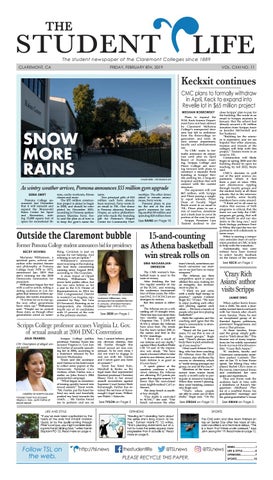
THE
STUDENT
LIFE
The student newspaper of the Claremont Colleges since 1889
CLAREMONT, CA
FRIDAY, FEBRUARY 8TH, 2019
VOL. CXXI NO. 11
Keckxit continues CMC plans to formally withdraw in April, Keck to expand into Revelle lot in $65 million project MEGHAN BOBROWSKY
SNOW MORE RAINS
CHLOE ORTIZ • THE STUDENT LIFE
As wintry weather arrives, Pomona announces $55 million gym upgrade SIENA SWIFT Pomona College announced last December that it will remodel and expand the 30-year-old Rains Center for Sport and Recreation, adding 15,000 square feet of space for recreational fit-
ness, cardio workouts, fitness classes and more. The $55 million construction project is slated to begin in 2020, and should be completed by December 2021, according to Pomona spokesperson Marylou Ferry. Ferry said the plan as of now is to keep the gym’s name the
same. Two principal gifts of $10 million each have already been received, Ferry wrote in an email to TSL. One donor is Pomona alumnus Ranney Draper, an active philanthropist who made the founding gift for Pomona’s Draper Center for Community Part-
Outside the Claremont bubble Former Pomona College student announces bid for presidency BECKY HOVING Marianne Williamson, a spiritual guru, activist and author who studied theater and philosophy at Pomona College from 1970 to 1972, announced Jan. 2019 that she’s running for the 2020 Democratic nomination for president. Williamson began her bid with a call to action, telling a doting audience in Los Angeles that instead of their applause, she needs donations. “It is time for us to rise up, the way other generations have risen up,” Williamson said. “People are so cynical these days, as though other generations owed us some-
thing. Cynicism is just an excuse for not helping. And whining is not an option.” Williamson’s announcement was long in the making; she had been considering running since August 2018, according to The Guardian. A close friend of Oprah Winfrey, Williamson has never held public office, but has run once before — for a seat in the U.S. House of Representatives in 2014 for 33rd Congressional District in western Los Angeles, represented by Rep. Ted Lieu (D-Torrance). Running as an independent, she finished fourth out of 16 candidates with 13 percent of the vote in the primary election.
CW: Description of alleged sexual assault
COURTESY OF SCRIPPS COLLEGE
Vanessa Tyson has accused Virgina Lt. Gov. Justin Fairfax of sexual assault.
Scripps College politics professor Vanessa Tyson has accused Virginia Lt. Gov. Justin Fairfax of sexually assaulting her in 2004, according to a statement released by her lawyers Wednesday. Tyson said she accompanied Fairfax to his hotel room to collect some papers at the Democratic National Convention, when Fairfax was a staffer on John Kerry’s 2004 presidential campaign. “What began as consensual kissing quickly turned into sexual assault,” Tyson wrote. “Mr. Fairfax put his hand behind my neck and forcefully pushed my head towards his crotch. … Mr. Fairfax forced me to perform oral sex on
COURTESY OF WIKIMEDIA COMMONS
Marianne Williamson, who announced her presidential bid in January, attended Pomona College from 1970 to 1972.
See 2020 on Page 2
him. I cannot believe, given my obvious distress, that Mr. Fairfax thought this forced sexual act was consensual. To be very clear, I did not want to engage in oral sex with Mr. Fairfax and I never gave any form of consent.” Tyson has hired Katz, Marshall & Banks — the legal team that represented Stanford professor Christine Blasey Ford in her sexual assault accusations against Supreme Court Justice Brett Kavanaugh. Fairfax has retained the services of Kavanaugh’s legal team, Wilkinson Walsh + Eskovitz.
See TYSON on Page 3
LIFE AND STYLE
15-and-counting as Athena basketball win streak rolls on The CMS women’s basketball team is used to the taste of victory. After finishing the last five regular seasons on top of the SCIAC and winning the conference tournament four of those years, the Athenas (19-2, 11-1 SCIAC) are no strangers to victory. But this season is different. The Athenas are on a roll, rattling off 15 straight wins. Their last loss was more than two months ago, against Chapman Dec. 1 (13-9, 8-5 SCIAC), whom the Athenas have since beat. The streak has the team ranked 20th in the nation and first in the SCIAC standings. “I think it’s a result of our defense and our depth,” captain Ellery Koelker-Wolfe CM ’19 said of the impressive win streak. “We have made a focused effort to take pride in our defense, and our team defense is as good as it’s ever been.” A quick glance at the numbers confirms a lockdown defense; the Athenas are allowing 52.3 points per game this regular season, 9.2 fewer than the next-closest team (eighth-ranked Cal Lutheran). The deep bench is another key strength. “Our depth is unrivaled in SCIAC,” she said. “Our bench out-scores the other
http://tsl.news
When author Kevin Kwan was a child, his aunt, a journalist, invited him to eat lunch with her friends after church every Sunday. There, he met an exceptional group of influential figures: politicians, prominent Singaporeans and even a Thai princess. At these lunches, Kwan said the group simply gathered to “bitch about life.” This became one of many inspirations for his wildly successful book-turned-blockbusterfilm: “Crazy Rich Asians.” 5C students, faculty and Claremont community members packed Garrison Theater on Jan. 31 to hear Kwan speak. Tan Kheng Hua, who played Rachel Chu’s mom in the movie, interviewed Kwan and contributed her own quips and experiences. Hua and Kwan took the audience back in time with a slideshow of Kwan’s Singaporean childhood. Photos of a youthful Kwan, his grandparents’ marriage and his great-grandfather’s house
See STREAK on Page 12
See KWAN on Page 5
‘Crazy Rich Asians’ author visits Scripps JAIMIE DING
SPORTS
“Rowling isn’t revealing facts about the series she’s long known to be true,” Eamon Morris PZ ‘22 writes. “She’s plucking statements out of a hat to make the series appear more progressive than it actually is.” Read more on page 8.
thestudentlife
See KECK on Page 2
team’s bench, sometimes our bench out-scores our starters — we just have so many weapons.” The Athenas say their competitive spirit is unparallelled this year, making for an energetic, fun environment to play in. “I think we just come with a really high energy in practice,” captain Corinne Bogle KG ’19 said. “We really enjoy pushing each other and playing against each other. … We have a bunch of people who just love playing basketball.” Both the captains and the coaching staff agree that the team’s camaraderie is stronger than ever. “Based off the past four years, I’d say this is one of the closest groups,” Bogle said. “There’s always somebody there to pick somebody up if you need to.” Head coach Kristen Dowling, who has been coaching the Athenas since the 201213 season, also attributes the success to chemistry, which is “really strong amongst our group, on and off the court.” Members of the team returned from winter break nearly a month early to participate in intensive training. When they weren’t playing, they were building community, Bogle said. “That’s where people are able to come out of their shells,” Bogle said. “On the
OPINIONS
“If you’ve ever been captivated by the hoots of the owls that inhabit Marston Quad, or by the quails running through Pitzer’s campus, you might consider looking into the 5C Birding Club,” writes Yasmin Elqutami PO ‘22. Read more on page 4.
Follow TSL on the web.
See RAINS on Page 10
UMA NAGARAJANSWENSON
Scripps College professor accuses Virginia Lt. Gov. of sexual assault at 2004 DNC Convention JULIA FRANKEL
nerships. The other donor asked to remain anonymous, Ferry wrote. Pomona plans to pay for the rest of the new gym’s expenses by raising another $9 million and spending $26 million from
Plans to expand the W.M. Keck Science Department have not been slowed by Claremont McKenna College’s unexpected decision last fall to withdraw from the three-college organization and form its own science department, faculty and administrators say. As CMC waits to formally announce its departure until after its April Board of Trustees meeting, Scripps College and Pitzer College are moving forward with plans to construct a separate Keck building in Scripps’ Revelle parking lot, a long-anticipated addition that will connect with the current structure. The expansion will cost $65 million, with Scripps and Pitzer paying a roughly equal amount, Pitzer Dean of Faculty Nigel Boyle wrote in an email to TSL. Pitzer plans to use a mix of reserves, donations and a bank loan to cover its portion of the cost, he said. Scripps President Lara Tiedens declined to dis-
close Scripps’ plan to pay for the building. She wrote in an email to Scripps students in January that the school had already secured a $1 million donation from Scripps trustee Jennifer McDonnell and her husband. “Building for the sciences is expensive, and we are hopeful that other alumnae, trustees and friends of the colleges will help with this project,” Tiedens wrote in an email to TSL. Construction will likely begin in spring 2020 and the building should be open for teaching by fall 2022, Boyle said. CMC’s decision to pull out of the joint science department, which it had been a part of since 1964, sent shockwaves rippling through faculty groups and the student body at all three schools. But in the intervening months, some faculty members have come around. “I think we’ve all come to realize that success of both programs is critical, that the more we can help the CMC program get going, that will only benefit us and our students in the long run,” said Keck biology professor Emily Wiley. She said the two departments will collaborate in some ways. Wiley is starting a temporary associate dean of curriculum position at CMC in July to help with the transition. Additionally, two committees have been formed to solicit faculty feedback on the future of the science
@TSLnews
PLEASE RECYCLE THIS PAPER.
The CMS swim and dive team finished on top on Senior Day after five hours of rain, cold conditions and technical delays. “This is a team that thrives under pressure,” says John Jeang HM ‘19. Read more on page 12.
@TSLnews
NEWS.............................1 LIFE & STYLE..................4 OPINIONS.....................7 SPORTS........................10
NEWS PAGE 2
THE STUDENT LIFE
Consortium files appeal in ongoing land dispute with Claremont School of Theology MARC ROD As the Claremont School of Theology works to sell off more than 10 acres of its campus as part of a planned move to Salem, Oregon, The Claremont Colleges Services is continuing to fight CST in court. TCCS, the official name for the consortium, is appealing a Los Angeles Superior Court decision that would amend a decades-old land agreement between the two institutions, and argued that the consortium should be allowed to purchase CST’s land for $14 million, rather than the $25 million the theology school is asking for. In January, Judge Dan Thomas Oki ruled that CST could sell to another educational institution, but TCCS had the right to match other offers. That ruling alters the original contract, which said TCCS would have the right to purchase CST’s land for a price determined by a formula in the contract. In 2016, during a period of financial hardship, CST moved to sell 10.5 acres of its 16.4-acre campus, and valued the land at $25 million. Based on the formula laid out in the agreement, TCCS determined the land was worth $4 million, but offered CST $14 million. When negotiations over the price broke down in August, CST sued, claiming that TCCS’ offer was well below market
Until they were updated this week, inspection permits posted in two Honnold Mudd Library elevators were up to four years out of date, violating California law. TSL’s inquiry into the expired permits last week appeared to prompt new permits
2020: PO dropout calls for slavery reparations Continued from Page 1
CHRIS NARDI • THE STUDENT LIFE
The Claremont Colleges Services is appealing a court decision regarding a land dispute with the Claremont School of Theology.
value and that the clause in the agreement was no longer valid under California law, according to a CST document. The case went to trial in September 2018. CST President Kah-Jin Jeffrey Kuan said the plan to move to Oregon and merge with Willamette University will continue despite the consortium’s appeal, which could extend the case for an additional year or two, according to TCCS. “We have been diligent and have built in safeguards to ensure CST will survive the
appeal, continue exploring a move to Salem and ultimately receive fair market value for the property,” Kuan wrote in an statement to TSL. TCCS CEO Stig Lanesskog defended the original agreement. “While we are pleased that [Oki’s] ruling will ensure that the property continues to be used by [an] … institution of higher education, we believe the original agreement is binding and would like CST to abide by its commitments,” Lanesskog said in a press re-
lease. CST’s lawyers said they were “very pleased” with Oki’s ruling, but Kuan was frustrated by TCCS’ appeal. “We are certainly disappointed by the apparent appeal and their spin on the entire unfortunate process,” Kuan wrote, noting that he has not yet seen the appeal. “Now, after prevailing in obtaining a fair market value, [TCCS] is taking further action to try to undo the trial and the court’s decision to ultimately ruin CST.”
After TSL inquiry, consortium updates library’s out-of-date elevator permits that violated state law HAIDEE CLAUER & JULIA FRANKEL
FEBRUARY 8, 2019
to be posted. Though the elevators were inspected last June, according to San Bernardino Department of Industrial Relations safety inspector Winfield Sheridan, the new permits remained unposted for up to four years. The updated permits must be posted following inspection, according to California
conveyance codes. Sheridan said the Honnold Mudd elevators passed a safety inspection June 1, 2018. Kim Lane, a spokesperson for The Claremont Colleges Services, confirmed in an email to TSL Feb. 4 that the new permits still needed to be posted. According to Lane, Honnold Mudd elevators are inspected and permits are up-
ELLEN KIM • THE STUDENT LIFE
The operation permits in the elevators of the Honnold-Mudd Library expired several years ago.
dated annually by Amtech Elevator Services, which is also responsible for posting them. Amtech general manager Dan Buttrey declined to comment and directed all questions to TCCS. Lane said TCCS reached out to Amtech in fall 2018 to renew the permits, but new permits were not posted. “Our central facilities services unit is aware that they will have to follow up more thoroughly with Amtech in the future,” Lane wrote. Some students said the outdated permits made them worried about riding in the elevators. “Every time I’m in the elevator I just look at the safety sticker posted and it says that the elevator was last checked for safety in April 2016,” Sarthak Sharma PO ’20 wrote in a message to TSL Monday. “It’s a little alarming.” Other students using study spaces in the library said they rarely use the elevators, opting to take the stairs instead. Christina Rusu SC ’21 frequents the library but rarely uses the elevators, because they sound “very old” and “frail.” “That’s why I’m taking the stairs,” she said.
When asked by CBSN in November 2018 why she was considering running for president, Williamson said, “I, like millions and millions of Americans, feel that our country is in crisis, and I think our president should be someone who has had a career working with crisis and systems of crisis.” After dropping out of Pomona, the young Williamson pursued a career as a cabaret singer in New York City. In 1979, she returned to her hometown of Houston to run a metaphysical bookstore focusing on New Age philosophy, according to People Magazine. She’s since published 12 books, four of which were New York Times No. 1 bestsellers, according to her website. The 66-year-old could quickly be overshadowed by more well-known candidates who have already announced their candidacies for the Democratic nomination, including Sens. Elizabeth Warren, Kirsten Gillibrand and Kamala Harris; former Housing and Urban Development Secretary Julián Castro; Rep. Tulsi Gabbard of Hawaii; and the mayor of South Bend, Indiana, Pete Buttigieg. Other household names, like Sen. Bernie Sanders and former Vice President Joe Biden, could also join the race. At least of one of Williamson’s policies will likely distinguish her from the rest of the Democratic pack. In a post on her website titled “Race and Repentance in America,” Williamson argues that the U.S. should put $200 billion toward a Reparations Plan for African Americans, “an educational, economic and cultural fund to be disbursed over a tenyear period by a council of esteemed African American leaders.” “Why should America not pay reparations to the descendants of slaves who were brought to America against their will, used as
slaves to build the southern economy into a huge economic force, and then freed into a culture of further violence perpetrated against them?” the post states. Williamson’s background also includes alternative medical beliefs, particularly related to depression. A 2016 post on Williamson’s Facebook page advocated for meditation, prayer, nutritional support and love in lieu of antidepressant medication for mothers suffering postpartum depression, and dismissed its seriousness as a mental illness, according to Buzzfeed. The post was widely condemned by experts, activists and postpartum depression survivors. According to the Huffington Post, Williamson later said, “Postpartum depression, example, is often a result of a woman’s heartbreak over having to go back to work sooner than her body, mind and heart are ready to.” This evaluation is not supported by the medical community. In the wake of the suicide of actor Robin Williams, who attended Claremont McKenna College for the 1969-70 academic year, Williamson’s Facebook page shared an article implying that antidepressants were responsible for his suicide, an opinion not shared by medical examiners who performed his autopsy. In addition to her extensive background authoring books on topics ranging from spirituality and finance to the application of love and inner peace, Williamson founded Project Angel Food, a “mealson-wheels program that serves homebound people with AIDS in the Los Angeles area,” according to her website. She also co-founded Peace Alliance, a non-profit with an emphasis on “taking the work of peacebuilding from the margins of society into the center of national discourse and policy priorities,” according to its website. The organization supports founding a “United States Department of Peace,” according to NBC Los Angeles.
TSL IS HIRING! We’re looking for: sports writers, graphic artists, business associates and photographers
Email editor@tsl.news for more information or to apply.
KECK: Science department to recruit professors Continued from Page 1 departments — one for Pitzer-Scripps and another for CMC. Several Keck professors have volunteered to serve on the CMC committee, Wiley said. Of course, not everyone is ready to let the issue slide. A letter circulated by Scripps and Pitzer alumni in response to CMC’s withdrawal has been signed by more than 150 people, and encourages alumni to donate only to Keck until several issues are resolved. Specifically, the letter asks Keck to construct an additional
building, hire more tenure track professors and add a career adviser to help students applying to graduate school. “Although Keck has struggled with funding since its founding, many of us were able to thrive due to the student-focused atmosphere and the dedication of our professors,” the letter states. “While we know those aspects will never change, we are concerned that Claremont McKenna’s withdrawal from the department will exacerbate the already significant funding problems.”
Nearly 70 percent of the people who signed the letter indicated they wanted their donations to go directly to Keck, according to Michelle Ozaki SC ’16, one of the alumni who crafted the letter. It’s unclear how much money could be raised this way. The exodus of nearly a third of Keck’s students — which will likely not occur for three years, according to CMC Dean of Faculty Peter Uvin — could benefit those who remain. Pitzer and Scripps hope to reduce the average Keck class size from 28 to 19 students,
Boyle said. Another goal, he said, is to increase the department’s tenure-track-to-visiting-professor ratio. The goal is 5.3 tenure track professors for every one visiting professor. The current ratio is 1.4 to one. “The reliance on visitors has been the crux of the problem,” Boyle wrote. But Keck needs the new building to open before it can start hiring more tenure track professors, as more tenured faculty will require more labs, he said. Plans to expand Keck’s physical building aren’t new. The science department first proposed a new building
back in July 2006, according to Boyle Ke CM ’99, a 19-year Keck employee. Those plans fell through. In fall 2014, Keck tried once again to kickstart construction for a new building, but was unsuccessful. Nigel Boyle, the Pitzer dean, said Keck began working on the current plans for a new building with all three colleges in fall 2016. Last spring, CMC began having “second thoughts.” The plans are now being crafted with the assumption that CMC will leave
Keck, said Keck Dean Ulysses Sofia. Boyle described the current plan as “concrete,” though Sofia noted that the plans are not yet finalized. Wiley, the biology professor, is optimistic about the new building, but has been around to long enough to remember previous promises of a new building. “There are some older faculty like me who remain very skeptical,” said Wiley, who’s been at Keck for 17 years. “But I think we see a sense of urgency that we did not perceive before. It really seems like if not now, then when?”
NEWS FEBRUARY 8, 2019
THE STUDENT LIFE
PAGE 3
Pitzer student orgs TYSON: Students throw criticize administration for support behind professor amid Fairfax allegations study space takeover LANEY POPE
Continued from Page 1
Pitzer College’s Residential Life moved its office into a popular study room on campus during winter break without approval from Pitzer’s Student Senate, upsetting senators. Res Life moved into East Sanborn C300 “to provide increased resource access and staff support for our students and RA,” Director of Residential Life Kirsten Carrier wrote in an email to TSL. The proposal for the change in office space was created in fall 2017, and C300 was selected for the switch because it was the “best location and most cost-effective for the college,” Carrier wrote. Carrier said the change in office has been well-received by students because it creates “a more professional working space for our student Residence Life Office assistants, and a space more conducive to the everyday needs of residential students.” The Res Life office is also often used by Resident Assistants, including Justin Blankson-Phipps PZ ’19, who said he supports the move because the new area is “a lot more spacious, which means we get to organize it a lot better.” There are also “two computers for the RAs now, which is really nice,” he added. Although Carrier said the Pitzer, Atherton and Sanborn Hall Council were consulted prior to the move, the former president of the three halls, Brendan Schultz PZ’ 19, said the council unequivocally voted against the move. According to Schultz, Res Life approached the council when he was president with a proposal for the move “as if they did need our approval ... but we did not grant approval.” Four members of the council voted against the move and one abstained, he said. Council representatives reached out to members of the Pitzer community and set up an online anonymous suggestion box, and Schultz does “not know anyone who spoke in favor or wrote in favor of the move.” Pitzer Senate said it was also not consulted. When other organizations want to take over a study room, “they have to get approval from senate, then they have to get approval from student body,” said Clint Isom PZ ’20, a senate vice
TSL has been unable to contact Tyson directly, and her legal team declined to comment. The allegations first surfaced Sunday in Big League Politics, a right-wing media outlet with a history of promoting discredited far-right conspiracy theories, after Tyson’s friend shared Tyson’s private Facebook post with the outlet without permission, according to Tyson’s statement. Fairfax has repeatedly denied the allegations and insisted the encounter was consensual. “Reading Dr. Tyson’s account is painful. I have never done anything like what she suggests,” he said in a statement Wednesday. “Any review of the circumstances would support my account, because it is the truth. I take this situation very seriously and continue to believe Dr. Tyson should be treated with respect. But, I cannot agree to a description of events that simply is not true.” Fairfax is poised to become the governor of Virginia if current Gov. Ralph Northam steps down. Northam is facing calls from both parties to resign following the Feb. 1 revelation of a photo published on Northam’s medical school yearbook page that showed two men, one wearing blackface and the other dressed in a Ku Klux Klan costume. Big League Politics was the first outlet to publish the racist photo in Northam’s yearbook. Northam initially confirmed he was in the picture, but later denied it while also admitting to dressing in blackface on another occasion. He has so far ignored the demands that he step down. Virginia Attorney General Mark Herring, who would be next in line for the governor’s office if both Northam and Fairfax resigned, also admitted to wearing blackface while in college Wednesday morning. Several prominent Democrats, including California Sen. Kamala Harris and New York Sen. Kirsten Gillibrand, both of whom are running for president, called for an investigation of Tyson’s accusations. So far, prominent
CHLOE ORTIZ • THE STUDENT LIFE
Justin Blankson-Phipps PZ ‘19 and Roshni Patel PZ ‘20 work at the new Pitzer Residence Life office Feb. 5. It was previously used as a student study space.
president. It’s “a pretty lengthy process to get space allocated to them.” Senators think administrative action that affects students should follow the same protocol as that of student-led groups, although current policy does not require administrators to do so. “We find issue that an office of Pitzer can just bypass [this process and] it’s just concerning that the student voice wasn’t included more in this,” Isom said. Since the new Res Life office location was announced, the senate has been working to create legislation clarifying its role in administrative changes that affect the student body, and passed a resolution reforming the space allocation process Sunday. Despite this, the administration is not required to adhere to Senate resolutions until they are approved by the College Council, which is made up of students and faculty, Isom said. The resolution is “more of a declaration or an opinion than an actual policy,” Isom wrote in a message to TSL.
Isom is concerned that this administrative move will set a precedent for future changes in jurisdiction. He worries that without legislation in place, the Pitzer administration could “colonize new study rooms and we’re not going to have any study spaces left over. We want to make sure that we can have a set process and deny somebody access if we deem it necessary,” he said. Although Carrier described the change in space as an “even swap,” because it “allowed the college to convert the previously decentralized office spaces back into study rooms,” many students agree that the new office is superior. Students valued the former study space especially because of its balcony. It is “prime real estate: third-floor balcony with a view of the mountains,” senator Isaiah Kramer PZ ’20 said. According to Carrier, the deck “remains accessible from 9 a.m. to midnight for students’ and [Resident Assistants’] programming use.”
national Democrats have stopped short of calling for Fairfax’s resignation. Tyson said she wrote the leaked Facebook post to vent her “frustration” that Fairfax might become governor. “It was not my intention in that moment to inject myself into what has become a much larger political battle,” she wrote in her statement. “My only motive in speaking now is to refute Mr. Fairfax’s falsehoods and aspersions of my character, and to provide what I believe is important information for Virginians to have as they make critical decisions about Mr. Fairfax,” she wrote. “Mr. Fairfax has tried to brand me as a liar to a national audience, in service to his political ambitions, and has threatened litigation.” Tyson, who said she is a Democrat, claimed to have no political motive, and said she hopes to return to her life as an academic and professor. She added that having job security through tenure made her feel more secure in coming forward with her allegations. “Vanessa Tyson is a beloved and valued member of our community,” Scripps Vice President for External Relations and Institutional Advancement Binti Harvey wrote in an email to TSL. “While we are unable to comment on the incident in question, which occurred prior to Professor Tyson’s employment at Scripps College, we support women sharing their stories of sexual assault as a powerful tool for healing and change.” The Scripps Associated Students board also expressed support for Tyson in a statement emailed to Scripps students Thursday morning. “We, the Scripps community, gather in solidarity with Professor Tyson and recognize the incredible courage and sacrifice it took for her to share her story. We want to openly express our full and unequivocal support for her at this time,” the statement reads. Scripps politics students told TSL that Tyson is an exceptional professor. Alison Jue SC ’20 took Tyson’s Women in Public Policy class, which she said centered around discussions of sexual assault in the workplace. Jue said Tyson often gave tips to students on what to do if they experience sexual assault in
the workplace and how to navigate relationships with male superiors. “She made it very clear that if we ever experienced discrimination in the workplace she would be very willing to talk about that and give advice,” Jue said. “That meant a lot to me as a student.” Tyson wrote in her statement that, in reporting Fairfax’s assault, she “felt a responsibility to myself, the beloved students I teach and the brave women I’ve tried to help overcome their own trauma.” Harper Mills SC ’20 also expressed admiration for Tyson. “She’s one of the most brilliant humans I know, and I know for a fact she grounds her work across all fields in compassion and empathy,” Mills wrote in a message to TSL. Scripps alumna Lina Mihret SC ’18 created a form allowing Scripps community members to submit messages of support to Tyson. She plans to send a care package with the messages to Tyson. “I hope she understands how much our respect for her has grown through her brave action,” she wrote in a message to TSL. “I also thought it was important for Scripps as a community to show support for one of the few black women professors at the school.” Mihret said Tyson supported her through difficult times on campus. “It’s important to show up for people [who] showed up for you,” she wrote. “When I was having a particularly difficult time on campus, Dr. Tyson made sure to check in with me, giving me advice and a listening ear. She showed me a lot of kindness when I really needed it.” Tyson told the the Washington Post in November 2017 and again in January 2018 that Fairfax had assaulted her, but the Post said it unable to corroborate Tyson’s allegations or Fairfax’s account of the events in question despite a weekslong investigation. Tyson is currently completing a fellowship year exploring “political discourse surrounding sexual assault, corresponding policies and the unique identities of sexual assault survivors” at the Center for Advanced Study in the Behavioral Sciences at Stanford University, according to Stanford’s website.
Total cost of attendance at Pomona crosses $70,000
Pomona College’s total cost for tuition, fees and room and board for the 2019-20 academic year will break $70,000 for first time, increasing from $69,496 to $71,980, President G. Gabrielle Starr announced in an email to Pomona students and families in January. Pomona is the last of the 5Cs to cross the $70,000 mark. The increase totals $2,484, 3.57 percent more expensive than the previous academic year, and is a relatively standard year-to-year increase for Pomona and the other Claremont Colleges, according to data provided to TSL by the other 5Cs about past tuition hikes. The other colleges have yet to announce their 2019-20 costs of attendance. Pomona spokesman Mark Kendall explained in an email to TSL that the additional money will “support student experiences in and out of the classroom,” including faculty and staff salaries and benefits, maintenance, student research, internships and study abroad. The increase in Pomona’s comprehensive cost will coincide with an increase in financial aid to meet the full financial need of students, Kendall wrote. — Hannah Shoemaker and Maria Heeter
Staff shake-ups at Pomona: treasurer out, assistant dean in
Pomona College treasurer Karen Sisson PO ’79 is leaving the school after 11 years, Pomona President G. Gabrielle Starr announced January. Sisson, who will depart Pomona at the end of 2019, helped Pomona weather the Great Recession beginning in 2008, and “helped us avoid significant impacts on faculty and students,” Starr wrote in an email to the Pomona community. Sisson also oversaw funding for Dialynas and Sontag Halls, the new art museum and numerous class buildings including Seaver South Biology, Millikan Laboratory and the studio art building. The school has also hired a new assistant dean of students, according to associate dean Jan Collins-Eaglin. The new administrator, Anthony Ferreria, began at Pomona Feb. 1. Ferreria previously worked at Columbia University as an assistant dean of students “supporting students’ academic, personal and career decisions,” according to Collins-Eaglin, and at New York University working with international, first-generation and low-income students. — Marc Rod
Mudd scores top marks in annual Princeton Review ranking
Princeton Review ranked Harvey Mudd College first for best career placement in the 2019 edition of its “The Best Value Colleges” book, while Pomona College ranked fifth for best financial aid. Harvey Mudd also ranked sixth in the “Top 50 Colleges That Pay You Back” ranking. The school received the same rankings on each of these lists in the 2018 Princeton Review rankings, according to a Harvey Mudd press release. — Marc Rod
Pitzer Senate fills vacant positions
Pitzer College students voted to fill some vacant Pitzer Student Senate positions last week, while the executive board filled others by appointment, according to an email to Pitzer students from Kamyab Mashian PZ ’19, a vice president. Dawson Reckers PZ ’21 was elected vice president of student engagement, Spencer Pletcher PZ ’22 was elected to serve on the campus aesthetics committee and Sam Horowitz PZ ’20 was elected to the academic planning committee. Turnout was low, with only 204 votes submitted, representing 18.35 percent of the student body. Dominick Yu PZ ’22 was appointed to the diversity committee, Caroline Joseph PZ ’20 to the campus life committee, Ian Emlet PZ ’21 to the teaching and learning committee and Justin Sleppy PZ ’21 to the study abroad and international programs committee. — Marc Rod
LIFE & STYLE PAGE 4
THE STUDENT LIFE
FEBRUARY 8, 2019
TV COLUMN
HBO’s ‘My Brilliant Friend’ brings to life one of modern literature’s most captivating female friendships
BEN REICHER CW: Contains mild spoilers HBO’s new mini-series “My Brilliant Friend” begins with the most modern of openings: a vibrating iPhone, its glow piercing a dark room. The caller ID is briefly visible before an elderly woman, lying alone in bed, answers. Whoever Rino is, he isn’t one for preamble: “Mamma’s missing.” Thus begins what may be the most complex depiction of a relationship between two women — between two people, for that matter — in contemporary storytelling. Throughout the conversation, we get the sense that Rino doesn’t care about his mother’s disappearance as much as he cares about how it affects him. He’s only calling her childhood friend, Elena Greco, to ask if his mother is with her, which Elena emphatically denies. She tells Rino not to look for her, convinced that his mother Lila is not missing, but gone. Filmed in Italian with English subtitles, “My Brilliant Friend” is an adaptation of the 2012 Italian novel of the same name, the first in the Neapolitan Novels quartet. Written by the pseudonymous Elena Ferrante, the four novels chronicle the childhoods of Elena and Lila amid the poverty and violence of 1950s Naples. For one of Italy’s most celebrated contemporary writers, very little is known about Ferrante: she only
gives interviews in writing, and the only facts she has revealed about herself are that she is female and was born in Naples. Like the original novel, the series largely defies categorization — it’s both a history lesson and a piercing psychological study, an exaltation and a cynical deconstruction of the idea of female solidarity. But there is one mantle that can undeniably be handed to it: “My Brilliant Friend” is one of this winter’s greatest hidden TV gems. After hanging up on Rino, we see Elena walking around her apartment, filled with books but empty of life, except herself and a dog. But suddenly, there is someone else in the room, someone who may no longer be alive: a little girl sitting in a chair, turning her piercing gaze towards Elena, who unyieldingly stares back. Elena told Rino his mother wasn’t with her, but now we see that’s not really true. All their lives, Elena and Lila have never truly been separated, even if at times they both wanted to be. So Elena sits down at her laptop and begins to write the story of her and Lila — not to commemorate her vanished friend, but to thwart Lila’s desire to disappear, to ensure some part of her remains. Guided by voiceover from the adult Elena, we cut to 6-year-old Elena in the unnamed Naples neighborhood where she and Lila grew up. In her elementary school classroom, young Elena is draw-
ing rows of vertical lines with a pencil. It’s meant as a handwriting exercise, but they look like prison bars. Perhaps that’s because, as a child and a teenager, Elena has an imprisoned quality about her: reserved and demure, studious and deferential. Her wide eyes stare out into the world as if she believes she will never truly be a part of it. By contrast, Lila is daring and assertive, leaving Elena (and just about everyone else who encounters her) feeling both threatened and entranced. The daughter of a desperately poor shoemaker, Lila doesn’t draw lines but teaches herself to read and write before Elena and her other classmates know how to. While Elena seems trapped, Lila seems constantly about to burst out of her tiny body and sack-like gray dress. One has the sense that nothing can keep her a prisoner. Over the course of the girls’ childhoods, the prison analogy becomes more and more appropriate. For men, distance in the neighborhood is measured not in blocks, but in proximity to the two feuding Camorra (Neapolitan mafia) families that rule the neighborhood — the kind of blood feud that families can hold for generations. And for women, distance is measured in how far their husbands or fathers or brothers will let them go from the house, in how far the sound of a wife or daughter or sister being beaten will travel through the dark multi-story apartment
JENNY PARK • THE STUDENT LIFE
complexes. Elena’s parents reluctantly allow her to continue past elementary school when the teacher intervenes, but no amount of intervention can persuade Lila’s father. This culminates in a scene that is only more disturbing because of how nonchalantly it’s received: when Lila argues with her father to let her go to middle school, he throws her out of their apartment window and breaks her arm. It’s in full view of the neighbors, and Elena is the only one who is the slightest bit shocked. In such an environment, it’s not surprising that Elena and Lila’s relationship becomes the only constant in their lives.
5C Birding Club takes eager avian adventurers under its wing
COURTESY OF RICHARD MAWHORTER
Simon Westley PZ ‘19, the current president of the 5C Birding Club, admires some woodpeckers in Pomona’s Marston Quad Feb. 6.
YASMIN ELQUTAMI If you’ve ever been captivated by the hoots of the owls that inhabit Marston Quad, or by the quails running through Pitzer ’s campus, you might consider looking into the 5C Birding Club. Anyone interested in learning more about Claremont’s bird population can enjoy weekly bird walks guided by these 5C students. “Birding usually refers to a higher level of bird watching with more expertise,” club president Simon Westley PZ ’19 said. “Essentially, birding can be keeping lists of what species you see, maybe even how many individuals of each species you see.” Birding occurs during the club’s bird walks, in which
groups of four to five students equip themselves with binoculars and record bird sightings throughout the Claremont Colleges. Occasionally, groups also explore within the Rancho Santa Ana Botanic Garden, less than a mile north of the colleges. The club also engages with the larger Claremont community by partnering with local nonprofit conservation and rehabilitation organizations, like the Pomona Valley Audubon Society and Wild Wings of California, to hold events in the area. “[The organizations] are just trying to get the community to know about nature and to care about nature, and to care about conservation and animal individuals,” Westley said. Westley said the club’s activ-
ities also further research efforts at the 5Cs: “The list keeping [of bird species] we do is helpful for citizen science, too.” The club’s Facebook group highlights surveys that allow members to offer avian information for existing research about bird plumage. The group also includes Pomona biology and neuroscience professor Rachel Levin, who recently posted on behalf of biology students looking for specific bird sightings. Despite the wide outreach and implications of the 5C Birding Club, its members stress the club’s easygoing aura, and consider that specific attitude beneficial to their experiences. “Often, birding can get really competitive with people who are older and more serious about it,” said Sunny Rhoades PO ’20, a birding club officer. “5CBC is low-key. It’s not a big time commitment so it allows you to get out there and do whatever you want and ask questions.” Westley said the club’s small size makes it very accessible. “If you don’t have a chance to go off-campus and, say, go to Joshua Tree, it’s really nice to focus on nature at home and form an appreciation for what’s around you,” Westley said. Rhoades and Westley both spoke frequently about the idea of appreciating your surroundings. They consider it a key
factor in the overall charm of the club. “You can identify a bird, and be like, ‘Okay, I found this bird,’ and then check it off the list, or you can say, ‘This is such an interesting bird. Why does it behave this way, and why is it here, and when does it leave?’” Rhoades said. “So there are definitely two ways to approach birding: you can look at birds and count them off, or you can actually care about the animal you’re observing and the space they inhabit, and I think learning about the latter has been something really good for me.” Westley echoed that sentiment: “Birding can give you an appreciation for wildlife that’s even just on campus. If you go to Marston Quad and see some great horned owls, you might respect the campus a little bit more.” One final selling point: “It’s like Pokémon, but it’s real,” Westley said. “So if you are at all interested in Pokémon, you might as well just look at the real-world version.” The group’s event information can be found on their Facebook page, 5C Birding Club, and the next community birding event, Family Bird Festival, will be held at the Rancho Santa Ana Botanic Garden Sunday, Feb. 17, from 10 a.m. to 3 p.m.
FILM COLUMN
The problematic nature of Bryan Singer’s involvement with the Oscar-nominated ‘Bohemian Rhapsody’ BEN HAFETZ
CW: Mentions of sexual assault and violence “Bohemian Rhapsody” won Best Motion Picture - Drama at the 2019 Golden Globes in early January. A few weeks later, the film was nominated for best picture at the upcoming 2019 Oscars. The film’s award performance is surprising for two reasons. First, the film itself is bad, very bad. Bad enough that Twitter users have taken to highlighting scenes from it that could be used to teach a class on how NOT to edit or shoot a film, due to its awful cinematic techniques. The second, more important issue with the film’s accolades is the involvement of Bryan Singer, a director accused of numerous cases of vile sexual assault and pedophila. Singer had been signed up to direct the film since its early stages of pre-production, but 20th Century Fox removed him from production and the film’s promotion after 85 percent of filming was completed due to erratic behavior. The studio’s attempt
to scrub any mention of Singer from the film was likely not due to behavioral indiscretions, but instead an attempt to salvage the film from any negative responses to Singer’s criminal allegations in a post #MeToo world. Singer’s removal in order to save the film worked exactly to plan. “Bohemian Rhapsody” was a gigantic box office hit, and the film could very well win the Oscar for best picture. Despite Singer’s lack of public involvement in the film, he could still be awarded for his contributions, which is a problematic feature of the upcoming Academy Awards. Singer is also expected to earn around $40 million because of the movie. A year after the Oscars emphasized the need to make serious changes in the wake of #MeToo, they are recognizing and awarding an alleged rapist. On a larger scale, the problematic nature of the film’s success is another case of a lack of consequences for the powerful, predatory villains of the #MeToo and “Time’s Up” movements. Harvey Weinstein is not going to jail because he has enough money and influence to work the legal system. Les Moonves
is most likely going to receive a $120 million severance package after resigning at CBS due to numerous allegations of sexual assault. Now, Singer might win an Oscar in a few weeks. Hollywood has to do better. The Oscars have to do better. We have to do better. Monsters like Singer should not be saved
from the consequences of their horrific acts, let alone rewarded, on any stage. Ben Hafetz PZ ’20 is a media studies and politics double major. He likes to not only see movies, but also tell his friends why they should or should not like certain ones.
NINA POTISCHMAN • THE STUDENT LIFE
The girls’ friendship is predicated not on affection, but survival. Elena never truly loses her jealousy of Lila; the first two moments when Elena feels brave enough to reach out to Lila, interestingly, are both moments when Lila is being put down, because her intelligence is such a threat to the neighborhood’s men. In the first moment, a group of boys throws rocks at Lila on the street because she beat their leader in a school competition; in the second, the elder brother of another boy she defeated threatens to literally stick a pin through her tongue (a metaphor if ever there was one). Nevertheless, Elena realizes that Lila can teach her how to
survive in their harsh world, while Lila realizes that even if she has lost a chance to escape the neighborhood, it might not be too late for her friend. If they stay by each other, as Lila perhaps allows herself to hope, maybe both girls can break free of everything that entraps them. If only it were so simple. Because, that boy who threatened to pierce Lila’s tongue? In the last episode, at the age of sixteen, she’ll marry him. Ben Reicher PO ’22 is a contributing writer from Agoura Hills, California. He joined his high school newspaper in ninth grade because he loved to argue, and hasn’t stopped since.
Witches, dancing, feminism: ‘Wicked Bodies’ has it all
MEGHAN JOYCE • THE STUDENT LIFE
Paloma McGregor performs at Balch Auditorium Feb. 5.
JULIA GOTTLIEB Keith Thompson, a member of choreographer Liz Lerman’s Dance Exchange, had some advice about how to deal with witches: “One, don’t feed them: They’re on a particularly strict diet, and you probably don’t have anything they’d want anyways except for some thumbs and some toes,” he told the audience at Scripps College’s Balch Auditorium on Tuesday night. “Two, you may want to avoid any sudden movements or thoughts because they’re very sensitive. Three, if you happen to be wearing something very aromatic or herbal in nature, it might get their attention. But don’t worry too much.” And so began the informal showing of Lerman’s work in progress, “Wicked Bodies.” On the tiled floor in front of the Balch stage, nine dancers dressed in gray moved in and out of the space in choreographed asynchrony. Among the performers were three professionals from Liz Lerman’s Dance Exchange — Thompson, Sam Horning and Paloma McGregor — and six 5C student dancers. The dancers were accompanied by Martha Gonzalez, assistant professor of Chicana/o Latina/o studies at Scripps, who served as a guitarist and vocalist. Ronnie Brosterman, dance department chair at Scripps, also made an appearance during the last ensemble. According to her website, Lerman’s inspiration for “Wicked Bodies” stemmed from a visit to the National Museum of Scotland. There, she saw an exhibit called “Witches and Wicked Bodies” that featured 500 years of prints and drawings of witches. With the realization that every culture and historical period has its witches, and that in each, the imagery of “sly, grotesque, sensual, [and] wildly creative” women is persistent, she questioned why some knowledge is celebrated, some erased and some criminalized. For a year, Lerman has worked through these questions with Scripps students and faculty as part of a residency to develop what will be her final piece premiering in the 2020-
21 season. This past weekend, Lerman returned to campus for a final time and invited dancers to participate in workshops to prepare for the “work in progress” performance Tuesday night. Before each section of Lerman’s piece, she or another dancer from her company came out to explain the concept behind what the audience was about to see. In one section, Lerman and longtime collaborator Thompson performed a duet, with Thompson’s interpretive movement accompanying Lerman’s spoken text. Thompson then presented his solo, performed alongside a “corrido,” a narrative art form that lacks a chorus, composed by Gonzalez. By inviting the audience inside these separate processes, Lerman demonstrated the different ways in which text and music inspire movement. In another section, Horning explained and danced through the process of developing an alphabet by using movement to spell and create spells. McGregor later explained that the inspiration for the student dancers’ gestural movements was generated by thinking about ancestral relationships. There were moments when dancers sat atop each others’ shoulders and cast shadows onto the auditorium wall, moments when they gently slid from the tile onto the stage, moments when dancers lived in their own world of individual rituals and moments when they came back together to cast spells as an ensemble. Explaining the collaborative nature of her choreographic philosophy, Lerman told the audience: “For me, making work is entirely dependent on the people with whom I’m working. People change what happens as soon as you enter the room, including you guys tonight in how you respond to what we’re doing.” Sasha Marlan-Librett SC ’22, a dancer who participated in Lerman’s workshops, said the performance really did resemble a work in progress. “Anytime they were giving us instructions, it was as if they were figuring it out themselves also,” she said. “She’s really good at delegating. It was so collaborative. Keith was teaching us a lot of the movement, and so were Paloma and Sam. So I liked getting feedback from everyone.“
LIFE & STYLE FEBRUARY 8, 2019
THE STUDENT LIFE
PAGE 5
MUSIC COLUMN
Seven female rappers worth listening to in 2019
ELLA BOYD Leikeli47 Leikeli47’s latest album made NPR’s 50 Best Albums of 2018, but that’s hardly what makes her such a compelling artist. With her ski mask on at all times, poetic lyrics and wide selection of beats incorporating R&B, jazz and blues, Leikeli47 crafts a fresh vision for the new direction of rap music. With lyrics like “Concealed eyes with a cherry bomb lip / Skin tint, skin tint, skin tint / Keep my makeup artist tied up in the basement,” Leikeli47 is simultaneously humorous and fiercely feminine. Song to check out: “Look” Noname Noname takes an entirely different approach to rap, speaking softly on her songs as if she is letting each listener in on a beautiful secret. In her track “Bye Bye Baby,” she personifies a mother having an abortion. In an interview with The Fader in 2016, she explained she tried to “make a love song” because “that shit was just important to me as a woman, as someone who cares about these women.” Her storytelling, compassionate approach to music and visceral depictions of life have taken her far. Noname has already created multiple tracks with Chance The Rapper and released two full-length albums, making her potential boundless. She explains this in an interview with The Fader, saying that “not having a name expands my creativity. I’m able to do anything.” Noname has already pushed the boundaries of social change through music, and she is definitely an artist to watch. Song to check out: “Ace” (feat. Smino & Saba)
CupcakKe CupcakKe brings an unmatchable level of confidence and sexual liberation to her music that can only be articulated herself. In a 2018 Interview with The Fader, she explained: “If I feel sexual, if I wanna show my nipples, I do it. If I want to be all covered up and not showing nothing at all, I do it.” B e sides her clever, often funny lyrics, her songs also touch on pressing issues, including toxic relationships, body image, police brutality and promoting acceptance for the LGBTQ community. Her music promotes personal growth in every direction — who else can rap “Suck ramen noodles off that dick, that’s my vitamin,” and one song later, “Every white man is not corrupted as the white men we see / I could vouch for that / But some still stuck in a state of mind / Or putting us behind and making us leave out the back.” CupcakKe creates music perfect for both blasting at parties and reflecting on alone. Song to check out: “Exit” Queen Key Born in the Chicago suburbs as Ke’Asha McClure, Queen Key made her first mixtape at only seven years old. Key is all
about girl powe r, c o n f i d e n t ly rapping lyrics like: “Can’t match this rapper, actress / More powerful than two Cleopatras,” while proclaiming that she’s a “pretty bitch but I fight dudes.” Each song has an intense, upbeat energy as Key’s rhymes and flow are as hard as the beats she picks. Key pays respect to Cardi B when she remixes Bodak Yellow, followed by several lines about sexual liberation saying “I’m the queen and my pussy a peach … I’m kinda
EN UYS N GH
•T
HE
IFE TL EN D STU
freaky.” For all her confidence and intensity, Queen Key doesn’t take herself too seriously, often laughing mid-song or rapping about how she’s “turnt as fuck / I left my pizza in the oven / That bitch burnt as fuck.” Song to check out: “Ayeee” RE CHLOE F
LI
Killumantii Born in Atlanta, Georgia, 19-year-old Instagram starturned-rapper Killumantii said she “borrowed [her stage name] from Tupac” in a 2017 Interview
Claremont a cappella groups shine at ICCA West Quarterfinal CATHERINE WARD Two Claremont a cappella teams brought their A-game to the stage last Saturday at the 23rd annual West Quarterfinal of the International Championship of Collegiate A Cappella, held at Pomona College’s Bridges Auditorium. First to perform were the Claremont Shades, which had hosted the competition for the past four years, and took to the stage this time around. They were professional and calm on their home turf, and started the night with a jazzy “Alright” by Jordan Rakei, sung by soloist Ernesto Fritz PZ ’22. The group went on to perform three pieces from their SCAMFest (Southern California A Cappella Music Festival) set, including “Liability” by Lorde, “Ain’t No Sunshine” by Bill Withers and “Curious” by SwayDay. The Shades didn’t have much time to prepare for the competition. “We were kind of like, ‘We have to do our SCAMFest set because that’s what we have ready right now,’ and then we learned ‘Alright’ over break on our own,” music director Saif Saigol CM ’19 said. How do you arrange a song
over break? “It was hard honestly; we had people send in voice memos. It was a lot of work, but we got it done,” Saigol said. Another Claremont a cappella group, Mood Swing, also performed for the first time at the ICCA quarterfinal, and showcased an energetic performance indicative of their group’s personality. They started with teen classic “Youngblood” by 5 Seconds of Summer, followed by “Escape” by Kehlani and ended with “When We Were Young” by Adele. The group was all smiles on stage, and enjoyed the performance overall. “I felt all the people around me and thought, ‘This is just fun. I’m singing with this group of people I really love and they’re feeding me good energy,’” soloist Maddy Yardumian SC ’21 said. “It just doesn’t feel high stakes. It feels like you’re doing something that is good and feels right.” The other eight teams hailed from CSU Northridge, UCLA, UC Santa Barbara and UC Riverside. Nearly 1,000 people attended from the 5Cs and the surrounding community. The teams were judged on arrangement, professionalism, creativity of movement and
interpretation, among other criteria. Every team showed a unique personality and style in their performance. The only all-male group of the competition, UCLA’s Bruin Harmony, took home first place. Their use of overlapping transitions and echoing harmonies also led the team to receive the Outstanding Arrangement award. The ScatterTones, another veteran ICCA group from UCLA, came in second place. They impressed with strong solo performances from senior group members, and also scored the Outstanding Choreography award. Acasola of CSU Northridge finished third. Their performance’s theatrical component set them apart from the competition, and their three soloists delivered emotional vocal performances that made their unrequited love act engaging. The top two teams advanced to the West Semifinals in Oregon, and the winner there will head to the ICCA Finals in New York City. Entering the ICCA competition is a serious undertaking for groups. Competitors must decide in October to put together a music video submission, and
only have two weeks to prepare for the competition postbreak. Usually, this includes late hours or extra practices. “It was really fun and a brand new experience, but that was quite the turnaround,” Yardumian said. “If we decide to keep doing it in the future, and we had a lovely time so I hope we do, we’ll have to be more conscious about time planning and stuff. It’s a lot.” For the Claremont groups, ICCA is a different experience than other a cappella performances. “For SCAMFest we’re trying to live up to our own standards and make ourselves proud, and ideally we’re doing the same with ICCA but there’s also a panel of judges you’re trying to impress and a score sheet and a rubric that you’re trying to hit every point on,” Saigol said. The competition also brings new groups and audience members. “For SCAMFest it’s all the Claremont groups, but for [ICCA] it was a lot of groups we had never heard before, so there was a sense of excitement around it,“ Mood Swing co-president Gabby Teodoro HM ’21 said.
TIMOTHY LIU • THE STUDENT LIFE
Claremont a cappella group Mood Swing performs at the ICCA West Quarterfinals Feb. 2.
with DJ Smallz. However, nothing else about her artistry is borrowed. Her fearless, tough-girl attitude, mixed with clever rhymes and confident lyrics, make for some fun music with substance. Her songs use simple beats, making her vocals and concise inflections the center of attention. She uses her platform to create songs with t o p i c s ranging from sexist double standards to internet drama, making Killumantii relatable while giving power to those who relate. Killumantii asks why girls are seen as unfaithful when behaving in the same way men do, rapping “how you get to run around single but I’m still suppose to act like your girlfriend? / And why I gotta sit through the hoe phase, if you ain’t ready to be a real boyfriend?” Song to check out: “Single” (feat. Omeretta The Great) Junglepussy Junglepussy is unapologetically confrontational, tackling social issues head on, whether in the form of rapping about not needing a wedding ring or demanding higher standards for the treatment of black women. “It’s a full-time job fucking loving yourself,” Junglepussy raps in “Bling Bling,” one
of her many songs focusing on independence and sexual liberation. Junglepussy creates songs evoking emotions ranging from joyful triumph to inner reflection, rapping in her song “Shower” that there are “scars on my body / cutting like decorations.” Junglepussy is no single entity, saying in an interview with Dazed that “I am much more than Junglepussy, I am much more than a black woman. I am so much, so many things.” Song to check out: “Bling Bling” Kash Doll With catchy hooks and a larger-than-life stage personality, Kash Doll creates powerful and irresistible music that has earned her a BET Award and praise from a Pitchfork review: “[Her] queenly personality remains assertive in whatever flow she flips through… she’s the boss.” Kash Doll’s previous collaborations include Trina and Ca$h Out. She’s worked hard to become a successful and respected musician, embracing her serious work ethic by rapping about how she’s “gon’ keep dropping, I ain’t stopping until I’m a billionaire / See I be grinding, show after show, man I mean I’m thriving.” Kash Doll’s confidence translates beyond her stage presence. She said in a 2017 interview with The Fader that she believes in higher standarwds for dating, noting that “I want to go out and be happy and have fun,” reminding her audience that despite all the flexing, there’s a real woman behind the music. Song to check out: “Check” Ella Boyd SC ‘22 is a first-year from Maine. She traded alpine skiing for writing for the student paper, and enjoys creating art through film, music, and poetry.
KWAN: Author talks privilege, childhood at Scripps Continued from Page 1 flickered across the screen. Kwan told stories about his life of privilege, where yelling “I’m thirsty” in the middle of the night brought his 70-year-old nanny running from the servants’ quarters to bring him a glass of water. “I thought it was really interesting to hear of his childhood and experiences [that] had influenced his storytelling,” Maia Jones SC ’20 said. “[It] actually led to me having really interesting conversations with friends afterwards about representation of different Asian identities.” Hua and Kwan engaged in witty banter the whole evening, and the audience in the sold-out auditorium ate it up. Among the many topics: Kwan’s cameo in the movie, the fact that Gemma Chan (who played Astrid Teo) doesn’t sweat, and how Michelle Yeoh (Eleanor Young in the film) insisted on wearing her own jewelry. A video of Henry Golding (leading man Nick Young), a former hairdresser, cutting Kwan’s hair, was a highlight of the night. Kwan, who moved to Texas at age 11, said he left Singapore “at the right moment in [his] life” for his mind to preserve childhood memories. Strolling down memory lane with his father before he passed away made Kwan realize “I need to put these [memories] down on paper.” In college, he wrote a poem titled “Singapore Bible Study” about ladies using lunch meetings as an excuse to gossip. The poem became a short story, and soon after, the beginning of his book, and then of the movie. Kwan never intended to publish his book, calling it “nonsensical scribbles” and his “crazy side project.” Nevertheless, he published the novel in 2013, and has since written two
more books — “China Rich Girlfriend” in 2015 and “Rich People Problems” in 2017. Kwan also let the audience in on his plans for the future. He’s working on three different TV shows: an one-hour drama series set in Hong Kong, a CBS sitcom called “The Emperor of Malibu” and a documentary series he described as “Anthony Bourdain meets luxury.” Grace Shao SC ’21 said many of Kwan’s and Hua’s topics of discussion surprised her, like Kwan’s family having black and white servants back in Singapore. But she didn’t “believe it is a place for us to judge ... because we come from such a different perspective, and we were just there to learn.” The event lasted approximately an hour, followed by a book signing. The line to meet Kwan stretched outside of the auditorium. “This [event] was just genuinely a lot of fun,” Sohni Kaur SC ’21 said. “We were all laughing together in the auditorium.” Before the Scripps Presents public event, Scripps College students had the opportunity to participate in a student session with Kwan, according to an email that Corrina Lesser, director of public events and community programs, sent to Scripps students. “It felt just more intimate and I felt like it was also a really good way for him to get to know Scripps students better too because he was able to talk to us one-on-one,” said Shao, who attended the session. “We had our own little book signing and photo-taking session.” Melody Chang SC ’22 said the highlight of her night was getting Kevin Kwan’s picture and autograph, and “him telling me that I looked like his cousin.” To see a full video of the conversation or find more information on upcoming events in the speaker series, visit the Scripps Presents Facebook page.
LIFE & STYLE PAGE 6
THE STUDENT LIFE
SCIENCE COLUMN
Climate change might not to be blame for polar vortex CAITLYN FICK
Many 5C students lamented the cold weather and rain that hit Claremont and the surrounding Los Angeles area this week. And although 50 degrees and cloud cover is unusual for Southern California, no one has been hit harder by the elements this January than those living in the Midwest or on the East Coast. The polar vortex that struck the eastern half of the U.S. starting last week has claimed the lives of more than 24 people, according to The Guardian. These low temperatures stem from a cold blast of air being pushed south from the North Pole.
EMMA LI • THE STUDENT LIFE
At certain points last week, parts of Illinois were colder than Antarctica. Minneapolis and St. Paul, Minnesota recorded extremely low temperatures. Many schools, including colleges and universities, closed their doors temporarily, as it was too cold for students to even be walking outside. Some of these campuses, like the University of Minnesota or North Dakota State, are miles wide, so harsh weather proved to be hazardous for those who needed to walk outside to get to and from their classes and dorm rooms, according to the University of Minnesota. Susanna Barrett SC ’19 is from St. Louis, which has also been hit by the polar vortex. Her younger sister attends Knox College, located in northwestern Illinois, where school closed for a day last week. In states where cold weather and lots of snow are expected each winter, these closures are particularly unusual and are a result of these record-low temperatures. According to her sister, the school hasn’t closed due to cold weather since the 1970s. Some scientists argue that the cold spell is simply a result of cold weather rather than a
shift in climate, according to BBC News. And while cold temperatures sweep the nation, it may seem counterintuitive that the planet is still warming up. However, some scientists believe that as climate change progresses, these storms and cold spells will also continue, the National Oceanic and Atmospheric Administration reports. Emma Stacy SC ’19, a resident of St. Paul, says she remembers there being a polar vortex during her senior year of high school; when that happens, you “can’t really go outside.” She said the cold weather makes daily commutes difficult as people are advised not to drive or leave their homes unless absolutely necessary. In the next week, temperatures in some places are expected to rise by 80 degrees. While this may be exciting for those who have been hiding out indoors, it has the potential to cause more havoc, and could lead to burst pipes, flooding rivers and crumbling roads. Caitlyn Fick SC ’19 is a chemistry major who enjoys mountains, trees, water and dogs.
YE OLDE STUDENT LIFE
Dating at the 5Cs through the ages MICHAEL HE In this edition of Ye Olde Student Life, which looks at articles and advertisements from past decades of TSL, we’re talking about the eternal college experience — dating. The Pomona Daily column in February 1941, printed a few weeks after Valentine’s Day, included a “Spice”column with flashy updates of 20 ladies’ relationship status. Although I’ve been single for my entire life and have zero expertise in romance, I can still write about it, right? Pomona College used to have a large partying fraternity. This Kappa Delta “superman” Hugh Ralston must have been a real stud. I wonder what partying was like in the early 40s; beer pong was not yet a thing. Onto another point: Keeping a public record of relationship statuses seemed to be casual in the 40s. Maybe
it’s because there were fewer people, and they actually got to know each other without spending six hours a day on small black boxes. Either way, it would be very interesting to know the feelings of the aforementioned people and learn whether they were embarrassed, ashamed or did not care. In some ways, things in Claremont are the same today — dating hasn’t gone away. But our modern sex culture, with hookups and Tinder, would probably seem blasphemous to people in the past. And people today probably cannot imagine a world where private information like one’s relationship status is printed. I look forward to learning more about the Claremont Colleges’ community of the past, and I hope this column can be a place where we can explore TSLs of old together. Michael He PO ’22 constantly
fights his urge to slack off and procrastinate, but once in a while does something productive and nice. Talk to him!
FEBRUARY 8, 2019
Struggling with creativity? Try Brian Eno’s Oblique Strategies cards
ELINOR ASPEGREN • THE STUDENT LIFE
Music journalist Geeta Dayal holds a set of Oblique Strategies instructional cards, which she said can encourage creative thinking, at her talk at the Hive Feb. 1
SCHUYLER MITCHELL I’m holding a small piece of white cardstock printed with a pithy instruction: “Give way to your worst impulse.” I’m not sure what I’m supposed to do with that, so I turn the card over and read the next one. “Water,” it says. That’s helpful. I reach for another card. This one advises me to “remove specifics and convert to ambiguities.” Alright, I can work with that. In 1975, Brian Eno and Peter Schmidt published the Oblique Strategies cards, a deck of “over one hundred worthwhile dilemmas” designed to break down artistic barriers and spark creative insight. Eno, a producer and musician (although self-described “non-musician”), is widely credited with conceptualizing and popularizing ambient music. He joined forces with Schmidt, a friend and artist, after learning they had developed similar systems for lateral thinking. Courtesy of the Pomona College Humanities Studio, I’m sitting in the Hive with the prolific music journalist, Geeta Dayal, who is leading a workshop on Eno and Schmidt’s Oblique Strategies as a follow-up to her talk the previous night. Dayal is the author of “Brian Eno: Another Green World” in the 33⅓ series, a collection of short books about albums. After finding himself stuck in a creative rut, Eno turned to the Oblique Strategies cards for inspiration when creating his influential record, “Another Green World.” Following in Eno’s footsteps, Dayal used the cards to find inspiration and create structure when writing
her book. Dayal asks me what I think “remove specifics and convert to ambiguities” means. I say I view it as an instruction to let go of my need for precision in my writing, to find solace in the gray space, instead of becoming mired in my need for every word to fall into perfect order. She points to the famous opening line of David Bowie’s song, “Moonage Daydream,” as an example of ambiguity. “I’m an alligator,” Bowie sings. What does that even mean? Does it matter? Although the song was released before the Oblique Strategies cards, Bowie, David Byrne, and other famous collaborators of Eno have used the cards to break through creative mind blocks. We go around the room and read off one or two of our Oblique Strategies cards, brainstorming ideas for what the cards could mean and how they could be applied to our own creative pursuits. Some cards seem straightforward, like “Change instrument roles,” while others are more cryptic, like “Twist the spine.” Others, Dayal notes, were easy for her to use as an excuse to stop writing her book, especially the card, “Take a break.” Nevertheless, the Oblique Strategies cards provide a useful framework for creating. Similarly, avant-garde composer and former Pomona College student John Cage employed the I Ching, an ancient Chinese divination system, in order to stimulate ideas for his work. It’s easy to become overwhelmed when trying to start a new project, whether that’s a poem, a song, a painting or even an academic essay. In the age of the Internet, beginning a creative process can be even more overwhelming.
I often find myself getting discouraged when I see the wealth of things online that have already been written; I wonder what I could possibly contribute that hasn’t already been said hundreds of times before. Dayal shares that she too feels this way sometimes, and notes that card systems like Oblique Strategies and I Ching can be more helpful now than ever. “Systems provide a pathway. They create constraints,” she says. When seemingly boundless quantities of information stifle our innovation, we can turn to the Oblique Strategies as a roadmap. When using the cards, Eno followed each instruction exactly, sometimes at the risk of his own detriment. In her book on “Another Green World,” Dayal writes, “If a song was being worked on intensely, and a card that was drawn suddenly proclaimed that the tapes had to be deleted, they were.” I wonder, could I erase something I’ve worked tirelessly to create? In a 1980 interview with KPFA in Berkeley, Eno shared that the first Oblique Strategy card said, “Honor thy error as a hidden intention.” In a similar vein, Schmidt’s first Oblique Strategy asked “Was it really a mistake?” These cards echo the theme of this year’s Humanities Studio: “Fail better.” A fear of failure can easily influence us to quit before getting started. However, Eno and Schmidt remind us that every error, every mistake, can act as a catalyst for something even greater. Schuyler Mitchell PO ’20 is TSL’s Life and Style Associate. In her free time, she can be found hosting a radio show on KSPC, advocating for the importance of naps and telling people how to pronounce her first name.
VIDEO GAME COLUMN
‘Mortal Kombat’: Gory, unadulterated Americana at its finest NADYA SIRINGO RINGO The “Mortal Kombat” games are, first and foremost, incredibly violent. Their trademark “Fatalities” are gory waterworks of blood spewing out of every body part imaginable. Thanks to modern animation technology, watching these “Fatalities” in “Mortal Kombat X” for the first time left me closing my eyes, unable to shake the images of flesh-ripping, spine-twisting, face-eating finishing moves on lifelike bodies. Yet as I continued watching the moves and interactions of characters in fighting matches and the game’s Story Mode, which attempts to unite its many fighters in a plot, I realized that “Mortal Kombat” wasn’t just a game of violence; it could very well be one of the most American pieces of media I have come across. In comparison to Japan, the U.S.’ equivalent video game capital of the world, the West is more well-known for being big fans of graphic, close-up violence within its games. A look at censorship laws in Japan show that although gore is allowed in games, a moderate amount of bodily viscera must be obscured, usually achieved by evasive angles, lighter colors and less graphic deaths. As such, it’s not surprising that the “Mortal Kombat” series
has not seen a Japanese release for 20 years. “Mortal Kombat 11,” the newest iteration in the series out this coming April, will not be released in Japan due to its “extreme gore and violence,” according to video game rating board CERO. The series’ leniency toward violence is not the only aspect that reveals a distinctly American point of view. Like the U.S., “Mortal Kombat” is a melting pot — it features fighters from around the world, and many other fighters come from different dimensions of the universe. However, while Earth’s warriors boast gratuitous strength, they also indulge in some stereotypes. Most American characters in “Mortal Kombat” represent a common American fascination. Johnny Cage is an action movie actor straight from Hollywood, whose role in the game is a sarcastic, fickle American man with little regard for rules and regulations. Standing in stark contrast is Sonya Blade, a straight-laced U.S. military general, and her commander Jackson Briggs, a black man of tremendous strength and ferocity when his otherwise level-headed demeanor is pushed to its limits. Nightwolf is a strongly spiritual Apache fighter with tomahawks and a brown leather outfit. In each character’s personality, fighting style and appearance, the developers of “Mortal Kombat’’
imbue cultural archetypes unique to American culture. Blade and Briggs showcase the American military’s prowess with machine guns and grenades in their “Fatalities” and fighting moves, while Briggs and Nightwolf represent stereotypical tropes in American media regarding minorities. The stereotypical American perspective continues in “Mortal Kombat” through its treatment of its non-American fighters. In the main story of the franchise, the warriors chosen to represent Earth in the Mortal Kombat tournament are mostly either American or East Asian — probably because nearly every fierce fighter from American action movies are from such ethnicities. East Asian fighters include Liu Kang, who is heavily inspired by Bruce Lee, along with Scorpion and Sub-Zero, ninja-like fighters from Japan and China. Like Briggs and Nightwolf, they represent stereotypes born from an American interest in their respective cultures. “Mortal Kombat” continues its stubborn affinity for inaccurate depictions of other cultures in subtler ways as well. In the story mode of “Mortal Kombat X,” Scorpion pronounces the name of his clan “Shirai Ryu” as “Shirai Ra-yoo” instead of the correct Japanese pronunciation, “Shirai Ryoo.” Kenshi, a Japanese swordsman, beckons a door to open when he states “Anata ga
hirakimasu,” which sounds like a Google-translated phrase to more experienced Japanese speakers. More ridiculously, Raiden, the Earth’s god of thunder, who has a name made of Japanese kanji and a straw hat you’d see on a Chinese farmer, has his name pronounced as “Rayden” instead of its correct pronunciation “Rye-den.” He also looks like an old white man. These pronunciations could offend Japanese-speakers; why won’t developers and voice actors put in the effort to ensure they’re
accurate? Game developers have the technology and resources to make such touch-ups. Although developers have never mentioned why they don’t make these changes, I can guess why. As a staple of American culture for nearly 30 years, “Mortal Kombat” symbolizes not only nostalgia for players, but also an unabashedly American perspective. In the end, the game is defined by its violence, botched pronunciations and outdated stereotypes,
which are relics of 90s Hollywood action and horror films. Despite the rise of political correctness in the last few years, “Mortal Kombat” remains popular and unfazed by its stereotypical screw-ups because it absorbs the mistakes other cultures perceive as distinctly American, and seems pretty damn proud about it. Nadya Siringo Ringo SC ’21 is from Indonesia. She is relentless in her pursuit for Epic Gamer Moments.
CATHERINE WARD • THE STUDENT LIFE
OPINIONS FEBRUARY 8, 2019
THE STUDENT LIFE
Where is the support for non-STEM majors?
THE STUDENT LIFE KELLEN BROWNING, Editor-in-Chief MEGHAN BOBROWSKY, Managing Editor HANK SNOWDON, Managing Editor MARC ROD, News Editor LANEY POPE, News Editor JULIA FRANKEL, News Associate NATALIE GOULD, Life & Style Editor MABEL LUI, Life & Style Editor SCHUYLER MITCHELL, Life & Style Associate DONNIE DENOME, Opinions Editor ANIKKA VILLEGAS, Opinions Editor TORREY HART, Sports Editor NOAH SHAPIRO, Sports Editor DELANEY HARTMANN, Sports Associate
PAGE 7
CASSIE WANG, Production Editor JAMES KARSTEN, Senior Design Editor ANNE JANG, News Designer HELENA ONG, Life & Style Designer DAPHNE YANG, Opinions Designer JILLIAN BATIUK, Sports Designer OLIVIA TRUESDALE, Copy Chief NINA POTISCHMAN, Graphics Editor CHLOE ORTIZ, News Photo Editor TALIA BERNSTEIN, Life & Style Photo Editor
The Student Life, the oldest college newspaper in Southern California, is produced and managed by students of the Claremont Colleges and published weekly. The Editorial Board consists of the editor-in-chief and two managing editors. Aside from the editorial, the views expressed in the opinions section do not necessarily reflect the views of The Student Life. E-mail Letters, Questions, and Concerns to editor@tsl.news. Email tips to liaison@tsl.news; email advertising inquiries to ads@tsl.news and print subscription inquiries to subscriptions@tsl.news. TSL welcomes letters to the editor, which can be submitted by mail, email, or in person at Walker Hall 101 of Pomona College. Letters must be under 400 words (although when an issue is particularly salient, we reserve the right to allow letters to run at a longer length) and submitted by 4 p.m. Wednesday of the week of publication. We reserve the right to decline publication of submitted letters and will not accept anonymous letters, letters containing profanity, factually inaccurate letters, or letters making personal attacks. TSL also reserves the right to edit for spelling, punctuation and grammar. Letters may be signed by a maximum of three people. All letters become the property of TSL and may not be reprinted without prior permission from the Editorial Board. Singles copies of TSL are free and may be obtained at news stands around campus. Multiple copies may be purchased for $0.47 per copy with prior approval by contacting editor@tsl.news. Newspaper theft is a crime; perpetrators may be subject to disciplinary action as well as civil and/or criminal prosecution.
West There’s another one
Red Dogg :’( RIP to our favorite camp sec officer
Virginia Gov, Lt. Gov, Attorney General
TSL is back No corrections this week!
Snow on Baldy Polar vortex 2k19
News never sleeps Sleeping was fun while it lasted
Rain Is class cancelled?
TSL SAYS
Trailblazer Paving the way for future camp sec doggos
KenKen
THEA BAROVICK • THE STUDENT LIFE
NINA POTISCHMAN • THE STUDENT LIFE
ANANYA SALUJA The recent surge in support for people, particularly women, in science, technology, engineering and mathematics, has been a long-awaited and inspiring development to watch unfold. However, in an age of increased value associated with STEM, the corresponding merit attached to studying humanities subjects has dwindled considerably. Growing up in the South Asian subcontinent, the trajectory of my career has changed immensely, mirroring societal attitudes and my own understanding of them. Largely dictated by the idea that a humanities degree would hold no relevance, I tried my hand at the sciences in hopes of becoming a doctor. Part of this decision came from an implicit desire to challenge myself and prove to myself and the society that believed so deeply that I was incapable of studying STEM that I was more than their definitions. Part of it came from my failure to understand that the humanities hold equal value to STEM, and that careers in the humanities are viable, despite what I had been told. In the South Asian subcontinent, the disparity between the perceived importance of STEM and humanities is pronounced. Humanities subjects
are largely viewed as what people turn to when they are incapable of studying STEM, rather than a choice that disciplined students actively make to study. The social sciences, whose classification has long been debated, are merely seen as pseudo-STEM subjects that hold comparatively less importance than their scientifically classed counterparts. Subjects like psychology, for which the target audience is still limited in South Asia, are considered futile endeavours, and students are often discouraged from pursuing them. Gender stereotypes in the subcontinent further emphasize the gap between the merits associated with the two. Women who choose to pursue careers in STEM have long been stifled by the debilitating and propagated belief that their gender puts them at a disadvantage, and those who choose to pursue careers in the humanities are seen as simply preparing to stay home. Men aren’t exempt from these stereotypes, and often find themselves boxed into STEM due to the femininity associated with the humanities in South Asian countries. Few men tread the humanities path in fear of the harsh social attitudes toward it. As someone whose interests fall predominantly in the humanities, I constantly need to defend my decision not to study
STEM. International students like myself are even more likely to get an extension on their visas if they choose to be STEM majors. International students’ need for validation sometimes manifests itself in a switch from the humanities fields into STEM fields. But the purpose of higher education is to embrace the freedom of pursuing something that excites the student. We must eradicate the stigma associated with the humanities. The lack of value attached to the liberal arts is misplaced and fosters an environment of inequality between subject areas. To expect a change in the entirety of the South Asian subcontinent is a tall order, but I do believe changes in certain policies like visa extensions could have a profound effect on how people view the humanities. The ability to obtain a visa to continue or complete an education, or even to work, is a reflection of the security a field offers. The current policy serves as the preliminary indication that humanities will be less useful in one’s future. Choosing to study the humanities does not prepare one for a life of futility, but rather for a life of fulfillment — that is the idea we need to propagate. Ananya Saluja PO ’22 is from New Delhi, India. She recently cut her hair, expecting her life to change.
You don’t have to be smart to enjoy ‘Rick and Morty’ CHRISTOPHER SALAZAR No, genius, you don’t have to be smart to enjoy ‘Rick and Morty’ Much to the disappointment of a few vocal “Rick and Morty” fans, merely tuning in to the explicit excursions of sardonic scientist Rick Sanchez and his dimwit grandson Morty does not demonstrate intellectual superiority. As a rule, it’s best to disregard anyone who feels the need to establish themselves as smart based on their taste in sitcoms. Still, that “Rick and Morty” has garnered such a following is noteworthy. And it’s worth exploring why some people watch the animated series. The answer, however, is unlikely to flatter. To be sure, watching “Rick and Morty” is an exercise in existential levity leveraged against cosmic indifference. Here, an appreciation for sarcasm, wit and dark humor goes a long way toward dividing the world into groupies and the uninterested. In this vein, references to Schrodinger’s cat, sci-fi cinema and philosophy, which pervade the series, are tempting exam-
ples of requisite intelligence. But despite such cultural allusions, the animated sitcom is popular because it’s made for a general audience. The high-brow references enhance Rick’s witticisms and the show’s general motif of how meaning is constructed in a meaningless multiverse, while parodying scientism. In any case, if “Rick and Morty” does attract brainy fans, it’s likely due to the program’s affinity for colorful language. In 2015, psychologists Kristen Jay and Timothy Jay of Marist College and the Massachusetts College of Liberal Arts found that “the ability to generate taboo language is not an index of overall language poverty.” Plainly, swearing signals a richer vocabulary, which tends to indicate higher intelligence. So Stephen Fry, the English writer and actor, was correct to say that “the sort of person who thinks swearing is in any way a sign of a lack of education or a lack of verbal interest is just fucking lunatic.” Interestingly, the high-brow intimations, which suffuse “Rick and Morty,” are not what attracts supposedly intelligent fans. That
honor belongs more to the explicit nature of the show’s banter. Still, there’s reason to remain suspicious of the notion that “Rick and Morty” devotees are, necessarily, a smart bunch. To reiterate, the series is popular because it’s made for a general audience. Notice, however, the democratization of information and its effect on discourse. Unfortunately, people assume that because facts are instantly available, expertise is cheap. Of course, a mature approach reveals that facts and knowledge are not identical. Yes, facts are needed to create knowledge. But facts alone are not enough. Knowledge requires context and experience — neither of which are supplied by “Rick and Morty.” Even those without a large reservoir of facts, context or experience delight in the show’s subversive humor. And the fans who point to their taste for the animated series as evidence of their mental supremacy are darling specimens of the Dunning-Kruger effect, where the less competent overestimate their competence. Recall Bertrand Russell’s quip that “the whole problem with the
world is that fools and fanatics are always so certain of themselves, and the wiser people so full of doubts.” To put it bluntly, anyone who is “certain” that taste in entertainment indicates brilliance is, amusingly, rather dull. Sure, “Rick and Morty” is infused with allusions of the salient sort. Yet, recognizing germane references does not make a genius. If the show was as emblematic of intellect as some would have us believe, the science would fail to become a caricature (at the expense of our amusement, no doubt). Yet, “Rick and Morty” is not honest to science — and we don’t expect it to be. In the same way, it’s the height of folly to expect a penchant for animated distractions to be suggestive of anything other than a profitable marriage between leisure and the talents of co-creators Justin Roiland and Dan Harmon. Christopher Salazar PZ ’20 is a philosophy major from La Verne, California. He’s not one to proselytize, but he considers whiskey on the rocks sacrilege.
Not everyone finds it easy to be ‘oneself ’ MILLY CHI In the age of social media and Gen Z-proclaimed self-love, the phrase “be yourself” is nearly ubiquitous. “Be yourself” can mean being silly, quirky, unique, unapologetic or weird — in a good way. This feel-good culture belies an ugly underbelly: it exists only within certain constraints. Deviation from the normative white, straight, cisgender, middle-class, able-bodied, conventionally attractive standards are grounds for disqualification. These factors ultimately distinguish between “weird” in a bad way and just “being oneself.” For people of color in America, the statement “be yourself” may have different implications. Often, pressures exist to leave behind components of one’s identity that would lead to them being associated with precon-
ceived notions or cultural and social stereotypes based on how they look. Digital platforms give people of color the chance to brand themselves, observing and emulating the trends in beauty, fashion and aesthetics that make for a successful following. Unfortunately, for black women, this may mean adhering to white society’s definitions of “propriety,” lest they be labeled “ratchet” or “ghetto.” For Asian women, avoiding the stereotype of the perpetual foreigner means assimilating into white society and stifling the visibility of one’s home life and cultural traditions. Additionally, appearing presentable means fitting into American ideals of perfectionism and investing money into one’s appearance — an investment most working class, low-income people of color, especially wom-
en of color, cannot make. “Being oneself” and being praised for being oneself, is a tricky maneuver that is deeply rooted in privilege. But “presentable” social media appearances are increasingly becoming a standard expected from real-world industries like marketing, advertising, fashion and entrepreneurship. In these industries, the statement “you are your own brand” is not uncommon. In our digital media-savvy world, branding has become explosive, transforming traditional career trajectories. For some, the only way to stand out from the crowd is to “be oneself ”— nowadays, some companies even request links to personal social media pages in order to gauge the level of “fit.” The line between personal and professional has become blurred. While some may argue that this added opportunity
allows an applicant to showcase further dimensions of personality and individuality, traditional ideals of “uniqueness” still adhere to the same dreaded formula. Uniqueness is about possessing the traits and belongings that no one else can quite have. The traits that fall under the category of covetable and unattainable, however, are ingrained into our social conditioning by white society, the wealthy elite and corporate America. Thus, an added degree of professional privilege is awarded to those who best imitate these ideals. Within the confines of social acceptability and our hyper-capitalistic society, “being unique” is commodifiable, and nearly impossible. Digital media platforms, especially in the case of self-branding, set the standards of social and aesthetic acceptability. They are often simply further
excuses for people with social legitimacy to show off their wealth, privilege and access to exclusive spaces and groups. According to Buzzfeed, social media influencers spend thousands of dollars a month on clothes, photography and makeup in order to regularly refresh their online presences. Posting photos from trips abroad is a way to appear “cultured” and different, but the price tags of each photo are never publicly broadcasted for all to see. Even wearing unique “vintage pieces” and branding one’s style as “hipster” or “bohemian,” rather than filling a wardrobe with luxury brands, requires a level of time and energy that not all can offer up for the sake of branding and “being oneself.” According to researchers at Georgia Tech, Instagram photos with faces are 38 percent more likely to receive likes and 32 per-
cent more likely to receive comments. Researchers also noted the presence of color branding and picture marketing as a tool for brands and users to differentiate themselves from the crowd, garnering larger followings. These studies have also revealed that images with happiness and neutral expressions have a positive influence on user likes on Instagram. If faces, color cohesion and happiness sell particularly well, it’s important to ask what it takes to attain all of these goals and who exactly has the time, energy, emotional well-being and resources to successfully tailor their branding — and their lives — to this criteria. Milly Chi PZ ’22 is an aspiring media studies major from Buena Park, California. She has deleted and redownloaded Instagram multiple times.
OPINIONS PAGE 8
THE STUDENT LIFE
Jasper’s Crossword: What’s in a name?
J.K. Rowling should stop adapting Harry Potter to fit her agenda EAMON MORRIS
JASPER DAVIDOFF • THE STUDENT LIFE
ACROSS 1. Sticky situation 6. Eastwood of empty chair notoriety 11. L.A. public transit card 14. Landry Jones of X-Men: First Class and Get Out 15. Where the buck starts 16. Certain malady, or 5C improv group 17. According to your wishes [c. 1599] 19. NYC subway org. 20. Some graders 21. 18-down, for example 22. Enlist in 23. Yours, in Paris 24. Word that elicits “Polo!” 25. One who took a stab? [c. 1599] 31. “Back In The ____” 32. It’s out of 1520 33. ‘Last 4 digits’ no. 36. Thurman of Kill Bill 37. Raging storm [c. 1611] 40. The Simpsons bartender 41. CA paper of record 42. Double Stuf snack 43. Cuts (off) 44. January 5, to some Christians [c. 1601] 48. Dorm staple from Maruchan or Nissin 51. Devil’s lettuce
52. Boring guy? 53. Pretend to be 56. One celebrated on the third Sunday of June, briefly 59. ___ mode 60. Story of snow [c. 1611] 62. Racket 63. Disney World park 64. Primary primary voter 65. Double helix molecule 66. Honks 67. Itty-bitty DOWN 1. Some vocal jazz 2. Org. of the Opportunity rover 3. Olympian Raisman and others 4. Ugly, in Oaxaca 5. OS based on Linux 6. “Everyone’s a ______” 7. Norse trickster god 8. Logical prefix 9. No, in Nuremberg 10. Follower of NUM or tater 11. It may be benign or malignant 12. Room just under a roof 13. Gershwin’s instrument 18. Country bordered by Thailand and Vietnam 22. Pickle receptacle 23. ___Pods 24. Damon of Good Will Hunting
25. “We get it, you vape” instrument 26. West Point inits 27. Exam with a logic games section 28. iPhone award “_____ the Year” 29. Suffix for Japan or legal 30. Scripps student gov’t 33. SoCal air quality inhibitor 34. Second-yr. 35. Smart thermostat 37. ____-gown relations 38. Before, poetically 39. Gibson or B 43. The top of a 22-down 44. Yardage requirement for a first down 45. President’s 3 a.m. musings 46. Learn 47. Scottish monster’s nickname 48. Drop, then enroll in again 49. Totally dedicated 50. Character who sings “How Far I’ll Go” 53. It could freeze or leak 54. “Falling Slowly” musical 55. Red light signification 56. “It’s always darkest before the ____” 57. “Too bad...” 58. Withhold 60. The third W in WWW 61. “This little piggy” appendage
FEBRUARY 8, 2019
Over the past few weeks, Twitter has been abuzz with a series of tweets mocking author J.K. Rowling’s habit of revealing unusual “facts” about the Harry Potter world long after the last book in the series was published in 2007. The tweets are funny, and usually include bizarre false revelations comparable to the way Rowling abruptly reveals random tidbits of information about the Harry Potter universe. Reading the tweets is an excellent way for any Harry Potter fan to pass the time. However, the tweets also draw attention to the dark side of Rowling’s habit. Rowling isn’t revealing facts about the series she’s long known to be true. She’s plucking statements out of a hat to make the series appear more progressive than it actually is. The phenomenon began back in 2007 at a question and answer session in New York City. A fan asked Rowling if Dumbledore, the enigmatic headmaster of the Hogwarts School of Witchcraft and Wizardry, had ever loved anyone before. Rowling, likely sensing an opportunity, replied: “Dumbledore is gay, actually.” The uproarious applause that met this statement confirmed that Harry Potter readers loved the idea of a diverse and socially progressive wizarding world. But Harry Potter was never diverse. From its inception, it has been almost completely white, Eurocentric and heterosexual. I love Harry Potter. I’ve been a huge fan since I was young. I’m a fan of it regardless of the homogeneity of the characters and the oddly alliterative names of characters of color — see Cho Chang and Parvati and Padma Patil. It’s full of valuable lessons of loyalty, and it’s been a consistent source of comfort as long as I’ve known it. This doesn’t change the fact that Harry Potter, as Rowling wrote it, is not diverse. Sure, the race of the characters is open for interpretation in many cas-
es — see the loose description of Hermione Granger that Rowling cited when a black actor was cast to play the character in the play “Harry Potter and the Cursed Child” — but the absence of racial distinction does not equal diversity. The lack of race or sexuality designations in the series shows that Rowling never explicitly meant to highlight diversity, and the insertion of labels after the fact does nothing to change that. It comes across as a disingenuous business move rather than as a serious and well-intentioned step toward equality. Moreover, Rowling’s insertion of diversity into Harry Potter is almost entirely responsive rather than as a result of her own initiative. For example, in 2014, Rowling responded to a fan curious about Jewish students at Hogwarts. “Anthony Goldstein, Ravenclaw, Jewish wizard,” she said. It’s as if Rowling, panicked at the possible outrage that could result from a lack of Jewish characters in Harry Potter, selected a random name from the series and immediately gave him a Jewish identity to maintain her appearance as a warrior for equality. Rowling’s progressive insertions trend continued in 2015. Rowling, when asked about tuition price at Hogwarts, asserted that magical education was completely free. This is never mentioned in the books and the presence of vast economic inequalities — see the difference in comfort between the Malfoys and the Weasleys — suggests the exact opposite. Furthermore, Rowling’s citation of Hermione’s characterization as aracial only occurred after controversy erupted over the casting of Noma Dumezweni in the role. Her insistence on Hermione’s race being open to interpretation is ultimately incorrect, as original illustrations by Rowling show her vision of Hermione to be white. Rowling knows her audience, and she recognizes that Harry Potter is a series that many progressives deeply value. It is possible she is genuinely championing social change. But if that’s
the case, a question remains: Why has she failed to follow through on statements she has made? For example, despite Rowling’s prominent role as a producer in the recent Harry Potter spinoff “Fantastic Beasts: The Crimes of Grindelwald,” the apparently gay Dumbledore was not apparently gay. There was nothing to suggest that Dumbledore was the person Rowling previously insisted he was, and the gay identity that Rowling gave to him was not expressed. To be fair, the recent facts that Rowling has revealed about Harry Potter have been largely inconsequential, if not ridiculous. One of Rowling’s websites, Pottermore, includes many of these new revelations; Rowling claimed that prior to the 18th century, wizards “relieved themselves wherever they stood, and vanished the evidence.” However, another piece by Rowling includes the random addition of nine wizarding schools across the world, making Harry Potter seem far less Eurocentric than it was originally. These global magic schools are built off stereotypes and the surface culture of inhabitants of the region. For example, Rowling’s description of Ilvermony, the North American magic school, draws heavily on indigenous tradition, particularly with its appropriation of four mythical creatures. Regardless of the reason behind Rowling’s recent revelations, she needs to cease all claims of diversity within her series. Diverse representation is something to be desired, but when it only occurs after the fact, and when it is only skin-deep, it’s ultimately deceptive. It tricks an audience into believing in creators for the wrong reasons. Sure, Rowling’s statements make Harry Potter more representative — but it isn’t genuine representation. It’s invented to keep her audience entertained and invested, and as “The Crimes of Grindelwald” showed us, it’s often forgotten. Eamon Morris PZ ’22 is from Orange, California. His roommate has a nut allergy.
U.S. presidential elections are far too long Meet TSL’s EdBoard CHRISTOPHER MURDY On New Year’s Eve, Sen. Elizabeth Warren, D-Massachusetts, announced her intention to run for president — a whopping 673 days before Election Day. In less than a month, more than five other major candidates have followed suit. For the next two years, coverage of their campaigns will crowd the airwaves. But that should not be the case. By the time this election season ends, my classmates and I will be planning for life after college. Right now, we have just begun the second semester of our first years. As Uri Friedman wrote during the 2016 election, parents with a newborn at the start of the election cycle will be coping with the “terrible twos” by Election Day. Many other countries have laws mandating how long campaign seasons can last, and while their lengths vary from nation to nation, the longest don’t even come close to the U.S.’ Over the course of the 596-day 2016 election cycle, “we could have instead hosted approximately four Mexican elections, seven Canadian elections, 14 British elections, 14 Australian elections or 41 French elections,” according to the New York Times. As such, candidates need to raise a vast amount of money to remain competitive over the two-year slog. Without it, they can’t hope to have the advertisement slots and media coverage needed to ensure that they become household names. The 2016 presidential campaign cost about $2.4 billion; with Senate and House campaigns included, the total was close to $6.5 billion. All that electoral money could give every public school teacher a $2,000 raise every four years instead, according to The Washington Post. Many nations limit the amount of money that political parties can spend on campaigns. In the U.K., for example, there’s a $29.5 million limit on spending in the year leading up to an election.
And “[Canadian] voters would not have the tolerance or would not accept a system where that kind of money is spent on campaigns [as it is in the U.S.],” University of Western Ontario professor Don Abelson wrote. “There would be a huge uproar.” Ridiculously long campaigns weren’t always the norm in the U.S., though. Prior to World War II, party insiders chose the nominees in June of the election year, so the campaign season kicked into gear only five months before an election. Once primaries began to determine party nominees, states began to move up their contests in an effort to become the focal point of candidates’ attention. The outsized influence that Iowa, New Hampshire and South Carolina exert in presidential campaigns demonstrates the success of that strategy. We clearly cannot return to this undemocratic process, but there are other solutions. Today, the primary season lasts from early February to June of an
election year. With Election Day not until November, the whole electoral process takes more than nine months. The current system favors the candidate who can raise the most amount of money, earn the most free media and spend the most amount of time in Iowa and New Hampshire. Often, these candidates attract voters not by offering sound policy proposals but appealing to their sympathies on a personal level. Since the Iowa caucuses now often take place in early February of the election year, candidates typically announce their campaigns a year in advance of that first contest. Media coverage over the next two years will obsess over each candidate’s response to President Donald Trump’s latest tweets. Members of the Senate and House of Representatives will soon turn their attention from their legislative agenda and instead focus on their re-election campaigns.
If history repeats itself, the incumbent politicians running for the presidency will soon spend more time in Iowa and elsewhere than in Washington. Americans are not content with this system; a majority has consistently indicated that the campaign season is too long. When news spread slowly, lengthy election seasons made sense, but those days are long gone. People today can see any rally, debate or tweet in a matter of seconds. While proposals to move towards a single-day, nationwide primary have proven controversial, we ought to consider moving primaries to a series of dates within the span of a month, preferably June or May of the election year. Christopher Murdy PO ’22 is an intended International Relations major from Lido Beach, New York. His favorite part of of the State of the Union is seeing who claps at what.
NINA POTISCHMAN • THE STUDENT LIFE
LIA GAGLIUSO • THE STUDENT LIFE
SCHUYLER MITCHELL What’s your favorite thing about TSL? Hank Snowdon CM ’21, managing editor: It’s a really great challenge. It gives us the opportunity to cover five schools, five administrations, two athletic programs, 7,000 students. Kellen Browning PO ’20, editor-in-chief: Because we go to private schools, it’s a lot harder to get information. Some events or decisions made by the administration might not be immediately available to students, so we have a special challenge and opportunity to dig deep into different stories. Meghan Bobrowsky SC ’21, managing editor: For a lot of those things, if we weren’t here reporting about them, people wouldn’t know what was going on. We serve a really special, unique purpose that no other organization at the 5Cs serves. So, Kellen and Meghan, you’re dating. Tell us the story about how you guys met. KB: We knew each other for like three years. MB: From cross country and track. KB: We went to high school together. MB: But we weren’t friends. KB: That’s not true — we knew each other! MB: But we were in very different groups in high school. KB: But we did high school journalism together, and in April my senior year I was working on a data-driven story about teach-
er salaries in our school district. It was for our local newspaper and I needed help with it, so I asked Meghan if she was interested. It went much longer than we thought it would, and we had to continue working on it over the summer and spent a lot of time together. Then, I was her counselor at a journalism workshop. MB: Kellen ignored me for two weeks. KB: Which I dispute. But then we took the train ride home together, and started dating three weeks before I left for college. So Hank do you ever feel like the third wheel? HS: I felt left out because Kellen and Meghan are all over each other… KB: That’s a lie, for the record! HS: So I recruited my girlfriend, Lia Gagliuso, to be our Instagram manager for the semester. What’s the weirdest thing to ever happen on production night? MB: I hate ketchup, and once at two in the morning Hank was throwing ketchup at me. HS: Ketchup packets. I wasn’t pouring ketchup on you. MB: I thought they were going to explode, and I was freaking out and running around the newsroom and trying to hide behind people. Another night, we’d done our entire production and were ready to submit the PDF, and as we were about to print a 10-page newspaper, we realized there were 11 pages. The joke is journalists are bad at math, right? So that was a pretty good example of that. Read the entire interview online!
OPINIONS THE STUDENT LIFE
FEBRUARY 8, 2019
PAGE 9
Bridge to acceptance: Creating a program to support first-gen, low-income students
TALIA BERNSTEIN • THE STUDENT LIFE
For Daniel Garcia PO ’21, the message “DoS only listens 2 them” refers to the perception that Pomona College’s Dean of Students office only listens to the school’s wealthier students.
DANIEL GARCIA Guest Columnist Hold on to your open minds and keep all prejudices outside of the vehicle at all times — we are entering an era of unprecedented diversity in higher education. Elite private colleges and universities around the United States are admitting more underrepresented minorities, women and first-generation, low-income (FLI) students than ever before. Pomona College has admitted a greater proportion of first-generation students in the last two years, from 16.8 percent in 2020 to 19.2 percent in 2022. However, despite the growing visibility of FLI students on college campuses, the institutional resources provided don’t always reflect the needs of this changing demographic. An increasingly common
solution that does reflect these needs is the creation of a summer bridge program for incoming FLI students, something that Pomona has lacked even in the face of peer institutions jockeying for high-achieving FLI students. According to a New York Times estimate, only 21.8 percent of Pomona’s student body comes from the bottom 60 percent of incomes, while 67 percent come from the top 20 percent. These statistics confirm that Pomona is still a rich and elite institution, so lower-income and middle-income students are outnumbered by wealthier peers. Despite the benefits they provide students, college administrations often question the need for summer bridge programs. The answer? First-generation and/or low-income students start their college experiences at a disadvantage in terms of resources, so bringing equity
to that disparity should be a priority. As The Washington Post has documented, even at institutions that claim to have a no-loan policy or claim to meet 100 percent of student need, students still have financial obligations such as student contributions, health insurance costs, personal and book expenses, support from family members and many other costs that aren’t covered by the school. Student need is determined by the FAFSA, and may not accurately reflect what students will be able to contribute toward tuition and costs. Additionally, these colleges often overlook the academic differences of students coming from high schools that are under-resourced. They don’t address the need to play catchup while also balancing the additional financial burdens and time constraints that come with being in school.
The Pell Institute has noted that the combination of these stresses has led to lower retention rates and graduation rates for FLI students, with the lowest quartile of incomes being particularly susceptible. Summer bridge programs and their continuing support for FLI students throughout their four years are seen as exceptional tools to promote student success across a range of metrics. Increased retention rates, higher GPAs, more time spent in co-curricular activities and leadership roles and more meaningful staff and faculty connections have all been reported by many other private, elite institutions. Some of these programs include Stanford University’s Leland Scholars Program, Princeton University’s Freshman Scholars Initiative and Washington University in St. Louis’s Summer Start Program. Perhaps most notable is Tufts University’s
Bridge to Liberal Arts Success program, which has a 100 percent retention rate, graduating three cohorts as of this past May. And college success extends beyond the classroom. Both Brandi Pretlow of the Leland Scholars Program and Michael Fitzpatrick of Yale’s Freshman Scholars bridge program, told me via email that they have recorded increases in student participation in co-curricular activities and leadership roles after participating in their bridge programs. By increasing FLI student involvement beyond the classroom walls, we solidify the institutional belief that learning occurs everywhere, from the residence halls to the tree-lined sidewalks of Claremont. However, if we don’t make sure that a program like this is accessible to FLI students, then it will be ineffective. That means that we must make it like the
others — free. For both Tufts and Princeton, alumni donations cover almost all of the program expenses. If Pomona explained the benefits of a summer bridge program to alumni, the school could easily gather enough resources to fund such a program. If colleges like Pomona are serious about diversity and inclusion, as well as ensuring that all students thrive, they need to do more than just admit FLI students; they must provide effective support to help them succeed. The groundwork and the trailblazing has already been done. Now it is Pomona’s turn to build a bridge. Daniel Garcia PO ’21 is the chair of the Pomona FLI Scholars Community Building Committee. A road trip connoisseur, he has also driven 40,000 miles in the last year and a half.
The case for destigmatizing ‘Woke Twitter’ needs to hold plastic surgery in college itself accountable JULIA SZABO
CHLOE FRELINGHUYSEN • THE STUDENT LIFE
CAMERON TIPTON Lying on the table, I really didn’t know what to expect. This was, after all, my first time. He soothed me, told me it would be alright, that it always hurt the first time but the pain would become bearable after a certain point. What have I gotten myself into, I wondered, before, slowly yet sharply, he stuck it in me. I winced, holding my breath all the while. I felt him masterfully slip it in and out, in and out, little spurts filling me with each thrust. This is the story of the first time I got lip injections. I want to begin this piece by debunking a few misconceptions: No, I do not have self-esteem issues. No, I am not merely attempting to conform to hegemonic Western beauty ideals. No, I am not “destroying my body.” Yes, I am tired of my peers making these assumptions. The stigma needs to end. Contrary to popular belief, the likelihood of long-term adverse effects associated with injectables is extremely low. According to a 2013 study conducted by the Journal of Clinical, Cosmetic and Investigational Dermatology, “serious adverse events are rare, and most are avoidable with proper planning and technique … [while] the majority of adverse reactions are mild and transient, such as bruising and trauma-re-
lated edema [i.e., swelling].” And given that the flesh is being pierced with needles and filled with foreign substances, bruising and swelling are to be expected. But the belief that lips never revert to their original size or ultimately become wrinkly following the dissolution of temporary lip fillers is not substantiated by research. People often think vanity is the reason for getting plastic surgery, but many utilize these services for more personal reasons. For instance, research has found onabotulinum toxin A — Botox — to be an effective treatment for migraines and axillary hyperhidrosis (excessive sweating in the underarm region). It would be difficult to find an individual undergoing one of these treatments for vanity purposes. Even when the recipient’s ultimate goal is beautification, though, vanity is not necessarily the motive. Gender dysphoria, the discomfort associated with identifying with a gender that does not align with one’s biological sex, is a serious problem affecting many in the transgender community, myself included; in these cases, plastic surgery is not sought out due to self-absorption, but as a means of feeling at home in one’s body. But even conventional uses of
plastic surgery are defensible. Particularly among self-identified “broke college students,” there has been an increase in the pursuit of “sugar daddy/sugar mommy” relationships and other such arrangements. Such relationships are often based on attraction and the provision of certain services — sexual, romantic or emotional — in exchange for money. It’s usually up to the benefactor or “sugar daddy/mommy” to determine how much money to offer. Therefore, particularly for low-income “sugar babies,” conforming to conventional beauty standards can help pay for ever-increasing college tuition fees, eating out with friends and shopping for school or personal supplies. Simply put, sexy sells, and one should not be chastised for capitalizing from physical gifts or resources. Regardless of motive, the decision to undergo plastic surgery is difficult and deeply personal; don’t complicate that decision by judging others without first acquainting yourself with the facts. Cameron Tipton PO ’20 is a psychology major. They are passionate about creative writing, Iranian-American politics, LGBTQ issues and iced coffee.
In the atmosphere of blackface accusations against Instagram influencers, Ariana Grande has come under the spotlight for potential cultural appropriation and revealed the hypocrisy of many ‘woke’ Twitter users. Back in December 2018, a Twitter thread “exposing” white Instagram influencers who were using self-tanner, extensions and lip fillers to make themselves appear biracial went viral. This phenomenon took on many names, including “blackfishing.” The original intent behind this thread seemed to be to call attention to this blackfishing as it appeared. Many people kindly took the time to explain why blackfishing on the internet is problematic. Writer Stephanie Yeboah told the Independent that “what we are seeing — especially on social media — is another way of white women co-opting, profiting and benefiting from appropriating another race and brands are encouraging this.” Unfortunately, the end product of the original blackfishing thread was public shaming. Often, situations like this end in celebrities being “canceled,” meaning people publicly proclaim they no longer support the artist. Generally, “canceled” artists continue to make art, continue to have a wide fan base and rarely change their behavior. So “canceling” famous individuals is seldom an effective method of bringing about change. Recent scholarship about “calling in” as opposed to calling out shows that personal interaction, education and interactions with perpetrators who want to change their behavior is a better method for bringing about change. Shortly after the “thank u, next” music video dropped, an image comparing Grande now to what she looked like during the years she appeared on the TV show “Victorious” circulated around Twitter and Instagram. The old photo showed an incredibly pale Grande with dyed red hair, while the new one showed her current tan, full-lipped, high ponytail-wearing self. The original tweet, which
only got around 465 likes, was captioned “Why does nobody talk about how Ariana Grande is appropriating black culture?” Around the same time, Grande was accused of imitating the linguistic characteristics of black women. An interesting pattern began to emerge. Many of the same people who had called out the other influencers rushed to Grande’s defense, claimed the accusers were “reaching” or simply ignored the allegations. My intention is not to suggest that we should “cancel” Grande or to draw conclusions about whether she is performing blackface. There have been several articles debating the subject, and as a white person, I have no authority to make this distinction. Instead, I hope to highlight the hypocrisy of those who call out certain famous figures for their wrongdoings, yet remain quiet when figures they “stan” — are super fans of — do the same things. Grande has acquired a massive fan base on Twitter, which she regularly uses to interact with fans. Popular Twitter users often take part in stan culture that idolizes and glorifies certain celebrities to an extreme extent, and led the charge with this attitude toward Grande. While “stan Twitter” and “woke Twitter” might appear very niche, they are highly in-
fluential. Popular Twitter users are in many ways influencers themselves. However, since Twitter is a word-based medium (as opposed to Instagram, which is image-based), it is popular Twitter users’ opinions, rather than their looks, that tend to be copied by their thousands of followers. Due to Grande’s strong Twitter fan base, whether she should be categorized with the perpetrators of blackfishing has become a controversial topic. The perceived closeness Twitter allows fans to feel with Grande leads them to believe she is one of them, and it is harder to “cancel” someone you love. This is not a critique, but rather a call to action, urging people to hold themselves to the same standards to which they hold others. If Grande can tick off boxes from the list of actions that constitute modern blackface, then Grande’s fans must hold her to the same standard as the influencers they would otherwise call out. The most difficult part of activism is reflecting on yourself and your own community, and asking yourself what privileges you have. Julia Szabo PZ ’21 is a Gender Studies and Media Studies major from Boston, Massachusetts. She spends approximately 25 percent of her free time listening to the “Mamma Mia 2” soundtrack.
EMMA LI • THE STUDENT LIFE
SPORTS
PAGE 10
THE STUDENT LIFE
FEBRUARY 8, 2019
COMMENTARY
Despite ‘heartbreaking’ Super Bowl, LA sports scene could soon enter new golden age KELLAN GRANT
“Beat LA” chants started two hours before kickoff at Super Bowl LIII and could be heard throughout Atlanta’s Mercedes-Benz Stadium until the final whistle. The two words served as a backdrop for the title bout, as the New England Patriots eventually beat the Los Angeles Rams, finishing with a historically low score of 13-3. For the second time in just over three months, Boston stumped Los Angeles to take home a world championship — once in baseball’s World Series and now again in the Super Bowl. Being a sports fan in this city has taken on the characteristics of an extremely dysfunctional relationship. The highs are astoundingly high, while the lows are incredibly low. And just when you think you’ve finally gotten over the hump, a major setback ensues. The misery started in baseball with the Dodgers’ Game 7 loss to the Houston Astros in 2017, continued against the Red Sox in 2018, and has now leaked its way into another sport — football — in 2019. In what has turned into a somber tradition, Angelenos are once again left asking the all-too-familiar question: “What if?” What if Todd Gurley’s playoff performance resembled his dominance from the first 14 weeks of the season? And what
if Brandin Cooks had held on to Jared Goff’s pinpoint pass late in the fourth that would have tied the game? The list goes on. On a grander scale, though, what if LA hadn’t failed on the biggest stage in three straight opportunities? In the immediate aftermath of each instance, the cost of these “what if” questions was a championship. But in the bigger picture, the “what ifs” have ultimately prevented the LA sports scene from entering a rare “golden age,” one the city hasn’t seen in over 30 years. From 1980-1989, the Lakers won five NBA Championships with their “Showtime” squad; the Dodgers took home two World Series titles; USC and UCLA football combined to appear in seven Rose Bowl games, each winning three; the Raiders gave the city what still stands as its only Super Bowl title; and hockey great Wayne Gretzky was traded to the Los Angeles Kings near the end of the decade. On top of all this, the city hosted the 1984 Olympic Games, and the Rose Bowl was home to three Super Bowls in 1980, 1983 and 1987. For that period of time, and even somewhat into the ’90s — especially given the hosting of the World Cup Final in 1994 — LA was the sports hub of the world. LA is knocking on the doorsteps of an era reminiscent of the ’80s, and both the Dodgers
and Rams had an opportunity to jumpstart it, but fell just short. And with LeBron James’ arrival to the Lakers last summer, LA’s most beloved team is on track to re-emerge as one of the NBA’s premier contenders. The Dodgers have displayed their potential, winning six straight National League West division titles and two straight National League pennants. They have one of the most analytics-forward front offices in all of sports, and with a plethora of young stars, they’re set up to contend through the next decade. For the Rams, it’s a similar story. Losing on Sunday was nothing short of disappointing, but with their youth and potential, the “Mob Squad” will inevitably be back. Goff, in his third season, is only 24 years old and has improved significantly each year. Gurley is also 24 and will likely return to his expected dominance come next September. They’ll have sure hands in receivers Cooks and a healthy Cooper Kupp, both 25, and they have one of the greatest defensive players of all time in 27-year-old Aaron Donald, under contract for six more years, with two Defensive Player of the Year awards under his belt. A loss in the Super Bowl only makes the Rams’ front office more eager to add key pieces to this promising young core. By this time next year, there’s a legitimate possibility
PHOTO COURTESY OF WIKI COMMONS
Despite a horrific offensive performance in the Super Bowl, the future looks bright for Jared Goff and the Los Angeles Rams.
that the city of LA will sit atop three of the four major sports in the U.S. And who knows? Maybe the LA Kings will recapture the magic of their 2012 and 2014 Stanley Cup runs. Not only will LA’s teams rise to the top of their respective leagues, but just like in the ’80s, the world will look toward LA to host the biggest sporting events on the globe.
The $5 billion LA Stadium and Entertainment District in Hollywood Park is set to open in 2020 to house both the Rams and Chargers. The site is slated to host Super Bowl LVI in 2022 and the 2023 College Football Playoff National Championship Game. The stadium will also likely be a site for matches in the 2026 World Cup, which was
awarded to the U.S., Canada and Mexico in a joint bid. Not to mention, the city will also host the 2028 Summer Olympic Games. Despite Sunday’s Rams loss reminding LA fans of that all-too-familiar feeling of heartbreak, there’s so much to look forward to in this city; the end to the championship drought seems imminent.
Pomona-Pitzer athletic director RAINS: Some wish for more to take job at Colorado College mental health funding instead GABBY HERZIG & TORREY HART Pomona-Pitzer Athletic Director Lesley Irvine will leave Claremont at the end of the 2018-19 school year to become vice president of athletics and athletic director at Colorado College in Colorado Springs, Pomona College announced in January. “Lesley wanted me to convey her deep gratitude for her time at Pomona and how much she has enjoyed being part of our community,” Pomona Dean of the College Audrey Bilger said in an email to the student body. “We all wish her continued success.” Irvine arrived at P-P in the fall of 2015 after working for five years at Bowling Green State University — a NCAA Division I school — in multiple capacities, including senior associate athletic director. Prior to that, she was the head field hockey coach at Stanford University for nine years. During her tenure, P-P cracked the top 30 in the Division III Directors Cup for the first time in 2017-18, an award based on success across NCAA championships, and also won its first men’s Southern California Intercollegiate Athletic Conference All Sports Trophy, according to the P-P athletics website. The 21 NCAA teams Irvine oversees have won 15 SCIAC championships over the past 3.5 years. “Some of her most notable accomplishments are just an overall change in sportsmanship and energy around varsity athletics as well as health and wellness in general with Pomona College and Pomona-Pitzer athletics,” P-P Senior Associate Athletic Director Angel Mason said. Irvine was unable to answer questions, as she is currently on family leave until next week after giving birth to twins in January, she told TSL. Irvine is also the chair of the Pomona physical education department, heads the SCIAC Athletic Administrators Committee and serves on the Division III National Women’s
Continued from Page 1
PHOTO COURTESY OF P-P ATHLETICS
Athletic Director Lesley Irvine will leave Claremont at the end of the semester for a job at Colorado College.
Basketball Committee, according to P-P. She was a founding board member of the Alliance of Women Coaches and has served on the NCAA Division I National Men’s Soccer and Division I National Field Hockey Committees. Colorado College competes at the Division III level, except in men’s hockey and women’s soccer, which are Division I. The school is currently developing a new $39 million, 3,000-spectator stadium to house the hockey team in conjunction with the city of Colorado Springs. The news of Irvine’s departure came less than a month after P-P revealed plans to begin construction on a $55 million gym upgrade in 2020, which will replace the 30-year-old Rains Center. She spearheaded that effort and has helped raise $20 million so far from two major donations, according to a Colorado College press release. The next athletic director will have to pick up where Irvine leaves off in the new gym
project. “I know that the college has supported that, so there’s no going [backward] on Rains,” Mason said. “So I think that the campus can feel good about the fact that it’s going to continue to move forward.” B o t h P - P a n d C l a re mont-Mudd-Scripps have undergone significant turnover in the athletic director position over the last three years. After starting at CMS in the fall of 2016, Athletic Director Terrance Tumey departed for the same position at Division I Fresno State last summer. Former longtime director Mike Sutton has filled the position in the interim as the school searches for Tumey’s permanent replacement. “We’re not sure what the hiring process [to replace Irvine] is going to be yet,” Mason said. “We’ll take our direction from President [G. Gabrielle] Starr and Dean [Audrey] Bilger, who our department reports to,” Mason said.
Pomona’s future renovation and construction account, Ferry wrote. Many athletes lauded the plan to replace and improve the old building, which is dwarfed in size and scale by Claremont McKenna College’s nearly three-year-old Roberts Pavilion. Student athletes have long complained that Rains lacks sufficient locker rooms, cardio equipment, ice baths and air-conditioning in the cardio room, and say the weight room is often overcrowded. “The space is very limited for our team lifts and workouts, and even though we make it work and I very much appreciate what we have, it would be very nice to upgrade the facilities to accommodate more people,” said Emily Brooks PO ’22, a member of the swim team. “I definitely think it will also help with the recruiting process to have new facilities.” Others had mixed feelings about the expenditure, and suggested the money could be better spent on improving mental health — although the two $10 million donations were earmarked specifically
for the athletic center. “At first when I heard about the new plans, I was disappointed that Pomona was not putting their money into more pressing matters, such as better mental health resources,” said Sophia West PO ’22, a cross-country and track runner. “However, once I learned that the gym was a donor gift and the money could be solely used for that purpose, I became more enthusiastic.” Added cross-country and track athlete Joe Hesse-Withbroe PO ’22: “It’s unfortunate that these donations are coming in at a time when other, more critical [and] important resources are underfunded, but it’s not fair to expect Pomona to turn down $20 million.” Gray Butler PO ’19 took issue with the message Pomona may be sending to its donors. “I understand that specific donations go to specific things, but where is Pomona lobbying then for specific funds for mental health?” they wrote in a message to TSL. “I have had to do the work all by myself to reach out to alumni directly to ask for funding to pay for my therapy. ... It doesn’t have to be either-or, but the prioritization is wrong.” Dean of Students Avis Hink-
son told TSL that Pomona is working separately to support student health and highlighted several new mental health programs. “As a temporary measure, Pomona College began making off-campus counseling an additional option,” she wrote. “As the demand for off-campus service has increased, we are certainly looking into various funding methods to sustain these services while continuing to support Monsour as our primary source of healthcare.” The remodeled gym will help support 21 NCAA teams, more than 1,800 intramural athletes and 550 club athletes, according to a Pomona press release. Pomona-Pitzer fields three more NCAA teams than it did when the Rains Center opened. The announcement comes as Sagehen athletics appear to be on the rise; P-P won the Southern California Intercollegiate Athletic Conference men’s all-sports trophy in 2017-18 for the first time in program history. “We are in the middle of a tremendous, unprecedented level of success for varsity athletics,” outgoing Pomona-Pitzer Athletic Director Lesley Irvine said in the press release.
PHOTO COURTESY OF POMONA COLLEGE
Pomona announced a $55 million upgrade to the Rains Center in December.
SPORTS FEBRUARY 8, 2019
THE STUDENT LIFE
PAGE 11
TA’S TIMEOUT
UEFA Champions League knockout preview
DANNY TA Next Tuesday, the UEFA Champions League round of 16 kicks off, and fans across the globe will gather to watch some of the best footballers showcase their abilities. Will Real Madrid retain its crown, or will heavyweights such as Barcelona and Juventus have something to say about the dynasty? For all Claremont students who will be tuning in, here’s a preview of what you can expect in each matchup. Roma vs. Porto In the group stages, Porto put on an impressive display, going unbeaten. Moussa Marega will be the key player to watch as Porto takes on last season’s semi-finalists. The French-born Malian forward scored five goals in the group stages. In the Portuguese league, Porto has also been in control, currently sitting at the top of the table. Meanwhile, Roma is struggling with inconsistency in the domestic league. The Italian side is currently fifth in Serie A. However, Roma’s young attacking lineup — with experienced striker Edin Dzeko leading the way — will prove difficult for Porto. Dzeko scored five goals in the group stages and will surely have a big role in this fixture. Manchester United vs. PSG Paris Saint-Germain finished atop one of the tougher groups, ahead of last season’s finalist Liverpool and Italian giant Napoli. Stars Neymar and Kylian Mbappé have been on fire all season, but injured Neymar will sit out both legs against Manchester United. In his absence, look for Mbappé and fellow strikers Edinson Cavani and Ángel Di María to step up, as they have proven how clinical they can be in Ligue 1. In contrast to the French heavyweights who comfortably lead their league, Man. United is fighting hard to make the top four in the Premier League under impressive new manager Ole Gunnar Solskjaer. Paul Pogba and Marcus Rashford showed tremendous
form in past weeks and United will hope they continue their brilliant displays. Man. United did just enough to finish second in their group behind Juventus. With Neymar out of the picture, United might gain confidence, but there is no doubt that PSG’s attacking depth will threaten their fragile defense. Tottenham vs. Dortmund To t t e n h a m s t a r t e d t h e group stages poorly, earning just one point in their first three matches. However, they managed to bounce back, and eventually finished ahead of Inter Milan and behind Barcelona for second place. Tottenham’s key players Harry Kane and Dele Alli both suffered injuries last month, and their health status will be crucial against an impressive German side — especially because Dortmund’s defense only conceded two goals in the group stages. Dortmund edged out Atletico Madrid for first place in their group. In the domestic league, they sit proudly at the top, ahead of struggling Bayern Munich. Captain Marco Reus and young talent Jadon Sancho will be the key players to watch along with Paco Alcacer, who has been brilliant all season. Ajax vs. Real Madrid Ajax has been away from the Champions League knockout round for quite a while, but these youngsters have proven that they can hang with the best. The Dutch side finished just two points behind Bayern Munich in the group stages. Ajax’s top Champions League scorer Dusan Tadic will be a key player in this matchup. Real Madrid’s experienced striker Karim Benzema and talented youngster Vinicius Jr. will also have a large impact. Ajax is currently second in the Dutch league while Real Madrid are third in La Liga. Real Madrid is a heavy favorite, but their defeats against CSKA Moscow in the group stages showed massive vulnerabilities that Ajax can exploit.
Lyon vs. Barcelona Lyon was undefeated in their group, which is impressive — if we ignore their five draws. It was just enough to earn them second behind Manchester City. Barcelona was also unbeaten in their group, which consisted of Tottenham and Inter Milan. It will be difficult for Lyon to keep Lionel Messi quiet. The Argentine has a decent track record for scoring against Lyon and is currently in amazing form. Lyon will also have to keep an eye on other worldclass attackers such as Luis Suarez and Philippe Coutinho. Lyon sits third in the French League while Barcelona comfortably sits at the top of La Liga. Regardless, Lyon’s Nabil Fekir, Maxwel Cornet and Memphis Depay will be key players for this difficult task ahead. Liverpool vs. Bayern This year, Bayern Munich is an older side who has shown vulnerabilities in the group stages. Last year ’s finalist Liverpool scraped through a difficult group, consisting of PSG and Napoli, to earn second place. Their form in the Premier League was almost perfect, allowing them to sustain a top position for many weeks. Bayern Munich, on the other hand, is struggling to catch Bundesliga leader Dortmund. But regardless of their domestic form, Bayern should still be confident in Champions League top scorer Robert Lewandowski. Bayern Munich will have to figure out how to keep Liverpool’s reliable front three quiet. Sadio Mane, Mohamed Salah and Roberto Firmino have been putting in brilliant performances all season long. Liverpool’s well-rounded squad will have regrets and motivation from last year’s 3-1 loss in the final in their heads as they march into this fixture fearlessly. Atletico Madrid vs. Juventus Juventus did just enough to edge out Man. United for first in their group, while At-
COMMENTARY
New CMS athletic director to be hired summer 2019 DELANEY HARTMANN
The Claremont-Mudd -Scripps Athletic Department has been searching for a new director of athletics ever since Terrance Tumey’s departure for Division I Fresno State in June 2018, and the search process is likely reaching its end. “The search is progressing on time and we are hoping to have finalists on campus later this spring semester and ultimately have the new director of athletic, physical education and recreation on board by this summer,” said Sharon Basso, Claremont McKenna College’s vice president of student affairs and chair of the search committee. The search for a new AD has been an interactive process involving members of the administration, current athletes and staff. CMS hired Odgers Berndtson, a consulting group specializing in sports leadership in higher education, to head the search. Berndtson held three open meetings on campus in October to converse and build a candidate profile for the position. Basso also reached out to students at CMC, Harvey Mudd College and Scripps College and encouraged them to share their input with the firm through an email survey. Berndtson took the information gathered from students and staff during the fall meetings to create an extensive position brief explaining the AD position, CMS values and the application process. The hiring team has been in recruiting mode since January.
Last week, the team gathered to review applicants and narrow the field for the first round of interviews. The finalists for the position will be forwarded to CMC President Hiram Chodosh, who will make the final hiring decision in consultation with the presidents of HMC and Scripps. Ellery Koelker-Wolfe CM ’19, a guard on the CMS women’s basketball team, and the current president of Student Athlete Advisory Committee, attended one of the meetings to share her thoughts on what a good candidate would look like. “Students were essentially there to tell the firm about what it is like to be an athlete here,” Koelker-Wolfe said. “[Berndtson] wanted to get an understanding of the three-college dynamic, what we value here and how athletes are really here to compete and win.” Even though she is a senior and won’t personally see the changes the new AD might make, it was important to Koelk-
er-Wolfe to have her voice heard throughout the hiring process. “I’ve seen CMS through a couple of transitions, and I’ve also seen CMS take off with a string of national championships last year, and I take a lot of pride in this program and want to see the success continue,” Koelker-Wolfe said. One of the senior’s suggestions to the firm was to look into female candidates for the position. She also shared her input on the alumni network within the CMS community and the ways that a new AD might strengthen the network for athletes. Most of all, she wants a candidate who embraces Division III athletics. “Mainly, I’d like to see a new hire who understands Division III and wants to be in Division III, instead of using Division III as a platform to get to a Division I school,” Koelker-Wolfe said.
AMY BEST • THE STUDENT LIFE
The Claremont-Mudd-Scripps Athletic Department has been searching for a new director since June 2018 and expects to fill the position by the summer.
PHOTO COURTESY OF WIKI COMMONS
Gareth Bale, the Man of the Match in the 2018 UEFA Champions League Final, will play again for Real Madrid as the the club seeks to win its 14th title.
letico Madrid put on a strong showing in theirs, only to finish second behind Dortmund on goal differential. Juventus’ addition of Champions League specialist Cristiano Ronaldo should provide them with tons of confidence. The former Real Madrid star has plenty of experience scoring goals against Atletico, and was the biggest reason Real has won four of the last five Champions League titles. Atletico is struggling to
catch league-leading Barcelona, while Juventus is comfortably on top of Serie A. Along with Ronaldo, Paulo Dybala will be a key player for Juventus in this match, while Antoine Griezmann will be Atletico’s main man. Schalke 04 vs. Man. City Schalke 04 earned second in a relatively easy group, finishing behind dominant Porto, while Man. City finished comfortably in first ahead of Lyon.
Despite their Champions League form, Schalke 04 has struggled massively in the Bundesliga as they currently sit in 12th position. Man. City is breathing down Liverpool’s neck in the Premier League in their quest to retain their title. City’s attacking talent will have plenty to say in this matchup, especially Leroy Sane, as he returns to his old club. This could be a heartbreaking Sane homecoming for many Schalke fans if City finds their ruthless form.
SPORTS
PAGE 12
THE STUDENT LIFE
FEBRUARY 8, 2019
CMS WOMEN’S BASKETBALL
STREAK: Athenas credit success to depth and defense
P-P Athlete of the Week Men’s Basketball Daniel Rosenbaum PZ ’19 Los Altos Hills, California Rosenbaum had a huge game for the Sagehens in their 89-69 win over Chapman Saturday. The senior led all players on both teams in points, rebounds and steals, putting up a 26-6-3 statline. His points matched a season high for Rosenbaum, who did his damage on an efficient 9-of-16 shooting, including four made three pointers. Averaging 18.6 points per game, the guard has been a potent scorer all season for the Sagehens, who are currently riding a 16-game winstreak and sit atop the SCIAC with a 12-0 conference record.
CMS Athlete of the Week Women’s Diving Jacque Desmond SC ’19 Lemont, Illinois IAN POVEDA • THE STUDENT LIFE
Corinne Bogle CM ‘19 goes for a left-handed layup in the Athenas’ win over Whittier Feb. 6, a victory that stretched their winning streak to 15 games.
Continued from Page 1 court, it helps develop our game. Off the court, it helps develop our team camaraderie.” Dowling attributed their success to external factors, as well. “We’re very fortunate to recognize how many people
beyond CMS women’s basketball have allowed this to happen,” Dowling said. “From the trainers, to the Dean of Students, to the faculty, who have all been supportive of our students.” So what next for the Athenas? If the rest of the season goes in their favor, they will be able to host the SCIAC tourna-
ment and potentially advance to the NCAA championship. But the Athenas are trying not to get ahead of themselves. “If you were to ask people on our team right now how many games in a row we’ve won,” laughed Koelker-Wolfe, “I bet they wouldn’t even know that we had won the last [15] games. We really just
enjoy playing basketball together.” That’s not to say the players don’t understand the target on their backs as the streak rolls on. “We’re that team that everybody wants to knock off,” Bogle said, “so we’re just trying to stay focused but still just have fun with it.”
Desmond continued her dominant season on Senior Day last Saturday, taking first in both the one-meter and three-meter events for the second time this year. Desmond has been nearly perfect in the one-meter, as this was her fifth win in six SCIAC events. On Saturday, it wasn’t even close, as Desmond beat the next highest finisher by 50 points. Her performance earned her yet another SCIAC Diver of the Week honor, her fourth of the season. Desmond’s two victories helped the Athenas improve to 8-0 in the conference heading into this weekend’s P-P Invitational, the final meet before the SCIAC Championship.
CMS SWIM AND DIVE
Just keep swimming: Seniors primed for postseason pressure ALLIE GOULD Persevering through nearly five hours of rain, cold conditions and technical delays, the Claremont-Mudd-Scripps swim and dive teams defeated Cal Lutheran and La Verne on Senior Day Saturday — an appropriate setting to celebrate a resilient senior class. “We’ve had so much variation,” said Riley Hoffman CM ’19. 2016, Hoffman’s first year on the team, marked the first time the Athenas failed to clinch the SCIAC championship since head coach Charlie Griffiths’ first season in 2002. Hoffman said expectations were low going into 2017, but a talented first-year class allowed the Athenas to reclaim the SCIAC title by a large margin. After losing to rival Pomona-Pitzer last year, the rising junior class was discouraged. But the Athenas have bounced back again, and just finished the 2018-19 regular season 8-0. “We’ve had the ability to bounce back, take losses and take negatives as they come and then move forward,” Hoffman said. Griffiths said this mental fortitude allowed the team to execute well on Saturday, despite the “less-than-perfect” conditions. The women (8-0) beat La Verne (1-6) 234-50 and Cal Lutheran (1-4) 234-58. The men (7-1) beat Cal Lutheran (3-2) 218-78 and La Verne (0-7) 220-40.
“The CMS swimming and diving team has established a tradition of handling challenging circumstances with poise, so we are ready for any of the issues that can come up during a meet,” Griffiths said. The Stags also fell to P-P last year in the SCIAC championship, snapping their decade-long stranglehold over the conference. “There are two typical responses after defeat: either being hungry for success or being a little discouraged,” John Jeang HM ’19 said. The Stags are embracing the former. Jeang said the team is “feeling confident” going into the championship meet, where it will enter as an underdog for the first time in his four years. “This is a team that strives under pressure,” he said. After dealing with inclement weather and unexpectedly strong rivals, Jeang and Hoffman know that wins are never guaranteed. They both want their teams to focus on working hard and performing their best, not on the final score. Griffiths echoed the sentiment. “We know that we need to bring our best each day and each season,” he said. “If we swim fast and dive well at SCIACs and NCAAs, positive team scores will be a natural byproduct.”
AMY BEST • THE STUDENT LIFE
Jacque Desmond SC ‘19 won both the women’s one- and three-meter diving events at the CMS swim and dive team’s Senior Day meet against Cal Lutheran and La Verne Feb 2.
5C SPORTS WEEKLY ROUNDUP TORREY HART CMS Swim & Dive caps perfect Athenas season with sweep on Senior Day The CMS swim and dive teams swept their tri-meet against Cal Lutheran and La Verne on Senior Day, with the Athenas (8-4, 8-0 SCIAC) beating the Regals 234-58 and Leopards 234-50 to complete an undefeated SCIAC dual meet season. The Stags (7-5, 7-1 SCIAC) took down Cal Lutheran 218-78 and La Verne 251-30. Seniors Jackson Crewe HM ’19, Jacque Desmond SC ’19, John Everett CM ’19, Torrey Hart CM ’19 and Aaron Lutzker HM ’19 each picked up an event win. Nick Tan HM ’22 picked up individual wins in the 100 backstroke, 200 backstroke, and 200 IM, and fellow firstyear Augusta Lewis CM ’22 won three of her own: the 100 breaststroke, 100 freestyle and 200 IM. The team will compete this weekend at the Pomona-Pitzer Invite, then take a weekend off before returning for the SCIAC Championships on February 20-24. P-P Men’s Swim & Dive completes undefeated SCIAC dual meet season Alex Werner PZ ’22 took down a Haldeman Pool record in the 200 breaststroke as the Pomona-Pitzer women’s swim and dive team (7-4, 7-1 SCIAC) took down Caltech 220-72 on Saturday. The men’s team (10-1, 8-0 SCIAC) downed Caltech 233-51 to complete a perfect season — its first in the modern SCIAC era. Ryan Drover PZ ’19, Erik Garcia PO ’19, Nathan Hahn PO ’19 and Jack Swanson PO ’19 each picked up individual event wins for the men on their Senior Day; Jason Lu PO ’22 also won two events. For the women, Maddie Kauahi PZ ’19 won the 100 freestyle and Werner picked up an additional win in the 100 breaststroke.
The Sagehens will host Claremont-Mudd-Scripps for an unscored invitational this weekend as a final tune-up before the SCIAC Championships. P-P women’s basketball clinches first postseason berth since 2002 The Pomona-Pitzer women’s basketball team (17-5, 11-2 SCIAC) beat Chapman 90-83 in an away game Saturday to clinch a spot in the postseason SCIAC tournament for the first time since 2002. The Sagehens shot 56.3 percent from the field and 62.5 percent from three-point territory to post a minimum of 20 points in each quarter. Carly Leong PZ ’22 tied her career high to lead the Sagehens with 26 points while classmate Amara Chidom PZ ’22 nabbed a team-leading seven rebounds. The win was P-P’s second over the Panthers this season, marking their first season series sweep over Chapman since the school joined the SCIAC in 2011. The Sagehens return to competition this Saturday to host Cal Lutheran on Senior Day. P-P men’s basketball extends win streak, perfect SCIAC season with win over Chapman Daniel Rosenbaum PO ’19 led the Sagehens in both points (26) and rebounds (6) as they took down Chapman 89-69 Saturday, continuing a perfect SCIAC season and extending their winning streak to 16 games. The team (20-1, 12-0 SCIAC) shot 59.6 percent from the field with only one turnover in the second half. Adam Rees PO ’20 and Micah Elan PZ ’20 added 17 and 15 points, respectively; Elan also led the team with six assists. The Sagehens got off to a slow start, only scoring nine points in the first nine minutes of play, giving Chapman a 25-11 lead at the end of the first quarter. P-P went on a 16-4 run, ending first half down just 39-38, then came roaring back in the second half to lead the game 76-55 with just under five minutes remaining, and never looked back. The Sagehens host Cal Lutheran this Saturday.
PHOTO COURTESY OF CMS ATHLETICS
Miles President HM ‘21 scored a career-high 25 points in the Stags’ loss.
CMS women’s basketball comes alive in 4th quarter to extend win streak to 15 games Despite only leading by four points at the end of the third quarter, the CMS women’s basketball team (19-2, 11-1 SCIAC) outscored Whittier 22-11 in the fourth to win 56-41 at home Saturday. The Athenas shots 35.8 percent from the field, missing all five three-point attempts, and scored 18 points off Poet turnovers. Guard Maya Love CM ’20 led the team with a 14-point, 12-rebound night, while also adding four assists in her 34 minutes of play. Classmate Lindsey Cleary CM ’20 went 5-of-7 from the field in 27 minutes, and Kate Parrish CM ’21 led reserves with 7 points off the bench. Having extended their current winning streak to 15 games, the Athenas will take on Caltech in Claremont Saturday. Miles President drops 25 points as CMS men’s basketball falls to Whittier
Despite getting a career-high 25 points from Miles President HM ’21 in 36 minutes of play, the CMS men’s basketball team (14-6, 8-3 SCIAC) dropped an away SCIAC game 76-73 to Whittier Saturday. Nicolas Segura Dobjanschi CM ’19 led the team with nine rebounds, also scoring 14 points, and Mitchell Kirsch CM ’21 tallied a team-leading six assists. Coming off the bench, JD Levine CM ’20 racked up 13 points in just 11 minutes of play. The Stags shot 45.8 percent from the field and made nine of 15 attempts from the free throw line; the Poets shot 41 percent from the field but made 14 of 17 free throw attempts and scored 19 points off CMS’ 21 turnovers. CMS led by three with ten minutes to go but was unable to withstand a late-game Whittier surge. CMS returns home to host Caltech Saturday.