THE STUDENT
LIFE
The student newspaper of the Claremont Colleges since 1889 CLAREMONT, CA
FRIDAY, NOVEMBER 9, 2018
VOL. CXXXI NO. 7
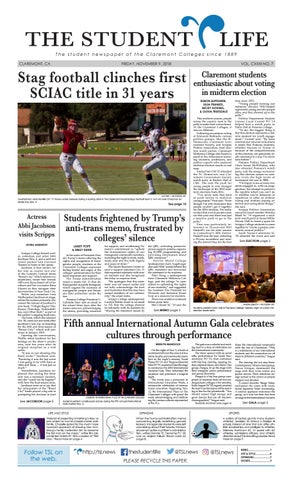
Stag football clinches first SCIAC title in 31 years
AMY BEST • THE STUDENT LIFE
Quarterback Jake Norville CM ‘21 throws under pressure during a scoring drive in the Claremont-Mudd-Scripps football team’s 16-9 win over Chapman on Senior Day Nov. 3.
See page 10
Students frightened by Trump’s anti-trans memo, frustrated by colleges’ silence
Actress Abbi Jacobson visits Scripps LEORA AKBAROV
LANEY POPE & EMILY KUHN
Scripps College hosted writer, comedian, and artist Abbi Jacobson Nov. 4, and a sold-out crowd packed into Garrison Theater to listen to her speak. Jacobson is best known for her role as creator and star of the Comedy Central series “Broad City,” which follows codependent, stoner best friends Abbi and Ilana (based off of Jacobson and her co-creator Ilana Glazer) as they navigate their late-twenties in New York City. Writer and comedian Lena Waithe joined Jacobson on stage, where the women primarily discussed the release of Jacobson’s new book, “I Might Regret This: Essays, Drawings, Vulnerabilities, and Other Stuff,” as part of the author’s ongoing book tour. The book, which she released Oct. 30, came out one week after Jacobson’s last day of shooting for the fifth and final season of “Broad City,” which will premiere in January 2019. Opening the conversation, Waithe asked Jacobson for her feelings on the show’s conclusion, now ten years after its original inception as a web series. “It was so sad shooting this [last] scene,” Jacobson said. “Knowing it was the last scene I was going to do with Ilana as Abbi and Ilana … it was just so much.” Nonetheless, Jacobson explained that ending the show now was a necessary decision, and she “could not be happier” with how the final season ends. Jacobson went on to say that her anticipation of the “Broad City” finale played a big role in prompting her decision to start
In the wake of President Donald Trump’s memo affecting the rights and recognition of transgender people, students at the Claremont Colleges expressed feeling fearful and angry at the colleges’ administration for their tepid responses and support. The Trump administration issued a memo Oct. 21 that defined gender as purely biological, which negates the existence of transgender people and threatens their protection under the law. Pomona College President G. Gabrielle Starr sent an email to the school three days after the memo came out, acknowledging the memo, providing resources
for support, and re-affirming Pomona’s commitment to “uphold the fundamental rights of our transgender community members, including the right to work, teach, study, play and live with dignity and peace of mind.” The Queer Resource Center issued a support statement Oct. 31 that expressed solidarity with noncis students and also recognized the delay in response time. “We apologize that this statement was not issued earlier and we fully acknowledge the hurt and frustration that this may have caused members of our community,” the email states. Scripps College spokesperson Carolyn Robles wrote in an email to TSL that the college showed its solidarity with its students by “sharing the statement issued by
See MEMO page 3
ELINOR ASPEGREN, JULIA FRANKEL, BECKY HOVING, & OLIVIA TRUESDALE This midterm season, people across the country took to the polls to make their voices heard. At the Claremont Colleges, it was no different. Following on-campus voting at Edmunds Ballroom, various politics groups, like the 5C Democrats, Claremont Government Society, and Scripps Politics Association, held election watch parties. Claremont McKenna College also hosted a panel at the Athenaeum featuring students, professors, and politics experts who analyzed midterm election results in real time. Emma Finn CM ’21 attended the 5C Democrats and Claremont Government Society watch party in Beckett Hall at CMC. She said the push for young people to vote changed the landscape of the 2018 midterm elections from 2016. “I’ve never seen that kind of push before to mobilize young people,” Finn said. “Even though I’m still frustrated that people couldn’t get it together for the 2016 election, I’m really excited that a lot of people came out this year and there was just a massive push to go to the polls.” Finn was particularly interested in 22-year-old Will Haskell’s run for state senator in Connecticut’s 26th district. Haskell won the seat, defeating a 22-year incumbent and turning the district blue for the first
time since 1973. “Young people turning out mattered,” she said. “Will Haskell captivated young and old people alike, and they showed up to the polls.” Politics Department Student Liaison Lucas Carmel PO ’19 helped host a watch party in Hahn Hall at Pomona College. “To me, the biggest thing is that this election represents a definite moment for youth engagement,” Carmel said. “By most external and internal indications it seems that Pomona students, whether because of Trump or because of the competitiveness of this election, are genuinely really interested in a way I’ve never seen before.” Pomona Politics Department Chair Susan McWilliams, who also attended Pomona’s watch party, said the energy surrounding this election season on campus rivals the high levels of excitement she saw in 2008. “I’m happy to see so many students engaged in, with no exaggeration, the attempt to preserve the republic which you can’t do — whether you’re democrat or republican or other — without voting and without paying attention and caring about things,” she said. Scripps Politics Association executive board member Matilda Msall SC ’19 organized a midterm watch party at Susan Miller Dorsey Hall to create a space for Scripps College students to come together to “create a greater community around politics.” Sarah Nunez-Lafontaine SC ’22 attended the event and said
See ELECTION page 3
SANDRA SUBLETTE • THE STUDENT LIFE
Students packed Hahn Hall at Pomona College Tuesday night to watch the election results roll in.
Fifth annual International Autumn Gala celebrates cultures through performance BREELYN MANGOLD
COURTESY OF INTERNATIONAL PLACE OF THE CLAREMONT COLLEGES
See JACOBSON page 5
the QRC, activating person-toperson support systems, organizing SCORE programming, and providing information about QRC resources.” Harvey Mudd College Spokesperson Judy Augsburger also said HMC stands behind the QRC statement and forwarded the statement to its students. Peter Hong, a spokesperson from Claremont McKenna College, said the college “is committed to upholding the rights of our students,” and suggested the Assistant Vice President for Diversity and Inclusion Nyree Gray as a resource for students. Pitzer was unable to comment before press time. Mel Gilcrest SC ’19 said the
Claremont students enthusiastic about voting in midterm election
Students perform a bollywood dance during the fifth annual International Gala hosted Nov. 3.
LIFE AND STYLE
OPINIONS
“Instead of presenting Armstrong’s story as one where he had to choose career over family, Chazelle opted for the much more nuanced approach of showing how Armstrong’s family motivated him to become the first man on the moon,” writes film columnist Ben Hafetz PZ ‘20 in a review of “First Man.” Read more on page 4.
Follow TSL on the web.
On the night of Nov. 3, a hush of excitement fell over the crowd of students, faculty, and community members as the night’s emcees, Noah Plasse PO ’21 and Tingyue (Juanita) Man PZ ’21, sauntered onto the stage to commence the 2018 International Autumn Gala. They welcomed the audience and promised a magical night. The event was a precursor to International Education Week, a nationwide celebration of international education. Beginning Nov. 12, the International Place of The Claremont Colleges will spend the week acknowledging and celebrating the various cultures represented at the 7Cs.
The gala was a colorful and exciting start to a time of celebration for the international community. The show opened with an aerial silks performance by Sarah Sundermeyer PO ’21, then continued with hip hop dancing, rapping, Indian classical dance, and more. One group, Pangea, lit up the stage with their energetic dance performance and group chemistry. Pangea is a hip hop group comprised of students from all five undergraduate colleges. One member, Kaila Teague PZ ’22, eagerly awaited the team’s performance while standing in line for the photobooth. “You should expect high energy and great dances that are all studentchoreographed,” Teague said. Students involved were eager to
http://tsl.news
See GALA page 5
SPORTS
When the Trump administration memo concerning legally redefining gender leaked, transgender students were left wondering about their futures. The lack of prompt action by Pitzer’s administration, writes Donnie TC Denome PZ ‘20, was an abject failure. Read more on page 8.
thestudentlife
share the international community with the rest of Claremont. “This is a celebration of our international students and the connection we all share to different countries,” Teague said. The dancing did not stop there. Contemporary African dance group, Dance Afrique, dominated the stage with their wide smiles and joyous moves. Their infectious energy spread to the crowd as people clapped and shouted. A crowd favorite, Shogo Taiko, enchanted the room with traditional Japanese Taiko drumming. A roarous applause welcomed the group, as it was not their first time on stage at the International Autumn
@TSLnews
PLEASE RECYCLE THIS PAPER.
A variety of factors go into many studentathletes’ decision to attend a Division III school, instead of one that can offer athletic scholarships and priviliges to athletes. Delaney Hartmann SC ‘21 spoke with 5C athletes, admissions officers, and athletic directors about the recruiting process. Read more on page 9.
@TSLnews
NEWS................................1 LIFE & STYLE.....................4 OPINIONS........................7 SPORTS.............................9
NEWS PAGE 2
NOVEMBER 9, 2018
THE STUDENT LIFE
Wilderness Remote First Aid course subsidized by Westboro Baptist Church announces plans Emergency Response Team, requires students to join to picket at Pomona SAMUEL BRESLOW The Westboro Baptist Church, a religious group known for its homophobic rhetoric and other hate speech, announced Nov. 6 that it plans to picket at Pomona College Nov. 12 at 7:15 a.m. to protest a course on “Queering Childhood” being offered next semester. “Lord willing, the preachers of WBC are on the way, sad youngsters!,” states a press release posted to the church’s website. “We will bring you the only hope of life – both temporal and eternal – that is not filled with misery, confusion, and death.” Pomona President G. Gabrielle Starr wrote in an email to students Nov. 8 that the college will not allow the church to picket on the college’s private property, which includes Sumner Hall, the address listed by the WBC.
“
We will bring you the only hope of life – both temporal and eternal – that is not filled with misery, confusion, and death.
”
- Westboro Baptist Church press release
“The hate speech this small group continually directs at the LGBTQIA+ community and many others is sickening,” she wrote. “Let us use the moment to uphold and affirm the positive values of inclusion we believe in and, most importantly, to care for one another as a community.” Starr cautioned that the church’s members “are known for being savvy in asserting legal rights,” and urged counter-protesters to protest “peaceably to avoid doing anything that would draw you into a legal dispute that would only serve someone else’s aims.” She also mentioned that the church sometimes does not show up to events it announces. Pomona spokesperson Mark Kendall said the college is “co-
ordinating and in contact with campus safety” to prepare for the picketing. Starr said the Queer Resource Center and the Frank Dining Hall Blue Room will be open 7-9 a.m. to support students. The other Claremont Colleges announced similar events. QRC director Manuel Diaz wrote in a follow-up email to Claremont students that “QRC professional staff will be available to talk with those who would like to, and provide a sense of belonging and inclusion in the space.” As of press time, nearly 1,000 people had RSVP’d to a Facebook event scheduled concurrently with the picketing titled “Celebration of Diversity,” which features a cover photo with a heart drawn over a rainbow flag. Matti Horne PO ’22, who is co-hosting the event along with four other Pomona first-years, wrote in a message to TSL that it will be held on Marston Quadrangle, away from the picketers, so as not to grant them an audience. “We are just planning to have a peaceful, fun, happy celebration of love and all identities,” she wrote. “There’ll be music, dancing, and hopefully postermaking and face painting.” TSL attempted to contact the WBC over the phone but was unable to reach them before press time. The “Queering Childhood” course, offered through the Gender and Women’s Studies program, “examines the figure of the Child and how this figuration is used by politics, law, and medicine to justify continued cultural investment in reproductive heteronormativity and productive ablebodiedness,” according to the course catalog. It promises to “examine the queer and crip children and childhoods against which the figure of the Child is articulated.” The course’s instructor, a visiting lecturer, declined to comment. The course was previously highlighted by the conservative news outlet Campus Reform. The WBC also announced plans to picket in front of Claremont High School the same day, but the school will not be in session in observance of Veterans Day.
COURTESY OF POMONA COLLEGE OUTDOOR EDUCATION CENTER
Students participate in Pomona College’s Wilderness Remote First Aid program.
SIENA SWIFT Some Pomona College students who participated in the Wilderness Remote First Aid program were unaware of the requirement to join the Emergency Response Team that subsidizes the cost of the course for Pomona students. The Wilderness Remote First Aid program run by the Outdoor Education Center started in 2013 and offers a Red Cross Wilderness Remote First Aid certification and basic CPR/AED certification, both valid for two years. It is a 16-hour, two-day course offered once in the fall and twice in the spring. Students who take the Outdoor Leadership PE class are required to take the two-day program. The course is designed to prepare participants for “medical and emergency response within a wilderness context, which is defined as more than two hours to advanced life support,” said Martin Crawford, Pomona’s di-
rector of Outdoor Education. The course description for the PE class does not include a mention of the Wilderness Remote First Aid program or the requirement to join the Emergency Response Team — just that the class includes some weekend field trips. About 60-80 students participate in the Wilderness Remote First Aid program per year according to Crawford. There are tests throughout the course to determine whether participants will pass and receive their certifications. After the course, Pomona students are required to become part of the Emergency Support Team 4, which specializes in community care. They participate in approximately one emergency drill per year and assist in the event of any actual emergency. All Outdoor Adventure leaders, Resident Advisors and professional staff are part of this Emergency Support Team, according to Crawford. “[Emergency Support Team
4] will be getting the notification through Everbridge saying we need you to assemble because of this big earthquake; please come help out your community,” Crawford said. Their responsibilities are mainly medical care techniques taught in class. Despite their willingness to help their community, some participants felt the requirement could have been made more clear. “[I] actually was unaware of [the requirement] until the almost halfway through the class,” Sam Meyer PO ’22 wrote in an email to TSL. Thea McAfee PO ’22 was also not aware of the requirement, but said it was logical. “It’s a mildly intimidating title to have, but I’m glad to be able to support the community in any way,” she said. Jonathan Contreras PO ’21 echoed McAfee. “[The Emergency Response Team requirement] caught me by surprise but I’m glad I’m certified to help in any way I can, especially in the case of
emergency,” Contreras wrote in an email to TSL. “I don’t believe I’ve been given any formal instructions regarding the emergency response team,” Contreras wrote. “I just kind of accept the idea that if there’s an emergency, I should help if it’s within the scope of my ability.” Participants in the WRFA course learn primary and secondary patient assessment, spinal injury assessment, reduction of dislocations, identifying medical conditions (asthma, diabetes, heart attacks), splinting, wound treatment, and wilderness hazards such as lightning, hypothermia or snake bites, according to Crawford. Anyone can take the WRFA course, including members of the 7Cs for $145 and the general public for $180. However, some 5C organizations subsidize the cost for students. The course is free for students in the Outdoor Leadership class. For Pomona students, the course cost is only $20 because it is subsidized by the Emergency Response Team.
Second Sparkathon attempts to solve LA homelessness Bags of urine found in Walker Hall
CHLOE ORTIZ • THE STUDENT LIFE
Teams strategize before judging during the 5C Sparkathon organized by Pomona Ventures Nov. 2.
ANAIS RIVERO Over 200 students gathered in the Hive Nov. 2 for Pomona Ventures’ second Sparkathon, a seven-hour thinking challenge that enables students of all majors to solve a pressing world problem in small collaborative teams. This time, the challenge was creating a solution to decrease homelessness in Los Angeles. Fabian Fernandez-Han PO ’20 founded Sparkathon last semester because competing in corporate case competitions left him feeling intimidated and dejected. “I wanted to build a positive environment where students of every background could come together in a fun and collaborative manner to solve global challenges and gain exposure to top recruiters,” he said. The top three teams received the Spark Initiative Grant, a $1,000 award to help implement their solutions. The first place winner also received an additional $1,000, the second place winner $750, and the third place winner $500. This year, there were over 250 registrations, according to Fernandez-Han. The winner of the Sparkathon was Team 17, which included Bella Kearney PO ’21, Calder Hollond PO ’21, Jed Kronenberg PO ’21, Damian Lin PO ’21, Elias van Emmerick PO ’21, and Sophia West PO ’22.
Their solution to help decrease homelessness in LA was to centralize information about shelter — such as availability, location, programs, criteria, and safety — into one database. This information would be condensed into a website and app called Sheltersearch. “We worked really hard, and we pulled together something great,” Lin said. “It’s amazing to have the opportunity to help the homeless [gain] better access to affordable housing. That’s exactly what we’re planning on using the prize money for.” The second place award went to Team 13, which included Claire Van Note PO ’22, Eric Zhu PO ’22, Kari Siegenthaller PO ’22, Samuel Paul Zukin PO ’22, and Caleb Brunman PO ’22. Their solution was to create an organization called LA Cares, which focuses on erasing the stigma surrounding homelessness. LA Cares also plans to connect tenants with vouchers to landlords, while streamlining the rental process. “My team went into the competition looking forward to having stimulating conversations about an important issue and looking to gain some experience with humancentered design,” Van Note said. “We were incredibly thrilled to have made it so far and receive second place.” The third place award was given
to Team 30, which included Virgil Munyemana PO ’22, Camille Wiggins PO ’22, Olu Omoyugbo PO ’22, Andriw Read PO ’22, Abdul Basit PO ’22, and Keath Carter PO ’22. Their solution was creating an organization called Project REstore that would provide laborers with the skills they needed to be hired by companies, such as typing, coding, Microsoft Office Suite, resumebuilding, and interviewing. “I was really interested in the Sparkathon after I took a class at Harvey Mudd called Human Centered Design,” Madeleine Halle PZ ’19 said. “It’s a class all focused on problem solving, and the projects have been really engaging and inspiring, and I wanted to continue to do that outside of the class.” Students were also interested in the chance to engage in problemsolving and to challenge themselves. “I like problem-solving in general, so it’s kind of fun to get a prompt and try to brainstorm a solution,” Joe Brennan PO ’20 said. With such limited time to develop a solution, students said working with each other was important. “The collaboration aspect was definitely my favorite part of the Sparkathon,” Dafina Matiku SC ’21 said. “It was great to be able to bounce ideas [off] one another.”
Bags of urine were reportedly disposed of in Walker Hall trash cans, according to an email sent by Pomona College Residence Life Coordinator Andrew Castro to Walker residents. “The week before fall break, my friends that lived in Walker noticed that it was smelling really, really bad in the corridor between all the rooms, and we didn’t know what was going on,” Walker resident Miranda Sheridan PO ’20 said. Castro asked for the behavior to stop, and asked the individual(s) to be mindful of the people they have impacted. “Please be considerate of the other individuals using the restrooms, and for the health and wellbeing of the staff that have to respond to these issues,” Castro wrote to Walker residents. Castro did not respond to TSL’s requests to comment. — Maria Heeter
Construction on Foothill Boulevard yields delays and lane closings Foothill Boulevard will be under construction until October 2019, according to an email sent out by Scripps College Facilities Department. The project, which began construction on Oct. 29, 2018, will include landscape updates, a protected bike lane, benches, and signage. For the duration of the project, students should expect delays and the closing of lanes. However, one lane of traffic will be open in each direction at all times, and building access by foot will not be disrupted. — Becky Hoving
Claremont City Council race still too close to call The unofficial election results of the Claremont City Council race have Jennifer Stark PZ ’98 in the lead with 24.46 percent of the votes, according to the Los Angeles County Registrar Recorder/County Clerk. Jed Leano trails close behind with 21.62 percent. On Friday, the registrar’s office will begin counting the 3,000 provisional ballots and vote-by-mail ballots still to be counted. Los Angeles county finalizes all election results by Nov. 30. — Becky Hoving
Conservative commentator George Will talks politics at Ath Conservative political columnist George Will spoke at the Marian Miner Cook Athenaeum Nov. 8 in a talk titled “The Political Argument Today.” Claremont McKenna College surrounded the venue with security personnel and fences, but there was no visible protest outside, as happened last spring when a talk by Manhattan Institute fellow Heather Mac Donald was blockaded. The talk was open to CMC students who registered for the dinner. Will was disinvited from a talk at Scripps College in 2014 after he criticized Obama administration efforts to curtail sexual violence. — Samuel Breslow
NEWS Three of five students on administrative search committee unpaid JAIMIE DING Five students were selected for a search committee to find a new first-generation coordinator for Pomona College. But, only two of them were paid. Pomona hired its first first-generation coordinator, Maria Melendrez PZ ’16, in July 2016. The position was open after Melendrez stepped down in the summer of 2018, according to a collective letter sent to Pomona administration. Dean Ric Townes organized a search committee to find her replacement, Pomona Dean of Students Avis Hinkson wrote in an email to TSL. The first-generation coordinator is responsible for coordinating events to support first-generation and low-income students as they navigate their college experience. The Associated Students of Pomona College was told to hire two students for the committee, according to executive vice president Johny Ek Aban PO ’19. The students were selected through an application process, and each of the students was given $500 by ASPC. Townes then asked the First-Gen Low Income (FLI) and Improving Dreams Equality Access and Success organizations to select three more members for the committee. One of the students was an IDEAS head mentor paid by the Dean of Students Office for her job but unpaid for her work on the committee. The other two students on the selection committee were unpaid. This is not the first time ASPC has paid students for serving on search committees. The students on the presidential search committee that selected President G. Gabrielle Starr last year were also given financial compensation by ASPC. “We believe [in] paying students for work that they do in addition to [them] doing it because of love for the community and because of
PAGE 3
THE STUDENT LIFE
NOVEMBER 9, 2018
passion for whatever position,” Ek Aban said. “It’s time that’s going away from studying; it’s time that’s going away from a work-study job or off-campus job that should be compensated.” Serving on a search committee is a “volunteer activity” and there are no plans in place to pay students for committee work in the future, Hinkson wrote. However, they are working to make the search process more accessible overall. “With acknowledgement of the time commitment required to participate on a search committee and to make the opportunity more accessible, we are working to adjust the process with enhanced open presentations to students, including a meal to help fit student participants’ schedules, in order to engage more student input without an onerous time commitment,” Hinkson wrote. Ivette Fernandez PO ’19 was picked to represent the FLI community on the committee and was one of the unpaid students. “I took time that I could’ve been doing work-study, or doing stuff for my other job on campus as an RA,” Fernandez said. “I took time out of that position because it’s very important to me that this coordinator would be someone who actually … represented FLI’s interests.” The situation was handled “indelicately,” she said. “It’s not the worst thing in the world … but it’s like a tiny step shown by new leadership that makes me have less faith in them.” Diana Rodriguez PO ’19, a member of both IDEAS and FLI, drafted the collective letter to the administration after conversations with Dean Hinkson were unsuccessful. The letter was posted in the Pomona Class of 2019 Facebook group, and ASPC sent out an email Oct. 16 to the Pomona student body to gather signatures for the letter. The letter was sent Nov. 8 to the Pomona dean of students, presi-
dent, and alumni board, and was signed by the collective ASPC Senate, as well as 100 students and alumni. “Every student should have the opportunity to be part of an administrative search committee position, but the reality is that not all of us have this privilege,” the letter wrote. “Not all students are able to volunteer time to these positions because they have multiple jobs in addition to courses.” Rodriguez emphasized the importance of the issue of paying students for administrative search positions beyond the current situation. “Right now it’s impacting FLI and IDEAS, but it could be any other program,” she said. Karla Ortiz PO ’20, an FLI mentor, signed the letter because of the impact the first-gen coordinator position has had on her. The position was put in place her first year at Pomona. “[The position has been] very integral to my well-being and [my] being able to be on campus and have these needs addressed,” she said. Ortiz said she believes all administrative search committee positions should be paid to recognize the labor that students put in. “Speaking from my own experience, a lot of the money that I make goes back to my family,” she said. ASPC was initially working with the two paid students on the search committee to discuss potentially cutting their compensation in order to “compensate equitably” between the IDEAS and FLI students and the students selected through ASPC. However, they voted Nov. 1 to allocate an additional $1,000 to pay the unpaid students if they were unsuccessful in securing DOS funding for the students’ compensation.
MEMO: Student voiced concerns at QRC town hall
EMILY KUHN • THE STUDENT LIFE
Students gather in the Queer Resource Center for a write-in advocating for trans rights in response to President Donald Trump’s recent memo.
Continued from Page 1 memo was devastating, yet unsurprising. As a transgender man, the memo confirmed all of his fears about “what the administration thinks about you, and how either the majority or a vast proportion of the country thinks of you as subhuman or not even real,” he said. Gray Butler PO ’20 identifies as non-binary and finds the memo difficult to engage with because they know “that this is just the beginning of a series of forms of violence,” they said. Gilcrest described the colleges’ response as “very lukewarm as best.” “If [the administration is] going to claim to really support [its] trans students and tout that as something that is unique about your school, you [have to] walk the walk instead just of talking the talk,” he said. To Butler, the lack of support from the administration did not come as a shock, but it did make
the reality of the memo harder to face. “Part of the trauma of what’s been happening is constantly being let down by the systems that are supposed to, in theory, protect you,” they said. Connie Walden PZ ’22 and Daniel Molina PZ ’22 spray painted “@ Pz, why the silence?” and “we will not be erased” over the trans flag on the Pitzer ’s free wall to express their discontent with the administration’s lack of action. “With certain issues like this, there is a certain timeframe in which it’s appropriate to respond,” Molina said. “[With] the Pittsburgh shooting, Pitzer responded within a few days. They took up to a week or more to respond to the whole trans memo.” Walden still felt that the statements that came out were not sufficient. “These emails just feel like PR statements of support, as opposed to ‘Here is how we are going to change our present policies and structures so we can be better,’”
Walden said. The QRC held a town hall Nov. 2 in response to the Trump memo. It also organized Trans Empowerment Week Nov. 5-9, a series of events including a letter writing campaign Nov. 6, where students wrote letters to their representatives protesting the memo. A few of the concerns brought up by trans students at the town hall included the lack of health care offered for trans students at the 5Cs, along with needs for stronger allyship training for professors and students, changing dead names in the systems, and sending out a full email response to memo with accessible and updated resources for support. Starr reassured students and reiterated the college’s support at the town hall. “We want to be here for our community in as many ways as possible and if we miss something, please tell us, because we want to do everything that is possible to make your lives livable, enjoyable, fruitful, and safe,” she said.
Corrections In the article about bike polo, Jojo Modeste’s last name was incorrectly stated as Fina. In the article about CMC Sex Week, Lauren Trihy CM ‘21 was incorrectly stated as vice president of CMC Advocates for Survivors of Sexual Assault and Violence, instead of advocate.
TSL regrets these errors.
COURTESY OF POMONA COLLEGE
The Smith Campus Center situated at Pomona College. Three of the five students on the search committee for the Pomona College first-generation coordinator were unpaid.
ELECTION: Watch parties fueled electionnight excitement Continued from Page 1 she was excited to vote because “it felt like it actually mattered.” “I’ve seen my state be completely overrun by someone who I don’t believe in, and who has completely hurt [Texas],” she said. “When I heard that [Rep.] Beto [O’Rourke] was running, I just started listening to him and finding out what he was all about — it wasn’t just because he was a democrat, it was because he believes in a more diverse community, he believes in healthcare, and he believes in actually helping people.” O’Rourke narrowly lost the
senate seat to incumbent Sen. Ted Cruz. Maggie Lind SC ’22, who also went to the Scripps watch party, echoed Nunez-Lafontaine, saying she was “upset with the government, to say the least.” “I think [voting] is a very essential part of our democratic process, and it just scares me how few people of our age typically vote,” Lind said. “We have the potential to make the most change, and I knew from the very beginning that I was going to be an active voter.” Samuel Breslow contributed reporting.
SANDRA SUBLETTE • THE STUDENT LIFE
A 5C student checks the close race for one of the Texas Senate seats Tuesday night.
Internship grant opportunities at the 5Cs available to students JENSEN STEADY 5C students lamenting the unpaid or underpaid internship opportunities may be eligible to receive funding from their respective colleges to help cover their expenses while working. Each of the 5Cs makes use of an online application for internship funding programs. At Pitzer College, grant funding applications are available on the first day of classes for the spring semester, according to Brad Tharpe, Pitzer’s director of career services. Funding is given for summer domestic and international internships based on hours per week and transportation costs, and the application requires a resume, budget, and written responses to five questions. It is due shortly after spring break. In 2018, Pitzer funded 51 students with an average award of $1,698 per student for a cumulative total of $86,000, Tharpe wrote in an email to TSL. Pitzer students may only receive funding for one summer during their college career and are funded through a few endowed funds, but mostly through Pitzer’s Office of Advancement. At Scripps College, students can apply to either the Summer Internship Grant Program or the Linda R. Scott Fund for Students, which provides money for internships during the school year, according to Scripps spokesperson Carolyn Robles. The Scripps internship grant application deadline for summer 2019 is Feb. 6 and requires demographic information, a tentative budget, and brief essay responses regarding the student’s professional growth plans. Last summer, Scripps funded 95 students with an average of $3,500 per student. “Internship grants are made possible through the generosity of
our alumnae, families, staff, and members of the Scripps community,” Robles wrote. Victoria Genao SC ’21 received grant funding for an internship at Los Angeles Contemporary Exhibitions. “The cost of traveling back and forth from Claremont twice a week was definitely a concern I had. … [W]hen I read about the Linda Scott Travel Fund, it sounded perfect for me, so I applied,” Genao said. Genao described how CP&R was able to factor in her predicted travel costs. “Within a week, I was notified that I’d been accepted as a recipient of a travel grant, and because I’d explained in my application that my estimated travel costs were actually going to exceed the maximum … CP&R offered me a grant that exceeded the said-maximum,” Genao said. Approximately 70 percent of Harvey Mudd College students do at least one summer internship, according to Paul Hardister, HMC’s associate director of the Office of Career Services. He noted that the other 30 percent usually do summer research. Hardister also reported that 88 percent of students who do internships say they are paid by their company. He wrote in an email to TSL that the remainder of students with internships can receive funding from one of four community engagement fellowships. Lorelei Bivins HM ’21 said she and her friends were unfamiliar with the Mudd programs. “I haven’t heard of anyone getting internship funding from Mudd,” she said. At Claremont McKenna College, the application for the Sponsored Internship & Experience Program will open for next summer on Jan. 7 and is due March 1. Students are required to fill out the
JENNY PARK • THE STUDENT LIFE
Scripps College students participate in The Resume Challenge hosted by Scripps Career Planning & Resources.
application, submit a budget, be an enrolled at CMC for the next academic year, and have a minimum 7.5 GPA. The program supports both internships and other experiences. Internships are “structured and supervised” and are a minimum of eight weeks, and experiences are “unstructured” and a minimum of four weeks, said Evan Wollen, assistant director for the SIE program. Wollen said that in 2018, CMC funded 344 students for a total of over $1.3 million in grant funding. On average, each student received $3,700 of funding. Wollen said that funding is drawn from over 30 different streams. Most of them are from the institutes and centers at the college, such as the Mgrublian Center for Human Rights or the Henry Salvatori Center, as well as the Soll Center for Student Opportunity. “Applying for summer funding was a nearly seamless process for me,” Juliana Favela CM ’21 wrote in a message to TSL. “This was my first time actually applying to an international program on my own
so I had little to no idea what I was doing, and SIE successfully guided me through filling it out. By the end, I was able to create a budget and SIE was able to fund my entire summer experience.” Pomona College Internship Program applications are due mid-spring. The application process includes an application, budget, resume, cover letter, essay responses, references, and a panel interview, according to Pomona’s website. Internships must consist of a six- to eight-week experience of at least 240 hours of total work time to qualify for funding, according to the website. In 2018, 77 students received funding for summer internships with awards ranging from $800 to $7,000. “I did the PCIP program twice and had my internship funded both times,” Nathalie Guevara PO ’19 wrote in a message to TSL. “Being able to get [my funding application] approved by PCIP as an outside internship and get funding helped a lot especially in terms of getting to and from the hospital for my shifts.”
LIFE & STYLE PAGE 4
NOVEMBER 9, 2018
THE STUDENT LIFE
FILM COLUMN
STUDY ABROAD COLUMN
‘First Man’: An out-of-this-world tale, told in personal moments BEN HAFETZ Before the 2017 Oscars, Damien Chazelle appeared primed to take Hollywood by storm. His first film “Whiplash” received universal acclaim and brought him into the eyes of the public, and his second film “La La Land” was favored to win the Academy Award for Best Picture. This was, of course, until the infamous “Moonlight” moment of the 2017 Oscars, where “La La Land” was falsely announced as the best picture winner, only for “Moonlight” to be revealed as the true winner. Chazelle’s third film, “First Man,” follows a familiar pattern of rising directors attempting biopics. The auteur takes on the true story of the American Space Race and the journey of Neil Armstrong (Ryan Gosling) to be the first man to land on the moon, to mixed results. Going into the film, I expected a similar story to Chazelle’s other films, where the male lead must sacrifice his personal life in order to achieve greatness, with moments of pure cinematic muscle-flexing through Chazelle’s set pieces. However, he opted for a different approach in his first true-to-life film. In “First Man,” the difficulty lies in balancing the quests for greatness and love, as Armstrong must balance the challenges of the Space Race with the turmoil of his young daughter’s death. Instead of presenting Armstrong’s story as one where he had to choose career over family, Chazelle opted for the much more nuanced approach of showing how
Armstrong’s family motivated him to become the first man on the moon. While this choice is welcomed considering the problematic element of Chazelle’s first two films –– the idea that men must remove women from their lives in order to achieve greatness –– the film never seems to earn the cathartic response that it clearly tries to gain from its audience. Chazelle’s second biggest departure from his previous style is the film’s distinct lack of big set-piece moments, which is especially significant, given the story’s focus on space travel. Instead of jaw-dropping, wide shots of the Apollo 11 soaring above the atmosphere, the film treats the audience to close-ups of terrified astronauts strapped into machines that look more like amusement park rides than spaceships. Furthermore, Chazelle replaces the expected patriotic monologues stressing the importance of space travel as a new frontier of manifest destiny with small moments of genuine strife between Armstrong and his family. Due in large part to the starmaking performance of Claire Foy as Janet Armstrong, the small moments between Armstrong and his family make the best moments of the film. Chazelle shoots these scenes in a bare-bones style, and they make the relationship between the Armstrongs and their two children the heart of the film. No moment reflects this strength more than the climax of the film. Without spoiling it, I will just say that Armstrong’s walk on the moon
Why traveling is the best decision I’ve made abroad
becomes less about a historic breakthrough, and rather more about a personal one. However, the film’s greatest strength is also its greatest flaw. All of these scenes of Armstrong and his family, especially the climax, work well on their own, but they don’t quite work well with each other. As amazing as the scenes of Armstrong interacting with his family are, they do not create a throughline that the film’s characters follow. Instead, we are just told we are supposed to feel the way the characters do. This creates an impressive climax because of Chazelle’s and Gosling’s talent, but one that simultaneously feels completely unearned. “First Man” is a great film in the abstract, where Chazelle’s camera brilliantly films the affecting moments of grief and pathos. However, in viewing the film as a whole, these moments fail to fully connect with each other, creating a situation where, as a viewer, I felt like the film tried to trick me into feeling something that was not quite there in the first place. Ultimately, “First Man” is a collection of great moments that never come together well enough to stick the landing. 3.5/5 Ben Hafetz is a media studies and politics double major at Pitzer College. He likes to not only see movies, but also tell his friends why they should or should not like certain ones.
NINA POTISCHMAN • THE STUDENT LIFE
JORDAN WONG • THE STUDENT LIFE
MARC ROD While traveling, travel. This might sound like a nonsensical truism, but studying abroad opens up a wealth of opportunities for additional travel outside of one’s host city, and traveling outside of Freiburg has been one of my favorite experiences thus far. As I write this column, I am on a trip with others from my program to Vienna and Prague. I am in a unique position compared to most students abroad, because my program involves several field study trips throughout Europe. However, the program-organized trips have been highly structured and scheduled — perhaps even over-scheduled. We have had a variety of lectures in each city we have visited, which left minimal time for traveling and exploring these European cities independently. Traveling autonomously has been a completely different experience. I have been able to set my own schedule and see the sites that interest me at my own pace and I gained a deeper understanding and appreciation of the local culture and history of the places I was visiting. This was an invaluable supplement to the classroom education and day-to-day experiences in Freiburg. While wandering the streets of the old city of Prague while snack-
ing on a local pastry, the old-world, Eastern European, post-Soviet culture and charm of the city was palpable. The city is filled with impressive historical architectural monuments, including a massive palace complex on a hill overlooking the entire city, but its narrow, crowded side streets, which fill with the scent of charcoal and cinnamon sugar from cooking pastries make it feel quaint and cozy. Every inch of the city projects a welcoming and friendly atmosphere. By exploring historical sites and museums, sampling the food, and interacting with locals, I felt I gained a deeper appreciation of Prague, Europe, and my experience abroad in general. Travel gave me the chance to relax and spend time with friends — which my hectic schedule in Freiburg gives me little time to do — experience more of Europe, and learn more about the places that I am studying and the diversity of cultures and traditions that interact within the EU. Each of the seven EU countries I have visited so far has a distinct character, culture, and ‘flavor ’ visible through architecture, food, museums, shops and local specialties, and the attitudes and behavior of the local people. Being able to see these differences firsthand has been a fascinating supplement to my studies about
the EU’s institutional structure. These regional differences are an integral element of the EU and regularly cause difficulties for it, making its success even more intriguing. Europe is an especially prime location for traveling. There are so many fascinating cities with rich histories throughout the continent, situated in a more condensed space than many major U.S. cities, which reduces travel time. Traveling is also generally more affordable in Europe than in the United States. Europe has a variety of low-cost airlines, highly affordable train tickets, and cheap — but good quality — hostels and hotels that make it ideal for students on a budget, although costs can still stack up. The chance to travel so freely and easily is a unique and special experience, so any student abroad should take advantage of this chance while they have it. Even if students only have an opportunity to take a day trip to a neighboring city, they should take that opportunity to travel. Anyone who does won’t regret it. Marc Rod is an international relations major at Pomona College, studying the European Union in Freiburg, Germany. Fittingly, he enjoys travel and journalism.
MUSIC COLUMN
How to enjoy popular music when popular music isn’t enjoyable ELLA BOYD CW: Mentions of drug use, mental illness, suicide The release (and immediate popularity) of the mixtape WRLD on Drugs got me thinking: Is everyone around me really as depressed as I think they are? The week WRLD on Drugs came out, it became impossible to avoid the collab between Juice WRLD and Future. Between Instagram stories, Spotify playlists, and Soundcloud reposts, it felt like everyone was projecting the drugged out melodies of the two popular rap artists. The truth is that this week was pretty similar to every other week, because lately, it feels like Top 40 songs are all pretty sad. Gone are the days of carefree bumps like “California Girls,” “Just Dance,” or the all-time classic “Baby” by Justin Bieber (feat. Ludacris). Now, don’t get me wrong, I am quite alright with moving on from the “feat. Ludacris” phase of the 2000s, but what happened to having a good time? Lyrics like “Just dance, it’s gonna be okay, just dance, spin that record, babe” have been replaced by: “You left me falling and landing inside my grave, I know that you want me dead (cough), I take prescriptions to make me feel a-okay.” The aforementioned lyrics come from the currently third most popular song in America, “Lucid Dreams” by Juice WRLD. Juice WRLD isn’t the only current artist churning out melancholy music. “ZeZe” by Kodak Black, which was No. 2 on the Billboard Hot 100 chart on Oct. 27, features lyrics: “Pop pills, do what you feel, I’m on that zombie.” Earlier in the year, the number one song in the United States was literally titled “SAD!” and the chorus went: “Suicide, if you ever try to
let go, uh, I’m sad and low, yeah, I’m sad I know, yeah.” Don’t misinterpret this as my rejection of pop culture. Self-expression is more than valid: It is generally the reason behind creating art in the first place. My problem here is with the ingenuine nature of creating “bangers” about serious topics for the world to consume and pay artists before discarding the song (including its lyrics). The media just moves on to the next hot song that crops up a few days later. Rap used to have a reputation for bringing light to the realities of life (think N.W.A’s social commentary on being black in America), but now
it often feels as if lyrics are stated for attention with little to no backing behind the words. For example, in a Genius Lyric video interviewing rapper Comethazine on his hit song “Bands,” where he raps, “I’m rocking Goyard and Supreme,” he admits in the interview “I don’t actually own any Goyard or Supreme.” Plenty of rappers lie about their money, but these lies are generally harmless. Talking about mental illness and death, however, may not be as harmless. The weirdest part, though, is that all of these songs are catchy and, quite honestly, fun. How a song
about suicide can be fun is honestly beyond me, but the juxtaposition of extreme emotions in situations where emotions are not meant to be felt deserves attention, which it certainly receives. The shock factor may be the casual nature of dropping lines like these. Songs like “SAD!” are blasted on speakers for kids to party to. Kids are getting wild to songs about wanting to die. Maybe this interest in the macabre isn’t abnormal, though. Rap has gained popularity on mainstream charts fairly recently, but popular music has had its more emotional moments through the decades. “How Am I Supposed To Live
Without You,” released in 1989, goes: “How am I supposed to live without you, how am I supposed to carry on, when all that I’ve been livin’ for is gone?” This sounds a little bit like “SAD!” without the suicide element. So, has music just recently gained the shock factor of casual drug use and suicidal intentions? Popular rap music, maybe. Rock music, on the other hand, has a history of violence linked to its lyrics. One specific case that comes to mind is the teen whose death was linked to their consumption of the Ozzy Osbourne song “Suicide Solution.” Unlike rap, heavy metal and screamo never topped numbers on
DIAMOND PHAM • THE STUDENT LIFE
American pop charts, although rap songs with similar, heavy themes do today. But why are these messages appealing to the masses? Surely not everyone is out here popping pills and wishing they were dead. In fact, teen drug abuse is statistically lower than ever, and teen opioid abuse is the lowest it’s been in 10 years. Hip hop is what people are listening to, and maybe the downbeat message itself isn’t why people are listening. And because hip hop is doing well on the charts, it just happens that the lyrical content of music is leaning more toward topics that have always been popular in the hip hop community. Referring to drugs in music gives artists “a certain notoriety… and adds to the allure and mystique,” reports Davey D, journalist and San Francisco State adjunct professor. Moreover, this may be intensified by the difficulties facing musicians who attempt to stop their addictions. Harold Owens, the senior director for MusiCares Musicians Assistance Program, says: “There is a stigma in the hip-hop community about coming clean and discussing [their addictions] in a genre that many feel has helped promote drug use.” In a scientific study done by the Academy of Finland, analysts reported that: “Anxiety and neuroticism were higher in participants who tended to listen to sad or aggressive music to express negative feelings, particularly in males.” If the Billboard Hot 100 is chosen by which songs the most people are listening to, then we can conclude Americans are in some serious trouble. Ella Boyd is a first-year from Maine who attends Scripps College. She traded alpine skiing for writing for the student paper, and enjoys creating art through film, music, and poetry.
LIFE & STYLE NOVEMBER 9, 2018
PAGE 5
THE STUDENT LIFE
JACOBSON: Writer, comedian, artist discusses new book, conclusion to ‘Broad City’ at Scripps Continue from Page 1
Writer, comedian, and artist Abbi Jacobson visited Scripps College Nov. 4 to discuss her new book.
COURTESY OF SCRIPPS PRESENTS
working on the book, which is comprised of personal essays centered around the thoughts and experiences she had while on a three weekslong, post-breakup roadtrip. When asked why she chose to take up another big project so quickly, she explained: “The show was a good distraction from this heartbreak, but the edit was coming to an end, and I was just like, fuck, I’m just going to be in this shitty zone.” Jacobson said one of her biggest challenges in writing “I Might Regret This” was handling such personal subject matter. “Usually I write about how I feel about bagels,” she said. “It was very challenging to find my voice.” Ultimately, the writing process allowed her to find that voice. She sees the release of the book as a new step in a long career trajectory, and believes it will help her begin to distance herself from “Broad City” and other prior work. Anisha Kaul SC ’20, who attended the talk, said she appreciated Jacobson’s emphasis on her individual work. “It’s nice to think that her career is only just beginning,” she said. “I really appreciated that [Jacobson]
distinguished herself from her character on “Broad City.” On the book’s content, Jacobson said each essay is tied to a different city, and deals with subject matter varying from “climate change, to he-who-must-not-be-named, to scrunchies.” At the end of the discussion, Jacobson transitioned into a Q&A session with the audience. In response to a “Broad City” related question on how to make a web series successful, Jacobson reminded aspiring creators to “keep your eyes on your own paper … find your voice and what makes your web series different.” Waithe also added her take, saying: “With Issa Rae and ‘Broad City,’ the web series wasn’t [yet] so saturated. You have to do something that really breaks ground.” Jacobson reassured her young audience in attendance, pointing out that it’s okay to not know what you’re going to do in life. In discussing her early 20’s, she said: “I was very conflicted about all my interests. I worked at Anthropologie and as an assistant at a bakery. I highly recommend not knowing what you’re doing when you’re 21.” To see a full video of the conversation or find more information on upcoming events in the speaker series, visit the Scripps Presents Facebook page.
BOOK COLUMN
The shape-shifting magic of translated literature SAMANTHA RESNICK
It was “One Hundred Years of Solitude” that first made me sign up for Spanish classes in the sixth grade. At the time, I hadn’t even read Gabriel García Márquez’s landmark work yet. Really, I had only heard the first line: “Many years later, as he faced the firing squad, Colonel Aureliano Buendía was to remember that distant afternoon when his father took him to discover ice.” One line, and I was hooked. I remember thinking: “If just the English translation is that remarkable, then I have to read the original.” And so I signed up for Spanish with one goal in mind: to not read “One Hundred Years of Solitude,” but rather “Cien años de soledad.” At the time, I saw translated literature as a sort of consolation prize for monolinguals. For those with tongues that knew only the dips and curves of a single language, the translation was the best they could hope for and was forever inferior to the original. However, as I continued to study Spanish in high school, and then linguistics in college, my original views — which now seem so unnecessarily hierarchical — have melted into a more fluid approach to translation and literature. This transformation has affected how I see that gorgeous opening line, where the English states that the Colonel’s father took him to “discover ice.” In Spanish, the line reads “conocer el hielo” instead. It is this subtle semantic shift in verb choice between the Spanish and English versions that reveals how dynamic different languages can be. In English, the verb is discover. But in Spanish, the verb is conocer, ‘to know,’ instead of descubrir, ‘to discover.’ The verb conocer is not the only one with that meaning in Spanish — saber technically has the same definition. However, saber is used more in the sense of knowing facts. With conocer, there is a level of intimacy, of familiarity. The Colonel and the ice start to appear more like friends in this light. And that was just the choice of verb in Spanish — when comparing to English, the choice of the verb discover further changes the original line. To know something and to discover it are cousins, sure, but not identical. Before, I would have seen this difference as a stain, a mark of the limitations of English compared to the sonorant subtleties of Spanish. It would have further fueled my placement of the original on a pedestal, as the “true” and best work. Now, I see it instead as an example of how the original work and its translation are equals made more beautiful by their differences. Rather than considering the English version
a close second, I now value it in its own right for offering, from the very first line, a new way of imagining that “distant afternoon.” Conversations surrounding the translation of literature — between languages, between mediums — often center around the concept of fidelity. The question I see over and over again: “The English translation, the film adaption — were they faithful to the original?” The implicit assumption here is that translation should vow to be a mirror, a 1:1 ratio. Faithful. However, this is an impossible task. It would make adulterers out of translators and film producers. By definition, the new work can never be precisely the
same as the original. You could interpret “faithful” more broadly, then, and think of it as “staying as true as possible to the voice of the original.” And I understand that. The interpretation or movie adaption should seek to respect its progenitor. However, I believe even this view misses an opportunity. Each language and medium has its own weaknesses, yes, but they also offer unique strengths that can lead to new interpretations of the original, as seen with Márquez’s opening line. Interestingly, Márquez himself refused to sell the film rights for “One Hundred Years of Solitude,” famously turning down a million-dollar offer. He prohibited the translation of
his novel into film because he wanted readers to “imagine the characters to be as they wish, and not as the borrowed face of an actor.” As I wrote about in my last column, I prefer books to films precisely for this reason: Books allow readers free reign when it comes to filling in the gaps. Márquez is correct in that the film adaptation of a book only offers one gaze, that of the director and actors. However, unlike my literary hero, I believe film adaptations are just that: one interpretation, not the interpretation. There is still value in the fact that film can provide yet another perspective on the original work. I like to think this is a more
optimistic stance. It portrays works of art as breathing, mutable, endless. With each adaptation, the original casts off its clothing and sheds its skin, as if to say, “Look at the new me! See how multifaceted I am!” This is my answer to another question often asked: “What is the point of reading the book if I have seen the movie? What value is there in reading different translations of the same text?” Liquid, solid, gas — it is all water. And so is “One Hundred Years of Solitude” in English and Spanish and French. As film or novel or even adapted series of poetry-turned-comic-book. This is true. But as marvelous as Marquéz’s writing is, for me the
beauty lies in that strange and wondrous nature of translated literature, where the essence of the work may remain the same, but the view we are afforded of it shifts with each new transmutation. And so, yes, I will read “Cien años de soledad.” Then, I will read “One Hundred Years of Solitude.” If there were a film adaptation, I would watch it. I do this because with each version, I am able to, over and over and over again, discover a new way of knowing ice. Samantha Resnick is a senior linguistics major at Pomona College. She likes reading words, and sometimes, she likes writing them, too.
MEGHAN JOYCE • THE STUDENT LIFE
LIFE & STYLE PAGE 6
NOVEMBER 9, 2018
THE STUDENT LIFE
FOOD COLUMN
Local cafe brews up free coffee classes for the Claremont public STEPHANIE DU
Paradis Ice Cream Cafe brews up free coffee classes for Claremont public Paradis Ice Cream Cafe, a local institution in the Claremont Village, has hosted free coffee classes for the Claremont public since early September. People of all ages, including 5C students, gathered in the sweet smelling shop to learn about the origins of coffee, its flavor profiles, and brewing methods. Jose Ramirez and Stanley Soebianto, who own Paradis, have both worked in the coffee industry for over 18 years. They give back to the community by sharing their experiences and knowledge about coffee through their coffee classes. Ramirez’s interest in coffee began at a young age. Born in El Salvador, Ramirez grew up with family members who owned coffee farms. When he grew older, he started working in a coffee company in Orange County. “Once you’re in the coffee industry, you never leave,” he said. Paradis’s most recent class, held Nov. 3, taught the public about different types of cold brew, a newly popular coffee drink. Cold brew, not to be confused with iced coffee, is created by extracting coffee from coffee beans in an ambient or cooler temperature. Because of the decrease in temperature, the brewing process takes much longer. Brewing can last for 16 hours, and results in a smoother, less acidic taste. Com-
pared to hot coffee, cold brew is less caffeinated and contains less antioxidants. Like any other coffee style, cold brew comes in different flavor profiles. Attendees of the event had the opportunity to try different types of cold brew. Brewed for 16 hours, the first type came from a French press. The coffee was robust in flavor and smooth in texture. The flavor also tasted noticeably less acidic than hot coffee. To show us the process of cold brew, Ramirez invited two participants to recreate the French press technique. Ramirez also provided samples of cold brew from different massproduced coffee brands. Each had a different flavor profile. Starbucks’ cold brew was smooth, but less flavorful than the 16-hour homemade brew. McCafe and Dunkin Donuts had flavored and sweetened beverages, and their overly sweet notes of vanilla and chocolate replaced the coffee flavor. When asked about Paradis’ connection to the 5Cs, Ramirez said Paradis offers ice cream at orientation openings and student coupons. For events like the coffee classes, Ramirez ‘tags’ the colleges on social media, hoping students will come. Even so, Ramirez wants to do more with the 5Cs. One of his ideas is to sponsor events. For example, if a club needed funding, Paradis said he would take 20 percent of their earnings on a particular night and offer it to the club.
COURTESY OF PARADIS ICE CREAM CAFE
Paradis Ice Cream Cafe, a local institution in the Claremont Village, has hosted free coffee classes for the Claremont public since early September.
“It hasn’t been easy to connect because everyone is busy and it takes time to come out to the Village,” he said. 5C students who came to the workshop said they found the event through Facebook, and came out of interest and their love for coffee. Several agreed that tasting the different coffees was the best part. “It was nice that he had the
demo and had people involved in the whole process of doing cold brew,” Emily Kim HM ’19 said. Previous event themes at Paradis include ‘Coffee Classes’ and ‘Coffee Flight Around the World.’ Ramirez comes up with these themes by asking attendees what they want to learn. “There’s so much to learn,” Ramirez said. “You can look up information on Google, but when
GALA: Bollywood dancing, aerial silks, and rap connect students from around the world Continued from Page 1 Gala. Chrystal Orozco, international student advisor and interim director of the International Place of The Claremont Colleges, presides over the international community and served as support for the gala.
“Our goal is to create a lineup that reflects the variety of talent that our seven-college community has as well as the different cultures that are represented in our student population.” Orozco wrote in an email to TSL. The involvement and inclusion of diverse backgrounds created a
space where international students could connect with both their roots and the Claremont community. Diya Pereira SC ’22, an international student from India, recalled feeling at home during the performances. “When they did the Indian dances, I was shouting so loud
and I have never felt more at home.” Pereira said. “I was so happy to see my people. I felt like I belonged for those one or two minutes.” To find out more about events for International Education Week beginning Nov. 12, check out their website: iplace.claremont.edu.
you actually hear about it and have the opportunity to ask questions, it’s a different experience.” Ramirez intends to keep up the monthly coffee classes. Ideas for future events include bringing in speakers, such as coffee farmers and champion baristas, to talk about more aspects of coffee culture. Ramirez believes having speakers would create a conversational atmosphere and provide
a great opportunity for the public to ask questions. Ultimately, he enjoys hosting the events because of the opportunity to connect with his customers. “[Coffee] is a product I feel you have a connection to,” he said. “I always say it’s an emotional product, because when you drink it, it keeps you warm. It’s a warming feeling, calming sensation — emotional in that way.”
SCIENCE COLUMN
Combatting exclusivity in STEM fields
KATIE ERICKSON • THE STUDENT LIFE
CAITLYN FICK
COURTESY OF INTERNATIONAL PLACE OF THE CLAREMONT COLLEGES
Students perform cultural dances during the fifth annual International Autumn Gala hosted Nov. 3.
For many students, STEM fields feel exclusive, and for good reason. Oftentimes, students have poor experiences in high school and feel they need to catch up after their first day in college STEM courses. Other students say they don’t feel welcome because they believe they don’t fit a certain mold or stereotype of a scientist. Peggy Wilson, a professor at University of Alberta, and many other researchers have found that lack of classroom community and lack of contact with professors outside of class can contribute to these feelings of exclusivity. Many minority students end up dropping out of STEM after their first semester as a result of these factors. Several professors are trying to combat these issues directly, including Mary HatcherSkeers at the W.M. Keck Science Department. A professor of chemistry and the co-director of the Center for Teaching and Learning for the 5Cs, Hatcher-Skeers has done significant work to help students feel more comfortable in STEM courses and to increase retention rates, especially for minority groups. Though her degree is not in higher education, Hatcher-Skeers has always been interested in pedagogy. Because of this, she has asked the question: “How do students learn, and how do we create classrooms that are the most beneficial to all students?” she said in an interview with TSL.
Hatcher-Skeers has worked with students on senior theses to survey students and assess feelings of comfort and community surrounding general chemistry classrooms. Through her own research and students’ thesis research, she has implemented many pedagogical changes that have shown an increase in feelings of community within the classroom. Although these strides are promising, Hatcher-Skeers said that “students experience a class differently.” This means that, even if one student is experiencing a strong sense of community or inclusivity, the student right next to them may not be. She discussed the reality that, for many students, science does feel inaccessible and exclusive, and noted that this reality should not be dismissed. According to HatcherSkeers, it is up to the faculty to create more inclusive environments for students. “Our job here is to create an inclusive environment where students can grow in confidence about their science,” she said. The fact that multiple students have dedicated their entire theses to this issue is a testament to the work that Keck is doing to enhance classroom environments for all students. This allows students to share their personal experiences so that professors can make changes that best match student needs. These steps are the first of many that can help students feel more welcome in STEM classrooms and ultimately lead to more diversity within the fields.
OPINIONS PAGE 7
THE STUDENT LIFE ARIEL SO Editor-in-Chief MEGHAN BOBROWSKY Managing Editor HANK SNOWDON Managing Editor
NOVEMBER 9, 2018
THE STUDENT LIFE
JAIMIE DING, News Editor OLIVIA TRUESDALE, News Editor SAMUEL BRESLOW, Senior News Adviser BECKY HOVING, News Associate NATALIE GOULD, Life & Style Editor MAYA KLEIMAN, Life & Style Editor MABEL LUI, Life & Style Associate DONNIE DENOME, Opinions Editor ANIKKA VILLEGAS, Opinions Editor KELLAN GRANT, Sports Editor NOAH SHAPIRO, Sports Editor BERGEN CARLOSS, Video Editor EMILY PUGH, Podcast Editor SAFIA HASSAN, Business Manager ANGELA TRAN, Business Manager OWEN WANG, Business Associate MAYA ZHOU, Communications Director WHITNEY WACHTEL, Web Developer AMBER CHONG, Copy Chief
The Student Life, the oldest college newspaper in Southern California, is produced and managed by students of the Claremont Colleges and published weekly. The Editorial Board consists of the editor-in-chief and two managing editors. Aside from the editorial, the views expressed in the Opinions section do not necessarily reflect the views of TSL. Email letters, questions, concerns, and tips to editor@tsl.news, advertising inquiries to ads@tsl.news, and print subscription inquiries to subscriptions@tsl.news.
BROOKE SPARKS, ADITYA GANDHI, LAUREN KOENIG, JAMIE REID, NADYA SIRINGO, Copy Editors CASSIE WANG, Production Editor JAMES KARSTEN, Senior Design Editor MADELINE MCCLUSKEY, Design Consultant QUIN FRALEY, News Designer HELENA ONG, Life & Style Designer SHAY LARI-HOSAIN, Opinions Designer JILLIAN BATIUK, Sports Designer CHRISTOPHER HU, Distribution Manager MEGHAN JOYCE, Graphics Editor CHLOE ORTIZ, Photo Manager TALIA BERNSTEIN, Photo Editor ALICE SHINN, Social Media Manager MAX OBER, Social Media Associate GRACE OZONOFF-RICHEY, Development Manager JULIANA ROMEO, Development Manager
TSL welcomes letters to the editor, which can be submitted by mail, email, or in person at Walker Hall 101 of Pomona College. Letters must be under 400 words (although when an issue is particularly salient, we reserve the right to allow letters to run at a longer length) and submitted by 4 p.m. Wednesday of the week of publication. We reserve the right to decline publication of submitted letters and will not accept anonymous letters, letters containing profanity, factually inaccurate letters, or letters making personal attacks. TSL also reserves the right to edit for spelling, punctuation and grammar. Letters may be signed by a maximum of three people. All letters become the property of TSL and may not be reprinted without prior permission from the Editorial Board.
TSL SAYS
Single copies of TSL are free and may be obtained at newsstands around campus. Multiple copies may be purchased for 47 cents per copy with prior approval by contacting editor@tsl.news. Newspaper theft is a crime; perpetrators may be subject to disciplinary action as well as civil and/or criminal prosecution.
Spice Girls back on tour Tell me what you want, what you really really want
Bohemian Rhapsody Listening to Queen for 2 hours
It’s not the same You can’t have the Spice Girls without Posh Spice
Poor historical accuracy Filmmakers ≠ journalists
Course registration Maybe I’ll find the LOML if I can finally get into Pitney’s Congress class
Eurobash 2k18 You only get to party in a parking garage once
PERMs Getting left unread by every professor
No kale Gotta eat our veggies
Walker Wall and Pittsburgh: How can our community proceed? JULIA FRANKEL Last week, two other Jewish students and I painted the words “Antisemitism exists. Acknowledge it” in big black letters, along with two blue Stars of David, on Pomona College’s Walker Wall, a space dedicated to free speech. Less than a day later, part of our message and one star were covered up with white paint. This act violated Walker Wall’s unspoken policy that messages must not be painted over within 24 hours of being posted. How did this happen? Why did this happen? Left unanswered, these questions force me to examine some painful explanations, ones I have repeatedly considered over the past week, based on my observations of Pomona’s response to the Oct. 27 shooting at the Tree of Life Synagogue in Pittsburgh. Though every major news outlet broadcast and reported on the shooting, it hardly seemed to infiltrate our Claremont bubble. While other Jewish students and I grieved for losses which seemed uniquely intimate, other students went about their weekends, discussing their costumes for Halloween and carrying out their affairs as usual. Almost no one brought the shooting up in conversation with me. Save for an email from Pomona President G. Gabrielle Starr and a Havdalah service held by Rabbi Danny Shapiro that night, Pomona’s campus and student body remained quiet. Reactions on other college campuses across the country were more pronounced and more timely. At University of Southern California, UCLA, Harvard University, Stanford University, University of Chicago, University of Michigan, Santa Monica College, for example, vigils held immediately in the wake of the shooting were organized not just by Jewish student organizations like Hillel and Chabad, but also by church groups, Muslim student associations, interfaith organizations, and student governments.
Diet culture hurts students, silences those in recovery JAMIE HAUGHTON & LAUREN COLELLA On Oct. 16, students from Scripps College, Harvey Mudd College, and Claremont McKenna College received an email from Claremont-Mudd-Scripps Recreation promoting their “Health and Wellness Fair,” which specifically (and almost exclusively) highlighted and promoted the fair’s body composition testing. This email became the center of controversy surrounding how weight is discussed on the 5C campuses and how a focus on quantitative measures like body composition can be detrimental to the overall health of students. Being that California — specifically the Los Angeles area — is a notoriously image-focused place, messages that prioritize weight loss are omnipresent and hard to escape. This weight and diet-focused culture have affected the Claremont Colleges as well. Diet culture, which prioritizes thinness, dieting, and weight loss above holistic health, has become so normalized it can be hard to see, especially since it most often appears in the form of microaggressions or unconscious biases. For those of us who do recognize the signs, it is difficult to go through a single day without encountering diet culture several times. The recent email for the CMS Health and Wellness Fair was just one example of the pervasive weight-focused diet culture. Its specific reference to a “body fat test,” which measures body composition, brings attention to how central weight and numerical markers are in our conversations surrounding health. Other examples include the calorie counts and “healthy choice” labels in 5C dining halls, as well as the promotional materials provided by the contracted foods service companies. Student Health Services has a poster that advertises “weightloss” as a primary benefit of eating a healthy diet, and Scripps’ health form for their study abroad programs includes only one number: body mass index. While we do not believe CMC, HMC, or Scripps are intentionally promoting fat bias or diet culture, this particular email (along with the many aforementioned factors) have had that impact on many members of the Claremont community. Although the email does not expressly state anything promoting weight loss, the implications are laced with the promotion of using numbers about one’s body fat as
These vigils were attended by hundreds. Off-campus, Muslim Americans and social justice organizations, too, have shown enormous displays of support — both financial and spiritual — toward the Jewish community. As a Jewish student, I am left to wonder what to make of both the paintover of Walker Wall and of Pomona’s response to the shooting. Surely this is a campus with progressive and moral intentions. I have seen Claremont mobilize in response to the troubling Kavanaugh hearings, after which a multitude of events and support sessions were planned to assist students in what was undoubtedly a difficult time. There are many on this campus who understand that in the face of grave injustice, silence can often be confused with complicity. While I am sure our community does not intend to condone the anti-Semitism which propelled this attack, a week of relative silence — coupled with the erasure on Walker Wall — shows that we still have a lot of work to do in order to truly refute the hateful philosophies that are gaining a platform in our society today. I am just beginning to understand the complexities of Pomona’s campus culture and cannot make a definitive claim as to why the massacre provoked little immediate outcry among the student body and campus organizations, nor why the paintover of Walker Wall occurred. Drawing from my experience in a left-leaning public high school in New York City, however, I do find that a certain hesitation exists in these spaces when responding to anti-Semitic attacks. One possibility is that some may conflate their own critical views of Israel with their response to American anti-Semitism. Some also may doubt the true oppression of the Jewish people, seeing that American Jews enjoy some privileges that marginalized groups do not. But in the face of this massacre, it must be made clear that to sympathize and stand with American
indicators of health. While these measurements might be important for athletes, numbers and weighing oneself can be incredibly triggering for people in recovery or anyone who has struggled with disordered eating and exercise habits. In an effort to promote health, the colleges have far too often offered strictly numerical perspective; body composition may spur unhealthy patterns, which are aggravated by the pervasive diet culture that creates a poor environment for many students. The focus of our anger and disappointment is not on the 5Cs’ attempt to promote health, or on those who wish to have access to calorie counts, body composition testing, or other weight related information (however, we do maintain that this information is not in any way an indicator of health). We believe it is important for students to be healthy, both physically and mentally. But, many cannot achieve such health when weight and body composition is emphasized as a beall and end-all of wellness. In fact, for many of us, seeing things like calorie counts, weight loss encouragements, and body fat testing can directly and significantly impede
our attempts to achieve wellness. To those adamant that weight and diet be centralized in conversations surrounding health and wellness, it is important to understand that members of the medical community have pointed to findings which show that weight cannot be blamed for the multitude of health problems that are usually attributed to it, as Linda Bacon and Lucy Aphramor point out in their book “Body Respect.” Further, studies in Nutrition Journal and Circulation, a scientific journal, have shown that promotion of weight loss does not help individuals achieve better health and can have the consequence of inducing body preoccupation and extremely unhealthy patterns of cyclical weight loss and weight gain. Without recognizing the potential dangers of advertising “body fat testing” to the student body, and by centralizing weight loss and featuring calorie counts on food items, the 5Cs are ignoring how these practices may be extremely damaging. People who have experienced weight-related bias and/or eating disorders have been left out of the narrative, and that ends now. If the Claremont Colleges want
to promote health and wellness, they must consider the mental health of those who have struggled with disordered behaviors around weight or who have been victims of fat bias. We ask that they refrain from promoting weight loss and centralizing body composition as a defining factor of health, for it forces many of us to re-convince ourselves that it’s not true. We, as students, are forced to go through this process all too often, and expect better from our educational institutions. It is our hope that the colleges will reconsider their definition of health and wellness, and understand that the conflation of health with body size contributes to a culture that is detrimental to many of us. Lauren Colella SC ’19 is a psychology major. She spends most of her time thinking about the human brain, her French homework, and her love for cows. Jamie Haughton SC ’20 is majoring in organizational studies. She is currently studying abroad in Denmark, where she is learning her fourth language.
Julia Frankel PO ’22 is from Brooklyn, NY. Her interests include politics, creative writing, and debating anyone who thinks non-Brooklyn bagels are worth eating.
Apple’s Memoji app is dangerous technology EAMON MORRIS
NATALIE BAUER • THE STUDENT LIFE
Jews does not imply any particular stance on the policies of current Israeli government. To speak out against the recent rise of anti-Semitism should not be considered politically incorrect, or “unwoke.” Though portions of American Jewry are privileged in ways other marginalized groups are not, our persecution is historical, deep-seeded, and recurring. As reported by the Anti-Defamation League, 2017 saw an 89 percent increase in anti-Semitic incidents on college campuses from 2016. On Nov. 2, the Claremont Colleges’ chaplains and various Jewish organizations at the 5Cs hosted a Solidarity Shabbat dinner, which finally initiated a communal healing process, albeit, one week after the shooting. Starr spoke movingly of the plague of anti-Semitism, and a diverse group of students — Jewish and non-Jewish alike — joined together to mourn the 11 lives lost. Discussions and healing processes, however, should also occur outside of spaces created by Jewish groups. Pittsburgh’s attack invoked not only anti-Semitism, but also the ideologies of white nationalism and xenophobia. Campus organizations concerned with rising levels of hate and violence directed at other specific populations in our country might have seen Pittsburgh as a call to common action. While Havdalah and Shabbat services are excellent settings for communal mourning and discussions of anti-semitism, so are classrooms, dormitories, event halls, and club meetings. Though the Walker Wall incident shakes me to my core, the Shabbat on Nov. 2 showed me that our student body does have the compassion and strength to rally against hateful forces both on- and off-campus. We just need to work on doing so, more immediately and more communally.
There’s a cartoon version of you on your phone screen. It smiles, says hello, and invites your friend to a party. It’s cute, and on the surface, it seems innocent — playful even. It’s called a Memoji, and it’s been available to some iPhone users since Sept. 17. On the surface, Memoji is a cheerful message to send to your friends and family. It allows you to pair your voice with an animated image of yourself to send Pixar-like videos of up to 30 seconds. The feature currently works on iPhone X and later models, as well as the latest models of the iPad Pro. The technology supporting the creation of Memoji and its counterpart Animoji, which features animals, robots, and mythical creatures, is the same technology behind Face ID. It’s cool technology. I’m not denying that. But it’s also dangerous technology — technology that can easily be used to mimic minorities and people of color. By giving users the ability to match any voice to any cartoon face of any race — including any skin color and/ or religious garment — Apple has made it easy for anyone to create 30-second racist videos. I’ll be honest. This isn’t a problem people are actively reporting. There’s no evidence online of white supremacists donning digital blackface to mimic racial groups, or of anyone mimicking a race using the technology for that matter. It’s also not an issue I’m able to fully comprehend. My privilege as a white male means that I’ve never experienced the same effects of racism. Despite these facts, this technology is still an issue that has roots in the technology industry as a whole. Sexual harassment and racial stereotyping permeate the tech industry as well as the technology it creates. One in 10 women in tech experience sexual harassment, and nearly one in four people of color experience stereotyping. In fact, 78 percent of employees surveyed in the tech industry said they experienced “some form of unfair behavior or treatment,” according to a study conducted by the Kapor Center for Social Impact and the Harris Poll. There isn’t an easy solution to the Memoji problem. The publicization of the frightening potential
of this technology could lead to its proliferation. The insertion of a feature that detects race into the iPhone could lead to racial profiling. Questionnaires regarding a user’s race at the first opening of an Apple product could also be problematic, as basic census questions are unable to determine a person’s physical appearance. In fact, all of these ideas would almost certainly lead to further problems. However, it is still highly important to examine the cause of this oversight. That Apple failed to consider the negative applications of their technology is indicative of a lack of diversity at Apple and other similar technology companies. In November 2017, Apple released a diversity report that shows just how serious this problem is. Apple’s report is hopeful. It takes an optimistic approach and focuses on growth. Yet, no matter how much Apple emphasizes diversity online, their numbers tell a different story. Only 36 percent of employees under thirty at Apple are women. According to Apple’s website, only 31 percent of employees under thirty are “underrepresented minorities” in the United States. At leadership levels and throughout the company as a whole, women and people of color are ridiculously underrepresented. Of the 115 executives or senior officials in the company, 77 are white men. Only 19 are people of color, and of those 19, only six are women. Any oversight (like the Memoji one), no matter how small, is unacceptable for a company as large as Apple — especially when recent reports indicate there are over 700 million iPhones in use across the world. Apple is trying to become more diverse, but they need to try harder. For a company that’s worth almost $1 trillion, Apple should be pouring its resources into diversifying its workforce. With a more diverse environment, Apple could gain valuable points of view. These different perspectives could be what prevent new issues surrounding race with Apple products from arising. They might even be what keep Apple ahead of its competition. Eamon Morris PZ ’22 is from Orange, CA. He spends more time drinking coffee than he does sleeping.
OPINIONS NOVEMBER 9, 2018
Pitzer’s response to Trump’s trans memo was too little, too slow
ANIKKA SOPHIA VILLEGAS • THE STUDENT LIFE
DONNIE TC DENOME It’s my third year writing an article for Transgender Day of Remembrance. I plan to keep writing them as long as I’m here and the Editorial Board is willing to publish them. This year’s article is coming early, but not for positive reasons. I, unfortunately, must address the memo published on Oct. 21 by the New York Times detailing the Trump administration’s reactionary plan to define gender specifically and only by genitals and gender assigned at birth, immutable and ingrained in genetics. I also must address the lack of response to the memo by 7C administrations and the burden this places on trans, non-binary, gender non-conforming, and intersex students to out ourselves and devote our time and labor to making our voices heard. Simply put, the response Pitzer College students specifically received from our administration was too little, too slow. The majority of the actions taken at Pitzer, especially by the administration, only happened after Victor Ultra Omni PZ ’19 and Aleo Pugh PZ ’19 sent a letter out through the student-talk listserv on Oct. 27. “In the event of a national tragedy or concerning legislative advancement of particular relevance to the student population,
Pitzer typically sends out a campuswide email,” Ultra Omni and Pugh wrote. “However, after nearly a week has elapsed following the news of the internal memo, no administrator, faculty or Consortium-wide resource/ cultural center has made a public statement condemning the memo, offering institutional support, or reached out personally to trans students on campus.” On Oct. 30, Mike Segawa, vice president for student affairs, sent an email to the Pitzer community, stating the memo ran “counter to Pitzer College’s Core Values of social responsibility and intercultural understanding.” In his email, Segawa offered a list of campus resources and offered support from the Office of Student Affairs for trans, nonbinary, and intersex students. He also announced a town hall meeting to be held by the Queer Resource Center on the topic, along with the Trans Empowerment Week. I want to trust that Segawa and the rest of the OSA administration deeply care about the safety and health of trans students on campus and want to help in any way they can. I sit on an advisory committee Segawa has convened on the issue and every gesture OSA has made seems like it’s coming from a good place. The problem is still how slow and hollow so many of these gestures actually are. The college’s outreach has not extended beyond the Claremont campus, despite our supposed
values of “social responsibility and intercultural understanding.” Pitzer urges its students to work with groups in the surrounding area through the Community Engagement Center and take classes off-campus through the Pitzer in Ontario and Inside Out programs. So, to ignore the repercussions this memo has on communities outside of campus is nothing less than irresponsible. Ultra Omni and Pugh point this out, writing that “although we raise an alarm to these silences, we are not surprised given the failure of the colleges to [respond to] the genocidal rate of trans women of color murdered each year which has steadily increased. These silences also remind us of the absence of Black trans women across institution of higher education. ... In times of political crisis higher education has historically been a site to resist fascism.” For students like me, Ultra Omni, Pugh, and others, surviving is a task as time- and energy-consuming as school or any job. Getting through every day without falling apart and putting on a cool, collected facade that does not draw attention to us is a burden even without school or work. I admire Ultra Omni’s and Pugh’s selflessness in this time as they strive to utilize their power as students in higher education to force change even as the world collapses around us. Beyond simple marginalization — and less simple legal delegitimization — the burdens placed on trans students are exhausting. We are consistently demanded to advocate for our own basic safety on- and off-campus, and to explain to the administration why responding rapidly to our concerns is part of their job. If the 5Cs value all their students (and I hope they do), they need to respond rapidly, reaffirming their commitment to us and their belief that we are valuable as human beings above all else when the rights of any student group are threatened. To dawdle until after there’s been outrage from students is irresponsible and implies that they don’t really care. I understand that the news of the memo fell over fall break, when most students, staff, and faculty were taking a well-deserved vacation from school responsibilities. But, this does not absolve OSA or similar groups of their responsibilities or even give them a real excuse for their slowness: Disaster happens without regard for scheduling, and students’ health and safety do not take vacations just
Social media fails to foster true creativity and originality MILLY CHI Social media is often viewed as a place of free and creative expression. It’s not only a liberating force, but a place where one can be recognized for originality, talents, and ideas. Platforms like Instagram can launch young hopefuls into stardom, a phenomenon commonly referenced by the term “instafamous.” While the path to “instafame” is different for each person, the popularization of this ideal has given rise to the phenomenon of self-branding. The careful curation of one’s image is rooted in the incentivization of every post, decision, and choice to share with the world. Despite Instagram’s marketing as a creative platform for all, its algorithm can actually stifle creativity. It rewires our brains to crave instant gratification, which often comes at the price of authenticity. Instagram’s algorithm tracks engagement to recommend more “popular ” accounts with high followings and interaction. The creators of social media measurably legitimize people’s accounts and endorse “objective” ideas of appeal, giving users a goal of “follower count” or “like count” to strive toward. Subsequently, platforms like Instagram foster a competitive spirit that continually recommends a similar, more “popular” account, and functions through a system of suggestions that tracks interests and ideals to keep users scrolling and striving toward more. For creators, artists, and the aspiring “insta-famous,” the pressure to conform and post with engagement numbers in mind is heightened. Instagram popularity can turn into a science, through numerous apps on the market: apps that inform the times of day when engagement is highest, apps that track followers/unfollowers and analytics, and photo-editing apps that offer hundreds of filter
PAGE 8
THE STUDENT LIFE
options wired toward Eurocentric ideals and scientific proportions of beauty. With scores displayed openly, creativity and originality are diminished and turned into objective grounds for competition. Self-branding, in particular, encourages users to monetize their images, voiding the individuality influencers proclaim. It reaches its greatest extremes when each post — whether advertising deceptive weight-loss teas or appetitesuppressant lollipops — becomes a business transaction tailored to capitalist society, sometimes involving much more harmful implications. The knowledge that each post contributes to one’s brand may even perpetuate performative activism and further marginalize the voices of actual grassroots activists who do not fit the mainstream mold. Different factors come into play when users buy into the ideal of self-branding. Many lifestyle influencers who profit off from their so-called individuality seem to be the least original of all, as all their ideas for travel destinations and “photo ops” (or photograph opportunities) are borrowed, recycled, and replicated by other influencers. For example, the rise of socialmedia friendly art installation pop-ups, like the viral Museum of Ice Cream, Refinery29’s 29Rooms, and Color Factory, reek of profitability and pseudo-creativity.
Participation in the world of social media is too often a pandering to superficial society’s ideas of glamour, beauty, and artistry. People have become desperate for the “perfect photo,” willing to line up like sheep and expend time, money, and energy for the sake of that one goal. In the same vein, the constricts of perfection, instant gratification, and public scrutinization actually stifle true creativity and artistic expression. The fake-instagram “finsta” phenomenon is a direct result of this culture. People have become acutely aware that their “main” instagram accounts, where they aggressively build social capital through scores, are not the place for true expression. They’ve taken to creating private accounts with smaller followings to post the silly “ugly photos,” the sadness, the embarrassing humor, and the candid thoughts on their minds. There is certainly something intriguing about the shift in culture and the wealth of opportunities to participate in a selfdesigned world. But the reality that all our decisions can be made now with an incentive of social capital in mind is a scary one. Milly Chi PZ ’22 is an aspiring media studies major from Buena Park, CA. In her free time, she can be found marveling at the wonder that is Canva.
MEGHAN JOYCE • THE STUDENT LIFE
because the school does. Outside community-specific resources, like the QRC, the group that I have seen put the most effort into supporting trans students at Pitzer is the Pitzer Student Senate. I am a co-sponsor of a resolution that would call for more genderneutral restrooms on campus, pressure the administration to invest grant money into trans women of color in higher education, and set aside Senate reserve funds as an emergency fund for trans students. Said resolution is slated to be introduced this Sunday, Nov. 11. I do not believe the resolution is perfect, for Senate’s power as a student-run organization is limited. But, we are exerting pressure on the school administration to make change and are putting funding we have toward the cause. That, I can say without a doubt, is more than the Pitzer administration has actually done, despite their greater power and resources. There is some small hope: On Tuesday night, the Democrats took back the House in midterm elections, essentially forcing Congress into gridlock and making it harder for President Donald Trump to enact proposed policies or legislation. The fact that it’s less likely that Trump will be able to enact his transphobic policies doesn’t make Pitzer’s response any better. Going forward, I believe Pitzer could effect the most change if it put aside funding for current trans students, mandated QRC ally trainings for faculty and staff, encouraged marginalized trans students to apply to the college, and gave Consortium resources like Student Health Services and Monsour Counseling and Psychological Services the funding and staff they need to actually provide trans-specific services. More than that, when the next crisis inevitably rises for another marginalized group of students, I expect Pitzer will respond in a timely manner and utilize its resources fully to support whomever is in Trump’s crosshairs next. I hope that the college will learn from its mistakes and not fail yet another group of students. I hope, I expect, I believe, but I’m not holding my breath. Donnie TC Denome PZ ’20, CGU ’21 is a 4+1 Bachelors/Masters public health major from Sunnyvale, CA, and one of the opinions editors for TSL. Send them covers of Simon & Garfunkel songs at donnie.denome@tsl.news.
Jasper’s Crossword: Midterms and midterms
JASPER DAVIDOFF • THE STUDENT LIFE
ACROSS 1. Droop (like shoulders) 4. Thyme or basil 8. What you might say when revealing something 12. Hospital wing you don’t want to end up in 13. I’m stuffed: “I ____ lot” 14. Reduces the swelling on 15. What a midterm marks the middle of 17. Home of Zeno and Parmenides 18. Man who faced backlash from midterm voters 20. Walk with pride 22. ___ Vegas 23. Reasons to do something 24. It follows uno and dos 26. Conjunctions often lumped with ands and buts 29. Mbr. of 30-across 30. The midterms gave Democrats control of this body 31. Pro-second amendment org. 32. Improv maxim: “___, and” 33. Pirates’ 32-acrosses 34. Frequent resolutions to soccer games 35. Singer whose “Ctrl” was TIME’s best album of 2017 36. Observes 37. Possible post-midterms Speaker of 30-Across 42. Succulent contained in skin products 43. How one might decide to take a class after doing poorly on a midterm 46. Cut (in half, perhaps) 47. Hawaiian feast 48. Boy 49. Prof below assoc.
50. No. after a phone number to reach a specific person 51. Text message DOWN 1. Bro’s counterpart 2. Nail, as in a midterm 3. Gingerbread house decor 4. Lacks 5. Gospel singer James 6. Film spool 7. What a world without Shakespeare would be 8. Levels of a wedding cake 9. Org. which has sued 18-across 119 times 10. Judge 11. Right away 16. Suffix following gas or right 19. Use a stun-gun 20. Nimble 21. Leaf grower 24. Part of a dollhouse fruit bowl 25. Regret (as in “the day”) 26. LBJ or MLK 27. On the house 28. Attitude 30. Nebulous, or overcast 34. Sign on a northbound Greyhound, perhaps 35. Aroma 36. Characteristic of a night sky 37. Org. of Armstrong and Glenn 38. Regrettably 39. Charlie Parker’s “____ the Time” 40. Parisian waters 41. Exam Obama, Clinton, Gorsuch, and Kavanaugh all took 44. Yo soy/je suis 45. Mormon
The streak epidemic: It’s time to get off Snapchat
JULIA READ • THE STUDENT LIFE
BECKY ZHANG Guest Columnist I remember the first time I broke a long Snapchat streak. My friend had texted me “save it,” “quick,” and “SAVE THE STREAK” a few hours before it happened. But, I had been preoccupied with working on a website for my summer project. Designing the page just how I wanted it to function was challenging and engrossing, so I had not picked up my phone for a whole afternoon. Just before dinner, I tapped open a few angry Snapchats from my friend: “281 days and now we’re back to square one?” and one with his eyes rolled and these words: “I don’t know if we can be friends anymore.” He was joking, of course, but still I felt my stomach tighten. I had let my friend down, and I had let our relationship down. I’d been careless enough to disregard our Snapchat streak for too long, and before I knew it, what had taken almost a year to build was gone forever. The photos and messages that made up our Snapchats had come to represent our friendship. That night, I went to dinner with my head heavy. I was careless, and I had broken our streak. A streak can be defined as a stripe of color in one’s hair, the act of running naked in public, or a period of repeated success: a digital and quantitative indicator of one’s relationship — rather, one’s commitment — to another. As we have come to use it, the streak is a period of repeated interpersonal success (using the term “success” lightly here).
The streak is not held lightly. It represents daily devotion, untiring contact via Snapchat between two people no matter where they are or what they are doing. It is a chain of artless, thoughtless — yet cumulatively thoughtful — photographs, of selfies in the dark. At three days of consecutive Snapchatting, the fire emoji appears. The streak has begun. Soon enough it becomes 30, 60, 90, the big 100. That’s worth a social media post and a couple of sincere congratulations. 365, that’s a year — you may as well have been dating for that long. And, these days, people are zipping past the 500s and 600s. What do you do when an app tells you that you’ve messaged somebody back and forth daily for two years? It is no small feat. Our loyalty to the streak, however, has in recent years stealthily eroded our healthy practices of communication and instead provided a morbid distraction from — and replacement of — substantive human connection. The streak is a race against time that we create for ourselves and with each other. It is the silent, tickless menace of an hourglass emoji that flickers on the screen and makes our blood pressure rise. The streak is a contest between people and involving others. Whose friendship, whose relationship, whose random, sketchy acquaintanceship can withstand the too-real frenzy of life? The streak belongs only to those who truly dedicate themselves to their perceived relationships: those who will wake up in the middle of the night just to send their cousin a photo of the darkness, those who
will share their account password with a generous friend before going camping in the backcountry. It is two after two after two megabytes, zipping across rooms, states, countries, and oceans. The streak is ceaseless and ever-growing, worn like a badge of pride; the longer you go, the stronger you go. The streak has become power, however fruitless it may actually be. Snapchat founder Evan Spiegel has proven to the world that nothing means anything until somebody interacts with it. We, as pre-teens, teenagers, and young adults, have anointed Snapchat with the unrelenting power of measuring our own interpersonal relationships. Spiegel didn’t ask for this; we simply gave it to him. Within the strangeness of constantly sending live-time photos to others, we have found a comfort and intimacy that were not present (nor needed) before. Technology is a formidable thing. Its creators construct its capabilities. We decide what to make of those capabilities; some are rendered irrelevant, while others become paramount. Every time we use a piece of technology, our own actions alter its definition and its purpose. Before long, the same technology comes to alter us. Who we are and why we are is no longer ours to say. Instead, we listen. It will soon be too late to mute the magnetic pull of technology. Before then, let’s slice the streaks and take care to invest our time in more meaningful acts of connecting. Becky Zhang PO ’22 hails from Hong Kong and is quite undecided on her major. She likes to play music, write, read, and cook.