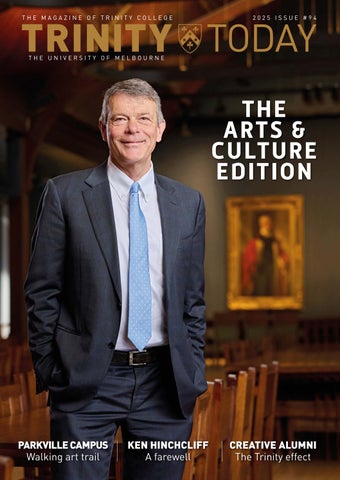
WARDEN'S NOTE
THE ARTS & CULTURE EDITION

At Trinity, creativity and culture lie at the heart of our community. We foster diverse talents, inspire collaboration and enrich learning through vibrant artistic expression and a rich cultural environment which empowers graduates to shape the visual, literary and performing arts locally, nationally and across the world.
Leafing through this special edition of Trinity Today has affirmed my belief in the College’s longstanding and proud relationship with the creative arts. What struck me was not just the abundance of alumni who have achieved remarkable things in this space, but also the diverse disciplines in which they operate. The importance of arts and cultural programs across the College is demonstrated by the people and programs featured in this magazine.
There’s a director with a love for the Himalayas who is soon to release her debut big-budget narrative feature film, and a Malaysian artist who transforms everyday objects into works of deep meaning. There is a periodontist who has travelled the world installing war memorials, and a sound engineer whose audio work in the UK has helped make the record-breaking ABBA Voyage a reality.

I sometimes wonder if these people would have achieved such highs were it not for their time at Trinity. Clearly, their success can be put down to drive, perseverance and talent, but after reading these stories, I can’t help but feel we’ve played some part in shaping their futures. Be it the opportunity of traversing the globe with The Choir, acting in a College play or musical, or seeing firsthand the traditional painting techniques of an Elder Aunty, they all share one thing – they felt secure in pursuing their artistic interests while at Trinity.
The College plans to further enhance its programs and support of the creative arts through an arts and culture strategy, due for release in early 2026. Our Arts and Culture Advisory Group, comprising of six experts, have guided the development of this strategy, which will determine how Trinity approaches its relationship with the arts in the years ahead.
PROFESSOR KEN HINCHCLIFF
WARDEN AND CEO
We acknowledge the traditional custodians of this country and pay our respects to elders past, present and emerging.

A FAREWELL
Ken Hinchcliff writes on a decade of dedication.
10

TRINITY'S ART TRAIL
Take a walk through the College's finest pieces of art.
21


OLD FORMS, NEW EARS
The rise of classical music seems unlikely, but statistics say otherwise.
14 SAINTS & SINNERS
A significant part of Trinity's art collection is its fine stained glass.
18

EMBRACING CHARACTER
Marney McQueen is a performer, comedian, celebrant – and publican.
24


Filmmaker Jen Peedom on her most ambitious project yet.

INFORMING THROUGH ART
Our commitment to fostering a vibrant Indigenous culture.
42 Snapshot
secular and sacred
to Communicate
truth in fiction
imitating
TRINITY'S MUSICAL STARS
Where are they now?
50
TELL US WHAT YOU THINK
Email your feedback about this edition of Trinity Today to tt@trinity.unimelb.edu.au
MANAGING EDITOR: Robbie Byrne, Communications Manager, Trinity College
SUBEDITOR: Simon Mann, MediaXpress
DESIGNER: Bill Farr, MediaXpress
Aboriginal and Torres Strait Islander peoples should be aware that this magazine may contain records, images or names of deceased people.
CONTRIBUTORS
STORIES: Ben Thomas, Caroline Miley, Danielle Norton, Jessica Asz, Justin Meneguzzi, Kasey Harward, Kate Elix, Professor Ken Hinchcliff, Jocelyn Pride, Margaret Barca, Robbie Byrne, Thuy On.
IMAGES: Kit Haselden Photography, Robbie Byrne, the University of Melbourne Archives, Trinity College Archives; also supplied by alumni, residents, students and friends of the College.
PUBLISHER'S NOTE
Information in this magazine was understood to be correct at the time of printing. Views expressed in Trinity Today do not necessarily reflect the views of Trinity College.

PEAK PRESSURE
SNAPSHOT 2025

We marked the official opening of the all-new A C C Farran Hall and Kitchens Precinct in March with a formal dinner for 250 alumni, friends and benefactors. Made possible thanks to many generous gifts by alumni and supporters, most notably Andrew Farran (TC 1957), the development was envisioned by Melbourne architecture firm Hayball in partnership with heritage specialists Lovell Chen and external project supervisors DCWC. The development, which has expanded the Dining Hall floor, increased seating capacity and incorporated an all-new cafe with seating area and subterranean kitchen, was described by Warden Professor Ken Hinchcliff as a ‘resplendent blend of 18th-century architectural glory and 21st-century modernity’.


The Our Way exhibition opened in August and saw Trinity collaborate with a diverse array of creators to explore how Indigenous artists are reimagining storytelling today with autonomy, pride and ambition. A satellite exhibition to The Potter Museum of Art’s 65,000 Years: A Short History of Australian Art, Our Way brought together works from the University of Melbourne Art Collection, the University’s Indigenous Art and Culture Collection, and the Trinity College Art Collection. Image: Ben Thomas, Rusden Curator, Cultural Collections at Trinity College, with Shanysa McConville, Associate Curator, Indigenous Collections at the University of Melbourne, at Our Way opening night.

Roy McNab (pictured above) from Melbourne was elected the new Senior Student of the Residential College. Other members of the Trinity College Associated Clubs (TCAC) for 2026 are: Social Secretary Abby Latimer; Treasurer Charlie Harley; Indoor Rep Henri Lempriere; Arts Rep Mim Moran; Men’s Sport Rep Angus Watson; Women’s Sport Rep Lily
Taylor; and Community Rep
Dion Whitfield

Trinity broke with tradition by naming joint recipients of the Bill Cowan Alum of the Year award. Animator Timothy Bain (TC 1997) and immunologist Mimi Tang (TC 1982) both accepted the honour in February. Tim is one of the most respected talents in children’s television, having worked on critically acclaimed shows such as Bluey. More recently, he has returned to Melbourne to direct his first live-action series, Knee High Spies As one of the world’s leading paediatric allergist immunologists and immunopathologists, Mimi has transformed the lives of children with her revolutionary approach to treating food allergies. Having led a research program that developed a groundbreaking treatment for peanut allergies, Mimi now finds herself involved in the commercialisation of that technology.

Trinity College alum The Reverend Canon Dr James Connolly (TCTS 1982) was recognised in the 2025 King's Birthday Honours list. The author and Anglican minister received a Medal of the Order of Australia for his outstanding service to the communities of Gippsland.

Pathways School graduates celebrated the completion of their Foundation Studies program at our Summer (March) and Winter (July) Valedictory Balls. A hearty congratulations to our duxes: Dinugi Lehansa Kankanam Gamage (January Comprehensive 2024); Shenghaun Yin (February Standard 2024); Yiran Gao (February Standard 2024); Queenie Yangson (June Fast Track 2024); Avani Arora (July Comprehensive 2024) pictured left; Xinyue Han (August Standard 2024); and Chieh-Lin Fan (September Fast Track 2024) pictured right.
snapshot2025
SNAPSHOT 2025


Trinity’s Men’s Firsts VIII rowing team represented the University of Melbourne in the Chengdu International Open Rowing Regatta. The crew of nine was one of the top 20 university rowing teams in the world invited to compete in the event. Trinity placed 4th in the final with a time of 2:26.06.
Congratulations to (L-R):
Jack Anderson (TC 2024), Casper Tabain (TC 2025), Archie Allen (TC 2024), Alex Leviny (TC 2023), Digby Bankes (TC 2024), Charlie Wallace (TC 2023) (cox), Ryan Fowler (TC 2024), Zac Cooper (TC 2025), Olly Williams (TC 2023) on their efforts.

June’s National Indigenous Tertiary Education Student Games (NITESG) in Perth gave the University of Melbourne’s Murrup Barak team the opportunity to showcase their athletic talent against 30 other Australian universities. The team featured several Trinity residents and alumni and finished in 12th position.
Special shout-out to residents Eddie Cubillo (TC 2025) pictured left, Jaidah Lowe (TC 2024), Jude Fixter (TC 2024), Bella Mariu (TC 2024), Will Morgan (TC 2024), Amara Peate (TC 2024) and Dion Whitfield (TC 2024) who participated. We also can’t forget alumni Anisha Damaso (TC 2022) and Alyssa Wilson (TC 2022) who also joined the team.

Our men’s Australian rules football team (above) sealed a historic 10th title in September. Our resident rowers also had an inspired outing at the Intercollegiate Rowing Regatta, where the Trinity women’s first VIII claimed top spot, breaking an 11-year drought, while the men’s first VIII made it four in a row, holding off strong competition from Ormond and Queen’s. The men’s and women’s second VIII teams also won, completing a clean sweep in rowing for Old Col. Trinity’s success continued at the Swimming Carnival, with gold in both the men’s and overall championships. Our mixed table tennis team, meanwhile, won their final.

Grease was this year’s musical of choice for our Residential College students. Performed at Uni Hall to sell-out crowds, this faithful take was brimming with theatrical talent. Leads Freya Cantwell (TC 2024) and Alex Mingay (TC 2025) were supported by a stellar cast who fully embraced the production’s kitsch aesthetic. It was brilliantly brought to life by director Sean Hwang (TC 2023) and coproducers Sam Prins (TC 2023) and Hamish Devonshire (TC 2023).

Jewish-Christian interfaith engagement under the umbrella theme of hope.
This year’s biannual Barry Marshall Memorial Lecture speaker was Bishop Susan Bell. The 12th Bishop of Niagara, Canada, and Wycliffe College graduate delivered a talk titled ‘Holiness on the Head: The Life and Times of George Herbert – Priest, Poet and Politician’ at Trinity College's Buzzard Lecture Theatre.
The Reverend Professor Mark R Lindsay, Trinity College Theological School Deputy & Academic Dean, was appointed a Fellow of the Center of Theological Inquiry (CTI) in Princeton, New Jersey. Professor Lindsay joined the centre, which has a relationship with Princeton Theological Seminar, in August for three months where he worked on future approaches to theological education and
snapshot2025
SNAPSHOT 2025


Trinity hosted 18 visiting scholars throughout 2025. Our first was Pietro Lorenzetti. Pietro, a control engineering researcher at the French National Centre for Scientific Research (CNRS), called Trinity home while working with Professor Dragan Nešić at the University of Melbourne. Autumn saw the arrival of Irish professor of theology and mission Dr Robert Heaney from Virginia Theological Seminary. Robert is well known in his field for his contributions to the Lambeth Conference Design Group. Renowned lawyer, law academic, Washington Post contributor and the University of Melbourne's 2025 Miegunyah Distinguished Visiting Fellow Professor Ned Foley arrived in August with his wife Miranda Cox (pictured) to deliver a talk titled ‘Why is American Democracy in Such Peril?’ to the University of Melbourne’s Law School and Trinity College residents. Spring arrived with a flurry of visiting scholars including architectural professor Johan Lagae from Ghent University, Gourlay Visiting Professors Chellie Spiller (University of Waikato) and Manoj Dora (Anglia Ruskin University), and Associate Professor Joey Zhou of Singapore’s Nanyang Technological University.

Trinity College Theological School postdoctoral research fellow Dr Natalie F Mylonas (FHEA) became the first Australian to be granted the prestigious Gingko Foundation Interfaith Fellowship. The Foundation seeks to forge positive relationships between scholars in the Middle East and North Africa (MENA), and the West. Natalie is a Hebrew Bible scholar, founder of Learn Ancient Hebrew online education and author of Jerusalem as Contested Space in Ezekiel (Bloomsbury, 2023).
Kirsten Gray (TC 1984) was appointed Chair of the Trinity College Board in May, succeeding Kerry Gleeson, whose four-year term had concluded. Kirsten brings a wealth of experience as a Chair and non-executive director, having joined the Trinity Board in 2023. She currently serves on the Governance, Nominations and Remuneration Committee, and the Trinity College Council. She has also contributed her expertise as a member of the Finance and Audit and Buildings and Grounds Committees.
In July, Romy Cantwell (TC 2021) bagged bronze in the Women’s Single Sculls event at the U23 World Rowing Championships in Poland. This proved to be a defining year for the Melbourne-based Romy; in September, she represented Australia at senior level for the first time at the 2025 World Rowing Championships.


In July, Trinity's Victoria Street campus expanded, with the addition of two new levels, adding to the existing floors already leased. The expansion allows for improved Pathways School facilities for both students and staff. The new floors feature additional lecture rooms and tutorial spaces as well as a new resource hub (library), social and study spaces, a wellbeing area, consultation rooms, a staff kitchen and lounge.

Congratulations to Ben Beischer (TC 2020) on a strong performance at the 2025 World University Games in Germany, finishing 14th in a competitive field of 50 athletes in the men’s half marathon.

2008-2015 Ken is appointed to Trinity College Council.
2012 Ken and Carole’s daughter, Alexandra, joins Trinity as a Residential College student.
2015 Ken returns to Trinity as the eighth College Warden after serving as Dean of the Faculty of Veterinary and Agricultural Sciences at the University of Melbourne. This followed an extensive period at the University of Wisconsin-Madison and the Ohio State University.
2016 Opening of the Gateway building, home to state-of-theart teaching and learning spaces primarily used by Foundation Studies students.
The moving finger writes; and, having writ, moves on
BY KEN HINCHCLIFF
Adecade ago, I returned to Trinity with a deep appreciation of its rich history and enduring identity, and with a vision for its future. I came with a view that the Warden was the custodian of this wonderful institution, an immense privilege, but for only a brief period in the long arc of the College’s history.
My wardenship was a fleeting moment in the century and a half of Trinity’s story although, like all moments, its effect is enduring. The choices we made over the last decade have shaped the trajectory of the College. Every decision was made with the future of Trinity firmly in mind, building on the foundations laid by my predecessors. In the words of 11th century Persian poet Omar Khayyam, ‘The moving finger writes; and, having writ, moves on’ – what happened, happened, and the ramifications of our actions ripple through our future.
It also contains the Professor Sir Joseph Burke Gallery – Trinity’s permanent gallery space – and the Craig Auditorium, a 250-seat lecture space.
Convened by Trinity in collaboration with the University of Melbourne, the first Indigenous Higher Education Conference provides a forum for educators, researchers, policymakers, students and the community to share information and knowledge on how best to support and improve outcomes for Indigenous students in tertiary education.
'Every
skilled and engaged board, and oversight by a highly effective Senior Management Team. Throughout this period, the College stayed true to its Anglican roots and purpose, and never lost sight of the vision to be, in the words of former Chair of the Trinity College Board, Bill Cowan (TC 1963), ‘world class’.
So, what has been achieved at Trinity in the past decade that will determine the future of the College? The timeline on this page lays out the sequence of events, decisions and actions that I believe are among the most influential.
While the timeline captures milestones, it cannot fully convey the context in which they arose, nor the reasoning and circumstances that shaped them. It does not reveal why these decisions were made and why particular events occurred.
The College was shaped over the past decade by two strategic plans, a buoyant international education business, exceptional demand for Residential College places, sound governance by a
2017 The strategic plan Unlocking Exceptional Promise is released, focusing on growth and scale, investing in and reconstructing Trinity’s technology infrastructure, providing more scholarships and embracing reconciliation. Trinity now provides the most generous college scholarship program in Australia.
Charles Sitch (TC 1978) is appointed Chair of the Trinity College Board.
The first strategic plan delivered during my wardenship was developed with the assistance of Social Ventures Australia between 2016 and 2018. That plan focused on: modernising the operations, management and governance of the College; expanding the size of each of the educational divisions; providing contemporary living and learning facilities for the Residential College and Pathways School; aligning our access and diversity imperatives with support in the form of merit-based, financial need-determined scholarships; expanding the role of the Theological School as a research-based institution; and addressing our contribution to higher education of Aboriginal and Torres Strait Islander students.
decision was made with the future of Trinity firmly in mind, building on the foundations laid by my predecessors.' >>
After completing the Gateway
2018 New Deans are appointed to each of the three education divisions of the College. They took office in 2019.
A second Indigenous Higher Education Conference is convened.
2019 Ken commissions and champions the Neave Review – the first review of Trinity’s Residential College culture. Led by Professor Marcia Neave AO, it is undertaken following a recommendation by the Australian >>
building (2016), the College developed a Campus Development Framework to provide a context for future infrastructure decisions. This led to the commitment to a two campus model, the commissioning of a 9000-square-metre campus at 611 Elizabeth Street, and the sale of teaching facilities at Royal Parade.
Important in the Framework was the expansion of the Residential College through the opening of the Dorothy building, featuring 100 residential rooms, a new Junior Common Room, and Residential College administration offices, and, a six-year (interrupted by the pandemic) renovation of the Dining Hall and kitchens precinct as the stunning A C C Farran Hall and cafe with subterranean kitchens. The public face of the College was enhanced by opening up of the Vatican Lawn grounds and kitchens facade to Scholars Walk and the University.
The pandemic years were profoundly influential. Suffice to say, with the collapse in international education, restrictions on movement and activities, uncertainty about the lasting effects of the pandemic, and the imperative to secure the longterm wellbeing of Trinity, the College hunkered down. We relinquished the Elizabeth Street property, which had yet to be commissioned, moved all teaching online, mothballed or closed other teaching facilities, quarantined the Residential College and, sadly, reduced staffing across all divisions by more than half. It was a challenging time, as it was for everyone, and it was not until 2024 that the former ‘normal’ almost fully returned.
Emergence from the pandemic stimulated a second strategic plan –Trinity 2030. While the previous plan was dominated by bricks and mortar and business planning, this latest iteration has five pillars that address different aspects of College life: modern College, enduring College, student-
Human Rights Commission for colleges to undertake an expert-led review of the factors that contribute to sexual assault and harassment on campus.
2020 Opening of the Dorothy Jane Ryall residential building to accommodate up to 100 students. Boasting superb facilities, ‘Dorothy’ features a student study and common area, a gym, music and art rooms, office space and a two-storey Junior Common Room.


these students to become members of the Residential College or study in the Theological School or Foundation Studies programs. We now award over $2.6 million in scholarships to more than 111 Residential College students each year. These are all financial needs-based and designed to provide access to the College by students who would not otherwise have been able to do so.
'We now award over $2.6 million in scholarships to more than 111 Residential College students each year.'
centred College, staff-focused College, and outward-looking College. A key initiative is to document and formalise the role of the arts and creative culture in the life of our College, the richness and diversity of which is laid out in this issue of Trinity Today.
The plan further considers the future of Trinity as an educational institution beyond being a residential college of the University of Melbourne. The College is blessed by the foresight of those who established the Trinity College Foundation, and the 2030 plan includes allocation of
Ken leads Trinity through the pandemic in one of the most locked-down cities in the world. From uncertainty about international student enrolments to a marked reduction in staffing, the shedding of teaching facilities and a pivot to online teaching, this period tests Trinity’s leadership in novel ways.
2021 Kerry Gleeson is appointed Chair of the Trinity College Board, the first woman and non-alum appointed to the role.
funds to a Trinity Future Fund that will secure, by the early 2030s, the long-term financial wellbeing of the College. Nothing is more important than the health and safety of our students and staff. The College has been proactive in programs to address gender-based violence, racism and antisocial behaviour in our community, which is not insulated from broader Australian society. We did so through accepting and acting on all the recommendations outlined in the Australian Human Rights Commission 2016 report and by commissioning independent reviews of the culture of the Residential College in 2019 (Neave Review) and 2025 (Residential College Culture Review, Ethell and Shehadie). We are the only college at the University of Melbourne to have done so, and we have acted on the recommendations made by those reviews. The College is currently undertaking sweeping reviews of its codes of conduct, developing responses to the Ethell and Shehadie review, and
2022
Trinity’s 150th anniversary year is celebrated with an impressive schedule of events and programs. Highlights include a 1000-person gala dinner, the week-long Gourlay Ethics in Business series and the Trinity Oakleaf Awards, which recognises 150 living alumni and supporters who have made a notable contribution to the College, the broader community, or both, within Australia or globally.
2023
Trinity’s Victoria Street campus reopens under a new lease after relinquishing the previous lease during
incorporating requirements of the National Accord on Gender-Based Violence in universities. The College has commissioned Yamagigu Consulting to advise us on policies related to antiracism and cultural safety, and an Indigenous strategy.
Trinity has long supported programs that advance access to higher education for Aboriginal and Torres Strait Islander students, and expanding these programs was a key part of my vision for the College. Regularly attending the Garma Festival of Traditional Cultures over the past 10 years has given me the insight and drive to improve education outcomes for Indigenous students.
The College convened and hosted two Indigenous Higher Education conferences (2016 and 2018) and a conference on Indigenous Australian art (2018), employed its first Indigenous support officer, actively recruited Indigenous Residential Advisors, and set its aspiration to have 10 per cent of
COVID. This campus is exclusively used for Pathways School teaching.
2024
Trinity 2030 Strategic Plan is announced – one that builds on the College’s 2017 strategic plan by focusing less on bricks and mortar and more on people, community and cultural activities.
Trinity awards $2.6 million in scholarships to 111 students in the Residential College – all financial needs-based.
'It is the relationships within the Trinity community that make being a Trinitarian so special.'
the Residential College membership being Aboriginal or Torres Strait Islander.
The College is active in Indigenous art and creative culture, as is detailed elsewhere in this issue of Trinity Today, and is proud to host exhibitions of visiting art and expand its own collection of Yolŋu art.
The College has a commitment to enabling access to its programs by students from diverse and underprivileged backgrounds.
Scholarships are critical in enabling
2025 After implementing the recommendations of the Neave Review in 2024, Trinity commissions a second independent review of the College culture, the results of which are released in early 2025.
Two additional levels at Trinity's Victoria Street campus open to support increased student numbers in the Pathways School.
Kirsten Gray (TC 1984) is announced as the new Chair of the Trinity College Board, the fourth Chair during Ken’s tenure, following Jim Craig, Charles Sitch and Kerry Gleeson.
Building on the College’s exceptional collection of art from North East Arnhem Land, we partnered with the Melbourne Indigenous Transition School to host an exhibition of Indigenous art, Barring-bul (2018), in 2019 hosted Revealed, the Castan Collection of North East Arnhem Land bark paintings collected in the 1960s and, in 2025, Our Way, an exhibition of contemporary Australian Indigenous art from the University of Melbourne, Trinity College and private collections. The College endorsed the Uluru Statement from the Heart in 2018, and in 2023 was the first university college in Australia to publicly support the campaign for a Voice to Parliament.
The College also awards the annual Nakata Brophy Short Fiction and Poetry Prize for Young Indigenous Writers. It has been the high point of my professional life to have stewarded the College for the past decade, an opportunity that as a veterinary student in the College from 1976-78 I could not have imagined. I could not have done so without the support of Carole (TC 1978) and a remarkable Senior Management Team which is simply the best I have ever worked with. While I will miss the day-to-day interactions with my colleagues and our students, I am still very much a proud alum and will continue to see you at Trinity events. It is the relationships within the Trinity community that make being a Trinitarian so special.
A C C Farran Hall and kitchens precinct is officially opened, marking a substantial rebuild and extension of the Dining Hall and cafe area that was first erected in 1880.
Residential College receives 576 applications for a 2026 place, the most applications since tracking began.
The Trinity College Future Fund is initiated, and arts and culture strategy drafted. Ken announces that he will depart as Warden in February 2026.
OLD FORMS, NEW EARS CLASSICAL MUSIC'S COMEBACK

BY JESSICA ASZ
In a cultural landscape dominated by viral videos and playlists, the rise of opera and orchestral music might seem improbable, but statistics tell another tale. According to a recent study by the Royal Harmonic Orchestra, under-35s are more likely to listen to classical music than their parents.
Trinity College alumni Soprano Siobhan Stagg (TC 2011), conductor Nicholas Carter (TC 2004) and opera philanthropist Dr Alastair Jackson (TC 1967) have spent their careers championing classical music.
All three of them believe its emotional power, universal stories and communal life force are more relevant than ever – especially to new generations discovering it for the first time.
Acclaimed singer Siobhan sees opera not as an elite art form, but as something far more familiar. She believes part of the genre’s draw is its emotional reach.
‘Opera is about storytelling,’ Siobhan says. ‘It can transport us out of the everyday and into another world. But it also helps us process real life.
'The stories often reflect very human struggles like class, relationships and the desires we all share to find love, to belong and to connect.’
What can keep new audiences from engaging, she argues, is not the art itself, but the unfamiliar rituals around it. ‘People might not know when to clap, if they are allowed to take photos or what they should wear.’ But once those hurdles are overcome, the art itself is universal.
‘You don’t need to understand classical music to be moved by it,’ says Nicholas Carter, designated Music Director of Staatsoper and Staatsorchester Stuttgart. ‘We need to promote the ideas that there aren’t the barriers to this great art that contemporary society might like to assume; that it’s for a rarified elite with a certain background or upbringing. It speaks to us all.’
He believes that there is a real hunger for authenticity among today's audiences.
‘In modern life, we’re bombarded with short, shallow, often artificial content which has made people’s attention spans shorter and left them feeling

disconnected from real and deep experiences,’ Nicholas says.
He sees classical music as an antidote to modern society, offering a rare moment of shared experience and quiet reflection. ‘We go to a concert to hear a symphony, and we’re surrounded by 1500 people, all sharing and experiencing the same thing. That’s incredibly powerful.’
That is not to say the trappings of modern culture cannot be useful in getting audiences to concert halls in the first place. Nicholas witnesses firsthand how audiences are tuning in via different mediums.
‘Whether it’s through film scores or video game music or TV, if people are engaging with orchestral palettes, that’s a really amazing starting point,’ he says.
‘The question is how we transition people from there to the enormous catalogue of music beyond it.’
Regarded as one of Australia’s most influential voices in classical music commentary, Dr Alastair Jackson has long championed the performing arts – a commitment recognised in 2018 with the Order of Australia. He says opera should be open to everyone.
‘In 19th-century Italy, opera tunes were the pop songs of the day,’ Alastair says. ‘People would be humming them as they walked down the street.’
He stresses the importance of accessible first encounters. ‘We’ve got to make opera as approachable as possible, but you can’t take someone straight to a Wagner’s Ring Cycle. That’s a bad idea. Start with La Traviata or La Boheme. They’re full of universal themes – love, passion and loss.’
Through her international career, Siobhan has seen how easily people can be left out of classical music by lack of opportunity. ‘The next generation of

For Alastair, the discovery of classical music by new audiences is encouraging, but just the beginning. ‘Opera is like a wonderful book. You’re constantly learning new things. Even after decades of listening, I’m still discovering new works.’
listeners and audiences aren’t just young people – it’s anyone who hasn’t had access yet,’ she says. ‘It’s about giving people an entry point into something they may never have encountered before.’
She applauds initiatives such as the Tasmanian Symphony Orchestra’s money-back guarantee. ‘People pay $700 for Taylor Swift tickets because they know they’ll have an amazing time,’ she says. ‘Classical music has to communicate that same promise.’
All three alumni highlight Europe’s deep cultural connection to opera and orchestral music, where the art forms are woven into daily life.
‘In Europe, opera isn’t a big deal,’ Siobhan says. She recalls seeing Germany’s then-chancellor Angela Merkel at one of her performances – not for a photo opportunity, but as a genuine audience member. She believes Australia can get there, but it requires buy-in.
He says if people are new to classical music and enjoy the well-known pieces of Beethoven or Chopin, for example, it’s natural they’ll want to explore further –something made easy by YouTube.
Alastair’s commitment to fostering the next generation of performers has become his defining legacy. Through a $3 million bequest, The Alastair Jackson International Opera Award offers young Australian and New Zealand singers the opportunity to study at the Royal College of Music Opera Studio in London.
‘What made me want to ensure the award’s continuity was seeing just how much talent in Australia goes unrecognised,’ he explains. ‘Our winners don’t just improve their technique; they are mentored, they make connections, they find work, and they grow as artists.’
Siobhan was one of the award’s earliest recipients. Since receiving it in 2012, she has enjoyed an extraordinary career, with highlights including
'People pay $700 for Taylor Swift tickets because they know they’ll have an amazing time. Classical music has to communicate that same promise.'
All three Trinity alumni are united by a shared belief: opera and orchestral music are not static relics of the past, but living, evolving art forms.
performances with the Deutsche Oper Berlin, appearances at the Salzburg Festival and, most recently, playing Susanna in Mozart’s Le Nozze di Figaro at the Sydney Opera House.
Both Siobhan and Nicholas credit Trinity’s choir as a formative part of their musical journey. ‘Along with the opportunity to travel internationally with the choir, singing there taught me to listen closely to those around me, refine my intonation and develop a strong sense of musical taste,’ Nicholas says.
Siobhan agrees. ‘We had to work through a huge amount of repertoire each week. It made you musically fluent. I still remember my first rehearsals and having that warm, glowing feeling in my chest, knowing I’d found my people.’
‘We are constantly growing and expanding our canon of operas and classical music,’ says Nicholas. ‘It’s not just music written 150 years ago; it’s also music that was written five minutes ago. What’s fascinating is seeing how new music interacts with its heritage and explores new ways of expression, finds new sound worlds and colours. I think that’s exciting.’
The stories of all three musical leaders remind us that artistry grows where opportunity exists.
For all three, that opportunity began with a choir rehearsal, a conductor’s nudge or a scholarship that opened doors to a world stage.
For info about the Alastair Jackson International Opera Award, go to melbaoperatrust.com.au
SCAN TO READ MORE ABOUT OUR CHOIR

Alastair Jackson remains enthralled by the power of classical music.
Renowned conductor Nicholas Carter.
Saints & Sinners

20 TRINITY TODAY • STAINED GLASS
By the time it was built, however, the Great War was in progress and parents of College men who died were anxious to commemorate them in glass.
Trinity’s stained-glass windows
BY CAROLINE MILEY
An important part of Trinity College’s art collection is its fine array of stained glass. It includes works by leading Melbourne and English artists of the late 19th and early 20th centuries, and the stories of its acquisition speak loudly of the history of the College and its students.
It is not surprising that much of the glass takes the form of war memorials. There is hardly a boys’ school or college in Australia that does not have a similar collection, and the rows of dedicatory inscriptions bear witness to the immense contribution made to the service of King and Empire by the men who willingly volunteered.
At Trinity, the earliest such memorial is to Lieutenant George Grice who fell in the Boer War, while the great east window in the Horsfall Chapel is a tribute to the 41 alumni who died in the Great War, and its nave windows are also war memorials.
When the College opened in 1872 there was no Chapel. The students’ Common Room (now the Warden’s Office, in the Leeper building) was used for daily prayers and, in 1878, was fitted as a Chapel. It is a handsome room with a bay of five large lobed windows with oculi.
The installation of a three-light of the Crucifixion, by the prominent Melbourne company of Ferguson and Urie, gave the room an ecclesiastical character. This is the oldest stained glass in the College and is a fine example of the firm’s work, likely made by David Relph.
In 1903, two side lights of the archangels St Michael and St Gabriel by the English firm of Clayton and Bel were installed. The College may have been inspired to commission Clayton and Bell after seeing the full suite of glass by that company installed in St Paul’s Cathedral 10 years earlier. The Perry room in Leeper has an identical bay window, filled with plain leadlight but for the College’s coat of arms in the central oculus.
The Horsfall Chapel, commissioned before the War and opened in 1917, is ornamented with an excellent set of early 20th-century stained glass by several artists, designed according to an overall scheme in style and content.
The Chapel’s dedication is to the Holy Trinity, and it was donated by businessman John Horsfall as a memorial to his daughter, Edith Carington.
The Warden and the architect Alexander North understood the importance of a coherent program of glass and devised a scheme that focused on early English warrior saints. Despite the work being by several hands, adherence to the design concept ensured that the glass both complemented the architecture and conveyed a unified message of duty and sacrifice.
The sanctuary is dominated by a three-light of the Crucifixion (1939) with base panels by William Kerr-Morgan, an English artist employed by the large Melbourne firm of Brooks Robinson. The base panels contain ancillary scenes: the soldier saint St Sebastian, the Emperor Constantine and St John Gualberto. Two lancets in the side walls, of the archangels St Michael (Grice Memorial and St Gabriel, were relocated from Leeper to the Horsfall Chapel in 1916, with base panels by Melbourne artist William Montgomery to make them fit the new openings. Montgomery also created in 1917 a St Alban window O’Hara Memorial) in the sanctuary.
The windows in the nave have traceries filled with lauding cherubim and seraphim and base panels displaying the regimental coats of arms of the soldiers commemorated.
The north wall contains two superb windows by English artist Dudley Forsyth – St Martin of Tours (1922, Miller Memorial) and St George (1923, Jowett Memorial) – plus another St Alban window (1931, Luxton Memorial) by Brooks Robinson.
The south wall has two windows by William Kerr-Morgan, of St Theodore of Heraklea (1915, Moule Memorial and St Oswald (1937, Creswell Memorial), with a recent window of St Cecilia (1998, Rusden Memorial) by Glenn Mack. This is the only window which does not conform to the scheme laid out at the time of the Chapel’s opening, being different in subject, style and colouration.
The Chapel windows are tall and narrow, a style typical of the architect’s work, so the glass has been designed with horizontal bands of sky cutting across the lights, and head and base decoration reducing the main subject to a central field.
The colouration of the windows has been carefully considered, as each had to harmonise not only with the others, but with the strong red brickwork of the walls.
The College also has a set of Victorian stained glass panels depicting characters from Shakespeare by William Montgomery. They came from the opulent Brighton mansion Norwood, built in 1891 by architect Philip Treeby for the


businessman Mark Moss. The front of the house boasted a huge oriel window of 35 panels of Shakespearean figures. Norwood was demolished in 1955, but the Shakespeare windows were saved. Eight were acquired by the then Warden, Robin Sharwood, and installed at Trinity at the time of the Clarke and Bishops’ renovations in 1969-70.
The panels are of William Shakespeare, Stratford Church, Ophelia and Falstaff (installed in Clarke) and Othello, Henry VIII, Portia and a figure identified as Bassanio (installed in Bishops’). At Trinity College, they were set into broad plain glass frames in the staircases of the two buildings.
The unselfconscious ‘Englishness’ of the themes expresses the Anglican nature of the College and celebrates the faith and heritage of its founders.
Subsequently, another two panels have been acquired: one (Katherine) was donated by Andrew Bostock in 2022 and the other (St Margaret) purchased by the College. These are now in storage. It was a happy idea to acquire these fine panels. At the time they were created, Melbourne's mansions were commonly decorated with stained glass depicting landscapes, flowers and fruits or scenes from classical mythology or British history, emphasising the owners' cultural heritage. Shakespeare was a popular subject, and visitors and family would have entertained themselves picking out their favourite characters. Trinity's inaugural Warden, Dr Alexander Leeper, was President of the Melbourne Shakespeare Society and an enthusiastic promoter of the Bard, so would have been delighted that the College he loved should be embellished with them.
The variety of the College’s collection of stained glass makes it a treasure-house of Victorian and early 20th-century styles and history. The work of many hands, it embodies much of the ethos of Trinity itself.
The unselfconscious ‘Englishness’ of the themes expresses the Anglican nature of the College and celebrates the faith and heritage of its founders. Saints and sinners jostle for position on its walls, continuing to survey and inspire new generations of students.


1
Yathikpa, by N. Marawili, 2013 This Indigenous 2.5-metre-high larrakitj, or memorial pole, was painted by the Yolŋu artist who is viewed as a critical figure in breaking down gender barriers as, traditionally, these clan designs were the exclusive province of men.
2
6 Chapel windows, various, 1916-1998 See story on pages 18-20.
7
13
Frank Patrick Henagan
by
2002 The medallion was
in honour of the long-standing Trinity gardener, porter and director of sport.

Oak decorative carving, 17th century Trinity’s fourth Warden, Professor Robin Sharwood, donated this intricate English panel. It depicts the figure of Christ holding an orb while, below him, a cherub sings from a psalter.


3
Professor Sir Joseph Burke Gallery, opened in August 2016
Trinity College World War II Memorial by McGlashan Everist, 1958 Situated on the north wall of Jeopardy, this cast alloy memorial panel features the names of 33 alumni who perished during WWII. It is embellished with a ribbon design and the words ‘Pro Ecclesia Pro Patria’.
8
14
Shakespeare Windows, by William Montgomery, c.1891 See pages 18-20.
15
Syd Wynne Medallion by Peter Corlett, 2008 Trinity’s preeminent overseer, Syd worked at Trinity for half a century from 1920 to 1970, succeeding his father, Sydney Snr.


‘The Burke’ emphasises the importance the College places on providing a rich and stimulating cultural environment. Previous exhibitions include Woop Woop (2017); All That You’ve Loved (2024); and, most recently, Our Way (2025), an exploration into how Indigenous artists are reimagining storytelling today.
4
Bulpadock Bull, by Pamela Irving, 1993 Well known at the time for her bronze casting of animals, Irving’s design pays homage to its namesake, which until the 1960s housed Trinity’s dairy herd. The Bull has been stolen on numerous occasions (by neighbouring colleges which shall go unnamed), resulting in it being permanently fixed to the ground.
9
16
United by Lachlan Ross, 2021 Commissioned with the objective of ‘celebrating and complementing’ the newly built Dorothy building, the piece reflects the connection, unity, diversity and strength of the Trinity community.
17


The ‘Henty’ font, unknown, pre-1580. Glass font 2005 & 2022, by David Wright One of the oldest ecclesiastical objects in Australia, this font (possibly of Norman origin) was removed from a church in West Sussex in 1829 by Thomas Henty before his voyage to Victoria. It was likely used in Portland, before being moved to St James’ Old Cathedral in Melbourne in 1842. It was replaced in 1845, after which the font lived a nomadic existence. In 1969 it arrived at Horsfall Chapel. The font was initially topped by a stainless-steel bowl and wooden cover until 2005 when David Wright was commissioned to design a piece. The resulting glass insert illustrates a flow of water leading to a ‘water-hole’, symbolising new life and baptism. The font glass was damaged and replaced by David in 2022.
5
Possums, platypuses and bandicoots, by Robert Prenzel (1920s) and Eva Schubert (1980s) Prenzel, one of Australia’s finest 20th century woodcarvers capped the pew ends based on designs from Chapel architect Alexander North. Three of these were stolen in the 1980s but successfully replaced by Eva Schubert’s own unique design.
Fleur-de-lys, by unknown This stone carved in the form of a fleur-de-lys was once part of the facade of the House of Commons, Westminster. It was removed during renovations and acquired by an alum of Trinity, before its donation in 1939.
10 A C C Farran Hall. The undisputed heart of the College has been restored to its former glory following an extensive renovation. The hall displays more than 40 artworks featuring wardens and notable benefactors.
11
Trinity College & World War Memorial by Ross Bastiaan, 2017 Cast by Trinity alum Ross Bastiaan (see page 52), this intricate memorial details the Commonwealth of Australia and Trinity's involvement along with a synopsis of the war itself. The memorial lists the names of 42 alumni who perished during the war.
12
Djan'kawu Creation Story, by Wandjuk Marika OBE, 1981
This suite of important works by the Yolŋu painter, actor, composer and Indigenous land rights activist tells the Djan'kawu Creation Story. The use of felt pen on paper is unique for the artist during this period. The series has been held custodially by the College in partnership with the Marika family since 2008.
Ventulus, by Rudi Jass, 2015 Adopting the Latin term for ‘gentle breeze’, Jass drew upon the symbol of the trefoil, a feature that appears on some of Trinity’s earliest buildings. A column of rusticated steel takes its profile from this motif that represents the Holy Trinity, with the same emblem cut at the column’s upper edge. Branches terminate in broad gingko leaves (a symbol in Asian cultures for longevity), which move in the breeze.
18
The Brush, by David Hamilton, 1994 The Brush showcases the Tasmanian-born artist’s adeptness in transforming steel into seemingly organic shapes that reflect his native island’s diverse flora and fauna.
19
Untitled, by David Abecassis, 2004 This work of stainless steel and cold cast bronze blades, taking the form of eucalyptus bark, was initially lent to Trinity by David. The passing of his friend and fellow alumni architect Alan Nance prompted the artist to formally gift the work to the College in 2024.
20
Bronze gargoyles, by Peter Corlett, 1998-2000 The six larger-than-life gargoyles feature eminent Trinity associates David Wells, Valentine Leeper, George William Rusden, Professor Alan George Lewers Shaw, Dame Margaret Blackwood and Professor Geoffrey Winthrop Leeper.
Medallion
Peter Corlett,
struck
THE MANY ACTS OF Marney McQueen
A performer, comedian, celebrant – and now a publican – the Trinity alum has built a career by embracing character, chaos and comedy, sometimes all at once.
BY JESSICA ASZ
As a child, Marney McQueen (TC 1998) was the one putting on shows in the living room, roping her family into watching impromptu skits and impersonations. At school, she mimicked teachers so accurately that they started bringing colleagues in to watch. That early joy of making people laugh became her creative compass. She arrived at the University of Melbourne to study Arts and Commerce – ‘a safe option,’ she says – but it wasn’t long before she threw herself into the College’s theatre scene, joining the Trinity College Dramatic Society and Musical Theatre Society. Performing ignited her soul.
In her first year, she played the title role in Alcestis, followed by parts in Rosencrantz and Guildenstern Are Dead and Little Shop of Horrors. In her second year, she took on the role of producer for West Side Story, which sharpened her commercial instincts behind the scenes.
‘Trinity was foundational,’ Marney says, ‘not just for the opportunities to perform, but for the amazing people I met there.’ She remembers the infectious energy of director Brian Hogan, brought in by the Dramatic Society to lead the annual show. ‘He was a theatrical animal.’ she recalls. ‘He made everything feel exciting. The students took charge of sets, lighting and costumes. Everyone was learning their crafts and understanding the work of putting on a show.’
After university, Marney landed a place at the National Institute of Dramatic Art (NIDA) in Sydney. It was there that she created her breakout character, Rosa Waxoffski, ‘bikini waxer to the stars’, a bold and hilarious figure who would go on to tour major comedy festivals around the world. At her debut performance of Rosa, Barry Humphries was in the audience, and she asked him if she could observe him perform in New York. ‘I saw his show eight times,’ she says. ‘That experience confirmed everything for me. I knew this was what I wanted to do.’
Since then, Marney's career has included roles in television, commercials and stage productions, including Hairspray and Priscilla, Queen of the Desert in which she played Marion, the hard-drinking pub owner.
‘Opening night was a comedy of errors,’ she remembers. ‘There were technical issues which meant the bus wouldn’t work.’ But the audience didn’t seem to mind. ‘They loved every second of it. The joy in the room was unforgettable.’
In a case of life imitating art, Marney went on to buy her own pub on the NSW Central Coast. Alongside her husband Frank, she runs the Royal Hotel Wyong, where she performs weekly cabaret shows in the back bar.
‘I saw an opportunity to bring something fun to the town – somewhere people could gather on a Saturday night to laugh, sing and come together,’ Marney says. The cabaret show has become a local institution, selling out weekly and uniting the community around live performance.
During the COVID years, raising young children and living in a regional town, Marney had wondered whether her stage career might be behind her, a prospect she found devastating. So, when she was cast as Celine Dion in Titanique, a musical parody of the Oscar-winning film, the joy of being on stage performing eight shows a week was immense.
‘It was the role of a lifetime, and the audiences were so interactive,’ Marney says. ‘People came back to see it again and again. It is that collective experience of laughing together that we all crave.’
Marney’s work is driven by a keen sense of character – often bold, satirical and larger-than-life. In her one-woman shows, she has explored everything from politics to gender identity using comedy as a safe space to hold a mirror to society.
‘You can make outrageous statements in a space that’s unthreatening because people are laughing. And, of course, it’s not me saying it – it’s the character!’ she laughs. ‘Comedy gives you permission to go places you otherwise couldn’t, showing us parts of ourselves we like to keep hidden. It’s disarming.’
So, what is next for Marney? ‘There’s always something,’ she says. ‘A new role. A new show. A new character just waiting to be born.’
What if she could offer her younger self one piece of career advice? ‘Be completely dedicated. Believe in your own power and know that some things only come with time and life experience.’
And if you can make people laugh while you are at it – even better.

Marney has just wrapped up performing the 'role of a lifetime' in Titanique

CURATING IN A digital age
Museum curators and virtual heritage communicators are blending technology with art and history to transform museum experiences across Australia.
BY DANIELLE NORTON
Museums are vital spaces for learning about – and connecting with – the past. But in today's digital world, curators and artists are firmly looking forward as they embrace innovative technology to encourage genuine interaction with their collections.
Rose Hiscock (TC 1986), Jane Clark (TC 1977) and Brett Leavy all integrate technology into their work to connect meaningfully with their audiences. Their approach reflects a broader shift in the arts and culture sector due to an expecation by modern audiences for interactivity, accessibility and cultural relevance as part of their museum and gallery experiences.
The future is certainly digital but it’s the artworks themselves that remain the important thing. As Rose notes: ‘Technology is a conduit to knowledge or to an experience or to a broader world, but the emotional reaction is the main game.’
TECHNOLOGY IS UBIQUITOUS
Rose is the Director of Museums and Collections at the University of Melbourne,

'If the technology is good, it’s invisible. I have a great belief in the original objects, the artefacts, the artwork.' ROSE HISCOCK
‘We have to think about those collections, especially Indigenous collections, as cultural heritage, cultural knowledge, a demonstration of a living culture, not of static objects sitting on a display shelf.
‘The first stage in that process of rethinking what a museum is has to start with the communities that are represented in those institutions and what their needs are and what their perspectives are. You go from thinking about a thing or an object, to thinking about a person.’
At Trinity, Rose learnt the importance of scaffolding herself with good friends.
‘The nice thing about communal life is that you learn that you’re one individual in a bigger world, and you have to learn how to be yourself through that as well,’ she says.
‘I was studying commerce, and I had an artistic community happening alongside it. That had a real impact on me.’
A FRESH APPROACH
and looks after the University’s public facing museums and collections.
‘Technology is everywhere in the work that I do,’ Rose says. ‘Every exhibition has it, and throughout the visitor journeys there are touchpoints at every moment. If the technology is good, it’s invisible. I have a great belief in the original objects, the artefacts, the artwork.’
Rose believes that the digitisation of a collection or an object means it becomes immediately accessible to a much larger audience. ‘If you have a great database of a collection, then anyone in the world who’s researching or wanting to visit can access it,’ she says.
The experience of Jane Clark was similar. She met her future husband at Trinity and also developed strong friendships with students from all year levels and disciplines who encouraged her to participate.
‘It’s a place that makes you try things that you wouldn’t have tried before, and you just feel so much more part of the University,’ she says.
By the time she graduated, Jane wanted to work in art museums rather than academia but had no idea that her career path would lead her to be instrumental in the use of technology in museums worldwide.
A Trinity contact recommended her for her first job at Arts Centre Melbourne which led to another at the National Gallery of Victoria. She later worked in commercial businesses >>
Jane Clark at Mona's Heavenly Beings exhibition.
PHOTO COURTESY OF Mona

presenting and researching artworks and writing about them.
But when businessman and art collector David Walsh invited Jane to take on the role of Senior Research Curator at his Museum of Old and New Art (Mona) just outside Hobart, she jumped at the opportunity.
Jane contributes most of the content in the descriptions on Mona’s ‘O’ app (pictured below).
‘David never wanted people distracted by labels on the walls,’ she says. ‘He also had this idea that he could, with his technical people, invent something that other museums would use as well. His Art Processors technology has been employed by The Australian Stockman’s Hall of Fame, the Art Gallery of New South Wales and the Bob Dylan Center in the USA, but we’re the only people who use it for everything.’
Visitors to the acclaimed Tasmanian art museum have responded very well to the app, she adds, even if some of them may not use it to its full potential.
‘People wander around and almost forget to use it because they’re engrossed in the art, but because they can save their tour, they can access it when they get home and explore what they missed as well as what they saw.’
VIRTUAL INSIGHTS
Award-winning multimedia digital producer Brett Leavy works at the intersection of technology, Indigenous knowledge, gaming and storytelling.
Drawing on the stories and artworks of many Indigenous sources, including works from Trinity’s own Indigenous art
collection, he has created the work Virtual Narrm 1834 for the Potter Museum as part of 65,000 Years: A Short History of Australian Art
The animation aims to provide a sense of the spirit of Wurundjeri people in pre-contact Narrm, immersing viewers in the sounds of nature and encouraging them to contemplate the consequences of colonisation for the traditional custodians.
Virtual Narrm also draws much from Brett’s previous project, Virtual Songlines, a role-play-based cultural survival game in which individuals can envelop themselves in the landscape of the First Nations people before the arrival of colonial settlers. His reasoning behind utilising pioneering technology to illustrate the world’s oldest culture is twofold: to create transportive museum experiences and to prove ‘our resilience and adaptability to technologies that raise the profile of First Nations and our underlying science, technology and land management achievements.’
Meet Trinity's Arts Advisory Group
Trinity College has a proud history of supporting, promoting and showcasing arts and cultural initiatives. With the inclusion of arts and creative culture in our 2030 Strategic Plan, we appointed six experts to form the Arts and Culture Advisory Group. They have provided advice and guidance on the Strategic Plan's underlying initiatives to ensure the continued development of arts and creative programs across the College.

DR GEORGINA ARNOTT
Georgina is the editor and CEO of Australian Book Review. A former academic specialising in Australian cultural and colonial history, her broad knowledge of contemporary literature will be a valuable asset to the group. A highly respected author, she published her debut biography, The Unknown Judith Wright, in 2016.


TIM BAIN (TC 1997)
Tim is an award-winning animator, writer and director who specialises in children’s television. After a lengthy spell in the UK, where he worked on a series of highly acclaimed animated productions, Tim has returned to Melbourne to produce his first live-action show, Knee High Spies, for ABC Kids. Tim is our Bill Cowan Alum of the Year 2025.

Rose is a highly regarded museum director. Committed to building a vibrant, balanced and accessible arts sector, Rose has played a critical role in shaping Australia’s museum offerings over the last three decades. She has held the position of Director of Museums and Collections at the University of Melbourne since 2019. Previous posts include Director at Science Gallery Melbourne and Executive Director for Arts Development at the Australia Council for the Arts.
An alum of the University of Melbourne and the University of Cambridge (Master of Arts), Rupert is deeply involved in Australia’s arts and culture sector.
Beyond his philanthropic endeavours with The Myer Foundation, he has chaired the National Gallery of Australia and the Australia Council for the Arts. In 2015, he was appointed an Officer of the Order of Australia (AO), for distinguished service to the visual and performing arts, governance roles with leading cultural institutions, promotion of philanthropy and contribution to the community.

KADE P McDONALD
Kade is an arts consultant with vast experience in the planning, marketing and curation of national and international art exhibitions. Until recently, he held the position of CEO at Agency Projects, a not-for-profit that delivers programs across the arts and built environment sectors, where he facilitated a transition to First Nations leadership.

A former Trinity College Associated Clubs (TCAC) arts representative, Clare is passionate about empowering young people in the performing arts. She brings extensive choral experience, having trained with the Australian Girls Choir and performed alongside stars including Hugh Jackman and Olivia Newton-John. Today, she works as a performing arts instructor for young people in Melbourne and remote communities across Australia.
Brett Leavy's immersive Virtual Narrm 1834 on display at the Potter Museum of Art.
PHOTO BY CHRISTIAN CAPURRO
ROSE HISCOCK (TC 1986)
RUPERT MYER AO (TC 1976)
CLARE WEVER (TC 2021)
The secular and sacred

Recently retired Trinity College Theological School theologian, lecturer and Anglican priest Dorothy Lee talks about her debut poetry collection.
BY THUY ON
Afamiliar face at Trinity College, Dorothy Lee spent 17 years engaging in lecturing, research and leadership. Now, she has published Poems of Lament and Grace, a collection that spans two decades of her life and which she sees as complementary – rather than separate – to her professional roles.
‘It’s a new thing for me to share my poems publicly but I found the atmosphere at Trinity, particularly within the Theological School, both flexible and encouraging, and that gave me the impetus, if not the courage, to attempt publication,’ Dorothy says.
Moreover, she doesn’t consider poetry as a departure from her usual interests, having always read and written poetry, ‘and my academic work has often been concerned with poetic themes, such as symbolism’ she adds.
She is drawn to the essence of poetry and how stylistically it differs from prose.
‘I think poetry, in a sense, “launders” language: it cleanses, renews and refreshes our everyday speech,’ she says. ‘It deliberately moves behind clichés and familiar forms of expression to articulate something deeper that strives to be universally human.
‘Poetry is more succinct, concertinaed, compact. Narrative is usually more leisurely and takes its time, with quite different literary strategies.’
What one derives from poetry and whether it resonates with an individual depends, of course, on whose poetic voice is heard. Dorothy is conscious of the importance of context.
Historically, she points out, ‘White middle-class males have taken it upon themselves to speak universal truths on behalf of everyone else.
'Yet, our experiences in relation to gender, sexual orientation, race and class are very diverse.
‘I’m conscious, for example, that I’m writing as an educated woman with a Scottish background. I hope I may have caught a glimpse of something universal in my creative work, but I acknowledge it’s a limited perspective.’
How would Dorothy herself describe Poems of Lament and Grace?
‘A short collection of poems that explore what seems to be contrary modes: with themes of loss and longing, heartache and joy, failings and hopes,’ she says. ‘It also surveys some of the figures of the classical world, from ancient Greece, that still have the capacity to speak to us today.’

‘I hope I may have caught a glimpse of something universal in my creative work.' DOROTHY LEE
Some contemporary poetry can come across as lofty and impenetrable, but this book was written with a general audience in mind and doesn’t presume any specialised knowledge.
‘My hope is that readers may be able to identify with the themes and find their own heart responses articulated,’ Dorothy explains. ‘So often people feel lonely and disconnected when going through difficult times. Maybe these poems can help them; I also hope readers are moved by the poems and may even enjoy them!’
Dorothy acknowledges that her journey to faith has been paved with times of doubt, apprehension and even dismay, but also with the corollary of redeeming moments of grace and gratitude. She demurs, however, when asked whether it was difficult to give an even-handed balance to the two emotions.
‘The poems do describe hard times as well as moments of joy and delight,’ she says. ‘I don’t think, however, that I set out to achieve an even balance between the two.
"Quite a few of the poems reflect challenging times in my life that are, I hope, mostly in the past. My more recent poems, since the book was published, tend to be more positive.’
In one of the poems, Dorothy talks about turning ‘ill-formed copy into liquid prose’ and ‘base born metals into gold’, but transforming ideas into words can be a challenging verbal alchemy.
‘Usually, a sentence forms in my mind with an image at its centre and I write it down and leave it for a while’ she says. ‘Then I come back to it and enlarge the image and work towards a rhythm that coheres with it. I’ll finally come back to polish it.
The themes and subjects of Poems of Lament and Grace are far-ranging with Dorothy deftly moving from a tableau of painting dolls under her mother’s eye, to admiring parakeets – ‘the larrikins of the aviatic world’ – to the travails of Persephone, Ariadne and Antigone.
But the decision to portray poems that canvas the minutiae of modern life as well as the world of Greek mythical figures, she points out, was organic rather than deliberate.
As for whether the collection tends more towards religion rather than embracing a more secular viewpoint, Dorothy says: ‘Some poems are more explicitly “religious” than others, though most express a kind of spirituality more universal, and not tied to any one religious expression.
‘I believe “secular” and “religious” experiences mirror each other … poetry makes possible the crossing of boundaries between the secular and the sacred, the ordinary and the mystical.
'Poetry is by nature porous and open-hearted, less concerned with religious dogma than with the depths of human experience.’

INFORMING THROUGH ART
NURTURING
INDIGENOUS ART AND CULTURES
BY BEN THOMAS
Amellow glow shimmered on the floorboards as a fire crackled quietly in the corner of the Junior Common Room one autumn evening in April 2008. Those gathered listened intently to the softly spoken Rärriwuy Marika, an artist and teacher from Yirrkala in north-east Arnhem Land, as she talked about Trinity's growing collection of artworks by her family members, and how they linked to the Yalangbara Creation story.
‘There are three ways to express or convey traditional knowledge,’ she explained. ‘Design, music, and dance ... Our Creators gave us our Law and our Ceremonies and we still perform them in the same way.’
The year 2007 stands as key in Trinity’s evolving engagement with Indigenous Australia. The groundwork had been laid years earlier when the University of Melbourne Chancellor Fay Marles (JCH 1944) visited Yirrkala and was introduced to Rärriwuy and her aunt, senior Yolŋu law woman Langani Marika. A cultural visit to Melbourne was proposed and, in May 2007, Rärriwuy and Langani stayed at Trinity as Visiting Indigenous Fellows.
UNDERSTANDING
In the overgrown garden on Trinity’s southern boundary (now the site of the Gateway building), Langani introduced residents to traditional dying of pandanus fibres for weaving and over a series of Sunday afternoons, aunt and niece shared with the College community the Yolŋu understanding of the land, law, art and spirituality.
Among several Indigenous initiatives undertaken by the College that year, the Marikas visit was seen as ‘the most dynamic and exciting of all’, according to Trinity’s then-Indigenous Programs Officer Dr Jon Ritchie, as it showed the potential for spreading the important educational message throughout the Trinity community.
The resident-led ER White Club commissioned Rärriwuy to produce a
painting for the student collection. Milngurr – the Sacred Water Hole from the Dhuwa Creation at Yalangbara was unveiled in the Dining Hall the following April when Rärriwuy returned, accompanied by her aunt, Ms D. Marika, an accomplished artist in her own right. Ms D. Marika’s painting – Yalangbara II – had been gifted to the College by Jan Martin, owner of Lyttleton Gallery in North Melbourne, in November 2007.
In the following years, more works by Ms D. Marika, her family and the wider community were added and a decade later, the growing collection of Yolŋu art at Trinity would be framed as the Miwatj Collection, adopting the Yolŋu term meaning ‘first light’. These deeply felt, entwined connections lie at the heart of Trinity’s Indigenous art engagement, an important visual expression of an infinitely rich cultural tapestry.
Earlier in the year, Jon’s appointment led to the publication of a booklet, Indigenous Perspectives. ‘It reports on the current status of Trinity’s Indigenous Perspectives Program and provides a recommendation for the next steps towards our mission of increasing access to the best possible higher education for Indigenous Australians,’ he wrote at the time.
That engagement deepened quickly. During December 2007, 22 young Indigenous secondary students from across Australia participated in Trinity’s Young Leaders Summer School program, offering a foretaste of College life and a glimpse of a pathway beyond school. At the end of the program, students from the Areyonga community in the Northern Territory gifted the College a painting titled Learning Different Cultures that they had completed while in residence.
CROSS-CULTURAL EXCHANGE
Indeed, cross-cultural exchange has been a prevailing undercurrent in Trinity’s approach, with the College sending groups of residents to the remote Indigenous settlement of Minyerri, Northern Territory, each
>>
Langani dying pandanus fibres on the grounds of Trinity College in 2007.

year since 2004, while bringing students from Minyerri to Trinity’s Summer School programs.
For many, it was an experience that was both challenging and extending. ‘Up here, futures in general are hard to imagine,’ Minyerri Senior Secondary School’s Melissa Coad wrote after visiting, ‘and for these kids it seems like the future is almost impossible to believe in.’
An alum of the University of Melbourne herself, Melissa had accompanied three female students to Trinity for the summer but was left amazed at the difference she had noticed in the girls. ‘To see Carol, Roddy and Desley be challenged and, in so many ways, rise to the occasion was fantastic and ... I can see how the Trinity experience has mattered.’
REVERBERATIONS
The shared experience between Indigenous and non-Indigenous Australia has indeed mattered, with the deepest reverberations often felt outside the public gaze. For Jerome Cubillo (TC 2009), a Larrakia resident from Darwin, being part of the group that visited Minyerri in 2011 was profound. ‘Being able to travel ... with a group of Trinitarians and host them on
'Design, music, and dance ... Our Creators gave us our Law and our Ceremonies and we still perform them in the same way.'
RÄRRIWUY MARIKA
various communities of MITS with the proceeds being used to support its inaugural scholarship.
A significant loaned collection, Revealed: Arnhem Land Barks from the Anita Castan Collection – Yirrkala and Milingimbi (2019), was followed by contemporary Indigenous Yolŋu print art, Balndhurr (2020), although the latter was cut short due to the COVID-19 pandemic.
my traditional land was incredible, and seeing other students engaging with my community made me especially proud of my culture,’ he noted.
EXHIBITIONS
Meanwhile, First Light, celebrating Trinity’s growing Yolŋu art holdings, became the inaugural exhibition in the Burke Gallery, opening in August 2016.
Having commissioned Rärriwuy a decade earlier, the ER White reprised the theme in 2017, purchasing a larrakitj pole by artist Noŋgirrŋa Marawili. Curatorially, further works through the Yirrkala Print Room were added to Trinity’s collections.
In 2018, the College partnered with the Melbourne Indigenous Transition School (MITS) to produce Barring-bul, an exhibition of artworks drawn from the
Create to Communicate
Inspired by her family story, Simone Cohen is drawing on her passion for the arts to show Foundation Studies students the power of creativity.
BY KATE ELIX
The saying ‘art is life, and life is art’ perfectly captures the essence of Trinity College English for Academic Purposes (EAP) teacher Simone Cohen.
‘My grandparents fled Germany and Poland after World War II. They moved to Australia not speaking any English and had to start from scratch.’
Simone recalls the challenges she saw her grandparents face as migrants, particularly with the language. These challenges had a lasting effect on Simone, and she now sees it as quite poetic that she helps people overcome such barriers.
Over the years, Simone has refined the way she teaches English. Drawing on her love of the arts, her style blends creativity with language learning, in what
way to support migrants and international students transition to life in Australia.
In 2023, Simone joined the Pathways School (for the second time, having worked in a contract position in 2014), and she brought the Create to Communicate program with her.
Now, Foundation Studies students have had the opportunity to participate in an eight-week Create to Communicate course, which is funded by health insurer Bupa and forms an integral part of Trinity’s Pathways School wellbeing program.
This year, Our Way – a collaborative exhibition of contemporary Indigenous art curated in partnership with the University of Melbourne – opened in the Burke Gallery. Co-curator Shanysa McConville, an eastern Arrernte woman, is herself an alumna of the Bachelor of Arts (Extended) program developed by Trinity to provide greater access for Indigenous residents coming into tertiary education.
Our Way complements the landmark exhibition 65,000 Years: A Short History of Australian Art at the Potter Museum of Art. In its own way, the event speaks to the next steps to be taken in Trinity’s engagement with the process of reconciliation: of shared dialogue, of storytelling, of listening. In the quiet of the Burke Gallery, that is exactly the exchange that can be experienced.
Simone’s passion for the creative arts began at a young age. Dance was her first love and in her late teens and early 20s her talent took her to Europe, the Middle East and Central America to pursue her dreams while travelling the world. What she also learned during those formative years was that she wanted to share her love of the creative arts with others. A succession of startups in her 20s – dance and drama courses for primary and secondary students, a Zumba dance business and other creative initiatives – only served to hone her skill set and affirm her passion for working in creative spaces.

It wasn’t until a stint working in the Middle East that Simone’s career trajectory pivoted. It was there that she discovered her love of teaching; in particular, teaching English as a Second Language (ESL). On returning to Australia, Simone began forging a career in ESL. Coincidentally, her mother was already working in the industry, as an EAP teacher in Trinity’s Pathways School, so maybe that aptitude runs in the family’s genes.
She credits her grandparents as the reason she was, and still is, so drawn to teaching English.
she describes as a holistic approach. ‘I found my own creative interpretation of teaching very quickly,’ she says. ‘I’d bring in movement, I’d bring in sound, I’d bring in art … I was doing it all – but in my own style.’
Her way of incorporating art into teaching worked, and she saw first-hand the positive influence she was having on people’s lives. The creative element of her teaching fostered personal growth, along with creativity, confidence, wellbeing and communication.
Drawing on this success, Simone developed her own creative arts therapy course – Create to Communicate – as a
Each week, students spend 90 minutes creating artwork around a specific theme.
‘One week it might be painting, the next mixed media or clay,’ Simone says. ‘It’s not about being a painter or an artist – it’s about the process.’
Simone also incorporates mindfulness into the sessions, finding meditation and movement help students focus and access their creativity.
She sees Create to Communicate as a form of preventative therapy and values Trinity’s openness to alternative methods of supporting students. She recalls one student who was struggling with social anxiety and initially sat silently in class, mixing colours but not painting. ‘Eventually, he started creating, and I saw the smile,’ Simone says.
Simone believes that through creative exploration, collaboration and reflection, art therapy provides invaluable benefits, especially during transition periods, like adapting to university life or a new cultural environment, experiences like those of Pathways School students.
‘It’s about building community to reduce social isolation – and helping people feel supported along the way.’
For more information on the
The opening night of 2025's Our Way exhibition at The Burke Gallery.
PHOTO BY WREN STEINER
The truth in FICTION
Author Nell Pierce (TC 2006) explored the fine line between fact and truth in her debut novel. Now a mother and living in Melbourne, she’s eagerly exploring new themes.

BY ROBBIE BYRNE WITH LAURA KENNEDY
‘Ihave grown to love secrecy,’ once wrote the most quoted of quotable writers, Oscar Wilde. ‘It seems to be the one thing that can make modern life mysterious.’
For author and publisher Nell Pierce, it is the thrill of holding on to a secret which compels her to write. ‘I’m a hoarder of the work,’ she jokes. ‘If I share it with other people, the impetus for telling the story is less. I didn’t share my novel with my partner until after I knew it was going to be published – and he’s a writer!’
If I had written Nell’s debut novel, the Vogel Literary Award-winning A Place Near Eden (Allen & Unwin, 2022), I too would have wanted to keep it all to myself. Set in Eden, NSW, a seaside town from Nell’s childhood, the book explores the fine line between fact and what our memory perceives as truth. It is a tense, complex and accomplished work – a story almost too good to share.
Conscious or otherwise, the examination of fact and truth was likely inspired in part by Nell’s concurrent Bachelor of Arts and Bachelor of Laws studies at the University of Melbourne. Her initial ‘vocational focus’ was law, admitting she didn’t see herself ‘so much as a writer’ during this formative time. However, it was the range of learning that only an arts degree can provide which sparked Nell’s love for creative writing. Jumping from the cold cadence of legal jargon to creative writing wasn’t exactly a natural transition. Nell confesses that her earliest work ‘wasn’t groundbreaking, wasn’t great stuff’ and that it took a ‘lot of study and a lot of work’ to sharpen her writing skills. Sharpen it she did. Following a brief stint in family law, Nell moved to New York where she studied a Master of Fine Arts in Fiction Writing at The New School. Once completed, she utilised her skills as a literary agent, where she helped aspiring writers.

‘A short story is like looking through a gap in a door. You see a bit of a room, and you imagine the rest; a novel is a more involved project.' NELL PIERCE
Despite helping those around her to get published, Nell admits that for her it ‘seems a little narcissistic to even be writing’. Perhaps it’s through this unease that she found comfort in exploring the weight of truth; a moral trade off of sorts. ‘I’m trying to convey something that I’ve felt and put that into a story ... which I hope would be relatable and applicable to other people.’
Part of this relatability is down to the realism of Nell’s characters in A Place Near Eden. Be it Tilly’s erratic insecurities or Celeste’s risk-loving confidence, there is something tangible in these people – people we have all met in life. Nell says that the inspiration to build such characters doesn’t so much come from those around her but from within. Writing, she says, is a process of ‘interrogation’ which enables her to examine uncomfortable truths.
‘I put a lot of myself into these characters,’ she says. ‘I try to put in the more unlikeable parts of myself or parts that make me uncomfortable to see what that looks like.’
Nell’s life has moved on since writing A Place Near Eden. Now a mother, she has swapped New York for Melbourne. It is a change that she believes has altered her world view and, in turn, what she wants to examine.
‘Those experiences have shifted the way that I think about my family and mother-child relationships,’ she says.
Nell’s latest work, The Dawn, published in The American Scholar, is emblematic of this shifting world view. Familial, the story examines loss and the importance of home routine and ritual in coming to terms with grief.
What is also striking is Nell’s shift to the short story format, a style she says involves a different reader approach. ‘A short story is like looking through a gap in a door,’ she says. ‘You see a bit of a room, and you imagine the rest; a novel is a more involved project.’
The recent resurgence of the short story format has been well documented. Though her evidence is anecdotal –‘I still see people reading books; I see people with attention spans’ – Nell believes that there’s life left in the traditional novel.
Be it an aid or a threat, the rise of artificial intelligence (AI) programs has the potential to drastically alter the publishing space. As we spoke to Nell, Japanese novelist Rie Qudan was garnering press attention for her prize-winning book Sympathy Tokyo Tower, which was written in part by generative AI.
Though cautious, Nell remains hopeful. ‘There’s so much focus on the potential that things are going to be dire and maybe I’m not seeing all the dire things that are already happening,’ she says. ‘But I honestly think ... AI has something to offer us.’
Still, artificial intelligence is no substitute for human creativity.
‘Imagination is the generative source of everything,’ Nell says. ‘From progress to innovation, understanding and empathy. Only we [humans] can imagine into the worlds of others.’

Tasked with capturing the attention of distracted audiences, two screenwriters share why it pays to play it personal on the small screen.
Art imitating life
BY JUSTIN MENEGUZZI
‘Write what you know’ is a classically vague gem of advice that many young writers encounter, but what if it could land you in hot water?
For New Zealand-born screen writer
Simone Nathan (TC 2011), whose highprofile credits include Taika Waititi’s Our Flag Means Death for HBO and Bloodline (Netflix), one of her biggest projects was also one of her most personal.
Now in its second season, comedy drama Kid Sister follows a loveable train wreck of a young woman learning to balance the expectations of her Jewish family with the determination to forge her own path.
It is ‘loosely based’ on Simone’s own life growing up in Auckland, with Simone
even playing the main character, Lulu. ‘As much as we all want to write a huge high-concept show, you need to earn your stripes first as a young screenwriter,’ she says. ‘The industry needs a little blood sacrifice before they feel like you can tell other stories.’
For Simone, who was a Trinity resident while studying her Bachelor of Arts at the University of Melbourne, translating her lived experience into something that resonated with audiences often required taking liberties with the truth. Multiple real people were distilled into a single character, her brother was omitted from the show’s family completely, and real events were heightened with outlandish stakes, like a surprise pregnancy.
‘There are parts of the show where I don’t even remember what is true and what was made up,’ says Simone, who
admits to worrying that a rabbi in the series, who was not based on her community’s very real and much-loved rabbi, might accidentally have caused offence. But when the series aired, there was nothing but support for the character.
Simone puts this down to comedy being a forgiving art form. Exaggerating reality can act as a mask that shields the comedian from personal criticism but also spares friends and family from feeling like they are being skewered in public.
‘The good news is the real people that you base your characters off can generally only recognise themselves if it’s a good thing,’ Simone says. ‘If it’s a negative quality, they think you just made that bit up. It’s like the human ego doesn’t allow you to feel personally attacked.’
Fran Derham (TC 2002), who was a Trinity College residential student from 2002 to 2003, says that drama, like
comedy, is another mask that helps storytellers share intimate experiences in a way that doesn’t feel like it oversteps personal boundaries.
The Melbourne producer, whose career began in copywriting and photography before veering into freelance TV and film production, co-wrote the hit Netflix teen surf drama Surviving Summer with acclaimed producer Joanna Werner. Her most recent show, the black comedy webseries Buried, this year won an Australian Academy of Cinema and Television Arts (ACCTA) Award for Best Online Drama or Comedy.
In addition to fictional drama, Fran has also produced documentaries including Finding the Line and First Love, which follow real women navigating male-dominated industries such as surfing and mountain skiing.

'As much as we all want to write a huge high concept show, you need to earn your stripes first as a young screenwriter.'
‘Even if you’re producing a documentary, it still needs to be marketable,’ she says. ‘It needs to have a story people can connect with and be interested in. This means structuring a true story with real people into a narrative form that feels familiar for audiences.
‘As humans, it’s ingrained in us to find narrative structure in things. Is it a tragedy or romance? Who is the protagonist and antagonist? We build an understanding of stories over the course of our lives by reading books or
watching movies. It starts from when our parents read books to us as kids.’
Translating the complicated mess that is real life into a neat narrative arc is a delicate process that requires a lot of trust between the documentary’s subject and producers like Fran, who describes the process as a two-way street that requires her to give up a little piece of herself, too.
'Film-making is a team sport,’ she says. ‘You can’t do it without others and, whether you’re a filmmaker or not, it’s all about the people you surround yourself with – this is certainly a realisation that I had while at Trinity. You’re working together to create your vision.’
When characters feel real because their experiences are grounded in the truth, no matter how dramatic or exaggerated they may be, that is when audiences are compelled to put down their phones and tune in.
Main image: Fran Derham (right) on shoot during Surviving Summer season two. Inset: Simone Nathan.
SUPER TROOPER

Now at the helm of London’s record-breaking ABBA Voyage, Victoria Hofflin (TC 2015) credits Trinity for opening a world of possibilities.
BY KASEY HARWARD
There is no single moment that placed Victoria Hofflin on the path to working as the Head of Audio on the groundbreaking ABBA Voyage virtual concert experience.
Reflecting on a whirlwind career that has taken her from Sydney to the heart of London, Victoria believes her life could have taken a different path had it not been for the many opportunities afforded her by Trinity College.
A classically trained cello and piano player and vocalist, she found the Choir of Trinity College and its association with the University of Melbourne’s Victorian College of the Arts a major draw when weighing up her university options.
‘The Choir was of such a high calibre,’ she says. ‘I thought I could continue to develop my classical training while I was pursuing contemporary music.’
Victoria soon learned that success hinged on leveraging opportunities and Trinity put a vast array of experience at her disposal: a colourful mix of fellow students, from aspiring actors to studious accountants.
‘It was a place where I could draw from the people around me,’ she says. ‘I look back on those years as a time of exploration. I gained a lot of selfconfidence.’
From joining the Trinity band for Cabaret, to directing the music in Grease and DJ-ing at College parties, Victoria says there was never a moment when she doubted taking a chance.

‘Trinity is a positive environment where you can try new things because there are zero consequences.’
She believes that risk-free attitude is best encapsulated by the Trinity musical in which students are encouraged to have a go, even often-reticent boys.
‘The fact that they were in the musical is unbelievable,’ Victoria says. Music’s innate ability to encourage inclusivity helped Victoria realise that she wanted to spend her life in the field. ‘Art has a flexibility which the rest of the world doesn’t,’ she says. ‘Not to be all Ariana Grande about it, but it affords the space for people to make a mistake and the time to get it right – Trinity fostered that.’
After graduating from the University of Melbourne in 2018, Victoria went on to co-produce the musical Chicks Dig It with fellow Trinity alum Coco Garner Davis (TC 2015). After securing two sold-out nights at the Melbourne Fringe Festival, she decided to take on London.
She soon found her feet in the sound department of the West End production of The Lion King, before joining the team at SoloTech, a global leader in audiovisual technology, which has given her some incredible roles.
'Art has a flexibility which the rest of the world doesn't.'
None, however, have allowed the 29-year-old to develop her skills quite like ABBA Voyage, where Victoria and her team oversee all the video, lighting and audio in a world-first production.
‘It’s a whirlwind; ridiculous in every shape and form,’ Victoria says, laughing. ‘You just have to come and see it. I can’t explain it to you.
"You’re going to enjoy it and know every word; it truly is one of a kind.’
It is difficult to comprehend the scale and complexity of the tech which Victoria manages. Housed in a purpose-built arena with a capacity of 3000 people, the show relies on the ‘performance’ of a holographic ABBA who sync up perfectly with a live band.
‘It is so technologically advanced,’ she says. ‘Everything has to work harmoniously, which means the team need to work together. We’re always striving to make it better.
Every day we ask, “How can we make this work better?” It’s such a privilege.’
Victoria’s crew are currently in the middle of a rehearsal period, adding new songs, updating visuals and ensuring every aspect of the show meets their standards.
And, so, what does a day bringing ABBA to life look like?
‘It’s a long day,’ she says. ‘I go in before 10am and we finish at 10pm. Audio in the morning and the rest of the team will come in this afternoon, and we do a tech run for the band with costumes and full hair and makeup to get everyone comfortable.’
Victoria’s list of achievements well exceeds what you would expect for someone of her age, but what does she see in the future? ‘If in 10 or 15 years I called up all these people I’ve worked with and said, “I’m going to put a show on and I need you to do it with me,” nine out of 10 of them would say, “Go on, let’s do it.” That’s my hope!
‘You’ve got to make your own luck,’ she adds. ‘You have to put yourself out there – keep pushing and make your own experiences. That’s the only way you’ll learn.’
Left: ABBA Voyage at London's ABBA Arena; Above: Victoria Hofflin behind the sound desk.
Two decades on from her first journey into the Himalayas, director Jen Peedom (TC 1995) is ready to tell the greatest climbing story never told.

PeakPressure
BY ROBBIE BYRNE
You’re dangling on the precipice. It’s well below zero. Beneath you, a trio of eager A-list actors await instructions from the production team and Sherpas. The biting wind whips around you, hindering every delicate camera move. It’s your first narrative feature film – and you’ve decided to do it the hard way. They say everyone has at least one book in them, but BAFTA-nominated director Jen Peedom has always had Tenzing. ‘I kept coming back to it,’ she says. ‘It felt like it was always meant to be. My life has connected with Tenzing Norgay’s story, his family and the Sherpa culture.’
Set to be released by Apple Original Films, Jen’s debut narrative feature film will chart the early life of Tenzing Norgay, who, with Edmund Hillary, became the first explorer to reach the summit of Mount Everest in 1953.
Jen has been ‘in awe’ of mountains since childhood. Raised in Canberra, she remembers her parents taking the winding road towards Kosciuszko for ‘skiing or hiking, whatever was in season’ in the 1980s. However, it wasn’t until a year studying abroad took her to the foothills of the Andes where she truly found her calling. ‘I hiked to Machu Picchu – I never felt so alive.’
Jen’s career as a filmmaker is far removed from her studies.
After graduating with a Bachelor of Business (Hons) from RMIT, she worked for a time at energy group Santos. Despite her success at the company, she had a nagging feeling that she was unsuited to corporate life.
Her work as a photography bursar at Trinity may have planted the first seeds of change. ‘Trinity was great,’ she says. 'To have the opportunity to display your work and for someone to say, “We think you’re good enough,” meant so much. It helped me figure out what I wanted to do.'
So much so that the 1995 edition of Bulpadok declared that 'photography is fast becoming an obsession at the expense of [Jen's] business course.'
Jen’s switch to film-making was written in the stars. At the turn of the millennium, she used the marketing skills acquired at Santos to land a job at Inside Film magazine, where she built the contacts and confidence needed to take her first trips to the Himalayas as a camera operator.
‘We were all wannabe filmmakers at Inside Film,’ she jokes. ‘We supported each other to pursue our film career ambitions. As managing director, I selfishly facilitated that so that we could all have our foot in the door while we wrote about that industry.
‘So many of those people have gone on to become some of Australia’s best filmmakers. It was a formative time.’
Jen’s infatuation with the towering peaks and rich culture of the Himalayas was immediate. But like Everest itself, she found the reality to be a terrible beauty – a place where the lives of the Sherpa people were too often taken for granted.
‘I quickly realised how things really worked,' she says. 'The Sherpas do all the carrying, all the work and the clients just do the climb.’
This is not an attempt to belittle the achievement of scaling Everest, which she says ‘remains an incredibly difficult thing to do’. Still, she believed that Sherpas were not getting enough credit outside of Nepal for their dedication to performing a job ‘which is at odds’ with their spiritual beliefs.
‘I was always trying to incorporate the Sherpas into our narrative,’ Jen says. ‘I saw them carry climbers off Everest only for those climbers to never mention that they were rescued when speaking publicly. As much as I tried to include that >>

narrative, the powers that be would cut that part of the story. It didn’t work for the narrative that they were telling.’
Jen knew there was a gap in the Everest narrative. Dismayed, she took a break and returned to Australia to start her family. She wouldn’t go back to Nepal for seven years.
In 2013, Jen returned to the Himalayas and met up with a group of Sherpa friends to tell their story on film. What she saw surprised her.
‘I was there in the aftermath of a deadly avalanche which took the lives of many Sherpas,' she says. 'They were using social media to become more
overcome something that will never love you back’.
We chat from Jen’s home in Sydney’s Randwick, just as she has wrapped up shooting Tenzing which features actors Genden Phuntsok, Tom Hiddleston and Willem Dafoe. Despite the film being a product of Hollywood, the creation process remained authentic throughout, according to Jen.
‘I met Tenzing Norgay’s son Norbu through making Sherpa,’ she says. ‘I told him that someone needed to tell his father’s story and that it had to be a film
... The adversity that [Tenzing] had to traverse before getting to the starting line was breathtaking and none of these moments had any archival footage. It was obvious that it needed to be scripted for narrative film. The story demanded it.’
Jen received the Norgay family’s blessing and got to work on a script.
‘Every scene was shot live on location in Nepal and New Zealand,' she says. 'There was no green-screening; 100 per cent of it is shot live. I’m not the kind of filmmaker who would shoot in a studio. I was adamant about that.
‘This approach would not have been possible were it not for the amazing team of Sherpas who shot the film with us in Nepal and New Zealand.
‘I'm not the kind of filmmaker who would shoot in a studio. I was adamant about that.'
JEN PEEDOM
vocal about the fact that they were not being appreciated for the incredible things they were doing. I thought, “Now is the time to tell that story.”’
The result was the BAFTAnominated Sherpa, a visually arresting and gripping account of changing attitudes among Sherpa climbers as told by a director firmly on their side.
It was a game-changer for the Sherpa image outside of Nepal and for Jen as a producer. More feature-length documentaries would follow, including Mountain (2017), River (2021) and Deeper (2025), many of which deal with what Jen says is the human desire ‘to
'There was something like 61 ascents of Everest in our team and this brought so much realism.’
This desire to be as authentic as possible came at a cost, however, with Jen recalling the difficulties of shooting in such unforgiving locations.
‘Let me tell you, it was difficult,’ she says. ‘Filming outdoors in sub-zero at perilous high-altitude locations could have been a recipe for disaster, but it felt like the only way to do it right. Yes, it meant for a difficult shoot, but difficult in the most thrilling way.’
Despite altitude sickness, high winds and bouts of food poisoning, Jen says spirits on set were buoyant. ‘I never heard a single complaint, ever. Everyone embraced the approach.’
With a total commitment to authentic storytelling in an industry all too reliant on artistic licence, it’s easy to see why actors want to work with Jen no matter how challenging the process – or, in Willem Dafoe’s words when asked to join Tenzing: ‘Disguise me as a mountain; I’ll be in whatever you want.’
Emerging voices
Storytelling has been at the heart of Indigenous cultures for millennia. It sustains communities, validates experiences and enables cultural continuation.
Created to nurture new literary talent, the Nakata Brophy Short Fiction and Poetry Prize for Young Indigenous Writers has celebrated emerging Indigenous voices across Australia since 2014.

The prize offers the winner money, an optional writing residency and the publication of their work in Overland
The first award of its kind in Victoria, it underscores our commitment to Indigenous education and reconciliation. Here, two past winners and the current recipient assess the initiative’s influence.
‘ [The Nakata Brophy Prize] helped me realise that I could achieve something special through my writing outside of academia. ’
ALLANAH
HUNT 2019 winner
‘ It can be difficult to give yourself the space and permission to prioritise writing, so an award that not only came with financial assistance, but the chance of a residency was eye-catching. ’
McGAUGHEY 2022 winner


‘ To have your work read alongside other Indigenous writers is a fantastic opportunity … It is also important that young writers are offered a platform to find their voice, and this prize certainly provides that. ’
SUSIE ANDERSON 2025 winner

JASMINE

facing the music
Juggling artistic endeavour with everyday life appears to be the norm for these rising musicians, but is this career 'balancing act' also a sign of a dysfunctional industry?
BY ROBBIE BYRNE
Like her Kaytetye ancestors whose practices moved with the rhythm of nature, Rona Glynn McDonald (TC 2014) works in what she calls ‘seasons’.
‘It’s the same energy put in different places at different times,' she says. 'The way I contribute to the world is always shifting.’
Rona (pictured left) is more than just a musician. A chief executive, DJ, producer, Indigenous rights advocate and adviser, her eclectic approach to life reflects a cohort of rising Aussie artists redefining what it means to be a musician.
But is this multifaceted approach born of relentless creativity, or necessity?
For Rona, it’s largely the former.
‘Everything I contribute to uses different parts of my brain,’ she says. ‘It enables me to pour fresh energy into one project at a time.’
Rona has long struggled with the concept of having a job for life, confessing that as a teenager she was ‘drawn to so many unconnected things’ that the prospect of going to university to specialise in one field was daunting.
This eagerness to thrive in so many disciplines is inspired in some ways by her childhood days learning the violin. Despite arriving at Trinity College with a vow never to pick up the instrument again, she believes her classical music background now provides the necessary composure to balance numerous roles today.
‘It certainly drives discipline,’ she says. ‘You need to be hyper-focused, and that muscle is really brought to the fore with classical music.’
Spencer Gruen (TC 2024) shares a similar perspective. With roots in jazz drumming, the promising DJ who performs under the Grün moniker believes that his graded music training back home in Singapore is now helping him become a better music producer.
‘To be able to read music and play multiple instruments makes you a better musician,’ he says. ‘The real skill in DJ-ing is discovering your sound, and the depth that a jazz or classical background provides helps to inform that.’
Fresh from being shortlisted as one of Australia's top 10 rising artists by the JBL Music Academy with Martin Garrix, Grün says his time at Trinity so far has offered ‘countless opportunities’ to get behind the drum kit or decks and collaborate.
At the opposite end of the Bulpadock at Trinity’s Pathways School, singersongwriter Collin Leonardo (TCFS 2022) believes that the release of his debut EP, Loverse, in 2022 would not have been possible were it not for attending Trinity.
‘Being here gave me the confidence to finally record and produce,’ he says.
‘I marketed it to all my Trinity friends, who got behind it to support me.’
While Rona’s musical endeavours at Trinity were bookmarked by >>
experiences such as falling in love with underground club culture at iconic haunts like Mercat and becoming ‘obsessed’ with synthesisers, she pressed pause on a potential music career after graduating from university, opting instead to amplify First Nations cultural voices through her work as CEO and director of Common Ground and by championing wealth redistribution to Indigenous communities as Director of First Nations Futures.
The influence of this work and her Kaytetye heritage is evident in her music today – scorching sundown anthems driven by empowering storytelling. Though house music’s minimal word use could render the genre an unsuitable vehicle for social change, she argues there’s no better place to promote social change than on the dance floor.
‘As a medium of communication, dance music is so powerful because you can explore so many different forms,’ Rona says. ‘It allows me to be quite subversive in how I deliver a message.’
Musicians have long been storytellers but, today, more than ever, they are torch-bearers for social justice. Acts such as Kneecap, who played to a packed-out Federation Square in 2025, have faced intense scrutiny for their political views, which are lauded by fans but often condemned by politicians. Given social media’s always-on nature and the intense scrutiny that this brings, it can be challenging for artists to balance morality and marketability.
‘Everyone loves listening to Bob Marley, but let’s remember that his songs are protest songs,’ Rona says.
‘What has changed, however, is the pressure such torch-bearing has on acts brave enough to speak out.
‘It’s harder to be an advocate in music today. You’ve seen how some acts have been silenced. The way social media works means that you can’t rock up to Glastonbury or Coachella and have a yarn. There’s just so much policing around freedom of speech that some artists figure that it’s easier to stay quiet.’
Spencer and Collin believe these ‘industry gatekeepers’ are making it increasingly difficult for musicians to be simply musicians.
‘I’d argue that today’s young artists carry so much more weight on their shoulders than musicians in the past,’ Collin says. ‘In the past, you wrote and

'Being [at Trinity] finally gave me the confidence to record and produce.'
COLLIN LEONARDO
performed and then, if you were talented enough, got a record deal. But because of how streamlined the music industry is today, musicians must produce [their music], manage, market and devise social media content that will hopefully go viral.
‘Artists are now faced with the need to learn these skills to grow their fanbase. So much multitasking can be a challenge.’
‘He’s spot on,’ agrees Spencer. ‘It’s more than just being a hard-working musician right now. The level of industry gatekeeping can be pretty wild. Most [musicians] need that hook or viral moment to kick-start their career. It seems aspiring musicians are constantly balancing authenticity and marketability, and I’m not sure if that is sustainable.’
While Spencer and Collin have dreams of ultimately transforming their talent into full-time careers, both have
a back-up plan where they will balance a steady nine-to-five job with their creative endeavours.
‘The hustle side of music is drawing me in right now,’ Collin says. ‘Just playing with my friends for fun. Looking forward, I see myself working for an agency that helps to promote artists. That would allow me to write, play and dance for enjoyment.’
This balancing act isn’t for everyone. Indeed, there aren’t many career paths where it is the norm to work multiple roles just to sustain the job that you’re most passionate about. Rona, however, believes a new movement is under way where artists can earn a meaningful income.
‘It’s such a challenge unless you’re prepared to work different roles, have the backbone of privilege and wealth –or be extremely lucky,’ she says.
‘But I believe the next music movement will be about building communities that exist in proximity.
‘Having a hundred genuine fans who regularly turn up to gigs – not thousands who might catch you in passing at a festival – that’s how we, as artists, will secure our future.’

'It
seems that aspiring musicians are constantly balancing authenticity and marketability.'
LEFT: Rising musician and dancer Collin Leonardo.
RIGHT: Spencer Gruen DJing at Trinity's 2025 Sports Ball.
PHOTO BY LEE ZHUANG
SPENCER GRUEN

TRINITY MUSICALS where are they now?


1980s
Anita Punton (TC 1989)
MUSICALS: Sweet Charity (1989) & Anything Goes (1990)
ROLE: Actor
CAREER: TV comedy writer and producer
MY STAND-OUT TRINITY MUSICAL MEMORY:
I was given a minor speaking part as a receptionist in Sweet Charity – and I’m not ashamed to say I milked that role to within an inch of its life. I hope the audience enjoyed me screaming my lines at them in a ‘Noo Yoik’ accent. I think I was trying to make up for the fact I wasn’t cast as one of the sexy dancers.
In the song The Rhythm of Life the entire cast was wafting around the stage dressed as hippies, and I decided I could get a few laughs by stuffing a cushion down my tights and pretending I was pregnant. I really gave it my all, singing and dancing while acting like my back was killing me. I think by the last performance I went into full-on labour. A belated thank you to everyone in the show for putting up with me.
For Anything Goes, I remember the huge roar from the audience when Michael Smallwood and I came out on stage for our bows. Michael played a gangster, and I was, to put it bluntly, his moll. I used the same accent as I did in Sweet Charity – clearly, I thought I was onto a winner.
HOW IT INSPIRED ME:
The fact that I got some laughs at Sweet Charity gave me the confidence to go into comedy. That was when I began writing jokes and got a foot in the door of TV sketch comedy. I still work with one of my fellow revue performers today, 30 years later.
1990s
Nicholas McRoberts (TC 1995)
MUSICALS: Bye Bye Birdie (1996), Little Shop of Horrors (1998) ROLE: Music director
CAREER: Artistic Director at Opera de Biarritz
MY STAND-OUT TRINITY MUSICAL MEMORY:
It was eye-opening to see how much went into the show – from set design to costumes and lighting. It allowed me to appreciate the collaborative nature of theatre. I ended up conducting several musicals at Trinity, and they were all incredibly formative.
HOW IT INSPIRED ME:
It was my first taste of how complex and rewarding real-world projects can be. You’re not just learning skills; you’re learning how to manage time, collaborate and make decisions under pressure. It’s where things stop being abstract. It’s the first step into a world of responsibility and creativity that has the potential to shape your life – whether you go into the arts or not. The Trinity musical was my first chance to stand in front of a group and lead something that felt professional – even though we were still students. That sense of responsibility, of shaping a performance from the inside out, stayed with me.
The annual Trinity musical is a highlight of the College calendar. For many alums, this transformative experience ignited a love for the stage and all it entails, from directing people’s attention to being at the very centre of it. While many used the opportunity as a platform to build a career in the performing arts, others took from their involvement lifelong memories and friendships. Here, participants from recent decades reflect on their Trinity musical experience.

2000s
Gil Marsden (TC 2004)
MUSICALS: West Side Story (2004), How to Succeed in Business Without Really Trying (2005), The Producers (2008)
ROLE: Actor
CAREER: Emmy-nominated film and TV director and producer
MY STAND-OUT TRINITY MUSICAL MEMORY:
I’ve been a musical kid my entire life, and so for many reasons musicals are the defining social experiences of my young adulthood. Trinity musicals were a natural extension. They were among the first times I was in a community where the musical wasn’t the primary focus (as I went to a high school with a strong performing arts focus). There was a special energy at our Trinity musicals; they were more community focused, and we had friends who were not used to performing – that community and group focus made it such a wonderful experience.
HOW IT INSPIRED ME:
Being more entrepreneurial in my artistic efforts and, as a result, my then-girlfriend (now wife) and producing partner Stephanie Marsden (TC 2005) and I started a theatre company which was my first directing experience. As a director now, I’d say that’s a strong influence. The experience also taught me that it’s important to build community if you want to excel in a high-performance environment.

2010s Joseph Baldwin (TC 2017)
MUSICALS: High School Musical (2017) ROLE: Actor CAREER: Actor, courtroom performance coach and musician
MY STAND-OUT TRINITY MUSICAL MEMORY:
The early days of the rehearsal process, when the whole team was super-excited to work on something fun together. There’s so much electricity in the air during those infant days –everything felt messy. The challenge was so exciting. One moment in particular was when Harry von Bibra had to run onto the stage with a cake only for a fellow cast member to accidentally bump him. The cake flew into the air, doing an entire backflip in the process, and landed perfectly in Harry’s hands like it was all planned. He continued with the scene like a champ.
HOW IT INSPIRED ME:
I’m now a professional actor. I’ve recently worked on several TV shows and films, most notably sharing a scene with Michael Shannon of Knives Out fame and David Corenswet (the current Superman) in an NFL drama set for release in 2026. In between acting roles, I work as a performance coach for courtroom advocates. The courtroom is like a stage, and lawyers need just as much performance coaching as actors. I absolutely love this work because I get to use my experience and expertise as a professional actor but apply it to the high-stakes setting of the courtroom.
Anita backstage with the one and only Barry Morgan. Nicholas has been Musical Director at Opera Biarritz since 2023. Gil's recent documentary honed in on the Erin Patterson trial. Joseph playing Benedick in Much Ado About Nothing.

THE ART OF Social comment

Three prominent artists, all Trinity alumni, offer perspectives on their art and its contribution to social discourse.
BY MARGARET BARCA
can art change people’s perceptions?
Does it have to have a message? And, in modern times, increasingly fraught by challenges – from war and terrorism to climate change – does art have a clear role to play?
Red Hong Yi (TCFS 2004), a Malaysian-born installation artist and architect, says the chance to influence how people see the world is one of the reasons why she creates.
Red looks back fondly on her time at Trinity. ‘It was a year of growth, learning and great friendships,’ she says, and it was also when she was ‘encouraged to think critically in class, no matter the subject’.
‘Trinity was my introduction into learning how to gather factual information and analyse these sources.’
Red has taken that critical thinking powerfully into her artistic endeavours. Her works are often

large-scale and notably involve unconventional materials – tea bag tabs, books, chopsticks, socks – often in large volumes, inviting viewers to think differently about the mundane objects around them.
One of her works, Seeds of Seduction, is a portrait of Chinese artist and activist Ai Weiwei that uses 20,000 sunflower seeds, a reference to Ai’s own work in which he portrayed the sunflower seed as a revolutionary symbol and of childhood poverty in China.
Home, memories and belonging have been constant themes in Red’s work. Currently, she is working with four Burmese refugees on a series of artworks featuring thousands of hand-sewn buttons. The four 'have been forcibly displaced, their ideas of "home" have been fractured and redefined', she says.
‘I do believe art can shift people’s perspectives, spark emotion and invite reflection … it can resonate emotionally and can linger in people’s minds.’
For Kristin Headlam (TC 1975), whose wide-ranging figurative art career spans decades of painting, drawing and printmaking, art is about putting the images out there and letting people take what they will. For Kristin, ‘art is really a question more than an answer’.
She remembers her time at the College in the 1970s as social and collegiate. ‘A lot of my friends came from that time. I felt amongst a group I could relate to – they were serious,’ she says, referring to a quality she obviously values
September 11, 2001. The monochromatic painting captures the destruction, chaos and bewilderment of that day.
In Kristin's view, it's up to the viewer to take away whatever they like. 'For the most part in my paintings, I just want to say, "This is what I see; can you see it?"'
Ross Bastiaan AM RFD (TC 1969), has created a unique series of bronze plaques that commemorate Australian history – and impart a message.
As a resident of the College, Ross ‘loved the history of Trinity, the culture of knowledge and education ... and I loved being introduced to the non-science part of life’.
Although always good at drawing, Ross chose science and has had an impressive career as a periodontist and forensic dentist, but the ‘non-science part of life’ that he has pursued has been equally impressive.
‘I felt passionately that Australia was losing part of its history. People didn’t know what had happened. I had a longterm vision.'
ROSS BASTIAAN
and one that is evident in the thoughtful way she discusses her work.
After finishing her Fine Arts degree, Kristin increasingly realised that ‘art was important to me … I wanted to be an artist’, and she enrolled at the Victorian College of the Arts.
She lived in Bangkok for more than three years, where she allowed her artwork to respond to the world around her. ‘Not the temples and the tourist images, but to the life I could see from my apartment.’ While her subjects have been remarkably diverse, her art has always been figurative and keenly observational.
In the early 2000s, Kristin’s work took a more sombre turn. She began to use photos and images drawn from mainstream media and repurpose them, painting scenes of disaster, refugees and soldiers. ‘I cut out a lot of colours and did them in a version of grey,’ she explains.
In Exodus (2002-03), for example, she showed New Yorkers fleeing after the bombing of the World Trade Centre on
When he visited ANZAC Cove in 1990, he was shocked to find nothing in English explaining the battle at Gallipoli. He decided to produce a series of plaques for the site, featuring the WWI campaign.
‘I felt passionately that Australia was losing part of its history,’ he says. ‘People didn’t know what had happened. I had a long-term vision.’ That vision has stretched for decades.
His first plaques were all words, but he realised he needed to elaborate.
'I cottoned onto a vital element,' he says. 'You have to put something graphic on the plaque. The picture is the winner.'
Ross honed his sculpting skills, training with Ray Ewers, a renowned Australian sculptor. He works up a drawing, translates it into bas-relief, and has the works cast in bronze.
Since that first Gallipoli series, Ross has drawn, cast and installed more than 270 interpretive plaques in 20 countries, honouring those who have fought and fallen in battle. He has raised around $1.2 million to help fund the projects (his work is voluntary).
The message in his artwork varies. ‘At the Menin Gate in Ypres, it was cynical,’ he explains. ‘I talk about the wastage, the terrible loss of life for limited gain.’
More recently, he has worked on plaques commemorating feats such as the construction of Victoria’s famed Great Ocean Road, and there is pride in the achievement.
‘I have tried to use my art to highlight the effort that our country has made.’
Ross Bastiaan in his studio. PHOTO: YANNI, MORNINGTON PENINSULA NEWS
Red Hong Yi showcasing a soil-based artwork commemorating Malaysian army veterans. PHOTO BY ANNICE LYN
Kristin Headlam. PHOTO BY MARK MOHELL
Touching the sky

Creativity is as individual as a fingerprint. Three Trinity alumni reflect on the influence Trinity College has had on their lifelong journeys in the arts.
BY JOCELYN PRIDE
THE ACTOR
David Lyons’ (TC 1994) journey to Trinity was through family tradition. ‘My father went to Trinity College, Dublin, and I followed my older sister to the Melbourne campus,’ he says. ‘I spent two years at Trinity and met people I took with me for the rest of my life. It was a joyous time.’
Coming from a regional school that didn’t have a lot of sporting opportunities, David was blown away by the choices on offer and immersed himself in football, rowing and the social side of the College. The one thing he didn’t do was join the Drama Society.
‘I’d acted in school productions and loved it,’ David explains. ‘I wanted to pursue it but let imposter syndrome get the better of me and took my foot completely off the pedal.’
One of his most vivid Trinity memories planted a seed that eventually took root and flourished ultimately into a garden.
‘I went to see a couple of College drama productions in the St Martin’s Youth Theatre and found myself wanting to be part of that kind of community,’ he says. ‘I yearned to be telling stories like the actors on the stage.’
Seven years on, after completing an honours year in Politics and Criminology and travelling overseas, working in a variety of jobs across Asia and Europe, David knew it was time to fulfil his dream.
‘When I arrived home and told my parents I wanted to be an actor, Mum pulled out a NIDA [National Institute of Dramatic Art] application form and smiled,’ he recalls.
Completing the course at NIDA, David then had a full-circle moment. ‘I was lucky enough to start straight off the bat with a production of Cyrano de Bergerac in St Martin’s, the very theatre that inspired me when I was at Trinity.’
Now living in Los Angeles, where he’s been cast across the full spectrum of good guy to shady characters, played alongside blockbuster names including Cate Blanchett, Taron Egerton and Robert Redford, and dabbled in script writing and directing, ‘grateful’ is the word David uses when referring to his career.
‘Things I learnt through my education I look back on now and think, “Ah, that’s what they were talking about.” I was given a key, but I didn’t know where it fitted. Until I found the door.’

THE ACADEMIC
Immersed in TV news reports of the Vietnam War, the travails of US president Richard Nixon and the Black Power movement, Professor Deirdre Osborne (TC 1983) developed an interest in civil rights and social issues very early in life.
‘I grew up in Australia in a family where Black culture was valued and was part of my literary education,’ Deirdre explains. ‘I knew what was racist terminology and it’s a reflex for me to be aware of the weaponry behind discriminatory language and the deep-seated wounds it causes.’
Words and actions are central in Deirdre’s esteemed career. As a Professor of Literature and Drama in the UK, her teaching, publications and innovations have made a valuable contribution to equality.
‘I realised when I came to live in London in the 1980s, the people I was seeing were not the people on the TV, films or on the bookshelves of book shops,’ she reflects. ‘I would try to include the work of Black writers in any curriculum I was teaching, as well as at events and festivals.’
This focus on balancing the cultural landscape also led to Deirdre completing a PhD, co-founding the only degree in Black literature in the world and developing a conversation series called BLAK to Black to bring First Nations writers such as Tony Birch together with Black British writers like Dorothea Smartt.
Despite living in the UK for most of her life, Deirdre is still connected to Australia and cites her time at Trinity as having had a significant influence. ‘It was a place that welcomed the arts and culture and didn’t dilute or stifle any kind of debate or bright ideas,’ she recalls.
Drama was a particular highlight, and Deirdre has fond memories of performing in A Game of Chess outdoors wearing ruffs and doublets, and of a spine-tingling rendition of St Joan by George Bernard Shaw in the atmospheric Horsfall Chapel.
‘The warmth, enthusiasm and sense of community at the College were things that helped ground me,’ she says. ‘My dearest friends in Australia all went to Trinity.’

THE MEDIA PERSONALITY
Born in Singapore, Charmaine Yee (TCFS 2004) was always destined for an international education. ‘My father is a Malaysian man who studied in Canada,’ she says. ‘My parents had the foresight to see that my personality and drive was suited to a tertiary education in Australia.’
Charmaine describes her time at Trinity as one of curiosity during which she was encouraged to explore creativity. ‘If you could explain to me why a circle should be a square and convince me, I might think about it,’ she says. ‘That kind of openness is priceless.’
Drama also featured. ‘When you come from a more reserved Asian country and have speech and drama in a safe and fun environment, it builds confidence.’
Such self-belief and poise have guided Charmaine’s career. Armed with a Bachelor of Arts (Media and Communications) with a double major in International Relations, she returned to Singapore and launched herself into the world of media as a radio presenter.
Building a loyal following at the popular Kiss92FM, she developed a niche for interviewing celebrities. ‘I used to fly to LA and sit down with stars to pick their brains,’ she says.
‘Hugh Jackman was my first big star, and I also loved interviewing The Rock [Dwayne Johnson] and Margot Robbie.’
Since marrying and becoming a mum, Charmaine has switched focus and wears many hats linked by a single thread of humanity.
‘It’s the cornerstone of everything I do,' she says. 'Whether it be making a keynote speech, teaching people how to craft a presentation, being an interviewer, or emceeing a celebrity event, I’m either engaging with an audience or guiding other people in the art of human connection.'
Trinity’s Foundation Studies Alum of the Year in 2023, Charmaine is keen for her daughter to follow in her Trinity footsteps. She also has a soft spot for Melbourne. ‘Who knows, maybe we’ll retire there one day.’
EVENTS 2025


n
↑ A C C FARRAN HALL OPENING
CLOCKWISE FROM TOP LEFT [L-R): Mikayla Hand (TC 2022), Kate Beggs (TC 2022), Michelle Clewley (TC 2022), Kayley Crees (TC 2024), Harlan Wright (TC 2022); Wendy Nettle, Alexandra Grimwade; Andrew Farran (TC 1957); Adam Jenney (TC 1982), Maria McGrath; Jim Farran, Ian Farran (TC 1969), Bill Cowan (TC 1963).
(L-R): Chris Cordner (TC 1968), Michael Fitzpatrick, Ken Hinchcliff (TC 1976).
CLOCKWISE FROM TOP LEFT Christopher Renwick (TC 1961); (L-R): Alistair Armstrong (TC 1969), Sue Waters, Tim Maclean (TC 1975), Simon Waters (TC 1975); Claudia Stafford (TC 2022), Wallis Brewer (TC 2021), Mia Bongiorno (TC 2020); James Gorton (TC 1986); Dawn Williams (TC 1979), Keri Whitehead (TC 1979); Charlie Smith (TC 2021), Hamish MacLaren (TC 2021), Will Spraggett (TC 1996), Will Gourlay (TC 1984), Jono Gourlay (TC 1991).
EVENTS 2025
ALUMNI REUNIONS


n ↑ SENIORS' LUNCH
n ← OUR WAY EXHIBITION
FROM LEFT (L-R): Tilly Lea-Hilpert, Julia Lea, Robyn Lea (TC 1989); Anthony Strazzera (TC 1972), Ann Rusden.
CLOCKWISE FROM TOP LEFT (L-R): Ben Thomas, Ian Boyd (TC 1955); Pete Heinz (TC 1973), Glen Robertson (TC 1973), Ed Shackwell (TC 1973); Peter McPhee (TC 1966), Charlotte Allen, Jill Wheeler, Drew Hopkins (TC 1966); James Butler (TC 1973), Renn Wortley (TC 1973); Scott Charles (TC 1986), Ian Gude (TC 1965).
SHANGHAI (L-R): Yang Mei, Carole Hinchcliff (TC 1978), Weiyuan Tan (TCFS 2004), Ken Hinchcliff (TC 1976), Xuqiao Yu (TCFS 2015), Yishuai Shi (TCFS 2018), Xiyue Sun (TCFS 2024), Xue Qin (TCFS 2001), Steffi Lee.
HONG KONG (L-R): Karen Chu (TCFS 2002), Carole Hinchcliff (TC 1978), Dorothy To, Alan Schmoll (TC 1998), George Iltis (TC 2024), Juliana Riquelme (TC 2024), Max Wong (TC 2024), Julia Yu (TC 2024), Ken Hinchcliff (TC 1976), Rebecca Zhang, Yuhao Zhai (TCFS 2018), Kenneth Wan (TCFS 2002). BEIJING (L-R): Han Jiale (TCFS 2015), Scott Charles (TC 1986).
NEW YORK Alumni gathered with the Warden at Manhattan's River Club in June for an evening of catching up and making new connections. Thank you to Simon Smith (TC 1984) for inviting us to the Club.
SINGAPORE (L-R): Joanna Edselius (TC 2024), Ruby Dargaville, Scout Tardent-Tong (TC 2025), Elle Ilkiw (TC 2025); Scott Charles (TC 1986), Stephen Harper (TC 1979), Barry Tse (TCFS 1990).
OBITUARIES
CHARLES
ABBOTT
(TC 1958) 10 June 1939 – 5 January 2025

A true all-rounder, Charles Abbott offered a remarkable contribution to the worlds of law, polo, football and education.
While studying law at the University of Melbourne, Charles made a name for himself on the field, winning the 1960 Amateur Football Premiership with the University Blues. He signed for then VFL side Hawthorn the following year, making 17 appearances over three seasons.
Charles retired from football before the 1964 season to focus on his legal work. The intervening years saw him offer his expertise in London (Allen and Overy), New York (White and Case) and in Melbourne with Blake and Rigall (now Ashurst).
In the latter years of his sporting life, Charles turned his attention to polo. Passionate about horses from an early age, he started playing the sport in 1972 and continued well into the 1990s. While polo took Charles across the globe, an undoubted highlight took place in Melbourne when he played alongside Prince Charles during a match between a Commonwealth and a Victorian team. Charles also hosted the King in waiting at his East Melbourne home.
Away from the polo ground, Charles was a driving force behind the development of equestrian sports in Victoria. He founded the Victoria Polo Association (VPA) in 1974 and helped to establish the Melbourne Cup Polo Tournament and Victoria’s March International.
An advocate for fair education access, Charles established a Trinity College scholarship and served as Chair of the Trinity College Foundation from 1998 to 2002.
KEITH JOHN AUSTIN ASCHE AC (TC 1946)
28 November 1925 – 14 December 2024

A remarkable individual who dedicated his life to serving Australia, Austin enrolled at Trinity after serving at the Royal Australian Air Force Base in Darwin. He studied at the University of Melbourne, earning a Bachelor of Arts and later a Master of Laws.
Austin was called to the Queensland Bar in 1951. He practised there for three years until he was called to the Victorian Bar where he practised until 1975. He became a Queen’s Counsel in 1972 and was the first judge selected for the newly formed Family Court of Australia in 1976. From 1985 to 1986 he served as Acting Chief Judge of the Court.
A passionate educator, Austin served as President of RMIT University and as Chancellor of Deakin University.
When invited to return to Darwin to become Chief Justice of the Supreme Court of the Northern Territory, it took Austin just ‘two nanoseconds’ to make the decision. There, his progressive style saw him advance dialogue on Indigenous legal issues.
In 1989, Austin became the inaugural Chancellor of Northern Territory University. Under his guidance, the institution offered new degree opportunities, developed bridging courses and scholarships for Indigenous people, and prioritised tertiary education access in remote areas.
Austin become the 15th Administrator of the Northern Territory in 1993. He remained active throughout retirement, serving as Chair of the Northern Territory Law Reform Committee until 2018.
Austin was a proud Trinitarian and remained an enthusiastic member of our alumni network. His legacy as a judge, public servant and scholar will be remembered.
DAVINA HANSON
21 September 1944 – 15 October 2024

‘Fiercely loyal’ and with ‘a great sense of humour’, Davina was a longstanding supporter of Trinity. Prior to studying a Master of Business Administration at the University of Melbourne, she was educated at Monash University, where she completed a Bachelor of Arts.
Though Davina never resided at Trinity, her unwavering commitment to the College has made an undeniable impression. Generous with her time, she served on the Executive Committee of the Foundation for 14 years. Davina also made significant financial contributions to the College every year and she was the first female Governor of the Trinity College Foundation. Away from advancement, Davina was a regular at Trinity events. Her favourite was the Commemoration of Founders & Benefactors which she jokingly dubbed the ‘Bounders and Malefactors dinner’.
Davina’s dedication to worthwhile causes did not stop at Trinity. She was also a fundraising committee member of the Genomic Disorders Research Centre in Carlton, where she, along with friends of Trinity Michael Hamson, Elizabeth Board and Elizabeth Cornell, assisted in raising funds for research into disorders caused by changes in DNA.
Outside her charitable endeavours, Davina worked in the Commonwealth Government Service both in Australia and the UK. This move spawned a passion for travel, touring widely across Europe, Africa and Asia.
Davina was awarded a Trinity Oakleaf Award (given to Trinity alumni and supporters who have made a significant contribution to Trinity or the broader community) in celebration of Trinity's 150th anniversary in 2022.
FAY MARLES AM (JCH 1944)
3 January 1926 – 1 November 2024

An alum of Trinity College Hostel (now Janet Clarke Hall), Fay was a leading feminist voice in Victoria for over half a century.
Fay completed a Bachelor of Arts and Diploma of Social Studies at the University of Melbourne in 1948, after which she moved to Queensland to work as a social worker for the Commonwealth Social Services Department. Following her marriage, Fay was forced to resign from her post – an event which arguably altered the course of her career.
She later joined the University of Queensland as an assistant lecturer, her contract including a provision that she could take a leave period of no longer than 12 months, which Fay interpreted as the first maternity leave provision in a university contract.
Fay’s dedication to equality led her to becoming Victoria’s first Equal Opportunity Commissioner in 1978. This appointment had a profound influence on women’s workplace rights in Victoria. Her community awareness campaigns brought issues such as sexual harassment, maternity leave and gender discrimination to the fore of workplace conversations.
Fay was elected Deputy Chancellor of the University of Melbourne in 1986 before becoming the University’s 18th Chancellor in 2001. Throughout her time in office, Fay worked tirelessly to encourage greater numbers of Indigenous graduates and helped expand international alumni support networks. In 2003, Fay was awarded the Centenary Medal for services to Australian society in business leadership and higher education. She was made a Fellow of Trinity College in 2005.
13 October 1946 – 8 March 2025

A pioneering advocate for accessible healthcare, Sunya graduated from the Faculty of Medicine at the University of Melbourne in 1970.
The son of two highly respected physicians, Sunya moved from Melbourne to Thailand in the early 1970s to take up a post at Bangkok’s Ramathibodi Hospital.
Eager to establish a health centre where locals and internationals could gain easy access to world-class medical care, Sunya founded Pattaya International Clinic in 1974. Within six years the clinic had progressed into a fully fledged hospital with 25 beds.
Today, Pattaya International Hospital offers more than 55 inpatient beds, 24-hour emergency services and a full range of advanced facilities. The hospital’s current ethos remains true to his philosophy, ensuring high-quality, ethical medical care at a fair cost.
A passionate Trinitarian, Sunya was a generous supporter of the College. In 2014, Sunya, along with lifelong College friend Professor Graham Brown (TC 1965), made a transformative gift to facilitate the construction of the Gateway building.
Speaking at the time, he said that his donation was all about legacy.
‘There are the very old and not so old buildings that represent generations of students that have passed through. All have been better off having experienced the Trinity magic.’
Sunya’s notable contributions to healthcare and education will undoubtedly influence generations of patients and students in the decades ahead.
Sunya was awarded a Trinity Oakleaf Award in 2022 for his contribution to Trinity and the broader community.
VALETE
We
SUNYA VIRAVAIDYA (TC 1965)
PICTURE: