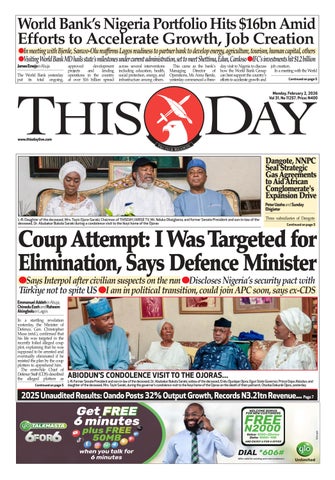
World Bank’s Nigeria Portfolio Hits $16bn Amid Efforts to Accelerate Growth, Job Creation
In meeting with Bjerde, Sanwo-Olu reaffirms Lagos readiness to partner bank to develop energy, agriculture, tourism,
others Visiting World Bank MD hails state's milestones under current administration, set to meet Shettima, Edun, Cardoso
James Emejo in Abuja
World Bank yesterday put its
a three-
L-R: Daughter of the deceased, Mrs. Toyin Ojora-Saraki; Chairman of THISDAY/ARISE TV, Mr. Nduka Obaigbena; and former Senate President and son-in-law of the deceased, Dr. Abubakar Bukola
during a condolence visit to the Ikoyi home of the Ojoras
Coup Attempt: I Was Targeted for Elimination, Says Defence Minister
Emmanuel Addeh in Abuja, Chinedu Ezeh and Raheem Akingbolu in Lagos
In a startling revelation yesterday, the Minister of Defence, Gen. Christopher Musa (retd.), confirmed that his life was targeted in the recently foiled alleged coup plot, explaining that he was supposed to be arrested and eventually eliminated if he resisted the plan by the coup plotters to apprehend him.
The erstwhile Chief of Defence Staff (CDS) described the alleged plotters as
Saraki
Shell Kicks Off Turnaround Maintenance at 225,000bpd Bonga FPSO to Extend Asset's Life
Peter Uzoho
Shell Nigeria Exploration and Production Company Limited (SNEPCo) has commenced a turnaround maintenance activity at the Bonga Floating Production Storage and Offloading (FPSO) vessel.
The company announced this yesterday in a statement signed by its Communications Manager, Gladys Afam-Anadu.
SNEPCo explained the exercise was a statutory and
integrity assurance programme aimed at extending the life of the facility.
“The schedule maintenance activity is designed to ensure the FPSO continues to operate safely and efficiently for the next 15 years, while reducing unplanned deferments and strengthening the asset’s overall resilience,” SNEPCo Managing Director, Ronald Adams, said, adding: “We expect to resume operations in March following the completion of
the turnaround.”
The Shell subsidiary said the scope of work includes statutory inspections, certification and regulatory compliance checks, major asset - integrity upgrades as well as engineering modifications to improve long-term operations and subsea assurance activities.
The FPSO located approximately 120 km offshore in water depths exceeding 1,000 meters, has the capacity to produce 225,000 barrels of
oil and 150 million standard cubic feet of gas per day of gas.
They noted that maintaining the integrity of this critical national asset was essential to supporting stable production and Nigeria’s wider energy, security and revenue objectives.
According to the statement, this year’s turnaround comes at a strategic moment for SNEPCo and its co-venture partners.
In 2024, the partners took Final Investment Decision (FID)
COUP ATTEMPT: I WAS TARGETED FOR ELIMINATION, SAYS DEFENCE MINISTER
“unserious individuals” but warned that the threat was real enough to trigger swift action, with several suspects now arrested and others actively being pursued internationally by the Interpol.
The attempted coup d'etat which has dominated headlines recently involved a plot by a network of military officers, security personnel and civilians to violently overthrow President Bola Tinubu’s government. Over a dozen serving military officers are currently in custody for the planned illegal takeover of the government, while a number of civilians remain on the run.
Speaking on sundry securityrelated issues on Channels Television, Musa argued that something must have seriously gone wrong with the
Industries Limited - Dangote Petroleum Refinery, Dangote Fertiliser Plant and Dangote Cement Plc have scaled up their Gas Sales and Purchase Agreements (GSPA) with subsidiaries of the Nigerian National Petroleum Company Limited (NNPC Ltd): Nigerian Gas Marketing Limited and NNPC Gas Infrastructure Company Limited (NGIC).
The deal is geared towards meeting the energy demands of the ongoing expansion
Bank MD, Governor of Lagos State, Mr. Babajide Sanwo-Olu, reaffirmed his administration's commitment to partner the Bretton Woods institution in the developing energy, agriculture, tourism and human capital in the state.
The governor said Lagos was ready to do more to attract investments and partnerships that will improve the living standard of the residents, adding that the State Government will do what is necessary to receive more support from the World Bank to improve its infrastructure.
Sanwo-Olu who received the World Bank Group team led Bjerde, including the International Finance Corporation (IFC) Regional Vice President for Africa, Mr. Ethiopia Tafara, at Lagos House, Marina, further read out achievements of his administration in the last
officers to think of forcefully taking over the government, arguing that even if they were not caught, they would have been staunchly resisted by Nigerians.
“I was also a target, I am sure you know. I was supposed to be arrested, and if I refused, I was supposed to be shot,” the 58-year-old retired general emphasised. “But that's the job”, he said, noting that anybody who goes to plan a coup knows the consequences. “If you succeed, good (for you) if not, whatever the consequences you are ready for it,“ he stated.
According to Musa, those involved in the coup plot were “unserious individuals”, whose calibre could not have successfully carried out such a grand plan.
The plot came to light
projects of the three Dangote subsidiaries, according to a statement by Dangote Group.
The statement said the upscaled Supply Agreements will help to drive the conglomerate’s Vision 2030, resulting in increased output, better and cleaner energy supply as well as support ongoing expansion projects.
The Agreements were signed at the unveiling of the NNPC Gas Master Plan (GMP) 2026, tagged "NGMP 2026", held at
six years through the delivery of the THEMES+ developmental agenda, which had impacted millions of Lagos residents positively.
In a statement issued by his Special Adviser on Media and Publicity, Mr. Gboyega Akosile, the governor also disclosed that Lagos ranked 29th in the Ease of Doing Business index, based on a national ranking four years ago, adding that last year, the state moved to the first position after doubling its performance in every aspect of its endeavours.
In her earlier remarks, Bjerde, said the World Bank would partner the state in view of the laudable achievements of the Sanwo-Olu- led administration, noting that it was indicative of a national solution.
She said there had been a lot of stability in the economy through the reforms initiated by the state’s current administration.
after intelligence agencies uncovered secret meetings and communications among a network of serving and retired military officers, with alleged support from some civilians. Security officials said the plan aimed to disrupt the constitutional order in Nigeria.
During the investigation, former Minister of State for Petroleum Resources, Timipre Sylva, was mentioned, prompting additional scrutiny by authorities. Sylva has since been out of the country.
“ But again, I think these guys were just a bunch of very unserious individuals that really don't know (anything). If you look at the calibre of the individuals, I don't know what got into their heads to think that they could take on the armed forces like that,” Musa emphasised.
the NNPC Towers over the weekend in Abuja.
Managing Director and Chief Executive Officer of Dangote Petroleum Refinery, Mr. David Bird, signed on behalf of the refinery, while the Group Managing Director of Dangote Cement Plc, Mr. Arvid Pathak, signed on behalf of the cement company, and Mr. Mustapha Matawalle signed on behalf of Dangote Fertiliser FZE.
Speaking at the signing ceremony, Chief Executive
The World Bank MD also pointed out that Lagos remained a major stakeholder on the bank’s interventions dashboard even as a subnational government.
Bjerde said, "Nigeria has been very consistent. Policies haven’t been changing much, and that is helping predictability, especially for investors. We like the government’s effort on Ease of Doing Business and cutting off the red tape.”
She added that the World Bank Group was determined to conduct a five-year country review in Nigeria to compare how the country and Lagos in particular had fared in the past five years.
She added that the bank was ready to leverage the capacity of Lagos to improve the private sector financing model for all its interventions, particularly in areas of infrastructural
on Bonga North, a subsea tie-back development that will depend on the reliability and enhanced capacity of the Bonga FPSO.
SNEPCo said a successful turnaround maintenance was therefore essential to preparing the facility for the additional volumes and operational demands associated with the new development.
The last turnaround maintenance activity on the FPSO took place in October
2022.
On February 1, the following year, the asset delivered its 1 billionth barrel of oil since production commenced in 2005.
Besides, the minister insisted that Nigerians would have fought against the coup plotters as they have done in the past, explaining that the alleged coup plotters need their brains reset and insisting that they will pay dearly for their indiscretion.
“What I even said is that even Nigerians would have fought them. Remember, Nigerians have fought against military rule for quite some time. Mr President has been one of them, so for them to wake up one morning and think they can do that in Nigeria, I think they need to reset their brain,” he said. So far, the defence minister pointed out that most of the suspects were in custody, but said that those still at large will be brought to book. He said the said colonel did not
Officer of Dangote Petroleum Refinery, David Bird said the agreement demonstrates the refinery's bold steps to expand its capacity.
According to him, the agreements mark a critical milestone in the expansion drive as well as a proactive measure to lock in vast energy requirements for the anticipated increase in its production capacity.
Chief Executive of Dangote Cement, Pathak, described the agreement signing serves as
development, energy, agriculture, tourism and human capital development.
Meanwhile, Bjerde is also scheduled to meet with Vice President Kashim Shettima; Minister of Finance and Coordinating Minister of the Economy, Mr. Wale Edun, Governor of the Central Bank of Nigeria (CBN), Mr. Olayemi Cardoso according to a statement issued by the bank.
She will also be joined on the visit by World Bank Vice President for Western and Central Africa, Ousmane Diagana, and Multilateral Investment Guarantee Agency Vice President, Ed Mountfield. It further emerged that International Finance Corporation (IFC)’s investment portfolio currently stood at over $1.2 billion.
During the visit, Bjerde
meet the requirements for promotion, because the armed forces declined to elevate him to the next rank.
Musa also attempted to defend the military for initially insisting that there was no coup initially, stressing that the language used was to ensure that there was no panic; that all those involved were picked up before any public disclosure and that no innocent person was wrongly accused.
“Things were being monitored until when we were sure that these are the things and then we just moved in and these facts are very clear. And what we tried to avoid is we didn't want any innocent person to be indicted for whatever reason. So, it was painstaking.
“I was there, I was the one who inaugurated the board. I
an enabler of DCP’s strategic objectives.
The agreement guarantees the gas required to support the drive towards Compressed Natural Gas (CNG) adoption as Autogas and to meet the increasing gas demand as production capacities in Nigeria are expanded.
made sure the board started to send them to the DIA (Defence Intelligence Agency) to do a thorough investigation and together with all the others, the NIA, the DSS and every other person. So it's a holistic investigation that we carried out because we didn't want any innocent person to be indicted,” he explained.
However, the defence minister stated that it is almost impossible to successfully execute a coup d'etat in today's Nigeria, stressing that it was unfortunate that many of the young officers did not know they were being used.
“The ability to execute it is one thing. I know that they probably thought they were in some other country, not Nigeria. So it's difficult to get
Continued on page 36
The Cement company added the agreement also promotes the adoption of cleaner fuel for both Autogas through CNG and gas to support increased production output. For Dangote Fertiliser FZE, it is anticipated the agreement will support the company’s fertiliser capacity expansion projects, given that fertiliser is a product of natural gas. Meanwhile, speaking at the event, the Minister of State for Petroleum Resources (Gas), Rt. Hon. Ekperikpe Ekpo, described the Gas Master Plan as a deliberate pivot
will also meet with senior government officials, private sector leaders, and civil society organizations as part of consultations on the World Bank Group’s upcoming Country Partnership Framework (CPF) for Nigeria.
The new strategy places jobs, energy access, and private sector-led growth at the center of Nigeria’s development agenda.
The consultations will seek feedback on four areas including improving the enabling environment, unleashing human capital, building resilience, and maximizing private capital.
The World Bank visit further underscored Nigeria’s central role in advancing global development priorities including flagship initiatives such as Mission 300 – the World Bank Group and African development Bank (AfDB) - led initiative aimed at connecting 300 million
Continued on page 37
Africans to affordable, reliable electricity by 2030, with a strong focus on expanding renewable energy and last mile access. This will be implemented through the Nigeria Distributed Access through Renewable Energy Scaleup (DARES) project – a $750 million World Bank operation designed to expand clean, reliable electricity access to over 17.5 million Nigerians through distributed renewable energy solutions such as Mini grids and solar home systems as well as with household energy access— and AgriConnect to transform smallholder farming into a commercially viable engine for jobs, higher incomes, and global food security. Discussions will further address progress on digital connectivity, power sector reforms, social protection, and human capital outcomes, the statement added.
Managing Director, Shell Nigeria Exploration and Production Company Limited (SNEPCo), Ronald Adams.
U.S.-NIGERIA COMMERCIAL AND INVESTMENT PARTNERSHIP FRAMEWORK...
Report: Nigeria Lost $77.7bn to Illicit Financial Flows in 10 Years
Nigeria lost a total of $77.7 billion to trade-related illicit financial flows (IFFs) between 2013 and 2022 (a period of 10 years), a new report by Global Financial Integrity (GFI) revealed.
GFI is a renowned United States-based think tank focused on tracking illicit financial flows, corruption, illicit trade and money laundering.
In a new report titled, "Trade-related Illicit Financial Flows in Africa, 2013-2022", GFI said IFFs represented a formidable barrier to Africa’s inclusive growth and economic sovereignty. It said the new report captured trade-related value gaps for all Sub-Saharan
African nations between 2013 and 2022.
The report said IFFs occurred via trade misinvoicing, with South Africa alone accounting for a dominant share of Africa’s trade-related IFFs between 2013 and 2022.
South Africa topped the list with an estimated $478.08 billion in cumulative trade value gaps with all trading partners, reflecting massive undeclared or mispriced transactions.
As a share of all Sub-Saharan Africa, South Africa accounted for 42 per cent of the region’s cumulative trade-related IFFs, highlighting the high concentration of leakage among the region’s largest commodity exporter.
The report stated, "A second
tier of countries have also haemorrhaged significant sums. Nigeria (approximately US$77.7 billion), Ghana (approximately US$54.1 billion), Côte d’Ivoire (approximately US$47.7 billion), and Kenya (approximately US$47.5 billion) each accumulated tens of billions of dollars in trade value gaps over the period 2013–2022.
"Côte d’Ivoire and Ghana are major exporters of commodities (such as cocoa, gold, and oil), and their high IFF figures suggest substantial misinvoicing in those export industries.”
The report stated, "Nigeria, despite being the continent’s largest economy and oil producer, shows a somewhat lower cumulative gap (≈$77.7 billion) than South Africa
possibly due to differences in trade structure or improved scrutiny in recent years.
"Still, Nigeria’s capital flight remains among the highest in Africa, consistent with longstanding concerns about oil-sector IFFs and money laundering."
It observed that Kenya’s sizeable aggregate gap (over $47.4 billion) was notable given its more diversified economy, adding that it likely reflects Nairobi’s role as an East African trade hub, "with misinvoicing occurring in both imports (e.g. undervalued goods to evade customs duties) and exports".
According to the report, Zambia at $35.8 billion, Angola ($35.4 billion), Senegal
Insecurity: UNICCON, DICON Launch AI-powered Drones to Curb Insurgency
Oghenevwede Ohwovoriole in Abuja
UNICCON Group of Companies, in partnership with Defence Industries Corporation of Nigeria (DICON), has launched Artificial Intelligence (AI)powered ‘kamikaze’ drones to curb insecurity in the country.
Chairman of UNICCON Group, Professor Chuks
Ekwueme, unveiled the drones during a joint technical demonstration of Integrated Drone Detection and Defence Systems in Abuja, weekend.
At the launch, Ekwueme said the move was a successful validation of sovereign defence technology designed to meet specific security needs of the African continent.
“This is not just an
improvised version display, it is a successful validation of sovereign defence technology designed to meet the specific security needs of the continent," he said.
He identified the breakthrough technologies as Africa’s First Integrated “Kamikaze” System, the UNIKAM-Series, and an AI and high-speed Loitering Munition that reaches speeds
of 210 plus km/h with an advanced impact radius observed at approximately 200 plus meters.
Ekwueme alluded to the "Advanced Drone Detection, Jamming, and Spoofing which is a stationary system capable of detecting over 40 Unidentified Area Vehicles (UAVs) simultaneously up to eight kilometres away."
SERAP Sues NNPCL Over ‘Failure To Account For Missing N22.3bn, $49.7m Oil Money’
The Socio-Economic Rights and Accountability Project (SERAP) has filed a lawsuit against the Nigerian National Petroleum Company (NNPC) Limited over the “failure to account for
the alleged missing or diverted ₦22.3 billion, USD$49.7 million, £14.3 million and €5.2 million oil money.”
Disclosing this in a statement on Sunday, SERAP Deputy Director, Kolawole Oluwadare, said the suit followed
the damning allegations documented in the 2022 audited report by the AuditorGeneral of the Federation, which was published on 9 September 2025.
The suit was filed last Friday at the Federal High Court in Abuja.
The group is seeking “an order of mandamus to direct and compel the NNPCL to account for the alleged missing or diverted N22.3 billion, USD$49.7 million, £14.3 million, and €5.2 million oil money.”
($25.5 billion), Tanzania ($35.5 billion), and Ethiopia ($24.6 billion) are among the top 10 Sub-Saharan African countries with the highest IFFs between 2013 and 2022.
The report also x-rayed top 10 African countries' cumulative trade value gap with advanced economies during the 10-year period with South also topping the bracket.
The GFI report stated, "South Africa emerges as the largest source of trade misinvoicing with advanced economies, with an estimated $238.4 billion trade value gap in 2013–2022 (well ahead of Nigeria’s $29.7 billion in this subset).
"South Africa’s top ranking in trade with developed countries underscores its extensive commerce with Europe, North America, and other advanced markets and suggests that substantial under-invoicing of exports or over-invoicing of imports is occurring in those channels (for example, in the export of precious metals or the import of high-value manufactured goods).” It added, "Nigeria is the second-largest in absolute terms with advanced economy partners ($29.7 billion), reflecting primarily oil trade with destinations like the United States and EU.
NCC, NSCDC Warn Construction Firms Against Fibre- Optic Cable Damage
Michael Olugbode in Abuja
Nigerian Communications Commission (NCC) and Nigeria Security and Civil Defence Corps (NSCDC) have issued a warning to construction companies, contractors, and other stakeholders over the rising incidents of fibreoptic cable damage during road construction and civil engineering activities across the country.
In a joint statement issued at the weekend, the two agencies described fibre-optic infrastructure as a critical national asset and cautioned that negligence leading to its damage will no longer be tolerated.
They stressed that offenders risked prosecution, as such acts constituted criminal offences under existing laws.
According to NCC and NSCDC, fibre-optic cables
are central to Nigeria’s digital economy, supporting communication networks, emergency services, business operations, and government functions.
They warned that frequent and avoidable fibre cuts posed serious threats to national security, economic stability, and public safety.
The agencies stated that under the Designation and Protection of Critical National Information Infrastructure (CNII) Order 2024, telecommunication fibre infrastructure had been classified as Critical National Information Infrastructure. As a result, any damage arising from unauthorised excavation, construction activities, or failure to coordinate with relevant authorities was deemed a criminal act, NCC and NSCDC stated.
Ndubuisi Francis in Abuja
Chuks Okocha in Abuja
L-R: U.S. Deputy Assistant Secretary for the U.S. Commercial Service at the U.S. Department of Commerce, Mr. Bradley McKinney; Nigeria’s Minister of Industry, Trade and Investment, Dr. Jumoke Oduwole; with U.S. Department of Agriculture Associate Administrator for the Foreign Agricultural Service, Mr. Jason Hafemeister, during the U.S.-Nigeria Commercial and Investment Partnership (CIP) Ministerial in Lagos … recently
Emmanuel Addeh in Abuja Oando Plc, one of Africa’s leading indigenous energy solutions providers, yesterday published its unaudited results for the full year ended December 31, 2025, announcing a 32 per cent year-on-year increase in
production by its upstream business and averaging 32,482 barrels of oil equivalent per day.
The growth, a statement from the company said, was driven by a 36 per cent increase in crude oil production to 11,269 bpd, a 24 per cent increase in gas production to 19,982 boepd,
Obi: Insecurity, Poverty, Power Supply Worsened in Nigeria in January
Chuks Okocha in Abuja
Former presidential candidate of the Labour Party (LP), Mr. Peter Obi, has described January as a “deeply distressing” month for Nigeria, citing worsening insecurity, failures in education and power supply, and what he termed misplaced governance priorities by the federal government.
In a statement shared on his verified X (formerly Twitter) account on Sunday, Obi said the first month of the year has become a troubling indicator of the challenges facing the country, warning that conditions continue to deteriorate across multiple sectors.
According to him, insecurity surged nationwide in January, with reports of several killings and hundreds of kidnappings and abductions.
He noted that victims included children, pregnant women, and nursing mothers, with abductors allegedly demanding millions of naira in ransom.
Obi added that persistent insecurity has prevented many farmers from returning to their farms, worsening food shortages and deepening rural poverty.
The former Anambra State governor also expressed concern over the state of education, which he described as the foundation of national
development.
He lamented that millions of Nigerian children remain out of school, while those enrolled are frequently unable to attend due to insecurity or teachers’ strikes.
Obi described the situation in Abuja, the nation’s capital, as “particularly tragic,” noting that schools remain closed despite what he said were billions of naira spent on renovating a conference centre and constructing bus terminals.
On infrastructure, Obi pointed to Nigeria’s electricity crisis, noting that the country, which already ranks among those with the poorest access to power, experienced two national grid collapses within the month.
He also criticised President Bola Tinubu’s travel schedule, contrasting Nigeria’s situation with other countries where leaders, he said, focus on domestic governance at the start of the year.
Obi claimed that the president spent 23 days abroad in January across two foreign trips, questioning the urgency of such extended absences amid pressing national challenges.
“The collective impact of these events paints a grim portrait of a nation grappling with insecurity, economic distress, failing infrastructure, and profound social upheaval,” Obi said.
and a 715 per cent increase in Natural Gas Liquids (NGL) production to 1,231 bpd.
The Group attributed the production growth to the full-year consolidation of the NAOC JV interest, improved operational uptime resulting from the reactivation of previously constrained wells, and targeted infrastructure upgrades across operated assets.
Besides, Oando reported a 10 per cent increase in profit after tax to N241.3 billion compared to N220.1 billion in 2024, supported by higher upstream production, impairment reversals, and favourable tax adjustments.
However, revenue declined 21 per cent to N3.21 trillion from N4.09 trillion in 2024, while gross profit decreased 82 per cent year-on-year to N27.8 billion, down from N155.9 billion in
2024, the company said.
According to Oando, these declines in earnings reflected the company’s change in revenue mix as it scaled back high-turnover, lower-margin refined-product trading in favour of higher-margin crude and gas trading opportunities, as well as the impact of non-cash items.
Commenting on the full year-end 2025 unaudited results, Group Chief Executive, Oando PLC, Wale Tinubu, said that the company materially improved uptime
“2025 was a year of relentless execution as we successfully transitioned from the integration of the NAOC Joint Venture into operational delivery, while its operated Joint Venture production averaged approximately 80,545 boepd.
“Over the year under review, we reinforced asset integrity, strengthened security across our operating areas, and materially improved uptime, delivering a 32 per cent year-on-year increase in total production.
“Operated Joint Venture production averaged approximately 80,545 boepd, translating to 32,482 boepd net to Oando, alongside a 30 per cent increase in crude oil lifting and a 59 per cent increase in gas sales volumes.
“Building on this foundation, we launched our development drilling programme with the successful completion and start-up of the Obiafu-44 gas-condensate well. This well represents the first execution milestone within a phased 36-well development programme, designed to restore
field deliverability, unlock incremental production and advance the Group’s mediumterm growth objectives,” the Oando chief executive stated.
Within its trading business, the Group recorded a 42 per cent increase year-on-year in crude oil cargos traded, rising to 26 crude oil cargos (29.4 MMbbl) compared to 21 cargos (20.7 MMbbl) traded in 2024. During the period, Oando said it deliberately paused Premium Motor Spirit (PMS) trading in response to structural changes in Nigeria’s domestic downstream landscape.
While this rebalancing resulted in a short-term reduction in reported earnings, Oando stated that it aligns with the Group’s longer-term focus on margin quality and capital efficiency.
Ogun Reaffirms Jurisdiction on Eba Oil Discovery Site
The Ogun State Government has reaffirmed its territorial jurisdiction over Eba Island in Ogun Waterside Local Government Area, dismissing claims from some quarters in Ondo State as misleading and capable of triggering avoidable communal tension.
The clarification follows public debates and a motion sponsored by Hon. Donald Kimikanboh Ojogo, representing Ilaje Federal Constituency in Ondo State, after President Bola Ahmed Tinubu approved the commencement of drilling activities at an abandoned oil well located on Eba Island.
In a statement issued on Sunday, the Special Adviser to the Governor on Information and
Strategy, Hon. Kayode Akinmade, said the Eba Island where the approved oil well is located falls squarely within Ogun Waterside Local Government Area of Ogun State.
According to Akinmade, boundaries between states and local governments in Nigeria are constitutionally defined and properly documented by the National Boundary Commission (NBC), adding that official boundary maps and records clearly situate Eba Island within Ogun State.
He explained that Eba is a long-established community within Ogun Waterside, whose status predates Nigeria’s independence and has remained unchanged through successive political and administrative reorganisations,
including the 1976 state creation exercise that carved Ogun State out of the former Western State.
“Since 1976, there has been no constitutional amendment, judicial pronouncement or federal gazette that altered the boundary placing Eba outside Ogun State,” the statement said.
The government clarified that there are two distinct locations known as “Eba.” While one is located near the Ondo State forest reserve, the larger Eba Island— where the oil well approved by the President is situated—lies entirely within Ogun State’s coastal corridor.
Akinmade noted the presidential approval for drilling followed extensive due diligence by Nigerian National Petroleum Company Limited (NNPCL) and
other relevant federal institutions, all of which confirmed that the oil well is located within Ogun State territory before clearance was granted. He added the deployment of national security assets, including naval formations around the drilling site, further demonstrates federal recognition of Ogun State as the host state.
Providing additional context, the statement disclosed that in October 2024, the Molokun of Atijere in Ondo State formally approached the Osobia of Makun-Omi in Ogun Waterside Local Government Area, seeking permission to conduct business activities on Eba Island. The request was declined and subsequently reported to the Ogun State Government, NNPCL and security agencies.
James Sowole
L-R: National Chairman, All Progressives Congress (APC), Prof. Nentawe Yilwatda; Governor of Taraba State, Agbu Kefas; and Vice President, Mr. Kashim Shettima, during the grand reception to welcome Kefas to APC in Jalingo on Saturday
WORKING VISIT BY THE BRITISH CYCLING TEAM TO LAGOS...
ACCI: Ban on Sachet Alcohol May Cost Economy N800bn Investments, 5m Jobs
Declares outright ban, without transition measures, may encourage proliferation of illicit and unregulated products Seeks new deadline extension to December 2026
James Emejo in Abuja
President, Abuja Chamber of Commerce and Industry (ACCI), Chief Emeka Obegolu, has warned that renewed enforcement of the ban on the production and sale of alcoholic beverages packaged in sachets and small bottles by National Agency for Food and Drug Administration and Control (NAFDAC) could put about
N800 billion investments at risk.
Obegolu said the move further threatened over five million direct and indirect jobs.
In a statement issued by ACCI Media and Strategy Officer, Olayemi John-Mensah, over the weekend, Obegolu described the enforcement as economically disruptive and potentially damaging to investor confidence, particularly at a time when “Nigeria requires
Alternative Bank Canvasses Stable Policy for Private Capital, Inclusive Growth
The Alternative Bank has called for stronger public-private collaboration and predictable policy to accelerate blended finance and mobilise more private capital into projects that drive inclusive economic growth.
It says blended finance can deliver commercially sound outcomes while advancing development priorities when transactions are properly structured and risks are transparently shared among government, Development Finance Institutions (DFIs), banks, and other stakeholders.
Executive Director, Commercial Institutional Banking (Lagos and South West) Korede Demola-Adeniyi made the remarks at the Africa Social Impact Summit (ASIS) HighLevel Policy Engagement held at the State House Conference Centre, Abuja.
The session was hosted by the Office of the Vice President in partnership with Sterling One Foundation and United Nations Nigeria, under the theme ‘Scaling Action: Driving Inclusive Growth
Through Policy and Innovation’.
She also noted that DFIsupported blended finance structures often deliver strong repayment performance relative to conventional lending when risks are shared transparently and execution is actively monitored.
“Blended finance works when the structure is clear and the risk-sharing is real,” she said. “However, private capital will not be committed at scale when the rules can change halfway through execution. If we want investors to show up, policy has to be predictable.”
Demola-Adeniyi explained that The Alternative Bank evaluates transactions as partnerships rather than conventional interest-based lending arrangements, assessing viability through profitability, agreed profit-sharing structures, and the contributions of each party to execution.
“If a project is viable, we evaluate how it makes money, how profit is shared, and what each party is responsible for,” she said. “Our model is that of a partnership built to deliver results.”
regulatory stability to sustain growth, protect livelihoods, and attract investment”.
He expressed the chamber’s full support for public health objectives, including protection of minors and the promotion of responsible consumption, adding, however, that the “current approach to enforcement is abrupt and raises concerns of regulatory inconsistency”.
Obegolu said, “The renewed enforcement contradicts existing government directives and legislative resolutions, including the directive issued by the Office of the Secretary to the Government of the Federation on December 15, 2025, which suspended the ban, as well as the resolution of the House of Representatives of March 14, 2024, calling for restraint and broader stakeholder consultation.”
He recalled that in December
2018, NAFDAC, alongside Federal Ministry of Health and Social Welfare and Federal Competition and Consumer Protection Commission (FCCPC), entered into a five-year Memorandum of Understanding (MoU) with manufacturers to gradually phase out sachet and smallvolume alcoholic beverages by January 31, 2024.
According to him, the moratorium was later extended to December 2025 following sustained engagement with industry stakeholders.
Obegolu stated, “Despite these agreed transition timelines, the sudden enforcement has begun to disrupt legitimate businesses across the manufacturing, packaging, distribution, and retail value chains, unsettling existing investments and exposing millions of workers to potential job losses.”
The ACCI president cautioned that an outright ban, without adequate transition measures, might inadvertently encourage the proliferation of illicit and unregulated alcohol products, thereby undermining both public health goals and government revenue.
Obegolu, who spoke for the Organised Private Sector (OPS) in the Federal Capital Territory (FCT), called for effective regulation on control, compliance, and enforcement, rather than outright prohibition.
He said, “ACCI is calling for a further extension of the implementation deadline to December 2026 to allow manufacturers complete ongoing transition processes, restructure operations, and exhaust existing inventories without unnecessary economic shocks.”
Obegolu also advocated
the establishment of a multistakeholder implementation committee comprising relevant regulatory agencies, policymakers, organised private sector groups, and industry representatives to ensure coordinated, transparent, and practical execution of the policy.
According to him, such an inclusive framework would help balance public health protection with economic sustainability, safeguard investments, preserve jobs, and strengthen confidence in Nigeria’s regulatory environment. He reaffirmed the chamber’s readiness to collaborate with NAFDAC, relevant ministries, the National Assembly, and other stakeholders to achieve responsible regulation that protects consumers while sustaining enterprise growth and employment.
PeacePro: Nigeria’s Agriculture Sector Suffers N5trn Capital Wipeout in Two Years
Hammed
Shittu in Ilorin
The Foundation for Peace Professionals (PeacePro) at the weekend said that Nigerian farmers have lost nearly ₦5 trillion (approximately $4billion) in productive capital over the past two years.
The group said the ugly development was due to policy induced price crashes, poor and misleading weather forecasts by the Nigerian Meteorological Agency (NiMet), and severe market distortions.
A statement issued in Ilorin, signed by the
group's Executive Director, Abdulrazaq Hamzat, described the losses as direct agricultural capital destruction at the producer level.
The statement stressed the estimate does not include secondary economic effects such as consumer inflation, GDP contraction, foreign exchange pressure, or security related costs.
“Those impacts come later. What has already happened is the liquidation of farmer capital,” PeacePro said.
According to the organization, Nigeria did not successfully “control
food prices” in 2024–2025.
Instead, a combination of poorly timed policy interventions, price suppression mechanisms, weak market coordination, and unreliable weather forecasting by NiMet forced farmers to sell produce below cost, wiping out the capital required to sustain future production cycles.
“This was not a market correction. It was a policy shock that transferred value away from producers,” the statement added.
While Nigeria has an estimated 38-40 million people engaged in agriculture,
PeacePro clarified that, "the most severe damage was concentrated among market facing producers, not subsistence farmers, although subsistence farmers were also adversely affected, particularly by poor and misleading weather forecasts issued by NiMet.
"The most affected group includes 6–8 million producers, small and medium scale commercial farmers, storage poor price taking producers, farmers engaged in grains, tubers, vegetables, and legumes.
"These producers supply Nigeria’s urban and regional food markets".
Kuni Tyessi in Abuja
L–R: Senior Special Assistant to the Governor of Lagos on Sports Marketing and Administration, Mr. Onaopepo Adu; Sport and Participation Director, British Cycling, Ms. Amy Gardner; Director General, Lagos State Sports Commission, Mr. Lekan Fatodu; Communications Manager, British Cycling, Ms. Ellie Stott; First Secretary, British Deputy High Commission, Lagos, Ms. Grace Bell; Senior Special Assistant to the Governor of Lagos on Sports, Mr. Damilare Orimoloye; and Director of Technical, Lagos State Sports Commission, Mrs. Ife Ogunlaja, during a working visit by the British Cycling team to the Lagos State Sports Commission in Surulere, Lagos .. recently
INAUGURATION OF FATGBEMS MEGA STATION...
Food Security: CPPE Tasks FG on Framework for Farm Price Stabilisation, Affordable Food Prices
Dike Onwuamaeze
The Centre for the Promotion of Private Enterprise (CPPE) has called for a clear, rulesbased and market-friendly farm price stabilisation and farmer income protection framework that would keep food affordable for consumers while protecting farmers’ incomes and safeguarding investment in agriculture.
The CPPE made this call yesterday in a policy brief
on sustainable food security titled "Imperative of Farm Price Stabilisation and Farmer Income Protection Framework for Nigeria," which canvassed for minimum guaranteed prices for selected priority crops
The Chief Executive Officer of CPPE, Dr. Muda Yusuf, who issued the brief, said that maintaining sustainable food security, rural livelihoods and national economic stability have become a major policy imperative for the federal
government.
Yusuf noted the government’s recent import focused food security strategy has brought about a sharp decline in food prices but left investors and producers in the agricultural sector lamenting over heavy losses arising from the collapse in prices of key commodities.
Following this development, he said that "the CPPE is of the firm view that Nigeria urgently requires a clear, rules-based and market-friendly 'Farm Price
Stabilisation and Farmer Income Protection Framework.'
"Such a framework should prevent import-induced price crashes, reduce harvest-time price collapse, discourage distress sales, protect farmer livelihoods, strengthen value chains, and provide stable supply conditions for processors and consumers."
Yusuf stated that "the welfare gains from cheaper food have been profound and should be acknowledged.
"However, the cost to farmers
To Ease Discomfort, PenCom Unveils Online Data Recapture Application for RSA Holders
The National Pension Commission (PenCom) has launched a self-service online data recapture application to ease pressure on Retirement Savings Account (RSA) holders who are hitherto required to present themselves physically for recapture.
The new platform, Data Recapture Self-Service Platform (PENCAP) which was unveiled in collaboration with Pension Fund Administrators (PFAs) became effective on February 1, 2026, PenCom noted in a statement.
The initiative marks another key step by the commission to enhance data integrity, improve service delivery, and modernise pension administration through responsible digitalisation.
The deployment of aligns with PenCom’s broader commitment to innovation, transparency, and operational efficiency within the country’s pension industry.
By embracing technologydriven solutions, the commission continues to enhance public confidence in the Contributory Pension Scheme (CPS) and ensure seamless access to
retirement benefits.
Before now, RSA holders were required to physically visit their PFAs in order to recapture. This approach has not achieved the needed outcome, with many eligible RSA holders yet to be recaptured for over six years.
However, RSA holders who prefer physical recapture may still visit their PFA branches, as the self-service platform is designed to complement existing service channels, PenCom further noted.
Essentially, the platform enables RSA holders to remotely update their personal records (recapture) without necessarily
visiting their PFAs.
The solution targets RSA holders who joined the Contributory Pension Scheme (CPS) on or before July 1, 2019 and have not undergone the data recapture process.
According to PenCom, “Accurate and up-to-date data remains fundamental to the efficient administration of retirement savings under the CPS. Over time, data inconsistencies arising from legacy records and incomplete documentation have posed challenges during verification and benefit processing.
and other investors across the agricultural value chain is equally significant and cannot be ignored."
He described the current development presented as a major policy dilemma that demands urgent attention because "Nigeria cannot afford a policy regime that undermines confidence and discourages investment in agriculture—one of the most strategic sectors of the economy, a major source of livelihoods, and one of the country’s largest employers of labour.
"There is, therefore, an urgent need for policy recalibration and rebalancing to ensure that farmers remain productively engaged, rural incomes are protected, and investor confidence across the agricultural value chain is sustained— without compromising the equally important objective of keeping food affordable for Nigerian households."
The CPPE said that recent surge in the import of food crops, especially staples such as rice, maize and soybeans, has caused serious dislocations in the agricultural investment ecosystem.
"This has inflicted severe hardship on farmers, weakened incentives to produce, and undermined Nigeria’s broader
food security objectives.
"Although consumers have welcomed the decline in food prices, the long-term consequences are adverse: farmer incomes fall, production declines over time, investment confidence weakens, and the country risks returning to cycles of scarcity and higher prices.
"Therefore, there is a need for a coherent programme grounded in global best practices and adapted to Nigeria’s fiscal and governance realities."
According to Yusuf, the establishment of the framework is a national priority that should be anchored on principles that reduce uncertainty, promote investment and encourage private sector participation.
"Specifically, it must be rules-based rather than discretionary; targeted rather than universal; market-friendly rather than command-driven and digitally enabled to strengthen transparency and accountability," he said.
Yusuf said that Nigeria’s efforts should focus on correcting market failures, particularly in storage, logistics, finance, processing, and market information, rather than crowding out private enterprise through excessive government control.
With Just 4% in Parliament, Coalition Pushes for Reserved Seats for Women Bill
Addeh and Sunday
The Chief Executive Officer of TOS Foundation Africa and Convener of the ‘Reserved Seats for Women Bill’ Campaign Coalition, Osasu Igbinedion Ogwuche, has renewed calls for the accelerated passage of the legislative proposal.
The activist, who spoke at a conference with editors in Abuja, said the bill has often been misunderstood
and wrongly framed as a gender-based agenda, cautioning that failure to act swiftly could delay its implementation until after the 2027 general elections.
According to Igbinedion Ogwuche, the bill seeks to create 74 additional seats in the National Assembly and 108 seats across the 36 state Houses of Assembly to improve women’s participation in governance. She noted that Nigeria currently ranks last in Africa in women’s
parliamentary representation.
She explained that only 16 of the 360 members of the House of Representatives are women, while the Senate has just four women out of 109 members. Across the 36 state assemblies, she said, only 51 of 993 lawmakers are women.
Painting a grim picture of women participation in Nigerian politics, she argued that poor female representation has real consequences for policymaking, citing that similar proposals failed in
the 8th and 9th National Assemblies, largely due to resistance framed around religion and culture.
“The bill for reserved seats for women is currently on the floor of the National Assembly. We are at third reading, a very critical stage that either makes or breaks the bill. What the bill is seeking to do, for those who are not aware, is to add additional seats, 74 additional seats to the National Assembly, and 108 additional seats across the 36 state assemblies.
“The level of women's participation in politics in Nigeria is very poor. In Africa, we rank 54 out of 54, the very bottom of the barrel. Women make up 50 per cent of Nigeria's population, but unfortunately assume only 4 per cent of seats in Parliament. That is 16 out of 360 members in the House of Representatives are women, and only four out of 109 senators are women.
Across the 36 state assemblies, you have only 51 out of 993
members who are women.
“In some state assemblies, over 16 of them, you have no women at all. I always reference this and laugh, but it's actually not a funny matter. In Jigawa State, the chairperson of the Women Affairs Committee is a man. So, we have a lot of work to do. We call ourselves the giants of Africa, but our politics, our governance, is not reflective of that. We cannot legislate for a people without them on the table,” she argued.
James Emejo in Abuja
L-R: Executive Director, WholeSale Business, Fatgbems Group, Damola Gbemisola, Managing Director/Chief Executive Officer, Dr. Kabir Gbemisola, Deputy Governor of Ogun State, Noimot Salako- Oyedele, The Alake of Egba Land, His Royal Majesty, Oba Dr. Michael Aremu Adedotun Gbadebo, The Executive Director, Retail Business and Expansion, Bayo Gbemisola and the Executive Director, Operation and Technology, Shamsudeen Gbemisola at the Commissioning of Fatgbems Mega Station at Opic in Ogun State....recently
Emmanuel
Aborisade in Abuja
ANNOUNCEMENT! ANNOUNCEMENT!!
TARABA STATE MINISTRY OF FINANCE, BUDGET AND ECONOMIC PL ANNING PUBLIC ANNOUNCEMENT
The Ministry of Finance, Budget and Economic Planning
f o r m a l l y a n n o u n c e s t h e
h e screening and disbursement exercise for outstanding gratuities and death benefits for the 2015 retirees and beneficiaries.
This exercise will begin on Monday, February 2, 2026, at the Ministry of Finance, Budget and Economic Planning, Jalingo, starting promptly at 9:00 AM.
The exercise will cover primarily all eligible 2015 pensioners and a final mop-up phase for any remaining beneficiaries from the 2013 and 2014 cohorts, which will be conducted simultaneously.
All primary beneficiaries are required to present the following original documents for verification:
A valid Identification Card..
The official Pension Approval Letter.
The Letter of First Appointment.
For those processing death benefits, the designated n e x t o f k i n m u s t p r e s e n t
Administration.
The Ministry is committed to a transparent and efficient p r o c e s s a
concerned to adhere strictly to the scheduled date, time, a n
e timely service.
1. This announcement serves to inform the p u b l i c o f t h e o n g
H i s Excellency, the Governor, Dr. Agbu Kefas, to the welfare of the State retirees. In demonstration of this commitment, an additional allocation of N5 Billion naira has been authorized specifically for the settlement of outstanding gratuity and death benefit payments. This initiative underscores the administration's deep respect for the dedicated service of these senior citizens.
2. It has come to our attention, however, that certain individuals are attempting to exploit this process by illegally soliciting funds from retirees under the guise of facilitating access to their rightful benefits. The Governor condemns these exploitative practices in the strongest possible terms as it directly undermines the integrity of this welfare initiative and victimizes those it is designed to assist.
3. T h i s a n n o u n c e m e n
m a l directive to all personnel within the Ministry of Finance, Budget, and Economic Planning, every civil servant, and the general public to immediately cease and desist from any form of involvement in these fraudulent activities. Any individual found to b e e n g a g e d i n s u c h a c t
disciplinary and legal actions. The administration remains dedicated to safeguarding the well-being o f b o t h r e t i r e d
servants.
Signed:
Dr Sarah Enoch Adi FCNA, ACTI Hon. Commissioner of Finance, Budget and Economic Planning, Taraba State
FEDERAL HOUSING AUTHORITY
NO 26 JULIUS NYERERE CRESENT, ASOKORO. ABUJA, FCT.
PUBLIC NOTICE
It has come to the attention of the management of Federal Housing Authority that some persons are still engaging in unauthorized and illegal developments in the Authority’s estates despite the previous directives by the Authority prohibiting such acts.
These developments are known to be carried out without approvals and all requisite professional supervision, in serious contravention of our Development Control guidelines.
The Authority for safety and compliance to all professional standards has persistently frowned at this illegal practice and has through previous radio announcements and newspaper publications outlawed such developments in all her estates throughout the country.
The management of Federal Housing Authority would not fold its hands and watch such unprofessional acts carried on its estates. As a professional housing delivery agency, FHA is committed to the safety of all the buildings in her estates, by deploying professional supervisions from setting out to completion.
Through this professional measure, we have been able to check and curtail the incidences of building collapses in our estates, thereby saving lives.
Consequently, the management of Federal Housing Authority through this medium is giving a 7 day stop work notice effective 29th January, 2026 to all persons engaging in unauthorized and illegal developments in FHA estates.
This window is to avail all persons involved in developing without approval from Federal Housing Authority to obtain their approval and all other necessary building permits from the Authority or ratify the existing ones that may have expired.
Federal Housing Authority at the expiration of this notice would apply maximum sanctions on all defaulters to this directive.
Your wealth isn’t limited by borders, but empowered by it
Join Priority Banking and invest a minimum of ₦50m (or foreign exchange equivalent) and be rewarded with ₦750,000.
Campaign runs from 1st Feb - 31st March 2026.
More than 170 years of trusted expertise International Wealth Hubs in 4 key regions
Now’s your time for wealth
SC Priority
Politics
MONDAY DISCOURSE
Monday Sit-at-Home: Who Blinks First Between Soludo and Onitsha Traders?
a nambra State Governor, Prof Chukwuma Soludo, recently ordered the closure of Onitsha Main Market over Monday sit-at- home, but the traders took to the streets in protest. The question is: who blinks first between Soludo and the traders? David-Chyddy Eleke reports.
Last Monday,Anambra State Governor, Prof Chukwuma Soludo visited Onitsha Main Market unannounced and after a brief inspection, he ordered the closure of the market for one week for non compliance with his order for traders to resume trading on Mondays.
Origin of Sit-at-home and Early Warnings
For weeks prior to this, government memos and circulars have been flying around, ordering civil servants, traders, and all to jettison the Monday sit at home order earlier imposed by the proscribed Indigenous People of Biafra (IPOB) as a way to protest the continued arrest and detention of its leader, Mazi Nnamdi Kanu. The order started in 2021 when Kanu was arrested in Kenya and extraordinarily renditioned to Nigeria, while his earlier abandoned trial commenced. The aim of the order was to use the compliance level to arm twist the federal government to free him, but it failed.
Later, when it turned out to be a huge blow on the economy of the South East rather than a gain, the IPOB was convinced to announce abolition of the order, but it seemed too late already as the people have been coerced into perpetual compliance. Much later, states across the South East reclaimed their Mondays, but this is not the same with Anambra, especially Nnewi and Onitsha where every Monday leaves both towns as ghost locations with no movements or human presence.
Closure and Protests
During his visit last Monday, Soludo pronounced a one week ban on the market, insisting the order must be complied with. The order generated lots of tension, with many questioning the authority of the governor to compel traders to come to market on Mondays. The social media was also agog with traders threatening to disobey the order.
On Tuesday however, Soludo made good his threat by flooding the entire market with security operatives, stationing armoured personnel carrier (APC) in strategic places, all in a bid to enforce the order. To counter this, traders resorted to protests, chanting pro-Nnamdi Kanu songs.
During what later became a huge protest, young people took to the streets singing “holy holy holy, Nnamdi Kanu is another saviour.”
In another video, the protesters were seen cajoling the governor, singing that he didn’t have the powers to compel them to come to market on Mondays. In a way to mimick Nnamdi Kanu, who insisted he was being tried under an abrogated law, asking the trial judge to “Omotosho show me the law”, the protesters started chanting songs asking Soludo to show them the law that empowered him to close the market.
The discourse generated much arguments, with many wondering that the protest may further break the fragile peace in the state and cause an escalation of violence.
Meanwhile, there are many who believe the sit at home was gradually fizzling out and didn’t need any harsh order that may anger non state actors into returning to the trenches. The governor was roundly blamed by such people for bringing the issue to the front burner again, but Soludo is not one to shy away from expressing himself.
Soludo reacts, remains resolute
On Wednesday, Soludo came out blunt to tackle issues during a press conference, insisting the Monday sit at home was economic sabotage and targeted at Nnewi and Onitsha in Anambra State, leaving out other states in
the zone, including those where known leaders of the secessionist group come from.
During the press conference at the Light House, Awka, Soludo bared his fangs, warning the traders not to annoy him into taking drastic actions. He stated that a thorough assessment of the market showed that at least 150 security operatives work in Onitsha Main Market, which means there was enough security, and if the issue was about insecurity, then there was enough manpower to tackle it. He also traced the genesis of the sit at home, insisting that his government has done enough to ensure that all past wounds were healed, including setting up the Peace Justice and Reconciliation Committee, whose reports are still being implemented and the call for amnesty, which was heeded by
over 15,000 youths. He however plainly stated that he is empowered by law to do what he did and even more, especially for those asking to be shown the law. He called on them not to run away when he eventually shows them the law.
“I want to say that the Monday sit at home is deliberate economic sabotage and would not be allowed to continue. Throughout the Yuletide the market was open from Monday down to Saturday and in most cases opened on Sundays too. For people who say the Monday decision is because of insecurity, why were there no incidences when traders opened all through the week? Now that normal businesses have commenced, they have started their Monday sabotage. If they go for meetings on Monday, go to stadium to exercise and they do not fear insecurity, why is their target Nnewi and Onitsha? Majority of those doing it are not from Anambra. As I drove to Onitsha on Monday, all markets were open. In most cases there were
The protesters started chanting songs asking Soludo to show them the law that empowered him to close the market. The discourse generated much arguments, with many wondering that the protest may further break the fragile peace in the state and cause an escalation of violence.
street trading and it was even difficult for us to meander our way. Other markets were open and I drove through Ochanja, but the major target is Onitsha Main Market. When we got there, it was not open. We think this is deliberate and it has to end.”
The governor traced the history of the sit at home order on Mondays to 2021 to protest the arrest of Nnamdi Kanu, leader of the banned Indigenous People of Biafra (IPOB), but said he visited Kanu in prison and he was unhappy about the decision and called for an end to the order. He said: “I visited Kanu and he was unhappy about it. I confronted him with the question (sit at home order) and he told me it was wrong. We later met with the stakeholders, constituted the Justice Peace Committee which was headed by Prof. Chidi Odinkalu and they have submitted their report and we have been implementing it. We also discovered that the people outside are the ones fueling it and we have held town hall meetings to tell them they are killing the homeland. You cannot distort the growth of people and education, the same people you said you are fighting for. We announced amnesty programme and 15,400 youths came out and we have rehabilitated them. We are working to give young people a life and other people are there working to give them pain.
“The rest of the world cannot adjust to our own calendar, we cannot operate a four-day economy and hope to compete with people operating six days of the week. So we must stop. This is not because of fear of insecurity because we have over 150 security personnel working in the main market only. In terms of revenue, the cost is much, but not about government revenue, but about the economy of the poor people and the overall stability of the state. The cost is much and not as a result of loss in taxes because Onitsha generates pittance. I’m talking about the larger economy which is more on the traders themselves. Monday is the most important day of the week and if we continue, our economy will continues to come down. We can’t train our children in a school system that runs four days a week. I’m concerned because you gave me the mandate to be your Chief Servant. If not, what do I lose? I can as well shut down and use my Mondays to sleep too.
He went further: “Some politicians are involved and they think it’s politics. It is not about politics, it is about security, the interest and future of our state. It is about our prosperity, it is about our security, it is about the poor people who must go out before they can feed. For now, we will not name the politicians who are sponsoring them. At least for now, but very soon we will name them. They are doing this because they think they can score political points by sponsoring this.
“This economic sabotage must not continue. In 2022 and 2023 we were busy strategizing on how we will deal with the insecurity in our land. In 2024 and 2025, we used it to launch onslaught on criminals, and today I can say that Anambra is the safest state. Even if our enemies do not agree, they will count us among the safest states in Nigeria. This 2026 is for fighting sit at home. It is either they open their shops or we revoke their ownership. If it gets to this point, we will ask them to come and show us their documents of ownership of the shops, and I will personally scrutinize it myself. Most of those documents, we know how they came about.
NOTE: Interested readers should continue in the online edition on www.thisdaylive.com
Soludo
Businesses at Risk as NAFDAC Wields Big Stick against Sachet Alcoholic Drinks ANALYSIS
With the nationwide enforcement of the ban on the production and sale of alcohol in sachets by the National Agency for Food and Drug Administration and Control (NAFDAC), stakeholders are increasingly concerned that the decision will put local investments and other businesses in the value chain at risk. Raheem Akingbolu writes
After months of back and forth on the decision of the National Agency for Food and Drug Administration and Control (NAFDAC) to ban the importation, manufacture, distribution, sale, and use of alcoholic beverages in sachets, PET, and glass bottles of 200ml and below, the regulatory agency commenced its enforcement last week. According to the Director-General of the regulatory agency, Prof. Mojisola Adeyeye, enforcement began after a fresh authorisation from the Nigerian Senate.
At a press briefing last week, Adeyeye maintained that the enforcement drive was aimed at protecting public health and vulnerable groups.
In November last year, THISDAY reported that the Office of the Secretary to the Government of the Federation (OSGF) had stepped in to save the sachet alcohol industry. The OSGF said it had received official correspondence from the House of Representatives Committee on Food and Drug Administration and Control on November 13, 2025, asking for a review of the planned enforcement.
The OSGF did not stop there. It cautioned NAFDAC and announced that any attempt at enforcement without clearance from its office was “of no effect and should be disregarded by the public”.
In addition to the counter directives and the possible effect of the ban on the economy and the value chain of the production of the various products, the recent decision by NAFDAC elicited reactions from the Manufacturers Association of Nigeria (MAN) and other civil society organisations, who said the ban could cost the economy trillions of naira and millions of jobs.
It is believed that the ban would negatively affect the economy by causing job losses, both direct and indirect, across the value chains of the manufacturing of various products, such as sachet producers, carton producers, and others.
In particular, the Distillers and Blenders Association of Nigeria (DIBAN) argued that the ban would lead to a loss of investment to the tune of about N3 trillion in machines and may eventually lead to the death of the entire industry, which is predominantly owned by Nigerians.
The association has also argued that the ban would throw about 5.5 million Nigerians into the labour market, including low-income factory workers and petty traders who earn their living from buying and selling the drinks.
DIBAN also disagreed with NAFDAC on the declaration that their products have as much as 95 per cent alcohol, pointing out that it was a mere blackmailing statement, made in a desperate move to send them out of the market.
Two days after NAFDAC announced the commencement of enforcement of the ban, specifically on January 23, DIBAN led stakeholders, including the Nigeria Labour Congress (NLC), the Trade Union Congress (TUC), and workers from various companies, to the NAFDAC Lagos office to protest the ban.
The protesters, who converged on the agency’s office as early as 8:30 a.m., carried placards with various inscriptions as they appealed to the federal government to call the NAFDAC Chief to order in the interest of the nation’s economy and the likely consequences of the decision on millions of Nigerians, whose
means of livelihood are connected with the sector. Some of the inscriptions on the placards read: ‘Local manufacturers deserve protection, not frustration’, ‘Stop destroying local manufacturers’, ‘N2 trillion investment deserves protection’, ‘5.5 million Nigerians cannot be pushed to the streets’, and ‘The Renewed Hope Agenda must work for all Nigerians’.
The Executive Secretary, Food, Beverage and Tobacco Senior Staff Association, a union under TUC, Comrade Solomon Adebosin, who spoke to journalists said the protest became necessary following the decision of NAFDAC to commence the enforcement on the ban of production and sale of alcohol in sachets and pet bottle below 200ml, despite the directive of the Office of the Secretary to the Government of the Federation that all actions and measures related to the proposed ban, should be suspended, pending the outcome of consultations and final directive.
According to Adebosin, the ban will not only cost over five million jobs but also put over N3 trillion in investment at risk.
“At this period of our economy, throwing over five million people out of their jobs and putting at least N3 trillion investment at risk will not augur well for our country,” said Adebosin. “We appreciate our president for his various proactive measures to strengthen the economy, but killing local investments and throwing people out of jobs will definitely frustrate the president’s commitment to boost the economy.”
He pointed out that the policy to ban the sachet drinks seemed targeted at the indigenous producers, as they are the most affected by this policy.
“With the trend and the target of the ban, it is clear that it is meant to frustrate local manufacturers out of the market. Unfortunately, this will have multiple negative effects on the economy as all the people engaged in the value chain of
sales and production would be affected,” he stated.
Adebosin affirmed that proper regulation, through access control and advocacy, is globally accepted as a sustainable approach to resolving the imbroglio. He appealed to the regulatory agency to follow the global trend by deepening regulation rather than embarking on an unpopular route that would create economic havoc for Nigerians.
Also speaking during the protest, Comrade Azeez Rasaki, who spoke on behalf of the National Union of Food/ Beverages & Tobacco Employees, said these actions undermine the economic recovery objectives of the Tinubu administration and run counter to the Renewed Hope Agenda, which promises Job creation, industrial growth, and support for local enterprise.
Rasaq, who is the Head of Department, Brewery and Tobacco, of the NUFBTE, alleged that NAFDAC’s actions constitute sabotage of the growth of indigenous manufacturers.
He condemned the agency’s decision to violate the SGF’s directive, which ordered a stay of action on the ban.
Razaq added that shutting down the companies would result in job losses that could further worsen insecurity in Nigeria.
While reading the demands of the unions, a member of FOBTOB, Anthony Oyagha, said, “We call on the Presidency to urgently intervene to ensure that NAFDAC aligns its actions with government policy, legislative oversight, and the broader national interest.
“Local manufacturers deserve honour, protection, and partnership, not punitive measures that destroy investments, livelihoods, and confidence in Nigeria’s business environment.
“We respectfully urge Mr President to act decisively to safeguard indigenous industries, protect jobs, and ensure that
regulatory agencies serve the Nigerian people and not external interests.”
As the issue continues to generate debate, DIBAN members are raising fresh questions and allegations that centre on the possibility that NAFDAC is being used by external forces to frustrate them in the interest of a few multinationals that appear to be direct beneficiaries of the ban. They have also raised the alarm that the ban might increase the influx of fake products and local ‘ogogoro’ into the market.
In some quarters, especially among the promoters of various beer brands in the market, whose values and consumptions are being eroded, it was seen as a welcome development. But to many Nigerians, who viewed the situation through the prism of its likely negative impact on the economy and the purchasing power of low-income earners, it was considered a deliberate attempt to frustrate the majority of Nigerians.
Though substance abuse is a critical issue in Nigeria, many analysts have consistently advised the country to tread softly as the firms producing alcohol in sachets employ people, pay taxes, and contribute to the economy.
To this end, some economic analysts have consistently advised the federal government to reconsider the decision to save manufacturers’ businesses and protect several thousand jobs that will be lost due to this proposed ban and pronouncement by the Agency.
A recent independent report in a few national dailies and online portals pointed out that the decision will affect at least 24 corporate organisations, the majority of which are indigenous companies, with a few multinationals currently operating in the industry, manufacturing wines and spirits with over 70 per cent local inputs. It was also emphasised that the industry has collective direct investment of over N500 billion in the Nigerian economy, while indirect investments by other companies in the industry exceed N800 billion.
In value addition, manufacturers are said to contribute over N1.2 trillion to the Nigerian economy and provide direct and indirect jobs of over 250,000 and five million, respectively.
To experts, the proposed ban on alcoholic beverages in sachets and small plastic bottles could hurt firms that produce them. This argument becomes germane because most firms are small, and implementing a ban could push them out of business. The DG NAFDAC had earlier in September issued directives to phase out the sale and consumption of alcohol in sachets and polyethene terephthalate (PET) bottles.
Recently, a research analyst at United Capital Plc, Ayorinde Akinloye, pointed out that the impact of the ban would be felt more on small-scale players in this segment, but could be a win for other large-scale foreign players and imported brands.
Akinloye reached this conclusion because the dominant consumers of alcohol in sachets and small bottles are low-income earners, just as the predominant retailers of alcohol in this packaging are small-scale indigenous businesses that own small kiosks or even hawk their wares.
Whichever way the pendulum swings, members of the public are watching with keen interest.
NAFDAC DG, Prof. Mojisola Christianah Adeyeye
FEaturEs
Kurmin Wali: The Cost of Delay and 86 Worshippers Still in Captivity
Weeks after gunmen invaded Kurmin Wali, a Christian community in Kajuru Local Government Area of Kaduna State, abducting worshippers during church services, 86 people remain in captivity, highlighting the human toll of delayed response. Although 177 persons were initially taken in the January 18, 2026 attack, new findings show that 80 of the victims escaped after fleeing into the forest but only returned yesterday, leaving families of those still held clinging to assurances from security agencies that rescue efforts are ongoing. Chiemelie
Ezeobi reports
Weeks after armed bandits
stormed Kurmin Wali, a Christian community in Kajuru Local Government Area of Kaduna State, 86 worshippers remain in captivity, despite repeated assurances by the police and the state government that efforts are under way to secure their release. The abduction, which initially involved 177 persons, continues to haunt the community, even as new information confirms that 80 of those taken managed to escape after fleeing into the forest.
The January 18, 2026 attack has exposed familiar weaknesses in the handling of mass kidnappings with early denial, delayed official acknowledgement, and the heavy burden placed on communities and churches to establish the truth before action followed.
January 18: A Coordinated Assault on Churches
Kurmin Wali, a quiet agrarian settlement, was on January 18, 2026, left stunned after the attack on that certain when armed bandits invaded the community and launched a coordinated assault on three churches. Worshippers attending services were forced out as the attackers overran the area, herding men, women and children into surrounding forest paths.
In the chaos, families were separated and entire congregations disappeared. By morning, it was clear that the raid was not an isolated incident but a large-scale abduction. Initial estimates by community leaders and clergy put the number of
abducted worshippers at 177. With the loss, farmlands were abandoned and homes fell silent as families searched desperately for missing relatives.
Official Denials and a Community’s Frustration
Despite reports from residents and church leaders, early responses from the Kaduna State government and the state police command questioned the scale of the abduction. Official statements suggested that claims of a mass kidnap were unverified, prompting anger and distress among affected families.
For relatives of the missing, the denials felt like erasure. Parents and spouses say they were forced to repeatedly justify their loss at a time when they were still struggling to process it. As days passed, anxiety grew. The absence of clear confirmation from authorities fed fears that the incident might be quietly downplayed.
How
the Church Took on the Role of Verifier
With official acknowledgement slow to come, churches across Kajuru Local Government Area stepped in to establish the facts. Clergy and lay leaders embarked on a painstaking documentation process, compiling names, ages and family details of those taken.
Congregational records were cross-checked against testimonies from survivors and relatives. The exercise, described by church officials as emotionally exhausting, produced a verified list of 177 abducted worshippers. Once published and shared with security agencies and the media, the list became impossible
to ignore.
Police
Confirmation and Promises of Rescue
Following sustained pressure, the Kaduna State Police Command eventually confirmed that a mass abduction had taken place in Kurmin Wali. The police spokesman acknowledged that 177 worshippers had been kidnapped and assured the public that security forces were working to rescue them.
While the admission validated the community’s claims, it raised lingering questions about why such confirmation took so long. Police provided no timeline for rescue operations, citing security concerns, and offered limited details about progress on the ground.
For families, acknowledgement was only the first step. Their focus had already shifted to survival.
Ransom Demands Deepen the Crisis
Relatives of the abducted worshippers and church officials supporting affected families say the kidnappers had since made contact. According to them, the abductors are demanding a combination of cash and motorcycles as ransom for the release of those still held.
The demands, families say, are far beyond the means of the largely farming community. The inclusion of motorcycles has heightened concern, as such items are often sought to improve mobility within forest terrain.
80 Escape, 86 Still Held
As at Sunday evening, fresh details have now clarified what happened to many of those initially believed to be in captivity. The village head of Kurmin Wali, Mr Ishaku Dan’azumi, had disclosed that 80 of the abducted
worshippers escaped on the same day of the attack but were unable to return home after losing their way in the forest. He said the escapees fled into the bush and hid out of fear, remaining scattered across forest settlements for weeks.
“We have now confirmed that 80 of our people have been found in different locations. They ran through the forest and hid because of fear on the very day of the incident,” he clarified just as he explained that contact was re-established only after one of the victims recently called the community and disclosed their location, prompting the mobilisation of search teams.
“They were afraid because they thought what happened to a nearby village, where bandits burnt down the entire community, had happened to us,” he said.
A headcount conducted on Friday confirmed that 80 victims had been located, while search teams continue to check other forest areas in case more people are still in hiding. With the updated figures, 86 worshippers are now confirmed to remain in captivity.
Dan’azumi said the authorities had been formally informed of the development, though fear is still preventing many of the escapees from returning home.
Waiting for Total Closure
Although the spokesperson of the Kaduna State Police Command, Mansir Hassan, said the command was working on a comprehensive report on the incident, for Kurmin Wali community, the confirmation that 80 worshippers survived offers a measure of relief, but it does little to ease the pain of families whose loved ones are still missing. Until the remaining 86 are brought home safely, residents say the events of January 18 remain unresolved and is a firm reminder that in communities like Kurmin Wali, survival is often followed by a long, uncertain wait for justice and peace.
Kurmin Wali community when the state governor visited after the attack
How CBN's FX Reforms, Rising Compliance Triggered Nigeria’s Removal from EU’s High-risk List
The announcement by the European Union (EU), that Nigeria has been removed from its list of high-risk jurisdictions for money laundering and terrorism financing shows key benefits from the Central Bank of Nigeria (CBN) reforms. It highlights the increasing transparency and compliance in the financial services sector and effective implementation of the Anti-Money Laundering and Countering the Financing of Terrorism (AML/ CFT) measures. Nigeria’s exit from the EU’s High-risk List is expected to enhance global trust and partnership for the domestic economy. Precious Ugwuzor reports
The Nigerian financial sector has experienced major transformation in recent years, following reforms in the sector. From exchange rate unification, increasing regulatory guidance, transparency in the forex market operations, enhanced surveillance in financial flows to the economy.
A large part of these reforms and policy implementations have brought significant benefits to the economy.
A remarkable gain was the recent European Union (EU), removal of Nigeria from its list of high-risk jurisdictions for money laundering and terrorism financing, alongside South Africa and four other African countries.
The move was generally seen by analysts as providing a further fillip to Nigeria’s economic prospects.
A statement published on the European Commission’s website said: “The European Commission, in its assessment, concluded that Nigeria has significantly strengthened the effectiveness of its AML/CFT regime and satisfactorily addressed the technical and strategic deficiencies highlighted by the FATF site, the move reflects decisions taken by the Financial Action Task Force (FATF) at its June and October 2025 plenaries, where several countries were removed from the list of “Jurisdictions under Increased Monitoring,” commonly referred to as the grey-list.
The statement also said that the move means that enhanced due diligence requirements applied to transactions involving Nigeria and other delisted countries will be lifted from January 29, 2026, subject to procedural approval by the European Parliament and the Council.
Analysts note that like its removal the FATF grey-list, Nigeria’s removal from the EU high-risk list also has significant economic and financial implications for the country.
The fact remains that being classified as a high-risk jurisdiction often leads to higher transaction costs, delayed payments, restricted correspondent banking relationships, and reduced foreign investment. Nigeria was removed from the FATF grey-list in October last year after implementing a series of reforms aimed at strengthening its anti-money laundering and counter-terrorism financing (AML/CFT) regime.
CBN Governor, Olayemi Cardoso earlier said the deployment of the Electronic Forex Market Surveillance System (EFEMS), the shift to a single, market-determined foreign exchange rate regime, and enhanced risk-based banking supervision – underscore CBN’s track record of reform delivery. They have strengthened Nigeria’s capacity to absorb external shocks, from volatile oil prices to shifts in credit rating sentiment.
“In 2026, we will deepen engagement with stakeholders, strengthen collaboration with other regulators and international partners, and foster responsible innovation across the financial system. We will continue to provide forward guidance, protect the integrity of our financial markets, leverage technology and AI to improve decision-making, and build institutional capacity to support an evolving and resilient financial system,” he said.
Reforms’ Contributions to List Exit
On assumption of office, the apex bank leadership led by Cardoso swung into action, dismantling the roadblocks and opaqueness in the financial system that put Nigerian on the EU list.
From reforms in the bureau de change operations, which falls within the other
financial sector segment of the economy, to the increase in surveillance and supervision of the deposit money banks, the CBN under Cardoso left no stone unturned to ensure that Nigeria exits the grey list.
Part of the compliance records include Nigeria’s lenders being able to identify the beneficial owner, and taking reasonable measures to verify the identity of the beneficial owner, such that they become satisfied that beneficial owner in every transaction is known.
As required by the law, the Nigeria’s financial institutions are also able to understand the ownership and control structure of their customers, obtain information on the purpose and intended nature of the business relationship and conduct due diligence on the business relationship. They equally ensured that scrutiny of transactions are undertaken throughout the course of every banking relationship.
President, Bank Customers Association of Nigeria (BCAN), Dr. Uju Ogubunka, described Nigeria’s exit from the EU list as an excellent development, for the country.
He praised the CBN’s efforts at ensuring that Nigeria is no longer burdened by the grew list challenges, following its exit.
He said: “It opens new approach and opportunities in Nigeria banks and customers dealings with international financial institutions. It shows that Nigeria’s financial system is safe for payments and other transactions. It is worth celebrating by all Nigerians,” he said.
Ogubunka advised that government should do more to ensure that Nigeria does not relapse, or return into the list by continuing to do things right.
More views from stakeholders Reacting to the country’s removal from the FATF grey list in a statement it issued at the time, the CBN said the move recognised “significant improvements
in Nigeria’s regulatory, supervisory, and enforcement frameworks, particularly in combating money laundering, terrorist financing, and proliferation financing.”
It also that the development, “marks an important milestone in the country’s continuing efforts to strengthen financial system integrity, transparency, and international confidence.”
The statement identified key reforms assessed by the FATF and the InterGovernmental Action Group Against Money Laundering in West Africa (GIABA), FATF’s regional assessment body.
These include: Strengthened oversight of financial institutions through updated AML/ CFT regulations, riskbased supervision, and fit and-proper assessments; expansion of compliance reporting and monitoring across remittance channels, Bureaux De Change, and fintech platforms to improve traceability and transparency; enhanced inter-agency data sharing and enforcement coordination between the CBN, the Nigerian Financial Intelligence Unit (NFIU), the Economic and Financial Crimes Commission ( EFCC), and law-enforcement bodies and implementation of market governance tools, including the Foreign Exchange Code (FX Code) and Electronic Foreign Exchange Matching System (EFEMS).
Furthermore, the statement said: “Nigeria’s removal from the grey list will yield tangible benefits for businesses and households alike including – lowering compliance costs, improving access to international finance, and making cross-border transactions faster and more affordable.
In time, these gains will translate into smoother trade settlements, quicker remittance inflows, and even more predictable access to foreign exchange – enhancing livelihoods, supporting enterprise growth, and deepening financial inclusion.
“The FATF decision reinforces the broader restoration of global confidence in Nigeria’s economic management.
Recent international assessments underscore this momentum, with Moody’s and Fitch upgrading Nigeria’s ratings outlook on the back of stronger external balances, credible policy execution, and renewed monetary-policy credibility.”
It also quoted Cardoso, as saying: “The FATF’s decision to remove Nigeria from the grey list is a strong affirmation of our reform trajectory and the growing integrity of our financial system.
It reflects a clear policy direction and the coordinated efforts of key national institutions working together to deliver sustainable, standards-based reforms. Our priority now is to consolidate these gains, ensuring that compliance, innovation, and trust continue to advance hand in hand to reinforce financial stability and strengthen Nigeria’s global credibility.”
Also, the CBN and Bank of Angola Memorandum of Understanding (MOU) signed late 2025, represents a major step to strengthen financial sector regulations and fight money laundering.
Cardoso, who signed on behalf of the CBN alongside the Governor of the Central Bank of Angola, Manuel Antonio Tiago Diaz, noted that the MoU aligns with Africa’s broader goals of economic integration and financial stability. Both apex bank leaders said the partnership marks a critical development between the two institutions in their efforts to deepen bilateral cooperation and technical exchange.
Both institutions are by the MoU expected to establish a bilateral forum for the reciprocal exchange and sharing of technical assistance between the authorities, to enhance capacity in the execution of their respective Central Bank functions.
They are also expected to cooperate and collaborate in the cross-border supervision of authorized institutions and exchange of cybersecurity information between them.
According to them, the institutions are to partner on licensing, supervision, resolution planning and implementation of resolution measures for cross-border financial establishments. They are also to ensure transparent and smooth periodic exchange of information as well as define procedures for exchange of information.
The cooperation will also extend to exchange control, financial markets and foreign reserves management, currency management and economic research.
The partnership further extends to payment, clearing and settlement systems management, financial sector development, banking supervision and regulation as well as Anti-Money Laundering and Countering the Financing of Terrorism.
Both central bank leaders said it is their hope that the outcome of the MoU implementation will be a win-win for both parties.
Cost of grey list to economy grey-listing of Nigeria carried a significant cost translating to more than $30 billion in potential investments.
Cardoso said: “Nigeria’s grey-listing carried a significant cost: countries in this category typically experience a 7.6 per cent of Gross Domestic Product (GDP) drop in capital inflows in the first year, for Nigeria, that translates to more than USD $30 billion in potential investment. Exiting the list therefore signals a major restoration of confidence and eases compliance frictions for correspondent banks.”
NOTE:
CBN Governor, Olayemi Cardoso
WHEN MUSIC MEETS POLICY
Sanwo-Olu’s entertainment investments are powering Lagos tourism and hospitality, argues ADEBOWALE MARTINS
See page 21
DEMOCRACY
WITHOUT IDEAS SAMUEL AKPOBOME OROVWUJE contends that ideological vacuum Is fueling unchecked power in Nigeria
See page 21
Humility, discipline, curiosity, and commitment to truth are essential to continued success, argues LINUS OKORIE
WHEN SUCCESS BECOMES THE ENEMY
Business history is filled with oncedominant companies that seemed invincible until they weren't. Kodak owned digital photography patents but clung to film. Nokia controlled 40% of the global mobile phone market in 2007 before the smartphone revolution swept past them. Blockbuster had 9,000 stores at its peak and dismissed Netflix as a niche player. These failures weren't caused by bad luck or disruptive technology alone; they were self-inflicted wounds that began at the top, in the executive suites where success had bred a dangerous form of arrogance.
Jim Collins refers to this phenomenon as the most dangerous stage of organizational decline. It is called Hubris Born of Success. Understanding this stage is essential for any leader who wants to sustain excellence across generations. Unbelievable yet true, that the very success that validates your decisions can become the poison that kills the organization you built. This is a paradox.
Success is intoxicating and very seducing. When strategies work, when markets respond, or when profits soar, leaders naturally feel validated. This validation becomes reinforcement, and reinforcement hardens into conviction. Over time, leaders begin to credit success primarily to their vision, their decisions, their leadership. Rather than humbly acknowledge that it is a mix of factors which includes timing, market conditions, talented teams, and sometimes simple luck.
Research shows that 70% of CEOs believe their company's success is due to their unique capabilities rather than favorable market conditions. This fundamentally changes how leaders process information and make decisions. They begin to believe they have discovered permanent truths about their industry or possess special insights that others lack. The hunger that drove the organization to success gets replaced by the assumption that success is the natural order of things.
Hubris-filled leaders often lose sight of the core values and practices that made their organizations great in the first place. They start believing that practically anything they touch will turn to gold, that normal rules don't apply to them, that they can succeed in areas far removed from what they actually know. The discipline that built the foundation of success gets abandoned for bold moves that feel innovative but are actually reckless.
The role of leadership cannot be overstated. Leaders set the tone, establish the culture, and make the critical strategic decisions that either sustain vitality or
begin the descent. When leaders fall into hubris, several dangerous patterns emerge.
First, they surround themselves with people who confirm rather than challenge their views. Studies show that companies in decline have 50% less constructive conflict in their leadership teams compared to thriving organizations. The robust debate that once characterized leadership meetings gives way to choreographed agreement. Talented people who might question the prevailing wisdom either leave the organization or learn to stay quiet. The diversity of thought that serves as an early warning system gets systematically eliminated.
Second, hubristic leaders abandon the vigilance that keeps great leaders scanning the horizon for threats and opportunities. Instead of asking "What could go wrong?" or "What are we missing?", they ask "How can we capitalize on our obvious superiority?" The watchfulness that success requires gets replaced by complacency that failure feeds upon.
Third, these leaders make increasingly bold decisions with decreasing rigor. Because previous big bets paid off, they assume future ones will too. They confuse confidence with competence and momentum with invincibility. Due diligence becomes a formality rather than a genuine inquiry. Data that contradicts their assumptions gets dismissed or explained away.
Finally, hubristic leaders often pursue growth for growth's sake, expanding into markets or product lines where they lack expertise. They believe their success in one area transfers automatically to others. This overreach stretches resources, dilutes focus, and exposes the organization to risks it doesn't fully understand. A McKinsey study found that companies that diversified beyond their core business had a 60% higher failure rate than those that maintained focus.
What makes hubris so dangerous is its stealth. Unlike a sudden market shock or competitive threat, hubris operates quietly,
compounding over time. The organization may still be growing, and still making profits. Success metrics don't immediately reveal the rot setting in. This is why decline is often well underway before it becomes visible. Research shows that the average company experiences 7-10 years of internal deterioration before external manifestations.
Leaders in this stage often interpret continued success as evidence that their approach is working, not recognizing that they are coasting on momentum generated by earlier, more disciplined efforts. They are living off accumulated goodwill, brand strength, and market position while eroding the foundations that created those advantages.
52% of Fortune 500 companies from 2000 have either gone bankrupt, been acquired, or ceased to exist. Many of these failures began not with obvious mistakes but with the subtle arrogance that success breeds.
If leadership creates the conditions for decline, leadership must also provide the cure. The good news is that hubris born of success is a choice, or more accurately, a series of choices that leaders make about how they interpret success and what they do with it.
The first and most crucial strategy is building genuine humility into your organization. Great leaders credit success to factors beyond themselves. They recognize the role of timing, market conditions, team contributions, and yes, luck. When leaders practice humility, they remain students of their business rather than presumed masters of it. They stay hungry, curious, and open to information that challenges their assumptions.
Effective leaders create systems that ensure they hear what they need to hear, not what they want to hear. This might mean creating a formal "devil's advocate" role in strategic planning, conducting rigorous pre-mortems where teams identify what could cause a proposed initiative to fail, or establishing direct channels for employees at all levels to raise concerns. The key is making dissent not just safe but valued. Leaders must maintain disciplined thinking and action, not bureaucratic rules, but disciplined people engaging in disciplined thought. This means being rigorous about staying within your core strengths.
Okorie is a leadership development expert spanning 30 years in the research, teaching and coaching of leadership in Africa and across the world. He is the CEO of the GOTNI Leadership Centre
Sanwo-Olu’s entertainment investments are powering Lagos tourism and hospitality, argues ADEBOWALE MARTINS WHEN
SAMUEL
AKPOBOME OROVWUJE contends that ideological vacuum Is fueling unchecked power in Nigeria
MUSIC MEETS POLICY
Lagos has always been Nigeria’s cultural heartbeat, a city where sound, style and spectacle coalesced in restless creativity. But under Governor Babajide Sanwo-Olu, that cultural energy has been deliberately elevated from raw potential to structured economic power. Today, entertainment in Lagos is no longer just about spotlights; it is a strategic driver of tourism, hospitality and allied sectors.
The successful hosting of the ninth edition of the All Africa Music Awards (AFRIMA) in January offered a vivid, continent-wide demonstration of how culture, when backed by policy and political will, can translate into growth, jobs and global relevance.
For five days, from January 7 to 11, Lagos became Africa’s musical capital. Artistes, delegates and stakeholders from over 48 African countries converged on the city, filling hotels, conference halls, entertainment venues and transport corridors. The event was a celebration of African music, and live economic ecosystem in motion, energising airlines, travel agencies, hospitality businesses, security services, event managers, media organisations and thousands of informal workers who form the backbone of Lagos’ service economy.
The African Union (AU) and the International Executive Committee of AFRIMA were unequivocal in their praise. According to Angela Martins, Head of Culture at the African Union Commission, the success of the awards reflected not only the growing influence of African music but also the strength of collaboration between public and private institutions. Her words carried particular weight: “AFRIMA has grown beyond an awards ceremony to become a powerful platform for African unity and cultural expression.” Lagos, she noted, once again proved its capacity to host major international events, reinforcing its status as a key centre of Africa’s creative economy.
This capacity did not emerge by chance. Over the years, the Sanwo-Olu administration has invested consciously in creating an enabling environment for entertainment to thrive. From improved security architecture and traffic management around major venues, to infrastructure upgrades, regulatory reforms and sustained engagement with creative stakeholders, the government has treated entertainment as a serious economic sector, not a peripheral indulgence.
AFRIMA’s President and Executive Producer, Mike Dada, captured this reality when he praised Lagos State and Governor Sanwo-Olu for the “strong support, cooperation and enabling environment” that made the ninth edition a huge success. From logistics to security and hospitality, Lagos demonstrated preparedness, professionalism and warmth, qualities that are essential for attracting repeat international events.
The economic ripple effects were immediate and measurable. Hotels across
Ikeja, Victoria Island and Lekki reported high occupancy rates throughout the AFRIMA week. Ride-hailing services, car rental firms and logistics companies recorded increased demand. Restaurants, lounges and nightlife venues experienced a surge in patronage, while artisans, designers, photographers, videographers and sound engineers found work in the shadows of the spotlight. In Lagos, culture does not operate in isolation; it feeds an entire chain of livelihoods.
The structure of AFRIMA itself amplified these benefits. The festivities began with a welcome soiree hosted at the residence of the Deputy British High Commissioner, underscoring Lagos’ growing stature in cultural diplomacy. This was followed by the Africa Music Business Summit at the Eko Convention Centre, Eko Hotels and Suites — a forum that brought industry professionals together to discuss the future of African music, investment trends and global market access. Such conversations are critical in positioning Lagos not just as a performance hub, but as a decision-making centre in the global creative economy.
The AFRIMA Music Village at Ikeja City Mall took the experience directly to the people. With over 25 top artists performing for more than 30,000 fans, the event transformed a commercial space into a cultural arena, driving foot traffic and sales for businesses in and around the mall. The grand finale, also held at the Eko Convention Centre, was broadcast to 84 countries worldwide, projecting Lagos into millions of living rooms and digital screens across the globe. That kind of exposure is tourism marketing money cannot buy.
Behind the glamour was a formidable coalition of sponsors and partners, many of them local and national brands. First Bank of Nigeria, Lagos State Internal Revenue Service (LIRS), Guinness Nigeria, The Address Homes, Utilita and Gobet247 were among the key sponsors, reflecting private sector confidence in both AFRIMA and Lagos as a host city. International cultural support from the British High Commission and the Embassy of Sweden further highlighted Lagos’ attractiveness as a platform for global cultural exchange.
Martins writes from Lagos
DEMOCRACY WITHOUT IDEAS
Hans J. Morgenthau warned in Politics Among Nations (1948) that politics is a struggle for power guided by interest. Power, he argued, does not restrain itself; it must be limited by ideas, institutions, and moral purpose. Decades later, Randall G. Holcombe, writing on politics as exchange and in Political Capitalism: How Economic and Political Power Is Made and Maintained (2018), described a system where political loyalty is traded for access, protection, and advantage. When ideas lose value, exchange replaces conviction.
Together, these insights help explain Nigeria’s present condition. Power is expanding not because it is defended by clear beliefs, but because the political marketplace has thinned out. Ideas no longer compete; interests do. And where ideas retreat, power advances.
This helps make sense of the recent wave of governors defecting to the All Progressives Congress (APC). These moves are rarely explained in terms of policy disagreement or belief. They are framed instead around alignment and national interest. In practice, they reflect calculation in a system where federal power is concentrated and opposition looks uncertain. Party labels become temporary; access becomes permanent.
Sadly, unchecked power thrives where opposition is weak. The APC’s growing dominance is less about persuasion than gravity. Control of federal power draws actors inward. In such a climate, survival replaces belief, and silence becomes strategy. The People’s Democratic Party (PDP) has struggled to counter this pull. Internal disputes, leadership uncertainty, and a lack of clear direction have weakened its standing. Indecision sends a signal: that loyalty is optional and the future unclear. When a party cannot say firmly what it stands for or where it is going, it loses the authority to ask members to stay and fight.
Smaller parties and coalition efforts were expected to widen choice, but many have repeated the same mistake. The African Democratic Congress (ADC), often cited in coalition talks, illustrates the limits of alliances without shared purpose. Meetings and announcements create excitement, but without an agreed programme, leadership structure, and discipline, such coalitions remain fragile. They gather ambition, not agreement. Politics then becomes exchange in Holcombe’s sense: temporary arrangements driven by advantage rather than belief. These arrangements rarely last long enough to challenge entrenched power.
The implications for the 2027 general elections are serious and immediate. First, the field of choice is narrowing. As defections continue and opposition weakens, voters risk facing elections with fewer real alternatives. Elections may still be competitive in form, but thin in
substance. When parties sound alike and stand for little, voting becomes a ritual rather than a decision.
Second, incumbency advantage will deepen. With power concentrated and opposition fragmented, the ruling party’s reach into institutions, narratives, and resources will expand. This does not require overt abuse; imbalance alone shapes outcomes. Where competition is weak, accountability fades.
Third, voter confidence is at risk. Nigerians have shown resilience and commitment to the ballot, even under difficult conditions. But confidence depends on belief that choices matter. When mandates are transferred through defections and coalitions dissolve before taking shape, citizens begin to feel sidelined. Turnout and trust suffer when politics appears closed.
Fourth, politics will tilt further toward personalities and regions rather than programmes. Without ideology, campaigns rely on identity, fear, and short-term promises. This may mobilize support temporarily, but it weakens national cohesion and policy debate. Elections become louder, not clearer.
Finally, institutions will feel the pressure. A weak opposition and dominant executive environment discourage robust legislative oversight and independent action. Even well-meaning officeholders become cautious when the cost of dissent is isolation. None of this is inevitable. But time matters. Rebuilding ideas takes longer than building coalitions of convenience. If parties wait until election season to define themselves, the damage will already be done.
For 2027 to strengthen Nigeria’s democracy rather than hollow it out, several shifts are necessary. Defection must carry political cost, not reward. Opposition parties must settle disputes early and speak with clarity. Coalitions must be built around programmes and shared commitments, not announcements. And citizens must demand positions, not just promises.
Orovwuje is public Affairs Analyst
Editor,
Editorial Page PETER ISHAKA
Email peter.ishaka@thisdaylive.com
ILLEGAL LOGGING IN EKURI FOREST
Illegal logging has devastating impact on the environment
We condemn the recent arrest and harassment of Forest Defenders in Ekuri Forest, a biodiverse rainforest in Cross River State. More egregious is the reason for their ordeal: blocking illegal logging. Although the police later released the Forest Defenders with all charges dropped and without bail, some of their rogue personnel reportedly stood guard while the alleged illegal logging continued. These sordid events took place in mid-January, according to the Global Forest Coalition (GFC), citing reports from Nigeria-based Emerging Genderplus Outreach Team (EGOT).
The Ekuri community forest in Cross River State is a 33,600-hectare, community-managed rainforest known for its biodiversity and conservation efforts. Bordering the Cross River National Park, the forest is managed by Old and New Ekuri villages (Nkokoli people), and it acts as a crucial buffer zone for endangered species, including the Nigeria-Cameroon chimpanzee, drills, forest elephants, and leopards. Recognised by the UN Equator Initiative in 2004 for its community-led conservation, the forest has faced significant threats, including proposed superhighway construction passing through it and illegal logging activities.
periencing one of the world’s highest rates of forest loss, losing roughly 3.7 per cent of its forest cover annually. Estimates suggest that less than 10 per cent, and as low as 3.7–4 per cent of the country’s land area remains under forest, far below the FAO's recommended 25 per cent. Over 90 per cent of the original forest cover has been lost, with an annual deforestation rate of 350,000 to 400,000 hectares, primarily due to agricultural expansion, logging, and infrastructure development.
Everything that we need to survive comes from nature, particularly the forests. They are an invaluable resource for life on Earth, and we need to create far more awareness on that
T H I S D AY
EDITOR SHAKA MOMODU
DEPUTY EDITOR WALE OLALEYE
MANAGING DIRECTOR ENIOLA BELLO
DEPUTY MANAGING DIRECTOR ISRAEL IWEGBU
CHAIRMAN EDITORIAL BOARD OLUSEGUN ADENIYI
Unfortunately, illegal logging is a national challenge. In many cases, local communities are taken advantage of and given peanuts, while illegal loggers go in and pilfer their heritage. Indeed, what the logger benefits is far more than what the community gets in return. Also, the environmental hazards that accrue to the community are far greater than whatever gains they derive from the sale of their wood. Apart from the loss of biodiversity, illegal logging makes it difficult for the ecosystem to provide the services it usually bestows on the environment. Some areas become prone to landslides, which destroy arable crops and lead to the loss of lives and property.
To compound the challenge, Nigeria’s tree cover is depleting alarmingly. Records show that Nigeria is ex-
EDITOR NATION’S CAPITAL IYOBOSA UWUGIAREN
THE OMBUDSMAN KAYODE KOMOLAFE
T H I S D AY N E W S PA P
EDITOR-IN-CHIEF/CHAIRMAN NDUKA OBAIGBENA
GROUP EXECUTIVE DIRECTORS ENIOLA BELLO, KAYODE KOMOLAFE, ISRAEL IWEGBU
DIVISIONAL DIRECTORS SHAKA MOMODU, PETER IWEGBU, ANTHONY OGEDENGBE
The Minister of Environment, Balarabe Abbas Lawal, who leads the efforts to tackle biodiversity loss, climate change, and pollution, has expressed concerns about the illegal logging, while reiterating commitment to biodiversity conservation, community-based forest management, and strict enforcement of environmental laws. “In line with the Ministry’s mandate, the National Environmental Standards and Regulations Enforcement Agency (NESREA) has commenced investigations,” she said. On the issue of illegal logging and deforestation, an environmentalist, Desmond Majekodunmi, has demanded greater accountability from government both at the federal and the states, arguing that “Everything that we need to survive comes from nature, particularly the forests. They are an invaluable resource for life on Earth, and we need to create far more awareness on that.”
On its part, the Nigerian Conservation Foundation (NCF) has described as a very worrying development “that a community forest that has been conserved over the years, globally recognised, and used as a sample plot for international interventions like REDD+ is being subjected to illegal logging.” The NCF Director-General, Joseph Onoja, has also called on the Cross River State government to protect the Ekuri landscape where forest elephants have been sighted. “We have worked closely with the community to protect the forest and ensure that such a rich natural habitat is secured for generations to come, and this we would continue to do.”
Considering the crucial role of forests in Nigeria’s socio-economic growth and the need to prevent avoidable biodiversity loss, authorities in the country must do all that is necessary to stop illegal logging.
Letters in response to specific publications in THISDAY should be brief (150-300 words) and straight to the point. Interested readers may send such letters along with their contact details to opinion@thisdaylive.com. We also welcome comments and opinions on topical local, national and international issues provided they are well-written and should also not be longer than (750- 1000 words). They should be sent to opinion@thisdaylive. com along with photograph, email address and phone numbers of the writer.
EXEMPLARY GOVERNANCE IN BORNO STATE
Dividends of democracy have continued to be delivered to the people of Borno State consistently over the years especially during the current administration being led by the Governor, Professor Babagana Zulum.
However, what is unknown to many outside the state is the unwavering commitment to repositioning and strengthening governance in the state by the Acting Governor of Borno State, who is the Deputy Governor, Dr. Umar Usman Kadafur.
It has been observed that even though the Governor is presently observing his annual leave, government activities have continued to be carried out successfully by the Deputy, who continues to demonstrate his dedication to the administration’s commitment to effective governance.
Shortly after the swearing-in of newly elected local government chairmen in Maiduguri, the Acting Gover-
nor conveyed the approval by Prof. Babagana Zulum, for the immediate disbursement of monthly statutory allocations directly to the 27 local government councils in the state, in line with constitutional provisions on local government financial autonomy.
The Ag.Gov told the newly inaugurated local government council chairmen to use whatever monies they were given judiciously and charged the council chairmen to prioritise service delivery and remain accountable to their constituents. He stressed that funds must be used judiciously to improve livelihoods, enhance security and address social welfare needs at the community level.
Thus, in order to uphold the policy thrust and development agenda of the state’s administration in line with the 25-year development framework and 10-year strategic transformation plan, Kadafur has signed into law
the 2026 Appropriation Bill, approving a total budget of N892.448 billion for the state. The assent ceremony took place recently at the Acting Governor’s Office in Maiduguri, the state capital.
Governor Kadafur had earlier presented the budget proposal to the Borno State House of Assembly, covering allocations to ministries, departments, and agencies, with priority given to education, healthcare, poverty alleviation, and the rehabilitation and reintegration of internally displaced persons (IDPs).
The 2026 budget is designed to address Borno State’s most pressing needs, with a strong focus on sectors that directly impact citizens’ welfare. It reflects the government’s commitment to sustainable development, improved service delivery, and post-insurgency recovery.
Muhammad Biu Ibrahim, Maiduguri, Borno State
Buoyed by Demand for Blue-chip Coys, Stock Market Added N6.8trn in January
Kayode tokede
Buoyed by investors’ confidence and massive demand for 23 blue-chip companies, the market capitalisation of the Nigerian Exchange Limited (NGX) went up by N6.8 trillion or 6.8 per cent to close January 2026 at N106.15 trillion.
Following their performance in January, the 23 blue-chip companies, which were led by BUA Foods Plc controls 87.5 per cent or N92.9 trillion of the overall market capitalisation of the NGX.
The firms cut across cement makers, financial institutions, Oil & gas, telecommunication, agriculture and Fast-Moving Consumer Goods (FMCG), and power generating companies.
The 23 firms are wellestablished, financially sound, and reputable with a history of reliable performance and regular dividend payout to shareholders.
As of close of trading activities in January 2026, BUA Foods Plc emerged as the most capitalised stock on the NGX, overtaking MTN
Nigeria Communications Plc, Dangote Cement Plc, Airtel Africa Plc and BUA Cement Plc.
As the stock price of BUA Foods traded flat at N798.90 per share, its market capitalisation closed January 2026 at N14.38 trillion.
The food manufacturing giant declared profit after tax of N507.73 billion in 2025, about 91 per cent increase over N265.99 billion achieved in the corresponding period of 2024.
The group’s combined revenue for the period was
N1.80 trillion, an 18 per cent increase over the N1.53 trillion achieved in the full year 2024. BUA Foods was followed by MTN Nigeria Communications with N12.01trillion market capitalisation as of January, 2026.
The stock price of MTN Nigeria in January 2026 gained 11.9 per cent to close at N572.00 per share from N511.00 per share it closed for trading in 2025.
The growth in stock price is on the backdrop of resurgence from loss to profitability in
first quarter 2025 and half year ended June 2025 result and accounts.
For Dangote Cement, its market capitalization closed the first trading month in 2026 at N10.7trillion following a 4.3 per cent increase in stock price to N635 per share from N609 per share iti closed for trading last year.
In addition, Airtel Africa and BUA Cement closed January 2026 with market capitalization of N8.53 trillion and N6.2trillion, respectively to join the list of five most capitalized stocks on the
Exchange. Guaranty Trust Holding Company Plc and Aradel Holdings Plc are the only two companies with an average N3 trillion market capitalisation as of January 2026.
The likes of Geregu Power Plc, Transcorp Power Plc, Zenith Bank Plc, First Holdco Plc, Lafarge Africa Plc, International Breweries Plc and Nigerian Breweries Plc are in the category of an average of N2 trillion market value on the Exchange.
A survey by PwC Nigeria has revealed that 91 per cent Chief Executive Officers (CEO) have expressed optimism that Nigeria economy is expected to improve in 2026 from 64 per cent in 2025 and 56 per cent are very or extremely confident in their organisation’s revenue growth, compared with 30 per cent globally.
According to the survey, Nigeria’s growth trajectory in 2026 indicates a significant
improvement in CEOs’ views of the local operating environment.
“Their outlook on the global economy has improved, with 81 per cent expecting global economic growth to strengthen in 2026, compared with 61 per cent in the previous year,” the survey stated.
The survey also revealed that, “As Nigeria’s macroeconomy continues to stabilize, firm-level and operational risks are becoming more prominent. Cyber risks now rank among the most
cited threats, with 38 per cent of Nigerians CEOs reporting they are highly or extremely exposed, up from 25 per cent in 2023.
“Concern about technological disruption rose from 22 per cent to 25 per cent as digital tools became more integral to core operations. This has increased focus on cybersecurity, data governance, and organisations’ability to adopt and manage AI and other emerging technologies at scale,” the survey added.
The survey was revealed
when PwC convened senior business leaders at the second edition of its Executive Roundtable on Nigeria’s 2026 Budget and Economic Outlook in Lagos.
The session brought together CEOs, C-suite leaders, policymakers, and industry stakeholders to examine how Nigeria’s improving macroeconomic stability can be translated into sustainable growth in 2026.
The roundtable was themed, “Nigeria’s Economic Outlook 2026: The Executive Playbook
for Growth, Resilience, and Efficiency.” The session drew on insights from PwC’s West Africa Economic Outlook 2026 and Nigeria’s 2026 Budget and Fiscal Strategy Insights, both released on the day, alongside the formal launch of Nigeria’s findings from PwC’s 29th Annual Global CEO Survey.
Opening the session, Country Senior Partner, PwC Nigeria, Mr. Sam Abu welcomed participants and launched the Nigerian CEO Survey findings. “Nigeria has achieved
improved macroeconomic stability, reflecting the impact of disciplined monetary and foreign-exchange reforms,” he said.
“Stability, however, is not the end goal. CEOs today are looking at the world through two lenses: a microscope for near-term threats such as geopolitical tensions and cyber threats, and a telescope for long-term opportunities in strategic reinvention, technology, data, and AI.
Kayode tokede
L-R: Chief Financial Officer, APM Terminals Nigeria, Courage Obadagbonyi; Head of People Function, Uzoma Ben-Ude; Chairman, Apapa-Iganmu Local Council Development Area, Jimoh Olawale; CEO of APM Terminals Nigeria, Frederik Klinke; Council Manager, Apapa-Iganmu Local Council Development Area, Badmus Omokayode; Employee Relations Manager, APM Terminals Apapa, Ben Nwangwu and Medical Adviser, APM Terminals Nigeria, Layi Ogunjobi, when APM Terminals Apapa donated medical equipment to Ojora Olugbode Primary Health Centre in Apapa-Iganmu LCDA, Lagos State… recently
NGF to Adopt Sugar as Driver of Industrial Development in States
Sunday Ehigiator
The Nigeria Governors’ Forum (NGF) has agreed to prioritise sugar as a strategic product for accelerating industrial development across states of the federation, while also entering into a partnership with the National Sugar Development Council (NSDC) to advance sugar project development nationwide.
The decision was reached following a recent meeting between the leadership of the NGF and the NSDC, during which the Forum resolved
to include sugar projects as priority beneficiaries in its engagements with development partners, both locally and internationally.
According to a statement from the NSDC, “under the proposed partnership framework, the NGF will work with the NSDC to support states in preparing and positioning sugar projects to be investor-ready, facilitate structured engagements between state governments, investors and industry operators, and improve coordination around critical
PTML Customs Hands Over Seized Arms to NCCSALW, Generates N44.06bn
The Nigeria Customs Service (NCS), Port and Terminal Multi-services Limited (PTML) Command has handed over seized arms and ammunition to the National Centre for the Control of Small Arms and Light Weapons (NCCSALW), reaffirming its commitment to border security, trade facilitation and inter-agency collaboration.
Speaking at the handover
ceremony, the Customs Area Controller, Comptroller Joe Anani, said the exercise underscored Customs’ zerotolerance for smuggling and its resolve to ensure that only legitimate trade thrives within Nigeria’s borders.
Anani noted that the handover was carried out with the approval of the Comptroller-General of Customs, Bashir Adewale Adeniyi, under whose leadership the seizures were made.
Group Business Editor
Eromosele Abiodun
Deputy Business Editor
Chinedu Eze
Comms/e-Business Editor
Emma Okonji
Asst. Editor, Energy
Emmanuel Addeh
Asst. Editor, Money Market
Nume Ekeghe
Correspondents
KayodeTokede(CapitalMarkets)
James Emejo (Finance)
Ebere Nwoji (Insurance)
Reporter Peter Uzoho (Energy)
The items handed over included five pistols of different makes, one Crossman Pump Master rifle, 132 Remington live cartridges, 51 rounds of 9mm Luger ammunition, four 9mm magazines, 40 rounds of assorted 9mm and blank/ hollow ammunition, as well as 118 empty 9mm shells.
According to the PTML Customs boss, the arms and ammunition were uncovered on 25 different occasions during the examination of imported vehicles between 2022 and 2025, describing the seizures as the outcome of sustained vigilance and collaboration with sister security agencies operating at the port.
enablers such as land access, infrastructure provision and incentive frameworks.”
Speaking at the meeting, the Executive Secretary and Chief Executive Officer of the NSDC, Mr. Kamar Bakrin, outlined the vast investment opportunities within the sugar
sector and urged governors of sugarcane-viable states to embrace sugar project development.
He identified 11 states with proven and suitable lands for profitable sugar production as Oyo, Kwara, Niger, Nasarawa, Kaduna, Kano, Bauchi, Gombe, Jigawa, Adamawa and Taraba.
Bakrin noted that recent macroeconomic developments have significantly improved the competitiveness and profitability of local sugar production. “While global sugar prices have
UACN Grows Revenue by 74%
Kayode Tokede
UAC of Nigeria Plc has announced its results for the year ended December 31, 2025 with revenue of about N343.4 billion, representing an increase of 74 per cent from N196.9 billion declared in the year ended December 31, 2024.
The growth in revenue followed a successful
completion of its transformational acquisition of C.H.I. Limited alongside continued contributions from the Group’s core operating businesses.
The company also announced its fourth quarter (Q4) of 2025 with a revenue of N183.77 billion, 61.7per cent higher compared to N113.64 billion in the fourth quarter (Q4) of 2024,
remained relatively stable in dollar terms, exchange rate movements have made imports significantly more expensive, thereby enhancing the commercial viability of domestically produced sugar, whose inputs are largely naira-denominated,” he said.
to N343.4bn
supported by the addition of three months revenue of C.H.I Limited.
The 2025 financial year marked a strategic inflection point for the Group, characterised by a significant expansion in scale, entry into large consumer growth categories, and strong underlying earnings momentum, albeit alongside N21.2 billion in one-off
acquisition-related costs incurred during the year. Profit before tax was N7.5billion in 2025, about per cent drop from N25.5billion in the prior year. Excluding N21.2billion one-off acquisition costs, underlying profit before tax was N28.7 billion in 2025, 76per cent higher compared to underlying profit before tax of N16.3billion in 2024.
INGRYD Goes Fully Digital, Becomes Exam Centre
A Technology Talent Outsourcing and Training Company, Ingryd Academy has said that it has gone fully digital and also became an examination centre. The firm’s Managing Director, Khadijat Abdulkadir made this known during the Panel Session: The Talent Playbook: The Tech
Talent Playbook-Raising Next-Gen Talents, at the Tech Revolution Africa Conference over the weekend in Lagos.
She said the rationale is to provide Users more access to courses where traction resides, while recalling teaching all courses physically in time past.
Khadijat noted that users
will be able to take on crash courses, self-paced courses or hybrid courses with the new development whilst its three month course in Cybersecurity, IT Risks, IT Audit, Blockchain and Artificial Intelligence still maintained.
“INGRYD is launching its fully digital services. In the past, we have been teaching our classes all physically in all our different locations. But, this year, we have decided to provide our users more access to our courses, more on-demand and also scale to support other countries where we are seeing a lot of traction.
African Governments Urged to Prioritise Human Factor in
Emma Okonji
Technology expert and Africa
AI transformations Coach, Adeoye Abodunrin, has called on African governments, policymakers and institutions to integrate behavioural economics insights into
Artificial Intelligence (AI) strategies, warning that technology-driven reforms without human-centred design, risk deepening inequality across the continent.
Speaking to journalists during a media briefing in Lagos, Abodunrin stressed the
AI Strategic Reforms
need for African governments to shape Africa’s AI future beyond the advanced algorithms and infrastructure, through a deep understanding of human behaviour, decisionmaking and socio-cultural realities.
According to him, “AI will only deliver inclusive growth in Africa if we design systems that understand how Africans think, decide, trust and adapt. Without behavioural economics, AI policies may look impressive on paper but fail at the implementation level that matters most.”
DHL Unveils Dedicated Aircraft in Lagos, Enhancing Africa Trade Links
Sunday Ehigiator
DHL Aviation, has unveiled two fully branded Boeing 737-400 aircraft at Murtala Muhammed International Airport in Lagos, marking a
significant milestone in the company’s ongoing investment in SubSaharan Africa’s (SSA) logistics infrastructure.
According to a statement from the company, the additional air capacity will enhance
transit times, improve delivery predictability, and extend DHL’s reach to support businesses across West Africa and beyond.
“As the only integrator with a dedicated air network in Sub-Saharan Africa, DHL continues to expand its aviation uplift to meet growing demand from West African businesses across key sectors, including e-commerce, perishables, energy, and life sciences & healthcare.”
L-R: Managing Director and Head of Asia, South Asia, British International Investment (BII), Srini Nagarajan; Non-Executive Director, Krishnakumar Natarajan; Investment Analyst, Mosorire Aiyeyemi; Investment Director, Temitope Afolayan; West Africa Regional Director and Head of Office, Africa Coverage, Benson Adenuga; CEO, Leslie Maasdorp; Managing Director/CEO, InfraCredit, Chinua Azubike; Non Executive Director and Chair of Development Impact Committee, BII, Chris Woodruff; Company Secretary, Bethany Burrow; Executive Director/COO, InfraCredit, Daniel Mueller; Non Executive Director and Chair of Risk Committee, BII, Kathryn Matthews, during the BII Board of Directors’ recent visit to InfraCredit’s office in Lagos… recently
FAAN Records Revenue Growth in Cargo Operation Services after Reforms
The Federal Airports Authority of Nigeria (FAAN) has recorded significant improvements in cargo operational efficiency and revenue performance following strategic reforms implemented by its Cargo Development and Services Directorate.
A report released by the Authority showed that recent adjustments to legacy processes are already yielding measurable results, with improved revenue assurance across major cargo terminals.
Key reform highlighted in the report is the relocation of FAAN operational staff and revenue-collection desks back into cargo warehouses. This, alongside
enhanced monitoring of unaccompanied luggage, has effectively blocked major revenue leakages that previously affected cargo operations.
The report notes that the positive impact of these reforms is particularly evident in the Nigerian Aviation Handling Company (NAHCO) Plc and Skyway Aviation Handling Company (SAHCO) cargo warehouses.
FAAN said despite a decline in cargo throughput in 2025, compared to 2024, the agency recorded higher revenue generation and significantly improved collection efficiency during the same period.
According to the report, this development clearly demonstrates
NAHCO Lauds Contribution to Commodity Export, Boost to Nation’s FX
The Nigerian Aviation Handling Company Plc (nahco aviance) said it has dome so much work to boost commodity export which attracts earnings in foreign exchange and has contributed in the stabilization of the naira.
The company said that its efforts will also contribute to the actualisation of the federal government’s projected $1 trillion economy by 2030.
The company made this known during a capacity building forum on export processing for Small and Medium Scale Enterprises (SMEs) in Lagos.
The Group Executive Director, Business & Business Development, NAHCO Plc, Saheed Lasisi, who spoke at the event, said NAHCO has keyed into and is contributing to federal government’s realization of the vision of a 1 trillion-dollar economy by 2030.
“A major focus of the government in achieving this
goal is commodity exports. And to record the needed volume in commodity exports, the nation needs the small and medium enterprises (SMEs),” Lasisi said.”
Lasisi said NAHCO recognises the contribution SMEs make to national development and is charting the way forward in preparing them for foreign markets.
He pointed out however that SMEs needed to build capacity in export processing because exporting agro products and commodities requires strong logistics and handling backbone and that NAHCO sits at the centre of the export value chain. He explained that the company serves as the link between exporters, airlines, and regulators.
In this role, NAHCO will provide necessary guidance in cargo handling, including in areas of the quality of product preservation, regulatory compliance, on-time flight connections, and acceptance requirements by international buyers.
the effectiveness of the operational reforms.
THISDAY also learnt that several initiatives are underway to consolidate the
gains and further strengthen revenue assurance across the cargo value chain.
Among these initiatives is a courier revenue
optimization framework, which will introduce a per-kilogramme charging model for courier operators in place of the current system
based on total shipment weight, an approach that would eliminate identified loopholes and enhance revenue generation.
PenCom/PenOp Launch PENCAP Data Recapture Self-Service Platform
Ebere Nwoji
The National Pension Commission (PenCom), said it has in collaboration with Pension Fund Administrators (PFAs), launched a selfservice online data recapture application known as Data Recapture Self-Service Platform (PENCAP) .
The commission said the platform which was launched yesterday( Sun February 1,2026) enables Retirement Savings Account
(RSA) holders to remotely update their personal records (recapture), without necessarily visiting their PFAs.
According to the commission, PENCAP targets RSA holders who joined the Contributory Pension Scheme (CPS) on or before 1 July 2019 and have not undergone the data recapture process.
“This initiative marks another key step by PenCom to enhance data integrity, improve service delivery, and modernise pension
administration through responsible digitalisation”, the commission stated.
Explaining the rationale for the Data Recapture Exercise, PenCom said accurate and up-to-date data remained fundamental to the efficient administration of retirement savings under the CPS.
According to the commission, over time, data inconsistencies arising from legacy records and incomplete documentation have posed challenges during verification
and benefit processing.
“PENCAP provides a proactive solution by offering contributors a secure and convenient channel to recapture their data. By improving the quality and reliability of contributor records across PFAs, the platform will support faster benefit processing, smoother verification exercises, and an overall improvement in service experience for RSA holders,” the commission guaranteed.
Quickteller InsomniaQ Vision Unveiled Ahead of Debut
Quickteller, Africa’s leading digital payments platform powered by the Interswitch Group, has unveiled InsomniaQ, its new music and culture experience, at a media briefing held recently in Lagos.
Speaking at the briefing, Executive Vice President,
Group Marketing and Communications, Interswitch Group, Cherry Eromosele, described InsomniaQ as a natural extension of Quickteller’s deep connection to moments that matter most to its consumers.
“InsomniaQ represents a cultural statement for us.
Quickteller has always shown up in people’s everyday lives as an enabler of convenience and connection, and with InsomniaQ, we are stepping into culture in a way that feels authentic, immersive, and reflective of the energy that defines Lagos in December,” Eromosele said.
Also speaking at the briefing, Divisional Head, Growth Marketing (Quickteller Ecosystem), Interswitch, Olawale Akanbi, shared the thinking behind the event’s distinctive all-night format. He said: “InsomniaQ was born from a desire to do something truly different.
NASD Hosts Stakeholder Retreat to Strengthen Strategy, Governance
NASD Plc has announced that it recently convened its major shareholders, board members, and executive management at a high-level stakeholder retreat in Lagos, aimed at reinforcing the Exchange’s long-term strategic direction and governance framework.
According to a statement, the retreat—held in Lagos
brought together key institutional stakeholders for in-depth discussions on NASD’s evolving role within Nigeria’s capital market ecosystem. The engagement provided a structured platform for shareholders and management to align on strategic priorities necessary to deepen institutional strength,
enhance market relevance, and support sustainable growth.
NASD noted that deliberations focused on the importance of strong shareholder collaboration, disciplined strategy execution, and the adoption of equitable governance practices to further strengthen investor confidence and long-term value creation.
The statement added that participants exchanged views on navigating market complexity, adapting to regulatory and economic changes, and ensuring that the Exchange continues to operate in line with global best practices while addressing the specific needs of Nigeria’s over-the-counter market.
Interswitch Showcases Technology at Delta Tech Wee
Interswitch, one of Africa’s leading integrated payments and digital commerce companies, played a significant role at the inaugural Delta Tech Week 2025, the flagship innovation, technology, and entrepreneurship
festival convened by the Delta State government through the Ministry of Science and Technology.
A key highlight of Interswitch’s involvement was its showcase of the API Marketplace and the Interswitch Payment
Gateway, where the team demonstrated how businesses and developers can seamlessly integrate for payments, collections, merchant services, reconciliations, and commerce expansion.
Speaking on the company’s participation at the event, Head, Operations Strategy, Interswitch, Olayinka Oluwadamilare, noted the importance of multistakeholder collaboration in accelerating regional innovation.
Dike Onwuamaeze examines the Nigerian Economic Summit Group 2026 Macroeconomic Outlook, which forecasts 8.0 and 6.0 annual growth rates for manufacturing and agricultural sectors
The Nigerian manufacturing and agricultural sectors are capable of attaining 8.0 per cent and 6.0 per cent annual growth rate respectively in 2026 and beyond. This is in spite of their respective fragile growth rates of 1.5 per cent and 2.2 per cent in 2025. In the last year, the manufacturing sector contributed a meager 3.40 per cent and controlled mere 8.3 per cent share of the country’s GDP. Likewise, the agricultural sector contributed 17. 8 per cent and controlled 27.1 per cent share of the GDP.
These forecasts were made by the Nigerian Economic Summit Group (NESG) in its 2026 Macroeconomic Outlook titled, “Consolidating Economic Stabilisation Gains: Pathway to Sustainable Growth in Nigeria,” which projected a 5.5 per cent economic growth for Nigeria in 2026 and the possibility of recording 8.0 GDP growth in 2029.
The outlook stated that accelerating manufacturing growth from 2.0 per cent to 8.0 per cent annually “requires significant investment in manufacturing fund disbursement, single-digit lending rates, Special Economic Zone operationalisation, and supply chain financing,” adding that “manufacturing expansion requires complementary infrastructure, domestic value chains, and regional integration.”
It also said that increasing agriculture’s productivity growth from 2.2 per cent in 2025 to 6.0 per cent annually from 2026 would moderate food price inflation rate to less than 15 per cent. But this would depend on extension service modernisation, additional input of more than 5,000 tractors and full operationalisation of ₦1 trillion agriculture’s fund.
It stated that “agricultural expansion underpins food security, rural employment, and exports.”
For the manufacturing and agricultural sectors to attain their respective projected growth rates, the NESG recommended the expansion of power generation capacity to 7,500+ MW by 2027, reduction of port turnaround time to between three and five days, and rehabilitation of more than 2,000 km road as non-negotiable factors.
It said that “infrastructure is the binding constraint for manufacturing expansion and export competitiveness.”
The report stated that an expansion of credit to private sector from 12-15 per cent to 2022 per cent of GDP would require financial deepening, which could be facilitated by the ongoing bank recapitalisation exercise, resolution of non-performing loans (NPL) and integration of digital financial services.
The report stated that “financial deepening enables the mobilisation of private investment, which is essential for infrastructure and manufacturing growth” adding that “regulatory predictability, is critical for attracting long-term manufacturing investment.”
The NESG anchored the projected growth on the political will of President Bola Ahmed
Tinubu’s administration to press on with the current economic reforms it commenced in 2023 by consolidating its tangible, though minimal, benefits on the economy.
It warned that failure to sustain the tempo of the reform would result in the stagnation of the manufacturing and agricultural sectors, which would hinder economic growth by slowing productivity gains, limiting job creation, and constraining income growth.
As these sectors struggle with policy inconsistencies, infrastructure deficits, unreliable power, and a lack of targeted investment persist, the economy will experience deindustrialisation and reinforce rural poverty.
NESG said: “Nigeria cannot afford to pause or regress. The demands of consolidation are as rigorous as those that drove the initial wave of reforms.
“Achieving a robust transformation, characterised by productive job creation, poverty reduction, enhanced services, and global competitiveness, depends on unwavering courage, commitment, and policy consistency.
“The path from fragile stabilisation to sustained prosperity is demanding, and stagnation or reversal would be unacceptable for a nation of immense resources and ambitions.
“This report provides the analytical foundation, evidence based context, and strategic direction necessary to make consolidation not just a policy priority, but a lived reality for Africa’s most populous country.”
The macroeconomic outlook described “consolidation as the bridge between short-term stabilisation and a future acceleration phase in which reforms are fully institutionalised and translated into broad-based, job-creating growth.”
The aim during the acceleration phase is to strengthen price and exchange rate stability, deepen fiscal discipline, and pivot from emergency crisis management to predictable, rules-based macroeconomic governance.
The NESG, therefore, urged the government to “consolidate recent gains and continue the country’s multi-year economic transformation roadmap, moving decisively from crisis-era stabilisation towards a more durable and inclusive growth path.”
It stated that Nigeria stands at a defining crossroads in its economic transformation journey. Following two years of bold and often difficult reforms implemented under extraordinarily challenging circumstances, the nation has begun to realise measurable stabilisation gains. These gains, although still fragile, have provided a crucial platform for pursuing the next, decisive phase of
economic progress: the Consolidation phase of Nigeria’s economic transformation pathway.
For this reason, “2026 is more than a mere continuation of ongoing reforms or policies; it represents a pivotal inflection point with enormous significance for the country’s future. At stake is the very progress that has been painstakingly achieved through rigorous reforms; without consistency and effective reinforcing policies, there is a real danger of reversing these macroeconomic gains from the Stabilisation Phase,” NESG said.
It noted that this phase of the economic transformation framework would mark a clear shift from the stabilisation phase to a determined, strategic push for consolidation.
Therefore, as the stabilisation process is actively materialising, painfully and gradually, it should not be viewed as an end in itself. Instead, the challenge now is to turn the fragile recovery into resilient and inclusive growth capable of withstanding future shocks and delivering sustained benefits to businesses, workers, and households across Nigeria.
The NESG argued that the consolidation phase marked a short to medium-term strategy that would solidify reform achievements, minimise policy reversals, and lay the groundwork for robust economic transformation.
This phase is far more than a technical goal; it is the bridge to a truly sustainable economic growth and development. During the consolidation phase, reforms and gains become solidified, new sector-specific support programmes emerge, and policies are adapted to changing national conditions.
The NESG said that this phase should be based on a careful review and evaluation of previous reforms to identify successes and address remaining challenges.
The NESG stated that the consolidation phase of the economic reform should be organised around four interlinked pillars. The first pillar is attracting private investment into manufacturing, agriculture, infrastructure, and priority services. This would require predictable policies, streamlined regulation, improved infrastructure and robust contract enforcement.
The second pillar is raising domestic productivity and strengthening local content through targeted investments in human capital, more effective extension systems, enhanced research, and integrated value chains that would reduce vulnerabilities and boost competitiveness.
The third pillar is creating decent jobs in labour-intensive sectors, supported by youth-focused programmes, entrepreneurship promotion and skills development to ensure
that economic expansion delivers broad-based, inclusive prosperity and sustainable poverty reduction.
“First, macroeconomic anchoring that seeks to sustain disinflation, maintain positive real interest rates, preserve foreign exchange stability through higher reserves and export diversification, and pursue spending-focused fiscal consolidation rather than relying solely on revenue increases.
“Second, is structural transformation that is focused on accelerating manufacturing and agricultural productivity, addressing infrastructure bottlenecks, especially in power and logistics, and deepening financial intermediation to raise private-sector credit as a share of the GDP.
“Third, is institutional strengthening that prioritises effective implementation of new tax and expenditure frameworks, regulatory coherence across levels of government, and stronger rule of law and contract enforcement to crowd in long-term private capital.
“The fourth pillar is social protection and jobs interventions schemes that could expand targeted safety nets and scale youth-focused skills and apprenticeship programmes so that reforms remain socially and politically sustainable,” the report said.
In 2026, the agenda should centre on clearer inflation targeting, prudent monetary policy, credible tax implementation under stronger fiscal–regulatory coordination, continued FX market liberalisation, power sector “quick wins” via a focused reform roadmap, and an expanded apprenticeship scheme incentivised through tax relief.
The report stated that between 2026 and 2028, the consolidation should be deepened through export led industrialisation, stronger agricultural value chains, operational special economic zones and clusters, wider MSME access to affordable credit, scaled digital infrastructure and literacy, and streamlined, technology enabled business regulation to lower costs and crowd in private investment.
According to the Chief Executive Officer of NESG, Dr. Tayo Aduloju, Nigeria enters 2026 at a crucial point in its economic journey where the choices made in within the year would determine whether recent reforms are institutionalised and translated into broad-based welfare improvements, or whether fragile gains are eroded by policy inconsistency, reform fatigue, and implementation gaps.
The NESG emphasised that creating conditions for economic and structural transformation will make the consolidation phase to be beyond passive maintenance. The phase should be focused on deliberately embedding structural reforms into the economy’s institutional and incentive architecture.
This Week In Tech
Tech Top 5 News
NIGERIA TAKES 49% STAKE IN WORLD BANK-BACKED $2BN FIBRE PROJECT
Nigeria has begun the financial advisory process for a World Bank-backed plan to deploy 90,000 kilometres of fibre-optic cable nationwide, a project aimed at expanding broadband access and closing long-standing connectivity gaps across Africa’s largest economy.
The project, known as Building Resilient Digital Infrastructure for Growth (BRIDGE), is valued at $2 billion and designed to extend high-quality broadband services to all 774 local government areas in the country. The World Bank has already approved $500 million in financing through its concessional lending arm, the International Development Association (IDA).
Under the terms of the financing agreement dated January 20, 2026, the Nigerian government will hold a 49% minority stake in a project company responsible for building and operating the fibre network, while private investors will retain operational control.
A spokesperson for the Ministry of Communications, Innovation and Digital Economy said the process of selecting a financial and transaction advisory firm was nearing completion, a step required before the special purpose vehicle, or project company, can be formally established.
Once formed, the project company will oversee the phased rollout of the fibre network, beginning with an initial deployment of 30,000 kilometres expected to start in early 2026, following the completion of preparatory activities and procurement processes.
REGULATOR: ALMOST FOUR IN FIVE OF NIGERIA’S MAJOR ROADS NOW HAVE MOBILE SIGNAL
About 78% of Nigeria’s major roads now have mobile network coverage, reflecting increased investment in telecom infrastructure, though service quality remains uneven, according to a new industry performance report by the Nigerian Communications Commission (NCC).
The report found that while mobile signal is present along most key transport corridors, only about 42% of these routes offer stable, high-speed 4G or 5G connectivity, highlighting a persistent gap between nominal coverage and usable service.
Millions of Nigerians depend on mobile networks while travelling, including farmers transporting goods, logistics operators, security personnel and emergency responders. The NCC said that reliable connectivity along highways has become critical for safety, commerce and economic activity.
Using geospatial mapping and crowdsourced device data, the regulator assessed signal strength and quality across trunk, primary and secondary road networks, rather than relying solely on traditional federal or state classifications.
The analysis identified more than 120 critical black spots, defined as road segments longer than five kilometres with complete signal loss. These gaps were found mainly in parts of the North-Central and South-East regions.
ONIEPOINT PROCESSES N412TN IN TRANSACTIONS IN 2025, DISBURSES N1TN IN LOANS
Nigerian fintech firm Moniepoint said it processed transactions worth N412 trillion ($270 billion) and disbursed more than N1 trillion ($270 million) in loans in 2025, highlighting the growing role of digital financial services in powering the country’s largely informal economy.
The figures were disclosed in Moniepoint
WEEK
Meet Nathan Nwachuku, Co-founder/CEO of Terra Industries
Inc.’s 2025 year-in-review report. The company said its microfinance bank arm now accounts for about 80% of in-person payment transactions nationwide, through point-of-sale terminals used by small and mediumsized enterprises.
Loan disbursements were primarily targeted at small businesses such as provision stores, supermarkets, and building materials traders, many of which are typically excluded from traditional bank lending.
Moniepoint said it processed more than 14 billion transactions during the year, while its online payment gateway, Monnify, handled web payments worth 25 trillion naira, driven by the growing adoption of business-to-business and e-commerce payments.
Businesses that accessed credit through the platform recorded average growth of more than 36% after receiving loans, according to the company, which now serves over 6 million active businesses across Nigeria.
In 2025, the company raised more than $200 million in a Series C funding round backed by investors including Development Partners International, Google’s Africa Investment Fund, Visa, the International Finance Corporation and Verod Capital.
Nathan Nwachuku, a physicist and technoindustrialist, is building what he describes as Africa’s first defence technology prime, signalling a shift in the continent’s role from a technology consumer to a producer of critical security infrastructure.
Nwachuku dropped out of university at 17 to focus on building technology for Africa and co-founded Terra Industries in 2024. Since launch, the company says it has placed about $11 billion worth of national assets under surveillance using its proprietary systems.
Terra Industries raised $11.75 million in seed funding led by 8VC, a venture capital firm founded by Palantir co-founder Joe Lonsdale, with participation from Valor Equity Partners, Lux Capital, SV Angel and others. Alex Moore, a board director at Palantir, joined Terra’s board as part of the round.
The company recently won a $1.2 million contract to protect two major hydroelectric power plants in Nigeria, beating an Israeli competitor. The project involves deploying drones and sentry towers for real-time threat detection and response.
Terra’s flagship Archer surveillance drone is designed to be cheaper than comparable foreign systems, and the company says it has ramped up production capacity to 5,000 units annually, with exports already underway to other African countries.
At its Abuja facility, Terra has doubled production of its aerial and ground systems, while its ArtemisOS software enables autonomous, multi-domain surveillance across pipelines, power infrastructure and remote industrial sites.
Nwachuku said the company’s long-term goal is to build sovereign defence capability across the air, ground, maritime, and cyber domains, positioning African-engineered systems at the centre of infrastructure security and counterterrorism efforts on the continent.
NIGERIAN-BUILT APPLICATIONS
CROSSED $1M IN SALES, NOTAP SAYS
Nigerian software developers have generated more than $1 million in sales from locally developed applications across domestic and regional markets, according to the National Office for Technology Acquisition and Promotion (NOTAP).
The agency’s director-general, Obiageli Amadiobi, said the milestone reflected the impact of targeted interventions aimed at building technical capacity, protecting intellectual property and linking innovators to market opportunities.
She said many local developers had previously struggled to commercialise their ideas due to weak intellectual property protection, which left innovations vulnerable to copying and exploitation.
The $1 million figure was generated from more than fifty locally developed applications, with individual developers earning between $5,000 and $80,000. About 60% of total sales came from other African countries, indicating growing regional demand for Nigerian-built software.
Applications contributing to the figure included a mobile health platform serving about 750,000 users across six states, an agricultural marketplace connecting smallholder farmers to buyers, and an education tool adopted by about two hundred schools.
The agency has issued more than 340 patent certificates since its inception and says improved intellectual property protection is key to attracting investment and enabling innovators to benefit financially from their work.
PAYPAL RETURNS TO NIGERIA VIA PAGA AFTER YEARS OF RESTRICTIONS
PayPal will now allow Nigerians to receive payments on its platform through a partnership with local fintech firm Paga.
The development was announced by Paga founder Tayo Oviosu, who said the partnership comes almost 13 years after he first reached out to PayPal with a proposal to collaborate in Nigeria.
Under the new arrangement, users can link their PayPal accounts to Paga wallets, view balances within the Paga app and convert and withdraw funds in naira, enabling inbound payments that were previously unavailable.
For years, Nigerian PayPal accounts were limited to outbound payments due to fraud risks, regulatory challenges and compliance concerns cited by the company, effectively excluding many freelancers and small businesses from receiving international earnings. Oviosu said the agreement was the result of long-term regulatory engagement and sustained investment in local payments infrastructure rather than a single breakthrough moment.
How Strategic Shift of NIBSS Is Rewiring Nigeria’s Payments System Business Special
Nigeria Inter-Bank Settlement System has stabilised Nigeria’s payment ecosystem by eliminating the dreaded ‘Christmas Freeze’ and also positioned the country as a continental leader in digital finance, writes Nume Ekeghe
In Nigeria’s financial technology landscape, stability has emerged as one of the clearest markers of progress especially during moments of peak demand. Over the past three festive seasons, the Nigeria Inter-Bank Settlement System (NIBSS) has achieved what once seemed elusive: seamless electronic transactions throughout Christmas. For three consecutive years, the dreaded “Christmas freeze” a wave of transaction failures during holiday surges has been absent, replaced by uninterrupted digital flows.
At the heart of this transformation lies deliberate leadership and strategic investment under Managing Director and Chief Executive Officer of NIBSS, Premier Oiwoh. His approach blends stability, innovation, and inclusion, reshaping the backbone of Nigeria’s payment ecosystem.
For many Nigerians, the festive season used to be synonymous with frustration. Banks and payment platforms struggled to cope with surging transaction volumes, leading to what was popularly described as “Christmas freeze”a period when transfers failed, payments hung in limbo, and merchants endured sleepless nights reconciling accounts.
That era is now history. For three straight festive seasons, Nigerians have celebrated without the dreaded freeze. Transactions flowed seamlessly, even at peak demand. This achievement is more than symbolic; it reflects the robustness of NIBSS’s infrastructure and its ability to scale under pressure.
The NIBSS boss has often emphasised that reliability is the foundation of trust in digital payments. By eliminating seasonal disruptions, NIBSS has restored confidence among consumers and merchants alike.
The “Christmas without freeze” milestone is now a recurring headline, a testament to the system’s maturity and resilience.
Evolution of Payment Systems: From NIP to NPS
The journey of NIBSS is inseparable from the evolution of Nigeria’s payment systems. Over a decade ago, NIBSS introduced the NIBSS Instant Payments (NIP), Africa’s first real-time, account-based digital payment solution. NIP transformed the way Nigerians moved money, enabling instant transfers across banks and fintech platforms.
But innovation did not stop there. In 2025, NIBSS unveiled the National Payment Stack (NPS), a unified, ISO 20022-compliant infrastructure designed to modernise and simplify Nigeria’s payment ecosystem.
The National Payment Stack (NPS) integrates payments, identity and data into a single intelligent platform designed to modernise Nigeria’s digital payments ecosystem. It enables real-time settlement across single, bulk and merchant transactions, while supporting automated reconciliation and advanced dispute management. The platform also incorporates request-to-pay and direct debit functionalities, alongside robust know-your-customer verification using national identifiers such as the Bank Verification Number (BVN), Tax Identification Number (TIN) and RC Number. With multicurrency capability and cross-border potential, the NPS positions Nigeria as an emerging regional hub for digital finance.
The unveiling of NPS was not just a domestic event. It attracted senior officials from
central banks and payment infrastructure providers across 20 African countries, underscoring Nigeria’s leadership role in shaping continental payment systems.
Oiwoh described the NPS as “more than a technology upgrade; it’s a national leap forward.” His words capture the ambition behind the project: to equip Nigeria with a platform that meets global standards while addressing local realities.
On November 7, 2025, at exactly 11:56 a.m. NIBSS executed the first live transaction on the National Payment Stack. The transfer, between PalmPay and Wema Bank, was processed in milliseconds with instant settlement.
This landmark moment demonstrated the speed, scalability, and reliability of the new infrastructure. It also signaled Nigeria’s readiness to embrace a future where payments are not only instant but also secure, inclusive, and interoperable across borders.
The transaction was more than a technical milestone; it was a symbolic leap into the next phase of Nigeria’s fintech evolution. By aligning with the ISO 20022 international messaging standard, NPS enhances data quality, regulatory transparency, and global compatibility. It lays the foundation for Nigeria’s emerging Digital Public Infrastructure, a critical driver of the digital economy.
Reduction in Transaction Fees: Driving Inclusion
Beyond infrastructure, NIBSS has also addressed affordability. In July 2023, transaction fees on the NIP platform
were reduced from N5 to N3.75. In January 2026, the fee was further cut to N2 per transaction.
This reduction is not trivial. For millions of Nigerians who rely on instant payments daily, lower fees translate into real savings. For financial institutions, it eases cost pressures and encourages wider adoption of digital channels.
Oiwoh, in a circular to institutions, noted that the decision aligned with the Central Bank of Nigeria(CBN)’s drive to promote affordable, efficient, and accessible digital payment channels. It also reflects NIBSS’s long-term vision of making instant payments nearly free at the point of use.
This pricing strategy is part of a broader effort to remove cost barriers and drive mass adoption of digital payments. By lowering fees, NIBSS is not only stimulating transaction volumes but also reinforcing its role as a critical pillar of Nigeria’s digital public infrastructure.
Continental Recognition and Collaboration
NIBSS’s achievements have not gone unnoticed. The NIP platform was recently rated “Mature” on the AfricaNenda Foundation’s Inclusivity Spectrum, becoming the first instant payment system in Africa to attain the highest level of inclusivity. This rating reflects strong performance across governance, accessibility, interoperability, and consumer protection.
The launch of NPS also attracted regional attention. Deputy Governors,
Directors, and senior executives from over 20 African central banks attended the unveiling in Lagos, highlighting the importance of regional collaboration in advancing inclusive, interoperable payment systems.
Nigeria’s leadership in digital payments is now recognized across the continent. With NPS, the country is positioned as a continental hub for innovation, security, and interoperability in financial technology.
Premier Oiwoh’s Stewardship, A Defining Era
At the centre of these achievements is the stewardship of Premier Oiwoh, whose tenure has marked a defining era for Nigeria’s payment ecosystem. Since taking the helm, he has prioritised reliability, affordability and innovation, steering NIBSS through a series of transformative milestones. Under his leadership, the long-standing challenge of the “Christmas freeze” has been resolved, the National Payment Stack has been launched, and the first live transaction on the new platform successfully executed. This period has also seen transaction fees reduced to their lowest levels in history, reinforcing the drive towards broader financial inclusion.
Oiwoh’s leadership blends technical foresight with strategic collaboration, with a consistent emphasis on interoperability, accessibility and cost efficiency. His approach has helped reposition Nigeria’s payment infrastructure as more resilient, inclusive and future-ready, underscoring a tenure that is reshaping the foundations of digital finance in the country.
Looking Ahead: Towards a ZeroRated Framework
While the reduction of transaction fees to N2 is a significant milestone, NIBSS has signaled its intention to go further. Oiwoh has publicly indicated that the organisation is exploring a transition away from per-transaction charges towards alternative pricing models.
The ultimate goal is a zero-rated framework where instant payments are free at the point of use. Such a model would remove cost barriers entirely, driving mass adoption and deepening financial inclusion.
This vision aligns with global trends in digital finance, where affordability and accessibility are critical to achieving universal inclusion. For Nigeria, it represents a bold step towards a truly digital economy.
A New Era of Trust and Innovation
Three years of seamless transactions, three Christmases without freeze, the evolution from NIP to NPS, and the reduction of transaction fees, these milestones define NIBSS’s journey under Oiwoh.
NIBSS has not only stabilised Nigeria’s payment ecosystem but also positioned the country as a continental leader in digital finance. By combining reliability, affordability, and innovation, NIBSS has transformed challenges into triumphs.
For consumers, merchants, and financial institutions, the message is clear: Nigeria’s payment systems are now robust, inclusive, and future-ready. Under Oiwoh’s stewardship, NIBSS has delivered a new era of trust and innovation one where every transaction tells the story of progress.
Oiwoh
Oye Charges Turkish Investors to Take Advantage of Nigeria’s $255bn Market
Oluchi
The Chairman of the Nigeria–Türkiye Business Council (NTBC), Dele Kelvin Oye, has urged Turkish investors to take advantage of Nigeria’s estimated $255 billion market size to expand their industrial footprint.
Oye made the call while speaking at the Türkiye–Nigeria Business Council Business Summit held in Ankara, where he highlighted Nigeria’s demographic strength, expanding consumer base and the opportunities created by the African Continental Free Trade Area (AfCFTA).
Nigeria is one of Africa’s most strategic investment destinations, with a gross domestic product estimated at about $200 billion and a stock market capitalisation
of approximately $54 billion, providing a strong foundation for long-term capital formation and industrial expansion.
Speaking at the investment summit, Oye further charged the investors to position early to benefit from the country’s projected $1 trillion economy.
The event was held on the sidelines of President Bola Ahmed Tinubu’s state visit to the Republic of Türkiye. It is aimed at strengthening the existing cordial relations between the two countries and exploring further areas of cooperation in security, education, social development, innovation, and aviation.
Oye, who’s immediate past President of NACCIMA, said Nigeria’s large and youthful population, projected to become the third largest globally by 2050, presents
a compelling demand base for manufacturing, consumer goods, energy, housing and services, while AfCFTA provides duty-free access to markets across the continent.
According to him, “The relationship between Nigeria and Türkiye is built on a foundation of mutual respect that dates back to Nigeria’s independence in 1960. Research indicates that this partnership has evolved from basic diplomatic recognition into a robust multi-sectoral collaboration . Over the decades, both nations have navigated the challenges of the global political economy, consistently finding common ground in their aspirations for South-South cooperation. This evolution is characterized by a shift from a traditional land-power focus to a more dynamic, maritime, and globally oriented economic strategy.”
APMT Boosts Community Healthcare with Donation to Ojora Olugbode Health Centre
Nigeria’s largest container terminal, APM Terminals Apapa, has reaffirmed its commitment to community development with the donation of critical medical equipment to the Ojora Olugbode Primary Health Centre in Apapa Iganmu, Lagos State.
The public healthcare facility, which serves residents across the ApapaIganmu Local Council Development Area, received an autoclave, oxygen concentrator, refrigerator and haematocrit analysers.
Speaking at the presentation ceremony, Chief Executive Officer of APM Terminals Nigeria, Frederik Klinke, said the initiative reflects the company’s long-standing responsibility to support
the wellbeing of its host communities.
“At APM Terminals, we believe that thriving communities are essential to sustainable business. This donation is part of our commitment to strengthening healthcare delivery where we operate,” he said. “It is not enough to provide equipment; we are equally committed to following up on how these facilities are utilised to ensure they truly raise the standard of healthcare in this community.”
Medical Adviser to APM Terminals Nigeria, Dr Layi Ogunjobi, expressed pride in the company’s sustained investment in the health centre.
“We have supported
Ojora Olugbode Primary Health Centre with infrastructural renovations to make it a befitting place for people to receive quality medical care,” he said. “The laboratory diagnostic equipment we have donated will ensure that pregnant women, children and community members receive efficient and reliable services in an environment where quality assurance can be guaranteed.”
Chief Financial Officer of APM Terminals Nigeria and Acting Managing Director, APM Tedrminals Apapa, Courage Obadagbonyi, described the relationship between the terminal and the local council as a lasting partnership.
Fasthire, PHCCIMA, CIPM to Host CareerFest 2026
Fasthire Services, in collaboration with the Port Harcourt Chamber of Commerce, Industry, Mines and Agriculture (PHCCIMA) and the Chartered Institute of Personnel Management of Nigeria (CIPM), Rivers State Chapter, is set to organise Fasthire CareerFest 2026, a two-day career development and job creation event scheduled to hold from 27th to 28th February 2026 in Port Harcourt, Rivers State.
The vision for CareerFest was originally conceived
by Fasthire Services and has since received strong buy-in and strategic support from PHCCIMA and CIPM Rivers, reflecting a shared commitment to workforce development, youth empowerment, and sustainable employment. CareerFest 2026 is designed to be a high-impact platform that goes beyond a traditional job fair. The organisers are expecting over 1,000 job opportunities, with employers actively recruiting across various
sectors. The event will also feature career exhibitions and professional guidance sessions, aimed at helping participants navigate career pathways, professional development, and longterm career planning. Other strategic partners supporting the event include NTA, 3MTT, Google Developer Group (GDG) Port Harcourt, SMFest, and other companies/ organizations that are committed to skills development, innovation, and employment creation.
The price of OPEC basket of twelve crudes stood at $63.14 a barrel on Monday, according to OPEC Secretariat calculations.
The OPEC Reference Basket of Crudes (ORB) is made up of the following: Saharan Blend (Algeria), Djeno (Congo), Zafiro (Equatorial Guinea), Rabi Light (Gabon), Iran Heavy (Islamic Republic of Iran), Basrah Medium (Iraq), Kuwait Export (Kuwait), Es Sider (Libya), Bonny Light (Nigeria), Arab Light (Saudi Arabia), Murban (UAE) and Merey (Venezuela).
OPEC DAILY BASKET PRICE As At 24 t H n OV e M be R , 2025
Transcorp Hotels Plc has announced 2025 financial year result and accounts with profit before tax at N32.82 billion, representing an increase of 45 per cent from N22.61 billion reported in 2024.
From the profit & loss figures, the company declared
profit after tax of N21.85 billion, up by 47 per cent from N14.90 billion in 2024.
The hospitality subsidiary of Transnational Corporation Plc with a market capitalisation of N1.75 trillion as of January 31, 2026 posted a historic N97.04 billion revenue in 2025, about 38per cent increase over N70.13 billion declared
in 2024.
Performance in revenue was driven by robust demand in room bookings, conferencing, food and beverage services, and other ancillary offerings.
Gross Profit Margin expanded to 77per cent in 2025, from 71per cent in 2024, driven by increased volumes, effective cost management, and
operational efficiencies.
Meanwhile, total assets closed 2025 at N159.91 billion, representing a 14per cent increase from N140.70billion in 2024.
This growth reflects substantial investments in physical facilities, supporting Transcorp Hotels future growth trajectory.
Total Equity was at N95.23 billion in 2025, an
18per cent increase from N80.52 billion in 2024, driven by strong operational performance and continued commitment to reinvesting to enhance shareholder value, while maintaining the policy of rewarding its valued shareholders through regular dividend distributions.
Board Chair, Transcorp Hotels, Dr Awele Elumelu,
in a statement said, “I am delighted with the 2025 performance of Transcorp Hotels Plc, led by Mrs. Uzoamaka Oshogwe. We have continued to strengthen the foundation of our company, with our growing asset base and equity--increasing by14 per cent & 18per cent respectively--positioning us for the future.
A Mutual fund (Unit Trust) is an investment vehicle managed by a SEC (Securities and Exchange Commission) registered Fund Manager. Investors with similar objectives buy units of the Fund so that the Fund Manager can buy securities that willl generate their desired return.
An ETF (Exchange Traded Fund) is a type of fund which owns the assets (shares of stock, bonds, oil futures, gold bars, foreign currency, etc.) and divides ownership of those assets into shares. Investors can buy these ‘shares’ on the
floor of the Nigerian Stock Exchange. A REIT (Real Estate Investment Trust) is an investment vehicle that allows both small and large investors to part-own real estate ventures (eg. Offices, Houses, Hospitals) in proportion to their investments. The assets are divided into shares that are traded on the Nigerian Stock Exchange.
GUIDE TO DATA:
Date: All fund prices are quoted in Naira as at 29 January 2026, unless otherwise stated.
Offer
SECOND EDITION OF PWC EXECUTIVE ROUNDTABLE...
Tinubu: World Honours a Giant, Fela Kuti With Grammy Lifetime Achievement Award
Says Fela lives on not only as a musician but as fearless voice of the people, courageous philosopher and a revolutionary force against injustice
Deji Elumoye in Abuja
President Bola Tinubu has celebrated the late Afro Beat star, Fela Anikulapo Kuti for winning the interationally recognised Grammy Lifetime Achievement Award.
The President in a personally signed statement issued on Sunday stressed that the whole world has honoured a giant by the Grammy award won by Fela.
Tinubu described the multi talented Afro Beat star as
not only a musician but a fearless voice of the people, courageous philosopher and a revolutionary against injustice who reshaped world music.
The President in the sixparagraph congratulatory message, stated, inter alia:
"The world of music has honoured a giant: Fela Anikulapo Kuti.
"Fela was more than a musician. He was a fearless voice of the people, a philosopher of freedom, and a revolutionary force whose
Stakeholders Commend FG, Imo Govt, NDDC, LIFE-ND, IFAD for Investing in Rural People
Amby Uneze in Owerri
Stakeholders in twelve communities in six local government areas of Imo State have commended the federal government, Imo State government, the Niger Delta Development Commission (NDDC), the Livelihood Improvement Family Enterprises - Nigeria Delta (LIFE-ND) and the International Fund for Agricultural Development (IFAD) for transforming the lives of the rural people.
The stakeholders who include beneficiaries of the programme, traditional rulers and other community leaders of the various areas expressed their
satisfaction to the government for providing palliative platforms for transformation of the rural economy in which the population can derive prosperity and equal benefits.
The commendation was made during the three-day NPCO/NDDC Joint oversight/ monitoring visits to the Imo State LIFE-ND Incubation centres which involved Ezimgbidi and Ibiasoegbe communities in Oru East LGA, Nnebukwu, Izombe, Mgbele and Egbuoma communities in Oguta LGA, Amaigbo in Nwangele LGA, Amandugba in Isu LGA, Ogbor in Isiala Mbano LGA, Ezimba in Ihitte Uboma LGA, and Eziama and Nguru Umuaro in Ngor Okpala LGA.
The 12 communities were selected for oversight visit out of the 104 communities currently on board from the 3 senatorial zones of the State.
The farms/value chain visited were Mgbeanulu Farm (poultry - brood and sell), Dera's farm (aquaculture), Frankorie's cassava farm (cassava), Livestock Specialists Agro Development Co. Ltd (aquaculture), Dee Imo's farm (aquaculture), Brohood farm (poultry), Duka's farm (fishing), Lordside Ejeval farms (poultry), C. Christ Investment Farms (rice), Agunanne Farms (aquaculture), Charles Excel Farm (cassava), and Kilos Farm (poultry). Addressing the team, the
Imo State LIFE-ND Project Coordinator, Mrs. Victoria Igboanugo, highlighted the essence of the oversight visit as the commission's commitment to youth employment, agribusiness development, food security, and sustainable economic growth in the Niger Delta region.
She noted that within the short period of one year and four months since the inception of the LIFE-ND Project in the state, commendable achievements in line with the objectives of the Commission have been recorded, adding that three batches of incubatees have been on-boarded totaling 1,403 beneficiaries under the programme.
Katsina Trains Climate Officers on Adaptation, Mitigation Strategies
The Katsina State Government has commenced a two-day capacity-building workshop to strengthen climate change adaptation, mitigation and resilience efforts across the state’s 34 local government areas. The training, organised by the Katsina State Development Management Board (KSDMB),
is held at Tahir Guest Palace, Katsina, and targets Climate Change Desk Officers from all the 34 local councils.
It is designed to equip the climate change desk officers to effectively plan, coordinate and implement climate-resilient initiatives at the grassroots. Speaking at the opening session, the Executive Secretary of KSDMB, Mustapha Shehu,
underscored the urgency of adopting a community-driven approach to tackling climate change in the state.
He said sustainable climate action must be anchored at the local level through continuous capacity-building, multi-sectoral collaboration, policy review and deliberate youth inclusion.
He stated that climate change poses not only environmental
risks but also serious developmental challenges that demand coordinated planning, evidence-based decision-making and active participation of local governments.
“Climate change is not merely an environmental issue; it is a development challenge that requires strong institutional response and grassroots ownership,” Shehu said.
music confronted injustice and reshaped global sound.
"His courage, creativity, and conviction defined a generation and continue to inspire the world. In Yoruba mythology, he has transcended to a higher plane as an Orisa. He is now eternal.
"Fela Kuti has blazed the trail with the Recording Academy of America's Lifetime Achievement Award, becoming the first African to
receive this honour, though posthumously. The award is an affirmation of his enduring global influence and the foundational role he has played in the evolution and impact of Africa on modern music.
"He defined Afrobeat, and you can hear and see his influence in generations of Nigerian musicians and in Afrobeats and beyond.
"Fela lives."
Oil Spill: Ijaw Youths Threaten
to Shut Down Oil Facilities, Give FG 60-Day Ultimatum
Endorse Tinubu, Fubara for 2027 elections
Adedayo Akinwale in Abuja
The Ijaw Youth Council (IYC) Worldwide has given a final 60-day ultimatum to the federal government and all relevant agencies to immediately commence full-scale remediation and clean-up of all polluted Ijaw territories.
It stated categorically that upon the expiration of the ultimatum, and in the absence of visible and concrete action, it would collectively and decisively shut down all oil and gas facilities operating within Ijaw territories.
It added the Ijaw people would no longer tolerate the destruction of their land, waters, livelihoods, and future.
The council also passed a vote of confidence and endorsement of Governor Siminalayi Fubara of Rivers
state for a second tenure and President Bola Tinubu, for the 2027 general election.
The council made its decision known in a communique issued on Sunday and signed by its President, Dr. Alaye Theophilus, after its National Convention held in Port Hacourt, Rivers State. It stated: “The Convention unequivocally condemned the continued ecological violence, oil pollution, and environmental degradation being inflicted on Ijaw territories through decades of reckless oil and gas exploitation.
“The Ijaw Youth Council hereby issues a final and non-negotiable 60-day ultimatum to the Federal Government of Nigeria and all relevant agencies to immediately commence full-scale remediation and clean-up of all polluted Ijaw territories.
Francis Sardauna in Katsina
L-R: Editor, Business Day, Mr. Lolade Akinmurele; Partner and Africa Family Business Leader, PwC Nigeria, Mr. Esiri Agbeyi; Managing Director, West Africa, Equinix, Mr. Wole Abu; Interim Managing Director, Cadbury Nigeria Plc, Ms. Folake Ogundipe; Regional Senior Partner, West Market Area, PwC Nigeria, Mr. Sam Abu; Managing Director/CEO, Renaissance Africa Energy Company, Mr. Tony Attah; Managing Partner and Co-founder, Verod Capital, Mr. Dan Danladi Verheijen; and Partner and Clients and Markets Leader, PwC Nigeria, Mr. Pedro Omontuemhen, at the second edition of PwC Executive Roundtable on Nigeria’s 2026 Budget and Economic Outlook held in Victoria Island, Lagos … recently
Senator Ali Ndume on Sunday asked the leadership of the House of Representatives to rein in its Deputy Spokesman, Philip Agbese, over what he described as an illconsidered attack on his position regarding the alleged falsification of Nigeria’s tax laws.
Ndume, who represents Borno South Senatorial District, spoke in Abuja while reacting to comments credited to Agbese, in which
the lawmaker dismissed as “mischievous” Ndume’s claim that discrepancies exist between the tax laws passed by the National Assembly and the version later gazetted and circulated to the public.
The Senator faulted Agbese for wading into a matter he said remains under investigation by a committee set up by the House leadership, insisting that only the panel has the authority to pronounce on the controversy.
“I call on the leadership of the House to call this maga dog to order. The man who
claims to speak for the House should not be a maga dog,” Ndume said.
According to him, Agbese acted out of turn by declaring that there was no falsification when the Muktar Betara-led committee constituted to examine the matter had yet to submit its report.
He said, “The tax laws alteration controversy is still pending before a committee constituted by the leadership of the House.
"The Betara-led committee has not submitted its report.
Only that committee has the locus standi to declare, after
investigation, that there is no difference between what parliament passed and what was gazetted,” Ndume stated.
Agbese had earlier reacted to Ndume’s television interview last week, where the Senator raised concerns about alleged distortions between the harmonised version of the tax bills approved by lawmakers and the final gazetted copies.
The Deputy House Spokesman dismissed the claim, saying, “It is sheer mischief to suggest that the tax laws were falsified.”
Mbah Urged to Balance Economic Growth, Infrastructure Devt with Poverty Reduction
Ndume said the comment was unfortunate and accused Agbese of playing to the gallery in a bid to curry favour with the House leadership.
“Agbese is too junior to join issues with me on a matter that does not affect him directly.
"He is the deputy spokesman of the House, not the spokesman,” he said.
The former Senate Leader argued that Agbese lacked the legislative experience to properly understand the gravity of the issue and the procedure for resolving sensitive parliamentary disputes.
“Agbese is forgiven on the
ground of inexperience. He is a first-timer. I was in the House in 2003 when he was probably in secondary school.
"For him to come out and say that my statement is mischievous is very unfortunate,” Ndume added.
Describing the remarks as disrespectful, the Senator said the language used against him was unbecoming of a lawmaker speaking on behalf of the parliament.
“If he has the guts to say that I am mischievous, it means he can tell his father the same thing. At 66, if I’m not old enough to be his father, I am close to that. My first daughter is 40 years old,” he said.
In the statement signed by his media aide, Mr. Azubuike Afam, Ogbodo noted there was no doubt that Enugu has witnessed increased revenue and accompanying infrastructure development in the state.
But the former governorship flag bearer claimed the growth in revenue has not been
Governor Peter Mbah of Enugu State has been urged to strike a balance between revenue growth, infrastructural development and poverty reduction in order to make citizens feel the real impact of governance. The advice was contained in a statement by the Enugu State 2023 governorship candidate of the African Action Congress (AAC), Ray Ogbodo, following his assessment of the trajectory of development under Mbah's administration.
matched with reduction in poverty index, saying "there is worsening hardship and rising poverty after 32 months in office".
He said he has been observing Mbah's governance style since he came into office and after 32 months into the administration, "silence is no longer an option" hence his decision to speak out and give advice on the way forward.
“It would be unfair not to acknowledge the governor’s vision and ambition, but that
vision alone isn’t governance," Ogbodo said, adding that "Mbah came into office with confidence, clarity of intent, and an aggressive economic posture".
He made it known that his scrutiny of the present Enugu government was borne out of "a deep sense of responsibility, (and) not just as a political opponent, but as a stakeholder, a former governorship candidate, and a citizen compelled by conscience and reality".
NDLEA Arrests Brazil Returnee with Cocaine Hidden on Body, Seizes Nearly 10 Tonnes of Drugs Nationwide
The National Drug Law Enforcement Agency (NDLEA) has arrested a Brazil-based Nigerian businessman, Uche Onyekwere, for attempting to smuggle cocaine into the country through the Murtala Muhammed International
Airport (MMIA), Lagos. Onyekwere, 47, was apprehended last Thursday, at the airport’s arrival hall during the inward screening of passengers on a South African Airways flight from Brazil via Johannesburg. NDLEA officials acted on intelligence that led to his selection for further checks.
A body scan conducted on the suspect indicated the presence of concealed substances. A subsequent strip search uncovered a large wrap of a white powdery substance, later confirmed to be cocaine, strapped to his right thigh. Further examination revealed two additional wraps hidden
inside the soles of the flat shoes he was wearing.
In total, NDLEA officers recovered three wraps of cocaine weighing 1.6 kilogrammes.
During questioning, the suspect reportedly admitted purchasing the drugs in Brazil with plans to sell them in Nigeria.
The Kogi State Government has approved cash-back promotion, described exercise as a clear affirmation of the pro-labour governance philosophy of Governor Usman Ododo,
The policy is designed to ensure that promotions translate into real improvements in workers’ welfare.
The Commissioner for Information and Communications, Kingsley Fanwo disclosed this yesterday in Lokoja while speaking in a chat with journalists on the scope and significance of the exercise.
He explained the cashback promotion covers civil servants whose promotions date as far back as 2007, explaining that the policy is aimed at correcting years of accumulated promotion arrears
and restoring confidence in the civil service.
According to him, Governor Ododo believes that promotions should go beyond official letters and documentation and must reflect meaningfully in the welfare, motivation, and living standards of workers.
“To the governor, promotions should not just be about paper. They must have a human face and reflect in the welfare of workers. The Governor doesn't consider the cash back of promotion a favour, but a discharge of his duty to the hardworking civil servants of Kogi State.
“This administration is committed to rewarding hardworking and dedicated civil servants who have remained steadfast in the service of Kogi State", Fanwo said.
Sunday Aborisade in Abuja
Michael Olugbode in Abuja
L-R: Wife of the Managing Director, Crystal Finance, Mrs. Clementina Mamudu; Managing Director, Crystal Finance, Mr. Imhoudu Mamudu; Chairman, Crystal Finance, Mr. Uyi Oronsaye; Wife of the Chairman, Crystal Finance, Mrs. Judith Oronsaye; Director, Crystal Finance, Mr. Larry Ifada; and Chief Executive Officer, Eko Electricity Distribution Company (EKEDC), Ms. Wonuola Joseph-Condotti, during the 10th anniversary celebration of Crystal Finance held in Lagos, yesterday
Emmanuel Ugwu-Nwogo in Umuahia
Eighty of Abducted Worshippers in Kaduna Community Escape, Village Head Confirms
HURIWA condemns failure to rescue victims Troops kill ISWAP second-in-command, 10 others in Sambisa forest Terrorists overwhelmed us, Niger police say as speaker hails army, DSS, others
Ilorin and Laleye Dipo in Minna
The Village Head of Kurmin Wali in Kajuru Local Government Area of Kaduna State, Mr. Ishaku Dan’azumi, has disclosed that 80 of the worshippers abducted during an attack on the community have escaped while 86 others remained in captivity.
Bandits had on January 18 invaded the community and launched a coordinated attack on three churches, abducting 177 worshippers.
Eleven persons were said to have escaped, as they were being taken away by the bandits.
However, speaking in a telephone interview, yesterday, Dan’azumi said the victims, who escaped did so on the same day of the incident but were unable to return immediately as they
lost their way in the forest.
He explained that the escapees fled into the forest and hid out of fear.
“We have now confirmed that 80 of our people have been found in different locations. They ran through the forest and hid because of fear on the very day of the incident," he said.
Dan’azumi stated that a few days ago, one of the victims contacted the community and disclosed their location, prompting the mobilisation of a team to trace them.
He said, “One of them called and told us where they were. We sent people there and confirmed their whereabouts.
"They were afraid because they thought what happened to a nearby village, where bandits burnt down the entire community, had happened to us. That was why they did not reach out immediately."
Dan’azumi said a headcount conducted on Friday confirmed
that 80 victims were found in different forest settlements.
According to him, search teams have also been deployed to other forest locations to ascertain whether more victims were still in hiding.
The village head disclosed that the authorities had been officially informed of the development.
He stated, “We have informed the government that 80 people have been found. They want us to gather them together, but fear is stopping many of them from returning. However, we have spoken with them and confirmed their locations.”
When contacted, spokesperson of the Kaduna State police command, Mansir Hassan, said the command was working on a comprehensive report on the incident.
Kaduna State Commissioner for Security and Home Affairs, Sule Shu’aibu (SAN), also promised to get back when
contacted for confirmation.
HURIWA Condemns Failure to Rescue Remaining Victims
Human Rights Writers Association of Nigeria (HURIWA) condemned the prolonged failure of the federal and Kaduna State governments to rescue the remaining Christians kidnapped from three churches in Southern Kaduna over three weeks ago.
National Coordinator of HURIWA, Comrade Emmanuel Onwubiko, in a statement, described the situation as “disappointing and unfortunate,” warning that the inability of authorities to protect citizens’ lives and property undermined Nigeria’s constitutional mandate and reflected a failing state.
The rights group also blamed renewed attacks on Christian communities in Southern Kaduna on alleged peace deals
Tyla Beats Burna Boy, Davido, Arya Starr to Win
African Music Performance at Grammys
Vanessa Obioha
Nigerians' hopes were dashed again as South African music star Tyla won the Grammy Award for Best African Music Performance, edging out Nigerian heavyweights Burna Boy, Davido and Ayra Starr with her song ‘Push 2 Start.’
The win marks Tyla’s second victory in the category that was first handed out in 2024. She was also its inaugural winner. The category included Burna Boy’s
‘Love,’ Ayra Starr ft Wizkid's ‘Gimmed Dat’ and Davido ft Omah Lay's ‘With You.’
The Best African Music Performance, recognises emerging sounds from the continent, including Afrobeats, Amapiano, highlife and other African genres. Burna Boy also missed out in the Best Global Music Album category, losing to Brazilian icons Caetano Veloso and Maria Bethânia for their collaborative album, Caetano e Bethânia Ao Vivo.
The awards were presented
during the Grammys Premiere Ceremony, where more than 80 categories were announced ahead of the main broadcast.
At the time of filing this report, one of the notable winners was American singer and rapper Shaboozey, of Nigerian descent, who won his first Grammy for Best Country Duo/Group Performance alongside Jelly Roll for their song ‘Amen.’
In his acceptance speech, Shaboozey paid tribute to immigrants, describing them as central to America’s growth
and cultural identity. “Immigrants built this country, literally. So this is for them. For all children of immigrants, this is also for those who came to this country in search of better opportunities, to be part of a nation that promised freedom for all and equal opportunity to everyone willing to work for it. Thank you for bringing your culture, your music, your stories and your traditions. You give America colour, I love y’all so much. Thank you.”
with terrorists, questioning whether payments made to militants to halt previous attacks had run out.
Former Kaduna Governor Mallam Nasir El-Rufai had alleged that N1 billion was paid to secure peace, though the state government and former Senator Shehu Sani had denied the claims.
Speaking on the Kaduna kidnappings, a secretary to one of the affected church networks, Yunana Adauji, who escaped, said, “The terrorists came in numbers with guns, gathered worshippers, and forced them into the bush, including children, women, men, and sick people. We don’t know the condition of those kidnapped. We need your prayers and help.” HURIWA condemned the alleged cover-up by the Kaduna State police commissioner, who initially dismissed the attacks as false, and called on the Police Service Commission to sanction him for misleading the public. The group urged the military, police, and DSS to intensify rescue operations and bring the perpetrators to swift justice. In a related attack, HURIWA condemned Sunday’s assault in Agwara town, Niger State, where terrorists set fire on the divisional police station, raided the United African Missionary Church, and abducted at least five people.
Continued online
Princess Nwamaka Chigbo for Burial February 5
Sunday Ehigiator
The family of the late Pa Adolphus and Victoria Chigbo of Abidi Village, Umuoji, in Idemili North Local Government Area of Anambra State, has announced the funeral arrangements for the late Barrister Princess Nwamaka Mediatrix Chigbo, who was murdered by suspected kidnappers in Abuja.
In a statement signed on behalf of the family by Mr. Celestine Chigbo and Dr. Maureen Chigbo, the funeral ceremonies are scheduled to hold on Wednesday, February 5, and Thursday, February 6, 2026, in Umuoji, Anambra State.
Barrister Nwamaka, an Abuja-based lawyer and former Treasurer of the Nigerian Bar Association (NBA), Abuja Branch, was abducted and later killed by still-unidentified
kidnappers in the Federal Capital Territory on Monday, January 5, 2026.
A wake keep will be held on Wednesday, February 5, 2026, at the Pa Adolphus Chigbo Family Compound, Abidi Village, Umuoji.
“The programme will commence with a Mass at 5:00 p.m., followed immediately by a Night of Tributes from 6:00 p.m. to 8:00 p.m.
“On Thursday, February 6, there will be a lawyers’ file to receive the body of the deceased, after which family members, friends, colleagues and well-wishers will have the opportunity to view and pay their last respects from 8:00 a.m. at the family compound.
“The Requiem Mass is scheduled for 10:00 a.m. at Our Lady of Seven Sorrows Catholic Church, Abidi Village, Umuoji.
Chuks Okocha, Alex Enumah, Linus Aleke in Abuja, John Shiklam in Kaduna, Hammed Shittu in
W’African Leaders to Deepen Regional Security Cooperation at Accra Conference
Michael Olugbode in Abuja
Leaders from several West African countries have agreed to pursue a new, structured approach to regional cooperation aimed at tackling terrorism, cross-border crime, and deepening insecurity across the sub-region.
The commitment was reached at the end of a twoday High-Level Consultative Conference on Regional Cooperation and Security held in Accra from January 29 to 30, 2026.
Discussions at the conference focused on the worsening security situation in West Africa, which leaders described as facing an alarming rise in terrorism and violent extremism.
Participants noted that the frequency of attacks and loss of civilian lives now posed serious threat to regional stability, economic activity, and social cohesion, making coordinated action unavoidable.
The conference followed earlier technical sessions involving Ministers of Foreign
The meeting was chaired by Ghana’s President, John Dramani Mahama, with Presidents Julius Maada Bio of Sierra Leone and Joseph Boakai of Liberia leading the delegations. Representatives from Nigeria, Burkina Faso, Mali, Mauritania, Senegal, and Togo also participated.
Affairs, Defence, and Security, as well as intelligence chiefs from participating states.
Development partners, including the African Union Commission and the United Nations Development Programme (UNDP), alongside civil society organisations, contributed to the deliberations.
Leaders agreed that existing responses to insecurity have been too fragmented and largely reactive.
As a result, the conference resolved to work toward a permanent framework for cooperation that would strengthen collective responses, improve information sharing, and address the structural drivers of insecurity across
borders.
A key outcome of the meeting was a renewed emphasis on a human security approach, recognising that military measures alone could not deliver lasting peace.
The leaders pledged to prioritise governance reforms, job creation, access to education and healthcare, and community-based peacebuilding as part of national and regional security strategies.
On counterterrorism, the conference agreed to enhance intelligence and information sharing, harmonise legal frameworks to support cross-border prosecution of terrorism-related crimes, and expand deradicalisation
COUP ATTEMPT: I WAS TARGETED FOR ELIMINATION, SAYS DEFENCE MINISTER
that done in today's Nigeria,” he maintained, stressing that every security loophole detected during investigation has now been blocked.
Specifically, he stated that some of the civilians were still at large. “The said civilians are still at large. Interpol is already contacted. Interpol is getting them. We'll get them. It's just a matter of time,” Musa stated.
On whether the aborted coup had ethnic colouration, Musa stated that although he wasn't defending the suspects, their leader may just have picked the officers around him to carry out the plot.
“I think he just met people that were around him. And it so happens, you know, the military is so like a family. Sometimes where you operate are people that you know around that area. So probably that's what happened. I am not saying it for him. But the truth about it is that I think they were just very stupid going about what they did,” he pointed out.
Besides, the minister assured that the security partnership with Türkiye, which saw Tinubu travel last week, will not undermine Nigeria's relationship with the US, stressing that the country remains committed to its non-aligned foreign policy.
The former Chief of Defence Staff, reaffirmed that Nigeria’s approach allows it to work with multiple international partners in its national interest.
“Nigeria is now a non-aligned nation, which means we can partner with everybody. Once you are a friendly nation to us, we are friends, and we can relate directly.
“That is why we can deal with China, Türkiye, and the United States. The idea of isolating yourself with just one group is not the best for anybody,” he explained, stressing that diverse defence partnerships gives Nigeria strategic leverage and citing Egypt as an example of a country that benefits from cooperation with multiple
global powers.
He added: “You can see in Egypt that they have support from several countries. It is important to keep that leverage so you can continue to move forward.”
According to him, military equipment and technology from Türkiye would begin arriving in Nigeria soon, following the signing of defence agreements between both countries, stating that the agreements go beyond procurement, but also focus heavily on military education, joint training, and defence industry cooperation.
“Very soon. Some of them are already ready. We are working on the paperwork now. The signing has been done, and we will proceed with discussions, training, and capacity building. Some of these are quick interventions that will come in, and we are going to deploy them as fast as possible.
“What we signed is essentially putting pen to paper
on our friendship and military cooperation. It involves military education, exchange of officers, and training of troops. They will send their personnel here, and we will send ours there.
“On defence industry cooperation, we have not done much on production before, and we want to replicate what they have achieved. They can come here, produce the same standard equipment they have in Türkiye, transfer the technology, and make it Nigerian-owned,” he said.
On whether he is now a member of the All Progressives Congress (APC), being a minister already under the ruling political party, Musa said that it was something he was considering seriously.
“I’ve not transitioned yet.
I’m in transition. Not yet, but I think I’ll be. Definitely. The APC has given me the platform to present myself right from when I was the CDS till date, so why not?”, he noted.
programmes while upholding human rights standards.
Measures to combat trafficking in arms, narcotics, and persons were also highlighted.
To strengthen border security, participants committed to exploring joint operational measures, including possible “hot-pursuit” arrangements
through bilateral or multilateral agreements. They further agreed to develop a foundational Memorandum of Understanding (MoU) on cooperation and security within six months, with Ghana’s Minister of Foreign Affairs tasked with leading the drafting process.
Okpebholo Seeks Divine Intervention as Government Intensifies Security, Devt Drive
Felix Omoh-Asun in Benin
Edo State Governor, Monday Okpebholo, has pleaded with the people of the state to support the present government in prayers to enable it deliver especially in the areas of security and infrastructure transformation.
This is was he assured the Edo people of his administration’s strong commitment to restoring security, driving development, and improving the quality of life across the state.
In a special end-of-the-month thanksgiving service yesterday at Living Faith Church, Irrua, in Edo Central Senatorial District, led by Pastor Peter Osawe, Okpebholo described the responsibility of governance as enormous but achievable with the collective support of the people and divine guidance, stressing that his administration remained focused on delivering tangible results across the state.
“I want to request your prayers because the task ahead is enormous. Fighting insecurity is not an easy task. Developing this state is also not an easy task,” the governor said.
He assured Edo citizens that his government was working
round the clock to strengthen the state’s security architecture, protect lives and property, and create an enabling environment for investment, economic growth, and social development.
According to him, his administration has already begun implementing strategic measures aimed at improving public safety, boosting infrastructure, and expanding opportunities for youths and women, while ensuring that governance is people-centred and transparent.
Okpebholo, however, noted that despite these efforts, some individuals and groups were attempting to discredit the government’s work, a move he said could undermine public confidence and slow down progress.
“As we try to do it, people are trying to discredit us. When they are discrediting us, what next is that we lose confidence. But God is sustaining us, and we will not be distracted from our mission,” he stated. He urged Edo residents to remain steadfast in prayer, unity, and support for his administration, noting that the success of government policies and programmes depended on the cooperation and trust of the people.
Olusegun Omoniyi Ige; and President, Nigerian Mining and Geosciences Society (NMGS), Mrs. Rose Ndora, during the inauguration of the 7th National President and Executive Council of NAEGE in Abuja at the weekend
WORKSHOP BY THE ENTERTAINMENT AND MEDIA HUBS CHAMPIONS PROJECT...
Oyo State Marks 50 Years, Nominates Late Ojetunji Aboyade, Funke Aboyade, SAN for Awards
Wale Igbintade
The Oyo State Government has announced the nomination of late Professor Ojetunji Aboyade, one of Nigeria’s most distinguished economists and public intellectuals, alongside his daughter, Ms. Olufunke Aboyade, SAN, for the prestigious Oyo State Award as part of activities marking the state’s 50th anniversary.
The nominations were conveyed through formal letters issued by the Oyo State @ 50 Secretariat and dated January 19, 2026.
The state government said the honours recognise individuals whose lives and work have made enduring contributions to the growth, reputation, and development of Oyo State, both locally and internationally.
The award presentation ceremony, which will mark the climax of the Oyo State @ 50 celebrations, is scheduled to hold on Tuesday, February 3, 2026, at the Oyo State Banquet Hall, Government House, Agodi, Ibadan.
The ceremony will be hosted
by Governor Seyi Makinde.
In the letter addressed to Ms. Aboyade, SAN, the Oyo State Government stated that her nomination was in recognition of her consistent selfless service to the growth and development of Oyo State, as well as her outstanding representation of the state on the global stage.
She is expected to attend the ceremony as a Special Guest of the Governor, with the entitlement to be accompanied by one guest.
A separate letter addressed to the family of the late Professor Aboyade announced his posthumous nomination for the state honour.
According to the government, the award is a tribute to his selfless service to Oyo State and his exceptional contributions to scholarship, governance, and public policy.
The family has been requested to nominate a representative to attend the ceremony and receive the award on his behalf.
Professor Ojetunji Aboyade, who was born on September 9, 1931, in Awe, Oyo State, is widely regarded as one
of Nigeria’s most influential economists and development thinkers.
Despite early economic challenges that briefly interrupted his formal education, he completed his Cambridge School Certificate as a private candidate with honours, a feat that earned him a Western Regional Government Scholarship to study in the United Kingdom.
He graduated with a First Class Honours degree in Economics from the University of Hull in 1957 and proceeded to the University of Cambridge, where he earned his doctoral degree in 1960.
On returning to Nigeria,
Aboyade joined the University of Ibadan as a lecturer in the Department of Economics and rose rapidly through the academic ranks, becoming a professor in 1966.
He later served as Head of Department and Dean of the Faculty of the Social Sciences, earning the reputation as the “Father of the Department” for his role in building its academic and institutional foundations.
His leadership extended beyond the university environment.
He served as Vice-Chancellor of the University of Ife, now Obafemi Awolowo University, between 1975 and 1979, and later chaired the Presidential
DANGOTE, NNPC SEAL STRATEGIC GAS AGREEMENTS TO AID AFRICAN CONGLOMERATE'S EXPANSION DRIVE
from policy articulation to disciplined execution, anchored on commercial viability and integrated sector-wide coordination.
He said: “Today’s launch is not merely the unveiling of a document; it represents a deliberate shift towards a more integrated, commercially driven, and execution-focused gas sector, aligned with Nigeria’s development aspirations.
“Nigeria is fundamentally a gas Nation. With one of the largest proven gas reserves in Africa, our challenge has never been potential, but translation: translating resources into reliable supply, infrastructure
into value, and policy into measurable outcomes for our economy and our people.
The Gas Master Plan speaks directly to this challenge.”
Ekpo further noted that the Plan’s strong focus on supply reliability, infrastructure expansion, domestic and export market flexibility, and strategic partnerships aligns seamlessly with the Federal Government’s Decade of Gas Initiative, positioning natural gas as the backbone of Nigeria’s energy security, industrialisation, and just energy transition.
In his address, the Group Chief Executive Officer, NNPC Ltd, Bayo Ojulari,
described the NNPC Gas Master Plan 2026 as a bold, effective execution-anchored roadmap designed to unlock Nigeria’s immense gas potential and elevate the country into a globally competitive gas hub.
Ojulari noted that with about 210 trillion cubic feet (Tcf) of proven gas reserves and an upside potential of up to 600 Tcf, Nigeria possesses one of the most consequential hydrocarbon basins in the world; one reinforced by the Petroleum Industry Act (PIA) and the federal government’s gas-centric energy transition agenda.
“The Plan is structured not just to deliver - but to exceed
- the Presidential mandate of increasing national gas production to 10 billion cubic feet per day by 2027 and 12 billion cubic feet per day by 2030, while catalysing over 60 billion dollars in new investments across the oil and gas value chain by 2030", he said.
He explained that the plan prioritises cost optimisation, operational excellence, and systematic advancement of resources from 3P to bankable 2P reserves, while strengthening gas supply to power generation, CNG, Liquefied Petroleum Gas (LPG), Mini-Liquefied Natural Gas (LNG), and critical industrial off-takers.
Advisory Committee from 1985 to 1992, providing policy guidance at critical moments in Nigeria’s economic history.
His international engagements included work with Yale University, the World Bank, and the International Food Policy Research Institute.
After retiring from formal academic life in 1981, he founded the Development Policy Centre in Ibadan, aimed at bridging the gap between academic research and public policy formulation.
The recognition of Ms. Olufunke Aboyade, SAN, alongside her late father brings a generational dimension to the Oyo State @ 50 honours.
A leading legal practitioner, she is the Managing Partner of Aboyade & Co and currently
serves as an Independent Non-Executive Director on the Board of the Nigeria Mortgage Refinance Company.
She is a Notary Public, a seasoned arbitrator, a Fellow of the Chartered Institute of Arbitrators (UK), Nigeria Branch, and an Associate of the Business Recovery and Insolvency Practitioners Association of Nigeria. Ms. Aboyade obtained her LL.B from the University of Ife at the age of 19, graduating in the top one per cent of her class, and proceeded to the Nigerian Law School, where she again graduated with distinctions. She later earned an LL.M from the University of Cambridge, Jesus College, in 1985, achieving first-class grades in several courses.
FCT Strike: NLC, TUC to Hold Solidarity Rally Tomorrow
Onyebuchi Ezigbo in Abuja
The ongoing industrial dispute between the Federal Capital Territory Administration and it's staff has taken a new dimension as the Trade Union Congress of Nigeria (TUC) and the Nigeria Labour Congress (NLC) have threatened to hold a solidarity rally with members of the Joint Union Action Committee (JUAC) tomorrow.
All the affiliates and state councils of the NLC and TUC in FCT are to participate in the solidarity rally scheduled to hold at the premises of the Federal Capital Development Authority (FCDA) in Abuja.
A statement jointly signed by Ag. General Secretary of NLC, Comrade Benson Upah and Secretary General of TUC, Comrade General NA Toro said, "the rally is to publicly affirm that an injury to one is an injury to all, and that the Nigerian labour movement will not abandon its own".
The two labour centres said:
"In furtherance of our earlier communication conveying the unwavering solidarity of the Trade Union Congress of Nigeria (TUC) and the Nigeria Labour Congress (NLC) with members of the Joint Union Action Committee (JUAC), we restate, clearly and without ambiguity, our total commitment to this struggle.
"We once again urge JUAC members to remain steadfast, resolute, and courageous in the defence of their rights and dignity. This is a struggle rooted in justice, fairness, and respect for labour rights and must be pursued with unity of purpose and an unbreakable spirit".
Both labour centres reaffirmed their full support for striking workers of the FCT who are aggrieved over non-remittance of National Housing Fund (NHF) deductions to the appropriate authorities in line with the pension Reform Act 2014 (as amended) and nonremittance of pension fund deductions.
L-R: Media entrepreneur and Founder of BellaNaija, Uche Pedro; Nollywood Icon, Rita Dominic; and Programme Manager, Creative Economy Practice at CcHUB, Omolabake Fakorede, at a workshop by the Entertainment and Media Hubs Champions Project driven by the Creative Economy Practice at CcHUB, held in Lagos…recently
Late Ojetunji Aboyade
Funke Aboyade
FATGBEMS OPENS NEW OUTLET…
L-R: Executive director, Wholesale Business, Fatgbems Group, damola Gbemisola; managing director/Chief Executive officer, dr. Kabir Gbemisola; deputy Governor of ogun State, noimot Salako- oyedele; the alake of Egba Land, His Royal majesty, oba dr. michael aremu adedotun Gbadebo; Executive director, Retail Business and Expansion, Bayo Gbemisola, and the Executive director, operation and technology, Shamsudeen Gbemisola at the inauguration of Fatgbems mega Station at oPIC Estate in ogun State....recently
Osun Assembly Warns Oyetola, APC Cronies over Diversion of LG Funds
Yinka Kolawole in osogbo
The Osun State House of Assembly has raised the alarm over illegal payments and handling of billions of naira from the state local government fund by court-sacked APC chairmen through the alleged machinations of the Blue
Economy Minister, Gboyega Oyetola, and the United Bank for Africa (UBA). The Assembly condemned reports of billions of naira of local government funds being paid out under the alleged directive of Oyetola, “such as the N25 million payment to each of the 30 illegal APC chairmen;
Ogoni People Protest Resumption of Oil Exploration in 17 Communities
Blessing Ibunge in Port Harcourt
Hundreds of Ogoni people in Rivers State, at the weekend, took to the streets of Bori, Khana Local Government Area of the state, to protest against the resumption of oil exploration in some communities in Ogoniland.
The protesters urged President Bola Tinubu to suspend the resumed oil exploration in 17 communities in Tai LGA, where they claimed hundreds of lives were lost several years ago.
The protesters condemned the resumption of oil activities in the affected communities without proper negotiations.
During the peaceful protest, it was observed that the
protesters displayed various placards bearing different inscriptions like ‘Free Ogoni Land from Economic Slavery’; ‘No to Oil Resumption ‘, NNPCL bring back our $300 million’; ‘No to Sahara Energy’, and others.
Speaking on behalf of the protesters, the Executive Director of the Ogoni Liberation Initiative (OLI), Douglas Fabeke, highlighted seven issues of great concern.
Fabeke said: “We have seven key issues we want to address, which concern our observations at the continued struggle of Ogoni communities. We expected that some of these issues we are raising here must have been addressed before now by the federal government.”
Stakeholders Call for Faster Response to Conflict Warnings
John Shiklam in Kaduna
Stakeholders working on conflict prevention have warned that avoidable deaths and rising criminality will persist in Nigeria unless early warning systems are backed by faster and coordinated responses
The warning was issued at a workshop on strengthening and capacity building of conflict early warning and early response, held in Kaduna.
The workshop was organised by The Strengthening Peace and Resilience in Nigeria (SPRING) programme, in collaboration with the Institute for Peace and Conflict Resolution (IPCR), a federal government agency,
with support from the UK’s Foreign, Commonwealth and Development Office, was held in Kaduna.
Participants were drawn from security agencies, civil society organisations, and government institutions to improve coordination and ensure that conflict indicators reported at the community level are acted upon before they escalate into violence.
Speaking at the event, Lead Consultant with Dev Consult Development Services, Steve Agbo, said the initiative is focused on strengthening the capacity of a multi-stakeholder early warning response group in Kaduna State.
N12million payment to each of the 30 illegal APC Vice Chairmen, and N10million payment to each of the 332 APC councilors.
Others are N130million each to selected traditional rulers in Osun State, N13
billion legal fees payment to Layonu and co, lawyers representing the illegal chairmen and councilors, as 15 percent of deposited funds.
Reaffirming the illegality of forceful occupation of council
secretariats by tenure-less politicians, the Assembly condemned the ‘callousness of the APC cronies and the minister’, lamenting that “not one naira has been paid in the last 12 months as salaries of local workers by these illegal
FCT Strike: NLC, TUC to Hold Solidarity Rally on Tuesday
Onyebuchi Ezigbo in abuja
The ongoing industrial dispute between the Federal Capital Territory Administration (FCTA) and its staff has taken a new dimension as the Trade Union Congress of Nigeria (TUC) and the Nigeria Labour Congress (NLC) have threatened to hold a solidarity rally with members of the Joint Union
Action Committee (JUAC) on Tuesday(tomorrow).
All the affiliates and state councils of the NLC and TUC in FCT are to participate in the solidarity rally scheduled to hold at the premises of the Federal Capital Development Authority (FCDA) in Abuja.
A statement jointly signed by Ag. General Secretary of NLC, Comrade Benson Upah and Secretary General
of TUC, Comrade General NA Toro said: “The rally is to publicly affirm that an injury to one is an injury to all and that the Nigerian labour movement will not abandon its own.”
The two labour centres said: “In furtherance of our earlier communication conveying the unwavering solidarity of the TUC and the NLC with members of the
JUAC, we restate, clearly and without ambiguity, our total commitment to this struggle.
“We once again urge JUAC members to remain steadfast, resolute, and courageous in the defence of their rights and dignity. This is a struggle rooted in justice, fairness, and respect for labour rights and must be pursued with unity of purpose and an unbreakable spirit.”
Central C’River: Obono-Obla, Youths, Call for Shift in Representation
Sunday Okobi
Ahead of the 2027 general election, the people of Cross River Central senatorial district have expressed concerns over what they called sittight syndrome and failed representation.
According to the people, that representation has not produced any legacy
dividends of democracy. They are therefore, calling for a shift and a new direction in the choice of who represents the zone in the next election.
Similarly, they condemned, in its entirety, the attempts at blackmailing through the media and other underhand means the Commissioner for Special Duties and Inter-governmental Affairs,
Oden Ewa, describing such moves as dead-on arrival “because Oden is highly respected and acknowledged for his commitment to the development and well-being of the people and communities as against other leaders that have shied away from discharging the responsibilities of their offices.”
A former Chairman, Special
Presidential Investigation Panel for the Recovery of Public Property (SPIP) and aide to late President Muhammadu Buhari, Okoi Ofem ObonoObla, who is leading this call, in a statement, condemned the attempt by the present Senator representing State Central senatorial district at the National Assembly, Eteng Williams, to seek re-election.
PDP Recommits to Inclusivity, Vows to Win National Assembly Seats in Kogi
Ibrahim Oyewale in Lokoja
The Peoples Democratic Party (PDP), Kogi State chapter, has restated its commitment to inclusivity and progress in Nigeria, stressing that it has a solution to Nigeria’s challenges. The state Chairman, Mohammed Gambo, made this known
at a meeting organised by Natasha Avabe Group, Zango City, in Adavi Local Government Area of the state yesterday. Gambo affirmedthe party’s commitment to inclusivity and progress, stating that PDP is the solution to Nigeria’s socio-economic problems.
He emphasised the party’s priorities as justice, fairness, and equity, eulogizing Senator Natasha Akpoti Udaughan as a performing senator.
He disclosed that the PDP plans to capture three senators and seven House of Representatives members in the next general election, stressing unity as key.
The party chairman appealed to undecided individuals to join the PDP, citing the party’s peopleoriented nature.
He promised that PDP would do things differently, prioritising women and youths, and making provisions for their empowerment.
Goldberg Honours the Spirit of Nigerian Football Fans with Tribute Film
In moments of victory and heartbreak alike, football has always held a special place in the Nigerian story, uniting voices, emotions and communities across the country. It is this enduring connection that Goldberg has celebrated in its newly released tribute film, Our Beat, Our Gold, a cinematic
piece captures the raw emotion, resilience and unbridled passion that define Nigerian football fandom, reaffirming the brand’s commitment to standing with fans beyond the final score-line. Created as the emotional climax of Goldberg’s Our Beat, Our Gold campaign, the tribute film draws from
real moments recorded throughout the tournament from communal viewing experiences to spontaneous celebrations and reflective silences. The result is a powerful narrative shaped not by scripted performances, but by genuine human reactions.
According to a statement, at the heart of the film are
the voices of the Goldberg Golden Clan; Shaffy Bello, Brown Ideye and Broda Shaggi, whose messages are layered seamlessly alongside footage of fans across the country. Together, they speak to belief, pride and the shared rhythm that continues to bind Nigerians to the game, regardless of outcome.
APC chairmen: primary school teachers - zero nurses and other healthcare workers - zero; local government civil servants -zero; traditional rulers not favoured by Gboyega Oyetola-zero; and retirees- zero.
MONDAYSPORTS
Ademola Lookman in Madrid to Complete €35m Atletico Switch
Duro
Ikhazuagbe
Italian Serie A side, Atalanta, have succeeded in ensuring that Nigerian forward, Ademola Lookman, did not switch to Fenerbahçe this Winter Transfer but pitch his tenth with the club’s preferred suitors, Atletico Madrid.
After the back and forth, Lookman yesterday left Bergamo to the Spanish capital for medicals to complete his switch to the LaLiga team.
The 2024 African Player of the Year was spotted at the Bergamo airport heading to Madrid to complete his €35million transfer.
The 28-year-old Londonborn forward didn’t feature in Atalanta’s goalless draw with Como on Sunday evening as he was already in Madrid as at the time of the game at the Stadio Giuseppe Sinigaglia in Como.
The choice of Atlético, was for Lookman, better than a repeat of what happened last summer when after agreeing persona terms with Inter Milan, Atalanta chiefs turned down the transfer and were only willing to deal with a club outside
Italy. That infuriated Lookman and went on Absence Without Leave (AWOL).
It was understood that his preferred choice was a move to Fenerbahçe in the Turkish Super Lig where earlier in the week had already agreed personal terms to the tune of €9million /year in a four-year deal.
Although it is not yet certain how much Lookman is going to earn in Spain, top transfer sources insisted yesterday
RESULTS
Premier League
Aston Villa 0-1 Brentford
Man Utd 3-2 Fulham
Nottingham 1-1 Cry’Palace
Tottenham 2-2 Man City NPFL
Katsina Utd 2-0 Abia War
Enyimba 1-0 Bayelsa Utd
Tornadoes 2-2 B’Insurance
Rangers 2-0 Kano Pillars
Wikki 1-1 Nasarawa TODAY
El-kanemi v Kun Khalifat
Remo Stars v Plateau Utd
Barau v Ikorodu City
Kwara Utd v Warri Wolves
CAF Champions League
Simba 2-2 Esperance
Pyramids 3-0 Berkane
Rivers Utd 0-1 P’Dynamos
Iwobi, Chukwueze, Bassey in Action as Red Devils Win Five-goal Thriller
Duro Ikhazuagbe
Nigerian trio of Alex Iwobi, Samuel Chukwueze and Calvin Bassey were in action as Manchester United defeated Fulham 3-2 in a thrilling Premier League encounter on Sunday afternoon.
For both Iwobi and Bassey, this was their 17th appearance this season for the London side while Chukwueze was three short of that outing. None of them got on the scorers’ sheet.
After the Sunday afternoon clash was heading to the two sides sharing the spoils at Old Trafford, Benjamin Sesko scored
a stoppage-time winner as Manchester United made it three wins in a row under Michael Carrick.
In a match preceded by a protest attended by 500-600 fans, according to police sources, United seemed to be cruising to victory as Brazilian duo Casemiro and Matheus Cunha put them two up with goals either side of half-time.
But after Raul Jimenez pulled one back five minutes from time with a brilliant penalty into the roof of the home net, Kevin looked to have snatched a point with a thunderous strike to the top corner.
CAF CL: Zambia’s
Power Dynamos Beat Rivers Utd in Uyo
NNigeria’s miserable season in continental club football campaign continued on Sunday evening with Rivers United beaten 1-0 at home in Uyo by Zambian side, Power Dynamos, in their CAF Champions League Match-day four encounter.
Kondwani Chiboni scored the lone winning goal for the visitors five minutes after the
break.
That victory in Uyo was Power Dynamos’ first-ever CAF Champions League group stage win. It also lifted Oswald Mutapa’s side to third position in Group C with four points from four games.
The Zambian side will host Moroccan side, RS Berkane in their next game on Saturday.
TRANSFER NEWS
that because he’s wanted personally by Atletico gaffer, Diego Simeone, the Nigerian star player was going to enjoy his stay in the Madrid capital.
Lookman played in Serie A since 2022, scoring 55 times for Atalanta following a move from RB Leipzig in the Bundesliga.
His goals included a hat-trick in the Europa
League final against Bayer Leverkusen in 2024, secured the club’s first European trophy and ended the German side’s 51-match unbeaten run.
He was only the sixth player to score a treble in a European club final and the first since 1975. Lookman went on to be be crowned the African Player of the Year that same 2024.
He began his career at Charlton Athletic, playing his first game in 2015, before moving to Everton two years later where he scored on his Premier League debut.
However, after failing to impose himself following the £11m move, he enjoyed a successful loan spell with RB Leipzig in the first half of 2018 and moved permanently to Germany in July 2019 for a fee of
£22.5m.
His first full season with the team was a disappointment as he made just one Bundesliga start during a campaign disrupted by the coronavirus pandemic. He then spent two seasons back on loan in the Premier League, first with Fulham and then Leicester City, before switching to Atalanta where his fortunes were transformed.
Alcaraz Conquers Djokovic to Complete Tennis Career Grand Slam in Australia
“Job finished - 4/4 complete.”
That was the message Carlos Alcaraz wrote on a TV camera lens after creating history with his Australian Open final victory over Novak Djokovic on Sunday.
Aged 22 years and 272 days, Alcaraz is the youngest man to complete the career Grand Slam, and only the ninth male player in history to win the singles title at all
four tennis majors.
With fellow Spaniard and 22-time major champion Rafael Nadal watching from the stands on Rod Laver Arena, Alcaraz collapsed to the floor in a mixture of tiredness and jubilation as Djokovic’s long forehand on match point sealed a 2-6 6-2 6-3 7-5 win.
Alcaraz has tattoos to commemorate his previous
Grand Slam wins. He said he will try to “choose a good spot” for the planned kangaroo tattoothat will mark his maiden victory in Melbourne.
He went on to say that fulfilling the busy tennis calendar can leave little time to “stop yourself and think about what you’re doing”but the world number one is determined to make sure
this latest success sinks in.
“What I’ve learned this year is about appreciating and enjoying every single second - not only lifting trophies but playing tournaments, playing tennis, getting victories, getting losses,” said Alcaraz.
“Whatever it is, just enjoy and appreciate the life you’re living.
“It’s an honour to put my name on the history books.”
Uche Okechukwu Takes Over as Enyimba’s Sporting Director
Enyimba Football Club have appointed former Super Eagles defender and club legend, Uche Okechukwu MON, as their new Sporting Director.
The appointment takes immediate effect and follows the resignation of the club’s former Sporting Director, Ifeanyi Ekwueme, according to an official letter signed by the Chairman of the Aba-based club.
In the letter, the Chairman, Kanu Nwankwo, congratulated Okechukwu, fondly known as the “Gentle Giant” on his new role and
expressed confidence in his ability to deploy his vast experience, integrity and deep understanding of football to reposition Enyimba for greater success.
The club’s leadership further noted that Okechukwu’s rich background in football administration, elite competition and player development aligns with Enyimba’s long-term sporting vision, particularly its ambition to return to the pinnacle of domestic and continental football.
A revered figure in
Nigerian and African football, Okechukwu enjoyed an illustrious playing career with European clubs Brøndby IF of Denmark and Fenerbahçe SK of Turkey, as well as Enyimba FC, Flash Flamingoes FC and Iwuanyanwu National FC locally.
Internationally, he was a key member of Nigeria’s golden generation, winning the 1994 Africa Cup of Nations, featuring at the country’s maiden FIFA World Cup appearance the same year, and later claiming Olympic football gold with the famed
Carlos Alcaraz defeated Novak Djokovic 2-6, 6-2, 6-3, 7-5 to win 2026 Australian Open and complete a career Grand Slam....yesterday
Uche Okechukwu.
Dream Team at the Atlanta 1996 Games.
MARKING 35TH ANNIVERSARY...
L-R (Sitting): Azeezah Muse-Sadiq, Tunji Adeyemi, Toyin Bashir, Isa Alade, Seyi Bella, Olumide Osundolire, and Ayodele Adeyemi-Faboya.
L-R (Standing): Kehinde Ojuawo, Chinedum Umeche, Asue Ighodalo, Ayotunde Owoigbe, Ken Etim, Abimbola Akeredolu, SAN, Femi Olubanwo, Stella Duru, Akindeji Oyebode, and Olamide Oshikoya. Partners of Banwo & Ighodalo on the firm’s 35th anniversary
MAHMUDJEGA
VIEW FROM THE GALLERY
Collapsing Like Pack of Cards
United Nations Organisation [UNO] is about to fail, after keeping the world’s peace for 81 years and making sure there has been no war as global, as all-out, as World War Two which cost 60 million human lives?
Secretary General António Guterres said last week that the UN faces “imminent financial collapse” amid unpaid annual dues and other issues. Only 36 of the UN’s 193 member states have paid their 2026 dues in full; $1.5 billion in dues is outstanding; and the US, which is supposed to contribute 22% of the UN’s budget, has slashed voluntary funding to UN agencies and refused to make mandatory payments to its regular and peacekeeping budgets. Guterres said, “The crisis is deepening, threatening programme delivery and risking financial collapse. And the situation will deteriorate further in the near future.”
Until I saw this statement by the Portuguese diplomat, I had thought that it was only Nigerians that are having budget problems this year due to the new tax laws. During my early primary school days, BBC’s Hausa service, which reached deep into rural parts of Northern Nigeria, frequently mentioned the UN as “Majilisar Dinkin Duniya.” That is, the council for stitching the world. Korea; Vietnam; Middle East; Lebanon; Rhodesia; South Africa; Cyprus; Kashmir; Cambodia; Mozambique; Angola; Western Sahara; news from every world trouble spot was replete with mentions of the UN.
In my young mind, I imagined UN to be a room full of tailors, with their Singer machines, busy stitching clothes. Elders in my hometown often mentioned a man called “Usal” as the world’s most powerful man. I later learnt that this was U Thant of Burma, UN’s third Secretary General [1961-71]. After him, the names Kurt Waldheim of Austria, Javier Perez de Cuellar of Peru, Boutros Boutros-Ghali of Egypt, Kofi Anan of Ghana, Ban Ki-moon of South Korea and Mr. Gueteres became household names here. All of Africa stood aghast in 1981 when USA repeatedly vetoed the OAU’s candidate for secretary general, Salim Ahmed Salim of Tanzania. Only the Peoples’ Republic of China stood by Africa and repeatedly vetoed candidates favoured by the West, until the slot was zoned to Latin America and de Cuellar clinched it. UN is collapsing? It set me thinking; which other international organsations that have made so much impact in our lives now risk collapse, and can the new Board of Peace, with Donald Trump as its Chairman for Life and possibly Chairman After Life, fill the vacuum? What
happens to World Health Organisation [WHO] led by Africa’s fluffy-haired son Dr. Tedros Adhanom Ghebreyesu? As WHO’s director general, this Ethiopian confronted the mightiest health challenge of the last 100 years, the COVID 19 pandemic. Mr. Trump has now pulled USA out of WHO; what if aliens from Mars arrive in Florida with a new virus?
What happens to United Nations Educational, Scientific and Cultural Organisation [UNESCO]? You mean, all its mighty achievements in the fields of education, science and culture will be Gone with the Wind? What about United Nations’ Children’s Fund [UNICEF]; who will cater to the needs of the world’s children, without whom human life will come to a screeching halt? What about United Nations’ High Commissioner for Refugees [UNHCR], upon whom millions of child, women, sick and elderly people displaced by war and famine look up to?
Not only the UN and its agencies, but recent changes in the world order threaten to eclipse many other international agencies that have been a feature of our lives. Will there be ECOWAS in the next decade? Already, the exit of Mali, Burkina Faso and Niger Republic has robbed it of more than half of its territory, though not its population. With the policy of suspending any member state where democratic rule is overthrown, Guinea Bissau was recently suspended and Benin Republic narrowly escaped the same fate. Who knows which country will be next?
African Union [AU] is much less visible today than it was during our school days, when it
was known as Organisation of African Unity, OAU. In those days, nearly everybody in Africa was in the know ahead of the annual OAU Summit. It was colourful and dazzling. Mobutu Sese Seko, Muammar Gaddafi, Anwar Sadat, Jerry Rawlings, Robert Mugabe, Gnassingbe Eyadema, Mengistu Haile Mariam, Daniel arap Moi, Julius Nyerere and Field Marshal Idi Amin were all sights to behold. Not to forget Murtala Mohammed, who dazzled OAU’s late 1975 summit in Addis Ababa with the fieriest speech in its history: “Africa will not bow to the dictates of any so-called super power!” Organisations that once dominated the news in Africa are now gone, such as East African Community [EAC], which fell apart in 1977 due to quarrels between Jomo Kenyatta, Idi Amin and Julius Nyerere. Is the Southern African Development Community [SADC] still there? Not much is heard of it these days. Where is the Mano River Union of Sierra Leone, Liberia, Guinea Conakry and Cote D’Ivoire? I can understand why the African Frontline States is no longer there, since Apartheid ended in South Africa 31 years ago, but where is the Arab Maghreb Union of Algeria, Libya, Mauritania, Morocco and Tunisia?
Before we Africans mourn too much, remember that Arab League is mostly unheard of these days. In my secondary school days, my Egyptian teacher called me “Mahmud Riad,” after the extremely visible Arab League secretary general, from Egypt. Since Arab League has largely faded, so has the Arab Rejectionist Front of Iraq, Syria, Algeria and Libya, which formed the most steadfast front against Israeli occupation of Palestine. Today you have Arab monarchs groveling at the feet of Donald Trump and dashing him a luxury plane.
Who hears these days when Organisation of Petroleum Exporting Countries [OPEC] is holding its bi-annual meetings in Vienna? In days past, Saudi Oil Minister Sheikh Ahmad Zaki Yamani’s body language was enough to shoot up international oil prices. Organisation of American States [OAS], you mean you are there when Donald Trump plucked away the President of Venezuela, seized the country’s vast oil fields and said he will personally run the country? What do you think old man Simon Bolivar will say, you guys having thrown away his hard fought battle to liberate Venezuela and three other countries from the Spanish Empire 200 years ago?
Where is the [British] Commonwealth of Nations, which once made Nigerian kids to march on the streets and say God Save the Queen? Vladimir Putin, where is Commonwealth of
Independent States [CIS] that Russia and eleven other former Soviet Republics formed in 1991? Look, where is the Association of South East Asian Nations [ASEAN]? Just because some of its members made major leaps economically, what about the others that are still struggling, such as Laos and Cambodia? You Asian guys even formed what you called South East Asia Treaty Organisation [SEATO], where you teamed up with Western powers allegedly to checkmate the spread of communism. You mean, there is no imperative to checkmate renewed colonisation of some countries and thwarting your progress through high tariffs?
Where is the Asia-Pacific Economic Cooperation[APEC] that you guys invented when ASEAN and SEATO became invisible, ostensibly to bring China and US together with others in a Pan-Pacific economic handshake? It used to hold high profile summit meetings but I haven’t heard about it for some time now. Anyway, we Third World folks are not the only ones facing collapsing institutions. North Atlantic Treaty Organisation [NATO], touted by Whites as the most powerful military alliance in world history, is coming apart, with its strongest member [USA] threatening to seize the territory [Greenland] of another member [Denmark]. What’s the rationale then for stopping Russia from seizing Ukraine, China from seizing Taiwan, Turkey from seizing Cyprus, Serbia from seizing Kosovo, Ethiopia from seizing Ogaden, Morocco from seizing Western Sahara, UK from seizing Gibraltar or Nigeria from seizing Bakassi? European Union [EU] is much less visible these days since the Brits bolted out and others are less eager about it following the influx of many East European countries. Even the Whites down under, where is the Australia-New Zealand-US [ANZUS] military alliance, to checkmate China and Russia from reaching down into the Pacific? By criticising the US attempt to grab Greenland, is the Aussie prime minister not saying bye bye to ANZUS?
I am just wondering; what ever happened to the UN Convention on Law of the Sea? Is there any provision in it for some countries to bomb boats in international waters on suspicion of drug smuggling or to stop some countries from exporting their oil? I hear less these days of my favourtite international organisation, World Wildlife Fund for Nature [WWF]. Are elephants, rhinos, lions, polar bears, blue whales, pandas and Siberian tigers no longer threatened with extinction? Or are you now saying good riddance to king cobras, great white sharks, killer orcas, prairie wolves, Nile crocodiles, New Zealand’s tuatara lizards and Galapagos giant tortoises?