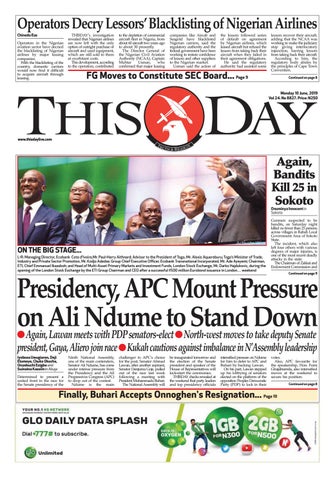
Operators Decry Lessors’ Blacklisting of Nigerian Airlines Chinedu Eze Operators in the Nigerian aviation sector have decried the blacklisting of Nigerian airlines by major leasing companies. With the blacklisting of the country, domestic carriers would now find it difficult to acquire aircraft through leasing.
THISDAY’s investigation revealed that Nigerian airlines are now left with the only option of outright purchase of aircraft and used equipment, which are still sold to them at exorbitant costs. This development, according to the operators, contributed
to the depletion of commercial aircraft fleet in Nigeria, from about 60 aircraft two years ago to about 30 presently. The Director General of the Nigerian Civil Aviation Authority (NCAA), Captain Muhtar Usman, who confirmed that major leasing
companies like Aircab and Seagold have blacklisted Nigerian carriers, said the regulatory authority and the federal government have been working to restore confidence of lessors and other suppliers to the Nigerian market. Usman said the action of
the lessors followed series of default on agreement by Nigerian airlines, which leased aircraft but refused the lessors from taking back their aircraft when they failed in their agreement obligations. He said the regulatory authority had assisted some
FG Moves to Constitute SEC Board... Page 9
lessors recover their aircraft, adding that the NCAA was working to make the judiciary stop giving interlocutory injunction, barring lessors from taking back their aircraft. According to him, the regulatory body abides by the principles of Cape Town Convention. Continued on page 8
Monday 10 June, 2019 Vol 24. No 8827. Price: N250
www.thisdaylive.com TR
UT H
& RE A S O
N
Again, Bandits Kill 25 in Sokoto
Onuminya Innocent in Sokoto
ON THE BIG STAGE... L-R: Managing Director, Ecobank Cote d'Ivoire,Mr. Paul-Harry Aithnard; Advisor to the President of Togo, Mr. Alexis Aquereburu; Togo’s Minister of Trade, Industry and Private Sector Promotion, Mr. Kodjo Adedze; Group Chief Executive Officer, Ecobank Transnational Incorporated, Mr. Ade Ayeyemi; Chairman, ETI, Chief Emmanuel Ikazoboh; and Head of Multi-Asset Primary Markets and Investment Funds, London Stock Exchange, Mr. Darko Hajdukovic, during the opening of the London Stock Exchange by the ETI Group Chairman and CEO after a successful $500 million Eurobond issuance in London… weekend
Gunmen suspected to be bandits, on Saturday night killed no fewer than 25 persons across villages in Rabah Local Government Area of Sokoto State. The incident, which also left four others with various degrees of major injuries, is one of the most recent deadly attacks in the state. The Chairman of Zakkat and Endowment Commission and Continued on page 9
Presidency, APC Mount Pressure on Ali Ndume to Stand Down Again, Lawan meets with PDP senators-elect North-west moves to take deputy Senate president, Gaya, Aliero join race Kukah cautions against imbalance in N’Assembly leadership Iyobosa Uwugiaren, Deji Elumoye, Chuks Okocha, Onyebuchi Ezigbo and Sumaina Kassim in Abuja Determined to present a united front in the race for the Senate presidency of the
Ninth National Assembly, one of the main contenders, Senator Ali Ndume, has come under intense pressure from the Presidency and the All Progressives Congress (APC) to drop out of the contest. Ndume is the main
challenger to APC's choice for the post, Senator Ahmad Lawan, after another aspirant, Senator Danjuma Goje, pulled out of the race last week following a meeting with President Muhammadu Buhari. The National Assembly will
be inaugurated tomorrow and the election of the Senate president and speaker of the House of Representatives will kick-start the ceremonies. THISDAY checks revealed at the weekend that party leaders and top presidency officials
intensified pressure on Ndume for him to defer to APC and Buhari by backing Lawan. On his part, Lawan stepped up his lobbying of senators elected on the platform of the opposition Peoples Democratic Party (PDP) to lock in their
votes. Also, APC favourite for the speakership, Hon. Femi Gbajabiamila, also intensified moves at the weekend to secure his position.
Finally, Buhari Accepts Onnoghen's Resignation... Page 10
Continued on page 8
2
MONDAY JUNE 10, 2019 • T H I S D AY
MONDAY JUNE 10, 2019 • T H I S D AY
3
4
MONDAY JUNE 10, 2019 • T H I S D AY
MONDAY JUNE 10, 2019 • T H I S D AY
5
6
MONDAY JUNE 10, 2019 • T H I S D AY
MONDAY JUNE 10, 2019 • T H I S D AY
7
8
MONDAY, ͚͸˜ ͺ͸͚Π˞ T H I S D AY
PAGE EIGHT
Saraki Donates Severance Allowance to Sharibu, Others Deji Elumoye in Abuja
Former Senate President, Dr. Bukola Saraki, has informed the National Assembly management to distribute his severance allowance to families of three victims of the insurgency in the Northeast zone and children of late senators in need of financial assistance. Saraki, in a statement by his Media Adviser, Alhaji Yusuph Olaniyonu, said he would
write the Clerk of the National Assembly to formally mandate him to act on the disbursement of his severance allowance. Going by the guidelines as contained in a document, Remuneration Package for Political, Public and Judicial Office Holders 2008, Saraki’s severance allowance is N7,452,727.50. According to Saraki, the severance allowance should be used to support the families of Leah Sharibu, who is being
held by Boko Haram after she and other girls were abducted from Dapchi town in Yobe State, and two humanitarian workers abducted and subsequently murdered by the insurgents, Hussaini Ahmed Khoisan and Hauwa Liman. Also, to benefit from the money are children of late members of the Eighth Senate who may require financial assistance in furtherance of their education as a trust fund is to be established by the
management of the National Assembly for the purpose. He said the decision to use the severance package to support the selected victims of the insurgency was based on the fact that their cases represented some of the most touching humanitarian issues debated at the plenary during the four-year tenure of the Eighth Senate and on which his colleagues and himself made emotional and passionate speeches.
He stated that 20 per cent of the severance allowance is to be donated to the family of Leah Sharibu while 20 per cent is also to be paid to the family of Hauwa Liman, the aid worker brutally murdered by Boko Haram after she was captured. Another 20 per cent is to be donated to the family of the second aid worker, Hussaini Ahmed Khoisan, also murdered in the same circumstances by Boko Haram.
"The remaining 40 per cent should be used by the National Assembly management to set up a trust fund that will assist children of deceased members of the Eighth Senate who are in financial need for their education. “It is my hope that this trust fund should grow with more contributions from my dear colleagues, present, past and future, who may be moved to put in additional money into it," Saraki added.
at the instance of the president. Buhari during the brief meeting was said to have directed the Clerk to the National Assembly to conduct the elections in strict compliance with existing rules of both the Senate and the House of Representatives. Sani-Omolori, according to sources, was at the Aso Presidential Villa to brief Buhari on preparations for tomorrow's elections. Omolori was reported to have told Buhari that there was the need to ensure that the image of the National Assembly is not endangered in conducting the election and drew attention to the existing rules of both chambers. Buhari was said to have appreciated the fact that Omolori expressed readiness to stick to the rule to avoid chaos and disorderliness. Article 3 of the 2015 Rules of the National Assembly deals with the election of presiding and principal officers. Article 3(3)(e) states: "When two or more senators-elect are nominated and seconded as Senate President, the election shall be conducted as follows : (i) by electronic voting, or (ii) voting by secret ballot,
which shall be conducted by the Clerks-at-Table using the list of the Senators-elect of the Senate, who shall each be given a ballot paper to cast his vote, with the proposers and seconder as Teller." The mode of voting at tomorrow's inauguration for some time now had been a bone of contention between two main contenders for the Senate presidency. While the supporters of Lawan are canvassing for the open secret mode of voting as contained in the 2011 Rules, the camp of Ndume are comfortable with the retention of secret voting system as adopted in 2015. The House of Representatives rules are the same with the Senate’s. The same powers of the Clerk of the National Assembly enunciated in the Senate Standing Rules are equally found in the Standing Rules of the Green chamber.
as Nigeria domesticated Cape Town Convention, which enables commercial airlines to lease aircraft and other mobile assets without hindrances in order to ease aircraft acquisition for Nigerian carriers. He added that one major condition for leasing aircraft is that in case of default or disagreement between the lessor and the airline operator, the leasing company should be assisted to recover its equipment by the country’s government and civil aviation authority. “The important thing is why did Nigeria domesticate the Cape Town Convention? The reason is that Nigerian airlines can have easy access to acquisition of aircraft globally and we can pay our lease rentals as and when due. To give assurance to the owners of these assets, is that when they feel that there is default he can take back his airplane, his engine or whatever he has leased to you out of the country without any hindrance; be it from the regulator, be it from Customs or from the legal system. After that you can now start talking about
the terms of the agreement and whether it was infringed upon,� Aero CEO said.
PRESIDENCY, APC MOUNT PRESSURE ON ALI NDUME TO STAND DOWN His chances and those of Lawan got boosted at the weekend as a national leader of the ruling party, Senator Bola Tinubu, mobilised support for the duo. However, the All Progressive Grand Alliance (APGA) and the Bishop of the Sokoto Diocese, Bishop Hassan Kukah, at the weekend, warned against a situation in the National Assembly where the leadership of the legislature could be skewed against one religion. Last week, such similar pressure being piled on Ndume paid off as Goje, a former Gombe State governor and Chairman, Committee on Appropriation in the last Senate, withdrew from the race and immediately declared support for Lawan. But Ndume had rebuffed pleas then that he should emulate Goje, saying he was in the race to win. Sources, who gave THISDAY updates on the manoeuvrings to ensure that APC is not made to lose face as it did four years ago when Senator Bukola Saraki defeated Lawan, who was the APC candidate for the Senate presidency then, said the party and some top presidency officials sent different
emissaries to Ndume to forgo his ambition. It was learnt that three meetings were held from Friday to yesterday between elders of the APC and Ndume. Another set of meetings also took place at the Maitama, Abuja residence of a Northern traditional ruler where Ndume was also prevailed upon to step down for Lawan. In addition, several calls were reportedly made by top presidency officials at the weekend to Ndume; all in a bid to get him not to run tomorrow. Sources also said that at every of these meetings, Ndume never budged but rather remained resolute to pursue his ambition to the end. He was said to have told those at the meetings that he has the votes of both returning and fresh senators and was just waiting till tomorrow for his ambition to come to reality. Lawan, on his part, intensified his lobbying of PDP senatorselect to get them to vote for him tomorrow. The erstwhile Senate leader, who had earlier claimed 38 out of the 44 PDP senators-elect had endorsed him, met on Saturday evening with some 20 PDP lawmakers at the Apo, Abuja
residence of former deputy Senate president, Senator Ike Ekweremadu. The consultative meeting was said to have been attended by ranking Senators Enyinnaya Abaribe and Dino Melaye as well as the only Young Peoples Party (YPP) senator-elect, Chief Ifeanyi Uba and senator-elect Abba Moro. The meeting was said to have lasted for about two hours with Lawan and the PDP senators agreeing to continue discussion on how to make the ninth Senate vibrant and responsive to Nigeria’s needs. Sources said Lawan would today meet with different zonal caucuses of the ninth Senate ahead of tomorrow's inauguration. THISDAY also learnt that Tinubu arrived Abuja yesterday to mobilise support for both Lawan and Gbajabiamila. Tinubu was said to have held private meetings at his Abuja residence with both returning and fresh APC federal legislators on the need for them to support the duo. Meanwhile, former Senate deputy chief whip, Senator Francis Alimikhena, yesterday said he was still in the race for the position of the deputy
Senate president. He told newsmen in Abuja that he had not withdrawn from the race and that his decision to contest was backed by his constituency. He expressed confidence that he would emerge victorious tomorrow. "I am still in the race. I have not stepped down for anybody,� he said. Alimikhena promised to provide what he called “purposeful leadership� if elected.
Election to be by Electronic Voting/ Secret Ballot In the meantime, the election of the presiding officers will be by electronic voting or secret ballot voting system in line with the 2015 rules of the legislative body. Sources told THISDAY yesterday evening that this was the fall out of the meeting between President Muhammadu Buhari and Clerk of the National Assembly, Alhaji Mohammed Sani-Omolori. The meeting reportedly held last Friday at the Presidential Villa in Abuja was said to be
House of Representatives Rules However, while the election of the Senate president or any other principal officer in the Senate Continued on page 10
OPERATORS DECRY LESSORS’ BLACKLISTING OF NIGERIAN AIRLINES He said: “The situation we are now is that we are trying to educate the judiciary to understand the implication of an operator that leases an aircraft under the Cape Town Convention and reneges. “And instead of abiding by the agreement and the provision of the Convention, they now run to the court to frustrate the efforts of recovery of the aircraft and thereby giving Nigeria bad name. “That is what we are trying to educate the judicial sector to understand the negative impact it is having on the aviation growth in Nigeria. It is very damaging.� The Chairman of Air Peace, Nigeria’s largest carrier, Chief Allen Onyema, who also confirmed the development, said blacklisting of Nigeria by lessors has adversely affected the airline’s operation. Onyema narrated his experience when his airline wanted to lease about 10 aircraft to replace those that would be going for major checks this year. According to him, his request was turned down because Air Peace is a Nigerian airline and the country has high country risk.
He said: “Nine of our aircraft are billed to go for major check this year. We have started sending them out since February. So, I wanted to lease aircraft to replace the ones that will go on check, but when I made request to leasing companies; after commending the airline on its integrity and goodwill, the risk department of the leasing companies will say that they would not lease aircraft to us because Air Peace is a Nigerian entity. “In the letter they wrote to us they said that Nigeria is politically unstable; that we don’t obey the rule of law. In fact, I replied them and told them to stop stigmatising my country. We have four aircraft that would go on maintenance, which means that we will lose 36 flights every day and that is why we wanted to lease the aircraft but they refused to give us, describing Nigeria as unsafe and risky environment,� he said. Also speaking on the issue, the Business Development Director of Medview Airline, Ishaq Na’Allah, said the blacklisting of Nigeria by leasing companies was dangerous for domestic
carriers because they could not easily acquire aircraft despite the fact that Nigeria is signatory to Cape Town Convention, which makes it easier for member nations to obtain mobile equipment like aircraft. Na’allah said it was difficult for Nigerian carriers to acquire new aircraft because they have to order the equipment, which takes about two or more years for the airline to get supply. He added that since most airlines rely on leasing and lessors have blacklisted Nigeria, it means that domestic operators would find it very difficult to acquire aircraft. “This blacklisting portends danger to us because we cannot run away from it. It is very costly to buy new aircraft and when you order, it takes time before you will have the aircraft. So, all of us depend on leasing but they have blacklisted us because some airlines did not meet their obligations. “The problem is that if you go to any other vendor they will be reluctant to attend to you because they talk to themselves. We have been trying to get around this problem in our operations.
Once you are blacklisted by any of them, the words will go round and they will not be willing to deal with the country. Even when they do, you will get aircraft at very high cost,� Na’Allah said. The operators said the blacklisting also affected insurance and cost of spares as suppliers tend to hike cost of service and cost of spares because Nigeria is designated as having high country risk The CEO of Aero Contractors, Captain Ado Sanusi, who also spoke on the blacklisting, said because of series of defaults by some Nigerian carriers, the lessors decided not to lease aircraft to indigenous operators. “Nigeria has reached that point where there is subtle blacklisting. When a country is blacklisted, there is no official letter written to you, telling you that you have been blacklisted. It is when you now go to the market to get these assets and you are turned down or you are given ridiculous and outrageous prices to discourage you from leasing the aircraft,� Sanusi said. The Aero CEO said this should have not been so
TOP GAINERS CUTIX PLC NPFMFB CHAMSPLC WEMA LASACO TOP LOSERS PZ UPL CHI PLC
NGN NGN 0.10 1.60 0.09 1.44 0.02 0.36 0.02 0.62 0.01 0.32 NGN 0.80 7.35 0.19 1.80 0.02 0.20 TOTAL 12.00 150.00 ACADEMY 0.02 0.27 HPE Nestle Nig Plc â‚Ś1,460.00 Volume: 305.558 million shares Value: N3.904 billion Deals: 3,754 As at Friday 7/6/19 See details on Page 35
% 6.6 6.6 5.8 3.3 3.2 % 9.8 9.5 9.0 7.4 6.9
9
MONDAY, ͚͸˜ ͺ͸͚Π˞ T H I S D AY
NEWS
FG Moves to Constitute SEC Board Lijadu tipped as chairman Goddy Egene Barring any last-minute change of plan, the federal government will this week, constitute a board for the Securities and Exchange Commission (SEC) to be headed by a lawyer, Mr. Olufemi Lijadu. The constitution of the board of the regulatory body for the country’s capital market is coming almost five years after the expiration of the last board, and after several calls by stakeholders on the government to do so. The commission has been without a board and is presently being run by an acting director general and acting executive commissioners, a situation, market watchers said had partially affected the effective regulation of the market. The commission always relies on the Federal Ministry of Finance for direction in the absence of a board. However, market sources said given the determination of the federal government in this second term of President Muhammadu Buhari to ensure the capital market plays its role as an economic enabler, the inauguration of a board for SEC has become expedient. While other members of the proposed board could not be ascertained, THISDAY gathered that Lijadu, who is a partner in the law firm of Ukiri Lijadu & Co has been pencilled in to chair the board. He heads the banking and finance practice of the law firm. Lijadu is a leading commercial lawyer with over
30 years’ experience in private practice and in-house. He recently worked for the federal government as chairman, Presidential Audit Committee on Recovered Public Assets. Lijadu returned to private practice in 2011 having worked in-house as company secretary and legal adviser, and subsequently, executive director of United Bank of Africa Plc. He was also a non– executive director of UBA Trustees and First Security Discount House (the first discount house in Nigeria). He has written several articles on globalisation of legal services and local content development in Nigeria’s oil and gas sector and regularly speaks on these issues on domestic and international platforms. Lijadu is a fellow and Director of the Aspen Leadership Global Network (West – Africa), and a member of the advisory board of Art X (Art Fair). He was a member of the presidential committee on the recovery of stolen assets. He is a Sloan Fellow of London Business School. Among stakeholders who had called for the constitution of a board for SEC is the Chairman of the Association of Securities Dealing of Houses of Nigeria (ASHON), Chief Patrick Ezeagu, who had said the federal government should not delay any longer to get a board for SEC. “We have been calling for a board for SEC without response from the government. SEC,
Lijadu which is regulating a market of several trillions of naira should have a board to enable a smooth running. It is disheartening to know that most of the laudable projects espoused in the master plan are being affected by lack of a board, which is statutorily mandated to take some major decisions in that direction. “Apart from not having a board, the DG and the commissioners are all in acting capacities. This does not send good signals to investors out there. Appointing a board for the commission and confirming the officers would significantly boost investor confidence, thereby restoring some level of stability to the market,� Ezeagu had said. The Chairman of Ibadan Zone of Shareholders Association of Nigeria (IZSAN), Mr. Eric Akinduro, said the international community was watching and the more the delay in the constitution of a board for SEC the more it will affect confidence in the market. “The apex regulatory
authority should be able to show example to others. If such a thing is happening in SEC now, the best way to handle the situation is for the government to put its board in place so that there can be confidence. The market is very sensitive. Anything that is not positive can easily drag the market down. Therefore, the best thing for the government is to take proactive step by ensuring that the board is constituted so that the growth the market is recording now can be sustained,� Akinduro said. Also, the National Coordinator, Independent Shareholders Association of Nigeria (ISAN), Mr. Adeniyi Adebisi, had said the shareholders were the ones bearing the brunt of the absence of a board in SEC.
and insinuating lack of due process in the investigations of Oando Plc. “To put the records straight, the SEC hereby states as follows: Fair hearing is a paramount and fundamental principle, which the commission as a law-abiding agency adheres to in all its investigative processes. “In the course of the investigations, communications e.g. letters and phone calls were exchanged and meetings held between the commission and Oando Plc, requesting for its comments and explanations on issues relating to the investigations. The findings of the commission were communicated to the Group Chief Executive Officer of Oando Plc by a letter dated July 10, 2017. “The commission subsequently engaged Deloitte & Touche to conduct a Forensic Audit of the activities of Oando Plc. “In the course of conducting the audit, Deloitte & Touche held regular sessions with members of the Board and senior management of Oando Plc, and afforded them the opportunity to provide explanations on issues relating to the investigation. “The commission confirms that Oando Plc was given sufficient opportunity of being heard and accorded several opportunities to rebut the issues revealed by the investigation.� The SEC explained that the responses given by Oando Plc, were however considered unsatisfactory; prompting, the decision by the commission to
penalise the company and some of the individuals related to it for violations of securities laws. The statement further added: “The actions of the commission were properly effected pursuant to the provisions of the Investments & Securities Act (ISA) 2007 and the SEC Rules and Regulations made pursuant to the ISA 2007. “These facts have been properly articulated in the court process filed at the Federal High Court by the commission in response to the suit instituted by the Group Chief Executive Officer and Deputy Group Chief Executive Officer of Oando Plc. “As the Apex Regulator of the Nigerian capital market, the commission has a mandate to protect investors.� “The commission’s recent action on Oando Plc aligns with the above cardinal mandate, as the directive for the removal of persons from the board of Oando Plc and the appointment of an interim management team to temporarily steer the affairs of the company is to protect investors and preserve stakeholder value. “Failure or refusal of the commission to act in the face of the serious issues thrown up by the investigations or to reverse its directives, would undermine the federal government’s agenda to build strong institutions and promote the transparency and integrity of the Nigerian capital market, especially given that, these are preconditions for attracting foreign investors to the Nigerian capital market.�
President
Muhammadu Buhari has condemned the killings. A presidency statement by Buhari’s spokesman, Mr. Garba Shehu, last night, said the president was alarmed by the development. It said, “The president, who was briefed about the incident and the arrests so far made by the police, condoles with Governor Tambuwal and the people of the state over the tragic incident. “President Buhari strongly
condemns all acts of violence and terrorism against innocent Nigerians, reiterating that perpetrators and sponsors of such dastardly acts would be held accountable under the law. “The president prays for the quick recovery of all those injured and assures that his administration will not relent in the fight to neutralise terrorists, bandits and kidnappers around the country.�
inevitable and nothing could be done to redress the situation. He said the country might have to live with such lopsidedness for now since the vice-president is a Christian. But Kukah expressed fears that Nigeria's quest for economic and social advancement might suffer a serious setback if the people fail to reflect its diversity in its leadership structures. According to him, what has now become a source of concern to many Nigerians, which is the likelihood of the dominance of the country's leadership hierarchy by persons of a particular religious faith, did not start overnight. Referring to the jostle for the various leadership positions in the ninth National Assembly and the concerns over the likely dominance of candidates of Muslim faith over their Christian colleagues, Kukah said the situation did not come as a surprise to many discerning Nigerians. Kukah, while addressing members of the Catholic
Lawyers Association during their inauguration ceremony in Abuja at the weekend, said the build-up to the present lopsided power structure took time to come. He said: "I hear Nigerians are nervous and saying that, you know, this new Assembly now, president is Muslim, Senate president would be a Muslim, and speaker is going to be a Muslim. In fact, one of my friends who has just been elected to the House told me two weeks ago that 'they are telling us that even deputy speaker we won't get ooh' and of course, lo and behold, we are not likely going to get." He added the point he was making was that the precarious situation the Christians found themselves now did not come as a surprise, adding: "Many of us contributed by labour, by carrying blocks, by watering, by building the structure of imprisonment that we are all living in now. And I can tell you the worst is still to come. “I am just laughing inside me because, a leper was passing by
and saw a poor man scratching his rashes and the leper was laughing and the poor man asked why he was laughing, and the leper said, that's how we started. 'Leprosy started like rashes before it became leprosy. "We can just go back to December 31,1983 when the coup happened and we saw Buhari and Idiagbon, Nigerians were excited about the fact that a government has come to clean up the mess in our country, which was okay. But our voices were muffled because you dare not point out the fact that, how can two Muslims from northern Nigeria govern this country; so, we clapped. And then, Babangida's coup, then; Abiola and Kingibe came and we shamelessly clapped for ourselves and we said we voted Muslim-Muslim ticket.� He said that another attempt at a Muslim-Muslim presidency would have pulled through in 2015, when Buhari planned to run with Tinubu but was prevented by an ambitious Saraki.
SEC: We Followed Due Process in Oando’s Probe Meanwhile, SEC yesterday denied all allegations insinuating lack of due and statutory processes in the investigation of Oando Plc. The commission emphasised that it abided by the fundamental principle of fair hearing in the entire phases of the investigation. According to a statement signed by the Head of Corporate Communications of the commission, Mrs. Efe Ebelo, “The attention of the SEC has been drawn to various reports questioning the regulatory authority of the SEC,
AGAIN, BANDITS KILL 25 IN SOKOTO member, state committee on Internally Displaced Persons (IDPs), Malam Lawal Maidoki, confirmed the incident to journalists yesterday. He said the council chairman and a team of joint security operatives had been to Rakumni, Tsage and Kalgo for rescue operation. They were also said to be preparing the corpses for burial. Attempts to get the state police command spokesperson,
Sadik Abubakar, to confirm the incident failed. Deadly attacks were carried out across eight villages in the same Rabah LGA last year with many people killed and others displaced. In January, no fewer than 26 people were killed when bandits invaded Warwana, Kursa and Dutsi villages in the same Rabah LGA of the state. According to the District Head of Gandhi, Alhaji
Abubakar Maccido, the bandits had stormed the villages on motorcycle shooting sporadically. The district head had also expressed fear that as the 2019 elections were then approaching, there was a possibility that his subjects might not be allowed to exercise their franchise for the fear of further attacks. He had pleaded with government to deploy enough security personnel to contain
the bandits. Governor Aminu Tambuwal had also in February this year confirmed the death of 16 people in fresh bandit attack at Dalijan, Rakkoni and Kalhu communities - all in the same Rabah LGA of the state. With the Saturday incident, banditry, which started in the state on July 9 last year, has claimed a total of 131 lives.
Buhari Condemns Killings However,
PRESIDENCY, APC MOUNT PRESSURE ON ALI NDUME TO STAND DOWN looks straight forward, this is not the case in the House of Representatives, as it is much more complicated. The House election procedure states that for any principal officer to be so elected, the officer must score 180 plus one votes out of the 360 members. And where the election did not produce an outright winner in the first ballot, there could be a second ballot between the first and second runner up to produce the mandatory score of 180 plus one votes. So far, the difference between APC and PDP has been reduced marginally. While APC has 213 members, the PDP has 127. If the APC members in the House abide by the party's directive to vote Gbajabiamila, it would be a straight win for the Lagos State lawmaker. But where there is an alliance between Hon. Emeka Nwajiuba from Imo State and Hon. Mohammed Bago from Niger State, victory would become uncertain for the party’s favourite.
Kukah, APGA Warn Against Imbalance In a related development, APGA and Bishop Kukah have warned against the possibility of the leadership of the National Assembly being skewed in favour of one religion. Reacting on the issue yesterday, APGA said any attempt to install two Muslims as the speaker and the deputy speaker of the House of Representatives would not bode well for the nation. The party said it opposed the move by Gbajabiamila to endorse Hon. Idris Wase as his deputy. The National Chairman of APGA, Chief Victor Oye, who spoke in an exclusive interview with THISDAY at the weekend, said the party was making smart moves and was aligning forces so its members could secure juicy committee positions in the legislature. He said: "We have 10
House of Representatives members and we have been interacting with them on the way forward. For the House of Representatives, we are looking at two candidates, one from North-central and the other from South-west. ‘’For me, the problem I have with Femi Gbajabiamila is that he is picking Wase from Plateau State as his deputy who is a Muslim. Femi used to be a Christian but now he is a Muslim, he has even gone to Mecca so you can’t have speaker and deputy speaker as Muslims, it won’t work in a country that is secular." But he said the arrangement being put forward by the APC in the Senate was balanced with the Lawan, a Muslim from the North-east, while the deputy Senate president is to go to a Christian from the South-south zone. When asked if he was not worried that the country might be saddled with Muslims as president, Senate president, House speaker and chief justice, Oye said the issue had become
10
MONDAY JUNE 10, 2019 ˾ T H I S D AY
NEWS
Group News Editor Ejiofor Alike Email Ejiofor.Alike@thisdaylive.com, 08066066268
NPA Earns N67.19bn Revenue in Three Months Eromosele Abiodun
The Nigerian Ports Authority (NPA) has announced a revenue of N67.19 billion for the three months that ended March 31, 2019. This represents 24.8 per cent of the N270.56 billion earned in 12 months ending December 31, 2018. The agency’s financial profile (unaudited) showing revenue and remittances to the Consolidated Revenue Fund (CRF) obtained by THISDAY revealed that the NPA raked in the amount via operating revenue while other revenue and investment income, which form a bulk of its revenue, are yet to be available for the period under review. Also, analysis of the agency’s six years revenue and remittances to CRF between 2013 and 2018 showed a quantum leap in revenue and remittances despite the downturn in ship and cargo traffic as a result of certain federal government’s policies that are discouraging importation. The financial results showed that the NPA recorded consistent growth in revenue and remittances in the last three years compared to what was obtainable in the past. A breakdown of the six years revenue and remittances showed that the NPA recorded a revenue of N157.31 billion in 2013. Of the 2013 revenue, it made N137.9 billion through operating revenue and N15.08 billion, N1.24 billion from other revenue and investment income respectively. However, it remitted N13.17 billion. In 2014, the agency recorded a total revenue of N172.8 billion, N149.7 from operating revenue and N22.4 billion and N636.5 million from other revenue and
investment income respectively. However, its remittance for the year improved by a little over N4 billion as it remitted N18.56 billion. In the year 2015, the agencies revenue improved by N4.4 billion as it recorded revenue of N177.2 billion compared to N172.8 billion the previous year. However, its remittance for 2015 declined by N130 million as it remitted N18.43 billion as against N18.56 billion in 2014. In 2016, the NPA’s revenue jumped by N5.1 billion as it recorded a revenue of N182.42 billion compared with N177.26 billion in 2015. The agency’s remittance for the year 2016 also jumped by N5.4 billion as it remitted a total of N23.87 billion as against N18.43 billion the previous year. In 2017, the authority’s revenue went up by a massive N83.2 billion as it raked in N265.6 billion for the year ended December 31, 2017 as against N182.4 billion in 2016. The NPA recorded the highest remittance in its history in 2017, remitting N30.31 billion. This showed a N6.44 billion increase over the N23.87 it remitted in 2016. The revenue growth trajectory continued in 2018 with historic revenue of N270.56 billion, almost twice its 2013 revenue, and N4.9 billion increase over its 2017 revenue. However, its remittance to the CRF declined by N5.6 billion as it remitted a total of N24.65 billion compared with N30.3 billion paid in 2017. Meanwhile, THISDAY findings revealed that the NPA might not be able to continue to generate increased revenue in the years ahead owing to government policies that are discouraging importation.
Buhari Accepts Onnoghen’s Resignation, Seeks Appointments of Five S’Court Justices Omololu Ogunmade in Abuja Two months after he resigned as the Chief Justice of Nigeria (CJN), President Muhammadu Buhari last night in Abuja announced the acceptance of the voluntary retirement of Justice Walter Onnoghen with effect from May 28, 2019. A statement by Senior Special Assistant to the President on Media and Publicity, Malam Garba Shehu, said Buhari thanked the former jurist for his services to the nation and wished him a meaningful retirement period. “Meanwhile, President Buhari has accepted the voluntary retirement from service of Hon. Justice Walter Onnoghen as Chief Justice of Nigeria, effective from May 28, 2019. “The President thanked Justice Onnoghen for his service to the Federal Republic of Nigeria and wished him the best of retirement life,” the statement said in part. Onnoghen sent his notice of retirement to Buhari on April 5 while standing trial before the Code of Conduct Tribunal (CCT) on allegations of non-declaration of assets. He was eventually convicted on April 18 by CCT chairman, Danladi Umar, on six counts charge. The statement also said Buhari had written the acting Chief Justice of Nigeria, Justice Tanko Muhammad, asking him to commence the process of appointing five justices to
the Supreme Court to raise the number of the justices of the apex court to 21 in accordance with the provision of Section 230(2) A&B of the Constitution of the Federal Republic of Nigeria, 1999 (as amended. According to the statement, the request was in line with the plan of the federal government to reposition the judiciary for greater efficiency. The statement added: “President Muhammadu Buhari has written the Acting Chief Justice of Nigeria, Hon. Justice Tanko Muhammad, on the appointment of additional five Justices of the Supreme Court of Nigeria. “The president wrote: ‘Pursuant to the provisions of Section 230(2) A&B of the Constitution of the Federal Republic of Nigeria, 1999 (as amended), I am pleased to request that you initiate in earnest the process of appointing additional five Justices of the Supreme Court of Nigeria to make the full complement of 21 Justices as provided by the aforementioned provisions of the Constitution. ‘This is in line with the government’s agenda of repositioning the judiciary in general and Supreme Court in particular for greater efficiency, with a view to reducing the backlogs of appeals pending at the Supreme Court. Please accept, your Lordship, the assurances of my highest regards.’
Also, the federal government automotive policy that saw a massive increase in used car tariff in the last two years has impacted negatively on importation. During the 2019 budget defence before the House of Representatives Committee on Ports, Harbours and Waterways, recently the Managing Director, Nigerian Ports Authority (NPA), Ms. Hadiza Bala-Usman
admitted that government policies are affecting the revenue of the authority. According to her, “We have noted a reduction in traffic coming into our ports. We attribute this to the fact that Nigeria has been advocating self-sustenance in terms of manufacturing and consuming what it produces. “And so, this attendant reduction in cargo, in our
understanding, is attributable to that because some of the items that constitute this drop include for example, the automobile policy, which had increased the cost of importation of automobiles from 30 to 70 per cent in order to stimulate manufacturing in Nigeria. So, there is steep decline in the importation of vehicles. “We also have an additional list of items that have been
banned from importation. This is to try to stimulate production of certain items in the country and ensuring that most agricultural produce are produced and consumed in Nigeria. “So, you can see the number of ocean-going vessels reducing. The agencies that work around revenue generation for importation of cargo will be seen not to have performed.”
PAINFUL EXIT …
Former Director General of Department of State Services (DSS), Mr. Ekpenyong Ita (left), and members of his family during the funeral service for his wife,Temitope, at the Presbyterian Church, Hope Waddell Parish in Calabar…weekend
Terrorism: Four Borno LGAs Completely Inaccessible, Says UNICEF Kingsley Nwezeh in Abuja The United Nations Children’s Emergency Fund (UNICEF) has stated that four Local Government Areas (LGAs) in Borno State were completely inaccessible for humanitarian assistance as a result of activities of terrorists in the affected places. It said attacks and armed clashes remained consistently high across the state, thus hampering its efforts to reach women and children in need of urgent help. The position of the UN agency is coming against the backdrop of the capture, last week, of Marte LGA by terrorist
group, Boko Haram. However, military authorities have denied that Marte LGA was under the control of insurgents. But in its latest report entitled “Situation Overview and Humanitarian Needs’, UNICEF said Marte, which the insurgents captured last week and three other local councils notably Abadam, Guzamala, and Kukawa were completely inaccessible owing to insurgent attacks. It said many local government councils remained partially accessible. “The security situation remains volatile, with a significant impact on humanitarian access. Four
LGAs remain completely inaccessible Abadam, Guzamala, Kukawa, and Marte - to humanitarian actors while access to Kala Balge LGA (Rann) remains severely constrained. UNICEF has only been able to conduct a limited number of day trips to Rann - Kala Balge LGA, where the nutritional situation of children appears to be deteriorating. “A rapid MUAC -Middle Upper Arm Circumferencescreening of children under five by community mobilisers revealed that 263 out of 460 children screened were suffering from severe acute malnutrition (SAM).UNICEF is planning to
provide treatment for both severe and acute malnutrition using extended criteria. Acute needs have also been identified by other sectors, including wash, shelter/ NFI and food security,” it said. The UN agency said “many other LGAs are only partially accessible, and the number of armed clashes and attacks remains consistently high across the state. A marked deterioration in road security has further increased humanitarian actors’ reliance on UNHAS helicopters to reach many locations, including monguno, where there are significant humanitarian needs following the arrival of nearly 15,000 newly displaced.”
NNPC Records N174.62bn Petroleum Products’ Sales
Kasim Sumaina in Abuja
The Nigerian National Petroleum Corporation (NNPC) yesterday said it recorded N174.62 billion sales of white petroleum products in March. The corporation disclosed this
in its March Monthly Financial and Operations Report (MFOR) released in Abuja. It said that March sales’ figure was higher than the N168.65 billion recorded in February. It explained that the total
revenue generated from the sale of white products from the period March 2018 to March 2019 stood at N2,780.79 billion. According to the report, petrol contributed about 91.09 per cent or N2.533billion. It added that a total supply
and distribution of 1.36 billion litres of petroleum products were made by NNPC’s subsidiary, the Petroleum Products Marketing Company (PPMC) in March, compared with 1.33 billion litres in February.
APC Govs, 268 Lawmakers Back Lawan, Gbajabiamila Adedayo Akinwale and Shola Oyeyipo in Abuja A total of 268 bi-parisan lawmakers yesterday signed document pledging their support to the preferred candidates of the All Progressives Congress (APC) for the positions of speaker and the deputy, Hon. Femi Gbajabiamila and Hon. Idris Wase, respectively. The APC Governors Forum has also backed the candidacy of Lawan and Gbajabiamila in
the ninth National Assembly. The progressives’governors disclosed this yesterday in Abuja after a closed-door meeting held at the Kebbi Governor’s lodge, Abuja. The meeting was the inaugural meeting of the governors after the 2019 elections. The Governor of Kebbi State and Chairman of the Forum, Atiku Bagudu, said that the governors were unanimous in supporting the party and President Muhammadu Buhari.
“Towards that extent, we are all unanimous in our support for Senator Ahmed Lawan for the Senate presidency and Hon. Femi Gbajabiamila for the Speaker if the House of Representatives and all governors are in agreement and we will work towards that purpose,” he added. Meanwhile, lawmakers drawn from the opposition Peoples Democratic Party (PDP), All Progressives Grand Alliance (APGA), and other opposition
parties last night converged at the Nicon Hilton Hotel and Suites in Abuja, venue of the event. It was also announced at the event that some of the main speakership candidates, Hon. Nkiruika Onyejeocha and Olusegun Odebunmi have stepped down for Hon. Gbajabiamila. The announcement was made by the Director General of the Gbajabiamila/Wase campaign council, Hon. Abdulmumin Jibrin.
MONDAY JUNE 10, 2019 • T H I S D AY
11
12
MONDAY JUNE 10, 2019 • T H I S D AY
MONDAY JUNE 10, 2019 • T H I S D AY
13
14
T H I S D AY Ëž Ëœ ÍŻÍŽËœ Ͱ͎ͯ͡
COMMENT
Editor, Editorial Page PETER ISHAKA Email peter.ishaka@thisdaylive.com
TALES OF TWO REGULATORS
NBC is to AIT What SEC is to OANDO, writes Kingsley Olateju
O
n the night of Thursday, June 6, 2019, AIT television was shut down by the Nigerian Broadcasting Commission (NBC) for alleged failure to abide by the Nigerian broadcasting code. This comes in the wake of the battle between another regulator, the Securities and Exchange Commission (SEC) and Oando PLC following the publication of the commission’s sanctions for alleged infractions identified during a forensic audit into the affairs of the company. The reoccurring theme across these two cases is claims of harassment and intimidation by the regulator. Before receiving the suspension notice DAAR Communications founder, Chief Raymond Dokpesi, led his management team on a protest to the National Assembly and some embassies in Abuja over what he called undue harassment and intimidation of the company and its officials with the intention of gaging the press. This is in line with stories that have shown the SEC taking drastic measures including sending armed security personnel to Oando head office to intimidate employees and disrupt day- to- day business operations. As at Friday, June 7, Oando staff had been unable to work from their office as a result of the company not wanting its employees in harm’s way. A wave of protests, have trailed the suspension of Daar’s license with the Nigerian Guild of Editors (NGE) and the Nigeria Union of Journalists (NUJ) demanding a review of the decision. Across the country there has been support for both organisations with notable voices challenging what seem to be regulators who are abusing the power bestowed upon them. Oby Ezekwesili in a tweet commented on the regulatory mishaps saying: “The reality is that a politically partisan environment has turned Regulatory Agencies to outposts of ruling-party of the day. We as citizens must therefore stand and fight Regulatory Rascality whenever it happens.� In the same vein, Atedo Peterside, founder of Stanbic IBTC Bank, known to share his opinion on issues that others fear to comment on, said; “The closure of AIT signifies dark days ahead. Our rights to free speech is next. Regulators now competing to consciously destroy businesses and jobs on flimsy grounds.� He also commented on the Oando saga saying: “SEC should publish the forensic audit report. Oando is a quoted company in Lagos and Johannesburg. Oando’s replies should also be published. Investors must be told the whole truth. Who is afraid of transparency and why?� Just as Oando’s principals ran to the Federal High Court to seek redress and successfully obtained an interim injunction restraining the SEC from executing its sanctions, the management of AIT also went to court and obtained a court order against the NBC.
OANDO HAS VEHEMENTLY ARGUED THAT IT IS BEING UNFAIRLY TREATED AND ITS HUMAN RIGHTS VIOLATED AS IT WAS NOT GIVEN THE OPPORTUNITY TO SEE, REVIEW AND RESPOND TO THE FORENSIC AUDIT REPORT AND SO IS UNABLE TO ASCERTAIN WHAT FINDINGS (IF ANY) WERE MADE IN RELATION TO THE ALLEGED INFRACTIONS AND DEFEND ITSELF ACCORDINGLY BEFORE THE SEC
Both parties want their day in court so they can argue the reasons why the sanctions meted out are unfair and how they have suffered discrimination by the regulators. Dokpesi had and continues to accuse the Director General of the NBC Mallam Modibbo Kawu of incompetence, bias and partisanship in the management of the regulatory agency. He went on further to accuse the NBC of stunting the growth of the television and its radio stations. It’s a story that seems to be a replica of the Oando versus SEC saga; Oando has said from the get go that the SEC under the leadership of Mounir Gwarzo has taken actions which were illegal, invalid and calculated to prejudice the business of the company. The fallout from the SECs most recent directives to Oando has led to the company officially stating that it believes that the alleged infractions and penalties are unsubstantiated, ultra vires, invalid and calculated to prejudice the business of the company. The company has vehemently argued that it is being unfairly treated and its human rights violated as it was not given the opportunity to see, review and respond to the forensic audit report and so is unable to ascertain what findings (if any) were made in relation to the alleged infractions and defend itself accordingly before the SEC. These actions by the regulators negate everything that democracy and the rule of rule stand for. Some of the ideals of democracy include recognition of the fundamental worth and dignity of every person; respect for equality of all persons; faith in majority rule and insistence upon minority right, acceptance of the necessity of compromise and insistence upon individual freedom. Yet the events we’ve seen in the past few days, with the release of alleged infractions and sanctions on Oando and its executive management team as well as what has been deemed the unjust closure of AIT and Raypower, negates every single one of these ideals. It’s a sad day when regulators whose sole purpose it is to protect institutions and stakeholders for the greater good are being seen as the big bad wolf. Regulators that once upon time were looked up to and even applauded for their work in developing their respective sectors and players within that sector are now being seen as over exuberantly working towards personal agendas. Despite their new role of ‘Big Bad Wolf’ it is gratifying that our Nigerian judiciary are still a strong force to be reckoned with, one that still ensures affected persons or organisations can confidently challenge decisions made by the regulator. The SEC versus Oando saga is two years old, whilst that of NBC and Daar is barely a week old but we all wait with bated breath for how this will play out and how long it will play out for. Olateju is an economist and legal advisor
BAYELSA ON TIMI ALAIBE’S MIND
Perelayefa Ebiketon pays tribute to Timi Alaibe, former managing director of NDDC, at age 57
A
s he turns 57 years old today, Chief Ndutimi Alaibe has several reasons to thank God: good health, sound mind, successful career, thriving businesses, accomplished children, legion of loyal and distinguished friends and associates and a litany of success stories. However, other than prayer sessions to God Almighty, it is not likely that Alaibe would be hosting a wild party to celebrate today. He hardly does, anyway. These are incredibly sober and reflective period for Alaibe who is seeking to contest for the governorship of his beloved home State of Bayelsa, in the election already earmarked for November this year by the Independent National Electoral Commission (INEC). He also faces the hurdle of emerging tops in the primaries of his political party, the Peoples Democratic Party (PDP), slated for August this year. Even when the overarching sentiment in Bayelsa State is that ‘Timi Alaibe is better placed to continue from where his party man, the current Governor, Seriake Dickson, would eventually stop in February next year, Alaibe is not unaware that the days ahead would be daunting and would test his legendary dexterity and organizational acumen. As he receives friends, associates, family members and teeming admirers, who as usual, would be visiting his home today to rejoice with him on the occasion of his 57th birthday, Alaibe’s reflections and discussions would most certainly be drifting to the forthcoming PDP primaries. As the gubernatorial primaries draw close, Alaibe has been quietly consulting and reaching out to critical stakeholders, especially chieftains of his party and potential delegates. In his consultations, Alaibe’s strongest message, as learnt, has been his unflinching desire to speedily deploy his wealth of experience, exposure and managerial skills to actualise the urgent task of bringing sustainable development to the door steps of Bayelsans. Indeed, not a few persons in the state believe that given the remarkable job that Dickson has done in the last seven and half years, there is
the compelling need to have a seasoned hand to succeed him so as to deepen the gains made so far and eventually place Bayelsa in that ultimate position of the most economically viable states in the country. Alaibe, they contend, possesses the requisite grassroots experience, exposure, managerial, institutional and educational qualifications to launch the state into a greater era. In an earlier article I wrote on Alaibe, I had averred that this boardroom guru is intensely irked by the fact that Bayelsans continue to lack basic necessities of life in spite of the rare privilege of occupying one of the most endowed spaces on the face of the earth. The state is naturally positioned by God to be the most economically viable in Nigeria but regrettably series of unfortunate factors have connived to rob it of its rightful place as the state with the best human capital index in Nigeria - with huge investments in people, health, education, social protection programmes, physical security, food security as well as women and youths’ empowerment schemes. With the longest coastline in Nigeria, stretching to about 203 kilometres, Bayelsa is traversed and crisscrossed by a large number of rivers, rivulets, streams, canals and creeks. Its forest resources encompass Mangrove Timber, Iroko, Mahogany, and Abura, while agricultural resources boast of such cash crops as oil palms and coco-nut and such food crops as cassava, rice, plantain, banana, sugarcane, vegetables and fruits. The state is endowed with marine and freshwater fisheries resources, extensive brackish water lagoons, creeks, rivers and lakes. The icing on the cake is the fact that Bayelsa State harbours about 23.4% of Nigeria’s crude oil resources, representing 9.8% of the nation’s economy and fourth largest state economy in the country. In spite of its natural endowments, 93% of the Gross State Product of Bayelsa is from the oil & gas sector and a paltry 7% from non-oil sectors. Alaibe has frequently identified a number of factors that have over the years weighed against its attainment of its full potential, chief among these, he insists, is the skewed federal structure of governance in Nigeria. The country tilts much more to the unitary rather than the fierce federal
structure as envisaged by the founding fathers of the country. Under the current arrangement, Bayelsa, like all the other oil-producing states in Nigeria, yields its natural endowments to the federation and gets pittance in return. Alaibe is also of the view that the peculiar terrain of the state makes it extremely difficult to sustain development without the requisite funding. He tenaciously holds on to the fact that Bayelsa’s fortunes would be much more enhanced if the federal government could avail it of much more of the income that is being generated from the state. In the contest for the governorship, Alaibe would be drawing strength and inspiration from his legendarily deep knowledge of the developmental needs of communities in the Niger Delta. An accomplished banker who rose through the ranks to the top of his profession, Alaibe was in 2001 appointed by former President Olusegun Obasanjo to serve in an executive capacity in the then newly established Niger Delta Development Commission (NDDC). While he served as the Executive Director (Finance and Administration) and later Managing Director of the commission, Alaibe doggedly pursued and achieved the opening up of previously inaccessible communities, villages and towns in the state. The shore protection efforts he championed saved hundreds of communities from being washed off by the ocean; on his watch, NDDC initiated and efficaciously completed hundreds of roads and other critical infrastructure in several communities in Bayelsa. Following the approval of President Obasanjo, the NDDC under Alaibe’s leadership painstakingly designed a master plan that was deliberately sculpted to bring massive development to the Niger Delta. Had it been implemented by successive governments as designed, the Niger Delta Master Plan, would have delivered new towns, bridges, coastal roads, coastal rail lines, several petrochemical industries, clean environment, millions of jobs and sustainable development to the Niger Delta, especially Bayelsa. Even after his exit from the NDDC in 2009, Alaibe never relented in his avowed resolve to continue to give Bayelsa and the entire Niger Delta not just his best but his all. As the
Special Adviser to the President on Niger Delta, Alaibe put his life at risk to lead the team that crisscrossed communities and creeks in the Niger Delta to extract peace commitment and eventually disarmed and demobilized thousands of militant agitators in the region who accepted the federal government’s offer of amnesty. He eventually superintended over the Presidential Amnesty Programme for about two years. It remains an incontrovertible fact that the amnesty programme under Alaibe speedily aided the stabilization of the security conditions in the entire Niger Delta and the Gulf of Guinea. The programme also facilitated the training of several youths in the region in either formal education or vocational skills. Even more important, the programme, under Alaibe saved Nigeria from tipping off the fiscal cliff. With the peace, safety and security the programme engendered in the Niger Delta, oil exploration and exploitation peeked and moved Nigeria’s oil export from less than one million barrel per day in 2007 to over two million barrels per day in 2011. In spite of his quest for the number one political office in Bayelsa, Alaibe insists that the effort would not be worth his while if the elections to the office at all levels were not credible or fraught with violence and bloodletting. At a recent event, Alaibe underscored the fact that Bayelsa yearns for credible leadership and agreed with Field Marshall Bernard Montgomery’s definition of credible leadership as “the capacity and the will to rally men and women under a common purpose, and must possess the character which inspires confidence. In other words, a leader must inspire confidence. A leader must be trustworthy. A leader must have the capacity to persuasively generate support without the use of force or coercion. A leader must be peaceful. A leader must have a history of leadership without violence. A leader must have that charisma that convinces his followers and must be able to use the weapon of love to disarm hatred.� As Ndutimi Alaibe clocks 57 years old today, not a few persons believe that he has these qualities and much more. Ebiketon wrote from Yenagoa, Bayelsa State
15
T H I S D AY MONDAY, JUNE 10, 2019
EDITORIAL Unethical Practices In The Banks There is the need to improve on the corporate governance culture of our financial institutions
H
ardly a day passes without stories of malpractices within the banking industry, especially in the social media as customers render accounts of how they were being short-changed by their banks. While the existence of fraud and all manner of sharp practices in the banks are neither uncommon nor unexpected, its prevalence is negatively impacting the sector and threatening to undermine public faith in the industry. We call on the authorities to see this malaise as a challenge and respond with measures that will safeguard the banking sector. In 2017, Automated Teller Machine (ATM) fraud, according to reports, accounted for the highest rate of fraud with an actual loss of N497.64 million. In the same manner, the Nigerian Inter-Bank Settlement System (NIBSS) revealed last year that the banking industry lost N12.30 billion to various fraudulent practices between 2014 and 2017. Recently, the THE BANKS ARE FOND OF Chartered Institute ARBITRARY DEDUCTIONS of Bankers of Nigeria FROM CUSTOMERS’ (CIBN) disclosed that ACCOUNTS UNDER THE no fewer than 2,122 GUISE OF SMS CHARGES, bank customers lodged complaints against CARD MAINTENANCE FEES AND ATM CHARGES, their banks to the subcommittee on ethics AMONG OTHERS and professionalism between 2001 and 2018. The committee was responsible for resolution of disputes relating to unethical practices between or among banks as well as between banks and their customers. Though ATM fraud is a common form of infraction, bank customers also complain about sundry other sharp practices. These range from credit card scam, to stealing of money from customers account. It is also alleged that some fraudulent bank staff habitually access and manipulate clients’ accounts, operate fictitious accounts and fiddle with those held by deceased customers whose signatures are usually forged with the intention to illegally
Letters to the Editor
withdrawing money from their accounts. Besides, bank employees also commit computer fraud, by logging into the computer system through remote sensors, some unscrupulous staff connive with others to tamper with diskettes and flash drives which enable them to access unauthorised domains. With that, they credit accounts for which funds are not intended.
W
T H I S DAY EDITOR BOLAJI ADEBIYI DEPUTY EDITOR YEMI AJAYI, DAVIDSON IRIEKPEN, MANAGING DIRECTOR ENIOLA BELLO DEPUTY MANAGING DIRECTOR KAYODE KOMOLAFE CHAIRMAN EDITORIAL BOARD OLUSEGUN ADENIYI EDITOR NATION’S CAPITAL IYOBOSA UWUGIAREN MANAGING EDITOR JOSEPH USHIGIALE
T H I S DAY N E W S PA P E R S L I M I T E D EDITOR-IN-CHIEF/CHAIRMAN NDUKA OBAIGBENA GROUP EXECUTIVE DIRECTORS ENIOLA BELLO, KAYODE KOMOLAFE, ISRAEL IWEGBU, IJEOMA NWOGWUGWU, EMMANUEL EFENI DIVISIONAL DIRECTORS BOLAJI ADEBIYI, PETER IWEGBU, ANTHONY OGEDENGBE DEPUTY DIVISIONAL DIRECTOR OJOGUN VICTOR DANBOYI SNR. ASSOCIATE DIRECTOR ERIC OJEH ASSOCIATE DIRECTORS PATRICK EIMIUHI, SAHEED ADEYEMO CONTROLLERS ABIMBOLA TAIWO, UCHENNA DIBIAGWU, NDUKA MOSERI DIRECTOR, PRINTING PRODUCTION CHUKS ONWUDINJO TO SEND EMAIL: first name.surname@thisdaylive.com
TO OUR READERS Letters in response to specific publications in THISDAY should be brief (150-200 words) and straight to the point. Interested readers may send such letters along with their contact details to opinion@thisdaylive.com. We also welcome comments and opinions on topical local, national and international issues provided they are well-written and should also not be longer than (9501000 words). They should be sent to opinion@thisdaylive.com along with the email address and phone numbers of the writer.
GOV FINTIRI AND SKILLS ACQUISITION CENTRES
I
n his first address to Adamawa people, Governor Ahmadu Umaru Fintiri promised to revive the Youth Skill Acquisition Centres. This is a very good step. Adamawa State needs a paradigm shift and new thinking in her human capital development programmes. The technical and skills acquisition centres across the state should be resuscitated, redesigned and retooled to serve as a vehicle for jobs and wealth creation, including, as training places for agricultural entrepreneurship. This will go a long way in increasing human capital output that will speed up and sustain economic growth. A well-funded, adequately tooled and efficiently manned skill acquisition centre will nurture the youths, encourage private sector and help the rural poor to be strong participants in the economic development of Adamawa State. In fact, it will free the state from the prison of always waiting for handouts from the FG- free petrol-dollars. Gov. Fintiri’s government has promised to make youth and women as the centre-piece of its attention. Therefore, as one of its most important strategies to tackle unemployment in the state, the government should use the centres as one of its focal points of agricultural entrepreneurship programme for youth and women- especially the rural poor. The government should go into partnership with private sector to establish poultry, fisheries, dairy, plantations, etc., in various locations in the state. Furthermore, the centres should be well funded to serve as ‘ideas development hubs’- because; ‘ideas development is also an excellent way to create employment for bright youths i.e. the well-known concept of innovate, create, invent and invest. Experts say it is the most difficult but most effective way to create long-term employment. Adamawa State churns out thousands of graduates- engineers, computers programmers, architects, operations researchers, chemists,
hile the aforementioned are specific instances of insiders’ abuse within the system, we maintain that the commercial banks are also culpable of deliberately promoting corporate unethical behaviour and shady business practices. Indeed, the frightening scale of these malpractices is an indictment on many of the commercial banks for failing to tighten their internal control system and for flouting their ethics, particularly on conflict of interest and the handling of confidential information. Unfortunately, the Central Bank of Nigeria (CBN) is not doing enough to curb these malpractices. Money laundering, investment fraud, toxic loans, banking laws violation are some of the broader corporate unethical practices perpetrated by the commercial banks. The banks are also fond of arbitrary deductions from customers’ accounts under the guise of SMS charges, card maintenance fees and ATM charges, among others. As a result of these indiscriminate charges, many customers have resorted to closing their saving accounts, resulting in the financial exclusion of many of our citizens. To worsen maters, despite the huge turn overs and after tax profits many of them declare yearly, they discourage small businesses from thriving by imposing difficult loan conditions. If there is any lesson to learn from the recent failure of one of the nation’s commercial banks, Skye Bank Plc, it is the need to improve on the corporate governance culture of our financial institutions in Nigeria. It is common knowledge that bank failures don’t happen overnight. The build-up is usually over a reasonable period, and results from poor management, insider abuses and other unwholesome practices that have to be dealt with by the relevant authorities. They must work to ensure that integrity is restored to the Nigerian banking hall.
surveyors, agric-economists, designers, etc., yearly. The Fintiri government should see the skill acquisition centres as goldmines as well as a sociopolitical weapon. The centres should be re-energized to work in such a way that it can assist graduates with technical skills and entrepreneurship passion to have access to facilities and environment that support thinking for invention and innovation. Poverty alleviation and wealth creation are weapons in human capital development. The Fintiri government should take advantage of supports from international NGOs and donor agencies. Furthermore, the government should collaborate as well as take advantage of programmes and projects of some federal government agencies - The Raw Material Research and Development Agency, National Technology Incubation Centre, Small and Medium Enterprise Development Agency of Nigeria [SMEDAN], National Office for Technology Acquisition and Promotion, National Poverty Alleviation Programme, National Directorate of Employment (NDE) as well as Bank of Industries, The North East Development Commission including the Central Bank of Nigeria (CBN). These agencies will play a vital role for the centre’s youths and women programmes especially in areas affected by Boko Haram senseless war. Moreover, private investors can also be major participants, as they can play the role of fund providers for any invention or innovation that has market potential. With this kind of scheme, it is possible to see new industries surface; the economy gradually grow and lots of good paying jobs created for Adamawa youths. There are expectations on Gov. Fintiri to utilize the human capital potential in the state to take Adamawa people out of poverty. The resuscitation of the youth skill acquisition centres is a good step to meet peoples’ expectations. Zayyad I. Muhammad, Jimeta, Adamawa State
MASSACRE IN KHARTOUM
T
he Mo Ibrahim Foundation is deeply concerned by the situation in Sudan, which has recently taken a turn for the worse, with a brutal armed crackdown on peaceful protestors, claiming the lives of an alarming number of civilians in recent days, and crushing hopes for a democratic transition. The TMC, which toppled Omar al-Bashir in April, claimed they were taking over to protect the protesters. Now they have unleashed the unruly Rapid Support Forces (Janjaweed 2.0) on the Sudanese people. The African Union is right to suspend Sudan’s membership, pending the transfer to civilian rule. The international community has been largely slow and hesitant on support to the democratic aspirations of the Sudanese people. Unfortunately, some regional powers, led by Saudi Arabia, appear to side with the military, with disastrous results. China is damaging its standing and its reputation in Africa by blocking the UN Security Council resolution condemning TMC’s violence. We have not seen a single tweet from the White House in support of the people of Sudan and of democracy. The Foundation hopes that the global community will unite to use all possible means to encourage all parties to re-establish political negotiations, leading as soon as possible to a civilian-led government, in order to organise free and fair elections in an open political space. Democratic civilian rule is the only way to ensure sustainable good governance for all the people of Sudan, and stability in this volatile region. The Mo Ibrahim Foundation
16
MONDAY JUNE 10, 2019 • T H I S D AY
MONDAY JUNE 10, 2019 • T H I S D AY
17
18
T H I S D AY Ëž Ëž ͚͸˜ ͺ͸͚Î
Group Politics Editor NSEOBONG OKON-EKONG
POLITICS
Email: nseobong.okonekong@thisdaylive.com 08114495324 SMS ONLY
M O N D AY D I S C O U R S E
Counting the Gains of June 12
Shola Oyeyipo writes that 26 years after the June 12 presidential election presumably won by late Chief Moshood Kashimawo Olawale Abiola, his sacriďŹ ce, doggedness and contribution to democracy are still yielding positive impacts
Buhari
Abiola
Remembering the Saga here are a few iconic dates in the Nigerian political history. These dates are reminiscent of landmark events that played significant roles in shaping Nigeria. The annulled June 12, 1993 presidential election represents an unforgettable political timeline. June 12, 1993 when Moshood Kashimawo Olawale Abiola assumedly won a presidential election that was annulled by Gen. Ibrahim Badamosi Babangida (rtd), has a place of prominence on Nigeria’s political calendar. Nigerians will never forget the turmoil the country was thrown into after Babangida who alluded to pending lawsuits, announced on June 23 that the historic June 12, 1993 presidential election, adjudged freest, fairest and won by wealthy Yoruba businessman and renowned philanthropist, MKO Abiola was annulled. Not only was his action considered a brazen slap on the South-west where Abiola hailed from, it was also seen as the biggest setback to the emergence of democratic leadership Nigerians yearned for. That action forced democrats, progressives and
civil society organisations to vehemently resist the military leadership. The international community was equally miffed. Crisis erupted in various parts of the country. Groups, particularly National Democratic Coalition (NADECO) and the Campaign for Democracy (CD) took up the fight. As much as there were causalities among them, they held on to their demand that Abiola must be sworn-in as the democratically elected president. Hundreds of people died in riots before Babangida handed over power to the Interim National Government on August 27, 1993. The Head of the ING, Chief Ernest Shonekan, had barely served three months in office when he was forced to resign on November 17, 1993 by Defense Minister, late General Sani Abacha. Spurred by NADECO and other agitators, Abiola declared himself president on June 11, 1994. He was arrested on June 23. Demanding for his unconditional release, petroleum workers and several other unions embarked on strikes that crippled the nation’s economy. Lagos and the South-west were worst hit. While Abacha died of heart failure under ques-
tionable circumstance on June 8, 1998. Abiola also died under suspicious circumstance the day that he was to be released, July 7, 1998. Though the official autopsy stated that Abiola died of natural causes, Nigerians were never convinced. That sustained the agitation to honour his memory. Worst still, the assassination of Abiola’s wife, Alhaja Kudirat Abiola on June 9, 1996 while her husband was detained by the Nigerian government further fueled the anger.
QUICK FACTS:
r+VOF 5IF HPWFSONFOU BOnulled the results of the June 12 elections in a most bizarre manner; nullifies all the relevant court decisions, suspends NEC through an unsigned terse statement. r+VOF /JHFSJBOT QSPUFTU UIF annulment of the elections. r+VOF $BNQBJHO GPS %FNPDracy (CD), an umbrella organisation for no fewer than 40 NGOS/Human Rights groups, called for a one-week nationwide protest to begin on July 5. r+VMZ 5IF /BUJPOBM %FGFODF BOE Security Council (NDSC) announces that an Interim National Government comprising of representatives of the NRC, the SDP, and leading military officers. r"VHVTU " HSPVQ PG TFOBUPST signed a joint motion asking the government to declare the winner of the June 12 election. r"CJPMB MFGU UIF DPVOUSZ VOBOOPVODFE r"VHVTU $MBNQ EPXO PO activists by government began across the country. r/PWFNCFS (FOFSBM "CBDIB took over power. Chief Ernest Shonekan was forced to resign in what many considered a palace coup. r+BOVBSZ "CBDIB GPSNBMMZ NPWFT his administration to Abuja to avoid growing opposition in Lagos and other South-west states. r+VOF $IJFG . , 0 "CJPMB declares himself president of the Federal Republic of Nigeria on the eve of the first anniversary of June 12 in an attempt to claim his June 12, 1993 presidential man-
date at Epetedo, Lagos Island. He went into hiding after the declaration, fearing arrest by the military leadership. r+VOF &WFOUVBMMZ UIF 'FEeral Military Government arrested Chief M.K.O Abiola on treason charges. r+VMZ 3JPUT CSPLF PVU JO UIF South-western states of Lagos, Oyo, Ondo, Ogun and Edo State in the South-south. r"VHVTU /JHFSJBO -BCPVS Congress (NLC) called for a general strike in solidarity with the oil workers’ strike. r"VHVTU +VTUJDF "CEVMMBIJ Mustapha of an Abuja High Court granted Abiola a controversial and unsolicited conditional bail. r"VHVTU 1SFTJEJOH KVEHF JO Abiola’s case withdrew. r"VHVTU $IJFG "OUIPOZ Enahoro, Enemaku Idachaba, General Alani Akinrinade, Chief Cornelius Adebayo and other NADECO officials arrested at Sheraton Hotel and Towers. In Kaduna, Alhaji Balarabe Musa, former Governor of Kaduna State, and others, attending a meeting in his house were also arrested and later released. r"QSJM -BUF $IJFG -BNJEJ "EFdibu, the ‘strongman’ of Ibadan politics, organises a pro-Abacha rally in Ibadan, which was countered by United Action for Democracy (UAD). There was hostility. Three people and five vehicles were burnt in the fight that ensued. r.BZ 5IF &VSPQFBO 6OJPO &6 officially pronounced Nigeria’s transition to civil rule programme a failure. r+VOF "CBDIB EJFE )JT EFBUI
T
r+VOF "CVKB )JHI $PVSU presided over by Justice Bassey Ikpeme issued an order restraining National Electoral Commission (NEC) from conducting the presidential election on June 12, 1993. This follows a suit brought by a largely ‘shadowy organization’, the Association for Better Nigeria (ABN), headed by Chief Arthur Nzeribe, a disqualified presidential aspirant. r+VOF /&$ DPOEVDUT QSFTJdential elections in defiance of the Abuja High Court order. Nigerians and foreign observers describe the elections as the freest and fairest the country has ever experienced. r+VOF /&$ QVCMJTIFE SFTVMUT from 15 states at its headquarters in Abuja showing that M.K.O Abiola is leading in all regions of the country including his opponent, Bashir Tofa’s home state, Kano. r+VOF (PWFSONFOU TXFBST in a seven-member presidential election tribunal. r+VOF "OPUIFS JOUFSJN PSEFS by an Abuja Court restrained NEC from releasing the results of the presidential elections. r+VOF /&$ TIFMWFT UIF SFMFBTF of the final results of the election because of actions pending in courts until further notice. r+VOF /&$ HPFT UP UIF $PVSU of Appeal to challenge the interim injunction by the Abuja High Court.
The Gains Stakeholders in Nigeria and friends of the country from around the world were quick to realise that the struggle for June 12 had reached crescendo. The barrel of the gun could not be quelled it. After long and excruciating military intervention in politics, the June 12 election presented an opportunity to expel the military from active politics. Citizens were only pacified when the military bowed out. The current Fourth Republic that has spanned over 20 years came directly from the agitation for June 12. Ordinarily, no decision could have been wiser than to give power to the South-west which was
openly shortchanged by the June 12 annulment and which lost one of its most illustrious and philanthropic sons to the struggle. To resolve the power equation, former President Olusegun Obasanjo, emerged president in 1999. This was why a son of late MKO Abiola and KudiratAbiola,Alhaji JamiuAbiodunAbiola while speaking at an event, ‘testimony of change’ held earlier in the year at the Presidential Villa, Abuja, noted that Obasanjo benefitted from his father’s blood but failed to recognise his contribution to Nigeria’s democracy. He stated that it took President Muhammadu Buhari who did not benefit from the struggle of late Abiola to recognise his acclaimed election as president on June 12 1993. Heightened Calls to Imortalise Abiola Shortly after Abiola’s death in detention, a cross section of Nigerians started demanding that the then president, Chief Olusegun Obasanjo, who is his relative and classmate, immortalise him. NOTE: Interested readers should continue in the online edition on www.thisdaylive.com
was attributed to cardiac arrest. r+VOF (FOFSBM "CEVMTBMBNJ Abubakar emerges as Nigeria’s new military head of state. r+VMZ 5IF 6/ TDSJCF MBUF ,Pà Annan, told the world that Abiola wanted freedom and that he might have dumped his mandate. r+VMZ "CJPMB EJFE PG DBSEJBD arrest after taking ill during a meeting with Nigerian and United States officials. Civil society groups suspect foul play by the two nations. r+VMZ 8JEFTQSFBE IJHIXBZ riots broke out at the news of Abiola’s death. Curfew was imposed in Abiola’s home state of Ogun. r+VMZ " DBSEJBD QBUIPMPHJTU %S James Young, reaffirmed that Abiola died of natural causes; a long-standing disease of the heart, which he said was capable of causing unexpected death. r'FCSVBSZ /JHFSJBOT WPUF JO presidential elections, Obasanjo wins. r 0CBTBOKP TIVO QMFBT UP immortalise Abiola r.BZ 1SFTJEFOU (PPEMVDL Ebele Jonathan of the PDP, during his Democracy Day speech announced renaming of the University of Lagos to Moshood Abiola University, but it was resisted. r+VOF 1SFTJEFOU #VIBSJ EJSFDUFE that the nation’s Democracy Day will now hold on June 12 of every year as against on May 29. He also resolved to honour Abiola with the highest national honour, the Grand Commander of the Federal Republic.
19
T H I S D AY Ëž Ëž ͚͸˜ ͺ͸͚Î
MONDAY DISCOURSE
Timi, a Professional in Politics
Sam Akpe x-rays the political journey of ‘Timi Alaibe, former Managing Director of the Niger Delta Development Commission (NDDC), who turns 57 today
H
is mother remains his greatest inspiration. As a kid, mother sang him a song in her native Ijaw—a song that infused a spirit of indomitability in him. Then she showered him with mysterious jaw-twisting nicknames such as “Pelekpogorogha� “Kikposuogha� and “Teinkposuogha.� Translated, they all mean the Invincible One. His father called him Madukaribia—a deep Igbo nomenclature meaning Greater Than Others. Add these to his first name, Ndutimi, meaning “enduring liberty,� “long life and prosperity,� it becomes clear why he is seen as a reckless optimist—someone above a downfall. In business, Ndutimi Emmanuel Alaibe possesses the never-give-up spirit. Whatever he touches turns gold. It started from the banking sector where he made indelible marks, to private business before pioneering the Finance and Administration Department of the Niger Delta Development Commission where he rose to become the Managing Director—a position that exposed him to regional politics until, by presidential fiat, he was appointed Special Adviser to the President on Niger Delta Affairs and mandated to nurture the Presidential Amnesty Programme. Over the years, his political networks and strongholds have widened. Even in the remotest part of Ijawland, those who have never seen him have heard of him. His influence is unmistakable—and unforgettable among individuals and communities. Different people hold diverse perceptions of him. While some think he is extra smart with a large heart, others belief he is an example of the popular theory that politics is local. A media delight and socialite who makes friends with the ease of a smile, Alaibe, best known as ‘Timi, has an unquenchable appeal among his admirers. It was this appeal that made him pull out Dokubo Asari—the godfather of recent militancy in the Niger Delta—from the turbulent creeks and took him to the Presidential Villa for a ceasefire negotiation. That skillful, courageous move triggered the foundation for establishment of the PAP which ‘Timi nurtured with a lasting operational template that has brought peace to the Niger Delta. The programme with its globally accepted disarmament, demobilization, rehabilitation and reintegration (DDRR) platforms, pulled out almost 30, 000 militants from the creeks of the Niger Delta, raised oil production per day from 700, 000 to above two million barrels, brought peace to the region and restoration of economic stability in Nigeria. Born today in 1962 in Warri—far from his hometown of Opokuma in Bayelsa State—‘Timi dreamt of being a medical doctor. However, when he applied for admission to the University of Port Harcourt, he was instead offered opportunity to study applied chemistry. He accepted and matriculated until his uncle—an accountant—persuaded him to accept the second offer to study accounting at Rivers State University (RSU). Perhaps, he was divinely guided. Three years later, he met his wife there. Today, he has two boys and three girls. Today, he is a grandfather. Looking back, daring the impossible has always been his trademark. As a kid—about 12 years old—he almost turned himself into a mouth-watering dinner for wild rainforest crocodiles. His father had entrusted him to the care of one Ikpebinimi, with the instruction to take him to Kaiama through Mbiama where he had secured admission in a secondary school. By the time they arrived the periphery of River Nun before crossing to Kaiama, night had started falling. Between River Nun and Mbiama was a ravine with a stream which they had to swim across, ‘Timi and his guide
Alaibe
did what adults were afraid of doing even in broad daylight. Stripped bare, with their bags of clothes tied to their backs, both bravely swam across the 50-metre wide stream to the other side. Here, they met an elderly woman in an old canoe who wondered aloud: “How did you people get here without being eaten up by crocodiles? Did you see one?� No, they did not. They were ignorant of their existence. For young ‘Timi, it was his first trip in the thick rain forest—and his first swim across any stream. The woman carried them in her canoe—almost as flat as banana leaf—to Kaiama. Life in secondary school was exciting. ‘Timi had a master. Everyone did. There was no borehole. Everyone bathed and fetched water from River Nun. Each time, he went to River Nun with two buckets to fetch water—one for his master and the other for drinking. The same river was where they had their bath and even defecated. There was no electricity. Everyone used lantern lamp to read at night. ‘Timi loved books—he still does. He is an intellectual militant. He relishes cognitive discourse, because it stimulates fresh ideas. He detests native intelligence or deceptive smartness. ‘Timi’s father—a Burma war veteran— relocated to Lagos after conscription into the Nigerian Army during the civil war. Henceforth, ‘Timi saw very little of his father until the end of the war. While the war raged. “At the end of every month, we would go to collect money from my father’s salary. Even when we were sick, we went to the Nigerian Army Hospital. They had a well-organised structure. We used to memorize my father’s ID Number: NA64849. I remember it till tomorrow. Whether my mother was going to pick the monthly allowance remitted from my father’s salary or was seeking treatment at the military hospital, NA64849 was the access code.� His early school years started at Isoko Primary School, Marine Beach in Apapa, in 1967. At the end of the war in 1970,
his father relocated the family to Port Harcourt and enrolled ‘Timi at Christ the King Primary School, Oromenike, Port Harcourt. His admission to Stella Marris Secondary School was later discarded as his father insisted that ‘Timi must school in Ijawland so that he could speak Ijaw. ‘Timi later graduated with a degree in accounting from RSU, Port Harcourt and an MBA from Obafemi Awolowo University, Ile Ife. After an exciting career in the banking sector, politics crept into his vocabulary. Banking is his first love. Politics is his passion—a passion ruled by the desire to provide strategic leadership; help people achieve their aspirations; consciously reduce poverty, hunger and joblessness among his people; conquer the fear of failure, which has been his internal phobia; dream the unimaginable; then aim and achieve the impossible within an unusual time frame. ‘Timi defines politics in different ways: the route to enduring liberty; transformation; societal welfare; a means—not the destination. In politics, he seeks to reverse a generational belief made more popular by Nicolo Machiavelli that the end justifies the means. ‘Timi believes the process justifies the end. What matters most is not just the victory but the process. As he has often said, “When I don’t win at the end, I sit back and review the process for a resurgence. Victory must come through a decent process.� In all his political adventures, his message—as embodied in his vision and mission—has been consistent; with minor garnishing: a better Bayelsa through innovative ideas; shifting the paradigm by transforming wasted human potentials into useful development resource; giving direction and providing guidance to the led; engaging in politics of development instead of development of politics; and empowerment of the people. In terms of thematic areas: developing a booming economy; creating critical infrastructure; education, enthroning civility and order; and dealing with environmental issues
are his focus. ‘Timi’s political thoughts and maneuvering are always well calculated. He is critical-minded—analytical. For every political calculation that goes wonky, he extracts a lesson for another day. His return to PDP in 2018 was received with huge enthusiasm. He explained the return: “Sometimes, you may not really appreciate the taste and richness of your mother’s soup until you have tasted that of your neighbour. Now, I have tasted my neigbhour’s soup. I have weighed the differences and I have decided to return home. PDP is where I grew up. PDP is family. PDP is home. The most important thing is not where I went; but the fact that I have found my way back home because it is traditional for a child who faces danger outside to run back home. That is what I have done.� A peace advocate, ‘Timi explained in May 2019 why his several forays into politics were sometimes inconclusive. “You will recall that since 2002 when I stepped into the political arena in Bayelsa State, I have had to pull back a few times in the middle of the contest—not out of timidity, weakness or lack of support base to win elections. Far from it! I have always taken such a decision when it became clear that for me to achieve my goal, I will have to swim in the blood of fellow citizens—by matching violence with violence. Instead of this, I have always chosen the path of peace at the risk of my political career. Why should I create orphans and widows just because I want political power?� A professional in politics, Timi is obsessed with transparent leadership because it generates trust and forms the foundation for democratic governance. A brilliant and energetic corporate player, his desire goes beyond personal gains. He shares the belief with Plato that “One of the penalties for refusing to participate in politics is that you end up being governed by your inferiors.� Perhaps, hope is about to unfold. The sun is shining again.
20
T H I S D AY Ëž Ëœ ÍŻÍŽËœ Ͱ͎ͯ͡
FEATURES Giving New Meaning to the Presidential Amnesty Programme
Group Features Editor: Chiemelie Ezeobi
Email chiemelie.ezeobi@thisdaylive.com, Tel: 08152252325
Udora Orizu examines the gains and challenges of the Presidential Amnesty Programme under the leadership of Professor Charles Dokubo
P
rofessor Charles Quaker Dokubo, the Presidential Adviser on Niger Delta/Coordinator of the Presidential Amnesty Programme (PAP) is at home with conflict management. At the University of Bradford, he obtained a Masters Degree in Peace Studies, before continuing his doctoral degree in Nuclear Weapon Proliferation and its control. In 1985, he was awarded his doctoral degree in the same University of Bradford. He was later appointed a temporary lecturer in the department before proceeding to Nigeria in 1993. He has authored and edited various scholarly books and journal articles including, Nigeria’s Security Interest in Africa, Nuclear Proliferation and the Probability of Nuclear War: the effectiveness of the Nuclear Non- Proliferation Regime. His latest publication is the Defence Policy of Nigeria: Capability and Contest. He was a Research Professor in the Nigerian Institute of International Affairs (NIIA), Lagos, when he got his current job. And he assumed office at a time the amnesty programme was at its ‘’Reintegration Phase’’ - a phase that is hinged on training, education/knowledge and vocational/skills acquisition. Monitors of the programme said one thing stood out undoubtedly, since the inauguration of the programme to the time Dokubo took over: the programmes’ predecessors were only interested in education and training without option of empowerment and job placement for the target-group. Initiation The amnesty programme — a special institution that will not only grant amnesty to the Niger Delta militants but also to oversee the human development capacity of the region, was initiated by the late President Umaru Musa Yar’Adua on June 25, 2009 following the breakdown and the failure of all other initiatives to the growth and the development of the region. In other words, the amnesty programme was created as a policy response to the menace of social agitations that had undermine insecurity and the development of the region in which the agitators were involved in seemingly destructive actions: blowing up of pipelines, kidnapping of multinational oil company’s workers and other oil infrastructures. The Presidential Amnesty Programme eventually offered the troubled region a huge opportunity to stem violent conflict meaningfully and to start longer-term regional development in the oil-rich region. The success of the programme was to be determined by the disposition and keenness of the agitators to surrender their arms and unconditionally, renounce militancy and sign an undertaking to this effect. And in return, the federal government made its pledge to institute programmes to ‘’rehabilitate and reintegrate’’ ex-militants under a structured Disarmament, Demobilisation, Rehabilitation and Reintegration (DDRR) programme. From the design, the DDRR programmme was not the typical one frequently considered to reflect what many peace-building strategists have under the framework of ordinary peace agreement; although it drew a lot from international standards and principles that are consistent with the national context. Progression Phases So far, the programme has undergone a transcendental progression through the various phases of Disarmament, Demobilisation and Rehabilitation. Many international organisations working on the Niger Delta’s projects, see the turning point of PAP under the leadership of Dokubo. To be sure, on assuming office, he was said to have
For many, the PAP Coordinator, Dokubo has restructured and created the programme such that in the long run, it will proffer solution to the endemic crisis and give room to sustainable security in the region and to Nigeria as a whole. The whole ideal may be that if he gives these young men and women from the Niger-Delta favourable conditions and policies to enable them gain employment, it will be keep them busy, invariably, and they will not have time for much agitation; the youths will be properly empowered within the region; and also, a potential employer of labour, thus contributing to economic growth as well as development.
Dokubo
injected a new thinking and dimension to the programme: the introduction of job placement programmes, micro-credit, cooperatives, business support, monitoring and evaluation. Dokubo’s projection was that for the programme to achieve its objectives, the Niger-Delta youths need to be taught to go through training and education, and be assisted to rediscover their potentials and further made to be self-reliant, as this will keep them engaged. And records show that since he took over the PAP, the number of ex-militants that have graduated has increased geometrically to over 20, 000. ‘’About 3, 243 persons are at present undergoing training while 5, 578 are at the same time awaiting training; this is because the PAP does the training in batches’’, Dokubo told journalists recently. In the education programmes, a breakdown shows that, of 2,577 persons who are currently in schools, 1,060 persons are studying in not less than 10 universities -- both private and government locally, while 1,517 are studying abroad in over 50 universities - spread across Europe, Asia, Africa and Americas. ‘’PAP is doing all this knowing that knowledge and education are key factors to the full and effective participation of youths in the processes of social, economic and political development’’, the presidential adviser stated; and adding that what education does to the youth is that it gives them the knowledge, capacities, skills and ethical values needed to fulfil their role as agents of development, good governance, social inclusion, tolerance and peace. Dokubo, who was a Research Professor at the NIIA may have also recognised the fact that greater focus on universal access to education, quality education, human rights education and learning are key for young people to be able to address their aspirations and challenges, fulfil their potential, and influence current and future social and economic conditions and opportunities. Empowerment through Vocational Skills Acquisition For those following the programmes of the PAP under the leadership of Dokubo, skills vocational training is seen as another area where he has done tremendously well. The skills acquisition involves the development of a new skill usually gained through training or experience. While vocational skill is a highly useful education as its occupational content is such that the trainee acquires skills, attitudes, interest and knowledge
to perform socially and economically scientific knowledge. Deriving from this initiative, a total of 18,602 were said to have received vocational training in specialised courses: agriculture, 2,265; automobile mechanics, 1,171; welding/fabrication 4,686; entrepreneurship, 2,074; carpentry, plumbing & pipe fitting, 402; electrical installation/maintenance, 714; Information and Communications Technology-ICT, 401; Crane/heavy duty operations, 1,536; health safety & environment-HSE, 249; and music/ fashion/entertainment/catering, 1688. Others include, aviation, 187; and Boat building, 152. Out of the 3243 in training, 3,006 are receiving education; 2,799 in universities in Nigeria, and 207 students in universities and colleges abroad. Also, a figures obtained from the PAP’s office suggest that 237 are receiving specialised vocational training, 217 in vocational skills acquisition in Nigeria, and, 20 undergoing specialised training Aviation training at the Nigerian College of Aviation Technology (NCAT). This shows that the training component of the reintegration programme have had modest impact on human capacity development in the Niger Delta. Also, Dokubu is said to be working on setting up in collaboration with the different state governments vocational Training Centres (VTCs) in different fields. Two of these Centres have been commissioned: the oil and gas training Centre in Agadaba-Obon, Ondo State and the Basic Skills Training Centre in Kaiama in Bayelsa State. Entrepreneurship Development Releasing that in the Nigerian scenarios, many Niger Delta youths and citizens do not have the financial muscles to set-up their businesses, and further recognizing that governments alone cannot provide jobs for its teeming youth population, PAP has developed programmes towards the expansion of economic activities through entrepreneurship and job placements of all trained delegates. Already, PAP is said to be liaising with different organisations such as United Nations Institute for Training and Research (UNITAR) to help in this regards. Even although, post-training engagement for already trained ex-militants remains daunting, the presidential adviser on Niger Delta is said to have so far empowered and facilitated the set-up of small and medium scale businesses for nearly 4,450 ex-militants. ‘’Some of the many trained delegates have secured direct employment in the public and private sectors within and outside the country’’, Dokubo stated recently.
Challenges For Dokubo, militancy did not end with the declaration of the PAP; according to him, that would amount to expecting that armed robbery would end when armed robbers are condemned and killed. ‘’That means training is a continuous process; rehabilitation is continuous; that is why it has been difficult to bring the amnesty to an abrupt end’’, Dokubo told a group of editors recently in Abuja. He said that containing these former combatants is a very sensitive assignment, describing the task as ‘’a generational’’ issue that cannot be wiped away within a twinkle of an eye. He added, “as long as oil remains and as long as injustices exist in the operations of the oil companies, people will feel cheated and will continue to revolt. We must always anticipate this. “Secondly, there is what is called economic re-integration. This implies not just the training in specialised or general skills, but the ability of the system to absorb graduates of such training at the completion of their courses. We must find jobs for the ex-combatants. “Something must engage them and turn their attention away from their old lifestyle of militancy. This is a challenge that government alone cannot handle.’’ The conflict management expert explained that it is against the spirit of re-integration, when the ex-combatants—after the disarmament and demobilisation and the training are returned to the same environment and lifestyle that gave rise to militancy. “Here I am talking about the atmosphere of joblessness and under-development. The truth is that if something must change about their behaviour and way of life, then something must change about their environment and lifestyle. This is a global practice everywhere. “Some people have often asked why we are still paying the stipends to some of the ex-combatants. This question becomes necessary because some of them have already undergone trainings and are expected to stand on their own. However, it does not end there. “The answer is this: by the rules of DDRR, those who have undergone training must be fully empowered with functional employment; they must be re-inserted into the larger society with alternative means of livelihood other than militancy. This is what rehabilitation and re-integration is all about’’, Dokubo explained. He said that payment of stipends will continue for the time being -- until it is replaced with effective way of life for the ex-combatants, saying they must first be functionally re-integrated before they are left alone. According to him, anything to the contrary will be counter-productive, as there are provisions in the re-integration process as to when payment of stipends will stop, adding that it certainly will not continue forever. But when will the amnesty programmes wind down its operations? “Amnesty is a gradual process that will be completed someday soon and it is the federal government that will determine that�, he stated.
MONDAY JUNE 10, 2019 • T H I S D AY
21
22
MONDAY JUNE 10, 2019 • T H I S D AY
23
T H I S D AY Ëž JUNE 10, 2019
Group Business Editor Obinna Chima
BUSINESSWORLD R A T E S MONEY MARKET OBB OVERNIGHT
A S
A T REPO
10.86 % 11.43 %
CALL 1-MONTH 3-MONTH
11.50 % 12.25 % 12.63%
J U N E
7 ,
S & P INDEX INDEX LEVEL 1-DAY MONTH-TO-DATE
Email obinna.chima@thisdaylive.com 08152447875
2 0 1 9
393.05 % -0.52 % -0.48 %
S & P INDEX 1/4 TO DATE YEAR TO DATE
1.67 % 10.11 %
EXCHANGE RATE N306.95/1US DOLLAR* *AS AT LAST FRIDAY
Quick Takes LSE Hosts Ecobank
MEDIA BRIEFING
L-R: Chairman, 13th Annual Business Law Conference Planning Committee, Dr. Adeoye Adefulu; Chairman, Nigeria Bar Association Section on Business Law (NBA-SBL), Mr. Seni Adio, Chairperson, Programmes Sub-Committee, Mrs Ozofu Ogemudia and Council member\Company Secretary and Chief Legal Counsel, Sterling Bank Plc, Justina Lewa, during a media brieďŹ ng on the forthcoming 13th Annual Business Law Conference of the NBA-SBL held in Lagos...recently
Report: Lagos Port Lead in Delay, Congestion Globally Ebere Nwoji A report on security threats and its challenges to ship owners has identified the Apapa port in Lagos to have the highest incidence of delays, diversion and pressure on crew members across the globe. A global insurance firm, Allianz stated this in its safety &shipping review 2019. The delays were linked to political risk which it stated has heightened around the globe and increasingly poses a threat to shipping security, trade and supply chains through conflicts, territorial disputes, cyber-attacks, sanctions, piracy and even sabotage. The report also stated that
Nigeria,MARITIME has replaced Indonesia as the top global hotspot for piracy, accounting for 48 incidents or almost one in four of all reported cases globally as many ship crews are kidnapped and taken into Nigeria where they are held for ransom. This was attributed to increased activities in the Gulf of Guinea (more than 70 incidents overall). The report noted that Pirates in Nigeria had demonstrated their capabilities further by hijacking a tanker around 100 nautical miles off Point Noire, Congo in October 2018. It said against this backdrop, the safety of crew continues to be a major cause of concern as it linked the hijacking and boarding
of vessels to inequality and the economic situation in parts of Africa and Asia, which together account for more than three in four cases globally. These according to the report posed challenges to ship owners and increase on marine insurance claims. “Recent years have also seen an increase in migrants making crossings in unseaworthy vessels, most notably heading to Europe from Africa and the Middle East. Around 113,000 migrants entered Europe by sea in 2018 – the fifth year in a row this total has been in excess of 100,000, according to the International Organisation for Migration. “In June 2018, the container ship Alexander Maersk rescued
113 migrants. The vessel responded to a request by the Maritime Rescue Coordination Center in Rome to change course and assist in a search and rescue operation in international waters. “The number of piracy incidents around the world increased by 12 per cent yearon-year to 201 in 2018. Given 2017’s total of 180 incidents was the lowest total for 22 years, the 2018 piracy count still represents an 18 per cent decrease in incidents from five years ago (2014:245). “Increased activity in the Gulf of Guinea (more than 70 incidents overall) is responsible for Nigeria replacing Indonesia Continued on page 22
Weak Investor Appetite Drives Bond Yields Higher Obinna Chima
Investors’ interest in the domestic bonds market was weak last week, which led to bearish performance, with average yields expanding 41 basis points (bps) week-on-week at the close of market on Friday. The market had a bearish outing last Monday (+9bps), Thursday (+22bps) and Friday (+10bps). According to analysts at Afrinvest West Africa Limited, looking across the term structure, the short-term instruments with less than one-year maturity witnessed the most sell-offs as yields surged by 148 bps week-on-week, while for the medium-term instruments, yields rose by 32bps. Similarly, yields on long-term
ECONOMY instruments inched up by 20bps. Despite the relative calm in the bonds market of late, Afrinvest analysts were optimistic of investors’ sentiment which would favour long-term instruments and drive yields lower. At the Sovereign Eurobond space, there was a sustained bullish performance for the fifth consecutive week as yields on all instruments moderated weekon-week, save for the Kenyan 2019 instruments whose yield rose 10bps and would be maturing this month. “As seen in the past weeks, the Zambian 2022 and 2024 Eurobonds still enjoyed the most buy interest with yields shedding 200bps and 190bps
week-on-week. “This was followed by the Kenyan 2048 and Ghanaian 2049 instruments with yields that pared 90bps apiece. “For the corporate Eurobond instruments we track, the bullish momentum persisted as yields fell across the board except on the Access 2021 instruments which inched higher by 80bps. “The Ecobank 2021 saw the most buying interest with a 90bps decline in yield. Ecobank issued additional 8.25% 5-year Eurobond instruments worth $50m which would be consolidated to form a single series with the initial 9.75% April 2024 bonds issued in April this year. “The issue was oversubscribed by 4.6x and the proceeds would be used to strengthen liquidity and for general corporate pur-
poses. We see sustained bullish performance going forward as investors take advantage of attractive yields in emerging and frontier markets, especially given the increasing prospect of rate cuts in advanced economies,� the report stated. Meanwhile, the CBN continued its interventions last week, with forex sales of US$294.7 million in the retail secondary market and CNY31.43m in the spot and short tenor forwards segment of the inter-bank foreign exchange market. Accordingly, there was exchange rate stability in all segments of the forex market. Although the external reserves were unchanged from last week at US$45.1 billion, analysts argued that the prospect of
Following its successful $500 million Eurobond issuance, Ecobank Transnational Incorporated (ETI), the LomĂŠ-based parent company of the Ecobank Group, was hosted by the London Stock Exchange (LSE). The ceremony was to celebrate the successful listing of the bank’s Eurobond on the LSE main market. The bond was oversubscribed with strong demand from international investors in the United Kingdom, United States, Europe, Middle East, Asia and Africa. It followed Ecobank’s 2017 convertible bond issuance on the international securities market.The five-year senior unsecured notes, which mature in April 2024, were launched with a coupon interest rate of 9.50 percent per annum payable semi-annually in arrears. The Group CEO of Ecobank, Ade Ayeyemi said the successful issuance of the inaugural Eurobond on the main London market demonstrated international investors’ approval and confidence in the bank’s long-term strategy and prospects as a strong and sustainable pan-African financial services institution. “It also demonstrates the ability of African corporates to access international capital markets,â€?he added. The Acting Group CFO of Ecobank, Ayo Adepoju said: “Ecobank places great emphasis on constantly reviewing our capital allocation strategies to ensure that we have the right strategic positioning, competitiveadvantages,productsandresourcestoincreaseefficiency and profitability. Our access to international capital markets are part of the mix and enable us to boost our liquidity profile, refinance maturing facilities and strengthen our foundations to ensure longterm sustainable growth and profitability for all our stakeholders.â€? ETI will use the net proceeds of the placement for general corporate purposes including the refinancing of maturing debt facilities.
SMEs Express ConďŹ dence in Jumia
A group of small and micro business owners across the country have expressed confidence that Jumia will continue to help their businesses achieve significant growth. The sellers expressed their feelings at the quarterly vendor board meeting with key leaders of the e-commerce company which held recently in Lagos recently. The meeting was organised to brainstorm and identify untapped growth potential that sellers on the platform could leverage to grow their businesses. In her opening remark, the Chief Executive Officer of Jumia Nigeria, Mrs. Juliet Anammah, urged the sellers to constantly ensure they list top quality products and manage their inventory to avoid out of stock and automatic cancellation, which can affect their performance. She noted that sellers with the highest performance and scores attract more orders from customers.
Ethiopian Connects Joburg from Lagos
The General Manager of Ethiopian Airlines in Nigeria Mrs. Firihiewot Mekonnen, has announced that starting from the June 15, 2019, Ethiopian Airlines would start flights to Johannesburg from Lagos via Lome. The flights would operate daily from Lagos via Lome. Meanwhile as the African Football Nations Cup is about to begin and Nigeria is also involved in the FIFA female World Cup, Ethiopian Airlines has wished the players well at the two events even as the airlines stated that it would always provide connections to these host countries of France and Egypt. The airline said it has served fans of the globally renowned British football teams Liverpool and Tottenham Hotspur in their travel to Madrid where the teams played for European Champions League final match. Ethiopian deployed three chartered flights from London, Liverpool and Manchester carrying the fans to Madrid. “Ethiopian Airlines is delighted that the supporters of the football teams enjoyed the features of its latest aviation technology aircraft along with the airline’s award-winning customer service and the overall travel experience.
How do you have economic growth without power? Without power there can’t be growth. Egypt electricity by 10 gigawatts, which is equivalent to 10,000 megawatts, in 18 months. But in Nigeria we have been struggling for 18 years without adding 1,000 megawatts and we have spent about three times President, Dangote Group,
Continued on page 22
Alhaji Aliko Dangote
24
T H I S D AY Ëž JUNE 10, 2019
BUSINESSWORLD REPORT: LAGOS PORT LEAD IN DELAY, CONGESTION GLOBALLY as the top global hotspot for piracy, accounting for 48 incidents or almost one in four of all reported cases globally. “Many crews are kidnapped and taken into Nigeria where they are held for ransom,� the report stated. It, however, noted the reduction in total number of losses especially in accident hotspots such as south-east Asia, adding that weather losses halved due to quieter storm year. “Number of shipping incidents is stable. Machinery damage is the major cause, responsible for US $1 billion worth of marine insurance industry claims in five years. “In 2018, 46 total losses of vessels were reported around the shipping world, down from 98 12 months earlier, driven by a significant decline in activity in the global loss hotspot, southeast Asia, and weather-related losses (10) halving after quieter hurricane and typhoon seasons,� it added. In addition, it noted that while the plummet in total losses was encouraging, the number of reported shipping incidents overall (2,698 in 2018) showed little decline – less than one per cent year-on-year. WEAK INVESTOR APPETITE DRIVES BOND YIELDS HIGHER further accretion through oil exports was weak given that oil price at US$62.3/bbl had moderated 16.6 per cent from its year-to-date high of US$74.7/ bbl. as at mid-May 2019. In the same vein, the CBN spot rate traded flat all week to close at N306.95/US$1.00. Similarly, at the parallel market, rate opened at similar levels (N361/$1) and traded flat all week. On the other hand, at the Investors’ & Exporters’ (I&E) forex window, the NAFEX rate opened the week at N360.18/$1 but depreciated by 57kobo to close at N360.75/$1 on Friday. Activity level in the I&E Window improved as total turnover advanced by 46.7 per cent to $728.4 million, from $496.5 million in the previous week despite the two-day holiday. At the FMDQ OTC futures market, the total value of open contracts of the naira settled at US$8.9 billion, US$256.2 million higher than US$8.7 billion in the prior week.
Group Business Editor
Obinna Chima
‘About N995bn Lost Annually to Crude Oil Theft’ Sylvester Idowu in Warri A consultant to the Nigeria Natural Resource Charter (NNRC), Mr. Niyi Awodeyi, has disclosed that about N995.2 billion is lost annually due to crude oil theft. Awodeyi, which said the amount was discovered in a recent findings, also estimated that N3.8trillion was lost in 2016. Awodeyi, who also quoted a World Bank report stated that 80 per cent of crude oil revenue in Nigeria was in possession of just one percent of the country’s population, stated that the award of security contracts, “gave the actors access to the pipelines�, with surprise increase in crude oil theft. The oil and gas expert who spoke, during a stakeholders’ engagement seminar on advocacy against crude oil theft, organised by New Nigeria Foundations (NNF) opined that the multinational oil and gas companies don’t follow International best practices in their operations in Nigeria. According to him, at least 50 per cent of the diesel used in Nigeria, especially in the Niger Delta, comes from local refiners, while 1,500 cases of pipeline breaches are reported per year. Awodeyi, also disclosed that the NNRC report showed that proceeds from crude oil theft were used to fund militancy and criminal ventures, noting that when the price of crude oil fell to between $30 and $40 per barrel, crude oil theft reduced and when militants wanted to renegotiate their payment, crude oil pipeline vandalism increases. While stating that over 10 per cent of the Niger Delta “is contaminated� due to crude oil
The Chief Executive Officer and Executive Director of FCMB Bank (UK) Limited, Mr. James Benoit, has advised policymakers in Africa to look more inward by creating wealth that will ensure sustainable development of the continent and reduce over reliance on foreign remittances. While admitting Nigeria’s dependence on diaspora remittances may not disappear any time soon, he stressed that its proportion in the total budget has to reduce as soon as possible to achieve the country’s growth agenda in the near future. The international banker said there was the need for
Jonathan Eze Comms/e-Business Editor
Emma Okonji Senior Correspondent
Raheem Akingbolu (Advertising) Correspondents
Chinedu Eze (Aviation) Eromosele Abiodun (Maritime) James Emejo (Finance) Ebere Nwoji (Insurance) Chineme Okafor (Energy) Reporters
Nume Ekeghe (Money Market) Nosa Alekhuogie (ICT)
enforcing all spill incidence reporting as measures being taken by the regulatory agency to reduce crude oil theft in the country. A representative of Delta State Ministry of Oil and Gas, Godwin Oziboro, acknowledged that illegal refining and pipeline vandalism had been major threat to the economy of Delta State and Nigeria at large, blaming the crime on poverty, corrup-
tion, ineffective enforcement of the necessary law and poor governance. An official of New Nigeria Foundation, Layide Adesanya, in her opening remarks, spoke briefly on the negative impact of crude oil theft on the economy and the need for all stakeholders to embark on extensive advocacy against crude oil theft. It had been reported that roughly a quarter of stolen
crude oil is sold locally. Illegal artisanal refineries located in Niger Delta “cook� the crude oil into separate petroleum products. The product yields two percent petrol, two percent kerosene and 41 percent diesel. The remaining 55 percent of crude goes to waste, most of which is dumped into the nearby water or into a shallow pit, resulting in environmental and health hazards.
Ě‹ Ë? Ă’Ă‹Ă“ĂœĂ—Ă‹Ă˜ Ă Ă?Ăœ Ă’Ă™Ă?Ă˜Ă“Ă˘ ÙÞĂ?Ă–Ëœ Ă’Ă“Ă?Ă? Ă—Ă—Ă‹Ă˜Ă&#x;Ă?Ă– ĂŽĂ?ĂŒĂ“Ă?Ă“ ÔÙ˞ Ă?ĂšĂœĂ?Ă?Ă?Ă˜ĂžĂ‹ĂžĂ“Ă Ă? Ă™Ă? Ă—Ă“Ăœ Ă™Ă? Ă–Ă™ĂœĂ“Ă˜Ëœ ËÖÙÑĂ&#x;Ă˜ Ă‘ĂŒĂ‹Ëœ ÖÒËÔÓ Ă&#x;Ă’Ă‹Ă—Ă—Ă‹ĂŽ ĂŽĂ?ĂŒĂ‹ĂŁĂ™Ëž Ă‹Ă˜Ă‹Ă‘Ă“Ă˜Ă‘ Ă“ĂœĂ?Ă?ĂžĂ™ĂœËœ Ă?Ă—Ă‹ Ă‹Ă˜Ă•Ëœ ĂŽĂ?×ÙÖË ĂŽĂ?ĂŒĂ“Ă?Ă? Ă‹Ă˜ĂŽ Ă’Ă‹Ă“ĂœĂ—Ă‹Ă˜ Ă‹Ă— Ă˜ĂŽĂ&#x;Ă?ĂžĂœĂ“Ă?Ă?Ëœ ÖÒËÔÓ Ă‹Ă—Ă™ĂœĂ&#x; ĂŒĂ“ĂžĂ™ĂŁĂ? Ă&#x;Ă?Ă&#x;Ă?Ëœ ĂŽĂ&#x;ĂœĂ“Ă˜Ă‘ ÞÒĂ? Ă–Ă‹Ă&#x;Ă˜Ă?Ă’ Ă™Ă? Ă‹ Ă˜Ă?ĂĄ Ă?Ă—Ă‹ Ă‹Ă˜Ă• ĂŒĂœĂ‹Ă˜Ă?Ă’ Ă“Ă˜ Ă–Ă™ĂœĂ“Ă˜Ëœ ĂĄĂ‹ĂœĂ‹ ÞËÞĂ?Ë&#x;ĂœĂ?Ă?Ă?Ă˜ĂžĂ–ĂŁ
African countries and their leaders to eschew excessive regulation which is responsible for unnecessary bureaucracy hindering growth. Speaking about what was needed to be done to fast-track growth in Africa, Benoit said: “There is no fast-track because it is part of the problem. We need to stop thinking of fast track, one-off game changers. Africa has a major demographic challenge which will be its growth engine or else drown it. “Red tape bureaucracy must be cut, youth must get education or trade, and other skills and the empowerment of women must all be addressed.
The continent must also be joined up to trade among itself rather than just export which is low value-added.�. The Chief Executive of FCMB Bank (UK) Limited, emphasised that the critical role of technology in Nigeria’s economic growth and advancement must be accorded priority consideration. He explained that the extent of adoption of technology would depend a lot on its accessibility, with requisite infrastructure deliberately built for that purpose. The banker added, “technology will not serve any major purpose if it is not used by Nigeria’s growing middle class or deployed to
produce services for export among others.� Benoit reiterated more specifically, the importance of educating or training the youth and ensuring medical care is accessible, so they can healthily contribute. FCMB Bank (UK) Limited, an award-winning trade finance bank is said to have financed over hundreds of millions of dollars trade across nearly 2 dozen countries in the past 24 months. The institution’s vast knowledge of those markets helps it to manage transactions that many other banks, including big global banks will not do. The bank has the compliance and credit
appetite to do so since it is an African bank by shareholding and with experience of the African market. FCMB Bank (UK) Limited had obtained the Variation of Permission (VoP) from the UK Regulators: The Financial Conduct Authority (FCA) and the Prudential Regulation Authority (PRA) last year; allowing the Bank to include retail (deposit and investments) servicing in its product offering. The approval extends the Banks services from its corporate, commercial and institutional customers to include High Net Worth Individuals (HNWI) and Small and Medium Enterprises (SMEs).
Techno Oil’s Gas Cylinder Plant Begins Operation Ă?ĂžĂ?Ăœ äÙÒÙ
AgriBusiness/Industry Editor
theft, Awodeyi noted that an extrapolated cost of $3 billion would be needed to clean up the region. The Manager, Upstream of Department of Petroleum Resources (DPR), Warri, Ogbeni Bright Efe, while speaking on strategies to prevent crude oil losses, identified crude oil fingerprinting, collaboration with security agencies, licensing of all operating pipelines and
FCMB UK Boss Urges Africa to Generate More Local Wealth
Capital Market Editor
Goddy Ogene
NEWS
With the inauguration of Techno Oil’s ultra-modern Liquefied Petroleum Gas (LPG) cylinder manufacturing plant by the Vice President, Prof. Yemi Osinbajo, at the weekend, the firm has commenced production of cooking gas cylinders of all sizes to serve both the local and international market. The plant, located at Kajola community, along Lekki-Epe Expressway, Lagos, is the largest LPG manufacturing plant in West Africa and one of the largest in the world, and has the capacity to produce five million tons of
cooking gas cylinder per year. At the inauguration ceremony, samples of Techno Oil’s LPG cylinders were displayed and the guests which included heads of government agencies and parastatals, LPG operators, heads of financial institutions and other stakeholders commended the firm. “This commissioning is a landmark moment for Nigeria’s mid-downstream gas sub-sector, and a reminder that we must regard our abundant domestic gas resource as an important component of economic growth and national prosperity,� Osinbajo said in his keynote message.
“Techno Oil’s investment auspiciously converges with our administration’s efforts to speedily diversify our economy, especially through domestic and indigenous solutions. “Let me assure you that the federal government will continue to actively support every effort to promote the use of LPG in Nigeria, as well as create and maintain an effective and catalytic regulatory environment,� he added. Earlier in her welcome address, the Executive Vice Chairman and Chief Executive Officer of Techno Oil Limited, Mrs Nkechi Obi, said the LPG plant was built
to bridge the infrastructural gap hindering the cooking gas adoption in Nigeria. According to Obi, there is also a growing concern amongst stakeholders related to the saturation of the market with old, expired and sub-standard cylinders that have gained entry into our country through the activities of unscrupulous individuals and entities who show no regard for human lives and the Nigerian economy. “Techno Oil is on a mission to correct this anomaly in collaboration with critical stakeholders as we are poised to deploy cylinders of international quality into the
Nigerian market, produced in Nigeria for Nigerians. “The growth population of cylinders in the country is less than two million. Our current production capacity is five million; instantly, Nigeria becomes a net exporter of cylinders in West Africa�, she stressed. She added that the firm’s 12, 000MT LPG Terminal construction has 90 per cent completion and would be inaugurated by November, 2019, saying they have deployed over 50 units of LPG Skids mounted stations and haulage trucks to eradicate the age long trilemma of accessibility and awareness.
T H I S D AY Ëž JUNE 10 JUNE 4, 2019
25
BUSINESSWORLD
MARKET REPORT
Stock Market Loses N283bn as Investors’Appetite Dampens ÙÎÎã Ă‘Ă?Ă˜Ă?
T
he stock market declined by 2.05 per cent last week as events in the capital market community dampened investors’ appetite. Although the market opened for only three days due to two days holiday declared by the federal government, some analysts said regulatory action against Oando Plc by the Securities and Exchange Commission (SEC) and the protest by some workers of the commission, opposing the expected return of its suspended director general, Mr. Mounir Gwarzo, impacted the market negatively. Contrary to a growth of 0.61 per cent the previous week, the Nigerian Stock Exchange All-Share Index (NSE ASI) fell 2.05 per cent to close at 30,432.13, while market capitalisation shed N283.2 billion to close at N13.402 trillion. At the beginning of the week on Monday, the local bourse depreciated by 0.45 per cent mostly on the back of losses by Seplat, Ecobank Transnational Incorporated, When trading resumed on Thursday, sell pressure in Dangote Cement Plc, Guaranty Trust Bank Plc and United Bank for Africa Plc depressed the index by 1.3 per cent. The bear run continued on Friday, leading to a decline of 0.31 per cent. As a result, the NSE ASI dipped by 2.05 per cent for the week. ĂœĂ‹ĂŽĂ“Ă‘ ĘŽĂ™Ă™Ăœ Across the sectors tracked, the performance was negative throughout. The NSE Oil and Gas Index led the losers, falling by 5.1 per cent, trailed by the NSE Insurance Index with a decline of 4.0 per cent. The NSE Industrial Goods Index went down by 3.1 per cent, while the NSE Banking Index shed 3.1 per cent, just as the NSE Consumer Goods Index closed 1.2 per cent lower. However, some market analysts said the sacking of the Group Chief Executive Officer of Oando Plc, Mr. Wale Tinubu and his deputy. Mr. Omamofe Boyo, following the release of the forensic audit of the company’s activities and the events that followed discouraged some investors from the market last week. Following the conclusion of investigations into the activities of Oando Plc, having received petitions from two shareholders in 2017, that the company was being mismanaged, SEC barred Tinubu and Boyo from being directors in any public company for the next five years. The commission also directed board members found guilty of various infractions to resign. SEC also announced the constitution of an Interim Management Team (IMT) headed by Mr. Mutiu Sunmonu, to oversee the affairs of Oando Plc and conduct an Extra Ordinary General Meeting on or before July 1, 2019. But Tinubu and Boyo got an ex-parte motion order from the Federal High Court in Lagos presided over by Justice Mojisola Olatoregun restraining SEC from implementing the directives contained in the outcome of the forensic audit. The judge said the order to maintain the status quo would remain pending the deter- now that stock prices remain low in the midst of mixed company numbers, weak mination of the motion on notice. But SEC requested the deployment of economic and market fundamentals.â€? armed security personnel , who took over Ă‹ĂœĂ•Ă?Ăž ĂžĂ&#x;ĂœĂ˜Ă™Ă Ă?Ăœ Oando Plc’s office in Lagos for days. Meanwhile, market turnover fell signifiAssessing the situation, the Chief Research Officer, Investdata, Ambrose Omordion, cantly because it was a brief trading week said there was already a panicky mode, as following federal government’s declarainvestors watch developments in the market tion of Tuesday and Wednesday as public According to him, Oando’s decision to holidays to mark the end of holy month of seek court protection on Monday, restrain- Ramadan and commemorate the Eid al-Fitr ing the implementation of the SEC’s order, celebrations. Investors traded only 768.983 million and the appointment of Mutiu Sunmonu, as head of the Interim Management Commit- shares worth N12.546 billion in 11,291 deals tee without doubts, would further damp- last week, compared to 1.082 billion shares valued at N18.111 billion that exchanged ened investors’ confidence. Omordion explained that the market hands in 16,400 deals the previous week. But the Financial Services Industry led would remain volatile in the absence of any catalyst that would impact positively on the the activity chart with 578.032 million shares market, and raise investor appetite for eq- valued at N7.384 billion traded in 5,934 deals, thus contributing 75.17 per cent and uity. “However, we would like to reiterate our 58.85 per cent to the total equity turnover advice that investors should go for equity volume and value respectively. The Oil and with intrinsic value. We advise investors Gas Industry followed with 55.229 million to allow numbers to guide their decisions, shares worth N1.486 billion in 1,111 deals. while repositioning in any stock, especially The third place was Conglomerates Indus-
try with a turnover of 48.332 million shares worth N227.418 million in 470 deals. Trading in the top three equities namely, Guaranty Trust Bank, United Bank for Africa Plc, and First City Monument Bank accounted for 329.929 million shares worth N5.341 billion in 1,427 deals, contributing 42.9 per cent and 42.57 per cent to the total equity turnover volume and value respectively. There was no Exchange Traded Product (ETP) traded during the week. However a total of 290,130 units valued at N3.935 million were executed in 16 deals the preceding week. A total of 23,941 units of Federal Government Bonds valued at N24.584 million were traded last week in 26 deals compared with a total of 1,057 units valued at N1.060 million transacted two weeks ago week in seven deals. ĂœĂ“Ă?Ă? Ă‘Ă‹Ă“Ă˜Ă?ĂœĂ? Ă‹Ă˜ĂŽ Ă–Ă™Ă?Ă?ĂœĂ? The price movement chart showed that 15 equities appreciated in price during the week, lower than 35 in the previous week, while 44 equities depreciated in price, higher
than 24 equities of the previous week. Champion Breweries Plc led the price gainers with 18.8 per cent trailed by Academy Press Plc, which garnered 8.0 per cent, while Livestock Feeds Plc went up by 6.7 per cent. NPF Microfinance Bank Plc gained 6.6 per cent, just as LASACO Assurance Plc and Sterling Bank Plc chalked up 6.6 per cent and 6.5 per cent in that order. Conoil Plc, Access Bank Plc, AIICO Insurance Plc and FCMB Group Plc appreciated by 3.2 per cent, 3.0 per cent and 2.4 per cent respectively. Conversely, NEM Insurance Plc led the price losers for the week, shedding 13.1 per cent, trailed by Capital Oil Plc with 13.0 per cent. Consolidated Hallmark Insurance Plc shed 13. 0 per cent as well, while Dangote Sugar Refinery Plc and Vitafoam Nigeria Plc went down by 12.8 per cent and 12.7 per cent in that order. Japaul Oil & Maritime Services Plc shed 10.7 per cent, while Ecobank Transnational Incorporated, Thomas Wyatt Nigeria Plc and Glaxosmithklone Consumer Nigeria Plc declined by 10 per cent each.
T H I S D AY Ëž JUNE 10, 2019
26
BUSINESSWORLD
INTERVIEW
Onyema: Increased Private Sector Investments Needed for Inclusive Growth The Chief Executive Officer of the Nigerian Stock Exchange, Mr. Oscar Onyema, in this interview on AriseTV clarified issues surrounding the recent listing of MTN Nigeria Communications Plc on the stock exchange and also spoke about efforts to deepen the country’s stock market. Hamid Ayodeji brings the excerpts:
W
hat does the listing of MTN Nigeria on the Nigerian Stock Exchange by way of introduction mean and this issue of free oat and obstruction of retail investors from having access to the shares at this point? Listing by Introduction is a process whereby a company is brought on to the exchange without doing what is called an initial public offer (IPO), that is without raising capital from the company, from the shareholders or selling shares to raise capital. The idea is that they are listed on the platform to allow the existing shareholders who may want to sell their shares in the open market to do so. However, you cannot force them to sell their shares. So, it is like me asking you to sell your house, you will sell it when you want to, either because the price is right or because you need the money immediately. With regards to free float, we have three listing boards for companies on the exchange - the premium board, the main board and alternative securities board and they have different listing standards you must meet to get on to each of these boards. The idea of having these boards is to segment the market and properly service the various segments of the market. The premium board is for companies that hold themselves out for having the highest standards as regards to corporate governance and have a minimum of N200 billion in market capitalisation. For those companies, we say they must have a minimum of 20 per cent in free float of N40 billion. The way we calculate free float, which is available on our website is that the directors, the promoters, their families are not calculated in that free float. That means free float is shares that are available to sell if you want to. In fact, in certain instances we actually lock up 50 per cent of the shares of the promoters for a period of time. For example, if you were coming to do an IPO. So, it is very important to educate the general public that free float means it’s a calculation that allows you to sell if you wanted to sell. In this case, the N40 billion free float was more than double, they met it and so that is not a problem at the exchange. Let us talk about the waiver that was granted to MTN, it is not exclusive to MTN as you have granted such waivers to others in the past. But why did MTN deviate from its initial public offer? MTN did not get a waiver on free float. The minimum free float is N40 billion for premium board companies and when they came in, they came in with 82 billion in free float, so there was no waiver there. Have we granted exemptions before? Yes, we have and we have given a compliance plan to such companies to meet those standards. So, again the exchange has authority to grant such waivers. But in this particular case, that waiver was not granted because they met the standards. So with regards to an IPO, the company has publicly stated that they want to do an IPO and they would do it when market conditions are right and when they have dealt with present issues they have with the Office of the Attorney General of the country, that will then allow them to get a proper evaluation. We don’t typically speak on behalf of companies. So, in terms of the company’s plan, you would need to speak with the company. But this was what they presented to us and the public. It wasn’t an exemption; there are many ways to be listed on the stock exchange. You can do an IPO, you can do Listing by Introduction, mergers and acquisition, you can do deposit receipt; so there are multiple ways and they are not exemptions, but avenues to attract people to bring their companies to list on the market.
Ă˜ĂŁĂ?Ă—Ă‹
The way we calculate free oat, which is available on our website is that the directors, the promoters, their families are not calculated in that free oat. That means free oat is shares that are available to sell if you want to. In fact, in certain instances we actually lock up 50 per cent of the shares of the promoters for a period of time. For example, if you were coming to do an IPO Do you think it was right for the Economic and Financial Crimes Commission to have invaded MTN Nigeria’s ofďŹ ce? I don’t think it is my place to comment on what security agencies and various financial regulators, do but at the exchange we hold ourselves to international standards. The first thing I want to make clear is that our market works the way it was designed to work, our market is a place that you come to of your own free will to buy and sell, depending on sentiments, price, analyses that you have done. We don’t conduct investigation in the public. So we look at market activities on a daily basis not to the second level, but to the micro second level, so we can actually replay everything that has happened in the market on a given day. So we look at market activity when there is noise to make sure nothing
has happened, and if we do not do that, the system we have which is called Smart and is one of the best surveillance in the world was programmed to automatically kick out exceptions if certain parameters are not met. The reason why I said that is in international markets it is rear for the FBI to raid a company because there is negative news in the press about them. So, we should wait for the result of the investigation. I am sure the EFCC has their own operating methodology and they must have something they are looking at, so I am not competent to talk about what triggered their investigation. I can only talk about our own activity and ours is to make sure we have a fair and orderly market which we try to do using global standards. The point raised about the EFCC intervening, if there are infractions should that not be the responsibility of the Securities and Exchange Tribunal (IST)? I think there is a lot of educating that needs to happen on the way the market works. The exchange is a self-regulatory organisation. That means we do front line regulation pursuant to delegated authority from the Securities and Exchange Commission, which has the responsibility to make sure we have a market place that works the way the law orders. If there are criminal activities, the NSE and SEC do not pursue such cases. We have relationship with organisations that have such authority. For instance, we have an MoU with the EFCC. So, if there are cases we looking at with criminal aspects we pass them on to the EFCC based on our MoU which also allows for a number of other things including capacity building which they train us twice a year and we also train them twice a year so that we can operate together smoothly. When there is a case brought up that is not criminal we do have our administrative processes that goes from the exchange level to the SEC level, to their own administrative proceedings and to the IST, which is like a court with people that sit as judges almost equivalent to the High Court. So, what they did is not usually the first line of approach, it is usually when you have established that there is something and you are going through dispute resolution mechanism in the capital market.
What has been the effect on the market? I think it has been very bad for the market. We have worked very hard to create a market place that is credible and people can have trust in; the only thing that makes the market works is trust and the noise that this listing has generated has been such that with initial activities in the market you saw various companies benefit from the renewed interest investors had in the market. The All Share Index rose up and post the raid, we have seen it go back into negative territory. One of the reasons we hold ourselves to high esteem is because 52 per cent of market activities is international, while about 48 per cent is domestic in terms of market activity. It is very important we view these things from the lenses of the national economy, the capital market and the impact they could have on millions of investors that participate in the market on a daily basis. Airtel has also indicated its intention to list on the NSE. What are you doing to attract institutional investors such Pension Fund Administrators who are holding N9 trillion pension funds according to recent report? The first thing is there is a lot of work that goes into getting any company to come to list. To be listed, they must find value in the listing proposition and it must meet their strategic business objectives before they are listed. So, we are in conversation with hundreds of companies in different industries that are operating inside and outside of Nigeria, but have some Nigerian linkage to list. So, I cannot comment on a particular company, but I can give you the general feedback. In regards to attracting institutional investors such as pension fund administrators into the market, it is based on trust and other things, with the first being country risk whereby you ask if you would be able to make more money in country A versus country B, based on the policies, how easy it is to do business and the competitiveness of the country. Once you have passed that hurdle the next thing is industry risk; which industries are growing fast and competitive and also gives you the highest form of return you are looking for. For PFAs, the most important for them is to protect the principal because these are money
T H I S D AY Ëž JUNE 10, 2019
27
BUSINESSWORLD
INTERVIEW
‘INCREASED PRIVATE SECTOR INVESTMENTS NEEDED FOR INCLUSIVE GROWTH’ they are holding in trust for people that are contributing towards their retirement, so 30 years from now, when people that are in their 30s start getting to retirement age, they should be able to have money in their retirement account to spend to maintain their lifestyles. So they run through those types of analysis to decide whether they want to put money in equities or fixed income or other asset classes. They must have diversified financial portfolios because we know from modern financial theories that a diversified portfolio gives you the best return in the long run. You can put all your money in one stock, but it is highly volatile; so you want to maintain a number of asset classes that are not highly correlated but would give you good risk adjusted returns. So for us, we are always engaging with the PFAs and other institutional investors such as asset managers and insurance companies to continue to make the case for them to use our platform which is a multi-asset platform. We offer equities, fixed income, exchange traded funds and now we are working on derivatives so they can have multiple channels from which they can invest in and they do use. In developed and developing economies, pension funds contributes a large amount to the stock exchange, unlike in Nigeria. Can the relationship between the NSE and PenCom become proďŹ table so that we generate a higher percentage on the NSE? We have some structural challenges concerning the way we run some things in the country. If you look at some countries, that have well developed pension system and well developed capital markets that would have been achievable because the assets they are holding are for a long period of time and those assets would be invested so as to generate the highest returns over a long period of time. Secondly, they would also invest in equities market as the foundation of their holdings because empirical studies show that over long period of time, equities give you the highest risk adjusted returns. Things do not function that way in Nigeria. But consider the fact that our stock exchange has only been in existence since 1960; it is relatively new compared to more developed markets. We have discovered that when you do the analysis on an inflation adjustment bases you are beating inflation by just a margin, if it was done on a dollar basis so as to compare your performance with other countries, you lose all those gains. So, we have a lot of work to do to become a very competitive market and not from only the equities perspective, but every other instruments pension funds can put their money into. The reason why I said we have structural challenges is that If you look at inflation rate and you look at rates that we are paying for treasury bills, bonds, and then look at the people borrowing, it is mostly the government. So you could argue that there is a crowding out effect. The size of government’s spending is actually small compared to the private sector. So, so we need to channel funds to the private sector to allow for a more inclusive economy that would drive higher valuation because the profit sector knows how to do business and the private sector tends to give high returns. All of these issues have exposed a lack of transactional activities between the equities market, but the NSE has an investors education programme. So is it safe to say the programme has failed or needs to be revamped? On an average we do have face to face contact with 20,000 people annually across the country in our various investors programme. In a country with 190 million people and with about 65 per cent of that population under the age of thirty; we need to find new ways to reach these potential investors. So we are deploying technology to reach people in ways they are used to being communicated to. So, the answer to your question is that it has not achieved its objective but we understand that we need to keep evolving with our approach methods, using technology as a key tool. We also know that not everyone is technologically savvy, so we are also making use of the traditional methods of approach, which includes face to face interactions, radio stations, newspapers, television stations. Clearly, one of the things that struck us is that there seems to be lack of understanding of how the market works.
I do not think that is how it is, we deserve some credits for the work we have done concerning compliance. Generally, we have revamped compliance framework since 2011 and we have focused on a number of things consistent with international standards. The ďŹ rst thing is transparency
Ă˜ĂŁĂ?Ă—Ă‹
Earlier you mentioned compliance framework, how strong is that compliance framework at the NSE? For example, in 2010, when Dangote Cement came into the market, they did offer for sale instead of Listing by Introduction and they have been getting waivers annually from the exchange, why haven’t you compelled Dangote Cement to ofoad more shares to the retail investors. You have rules about timely declaration of results and still these companies break these rules, and the NSE has been very lenient with pursuing these cases, why is that so? I do not think that is how it is, we deserve some credits for the work we have done concerning compliance. Generally, we have revamped compliance framework since 2011 and we have focused on a number of things consistent with international standards. The first thing is transparency. If you look at the reports we put out on our website, it shows you the compliance status of companies that we have issued fines to and have not met their reporting timelines, companies that have one deficiency or another. Secondly, we introduced the companies’ status indicator symbols, an eleven symbols that show companies below the listing standards, even on the ticket tape it is almost like a buyers’ beware, stating that the company is below listing standard as you try to make a decision concerning buying the stocks of that particular company. We have actively engaged with the issuer committee who make it a lot easier for them to report too various distribution platforms that we have. We also started proactively engaging the companies reminding them when the deadline is about due and for them to inform us if they are having challenges and we changed an aspect of rules making sure that a company that will file late puts up press release in the newspapers stating why. Having worked with such companies up to the point of the deadline for reporting, if they miss those deadlines, we issue fines. In fact, we have been accused of issuing too many fines. So because of our activities concerning compliance, we issue out fines, delist companies, suspend companies for lack of regulatory compliance and again we were criticised for delisting companies. Yes, that is because of the investors’ rights. What happens to the investors? The investors have the responsibility to protect their investments and the law provides for that, which is why investors have the right to attend Annual General Meetings, they have the right to ask members of the board questions. You cannot put your money on the table and walk away; your eyes need to be on your money. That is the first line. As
an investor, the law allows you certain rights to make sure you are holding your directors and management to account. The NSE now has a wrap around that to make sure the companies continue to make their listing standards; so they have to file quarterly financials, market-moving information and then there is the apex regulator in the capital market which is the Securities and Exchange Commission, which has its own rules and regulations around investor protection. So, there are so many layers to protecting investors. It is like driving because the first responsibility in driving is for you, making sure that you abide by the rules of driving. In addition to that, you have the police to make sure that other drivers keep to the rules and don’t drive into you. One of the greatest issues that has come up concerning cost of transactions on the NSE is that it is on the high side. Is this something you are going to look into to deepen market participation? We did a transaction cost analysis years ago where we looked at the entire cost of listing and trading in Nigeria. The first thing to highlight is that there are many players involved in the listing process. There are statutory fees you have to pay SEC, then listing fees to pay NSE, eligibility fees to pay the CSCS, you would also pay your advisers, investment bank, brokers, lawyers. So looking at the entire value chain I agree we are not competitive from a pricing perspective so there has been an effort led by the SEC and NSE to see how we can make the market more competitive in terms of pricing. Changing prices does not necessarily mean more listing or volume in the market, we have tried that before. There are a number of things that need to be put in place, in our alternative securities market where we slashed the prices such that listing fee is N100,000 and we have not seen companies knocking at our offices that they want to list. One of our challenges concerning this is the feedback we get from companies are bigger issues around what kind of incentives do we get for being a listed company? So those companies say can we get some tax break? Considering all the regulatory weight that has been placed on them. They want to know the kind of tax incentives they can get from being listed. Another feedback we got from them was that, once they are listed the feasibility of the company is high, everyone sees the activities of the company; however, the feasibility can be positive or negative. For example, all the agencies go after them for sign levy and other fees, so I think we need to get the environment working right. Given the feedback from companies, we also decided to make it sharper for them to understand the value proposition for listing which is when you
become a listing company it shows you have gone through a rigorous process on whichever of the boards you decide to list. It means people can give you the benefit of the doubt because your transaction activities are more transparent, even getting loans from banks becomes cheaper, raising capital you have the flexibility of raising either equity or debt on the same platform. Thus, strategic investors find you more attractive for investments and if there are multiple companies listed in that industry you have a peer group you can be compared to. For companies that have founders, you have to think about how the company can transition into one generation and the other and listing gives you the best opportunity for your company to continue surviving. Studies have shown that coming to list gives your company credibility. The NSE has been talking a lot about demutualization, what does that mean? It means you are transforming from a company that is limited by guaranty to a company that is limited by shares. And in other for you to demutualise you need to have a framework that is supported by law. By the way stock exchanges all over the world have already demutualised. In the world federation of stock exchanges, out of the 65 board members there are only eight that are not demutualised and Nigeria is one of them. In Africa we have 11 that have already demutualised so that is the way to go because it allows you to unlock various potential with regards to the growth of the capital market and exchange market. In Nigeria, the company law did not have a clear path to go from a company that is limited by guaranty to one that is limited by shares. It is not bullet proof so we to create the Demutualisation Act. We thank the National Assembly for passing that bill and also the President for signing the bill into law. We now have a framework that allows us to move through the demutualisation process. There is also the need to mention the SEC rules concerning it, there is a demutualisation rule that we follow. Putting together documentation, we all already had a whole team which includes lawyers and financial advisers. We are also working on the ecosystem to make sure we put in place all the mechanisms that would allow us to transition seamlessly from a company limited by guaranty to one that is limited by shares. We are not demutualising for the sake of it, we are doing it so we can unlock certain values for the economy and capital market. It is also not just about following the rules of SEC and the Demutualisation Act, it is also about critically examining your business. And there are certain requirements for demutualising and eventually going to the public market. One of them is separating your business activities from your regulatory activities and there are three models for doing that. As the CEO of NSE, what should we expect at the end of your tenure? My legacy would be that we have been able to prove to the international market that this is a preferable option for investment that facilitates the durability of millions that are potential investors in the market.
28
T H I S D AY • MONDAY JUNE 10, 2019
T H I S D AY • MONDAY JUNE 10 , 2019
29
T H I S D AY Ëž JUNE 10, 2019
30
BUSINESSWORLD
NEWS
Edo Strengthens Ties with Lagos, Kaduna Ă&#x;Ă˜ĂŽĂ‹ĂŁ Ă•Ă™ĂŒĂ“ The Edo State Government has strengthened ties with Lagos and Kaduna States in order to collectively identify and maximise investment opportunities with special focus on improving ease of doing business and attracting Foreign Direct Investment (FDI) into the production and service
sectors of the state. In a media chat with journalists, Senior Special Assistant to Edo State Governor on Investment Promotion, Mr. Kelvin Uwaibi, stated that the state government set up the Edo State Investment Promotion Office to interface with the state’s teeming investors and ensure seamless engagement between government and its agencies.
Uwaibi, who heads the Edo State Investment Promotion Office (ESIPO), added that there was a renewed drive to attract investment to the state, which has huge potential in transportation and logistics, extractive industries, agriculture, creative industry, among others. The SA to the governor said ESIPO recently visited two top-ranking investment
promotion agencies (IPA) in the country to compare notes and strengthen drive for investments, noting, “We were at Lagos Global, a top-rated IPA with the highest FDI attraction in Nigeria. We also visited KADIPA, which ranks as number one by the World Bank on the Ease of Doing Business index in Nigeria.� He said the state government was partnering with
the Market Development in the Niger Delta (MADE), a United Kingdom Department for International Development (DFID)-funded programme, to improve the investment climate in the state. Uwaibi, said that the state was also collaborating with Lagos Global and KADIPA to strengthen ties and stimulate the state’s investment climate for growth.
The special assistant added that there was need for cooperation among IPAs in the country, which would enhance adoption of investment promotion models that have been proven to work and successful, noting that, “Nigeria has what it takes to compete with other countries for FDIs and Edo State is working to be among the top destinations for investors.
Ibom Air Begins Flight Operations
Ă’Ă“Ă˜Ă?ĂŽĂ&#x; äĂ?
Ě‹ Ë? ĂœĂ“Ă˜Ă?ÓÚËÖ Ă?Ă‘Ă&#x;Ă–Ă‹ĂžĂ“Ă™Ă˜ ĘŠĂ?Ă?ĂœËœ Ă‹ĂžĂ“Ă™Ă˜Ă‹Ă– Ă‘Ă?Ă˜Ă?ĂŁ Ă?Ă™Ăœ ÙÙÎ Ă‹Ă˜ĂŽ ĂœĂ&#x;Ă‘ ĂŽĂ—Ă“Ă˜Ă“Ă?ĂžĂœĂ‹ĂžĂ“Ă™Ă˜ Ă‹Ă˜ĂŽ Ă™Ă˜ĂžĂœĂ™Ă– Ě™ ĚšËœ Ă’ĂœĂ“Ă?ÞÙÚÒĂ?Ăœ ĂŽĂ?Ă—Ëž Ă‹ĂœĂ•Ă?ĂžĂ“Ă˜Ă‘ Ă‹Ă˜Ă‹Ă‘Ă?ĂœËœ ĂœĂ–Ă‹ Ă‹Ă“ĂœĂŁ Ă“Ă‘Ă?ĂœĂ“Ă‹Ëœ Ă?Ă&#x;Ă˜Ă‹Ă˜ĂŁĂ‹ ĂŒĂ“Ă‹Ă•Ă™ĂœËž Ă’Ă“Ă?Ă? Ă&#x;ĂžĂœĂ“ĂžĂ“Ă™Ă˜ ĘŠĂ?Ă?ĂœËœ Ă‹Ă‘Ă™Ă? ÞËÞĂ? Ă“Ă˜Ă“Ă?ĂžĂœĂŁ Ă™Ă? Ă?Ă‹Ă–ĂžĂ’Ëœ Ă‹Ă“ĂĄĂ™ Ă‹ĂŽĂ‹Ă“ĂœĂ™Ëž Ă‹ĂžĂ?Ă‘Ă™ĂœĂŁ Ă‹Ă˜Ă‹Ă‘Ă?Ăœ Ě™ ÙåÎĂ?ĂœĚšËœ ĂœĂ–Ă‹ Ă‹Ă“ĂœĂŁ Ă“Ă‘Ă?ĂœĂ“Ă‹Ëœ Ă‹ĂžĂ’Ă‹Ă˜Ă“Ă?Ă– ĂŽĂ?ĂĄĂ&#x;Ă?Ă“Ëž ĂœĂ‹Ă˜ĂŽ Ă—ĂŒĂ‹Ă?Ă?Ă‹ĂŽĂ™ĂœËœ Ă‹Ă˜Ă™ Ă—Ă“Ă–Ă•Ëœ Ă‹Ă?Ă’Ă?Ă‹Ă– Ă•Ă™Ă˜Ă•ĂĄĂ™Ëž Ă‹Ă˜ĂŽ ĂœĂ?ĂšĂœĂ?Ă?Ă?Ă˜ĂžĂ“Ă˜Ă‘ ÞÒĂ? Ă’Ă‹Ă“ĂœĂ—Ă‹Ă˜Ëœ Ă“Ă‘Ă?ĂœĂ“Ă‹Ă˜ Ă˜Ă?ÞÓÞĂ&#x;ĂžĂ? Ă™Ă? ÙÙÎ Ă?Ă“Ă?Ă˜Ă?Ă? Ă‹Ă˜ĂŽ Ă?Ă?Ă’Ă˜Ă™Ă–Ă™Ă‘ĂŁ Ě™ ĚšËœ Ă‹Ă‘Ă™Ă? ÞËÞĂ? ÒËÚÞĂ?ĂœËœ ĂœË› ÎÓÞÒ Ă–Ă‹Ă‘ĂŒĂ?Ëœ ĂŽĂ&#x;ĂœĂ“Ă˜Ă‘ ÞÒĂ? Ă™ĂœĂ–ĂŽ Ă“Ă–Ă• Ă‹ĂŁ Ͱ͎ͯ͡ Ă?Ă?Ă–Ă?ĂŒĂœĂ‹ĂžĂ“Ă™Ă˜ Ă“Ă˜ Ă‹Ă‘Ă™Ă?Ë&#x;ĂœĂ?Ă?Ă?Ă˜ĂžĂ–ĂŁ AKINYELE ABAYOMI
Unicorn Set to Host Africa TechMoney Summit Ă–Ă&#x;Ă?Ă’Ă“ Ă’Ă“ĂŒĂ&#x;Ă¤Ă™Ăœ Unicorn Group a Pan-African, Investment Company targeting innovative ideas, is set to host tech money and innovation summit Africa, in Lagos. The event would be a platform where start-ups would meet with the aim of solving Africa’s challenges with over 52 speakers in attendance. The two-day conference, schedule to hold between June 11-12th, 2019, with the theme: ‘’Africa Tech Money: Where Tech & Money Meet,’’ would be hosted by the University of Lagos (UNILAG). It is aimed at providing education, training, mentorship, infrastructure and longterm capital to entrepreneurs,
through ecosystem strategy for start-ups and early stage companies in technology-enabled sectors across Africa. Speaking at a pre-event press briefing in Lagos, over the weekend, the Chief Programme and Development Officer, Unicorn Group, Olatorera Abiola, said the programme aims at driving innovative ideas from Africa towards solving Africa problems and challenges. “There has never been a better time to unlock then value of technology in Africa, the fourth industrialisation, advent of exponential technologies, cloud, AI, IoT, Blockchain and crypto mean that Africa can feasibly leapfrog it’s way to making serious advancements
in realising key advancements set out in the UN’s sustainable development goals. “Tech Money Africa will bring together the leading minds in Technology, Innovation and finance across the public and private sector in Africa as this is the platform to start and build relationship with partners and collaborators, find potential mentors and supporters from within the tech industry,� she said. According to her, having been in Nigeria for about three years now with several companies in their portfolio, there was a need to provide Nigerians with the opportunity to meet with seasoned professionals that have excelled in the business world, sharing
experiences and intellects on how to grow viable initiative beyond ideation. She added that applicant would have the opportunity to present their businesses to a panel of judges, who would select 50 prospective pitchers that would be allowed to proceed to Boot-camp, before final three winners would emerge. According to her, “In the past year Africa has benefited from unprecedented capital inflows into technology, which have Nigeria as a premier destination for investment into technology; this trend builds a compelling reason to convene the ecosystem driving Africa’s technology investment and fintech innovations in Lagos.�
NIWA Pledges to Maximise Inland Waterways Potential ĂœĂ™Ă—Ă™Ă?Ă?Ă–Ă? ĂŒĂ“Ă™ĂŽĂ&#x;Ă˜
The Managing Director of the National Inland Waterways Authority (NIWA), Senator Olorunibe Mamora, has promised to do his best to maximise Nigeria’s inland waterways potential to support economic growth in the country. Mamora, who made this known in a statement, said the authority would attempt to bridge the infrastructure gap and provide an alternative mode of transportation for evacuation of economic goods and persons on the nation’s Inland Waterways. On the authority’s partnership with SEALINK Limited, he said the project, would establish a maritime shipping line which would provide cabotage, passenger services
and goods haulage among the countries of the Joint Development Zone (JDZ). He added that the project was aimed at reducing the cost of moving cargoes among the countries of the JDZ and increasing maritime and trade activities among them. According to him, “The project, when completed will reduce the cost of moving cargo and increase maritime and trade activities by ensuring payment of duty only on goods delivered to the ports of final destination, improve frequency of maritime services as well as improve private sector initiative through the provision of efficient sea transport services by giving competitive edge to exporters and importers. “Others are to reduce transportation costs, eliminate the
need for cargo trans-shipment and Increase trade volume and improve efficiency in transportation in the Sub-region and boost economic growth and development for Nigeria.� Mamora said the authority would collaborate with the organisations to harness the untapped waterways resources that would add to the nation’s GDP in no small measure. He said: “NIWA’s endorsement of this MoU is an eloquent testimony of the viability of the Inland waterway transportation network in Nigeria. This marks another major step in the journey to reverse the dependence of our economy on oil and to open up the vast untapped opportunities that the inland waterways can offer. “The realisation of inland
waterways transportation will not only ensure safer roads but ensure the huge sums spent on road maintenance is diverted to other areas of needs in the economy.’’ According to him, the collaboration was a novel public-private partnership framework that is primarily designed to attract private sector investments under government agencies facilitation support at no cost to government. Chairperson, Sealink Implementation Committee, Mrs Dabney Shallholma, in the statement commended the management of NIWA in its effort toward the Sealink project. Shallholma said the Sealink Project were quite exemplary and typical of the roles of Export Credit Agencies all over the world.
Ibom Air, the first state government owned airline started operation at the weekend with inaugural flights to Lagos and Abuja, from the Akwa Ibom state capital Uyo. The airline showed its readiness to start operation as it obtained its Air Operator Certificate (AOC) last Thursday and kicked off service the following days with high load factor. The Chief Operating Officer (COO) of the airline, Mr. George Uriesi, said the airline would carve out a niche market with efficient service, on-time departure and high level of safety in its operations. “We don’t have any ambition for long haul at all. We will settle in the country and after a while we will go into the region. We want to model ourselves around Comair of South Africa. They have been in existence for about 75 years. “They have been profitable for 72 of their 75 years. They are such a world class airline that British Airways has put their livery on it. They operate franchise for British Airways. “They have no ambition to go anywhere other than South Africa destinations. That is the type of model we are after,� Uriesi said. The airline operates modern Bombardier CRJ-900 with 90-passenger capacity. Currently it has three aircraft in its fleet while the fourth aircraft would be added in August. “We are going to have the biggest CRJ900 on the continent. The fourth one will come in in August. Against numbers, the fifth aeroplane comes in the first quarter 2020. “But if the numbers are achieved before then, then we can bring it forward. It is going to be organic expansion against the numbers over the next three years. There are indications that it is going to be faster than slower,� Uriesi said. In choosing CRJ 900, Uriesi said the management of the airline did a very robust assessment of the need and what is the right equipment for the need, considering the fact that domestic flight time from one destination to another is about one hour. “We looked at the Boeing
B737 while considering the aircraft type we want to use. We also looked at the economics of the operations of the Embraer and the Bombardier CRJ900 and eventually we opted for the CRJ. “The pros were more than the cons. Investing in more modern aeroplanes means that we have a longer period of more reliable services and in terms of business plans, that is much better for us. Besides, the equipment is the right one for this route structure,� he added. Uriesi, said that Ibom Air is privately run airline although owned by the Akwa Ibom state government, adding that the management of the domestic carrier has invested heavily on maintenance. He disclosed that the airline had sent 11 young persons with Masters degree for training for the Bombardier course on the CRJ900. The newly train personnel would be under the tutelage and guidance of one of the most experienced aircraft engineers in the country, Lookman Animashaun, he added. “We will have the expertise. We have already invested heavily on it. We have currently the capacity to manage and maintain the fleet until the time when these guys are ready to take over from the foreign ones�, he added. He commended the government of Akwa Ibom state for setting up the airline, saying it was part of the big picture that the state has by first building state-of-the art aircraft maintenance facility (MRO), construction of an airport and now the setting up of an airline. The intention, he said, was to make Akwa Ibom destination of choice for Nigerians and those visiting Nigeria, stressing that the airline was a key step in firming that tripod and developing tourism in the state. “Now that we have the airline, the MRO will very soon become established properly. The airline is designed to be very well run and it is not a government parastatal. The state has invested in an airline as professional as to run it like a private company in which the state is absolutely not involved. It is a robust business plan,� Uriesi added.
MONDAY JUNE 10, 2019 • T H I S D AY
31
32
MONDAY JUNE 10, 2019 • T H I S D AY
T H I S D AY Ëž JUNE 10, 2019
33
BUSINESSWORLD
INTERVIEW
Developing Roadmap for Greater Growth, Job Creation Ă™ĂŽĂĄĂ“Ă˜ Ă—Ă?ʨĂ?Ă–Ă?
I
welcome you to this very important event which has been scheduled to allow the organised private sector, not only to air their views but also to provide some inputs into our roadmap to be unveiled in due course for achieving greater growth and job creation in Nigeria. Given the quality of the important personalities here today, which cuts across the different strata of the Nigerian Economy, I believe that the Central Bank of Nigeria will be able to obtain valuable insights that will shape policy decisions, as we work to support the continued growth and development of the Nigerian economy. Our goal in participating in this roundtable session is to generate valuable insights from key stakeholders on the role monetary policy authorities could play in formulating and implementing policy measures that will support improved economic growth, as well as the creation of jobs in Nigeria both in the near and long run. This session is particularly important in light of the challenges that confronted us as a nation, following the massive drop in crude oil prices between 2015 to 2017. The crisis brought to the fore, the challenge an economy could face when it relies on a single commodity for most of its foreign exchange earnings and government revenue. The crisis also underscored the need for measures that will drive productivity in key sectors of the Nigerian economy such as agriculture and core manufacturing. Productivity growth in these sectors are badly needed to insulate our economy from volatilities in the crude oil market and help in creating jobs on a mass scale, given our large and growing population. In setting the context at today’s session, you will observe that the CBN took a number of actions in the last 5 years to support the growth of the economy and these have helped in achieving the macroeconomic stability we see today with inflation trending down to 11.37 percent from 18.72 in January 2017; exchange rate stability at current levels with considerable convergence and reserves build up to current level of over $45 billion compared to $23 billion in October 2016. Although we had hoped to achieve a lower level of interest rate, this became impossible given the normalisation of monetary policy in the United States and the over 60 percent drop in crude oil prices between 2014 and 2016. You will agree with me that the consequences of these unfortunate occurrences was a heightened inflationary pressure on the economy and Monetary policy had no option but to embark on a regime of tightening so as to rein inflation. We also deployed measures aimed at supporting improved productivity of the Nigerian economy, by restricting access to foreign exchange on 43 items that could be produced in the country and also strengthened our intervention programs which helped in restarting the flow of credit to critical sectors of the economy. As part of our interventions, we introduced the Anchor Borrowers Program(ABP); a program that helped to improve access to credit to Small Holder Farmers. Through our intervention programs such as Commercial Agricultural Credit Scheme and the Real Sector Support Fund, we have enabled large agro processors and manufacturers expand their operations, thereby supporting our efforts at improving domestic production of goods. Whereas these results are reassuring, I think it is fair to state that our task at building a stronger economy is far from complete; with the pace of GDP
×�ʨ�Ö�
growth remaining very fragile and badly lagging behind population growth rate of 2.7 percent. Indeed, we are yet to see a substantial increase in credit to the private sector by our financial institutions. Our domestic industries particularly high employment generating sectors like textile and garment sectors have to deal with rampant smuggling and dumping of materials through our borders. These Challenges no doubt call for action by the Monetary and fiscal policies through the implementation of policies; the spirit and letter of which must be respected by all. Furthermore, the rising volatility which we see today in the crude oil market occasioned by the rapid increase in the supply of shale oil by the United States, and which has seen its production rise from 9 million barrels per day in 2017 to over 12 million barrels per day today, portends great risk to Nigeria’s growth trajectory if we do not take actions that would wean us from excessive reliance on crude earnings for survival. This means that we must strengthen our efforts over the coming years to stimulate growth and create jobs in critical sectors of our economy that will help insulate our economy from shocks in the global economy. In doing this, the CBN has recently been caught in a syndrome which we term “THE DILEMMA OF MONETARY POLICY IN NIGERIA�. Typically, for a nation to be seen to prosperous, any citizen of that country will expect the following macroeconomic indices to prevail: i.e. A low interest rate regime, a stable exchange rate regime and robust reserve position, a low inflationary environment, and lastly, an environment of full employment. In fact, I love these and would have less stress in monetary policy if all these are possible. But the question we should ask ourselves at this session is, in the Nigeria of today, are these all possible at the same time? Indeed, we are fully cognizant of the diversity of opinions of even some of you in this audience regarding our actions on Monetary policy. Put succinctly, we have watched some so-called economic and financial analysts through TVs and others through the newspapers say that “to grow the economy and create jobs, the CBN must allow exchange rate to free float, and also allow inflation to rise; while at the same time allowing interest rates to come down.� We have also curiously observed that these analysts have often reached different conclusions from those of the CBN.
Again I am not surprised at these views because most have done so with shockingly limited or out rightly incorrect information. For example, we have watched some armchair analysts demand that the CBN stop “defendingâ€? the naira and simply allow market forces to determine the exchange rate. These analysts simply call for the Naira to be floated. To these analysts, let me remind them that the CBN Act demands that we “defendâ€? the Naira using the foreign exchange reserves. In setting out the 5 principal mandates of the CBN, Section 2, Subsection C of the CBN Act 2007 reads and I quote â€œâ€Śmaintain external reserves to safeguard the international value of the legal tender currencyâ€?. In effect, the CBN would be disobeying the law establishing it, if it sits idly by and allow the Naira to be determined wholly by the so-called market forces. Second, those who call for floating of the currency betray their wilful ignorance of the effects of significant depreciation, however short-lived, on inflation. Several empirical analyses have shown that the pass-through of changes in the exchange rate on consumer prices is almost one-to-one. This implies that for every percentage point depreciation in the naira, there is almost the same rise in inflation. Sadly, while most people in this room may be spared the brutal consequences of inflation, the majority of Nigerian Masses and fixed income earners are not. The poor masses are the ones that bear the brunt of losing purchasing power of the meagre salaries they receive, ever so infrequently. Indeed, given the current resistance to pay increased minimum wage of N30,000, one wonders how the fixed income earner would survive the consequences of inflationary pressure arising from the pasthrough from exchange rate depreciation being proposed by the naysayers. What better economic benefit would a young civil servant receive from us than knowing that when she returns to the market every month, she is sure of buying just about the same amount/ quantity of food and other goods she bought the previous month? For me, I’m very comfortable staying on the side of the weak, vulnerable, and poor masses and protecting their purchasing power, because as far as I am concerned, this idea of allowing a free float is both elitist and wrong. My final point on this is that academic thinking and institutional positions on this matter is now shifting in our favour. For nearly a decade, a brilliant Harvard Professor of Economics kept publishing several papers showing that fully flexible exchange rates do not always lead to optimal economic outcomes. In a December 2017 article titled “The Elusive Benefits of Flexible Exchange Ratesâ€?, she concludes the following: “There is no denying that flexible exchange rates provide valuable monetarypolicy independence. But, in a dollar denominated global trade environment, the ability of a floating currency regime to support full employment is severely limited.â€? Less than one year after Professor Gita Gopinath published this particular piece, the IMF hired her as their prestigious first female Chief Economist and Director of Research. Indeed, even the IMF now supports some form of interventionist managed float especially for countries that are grappling with difficulties. For instance, at the height of the struggles, Argentina faced with stabilizing its currency, the IMF extended a loan package of about US$57 billion to them, and approved a daily auction of about US$60 million by the Central Bank to defend the Argentine Peso. The IMF supported this and in fact
included this in their press releases for Argentina. So, to these group of arm Chair Experts in Nigeria, I ask: “How could you ever think you are more Catholic than the Pope�. I have also heard a lot of people suggest that all they want is for the CBN to reduce interest rates. In fact, for us at the CBN, achieving a low interest rate regime will give us a great sense of accomplishment. Indeed, given our determination to stimulate economic growth, it is obvious that we would want to pursue a policy of moderating interest rates. Yet, in an environment where inflation recently was a high as 18.72 percent, it would be counter-productive to reduce interest rates because any attempt to ease interest rates under a high inflationary environment will no doubt retard growth. While we are delighted that we have been able to fight inflation down to very low double digits, we believe it is still too high for the Nigerian economy. Our goal is to moderate it down to single digits. More also, we need to keep in mind that Nigeria’s high interest regime reflects not only the cost of capital, but also the cost of doing business in the country. A typical branch of Nigerian bank provides its own security with sometimes permanent police presence, its own electricity supply with several generators, diesel tanks and inverters and its own broad band internet services. For banks whose main source of income is from interest earnings, these deficiencies become costs which it must necessarily pass on to borrowers. So regardless of what we do at the CBN, it is important that we realise other aspects of our business environment that promote and sustain high interest rates. With the foregoing, ladies and gentlemen, herein lies the DILEMMA OF POLICY MAKING IN NIGERIA. Indeed, I do understand why some may genuinely reach different set of conclusions and proffer different set of advice even when they have substantially correct information. Policymakers must therefore act with certain principles that ground and guide them especially in sometimes rapidly changing global environment. For example, not many people can claim to have foreseen the trade tensions between the USA and China, difficulties with Brexit, policy uncertainty and rapid spread of protectionist tendencies that the world now grapples with. Ladies and Gentlemen, as leaders and policymakers, we must strengthen our resolve over the coming years to stimulate growth and job creation by putting in place unconventional policies that would help insulate our economy from shocks in the global economy. It is in an attempt to stimulate such discuss that we decided to participate in this session today. I will therefore encourage participants to highlight important building blocks that will lead to greater economic growth in our beloved country. We are eager to listen to your ideas and views on how we can help improve productivity and investments by companies operating in Nigeria; reduce our dependence on imported goods that can be produced in Nigeria; and increase our exports of non-oil goods and services. Distinguished participants, in closing, I would like to welcome you once again to this roundtable session., I look forward to very robust discussions and comprehensive recommendations that will form part of our roadmap to be unveiled in the coming days with the aim of actualizing our collective intent of ensuring that the monetary policy authorities implement measures that will help drive the growth of the Nigerian economy. t &NFmFMF HBWF UIF TQFFDI BU B SPVOEUBCMF TFTTJPO IFME JO -BHPT PO +VOF
T H I S D AY ˞ JUNE 10, ċĉĊĒ
ÄŒÄ?
BUSINESS/MONEYGUIDE
FSDH Projects Higher Ination Rate for May Ugo Aliogo FSDH Merchant Bank has predicted a slight increase in May inflation rate to 11.39 per cent, from the 11.37 per cent recorded in April. The firm which also anticipated a possible adjustment in pump price of premium motor spirit (PMS) and electricity tariff, forecasted that this may shift the inflation curve by 2.5 per cent. Speaking at a media briefing on its monthly economic and financial markets outlook for June, titled: “Economy in Need of Boosters: Priorities for a Second-Term,â€? the Head of Research, FSDH Merchant Bank, Mr. Ayodele Akinwunmi, said one of the reasons why the investment and research firm projected higher inflation for May
was because of the increase in commodity prices. He also stated that increase in commodity prices was associated with the commencement of the rainy and planting seasons where some products would be held back to create shortage. Also, Akinwunmi, noted the weak purchasing power in Nigeria presently, adding that a computation of consumer price index in the last five years showed that inflation rate had grown by more than 66 percent. According to him, “If you look at the personal income from income and expenditure approach of Gross Domestic Product (GDP) the Lagos Business School (LBS) publishes, incomes of consumers have not grown by that. So there is weak purchasing power, as a result people have readjusted
their lifestyles. “It is not going to stimulate inflation so much, but it will enable you to buy those things that you need to buy, but if government spends more money on capital projects, it will increase the condition of the economy. “The major issues that will drive inflation are PMS and electricity adjustment which I think is very important.� He noted the growing concerns about the negative impact of the US and China trade disputes on the global economy and demand for crude oil, adding that a slowdown in the global economy may reduce demand for crude oil and lower the crude oil price. “These developments may have negative effects on Nigeria’s fiscal position,� he said.
Fidelity Offers Advisory Services for Overseas Studies Nume Ekeghe Fidelity Bank Plc has organised a forum for its customers who which to study abroad. The event was also attended by parents whose children and wards intend studying abroad. Organised by the private banking division of the bank, the advisory forum which held in Lagos at the weekend with counsel and advisory partners, Quelu Advising Centre, had in attendance an array of prospective parents and students planning to study abroad. The forum provided sufficient information and guidelines and covered students’ profiling, advice
on university selection, finding scholarship opportunities, application and admission process, visa application, among others. Speaking at the forum, the Divisional Head of Private banking, Mrs. Chioma Nwankwo said: “Studying abroad is becoming more popular among Nigerian students as the country itself continues to pursue integration into the international landscape. “The demand for professionals with global experience is rapidly increasing amongst local employers. Our private bank has therefore partnered with Quelu Advising Centre over an interactive education advisory session to better equip
our high net-worth and ultrahigh net worth clients for future engagements in this respect�. Furthermore, she said: “We are particular about the next generation and what we do at private banking is to manage wealth for our clients. “So our thinking is that after you have managed wealth you would need to transfer to enable wealth preservation. “This advisory is part of the private banking, but we are moving to the financial planning aspect. So we can help our customers on how much they would need to set aside so that they are able to pay their school fees when the time comes.�
Sterling Bank Targets Increased Agric Financing Nume Ekeghe Sterling Bank Plc said it has committed 10 per cent of its total loan portfolio for the financing of agriculture, in recognition of the significant contribution that the sector was capable of making to the growth of the Nigerian economy. Group Head, Agric Finance and Solid Minerals, Sterling Bank, Mrs. Bukola Awosanya, who disclosed this at a recent summit on Commodity ValueChain Investment and Agribusiness Support Initiative through PPP in Abuja, said the bank’s commitment is a deliberate effort to support farmers and ensure
that the “value chain is properly tied end to end.� Awosanya, in a statement, said agriculture financing constitutes one of the five focal sectors of intervention for the bank alongside health, education, renewal energy and transport (HEART). She noted that the absence of good agricultural practices, failure of farmers to repay loans, inconsistency in government policies as well as bad weather, among others, are some of constraints to lending to operators in the sector. She added: “We want to encourage farmers but if the input is bad, the output will fall short of expectations. For instance, poor seed quality is
an issue; lack of infrastructure such as bad roads are also issues because it makes distribution of the harvest from the farm to the market difficult. “Government policy also affects lending to the sector because after the bank has concluded arrangements to finance some farmers, the government may decide to lift a ban on the importation of the commodity. What happens to the ones you have done? So government policy is also a problem in agriculture.� Nonetheless, Awosanya said Sterling Bank was interested in providing funds to assist farmers grow although poor farmer education remains an issue.
Firm Launches App to Drive Innovation 100 songs where we will drop 10 eliminating the barriers impeding
Gilbert Ekugbe
Swype Global Limited has launched an app, Swypatune to drive innovation in Nigeria. It stated that the launch of the solution was to give more opportunities to youths to showcase their talents and creativity. The Chief Executive, Swype Global, Peter Atorough, while speaking at the event in Lagos, said the app would help eradicate the barriers hindering youths in the creative world and in the talent industry. “With swypatune, you can sit in the comfort of your home and upload your demo tape, register your songs and send it over to us. The app then selects the top
songs every week and those who are eliminated, we will feature them on a TV show to give them a second chance to create a fan base for them,� he said. He added: “At the tenth week, we will get 10 contestants to perform on TV where people swype to vote for their favourite contestant. The winner goes home with N10 million with a full recording deal and also to promote their song.� According to him, over $180,000 was spent to develop the app while also seeking more strategic partnership with relevant stakeholders who are poised to embrace the vision of leveraging digital technology, primarily focused on
the growth of upcoming artistes in Nigeria. Earlier, the co-founder of Swype Global Limited, Frank Fotso, said through swypeglobal, the company would be employing over a 100 people with the company and its operations in Nigeria, maintaining the app is going to create more artiste from Africa. “Since we are digitalising it, so many people are going to know about our culture, our musicians and how talented they are. “Swypeglobal aims to digitalise a lot of things in Africa, because this is one of the way to address certain issues we face in Africa. We want to use digital to give back to the people,� he said
DRIVING FINANCIAL INCLUSION L-R: Zonal Head, Ikeja 2, First City Monument Bank (FCMB), Mrs. Adejumoke Arije; one of the winners in the first draws of ‘FCMB Millionaire Promo Season 6’, Mr. Ajuebor Emefiele; Group Head, Consumer Liability Products,
MARKET INDICATORS MONEY AND CREDIT STATISTICS
(MILLION NAIRA)
NOVEMBER 2018 .POFZ 4VQQMZ .Č
ČĊ Ä?Ä’Ä? đĉČ Ä?Ä?
-- CBN Bills Held by Money Holding Sectors
Ä? ČČČ ĉÄ?Ä? Ä‹Ä‘
Money Supply (M2)
Ä‹ÄŽ Ä?Ä?ÄŠ Ä?ČĒ ÄŠÄ?
2VBTJ .POFZ
ÄŠÄ? Ä?Ä?ÄŒ ĉÄ?Ä? Ä’Ä‘
/BSSPX .POFZ .ÄŠ
Ċĉ Ä?Ä‘Ä‘ Ä?Ä?Ä‹ ÄŠÄ‘
$VSSFODZ 0VUTJEF #BOLT
ÄŠ Ä?ÄŠÄŠ Ä?Ä?ÄŒ ÄŽÄ’
%FNBOE %FQPTJUT
Ä‘ Ä’Ä?Ä? Ä‘Ä’Ä‘ ÄŽÄ’
Net Foreign Assets (NFA)
ÄŠÄ‘ ĒĒĉ Ä?ĉĉ Ä?Ä‘
Net Domestic Assets(NDA)
ÄŠÄ‹ đĉÄ? Ä?ĉċ Ä?Ä?
-- Net Domestic Credit (NDC)
Ä‹Ä? ĉÄ?Ä‹ Ä’Ä‘Ä? Ä‹Ä‹
$SFEJU UP (PWFSONFOU /FU
Ä‹ Ēđĉ Ä‹Ä‹Ä’ Ä?Ä?
---- Memo: Credit to Govt. (Net) less FMA
Ä? ĉĒČ Ä?ÄŠÄ’ Ä?ÄŒ
---- Memo: Fed. and Mirror Accounts (FMA)
Ä? ÄŠÄ?Ä? ÄŽÄ?ÄŠ Ä?ÄŒ
$SFEJU UP 1SJWBUF 4FDUPS $14
Ä‹ÄŒ ĉđċ Ä?ÄŽÄ? ÄŽÄ?
0UIFS "TTFUT /FU
ÄŠÄŒ Ä‹ÄŽÄ‘ ÄŽÄ‘ÄŒ ÄŽÄ?
Reserve Money (Base Money
Ä? Ä‘ÄŠÄŠ ÄŠÄ’Ä‹ ÄŒÄ?
$VSSFODZ JO $JSDVMBUJPO
#BOLT 3FTFSWFT
t 4PVSDF $#/
Money Market Indicators (in Percentage) Month
March 2018
*OUFS #BOL $BMM 3BUF
ÄŠÄŽ ÄŠÄ?
Minimum Rediscount Rate (MRR) Monetary Policy Rate (MPR)
14.00
Treasury Bill Rate
11.84
Savings Deposit Rate
Ä? ĉÄ?
1 Month Deposit Rate
Ä‘ Ä‘Ä‹
Č .POUIT %FQPTJU 3BUF
Ä’ Ä?Ä‹
6 Months Deposit Rate
Ċĉ ĒČ
ÄŠÄ‹ .POUIT %FQPTJU 3BUF
Ċĉ ċĊ
Prime Lending rate
ÄŠÄ? ČĎ
Maximum Lending Rate
ČĊ ĎĎ
t .POFUBSZ 1PMJDZ 3BUF ĊČ
OPEC DAILY BASKET PRICE 5)634%": Ä? +6/& ċĉĊĒ
The price of OPEC basket of fourteen crudes stood at $60.88 a barrel on Thursday, compared with $61.04 the previous day, according to OPEC Secretariat calculations. The OPEC Reference Basket of Crudes (ORB) is made up of the following: Saharan Blend (Algeria), Girassol (Angola), Djeno (Congo), Oriente (Ecuador), Zafiro (Equatorial Guinea), Rabi Light (Gabon), Iran Heavy (Islamic Republic of Iran), Basra Light (Iraq), Kuwait Export (Kuwait), Es Sider (Libya), Bonny Light (Nigeria), Arab Light (Saudi Arabia), Murban (UAE) and Merey (Venezuela). SOURCE: OPEC headquarters, Vienna
35
T H I S D AY Ëž JUNE 10, 2019
MARKET NEWS
Presco to Pay 200k Dividend Despite 25% Decline in ProďŹ t Goddy Egene Presco Plc has recommended a dividend of 200 kobo per share for the year ended December 31, 2018, despite a decline of 25 per cent in its profit. The dividend, which was same amount paid in 2017, would be paid to shareholders whose names appear on the company’s register as at the close business on July 5, 2019. Details of the audited results of
palm oil producing firm showed that it recorded a revenue of N21.344 billion in 2018, down from N22.365 billion in 2017. Cost sale was reduced from N5.941 billion to N4.753 billion, brining gross profit to N16.591 billion, compared with N16.424 billion in 2017. Selling and general administrative expenses were reduced to N6.384 billion from N7.184 billion. However, loss on biological asset revaluation rose from
P R I C E S MAIN BOARD
DEALS
F O R
N347 million in 2017 to N2.632 billion in 2018. Also, financing cost rose from N973 million to N1.276 billion. Consequently, the company ended the year with a profit of N4.284 billion, down from N5.726 billion the previous year. In terms of earning per share, it fell from 568 kobo to 430 kobo. But the board of directors recommended a dividend of 200 kobo in 2018, same as in 2017. Meanwhile, the company has
S E C U R I T I E S
MARKET PRICE
QUANTITY TRADED
VALUE TRADED ( N )
also recorded a decline in bottomline for the first quarter(Q1) ended March 31, 2019. The unaudited Q1 results showed a revenue of N5.506 billion in 2019, indicating a decline of 16 per cent compared to N6.590 billion in the corresponding period of 2018. Net financing cost rose 86 per cent from N289 million to N539 million, while profit after tax fell 17.6 per cent from N2.597 billion in 2018 to N2.140 billion in 2019.
T R A D E D MAIN BOARD
A S
Commenting on the Q1 performance, analysts at Cordros Capital Limited said Presco recorded a 16.4 per cent in decline in to N5.5 billion, driven by the combination of lower local refined crude palm oil (CPO) price, which declined by 11 per cent together with moderate volume growth. “However, since cost of sales (-44 per cent ) tapered faster than revenue growth, gross margin improved to 85 per cent from 78
O F
per cent in the preceding year. Also in Q4-18, total OPEX declined by 53 per cent to N2.17 billion, on account of material moderation in selling, general and administrative expenses (-54 per cent) which masked the expansion in distribution expenses (+5 per cent to N87 million). Consequently, EBIT printed N2.20 billion (vs. loss of N221 million in Q4-17), with related margin at 43 per cent,� they said.
0 7 / 0 6 / 2 0 1 9 DEALS
MARKET PRICE
QUANTITY TRADED
VALUE TRADED ( N )
36
˾ MONDAY, JUNE 10, 2019
DKE z͕ :hE ϭϬ͕ ϮϬϭϵ ŽŵĞƐƟĐ ƋƵŝƟĞƐ DĂƌŬĞƚ͗ >ŽĐĂů ŽƵƌƐĞ ZĞƚƵƌŶƐ ƚŽ
THISDAY AFRINVEST 40 INDEX
EĞŐĂƟǀĞ dĞƌƌŝƚŽƌLJ͙ ^/ ĚŽǁŶ Ϯ͘ϭй Last week, the benchmark index halted its two weeks bullish run following losses on all trading days (3-day) as the All Share
Fundamental Performance Metrics for THISDAY AFRINVEST 40 Index
Index (ASI) shed 2.1%% W-o-t ƚŽ ƐĞƩůĞ Ăƚ ϯϬ͕ϰϯϮ͘ϭϯ ƉŽŝŶƚƐ͘ ŽŶƐĞƋƵĞŶƚůLJ͕ ŵĂƌŬĞƚ ĐĂƉŝƚĂůŝƐĂƟŽŶ ĚĞĐůŝŶĞĚ EϮϴϯ͘ϮďŶ ƚŽ ĐůŽƐĞ Ăƚ Eϭϯ͘ϰƚŶ ǁŚŝůĞ zd ůŽƐƐ ǁŽƌƐĞŶĞĚ ƚŽ -3.2% from -1.1% ƌĞĐŽƌĚĞĚ ŝŶ ƚŚĞ ƉƌŝŽƌ ǁĞĞŬ͘ ĐƟǀŝƚLJ ůĞǀĞů ǁĂŶĞĚ ĂƐ ĂǀĞƌĂŐĞ
ǀŽůƵŵĞ ĂŶĚ ǀĂůƵĞ ƚƌĂĚĞĚ ĨĞůů ďLJ ϴ͘Ϯй ĂŶĚ ϱ͘ϭй ƚŽ ϮϴϬ͘Ϭŵ ƵŶŝƚƐ ĂŶĚ Eϯ͘ϵďŶ ƌĞƐƉĞĐƟǀĞůLJ͘ tĞ ŶŽƚĞ ƚŚĂƚ ƚŚŝƐ ĐŽƵůĚ ďĞ ĚƵĞ ƚŽ ƚŚĞ ůŽǁĞƌ ŶƵŵďĞƌ ŽĨ ƚƌĂĚŝŶŐ ĚĂLJƐ ůĂƐƚ ǁĞĞŬ ĐŽŵƉĂƌĞĚ ƚŽ ƚŚĞ ƉƌŝŽƌ ǁĞĞŬ͘ dŚĞ ƚŽƉ ƚƌĂĚĞĚ ƐƚŽĐŬƐ ďLJ ǀŽůƵŵĞ ǁĞƌĞ h ;ϭϵϲ͘ϭŵ units), 'h Z Edz ;ϭϳϲŵ ƵŶŝƚƐͿ ĂŶĚ E/d, E< ;ϭϬϱ͘ϲŵ ƵŶŝƚƐͿ ǁŚŝůĞ ƚŚĞ ŵŽƐƚ ƚƌĂĚĞĚ ƐƚŽĐŬƐ ďLJ ǀĂůƵĞ ǁĞƌĞ 'h Z Edz
Ticker
Current Price
THISDAY AFRINVEST 40
ƚ ƚŚĞ ďĞŐŝŶŶŝŶŐ ŽĨ ƚŚĞ ǁĞĞŬ͕ ƚŚĞ ůŽĐĂů ďŽƵƌƐĞ ĐŽŶƟŶƵĞĚ ŝƚƐ ďĞĂƌŝƐŚ ƌƵŶ ĨƌŽŵ ƚŚĞ ƉƌŝŽƌ ǁĞĞŬ ĂƐ ƚŚĞ ^/ ĚĞĐůŝŶĞĚ ϰϱďƉƐ ŽŶ the back of losses in ^ W> d, d/ and E'^h' Z͘ ŌĞƌ ƚŚĞ ϮĚĂLJ ŚŽůŝĚĂLJ͕ ƐĞůů ƉƌĞƐƐƵƌĞƐ ŝŶ E' D, 'h Z Edz and h ĚƌĂŐŐĞĚ ƚŚĞ ďĞŶĐŚŵĂƌŬ ŝŶĚĞdž ĚŽǁŶ ďLJ ϭ͘ϯй ŽŶ dŚƵƌƐĚĂLJ͘ KŶ
&ƌŝĚĂLJ͕ ďĞĂƌŝƐŚ ƐĞŶƟŵĞŶƚ ƉĞƌƐŝƐƚĞĚ ŝŶ ƚŚĞ ŵĂƌŬĞƚ ĂƐ ƚŚĞ ^/
Price Change Index to Date
ROE
ROA
P/E
P/BV
Divindend Earnings Yield Yield
1,319.39
-0.43%
-10.1%
31.9%
16.0%
5.5%
4.9x
0.7x
6.3%
1 Guaranty Trust Bank PLC
30.40
-1.0%
18.9%
-11.8%
-11.9%
33.1%
5.3%
4.5x
1.5x
8.9%
22.0%
2 Zenith Bank PLC
20.35
-0.2%
12.2%
-11.7%
-1.9%
24.7%
3.2%
3.4x
0.8x
13.8%
29.2% 11.7%
3 Dangote Cement PLC 4 Nestle Nigeria PLC 5 Nigerian Brew eries PLC 6 FBN Holdings Plc 7 Cement Co Northern Nigeria PLC 8 United Bank for Africa PLC 9 International Brew eries PLC 10 SEPLAT Petroleum Development C 11 Access Bank PLC 12 Ecobank Transnational Inc
;Eϱ͘ϱďŶͿ͕ DdEE ;EϮ͘ϴďŶͿ ĂŶĚ E/d, E< ;EϮ͘ϭďŶͿ͘
Price Previous Current Change Price Weightin YTD Change g
14.6%
189.00
0.0%
10.1%
-0.4%
1.6%
40.1%
21.8%
8.5x
3.1x
8.5%
1,450.00
-0.7%
8.9%
-2.4%
-1.7%
81.2%
27.4%
24.3x
18.3x
4.0%
4.1%
58.00
0.0%
4.6%
-32.2%
-24.2%
9.5%
4.4%
26.6x
2.7x
4.2%
3.8% 24.0%
6.95
0.0%
5.2%
-12.6%
-13.1%
10.0%
1.1%
4.2x
0.5x
3.7%
15.00
0.0%
3.9%
-22.7%
-22.7%
4.7%
4.3%
4.3x
0.6x
2.7%
23.0%
6.25
0.8%
4.0%
-18.8%
-19.9%
15.5%
1.7%
2.7x
0.4x
13.6%
37.7%
5.0x
0.5x
3.5%
20.1%
7.9%
20.00
0.0%
2.6%
-34.4%
-36.5%
-23.8%
-3.2%
513.40
0.0%
3.2%
-19.8%
-17.3%
10.1%
6.3%
4.9x
6.30
0.0%
3.5%
-7.4%
-3.1%
22.2%
2.1%
1.6x
0.4x
10.00
-0.5%
2.3%
-28.6%
-30.1%
15.3%
1.2%
2.8x
0.4x
-1.8%
62.4% 35.6%
13 Stanbic IBTC Holdings PLC
42.50
0.0%
2.6%
-11.4%
-8.4%
30.3%
4.6%
6.4x
1.7x
3.5%
14 Unilever Nigeria PLC
30.95
0.0%
2.3%
-16.4%
-16.4%
12.7%
7.7%
17.3x
2.1x
4.9%
15 Lafarge Africa PLC
10.00
0.0%
1.5%
-19.7%
-16.7%
-53.7%
-7.9%
16 Guinness Nigeria PLC
47.50
0.0%
1.0%
-34.0%
-34.0%
6.8%
3.7%
15.9x
1.2x
3.9%
17 Okomu Oil Palm PLC
74.00
0.0%
1.4%
-2.9%
-2.9%
21.0%
16.0%
11.7x
2.4x
4.3%
8.6%
18 Total Nigeria PLC
150.00
-7.4%
1.1%
-26.1%
-26.1%
19.3%
4.5%
8.8x
1.7x
11.3%
11.4%
19 11 PLC
170.00
-2.9%
1.3%
-8.4%
-8.4%
38.0%
16.8%
5.7x
1.9x
4.9%
17.6%
13.90
-0.7%
0.8%
-39.8%
-37.4%
6.6%
2.0%
6.4x
0.4x
7.2%
15.6%
20 Flour Mills of Nigeria PLC
0.7x
15.7% 5.8% -63.0% 6.3%
21 Oando PLC
4.00
0.0%
1.0%
-20.0%
-16.7%
14.3%
2.5%
1.8x
0.2x
22 Fidelity Bank PLC
1.72
-0.6%
1.0%
-15.3%
-15.3%
12.7%
1.4%
2.1x
0.2x
6.4%
48.7%
23 Transnational Corp of Nigeria
1.16
0.0%
1.0%
-12.1%
-7.9%
16.4%
3.6%
4.3x
0.7x
2.6%
23.0%
24 Dangote Sugar Refinery PLC
11.50
-4.2%
0.8%
-24.6%
-22.3%
22.3%
12.6%
5.8x
1.3x
9.6%
17.3%
2.1x
ƚƌĞŶĚĞĚ ƐŽƵƚŚǁĂƌĚ ďLJ ϯϭďƉƐ ĚƵĞ ƚŽ ƐĞůů-ŽīƐ ŝŶ 'h Z Edz,
25 Diamond Bank PLC 26 FCMB Group Plc
1.65
0.6%
E ^d> and E'^h' Z.
0.6%
-12.7%
-8.3%
8.8%
1.2%
27 UAC of Nigeria PLC
6.30
-4.5%
0.4%
-35.4%
-34.0%
-7.9%
-3.6%
55.1%
0.2x
8.5%
48.4%
0.3x
9.8%
-31.1%
2.45
2.1%
0.7%
28.9%
28.9%
9.3%
0.9%
7.6x
0.7x
29 Presco PLC
58.00
0.0%
0.4%
-9.4%
-9.4%
7.3%
4.6%
15.2x
2.2x
3.6%
6.6%
ĐƌŽƐƐ ƐĞĐƚŽƌƐ͕ ƉĞƌĨŽƌŵĂŶĐĞ ǁĂƐ ďĞĂƌŝƐŚ ĂƐ Ăůů ϲ ŝŶĚŝĐĞƐ ƵŶĚĞƌ
30 NASCON Allied Industries PLC
14.80
0.0%
0.3%
-17.8%
-17.8%
32.2%
12.9%
9.7x
3.1x
6.8%
10.3%
31 Forte Oil PLC
25.75
0.0%
0.3%
-6.3%
-8.0%
48.9%
7.4%
ŽƵƌ ĐŽǀĞƌĂŐĞ ĚĞĐůŝŶĞĚ t-o-t͘ dŚĞ Kŝů ĂŶĚ 'ĂƐ ŝŶĚĞdž ůĞĚ ƚŚĞ
32 Union Bank of Nigeria PLC
7.00
0.0%
0.4%
25.0%
25.0%
6.6%
1.2%
12.2x
0.9x
33 Julius Berger Nigeria PLC
21.65
0.0%
0.3%
7.7%
-2.0%
19.9%
2.3%
4.4x
0.8x
28 Sterling Bank PLC
ůŽƐĞƌƐ ĂƐ ŝƚ ĚĞĐůŝŶĞĚ ďLJ ϱ͘ϭй t-o-t ĨŽůůŽǁŝŶŐ ƐĞůůŽīƐ ŝŶ : W h>K/> (-ϭϬ͘ϳйͿ ĂŶĚ dKd > (-ϳ͘ϰйͿ͕ ǁŚŝůĞ ƚŚĞ /ŶƐƵƌĂŶĐĞ ĂŶĚ /ŶĚƵƐƚƌŝĂů 'ŽŽĚƐ ŝŶĚŝĐĞƐ ĚĞĐůŝŶĞĚ ϰ͘Ϭй ĂŶĚ ϯ͘ϭй ƌĞƐƉĞĐƟǀĞůLJ ŽŶ ƚŚĞ ďĂĐŬ ŽĨ ůŽƐƐĞƐ ŝŶ E D(-13.1%) , > thE/KE (-ϰ͘ϮйͿ ĂŶĚ E' D (-ϱ͘ϯйͿ͘ dŚĞ ĂŶŬŝŶŐ /ŶĚĞdž ĂŶĚ
34 PZ Cussons Nigeria PLC 35 Chemical and Allied Products P 36 Wema Bank PLC
2.0x
-8.2% 8.2% 9.8%
22.8%
7.35
-9.8%
0.2%
-39.3%
-40.2%
0.7x
2.0%
31.10
0.0%
0.2%
-10.8%
-10.8%
68.7%
31.5%
10.5x
6.6x
9.3%
9.5%
0.62
3.3%
0.2%
-1.6%
-1.6%
7.3%
0.7%
6.5x
0.5x
4.8%
15.5%
1.2x
1.7%
13.7%
37 Beta Glass PLC
75.00
0.0%
0.2%
9.8%
9.8%
38 Dangote Flour Mills Plc
16.40
0.0%
0.4%
139.4%
148.5%
-15.8%
-5.1%
39 Transcorp Hotels Plc
5.40
0.0%
0.1%
-11.5%
-9.2%
6.0%
3.2%
12.0x
0.7x
40 AXA Mansard Insurance PLC
1.91
0.0%
0.1%
4.4%
4.4%
11.0%
3.1%
8.4x
0.9x
ĨƌŝŶǀĞƐƚ / d /ŶĚĞdž ĂůƐŽ ƐŚĞĚ ϭ͘ϯй ĂŶĚ ϭďƉƐ ƌĞƐƉĞĐƟǀĞůLJ ĚƵĞ ƚŽ
13.2%
7.3x
T o p 10 T r a d e s b y V o l u m e
2.6x
-6.9% 2.8%
8.3% 11.9%
T o p 10 G a i n e r s
ƐĞůůŽīƐ ŝŶ 'h Z Edz (-ϯ͘ϴйͿ͕ t D E< (-3.1%), and T ic k er
Vo lum e
, D^ (-ϱ͘ϯйͿ ǁŚŝůĞ ƚŚĞ ŽŶƐƵŵĞƌ 'ŽŽĚƐ /ŶĚĞdž ƐŚĞĚ ϭ͘Ϯй ĂƐ
UB A
a result of losses in E'^h' Z (-ϭϮ͘ϵйͿ ĂŶĚ W (-ϵ͘ϯйͿ
Z EN IT H B A N K GUA R A N T Y R OYA LEX ST ER LN B A N K
/ŶǀĞƐƚŽƌ ƐĞŶƟŵĞŶƚ ĂƐ ŵĞĂƐƵƌĞĚ ďLJ ŵĂƌŬĞƚ ďƌĞĂĚƚŚ ;ĂĚǀĂŶĐĞͬ ĚĞĐůŝŶĞ ƌĂƟŽͿ ǁĞĂŬĞŶĞĚ ƚŽ Ϭ͘ϰdž ĨƌŽŵ ϭ͘ϳdž ƌĞĐŽƌĚĞĚ ůĂƐƚ &ƌŝĚĂLJ ĂƐ ϭϱ ƐƚŽĐŬƐ ĂĚǀĂŶĐĞĚ ĂŐĂŝŶƐƚ ϰϬ ƚŚĂƚ ĚĞĐůŝŶĞĚ͘ dŚĞ ŽƵƚƉĞƌĨŽƌŵŝŶŐ ƐƚŽĐŬƐ ůĂƐƚ ǁĞĞŬ ǁĞƌĞ , DW/KE ;нϭϴ͘ϴйͿ͕
P ric e C hg %
T ic k er
P ric e
P ric e C hg %
91.7
0.8%
C UT IX
1.60
6.7%
30.4
-0.2%
NP FM CRFB K
1.44
6.7%
29.8
-1.0%
CHA M S
0.36
5.9%
23.9
0.0%
WEM A B A N K
0.62
3.3%
12.7
2.1%
LA SA C O
0.32
3.2% 2.3%
A C C ESS
9.5
0.0%
UC A P
2.20
F ID ELIT YB K
8.9
-0.6%
ST ER LN B A N K
2.45
2.1%
T R A N SC OR P
8.4
0.0%
C UST OD IA N
6.05
0.8%
WA P IC
8.2
-2.5%
UB A
6.25
0.8%
M TNN
7.8
-0.3%
FCM B
1.65
0.6%
Dz ;нϴ͘ϬйͿ ĂŶĚ >/s ^dK < ;нϲ͘ϴйͿ ǁŚŝůĞ E D (T o p 10 T r a d e s b y V a l u e
T o p 10 L o s e r s
13.1%), E'^h' Z (-ϭϮ͘ϵйͿ ĂŶĚ s/d &K D (-12.7%) were ƚŚĞ ƚŽƉ ƵŶĚĞƌƉĞƌĨŽƌŵŝŶŐ ƐƚŽĐŬƐ͘ ůƚŚŽƵŐŚ ǁĞ ĞdžƉĞĐƚ ďĂƌŐĂŝŶ ŚƵŶƟŶŐ ŽŶ ƐƚŽĐŬƐ ǁŚŝĐŚ ŚĂǀĞ ƌĞĐĞŶƚůLJ ƐƵīĞƌĞĚ ůŽƐƐĞƐ ŶĞdžƚ ǁĞĞŬ͕ ǁĞ ďĞůŝĞǀĞ ƐĞŶƟŵĞŶƚ ǁŽƵůĚ ƌĞŵĂŝŶ ďĞĂƌŝƐŚ ŝŶ ƚŚĞ absence of any major market catalyst.
Afrinvest West Africa Limited
T ic k er
Value
P ric e C hg %
M TNN
1082.0
-0.3%
PZ
7.35
-9.8%
907.8
-1.0%
UP L
1.80
-9.5%
Z EN IT H B A N K
614.4
-0.2%
C H IP LC
UB A
565.9
0.8%
T OT A L
M OB IL
GUA R A N T Y
T ic k er
P ric e
P ric e C hg %
0.20
-9.1%
150.00
-7.4% -6.9%
242.5
-2.9%
A C A D EM Y
0.27
F LOUR M ILL
65.1
-0.7%
C A VER T ON
2.40
-6.6%
A C C ESS
60.3
0.0%
H ON YF LOUR
1.08
-5.3%
FB NH
40.1
0.0%
C A P OIL
0.20
-4.8%
UA C N
40.0
-4.5%
UA C N
6.30
-4.5%
N EST LE
31.5
-0.7%
D A N GSUGA R
11.50
-4.2%
Brokerage
Asset Management
Investment Research
Ayodeji Ebo | aebo@afrinvest.com
Ola Belgore | obelgore@afrinvest.com
Robert Omotunde | romotunde@afrinvest.com
Adedoyin Allen | aallen@afrinvest.com Oluwarotimi Ashimi | oashimi@afrinvest.com
Adedayo Bakare | abakare@afrinvest.com
37
MONDAY, JUNE 10, 2019 ˾ T H I S D AY
MARKET NEWS
SEC Commended on Move to Pay Defunct Skye Bank Unclaimed Dividends Goddy Egene The Securities & Exchange Commission (SEC) has been commended on its recent directive to shareholders of defunct Skye Bank Plc to contact Cardinalstone Registrars for the payment of their unclaimed dividends. The Issuers & Investors ADR Initiative (IIADRI), an organisation
with a mandate to ensure the stability and growth of the Nigerian capital market through protection of the rights of both the issuers and investors, gave the commendation. The group had last month petitioned the the Director General of SEC, Ms Mary Uduk, to probe the utilisation of unclaimed dividends by delisted companies and final pay off of investors of
A Mutual fund (Unit Trust) is an investment vehicle managed by a SEC (Securities and Exchange Commission) registered Fund Manager. Investors with similar objectives buy units of the Fund so that the Fund Manager can buy securities that willl generate their desired return. An ETF (Exchange Traded Fund) is a type of fund which owns the assets (shares of stock, bonds, oil futures, gold bars, foreign currency, etc.) and divides ownership of those assets into shares. Investors can buy these ‘shares’ on the
such companies. And in an apparent response to the petition, SEC recently directed investors in defunct Skye Bank Plc to contact the registrar of the firm for their unclaimed dividends. SEC had said the unclaimed dividends declared by the bank were being held in trust on their behalf. The commission also directed Cardinalstone Registrars and STL
floor of the Nigerian Stock Exchange. A REIT (Real Estate Investment Trust) is an investment vehicle that allows both small and large investors to part-own real estate ventures (eg. Offices, Houses, Hospitals) in proportion to their investments. The assets are divided into shares that are traded on the Nigerian Stock Exchange. GUIDE TO DATA: Date: All fund prices are quoted in Naira as at 06Jun-2019, unless otherwise stated.
Trustees to ensure that all genuine claims of beneficiary shareholders be addressed forthwith. Commenting on the development, President of IIADRI, Mr. Moses Igbrude said the regulator has done what has been the expectation of investors. “This is a commendable move by SEC. It is a good beginning and we want the commission to
do more in this respect. There are many delisted companies and nothing is heard about their unclaimed dividends. SEC should ensure that these companies make these dividends available to their investors and this will go a long way in restoring investor confidence in the market,” Igbrude said. In the petition to SEC, IIADRI had said:“As you already know we
are the foremost organisation with a mandate to ensure the stability and growth of the Nigerian capital market through protection of the rights of both the issuers and investors. It is in pursuance of this objective that we call your attention to some unanswered questions arising from the delisting of public quoted companies and seek your clarification on this.
Offer price: The price at which units of a trust or ETF are bought by investors. Bid Price: The price at which Investors redeem (sell) units of a trust or ETF. Yield/Total Return: Denotes the total return an investor would have earned on his investment. Money Market Funds report Yield while others report Year- to-date Total Return. NAV: Is value per share of the real estate assets held by a REIT on a specific date.
DAILY PRICE LIST FOR MUTUAL FUNDS, REITS and ETFS MUTUAL FUNDS / UNIT TRUSTS AFRINVEST ASSET MANAGEMENT LTD aaml@afrinvest.com Web: www.afrinvest.com; Tel: +234 818 885 6757 Fund Name Bid Price Offer Price Yield / T-Rtn Afrinvest Equity Fund 146.33 148.31 -6.99% Afrinvest Plutus Fund 100.00 100.00 8.11% Nigeria International Debt Fund 276.34 276.34 1.14% ALTERNATIVE CAPITAL PARTNERS LTD info@acapng.com Web: www.acapng.com, Tel: +234 1 291 2406, +234 1 291 2868 Fund Name Bid Price Offer Price Yield / T-Rtn ACAP Canary Growth Fund N/A N/A N/A ACAP Income Funds N/A N/A N/A AIICO CAPITAL LTD ammf@aiicocapital.com Web: www.aiicocapital.com, Tel: +234-1-2792974 Fund Name Bid Price Offer Price Yield / T-Rtn AIICO Money Market Fund 100.00 100.00 13.19% AIICO Balanced Fund 2.30 2.33 3.67% ARM INVESTMENT MANAGERS LTD enquiries@arminvestmentcenter.com Web: www.arm.com.ng; Tel: 0700 CALLARM (0700 225 5276) Fund Name Bid Price Offer Price Yield / T-Rtn ARM Aggressive Growth Fund 15.43 15.90 -6.99% ARM Discovery Fund 343.59 353.94 -3.66% ARM Ethical Fund 28.85 29.72 2.16% ARM Money Market Fund 1.00 1.00 13.17% AXA MANSARD INVESTMENTS LIMITED investmentcare@axamansard.com Web: www.axamansard.com; Tel: +2341-4488482 Fund Name Bid Price Offer Price Yield / T-Rtn AXA Mansard Equity Income Fund 96.73 97.41 -4.40% AXA Mansard Money Market Fund 1.00 1.00 12.03% CAPITAL EXPRESS ASSET AND TRUST LIMITED info@capitalexpressassetandtrust.com Web: www.capitalexpressassetandtrust.com ; Tel: +234 803 307 5048 Fund Name Bid Price Offer Price Yield / T-Rtn CEAT Fixed Income Fund N/A N/A N/A CHAPELHILL DENHAM MANAGEMENT LTD investmentmanagement@chapelhilldenham.com Web: www.chapelhilldenham.com, Tel: +234 461 0691 Fund Name Bid Price Offer Price Yield / T-Rtn Chapelhill Denham Money Market Fund N/A N/A N/A Paramount Equity Fund N/A N/A N/A Women's Investment Fund N/A N/A N/A CORDROS ASSET MANAGEMENT LIMITED assetmgtteam@cordros.com Web: www.cordros.com, Tel: 019036947 Fund Name Bid Price Offer Price Yield / T-Rtn Cordros Money Market Fund 100.00 100.00 12.39% Cordros Milestone Fund 2023 98.91 99.37 Cordros Milestone Fund 2028 98.87 99.18 CORONATION ASSEST MANAGEMENT investment@coronationam.com Web:www.coronationam.com , Tel: 012366215 Fund Name Bid Price Offer Price Yield / T-Rtn Coronation Money Market Fund 1.00 1.00 12.47% Coronation Balanced Fund 0.82 0.83 Coronation Fixed Income Fund 1.20 1.20 7.13% EDC FUNDS MANAGEMENT LIMITED mutualfundng@ecobank.com Web: www.ecobank.com Tel: 012265281 Fund Name Bid Price Offer Price Yield / T-Rtn EDC Nigeria Money Market Fund Class A N/A N/A N/A EDC Nigeria Money Market Fund Class B N/A N/A N/A FBNQUEST ASSET MANAGEMENT LTD invest@fbnquest.com Web: www.fbnquest.com/asset-management; Tel: +234-81 0082 0082 Fund Name Bid Price Offer Price Yield / T-Rtn FBN Fixed Income Fund 1,193.27 1,194.11 6.87% FBN Heritage Fund 144.27 145.23 1.04% FBN Money Market Fund 100.00 100.00 12.96% FBN Nigeria Eurobond (USD) Fund - Institutional 115.86 116.27 4.91% FBN Nigeria Eurobond (USD) Fund - Retail 115.82 116.23 5.13% FBN Nigeria Smart Beta Equity Fund 139.07 141.03 -7.29% FIRST CITY ASSET MANAGEMENT LTD fcamhelpdesk@fcmb.com Web: www.fcamltd.com; Tel: +234 1 462 2596 Fund Name Bid Price Offer Price Yield / T-Rtn Legacy Money Market Fund 1.00 1.00 11.28% Legacy Debt Fund 3.42 3.42 5.27% Legacy Equity Fund 1.13 1.15 -7.74% Legacy USD Bond Fund 1.05 1.05 2.05% FSDH ASSET MANAGEMENT LTD coralfunds@fsdhgroup.com Web: www.fsdhaml.com; Tel: 01-270 4884-5; 01-280 9740-1 Fund Name Bid Price Offer Price Yield / T-Rtn Coral Growth Fund 3,029.64 3,058.69 1.49% Coral Income Fund 2,906.79 2,906.79 6.10% GREENWICH ASSET MANAGEMENT LIMITED assetmanagement@gtlgroup.com Web: www.gtlgroup.com ; Tel: +234 1 4619261-2 Fund Name Bid Price Offer Price Yield / T-Rtn Greenwich Plus Money Market Fund 100.00 100.00 11.58% Nigeria Entertainment Fund 108.13 108.59 0.47% GROWTH & DEVELOPMENT ASSET MANAGEMENT LIMITED assetmanagement@gdl.com.ng Web: www.gdl.com.ng ; Tel: +234 9055691122 Fund Name Bid Price Offer Price Yield / T-Rtn GDL Money Market Fund 10.00 10.00 12.95%
INVESTMENT ONE FUNDS MANAGEMENT LTD enquiries@investment-one.com Web: www.investment-one.com; Tel: +234 812 992 1045,+234 1 448 8888 Fund Name Bid Price Offer Price Yield / T-Rtn Abacus Money Market Fund 100.00 100.00 12.33% Vantage Balanced Fund 2.15 2.17 0.03% Vantage Guaranteed Income Fund 1.00 1.00 16.02% Kedari Investment Fund (KIF) 131.06 131.15 4.86% LOTUS CAPITAL LTD fincon@lotuscapitallimited.com Web: www.lotuscapitallimited.com; Tel: +234 1-291 4626 / +234 1-291 4624 Fund Name Bid Price Offer Price Yield / T-Rtn Lotus Halal Investment Fund 1.21 1.23 5.11% Lotus Halal Fixed Income Fund 1,105.69 1,105.69 5.89% MERISTEM WEALTH MANAGEMENT LTD info@meristemwealth.com Web: http://www.meristemwealth.com/funds/ ; Tel: +234 1-4488260 Fund Name Bid Price Offer Price Yield / T-Rtn Meristem Equity Market Fund 10.72 10.81 -6.79% Meristem Money Market Fund 10.00 10.00 12.16% PAC ASSET MANAGEMENT LTD info@pacassetmanagement.com Web: www.pacassetmanagement.com/mutualfunds; Tel: +234 1 271 8632 Fund Name Bid Price Offer Price Yield / T-Rtn PACAM Balanced Fund 1.27 1.29 3.46% PACAM Fixed Income Fund 11.50 11.57 3.38% PACAM Money Market Fund 10.00 10.00 12.51% SCM CAPITAL LIMITED info@scmcapitalng.com Web: www.scmcapitalng.com; Tel: +234 1-280 2226,+234 1- 280 2227 Fund Name Bid Price Offer Price Yield / T-Rtn SCM Capital Frontier Fund 120.25 120.63 -0.47% SFS CAPITAL NIGERIA LTD investments@sfsnigeria.com Web: www.sfsnigeria.com, Tel: +234 (01) 2801400 Fund Name Bid Price Offer Price Yield / T-Rtn SFS Fixed Income Fund 1.02 1.02 5.21% STANBIC IBTC ASSET MANAGEMENT LTD assetmanagement@stanbicibtc.com Web: www.stanbicibtcassetmanagement.com; Tel: +234 1 280 1266; 0700 MUTUALFUNDS Fund Name Bid Price Offer Price Yield / T-Rtn Stanbic IBTC Balanced Fund 2,342.46 2,356.00 1.22% Stanbic IBTC Bond Fund 202.01 202.01 6.24% Stanbic IBTC Ethical Fund 0.91 0.92 -3.68% Stanbic IBTC Guaranteed Investment Fund 256.16 256.26 5.68% Stanbic IBTC Iman Fund 156.30 158.17 -4.15% Stanbic IBTC Money Market Fund 100.00 100.00 12.77% Stanbic IBTC Nigerian Equity Fund 7,961.78 8,063.44 -6.17% Stanbic IBTC Dollar Fund (USD) 1.11 1.11 2.65% UNITED CAPITAL ASSET MANAGEMENT LTD unitedcapitalplcgroup.com Web: www.unitedcapitalplcgroup.com; Tel: +234 803 306 2887 Fund Name Bid Price Offer Price Yield / T-Rtn United Capital Balanced Fund 1.20 1.22 1.02% United Capital Bond Fund 1.71 1.71 6.97% United Capital Equity Fund 0.69 0.70 -2.52% United Capital Money Market Fund 1.00 1.00 13.20% United Capital Eurobond Fund 111.02 111.02 3.50% United Capital Wealth for Women Fund 1.14 1.14 3.93% QUANTUM ZENITH ASSET MANAGEMENT & INVESTMENTS LTD service@quantumzenithasset.com.ng Web: www.quantumzenith.com.ng; Tel: +234 1-2784219 Fund Name Bid Price Offer Price Yield / T-Rtn Zenith Equity Fund 10.64 10.82 0.93% Zenith Ethical Fund Zenith Income Fund Zenith Money Market Fund
11.43 21.90 1.00
11.58 21.90 1.00
-3.71% 13.52% 10.73%
REITS NAV Per Share
Yield / T-Rtn
5.40 120.61 52.31
-44.85% 2.45% 1.10%
Bid Price
Offer Price
Yield / T-Rtn
9.85 98.38 81.20
9.95 100.46 82.70
-6.56% -16.14% -8.43%
Fund Name FSDH UPDC Real Estate Investment Fund SFS Skye Shelter Fund Union Homes REIT
EXCHANGE TRADED FUNDS Fund Name Lotus Halal Equity Exchange Traded Fund SIAML Pension ETF 40 Stanbic IBTC ETF 30 Fund
VETIVA FUND MANAGERS LTD Web: www.vetiva.com; Tel: +234 1 453 0697 Fund Name Vetiva Banking Exchange Traded Fund Vetiva Consumer Goods Exchange Traded Fund Vetiva Griffin 30 Exchange Traded Fund Vetiva Industrial Goods Exchange Traded Fund Vetiva S&P Nigeria Sovereign Bond Exchange Traded Fund
funds@vetiva.com Bid Price
Offer Price
Yield / T-Rtn
3.56 6.24 13.22 10.90 157.62
3.60 6.32 13.32 11.10 159.62
-10.93% -18.03% -9.71% -11.70% 18.74%
NAV Per Share
Yield / T-Rtn
106.90
17.40%
INFRASTRUCTURE FUND Fund Name Chapel Hill Denham Nigeria Infrastructure Debt Fund
The value of investments and the income from them may fall as well as rise. Past performance is a guide and not an indication of future returns. Fund prices published in this edition are also available on each fund manager’s website and FMAN’s website at www.fman.com.ng. Fund prices are supplied by the operator of the relevant fund and are published for information purposes only.
38
MONDAY JUNE 10, 2019 • T H I S D AY
MONDAY JUNE 10, 2019 • T H I S D AY
39
40
MONDAY JUNE 10, 2019 • T H I S D AY
MONDAY JUNE 10, 2019 • T H I S D AY
41
42
MONDAY JUNE 10, 2019 • T H I S D AY
MONDAY JUNE 10, 2019 • T H I S D AY
43
44
MONDAY JUNE 10, 2019 • T H I S D AY
MONDAY JUNE 10, 2019 • T H I S D AY
45
46
MONDAY JUNE 10, 2019 • T H I S D AY
MONDAY JUNE 10, 2019 ˾ T H I S D AY
47
NEWS XTRA
Ex-AGF, Malami Faces Disciplinary Panel over Comment on Dasuki Davidson Iriekpen with agency report The Disciplinary Panel of the Legal Practitioners Privileges Committee (LPPC) has summoned the immediate past Attorney General of the Federation and Minister of Justice, Abubakar Malami, to appear before it on June 14 over a prejudicial statement made against the detained former National Security Adviser (NSA), Col. Sambo Dasuki (rtd). The hearing notice obtained by PRNigeria which was signed by the Secretary Disciplinary Committee of the LPPC, Patricia Orhomuru, has a reference No: PET/LPPC/23/2018 and dated May 16, 2019. The notice read in part: “Take notice that the above matter is fixed for hearing by the Disciplinary Committee of the Legal Practitioners Privileges Committee of the Office of Registrar Supreme Court of Nigeria Abuja on June 14, 2019, at 11a.m. in the forenoon.” Malami is expected to face the panel for investigation in a statement credited to him in the Voice of America (VOA) Hausa Service on July 13, 2018, in which
SERAP, Others Ask Court to Stop N’Assembly’s N4.68bn Package More than 1,500 concerned Nigerians, Socio-Economic Rights and Accountability Project (SERAP), BudgIT and Enough is Enough Nigeria (EiE), have filed a lawsuit asking the Federal High Court to “restrain, prevent and stop the National Assembly Service Commission from paying the incoming members of the ninth National Assembly individually and/or collectively over N4.68 billion as ‘welcome package.” SERAP, BudgIT and EiE, suing for themselves and on behalf of 1,522 concerned Nigerians, stated that: “The Revenue Mobilisation, Allocation and Fiscal Commission (RMAFC) has failed to do any downward review of salaries and allowances of members of the National Assembly since 2007 in spite of the economic downturn in Nigeria. Yet, the commission is statutorily required to review the pay of the lawmakers, in conformity with the country’s economic realities and to achieve fiscal efficiency.” In the suit number FHC/L/ CS/943/2019 filed last Friday before the Federal High Court in Lagos, the plaintiffs argued: “Given many years of extreme poverty in the country, and the inability of several state governments to pay salaries of workers and pensions, the refusal or failure of the RMAFC to review and cut the salaries and allowances of members of the National Assembly is a gross violation of the 1999 Nigerian Constitution (as amended) and the commission’s own Act.” The defendants in the suit are the Senate President, Speaker of the House of Representatives, National Assembly Service Commission and RMAFC.
he was quoted to have said that Dasuki would not be released despite all subsisting court orders for his release on bails. In the audio recording of the interview he granted VOA, Malami had accused Dasuki of being responsible for the deaths of over 100,000 Nigerians during for President Goodluck Jonathan’s era. In the interview, Malami had said: “Remember, we are talking about a person who was instrumental to the deaths of over 100,000 people. Are you saying that the rights of one person are more important than that of 100,000 who lost their lives?” A notice of hearing in the petition filed by Dasuki’s family against former AGF
indicated that Malami would be interrogated by the committee of the Legal Practitioners at the Office of the Chief Registrar, Supreme Court of Nigeria, Abuja. The Dasuki family had petitioned the Nigerian Bar Association (NBA) praying for an investigation and sanction of the minister over his unprofessional conducts and utter disregard to the rule of law likely to cause anarchy in the country through his promotion of disobedience to the lawful order of court by the federal government. In the petition dated July 23, 2008, and received by the NBA the same day, the family wanted Malami to be investigated in the resolve of the federal government not to comply with any order of court admitting the former NSA
to bail and has been unjustly detained for almost four years. Recalling how their son served Nigeria for 21 years as an officer in the Nigerian Army; Managing Director Nigeria Security Printing and Minting Company (NSPMC) and later as National Security Adviser to the immediate past administration, they stated that Dasuki in his lifetime has not been convicted of any crime till date. The petition signed by his wife, Bintu Dasuki; his son, Abubakar Dasuki and his nephew, Umar Dahiru, explained how the ordeal of Dasuki started when Buhari’s government came on board with the invasion of his houses in Abuja and Sokoto during which his vital properties including vehicles were carted
away by the operatives of the Department of State Services (DSS). The petition also chronicled how Dasuki was arraigned before four different High Courts and was granted bail by all the judges claiming that the charges were bailable offences under the Nigerian law. They also added that the Court of Justice of the Economic Community of West African States (ECOWAS) declared the detention of Dasuki as unlawful, null and void and subsequently ordered his immediate release in addition to imposing a fine of N15million on the federal government as compensation for the breach of Dasuki’s fundamental rights. The family regretted that up
till date, none of the orders of the high courts and the international court was obeyed by the federal government. The petition noted the latest judgment of Justice Ijeoma Ojukwu on the Federal High Court which on July 2, 2018, admitted Dasuki to bail upon discovery that his detention was a breach of the constitution of the Federal Republic of Nigeria and that of the fundamental right of the ex-NSA. The Dasuki family claimed that upon meeting the bail condition, the warrant of release of Dasuki on bail signed by the court was served on the Director General of the DSS and the attorney-general for their compliance with the order of the court.
48
MONDAY JUNE 10, 2019 • T H I S D AY
49
MONDAY JUNE 10, 2019 ˾ T H I S D AY
NEWSEXTRA
Oyo Govt Accuses Ajimobi, Aides of Seizing Many Official Vehicles To establish anti-graft agency Kemi Olaitan in Ibadan
The Chief of Staff to Governor Seyi Makinde of Oyo State, Chief Bisi Ilaka, has accused the immediate past state Governor, Abiola Ajimobi, and his commissioners of allegedly carting away many government vehicles, especially new vehicles bought at the end of 2018 and early this year. This is coming as Makinde state that executive bill would soon be sent to the state House of Assembly for the establishment of an anti-graft agency to fight corruption in the state. Ilaka made the revelation at the weekend while speaking on an Ibadan-based radio station, Fresh FM, stating that Makinde, his deputy and himself had been riding in their personal vehicles since assumption of office because there are no vehicles to work with. Ilaka, who was asked to confirm report of 11 missing government vehicles, said the actual number of vehicles the former governor and his aides went away with would be ascertained at the conclusion of forensic verification of government assets. According to him, “We have only been in government for barely a week and some days, but from what we have seen so far, the scale of theft by the last government is unprecedented. Everybody knows that getting cars is not the problem of the immediate past governor. Why did he take away government vehicles?
“If Ajimobi goes to a car showroom and asks to be supplied 11 cars, they will deliver the cars to him because they know they will get paid. We will take the steps we deem necessary on this. “It is not limited to him. His commissioners have gone away with vehicles same as the heads of parastatals. There are no vehicles. A lot of these cars were bought by the end of 2018 and early this year. “When we came in, we felt that most of us who share the political space in Oyo State are one way or the other brothers. So, we don’t want to go out as if we are witch-hunting anybody. But they are forcing our hand. “We have a responsibility to the people of the state. We need to protect the resources of the state. If we want to replace these vehicles, it will cost the state a lot. Why did they do this? “Even the local government chairmen went away with fridges and televisions. I can’t understand their mindset. They say a fish rots from the head. If the governor had done this, what did we expect the commissioners, chairmen and heads of parastatals to do? “We are peeling the onion layer by layer and within the next week or two, we will strive to retrieve a lot of these government properties that they have stolen. There is no other word for it. It is theft. And that is the kind of rape inflicted on the state in the last eight years. It is unfair.”
Ilaka added that some officials in the state Ministry of Justice had told him that only five or six out of the 12 Sport Utility Vehicles (SUV) the past government said it bought for the judiciary were supplied. He disclosed that the Director of Public Prosecution (DPP) in the state would be empowered “to chase these people down any foxhole they might get into,” stressing that never again would the state be subjected to this kind of stealing it witnessed in the last eight years. The Chief of Staff however assured the people of the state that Governor Makinde would protect their commonwealth and utilise same for their welfare as well as the development of the state. But in his reaction, the Special Adviser on Media to the former governor, Mr. Bolaji Tunji, challenged the Chief of Staff to name those who went away with their official cars and stop playing politics with governance. According to him, “Did the Chief of Staff tell you we bought a brand new official Lexus bullet proof SUV for Governor Makinde? He should not be pedestrian. No one made away with any vehicle. They should not continue to play politics.” Meanwhile, Makinde has said executive bill would soon be sent to the state House of Assembly seeking the establishment of an anti-graft agency to fight corruption in the state.
NBA Constitutes Review Panel to Promote Transparency Martins Ifijeh The Nigerian Bar Association (NBA) said it has set up a Constitutional and Electoral Review Committee to ensure that the good practices introduced by the present administration of the body are institutionalised. In a statement made available to THISDAY yesterday, NBA President, Mr. Paul Usoro (SAN), said the idea was to ensure that the innovative practices his administration started, including preparing and publishing NBA’s Quarterly Finance Statement (QFS) are sustained by subsequent administrations. Members of the committee include Prof. Fabian Ajogwu (Chairman); Solomon Umoh, (alternate chairman), while other members include Titi Akinlawon, Seye Opasanya, Ibrahim Aliyu Nassarawa, Henry Chidi Onyuike, Ekpenyong Ntekim, Yusuf Asamah Kadiri, David Karshima, Nkoyo Amah, Aji Bubakari Kamale, Dele Oloke, Sule Shuaibu, and Adamu Aliyu
Umar. Usoro said: “One of the cornerstone legacies that my administration hopes to bequeath to succeeding NBA administrations would be corporate governance principles exemplified by the transparency, prudence and accountability with which we manage the finances of the association. The practice of preparing and publishing the NBA’s QFS has come to stay and has been applauded by most well-meaning members of our association. “Unknown to most, the NBA constitution does not mandate that practice. My administration has institutionalised it merely because we know it to be a good practice, particularly in a circumstance that we are managing the association’s funds in trust for the members. “However, given the lacunae in our constitution, there is the distinct if not imminent possibility of that practice departing the NBA with the effluxion of my administration’s tenure – except of course the constitution is amended to
institutionalise it, with prescribed sanctions in the event of default, the preparation of the QFS by the elected executive, presentation of the financial statement to our national executive council at its quarterly meetings and publication of same to all members,” he said. He explained that his office has used the preparation and publication of the statement to make the point for the review of its constitution in a manner that, amongst others, would entrench the principles of corporate governance in NBA. The senior advocate of Nigeria said that was part of what informed his selection of a renowned corporate governance teacher, Prof. Ajogwu to chair the review committee. “As I have done in other instances, I have included some branch chairmen as members of the committee in the expectation that they will carry the torch and flag of the committee to the branches and assist the committee and all of us in achieving our collective goals and aspirations,” he said.
50
MONDAY JUNE 10, 2019 ˾ T H I S D AY
NEWSEXTRA
Insecurity: CDS, Buratai, Others Must Go, YCE Insists Backs true federalism Selfish leaders killed Yoruba aspirations, Nigeria’s economy, says Akande
Victor Ogunje in Ado Ekiti and Yinka Kolawole in Osogbo Following incessant kidnapping, killings and insurgency across many parts of the country, the Secretary of the Yoruba Council of Elders (YCE), Dr. Kunle Olajide, has called for the overhaul of the Nigerian security architecture. This is coming as the former interim National Chairman of the All Progressives Congress (APC), Chief Bisi Akande, has asserted that some ‘selfish and
greedy’ Yoruba leaders were responsible for the retrogression and underdevelopment that the Yoruba race is witnessing currently. The YCE scribe said except the military service chiefs, including the Chief of Defence Staff, Gen Gabriel Olonisakin; the Chief of Army Staff (COAS), Lt Gen Tukur Butatai, and others, are sacked, the country would continue to witness myriads of crimes. He suggested further that President Muhammadu Buhari
Forfeit Your Salary Like Zamfara, Oyo Govs, PDP Tells Sanwo-Olu Lagos gov did not buy N187m car, says gov’s aide Esther Oluku The Peoples Democratic Party (PDP) in Lagos State has advised the Lagos State Governor, Mr Babajide Sanwo-Olu, to emulate his counterparts in Oyo and Zamfara states by donating his salary to pensioners and orphanages. The Oyo State Governor, Seyi Makinde, had promised to donate his salary to pensioners in the state, while the Zamfara State Governor, Bello Matawalle, said he would donate half of his monthly salary to an orphanage in Gusau, the state capital. The Publicity Secretary of the PDP in Lagos State, Taofik Gani, in a statement, on Sunday, also called on Sanwo-Olu to declare his assets, while criticising him over the alleged purchase of a N187million official vehicle. But in a swift reaction, the Lagos State Government through the Deputy Chief Press Secretary to the governor, Gboyega Akosile, in a statement, yesterday, denied the allegation, saying the vehicle used by Sanwo-Olu, which he said was “certainly not N187 million,” was purchased over a year ago. The PDP statement read, “The Lagos PDP advises Sanwo-Olu to make public his assets and also manifest commitment to selfless service devoid of any
urge for personal enrichment. One of such manifestations is to follow the humble, humanitarian and serving postures of his fellow governors of Oyo and Zamfara states, both of whom have donated all their salaries to their pensioners and orphanages. “It is only when and if Mr. Sanwo-Olu manifests such selfless and austere gestures as a lifestyle that Lagosians can take him seriously and sympathise with him as he claims to be losing weight. Otherwise, Mr. Sanwo-Olu is advised to, as a matter of emergency, consult his medical doctor to diagnose real reasons for him losing weight.” The PDP also criticised the Lagos governor for allegedly buying a N187million SUV as his official vehicle and urged him to make public his assets declaration. According to the PDP, for Sanwo-Olu to buy a N187 million official vehicle marks a prodigal and insensitive beginning to his administration, “especially when the residents need abandoned projects completed and the provision of improved welfare services.” But Akosile stated that the Lagos chapter of the PDP had started exhibiting signs of “long-term depression” by joining the “infamous league of fake news promoters.”
Buhari Condoles Emir of llorin over Mother’s Death Hammed Shittu in Ilorin President Muhammadu Buhari at the weekend sent a five-man delegation to llorin, Kwara State capital, to commiserate with the Emir of Ilorin, Alhaji lbrahim Sulu-Gambari, over the death of his mother, Hajia Aishat Sulu-Gambari. The federal government delegation was led by the Chief of Staff to the president, Alhaji Abba Kiyari. Speaking on behalf of the delegation, the state Chief of Protocol to the president, Lawal Kazaure, described the demise of the emir’s mother as unfortunate. Kazaure, who recited some portions from the Holy Qur’an, prayed to Allah to grant the deceased eternal rest, forgive her sins and give the emir the fortitude to bear the loss. The monarch expressed
gratitude to President Buhari for deeming it fit to send a high-powered delegation to Ilorin to commiserate with him over the death of his mother. He used the opportunity of the visit to advise the All Progressives Congress (APC)led government to fulfill its campaign promises to Nigerians for more development to be attained in the country. The emir prayed Allah to grant President Buhari a successful and rewarding tenure. Other members of the delegation included Governor AbdulRahman AbdulRasaq of Kwara State; Special Assistant to the president, Seriki Abba; the Permanent Secretary in the Presidential Villa, Jalal Arabi, and Chief Finance Officer of the Nigeria National Petroleum Corporation (NNPC), lsiaka AbdulRasaq
must restructure the country in line with advocacy for true federalism, adding that the lopsidedness in the country’s structure was responsible for poverty among citizens thereby leading to upsurge of crimes. Speaking in Ado Ekiti yesterday, Olajide advised President Buhari to treat the alarm raised by Afenifere that the South-west region has been allegedly taken over by killer herdsmen and other criminal gangs with utmost attention. He said Nigerians are helpless due to geometric increase in the level of poverty and economic depression being witnessed currently, adding that the populace shouldn’t expect less crime rate under harsh and annihilating condition. According to the Yoruba leader, “The present service chiefs started with President Buhari four years ago, still, they have not been able to reduce insurgency in the North and kidnapping in the South. “My opinion is that they have
run out of ideas and they should be sacked. They are fatigued already and have nothing more to offer. “The best for President Buhari is to bring in fresh hands to manage our security architecture to prevent these killings and other crimes.” On the alarm raised by Afenifere that the South-west region is no longer safe, the YCE leader said: “I don’t share the view of Fulanisation or Islamisation agenda, but Nigeria has become the world capital of poverty displacing India, so we should expect crime to soar. “In Nigeria, the poverty level is high in the North because the area is troubled. But these herdsmen and other bandits are moving down South and they see the Southwest as a fertile land where they can make millions through kidnapping and ritual killings. “So, the threat is real and what I expect the federal government to do is to put security on red alert and be proactive.
“The six governors in the region should mobilise the traditional rulers, the youth groups and other interested bodies to work with the military, police and NSCDC through a Joint Task Force (JTF) and allied means to comb all the suspected forests to dislodge these criminals from their hideouts.” He further said: “ I want to applaud the president for coming out boldly to align himself with the fact that the country needs true federalism, and this will help in solving some of these inevitable challenges lopsided structures had caused in our system.” Meanwhile, APC chieftain, Akande, has asserted that some ‘selfish and greedy’ Yoruba leaders were responsible for the retrogression and underdevelopment that the Yoruba race is witnessing currently. Akande buttressed his assertion by stating that some western leaders in military uniforms collaborated with the
North to destabilise the Yoruba political strength, marginalise its people and seize their common patrimonies like University of Ife, the Western Nigerian Television and the Liberty Stadium. The former governor of Osun State stated these at the weekend during the unveiling of Karele Oodua Logo and Investiture of Karele Oodua Ambassadors organised by the state Ministry of Home Affairs, Culture and Tourism. According to Akande, the selfish Yoruba leaders also took part in annulling the June 12, 1993, presidential election won by Chief MKO Abiola. He noted that at the beginning of the current republic, the same leaders, for greed reason and self-aggrandisement, cringed to the North and the East for political influence to continue to depress and degrade the authentic aspirations of the Yoruba people with a sermon that the Yoruba should join the mainstream politics of Nigeria.
LET GAS BE AVAILABLE…
L-R: Managing Director, Techno Oil Limited, Mr. Tony Onyema; Vice Present Yemi Osinbajo; Managing Director, Techno Gas and Power, Mr. Collins Onyema; Executive Vice Chairman/CEO, Techno Oil Limited, Mrs Nkechi Obi, at the formal inauguration of the Techno Oil LPG Cylinder Manufacturing Plant by the vice president in Lagos...recently
14.2m Nigerians Consumed Illicit Drugs in 2018, Says NDLEA Chairman Hammed Shittu in Ilorin The Chairman of National Drugs Law Enforcement Agency (NDLEA), Colonel Mohammad Abdullah (rtd), at the weekend said no fewer than 14.2 million Nigerians consumed illicit drugs in 2018. Abdullah disclosed this in Ilorin, Kwara state capital, at the sideline of sent-forth ceremony organised for the
retiring commander of state agency Command, Mr. One Ogileg. Represented by his Chief of Staff, Mr. Femi Oloruntoba, Abdallah said: “Everybody is alarmed at the level at which drugs are abused these days.” Making reference to United Nations statistics, the NDLEA boss said: “The recent UN drugs survey puts it that 14.2 million Nigerians consumed illicit drugs
in 2018. “This is higher than the global statistics. Globally, it is estimated that only five million people took drugs last year. Ironically and frighteningly, it means 14.2 percent of Nigerians took drugs last year.” He stated that “what this means is that every commercial rider that you see working from 6a.m. to 10p.m. is probably high on drugs. The cultists and the
kidnappers that pitch tent in the bush for criminal operations are on drugs. What it means also is that if the government fights against drug abuse, it has fought 50 percent of criminality in Nigeria.” Abdullahi therefore urged the government to provide the equipment, fund and personnel for the war against drug abuse in order to be successful in Nigeria.
Moghalu Blames Northern Elite, Politicians for Region’s Under-devt Ibrahim Shuaibu in Kano Presidential candidate of Young Progressive Party (YPP) in the 2019 presidential election, Prof Kingsley Moghalu, at the weekend in Kano accused northern elite and politicians from the region of encouraging poverty among the masses
for their selfish and political aggrandisement. Speaking as the guest speaker at the Ra’ayi Initiative for Human Development (RIHD) annual lecture held at Aminu Kano Teaching Hospital (AKTH) Conference Hall, Moghalu wondered why the North could hold power at the centre for 42
years and still remains “the headquarters of poverty in Nigeria.” According to him, the selfishness of the northern political class remains the major cause of poverty and under-development in the region. He spoke on the topic: ‘Northern Nigeria’s Prosperity
in the 21st Century: The Imperative of Social and Economic Transformation’. The 2019 presidential candidate said solutions for repositioning the North are based on re-setting of the people’s mindset and worldview, insisting that “the problem with the North is the North versus itself.”
MONDAY JUNE 10, 2019 ˾ T H I S D AY
51
NEWSEXTRA
EFCC: Why We Handed over Goje’s Case to AGF’s Office Kingsley Nwezeh in Abuja The Economic and Financial Crimes Commission (EFCC) has said that the Office of the Attorney-General of the Federation has constitutional power to take over any criminal case at any stage of an investigation.
The spokesman of the commission, Mr. Tony Orilade, made this known in an interview with the News Agency of Nigeria (NAN) in Abuja, yesterday. Orilade was reacting to the take-over of the case of alleged N25 billion fraud filed against former Gombe State Governor, Senator Danjuma Goje by the
OGFZA, Axxela Partner on Cheap Power for Onne Free Zone A subsidiary of the Oil and Gas Free Zones Authority (OGFZA), Free Zone Global Investment Limited (FGIL), has signed a memorandum of understanding (MoU) with Axxela Limited, an energy solutions company, for a partnership to build power infrastructure for cheap and quality electricity supply to the Onne/Ikpokiri Free Zone in Rivers State. FGIL is the investment arm of OGFZA while Axxela is Nigeria’s leading power and gas company. Specifics of the MoU show that FGIL and Axxela agreed to collaborate on feasibility studies, project funding, and other requirements for the delivery of the power solutions. The MoU also indicates that though the power solutions project will kick
off at the Onne/Ikpokiri Free Zone, other oil and gas free zones under the jurisdiction of OGFZA, such as Eko Support Free Zone in Lagos, are drawn in the project master plan. At the signing ceremony in Abuja, the Chairman of the board of FGIL, Mr Umana Okon Umana, who is the Managing Director of OGFZA, the parent company to FGIL, said he was delighted that preliminary work on the project has started with the signing of the MoU, describing the event as “a milestone in the history of OGFZA.” Umana projected that the power solutions initiative for the oil and gas free zones “will have a positive impact on the nation’s economy.”
commission. According to Orilade, by virtue of the existing law, the office of the AGF has the power to takeover any criminal case at any stage. “And that is exactly what has happened”. The OAGF had on Friday taken over the case of alleged
N25 billion fraud filed against Senator Goje (APC-Gombe Central). Goje was until Thursday last week, a contender for the post of the President of the Senate. He withdrew from the race after meeting with President Muhammadu Buhari and immediately endorsed his rival
Ahmad Lawan (APC-Yobe). Section 174 (1a) of the 1999 Constitution states that the AGF shall have the power “To institute and undertake criminal proceedings against any person before any court of law in Nigeria, other than a court-martial, in respect of any offence created by or under any
Act of the National Assembly.” While subsection (1b) says “to takeover and continue any such proceedings that may have been instituted by any other authority or person”. For almost eight years, the EFCC had been prosecuting the former governor until Friday, June 7.
Plus TV Africa to Broadcast on StarTimes Across Africa
Akeredolu Seeks Inclusion of More Beneficiaries in Amnesty Programme
Plus TV Africa, a 24-hour news channel will now broadcast across all of Africa via StarTimes dish platform. The pay-tv company announced at the weekend, barely six months after the channel launched locally on the pay-tv platform. The upgrade, according to StarTimes is as a result of the superior performance of the Plus TV Africa since it launched late last year and its drive to reach a wider audience across more than 30 African countries where it broadcasts, reaching an audience of over 12 million homes with news in business, politics, sports, entertainment and global trends. According to the Chief Executive Officer, StarTimes Nigeria, David Zhang, “Plus TV Africa has done well during the pilot phase of the broadcast
Ndubuisi Francis in Abuja
hence the upgrade to our dish platform. Right now, in all of Africa where we broadcast, Plus TV Africa can be enjoyed” Also commenting, Managing Director/ Editor-in-Chief at Plus TV Africa, Kayode Akintemi said “The upgrade to broadcast Pan Africa is proof that the hard work the company has put into creating unique and engaging content for various category of audience has paid off.” He stated emphatically that Plus TV Africa is conceived to become the number one on-air and online source of news and analysis in Africa. Akintemi added that Plus TV Africa is a station for the millennials and the young at heart hungry for unbundled news and trends with solutions to move the continent forward.
Ondo State Governor, Chief Oluwarotimi Akeredolu (SAN), at the weekend, commended the performance of the Presidential Amnesty Programme under the leadership of Prof. Charles Dokubo, expressing confidence on a deep-rooted commitment to the development of the Niger Delta. He also advocated the inclusion of more persons into the interventionist programme. Akeredolu, who spoke in Abuja when he paid a courtesy visit to Dokubo in his office, said he has demonstrated a clear commitment to the objectives of the programme within a short period in the saddle as the coordinator. In a statement issued
yesterday by Dokubo’s Special Assistant (Media), Mr. Murphy Ganagana, the Ondo State governor said: “Well, it is not the first time I have met him. Prof. Dokubo is someone from Niger Delta and he is committed to this programme (Amnesty). That, he has shown today. “He has a personal commitment to everything that has to do with Niger Delta because he is one of them. So, I see that in him, and he has shown it.” The governor, however, urged the federal government to continuously assess and review participation in the Amnesty Programme to provide a window of opportunity for more youths in the Niger Delta to be included in the interventionist programme.
52
MONDAY JUNE 10, 2019 ˾ T H I S D AY
NEWSEXTRA
Onaiyekan Seeks Synergy Between Catholic, Muslim Lawyers Onyebuchi Ezigbo and Kassim Sumaina in Abuja The Catholic Archbishop of Abuja Archdiocese, Cardinal
John Onaiyekan, has asked legal practitioners of the Catholic faith to explore avenues of collaboration with their Muslim counterparts so as to promote better
Ebonyi REC Confirms Probe by SPIP over Alleged Electoral Fraud Benjamin Nworie in Abakaliki The Resident Electoral Commissioner in Ebonyi State, Prof. Godswill Obioma, has confirmed that the Special Investigative Panel (SPIP) has invited him over a bribery allegation involving an INEC staff and other alleged electoral irregularities during the March 23 Presidential and National Assembly elections in the state. Obioma, who confirmed the incident, noted that he was not arrested as alleged, but was only invited by the panel following an allegation that the Peoples Democratic Party (PDP) connived with some INEC staff to reduce votes of President Muhammadu Buhari and other candidates of the All Progressives Congress (APC) in the state. Obioma stated this while reacting to an allegation by the candidate of the APC for Ikwo and Ezza South Federal Constituency, Mr. Chinedu Ogah, that he was arrested
by the panel for collecting N300 million bribe from a presidential candidate to reduce the president’s and other APC candidates votes in the state. While noting that he had made official statements with the panel, the REC added that the alleged bribe didn’t involve him in any way but some of his staff in the state. Ogah had alleged that the REC collected bribe from a presidential candidate which led to the reduction of about 15, 000 votes got by the president in Ikwo Local Government Area of the state. Ogah said: “The results collation was supposed to be done at the polling units to ward to local government to the constituency office in Onueke and such a thing was not done. The votes of President Muhammadu Buhari were reduced and falsified. The Ebonyi State REC, Prof. Godswill Obioma collected about three hundred million naira
understanding of the conflict areas in the operation of country’s laws and that of other religious laws like Sharia and Cannon laws. Speaking at the formal inauguration of the new national executive of the Catholic Lawyers Association of Nigeria in Abuja at the weekend, Onaiyekan said they should open a good working relationship with the Muslim lawyers association to help in finding solutions to the problem that usually arise with the operation of Sharia and the normal law of the land. “I want to stress that you
also help young lawyers to grow, cooperate with others outside of Catholic lawyers professionally. ‘’It is possible to have a kind of good working relationship with the Muslim Lawyers Association, because that would be one of the way out for us to resolve our often detractable problem of what to do with the Sharia system of law and the law we are all familiar with,” he said. He said that the current law of the land is neither basically a Christian law nor that of the Muslim but a legal instrument meant to guide the society. He added, “But, there
should be a way Christians and Muslims can relate with the issues by talking together about law and seeking the will of God, which is the a very strong common base that we will have.” The Cardinal admonished the lawyers to always be guided by the tenets of the law and operate with the fear and obedience to God. While inaugurating the group, the President of Catholic Bishops Conference of Nigeria (CBCN) and Archbishop of the Benin Archdiocese, His Grace Most Rev. (Dr.) Augustine Akubeze, said that Catholic lawyers are
to be seen as forbearers of justice and fair play in the land. He told the members of the association that as Catholic lawyers, their actions must be piloted by their Catholic faith, adding that through this way, they will be bringing Christ justice and mercies into the legal system in Nigeria. He also said that the Catholic Lawyers Association is expected to foster more perfect life and promote public worship in line with the Christian doctrine and to engage in evangelisation, works of piety, charity with the Christian spirit
Ex-Ogun Political Office PARTNERSHIP … Holders Allegedly Cart Away NEW Chief Executive Officer, StarTimes Nigeria, Mr. David Zhang (left), and Managing Director/Editor-in-Chief , PlusTVAfrica, Mr. Kayode Akintemi, at a ceremony to announce the migration of the television station’s broadcasting to StarTimes dish platform, in Lagos… recently Vehicles, Office Furniture Femi Ogbonnikan in Abeokuta Strong indications have emerged that some ex-political office holders in Ogun State allegedly carted away valuables, such as vehicles, furniture and office items before vacating their offices. THISDAY gathered that official vehicles that were meant for some officials of the new administration to inherit were said to have been equally removed from the pool. Consequently, it was said that the officers of the new administration had no choice than to convert their personal vehicles for official use. Investigation revealed that shortly after being ushered into the governor’s office in a colourful parade mounted by a team of policemen, the new Governor, Dapo Abiodun, while in company of his deputy, Noimot Salako-Oyedele; Head of Service (HOS), Lanre Bisiriyu; and permanent secretaries (PS), wasted no time in embarking on a tour of key offices, such as the Civil Service Commission (CSC), Accountant-General, Ministry of Local Government and Chieftaincy Affairs, among others. During the visit, the governor was said to have found out that some of the former officials made away with chairs, tables and
other furniture items. Salako-Oyedele was assigned to inspect the state of the facilities at the deputy governor’s lodge, Government Guest House 2 and the Presidential Lodge, all located at Ibara GRA, and the Government House, Igbein, Abeokuta, last Monday. The deputy governor who was accompanied on the inspection tour by the Permanent Secretary, Bureau of Government House and General Services, Alhaji Shamsildeen Mosuro, it was further gathered, expressed disappointment over the poor state of the facilities and the carting away of the government’s property. But when contacted on the issue, the new Chief Press Secretary (CPS), Mr. Kunle Somorin, told THISDAY that he was yet to be briefed. “I resumed few days ago and I am yet to be briefed over the carting away of the government properties, including vehicles and furniture. But I can assure you, if and when we find out such, we would look into it. “The government and the good people of the state will not be short-changed, even, if it happens. “Carting away or misuse of government facilities, if there is any, we will look into it,” he assured.
Ugwuanyi Brought Me out of Political Oblivion, Says Nnamani Davidson Iriekpen Ahead of the inauguration of the National Assembly tomorrow, former Enugu State Governor, and Senator-elect for Enugu East, Senator Chimaroke Nnamani, yesterday stated that Governor Ifeanyi Ugwuanyi has lifted him from political oblivion and restated his resolve to serve faithfully for the advancement of the Nigerian project that would engender peace, unity and development of the country. Nnamani said in a statement yesterday that he would do everything possible and within the ambit of the law to work
for the emancipation of the ordinary Nigerians. He assured that in the ninth Senate, “I will focus on poverty alleviation, employment opportunities, fair and equitable distribution of national resources as well as promoting the manufacturing sector of the economy.” On the home front, the former governor expressed appreciation to Ugwuanyi, who he said, facilitated his election into the Senate. Nnamani said, “I am grateful to my governor for the opportunity to rejig my political career.
“I owe him a lot of gratitude for the opportunity to serve my fatherland. I restate my respect and loyalty to him as my political leader.” Senator Nnamani, however, distanced himself from any political godfather’s role just as he underscored the fact that “Governor Ugwuanyi is the political leader in practice and head of the Ebeano political family in Enugu State “. He lauded Ugwuanyi for the developmental strides in the state and urged him not to rest on his oars. The Enugu East senator enjoined politicians and citizens
alike to rally round Ugwuanyi in his commitment to bring all round development to the state. Nnamani also paid glowing tribute to Enugu political leaders including Chief Jim Nwobodo; former Senate President, Ken Nnamani; Deputy Senate President, Ike Ekweremadu; Senator Fidelis Okoro; Dr. Okwy Nwodo, Ohanaeze President, John Nwodo; former Chief of Naval Staff, Rear Admiral Alison Madueke (rtd); and a former military administrator JNJ Aneke among others for their roles in promoting political harmony the state.
BUDGET 2019: PULLING A GUN WE KNOW WE CAN’T SHOOT A major setback to budget implementation is revenue pressure. Budgeting should focus on how to expand the revenue base of the country. We have heard that we have improved on “ease of doing business” but that, sadly, has not translated to more business as can be seen from our continued reliance on oil revenue to fund our budget. I believe it is time we stop doing things that are not working. We must deliberately invest
in known growth sectors of the global economy. While we admit that Agriculture and Solid Minerals are important, we must begin to invest massively in the knowledge economy. The last time I checked, the major companies of the world today do not have so much stock of raw materials and finished goods in some warehouses like before. This is the time to encourage investment in Information and Communications Technology,
artificial intelligence, robotics, 3D Printing and next generation engineering. We must sustain investment in infrastructure and reduce drastically, all forms of waste in terms of bloated government, unsustainable wage bills, corruption and outright stealing. We must scrutinize our budgets very well to ensure that they fit into a philosophy or a framework and the budget should not be a stand-alone document that has little or no
connection with the past nor the future. Finally, there should be a feedback mechanism where governments publish the performance of previous budgets before approving new budgets. This will force governments to understand that the budget is a law that should not be implemented in breach while at the same time providing the people with information which would help them to hold their governments to account.
MONDAY JUNE 10, 2019 • T H I S D AY
53
54
MONDAY JUNE 10, 2019 ˾ T H I S D AY
MONDAYSPORTS
Group Sports Editor: Duro Ikhazuagbe Email: duro.ikhazuagbe@thisdaylive.com 08111813083
Iheanacho, Ajayi Left out as Eagles Land in Egypt for AFCON 2019 Duro Ikhazuagbe Leicester City forward Kelechi Iheanacho and Rotherham United midfielder, Semi Ajayi were left out of Nigeria’s 23man squad as Super Eagles flew out of Abuja for the 2019 Africa Cup of Nations in Egypt
yesterday. Iheanacho, 22, had earned a spot in the initial 25-man provisional squad last month, despite his poor run for both club and country in recent time. The former Manchester City forward has been searching
Peak Bids Eagles Farewell with Super Breakfast Peak, the Official Milk of the Super Eagles, treated the team to their last breakfast in Asaba as they made to depart for Egypt to battle for honours in the 32nd Africa Cup of Nations which kicks off on June 21. All the 25 players in camp as at that time as well as their officials were at the breakfast session. Captain John Mikel Obi and his teammates could not hide their excitement at the gesture by the brand, which has stood behind the squad over the years. Coach Gernot Rohr said that with the support from Peak, the team would be inspired to conquer in Egypt as the Super Eagles chase a fourth African title after the successes
of 1980, 1994 and 2013. Goalkeeper Ikechukwu Ezenwa expressed his delight at the special bonding session and said that Peak had been his No 1 milk. “I am happy with Peak. I love Peak milk. And I am thrilled that the brand is supporting the Super Eagles,” the goalkeeper enthused. Since 1998 when it backed the Super Eagles to the FIFA World Cup in France, Peak Milk has been supporting the national football team. The brand was part of the success story of the Super Eagles as they went all the way in South Africa to lift the Africa Cup of Nations in 2013. It is set to see the Super Eagles triumph again in Egypt 2019.
for his first international goal since scoring against Argentina in 2017 friendly and was the subject of strong criticism from Rohr earlier this year. Apart from this duo, Coach Gernot Rohr is going to Egypt with his usual suspects, majority of whom featured for Nigeria at the last 2018 World Cup in Russia where Eagles failed to make it beyond the group stage. Returnee Captain of the team, John Mikel Obi, his assistant, Ahmed Musa, and the likes of William TroostEkong, Kenneth Omeruo, Wilfred Ndidi, Alex Iwobi, Oghenekaro Etebo and Leon Balogun were all listed in the final squad for the AFCON battle in Egypt. In-form Villarreal winger Samuel Chukwueze and
fellow Under-17 World Cup winner Victor Osimhen are both included and will get a chance to make their first tournament appearances at senior level. The three-time African champions who landed in Ismailia yesterday evening are staying at the Hotel Mercure in the Egyptian city where they will play Senegal’s Lions of Teranga (Africa’s number one-ranked team) in their final preAFCON friendly on June 16. Eagles will spend one week here before heading to Alexandria – venue of their Group B matches during the championship. Last Saturday in Asaba, Eagles played out a goalless draw with Zimbabwe before flying out to Abuja to board
the chartered flight to Egypt, The three-time champions will play in Group B alongside Guinea, Madagascar and Burundi. Nigeria’s opening match will be against Burundi on 22 June at the Alexandria Stadium, Alexandria. Nigeria’s 23-man squad: Goalkeepers: Francis Uzoho (Anorthosis Famagusta, Cyprus); Ikechukwu Ezenwa (Katsina United); Daniel Akpeyi (Kaizer Chiefs, South Africa) Defenders: Olaoluwa Aina (Torino, Italy); Abdullahi Shehu (Bursaspor, Turkey); Chidozie Awaziem (Rizespor, Turkey); William Ekong (Udinese, Italy); Leon Balogun (Brighton, England); Kenneth Omeruo (CD Leganes, Spain); Jamilu
Collins (SC Padeborn 07, Germany) Midfielders: John Mikel Obi (Middlesbrough, England); Wilfred Ndidi (Leicester City, England); Oghenekaro Etebo (Stoke City, England); John Ogu (Hapoel Be’er Sheva, Israel) Forwards: Ahmed Musa (Al Nassr, Saudi Arabia); Victor Osimhen (Royal Charleroi, Belgium); Moses Simon (Levante, Spain); Henry Onyekuru (Galatasaray SK, Turkey); Odion Ighalo (Shanghai Shenhua, China); Alexander Iwobi (Arsenal, England); Samuel Kalu (Girondins Bordeaux, France); Paul Onuachu (FC Midtjylland, Denmark); Samuel Chukwueze (Villarreal, Spain)
Musa, Ighalo, Akinwunmi Emerge Pitch Award Winners Super Eagles striker and Al Nassr sensation, Ahmed Musa and Super Falcons player Francisca Ordega both won the top prizes of King and Queen of the Pitch last night at the 6th award ceremony of the Nigeria Pitch Awards. In the Defender of the Year category, William Troost-Ekong of Udinese starved off competition from fellow teammates Leon Balogun and Kenneth Omeruo. In the Goalkeeper’s category, Anorthosis Famagusta goalkeeper, Francis Uzoho beat last year’s winner, Ikechukwu Ezenwa and Enyimba International goalie Theophilus Afelokhai to win the prize for the first time. Leicester City midfielder, Wilfred Ndidi retained the Midfielder of the Year award and Odion Ighalo the Shanghai Shenhua forward was voted the Striker of the Year. The award ceremony which held after the International Friendly between the Super Eagles and the Warriors of Zimbabwe was attended by Seyi Akinwunmi First Vice President of the Nigeria Football Federation, Ahmed Fresh, NFF Board member, Mr. Chiedu Ebie, Secretary to the Delta State Government, Mr. Olayinka Adeleke, State Police Commissioner, Coach, technical crew and members of the Super Eagles. Speaking at the ceremony, Seyi Akinwuni who represented the NFF President, commended the organizers of the awards stressing that putting an award together required a lot of effort. He reiterated the support of the Federation for the Pitch Awards. Mr Shina Philips, President
of the Nigeria Pitch Awards expressed appreciation of the organizers to the Federation and the Delta State Government. He said the organizers remained committed to giving Nigerians a transparent and credible awards. ‘We will continue to do what is right because we believe our players need to be motivated by a transparent and credible reward system which will see then earn the respect of everyone in the football community,’ Philips said. The Sam Okwaraji Award for commitment to Nigeria Football has been one of the high points of previous Awards Ceremonies. Barr. Seyi Akinwunmi, the First Vice President of the NFF and Chairman Lagos FA last night joined Amaju Pinnick and Dr. Ifeanyi Ubah as winners of the prestigious Sam Okwaraji Award. The NFF President had won the previous two editions. Oil giant, Aiteo Group retained the Corporate Sponsor of Football award. Enugu Rangers Coach, Gbenga Ogunbote won the Coach of the Year award while his team carted home the Club of the Year award. Nigeria’s national women team, Super Falcons were voted the Best National Team. In the media category, Samuel Ahmadu of Goal.com emerged the maiden winner of the Football Journalist of the Year (Online). Other winners are Johnny Edwards of Complete Sports who was named Football Journalist of the Year (Print), Mozez Praiz of SuperSport won the Football Journalist of the Year (TV) and Tony Bekederemo of Brila Sports Radio was voted winner of the Football Journalist of the Year (Radio).
Super Eagles vice captain Ahmed Musa with his colleagues at the breakfast with Peak milk as they were about to depart Asaba for Egypt for 2019 Africa Cup of Nations
NPFL SUPER SIX
Abdallah Remains Positive on Enyimba Winning the Playoff After playing three matches at the ongoing NPFL Super Six Playoff in Lagos which has seen Enyimba win two and lost won, Head Coach of the Aba team, Usman Abdallah, remains positive of winning the championship. Speaking at the Agege Stadium at the weekend, Abdallah said: “Enyimba is in a good position to win the title but at the moment, it is not really on our hands as Kano Pillars enjoy the advantage now. “So, we are focusing on winning our remaining games and then see how others fare. We are not ruling out anything.” After defeating archrivals, Rangers 1-0 in the tournament’s first Eastern Derby, Enyimba crashed 2-0 to Kano Pillars and went on to crush Lobi Stars 3-1 to stay
on six points behind Pillars who are on seven points. This evening at the Agege Stadium, The People’s Elephant will roll out its tank against FC Ifeanyiubah who have nothing to play for beyond pride after losing three matches here. The Enyimba coach restated that the playoff was a different kind of competition from the regular season. “I did say at the end of the regular season that the playoff present a different context and it is already showing here with unexpected results. We have an open aspiration which is to win the title or pick a continental ticket and we cannot consider any of the aspirations met until our last game. Meanwhile, Abdallah
has promised to feature diminutive Chukwuka Onuwa for Agege fans to see him play live at the ground where he was adored. For three seasons, Onuwa was a favourite of fans of MFM FC. At the Temple of Football, as Agege Stadium was nicknamed, Onuwa orchestrated so many moves through ball passing and scruff of the neck runs that led to goals at the most crucial moments for the church club which in a surprising move, approved his transfer to Enyimba International at the start of the season. At the start of the playoff, Onuwa’s fans thronged the Agege stadium hoping to see him in action for the People’s Elephant only to be disappointed on all three occasions. A quiet agitation
from the fans reached journalists who took it to Enyimba’s coach. “We have a rich squad and each player has his specific contribution to the squad which we select such players for. Onuwa is an important member of our team and he was almost going to come in against Lobi Stars...he will have his day and I can assure his fans especially the Lagos people that Onuwa is appreciated in Enyimba. I will play Onuwa for Lagos fans but they should not forget that before he plays for them, he is an Enyimba player,” explained Abdallah.
TODAY Rangers v Kano Pillars-3pm Akwa Utd v Lobi -5pm Enyimba v Ifeanyiubah -7pm
55
MONDAY JUNE 10, 2019 ˾ T H I S D AY
MONDAYSPORTS
Portugal Wins Inaugural UEFA Nations League Pickford hands England third-placed bronze Hosts Portugal claimed their second trophy in three years by beating the Netherlands to win the inaugural UEFA Nations League. Fernando Santos’ side
triumphed at the 2016 European Championship and Goncalo Guedes’ second half strike gave them a narrow victory in Porto. The Valencia winger
French Open: Nadal Beats Thiem to Lift 12th Men’s Singles Title Rafael Nadal maintained his stranglehold on the French Open by beating Austrian fourth seed Dominic Thiem in four sets to lift a 12th men’s singles title. The Spaniard won for the third straight year at Roland Garros with a 6-3 5-7 6-1 6-1 victory in a breathtaking and high-quality final. The 33-year-old is the first player to win 12 singles titles at the same Grand Slam tournament. It is Nadal’s 18th major title. That leaves the left-hander two adrift of Switzerland’s Roger Federer, who he beat in the semi-finals, and three clear of Serbian world number one Novak Djokovic, whose bid to hold all four majors was ended by Thiem. The second seed slid to the red dirt in triumph when he clinched victory on the second match point, lying behind the baseline with his arms outstretched as he contemplated the magnitude of his achievement. With clay plastered over his back, he clambered to his feet and took the acclaim of an enthralled Roland Garros crowd which has become accustomed to seeing him triumph. Thiem, 25, suffered his second Grand Slam final
defeat after losing in three sets to Nadal in last year’s final. Hundreds of Spanish fans milling around outside Chatrier, identified by their red and yellow flags, football shirts and facepaint, has become an almost annual event before the men’s final at Roland Garros since 2005. Nadal has won on all but three of his appearances here, with his only defeats coming in a shock 2009 fourth-round loss to Robin Soderling and a 2015 quarter-final defeat by against Novak Djokovic. In 2016, he pulled out before the third round with injury. That meant he went into Sunday’s final with a Roland Garros record of 92 wins and two defeats. A fiercely contested first set was closer than the scoreline suggests, Nadal rattling off the final four games to edge ahead after 55 tense minutes. Both players understood the importance of making a quick start, Nadal attempting to take advantage of any mental and physical fatigue in his opponent, who only finished his delayed semi-final against top seed Novak Djokovic less than 24 hours earlier. The result was a physical battle, full of intense rallies as each man tried to gain the upper hand by brute force.
HiFL Holds Team Draw, Reveals Jerseys ahead of 2019 Season As teams prepare to slug it out in the 2019 edition of the Higher Institutions Football League (HiFL), draw for the group stages held at the Oriental Hotel in Lagos last Friday. New team jerseys and logos were also unveiled at the ceremony. The 32 teams that qualified for the group stage were drawn into eight groups of four teams each starting from Group A- Group H. Group A has UNILAG Marines, FUTA Tigers, EKSU Mountaineers, OAU Giants while Group B has UI Pioneers, AAUA Luminaries, LCU Gladiators, LASU Blazers. In Group C, UNIUYO Tuskites, IAUE Minders, DELSU Titans, UNICAL Malabites, will do battle to qualify for the round of 16. MOUAU Bloomers, RSU Dolphins, ESUT Explorers, NDU Oilers were ceded in Group D as Group E will feature UNIBEN Royals, FUOYE Dazzlers, FUNAI Hawks and UNIZIK Cardinals. Teams in Group F include Nile Rovers, FUTMINNA Transformers, PLASU Boulders, UNILORIN Warriors. Group G plays host to ABU Nobles, KUST Pyramid, ATBU Brave Hearts, UNIMAID Desert warriors. The last group, Group H will have BUK Stallions, NSUK Miners,
BSU Weavers, UAM Tillers. Games in group stages will be held across the eight host institutions that were automatically ceded for the draws for ease of logistics and facilities. The first two teams from each group will automatically qualify for the round of 16. Explaining the reasoning behind the modalities for the draws, the Director of PACE Sports and Entertainment Marketing, Mr. Sola Fijabi said the format was reviewed to enhance the league and create more excitement for its teeming fans. “HiFL is a game changing initiative and it is heartwarming that the league has gained acceptance across higher institutions in Nigeria. We have reviewed the rules of the game in line with our experiences from last year and global trends in football and collegiate sports. We have done this in conjunction with our partner, the Nigerian University Games Association (NUGA) and other technical partners. Our desire is to create a league that would be of pride to us as a company, the Nigerian universities and indeed our esteemed sponsors,” Fijabi said.
smashed in from the edge of the area following Bernardo Silva’s clever cutback, though Dutch goalkeeper Jasper Cillessen will be disappointed he did not keep the effort out. The Dutch looked to get back into the game but Memphis Depay’s powerful header was well saved by Wolves number one Rui Patricio and ex-Middlesbrough
midfielder Marten de Roon lashed over. Earlier, Jordan Pickford was England’s spot-kick hero once more as they beat Switzerland on penalties to finish third in the inaugural UEFA Nations League. Everton’s goalkeeper saved from Josip Drmic to seal the win after the first 11 penalties in the shootout were scored
- having stepped forward to hammer home England’s fifth in confident fashion. The Three Lions’ victory gave them a small measure of consolation after they lost their semi-final to the Netherlands and it was deserved after they created all the best opportunities in a predictably low-key affair. Harry Kane and Raheem
Sterling hit the woodwork, Swiss keeper Yann Sommer saved superbly from Dele Alli and Callum Wilson had a goal ruled out by VAR after he was adjudged to have fouled Manuel Akanji. And so it went to penalties, with Harry Maguire, Ross Barkley, Jadon Sancho, Sterling, Pickford and Eric Dier successful before Drmic’s miss.
Cristiano Ronaldo (holding then trophy aloft), celebrating winning the inaugural UEFA Nations League with teammates…yesterday
Falana Regains BOA Lawyers’ Football League Trophy Advocaat wins bronze medal Tayo Fashesin’s hat-trick against Africa Law Practice/ SPA Ajibade was all former champions, Falana & Falana needed last Sunday to regain the BOA Lawyers’ Football Tournament trophy it lost to Olisa Agbakoba Legal last year. Fashesin scored the opening goal in the 9th minute before adding two quick goals in the 18th and 19th minutes of thrilling final played at the AstroTurf 2000 facility in Ikoyi, Lagos. Aficionados of the football tournament held annually in memory of the late lawyer, Bankole Olumide Aluko, a founding partner in the law firm of Aluko & Oyebode, who died 17 years ago, were on the look out for an upset. ALP/SPA Ajibade had shown uncommon skill to reach the final. However, that was not to be as Falana & Falana was determined to set a record that will be hard to erase, winning another title.
To reach the final, Falana & Falana defeated LSMJ 4-3 in a penalty shoot out after regular period had ended goalless. ALP/SPA Ajibade, on the
other hand, defeated Advocaat 2-0 with Tosan Wiltshire and Tayo Erelu accounting for both goals. Before the final, Lagos State Ministry of Justice
(LSMJ) lost to Advocaat 1-2 in penalty shoot out after a goalless regular time. It was a deserving bronze for Advocaat who knocked out OAL in the quarter-final.
Falana & Falana players and officials celebrating the 2019 BOA Lawyers’ Football Tournament victory over ALP/SPA Ajibade...last Sunday
Betway Attracts Nigerian Sports Fans with Win Boost Feature With Betway’s latest Win Boost feature, Nigerian sports fans who place Multi Bets on major sporting events can now smile all the way to the bank. Commenting on the new feature, Betway Country Manager, Lere Awokoya, said, “We are thrilled about the Win Boost offer because it gives bettors the opportunity to boost their Multi Bet winnings up to 250%.
“At Betway, the goal is to make sure that our customers have multiple options when they visit our platform, and with the addition of this feature, the odds of winning are much higher.” Win Boost, which was recently launched on betway.com.ng, will give betters the chance to increase their multi bet payouts by up to 250%. This means that Betway will increase the payout amounts on winnings
on Multi Bets for all customers who register and bet through the platform. To qualify for a boost, bettors will be required to place a Multi Bet consisting of five or more legs, each at odds of 1.2 or more. The more legs added to the betslip, the bigger the boost. As a global leader in online sports betting, Betway has been working tirelessly to meet the needs of its customers through
features and promotions that are geared to Nigerians and their love for sports. Betway, Principal sponsors of English Premier League side West Ham United, continues to stay true to its promise of providing the best sports betting opportunities for Nigerian sports fans through new and existing features like 4 To Score, Book-a-Bet, Lucky Numbers and more.
Monday June 10, 2019
TR
UT H
& RE A S O
N
Price: N250
MISSILE Ndume to Lawan
“You know clearly that there is a difference between endorsement and election. You will recall too that in 2015 that story of endorsement was canvassed. He had the endorsement, but what happened on the floor of the Senate was different. This kind of thing has been there all along, we have seen endorsements against several elections” – A former Senate Leader, Senator Ali Ndume, dismissing the endorsements of former Senate Leader, Senator Ahmad Lawan, for the position of Senate President.
ALEXOTTI OUTSIDE THE BOX
alex.otti@thisdaylive.com
Budget 2019: Pulling a Gun We Know We Can’t Shoot “There are two ways to be fooled. One is to believe what isn’t true; the other is to refuse to believe what is true.” Soren Kierkegaard (1813-1855)
M
r. John Aboh, popularly called “Uncle John” by his younger friends like us, is a great banker. He is a man full of wisdom and wits. Sometimes, he would drop rib-cracking jokes while keeping a straight face such that listeners would be wondering whether it was he who actually cracked the joke. I had the privilege of working with him in three different financial institutions in the past. In one of them, a colleague who had just resigned from the bank, was put under pressure by management to rescind his decision. As it was usual to seek advice from Uncle John, this colleague approached him and told him he was considering withdrawing his resignation. Uncle John promptly asked him, “why pull out a gun, if you know you are not going to shoot”? My colleague got the message and continued with his exit plans. Years later, it was my turn to advise a younger colleague. He had been offered a senior role in another bank and had tendered his resignation. His then employers would have none of that. They started the usual thing that management does, pleading with him not to go, as the bank’s “survival” depended on him. Matters were not helped by the Chairman of the bank, a man he respected, who joined the pleading. I had no difficulty in quoting Uncle John for him. Unfortunately, he did the opposite. He withdrew his resignation. Months later when the bank was ready with his replacement, he was removed from his role and given a not- too- important role, a signal that the bank was then prepared for his exit. Of course, by this time, the bank that made him the offer had filled the role. The frustration led him to quit without another job. The truth is that institutions don’t like to be taken unawares. Secondly, most institutions believe in Murphy’s law that if something can go wrong, it will surely go wrong. So, if you had considered leaving, it is a question of time before you did. Today, we are relating that wise saying to the circumstances surrounding the 2019 budget recently signed into law by the President. Luckily, as he was signing the budget, he made a remark which acknowledges the position of this column. He had confessed that the budget would be difficult to implement. Someone would then ask, if he knew that the budget would run into stormy waters, why did he sign it? The President might have reasoned that if it took the National Assembly over 6 months to pass the budget, he shouldn’t risk withholding accent which may lead to an indefinite wait. As can be seen, it has become part of our culture to pass national budgets between May and June of the budget year. The only exception being 2013 when the budget was ‘miraculously’ passed in February. Be that as it may, the 2019 budget has become law, as every budget approved by the National Assembly is indeed a law. Our worry is that there is nothing to indicate that this budget would be implemented, except in breach. It is no longer news that the National Assembly increased the budget size by N90.33b from N8.83t to N8.92t. In doing this, the National Assembly appropriated N23.68b for itself as severance benefits for its non-returning members, added N80b for security, removed some projects
President Muhammadu Buhari
budgeted for by the executive and inserted constituency projects for its members. Even at that, the National Assembly was not done with tinkering with the budget. In a strange action, the assembly reduced the proposed borrowing by N44b from N1.649t to N1.605t. This increased the deficit in the budget from N1.859t to N1.918t representing 1.37% of GDP and creating in the process, a funding gap of close to N103b. The other issue of concern relates to the fundamental assumptions of the budget. At a projected oil production volume of 2.3m barrels per day, it is our view that the stage has already been set for the budget to fail. Going by records, we have not been able to significantly go above the 2m barrels mark in the last one year. One would like to know what new thing we are expecting would happen to add about 300,000 barrels per day to our production capacity this year. And by the way, bear in mind that the year is almost half gone and that magic doesn’t seem to have happened. It is our opinion that this projection is unrealistic. The budget also proposes a benchmark oil price of $60 per barrel. It is our belief that the prognosis for oil price this year is negative. For instance, the OPEC daily basket prices for crude stood at $60.88 as at Thursday June 6 as against $67.10 per barrel a week earlier. One would have expected that we adopt a more conservative position as we are almost at the benchmark and in the light of the trade war between China and the US, anything can happen. In the event that prices continue on a downward spiral, our budget would go off the mark. The other fundamental assumption is exchange rate which the budget leaves at N305 per dollar. While this rate has remained stable, it is also true that the market exchange rate is almost N50 per dollar higher. If the two assumptions discussed earlier fail, then it would be very difficult for the adopted exchange rate to stand. It is also noteworthy that it is only the government that does business at the official exchange rate. The vast majority of us trade at about N360 per dollar Before we go further, it will not be out of place to query the implementation of the 2018 budget. The 2018 budget projected a total revenue of N7.1t, but the actual revenue raised was N3.96t. This is just about 55% of the
total projected revenue. Of the N3.96t, 60% or N2.32t came from crude oil sales, while N1.64t came from non-oil sources, including taxation. The performance of 55% of revenue in 2018, is marginally higher than the performance of 53% of revenue in the 2017 budget. On the expenditure side, recurrent expenditure for last year budgeted at N6.25t was virtually fully implemented. Capital expenditure, however, which was proposed at N2.87t fell short of implementation by N1.32t as only N1.55t was realised. This shows that a little above 50% of capital expenditure items in the budget were implemented. Another major expenditure head in the budget is Salaries and Allowances. N2.12t was budgeted and spent, representing 55% of revenues. Again, since revenues drastically fell short of budget, the only way to fund some of the expenditures was through extra-budgetary borrowing. We predicted this in this column about a year ago. Of course, we all know that by the end of 2018, we had raved up borrowing such that our loan profile had surged from N21.73t ($71b) in 2017 to N24.39t ($79.44b). As a result of this, our projected debt service to revenue ratio of 31.5% ballooned to 66%. In simple English, for every N100 we earned last year, we used N66 to pay back loans. This trend did not start today. In 2015, our debt service to total revenue ratio was 33% , increasing to 45% in 2016 and further to 62% in 2017. We cannot conclude our query of the 2018 budget without bringing in an updated schedule we created when we discussed last year’s budget. We had looked at our budget in per capita terms and compared it with other African countries who do not lay claim to being the “giant” of Africa. While a Nigerian’s share of last year’s budget was $150, the 2019 budget has reduced that to $145. Our counterparts from South Africa would now earn $2,155, an increase of $45 from the 2018 figures of $2,110. From the table above, it is quite clear that something is fundamentally wrong with us. Countries with fractions of our population have budget figures that are far higher than ours in absolute figures. How come Angola with 15% of our population has a budget that is $7.4b bigger than ours? The issue is real economic activity or productivity. Until we have our huge population productively engaged, it would continue to be a drag on the economy. It is also the reason why we have become the poverty capital of the world. Clearly, the 2018 budget of N9.12t was larger than the 2019 budget of N8.92. Applying the average inflation rate last year of 11.3% to the 2019 budget will reduce the size of the budget further to N7.91t. That would translate to $25.7b as against the $30b of 2018. Those are actually the relevant numbers that point to the contraction of the economy. A few other interesting observations are in order here. One billion dollars was provided for fuel subsidy. We had taken up this matter in a previous piece where we argued that subsidy
has outlived its usefulness, if any, and should be scrapped. The fact that fuel subsidy has failed to get to those that needed it most, the poorer people and the opaque manner in which it is implemented coupled with the massive corruption that it has been associated with, make subsidy, a candidate that should not have found its way into the 2019 budget. Think of allocating the $1b to another item that will support job creation and increase productivity. Or simply using it to subsidise production rather than consumption and the kind of impact it would make on the economy. A closer look at the expenditure side of the budget would reveal avoidable waste. For instance, there is some N8b Working Capital for the National Carrier under the Ministry of Transport. Everyone knows that this is not a priority at this time. We also know that the government is still struggling with the two local carriers, Arik and Aero Contractors, currently under the management of AMCON. If the airline business was a priority, why not start with those that are technically owned by government? Under the Ministry of health, there is a heading, “Construction of NAFDAC Offices in the 36 states and FCT” with a proposed spend of N229m. One wonders what this is about as we know that the agency is present in most if not all the states. If they were renting prior to this time, is this a good time to own? Again, under the Ministry of Trade and Industries, the budget provides N1b for “Industrial Policy Reforms and Enabling Business Environment”, whatever that means!. There was also a heading tagged “Strategic Negotiation and Engagement” whose budget is N250m and another N240m earmarked for the “Development of new Commodity Priority Products for International Markets”. Looking at the most important factors in the Human Development Index; Education got an allocation of N620.5b which is about 7% of budget while Health got a paltry N365.76b representing 4% of the budget. These numbers remain abysmally low given the UNESCO recommendation of between 15% and 20% for Education and the 2001 Abuja declaration of African Counties under the auspices of the World Health Organisation,(WHO) also requiring member countries to set aside, at least 15% of their budgets for health care. Our submission is that budgets in this country have become a ritual. And it does appear that those involved know that there are no consequences for not delivering on the budget. They are, therefore, not bound to introduce rigour into the budgeting process. There is also a tendency to go into the exercise with the ‘contract’ mindset rather than the delivery mindset. Therefore, if a provision of N10m has been made to construct a building, what is important is that a contract is awarded and payment is made within the budget year. Constructing the building itself, becomes secondary. Continued on page 52
COMPARISON OF BUDGET PER HEAD FOR SELECTED AFRICAN COUNTRIES(2018-2019)
Printed and Published in Lagos by THISDAY Newspapers Limited. Lagos: 35 Creek Road, Apapa, Lagos. Abuja: Plot 1, Sector Centre B, Jabi Business District, Solomon Lar Way, Jabi North East, Abuja . All Correspondence to POBox 54749, Ikoyi, Lagos. EMAIL: editor@thisdaylive.com, info@thisdaylive.com. TELEPHONE Lagos: 0802 2924721-2, 08022924485. Abuja: Tel: 08155555292, 08155555929 24/7 ADVERTISING HOT LINES: 0811 181 3085, 0811 181 3086, 0811 181 3087, 0811 181 3088, 0811 181 3089, 0811 181 3090. ENQUIRIES & BOOKING: adsbooking@thisdaylive.com