To Bridge Budget Deficit, CBN Raises N15.3tn from Low-risk Nigerian Treasury Bills in 2025 Kayode Tokede
The Central Bank of Nigeria (CBN) raised an
estimated N15.3 trillion from the Nigerian Treasury Bills (NTBs) market in 2025 to support the federal
government’s effort to bridge its budget deficit, according to data obtained from the apex bank.
The amount represents a 14.8 per cent increase over the N13.3 trillion mobilised from investors
in 2024, underscoring the growing reliance on shortterm domestic borrowing to plug fiscal gaps.
Treasury bills, issued by the CBN on behalf of Continued on page 5
Tinubu, Sanwo-Olu, Uzodimma, Others Mark 73rd Eyo Festival in Lagos… Page 5 Sunday, December 28, 2025 Vol 30. No 11221
www.thisdaylive.com TR
UT H
& RE A S O
N
N500
US Airstrikes in Nigeria Prevented Potential Christmas Attacks, Says Congressman, Moore Chuks Okocha, Linus Aleke in Abuja and Onuminya Innocent in Sokoto
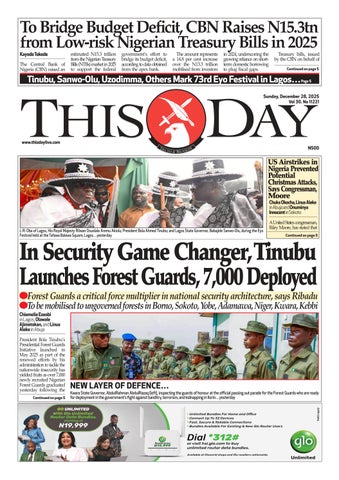
L-R: Oba of Lagos, His Royal Majesty Rilwan Osuolale Aremu Akiolu; President Bola Ahmed Tinubu; and Lagos State Governor, Babajide Sanwo-Olu, during the Eyo Festival held at the Tafawa Balewa Square, Lagos…yesterday
A United States congressman, Riley Moore, has stated that Continued on page 5
In Security Game Changer, Tinubu Launches Forest Guards, 7,000 Deployed
Forest Guards a critical force multiplier in national security architecture, says Ribadu To be mobilised to ungoverned forests in Borno, Sokoto, Yobe, Adamawa, Niger, Kwara, Kebbi
Chiemelie Ezeobi in Lagos, Olawale Ajimotokan, and Linus Aleke in Abuja
President Bola Tinubu’s Presidential Forest Guards Initiative launched in May 2025 as part of the renewed efforts by his administration to tackle the nationwide insecurity has yielded fruits as over 7,000 newly recruited Nigerian Forest Guards graduated yesterday following the Continued on page 5
NEW LAYER OF DEFENCE…
Kwara State Governor, AbdulRahman AbdulRazaq (left), inspecting the guards of honour at the official passing out parade for the Forest Guards who are ready for deployment in the government's fight against banditry, terrorism, and kidnapping in Ilorin…yesterday
SUNDAY, DECEMBER 28, 2025 • T H I S D AY
2
Processing Charges
For Life
on all GTBank Terminals
Get the full value of every payment you receive on your GTBank POS Terminal.
Terms and Conditions apply
SUNDAY, DECEMBER 28, 2025 • T H I S D AY
3
4
SUNDAY, DECEMBER 28, 2025 • T H I S D AY
5
DECEMBER 28, 2025 • T H I S DAY, T H E S U N DAY N E W S PA P E R
NEWS
Tinubu, Sanwo-Olu, Uzodimma, Others Mark 73rd Eyo Festival in Lagos Lagos accentuates richness of Nigerian culture, says president Segun James
President Bola Tinubu; Imo State Governor, Senator Hope Uzodimma and other eminent personalities joined the Lagos State Governor, Mr. Babajide Sanwo-Olu to celebrate the 73rd Eyo Festival yesterday in Lagos State. The Eyo Festival
popularly called ‘Adamu Orisa play’ took place at Tafawa Balewa Square after eight hours of public procession. In his speech titled, 'Lagos accentuates the richness of Nigerian culture with Eyo Festival,' President Tinubu noted the festival was more than a celebration and
underscored the rich culture of Nigeria. This year's play was staged in honour of four distinguished personalities - the first military administrator of the state, Brigadier Mobolaji Johnson; first civilian Governor of the State, Alhaji Lateef Jakande, former Governor
Michael Otedola and mother of President Tinubu, Alhaja Abibatu Mogaji. The event began with colourful procession of the various Eyo with Elemoro, followed by Ajagun, Onitoolo, Adele Asese, Adimu Apena, Eletu Iwase, Arobadade, Oba Akintoye, Oloto, Saba,
Akogun Olofin, Asajo, Kosoko Moronfolu, Opeluwa Onido, Ogunmade, Ojora Apasa, Oshodi Tapa, Olokun, Onikoyi, Eletu Omo and others. The procession culminated with the most prominent Eyo groups who are Adimu, Okolaba, Oniko, Ologede
and Agere. In his speech, Tinubu said, "The Eyo Festival is a vibrant expression of the rich traditions of Lagos. It celebrates the achievements, outstanding contributions, and exemplary lives of distinguished Nigerians—not only eminent Lagosians.
IN SECURITY GAME CHANGER, TINUBU LAUNCHES FOREST GUARDS, 7,000 DEPLOYED
successful completion of an intensive three-month training programme. The Office of the National Security Adviser (ONSA), which announced this development, said the graduation ceremonies were held across Borno, Sokoto, Yobe, Adamawa, Niger, Kwara, and Kebbi states. Meanwhile, some security experts have lauded President Tinubu’s plan to mobilise the forest guards to ungoverned forests in the seven pilot states, saying their knowledge of forest terrains could significantly enhance the effectiveness
of security operations. The Forest Guards are indigenous to their respective local government areas, enabling them to leverage terrain familiarity and community trust in countering banditry, kidnapping, and the illegal exploitation of forest resources. Speaking on the mandate of the guards at the graduation ceremonies, the National Security Adviser (NSA), Mallam Nuhu Ribadu, said they would guard Nigeria’s natural environment and also serve as a critical force multiplier in national
security architecture, particularly in supporting the efforts of security agencies to checkmate perpetrators of insecurity. He stated that the Nigerian Forest Guards is an inter-agency initiative established under his leadership and strategic guidance, in collaboration with the Federal Ministry of Environment. Ribadu noted that it was coordinated operationally by the Department of State Services (DSS) and the National Park Services. “It draws strategic input, doctrine, and operational alignment from the Defence Headquarters,
Nigerian Army, Nigerian Navy, Nigeria Police and the National Security and Civil Defence Corps (NSCDC). This synergy ensures unity of purpose, seamless command and control, as well as operational effectiveness,” he added. Ribadu described the initiative as a decisive step toward restoring state authority and protecting vulnerable communities. He lauded the contributions of the training instructors and coordinators from the Nigerian Army, Nigerian Navy, Nigeria Police, DSS, NSCDC, National
Park Service, National Intelligence Agency (NIA), and the governments of the seven pilot states. “I wish to assure the public that the Forest Guards will be deployed immediately to identify hot spots to enhance existing security architecture, particularly in forested and ungoverned areas. As first responders, they are expected to dominate and ensure the security of the forest ecosystem, gather actionable human intelligence, support ongoing security operations, and enhance presence in hitherto ungoverned spaces,”
Ribadu explained. According to the NSA, the training programme was deliberately intensive, structured, and demanding, designed to transform loyal and committed Nigerians into agile, disciplined, and capable field operatives. The curriculum integrated environmental conservation principles with advanced security competencies, ensuring a balanced, professional, and mission-ready force. Trainees underwent extensive physical and mental conditioning, Continued on page 10
US AIRSTRIKES IN NIGERIA PREVENTED POTENTIAL CHRISTMAS ATTACKS, SAYS CONGRESSMAN, MOORE
the US airstrikes in Sokoto State thwarted potential Christmas attacks by the radical Islamic terrorists in Nigeria, as witnessed in the past years when the terrorists carried out deadly strikes on Christians. Moore’s clarification is coming as the Chief of Defence Staff (CDS), General Olufemi Oluyede, and the Chief of Army Staff (COAS), Lieutenant General Waidi Shaibu, have charged the troops of Joint Task Force Operation FANSAN YAMMA, a military operation against terrorists in the North-West, to be ruthless to terrorists and also maintain heightened vigilance, warning that
criminal elements often attempt to exploit festive periods to undermine security. Meanwhile, a former Senate Leader and Senator representing Borno South, Ali Ndume, has urged the federal government to expand the joint military operations with the United States to Nigeria’s Northeast, citing the persistent threat posed by terrorist groups in the region. A former federal lawmaker representing Kaduna Central, Senator Shehu Sani, has also stated that a military action against terrorists carried out with Nigeria’s consent or participation doesn’t breach
the country’s sovereignty. US President Donald Trump had announced in the early hours of Friday that he ordered the US military to launch a deadly strike against ISIS terrorists in the North-west on Thursday night. According to Trump, the US Department of War executed numerous perfect strikes, and vowed that the United States, under his leadership, will not allow radical Islamic terrorism to prosper. Nigeria’s Minister of Foreign Affairs, Ambassador Yusuf Tuggar, also confirmed that the security collaboration between Nigeria and the United
States led to airstrikes against ISIS terrorists in Jabo in Tambuwal Local Government Area (LGA) and Warrayya and Alkasim in Tangeza LGA, both in Sokoto State. Tuggar said the military operation was carried out in line with international law and with full respect for Nigeria’s sovereignty. In a yesterday post on X, Congressman Moore said while Christians in Nigeria were victims of violence on past Christmas seasons, this year’s response was focused on targeting extremist groups. “For the past two Christmases, Christians have been murdered in
Nigeria. This year, thanks to @POTUS, Radical Islamic Terrorists were on the receiving end of 12 Tomahawk missiles as a present. “The successful strikes on ISIS, in coordination with the Nigerian government, are just the first step to secure the country and end the slaughter of our brothers and sisters in Christ,” Moore wrote.
CDS, COAS Urge Troops to Be Ruthless, Sustain Vigilance in Northwest
In a related development, the CDS, General Oluyede, and the COAS, Lieutenant
General Shaibu, has charged the troops of Joint Task Force Operation FANSAN YAMMA, to be ruthless and maintain heightened vigilance during the festive period. They gave the charge when they paid an operational visit to the Headquarters of the Joint Task Force to celebrate Christmas with the troops. Addressing the troops of 248 RECE Battalion, Illela, Sokoto State, Shaibu specifically ordered them to be ruthless to terrorists to wind down the ongoing fight against insurgency, terrorism, and other emerging security threats in the North-west.
TO BRIDGE BUDGET DEFICIT, CBN RAISES N15.3TN FROM LOW-RISK NIGERIAN TREASURY BILLS IN 2025
the federal government, are regarded as low-risk instruments, primarily used to meet short-term financing needs. Data obtained from the CBN showed that the total amount offered for subscription in 2025 stood at N12.8 trillion, a sharp 60.2 per cent rise compared with the N7.99 trillion offered in 2024. Despite the higher volume raised, total
investor subscriptions declined, reflecting the impact of lower yields. Subscriptions in 2025 stood at N36.63 trillion, representing a 5.5 per cent drop from the N38.75 trillion recorded in 2024. Market data reviewed by THISDAY indicates that the CBN deliberately reduced NTB stop rates in 2025, a move that encouraged significant portfolio rebalancing,
with some funds flowing into the Nigerian Stock Market. At the NTB auction conducted on December 17, 2025, the stop rate on the 91-day bill fell to 15.5 per cent, from 18 per cent in December 2024. The 182-day bill also declined to 15.95 per cent, compared with 18.5 per cent a year earlier. Similarly, the 364-day bill closed at 17.51 per cent,
sharply lower than 22.9 per cent recorded in December 2024. Analysts say the CBN’s strategy reflects a careful balancing act. By combining tight monetary policy with large NTB auctions, the apex bank aims to rein in inflation and stabilise the foreign exchange market, while gradually easing borrowing costs to attract capital inflows.
The variation in stop rates across tenors offers insight into investor sentiment. The relatively lower yield on the 182-day bill suggests expectations of interest rate stability in the near term, while the comparatively higher yield on the 364-day bill points to lingering caution over longer-term economic uncertainties. Overall, the spread of
demand across maturities signals strategic positioning by investors and continued confidence in Nigeria’s domestic debt market. Speaking to THISDAY, an investment banker and stockbroker, Mr. Tajudeen Olayinka, attributed the lower yields to demandand-supply dynamics, noting that the government intentionally cut NTB stop rates to attract key institutional investors.
6
T H I S DAY, T H E S U N DAY N E W S PA P E R • DECEMBER 28, 2025
NEWS
SEVENTY-TWO HEARTY CHEERS…
Secretary to the Government of the Federation, Senator George Akume (left), and his new wife, Zaynab, during the thanksgiving service to mark the 72nd birthday of the SGF at St. John the Baptist Cathedral, Gboko, Benue State…yesterday
No Place for Terrorists, Kidnappers to Hide in Kwara, Says Governor Abdulrazaq Hammed Shittu in Ilorin
Kwara State Governor, Alhaji AbdulRahman AbdulRazaq has said that there is no place for terrorists and kidnappers to hide in the state anymore with the full deployment of Forests Guards across major areas of the state. AbdulRazaq stated this in Ilorin yesterday during the passing-out of over 1,000 Forests Guards that have completed their training ahead of full deployment to curtail the activities of terrorists, kidnappers, and illegal miners, among others in the state. Governor AbdulRazaq thanked the security forces
for their commitment to protect lives, saying a synergy with the new auxiliary forces who were all drawn from local communities will strengthen the campaign to fight terrorists and kidnap purposes. He stated, “Today opens a new page in our campaign against all forms of terrorism, kidnapping, and opportunist attacks on our people by bad faith actors who exploit our vast territories for evil purposes,” he said. “And the message is very clear: more than ever before, the terrorists now have the option of immediately leaving our state or paying a heavy price.
“Today’s launch of the forest guards simply means that we are going on the offensive because our people deserve their peace as freeborns. We have
had enough Anyone who thinks or acts otherwise is our enemy who will not be spared. “Distinguished Forest Guards, you are
embarking on a national assignment to protect our people from all criminals in our forests. Working with gallant officers and personnel of the security
forces, you are to go all out to flush out the terrorists, restore sanity in our forests, and keep our communities safer than they ever were.
Many Feared Dead as Police Confirm Explosion in Zamfara Onuminya Innocent in Sokoto
The Zamfara State Police Command has confirmed that an explosion rocked the Yar’Tasha-Dansadau road in Maru Local Government Area (LGA) of Zamfara State. Many travellers were feared killed by the
explosion caused by bandits. The Zamfara State Police Command confirmed the incident, with Police Public Relations Officer, Yazid Abubakar, saying that security operatives were responding to the situation and gathering information from the scene. According to sources
in the area, the blast, believed to be caused by an improvised explosive device (IED) planted by bandits, occurred yesterday afternoon, throwing commuters into panic . "I can confirm that there was a blast in that area, but the incident just happened. I can’t tell you details yet. I will update you later,"
Abubakar said. Residents suspect the bandits may have planted the explosive device, given the area's history of banditry and violent attacks. Videos circulating on social media show travelers fleeing the scene in panic, with vehicles abandoned along the highway.
sustainable development in the country. He stated this yesterday at St. John the Baptist Cathedral, Gboko in Benue State during a thanksgiving church service to celebrate his 72nd birthday anniversary. The SGF described national development as a
collective responsibility that required the synergy of all three tiers of government. He also urged state and local governments to ensure accountability and judicious utilisation of the enhanced federal allocations they receive to drive development that benefits the grassroots
populace. Akume thanked God for the opportunity to serve his people and the nation at large through his journey in the Civil Service and politics, stating God has used him to empower many individuals through the meager resources at his disposal.
Theatre Commander: 438 Terrorists Killed in Seven Months Akume: Accountability in Governance Key to National Devt
The Joint Task Force North East Operation Hadin Kai (OPHK) has, in seven months of operations, killed 438 Boko Haram and ISWAP terrorists. The Theatre Commander, OPHK, North-east Sector 1, Maj.-Gen. Abdulsalam Abubakar, who made this known on Saturday at the Christmas Luncheon in Maiduguri, Borno State, said the operations were coordinated between May and December. Abubakar said the operatives have also recovered 254 assorted weapons, 300 units of Starlink communication devices and rescued 366 civilians from various
terrorist enclaves. “The surrender of 881 JAS/ISWAP fighters and their families, among other accomplishments, further underscores the progress made,” he said. The army general said that the Christmas celebration coincided with their dry season operations in the Theatre. He, however, assured the Chief of Army Staff of the unwavering commitment of their gallant forces to maintain the tempo of operations. Abubakar also attributed the successes recorded in the Joint Operations Area (JOA) to the Chief of Army Staff’s interventions.
Olawale Ajimotokan in Abuja
The Secretary to the Government of the Federation, Senator George Akume, has emphasised the importance of accountability among the three tiers of government towards
Global Cooperation, Not Isolation, Key to Nigeria’s Security, Says Jimoh Ibrahim Wale Igbintade
The Senator representing Ondo South, Jimoh Ibrahim, has stated that no nation in
the contemporary international system enjoys absolute sovereignty. This is as he insisted that global security realities compel states
to embrace cooperation and collective action. On Christmas Day, the United States military, in collaboration with the federal government, conducted
coordinated airstrikes targeting terrorist bases in Sokoto State, an operation the Nigerian government said did not violate the country’s sovereignty.
SUNDAY, DECEMBER 28, 2025 • T H I S D AY
7
8
T H I S DAY, T H E S U N DAY N E W S PA P E R • DECEMBER 28, 2025
NEWS
CONGRATULATIONS TO NEWEST COUPLE…
L-R: Paramount Head, Iju/Jack Group of War Canoe and Chieftaincy Houses of Abonnema, Opuda Dr. Tammy Wenike Danagogo Jack; Paramount Head of Oruwari-Briggs War Canoe Houses, Chief Dumo Lulu-Briggs; Amanyanabo of Abonnema, HRH King Disrael Gbobo BoB-Manuel II; Newlywed, Alabota Ngowari and Alabo Samuel Biokpo Diminas Jack; Amanyanabota Ibitimi BoB-Manuel; and Paramount Head Otaji/Georgewill Chieftaincy Houses, Chief Ambiye Marcus Georgewill, during Alabo Samuel and Alabota Ngowari Kalabari Traditional Iya Marriage at Iju Jack Memorial Hall, Abonnema Rivers State...yesterday KUNLE OGUNFUYI
Wike: After Tinubu, I’m Nigeria’s Most Abused Politician Now
Says politics in Rivers will start January 2026 Assembly members present new car to minister as Christmas gift
Blessing Ibunge in Port Harcourt
The Minister of the Federal Capital Territory (FCT), Nyesom Wike, has described himself as the most abused politician in Nigeria after President Bola Tinubu. Wike declared that politics in Rivers State would
officially commence from January 2026. This is as members of the state House of Assembly presented a brand-new Toyota Camry to the minister as a Christmas gift. Speaking yesterday during a special thanksgiving service organised by the Chairman of South-South
Development Commission, Hon. Chibudom Nwuche and his family in Ochiba community, his hometown in Ahoada East Local Government Area (LGA) of Rivers State, the former Rivers State governor said he does not renege on any agreement he enters and reiterated his unwavering
support for Tinubu. He used the occasion to thank the people of Ahoada East and Ahoada West LGAs for their steadfast support. “This is the first local government we are coming to say ‘thank you’ for being there for us all through these years.
US Resumes Surveillance of Sambisa Forest After Air Strikes in Sokoto
The United States has resumed intelligence, surveillance, and reconnaissance (ISR) operations over Nigeria’s north-east region, targeting militants in the Sambisa forest, following Thursday night’s air strikes on ISIS fighters in Sokoto State. Brant Philip, a Sahelfocused terrorism tracker, disclosed the
development on Saturday, sharing flight-tracking data showing a US aircraft flying over Borno State. According to the data, the aircraft involved was a Gulfstream V, a long-range business jet often modified for intelligence, surveillance, and reconnaissance missions. “The United States
resumed ISR operations today on ISWAP in the Sambisa forest, Borno State in northeast Nigeria, after a pause of one day following the strikes in Sokoto State,” Philip wrote on X (formerly Twitter). Philip explained that yesterday operation focused on the Islamic State West Africa Province (ISWAP), the ISIS affiliate
operating mainly in Nigeria’s north-east and the Lake Chad basin. Flight-tracking information reviewed by multiple open-source analysts indicated that the US began its ongoing ISR missions in Nigeria on November 24, taking off from Ghana, which serves as a logistics hub for the American military network in West Africa.
Northern Christian Elders Welcome US Airstrikes, Say Nigeria Needs International Support to End Terror Chuks Okocha in Abuja
The Northern States Christian Elders Forum (NOSCEF) has welcomed the United States’ airstrikes on terrorists in the North-west and faulted critics opposing the US military intervention against terrorist groups in the country. In supporting the US intervention, the Christian elders insisted that the
country urgently needs all available support to end the worsening insecurity. Reacting to the US airstrikes in Sokoto State, the Chairman of the association, Sunday Oibe, said Nigeria is facing an existential security crisis that requires decisive and collaborative action. According to him, any assistance aimed at restoring peace should be welcomed, provided the
Nigerian government is fully aware and involved in the process. “In whatever way this help comes, as long as the Nigerian government is in the know, it is a welcome development. “Nigerians have been bleeding for far too long because of the activities of these criminal bandits, whom I prefer to call enemies of humanity,” he stated.
Oibe aligned his position with that of former Head of State, General Ibrahim Babangida (rtd.), stressing that terrorism must be confronted decisively and without compromise. “I agree completely with the position of former leader, General Babangida, that the government must root out this evil without negotiation,” he said.
“You know, like the pastor said today, God detests those who are ungrateful. And so, for what you’ve done for us, for standing with us, we say ‘thank you. Thank you, and thank you,” Wike said. “You remember, in 2023, when it was tough, nobody knows what will happen in that election. Somebody was saying that it will be difficult for Asiwaju Bola Ahmed Tinubu to win that election. So, many people were not able to come and vote for Asiwaju Bola Ahmed Tinubu. “But we all met, as
leaders here, and said we must take a stand and defend. That we must make a decision, whether it is good or bad. But we know at the end of the day, it will be good. But we did it. “When it was tough, for people to say, ‘on your mandate we stand,’ we stood firm and said ‘on your mandate we stand.’ And to the glory of God, we stood. And today, he is the President and Commander-in-Chief of the Armed Forces of the Federal Republic of Nigeria,” he added.
Nigerian Immigration Gives Foreign Nationals Deadline to Regularise Stay Before Amnesty Ends Laleye Dipo in Minna
The Niger State Comptroller of the Nigerian Immigration Service (NIS), Maduka Hope, has directed all foreign nationals residing in the state to regularise their stay before the general amnesty window closes at the end of the month. Hope gave the directive after a meeting with leaders of Nigerien nationals in the state. He explained that the engagement forms part of a broader initiative by the Comptroller-General of Immigration to strengthen border security and improve migration management.
“We are going all out in the New Year to know who is where. We are going to document them,” he said. He warned that foreign nationals who fail to present valid travel or identity documents risk being repatriated to their countries of origin. “Those who don’t have documents to show why they are here or what they are doing will be returned to Niger Republic,” he told reporters. The comptroller clarified that the documentation exercise is not limited to Nigerien nationals alone but targets all ECOWAS citizens resident in the state.
9
DECEMBER 28, 2025 • T H I S DAY, T H E S U N DAY N E W S PA P E R
NEWS
LAW SCHOOL CLASS OF 1985 CELEBRATES…
L-R: Former Vice Chairman, Nigerian Football Federation, Mr. Seyi Alinwunmi; Secretary to the Lagos State Government, Mrs. Abimbola Salu-Hundeyin; Lagos State Governor, Mr. Babajide Sanwo-Olu; Attorney-General of the Federation and Minister of Justice, Prince Lateef Fagbemi (SAN); Husband of the Chief Justice of Nigeria, Mr. Akin Kekere-Ekun; Chief Justice of Nigeria, Justice Kudirat Kekere-Ekun; Justice of the Supreme Court of Nigeria, Justice John Inyang Okoro; Governor Oyo State, Mr. Seyi Makinde; Chairman, Class of 1985, Chief Emeka Ngige (SAN); and Chairman, Ecobank Nigeria Limited, Mrs. Bola Adesola, at the 40th Anniversary Gala Nite at Lagos Oriental Hotel, Lagos…recently
To Enhance Good Governance, Gambari Tasks Govt on Mentoring of Younger Generations Hammed Shittu in Ilorin A former Chief of Staff to the late former President Muhammadu Buhari; Prof. Ibrahim Agboola Gambari, yesterday urged governments at all levels to harp on mentoring younger generations of Nigerians so as to boost good governance in the country. Speaking yesterday in Ilorin, the Kwara State capital during the seventh annual general meeting of Ilorin Emirate Professors’ Association, Gambari who is also a former Nigerian
envoy to the United Nations (UN), advocated meritocracy as the antidote to Nigeria's problems. He said that mentoring of the young generations would go a long way in achieving commitment to excellence in the nation's polity. Gambari spoke on the ‘Roles and Responsibilities of Academia in Good Governance.’ According to him, "Our founding fathers believed in mentoring others and at the end of the day pushed those mentees into positions of responsibility.
Muslim Students: Tinubu’s Tax Reforms Must Be Fair, Inclusive to Gain Public Trust Sunday Ehigiator
The Muslim Students’ Society of Nigeria (MSSN) has warned that the federal government’s proposed tax reforms could further weaken public confidence if concerns about fairness, justice, and inclusivity are not properly addressed. The group stated this yesterday at the opening ceremony of its B-Zone Islamic Vacation Course held at the proposed permanent site of AlUmmah University, located along the IbadanLagos Expressway in Onigari, Ogun State. Addressing participants, the National President
of the society, Mallam Tajudeen Mustapha, said the country is facing overlapping challenges, including economic hardship, insecurity, moral decline, and weak leadership, noting that policies viewed as unjust only deepen citizens’ distrust of government. According to him, “taxation itself is not the core issue, but rather the growing lack of trust in how public resources are managed.” He added that “agreements and reforms such as the taxation that raise questions of equity and sovereignty make citizens sceptical and disengaged.”
"I, therefore, urge the ruling class not to take the communities for granted". He tasked academics to move out of the comfort zone by engaging in dialogues that would ensure good governance. "While we should encourage that academia moves out of its comfort zone in the ivory towers
to encourage conversations and dialogues in a very constructive setting in the achievement of governance, we must nevertheless not forget Ides of March. "Today's world is characterised by disruptions of all sorts, mostly technologically driven, social polarisation,
new age nationalism, political instability and climate change. "In the midst of this governance architects are forced to make tough decisions which involve allocating scarce resources to myriads of challenges and demands. We must provide support in the form of clarity in the
process of making such decisions". "For academia in Nigeria, it is important that we evolve in how we practice and must understand where the world is headed given all the complexity we currently face in a very turbulent geo-political world order.
PDP Faults Kwara Govt’s Silence on Offa Explosion Hammed Shittu in Ilorin The Kwara State chapter of the Peoples Democratic Party (PDP) has faulted the state government over what it described as a lack of official response to the explosion that occurred in Offa, the headquarters of Offa Local Government Area (LGA), leaving residents anxious and seeking clarity on the incident. The party’s position
follows earlier reports on Friday that explosions rocked parts of Offa community on Christmas night, damaging property and prompting security agencies to cordon off affected areas as investigations commenced. In a statement issued in Ilorin and signed by the Kwara State Publicity Secretary of the PDP, Olusegun Adewara, the opposition party said that the Governor
AbdulRahman AbdulRazaqled administration had failed to address the public or offer reassurance since the incident. It expressed sympathy with the people of Offa, especially the Olofa of Offa, Mufutau Gbadamosi, Esuwoye I, as well as residents, business owners and communities affected by the explosion. “It is unfortunate that while residents ran for their lives in fear and confusion,
the state governor and his government were conspicuously missing in action, both physically and in communication,” the statement read. According to the party, there had been no official explanation, no security briefing, no visible government presence at the scene, and no word of reassurance to residents of Offa and other parts of the state as of the time the statement was released.
Soludo: Anambra's 2026 Budget Surpassed UNESCO's Recommendation on Education Funding David-Chyddy Eleke in Awka Anambra State Governor, Prof. Chukwuma Soludo, has said that the state's 2026 budget on education surpassed the recommendation made by United Nations Education, Scientific and Cultural Organisation (UNESCO). A press statement by
the governor's Chief Press Secretary (CPS), Mr. Christian Aburime, stated that Soludo deliberately made Anambra State the education headquarters of Nigeria by budgeting 46.9 per cent of its N757 billion budget to education alone, as against UNESCO's 15-20 per cent recommendation. He said: "An intentional leader like Governor
Chukwuma Charles Soludo can’t just stop taking the educational torchlight to new heights. "Anambra State is topping the charts in the 2026 fiscal year. Fresh analysis across Nigeria’s states, shows Anambra outshining peers like Enugu, Kano, and Jigawa, while many others trail far behind in global standards.
“This is Governor Chukwuma Soludo’s uncompromising resolve to transform Anambra into a knowledgedriven powerhouse, aligning seamlessly with UNESCO's longstanding recommendations that nations and states allocate 15 to 20 per cent of total public expenditure, or four to six percent of GDP, to education."
10
T H I S DAY, T H E S U N DAY N E W S PA P E R • DECEMBER 28, 2025
NEWS
A SHOW OF HOSPITALITY…
L-R: Director, Orange Group, Mr. Ugochukwu Ezenna, Chief Executive Officer, Mike & Chris Limited, Mrs. Georgelyn Chinwe; Abbot General of the Order of Cistercians of the Strict Observance, Dom Bernardus Peeters; Chairman, Orange Group, Sir Tony Ezenna; Director, Orange Group, Lady Lizzy Ezenna; Managing Director, Malvin Meadow Schools, Maryland, Lagos, Mrs. Chika Mgbemena; her daughter, Miss Chioma Mgbemena, at a reception for Abbot General at the residence of Sir Ezenna in Ikoyi, Lagos…recently
Makinde Dismisses Fayose’s N50bn Tinubu Donation Claim, Says Allegation Baseless Kemi Olaitan in Ibadan
Oyo State governor, Seyi Makinde, has dismissed claims by former Ekiti State Governor, Ayo Fayose, that he received N50billion support from President Bola Tinubu following the January 2024 explosion in Ibadan. Addressing newsmen yesterday, the Special Adviser on Media to Governor Makinde, Dr. Sulaimon Olarenwaju,
described the allegation as baseless and challenged Fayose to provide evidence to support it. Olarenwaju said Fayose’s claim lacked credibility. “He who makes an allegation must provide evidence. Let him produce proof of what he is claiming. It is important to note that Fayose lacks credibility. Even members of his family have publicly disowned him. “What credibility does
such a person have? People like that speak carelessly, and ordinarily, they should not be taken seriously. But since he has made a claim, let him substantiate it,” he said. It would be recalled that former Governor Fayose, an ally of FCT Minister Nyesom Wike, while speaking on a TVC programme, ‘Politics Tonight,’ on Friday, had accused Governor Makinde of concealing
an alleged N50 billion donation from the presidency in the wake of a deadly explosion in Ibadan last year. The former governor claimed that although the money was not paid directly into Oyo State’s bank account, it was linked to Makinde’s visit to Tinubu after the incident. “You did not tell Nigerians that you got, at the prerogative and mercy of Mr. President,
N50 billion in support of the explosion victims in Ibadan. He never said that to Nigeria. “So, the president can say the explosion is not worth more than N10 billion. The N50 billion did not come into the coffers of Oyo State. It came as a result of your interface with the president, because you came out to say that you met with him,” he had said. Fayose further alleged:
IN SECURITY GAME CHANGER, TINUBU LAUNCHES FOREST GUARDS, 7,000 DEPLOYED
including endurance exercises, obstacle-crossing drills, and long-range patrol simulations to prepare them for sustained forest operations. They were also trained in tactical fieldcraft, including movement techniques, enemy-contact drills, ambush response, rescue operations, and coordinated offensive actions—equipping them to deny criminal elements any form of sanctuary within Nigeria’s forest spaces. The training programme was said to have recorded a 98.2 per cent completion rate. A total of 81 trainees were disqualified on disciplinary grounds, while two trainees passed away due to preexisting medical conditions. Governors and Deputy Governors from the seven participating states attended the ceremonies, including Governor AbdulRahman AbdulRazaq of Kwara State and Governor Mai Mala Buni of Yobe State, with other states represented
by their deputy governors. AbdulRazaq called the initiative a game changer, which he said would leave the terrorists and kidnappers with the option of either leaving Kwara State or paying a heavy price. “The enlistment of armed forest guards to complement the patriotic efforts of our security forces is a game changer in this campaign. It shows very clearly that the government is committed to the mission of ridding our country of all forms of terrorism, banditry, and kidnappings,” the governor said. He commended President Tinubu for “thinking out of the box” to repossess Nigeria’s forest resources, expel all the bad faith actors occupying the forests, and strengthen public safety.
Security Experts Hail Plan to Deploy Forest Guards against Kidnappers, Bandits Meanwhile,
some
security experts have lauded President Tinubu’s plan to deploy forest guards as a strategic measure to combat banditry and kidnapping in Nigeria. The experts noted that combining local expertise with formal security forces would improve intelligence gathering, disrupt illegal activities, and strengthen national security. A retired Assistant Inspector General of Police (AIG) Edgal Imohimi, who was Lagos State Commissioner of Police, described the initiative as a step in the right direction if properly structured. He said an effective forest guard would complement national security by providing local intelligence and filling security gaps in forested and semi-urban areas. Imohimi noted that recruiting personnel from local communities would enhance terrain knowledge and
intelligence gathering, while training in jungle warfare and tracking would improve effectiveness. A retired Commissioner of Police (CP) Emmanuel Ojukwu, described the plan as a welcome development, noting that the fight against insecurity requires coordination and collaboration between security agencies and the public. “Forest guards have strong familiarity with the terrain. They are well acquainted with the forest environment and know how to navigate it. They understand human movement as distinct from that of animals, and this knowledge allows them to assist security agencies in identifying the locations of terrorist and bandit camps,” he said. A retired diplomat, Ambassador Ejike Eze, also praised the initiative, but stressed the need for clearly defined roles. “It is a laudable initiative, but the
government must ensure that every security agency adheres to its constitutionally defined responsibilities. Forest guards should not be guiding VIPs or remaining in offices, as some other agencies do. They must operate fully within the forests, permanently deployed where they are most needed. Our forests should be divided into operational divisions, and commanders must be directed to man these divisions effectively," he said. Eze drew comparisons with Cuba, noting that authorities there monitor their forests around the clock. “You cannot drop a pin in a Cuban forest without operatives identifying its location. Those who terrorise us operate from our forests, and a well-deployed local force can play a crucial role in tackling these threats,” he added. However, a former
“You only told Nigerians the part where you said the president asked you to go and organise the APC for him and that you said you could not organise. But you did not tell Nigerians what the president did for you and for the good people of your state.” However, responding to Fayose’s claims, Makinde’s spokesman denied that the presidency made any such monetary donation to Oyo State government.
Commissioner of Police for the FCT, Lawrence Alobi, expressed reservations about the plan. “I don’t share the president’s sentiment. Some advisors are guiding the president based on political interests rather than the country’s security needs. Each state already has a police command, military base, Civil Defence, DSS, and other security actors. Creating a Forest Guard raises questions: What will they do, and who will supervise them?” he queried. Alobi argued that national security would be better served by strengthening the Nigeria Police through reform. Former Lagos State Commissioner of Police, CP Fatai Owoseni (rtd), who is currently the Special Adviser on Security Matters to the Oyo State Government, said the problem is not the creation of new units but poor integration.
SUNDAY, DECEMBER 28, 2025 • T H I S D AY
11
JAMES HOPE COLLEGE Knowledge•Character•Truth
SHAPING LEADERS, BUILDING LEGACIES JOIN A LEGACY OF EXCELLENCE AT JAMES HOPE COLLEGE, LEKKI LAGOS NOVEMBER 2024 CAMBRIDGE IGCSE EXAMINATION RESULT A* A* - A A* - B A* - C
GRADES: 65% GRADES: 93% GRADES: 98% GRADES: 100%
MAY/JUNE 2025 WAEC EXAMINATION RESULT A -B A -C 1
2
1
6
GRADES: 94% GRADES: 100%
Dedicated educators who ignite curiosity, character, and confidence in every learner Proud winners of prestigious international and national academic awards Beautiful, serene and secure world-class campus State of the art classrooms, laboratories and sports facilities
ENTRANCE EXAMINATION FOR DAY AND BOARDING STUDENTS FOR THE 2026/2027 ACADEMIC SESSION Admission into year 7 (JSS1) is scheduled to take place as follows: Dates: Saturday 31st January, 2026 and Saturday 7th February, 2026 Locations: LAGOS: James Hope College, Twin Lakes Estate, Lekki, Lagos ABUJA: 71 Usuma Street, Opp. Transcorp Hilton Hotel, Maitama Abuja Time:
PORT HARCOURT: 15 Nnamdi Azikiwe Road, Port Harcourt, Rivers State. 10AM
APPLICATION CLOSES: FRIDAY 23RD JANUARY 2026 Application forms can be downloaded from www.jameshopecollege.edu.ng under the “admission” tab or can be collected from James Hope College, Twin Lakes Estate, Lekki, Lagos.
OPEN DAY
SATURDAY 17TH JANUARY, 2026 DOWNLOAD APPLICATION FORMS
+2347083662229 +2347018282065 Follows us on all our social media handles @jameshopecollege
James Hope
@JHCLekki
+2347085369376 +2347015349257 admission@jameshopecollege.edu.ng www.jameshopecollege.edu.ng
12
SUNDAY, DECEMBER 28, 2025 • T H I S D AY
SUNDAY, DECEMBER 28, 2025 • T H I S D AY
13
THISDAY, The SUNday Newspaper •December 28, 2025
14
Interview
Seyi Makinde:
Nigerians will Shock Politicians, Elites in 2027 Oyo State Governor, Seyi Makinde, last week held a media interaction in Ibadan, with selected media professionals from across the country. Chuks Okocha, who monitored the event, brings excerpts
Y
our Excellency, you said politics is a game but governance is not. But politics is a sort of party governance. So how do you ensure that governance and party functions are separated, bearing in mind some of the things that have been happening in the PDP in recent years? I’ll start by saying that we’ve tried several constitutions, you know. We started with the parliamentary system, and then we went to the presidential, right? When you’re seeking votes, you know, you go out, engage with the people, you can promise them heaven and earth, right? But if you’re given the opportunity to serve the people, you have to deliver; and you have to deliver not only to the people of your own party. We engage at the federal level and say, look, we think you should do this for the states. And then we hear things like, oh no, you cannot empower your enemy or your competitor. With what? Yes, we’ll play the game. While we’re campaigning, you will say all sorts of things, you know, about the other parties. You try to sell your own programmes and policies. But once it comes to governance the game stops because destinies are involved, even generations yet unborn can be impacted. I had a meeting with the cabinet secretary in Kenya. That is the equivalent of, maybe SGF in Nigeria, the number three citizen out there. He said to me while we were in his
officewatchingthedramainGazabetween Israeli and the Palestinians. And then he said, look, this could have actually been Kenya. Because when they were looking for land to create the state of Israel, Kenya was actually considered.And that bill was defeated by one vote in parliament. So some of the things we do in governance, we may think, oh, ok, this is just easy. But generations yet unborn are impacted. If you know my political trajectory, this is my very first job in the public sector. And I got the job when I was 51. So what happened to me between zero and 51? And I’ll be 58 on Christmas day. So what happened to me between zero and 51? I operated in the private sector. And I operated not only in Nigeria, but, you know, across different continents. I believe once prayers have been answered – because nobody can get anything without God giving it to that individual. And even leadership, you cannot become a leader by yourself, it is because God has given that position to you. And he will give people the kind of leaders they deserve at any particular time. In the Bible, God allowed a wicked king to be enthroned because at that particular time, God decided that that is the kind of king the people deserved. But that is usually not the end of the story. So I will say that in Nigeria today, we have to rise above partisanship. This
may go straight into the issue within PDP. I say everybody has defected and I’m saying I’m not movedbecausethepeoplethatnegotiatedNigeria, they have two major things that were in there, in that negotiation. First, federalism. That’s why they call us the Federal Republic of Nigeria. Two, multi-party democracy. That is why, upon independence, you had Action Group, you had Northern People’s Congress, you had NEPU, you had NCNC. You understand? At independence, it was a multi-party democracy. So, now you are moving the country towards a one-party state. It won’t work. I was in Ebonyi State recently and they brought Kola to me and said, in Igbo land, if you are receiving a big visitor, this is how you do it. I said, well, Kolanuts is grown in the west, eaten in the north, and literally worshiped in the east. So you have different nations, different cultures within the nation called Nigeria. And the people who negotiated our independence felt that it was okay to have unity in that diversity, it has to be a federal arrangement. If you move the country towards a one-party state, what happens the day you require a multi-party or bipartisan approach to issues? Who are you going to call? The day you move the country towards a one-party state, you remember what happened with the Arab Spring. Once people don’t have leadership, they will find leaders by all means. So we better get our acts together as political leaders in this country. That will be my own approach to your question.
Talking about PDP, I know there was a time you were in the G5, and that G5 actually supportedthepresident.Whathappenedconcerning your relationship between the president and your friend, Nyesom Wike…? What happened, because at some point, everybody thought it was all rosy? Okay, I contested the election for the first time in 2007 to go to the Senate here in Oyo State. And, well, I lost. I contested under theAll Nigeria Peoples Party (ANPP). I was in PDP with Oba Rashidi Ladoja. You remember his impeachment and all of that, all the shenanigans that happened within that period? So it wasn’t possible. The PDP franchise was handed over to Baba Lamidi Adedibu. And me, as a person, as a 39-year-old trying to get into politics for the first time, I didn’t like that brand of politics. And I said I wasn’t going to be involved with that brand of politics. That was why I contested under ANPP. But ab initio my first outing in politics, I joined PDP. So, we lost. We came back 2011 in PDP again. They didn’t even allow me to go past the party primaries. So I lost. And then I said, look, I’ve been dealing with people here. I think since I’ve lost twice at the senatorial level, let me move up, let me promote myself to the governorship level. So I contested in 2015 to be the governor of the state. Again, I lost. But my point is, in all of this journey, I never interacted with, or went to Bourdillon (Bola Tinubu’s Lagos home). No. I held my own. Whatever I couldn’t get through to the people of Oyo State, I left it like that. I don’t
THISDAY, The SUNday Newspaper •December 28, 2025
15
Interview What Nigerians will Show Politicians and Elites in 2027, We Cannot Imagine It Right Now believe in godfatherism in politics. So I didn’t go. I stayed here. But 2019, the people of Oyo State decided. Did they decide because there is influence of anybody from Bourdillon or from outside of the state? The answer is no. So, in 2023, we felt that after eight years of President Buhari who hailed from the north, the presidency should come to the south. And I need to also say this: I don’t believe that will be a permanent arrangement in Nigeria. I believe Nigeria will get to a point where, if you like, two Ibibio people can be president and vice president as long as they are qualified.And we have strong institutions that will ensure that they do what is right for the people of Nigeria. So we felt that the presidency should come to the south. And within my party, Nyesom Wike was contesting, I supported him. He lost in the primaries. And then the Waziri, former vice president (Atiku Abubakar), won; he is from the north. But I said, look, if our party has selected somebody from the north then we should sit down and decide how this thing is going to work. Atiku came to Ibadan. We were at Ogunlesi Hall at the UCH and we mentioned to him that you are the candidate of the party, you are from the Northeast; Iyorchia Ayu, the national chairman of the party, is from North Central. And in that meeting, we were facing the Press. I didn’t tell him this at the government house? No. I said Governor Aminu Tambuwal, as of that time, was the chairman of PDPGovernors Forum. I said intelligence indicated that you will appoint him as the DG of this campaign. He is from the Northwest. So what are we supposed to use to campaign to convince people because politics is a game of numbers? But we couldn’t reach any agreement. We met with him in London. The only thing I said to him in London was, allow us to go and remove Iyorchia Ayu and then make Taofeek Arapaja the acting chairman because he was the Deputy National Chairman (South) at that time. Make Arapaja the chairman, he will be at the table when you are all talking and deciding. In London, I said just agree with us to go and remove Ayu. Don’t even bother about how we will do it. He said we should give him one week to decide. He came back to Nigeria and we heard that famous statement that those ‘small boys’ and that he had moved on. Okay, so if he moved on, what would I do? We had to do something. That is politics. So we couldn’t reach that agreement. And it wasn’t Wike that guaranteed the president (Tinubu) before me. Because I had never had any political dealings with him (Tinubu) up until that point, someone else did the linking. I said, okay, fine. If this is what we will do, we will support you. But even as a candidate, I must have mentioned it three or four times that our expectation would be a government of national unity; a government of national competence where you could start the process of re-setting this country. But is it what we are seeing right now? Is it a government of national competence? Is it a government of national unity? The answer is no. When the president asked me to nominate somebody who may be appointed as a minister, I said, sir, what position do you want to give to us in Oyo State? Then he said, ‘I’m looking for a developmental economist who can be the minister of budget and economic planning’. I said, okay. I will look for somebody that fits that bill.And I sent somebody’s name, who is an Oyo State indigene to him. The individual wasn’t appointed. Rather, they selected the current Minister of Power (AdebayoAdelabu). He wasn’t taken to the Ministry of Budget and Economic Planning. He was taken to the Ministry of Power. At a subsequent meeting with the president, I think I must have gone to him to seek for approval for the upgrade of the Ibadan airport. He said, ‘I’ll sign it for you. I’ll give you my nod. But, oh, sit down. What’s happening politically? I heard you are upset because your nominee was not given the ministerial slot.’ I said, ‘sir, in Yoruba land, if you don’t want the pregnancy to be aborted, you won’t want the baby to die because it’s easier to abort a pregnancy than to kill a baby.’ I said, ‘you will decide at the end of the day who you want to work with. We can only suggest people. But if you know people that fit your bill, the kind of individuals you want in your cabinet, ours is just to support you. However, let me say this. If you’ve selected the minister of power because you want him to help you organise APC in our state, he doesn’t have the capacity.’ I told the president.’l He said, ‘no, no, no, Seyi; it is you that I want to help me organise APC in Oyo State.’ I said, ‘no, sir, I can never help you organise APC in Oyo State because I am of the PDP.’
mistakes. Even up until this moment, I say to people - because people have been calling me - Seyi, you can take the approach of siddon look, just keep yourself, and then let this wave go away. They even went as far as saying that by the time you’ll be done with your position as governor of your state, you’ll be 59. Even if you wait for 8 years, you’ll be 67. You can contest if you want to contest. I said, look, what are we afraid of? Is it death? If you’re afraid of death, will that stop you from dying? What can it do to you? If you’re afraid of death, what it can do to you is that it won’t allow you to live your life freely. So we’re not going to do that. I’m not afraid to speak my mind. I’m also not afraid to apologise to people when I wrong them, because it’s only God that is all-knowing, that knows the end from the beginning. I am not, maybe people may think because I was born on Christmas Day, they may think, you know, maybe I know too much. No.
• Makinde So, if we have a government of national unity, a government of national competence, we would have been in a very different environment right now. And let me just mention again this issue of Wike. So, this (displays a contract award paper) was the exact first contract that Mobil gave to my company, Makon (Makon Engineering and Technical Services Limited). I was 29. It was $1 million. They subsequently added two other contracts such that within that one year (1997-1998), I had $1 million in my pocket. I was 29. 1997/98. Wike perhaps at that time just left the Law School. And then his next job after that was local government chairman. And the trajectory was… I don’t beef anybody. But the real issue is that I was in a meeting with the president and Wike. And I’m saying this in an open chat. The president’s chief of staff was also in that meeting with a few other people. And Wike said to the president: ‘Sir, I will hold PDP for you against 2027’. I was in shock. So when we got to the veranda. I said, Wike, did we agree to this? I don’t like talking about people and I will not talk about people or talk about events. But I’ll talk about the real issue. The real issue is that Wike would like to support the president for 2027. That’s fine. It is within his right to do that. But also some of us that want to ensure that democracy survives in Nigeria, we don’t drift into a one-party state. And we want to ensure that PDP survives. He should also allow us to do our own thing. That is just the issue between me and Wike. And I confided in a mutual friend of ours after that meeting. And I kept thinking, okay, I mean, the president did not ask him to do this for me. He was the one that volunteered that I will do that. I said to our mutual friend, look, maybe he was talking about an errand that the president never sent him. So, let’s watch. Let’s engage him. Let’s see if he will back off. But he never did. After he didn’t back off, I said, well, now it’s time to confront him, because I told him from that day that I will never be a part of this. And that is why I will not be supporting the president for 2027. Wike can support him. It is within his right. But also it is within my own right to decide within the political space who I will support or what I will do in 2027.
We now understand the real reason why there is a conflict in the PDP. Now, the party is divided along two lines. The one being led by Taminu Turaki is claiming that it is the rightful one. And I remember that INEC called the two parties to a meeting. Now, with the state PDP now found itself currently, in the forthcoming off-season elections and in 2027, does the party stand a chance? Nigeria needs a credible opposition. You’ve mentioned it that the country is fast
moving towards a one-party state. Does PDP have any chance? Well, the president has the power to call his minister to order and say allow democracy to survive in Nigeria. And by the way, the way PDP is today, there is no faction in PDP. We held a convention here in Ibadan. We gave adequate notice to INEC, which is all that we are required to do under the law. So, it will take INEC some time if they choose to behave like the ostrich, bury their head and leave all of their bodies outside. And, for the current INEC chairman, the job is very difficult to start with. Now, to hide all of these things that they are not supposed to hide. They basically called the two sides together. They played our people. They invited them and said, we want to engage with the leadership of PDP. And then, they got there and found out that they also invited Anyanwu and co. I said, that’s even silly to start with. Pardon my language. So, why did they not call Damagun? It wasAnyanwu that was the secretary when Damagun was there as chairman. And the notice that went to INEC was a notice signed by both Damagun and Anyanwu. I wanted to basically ask that they expel Anyanwu at NEC. But our leaders came and said let us not do that. Let’s get the two of them together, you know, and all of that. So, the Supreme Court already said whoever is your secretary is the internal affair of the party. There was a Supreme Court judgment on SDP, howmanydaysago,sayingexactlythesamething. So, we had a proper convention in Ibadan. And Wike and the rest of those people were expelled, and they’ve been expelled even if the court says the convention is not valid, which I don’t think is possible, because up to the Supreme Court it is already said these are internal affairs of the party. So, they can only delay things. But there may be unintended consequences for trying to kill the PDP. There’s a danger that if you do that, you may unknowingly kill democracy in this country, God forbid. So, that is my own position. It’s interesting what you just revealed. The question young people have been asking for the last couple of years is, isn’t the governor of Oyo State and those who used to be part of the G5 not embarrassed what they have caused the PDP? How do you respond to them? What do you say to these young people? Good governance, sustainable development, it’s all about a journey of the people. And I said it earlier, I can make mistakes, I’m human. I supported the current president, even though in another party at that time, because I thought, even though I never dealt directly with him, I thought we would do what is right for the country. Reset the country, like I said, bring people from all over that can help the country. But unfortunately, that is not what we’re seeing. So I regret that action. Yes, I do. I mean, if people say what have you done? Well, I’m not above
So, having admitted that you regret your actions then, you seem to be trying to correct what happened that time. And to the elephant in the room, are you planning to take the bull by the horn, run for president in 2027? Well, I’ve heard that also. I’ve heard people saying, oh, it’s Seyi trying to position himself for the 2027 presidency. Let me make this very clear. I am qualified to serve this country at the highest level. I’m even overqualified. I’ve run Oyo State. Even the current president, what brought him to the table? He was governor of Lagos State – two terms. By the end of May 2027, God sparing my life, I would have been to the end of the tunnel as a two-term governor of Oyo State. So, what are we talking? Professionally, I ran a company from a very young age, at 29. Some of my colleagues were just finishing their youth service at that point. I ran the company, and people can go out there and check. I did not go to NNPC, you know, or the likes to get contracts. I was working for multinational oil companies. I worked for Shell, Exxon Mobil, and Chevron. To the extent that at a point, I went on holiday to my house in Houston, Exxon Mobil came to me and said, look, we want to work in your neighbourhood. We have work to do in Chad and Cameroon, on the Chad-Cameroon pipeline project. I personally, I was in Kribi, where they positioned the FSO. I sent engineers to Chad, I sent engineers to Cameroon. You can’t go there because you’re Nigerian, no. You can only go there because professionally, they have trust in you. I worked on the West African gas pipeline. ABB came to us and said, look, from Lagos, you know, to Tema in Ghana. I was in Tema myself because when I started, during the day, I was working as a field engineer.At night as the general manager. I couldn’t even tell people on my card that I own the company. Because they would look at me and say, you own which company? So, I sent engineers to Equatorial Guinea. We worked on the Equatorial Guinea LNG. All of those things were because professionally, we did what was right. I could have joined politics in 1998 because I made enough money to do that. But I won’t tell you I’m a foundation member of PDP, no. I joined PDP in 2002. And why did I join? I joined solely because of Baba Ladoja. I joined to support him towards the 2003 elections. I already moved my family to the U.S. then, in the year 2000. I had a wife and a daughter at that time. We had the second one in December of 2000. And I moved my office from Port Harcourt to Lagos. So, most weekends, no family, nothing. So, I came to Ibadan to meet my parents. One thing led to the other. From that place, I commissioned the classroom block that I gave to my alma mater, Bishop PhillipsAcademy, Ibadan. They brought Governor Lam Adeshina to do the commissioning at that time. And I gave him a proposal for the farm settlements here – the power solution. He said, okay my assistant will call you. I waited. Nobody called me. So, going towards 2003, I thought if a professional is elected as the governor of Oyo State, maybe things might be one shade better. At this point, you need to have a party.You need to have a competitive political environment. At Ebonyi, I said to the Igbo nation out there that, in 1999, we’re going to have an almost very similar situation that we’re in today. All the generals, all the elites, you know, they were all gravitating towards PDP, until Ogbonnaya Onu gave up his presidential ticket in APP to have APP and AD join together and they produced Baba Olu Falae and Umar Shinkafi. And the environment became instantly competitive. So, I’m not fixated on running or not running. Read full Interview online - www.thisdaylive.com
16
SUNDAY, DECEMBER 28, 2025 • T H I S D AY
Thank you for being a caring good wife and a mother to our friend, Alaghi Usman Mohammed and his family.
T H I S D AY, Th e S U N D AY N e w S PA P e r deCEMbeR 28, 2025
BUSINESS
17 Editor: Festus Akanbi 08038588469 Email: festus.akanbi@thisdaylive.com
A Year of Reforms, Strain, and Fragile Recovery
2025 unfolded as a year of uneasy recalibration for Nigeria’s economy, where bold reforms met stubborn realities and progress came in fragile steps. Between tightening policies and everyday survival, the nation’s business landscape was reshaped by strain, adaptation, and cautious hope, writes Festus Akanbi
Wale Edun
B
y any fair and historically grounded measure, 2025 will be remembered as a hinge year in Nigeria’s economic story. The country stood between painful reform and cautious hope, attempting to stabilise an economy long distorted by dependence on subsidies, weak revenue mobilisation, and policy inconsistency. What shaped the business and economic landscape was not a single defining shock, but the cumulative impact of policy decisions, structural weaknesses, and tentative institutional responses. Every sector felt the pressure. Households battled high prices and eroding purchasing power. Businesses struggled with soaring costs, insecurity, and tight credit. Government, meanwhile, tried to repair a broken fiscal and monetary framework while contending with limited trust and shrinking room for manoeuvre.
Tax Reforms At the centre of the economic conversation were tax and regulatory reforms that exposed Nigeria’s longstanding fiscal dilemma. Entering 2025 with one of the lowest global tax-toGDP ratios, the country faced rising debt-service obligations and declining oil revenues. The federal government’s push for controversial tax reform bills reflected a recognition that delay was no longer viable. Officially, the reforms were presented as pro-poor and pro-business, promising relief for low-income earners and small businesses while improving compliance among larger taxpayers. In practice, they provoked intense resistance. State
Yemi Cardoso
governments concerned about revenue sharing and fiscal autonomy, labour unions feared that indirect taxes would worsen the inflationary impact on workers, and business groups questioned the timing of new tax measures amid high energy costs, weak demand, and elevated interest rates.
Oil and Gas Sector Reforms The tension between reform ambition and structural weakness was most visible in the oil and gas sector. Although hydrocarbons remained Nigeria’s fiscal backbone, their capacity to deliver stable revenue had been undermined by underinvestment, theft, and governance failures. One of the year’s most consequential institutional events was the removal of the NNPC Limited board, including its Group Chief Executive Officer, Mele Kyari. This move signalled an attempt to reset governance, restore accountability, and align the national oil company more closely with the Petroleum Industry Act’s reform objectives. Equally significant was the resumption of NNPC Limited’s Monthly Financial and Operations Report. After a prolonged absence that fuelled mistrust, regular disclosures on crude production, revenues, and remittances marked a meaningful step toward transparency. While transparency alone did not resolve operational challenges, it helped rebuild confidence among investors, analysts, and civil society groups. Operational improvements briefly yielded tangible results. Nigeria met its 1.5 million barrels-per-day OPEC quota, a milestone not achieved in years.
Zack Adedeji
Although not sustained, it reflected better coordination, security, and stakeholder engagement in oil-producing regions. Oil theft reportedly declined to about 5,000 barrels per day, down from industrial-scale levels. The reduction increased export volumes and foreign exchange inflows during a period of severe fiscal strain, although it did not eliminate the problem.
Dangote Refinery Downstream petroleum dynamics shifted sharply with the growing influence of the Dangote Refinery. The naira-forcrude arrangement, which exchanged domestic crude for refined products priced in naira, fundamentally altered fuel supply structures. As the refinery ramped up production for domestic use and export, traditional fuel importers faced shrinking dominance. For policymakers, the scheme promised reduced foreign exchange demand and greater price stability; for the market, it brought shortterm disruptions and margin pressures. The transition highlighted the complexity of moving from an import-dependent system to domestic-scale refining. Regulatory changes added to the sense of flux. The resignations of the heads of both the Nigerian Upstream Petroleum Regulatory Commission (NUPRC) and the Nigerian Midstream and Downstream Petroleum Regulatory Authority (NMDPRA), followed by new appointments, reflected ongoing recalibration of oversight structures. These shifts coincided with upstream investment signals that offered cautious optimism. Shell’s Final Investment Decision on the Bonga North deepwater project, Nigeria’s first major offshore FID in years, suggested
renewed investor confidence. In addition, approvals of multiple Field Development Plans valued at over $18 billion indicated a revival of project momentum despite tight global financing conditions. Gas infrastructure remained central to long-term strategy. Work continued on the Ajaokuta–Kaduna–Kano gas pipeline, intended to unlock domestic gas for power and industry. In contrast, the brief resumption and subsequent collapse of operations at the Port Harcourt and Warri refineries reinforced doubts about the viability of state-owned refining assets, underscoring governance and efficiency challenges.
Monetary Policy Beyond energy, monetary policy emerged as one of the most decisive forces shaping business outcomes. The Central Bank of Nigeria maintained a tight stance throughout 2025, keeping interest rates elevated to curb inflation and stabilise the naira. While consistent with orthodox policy, the impact on the real economy was severe. Borrowing costs surged, constraining working capital and investment. A Central Bank survey showing that about 75 per cent of businesses struggled primarily due to high interest rates captured the depth of the credit squeeze. For many firms, especially small and medium-sized enterprises, survival replaced growth as the priority. Fiscal policy unfolded under this monetary tightening. The 2025 budget sought to reset the framework through Continued on page 18
18
T H I S D AY, Th e S U N D AY N e w S PA P e r deCEMbeR 28, 2025
BUSINESS
A Year of Reform, Strain, and Fragile Recovery
Ojulari
Aliko Dangote
Keyamo
stronger revenue assumptions and expenditure rationalisation. Structural measures aimed at boosting non-oil revenue and improving discipline were embedded in the budget. Yet critics argued that the fiscal stance offered little immediate relief to households and businesses grappling with rising food, energy, and transport costs—the unresolved tension between consolidation and social relief shaped policy debates throughout the year.
Naira Stability The naira displayed relative stability in 2025, though volatility persisted. Improved transparency, tight monetary conditions, and increased inflows from oil exports and portfolio investment helped calm markets compared to previous years.
Banks, Insurance Firms’ Recapitalisation The financial system underwent gradual reform. Banks and insurance companies pursued recapitalisation to strengthen balance sheets, alongside broader Central Bank-led efforts to restore credibility and transparency. Inflation, though easing intermittently, remained high enough to shape consumer behaviour and planning.
GDP Rebasing Macro adjustments included GDP rebasing, which updated sectoral weights and headline figures but did little to change lived realities, highlighting the gap between statistics and daily experience. International partners remained engaged, with IMF support continuing and Afreximbank’s leadership transition reinforcing Nigeria’s regional financial role.
Aviation Sector The aviation sector illustrated uneven adjustment. Growth slowed sharply to 2.88 per cent as airfares surged due to fuel, foreign exchange, and maintenance costs. Passenger volumes fell, routes were rationalised, and airlines struggled to balance survival with safety. At the same time, approval of a N712 billion contract to rehabilitate Lagos airport signalled long-term commitment amid short-term pain.
Ports Ports and logistics remained significant
Adelabu
Umahi
constraints. Congestion, inefficiency, and poor access roads raised trade costs, increased delays, and weakened competitiveness. Combined with nationwide road failures, these challenges underscored infrastructure’s central role in economic performance. Taken together, Nigeria’s business and economic story in 2025 was one of transition under strain. Reforms advanced, transparency improved, and some long-standing problems eased. Yet structural weaknesses, insecurity, and high costs continued to weigh heavily. The year did not deliver a dramatic turnaround, but it laid foundations that would shape Nigeria’s economic trajectory beyond 2025, for better or worse.
Power Without Light: Nigeria’s Grid of Promises and Persistent Darkness Nigeria’s power sector has become a symbol of promises made but rarely kept, where official optimism consistently collides with lived experience. Under President Bola Tinubu’s administration, Nigerians were assured of improved stability and higher electricity output. Yet, for most households and businesses, darkness remains routine, reinforcing the gap between policy declarations and the reality on the grid. On paper, Nigeria boasts an installed capacity of over 13,000 megawatts. In
practice, supply frequently hovers between 3,000 and 4,000MW, undermined by repeated grid collapses, weak transmission networks, and inefficient distribution. The shortfall has forced the economy to depend heavily on self-generation, raising operating costs for businesses and deepening the financial strain on households. In response, some state governments have begun pursuing alternative paths, launching independent power projects and mini-grids to secure electricity for public facilities and local communities. Initiatives in Lagos, Ogun, and Sokoto, alongside federal programmes such as the Nigeria Electrification Project, signal growing subnational efforts to escape national grid failures. Still, the Christmas 2025 blackout, triggered by an explosion on the Escravos– Lagos gas pipeline, exposed how fragile the system remains. Official assurances of swift restoration rang hollow as repairs dragged on. Ultimately, Nigeria’s power crisis is no longer merely technical. It reflects deep market failures, weak governance, and chronic liquidity problems. Until these structural issues are resolved, improved supply will remain elusive, and the economy will continue to suffer in the dark.
Trapped on Crumbling Roads As Nigerians embarked on journeys home for the Christmas season, the long-
awaited joy of reunion was overshadowed by frustration, danger, and exhaustion on the highways nationwide. While the South-east bore the brunt, with the Lagos–Benin–Agbor bypass, OnitshaOwerri Road, and Enugu-Abakaliki Road marred by deep potholes, flooding, and cracked surfaces, similar scenes played out elsewhere. Travellers on the Abuja–Lokoja Highway, the Benin–Warri corridor, and major routes in the North and South-west faced gridlocks, stalled vehicles, and roads degraded by years of neglect. The ordeal went beyond the poor tarmac. Motorists reported illegal checkpoints, extortion, and nightmarish diversions through village tracks, exposing commuters to further risks and delays. Families were forced to spend unplanned nights in hotels or even motor parks, highlighting the human toll of infrastructural decay. These roadways are more than pathways; they are lifelines for trade, tourism, and cultural homecomings, yet they remain ignored, mainly despite repeated warnings. Calls for immediate action from the federal government and state authorities underscore the urgent need for coordinated, nationwide interventions. Without significant investment and proper maintenance, festive travel will remain a test of endurance, turning what should be moments of celebration into episodes of stress, danger, and economic loss for millions of Nigerians.
THISDAY, The SUNday Newspaper •December 28, 2025
19
INTERNATIoNAL
Recalling Ambassadors and Fighting Terrorism in Nigeria-U.S. Relations: The Need for Physiognomic Training
D
iplomacy is increasingly becoming more interesting in international relations in light of the challenges shaping the quest for a New World Order. When Professor JeanBaptiste Duroselle of the Université de Paris theorised that ‘tout empire périra,’ that is, ‘every empire shall perish,’ he must have considered the cases of empires, like the United States under President Donald Trump, who does not appear to believe that an empire can perish or can be allowed to perish. True enough, President Trump is operating a triangular foreign policy: the US foreign policy angle, the ‘America First’ angle, and the ‘Make America Great Again’ angle. Differentiating the traditional US foreign policy angle that underscores promotion of national security, economic vibrancy, human rights, and democracy, etc., in US foreign relations from ‘America First’ (AF) or ‘Make America Great Again’ (MAGA) angle which are two sides of U.S. tactical foreign policy, is necessary. AF and MAGA are tactical anti-Sino-Russian strategies. More importantly, they are essentially a response to the rising profile of China’s relationships with Africa. And true again, China is quietly working towards replacing the United States as the new global leader in international relations, but Trump is vehemently opposed to this type of development and therefore wants ambassadors that can help him In Nigeria, there are three categories of diplomats: career, non-career or political, and academic, diplomats. We refer to academic diplomats as diplomatists, because they combine the attributes of the Vienna-defined diplomatic agents with those of an academic. Diplomatist is an old word reserved for people with a lot of wisdom. The word, however, went into désuétude mainly because monarchs did not want to accept the superiority of knowledge of anyone else. Contemporary diplomacy simply talks about a diplomat. For us, when a diplomat is able to engage more in intellection, the notion of a diplomatist cannot but naturally apply. Professors Ade Adefuye, Alaba Ogunsanwo, Akinjide Osuntokun, Tunde Adeniran, Tijjani Muhammad-Bande, Joy Ogwu, George Obiozor, etc. are diplomatists per excellence. In the same vein, notable ministerial diplomatists are Professor Akinwande Bolaji Akinyemi and Professor Ibrahim Agboola Gambari. Yusuf Maitama Tuggar, though not an academic professor may qualify may, sooner than later, also become a diplomatist. Their impact on foreign policy has been considerable, but the impact has been partly neutralised by the recall of ambassadors.
Diplomacy of Recall of Ambassadors
Two major events occurred last week and impacted on NigeriaU.S bilateral ties. The first is the recall of many US ambassadors in countries that are considered to be of particular concern, or countries with visa bans for their citizens, or countries that are adjudged to be of less value to the strategic calculations of the United States. Put differently, how does Donald Trump translate his vehement opposition to Chinese rise and competition with Russia into action? The use of Africa for the purposes of the translation is one of the options considered by Donald Trump. One interesting point in the recall of Ambassadors in international relations is the rationale, especially the philosophical and environmental conditionings of a diplomatic recall. In general diplomatic practice, every need to recall an ambassador is always a pointer to, or a reflection of, dissatisfaction necessitating the need for consultation with the government of the sending State. Rather than the ambassador having to send written reports through diplomatic bags, the ambassador is often recalled, and asked to come back home to brief directly the Home Office. The purpose is to enable the giving of confidential details about the concerns at stake, and review of policy attitude, if need be. If the purpose of recall is not for confidential one-on-one briefing, it can be a manifestation of protest, in which case the recalled ambassador may not quickly return to his duty post until the subject of concern is finally resolved. Diplomatic recall can also be a resultant of an end of ambassadorial tenure in office. In fact,
with
Bola A. Akinterinwa Telephone : 0807-688-2846
e-mail: bolyttag@yahoo.com
•Tinubu
• Trump
when an ambassador is considered to have acted in a manner that is incompatible with the status of a diplomatic agent in his host country, he can be declared a persona non grata and this can normally warrant a recall by his home country and by necessity in compliance with the demand of the receiving State. Besides, it is important to note that a recall is necessarily reactive in nature, and as such, it cannot but be a signal to the receiving host country that something had gone wrong and that has to be sorted out quickly to prevent any further deterioration in the bilateral ties. In the event of a diplomatic recall, a formal letter of recall is generally written to the government hosting the recalled ambassador, at least, for records purposes. The recall of Nigeria’s ambassadors by President Bola Ahmed Tinubu (PBAT) of Nigeria and the recall of US Ambassadors by President Donald Trump have some shared values and differences. In terms of intellection, it is observable that both Trump and Tinubu have some animosities vis-à-vis ambassadors. Additionally, when PBAT ordered the recall of all ambassadors of Nigeria in 2023, it was the entire ambassadorial personnel that was affected with the exemption of the Permanent Representative to the United Nations headquarters in New York. It should not be forgotten that President Muhammadu Buhari accredited 83 ambassadors in 2020 and that 41 of them were non-careerists and 42 were career ambassadors. This means that attempt was made to have a balance between the number of career and noncareer appointees. It is also useful to understand the exemption of the Representative to the United Nations in the context of the difference in tradition of not calling a representative to an international organisation an ambassador.Accredited workers and employees in an international organisation are referred to as international functionaries. Their accredited counterparts in an embassy are called diplomats or diplomatic agents. In other words, Nigeria normaly accredits a Permanent Representative to the United Nations. Even if the Representative has an ambassadorial status, he always and normally answers the name, Permanent Representative. This is why Nigeria’s ambassador to the United States is located in Washington D.C. the U.S. political capital, as distinct from her Permanent Representative in New York.
Yes, we can rightly posit that the Nigeria-U.S. collaboration in the airstrikes on terrorists in Sokoto in Northwest of Nigeria is a good manifestation of politico-diplomatic rapprochement between Nigeria and the United States. One major reason is the choice of countries from which U.S. ambassadors have been recalled to take effect from end of January 2026. In Africa, the centrepiece of Nigeria’s foreign policy, 13 countries out of about 30, are affected: Burundi, Cameroon, Cape Verde, Gabon, Ivory Coast, Madagascar, Mauritius, Niger, Nigeria, Rwanda, Senegal, Somalia, and Uganda. A deeper analytical look at these countries reveals that these are countries that Donald Trump would want to foster closer rapports with in fighting U.S. rivals in international relations. In the West Africa region, countries like Senegal and Ivory Coast are the remaining still reliable Francophiles and proWest countries. Niger, Mali and Burkina Faso have fallen apart with France and the United States. Thus, sooner than later, the recalled U.S. ambassadors are most likely to be replaced, because the US seriously needs Nigeria and others as strategic partners in maintaining security in the Gulf of Guinea, especially that the AFRICOM does not have any headquarters in Africa yet. Meanwhile, training of students of international relations in intelligence studies has become a desideratum. So should emphasis on physiognomy be. While the recall of US ambassadors is meant to advance the ‘America First’ Agenda, Nigeria’s ambassadors-designate should be more concerned with the promotion of Nigeria’s quest for strategic autonomy, the Mother of all Foreign Policy Agenda under PBAT. With assurances of my best wishes for a better New Year. Thank you for reading this column.
“
“
Vie Internationale
Thus, all ambassadors of Nigeria were recalled in 2023 by PBAT. Under normal circumstance, it is the political appointees that should have been recalled home. The careerists should not have been part of those to be recalled. However, under the pretext that both the careerists and non-careerists are appointees of the President, PBAT has indiscriminately recalled all of them. There should not be any controversy or complaint about this. However, I strongly hold a different position on the matter. Under no circumstance should the exercise of presidential power suppress the growth, the progress, and the development of career diplomats who are, more often than not, prevented from becoming ambassadors as a result of appointment of political ambassadors. Even when diplomats are compensated with the status of Ambassadors in situ, it is still not the same as serving as ambassador in a diplomatic mission. Whatever is the case, the mania of recalling has generally reflected Government’s appreciation of the services rendered by the recalled ambassadors, enough time for them to wind down, and return to Nigeria. For instance, in 2023, the returnees were required to take formal leave of their host government within 60 days and return to Nigeria not later than 31st October, 2023 at its latest. The instruction to return was given on August 31st, 2023. Comparatively, the recall of U.S. ambassadors by President Trump is selective and limited. About thirty ambassadors are affected and almost half of the affected ambassadors are those accredited to Africa. Whereas, one rationale for the recall of Nigerian ambassadors, as given by Ajuri Ngelale, the presidential spokesman, was that ‘the president is determined to ensure that world-class efficiency and quality, will henceforth, characterise foreign and domestic service delivery to citizens, residents and prospective visitors alike.’ This is a good foreign policy determination that also raises one fundamental question: how can one ensure a world-class efficiency and quality in both foreign and domestic service delivery to people when the recalling of ambassadors was not immediately followed by replacement? In the words of Foreign Minister Yusuf Maitama Tuggar, ‘Ambassadors as representatives of the country serve at the behest of the President and it’s his prerogative to send or recall them from any country.’ This means that no one can legally challenge PBAT. This is one area that Nigeria under PBAT may be different from the U.S. of Donald Trump. As noted earlier on President Trump’s recall, no rationale was given per se. However, from a deductive analytical approach, there are countries with which Donald Trump has not been comfortable, especially in terms of their being perceived as obstacles to Trump’s transactional foreign policy, as well as to the objectives of AF and MAGA. In this regard, President Trump rightly or wrongly, believes that some US Ambassadors are not doing enough to suppress the rising profile of China in their host countries and, therefore, they should be recalled. Those recalled are U.S. diplomatic careerists serving in Africa, the terra cognita of strategic mineral resources. Besides, Donald Trump and PBAT do not believe much in the goodness of ambassadors. They both prefer personal diplomacy, which is good in itself, but not good enough to replace the professional diplomatic functions and finesse of an Extraordinary and Plenipotentiary ambassador. Personal diplomacy can complement but not replace. This was one diplomatic myopia and virus that PBAT first acquired by not giving priority of attention to the appointment of new ambassadors when he recalled all career and non-career ambassadors of Nigeria in 2023. PBAT is currently addressing the intellection myopia by naming ambassadors-designate to replace all the Muhammadu Buhari-accredited ambassadors. On the contrary, Donald Trump is recalling his own ambassadors. To fight the Chinese or the terrorists?
Fighting Terrorism and Need for Physiognomic Training
For example, in his assessment of Donald Trump’s recall of some US ambassadors, Cameron Hudson, a former US official working onAfrica, has it that President Trump feels that ‘he doesn’t need ambassadors, because he’s managing these relationships, even with 54 African countries, himself. So if he’s not personally engaged, then that country doesn’t merit his engagement. If he is personally engaged, then why does he need an ambassador?’ (Vide Daphne Psaledakis and Simon Lewis, “Trump’s recall of ambassadors compounds staffing problems at posts in Africa,” Reuters, December 24, 2025, 7:01 GMT + 1). What a good logic? Is this not part of the considerations of why many world leaders now prefer unilateral versus collective bilateralism in their relationships with Africa? Japan, as one sovereign State, holds a summit with 54 sovereign States in Africa. This is still considered a bilateral relationship since the whole of Africa is speaking with one voice as a united states of Africa or continent? One illustration is that of the Franco-African summits which are generally held in rotation in France and Africa. When the summit is held in one Francophone country one year, it will be the turn of France nest and then the turn of another Francophone country when it is the turn of Africa to host the summit. Today, the Franco-African summit is no longer limited to the Francophone countries. NonFrancophones have joined. In fact, it has been replicated in different formats. We now talk more about Russia-Africa, China-Africa, Great Britain and Africa, even Turkiye-Africa, summits. Read full article online - www.thisdaylive.com
T20 H I S D AY MONDAY MARCH 14, 2022
OPI NION
opinion@thisdaylive.com
www.thisdaylive.com
T
hey say you never truly understand the weight of grief until it hits you. My cousin, Dr Olawale Banmore, the Managing Director of Staco Insurance Plc, passed at the early hours yesterday morning. And I am left here, among the living, trying to make sense of what it means to lose someone who was once as permanent a fixture in my life as the rising sun. It was indeed a humbling experience yesterday, driving around Lagos, trying to buy a coffin, negotiating with an ambulance to carry his corpse to Ilorin and sorting out so many things that the living owes the dead. But to be honest, I just coasted along while my wife took all the decisions. We Nigerians have a peculiar relationship with death. But in the quiet moments, when the well-wishers have left and the condolence register has been closed, what remains is the raw, unadorned truth: someone you loved is gone, and nothing can fill that void. I remember my cousin in fragments now, the sound of his laughter that seemed to come from his belly, the way he argued about football (as an Arsenal supporter) with the conviction of a prophet and the days when he was an undergraduate at Ibadan and I at Ife. These memories feel both sharp and distant, like looking at photographs through water. The thing about terminal illness is that it gives you time to come to terms with the inevitable. But time, I have learned, is a cruel gift. Because even when you know death is coming, you are never truly prepared. You tell yourself that you are ready. You rehearse the grief. But when it arrives, it still knocks the breath out of you. My wife and I decided to spend our Christmas in Lagos so we could be close to Wale without knowing it was going to be a final goodbye. His death was the last thing on our mind when leaving Abuja on 22 December. We spent a few hours with him at the hospital on Christmas day. I could feel for his wife, Rayoke, who unfortunately is now a widow. In the last four months, I came to Lagos to see Wale three times. Each visit was a negotiation between hope
EDITORIAL
THE STRIKE ON TERROR IN NIGERIA
See Page 45
1 Sunday 28 December, 2025 Vol 30 No 11186
OLUSEGUN ADENIYI mourns the passing of his friend and cousin, Olawale, Managing Director of Staco Insurance
OLAWALE BANMORE: WHEN DEATH COMES CALLING
and reality. We would talk about his recovery as though it were certain, even as we both saw the truth written in the medical procedures he has had to undergo. There is a particular kind of conversation that happens between people who know one is dying, a delicate dance where neither party wants to acknowledge what both can see. We speak in future tenses we fear may be self-deceiving, make plans we know might never materialize, while maintaining the fiction that tomorrow is guaranteed. But then tomorrow is never guaranteed. This is what death teaches us, again and again, with patient cruelty. Then came two days ago when the doctors called the family aside. They had done all they could do, they said. The treatment was no longer working. It was time, they suggested gently, to call his pastor. There is something uniquely devastating about that moment when medical science raises its hands in surrender, when the people trained to heal tell you that all that remains is to prepare the soul. It is one thing to know intellectually that someone is dying; it is another thing entirely to have it pronounced as medical fact, to have the curtain pulled back on hope’s illusion. Throughout Friday night when I
could not sleep, waiting for the dreaded call the doctors had, with clinical compassion, hinted us would come. But his wife and children were with him at the final moment. In Nigeria’s healthcare system, we are used to fighting against inadequate infrastructure, against incompetent professionals. But this was different. This was not a failure of the system but an acknowledgment of death’s sovereignty. Even in the best of circumstances, even with all the resources in the world (and Wale had the best medical treatment at home and abroad), some battles cannot be won. The doctors at LUTH tried their best. And so did the medical personnel at Marcele Ruth where Wale finally succumbed to prostrate cancer. A seasoned insurance professional with nearly three decades of experience, Wale rose to the pinnacle of the insurance industry through grit, intellect, and uncommon resilience. He previously held top leadership roles within the Royal Exchange Group, including Group Managing Director and Managing Director of Royal Exchange Prudential Life. Across these roles, Wale was known for his strategic clarity, turnaround leadership, and deep understanding of risk, governance,
and institutional reform. Academically accomplished, Wale held degrees from the University of Ibadan and went on— even while battling prolonged illness— to secure both an MPhil and a PhD in Strategic Marketing from Babcock University. Meanwhile, what strikes me most after his passing is not the grand, philosophical questions about mortality, though those come too but the small, mundane ways his absence manifests. The phone number in my contacts that will never be answered. The jokes no one else will understand. Grief, I am learning, lives in these details. My cousin fought his illness with dignity. There is something profoundly moving about watching someone face their own mortality with courage, not the loud, performative kind, but the quiet strength of getting up each day to face what cannot be changed. Abiding by his wish, we bury him today in the village in Kwara State but there will be a thanksgiving reception in his honour, most likely in Lagos, so that his friends, colleagues and associates can pay a proper tribute. As I write this, I am thinking about what we will leave behind when we go. The material possessions or accomplishments, and the imprints we make on other people’s hearts. My cousin leaves behind three children (Dapo, Bolaji and Doyinsola) and a grandchild, Serena, who now carry his name and stories that will be told and retold at family gatherings. In this way, perhaps, death is not quite the end we imagine it to be. But these are the thoughts of someone trying to find meaning in a loss or trying to build philosophical bridges across the chasm of grief. The truth is simpler and harder: I miss Olawale Banmore. I will miss him tomorrow and the day after and in all the tomorrows that follow. But I cannot end this without acknowledging his friends who were more than brothers. There are many but two stood out: Biodun Ladepo and Wale Jegede. Everybody needs friends like them. And my friend, Waziri Adio, has been a pillar of support in recent months. I also appreciate the Chairman of Staco Insurance, Alhaji Muhammed Sidi-Aliyu and the entire management for their wonderful support. They were with Wale to the very end. Meanwhile, we do not get to choose when death comes calling. We only get to choose how we live. My cousin’s illness has taught me this: Say the words. Make the call. Take the trip. Love loudly and without reservation. Because one day, the film reel will stop, and all we will have are the moments we created while we had time. Rest well, my brother. The fight is over now. Adeniyi is Chairman, THISDAY Editorial Board
45
T H I S D AY SUNDAY DECEMBER 28 2025
EDITORIAL
Editor, Editorial Page PETER ISHAKA Email peter.ishaka@thisdaylive.com
THE STRIKE ON TERROR IN NIGERIA Any determined offensive to put an end to the crisis of insecurity is welcome
T
he Christmas Day strike on terrorist targets in Sokoto State is a bold undertaking with many positive meanings. The collaboration between Nigeria’s armed forces and their United States’ counterparts is a strategic gain. The identification of ISIS as the target of the strike brings Nigeria’s campaign in lube with the global thrust of counter-terrorism. This campaign has seen the US collaborate with governments in diverse countries to go against ISIS terrorists. To this extent, the involvement of the US in the Sokoto strike is part of the global anti-ISIS campaign that has been waged in the aftermath of the 9/11 attacks in the US. Whatever may be the shortfalls of this specific strike, it is a fitting but long overdue diplomatic signal to all terror merchants, sponsors and foot soldiers in Nigeria that their days are numbered. However, it is crucial to dispel the dangerous strands in narratives surrounding the strike. It was not targeted at any faith. Nor was it designated to derogate any section of the country. Instead, it is aimed at eroding and ultimately eliminating the capacity of ISIS and affiliates like Boko Haram to continue destabilising Nigeria by perpetuating insecurity through terrorism. Over and above this international dimension, ISIS and its local allies like ISWAP and Boko Haram have been at the root of the almost intractable insecurity in Nigeria. They have bombed mosques, churches, markets and other public places in many parts of the country. The casualties have ranged from Christians to Muslims and other innocent people. Any determined anti-ISIS operation is a great service to the battle against insecurity in Nigeria. Success in Nigeria will send useful signals to the neighbourhood Sahelian environment. However, given the narrative of President Donald Trump, managing the fallout of the strike would require the cooperation of critical institutions. As we wrote recently, the peaceful, even if not perfect, coexistence of the world’s two major faiths—Christianity and Islam—is at the core of Nigeria’s strength and survival.
While we admit that the capacity of the state has been weakened by sundry cartels of criminal gangs operating all over the country (including in religiously and ethnically homogenous communities), there is no evidence to suggest that the multitude of violent outbursts that occur almost on daily basis has any religious colorations or undertones. A section of the media has come under the spotlight in recent days with the reportage of the killing at a mosque in Maiduguri. While we do not in any way advocate censorship, times like this call for responsible journalism so that we do not unwittingly provide platforms for purveyors of hate. It is particularly important to note that slanting news in a provocative manner will not in any way advance the cause of peaceful co-existence in a complex and delicately balanced country. The second critical institution to which we appeal is the leadership of the religious organisations who must recognise that this is no time to play to the gallery or fan the embers of discord. The third are members of the political class who should come together to ward off attempts to divide the country along the sectarian line. Despite being in the opposition, Senator Aminu Tambuwal, a former governor of Sokoto State where the bombing took place, has taken the high road with his public appeal. We need more of such voices of moderation. Regardless of the faith they profess, Nigerians must understand that at issue is the very survival of our country as a multi-religious and multi-ethnic secular state. All attempts to divide Nigeria and Nigerians along religious lines must be rejected. We concede that in the resulting weakening of state capacity, the Sahel-wide jihadist insurgency has intruded into parts of the country to conduct violent acts, including abductions and mass murder. In recent years, attacks on schools, hospitals, churches, mosques, and other public facilities have been carried out by Boko Haram and the Islamic State West Africa Province. Besides, even when there are challenges of nationhood, Nigerians have confronted them together.
Whatever may be the shortfalls of this specific strike, it is a fitting but long overdue diplomatic signal to all terror merchants, sponsors and foot soldiers in Nigeria that their days are numbered S U N DAY N E W S PA P E R editor davidson iriekpen Deputy Editors FESTUS AKANBI, EJIOFOR ALIKE Managing DirecTOr Eniola Bello Deputy Managing Director Israel Iwegbu Chairman Editorial Board Olusegun Adeniyi EDITOR NATION’S CAPITAL IYOBOSA UWUGIAREN THE OMBUDSMAN KAYODE KOMOLAFE
T H I S DAY N E W S PA P E R S L I M I T E D Editor-in-Chief/Chairman Nduka Obaigbena Group Executive Directors Eniola Bello, Kayode Komolafe, Israel Iwegbu Divisional Directors SHAKA MOMODU, peter Iwegbu, ANTHONY OGEDENGBE DEPUTY DIVISIONAL Director OJOGUN VICTOR DANBOYI snr. associate Director eric ojeh Associate Director Patrick Eimiuhi CONTROLLERS ABIMBOLA TAIWO, UCHENNA DIBIAGWU, NDUKA MOSERI DIRECTOR, printing production CHUKS ONWUDINJO TO SEND Email: first name.surname@thisdaylive.com
Letters to the Editor
Letters in response to specific publications in THISDAY should be brief(150-200 words) and straight to the point. Interested readers may send such letters along with their contact details to opinion@thisdaylive.com. We also welcome comments and opinions on topical local, national and international issues provided they are well-written and should also not be longer than (950- 1000 words). They should be sent to opinion@thisdaylive. com along with the email address and phone numbers of the writer
C
LETTERS
EXTRAVAGANT SPENDING DURING FESTIVE PERIODS
elebration is part of human nature. There are many reasons to celebrate: communities celebrate their historic moments and culture; institutions celebrate milestones while individuals celebrate personal accomplishments. Festive periods are usually periods of celebration and happiness and the people especially Nigerians celebrate them with much extravagance that leaves some sour taste after the season. Festive celebration especially religious festivities like Christmas or Sallah should be a period of sober reflection about life and the teachings of the Almighty rather than a period of fashion show and undue extravagance. It should be a period of fasting, praying and alms-giving. It should be a period of love and sharing. But these values have been lost and the essence of the celebration diluted because of mundane things. There are recommended rites and procedures for these religious celebrations
but most times the people chose to secularize or socialize them by indulging in ostentatious activities just to be like others. And hence the period that is supposed to be for peace is substituted for other things. Indeed, the major causes of these deviations are: misconception about the purpose of the season, ignorance, poor knowledge of financial literacy and cash flow and the desire to be like others. The result of this is that the period is turned to a season of intense activities. The energy that should be used evenly throughout the year is concentrated in the last months of the celebration period like the Christmas in order to “meet up”. And in the process some get frustrated when they cannot meet up, develop high blood pressure and other ailments. There is increase in crime and social vices as the criminal elements in the society rise to take advantage of intense activities. Again, there is exploitation by businesses and merchants who are leveraging on increased demand for goods and services to
increase their prices. There are also bottlenecks and cut-throat competition among businesses. The most undesirable outcomes of the festive seasons are the violence and crime that is perpetrated during the period and the suffering and hardship that ensues after the season due to wastages and extravagance. To avoid the induced stress that come during moments of festivity, it is advisable that people should begin the preparation early and avoid the last minute rush that leads to stress. It is also necessary to remind the people that festive seasons come and go; life remains. It is good to recognize that the celebration this year will not be the last. There are many more Christmas and end-of-year seasons to come. Thirdly, it is reasonable to think of life after the season. It is extremely foolish to spend all your earnings during festive period and then go broke after. Remember that there is no competition. You are not celebrating to impress anybody. Don’t compare yourself to others; spend according
to your earnings. It is extremely foolish to borrow for the purpose of seasonal festivities. Borrowing should be for the purposes of investment not for celebrations. Members of the clergy should de-secularize religious festivities by emphasizing things more of ethical and theological values rather than outward exhibitionism. This will make the people realize the true essence of religious festivity. Furthermore, people should be educated on the knowledge of cash flow analysis. People should be made to know the danger of excess spending. People should be advised to cut their coat according to their cloth. People must be aware that there are other bills like school fees, house rent, etc., to pay after the festive season. It is sheer folly to run into debt just for seasonal festivity.
Hajia Hadiza Mohammed, London, UK hajiahadizamohammed@gmail.
46
THISDAY, The SUNday Newspaper •December 28, 2025
PERSPECTIVE
One-Party State is Loading in Nigeria: True or False? Magnus Onyibe
A
s a student, I was often intrigued by open-ended examination questions such as “No Nile, No Egypt. Discuss.” Such questions demanded analytical reasoning grounded in historical facts. That early fascination inspired the title of this intervention: “One-Party State Is Loading in Nigeria: True or False?” Any assessment of Nigeria’s democracy must acknowledge one reality: political bias inevitably shapes judgement. Thus, the question of whether Nigeria is sliding into a one-party state is often answered emotionally rather than empirically. Those who argue that the danger is real point to the massive defections from the People’s Democratic Party (PDP), Nigeria’s former ruling party. Once dominant between 1999 and 2015, the PDP today resembles a political patient in intensive care. It has been hemorrhaging governors and leaders, unable to heal internal fractures despite repeated reconciliation efforts since its defeat by the All Progressives Congress (APC) in 2015. The party’s recent national convention in Ibadan, intended as a reset, may yet prove pyrrhic. Deep factionalisation, parallel conventions, and ongoing legal battles—particularly involving the rival faction led by Nyesom Wike, former Rivers State governor, and current FCT minister—have crisis rather than resolved it. In contrast, the ruling APC appears politically stable, making comparisons between the two parties akin to juxtaposing ancient Athens—the birthplace of democracy—with modern-day Washington, DC. It is particularly disappointing that the PDP, which midwifed Nigeria’s return to multiparty democracy in 1999 after years of military rule, governed for 16 years before collapsing into opposition disarray. A decade on, the party remains trapped in a deep malaise. This dysfunction largely explains the growing wave of defections to the APC, a trend that is fast becoming the norm. The Labour Party (LP), which surged to national prominence through Peter Obi’s impressive third-place finish in the 2023 presidential election, is not immune either. Internal democracy deficits and allegations of financial impropriety have plunged the party into factional strife, mirroring the PDP’s troubles. Against this backdrop, fears that Nigeria may be drifting towards a one-party state are understandable. Politicians in failing opposition parties are quick to sound the alarm—whether out of genuine concern or political self-preservation. But the critical question remains: Does the weakness of opposition parties necessarily mean the death of democracy in Nigeria? This dysfunction explains the growing wave of defections to the APC, a trend increasingly interpreted as evidence that Nigeria is sliding towards one-party rule. But that conclusion is far from settled. Contradicting this narrative is another school of thought that holds that a one-party state is not “loading” in Nigeria. Despite the avalanche of defections to the APC, countervailing movements suggest a reconfiguration—not a collapse—of opposition politics. For instance, Osun State Governor Ademola Adeleke has reportedly defected to the Accord Party, a platform once considered near moribund. More significantly, key PDP founding figures—including former Vice President Atiku Abubakar and former Senate President David Mark—along with thousands of party members, have migrated to the revitalised African Democratic Congress (ADC). Politics is inherently dynamic. In this case, the ADC appears to have been politically “acquired” by heavyweight defectors from the PDP—unlike the formal merger that birthed the APC in 2013. The ADC has made no pretence about its ambition to challenge the APC for control of Aso Rock in 2027 and has already embarked on an aggressive membership drive, ahead of the APC’s planned convention in March 2026. Waziri Adamawa, Atiku Abubakar’s recent formal entry into the ADC at a rally in Jada, Adamawa State, underscores the party’s renewed momentum. Meanwhile, Peter Obi—widely
Tinuba
Atiku
Peter Obi
assumed to be aligned with the ADC—has yet to formally declare, suggesting strategic caution rather than political irrelevance. Beyond the ADC, Nigeria’s political map further weakens the one-party thesis. In Kano State, the New Nigeria Peoples Party (NNPP), led by Dr. Musa Kwankwaso and powered by the Kwankwasiyya movement, remains firmly in control. In Anambra State, Governor Chukwuma Soludo of the All Progressives Grand Alliance (APGA) secured a landslide re-election victory in November, defeating the APC candidate by over 400,000 votes—clear evidence that APGA, not the APC, rules the roost. Similarly, in Abia State, Governor Alex Otti of the Labour Party (LP) has sustained multiparty vibrancy through performance-driven governance. While internal party disputes pose challenges, LP’s control of Abia further undermines claims of an APC monopoly. Taken together, these realities raise a critical question: how can Nigeria be described as descending into a one-party state when LP, APGA, NNPP, ADC, Accord, and even the weakened PDP still control states, mobilise voters, and credibly compete for power? The decline of the PDP—once Nigeria’s dominant ruling party—should not be conflated with the collapse of democracy itself. Parties rise and fall; democracy survives through competition, not permanently. What Nigeria appears to be experiencing is not a one-party state but a phase of dominant-party politics. Dominance, however, is not the same as monopoly.As long as opposition parties win elections, govern states, and challenge for national power, Nigeria—however imperfectly—remains a multiparty democracy. At this juncture, it is pertinent to share with readers how the post below shared with me by a senior member of the commentariat prompted this analogical intervention.
it to roll over formerly opposition-controlled states. Consequently, the leadership of the remaining three PDP-controlled states is now in a quandary over how to withstand the ferocity of the ruling APC while remaining within an increasingly weakened and handicapped PDP. Being naturally inquisitive, I chose to look beneath the surface of the data, ignoring the drumbeats and celebratory dances of those alleging that Nigeria is descending into a one-party state simply because the PDP is now in the ICU and seemingly in the throes of death. By stripping away the noise and focusing on reality, one can discern that during the current political cycle, three nearly moribund parties—LP, ADC, and Accord—have been resuscitated, while a new party, the NNPP, has emerged within the same political dispensation. So, the diminishing fortunes of the PDP do not equate to the imminent death of democracy, as some would have us believe. History is instructive in validating this assertion. Empires rise and fall—an inevitable reality. Greece, once the cradle of democracy, is today but a shadow of its former self. Britain, which once ruled nearly three-quarters of the world—from Africa to India, the Caribbean, Canada,Australia, and even the United States—has since contracted into England, Ireland, and Wales, collectively known as the United Kingdom. Therefore, while it is understandable to mourn the decline of the former ruling party, PDP, it is disingenuous to portray its internal crisis—now leaving it in control of only three states—as evidence that Nigeria’s over 25 years of continuous multiparty democracy is degenerating into a one-party state. Incidentally, Nigeria has witnessed a similar political scenario in the past, as highlighted by the socio-economic and political analysis firm Statisense. During the era when the PDP was the ruling party, particularly under President Olusegun Obasanjo’s second term between 2003 and 2007, the party controlled all the South-east and South-south states and most of the South-west and north central as well as a bit of north east and west, with Lagos State as the lone exception. Subsequently, following court rulings that nullified several elections, the Action Congress of Nigeria (ACN), which had lost the South-west to the PDP, strategically plotted its return to national relevance by merging with three and a half other opposition parties to form the APC in 2013. This coalition enabled the APC to reclaim lost ground and eventually seize power. Today, it is remarkable that the APC—owing largely to the organisational skills of President Bola Tinubu—has reinvented itself from controlling only Lagos State in 2007, to becoming the ruling party in all but six of Nigeria’s 36 states as 2025 draws to a close. At this juncture, it bears reiterating that if a one-party state were ever to emerge in Nigeria, it would reflect Tinubu’s political dexterity as a seasoned strategist—and, conversely, the failure of opposition party leaders to inspire committed followership due to weak internal democracy within their platforms, including the PDP, LP, SDP, and ADC.
The argument that Tinubu is secretly funding the undertakers of opposition parties currently exhibiting signs of terminal illness is both lame and untenable. In politics, opposition parties routinely deploy all available tactics—demarketing, blackmail, intimidation, and deception—to outwit rivals. A classic example was Senator Bukola Saraki’s emergence as Senate President against the wishes of then-President Muhammadu Buhari. Through political manoeuvring, Saraki outsmarted party leaders(diverting hostile senators away from the chambers while the loyal ones remained to vote in his favor) and thus secured the position as senate president against the plan of the leadership of his party but with support from dissident APC senators and opposition PDP lawmakers. That episode was realpolitik at its finest. This reality underpins the popular saying that politics is a dirty game—a negative but globally entrenched label, with Nigeria being no exception. Given this context, political parties worthy of the name should protect their flanks, much like households secure their homes against intruders. Instead of ensuring internal cohesion, opposition parties facing self-inflicted implosions have chosen to blame the APC and Tinubu for their misfortune. For instance, the PDP’s crisis deepened in 2023 when the party violated its zoning principle by shifting the presidential ticket northward, producing Atiku Abubakar as its candidate instead of rotating power to the South-East. In protest, Peter Obi—Atiku’s former running mate in 2019—defected to the Labour Party, becoming its presidential flagbearer. That political divorce resulted in Obi and the LP sweeping votes across the South and East to finish third, with 6,101,533, while PDP and Atiku secured a distant second place with 6,984,530 votes, largely from parts of the North, as Tinubu and APC garnered 8,794,726 in the 2023 presidential election. If opposition leaders in the PDP failed to consolidate their gains from 2019, lacked foresight, and could not forge a united front in 2023—ultimately losing to Tinubu—why should anyone else be blamed for their misfortune? President Tinubu, by contrast, demonstrated political sagacity by persuading rival contenders to step down during the APC primaries and by patiently building a national coalition over several years before winning the presidency. Given this level of diligence and strategic effort, how can the failures of Nigeria’s opposition parties—now metaphorically sleepwalking into oblivion—be blamed on Tinubu or the APC?
The following is the data that was shared: PDP: The Journey to Single-Digit States Ruling Party Trajectory 1999 — Presidency & 22 states 2003 — Presidency & 26 States 2007 — Presidency & 29 States 2011 — Presidency & 25 States 2015 — 13 States 2019 — 16 States 2023 — 13 States 2025 — 6 States The Six States: • Adamawa • Bauchi • Oyo • Plateau • Taraba • Zamfara It is astonishing that since the above statistics were generated, the PDP has further shrunk in its ranks from six (6) states to three (3), as Plateau, Taraba, and Adamawa have also fallen under the spell of the APC. This development has occurred as the ruling party—now going beyond a conventional political organisation—has effectively morphed into a movement, enabling
• Onyibe, an entrepreneur, public policy analyst, author, democracy advocate, development strategist, an alumnus of the Fletcher School of Law and Diplomacy, Tufts University, Massachusetts, USA, a Commonwealth Institute scholar, and a former commissioner in the Delta State government, sent this piece from Lagos. Read full story online - www.thisdaylive.com
THISDAY, The SUNday Newspaper •December 28, 2025
47
PERSPECTIVE
How NNPC’s Anti-theft Consolidation is Securing Nigeria’s Oil Future
F
Ahmed Bature
or years, crude oil theft represented one of the most corrosive threats to Nigeria’s economy—draining revenue, discouraging investment and undermining the credibility of the country’s energy sector. By the time Bayo Ojulari assumed office as Group Chief Executive Officer of the Nigerian National Petroleum Company (NNPC) Limited in April 2025, the worst of the crisis had begun to ease, thanks to the industry-wide interventions and policy shifts already in motion. Yet the challenge before him was no less daunting: how to consolidate fragile gains and ensure that progress against oil theft did not unravel under new leadership. Eight months on, the evidence suggests that Ojulari has approached this task with the same stabilising philosophy that has defined his early tenure. Rather than dismantling existing security frameworks, his administration has reinforced them—tightening coordination, improving accountability and embedding crude protection into NNPC’s broader commercial strategy. The result has been one of the most striking developments of 2025: the restoration of near-100 per cent availability across Nigeria’s major crude oil pipelines, a milestone that would have seemed improbable just a few years ago.
From Crisis to Control
At the height of crude theft in mid2022, some of Nigeria’s most critical pipelines were barely operational. Terminal recovery factors plunged close to zero, exports were disrupted and investors grew wary of onshore and shallow-water assets. Billions of dollars were lost annually, not only through theft itself but through deferred production and reputational damage. By the time Ojulari took office, a combination of security interventions, community engagement and privatesector collaboration had begun to reverse the trend. What was required next was consistency—ensuring that the progress was institutionalised rather than dependent on ad hoc measures or personalities. Ojulari’s leadership has been marked by that consistency. Under his watch, NNPC Ltd announced full availability of key export pipelines, including the Trans Niger Pipeline (TNP), Trans Forcados Pipeline (TFP), Trans Escravos Pipeline (TEP) and Trans Ramos Pipeline (TRP). These arteries connect Nigeria’s oil fields to international markets, making their reliability central to national revenue. Industry analysts describe the achievement not as a sudden breakthrough, but as the outcome of sustained coordination—one that Ojulari has carefully preserved.
Security as a Commercial Imperative
One of the most significant shifts under Ojulari has been the framing of crude security as a commercial issue rather than a purely law-enforcement challenge. In internal briefings and public statements, NNPC has increasingly linked pipeline availability directly to profitability, investor confidence and energy security. This perspective aligns with the company’s transformation under the Petroleum Industry Act (PIA), which mandates NNPC Ltd to operate as a commercial entity. Under this framework, every barrel lost to theft represents not just a national loss, but a direct hit to corporate performance. By embedding security outcomes into operational metrics, Ojulari has reinforced accountability across sub-
Ojulari sidiaries and partner operators. Pipeline protection is no longer treated as an external obligation, but as a core business function tied to revenue protection.
Collaboration over Confrontation
Ojulari’s oft-stated belief in partnership has been particularly evident in the anti-theft space. Rather than relying solely on force, NNPC’s strategy has continued to emphasise collaboration with security agencies, private security contractors and host communities. This multi-layered approach has proven effective in addressing the root causes of vandalism and illegal tapping. Community surveillance initiatives, combined with technology-enabled monitoring and rapid response mechanisms, have helped deter large-scale theft while improving early detection. Crucially, Ojulari has maintained alignment with government institutions, ensuring that NNPC’s efforts complement national security objectives. This coordination has reduced duplication, improved intelligence sharing and reinforced the legitimacy of interventions. Observers note that this continuity has been essential. Frequent leadership changes in the past often disrupted relationships and stalled progress. Under Ojulari, those relationships have been preserved and strengthened.
Upstream Confidence Returns
The impact of improved pipeline security has extended beyond theft reduction to broader upstream perfor-
mance. With export routes stabilised, producers have been able to plan more confidently, unlock shut-in volumes and commit capital to asset optimisation. NNPC Exploration and Production Limited (NEPL), the company’s flagship upstream subsidiary, recorded production levels as high as 355,000 barrels per day within the last year—a reflection of improved asset integrity and reduced evacuation risk. Joint Venture (JV) and Production Sharing Contract (PSC) partners have also responded positively, renewing commitments and accelerating investment decisions. For Ojulari, this renewed confidence is a critical dividend of security consolidation. By ensuring that barrels produced can reliably reach the market, NNPC has strengthened Nigeria’s case as a viable investment destination in an increasingly competitive global energy landscape.
Revenue Protection and National Impact
Beyond corporate metrics, the reduction in crude theft carries profound national implications. Oil remains a major source of foreign exchange and fiscal revenue for Nigeria, and improved pipeline availability directly translates into stronger inflows to the federation. NNPC Ltd’s improved remittances to government in early 2025—amounting to trillions of naira—reflect not just high oil prices or accounting reforms, but the physical reality of more barrels being delivered and sold. In this sense, Ojulari’s consolidation of anti-theft measures has contributed to macroeconomic stability at a time of fiscal pressure. Energy security, too, has benefited. Reliable crude supply supports domestic refining, export obligations and strategic planning, reducing Nigeria’s vulnerability to supply shocks.
Technology and the Next Phase
While much progress has been made, Ojulari has been careful not to declare victory. NNPC officials continue to
describe crude theft as an evolving threat that requires constant adaptation. Under Ojulari’s leadership, there has been growing emphasis on technology— real-time monitoring, data analytics and automated detection systems—to complement human surveillance. These tools are designed to improve response times, reduce blind spots and lower long-term security costs. By integrating technology into pipeline protection, NNPC aims to move from reactive enforcement to proactive prevention, further institutionalising gains.
Building on Inherited Foundations
It is important to note that many of the frameworks underpinning today’s success were established before Ojulari’s appointment. His contribution has been to preserve momentum, close coordination gaps and align anti-theft efforts with NNPC’s commercial transformation. In doing so, he has avoided the temptation to rebrand inherited initiatives, choosing instead to let results speak for themselves. This approach has earned quiet respect within the industry, where continuity is often more valued than reinvention.
A Fragile but Promising Equilibrium
As Nigeria’s oil sector continues to recover from years of disruption, the progress against crude theft remains both encouraging and fragile. Sustaining it will require vigilance, investment and continued collaboration. Eight months into his tenure, Bayo Ojulari has demonstrated an understanding of this reality. By treating pipeline security as a cornerstone of diversification and profitability—not a standalone campaign—he has helped anchor NNPC Ltd’s growth trajectory. In an industry where setbacks can be swift and costly, the ability to hold the line may prove just as important as the ability to advance it. •Bature writes from Abuja
A
Glitterati TR
UT H
& R E A SO
N
28.12.2025
WEEKLY PULL - 0UT
edited by: VANESSA OBIOHA/vanessa.obioha@thisdaylive.com.
Rewinding 2025 in Entertainment
If 2025 proved anything, it is that entertainment remains one of the most dramatic mirrors of our time. From historic wins and cultural firsts to spectacles that took over social media and controversies that unfolded in real time, the year often felt like a carefully scripted blockbuster, except it was all very real. As the curtain falls on 2025, we look back at the creatives, moments and movements that made us cheer, debate, dance and, occasionally, gasp. Vanessa Obioha writes Historic Milestones
Joel Kachi Benson:
J
oel Kachi Benson started the year on a high note. His documentary ‘Mothers of Chibok’ premiered to a rousing reception at the i-Represent International Documentary Festival (iREP) in March. The film centres on women whose lives were shaped by the notorious 2014 Chibok Girls abduction, spotlighting their resilience, strength and entrepreneurial drive. A theatrical release is expected in early 2026. June brought an even bigger moment. Benson made history as the first African to win an Emmy. ‘Madu,’ the Disney Original documentary he co-directed with Oscar nominee Matt Ogens, won Outstanding Arts and Culture Documentary. The film tells the story of Anthony Madu, the young Nigerian ballet dancer whose barefoot dance in the rain went viral in 2020, tracing his journey from Nigeria to the UK, where he earned a scholarship to the Elmhurst Ballet School.
Tems: Like Benson, the Nigerian singersongwriter born Temilade Openiyi, better known as Tems, started the year on a winning note. She picked up her second Grammy for Best African Music Performance for her song ‘Love Me Jeje’ from her debut album ‘Born in the Wild,’ becoming the first Nigerian to win in the category introduced in 2024. Her Grammy glow was followed by a mesmerising performance at the unveiling of Aston Martin’s 2025 Formula One car in London. Then came a series of firsts. Tems became the first African woman to own a stake in a Major League Soccer
Benson
Tems
team, joining the San Diego FC ownership group. She also made history as the first African to headline the FIFA Club World Cup Halftime Show in July, sharing the stage with Doja Cat and J Balvin. Away from the spotlight, she launched the Leading Vibe Initiative, aimed at mentoring and supporting emerging women artists.
Fela Kuti: Twenty-eight years after his death, Fela Anikulapo-Kuti’s legacy continues
Kuti
to expand. The Recording Academy recently announced that the Afrobeat pioneer will be honoured with a Lifetime Achievement Award at its Special Merit Awards ceremony in 2026, making him the first African to receive the honour. The Academy cited Fela’s far-reaching influence on global music and artists such as Beyoncé, Paul McCartney and Thom Yorke, as well as his role in shaping modern Afrobeats.
Burna Boy:
Burna Boy
Still one of Nigeria’s most exported artists, in 2025, Burna Boy extended his influence beyond music into film production. He produced ‘3 Cold Dishes,’ a human trafficking drama spanning Nigeria, Côte d’Ivoire and the Benin Republic. The film opened the Africa International Film Festival (AFRIFF) and later won two awards — the NFVCB Award for Best Nigerian Film and Best Young/Promising Actor — at the Africa Movie Academy Awards (AMAA). Continued on page 49
49
T H I S D AY, Th e S U N D AY N e w S PA P e r deCEMbeR 28, 2025
COVER
Rewinding 2025 in Entertainment Top Raves
Imisi:
Wizkid:
Wizkid’s reign showed no signs of slowing down in 2025. He became the first African artist to cross 100 million Shazam requests and emerged as Nigeria’s most-streamed artist on Spotify and Apple Music. His album Morayo continued its dominance, while the documentary ‘Wizkid: Long Live Lagos!’ offered fans a reflective look at his journey.
From the moment she walked into the Big Brother Naija house, Opeyemi ‘Imisi’ Ayanwale commanded attention. Her confidence, boldness and unapologetic presence dominated conversations throughout the season. By the finale, it was little surprise when she emerged as the winner, walking away with the N150 million grand prize.
The Drama
Regina Daniels:
In October, Regina Daniels’ fairy tale marriage to Senator Ned Nwoko became the subject of intense public scrutiny following a viral video that showed the actress in visible distress. What followed was a messy, very public fallout that divided opinion and dominated entertainment headlines for weeks. From Nwoko’s accusation that Regina is a drug addict to arresting her brother, Sammy West, for conspiracy and other crimes, the mess couldn’t be messier. Regina, taking to social media, also vowed to fight for the custody of her children.
Daniel Etim-Effiong:
Adekunle Gold:
Adekunle Gold’s steady evolution reached a new peak in 2025. His album ‘Fuji’ earned praise for its bold musical direction, especially ‘Many People,’ a loving salute to the Fuji genre featuring Yinka Ayefele and Adewale Ayuba. But what really captured people’s imagination was his promotional flair. From a Fuji Street Carnival, a food-and-culture collaboration with Knorr, to a London concert at the Royal Festival Hall alongside the Guildhall Session Orchestra, fans had a new respect for his craft, with his London concert widely regarded as his finest performance yet.
This dashing Nollywood actor stepped behind the camera in 2025 with his directorial debut ‘The Herd.’ Tackling Nigeria’s kidnapping crisis, the film moved from cinemas to Netflix, where it quickly climbed into the platform’s Top 10 in Nigeria. Etim-Effiong starred in the movie alongside Kunle Remi, Linda Ejiofor-Suleiman, Adam Garba, Abba Ali Zaky, among others.
Carolyna Hutchings:
2Baba:
Nigerian musician Innocent ‘2Baba’ Idibia shocked Nigerians in January when he announced that he had separated from his wife Annie Macaulay. The duo had been married for more than a decade and were blessed with two children. Reports later surfaced
The actress returned to the set of The Real Housewives of Lagos season 3. If fans had expected Carolyna Hutchings to play it nice, they were disappointed as the lady brought all the spice to the show. From her heated feud with Dabota Lawson to the unresolved tension between her and Laura Ikeji, the third season was entertaining, all thanks to Carolyna and her very ‘sharp tongue.’
The Showstoppers
Davido:
Apart from his song ‘With You’ featuring Omah Lay being the anthem of 2025, Davido got fans talking with his wedding to Chioma Rowland. The couple had their traditional wedding in 2024, and in August 2025, they travelled to Miami to have the white wedding of their life. From decor to fashion to faces at the wedding, the ceremony was one of the trending moments on social media.
power couple have come up with different iterations of a showstopping festival. From Love Like a Movie, which saw international stars like Kim Kardashian visit Nigeria for the first time, to Livespot X Festival that brought Cardi B to Lagos. Then came the Entertainment Week Lagos, designed to be a conference, concert and a deal room all at once. This year, that idea was transformed into Entertainment Week Africa, expanding from city to continent. To cap the year, the couple organised the Detty December Fest, which has kept Lagos on its feet since December 6. From international performances from artists like Juma Jux and Busta Rhymes to breathtaking spectacles from Aerial Acrobats. The culture and lifestyle experience will culminate on December 31.
Darey and Deola Alade:
Few couples understand spectacle like Darey and Deola Alade. For more than a decade, the
was one of the social media highlights of the year. Every moment of the lavish wedding was captured in reels and real life, with fans drooling over their opulence. Beyond her matrimonial bliss, Priscilla was also crowned the Top Beauty Influencer at the 2025 African Golden Awards and clinched a few ambassadorial roles with top brands.
Mr Eazi:
Funke Akindele: Once again, Funke Akindele proved her box office magic. Her December release ‘Behind the Scenes’ raced past the N500 million mark within a week, making it the fastest Nollywood film to do so and the highest-grossing film of the year according to its distributor FilmOne Entertainment. The film’s exploration of black tax, backed by a star-studded cast, struck a chord with audiences. The ensemble cast included Scarlet Gomez, Iyabo Ojo, Destiny Etiko, Tobi Bakre and Uche Montana.
that he had found another beau, a lawmaker and member of the Peoples Democratic Party (PDP), Natasha Osawaru. By July, they had a private traditional wedding ceremony in Abuja, but the honeymoon seems to have faded before it started. A rumour started in October that 2Baba, who was scheduled for a concert in the United Kingdom, was allegedly arrested and could not meet his obligations, upsetting the fans. Natasha was said to have been the cause of his arrest. But the rumour was quickly quashed. However, a viral clip emerged in December, purporting the alleged incident. In a live Instagram session with former Cool FM OAP Daddy Freeze, 2Baba, who was supposed to be part of the interview, was cut mid-air when he and Natasha got into a heated altercation. The scenario made fans react and call for help for their beloved music icon.
Priscilla Ojo-Mkambala:
Daughter of actress Iyabo Ojo, the young lifestyle and beauty influencer’s wedding to her man, the Tanzanian singer Juma Jux,
2025 is arguably the year of weddings as Mr Eazi, born Tosin Ajibade, also wedded his longtime girlfriend, Temi Otedola, daughter of the billionaire Femi Otedola. The couple turned their wedding into a global event, spanning three continents. The nuptial spectacle started with a civil ceremony in Monaco in May, a traditional wedding in Dubai two months later and a white wedding in Iceland in August. Stylish, cinematic and widely covered, their union was one of the year’s most talked-about celebrations and showed that love and wealth can mix well if blended properly.
50
HighLife
T H I S D AY, T h e S U N D AY N e w s pa p e r DECEMBER 28, 2025
with Kayode ALFRED 08116759807, E-mail: kayflex2@yahoo.com
...Amazing lifestyles of Nigeria’s rich and famous
Reading Tony Elumelu’s Impact File Banky W and Adesua Etomi: Enduring Love Care sometimes shows up in rooms far from home. Case in point: Abuja, December 2025, with six members of the United States Congress sitting across a Nigerian banker who insists the country deserves partnership, attention, and patience. Tony Elumelu hosted the bipartisan delegation at Transcorp Hotels, Abuja, during a moment of strain in Nigeria–U.S. relations. At a time when security labels hovered and diplomatic caution filled the air, Elumelu chose conversation, framing Nigeria as a democracy worth engaging and an economy worth backing. His argument rested on facts. Nigeria anchors civil society in West Africa. It trades crude, wheat, rice, and talent with the United States. Nigerian Americans rank among the most educated diaspora groups. For Elumelu, these links signal shared stakes rather than distant sympathy. And that posture tracks his wider record. Since 2015, the Tony Elumelu Foundation (TEF) has committed $100 million to African entrepreneurs. Over 24,000 beneficiaries now operate businesses. Many are Nigerians. Together, they have created millions of jobs and billions in revenue.
The emphasis stays consistent. Elumelu pushes investment as social policy. Africapitalism, his preferred term, argues that long-term private capital in power, finance, and infrastructure produces public good without waiting for aid cycles. Plus, through Transcorp and Heirs Holdings, Elumelu invests heavily in Nigeria’s power and gas sectors. His stated goal targets 2,000 megawatts of daily generation. The ambition responds directly to grid instability that shapes daily life. Food security entered the frame in July 2025. Elumelu pledged a N25 billion guarantee to the Produce for Lagos initiative, the largest private sector contribution to the program. There are quieter gestures too. In early 2025, his family foundation donated N90 million to Lagos orphanages covering rent, medical bills, and essentials, with no rebranding exercise following. By these and every other indication, when Elumelu speaks abroad, he presses for predictable policy, youth opportunity, and private sector inclusion. He continues to do so now, simultaneously keeping capital, advocacy, and attention pointed home. Care, in this case, looks less like sentiment
Elumelu
and more like sustained effort, repeated choices, and a refusal to disengage when Nigeria grows complicated.
Saidu Mohammed: When Regulation Calls Louder Than the Boardroom Banky W
Whereas some love stories announce themselves loudly, others show up quietly, then stay. At a traditional wedding (tagged #InSync2025) in Victoria Island, Lagos, recently, Banky W and Adesua Etomi-Wellington reminded Nigerians which kind theirs has always been. The setting was the Yoruba-Edo traditional wedding of Ifedayo Agoro, known as Diary of a Naija Girl, and her husband, Frank Itom. The ceremony blended cultures, colour, and careful symbolism, with Edo fashion taking centre stage and guests soaking in a long, layered celebration. Midway through the festivities, the MC turned attention briefly to Banky and Adesua. Asked to share a kiss, Adesua climbed onto her husband’s lap and did just that. And though the moment lasted seconds, the reaction lasted much longer. The clip travelled quickly online. Comment sections filled with surprise, delight, and familiarity. Nigerians have watched this couple long enough to know the gesture was not staged. Their public story began in reverse. In 2016, they played lovers in The Wedding Party. In 2017, they announced their engagement after keeping the relationship private for over a year. The reveal felt dramatic then. With time, it looks deliberate. Marriage followed, then work, then life. Adesua appeared in Banky’s “Made For You” video before fans knew the context. Later came “Final Say” in 2021, a song shaped by grief, faith, and the birth of their son, Hazaiah. Eight years into marriage, they now expect a second child. Along the way, they have spoken openly about IVF, loss, and pressure. Rather than erasing vulnerability, fame has amplified scrutiny. At a wedding celebrating new beginnings, Banky W and Adesua showed workings: that love can survive applause; that love can remain playful; that love can still show up unannounced, long after the red carpet has moved on.
Mohammed
Some career moves end before they begin. In Nigeria’s energy sector recently, restraint became the headline. On December 17, 2025, Seplat Energy Plc announced the appointment of Engineer Saidu Mohammed as an Independent Non-Executive Director,
effective January 1, 2026. Five days later, the company confirmed his withdrawal. The reason was precise: conflict of interest. The timing mattered. On the same day Seplat issued its board announcement, President Bola Tinubu nominated Mohammed as CEO of the Nigerian Midstream and Downstream Petroleum Regulatory Authority (NMDPRA). The Senate confirmed the appointment on December 19. By December 23, he had assumed office. The regulator Mohammed now leads overseas companies across Nigeria’s midstream and downstream value chain, including Seplat. Holding a board seat in a regulated firm while running the regulator would breach governance and independence standards. Mohammed formally stepped aside. The episode followed earlier board changes at Seplat. In April 2025, Bello Rabiu and Babs Omotowa resigned after being nominated to the board of NNPC Limited. Mohammed and Larry Ephraim Ettah were appointed to fill the resulting
vacancies. Ettah’s appointment stands. Mohammed arrives at the NMDPRA with depth. He brings over 37 years of oil and gas experience, largely within NNPC. His focus has been on natural gas development, infrastructure, and commercialisation. As Group Executive Director and Chief Operating Officer of Gas and Power at NNPC, he oversaw major projects. These include the Escravos–Lagos Pipeline Expansion, the Ajaokuta–Kaduna–Kano gas pipeline, and Nigeria LNG Train 7. He also contributed to frameworks that fed into the Petroleum Industry Act. His résumé includes roles as Managing Director of the Kaduna Refining and Petrochemical Company and the Nigerian Gas Company. He has chaired strategic energy boards and represented Nigeria in regional and international forums. He is a COREN-registered engineer and a fellow of two engineering bodies. The decision to withdraw from Seplat did not alter any contract or dispute. It clarified lines. Since the industry of concern is one where boundaries often blur, the cleaner story was the one that did not proceed.
Gbenga Ashafa: Leadership Driven by Compassion Power usually fades quietly in Nigerian politics: some former officeholders disappear; others reappear only during election seasons. Gbenga Ashafa chose a different rhythm: he kept showing up, even after the title left. Ashafa represented Lagos East in the Senate from 2011 to 2019. Before that, he rose through the Lagos State civil service. After that, he led the Federal Housing Authority from 2020 to 2024. The offices changed. The constituency did not. During his two Senate terms, records show over 96 verifiable constituency projects and direct empowerment of about 50,000 residents. These numbers matter because they describe scale. They also explain why his name still circulates in Ikorodu, IbejuLekki, and Epe.
Schools benefited early. Classrooms went up at St. John Anglican Primary School in Imota. Oreyo Grammar School gained an ICT centre and a town hall. Energy and water followed with a 500 KVA transformer reaching Agbowa, and solar boreholes appeared in Itoikin. Meanwhile, economic support came weekly. At his Ikosi office, artisans received tools, and widows received capital. In 2013, he distributed over 800 bags of rice to petty traders. The gesture looked ordinary at the time, but it kept many small businesses alive during hard months. His legislative interests stretched wider. As chair of the Senate Committee on Land Transport, Ashafa pushed reforms that helped revive Nigeria’s rail sector. Colleagues nicknamed him “The Rail Man.” He also
championed the National Transport Commission Bill to regulate the sector. After leaving the Senate, he did not retreat. Through the Gbenga Ashafa Trust Endowment, scholarships continued. Microfinance support reached ICT, health, and agriculture projects. In July 2025, he marked his 70th birthday with a free medical outreach in Somolu. The man has also quietly paid hospital bills for indigent patients and spoken publicly for refugees and displaced persons. Even though these acts rarely trend, they endure locally. In a political culture obsessed with office, Ashafa’s relevance rests elsewhere. His influence no longer depends on power but on memory. Constituents remember who stayed after the convoy left.
Ashafa
T H I S D AY, T h e S U N D AY N e w s pa p e r DECEMBER 28, 2025
51
HIGHLIFE
Babatunde Fowler: Embracing a Stronger Calling in God’s Vineyard
Fowler
Public power has a noise to it. Babatunde Fowler’s life now moves in quieter rooms, where decisions sound
more like prayer than policy. Fowler is best known as the former Executive Chairman of the Federal Inland Revenue Service (FIRS), a role he left in 2019. He once sat near the centre of Nigeria’s fiscal machinery. As of late 2025, he lives far from that glare, by choice and circumstance. September 2025 marked a personal turning point. His mother, Chief Leila Fowler, died at 92. She was a respected lawyer and the founder of Vivian Fowler Memorial College for Girls. President Bola Tinubu publicly praised her legacy. For Fowler, the loss might have narrowed life’s focus. Since leaving FIRS, Fowler has avoided Nigeria’s political spotlight. His exit followed the non-renewal of his appointment under President Muhammadu Buhari, and later EFCC questioning linked to his Lagos tax years. Though no charges followed, the episode still reshaped his public posture. What remained constant was faith. Fowler has been an ordained pastor in the Redeemed Christian Church of God (RCCG) for over a decade. This role never competed with public office. Rather,
it ran alongside it, quietly, without announcements or branding. Within RCCG circles, he appears as Pastor Babatunde Fowler. He participates in church programs and social initiatives, including work linked to RCCG Rose of Sharon, where his wife leads corporate social responsibility. His spirituality is described by associates as deliberate and disciplined. Withdrawal has not meant retreat from relevance. Fowler serves on the Pan-African Oversight Committee tied to the African Union’s PanAfrican Parliament. He also remains a respected international tax expert, having served on a United Nations committee on tax matters. These roles keep him engaged beyond Nigeria’s politics. They also allow distance from its daily quarrels. It is advisory work, slow work, influence without microphones. With Nigerians traditionally defining influence by office, Fowler’s lesson is different: sometimes the stronger calling is the one that survives when the titles fall away.
Temitope George: Sanwo-Olu’s Power Move at LSERC Governor Babajide Sanwo-Olu has nominated Mrs. Temitope George as CEO of the Lagos State Electricity Regulatory Commission (LSERC). The memo came from the Head of Service, Bode Agoro. The confirmation now sits with the House of Assembly. Lagos has just taken firmer control of its electricity market after decentralisation. Regulation, once federal-heavy, now sits closer to the streets where outages bite. Handing that responsibility to one person signals trust, calculation, and urgency. George arrives with a legal résumé built around hard infrastructure, not soft theory. She has spent over 20 years advising governments, multinationals, and development institutions on energy, construction, and public-private partnerships. Her work lives where contracts meet public patience. She is also familiar with Lagos power, literally and figuratively. As a pioneer at the Lagos State PPP Office, she helped structure projects valued at over $10 billion: the Lekki Toll Road, Lekki Deep Sea Port, the Blue and Red Rail Lines, all systems that Lagos relies
on daily. Electricity regulation demands more than technical knowledge. It requires negotiation, dispute management, and an instinct for long timelines. George brings all three. In early 2025, she became an accredited attorney mediator at the Lagos Multi-Door Courthouse. Grid conflicts rarely stay technical for long. Her public life extends beyond boardrooms. She led Nigeria’s premier cycling club, Cycology, until late 2025. She chaired the Sustainable Transport Festival in 2024. These roles point to a steady interest in urban movement, safety, and sustainability. Critics will note her visibility as the wife of Senator Solomon Adeola. After all, Lagos politics always notice proximity. Yet regulatory agencies survive on process, not pedigree. The Electricity Commission answers to law, data, and consumer pressure. Performance will surface quickly. She replaces Dr Fouad Animashaun, who moved to the national regulator’s board in late 2025. The handover keeps institutional memory intact while signalling a new phase. Lagos’s electricity regulation now
George
needs consolidation, enforcement, and confidence. Sanwo-Olu’s choice says something plain: that power reform is operational work, not abstract policy. And he has placed it in the hands of someone whose career suggests that when Lagos flips a switch, she prefers it to stay on.
Six Months In: Mohammed Babangida and the Bank That Quietly Moved
Babangida
When Mohammed Babangida was named Chairman of the Bank of Agriculture (BOA) last July, expectations split quickly: some people predicted symbolism, while others anticipated slow motion. Six
months later, the result is measurable. Babangida assumed leadership as the federal government relaunched BOA as a core tool for food security. The institution, founded in 1972, had long struggled with scale, weak systems, and limited farmer reach. His task was structural, not ceremonial. The first visible shift came through governance. A full board and executive leadership were confirmed across Nigeria’s six geopolitical zones. For an institution shaped by delays, that mattered. Decisions began to move faster, with clearer lines of responsibility. Then came programmes. Under his watch, the Renewed Hope National Agricultural Mechanisation Programme moved from concept to rollout. The scheme targeted 2,000 tractors and 9,000 implements for youth and women agripreneurs, offered through lease-to-own financing. Applications extended nationwide by November. This was not a superficial reform. Mechanisation sits at the centre of yield, labour efficiency, and postharvest outcomes. For farmers priced out of equipment ownership, access mattered more than ownership. Behind the scenes, the bank pushed
its digital reset. Lending systems shifted toward data tracking, risk assessment, and accountability. For smallholder finance, this reduced guesswork and improved monitoring. It also addressed a long-standing trust gap between farmers and formal lenders. The biggest test remained capital. The federal government reaffirmed plans to complete a N1.5 trillion recapitalisation by the first quarter of 2025. Progress here shaped credibility to the point that markets are still watching closely and farmers are still waiting quietly. Meanwhile, this is almost all Babangida, and thanks to his background, this approach is shaping things positively. The man arrived, not from farms, but from boardrooms, credit committees, and governance training. Critics flagged that distance early. Six months in, the strategy leaned into financial discipline rather than agrarian symbolism. Results, though still modest, are very directional. After all, credit pipelines have widened, partnerships expanded, systems tightened, and expectations recalibrated.
Ojulari
The $285 Million Question Between NNPC and TotalEnergies How often do oil disputes stay quiet for long? Very rarely. The one in mind, the one with the label of “$285 million”, arrived with a court filing, dressed as a number that refuses to be ignored. This December, NNPC Limited asked a Lagos court to enforce an arbitral ruling against TotalEnergies. The claim centres on the Amenam Kpono offshore field, where Nigeria says too much oil left its waters years after a debt had been settled. The facts reach back to June 2000. TotalEnergies funded NNPC’s share of developing the field, advancing $697 million. Repayment came through crude oil liftings plus interest. NNPC argues that by late 2007, the account was fully cleared. What followed was the dispute. NNPC says TotalEnergies continued lifting oil between 2008 and 2014, about 11.8 million barrels. An arbitral tribunal agreed last November, ordering compensation of $285.2 million plus costs. TotalEnergies rejects the ruling. It calls the process flawed and says the tribunal lacked jurisdiction. The company has gone to the Federal High Court to challenge enforcement, framing the decision as unfair and legally unsound. Note that only months earlier, NNPC and TotalEnergies signed fresh deepwater contracts for blocks PPL 2000 and 2001. These are the first such awards to an international oil company in over a decade. Those licences reflect Nigeria’s new oil posture. Deepwater projects now align fully with the Petroleum Industry Act, covering oil and gas together. TotalEnergies holds 80 per cent, and SAPETRO holds the rest. The message is a long-term partnership, backed by clearer rules. Beyond contracts, there is still collaboration. The Ubeta gas project aims to feed NLNG with 350 million cubic feet daily. Joint assets have hit zero routine gas flaring, whereas methane monitoring now uses TotalEnergies’ AUSEA technology. At the same time, TotalEnergies is reshaping its portfolio. It has sold nonoperated interests like Bonga and doubled down on deepwater assets such as Akpo and Egina. Nigeria is becoming leaner, deeper, and more selective. This is why the $285 million claim resonates. It signals that legacy deals will be scrutinised even as new ones are signed. Nigeria wants investment, discipline, and memory. The oil future may be offshore, yet the past still collects its dues.
52
T H I S D AY, T h e S U N D AY N e w s pa p e r DECEMBER 28, 2025
Adebayo Adeoye bayoolunla@gmail.com; 08054680651
Society Watch
Olubunmi Tunji-Ojo: The New Gospeler on a Mission
Akindele
Jumoke Akindele’s Exceptional Leadership In a significant development for Nigerian politics, the confirmation of Senator Jimoh Ibrahim as a non-career ambassador-designate by the Nigerian Senate has created an opportunity for fresh leadership in the Ondo South Senatorial District. As the All Progressives Congress (APC) prepares to fill this vacancy, one name stands out prominently: Hon. Jumoke Akindele, the trailblazing former Speaker of the Ondo Stte House of Assembly and the only woman to hold that position in the state’s history. Akindele is a seasoned lawyer, educated at Obafemi Awolowo University, with a distinguished career in legal and public service. As a former legislator and Speaker, she demonstrated exceptional leadership, navigating complex legislative processes with eloquence, intellect, and strategic brilliance. Her tenure elevated the Ondo State House of Assembly, inspiring a generation of women and youth in politics. This year, when the zone faced a crisis involving landowners and the Okitipupa Oil Palm Company (OOPC), the largest and most profitable enterprise in the area, which threatened peace and commercial activities in the senatorial zone, it was Akindele who stepped in to restore harmony. Elders and leaders of the zone, led by wartime hero and statesman General Olu Bajowa (rtd), nominated her as chairman of the committee tasked with resolving the issues. Through her efforts, the conflict was addressed, leading to restored peace in the land. Among aspirants expressing interest in the seat, Akindele’s credentials are unparalleled. Hailing from Okitipupa— the largest town in the district and the headquarters of the local government of the outgoing Senator Jimoh Ibrahim—she aligns with the consensus that the local government should complete its term to maintain equity and representation. Nigeria’s Senate currently has only four female members out of 109, highlighting a persistent gap in gender representation. Calls for increasing this number to better reflect the nation’s demographics have grown louder, with advocates pushing for greater female participation to bring diverse perspectives on issues like education, healthcare, and community development. Akindele’s candidacy offers a historic chance for Ondo to lead by example. As a proven female leader, her election would advance the APC’s commitment to inclusivity and respond to national agitations for more women in the upper chamber.
The Minister of Interior, Olubunmi Tunji-Ojo, and one of the poster boys of the Tinubu administration, has demonstrated an uncommon and unprecedented understanding of the state politics that any Tinubu supporter would wish for the presidential election to hold today. His strategy, which continues to attract new members daily, is simple — fostering a good and close relationship with the people. This straightforward approach has ensured the political dominance of both his boss, President Tinubu, and himself in Ondo State. Today, there are many Tinubu support groups across the state, with most of them having his imprint. It is not surprising that many are already wondering where the young man gets the energy and wisdom to bring together so many political groups to work seamlessly on the same project. But those who know him do not see anything strange in what TunjiOjo, affectionately called BTO by his supporters, is doing. They are quick to cite his unprecedented record as a member of the House of Representatives. BTO broke an age-long jinx of winning a two-term in the Akoko North East/West federal
constituency. Moreover, his record during his time at the green chamber opened the eyes of the people to what kind of representation a House member can offer his people. With his office, BTO has pulled many youths out of the dungeon of hopelessness by providing them with jobs and education. The poor are not left out of his plans. With a constant dose of very rich ‘palliatives’, many poor people have been given a good reason to smile. All these have given him a cult-like following by people who view his act of kindness as a rescue from the debilitating choking grip of politicians. Many now see hope where they hitherto saw dejection and smile where tears had consistently flowed. Expectedly, the development has led to a cold war between his supporters and those of the state governor, Lucky Aiyedatiwa. Recently, Tunji-Ojo addressed the matter when some leaders from the state paid him a visit in Abuja. He reiterated that there was no need for any such rift, maintaining that he was focused on delivering on President Tinubu’s Renewed Hope Agenda.
Tunji-Ojo
Maureen Tamuno: A Trailblazing Ambassador
Tamuno
The career of Maureen Tamuno, Group Managing Director/CEO, Abuja Investment Company Limited (AICL), has traversed private, public and diplomatic sectors, spanning over three decades. Quite early in her political journey, she saw how women like the late Layla Dogonyaro, Her Excellency Mrs. Pauline Tallen and Justice Mary Odili (rtd) drove the process of getting women involved in politics
rather than take the back seat. She joined the Junior Chambers International, an organisation whose mission is to groom young people into becoming a foremost global network of young leaders. She learnt quite early the benefits of leadership development opportunities that inspired her towards creating opportunities for empowering young people for growth. Tamuno is one experienced politician in Nigeria’s history who has climbed every rung of the ladder to attain her current height. While in the Rivers House of Assembly, she was elected Nigerian representative on the Women Parliamentary Association from 2009 to 2011. This was a huge responsibility, which she handled with passion and determination. In 2011, she was elected the very first female Chairman of the Local Government Council in Rivers State, a position she held until 2014. She also represented her constituency at the Rivers State House of Assembly. Although she contested for the House of Representatives, she lost. The loss, however, did not deter her from pursuing her dream
in public service. She was appointed to serve on the Board of the Nigerian Railway Corporation in 2018, where she served until 2020, when she was appointed by the then President Muhammadu Buhari as Nigeria’s Ambassador and High Commissioner with concurrent accreditation to Jamaica, the Dominican Republic, Belize and Haiti and Nigeria’s Permanent Representative on the International Seabed Authority (ISA) until October 2023. She took over the role of GMD/CEO of AICL two years ago. Over the years, she has received the following awards: Diplomatic Excellence Awards, where she was honoured for outstanding service as Nigeria’s High Commissioner to Jamaica, Belize, Haiti, and the Dominican Republic, where she championed stronger bilateral relations, cultural diplomacy, and investment partnerships. She has also been conferred with the prestigious title of Yeye Folagboyero of Owo Kingdom, in acknowledgement of her contributions to cultural heritage and community development, and has bagged multiple awards for innovation, leadership in governance, and advancing investment opportunities in Abuja and beyond. She was recently honoured in Ghana at the Women Economic Empowerment Leadership Award for championing women’s voices and leading with purpose.
Seyi Tinubu Gets Chieftaincy Title
Tinubu
Rather than rest on the laurels typically associated with the saying, “in the name of the father,” Seyi Tinubu, son of President Bola Tinubu, has chosen to draft his own blueprint for success. The young dude leverages his unique abilities, insights, and determination to forge a path defined by his own accomplishments and values. In doing so, the young man has become not just a son of a powerful politician but a formidable architect of his future, shaping his identity and influence in modern Nigeria. Since his father assumed power as the Commander-in-Chief of the Federal Republic of Nigeria, Seyi has not rested on his laurels. He has doubled his
acts, moving from one corner of the country to another, fostering good relationships and unity among all tribes and ethnicities. With this, he has become popular and has wormed himself into the hearts of many Nigerians, including the masses, the rich and the poor. Little wonder he has been found worthy of the chieftaincy title from Alaafin of Oyo, Oba Abimbola Owoade, who installed him as the “Okanlomo of Yorubaland” recently. “Okanlomo of Yorubaland” is a prestigious Yoruba title, meaning “the one dear to the hearts of all Yoruba people” or “beloved child,” signifying deep affection and importance to the race.
Flamboyant Pastor, Tom Samson, Attains Diamond Age Certain memorable events can only be experienced once in a lifetime. Turning 60 is surely one of such milestones because it is an age that confers dignity on the celebrator. It was, therefore, not surprising when the flamboyant pastor, Bishop Tom Samson, celebrated his 60th birthday recently. The General Overseer of Christ Royal Church pulled all the stops to host a classy party to mark his grand entry into the diamond club. Surrounded by his wife, his
wonderful family, close-knit friends and well-wishers, the founder of Royal Church celebrated the landmark age with much glitter, grandeur and glamour. He also used the birthday period to lay the foundation for his university, Monarch University in Otta, Ogun State. The Delta State pastor is one of Nigeria’s most celebrated pastors. Over the years, he has come to win the love and adulation of people for his charismatic style of worship.
Samson
53
T H I S D AY, T h e S U N D AY N e w s pa p e r DECEMBER 28, 2025
Loud Whispers
with Joseph Edgar (09095325791)
Elumelu’s Gift to Charles Okocha
Elumelu
I have been an avid fan of this gentleman for sometime now. If you follow him on social media, you will be able to plot his outlook. Not only that, he has no airs around him and carries on with life with the ease of a man who is fulfilled and happy. However, I have been seeing a strange thing on the gram recently. The popular Charles Okocha has been mimicking him, complete with his hype man. He has been dressing and almost talking like Elumelu which usually leaves me in stitches. Charles is one of the biggest
Okocha
pop culture influencers in the country. He is followed by millions and has introduced such mega popular themes to our popular lexicon. He gave the word “phenomenal” a whole new meaning, after making “amo shine” an inspirational anthem for a generation. With the series of Elumelu skits, Charles seems to have come back home after pulling Jay Z as his alter ego for years. Today, Mr. Elumelu seems to be his alter ego and the contrast in the outlook of both men feeds very ferociously into the contenting
Seyi Makinde: The Million Naira Man The problem with “fabu” is that you must be a natural. Telling fibs is God-given and cannot be learnt. You see, Wike is blessed with the talent of giving “fabu”. The thing flows from his mouth like Okra and he doesn’t even blink as he lets loose of the stories. Go back and watch the interview where he talked about his father as a General Manager and how he came about his wealth, or was it Rolls Royce? Now compare that with Seyi Makinde, who, the other day, took Journalists on a “fabulistic” ride and fell down flat on his face. His temperament, outlook, carriage and choice of words showed very clearly that he is not a master fabulist in the mold of Wike. His story did not hold water and the way he told the story was also opaque. As he rendered to us on how he made $1million, his face remained plain, devoid of character and you could see that he was uncomfortable. Nowhere did we see the Wike
classic fabu stance - the hand gestures, the drama of his engagement, the background music and the sometimes effective dance steps as the song ‘As he dey pepper them’ hit the airwaves. Makinde was not only boring but emerged as a very terrible liar. It made us start to ask what exactly he learnt from the Wike school having been a strong member of the G5 - a group of “fish ling” governors led by Wike and whose sole purpose was to destabilise the PDP. That his story of making $1million from a contract of the same $1million has thrown Seyi up the ladder of immortal Fabulis, a rating that even his principal, Wike has not reached, making Nigerians to go and fish out his picture the year he claims to have made that huge sum. In the picture, he had the impoverished face of a suffering Nigerian complete with pimples. Oga should go back to school for a quick refresher course on giving fabu if he is going to compete well. Even he himself did not believe the story from
the look on his face as he gave the famous “lie”. Na wa, we have suffered in this country, I swear.
Makinde
Malami
Efe
The Wonderful Man in Abubakar Malami This was Muhammadu Buhari’s number one law enforcement man and if we are to believe the charges against this oga by the EFCC, then we took a confirmed rapist and gave him the keys to our female hostel. Of course he will have his day in court as I do not believe in emotional outburst in cases like this and would usually prefer to wait until due process has taken its course. But what we are hearing ehn, with the billions of assets and liquid cash this man is being accused of, one would be wishing that we could go back to the days of the wild West. How do you keep a straight face and do this kind of crime – if it is all true o. I can understand that odd mansion in Abuja and two more in his village but to acquire a whole city? Yes na, if you see the number of buildings
interpretation of the skits. For all of his efforts, we have just learned that that Mr. Elumelu has reportedly rewarded Charles with $75,000 for Christmas. And Charles, in reporting this “phenomenal” gift, delivered a masterpiece of a skit. If you want to forget your immediate worries this season, kindly go on Instagram and look for Charles Okocha and see his various skits parodying Mr. Elumelu and you will laugh until you wet your pants. Jay Z will not be finding this funny; I swear.
he is being accused of, e reach to turn Jalingo into a modern day European country. These people don’t fear God o as they just go along with impunity and a disdain for those of us who truly own the collective wealth of the nation. The beautiful thing about this pilfering is that, what we have now is a turning table of “thieves” and persecutors. As one “regime” is coming to an end, the stars of that regime are chased by the new masters. And when those ones finish their tenure, the new masters will start chasing that one. What we have now is no longer a government but a rolling hill of “thieves”. Make una continue. Carter Efe: The Clown Who Made Good This social media influencer has carried tomfoolery to another level. He has played into the ‘mumuism’ that is the Nigerian youth and is cashing out madly. He was recently announced the highest streamer on Twitch with about 200,000 fully subscribed followers. He is so popular now that major stars are fighting to
Oyedele
54
T H I S D AY, T h e S U N D AY N e w s pa p e r DECEMBER 28, 2025
visit him in his studio. The other day, the music superstar Davido went to visit him and in one phone call, got him a N200m brand ambassador deal and also gifted him N20m to share among his fans. But when you watch him, you don’t see the sense in what he is doing. Screaming incoherently, running around barely covered and getting violent, smashing stuff, banging his head on walls and literally beating up his side kicks. Our youths have rewarded this caricature with huge following and phenomenal wealth. I don’t see what all the fuss is about but then again, me I go school and I get sense. Same cannot be said for the millions who throng his broadcast to watch him spit on the wall, tie a towel and run around like a man infested with rabies and all the other mad things that he does. Yes, I am envious because see me doing strong historical dramas and everybody is begging for complimentary tickets, leaving me penniless, and this person is lisping into millions just by being himself. Life. Taiwo Oyedele: The Confusion of a Law I don’t kuku understand the whole tax brouhaha. They first introduced this man with brown face and he was going all over the place saying that he wants to tax prostitutes and the rest. See, when it comes to tax, I blank out. I don’t understand the thing and do not even bother to go there. All I have been hearing sha has been that from next year, it will be hell for us regarding the so-called tax reforms that this Baba is championing. And then the man will reply and say “Oh no, Nigerians will pay less, and that it is only the very wealthy and big companies that will pay more.” Anyway, in the last few days, we have been hearing of a doctored tax law or something along those lines. Even grandfather Atiku has come out to say his own bit against what is going on. What is very obvious now is the fact that Nigerians are very worried about what is going on as the authorities seem to have carried themselves into some kind of a big hole on this matter. Thanks to the government, their National Assembly and one man that they call Oyedele. Na Bola Ige style that I am doing on this matter - siddon look. Like I have already said in the beginning – something that you don’t understand, shebi na to keep quiet? Me, I am here with my hand firmly holding my lips and waiting to see what will happen. Doris Ogala: The Watermouth Actress This one is another irritant. She went into an affair as a married woman, left her husband and started sending sex tapes to another man who after having his fill moved on to marry
someone else. End of case abi? No ooo. The actress goes on air to accuse the man of all sorts, abuse him and threaten his
marriage, citing that he had promised him to marry her and as such he cannot change his mind.
Akpabio vs Natasha: It’s Getting Boring Mbok, this sex scandal is getting boring. I hear they are going to the Supreme Court at a time when we are being faced with serious and entrenched interest against our nationhood. So, it is this sex scandal with no salacious evidence for us to chew on that our Supreme Court judges will be disturbing themselves over? Senator Natasha has accused my brother of almost everything except impregnating her and till date, we have not seen any concrete evidence. Mbok, what is a sex scandal with no nudity? What is sex scandal without salacious midnight text saying some very flowery things about an exposed female anatomy? This is a very boring sex
Akpabio
scandal. The one from Equatorial Guinea where that man “took” all Federal Executive Council members’ wives, judiciary and police and almost destroyed the country’s army by going through their wives like a fox with fire tied to its tail and asked to run through the field is an entertaining sex scandal. This Natasha and Akpabio own is just- he said, she said. Mbok we are tired and both of them should just go and find somewhere to sit down, abeg. If you want a real sex scandal, oya go and copy the Equatorial Guinea man. Come back and you will see in graphic detail how a sex scandal should be. For now, this Akpabio and Natasha are just annoying us, they are not serious. Come and beat me.
How it changing my mind lead to me be punished by beheading is beating me here right now. So someone in the moments of passion cannot promise heaven and earth and when he climbs down and reality hits him, he cannot change his mind? My grandmother once said that only a foolish woman believes the promises a man makes while he is on top. Yes, men say all sorts during the ride and when he comes down, he cannot even remember whatever it is that he had promised. So Ms Ogala believed all this Pastor must have said to go one more time and felt that he meant every word of it. Today, Oga has changed mouth and has moved on and Sister Doris will shamelessly not let us hear word. Men sha be careful. In this day and age, it is not in every hole you go and hunt. My great advice to you all is that if you find something of interest, allow me to be your tastemaker before you plunge. Let me be like the court taster who tastes everything the King is to eat or drink to ensure he is not being poisoned. I can do the job very well, let me be your taster before you go and join with that kind of woman. Na wa. Jalo Waziri: A Very Honourable Exit My brother has just retired from CSCS Plc. The CSCS for those of you that don’t know is the largest central depository in the capital market. I think it is one of the biggest in Africa and certainly one of the most profitable. Jalo played a very keen hand in moving the place from a backwater operation to its very enviable place today and it is for this reason that the whole capital market is in a joyous mood as they send off one of the most influential members of their community. Jalo comes with a very rich pedigree, having worked in some of the most stellar institutions within the market- SEC, Afrinvest, NGX, all before the CSCS where he ran for over a decade. Well done my Oga. You surely left a very strong performance track. Well done sir. Mazi Princewill Utchay: Thanks for Oscar Ibru Mazi Princewill prides himself as the promoter of the very first 24-hour Chinese Restaurant on the continent. Well, it is not for that claim that I am saluting him today. It is for the recent all-white tribute that he organised for his dear friend Oscar Ibru at the same restaurant. As usual, I was invited as an afterthought but not about me, the party was swell and we enjoyed ourselves. Chinese food flowed with strong wine and brilliant speeches on the dear departed Oscar. It was a night well organised and well spent. Thank you so much, my big brother, for giving Oscar such a huge honour. Well done.
ARTS & REVIEW THISDAY, The Sunday Newspaper • JUNE 24 2012
A
publication
MOWAA
28. 12. 2025
Fela Kuti
Oyin Olugbile
For Nigeria’s Arts Scene, a Year of Triumph and Turbulence As the curtains close on 2025, the Nigerian art and culture scene stands as a landscape of immense triumph, exciting experiences partly shadowed by controversies. From the highbrow galleries of London to the ancestral streets of Benin City, the year was defined by a struggle to balance global prestige with traditional censorship. Yinka Olatunbosun reports.
T
his has been a mixed year for the art world, marked by both excitement and controversy. Among the standout moments on Nigeria’s cultural calendar is London’s Tate Modern hosting one of the most ambitious African art exhibitions to date, Nigerian Modernism: Art and Independence, running from October to May 2026. Featuring more than 250 works by 50 artists, the exhibition traces the “Natural Synthesis” movement and brings renewed international attention to figures such as Ben Enwonwu, Ladi Kwali, and the Zaria Art Society. In doing so, it challenges long-held perceptions of Nigerian art as merely “ethnic” or “traditional,” positioning it instead as a confident modernist movement that helped shape the country’s post-independence identity. Arguably the most significant controversy of the year, the planned official opening ceremony for the Museum of West African Art (MOWAA) in Benin City was postponed indefinitely. What was intended to be a triumphant opening on November 9 turned into a site of civil unrest, and an embarrassment for the art community as foreign media and art connoisseurs from different parts of the world witnessed a protest that forced the ceremony to a grinding halt. Protesters, believed to be loyal to the Oba of Benin, Ewuare II, stormed the museum pavilion on the grounds that the institution lacked the traditionalmandatetobethecustodianofreturned Benin Bronzes, asserting that such artefacts belong exclusively to the Royal Court, not a private or state-backed foundation. Following the incident, Edo State Governor, Monday Okpebholo, revoked the museum’s land license. The opening was postponed indefinitely, leaving the $100 million project in a state of "unclear future," highlighting the delicate politics of restitution and the rightful custodian of Nigeria’s heritage. Talks are ongoing to resolve the crisis. Meanwhile, The Netherlands returned 119 Benin Bronzes to Nigeria, a significant step in addressing colonial-era looting. The artefacts, looted by British forces in 1897, were handed over to Nigeria in June with 113 from the Dutch
State Collection and six from the Municipality of Rotterdam. A major milestone in Nigeria's efforts to reclaim its cultural heritage, the Benin Bronzes, crafted between the 16th and 18th centuries, are considered vital to Nigeria's history and identity and are ironically at the centre of the controversyaroundMOWAA’sabortedopening exhibition. In November, Art X Lagos celebrated its 10th anniversary, themed Imagining Otherwise, No Matter the Tide. The fair expanded into four new spaces at the Federal Palace, solidifying its status as West Africa’s premier art market. A major feature was the retrospective of legendary photographer J.D. ’Okhai Ojeikere, titled An Exacting Eye, which showcased six decades of Nigerian social and aesthetic history through his iconic "hairstyles" series. Fela Kuti's museum, "Afrobeat Rebellion," cast a spell on viewers at the Ecobank Pan African Centre in Lagos, Nigeria, from October 12 to December 28. The exhibition is a multi-sensory experience that explores Fela's life, music, and legacy as a musician, activist, and cultural icon. The museum features 10 thematic sections, including Fela's early life, his time in Lagos, the Kalakuta Republic, and his global influence. Somehighlightsoftheexhibitionincludealibrary and jukebox section with books written by and about Fela; interactive spaces that recreate the Kalakuta Republic and Afrika Shrine; a section dedicated to the Kalakuta Queens, Fela's dancers, singers, and partners; live performances and studio sessions with artists like Ezra Collective and Seun Kuti as well as workshops, talks, and children's programmes. Flipping the pages in the year's calendar, Chimamanda NgoziAdichie made a significant literary comeback with her new novel Dream Count. The new literary effort explores identity, love, and desire, following a period of battling depression. The award-winning writer also gained major fashion recognition, attending the Met Gala as a host committee member, asserting her evolving influence in culture beyond literature, while continuing to engage in global discussions on feminism and society. Oyin Olugbile won the 2025 Nigeria Prize
for Literature for her novel Sanya taking home a $100,000 prize on October 10. "Sanya" beat out two other finalists, The Road to the Country by Chigozie Obioma and This Motherless Land by Nikki May. The judges praised Olugbile's "mythology retelling approach," noting her unique portrayal of Sango as a female character and her captivating use of Yoruba mythology. The winning novel explores themes of identity, power, and cultural heritage, showcasing Olugbile's mastery of storytelling. In the music scene, the 2026 Grammy nominations spell good tidings for Afrobeats' artists in Nigeria as the Recording Academy announced the nominations for the 68th Annual Grammy Awards. Slated for February 2026, the ceremony is a highly anticipated one which has several Nigerian artists dominating the "Best African Music Performance" category. Burna Boy, Ayra Starr, Wizkid, Davido and Omah Lay are all nominated for Best African Music Performance for while Burna Boy secured Best Global Music Album nomination for "No Sign of Weakness." These nominations reflect Nigeria's growing influence and dominance in global music and the widespread appreciation for contemporary African music. Fela Kuti, the legendary Nigerian musician and activist, was said to have been enlisted to receive a Grammy LifetimeAchievementAward in 2026, making him the first African artist to receive this honour. This posthumous honour is in recognition of Fela’s contribution to music recording. He would be recognised alongside other music icons like Whitney Houston, Chaka Khan, Cher, and Paul Simon for his creative contributions to recorded music. Fela’s Afrobeat music blended funk, jazz, salsa, and traditional Nigerian rhythms, creating the unique music genre that has inspired global stars like Beyoncé, Wizkid, and Burna Boy. His lampoon-laden lyrics often criticised corruption and oppression, making him a voice for the voiceless. This award is a testament to Fela's enduring legacy. In the film industry, Nollywood transitioned from "quantity" to "prestige" this year, making deep inroads into the global "Big Three" festivals.
Akinola Davies Jr.'s My Father’s Shadow became a breakout sensation, receiving a Caméra d’Or Special Mention at Cannes. It was subsequently selected as the UK’s entry for the 2026 Academy Awards, featuring a predominantly Nigerian narrative and cast. On his part, Joel Kachi Benson made history as the first Nigerian to win an Emmy for Mothers of Chibok, signaling a shift in how Nigerian real-world stories are being consumed by global audiences. The cinematic world had its own share of controversy. The movie "AVery Dirty Christmas" in Nigeria was widely condemned as offensive and disrespectful to the Christian faith. The Christian Association of Nigeria (CAN) expressed outrage over the title, stating that it diminishes the spiritual meaning of Christmas and reduces it to something crude and sensational. The movie's producer and lead actress, Ini Edo, apologised for any offense caused and explained that the title is a metaphor for family conflicts during a Christmas reunion. She has also offered to change the title and has pleaded with regulators not to withdraw the film from cinemas, citing commitments to investors and its current screening in over 70 cinemas nationwide. The National Film and Video Censors Board (NFVCB) has requested the producer to modify the title, acknowledging public concerns and emphasising the importance of respecting religious sensitivities. Actor IK Ogbonna has also defended Ini Edo, questioning the timing of CAN's objection and arguing that the film's content has not been criticised. In the same vein, Unchained VibesAfrica (UVA) called for artistic freedom while respecting moral and religious expression. While faith-based groups, including CAN, have the right to critique creative works, UVA cautions against using such criticism to pressure regulatory bodies, such as the NFVCB, into censorship. UVAcalls for dialogue, regulatory independence, and a cultural space where disagreement leads to discussion rather than suppression.
Read full article online - www.thisdaylive. com
editor okechukwu uwaezuoke/ okechukwu.uwaezuoke@thisdaylive.com
THISDAY, The SUNday Newspaper •December 28, 2025
56
ARTS & REVIEW\\Potpourri
At KENNA Litigation Forum, Ajogwu Unveils Latest Book
T
Yinka Olatunbosun
he 2025 KENNA Litigation Forum, held on November 25, 2025, in Lagos, was expectedly a gathering of leading practitioners and corporate executives on critical issues arising from contemporary legal practice. With the theme “Shifting from Dispute Resolution to Dispute Prevention and Management,” the forum featured the presentation of “Preliminary Objections in Litigation,” the latest book by Prof. Fabian Ajogwu, OFR, SAN, Senior Partner at KENNA. In his opening remarks, Prof. Ajogwu emphasised the growing importance of dispute prevention in modern legal practice. “Disputes will always arise; however, when resources are invested in preventing and managing them, this becomes far more cost-effective for any business.” The panel session, moderated by Ms. Chiamaka Anakua, Associate at KENNA, explored practical strategies for identifying and managing disputes before escalation. The forum featured discussions from Mr. Mike Igbokwe, SAN, President of the Nigerian Maritime Lawyers Association; Mr. Emeka Anyaeji, Group General Counsel/Company Secretary of Quantum Zenith Group; and Mr. Damilola Raji, Senior Associate at KENNA. In the foreword, Prof. Fidelis Oditah KC,
L-R: Dr. Kemi Pinheiro, SAN, Principal, Pinheiro LP; Mr. Chukwudi Enebeli, SAN, Partner, Pinheiro LP; Mr. Mike Igbokwe, SAN, President, Nigerian Maritime Lawyers Association; Mr. Emeka Anyaeji, Gen. Counsel Quantum Zenith Group; Prof. Fabian Ajogwu, SAN, Senior Partner at KENNA; C. O. Toyin Pinheiro, SAN, Principal, Toyin Pinheiro & Co.; Ms. Chiamaka Anakua, Associate, KENNA; and Mr. Damilola Raji, Senior Associate, KENNA
DISCOURSE SAN, described the book as “a significant contribution to legal jurisprudence and the practice of law,” noting its clarity, practical relevance, and forward-looking treatment of the subject of preliminary objections. The keynote was delivered by the Chief
Judge of the Federal High Court, who emphasised the importance of foresight and procedural discipline in reducing avoidable litigation and conserving judicial resources. He noted that effective collaboration between in-house and external counsel remains essential for achieving these goals and commended Prof. Ajogwu for his contribution to strengthening legal practice.
Mr. Igbokwe SAN, called for a shift from an adversarial, winner-takes-all system to collaborative approaches that preserve business relationships. He noted that clients nowadays prioritise efficiency and cost savings. Mr. Anyaeji outlined practical risk management strategies, including clearer contract drafting and proactive stakeholder engagement. “Dispute prevention is more efficient than waiting for conflicts to arise,” he noted, and he further commended Prof. Ajogwu’s contribution to both client service and industry growth. On his part, Mr. Raji highlighted innovative approaches, such as pre-mortem analysis and the use of emerging technologies, including artificial intelligence (AI), that help identify contractual pressure points and support the transition from dispute resolution to dispute prevention and management. Following the panel session, further perspectives were shared. C.O. Toyin Pinheiro, SAN, of Toyin Pinheiro & Co., lauded the timeliness of the forum and its theme. He highlighted the ongoing challenges in case management and the need for early dispute control. Dr. Kemi Pinheiro, SAN of Pinheiro LP, also emphasised that many corporate disputes are preventable and that significant financial losses occur when early intervention tools are not utilised. The forum concluded with the formal unveiling of the book with the book publishers, CLDS Publishing, also in attendance.
Quintessence At 50: Celebrating Five Decades Of Artistry And Cultural Excellence
N
Yinka Olatunbosun
ostalgia filled the air as Quintessence, Nigeria’s leading art, craft, and book gallery, marked its 50th anniversary on Saturday, November 8, at its elegant space on 285 Akin Olugbade Street, Ikoyi, Lagos. For five decades, Quintessence has stood as a beacon of creativity and cultural preservation, nurturing indigenous artists and promoting African heritage through art, crafts, books, and fashion. Established in 1975 at the Falomo Shopping Centre in Ikoyi by the late Chief Aino Oni‑Okpaku and her husband, Gabriel Olusegun Oni‑Okpaku, the gallery later moved to Parkview and now sits in its serene Ikoyi location, continuing to inspire new generations of art lovers. Today, the legacy lives on through their son, Jude Oni-Okpako, the Chief Executive Officer of Quintessence Nigeria Limited, who has successfully upheld the founders’ vision while introducing modern innovations to sustain the brand’s relevance. The event drew friends, family, art enthusiasts, and dignitaries who gathered to celebrate an institution that has become synonymous with quality, originality, and cultural pride. Quintessence’s space, known for its rich blend of rare artefacts,African-inspired fashion pieces such as
ANNIVERSARY adire and ankara—handcrafted bags, shoes, books, and art collections, came alive with music, colour, and warm tributes to a legacy built on passion and perseverance. Delivering the keynote address titled “50 Years of Quintessence: Building Cultural Memory,” Arc. Bayo Odunlami, Managing Director and CEO of Design Group Nigeria, reflected on the humble beginnings of the gallery and the founders’ unwavering commitment to excellence. “I can say one thing for sure,” Odunlami said, “When this journey started, we were very young, but we understood quality. Quintessence has maintained that quality for 50 years in an environment where quality is not always sustained. That alone is worth celebrating.” Drawing parallels with his own experience managing a 72-year-old family business, Odunlami praised Oni-Okpako for upholding the family legacy with dedication and integrity. “When you inherit something of quality, your success is defined by how well you pass it on to the next generation,” he said. “Keep your eye on the ball. Quality has no other definition. That’s what makes Quintessence—quintessential.” He assured Oni-Okpako of continued support from the creative community, urging him to embrace
Dancers in performance at Quintessence @ 50 event in Lagos innovation while preserving the spirit of authenticity that defines the brand. In his response, Oni-Okpako expressed deep appreciation for the support and goodwill from friends and patrons over the years. “It’s a lot of pressure moving an institution like this forward,” he admitted. “But it’s also rewarding. I have not only inherited a company built on quality but a community that supports and believes in what we do.” He thanked the Quintessence family past and
present for their contributions, adding that the vision remains to keep growing stronger while staying true to the gallery’s original ideals. “The challenge,” he noted, “is to hand this over to the next generation even greater, stronger, bigger, and bolder.” Also speaking, Mr. Vincent Aruofor, a member of the Quintessence board, recalled his initial doubts about the continuity of the brand after the passing of the founders. His fears, however, were soon allayed by Oni-Okpako’s leadership.
Mara Mania Spotlights Lagos Street Culture
T
Yinka Olatunbosun he pulsing energy of Lagos street dance took centre stage at the Alliance Française/Mike Adenuga Centre, Victoria Island, as the MARA MANIA exhibition opened its doors to TikTok mara dancers, art lovers and the city’s creative community. The exhibition, which ran from November 29 to December 20, celebrates one of Lagos’ most exciting underground cultural movements—mara, a fast-paced sound-and-dance style that has become a nationwide sensation. Presented by the Embassy of France in Nigeria, in partnership with Alliance Française Lagos and Improv Practice, the show transforms the gallery into a sensory tunnel of sound, movement and history. At the centre of the hall sits a yellow-and-black keke, instantly immersing visitors in the sights and pulse of Lagos street life. Walls come alive with colourful portraits of street-dance legends, tracing Nigeria’s
EXHIBITION
The “Faces and Stories” wall highlights 10 major contributors to the mara ecosystem: Odogwu Mara, DJ Khalipha, Zenny B, SkiLo Richie, DJYK Mule, King
evolving street choreography fromAjegunle’s Galala in the 1990s, to Swo, Alanta, and the Yahooze craze powered by Olu Maintain. The exhibition is curated by Marianne Ournac, Cooperation Officer at the French Embassy, and Anthony Dike, who explained that every installation was designed to bring visitors into the “world of mara.” One section allows guests to learn mara steps by standing on a platform where their image is merged with that of a dancer on a screen. “You mimic the steps and learn by doing,” Dike said. Another striking space recreates a Lagos charging centre to display viral TikTok videos that helped spread the mara movement. “Charging centres are lifelines in communities without steady electricity. We used that concept because many dancers actually rely on these spaces to keep their phones powered for recording,” he explained.
Anthony Dike (2nd right), Laurent Favier (centre), Marianne Ournac (2nd left) with some of the visitors at the event
Kong Mara, DJ Cora, DJ Tobzy, A221, and Kadima, whose music has even caught the attention of global DJs like Skrillex. Visitors can also try their hands at mixing mara beats in a dedicated DJ booth designed as a creative play space. Born on the streets of Lagos Mainland, mara has grown into a creative language shaped by young DJs, dancers and neighbourhood communities. It is fast, improvised, street-rooted and unapologetically expressive. Many of these artists recently represented Nigeria at the Nyege Festival 2025 in Kampala, supported by the French Embassy, helping to take mara to global audiences. The exhibition grounds that momentum back home, honouring the local scenes that gave Mara its authenticity. Speaking at the opening ceremony, Laurent Favier, Consul General of France to Nigeria, praised the raw power of the genre. “I was astonished to learn that ‘mara’ means street or madness.And with the sound of the music, I wasn’t surprised—the BPMs are crazy,” he said.
57
T H I S D AY, Th e S U N D AY N e w S PA P e r deCEMbeR 28, 2025
CICERO
Editor: Ejiofor Alike SMS: 08066066268 Email: ejiofor.alike@thisdaylive.com
Issues that Shaped Nigerian Politics in 2025
In 2025, Nigeria’s political climate grew tense amid worsening insecurity, US President Donald Trump’s threat of military intervention, a state of emergency in Rivers State, and unprecedented defections of governors from the opposition Peoples Democratic Party to the ruling All Progressives Congress. Despite these challenges, the country’s democracy endured through the year under review
General Oluyede
Worsening Insecurity
T
He said he had ordered the Pentagon, or the “Department of War,” to prepare for potential military action in Nigeria. He alleged that the federal government has failed to protect Christian communities from violent Islamic terrorists. Trump’s threat followed his earlier declaration designating Nigeria as a “country of particular concern” (CPC) for religious-freedom violations, citing what he described as an “existential threat” to Christianity. He further embarrassed Nigerians when he called Nigeria a “disgrace” US Senator Ted Cruz had pushed Congress to adopt the designation, alleging that “religious persecution and violence against Christians and other religious minorities in Nigeria is endemic.” However, President Tinubu rejected the claims, arguing that “religious freedom and tolerance have been a core tenet of our collective identity and shall always remain so.” Tinubu also sent a powerful delegation led by the National Security Adviser (NSA), Mallam Nuhu Ribadu to engage the US officials. Following the engagement between the two countries, Trump announced in the early hours of Friday that he ordered the US military to launch a deadly strike against ISIS terrorists in the North-west on Thursday night. According to him, the US Department of War executed numerous perfect strikes, which only the United States is capable of doing. Trump vowed that the US, under his leadership, will not allow radical Islamic terrorism to prosper..
he nationwide insecurity worsened in 2025 with attacks on military facilities and civilian population by terrorists and bandits. In June, the unending attacks by herdsmen on communities in the North-central state of Benue had forced President Tinubu to reschedule his official visit to Kaduna State and travel to Benue, following the killing of many people in Yelwata Community, Guma Local Government Area (LGA) of Benue State. Tinubu paid a condolence visit on June 18, 2025, and instructed Nigeria’s service chiefs to ensure the arrest of those responsible for the massacre. Tinubu also met with all stakeholders—including traditional rulers, political, religious, community leaders, and youth groups—to seek lasting solutions to the hostilities. In the North-east, Brig. Gen. Musa Uba was killed by the ISWAP terrorist group while in captivity, days after the senior official was kidnapped by the terrorists following an ambush in Borno State, which also claimed the lives of four soldiers. Bandits seem to be having a field day in the North-west, despite the sustained efforts of the military and other agencies.
Governor Siminalayi Fubara
Rivers State Emergency Rule
US President Donald Trump
US Military Operation in Nigeria Though Nigeria witnessed many political and economic developments in 2025, the most significant that sent shivers down the spine of officials of the federal government was the threat by the United States President Donald Trump. Trump’s threat was eventually carried out in form of US military operation against terrorists in the North-west State of Sokoto. The strike, which was carried out in collaboration with the Federal Government of Nigeria led to precision air strikes on terrorist targets in the North-west. Trump had in November threatened to come into Nigeria “guns blazing” to destroy Islamic terrorists in defence of Nigerian Christians who have been killed in their thousands in the past few years
A major internal political tsunami occurred on March 18, when President Tinubu imposed an emergency rule in Rivers State and suspended Governor Siminalayi Fubara; his deputy, Prof. Ngozi Nma Odu, and members of state House of Assembly. Tinubu appointed a former Chief of Naval Staff, Vice Admiral Ibok-Ete Ibas (rtd ) as the administrator of the state. Some governors elected on the platform of the Peoples Democratic Party (PDP) went to the Supreme Court to challenge Tinubu’s power to sack democratic structures in the state. The state was plunged into a protracted political crisis following the supremacy battle between Fubara and his godfather and Minister of the Federal Capital Territory (FCT), Nyesom Wike, who is the leader of the political structure that produced him as governor. Tinubu had in December 2023 brokered an eight-point peace deal between the governor and the FCT minister, but the peace deal could not be fully implemented because it was skewed against Fubara. The last straw that broke the camel’s back in the governor’s camp was the 62-page Supreme Court’s judgment delivered in February 2025, which indicted the governor for acts of gross misconduct. Tinubu recalled Fubara, his deputy and the lawmakers on September 18, 2025, after the six months ended on September 17. The Supreme Court delivered its judgement months after Fubara had returned to power. The apex court, in its judgement, upheld the president’s powers to declare a state of emergency in any part of the country to forestall a breakdown of law and order in line with Section 305 of the 1999 Constitution. It was curiously silent on the suspension of Governor Fubara, his deputy and the state legislators from office, which was the main bone of contention.
58
T H I S D AY, Th e S U N D AY N e w S PA P e r deCEMbeR 28, 2025
CICERO Issues that Shaped Nigerian Politics in 2025
Senator Natasha Akpoti-Uduaghan
Senator Natasha Akpoti-Uduaghan’s Suspension A major political development in 2025 was the six-month suspension of the lawmaker representing Kogi Central Senatorial District, Senator Natasha Akpoti-Uduaghan, by the Senate, following the recommendation of the Senate Committee on Ethics, Privileges and Public Petitions. The senator was suspended over her dispute with the Senate President, Senator Godswill Akpabio, following her alleged violation of the Senate’s rules. The lawmaker had earlier accused Akpabio of sexual harassment. She was consequently referred to the Senate Committee which recommended her suspension for six months. She returned to her office on September 23, 2025, and described her suspension by the Senate as “illegal”. She challenged her suspension at the Federal High Court sitting in Abuja where Justice Binta Nyako held that the six-month suspension slammed on her by the Senate was “excessive,” and amounted to denying her constituents their right to representation. However, she failed to make a declarative order for her immediate recall.
Prof. Nentawe Goshwe Yilwatda
Defections and Fear of One-party State A gale of defections hit the PDP in 2025 with the main opposition party losing nearly all its governors. Governor Sheriff Oborevwori of Delta State was the first governor to abandon the PDP for the APC, followed by Umo Eno of Akwa Ibom State, and Governor Peter Mbah of Enugu State. Barely 24 hours after Mbah’s defection, the Bayelsa State Governor, Douye Diri also resigned his membership of the main opposition party. Though Diri was initially mum on his next political move, months later he defected to the APC. Earlier this month, Governor Agbu Kefas of Taraba State also defected from the PDP to the APC. Governor Siminalayi Fubara of Rivers State, also later dumped the PDP for the APC. The ruling APC had also announced the defection of Plateau State Governor, Caleb Mutfwang, from the PDP to the ruling party. The announcement was reportedly made last Wednesday by the APC National Chairman, Prof. Nentawe Yilwatda, during the party’s 14th National Caucus meeting held at the State House Conference Centre, Abuja. With the gale of defections hitting the PDP, the chieftains of the opposition parties alleged that the governors were defecting to the APC to avoid a probe by the Economic and Financial Crimes Commission (EFCC). They also claimed that the defections to the APC had confirmed their claim on President Tinubu’s plan to turn Nigeria into a one-party state.
Josh Amupitan
Joash Amupitan as INEC Chairman Following the expiration of the tenure of the former Chairman of the Independent National Electoral Commission (INEC), Professor Mahmood Yakubu, President Bola Tinubu appointed Professor Joash Amupitan as the new chair of the commission. With his appointment, Amupitan, a law professor at the University of Jos, and Senior Advocate of Nigeria (SAN), has the mandate to superintend presidential, governorship and legislative elections in the country. This appointment places him in the full glare of Nigerians, especially ahead of the 2027 general election.
Prof. Chukwu Soludo
Anambra State Governorship Election Another major political development in 2025 was the November 8 Anambra State governorship election, the first major election conducted by the Independent National Electoral Commission (NEC) under its new Chairman, Prof. Joash Amupitan (SAN). The candidate of the All Progressives Grand Alliance (APGA), and Governor of Anambra State, Prof. Chukwuma Soludo, emerged the winner of the election, following the announcement of results from all 21 local government areas (LGAs) by the INEC. INEC announced that a total of 584,054 votes were collated across the state, with Soludo securing 422,664 votes, maintaining a decisive lead over his closest rival, Prince Nicholas Ukachukwu of the APC, who garnered 99,445 votes. Other candidates include ADC: 8,208 votes and PDP: 1,401 votes.
Opposition Parties in Disarray During the year under review, the PDP was further factionalised while the leadership crisis in the Labour Party (LP) deepened, thereby brightening the chances of the victory of the All Progressives Congress (APC) in the 2027 general election. With the major opposition parties in disarray, opposition politicians formed a coalition and joined the African Democratic Congress (ADC). Today, the PDP has two factions with Wike’s loyalists constituting one faction headed by Abdulrahaman Mohammed as National Chairman while the second faction has Taminu Turaki (SAN), as the National Chairman. INEC said it would not recognise any of the two factions until judgments in several court cases are delivered. Leadership crisis also weakened the LP, after it was split into two factions – Julius Abure-led faction, and Senator Nenadi Usman-led faction. Following the crises that hit the opposition parties had alleged that President Tinubu and the ruling party were destabilising the opposition parties.
Pressident BolaTinubu
Ambassadors Appointed at Last During the year under review, President Tinubu ended the logjam of over two years when he appointed ambassadors to oversee Nigeria’s missions abroad. After President Trump of the United States blacklisted Nigeria as a Country of Particular Concern, many blamed it on the non-appointment of ambassadors. The ambassadors, which are 64 in number, consist of 34 career ambassadors and 30 non-career ambassadors.
59
THISDAY, The SUNday Newspaper •December 28, 2025
INTERVIEW
Kabiru Tanimu Turaki:
Intimidation, Coercion, Inducements Responsible for Current Wave of Defections In this interview with Chuks Okocha, the new National Chairman of the Peoples Democratic Party, Kabiru Tanimu Turaki (SAN), spoke on the current wave of defections to the ruling All Progressives Congress and how impunity and imposition weakened internal discipline and confidence in the PDP, among other issues. Excerpts:
A
s a senior statesman, do you still have confidence in the Nigerian judiciary, particularly in the handling of sensitive political cases? Yes, I do. I have confidence in the Nigerian judiciary and in the role it continues to play in stabilising our democracy. As someone who has spent many years in the legal profession, I know that our courts have often risen to the occasion, even under intense political pressure. That said, confidence in the judiciary also comes with a responsibility to safeguard public trust. Justice must not only be done; it must be seen to be done. When certain patterns begin to raise concerns or create unease, it is important to address them responsibly and institutionally, not to weaken the judiciary, but to strengthen confidence in it. Your party recently wrote to the Chief Judge of the Federal High Court, raising concerns about the conduct of some judges handling PDP-related matters. What informed this decision, and what were you seeking to address? The letter was written out of genuine concern, not hostility or accusation. Over time, we observed that almost all cases involving the PDP at the Federal High Court in Abuja were being assigned to just three judges, despite the division having 14 judges. This naturally generated anxiety among our members nationwide. Rather than speculate or engage in public controversy, we chose the appropriate institutional route by formally writing to the Honourable Chief Judge. Our request was simple: That future cases be more broadly and transparently assigned. We were very clear in the letter that we do not doubt the integrity of the judiciary. What we were addressing was perception, because once public confidence in due process is eroded, the consequences can be far-reaching. There have been longstanding internal disagreements within the PDP. Are you now exploring a comprehensive reconciliation approach to unify all aggrieved stakeholders? Absolutely. Reconciliation is not optional; it is essential. The PDP has gone through electoral losses, internal disagreements, and strained relationships over the years. These issues cannot be wished away. We are taking an inclusive approach by engaging with all aggrieved stakeholders party elders, governors, former office holders, youth, and women leaders. The aim is to listen, rebuild trust, and restore a sense of shared ownership of the party. Unity will only come when people feel respected and fairly treated, and that is the path we are committed to. We are determined to return the party to its glorious years by returning it to the people; the people own it and will determine its direction. You recently met with virtually all organs and structures of the party. What were the objectives of this meeting? The meeting was deliberate and strategic. We felt it was important to reconnect the leadership with the institutional backbone of the party. Party organs exist for a reason,
• Turaki and they must be allowed to function properly. The objective was to reassure these organs of their relevance, clarify roles, and promote open and frank engagement. The outcome we seek is better coordination, clearer communication, and stronger internal discipline. When party structures work as they should, stability and unity naturally follow. We also paid courtesy visits to our leaders, Gen. Ibrahim Badamasi Babangida (rtd), Gen. TY Danjuma (rtd.), and Chief Olusegun Obasanjo to pay our respect, draw inspiration, tap from their wealth of experience, and seek guidance from them and we are glad to say the visits were worth the while. Impunity and imposition have been identified as major challenges confronting the PDP. How do you intend to address this? We must confront this issue honestly impartially and with the fear of God. Impunity and imposition have weakened internal discipline and undermined confidence in the party over time. My position is simple: Rules must matter again. The PDP has a constitution and clearly defined processes, and these must be respected. Decisions will no longer be taken by bypassing party structures. Where rules are violated, sanctions will apply fairly and consistently. Discipline must, however, go hand in hand with
fairness. When members trust the process, compliance becomes natural. Choices will be left to the people and not to the whims and caprices of underhanded dealings or the deliberate violations of the rights of individual members. Mutual suspicion is eliminated and confidence in the system is restored. What’s your immediate and long-term agenda as National Chairman? In the immediate term, the focus is on stabilising the party reducing tension, restoring confidence, and ensuring all party organs function effectively. Without stability, meaningful progress is impossible. In the long term, the agenda is to rebuild the PDP into a strong, credible, and competitive national alternative. That means deepening internal democracy, strengthening grassroots structures, building capacity within the party, and reconnecting with Nigerians on issues that affect their daily lives. Our goal is to return the PDP to its founding values of justice, inclusion, and competent governance. We are deploying all our arsenals to achieve this within a reasonable time as 2027 is around the corner and we hope to rebound fully confident in our ability to reclaim power again. Are you worried that persistent defections could push Nigeria toward a one-party system? It is a legitimate concern. When defections are driven by convenience rather than conviction, they weaken opposition politics and democratic accountability. A healthy democracy requires a strong opposition.
However, parties must also look inward. People defect when they feel alienated or unfairly treated. Our response is to make the PDP a party people want to belong to one anchored on fairness, internal democracy, and respect for its members. I must however caution that the current wave of defections is not borne by alienation or unfair treatment but rather in what I will prefer to refer to as intimidation, coercion, and inducement. What practical steps should be taken to strengthen multi-party democracy in Nigeria? Political parties must first put their own houses in order. You cannot advocate democracy nationally while undermining it internally. For the PDP, that means transparency, inclusion, and respect for party organs. Beyond the parties, institutions such as the electoral body, the judiciary, and security agencies must act impartially and consistently. When rules are clear and fairly applied, confidence in the system grows. Safeguarding Nigeria’s multi-party democracy is a shared responsibility, and the PDP is committed to playing its part responsibly. We however appeal to the ruling party to stop the unwarranted interference in the internal affairs of political parties through proxies to stifle dissent, suppress free speech, and undermine competition. Political parties should rely more on fulfilling their campaign promises and mobilizing the electorate through the implementation of their latent policies rather than using subterfuge as a means of staying relevant.
THISDAY, The SUNday Newspaper •December 28, 2025
60
polity
How Uba Sani’s Inclusive Leadership is Steadying Kaduna
Alhassan Ibrahim
F
or decades, Kaduna State occupied a paradoxical space in Nigeria’s national imagination. It was at once a land of immense promise and painful contradiction: a cosmopolitan centre of culture, faith, and enterprise, yet also a theatre of recurring ethno-religious tension. The state’s diversity, rather than being harnessed as a strength, too often became a fault line. But history, as Kaduna is now demonstrating, is not immutable. Since May 29, 2023, a quiet but profound transformation has been underway, driven by a leadership philosophy that treats peace not as a slogan, but as a system. At the heart of this transformation stands Governor Uba Sani. The clearest symbol of this new Kaduna emerged on Sunday, December 21, 2025, when Governor Uba Sani attended the Kaduna Unity Christmas Carol organised by the Christian Association of Nigeria (CAN), Kaduna State Chapter, in collaboration with the state government. It was not a novelty appearance. It was his third consecutive attendance at the Christian gathering; an audacious yet deeply reassuring act by a Muslim Governor in a state long scarred by religious suspicion. More profoundly, he attended alongside leaders of Jama’atu Nasril Islam (JNI), one of the most respected Islamic organisations in Northern Nigeria. In that single image lay a powerful message: Kaduna has chosen coexistence over confrontation. The mood at the carol was reverent, joyful, and unmistakably historic. Christian leaders from across denominations rose to commend a Governor whose leadership they described as fair, equitable, and inclusive. Ademola Tinuoye, Chairman of the Pentecostal Bishops’ Forum, spoke with rare clarity: “You promised fairness, and we have seen it; there is no crisis because of your fair dealings.” In a state once conditioned to expect unrest, the absence of crisis has become the most eloquent endorsement of leadership. That absence is not accidental. Since Uba Sani assumed office, Kaduna State has not witnessed a single ethno-religious crisis. This is unprecedented in recent memory and deeply instructive. It confirms that peace is not sustained by force alone, but by justice, trust, and consistency. Tinuoye reinforced this reality when he added: “You promised equity and inclusiveness; everyone is being carried along. You also promised justice, and you have delivered.” These were not ceremonial compliments; they were statements grounded in lived experience. Amos Kiri, President of the United Church of Christ, captured the historical weight of the moment when he observed: “Over the years, Christians in Kaduna have not had the privilege of seeing their governor attend a Christian programme like this.” That reflection spoke as much about the past as it did about the present. By attending the carol with his entire cabinet, Governor Uba Sani sent an unmistakable signal that governance in Kaduna belongs equally to all its people, irrespective of faith. The interfaith character of the event itself reinforced this message. Muslims and Christians worshipped, reflected, and celebrated together. Kiri aptly described the gathering as an interfaith celebration and added a hope that deserves national attention: “If you continue this way, Kaduna will remain peaceful, and Nigeria will progress.” Peace in Kaduna, after all, carries implications far beyond its borders. Governor Uba Sani’s address at the carol offered rare insight into the convic-
Kaduna State Governor, Uba Sani and some Christian leaders in the state
tions guiding his leadership. “I am here today by choice, by conviction, and by commitment,” he declared. In those words was a redefinition of power; not as obligation, but as moral responsibility. He described Christmas as a season whose values of love, sacrifice, humility, and compassion transcend religious boundaries and speak directly to shared humanity. Faith, in his framing, is not a divider but a bridge. This philosophy has shaped governance in Kaduna since his first day in office. “From my first day in office… I made a solemn vow to serve as Governor for all the people of Kaduna State; without fear or favour,” he reminded the audience. That vow has translated into policies that deliberately reject ethnic or religious favouritism, replacing it with merit, equity, and accountability. In a state once hypersensitive to perceived exclusion, this posture has been transformative. Security, long Kaduna’s most stubborn challenge, has been approached with both firmness and empathy. Beyond collaboration with federal security agencies, the administration has invested heavily in dialogue, community engagement, and trust-building. Traditional rulers, clerics, and community leaders have been brought into the security architecture, turning them into stakeholders rather
than spectators. The result has been a measurable reduction in tension and a restoration of public confidence. Development has also been deployed as an instrument of peace. Governor Uba Sani’s responsiveness to citizens was evident when he recalled appeals made by church leaders at the previous year’s Christmas carol for the rehabilitation of roads in parts of Southern Kaduna. True to his word, those roads: from Television Garage to PAN Drive, Romi to Karatudu, and the Kabala Costain–Barnawa corridor, are now completed or significantly advanced. Infrastructure, in this context, has become a language of respect and inclusion. The scale of this commitment is striking. In two phases, the Uba Sani administration has embarked on over 135 road projects covering more than 1,300 kilometres. Communities that had not seen a single kilometre of motorable road in over a decade are now connected to markets, schools, and healthcare facilities. As the governor noted, the commissioning of these roads often triggered tears of joy among residents; a reminder that development, when inclusive, heals long-standing psychological wounds. Healthcare reforms have followed a similar logic. The upgrade of 255 Primary Health Care Centres to Level Two status, the highest achieved by any state in Nigeria, has brought quality healthcare closer to the people. Maternal and child health outcomes have improved, while the commissioning
of a 300-bed Specialist Hospital further underscores the administration’s commitment to human security. Peace, in this sense, is inseparable from well-being. Agriculture, contributing over 42 percent of Kaduna’s GDP, has received unprecedented attention. Budgetary allocation rose from less than one percent in 2023 to over ten percent in subsequent years ( in fact, over 11% is allocated to agriculture in the recently signed Kaduna State’s 2026 budget), surpassing continental benchmarks. Initiatives such as the Special Agro-Industrial Processing Zone, the Kaduna State Agricultural Quality Assurance Centre (AQAC) and the Nigeria–China Poultry Project promise jobs, food security, and shared prosperity. These are not merely economic interventions; they are peace-building strategies. Social protection has also been prioritised. Subsidised transport schemes, nutrition programmes implemented in partnership with UNICEF, and youthfocused initiatives have eased daily pressures on vulnerable populations. By addressing the socio-economic roots of unrest, the administration has reduced the conditions under which conflict thrives. What is emerging is a distinct Kaduna Peace Model: one anchored on inclusive leadership, equitable development, proactive security, and sustained interfaith engagement. It is a model built not on grandstanding, but on consistency. It recognises that peace is not declared; it is cultivated. Other states, particularly in Northern Nigeria, would do well to study and adapt this approach. The challenges they face are not fundamentally different from those Kaduna once faced. What differs is the courage to govern for all, to show up where suspicion once reigned, and to let justice rather than identity guide power. Governor Uba Sani’s third consecutive attendance at the CAN Christmas Carol is therefore more than symbolism. It is the distilled expression of a governing philosophy that understands the power of presence and the language of trust. Kaduna’s story, under his leadership, is no longer one of inevitable division, but of deliberate healing. In a nation searching for workable examples, Kaduna is quietly offering a lesson: peace is possible, when leadership chooses inclusion. Ibrahim, a freelance journalist resides in Kurmin Mashi, Kaduna
61
DECEMBER 28, 2025 • T H I S DAY, T H E S U N DAY N E W S PA P E R
B AC K PAG E C O N T I N UAT I O N NOW THAT TRUMP HAS DROPPED HIS BOMBS masters for Russian and Chinese overlords — are also unhappy with the US action in Nigeria. Meanwhile, there are those opposed to it because they regard America as anti-Muslim. They will naturally oppose the action even if most of the victims of terror are, evidently, Muslims. It also does not help that Trump keeps saying he was protecting Nigerian Christians — even though, for all you care, it is northern Muslims that will benefit the most if terrorism is routed in Nigeria eventually. Many in this camp are conflicted and I can understand. And then, there are the politicians. One major weapon that was used by the All Progressives Congress (APC) to oust President Goodluck Jonathan in 2015 was insecurity. The APC seemed particularly pleased with every Boko Haram attack because it helped their political fortune, and I remember Alhaji Lai Mohammed, the party’s spokesman, asking Jonathan to resign because of insecurity. Today’s opposition figures are adopting a rinse-and-repeat strategy, so if the insecurity festers, it will continue to give them the necessary ammunition for electioneering ahead of 2027. Many will be unhappy if the US intervention takes the wind out of the terrorists’ sails. It is all politics. I thought those who campaigned vociferously and ferociously for the US to intervene in Nigeria would be over the moon after the strike. To my surprise, many of them are sounding deflated. Some are unhappy that the US struck in Sokoto instead of Benue. I can also understand. All along, the campaign was not really about fighting terrorism wherever it exists. It was rather to fuel the narrative that only Christians are being killed in Nigeria and the only thing that can satisfy this camp is for Muslims in Christian-majority communities to be identified and killed. I won’t be surprised if those in this group send a list of individuals and addresses that should be bombed to the US mission in Abuja.
There is this guy on X who posted endlessly for the US to invade Nigeria but started complaining after the strike. I was confused. You asked for it and got it, so what is there not to be happy about? It seems his thinking was that the US would come to Abuja, bomb Aso Rock and whisk away President Bola Tinubu. This was a very popular fantasy on social media. The guy was depressed when the US and Nigerian authorities announced that the operation was jointly agreed upon and that Tinubu authorised it. If you spent too much time on social media, you would have read all sorts about how Trump was planning to remove Tinubu within the twinkle of an eye and replace him with whoever. Now that Trump has finally started dropping his bombs, another part of me is worried, even scared. And, I would say, for good reasons. One, there is high expectation in some quarters that American air strikes will end insecurity in the north. He had promised to go “guns-a-blazing” into that “now disgraced country” (this became the favourite phrase of you-know-who) to “completely wipe out the Islamic terrorists who are committing these horrible atrocities. If we attack, it will be fast, vicious, and sweet, just like the terrorist thugs attack our CHERISHED Christians!” My hope is that the strikes will be far-reaching enough to cripple the terrorists, but we still need to manage our expectations. We have to be realistic and accept that terrorists will not be completely wiped out as swiftly as Trump promised. This is not Netflix. If it was that easy, the US would have wiped out the Islamic State, Al Qaeda and the rest of them since President George W Bush launched the war on the “axis of evil” in 2001 after the 9/11 attacks. The reality is that terrorism has mutated over time. The world is still battling with it, and Africa has become the terrorist playground. The situation in Mali is pathetic
as Al Qaeda keeps pounding the Sahel. And that is my second fear: that the US strikes may bring out the beasts in these guys who are never short of advancing new devilish strategies and tactics. Terrorism thrives on its unpredictability. Terrorists live among ordinary people in many instances and this gives them the cover they need to launch attacks on soft targets. They also use ordinary people as human shield. You can hardly attack them without recording civilian casualties. Most military successes are usually against insurgents who carve out and protect territories. This allows the military to see the enemy clearly on the battle line. Unfortunately, the cost of recruitment is very low for terrorists. The more you kill them, the more they come at you. They regenerate by recruiting child soldiers — some as young as 10 years old. That is why they keep multiplying like rats and ants. My third fear stems from the framing of the entire security crisis in northern Nigeria as “Christian persecution”. While announcing the strike, Trump said in his social media post that the “ISIS Terrorist Scum in Northwest Nigeria… have been targeting and viciously killing, primarily, innocent Christians”. I believe this was deliberate and designed to get the applause of his radical Christian supporters. I hope this will not put northern Christians under renewed attacks as the terrorists try to take a pound of flesh. That would just lead to another round of religious tension, the kind I have witnessed before and never wish to see again. We will be the ones to carry the can in the end. Trump will not be there. What we are dealing with in northern Nigeria is a hydra-headed monster. You can never solve a multi-dimensional problem with linear reasoning. The insecurity up north has many faces. As I wrote in ‘Before Trump Drops
His Bombs’ (THISDAY, November 9, 2025), we are dealing with insurgency, terrorism, banditry and communal clashes that are often categorised as religious war whenever the feuding parties are not of the same religion. I do not see how bombing terrorists in Sokoto will end the war between Tiv and Fulani herders in Benue. I know some people are naïve enough to think bombing “ISIS terrorist scum” in the north-west will end the rift between Berom and Fulani in Jos. Finally, I fear that the US strikes may hit the wrong targets, leaving behind civilian casualties. If this happens, it will be milked extensively by those who are opposed to the intervention. And, for sure, you cannot rule out mistakes. Contrary to the misinformation in sections of the commentariat, the Nigerian military has actually been carrying out air strikes on bandits and terrorists for ages. They have made mistakes too. In January 2017, over 50 refugees in an IDP camp in Rahn, Borno state, were bombed in error. If the US military makes a similar mistake, there will be a heavily politicised outcry of unimaginable proportions and this may take the sting out of the operations. Just saying. I will conclude by saying that despite my fears and reservations, I am fully in support of the US strike. For it to achieve the maximum result of crippling the terrorists, our security agencies and the government must follow through diligently. The US will carry out air operations, but it is our security forces that will do the ground battle. Bombing alone will not reduce or eliminate terrorism. We need to do our part. As per the religious angle, northern Muslims and Christians will keep bickering until they both willingly agree to accommodate each other and live in peace. You can bomb terrorists off the face of the earth but you can never bomb hate, bitterness and resentment out of people’s hearts.
MIXED SIGNALS
TAX MATTER
OWN GOAL
NO COMMENT
enterprises, etc. The challenge has been that these attempts are not far-reaching enough, and some are not codified (like having a January-December budget cycle and thus easy to upturn), and even the ones that are set in law are mostly observed in the breach, and without consequences (because the laws are not firm enough). My considered view is that we need a comprehensive law that ties together everything around budgeting, addresses the existing gaps, assigns clear responsibilities and imposes stringent sanctions. In this piece, I will highlight five areas that I think should be considered in such a reform plan. My first suggestion is that we need a defined budget calendar that aligns with our January 1st to December 31st fiscal year. The Federal Government does not have (or enforce) a budget calendar that stipulates deadlines for preparing, presenting, passing and implementing its budgets. It took a lot of deliberate efforts for the President Buhari administration to achieve the JanuaryDecember budget cycle with the 2020 budget,
which was signed on 5th December 2019. Even then and in subsequent years, it was easy to decipher that the process was being rushed, and it is in the haste that magic and mistakes happen. Countries have different fiscal years. The US, for example, operates the October 1st to September 30th fiscal year while other countries operate other variations such as April 1st to March 31st or July 1st to June 30th. So, the choice of fiscal year does not have to be January 1st to December. 31st. What is common to most countries is that they allocate enough time to the different components of their budgeting process to ensure that a budget is in place ahead of the start of the new fiscal year. This allows for predictability and signals seriousness. The trick is to start the process on time and to set and enforce hard deadlines. For example, the budget circular for the personnel and overhead components of our federal budget can go out by March 1st and the capital
On Wednesday, December 24, President Bola Tinubu inaugurated a committee on strategy, conflict resolution and mobilisation to resolve disputes within the All Progressives Congress (APC) ahead of the 2027 general election. The committee is made up mostly of governors, but one name you would never miss is Yahaya Bello, the former governor of Kogi state who is currently standing trial over allegations of fraud running into hundreds of billions of naira. If not that our politicians are generally shameless, Bello should have cleared his name in court before he gets into this sort of assignment. To Tinubu, though, politics is the most important thing in life. Every other thing is secondary. Desgracia.
And Four Other Things…
I have been following with intense interest the controversy over the tax laws which were allegedly doctored before they were signed by President Bola Tinubu. Curiously, the “original” version being circulated clearly bears the title “House of Representatives” — and this is what is being compared with the signed version. Bills are passed by both chambers and harmonised when the differences are sorted out by a joint committee. The final version sent to the president for signing does NOT bear “House of Representatives”. Ignoring the politicking around it, however, I have a strong feeling something sinister happened along the line, but we still can’t find the smoking gun. Confounding.
I found a recent tweet by Ms Genevieve Mbama, founder/CEO of Novedad Insights & Solutions Ltd, quite telling. She said when she was schooling in the US, she noticed that most of the support programmes for Africa were channelled to Ghana and Kenya. Why? Nigerians generally badmouth their country. They do not understand that they can criticise their leaders without debasing their country. Even when Americans are trying to recognise something positive out of Nigeria, they will neutralise it with negativism. She wrote: “Generally, Americans are high on patriotism. No matter. So, they DO NOT RESPECT any citizen of another country that DISRESPECTS their country.” Instructive.
With effect from January 1, 2026, Nigerians — northerners, southerners, Igbo, Yoruba, Hausa, etc, Christians, Muslims, traditionalists, atheists, members of APC, PDP, Labour Party, and the rest — will no longer be able to apply for certain categories of the US visa owing to restrictions. Those already in the US who are qualified for residency (Green Card) will have their applications put on hold. Also, Nigerians who have become US citizens may not be able to apply for family members to join them for now. Special thanks to Nigerians who launched a well-funded, vicious campaign to designate their motherland as a “country of particular concern”. Hope they are popping champagne now. Hahahaha.
FG NEEDS HOLISTIC BUDGET REFORM 31st October 2023, about a month before the presentation of the 2024 budget proposal). This aberration could be excused on account of the fact that 2023 was a transition year and with the probability that the new administration was still trying to get a hang of things. In 2024, the Tinubu government decided to surpass itself. It ran four budgets simultaneously: the capital components of the 2023 main budget and the 2023 supplementary budget, which ran till 31st December 2024; the 2024 main budget; and then the N6.2 trillion supplementary budget, cleverly termed amendment, which was passed on 23 July 2024. This year, the administration came down a notch by running just three budgets together. It is commendable that President Tinubu has acknowledged that the habit of running multiple budgets, which his administration did not invent but did take to new heights, is a bad practice. At least, we have moved from official justification to official admission of the untidiness. Some progress there. It is even more remarkable that the president has
vowed to end the bad practice by March next year. In furtherance of his vow, he has also asked the legislators to repeal and re-enact the 2024 and 2025 budgets. But ending multiple budgets is not the only thing that needs fixing. There are many other gaps and anomalies that undermine the sanctity and the effectiveness of our federal budgets. What is needed is a comprehensive and faithfully-implemented plan for reforming the approach to and the process of budgeting at the federal level. To be sure, there have been some attempts at imposing sanity and predictability over time. But much more is needed. Some of these previous changes are enshrined in different laws and circulars and cover areas such as: mandating the passage of three-year fiscal expenditure frameworks and the publication of budget implementation reports; setting limits on or conditions for budget deficits, public debt and CBN overdrafts (the famous ways and means); and stipulating how to treat the operating surpluses of government-owned
Continued on page 62
62
T H I S DAY, T H E S U N DAY N E W S PA P E R • DECEMBER 28, 2025
B AC K PAG E C O N T I N UAT I O N NOW THAT TRUMP HAS DROPPED HIS BOMBS
component by May 15th, with submission deadlines set for April 15th and June 15th respectively. The bilateral budget sessions (where the budget office holds what can be termed negotiation meetings with MDAs) can be in the whole of July. The Medium-Term Expenditure Framework (MTEF) can be sent to the legislators before or by 15th August. The president can present the proposed budget to the National Assembly before or by 15th September. The process for the US budget that runs from October to September usually starts in February. Starting ours in March allows for at least six months for the conclusion of all the preparations on the executive side while the president presenting the proposed budget to the National Assembly in September grants the legislators at least three months to treat the proposed budget. This nine-month window will allow all concerned to do a thorough job, including enough time for the executive to review the budget passed by the legislators and to request for changes, if necessary, before the new fiscal year commences. My second proposal is that we need budgets for only nine months for election and transition years. We should find a way of balancing two needs: that there is no government shutdown and that a departing government does not tie the hands of an incoming one. So, the budgets for such years should cover up to September while the first act of the new or returning administration should be to, say by June, present a supplementary budget (mainly for the last three months of the year) followed by the budget for the next fiscal year in September. This is a standard practice in many countries where interim or provisional budgets are passed for election/transition years to cover personnel and essential items. Examples of countries operating this model include India, Japan and Ghana. Apart from allowing the new government to quickly set its priority and not be burdened for six months with a budget it did not prepare
and which may not align with its priorities, this proposal has another advantage. It will ensure that new administrations will appoint their cabinets on time. My third proposal is that we need to have one comprehensive budget for the Federal Government. What we have now may give the impression of comprehensiveness, but it is not. The budgets presented by the president usually has a few line items about proposed total revenues and total expenditures of the Government-Owned Entreprises (GOEs), and lines items for statutory transfers to the legislature and the judiciary. My sense is that even the Budget Office of the Federation (BOF) may not see the budgets of the GOEs and simply tallies the numbers sent to it by these entities to arrive at the aggregate figures in the MTEF and in the budget proposal presented by the president. These GOEs are treated like governments within government, and with the size of resources at their disposal they can always get their way. The only time the public has seen the disaggregated budgets of the GOEs was when BOF published the 2024 proposed budget of 62 GOEs. The budgets of the GOEs are usually passed separately and sometimes at a time the rest of the country and even the media are preoccupied with other things. For example, while the National Assembly passed the 2025 federal budget in February, it approved N1.13 trillion as the budget for the year for the Nigeria Customs Service in June 2025. As can be seen from the budgets of NCS and others, the budgets of the GOEs are material, with the leading ones individually having higher budgets than most states. This is the more reason GOEs’ budgets should be closely scrutinised not just by the executive but also by the public. The budgets of the presidency and even of the security forces are part of the larger budget presented by the president and are fully disaggregated. It cannot get more sensitive than this. So, there is no
justification for hiding GOEs’ budgets from the public. Besides, these agencies have too much latitude in defining their spending priorities. They are not only disposed to waste and misallocation (as reviews of the 2024 budget illustrate) but are also given to spending in ways that may not align with FG’s priorities. Putting all the budgets in one comprehensive document and getting all federal agencies to justify their expenditures will bring sanity and ensure a more optimal allocation of scarce resources. Also, the budgets of the legislative and judicial arms of government should not be beyond public scrutiny. My fourth proposal is that we need to rein in legislative constituency projects. It is tempting to call for their cancellation, but this will be impractical, especially because Nigerians have also come to appraise legislators by the projects they sponsor or attract. From the period when the executive assigned a fixed amount yearly for constituency projects, called zonal intervention projects, the idea of allowing legislators to sponsor projects has totally gone out of hand. The lines have become totally blurred and this has made a total nonsense of the budget. Legislators not only choose projects like boreholes and street lights that should be the focus of local government areas and not the Federal Government but also indulge in ridiculous ones like painting the palaces of traditional rulers or buying second-hand cars for local chiefs that at best should be funded by the legislators themselves, if indeed these are things important to them. The legislators also decide the cost of the projects and the agencies to implement them. So, it is not unusual for agencies to be assigned projects that have absolutely no bearing with their mandates. It is an abuse of process and powers for the legislators to propose projects, cost them, then assign and approve the same projects. This, definitely, needs to change.
MBANEFO, MASQUERADE OF AFRICAN ART DEPARTS in my write-up in the Guardian Art column edited by Jahman Anikulapo. Once, he invited me to Nike Lake Hotel Enugu, before it was declared open, showcasing an array of art collections both paintings and sculpted works, in surreal garments typical of the emerging style of the Japanese-American sculptor Isamu Noguchi known for his blend of the East and West culture, leaning on a synthesis of modernism, the third, perfect point of the mystical triangle. Noguchi, like the Dutch painter Piet Mondrian who created the Broadway Boogie Woogie, based on his interpolation of New York as a city of great vibes in the 1940s, had translated his art forms to sync with the choreography of Martha Graham, and scenarios that put new life into our appreciation of nature. Did these characters impress Mbanefo in his days? Did Mbanefo’s patronage of art in his time align with interior design concepts, for instance, and as exhibited in Okpu Eze’s Mintec Gallery in Port Harcourt? Was there an affinity between the emerging adire culture and new concepts forged into artworks defining popular idioms? Was he aware of such scenarios between landscape and images, between images and imageries, between jazz and Afrobeat, comparisons of different milieus generally? Possibly. At this time-the 1980s, that is, art was more of an altruistic venture, less an investment locked up to appreciate in value over time as retrospectives to be exhibited much later, primarily to attract millions of naira or dollars, as a commercial venture. There were exceptions, though. After taking me round the National Theatre to behold the presence of his artistic and sculpted designs, it did not take much to hazard a guess that in addition to being a
Mbanefo
director of the then leading advertising agency Lintas, my friend Erhabor Emokpae had become a success story in his chosen profession. There was also Adebayo Adeleke, an engineer and property developer, the brain behind the now exclusive and privileged resort-the Banana Island but more importantly, another art enthusiast and promoter in this context, who sponsored the writing and publication of: ‘A Life with the Gods in their Yoruba Homeland,’ by Susan Wenger and Gert Chesi, sold at Falomo Shopping Centre at Awolowo Road, Ikoyi. Mbanefo appreciated all of these essences and more. What was intriguing was how his knowledge of numbers complemented seamlessly his active avant-gardism in the promotion of art and its blend with themes reflective of the various departments of human endeavour. His image looms large, pushing boundaries with depths of innovation, even now that he has joined the big masquerades-the Nnukwu Mmanwus of our time. Mbanefo was the silent worker who saw
beyond the mere presence of 20th-century art, a welding of yesterday and today, in an attempt to divine what tomorrow portends for man. Art to him was beyond the ordinary. It was spiritual and divine; through it man can have a glimpse of the ethereal, acquiring as it were, Adam’s lost spiritual flesh and with it, experience a test of Eden, man’s lost paradise. In its depth, it took sentient form, and Being (God) assigned it dimension, transforming its adherents into other levels of existence and contemplation. This background or proposition conforms with the mystical invocation that says to Being or to God, there has never been a beginning, for nothing cannot give rise to something, a reflection of the philosophical and cosmological arguments against linear time where nothing (ex-nihilo) gives rise to something, supported by the Big Bang theory. No! Art, Nigerian art, of course, conforms with the existence of a Divine Being and cannot be an vehicle for the practice of witch craft and occult fellowship, wrongly perceived in Erhabor Emokpae’s description of the Lord’s Last Supper. Mbanefo belonged to the above school of thought, which also postulated that in the long run, art is a catalyst, a harbinger of what is to come, an effervescence that would crystallise to give the future a direction. He was a promoter of his uncle or kinsman Ben Enwonwu, a real master and celebrated painter and sculptor with global recognition, Nigeria’s art ambassador at the international scene. Mbanefo reminds me of Okpu Eze, sculptor, surrealist, and President-Emeritus, Society of Nigerian Artists (SNA), who named one of his sculpted works Ikenga, a mark of scholarship and recognition in Igbo culture. According to
In bringing sanity to constituency projects, India’s Member of Parliament Local Area Development Scheme (MPLADS) is a model to look at. Under MPLADS, the executive publicly defines what federal funds can be used for and announces the allocation for each year; the legislators are allowed to propose projects to a coordinating ministry which reviews the proposals, decides what can be accommodated within the earmarked fund for the year, and assigns the selected projects to the relevant agencies. These projects are part of the budget proposed by the executive to the legislators, not arbitrarily insertions by the latter. The coordinating ministry also maintains a portal and publishes reports about fund releases and project implementation. The legislators get projects to show to their constituents, but within reason; the executive regains control of proposing and implementing budgets; the legislative arm restricts itself to approving and oversighting budgets; and the public is officially given the tools to track and scrutinise. This is worth taking on board. My fifth proposal is that we need to discontinue at least three wayward practices: indulging in unrealistic revenue and expenditure projections, engaging in extra-budgetary spendings, and awarding contracts without cash-backing. These are not innocuous acts. They have serious consequences, and we can see them in the poorly implemented budgets, in the inability to pay contractors, in the abandoned projects, in the expanding deficits and debts, and in the significant and increasing portion of government revenues going to debt service, which additionally crowds out the resources that should be allocated to critical areas of need. We need to stop lying to ourselves with bogus budget projections and these other practices and give ourselves a better chance of climbing out of the fiscal hole. These are areas where the president and his economic team can activate a reset, a very hard one. Eze, Ndi Igbo recognise, and value affluence as an art of greatness because poverty is an art of nothingness, and nobody celebrates it. Ikenga, as a philosophy of achievement, goes beyond physical acquisition to the wealth of mind and soul. I once visited Wole Soyinka in the home of his adopted son, Yemi Ogunbiyi (Activity). It was a modern shrine of artworks. Soyinka sat there in a serene atmosphere, projecting a halo, an aura of an elevated soul. I have seen Okpu Eze in that meditative mood, surrounded by his artistic presentations, which he claimed were vehicles of communication with past masters, ditto for Ben Enwonwu at his Ikoyi home, insisting no one could leave with his originals uninsured. Did I meet Mbanefo seated in a hallow of his art shrine or altar at his Kingsway Road residence, meditative and contemplative? He was always so anyway, at home and at work. He was simple and great at the same time. Mbanefo exuded the qualities of Ikenga. He was an Ikenga in human form. The Nigerian art space in his days and long before his arrival was and still is, a marketplace of great ideas. It was a shrine of futuristic concepts separate from the banality of airport art. It became and still is a Mecca of some sort, with scouts encouraging natives to sell their totems, their contacts with their gods, and for peanuts. These shrines called originals appreciated in value once they were smuggled out of the country, into millions of dollars at Sotheby’s and the Museum of Modern Art (MOMA). This was how the Benin and other African and Nigerian artworks were looted by the invading colonial masters. Continued online
63
THISDAY, The SUNday Newspaper •December 28, 2025
SundaySports
Edited by: Duro Ikhazuagbe email:Duro.Ikhazuagbe@thisdaylive.com
Super Eagles Beat Tunisia in Five-goal Thriller to Book Knockout Ticket Man-of-the-Match Ademola Lookman says Nigeria on right path to fourth trophy
AFCON 2025
A
Duro Ikhazuagbe demola Lookman provided two assists and scored a goal as Super Eagles defeated Tunisia 3-2 to book their passage to the knockout round of the 2025 Africa Cup of Nations (AFCON) in Morocco on Saturday night. The five-goal thriller sent the super Eagles to the top of Group C on maximum six points while Tunisia are a distant second on three points. Both Tanzania and Uganda who played 1-1 in the group’s other game are third and fourth on just one point each after two games. Galatasaray man,Victor Osimhen scored Nigeria’s opening goal in the 44th minute, when he headed home a fine delivery by Ademola Lookman to cap the first half 1-0 in Nigeria’s favour. That goal was Osimhen’s second in 10 AFCON appearances for Nigeria. He’s now just five goals away from equaling Nigeria’s all-time most prolific international scorer Rashidi Yekini. Newly appointed Captain of the team, Wilfred Ndidi scored his first-ever Nigerian goal when he also headed home a corner kick by Ademola Lookman in the 50th minute. It was his
first since making his debut in the senior nTionsl team in October 2015 Super Eagles were coasting to a comfortable victory when Ademola Lookman fired home from inside the box after he was set up by Osimhen in the 67th minute. That goal provoked a fight back by Tunisia. In the 74th minute, the North Africans pulled a goal back on 74 minutes courtesy of a header off a free kick. They then made the match a lot more interesting when they netted from the penalty spot after VAR ruled a handball against Bright Osayi-Samuel. Nigeria held out despite a couple of scares to advance into the Round of 16 of Morocco 2025. Speaking during the post match, Ademola Lookman who was voted CAF Manof-the-Match, said that the Super Eagles are headed in the right direction at the 2025 AFCON in Morocco after they shot their way to the Round of 16 last night. The Atalanta star Ademola Lookman stressed: “We’re in the right direction,” he said after the thrilling contest. We dominated before Tunisia had a spell during which they scored two goals. “The fans should continue to support us.”
MAN-OF-THE-MATCH...
Super Eagles players celebrating Ademola Lookman’s goal in Nigeria’s 3-2 defeat of Tunisia to progress to the Round of 16 of AFCON 2025 ...on Saturday night in Fes, Morocco
Rohr Celebrates First-ever Benin Republic’s AFCON Win
F
ormer Super Eagles coach Gernot Rohr has said Benin Republic’s historic first-ever AFCON win over Botswana has boosted their chances of reaching the knockout rounds of the tournament. Benin pipped Botswana 1-0 on Saturday after they fell by the same scoreline in their opening group game against DR Congo. “We’re happy, it’s a his-
toric victory because Benin had never won a match in the Africa Cup of Nations in their four appearances,” Rohr said. “It’s the first one, so we’re very happy. It gives us hope if getting out of this tough group before the last match against Senegal. t will obviously be complicated, but my team chowed some great things in terms of play, and morale too.” He continued: “It was tough against DR Congo, where there
was a VAR malfunction that prevented us from getting a penalty, but my players forgot about that and they produced good football. “In the end (vs Botswana), they backed off a bit not to my liking, but they wanted so badly to defend this first victory that we have to forgive them.” Yohan Roche fired Benin to history on Saturday. His deflected strike sealed a 1-0 win over Botswana in Group D at the Africa Cup of Nations.
RESULTS AFCON 2025 Benin 1-0 Botswana Senegal 1-1 DR Congo Uganda 1-1 Tanzania Nigeria 3-2 Tunisia Premier League Nottingham 1-2 M’ City Arsenal 2-1 Brighton Brentford 4-1 Bo’mouth Burnley 0-0 Everton Liverpool 2-1 Wolves West Ham 0-1 Fulham Chelsea 1-2 Aston Villa
Man Utd Move up to Fifth GOtv Boxing Night 34: Ijomoni, Adeleke, Oladipupo Shine Brightly up with Win over Newcastle
M
anchester United’s Patrick Dorgu struck in the first half as Ruben Amorim’s side held on for an ugly 1-0 victory over Newcastle United on Friday in the year’s only Boxing Day fixture to climb to fifth place in the Premier League standings. The hosts have 29 points after 18 games, with the rest of the week’s games to be played on Saturday and Sunday, while Newcastle are 11th with 23 points. Dorgu scored his first goal for United with a volley against the run of play in the 24th minute when Diogo Dalot’s long throw was partially cleared. The ball fell to the Dane, who smashed it into the bottom left corner from 15 yards out. “It was a good hit. I didn’t know I could do that, but I was very happy to score my first goal in this stadium as well. It was amazing,” Dorgu told Sky Sports.
“I just took what (Amorim) told me to work on my confidence and stuff. I think I did well today. I just looked at the ball, saw it drop, and I just hit it.” Newcastle pushed for an equaliser late on but could not break down a team missing key players, including injured captain Bruno Fernandes, along with Bryan Mbeumo and Amad Diallo, who are playing in the Africa Cup of Nations. Man United’s Benjamin Sesko hit the crossbar in the second half, and Dalot had a huge chance to double the home side’s lead when Lisandro Martinez picked him out with a free kick. However, Dalot fired his shot over from eight yards out. The visitors had 16 shots to Man United’s nine and thoroughly dominated the second half, leaving manager Eddie Howe to rue the chances missed in a loss that leaves them with one victory on the road this season.
T
he trio of Tobiloba “Smiling Assassin” Ijomoni, Sadiq “Happy Boy” Adeleke and Saddam “Baby Boxer” Oladipupo dominated fan conversations at GOtv Boxing Night 34Jams Festival, delivering stellar performances. The event, held on Friday at the Tafawa Balewa Square in Lagos, saw Adeleke and Oladipupo emerge as the national champions, while Ijomoni walked away with the biggest individual honour of the night. In the headline bout, Adeleke dethroned defending champion, Durotimi “Tiny”Agboola, to claim the national super bantamweight title after a gruelling 10-round duel. The judges returned a majority decision in his favour, rewarding a performance built on steady pressure. The victory marked Adeleke’s first national title and capped a measured, mature showing on the biggest stage. Earlier, Oladipupo announced himself as the new national lightweight champion, outclassing Imole “System” Oloyede by unanimous decision over 10 rounds. “Baby Boxer” dictated the pace of the bout and dominated exchanges to earn the points. While the titles went to Adeleke and Oladipupo, the “Smiling Assassin” was named Best Boxer of the Night, receiving the Mojisola Ogunsanya Memorial Trophy and a N1 million cash prize after a commanding unanimous decision victory over Segun “Odi” Gbobaniyi in their eight-round
President of the Nigerian Boxing Board of Control (NBB of C), Dr Rafiu Ladipo (left) presenting the Mojisola Ogunsanya’ Best Boxer N1million Cheque to Tobiloba Ijamoni shortly after the GOTv Boxing Night 34 in Lagos ....on Boxing Day national lightweight challenge contest. The undercard delivered a run of emphatic finishes. Emmanuel “Ability” Abimbola halted the previously unbeaten Sodiq “Smart Lion” Suleiman in the fourth round of their light welterweight bout, while Toheeb “Full Tank” Hassan recorded a fifth-round technical knockout against Ezekiel “Touch” Seun in the super bantamweight division. International spice came courtesy of
Rasheed “ID Buster” Idowu, who stopped Ghana’s Nii Offei Dodoo in the fourth round of their eight-round catchweight clash. Outside the ring, fans were treated to live music by Shoday and a comedy performance by Triclowns. The event was sponsored by GOtv, with support from MultiChoice, Renmoney, ZetaWeb, TheCable and the Lagos State Sports Commission.
Price: N500
DECEMBER 28, 2025 • T H I S DAY, T H E S U N DAY N E W S PA P E R
BACK PAGE LEAD PHOTOGRAPH
PERFORMING THE ANNUAL GOVERNANCE RITUAL...
L-R: Delta State Commissioner for Economic Planning, Mr. Sonny Ekedayen; Attorney-General and Commissioner for Justice, Mr. Ekemejero Ohwovoriole (SAN); Governor Sheriff Oborevwori; Clerk of the State House of Assembly, Mr. Otto Aghoghophia; and the Speaker of the assembly, Hon. Emomotimi Guwor, during the signing of the 2016 Appropriation Bill into law at the Executive chambers, Government House, Asaba …recently
SIMONKOLAWOLE SIMONKOLAWOLELIVE!
simon.kolawole@thisdaylive.com, sms: 0805 500 1961
Now That Trump Has Dropped His Bombs
O
n Christmas Day, while men (and women) slept, President Donald Trump authorised a US military strike on suspected terrorist camps in Sokoto state, Nigeria. I woke up on Boxing Day to the news. A part of me was elated, mainly because I have always believed we should not shy away from getting help. Counterterrorism experts will tell you that the best scenario is Trump for it not to start at all. Once it starts, you are not see the end. As it festers, even in fits and in soup. Those who saw the beginning may starts, it could take decades to defeat. It is not
WAZIRIADIO
a riot to be quelled in a day. There is a reason the US fled Iraq and Afghanistan after losing thousands of soldiers and trillions of dollars in the war. My bias for foreign help is not that popular: those who think in terms of sovereignty and neo-imperialism will have none of that. They see foreign help as an injury to our national pride and a dent in our independence. I fully understand their sentiments. However, we would not be discussing sovereignty if we had been able to assert it against the terrorists and
insurgents over the last 16 years. It is easy to discuss sovereignty when it is not your brothers and sons that are being killed and it is not your sisters and daughters that are being raped. Those who are in the thick of the terror and horror would theorise more about survival and less about sovereignty. That’s the way life goes. Advocates of the decolonisation of Africa — who are apparently pleased that Mali, Niger and Burkina Faso have exchanged their French colonial Continued on page 61
POSTSCRIPT
FG Needs Holistic Budget Reform
O
ne of the highlights of President Bola Tinubu’s 2026 budget speech is his promise to end the confusing and anomalous practice of operating multiple budgets in one financial year. “This is a reset, a very hard one: we are terminating the habit of running three budgets on one inflow,” he said. “By March 31, 2026, all capital liabilities from previous years will be fully funded and closed. From April, Nigeria
will operate on a single budget backed by a single revenue cycle — no overlaps, no excuses, no rollovers.” This is all well and good. Running multiple budgets may not be illegal, but it is clearly ungainly. It creates an unnecessary muddle, makes budget-tracking difficult, and compounds the rarely-acknowledged but obvious gaps in implementation capacity. Ordinarily, the budget for the preceding year should terminate once the one for the new
year is signed. It has become a convention for exceptions to be made for capital budgets. This convention itself is ill-advised as most capital projects are multi-year and it would have been neater for a new budget to continue where the last one stopped. Bad precedents linger and become standard practice, even when they are no longer tenable or desirable. However, it should be noted that prior to the Tinubu era, the record was for a previous year’s capital budget to be in force till June of
the new year. That record was upturned from late 2023 when the Tinubu administration, magically, juggled three budgets: the 2022 supplementary budget (which it proposed for amendment on 12th July 2023), the 2023 main budget that it inherited from the President Muhammadu Buhari administration, and the 2023 supplementary budget (which it curiously sent to the National Assembly on
Continued on page 61
NDUKANWOSU GUEST COLUMNIST
Mbanefo, Masquerade of African Art Departs
A
mbassadorArthur Mbanefo (CON, MFR), the Odu of Onitsha, and once Nigeria’s Permanent Representative to the UN, and I crossed each other’s paths while I was a Literary Correspondent contributing to the Art/Life column created by Dele Giwa in the Daily Times. His interest in the arts evoked admiration, especially as an afficionado, collector, and patron even as the lead partner at Akintola
Williams and Co. and as a boardroom chieftain in Corporate Nigeria. When the pantheons of Nigerian mythical art and mythology are chronicled, there is no doubt Mbanefo will stand tall as a reference point, as a first among equals from the many titans that traversed that space of mortals transformed into the immortal Igurube, which the legend Bruce Onobrakpeya celebrated in his 1990s exhibition. That was when the locusts returned as reincarnates and messengers of Ieschouah,
the great architect of the universe. The focal point of Mbanefo’s perception of art, especially Nigerian art, could be likened to the mindset of Papus, a co-founder of The Martinist Order (TMO) who celebrated the Christ in mystical tradition. Mbanefo saw everything positive in Nigerian art and was unlike Werner Spies and, in fact, Gottfried Benn, who chided German artists, minus Max Ernst, for travelling to France in search of validation and patronage. German art critics considered this attitude a
condescending gesture to French masters. It was a case of identity versus dominance. For Mbanefo, Nigerian art was the Obatala or Orisha of all art. He promoted and patronised Nigerian and African art, opening several exhibitions with famous quotations. I raised these issues when he turned 70 and stood him out as a Masquerade of African Art Continued on page 62
Printed and Published in Lagos by THISDAY Newspapers Limited. Lagos: 35 Creek Road, Apapa, Lagos. Abuja: Plot 1, Sector Centre B, Jabi Business District, Solomon Lar Way, Jabi North East, Abuja . All Correspondence to P.O. Box 54749, Ikoyi, Lagos. EMAIL: editor@thisdaylive.com, info@thisdaylive.com. TELEPHONE Lagos: 0802 2924721-2, 08022924485. Abuja: Tel: 08155555292, 08155555929 24/7 ADVERTISING HOT LINES: 0811 181 3085, 0811 181 3086, 0811 181 3087, 0811 181 3088, 0811 181 3089, 0811 181 3090. ENQUIRIES & BOOKING: adsbooking@thisdaylive.com. (ISSN: 1117-871X).