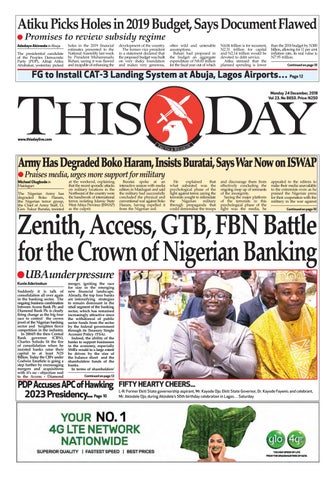
Atiku Picks Holes in 2019 Budget, Says Document Flawed Promises to review subsidy regime Adedayo Akinwale in Abuja The presidential candidate of the Peoples Democratic Party (PDP), Alhaji Atiku Abubakar, yesterday picked
holes in the 2019 financial estimates presented to the National Assembly last week by President Muhammadu Buhari, saying it was flawed and incapable of enhancing the
development of the country. The former vice president in a statement declared that the proposed budget was built on very shaky foundation and makes very generous,
often wild and untenable assumptions. Buhari had proposed in the budget an aggregate expenditure of N8.83 trillion for the fiscal year out of which
N4.04 trillion is for recurrent, N2.31 trillion for capital and N2.14 trillion would be devoted to debt service. Atiku stressed that the planned spending is lower
than the 2018 budget by N300 billion, allowing for 11 per cent inflation rate, its real value is N7.95 trillion. Continued on page 10
FG to Install CAT-3 Landing System at Abuja, Lagos Airports… Page 12 Monday 24 December, 2018 Vol 23. No 8650. Price: N250
www.thisdaylive.com TR
UT H
& RE A S O
N
Army Has Degraded Boko Haram, Insists Buratai, Says War Now on ISWAP Praises media, urges more support for military Michael Olugbode in Maiduguri The Nigerian Army has degraded Boko Haram, the Nigerian terror group, the Chief of Army Staff, Lt. Gen. Tukur Buratai, insisted
at the weekend, explaining that the recent sporadic attacks on military locations in the North-east of the country were the handiwork of international terror, isolating Islamic State West Africa Province (ISWAP) as the culprit.
Buratai spoke at an interactive session with media editors in Maiduguri and said the military had successfully concluded the physical and conventional war against Boko Haram, having expelled it from the Nigerian soil.
He explained that what subsisted was the psychological phase of the fight against terror, saying the terrorists sought to intimidate the Nigerian military through propaganda that could demoralise the troops
and discourage them from effectively concluding the ongoing mop up of remnants of the insurgents. Saying the major platform of the terrorists in this psychological phase of the fight was the media, he
appealed to the editors to make their media unavailable to the extremists even as he praised the Nigerian press for their cooperation with the military in the war against Continued on page 10
Zenith, Access, GTB, FBN Battle for the Crown of Nigerian Banking UBAunder pressure Kunle Aderinokun Suddenly it is talk of consolidation all over again in the banking sector. The ongoing business combination between Access Bank Plc and Diamond Bank Plc is clearly firing change as the big four race to control the crown jewel of the Nigerian banking sector and heighten fierce competition in the industry. In 2004/5 the then Central Bank governor (CBN), Charles Soludo lit the fire of consolidation when he insisted banks raise their capital to at least N25 Billion. Today the CBN under Godwin Emefiele is going a step further by encouraging mergers and acquisitions with it's no - objection nod to the Access - Diamond
merger, igniting the race for size in the emerging new financial landscape. Already, the top four banks are intensifying strategies to remain dominant in the retail segment of the banking sector, which has remained increasingly attractive since the withdrawal of public sector funds from the sector by the federal government through its Treasury Single Account Policy (TSA). Indeed, the ability of the banks to support businesses in the economy, especially SMEs would to a large extent be driven by the size of the balance sheet and the shareholders funds of the banks. In terms of shareholders’ Continued on page 12
PDP Accuses APC of Hawking 2023 Presidency... Page 10
FIFTY HEARTY CHEERS... L-R: Former Ekiti State governorship aspirant, Mr. Kayode Ojo; Ekiti State Governor, Dr. Kayode Fayemi; and celebrant, Mr. Akindele Ojo; during Akindele’s 50th birthday celebration in Lagos… Saturday
2
5 ) * 4 % ": t MONDAY, DECEMBER 24, 2018
5 ) * 4 % ": t MONDAY, DECEMBER 24, 2018
3
4
5 ) * 4 % ": t MONDAY, DECEMBER 24, 2018
5 ) * 4 % ": t MONDAY, DECEMBER 24, 2018
5
6
5 ) * 4 % ": t MONDAY, DECEMBER 24, 2018
5 ) * 4 % ": t MONDAY, DECEMBER 24, 2018
7
8
5 ) * 4 % ": t MONDAY, DECEMBER 24, 2018
5 ) * 4 % ": t MONDAY, DECEMBER 24, 2018
9
10
MONDAY, ÍşÍźËœ ͺ͸͚΀ Ëž T H I S D AY
PAGE TEN
PDP Accuses APC of Hawking 2023 Presidency Rejects tenure extension for IG Idris Nseobong Okon-Ekong in Lagos and Adedayo Akinwale in Abuja The Peoples Democratic Party (PDP) has accused the All Progressives Congress (APC) and the presidency of insincerity by promising both the South-east and South-west 2023 presidency in exchange for votes in 2019, dismissing it as a desperate bid to hang on to power. The main opposition party also rejected the possible extension of the tenure of the Inspector General of Police (IG), Mr. Ibrahim Idris, who is due for retirement on January 3, 2019, having served the Nigeria Police for 35 years. In a statement yesterday by one of its campaign spokespersons, Prince Kassim Afegbua, the main opposition party wondered how the president could be promising South-east the presidency when his vice president is also promising the South-west the same position in 2023. According to Afegbua, “In its
desperation to hang on to power despite its abysmal failure so far, the APC and the presidency have resorted to trading with the lure of 2023 presidency, promising both the South-east and South-west the 2023 presidency in exchange for votes.� Afegbua added, “This has exposed the insincerity and dubious intention of the Muhammadu Buhari-led federal government with his empty promise of bequeathing the presidency to the people of the South-east and South-west geopolitical zones in 2023.� He noted that this is why Nigerians cannot take the APC and the Buhari presidency serious any longer as the country prepares for the 2019 election. Afegbua noted that the Secretary to the Government of the Federation (SGF), Mr. Boss Mustapha, had told the APC campaign in Owerri, Imo State, while speaking on behalf of Buhari that the president would hand over the reins of power to the South-east, while calling
on the people to support the president. He added that Vice President Yemi Osinbajo had also told leaders of the South-west last week to support the re-election of Buhari so as to get the presidency in 2023. Afegbua stated, “Two principal officers of the same government cannot be fooling Nigerians with vain glorious promises all in the name of re-election. Such discordant tunes by the first and second citizens of our dear country have exposed lack of synergy, and display of double standard and double-speak by chieftains of a government that has continued to display wanton desperation to hold on to power at all cost in the face of monumental failure. “How can the president be promising South-east the presidency when his vice president is also promising the South-west same position in 2023, all in the name of 2019 re-election? “This is a clear show of deceit,
In another development, the PDP has rejected the possible extension of the tenure of Idris, who is due for retirement on January 3 next year, having served for 35 years. Idris, who joined the police in 1984, was appointed IG by President Buhari on March 21, 2016, replacing Mr. Solomon Arase, who retired from the police force on June 21, 2016. National Publicity Secretary of PDP, Mr. Kola Ologbondiyan, told journalists in Lagos yesterday that the main opposition party had rejected any attempt to extend the tenure of the IG, describing it as another ploy by the APC-led government to scheme the 2019 general elections in its favour. Ologbondiyan said Idris, who has been widely criticised for the perceived biased role of
his men and officers in the 2018 governorship elections in Ekiti and Osun States, might be retained “to continue the dirty jobs for the APC government during the elections scheduled to hold in February and March, 2019.� Ologbondiyan, who was accompanied by a colleague in the PDP Presidential Campaign Organisation, Mr. Umar Sani, revealed that the PDP was mindful of other moves by the APC to rig the elections. “PDP rejects any attempt to extend the tenure of the Inspector General of Police. Our party is aware that the IG has surrounded every commissioner of police with informants and these informants are also to attend political meetings where the commissioners are to participate. They are also to monitor the movement of the various commissioners,� he explained. The main opposition party urged the IG to insulate the Nigeria Police from partisan
politics, adding that from the body language of the president, it was manifestly clear that he was not interested in a free and fair election. “Look at the way the police commissioners in Akwa Ibom and Rivers States are being transferred, at the least complaint from the opposition APC in those states. We know that those relocation are at the prerogative of the Inspector General of Police, but there is more to it than meets the eye. Why is it that police commissioners in PDP-controlled states, who insist on applying the law without favour are quickly replaced?� he queried. Buhari had exercised a similar discretion last year when he extended the tenures of all service chiefs pursuant to the powers conferred on the President and Commander-inChief of the Armed Forces of the Federal Republic of Nigeria by section 218(1) and (2) of the 1999 Constitution as amended.� The current service chiefs were appointed on July 13, 2015.
at September 2018, only approximately 40% of projected revenues were realized by the federal government. Similarly, by December 14, 2018, only N820.57 billion was released for capital spending out of a projected expenditure of N2.652 trillion. This implied that only 31% of the capital budget was implemented. “This would impact negatively on growth, jobs and poverty. With such a dismal budget performance, the economy would not have had the capacity to grow, generate wealth and jobs. “Secondly, the 2019 budget is a business as usual budget. The federal government keeps repeating the same mistakes but expects different results. For example, although the current resource position remains precarious, government does not intend to introduce significant fiscal restructuring. Thus, in spite of dwindling revenues, subsidy on PMS will continue (US$1 billion is budgeted for that); “Government does not intend to introduce any reforms in the foreign exchange market as multiple exchange rates will be maintained - thus giving away between N300 billion and N800 billion to opportunists, rentseekers, middlemen, arbitrageurs, and fraudsters; and finally, the budget is overwhelmingly recurrent, with capital spending taking the back seat. “Thirdly, 2019 Budget is based on grossly exaggerated assumptions. They are not able to put in place any coherent and comprehensive policies to give hope that these assumptions can be met. The most laughable assumption is that real GDP will grow at 3.01 per cent. When indeed, GDP growth has been sluggish, with a projection of 1.9 per cent in 2019. The government cannot cut spending and expect the economy to grow. “Fourthly and very fundamentally, 2019 Budget is very small. The size of the budget
is not sufficient to stimulate growth of the economy, create jobs and alleviate poverty. The planned total expenditure of N8.83 trillion is lower than 2018 budget by approximately N290 billion. The federal government is contracting the economy whereas in a period of recession, governments must spend more to have meaningful impact on jobs and poverty. “The budget is also very low in relation to the size of the Nigerian economy, which is estimated at approximately N150 trillion. This means that the 2019 budget is barely 6% of GDP. (Compare Bangladesh 15.30%, India 12.74% and Afghanistan 11.9% in 2017). Again, this will have no meaningful impact on jobs and poverty.� Fifthly, Nigeria’s fiscal crisis persists and fiscal position of the federal government, and by extension, the states and local governments remains precarious. First, projected revenues of N6.97 trillion are three per cent lower than 2018 and second, the oil sector continues its dominance as it contributes 54% of the budget revenues. The non-oil sector is expected to contribute only 20 per cent of the budget revenues. There are no coherent and comprehensive plans to expand the resource horizon of the federal government. “Six, as has been with previous budgets, recurrent costs and debt service will take a lion’s share of the budget as against capital expenditure. Capital expenditure will be only 23 per cent of planned expenditure. On the other hand, 24 per cent of the budget will be spent on debt service and 46 per cent on overhead and personnel costs. Thus over 70 per cent of the budget will be devoted to recurrent costs and debt service. This will not grow the economy and create jobs.� Atiku said, “It is therefore putting it mild to say that the 2019 proposed budget is not developmental, will not pull Nigeria from the abyss and may,
indeed accentuate the misery and hopelessness the Nigerian people have lived with since 2015.� He therefore said that an Atiku presidency, in 2019, would present to Nigerians a people’s budget that will prioritise and focus on the twin challenges of unemployment and poverty. The former vice president noted that the-Atiku-Plan would accelerate growth rather than contract the economy to steer Nigeria out of recession and to create opportunities for our youth to be self-employed. He added further that Atiku presidency would improve the budgeting process to facilitate more effective budget impact on the economy by increasing, significantly, the share of capital expenditure in the budget to a minimum of 40 per cent in the first instance. According to him, “The-AtikuPlan recognizes that Nigeria’s current unprecedented fiscal crises, characterised by rising debt levels and revenue short falls, have resulted largely from APC-led government’s poor management of resources. “We shall therefore undertake significant fiscal re-structuring including a review of the current subsidy regime and of the monumental losses to the economy arising from leakages from the operation of the foreign exchange market, in order to channel resources into the critical sectors of the economy.�
desperation, crass insincerity and hypocrisy of the highest order.�
PDP Rejects Tenure Extension for IG Idris
ATIKU PICKS HOLES IN 2019 BUDGET, SAYS DOCUMENT FLAWED According to him, “The proposed budget as presented is fundamentally flawed. It deliberately ignores and fails to address current realities and pretends, as Mr. President asserts, ‘we are on the right direction.� Atiku added, “On the contrary, the 2019 budget is built on very shaky foundation and makes very generous, often wild and untenable assumptions, which pose significant risks to its implementation. It will be a disservice to the country if we ignore these fundamental flaws.� He said several inaccurate claims, which litter the budget document, was an attempt for the president to whitewash the regime and hide its monumental failure to improve, even minimally, the welfare and living standards of much of the population. The PDP presidential candidate described the rhetoric of ‘inclusive, diversified and sustainable growth’ as no more than an amplification of the All Progressive Congress (APC)-led government’s renewed propaganda to hoodwink the citizens into believing that there is ‘light at the end of the tunnel.’ The former vice president faulted Buhari's claim that his administration has recorded several successes in economic management, and that the economy has recovered from recession; while he also claimed that foreign capital inflows, including direct and portfolio investments, have responded to improved economic management. Contrary to the claim, Atiku stated, “In reality, the economy is yet to recover from the 2016/2017 recession as it remains severely stressed, extremely fragile and vulnerable to external shocks. GDP growth declined from 2.11 per cent in 2017 to 1.9 per cent in Q1 and to 1.5 per cent in Q2 of 2018. In Q3 of 2018 there was only a marginal increase of 0.3 per cent to 1.8 per cent.� “In its current form, the local economy is not dynamic enough
to journey to their so-called Next Level.� For the year 2019, Atiku stressed that a general slowdown in the real growth rates of economic activity in both the oil and non-oil sectors has been projected at 1.9 per cent by the World Bank. This rate, he said, is well below the 2019 budget projection of 3.01 per cent and is not enough to create the needed jobs for the growing population of the country or for the attainment of the SDGs. Atiku explained that as a sign of the weakness of the economy, the rate of unemployment has increased from 18.8% in 2017 to 23.1% in Q3 of 2018, adding that today, close to 20 million people are unemployed compared to 7.2 million people in 2014. He pointed out that these high rates of unemployment represent both a significant distortion in the economic system and a lost opportunity for critical national development and could potentially threaten social stability. Atiku noted, “Sadly, Foreign Direct Investment (FDI) is limited and is declining. In Q3, 2018 capital inflows were US$2.855.21 billion showing a decrease of 48.21% compared to Q2 2018 and 31.12% decrease compared to Q3 2017.� “Indeed, its current level is the lowest since Q2, 2017. Value of Foreign Portfolio recorded at US$1.7 billion represents a decrease of 58.2% compared to Q2 2018. It also represents a 37.7% decrease compared to the Q3 of 2017. “Finally, it is very significant to note that capital importation in 2014 (Q3) was US$6.5 billion and in 2018 (Q3) US$2.9 billion. This shows US$3.6 billion or 55% decline since the regime came into power.� Atiku said contrary to president’s assertion, capital importation actually shrinks, saying in reality the president
should expect no less, as it was under his watch and resulting from his actions or inactions, investor confidence in the economy has waned like never before in Nigeria’s history. The former vice president posited that Nigeria remains an uncompetitive economy as demonstrated by the recent World Economic Forum (WEF), Global Competitiveness Index, which positions Nigeria as 115th of 140 countries. He said the report showed that Nigeria has moved three places down, contrary to Mr. President’s claim that the country is moving in the right direction. Atiku said while the country has witnessed increases in gross reserves, he contended that the so-called ‘successes’ recorded did not emanate from any coherent and comprehensive economic policies of the federal government. He stated categorically that the ‘sustained accretion’ to foreign exchange reserves resulted from increases in international prices of Brent Crude and foreign borrowing, stressing that giving the country’s total dependence on the oil sector for foreign exchange earnings, any turbulence in the international oil market would lead to reversals. This, Atiku noted, cannot be counted as ‘success.’ The acclaimed ‘success’ was simply by the Grace of God. The presidential candidate, however, gave six reasons why the 2019 budget cannot place the economy on the path of inclusiveness and lift significant numbers of the citizens out of poverty. Atiku said, “Firstly, the 2019 is built on a very shaky foundation. It seeks to consolidate on the ‘achievements’ and ‘successes’ of the 2018 budget. However, the 2018 budget was itself poorly implemented. Actual revenue collected was only N2.84 trillion (as at September 2018) against projected revenue of N7.17 trillion. “This implied that as
ARMY HAS DEGRADED BOKO HARAM, INSISTS BURATAI, SAYS WAR NOW ON ISWAP terror. “The real situation on the ground is that in terms of the conventional war against insurgency, Boko Haram has been degraded,� he said, adding, “What we are dealing with now is international terror led by Islamic State West Africa Province.� According to Buratai, “The operational and physical war
has been contained. It is no more a physical war. It is a psychological war and they are using the media to wage it.� He said what was happening in the North-east was less of insurgency and more of crime, explaining that the trend had moved from local uprising to organised international terrorism. The Army boss said Boko
Haram having been effectively contained had yielding ground to ISWAP and warned that even when the new terror machine is defeated there are no guarantees that a new group would not emerge. “There are people somewhere pulling the strings, and what we have now is a psychological war with international terror dimensions,� Buratai said.
Appealing to the media not to yield their platform to the terrorists, he said, “My appeal to the media is to deny the terrorists access to propagate their dastardly acts. Giving them space in your media encourages them. It is the tonic they need to energise their followers, intimidate the public and demoralise troops.�
He praised the media for what they had done so far in the coverage of the war against terror even as he requested for less dramatization of the activities of the terrorists. Buratai responded to media complaint of slow response to enquiries, explaining that it was the nature of the military to Continued on page 12
TOP GAINERS DOUBLE11 UACN NEMINSURE NEIMETH FORTOIL TOP LOSERS VERITASKAP LASACO REGENCY
NGN NGN 16.80 184.80 1.00 11.00 0.25 2.78 0.07 0.79 2.50 28.45 NGN 0.02 0.23 0.02 0.30 0.01 0.20 ROYALEXCHANGE 0.01 0.20 TRANSCORP 0.06 1.20 HPE Nestle Nig Plc â‚Ś1,470.10 Volume: 193.538 million shares Value: N3.665 billion Deals: 2,992 As at Friday 21/12/18 See details on Page 39
% 10 10 9.8 9.7 9.6 % 8.0 6.2 4.7 4.7 4.7
5 ) * 4 % ": t MONDAY, DECEMBER 24, 2018
11
12
MONDAY, ÍşÍźËœ ͺ͸͚΀ Ëž T H I S D AY
NEWS
Foreign Portfolio Investments Drop by N94bn in Q3 Obinna Chima Foreign Portfolio Investors (FPI) withdrew more than N94.4 billion between July and September 2018 from the Nigerian Stock Exchange (NSE), THISDAY has learnt. THISDAY, however, gathered that the amount may rise further following last week’s decision by the United States Federal Reserve to once more hike interest rates despite calls by President Donald Trump for Fed to stop raising interest rates. The Fed rate hike, the fourth this year, had pushed the US central bank’s key overnight lending rate to a range of 2.25 per cent to 2.50 per cent. A member of the Central Bank of Nigeria’s Monetary Policy Committee (MPC), Mr. Robert Asogwa, confirmed the withdrawal of the N94.4 billion in his personal statement at the recent MPC meeting, according to a data posted on CBN website. Following this development,
Asogwa noted that capital inflows have declined consistently especially since 2018, while outflows have more than doubled during this same period, thus making external financing more challenging in Nigeria. He said, “There have been sharp declines in inflows, especially for portfolio investments and Foreign Direct Investment (FDI). “Between July and September 2018, foreign portfolio investors withdrew more than N94. 4 billion from the Nigerian Stock market alone. “These movements have been attributed to the monetary policy normalisation process in some advanced economies, which has seen interest rates in places like the USA increased for three times in 2018.� According to him, besides, the usual investors fear about the 2019 general elections may have also been a contributing factor. He pointed out that given
that monetary policy forecasts for 2019 in many advanced economies suggests policy rate increases, “the capital flow position in Nigeria may possibly worsen in the near future.� Asogwa said the US Federal Funds rate had been anticipated to reach 3.5 per cent by end of 2019, while the prevailing zero rates in the Euro Areas was expected to move a bit higher by mid-2019. He added that the return of frequent volatility in the oil market was already putting pressure on commodity exporting countries like Nigeria. According to him, there are still expectations that prices may drop further in the early months of 2019. He added, “CBN staff report shows that the NPL ratio, which has risen to 14.70 per cent in August 2018 had declined to 14.05 per cent in October which signals improvement even though it is still above the allowed
prudential maximum thus requiring comprehensive NPL reduction strategies from the banks and the regulators. “In addition, the modest improvement in the Capital Adequacy Ratio (CAR) and the Profitability Indicators (ROE and ROA) in October as compared to August shows that the financial sector weaknesses which was a key concern at the last MPC meeting of September are partly being halted.� In her contribution, the Deputy Governor, Financial System Stability Directorate, Ms. Aisha Ahmad, said even though there was need to brace for a tough year ahead, it was also imperative to consolidate on the price stability gains on the monetary side by stimulating stronger and more resilient Gross Domestic Product growth. This, according to her, calls for a policy stance that achieves price stability conducive to economic growth. She said, “As we approach 2019, new downside risks are
emerging as existing risks continue to intensify. Slowing global demand and growth projections, volatile oil prices, and sustained monetary policy normalisation in the US, have implications for exchange rate stability and by extension, price and monetary stability. “In addition, the upcoming general elections and unintended but largely contractionary fiscal environment due to the delays in passing the 2018 budget, also have implications for sustained economic recovery and growth.� On his part, another MPC Member, Mr. Dahiru Balami, pointed out that there was threat to exchange rate stability due to the pressure on external reserves as well as increase in capital outflow. He noted that capital outflows accelerated due to lack of instruments for foreigners to invest in. “Price stability is better achieved if we can prevent exchange rate volatility through
proper management of external reserves. “The exchange rate market is largely affected by the volatility of the oil price and the level of domestic production,� he said. To the Deputy Governor, Economic Policy Directorate, CBN, Dr. Joseph Nnanna, despite significant pressure from non-performing loans, systemically important top-five banks in the banking industry, which account for over 50 per cent of total banking sector assets, revealed soundness of their financial system. He explained, “Overall, credit to the core private sector has leveraged on the emerging positive sentiments, and the lull in government borrowing, to increase by 2.20 per cent in September 2018 and 2.93 per cent annualised. “Net credit to the government contracted by 6.25 per cent in September 2018 over the level at endDecember 2017, representing an annualised decline of 8.34 per cent.�
FG to Install CAT-3 Landing System at Abuja, Lagos Airports Kasim Sumaina in Abuja The federal government has hinted that Category 3 (CAT3) Landing System, a landing system at zero visibility level by airplanes, will be installed at the Nnamdi Azikiwe International Airport, Abuja (NAIA), and Murtala Muhammed Airport (MMA) in Lagos by January 2019. The Managing Director of the Nigerian Airspace Management Agency (NAMA), Capt. Fola Akinkuotu, said this on the sidelines of the inauguration of the new NAIA terminal, held recently in Abuja. He said, “As it is, we have the Instrument Landing System (ILS) Category 2, which allows us to fly at some reduced visibility and we would be able to fly lower than Category 1 ILS.
"It will interest you to know that, approval has been given; contracts have been awarded and construction has started for the installation of the Category 3 landing system. I think before the end of January, it will be ready. We are planning this category of ILS on Lagos and Abuja airports for a start and the next point of call will be Kano." Speaking further, he said, "There are different categories of Category 3; there is category A, B and C but in any of these categories, an airplane should be able to land at a very poor visibility. With Category 3 A, B or C, you should be able to land at a very marginal weather but with a certain category you can land. "We are close to achieving a higher level of landing
navigational aid in Abuja. Except for some bureaucratic bottlenecks, we should have had a CAT-3 landing system here, which will improve our capability to land airplanes in very poor visibility." He explained further, "We have always been ready. When you have increased traffic that means more airplanes will come in and so we have to provide more manpower which we are doing in terms of air traffic controllers. "We are planning to improve and actually, we are close to achieving a higher level landing navigational aid in Abuja in anticipation of the new international terminal. To a good extent, we have foreseen the possibilities that we are seeing today and we will be able to match whatever are
the demands.� The NAMA boss stated that, "First, let us look at the pilots and their training for low visibility approaches. It is not just one training that you will conduct for them. It is a training that you have to do all the time, usually every six months. "There is no point in starting to learn how to do low visibility approaches when the equipment is not there. And don’t forget that uninterruptible power supply is vital. "Yes, there is a plan actually for an independent power system for these major airports and FAAN (Federal Airports Authority of Nigeria) provides the lights as they have been told. So by and large, once the system comes in, everybody will move up to speed."
He argued that it is not only NAMA that will have to prepare, adding that, other people will have to be prepared because installing a Category 3 will require that everyone improve on their own capabilities. "We must have an uninterruptable power supply; the airplane will have to be properly equipped; the pilot would have to be properly trained for low visibility approaches and our approach light would have to meet category 3 but the starting point is to ensure that we have it and everybody have been sensitised of what is coming for us to be able to take full advantage," he said. Speaking on the design of NAIA, he stressed that, in the conceptualisation and design of
the terminal building, there were some kinds of flaws that were observed that the terminal as it were designed, made it difficult for the control tower to see in totality or to have a complete aerial view of the two end of runway. According to him, "This will be fixed in medium term because with the adjustment of the masterplan, we will achieve that. However, since it is a necessity for the air traffic controller to be able to have visible access to both ends of the runway, we provided a mobile tower. "NAMA will continue to improve on the services that it provides and we want to achieve our category 3 ILS in major airports in 2019 and improve our aeronautical information system."
shareholders’ funds increased to N625.167 billion in the review year from N504.902 billion of the previous year.
Access Bank recorded a profit before tax of N80.072 billion as at December 31, 2017 which dropped from N90.339 billion of the previous year. Also, profit
after stood at N61.990 billion in 2017, having decreased from N71.439 billion. Besides, assets grew to N4.102 trillion in 2017 from N3.483 trillion in 2016, while the shareholders’ funds also increased to N515.447 billion from N454.494 of the previous year. If the merger with Diamond Bank is finalized, these numbers would definitely change and may see the bank emerge as the largest bank in the continent in terms of customer base. This does not include the value after the Diamond Bank acquisition, which is still in process. Following the acquisition, Access Bank Plc has obtained regulatory approvals for it to raise a fresh $250 million (N90 billion) tier II capital and has also obtained “no objection� from the Central Bank of Nigeria (CBN) to undertake a rights issue to raise up to N75 billion ($207 million) before the end of first quarter of 2019.
would have demoralising effects on the soldiers.� Buratai also spoke about the funding and equipment available for the war against terror and said the federal government was doing its best within the resources available to the country. “No Army can have all it needs for its operations. I say to you that the federal government is doing its best and we are
optimising what we have to do the job the nation has given us to do,� he said. With Buratai were the first General Officer Commanding (GOC) 7 Division, now Chief of Training and Operations, Maj. Gen. Lamidi Adeosun, and the Theatre Commander, Operation Lafiya Dole, Maj. Gen. Benson Akinroluyo, as well as sector commanders and officers of the operation in the North-east.
ZENITH, ACCESS, GTB, FBN BATTLE FOR THE CROWN OF NIGERIAN BANKING funds, Zenith Bank still maintain the lead in Nigerian banking with N822 billion. It would be closely followed by the combined entity that would emerge from the Access-Diamond deal as their combined results as at the end of December 31, 2017, was a total of N738 billion; FirstBank has N678 billion and GTBank N625 billion in shareholders' funds. Other banks in the middle will now be under pressure to merge or acquire others for size and a brave new banking world emerges as the merger between Access Bank and Diamond has given the lenders N5.817 trillion in asset size as at December 31, 2017 and Access Bank would become the country’s largest bank by asset size. It would be followed closely by Zenith Bank, whose total assets stood at N5.595 trillion as at December 31, 2017; FirstBank – N4.949 trillion and GTBank N3.351trilion, in that order.
Similarly, a review of the profit before tax in the banks showed that Zenith Bank still maintains the lead with N203 billion as at December 31, 2017. It was closely followed by GTBank at N200 billion and and UBA's N103Billion. Access Bank then follows at N80 billion (Diamond recorded a loss of N11.547 billion in the period under review). With the emerging new banking order, UBA is now under pressure to find growth in the market place if it is to belong to the Big Four. No doubt, the Nigerian banking industry, in recent times, has witnessed relative improvement, but not without its attendant challenges. Obviously, the challenges in the global economy have either direct or indirect impact on the Nigerian economy and particularly, the banking sector, which is the lifeblood of the economy. For instance, the vagary in the
prices of oil at the international market has taken its toll on the bottom-line of some of the banks in the country. Despite these challenges, the tier 1 banks have remained unruffled by the storms and still stand tall, towering above their peers. They control the chunk of the market share as well as in terms of profitability, assets and shareholders’ funds. Among the four banks, they compete for the topmost position; they battle for the soul of the banking sector.
Zenith Bank The audited statement of account and financial results of Zenith Bank as the yearended December 31, 2017, showed that the bank made a profit before tax of N203.461 billion, a significant increase from N156.748 billion of the previous year. Consequently, the bank reported a profit after tax
of N177.614 billion, which represented a growth of 37.22 per cent over N129.434 billion in 2016. The bank’s assets also grew to N5.595 trillion in the review year from N4.739 trillion of the previous year. Shareholders’ funds stood at N821.658 billion as at December 31, 2017, representing an increase of 16.64 per cent over N704.46 billion in the previous year.
GTBank As at the year-ended December 31, 2017, the audited statement of accounts and financial results of GTBank revealed that it posted profit before tax of N200.242 billion, which represented an increase of 21.25 per cent over N165.136 billion in 2016. Profit after tax stood at N170.5 billion in the review year from N132.280 billion. The amount translated to growth of 28.89 per cent. The bank’s total assets grew to N3.351 trillion in 2017 from N3.116 trillion in 2016, while the
FirstBank For FirstBank, profit before tax stood at N56.825 billion as at December 31, 2017, having grown from N22.948 billion in the previous year. Profit after tax was N40.011 billion in the review year, a significant increase of 226.8 per cent from N12.243 billion. Asset grew to N5.236 trillion in 2017 from N4.736 trillion in the previous year. The bank’s shareholders fund spiked to N678.192 billion in the review year from N582.575 billion in the previous year.
Access Bank
ARMY HAS DEGRADED BOKO HARAM, INSISTS BURATAI, SAYS WAR NOW ON ISWAP be cautious in disseminating information, particularly about causalities, adding that apart from the need to ensure accuracy, there were also national security implications that would have to be considered. “We have procedures in the military, which may not accord with your need for timely response to request for information. But I assure you
that our policy is openness, and all I appeal for is your understanding, knowing full well that we have nothing to hide at all times,� he said. The military had come under heavy criticism over its handling of information on recent attacks on 157 Task Force Battalion at Metele, on the fringe of Borno State, where 23 soldiers were killed by Boko Haram. It took the Army almost
a week before it clarified the casualty figures. But the Army boss explained that it was not deliberate, saying military procedures required that they do proper checks and account for troops before making pronouncements, saying these take time to conclude. He assured that the army took the welfare of troops seriously, denying any iota of truth in speculations
that soldiers’ salaries and emoluments were being compromised by the military high command. “No officer would dare such a thing. We take issues of welfare of troops very seriously and deal decisively with any infraction in that regard,� he said, appealing against further publication of such speculations because “portraying the officer corps as corrupt and uncaring
5 ) * 4 % ": t MONDAY, DECEMBER 24, 2018
13
14
T H I S D AY Ëž Ëœ Í°Í˛Ëœ Í°ÍŽÍŻÍś
COMMENT
Editor, Editorial Page PETER ISHAKA Email peter.ishaka@thisdaylive.com
OLAMIDE’S‘POVERTY DIE’PRAYER AND THE ECONOMY Oludayo Tade urges Nigerians to vote wisely in the forthcoming elections
M
usicians of the hip-hop genre are becoming prophetic and doing their best to read the mood of the country. They not only reproduce individual anxieties in musical form but also embellish institutional failures and speak about the arrow heads that made suffering an inevitable daily food which Nigerians down the ladder are forced to consume. In 2018, Nigeria levitated into the glorious rank as the leader of the poor in the world. We are also witnesses to the failure in the economy which has left many Nigerians dwellers in the dungeon of lack and hopelessness. Gladly the ‘fixer’ has finally own up that the economy is in bad shape despite years of denial. The one who is supposed to provide electricity and fix roads has further confirmed the mannerism of blame-game characteristic of the broom government. While a few successes were recorded, costly policies and indecisions have had negative consequences on the masses. This is why poverty is today freely sighted on the road and in the closets of many households. Even if the government ordered the Statistician General of the Federation to include jobs allegedly created in the informal agriculture sector to shore-up the unemployment figure which it thinks is embarrassing, will that obliterate the loss of millions of jobs in the formal sector since 2015? Realising this fact, the President wants us to give him more time, pray for his government, and at the same time tighten our already sagging waistline. Religion has become instrumentalised in Nigerian politics and what we deliberately failed to do, we give spiritual explanations. The ember months are period of evaluation of successes and failures. Nigerians who were promised change must be embittered by the twist of fate in their fortunes. They must be wondering why only sand has been swept by the broom into their Garri while the two wise men in Aso-villa hold the country by the jugular. Since January 2018, Nigerian youths have been unperturbed by their description as lazy cohorts looking for freebies. Despite losing their jobs, they still engage in different businesses to make ends meet to conquer poverty and send it packing from their lives. But still, poverty is biting harder and deeper. Like the government and many poor Nigerians, young and old, popular musicians in Nigeria too are turning to God. Olamide, the one popularly called Baddo released a single he titled “Poverty die�. In poverty die, Olamide introduces Pentecostal warfare prayer characteristic of Pentecostal Christianity to kill poverty. Olamide sees poverty as a living thing which must be killed for successes to be recorded individually and collectively. It follows therefore that what we lack, that is, our poverty situation, has assumed a life of its own which grows and threatens our livelihoods and survival. Realising the rising level of kidnapping, armed robbery, and killings in the northeast Nigeria, Olamide says we invoke the power of God and not the assurances of the army, the presidency and ‘transmission’ of the police. Therefore, when spiritual security is active, the poverty of insecurity must die. He says “when I wake up, no be by my power oo, Oluwa lo kuku so wa o (The Lord is the one guarding us) I go down on my knees and thank God ooo. Poverty Die die die die, Poverty die die die� Olamide invokes the Supreme Being not to allow bad-luck near our dwelling (Country). By implication it amounts to being unfortunate to be governed by wicked people since bad governance is poverty. It is bad-luck to vote terrible people using umbrella to cover themselves and tracks while others sweep fortunes to themselves and sadness to
THE EMBER MONTHS ARE PERIOD OF EVALUATION OF SUCCESSES AND FAILURES. NIGERIANS WHO WERE PROMISED CHANGE MUST BE EMBITTERED BY THE TWIST OF FATE IN THEIR FORTUNES
others. To Olamide, it is ill-luck to be governed by people who usher in penury into the life of the ruled. This condition must die. Nigerians want bad-luck, penury, cash-less conditions to die in their lives. Hence, you see them in churches with warfare prayers to kill poverty in their lives. As Baddo voiced these; “I dey hustle make the poverty japa ooo. K’oriburuku ma lo ya ile wa ooo (let bad-luck not stop by our house). Poverty Die die die die, Oriburuku ji nasi ‘le mi, (Bad-luck, go far away from my house) airina ji nasi’le mi (Penury, go far away from my house). Ailowolowojina sile mi (cash-lessness get far away from my dwelling)�.Agreeably, bad governance in Pentecostal parlance is an affliction. Pretentious leadership is a plague. Meanwhile, like Adam’s blame game on God for giving him Eve who persuaded him to eat the forbidden fruits, the broom party go all down low with accusation of Goodluck Jonathan for their complicit late cabinet composition. With incoherent spoke-persons and the President loyal to the colonial homeland, the government distances itself from the ‘poverty’ situations at home. Thus, while people go to church and mosque to pray for the country, the topmost prayer should be to make their lives better and all those making their lives hellish should be removed by Holy Ghost fire! Burning enemies and poverty situations have become common prayer points which dominate Pentecostal Christianity. Folding Olamide’s warfare prayer song into the election season helps to understand the importance of undoing bad decisions of the past, revising ones positions and stance and deciding whether to continue trekking on poverty tracks of the umbrella and the broom or negotiate new deal with emerging stakeholders. Taking this decision sets the tone for the 2019 elections. This decision making moment accounts for why marriage and divorce become preponderant in the last quarter of the year. Men and women in violent relationships decide to go separate ways this time of the year because no danger must ride with them into the New Year. Ironically, it is the same period others are tying nuptial nuts. It is interesting to note that just like fake progressive politicians are sweettalking Nigerians to vote them in 2019 as the messiah, the woman that ends in abusive relationship was also sweet-talked into believing she decided rightly. But an innate quality in discerning human being is standing up when one has fallen and never to be cajoled again. In ‘Poverty die’ Olamide invites Holy Ghost fire to consume all the problems and burn them. The consequences of ‘poverty’ in its manifestations are telling in today’s Nigeria that even the blind can see it. Lack of good leadership is a poverty condition that remakes the fortune of a country for the worst. It makes the beautiful person ugly. Apart from lack of committed, empathetic and truthful leadership, Nigerians die in droves due to death health centres while students spend their prime at home owing to unwillingness to invest in public education. But as Olamide describes ‘poverty’ as his ‘ex’, Nigerians can undo these selfish messiahs in 2019. Olamide’s ‘Poverty die’ is metaphorically mirroring ills and the instrumentalisation of the spiritual to counter the physical. To end poverty of poor health infrastructure, bad economy managers, poor public education investors and clannish in decision takers, Nigerians must use their votes to kill the ambitions of human afflictions in the polity. Dr Tade, a sociologist sent this piece via dotad2003@yahoo. com
AKWA IBOM 2019: BETWEEN MIGHT AND WILL Udom Emmanuel enjoys the support of his people, writes Ufot Essien
F
or close observers of events unfolding in Akwa Ibom State of late, the forth-coming general elections in the state, particularly the Governorship, would apparently be nothing more than a test of strength between the ‘federal might’ and the will of the people, which for this purpose, we will call ‘the people’s might’. For those acquainted with the political scenario of the state, it is not uncommon to hear politicians boasts: ‘Akwa Ibom is PDP and PDP Akwa Ibom’ or ‘In Akwa Ibom, PDP is a religion’. And for all you care, it is not an empty boast, though since the advent of the ‘Uncommon Defection’ when the former governor of the state Senator Godswill Akpabio defected to the ruling party at the centre - the APC, there have been deliberate – some would say desperate - attempts to create a distorted impression that the APC, the only noticeable opposition in the state, is now at par with the PDP. Nothing could be far from the truth. The picture on ground confirms this to be a far cry from the reality. For instance, a cursory look at the state’s representation at the National Assembly, even from inception of the fourth Republic in 1999 to date, will show the state to be the traditional homestead/stronghold of the PDP. More specifically, between the Sixth Parliament (2007 - 2011) and the present Eighth Parliament (2015 2019), records show that all the representations of the state at the National Assembly – both at the Senate and the House of Representatives, came from the PDP. In other words, all the representatives of the people at the federal legislature, came from the platform of the PDP. These
include Senators Alloysios Etok, Effiong Bob and Eme Ufot Ekaette (Sixth Parliament), Alloysios Etok, Ita Ennang and Helen Esuene (Seventh Parliament) and Godswill Akpabio, Bassey Albert and Nelson Effiong (Eighth Parliament). Though Akpabio and Effiong only recently defected to the APC, the fact remains that the entire representation from the state at the Lower House, still retain their PDP status; which among other factors, gives a lie to any attempt to create an impression of APC, PDP parity in the state. What more can drive home this truth more forcefully than the fact that all the 27 members of the State House of Assembly equally emanated from the platform of the PDP until five of them, for reasons best known to them, chose to defect. Even at that, the House still maintains its PDP dominance. Need we also point out that the 31 elected local government chairmen of the state are all from the PDP, thus leaving the entire local government structure in the state 100 per cent in the hands of the PDP? Aside all these, run through a catalogue of Who’s Who in the politics of the state and you’ll be left in no doubt about which of the contending parties has the upper hand. Therefore, in a way, those who say ‘Akwa Ibom is PDP and PDP Akwa Ibom’ or whatever slogan they choose to use to express this dominance, may not be far from the truth. This picture notwithstanding, since the ‘uncommon’ defection and the threat of Warsaw; worsened by the resultant attempt by the five sacked members of the State Assembly to take over the House – an incidence interpreted by many as the forerunner of Warsaw – the fear of the federal might has become
even more palpable. Warsaw itself, many have come to realise, was only a synonym for federal might. What’s more? The response to that event by the APC-led federal government has not, in any way, helped matters but has rather concretised the fears about the federal might. Come to think of it, while the erstwhile Commissioner of Police James Abang was removed for apparently stopping the illegality of five sacked members from taking over control of the House of 27 members, the new CP was hailed for aiding the five gain access to the hollow chambers to conduct the ‘unholy’ business of electing a ‘new’ speaker under the watch and supervision of the Nigerian Police. As at the time of putting together this report, there were fresh fears of a planned invasion of the Assembly by the five sacked members. In a way, another episode of the Warsaw plot. Today, contrary to the reign of peace that has enveloped the state since the Udom Emmanuel administration took over, strange things are beginning to happen. Only recently, a popular blogger in the state was clamped into Police detention in what the authorities say was ‘order from above’; an incident which the media community in the state has since dismissed as a ‘strange media clampdown’. Similarly, the freedom that residents of the capital city have been enjoying since the peaceful reign of the Emmanuel administration started, has begun to give way as men of the Nigeria Police has started a stop-and-search on all vehicles and you would hardly drive out any time from 8pm without encountering the men in uniform. For now, delicate calm pervades the entire state that had, hitherto, enjoyed tremendous peace and
security. But for those leading the ‘federal troops’, they may have met their equal in the governor who is emboldened by the massive support he has enjoyed from the people otherwise referred to as the ‘people’s might’. Recall that the governor, following perceived – some would say glaring – partisanship by the Police in the handling of the State Assembly incidence, has since called for the removal of the new Police Commissioner, meaning the new CP may not enjoy the confidence of the large majority of Akwaibomites. Interestingly, Akwaibomites may not be alone in sensing the threat ‘from above’ as even the irrepressible Governor Nyesome Wike of Rivers State has repeatedly raised the alarm that the APC-led federal government was desperate to ‘take over’ Akwa Ibom State and his state, Rivers. This is in the face of an equally repeated pledge by President Muhammadu Buhari to supervise over free and fair elections come 2019. But does the body language match the spoken language? Unperturbed, the people, as it were, have seemingly resolved to take their fate in their hands and stand by their governor, against all odds. And, several things work for the governor. For one, Emmanuel has cut out for himself the picture of a man his people can trust. His words and his deeds run in the same direction. But more important, the governor has proven himself as a very efficient and effective administrator. In the face of lean resources, he has, through the public-private sector partnership (PPP), created over 12 giant industries in three years with more and even bigger ones in the kitty. Essien wrote from Uyo, Akwa Ibom State
15
T H I S D AY MONDAY, DECEMBER 24, 2018
EDITORIAL Nigeria’s Troubled Economy The states should be allowed to exploit and manage their resources
A
fter a session over the lingering minimum wage for workers, members of the Nigeria Governors’ Forum (NGF) met briefly with President Muhammadu Buhari last week and he told them the obvious: the country’s economy was in “bad shape.” The president urged the governors, according to the chairman of the forum and Governor of Zamfara State Abdulaliz Yari, to buckle up, tighten their belts and work on their decayed infrastructure. The poor state of the economy is not open to debate. The president was only emphasising the worries that have preoccupied many critical stakeholders for quite a while. The prevailing economic downturn has worsted the capacity of both the state and individuals so much so that basic necessities of life, including food and healthcare are becoming luxuries. Perhaps nothing describes the situation better than the revelation, earlier in the year, that Nigeria has overtaken India as the country with the most number of citizens living in extreme poverty. Living in extreme poverty, by the parameters set by the World Bank, means living on less than $1.90 per THERE IS AN URGENT day. NEED TO OVERHAUL THE Almost everywhere is grim. CURRENT RESOURCE Figures available MOBILISATION AND ALLOCATION MODEL IN paint a dire situation millions of idle ORDER TO ALLOW THE of youths condemned COUNTRY EXPLORE to the street corner AND EXPLOIT ITS FULL and economically ECONOMIC POTENTIAL inactive. Last week, the National Bureau of Statistics (NBC) reeled out figures confirming the consistent pattern of worsening unemployment in the country, rising from 9.9 per cent in 2015 to 19.70 per cent in the last quarter of 2016 to 23.1 per cent in the third quarter of 2018. In real terms, some 21 million Nigerians, nearly as large as the population of Cote d’Ivoire, are idle and create huge social problems out there in the streets.
Letters to the Editor
A combination of sustained negative economic growth and an uncontrolled demographic bulge has put the country in a very difficult and potentially explosive situation. Indeed, harping on the danger in the air as a result of economic failure and lack of planning, former President Olusegun Obasanjo said recently that his greatest fear for Nigeria was “youth explosion as a result of anger, frustration, unemployment and lack of opportunities.”
T
T H I S DAY EDITOR BOLAJI ADEBIYI DEPUTY EDITOR DAVIDSON IRIEKPEN MANAGING DIRECTOR ENIOLA BELLO DEPUTY MANAGING DIRECTOR KAYODE KOMOLAFE CHAIRMAN EDITORIAL BOARD OLUSEGUN ADENIYI EDITOR NATION’S CAPITAL IYOBOSA UWUGIAREN MANAGING EDITOR JOSEPH USHIGIALE
T H I S DAY N E W S PA P E R S L I M I T E D EDITOR-IN-CHIEF/CHAIRMAN NDUKA OBAIGBENA GROUP EXECUTIVE DIRECTORS ENIOLA BELLO, KAYODE KOMOLAFE, ISRAEL IWEGBU, IJEOMA NWOGWUGWU, EMMANUEL EFENI DIVISIONAL DIRECTORS BOLAJI ADEBIYI, PETER IWEGBU, ANTHONY OGEDENGBE DEPUTY DIVISIONAL DIRECTOR OJOGUN VICTOR DANBOYI SNR. ASSOCIATE DIRECTOR ERIC OJEH ASSOCIATE DIRECTORS PATRICK EIMIUHI, SAHEED ADEYEMO CONTROLLERS ABIMBOLA TAIWO, UCHENNA DIBIAGWU, NDUKA MOSERI DIRECTOR, PRINTING PRODUCTION CHUKS ONWUDINJO TO SEND EMAIL: first name.surname@thisdaylive.com
TO OUR READERS Letters in response to specific publications in THISDAY should be brief (150-200 words) and straight to the point. Interested readers may send such letters along with their contact details to opinion@thisdaylive.com. We also welcome comments and opinions on topical local, national and international issues provided they are well-written and should also not be longer than (9501000 words). They should be sent to opinion@thisdaylive.com along with the email address and phone numbers of the writer.
THE APC IN PANIC MODE
DEAR SANTA, I’M PART OF THE PROBLEM
I
n the past, I used to ask myself, “What has Nigeria done for me?” But these days, there is usually guilt when that thought intrudes. There is now the thought of, “What have I done for Nigeria?” I have come to understand that I have been a part of the Nigeria problem. I have been more interested in taking from the country than in giving to it. I have been fiercer in criticising the country than in delivering solutions to its challenges. And I have expressed more passion for sentimental nothings than for real issues. The bigger problem is that there are many of us citizens who are more interested, like me, in taking from the country than in giving to it, and who are imbued with ethnic and sectional passion. But I hope Santa Claus helps deliver this memo to many Nigerians like me. Nation-building is not about building infrastructure. It is not about allocating projects to a section of the country to appease them. It is not about giving people from a certain ethnic stock federal appointments to pacify a region or group of people. It is not about distribution of state resources, even though that is inclusive. It is about the people coming into a peaceful accord with one another; treating one another fairly; respect-
he situation in so many states is so dreary that they can neither meet their routine obligations of paying salaries nor embark on any meaningful development projects. And in the process, many of the states, like the government at the centre, have piled up debts, and servicing them has become a major source of drain. In addition, the large-scale insecurity across the nation, particularly in the Northeast, has necessitated that huge sums be budgeted for security to the detriment of development infrastructure in education, health and other social services. Unfortunately, the response from the government to these challenges remains incoherent. Even with all the noise about diversification of the economy from oil to agriculture, the tilt is still towards heavy government participation. Perhaps even more worrying is the epileptic power supply. After almost four years of the change administration, it can hardly keep the lights on. At a period energy alone accounts for about 30 per cent of the operating cost of businesses and running individual households, the sector has made it difficult for businesses to be done profitably. Foreign direct invests are dwindling. As we have stated here in the past, there is an urgent need to overhaul the current resource mobilisation and allocation model in order to allow the country explore and exploit its full economic potential. Besides, the demand for new wage cap reopens the debate on the need to restructure not just the nation’s federalism but also its fiscal template. Indeed, the argument for states to be allowed to exploit their natural resources and manage them to meet the needs of their people have become more compelling just as the need to make education more relevant to the society.
ing one another’s views, religion, beliefs, culture and political leanings. It is about the people understanding their differences and protecting the other’s right to be different. It is true; leadership plays a pivotal role in fostering unity and in nation-building. But leadership will fail if the people are unwilling to build the nation. That an Igbo man calls a Hausa man “aboki” is symptomatic of latent resentment; that a Hausa man calls an Igbo man “Nyamiri” is also symptomatic of the same. What can the government do in this case? It is up to citizens to build that country they desire. And it starts by ending stereotypes, needless conspiracy theories and imaginary plots. It also starts by giving – thoughts, time, energy – to Nigeria. In conclusion, the government should consider framing a policy to encourage inter-ethnic marriage. The government should be intentional about this. Marriage is an adhesive; it will help in bonding families and cementing ethnic ties. In the old world, kings often give their daughters in marriage to other kingdoms to hold the peace and to solidify international relationships. This may appear simplistic; but I do not think anyone will want to take up arms against his in-laws. I will be better for Nigeria. Fredrick Nwabufo, fredricknwabufo@yahoo.com
P
anic is easy to detect. People start sweating. They feel nauseous. Their heart starts to beat at an incredible rate. Then they stop thinking straight. They become paranoid. They make decisions based on emotions instead of rationality. It is very important that when you meet someone suffering a panic attack that you help them, attend to their needs and see they receive medical treatment immediately. But what can you do when a whole party starts to panic? When the system itself is afraid of the political competition and starts to see enemies everywhere, making up threats to national security? Well, then you can’t just help them and call a doctor. All you can do is raise awareness. The recent allegations by the Coalition for Nigeria about a Trumpesque cabal targeting our 2019 elections left me quite speechless. Not only did it provide zero evidence, it didn’t even make sense. First, the geo-political level: It is obvious the Russians have an interest in the United States. Nigeria? I remain sceptical. China, yes; the United Kingdom, for sure. But unfortunately, since the end of communism,
Russia hasn’t cared much about Africa. Second, the strategic level: We all know that President Buhari has filled every vital post in his administration with people who are very close to him or in his pocket. And his pockets are indeed deep. Are there any PDP sympathizers left in INEC key positions? It’s hard to imagine. Last, but not least, the practical level: An opposition party rigging the elections? That’s absurd! They have neither the power nor the means to accomplish such a feat. How exactly would the opposition rig the election, even if they wanted to? Everybody knows that only the governing party has influence over the electoral bodies. Let’s all take a deep breath, let the panic pass and see clearly: This is a smokescreen. A pathetic attempt at distracting the masses from the real issue – which is the fact that President Buhari has lost all support and is facing crushing defeat. This is the story that he doesn’t want you to talk about. Let’s not do him that favour during the campaign. Keep calm and see through the smokescreen. Lawrence Gemade, Abuja
16
5 ) * 4 % ": t MONDAY, DECEMBER 24, 2018
5 ) * 4 % ": t MONDAY, DECEMBER 24, 2018
17
18
T H I S D AY Ëž Ëž ÍşÍźËœ ͺ͸͚΀
Group Politics Editor NSEOBONG OKON-EKONG
Email: nseobong.okonekong@thisdaylive.com 08114495324 SMS ONLY
M O N D AY D I S C O U R S E Mix of Unmet Changes, Political Intrigues, Dashed Hopes Nseobong Okon-Ekong, Vanessa Obioha and Ojo Maduekwe summarise some of the pivotal events that shaped a politically intriguing and entertaining year, marked with interesting twists and turns. From defections to controversial permutations, 2018 has been, arguably, more dramatic than other years under the present democratic dispensation Justice Served: Gana vs Duke nless the judgment is overturned by a higher court, as it stands, former governor of Cross River state, Donald Duke, won’t be flying the presidential flag for the Social Democratic Party (SDP) in the 2019 election. Duke had been declared the party’s presidential candidate after the primary election held in October, but on December 14, an FCT High Court, replaced him with former Minister of Information, Prof. Jerry Gana. In the case instituted by Gana, Justice Hussein Baba-Yusuf ruled that since the party chairman, Chief Olu Falae, is from the South as Duke, then based on the SDP constitution on the zoning and rotation of party offices, both the candidate and chairman cannot come from the same region. Demanding that political parties must “abide by the regulations which they have made by themselves�, Justice Baba-Yusuf ruled that Gana “laid sufficient evidence to have the judgment in his favour; it is a clear violation of the party’s constitution; the court cannot wave right over illegality.�
U
Buhari...making a presentation to the National Assembly
The trial would move from the CCT to the Appeal Court and then back to the CCT and culminate at the Supreme Court. One time, when the case came up at the CCT, Saraki had 106 lawyers in his defense team, led by Kanu Agabi, a former Attorney General of the Federation. Two years after, on June 14, 2017, the CCT chaired by Danladi Umar, cleared Saraki of charges brought against him by the federal government. According to the ruling, the failure of the prosecution to present witnesses to testify against Saraki made their evidence “defective�.
Justice Served: Saraki vs The FG The false asset declaration case brought against the Senate President, Bukola Saraki, by the federal government, beginning from
September 2015 and culminating at the Supreme Court in July 2018, can be said to have been the most intriguing politically motivated case to watch. In June 2015, after Saraki went against his then party’s (APC) choice for the senate president, teamed up with members of the opposition Peoples Democratic Party (PDP) in the senate to be elected their president, he was slammed with a false asset declaration suit by the government. Arranged on an initial 16-count charge, which was subsequently amended to 18-counts, Saraki was accused of making false declaration of assets and withholding information regarding his assets while he was Kwara governor between 2003 and 2011, and when he became a senator in 2011. Since inception of the trial Saraki had always insisted that it was politically motivated. The fact that he was at the time a high ranking member of the ruling APC-led government, and the timing coinciding with his emergence as senate president, made his allegation very believable. Keeping up with the theatrics of his trial was entertaining. On the first day of the trial, he was accompanied by a good number of his colleagues, arrived the premises of the Code of Conduct Tribunal (CCT) on time by 11:50am. When the CCT failed to begin sitting, he went for his Muslim prayers. On returning, by 1:49pm Saraki was docked and the trial began.
Amosun
Ortom
Okorocha
Justice Served: Oye vs Umeh The legal battle for the national leadership of the All Progressives Grand Alliance (APGA) is one of the longest political tussle ever witnessed in Nigeria in the present political dispensation since 1999. Founded in 2003, APGA has spent half of its existence in and out of court. The July 13 judgment affirming Victor Oye the party’s chairman would be the fourth time such appeal would receive the apex court verdict. Beginning in 2004, less than a year after its founding, the tussle for the soul of APGA has its root in the confrontation between then national chairman and founder, Chekwas Okorie and APGA’s former treasurer, Victor Umeh, over accusation of anti-party levelled against Okorie by Umeh. The tussle culminated in the expulsion of Okorie, while Umeh was made the party’s acting national chairman. This expulsion was later endorsed by APGA stakeholders, the National Working Committee. From there began the party’s downward slide into becoming a house of cards.
Executive / Legislative Relations The lingering frosty relationship, from 2015 till date, between the executive and legislative arms of government can be traced back to the election of both principal officers of the senate and House of Representatives. Following the animosity created by the false asset declaration suit against Saraki, it is no surprise that when President Muhammadu Buhari presented his first budget in office on December 22, 2015 for 2016, it would take several months before it was passed by the national assembly. Although issues such as some heads of government agencies disowning the amounts allocated to them, and some accusing the National Assembly of ‘budget padding’ several projects under their agen-
cies, it was however obvious there existed a frosty relationship between both arms. If the CCT trial of Saraki didn’t cause enough damage, the executive decided to prosecute Saraki and his deputy, Senator Ike Ekweremadu for allegedly forging the senate rules used in electing them into office. The police invited Ekweremadu for interrogation, and the government later initiated charges of forgery against Saraki and Ekweremadu before an FCT High Court, but would later drop the charges in October 2015. Another issue that exposed the fault-lines between both arms was the still lingering non-confirmation of the acting chairman of the Economic and Financial Crimes Commission (EFCC), Ibrahim Magu. First nominated in 2016 to head the EFCC, the Senate rejected Magu, citing a report by the Department of State Security (DSS) advising against the confirmation. Re-nominated again in January, 2017 by an unyielding Buhari, the Senate, relying on the same DSS report, rejected him again, and asked that he be removed even from acting capacity. All through this confrontation, neither did the senate nor the executive bulge and so, Magu remains until today the acting chairman of EFCC. Perhaps, the most scandalous scenario exposing the no-love lost situation between both arms of government was the recent jeering of President Buhari by the legislators when he came to present the 2019 budget before them. Ekiti and Osun as Template? There are allegations that the APC has developed a rigging scheme for the 2019 general elections, and that the 2018 Ekiti and Osun governorship elections, as well as the 2018 by-elections held in Kwara and Bauchi states, served as templates to test-run the scheme. In all these highly controversial elections, the security agencies posted to maintain law and order, were alleged to have connived with the APC in rigging the elections to favour candidates of the ruling party. INEC as APC Enabler? The main opposition PDP is concerned and alleging that the Independent National Electoral Commission (INEC) will enable the ruling APC in ‘rigging’ the 2019 elections. On more than three occasions, national chairman of the PDP, Uche Secondus, has expressed concern that the elections
Secondus
19
T H I S D AY Ëž Ëž ÍşÍźËœ ͺ͸͚΀
MONDAY DISCOURSE
Hall of the Government House where they sat with officials of the House of Assembly, including the Clerk of the Assembly in session. Plans to impeach the governor came to a halt when a High Court in Makurdi restrained the motion notice raised by the eight lawmakers. No APC Zamfara Governorship Candidate: The in-house drama going on in the ruling party continues in Zamfara where the party has failed to produce a governorship candidate before INEC’s
is not the first time the Adamawa-state born businessman had indicated interest to run for president. In 1982, he made his first presidential bid under the Social Democratic Party but emerged third. Following his fallout with Obasanjo, he defected to the defunct Action Congress where he clinched the presidential ticket but lost to Obasanjo’s preferred candidate, the late Umaru Yar ’Adua. Atiku would later return to PDP to take another shot at the presidential ticket. Once again, he lost the ticket to Goodluck Jonathan who would later emerged winner of the 2011 elections. By 2014, Atiku had dumped the PDP for the APC, a party which he helped form with the intent of running for president. With the emergence of Buhari as the president under the party, Atiku once again fled the party and returned to PDP where he finally got the ticket. Choosing former governor of Anambra state, Peter Obi as his running mate, Atiku is determined to put a golden seal to his long dream of ruling the country. Akinwunmi Ambode’s Truncated Political Dream: A two-term governorship rule in Lagos state is no longer a given, following the unfortunate case of Governor Akinwunmi Ambode. The ruling governor failed to get the backing of the majority of his party after a perceived fallout between him and the party leaders in Lagos state. He has gone down history as the first governor of the state who only served one term in the office since 1999. Drama King Ayo Fayose: The drama king was at his best this year, entertaining the audience with his raucous display of
Gana
Duke
Oshiomhole
of Imo State governor, Rochas Okorocha. The two men have been in a war of words since Oshiomhole countered Okorocha’s plan to field his son in-law, Uche Nwosu as his successor. Oshiomhole’s preferred candidate is Senator Hope Uzodinma representing Orlu constituency. Before Oshiomhole’s interference, Okorocha had been greatly pilloried for his actions by the populace who believed it was a ploy to control the affairs of the state after he leaves office. Regardless of Okorocha’s interest, Oshiomhole kicked off the campaign for Uzodinma while the state party members nullified the membership of Uzodinma. Okorocha on the other hand is campaigning for his candidate Nwosu on the platform of Action Alliance. In similar vein, Governor Ibikunle Amosun of Ogun State has defied his party the APC’s governorship candidate for Ogun state and is campaigning for his preferred choice, Adekunle Akinlade of Allied People’s Movement. Their dissenting actions are clear evidence of the party’s implosion. Ortom’s Nightmare: Following his defection to PDP, Governor Samuel Ortom of Benue was nearly impeached by some members of the House of Assembly. The eight members acting under protection of the police, had in July sat in session and raised an impeachment notice against the governor. The remaining 22 members subsequently relocated to the Old Banquet
deadline. APC cancelled the gubernatorial primary in the state due to alleged election malpractices. With INEC’s ban on the party in Zamfara, it is unknown how Oshiomole will manage the issue in the upcoming election. Raucous Presidential Primaries: The presidential primaries of the APC and the PDP were, in a way, a rowdy circuit. While the APC claim to have uniformly chosen President Muhammadu Buhari as its preferred candidate for 2019, it was a battle of the fittest in the PDP camp. The party had 12 candidates vying for the presidential post, among them were the Senate President, Bukola Saraki, former vice president, Atiku Abubakar, Aminu Tambuwal, Rabiu Kwankwaso and David Mark. Atiku would later emerge the winner. Not a few eyebrows were raised when the ruling party claimed that they garnered 14.8 million votes for Buhari to win the party’s direct presidential primary. The figures are still being widely contested, with opponents challenging the APC to show its membership register with that number of supporters. Atiku’s Lucky Charm: Atiku inched toward his political goal of ruling Nigeria when he emerged the winner of the PDP presidential primary. Formerly, a primary member of the ruling party, Atiku defected to his former party, PDP before announcing his presidential campaign. It
words. Having shoved his presidential dream aside, Fayose hasn’t derailed in throwing vitriols at the ruling party, particularly the president. He boldly expresses his opinions on Twitter, daring anyone to contradict him. However, it was his outburst over the Economic and Financial Crimes Commission (EFCC) allegations against him that was the height of it all. The anti-graft agency invited him over the N1. 2bn slush fund from the National Security Adviser, Col. Sambo Dasuki, which was deposited in his Zenith Bank account and which has been frozen by a court order. Before his tenure elapsed, the governor told anyone who had ears that he would turn himself in to the agency once he leaves office, a decision he said was informed by his belief in the rule of law, particularly the need to clear his name. In his usual dramatic manner, he arrived the EFCC’s office in company of some chieftains of the PDP. Dressed in a blue t-shirt with a bold white inscription: ‘EFCC I’m here’, with a face cap to match, the ‘stomach infrastructure’ governor carried two bags in tow. He was detained but was released two weeks later. This incident competed for dubious attention with an earlier episode in which Fayose had claimed he was brutalised by security agents, but his assertion was doubted by discerning members of the public.
might not be free and fair, alleging that “INEC will rig the elections�. Some critics who allege that INEC may have been compromised, cite as example the decision by the electoral body to register an additional 23 new political parties, bringing the total to 91, saying that this proliferation was the APC’s way of diluting the PDP candidate’s votes in 2019. INEC has insisted that in registering the parties, it acted legally as prescribed by Section 40 of the 1999 Constitution, which allows for freedom of association, and as referenced by the Supreme Court in a case brought before it by Alhaji Balarabe Musa of the Peoples Redemption Party (PRP). The Passing of Anenih, Badeh The death of Tony Anenih and Alex Badeh came as a shock in different ways. While Anenih, a former Works Minister and founding member of the PDP popularly known for his nickname, ‘Mr Fix It’, died while receiving treatment for an undisclosed ailment, Badeh was murdered. Having served as a state chairman of Nigeria’s then ruling party, National Party of Nigeria (NPN), between 1981 and 1983, and later as the national chairman of the Social Democratic Party (SDP) in 1993, helping the late MKO to win the June 12, 1993 presidential election, Anenih was said to have been one of the most influential politicians of his era. For the late Badeh, who was the immediate past Chief of Defence Staff, serving under former President Goodluck Jonathan, he was reportedly killed by unknown gunmen while returning from his farm
Otobong Ndem and Nse Ntuen besiege the Assembly in an effort to impeach the sitting governor and elect a new Speaker of the House. Cracks in APC: It was believed that the election of former governor of Edo state, Adams Oshiomole as APC’s National Chairman will to a large extent keep the ominous implosion threatening APC. If anything, Oshiomhole’s emergence brought up disregard of the party’s laws to pursue personal interest. A typical example is that
Abubakar
in Abuja. A Year of Defections: In preparation for the 2019 elections, political candidates pitched tents where their interests can best be served. This year, however, saw a large number of cross-carpeting from one party to another. But it was the defection of the Senate President, Bukola Saraki from the ruling party All Progressives Congress (APC) to his former party, People’s Democratic Party (PDP) that hugged headlines most. Called a betrayer and all sorts of names, Saraki restored power to PDP as a minority leading the senate. Saraki’s defection was a precursor to his presidential ambition which unfortunately didn’t materialise. Like Saraki, the presumed godfather of politics in Akwa Ibom State, Senator Godswill Akpabio surprised his votaries and Nigeria as well when he defected to APC. It was expected that his godson who is currently the governor of the state, Udom Emmanuel will follow suit, but Udom stayed put to weather the storm that Akpabio’s defection stirred. Power Tussle in Akwa Ibom State House of Assembly: Following Akpabio’s defection, the Speaker of the Akwa Ibom State House of Assembly, Rt. Hon. Onofiok Luke sacked five lawmakers who also defected from the PDP to the opposition party, APC. That decision generated a pandemonium that saw the affected lawmakers: Idongesit Ituen, Gabriel Toby, Victor Udofia,
Saraki...on a victory lap
20
T H I S D AY Ëž Í°Í˛Ëœ Í°ÍŽÍŻÍś
FEATURES
Group Features Editor: Chiemelie Ezeobi Email chiemelie.ezeobi@thisdaylive.com, 08152252325
Elusive Justice for 38 Retired Army OfďŹ cers Davidson Iriekpen writes that if not checked, the antics of the Nigerian Army could make a mockery of the cases filed by some senior officers, who were compulsorily retired from active duty without due process
T
hese are not interesting times for the Nigerian Army (NA). If it is not battling insurgency in the country, especially in the North-east where hundreds of its men are daily being killed, it is trying to suppress agitations and mutinies from its men on the battlefield owing to poor welfare and inadequate equipment to confront Boko Haram terrorists or it is contending with non-governmental organisations or battling issues relating to the 38 senior officers whose careers were unjustly cut short in 2016.
Long Road to Justice Penultimate last week, its application for adjournment again stalled hearing in the case of unlawful dismissal instituted by one of the 38 senior officers compulsorily retired in 2016. The claimant, Colonel Mohammed Auwal Suleiman (rtd), a former Defence AttachÊ in the Chad Republic, had approached the National Industrial Court in Abuja to challenge the retirement. In his evidence-in-chief on June 13, he told the court that the army violated its own rules and laws when it compulsorily retired some of its senior officers in 2016. At the resumed hearing of the case, counsel for the army, I. I. Ngele informed the court that the defendants’ sole witness, Major Ali Abba Goni, was not available and that the army was considering the option of substituting the witness. He therefore urged the court for an adjournment. However, objecting to the application, Suleiman’s counsel, Olayinka Adedeji, said the defence counsel had on October 10 informed the court that the said witness was out-of-station on a course. She said the submission was contrary to evidence gathered that the said witness was in the office at Army Headquarters Garrison (AHG) in Abuja on the said date. She said the claimants had been informed that Major Goni had since been transferred from AHQ to 8 Division, Monguno in Borno State. It was gathered that the witness was posted out of Abuja on October 29 but expected to resume on November 5. Adedeji said the application for adjournment was therefore the second consecutive time the defendants was stalling the proceeding. She therefore urged the court to foreclose their defence. In a short bench ruling, the trial judge, Justice Sanusi Kado held that with the admittance of the complainant’s counsel to the fact that the witness has been posted out of Abuja, it would be against the doctrine of fair trial to foreclose the defence. He therefore adjourned the matter to February 26, 2019 for definite hearing.
Some soldiers facing a military court martial
PHOTO: GOOGLE
Combat-ready soldiers
The 38 ofďŹ cers, who many described as the country’s brightest in internal and external security operations, were believed to have been forced out of service without recourse to the rules of disengagement in the Nigerian military
The court also ordered the defendants to ensure that the punitive cost of N20,000 awarded against them at the last sitting was paid to the claimant before the next adjourned date. This has been the pattern since some of the 38 senior officer compulsorily retired from service unjustifiably went to court to seek justice. The 38 officers, who many described as the country’s brightest in internal and external security operations, were believed to have been forced out of service without recourse to the rules of disengagement in the Nigerian military. The most bizarre perhaps was in November when the army arrested the judgment in the case filed Major General Ijeoma N. Ijioma (rtd) challenging his dismissal at the National Indutrial Court in Abuja, forcing Justice Judith Agbakoba to withdraw from the matter. This happened despite its refusal to argue its case and refusing to call any witness. On the day fixed for judgment, Michael Owolabi, the counsel for the army and Chief of
Army Staff, General Tukur Buratai, suddenly appeared in court and accused the judge of bias. Nwokoro had challenged the decision of the army in retiring him unjustly and without facing a disciplinary panel. He also accused it of violating his rights of employment and demanding reinstatement in line with an order of the court.
Legal Rigmarole After the applicant closed his case in May, the defence team elected not to open defence or call any witnesses. Following that decision, the court adjourned till June to allow parties file their written addresses. While the applicant filed a final written address, the defence team, comprising the Nigerian Army, Minister of Defence, Chief of Defence Staff and the Chief of Army Staff refused to do same after three adjournments at their instance. Following the failure, and after the stipulated time, the trial judge, Justice Agbakoba, foreclosed the defence team, meaning that the court would no longer allow it to further delay judgment,
which was expected to follow the submission of written addresses by parties. After that decision of the court in October, the judge adjourned till November for judgment. At the opening of session in November, however, the defence lawyer, Michael Owolabi, asked Justice Agbakoba to recuse herself, accusing her of bias over the decision of the court to foreclose the defence team in October. Owolabi drew the attention of the court to an application he said the defence had filed at the Appeal Court, which required that the matter before the industrial court be suspended. He also said a petition had been written against the judge and sent to the President of the National Industrial Court. “Justice is rooted in confidence, My Lord. One of the parties appearing before Your Lordship has lost confidence,� Owolabi said.
Partisan Retirement Meanwhile, a cursory look at the list of the 38 officers revealed that 29 of them are Christians and from southern part of the country, while
21
T H I S D AY Ëž Í°Í˛Ëœ Í°ÍŽÍŻÍś
FEATURES the remainders are northerners. The officers, according to THISDAY investigation, were neither queried nor indicted by any panel, but got flushed out of the system for reasons that smack of high-level arbitrariness, persecution and partisanship by the army authorities. In their various letters of retirement, the army authorities hinged their decision on “provisions of Paragraph 09.02c (4) of the Harmonised Terms and Conditions of Service for Officers 2012 (Revised).� The section shows that the officers were laid off “on disciplinary grounds i.e. serious offence(s).� However, contrary to the claim by the army, investigations have since revealed that while only a few of the affected officers were queried, tried and indicted, others simply had their careers abruptly cut short without any trial, indictment or even warning, an indication that the officers were not only victims of ethnic cleansing, but overzealousness, vindictiveness, arbitrary, unfair and capricious applications of military laws that violated army regulations and the fundamental rights to fair hearing of the officers as a citizens.
Spurned Intervention by Senate Otherwise, many of are wondering why the army is reluctant to reinstate the officers despite the intervention of the courts and the National Assembly. For instance, recently, the Senate asked the army authorities to reinstate one of the officers, Col. Chidi Ukoha. After listening to Ukoha’s petition, the Senate Committee on Ethics and Privileges, realising that the officer was neither queried nor given fair hearing before his dismissal, asked the army to reinstate him. It also cautioned the army authorities against arbitrary disengagement of officers. But despite this, the army has refused to review the cases.
Chief of Army Sta, General Buratai anked by some senior oďŹƒcers
Contravention of Armed Forces Act Some of the officers have also described the reasons given for their compulsory retirement as untenable because the action had nothing to do with the so-called ‘service exigency’ and clearly contravened the Armed Forces Act (AFA), CAP A20 Laws of the Federation of Nigeria 2004 on which their compulsory retirement was grounded. Citing instances where the AFA was contravened the officers pointed out that in the AFA, “all military officers are entitled to appear before a Court Martial to ascertain their guilt or otherwise when accused or alleged to have committed an offence". Pointing out that the Chief of Army Staff, Lt. Gen. Buratai, had a hidden agenda in ensuring that they were booted out of the service, the officers stressed that in some instances, some of them were out of the country at the time some of the infringements were allegedly committed, while others had neither been queried nor ever received any summons before a civil or military tribunal or inquiry. Specifically, four of the officers: Brig. Gen. Aghachi, Brig. Gen. I.M Lawson, Col. M.A Suileman and Lt. Col T.E Arigbe, were actually on assignment out of the country, but were also retired without fair hearing. In the Nigerian Constitution, fair hearing is clearly expressed under Section 36 (2) (a) which states: “Provides for an opportunity for the persons whose rights and obligations may be affected to make representations to the administering authority before that authority makes the decision affecting that person.�
Unanswered Questions Some of the questions begging for answer are: Why did Burutai and Minister of Defence, Brig-General Dan-Ali (rtd), mislead the nation by publicly saying that all the officers were granted fair hearing, when they know that it was not true? If they really gave the officers fair hearing, can they provide evidence of the days and times these officers appeared before the court martial or even panels of inquiry?
The Untouchable? Many analysts are completely surprised as to why the same army under Buratai who reinstated Major General Ahmadu Mohammed, would sack 38 officers without hearing from them. Mohammed, it would be recalled was the General Officer Commanding (GOC) of 7 Division in 2014 when his troops mutinied and fired at his vehicle. The soldiers accused him of dereliction of duty and sending them to the battlefield with minimal logistic supports thereby leading to many deaths.
Defence Minister, Mansur Dan-Ali The former GOC who is from Kano State, did not appeal his retirement within 30 days as stipulated by the conditions of service which according to defence sources, was already a breach of the appeals process but this was ignored because the army headed by Buratai had an interest to ensure fairness and justice was served. Mohmmmed instead, waited for the outcome of the general election as well as the removal of the previous service chiefs. After the appointment of Buratai as Chief of Army Staff,
The ofďŹ cers, according to THISDAY investigation, were neither queried nor indicted by any panel, but got ushed out of the system for reasons that smack of highlevel arbitrarines, persecution and partisanship by the army authorities
he then decided to appeal his retirement in September 2015, a good nine months after and was recalled in January this year. At the time of his recall, army spokesman stated: “Although, it is not an aberration for the international human rights body to raise such an observation, however, it did not take into cognisance the circumstances leading to his illegal retirement and the legal procedure that was followed in his reinstatement. The compulsory and premature retirement of Major General Mohammed did not follow due process and was rather arbitrary. "The senior officer was never charged, tried, let alone found guilty of any offence that justified his premature retirement. The action was therefore a clear violation of extant rules, regulations, as well as terms and conditions of service of the armed forces of Nigeria. This obvious violation prompted the senior officer to seek redress using the appropriate legal means. "Consequently, the realisation of these omissions called for a review of the case by the Army Council and his subsequent reinstatement into the service.� Analysts are wondering why the same army under Buratai, which reinstated Mohammed whom it stated was never found guilty of any offence, proceeded to retiring several officers without trying them. They stated that this was clear evidence that the laid down military procedures were not followed in the retirements of the 38 officers, arguing that the same mistakes made when General Mohammed was retired have been made again.
Fallout of 2015 Election Defence sources alleged that one of the main
reasons why the army authorities retired some of the officers was because they refused to cooperate with the All Progressives Congress (APC) during the last general election in some Peoples Democratic Party (PDP) strongholds. “This is not fair because they wanted to ensure transparency. It was not because they were loyal to PDP government or sided a political party. They just wanted to ensure that bloodbath was averted at the end of the polls,� one of the sources told THISDAY.
Recourse to NBA Sensing that attitude and antics of the counsel to the army, Owolabi, could rob him of justice and invariably affect other cases in courts, Gen. Ijioma last week dragged him before the Nigerian Bar Association (NBA) and Legal Practitioners Disciplinary Committee for obstruction of justice. In his letter dated December 3, 2018 and addressed to the two legal institutions, he accused Owolabi of deliberately constituting a clog in the wheel of justice through some unprofessional antics and delay tactics. This, he said, could combine to violate his rights to fair hearing and ultimate justice if the lawyer’s conduct is allowed to stand. The retired general listed instances where the army defence counsel had in the last two years, adopted several measures to deny him of justice. For now, many observers are calling on the President of the National Industrial Court where almost all the cases are filed, and ultimately the Chief Justice of Nigeria to curtail the excesses of the army in order not to make a mockery of the judiciary which they reiterated is the last hope of the common man.
22
5 ) * 4 % ": t MONDAY, DECEMBER 24, 2018
23
T H I S D AY Ëž Ëœ ͰͲ, 2018
BUSINESSWORLD R A T E S MONEY MARKET OVERNIGHT OBB
A S
A T
REPO 25.08% 21.67
CALL 1-MONTH 3-MONTH
22.50% 22.50% 22.50%
D E C E M B E R S & P INDEX INDEX LEVEL 1-DAY MONTH-TO-DATE
351.50% 0.04% 0.58%
Group Business Editor Obinna Chima
Email obinna.chima@thisdaylive.com 08024557078, 08152447875
2 1 , 2 0 1 8 S & P INDEX 1/4 TO DATE YEAR TO DATE
1.21% 6.68%
EXCHANGE RATE N306.95/1US DOLLAR* ĚŠ
Quick Takes Ecobank Nigeria Promotes Sta
Ecobank Nigeria Limited has announced the promotion of about 1,000 of its members of sta. The latest promotion was in line with the bank’s commitment to recognise and reward excellent performance amongst its sta. The promoted sta cut across all cadres of the workforce. The Managing Director of Ecobank Nigeria, Patrick Akinwuntan who announced this in Lagos, stated that the bank was fully committed to rewarding excellence and would continue to take appropriate positive actions in line with international best practice to sustain excellence in its work force. Akinwuntan emphasised that Ecobank Nigeria would also continue to simplify its operations and enhance its systems to better serve customers so as to be ahead of the competition in the industry. “Our focus on the customer, sta and digital platforms are key components of our strategy targeted at reinforcing our position as the leading pan-African bank. “We will continue to align our people composition, development, recognition and rewards to position us to embrace best practiceservicemodelsandtechnologiestoenableusdeliveronimproved customer experience,â€? he said. The promoted sta were selected through Ecobank Group’s standardised performance management system.
Kwara Assembly Passes Budget
SPECIAL RECOGNITION
L-R: President Mohammadu Buhari; Kebbi State Governor, Alhaji Atiku Bagudu and Managing Director/Chief Executive, Unity Bank Plc, Mrs. Tomi Somefun, during the presentation of an award on the Anchor Borrowers’ Program to the bank in Abuja‌recently
Shared Agent Network Will Boost Financial Inclusion, Says CBN Stories by Emma Okonji The Central Bank of Nigeria (CBN) has reiterated its commitment to the formulation of appropriate policies through inputs received from the various stakeholders in the Nigerian payment industry. CBN said the renewed commitment would enhance expansion and growth of agent networks as a prerequisite for enhancing financial inclusion. This was stated by the Director, Payment System Management of the CBN, Mr. Sam Okojere, at the fourth quarter 2018 edition of PoS Innovation Summit, which held in Lagos recently. Okojere, who was the guest of honour at the event and was represented by the Assistant Director, Payments System Management at CBN,
ECONOMY Mr. Olubukola Akinwumi, also averred that CBN would maintain a balanced approach in protecting the interests of both the consumers and practitioners in the industry. The event, with the theme: “Pricing and Shared Agent Network viability� explored the dynamics of the Shared Agent Network Expansion Program (SANEF) and its capability to accelerate the achievement of financial inclusion goals of the PSV 20:2020. Also speaking at the summit, the Keynote Speaker, Dr. Edwin Otieno, who is Head, Agent Banking of Kenya Commercial Bank, shared insights from the strategy employed by the Kenyan institution, which he said, yielded over 96 per cent growth in the
volume of transactions and has driven the National Financial Inclusion index by over 16 per cent. He stressed the need for corporates to continue to provide support to agents on the field through trainings, deployment of enhanced products, documentation of procedures and periodic audit of processes. The Executive Director and Chief Technology Officer of Global Accelerex Ltd, Mr. Stanley Ugochukwu Peters, stated that the insight and ideas gained from deliberations was a clear indication that stakeholders are united in their desire to drive financial inclusion, and implored all to continue to work together to support SANEF and ensure its success. Industry stakeholders which include the Nigeria Interbank
Settlement System Plc (NIBSS), CBN, Chartered Institute of Bankers of Nigeria (CIBN), commercial banks and other operators in the payment system had developed the SANEF initiative to aggressively roll-out 500,000 agent networks to offer basic financial services across the country. SANEF is powered by the CBN, banks, NIBSS, licenced mobile money operators and shared agents with the primary objective of accelerating financial inclusion in Nigeria. The initiative involves onboarding 40 million low income and unserved Nigerians into the financial system, increasing financial access points from the current 50,000 to 500,000 by 2020 and deepening access to mobile Continued on page 24
NCC Introduces Harmonised Short Codes for Telecoms Industry The Nigerian Communications Commission (NCC) has introduced the telecoms industry harmonised short codes that will simplify usage and access to telecoms services by telecoms consumers. Head of Fixed Network at NCC, Tony Ikemefuna, who made the disclosure at the second stakeholder’s forum on Value Added Services, organised by NCC in Lagos recently, said the harmonisation was also meant to sanitise the short code systems in the industry, which before now, were many with specific functions that often confused telecoms subscribers in accessing telecoms services. Reading out the new harmonised short codes, Ikemefuna said the codes would be subjected to final approval after NCC must
TELECOM have collated feedbacks from VAS operators concerning the new harmonised codes. According to him, the new system code for checking airtime balance will be same for all the networks, likewise for data balance and other services. He added that current codes being used by the telcos would run concurrently with the new codes for 12 months and 12 months for VAS providers, after which the old codes would be phased out. Speaking on behalf of the VAS providers, the National Coordinator of Wireless Applications Service Providers Association of Nigeria (WASPAN), Mr. Chijioke Ezeh, said
the harmonisation would help sanitise the use of numbers in the sector. “The good thing is that we have enough time for the harmonisation and the eventual take off of the new code, which will also make the subscribers understand that a particular set of numbers are used for particular services� he said. The commission however said there was no going back on its ban of auto-renewal of telecoms services, which include VAS. This came on the heels of appeals by the VAS providers who claimed that their businesses have crumbled as a result of the ban. Speaking at the forum, NCC’s Director, Compliance Monitoring and Enforcement, Mr. Efosa Idehen, said ongo-
ing investigations across the networks have shown rampant cases of forceful subscriptions. According to him, many subscribers were being charged for services they never subscribed and that was because they were able to auto-renew such services. He however, admitted that the audit also showed that some VAS providers were doing their legitimate businesses on the networks without compelling subscribers to patronise their services. He said the audit of the mobile networks’ systems was still ongoing and would be concluded by first quarter 2019, after which recommendations would be made and fresh decisions to be taken by the
The Kwara State House of Assembly has passed the 2019 budget of N157,802,032,561 into law. This was 0.19 percent higher than N157,504,952,561 presented by Governor Alhaji Abdul Fatah Ahmed to the House on Thursday 6th of December 2018. Thecapitalexpenditureofthe2019budgetisnowN79,594,046,011against N79,784,478,484 proposed by the governor, representing 50.44 per cent of the total budget.The recurrent expenditure is now N71,145,213,355, as againstN70,657,700,882representing49.56percentofthetotalbudget. The House equally, in conformity with its law, allocated N1,219,373,880 as one per cent of the state Consolidated Revenue Fund, for the State Health Insurance Agency, to ensure accessible qualitative healthcare delivery to the people of the state. Speaking after the passage of the budget, the Speaker,DrAliAhmad,whiledirectingtheClerkoftheHouse,HajiaHalimat Jumai Kperogi, to prepare a clean copy for the governor’s assent, praised members and sta for providing the platform in moving the state forward. Ahmad, explained that, with the passage of the budget, the House had demonstrated its commitment and high sense of patriotism. He however expressed displeasure about the non-funding of the audit unit by the state government, pointing out the eighth legislature under his watch, had been consistent in allocating fund for the audit department, to ensure accountability and transparency in governance.
Hubmart Stores Delight Customers
On the heels of the success of the ďŹ rst rae draw in the ongoing Awoof promotionandprizepresentationceremony,oneoftheleadingindigenous retail chains, Hubmart stores has concluded the second Awoof rae draw with winners carting away shopping vouchers and freebies valued at N3.5 million. The rae draw was conducted by Musician Isaac Geralds and Niyi Adeleke, the Assistant Head, Enforcment Unit, National Lottery Regulatory Commission at Ikeja GRA store of Humbert. TheVice President, Marketing, Cheng Fuller, stated that the retail chain was pleased with the massive participation of its customers in all Hubmart activations and was always happy to share delight. According to Fuller, “We were pleased with the customer’s participation inourAwoofpromotionsbutevenmorepleasantlysurprisedatthemassive turnoutweexperiencedduringthejustconcludedBlackFridaypromotions. For this, we are deeply grateful to you our beloved loyal customersâ€?. He further stated that following the Black Friday sales and in a bid to further spread the spirit of celebration and goodwill among its customers this Christmas, Hubmart stores would be having her ďŹ rst ever Orange Friday Fiesta, a customer-driven initiative which would eclipse the just concluded and hugely successful Black Friday sales promotion. “The Orange Friday Fiesta, which has been scheduled to commence on the14thofDecember2018willseeHubmartoercustomersbumperash discounts on electronics, alcoholic beverages, fresh produce, groceries as well as lots of other surprises. “Think of Black Friday, and amplify that a hundred timesâ€?, he said. ThekeythrustoftheďŹ estaasexplainedbytheVicePresident,Marketing (Cheng Fuller) was the celebration of 3 years of Hubmart Stores delighting her teeming customers.
“ Digital infrastructure is so critical to improving productivity and helps build economies and we are truly committed to ensuring that West Africa is well connected with the rest of the world�
MainOne CEO, Continued on page 24
Ms. Funke Opeke
T H I S D AY Ëž Ëœ Í°Í˛Ëœ Í°ÍŽÍŻÍś
24
BUSINESSWORLD SHARED AGENT NETWORK WILL BOOST FINANCIAL INCLUSION, SAYS CBN
and digital financial products and services such as savings accounts, micro loans, insurance, pensions by Nigerians. The project seeks to deepen financial inclusion in Nigeria through an integrated ecosystem with strong regulatory oversight, consumer protection and interoperable payment systems with limited concentration risk. It intends to create a platform for Nigerian owned financial services companies to grow, whilst empowering and creating jobs for Nigerians. A report by SANEF had shown that the north-eastern and south-east regions have the least access to banking, a report on financial access touch-points released by SANEF showed. With five per cent financial access touch-points for the north-east and seven per cent for the south-east, both regions remain disadvantaged in access to financial services. South-west leads on financial access touch-points with 54 per cent; south-south with 12 per cent; north-central 11 per cent and north-west 10 per cent. NCC INTRODUCES HARMONISED SHORT CODES FOR TELECOMS INDUSTRY
regulator. He urged WASPAN as industry association to do a self-assessment and weed out the bad eggs among them before the regulator takes its final decision. Speaking earlier, the Executive Vice Chairman of NCC, Prof. Umar Danbatta, said the purpose of the forum was to develop effective partnership and collaboration with VAS providers and the mobile network operators (MNOs) to meet the needs of the consumers. Danbatta, who was represented by the Director of Technical Standard and Network Integrity, Bako Wakil, said the NCC as a consumer-centric regulator, would continue to ensure that the interest of the consumer is protected. He said the geometric increase in the number of VAS providers is an indication of growing interest in the telecoms sector.
Bello Explains Status of NTC Bill Kasim Sumaina in Abuja The Executive Secretary, Nigerian Shippers’ Council (NSC), Mr Hassan Bello, has refuted the insinuation that President Muhammadu Buhari declined assent to the National Transport Commission (NTC). According to him, the president only requested adjustment to the safety regulations section. Bello, while addressing the press recently in Abuja, disclosed that the safety section was added by the National Assembly which would be removed. The president had in a letter to the National Assembly leadership read by the President of the Senate, Sen. Bukola Saraki, at plenary last Wednesday, said some sections of the NTC bill contained safety regulations that would duplicate the functions of existing transport agencies. The letter read: “Safety regulatory provisions enshrined in some sections of the bill which are technical in nature fall within the purview of central legislation implemented by agencies like NIMASA (Nigeria Maritime Administration and Safety Agency (NIMASA), NPA (Nigeria Ports Authority (NPA) and therefore should be expunged from the bill.� But, reacting to this, the NSC boss pointed out that: “The president didn’t decline the bill, he only said that some
Obinna Chima
Capital Market Editor
Goddy Egene
AgriBusiness/Industry Editor
Jonathan Eze
Comms/e-Business Editor
Emma Okonji
Senior Correspondent
Raheem Akingbolu (Advertising) Correspondents
Chinedu Eze (Aviation) Linda Eroke (Labour) Eromosele Abiodun (Cap Mkt) Ejiofor Alike (Energy) James Emejo (Nation’s Capital) Reporters
Nume Ekeghe (Money Market) Nosa Alekhuogie (Maritime)
sections should be corrected and should be brought back to him for assent which we have done.� According to him, “the President had earlier noted that some sections of the bill contained safety regulations that would duplicate the functions of existing transport agencies
like NPA and NIMASA which should be expunged from the bill.� He also said that the percentage of the amount to be retained by the agency from royalties collected under section 19 (2)(d) should be reduced from 10 to five per cent. “Section 19 (2)(f) which
stipulates charge of three per cent freight tariff stabilisation fee on all imports and exports out of Nigeria including wet and dry cargoes should be amended and reduced from three per cent to one per cent. “Section 12 (9)(2)(d) stipulates that a portion of the proceeds from royalties collected
by the authority empowered to collect royalties from transport service providers should not exceed 10 per cent which is collected by service providers and concessionaires which is contained in NSC legislation.� Bello, however, said all necessary adjustments would be made and taken for assent.
NSE LISTING
L-R: Chief Executive Officer, GDL, Kola Ayeye; Executive Director, Nigerian Stock Exchange (NSE), Tinuade Awe; Chairman, Growth and Development Asset Management Limited, Dr Nadu Denloye; Director, Christiana Bamidele George, Legal Counsel, Bayo Omole and Group Head, Compliance and Risk Management, GDL, Peter Shodipo, at the listing ceremony of the GDL Money Market Fund on the NSE in Lagos‌ recently : ETOP UKUTT
FCT–IRS Rakes in N59bn from Tax Collection Olawale Ajimotokan in Abuja The FCT-Internal Revenue Service has generated N59 billion from taxation this year. The agency has also projected to increase the revenue to N130 billion in 2019. The Chairman of FCT-IRS Abdullahi Attah, made the declaration during a recent sensitisation programme held in Abuja.
Attah, said the amount which the internal revenue service declared represented what was generated by November. He stressed that FCT-IRS was still working hard to increase the revenue, with an estimation of about N6 billion to be generated this month alone. “Our target for 2019 is about two times and it is N130 billion. We strongly think we can achieve that because the Federal
Inland Revenue Service (FIRS) is giving us eight of their offices and 117 staff so that we can actualise that. “If you compare that with what FIRS has been doing from eight offices and 200 staff vis-a-vis our own with one office, just about 30 staff and 40 NYSC members, we would have done about 30 per cent higher,� Attah said. He declared that the FCT-IRS
intends to collaborate with FIRS to take over the files from them so that the record of every tax payer that had been on FIRS system can be taken over for the number of years he had been a tax payer. Attah, declared that one of the main objectives is to ensure that all tax payers in the FCT file their annual tax returns in the manner and with the time specified by
law whether under formal employment or in the informal sector under Section 41 (3) of the Personal Income Tax Act 2011 (as amended). He similarly disclosed that since the commencement of the issuance of Taxpayer Identification Number (TIN) to FCT residents, over one million tax payers had been captured in the database and the exercise had recorded significant success.
NSDC Disburses N3.9bn for Sugar Projects, Decries Smuggling James Emejo in Abuja
Group Business Editor
NEWS
The Executive Secretary, National Sugar Development Council (NSDC), Dr. Latif Demola Busari, has said plans has been finalised to disburse a total sum of N3.9 billion out of the current N12 billion Sugar Development Fund domiciled in the both the Bank of Industry (BoI) and the Bank of Agriculture
(BoA). He said while N6.4 billion is in BoI, another N3.2 billion was in custody of BoA, adding that the monies were meant for the provision of infrastructure and machineries for the various sugar projects. Busari said processes had reached advantaged level to N2.4 billion from the fund in BoI and an additional N1.5
billion from that of the BoA for various projects aimed at achieving self-reliance in sugar development as contained in the sugar development masterplan for the country. Speaking during an interactive session with journalists, he said “though we are not where we ought to be,� new guidelines were being rolled out to fastback the realisation of keys objectives
of the master plan. He also expressed satisfaction that progress had so far been made even though the current election year had slowed down the rate of achievement. He further said progress had been slow due to the fact that investment in sugar is capital intensive and often difficult to find long-term investors who are willing to commit resources
and wait for several years before they can expect returns. The NSDC boss said smuggling remained a key challenge to the development of the sugar industry. He regretted that the ban on sugar importation in past five years has had little or no effect as a result of the menace of smuggling to the economy- practically leading to loss of jobs.
Lokpobiri Lauds $500m IFAD Investment in Agriculture James Emejo in Abuja The Minister of State for Agriculture and Rural Development, Senator Heineken Lokpobiri, has commended the International Fund for Agricultural Development (IFAD) for supporting the nation’s agricultural value chain development programme with the sum $500 million. Speaking when he received Ms Ndine Gbossa, the new country representative of the
fund in his office, the minister assured Gbossa that the federal government takes the partnership with IFAD, “very seriously because the fund has played critical role in making Nigeria the highest producer of rice and cassava in Africa.� He said: “We take our partnership with IFAD very seriously and we appreciate the investments and the support that we are getting from you. “Today, Nigeria is rated as
the highest producer of rice and cassava in Africa, courtesy of IFAD intervention and the Anchor Borrowers Programme and Nigerians answering the clarion call of this administration to go back to the farms to produce what we eat and eat what we produce.� Recounting the success story of the current administration in the area of agriculture, the minister disclosed that an average Nigerian farmer is
now a millionaire, noting that in those days, people used to send money from the townships to their relatives in the rural areas, but right now, it is those in the villages that are sending money to their relatives in the townships. Lokpobiri, said if more people get to see the results the federal government and her partners like IFAD are making in investments, they would be encouraged to go back to the
rural areas instead of being in the townships constituting nuisance, committing crimes, going into drugs. The minister disclosed that the country used to spend a whooping sum of $5 million for the importation of rice every day, but that through new policy programmes by his ministry and the intervention of partners like IFAD the figure has drastically reduced.
25
T H I S D AY Ëž Ëœ Í°Í˛Ëœ Í°ÍŽÍŻÍś
BUSINESSWORLD
MARKET REPORT
All-Share Rises 0.33% as Market Pares Losses to End Four-Week Decline Goddy Egene It was a positive performance for the Nigerian equities market last week after four weeks of decline as increased buying interest in bellwethers lifted the market. The Nigerian Stock Exchange (NSE) All-Share Index rose 0.33 per cent to close at 30,773.64, while market capitalisation rose by same margin to be at N11.241 trillion. Similarly, all other indices finished higher with the exception of the NSE CG and NSE Banking Indices that depreciated by 0.05 per cent and 2.20 per cent respectively while the NSE ASeM index closed flat. The renewed interest in FBN Holdings Plc, Nestle Nigeria Plc and Dangote Cement Plc outweighed sell offs in Access Bank Plc, Union Bank of Nigeria Plc and Ecobank Transnational Incorporated. With last week, the year-to-date decline of the ASI moderated to 19.5 per cent. An analysis of the market performance showed that four out of five sectors tracked closed in green. The NSE Insurance Index recorded the highest gain of 3.5 per cent as a result of appreciation in the shares of NE Insurance Plc and WAPIC Insurance Plc. The NSE Oil & Gas Index and NSE Industrial Goods Index went up by 2.3 per cent and 1.1 per cent respectively following buying interest in Forte Oil Plc, Double One Plc, Cement Company of Northern Nigeria Plc and Dangote Cement Plc. Similarly, price appreciation in Nestle and Nigerian Breweries lifted the NSE Consumer Goods Index by 0.9 per cent higher. However, on the flip side the NSE Banking Index fell by 2.2 per cent due to decline in the shares of Access Bank Plc and ETI. Although Access Bank Plc remained in the news last week due to its move to acquire Diamond Bank Plc, its share price suffered a decline, while that of Diamond Bank Plc appreciated. Specifically, Access Bank Plc shed 5.2 per cent, while Diamond Bank Plc jumped by 57.89 per cent. However, the swoop on the shares of Diamond Bank, which led to the jump in price, was expected given the terms of the merger with Access Bank. The proposed merger would involve Access Bank acquiring the entire issued share capital of Diamond Bank in exchange for a combination of cash and shares in Access Bank via a Scheme of Merger. Based on the agreement reached by the boards of the two financial institutions, Diamond Bank shareholders would receive a consideration of N3.13 per share, comprising of N1 per share in cash and the allotment of two new Access Bank ordinary shares for every seven Diamond Bank ordinary shares held as at the implementation date. Immediately following completion of the merger, Diamond Bank would be absorbed into Access Bank and it will cease to exist under Nigerian law. And some stock market operators said the business combination was a welcome development that seemed to be more favourable to Diamond Bank Plc. Mr. David Adonri of Highcap Securities Limited, said: Diamond Bank Plc has been failing. Merger with Access Bank has finally rescued the bank from imminent collapse. The terms of merger weigh heavily in favour of Diamond Bank Plc.� Market Turnover Meanwhile, the value and volume of trading also went up last week with investors trading 1.472 billion
shares worth N18.678 billion in 15,610 deals compared with 1.169 billion shares valued at N14.762
billion that exchanged hands the previous week in 14,554 deals. The Financial Services Industry
billion traded in 9,154 deals. The sector thus contributed 62.4 per cent and 58.9 per cent to the total equity turnover volume and value respectively. The Healthcare Industry followed with 280.722 million shares worth N78.511 million in 259 deals. The third place was Industrial Goods Industry with a turnover of 108.712 million shares worth N 2.949 billion in 1,496 deals. A further breakdown of the performance showed that the top three equities namely Union Diagnostic & Clinical Services Plc, Zenith Bank Plc, and Access Bank Plc, (measured by volume) accounted for 619.444 million shares worth N6.053 billion in 2,818 deals, contributing 42.09 per cent and 32.41 per cent to the total equity turnover volume and value respectively. Also traded during the week were a total of 880,145 units of Exchange Traded Products (ETPs) valued at N6.742 million executed in five deals compared with a total of 316 units valued at N849,000 that was transacted two weeks ago in five deals. Also, a total of 14,068 units of Federal Government Bonds valued at N12.701million were traded last week in 23 deals compared with a total of 10,934 units valued at N10.746 million transacted the preceding week in 31 deals Price Gainers and Losers The price movement chart showed that 49 equities appreciated in price during the week, higher than 34 in the previous week, while 23 equities depreciated in price, lower than the 37 of the previous week. Diamond Bank Plc led with 57.89 per cent, trailed by Unity Bank Plc with 39.13 per cent. Neimeth International Pharmaceuticals Plc with 31.67 per cent. The pharmaceutical firm last week announced a bonus issue of one for every 10 shares already held for the year ended September 31, 2018. Neimeth recovered from loss in 2017 to a profit in 2018. Specifically, Neimeth posted a revenue of N2.269 billion for the year ended September 30, 2018, up from N1.534 billion in 2017.Cost of sale jumped from N604.670 million to N1.107 billion, while gross profit stood at N1.161 billion in 2018, as against remained the most active leading N929 million in 2017. the activity chart with 918.303 Finance cost fell from N84 million to million shares valued at N11.015 N76 million. The company ended the year with a profit before tax (PBT) of N202 million compared with a loss before tax of N404 million and profit after tax of N184 million in 2018, which is a recovery from a loss of N411 million in 2017. Based on the performance, the board of directors recommended a bonus instead of cash dividend. Also, NEM Insurance Plc was among the price gainers last week, chalking up 20.87 per cent. Forte Oil Plc added 18.05 per cent. Double One Plc garnered 18.01 per cent. Other top price gainers included: UACN Property Development Company Plc (17.5 per cent); Cement Company of Northern Nigeria Plc (13.38 per cent); Honeywell Flour Mills Plc (12.61 per cent) and Vitafoam Nigeria Plc (10.47 per cent). Conversely, Ikeja Hotel Plc shed 9.6 per cent, trailed by Japaul Oil & Maritime Services Plc with 9.1 per cent. Union Bank of Nigeria Plc went down by 8.2 per cent, just as Veritas Kapital Assurance Plc and Abbey Mortgage Bank Plc shed 8.0 per cent and 7.5 per cent in that order. Other top price losers included: CAP Plc (6.4 per cent); John Holt Plc (6.2 per cent); AIICO Insurance Plc (5.8 per cent); Access Bank Plc (5.3 per cent).
26
T H I S D AY Ëž Ëœ Í°Í˛Ëœ Í°ÍŽÍŻÍś
Wigwe: Why We Chose Inorganic Growth Strategy The Group Managing Director/Chief Executive Officer, Access Bank Plc, Mr. Herbert Wigwe, in this interview on Arise TV spoke on the ongoing business combination agreement between his bank and Diamond Bank Plc, as well as how the deal will benefit customers and the economy. Nume Ekeghe presents the excerpts Looking back to 16 years ago when yourself and your partner left GTBank with dream of owning and managing the biggest bank in the country and today, once this deal is ďŹ nalised, you will be managing the biggest bank in Africa in terms of retail base, how does this feel? It is a great feeling and I think what is more import is not how big you are, but what we are doing for the country. For us, what is critical is what we are doing as far as financial inclusion is concerned and as far as deepening the financial market is concerned and all of that. Nigeria has not so many positive narratives outside yet. We have such a great economy and great people and the fact that this is coming out of the country means that we can support local businesses to become global champions and for me, that is the greatest thing about this merger. Why did you choose the inorganic growth strategy of either acquiring a bank or merger? We have a very unique history and at the time we came into running Access Bank, it was a very little bank and it was clear to us that organic growth was not the only way for us to get to where we wanted to get to. And so we knew that inorganic growth was the best way for us to pursue for us to become one of the strongest and largest banks in the country. If you look all over the world, the top five banks in every country typically control 75 to 80 per cent of the market share and that is how it is in the United Kingdom, the United States, etc. And so for us, we were certain and bent on ensuring that we had that kind of scale and scale is critical. So for us today, getting to that kind of scale is something we are extremely proud of and the fact that over time, we have been able to build significant experience as far as mergers and acquisitions are concerned, is one we are extremely proud of. I don’t think there is any Nigerian bank that has gone through as much mergers as we have. There is been strong learning points and there has also been weaknesses and areas where we have made mistakes and I think today, we are far finer than ever before and just from the skills we have developed over time. With the announcement of the merger in principal, what are the next steps for the transaction. Can you give us a timeline? We need to go through various levels of regulatory approvals. We need the court sanctions, we need shareholders to meet and approve and all of that. We believe that before the end of the second quarter of next year, we should have concluded a legal merge. But the beauty of this particular arrangement is the fact that we are working with our brothers and sisters in Diamond Bank to protect market share, to continue to build customer confidence to ensure that the merger is value accretive. So before the end of the first half of next year, we would have concluded a legal merge. I think around April that should have happened. What kind of value and synergy are you bringing to the shareholders? If you compare both banks, there is so much complementarity. Access Bank brings a strong wholesale banking business and over time, we have basically perfected the act of what we referred to as a network strategy that basically supports the value chain and that was our own way of getting into retail. We are also very strong in treasury, risk management and we have a very strong digital banking business. Diamond Bank focused on retail and built an excellent and unparalleled retail franchise and it was the
Wigwe fastest growing retail bank. They used their digital capabilities to pursue areas that had to do with financial inclusion, women, the vulnerable groups, etc. This combination means that you are taking the value chain right from the wholesale customer to the last man. It means that things that have to do with payments for instance, would remain within the system and transmission income is going to be significant. Together we have about 35,000 point of sale (PoS) terminals, we have about 3,300 ATMs and we have a huge reach across the country and all of those things would mean that you don’t have to take incremental risks for us to do well. There were some areas of focus, for example, we were known to be leaders in supporting women, Diamond Bank was also in that space. So that combination means we have locked down that space, not just in Nigeria but in other places where we have our presence. So there is so much to be built and what is important now is actually pulling out their efficiencies coming from that combination so that our shareholders and all other stakeholders can see the benefit. The last point which is for me a very important point is that we had an SME focus slightly different from what Diamond is doing. SMEs represent a critical part of the economy and an engine for growth and what this enlarged franchise does it that it now starts supporting more SMEs and their contribution to the growth of our Gross Domestic Product (GDP) and employment and all of the things the government is trying to push. It means that to the whole country and to stakeholders, there is significant value.
For customers of Diamond Bank, can they still go ahead with their everyday banking and what would be your retail number post-merger? Nothing would change. The benefit of this merger is that we are going to keep all of those unique things about Diamond. They have an incredible mobile banking application and they have a way of reaching the mass market. We must ensure that we keep that emotional connect of that Diamond retail customer which is very critical. So nothing would change. If anything would change is the fact that they more touch points and the fact that for that woman in the market, payments get easier. Together, what we have created has 29 million customers which is more than any other institution in the continent. You can say that there might be some duplication and if you go through that and the margin of duplication is probably around two to three million customers. So if you call it 25 million customers, it is still a very sizeable amount of customers. And embedded in this, is about 10 million mobile customers. So, it is a great opportunity that cannot be compared to other parts of the continent. How can merger enhance your ďŹ nancial inclusion drive? Diamond has a very strong partnership with the largest telecoms company in the country and reaching that level of financial inclusion under this combination would be much easier than ever before. And we would continue to serve those customers and develop the unique skills of having to serve these
customers. It was not one of our strengths and it is the benefit of merging these two institutions and making sure that from the corporate end, all the way to the last customer, they can be properly served. This basically takes banking to tens of millions of customers across the country. We now have the reach, we have the capability of how to serve these customers and we have the right partnership of fintechs and telecoms. For us, all these things the government wanted to do as far as financial inclusion is concerned is easily much more attainable now. What where the compelling reasons for the merge with Diamond Bank? I have always said that the best way to predict the future is to create it. You have to disrupt the existing circumstance for you to actually create the future. We are extremely comfortable the way we are and would have continued to grow organically. So the compelling reason is that we want to create a very strong largely diversified bank that would support the growth of our economy. And that is what is being created and we are supporting it with significant capital to ensure that given the size of that institution there is robust and sufficient capital in line with international best practice and all the things that have to do with creating buffers for capital, to ensure that this institution is able to compete with its comparators world over. Look back in time, there was a time Nigerian banks were very small and then Central Bank of Nigeria Governor, Prof. Continued on page 27
T H I S D AY Ëž Ëœ Í°Í˛Ëœ Í°ÍŽÍŻÍś
27
WIGWE: WHY WE CHOSE INORGANIC GROWTH STRATEGY that we have a sustainable institution. I must begin to see the second, third and fourth generation of this institution. I don’t want to create a titanic. I want an institution where successive leaders leave the institution and the institution would be able to stand the test of time. We are a global institution in the making and we want to see our people standing side by side with their comparators and I’m not talking about just in Nigeria, I am taking about banks in New York. I see them standing side by side with JPMorgan, HSBC, etc. That is the kind of institution we would want to create to ensure that we run away from all the issues from dis-intermediation that is a problem in Africa and that we ourselves are present in the global financial markets and can support our businesses and African trade by ourselves.
Chukwuma Soludo came along and increased capital and so Nigerian banks then grew so much bigger. So the likes of Dangote who would have been struggling to borrow internally to support the economy could sit back to discuss with Nigerian banks to raise millions of dollars to expand. If you needed to borrow $20 million before, you needed to run all over the world, today you can borrow that locally to support the economy. So with this, we are creating a large institution that can support local Nigerian businesses and convert them to global corporates. It is a phenomenal thing and that is what we are trying to achieve and we have our comparator banks that are of the same size and scale who are going to be doing the same thing. Let us show that as Nigerian, we have the capacity create decent institutions and grow our economy. Nobody would support our country as much as ourselves. You have now merged with a bank with a high non-performing loan (NPLs) portfolio. How much of Diamond Bank’s bad loans would you be forced to write-off? We are fully cognisant of all of those things, and one of the things we are doing is that Diamond Bank is determined to right off all of those loans before the date of legal merge. They would do so on the 31 of December, 2018, and whatever the residue is, from next year, that solves that problem permanently. So, we have enough capital to support the enlarged franchise which is important. Now all the benefits of recovering bad loans now becomes a plus because we have cut out what becomes a cancer and taken it out totally. So we have a fresh, clean, brand new franchise that is adequately capitalised. So that concern people had of what is going to happen to the NPL is taken out decisively and we have enough capital to go on. Even if we don’t recover any capital from it, it is a brand new world. We have gone through this many times before and we have recovered money. So, we are going to get the benefits of that recovery coming to profits in ensuring that shareholders get adequate returns for their investments. Why is your bank planning to raise fresh capital and what time next year are you raising it? We have issued a statement in the newspapers basically calling for an extraordinary general meeting (EGM) to raise capital. We have traditionally determined what our capital adequacy ratio should be. Nothing to do with what exists now, we always create adequate buffers. The Swiss banking model for instance, as developed as their economy is, their regulators insists that they keep 19 per cent capital adequacy level not to talk of an emerging economy fraught with risks like ours. So we have a determination to ensure that our capital adequacy level is north of 20 per cent. And because we are a systemically important financial institution with presence across several continents and as a group, all we trying to do is to ensure that even after the deal, and even though we would have enough capital, we believe we need to create capital buffers. When you have a presence in the UK, there is something they refer to as a recovery and resolution plan and so the Prudential Regulation Authority (PRA) is always also concerned about the state of the parent. Now as a global enterprise which we are creating, we try to make that anywhere any of our regulators in any of those countries in which we have our presence is, when they look at the parent, they would see an institution strong enough to continue to ensure those subsidiaries function properly. And it is not just the rights issue, we also did a tier II capital raising and the essence of the capital raising which is in dollars, was to ensure that if there is any depreciation for any reason over time, we have the adequate capital to support ourselves. What is the time frame? Our EGM is going to be on the 1st of February and I reckon that in the second quarter of next year, we would do the rights issue. This would be coming after the elections, are there any downsides to this? Our stakeholders have infinite confidence
Wigwe in our institution and I’m certain that they would support us. We have done it several times before and it is never a good time. We have elections now, the next thing, something would happen, etc. This is basically a call on the stakeholders who I know would support and they have supported before and I don’t envisage any issues. And by the way, the rights issue is also available for existing shareholders of the enlarged bank which is also Diamond Bank shareholders. So I remain confident that we would raise the money. The public often quick to cheer when we hear news of a merger and acquisition in the banking sector, but we don’t know the kind of work that goes on behind the scenes to make these transactions seamless. What procedures did you have to undertake to fully integrate two different entities, culture and personnel and how long does it take? It is a lot of work. The first thing you would probably do is set up an integration committee or a steering committee and of course you would have different committees required to ensure that the business does not suffer. So, basically to keep the traditional lights on while you are going about doing the integration. And then, in the integration committee, in our case what we are doing now is that you create work streams around systems, processes, making sure the alignments happen, around people which are the most difficult aspect. Also around culture; how to harmonise pay between the two institutions, what do you do to direct sales agents, how do retool or re-skill people etc. Now, culture is different and it refers to the norms and practices of the two institutions and how do you integrate it takes a little longer. So, there about 13 or 14 different work streams and people have to work day and night to ensure that there is a technology alignment. For instance, a Diamond customer must continue to use the same account, they must not feel any pain and they must continue to use that application and it has to be seamless. You have to ensure that the branding retains the emotional connect the customers had with that institution. So those are all the different streams that need to be worked on. And people work tirelessly overtime and that makes the difference between what is a successful merger and what is not successful. Because if you don’t get the people working together and if you don’t get trust between the two institutions and you start segregating one set of people from the other, then their ability to engage customers is threatened and then customers can just revolt and then leave the bank. So you have to make sure that those
elements are working very closes together. Now it is something we have done a number of times and we have become quite adept at it. You would never get it 100 per cent but certainly in this case, we would get it 95 per cent. We have already started engaging our brothers and sisters in Diamond Bank and we are one family and we would do all the various roadshows to the customers. For customers that are asking what happens to their bank account, it is absolutely safe and it is business as usual. In fact, if anything, we would start ensuring that things we do within the two institutions are the same. So whether you are a Diamond or Access Bank customer, if you go to an ATM, it is free of charge so that the customers can start seeing us as one. And then start benefiting from the products and services of either. The physical aspect of the integration would happen and it would become manifest by the time we have a legal merge but the culture aspect continues because it takes time to build trust. But the good thing is that we pretty much have the same DNA a bit different and it wouldn’t be difficult for us to harmonise it. How much of branch and staff rationalisation is expected? We are not planning for any Diamond staff to leave, that I not the idea. We are optimising people and training people and they have done an excellent job as far as retail is concerned. So, we are taking it and plugging it into Access Bank. The issue about branch rationalisation has to be handled very carefully because you would be totally shocked as to the relationship, interactions and customer behaviour across branches. An example, the relationship between customers in Idumota and Onitsha you would be shocked that it is a very strong correlation. So if you rush to go and close a branch, it might affect you. So it requires some deep analytics for you to get there. We would re-tool and re-skill them and now apply them differently within the institution. It is the same argument people used to have by saying technology would replace human beings and it is not going to happen. So people are going to develop new skills and be used differently. So we have absolutely no intention of asking people to go. We know that people are expecting issues from an integration standpoint but I think that people are making a mistake because this is one thing we have done several times and we are experts at it and this integration is going to be seamless. With this merger, what legacy are you hoping to leave behind as the CEO? At the time I am leaving, I want to ensure
Do you see Access Bank taking the top spot in the stock market now that you are the biggest bank in the country? I don’t know about being the biggest bank in country and that is not what is important to me. I think our comparator banks have done exceedingly well, they are efficient, they are big and they have the reach. I think we have grown and we have come of age, and it is for us to pull out the efficiencies and the market will tell and it would happen in 2019 and we would see it in 2020. Do know what it means to have 29 million customers or 25 million customers, by pulling out the efficiencies from them, it changes the landscape totally and the more efficient we get the greater value you would see to shareholders. And the share price would reflect it and I remain extremely confident. People have asked questions on how many shares we have in issue and how we would support these shares, etc. I am absolutely clear in my mind that the efficiencies would show in the profitability and it would show in the return on equity and all of these things would determine the share price. It is a great future for all Access and Diamond shareholders and stakeholders. There are four subsidiaries of Diamond Bank, including a bank in the UK, are you taking on the subsidiaries or are you selling them off? Diamond Bank has actually sold most of them. The one in the UK is going through their final approval and it would be sold. Whenever the money comes out, I think it would come before the legal merge and it would go into Diamond Bank. And there is no need to duplicate it because we have a very strong presence in the UK. Diamond Bank had also sold its subsidiaries in CĂ´te d’Ivoire and I don’t think it is necessary for us to set up in countries that we have not taken strategic decisions to set up in before How about the Diamond Bank Pensions Custodians, are you taken that as well? We are reviewing it. Obviously there are implications and rules that come from the National Pension Commission with respect to if you have a subsidiary and what to do with it. So we have to take a decision if we are to keep it or to sell it and that decision has not been taken yet and it would happen in due course. Do you have any ďŹ nal words for all the stakeholders affected by the merger? It is a great time and it a great opportunity, and the assurance I want to give all stakeholders, staff, shareholders and customers most importantly is the fact that this is a brand new world and there is something in it for everybody particularly our customers. Those who did not get enough of what they wanted in Diamond, now have Access to a larger platform and it remains a safe institution. And for staff, obviously I am communicating with everybody and we are not asking people to go, it is certainly not on the table. All we seek to do is to create a value accretive enterprise. And for our regulators, what is important and what is critical is that we create a safe institution that is adequately capitalised and that is already happening. But I think for the government, the best way to look at it is that we have created an institution that would support the growth of our GDP, and an institution that would support SMEs that would lead to greater financial inclusion, greater financial deepening and all of those things which are required to propel an economy.
28
T H I S D AY Ëž Ëœ Í°Í˛Ëœ Í°ÍŽÍŻÍś
Unity Bank Receives Award on ABP Nume Ekeghe Unity Bank Plc has announced that it received commendation from President Mohammadu Buhari and an award from Rice Farmers Association of Nigeria (RIFAN) for its participation in the scheme. The award was presented to the bank at the third anniversary of the Anchor Borrowers’ Programme (ABP) in Abuja, during a gala night organised by beneficiaries of the ABP. Receiving the award, the Managing Director/ Chief Executive Officer, Unity Bank, Mrs Tomi Somefun, commended the federal government, the Central Bank of Nigeria and the entire members of RIFAN for the recognition and promised that the bank would continue to contribute towards continual
success of the ABP initiative. Unity Bank Plc recently won the CBN 2018 sustainable banking award, having emerged tops in the category of sustainable transaction of the year in agriculture. Commenting on the award, Somefun, said the lender has successfully on-boarded over 90,000 hitherto financially excluded farmers and generated bank verification number for them to facilitate financial and banking transaction. Capacities of about 60 agro input suppliers were expanded through provision of facilities and financial advisory services. “Safeguards shall exist to protect rare and endangered species, preservation of conservation zones and protection of grazing and forest reserves,� she had explained
NCC’s Approval Rattles Telcos as ATC Exonerates Smile Emma Okonji Telecoms operators (Telcos) have been unsettled over recent approval granted IHS and ATC Nigeria by the Nigerian Communications Commission (NCC) to disconnect telcos from their facilities as a result of their indebtedness to the facility operators. The telcos are afraid that they may lose their subscribers as well as huge revenue, if disconnected from their facilities. The NCC gave the approval for the disconnection and explained that the telcos had no reason to owe facility operators. However, in order to allay the fears of subscribers of Smile Communications, one
of the telecoms companies listed for disconnection, ATC Nigeria has confirmed that Smile Communications Nigeria is not indebted to it. To affirm Smile’s non-indebtedness, ATC has also withdrawn the earlier disconnection notice. ATC Nigeria confirmed the payment of all legacy amount due from Smile Communications. ATC Nigeria in a letter dated 18th December to the NCC, withdrew the notice of disconnection. According to a very reliable source close to both ATC and Smile Communications, ATC’s request to NCC was premised on the payment of all legacy amount due to ATC by Smile Communications. Sources from both organisations
confirmed that whatever was outstanding related to exchange rate differentials have been addressed. Both organisations are currently exploring new tower agreement that will be naira denominated and would be mutually beneficial to support Smile Communications Nigeria long term rollout plan. According to them, the legacy debts from most telecoms operators to tower vendors mostly arose as a result of the devaluation of the naira by over 40 per cent in 2016, which brought about a significant increase in tower lease rental, considering that the tower agreements were denominated in dollars. Moving to a naira denominated contract would ensure sustainability of telecommunications’
business and facilitate expansion of broadband services across the country to fuel economic development and social engagement, the source said. Meanwhile, the NCC has assured telecoms subscribers that the disconnection order would not affect any telecoms subscribers, since as a regulator, it has a duty to protect telecoms subscribers always. Executive Commissioner, Stakeholder Management at NCC, Mr. Sunday Dare, who gave the assurance in Abuja at the weekend, clarified that the approval given by the NCC was not for any network to disconnect subscribers as being wrongly perceived, but for some creditor networks to restrict services to debtor networks.
IoD Charter Bill Passes Second Reading Ugo Aliogo The Institute of Directors (IoD) charter bill has passed the second reading on the floor of the House of Representative. Disclosing this at the 2018 Annual Directors Dinner and Awards Night organised by the institute in Lagos, the Chairman of Governing Council, Institute of Directors Nigeria, Alhaji Ahmed Mohammed, noted that the effort to get a charter status for the institute has received great momentum, adding that they are getting closer to achieving their objective. “The Senate passed the IoD Charter Bill earlier this year and only last month, we attended a very successful Public Hearing at the House of Representatives after our Bill had passed second reading on the floor of the House,� he explained. He expressed confidence that the bill would be passed by the House of Representatives in the coming days, while commending the Chairman, members of the Charter Committee and members of the Institute for their untiring efforts to ensure the Institute becomes chartered. Mohammed, said another achievement worthy of note was the completion of the IoD Nigeria Landswap agreement. The IoD chair explained that after a lull of over three years, the matter was resolved in August, with the institute taking possession of
an alternative property on 8 Temple Road, Ikoyi “in place of our property on 53 Glover Road, Ikoyi, which has also been officially handed over to Transcorp Hotels Plc as agreed under the Landswap agreement.� Mohammed further stated that since the resolution of the Landswap matter, they have swung into action and the governing council had approved a new design of a proposed 15 storey headquarter building for the institute. He added that they have approached the Lagos State Government “regarding the statutory approval, which the state governor, Mr. Akinwunmi Ambode has promised us would be seamless.� According to him, “This year, the Institute also reviewed and adopted a new Governance Charter. You will all recall that after the Strategic Retreat of the Governing Council and Executive Committee of the Institute held in December 2016, it was proposed and agreed that there was a need for the review of the Institute’s Governance Charter with a view to ensuring proper devolution of power between the various organs of the Institute. “The governance charter was also expected to review the IoD committees, their statutes, roles, functions and membership.�
CAPACITY BUILDING
L-R: Chairman, Motor Mechanic andTechnicians Association of Nigeria (MOMTAN), Alhaji Maruf Arowolo; Oleum Academy’s Best Graduating Student, Samuel Ogunade; CEO, OVH Energy, Mr. Huub Stokman and Chairman, NATA, Mr. Jacob Omonide Fayehun, at the Oleum Academy Graduation Season V Ceremony in Lagos...recently.
Pay Without Card Solution Unveiled CoralPay has deployed the first interoperable USSD and mobile payment platform to Nigerians desirous of a seamless and secure payment solution. The solution, which fulfils the mantra of being Africa’s Gold Standard for payments, allows for enhanced interoperability amongst stakeholders in the payment ecosystem. The solution, according to the CEO CoralPay, Chioma Nkechika, allows customers using the USSD short codes of their respective banks alongside their Mobile Apps to pay for goods and services directly from their bank accounts and wallets. A statement explained that
the transactions are accepted on PoS terminals, and ATMs, with receipts printed or on e-Commerce sites with emails sent to registered addresses. The C’Gate solution, which is already being adopted and deployed by leading Nigerian banks and mobile money operators (MMOs), seamlessly enables USSD to PoS, USSD to Web, USSD Fast Transfer transactions, USSD on App, USSD to ATM, and CiCo (USSD Cash-In and USSD Cash-Out) on POS, offering customers more flexibilities and payment options than anything currently available in the Nigerian market.
“Zenith Bank has led the adoption of the C’Gate solution as an addition to its e-payment offerings, with other banks like GTBank, UBA, Access Bank, FCMB, FirstBank, Fidelity Bank, Wema Bank, Keystone Bank, Sterling Bank, Providus Bank and others following suit at various levels of integration and deployment,� the statement added. PoS transactions have grown significantly, with total transaction count up (yearon-year) from 63.7 million to 146.3 million transactions, with corresponding value rising from N758.9 billion
to N1.4 trillion as at the December 2016 and December 2017 respectively. This excludes web payments, ATM operations and mobile money transfers, all of which are now seamlessly integrated with the C’Gate Platform. On C’Gate, the CoralPay boss said that the solution was designed and developed locally, leveraging on the global experience and expertise of the company’s engineers, drawing on the declared mission to build ‘Africa’s Gold Standard’ for payment, encouraging financial institutions and SMEs grow capacity through financial inclusion and innovation.
Heritage Bank Seeks End to Medical Tourism Heritage Bank Plc has announced a partnership with AFRICANMED and the Chinese community in Nigeria, with the aim of developing the country’s health sector and bringing down the rate of medical tourism by Nigerians. MD/CEO, Heritage Bank, Ifie Sekibo who disclosed this at the maiden edition of AFRICANMED exhibition of top brands of medical equipment from China in Lagos recently,
said there was an urgent need to reduce the huge foreign exchange which Nigerians spend every year on medical tourism. He explained that Heritage Bank would find it easy to provide finance for interested buyers of the medical equipment from China because it already has a robust correspondent banking relationship with Deutsche Bank of China and Access Bank of China. The relationship, he said, would enable Heritage Bank to
seamlessly open letters of credit for interested buyers. The Group Head, Agric and Export, Heritage Bank, Olugbenga Awe, who represented Sekibo, said since some of the equipment cost millions of dollars, the bank would not expect the buyers to tie down such heavy amount of money, adding that the bank would support interested buyers with robust loans that would enable them to acquire the equipment
and pay back over a period of two years. “We are willing and ready to support with funding as far as this equipment are concerned,� he said, adding that the bank is working with AFRICANMED to develop a bespoke solution that will enable prospective buyers to buy the products while the bank pays on their behalf. He said the recent $2.5 billion currency swap deal between the Central Bank of Nigeria (CBN)
and the Chinese central bank would be beneficial as the bank would have enough funding through that arrangement to meet the needs of interested buyers. AFRICANMED was recently set up in Nigeria to congregate top brands of Chinese medical equipment and healthcare solutions provider companies focusing on the “Selection of Intelligently made-in-China
products, to serve the African people.� Based on big data of medical supply chain, the company would provide comprehensive online and offline service platforms for all kinds of African medical institutions, hospitals, specialist care, small and medium-sized distributor financing, procurement and inventory using Nigeria as the hub of its operation on the African continent.
29
T H I S D AY Ëž Ëœ Í°Í˛Ëœ Í°ÍŽÍŻÍś
SMEDANTrains 11,000 Artisans,Youths James Emejo in Abuja The Small and Medium Enterprises Development Agency of Nigeria (SMEDAN) said it intends to generate 444,000 direct jobs and an additional 1,776,000 indirect jobs from the training of 300 youths from each state of the federation for the next three years under its National Business Skills Development Initiative (NBSDI). It noted that 11,000 artisans and youths had been trained across the country in the 36 states of the federation and the federal capital territory within the year. The youths, during the five days training programme, were trained on personal and business visioning, business plan development, identification of business opportunities, selling and marketing strategies, accessing business finance, customer care and legal and regulatory issues. A statement by the Head, Corporate Affairs Unit, Mr. Ibrahim Mohammed, further noted that the NBSDI programme was designed to support the entrepreneurship component of the National
Industrial Skills Development Programme (NISDP), a tripartite intervention by SMEDAN, ITF, and BOI to fill the capacity gap of the youths. The programme was designed to absorb the graduates of the Industrial Training Fund (ITF)’s vocational skills training programme. The initiative had been designed to ensure that more professional services will be provided by local and well trained young artisans thereby leading to reduction in job losses to immigrants from neighbouring countries. The Director, Enterprise Development and Promotion Department, SMEDAN, Mr. Monday Ewans, pointed out that the scheme focuses on providing entrepreneurship and business management skills to the trained artisans so that they can sustain their businesses over a longer period of time. According to him, the training programme seeks to pursue a drastic reduction in dependency poverty as most of the out of school youths who still rely on stipends from parents are empowered to become selfreliant.
Firm Re-brands, Pledges Improved Services Oluchi Chibuzor Bakertilly in Nigeria, an audit firm with international network has re-branded its business operations to enable it handle complexities of business transaction in increasingly sophisticated accounting, legal, taxation and management of information technology emerging nationally and globally. This was in line with the Bakertilly International network of independent member firms operating in 147 territories worldwide with global revenue of $3.4 billion and ranking among top 10 accounting networks. The Senior Partner, Bakertilly
in Nigeria, Solomon Adeleke, stated this recently in Lagos, at the official launch of the company’s new logo. He said the new brand identity was a product of a two-year project that involved consultation with clients and staff to assess their expectation amidst the changing phase of the profession in which they operate. According to him, because of the need for more collaboration, clients would want professional advisers with international reach and with similar look, adding that the brand refresh initiative would achieve different objectives. Speaking further, he said the adoption of the name Bakertilly would define and communicate
the firm’s brand personality, value, purpose and differentiation in the marketplace. On the disruptive nature of technology, he said, “the disruption attending our work as professional services providers and indeed accountancy profession as whole requires that we up our game in order to meet the expectation of clients for the future of their businesses and our ability to continue to attract talents to enrich the pool of our human resource. “The outcome of the two-year project is the development of our new logo and mission statement -Now for Tomorrow. “This captures our essence as a firm as we help our clients
embrace the opportunities of today while preparing them for challenges of tomorrow.� On his part, a partner of firm, Mark Ariemuduigho, said having evolved from two foremost premier national firms - Oyelami Soetan Adeleke & Co (OSA) and Aneni Dairo (AD & CO) and thereafter to Summit International Associate, before merging with Bakertilly in 2008, “we are ready to deplore its 20 to 40 years of experience to handle complexities of business transaction in increasingly sophisticated accounting, legal, taxation and management of information technology currently emerging nationally and globally.�
CPC Backs NCC’s Sanction on Mobile Operators James Emejo in Abuja The Director General, Consumer Protection Council (CPC), Mr. Babatunde Irukera has welcomed the Nigerian Communications Commission’s (NCC) push to sanction Mobile Network Operators with respect to unsolicited value added service subscriptions and unlawful deductions from consumers. He said: “That this unprecedented yet, important initiative to protect consumers was the outcome of a long and comprehensive investigative audit that was industry-wide is laudable and corroborates the validity, and accuracy of incessant and persistent consumer dissatisfaction and complaints with respect
to these issues.� The CPC boss, while commending the telecoms regulator for the intervention, also assured of the Council’s abiding commitment to improve consumer experience in the telecommunications sector and determination to continue the enduring partnership with the Commission to accomplish this objective. In a statement, he said: “We look forward to the effective enforcement of applicable standards and principles of fairness, transparency and responsiveness with regards to these and other issues within the sector, and will continue to collaborate to achieve the same.�
Jumia Launches Late-night Food Delivery Service Ugo Aliogo Jumia’s marketplace for restaurants has launched a late-night delivery service to enable customers to place order food until midnight. Disclosing this at a media briefing in Lagos, the Managing Director of the company, Guy Futi, said the firm introduced the late-night delivery service to accommodate customers who desires to order food at night. He also noted that the late night delivery combined with initiatives like greater customer accessibility, more payment options, more locations, lunchtime deals, seasonal deals and new related products (Jumia Party) has led to over 120 per cent increase in the volume of orders. “We introduced the late-night delivery service to accommodate customers who order food at night. “The late night delivery
combined with initiatives like greater customer accessibility, more payment options, more locations, lunchtime deals, seasonal deals and new related products (Jumia Party) has led to over 120 per cent increase in the volume of orders,� Guy said. Guy, who explained that they have made it possible for orders to be picked up by the rider closest to a restaurant’s location, noted that through this process, they can deliver orders to the customer’s doorstep within 40 minutes. He added that the delivery process can be tracked right from the time when the customer places the order to the moment it is delivered. According to him, “It was very robust, month to month growth was in the double digit. And in the last seven months we had more than 70 per cent growth that we brought on in a mix of clients, vendor partners, from KFC to Krispy cream to all the biggest vendors.
PROMOTING E-BANKING
L-R: Executive Director, Business Development/COO, Global Accelerex Limited, Kayode Ariyo; Special Assistant to the Vice President on Innovation and Entrepreneurship, Ifeoluwa Adebayo; Chairman, CeBIH, Stanley Jacob and Vice Chairman, Kayode Olubiyi, at the Annual Retreat of the Committee of e-Business Industry Heads (CeBIH) held in Abeokuta...recently
Cooperative Society Donates Relief Materials to Elderly Peoples’ Homes Oluchi Chibuzor The Cooperative Society arm of one of the International Oil Companies has donated relief materials to selected homes for the elderly to help improve their well-being. The Head, Legal and Compliance, Total E&P Nigeria Staff Multipurpose Co-operative Society, Henry Hector-Amiwero, who disclosed this recently while distributing the items in Lagos, said the need to help the senior citizens was a task they were motivated to do and to improve their quality of life. According to him, with no public provision of geriatric care, elderly people rely on family members and neighbours for their sustenance, saying that staff, through the co-operative society decided to contribute to the great works been done by the various homes. Hector-Amiwero further urged organisations to consider helping the elderly in the society through various initiatives that would help increase livelihood and reduce their dependency on family members with low income
According to him, “the wellbeing among older people in Nigeria is of great concern to us, because we will also retire at some point of our career to join the league of senior citizens of the society, which does not depend on whatever you have,� adding that “there is need to developed a policy that will cover the overall well-being package of people well above sixty-five years of age, especially those with low income in the society. “The trend is only those with well- established means of living and those who receive regular support from their families are healthier in the society and that is why we decided to visit old people’s homes in Yaba and Mushin in Lagos respectively.� The President of Eti Osa Multipurpose Cooperative Union Limited, Mr. Aborode Bola, thanked Total Co-operative Society for the donation of food stuff, toiletries and other relief material, to the selected homes and in showing interest in the areas where others failed to recognise.
US Calls for Inclusion of Persons with Disabilities Ugo Aliogo The United States Consulate in Lagos called for concerted efforts to ensure the full inclusion of persons living with disabilities in every aspect of social, political, economic, and cultural life. Disclosing this at a programme organised by Project Enable Africa in commemoration of the 2018 International Day of Persons with Disabilities, US Consulate Public Affairs Officer Russell Brooks, reaffirmed the United States government’s support for the inclusion of persons with disabilities. Brooks explained that the United States, as part of its foreign policy, works to remove barriers and create a world in which disabled people enjoy dignity and full inclusion. He also added that promoting disability rights is an integral part of the promotion of human rights. “In pursuing diplomacy that is inclusive and empowering of persons with disabilities, the United States opposes discrimination against persons with disabilities everywhere and in all its forms. If we permit anyone in our society to be accorded less
than their full human rights, we are all diminished as a result,� Brooks stated. At the event, the President of Women Arise, Dr. Joe OkeiOdumakin, and Access Bank’s Head of Sustainability, Ms. Omobolanle Victor-Laniyan, highlighted the importance of the full and equal participation of persons with disabilities in all spheres of society. In 2017, Project Enable Africa, a Nigeria Civic Society Organisation (CSO) that promotes the rights, empowerment and social inclusion of persons with disabilities established a disability-friendly digital hub in Lagos with funding from the US government. To date, the hub has trained 20 young persons with disabilities in various information and communication technologybased skills, and supports them through mentorship. At the event, Project Enable Africa announced a second cohort that would be trained next year. Project Enable Africa is also the winner of the Google impact challenge funds competition in Nigeria and will receive an award of $250,000.
30
5 ) * 4 % ": t MONDAY, DECEMBER 24, 2018
5 ) * 4 % ": t MONDAY, DECEMBER 24, 2018
31
32
5 ) * 4 % ": t MONDAY, DECEMBER 24, 2018
5 ) * 4 % ": t MONDAY, DECEMBER 24, 2018
33
34
5 ) * 4 % ": t MONDAY, DECEMBER 24, 2018
5 ) * 4 % ": t MONDAY, DECEMBER 24, 2018
35
36
5 ) * 4 % ": t MONDAY, DECEMBER 24, 2018
5 ) * 4 % ": t MONDAY, DECEMBER 24, 2018
37
38
M O N DAY Ëž DECEMBER 24, 2018
BUSINESS/MONEYGUIDE
Ministry, Partners ICAN on SMEs’Support Ugo Aliogo The Minister of Industry, Trade and Investment, Dr. Okechukwu Enelamah has welcomed the plans of the Institute of Chartered Accountants of Nigeria (ICAN) to collaborate with the ministry and its agencies on capacity building and support for Small and Medium Enterprises (SMEs). Receiving a delegation of the leadership of ICAN on a courtesy visit to the ministry in Abuja, recently, Enelamah, who is an ICAN member, was quoted in a statement to have accepted the gesture of the institute. He highlighted the federal government’s focus on capacity building and called for the collaboration with the ministry and its agencies. Expressing appreciation for the foundational training ICAN offers and its ability to maintain high standards, he also welcomed their contribution to the Financial Reporting Council of Nigeria, which is one of the agencies
under the ministry. Earlier, ICAN President Alhaji Razak Jaiyeola, said the body was particularly interested in the aspect of capacity building, support for SMEs and accountability for the various deliverables under the ERGP; and wished to collaborate with the different agencies under the Ministry saddled with the mandate of promoting initiatives to grow the SMEs sector of our economy. “Specifically, we would like to engage with the Bank of Industry to support and assist accountants in SMEs,� he said. “We believe that if these small business practitioners are encouraged to expand their businesses, the quality of financial reporting will improve, more employment opportunities would be created, more people will be economically empowered and there will be a great diminution in the army of idle hands and societal deviants.� On the financial reporting, he recalled that when FRCN shared
the Draft 2018 Code, the Institute reviewed and submitted recommendations and observations for consideration and inclusion. He commended the Ministry for its role in the strategic efforts being made by the government to enhance the Ease of Doing Business and developing a corporate governance code that meets international standards, which he described as an essential prerequisite for attracting investments into the country. At the meeting, according to the statement signed by the Strategy and Communications Adviser to the Minister of Industry, Trade and Investment, Mr. Bisi Daniels, were the Permanent Secretary of the Ministry, Mr. Sunday Akpan, who assured ICAN of the ministry’s support in its efforts; the second Deputy Vice-President, ICAN, Mrs. Comfort Eyitayo; the Registrar/Chief Executive, Mr John Evbodaghe; and other members of the Governing Council of ICAN.
Mr. Obinna Anyanwu, Country Head (Nigeria) Commonwealth Enterprise and Investment Council welcomes the new British High Commissioner to Nigeria, Ms. Catriona Laing at her welcome reception at The British Residence last Monday.
MARKET INDICATORS
VFD Promotes Technology, Innovation The VFD Group, an investment company has expressed support for the ‘Girls Coding,’ an initiative of the Pearls Africa Foundation. Girls Coding is passionate about increasing the number of females in science, technology, engineering and mathematics (STEM), training the girls in underserved community and improving the resourcefulness of young girls and women through our widespread packages. Speaking when she received the team from Pearls Africa Foundation in her office, the Group Head, Marketing and Corporate Communications Unit, VFD Group, Sylvia Henry-Toochukwu, said one of the core values at VFD Group is innovation. This, according to her, was why the group is continually
creating innovative ways to serve our customers better. “In the light of this, VFD Group has partnered with Pearls Africa to encourage the growth of innovation and technology, through the Girls Coding program, amongst other things. “As we work to remain on top of the foremost financial technologies, we recognise innovation in other organisations and we’re dedicated to supporting ideas that drive the economy,� Henry-Toochukwu added. According to her, the VFD Group has entered into a longterm partnership with Pearls Africa which would be beneficial to the Nigerian economy, the girl child and indeed Nigerian children. On her part, the Programme
Officer, Pearls Africa Foundation, Lilian Ijeoma Idowu, explained that the foundation is a social enterprise that is heavily invested in the advancement of young girls and women with more focus on vulnerable young girls living in under-served communities through training in technology, skill acquisitions, entrepreneurship, mentorship and internship placements. The foundation has a community of young girls and women in STEM as well as ethics, leadership skills, self-empowerment/ development, confidence, public speaking, self-esteem which leads to economic independence. At its core, they provide functional skills to young girls thus improving their quality of life.
IAA, Others to Deepen Capacity The International Advertising Association Nigeria (IAA Nigeria) is set to partner with the practitioners and universities in addressing knowledge and skills gaps facing the industry especially through building a solid foundation and future for marketing communication in Nigeria. Speaking at a recent cocktail in Lagos, the International Advertising Association Nigeria, President, Dr. Tunji Olugbodi, said the interest of practitioners in marketing communication have to do with capacity building, strong leadership and representation of interest and young professionals, in all the genres
of marketing communication. He acknowledged the existence of a lot of gaps in the industry, especially knowledge and skills gaps. He stated that there are specific areas in the industry that are not growing as many people don’t quickly take up those responsibilities as soon as possible. He lamented the dearth of concept or copy writers, strategic planners and people in different areas, “but these two areas come readily to me as areas we need to fill and ensure that it is not a dying vocation.� According to him, “What is clear is that there is need for a central coordination to identify
where the challenges are about the skills and knowledge gaps, to understand what needs to be done and harness that; not just from the local but a global point of view. “Alongside these, IAA is also designing projects that will help it engage the different universities in the pilot scheme, as well as encouraging student-membership with as low as N5, 000 per year, which gives them access to a lot of benefits. “The plan, basically, is to nurture young tertiary students to become very active players in the economic setting of their nation.
Oviosu, Alabraba among ‘Endeavor Entrepreneurs’ After undergoing a rigorous multi-step selection process over several weeks, culminating in Endeavour’s 84th International Selection Panel held in South Africa recently, Tayo Oviosu, CEO & Founder of Paga, and Jay Alabraba, Co-Founder and Director of Business Development, have been selected as Endeavor Entrepreneurs. Endeavor now supports 1,793 entrepreneurs leading 1,124 companies in 33 markets around the world.
Endeavor Entrepreneurs have a significant track record of impact, creating 1.5 million jobs and generating $15 billion in revenue in 2018 alone, and helping to build sustainable growth models in their home countries. It selects entrepreneurs using a mix of criteria relating to candidates and their companies, including their commitment to advancing an ecosystem of entrepreneurship. As Endeavor Entrepreneurs, Tayo and Jay
would gain access to thousands of mentors including investors, serial entrepreneurs, and professionals who are proven business leaders in a range of growth markets and industries. They would also gain access to customised products and services that would be helpful to Paga on the journey to scale, across the company’s capital raising, talent management, market entry, and business expansion needs.
MONEY AND CREDIT STATISTICS
(MILLION NAIRA)
MARCH 2018 Broad Money (M2)
24,303,049.86
-- Narrow Money (M1)
10,912,604.10
---- Currency Outside Banks
1,668,378.21
---- Demand Deposits
9,244,225.90
-- Quasi Money
13,390,445.76
Net Foreign Assets (NFA)
15,619,134.18
Net Domestic Assets(NDA)
8,683,915.68
-- Net Domestic Credit (NDC)
26,267,136.53
---- Credit to Government (Net)
3,823,345.45
---- Memo: Credit to Govt. (Net) less FMA
5,433,209.43
---- Memo: Fed. and Mirror Accounts (FMA)
-1,609,863.98
---- Credit to Private Sector (CPS)
22,443,791.08
--Other Assets Net
-17,583,220.85
Reserve Money (Base Money)
6,746,646.49
--Currency in Circulation
1,668,378.21
--Banks Reserves
4,357,551.58 Ëž Ă™Ă&#x;ĂœĂ?Ă? Ě‹
Money Market Indicators (in Percentage) Month
March 2018
Inter-Bank Call Rate
15.16
Minimum Rediscount Rate (MRR) Monetary Policy Rate (MPR)
14.00
Treasury Bill Rate
11.84
Savings Deposit Rate
4.07
1 Month Deposit Rate
8.82
3 Months Deposit Rate
9.72
6 Months Deposit Rate
10.93
12 Months Deposit Rate
10.21
Prime Lending rate
17.35
Maximum Lending Rate
31.55
Ëž Ă™Ă˜Ă?ĂžĂ‹ĂœĂŁ ÙÖÓĂ?ĂŁ Ă‹ĂžĂ? Ě‹ ͯ͹Ϲ
OPEC DAILY BASKET PRICE AS AT THURSDAY, 20 DECEMBER 2018
The price of OPEC basket of ďŹ fteen crudes stood at $53.92 a barrel on Thursday, compared with $55.13 the previous day, according to OPEC Secretariat calculations. The OPEC Reference Basket of Crudes (ORB) is made up of the following: Saharan Blend (Algeria), Girassol (Angola), Djeno (Congo), Oriente (Ecuador), ZaďŹ ro (Equatorial Guinea), Rabi Light (Gabon), Iran Heavy (Islamic Republic of Iran), Basra Light (Iraq), Kuwait Export (Kuwait), Es Sider (Libya), Bonny Light (Nigeria), Qatar Marine (Qatar), Arab Light (Saudi Arabia), Murban (UAE) and Merey (Venezuela). SOURCE: OPEC headquarters, Vienna
39
M O N DAY ˾ DECEMBER 24, 2018
MARKET NEWS
FMDQ OTC Securities Exchange Admits N13.5bn Union Bank Bonds Goddy Egene The FMDQ OTC Securities Exchange last week admitted the N13.50 billion Union Bank of Nigeria Plc Bonds on its platform. The bonds comprise the Union Bank of Nigeria Plc N7.19 billion Series 1 and N6.31 billion Series 2 Senior Unsecured Fixed Rate Bonds under its N100.00 billion Debt Issuance Programme on its platform. Welcoming guest to the listing
ceremony, Associate Executive Director, Corporate Development, FMDQ, Ms. Kaodi Ugoji applauded the issuer for successfully raising N13.50 billion from the debt capital markets (DCM). She explained that FMDQ’s listings, quotations service has been tailored to provide a unique opportunity for issuers, governments and corporates alike, to raise the profiles of their issues and access a deep pool of funds from the DCM, thereby meeting
P R I C E S MAIN BOARD
F O R
DEALS
their long-term funding needs. In his address, Managing Director/CEO, Union Bank, Mr. Emeka Emuwa said: “ Union Bank Plc is pleased to be listing its inaugural Series 1 & 2 issuances under its N100.00 billion Debt Issuance Programme on FMDQ Platform. The issuance of the Series 1 & 2 Bonds is a key milestone of our corporate funding strategy and listing the Bonds on FMDQ ensures growth in liquidity and transparency
S E C U R I T I E S
MARKET PRICE
QUANTITY TRADED
VALUE TRADED ( N )
within the fixed income market in Nigeria.” Speaking on behalf of the sponsor to the issue and FMDQ Registration Member (Listings), Mr. Kobby Bentsi-Enchill, stated, Stanbic IBTC Capital is pleased to have supported Union Bank with the issuance of the Series 1 & 2 Bonds under the Debt Issuance Programme as well as the listing on FMDQ. “FMDQ has made significant strides with enhancing the liquid-
T R A D E D MAIN BOARD
A S
ity of the DCM, and the listing of the Series 1 & 2 Bonds by Union Bank Plc further provides a competitive investment option for fund managers looking for sustainable returns over and above comparable treasury benchmarks. We are excited to continue a fruitful partnership with FMDQ and Union Bank Plc,” he said. On his part, Managing Director/CEO of FMDQ, Mr. Bola Onadele. Koko congratulated
O F
the issuer for successfully raising the bonds, and commended the sponsor to the issue and Registration Member (Listings) of FMDQ, Stanbic IBTC Capital, for its concerted efforts towards ensuring the success of the issuance. Onadele stated that the Nigerian DCM has continued to make essential strides towards its development and the listing of the Union Bank Bonds on FMDQ marks another milestone in the success of the DCM.
2 1 / 1 2 / 2 0 1 8 DEALS
MARKET PRICE
QUANTITY TRADED
VALUE TRADED ( N)
˾ MONDAY, DECEMBER 24, 2018
40
Monday, December 24, 2018
THISDAY AFRINVEST 40 INDEX
ŽŵĞƐƟĐ ƋƵŝƟĞƐ DĂƌŬĞƚ͗ >ŽĐĂů ŽƵƌƐĞ ƵĐŬƐ ϰ-tĞĞŬ ĞĂƌŝƐŚ WĞƌĨŽƌŵĂŶĐĞ͙ ^/ ƵƉ Ϭ͘ϯй t-o-W
Fundamental Performance Metrics for THISDAY AFRINVEST 40 Index
This week, increased buying interest in bellwethers – & E,,
Ticker
E ^d> and E' D – ŽƵƚǁĞŝŐŚĞĚ ƐĞůů ŽīƐ ŝŶ ESS, h E and d/͕ ŚĞŶĐĞ͕ ƚŚĞ ůů ^ŚĂƌĞ /ŶĚĞdž ; ^/Ϳ ƌŽƐĞ Ϭ͘ϯй t-ot ƚŽ ƐĞƩůĞ Ăƚ ϯϬ͕ϳϳϯ͘ϲϰ ƉŽŝŶƚƐ͘ Ɛ Ă ƌĞƐƵůƚ͕ zd ƌĞƚƵƌŶ
THISDAY AFRINVEST 40 1,283.32
;Eϭ͘ϭďŶͿ ǁĞƌĞ ƚŚĞ ƚŽƉ ƚƌĂĚĞĚ ƐƚŽĐŬƐ ďLJ ǀĂůƵĞ͘
ƵƌŝŶŐ ƚŚĞ ǁĞĞŬ͕ ŵĂƌŬĞƚ ƉĞƌĨŽƌŵĂŶĐĞ ĞdžŚŝďŝƚĞĚ ĂŶ ƵŶĚƵůĂƟŶŐ ƉĂƩĞƌŶ͕ ŽƉĞŶŝŶŐ ŽŶ Ă ŶĞŐĂƟǀĞ ŶŽƚĞ ĚƵĞ ƚŽ ůŽƐƐĞƐ
28.3%
20.8%
7.4%
6.0x
0.7x
6.6%
-17.1%
-16.6%
34.1%
5.6%
5.0x
1.9x
7.9%
19.8%
2
Zenith Bank PLC
22.70
0.7%
13.9%
-11.5%
-12.5%
23.7%
3.4%
3.9x
0.9x
11.8%
25.7%
5
Dangote Cement PLC
6
FBN Holdings Plc
80.00
2.6%
6.4%
-40.7%
-40.8%
13.8%
6.4%
26.8x
3.8x
4.7%
3.7%
0.7%
9.2%
-5.5%
-5.5%
85.8%
26.3%
26.6x
20.7x
3.2%
3.8%
187.00
-1.6%
6.1%
-18.7%
-18.7%
20.1%
9.8%
19.5x
4.1x
5.6%
5.1%
7.90
3.9%
6.0%
-10.2%
-10.1%
6.6%
0.8%
5.7x
0.4x
3.2%
17.7%
7
Access Bank PLC
7.05
-4.7%
3.7%
-32.5%
-33.5%
14.1%
1.7%
2.9x
0.4x
9.2%
34.1%
8
United Bank for Africa PLC
7.85
4.7%
4.0%
-23.8%
-24.6%
15.4%
1.8%
3.6x
0.6x
11.0%
28.1%
3.1%
39.3% 14.7%
9
Ecobank Transnational Inc
10
SEPLAT Petroleum Development C
14.25
0.0%
3.3%
-16.2%
-12.4%
12.1%
1.0%
4.5x
0.5x
584.50
-1.4%
3.5%
-4.4%
-6.7%
25.9%
15.3%
2.5x
0.6x
Stanbic IBTC Holdings PLC
46.00
0.0%
3.9%
10.8%
12.5%
35.7%
4.6%
6.8x
2.2x
2.2%
12
Unilever Nigeria PLC
37.00
0.0%
2.8%
-9.8%
-8.0%
24.7%
11.5%
17.2x
2.6x
1.4%
5.8%
13
Guinness Nigeria PLC
72.00
0.0%
2.1%
-23.4%
-23.4%
8.8%
5.0%
19.3x
1.8x
2.6%
5.2%
14
Lafarge Africa PLC
12.60
7.2%
0.6%
-71.1%
-71.1%
-53.7%
-7.9%
0.8x
11.6%
-50.0%
15
Fidelity Bank PLC
1.94
2.1%
1.2%
-21.1%
-24.8%
11.3%
1.5%
2.5x
0.3x
5.7%
16
Oando PLC
4.75
0.0%
1.3%
-20.7%
-20.7%
10.9%
1.7%
4.0x
0.3x
0.0%
1.0%
-30.0%
-31.2%
32.6%
16.4%
5.6x
1.6x
12.3%
17.9%
3.9%
13.7%
4.8%
13.9% 17.5%
17
Dangote Sugar Refinery PLC
14.00 76.20
18
4.4%
1.5%
12.6%
12.6%
39.3%
29.7%
7.3x
2.5x
19
International Brew eries PLC
30.50
0.0%
0.5%
-44.0%
-44.5%
24.6%
7.4%
31.9x
7.3x
ŝŶǀĞƐƚŽƌƐ ƐŽƵŐŚƚ ƚŽ ŵĂŬĞ ƐŚŽƌƚ ƚĞƌŵ ŐĂŝŶƐ ĂƐ ƉĞƌĨŽƌŵĂŶĐĞ
20
Flour Mills of Nigeria PLC
20.95
-0.2%
0.6%
-27.8%
-27.8%
7.6%
2.3%
7.2x
0.6x
21
Transnational Corp of Nigeria
ƌŽƐĞ ϳϬďƉƐ ďĞĨŽƌĞ ƐŚĞĚĚŝŶŐ ϯϴďƉƐ ďLJ ŵŝĚǁĞĞŬ͘ dŽ ĐůŽƐĞ ƚŚĞ
22
ǁĞĞŬ͕ ƚŚĞ ŵĂƌŬĞƚ ƉĂƌĞĚ ŐĂŝŶƐ ĨƌŽŵ dŚƵƌƐĚĂLJ͛s session, down
23
ƵŶĚĞƌ ŽƵƌ ĐŽǀĞƌĂŐĞ ĐůŽƐĞĚ ŝŶ ƚŚĞ ŐƌĞĞŶ t-o-t͘ dŚĞ /ŶƐƵƌĂŶĐĞ ŝŶĚĞdž ůĞĚ ĂĚǀĂŶĐĞƌƐ͕ ƵƉ ϯ͘ϱй ĚƵĞ ƚŽ ŐĂŝŶƐ ŝŶ E D ;нϮϬ͘ϵйͿ ĂŶĚ t W/ ;нϱ͘ϬйͿ͘ dŚĞ Kŝů Θ 'ĂƐ ĂŶĚ /ŶĚƵƐƚƌŝĂů 'ŽŽĚƐ ŝŶĚŝĐĞƐ ƚƌĂŝůĞĚ͕ ƌŝƐŝŶŐ Ϯ͘ϯй ĂŶĚ ϭ͘ϭй ƌĞƐƉĞĐƟǀĞůLJ ĨŽůůŽǁŝŶŐ ďƵLJŝŶŐ ŝŶƚĞƌĞƐƚ ŝŶ &KZd ;нϭϴ͘ϬйͿ͕ DK /> ;нϭϴ͘ϬйͿ͕ EE ;нϭϯ͘ϰйͿ ĂŶĚ E' D ;нϭ͘ϭйͿ͘ ^ŝŵŝůĂƌůLJ͕
22.5%
11
in 'h Z Edz, & E, and hE/> s Z͘ /Ŷ ƐƵďƐĞƋƵĞŶƚ ƐĞƐƐŝŽŶƐ͕
ĐƌŽƐƐ ƐĞĐƚŽƌƐ͕ ƉĞƌĨŽƌŵĂŶĐĞ ǁĂƐ ƉŽƐŝƟǀĞ ĂƐ ϰ ŽĨ ϱ ŝŶĚŝĐĞƐ
13.1%
1,470.10
Okomu Oil Palm PLC
ϭϯďƉƐ ĂƐ ŝŶǀĞƐƚŽƌƐ ŬĞĚ ƉƌŽĮƚ ĨŽƌ ƚŚĞ ǁĞĞŬ͘
Divinden Earnings d Yield Yield
-16.8%
Eϯϯ͘ϳďŶ ƚŽ Eϭϭ͘ϮƚŶ͘ /Ŷ ƚŚĞ ƐĂŵĞ ǀĞŝŶ͕ ĂĐƟǀŝƚLJ ůĞǀĞů ŝŵƉƌŽǀĞĚ
while E/d, ;Eϰ͘ϱďŶͿ͕ 'h Z Edz ;EϮ͘ϭďŶͿ ĂŶĚ E' D
P/BV
21.4%
Nigerian Brew eries PLC
ƵŶŝƚƐͿ͕ E/d, ;ϭϵϲ͘ϱŵ ƵŶŝƚƐͿ ĂŶĚ ^^ ;ϭϬϲ͘ϴŵ ƵŶŝƚƐͿ
P/E
-2.6%
Nestle Nigeria PLC
ƚŽƉ ƚƌĂĚĞĚ ƐƚŽĐŬƐ ďLJ ǀŽůƵŵĞ ǁĞƌĞ hE/KE ;Ϯϳϱ͘ϳŵ
ROA
33.80
3
0.10%
ROE
Guaranty Trust Bank PLC
4
Ϯϲ͘ϱй t-o-t ƚŽ Ϯϵϰ͘ϯŵ ƵŶŝƚƐ ĂŶĚ Eϯ͘ϳďŶ ƌĞƐƉĞĐƟǀĞůLJ͘ dŚĞ
Price Price Previous Current Change Change Price Weighting YTD Index to Change Date
1
moderated to -ϭϵ͘ϱй ǁŚŝůĞ ŵĂƌŬĞƚ ĐĂƉŝƚĂůŝƐĂƟŽŶ ĚĞĐůŝŶĞĚ ďLJ
ĂƐ ĂǀĞƌĂŐĞ ǀŽůƵŵĞ ĂŶĚ ǀĂůƵĞ ƚƌĂĚĞĚ ŝŶĐƌĞĂƐĞĚ ďLJ Ϯϲ͘Ϭй ĂŶĚ
Current Price
3.1%
1.20
-4.8%
0.6%
-17.8%
-18.9%
13.6%
3.0%
5.7x
0.7x
1.7%
UAC of Nigeria PLC
11.00
10.0%
0.4%
-34.9%
-34.9%
0.4%
0.2%
86.5x
0.5x
5.9%
Diamond Bank PLC
1.50
9.5%
0.6%
0.0%
-4.5%
-5.8%
-0.7%
200.00
4.2%
0.6%
-13.0%
-13.0%
34.6%
7.5%
24
Total Nigeria PLC
25
FCMB Group Plc
26
11 PLC
27
Forte Oil PLC
28.45
9.6%
0.4%
-34.6%
-32.3%
28
PZ Cussons Nigeria PLC
10.70
1.9%
0.2%
-48.1%
-49.4%
0.2x 7.0x
39.5% 25.3%
1.2% -46.8%
2.2x
8.5%
14.3%
1.65
-4.6%
0.6%
4.4%
6.7%
1.0%
2.1x
0.2x
6.0%
46.5%
184.80
10.0%
0.6%
-5.0%
-5.0%
38.0%
16.8%
6.2x
2.1x
4.3%
16.2%
84.6%
8.3%
11.7x
2.2x
8.6%
1.0x
1.4%
29
Cadbury Nigeria PLC
10.00
0.0%
0.3%
-36.2%
-35.9%
4.7%
1.9%
34.9x
1.6x
1.6%
2.9%
30
Presco PLC
62.15
0.0%
0.4%
-9.3%
-9.3%
37.0%
24.8%
2.5x
0.8x
3.2%
40.7%
31
NASCON Allied Industries PLC
17.00
0.0%
0.4%
-8.1%
-11.6%
47.0%
17.5%
8.9x
4.0x
8.8%
11.3%
32
UPDC Real Estate Investment Tr
6.60
0.0%
0.3%
-34.0%
-34.0%
0.6x
8.4%
33
Union Bank of Nigeria PLC
5.60
0.0%
0.3%
-28.2%
-25.4%
5.3%
1.0%
10.2x
0.6x
34
Julius Berger Nigeria PLC
20.10
0.0%
0.3%
-28.2%
-28.2%
17.3%
1.8%
5.6x
0.9x
35
Sterling Bank PLC
1.82
0.6%
0.5%
68.5%
61.1%
10.6%
1.1%
4.8x
36
Dangote Flour Mills Plc
6.85
-0.7%
0.2%
-43.6%
-43.6%
0.0%
0.0%
0.0%
0.2%
-32.9%
-32.9%
12.1%
7.2%
9.8% 4.8%
18.0% 20.9%
0.5x
1.1%
0.9x
2.9%
11.6x
2.0x
52.8%
37
GlaxoSmithKline Consumer Niger
14.50
ƉƌŝĐĞ ĂƉƉƌĞĐŝĂƟŽŶ ŝŶ E ^d> ;нϭ͘ϰйͿ ĂŶĚ E/' Z/ E
38
Chemical and Allied Products P
34.85
0.0%
0.3%
2.5%
-2.4%
66.2%
30.2%
16.3x
10.9x
5.9%
6.1%
Z t Z/ ^ ;нϬ͘ϲйͿ ĚƌŽǀĞ ƚŚĞ ŽŶƐƵŵĞƌ 'ŽŽĚƐ ŝŶĚĞdž Ϭ͘ϵй
39
Beta Glass PLC
68.30
0.0%
0.2%
33.1%
33.1%
17.7%
11.5%
8.3x
1.4x
1.6%
12.0%
40
Transcorp Hotels Plc
6.10
0.0%
0.1%
-15.4%
-15.4%
6.9%
3.8%
11.9x
0.8x
2.0%
8.4%
ŚŝŐŚĞƌ͘ KŶ ƚŚĞ ŇŝƉ ƐŝĚĞ͕ ƚŚĞ ĂŶŬŝŶŐ ŝŶĚĞdž ǁĂƐ ƚŚĞ ůŽŶĞ ůŽƐĞƌ͕ ĚŽǁŶ Ϯ͘Ϯй ĂƐ ^^ ;-ϱ͘ϰйͿ ĂŶĚ d/ ;-ϱ͘ϬйͿ ǁŝƚŶĞƐƐĞĚ ƐĞůů ƉƌĞƐƐƵƌĞƐ͘
T o p 10 G a i n e r s
/ŶǀĞƐƚŽƌ ƐĞŶƟŵĞŶƚ ƐƚƌĞŶŐƚŚĞŶĞĚ ƚŚŝƐ ǁĞĞŬ ĂƐ ŵĂƌŬĞƚ ďƌĞĂĚƚŚ ;ĂĚǀĂŶĐĞͬĚĞĐůŝŶĞ ƌĂƟŽͿ ŝŵƉƌŽǀĞĚ ƚŽ Ϯ͘ϭdž ĨƌŽŵ Ϭ͘ϵdž ƚŚĞ ƉƌŝŽƌ ǁĞĞŬ ĐŽŶƐĞƋƵĞŶƚ ŽŶ ϰϳ ƐƚŽĐŬƐ ĂĚǀĂŶĐŝŶŐ ƌĞůĂƟǀĞ ƚŽ ϮϮ ƐƚŽĐŬƐ ƚŚĂƚ ĚĞĐůŝŶĞĚ͘ dŚĞ ďĞƐƚ ƉĞƌĨŽƌŵŝŶŐ ƐƚŽĐŬƐ ĨŽƌ ƚŚĞ week were / DKE E< ;нϱϳ͘ϵйͿ͕ hE/dz ;нϯϵ͘ϭйͿ ĂŶĚ
T o p 10 T r a d e s b y V o l u m e
T ic k er
P ric e
P ric e C hg %
UA C N
11.00
10.0%
184.80
10.0%
N EM
2.78
9.9%
N EIM ET H
0.79
M OB IL
FO
T ic k er
Vo lum e
P ric e C hg %
GUA R A N T Y
29.8
-2.6%
Z EN IT H B A N K
24.9
0.7%
FB NH
17.3
3.9%
9.7%
T R A N SC OR P
16.7
-4.8% -4.7%
28.45
9.6%
A C C ESS
15.4
D IA M ON D B N K
1.50
9.5%
UB A
13.1
4.7%
UN IT YB N K
0.96
9.1%
FCM B
11.7
-4.6%
LIN KA SSUR E
0.61
8.9%
C H A M P ION
10.6
3.8%
UN ION D A C
0.26
8.3%
WA P IC
5.0
5.0%
A GLEVEN T
0.27
8.0%
UN IT YB N K
4.2
9.1%
T o p 10 L o s e r s
E /D d, ;нϯϭ͘ϳйͿ ǁŚŝůĞ hW ;-ϭϴ͘ϱйͿ͕ /< : ,Kd > ;-ϵ͘ϲйͿ and : W h>K/> ;-ϵ͘ϭйͿ ůĞĚ ůĂŐŐĂƌĚƐ͘ /Ŷ ƚŚĞ ĐŽŵŝŶŐ ǁĞĞŬ͕ ǁĞ ĞdžƉĞĐƚ ŵĂƌŬĞƚ ƉĞƌĨŽƌŵĂŶĐĞ ƚŽ ƌĞŵĂŝŶ ƉŽƐŝƟǀĞ ĂƐ ĨƵŶĚ ŵĂŶĂŐĞƌƐ ƌĞďĂůĂŶĐĞ ƉŽƌƞŽůŝŽƐ ĂŚĞĂĚ ŽĨ ƚŚĞ ŶĞǁ LJĞĂƌ͘
T ic k er
(A Dealing Member of the Nigerian Stock Exchange)
T o p 10 T r a d e s b y V a l u e
P ric e
P ric e C hg %
VER IT A SKA P
0.23
-8.0%
LA SA C O
0.30
-6.2%
T R A N SC OR P
1.20
-4.8%
R EGA LIN S
0.20
-4.8%
R OYA LEX
0.20
-4.8%
A C C ESS
7.05
FCM B
T ic k er
Value
P ric e C hg %
GUA R A N T Y
1013.7
-2.6%
D A N GC EM
585.2
-1.6%
Z EN IT H B A N K
570.2
0.7%
N EST LE
558.4
0.7%
NB
244.5
2.6%
-4.7%
FB NH
134.6
3.9%
1.65
-4.6%
A C C ESS
107.8
-4.7%
J A IZ B A N K
0.48
-4.0%
UB A
101.3
4.7%
A IIC O
0.65
-3.0%
M OB IL
56.6
10.0%
33.80
-2.6%
F LOUR M ILL
46.2
-0.2%
GUA R A N T Y
Afrinvest Securities Limited (RC 603 315)
8.6%
Investment Research
Brokerage Ayodeji Ebo | aebo@afrinvest.com
Robert Omotunde |
Bolaji Fajenyo | bfajenyo@afrinvest.com
Jolomi Odonghanro | jodonghanro@afrinvest.com
romotunde@afrinvest.com
41
T H I S D AY Ëž Ëœ ÍşÍźËœ ͺ͸͚͜
MARKET NEWS
Agusto & Co. Affirms ‘Aa-(f) Rating to FBN Money Market Fund Goddy Egene Agusto & Co. has affirmed the ‘Aa-(f)’ rating assigned to FBN Money Market Fund. The rating assigned to the FBN Money Market Fund reflects the Fund’s minimal to low exposure to downside risk (impairment to the net asset value) in the medium term. FBN MMF has maintained low exposure to credit risk by investing in good quality assets with minimum credit rating of
‘Bbb’ in local currency. The Fund has also kept a good proportion of investments in liquid FGN securities, with an average of 46 per cent during the review period. There are currently no fixed cash holding requirements but FBN MMF maintains staggered maturities to support liquidity. The Fund surpassed the regulatory weighted average maturity 90-day threshold on a number of occasions, nevertheless, FBN MMF maintained a maximum
A Mutual fund (Unit Trust) is an investment vehicle managed by a SEC (Securities and Exchange Commission) registered Fund Manager. Investors with similar objectives buy units of the Fund so that the Fund Manager can buy securities that willl generate their desired return. An ETF (Exchange Traded Fund) is a type of fund which owns the assets (shares of stock, bonds, oil futures, gold bars, foreign currency, etc.) and divides ownership of those assets into shares. Investors can buy these ‘shares’ on the
term to maturity of less than a year for all securities. The rating expires on 30 November 2019. The FBN MMF is a mutual fund and a mutual fund is an investment solution that allows individuals to invest in different asset classes such as treasury bills, bonds, stocks and fixed deposits, as long as they have the minimum starting amount for the fund. Normally, for an individual investor to be able to participate at this high
floor of the Nigerian Stock Exchange. A REIT (Real Estate Investment Trust) is an investment vehicle that allows both small and large investors to part-own real estate ventures (eg. Offices, Houses, Hospitals) in proportion to their investments. The assets are divided into shares that are traded on the Nigerian Stock Exchange. GUIDE TO DATA: Date: All fund prices are quoted in Naira as at 2012-2018, unless otherwise stated.
investment level, the investor would need a lot of capital as well as strong financial knowledge. However, a mutual fund opens up a world of investment opportunities to individuals who do not have the time, knowledge or large capital to create their own diversified investment portfolio, but would like to see their money grow. And the FBN MMF’s objectives are to maximise current income, preserve capital
and maintain a high degree of liquidity. The focus of this fund is therefore to invest in a wide range of short-term, low risk money market securities for maximised returns. “Our FBN MMF has minimal to low risk of investment loss due to low net asset value volatility. This means that we invest your money where it matters most; in treasury bills, guaranteed commercial papers, banker’s acceptance and bank tenured deposits, in
order to give you maximised returns,� the fund managers, FBNQuest Asset Management Limited, explained. According the fund managers, its assets can be broadly broken down in a way that 10 per cent -75 per cent is invested in bank tenored placements ; 25 per cent to 100 per cent is invested in treasury bills and short-government securities, while 10 per cent to 75 per cent is invested in other money market securities.
Offer price: The price at which units of a trust or ETF are bought by investors. Bid Price: The price at which Investors redeem (sell) units of a trust or ETF. Yield/Total Return: Denotes the total return an investor would have earned on his investment. Money Market Funds report Yield while others report Year- to-date Total Return. NAV: Is value per share of the real estate assets held by a REIT on a specific date.
DAILY PRICE LIST FOR MUTUAL FUNDS, REITS and ETFS MUTUAL FUNDS / UNIT TRUSTS AFRINVEST ASSET MANAGEMENT LTD aaml@afrinvest.com Web: www.afrinvest.com; Tel: +234 1 270 1680 Fund Name Bid Price Offer Price Yield / T-Rtn Afrinvest Equity Fund 157.67 159.14 -11.04% Afrinvest Plutus Fund 100.00 100.00 11.00% Nigeria International Debt Fund 276.52 278.25 19.65% ALTERNATIVE CAPITAL PARTNERS LTD info@acapng.com Web: www.acapng.com, Tel: +234 1 291 2406, +234 1 291 2868 Fund Name Bid Price Offer Price Yield / T-Rtn ACAP Canary Growth Fund 0.83 0.84 1.37% ACAP Income Funds 0.63 0.63 7.20% AIICO CAPITAL LTD ammf@aiicocapital.com Web: www.aiicocapital.com, Tel: +234-1-2792974 Fund Name Bid Price Offer Price Yield / T-Rtn AIICO Money Market Fund 100.00 100.00 12.80% AIICO Balanced Fund 2.21 2.23 -3.86% ARM INVESTMENT MANAGERS LTD enquiries@arminvestmentcenter.com Web: www.arm.com.ng; Tel: 0700 CALLARM (0700 225 5276) Fund Name Bid Price Offer Price Yield / T-Rtn ARM Aggressive Growth Fund N/A N/A N/A ARM Discovery Fund N/A N/A N/A ARM Ethical Fund N/A N/A N/A ARM Money Market Fund N/A N/A N/A AXA MANSARD INVESTMENTS LIMITED investmentcare@axamansard.com Web: www.axamansard.com; Tel: +2341-4488482 Fund Name Bid Price Offer Price Yield / T-Rtn AXA Mansard Equity Income Fund 99.08 99.78 -14.48% AXA Mansard Money Market Fund 1.00 1.00 12.31% CHAPELHILL DENHAM MANAGEMENT LTD investmentmanagement@chapelhilldenham.com Web: www.chapelhilldenham.com, Tel: +234 461 0691 Fund Name Bid Price Offer Price Yield / T-Rtn Chapelhill Denham Money Market Fund 100.00 100.00 13.89% Paramount Equity Fund 11.49 11.78 3.61% Women's Investment Fund 100.86 103.45 0.23% CORDROS ASSET MANAGEMENT LIMITED assetmgtteam@cordros.com Web: www.cordros.com, Tel: 019036947 Fund Name Bid Price Offer Price Yield / T-Rtn Cordros Money Market Fund 100.00 100.00 13.22% Cordros Milestone Fund 2023 95.06 95.29 Cordros Milestone Fund 2028 98.40 98.72 CORONATION ASSEST MANAGEMENT investment@coronationam.com Web:www.coronationam.com , Tel: 012366215 Fund Name Bid Price Offer Price Yield / T-Rtn Coronation Money Market Fund 1.00 1.00 12.35% Coronation Balanced Fund 0.85 0.85 Coronation Fixed Income Fund 1.16 1.16 10.87% EDC FUNDS MANAGEMENT LIMITED mutualfundng@ecobank.com Web: www.ecobank.com Tel: 012265281 Fund Name Bid Price Offer Price Yield / T-Rtn EDC Nigeria Money Market Fund Class A 100.00 100.00 12.12% EDC Nigeria Money Market Fund Class B 1,000,000.00 1,000,000.00 11.51% FBNQUEST ASSET MANAGEMENT LTD invest@fbnquest.com Web: www.fbnquest.com/asset-management; Tel: +234-81 0082 0082 Fund Name Bid Price Offer Price Yield / T-Rtn FBN Fixed Income Fund 1,176.42 1,177.18 11.74% FBN Heritage Fund 140.70 141.89 0.88% FBN Money Market Fund 100.00 100.00 13.10% FBN Nigeria Eurobond (USD) Fund - Institutional $113.08 $113.67 3.85% FBN Nigeria Eurobond (USD) Fund - Retail $112.82 $113.41 3.73% FBN Nigeria Smart Beta Equity Fund 145.67 147.73 -8.27% FIRST CITY ASSET MANAGEMENT LTD fcamhelpdesk@fcmb.com Web: www.fcamltd.com; Tel: +234 1 462 2596 Fund Name Bid Price Offer Price Yield / T-Rtn Legacy Equity Fund 1.20 1.22 -6.99% Legacy Debt Fund 3.23 3.23 11.86% Legacy USD Bond Fund 1.03 1.03 2.82% FSDH ASSET MANAGEMENT LTD coralfunds@fsdhgroup.com Web: www.fsdhaml.com; Tel: 01-270 4884-5; 01-280 9740-1 Fund Name Bid Price Offer Price Yield / T-Rtn Coral Growth Fund N/A N/A N/A Coral Income Fund N/A N/A N/A GREENWICH ASSET MANAGEMENT LIMITED assetmanagement@gtlgroup.com Web: www.gtlgroup.com ; Tel: +234 1 4619261-2 Fund Name Bid Price Offer Price Yield / T-Rtn Greenwich Plus Money Market Fund 100.00 100.00 12.56% Nigeria Entertainment Fund 106.49 106.91 6.30% INVESTMENT ONE FUNDS MANAGEMENT LTD enquiries@investment-one.com Web: www.investment-one.com; Tel: +234 812 992 1045,+234 1 448 8888 Fund Name Bid Price Offer Price Yield / T-Rtn Abacus Money Market Fund 100.00 100.00 12.58%
Vantage Balanced Fund 2.14 2.16 1.56% Vantage Guaranteed Income Fund 1.00 1.00 15.44% Kedari Investment Fund (KIF) 124.40 124.59 8.08% LOTUS CAPITAL LTD ďŹ ncon@lotuscapitallimited.com Web: www.lotuscapitallimited.com; Tel: +234 1-291 4626 / +234 1-291 4624 Fund Name Bid Price Offer Price Yield / T-Rtn Lotus Halal Investment Fund 1.20 1.22 4.92% Lotus Halal Fixed Income Fund 1,095.13 1,095.13 13.33% MERISTEM WEALTH MANAGEMENT LTD info@meristemwealth.com Web: http://www.meristemwealth.com/funds/ ; Tel: +234 1-4488260 Fund Name Bid Price Offer Price Yield / T-Rtn Meristem Equity Market Fund N/A N/A N/A Meristem Money Market Fund N/A N/A N/A PAC ASSET MANAGEMENT LTD info@pacassetmanagement.com Web: www.pacassetmanagement.com/mutualfunds; Tel: +234 1 271 8632 Fund Name Bid Price Offer Price Yield / T-Rtn PACAM Balanced Fund 1.33 1.36 11.82% PACAM Fixed Income Fund 12.17 12.24 10.31% PACAM Money Market Fund 10.00 10.00 11.70% SCM CAPITAL LIMITED info@scmcapitalng.com Web: www.scmcapitalng.com; Tel: +234 1-280 2226,+234 1- 280 2227 Fund Name Bid Price Offer Price Yield / T-Rtn SCM Capital Frontier Fund 128.19 128.62 -1.17% SFS CAPITAL NIGERIA LTD investments@sfsnigeria.com Web: www.sfsnigeria.com, Tel: +234 (01) 2801400 Fund Name Bid Price Offer Price Yield / T-Rtn SFS Fixed Income Fund 1.70 1.70 14.48% STANBIC IBTC ASSET MANAGEMENT LTD assetmanagement@stanbicibtc.com Web: www.stanbicibtcassetmanagement.com; Tel: +234 1 280 1266; 0700 MUTUALFUNDS Fund Name Bid Price Offer Price Yield / T-Rtn Stanbic IBTC Balanced Fund 2,301.68 2,315.64 4.72% Stanbic IBTC Bond Fund 188.96 188.96 8.51% Stanbic IBTC Ethical Fund 0.94 0.95 -6.44% Stanbic IBTC Guaranteed Investment Fund 246.45 246.49 14.17% Stanbic IBTC Iman Fund 159.59 161.42 -10.88% Stanbic IBTC Money Market Fund 100.00 100.00 12.20% Stanbic IBTC Nigerian Equity Fund 8,398.63 8,499.47 -11.67% Stanbic IBTC Dollar Fund (USD) 1.11 1.11 7.11% UNITED CAPITAL ASSET MANAGEMENT LTD unitedcapitalplcgroup.com Web: www.unitedcapitalplcgroup.com; Tel: +234 803 306 2887 Fund Name Bid Price Offer Price Yield / T-Rtn United Capital Balanced Fund N/A N/A N/A United Capital Bond Fund N/A N/A N/A United Capital Equity Fund N/A N/A N/A United Capital Money Market Fund N/A N/A N/A United Capital Eurobond Fund N/A N/A N/A United Capital Wealth for Women Fund N/A N/A N/A ZENITH ASSETS MANAGEMENT LTD info@zenith-funds.com Web: www.zenith-funds.com; Tel: +234 1-2784219 Fund Name Bid Price Offer Price Yield / T-Rtn Zenith Equity Fund 11.07 11.22 -8.50% Zenith Ethical Fund 12.22 12.34 -5.58% Zenith Income Fund 20.71 20.71 12.18% Zenith Money Market Fund 1.00 1.00 12.54%
REITS NAV Per Share
Yield / T-Rtn
9.00 139.60 51.74
-20.11% 5.39% 1.79%
Bid Price
Offer Price
Yield / T-Rtn
10.28 116.04 87.94
10.38 118.48 89.57
-13.13% -18.77% -19.51%
Fund Name FSDH UPDC Real Estate Investment Fund SFS Skye Shelter Fund Union Homes REIT
EXCHANGE TRADED FUNDS Fund Name Lotus Halal Equity Exchange Traded Fund SIAML Pension ETF 40 Stanbic IBTC ETF 30 Fund
VETIVA FUND MANAGERS LTD Web: www.vetiva.com; Tel: +234 1 453 0697 Fund Name Vetiva Banking Exchange Traded Fund Vetiva Consumer Goods Exchange Traded Fund Vetiva GrifďŹ n 30 Exchange Traded Fund Vetiva Industrial Goods Exchange Traded Fund Vetiva S&P Nigeria Sovereign Bond Exchange Traded Fund
funds@vetiva.com Bid Price
Offer Price
Yield / T-Rtn
3.94 7.15 14.45 12.29 142.03
3.98 7.23 14.55 12.49 144.03
-16.79% -25.16% -17.15% -37.33% 5.65%
NAV Per Share
Yield / T-Rtn
107.13
17.03%
INFRASTRUCTURE FUND Fund Name Chapel Hill Denham Nigeria Infrastructure Debt Fund
The value of investments and the income from them may fall as well as rise. Past performance is a guide and not an indication of future returns. Fund prices published in this edition are also available on each fund manager’s website and FMAN’s website at www.fman.com.ng. Fund prices are supplied by the operator of the relevant fund and are published for information purposes only.
42
5 ) * 4 % ": t MONDAY, DECEMBER 24, 2018
5 ) * 4 % ": t MONDAY, DECEMBER 24, 2018
43
44
5 ) * 4 % ": t MONDAY, DECEMBER 24, 2018
5 ) * 4 % ": t MONDAY, DECEMBER 24, 2018
45
46
5 ) * 4 % ": t MONDAY, DECEMBER 24, 2018
47
MONDAY DECEMBER 24, 2018 ˾ T H I S D AY
INTERNATIONAL
Security Forces Kill 14 Militants in Sinai Egyptian security forces have killed 14 Islamist militants in an exchange of fire in the country’s turbulent northern Sinai region, the interior ministry said Sunday. The militants were under surveillance ahead of security forces raiding their hideout in the town of El-Arish, the ministry said in a statement. An exchange of fire lasting several hours killed eight militants, the ministry said
without detailing when the raid took place. The other six attempted to flee but were killed in a police chase. The militants were suspected of planning attacks on “important and vital facilities”, armed forces and police personnel, the interior ministry said. Egypt has for years been battling an insurgency in North Sinai, which upsurged
following the 2013 military ouster of Islamist president Mohamed Morsi. Hundreds of police and soldiers have since been killed in militant attacks. Security forces have since February been conducting a major operation focused on the Sinai Peninsula, aimed at wiping out a local affiliate of the Islamic State group which is spearheading the insurgency.
Turkey, Israel in New War of Words Turkish President Recep Tayyip Erdogan on Sunday lambasted the Israeli prime minister as an “oppressor” after he accused Turkey of “massacres” against Kurds in a new war of words. Relations between Turkey and Israel have been tense this year over multiple issues including a controversial law passed by the Israeli parliament in July which defined the country as the nation state of the Jewish people. “You are an oppressor, cruel and at the head of state terror,” Erdogan told Israeli
leader Benjamin Netanyahu. In a televised speech in Istanbul, the president also accused Israel of “occupying Palestine” as well as committing “sins, crimes against humanity, massacres”. The latest diplomatic row began after Erdogan warned young Turks on Saturday: “Do not kick the enemy you have brought down to the ground. You are not a Jew in Israel.” Netanyahu told Erdogan in a tweet late on Saturday that he “should not preach to Israel” as “the occupier of northern Cyprus, whose
army massacres women and children in Kurdish villages, inside and outside Turkey”. Before Erdogan’s comments on Sunday, his chief advisor Ibrahim Kalin hit out in a tweet at Netanyahu who he accused of using Erdogan “bashing… as a political chip” in a bid to save himself “from his domestic troubles”. On December 14, Erdogan also said Palestinians were subjected to “pressures, violence and intimidation policies no less grave than the oppression done to the Jews during the Second World War”, referring to the Holocaust.
Trump Considers Sacking Federal Reserve Chairman President Donald Trump has privately asked cabinet members if he has the authority to fire Federal Reserve Chairman Jerome Powell after interest rates were increased and the stock market plummeted, US media reported weekend. CNN and Bloomberg, citing unnamed people familiar with the matter, said that Trump was furious when the Fed raised the key borrowing rate on Wednesday and signaled it will continue to hike rates next year. Treasury Secretary Steven Mnuchin, however, quoted Trump as denying any plan
to remove Powell. “I never suggested firing Chairman Jay Powell, nor do I believe I have the right to do so,” Trump said, according to comments relayed on Twitter by Mnuchin. An attempt to end Powell’s term early would be a direct attack on the independence of the powerful Fed, which plays a major role in the world’s largest economy. It would also likely create havoc in the stock market. Trump’s aggressive trade policies combined with the strong US dollar have already created fears of slowing US and
global growth, and caused markets to retreat. On Friday Wall Street suffered its third straight rout, ending its worst week since late 2008 at the start of the global financial crisis. Powell, chosen by Trump for the job, took over as head of the US central bank for a four-year term in February, replacing Janet Yellen. On Tuesday the president warned the Fed not to make “yet another mistake” by raising interest rates, the second consecutive day he had gone after the central bank on Twitter.
Macron Calls for Order after Protesters’ Attack on Police French President Emmanuel Macron called for “order” on Sunday after a sixth weekend of “yellow vest” anti-government protests marked by dwindling participation and a violent attack on police in Paris. Speaking during a visit to the
central African state of Chad where he was visiting French troops serving in a counter-terrorism force Macron said: “There must be order now, calm and harmony. Our country needs it.” “It needs harmony, unity, sincere
commitment to strong collective causes and we must heal the divisions,” said the 41-year-old centrist, who has struggled to tamp down the anger of the working poor in smalltown and rural France over falling spending power and policies seen as tilted towards the rich. A total of 38,600 people took part in a sixth round of nationwide protests on Saturday, according to the interior ministry — around half the number that demonstrated a week earlier. In Paris, the scene of fierce clashes and widespread destruction in previous weeks, the protests were mainly peaceful. But as evening fell, violence broke out again on the iconic Champs-Elysees avenue. In one incident that caused widespread outrage, a group of three police officers on motorbike were forced to make a hasty escape after coming under attack near the Champs-Elysees from a group of demonstrators, who threw electric scooters, paving stones and other objects at them.
48
MONDAY DECEMBER 24, 2018 ˾ T H I S D AY
NEWS
Group News Editor Ejiofor Alike Email Ejiofor.Alike@thisdaylive.com, 08066066268
APC to Begin Intensive Campaign January Onyebuchi Ezigbo in Abuja The All Progressives Congress (APC) has finalised arrangements to embark on one-month intensive national campaign to woo the electorate for the February 16 presidential election. Ahead of the campaign, the Chairman of the Board of the Niger Delta Development Commission (NDDC), Senator Ndoma Egba, has said the electoral chances of President Muhammed Buhari in Cross River State appears very positive based on the current dynamics of politics in the South-south zone According to the election timetable released by the Independent National Electoral Commission (INEC), parties are expected to end their presidential/National Assembly campaigns on February 14 and governorship campaigns on February 28. THISDAY gathered that both the party and the presidency have been meeting in the past few days to agree on the strategies for funding and logistics.
A top member of the yet-to-be inaugurated APC Presidential Campaign Council, who confided in THISDAY, revealed that barring any last minute change in his campaign itinerary, President Muhammadu Buhari is most likely to flag-off his campaign for the North-west zone in Kano State. An APC chieftain who does not want his name mentioned, also said the Presidency has moved in to try and resolve political differences in Kano APC chapter, especially the dispute that led to the defection of former governor, Senator Rabiu Kwakwanso. On the continued delay in kickstarting presidential campaign, the source said the party is being tactical by waiting to resolve a number of critical issues before rolling out its national campaigns. He said: “The difference is simple; as you know we are highly experienced in this issue of election and contesting election. We understand what it means to win and lose election,” he said. The source said the president is particularly interested in making
sure that his Northwest political base is intact and is ready to make concessions in order to ensure that the campaign launch in Kano is a resounding success. According to the source, some level of success is being recorded in the reconciliation efforts between the Kano State Governor, Abdullahi Ganduje, and his former boss, which led to last week’s return of key Kwakwanso loyalists to APC fold. Ongoing reconciliation of aggrieved party faithfuls has been one of the factors said to be affecting the commencement of APC’s campaign, although the leadership has continued to deny the existence of any hindrance to its campaigns. Also THISDAY learnt that the handlers of the president’s campaign and the party are also weighing the consequences of rolling out national campaigns at a period the public universities and polytechnics are shut down following strike action by industrial unions and another threat of nationwide industrial action by the organised labour
still unresolved. “The Presidency considers it insensitive to embark on the campaign, while all these critical labour sectors are boiling. It feels it will be better to allow some measure of compromise to be achieved and issues resolved with affected unions before President Buhari starts campaigning,” he said. Meanwhile, former Senate Leader, Senator Ndoma-Egba, has said the delay in commencement of APC presidential campaign will not have any negative effect on the party’s chances in the 2019 general elections. Ndoma-Egba who spoke during an interactive session with journalists in Abuja at the weekend, explained that there is still enough time for the party to do its campaigns. “I don’t think it is the length of the campaign that matters, but the intensity. The opposition has been campaigning and we have seen the impact. We still have time for the campaign. Don’t forget that this is the party in government and it will rely largely on its records which
are there to speak for us,” he said. On what to expect from the South-south zone which is regarded as a traditional PDP zone, NdomaEgba said the political indices have changed, adding that President Buhari and the APC now stand a good chance of winning elections in the area. “Yes, it was a traditional PDP area because at a time, we had our son who was contesting the Presidency. There was that underlining sentiment that our son was contesting. But today, we don’t have that situation and we don’t have anybody who is contesting from that zone. The two major candidates are from the same region and from the same religion. So, that sentiment will not be there. “The sentiments that our son is contesting is no longer there. We are now dealing with verifiable records, which we are going to be dealing with and the records favour the president unequivocally and the APC,” he said. The NDDC boss who recalled that President Buhari got a paltry
28,000 votes in Cross River State in 2015, said despite the low level of support, the president has done a lot for Cross River State in terms of political appointments and project patronage. “Cross River State remains the only state that he has visited twice. The state is well represented in government. We have the Chief Justice of Nigeria even though he is not a politician. You can’t run away from the fact that he became Chief Justice under President Buhari, but anything could have happened. “The Head of Service of the Federation is from Cross River State; the Auditor General of the Federation is from that state; the Minister of the Niger Delta; the Chairman, NDDC, and the SpecialAdviser on Prosecution are all from that state in addition to Chairmen of boards, all for a paltry 28,000. What was the record under PDP? The best we ever had as a state under the PDP was when we had Kanu Agabi as Minister and Senator Liyel Imoke as Special Adviser,” he said.
Atiku: $1bn Fuel ‘Subsidy’ in 2019 Budget is Buhari’s Campaign Slush Fund Berates NNPC for abuse of financial procedures Segun James The presidential candidate of the Peoples Democratic Party (PDP), Alhaji Atiku Abubakar, has come down hard on the Nigerian National Petroleum Corporation (NNPC) over what he described as huge abuse of financial procedures in the running of the state oil company, alleging that the $1 billion voted in the 2019 budget to fund the under-recovery in petrol price was simply a slush fund to finance President Muhammadu Buhari’s re-election campaign. A statement issued yesterday in Abuja by Atiku’s Special Assistant on Public Communication, Mr. Phrank Shaibu, said “the secret and opaque re-introduction of subsidy in the prices of petrol even before it was provided for in the 2019 budget without any budgetary approval by the National Assembly was proof of the colossal amount of embezzlement and rip-off that have now become the hallmark of the Buhari administration”. Atiku recalled that at the beginning of 2018, the federal government illegally diverted $1.05 billion (N378 billion at N360 to a dollar) sourced from the Nigerian Liquefied Natural Gas (NLNG) dividend funds to secretly fund subsidy payment on petroleum products. He noted that details of the diversion became public following accusations by the National Assembly that the NNPC had a $3.5 billion subsidy fund it was spending without appropriation by the legislature. In October, a motion by Senator Biodun Olujimi, (EkitiPDP) had triggered debates in the National Assembly on the purported $3.5 billion fund alleged to be managed by the NNPC. But the NNPC said it had
no such fund in its custody. Rather, the corporation said it had a $1.05 billion fund it is using to stabilise petrol supply and distribution in the country. Atiku said it was on the strength of NNPC’s admission of guilt in the management of the current administration’s subsidy regime that he asked federal government to refund the $1.05 billion, which the NNPC admitted was in its custody. Atiku said: “From the documents published by Premium Times on November, 5, 2018, we can say without any fear of equivocation that there was never any subsidy at all, better still, that the fraud code-named National Fuel Support Fund was simply a smoke-screen for enriching cronies, and for funding of President Buhari’s re-election campaign.” The statement said the fact that only the trio of the Chief of Staff to the President, Mr. Abba Kyari; Group Managing Director of the NNPC, Maikanti Baru, and the Chief Financial Officer in charge of Finance and Accounts, Isiaka Abdulrazak, were managing the funds without appropriation, said a lot about the motive of the dubious subsidy regime. Atiku said subsidy arrangement under President Buhari raises some questions that are begging for answers. “Why was the NNPC spending sums of money to the tune of $ 3.5 billion or $1.05 billion even when it was fully aware of the powers of the National Assembly to appropriate on petroleum subsidy matters? Why did NNPC spokesman, Ndu Ughamadu lie about the source of the $1.05 billion? Why did he say it was a loan obtained from one of the international agencies when there was ample evidence to show that the money was taken from NLNG dividend account?” he queried.
WELCOMING THE LEADER...
President of the Senate, Dr. Abubakar Bukola Saraki, acknowledging cheers from party supporters, during a meeting with Peoples Democratic Party (PDP) stakeholders in Ilorin...yesterday.
FG Hikes Cost of Expatriates’ Residence Permit Card Hamid Adedeji The federal government has hiked the cost of the Combined Expatriate Residence Permit and Aliens Card (CERPAC) otherwise known as Green cards to $2,000, shocking foreign residents who wished to obtain the document. The new price was effected last week without warning by the Ministry of Interior, a development that reportedly caught many
foreigners unawares. THISDAY learnt that many foreigners had visited the banks to pay the old rate of $1,000 for the card, but were informed that the document is now sold for $2,000. The CERPAC card is mandatory for expatriates who are either residing or working in Nigeria or visiting for long periods (that is beyond 56 days) and seamen who stay ashore beyond 28 days. The card which is produced
by a firm, Continental Transfer Technique Limited for the Nigeria Immigration Service, is valid for a year. The federal government generated N1.2 billion between 2016 and 2017 from the sale of the cards to foreigners. Multiple sources explained that the foreigners were jolted by the price hike which they claimed ignorant of. “Many of the foreigners
could not obtain the card last week on hearing that the price had been hiked by 100 per cent by the Ministry of Interior. Most of them simply went back home because they were shocked by the development which they felt was uncalled for,” a source explained. But the Director of Press, Ministry of Interior, Mohammed Manga, said he had no information on the development, promising to find out during the week.
Oshiomhole is a Noise Maker, Says Okorocha Governor Rochas Okorocha has described the National Chairman of the ruling All Progressives Congress, Adams Oshiomhole, as a noise maker. Okorocha also said Oshiomhole owed civil servants in Edo State seven months arrears of salary by the time he left office as governor. He said the APC national chairman lacked the moral right to contribute on issues concerning payment of civil servants salaries. Okorocha said instead of Oshiomhole to market the ruling party during a rally in Owerri, he was busy abusing
him (Okorocha). The Imo State governor who spoke in a press statement issued in Owerri, yesterday, by his Chief Press Secretary, Sam Onwuemeodo, said the former Edo State governor is angry because his (Oshiomhole) preferred APC governorship candidate in Imo state, Senator Hope Uzodinma, does not have the clout to win the state for the ruling party. Okorocha equally challenged Oshiomhole to publish his scorecard as the state governor for eight years while he (Okorocha) publishes his own scorecard as the Imo State
governor. The statement read partly, “The National Chairman of the All Progressives Congress, Mr. Adams Oshiomhole, was in Owerri on Friday, December 21, 2018, for the flag-off Campaign of Chief Hope Uzodinma, his preferred governorship candidate of the party, and he insulted and told petty lies against Governor Rochas Okorocha.” “We won’t allow Oshiomhole to have his cake and still eat it.” “Adams Oshiomhole was governor in Edo State for eight years. Rochas Okorocha has been governor in Imo for less than eight years. And we
challenge Oshiomhole to publish his achievements in Edo State for the eight years he was governor and let Rochas publish his own achievements in Imo in less than eight years. And let Nigerians judge between the two who failed as a governor. If Oshiomhole failed to accept this challenge, we won’t have any other option than to conclude that he is just a noise maker.” “Oshiomhole has been talking and working to fulfill his own part of whatever deal he has with Chief Hope Uzodinma. He is acting his own part and in doing that, has thrown caution to the wind.”
5 ) * 4 % ": t MONDAY, DECEMBER 24, 2018
49
50
5 ) * 4 % ": t MONDAY, DECEMBER 24, 2018
MONDAY DECEMBER 24, 2018 ˾ T H I S D AY
51
NEWSEXTRA
Budget Presentation: PDP Uncovers Alleged Plot to Unleash EFCC on Lawmakers Atiku’ll eliminate multiple taxation Farmers’ donation to Buhari unlawful
Adedayo Akinwale in Abuja The Peoples Democratic Party (PDP) campaign organisation has raised the alarm over an alleged plot by the Presidency to send the Economic and Financial Crimes Commission (EFCC) after members of the National Assembly who supposedly booed President Muhammadu Buhari during his budget presentation to the National Assembly, last week. This is coming as the Presidential Campaign Organisation of the main opposition party has said that its presidential candidate, Atiku Abubakar, has perfected a blueprint that would eliminate multiple taxation, slash income tax, while also increasing government funding to small and medium enterprises (SMEs), in key sectors of the economy. A spokesperson of the campaign, Mr. Buba Galadima, raised the alarm yesterday while addressing a press conference in Abuja, even as he described the purported donation by farmers for Buhari’s re-election bid as unlawful, and unjustifiable in any court of law. According to him, “A lot of people who are uninformed felt that it was either unnecessary, rude to interact or to boo a president of a country. Some of us felt otherwise, because they were reacting to statements being made by the president from performance and rolled out certain indices or facts about his performance all
over Nigeria within the preceding year of this budget.” Galadima said it was unfortunate that the president is a person that cannot check his facts, and has no way of finding out the truth, adding that whatever is given to him by his subordinates, he takes it and rolls it out to the public. “This has called his integrity to question,” he insisted that it was not out of place for members of the National Assembly to boo the president, stressing that besides there is a parliamentary immunity. Galadima stated, “We learnt under an impeccable authority that some of his close aides are meeting and taking names of those who supposedly booed the President to frame them, either with EFCC or ask the police to invite them. I don’t know for what purpose.” “They can’t arrest any parliamentarian for booing the President on what he thinks is correct. They should be careful with what they are trying to do, because what they are planning to do, whether the President knows or he doesn’t know, will affect the 2019 general elections. “He (Buhari) has no authority whatsoever, or his agents whether EFCC, ICPC, Police and DSS to accuse any parliamentarian for having booed the President on the floor of the National Assembly because what the President read out as achievement was absolutely trash; were absolute falsehood; they were absolute misrepresentation of facts. By
now, we must have seen that 90 per cent of what he called achievement were rarely not true,” he added. Reacting to the report that Farmers Association of Nigeria had contributed N100 each to fund the re-election of the president, Galadima described it as unlawful. He said, “If it is true, this is against the Electoral Act, because in the Electoral Act, whoever does business with government cannot contribute to the election of that government. It is against the law.” Galadima stated categorically that those who made that contribution and those who received the contribution should be called to book and be arraigned before the appropriate court of law. Meanehile, the campaign council of the Presidential Campaign Organisation has said its presidential candidate, Atiku Abubakar, has perfected a blueprint that would eliminate multiple taxation, slash income tax, while also increasing government funding to small and medium enterprises (SMEs), in key sectors of the economy. The Director of Media and Publicity, Mr. Kola Ologbondiyan, in a statement yesterday, stated that Atiku was personally worried about the current huge tax burden and hidden levies on businesses, common commodities and services by Buhari’sadministration, which has led to the prevalent economic strangulation, high costs and untold hardship being faced by Nigerians.
Obasanjo Advocates Collective Solution to National Insecurity Former President Olusegun Obasanjo has advocated collective efforts, from all Nigerians, against the current insecurity and insensitivity in the country. Obasanjo said this at the 80th anniversary of former Vice-Chancellor, Ahmadu Bello University (ABU), Zaria, Prof. Ango Abdullahi, held at his farm at Basaa, Zaria, Kaduna State. The News Agency of Nigeria (NAN) reported that the ceremony was organised by the Abdullahi Kwasau Dynasty. The ex-president said the call became necessary in view of the
incessant insecurity bedeviling the country. He called on Nigerians not to allow things to go the way they were going in order not to plant the seed of destruction for the country. Obasanjo said: “For as long as our nation is not what it should be, we have to work together to make our country what it should be. “Nobody can say yes, is my country, I can do whatever I like with it; God will not allow that to happen.” In his speech, Abdullahi recalled that his relationship with Obasanjo started in 1975 during the regime
of late Gen. Murtala Mohammed. He said the regime kicked him and others out of office while he was a Commissioner in Kaduna State, under Gen. Yakubu Gowon’s administration. “When they kicked us out of office, I quietly went back to ABU where I was from. “Later, I was summoned to go to Dodon Barracks, I asked myself, what crime have I committed as a commissioner to be invited. “Certainly, when I presented myself in Obasanjo’s office, he told me that I was selected as a member of a committee.
I Have Fear of God, Not Buhari, Amosun Clarifies Femi Ogbonnikan in Abeokuta Ogun State Governor, Senator Ibikunle Amosun, has said he does not fear President Muhammadu Buhari but only God. Speaking at the 2018 edition of the state Christmas Carol and Service of nine lessons, Amosun said this in response to a media report quoting him to have said that “he fears no one except Buhari and God;” According to the governor, he had addressed leaders and members of All Progressives Congress (APC) during a stakeholders’ meeting held last Friday at the party Secretariat in
Abeokuta. “You know this is our time as politician, a time when politicians will call black, blue. Yesterday I held a meeting with our people, and the way I started was that, I was brought up to fear God but only for me to see in the paper this morning that ‘Amosun says he fears God and Buhari’. No , it is only God I fear, the one that is alive, the only one that will say ‘kufayakun’ and no one can change that is the only God that I fear. “Of course, I respect President Buhari; I love him and he loves me too, but I know him he fears God because he is from God.
He doesn’t beg for respect he commands and earns it. So, it is only God that I fear.” While delivering his Christmas message, the Secretary-General, Anglican Communion Worldwide (Anglican Communion Office and Consultative Council), London, Archbishop Josiah Idowu-Fearon explained that Nigeria’s problem is as a result of scanty knowledge of both the Holy bible and the Quran. The cleric also noted that politicians are negatively using religion to divide the country but enjoined citizens to refuse any of such acts.
52
MONDAY DECEMBER 24, 2018 ˾ T H I S D AY
NEWSEXTRA
Ambode’s Supporters Debunk Alleged Alliance with PDP, Accord Party Gboyega Akinsanmi Scores of supporters of Lagos State Governor, Mr. Akinwunmi Ambode, yesterday embarked on solidarity rally to reaffirm commitment to the election of the governorship candidate of All Progressives Congress (APC) in next year’s general elections in the
State, Mr. Babajide Sanwo-Olu. The supporters, who marched from the State Secretariat in Alausa to APC’s secretariat on Acme Road in Ogba, said there was no iota of truth in the purported alliance with the Peoples Democratic Party (PDP) and Accord Party as reported in some sections of the media.
SERAP Asks Court to Stop Dariye’s N14.2m Monthly Pay Acivil society group Socio-Economic Rights and Accountability Project (SERAP), has urged the Federal High Court in Lagos to stop the N14.2million monthly salary and allowance being paid by the National Assembly to a convicted lawmaker, Senator Joshua Dariye, who is currently serving a 10-year jail term in Kuje Prison. The suit followed a report that despite being convicted and sent to jail for embezzling N1.1billion ecological funds belonging to Plateau State where he was a two-term governor, Dariye was still being paid N14.2 million monthly by the National Assembly. In the suit, SERAP described the continued N14.2million monthly payment to Dariye as “a great moral failure” on the part of the leadership of the National Assembly. The anti-corruption group
contended that the payment violated Nigerian law and international obligations, while accusing the Senate President, Bukola Saraki, of “trying to override Nigerian law and the judgment of our court,” which convicted Dariye. Joined as defendants in the suit areDariye and the NationalAssembly Service Commission. SERAP said members of the public, including itself, were alarmed to learn that despite his conviction and imprisonment, Dariye was still earningN750,000 salary and N13.5million monthly allowance. The group contended that, “by paying Dariye’s allowances while in prison, Saraki and the National Assembly Service Commission have destroyed the efficacy and purpose of Dariye’s conviction and have brought the rule of law and administration of justice into disrepute.
The rally, which was organised under the auspices of Ambode Mandate Support Group (AMSG), was well attended by thousands of the governor’s supporters who were received by the State APC Chairman, Alhaji Tunde Balogun, alongside other state executive officers of the party. Leader of the delegation and Director General of AMSG, Hon. Akeem Sulaimon, said the solidarity walk was embarked upon to reaffirm the commitment of Ambode to the victory of the APC in 2019 elections at all levels in the state. Sulaimon, who is also the Special Adviser to the Governor on Communities and Communication, said it was also important to emphasise that Governor Ambode had truly accepted the choice of the party, adding that any contrary
information was a hoax. “We are here because a lot of people lately seem to be talking for our principal, Governor Ambode, claiming to be representing his interest and we need to let the whole world know that if anyone will represent his interests, it can only be those of us that belong to his campaign. “His Excellency, Mr. Akinwunmi Ambode is a man of God; he is a man who believes that the party is supreme; he is a man who has accepted the choice and the position of the party. He has accepted that Babajide Olusola Sanwo-Olu is the candidate of our great party, APC and he has equally been mobilising not just members of his group but he has been mobilising the party to ensure victory for Mr Babajide Sanwo-Olu come 2019,” he said.
Speaking specifically on the alleged declaration of support for the opposition party by some supporters of the governor, Sulaimon said though the rally was planned long before now, nonetheless there was no truth in the said rumour, adding that the governor, as a loyal party man, would not do anything to rock the boat. “We are organising this to show to Lagosians and Nigerians that our principal bears no grudge; he has no ill feelings. If he had wanted to fight at that time, he could have fought and so if he did not fight then, why would anybody be insinuating that he wants to fight now? “We are here to let you know that he (Ambode) is not fighting. The governor’s directive to us is that we should all go out
and mobilise for Sanwo-Olu. Irrespective of how things might have happened, the governor has equally benefited from the party and he says that he will not destroy the party that he has benefited from,” Sulaimon said. Responding, Balogun commended the supporters for showing commitment to the party, saying the rally was a demonstration of Governor Ambode’s loyalty to the party. “Trekking from Alausa to this place under this scorching sun is a tough task no doubt and it is a demonstration of your commitment and loyalty to this party; it is a demonstration of the commitment and loyalty of Governor Ambode to APC and I want to commend you all for this,” Balogun said.
Presidential Candidate Sues INEC over Buhari’s Certificate The presidential candidate of All Grassroots Alliance (AGA), Mr. Chuks Nwachuku, has dragged the Independent National Electoral Commission (INEC) before a Federal High Court in Abuja, asking the court to disqualify President Muhammadu Buhari from seeking re-election in 2019
for failing to produce his authentic certificate. Nwachuku dragged INEC to court on behalf of himself and other class of Nigerians interested in credible elections in 2019, in the suit which was filed last Friday. The plaintiff said INEC was not legally competent
to recognise Buhari as the candidate of All Progressives Congress (APC) for next year’s general elections having failed to produce the credentials to which he lays claim. The plaintiff, who is also a lawyer, said it was rather ironic that Buhari only submitted an affidavit claiming that his certificate was with the
Nigerian Army to which he is the Grand Commander, while the same institution had publicly debunked such claim of being in possession of the academic credentials of the President. The matter is yet to be assigned to a judge, while a date is yet to be fixed for hearing.
53
MONDAY DECEMBER 24, 2018 ˾ T H I S D AY
NEWSEXTRA
Shell Signs FID on Assa North Gas Project Ejiofor Alike Shell Petroleum Development Company of Nigeria Limited (SPDC) has announced the Final Investment Decision (FID) on the Assa North Gas Development Project in Imo State, a major momentum to the domestic gas aspiration of the federal government for increased power generation and industrialisation. At peak production, the project is expected to produce 300 million standard cubic feet of gas per day and will be treated at SPDC JV’s Gas Processing Facility and distributed through the Obiafu-
Obrikom-Oben pipeline network. The Managing Director of SPDC and Country Chair, Shell Companies in Nigeria, Mr. Osagie Okunbor, who disclosed this yesterday, noted that the project would be a major game-changer in Nigeria’s quest for energy sufficiency and economic growth. “This is good news for the SPDC JV and Nigeria as we look to grow the domestic market and optimise our onshore footprints,”Okunbor said. Okunbor said, “The project is key to driving the Federal Government of Nigeria’s ambition of marching away from
Jazz, African Percussion Blend as 10th HotSports Carol Holds Today Multiple instrumentalist, Olu Jazz, a ka ‘D Saxtalkative’ headlines what promises to be an evening of fun laced with spiritual rejuvenation as the HS Media Group (HotSports) Christmas Carol by the Poolside serves off in Lagos tomorrow. The Show, now in its 10th year, traditionally takes place on Christmas Eve and has, over the years, served as a Platform for frontline sports marketing and production Company, HotSports Big. Ltd to connect with its clients, staff, their families and other friends and well-wishers during the Yuletide. A statement signed by the Company’s executive director, Commercial services, Mr. Felix Ideh, says guests at the 10th edition of the annual gathering have quite a bit of fun to look forward to as this year’s service offers something totally different from the past nine. “For instance, this year, we have decided to go fully African. Popular Carol numbers will be enjoyed by our guests in a fusion of Jazz and African percussion thus ensuring that we spend more time on the dancing floor than we have done in the past nine editions of the Programme. For this year, the dress code for the event is African smart casual with a touch of red while HS Production Services Ltd, HotSports’ sister company has concluded arrangements to stream it live on YouTube, Facebook as well as Tweeter”, Ideh volunteered. On his part, Olu Jazz sees the HotSports Carol by the Poolside as part of a Jazz revolution he began upon his return to Nigeria earlier in the year after a musical sojourn in the United States of America. After performing alongside Jazz legends and heavyweights across the globe, Olu Jazz nurses an ambition to return this genre of music to its roots. “Jazz originated from Africa”, he says and continued: “and even though slave trade etc exported to the western world, we should take back what belongs to us and I am leaving no stone unturned in the effort to Africanise Jazz. This is the Gospel and the 10th HotSports Carol by the Poolside presents a perfect opportunity to spread it”. The show which kicks off at 7pm will be presided over by the director, post graduate school, St. Francis of Assisi College of Theology, Wusasa, the Ven. (Dr) Adeyemi Agbelusi.
a mono-economy through diverse industrial growth. It is premier amongst the Seven Critical Gas Projects initiative led by the Ministry of Petroleum and the Nigerian National Petroleum Corporation (NNPC). Their integrated focus, support and drive were instrumental to this
investment decision.” Okunbor added that the SPDC JV would continue to explore other areas of support for the expansion of domestic gas supply and continue to make investments under the right conditions. SPDC’s Director and General Manager Projects, Mr. Toyin
Olagunju, said the Assa North project would be a significant contribution to GDP growth in Imo State and across Nigeria, adding that the gas produced will be utilised in-country across diverse industries, while providing economic opportunities for local communities.
SPDC JV had recently signed a gas supply and aggregation agreement with Geometric Power Aba Limited (GPAL) for the supply of about 43million standard cubic feet of gas per day to support the 140MW-capacity Aba Integrated Power plant at Ossisioma in Abia State.
Osun Gov Pledges to Complete Ongoing Projects Osun State Governor, Gboyega Oyetola, has assured the people of the state that ongoing projects inherited from the past administration would be completed. He spoke in Ilesa at the weekend during Iwude, a traditional festival celebrated annually by the Ijesa. Oyetola who was the chief guest of honour, promised that work would continue non-stop in the Ilesa water project and the roads under construction.
He told the Owa Obokun of Ijesaland, Oba Adekunle Aromolaran and others: “I am your son. All of us are your sons and daughters. Work will not stop in our projects.” The governor thanked the people for electing him and urged them to vote for All Progressives Congress (APC) candidates in the February 16 and March 2 general elections to complement his election and to make governance smooth for easy
delivery of democratic dividends. He said his government would be all-inclusive. Oyetola promised to take back those who defected from the APC to other political parties before the governorship election and prayed for long life for Oba Aromolaran. The monarch prayed for a successful tenure for the governor and urged him to transform the Osun State College of Education to a university.
Oba Aromolaran expressed happiness that the Wesley Guild Hospital in Ilesa would soon become a Federal Medical Centre. He urged governments at all levels to take job creation seriously so that the teeming youths would have where to work. Immediate past Governor Rauf Aregbesola, an Indigene of Ilesa, who was warmly received at the event, promised to remain committed to the service of the people.
54
MONDAY DECEMBER 24, 2018 ˾ T H I S D AY
NEWSEXTRA
NNPC Subsidiary, 22 Others Owe $49m in Gas Flare Fines Chineme Okafor in Abuja The Nigerian Petroleum Development Company (NPDC), a subsidiary of the Nigerian National Petroleum Corporation (NNPC), and 22 other oil companies are yet to pay to remit $3,632,075 to the Federation as fines for flaring gas beyond their allowed thresholds. The NPDC and four other oil companies also failed to remit $46,674,360.78 to the federation as royalty on the volume of oil they produced within the period, bringing the outstanding to over $49 million, an audit report has revealed. Also, Nigeria has just about $34,432,432 to draw from the Nigeria Liquefied Natural Gas (NLNG) Limited, being reimbursement for the $2,672,926,309 loan it gave for the establishment and running of the gas company. These were contained in an audit report of operations in the country’s oil and gas industry by the Nigeria Extractive Industries Transparency Initiative (NEITI).
The audit report, which covered the 2016 operations of the industry was released at the weekend in Abuja by NEITI. Among others, the report shows how much money Nigeria earned from oil and gas production within the period, as well as issues such as loan repayments by NLNG to the country, gas flare fines defaults, and unremitted oil royalties. According to the report, in 2016, the NLNG paid $390,234,415 to bring the total value of payment to the country to $2,638,493,877 and drawdown its loan repayments to $34,432,432. It equally stated that a subsidiary of the Nigerian National Petroleum Corporation (NNPC) – the Nigerian Petroleum Development Company (NPDC), and 22 other oil companies failed to pay to the federation $3,632,075 as fines for flaring gas beyond their allowed thresholds. Additionally, it noted that the NPDC and four other oil companies failed to remit$46,674,360.78 to the federation as royalty on the
volume of oil they produced within the period. Nigeria through the NNPC maintains a 49 per cent shareholding in the NLNG, and would still retain its dividends from the operations of the entity even after the loan repayment is completed. “The total federation loan/ investment in the NLNG project was $2,672,926,309 as at December 2016, out of which $2,638,493,877 has been liquidated leaving an outstanding balance of $34, 432, 432,” NEITI said in the report. It added: “For the period under review, NLNG paid a total of $390,234,415 to NNPC as loan repayments, interest and dividend. The dividend accruing to the federation in 2016 was $356,126,898 representing 91.26 per cent of the total revenues while interest and
principal repayment were $2,323,733 (0.60 per cent) and $31,783,784 (8.14 per cent), respectively.” NEITI stated that the NNPC confirmed to it receipt of the $390,234,415 as payment of dividend, loan repayment and interest by NLNG in 2016, but protested that these monies were paid into a JP Morgan Chase NNPC Depository Account domiciled with the Central Bank of Nigeria (CBN) as against an existing constitutional obligation in this regards. “The NEITI audits have consistently maintained that these monies should be paid into the Federation Account. This position is based on Section 162(1) of the 1999 Constitution of the Federal Republic of Nigeria, which stipulates that, “all revenue proceeds should be paid to the Federation Account.” “NNPC has always referred
to approvals by the federal government, authorising it to withhold remittances or in some cases utilise the funds for specific projects such as the Brass LNG project. NNPC made available these approvals for sighting by our team. The NNPC says that the Ministry of Finance is managing the fund,” it further explained. According to it, while the NPDC and companies such as Addax; Aiteo; Belema Oil; Brittania U; Conoil; Energia and Eroton, incurred a total gas flared liability of$3,632,075 in 2016, the same NPDC and Dubri Oil; Newcross E&P; ND Western and Platform owed a total oil royalty underpayment worth $46,674,360.78 to Nigeria. On the country’s earnings from the use of oil pipelines it jointly invested in oil companies, the report stated: “In 2016, the total
revenue that accrued as pipeline transportation fee was$25,713,879. “This represents 55 per cent counterpart share of the federation in the SPDC pipeline JV infrastructure. These fees were paid directly to NNPC as income from the JV,” the report said. It added however that there was an unreconciled difference of $23,185,327 due to the inability of the NNPC to provide proof of receipt of the total sum paid by Shell Petroleum Development Company (SPDC) in this regards. In 2016 as well, the NEITI report showed there was an unappropriated public spending of N99.598 billion by the NNPC as subsidy for petrol consumption in the country following price differentiation in the importation of fuel by NNPC.
No Alternative to Restructuring, Clark Insists Niger Delta leader and former Federal Commissioner for Information, Chief Edwin Clark, has insisted that the restructuring of Nigeria remains the way out of the challenges confronting the country. He stated this yesterday when he received the presidential candidate of the Action Democratic Party (ADP) and members of the party who visited him at his residence in Abuja. The elder statesman said, “We need a proper restructuring of this country; where everybody will be equal, where appointments will not come from one particular place and others are just waiting.”
Ahead of the general elections in 2019, Clarke said the problems in the country might continue irrespective of who wins the election next year. He, therefore, stressed the need for a constitutional amendment that would guarantee equity and justice for citizens, irrespective of their ethnic or religious background. “Once you have a Nigeria where some people are superior, and others are inferior, then you don’t have a country,” the elder statesman noted. “We believe in one thing, and that is the Constitution Nigeria has today; if that constitution is not changed, all will not be well.”
Biosafety Agency Explains Lingering Campaign against GMOs Udora Orizu in Abuja The Director-General of the National Biosafety Management Agency (NBMA), Mr. Rufus Ebegba, has revealed why the lingering disagreement between his agency and campaigners against Genetically Modified Organisms (GMOs) will not end soon. Ebegba stated that the lingering crisis between NBMA and some environmental activists is a ‘trade war’, saying the disagreement won’t end soon because the agitators against GMOs had made up their minds to discredit government and the agency without considering the economic implications. Over 20 civil society organisations (CSOs) led by Health of Mother Earth Foundation (HOMEF) and the biosafety agency have been at loggerheads over the safety of genetically modified foods being spread to Nigerian markets. He said, “There is no way I can assure agitators that modern
biosafety is safe because they are apostle of people who believe in certain aspects of the economy. And it may interest you to note that those who have constantly agitated have never for one day, say let us see what the agency has but they just believe the agency is not competent.” “They discredit the agency and that is not the way to do things. If you mean well for your country, why don’t you go to relevant authorities and express your fears, concerns and listen to what they have to tell you. “But they just decided to vilify the agency for their personal interest and I think we would continue to enlighten Nigerians and give them confidence that this agency is here for them,” Ebegba said. He, however, noted that the agency won’t succumb to pressure from anybody as regards strengthening of modern biotechnology in Nigeria, adding that some individuals cannot just sit somewhere and decide for the entire Nigerian populace “all in the name of activism.”
RESPECT FOR TRADITION…
L-R: Speaker of Osun State House of Assembly, Hon. Najeem Salam; former Governor Rauf Aregbesola; Owa Obokun of Ijesaland, Oba Adekunle Aromolaran; Osun State Governor, Gboyega Oyetola; and his deputy, Mr. Benedict Alabi, at 2018 Iwude Ijesa Festival, in Ilesa… recently
Former PDP National Publicity Secretary, Ikem, Dumps APC A chieftain of the All Progressives Congress (APC), and one-time National Publicity Secretary of the Peoples Democratic Party (PDP), Mr. Venatius Ikem, has defected back to the party. Addressing a mammoth crowd who came out to receive him at the Obudu council headquarters in Cross River State, Ikem who returned with about 3,000 APC supporters, including others from SDP, said his former party was dead in the state. He said the APC in the state, particularly in his home local government of Obudu has been “depleted irreparably.” “Each time I see PDP people
I frown, they think that I am still angry with them and I say, why are you filling my space? Leave me to fill the space so that you know there was APC and I know that I have the capacity to collapse it, we have done so today,” Ikem disclosed. The returnee who said he added value wherever he found himself noted that “we will do more than collapsing APC in Obudu, as I come, I come with my full heart with everything I have and I will work for Ayade unconditionally.” Speaking on the reasons why he is returning to PDP after three years of romance with
the APC, Ikem said: “The party I ran to has proven to me to be worse than what I experienced in PDP,” adding that “my anger was maltreatment and I was getting worse than I got where I was. So, I told myself, let me go back to my house.” Continuing, the former state Commissioner for Works maintained: “I believe that we must constantly add value wherever we find ourselves and fill the gap wherever we find one. To me, that is the only thing I can do for you as I have no money or any other special thing to do for you during the campaign.”
Speaking specifically to Ayade, Ikem said: “I know the resistance you may face or have, we can muster and harness them to add value for your return as the governor as we hope that with us together, you will continue to represent us well.” Receiving the defectors, state PDP chairman who was represented by the state Legal Adviser, Mr. Pius Awah, said Ikem’s return to the PDP “ is a great occasion for us because one of our sons whom we thought was lost has come home. We welcome him and his supporters and promise that none will be marginalised.”
Akwa Ibom Govt: Why APC Will Not Use Stadium for Campaign The Akwa Ibom State Government has explained the reason why it will not allow President Muhammadu Buhari to use the Godswill Akpabio International Stadium, Uyo, for his campaign on Friday. Buhari is scheduled to visit the state on Friday to flag off his re-election campaign in the state. The All Progressives Congress (APC), had requested the use of the stadium for the campaign. The state government, instead, has directed the president and the APC to make use of another
stadium – the Uyo Township Stadium. “The next season of the Nigeria Premier Football League (NPFL) is scheduled to begin on January 13, 2018. In view of this and the fixtures of home matches for Akwa United FC, it will be practically impossible to ‘regrass’ the stadium for pre-fixed matches, if used for non-sports activities, because of the nature of pressure that such events bring on the pitch,” the Commissioner for Sports in the state, Monday Uko, said in a statement issued weekend. “Additionally, The Maintenance
Contractor (Julius Berger) had also advised that the present atmospheric conditions being very hostile to the pitch, the facility should not be used for non-sport activities during this harmattan period, so as to avoid inflicting long-term or irreversible damage to the grass on the football pitch,” Uko said. He added that the explanation became necessary because “political actors and commentators” in the state were trying to use the issue to pit the state government against President Buhari. The commissioner went further to
say that the annual state-sponsored Christmas Carol night in Uyo took place in the Uyo Township Stadium, instead of the earlier proposed Godswill Akpabio International Stadium, because of the same reason. The Christmas Carol night was held on Friday. The commissioner added, “The stadium from its inception has been under a maintenance contract with Julius Berger. They operate all the sensitive and non-sensitive components of the facility.
53
T H I S D AY ˾ MONDAY DECEMBER 24, 2018
MONDAYSPORTS
Group Sports Editor Duro Ikhazuagbe Email duro.ikhazuagbe@thisdaylive.com 0811 181 3083 SMS ONLY
Eagles Can Be African Champions Again in 2019, Says Ighalo Duro Ikhazuagbe
Super Eagles forward, Odion Jude Ighalo, has hinted of the determination of the team to win next year’s Africa Cup of Nations. The China-based player who is AFCON 2019 top scorer with six goals believes the current squad under the watch of Gernot Rohr has stayed together long enough to blend into a formidable force capable of ruling Africa again. “We are all aware of what Nigerians expect from us. We will prepare hard and strive to deliver,” the former Watford forward who is holidaying in Lagos after his Changchun Yatai club was relegated from the Chinese Super League stressed. The Super Eagles star was one of the several Super Eagles and Super Falcons players who joined the Nigeria Football Federation (NFF) to celebrate sponsors of the national teams last Thursday night in Lagos. Ighalo is unfazed by the fact
that CAF is yet to announce a host country for the AFCON 2019 after it was taken away from Cameroon. “Whether the championship is held in Egypt or South Africa, we will be ready. We have the advantage of having been together for sometime now, with the bulk of the team having played at the World Cup. “Qualifying for the AFCON has also made us believe very much in our ability and of course, the Nigerian Spirit is always there to propel us in difficult times,” gushed Ighalo as he savoured the Sponsors’Night. Ighalo rediscovered his scoring tricks in the AFCON 2019 qualifiers after a notimpressive performance at the World Cup in Russia last summer. President of the NFF, Mr. Amaju Melvin Pinnick, heaped plaudits on Ighalo for overcoming the bad spell in Russia to get his magic back. Pinnick described Ighalo as
the very definition of patience, perseverance and fortitude, whose experience is worthy of study by the average Nigerian youth seeking success but confronted with challenges. “Ighalo has become the metaphor for success on the back of perseverance, continued improvement and patience. “For several months he was looking to score for the national team but it did not happen.
He never gave up, and the coaches kept their belief in him. “Then, in only three days, he scored five goals to become the leading scorer in the 2019 AFCON qualification series. There is nothing drive and doggedness cannot achieve,” observed the NFF chief. A five-goal haul over three days, against the Mediterranean Knights of Libya in the month of October, propelled Nigeria
to top place in Group E of the qualification series, with the score draw away to South Africa in November eventually sealing a place for Eagles at the finals. CAF is believed to announce a new host for the AFCON 2019 at the Awards scheduled to hold in Dakar, Senegal. South Africa is tipped to grab the rights ahead of Egypt. Nigeria last participated and won the
AFCON 2013 in the Rainbow Nation. The final match of the AFCON 2019 qualification series, an academic exercise against Seychelles in Nigeria on 22ndMarch 2019, will rather serve as part of the preparation for the finals for Eagles. Nigeria won the Africa Cup of Nations at home in 1980, and on away ground in Tunisia in 1994 and South Africa in 2013.
NFF Celebrates Partners, Sponsors and Super Falcons The Nigeria Football Federation (NFF) at the weekend at the Lagos home of its President, Amaju Pinnick, held a dinner to appreciate its partners and sponsors as well as the nine-time African champions, Super Falcons. According to the federation, the partners and the sponsors “are the reason the Nigeria Football Federation can beat its chest anywhere that it is 60-65% self-funded.” In a press statement by its Director of Communication, Ademola Olajire, Corporate Nigeria’s support for Nigerian football has improved significantly over the years. “And they all turned out gleefully and in full flow when the NFF decided to celebrate them in Lagos on Thursday night.” He stressed that it was not a night for speeches even as the partners and sponsors affirmed their satisfaction and commitment to the relationship. Even those not in the boat yet gave words of their eagerness to jump aboard. At the occasion were big wigs and representatives of AITEO Group, the Official Optimum Partner of the NFF); Coca-Cola the Official Soft Drink and CoSponsor of the National Teams as well as Nigerian Breweries PLC
(Star Lager – Official Alcoholic Drink of the Super Eagles; Amstel Malta – Official Malt Drink of the NFF and the National Teams). Also in attendance were Zenith International Bank PLC as the Official Bank of the NFF; Tropical and General Investments makers of Big Bull which is the Official Rice of the Super Eagles as well as WAPIC Insurance PLC, the Official Insurance Services Provider of the NFF and the National Teams. Cadbury Nigeria PLC makers of Tom Tom which is the Official Candy of the Super Eagles; Emzor Pharmaceuticals makers of Official Paracetamol of the NFF and the National Teams; FrieslandCampina WAMCO (Peak Milk – Official Milk of the Super Eagles); Simba Group (TVS: Official Motorycle and Tricycle Partner of the Super Eagles) and; Sports Radio Brila (Official Broadcast Station of the NFF) all attended the event. Overseas-based kits supplier NIKE and 1XBET (Official Partner) sent words of goodwill. Consul-General of the United States of America, John Bray; Stephen Forbes from the British Council and; Auditing firm PwC’s Edafe Erhie, Esiri Agbeyi and Tolu Adeleke added colour to the occasion.
Representatives of the BUA Group presenting cheques to the Super Falcons during the Nigeria Football Federation (NFF) Sponsors Night in Lagos… last weekend
Olapade Edges Tour Championship Olawale Ajimotokan in Abuja Sunday Olapade at the weekend in Abuja cumulated a presentperfect 10 under par 278 to win the Tour Championship, the final event on the schedule of the West Africa Golf Tour. The Tour Championship paraded the top-ranked 30 players on the Tour, who converged on IBB International Golf Club, Abuja for a piece of the tournament’s
$45,000 prize money. Olapade, from MicCom Golf and Country Club, Ada, Osun State, executed the final round with a commanding one under par 71 to beat Vincent Torgah of Ghana by six strokes. His path to victory had been eased by his scores of 71, 68 and 68 respectively in the preceding 54 holes. The victory was his fourth on the West Africa Golf Tour this year following wins at Port Harcourt
Classic, B&E Match-play Abuja and Nigeria @ 58 at Lakowe Lakes, Lagos. It also reinforced the intensity of the rivalry between him and Torgah as both players featured in the highly contested final grouping and between themselves accounted for eight of the 10 tournaments on the 2018 schedule. Olapade held on to his fourshot advantage and refused to allow Torgah into his lead on
the front nine they both scraped at level par. Despite several openings to come into the play, Torgah blew and hot and cold and failed to take the initiative on a feisty back nine. His hope of mounting a real challenge evaporated, when he slipped six shots out of the lead after Olapade birdied the 14th and 16th holes while he could only respond with pars.
Sodiq, Olatunji Win O’Trafford PSA National Tourney Nigeria’s top female squash player, Yemisi Olatunji and former male Number One, Taiwo Sodiq, emerged winners of the O’Trafford PSA National Closed Satellite Tournament 2018 at the weekend. It was another version of the Williams sisters, Venus and Serena, at the final when
Yemisi defeated her younger sister, Busayo Olatunji, 11-7, 11-8, 11-3 to win the women’s event of the maiden O’Trafford squash tournament. Fresh from her exploit at the just concluded National Sports Festival in Abuja, Yemisi displayed why she is Nigeria’s topmost player in the female
category. In the male category, Sodiq who was in strong form throughout the game and ousted top player, Lanre Abdulrahman in the semi-final, bounced from his lost in the first set to defeat a hard-fighting Idowu Enemakure 12-14, 11-1, 11-6, 11-8 in a five straight set game.
The Chairman of O’Trafford Squash club, Aderemi Adeseun while presenting the winners with their prizes said the tournament has come to stay and urged all other squash clubs to organise more PSA sanctioned tournaments to enable Nigerian squash players get points to be ranked.
Confed Cup: Rangers FC Hit Next Phase after Win over USM Femi Solaja with agency report
Winner of the maiden edition of the O’Trafford PSA Satellite Tournament, Taiwo Sodiq (centre) receiving his trophy from Aderemi Adeseun Chairman of the O’Trafford, Squash Club at the weekend in Lagos. With them is Captain of the club, Biyi Mabadeje
For the second year running, Nigerian clubs will have stake in CAF club competitions following the decent 2-0 win by Enugu Rangers against visiting USM Bel Abbes of Algeria yesterday at the Nnamdi Azikiwe Stadium in Enugu. Although there is still a hurdle before qualifying for the group stage, the Flying Antelopes showed the character of a team to go far in the CAF Confederation Cup competition. Earlier on Saturday, Nigeria’s representatives in the CAF Champions League, Lobi Stars
defeated Kenya’s Gor Mahia 2-0 but progressed to the knock out phase on the away goal rule. Lobi lost the first round first leg 1-3 in Nairobi but the away goal gave the Makurdi team the edge despite the aggregate 3-3 scoreline. Unlike the last edition of the CAF continental competitions that Nigeria presented four teams based on the country’s co-efficient, poor results occasioned the reduction of the country’s slot to just one each in the two top club competitions. However, Nigeria’s determination to get the four slots back (two in each competition) may have started with these two
wins by Lobi and Rangers. Bright Silas scored both goals as Rangers took the game to their visitors from the onset at the ‘Cathedral in Enugu’ on Saturday. The former JUTH FC star opened scoring after six minutes before he doubled the lead in first half stoppage time after he was assisted by defender Isaac Loute. The Algerians were reduced to 10 men on 90th minute after one of their players Boualem received his second caution. Rangers created the better chances, but poor finishing or some resolute defending and good goalkeeping denied them a bigger win.
Monday December 24, 2018
TR
UT H
& RE A S O
N
Price: N250
MISSILE Danjuma to Military “The Amnesty International did a report. I will request you to obtain a copy of that report and read it. I request you to decide for yourself, because we all live in this country, whether the report is accurate or not. We are all victims of what is going on in our country” – Former Minister of Defence, General T.Y Danjuma (rtd), condemning the security situation in the country.
ALEXOTTI OUTSIDE THE BOX
alex.otti@thisdaylive.com
Bailing with Bail Out Funds “One of the greatest disservices you can do to a man is to lend him money that he can’t pay back” Jesse H. Jones (1874-1956).
L
ending, like any other function in business is guided by some cardinal rules. One of such rules of credit is Capacity. For a prospective borrower to qualify for a loan, he must convince the lender that he is in a position to generate enough income, primarily from the business being funded, to pay back when the loan is due. Beyond capacity, are other rules like character, collateral, condition and capital. These are what are referred to as the 5 Cs of lending. The issue of capacity seats very well within the statement quoted above. Bail outs are not new in macroeconomic management. The first bail out recorded in US history happened in the year 1792 when the US government rescued 13 states that were in debt crises following the American War of Independence. One of the bail out schemes that has remained memorable even decades after, occurred during the Great Depression of 1929. Prior to this period, economists had believed that there was an in-built self-regulating mechanism that protected the economy from the adverse effects of the interplay of demand and supply. The theory was that all things being equal, price was determined by demand and supply and anytime prices went up, supply would respond by going up to take advantage of high prices. Increase in supply would then force prices down until that desirable level, called equilibrium, was attained. Conversely, a drop in prices would engender a commensurate rise in demand leading to the attainment of equilibrium, where demand and supply would meet and the market would clear. With the Great Depression setting in, it was clear that the claims of the in-built self regulating mechanism had become a farce. Secondly, the assumption of ‘all things being equal’ no longer held water, as in reality, it was clear that all things can never be equal. Then entered John Maynard Keynes (1883-1946) who argued that government intervention was necessary to moderate the negative effects of the free economy. So, following a prolonged period of economic stagnation and subsequent decline, government had to intervene to bail out the economy. There has been a myriad of opinions as to the propriety of using tax payers’ money to rescue private businesses who sometimes are actually the architects of their own misfortune. There is also the very sensible argument about private businesses paying extremely huge salaries and dividends to employees and owners when things are good and passing their problems to the public when they run themselves into trouble. That not withstanding, however, it is generally believed that bailouts will remain with us if we must tame or eliminate instability and risk in the financial system, irrespective of where one comes out in the debate. This belief is reinforced by another belief that the entire economy could be brought down by distress in one of the sectors, especially the financial sector, upon which, in fact, every other sector, depends. The most recent bail out in the US was some 10 years ago after the global economic crisis of 2008. The US Emergency Economic
Minister of Finance, Zainab Ahmed
Stabilization Act was enacted on October 3, 2008, to protect the global economy from collapse. Commonly referred to as Bailout of the U.S. Financial System Act, it was a law enacted following the adverse fallouts of the subprime mortgage crisis. The act authorizied the United States Treasury Secretary to spend up to $700 billion to purchase distressed assets, especially Mortgage-Backed Securities (MBS), and supply cash directly to banks. The funds for purchase of distressed assets were mostly redirected to inject capital into banks and other financial institutions while the Treasury continued to examine the usefulness or lack thereof of targeted asset purchases. Before then, the banks had become bullish in creating risk assets backed by mortgage. First, the banks were indiscriminately giving out loans to many unqualified borrowers to purchase houses. As the mortgages were created, many of the beneficiaries could not meet their repayment obligations. The widely held assumption was that houses never went down in value and it was therefore expected that even if those who took the loans for the purchase of houses did not pay, the value of the underlying asset, meaning the houses, would be enough to pay back the loan. Just as there was the wrong assumption about supply and demand interfacing all the time to create an equilibrium, the analysts were wrong this time. In response, the creative financial engineers started designing synthetic credit products that simply delayed the evil day. The price of houses remained sluggish and this naturally led to a bubble in the market and, and like all bubbles, that one also burst at some point and the banks were left carrying the can. To save the collapsing system, the government of President George W. Bush passed the Economic Stabilisation Act in the twilight of its regime, which Barack Obama had to inherit. Records show that Mr. Obama diligently implemented this Act which, in turn, helped to rescue the economy. The bail out scheme was even extended to motor vehicle manufacturers including General Motors, amongst other companies that were at the verge of collapse. While the measure was largely successful in rescuing many of the big firms in the global economy, some companies like Lehman Brothers, AIG Insurance and government schemes like Fannie Mae and Freddie Mac, could not be
saved.. Our own version of the bailout scheme started in 2009 with the appointment of the current Emir of Kano, the then Sanusi Lamido Sanusi as the Governor of the Central Bank of Nigeria. He immediately started reforms in the banking industry that led to the removal and prosecution of some bank executives and the appointment of new helmsmen for those banks. He set up the ‘Bad Bank’; the Asset Management Company of Nigeria (AMCON). The Bad Bank was the vehicle through which bad loans were taken off the books of the banks that either came under the CBN hammer or had challenged loans in their books. According to Ahmed Kuru, the current CEO of AMCON, the company has an outstanding N5.3trillion purchased from the banks relating to 14, 000 customers of banks. Out of this number, 350 of the loans represent 85% of its total exposure. What this means is that AMCON, following the Pareto principle of 80:20, could simply focus on the 2.5% of its debtors to recover 85% of its exposure. It is interesting that over 50% of this year’s budget has been used to save private businesses in the country. The question of the fairness and appropriateness of this action remains unanswered. Some more fundamental questions include; what has been the attitude of the beneficiaries of these bailouts? Have they shown any willingness to pay? Do they have the capacity to pay? Is there a way to ensure compliance by those who have capacity to pay but have so far failed to so do? Is it not justified to fear that they have simply ‘bailed’ with the bailout funds, which, like we had explained earlier, is tax payer’s money? The popular and ongoing bailout scheme in Nigeria is actually the main reason for this intervention. By the time the Muhammadu Buhari government came into power in 2015, it discovered that some states were in arrears of several months of the salary of civil servants. The federal government therefore decided to give bailout funds to such states to enable them be up to date in their payment of salaries. Recently published reports indicate that the total amount of bail out funds extended to the states was in the region of N1.75trillion. This amount is close to 20% of the 2018 national budget. The loans were structured to be repaid over a twenty year period at an interest of 9% per annum. About 20 out of the 36 states of the Federation benefitted from the bail out funds programme. Analysts have raised concerns about the fact that the loans were drawn from the Federation Account without going through the due process of Appropriation. Others have also queried the Federal Government for not scrutinizing why the states that benefitted from bail outs got themselves into that situation in the first place. Some analysts have also insisted that the Federal Government did not set up any mechanism to ensure that the bail out funds were actually deployed to the settlement of outstanding salary areas. In fact, it is on record that some of the states that received bail out funds have literally bailed with such funds, leaving behind even more salary arrears. There is also the concern that the current governments of the debtor states are sadly leaving these debts behind for future generations of its citizens to settle. The states themselves have also been seeking
even more bail out funds as they continue to sink deeper into more economic crises and financial instability. Meanwhile, nothing seems to have changed in the personal lifestyles of the leadership of the bailed out states. Some of them are still living large and investing in white elephant projects. Matters are not helped by the declining oil prices which currently is trading at slightly over $50 per barrel. What is staring everyone in the face is the imminent insolvency of many of the states that were bailed out unless the federal government puts itself in a position to continue to bail them out in perpetuity. So, what should be done? I am of the firm belief that even though bail outs are one way to rescue a challenged company or government, it is important that emphasis should be on adopting sustainable approaches. Truth be told, some of the states that have been created in Nigeria are not viable and cannot operate without hand outs. The problem, therefore, is more fundamental than we want to believe. A state which has little or no economic activity and makes infinitesimal contribution to the GDP of the country can hardly survive. In an era of high oil prices, such states could be coasting along. However, it takes a little shock in the oil market to expose their underbelly. Strictly speaking, we must begin to ask ourselves what happens when oil dries up some day or if with technology advancement, the world finally has no use for oil. Of course, it is already happening in many countries in Europe and elsewhere. In some of those countries they have begun to set deadlines for phasing out hydrocarbon-fired vehicles and replacing them with electric vehicles. The big challenge facing our states and even the Centre is that we need to begin to ask ourselves hard questions and even question our existence as governments. If states can’t perform basic functions like payment of salaries, do we really believe that they should be called governments? It is interesting that these days, payment of salaries is listed by some state Governors as part of their achievements in office. This, to me, is the compulsory job of employers, be they in the private or the public sector. Where this does not happen, such an employer should consider itself, a failure. State governments should look at themselves and think of the economic activities they can promote in their domains to ensure that they generate enough internal revenue to run their governments. Bad governance which has been the bane of a lot of States in the country is encouraged by what someone referred to as “feeding bottle federalism” where at the end of every month, full grown men gather in Abuja, waiting to suck from the feeding bottle. The Federal Government should also apply a little more rigour before handing money to people who have either mismanaged their states’ resources, or have refused to put on their thinking caps to come up with strategies to generate revenue to run those states. Dolling out cash by way of bail out funds would simply encourage docility and laziness. Worse still, it will help perpetuate the culture of impunity and corruption, which has been the bane of our society. Permit me to use this opportunity to wish my readers a merry Christmas and a prosperous 2019.
Printed and Published in Port Harcourt by THISDAY Newspapers Limited. Lagos: 35 Creek Road, Apapa, Lagos. Abuja: Plot 1, Sector Centre B, Jabi Business District, Solomon Lar Way, Jabi North East, Abuja . All Correspondence to POBox 54749, Ikoyi, Lagos. EMAIL: editor@thisdaylive.com, info@thisdaylive.com. TELEPHONE Lagos: 0802 2924721-2, 08022924485. Abuja: Tel: 08155555292, 08155555929 24/7 ADVERTISING HOT LINES: 0811 181 3085, 0811 181 3086, 0811 181 3087, 0811 181 3088, 0811 181 3089, 0811 181 3090. ENQUIRIES & BOOKING: adsbooking@thisdaylive.com