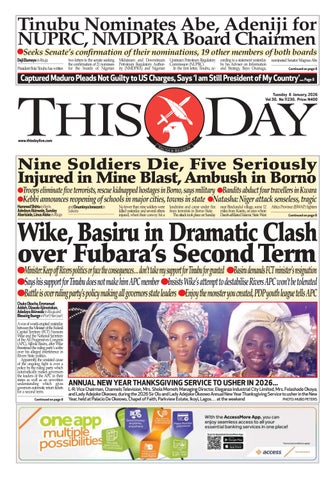
Tinubu Nominates Abe, Adeniji for NUPRC, NMDPRA Board Chairmen
Seeks Senate’s confirmation of their nominations, 19 other members of both boards
Deji Elumoye in Abuja
President Bola Tinubu has written
two letters to the senate seeking the confirmation of 21 nominees for the boards of Nigerian
Midstream and Downstream Petroleum Regulatory Authority (NMDPRA) and Nigerian
Upstream Petroleum Regulatory Commission (NUPRC). In the first letter, Tinubu, ac-
cording to a statement yesterday by his Adviser on Information and Strategy, Bayo Onanuga,
nominated Senator Magnus Abe Continued on page 8
Captured Maduro Pleads Not Guilty to US Charges, Says ‘I am Still President of My Country’... Page 8 Tuesday 6 January, 2026 Vol 30. No 11230. Price: N400
www.thisdaylive.com TR
UT H
& RE A S O
N
Nine Soldiers Die, Five Seriously Injured in Mine Blast, Ambush in Borno Troops eliminate five terrorists, rescue kidnapped hostages in Borno, says military Bandits abduct four travellers in Kwara Kebbi announces reopening of schools in major cities, towns in state Natasha: Niger attack senseless, tragic
Hammed Shittu in Ilorin, Adedayo Akinwale, Sunday Aborisade, Linus Aleke in Abuja
and Onuminya Innocent in Sokoto
No fewer than nine soldiers were killed yesterday and several others injured, when their convoy hit a
landmine and came under fire from terrorists in Borno State. The attack took place on Sunday
near Bindundul village, some 12 miles from Kareto, an area where Daesh-affiliated Islamic State West
Africa Province (ISWAP) fighters Continued on page 8
Wike, Basiru in Dramatic Clash over Fubara’s Second Term Minister: Keep off Rivers politics or face the consequences… don’t take my support for Tinubu for granted Basiru demands FCT minister’s resignation Says his support for Tinubu does not make him APC member Insists Wike’s attempt to destabilise Rivers APC won’t be tolerated Battle is over ruling party’s policy making all governors state leaders Enjoy the monster you created, PDP youth league tells APC
Chuks Okocha, Emmanuel Addeh, Olawale Ajimotokan, Adedayo Akinwale in Abuja and Blessing Ibunge in Port Harcourt A war of words erupted yesterday between the Minister of the Federal Capital Territory (FCT) Nyesom Wike and the National Secretary of the All Progressives Congress (APC), Ajibola Basiru, after Wike threatened the ruling party’s scribe over his alleged interference in Rivers State politics. Apparently, the unstated cause of the ongoing fight is over a policy by the ruling party which automatically makes governors the leaders of the APC in their states as well as an unwritten understanding which gives governors automatic return tickets for a second term. Continued on page 8
ANNUAL NEW YEAR THANKSGIVING SERVICE TO USHER IN 2026...
L-R: Vice Chairman, Channels Television, Mrs. Shola Momoh; Managing Director, Eleganza Industrial City Limited, Mrs. Folashade Okoya; and Lady Adejoke Okeowo, during the 2026 Sir Olu and Lady Adejoke Okeowo Annual New Year Thanksgiving Service to usher in the New Year, held at Palacio De Okeowo, Chapel of Faith, Parkview Estate, Ikoyi, Lagos… at the weekend PHOTO: MUBO PETERS
2
tuesDAY, JANUARY 6, 2026 • T H I S D AY
Processing Charges
For Life
on all GTBank Terminals
Get the full value of every payment you receive on your GTBank POS Terminal.
Terms and Conditions apply
tuesDAY, JANUARY 6, 2026 • T H I S D AY
3
4
tuesDAY, JANUARY 6, 2026 • T H I S D AY
5
THISDAY • TUESDAY, JANUARY 6, 2026
Group News Editor: Goddy Egene Email: Goddy.egene@thisdaylive.com, 0803 350 6821, 0807 401 0580
NEWS
APC E-REGISTRATION IN KWARA STATE...
Kwara State Governor, AbdulRahman AbdulRazaq, participating in the All Progressives Congress (APC) electronic registration exercise in Kwara State… recently
Flutterwave Acquires Mono to Enhance Open Banking, Payments Infrastructure in Africa Emma Okonji
Flutterwave, a leading fintech company, has acquired Mono, an African open banking and account-based payments provider. According to Flutterwave, the acquisition would enable it to strengthen its payments infrastructure and accelerate the growth of open banking in Africa, with a focus on interoperability, data-driven solutions, and locally relevant payment methods. It explained, in a statement yesterday, that the acquisition would also allow for faster onboarding, reduced fraud, and seamless account-to-account payments, while also offering businesses access to simplified compliance, thereby solidifying Flutterwave’s position within the rapidly evolving African financial landscape. The acquisition marks a significant step towards Flutterwave’s long-term vision of constructing an interconnected, interoperable financial ecosystem for Africa, with open banking at its core. The integration is expected to redefine alternative payment methods across the continent, paving the way for more efficient and secure financial transactions.
Mono’s API-driven platform provides secure access to financial data, robust identity verification, and facilitates account-to-account payments – essential capabilities as African markets increasingly embrace data-led financial services. Mono would retain its operational independence, including its existing leadership team and day-to-day operations. It stated, “Flutterwave’s stake enables strategic alignment rather than operational control, allowing Mono to maintain its pace of innovation while contributing its open banking infrastructure to Flutterwave’s broader payments ecosystem. “The acquisition reflects a growing recognition that the next phase of Africa’s payments growth will be driven less by card rails and more by bank-based, authenticated, and locally relevant payment methods. “By integrating Mono’s open banking APIs, Flutterwave strengthens its ability to support faster onboarding, improved verification, reduced fraud, and seamless account-to-account payments. “The collaboration also creates a clear pathway for expanding
into richer alternative payment methods, authenticated payment flows, and, over time, open banking-enabled stablecoin use cases. “It also carries implications well beyond product expansion. Businesses gain access to infrastructure that simplifies compliance-heavy processes such as identity checks and bank verification, while improving conversion and reliability at scale. “Developers and partners ben-
ments have reinforced the company’s standing within Nigeria’s independent oil and gas sector and signal its readiness to pursue the next phase of growth. “It is against this backdrop that Equere’s appointment has been made. Uduak will continue to serve as Chief Commercial Officer, and as an Executive Director of Petralon 54, a subsidiary of Petralon Energy, while also assuming expanded responsibilities at the group level. “His appointment reflects leadership that has consistently delivered value across com-
frameworks, including PCI-DSS and ISO 27001.” Founder and CEO of Flutterwave, Olugbenga Agboola, emphasised the importance of a unified system that integrates payments, data, and trust to support Africa’s financial future, with open banking providing the critical connective tissue. According to Agboola, the acquisition would empower businesses operating within African markets, while ensuring
security, compliance, and local relevance. For his part, Mono’s Founder and CEO, Abdulhamid Hassan, who highlighted the shared vision and the synergistic effect of the partnership, said, “We built Mono to unlock Africa’s Open Banking potential, and since our first partnership with Flutterwave in 2021 and working together over the years, we’ve seen the power of a coordinated effort towards this goal.”
Abiodun Will Position Ogun as Benchmark for Housing, Urban Development, Says Commissioner James Sowole in Abeokuta
The Ogun State Commissioner for Housing, Chief Jamiu Omoniyi, has said Governor Dapo Abiodun’s administration, is determined to make the State a benchmark for housing and urban development in the country and beyond. The Commissioner for Housing said this at a media briefing where programmes of the ministry for the 2026, were highlighted. Omoniyi was supported by the
Petralon Energy Appoints Equere Executive Director Petralon Energy, an indigenous oil exploration and production company, has announced the appointment of Uduak Equere as Executive Director. In a statement, the company explained that the appointment became effective January 5, 2026, following a year of significant operational and commercial progress for the company. It noted that, over the past year, Petralon has advanced key milestones across its portfolio, strengthening its operational execution, financial position, and institutional foundations. “These develop-
efit from a unified environment where payments and financial data coexist, reducing complexity and accelerating time to market. “The integration enhances Flutterwave’s vertical depth, reinforcing long-term value creation through stronger margins, deeper platform stickiness, and differentiated infrastructure. “Regulatory stakeholders benefit from increased standardisation, stronger data protection, and adherence to global security
mercial development, corporate finance, and operational execution,” it added. It further pointed out that, “before joining Petralon Energy, Uduak had built significant commercial and financial expertise across leading energy and investment institutions.” He added: “He began his career at Vetiva Capital Management as an Investment Analyst, where he covered energy sector equities, shaped market perspectives on Nigeria’s oil, gas, and power sectors, and regularly appeared on CNBC Africa.”
Chairman of the State Housing Corporation, Alhaji Adeyemi Adelani; General Manager of the Corporation, Mr. Akinwale Ojo; Permanent Secretary of the Ministry, Mr. Murtala Adekunle, and the Special Adviser to the Governor on Information and Strategy, Hon Kayode Akinmade. The commissioner said the housing sector, including the State Ministry of Housing and the Ogun State Housing Corporation, has witnessed a remarkable transformation. He added, “Housing delivery in our dear Gateway State transcends the provision of shelter; it is about dignity, functionality, sustainability, urban renewal, and inclusive
economic growth. “Through coherent policies, disciplined execution, and strategic partnerships, the sector has delivered developments that meet international standards while staying responsive to local realities, contributing meaningfully to job creation, wealth generation, and the overall Gross Domestic Product of the State. “We closed 2025 on a strong and reassuring note with the successful delivery of an additional 30 units of duplexes at the Ibara GRA Cluster 1 Extension and another 100 duplexes at President Muhammadu Buhari Estate. “This achievement reflects the consistency, planning integrity,
and institutional capacity of the Housing sector.” According to the commissioner, the Ministry of Housing and Ogun State Housing Corporation are strategically positioned to scale up delivery across multiple fronts. Highlighting projects for 2026, Omoniyi said, “Key legacy projects slated for execution include the construction of an International Conference Centre (GIA) at Iperu, a modern 2,500 seater-capacity Banquet Hall/Centre, the Appeal Court Headquarters and Residences, Ibara GRA Phase II comprising 50 duplexes, as well as Commissioners’ Quarters, Appointees’ Quarters, and Assembly Quarters.
NNPCL: Court Okays EFCC Move to Temporarily Seize N30.7m Allegedly Linked to Fraud
Alex Enumah in Abuja
The Economic and Financial Crimes Commission (EFCC) yesterday received permission from a Federal High Court, Abuja, to temporarily seize the sum of N30.7 million allegedly linked to fraudulent activities in the Nigerian National Petroleum Corporation Limited (NNPCL).
Justice Emeka Nwite gave the permission while ruling in an ex-parte application brought by the anti-graft agency, seeking a temporary forfeiture of the said sum to the federal government. The motion was argued on behalf of the commission by one of its lawyers, Emenike Mgbemele. After granting the request,
the judge ordered that the interim order of forfeiture be published in a national daily for interested persons to show cause within 14 days why the funds should not be permanently forfeited to the Federal Government of Nigeria. Nwite, subsequently adjourned the matter until January 22 for the report of compliance.
6
TUESDAY, JANUARY 6, 2026 • THISDAY
NEWS
GOVERNOR OF THE YEAR IN IGR AWARD 2025...
L-R: Executive Chairman, Jigawa State Internal Revenue Service (JIRS), Dr. Nasir Sabo Idris; Chairman/CEO, Alford Conferences Limited, Mr. Frederick Apeji; Deputy Governor of Jigawa State, Engr. Aminu Usman Gumel; Executive Governor of Jigawa State, Mallam Umar Namadi; and Chairman, Alford Conferences Limited Media and Events Advisory Board (MEAB), Mr. Shuaibu Shehu Mohammed, during the presentation of the Governor of the Year in IGR Award 2025 to Governor Mallam Umar Namadi at the Government House, Dutse, Jigawa State at the weekend
Dangote Refinery Debunks Shutdown Rumours, Insists on 50m Litres Daily Petrol Supply Reaffirms N699/litre gantry price as marketers evacuate over 48m litres last Sunday Lampoons fuel importers for allegedly spreading misinformation, exploiting Nigerians
Peter Uzoho
Dangote Petroleum Refinery has dismissed rumours claiming the refinery was shutting down for maintenance, describing the story as false and misleading. In a statement issued yesterday, the refinery emphasised that
production remained ongoing, stable, and uninterrupted at the 650,000 barrels per day facility. The Aliko Dangote-owned world’s largest single-train oil refinery based in Lagos also insisted that it had maintained its over 50 million litres daily petrol supply in Nigeria.
The refinery equally reaffirmed its N699/litre gantry price, saying marketers evacuated over 48 million litres last Sunday. The statement said, “Dangote Petroleum Refinery continues to operate at scale and retains the capacity to supply between 40 million and 50 million litres of
Premium Motor Spirit (PMS) daily through January and February, subject solely to market demand.” It added that on January 4, the refinery produced 50 million litres of PMS and evacuated 48 million litres via its gantry. “Current stock levels cover over 20 days of national consump-
2026 Ogoni Day: Group Tasks Local Farmers on Continued Agriculture Activities Blessing Ibunge in Port Harcourt
Despite ongoing challenges of decades of polluted environment, a non-governmental organisation, Lekeh Development Foundation, has encouraged local farmers in Ogoniland to continue with their agricultural activities, thereby helping in solving the problem of food security. Executive Director of the foundation, Friday Nbani made the call yesterday, in commemoration of the 2026 Ogoni Day held in Bori, Khana Local Government Area of Rivers State. Addressing farmers from different LGAs in Ogoniland,
Nbani expressed sadness that over 30 years after the murder of Ken Saro-Wiwa and other Ogoni environmental activists, the area is still suffering serious environment degradation. He said the event is a sacred day of remembrance and resilience, saying that they stand not as victims of the past but as architects of the future. Nbani said “Thirty-one years ago, Ken Saro-Wiwa and the Ogoni Nine gave their lives so that we might breathe clean air, drink pure water, and walk on soil that belongs to us and our children and today, their blood still cries out from the earth, demanding that we finish what
they started. “The oil has poisoned our land, the injustice has scattered our people, and the silence of the world has tested our spirit, but look around you: we are still here, we are still fighting, and we are still rising. “Every mangrove we replant is an act of defiance, every young Ogoni who refuses to forget is a living monument, every voice raised for environmental justice echoes the courage of those who came before us. “This is not just our struggle, it is the struggle of every community worldwide that refuses to let profit triumph over people, that refuses to let development
Atiku: Nigerians Need Leadership, Not A Paris Menu
Chuks Okocha in Abuja
The former Vice-President Atiku Abubukar, has criticised President Bola Tinubu’s visit to Paris, France, saying what Nigeria needed was good leadership and not a Paris menu. In a statement by his Senior Special Assistant on Public Communication, Phrank Shaibu, said, ‘’the Presidency’s
latest ‘Stop Press’ is a textbook case of misplaced priorities and official shamelessness. “At a moment when Nigerians are crushed by hunger, insecurity, collapsing businesses, and a brutal costof-living crisis, the presidency chose to brief the nation on who the president had lunch with and who he dined with in Paris. ‘’That is not leadership. It
is tone-deafness in power. While communities in Niger State and other parts of the country are under attack and families can no longer afford basic food, the presidency is busy explaining camera phones, image quality, and photo editing. ‘’By the way, why is Tinubu’s plate empty? Nigerians did not ask for a Paris menu. They asked for leadership.
mean destruction, that refuses to let tomorrow’s children inherit a wasteland.” According to him, they do not simply remember; but that the Ogonis recommit, rebuild, reclaim, and roar with one voice, stressing that “Ogoni will rise, our land will heal, and justice, though delayed, will never be denied.”
tion, effectively dispelling any concerns about supply,” the company stated. The refinery clarified that routine maintenance on specific units, including the Crude Distillation Unit (CDU) and Residual Fluid Catalytic Cracking (RFCC), did not interrupt overall production, owing to the sophisticated and integrated design of its processing units. It added that other critical units, such as the Naphtha Hydrotreater, CCR Reformer, and Hydrocracker, remained fully operational, producing PMS, Diesel (Automotive Gas Oil), and Jet A-1. The refinery stated, “Dangote Petroleum Refinery confirms that it has consistently maintained adequate PMS availability for the domestic market. From 16 December 2025 to date, the refinery has loaded between 31 million and 48 million litres of PMS daily from its gantry, in line
with prevailing market demand. “These volumes are fully verifiable against depot loading records maintained by the Nigerian Midstream and Downstream Petroleum Regulatory Authority (NMDPRA) in the normal course of its regulatory responsibilities.” The refinery also reaffirmed its ex-gantry price of N699 per litre for PMS, available to all marketers and bulk consumers. It encouraged filling stations, large-scale users, and institutional buyers to patronise locally refined products, which were more affordable, reliable, and of high quality, rather than relying on imported alternatives. “By sourcing PMS locally at N699 per litre, marketers are better positioned to pass on price relief to consumers, enhance market stability, conserve foreign exchange, and support Nigeria’s broader economic recovery and energy security objectives,” the refinery said.
Nigeria, 146 Others Agree Way Forward on Global Minimum Tax Package
Ndubuisi Francis in Abuja
Nigeria and 146 other countries, as well as jurisdictions working together within the OECD/G20 Inclusive Framework on Base Erosion and Profit Shifting (BEPS), have agreed on key elements of a package that charts a way forward for the coordinated operation of global minimum tax arrangements in the context of a digitalised and globalised economy. Following months of intense negotiations, the comprehensive package for a “side by side” arrangement, announced yesterday, represents a sig-
nificant political and technical agreement, which will set the foundation for stability and certainty in the international tax system. Domestic tax base erosion and profit shifting (BEPS) relates to tax planning strategies that multinational enterprises use to exploit loopholes in tax rules to artificially shift profits to low or no-tax locations as a way to avoid paying tax. The OECD/G20 BEPS Project equips governments with rules and instruments to address tax avoidance, ensuring that profits are taxed where economic activities generating them take place
and where value is created. The agreed package will preserve the gains achieved so far in the global minimum tax framework and protect the ability for all jurisdictions, particularly developing countries, to have first taxing rights over income generated in their jurisdictions. The package includes five key components: First, a series of simplification measures will reduce compliance burdens for multinational enterprises (MNEs) and tax authorities in calculating and reporting under the global minimum tax rules.
7
THISDAY • TUESDAY, JANUARY 6, 2026
NEWS
LOUIS ODION PAYS COURTESY VISIT TO GOV OKPEBHOLO...
Governor Monday Okpebolo of Edo State (right) receiving Mr Louis Odion, Executive Commissioner (Operations) of Federal Competition and Consumer Protection Commission (FCCPC), on a courtesy visit to Government House, Benin City... yesterday
Pension Fund Managers Expand Registration into CPS by 129,000 Attribute progress to increased youth participation
Ebere Nwoji
Pension Fund Managers said they expanded their coverage of Nigerian workers who registered into the Contributory Pension Scheme (CPS) in the third quarter 2025 by 129,000 contributors, attributing the development to increased youth participation and improved gender inclusion. The managers said with this achievement total number of contributors into the scheme at the period rose to 10 million contributors, with the total assets raked in by the operators during the period standing at N26.09 trillion. Towards the last quarter of the year, precisely in November, the figure rose to N27.052 trillion. With this achievement the operators said when the full result of their fourth quarter performance comes out, they expected that inflation stability and a more accommodative monetary policy environment
would support investment returns. They are also hopeful that continued adoption of digital systems would strengthen compliance monitoring, operational efficiency, and transparency. The managers are equally very optimistic that in the fourth quarter result, Personal Pension plan (PPP) expansion and intensified employer compliance enforcement would be central to sustaining growth and coverage. These are contained in the third quarter report and fourth quarter outlook on activities in the pension sector released by the National Pension Commission (PenCom) recently. PenCom in the report said sustained growth in pension assets to N26.09 trillion was driven by positive investment performance and improved contribution compliance. The commission said the increase in contributors’ coverage which expanded
with over 129,000 new RSA registrations, was supported by increased youth participation and improved gender inclusion. “Retirement benefit administration remained stable, with timely payment of accrued rights and enhanced service delivery under the DBS, compliance enforcement
A High Court of the Federal Capital Territory (FCT) has ordered the sealing of a disputed waterfront property located within the Lekki Peninsula Scheme area of Lagos State, pending the determination of a civil suit arising from a commercial land transaction between private parties. The order followed an ex parte application filed by one of the parties to the dispute, Mr. Henry Ugonna Orabuchi, who was seeking judicial intervention over disagree-
ments connected with the ownership, documentation, and regulatory status of the property. According to court filings, Orabuchi stated that he was introduced in 2022 to a property owner by an intermediary who presented him as the owner of a waterfront property in Lekki, Lagos. He said he was informed that part of the land was waterlogged and required sand-filling, after which portions would be sold. Orabuchi said he subsequently entered into an agree-
diversifying investments of pension funds and assets. According to the report, the third quarter of 2025 marked a period of resilience and reform-driven progress for Nigeria’s pension industry. It said this was supported by macroeconomic stability, rising capital-market confidence, and deepening regulatory oversight.
The report stated: “The National Pension Commission (PenCom) consolidated gains across fund performance, compliance, and coverage. Total pension assets grew to N26.09 trillion, while industry reforms continued to enhance transparency, accountability, and public trust in the Contributory Pension Scheme (CPS).
Youths Protest Rising Cases of Kidnapping in Ambrose Alli University Community Felix Omoh-Asun in Benin
Youths in the community hosting Ambrose Alli University, in Edo State, yesterday protested rising cases of kidnapping. One of the leaders of the protest, Andrew Oziegbe, described the response of relevant authorities to the security challenges in the area as inadequate. Oziegbe called for urgent
Court Orders Sealing of Lekki Waterfront Property Alex Enumah in Abuja
strengthened through recoveries, employer monitoring, and continued state-level CPS adoption engagements”. PenCom in the report said preparations for Q4 prioritised expansion of the Personal Pension Plan (PPP), intensified compliance drive, and acceleration of data recapture and exploring avenues for
ment to acquire 3,000 square metres of the reclaimed land for an agreed consideration. He also disclosed that additional funds were paid at various stages of the transaction, based on representations made during the course of the agreement. The plaintiff listed documents presented to him to include a Lagos State Certificate of Occupancy covering the adjoining land, with assurances that necessary consents for the reclaimed portion would be derived from the same root of title.
government intervention to curb the growing wave of kidnappings and restore confidence among residents and students. The group had last week identified themselves as students of Ambrose Alli University (AAU), Ekpoma, and announced plans for a peaceful protest. According to them, the decision followed the recent abduction of one Akhabhe Favour and an unnamed former student union leader of the institution. It was gathered that the incidents heightened concerns
over the safety of students in and around the university town. However, the management of Ambrose Alli University distanced the institution and its students from the protest. In a statement issued by Principal Assistant Registrar/ Head, Information, Protocol and Public Relations, Otunba Mike Ade Aladenika, the university said those involved in the protest were not registered students of the institution. The statement read, “The individuals involved in the protest are not registered students, members of the
University Students’ Union Government, nor are they affiliated with the institution in any capacity. “They do not have the authorization or right to represent the university or organize activities in its name.” Aladenika added that the management condemned any attempt to disrupt the peaceful academic environment of the university. He assured that unauthorised actions would be met with appropriate measures to safeguard the institution’s interests and maintain order.
WSCIJ Honours Ex-ASUU President, Biodun Jeyifo at 80
Oluchi Chibuzor
The Wole Soyinka Center for Investigative Journalism, (WSCIJ), and past students of renowned scholar and Professor Emeritus at Cornell, Biodun Jeyifo, have expressed gratitude to the broadminded impact his life had had on their career and field of literature globally. Speaking yesterday in Lagos at a symposium in honour of the ex-
ASUU President, themed ‘Pedagogy, Curriculum and Decolonisation: Then and Now’, the Executive Director, WSCIJ, Motunrayo Alaka, said the event invites everyone to look backward with honesty, forward with responsibility, and inward with courage. According to her, “We recognise his accomplishments as a scholar whose work has shaped how we read African literature, interrogate power, and understand culture
and as a Professor Emeritus of English at Cornell University, and of Comparative Literature and African and African American Studies at Harvard University. “His scholarship on the works of our Grand Patron, Professor Wole Soyinka, remains foundational, but perhaps even more enduring is his insistence that knowledge must always be questioned: who produces it, who benefits from it, and who is left out.
8
TUESDAY, JANUARY 6, 2026 • THISDAY
EIGHT
Captured Maduro Pleads Not Guilty to US Charges, Says ‘I am Still President of My Country’
Emmanuel Addeh in Abuja Toppled Venezuelan President, Nicolas Maduro, yesterday pleaded not guilty to narcotics charges after President Donald Trump’s stunning capture of him rattled world leaders and left officials in Caracas scrambling to regroup. “I am innocent. I am not guilty. I am a decent man. I am still president of my country,” Maduro, 63, said through an interpreter, before being cut off by U.S. District Judge Alvin Hellerstein in Manhattan federal court. Maduro’s wife Cilia Flores also pleaded not guilty. The next court date was set for March 17.
Dozens of protesters, both pro- and anti-Maduro, gathered outside the courthouse before the half-hour hearing, Reuters reported. Hours later in Caracas, Maduro’s Vice President Delcy Rodriguez was sworn in as Venezuela’s interim president with words of support for Maduro but no indication she would fight the U.S. move. “I come with pain in my heart over the kidnapping of two heroes who are being held hostage,” she said, pledging to move Venezuela forward in “these terrible times.” Maduro is accused of overseeing a cocaine-trafficking network that partnered with violent groups
including Mexico’s Sinaloa and Zetas cartels, Colombian FARC rebels and Venezuela’s Tren de Aragua gang. He faces four criminal counts: narco-terrorism, cocaine importation conspiracy and possession of machine guns and destructive devices. Maduro has long denied the allegations, saying they were a mask for imperialist designs on Venezuela’s rich oil reserves, the report added. Trump has made no secret of wanting to share in Venezuela’s oil riches. U.S. oil companies’ shares jumped on Monday, fueled by the prospect of access to those vast reserves. While world leaders and U.S. politicians grappled
with the extraordinary seizure of a head of state, an emergency order in Venezuela, published in full on Monday, ordered police to search and capture anyone who supported Saturday’s U.S. attack. At the United Nations, the Security Council debated the implications of the raid, which was condemned by Russia, China and leftist allies of Venezuela. U.N. chief Antonio Guterres raised concerns about instability in Venezuela and the legality of Trump’s strike, the most dramatic U.S. intervention in Latin America since the 1989 Panama invasion. U.S. Special Forces swooped into Caracas by helicopter on Saturday, shattered his security cordon and
dragged him from the threshold of a safe room. On Monday morning, Maduro - his hands zip-tied - and his wife were escorted by armed guards in tactical gear from a Brooklyn detention center to a helicopter bound for the Manhattan federal court. The judge began the hearing at 12:02 p.m by summarising the charges in the indictment. Shackled at the ankles and wearing orange and beige prison garb, Maduro listened on headphones through an interpreter. Hellerstein asked Maduro to stand and confirm his identity. He replied in Spanish. The judge told the couple of their right to inform the
W I K E , B A S I R U I N D R A M AT I C C L A S H O V E R F U B A R A’ S S E C O N D T E R M
Therefore, the FCT minister, a politician, already foreseeing the implication of this APC’s established understanding after the Governor of Rivers State, Siminalayi Fubara recently defected to the ruling party, sees this impending scenario as unacceptable. Put succinctly, Wike considers this scenario as a threat to his ambition to replace his erstwhile political godson in the upcoming 2027 general election, having almost singlehandedly supported him to be governor in 2023. But yesterday the situation boiled over with Wike urging Basiru to steer clear of the politics of Rivers or face the unpalatable
consequences, a threat that immediately drew a sharp response from the APC national secretary, who accused the minister of overreach. Basiru demanded Wike’s resignation from the Federal Executive Council (FEC), arguing that the minister’s posture was incompatible with his role as a cabinet member and dangerous to party cohesion. He insisted that Wike’s open support for President Bola Tinubu did not confer APC membership on him. Joining the fray, prominent APC stakeholders also issued a stern warning to the minister demanding an immediate retraction and public apology over what they
described as the “unwarranted and disrespectful” comments against Basiru. In a statement signed by Umar Duhu, the APC stakeholders described Wike’s remarks as a clear breach of protocol, stressing that such conduct would not be tolerated within the ruling party. But speaking during his “Thank You” visit to Oyigbo Local Government Area of Rivers State, where he insinuated that the APC scribe had received some funds from the N600 billion sum left in the state’s coffers, Wike described Rivers as a “no-go area” and challenged the APC topnotch to take a cue from those who previously attempted to meddle
in the state’s politics. Wike cautioned Basiru that he should not hold anybody responsible if he got his fingers burnt from the dangerous expedition he was planning on embarking upon in the oil-rich, politically crucial Niger Delta state. The minister was reacting to Basiru, who had tackled the APC Vice Chairman (South-South), Chief Victor Giadom, for describing the incumbent Governor of the state, Siminalayi Fubara, as a ‘so-called governor.‘ Basiru rebuked Giadom describing the comments as unfortunate. “I find it unfortunate that a member of the NWC… was referring to a governor in our
party as a ‘so-called governor of Rivers State’. The office of the governor is an exalted position, and whoever is occupying it must be respected, irrespective of whatever political differences you have,” Basiru had stated. But an angry Wike said: “Let me warn those who come to Rivers State, because you have heard that we have N600 billion, you come here, you collect, and you open your mouth to talk anyhow. “I say it here, take this message to your National Secretary, leave Rivers State alone. Go and ask those who have done it before. Don’t take our support for Mr President for granted. You have to be careful with statements you make. “Today, you are enjoying in Osun, you don’t know those who did the work. You are opening your mouth to talk about Rivers State. Anything you see, take it. When Mr. President comes back, when I see the Minister of Blue Economy, I will tell them to tell him. “Go and ask other people what has happened to them before. If your hand burn, no be me burn am o. This state is a no-go area. Take the one you have taken, stop making unnecessary comments.” The minister, who described Rivers as “a no-go area” and challenged those he characterised
Maduro Venezuelan consulate of their arrests. Prosecutors say Maduro has been involved in drug trafficking from the time he began serving in Venezuela’s National Assembly in 2000 to his tenure as foreign minister and subsequent 2013 election as the late president Hugo Chavez’s successor. as greedy politicians to stay away from the state. “Take the one you have taken and stop making unnecessary comments. We have taken a decision to support Mr President and that is exactly what we are doing. When we agreed to support Tinubu in 2023, nobody forced us. “Now food is ready and everybody is coming and when it was hot nobody was saying anything. Leave Rivers state alone,” Wike emphasised. Wike also challenged his detractors to demonstrate the political strength required to unite two major political parties in a single state, a feat he said only he has achieved. He said: “Let anyone who has the capacity to unite two major political parties in a state come out and show that it can successfully merge the APC and PDP to work together. “If it is easy, try it and see what it takes. This is the only state where you see the two major political parties working together.” He restated that he will correct “mistakes” made during the 2023 elections in Rivers State, stressing that it must be done “now or never,” regardless of the cost. Addressing the Oyigbo people, Wike urged them to replicate the support they gave him during the
NINE SOLDIERS DIE, FIVE SERIOUSLY INJURED IN MINE BLAST, AMBUSH IN BORNO were said to operate freely and who had been abducted by the N450 million for the release of forcing vehicles to stop before often set up checkpoints. fleeing terrorists. the monarch and his son from whisking the passengers to an unknown location. According to two security Items recovered at the scene the bandits’ den. Sources added that the sussources from the Damasak brigade, included AK-47 rifles and other The suspected bandits, “The terrorists planted a mine assorted materials believed to have yesterday, stormed Isanlu-Isin- pected bandits were yet to get that our soldiers stepped on. been used by the insurgents. Omu-Aran road in Irepodun and in touch with the families of the Unfortunately, about nine soldiers Uba said the outcome of abducted four travellers on the victims for payment of ransom. However, at the time of filing died instantly, while five others the operation underscored the trip to Ilorin, the state capital. were seriously injured.” The suspected bandits were said this report, there had been no professionalism, precision and A member of the Civilian combat effectiveness of the troops, to have ambushed the travellers official statement from the state Joint Task Force involved in the as well as the value of sustained on the road and asked them to Police Command confirming the rescue operation, Abba Kaka Tuja, cooperation with local security come down before they were later attack or detailing efforts to rescue the abducted victims. added that an armoured vehicle stakeholders. marched into the forest. But a senior police officer with was destroyed when the mine Sources close to the area told He added that the success of detonated, followed by sporadic the mission reflected OPHK’s journalists in Ilorin that the attackContinued on page 28 Continued on page 27 gunfire from militants. continued commitment to ag- ers operated freely on the road, The soldiers were traveling gressive offensive actions aimed from Maiduguri to Damasak, at degrading terrorist capabilities, TINUBU NOMINATES ABE, ADENIJI FOR NUPRC, NMDPRA BOARD CHAIRMEN the headquarters of Mobbar while ensuring the safety and team at the World Bank, which Other members of the to serve as NUPRC board chair. Production. Local Government Area, when protection of civilians. Others were Indabawa Alka, advised the Nigerian government NMDPRA board, as proposed by Abe, who represented Rivers The statement further said the attack occurred around 1600 troop morale across the North- South East in Senate for two terms, Executive Commissioner for on reform and restructuring of Tinubu, were Mr. Yahaya Yinusa, GMT, Tuja said. Meanwhile, troops of Operation east theatre remained high, is a former board member of Corporate Services and Ad- the petroleum sector, including Executive Director, Distribution Hadin Kai (OPHK) eliminated five with security forces maintaining Nigerian National Petroleum ministration; Mahmood Tijani, the development of Strategic Gas Systems; Adeyemi Aminu, Executerrorists and rescued kidnapped dominance of the operational Corporation (NNPC) and current Executive Commissioner for Plan for Nigeria. He is currently tive Director, Corporate Services; civilians during a coordinated environment, despite evolving Chairman of National Agency of Health, Safety and Environment; the managing partner at ENR Ms. Modie Ogechukwu, Executive the Great Green Wall. and Ms. Olayemi Adeboyejo, Advisory. Director, Economic Regulation and offensive in Konduga Local security challenges. The president also nominated Strategic Planning; and Olawale Other nominees for the NUPRC Secretary and Legal Adviser. It said Operation Hadin Kai Government Area of Borno State, Former President Muhammadu Chief Kenneth Kobani and Mrs. Dawodu, as Board Secretary and was resolute in its mandate to board are Engr. Paul Jezhi, a the military announced. In a statement yesterday, Media dismantle terrorist networks and former Trade Union Congress Buhari had appointed Lamido Asabe Ahmed as Non-Executive Legal Adviser. Dawodu is an Information Officer of the Joint restore lasting peace and stability (TUC) chairman in Kaduna, and and Adeboyejo in 2022, while members. Kobani was Minister industry player and was, at a Task Force, North East, Operation to the region. Mr. Sunday Babalola, a former Tinubu appointed Alka in 2023. of State for Trade under former time, Financial Reporting Manager In a related development, about Deputy Director of Department Inyang. Hadin Kai, Lieutenant-Colonel President Goodluck Jonathan and at Exxon Nigerian subsidiaries. Sani Uba, said the operation was six suspected bandits, reportedly, of Petroleum Resources (DPR), Ezeala, former Managing Secretary to the Government of Tinubu charged all the appoincarried out in the early hours of abducted four travellers along which was abolished by Petroleum Director of Nigerian Gas Market- Rivers State, under then Governor tees and nominees to discharge January 4, 2026 following credible Isanlu-Isin-Omu-Aran Road in Industry Act (PIA) in 2021. their duties and responsibilities ing Limited, Mahmood Tijani, Nyesom Wike. intelligence on terrorist movements Irepodun Local Government Area Equally nominated for confir- professionally as regulators of the Both men would serve as Babalola, and Jezhi are new of Kwara State. in the area. non-executive commissioners. appointees of Tinubu. mation were Abiodun Adeniji, oil and gas sectors. The monarch of Aafin commuAccording to the statement, Tinubu also nominated The president urged the senIn his second letter to Senate, Executive Director of Finance; troops, working in close collabora- nity in Ile Ere district of Ifelodun executive commissioners to the Tinubu nominated Mr. Adegbite Francis Ogaree, Executive Director ate to approve the nominees tion with the Civilian Joint Task Local Government Area of the board. They were Muhammed Ebiowei Adeniji, a lawyer, as of Hydrocarbon; Oluwole Adama, expeditiously. Force (CJTF), engaged the terrorists state, Oba Simeon Olaonipekun, Lamido, Executive Commissioner Chairman of the NMDPRA Executive Director of Midstream The requests followed the recent at a known crossing point along and his son were kidnapped for Finance; Mr. Edu Inyang, board. Adeniji has over 30 years of and Downstream Gas Infrastruc- appointment of chief executive the Sojiri axis. on December 31, 2025 around Executive Commissioner for experience in energy and natural ture; and Dr. Mustapha Lamorde, officers for the two regulatory The encounter resulted in the 8pm in his palace following the Exploration and Acreage; Justin resources issues. Executive Director of Corporate agencies. neutralisation of five terrorists, invasion of the palace by about Ezeala, Executive Commissioner Adeniji was Special Technical Services and Administration. Senate had confirmed with no casualties recorded among eight suspected bandits. for Economic Regulation and Adviser to Minister of State for Tinubu appointed Adama in Oritsemeyiwa Eyesan as Chief the troops. The bandits had reached out to Strategic Planning; and Henry Petroleum on upstream and 2024, while late Buhari appointed Executive Officer of NUPRC and The operation also led to the the residents of the community Darlington Oki, Executive Com- gas until 2018. He was also a Lamorde and Adeniji in 2021 and Engr. Saidu Aliyu Mohammed successful rescue of three civilians, and demanded a ransom of missioner for Development and member of Oil & Gas Policy Ogaree in 2022. as CEO of NMDPRA.
9
tuesDAY, JANUARY 6, 2026 • T H I S D AY
JAMES HOPE COLLEGE Knowledge•Character•Truth
SHAPING LEADERS, BUILDING LEGACIES JOIN A LEGACY OF EXCELLENCE AT JAMES HOPE COLLEGE, LEKKI LAGOS NOVEMBER 2024 CAMBRIDGE IGCSE EXAMINATION RESULT A* A* - A A* - B A* - C
GRADES: 65% GRADES: 93% GRADES: 98% GRADES: 100%
MAY/JUNE 2025 WAEC EXAMINATION RESULT A -B A -C 1
2
1
6
GRADES: 94% GRADES: 100%
Dedicated educators who ignite curiosity, character, and confidence in every learner Proud winners of prestigious international and national academic awards Beautiful, serene and secure world-class campus State of the art classrooms, laboratories and sports facilities
ENTRANCE EXAMINATION FOR DAY AND BOARDING STUDENTS FOR THE 2026/2027 ACADEMIC SESSION Admission into year 7 (JSS1) is scheduled to take place as follows: Dates: Saturday 31st January, 2026 and Saturday 7th February, 2026 Locations: LAGOS: James Hope College, Twin Lakes Estate, Lekki, Lagos ABUJA: 71 Usuma Street, Opp. Transcorp Hilton Hotel, Maitama Abuja Time:
PORT HARCOURT: 15 Nnamdi Azikiwe Road, Port Harcourt, Rivers State. 10AM
APPLICATION CLOSES: FRIDAY 23RD JANUARY 2026 Application forms can be downloaded from www.jameshopecollege.edu.ng under the “admission” tab or can be collected from James Hope College, Twin Lakes Estate, Lekki, Lagos.
OPEN DAY
SATURDAY 17TH JANUARY, 2026 DOWNLOAD APPLICATION FORMS
+2347083662229 +2347018282065 Follows us on all our social media handles @jameshopecollege
James Hope
@JHCLekki
+2347085369376 +2347015349257 admission@jameshopecollege.edu.ng www.jameshopecollege.edu.ng
10
tuesDAY, JANUARY 6, 2026 • T H I S D AY
11
tuesDAY, JANUARY 6, 2026 • T H I S D AY
High Chief
WAYLES @
:
Celebrating A Life Of PURPOSE, WISDOM, IMPACT I joyfully celebrate High Chief Emonena Victor Wayles Egukawhore as he marks his 60th bir thday—a remarkable milestone in a life beautifully lived. Your journey through the years has been dened by kindness, wisdom, and an unwavering commitment to uplifting others. In every season of life, you have led with grace, compassion, and integrity, leaving a lasting impact on everyone privileged to know you. Your words inspire, your actions teach, and your presence brings reassurance and hope. At 60, you stand as a testament to a life of purpose—rich in experience, strengthened by challenges, and crowned with achievements that reect both excellence and humility. The legacy you continue to build is not only seen in professional accomplishments but in the lives you have touched through generosity of spirit and depth of character.
High Chief
EMONENA
VICTOR WAYLES
EGUKAWHORE
May this new chapter be lled with good health, renewed strength, joy, and the fullment that comes from seeing the fruits of a life well invested.
Distinguished Senator SUNDAY MARSHALL KATUNG Kaduna South Senatorial District.
12
tuesDAY, JANUARY 6, 2026 • T H I S D AY
13
tuesDAY, JANUARY 6, 2026 • T H I S D AY
Get the essentials you need today, from household to personal assets, BNPL with our Polaris Asset Finance Loan. Get up to ₦1,000,000 Competitively priced interest & charges 100% financing with no upfront contribution Loan tenor of up to 12 months Convenient monthly installments repayment Dial *833*12# or download VULTe to apply today Visit the nearest Polaris Bank today to get started.
www.polarisbanklimited.com Member NDIC (DIS)
14
tuesDAY, JANUARY 6, 2026 • T H I S D AY
tuesDAY, JANUARY 6, 2026 • T H I S D AY
15
16
tuesDAY, JANUARY 6, 2026 • T H I S D AY
17
T H I s D Ay • TUESDaY JaNUaRY 6, 2026
Politics
Acting Group Politics Editor DEJI ELUMOYE Email: deji.elumoye@thisdaylive.com 08033025611 sms only
10th Senate: Raging Issues of Power, Protest and Politics
From scandal to suspension, defections to fiscal battles, the Nigerian Senate in 2025 became a crucible of power, protest and procedure. Under relentless public scrutiny, the upper chamber navigated bruising controversies, high-stake confirmations and landmark legislation that tested its authority, cohesion and democratic credibility. sunday Aborisade writes.
Akpabio
F
rom January to December, 2025, the Nigerian Senate, under the gavel of Senate President Godswill Akpabio, has been anything but a quiet chamber. It has been a year defined by institutional drama, bruising personal conflicts, highwire politics, shifting loyalties, and farreaching legislative decisions that have shaped the trajectory of President Bola Tinubu’s administration and Nigeria’s fragile democracy. If the Senate is often described as the “upper chamber,” 2025 revealed it also as a pressure chamber, where egos clashed, tempers flared, rules were stretched, and the line between politics and governance was repeatedly tested. At the centre of the storm stood a handful of defining moments: the Akpabio–Natasha confrontation and the unprecedented six-month suspension of a serving female senator; renewed allegations of budget padding; waves of defections that redrew party arithmetic; marathon screening exercises for presidential nominees; passage of consequential fiscal and economic bills; and public hearings that degenerated into verbal combat and political theatre. Together, they formed a legislative season as dramatic as any in recent Senate history. Natasha Affair: When Power Met Protest The defining episode of the year erupted in February, when Senator Natasha Akpoti-Uduaghan (PDP, Kogi Central) accused the Senate leadership, implicitly Senate President Akpabio, of harassment, intimidation and deliberate attempts to silence her legislative voice. What began as a disagreement over committee assignments and floor recognition rapidly escalated into a full-blown institutional crisis. Natasha’s public claims aired both on the Senate floor and through media engagements, sent shockwaves across the political establishment, triggering protests by civil society groups, women’s rights organisations and opposition lawmakers. Senate leadership responded forcefully Invoking provisions of the Senate Standing Orders, the Committee on
Barau
Ethics, Privileges and Public Petitions commenced disciplinary proceedings against the Kogi senator. The hearings, held amid heavy security and public scrutiny, were tense and polarising. Natasha alleged a pre-determined outcome; the committee insisted it was enforcing discipline and protecting institutional integrity. In March, the Senate voted to suspend Senator Natasha for six months, a decision that ignited nationwide outrage and reopened debates about gender representation, dissent, and the limits of legislative authority. The suspension, one of the longest ever imposed on a senator, fractured public opinion. Supporters of the leadership framed it as necessary discipline while critics condemned it as executive overreach within the legislature. For weeks, the Senate sat under the shadow of protests, court actions and international attention, making the Natasha affair a symbol of the year ’s larger tensions over power and accountability. Ningi Budget Padding Allegations Resurface Barely had the dust settled when another controversy resurfaced, which is budget padding. Senator Abdul Ningi (PDP, Bauchi Central) reignited national debate in April when he alleged
Bamidele
that trillions of naira were irregularly inserted into the 2025 Appropriation Act without proper legislative approval. The allegation struck at the heart of the Senate’s credibility. Ningi claimed that what was passed on the floor differed substantially from what was gazetted, echoing past scandals that had haunted previous assemblies. The Senate leadership swiftly denied the claims, accusing Ningi of misinformation and grandstanding. A closed-door session followed, after which the Senate threatened disciplinary action. Though the matter did not culminate in formal sanctions, it left lingering questions about transparency in the budgeting process and reinforced public scepticism about legislative oversight. Defections and Politics of Numbers 2025 also witnessed a steady stream of defections, largely favouring the ruling All Progressives Congress (APC). Senators citing “irreconcilable differences,” internal party crises and alignment with the centre crossed over from the PDP, Labour Party and NNPP. Each defection altered the Senate’s political arithmetic, strengthening the APC’s dominance and weakening opposition leverage. While leadership framed the defections as endorsements of President Tinubu’s reform agenda, critics described them as opportunistic and transactional, driven more by survival instincts than ideology. The Senate chamber became a stage for dramatic announcements, applause from the majority benches, and muted protests from dwindling opposition ranks.
In 2025, the nigerian senate stood as an institution under intense public scrutiny. It passed laws, confirmed nominees and supported executive reforms. But it has also courted controversy, tested democratic norms and exposed the fault lines of power, gender, accountability and transparency.
Tinubu’s Nominees and Senate’s Gatekeeping Role One area where the Senate asserted itself with procedural seriousness was in the screening and confirmation of presidential nominees. Throughout the year, the chamber screened and confirmed ministers, ambassadors, service chiefs, heads of agencies and members of regulatory bodies critical to Tinubu’s economic and security agenda. Some sessions were routine; others were bruising. Nominees faced probing questions over past records, asset declarations, regional balance and competence. On several occasions, controversial nominees survived scrutiny amid murmurs of “take a bow,” reinforcing perennial criticism that legislative oversight often yields to political expediency. Still, the Senate rejected or delayed a few nominations, underscoring its constitutional gatekeeping role, even if selectively exercised. Fiscal Bills, Reforms and Economic Gamble Against the backdrop of a struggling economy, the Senate approved a raft of fiscal and economic bills that defined the Tinubu administration’s reform push. These included amendments to tax laws, borrowing requests, supplementary budgets, and executive bills aimed at stabilising revenue, attracting investment and funding infrastructure. Debates were often intense, with lawmakers divided over debt sustainability, fuel subsidy fallout, and the social cost of reforms. Public hearings on tax and revenue bills drew fierce opposition from labour unions, private sector groups and civil society, many of whom accused the Senate of prioritising revenue over welfare. Yet, in most cases, the bills passed, sometimes with minor amendments, reflecting a Senate largely aligned with the executive’s economic direction. NOTE: Interested readers should continue in the online edition on www.thisdaylive.com
18
FEatures
TUESday, JANUARY 6, 2026 • T H I S D AY
Group Features Editor: Chiemelie Ezeobi Email chiemelie.ezeobi@thisdaylive.com,
How CBN Tackled Year-end Cash Scarcity with Reforms, Regulation
The Central Bank of Nigeria (CBN) is reinforcing operational discipline ensuring that the financial system serves all Nigerians reliably by making cash available at all times. A committee set up and chaired by CBN Governor, Olayemi Cardoso to take a holistic look at the cash scarcity problem seems to have brought about relief to millions of Nigerians in need of cash for their daily spending and business operations. Nigerians are now excited that for the first time in recent years, Christmas season, was celebrated with zero complaints from the banking public on cash scarcity or difficulty of getting cash from banks and Automated Teller Machines (ATMs). Precious Ugwuzor reports
F
or years, Christmas and New Year periods were always disrupted by perennial scarcity of naira notes.During such periods, and sometime afterwards, Nigerians find it very difficult to access cash from banks, Automated Teller Machines (ATMs), and sometimes Point of Sale (PoS) terminals. But all that have changed after a committee set up and chaired by CBN Governor, Olayemi Cardoso reviewed cash scarcity problem in the country, and provided solution for the ease the problems of the people. In many of the markets visited in Lagos, Abuja, Kano, Calabar, and across major cities in the country, traders praised the CBN finding lasting solutions to the problem. A check in many of the commercial banks' branches showed that many customers that needed cash for the season were able to get the cash over-the-counter. Also, many bank ATMs were loaded, giving cardholders opportunity to make cash withdrawal across-the-counter and ATMs. In many of the banks' branches in Ibeju-Lekki, Victoria Island, Ikoyi, the long queues peculiar with the season CBN Governor, Olayemi Cardoso were non-existent. One of the banks' customers, Mrs. Nkiru causes rather than symptoms. As a Onyema, said she spent just 10 minutes in result, we recalibrated our cash‑printing a new generation bank to be paid N20,000 models, issued guidelines on the across-the-counter. "It took me 10 minutes optimal ATM‑to‑card ratio, strengthened to be paid by my bank. I am happy that requirements for CBN approval before the old practice of people queuing in ATM or branch closures, enforced banks and ATMs for cash withdrawals sanctions on banks whose ATMs and deposits is over,” she said. fail to dispense cash, and intensified According to her, the cash crunch has supervision of payment agents and eased after banks began loading their ATMs POS operators nationwide”. with cash to enable customers who cannot make it to the banking hall to get cash Digital finance transformation from the machine. Nigeria’s digital‑finance Another customer, Stephen Abiodun, said transformation accelerated in 2025, he was also able to make cash withdrawal reflecting CBN’s twin priorities of from a bank’s branch ATM without any fostering innovation while safeguarding challenges. stability across the payments ecosystem. "After spending just 15 minutes, I was Earlier this year, we extended our able to get cash from my bank’s ATM. The Payment System Vision roadmap to time people spent at the banking halls also 2028, an ambitious commitment to reduced giving them more time to carry modernise payments infrastructure out other productive activities," he said. and strengthen cybersecurity. In many of the banks’ branches visited, According to the CBN, more than in Garki Abuja, Broad street Lagos, and 12 million contactless payment cards Ikeja-axis also in Lagos, their ATMs are are now in circulation. Our regulatory fully operational. sandbox has expanded to over 40 President, Bank Customers Association fintech innovators, enabling safe of Nigeria (BCAN), Dr. Uju Ogubunka, experimentation and responsible scaling said the development provides a great of new digital‑finance solutions. sense of relief to bank customers. “Revised agent‑banking guidelines have tightened anti‑money‑laundering Ogubunka, who was former Registrar, controls, including geo‑fencing of Chartered Institute of bankers of Nigeria high‑risk areas, while improving (CIBN), said banks should make request consumer protection at the last mile. for cash from the CBN to enable them Integration across switching companies meet their obligations to customers. has improved, bringing Nigeria closer Speaking on the development during to seamless domestic interoperability,” the last banker ’s dinner organized by it said. the Chartered Institute of Bankers of Supported by these measures, Nigeria Nigeria (CIBN) in Lagos, CBN Governor, today stands among Africa’s most Olayemi Cardoso explained how the apex advanced digital payments markets, bank, working in collaboration with the with a dynamic fintech ecosystem that commercial banks, achieved the feat. has produced eight of the continent’s “Our starting point was a comprehensive, nine unicorns. By mid-2025, leading end‑to‑end review of the entire cash fintech apps had surpassed 10 million lifecycle: from production, to transportation, downloads each, with one surpassing to distribution, and eventual access by 50 million downloads, reflecting deep consumers,” he said. consumer adoption. The apex bank boss added: “This holistic assessment enabled us to address root
ATM, POS transactions for foreign cards CBN recently directed banks and other financial institutions to ensure uninterrupted use of foreign-issued payment cards across ATMs, pointof-sale (POS) terminals and online platforms nationwide. In a circular CBN’s Financial Policy and Regulation Department and signed by its Director, Rita Sike, is expected to improve access to funds, security and user experience for tourists and Nigerians returning from the diaspora. She said: “In furtherance of ongoing efforts to facilitate access to funds and convenience, security, and user experience in foreign card usage for diasporans and tourists visiting Nigeria, all banks and non-bank acquirers of value are hereby directed to ensure uninterrupted and efficient local currency withdrawal, payment, and transfer services for users of foreignissued payment cards nationwide”. Under the circular, banks and fintechs were instructed to ensure that all ATMs, POS and virtual terminals were configured to accept international cards, complied with card-scheme standards and possessed the required certifications. They were also required to maintain system availability to avoid failed transactions. The central bank said institutions must “implement multifactor authentication for all withdrawals and online transactions exceeding $200 per day, $500 per week, and $1,000 per month (or its equivalent),” while ensuring compliance with approved ATM cash withdrawal limits. The CBN further directed banks and acquirers to clearly disclose exchange rates and charges to customers before completing transactions, maintain sufficient liquidity to settle transactions, and ensure that merchants were paid in local currency.
They are expected to “clearly communicate the applicable exchange rate, which shall be market-driven and based on the prevailing official rate, as well as other associated charges to users,” the CBN said, adding that transactions should only be completed after customers have accepted the terms. To curb fraud and abuse, the circular required institutions to strengthen knowyour-customer and anti-money laundering controls, monitor unusual transaction patterns, recalibrate fraud-monitoring systems to reduce false declines on legitimate foreign card transactions, and ensure that card-acceptance devices supported contactless payments for lowvalue transactions. Banks were also directed to require signed receipts for card-present transactions and request valid identity documents where transactions appeared suspicious. Suspicious transactions must be reported to the Nigerian Financial Intelligence Unit in line with existing regulations. For acquirers, the CBN mandated robust and auditable chargeback management processes, retention of transaction records for at least 12 months, and quarterly training for merchants and agent networks on dispute handling and chargebacks. The regulator warned that unresolved customer complaints escalated to the CBN would attract sanctions. Tourists and Nigerians returning from the diaspora who experienced difficulties using foreign cards were advised to report such incidents to the CBN’s Consumer Protection and Financial Inclusion Department. “The CBN will monitor compliance with this directive and will impose appropriate sanctions on any institution found in breach, in accordance with extant regulations,” it said. The move comes during the yuletide period, when a surge in visits by Nigerians living abroad and foreign tourists typically leads to increased reliance on foreign-issued cards for cash withdrawals and payments. Entrenching digital payments The apex bank has for years, looked beyond cash by entrenching digital payments among the populace. That explained why the CBN raised the innovation bar with the release of a new e-payment guidelines titled: “Migration to ISO 20022 Standard for Payment Messaging and Mandatory Geo-Tagging of Payment Terminals”. The new policy aligns with CBN’s move to entrench transparency, compliance and secured e-payment space. According to Cardoso, the Nigerian payments ecosystem has been ahead of many advanced economies, yet has not always received the recognition it deserves. “Many innovations that other countries are only now experiencing have been part of our system for years. We must celebrate these successes, as they contribute to building our global reputation. Nigeria’s dynamic fintech ecosystem has driven financial inclusion and positioned the country as a hub of innovation in Africa,” he said. NOTE: Story continues in the online edition on www.thisdaylive.com
LAWYER TUeSday, JANUARY 6, 2026
A TR
UT H
& RE A SO
N
weekly pullout
TR
UT H
& RE A S O
President Bola Tinubu, GCFR
Hon. Justice Kudirat Kekere-Ekun, GCON
Prince Lateef Fagbemi, SAN
Afam Osigwe, SAN
N
Expectations for Nigeria’s Administration of Justice Sector in 2026
II
T H I S D AY • TueSday, JANUARY 6, 2026
In this edition
Justification for Award of Aggravated, Punitive Exemplary Damages Page IV
NBA Lagos Raises Alarm Over Missing Lawyer Page V
Businessman, Firm, Face N50m Fraud Trial Page V
Quotable ‘We, in the Southeast, we have resolved not to play tribal politics anymore….We are now part and parcel of the country called Nigeria….The five Governors of the Southeast, have decided to make sure the Southeast is part of Nigeria.’ - Senator Hope Uzodimma, Governor of Imo State
Two Drug Manufacturers Jailed 10 Years Each Page V
lawyer
onikepo braithwaite: editor, jude igbanoI: deputy editor, peter taiwo, steve aya: reporters
III The advocate
T H I S D AY • TueSday, JANUARY 6, 2026
For Tinubu, Trust is Earned
H
appy New Year, dear Readers. We thank God, for bringing us thus far. The year 2025 was definitely a mixed bag of the good, the not so good, the bad and the ugly, but I am uncertain about whether I can classify it as an ‘Annus Horribilis’, like I have done to the past few years. There was hope, but there was disappointment too. Jos & Borgu Attacks Unfortunately, the year 2026 hasn’t started on such a good note. Terrorists attacked Bum Community in Jos South LGA, Plateau State on New Year’s Eve, and nine people were reportedly killed. This was followed by another attack in Borgu LGA, Niger State, in which it was reported that over 30 people were killed and others, abducted. These heinous attacks have almost become customary in Plateau State, during the Christmas and New Year season. In December 2023, many villages in Plateau were attacked, allegedly leaving at least 200 dead. Even as far back as Christmas Eve 2010, there were bombings in which more than 30 people were killed in Jos, leading to clashes between Christians and Muslims. Knowing that Plateau State/Jos is usually a hotbed of violence during the festive season, security should have been beefed up there. Instead of proactivity, we have the usual reactivity, where all government officials rush to the scene of the incident after the fact, stay there for a few minutes and leave, only to return the same way when the next attack occurs. As we begin 2026, if only Government would face the security and welfare of Nigerians which is the primary purpose of government (see Section 14(2)(b) of the 1999 Constitution of the Federal Republic of Nigeria)(the Constitution)) with the same amount of determination, commitment, gusto and aplomb that it is facing taxation, all terrorists, bandits and violent religious extremists would be destroyed, and Nigeria would be a safer place for all!
Harmonised Bills and Trust In part of his reaction to the protest about the Harmonised Bills on the new Tax Laws (Harmonised Bills) being different from what has been gazetted, President Bola Tinubu, GCFR, said “Absolute trust is built over time through making the right decisions, not through premature, reactive measures”. This is absolutely correct. But, it is also true that trust is not built by deception, manipulation or opaqueness. Trust is built by bona fide, transparency, reliability, accountability, integrity, and owning up to and correcting one’s mistakes, not glossing over them. Additionally, in a democratic setting, trust is enhanced by upholding the rule of law, and having regard for the separation of powers (see Section 4-6 of the Constitution). Acting ultra vires one’s powers is not just a breach of the Constitution, but a breach of the trust of the people. See President, FRN & Anor v National Assembly & Ors (2022) LPELR-58516(SC) per Emmanuel Akomaye Agim, JSC where the Supreme Court held inter alia thus: “The President has no Constitutional or legal right or power, to request or compel the National Assembly to amend or make an Act. No part of the Constitution, gives him such right or power. One of the hallmarks of our Constitutional democracy, is separation of powers of government.The executive, legislative and judicial powers of the government of the Federation or of a State are separated, and each vested on each of the three main arms of government by Sections 4, 5 and 6 of the 1999 Constitution”. In 2026, Nigerians want to see more regard for the rule of law from Government, and less arbitrariness. National Assembly’s Reaction One would have imagined that by now, the National Assembly (NASS) would have been at the Supreme Court, praying for a declaration that whatever purported tax laws are contained in the Gazette are invalid, seeing as they aren’t the Harmonised Bills that were passed by NASS - see Sections 232(2) & 58(4) of the Constitution. The Speaker of House of Representatives (HoR), Dr Tajudeen Abbas, GCON, however, ordered for a review of the Harmonised Bills with the gazetted version, in order that the authorised version be reproduced. The HoR has also released a copy of the four Tax Laws, that President Tinubu assented to. A community reading of Section 14(2)(a) &
onikepo Onikepo braithwaite Braithwaite onikepo.braithwaite@thisdaylive. com onikepob@yahoo.com
The
Advocate “As we begin 2026, if only Government would face the security and welfare of Nigerians, which is the primary purpose of government…with the same amount of determination, commitment, gusto and aplomb that it is facing taxation, all terrorists, bandits and violent religious extremists would be destroyed, and Nigeria would be a safer place for all…But, if the President assented to the altered version, then this is different from the Harmonised Bills. It is tantamount to, the President not assenting to the Harmonised Bills….The Constitution doesn’t endow the President with the power, to override NASS and instruct that Tax Laws which are not Acts of NASS, should take effect…..” (c) of the Constitution evinces the fact that sovereignty belongs to the people of Nigeria through whom Government derives its powers via the Constitution, and that the people have a right to participate in their government. The people participate in Government, through their elected representatives - also see Section 4 of the Constitution. There was a lot of back and forth on the Harmonised Bills, sensitisation of the people on them, before they were eventually passed by NASS. Any attempt to change what was passed by NASS without following due process, no matter how good the reason or intention for doing so may be, not just renders any resulting law arising therefrom invalid, but is tantamount to truncating the will of the people. The Morning Show Interview I watched Arise TV’s Morning Show last week, and a Professor who was interviewed, stated that he was unable to get a copy of the Harmonised Bills - the document suddenly became a ‘Vanishing Thomas’, a needle in the haystack! But, he did state that he was able to obtain the proceedings of the HoR and Senate. He mentioned the Nigerian Tax Administration Act (NTA) in particular, and said he recorded about 28 discrepancies between the HoR proceedings and the Gazette’s version of the NTA - this is horrifying; of course, there were also discrepancies with the Senate proceedings. This is certainly, not how to gain the trust of the people! By appearing to pull a fast one on them, when already, Nigerians are suspicious of these new tax initiatives. For the people, new tax initiatives usually means more money to be paid to Government, and less money available to them, no matter how
President Bola Ahmed Tinubu, GCFR
well Government may try to coat the narrative. For Nigerian governments, taxation is always always the lowest hanging fruit to boost income/revenue, irrespective of whether the people are already in a bad place economically, like now. And, while Nigerians are not Nostradamus, to be able to predict whether these tax initiatives will end up being the best thing since sliced bread, with this ‘hocus pocus’ on the Harmonised Bills and Gazette, for now, at least, trust is bound to be eroded, not enhanced. It doesn’t help that, most Nigerians do not really believe that successive governments (present company included) have their interest at heart. While the masses have always been paid minimum wages that are not living wages, contrary to Section 16(2) (d) of the Constitution, Nigeria’s N70,000 minimum wage translates to N840,000 per annum, though the tax net opens at N800,000 per annum. Considering the fact beyond income tax, there are other indirect taxes that people also pay such as VAT, it’s almost as if what this administration gave in the new minimum wage with one hand, is being taken back with the other hand! Meanwhile, Politicians and a selected few are living like kings and princes. This can never earn the people’s trust. Corruption As long as corruption persists on the scale that it does in Nigeria, there can be no trust between the people and Government. There will only be suspicion and scepticism. The people want to see their taxes working for them, not being syphoned into the pockets of public officials, and unless there is a remarkable shift from corruption, they will
always view so-called tax reforms with misgivings. Take the immediate past Attorney-General of the Federation, Abubakar Malami, SAN, for example. Isn’t it ironic that, in 2016, using allegations of corruption as the ground, under his watch, judicial officers were raided in the dead of night, as if they were violent fugitives. Today, along with his son (age maybe early 30s), who until recently, was celebrated as one of the youngest successful CEOs in Nigeria, they are facing corruption charges involving properties worth over N200 billion and money laundering charges to the tune of N8.7 billion. I also read somewhere, that the son of the former Governor of Zamfara State, Abdulaziz Yari (31/32 year old), now owns a 25% stake in Geregu Power. Where did they all get such fabulous wealth from? Sadly, this kind of ‘Unexplained Wealth’ is pervasive in government. This is only a tip of the iceberg, in terms of what public officials stand accused of stealing from the Nigerian treasury, and this kind of thing will only breed contempt, not trust, unless Government shows a true commitment to fighting corruption across board. Passing a Bill and its Importance By virtue of Section 58(1)-(5) of the Constitution, there are only two ways in which a Bill of NASS can become law: 1) the Harmonised Bill passed by the majority of both chambers, forwarded to the President is assented to by the President within 30 days of presentation; or 2) NASS re-passes the Bill and overrides the President, if he withholds assent. In both processes, there is an emphasis on the majority in both chambers passing the Bill, so much so that, when NASS chooses to override the President, the process of re-passing a Bill must be repeated before the Bill becomes an Act of NASS. This is the constitutional mandate of NASS (see Section 4 of the Constitution). The passing of a Bill by NASS, gives the law legitimacy; it is key - the difference between dictatorship/arbitrariness and democracy/representation, a check and balance on the executive branch. There appear to be several scenarios, arising from this matter. Firstly, if the laws President Tinubu assented to are the Harmonised Bills, and it’s only the Gazette that was altered, then a new Gazette can be produced with the authorised version. But, if the President assented to the altered version, then this is different from the Harmonised Bills. It is tantamount to, the President not assenting to the Harmonised Bills. This would mean that the purported Tax Laws that are said to have taken effect on January 1, 2026 are invalid, and what is being implemented is unlawful; they are not Acts of NASS. See Akintokun v LPDC (2014) LPELR-22941(SC); Adamu v Akogwu (2023) LPELR-59522(CA). In this case, the Harmonised Bills must be re-passed and resent to the President for his assent, before they qualify as Acts of NASS. See Akintokun v LPDC (Supra). Conclusion In any relationship, trust is earned, it is certainly not automatic. Trust is not built by engaging rhetoric, but as President Tinubu said, by making the right decisions. It was not the right decision, for the Harmonised Bills to be altered without following due process. There was ample time between the period that the Bills were forwarded for assent and January 1, 2026 when they were scheduled to take effect, to remit any alterations to NASS for their consideration. The Constitution doesn’t endow the President with the power, to override NASS and instruct that Tax Laws which are not Acts of NASS, should take effect, no matter what - see Section 58 of the Constitution, and President, FRN & Anor v National Assembly & Ors (Supra). Like I said last week, the alterations to the Harmonised Bills border on the offence of Forgery, and whether the alterations are significant or not, is irrelevant. See the case of C.O.P. v Anagor (2025) LPELR-82111 per Eberechi Suzette Nyesom-Wike, JCA where the Court of Appeal held thus: “..I will avail myself of the definition of forgery from the Black's Law Dictionary, 11th Edition at page 793 where it was defined as: "(1) The act of fraudulently making a false documwent or altering a real one to be used as if genuine. (2) A false or altered document made to look genuine by someone with intent to deceive. (3) The act of fraudulently altering, authenticating, issuing or transferring a writing without proper authority”.
IV law report
TueSday, JANUARY 6, 2026 • T H I S D AY
Justification for Award of Aggravated, Punitive Exemplary Damages Facts The facts of the case, as presented by the Appellant, is that he maintained an account with the Respondent and had deposited the sum of N955,000. Upon attempting a withdrawal at a later time, he discovered that the sum of N350,000 had been withdrawn from his account without his authorisation. Further to this development, the Appellant reported the matter to the Respondent, and the complaint was referred for investigation. The Appellant maintained that his ATM card was at all material times in his possession; that the disputed withdrawals were made in Asaba, a place he had never visited; and denied authorising any third party to use his ATM card, and alleged negligence on the part of the Respondent. The Respondent denied liability, contending that the disputed transactions were carried out using the Appellant’s ATM card and the correct PIN, and that the loss resulted from the Appellant’s negligence in using an easily guessable PIN. Following the denial of liability by the Respondent, the Appellant took out Writ of Summons against the Respondent at the High Court of Sokoto State, claiming a refund of the authorised withdrawal from his account, damages for unlawful invasion of his privacy and deprivation of his right to use his funds, unreserved written apology for the unlawful invasion of his savings account, and other orders as the court may deem fit. At trial, the Appellant testified that the bank had stationed personnel at its ATM booths to assist customers in activating their ATM cards and that he had chosen the PIN “1234” for ease of memory and that he was not warned by the Respondent about the risks of using easily decipherable PINs. The Respondent, on its part, admitted that the CCTV camera at its ATM stand was not functional at the material time. At the conclusion of the trial, the court found merit in the Appellant’s case and held the Respondent liable for the unauthorised withdrawals. Accordingly, the court granted the reliefs sought, including a refund of the sum of N350,000, compensation in the sum of N5,000,000, and an unreserved written apology in favour of the Appellant. Dissatisfied with the trial decision, the Respondent appealed to the Court of Appeal, which partly upheld the decision but set aside theN5,000,000 compensation, substituting it with an award of N200,000 as general damages in favour of the Appellant. This informed the appeal by the Appellant to the Supreme Court. Issues for Determination The Supreme Court adopted the three issues formulated by the Appellant in its determination of the appeal, to wit: 1. Did the court below have the jurisdiction to have entertained grounds 3 & 4 of the Amended grounds of appeal of the Respondent which were grounds of mixed law and facts, and upon which no leave of court was sought for and obtained before filing and arguing same, and making use of the said grounds of appeal in the determination of the appeal of the Respondent at the court below? 2. Whether the court below was right to have suo motu raised the issue of the arbitrary nature of the award of N5,000,000 only when there was no ground of appeal challenging the arbitrary nature of the award, and when no opportunity was given to parties to address the court below on the issue suo motu raised? 3. Was the court below correct in law to have held that there was no evidence and basis for the award of the sum of N5,000,000 as compensation to the Appellant? Arguments On issue one, Counsel for the Appellant argued that an appellate court can only exercise jurisdiction where a competent notice and valid grounds of appeal exist. Counsel argued that grounds 3 and 4 of the Respondent’s amended grounds of appeal were grounds of mixed law and fact because they challenged the trial court’s evaluation of evidence and exercise of discretion, particularly on general damages. Consequently, since no leave of court was sought or obtained to raise these grounds, they were incompetent, depriving the Court of Appeal of jurisdiction to entertain them. The Appellant submitted further that since issue two was distilled from the incompetent grounds, same is incompetent and should be discountenanced. On the other hand, counsel for the Respondent argued that under Sections 241 and 242 of the 1999 Constitution of the Federal Republic of Nigeria (as amended), an appeal lies as of right from the final decision of a High Court. Since the Respondent appealed
of the Court of Appeal.
Honourable Mohammed Baba Idris, JSC
In the Supreme Court of Nigeria Holden at Abuja On Friday, the 20th day of June, 2025 Before Their Lordships Ibrahim Mohammed Musa Saulawa Emmanuel Akomaye Agim Stephen Jonah Adah Jamilu Yammama Tukur Mohammed Baba Idris Justices, Supreme Court SC/332/2013 Between ABDULLAHI ISIYAKU
And
UNITED BANK FOR AFRICA
APPELLANT RESPONDENT
(Lead Judgement delivered by Honourable Mohammed Baba Idris, JSC)
the final judgement of the High Court of Sokoto State, no leave was required from the trial court or the Court of Appeal, even for grounds involving mixed law and fact. Thus, the lower court had the jurisdiction to entertain the grounds 3 and 4 of the appeal. Arguing the second issue, counsel for the Appellant submitted that the Court of Appeal wrongly raised the issue of the arbitrariness of the N5,000,000 general damages suo motu, i.e., on its own, when the Respondent’s appeal did not challenge the award on that basis. Counsel further contended that raising and deciding an issue not presented by the parties violated the Appellant’s constitutional right to a fair hearing under Section 36 of the Constitution, and that the Court of Appeal lacked jurisdiction to decide an issue not properly before it. The Respondent countered the submission, stating that the lower court properly considered the issue of the N5,000,000 general damages, as it was raised in the Respondent’s grounds of appeal alleging that the award was excessive. Counsel contended that the issue was not raised by the court on its own but was legitimately part of the
“…. aggravated, punitive, or exemplary damages may be awarded where the circumstances of a case disclose conduct by the Defendant that is particularly egregious, outrageous, or high-handed. Such awards are not merely compensatory, but are aimed at punishing the Defendant and deterring similar conduct in the future”
appeal argued before the lower court, and that the Appellant had the opportunity to respond. Thus, the lower court acted within its jurisdiction, and its decision did not violate the Appellant’s right to a fair hearing, relying on AKEREDOLU v ABRAHAM & ORS (2018) LPELR-44067. On the third issue, counsel for the Appellant argued that the trial court properly awardedN5,000,000 in general damages, based on credible evidence of the Appellant’s financial responsibilities and the hardship caused by the wrongful deprivation of his funds. He submitted that the trial court granted the damages because it considered that the Appellant was a businessman with two wives, nine children, and numerous dependents who relied on him financially, and that the unauthorised withdrawal of funds from his account had caused him significant hardship and inconvenience. General damages need not be specifically pleaded, as they are presumed by law and therefore do not need to be precisely quantified. Accordingly, the award was based on evidence, not conjecture, and the lower court erred in interfering, as appellate courts should only alter such awards if they are manifestly excessive, arbitrary, or unsupported by evidence. On its part, it was argued for the Respondent that the basis of the award by the trial court was based on negligence, while damages should aim to restore the claimant to his original position (restitutio in integrum). Counsel argued that the Appellant failed to link his alleged hardships to the Respondent’s actions, making the N5,000,000 award excessive and unsupported by evidence. The reduction of damages to N200,000 by the Court of Appeal was therefore justified, legally sound, and properly grounded in evidence. Counsel urged the court to dismiss the appeal and uphold the decision
Court’s Judgement and Rationale In resolving issue one, the Supreme Court reiterated the well-established principle of law on the identification and classification of grounds of appeal, reaffirming that the true nature of a ground, whether of law, fact, or mixed law and fact, is not determined by the label assigned by Counsel, but by a careful and holistic examination of the ground together with its particulars. Relying on The court reiterated the established guidelines in AIC LTD v TECHNIP & ORS (supra) for classification of grounds of appeal, namely that: i. a complaint of misapplication or misunderstanding of the law to admitted or proved facts raises a ground of law; ii. a challenge to the evaluation of facts before applying the law raises a ground of mixed law and fact; iii. a challenge to the appraisal of facts alone constitutes a ground of fact; and iv. complaints involving interpretation or application of statutory or constitutional provisions, admissibility of evidence, or failure of the court to pronounce on issues properly raised are grounds of law. The Supreme Court further held that on the issue of whether leave of court was required, relying on Section 241(1)(a) of the Constitution, an appeal lies as of right from a final decision of a High Court sitting at first instance, irrespective of whether the grounds of appeal are of law, fact, or mixed law and fact, citing ABUBAKAR v WAZIRI (2008) LPELR-54 (SC) (PP. 40 PARA. B) and AJOSE-ADEOGUN v OLOJEDE & ORS (2024) LPELR-62730 (SC). Based on these principles of law, the Supreme Court held that the judgement appealed against was a final decision of the High Court of Justice of Sokoto State exercising original jurisdiction; consequently, no prior leave was required before filing the appeal at the Court of Appeal. The objection challenging the competence of the appeal on the ground of absence of leave was therefore held to be unmeritorious. Deciding issue two, the Supreme Court held that the issue of the N5,000,000.00 compensation award was properly before the lower court, as it formed part of the reliefs sought at trial, was raised as a specific ground in the Respondent’s Amended Notice of Appeal, and was formulated as an issue for determination in the Respondent’s brief. The Lordships noted that the Appellant responded to, and adopted the issues as framed. Accordingly, the lower court’s pronouncement on compensation was not made suo motu but arose from issues validly submitted and argued by the parties. Thus, the Supreme Court held that the Appellant’s objection lacked merit, and the issue was resolved in favour of the Respondent. On the third issue, the apex court held that the award of aggravated and/or punitive damages by the trial court was firmly grounded in law and evidence. The decision was based on the finding that the Respondent gravely breached its fiduciary and contractual duties by unjustifiably and persistently denying the Appellant access to his funds, thereby causing severe and prolonged hardship to him and his dependants. The Supreme Court noted that the Respondent’s conduct was not only negligent but also oppressive and demonstrated a reckless disregard for the Appellant’s rights, thus justifying the award of aggravated and punitive damages to compensate for the enhanced suffering, punish the wrongdoing, and deter similar conduct. Notably, Their Lordships reaffirmed the settled principle of law that aggravated, punitive, or exemplary damages may be awarded where the circumstances of a case disclose conduct by the Defendant that is particularly egregious, outrageous, or high-handed. Such awards are not merely compensatory, but are aimed at punishing the Defendant and deterring similar conduct in the future - ODIBA v AZEGE (1998) LPELR-2215 (SC); G.K.F. INVESTMENT (NIG.) LTD. v NITEL PLC (2009) LPELR-1294 (SC); and ODIBA & ANOR. v MUEMUE (1999) LPELR-2216 (SC). Consequently, the Supreme Court held that the lower court erred in finding that the trial court gave no basis for its award and in substituting it with a lesser sum. The reduced award of N200,000.00 was held to be grossly inadequate and unjust, and the trial court’s award of N5,000,000.00 was reinstated and affirmed. Appeal Succeeds in Part. Representation S. A. Dauda for the Appellant. A.Y. Abubakar with M.A. Assalaft for the Respondent. Reported by Optimum Publishers Limited, Publishers of the Nigerian Monthly Law Reports (NMLR)(An affiliate of Babalakin & Co.)
V
TueSday, JANUARY 6, 2026 • T H I S D AY
NEWS
Missing Lagos Lawyer, Mr Ugwuoke Henry Onyebuchi
Yussuf Abayomi Azeez (left) and Kekere-Ekun Abideen
NBA Lagos Raises Alarm Over Missing Lawyer
Stories by Steve Aya
The Nigerian Bar Association (NBA), Lagos Branch, has expressed serious concern over the disappearance of one of its members, Mr Ugwuoke Henry Onyebuchi, a legal practitioner popularly known as “Odogwu Lawyer”. In a statement issued by the Branch, the Association disclosed that Mr Onyebuchi has been missing since December 10, 2025, with his whereabouts remaining unknown. The NBA stated that the Lawyer was last seen at
about 9pm on the said date, a development that has sparked growing anxiety within the legal community, and among concerned members of the public. According to the
Branch, the incident was promptly reported at the Ilasan Police Station, following his disappearance. The matter, the Association said, has also been formally escalated
to the Lagos State Commissioner of Police, with preliminary investigations already underway. Describing the disappearance as deeply troubling against the
backdrop of prevailing security challenges in the country, the NBA called for urgent and decisive action by law enforcement agencies. The NBA Lagos Branch reaffirmed its
Businessman, Firm, Face N50m Fraud Trial Operatives of the Force Criminal Investigation Department (Force CID) Annex, AlagbonIkoyi, Lagos, have arraigned a Nigerian businessman, Paul Ezefulukwe, before a Federal High Court in Lagos over allegations of obtaining money by false pretences, N50 million fraud,
and issuance of dud cheques. Ezefulukwe was arraigned alongside his company, Sabi Technology Limited, on a five-count charge marked FHC/L/1067c/2025, before Justice Yellim Bogoro. The alleged offences, are said to have occurred in
February 2023. Prosecutor, Mr Samuel A. Ogala told the court that the Defendant fraudulently obtained N50 million from one Lucky Uwakwe under the pretence of using the money for investment purposes. However, the funds were reportedly not
used for the intended investment, and the Defendant allegedly issued three United Bank for Africa (UBA) cheques, which were dishonoured due to insufficient funds in his account. According to the Prosecutor, the alleged acts of Ezefulukwe and his company are
Two Drug Manufacturers Jailed 10 Years Each Two hard drugs manufacturers, Yussuf Abayomi Azeez and KekereEkun Abideen, have been convicted and sentenced to 10 years’ imprisonment each by a Federal High Court sitting in Lagos, for producing prohibited hard drugs. The trial Judge, Justice Akintayo Aluko, handed down the sentences after the two Defendants pleaded guilty to a five-count
readiness to cooperate fully with security authorities, and appealed to the public to provide any useful information that could aid efforts to ensure the safe recovery of Mr Onyebuchi.
charge preferred against them by the National Drug Law Enforcement Agency (NDLEA). According to the prosecution, the convicts were arrested on November 6, 2025, at a clandestine drug laboratory located at No. 19, Vincent Eku Street, off Ashela Street, Royal Estate, Ogombo, Lagos State, where they were engaged in the illegal manufacture of hard drugs.
The Prosecutor, Barrister Abu Ibrahim, informed the court that the Defendants were apprehended with large quantities of prohibited substances, including 9.9 kilograms of MDMB-4enPINACA, a synthetic cannabinoid, and 600 grams of ISOTONITAZENE, a synthetic opioid. Other drugs recovered from the illegal laboratory included 26.183
kilograms of ADBCHMINACA, 300 grams of (R) SFMDMB, and 20 grams of 4-Fluoro-Butina, all classified as synthetic cannabinoids. Mr Abu, who is a Commander of Narcotics and Head of the Legal/Prosecution Department of the MMIA NDLEA Command, also told the court that a total sum of N1,085,000 was recovered from the convicts at the time of their arrest.
He stated that the offences committed by the Defendants were contrary to and punishable under Sections 20(1)(a) and 20(2)(a) of the National Drug Law Enforcement Agency Act, Cap N30, Laws of the Federation of Nigeria, 2004, adding that all exhibits, including the drugs, confessional statements and recovered cash, were tendered in evidence through a prosecution witness.
contrary to Sections 8 and 1(1)(3) of the Advance Fee Fraud and Other Fraud Related Offences Act, 2006, as well as Sections 1(1) (a) and (b) of the Dishonoured Cheque (Offences) Act, Cap. D11, Laws of the Federation of Nigeria, 2004. Ezefulukwe, however, denied all the allegations and pleaded not guilty to the charges. He was subsequently admitted to bail under certain conditions, pending the continuation of his trial. The court adjourned the trial to February 19, 2026, for hearing. The charges allege that Ezefulukwe and Sabi Technology Limited conspired to defraud, obtained money under false pretences, and issued dishonoured cheques in Lagos State.
VI coVER
TueSday, JANUARY 6, 2026 • T H I S D AY
Immediate Past Ekiti State Attorney-General and Commissioner for Justice, Olawale Fapohunda, SAN
Expectations for Nigeria’s Administration of Justice Sector in 2026 For the year 2025, it was a mixed-bag for the administration of justice sector in Nigeria. However, it is undeniable that there is still a great deal of reform needed, to get the sector into proper shape. Expectations are high, that 2026 will be better for the Bar and the Bench, and there will be a holistic reform of the administration of justice sector in Nigeria.What are those expectations for the Judiciary, Courts, Police, and Nigerian Correctional Service?What are the prognostications?What should the legal community and Nigerians expect in 2026? Olawale Fapohunda, SAN and Onikepo Braithwaite; and Jude Igbanoi express their views, and make recommendations on what must be done to meet the expectations and aspirations of Nigerians in 2026, to guarantee better justice delivery for all ‘Mr President, Renew Our Hope in the Justice Sector in 2026’ Olawale Fapohunda, SAN and Onikepo Braithwaite A Motionless or Directionless Justice System t is a tradition of Thisday Lawyer at the beginning of every year, to review the progress made with reforms in the Administration of Justice in the previous year. This is a tradition that has now been sustained, for more than
I
two decades. Justice sector stakeholders, who have, overs the years, expressed diverse viewpoints on challenges, progress, and prospects for a reformed justice system have always concluded with a robust call for action in the new year. Optimism has always prevailed, even in the face of glaring challenges plaguing the sector. This year is different. The comments leading up to this 2025-2026 review of the state of our
“We simply cannot afford to get tired of constantly reminding our President and Commander-in-Chief that there can be no renewal of hope for our country or her citizens, without a justice system that works for the benefit of all our people regardless of money, gender, ethic group, religion or any other attribute”
justice system, has been largely negative. This is the first time that the overwhelming commentary, will be to ask us why we bother. In the words of a senior legal practitioner ‘Don’t you get tired of writing about our hopes and aspirations for the justice system, when it is obvious that those who should read are either not doing so, or simply do not think the justice system is worth the attention”. The ‘why do you bother’ comment, was matched by the equally depressing ‘nothing is happening’ views. These are those who insist that, for the justice sector ‘it has been all noise and no movement’. Someone said ours is a classical case of, ‘the more the noise the less you see’. It is deeply regrettable that more than two decades after the attainment of democracy, the wind of pessimism is blowing over our justice system like a hurricane. The emerging consensus among justice sector stakeholders
that our justice system is caught in between heading nowhere at all to heading in the wrong direction, is an impediment to our democracy. When Frustration Beclouds Reality On why we bother, we bother because doing nothing can never be an option. We have to bother because, it is incumbent on every legal practitioner to speak up in support of a justice system that is fair, accessible, accountable to all members of society, ensures due process and protects fundamental human rights. This is our calling. In addition to speaking up, we are obliged to proffer solutions and where possible within our various spheres of influence, seek to implement those solutions. We simply cannot afford to get tired of constantly reminding our President and Commander-in-Chief, that there can be no renewal of hope for our country or her citizens, without a justice system that works for the benefit of all
VII cover
TueSday, JANUARY 6, 2026 • T H I S D AY
Expectations for Nigeria’s Administration of Justice Sector in 2026 our people regardless of money, gender, ethnic group, religion or any other attribute. Having said all this, it is also important that we do not allow our frustration with the slow pace of progress becloud our sense of reality. It is simply not true that ‘nothing is happening’. Expectations may have outpaced tangible deliverables, but there have been significant movements at least in six main areas. First, in the area of judicial reform, efforts have been made to strengthen the independence of the Judiciary, including the appointment process, improved remuneration for Judges, and disciplinary mechanisms for judicial misconduct. Secondly, with criminal justice reforms, the Administration of Criminal Justice Act 2015 (ACJA) introduced innovative measures to expedite trials, protect the rights of Defendants, and modernise criminal procedures. State-level adaptations of the ACJA, have further expanded its impact. Thirdly, Alternative Dispute Resolution (ADR) mechanisms such as mediation and arbitration have been promoted to reduce the burden on courts, and provide faster, cost-effective resolutions to disputes. Fourthly, there has been some progress in technology integration. Digital case management systems and virtual hearings have improved efficiency and accessibility, at least in some courts. Despite funding issues, legal aid and access to justice initiatives including the expansion of legal aid schemes and pro bono services, have helped improve access for vulnerable population. Finally on law reform. There is a serious ongoing effort to review the Laws of the Federation. The last time this exercise was carried out, was over two decades ago. Presidential Attention Required for the Justice Sector As we begin the year 2026, the truth that is self evident and which has been told multiple times in this publication, is that without President Bola Ahmed Tinubu’s attention and prioritisation of the justice sector, we will continue to make progress at snail’s speed. The nature of the interventions required to make the difference that we desire, is beyond the capacity of the two other arms of government and indeed, outside the realm of ministerial powers. This is more so, because these
Onikepo Braithwaite, Editor, This Day Lawyer
interventions require the Federal and State Governments working together. The approach has to be holistic and nationwide, with Mr President leading from the front. It is for this reason that our very first prayer point for the justice sector in 2026, is that the Almighty God in His infinite mercy will grant Mr President divine wisdom, discernment and understanding to prioritise the justice sector recognising that much of the challenges of crime, safety and security we are facing as a nation presently, is caused by our struggling justice system. In 2026, all the key institutions that make up our justice sector need Presidential attention, if the faith of our people in the justice system is to be renewed. Wanted: NEC Meeting on the Future of the Judiciary The Judiciary, the Police, correctional services and access to justice institutions, are victims of limited attention at the highest level of government. Starting with the Judiciary, Mr
“. It is for this reason that our very first prayer point for the justice sector in 2026, is that the Almighty God in His infinite mercy, will grant Mr President divine wisdom, discernment and understanding to prioritise the justice sector recognising that much of the challenges of crime, safety and security we are facing as a nation presently, is caused by our struggling justice system”
President should be encouraged to support the position of the National Judicial Council (NJC) on constitutional judicial reform. The NJC has adopted a commonsensical approach to reforms in the Judiciary, by proposing a set of alterations to Judiciaryrelated Bills that are currently before the National Assembly. These alterations cumulatively focused on strengthening judicial independence, achieving efficiency and integrity. Constitutional amendment is a critical pathway to achieving these goals. The second action point as it concerns the Judiciary, is to urge Mr President to convene a National Economic Council meeting on the future of the Judiciary in Nigeria. The situation of the State judiciaries, generally requires urgent attention. There is a clear and present need for a national consensus on the minimum institutional standards acceptable for a State Judiciary. In 2026, it is a tragedy that conversations about State judiciaries almost always focuses on dilapidated High Courts premises and poor facilities in general, caused by absence of financial independence. State Governors need to be reminded that the Judiciary is not a Ministry, department or government agency. Relatedly, is the need to engage State Governors on the situation of the lower courts, most of whom suffer some of the worst conditions in public service. Stop the Debate, State Police Now
On the Nigeria Police, the twin Presidential directives on withdrawal of Police officers from VIPs and the immediate recruitment of persons into the Nigeria Police, are important developments. However. truth be told, these interventions will not by themselves solve our security problems. Achieving a Police institution that will elevate our sense of security requires fundamental reforms, and not adhoc interventions. The foundation on which the Nigeria Police stands, is weak. It needs to be rebuilt, from the bottom up. The building blocks for this reconstruction, are the several reports of the many high-level committees that have reviewed the status of the Police at least since 1999. This publication has advised Mr President severally to review these reports, and turn them into an activity plan for the reform of the Nigeria Police. The year 2026 provides another opportunity to do so. Then, there is the matter of State Police. In 2026, can anyone reasonably argue against creating a more responsive, effective local law enforcement by utilising officers familiar with local terrain, language and culture that will enable citizens trust and quicker response to issues like kidnapping and banditry? We think not. 2026 should be the year we stop the debate and enable State Police. Conflict of Focus: Ministry of Interior & Correctional Services The optimism that greeted the enactment of the Nigerian Correctional Services Act, appears to cont'd on page VIII
VIII
TueSday, JANUARY 6, 2026 • T H I S D AY
cover
Expectations for Nigeria’s Administration of Justice Sector in 2026 cont'd from page VII
be giving way to scepticism. Its implementation continues to face substantial challenges. Shifting focus from punitive prisons to rehabilitation and reintegration through vocational training and education, achieving improved conditions including addressing overcrowding, poor infrastructure and inadequate inmate care, are some of the important goals that the Nigeria Correctional Services is grappling with. Of course, the conditions of service of correctional officers remain an important challenge. There is also the issue of conflict of focus. Whether the current location of the Nigeria Correctional Services in the Ministry of Interior and the manner it is managed simultaneously with the Immigration Services and Nigeria Security and Civil Defence Corps, is not a stumbling block to achieving sustainable reforms in this important institution. In any case, it is obvious that a lot more needs to be done in 2026, if Nigeria is to move towards a modern correctional system focusing on humane treatment, skill development and successful reintegration. Disempowered Access to Justice Institutions On our access to justice institutions, it is noteworthy that possibly for the first time in a long while, these institutions are now led by persons with subject-matter appreciation and most importantly, a zeal to make a difference. Regrettably, these institutions without exception, are struggling with resource constraints of the sort that is capable of making the most motivated disempowered. The Federal Ministry of Justice and many of the State Ministries of Justice, the National Human Rights Commission and the Legal Aid Council are themselves too preoccupied with dealing with perennial lack of resources, that to insist that they achieve their mandates will be as unfair as it would be ridiculous. The tragedy of this situation becomes obvious when it is realised that, they are the next place of respite for the vulnerable in our communities when justice threatens to fail them or indeed, fails them as it frequently does. These institutions could benefit from a National Economic Council conversation
Jude Igbanoi, Deputy Editor, This Day Lawyer
of the sort we proposed earlier, in this write-up. 2026 Renewing Hope for the Justice Sector It is only left for us to add that, reforming our administration of justice system is a complex but vital undertaking. We strongly urge Mr President, to rethink his current approach to reforms in the sector. In 2026, the renewed hope of our citizens for a more efficient, transparent, and equitable justice system that serves all irrespective of economic status or social standing, can be achieved by political will backed by the humility to appreciate the enormity of what needs to be done now. There is no shortage of proposals, of what needs to be done. While the devil might be in the details, the mission in 2026 for the justice sector should be clear. Mr President should take the justice system in a different direction, one that gives hope and comfort to an increasingly cynical population. Olawale Fapohunda, SAN, Immediate Past AttorneyGeneral of Ekiti State, and Onikepo Braithwaite, Editor of This Day Lawyer
“Justice Kekere-Ekun’s leadership philosophy suggests that change will not come through radical disruption, but through structural correction. Her tenure signals a shift from survival to consolidation—repairing systems quietly, so that justice can speak loudly through outcomes, not headlines….increasingly shifting to consolidation, with reform efforts now focused on discipline, efficiency, and systemic integrity….”
Quiet Authority, Hard Choices: Judiciary’s 2026 Reform Agenda Takes Shape Jude Igbanoi Introduction Leadership in the Judiciary, is rarely demonstrative. It is measured less by declarations than by consistency, restraint, and fidelity to institutional values. Since assuming office as Chief Justice of Nigeria (CJN), Honourable Justice Kudirat Motonmori Olatokunbo KekereEkun, GCON, has projected a style of leadership that is understated but firm, anchored in integrity and administrative discipline rather than public rhetoric. That approach was evident, at the recently concluded All Nigerian Judges Conference. The 2025 edition recorded unusually high participation, with close to 600 Judges from across the Federation attending and remaining engaged throughout the programme. Unlike previous conferences, participation was not solely driven by attendance registers or enforcement mechanisms. During the closing session, Hon. Justice Benson Anya of the Abia State High Court drew attention to what he described as a noticeable shift. At earlier conferences, he recalled, Judges were required to sign attendance registers in the morning and at the close of each day, yet participation often remained inconsistent. In 2025, no registers were taken, but attendance was sustained. According to Justice Anya, the difference lay in leadership example. The Chief Justice attended every session, arrived early, and participated actively in discussions. She also ensured
that Justices of the Supreme Court and the Court of Appeal, were present throughout. Attendance, he observed, became voluntary, but commitment was firm. The episode illustrates how leadership by example, can influence institutional culture. However, within the Judiciary and the wider legal community, there is broad recognition that while deeply commendable, presence alone cannot resolve the deeper structural and credibility challenges confronting the justice system in Nigeria. A Judiciary at a Crossroads The Nigerian justice system, stands at a critical juncture. Public confidence has been strained by delays, conflicting judgements, and the increasing politicisation of constitutional litigation. The Apex Court, burdened by an overwhelming caseload, often functions more like a routine appellate court than a constitutional guardian. These pressures make reform not merely desirable, but inevitable. Justice Kekere-Ekun’s leadership philosophy suggests that change will not come through radical disruption, but through structural correction. Her tenure signals a shift from survival to consolidation—repairing systems quietly, so that justice can speak loudly through outcomes, not headlines. As the Judiciary looks toward 2026, attention is increasingly shifting to consolidation, with reform efforts now focused on discipline, efficiency, and systemic integrity—particularly at the level of the Apex Court. The following are some of the areas that the Apex Court must look at, as we commence 2026: cont'd on page IX
IX cover
T H I S D AY • TueSday, JANUARY 6, 2026
Expectations for Nigeria’s Administration of Justice Sector in 2026 cont'd from page VIII
A. Jurisdictional Re-Engineering There is a constant narrative and chatter amongst concerned stakeholders that there must be a narrowing of the Supreme Court’s mandatory appellate jurisdiction by introducing strict leave-to-appeal criteria. This will make the Court primarily a constitutional and policy court. The impact will be to reduce backlog, improve quality of judgements and align Nigeria with mature apex court models like UK, Canada, India etc. A quick win to curb frivolous leave applications and Appeals, may be an insistence that every application for leave to appeal should be accompanied by an affidavit sworn to by Counsel on record, deposing that, upon a conscientious and professional assessment of the record, Counsel genuinely believes that the proposed appeals raise arguable issues and is meritorious and deserving of the Court’s consideration. Long term and permanent solutions to achieving this objective is swift and decisive constitutional amendment, or robust judicial rules under existing powers. • Discipline, Accountability, and Public Trust Despite recent improvements in institutional tone, concerns persist regarding the conduct of some judicial officers. Observers note that, certain Judges of superior courts continue to attract criticism for actions perceived as inconsistent with the ethical standards of their offices. There is growing consensus that restoring public confidence in the Judiciary, will require firmer and more decisive disciplinary action. Leadership by example sets standards, but enforcement remains indispensable. Erring judicial officers, regardless of rank, must be held accountable, if the principle that no one is above the law is to be meaningfully upheld. Attention has also turned to the role of legal practitioners, in undermining judicial integrity. While Judges are often sanctioned, Lawyers who facilitate unethical practices frequently escape disciplinary consequences. This has renewed calls for the Nigerian Bar Association to intensify internal regulation, particularly against practitioners known for procedural abuse or corrupt inducement. • Automation, Registry Reform,
Hon. Justice Kudirat Kekere-Ekun, GCON
and Institutional Capacity Alongside discipline, judicial automation has emerged as a central pillar of the reform agenda of the present CJN. Amendments to the Supreme Court Rules and ongoing digitisation initiatives are beginning to influence case management practices, but stakeholders caution that procedural loopholes remain. Apparently, one proposal under active consideration is the full digitisation of the Supreme Court Registry. This would enable end-to-end electronic filing, processing, tracking, and archiving of court processes through a comprehensive digital case-management system. Analysts argue that such a system would significantly reduce delays, prevent loss of records, enhance transparency and improve overall efficiency. Closely linked to digitisation, is the need for sustained investment in ICT infrastructure. Secure digital platforms, electronic recording and transcription systems, virtual hearing facilities where appropriate, and robust cybersecurity safeguards are viewed as essential to protecting court data and ensuring continuity of reform. The 2026 target should be at
“While Judges are often sanctioned, Lawyers who facilitate unethical practices frequently escape disciplinary consequences. This has renewed calls for the Nigerian Bar Association to intensify internal regulation, particularly against practitioners known for procedural abuse or corrupt inducement”
Afam Osigwe, SAN
least, 70-80% digitisation of all Supreme Court processes. • Communicating Justice in a Noisy Digital Age Quiet reform, does not mean silence. In an age of misinformation, the Supreme Court must communicate better—through official summaries of landmark judgements and institutional, not personal, engagement with the public. Clear communication enhances legitimacy, without dragging the Court into media populism. It also counters misinformation, and improves civic understanding. • Recruitment of Judicial Officers Needs Further Reform There was a time that recruitment on to the bench was occasionally done by “invitation only” meaning that the system and the stakeholders would occasionally identify worthy candidates to be invited to join the bench. However, the system has now become much more complex and a lot of questionable persons of indeterminable character are sadly finding their way to the bench. The present CJN has taken huge commendable steps to roll back the depreciation of the quality of the intake through the recently introduced policy of publication of applicants for the bench for public comments. This policy appears to be yielding results as it will deter those with “skeleton in their cupboards” and those bold enough to proceed despite the skeletons. However, in 2026 the NJC must carry out further reform especially at the intake selection and testing level by the Heads of Courts and State JSC levels. That process is still far
from perfect because that process still appears sometimes opaque and riddled with nepotism and corruption. Centralised testing supervised by the NJC with an independent panel of neutrals to oversee examinations, anonymised examination sheets etc must be introduced to infuse credibility into the system so only the best can emerge. • Strategic Capacity-Building Framework Capacity-building has also emerged as a priority for the Apex Court. Proposals include the development of a long-term strategic framework for continuous professional development across the Apex Court—covering Justices, judicial assistants, registrars, and support staff—in areas such as advanced legal reasoning, ethics, case management, and global best practice technology-driven justice delivery. • Reform of Court Proceedings and Case Management Beyond technology, reform discussions have extended to how proceedings are conducted. One proposal suggests that all interlocutory motions be taken in chambers, while only substantive appeals are heard in open court. Proponents argue that this would decongest the Supreme Court’s docket and allow the Court to focus on appeals of constitutional, precedential, and national importance. Such procedural streamlining, analysts note, could significantly reduce delays without compromising the quality of judicial scrutiny. • Cost Sanctions and Control of Procedural Abuse Another area of concern is the growing prevalence of frivolous cont'd on page X
X
TueSday, JANUARY 6, 2026 • T H I S D AY
cover
Expectations for Nigeria’s Administration of Justice Sector in 2026 cont'd from page IX
and vexatious appeals. Legal practitioners acknowledge that a substantial portion of the Apex Court’s workload is consumed by applications that delay justice without advancing the law. To address this, proposals have been advanced for the imposition of substantial and deterrent costs on frivolous or abuse-of-process appeals. Where such costs are awarded and remain unpaid, defaulting counsel could be denied the right of audience in Nigerian courts until full compliance is achieved. Further proposals include imposing clear timelines—such as 60 days—for the payment of costs awarded personally against counsel. Non-compliance could attract additional sanctions, including restrictions on the right of audience. Any award of personal costs against counsel would also be treated as a disciplinary matter and formally reported to the appropriate professional bodies. •Commercial Appeals and Investor Confidence Judicial delay remains a major concern for investors, particularly in commercial disputes. As Nigeria seeks to attract foreign and indigenous investment, attention has turned to the role of the Apex Court in promoting commercial certainty. One proposal is the institutionalisation of fast-track commercial appeals. Under this framework, litigants could opt to pay enhanced filing and processing fees in exchange for defined timelines for hearing and determination, particularly in high-value disputes. Appeals involving sums exceeding N5 million could attract higher, percentage-based filing fees, reflecting both the commercial nature of the transaction and the judicial resources engaged. In addition, applications for stay of execution would receive urgent and priority listing, given their implications for enforcement and commercial stability. •Electoral Justice and National Stability Few issues test the credibility of the Supreme Court like election disputes. Conflicting interpretations of electoral laws and shifting standards of proof have fuelled public scepticism. A 2026 reform agenda must prioritise clarity and consistency in electoral jurispru-
President Bola Ahmed Tinubu, GCFR
dence, ensuring that election petitions are resolved swiftly, predictably, and within clear constitutional boundaries. This is not activism; it is stabilisation. A predictable Apex Court is a stabilising force in a fragile democracy like Nigeria. •Authority, Independence, and Enforcement Justice Kekere-Ekun’s reform vision must speak to internal accountability. Judicial independence must coexist with discipline, timeliness, and ethical clarity. Performance benchmarks, peer review mechanisms, and strict adherence to judgment timelines can strengthen the judiciary without exposing it to external interference. Equally important is the enforcement of Supreme Court orders. A court whose decisions are ignored risks becoming symbolic rather than sovereign. Restoring respect for judicial authority is essential to rebuilding the rule of law. There must therefore be stronger collaboration with executive agencies and clear sanctions for disobedience of Supreme Court orders. • ADR and Professional Responsibility
“Quiet reform, does not mean silence. In an age of misinformation, the Supreme Court must communicate better—through official summaries of landmark judgements and institutional, not personal, engagement with the public. Clear communication enhances legitimacy, without dragging the Court into media populism. It also counters misinformation, and improves civic understanding”
Prince Lateef Fagbemi, SAN
Beyond adjudication, reform discussions have also focused on strengthening Alternative Dispute Resolution (ADR) as a core component of justice delivery. While ADR mechanisms exist, their use—especially at appellate levels—remains limited. Proposals suggest that the Supreme Court should actively encourage ADR in appropriate complex disputes. In a related development, applicants for the rank of Senior Advocate of Nigeria may be required to demonstrate a proven record of successfully resolving complex matters through ADR, including appeals settled or withdrawn following ADR processes. Supporters argue that such measures would reduce pressure on the courts and align professional incentives with efficiency, while critics caution that careful calibration will be required. M. Urgent Treatment of Motions for Stay of Execution Applications for stay of execution should be treated with urgency and accorded priority listing, having regard to their far-reaching implications for the administration of justice, commercial certainty, and enforcement of judgments. • Safeguards Against Abuse by Indigent Applicants Where an applicant asserts indigence as a basis for relief, counsel appearing for such applicant shall provide a formal undertaking and procure the filing of such sum as the Court may determine. This bond shall be liable to forfeiture where the application is adjudged to be frivolous, vexatious, or an abuse of the process
of Court. This requirement will help safeguard access to justice while discouraging the improper invocation of poverty as a shield against procedural accountability. Conclusion Taken together, the reform proposals under consideration for 2026 point less toward expansion and more toward consolidation. The emphasis is on tightening discipline, modernising administration, strengthening accountability, and aligning incentives across the justice sector. As the judiciary enters this phase, the challenge will be whether quiet, integrity-driven leadership can translate into durable institutional outcomes. Ultimately, success will be measured not by announcements, but by public confidence, predictability, and the timely delivery of justice. In a system long strained by delay and distrust, 2026 may determine whether steady leadership can finally turn reform into routine. In conclusion if these reforms take root, Nigeria’s Apex Court by 2026 could emerge as: • A true constitutional guardian • Jurisprudentially consistent • Administratively efficient • Politically insulated • Publicly respected Justice Kekere-Ekun’s ultimate legacy may not be defined by dramatic moments, but by enduring structures created under her administration. In a justice system long in need of calm, credible leadership, her quiet reform could become one of the most consequential judicial chapters in Nigeria’s democratic history. Sometimes, the most powerful reforms are the ones that speak through institutions—long after the reformer has left the stage. Jude Igbanoi, Deputy Editor, This Day Lawyer
tuesDAY, JANUARY 6, 2026 • T H I S D AY
XI
XII
T H I S D AY • TUESDAY JANUARY 6, 2026
business/MOnEYGUIDE
Champion Breweries Issues Landmark N30bn 5-Year Bond under N45bn Programme Bonny Oriarehu Champion Breweries Plc has announce the successful issuance of its maiden N30 billion 5-year Fixed Rate Senior Unsecured Bond at a coupon of 19.50 per cent, under its N45 billion Bond Issuance Programme. The landmark transaction, it said in a statement, marks a significant milestone as it continues to expand its footprint and strengthen its position in Nigeria’s beverage industry. “The Bond Issuance is the first bond to be issued by a player in the breweries subsector in Nigeria signalling the Company’s ambition to diversify its funding sources, strengthen its capital structure, and position Champion Breweries for sustainable growth in a competitive market. “The bond proceeds will
be strategically allocated to enhance operational efficiency, enabling Champion Breweries sustain growth and deliver longterm value to stakeholders,” the statement reads in part. Commenting, Chairman of Champion Breweries Plc, Mr Imo-Abasi Jacob, said, “The successful Bond Issuance is more than a financing milestone, it is a statement of intent. By accessing the debt capital markets, we have demonstrated the strength of our governance, the resilience of our business model, and the confidence investors place in our long‑term vision.” Managing Director/CEO of Champion Breweries Plc, Dr Inalegwu Adoga, commented: “This successful Bond Issuance reflects investor confidence in Champion Breweries and our strategic direction under EnjoyCorp. With this capital,
we are focused on driving operational efficiency and unlocking opportunities that will sustain growth and reinforce our leadership in Nigeria’s beverage market.” Executive Director, Rand Merchant Bank Nigeria Limited (RMB Nigeria), Head of Investment Banking Broader Africa, Chidi Iwuchukwu highlighted: “Champion Breweries Plc’s maiden Bond Issuance is a significant milestone for the breweries sub-sector and reflects the increasing depth of Nigeria’s debt capital markets. Rand Merchant Bank is proud to have partnered with Champion Breweries Plc as Lead Issuing House and Bookrunner, leveraging our expertise in credit ratings advisory, transaction structuring, debt advisory, as well as investor and regulatory engagements to deliver seamless execution.”
BOI Partners with Lagos Free Zone Company Lagos Free Zone providing MSMEs with In her remarks, MD/ Company (Tolaram) has recently welcomed the Bank of Industry (BOI) as a strategic investor. The investment will accelerate the development of a dedicated MSME hub within the Zone and promote non-oil exports through the LFZC’s integrated Lekki Deep Sea Port. This partnership strengthens Nigeria’s industrial ecosystem by
access to world-class infrastructure, efficient logistics through the Lekki Deep Sea Port, and a supportive business environment. While inspecting the facilities, MD/CEO, BOI, Dr. Olasupo Olusi, emphasized that: “Our investment enables MSMEs to scale and compete globally while contributing to Nigeria’s economic transformation.”
CEO, Lagos Free Zone Company, Mrs. Adesuwa Ladoja, noted: “BOI’s partnership validates our vision and helps unlock new opportunities for Nigerian businesses to realize their export ambitions.” This milestone marks another step toward building a globally competitive industrial and logistics hub in Nigeria.
Afrinvest’s Digital Platform, Optimus, Rebrands as PlutusNeo Kayode Tokede Afrinvest, has announced the rebranding of its digital investment platform, Optimus by Afrinvest, to PlutusNeo by Afrinvest, marking the next phase of the firm’s digital strategy focused on expanding access to wealth creation. The digital platform, first launched in 2022, was created to give individuals secure and easy access to Afrinvest-managed investment products through a modern digital interface. Since launch,
it has become a trusted channel for Nigerians seeking professionally managed investment solutions, supported by Afrinvest’s over 30 years of experience across Nigeria’s capital markets. Commenting on the evolution, Managing Director, PlutusNeo by Afrinvest, Ayodeji Ebo, said the rebrand positions the platform for long-term growth. “Optimus represented an important phase in our digital investment journey,” he said. “PlutusNeo builds on that progress, evolving
the platform into one designed to support long-term wealth creation for a broader audience. It also reflects our vision to develop a more connected digital ecosystem over time.” According to Group Managing Director, Afrinvest, Ike Chioke, the platform reflects the firm’s long-standing commitment to inclusive wealth creation. “For over 30 years, Afrinvest has operated through multiple market cycles, and that experience shapes how we approach investing,” he said.
SCAN Lauds Members, Maritime Stakeholders, Assures Better 2026 The President of the Shipping Correspondents Association of Nigeria (SCAN), Mr. Moses Ebosele, has praised members of the association and key stakeholders for their unwavering support, resilience and professionalism throughout 2025, assuring them of a more rewarding and productive year ahead. In his New Year message to members and stakeholders, Ebosele welcomed everyone to 2026 and expressed
deep appreciation for the cooperation, commitment and understanding shown in spite of the challenges encountered in the outgoing year. He specifically commended the Ministry of Marine and Blue Economy, Nigerian Ports Authority (NPA), Nigerian Maritime Administration and Safety Agency (NIMASA), Nigeria Customs Service (NCS), Nigerian Shippers’ Council (NSC) and the National Inland Waterways Authority (NIWA) for their
sustained engagement. The SCAN President also acknowledged the continued partnership and goodwill of SIFAX Group, Nigerdock, members of the Seaport Terminal Operators Association of Nigeria (STOAN), Truck Transit Parks Limited (TTP), Master Mariners, Maritime Workers Union of Nigeria and other industry players, noting that their collaboration has contributed significantly to the association’s growth.
L-R: Deputy Governor of Kebbi State,Senator Umar Abubakar Tafida; Regional Sales Manager, North Central 1, Chemical and Allied Products (CAP) Plc, AdefolahanOjo; Senator Victor Umeh, and Regional Sales Manager, North Central 2, CAP Plc,Ayodeji Joel, receiving the Paint Company of the Year award at the 2025 Africa Housing Awards...recently
MARKET INDICATORS MONEY AND CREDIT STATISTICS (MILLION NAIRA) October 2025
Month
Money Supply (M3)
119,037,577.07
-- CBN Bills Held by Money Holding Sectors
9,291.49
Money Supply (M2)
119,028,285.58
Quasi Money
79,681,419.97
-- Narrow Money (M1)
39,346,865.60
---- Currency Outside Banks
4,646,794.28
---- Demand Deposits
34,700,071.33
Net Foreign Assets (NFA)
34,804,442.84
Net Domestic Assets(NDA)
84,233,134.23
-- Net Domestic Credit (NDC)
99,199,655.08
---- Credit to Government (Net)
24,787,980.96
---- Memo: Credit to Govt. (Net) less FMA
0.00
---- Memo: Fed. and Mirror Accounts (FMA)
0.00
---- Credit to Private Sector (CPS)
74,411,674.12
--Other Assets Net
2,603,854.03
Reserve Money (Base Money)
36,641,142.21
--Currency in Circulation
5,057,881.01
--Banks Reserves
31,583,261.21
--Special Intervention Reserves
284,361.95 • Source - CBN
Money Market Indicators (in Percentage) Month
October 2025
Inter-Bank Call Rate
October 2025
Minimum Rediscount Rate (MRR) Monetary Policy Rate (MPR)
27.00
Treasury Bill Rate
15.07
Savings Deposit Rate
7.43
1 Month Deposit Rate
11.37
3 Months Deposit Rate
11.32
6 Months Deposit Rate
11.12
12 Months Deposit Rate
11.78
Prime Lending rate
18.89
Maximum Lending Rate
29.56
NSE MARKET INDEX CAP
0.75%(52%YoY)
Index
0.9% (29%Y/D) • Monetary Policy Rate - 27%
OPEC DAILY BASKET PRICE As At 24TH NOVEMBER , 2025
The price of OPEC basket of twelve crudes stood at $63.14 a barrel on Monday, according to OPEC Secretariat calculations. The OPEC Reference Basket of Crudes (ORB) is made up of the following: Saharan Blend (Algeria), Djeno (Congo), Zafiro (Equatorial Guinea), Rabi Light (Gabon), Iran Heavy (Islamic Republic of Iran), Basrah Medium (Iraq), Kuwait Export (Kuwait), Es Sider (Libya), Bonny Light (Nigeria), Arab Light (Saudi Arabia), Murban (UAE) and Merey (Venezuela).
XIII
T H I S D AY • TUESDAY JANUARY 6, 2026
mARKET NEWS
Market Cap Hits All-time High of N100trn on Strong Early-year Buying
Kayode Tokede
Nigerian Exchange Limited (NGX) opened the year on a strong footing, with stock market capitalisation crossing the N100 trillion mark, buoyed by renewed investor demand and broad-based gains across listed stocks. Market data showed that stock market capitalisation
rose from N99.94 trillion it closed for trading last week, gained N1.87 trillion to close yesterday at N101.81 trillion. In dollar terms, market capitalisation advanced from $69.61 billion to $71.15 billion. Also, the NGX All-Share Index (ASI) gained 1.74 per cent in the latest trading session to 159,218.22basis points from 156,492.36 basis points it close last week,
P R I C E S MaiN Board
F O R DEALS
lifting both month-to-date and year-to-date returns to 2.32 per cent. The rally was driven by strong buying interest in stocks such as BUA Cement Plc (2.5 per cent), Guaranty Trust Holdings Plc (5.1 per cent), United Bank for Africa Plc (6.6 per cent) reflecting the traditional “January Effect” that often characterises early-year market activity.
S E C U R I T I E S Market Price
quantity traded
Analysing by sectors, the NGX Insurance Index (+five per cent), NGX Banking Index (+4.7per cent), NGX Oil & Gas Index (+3.8per cent), NGX Consumer Goods Index (+2.1per cent) and NGX Industrial Goods index (+one per cent) advanced. Investor sentiment strengthened markedly, with market breadth improving to 9.13x as 73 stocks
T R A D E D
value traded ( N )
MaiN Board
A S
O F
recorded gains against eight decliners, signalling widespread participation in the rally. Commenting on the milestone, Group Managing Director and Chief Executive Officer of Nigerian Exchange Group, Temi Popoola in a statement said the achievement reflects growing confidence in the Nigerian capital market. “The equities market
capitalisation crossing the N100 trillion mark is a defining milestone for Nigeria’s capital market and a clear signal of renewed investor confidence as the year begins,” Popoola said. “It reflects the market’s growing depth, resilience, and ability to respond positively to improving macroeconomic conditions and structural reforms.”
D E C E M B E R / 3 1 / 2 5 DEALS
Market Price
quantity traded
value traded ( N)
XIV T H I S D AY TUESDAY JANUARY 6, 2026 20 TR
UT H
& R E A SO
Tuesday January 6, 2026 Vol 27. No 11231
N
opinion@thisdaylive.com
www.thisdaylive.com
A NEW CHAPTER OF HOPE AND UNITY
MORRISON ATIGOGO pays tribute to Uba Sani at 55
See page 21
NIGERIA’S UNFINISHED WAR
Fifty-six years on, the country still lives with unresolved pain, writes PATRICK O. OKIGBO
See page 21
EDITORIAL
WHY LAND REFORM IS IMPORTANT
See page 22
1
CHIDI ANSELM ODINKALU contends that if adopted in its present form, the new law will be liable to institutional capture
TINUBU’S LEGAL PRACTITIONERS BILL
Twenty-three days after the transmission by President Bola Ahmed Tinubu, the upper chamber of Nigeria’s National Assembly, better known as the Senate, held public hearings on 18 December 2025 to consider the Legal Practitioners Bill. At this pace, the bill will be certain to become law well before the middle of 2026. The journey to this bill has been somewhat tortured. The last time there was meaningful legislative action on the regulation of the legal profession in Nigeria, the military were in power and that was over 50 years ago. The existing framework governing Nigeria’s legal profession has in fact evolved very little since the Legal Practitioners Act was first enacted two years after independence in 1962. Long before the onset of this millennium, it was evident that the design and regulation of Nigeria’s legal profession needed to be updated. Substantial disagreements, however, existed as to how to accomplish this. In December 2016, then president of the Nigerian Bar Association (NBA), Abubakar Balarabe (AB) Mahmoud, a Senior Advocate of Nigeria (SAN), constituted a Legal Practitioners Regulation Review Committee under the leadership of Anthony Idigbe, SAN, with a mandate to undertake consultations and rationalize proposals for the reform and regulation of Nigeria’s legal profession. As part of its work, the Idigbe Committee took soundings from the official legal profession and from branches of the NBA. The Committee comprised entirely of lawyers and, in its work, appeared to make little effort to reach out to or consult with consumers of legal services. That was a significant flaw in its process. Upon receiving the committee’s report, the president of the NBA then set out the desired goals and ambitions of the reform he sought: “We need a legal profession” he declared, “that will inspire confidence in the Nigerian legal system such that entrepreneurship will thrive and foreigners will feel confident to invest in our country thereby generating prosperity for our people.” He complained that - afflicted as it was by chronically incapable regulation - “the Nigerian Bar Association as presently structured and managed cannot provide that leadership expected to produce these outcomes.” For nearly two decades preceding the Idigbe Committee Report and immediately thereafter, the NBA had been led by SANs. In 2020, the membership of the association elected Olumide Akpata to lead it. An exceptional and able lawyer, Olumide made his name at the commercial Bar. It is fair to say that some
traditionalists took personal affront at his election to lead the Bar. Any hopes for a quick dash to translate into legislative reality the lofty dreams inspired by the Idigbe Committee Report were to be quickly frustrated by an internecine contest that ensued of egos and interests too complex to be rehashed here. As this contest unfolded, the original proposals of the Idigbe Committee vegetated; then mutated, before getting annihilated. It appears that some interests within the Body of Benchers (BoB) decided in this flux to capture the profession. Much of the contest that followed over the future of the regulatory proposals was to occur within the BoB. A statutory body created by the existing Legal Practitioners Act, the BoB is described under law as “a body of legal practitioners of the highest distinction” in Nigeria responsible for admitting new entrants into the legal profession. While the BoB sought to subordinate to itself the NBA and all other organs for the regulation of the Legal Profession, the NBA sought to argue for its independence as the professional association of lawyers in Nigeria. As this argument raged, some interests instigated a contest over the assertion of associational monopolies by the NBA with the emergence of a Nigerian Law Society (NLS), in effect forcing the NBA to battle on two fronts for its own survival. These contests were still ongoing when in 2023, Nigeria elected a new President. Leading protagonists in the BoB, who were also counsel to the new president, acquired presidential leverage in the battle to shape the new regulatory environment. With the strategic landscape thus redefined, the NBA was left to seek tactical accommodation in shaping the content of the new Bill, with a focus on preserving its considerable revenue streams. The original ambitions outlined in 2018 for a radical reinvention
of Nigeria’s legal profession suffered a tragic stillbirth. Among its eight objectives, the bill proposes to advance public confidence in legal services; promote the public interest, rule of law and access to justice; and, above all, “ensure the independence, integrity and honour of members of the legal profession.” There is, however, a clear mismatch between the essential proposals of the Bill and these high sounding objectives. For starters, about half of the bill is devoted to provisions for a revamped Body of Benchers, which emerges from these proposals as a supreme regulator - if not owner - of Nigeria’s legal profession. If these proposals become law, the provisions of the bill governing the BoB will prove to be the cemetery of Nigeria’s legal profession. Far from being a guarantor of an independent Bar, the BoB created by this Bill is a wholly-owned subsidiary of the ruling government. It will be funded by the Federal Government through the National Judicial Council. Among its membership, the BoB will include the Chief Justice of Nigeria; AttorneyGeneral of the Federation; all Justices of the Supreme Court; President of the Court of Appeal and Presiding Justices of divisions of the Court of Appeal; Chief Judge of the Federal High Court and of all state High Courts (including the High Court of the Federal Capital Territory); President of the National Industrial Court; all State Attorneys-General; as well as the President of the Senate, Speaker of the House of Representatives, and the Chairs of Judiciary Committee in both chambers of the National Assembly if they have been lawyers for at least 15 years. The NBA’s representation in the Body will be 61, comprising its president and 60 other lawyers nominated by its National Executive Committee. It will be a no-contest. Second, the BoB will be responsible not merely for admission into the legal profession but also for discipline. So, Body will subsume the Legal Practitioners Disciplinary Committee (LPDC). Members of the Body will become, in typical Nigerian fashion, above discipline. Third, to underscore the supremacy of the BoB, the bill now proposes that the Legal Practitioners Privileges Committee (LPPC) can only make, retain or review rules and criteria for conferment of the rank of SAN, including any conditions for withdrawal of the rank “with the approval of the Body of Benchers.” A lawyer and a teacher, Odinkalu can be reached at chidi.odinkalu@tufts.edu
XV T H I S D AY
321
TUESDAY JANUARY 6, 2026
MORRISON ATIGOGO pays tribute to Uba Sani at 55
A NEW CHAPTER OF HOPE AND UNITY On Wednesday, December 31, 2025, Kaduna State Governor Uba Sani clocked a significant milestone—his 55th birthday. The occasion did not only draw heartfelt tributes from across Nigeria but also highlighted the transformative leadership that has redefined governance in Kaduna State. It was characterized by a deluge of moving tributes, all celebrating and espousing the milk of kindness and humanity flowing in Governor Uba Sani’s veins; his uncommon vision that transcends ethno-religious divides; the show of true political will-power and the unflinching display of courage to do the right things for the benefit of all; the passion to always foster unity among the people and ensure peaceful co-existence and the prosperity and development of all people in the state and above all, the celebration of the emergence of visionary and inclusive leadership to which all can relate. Interestingly, President Bola Ahmed Tinubu led the pack in showering heartfelt eulogies on the governor who is simply loved to bits by his people and well-spoken of throughout the country and beyond. In a detailed tribute he personally signed on December 30, 2025, President Tinubu painted a vivid portrait of Governor Uba Sani as a steadfast democrat, reformer, and compassionate leader. Echoing the sentiments of many who took paid adverts in national newspapers to express their goodwill messages and sing the praises of the governor, President Tinubu underscored how Kaduna has indeed turned a new chapter under Uba Sani's stewardship, emerging from past challenges into an era of unity, progress, and renewed hope. President Tinubu referred to Governor Uba Sani as “my younger brother and friend in the struggle for democracy in Nigeria.” He reflected on Uba Sani's early commitment to noble causes, noting, “The life, struggles, and triumphs of Governor Uba Sani glisten with golden lessons, especially for our younger ones. As a young man, he identified a noble purpose for his life: the quest for a free and egalitarian society. It was a cause that some of us chose not for personal gain or self-promotion, but for the betterment of our society and the freedom of our people.” This theme of principled sacrifice runs deep in Tinubu's message. He described the Governor as part of “a rare generation of leaders whose journey into power was preceded by sacrifice and principle.” The president said during the dark days of military rule, Governor Sani emerged as a pro-democracy activist who “stood firmly on the side of justice, freedom, and national unity.” He emphasizes that “at a time when fear was widespread and silence tempting, he—like a few of us— chose the more challenging path of conviction.” And noted that even in power, Uba Sani has not strayed from this essential point, instead “it has matured into statesmanship, guiding his conduct in of-
fice with humility, empathy and resolve.” Governor Uba Sani's legislative tenure as a senator in the 9th National Assembly has been hailed as a period of profound impact. And no less a person than President Tinubu praised him for the feat he achieved during the period. He declared Uba Sani as “a reformist lawmaker and a thinker,” particularly for his role in the Banks and Other Financial Institutions Act (BOFIA) 2020. This legislation, according to the President, “demonstrated foresight and a deep understanding of Nigeria's future. That legislation strengthened financial stability, embraced innovation, laid a solid foundation for fintech growth and expanded access to credit for businesses and entrepreneurs. It remains a testament to his capacity to deliver enduring reforms.” Such eloquent tributes from the President of the country speak volumes. And since assuming office on May 29, 2023, Governor Uba Sani has infused Kaduna's governance with a refreshing tone, proving himself not just a man of conviction, but also a man of compassion. President Tinubu specifically highlighted Uba Sani's “dedication to dialogue, reconciliation, and development that continues to inspire the diverse people of Kaduna State.” The President stated that “through his peculiar and deliberate inclusive governance model, Uba Sani has united the people, healed ethnic and religious divisions and restored trust across communities.” Expectedly, this has resulted in a remarkable turnaround in the security narrative of the state. “Kaduna, once burdened by recurrent tensions, has witnessed remarkable calm and cohesion under his watch. Birni Gwari, which was once desolate due to banditry, has gotten its groove back, with farmers returning to their farms and agricultural commerce booming,” the president attested. This peace-building approach extends to partnerships with traditional rulers, religious leaders and local communities, fostering safety, security and sustainable development. On the economic front, Sani's achievements in infrastructure, healthcare, industrialization, and agriculture reflect a clear understanding that development must touch lives equitably. By reconnecting communities, expanding access to quality healthcare, and empowering farmers as drivers of food security and economic stability, he has transformed governance in the state and positioned Kaduna for long-term prosperity.
Atigogo, an architect and public affairs analyst, writes from Kaduna
Fifty-six years on, the country still lives with unresolved pain, writes PATRICK O. OKIGBO
NIGERIA’S UNFINISHED WAR
The conversation had no agenda. It rarely did. An older and younger cousin catching up quickly, without ceremony, before life intervened again. Then it drifted, unprompted, to Biafra. How old were you when the war began? Nine going on ten. What do you remember? He hesitated and tried to change the subject. When pressed, he paused, then offered a single word: kwashiorkor. Just before the war, his mother had bought him a set of musical instruments— banjo, ukulele, xylophone, tambourine, flute and accompanying music scores. He still had them when the family fled back to their village. There, he and his mates learned to play songs from the music scores. Some adults decided the children could use their music to entertain younger ones in refugee camps—children with distended bellies, victims of starvation turned into a weapon of war. What he remembers most are fleeting moments: the instant when a child his age allowed a fleeting smile to cross a dull, exhausted face. At that point in the story, he —now a grandfather—broke down. He had not returned to those memories in nearly half a century. He had buried them, he explained, because that was the only way to function. The nightmares stopped decades ago. The memory did not. His experience is not exceptional. Millions of Nigerians who lived through the civil war—on both the Biafran and federal sides—carry similar, largely unspoken scars. They rebuilt their lives, raised families, worked, laughed, and mourned football defeats. To outward appearances, the country moved on. Inwardly, many did not. The war ended in 1970. Its trauma remains. That unresolved trauma continues to shape Nigeria’s politics and social relations. The distrust—sometimes shading into open hostility—that characterises relations among the country’s ethnic and religious groups predates the civil war. But it hardened during those 30 months, when hunger was weaponised, identities were absolutised, and survival depended on who one was and where one came from. The conflict turned suspicion into habit. Nigeria never properly healed. General Yakubu Gowon’s declaration of “No Victor, No Vanquished” was rhetorically magnanimous but institutionally hollow. There was no truth-telling, no national reckoning, and no systematic attempt to address collective trauma or rebuild trust across communities. Silence was mistaken for reconciliation. Forgetting was treated as nation-building. Other countries emerging from internal conflict have learned—often painfully—that this approach fails. Rwanda’s gacaca courts, South Africa’s Truth and Reconciliation Commission, and Colombia’s victim-centred peace process differ in design, but share a common insight: societies do not move on by pretending the past did not happen. They do so by confronting it deliberately,
imperfectly, and in public. Nigeria still has time to do the same. A serious national healing agenda would begin with acknowledgement: an official, credible account of both the remote and proximate causes of the war, alongside an inclusive process to document civilian suffering on all sides—free of triumphalism or denial. Such an effort would not reopen old venom; it would drain it of its lingering power to poison. Education matters too. Nigeria’s civil war is scarcely mentioned and seldom taught. Many young Nigerians know it only through hearsay, often filtered through grievance or myth. This leaves resentment untethered from context and easily mobilised. A clear, honest national curriculum—supplemented by public archives, oral histories and museums— could convert private pain into shared history. The Centre for Memories* in Enugu is attempting to do this work. It should not be alone. Mental health deserves equal attention. Trauma does not fade neatly with time; it is transmitted across generations. Children inherit not only stories, but silences, anxieties and mistrust. Investing in accessible mental-health services, particularly in regions most affected by the war, would be both humane and economically prudent. Societies burdened by unresolved trauma pay for it in violence, weak institutions and stalled development. Across African traditions runs a simple wisdom: a wound that is kept hidden is the one that festers. Silence preserves trauma; speech weakens it. I am part of an initiative developing a platform for Nigerians to document their experiences of those brutal 30 months. The country needs many more such efforts—books, films, theatre—spaces that bring buried memories into the open and allow them to be named. Above all, leadership matters. Healing requires political courage: the willingness to reopen difficult conversations not to assign blame, but to restore dignity, confidence and civic trust. Nigeria’s political class has too often preferred the convenience of forgetting to the difficulty of repair. The cost of that choice is visible in the country’s recurring crises of cohesion.
Okigbo III is the Founding Partner at Nextier, a multi-competency advisory firm and serves as the Chairman of the Board of Trustees of the Centre for Memories
XVI 22 4
T H I S D AY
TUESDAY JANUARY 6, 2026
EDITORIAL
Editor, Editorial Page PETER ISHAKA Email peter.ishaka@thisdaylive.com
WHY LAND REFORM IS IMPORTANT There is need to review the Land Use Act
D
espite a recent promise by the Minister of Housing and Urban Development, Ahmed Dangiwa, that the Federal Government was set to overhaul its land administration system to unlock an estimated $300 billion in dead capital, there is nothing to suggest a serious commitment to this important idea. Nigeria’s poor ranking on the World Bank’s Registering Property Index, according to Dangiwa, was a direct result of outdated and cumbersome land processes, excessive bureaucracy and inconsistent regulations that discourage investment. All over the world, land is such a vital resource that it determines the wealth of nations, individuals, and society, influences the balance of power and how resources are used and managed. The contest for land has also led to wars and age-long conflict that government must be involved in its management. In Nigeria, the law that government uses to manage land resources is the Land Use Act of 1978. This 48-yearold legislation was passed under the military and has not been reviewed since then. The last time a president showed significant interest in land reforms was under the late Umaru Musa Yar’Adua but he couldn’t complete the process before he died. By the law currently in operation, the power over the land within the territory of a state is vested in the governor. While we know that the governors have assumed their full powers based on the vesting done by this law, there is little to show they have managed the powers as trustees nor have allocated land in a fair and transparent manner. That Nigeria is usually ranked low among other countries on the World Bank Ease of Doing Business index in terms of ease of registering properties is a reflection on land management. Meanwhile, States
such as Kaduna, Lagos, Nasarawa and Kano have tried to carry out reforms of the land system with some minimal results. Nigeria needs land reforms that will improve land administration, create an equitable system that will lead to affordability, improved land titling and property registration procedure and reduce corruption in the Land Market. According to PricewaterhouseCoopers (PwC), about $900 billion, which is twice Nigeria's GDP, can flow into the economy if we get our land reforms right. The PwC report claims that the real estate market alone holds between $230 billion and $750 billions of value that is locked up. To do this, there is an urgent need to review the Land Use Act. The enormous power that the governor enjoys needs to be reduced, and an accountability framework created to ensure the Governor continues to function as a real trustee. Land reforms require a lot of thinking, a definition of clear objectives, the creation of the right instruments, the development of effective administrative mechanism, improved governance, and processes to drive inclusion, transparency, and efficient customer service. Sustained land reforms cannot be based on keen-jerk reactions or attempts to become popular. The urgent task to unlock the wealth in our land resources cannot be delayed. Fortunately, the work done by the Presidential Technical Committee on Land Reforms, led by a renowned expert, Peter Adeniyi, is still in place. The draft bill may only need to be reviewed. According to the World Bank, land reform involves changing the institutional structure. This includes a review of how access to land is regulated, property rights are defined, and ownership conflicts are resolved. Effective land reforms will improve livelihoods, maximise the land market, and create more efficient systems. We hope the current administration of President Bola Tinubu will make land reform a priority this year.
Effective land reforms will improve livelihoods, maximise the land market, and create more efficient systems T H I S D AY
EDITOR SHAKA MOMODU DEPUTY EDITOR WALE OLALEYE MANAGING DIRECTOR ENIOLA BELLO DEPUTY MANAGING DIRECTOR ISRAEL IWEGBU CHAIRMAN EDITORIAL BOARD OLUSEGUN ADENIYI EDITOR NATION’S CAPITAL IYOBOSA UWUGIAREN THE OMBUDSMAN KAYODE KOMOLAFE
T H I S D AY N E W S PA P E R S L I M I T E D
EDITOR-IN-CHIEF/CHAIRMAN NDUKA OBAIGBENA GROUP EXECUTIVE DIRECTORS ENIOLA BELLO, KAYODE KOMOLAFE, ISRAEL IWEGBU DIVISIONAL DIRECTORS SHAKA MOMODU, PETER IWEGBU, ANTHONY OGEDENGBE DEPUTY DIVISIONAL DIRECTOR OJOGUN VICTOR DANBOYI SNR. ASSOCIATE DIRECTOR ERIC OJEH ASSOCIATE DIRECTOR PATRICK EIMIUHI CONTROLLERS ABIMBOLA TAIWO, UCHENNA DIBIAGWU, NDUKA MOSERI DIRECTOR, PRINTING PRODUCTION CHUKS ONWUDINJO TO SEND EMAIL: first name.surname@thisdaylive.com
Letters to the Editor Letters in response to specific publications in THISDAY should be brief (150-300 words) and straight to the point. Interested readers may send such letters along with their contact details to opinion@thisdaylive.com. We also welcome comments and opinions on topical local, national and international issues provided they are well-written and should also not be longer than (750- 1000 words). They should be sent to opinion@thisdaylive. com along with photograph, email address and phone numbers of the writer.
LETTERS
TAX REFORM AND THE COST OF SILENCE In recent weeks, Nigeria has been awash with heated debates over the newly introduced tax law. From social media timelines to informal discussions in public spaces, opinions have been freely expressed, often passionately and sometimes angrily. Unfortunately, much of this national conversation has been driven not by facts, but by fear, speculation, and widespread misinformation. Since the announcement of the new tax regime, reactions have poured in from different quarters of the country. Many of these reactions, including those from individuals who parade themselves as professionals or public commentators, reveal a troubling lack of understanding of what the law actually entails. Instead of clarifying issues for the public, these interventions have largely amplified confusion. At the centre of the controversy are exaggerated claims about bank transactions, increased taxation on the poor, and alleged attempts by government to squeeze already
struggling Nigerians. These claims, repeated often and loudly, have taken root in public consciousness. In the absence of timely and authoritative clarification, misinformation has spread unchecked, exhausting citizens and distorting public perception. A sober examination of the new tax law, however, tells a different story. The reform represents one of the most comprehensive overhauls of Nigeria’s tax system in decades. It consolidates multiple outdated and overlapping tax laws into a more coherent framework designed to simplify compliance, improve efficiency, and promote fairness. Far from being a blanket burden on the masses, the law introduces progressive measures intended to protect low-income earners while ensuring that higher earners and large corporations contribute more equitably. Crucially, the new law removes the burden of Value Add-
ed Tax (VAT) from the most essential pillars of daily life: food, healthcare, and education are now VAT-exempt. This is a direct intervention to protect the purchasing power of the average Nigerian. Furthermore, one of the most significant provisions is the exemption of individuals earning up to N800,000 annually from personal income tax. This single measure offers relief to millions of Nigerians within the low-income bracket. To further ease the minds of the banking public, it must be clarified that this tax reform has absolutely nothing to do with bank transaction narrations. There are no "auto-debits" authorized by this law; taxes are paid yearly through a transparent system of self-assessment. The law also expands allowable reliefs and deductions, including rent relief, to ease pressure on households grappling with rising living costs. ‘Kayode Awojobi, Ago-Iwoye, Ogun State
19
THI S DAY • Tuesday, January 6, 2026
BUSINESSWORLD R A T E S MONEY MARKET
A S
REPO
A T
Group Business Editor Eromosele Abiodun Email oriarehu.eromosele@thisdaylive.com
08056356325
J a n u ar y
S & P INDEX
5 ,
2 0 2 6
S & P INDEX
EXCHANGE RATE
OPR
25.34%
CALL
23.25%
INDEX LEVEL
595.26
1/4 to daTE
0.24%
N1,441.36/ 1 US DOLLAR*
OVERNIGHT
25.18%
1-MONTH
21.37%
1-DAY
0.10%
YEAR TO DATE
-10.99%
*AS AT MONDAY., Jan. 5, 2026
3-MONTH
22.41%
MONTH-TO-DATE
0.24%
Nigeria Imports 12.96bn Litres of Petrol, Gets 7.4bn Litres Local Supply in 13 Months
Emmanuel Addeh in Abuja Nigeria remained structurally dependent on imported petrol between November 2024 and November 2025, despite a measurable contribution from the Dangote Refinery, according to a THISDAY analysis of official data released by the Nigerian Midstream and Downstream Petroleum Regulatory Authority (NMDPRA). Over the 13 month period, the country imported an estimated 12.96 billion litres of petrol, while local refineries supplied about 7.39 billion litres, bringing
total petrol availability to roughly 20.35 billion litres. The review showed that imported petrol accounted for about 63.7 per cent of total supply during the period, while local production covered 36.3 per cent, underscoring the scale of Nigeria’s continued exposure to external supply chains and foreign exchange pressures. The analysis was based on monthly average daily supply figures converted into total monthly volumes, ensuring an aggregation of imports and domestic production across the entire period from November 2024 to November 2025.
In November 2024, Nigeria consumed an estimated 1.68 billion litres of petrol, of which imports accounted for about 1.12 billion litres, or 66.8 per cent, while domestic refineries supplied roughly 560 million litres, representing 33.2 per cent. December 2024 recorded total supply of approximately 1.62 billion litres, but import dependence deepened significantly as imported volumes rose to 1.31 billion litres, accounting for 81.1 per cent, while local output fell to just 307 million litres. Opinions have been divided over continued petrol import into Nigeria. Proponents contend that the
country cannot yet rely solely on domestic refining, even with the Dangote Refinery in operation, if only to wade off monopolistic tendencies. Besides, they argue that demand fluctuations, maintenance shutdowns, logistics constraints and distribution bottlenecks can quickly create shortages. Imports are therefore seen as a buffer that prevents supply shocks, price spikes and fuel scarcity, while also allowing competition that can check monopoly pricing and inefficiencies in the local supply chain. On the other hand, the case against petrol import is anchored on
economic efficiency and energy sovereignty. Critics argue that importing petrol while the Dangote Refinery has significant capacity undermines local investment, drains scarce foreign exchange and perpetuates exposure to global price volatility. They maintain that prioritising locally refined products would deepen value addition, create jobs, stabilise supply over time and reduce Nigeria’s long-standing dependence on imported fuel, provided regulatory certainty and fair pricing are ensured. The THISDAY analysis indicated that January 2025 marked a sharp contraction
in overall supply to about 1.35 billion litres. However, local refineries contributed an estimated 592 million litres, raising their share to 43.6 per cent, while imports declined to 766 million litres, or 56.4 per cent. This improvement in domestic participation continued into February 2025, when total supply rebounded to about 1.47 billion litres. Local production reached roughly 694 million litres, its highest monthly contribution in the period, accounting for 47.4 per cent, while imports The story continues online on www.thisdaylive.com
CIoDN Urges Businesses to Treat Tax as Core Fiduciary Issue Dike Onwuamaeze
The Chartered Institute of Directors Nigeria (CIoDN) has tasked corporate entities in Nigeria to embrace tax compliance and treat tax obligations as core fiduciary issue by ensuring transparent reporting and robust recordkeeping. This view was expressed yesterday by Director
General/Chief Executive Officer of CIoDN, Dr. Taiwo Noias-Alausa, in the institute’s “2026 New Year Message: From Transformation to Prosperity.” Noias-Alausa said: “With the Nigeria Tax Act 2025 now in effect, tax compliance must evolve from being a mere ‘back-office function’ to a central element of corporate governance.
“Boards and directors are now required to treat tax obligations as a core fiduciary duty, ensuring that internal controls, transparent reporting, and robust record-keeping are rigorously applied. These are the mechanisms that strengthen public trust and ultimately lower the cost of capital for the private sector.” He also commended the landmark efforts of the federal
Food name of commodity
Rice
Size
State
Price
50kg
Abuja
N65,000 N68,000
50kg
LAGOS
₦55,000 – ₦70,000
50kg
Kwara
50kg
ENUGU
50kg rivers
₦52,000 – ₦54,000 ₦65,000 ₦70,000 ₦60,000 N65,000
government to overhaul Nigeria’s fiscal framework through the enactment of the Nigeria Tax Reform Acts. “By consolidating the Nigeria Tax Act (NTA 2025), the Nigeria Tax Administration Act (NTAA 2025), the Nigeria Revenue Service Act (NRSA 2025), and the Joint Revenue Board Act (JRBA 2025), the government has replaced decades of fragmentation
Commodities name of commodity
Sorghum
Price
with a globally competitive system. “This streamlined framework is the essential engine for enterprise productivity and the realization of our national developmental objectives,” he said. The CIoDN also urged businesses to pursue strategic alignment with national priorities.
It said that “federal policy currently prioritises national stability, food security, energy sufficiency, and financial inclusion. “With food costs remaining the most significant burden on Nigerian households, boards are encouraged to find the commercial opportunity within the social responsibility of optimizing supply chain efficiencies.”
T o d ay
State
Price
name of commodity
Size
State
Price
100kg JIGAWA
N30,000
B EAN S
Benue
Benue
N32,000
Brown Beans
100kg
50kg bag
₦90,000 – ₦95,000
Lagos
100kg
Kaduna
N32,000
N95,000
50kg
Enugu
N24,000
Kano
50kg
Lagos
N26,000
100kg
Delta
N35,000
₦70,000 – ₦75,000 ₦72,000 – ₦75,000
100kg
Abia
N36,000
Size
50kg 50kg 50kg 50kg
Oloyin (Honey)
White Beans
Borno White Beans
Delta
White Beans
N72,000 – ₦75,000
20
Tuesday, January 6, 2026 • T H I S D AY
BUSINESSWORLD
News
L -R: Non Executive Director, David Butler; Managing Director, Dr Inalegwu Adoga; Non Executive Director, Eric Idiahi; Independent Non-Executive Director, Shuaibu Ottan; Non Executive Director, Mrs Mary Akpobome; Non Executive Director, Mr Thompson Owoka; Non Executive Director, Mr Olufunminiyi Alabi and Finance Director, Mr Rasheed Adebiyi, all of Champion Breweries Plc during the company’s 5 years Series 1 Bond Issuance signing ceremony in Lagos… recently
Adelabu: Alleged Missing N128bn Predated My Appointment as Minister
Stories by Emmanuel Addeh in Abuja
The Minister of Power, Adebayo Adelabu, has issued a clarification regarding recent calls by the Socio-Economic Rights and Accountability Project (SERAP) for a probe into the Ministry of Power and the Nigerian Bulk Electricity Trading Plc (NBET) over an alleged missing N128 billion. Media Aide to the minister, Bolaji Tunji, in a statement in Abuja regarding the issue, said the matter predated the appointment of Adelabu to head the ministry of power. SERAP’s Deputy Director,
Mr. Kolawole Oluwadare, had minister. urged President Bola Tinubu “While the Honourable to direct the Attorney General Minister of Power, Chief of the Federation and Minister Adebayo Adelabu, has of Justice, Mr. Lateef Fagbemi (SAN) alongside relevant anti-corruption agencies, to investigate allegations that over N128 billion in public funds were missing Ebere Nwoji or diverted. Responding to the development, Adelabu The Nigeria Insurers stated that the audit report Association (NIA), said upon which SERAP based it has commenced the its request relates strictly development of a Mortality to the 2022 financial year, Rate Table for Nigeria for a period that predates the the sale of its life insurance current administration and the products. NIA said the mortality appointment of the incumbent table was a project that
no objection to calls for investigation, it is important to clearly state that he was appointed in August 2023,
would add significant value to the life insurance market. The association said it was collaborating with Africa Re Foundation for the project. NIA Chairman, Mr Kunle Ahmed who stated this in his new year message to the insurance industry said said one of the major
achievements recorded by the insurance industry in the year 2025 was the signing into law of the Nigeria Insurance Industry Reform Act (NIIRA) by President Bola Tinubu. He said this would create a stronger framework for insurance penetration, governance, and sustainable
growth. “I deeply appreciate your commitment to client’s satisfaction, unwavering support, resilience, and collaborative spirit, which together defined the remarkable progress of our Association and the Nigerian insurance industry in 2025.”
disbursed over N10 billion in cumulative loans to Micro, Small, and Medium Enterprises (MSMEs) across the country.The disbursement reinforced RegentMFB’s commitment in championing financial inclusion, enterprise development and accessible
Olugbesan, described the volume of loan disbursement as the bank’s commitment to long term economic impact. Olugbesan said: “Surpassing N10 billion in loan disbursements reflects our conviction in MSMEs as drivers of structural
for entrepreneurs, and allocate capital prudently to sustain community level development and long term, economy wide impact.” The Chief Marketing Officer of RegentMFB, Chibuzor C. Uba, stated that at the RegentMFB, “we do
them to achieve their dreams and contribute to Nigeria’s economic prosperity. As we continue to innovate and expand our services, we are committed to being the catalyst for success, driving progress and prosperity for all our stakeholders.”
whereas the audit report in question relates to the 2022 financial year. “Consequently, the issues
raised in the referenced audit report pertain entirely to a period before the minister’s tenure.
NIA Develops Mortality Rate Table for Sale of Life insurance, Partners UNDP
O i l P r i c e s F a l l RegentMFB Disburses N10bn to Enhance Financial Inclusion after US Captures Dike Onwuamaeze financing for small economic growth. Looking not just bank, we partner. businesses. toward 2026, we aim to We have been privileged to The Managing Director broaden financial inclusion, fuel the growth of countless Regent Microfinance Venezuelan Leader Bank (RegentMFB) has of RegentMFB, Dr. Idris ease liquidity constraints businesses, empowering Oil prices fell yesterday as adequate global supplies offset concerns about supply disruptions due to the US capture of Venezuelan President Nicolas Maduro in an audacious raid over the weekend. Nigeria’s benchmark, Brent crude futures, were down 50 cents, or 0.8 per cent, to $60.26 a barrel, while US West Texas Intermediate (WTI) crude was 53 cents, or 0.9 per cent, lower at $56.79 a barrel. The key benchmarks were volatile in early Asian trade as investors assessed the political upheaval in the Organisation of Petroleum Exporting Countries (OPEC) member Venezuela and the potential
impact on oil supply. President Donald Trump said Washington would take control of the country and that a US embargo on Venezuelan oil remained in full effect, after detaining Maduro in New York on Sunday. In a global market with plentiful oil supply, analysts said any further disruption to Venezuela’s exports would have little immediate impact on prices, a Reuters report said. Top officials in Maduro’s government, who have called the detention of Maduro and his wife Cilia Flores a kidnapping, are still in charge and vowed to stay unified behind Maduro.
KEDCO Promotes 1,500 Employees to Boost Performance Kano Electricity Distribution Company (KEDCO) has approved the promotion of 1,500 members of staff as part of its ongoing commitment to staff welfare, motivation, and building a performance-driven workforce. In a statement released by the company’s spokesperson,
Food name of commodity
Palm oiL
Size
State
25cl Lagos 25cl
PH
25cl
OYO
25cl
IMO
25cl
Edo
25cl Abuja
C o m m o diti e s
Price
name of commodity
Size
State
₦20,000 – ₦42,500
Groundnut
₦24,000 – ₦35,000 ₦22,000 – ₦35,000 N32,000-N56,000
₦20,000 – ₦35,000 ₦25,500 – ₦35,000
Sani Bala Sani, he highlighted that the promotion exercise is the most significant in the company’s history, underscoring KEDCO’s renewed commitment to human capital development. According to the statement, the exercise followed a comprehensive performance
P r ic e
appraisal process and aligns with best practices in corporate governance, fairness, and transparency. It stated that it was designed to recognise deserving staff who met the eligibility criteria in line with the company’s conditions of service, and have demonstrated dedication,
T o day
Price
name of commodity
Size
State
100KG Kano
40,500
ONIONS
100kg
Ibadan N60,000
100KG Benue
47,000
100KG Lagos
45,000
100KG Delta
44,000
100KG
Abia
100KG KADUNA
competence, and resilience in supporting the company’s operational turnaround and improved service delivery. Speaking on the development, KEDCO’s Managing Director and Chief Executive Officer, Dr. Abubakar Jimeta described the move as a strategic investment in people.
100kg KANO
Price
N30,000
N250,000₦270,000 N250,000100kg Plateau ₦270,000 100kg BENUE
name of commodity
Size
Location
Price
MAIZE
50kg
Oyo
N30,000
50kg
Enugu
N30,000
100kg delta
N30,000
50kg
Abia
N32,000
100kg DELTA
50kg
Lagos
N30,000
27,000
N250,000
100kg LAGOS
N250,000
50kg
Kano
N32,000
40,000
100kg ENUGU
N250,000₦270,000
100kg Benue
N30,000
21
T H I S D AY • Tuesday, January 6, 2026
BUSINESSWORLD
Insurance
How Regulatory, Legislative Overhaul Dominated Insurance in 2025 The insurance sector in the year 2025 recorded great achievements in two major areas that have been plaguing its operations, writes Ebere Nwoji
S
eries of events that took place in the insurance sector in the outgoing year 2025 portray the year as year of regulatory transformation and legislative overhaul for insurance sector. Indeed, it was a year the industry realised its dream of having a new legislation to replace the moribund 2003 insurance act, which the sector has been wobbling with in its search for growth, development and meaningful contributions to the economy. Industry stakeholders said it was a year of double achievement for the insurance sector in the area of enthronement of regime of a new legislation, the Nigerian Insurance Industry Reform Act (NIIRA 2025) and a year of uninterrupted capital increase in line with risk-based capital model. The industry has over the years experimented with different models of recapitalisation exercises from the tier base capital increase, which divided the insurance sector into three tiers in terms of minimum required capital to minimum solvency capital and Risk based capital increase. These were not concluded because of oppositions. Heralding these positive developments in the industry within the year was high hopes and predictions made by both local and international insurers in their outlook for the year. Nigerian insurers welcomed the year 2025 with expression of high hopes, enthusiasm and big dreams. At the onset, precisely in the first week of January 2025, some insurers had in their outlook for the year told THISDAY that 2025 would be a year of uninterruptible recapitalisation and renewed legislation that would dismantle every stronghold that has held the sector hostage against its growth and developmental dreams.
Early 2025 Hopes, predictions
Stakeholders had anchored their hopes and predictions on the passage, late in 2024, of the Nigerian insurance Industry Reform bill by the upper legislative house and perhaps huge amount of N4 trillion allocation to infrastructural development by federal government in the 2025 appropriation bill, which the presidency presented to the joint session of the National Assembly, shortly before proceeding Yuletide holidays. The insurers were optimistic that if the budget was passed into enabling act, some portions of the infrastructural fund would definitely hit their vaults through insurances of those projects. Again, they believed that with the passage of the reform bill, going by the speed with which President Bola Ahmed Tinubu’s administration was treating economic matters on its table, the bill would later in the year 2025 secure presidential ascent. They also believe that once the bill gets ascent from the presidency, the insurance sector would be good to go in its efforts to secure its pivotal position in the finance services sector of the economy. On its part, the sector regulator, the National Insurance Commission (NAICOM), believed without doubt that the Nigeria Insurance Industry Reform Bill if signed into law, would unlock the growth, prosperity, and potential of the insurance sector. Describing the bill as a game changer for the Nigeria’s insurance industry that is going to have high positive impact on the contributions of insurance sector to the country’s GDP and economy as a whole, NAICOM said by consolidating existing insurance laws, the new legislation marked a new era in the efforts to strengthen the Nigeria’s insurance industry. These and more were the hopes and
predictions of the industry operators at the very beginning of the year 2025. Eight months after their predictions, precisely on August 5th 2025, President Bola Ahmed Tinubu signed the Nigerian Insurance Industry Reform Act (NIIRA) into law to the jubilation of the industry operators and insurance sector stakeholders. NIIRA2025 automatically introduced higher minimum capital of N10 billion for life insurance underwriters, N15 billion for general business underwriters, N25 billion for composite firms that is underwriters of life and general business and N35 billion for reinsurers. The operators were given July 31,2026 as deadline for recapitalising their businesses. The new capital regime was a big improvement from the former capital of N2bn for life underwriters, N3 billion for general business, N5 billion for composite firms and N10bn for reinsurers. The presidential assent to the insurance act sparked off series of developmental activities in the industry during the year with the regulator collaborating with various sectors of the economy to push insurance awareness and patronage.
hub it tagged “NIA innovation lab” in August shortly after the signing of the new legislation. The association described the lab as a facility designed to accelerate digital solutions and reshape insurance practice in the country. This came barely two weeks after the insurtech firms licensed by the regulator commenced operation. NIA invited applications from technology innovators and just few weeks back, it unveiled four innovators, namely: Bunce, Mycover.ai, Riwe Technologies and SEAMFIX as finalists to pitch their improved solutions designed for the 2025 NIA Innovation Lab Demo-Day. The start-ups showcased their solutions to insurers, investors, and industry leaders for potential adoption, partnership and investment at the Insurers House, Victoria Island, Lagos. The NIA Chairman, Mr Kunle Ahmed, said that the gathering was not only to showcase ground breaking ideas but also to reaffirm the insurance industry’s unwavering commitment to innovation as the cornerstone of its future.
Insurers’ efforts in 2025
Insurers in other climes
One of the key issues the insurance sector in Nigeria fought gallantly to overcome was delayed and non-payment of claims, which they saw as major negative issue plaguing the image of the industry. Efforts were made by both the operators and regulator to tackle the issue. It was also one of the key areas NIIRA 2025 focused attention. Also, the industry during the year determined to leverage on technology to block every loophole through which businesses slip off operators’ hands. The Chairman Nigeria Insurers Association (NIA), Mr Kunle Ahmed, speaking on tackling problem of claims settlement in the industry said that the association would through technology end the era of claims fraud and controversy over claims payment between the industry and insuring public by exploring the possibility of digital collation and tracking of claims payment to delight customers and reduce insurance fraud. Also, going by what the insurance commissioner said, the industry will from 2025 cease from reflecting figures of unpaid claims in their accounts book. This was after the Commissioner for Insurance, Mr Olusegun Ayo Omosehin had initially declared that the industry has zero tolerance to non-settlement of claims. The operators through NIA, determined to digitalise the industry operations by launching a technology innovation
A peep into what happened among insurance industry outside Nigeria shores shows that Nigerian insurers were not off line in their choice of using technology innovations to drive their market. Early in the year, Deloitte in its outlook report on global insurance, especially, the US market said as risks become more complex and unpredictable and consumers more empowered, particularly with generative AI tools at their fingertips, insurers can no longer evaluate risks through the rear-view mirror. They should continue to evolve the way insurance works and how they interact with customers and distributors. The report noted that it was becoming increasingly important for carriers to elevate technological and operational excellence, innovate product solutions and broaden the insurance value proposition—making the insurance safety net more reliable, accessible, and resilient. Deloitte, said by modernising and streamlining infrastructure, operations and business models, insurers could develop a more forward-looking approach to risk modelling, assessment, analysis and mitigation. “As insurers evolve their business models, it will be important to maintain trust with the customers and markets they serve. For example, after a period of consumer “sticker shock” from large nonlife premium increases, coverage pullback and fears of surveillance from advanced
technologies, the industry may first need to rebuild goodwill among stakeholders to help support their objectives. Indeed, machine learning and AI can amass and analyse vast amounts and sources of data, but insurers should provide transparency and fairness to help make these approaches acceptable to consumers and regulators”, Deloitte said. Global insurance giant, Allianz Global Corporate & Specialty (AGCS) in its annual Directors’ and Officers’ insurance insights report taking a look into 2025 alerted global insurance directors and officers on the key risk trends in the year 2025. The managers were cautioned on the risk that would emanate from insolvency, geopolitical tension and ‘AI washing’ which insurance experts said would dominate other risky lines of business in the new year. The experts said risks from these aforementioned areas were most likely going to pose serious challenge to directors, managers and officers of insurance institutions. “Directors and Officers (D&Os), have been operating in a highly complex environment throughout 2024, and further volatility can be expected during 2025,” it said. Here in Nigeria, NAICOM early in the year warned insurance board members that it would no longer be business as usual insisting all hands must be on the deck to mitigate and reduce risks.
Sector’s 2025 performance
These activities led to positive performance of the industry in terms of premium generation during the year. For instance, whereas in the year 2024 the sector generated N1.562 trillion, the NIA Chairman predicted that in 2025, the industry would generate N2 trillion premium. In Q1, 2025 the industry premium stood at N769.2 billion showing N63.4 per cent year-on-year growth. In Q2 2025, the sector recorded N1.21trillion premium a 49.3 per cent increase from the figure it recorded in the corresponding period in 2024. From the performance in the third and last quarter of the year, going by the unaudited financial statements of individual firms there are signs that the industry will hit the 2 trillion mark as predicted by the operators. Though NAICOM and NIA have not come out with the aggregate result of premium written in third and fourth quarter, reports from National Bureau of Statistics said the sector recorded 20.78 percent real growth in Q3 2025 positioning the insurance sector as one of the impressive performers in Nigerian economy during the year under review. These results were contained in the Bulletin -of -the – Insurance- Market Performance published by NAICOM. The industry’s assets grew from N3.9 trillion in 2024 to N4.4 trillion in Q2 2025. Industry operators attributed the sector’s overall growth to increasing awareness and understanding of value of insurance by Nigerians, regulatory reforms such as stricter solvency and reserve requirements for insurers, enhanced consumer protection policies to boost trust in the sector, and encouragement of digital transformation to improve accessibility and efficiency. Obviously, the sudden growth witnessed in the industry was also aided by growth of technology and advent of digital channels of insurance product distribution, more and more Nigerians, are in the recent past, beginning to understand and appreciate the value of insurance and this is driving demand for insurance products despite consumers’ economic odds. The story continues online on www.thisdaylive.com
22
BusinessSpecial
T H I S D AY • Tuesday, January 6, 2026 Editor: Goddy Egene goddy.egene@thisdaylive.com 0803 350 6821
Savouring the Impact of IHS Empowerment Initiatives IHS Towers a global telecoms infrastructure company, which started operations in Nigeria, has impacted several communities, individuals and organisations in Nigeria, through its empowerment initiative and skills development, writes Emma Okonji
Fatungase Onyia Maranatha ounded in Nigeria in 2001, IHS of theory and practical sessions. Shua’ibuAliyu, was trained in training programme, I have trained 517 teachers Towers has grown to become one “After the training, I secured an Cybersecurity in Kaduna State, under across Ogun State, under a scheme, which of the largest independent towers, internship with a Dubai-based company, the 3MTT initiative. According to her, she I titled: ‘517 Go to Space Initiative’. Aside operators and developers of shared which later became a full-time remote job joined the training in Kaduna State without from training other teachers in Nigeria, the communication infrastructure globally. for me. I have since worked on multiple a laptop and with no tech background. initiative has impacted over 100,000 students Its empowerment programme in Nigeria live products, with one launching in the “During the training, I won a laptop indirectly, as the trained teachers were also has impacted several communities, schools, United Arab Emirates (UAE). My major through IHS-supported monthly involved in training their students. Based on hospitals, organisations, including individuals challenge during the training programme learning showcases. Since I graduated, the impact of the training across schools in that were trained in ICT skills, sponsored was the distance to the learning centres, I have trained two cohorts of women in Ogun State, I was appointed as Ogun State within and outside of Nigeria by IHS Nigeria. but with perseverance and determination, introductory cybersecurity and I have Education Ambassador and shortlisted among I was able to overcome the challenge,” conducted cybersecurity awareness top 50 teachers globally for an international 3MTT Initiative Makinde said. programmes in schools and communities teaching prize. Another beneficiary of the IHS sponsored in Kaduna State,” Aliyu said. IHS Nigeria partnered with the Federal Project Empower Initiative 3MTT programme, Dr. BasseyAsuquo, Government of Nigeria on its 3 Million who is the Founder of Linia Finance, Global Educators Programme Technical Talent (3MTT Programme), Project Empower is an initiative of IHS narrated how he was trained in data designed to train three million Nigerians in analysis & visualisation under the (3MTT) The IHS Global EducatorsProgramme, Nigeria, designed to empower individuals digital skills. Through the partnership, IHS programme. in partnership with the Limitless Space through practical skills acquisition and is financing dedicated learning hubs across According to him, he participated Institute in the United States of America, entrepreneurship development. The programme several communities in Nigeria, where digital in IHS-sponsored hackathons at state, trained 20 Science and Mathematics is implemented in collaboration with Fields skills in emerging technologies are taught. regional, and national levels, and won teachers selected from Nigeria and Brazil of Skills and Dreams (FSD), who serve as At a recent joint media interview, THISDAY funding, data, and devices through and they were trained in Texas, United the implementing partner and the initiative spoke with some of the beneficiaries and has benefitted several individuals. different competitions, and eventually States of America. instructors from some of the community hubs One of the beneficiaries, Adedeji Abiola, built a product initially adopted by One of the beneficiaries, Haa Maranatha, of the IHS sponsored 3MTT programme. Enugu State Ministry of Women Affairs. who is a Chemistry teacher from Federal is a graduate of Houdegbe North American The Community Operations Lead of IHS He later co-founded Linia Finance, a Government College, Jos, spoke to University where she obtained a B.Sc in sponsored 3MTT Programme, Mr. Auwal fintech startup, and later secured N25 journalists about the impact of the Global International Relations. Before joining the MS, told journalists that over 1.8 million IHS empowerment programme, she was million local investment and $10,000 Educators programme. Nigerians signed up for the programme international funding. So far, Asuquo According to Maranatha, the training working eight hours with a company from and the beneficiaries were selected using has created jobs for 12 team members exposed her to space science and the 9.00a.m–5.00p.m daily with little salary that their BVN/NIN for verification to ensure that are 3MTT beneficiaries. Science, Technology, Engineering and was not enough to sustain the family. unique and genuine applicants. Training “My husband encouraged me to try Mathematics (STEM) innovation. spans 12 tech tracks, including software School Connectivity & “My teaching approach shifted from the empowerment programme, and that engineering, product management, data Digital Literacy exam-focused to problem-solving and encouragement changed my life. Since joining analysis, cybersecurity, UI/UX, etc. curiosity-driven learning. My students have the programme, I have been able to stand According to Auwal, “So far, between Umar Sama’ila is one of the beneficiaries won a national microgravity contest, and on my own financially. I no longer wait 210,000 and 240,000 beneficiaries have been of the IHS School Connectivity and Digital different schools in Northern Nigeria have 30 days to get paid; I now earn income trained across multiple cohorts, and many of Literacy programme sponsored by HIS, received internet connectivity and STEM daily. I also train others using the catering the beneficiaries have secured remote jobs, through the 3MTT initiative. He spoke kits sponsored by IHS,” Maranatha said. knowledge I gained from IHS and FSD internships, micro-jobs, while others have about how some schools in Katsina Another beneficiary of the Global sponsored programmes. Before the training, set up startup companies. Over 30,000 job State benefited from the school initiative. Educatorsprogramme, Dr. Kayode I had no knowledge of baking. Now I can opportunities created through internships, According to him, students in Katsina Adewale, who is a Mathematics teacher bake vanilla, chocolate, and red velvet full-time roles, freelance/micro-jobs, and State were trained in Computer basics, from Ogun State, also spoke about the cakes, as well as snacks like meat pies, beneficiaries now work within Nigeria and doughnuts, egg-rolls, buns, puff-puff, and Graphic design, Software development, impact of the programme. internationally.” among others. Students now participate “The training exposed me to new more. I even continued learning beyond One of the beneficiaries, DamilolaMakinde, in national competitions on digital skills, teaching methodologies in Mathematics the programme because knowledge is who was trained in Product Management, and several students have progressed into and I had direct interaction with astronauts continuous,” Abiola said. said he joined the programme with zero university to study computer science-based and space institutions in the United States The story continues online on knowledge in product management, but programmes. of America, during the training period. www.thisdaylive.com gained hands-on training through 12 weeks Another beneficiary, Maryam Since I returned to Nigeria from the
F
23
THISDAY • TUESDAY, JANUARY 6, 2026
PERSPECTIVE
2026 WON’T REWARD EXPERIENCE ALONE:
Seven Leadership Decisions That’ll Distinguish Institutions Built to Endure By Dr Alim Abubakre
T
he defining test of leadership in 2026 will not be whether executives recognise risk. Most serious organisations already do. Risk registers are full; dashboards are sophisticated, and committees meet regularly. The real test will be whether leaders have moved beyond recognition to an institutional yet flexible design. The coming year will favour organisations that have translated awareness into operating muscle, where strategy is not a document but a living system that shapes daily decisions under pressure. This matters acutely for Nigerian organisations. Preparation for the 2027 general elections will quietly but materially affect enforcement behaviour, regulatory interpretation, labour relations, public sentiment, and reputational exposure. At the same time, the United States midterm elections will reshape global risk appetite, foreign policy emphasis, capital flows, sanctions posture and technology governance. For Nigerian boards, these forces do not remain abstract. They surface as exchange-rate movements, tighter credit, investor caution, impact on government revenue and expenditure, policy recalibration and heightened scrutiny. Organisations that treat these as background noise will struggle. Those who have designed for them and are nimble and agile will quietly outperform. What follows is not a list of trends. It is a reframing of eight leadership decisions that even advanced organisations must revisit in 2026. The emphasis is not on whether these issues appear on your agenda, but on whether they genuinely shape how your institution allocates capital, time, talent, attention, and authority. The most strategic implication of Nigeria’s tax reform is that taxation has moved decisively from the margins of administration to the centre of leadership judgment. It now shapes pricing power, cash flow durability, investment timing, public legitimacy, and the room leaders have to manoeuvre strategically. As the new tax regime takes effect from January 2026, organisations that approach tax reform as a narrow compliance exercise will experience silent margin erosion and growing friction with stakeholders. Those who approach it as a strategic reset will convert disruption into advantage. Across sectors and sizes, the decisive response is not scale but posture. Leaders must develop disciplined policy awareness that anticipates shifts rather than reacts to them, embedding scenario thinking into routine decision-making so pricing, contracts, and funding structures can adjust before pressure crystallises. Strategy itself must become flexible by design, allowing offerings, routes to market, and operating models to be reconfigured as rules evolve, a lesson demonstrated by firms that adapted early during India’s GST transition. Hence, leaders must compete on legitimacy, recognising that transparent tax governance, strong documentation, and credible compliance now directly influence trust, access, and reputation. Rwanda’s digital
Dr Alim Abubakre
tax systems and the rapid adaptations seen after fiscal reforms in South Africa and the UK show that legitimacy, once established, becomes a source of resilience. For Nigerian leaders, tax reform is no longer a constraint to manage but a capability to master. Intelligence will no longer be judged by tools, but by how work is redesigned. By 2026, artificial intelligence will be fully embedded in organisational life. The differentiator will not be access to technology. It will be whether leaders have re-engineered decision-making so that human judgment and machine output reinforce one another without eroding accountability. Many mature organisations already deploy AI in pockets. The gap lies in orchestration. Where intelligence remains bolted onto existing processes, value remains fragmented. Where workflows are redesigned end to end, performance shifts materially. Globally, leading financial institutions illustrate this distinction. The most advanced have moved beyond automation towards judgement augmentation, redesigning fraud management, credit assessment, and customer engagement so that staff are trained to interrogate outputs, escalate exceptions, and continuously improve models. In Africa, particularly in Nigeria and Kenya, fintechs that pair AI-driven analytics with disciplined human oversight outperform peers that simply acquire new platforms. The lesson for 2026 is subtle but decisive. Intelligence becomes strategic only when it reshapes how decisions are made, reviewed, and owned. Geopolitics will separate organisations that monitor risk from those that operationalise it. Most boards already acknowledge geopolitical risk. The difference in 2026 will be between organisations that catalogue exposure and those that embed geopolitics into operating choices while remaining nimble, responsive, and agile. Trade, technology, data, and energy are now
shaped by national interests as much as by market logic. The danger is not ignorance. It is strategic inertia, remaining anchored to assumptions formed in a more predictable world. Globally, manufacturers and technology firms that are performing best are not those with the most detailed country reports, but those that have quietly built redundancy into supply chains, diversified jurisdictional exposure and pre-agreed decision triggers for policy shocks. In Africa, the strategic importance of critical minerals offers a telling example. In countries such as the Democratic Republic of Congo, cobalt has become a nexus of industrial policy, ESG scrutiny, global diplomacy and investor expectation. Organisations operating in or around such sectors succeed not by avoiding politics, but by designing governance, partnerships and investment horizons that can absorb political tension without paralysis. In 2026, geopolitical competence will be measured by how quickly and calmly organisations can adjust when assumptions are challenged. Climate and energy will expose whether resilience is engineered or merely claimed. Climate risk is no longer a future concern. It is already embedded in cost structures, insurance availability, operational continuity, and regulatory pressure. Many organisations speak fluently about sustainability. Fewer have translated climate exposure into disciplined investment decisions that protect productivity and margins. In Europe, energy price volatility has forced many manufacturers to treat efficiency and sourcing not as environmental statements but as survival economics. Those who moved early reshaped their cost base. Those who hesitated absorbed permanent disadvantages. In Nigeria, grid instability has already pushed private firms and public institutions to invest in hybrid energy systems, not out of idealism but out of necessity. The strategic question in 2026
will not be whether an organisation has a sustainability report. It will be whether it has deliberately engineered resilience against energy, water, and climate disruption in ways that show up in uptime, cost predictability, and operational confidence. Talent strategy will be judged by stamina, not attraction. The most underestimated risk of 2026 is organisational exhaustion. Economic pressure, uncertainty, and rapid change will quietly drain cognitive and emotional capacity. Many organisations will retain people on payroll while losing engagement, creativity, and discretionary effort. Advanced organisations are already shifting from transactional talent management to capability systems that protect stamina. They identify roles that truly matter, invest continuously in skills tied to live work, and cultivate leadership routines that surface risk early rather than punish it. Globally, the struggle to make hybrid work effective shows how quickly trust erodes when expectations are unclear. In Nigeria, the reality of outward migration has exposed a deeper truth. Organisations that offer purpose, development, predictability and fair total reward retain talent more effectively than those that rely on loyalty narratives. In 2026, the strongest organisations will be those whose people can think clearly under pressure because the system supports them to do so. Trust will function as institutional capital, not reputation management. Trust is increasingly the invisible asset that determines whether stakeholders give organisations the benefit of the doubt during disruption. In 2026, disinformation, deepfakes, and polarisation will intensify this pressure, particularly during election cycles. The issue is not whether misinformation exists. It is whether organisations have designed the capacity to respond with speed, coherence, and credibility. Globally, corporations are learning that delayed or ambiguous responses to false narratives amplify damage. Those who have rehearsed response protocols and anchored communication in verifiable facts stabilise faster. In Africa, politically charged environments can turn minor allegations into major crises within hours. Organisations that treat communication as a risk discipline rather than a branding exercise preserve legitimacy more effectively. In 2026, trust will not be protected by silence or noise, but by preparedness and consistency. Cyber resilience will be judged by continuity, not controls. Most serious organisations have cybersecurity frameworks. The question in 2026 will be whether those frameworks protect continuity. The most damaging incidents will not be data breaches alone, but disruptions to payments, operations and decision authority. AI-driven social engineering will increasingly exploit human process weaknesses rather than technical gaps. Continues online
•Dr Alim Abubakre, Founder, TEXEM, UK | Senior Lecturer in International Business, Sheffield Business School, UK and Member of the Board of Business Council for Africa.
24
TUESDAY, JANUARY 6, 2026 • THISDAY
NEWS
STARTING THE YEAR WITH GOD...
L-R: Chairman, Enugu State Post Primary Schools Management Board, Rev. Fr. Hilary Mgbodile; Rev Fr. Cletus Amuh; Chaplain, Government House, Enugu, Chapel, Rev. Fr. Anthony Ude; Governor of Enugu State, Dr. Peter Mbah; wife of the Governor, Mrs. Nkechinyere Mbah; Vicar General, Catholic Diocese of Enugu, Msgr. Geoffrey Aguigwo and Rev. Fr. Johncross Okoh during a Holy Mass to formally kickstart the new work year at the Government House Chapel, Enugu, Monday.
JOHESU’s Strike Bites as Public Hospitals Remain Grounded Onyebuchi Ezigbo in Abuja Healthcare services at governmentowned hospitals nationwide have continued to witness major disruptions for almost two months due to an indefinite strike embarked upon by health workers to demand for better welfare packages. Virtually all government-owned hospitals in Abuja had been adversely affected by the industrial
action by the health workers under the auspices Joint Health Sector Unions (JOHESU). The workers had been on an indefinite nationwide strike for 53 days, literally shutting down the affected hospitals. But Federal Ministry of Health and Social Welfare stated that most of the demands of the workers had been addressed, with a few ones undergoing serious consideration.
The ministry stated, “Despite recent disruptions by a small segment of health workers, notably resident doctors, the overwhelming majority of Nigeria’s capable health workforce have continued to report for duty, serving our people with dedication, care, and innovation.” JOHESU is an umbrella body representing major health sector unions, such as Medical and Health Workers’ Union of Nigeria (MH-
WUN), Nigerian Union of Allied Health Professionals, Senior Staff Association of Nigerian Universities, Teaching Hospitals, Research Institutes and Associated Institutions, and Non-Academic Staff Union of Educational and Associated Institutions, While declaring the indefinite nationwide strike on November 14, 2025, the union’s National Chairman, Kabiru Minjibir, said
Oil Fields Sales: Court Orders Petroleum Minister, others to Maintain Status Quo Alex Enumah in Abuja
A Federal High Court in Abuja, has ordered the Minister of State for Petroleum Resources (Oil), Heineken Lokpobiri, and others to maintain status quo over the sales or allocation of some oil fields in the Niger Delta region, pending the hearing and determination of suit before the court. Justice Emeka Nwite gave the order on Monday, shortly after plaintiffs’ lawyer, Ambrose Unaeze, moved an exparte application to that effect. The plaintiffs; Hi-Rev Oil Limited and Hi-Rev Exploration and Production Ltd are currently locked in legal battle against the
minister, Attorney-General of Federation (AGF) and Nigeria Upstream Petroleum Regulatory Commission (NUPRC), who are 1st, 2nd and 3rd respondents in the suit, marked: FHC/ABJ/ CS/2678/2025. The court had on December 22, 2025, ordered the respondents to show cause why the reliefs of the plaintiffs in their motion ex-parte should not be granted. The judge made the order after Unaeze moved the motion dated and filed on December 11, 2025. The plaintiffs had sought an order of interim injunction restraining the defendants or whomsoever is acting on their behest from selling, assigning or allocating the Yorla
South (Petroleum Prospecting Licence (PPL) 2A32 – OML 11) located in Rivers. The order is to also restrain the defendants from allocating Akiapiri (PPL 2A48 – OML 25) located in Bayelsa; Diebu Creek East (OML 32) also located in Bayelsa and Idiok (PPL 2A41 – OML 67) located in Akwa Ibom, “same being direct replacements for Utapate Oil Field (formerly part of OML 13) and OPL 2002, previously allocated to the plaintiff but was later withdrawn by the defendants, pending the hearing of the interlocutory application in this suit.” Plaintiffs claimed they were previously allocated the Utapate
Oil Field (formerly part of OML 13) and OPL 2002, but were unreasonably withdrawn by the federal government. According to them, parties had a settlement agreement for the replacement of the Utapate Oil Field, which was accepted or adopted and it became consent judgment. Unaeze stated the firms had taken substantial steps and offered consideration in respect of the grant of the licence to operate OPL and licence to establish a petroleum refinery.
African Democratic Congress (ADC), has viewed the action taken by the United States President, Donald Trump, to arrest and bring to trial President of Venezuela, Mr. Nicolas Maduro, and his wife as a timely warning and lessons to the Nigerian government in many respects. The party also criticised the Nigerian government’s failure to react to the develop-
ment as other countries and world leaders have done as an embarrassment to the country, which could only be explained by Tinubu’s personal fear that he might suffer the fate of the Venezuelan leader. In a statement by the party’s National Publicity Secretary, Mallam Bolaji Abdullahi, the ADC said while the party supported the principles of sovereignty and non-interference in the
internal affairs of other nations, the party believed that a government that held its national laws in contempt and trampled on the rights of its citizens opened itself up for external interference. The party noted that Venezuela’s 2024 presidential election was widely condemned and warned that authoritarian leaders and election riggers could no longer hide under sanctity of national borders to protect their stolen mandates.
governments a 15-day notice of strike. “Nothing has been done by successive administrations to redress this infraction. Despite the well-advertised assurances of President Bola Ahmed Tinubu, when a two-man delegation of JOHESU visited him on June 5, 2023, to advance the FG’s resolve to get JOHESU to suspend its strike, this demand remains unattended to,” the statement added. However, the federal government dismissed the strike by the health workers as unwarranted. While assessing the impact of government’s interventions so far, Coordinating Minister of Health and Social Welfare Professor Muhammad Pate said a significant number of the workers’ demands had been addressed. Pate said, “We acknowledge that successive governments did not always provide the enabling environment for our best talents to thrive. Longstanding commitments were poorly implemented, leading to dissatisfaction among health workers, particularly members of the Nigerian Medical Association (NMA), the Joint Health Sector Unions (JOHESU), and the National Association of Nigerian Nurses and Midwives.
NEMSA MD Ends Tenure, Lists Achievements
Emmanuel Addeh in Abuja
Managing Director and ADC: Trump’s Venezuela Action Lesson to The Chief Executive Officer of the Electricity Management Nigeria, Tinubu’s Silence Embarrassing Nigerian Services Agency (NEMSA), Aliyu Chuks Okocha in Abuja
the federal government was delaying the implementation of the Memorandum of Understanding it reached with the union on the health workers’ pay package. Minjibir said the withholding of the immediate adjustment and implementation of the Consolidated Health Salary Structure (CONHESS) was the core issue behind the strike. He explained that the initial delays in resolving the dispute were due to the absence of the Presidential Committee on Salaries (PCS), which had not yet been reconstituted then. However, JOHESU’s President said even after the re-establishment of the committee, the matter remained neglected. He accused the government of neglecting what he described as “one of the longest and most protracted demands in Nigeria’s labour history”. Following a unanimous resolution during JOHESU’s expanded National Executive Council hybrid meeting held on November 14, 2025, the union directed all affiliate unions across the federal health service sector to commence an indefinite strike to ensure that CONHESS is implemented. It further urged state chapters across the 36 states and the FCT to also issue their respective state
Tahir, has completed his tenure in office, listing some key achievements as head of the agency. Tahir, an electrical engineer, was appointed by President Muhammadu Buhari with effect from December 31, 2021 and was NEMSA’s General Manager, Technical Standard and Inspectorate Services (TS&IS) before he was picked. A statement in Abuja yesterday signed by the Head of Communications & Protocol of NEMSA, Ama Umoren, said
Tahir, an electrical engineer, formally ended his term on December 31, 2025. “The Nigerian Electricity Management Services Agency (NEMSA) announces the successful completion of the statutory tenure of its Managing Director/ Chief Executive Officer, Engr. Aliyu Tukur Tahir, which formally came to an end on 31st December 2025,” the statement said. Tahir’s tenure, the statement explained, was marked by notable strides in institutional strengthening, improved regulatory enforcement, enhanced operational efficiency, and renewed stakeholder confidence in NEMSA’s mandate of ensuring
safety, quality, and compliance within the Nigerian Electricity Supply Industry (NESI). Under his leadership, the agency, according to the statement, recorded measurable progress in inspection, testing, certification, automation of service delivery processes, and strategic collaborations with key sector stakeholders. NEMSA said that Tahir already complied with the circular: SGF/OP//I/S.3/T/39 dated August, 28, 2019 from the Office of the Secretary to the Government of the Federation (SGF) on end-of-tenure processes and succession guidelines for heads of extra-ministerial departments and agencies.
25
THISDAY • TUESDAY, JANUARY 6, 2026
NEWS
BOSUN TIJANI FOUNDATION YOUTH TOURNAMENT...
L-R: Public Relations Lead, T2, Chineze Amanfo; Minister of Communications, Innovation and Digital Economy, Bosun Tijani; and Vice President, Brands and Communication, T2, Seni Ogunkola during the Bosun Tijani Foundation Youth Basketball Tournament which held at the Alake Sports Complex, Abeokuta over the weekend
Court Denies Bauchi Finance Commissioner, Others Bail in Alleged $9.7m Terrorism Financing Charge Alex Enumah in Abuja A Federal High Court in Abuja, on Monday, refused to release on bail, the Commissioner for Finance, Bauchi State, Yakubu Adamu, and his co-defendants, standing trial on an alleged $9.7 million terrorism financing charge. Justice Emeka Nwite based his decision on the grounds that the offences with which the defendants were arraigned threatened national security and public safety. I’m his ruling in their bail applications, the judge explained that terrorism related offences threatened social order and pretrial release could endanger the public, hence, such bail cannot be granted. Nwite however, ordered for accelerated hearing in the matter. “I am not unmindful of the constitutional provision of Section 36(5) which provides that every person who is charged with criminal offence shall be presumed innocent until he is proven guilty. “But I must not hesitate to state that the said constitutional provision is not absolutely right. “In the consideration of application for bail, all factors
have to be considered,” he said. Citing a 2001 case involving Bamaiyi and the State, the judge said the apex court held that “it is proper to consider the nature of the offence, the nature of the evidence in support of it and the severity of the punishment which conviction will entail.” He said the court took these critical factors as to availability to stand trial into consideration, hence, “these are not matters that should be glossed over.” Justice Nwite said: “I cannot say more than this erudite jurist. Our criminal justice system has its stipulations and safeguards
for the prosecutor, the accused and the victim. “In the proper operation of that system, it can be said that it is in the interest of the society and with those safeguards that if an application for bail pending trial, there is a good reason to believe or strongly agree that the accused will not jump bail, thereby making himself available to stand his trial and/ or will not interfere with witnesses thereby constituting an obstacle in the way of justice, the court will be acting within the undoubted discretion to grant bail.
“I have carefully considered the affidavit evidence available before me in this point in time. “And I have also considered the proof of evidence, especially the statement of Dan Lawan Abdulmumuni and other prosecution witnesses together with grave threat to national security and public safety this case pose. “And I have also taken cognizance that terrorism related offences threatened social order and pre-trial release could endanger the public. “In my view, the prosecution/respondent has
succeeded in raising a reasonable presumption of criminal responsibility on the part of the applicants (Adamu and co-defendants). “In view of the foregoing, I am of the humble view and I so hold that interest of justice will be met by giving the matter accelerated hearing. “Consequently, the application is hereby refused,” the judge ruled. Justice Nwite adjourned the matter until January 13 for commencement of trial. Recall that the court had ordered the remand of the
defendants at the Kuje Correctional Center shortly after their arraignment on a 10-count charge on December 31, 2025. Nwite similarly adjourned till January 5, 2026, for ruling in their bail applications. Adamu, the 1st defendant, was arraigned alongside Balarabe Abdullahi Ilelah, Aminu Mohammed Bose and Kabiru Yahaya Mohammed, who are 2nd to 4th defendants respectively and Bauchi State civil servants. The defendants, however, pleaded not guilty to all the counts.
FG Drops Criminal Defamation Charges Against Akpoti-Uduaghan Alex Enumah and Sunday Aborisade in Abuja The federal government has formally withdrawn the criminal defamation case filed against Senator Natasha AkpotiUduaghan, representing Kogi Central Senatorial District. The development had brought to an abrupt end her prosecution that had drawn national attention and sparked intense political debate. Court documents obtained
on Sunday revealed the Office of the Attorney-General of the Federation (AGF) filed a Notice of Discontinuance on December 12, 2025, before the Federal High Court, Abuja Judicial Division. The filing effectively terminated Charge No: FHC/ABJ/ CR/195/2025 instituted in the name of the Federal Republic of Nigeria against the senator. The criminal proceedings stemmed from petitions submitted by the President of the Senate, Senator Godswill Akpabio, and
a former Governor of Kogi State, Yahaya Bello. Senator Akpoti-Uduaghan had been accused of criminal defamation and cyber-bullying over comments made during a televised interview on Politics Today, anchored by Seun Okinbaloye, in which she alleged that her life had been threatened. According to the Notice of Discontinuance, the withdrawal was effected pursuant to Sections 108(1), 108(2)(a) and 108(5) of the Administration of Criminal Justice Act (ACJA), 2015, as well as under the inherent powers
of the court. The document was signed on behalf of the Attorney-General by officials of the Department of Public Prosecutions of the Federation and duly certified by the court. During the pendency of the case, a number of high-profile individuals were listed as witnesses for the complainants. They included the Kogi State Governor, Usman Ododo; Senator Ekpenyong Asuquo; political commentator, Reno Omokri; and activist, Sandra Duru. As at press time, the Office
of the Attorney-General of the Federation had yet to issue an official explanation for the decision to discontinue the prosecution. The development comes amid a broader easing of legal hostilities linked to the controversy. Separately, Senate President Akpabio has directed his legal team to withdraw nine defamation suits he had earlier instituted against various individuals. The directive, announced on January 1, 2026, instructed his lawyers to discontinue all pending cases, effectively ending the civil actions.
Katsina Unveils 15 Ambulances to Tackle Emergencies on Highways Bauchi ALGON Calls on Tinubu to Francis Sardauna in Katsina The Katsina State Government has unveiled 15 newly acquired ambulances to strengthen response and reduce fatalities arising from road accidents on major highways across the state. Governor Dikko Umaru Radda who received the Toyota ambulances Monday at the Katsina Government House said the initiative would improve medical care, especially
for accident victims on busy inter-state routes. He explained the brandnew ambulances would be strategically deployed along major highways to ensure that victims of road accidents and other medical emergencies receive timely attention. Represented by his Chief of Staff, Abdulkadir Mamman Nasir, the governor said the ambulances are equipped with modern life-support facilities and will be manned by trained
paramedics and emergency health workers in the state. He said: “These 15 units of Toyota model ambulances being uploaded today (Monday) will be stationed along highways in and around the state. This is in fulfillment of our electioneering campaigns.” According to him, the initiative complements ongoing investments by the state government in primary, secondary and tertiary healthcare services across the state.
Intervene, Stop Mohammed’s Intimidation
Segun Awofadeji in Bauchi
Bauchi State chapter of the Association of Local Governments of Nigeria (ALGON), comprising the 20 Local Government Areas, has called on President Bola Tinubu, to intervene and stop what it described as political intimidation of Governor Bala Mohammed and his administration. The call was made at a press
conference addressed by the Chairperson, Mahmood Babamaji, Executive Chairperson of Bauchi LGC. ALGON, he said, observed with dismay, the continuous intimidation, investigation and arbitrary arrest of government officials under Mohammed, all under the pretence of fighting corruption. “All of us the, Executive Chairpersons of the Twenty
LGCs of Bauchi State under the auspices of the Association of Local Governments of Nigeria (ALGON), Bauchi state chapter are compelled to address the press today on certain political developments that affects our principal and Mentor, Distinguished Sen Dr Bala Abdulkadir Mohammed CON, Kauran Daular Usmaniya, the democratically elected Governor of Bauchi state.
26
TUESDAY, JANUARY 6, 2026 • THISDAY
NEWS
YULETIDE CELEBRATIONS ORGANISED BY AMAZING WONDERLAND...
L-R: Project Manager, Amazing Wonderland of Africa, Alhaja Bola Lawal; Organiser and Chief Executive Officer, Amazing Wonderland of Africa, Mrs. Bola Awokoya; one of the participants, Mrs. Bimpe Ishola; and Yeye Meso, Chief Mrs. Dayo Igbeta, during the Yuletide celebrations organised by Amazing Wonderland, held in Surulere, Lagos… recently
Stanbic IBTC Founder, Peterside, Warns of Revenue Crisis, Rising Poverty in New Year Funmi Ogundare Founder of Stanbic IBTC Bank Plc, Mr. Atedo Peterside, yesterday, warned that Nigeria would face daunting economic and social challenges in 2026, saying weak revenue generation, deepening poverty and persistent insecurity could significantly undermine national stability if left unaddressed. Speaking in an interview on AriseTV Prime Time, Peterside
explained that any president who truly understood Nigeria’s realities must be worried about the future, particularly with the country’s population projected at about 230 million, an estimated 140 million people living in poverty, and government finances under severe strain. He identified revenue generation as the most critical test for the federal government, noting that even proposed tax reforms might not yield the expected
results if politically powerful interests were shielded. “The big question is whether the government can raise the revenue it is projecting. The people with the most wealth are also friends of the government. “Are they going to raise revenue from their own friends? If you think you can leave them alone and go after ordinary Nigerians, it’s not going to work,” he said. Using the oil and gas sector
as an example, he noted that tax receipts often declined sharply after oil blocks were transferred from international oil companies to indigenous operators, and questioned whether the government hadeffectively addressed the problem. He also warned that Nigeria’s continued reliance on borrowing was unsustainable. “How much longer can you keep borrowing for?” he asked. Peterside expressed concern
AbdulRazaq Seeks Inclusivity as APC Starts e-Registration, Membership Revalidation Hammed Shittu in Ilorin
Kwara State Governor, Alhaji AbdulRahman AbdulRazaq, yesterday, sought inclusivity in the ongoing e-registration and membership drive, saying the exercise was designed to strengthen the party and ensure accurate membership tally for planning. The Kwara State Chapter of the All Progressives Congress(APC) has commenced its e-registration and revalidation membership exercise across 193 wards in
the state. AbdulRazaq was the first to be registered and revalidated with registration number 001 in the APC register. The programme was organised by the State APC led by the Chairman, Sunday Fagbemi. Speaking at the event, AbdulRazaq said the exercise was designed to strengthen the party and ensure accurate membership tally for planning. He said everyone who wished to register as members of the party should be accommodated,
cautioning against excluding anyone from the exercise. “It is important that we know how many of us are members of this exclusive club (APC), which is arguably the biggest party in Africa. “This is the only party to develop Nigeria and all the states in Nigeria, including all the local governments. “We want to know how many we are, so that we can use that to enumerate, canvass, and protect ourselves properly, empower ourselves properly, not leaving
anyone behind. “Now, for those who have been tasked with this exercise: don’t exclude anyone. We need all the members we can get. So, make sure you register, not just our members, you should go out and canvass for new members. “This is an opportunity to canvass new members. You’ve seen all the work that’s been done from the federal level to the state and local government level. Use that to market the party, to make sure that we expand from where we used to be,” he said.
over Nigeria’s widening income inequality, warning that economic growth that benefittedonly a small elite could not be sustained. “We have the very wealthy and we have the phenomenally poor. You cannot have equilibrium when there are so many poor people around you,” he said. He equated poverty with insecurity, warning that widespread deprivation made it easier for criminal and terrorist groups to recruit, particularly among citizens, who feel the state has failed them. Peterside also emphasised the danger posed by Nigeria’s estimated 30 million out-ofschool children, saying they were increasingly difficult to integrate into a modern economy and remain vulnerable to exploitation. On international relations, he said he foresaw storm clouds if pressure from U.S. President Donald Trump intensifiedtowards 2026. The retired banker stressed that Nigeria has not been effective in shaping counter-narratives globally, arguing that some of the criticisms of Nigeria’s security situation should not be dismissed outright.
He argued further that violence in parts of the north central and north east bore the characteristics that victims could legitimately describe as genocidal, even if such violence was not nationwide. On domestic politics, Peterside said it was too early to determine how the opposition would shape up ahead of the 2027 general election, warning that personal ambition among political leaders could derail efforts at unity. “If all the opposition leaders insist it must be them or nothing else, then it won’t work,” he said, urging opposition figures to first build a common platform around shared issues such as hardship, poverty and insecurity before debating leadership. He described the African Democratic Congress (ADC) as an emerging rallying point for the opposition, largely by default, after talks among other parties failed. Peterside also confirmed that he formally left the Social Democratic Party (SDP) on January 1, saying it had become clear that the party could not serve as the unifying platform he had envisaged. He added that he has not joined any other political party.
Army Rescues Retired Colonel HOSCON Traditional Rulers, Stakeholders Seek Hours After Abduction in Plateau Activation of S-South Seaports, Other Economic Benefits Yemi Kosoko in Jos
Troops of the 3rd Division of the Nigerian Army have rescued a retired senior military officer, Colonel Ajanaku (rtd), who was abducted in the early hours of Monday in Bassa Local Government Area of Plateau State. The officer was forcefully taken from his residence opposite the Salvation Army Church along Rukuba Road at about 12:45 a.m. by armed men who reportedly forced their way into the home. Acting Deputy Director, Army Public Relations for the
3rd Division, Lieutenant Colonel Aliyu Danja, confirmed the rescue in a statement on Monday evening. “I can confirm that the senior officer was rescued by our troops in the early hours of the evening. He’s currently taken to our medical facility for a medical checkup,” Danja said. Sources in Bassa told our correspondent that troops from various sectors immediately launched a pursuit, tracking the kidnappers through the Wildlife Park and into surrounding caves and rocky hideouts believed to
be used by criminal groups. Security forces later switched to covert operations, which led to the successful rescue of the retired officer around 6 p.m. near the Rafiki axis in Bassa LGA. Before the rescue, the abductors had contacted the victim’s wife and demanded a ransom of N200 million, threatening to kill the officer if any rescue attempt was made. Military authorities have not disclosed whether any arrests were made, but operations in the area were said to be ongoing as of Monday night.
Sylvester Idowu in Warri
Traditional Rulers and Stakeholders in Host Communities of Nigeria Producing Oil and Gas (HOSCON) have tasked the federal government to urgently activate major seaports in the South-South zone for economic benefits of the people of the region. They contended that the move will be critical to job creation, economic diversification and decongestion of federal highways. The group maintained that effective use of ports in Sapele, Warri, Burutu, Koko, Onne
and the Ibom Deep Seaport would strengthen Nigeria’s maritime economy, boost oil and gas logistics and significantly improve the living conditions of Niger Delta communities. Ovie of the Great Idjerhe Kingdom, HRM King Obukohwo Monday Arthur Whiskey and Chairman of HOSCON Traditional rulers and stakeholders, at a press conference on behalf of the group yesterday said Nigeria must begin to maximise existing maritime assets in oil-producing areas to drive inclusive national development. The group noted the SouthSouth remains underdeveloped
despite being the backbone of the country’s oil and gas economy stressing that deliberate federal policies were needed to integrate host communities more deeply into oil and gas operations in their environment. HOSCON assured that local participation would enhance security, ownership and sustainability of projects. According to the group, meaningful appreciation of Niger Delta communities must go beyond rhetoric and reflect in visible, people-oriented infrastructure such as functional ports, roads, rail and water transport systems.
27
THISDAY • TUESDAY, JANUARY 6, 2026
NEWS
HANDOVER OF BOTTLE TOILET PROJECT BY REDFOUNDATION...
L-R: Councillor Aku Ward III, Igbo Eititi LGA of Enugu State, Comrade Emmanuel Ezemagu; Executive Director, Rural Engagement and Development Foundation ( REDFoundation), Mazi Ozor Kingsley; Igwe of Aku Community, Igwe Charles Ochi; representative of Enugu State Governor, Ms Chika Mba; Chairman, Ugwunani General Assembly, Chief Sylvanus Okara and Aku Elders representative, Chief Ezekiel Ezemagu during the Official Handover of Bottle Toilet Project by REDFoundation Funded by International Climate Change Initiative and Canada Fund in Ugwunani Community of Igbo Etiti LGA of Enugu State on Sunday
Obi: India Surpassing Japan in Economy Exposes Nigeria’s Economic Decline, Others Chiemelie Ezeobi
Presidential hopeful, Mr. Peter Obi, yesterday, reacted to India’s emergence as the world’s fourth largest economy, describing it as a stark reminder of Nigeria’s economic decline and missed opportunities over the years. In a statement posted on his X page titled: “Concerning Issues as India Surpasses Japan: A Stark Reminder of Nigeria’s Decline”, Obi said while this was a remarkable achievement for India, it raised questions about Nigeria’s economic performance. “Over the weekend, it was announced that India has become the fourth-largest economy in the world, in terms of nominal GDP, surpassing Japan. “According to IMF estimates for 2025, India’s GDP is projected to be about $4.187 trillion, while Japan’s GDP is approximately $4.186 trillion. “India now aims to overtake Germany, which has a GDP of around $4.74 trillion, to become the third-largest economy. “While this is a remark-
able achievement for India, it raises questions about Nigeria’s economic performance. I have undertaken a comparison of the two countries, as they once shared a similar economic trajectory.” Quoting historical estimates from the World Bank, he said at the end of 2007 (during Obasanjo’s presidency), India’s nominal GDP per capita was about $1,022, while Nigeria’s was approximately $1,816. “By 2015 (at the end of the Yar’Adua/Jonathan era), India’s nominal GDP per capita had risen to around $1,584, compared to Nigeria’s GDP per capita of about $2,586, as stated by World Bank data. “However, based on IMF World Economic Outlook projections, by 2025, India’s nominal GDP per capita is estimated to be about $2,878, while Nigeria’s is expected to decline to about $807,” he lamented. Obi added that despite significant subsidy savings, substantial revenue growth, and excessive borrowing (more than all previous governments
Ex-Abia Gov, Orji, Bagos Join APC Chuks Okocha in Abuja and Yemi Kosoko in Jos
A former Abia State governor, Senator Theodore Orji, has left the Peoples Democratic Party (PDP) for the All Progressives Congress (APC). Orji, who served as Senator for Abia Central from 2015 to 2023, had announced his retirement from politics months ago but hadn’t formally left the PDP until now His son, a former Speaker of the Abia State House of Assembly, Hon. Chinedum Enyinnaya Orji, had earlier dumped the PDP amid the internal crisis rocking the party. As speculated, the former Abia Central senator, who
has largely maintained a low public profile since his retirement, has now formally left the PDP for the APC, a decision many analysts said had long been anticipated. Confirming the development, the former governor’s media aide, Mr. Ifeanyi Umere, said the defection was personal, adding that there was no official reason provided for the move. Also, a former member of the House of Representatives, Hon. Dachung Musa Bagos, has defected to the APC, pledging full support for President Bola Tinubu and the Plateau State Governor, Caleb Mutfwang over the ongoing security and economic reforms.
combined from 1999 to 2023), Nigeria’s performance remains troubling. “The combined revenue for 2023 to 2025 amounts to approximately N200 trillion ($135 billion), yet there has been no meaningful improvement in critical areas such as healthcare, education, or poverty alleviation. “In spite of these resources, issues like poverty, insecurity, healthcare, and education have worsened. Businesses, particularly small and medium enterprises, are closing daily due
to lack of support, electricity remains erratic and expensive, and the costs of basic necessities—such as rent, transport, and food—continue to rise beyond the reach of ordinary Nigerians,” he posited. Proffering solutions, Obi said, “I continue to call for national unity to build a leadership consensus anchored on competence, compassion, and character. “This leadership must prioritise the welfare of Nigerians and invest in essential areas such as healthcare, education,
infrastructure, agriculture, and technology. “ It should also focus on cutting waste, reducing the cost of governance, and ensuring full transparency and accountability so citizens can track and assess national progress. “Such a government must empower citizens economically, create jobs, support businesses, strengthen security, provide reliable energy and food security, promote innovation and human capital development, and restore trust in public institutions by holding officials accountable.
“This way, Nigeria’s vast resources can be directed toward building a prosperous, equitable, and secure nation for all. “Only through united collective action, transparency, and visionary leadership can Nigeria close the gap with nations like India and ensure that its wealth translates into prosperity, security, and opportunity for all citizens. “Other countries are already setting an example—the time for Nigeria to act, catch up, and reclaim its potential is now. A new Nigeria is Possible.”
NINE SOLDIERS DIE, FIVE SERIOUSLY INJURED IN MINE BLAST, AMBUSH IN BORNO the Divisional Police Headquarters transition back to school,” Bande recent bandit attack at Kasuwanat Omu-Aran, who sought said. Daji, in Niger State, where about Natasha: Niger Attack anonymity, confirmed the incident. The resumption applied to both 42 people were reportedly killed, “The division has informed primary and secondary schools, indicated that Nigeria’s security Senseless, Tragic The senator for Kogi Central, the state police command of and the commissioner appealed architecture still required urgent Natasha Akpoti-Uduaghan, the incident and we are work- to parents and guardians in the recalibration. ing round the clock to secure affected areas to ensure compliance He added that the incident condemned the Niger State attack the release of the victims,” the by sending their children back reinforced the need for a “surgical as “heart-breaking, senseless and source said. cleansing” of the defence system, a tragic reminder of the worsento school. She also charged Education particularly of officials whose ing insecurity confronting many Secretaries and Zonal Directors continued presence raised public Nigerian communities.” Insecurity: Kebbi She said, “My heart is heavy in the affected areas to ensure full suspicion or operational concerns. Announces Reopening of “Our findings show clearly that as I mourn the innocent men and compliance with the directive. Schools in Major Cities, Bande expressed her apprecia- President Bola Ahmed Tinubu women who were brutally murtion to Kebbi State Governor, Com- has gone beyond expectations dered at Kasuwan Daji Market. Towns “These were ordinary Nigerians rade Nasir Idris, for his continued in confronting terrorism. What Kebbi State Government support of the educational sector remains is to remove internal going about their lawful activities, directed the immediate reopening and his commitment to ensuring bottlenecks that could undermine only to be cut down by evil forces of selected schools across the state. quality education in the state. that have no regard for human his efforts,” Asaolu stated. The announcement was made Asaolu recommended, in the life.” by Commissioner for Basic Akpoti-Uduaghan extended alternative, that Bello Matawalle and Secondary Education, Dr. Insecurity: Diplomats be redeployed from the Ministry of condolences to the bereaved Halimatu Bande, during a press Seeks Redeployment of Defence, which they described as families and the people of Niger briefing in Birnin Kebbi. Bello Matawalle from critical to restoring confidence and State, statng that the burning According to Bande, only coherence in the anti-terror war. of the market and the reported Defence Ministry schools located within major He cited persistent credibility abductions had deepened the United World Congress of questions, including allegations of trauma of already vulnerable cities and towns are approved to resume, while schools outside Diplomats (UN-WCD) and links with bandits dating back to communities. these areas would reopen at a International Institute of Experts Matawalle’s tenure as governor “The destruction of the market later date, which would be on Political Economy and Ad- of Zamfara State, warning that and the kidnapping of innocent ministration (IIEPEA) demanded keeping an official under such citizens do not just claim lives; communicated in due course. The commissioner stated that immediate redeployment of scrutiny weakened the moral they devastate livelihoods and the decision to reopen schools Minister of State for Defence, authority of the security campaign. destabilise local economies,” was a result of the improving Bello Matawalle, from the ministry. Asaolu maintained that Ma- she said. The diplomats made the call at tawalle’s continued stay in the security situation in the state. She called on the federal “The security situation continues a press conference held yesterday defence ministry could dilute the government and security agencies to improve, and we believe it is in Abuja, while presenting an as- seriousness signalled by recent to act swiftly and decisively to time for our schools to reopen. sessment report on the ongoing military leadership reforms, apprehend the perpetrators, stressI urge all relevant stakeholders war against terrorism in Nigeria. including the appointment of ing the need for a more proactive UN-WCD Secretary-General, General Christopher Musa as and intelligence-driven security to comply strictly with these directives and ensure a smooth Professor Tunji Asaolu, said the Minister of Defence. strategy, especially in rural areas.
28
TUESDAY, JANUARY 6, 2026 • THISDAY
NEWS
OTU SWEARS IN EGBUNG AS BEKWARRA CHAIRMAN...
L-R: Hon. Odama Egbung, in a handshake with the Cross River State Governor, Senator Bassey Otu, when he was sworn in as Chairman of Bekwarra LGA at Government House, Calabar ... yesterday
Speaker Abbas, Afenifere Decry Terrorists Attacks in Niger, Kwara, Ondo and Others Adedayo Akinwale in Abuja
Speaker of the House of Representatives, Hon. Abbas Tajudeen and Afenifere, have expressed concerns over the surge in kidnapping incidents in Osun, Kwara, Ondo and Ogun States, as well as the recent terror attacks in Niger where terrorists killed scores of people, kidnapped many others, and set a market ablaze. Abbas, in a statement yesterday
by his Special Adviser on Media and Publicity, Musa Krishi, condemned the attack on Kasuwan Daji market in Demo community, Borgu Local Government Area of Niger State. The Speaker, while describing the attack as gruesome and unfortunate, urged the security forces to show concrete results as they followed the presidential order. He also commended President
Bola Tinubu for providing the needed leadership at critical times, saying the House was ever ready to provide legislative interventions where necessary. The speaker commiserated with the families of those killed by the attackers while praying to God to heal those who were injured. On its part, Afenifere also expressed concern over the surge in kidnapping incidents just as
it frowned at the reported attack on women, who were at the gate of the Kwara State Government House on a Save Our Soul (SOS) mission. The group, in a statement by its National Publicity Secretary, Jare Ajayi, maintained that citizens have an inalienable right to call the attention of government to their plight so long as such was done in a peaceful manner. He noted that Saturday’s attack
on Kasuwan Daji in Niger State, like many other similar attacks, came at a time when terrorism was expected to be tamed. Ajayi explained that reports had it that some women and children from Oke-Ode, Ifelodun local government area of Kwara State went to the Kwara State Government House in Ilorin, the state capital to plead that the state government come to their rescue.
W I K E , B A S I R U I N D R A M AT I C C L A S H O V E R F U B A R A’ S S E C O N D T E R M
2023 elections in the 2027 elections. “There is nothing I have asked from you that you did not give me. We are not ungrateful people. In 2023, we took a risk, and today we can see where we are, so let’s replicate it in 2027,” he said. However, stressing that loyalty to the president was not a substitute for allegiance to the ruling party’s structures and constitution, Basiru said Wike remained a member of the opposition Peoples Democratic Party (PDP) and should not seek to exercise influence within the APC. Basiru further alleged that the former Rivers governor was actively attempting to destabilise the APC in Rivers State, a move he said would not be tolerated by the party’s leadership or its grassroots. According to him, the APC would resist any external interference designed to weaken its internal unity ahead of future political contests. In a statement in Abuja, the APC scribe said Wike is not a member of the ruling party and cannot dabble into the affairs of the party, asking him to resign his position as FCT minister and face his obsession with Rivers politics. Basiru stated: “My attention has been drawn to the tirade of the Minister of the FCT against my person and my office as the National Secretary of the APC. This is as regards my position that all members of the NWC must
accord any sitting governor his due respect and that the governors remain the leaders of the party in their states. “It is shocking that such an innocuous statement can elicit such uncouth responses from no less than a member of the Federal Executive Council. For the avoidance of doubt, our records indicate that Minister Nyesom Wike is not a member of our party, APC, so he lacks the locus to dabble into the affairs of our party. “And as National Secretary of the APC, I am imbued with the responsibility to protect the interests of the party and all its members and structures. Hence, my comments regarding the affairs of the APC in Rivers State cannot be an undue interference in the affairs of Rivers state. as national secretary, my activities cannot be confined to my home state, Osun State.” Basiru noted that cheap blackmail has become a stockin-trade for Wike, dismissing the insinuation that he came to Rivers to collect money. He added: “I also take exception to Wike’s reference to a certain N600 billion largesse in the state for which I and other APC leaders are scrambling. This is nothing but cheap blackmail which has become his stock-in-trade. My background and track-record is that of unquestionable integrity and I challenge him to prove his
allegations or we may meet in court.” As for Wike’s ‘veiled threat’ against him, Basiru reminded the minister that he is not God and that he may be overplaying his political card. “My faith is in God and will not succumb to cheap threats such as the one from Wike. I am one of the young Nigerians that confronted military rule, fighting for democracy, when the likes of Wike were nowhere in sight. “Let me also remind Nyesom Wike that his support for President Bola Ahmed Tinubu, does not automatically make him a member of the APC. Millions of non-APC Nigerians also support Mr. President and his own is no different. His attempt to destabilise our party in Rivers state will not be tolerated and he cannot bring the spirit of PDP into the APC. “Finally, my advice to Nyesom Wike is that he cannot be in the Federal Executive Council of an APC government and be causing confusion within any organ or structure of the party at any level, using the leverage of that same office. The honourable thing to do is to resign his appointment as minister,” Basiru pointed out. In the meantime, prominent stakeholders of the APC have issued a stern warning to Wike, demanding an immediate retraction and public apology over what they described as unwarranted and disrespectful comments
against Basiru. In a statement sent to THISDAY on Monday, the APC stakeholders described Wike’s remarks as a clear breach of protocol, stressing that such conduct would not be tolerated within the ruling party. According to the statement, which was signed by Umar Duhu, on behalf of concerned APC stakeholders, Wike’s comments were uncalled for and inconsistent with the standards expected of a serving minister in an APC-led government. “As a serving minister, Nyesom Wike has a responsibility to exercise restraint, decorum and respect for the institutions of government and the ruling party,” the stakeholders said. They added that the APC was not a party where leaders remained silent in the face of provocation, insisting that discipline and respect for hierarchy were core values of the party. The stakeholders further argued that Wike is not a registered member of the APC and therefore had no authority to interfere in the internal affairs of the party or intimidate its officials. “We remind him that he is not a member of the APC. He therefore has no privilege or mandate to interfere in the internal affairs of the party or harass its officers,” the statement read. The group accused the FCT minister of attempting to intimidate the APC National Secretary,
describing such actions as an abuse of office and a dangerous precedent within a democratic setting. They warned that the party maintains a zero-tolerance policy for indiscipline, threats, or vulgar conduct, regardless of the status or influence of the individual involved. As part of their demands, the stakeholders called on Wike to immediately retract his comments and issue a formal apology to the APC and its National Secretary. They further listed possible consequences should Wike fail to comply, including filing a formal complaint with President Tinubu, initiating legal proceedings for defamation and abuse of office, and seeking disciplinary action against him in his capacity as a minister. The statement also questioned Wike’s continued value to the APC-led administration, alleging that his rhetoric and ongoing political battles in Rivers State could undermine Tinubu’s re-election efforts. “Given his divisive rhetoric and apparent fixation with Rivers State politics, it is becoming increasingly clear that Wike is more of a liability than an asset to the President’s political project,” the stakeholders said. Meanwhile, the South-South Youth League of the PDP has described Wike, as a “homeless politician” who has lost his political bearing after betray-
However, Afenifere condemned the attack on protesters or groups calling attention to their plight, especially since they were not seen with any dangerous weapon. “It is noteworthy that Governor Abdulrasaq has not only distanced himself from the unfortunate incident but went further to call on the police to ‘find the attackers and bring them to account’. ing the platform that gave him relevance. In a scathing response to recent comments made by Basiru, regarding the political standing of the former Rivers state governor, the Youth League asserted that Wike is currently in a “political no-man’s-land,” having been rejected and expelled by the PDP and yet to be fully integrated or trusted by the APC. The statement, signed by the Zonal Coordinator of the League, Okoronkwo Magnus, emphasised that the APC leadership has no right to complain about Wike’s conduct or his “mercenary” style of politics, as they were the ones that were emboldening him against the PDP to undermine leadership of the opposition. “The APC National Secretary and the ruling party should stop lamenting and start enjoying the monster they created,” the statement read. When Wike was working against the PDP, the APC celebrated him as a hero. Now that his toxic brand of politics is becoming a liability to them, they want to distance themselves. You cannot hire a bulldozer to demolish your neighbour’s house and expect it not to leave tracks in your own yard,” Okoronkwo stated. The League noted that the political dynamics in Rivers State have shifted, and Wike can no longer claim to hold the “keys” to the South-South region.
C tuesday january 6, 2026 • T H i s d ay
29
NEWSxtra
Kidnappers Kill Victim, Still Hold on to Elder Brother in Edo Felix Omoh-Asun in Benin
Younger brother to Dr. Babatunde Abu Ibrahim, Abu Tahir, kidnapped in Auchi, Edo State, has been killed by his abductors. The corpse of Abu Tahir, has been recovered at the bank of a river, reports said. Tahir was said to have been found dead by the river bank during bush combing by security team
comprising police, army, local vigilance group and hunters. Source said the victim’s family was looking for the N200 million ransom demanded by the kidnappers before he was found dead in the bush. He said the kidnappers abandoned the deceased and went with his elder brother who is a medical doctor.
He said the deceased also graduated from the university as a medical doctor this year but had not gone for his housemanship. Confirming the incident, the Edo State Ploice Command’s Spokesperson,
yesterday at the State Executive Council meeting during the Appeal Fund and Launching of the Year 2026 Armed Forces Remembrance Day Emblem at the Lagos House, Ikeja. The governor said the launching of the emblem appeal ahead of the January 15, 2026 commemoration of Armed Forces Remembrance Day has become a tradition that has come to stay in Nigeria, noting that he considers it a constitutional duty to remember the fallen heroes who have served the country, while some have become handicapped in the process as well.
kidnapped together. The two brothers were kidnapped on January 1, 2026, along City Pride Road, Igbira Camp, Auchi, the administrative headquarters of Etsako West Local Government Area of
the state. Abu Ibrahim, who is currently undergoing housemanship at the Edo State Teaching Hospital, Auchi, was returning home with his brother, Tahir, when they were kidnapped.
Gombe Unveils Tough Security Measures, Bans Scrap Metal Trade Segun Awofadeji in Gombe The
Gombe
State
has unveiled Sanwo-Olu Donates N100m, Houses, Government a set of far-reaching and Food Items to Nigerian Legion decisive security measures As part of events to mark the Year 2026 Armed Forces Remembrance Day celebrations, the Governor of Lagos State, Mr Babajide Sanwo-Olu, has donated the sum of N100 million, four units of two-bedroom apartments in Ajara, and two pick-up utility vehicles to the State Council of the Nigerian Legion. He also donated four cows, 500 bags of rice and other food items to members of the Nigerian Legion as part of his administration’s commitment to the welfare of Legionnaires and families of the fallen heroes. Governor Sanwo-Olu announced the donations
ASP Eno Ikoedem, said the deceased was found dead in by the police during bush combing. She said the deceased’s family identified him to be the younger brother of the medical doctor, who were
aimed at strengthening public safety and enhancing internal security across the state. The decisions were
announced by the State Attorney-General and Commissioner for Justice, Barrister Zubair Muhammad Umar, shortly after Governor Inuwa Yahaya presided over an expanded meeting of the State Security Council, convened to review emerging security challenges and recent
incidents in the state on Monday. Barrister Umar disclosed that following a detailed assessment of reports on the vandalism of public infrastructure and related criminal activities, the Security Council approved the immediate ban on the scrap metal business,
popularly known as Bola Jari, citing serious security risks associated with the trade. The council expressed serious concern over the persistent vandalism of school infrastructure and other public assets, which often find their way into the hands of scrap metal dealers.
Rand Merchant Bank Nigeria Meets CBN Recapitalisation Requirement Nume Ekeghe
Rand Merchant Bank Nigeria Limited (RMBN) has announce that it has successfully met the N50 billion capitalisation requirement for merchant banks operating in Nigeria as of December 30, 2025 in line with the Central Bank of Nigeria’s Banking Sector Recapitalisation
Programme. RMBN, in a statement, noted that this milestone underscores its financial strength, resilience, and unwavering commitment to regulatory compliance, while reflecting shareholders’ confidence in the Nigerian economy and the Bank’s role in shaping the country’s evolving financial landscape. Commenting on the
achievement, Chief Executive Officer of RMBN, Mr. Bayo Ajayi said: “We are proud to have met the CBN’s capitalisation requirement. This achievement reflects our shareholders’ confidence in the Nigerian economy and our dedication to delivering best-inclass corporate and investment banking services across Nigeria and Africa. Our focus remains
on building a stronger, more resilient institution that can thrive in Nigeria’s dynamic financial environment.” “Meeting the CBN capitalisation threshold positions RMBN to deliver innovative financial solutions to clients, Enhance customer confidence, and Contribute to the stability and growth of Nigeria’s banking sector.”
30
TUESDAY, JANUARY 6, 2026 • T H I S D AY
BACK PAGE CONTINUATION TRUMP, VENEZUELA AND THE AMERICAN EMPIRE independent countries of Latin America. It is therefore not surprising that in the wake of the invasion of Venezuela, President Trump had to invoke the Monroe doctrine and the Theodore Roosevelt corollary as justification. He claimed that Venezuela’s Maduro had been hosting foreign enemies of the United States who could threaten America’s foreign policy “dating back more than two centuries”. But what we are faced with is not America protecting the world. We are dealing with what may be called for the want of a better term, “the Trump Corollary” or the “Trump Doctrine” which is simply a reversion to colonialism and American imperialism not just in the Western Hemisphere but elsewhere in the world. It is a genetic American impulse. In the early 19th century, for example, the United States drove out the native Americans from their own land by force with the Indian Removal Act of 1830. Under the idea of Manifest Destiny, a reason for expansion, the US bought the state of Louisiana from France. The US later annexed Mexican territory from Texas to the Pacific Coast, and took Alaska from Russia in 1867. Other territories were acquired: Hawaii, Guam, Puerto Rico, American Samoa and the US Virgin Islands. America also established a colony in West Africa, Liberia. Cuba became independent in 1898, but Americans have always tried to own Cuba. America may have stopped acquiring more land since the early 20th Century, but it has not weaned itself Maduro of the compulsion to dominate. Its emphasis on the five pillars earlier identified has been war against another country always has a exposed as mere pretence by the Trump hidden motive. US President George W. Bush Doctrine. Trump is the ultimate conqueror led the coalition forces to Iraq (2003 -2011) in and the archetypal provincialist. He has search of weapons of mass destruction which withdrawn the United States from whatever they never found. They were simply interested may be remotely interpreted as an attempt in seizing Iraqi oil. Saddam Hussein had to engage with the outside world without a also made the mistake of saying he would principal and superior benefit for the United sell Iraqi oil in Euros. As far back as 1974, States. President Trump has withdrawn the Henry Kissinger had made a deal with Saudi United States from the Paris Climate Agree- Arabia that crude oil must be sold globally ment, the Trans-Pacific Partnership (TPP), the in US dollars. In 2009, Muammar Ghaddafi Iran Nuclear Deal, the UN Human Rights of Libya also started toying with the idea of Council, UNESCO. He has reduced funding a gold-backed African currency in a United and support for the World Health Organization States of Africa. He was taken out by 2011. (WHO), the World Trade Organization (WTO) This time, Nicolas Maduro started a sturdy and other UN agencies as well as treaties or bromance with China and Russia. General programmes (e.g. USAID, UNRWA) that are Laura J. Richardson, former Commander of beneficial to less developed countries of the the US Southern Command (2021 – 2024) says world. Any country that seeks to assert itself such presence in America’s backyard is not in is a threat to the US in President Trump’s America’s national security interest. China, the America. He has imposed tariffs on every arch-rival, in particular, gets 36% of its food likely country in the world. He sees himself resources from the region. It is No. I trade as the chief commander of the world, hence partner with Venezuela, with trade reaching his interventions in Iran, Syria, Yemen, the nearly $450 billion - $750 billion per annum. Gaza Strip, Ukraine, Taiwan, Pakistan, the Light sweet crude has been discovered off Democratic Republic of Congo, Nigeria and the coast of Guyana. anywhere else in the world. There is also a Lithium Triangle – lithium Trump is not essentially different from being important to emerging technology- 60% the American leaders who preceded him of the world’s lithium is in Argentina, Bolivia in terms of the fixed idea at the heart of and Chile. Besides, Venezuela is home to the American foreign policy. It is just that he is world’s largest crude oil reserves – about 303 the most brazen along the line. He may have billion reserves of crude oil. It has now come to unilaterally withdrawn the United States from light that all the stories about narco-terrorism, international treaties, but President Jimmy Carter sanctioned oil vessels and the declaration of did exactly the same, before him, when he Nicolas Maduro, and his wife Cilia Adela withdrew the United States from its defence Flores being heads of the Cartel of the Suns treaty with Taiwan in the 70s. Carter did so (Cartel de los Soles) or possessing weapons without Congressional agreement. Every are just cover stories for America to lay its aggressive American President who wages hands on Venezuela’s oil and annex the
country’s resources. It is simply a colonial, imperial conquest. It is unconstitutional. It is anti-constitutional. It violates international law. It sets a bad precedent. Other countries of the world should beware. Where Trump’s America shows interest, it is not about any altruism. It wants to put America first as seen in Ukraine where Trump is interested in. rare earth materials in exchange for American support, in the DRC which is heavily resource-rich, and of course Nigeria where the US has shown up in the garb of a benevolent Good Samaritan. Even in the Gaza strip, Trump wants to plant a real estate investment! Article 2 (1) of the UN Charter states that all states are legally equal regardless of size or power. Trump treats other states with contempt and routinely violates their sovereignty. This is what he has done by invading and threatening Iran, by insulting Ukraine, South Africa and Nigeria, and by arresting Nicolas Maduro and treating him like a common criminal. Article 2 (7) of the same UN Charter frowns upon the use of force and interference in the domestic affairs of another state. Trump does not care. Article 51 of the same Charter recognizes every country’s right to self-defence. Any country that is attacked by a foreign force has the right to defend itself, but it must do so within the clear principles of international humanitarian law and report immediately to the Security Council. Venezuela did not attack or provoke the US. Yet the US deployed the biggest aircraft carrier in the world, the USS Gerald R. Ford to the Caribbean Sea, and the Eastern Pacific, along with 11 warships, three amphibious assault ships, two cruisers, Tomahawk cruise missiles, a Navy submarine, Air Force drones, 15, 000 military personnel.
Before the January 3 invasion, 35 boats had been intercepted and bombed. About 100 persons were killed. The United States has shut down Venezuela’s airspace. The country’s coastline has been sealed off. The build-up was massive. The threat was overwhelming. It was foreseeable that Venezuela had been out-flanked and overwhelmed. On January 3, Nicolas Maduro who had been threatening that Venezuela will resist American colonialism was picked up from his own bedroom in the Presidential Palace, put in handcuffs, blindfolded and flown out like a common criminal to the United States. He was arraigned in a court in Manhattan, New York, yesterday. Oh, Ozymandias! But on whose authority did President Trump act? His own authority. The capture of Nicolas Maduro has been likened to a similar invasion of Panama ordered by President George H. W, Bush in December 1989 which led to the capture of President Manuel Noriega. Incidentally, as in the Maduro case, Noriega was captured without congressional authorization. Noriega was also accused of drug-trafficking. He was later classified as a Prisoner of War (POW), and he spent 20 years in US custody. This then is Noriega 2. In both Panama and Venezuela, America’s defence is its criminalization of sovereignty and the claim that it seeks to defend democracy and remove criminals from power. There is no basis for this intervention in international law. Democracy can only be enforced through the ballot box, and not through force. Only the people of Venezuela can choose their own leader, not America. Trump’s spin doctors claim that he has inherent powers to act under Article II, Section 1 of the US Constitution but inherent powers are not absolute, they are limited and must not violate the spirit of the Constitution. As expected, lawmakers in the US Congress are divided along partisan lines. The UN Security Council has summoned an emergency meeting, January 5, 2026, but it can only rant, it is helpless against the US and its veto power. What next for Venezuela and the Western Hemisphere? President Trump has threatened that Cuba, Mexico, Greenland, Iran and Colombia are his next targets. In the face of the instability, uncertainty and chaos in Venezuela, President Trump has assigned Secretary of War, Pete Hegseth and Secretary of State, Marco Rubio to take over the supervision of the country until it is safe to install a President who will do what American wants, and surely, the choice will not be a Chavismo or a socialist, but most likely opposition leader, Maria Machado who has presented herself as a willing tool. Near-term risks may be limited for the energy market, but political chaos may affect the people of Venezuela in ways not yet imagined. The path to recovery will be long. The self-acclaimed “mightiest prophet of God”, Dr David Edward Owuor of Kenya had gone to Venezuela, the Miraflores Palace, to pray for President Maduro. He predicted victory for him over his enemies. Prophet Owuor is very lucky. If he had tarried awhile in Caracas, he could have been abducted by US forces, and put in handcuffs, along with the now embattled Maduro!
A DEFINING MOMENT FOR NIGERIA: WHY STAYING THE COURSE MATTERS hears you. Our resolve is to accelerate the pace at which these reforms translate into tangible, widespread relief. This is why in 2026, our “Budget of Consolidation, Renewed Resilience and Shared Prosperity” is critical. It is a commitment to double down on what is working, to solidify gains, and to ensure that the shared prosperity we speak of becomes a lived reality for more Nigerians, faster. But nation-building is a covenant. We, in government, commit to lead with clarity, to deploy resources with integrity, and to communicate with constancy. We commit to face the people, to account for our stewardship, and to explain our path. In return, the civic strength of our nation, our collective will to pay taxes, to protect public goods, to engage constructively, and to reject the divisive pull of mischaracterisation and disinformation is what will ultimately secure our shared future. This office, under my watch, shall be ac- President Bola Tinubu countable and purposeful. It will remain a and we will report. You will continually and President Bola Ahmed Tinubu, GCFR, has responsible, accessible, and truthful channel sustainably see and hear from this ministry, a never been one to be fazed by problems or between the government and you, the people. clear voice of accountability for the government’s challenges. His approach has consistently been We will explain, we will defend, we will listen, whole agenda. calm and decisive—turning difficulties into
opportunities to do things better and more efficiently. Our recent engagements as a government with the United States bear witness to this approach. Under the President’s leadership, we turned a tense period into an opportunity to deepen bilateral relations with the US and to ramp up our anti-insurgency efforts. But even as we acknowledge the gains we have made, we do not seek to live in the past. Our eyes are firmly focused on what lies ahead and on how tomorrow must improve on today. For us, every moment in the present is an opportunity to double down on what is working, so that we can reap the full benefits of reform. The journey ahead demands our collective patience and our shared resolve. The easy politics of division and noise will persist, but the hard work of building a Nigeria that works for all must prevail. We have laid a new foundation. Now, we must build the house together. I wish every Nigerian a peaceful and productive year ahead. •Mohammed Idris, fnipr, is the Honourable Minister of Information and National Orientation
31
THISDAY • TUESDAY, JANUARY 6, 2026
TUESDAYSPORTS
Group Sports Editor: Duro Ikhazuagbe Email: duro.ikhazuagbe@thisdaylive.com
0811 181 3083 SMS ONLY
Super Eagles Breeze into Q’finals with 4-0 Crushing of Mozambique Duro Ikhazuagbe Nigeria’s Super Eagles breezed into the quarterfinals of the 2025 Africa Cup of Nations (AFCON) with 4-0 demolition
AFCON 2025 of Mozambique’s Mambas in the Round of 16 clash in Fes, Morocco on Monday night. Two goals from Victor
Osimhen and one each from Ademola Lookman and Jerome Akor Adams ensured that the Super Eagles maintained their 100 per cent form, winning all four games they have played
so far in the tournament. Barely two minutes into the game against the Mambas, Osimhen fired Nigeria into the lead but that goal was ruled offside.
Victor Osimhen (left) and Ademola Lookman celebrating Super Eagles’ 4-0 demolition of Mozambique for Nigeria to qualify for the quarterfinals of AFCON 2025
Mo Salah Seals Quarterfinal Berth for Egypt’s Pharaohs Egypt are into the quarter-finals of the the 2025 Africa Cup of Nations (AFCON) after two goals in extra time, including one from Mohamed Salah, saw the Pharaohs edge a tight last-16 tie 3-1 against Benin. Clearcut chances were at a premium in Marrakesh, with Salah, who remains in the hunt for a first AFCON title with his country, largely a peripheral figure
until his strike in the 124th minute. After a goalless first half, Egypt midfielder Marwan Attia broke the deadlock with a fine strike from the edge of the penalty area which found the top corner with just over 20 minutes of normal time to play. With Benin struggling to create, it looked like one goal would be enough, until Junior Olaitan’s cross took a big deflection which
goalkeeper Mohamed El Shenawy could only claw off his line and Jodel Dossou gobbled up the loose ball with seven minutes to go. With both sides cancelling each other out in extra time, it was no surprise to see a set piece prove the difference, with Yasser Ibrahim’s sinew-stretching effort from near the penalty spot looping past despairing Cheetahs goalkeeper Marcel Dandjinou.
Salah then added the gloss in the final minute, racing clear and using the outside of his left boot to curl exquisitely past Dandjinou from well outside the box. The defeat means Benin will not replicate their 2019 run to the last eight, while Egypt’s reward is a tie against either Ivory Coast or Burkina Faso, who meet on Tuesday, back in Agadir on Saturday (19:00 GMT).
Undaunted, the three-time African champions continued their domineering of the game with Alex Iwobi fully in charge of the midfield. He was the engine room of the team, spraying accurate passes from the middle to the attack spearheaded by Osimhen, Lookman and Akor. Ademola Lookman who contributed two assists, however got on the scorer’s sheet when he put Super Eagles ahead from Akor Adams cutback in 20th minute. Osimhen quickly doubled the lead five minutes later to put Nigeria in firm control going into the half time break. Two minutes on return from the break, Osimhen added the third goal for Nigeria while Akor made it four goals for Nigeria in the 75th . He drilled the shot into the roof of the net from a rebound by Mozambique’s goalkeeper, Ernan Siluane. However, a heated exchange between Osimhen and Lookman inside the Mozambique box after Nigeria won a corner was the talking point of the victory . The duo approached
RESULTS Egypt 3-1 Benin Rep Nigeria 4-0 Mozambique
TODAY Algeria v Côte d’Ivoire v
DR Congo B’Faso
each other, raising their voices and remonstrating. The delivery that followed was far less interesting. They’re clearly demanding more from each other despite the scoreline. Handlers of the team may need to resolve this unfortunate event as Nigeria can ill afford a rift between two of her best players at this tournament as they search for a fourth AFCON title. Super Eagles will face either Algeria or DR Congo in quarter-finals on Saturday at 3pm. Meanwhile, three players who were booked on the night – Calvin Bassey, Wilfred Ndidi and Frank Onyeka need to avoid receiving more caution cards so as to avoid sitting out Nigeria’s crucial Last 4 game if the team succeed on Saturday.
Ademola Lookman Bags Manof-the-Man Award, Again For the second time in the ongoing AFCON 2025, Ademola Lookman, was yesterday again selected as Man-of-the-Match as Super Eagles defeated Mozambique 4-0 to book their passage to the quarterfinals of the tournament in Morocco. The Atalanta forward also earlier won the Man-of-theMatch award in Nigeria’s second group game against the Carthage Eagles of Tunisia. Lookman who was the heart and soul of the Super Eagles, having hands in most of the moves that resorted in all the four goals, also registered one goal to his
name in the game. The former Leicester City gave Nigeria the edge in the 20th minute when he cut back from a brilliant assist by Akor Adams to power home the opener. The 28-year-old superbly set up Osimhen for the second goal five minutes later. Lookman was also instrumental in Osimhen’s third two minutes after the break. He then teed up Akor for the fourth in the second half. The winger has so far scored three goals, and provided five assists in three outings for the Super Eagles at the AFCON 2025 finals.
Man Utd’s Search for Ruben Amorim’s Successor Begins
The search for Manchester United’s next manager is on. After only 14 months in charge, Ruben Amorim was sackedon Monday following his latest criticism of the club’s hierarchy. United are sixth in the Premier League and in contention for Champions League football next season. BBC Sport understands Darren Fletcher will take charge for the next few matches before United appoint a caretaker manager for the rest of the season. But who could be handed the reins full-time this summer? With Erik ten Hag, Ralf Rangnick and now Amorim ending in failure at United, should they go with a manager tried and tested in the Premier League?
Unai Emery has done a sterling job in leading Aston Villafrom the edge of relegation back to Europe and into title contention this season. Villa are third in the table - only six points adrift of leaders Arsenal. Would Emery’s mixed spell in charge of the Gunners work against him, though? Andoni Iraola will also have suitors after leading unfancied Bournemouthto ninth last season. The Cherries are on an 11-match winless streak, but it would be hard for Iraola to turn United down if the opportunity arose. Oliver Glasner is out of contract at Crystal Palacein the summer and his side won the FA Cup last season, while Eddie Howe ended Newcastle’s long wait for
a major trophy by winning the Carabao Cup. Both might be tempted by a
new challenge. Could United’s next permanent manager be an internal appoint-
ment? Former midfielder and current Under-18s coach Fletcher, 41, spent
L-R: Xavi, Oliver Glasner and Darren Fletcher touted to be in the race to replace Ruben Amorim at United
11 years playing for United under Sir Alex Ferguson, Another obvious contender is former United midfielder Michael Carrick. He is out of work after being sacked from his first managerial job at Middlesbrough in June. The 44-year-old, who also played for West Hamand Tottenham, made 463 appearances for United in a 12-year spell, winning 17 trophies before retiring in 2018. Whether he is still out of work by the summer remains to be seen. Ipswich Town boss Kieran McKenna is another with United links who could be in the frame. The 39-year-old former United assistant first-team coach has impressed in his first managerial role at Ipswich.
THISDAY • TUESDAY, JANUARY 6, 2026
Price: N400
BACK PAGE LEAD PHOTOGRAPH
LAUNCH OF THE YEAR 2026 ARMED FORCES REMEMBRANCE DAY EMBLEM...
L-R: Commander of the Base Services Group and Air Component Commander of Operation AWATSE, Air Commodore Muhammed Imam; Commander, Nigerian Navy Ship (NNS) Beecroft, Rear Admiral Ponfa Paul Nimmyel; Governor of Lagos State, Mr. Babajide Sanwo-Olu; Chairman, Nigerian Legion, Lagos command, DCG Hakeem Wolimoh; Commander, 9 Brigade Nigerian Army Command, Brigadier General Ayokunle Owolabi and Commissioner of Police, Lagos Command, CP Moshood Jimoh during the launch of the Year 2026 Armed Forces Remembrance Day Emblem and Appeal Fund, at the EXCO Chamber, Lagos House, Ikeja, ... yesterday
TUESDAY WITH REUBENABATI abati1990@gmail.com
Trump, Venezuela And The American Empire
T
he received opinion in 20th century literature on America’s foreign policy process is that the United States, America as we know it, is not a colonizing power but a liberal society of men and women who are committed to the ideals of democracy, free trade and economic prosperity, human rights, humanitarian aid, and global stability. Indeed, successive US administrations, projected on a bipartisan basis, this dream and reality of America as the land of freedom, the bastion of liberalism, emphasized even more stridently during the Cold War era as a Grand Strategy against the seeming expansionist ambitions of communism and its promoters. American Presidents – George Washington, John Adams, Thomas Jefferson, James Madison, Ronald Reagan and others made homeland defence and American exceptionalism the cardinal pillars of their efforts in addition. In more contemporary times, the challenges to American security have acquired new forms: it is no longer strictly a
US President Donald Trump cold war against the rise of communism or socialism, rather new forms of threats have since emerged: the rise of rogue states, illegal migration towards the United States, cyber
espionage and cyber-attacks, nuclear, chemical and ballistic missile threats, alternate nuclear autocracies, Islamic Jihadism, the menace of non-state actors and the great power rivalry with emergent centres such as Russia, China, North Korea and the Axis of Resistance led by Iran. Over time, the notion that America is a liberal country is diminished, the myth that America is not an empire-building power has been displaced. The truth is that the notion of the American Empire has always been alive and well. The idea of America First has become only more urgent and strident in recent times. Donald J. Trump, the 45th and 47th President of the United States with his scarification of the traditional face of American diplomacy has upended the rules-based international order. His latest invasion of Venezuela and arrest of a sitting Head of a sovereign state reveals the underbelly of American diplomacy that goes back to the very past, the urge for expansionism
MOHAMMEDIDRIS
and domination. America’s politics of dominance is framed around what America wants, not necessarily democracy. It is determined by what America considers as threats to it, and what it stands to gain. Self-interest. Trump is the apotheosis. America has always loved to use power and assert control beyond its borders. Long before the country came up with the idea of less threatening methods such as alliances, trade and cultural influence, America practiced the game of conquest. In 1798, America was a relatively small country, still open to threats from overseas. By 1893, there was the James Monroe Doctrine which proclaimed the neutrality of the United States, and opposed colonization from Europe. Later, the Roosevelt Corollary of 1904 positioned the US as the policeman of the Western hemisphere to prevent European re-colonization of the newly Continued on page 30
GUEST COLUMNIST
A Defining Moment for Nigeria: Why Staying the Course Matters
A
s we enter a new year, the questions that fill our markets, our homes, and our places of work are clear and urgent. They are questions about the price of food, about security in our communities, and about the direction in which our country is headed. It is the duty of this office, the Ministry of Information and National Orientation, to speak to these questions directly, clearly, and with respect for every Nigerian bearing the weight of this moment. The last thirty-one months have been a period of foundational, often difficult, transformation. Our bold reforms, beginning with the necessary but painful decisions on subsidies and exchange rates, were engineered to break a cycle of economic stagnation and secure a future of sustainable prosperity. This path was never promised to be easy, but it was promised to be honest and purposeful. Today, the first green shoots of that promised stability are visible. December 2025 marked
President Bola Tinubu the thirteenth consecutive month of expansion in business activity. Multinational firms are
re-evaluating Nigeria with serious intent. Our GDP is growing, inflation is declining, and our external reserves are strengthening. These are not mere statistics for reports; they are the essential groundwork upon which lasting improvement in everyday life is built. However, a nation is not governed by indices alone. A nation is governed through trust, forged in the clear communication of both struggle and progress. My role is to be a steady voice for this administration, to explain our ambitions and our actions. Upon this emerging macroeconomic stability, we have prioritised layering direct interventions that touch lives. The student loan programme (NELFUND) is opening doors. The Presidential CNG initiative is aimed at reducing transport costs. Programmes like LEEP, the Jubilee Fellows, and the 3MTT are designed to put skills and opportunity directly into the hands of our youth. In agriculture, a historic recapitalisation of the Bank of Agriculture and
new mechanisation programs are deployed to combat food insecurity at its root. We are also pushing ambitious infrastructure. The Coastal Highway, the Sokoto-Badagry Expressway, the AKK Gas Pipeline, and new rail lines, to unite our economy and reduce the costs embedded in our geography. In security, a new architecture is being rolled out. We are investing heavily in recruitment, equipment, and international cooperation to finally turn the tide against terrorism and banditry. The recent rescue of our abducted students in Kebbi and Niger states, respectively, is a testament to this relentless focus, and we remain steadfast until every Nigerian feels safe. I acknowledge the fatigue that comes with endurance. The anxiety over prices, the worry for loved ones, and the desire for quicker results are all valid feelings; they are the human context of governance. This administration Continued on page 30
Printed and Published in Lagos by THISDAY Newspapers Limited. Lagos: 35 Creek Road, Apapa, Lagos. Abuja: Plot 1, Sector Centre B, Jabi Business District, Solomon Lar Way, Jabi North East, Abuja . All Correspondence to POBox 54749, Ikoyi, Lagos. EMAIL: editor@thisdaylive.com, info@thisdaylive.com. TELEPHONE Lagos: 0802 2924721-2, 08022924485. Abuja: Tel: 08155555292, 08155555929 24/7 ADVERTISING HOT LINES: 0811 181 3085, 0811 181 3086, 0811 181 3087, 0811 181 3088, 0811 181 3089, 0811 181 3090. ENQUIRIES & BOOKING: adsbooking@thisdaylive.com (ISSN 1117-871X)