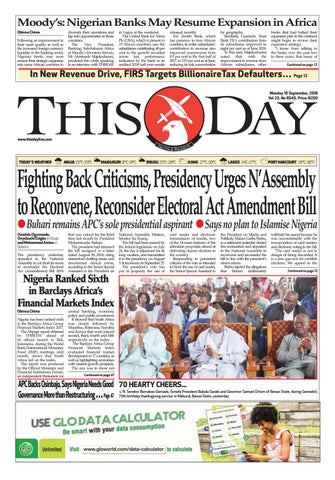
Moody’s: Nigerian Banks May Resume Expansion in Africa Obinna Chima Following an improvement in their asset quality as well as the increased foreign currency liquidity in the banking sector, Nigerian banks may soon resume their strategic expansion into some African countries to
diversify their operations and tap into opportunities in those countries. The Vice President, Banking, Sub-Saharan Africa at Moody’s Investors Service, Mr. Akintunde Majekodunmi, predicted this while speaking in an interview with THISDAY
in Lagos at the weekend. The United Bank for Africa Plc (UBA), which is present in 19 African countries, saw the subsidiaries contributing 40 per cent to the growth recorded across key performance indicators by the bank in its audited 2018 half year results
released recently. For Zenith Bank, which has presence in four African countries, its entire subsidiaries’ contribution to revenue also improved year-on-year from 8.5 per cent in the first half of 2017, to 12.9 per cent as at June, reducing its risk concentration
by geography. Similarly, Guaranty Trust Bank Plc’s contribution from its subsidiaries improved to eight per cent as of June 2018. To this end, Majekodunmi noted that with the improvement in revenue from African subsidiaries, other
banks that had halted their expansion plan in the continent might begin to review their expansion strategy. “I know from talking to the banks over the past two to three years, that many of Continued on page 12
In New Revenue Drive, FIRS Targets BillionaireTax Defaulters… Page 12 Monday 10 September, 2018 Vol 23. No 8545. Price: N250
www.thisdaylive.com TR
TODAY'S WEATHER
ABUJA 25°C-33°C
MAIDUGURI 31°C-31°C
UT H
& RE A S O
ENUGU 25°C-28°C
N
KANO 27°C-33°C
LAGOS 24C-27°C
PORT HARCOURT 20°C-30°C
Fighting Back Criticisms, Presidency Urges N’Assembly to Reconvene, Reconsider Electoral Act Amendment Bill
Buhari remains APC’s sole presidential aspirant Says no plan to Islamise Nigeria
Omololu Ogunmade, Onyebuchi Ezigbo in Abuja and Mohammed Aminu in Sokoto The presidency yesterday appealed to the National Assembly to cut short its recess to reconsider the Electoral Act (Amendment) Bill 2018
that was vetoed for the third time last month by President Muhammadu Buhari. The president had returned the bill unsigned in a letter dated August 30, 2018, citing unresolved drafting issues and uncorrected clerical errors, according to the Senior Special Assistant to the President on
National Assembly Matters, Senator Ita Enang. The bill had been passed by the federal legislature on July 24, the day it adjourned for its long vacation, and transmitted it to the presidency on August 3. It reconvene on September 25. The president’s veto has put in jeopardy the use of
card reader and electronic transmission of results, two of the 14 main features of the alteration proposals aimed at delivering cleaner elections in the country. Responding to persistent criticism of the veto as intended to block the use of card reader, the Senior Special Assistant to
the President on Media and Publicity, Malam Garba Shehu, in a statement yesterday denied this insinuation and appealed to the National Assembly to reconvene and reconsider the bill in line with the president’s observations. Shehu rejected the allegations that Buhari deliberately
withheld his assent because he was uncomfortable with the incorporation of card readers and electronic voting in the bill. "The card reader is not in danger of being discarded. It is a sine qua non for credible elections. We appeal to the Continued on page 12
Nigeria Ranked Sixth in Barclays Africa’s Financial Markets Index Obinna Chima Nigeria has been ranked sixth in the Barclays Africa Group Financial Markets Index 2017. The 34-page report obtained by THISDAY ahead of its official launch in Bali, Indonesia, during the World Bank/International Monetary Fund (IMF) meetings next month, shows that South Africa led on the index. The report was produced by the Official Monetary and Financial Institutions Forum, an independent think-tank for
central banking, economic policy and public investment. It showed that South Africa was closely followed by Mauritius, Botswana, Namibia and Kenya that were placed second, third, fourth and fifth respectively on the index. The Barclays Africa Group Financial Markets Index evaluated financial market development in 17 countries, as well as highlighting economies with clearest growth prospects. The aim was to show not Continued on page 47
APC Backs Osinbajo, Says Nigeria Needs Good 70 HEARTY CHEERS... L-R: Senator Barnabas Gemade, Senate President Bukola Saraki and Governor Samuel Ortom of Benue State, during Gemade’s Governance More than Restructuring … Page 47 70th birthday thanksgiving service in Makurdi, Benue State...yesterday
2
T H I S D AY ˾ ͯͮ˜ ͰͮͯͶ
T H I S D AY ˾ MONDAY SEPTEMBER 10, 2018
3
4
T H I S D AY ˾ ͯͮ˜ ͰͮͯͶ
T H I S D AY ˾ MONDAY SEPTEMBER 10, 2018
5
6
T H I S D AY ˾ ͯͮ˜ ͰͮͯͶ
T H I S D AY ˾ MONDAY SEPTEMBER 10, 2018
7
8
T H I S D AY ˾ ͯͮ˜ ͰͮͯͶ
T H I S D AY ˾ MONDAY SEPTEMBER 10, 2018
9
10
T H I S D AY ˾ ͯͮ˜ ͰͮͯͶ
T H I S D AY ˾ MONDAY SEPTEMBER 10, 2018
11
12
MONDAY, ͚͸˜ ͺ͸͚΀ Ëž T H I S D AY
PAGE TWELVE
In New Revenue Drive, FIRS Targets Billionaire Tax Defaulters Considers freezing accounts
James Emejo in Abuja The Executive Chairman of the Federal Inland Revenue Service (FIRS), Mr. Babatunde Fowler, has disclosed that the agency will soon target defaulting taxpayers who have billions in their bank accounts but refuse to honour tax obligations to the country. He said over 6,772 billionaire taxpayers had been identified by the service leveraging on bank data, adding that the FIRS would through all banks do what it called substitution on accounts for such identified taxpayers. The FIRS boss spoke at a stakeholders’ meeting which held last Thursday in Lagos, noting that those who had between N1 billion and N5
billion in their accounts have no Taxpayer Identification Number (TIN) or have an identification but never filed any tax returns as tax payers. Fowler was quoted by a source as saying, "What we have done is what we call ‘substitution’ which also is in our laws which empowers us to appoint the banks as collection agents for tax. "So, all these ones of TIN and no pay and no TIN and no pay, to the total of 6,772 will have their accounts frozen or put under substitution pending when they come forward." He said, "First, they refused to come forward in 2016, they refused to come forward under VAT and are still operating here. So, we are
putting them under notice that it is their civic responsibility to pay tax and to file returns on these accounts. “We looked at all businesses, partnerships, corporate accounts that have a minimum turnover of N1 billion per annum for the past three years. First of all, the law states clearly that before you open a corporate account, part of the opening documentation is the tax I.D. From the 23 banks, we have analysed so far, we have 31,395 records, out of which effectively minus duplications we had 18,602." Continuing, he said, “We broke those into three categories: Those that have TIN tax I.D, those that don’t have no TIN and of course no TIN no pay and those
that have TIN and have not even paid anything. “So, on a minimum, every company or business included here over the last three years have had a banking turnover of N3 billion and above. Some of them have had banking turnover of over N5 billion and have not paid one kobo in taxes. Now the total number of TIN and no pay is 6,772. “So, if someone is good in mathematics and you take the minimum level of N3 billion multiply by 409 and they are operating within our society and economy and do not remit or make any tax payment." Commenting further on some far-reaching measures being taken against wealthy
tax defaulters, Fowler said, "... If you do not file your returns and you are in constant default, we use turnover as a basis of estimating your tax liability’. For example, if your turnover is N100 million, we assume that 20 per cent of that is profit and we tax that at 30 per cent. He said some of the people or companies "claim not to own the properties, those of them that claim not to own the properties and of course were sent to government, presidency to decide what would happen to those properties that have no owners. "To those that have owners and have not paid, they would be prosecuted. We are also in the process of going to
court to get the approval of the court orders to sell those properties. "We are not only doing that in Abuja, we have concluded it in Lagos. We are currently doing it in Osun, Oyo and Kaduna States and eventually we would cover the whole federation. “The idea here is simple. If you have had the opportunity to make your wealth in this economy, in this society, the least you can do is pay your tax. “We have not included any group who by law are not meant to pay tax in this group. So far, we have sent out 2,980 letters and we believe that before the end of September we would get most of them out.
FIGHTING BACK CRITICISMS, PRESIDENCY URGES N'ASSEMBLY TO RECONVENE, RECONSIDER ELECTORAL ACT AMENDMENT BILL National Assembly to reconvene as soon as possible to consider and approve the necessary corrections to the amended electoral act," he said. According to him, the incorporation of e-voting and use of card readers into the bill was never part of the issues raised by the president on the bill. He also said the earlier adoption of e-voting as enshrined in the 2015 amendment act by the Independent National Electoral Commission (INEC) already made the use of card reader a settled matter, insisting that the "president's recent decision to decline assent to the bill has no effect whatsoever on INEC’s use of card readers." Instead, he added, the president only declined assent because some portions of the bill were not only ill-prepared but also flawed and needed to be rectified before he could append his signature to it. Furthermore, Shehu explained that the president and the National Assembly never had any confrontation over the provision of card reader in the bill, recalling how the president had himself been a beneficiary of the use of card reader in 2015. He, therefore, advised the media to ignore allegations that the president deliberately frustrated the effectiveness of the bill because of card readers. He stated, "The president wanted engagement with the parliament for the corrections
to be effected so that, at the end of the day, both arms of government will be happy with the fact that we have a good electoral law in place. "The president is not in confrontation with the parliament on this issue. He has asked his officials to dialogue with the legislature for the corrections to be effected. As for his alleged rejection of the card reader, nothing can be farther from the truth. "The president is the country’s number one fan of the card reader. For a candidate who ran three times and 'lost' in an electoral environment in which votes were allocated and losers asked to go to court if they felt unhappy, the president knows full well the role that the card reader played in his emergence in 2015. "He has said times without number that he would strengthen and widen its application in the country and this, he is determined to do. "Accordingly, we would like to appeal, especially to the media to disregard baseless allegations against the president, even as he puts in his best efforts in working with the National Assembly to give the nation a good electoral law, and in time." There are fears that even if the bill is reconsidered and assented to by the president, it might not be used for the 2019 general election given a protocol of the Economic Community of West African States (ECOWAS), which provides that an electoral
law must come into force not later than six months to the conduct of the elections. Buhari Remains APC’s Sole Presidential Aspirant Meanwhile, barely 24 hours to the deadline on sale of expression of interest and nomination forms by the APC, Buhari has remained the only aspirant to have purchased the forms. Last Tuesday, a group known as Nigeria Consolidation Ambassador Network (NCAN) bought both forms for the president for N45.5million. The ruling party has repeatedly said it would not grant automatic ticket to the president but that he would be allowed the right of first refusal to seek re-election in 2019. As at yesterday, no other aspirant has come forward to pick the forms to challenge Buhari for the APC ticket. There is an unwritten agreement by the leadership of the APC to zone its presidential ticket to the north just like the main opposition party, the Peoples Democratic Party (PDP). The acting National Publicity Secretary, Mr. Yekini Nabene, confirmed to THISDAY that as at yesterday, no other presidential aspirant had come forward to pick the nomination forms. APC said it would hold a primary election to select it presidential flag bearer in the 2019 election while a national convention to ratify
the election of its presidential candidate would be held on October 6, 2018. Meanwhile, the party operated all through the weekend to enable numerous aspirants to various positions purchase nomination forms. Among those that collected their nomination forms at the weekend were Senator Shehu Sani and the Director General of the Voice of Nigeria, Mr. Osita Okechukwu both of whom purchased their nomination forms to vie for senatorial elections. Addressing journalists Sani said he decided to stay back in the APC despite the challenges because he believed it came to power on the promise of change. On the tussle between him and the Kaduna State Governor, Malam Nasir el-Rufai, over the mode of primary election, Sani said, "The Kaduna State chapter has submitted their application for indirect primaries and we the stakeholders have also submitted application for direct primaries." Sani said that it is now left for the national leadership of the party to decide which way to go. “I think the governor of a state should be more concerned about the party he is going to confront, which is the PDP with such formidable names and members who are united and determined to take over power from us rather than bringing himself low to fight for a senatorial seat.
"He has three senatorial seats to fight. He has Southern, Central and the Northern Kaduna. How will an APC in Kaduna win election when you have a united house in Kaduna PDP and divided house in the APC." Okechukwu, who also picked the APC expression of interest and nomination forms to run for Senator of Enugu West senatorial district in eastern Nigeria, said if elected, he would work in line with Buhari’s plan for agriculture, by establishing cassava and rice farms at different locations in Enugu State. He added that he would push for the establishment of a standard gauge rail line that would run from the eastern to northern part of Nigeria. He said that his state had adopted the process of indirect primary to elect their flag bearers for the 2019 general election. “I intend to use my experience, my network across the length and breadth of the country to make demands that will get my people to have the eastern corridor railways just like the western corridor railways," he said. No Plan to Islamise Nigeria, Buhari Tells Catholic Bishops In another development, Buhari yesterday said there was no plan whatsoever to Islamise Nigeria, contrary to the propaganda being spread in some quarters and churches across the country. Speaking at the Catholic
improvement in the economy. “Non-performing loans (NPLs) in some banks have been written off, which also shows that they have the capacity to write-off loans without dipping into their capital,� he said. Continuing, Majekodunmi noted that half year results showed pressure on interest income from falling yields on government securities and that the banks have since made up for this through their non-income interest line. “Specifically, their revenues are generated through transactional banking. So, a lot of banks, like we expected, have been exploiting their digital
platform and as a result they have made substantial revenues on transactional banking. “In terms of things like asset risks and foreign currency liquidity, we haven’t seen too much of upward pressure in terms of NPLs. In fact, for some banks, NPLs have come down as a result of some of their troubled assets. “And from a foreign currency liquidity perspective, things are more stable than they were previously. Again, in some banks, we have seen an accretion of foreign currency deposits and not the downward pressure we saw in 2016,� he added.
MOODY’S: NIGERIAN BANKS MAY RESUME AFRICAN EXPANSION them stopped, or should I say halted the growth in their pan-African expansion because they wanted to focus on the problems they had at home, as in Nigeria. “Those were the asset quality issues, their foreign currency liquidity challenge and the issues they had in the oil and gas sector. Now that those challenges have been sorted out, we might see a return of these banks growing their franchises outside Nigeria.� This, he however stressed, would not be in the short-term, saying “but we would see Nigerian banks continue to expand their businesses across
the continent.� Mohammed Garuba, one of the founding Partners/ Directors of CardinalStone Partners Limited, an investment banking firm, recently told THISDAY that banks that were bold enough to set up subsidiaries in the continent, are presently reaping from those economies. According to him, Africa presents a huge opportunity to providers of financial services. “Ghana is doing 18 per cent, their foreign exchange is stable and worst case it hovered around three per cent because theirs is manage float system. So, I would invest in
Ghana and I’ll still walk away with about 15 per cent return. Congo’s treasury bills rate is up 30 per cent. In fact, banks such as GTBank, Access Bank, UBA, FirstBank are all in Congo because of this guaranteed interest rate. All their respective audited accounts for 2017, their most successful subsidiary was Congo because they are all making crazy money from the country,� he said. Also, while commenting on the recently released half year results by Nigerian banks, Banking Analyst, SubSaharan Africa, Moody’s, Peter Mushangwe, said generally, the trend reflected signs of
Bishops Conference of Nigeria (CBCN) in Sokoto, the president said there was no credible fact to indicate that the present administration was out to Islamise Nigeria. He noted with dismay that such negative propaganda and innuendos being promoted by outsiders, finds narrative in churches across the country. According to him, such religious propaganda has created suspicion and distrust, leading to division and disharmony among Nigerians. Buhari emphasised that such negative propaganda being propagated by outsiders included the membership of Nigeria to the Organisation of Islamic Conference, introduction of Sharia in northern states, the Boko Haram insurgency, as well as farmers/herdsmen clashes. Buhari, who spoke through the Secretary to the Federal Government (SGF), Mr. Boss Mustapha, blamed politicians for using religion as a tool to spread hate and division among the people. He pointed out that these four issues had been in existence for decades and even preceded Continued on page 47
TOP GAINERS NEIMETH SKYEBANK GSK JAPAUL WAPIC TOP LOSERS LAWUNION WEMABANK UNIONBANK
NGN NGN 0.06 0.66 0.05 0.58 1.20 14.30 0.02 0.26 0.03 0.39 NGN 0.06 0.54 0.06 0.57 0.55 5.30 STDINSURE 0.03 0.29 LASACO 0.02 0.31 HPE Nestle Nig Plc â‚Ś1,500.00 Volume: 155.953 million shares Value: N2.103 billion Deals: 2,715 As at Friday 31/08/18 See details on Page 35
% 10.0 9.4 9.1 8.3 8.3 % 10 9.5 9.4 9.3 6.0
T H I S D AY ˾ MONDAY SEPTEMBER 10, 2018
13
14
T H I S D AY Ëž Ëœ ÍŻÍŽËœ Í°ÍŽÍŻÍś
COMMENT
Editor, Editorial Page PETER ISHAKA Email peter.ishaka@thisdaylive.com
A CASE FOR SACRIFICIAL LEADERSHIP
Chris Okotie canvasses the need to expand the country’s vision of leadership beyond political affiliations
P
olitics is essentially the negotiation of instrumentality for a place and for a time. Every political agenda is predicated on an ideological philosophy that finds expression in its manifesto. The manifesto is an aggregation of philosophical abstractions that are seeking practical materialisation. I believe that the two dominant parties understand the seriousness of what confronts Nigeria and we would resort to a certain political pragmatism that would enable Nigeria overcome these existential adversaries as I mentioned in my letter. There are many patriots within these parties who understand that we have an aboriginal connectivity as a nation or as a people that cannot be vitiated by any political philosophy or alliance. We have come to that point in our political evolution where we must be willing to be messianic, that is, sacrificial in our disposition towards Nigeria. Even if it is just based on the terms of examining the Constitution and re-ordering it, and all of the ramifications that derive therefrom. I am sure that we can find a certain level of philosophical syncretism that will enable us take Nigeria to the next level. The present political scenario in Nigeria is not unusual and is characteristic of a free democracy like ours which empowers you to establish a position and to pursue it, looking for a platform on which you can articulate and crystallise that political posture. This phenomenon, in my view, represents birth pangs and it portends good things; that there is light at the end of the tunnel and the renaissance of our great nation. These things will play out in their natural sequence and eventually, we will come to a place where we will all recognise the need for a certain mutuality that must be available to each political party and all political actors involved; for the sake of the unity, holistic existence of our nation and posterity. I am not seeking to wrest power from the elites. What I am trying to do is to establish a new concept of government that I have christened aboriginal democracy, that will re-establish the parameters for political participation and will enlighten the polity as to their responsibilities within the democratic setting. The word, democracy derives from the Greek word, demokratia which is a compound word. It speaks of demos, that
THE NIGERIAN EXPERIENCE DOESN’T DEPICT THE POWER OF THE PEOPLE BUT THE POWER OF THE GOVERNMENT. ALL WE NEED TO DO IS TO CHANGE THE CONCEPT AND MAKE IT MORE PRACTICABLE FOR THE PARTICIPATION OF THE PEOPLE AND THAT WILL BE DONE PROGRESSIVELY
is, people and kratia which speaks of power; and that word is taken from the Greek word, kratos. When you put those two words together, they translate into people and power. But, the thing about our system is that the nomenclature has not really exemplified the true meaning of that terminology because kratos is power that is made visible. However, the Nigerian experience doesn’t depict the power of the people but the power of the government. All we need to do is to change the concept and make it more practicable for the participation of the people and that will be done progressively. It is something that has to go through a process where the people learn to appreciate the responsibilities that they have in the governing process. This process must come to its logical conclusion. The bottom line for development of any kind of economic or security structure is usually predicated on the political will. We have men and women who understand these concepts but have not been able to practically change the situation in our country as they relate to either the economy or security issue because of political will and that itself is predicated on a lot of factors that are ramified into intricate administrative red-tapism. That is why I am saying that it is too early in the day to begin to discuss these issues. But when the time comes, one will be able to table these issues within the confines of normative civility where everybody understands the seriousness of what is at stake and can participate in the process of re-engineering our nation. I adamantly hold out an olive branch towards the two dominant parties. I believe that the Chris Okotie option will establish a no victor no vanquished scenario. It will ameliorate and pacify partisan tension which has been amplified by the current political recalibration. The option of peace is the only option as articulated by Okotie letters. We must focus on nationalistic sentiments and expand our vision beyond the perimeter of political affiliations. Rev Okotie, a presidential aspirant, is the Pastor of The Household of God Church, Lagos
NIGERIA AIR: TIME TO ENGAGE
The management of the airline will be crucial to its success, argues Chris Aligbe
I
n the aviation sector, the most trending news is all about the proposed new national carrier, “Nigeria Air� recently unveiled at the Farnborough Air Show by the Minister of State for Transport (Aviation), Senator Hadi Sirika. The extent of discussions and reportage remains unequalled in the annals of the history of the industry. More critically is the number of high standing professionals in aviation and other sectors who have expressed their views on Nigeria Air. These include: Dr. Oby Ezekwesili, Bismark Rewane, Capt. Nogie Meggison, Capt. Roland Iyayi, John Ojikutu and Nick Fadugba. We have also had comments from Mr. Chike-Obi and journalists like Sonala Olumense. All these are people who should be taken very seriously, among many others, when they ventilate on serious national matters by virtue of either their personal standing, professional success, the positions they hold or have held or the group they represent. I have chosen the above commentators out of the numerous others, for the reason, inter alia, that their views aggregate most of the others. I will therefore identify and engage their various positions, not necessarily as a final rebuttal as in Zik’s “Civil-Military Diarchy�, but rather, to extend the frontiers of discourse on this critical national issue. “Nigeria Air must Fail: This affirmative position was advanced by one of Nigeria’s outstanding citizens – Dr. Oby Ezekwesili whose incisive insights and analytical strength are usually magnetic. Having held various national and international positions, which include headship of Bureau of Public Procurement and Minister of Education as well as Vice-President of the World Bank, the tremendous experience and exposure of Ezekwesili, who was during her years under OBJ, nicknamed “Madam Due Process�, would have been invaluable if she had said the Nigeria Air Would Fail rather than Must Fail. This is because, unlike “Must�, which is proclamation of a mere wish, “Would�, would have provided reasons why Nigeria Air would fail. This would have educated us a lot, more so when one remembers that Dr. Ezekwesili’s service under OBJ spanned the period when five attempts at floatation of a national carrier (IFC’s Privatisation of Nigeria Airways, Kema Chikwe’s Air Nigeria and Nigeria
Global, Isa Yuguda’s Nigerian Eagle and OBJ’s disaster called Virgin Nigeria) all failed. But since we don’t have her usual insight, I find no basis to engage her “Must Failâ€? wish. To attempt to do so will either end in illicit deductions and imputation of improper motives or improper imputation of motives which are fundamental flaws in public discourse and logic. Secondly, even in THISDAY report of her interview on AIT, which unfortunately I didn’t watch, she was reported to have opined that the government’s plan to invest US$300million to kick start Nigeria Air is a waste of public funds. She looked at the opportunity cost of such an investment vis-Ă -vis other sectors of “higherâ€? priority such as education, health and others. Dr. Ezekwesili, as reported, further went ahead to say that, based on her experience at the World Bank, “if the government wanted ‘Nigeria Air’ to be private sector-driven as it claimed, the design of the project would have been made in a way that the investors would have provided start-up fund for the airlineâ€?. Fair enough. But such designs have typologies and models which vary from one locale to the other. For instance, across Africa today, there are new national airlines coming up – Uganda, Zambia and those already up like Kenya Airways, Rwanda, Asky and AWA all of which have different models. Unfortunately, the THISDAY report did not indicate whether Dr. Ezekwesili proffered any model. “The Rreturn on Investmestâ€? Argumen: This position advanced by one of Nigeria’s most outstanding financial analysts, Mr. Bismark Rewane, of “Financial Derivativesâ€? posits that, contrary to the aviation minister’s position that the US$300million start-up investment by the federal government will be recovered in three years of Nigeria Air operation, going by the known best returns on investment of airline globally, that, Hadi Sirika’s position is incorrect. Based on his further evaluation, he advised the government to rather focus on an MRO Centre and airport concession which he considers more profitable. I want to concur with Bismark in his financial position, not just because not to do so will be to engage a “lion in his denâ€? but because the margin of direct financial return on investment in airline operations is usually low, uncertain and its volume is usually based on a lot of “ceteris paribusâ€?; the protective clichĂŠ of Economists.
However, since I do not believe that the uncertainty of the single factor of financial return is enough to put off “Nigeria Air�, I will want to look at the issue of “return on investment� (ROI) from a wider ramification. It is my position that ROI is dependent on the objectives of whosoever is investing. If a private man is investing, the classic concept of ROI which implies recovery of invested funds applies. This is what Bismark is rightly referring to and he cannot be faulted. However, when governments are investing in airline project, the objectives are different with priorities that include, but not limited to, employment creation, provision of affordable and reliable air transport service for the air travel public, creating a platform for aviation manpower development, hub development and aviation services expansion, BASA utilization and reduction of capital flight. Without even calculating the consequential collateral benefits that trickle down, as well as the push and pull factors effects, the realisation of the above stated objectives, when reduced to monetary calculations, will more than triple the start-up investment of US$300million. For instance, a “Nigeria Air� with a fleet of 10-jet-aircraft would require between 35 – 50 personnel per aircraft, depending on the aircraft types. It will reduce, at least by 25%, the over US$600million transferred out annually by foreign airlines on ticket sales. Again, I am in agreement with Bismark that the government should pursue the issues of MRO Centre and airport concession. However, I need say here that an MRO Centre in Nigeria will only succeed when “Nigeria Air� becomes operative. This will create an immediate market for the MRO which is nonexistent now but which is needed to build the usual symbiotic business relationship that is a sine qua non for success. This is because no MRO succeeds without a parent airline. In 2015, we carried out a survey of 56 MROs globally and found out that only (three started without any parent airline. In Africa, the MROs in South Africa (the largest in Southern hemisphere), Ethiopia and Egypt all grew out of parent airlines, all of which are, up till today, national carriers. The number of operating aircraft in the country is so small and varied in types to support any MRO viably. “The Cart Before the Horse� argument: This position which holds that the aviation ministry, by taking steps to float and bring “Nigeria Air� into being by December, without first sourcing investors
and core partner is not only tantamount to putting the “cart before the horse�, but also negates its claim to the airline being “private sector-driven�. A corollary of this argument is also that the 5% equity to be held by the government is unequitable to the US$300million being invested by the government over the next three years – 2018 to 2020. This position is held by quite some, most notable among whom is former AMCON CEO, Mustapha Chike-Obi, who fired the first salvo by comparing the US$256million paid to acquire 30% equity of Virgin Atlantic by Air France/KLM with US$300million for 5% equity in “Nigeria Air� that is yet to be formed. Incidentally, Mr.Chike-Obi spoke before the aviation minister explained the aim and application of the US$300million as a start-up fund and a three -year cash-flow provision which could be converted into equity or debt. Out of the US$300million, US$55million will be spent in 2018 as an upfront grant/viability gap funding, US$100million in 2019 and US$145million in 2020. Beyond this, what appears clear is that many a commentator seems to have missed the fact that no Nigerian investor will invest in a product he/she has not seen or is not part of the origination. It is even worse when it is an airline given the history of airline business in our country where over 25 private airlines have gone under, including two that were quoted on the Stock Exchange – ADC and Albarka, as well as the wholly government owned national carrier – Nigeria Airways. Secondly and quite critical is the fact that even if Nigeria Air is floated, investors will wait to know who will manage it before coming with their funds. For instance, if investors find that the management is a government appointed team, given our past experiences, they will stay away. But if they find that the core-investor partner that will manage is a world class airline like Cathy Pacific, Singapore Airlines, Emirates, Qatar, Etihad, British Airways or Air France, they will cascade. The point I am making is precisely that for “Nigeria Air� to fly, the two most critical determinants are: the product (airline) and management. As a professional, the minister should be aware of these two factors and his present approach is mostly probably being guided by this indubitable fact.
Aligbe is an Aviation Consultant
15
T H I S D AY Ëž Ëœ ÍŻÍŽËœ Í°ÍŽÍŻÍś
EDITORIAL YET ANOTHER DELUGE There is need to pay more attention to the environment
W
hile hundreds of thousands of citizens are still counting their losses, nature is wreaking havocs on communities in several states across the country. Within the past one month, villages, schools and farmlands have been submerged as more and more Nigerian join the growing population of internally displaced. To compound the problem, the Nigeria Hydrological Services Agency last week predicted more ooding in no fewer than 12 states of the federation. According to an alert from the agency, there has been a systematic rise in the water levels of both Rivers Niger and Benue in recent weeks such that Shiroro, Kainji and Jebba dams were already spilling water. Instructively, while Nigeria has many challenges, environment is not often listed as one of them. That only shows our lackadaisical disposition to serious issues. It is therefore time Nigeria became part of the global trend of putting issues of the environment on the front burner while the relevant authorities should be more proactive, especially in the prevention of natural disasters. And BEYOND THE when they inevitably INTERVENTION OF THE occur, governments at all tiers, GOVERNMENT AT ALL complemented by LEVELS IS THE NEED private organisations FOR NIGERIANS TO and well-endowed BEGIN TO IMBIBE THE individuals, should CORRECT ATTITUDE TO come to the aid of the victims as we see WASTE DISPOSAL in other parts of the world. Meanwhile, elementary science teaches that as global temperatures rise, oceans get warmer and when water heats up, it expands and sea levels rise as we have been witnessing in several countries in recent times. It is therefore no surprise that in several coastal cities across the world today, climate change is creating a situation where too much water comes at an unexpected time, or in unexpected places causing seri-
Letters to the Editor
ous problem. It is then little wonder that the densely populated, low-lying cities and towns in our country have also become an environmental nightmare for most of the inhabitants on account of ooding. However, beyond the intervention of the government at all levels is the need for Nigerians to begin to imbibe the correct attitude to waste disposal because ooding in some of our major cities cannot be solely explained by the factor of nature. The habit of the people indeed plays a crucial role in what has been happening over the years anytime it rains. Most of the drains are blocked due to the indiscriminate throwing on the roads and drainages, disposable empty cans and pure water nylons, among others. his dirty attitude quite naturally leads to blockages of canals and man-holes resulting in the type of oods that have been witnessed in recent weeks. For instance, Lagos presents a clear example in this regard as most ood-prone areas are replete with buildings erected on water channels. This ugly trend must stop while the state government should ensure that all those buildings are pulled down so as to ensure the free ow of water into the canals. However, it is not enough for the government to just ask citizens to leave their houses built on ood path without providing compensations or any measures for their relocation, especially if those buildings have all the requite permits which then suggest that the owners are not to blame. Also, there is need for the authorities to resettle those living in ood-prone areas, especially in situations where that is the only solution for dealing with the problem. Naturally, there will be resistance from people who would not like to move from their present habitat but they must be made to realise the consequences of whatever choice they make between accepting to be resettled or risk their lives and livelihoods. In the ďŹ nal analysis, Nigerians must come to terms with the fact that we are at a period in history when the forces of nature are raging and we must be prepared to deal with them.
T T H I S DAY EDITOR
DEPUTY EDITOR MANAGING DIRECTOR DEPUTY MANAGING DIRECTOR CHAIRMAN EDITORIAL BOARD
EDITOR NATION’S CAPITAL MANAGING EDITOR
T H I S DAY N E W S PA P E R S L I M I T E D EDITOR-IN-CHIEF/CHAIRMAN GROUP EXECUTIVE DIRECTORS ˜ ˜
˜ ˜
DIVISIONAL DIRECTORS ˜ ˜ DEPUTY DIVISIONAL DIRECTOR
SNR. ASSOCIATE DIRECTOR ASSOCIATE DIRECTORS ˜ CONTROLLERS ˜ ˜
DIRECTOR, PRINTING PRODUCTION TO SEND EMAIL: ďŹ rst name.surname@thisdaylive.com
TO OUR READERS Letters in response to speciďŹ c publications in THISDAY should be brief (150-200 words) and straight to the point. Interested readers may send such letters along with their contact details to opinion@thisdaylive.com. We also welcome comments and opinions on topical local, national and international issues provided they are well-written and should also not be longer than (9501000 words). They should be sent to opinion@thisdaylive.com along with the email address and phone numbers of the writer.
NATIONAL SECURITY AND NOUN LAW GRADUATES
T
he imbroglio between the Council of Legal Education (CLE) and National Open University of Nigeria (NOUN) over admission into the Nigerian Law School is indeed discreditable albeit resolvable. Taking a realistic and holistic look on the issues, the quagmire which has lingered for five years since the first set graduated resulted from conflict of interests between the Federal Ministry of Education and its counterpart, Ministry of Justice. Regrettably, innocent law graduates became the proverbial helpless grass that suffers the fight of the elephants. By their establishments, NOUN and National Universities Commission (NUC) operate under the Ministry of Education while the Nigerian Law School, under Council of Legal Education is supervised by the Minister of Justice/Attorney General of the Federation; thus two different ministries involved. The two ministers have significant roles to play in the resolution of the conflicts as their continual disagreement will keep the students roaming the streets. These two ministers should harmonize their differences without further delay. Possibly, President Muhammadu Buhari should summon them for amicable resolution of the crisis pursuant to national security and interests. Interestingly, this is an era the polity is overheated over national security. Irrefutably, NOUN law graduates’ crisis aptly falls under matters that deserve doctrine of necessity and national security as keeping grown persons to be wandering the streets without vocational training for their practice and engagement is highly prejudiced and
dangerous. No doubt, the predicament commenced during the previous administration but in line with change mantra, the crisis deserves a state of emergency as unrelenting neglect is precarious. By the accreditation of the programme by NUC, obligations accrued to the parties to do the needful. The students fulfilled their part by completing their courses and acquired certificates as approved by the relevant bodies. And to crown it, in the moot-court competition which is the only practical aspect of the programme, the students diligently floored their counterparts from conventional universities and represented the country in India international competition in 2012. Such breeds deserve honours and not political bullying. The federal government should stop pretending as if it is not aware of the predicament of the students. FGN is under obligation to fulfill its part of the deal as it willfully established the institution, promoted and lured these citizens into it. To clear the air over its authenticity, the then President, Chief Olusegun Obasanjo laudably enrolled into one of the programmes. That singular act is sufficient to make those playing politics to have a rethink. These graduates were persuaded to apply into the school due to its newness, and from records so far, it cannot be said that the products are academically deficient. President Buhari owes these students obligation even though inherited. Government is a continuum. It is absurd to abandon innocent and brilliant citizens with certificates to be roaming the streets for no justifiable reasons.
The Minister of Justice, Mr. Abubakar Malami (SAN) certainly understood the undefeatable title the students acquired as Innocent third parties in line with Lord Denning’s ‘bona fide purchasers of Interest for value without notice of defect’ though not the case as they school was accredited. At most, if the accreditation appears questionable or flawed, the appropriate thing should be to withdraw the accreditation as NUC did to University of Abuja and recently, Obafemi Awolowo University. The powers vested in the Minister of Justice/Attorney General of the Federation to give directions to the Council of Legal Education should be effectively utilised forthwith. Enough of empty promises and tactics as destinies are being shattered. If the numerous prominent legal icons that embraced Open and Distance Learning were frustrated during their time, the nations would have lost all their contributions to the legal profession and society at large so far. To sum, the minister of justice should urgently release these innocent citizens from incarceration. No country of the world would allow such shameful treatment to triumph especially in a government that made uncountable promises to the citizenry. A hullabaloo on national security when citizens’ sweats are aimlessly endangered is inconsistent. The FGN under President Buhari has the brightest chance of redeeming this situation and write his name in gold. Onyema Sylvester Ikechukwu wrote from Lagos
16
T H I S D AY ˾ ͯͮ˜ ͰͮͯͶ
T H I S D AY ˾ MONDAY SEPTEMBER 10, 2018
17
18
T H I S D AY • MONDAY, SEPTEMBER 9, 2018
POLITICS
Group Politics Editor NSEOBONG OKON-EKONG Email nseobong.okonekong@thisdaylive.com 08114495324 SMS ONLY
M O N D AY D I S C O U R S E
The Burden of Presidential Nomination Form Nseobong Okon-Ekong and Segun James report that Nigerians were jolted when a group presented the leadership of the All Progressives Congress with a cheque to enable President Muhammadu Buhari purchase the party’s presidential nomination form
Buhari
T
he Nigerian political scene recently witnessed the emergence of a group that is shrouded in mystery. The arrival of the assemblage which goes by the bogus name, Nigeria Consolidation Ambassadors Network (NCAN) brings back memories of similar spurious clusters which usually gain prominence during the period of high stake political campaign in the country. On the surface, the NCAN could be categorised along with the mass of other support groups angling for President Muhammadu Buhari’s reelection. While the others were jostling for recognition, the National Coordinator of the NCAN, Mr. Sanusi Musa, a previously unknown personality took a decisive action that turned all attention on him. Though, it may not be considered a coup de grace like the action of the Association for Better Nigeria (ABN) which was one of the vehicles used to scuttle the June 12, 1993 Presidential Election, the exploit of the NCAN has already created far-reaching ripples on the constantly turbulent political waters of Nigeria. The fanfare with which the NCAN issued N45.5 million to procure the All Progressives Congress (APC) presidential nomination and expression of interest forms for President Muhammadu Buhari earned, perhaps, an unexpected hostile response from Nigerians. Presenting the cheque for the amount to the leadership of APC, Musa said his group was out to assist Buhari, who had earlier complained that the cost of the forms were above his salary. Vice President Yemi Osinbajo had revealed that Buhari earns N1.75 million monthly. Assuming his salary remained intact in the last three years, he would have saved N63 million. THISDAY Board of Editors, rights groups and other stakeholders who rose in condemnation of the action of the NCAN, have also urged
Yakubu
Buhari to reject the offer, citing the fact that it
The two leading political parties in Nigeria have obeyed this provision of the electoral act more in the breach. From inception, nomination of the APC has been on the high side. For the 2015 election, the party sold its presidential form for N27 million. The People’s Democratic Party (PDP), on the other hand has recently pegged its presidential nomination form at N12 million, which is a reduction from the N22 million that it cost to acquire the same form in 2015. This gives the impression that a party in government, understandably, has more at stake
Atiku
contravenes the Electoral Act. The contentious part of the act states: “A presidential aspirant in a Nigerian election will pay no more than N10 million as a nomination fee during the political primary process.” The two leading political parties in Nigeria have obeyed this provision of the electoral act more in the breach. From inception, nomination of the APC has been on the high side. For the 2015 election, the party sold its presidential form for N27 million. The People’s Democratic Party (PDP), on the other hand has recently pegged its presidential nomination form at N12 million, which is a reduction from the N22 million that it cost to acquire the same form in 2015. This gives the impression that a party in government, understandably, has more at stake. The NCAN gesture to Buhari has been widely criticised as unlawful with many opponents asking the president to turn down the offer. They said that the action of the group and the acceptance of the offer by the president is a clear contravention of the Electoral Act 2010. Civil society groups and opposition parties were united in condemning the offer too. The groups, including Centre for Transparency Advocacy, Pan Niger Delta Forum (PANDEF) and Afenifere as well as the Peoples Democratic Party (PDP) and African Democratic Congress (ADC), said the NCAN gesture was a violation of S91(9) of Electoral Act 2010 as amended and asked the president to reject it. The presidency, however, refused to take issues with the critics yesterday, asking THISDAY to approach the president’s campaign managers for comments. “The president’s campaign organisation is the most appropriate body to react to this type of matter,” said Femi Adesina, the Special Adviser to the president on Media and Publicity. The Director of Strategic Communication of the Buhari Campaign Organisation, Mr. Festus Keyamo (SAN), could not be reached
as he was said to have travelled out of the country. The PDP, for instance, said if Buhari proceeds to accept the offer, the Independent National Electoral Commission (INEC) should apply the sanction stipulated in S91 (10) (a) of the electoral law. “The PDP urges the INEC to note that the purchase of the N45 million form by the group directly violates section 91 (9) of the Electoral Act, which provides that “no individual or other entity shall donate more than One million naira (N1,000,000) to any candidate,” the party said in a statement by its National Publicity Secretary, Mr. Kola Ologbondiyan. According to him, “Since President Buhari has not publicly disowned the purchase of the form by the group, the PDP charges INEC to hold him culpable and make him to face the appropriate sanctions for the violation of electoral laws.” Arguing that there is a world of difference between an aspirant and a candidate, the APC disagreed that there had been any constitutional or legal infraction by the action of NCAN. Yenagoa-based lawyer, Mr. Doueyi Fiderikumo posited that the President did not contravene the provisions of S91. He said the Act will only apply after the president had secured his party’s ticket and is presented as the party’s candidate. According to him, Section 91 of the Act does not apply to the party’s primaries which are strictly the internal affairs of the party. He said that what was contemplated in the law are the elections that were regulated by the Independent National Electoral Commission (INEC) for positions such as President, Vice President, Governor, Deputy Governor Senate, House of Representatives and State House of Assembly which are recognised by the constitution and by-elections into these positions as conducted by the INEC. Fiderikumo insisted that both NCAN and the President did nothing wrong as purchase
19
T H I S D AY • MONDAY, SEPTEMBER 9, 2018
POLITICS
The NCAN team with the leadership of the APC
of nomination form is strictly a party affair. “It will only be illegal if it was for the purpose of running for election. No law has been broken for the following reason: First Section 91(9) cannot be interpreted in isolation. To understand whether this section applies to primary election for nomination of candidates of political parties, we have to look at other subsections of S91 – subsections 1, 2, 3, 4, 5, 6, 7 and 8. “If you look at these provisions, it is looking at predetermined election – presidential, governorship, national and state assembly elections. It has nothing to do with primary election.” Fiderikumo opined that, “You cannot be a candidate for election into these offices except where you have secured your party’s ticket after having won the party’s primary. So, you will notice in the first place that S91 actually prohibits INEC election. S91 has nothing to do with party primaries.” As the legality and the morality of the president’s action continues to rage, his party, the APC in a statement by its acting National Publicity Secretary, Mr. Yekini Nabene, said that it would amount to rushing to quick conclusion based on erroneous legal grounds for anyone to fault the NCAN. “Aside from the fact that there is a world of difference between an aspirant and a candidate in the eyes of the law, there has been no contravention of the Electoral Act 2010 (As Amended)”. Nabene explained, “The Nigeria Consolidation Ambassadors Network was responsible for the purchase of the presidential forms for President Buhari and has indicated that it acted as a collection medium to aggregate micro
contributions from thousands of Nigerians keen to ensure his re-election. “While we restate that as a political party, the APC acted in compliance with the dictates of the law, we also acknowledge that this singular act by thousands of Nigerians severely jolted the ranks of opposition politicians and their paid agents in the media hence their desperate attempt to tar such a noble gesture with the brush of illegality. “This is especially the case considering the loud silence when former Vice President Atiku Abubakar enjoyed the same gesture from his supporters to purchase the PDP Nomination and Expression of Interest Forms for the 2019 presidential election.” But other lawyers countered this position, arguing that candidacy starts with aspiration. “Election is a process that starts with the selection of aspirants. So, the nomination process is part of the election because there can’t be a candidate by law without a selection process,” a lawyer said, asking, “Are they saying that an aspirant can gather illicit funds and use it later when he becomes a candidate?” Another lawyer said APC’s argument was hairsplitting. “The point is that in 2015 when Buhari had more than enough friends to pick up the forms for him, he chose the option of a loan. Has the situation changed now?” he asked. The pan-Yoruba socio-cultural organisation, Afenifere, said the president should shun the forms, arguing that his claim that he could not afford them was hypocritical, adding that it was a rehash of similar attitude before the 2015 election. The group’s spokesman, Mr. Yinka Odumakin, warned that Buhari might be sued for violating
Oshiomhole
the Electoral Act. Odumakin stressed that it was typical of Buhari’s administration to take Nigerians for granted. He ecalled that Buhari said he took loan to buy his 2015 nomination form, but he is yet to inform the nation if he has indeed finished paying the loan. He said that the action of the president was contrary to the provision of Electoral Act 2010 as amended, which pegs individual and group contributions to election expenses
of a candidate to N1million. “You say you are fighting corruption, but this is corruption. This is a clear contravention of the Electoral Act. It is all hypocrisy,” Odumakin insisted. The National Publicity Secretary of PANDEF, Chief Anabs Sara-Igbe, said the organisation is a pressure group that does not dabble into partisan politics except that which has to do with issues relating to restructuring the country, fiscal federalism and the Niger Delta. Sara-Igbe, however, said that if the president has violated the laws, those who feel aggrieved have the right to seek redress in the court of law. “They should approach the court for interpretation of the Electoral Act, if they feel aggrieved; but they are also free to advise the president to do the needful. Everybody is free to advise the president,” he said. The African Democratic Congress (ADC) similarly called on the president to reject the forms, challenging him to question the source of the money used in buying the forms. The party said, “Buhari would make a mockery of his anti- corruption war and his ‘Mr. Integrity’ posture if he failed to investigate the source of the fund. After all, he is the no nonsense anticorruption fighter who in the last three years tried to rid the country off all vice; but little did they know that the innocuous public relations gambit will attract so much criticism from the people and the media.” If his 2014 lamentation drew the sympathy of Nigerians, his 2018 show has not. Instead, it has drawn the ire and outrage of people who feels the President may be taking them for fools.
QUICK FACTS • The 2010 Electoral Act abolished arbitrary fees for nomination forms fixed by political parties. Thus, a presidential aspirant in a Nigerian election will pay no more than N10 million as a nomination fee during the political primary process. • The APC has fixed its presidential nomination form at N45 million
• The PDP nomination form costs N12 million (it cost N22 million in 2015) • Both the APC and the PDP have violated the provision of the Electoral Act • Nigeria Consolidation Ambassadors Network (NCAN) recently presented President Buhari with for N45 million to buy the APC presidential form
• NCAN said it amassed funds from members of the public who want Buhari to return as president • Alhaji Atiku Abubakar, a presidential aspirant on the PDP platform was also reported to have resorted to crowd-funding to pay for his form • Buhari earns N1.75 million monthly. Assum-
ing he his salary remained intact in the last three years, he would have save N63 million. • Section 91 (9) of the Electoral Act provides that ‘no individual or other entity shall donate more than One Million Naira • Buhari claimed that he took a loan in 2015 to enable him buy the APC presidential nomination form at N27 million
20
MONDAY, SEPTEMBER 10, 2018 • T H I S D AY
FEATURES
Group Features Editor: Chiemelie Ezeobi Email chiemelie.ezeobi@thisdaylive.com 07010510430
A Strike Force Against Regrouping Boko Haram Terrorists The Nigerian Air Force recently launched Operation Thunder Strike 2, a team made up of young budding pilots, to decimate regrouping Boko Haram forces. Chiemelie Ezeobi writes
The Chief of Air Staff, Air Marshal Sadique Abubakar, addressing the strike force
T
he war against terror seems unending. The world over, the military and security forces battle one major challenge: regrouping terror forces. Nigeria has suffered the same fate in its fight against Boko Haram terrorism. There is no doubt that the Nigerian Armed Forces have considerably decimated the capacity of the insurgents to reclaim lost grounds, pushing them back into the arid desert and sometimes, even crippling their sources of weaponry. Notwithstanding these measures, the terrorists have kept inventing new strategies to stay afloat. While they have been sacked from the caliphates they had arrogated to themselves, they still unleash pockets of violence in some areas, especially through suicide bombing. Strike Force As unrelenting as these terror groups appear to be, the military, on the other hand, are also not resting on their oars. Just this September, the Nigerian Air Force (NAF), through its Air Task Force (ATF), commenced Operation Thunder Strike 2 against Boko Haram terrorists in the North-east. The operation, which commenced September 3, was an independent Air Interdiction Operation (AIO) targeting selected Boko Haram locations within the fringes of Lake Chad and Sambisa Forest in Borno State. This was with a view to further degrading the remnants of the insurgents, curtailing their freedom of action and denying them bases from which they could launch attacks against the nation’s ground troop locations. Success
After the launch, the next day saw air strikes by NAF aircraft, which resulted in the destruction of Boko Haram hideouts and neutralisation of scores of insurgents at three locations, namely, Tumbun Rego, Sabon Tumbun and Tumbun Allura, all on the fringes of the Lake Chad. Tumbun Rego, which is located about 140Km Northeast of Maiduguri, has been identified as a major logistics/communications base and staging area for the insurgents. Accordingly, the ATF detailed F-7Ni and
The attack platforms acquired the targets and took turns to attack the location, destroying the structures and killing most of the Boko Haram Terrorists (BHTs) in the process. The few surviving BHTs, seen fleeing the area, were strafed and neutralised by the helicopter gunships
Alpha Jet aircraft to attack the identified BHT logistics/communications hubs. The identified hubs were subsequently destroyed by the strikes. Similarly, a number of solar panels were spotted and destroyed during the attack. According to NAF Director of Public Relations and Information (DOPRI), Air Commodore Ibikunle Daramola, the attack on Sabon Tumbun was undertaken based on Human Intelligence reports, which were later confirmed following several days of Intelligence Surveillance and Reconnaissance (ISR) missions, indicating that the settlement was a BHT tactical operations base. Daramola said the settlement also had some equipment and vehicles cleverly concealed under thick foliage. Accordingly, the settlement was attacked in successive waves of strikes by Alpha Jet, F-7Ni and Mi-35M Helicopter Gunships, leading to the destruction of BHT facilities, equipment and structures in the settlement as well as the neutralisation of several insurgents. Tumbun Allura, another major BHT operations base on the fringes of the Lake Chad, was attacked by Alpha Jet and F-7Ni aircraft. Overhead the area of interest, several of the BHTs were observed and the objectified. On September 5, in continuation of the strike team, the the Air Task Force (ATF) of Operation LAFIYA DOLE, successfully destroyed some BHT facilities and equipment at Alafa Yagayaga in Sambisa Forest as well as a suspected BHT ammunition depot in Kusuma on the fringes of Lake Chad, Borno State. The DOPRI said, “The air strikes against Boko Haram terrorists at Alafa Yagayaga were targeted at structures within the settle-
ment that had been identified via previous Intelligence Surveillance and Reconnaissance (ISR) missions to be rendezvous (RV) points for the insurgents. "Consequently, a combination of NAF fighter aircraft and helicopter gunships were detailed to carry out air interdiction on the locations, while the NAF ISR aircraft conducted Battle Damage Assessment (BDA). "The attack platforms acquired the targets and took turns to attack the location, destroying the structures and killing most of the BHTs in the process. The few surviving BHTs, seen fleeing the area, were strafed and neutralised by the helicopter gunships. "The attack at Kusuma was initiated following credible intelligence indicating the presence of a BHT logistics/ammunition depot within the settlement. Accordingly, the ATF detailed a fighter aircraft to attack the insurgents’ position, while the NAF ISR aircraft conducted BDA. "At the end of the attacks, the BDA revealed a direct hit on the ammunition depot, which was engulfed in fire while some other adjoining BHT structures were equally destroyed and the occupying terrorists neutralised." Budding Pilots Aside from destroying Boko Haram camps, another advantage of the strike force was that it brought to fore the talent of young pilots in the force. In this operation, these set of courageous young pilots from the ranks of flying officers to squadron leaders, within the age bracket of 25 to 33 years, operate the NAF platforms in the various theatres of operation. Unlike what was obtainable in the recent past where senior officers of the rank of Air
• T H I S D AY MONDAY,SEPTEMBER 10, 2018
21
FEATURES These young pilots are engaged in daily missions for the force now... they fully man all components of the air operations, ranging from combat, Intelligence, Surveillance and Reconnaissance, as well as air mobility missions, while the senior pilots provide the needed guidance and operational directives
The budding young NAF pilots before their ight
NAF pilots preparing for take-o
NAF jets deployed for Operation Thunder Strike 2
Vice Marshals and Air Commodores were compelled to fly combat missions due to scarcity of young aircrew, these young pilots now fully man all components of the air operations including Intelligence, Surveillance and Reconnaissance (ISR). Recently, the young strike force exhibited courage and doggedness in the fight to prevent the Albarnawi group of Boko Haram Terrorists (BHT), from establishing a foothold in the Lake Chad Green fringes. This earned them high praise from the Chief of the Air Staff (CAS), Air Marshal Sadique Abubakar, who commended the pilots, especially the young ones and other personnel, who made this possible. CAS, who was at the headquarters of the Air Task Force (ATF) of Operation LAFIYA DOLE in Maiduguri to monitor the progress, urged the young pilots to remain focused and unrelenting in their quest to safeguard the territorial integrity of the country. While assuring the young pilots of the commitment of the NAF in ensuring serviceability of various platforms in its inventory, Abubakar said the welfare needs of the pilots, and indeed all NAF personnel, would continue to receive priority attention. For the NAF, the steadily increasing number of young pilots who are flying various Air Force platforms, is a radical transformation from what obtained in the recent past, when senior officers of the rank of Air Vice Marshal and Air Commodore were compelled to fly combat missions due to scarcity of young aircrew. According Daramola, these young pilots are engaged in daily missions for the force. He said, "It is imperative to state that most of these young, intelligent and courageous combat and operational support pilots, who are flying NAF platforms in the various theatres of operation, including the Northeast and Northwest, are junior officers of the ranks of flying officer to squadron leader within the age bracket of 25 to 33 years. "They now fully man all components of the air operations ranging from combat; Intelligence, Surveillance and Reconnaissance (ISR) as well as air mobility missions, while the senior pilots provide the needed guidance and operational directives. "These committed young and energetic pilots conduct multiple missions daily and often remain airborne for several hours monitoring incidents and providing air support to the surface forces. "The foregoing is evidence that, the CAS vision of repositioning the NAF into a highly professional and disciplined force through capacity building initiative."
22
IMAGES
T H I S D AY • MONDAY, SEPTEMBER 10, 2018
Photo Editor Abiodun Ajala Email abiodun.ajala@thisdaylive.com
L-R: Oba Elect of Osapa London, Lekki, Lagos, Oba Waheed Eletu Odibo; Guest, AIG Zone 2 Command, Mr. Adamu Ibrahim; receiving Distinguished Award of Excellence in Security and Safety from Oba Fatai Oyeyinka Aremu Aromire Ojora of Ijoraland and Iganmu;and Baale of Apapa, Otunba Hakeem Ogbara, during the Courtesy Visit of Zone 2 AIG Command to Ojora of Ijoraland and Iganmu Kingdom in Lagos... recently PHOTO: KOLAWOLE ALLI
L-R: The Amir Ahmadiyya Muslim Jama’at Nigeria, Dr Mash’hud Adenrele Fashola; Sadr Majlis Ansarullah Nigeria, Alhaji (Engr) Abdul Waheed Adeoye; Representatives of the Director-General, Administrative Staff College of Nigeria (ASCON), Topo Badagry, Mallam Ahmed Musa and Topon Toyiga 1 of Ajido Kingdom, Aholu Saheed Abioro Sedonu, during the 43rd Majlis Ansarullah Ijtema in Badagry, Lagos State....recently
L-R: Logistics /Customer Safety Manager, Guinness Nigeria Plc, Oluwafemi Adebayo; Deputy Corps Commander, representing Edo Sector Commander, FRSC, Udensi Emea Oji; Site Director,Guinness Benin Plant, Adebayo Alli; Regional Logistics Manager, East, GNPlc, Magnus Amaechi; and Assistant Corps Commander/HOD, training department, FRSC, Kyrian Okolo during Guinness Nigeria 2018 Transport and Safety week in Benin-City...recently
L-R: Manager, Projects IDEAS, Stanbic IBTC, Mr. Ovie Adasen; CEO, Broot Consulting/Partner, Design Thinkers Academy, Dr Olukunle Iyanda; Human Recourses Director/Design Lead, CocaCola Nigeria, Ms. Patricia Jemibewon and Founder/Managing Partner, Design Thinkers Academy, South Africa, Mr. Robert Bloom, at the Design Thinking Workshop for Innovation Leadership in Lagos…recently KOLA OLASUPO
Oba Elegushi of Ikateland, Oba Saheed Elegushi (left); welcoming the President of the Nigeria Olympic Committee, Mr. Habu Gumel, to his palace on a courtesy visit, in Lagos…recently President of the Senate and Presidential Aspirant under the platform of the PDP, Dr. Abubakar Bukola Saraki with a chieftain of the party, Chief Emmanuel Iwuayanwu, during his meet the delegates tour of Imo and Abia states ...recently
L-R: Franchise Partner, Scanfrost Mall, Mr. Jude Amadi; Vice Chairman, C&I Leasing Plc, Pastor Emeka Ndu and Managing Director, New Home Distributions Africa Limited, Owners of Scanfrost, Mr. Maneesh Nanda, during the opening of Scanfrost Circle Mall, Lekki-Peninsula, Lagos...recently KOLA OLASUPO
L-R; Divisional Head, Transaction Banking, First City Monument Bank (FCMB), Mrs. Rolayo Akhigbe; Chairman, Lagos Chamber of Commerce & Industry (LCCI) Export Group, Mr Bamidele Ayemibo and President of LCCI, Mr Babatunde Ruwase, during the Export Business Symposium organised by LCCI and supported by FCMB in Lagos.. recently.
23
T H I S D AY Ëž SEPTEMBER 10, 2018
BUSINESSWORLD R A T E S MONEY MARKET OBB OVERNIGHT
A S
A T
REPO 2.83 % 3.42 %
CALL 1-MONTH 3-MONTH
2.83% 5.86 % 6.44%
Group Business Editor Obinna Chima
Email obinna.chima@thisdaylive.com 08024557078, 08091152219
S E P T E M B E R S & P INDEX INDEX LEVEL 1-DAY MONTH-TO-DATE
344.15% 0.03% -0.24%
7 , 2 0 1 8
S & P INDEX 1/4 TO DATE 2.84% YEAR TO DATE 4.46%
EXCHANGE RATE N306.20/1US DOLLAR* ĚŠ
Quick Takes Mandillas Honours Outgoing CEO
REWARD FOR EXCELLENCE
L-R: Group Head Corporate Communications, Access Bank Plc, Amaechi Okobi; Group Managing Director/Chief Executive Officer, Access Bank Plc, Herbert Wigwe, Group Head, Accelerate TV, Colette Otusheso and Winner of Best Short Film/Online Video, Africa Magic Viewers’ Choice Awards (AMVCA), Micheal Ama Psalmist Akinrogunde at the presentation of the award at Access Bank Headquarters, in Lagos‌ recently
Analysts Give Buying Tips as Stocks Hit Rock-bottom Prices Goddy Egene As the Nigerian equities market continued with its free fall hitting a 52-week low last week, investment analysts have advised investors to see the low prices as an opportunity to increase their portfolio. The Nigerian market, which started the year on a bullish note, entered a bearish mode in February and has remained largely bearish since then. Factors such as political jitters and hikes in the US Fed rates have caused most foreign investors to flee the Nigerian equities market. Even positive macroeconomic indicators and the impressive financial scorecards of companies for the first half of the year had little impact on the market as the
CAPITAL MARKET Nigerian Stock Exchange (NSE) recorded a year-to-date decline of 11 per cent as at last Friday. However, rather than panic, analysts at Meristem Securities Limited have said investors should take advantage of the bear market, saying the market has bled so much over the past few months and the bearish days would soon be over. “With stock prices bottoming out, light gleams at the end of the tunnel. The low prices in the market provide investment opportunities for players in the market, but of course, with a focus on the fundamentally justified stocks,� they said. The analysts explained that the 2019 elections posed a major concern for most investors which
has caused them to withdraw their funds from the market, thus making profit volume opportunities after the election become more visible. “We believe that after the elections in February 2019, calm will be restored in the market. It is only fair that you don’t get caught sleeping so why not you buy now, ahead of 2019?� they said. In buying stocks now, the analysts advised investors to consider the fundamentally justified stocks, stressing that “the market always remembers these stocks and given their very attractive prices now, your patience will be rewarded.� They added that investors should also consider companies which are important to the growth of the economy.
“Consumption is a given and the government will always carry out infrastructural projects and works. Consumer staples and the elephant in the industrial goods sector lead the way here,� they said. Other stocks investors should consider, according to the analysts, are dividend yielding stocks. “Dividend yielding stocks always provide an extra income stream for their holders. Even when stock prices are falling and there is no capital appreciation, dividend income provides some comfort. With prices on the low end, dividend yield becomes even more attractive,� they said. Another strategy they advised Continued on page 24
NITDA Opens Fresh Discussion to Boost Local Production Emma Okonji Having saved the federal government over N10 billion in one year through the implementation of information technology (IT) clearance on the importation of foreign IT products into Nigeria, the National Information Technology Development Agency (NITDA) has opened fresh talks with Original Equipment Manufacturers (OEMs) and technology start-ups in the country. The move is to develop new ways of raising the standard and quality of locally developed products and solutions. The Director-General of NITDA, Dr. Isa Ibrahim Pantami who made the disclosure, told THISDAY that the move became
ICT necessary, following complaints about some substandard IT products and solutions that were developed locally. Pantami, said the move would complement government’s effort on the huge success recorded since the establishment of its IT Clearance and Monitoring Unit, which he said would continue to save money for the federal government and the Nigerian economy. “The essence of ensuring clearance and monitoring at NITDA’s office is to save money for government. Within one year, we have saved over N10 billion for federal government. “I can recall a single project
that was brought to NITDA for clearance and after thorough review of the project, we discovered that we were able to save N3.2 billion for government from a single project, after reducing some of the quoted figures on that single project. “But again, we need to promote the quality and standard of all IT products and solutions that are locally developed and produced in Nigeria, in order to ensure that investors get value for their money, since we are depriving them of patronising foreign developed IT solutions that could be produced locally in Nigeria,� Pantami said. It was for this reason that NITDA decided to collaborate with OEMs and technology start-ups to discuss new ways
of helping them improve on the quality and standards of their products. “We have a lot of local OEMs that are doing well but they need to improve on the quality of their products to attract more patronage,� he added. According to him, “NITDA is keen on supporting local content development and promotion. NITDA wants to ensure that local content development comes with world-class quality because there are lots of complaints about the quality of our hardware and software. “To address this, NITDA is working with industry stakeholders and Original Equipment Continued on page 24
The Mandillas Goup has organised a send-forth party to honour its outgoing Group General Manager and Chief Executive OďŹƒcer, Mr. David Edward, for his exceptional service to the company. Speaking at the event, the Group Chief Executive OďŹƒcer, Ola DebayoDoherty, said the company has remained a household name in Nigeria in over 70 years. She also said the ďŹ rm was partnering with the world greatest brands in the air conditioning and auto industries. She noted that the premise on which the group was founded was for the provision of quality service to customers, noting that this had become the foundation of the company’s core values. Debayo-Doherty further noted that the company remained committed to customer service which had enabled it to withstand the ever-changing Nigerian economy. She added: “Indeed we have had our challenges through the years like others, but the group is still strong with 70 years of partnering Nigerians and Nigeria. “This gives a bit of background to the role that David has played in sterling the company through dierent challenges in the country’s economy to where we are today. “I assure you that the foundation you laid, will be sustained and advanced. Mandillas group limited family is committed to taking the company to the zenith successfully. It is a new dawn and we are scaling to greater heights.â€?
Renaissance Capital Strengthens Team
Renaissance Capital, one of the leading emerging and frontier markets investment bank has announces the appointment of Samuel Sule as its Director. He is to join the ďŹ rm’s ďŹ nancing group. According to a statement, Sule will be based in London and report to the company’s Global Head of Financing and Head of Debt Capital Market, Dmitry Gladkov. “Samuel brings over 10 years of debt capital markets experience, working with multi-national corporations and major banks across Africa, and will be well placed to strengthen the ďŹ rm’s oering in the area of capital markets across ďŹ nancing instruments and geographies. “Samuel joins Renaissance Capital from Standard Chartered Bank, where he spent over ďŹ ve years working on domestic and international debt transactions, from origination to structuring and distribution, for issuers across West Africa (2013-2018). “Samuel’s recent transaction experience includes sovereign bond issuance across West Africa, international bond issuance for multi-lateral institutions and banks, as well as local currency ďŹ nancing for corporates. Samuel’s previous work experience includes roles with Stanbic IBTC Capital (Lagos) and HSBC (London),â€? the statement explained. Sule holds a BA Hons degree in Economics and Politics from the University of Newcastle, UK. He is a CFA Charter holder and gained a CISI Level 3 CertiďŹ cate in Financial and Commodity Derivatives, FSA and is a Nigerian SEC-approved ďŹ nance professional. Commenting on the appointment, Gladkov said: “I am very pleased to welcome Samuel to join our strong DCM team, which had an exceptionally successful past year. “We led a series of innovative transactions across emerging markets, including Nigeria’s ďŹ rst ever corporate infrastructure bond, and the ďŹ rst 10-year bond issued by a non-ďŹ nancial corporate in Nigeria. “Building on this excellent track record, Samuel’s unique African debt capital markets experience will help us further enhance our footprint in the continent and strengthen the Firm’s position as the world’s leading frontier and emerging markets investment bank.â€?
AgilityCommencesWarehouseParkConstruction
Agility, one of the leading global logistics and logistical infrastructure provider, has laid the foundation stone for an AgilityWarehouse Park on a 29 hectares site on the Maputo Ring Road in Marracuene, Mozambique. Thenewparkwillprovide175,000m2ofworldclass,eďŹƒcient,warehousing availabletolocalandinternationalcompanies.TheAgilityWarehousePark in Mozambique is part of a network of international standard warehouse parks that Agility is funding and developing across key markets in Africa to support the development of domestic and regional trade. Quality logistics infrastructure is a key driver of new foreign direct investment, stimulating improved trade ows, prosperity and job creation.
“The whole idea of our Export Development Intervention is to get small stakeholders involved in the export value chain and to support Nigerian micro, small and medium scale enterprises become big players in the export market�
MD, NEXIM Bank, Abba Bello
T H I S D AY Ëž ÍŻÍŽËœ Í°ÍŽÍŻÍś
24
BUSINESSWORLD ANALYSTS GIVE BUYING TIPS AS STOCKS HIT ROCKBOTTOM PRICES
to be used is block buying of stocks. “Prices have been on a downward spiral and as low and attractive prices may seem, there is always room for a further slip, which means there is always an opportunity to buy at the cheapest price. “You might want to buy in bits and pieces so that if the axe falls, you get to enjoy the lower price, while obtaining your target volume,� they said. NITDA OPENS FRESH DISCUSSION TO BOOST LOCAL PRODUCTION
Manufacturers to ensure that they improve on the quality. “We have had meetings with them in Lagos to thinker how to improve on the quality of locally produced hardware and software. “Government, through NITDA is ready to assist them to improve on quality. At one of the meetings, they raised their concerns and challenges and we told them we are willing to enforce any existing law that will give them backing and protection in the course of local content production, provided they stick to quality. “We do not have issues working with the OEMs, but the only challenge we have with them is on the issue of quality of their products, which oftentimes, is substandard, a situation that has always scared investors from investing in local software and hardware.� Pantami assured Nigerians that NITDA would continue to encourage investors not to import IT products or parts of IT products into Nigeria, when we have the local resources and manpower to produce such products locally in the country. To achieve quality in local production, Pantami called on local OEMs to establish service centres in Nigeria, beginning with Abuja and Lagos to ease the challenge of fixing faulty products in Nigeria. “We even advised them to partner among themselves to jointly establish local service centres in the country since it is expensive to establish a single service centre and maintain it,� Pantami said.
NEWS
Stakeholders Kick against Proposed Single Gateway for Telecoms Stories by Emma Okonji Telecoms stakeholders under the aegis of the Association of Licenced Telecoms Operators of Nigeria (ALTON) have rejected the proposed implementation of a Single International Gateway (SIG) for Nigeria. The SIG is expected to allow all inbound and outbound calls to be routed through a single connectivity pipe. Although the proposed plan is still under discussion between the Nigerian Communications Commission (NCC) and the licenced International Data Access Providers (IDAs), but the Mobile Network Operators (MNOs) who are members of ALTON are vehemently kicking against the move and have called on NCC to disregard the implementation proposal from the IDAs. The Chairman of ALTON, Mr. Gbenga Adebayo, told THISDAY that the planned implementation of a single international gateway was not based on national interest. According to him, the initiative was being driven by the selfish interest of a few individuals who had earlier complained of the current sharing formula of the interconnect agreement between MNOs and IDAs. The current sharing formula of 30:70 for IDAs and MNOs respectively was said to be a bone of contention. This, THISDAY learnt,
was also causing discomfort among IDAs who felt that the MNOs were making so much money from their investment. Adebayo said if allowed to be implemented, it would not only stifle growth in the telecoms sector, it would also create market monopoly, where a small group of IDAs would be in charge of the single international gateway that will carry telecoms traffic. “If implemented, all IDAs,
MNOs and International Gateway Operators will connect to the single international gateway to route all incoming and outgoing calls,� Adebayo said. The licenced International Data Access Providers who are presenting the idea of a single international gateway to NCC, are of the view that the initiative is of national interest and that it would help NCC ensure efficient management including planning, coordination, allocation,
assignment, registration, monitoring and use of scarce national resources in the communications sub-sector, including but not limited to frequency spectrum, numbers and electronic addresses, and also promote and safeguard national interests, safety and security in the use of the said scarce national resources. They also said it would ensure fair competition in all sectors of the Nigerian communications industry and also encourage participation of
Nigerians in the ownership, control and management of communications companies and organisations. The initiative would also help telecommunication operators and service providers solve complex business problems through the creative use of advanced technology and techniques, while empowering fraud investigators to rid the market of illegal SIM box devices, and help MNOs generate more money, the IDAs said.
DISCUSSING THE ECONOMY
L-R: Chief Executive Officer, Native Digital, Mr. Tayo Oyedeji; Chief Executive Officer, Kantor Nigeria, Mr. Aggrey Maposa; Managing Director, Deep Dive Research, Stella Okpala and Adjunct Professor at Lagos Business School/Partner, Kainos Edge Consulting, Dr. Doyin Salami, at the Marketing Research Academy stakeholders’ forum held in Lagos‌recently PHOTO: ETOP UKUTT
China Devt Bank, Afreximbank in $500m Agreement to Support Africa’s Trade Infrastructure The China Development Bank (CDB) has signed an agreement with the African Export-Import Bank (Afreximbank) to provide a $500 million facility to the latter. The facility is expected to enable the African trade finance bank support trade enabling infrastructure projects across the continent. The facility will also be used to support Afreximbank’s trade finance intermediaries to provide medium to long term financing for sub-projects
in various sectors, including energy, telecommunication, transportation, agriculture, medical sector, industrial park or any related trade finance transactions. The facility carries a 10-year tenor. Vice Chairman and President of CDB, Zheng Zhijie Liu, and President of Afreximbank, Prof. Benedict Oramah, signed the facility agreement on behalf of the two institutions during a ceremony held on the sidelines of the “4th Investing in Africa
Forum,� recently concluded in Changsha. According to Oramah, “This facility strengthens our capacity to realise our mandate and makes it possible for Afreximbank and CDB to achieve important development outcomes in Africa. “We are actively seeking to drive Africa’s development by working with partners to support employment creation, increased economic activities, and increased tax earnings for governments arising from
increased commercial activities resulting in increased earnings and profitability.� Oramah added that the facility would contribute to the promotion of South-South trade, particularly between China and Africa, while providing long-term funding which Afreximbank would transfer to its clients. Zhijie said as a development finance institution of the Chinese government, CDB had always promoted China-Africa cooperation as
the focus of its international business. Since 2006, the bank had provided more than $50 billion for nearly 500 projects in 43 countries, he said, adding that those funds had been used to support a large number of key projects in infrastructure, energy and minerals, telecommunications, agriculture, among others. Several other agreements involving other institutions were also signed during the ceremony.
Firm to Tackle Leakages in Power Distribution with New Technology Group Business Editor
Obinna Chima
Capital Market Editor
Goddy Egene
AgriBusiness/Industry Editor
Jonathan Eze
Comms/e-Business Editor
Emma Okonji
Senior Correspondent
Raheem Akingbolu (Advertising) Correspondents
Chinedu Eze (Aviation) Linda Eroke (Labour) Eromosele Abiodun (Cap Mkt) Ejiofor Alike (Energy) James Emejo (Nation’s Capital) Chineme Okafor (Energy) Ebere Nworji (Insurance) Reporters
Nume Ekeghe (Money Market) Nosa Alekhuogie (Maritime)
CWG Plc, a technology solution company, has sent a proposal to the federal government on how to block leakages among electricity distribution companies (Discos), through a new metering technology that comes with electricity theft prevention device. The new technology, which has full local content development, was conceptualised and designed locally by CWG, in partnership with a foreign firm. The technology, according to the firm, is capable of generating more revenue for government and the Discos, while block electricity leakages and providing better payment options for electricity consumers. Discussing the new technol-
ogy at a seminar organised for Technology Editors in Lagos recently, the Group Chief Executive Officer, CWG Plc, Mr. James Agada, said the company has the capacity to partner with Discos for the full deployment of the new metering technology that comes with electricity theft prevention devices. The solution, he said, would be an added service for the Discos to solve the energy crises in the country, which he said do not come from power generation, but from power distribution. The new meter has multi-functions with backend software, mobile app, WiFi enabled and could be used as postpaid or prepaid metre.
Also, the Vice President, Corporate Development at CWG Plc, Mr. Daniel Shobhan Das, said the new technology from CWG would help address all categories of electricity consumers in the country, which he classified as unbilled, non-paying and unknown consumers who are all consumers of distributed electricity from Discos. He said although some electricity consumers were known to be payment worthy, but they operate outside the official billing network of Discos, while some are known but pay to corrupt officials and some operate illegal metres. “All these identifies challenges are crippling revenue generation, but our solution
has the capability to address all of that and put an end to electricity leakages,� Das said. According to him, Discos are faced with lack of finance for metering and theft prevention technology and they are severely under debt and unable to provide payment bank guarantees for meter purchase orders. He further explained that the Discos had been reported to be defaulting on payments to metre manufacturers who have supplied based on payment promises. Das however said the CWG smart metering technology has theft prevention devices, utility analytics and healthy utility that will help Discos generate more revenue.
“The smart metre has high speed 4G LTE Modem, Wi-Fi Router inbuilt into the CIU for wireless internet access, remote off/on of electric supply line, mobile and web-based token recharge with manual option as a failsafe measure, as well as a web-based dashboard view and control of the energy consumption,� Das said. Group Head, Brand and Marketing Communications, CWG Plc, Anthonia Ehanmo said CWG would continue to address specific Nigerian challenges though innovative technology solution. CWG has expanded its operations to Ghana, Cameroon and Uganda, with plans to expand into other African countries, Ehanmo added.
25
T H I S D AY Ëž ÍŻÍŽËœ Í°ÍŽÍŻÍś
Equities Market Dips to 52-Week Low on Continuing Bear Run Goddy Egene The equities market fell to a 52-week low last week as the bears consolidated their hold on the market. The persisted selloffs in bellwether counters led to a decline of 2.3 per cent in the Nigerian Stock Exchange All-Share Index (NSE ASI) to close at 34,037.91. Market capitalisation shed N295.9 billion to close at N12.4 trillion. Bears dominated the market four out of the five trading days. The only gain in the week was on Tuesday when the market fell 0.03 per cent. Market analysts said the downtrend remains largely driven by the lingering uncertainties around the 2019 general elections which they said they expect to be sustained. “Nevertheless, we maintain that the current trend is not necessarily a true reflection of the fundamentals of companies and we believe that opportunities still remain in the market. Consequently, despite the overall negative performance, there were periods of intraday gains during the week,� they said. All the sectors closed in the negative led by the NSE Oil& Gas Index that went down by 3.7 per cent, followed by the NSE Consumer Goods Index with 2.7 per cent depreciation. Similarly, the NSE Banking Index, NSE Industrial Goods Index and NSE Insurance Index dipped by 2.4 per cent and 1.9 per cent and 0.1 per cent respectively. Our outlook for equities in the near-tomedium term is negative, owing to the absence of a near term positive catalyst and lingering jitters across the global space. However, macroeconomic fundamentals remain stable and supportive of recovery in the long term.
Daily Performance The market opened Monday, which was also the first day of September on negative note as the index shed 0.03 per cent. The market had closed the month of August with a decline of 5.9 per cent and some level of bargain hunting was being expected last week due to the low prices of many stocks. However, that was yet to materialise as stocks continued to plummet. Some other analysts had guided investors to trade cautiously in the short-to-medium term, saying the absence of a positive one-off catalyst and brewing political concerns, continue to cast a shadow on their outlook for risky assets. Atotal of 19 stocks depreciated on Monday while 18 appreciated. Jaiz Bank Plc led the price losers with 10 per cent, trailed by Flour Mills of Nigeria Plc with 9.6 per cent, while Transcorp Plc went down by 7.9 per cent. Prestige Assurance Plc, Veritas Kapital Insurance Plc and Mutual Benefits Assurance Plc dipped by 7.6, 6.9 per cent and 6.6 per cent in that order. On the positive side, Consolidated Hallmark Insurance Plc led the price gainers with 10 per cent, trailed by AIICO Insurance Plc with 9.7 per cent, just as Continental Reinsurance Plc garnered 9.4 per cent. NPF Microfinance Bank Plc, WAPIC Insurance Plc and Union Diagnostic and Clinical Services Plc appreciated by8.9 per cent, 8.3 per cent and 7.6 per cent respectively. Meanwhile, activity level waned as volume and value traded fell 65.8 per cent and 68.0 per cent to 131.5 million shares and N3.1 billion respectively. The top traded stocks by volume were Nigerian Breweries Plc (19.1 million), Stanbic IBTC Bank Plc (11.8 million shares) and AIICO Insurance Plc (11.2 million) while Nigerian Breweries Plc (N1.8 billion), Stanbic IBTC Bank (N0.6 billion) and Zenith Bank Plc (N0.1 billion) were the top traded stocks by value. The market rebounded on Tuesday as the NSE ASI rose 0.28 per cent to close at 34,933.68 while market capitalisation added N36.1 billion to close at N12.8 trillion. Buying interest in banking stocks such as Zenith Bank Plc, GTBank Plc, United Bank for Africa Plc buoyed the return of the bulls. However, 23 stocks appreciated compared with 18 that lost value. AIICO Insurance Plc led the price gainers with 10 per cent, trailed by Jaiz Bank Plc and
price losers’s table with 10 per cent, trailed by Eterna Plc with 9.4 per cent. Law Union & Rock Insurance Plc shed 9.0 per cent, just as Standard Alliance Insurance Plc went down by 8.5 per cent. Unilever Nigeria Plc, AIICO Insurance Plc and Guaranty Trust Bank Plc depreciated by 6.4 per cent, 5.5 per cent and 4.6 per cent respectively. On the positive side, A.G Leventis Nigeria Plc led the price gainers with 10 per cent, trailed by Fidson Healthcare Plc with 9.0 per cent. Sovereign Trust Insurance Plc chalked up 8.7 per cent, just as Royal Exchange Plc added 8.3 per cent. Continental Reinsurance Plc and LASACO Assurance Plc garnered 6.6 per cent and 6.4 per cent order. The market went down 0.21 per cent on Friday, which was the last day of the week following the depreciation recorded in the share prices of Dangote Cement, Zenith Bank, Lafarge Africa, Transcorp, and Oando Plc among others.
Market Turnover C & I Leasing Plc with 8.8 per cent apiece. Diamond Bank Plc appreciated by 8.7 per cent, just as Japual Oil & Maritime Services Plc and WAPIC Insurance Plc chalked up 8.3 per cent,7.6 per cent respectively. Other top price gainers included: Mutual Benefits Assurance Plc(7.1 per cent); Consolidated Hallmark Insurance Plc (6.0 per cent); Skye Bank Plc (5.7 per cent); NAHCO Plc (5.2 per cent). Conversely, Fidson Healthcare Plc, PZ Cussons Nigeria Plc and Universal Insurance Plc led with 10 per cent apiece. Tripple Gee & Company Plc shed 9.4 per cent, just as Guinness Nigeria Plc went down by 8.5 per cent. The shares of Guinness Nigeria depreciated despite the company’s improved results for the year ended June 30, 2018. The audited results of the brewing firm showed a revenue of N125.9 billion, up by 14 per cent from N125.92 billion in 2017. Net financing expenses fell 54 per cent to N3.443 billion, from N7.527 billion following a rights issue of last year. Profit before tax stood at N9.943 billion, up from N2.662 billion, while PAT soared by 249 per cent from N1.923 billion to N6.718 billion in 2018. Based on the improved performance, the board recommended a dividend of 184 kobo per share, compared with 64 kobo paid the previous year. Commenting on the results, Managing Director/CEO, Guinness Nigeria Plc, Baker Magunda, said: “Improved operating performance combined with lower finance charges have helped us deliver an overall PAT increase of 249 per cent during year. The execution of our strategy is working as we delivered both top line growth and margin expansion while also increasing investment behind our brands. Looking forward, we will continue to focus on the three strategic pillars of productivity, expansion of our portfolio, as well as the execution of the commercial footprint initiatives to drive the business forward. Whilst we remain optimistic about the execution of our strategy, we note that
the operating and competitive environment is likely to continue to be challenging in the 2019 financial year.� The gain recorded on Tuesday could not be sustained on Wednesday as the bears resurfaced pushing the year-to-date (YtD) decline to 10 per cent. The NSE ASI ended the day lower at 34,414.37, while market capitalisation shed N190.5 billion to close at N12.6 trillion. Profit booking by investors profit in bellwether counters such as Dangote Cement Plc, Zenith Bank Plc, Guaranty Trust Bank Plc and Seplat Petroleum Development Company Plc led to the negative performance. In all, 26 stocks lost value as against 20 that appreciated. Mutual Benefits Assurance Plc, which is shopping for N2 billion via Rights Issue, led the price losers with 10 per cent. It was followed by Learn Africa Plc with 9.8 per cent, just as Chams Plc and Law Union & Rock Insurance Plc fell by 9.6 per cent and 9.5 per cent in that order. Niger Insurance Plc and AIICO Insurance Plc shed 9.0 per cent apiece just as Universal Insurance Plc and Sovereign Trust Insurance Plc depreciated 8.3 per cent and 8.0 per cent respectively. On the other hand, C& I Leasing Plc led the price gainers with 8.5 per cent trailed by Jaiz Bank Plc with 8.1 per cent. Sterling Bank Plc and Forte Oil Plc garnered 5.8 per cent and 5.2 per cent in that order. Other top price gainers included: Wema Bank Plc (5.0 per cent); Regency Alliance Insurance Plc (4.5 per cent); Cornerstone Insurance Plc, Transcorp Plc (4.1 per cent each) and Veritas Kapital Assurance Plc (3.7 per cent). Meanwhile, activity level fell as volume and value traded fell 16.7 per cent and 40.0 per cent to 200.3 million shares and N2.2 billion respectively. The top traded stocks by volume were United Bank for Africa Plc (22.5 million shares), Stanbic IBTC (19.3 million shares) and FCMB Group Plc (19.1 million shares) while Stanbic IBTC (N904.2 million ), GTBank (N268.2 million) and Seplat
(N260.8 million) led by value. In terms of sectoral performance four of the five tracked sectors closed in the bears’ territory. Only the NSE Consumer Goods Index emerged gainer with 0.3 per cent. The stock market depreciated further on Thursday as investors continued with sell pressure. As a result, NSE ASI fell 0.88 per cent to close at 34,110.22, while market capitalisation ended lower at N12.45 trillion. The negative performance was partly due to intense sell pressure in banking and consumer goods large-cap counters. Specifically, some of the leading price losers were GTBank Plc, Stanbic IBTC Holdings Plc, United Bank for Africa Plc, Nigerian Breweries Plc and Zenith Bank Plc. Stanbic IBTC Holdings shed 4.2 per cent on a day its banking subsidiary, Stanbic IBTC Bank reported to the NSE that the Central Bank of Nigeria (CBN) had deducted the sum of N1.886 billion from its account. The N1.886 billion is the fine the apex bank imposed on Stanbic IBTC Bank, along with three other banks for illegally assisting MTN Communications Nigeria to repatriate $8.134 billion between 2007 and 2015. However, in a letter dated 06 September, 2018 to NSE, Stanbic IBTC Bank, reiterated its position that it has not breached any extant laws relating to Certificates of Capital Importation (CCI) executed on behalf of MTN. “Stanbic IBTC Holdings PLC as well as our banking subsidiary maintain our position on this matter, which is the fact that the Bank has done nothing illegal and accordingly the Bank will continue to provide CBN with documents and details in support of our contention that our actions in relation to these transactions were not illegal,� the bank said, reassuring stakeholders that the current situation would not affect the seamless transactions with the bank. Despite, the foregoing the shares of Stanbic IBTC Holdings Plc closed as the eight highest price loser, falling from N47.00 to N45.00 per share. However, WAPIC Insurance Plc led the
Meanwhile, investors traded 892.725 million shares worth N13.075 billion in 15,607 deals last week, down from 1.533 billion shares valued at N23.026 billion that exchanged hands in 17,009 deals the previous week. The Financial Services Industry remained the most active recording 757.992 million shares valued at N9.251 billion traded in 9,653 deals, thus contributing 84.9 per cent and 70.7 per cent to the total equity turnover volume and value respectively. The Consumer Goods Industry followed with 43.651 million shares worth N2.754 billion in 2,231 deals, while the third place was occupied by Oil and Gas Industry with a turnover of 28.892 million shares worth N558.264 million in 1,430 deals. Trading in the top three equities namely – UBA, GTBank and Stanbic IBTC Bank Plc accounted for 257.188 million shares worth N6.996 billion in 2,270 deals, contributing 28.8 per cent and 53.5 per cent to the total equity turnover volume and value respectively. Also traded during the week were a total of 1.248 units of Exchange Traded Products (ETPs) valued at N197,421.45 executed in three deals, compared with a total of 2,422 units valued at N3.752 million that was transacted two weeks ago in 15 deals. A total of 64,438 units of Federal Government Bonds valued at N70.323 million were traded last week in 38 deals compared with a total of 42,158 units valued at N42.397 million transacted last the previous week in 25 deals.
Price Gainers and Losers A look at the price movement chart showed that 33 equities appreciated in price in the week under review, lower than 37 in the previous week, while 39 others depreciated , higher than 34 equities of the previous week. Consolidated Hallmark Insurance Plc led the price gainers with 26.6 per cent, trailed by Continental Reinsurance Plc with 16.7 per cent. C & I Leasing Plc added 16 per cent, while Skye Bank Plc garnered 13.7 per cent and Cornerstone Insurance Plc chalked 13.7 per cent and 12.5 per cent in that order. NPF Microfinance Bank Plc and Neimeth International Pharmaceuticals Plc appreciated by 10 per cent each. Other top price gainers included: GlaxoSmithkline Consumer Nigeria Plc (9.1 per cent); AIICO Insurance Plc (8.5 per cent) and WAPIC Insurance Plc (8.3 per cent). Conversely, Law Union and Rock Insurance Plc led the bears, shedding 26 per cent. Standard Alliance Insurance Plc trailed with 23.6 per cent. Universal Insurance Company Plc, Flour Mills of Nigeria Plc and Niger Insurance Plc went down by 17.5 per cent, 11.5 per cent and 11.3 per cent respectively. Other top price losers were: PZ Cussons Nigeria Plc, Mutual Benefits Assurance Plc (10 per cent apiece); Learn Africa Plc (9.8 per cent); Chams Plc (9.6 per cent) and Tripple Gee and Company Plc (9.4 per cent).
26
T H I S D AY Ëž ÍŻÍŽËœ Í°ÍŽÍŻÍś
BUSINESSWORLD
INSIDE BROAD STREET
Bearish Sentiment Persists in Bond Market Obinna Chima Bearish sentiments continued in the bond market last week. Consequently, average yield pegged at 14.9 per cent, representing an increase of 11 basis points week-on-week. The sentiment has persisted over the past few weeks, since the hike in yields in the treasury bills primary market auction (PMA) last month. The hike in yields on 29th August, was said to have signalled that market yields were on the rise, in line with expectations. Consequently, the number and value of deals recorded on the FMDQ OTC declined by 5.1 per cent and 1.5 per cent week-on-week, to N844 billion and N409.9 billion respectively. Given the expectation that yields would trend upwards in the fourth quarter of 2018 as the Central Bank of Nigeria (CBN) seeks to maintain price stability in the face of heightening risks (primarily political and policy), analysts at Afrinvest Securities Limited, anticipated in a report at the weekend, that trading activities would remain focused on the shorter end of the yield curve consequently exerting upward pressure on yields in the coming weeks. Also, this was expected to impact participation (bid volumes) at the primary market bond auction to be held on the 26th of September for the benchmark 5-year (12.75% FGN APR 2023: Re-opening), benchmark 7-year (13.53% FGN MAR 2025: Re-opening) and benchmark 10-year (13.98% FGN FEB 2028: Re-opening). In the sub-saharan Africa (SSA) sovereign eurobonds market, the volatility in emerging markets continued to reflect in trading on SSA Eurobonds, as yields continued to rise, advancing by five basis points across all instruments (Nigeria sovereigns up eight basis points week-on-week). Also, Afrinvest stated, “While the economic constraints in Turkey and Argentina persist, we expect appetite for SSA sovereigns to remain tempered. “In our opinion, while the contagion effect of emerging and frontier market routs has resulted in a moderate slowdown of portfolio investments into Nigeria in first half of 2018, we do not expect these to have substantial impacts on Nigeria’s broader macroeconomy given the relative stability in external economics (particularly steady and positive outlook in oil market) and the commitment of the Central Bank of Nigeria (CBN) to achieve a stable foreign exchange market. “Hence, the Nigerian sovereign Eurobonds provide a good opportunity to take advantage of attractive prices, with the opportunity for capital appreciation as market dynamics normalise.� Conversely, the Nigerian corporate Eurobonds market has witnessed good levels of buying activities, which have resulted in average yield declining by five basis points week-on-week, to 7.5 per cent, with most instruments recording declines in yields. This was adduced to the relatively higher yields on the assets over the sovereign. As the spread narrows, analysts anticipated this to temper.
Interbank Money Market Given the central bank’s commitment to sustain the stability of financial system and keep the foreign exchange market steady against the backdrop of fears of capital reversals, the overall system liquidity, in line with recent trend, remained strong. According to Afrinvest, financial system liquidity which closed the prior week at N1.2 trillion, opened last Monday at N422.2 billion. However, an improvement to N794.9 billion was recorded last Tuesday. The amount which resulted from FAAC inflow to states and LGAs (estimated at N445 billion excluding the FGN’s share of N269.8 billion), forced the CBN to float OMO auctions totalling N600 billion of 77-day and 198-day instruments. Appetite for the instruments was weak as the CBN only successfully raised a total of N171.3 billion at stop rates of 11.1 per cent (77-day instrument) and 12.2 per cent (198-day instrument). By Thursday, OMO maturities of N294.5 billion also hit the system to sum opening financial system liquidity to N896.1 billion. In line with liquidity dynamics, the open buy back (OBB) and overnight (OVN) rates continuously trended downward during the week, shedding 3.2 per cent and 3.4 per cent week-on-week, to close at 2.8 per cent and 3.4 per cent, from six
Broad Street, Lagos
per cent and 6.8 per cent respectively. During the week, the treasury bills market traded largely bullish across benchmark instruments with discount rates moderating 22 basis points and 57 basis points for 91-day and 364-day instruments respectively, while the 182-day recorded 1.6 per cent increase in rate. “Currently, the 3-month and 12-month instruments seem the most active on a comparable discount rate basis given a parabolic discount rate shape across benchmarks,� the report stated. From the average treasury bills rate of 12.1 per cent the preceding Friday, the market opened somewhat flattish last Monday, but sustained a downward trend for the rest of the week before turning positive on Friday to close at 12.4 per cent. The 12-month instrument was the most active, recording a discount rate moderation of 57 basis per cent week-on-week. A treasury bills auction is expected to be conducted this Wednesday across the 91-day, 182-day and 364-day benchmarks. This will largely shape the direction of rates as investor appetite for higher yielding instruments, amid emerging and frontier market routs, continue to shape the demand and supply dynamics. Similarly, OMO maturities totalling N240.6 billion are expected to hit system liquidity in this week and is anticipated to shape money market rates movement.
Forex Market The central bank maintained its market interventions last week, injecting US$210 million into the foreign exchange market via wholesale secondary market interventions earlier in the week.
In our opinion, while the contagion effect of emerging and frontier market routs has resulted in a moderate slowdown of portfolio investments into Nigeria in ďŹ rst half of 2018, we do not expect these to have substantial impacts on Nigeria’s broader macroeconomy
Also, on Friday, the CBN injected the sum $303.91 million into the interbank retail Secondary Market Intervention Sales, making it a total of $513.91 million. This was in addition to the sale of CNY 46.58 million in the spot and short-tenored forwards. CBN Director, Corporate Communications, Mr. Isaac Okorafor, had said the exercise which was in tune with the CBN guidelines, were for the payment of Renminbi denominated Letters of Credit for agriculture as well as raw materials. He added that the sales in the Chinese Yuan were through a combination of spot and shorttenored forwards, arising from bids received from authorized dealers. While noting that availability of Renminbi was sure to ease pressure on the Nigerian foreign exchange market, Okorafor attributed the relative stability in the foreign exchange market to the intervention of the CBN as well as the sustained increase in crude oil prices in the international market. He further assured that the CBN would remain committed to ensuring that all the sectors continue to enjoy access to the needed foreign exchange by Nigerians. But analysts at Afrinvest argued that the cumulative effect of the CBN’s injection in the past three months had pressured reserves. “As a result, foreign reserves level declined by 4.8 per cent to US$45.5 billion (5th September, 2018), from US$47.8 billion recorded on 2nd of July. “Consequent on the persistent interventions, the naira remained resilient in the week, with the currency trading flat in the parallel market week-on-week at at N361.0/$1. “However, there were marginal depreciations recorded at the interbank and I&E windows, where the naira weakened to N306.20/$1 and N362.78/$1 respectively week-on-week. “Also, the activity level in the I&E window improved to US$1.1 billion from $900 million, increasing 14.1 per cent week-on-week,� it stated. In the FMDQ OTC futures market, the total value of naira settled OTC futures open contracts increased by 3.4 per cent to $4.5 billion relative to $4.4 billion recorded in the preceding week with subscriptions in JUL-2019, MAY 2019 and FEB 2019 as the most patronised. This week, the naira is expected to trade at similar levels as CBN continues to sustain intervention in the market. “In our opinion, continued interventions as well as possible outflows due to political risk will pressure the reserves in the coming months, we believe this might strain CBN’s ability to intervene frequently in the market,� Afrinvest insisted.
CBN Debits Four Banks Following a fine of N5.87 billion the Central
Bank of Nigeria (CBN) recently imposed on Stanbic IBTC, Standard Chartered Bank Nigeria, Citibank and Diamond Bank, the banking sector regulator last week debited the accounts of the respective banks. While Stanbic IBTC disclosed in a statement to the Nigerian Stock Exchange (NSE) that the central bank has debited its account, a CBN source told THISDAY that the amount has been deducted from the affected banks’ respective accounts at the CBN. The CBN last week slammed a fine of N5.87 billion on four banks over the violation of extant laws and regulations of the Federal Republic of Nigeria, including the Foreign Exchange (Monitoring and Miscellaneous Provisions) Act, 1995, and the Foreign Exchange Manual, 2006. Also affected was MTN Nigeria, which the CBN directed to immediately refund $8,134,312,397.63, which was illegally repatriated by the telecoms company, to the coffers of the bank. For the banks, the highest fine of N2,470,604,767.13 was slammed on Standard Chartered Bank, while Stanbic IBTC Nigeria was fined N1,885,852,847.45. Citibank also got fine of N1,265,541,562.31, just as Diamond Bank was directed to pay N250 million penalty. But Stanbic IBTC in a statement explained: “Following our earlier announcement to the NSE on 30 August 2018, in respect of the penalty of N1.886 billion imposed by the CBN on our banking subsidiary – Stanbic IBTC Bank Plc in relation to the remittance of foreign exchange on the basis of certain capital importation certificates issued to MTN Nigeria Communications Limited, we write to update the NSE that the CBN has debited the account of our banking subsidiary with the CBN for the full amount of the above stated fine advised to the bank.�
Taxes The Executive Chairman, Federal Inland Revenue Service (FIRS), Mr. Babatunde Fowler, last week disclosed that the federal government realised N3.5 trillion from various taxes in the first eight months of 2018. This was N1 trillion higher, compared with the N2.5 trillion generated by the country same period in 2017. The FIRS boss stressed that oil revenue was unsustainable, just as he reiterated the need to focus on ways to ramp up the country’s non-oil revenue. “If you look at 2018 revenue till date, between January and August, we have done N3.5 trillion, which was N1 trillion higher than the amount realised over same period in 2017. “You can clearly see that even at current prices, the oil revenue tax cannot fund our nation. The only way to have a high level of tax compliance is to focus on the non-oil.
27
T H I S D AY Ëž SEPTEMBER 10, 2018
BUSINESSWORLD
MONDAY INTERVIEW
Okonkwo: Nigerian Banks Have Requisite Human Capital The Managing Director/Chief Executive Officer of Fidelity Bank Plc, Mr. Nnamdi Okonkwo, in this interview on ARISE TV, the sister broadcast station of THISDAY, spoke on the recently introduced Real Sector Support Facility as well as on a wide range of issues in the banking industry and the economy. Nosa Alekhuogie and Nume Ekeghe provide the excerpts: Some have said the Central Bank recently introduced the Real Sector Support Facility (RSSF) because the bank did not have the capacity to lend to the critical sectors of the economy. What is your take on that? Well it is interesting for them to have said that. Banks, in every situation that has to do with the economy, would take the bashing. I find it interesting that they talked about the internal capacity of banks. Talking about capacity, I think we need to break it down to what we mean about that. I will take it from three perspectives. What do banks do basically? Financial Intermediation. So, we take money from the surplus segments of the economy and pass it on to the deficit segments. Basically, we take deposits and give loans. Now, do we have capacity to do this? Yes, but there are other dimensions. Now, we take it from the liquidity perspective, which means that you are liquid enough to continue in this financial intermediation process. If I go to liquidity, what that is simply talking about is your ability to have enough liquid funds to continue to lend. And that is why the Central Bank has liquidity ratio for banks. We also have the cash reserve requirements (CRR), which is also a liquidity management tool. Excess liquidity in the system portends danger. For instance, it can make a lot of funds available for people to speculate in the foreign exchange market and there could be pent up demand for foreign exchange which can lead to devaluation. So, in terms of liquidity, Nigerian banks are liquid, which in the first place, was why the issue of CRR came about. CRR simply means that for every one naira from deposit that you keep as a bank, the central bank keeps 22.5 per cent. And over time, this fund has built up and banks have been agitating for its release so that we can carry on with our business. The regulator obviously, was resisting that for a while. And part of the federal government’s Economic and Recovery Growth Plan (ERGP), is to make sure that lending in the real sector, especially manufacturing and agriculture is improved. And the issue became challenges like interest rate and so on. Now, the central bank came up with this creative way to say ‘banks, if you want me to give you some of your liquidity, I will do so on the condition that you extend long-term loans to manufacturing, agric and the real sector.’ And for that reason, they pegged the loan at nine per cent. So, instead of having these funds sterilised at the CBN at zero interest rate to the banks, it is a stimulus for banks to go ahead and lend our funds with the central bank at nine per cent, minimum tenor seven years and then you give moratorium of two years. So, from liquidity perspective, you can see that the banks are liquid enough. Now, if I go to capital adequacy, the Nigerian banking industry, the capital adequacy ratio average shows that we have the capacity, of course, they may be one or two players who occasionally might have challenges in that area. But the regulatory framework for regulating banks ensures that at every point in time , the regulator keeps an eye and makes policies that continues to make banks strong enough in terms of capital adequacy ratio. If you recall before the end of last year, the central bank came out with a rule that if you do not have the required capital adequacy ratio, you cannot pay dividend. So, that forces you to retain more earnings to build up your
would not finance manufacturing businesses before now goes beyond banks’ capacity from that perspective of human capital. The risks, how about the general macro issues that would hamper a company’s ability to complete its asset conversion cycle and repay your loan? We have seen bad loans in the bank a lot of times. Now that it is single digit and for two key sectors of the economy, what is making it different? What is making it different is, imagine somebody who produces plastics and he borrows at 20 per cent and above. He has his own power station and the transportation of his goods, say from the south to the north, is more expensive because of poor infrastructure. By the time he puts together his cost of business, he might just find himself with cost of goods to sale ratio of maybe 90 per cent and this 10 per cent margin is not enough to accommodate other costs. So, he would operate at a cost at a loss. I will give you an example, in the past, when I was in corporate banking in the early days, I used to be in charge of plastics, flour mills and the vegetable oil industries. We had a kind of waving motion in terms of sales in some of those plastic companies. During the rainy season, when their sales drop and you ask them why, they will tell you that people who come in from Chad and other neighbouring countries that buy their goods, stop coming during rainy season due to poor infrastructure. So, at that point, if these companies produce, you cannot really achieve the same kind of volume of sales. Now if cost of producing is that high and disposable income of those that buy is lower, then definitely production in the manufacturing sector would drop. So, what I’m trying to say is that beyond the banks’ capacity, there are bigger macro-economic challenges that hampers lending to the real sector. If you lend money, you expect that money to be returned to you so that you can lend to the next person.
Okonkwo
capital buffers so that you continue to lend safely. Capital adequacy ratio as you may know, there are different requirements for different categories of banks. For the tier 1 banks, it is 16 per cent, for any other bank with international banking licence, it is 15 per cent and for banks that have only national banking licence, which means they
Excess liquidity in the system portends danger. For instance, it can make a lot of funds available for people to speculate in the foreign exchange market and there could be pent up demand for foreign exchange which can lead to devaluation
are operating in Nigeria alone, that is 10 per cent. So, if you look at it, you would see that from regulatory framework and from the individual banks’ capacity, we have the capital adequacy ratio to continue to lend in this area. Did you get a sense that, that was one of the areas in which you felt there was lack of capacity? I wanted to speak about it from three points. People have to first of all understand what banks do. Now, we have talked about capital adequacy ratio. The next one I would like to talk about is when you are the manager of other people’s funds, do you have the human capital capacity to do that? And my answer is yes, in the Nigerian banking industry. I would tell you why. Most of us running banks today, started in the late 1980s and early 1990s, when merchant banking was the main thing and merchant banks were the banks who used to lend mainly to manufacturers and the real sectors. The traditional banks in those days especially the big four, if you notice, they were all so heavy in agriculture and had the competence, track record and history of lending to that segment. So now, most banks have grown especially with the recapitalisation of 2004 and the shake-up of 2008. So, the industry is in a stronger position today to lend. But the reason you
In today’s world, do you believe that the banks still have the capability to work in the agric and manufacturing sector and haven’t lost that competence? We are actually in a stronger position today to do that but because if you lend at the rate that you should lend based on your own cost of funds, then it would not be profitable for them. So now you have funds available to lend at nine per cent, which is about 11 per cent drop in cost of funds, compared with about 20 per cent which you would have lent to the sector, which makes it easier for those companies. So, the issue is not capacity for the banks. Now, most banks today meet international standards in terms of practices and human capital development. I’ve worked and run a bank in Ghana, I supervised in Sierra Leone and Liberia and in all these countries, I can say Nigerian banks have demonstrated that we have the requisite human capital. In our days, you do not resume the bank if you do not go through training school for three months and today most of the banks now have their training academies where you develop people. So, we have the capacity in terms of the human resources, capital adequacy ratio and liquidity. Continued on page 28
28
T H I S D AY Ëž ÍŻÍŽËœ Í°ÍŽÍŻÍś
OKONKWO: NIGERIAN BANKS HAVE REQUISITE HUMAN CAPITAL With the way banks have been able to develop capacity and training, why do you think this hasn’t cascaded to other parts of the economy? If this was not a private enterprise, Arise TV will not be making the type of impact it is making today. Clearly in Nigeria, the private sector is leading. We meet international investors, they come and put money in our companies because they see that we have the right governance and right human capital to run those businesses. We have international standard governance to run businesses in the private sector.
Retail is another light bulb in our bank. In 2013, just before I became CEO, we had to look at our strategy and we decided that our retail play would be supported by very strong digital strategy. Because if you are going to do retail and you are thinking of brick and mortar you would not work. So, we had to use technology to drive retail. I would give you some statistics. Today, we have 4,306 PoS machines deployed, we have 788 ATMs, we have two million cards issued, 1.5 million mobile subscribers. In 2013, we only had 54,000 mobile subscribers and today it is 1.5 million.
If we do well in terms of lending to these two sectors, automatically the economy will do better. What are your expectations for foreign direct investment ( FDI) and is it an enabling environment for businesses to grow and thrive? It is a chain effect. Remember, when Dunlop left Nigeria and when Michelin relocated to Ghana, they did not do so because banks did not have the capacity to lend money to them, but the macro environment drove them out of the country. So, now with things like the ERGP and interventions from the agric sector, the N220 billion fund in micro, small and medium-sized enterprises (MSMES) and all of that and if the big manufacturers come alive, there are value chain opportunities for even small manufacturers to tap into. So, if you have companies operating, it is easier and safer to lend to these types of companies in manufacturing and corporate level that we are talking about. Do you think it will automatically make the macro economic factors better? Yes. But remember there are guidelines. It has to be something that is local like backward integration, it has to be preferably foreign exchange generating. So, ultimately, that means you are going to hire more people to work in these factories, that means employment rate would improve, that means disposable income would improve, that means quality of life would be better for more people. It has a chain effect. It makes those companies more attractive when they are in full capacity production for foreign investors, for instance, for them to even issue corporate bonds and have people subscribe.
How many transactions are you doing on the mobile banking platform and what is the percentage of this with all your transactions? Today, we are at what we call digital migration. By the way, in past we used to build about 15 to 20 branches yearly. Now, we do just about two or three branches yearly because of digitisation. So, to answer your question, today 80 per cent of our transactions are driven by technology and that is why if you go to our banking halls they are not as busy. I’ll tell you a stor. Usually, I do visit our branches and one day I walked into one of our branches at 8.15am and I asked why there were not a lot of people and they responded that funds transfer officers are not needed because customers can do them on their mobile phones. So, we have redeployed them and trained them for different parts in the bank. So rather than lose their jobs, as our business is growing we retrain them. So that is what happens when you digitise.
Corporate bonds being backed by the CBN is also part of the policies and lots of people don’t talk about this. Is it because people see more opportunities in the lending part and not in the bonds? Well for you to issues bonds, you have to meet certain rigorous standards and proper accounting. So, if a manufacturing company that had been comatose in the last five years comes alive today on account of this intervention, by the time they operate overtime, they would have convinced bond investors to invest in their bonds. Now, there are existing companies today that actually qualify. So, it is left for those companies to come to the market and access this opportunity. We are talking about this today because CRR involves direct lending. But bonds are instruments that investors would invest in. From the banking perspective, we are focusing on the CRR part and then from the corporate, they would then have to access the market with this opportunity and issue bonds following the guidelines of CBN. Do you see today that there are enough companies in the manufacturing and agriculture space to take advantage of this new liquidity? I don’t know about enough, but there are companies. The other thing is that for corporate bond issuers, the opportunity space has just improved and the likes of the flour millers, the beverage companies, many of them can access that market. What has been the response to this new CBN policy by the manufacturing and agricultural sector? It has been massive. Just on Wednesday, we submitted quite a number of applica-
Okonkwo
tions. There is a rice, mill which is one of the biggest in the country we had been supporting when nobody would touch them. The CBN is very serious about this to the point where it is following up with what we are doing in that area. In our risk committee, we just compiled a list and we are already making moves and very soon, and I’m sure most of them would begin to access these funds. When you talk about risk framework for businesses who want to access these loans, what exactly are you looking at? Remember banks do not operate in isolation, we are heavily regulated and there are sanctions for infractions. So, you must have a robust and solid risk management framework which is what we have. We can’t just jump out and start lending. There are processes you have to go through certain analysis from unit level to divisional levels to management credit committee level and then board credit committee level, depending on the amount. All of these are checks and balances and the regulator would also play a role in making sure you do not take excessive risk. That is why they have examiners coming to inspect you once or twice a year, depending on composite risk rating. This brings us to Fidelity Bank’s SME focus. Can you speak more on your SME focus? SMEs is a major focus for Fidelity bank. It started about seven years ago when we decided to look at SMEs from a different perspective. We have general SMEs and then we have managed SMEs. We have a
Clearly in Nigeria, the private sector is leading. We meet international investors, they come and put money in our companies because they see that we have the right governance and right human capital to run those businesses. We have international standard governance to run businesses in the private sector
division headed by a general manager that looks at managed SMEs. We help SMEs build capacity, give them access to markets and also educate and help prepare them for qualification to borrow. We have an office where you could work in and they would look at your business and then help you with tools like simple book keeping and so on. And so, over the years, we have seen a massive growth in our SME numbers and our SME loan default rate have been very low because of this approach. What rate do your bank give out your SME loans? They are at commercial rate, but the problem of SMEs is not necessarily just the rate. Today, if I’m an entrepreneur, I could start a small business on this street but if I do not have the capacity to manage businesses and I don’t understand book keeping, it could affect the mortality rate which is very high for SMEs. So that is where Fidelity comes in to help them know those things you need to do upfront so that your business would grow. If you look at Admiralty way or Adeola Odeku street, when those malls opened, everyone took shops there but if you go there now, a lot of those businesses have died and for those people who took on those spaces, it was because of the lack of capacity. And that is why further on our SME plate, we have taken beyond Fidelity, we have partnered with the Enterprise Development Centre of Lagos Business School (LBS), to collaborate and develop SMEs. We have also partnered with Nigerian Export Promotion Council (NEPC). Again, in two weeks or so, we would be commencing seventh stream of export development program, where we train SMEs in collaboration with LBS and the NEPC and we have had testimonies from this program. So are the SMEs are responding? They are responding. That is why we get stronger. It is not just about you coming in to borrow, we support you to develop. And that is why also the N220 billion SME fund we accessed N2.6 billion and we have got repayments now of about N1.2billion and our NPL ratio in that area is far below the threshold of five per cent. If you have been following the news, we celebrated some of them. That is the water manufactures in Ondo, Kano, Aba, Onitsha and all across the country. So, SME is something we are very passionate about. When people mocked us saying we would lose money, seven years on, our NPLs for SMEs are not anywhere near worrisome. You have taken a special interest in SMEs. As a bank, what is your retail strategy?
So, if 80 per cent of your transactions are enabled by technology, what are some the areas you need to respond to in this digital age? Another thing we have done is that we have created something called a Digital lab. We hired 28 young people between the ages of 21-24 years and have sent them for training for about two months and we have quartered them on Awolowo road and we just gave them the wings to fly. These are people who develop applications and we have taught them our strategy as a bank and they understand what we are doing. So, these young people are strengthening our digital platforms. We recently launched an APP whereby when you are chatting with your son for example and he needs money I can just click on the Fidelity logo and then transfer funds to him. So, I can go on and on, but it is something that excites me. How are banks looking at Fintechs. Last week we had a gentleman whose company had just raised $8 million for their payment gateway. How is your bank looking at this space, are you collaborating and how is it being integrated to traditional banking? Given all I have said today about digitisation, if you ignore Fintechs, you would do so at your peril. So, banks should rather collaborate with them at this point. From what I am describing, I don’t know who made that quote, but I agree with him when he said that banking would always be needed but that banks would not always be needed. So, what that means is that people are going to do banking but not necessarily in brick and mortar banks. So, what we have done is that these young boys and girls are going to develop the kind of apps we would need. So, rather than have them seat in one room and using their knowledge to do internet fraud, we are giving them employment and wings to fly. So, we are collaborating with Fintechs to make sure we provide banking services. What do see in terms of Fintech application and regulations? Banks are heavily regulated. Anybody can be a Fintech company. So, you are doing banking, but you are not regulated by the CBN. So, a major imperative to protect all of us from cyber fraud and things like that, is to also develop a very solid framework for Fintechs. So, you can do financial services, but you should subject yourself to regulations.
29
T H I S D AY Ëž ÍŻÍŽËœ Í°ÍŽÍŻÍś
Ëš
Winners Named in Union Bank Campus Innovation Challenge Nume Ekeghe Winners have emerged in the Union Bank Campus Innovation Challenge, following a pitch event which held recently in Lagos. The Innovation Challenge provided a platform for students of tertiary institutions to present innovative, technology-driven
ideas that address social and business challenges, for a chance to attract financial and mentorship support from Union Bank of Nigeria and leading social innovation hub, Co-Creation Hub (CcHub). During the one-month entry period which spanned from July 4 to August 5, over 800 entries were received from students
across the country with innovative ideas that sought to solve various challenges in the society. Following the entry period, nine semi-finalists were shortlisted from the vast pool of entries and invited to present their ideas which were judged based on criteria including business model, innovation, capacity to execute, market opportunity
and level of social impact. The panel of judges included Union Bank’s Chief Digital and Innovation Officer, Lola Cardoso; Head, Transaction Banking, Chidi Ileka; Director of People at CcHub, Toun Tunde-Anjous; South-West Executive Director at Bank of Agriculture, Bode Abikoye and Executive Director, LEAP Africa, Femi Taiwo.
The duo of Kolawole Tomisin and Erioluwa Morenikeji, from the University of Ibadan emerged first prize winners of N1.5 million for their initiative – Vinsighte, a health technology project that makes use of technology to help blind and visually impaired persons live a happier, more comfortable life. The first runners up, Obasogie
Okpamen, Hermans Joshua and Usifoh Benedict all from Landmark University, received N1 million for their sustainable power project, Ina Lite; while the second runners-up from the Federal University of Technology Akure, Alabi Oladimeji and Solomon Fabusuyi got N500,000 for Farmally, an agricultural funding initiative.
Air Peace Rewards Anambra Technovision Winners
SAHCOL Repositions with New Appointments
Chinedu Eze
Chinedu Eze
One of Nigeria’s leading carrier, Air Peace has congratulated five Anambra State students and their teachers for emerging victorious in the recent Technology challenge held in the United States. The airlines honoured them with free return Owerri-Abuja tickets to facilitate their visit to the Presidential Villa, Abuja, last Thursday. The five Anambra students from Regina Pacies Secondary School, Onitsha represented Nigeria and Africa at the World Technovation Challenge in the Silicon Valley in San Francisco, United States and defeated Spain, USA, Turkey, Uzbekistan and China to lift
the gold medal in the contest. They visited the federal government at the Presidential Villa, Abuja last Thursday, in company of Miracle Igboke, their mentor and Chief Executive Officer of Edufun Technik STEM, Uchenna Onwuamaegbu Ugwu and principal, Rev. Fr Vincent Ezeaka. The girls won the technology contest with the mobile application innovation, FD-Detector they developed to assist in checking fake pharmaceutical products in Nigeria. A statement signed by Air Peace Corporate Communications Manager, Mr. Chris Iwarah said the airline was proud of the schoolgirls’ rare feat. The development, Air Peace remarked, was proof that its
effort to develop engineering capacity in Nigeria’s aviation industry was not a misplaced venture. “We are very proud of the feat of these young girls from Nigeria. At Air Peace, we believe that given the right environment and encouragement Nigerians will excel in all their undertakings. These girls have proved beyond a doubt that Nigerians possess everything it takes to rank among the best in the world. “This is the motivation for the huge investment Air Peace has continued to make in the training of young Nigerians in aviation engineering. We will continue to recognise, encourage and reward excellence,� the airline said.
Rack Centre Gets Business Continuity Management Certification Rack Centre, one of Africa’s premium colocation data centre has achieved the ISO 22301:2012, Business Continuity Management Certification, joining an elite number of data centre in the world to attain such a feat. Awarded by the globally recognised British Standard Institute (BSI), the certification is an attestation that Rack Centre has evolved a robust and holistic system for business continuity management. The ISO 22301:2012 is designed to protect a business from threats to business continuity and proactively put plans in place ahead of time to prevent such threats impacting on the smooth running of that business or to keep the business running during crises and improve recovery time. Managing Director, BSI Middle East and Africa, Theuns KotzĂŠ, said: “In today’s volatile world,
understanding what it takes to ensure the survival and prosperity of an organisation can be more challenging than ever. By achieving ISO 22301:2012 Certification for Business Continuity Management, Rack Centre demonstrates its commitment to improve information resilience and minimise the operational impact of disruptive incidents. On behalf of BSI, I would like to congratulate Rack Centre for achieving ISO 22301:2012 certification and for your ongoing commitment to continual improvement.� Delighted in securing such a coveted certification Managing Director, Rack Centre, Ayotunde Coker, said: “This is a key milestone for Rack Centre and underpins our commitment to excellence and business continuity.� To obtain the certification, Rack Centre partnered Deloitte,
the internationally recognised professional services firm which provided consulting, implementation and certification services. Deloitte in its congratulatory message, said: “We understand that this marks a turning point in Rack Centre’s journey in maintaining the competitive edge and customer’s delight. It had been a tremendous learning experience for us all and it is heart-warming to see all the hard work resulting in this success.’’ Rack Centre is the state-of-theart, Tier III Constructed Facility Certified data centre offering carrier neutral colocation services. With connection to over 27 of the major carriers and Internet Service Providers (ISPs) in the country and direct connection to all undersea cables serving the South Atlantic Coast of Africa, it is said to be the most connected data centre in Africa.
Sirika to Unveil Buhari’s Achievements in Aviation Sector Chinedu Eze The Minister of State, Aviation, Hadi Sirika will tomorrow in Lagos deliver a keynote address on the achievements of the Muhammadu Buhari administration in the aviation industry. Sirika will lead a federal government delegation to Lagos as the Nigerian Airspace Management Agency (NAMA) holds its first stakeholders’ interactive forum for the year 2018. This was disclosed in a statement signed by the management of NAMA. Sirika is expected to throw light on national carrier, airport concession, Single African Air Transport Market (SAATM),
issues with domestic airlines and the strides of the aviation agencies. The statement said the Minister who has committed to be physi-
cally present at the event was expected to deliberate on major developments in the aviation sector since the inception of the Buhari administration.
Skyway Aviation Handling Company Limited (SAHCOL) has announced that it aims to reposition the company with the new appointments made by its board recently. The firm in a statement signed by its management said it wants to remain competitive and a leading IT driven handling company in Nigeria in order to take advantage of its modern warehouse, facilities for fresh farm produce for export and improved service for its clients. To this end, SAHCOL board recently appointed Mr. Basil Agboarumi, as the new Managing Director and Chief Executive Officer of the company. Mrs. Boma Ukwunna, Gen-
eral Manager Cargo Services, Mr. Olaniyi Adigun, Sales and Marketing and Mr. Babatunde Afolabi, Information Technology and Business Development were also elevated to the position of Executive Director. Agboarumi, joined the SAHCOL then a subsidiary of the Nigerian Airways Limited, as the Pioneer Staff/Head of the Public Affairs Unit. After the privatisation and subsequent takeover of Skypower Aviation Handling Company Limited by the SIFAX Group in 2009, he was appointed Head of Corporate Communications, with a mandate to spearhead the rebranding of the new Skyway Aviation Handling Company Limited. Afolabi is a graduate of Computer Engineering from the
University of Ottawa, Canada in 2015. He has extensive technical skills in Information Technology spanning programming languages, database, scripts, web designing, design tools and operating systems. On the other hand, Ukwunna, the new Executive Director, Cargo Services and Operations is a 1997 graduate of Mass Communications in Delta State University, Abraka. She holds a special Executive Master’s program in Business Administration which she obtained in 2011 from the University of Huddersfield, United Kingdom. She is a fellow of the Ports and Terminal Management Academy of Nigeria and member of Nigeria Boma Ukwunna joined SAHCOL in 2014.
30
T H I S D AY ˾ ͯͮ˜ ͰͮͯͶ
T H I S D AY ˾ MONDAY SEPTEMBER 10, 2018
31
32
T H I S D AY ˾ ͯͮ˜ ͰͮͯͶ
T H I S D AY ˾ MONDAY SEPTEMBER 10, 2018
33
T H I S D AY Ëž SEPTEMBER 10, 2018
34
BUSINESS/MONEYGUIDE
CBN to Sell N1.024 Trillion Treasury Bills in Q4 Obinna Chima The Central Bank of Nigeria (CBN) is to auction treasury bills worth N1.024 trillion in the fourth quarter of this year. The central bank stated this in its Nigerian Treasury Bills Issue programme for the fourth quarter of the year that was posted on its website. According to the banking sector regulator, 91-day bills worth N62.635 billion would be auctioned during the period, while for the 182-day bills, the CBN intends to issue a total of N148.667 billion. In addition, N812.401 billion worth of 364-day bills would also be auctioned by the CBN during the period. The central bank usually sell treasury bills twice a month to help the government fund its
budget deficit, mop up excess liquidity in the system. A member of the Monetary Policy Committee (MPC), Dr. Mahmoud Isa-Dutse, recently warned that the Nigerian banking system continues to harbour excessive liquidity with industry liquidity ratio far above the prescribed requirement. Specifically, Isa-Dutse put the average industry liquidity ratio as at June 30, 2018, at 46 per cent, compared to the minimum prudential requirement of 30 per cent. This was reflected in his personal statement at the July 2018 MPC meeting posted on the CBN website. In his contribution at the meeting, Isa-Dutse, pointed out that industry data and complaints from real sector operators indicated weak lending by the
banks, directly contributing to the weak economic recovery. Nigeria’s Gross Domestic Product (GDP) slowed to 1.50 per cent (year-on-year) in the second quarter of the year (Q2, 2018), compared to the 1.95 per cent rate recorded in the preceding quarter, according to a recent data by the National Bureau of Statistics (NBS). He said, “The liquidity overhang in the system is likely to worsen in the immediate future on account of 2018 budget execution, election spending and the new minimum wage proposals if approved. “All hands must, therefore, be on deck to accelerate the rate of growth to a much higher level to enable us achieve the targets set in the Economic Recovery and Growth Plan (ERGP).�
FSDH Merchant Bank Calls for Urgent Measures to Stimulate Growth The Head of Research and Strategy at FSDH Merchant Bank Limited, Mr. Ayodele Akinwunmi has advised the federal government to take urgent steps to stimulate economic growth in the country. He said this while speaking on the bank’s latest monthly economic report. Nigeria’s real Gross Domestic Product (GDP) growth rate of 1.50 per cent recorded in the second quarter (Q2) of 2018 was below the expectations of most analysts. Although the fragile growth was driven by the non-oil sector, Akinwunmi pointed out that the fact that dominant sectors of the economy either recorded low growth or contracted in Q2 2018, indicated that urgent actions were required. Agriculture, which is the largest sector of the Nigerian economy at 22.86 per cent, recorded a marginal growth of only 1.19 per cent. “FSDH Research notes that the slow growth in the agriculture sector, if not checked, may lead to food shortage in the country and consequently escalating food prices and rising inflation rate. “Trade, which is the second largest sector of the Nigerian economy, contracted by 2.14 per
cent and entered a recession in Q2 2018. “The weak purchasing power in the country (occasioned by non-payment of salaries, high unemployment rate and high consumer prices) is responsible for the contraction in the trade sector. Improvement in the business environment that can lead to job creation and payment of salary of workers, particularly among the state civil servants, will stimulate purchasing power,� he added. The FSDH report, however, observed strong growth in the Information & Communication and the Construction sectors of the economy. “We believe the two sectors can achieve higher growth rates given the enormous potentials inherent in these sectors. The contraction in the Real Estate sector can be reversed if government at all levels partners with private sector operators to provide affordable housing units for Nigerians. “Government can provide land, lower the cost of registration and perfection of titles, and provide long-term loans for their employees. The current low GDP growth rate is not strong enough to stimulate credit creation. It has also increased the risk of doing
business in Nigeria. Therefore, urgent measures are required so that low GDP growth rate does not become a new norm in Nigeria,� he added. The total value of foreign capital importation into Nigeria stood at US$5.51 billion in Q2 2018, a drop of 12.53 per cent, compared with Q1 2018. This drop, according to the report, was an indication of the risk aversion of foreign investors. Both Foreign Portfolio Investments (FPI) and other investments declined in Q2 2018 over Q1 2018. However, Foreign Direct Investments (FDI) increased marginally in Q2 over Q1 2018. “The risk aversion towards Nigeria is due to rising uncertainties in the Nigerian economy and the expectation of a rate hike in the US. FPI remained the most significant component of total capital inflow into Nigeria in Q2 2018 but contracted by 9.76% over the previous quarter. “The Central Bank of Nigeria (CBN) may raise the yield on short-term securities to attract FPI in order to ensure stability in the foreign exchange market. Consequently, the yields on the Nigeria Treasury Bills (NTBs) may increase,� the report added.
CBN building
MARKET INDICATORS MONEY AND CREDIT STATISTICS
(MILLION NAIRA)
MARCH 2018 Broad Money (M2)
24,303,049.86
-- Narrow Money (M1)
10,912,604.10
---- Currency Outside Banks
1,668,378.21
---- Demand Deposits
9,244,225.90
-- Quasi Money
13,390,445.76
Net Foreign Assets (NFA)
15,619,134.18
Net Domestic Assets(NDA)
8,683,915.68
-- Net Domestic Credit (NDC)
26,267,136.53
---- Credit to Government (Net)
3,823,345.45
---- Memo: Credit to Govt. (Net) less FMA
5,433,209.43
---- Memo: Fed. and Mirror Accounts (FMA)
-1,609,863.98
---- Credit to Private Sector (CPS)
22,443,791.08
--Other Assets Net
-17,583,220.85
Reserve Money (Base Money)
6,746,646.49
--Currency in Circulation
1,668,378.21
--Banks Reserves
4,357,551.58 Ëž Ă™Ă&#x;ĂœĂ?Ă? Ě‹
Money Market Indicators (in Percentage) Month
March 2018
Inter-Bank Call Rate
15.16
Minimum Rediscount Rate (MRR)
Paga to Accelerate Growth with $10m Investment Paga, one of the leading mobile money companies in Nigeria, has disclosed that it recently closed a $10 million financing deal led by the Global Innovation Fund (GIF). Also participating in the investment are existing investors in the company - Goodwell (managed by Alitheia Capital), Adlevo Capital, Omidyar Network and Unreasonable Capital. A statement from Paga explained that the new financing brings the total amount Paga has raised since inception in 2009 to $35 million. The company commenced commercial operations in August 2012, and recently revealed that since then it has served 9 million customers and created over 10,000 jobs through its 17,000 agents who hire staff to run their stores. “GIF is proud to lead Paga’s Series B2 round,� GIF’s CEO,
Alix Peterson Zwane said. “Paga’s mission of helping people ‘make life possible� aligns with our core mission of supporting entrepreneurs and innovators that seek to improve the lives of those living on less than $5 per day. I am pleased that GIF will help enable Paga’s next phase.� Nigeria is one of the fastest growing emerging markets in the world, and the biggest economy in Africa with $405 billion GDP. Nigeria currently has a population of over 186 million but is expected to become the third largest country in the world (behind India and China) by 2050 with 411 million people. “In Nigeria today, over 100 million adults find it difficult to transfer or leverage money for basic human needs. This problem is one that exists even
for those that are banked and is something Paga’s team is passionate about solving. “The growth financing announced today will enable Paga further scale its business in Nigeria to drive growth of Paga’s mobile wallet and agent network and explore expansion opportunities in other markets where similar problems exist,� the statement added. “Our belief in Paga as an effective platform to drive financial inclusion is unwavering. “Paga has shown solid progress, and alongside other investments in our portfolio has played a huge role in our ability to demonstrate that enabling access to essential services for the broad population has both significant financial and developmental impact,� Managing Partner at Alitheia Capital,� ‘Tokunboh Ishmael said.
Monetary Policy Rate (MPR)
14.00
Treasury Bill Rate
11.84
Savings Deposit Rate
4.07
1 Month Deposit Rate
8.82
3 Months Deposit Rate
9.72
6 Months Deposit Rate
10.93
12 Months Deposit Rate
10.21
Prime Lending rate
17.35
Maximum Lending Rate
31.55
Ëž Ă™Ă˜Ă?ĂžĂ‹ĂœĂŁ ÙÖÓĂ?ĂŁ Ă‹ĂžĂ? Ě‹ ͯ͹Ϲ
OPEC DAILY BASKET PRICE AS AT THURSDAY SEPTEMBER 6, 2018
The price of OPEC basket of ďŹ fteen crudes stood at $74.51 a barrel on Thursday, compared with $75.18 the previous day, according to OPEC Secretariat calculations. The OPEC Reference Basket of Crudes (ORB) is made up of the following: Saharan Blend (Algeria), Girassol (Angola), Djeno (Congo), Oriente (Ecuador), ZaďŹ ro (Equatorial Guinea), Rabi Light (Gabon), Iran Heavy (Islamic Republic of Iran), Basra Light (Iraq), Kuwait Export (Kuwait), Es Sider (Libya), Bonny Light (Nigeria), Qatar Marine (Qatar), Arab Light (Saudi Arabia), Murban (UAE) and Merey (Venezuela) SOURCE: OPEC headquarters, Vienna
35
T H I S D AY Ëž SEPTEMBER 10, 2018
MARKET NEWS
May & Baker Applies to Raise N2.5 Billion via Rights Issue Goddy Egene May and Baker Nigeria Plc has applied to the Nigerian Stock Exchange (NSE) to raise N2.450 billion fresh capital from existing shareholders. The company is going to raise the funds through a Rights Issue of 980 million shares of 50 kobo each at N2.50 per share on the basis of one new share for every one share held as at the close business on Tuesday, 4
September 2018. Expectedly, the funds would be used to enhance the operations and performance of May & Baker going forward. The pharmaceutical firm recently reported a growth of 179 per cent in the first half (H1) of the year ended June 30, 2018. According to the unaudited results of the company, total comprehensive income-which includes PAT and extra ordinary income rose to N601.37
P R I C E S MAIN BOARD
F O R
DEALS
million in 2018 as against N94.86 million recorded in the comparable period of 2017. The 534 per cent increase in net distributable earnings raised strong prospect of possible significant increase in dividend payout to shareholders. The report showed that group’s profit before tax rose by 178.76 per cent to N388.90 million in first half 2018 as against N139.51 million recorded in comparable period of 2017.
S E C U R I T I E S
MARKET PRICE
QUANTITY TRADED
VALUE TRADED ( N )
Profit after tax jumped by 178.78 per cent from N94.86 million to N264.45 million. Explaining the performance, Managing Director, May & Baker Nigeria Plc, Mr. Nnamdi Okafor, said It is noteworthy that the company achieved higher turnover in 2018 despite the discontinuation of a significant arm of its business responsible for about 20 per cent of turnover in 2017. According to him,
T R A D E D MAIN BOARD
A S
this performance, has, again demonstrated the long-term sustainability of the company’s growth strategy and the continuing efficiency of its world-class pharmaceutical manufacturing complex in Ota, Ogun State. “Our many growth initiatives are paying off and we are happy that the results have proved us right. With improvement in macroeconomic environment, we will
O F
continue to improve on our performance with a view to creating greater value for our shareholders,� Okafor said. He noted that the impending commencement of operations of Biovaccines Nigeria Limited and ongoing efforts to turn the company’s world-class manufacturing facility in Ota, Ogun State, into a hub of pharmaceutical manufacturing in West Africa hold great prospects for the group.
7 / 0 9 / 2 0 1 8 DEALS
MARKET PRICE
QUANTITY TRADED
VALUE TRADED ( N)
˜ ˜ ͺͶ ˾ T H I S D AY
36
Monday, September 10, 2018 ŽŵĞƐƟĐ ƋƵŝƟĞƐ͗ ^ƵƐƚĂŝŶĞĚ ^Ğůů ŽīƐ ƌĂŐ /ŶĚĞdž >ŽǁĞƌ
THISDAY AFRINVEST 40 INDEX
dŚĞ ďĞĂƌŝƐŚ ƐĞŶƟŵĞŶƚ ŝŶ ƚŚĞ ĚŽŵĞƐƟĐ ďŽƵƌƐĞ ǁĂƐ ƐƵƐƚĂŝŶĞĚ
Fundamental Performance Metrics for THISDAY AFRINVEST 40 Index
Price Price Previous Current Change Change Price Weightin YTD Index to Change g Date
ƚŚŝƐ ǁĞĞŬ ĂƐ ŝŶǀĞƐƚŽƌƐ ĐŽŶƟŶƵĞĚ ƚŽ ƐĞůů Žī ŽŶ ŵĂƌŬĞƚ Current Price
Ticker
ďĞůůǁĞƚŚĞƌƐ͘ dŚĞ ĚŽǁŶƚƌĞŶĚ ƌĞŵĂŝŶƐ ůĂƌŐĞůLJ ĚƌŝǀĞŶ ďLJ ƚŚĞ ůŝŶŐĞƌŝŶŐ ƵŶĐĞƌƚĂŝŶƟĞƐ ĂƌŽƵŶĚ ƚŚĞ ϮϬϭϵ ŐĞŶĞƌĂů ĞůĞĐƟŽŶƐ ǁŚŝĐŚ
ROA
P/E
P/BV
Divinden Earnings d Yield Yield
1,374.20
-0.03%
-10.9%
37.4%
19.9%
6.6%
6.1x
0.8x
6.2%
1
Guaranty Trust Bank PLC
35.00
0.1%
20.7%
-14.1%
-13.7%
35.8%
5.4%
5.4x
2.1x
7.7%
18.7%
ĐƵƌƌĞŶƚ ƚƌĞŶĚ ŝƐ ŶŽƚ ŶĞĐĞƐƐĂƌŝůLJ Ă ƚƌƵĞ ƌĞŇĞĐƟŽŶ ŽĨ ƚŚĞ
2
Zenith Bank PLC
20.90
-0.5%
11.9%
-18.5%
-19.4%
25.6%
3.6%
3.6x
0.9x
13.1%
28.1%
ĨƵŶĚĂŵĞŶƚĂůƐ ŽĨ ĐŽŵƉĂŶŝĞƐ ĂŶĚ ǁĞ ďĞůŝĞǀĞ ƚŚĂƚ ŽƉƉŽƌƚƵŶŝƟĞƐ
3
Nigerian Brew eries PLC
92.90
-0.1%
7.0%
-31.1%
-31.2%
15.9%
n
26.7x
4.3x
4.4%
3.7%
4
Nestle Nigeria PLC
1,500.00
0.0%
8.7%
-3.6%
-3.6%
92.0%
23.0%
30.8x
26.7x
3.0%
3.2%
223.00
-0.4%
6.8%
-3.0%
-3.0%
21.7%
9.9%
22.8x
5.3x
4.7%
4.4%
9.00
0.0%
6.3%
2.3%
2.4%
7.4%
0.9%
5.9x
0.5x
2.8%
17.0%
ǁĞ ĞdžƉĞĐƚ ƚŽ ďĞ ƐƵƐƚĂŝŶĞĚ͘ EĞǀĞƌƚŚĞůĞƐƐ͕ ǁĞ ŵĂŝŶƚĂŝŶ ƚŚĂƚ ƚŚĞ
ƐƟůů ƌĞŵĂŝŶ ŝŶ ƚŚĞ ŵĂƌŬĞƚ͘ ŽŶƐĞƋƵĞŶƚůLJ͕ ĚĞƐƉŝƚĞ ƚŚĞ ŽǀĞƌĂůů
THISDAY AFRINVEST 40
ROE
12.1%
5
Dangote Cement PLC
ŶĞŐĂƟǀĞ ƉĞƌĨŽƌŵĂŶĐĞ͕ ƚŚĞƌĞ ǁĞƌĞ ƉĞƌŝŽĚƐ ŽĨ ŝŶƚƌĂĚĂLJ ŐĂŝŶƐ
6
FBN Holdings Plc
ĚƵƌŝŶŐ ƚŚĞ ǁĞĞŬ͘
7
Access Bank PLC
9.05
0.0%
4.4%
-13.4%
-14.6%
13.3%
1.6%
4.2x
0.6x
7.2%
24.1%
8
United Bank for Africa PLC
7.90
0.0%
3.8%
-23.3%
-24.1%
16.2%
1.9%
3.5x
0.6x
10.8%
28.4%
3.0%
35.8% 14.3%
9
Ecobank Transnational Inc
10
SEPLAT Petroleum Development C
19.50
0.0%
4.2%
14.7%
19.9%
12.2%
1.0%
6.4x
0.8x
603.00
0.0%
3.3%
-3.7%
-3.7%
25.0%
14.6%
2.8x
0.6x
15.7%
dŚĞ ďĞŶĐŚŵĂƌŬ ŝŶĚĞdž ĚĞĐůŝŶĞĚ ŽŶ ϰ ŽĨ ϱ ƚƌĂĚŝŶŐ ĚĂLJƐ ŝŶ ƚŚĞ
11
Stanbic IBTC Holdings PLC
45.00
0.0%
3.5%
8.4%
10.0%
35.4%
4.9%
7.0x
2.2x
2.2%
ǁĞĞŬ͕ ǁŝƚŚ ƚŚĞ ůĂƌŐĞƐƚ ůŽƐƐ ƌĞĐŽƌĚĞĚ ŽŶ tĞĚŶĞƐĚĂLJ ;-ϭ͘ϱйͿ͕
12
Unilever Nigeria PLC
46.80
0.0%
3.3%
14.1%
16.4%
20.4%
8.7%
25.9x
3.4x
1.1%
3.9%
ǁŚŝůĞ ƚŚĞ ŽŶůLJ ŐĂŝŶ ŝŶ ƚŚĞ ǁĞĞŬ ǁĂƐ ŽŶ dƵĞƐĚĂLJ ;нϬ͘ϯйͿ͘ KŶ Ă
13
Guinness Nigeria PLC
88.00
0.0%
2.4%
-6.4%
-6.4%
15.4%
6.1%
26.2x
2.2x
2.1%
3.8%
14
Lafarge Africa PLC
23.00
-0.6%
0.9%
-48.8%
-48.8%
-54.0%
-10.1%
1.4x
6.5%
-39.1%
15
Fidelity Bank PLC
1.70
-0.6%
1.0%
-30.9%
-34.1%
10.4%
1.4%
1.3x
0.3x
6.4%
ǁŚŝůĞ zd ůŽƐƐ ǁŽƌƐĞŶĞĚ ƚŽ -ϭϭ͘Ϭй͘ >ŝŬĞǁŝƐĞ͕ ŵĂƌŬĞƚ
16
Oando PLC
5.25
-1.9%
1.3%
-12.4%
-12.4%
10.3%
1.5%
4.6x
0.4x
ĐĂƉŝƚĂůŝƐĂƟŽŶ ƌĞĚƵĐĞĚ EϮϵϱ͘ϵďŶ ƚŽ ƐĞƩůĞ Ăƚ EϭϮ͘ϰƚŶ͘ /Ŷ ƚŚĞ
17
Dangote Sugar Refinery PLC
16.00
6.0%
1.0%
-20.0%
-21.4%
41.5%
18.1%
5.4x
1.9x
7.8%
18.5%
18
Okomu Oil Palm PLC
79.90
0.0%
1.4%
18.0%
18.0%
35.8%
26.6%
8.6x
2.8x
4.0%
11.6%
4.7%
18.9% 16.3%
t-Ž-t ďĂƐŝƐ͕ ƚŚĞ ůů ^ŚĂƌĞ /ŶĚĞdž ĨĞůů Ϯ͘ϯй ƚŽ ϯϰ͕Ϭϯϳ͘ϵϭ ƉŽŝŶƚƐ
ƐĂŵĞ ǀĞŝŶ͕ ĂĐƟǀŝƚLJ ůĞǀĞů ǁĞĂŬĞŶĞĚ ĂƐ ĂǀĞƌĂŐĞ ǀŽůƵŵĞ ĂŶĚ ǀĂůƵĞ
74.8% 21.6%
19
International Brew eries PLC
32.00
0.0%
0.5%
-41.3%
-41.8%
24.6%
7.4%
33.5x
7.6x
ĐŽŶƚƌĂĐƚĞĚ ϰϭ͘ϳй ĂŶĚ ϰϯ͘ϭй ƚŽ ϭϳϴ͘ϱŵ ƵŶŝƚƐ ĂŶĚ EϮ͘ϲďŶ
20
Flour Mills of Nigeria PLC
21.50
0.0%
0.5%
-25.9%
-25.9%
9.8%
2.9%
5.3x
0.6x
ƌĞƐƉĞĐƟǀĞůLJ͘ dŚĞ ŵĂũŽƌ ĚƌĂŐƐ ƚŽ ƉĞƌĨŽƌŵĂŶĐĞ ŝŶ ƚŚĞ ǁĞĞŬ ǁĞƌĞ
21
Transnational Corp of Nigeria
1.19
-2.5%
0.5%
-18.5%
-19.6%
12.9%
2.8%
6.1x
0.7x
1.7%
22
UAC of Nigeria PLC
11.00
0.0%
0.4%
-34.9%
-34.9%
1.4%
0.6%
19.7x
0.5x
5.9%
23
Diamond Bank PLC
1.33
8.1%
0.5%
-11.3%
-15.3%
-7.2%
-0.9%
'h Z Edz ;-Ϯ͘ϴйͿ͘ dŚĞ ƚŽƉ ƚƌĂĚĞĚ ƐƚŽĐŬƐ ďLJ ǀĂůƵĞ ǁĞƌĞ
24
Total Nigeria PLC
-17.5%
-17.5%
33.1%
6.9%
7.1x
2.2x
9.0%
14.1%
'h Z Edz
25
FCMB Group Plc
13.9%
6.7%
1.0%
3.0x
0.2x
5.6%
33.8%
6.2x
2.2x
4.4%
E/' Z/ E
Z t Z/ ^
;-ϱ͘ϭйͿ͕ E' D
;Eϭ͘ϳďŶͿ͕ ^^
;-Ϯ͘ϮйͿ ĂŶĚ
;EϰϮϵ͘ϴŵͿ E ^ W> d
;EϮϲϬ͘ϴŵͿ ǁŚŝůĞ 'h Z Edz ;ϰϲ͘ϵŵ ƵŶŝƚƐͿ͕ ^^ ;ϰϲ͘ϭŵ ƵŶŝƚƐͿ ĂŶĚ // K ;ϯϯ͘Ϯŵ ƵŶŝƚƐͿ ǁĞƌĞ ƚŚĞ ƚŽƉ ƚƌĂĚĞĚ ďLJ ǀŽůƵŵĞ͘
^ĞĐƚŽƌ ƉĞƌĨŽƌŵĂŶĐĞ ǁĂƐ ĂůƐŽ ďĞĂƌŝƐŚ ĂƐ Ăůů ŝŶĚŝĐĞƐ ĐůŽƐĞĚ ŝŶ ƚŚĞ
26
11 PLC
27
Forte Oil PLC
189.70
0.0%
0.5%
1.80
0.0%
0.6%
180.00
0.6%
0.5%
-7.5%
-7.5%
40.2%
16.0%
21.00
0.0%
0.3%
-51.7%
-50.0%
29.7%
3.0%
13.50
0.0%
0.3%
-34.5%
-36.2%
10.7%
5.0%
12.8x
1.3x
1.1%
7.8%
29
0.0%
0.3%
-35.9%
-35.6%
5.9%
2.2%
29.8x
1.7x
1.6%
3.4%
2.5x
#N/A N/A
3.3%
39.7%
62.4%
20.6%
9.5x
5.4x
7.5%
10.5%
0.8x
7.8%
8.4x
0.5x
1.8%
6.9x
1.1x
3.8x
30
Presco PLC
60.05
0.0%
0.4%
-12.3%
-12.3%
31
NASCON Allied Industries PLC
20.00
0.0%
0.4%
8.1%
4.1%
UPDC Real Estate Investment Tr
9.00
0.0%
0.3%
-10.0%
-10.0%
5.30
-9.4%
0.3%
-32.1%
-29.4%
ϯ͘ϳй t-Ž-t ĨŽůůŽǁŝŶŐ ůŽƐƐĞƐ ŝŶ ^ W> d ;-ϳ͘ϮйͿ ĂŶĚ K E K ;-
34
Julius Berger Nigeria PLC
25.00
0.0%
0.3%
-10.7%
-10.7%
17.3%
35
Sterling Bank PLC
1.45
0.0%
0.4%
34.3%
28.3%
11.0%
1.1%
36
Dangote Flour Mills Plc
7.85
0.0%
0.2%
-35.4%
-35.4%
0.0%
0.0%
9.2%
0.2%
-33.8%
-33.8%
6.5%
3.6%
20.6x
2.0x
52.4%
4.9%
38
28.35
0.0%
0.2%
-16.6%
-20.6%
66.2%
30.2%
13.2x
8.9x
7.0%
7.5%
39
Beta Glass PLC
78.00
0.0%
0.2%
52.0%
52.0%
17.7%
11.5%
9.5x
1.6x
1.4%
10.6%
40
Transcorp Hotels Plc
6.75
0.0%
0.1%
-6.4%
-6.4%
5.3%
2.9%
18.8x
0.9x
1.8%
5.3%
T o p 10 G a i n e r s
N EIM ET H
;нϮϲ͘ϳйͿ͕ KEd/E^hZ ;нϭϲ͘ϴйͿ ĂŶĚ /> ^/E' ;нϭϲ͘ϬйͿ ǁŚŝůĞ > thE/KE ;-Ϯϲ͘ϬйͿ͕ ^d /E^hZ ;-Ϯϯ͘ϳйͿ ĂŶĚ hE/s/E^hZ ;ϭϳ͘ϱйͿ ǁĞƌĞ ƚŚĞ ǁŽƌƐƚ ƉĞƌĨŽƌŵĞƌƐ͘ Ɛ ŶŽƚĞĚ ĞĂƌůŝĞƌ͕ ǁĞ ŵĂŝŶƚĂŝŶ ƚŚĂƚ ƚŚĞ ĐƵƌƌĞŶƚ ďĞĂƌŝƐŚ ƉĞƌĨŽƌŵĂŶĐĞ ǁŝůů ďĞ ƐƵƐƚĂŝŶĞĚ ĂƐ ĞůĞĐƟŽŶƐ ĚƌĂǁ ĐůŽƐĞƌ͕ ŚŽǁĞǀĞƌ ǁĞ ĞdžƉĞĐƚ Ă ƌĞƐƵƌŐĞŶĐĞ ĂƐ ƚŚĞ ĞůĞĐƟŽŶ ĞƵƉŚŽƌŝĂ ƐĞƩůĞƐ͘ ,ĞŶĐĞ͕ ŐŝǀĞŶ ĐƵƌƌĞŶƚ ƉƌŝĐŝŶŐ ŝŶ ƚŚĞ ŵĂƌŬĞƚ͕ ǁĞ ĞŶǀŝƐĂŐĞ ŽƉƉŽƌƚƵŶŝƟĞƐ ĨŽƌ ŝŶǀĞƐƚŽƌƐ ƚŽ ƚĂŬĞ ĂĚǀĂŶƚĂŐĞ ŽĨ͕ ĂůďĞŝƚ ǁŝƚŚ Ă ŵŝŶŝŵƵŵ ŝŶǀĞƐƚŵĞŶƚ ŚŽƌŝnjŽŶ ŽĨ Ă
LJĞĂƌ͘
¯NjÞŘɚsǣǼ ǢsOȖNjÞǼÞsǣ ĵÞŎÞǼs_ ʹNJN ˥˟ˢ ˢˠˤʺ ʹ ^s ĶÞض ōsŎEsNj Ÿ¯ ǼÌs ŗÞ¶sNjÞ Ř ǢǼŸOĨ rɮOÌ Ř¶sʺ
1.4% 2.5%
14.30
t-Ž-t͘
ĚĞĐůŝŶĞĚ͘ dŚĞ ƚŽƉ ŐĂŝŶĞƌƐ ĨŽƌ ƚŚĞ ǁĞĞŬ ǁĞƌĞ ,D Z</E^
26.5%
0.4x 1.0x
GlaxoSmithKline Consumer Niger
T ic k er
ǁĞĞŬ͕ ĨŽůůŽǁŝŶŐ ϯϮ ƐƚŽĐŬƐ ƚŚĂƚ ĂĚǀĂŶĐĞĚ ƌĞůĂƟǀĞ ƚŽ ϯϴ ƚŚĂƚ
14.4%
Chemical and Allied Products P
ŝŶĚĞdž ĐůŽƐĞĚ ŽƵƚ ƚŚĞ ŶĞŐĂƟǀĞ ƉĞƌĨŽƌŵĂŶĐĞ ǁŝƚŚ Ă Ϭ͘ϭй ĚĞĐůŝŶĞ
;ĂĚǀĂŶĐĞƌͬ ĚĞĐůŝŶĞƌ ƌĂƟŽͿ ĨĞůů ƚŽ Ϭ͘ϴdž ĨƌŽŵ ϭ͘Ϭdž ŝŶ ƚŚĞ ƉƌŝŽƌ
11.9% 4.0%
37
;-Ϯ͘ϴйͿ ĂŶĚ E' D ;-Ϯ͘ϮйͿ ƌĞƐƉĞĐƟǀĞůLJ͘ dŚĞ /ŶƐƵƌĂŶĐĞ
/ŶǀĞƐƚŽƌ ƐĞŶƟŵĞŶƚ ƐŽŌĞŶĞĚ ŝŶ ƚŚĞ ǁĞĞŬ ĂƐ ŵĂƌŬĞƚ ďƌĞĂĚƚŚ
16.2% -12.5%
10.05
Union Bank of Nigeria PLC
ĨĞůů Ϯ͘ϰй ĂŶĚ ϭ͘ϵй ĨŽůůŽǁŝŶŐ ƉƌŝĐĞ ĚĞƉƌĞĐŝĂƟŽŶƐ ŝŶ 'h Z Edz
1.6x
PZ Cussons Nigeria PLC
32
ƐŽƵƚŚǁĂƌĚƐ͘ ^ŝŵŝůĂƌůLJ͕ ƚŚĞ ĂŶŬŝŶŐ ĂŶĚ /ŶĚƵƐƚƌŝĂů 'ŽŽĚƐ ŝŶĚŝĐĞƐ
5.1% -65.0%
Cadbury Nigeria PLC
33
ĂŶĚ hE/> s Z ;-ϲ͘ϰйͿ ĚƌĂŐŐĞĚ ƚŚĞ ŽŶƐƵŵĞƌ 'ŽŽĚƐ ŝŶĚĞdž Ϯ͘ϳй
0.1x
28
ƌĞĚ t-Ž-t͘ dŚĞ Kŝů Θ 'ĂƐ ŝŶĚĞdž ĚĞƉƌĞĐŝĂƚĞĚ ƚŚĞ ŵŽƐƚ͕ ĚŽǁŶ
Ϭ͘ϵйͿ ǁŚŝůĞ ƐƵƐƚĂŝŶĞĚ ƐĞůů ŽīƐ ŝŶ E/' Z/ E Z t Z/ ^ ;-ϱ͘ϭйͿ
3.0%
T o p 10
P ric e
P ric e C hg %
0.66
10.0%
T ra de s by V o lum e
T ic k er
Vo lum e
P ric e C hg %
GUA R A N T Y
27.2
0.1 %
Z EN IT H B A N K
1 9.7
-0.5%
SOVR EN IN S
1 2.7
0.0%
F ID ELIT YB K
1 0.8
-0.6%
SKYEB A N K
7.9
9.4%
FB NH
7.6
0.0%
6.9
0.0%
SKYEB A N K
0.58
9.4%
GLA XOSM IT H
14.30
9.2%
WA P IC
0.39
8.3%
J A P A ULOIL
0.26
8.3%
D IA M ON D B N K
1.33
8.1%
C OR N ER ST
0.27
8.0%
A C C ESS
D A N GSUGA R
16.00
6.0%
UB A
6.4
0.0%
A IIC O
0.89
4.7%
ST ER LN B A N K
5.8
0.0%
0.27
3.8%
J A IZ B A N K
5.7
0.0%
UN ION D A C
T o p 10 L o s e r s T ic k er
T o p 10 T r a d e s b y V a l u e
P ric e
P ric e C hg %
LA WUN ION
0.54
-10.0%
WEM A B A N K
0.57
-9.5%
UB N
5.30
-9.4%
ST D IN SUR E
0.29
-9.4%
LA SA C O
0.31
-6.1%
H ON YF LOUR
1.50
C ILEA SIN G
2.90
T ic k er
Value
GUA R A N T Y
948.9
P ric e C hg % 0.1 %
Z EN IT H B A N K
41 2.0
-0.5% -0.1 %
NB
243.1
M OB IL
1 00.3
0.6%
FB NH
68.5
0.0%
-3.8%
A C C ESS
62.2
0.0%
-3.0%
UB A
50.5
0.0%
1.19
-2.5%
OKOM UOIL
29.9
0.0%
OA N D O
5.25
-1.9%
FO
24.2
0.0%
WA P C O
23.00
-0.6%
F ID ELIT YB K
1 8.6
-0.6%
T R A N SC OR P
ÝŘɚsǣǼŎsŘǼ NJsǣs NjOÌ
DNjŸĨsNj ¶s ɴŸ_sĠÞ rEŸ ʿ sEŸ˔ ¯NjÞŘɚsǣǼʳOŸŎ
NJŸEsNjǼ ŷŎŸǼȖŘ_s ʿ NjŸŎŸǼȖŘ_s˔ ¯NjÞŘɚsǣǼʳOŸŎ
DŸĶ ĠÞ ® ĠsŘɴŸ ʿ E¯ ĠsŘɴŸ˔ ¯NjÞŘɚsǣǼʳOŸŎ
rNjŸŘŎŸǣsĶs ʊÞE ʿ s ʊÞE ˔ ¯NjÞŘɚsǣǼʳOŸŎ
37
T H I S D AY Ëž Ëœ ͚͸˜ ͺ͸͚͜
MARKET NEWS
Stanbic IBTC Assets Exchanged Traded Funds to Pay N5.28 Dividend Goddy Egene
Stanbic IBTC Asset Management Limited (SIAML) is to reward investors in the Pension Exchange Traded Fund (ETF) 40 and Stanbic IBTC ETF 30 with dividends. While investors in the SIAML Pension ETF 40 will receive a dividend of N2.55, those in Stanbic IBTC ETF 30 will get N2.73 per unit. In a notification to the Nigerian Stock Exchange (NSE), SIAM said the qualification date
for both is September 13 and payment date is 17, 2018. The SIAML Pension ETF 40 is an ETF that mirrors the Pension 40 Index (Pension Index),replicating as closely as possible the total return of The NSE Pension 40 Index. Chief Executive, SIAML, Bunmi Dayo-Olagunju had said the primary objective of the SIAML Pension ETF 40 was to provide investors access to the most liquid publicly quoted companies on the NSE
A Mutual fund (Unit Trust) is an investment vehicle managed by a SEC (Securities and Exchange Commission) registered Fund Manager. Investors with similar objectives buy units of the Fund so that the Fund Manager can buy securities that willl generate their desired return. An ETF (Exchange Traded Fund) is a type of fund which owns the assets (shares of stock, bonds, oil futures, gold bars, foreign currency, etc.) and divides ownership of those assets into shares. Investors can buy these ‘shares’ on the
that are compliant with the regulatory requirements for investing pension assets in terms of taxable profits, free float, dividend, sector and individual stock weighting. “The SIAML Pension ETF 40 is designed as an instrument of choice for PFAs, Life Assurance companies, institutional investors, as well as foreign portfolio managers who are desirous of the Nigerian exposure with minimal liquidity and exit risk,� Dayo-Olagunju stated.
floor of the Nigerian Stock Exchange. A REIT (Real Estate Investment Trust) is an investment vehicle that allows both small and large investors to part-own real estate ventures (eg. Offices, Houses, Hospitals) in proportion to their investments. The assets are divided into shares that are traded on the Nigerian Stock Exchange. GUIDE TO DATA: Date: All fund prices are quoted in Naira as at 0609-2018, unless otherwise stated.
Highlighting some of the benefits of the ETF, DayoOlagunju said it would provide investors with a strategic exposure to the equities market, allowing for flexibility, cost effectiveness, diversification of investment, as well as liquidity. She added that it would act as a benchmark for PFAs to measure performance and report same to Retirement Savings Account (RSA) holders. She assured that SIAML will continue to leverage its
expertise in asset and wealth management, built over the past 20 years, as well as the Stanbic IBTC Group’s rich heritage in corporate and investment banking to provide quality products and services that will not only deepen the market but enhance transparency, add value and lead to investor confidence. In a similarly vein, the Chief Executive, Stanbic IBTC Capital Limited, Mr.Funso Akere, commended SIAML for its efforts in deepening the Nigerian capital
market through the introduction of new and innovative products with specific characteristics to meet the needs of various market categories. Apart from SIAML as the fund manager, First Registrars and Investor Services Limited will serve as the registrar while Stanbic IBTC Capital is the issuing house. Stanbic IBTC Stockbrokers Limited is the authorized dealer; FBN Trustees Limited will serve as trustees while Standard Chartered Bank is the offer custodian.
Offer price: The price at which units of a trust or ETF are bought by investors. Bid Price: The price at which Investors redeem (sell) units of a trust or ETF. Yield/Total Return: Denotes the total return an investor would have earned on his investment. Money Market Funds report Yield while others report Year- to-date Total Return. NAV: Is value per share of the real estate assets held by a REIT on a specific date.
DAILY PRICE LIST FOR MUTUAL FUNDS, REITS and ETFS MUTUAL FUNDS / UNIT TRUSTS AFRINVEST ASSET MANAGEMENT LTD aaml@afrinvest.com Web: www.afrinvest.com; Tel: +234 1 270 1680 Fund Name Bid Price Offer Price Yield / T-Rtn Afrinvest Equity Fund 165.11 165.71 -7.11% Nigeria International Debt Fund 264.84 265.50 14.46% ALTERNATIVE CAPITAL PARTNERS LTD info@acapng.com Web: www.acapng.com, Tel: +234 1 291 2406, +234 1 291 2868 Fund Name Bid Price Offer Price Yield / T-Rtn ACAP Canary Growth Fund 0.82 0.83 -0.28% ACAP Income Funds 0.63 0.63 5.02% AIICO CAPITAL LTD ammf@aiicocapital.com Web: www.aiicocapital.com, Tel: +234-1-2792974 Fund Name Bid Price Offer Price Yield / T-Rtn AIICO Money Market Fund 100.00 100.00 12.30% ARM INVESTMENT MANAGERS LTD enquiries@arminvestmentcenter.com Web: www.arm.com.ng; Tel: 0700 CALLARM (0700 225 5276) Fund Name Bid Price Offer Price Yield / T-Rtn ARM Aggressive Growth Fund N/A N/A N/A ARM Discovery Fund N/A N/A N/A ARM Ethical Fund N/A N/A N/A ARM Money Market Fund N/A N/A N/A AXA MANSARD INVESTMENTS LIMITED investmentcare@axamansard.com Web: www.axamansard.com; Tel: +2341-4488482 Fund Name Bid Price Offer Price Yield / T-Rtn AXA Mansard Equity Income Fund 136.97 137.93 -9.71% AXA Mansard Money Market Fund 1.00 1.00 12.00% CHAPELHILL DENHAM MANAGEMENT LTD investmentmanagement@chapelhilldenham.com Web: www.chapelhilldenham.com, Tel: +234 461 0691 Fund Name Bid Price Offer Price Yield / T-Rtn Chapelhill Denham Money Market Fund 100.00 100.00 10.51% Paramount Equity Fund 11.72 12.02 5.70% Women's Investment Fund 102.19 104.81 1.55% CORDROS ASSET MANAGEMENT LIMITED assetmgtteam@cordros.com Web: www.cordros.com, Tel: 019036947 Fund Name Bid Price Offer Price Yield / T-Rtn Cordros Money Market Fund 100.00 100.00 12.25% CORONATION ASSEST MANAGEMENT investment@coronationam.com Web:www.coronationam.com , Tel: 012366215 Fund Name Bid Price Offer Price Yield / T-Rtn Coronation Money Market Fund 1.00 1.00 11.65% Coronation Balanced Fund 1.17 1.20 11.63% Coronation Fixed Income Fund 1.08 1.11 4.39% EDC FUNDS MANAGEMENT LIMITED mutualfundng@ecobank.com Web: www.ecobank.com Tel: 012265281 Fund Name Bid Price Offer Price Yield / T-Rtn EDC Nigeria Money Market Fund Class A 100.00 100.00 11.24% EDC Nigeria Money Market Fund Class B 1,000,000.00 1,000,000.00 12.65% FBNQUEST ASSET MANAGEMENT LTD invest@fbnquest.com Web: www.fbnquest.com/asset-management; Tel: +234-81 0082 0082 Fund Name Bid Price Offer Price Yield / T-Rtn FBN Fixed Income Fund 1,204.96 1,205.69 11.25% FBN Heritage Fund 140.47 141.42 0.68% FBN Money Market Fund 100.00 100.00 11.93% FBN Nigeria Eurobond (USD) Fund - Institutional $114.12 $114.50 3.53% FBN Nigeria Eurobond (USD) Fund - Retail $113.76 $114.20 3.31% FBN Nigeria Smart Beta Equity Fund 157.22 159.45 -1.50% FIRST CITY ASSET MANAGEMENT LTD fcamhelpdesk@fcmb.com Web: www.fcamltd.com; Tel: +234 1 462 2596 Fund Name Bid Price Offer Price Yield / T-Rtn Legacy Equity Fund 1.24 1.26 -4.20% Legacy Debt Fund 3.14 3.14 8.63% FSDH ASSET MANAGEMENT LTD coralfunds@fsdhgroup.com Web: www.fsdhaml.com; Tel: 01-270 4884-5; 01-280 9740-1 Fund Name Bid Price Offer Price Yield / T-Rtn Coral Growth Fund N/A N/A N/A Coral Income Fund N/A N/A N/A GREENWICH ASSET MANAGEMENT LIMITED assetmanagement@gtlgroup.com Web: www.gtlgroup.com ; Tel: +234 1 4619261-2 Fund Name Bid Price Offer Price Yield / T-Rtn Greenwich Plus Money Market Fund 100.00 100.00 12.04% Nigeria Entertainment Fund 102.74 104.38 3.10% INVESTMENT ONE FUNDS MANAGEMENT LTD enquiries@investment-one.com Web: www.investment-one.com; Tel: +234 812 992 1045,+234 1 448 8888 Fund Name Bid Price Offer Price Yield / T-Rtn Abacus Money Market Fund 1.00 1.00 11.33% Vantage Balanced Fund 2.13 2.15 1.06% Vantage Guaranteed Income Fund 1.00 1.00 14.20% Kedari Investment Fund (KIF) 121.49 121.76 5.58%
LOTUS CAPITAL LTD ďŹ ncon@lotuscapitallimited.com Web: www.lotuscapitallimited.com; Tel: +234 1-291 4626 / +234 1-291 4624 Fund Name Bid Price Offer Price Yield / T-Rtn Lotus Halal Investment Fund 1.19 1.21 3.71% Lotus Halal Fixed Income Fund 1,080.46 1,080.46 9.46% MERISTEM WEALTH MANAGEMENT LTD info@meristemwealth.com Web: http://www.meristemwealth.com/funds/ ; Tel: +234 1-4488260 Fund Name Bid Price Offer Price Yield / T-Rtn Meristem Equity Market Fund 11.73 11.83 -9.73% Meristem Money Market Fund 10.00 10.00 10.65% PAC ASSET MANAGEMENT LTD info@pacassetmanagement.com Web: www.pacassetmanagement.com/mutualfunds; Tel: +234 1 271 8632 Fund Name Bid Price Offer Price Yield / T-Rtn PACAM Balanced Fund 1.31 1.34 10.42% PACAM Fixed Income Fund 11.81 11.88 7.03% PACAM Money Market Fund 10.00 10.00 12.01% SCM CAPITAL LIMITED info@scmcapitalng.com Web: www.scmcapitalng.com; Tel: +234 1-280 2226,+234 1- 280 2227 Fund Name Bid Price Offer Price Yield / T-Rtn SCM Capital Frontier Fund 127.90 128.45 -1.34% SFS CAPITAL NIGERIA LTD investments@sfsnigeria.com Web: www.sfsnigeria.com, Tel: +234 (01) 2801400 Fund Name Bid Price Offer Price Yield / T-Rtn SFS Fixed Income Fund 1.64 1.64 10.19% STANBIC IBTC ASSET MANAGEMENT LTD assetmanagement@stanbicibtc.com Web: www.stanbicibtcassetmanagement.com; Tel: +234 1 280 1266; 0700 MUTUALFUNDS Fund Name Bid Price Offer Price Yield / T-Rtn Stanbic IBTC Balanced Fund 2,275.92 2,291.53 3.61% Stanbic IBTC Bond Fund 185.01 185.01 6.27% Stanbic IBTC Ethical Fund 0.96 0.97 -4.46% Stanbic IBTC Guaranteed Investment Fund 239.36 239.40 10.96% Stanbic IBTC Iman Fund 166.63 168.52 -6.95% Stanbic IBTC Money Market Fund 100.00 100.00 11.60% Stanbic IBTC Nigerian Equity Fund 8,682.28 8,786.66 -8.74% Stanbic IBTC Dollar Fund (USD) 1.09 1.09 2.46% UNITED CAPITAL ASSET MANAGEMENT LTD unitedcapitalplcgroup.com Web: www.unitedcapitalplcgroup.com; Tel: +234 803 306 2887 Fund Name Bid Price Offer Price Yield / T-Rtn United Capital Balanced Fund 1.17 1.18 -1.13% United Capital Bond Fund 1.54 1.54 8.20% United Capital Equity Fund 0.74 0.75 -3.59% United Capital Money Market Fund 1.00 1.00 11.54% United Capital Eurobond Fund 104.70 104.70 4.67% United Capital Wealth for Women Fund 1.07 1.07 2.54% ZENITH ASSETS MANAGEMENT LTD info@zenith-funds.com Web: www.zenith-funds.com; Tel: +234 1-2784219 Fund Name Bid Price Offer Price Yield / T-Rtn Zenith Equity Fund 11.40 11.58 -8.08% Zenith Ethical Fund 12.38 12.50 -6.01% Zenith Income Fund 20.19 20.19 6.70% Zenith Money Market Fund 1.00 1.00 11.65%
REITS NAV Per Share
Yield / T-Rtn
11.41 137.71 51.52
1.01% 3.96% 1.36%
Bid Price
Offer Price
Yield / T-Rtn
11.36 124.40 96.08
11.46 127.05 97.88
-4.30% -12.90% -12.05%
Fund Name FSDH UPDC Real Estate Investment Fund SFS Skye Shelter Fund Union Homes REIT
EXCHANGE TRADED FUNDS Fund Name Lotus Halal Equity Exchange Traded Fund SIAML Pension ETF 40 Stanbic IBTC ETF 30 Fund
VETIVA FUND MANAGERS LTD Web: www.vetiva.com; Tel: +234 1 453 0697 Fund Name Vetiva Banking Exchange Traded Fund Vetiva Consumer Goods Exchange Traded Fund Vetiva GrifďŹ n 30 Exchange Traded Fund Vetiva Industrial Goods Exchange Traded Fund Vetiva S&P Nigeria Sovereign Bond Exchange Traded Fund
SPECIALIST FUNDS*
funds@vetiva.com Bid Price
Offer Price
Yield / T-Rtn
4.09 7.91 15.79 16.34
4.13 7.99 15.89 16.54
-13.61% -17.23% -9.68% -16.86%
141.84
143.84
5.53%
NAV Per Share
Yield / T-Rtn
105.44
17.63%
FOR HNI & PROFESSIONAL INVESTORS ONLY
Fund Name Chapel Hill Denham Nigeria Infrastructure Debt Fund
The value of investments and the income from them may fall as well as rise. Past performance is a guide and not an indication of future returns. Fund prices published in this edition are also available on each fund manager’s website and FMAN’s website at www.fman.com.ng. Fund prices are supplied by the operator of the relevant fund and are published for information purposes only.
38
M O N DAY • SEPTEMBER 10, 2018
CITYSTRINGS
Group Features Editor: Chiemelie Ezeobi Email chiemelie.ezeobi@thisdaylive.com 07010510430
Elusive Justice for Slain Ozubulu Church Worshippers About a year ago, 13 persons were killed in a Catholic Church in Ozubulu, Anambra State, and scores were injured, but justice is yet to be delivered in the case, as attempts to bring the perpetrators to book have been shrouded in controversy. DavidChyddy Eleke reports
I
n Amakwa, Amaofe community of Ozubulu in Ekwusigo Local Government Area of Anambra State, Sunday, August 6, 2017 broke normally, like any other Sunday. As usual, the Catholic faithful trooped for the morning mass at St. Philips. In Amakwa, a predominantly Catholic community, as expected, the church was already filled up by 5.30am. Deep into the mass, the unthinkable happened. A Hilux truck drove by, went down the road, turned and parked. According to eyewitness accounts, a tall and firmly built man, dressed in all black, with a jacket and a fez cap, marched into the church with a rifle, and without uttering a word, opened fire on worshipers, spraying them with bullets recklessly. Initially, it was thought that hundreds of people had lost their lives. But after the hullabaloo, the Anambra State Police Command made an official release, which put the death toll at 13 dead and 22 others injured. Ripple Effect from South Africa At first, the incident was attributed to herdsmen attack, but the Anambra State Governor, Chief Willie Obiano, who had cut short his Abuja trip to attend to the crisis, debunked that. After an extensive meeting with stakeholders of the area, Obiano said the attack arose from a drug war between some indigenes of the community who lived in South Africa. THISDAY further gathered that the war between the groups had been on for a while, and had also cost some of the gang members their lives. A source from the community who refused to be named told our correspondent then, that the genesis of the killing was a business deal which went sour, resulting in the incarceration of a member of the opposing gang in South Africa. "Since then, there has been no peace because the opposing gang are saying that our son, for whom their gang member went to work for, before he was caught and jailed cannot be abandoned in jail. As a result of the feud, the gang members have been killing themselves, leading the traditional ruler of the community and other prominent members of community calling the groups for settlement, all of which never worked," he said. Dramatis Personae At the centre of the entire fiasco, is a young international business man, Mr. Aloysius Ikegwuonu, who is popularly known as Bishop in the area and beyond. Ikegwuonu had in the church attack lost his father while his step mother escaped death with a bullet wound. According to sources, the gunmen had first
St Philip Catholic Church, Ozubulu, venue of the gunmen's deadly attack
gone to his house, which is not far away from the church, which he also built, furnished and donated in the name of his father, Chief Philip Ikegwuonu. The men were said to have been told that he was in church, and when they got to the church and could not find him, they were infuriated and also provoked to carry out the killing. Another actor in the incident, who though is said to be in jail in South Africa was identified as Obrocho. A source in the community said Obrocho who is the leader of the opposing gang, suspected to have carried out the killing is a supposed business colleague of Ikegwuonu. Though he is serving a jail term in South Africa, THISDAY gathered that he is so powerful that even from prison, he still issues directives to his boys on what to do, and is suspected to have coordinated the attack on St Philip's Catholic Church from prison. Government's Promises After the incident, it turned Ozubulu into a pilgrimage centre, as politicians and prominent businessmen cashed in on it to show love to the people. A federal government delegation led by Minister of Labour and Employment, Dr. Chris Ngige was immediately dispatched to condole with the people. Ngige's delegation first visited the government house, Awka, where they were joined by the deputy governor, Dr. Nkem Okeke. They also stopped by at Nnewi to condole the Catholic Bishop of Nnewi, Most Rev Dr Hillary Okeke, under whose diocese the parish fell. At St Philip's Catholic Church, the delegation spoke with the priest in charge, Rev Fr Jude Onwuaso, after they took a walk around the area before heading to the Nnamdi Azikiwe University Teaching Hospital, Nnewi, where the gunshot victims were receiving treatment. Ngige briefed journalists on behalf of the delegation, which comprised Minister of Health, Prof. Isaac Adewole; Minister of Foreign Affairs, Mr. Geoffrey Onyeama; Minister of State for Environment, Ibrahim Jibril; and the Minister of State for Education, Prof. Anthony Anwukah. Ngige said the federal government would ensure help for victims of the attack, while also promising to beef up security in all the churches in the South-east to forestall further attacks. The minister said the federal government will make adequate arrangement for security around churches in the Southeast, and ensure that the perpetrators of the crime were brought to book. Failed Promises But one year after the attack, THISDAY checks revealed that none of the two promises made by the federal government
has been fulfilled; no security has been provided for churches in the South-east, or even St Philip Catholic Church, Ozubulu, nor have perpetrators of the very heinous crime been brought to book. THISDAY Checks THISDAY recently embarked on a visit to Amakwa Ozubulu on investigation on Sunday morning, and found that as porous as the parish was on the morning of the attack in August 2017, it has remained the same, with no even an unarmed police officer stationed there. Attempts with speak to Rev Fr Jude Onwuasor on how the parish has been coping without security proved abortive as he immediately moved into a second mass, but a parishioner, Mr. Emma Eze told THISDAY that Ikegwuonu, who donated the church, comes to worship in the church anytime he is in the country, and that he usually comes with his personal security, and that when he leaves, the church becomes porous again. He condemned the federal government for making promises that they cannot keep, adding, "We are not asking them to come and secure us, we are only asking that the perpetrators be brought to book as justice for those slain in the incident." Another failed promise of government is the promise of ensuring that the killers were made to face the law. Even though the matter is still in court, not much has been done to ensure justice for the slain worshippers; instead the killers had allegedly once threatened to strike again if their terms were not met. Court Case The matter first commenced in an Anambra State Magistrate Court sitting at Ozubulu, where four persons; Great Chinedu Akpunonu (44), Vincent Ike (57), Chukwudi Ugwu (30) and Onyebuchi Mbanefo (46), were arrainged. The four were arraigned on 37-count charge bordering on conspiracy and murder. Ikegwuonu, whose father was killed in the attack, the Parish Priest of St Philip’s Catholic Church, Rev Fr Jude Onwuaso and six others were called as witnesses. The matter however advanced considerably before threats started pouring in on the magistrate. Besides threatening the magistrate, some of the witnesses told the court that they have also been threatened by some of the gang members living in South Africa. The development led to the court being moved from Ozubulu to Awka, where it is believed that security would be more available. Diabolic Approach, Arrest As a result of what has been described as
shoddy handling of the matter by the state government and the police, recently the villagers decided to handle the matter their own way. THISDAY gathered that youths of the village, backed by some elders who became worried that the spate of killing was still yet to abate as members of the community who were linked to either of the gang were secretly being killed, approached a dreaded deity of the community, asking it to avenge the death of the innocent ones killed. The youths met the chief priest of Ndiekwulu deity, Anazo Ilomuanya, asking that the deity strike anyone who had a hand in the church shooting with madness and subsequent death. But in what seems a panicky move, the Anambra State police command has moved in and arrested the chief priest and five others from the community. However, a rights group, International Society for Civil Liberties and the Rule of Law (Intersociety), has waded into the case calling on the police and Anambra State Government to immediately commence the process for their release. The chairman Board of Trustees of Intersociety, Mr. Emeka Umeagbalasi, who spoke to THISDAY called for the immediate release of the chief priest and others who are detained alongside with him. The group said the youths violated no known law by approaching the deity to settle what is perceived to be a drug war between sons of the community, based in South Africa, who have been killing members of the opposite gangs and members of their family. It added that the chief priest of the deity had the right to worship his deity, and that it fell under his fundamental human right of freedom of association and worship. "Intersociety is specifically calling on the Attorney General of Anambra State and Commissioner for Justice to as a matter of urgent public importance and inexcusability, file a motion for withdrawal and discontinuation of the said phantom charges of trial by ordeal. The six incarcerated innocent citizens especially the Chief Priest of Ndiekwulu Deity, Ozubulu, must be released unconditionally and discharged and acquitted," the group stated. When contacted, the Police Public Relations Officer of the state command, SP Haruna Mohammed, said, "The matter is before the court, it would amount to pre-empting court process if I comment further." The Attorney General and Commissioner for Justice, Uju Nworgu, could not be reached for comments. Meanwhile, as the quest for justice remains elusive, given that the killers of the worshipers continue to enjoy their freedom, most worrisome is that the government is yet to fulfil its twin promise of enhancing security in churches and the bringing perpetrators to book.
39
M O N DAY • SEPTEMBER 10, 2018
CRIME&SECURITY
Teenage Rape Survivor Decries Ordeal at Hands of Former Police Officer Rebecca Ejifoma Teenage serial rape survivor, (names withheld), has decried her ordeal at the hands of her tormentor, SP Monday Joseph Ebowemen, a retired former police officer, who also doubles as her maternal uncle. The 15-year-old, was said to have been victimised by the suspect for four years, resulting to three pregnancies, that he forced her to abort, thereby damaging her womb. The survivor, who is currently being treated under protection, in an exclusive interview with THISDAY, said for four consecutive years, she was raped serially by her uncle, whom she lived with. Recounting her ordeal she said the brutal abuse began when she was only 11 years at their Sangotedo residence in Ajah, Lagos. He said, “He repeatedly forced himself on me and I took in three times. He again forced me to abort the three pregnancies. I’m worried that I may not be able to give birth in future." According to the teenager and niece of the perpetrator, the ex-officer usually had series of prolonged carnal intercourse with her until his arrest on July 19, this year. “He would ask me to go and lay his bed for him and before you know it he is already in the room. He would undress me. Whenever
Ebowemen
I refused him, he would threaten that he would stop paying my school fees. "For this reason, I missed classes in school. Last year, he impregnated me and then took me to one hospital. They injected me and when I woke up, I saw myself at home having pains." The case is currently under investigation at the Lagos State Command Gender Unit. According to her rescuers at Child Protection Network (CPN), the ex-police officer, who is also a grandfather, has been defiling the minor without hindrance until she was rescued. According to CPN, when they delved into the case, some elders
from the suspect's hometown arrived Lagos to see how they can settle the criminal offence of child defilement and serial abortions out of court. “The child is currently in an undisclosed orphanage in the state since her mother, Mrs. Mary Ebowemen, warned her not to show up at the house if she (the victim) m appears in court for the hearing,” CPN told THISDAY. Meanwhile, the Ben Bruce Foundation has partnered the good whistle blower (name withheld) who helped her, in granting the survivor scholarship and the necessary psycho-social support. The coordinator of the foundation, Mrs. Olu-Adebiyi Ore, told THISDAY that the informant took the survivor to Mirabel Centre for examination and afterwards kept the child safe in her house when her mother threatened to disown her if she reported or appeared in court. Ore, who said they have been receiving threats noted that they have received various calls from families and friends that the case be dropped and settled in a community way. While the rescuers await the Director of Public Prosecution (DPP), the suspect is already in Kirikiri prison, pending when the case will be brought again before Samuel Ilori Magistrate Court, Ogba, Lagos, on October 8, for hearing.
Police Arrest 11 Alleged Cultists in Lagos Rebecca Ejifoma
The Lagos State Police Command has nabbed 11 suspects of a newly formed cult group known as the 'New Black Movement of Africa’, barely minutes after conducting its initiation ceremony for new members. Those arrested include: Godwin Victor, Benjamin Daniel, Saviour Anioffiong, Lawal Ibrahim, Shola Odekunle, Sodiq Olawuyi, Segun Fagbohun, Bashiru Lawal, Chinedu Francis, Wahab Adams and Ifarinde Adeniyi. According to police spokesman, CSP Chike Oti, the group comprising boys aged about 25 years, met their waterloo after a newly recruited member, who could not bear the torture during the initiation process, fled the venue. Following his show of cowardice the fleeing recruit exhibited and coupled with the fear that he might reveal their identities to the police, the gang members stormed the boy’s mother’s house at Jakande Estate,
BREAKING THE SILENCE OF DRUG OVERDOSE- WILSON IGHODALO
Ighodalo Drug overdose is very common now among youths. An overdose is considered a life-threatening emergency. People who take in addictive drugs on a regular basis often find that they need to take more and more of the same drug in order to feel the euphoria they crave. Brain cells become accustomed to the ongoing presence of drugs and it takes bigger doses to overcome brain cell inertia and deliver a big punch of charge with a drug hit. To keep these charged brain cells happy, people then take bigger drug doses, but those big doses can overwhelm the body’s vital systems. When that happens, people can overdose, and sadly, overdose is common. Signs of overdose include unconsciousness, slow and irregular breathing, cold body temperature, sweating, vomitting, unusual heart rate, chest pain, anxiety or disorientation, seizures an shivering. That means families and friends simply must know what overdose symptoms are. That way, they can provide vital help and attention in the event of an overdose. These are the signs that could indicate that an overdose is happening. Codeine is not water, neither is Tramadol food but recovery is possible by seeking help and thinking anti-drugs. The society is to support and don't punish, as well as stop all forms of stigmatisation. ... Ighodalo is the President, The Drug Salvation Foundation and Focal Person, South West Zone, Community Intervention Network on Drugs (CIND) Nigeria, a network of CSOs working on drugs in Nigeria.
The 11 alleged cultists
Ajah with dangerous weapons. Oti added that the cult members beat everyone at sight, including residents, before engaging on a vandalism spree ovcasioned by theft. He said: “Unfortunately for the group, the mother of the runaway boy sneaked out of the house and placed a distress call to the Divisional Police Officer in charge of Ilasan division, CSP Onyinye On-
wuamaegbu, who led a contingent of policemen to the estate and arrested the 11 suspects." He however commended the timely intervention of the police, that put a stop to an incident that could have otherwise turned bloody. Oti, further disclosed that members of the Black Movement of Africa were breakaway faction of the Aiye cult group.
Magu: Resistance Against Anti-graft War Frightening The Acting Executive Chairman of the Economic and Financial Crimes Commission, EFCC, Ibrahim Magu, has described the resistance against the ongoing anti-graft war by the corrupt elements in the country as frightening. He said though no one would expect the fight against corruption to be smooth, the resistance had assumed frightening dimensions with political motives inputed into most of the activities of the commission, especially as the next general election approaches. .Speaking during a meeting with media executives in Lagos, lamented that it has become fashionable for anyone being investigated for corruption
CRIME SITUATION REPORTS
to 'scream political persecution'. He said: “Corrupt officials of state governments are pleading immunity not ascribed to them by the Constitution. “Some governors have also extended the frontiers of their constitutional immunity by claiming that anti-corruption agencies cannot even investigate them.” Magu, who described the event as part of his interface with critical stakeholders, therefore, urged the media to be more vigilant, adding that “the EFCC is apolitical and will not knock on your door, if you have not violated the law. “The media owes Nigerians a duty not to allow the corrupt to deploy
their ill-gotten riches to corner the machinery of government. Such folly was injurious to our national wellbeing in the past and will not profit us in the future.” The EFCC boss, who further stated that the commission was making progress, inspite of the distractions and irritations by the corrupt, also used the occasion to reiterate that the commission, under his leadership, had recorded improvements in the areas of prosecution of persons for corruption and recovery of stolen assets. “So far this year, we have had the honour of sending two former governors to jail for 14 years each. It has never happened", Magu added.
SECURITY TIPS (part 1) • Do not keep any object that will aid criminals to have easy access to your premises, e g. Ladder beside the wall. • Owners of uncompleted buildings must clear them of undesirable persons or request the assistance of security agencies to do so where necessary. • Park owners, garage operators and operators of shopping malls must ensure that they thoroughly scan, search and take stock of all vehicles parked within and around the premises of such public places. • Hotels and Hospitality industries should always screen their guests and lodgers properly and ensure that they obtain accurate details of all guests. Source: Nigeria Police Force Public Relations Department
HOTLINES FOR COMPLAINT AGAINST POLICE IN LAGOS 1) 08067945297 2) 08063025274 3) 08063164759 4) 08113615350 5) 08113683077 6) 08081426895 7) 08126404930 8) 08089781657 9) 08096283148 10) 08096283173 Source: Lagos State Police Command
40
T H I S D AY ˾ ͯͮ˜ ͰͮͯͶ
T H I S D AY ˾ MONDAY SEPTEMBER 10, 2018
41 ADVERTORIAL
42
T H I S D AY ˾ ͯͮ˜ ͰͮͯͶ
T H I S D AY ˾ MONDAY SEPTEMBER 10, 2018
43
44
T H I S D AY ˾ ͯͮ˜ ͰͮͯͶ
T H I S D AY ˾ MONDAY SEPTEMBER 10, 2018
45 ADVERTORIAL
MONDAY SEPTEMBER 10, 2018 ˾ T H I S D AY
46
FOREIGN/DIPLOMATIC AFFAIRS
In Brief Floats, Flowers at North Korea Military Parade, but No Missiles
Four people died in the latest violence and looting to hit shops owned by foreigners in Soweto, Johannesburg
Photo credit: Sowetan/Thulani Mbele
Xenophobia in South Africa: Time to Unsettle Narratives about Migrants Loren B Landau
F
oreign nationals have, yet again, been attacked, displaced and had their shops looted in South Africa. This is an unfortunate – but entirely unsurprising – way to mark the anniversary of the 2008 xenophobic attacks during which tens of thousands were displaced and more than 60 people killed. Even before 2008, a handful of scholars and activists were urging the government to do more to protect those targeted for violence because of their geographic origins. Only after the 2008 melee did the government join civil society and international organisations in committing to ensure that such bloodletting would never happen again. But, it has. Why? Firstly, both the government and civil society are culpable. The government continues to sideline xenophobic violence the same way it does most violence affecting poor South African communities. It has naturalised anti-outsider violence by blaming it variously on criminality or the natural resentment poor South Africans feel towards those they perceive as “stealing” opportunities from them. Civil society efforts have fared little better in arresting the violence. Many organisation, foreign and domestic, have responded in a classic “garbagecan” fashion, matching readymade solutions to problems they only poorly understand. The results include innumerable marches, education campaigns, rights awareness symposiums, and social cohesion summits. Various bodies, including the one I work for, regularly document the abuse of migrants at the hands of police, authorities and neighbours. The solution doesn’t lie in
simply doing more of the same. What’s required is to recalibrate how xenophobia is covered, particularly how stories are told about migrants – their rights, suffering, and their relationship to the citizens around them. The way it’s currently done is doing more harm than good. South African coverage of migrants falls into what the president of the global Ethical Journalism Network, Aidan White, recently noted was a trend towards “victim journalism” in global migration coverage. But changing course means going against the grain of the dominant narratives. It means destabilising the language and approaches used to speak about violence and immigration. This is as true in South Africa as it is elsewhere in the world. When one does this, as Tanya Pampalone and I have tried to do in the book I Want to Go Home Forever: Stories of Becoming and Belonging in Africa’s Great Metropolis. the stories are often difficult to digest. They are uncomfortable because they upset easy binaries and accusations. They also point to new opportunities to build communities that are inclusive and safe. The accounts of migrants described in White’s article are very recognisable in South Africa. Many of the accounts offered by South African civil society and scholars rapidly descend into a parade of miseries and indignities. As if the more people suffer, the more deserving they are of not only sympathy, but a place in a hosting country. It’s as if the only way one is allowed to stay is if you completely deserve pity. Miriam Ticktin, a leading migration scholar, similarly observes how migrants need to ensure they are read as helpless, needy and innocent to secure
access to protection and help. While such claims may get you “in”, they also feed perceptions that migrants are wards, stealing resources. The problem of focusing on migrants’ rights and victimisation is that it does little to hold the political and criminal elements leading – and benefiting – from the violence against migrants responsible. It also prevents empathy from citizens grappling with the competition for scarce resources such as houses, or for jobs, as well as the ethical dilemmas of migration. Migration is a complex process that by its nature transforms communities. It introduces new languages and customs. It creates new forms of economic and social exchange. These can be unsettling and disorienting, especially during times of economic hardship and political transition. Framing xenophobic violence as a question of immigrant victimisation invites divisions between neighbours. There are multiple examples, such as accounts of immigrants as somehow superhuman people who have suffered violence and persecution across a smorgasbord of sites, yet heroically continue commerce to feed their families. Journalists and scholars overlook or suppress unsavoury elements of migrants’ histories and activities. This is often for fear of feeding anti-immigrant reactions. Perhaps more importantly, migrant-oriented journalists and activities too quickly condemn South Africans as thoughtless purveyors of violence. Both sides become caricatures, people without politics or the complexities that are inherent to all humans. It’s true: there are many stories of victimisation. But there are a host of other accounts that reflect a complexity often ignored in the simple narratives.
There are the geriatric refugees from Ethiopia who fear reprisals for political actions taken decades ago. There are conflicts among immigrant families far more vicious than anything South Africans are offering. There are immigrants who make court cases against them disappear. There are also thoughtful, patriotic South Africans convinced xenophobia is socially just. For them, overcoming apartheid’s legacy means redirecting resources and opportunities to the citizens who most suffered from it. For them, sharing the country’s wealth and urban space with “others” can only frustrate a transformation agenda that has been too slow to bear fruit. There are also stories – seldom told – that can salve and offer direction. They remind those willing to listen that while immigrants live in almost all South African townships, violence against them is remarkably infrequent. It’s not random or driven solely by rage, but calculated, purposeful, and directed. What is more, there are poor, black South Africans who know that foreigners are not the problem. They are perfectly aware that foreigners aren’t the reason they are jobless, homeless, and frightened to walk the streets. Better than most, they know that it is officials’ false promises and unwillingness to counter corruption, violence, incompetence and institutional incapacity that are to blame. These are problems with no easy solutions. Yet that is precisely the message that scholars, activists, and concerned citizens need to hear. – Landau is Research Chair on Mobility and the Politics of Diversity, Migration, Urbanisation, Refugees, Xenophobia, University of the Witwatersrand, Johannesburg.
With no long-range missiles on display, North Korea staged a military parade on Sunday focused on conventional arms, peace and economic development as it marked the 70th anniversary of the country’s founding. The reduced display compared to past years earned a thank you note from U.S. President Donald Trump, who hailed it as a “big and very positive statement from North Korea,” Reuters reported. On Twitter, Trump quoted a Fox News description of the event without long-range nuclear missiles as a sign of North Korea’s “commitment to denuclearise.” Trump tweeted, “Thank you To Chairman Kim. We will both prove everyone wrong! There is nothing like good dialogue from two people that like each other! Much better than before I took office.” In Pyongyang, line upon line of goose-stepping soldiers and columns of tanks shook the ground before giving way to chanting crowds waving flags and flowers as they passed a review stand where North Korean leader Kim Jong Un sat with a special envoy from China, as well as other visiting foreigners.
19 Killed in South Sudan Plane Crash
Nineteen people were killed on Sunday when a small passenger plane crashed into a lake as it tried to land in thick fog in central South Sudan. Only four people, including two children, survived the crash, a government official, Taban Abel Aguek, said, according to BBC. The victims included the pilot and co-pilot, a staff member of the Red Cross and an Anglican bishop, he told AFP. The aircraft was carrying 23 people from the capital, Juba, to the city of Yirol on Sunday. “When it arrived the weather was so foggy and when it tried to land it crashed into Lake Yirol adjacent to Yirol town,” the regional government minister, Abel Aguek, said. “The whole town is in shock, the shops are closed, some people have taken their relatives for burial. It is a commercial plane that crashed,” he added.
Nationalists ‘Make Gains’ in Swedish Election
Sweden’s nationalist antiimmigration party made gains in the country’s general election as the establishment parties appear deadlocked, exit polls predicted on Sunday. The Sweden Democrats (SD) was expected to achieve 19.2% of the vote. The party, described by Prime Minister Stefan Lofven as “racist”, held 12.9% of the ballot in the previous election. Neither the governing Social Democrats nor the centre-right bloc of parties was predicted to win a majority. An exit poll by public broadcaster SVT suggested the centreright Alliance got 39.6% of the vote, slightly more than the Social Democrats on 39.4%. Immigration had been a central issue of the campaign. The SD argued that the high number of migrants taken in by Sweden was driving up crime and putting the welfare system at risk.
U.S. Cancels Security Meeting With Central American Countries
The United States suspended a meeting with Central American officials that was to take place this week, the government of El Salvador said, as the policies of U.S. President Donald Trump test relations in the region, Reuters reported. In a statement late Saturday, the El Salvadoran government said it regretted that U.S. officials had called off the meeting scheduled in Washington among members of the Alliance for Prosperity, a U.S.-led group that seeks to boost economic growth in El Salvador, Honduras and Guatemala. El Salvadoran officials said they were notified of the meeting’s cancellation on Friday and would be willing to meet in the future.
MONDAY, ͚͸˜ ͺ͸͚΀ Ëž T H I S D AY
47
NEWS
APC Backs Osinbajo, Says Nigeria Needs Good Governance More than Restructuring Assures FG considering el-Rufai committee report
Onyebuchi Ezigbo in Abuja The All Progressives Congress (APC) has joined the renewed debate on restructuring, aligning with Vice President Yemi Osinbajo's position that Nigeria needs good and accountable governance, more than the rhetoric of restructuring. The party said as part of its practical approach to implementing restructuring, its committee's report on restructuring is being considered by the federal government. Against the background of renewed debate on restructuring particularly between Osinbajo and the former Vice President Atiku Abubakar, the ruling party said the calls for restructuring by many politicians are often time a populist and opportunistic ploy to latch on and politically exploit
simplistic public narratives on the panacea to Nigeria's problems and not necessarily for its realism and practicability. In a statement by its acting National Publicity Secretary, Mr. Yekini Nabene, APC said the country will never succumb to ethnic champions who promote campaigns to break up the country into tiny bits or other unrealistic and unpatriotic proposals in the name of restructuring. "Prof. Osinbajo in his well-articulated response to Atiku submitted that what Nigeria requires now is not geographic restructuring but good governance, honest management of public resources, deeper fiscal Federalism and a clear vision for development. APC cannot agree more with Prof. Osinbajo," the party said.
APC said that past administrations had splashed billions of public funds to convene several national conferences, subsequently left conference reports to gather dust and achieved nothing. It held that bad governance, corruption, bigotry and other ills remain the limiting factors that continue to hold the country back. While reacting to Atiku's campaign on restructuring, the party noted that the former vice president had the opportunity as Chairman of the National Economic Council throughout the eight years of the President Olusegun Obasanjo administration to bring about the desired order but failed to do so. Similarly, APC said that former Senate President, David Mark, superintended over the federal legislature for eight years but
never sponsored a single bill on restructuring. APC added, "How did he use his office to correct the imbalance in our federation he expresses today? Senator David Mark was Senate president for eight years and never sponsored a motion on restructuring. Today he is promising to restructure the country. "We must be wary of latterday converts to the matter of restructuring, exploiting the issue for populist political campaigns.� APC said, “Just as Osinbajo submitted, good governance involves transparency and prudence in public finance, it involves social justice, investing in the poor and providing jobs and opportunities for the people, particularly young people. "This remains the focus of the current administration as seen
by the several social intervention programmes currently being implemented.� The ruling party assured Nigerians that the President Muhammadu Buhari- led administration is committed to implementing a new national minimum wage. In addition, it said the administration is implementing the Government Enterprise and Empowerment Programme (GEEP) scheme, comprising, GEEP MarketMoni, GEEP FarmerMoni and GEEP TraderMoni being executed by the Bank of Industry and providing interest-free loans to petty traders and artisans across Nigeria. On the issue of restructuring, APC said that the Buhari administration has a wellarticulated roadmap, considering
all the issues involved in ensuring a new, well secured, better governed Nigeria with equitable distribution of resources within the component federating units, is being given serious attention. It said that a Committee on True Federalism chaired by the Kaduna State Governor, Mallam Nasir El-Rufai, had recommended 24 items including, creation of states; merger of states; delegation principle; fiscal federalism; devolution of power and resources between state, federal and local governments in federating units, which summarizes the views of Nigerians. According to APC, the Buhari administration believes that good, sincere, focussed, and purposeful leadership at all levels will propel the country to its deserved heights.
FIGHTING BACK CRITICISMS, PRESIDENCY URGES N'ASSEMBLY TO RECONVENE, RECONSIDER ELECTORAL ACT AMENDMENT BILL the present administration. He said, "It is pertinent to note that due to circumstances we found ourselves as a nation, suspicion on religious grounds has almost destroyed the fabrics of unity and love that binds us. "There has been a lot of negative propaganda being instigated by outsiders and finds narrative in the church that there is a plan to Islamise Nigeria without any credible fact. "The issue of membership of Nigeria to Organisation of Islamic Conference, Sharia and farmers/herdsmen clashes had created a lot of suspicion in the minds of the people despite the fact that the problems had existed in the country for several decades." Buhari noted that both
Christians and Muslims religious leaders had been victims of killings in some parts of the country, noting that the federal government was committed to securing the lives of the citizens. He said, "I assure all Nigerians that criminals would be fished out and dealt with. The federal government will continue to provide a safe society for everyone. "The fight against the Boko Haram insurgency is achieving the desired goal while efforts are being made to tackle myriad of challenges in the polity." Buhari expressed optimism that Nigeria would rise again despite the myriad of challenges bedevilling it and stressed the need for the church, especially Catholic bishops to rise up to the occasion and educate
the people on the negative propaganda being spread by politicians in order to achieve their selfish aims. "As you round up this conference, I urge you to go back to your various communities and preach a message of hope, reconciliation and peace," the president pleaded. In his remark, the President of the Catholic Bishops' Conference, Bishop Augustine Akabueze, said the bishops were in Sokoto to deliberate on issues affecting the church and the nation, as well as advise Nigerians to make informed decisions ahead of 2019 elections. He called on Nigerians not to despair, despite the challenges bedevilling the
country, stressing that only those who confronted their challenges achieve the desired goals. Akabueze cautioned youths against engaging in fraudulent acts but should uphold the virtues of honesty. He also warned politicians to desist from using religion and ethnicity to divide Nigerians. He said, "We want to use this medium to warn politicians who are instigating hatred and division by using religion and ethnicity to desist forthwith. "We say to these politicians enough of your deceit. They steal our money while they distract us with religion." He called on the federal government to do more in order to bring an end to the conflict between herdsmen and
farmers in the country. The Apostolic Nuncio of Nigeria, Monsignor Antonio Filipazzi, harped on peaceful coexistence and urged the federal government to put an end to the violence ravaging some parts of the country. He said the people should rather give priority to peace and dialogue among various religious and ethnic groups. The Sultan of Sokoto, Alhaji Muhammad Sa'ad Abubakar III, urged the bishops to redouble efforts towards promoting peace and mutual understanding among various religious groups in the country. Sokoto State Governor, Alhaji Aminu Tambuwal, stated that Islam and Christianity preached peace, urging Nigerians to go back and study the scriptures.
"It is high time for us to go back to our holy books. I believe if we study the scriptures, we will be able to understand that there is no reason to pick sticks and swords to fight one another," he said. He maintained that churches and mosques must redouble efforts in character formation of the youths and should not abdicate from their role. The Governor of Plateau State, Mr. Simon Lalong, described peace as prerequisite for development and commended the bishops for choosing Sokoto to host the conference. Also speaking, Catholic Bishop of Sokoto Diocese, Archbishop Mathew Hassan Kukah, lauded various Christian and Muslim leaders for gracing the occasion.
continent. Analysis from the International Monetary Fund had also shown that relaxing these borrowing constraints could increase Gross Domestic Product levels by between eight per cent (in Nigeria) and 20 per cent (in the West African Economic and Monetary Union) through a substantial improvement in total factor productivity over the long term. “Pillar 1 of the Barclays Group Africa Financial Markets Index measures market depth using five categories made up of 14 indicators. “These include the range of financial products, currencies and hedging options available across national exchanges, as well as the size of financial assets relative to GDP. According to the report, concerns over capital openness, official foreign exchange data reporting and foreign exchange liquidity are highly relevant in the competition to attract foreign investors. It stated that since a lot
of African economies are relatively small, capital markets must be developed by attracting international investors to Africa’. “Africa has one of the youngest populations, with a median age of just 15 years old, against a global average of 30 and a European average of more than 40. “This contributes to Africa’s high dependency ratio (the ratio of dependents to working-age population), but as these children move into working age, the African continent could experience a demographic dividend leading to higher GDP growth figures. “Although remaining relatively small on a per capita basis, the aggregate demand for consumer goods and services is expected to increase significantly, creating new investment and trade opportunities. “This could support an increase in domestic consumer spending to $2.2 trillion in 2030 according to some estimates, up from $680 billion in 2008,� it added.
NIGERIA RANKED SIXTH IN BARCLAYS AFRICA’S FINANCIAL MARKETS INDEX just present positions, but also how economies can improve market frameworks to meet yardsticks for investor access and sustainable growth. The Index assessed countries according to six pillars: market depth; access to foreign exchange; tax and regulatory environment and market transparency; capacity of local investors; macroeconomic opportunity; and enforceability of financial contracts, collateral positions and insolvency frameworks. In terms of market depth, which was the first pillar, out of a maximum score of 100, Nigeria recorded 47 points. South Africa, with a score of 99 led under this category and was closely followed by Mauritius (60) and Egypt (54). Also, in the second pillar – Access to foreign exchange – Nigeria scored 56 points. South Africa led once more with a score of 87 and was followed closely by Botswana (82), Uganda (79) and Ivory Coast (74). However, in the third pillar – market transparency, tax and regulatory environment-
Nigeria performed better with a score of 94. But South Africa still led with 95 points. Under pillar four – Capacity of local investors – Nigeria performed poorly with 16 points. This pillar also had South Africa as the leading country at 100 points. Namibia (94) and Botswana (49), also followed closely. In terms of pillar 5- macro economic opportunityNigeria was ranked 67, with South Africa still retaining the leading position. In pillar six- legality and enforceability of standard financial markets master agreements – Nigeria scored 35, while South Africa held on to the leading position with a score of 100. Mauritius came in second with 93 points and Kenya 81. African financial markets have traditionally suffered from a lack of depth relative to other regions. This had been a key factor holding back the ability of firms and investors within and beyond the continent to exploit expansion opportunities.
According to the report, investors need to access suitable assets in the required sizes and with the desired financial characteristics, while African firms require growth finance from abroad that is often not available from domestic or regional sources. More than 20 per cent of African businesses view access to finance as the biggest obstacle to growth, according to the World Bank Enterprise Survey, against around 13 per cent on average for the rest of the world (excluding Africa). “This highlights the need to increase financing options via the development of financial markets. The issue is particularly pronounced for small and medium-sized enterprises, which form the backbone of the economy as the largest job creators and as the largest combined share of output, and which experience severe challenges in accessing bank financing. “This is partly the result of high concentration across the banking sector in Africa, which contributes to high
interest rate spreads. The high cost of loans in turn challenges the private sector’s access to credit. “Owing to information asymmetries, a high degree of informality and other factors, banks have focused their lending on large enterprises and government entities as a way to minimise their risk exposure. “These difficulties have been compounded by regulatory issues such as the type of assets that are acceptable as collateral for bank loans,� the report added. The World Bank estimates that African businesses’ assets are composed, on average, of 75 per cent ‘movable assets’ (including inventory, equipment, farm products, accounts receivable and intangibles) and just 25 per cent real estate. Yet, collateral requirements are on average 80 per cent real estate and 20 per cent movables. These factors mean many African companies are unable to secure bank financing, resulting in a significant gap in access to finance across the
48
T H I S D AY ˾ ͯͮ˜ ͰͮͯͶ
MONDAY SEPTEMBER 10, 2018 ˾ T H I S D AY
49
NEWS
News Editor Ejiofor Alike Email Ejiofor.Alike@thisdaylive.com, 08066066268
2019: South, Middle Belt Leaders to Interface with Buhari, Other Presidential Aspirants Meet with Atiku Deji Elumoye in Abuja The Forum of South and Middle Belt Leaders has resolved to dialogue with President Muhammadu Buhari and presidential aspirants of all political parties ahead of the 2019 general elections. Already, the Forum, headed by elder statesman, Chief Edwin Clark, yesterday held the maiden edition of the interactive session with former Vice President and Peoples Democratic Party (PDP) presidential aspirant, Alhaji Atiku Abubakar, in Abuja. Clark, who spoke while answering a journalist’s question at the end of a close-door meeting the Forum held at his Asokoro residence with Atiku, said the Forum leaders would interface in the next few days with President Buhari and other presidential aspirants “with a view to knowing what they have for all ethnic nationalities that make up our great country.” He said the doors of the Forum are open to the president and all other aspirants across party lines, “and it’s now left for them to honour our invite and showcase what they have for Nigerians.” Briefing journalists earlier on the executive session the Forum had with Atiku, President-General of Ohanaeze Ndigbo, Chief John Nwodo, said the leaders had an exciting and fruitful
deliberations with the former vice president on the state of the country. According to him, the two parties had frank discussions on the current state of Nigeria as well as the resources, economy and security. According to Nwodo, “The former vice president brought his wealth of experience to bear on what he told us about his conviction about the Nigerian project and where he wants to take Nigeria to if elected president “We have recorded him, and should providence shine upon him and his ambition becomes a reality, we will be able to remind him of all what he told us about how he wants to go about governance.” He emphasised that the leaders are yet to take a decision on who to support as presidential candidate in the forthcoming polls “We have not come to a conclusion on who to endorse. We will listen to all of them after which we will now do our assessment and come up with a candidate to back for the presidential ticket,” he stated. On his part, Atiku said he had fruitful deliberations with the opinion leaders “as they asked me stimulating questions that are relevant on restructuring, the economy, unity and the Nigeria’s security challenges. He said the interaction was productive “as we were very frank with one another over
Abuja Tremor: FG Confirms Suspension of Mining Activities Kasim Sumaina in Abuja The federal government has confirmed the suspension of all blasting activities in and around the affected areas that experienced minor earth tremor last week at Mpape, Abuja. The Minister of 0Mines and Steel Development, Alhaji Abubakar Bawa Bwari, at the weekend hinted that the federal government, through his ministry, ordered the suspension in order to enable the team of experts put together by the ministry to investigate the incidence do a thorough job. Bwari, in a statement by his media aide, Ishaku Kigbu, in Abuja, noted that “getting to the root of the cause of what triggered the tremor would be better achieved without further blasting activities around the affected areas.” According to him, “Even though l would not say the tremor experienced may have anything to do with excavations around the affected areas until investigations are completed remembering that two years ago there was an incidence like that in Kwoi, in Southern Kaduna, it is better to suspend all mining and blasting activities around affected areas until investigations by experts ascertain its cause. “They have taken samples
to aid their job, and there was a need by the government to stop all excavations and other mining activities to enable them do a good job.” The minister said considering that the world is experiencing climate change, some of the unusual incidents could be natural occurrences not envisaged, adding that the government had proactively acquired some geoscientific detecting equipment to detect such happenings, and was in the process of installing them when the Abuja incidence occurred. He added: “The good news is that Nigeria geographically is not on the lane of earthquakes but we are not relenting since the world, considering climate change, unexpected things are bound to happen where they ought not to, and the six geo science equipment, when installed, will go a long way in detecting such natural occurrences while not ruling out elements of human induced activities.” Bwari further hinted that there is no conclusion yet on the matter since investigation is ongoing, but cannot also rule out human induced activities, adding that “we may not have control over some of these occurrences, but our control mechanism remains that mining is done under best practices.”
all the issues, and I think this kind of exercise can be a guide to future leaders of this country.” Nigeria, Atiku further said, is a country with many nationalities, and expressed
his readiness to come up with required solution to solve the myriad of problems facing it. The presidential aspirant said: “My main focus is for Nigeria to remain one indivisible country while
taking into consideration all the many challenges facing it with a view to having a united Nigeria.” Other South and Middle Belt Forum leaders at the meeting with Atiku include
Afenifere leader, Chief Ayo Adebanjo; Chairman of Middle Belt Forum, Air Commodore Dan Suleiman(rtd); Chief Samuel Okeke, Yinka Odumakin and Prof Banji Akintoye.
ELDER STATESMEN...
L-R: Leader of Afenifere, Chief Ayo Adebanjo; former Vice President and presidential aspirant on the platform of Peoples Democratic Party (PDP), Atiku Abubakar; Air Commodore Dan Suleiman (rtd); South-South Leader, Chief Edwin Clark and President General, Ohanaeze Ndigbo, Chief John Nwodo, during the presidential aspirant’s meeting with the southern and middle belt leaders in Abuja... yesterday
Air Passenger Traffic Grew 23.9% in H1 2018, Says NBS Chinedu Eze The National Bureau of Statistics (NBS) has disclosed that a total of 7,503,408 passengers passed through Nigerian airports in the first half of 2018, representing a 23.9 per cent growth from the 6,054,319 passengers recorded in the first half of 2017. The passenger traffic however includes international, domestic, inbound and outbound air travel. NBS observed that this significant growth in both the first and second quarters of 2018 was mainly driven by the increased passenger traffic through Abuja airports, compared with the same period in 2017 when the Abuja airport was closed down during the period for the rehabilitation of
the runway. NBS also said there was also a boost in passenger traffic in March 2018 when total air passenger was 1,721,224 with 797,608 arrivals and 923,616 departures, which was a 62 per cent rise from the average passenger traffic from the previous two months - January and February 2018. NBS noted that the total number of air passengers declined in the second quarter of 2018 from the first quarter by 4.90 per cent, standing at 3,657,555. Nevertheless, the recorded total passenger in Q2 indicates a robust year-on-year growth of 15.24 per cent from the same quarter in the last year. Of the 7,503,408 total passengers - arrivals and departures - recorded in the
first half of 2018, 27.59 per cent or 5,433,145 passengers traversed through the country’s international airports and 72.41per cent or 2,070,263 went through the various domestic airports. The agency said Lagos and Abuja’s international and domestic airports accounted for 73.4 per cent of total air traffic passengers in Q2 2018, representing a decline from their combined market share in Q1 2018, which was 77.9 per cent but an increase in combined market share over the same period last year. The Director General of the Nigerian Civil Aviation Authority (NCAA), Captain Muhtar Usman, recently told THISDAY that as Nigeria recovered from recession, more people started travelling in 2018.
According to him, there is increase in capacity as passengers demand increased, while the foreign airlines which cut down frequency and aircraft size during the recession, boosted their operations in Nigeria. “For example, those airlines that left due solely for economic consideration during the recession returned and those airlines which have been supporting Nigeria despite the economic challenges stayed.We appreciate them,” Usman said. In 2016 Emirates withdrew its daily Abuja-Dubai operations and reduced its 14 flights weekly operation to Lagos from Dubai to seven, but the airline has returned the frequencies and now operates 21 times weekly to Nigeria.
Saraki: We Must Get Rid of Inept Leadership Emmanuel Ugwu in Umuahia Senate President, Dr. Bukola Saraki, has hinted that the time has come to free Nigerians from “trial and error leadership” and build a brand new country where every citizen would have a sense of belonging irrespective of ethnic origin, religious or political inclinations He made the clarion call at the weekend in Umuahia, Abia State, where he went to seek the support of the state chapter of the Peoples Democratic Party (PDP) as a presidential candidate
in the forthcoming presidential primary. Saraki, whose entourage included four Senators-Theodore Orji (Abia Central), Mao Ohuabunwa (Abia North), Enyinnaya Abaribe (Abia South) and Dino Melaye (Kogi West)stated that having spent many years fighting for justice and democracy “I have an idea of the type of Nigeria we want. “It’s a Nigeria where everybody has a sense of belonging,” he said, adding that in the envisioned new Nigeria, everybody would
have equal stake and would sit on the same table to discuss and find solutions to national problems without any section of the country lording over others. According to him, every component part of Nigeria must have a space to develop at its own pace, noting that “the trouble with Nigeria is when one part is working and the other is not working.” He assured Nigerians that he would ensure that “there is equity in Nigeria and will restructure the country,” so that states could grow at their own
pace and resources devoid of the overbearing federal government. “We need a leader with a vision; we need a leader who is energetic. We need a leader who when he stands with other world leaders, we will be proud of him,” he said. The presidential aspirant regretted that Nigeria has been unfortunate to be saddled with a leader who has no clear idea of how the country could move forward and take its proper place in the comity of nations with buoyant economy and democratic culture.
MONDAY SEPTEMBER 10, 2018 ˾ T H I S D AY
50
NEWSEXTRA
I Have Forgiven Those Who Invaded My House, Says Clark Martins Ifijeh Elder statesman, Chief Edwin Clark, has said he has forgiven the security agents who invaded his house over alleged stockpiling of firearms. He told Senator Shehu Sani
who visited him in Abuja yesterday that he decided to forgive them in the interest of peace and the fact that the police had apologised. “I have forgotten all since the Inspector General has apologised to me through a very powerful
Abuja-Kaduna Train Crushes 52 Cows The Kaduna State Commissioner of Police, Ahmad Abdurahaman, yesterday confirmed that 52 cows were crushed to death by a KadunaAbuja bound train. Addressing a press conference in Kaduna, Abdurahaman said the incidence happened in Kasarami in Kagarko Local Government Area of the state. According to him, the command received a distress call of the accident and he personally led principal staff of the command to the spot. “When we got to the spot we found out that contrary to earlier calls of insurgents attack, what actually happened was an accident involving cows. The Fulani Herdsmen who passed the night at Kasarami asked if they could cross over with their
cattle and were misinformed that there was no rail services yesterday. “It was when they were half way that a fast moving train from Rigasa station on the way to Abuja approached. “The train was on a high speed and in the process crushed to death 52 cattle while 27 that were still alive were ordered to be slaughtered and sold out to reduce the loss on the herdsmen. “I want to assure the good people of Kaduna State that what happened was an accident and no life was lost only the cattle.” he said. The police commissioner explained that the Fulani herdsmen were on their way back to Katsina State when the unfortunate incident happened.
delegation; I have forgiven them in the interest of Nigeria,” Clark said. “If I do not, there are people who are very willing to cause trouble and I do not want that to be done in my name. I have also appealed to my youths, my children at home who gathered at Yenagoa in Bayelsa State, who were very upset to be peaceful.” Some policemen on September 4, searched Clark’s house for alleged firearms. Clark added that the incident was aimed at discrediting the President Muhammadu Buhariled government. He said: “Coming to search my house was not a problem, but if it was not properly planned, or with an intention, just to embarrass me and the
government then there is a concern. “Whatever you do, if it fails, it affects the government of President Buhari, if it succeeds perhaps it will go on.” He said it was unthinkable for him at his age and consistent call for peace, to stockpile arms. He further said it would be unfair and unreasonable to think that a 91-year old man, who had been fighting for peace in the country and had directed youths to lay down arms, to stockpile arms. “So, today at 91, I should be gathering arms in my house?” he wondered. The elder statesman said he had written the president, requesting a full investigation into the incident and those
behind it, and not to make those that searched his house scapegoats. Earlier, Sani said he was in the house to express concern over the incidence. “I am pleased that the police have taken action. I will call on you as a father to accept the apology of the police and also to do everything possible to work and express your opinion so that advantage should not be taken on this issue. “You are not an elder statesman for a section of the country. You have fought for the peace and unity of this country. “You are a repository of history of this country; you know what happened yesterday you know what is happening today and we will still need you for the
future of this country,” Sani said. The lawmaker cautioned security agents, who in as much as they needed whistle blowers and informants; to be careful with the information they worked with. He further warned that false information and whistle blowing could be sources of instability and crisis in the country. “Intelligence agencies and security agencies must do a background check on people who provide information to them so as not to rubbish their image and that of the government. “I am of the firm believe that as a father, you will take this as simply an act that was done without the full intention of the person in the position of power in Nigeria.
Again, Rainstorm Destroys 184 Houses in Katsina Francis Sardauna in Katsina A heavy rainstorm at the weekend destroyed no fewer than 184 houses and washed away farmlands in eight communities of Kurfi Local Government Area (LGA) of Katsina State. Rainstorm had earlier destroyed over 500 houses and killed at least 10 people in Katsina, Jibia, Kankia, Bakori, Kafur and Dutsin-Ma LGAs of the state. The places recently affected by the natural disaster in Kurfi includes Wurma, Birchi, Tsauri, Kofar-fada, Nasarawa, Kofar-yamma, Sabon-ungwan, Kofar-arewa. The downpour, which, according to the victims, started around 1:15 a.m. and stopped by 12 p.m on Friday, caused river channels in the affected villages to overflow their banks, resulting to the natural disaster.
When THISDAY visited some of the affected areas yesterday, the residents were still busy salvaging their personal effects from their homes, while others were seen packing out of the affected areas. The natural disaster sacked many residents from their homes and shops as their apartments were flooded, thereby rendering thousands homeless in the area. An eyewitness who pleaded anonymity said: “20 houses were destroyed in Wurma, Birchi 32; Tsari, 23; Kofar-fada, 11; Sabonungwa, 19; Kofar-yamma, 32; Kofar-arewa, 14; while 43 houses were also destroyed in Nasarawa community”. The source, however, admonished the federal and state governments to come to their aid, considering the devastating nature of the rainstorm, adding: “It is only government that can assist us because the situation is beyond our financial strength.”
Cholera Outbreak: Death Toll Rises to 18, Says UN Michael Olugbode in Maiduguri The death toll as a result of the cholera outbreak in Borno State has risen to 18, the United Nations said yesterday. In a statement, the United Nations Office for the Coordination of Humanitarian Affairs (UN-OCHA) said as at last Friday a total of 680 cases of suspected cholera had been recorded in eight Local Government Areas, including 18 deaths, since the latest outbreak of the killer disease. It lamented that this represents a fatality rate of 2.6 per cent. The Borno State Government on September 5, 2018 had declared the outbreak of cholera in the state. The state government had
concealed the casualties as a result of the disease. The UN agency said since the first suspected cases were recorded on August 19, 2018, the following cases have been recorded: Jere (218 cases, including two deaths); Magumeri (156, including four deaths), Maiduguri Metropolitan Council (MMC) (141 including five deaths); Chibok (85 including three deaths); Konduga (38 including three deaths), Kaga (28, including one death), Damboa (eight) and Shani (six). The statement said the Borno State Ministry of Health, with the support of humanitarian partners, is coordinating the response through the Emergency Operation Centre (EOC).
COURTESY VISIT
National Leader, All Progressives Congress (APC), Bola Ahmed Tinubu (left), speaking during a courtesy call on the palace of Ataoja of Osogbo, Oba Jimoh Olanipekun in Osogbo, Osun State…recently
APC Challenges Wike to Name Sponsored Presidential Aspirants Ruling party faction joins APGA in Imo Onyebuchi Ezigbo in Abuja The All Progressives Congress (APC) has asked the Governor of Rivers State , Mr. Nyesom Wike, to name any presidential candidate that the ruling party has sponsored in the Peoples Democratic Party (PDP). This is coming as a faction of the ruling party in Imo State led by Senator Ifeanyi Godwin Araraume, which has been at loggerhead with the party executive loyal to the state Governor, Rochas Okorocha, has defected to the All Progressives Grand Alliance (APGA).
APC said in a statement issued by its acting National Secretary, Yekini Nabene, yesterday that it is understandable that the PDP in its despair over its failed 2019 election bid for the presidency has resorted to comical conspiracies. “Instead of putting its house in order, it is laughable that Governor Wike and his PDP cohorts are clutching on straws in its desperate bid to remain in public reckoning in the face of imminent 2019 defeat,” it said. APC said it is challenging Governor Wike to be brave enough and name the APC-
sponsored aspirants among the crowd that have signified interest to run for the presidency under the PDP. “We urge the PDP to quickly wake up to the reality that the 2019 presidential elections have been won and lost. “The PDP is a dead party and we urge its members who share our progressive ideals to leave the sinking and rudderless ship and come over to the APC which is rebuilding and repositioning the country in all facets,” it said. Meanwhile, a faction of APC in Imo State led by Senator
Araraume, defected to the All Progressive Grand Alliance (APGA). The final meeting that produced the alliance was held yesterday at APGA National Headquarters in Abuja. The APC splinter group had earlier met with the leadership of APGA last week to cement the alliance deal. Speaking on the outcome of the meeting the National Chairman of APGA, Ozonkpu Victor Ike Oye, who presided over the meeting in company with the APGA National Secretary, Labaran Maku said alliance talks were successful.
Kogi Uncovers N4.3 billion Pension Fraud Yekini Jimoh inLokoja The Kogi State Government yesterday said it has uncovered the sum of N4.3 billion pension fraud allegedly perpetrated by the past two administrations. The two administrations, according to the state government,
are those of the former Governors of the state, Alhaji Ibrahim Idris and that of the immediate past administration of Captain Idris Wada between 2010 and 2015. The Director General, Media and Publicity to the state governor, Mr. Kingsley Famwo, made this known yesterday in a statement.
He stated that the fraudulent acts was revealed through an audit exercise embarked upon by private auditor mandated by the state Governor, Yahaya Bello. The spokeperson of the governor noted that the audit report shows that the syndicate diverted the pension and gratuity
funds to private accounts, using names of unintended beneficiaries to the detriment of pensioners in the state. “On assumption of office, Bello, miffed by the level of unpaid pensions in the state, ordered a comprehensive audit of pension funds in the state.
MONDAY SEPTEMBER 10, 2018 ˾ T H I S D AY
51
NEWSEXTRA
Visionscape Restates Committment to Operate According to Laws Hamid Adedeji Visionscape, a sanitation outfit in Lagos State, has restated its commitment to operate in a fair and just manner and in accordance with applicable laws. The company has also said it terminated the contract of 18 of its employees due to a mandatory reorganisation occasioned by a change in its scope of operations. In a statement sent to THISDAY yesterday, the company said it operates a fair and just system hinged on relevant applicable laws, existing policies and procedures and added that it paid all entitlements due the affected staff.
According to the company, it evaluated all employees in all functions of the business using individual performance assessments as a basis of decision making arguing that the methodology highlighted the core individuals that needed to be retained considering the resizing and right-sizing of the business and unfortunately, in tandem, some employees were affected. The statement reads in part: “The decision to terminate contracts of some of our employees on April 13, 2018, was due to restructuring of our business following a cohesive change in the scope of our contract and in turn, our modus
Tinubu: Why I’m Backing Oyetola Osun residents embrace candidate’s free medical treatment Kehinde Lawal
The National Leader of the All Progressives Congress (APC), Bola Ahmed Tinubu, at the weekend in Osogbo, Osun State capital, solicited support for the party’s candidate in the September 22, 2018 governorship election in the state, Alhaji Isiaka Adegboyega Oyetola, saying with his impeccable credentials, competence and the sterling performance of the outgoing Governor Rauf Aregbesola, the APC flag bearer is the best man for the job and the one to beat in the race. This is coming as hundreds of residents trooped out in Osogbo in Osun State yesterday for treatment in the free medical mission organised by Oyetola . Tinubu said he was backing the renowned insurance guru and corporate player in order to help replicate the economic and infrastructural development witnessed in Lagos in Osun. State Tinubu spoke during separate visits to the palaces of Ataoja of Osogbo, Oba Jimoh Olanipekun, and Owa-Obokun of Ijeshaland, Oba Adekunle Aremolaran. During the visits, the APC leader sought royal blessing for Oyetola. At the palace of Ataoja, the former Lagos State governor described Oyetola as a technocrat and shrewd manager and administrator, recalling how he singlehandedly founded and raised his own company, an insurance company, to a place of enviable status. Tinubu said Ogbeni Aregbesola had laid the infrastructural foundation for the state and that Oyetola, with his experience and expertise in the corporate world, would take Osun to the next level, which to raise its economic and investment profile. Receiving Tinubu, Oba Olanipekun expressed gratitude to the APC leader for the role he played when the traditional ruler had challenges over his emergence as Ataoja of Osogbo. Olanipekun also commended
Governor Aregbesola for doing an excellent job in the state, admitting that Osogbo particularly benefited from the administration with the good network of road and other infrastructure put in place in the state. He, however, said if elected, Oyetola should help to further develop the city. Meanwhile, hundreds of residents trooped out in Osogbo in Osun State yesterday for treatment in the free medical mission organised by Oyetola. The medical mission started in Ejigbo in Saturday. It will be taken to eight other towns including Iwo which will take its turn today. The other towns listed to have a feel of the programme are Ila Orangun, Ede, Ikirun, Ilobu, Ilesa, Ife and Ikire. Residents were given instant treatment for eye, teeth, hernia and general examination free of charge. Drugs were instanly dispensed A coordinator of the Development Support Initiative (DSI), Dr. Adebola Odunsi, said apart from teeth removal, issuance of glasses and general treatment, 45 surgeries for catarract, hernia and others were scheduled after the outreach at Ejigbo. He said a higher number for surgeries was expected in Osogbo. The surgeries are to be carried out from today. Odunsi said the DSI had carried out missions in Lagos, Ekiti, Oyo and Anambra states. Oyetola said the programme was a foretaste of how seriously his administration would take healthcare. Two hundred and fifty personnel, including 30 doctors, 15 nurses, five dental surgeons, six eye surgeons, 21 rye doctors, 20 dentists, 10 pharmacists among others, are on the Osun mission. The candidate received a warm reception when he appeared at the Freedom Park venue. Oyetola promised an administration that will take the interst of the masses at heart.
operandi.” Its Chief Executive Officer, John Irvine, in the statement said: “We reiterate that the decision to terminate the area managers’ employments was
purely a business decision as management reviewed the manpower requirements against the backdrop of the delivery of our current scope. “It was agreed that it is essential to continue
working on different business methodologies as far as the scope of the business is concerned, and of course, periodically review the impact of these methodologies on the personnel, policies and
practices of the Company.” “Furthermore, all salaries, entitlements and emoluments due to them upon termination of employment have been paid in full.”
PDP Leader Joins APC in Akwa Ibom Kehinde Lawal The Peoples Democratic Party (PDP) in Akwa Ibom State last Saturday suffered a devastating blow with the defection of the party’s leader in Ika Local Government Area, Dr. Francis Udoikpong. Udoikpong, a PDP state caucus member and former state Commissioner for Health, defected with about 5,000 others including Sir Godwin Idungafa,
a former Ika Local Government Area Vice Chairman, Mr Harry Eduo; a former Ika Local Government Area Secretary and Councillor, Mr. Uyo Udom, a long-standing lawyer and politician. The defection of the Ika local government area PDP leader is coming barely a month after former Deputy Inspector-General of Police Udom Ekpoudom (rtd) and Obong Otu Robert Akpan, his counterparts in Etim Ekpo
and Ini Local Government areas, respectively, joined the APC together with Senator Godswill Akpabio, the former Senate Minority Leader. Udoikpong, also a former Chairman of Ika Local Government and immediate past Chairman of the State Agency for the Control of AIDS (SACA) who spoke on behalf of the defectors, said they were leaving the PDP because the Governor Udom Emmanuel administration
had completely neglected Ika, a boundary local government area with Abia State, in the scheme of things and infrastructure. He condemned the inclusion of their names in the Emmanuel gubernatorial campaign organisation without their consent and demanded that their names be removed. The state Chairman of APC, Mr Ini Okopido, who received the defectors, said with their coming, Ika is now completely APC.
52
MONDAY SEPTEMBER 10, 2018 ˾ T H I S D AY
NEWSEXTRA
PACAC: Nigeria Loses More from Illicit Financial Flows By Multinationals Says MTN, others not properly taxed Alex Enumah in Abuja The Presidential Advisory Committee Against Corruption (PACAC) has explained why it is shifting the war against
corruption in the country from politically-exposed persons to multinationals. According to the Executive Secretary of PACAC, Prof. Bolaji Owasanoye, Africa and indeed
Two Ex- THISDAY Staff, Abdullahi, Abdulwahab Join Kwara Guber Race Hammed Shitu in Ilorin A former editor with THISDAY Newspapers and former Minister of Youths and Sports Development, Mallam Bolaji Abdullahi, will this week announce his intention to contest the Kwara State gubernatorial race on the platform of Peoples Democratic Party(PDP) ahead of next year general election. Abdullahi, the immediate past National Publicity Secretary of All Progressives Congress(APC), recently resigned his position and built tent with the PDP following the defection of his leader and Senate President, Dr. Bukola Saraki, and all political structure of Saraki political dynasty moved to PDP in the state. The former minister will officially next Wednesday in Ilorin, the state capital, declare his intention to seek the mandate of the people of the state to govern the ‘State of Harmony’ in 2019. Sources close to his campaign group in Ilorin told THISDAY yesterday that arrangement has been finalised to make the event a memorable one. The sources added that all the supporters across the 16 local government councils of the state are expected to attend the event. Also, a former correspondent of THISDAY Newspaper in the state and former majority leader of the state House of Assembly, Hon. Abdulwahab Kayode, has also joined the state gubernatorial race.
Abdulwahab has picked the governorship nomination form of the All Progressives Congress (APC) yesterday in Ilorin Also, a former member of the state House of Assembly, Hon. Babatunde Umar, has also obtained the nomination form to contest the Kwara Central senatorial election. Other APC aspirants who have obtained their nomination forms are Mrs. Bukola Dada who is gunning for the House of Representatives seat of Ifelodun/ Oyun/Offa federal constituency; Hon. Abdulhameed Alli, who is contesting for the House of Representatives seat of Asa/Ilorin West federal constituency and Alhaji Lanre Moruf Olarinoye who is contesting for the Ojomu/ Balogun state constituency in the state House of Assembly. Commenting on the development, the Chairman of APC in the state, Hon. Ishola Balogun-Fulani, assured all APC aspirants of a level playing ground. He said the state chapter of the party has adopted direct primary to elect its candidates for all elective offices in accordance with the directive of the party’s national secretariat. Balogun- Fulani urged the aspirants to conduct their campaigns in orderly manners and play the game according to its rules. He expressed optimism that the APC would emerge victorious in the 2019 general election in the state.
Nigeria losses more from Illicit Financial Flows (IFF) perpetrated by multinational corporations than from direct looting by politically-exposed persons. Owasanoye, while citing a report by the Tabo Mbeki Panel, which noted that 70 per cent of West Africa’s losses to IFF come from Nigeria, said no government would fold its hands and continue to watch foreign entities devour its economy. Last week, the Central Bank of Nigeria (CBN) penalised four banks with a total fine of N5.8 billion for allegedly assisting South Africa’s Telecom giant MTN illegally repatriates $8.13
billion. Speaking on the development, the PACAC Secretary alleged that outside MTN, a lot of multinational corporations are daily involved in the subtle and unscrupulous movement of monies earned in Nigeria, thereby leaving the country grappling with the challenge of development. He added, “Now by the money leaving it meant that that money was not available for other uses. Manufacturers and other people who require foreign exchange suffers because somebody has taking the money on the pretense that it
was borrowed and have to be repaid with interest. “The other way Nigeria lost is that MTN was not properly taxed. It meant for those periods that they took money out on their books they would have under declared their profit because they have said that this was debt and not equity and since corporate tax is 30 percent, they would have consistently paid far less to us and so shortchanged us in the process.” He stated that other means through which these multinationals continue to defraud Nigeria include
falsification of trade records, over and under- invoicing, secret companies, tax evasion, profit shifting, exploitation of weak regulatory mechanism, overpricing intellectual property among others. “So, you wonder why some big companies keep saying, the Nigerian business environment is very harsh yet they remain, they keep saying business is not good but they are here because they have taking out their money in advance through spurious means and any government that is not sensitive to look at it very well would continue to struggle”, he further explained.
CAMPAIGN AGAINST WOMEN TRAFFICKING...
L-R: Chairman, Cross River State Carnival Commission, Mr. Gabe Onah:the convener, Senator Florence Utah Giwa: Cross River State Deputy Governor, Prof. Evan Esu:.and Director General, National council of Art and Culture, Segun Runsewe at the special stage presentation of the campaign against women trafficking and sex slavery held in Lagos ...yesterday
Anambra APC Rejects Direct, Indirect Primaries, Fayose Berates Fayemi over Adopts Consensus Method N117bn Debt Claim against State Govt
Victor Ogunje in Ado Ekiti The Ekiti State Government has said that the administration of Governor Ayodele Fayose did not commit the State to any financial institution in form of bonds and commercial loans. The state government pointed out that “no loan can be granted without the approval of the Debt Management Office (DMO) and the Federal Ministry of Finance, adding that these two offices should publish details of any loan taken by the Fayose administration, including the banks that granted such loans. The state government, which said the State Governor-Elect, Dr. Kayode Fayemi was already preparing excuses for his impending failure, declared that “unlike him (Fayemi) who was not courageous enough to answer questions on his administration before a duly constituted probe panel, Governor Fayose is not afraid of being probed either by the State or Federal Government.”
Special Assistant to the governor on Public Communications and New Media, Lere Olayinka, said yesterday, in a reaction to claim by Fayemi on the State’s debt that “Ekiti State indebtedness stands at N59.5 billion that was either directly inherited from the Fayemi’s administration or incurred as a result of the loans restructuring done at the instance of the federal government and the Federal Economic Council.” He gave the breakdown as follows; Commercial Bank Loan, N2,087,788,065.28; CBN Grant for Water Project, N163,450,000; Excess Crude Account Backed Loan, N9,545,173,472.78; Bailout, N9,083,761,215.40; FGN Bonds, N18,226,699,707.18; State Bonds, N3,484,469,345.51 and Budget Support, N16,869,000,000. “Particularly, the N10 billion grant released from the Excess Crude Account for capital projects was fund that should normally accrue to all States.
Ruling party’s faction in Enugu adopts direct primary Christopher Isiguzo in Enugu and David-Chyddy Eleke in Awka The Anambra State chapter of the All Progressives Congress (APC) has adopted the consensus method of primary election for all elective positions in the state. This coming as a faction of APC in Enugu State at the weekend adopted direct primary for the election of its governorship, National and State Assemblies’ candidates for the forthcoming 2019 elections. The Anambra State Chairman of the party, Mr. Emeka Ibe who briefed journalists on the outcome of
a stakeholders meeting held on Saturday night, said the party favoured the consensus method as a way of avoiding rancour in the party. He said, “We have adopted consensus mode of primary election, we will use it in all our elections in the state, except presidential election, which would be direct primary. “The party has already set up a seven-man committee that will go and conduct further meetings with diverse stakeholders and come up with recommendations as to how we can use this consensus method. “The committee is led by Mr. Ifeanyi Osegbo, and
Mr Cyprian Udenwa is the secretary. By Wednesday, it is expected that the committee should have done the job.” Meanwhile, the party has revealed that the Minister of Labour, Dr. Chris Ngige has resolved to join the senatorial race. Ngige would be vying to represent Anambra Central senatorial zone in the Senate. Ibe told journalists that, “So far, Ngige has not picked his nomination form, but he still has time. “The sale of forms would close by Tuesday, and he will pick his form before close of deadline. What I can tell you is that he would contest the
election,” he said. In a related development, a faction of APC in Enugu State at the weekend adopted direct primary for the election of its governorship, National and State Assemblies’ candidates for the forthcoming 2019 elections. This came less than 48 hours after a faction of the party in the state led by Dr. Ben Nwoye adopted indirect and consensus system of primary for the same exercise. Briefing journalists at the end of the meeting, the foreign affairs minister said the decision to adopt the direct system of primary was to carry party members along in line with democratic tenets.
BoI: TradiMoni Loan to Boost FG’s Financial Inclusion Agenda Sunday Okobi The Executive Director, Bank of Industry (BoI), Mrs. Toyin Adeniji, said the goal of the TradiMoni loan scheme is centrally aimed at taking financial inclusion down to the grassroots as well as empowering small scale trader
in the country. She added that the current administration recognises the contribution of petty traders to economic development. Adeniji, who stated this at the launch of the scheme in Abuja recently, also noted that the administration, after identifying
that most traders may not have what the commercial banks may require in granting them loan, hence, his support for this initiative to help them grow their businesses. She further noted that the scheme would empower traders in order to expand their businesses
and contribute their quotas towards developing the economy. According to her, “With over 23 million Nigerians financially excluded, the introduction of TraderMoni by the Federal Government in conjunction with Bank of Industry last month could not have come at a better time.
T H I S D AY ˾ MONDAY SEPTEMBER 10, 2018
53 ADVERTORIAL
54
T H I S D AY ˾ ͯͮ˜ ͰͮͯͶ
55
͚͸˜ ͺ͸͚΀ Ëž T H I S D AY
MONDAYSPORTS
Group Sports Editor Duro Ikhazuagbe Email duro.ikhazuagbe@thisdaylive.com 0811 181 3083 SMS ONLY
2018 ITTF AFRICAN CHAMPIONSHIPS
Finally, Aruna Quadri Rules African Championships rEgyptian Meshref wins women’s Singles event Duro Ikhazuagbe After overcoming Egyptian Ahmed Saleh 4-1 to win his first ITTF African Championships title in Mauritius yesterday, Aruna Quadri, 30, jumped for joy that at last he has added that missing link to his rich trophy chest. “I am happy that I am winning this African Championships title for the first time particularly less than one month after I won the ITTF Challenge Nigeria Open in Lagos,� gushed Africa’s numero uno table tennis star. Aruna who is perhaps the biggest table tennis export from Nigeria to the world at the moment did not drop a point all the way to the final from the
first round. It was a sweet victory for Aruna as he snatched the title from an Egyptian. His biggest rival in the continent, Egypt’s Omar Assar denied Aruna his first African Championship honour way back in 2016. He however paid glowing tributes to the Indian Island Mauritian fans who rooted solidly for him all through the week-long championship. “I am grateful to the Mauritian fans for their support throughout all my matches,� Aruna noted with gratitude. With the African Championship title in the bag, Aruna insisted that to complete the circle of winning all table tennis titles in Africa, he
was now shifting his focus to the All Africa Games gold medal that has continued to elude him.
“I think I have won virtually all the titles in African table tennis. The only one I am still hungry to win is the African Games title which I believe I will continue to work hard in order to win it next year in Morocco,� he pledged. Aruna who reached the quarter finals in the Men’s
featured players from their home leagues, and Sunday Mba got both goals that saw the Eagles outshine the Lone Star in front of their then president, Mrs Ellen Johnson Sirleaf, to commemorate her swearing in for a second term in office. Mba’s first goal was in the ninth minute, from a Reuben Gabriel pass, to silence the 18,000-seater stadium, before the second on 30 minutes from an assist by Ejike Uzoenyi. In July 200, the Liberians beat the Eagles 2-1 before a sparse crowd that had turned out at Monrovia’s Samuel K. Doe Sports Complex. Many Liberians had thought their national side would crumble against the like of Nwankwo Kanu, Sunday Oliseh and Austin Okocha, but the Lone Star started like a house on fire and hit the back of the visitors’ net as early as the 4th minute. In the latest FIFA Ranking, Liberia are ranked 158th in the world while Nigeria is 48th. EAGLES FOR LIBERIA Goalkeepers: Ikechukwu Ezenwa (Enyimba FC); Daniel Akpeyi (Chippa United, South Africa) Defenders: Semi Ajayi (Rotherham United, England); Chidozie Awaziem (FC Porto, Portugal); Adeleye Olamilekan (FC IfeanyiUbah); Jamilu Collins (SC Padeborn 07, Germany); Ebube Duru (Lobi Stars) MidďŹ elders: Wilfred Ndidi (Leicester City, England); Oghenekaro Etebo (Stoke City FC, England); John Ogu (Hapoel Be’er Sheva, Israel); Kelechi Nwakali (FC Porto, Portugal); Joel Obi (AC Chievo Verona, Italy) Forwards: Kelechi Iheanacho (Leicester City, England); Simeon Nwankwo (Crotone FC, Italy); Henry Onyekuru (Galatasaray SK, Turkey); Sunday Adetunji (Enyimba FC); Samuel Kalu (Bordeaux FC, France); Mfon Udoh (Enyimba FC)
Dina Meshref, who lost the title to Nigeria’s Olufunke Oshonaike in 2016, reclaimed the African honour after a convincing 4-0 win over compatriot, Reem El-Eraky. Despite her victory, Meshref admitted that it was a bit hard to win back the laurel particularly with strong opposition from Nigeria’s Edem Offiong in the semifinal. “I am happy winning my title back but it was not an easy task particularly with the match against Edem Offiong. But in all I am happy as I look forward to the ITTF World Cup which is my next tournament this year,� she told ITTF website last night.
4th National Youth Games Opens Today in Ilorin
Ezenwa, Four Other Home-based Eagles for Liberia Friendly CAF Confederation Cup quarter finalists Enyimba FC’s captain, Mfon Udoh and four other home-based professionals have been included in the list of 18 Super Eagles who will play the Lone Star of Liberia in an international friendly in Monrovia on Tuesday. Coach Gernot Rohr has also listed goalkeeper Ikechukwu Ezenwa (also with Enyimba FC), defenders Adeleye Olamilekan of FC IfeanyiUbah and Ebube Duru of Lobi Stars, as well as Enyimba FC forward Sunday Adetunji. Apart from goalkeeper Ikechukwu Ezenwa who travelled with the team to Seychelles for Saturday’s 2019 Africa Cup of Nations qualifier against the Pirates, all the other home-based professionals have been directed to report at the Sheraton Hotel, Lagos latest by 3pm today. Ezenwa and the 13 other players would fly into Lagos from Addis Ababa on this afternoon before the contingent is flown to Monrovia this night aboard an ARIK Air plane. The match is in celebration of Liberian President, former World Footballer of the Year George Oppong Weah, and is scheduled for Tuesday evening at the 35,000 –capacity Samuel Kanyon Doe Sports Complex. Meanwhile, Spartak Moscow midfielder, Sylvanus Nimely is one of the players Liberia will rely on to wreak havoc on Nigeria when both teams clash in an international friendly. Nigeria has met Liberia on 13 occasions in the past, with the Super Eagles winning eight games, drawing two and losing three times. Nigeria and Liberia last clashed on August 19, 2012, during qualifiers for the 2013 Africa Cup of Nations in South Africa, which the Super Eagles went on to win. Dramatically, a friendly between both nations preceded that match, in February 2012, as Nigeria defeated Liberia 2-0 at Antoinette Tubman Stadium in Monrovia. For that game, both teams
Singles competition of the World Cup 2014 also proved a worthy ambassador of Nigeria battling Rio 2016 Olymoic Games Number One seed, China’s Ma Long to standstill in the quarter final but eventually lost. In 2014, Aruna was ranked number 30 in world table tennis, and the International Table Tennis Federation named him the Star Player of the year. His peak world ranking was 25, which he held from September 2016 to January 2017. Currently he is ranked 27th in the ITTF male world rankings. In the women’s singles of the 2018 ITTF African Championships,
Aruna
Aiteo Cup: 3SC, Heartland, Bendel Insurance Crash Out
rDefending Champions Akwa United
through to next round The AITEO Federation Cup lived up to its reputation as ‘leveler for all teams’ yesterday as former champions, Shooting Stars Sports Club of Ibadan, Heartland Football Club of Owerri and Bendel Insurance FC of Benin City all crashed out of the competition. Shooting lost to Supreme Court while the Naze Millionaires were caged by Confine FC. Insurance lost to Remo Stars Feeder team. However, Cup holders Akwa United moved into next round of the competition with a comprehensive 7-0 drubbing of amateur club, Hope of Glory in their round of 64 tie. In Port Harcourt, Akwa United showed their class as they completely outclassed Hope of Glory with Aniekeme Asuquo grabbing a hat-trick while the duo of Victor Mbaoma and Ezekiel Bassey scored a brace apiece. Shooting Stars lost 5-4 on penalties to fellow Bet9ja Nigeria National League side, Supreme Court in Benin. The game ended in a 0-0 draw after 90 minutes. Nationwide League one side, Cofine FC created one of the biggest upsets of the round by edging out Heartland 4-2 on penalties after the game finished 1-1 at regulation time. Plateau United sailed into
the next round after beating Zabgai FC of Bauchi 2-0 in Kaduna, while Enyimba also defeated Wasiu Alabewewe 3-0. In Abuja, Go Round FC got an easy pass to the Round of 32 as Kebbi-based opponents, Dan Masari failed to show up for their encounter in Abuja. The match commissioner and other officials present made the decision after waiting mandatory time after the game should have kicked off. Team Manager of Go Round FC, Soni Uboh was disappointed the game did not hold but has accepted the situation. “We would have loved to play the fixture to put the boys in match shape ahead of next weekend’s Round of 32. “We took the trouble to come for the fixture from the South South, but is all good as we have made it to another Round of 32 in the club’s history,� Uboh said. Coach of the side Ngozi Elechi said it is still a good one for his team in spite of the easy passage. “It is a good one for my players because you know in football victory is victory and we are glad we have made it to the Round of 32. “In spite of the stress of the journey, we are delighted,� Elechi said
The opening ceremony of the 4th National Youth Games takes place today at the Sports Complex of the University of Ilorin. According to the Director Grassroots Sports Development Dr Demola Are, 32 states will be taking part in 33 sports during the 10-day event which has continued to grow in leaps and bounds since Solomon Dalung assumed office as the Youth and Sports Minister. Dr Are whose department is solely responsible for grassroots sports development said that the objectives of the games have been fruitful. “We are happy with the progress made so far in ensuring that for the 4th year in a row, we have continued to organise the National Youth Games which is a vital aspect of unearthing talents.� He reemphasized that in line with the dreams of the founding fathers of the NYG, athletes identified during the competition will be developed and nurtured for future national and international competitions. “Those who were discovered in previous games represented Nigeria at the last Africa Youth Games which served as qualifiers
for the Youth Olympics in Buenos Aires. Many of these athletes who were discovered 3 to 4 years ago will be representing Nigeria in next month’s Youth Olympic Games which for us is a major milestone.� As the competition expands with more states showing interest, Roller skating will be having its third demonstration during the games before they can be officially admitted to the games which is also featuring Lagos State for the first time. “For all these athletes, our target is the 2020 Olympics Games in Tokyo. At least we should be able to see some products of the National Youth Games from different federations in Tokyo. By then, we should be able to really judge how far we have gone.� The opening ceremony of the National Youth Games which provides a level playing field for young athletes under the ages of 15 is expected to have former Directors-General of NSC including Dr. Amos Adamu, Dr Patrick Ekeji, Hon. Gbenga Elegbeleye, and Alhassan Yakmut in attendance.The competition runs from September 7th to 17th 2018.
US Open 2018: Serena Fined over Outbursts During Final Serena Williams was yesterday fined $17,000 for the code violations that included calling the umpire a “liar� and “thief� in her US Open final loss on Saturday. Williams, beaten by Naomi Osaka, was docked a game for verbal abuse and had a point penalty for racquet smashing and a code violation for coaching. She later said it was “sexist� to have been penalised a game. Williams’ fine for the code violations, imposed by the United States Tennis Association (USTA), will be deducted from the $1.85 million the American won as the runner-up. Osaka, 20, won the match 6-2 6-4 to become the first Japanese Grand Slam champion. Williams, who was aiming to equal Margaret Court’s record of 24 Grand Slam singles titles, refused to shake hands with umpire Ramos after the match. She later accused him of sexism, saying: “He’s never taken a game from a man because they said
‘thief’.� Williams was given a first code violation after Ramos judged a gesture from coach Patrick Mouratoglou to be coaching. She said she had not received any tactics from Mouratoglou, telling the umpire she would “never cheat to win and would rather lose�. The Frenchman later admitted that he had been coaching from the box but that Williams had not seen him doing so. Williams then received another code violation for a racquet smash at 3-2 in the second set, leading to Ramos docking her a point. With Osaka leading 4-3, Williams told the umpire: “You are a liar. You will never be on a court of mine as long as you live. When are you going to give me my apology? Say you are sorry.� That led to Ramos docking her the next game to leave Osaka just one game away from victory at 5-3 up. Williams refused to take to the court and demanded an intervention from the tournament referee.
Monday September 10, 2018
TR
UT H
& RE A S O
N
Price: N250
MISSILE Presidency to Atiku
“Rather than use the name of President Buhari to buoy his bid to get the presidential ticket of a party, whose flag has been flying at half-mast since it got roundly trounced at the polls in 2015, the former vice-president needs be told that the president is truly uncompromising, but only when it comes to looting the common patrimony of Nigerians, and squandering their riches.” –The Presidency denying the former Vice-President Atiku Abubakar’s depiction of President Muhammadu Buhari as an ‘uncompromising’ and a ‘power-drunk’ retired general.
IBRAHIMDANKWAMBO Nigeria: A Journey Through My Identity GUEST COLUMNIST
I
n the past few weeks, I have traversed the length and breadth of Nigeria, asking my compatriots, especially members of our political party, the Peoples Democratic Party (PDP), to give me a chance to fly our flag and eventually lead our country. Along the way, I have met the Nigerian people in their domains and felt their pulse. I have had the benefit of the introspective wisdom of the old and, in meetings with young Nigerians, I have seen not only the vibrancy of youth, an uncommon creativity and a unique zest for life, but also the hope for our future as a people. Our women, our source, ever hardworking and ever multi-tasking, remain, in the north, east, west and south, more precious than gold as our best resource. In our men, I encountered uncommon leadership, diligence, hard work, character and commitment to edifying values in such ways as only a few other societies can boast of. As I took in the essence of Nigeria at every stop, my joy multiplied in bounds and, today, my pride in my identity as a Nigerian is fully affirmed. No doubt, these are not the best of times for our country and its people. But their resilience remains unassailable and their desire to live a life of worth is a message I have got so comprehensively. Nigerians are proud of their Nigerianness. And the elite must stop their devious manipulations that divide Nigerians. The savage attack on the national common wealth by a few persons cannot build a healthy nation and must stop now. Just because of the greed and selfishness of the ruling elite, our timetested values of hard work, honesty, integrity and unity are being debased. Our education has been robbed of its visionary robustness and developmentoriented content. Nigeria’s diverse but unifying cultures, rich in content and edifying in values, have been fed to the dogs. Our young ones, our future, are being denied the joy of being young and seeing themselves as the future of Nigeria. As the future beckons, what Nigeria needs is a new model of leadership and a compassionate style of governance the signature of which is prudence, simplicity and people-centredness, above everything else. With a moral and ethical compass that sets a lot of store of love and sacrifice for the common good, it must be a leadership style diametrically opposed to that of self-aggrandisement. For our nation to find its way to the fulfillment of its manifest destiny, it needs a leader with the moral strength to seek the good of all, a leader with the courage to do so accountably, responsibly and with the highest level of integrity. Nigeria needs a leader who can be trusted in the south, north, east and west, irrespective of tribe, tongue, religion or political or social inclination. The truth must be told: Ours is a broken country today, torn apart by an inept leadership but, happily, held
Buhari
together only by the graceful spirit of a resilient people who would have nothing else but a united Nigeria. Because we are a broken people and with the country divided as has never been before, the job of mending Nigeria should go to a man in whom every tongue and every tribe, all faiths and creed find a symbol of their oneness. In the Nigeria I grew up in and the essence of which has been reinforced during my current journey, with the right leadership, all the things that ail Nigeria are curable, given the good hands as well as the good hearts The Almighty has blessed the country with. The impression that Nigeria is a country run by a corrupt and inept political class that is self-seeking, impervious to knowledge and bereft of understanding should not be reinforced. It must change. Disgraceful indifference by leaders to the plight of the people, arrogance in the face of little or no
As the future beckons, what Nigeria needs is a new model of leadership and a compassionate style of governance the signature of which is prudence, simplicity and peoplecentredness, above everything else
knowledge, greed and avarice cannot be ways to building a united, peaceful and prosperous Nigeria. I have also seen that our people are aware of their own culpability in the parlous state of Nigeria. It is however gratifying to observe their readiness to make amends. They yearn for a leadership that would consciously rouse them into war against their own passivity over their own affairs, a leadership that will shake them out of the apathy that encourages impunity against them. With appropriate and developmentfocused education, therefore, our people must be empowered to find their voice. They must be empowered to boldly point out failed promises of leaders and political parties. Nigerians want to and must be enabled to ask critical questions and interrogate vague or nebulous statements that politicians make instead of specific plans. The people must be given well thought-out and effective strategies for addressing the problems of widespread insecurity, poverty and want in the midst of so much abundance. Nigerians want to be told of homegrown policies for growing their economy and they seek a leader who will find new ways of pushing the frontiers of excellence. I have met a people who believe the time has come for an end to cruel and unlawful enrichment of selves by public office holders at the expense of the people and destruction of their future. They want to see a leadership that ensures those who pillaged the collective treasury even in the past are brought to justice for their crimes against the Nigerian people. They want to see a country where there are no sacred cows in the investigation and prosecution of corruption cases, a leadership that diligently wages the war against insurgency and one that ensures the crimes being perpetrated by herdsmen, whoever they are, have no place in their Nigeria. In our country today, of course, publicly declared commitments to education, wealth and job creation, security of lives and property and industrialisation abound. But the will to implement anything has been absent. The message I got from Nigerians is therefore simple: The era of power for its own sake must, of necessity, end! Visionary leadership, which our people need and deserve, does not run on impulse, on mere body language or on a hunch. Its signature is genuine personal capacity, deep respect for facts and figures, appreciation of diligently generated data and research findings germane to running the economy as well as an ability to deploy the best of all things, the best of all persons, in pursuit of the best for all. A healthy respect for good data and the appropriate use of same in the management of the nation’s human and material resources must, therefore, be the hallmark of the leadership that will liberate Nigeria. The leader Nigerians want and deserve now is one who looks beyond these
times, one with the capacity to dream big dreams. That leader must also have the energy or vibrancy to stay awake to make those dreams come true. Our signature as a nation and a people is boldness in speaking the truth to each other in the knowledge that a nation that deceives itself and willfully lives a lie can only live in eternal damnation. Nigerians must, therefore, engage in a deep thought over their national life with a view to charting a new course for the country. Once again, the Nigerian identity is boldness in the face of challenges, an ability to thrive in adversity, willingness to surmount obstacles and finding fulfillment even on the narrow path of honesty, hard work and integrity. We must therefore return to the work of nation building started by our parents, the late President Nnamdi Azikiwe, Sardauna Ahmadu Bello, Chief Jeremiah Oyeniyi Obafemi Awolowo (a hero whose entire thoughts I have read and committed to heart), Abubakar Tafawa Balewa, Micheal Opara, Harold Dappa-Biriye, Joseph Sarwuan Tarka, Aminu Kano, Anthony Enahoro, Margaret Ekpo, Hajiya Gambo Sawaba, Sa’adu Zungur and many other departed great compatriots, ably assisted by devotees to what I call the Nigeria as My Identity (ID) idea. Departed or still alive, Nigeria as my Identity, for the likes of Sunday Bolorunduro Awoniyi, James Ajibola Ige, Adekunle Ajasin, Bisi Onabanjo, Bello Ijumu, Bukar Dipcharima, Jolly Tanko Yusuf, Dan Suleiman, Ndubuisi Kanu, Yakubu Jack Gowon, Emeka OdumegwuOjukwu, David Akpode Ejoor, and many others too numerous to mention, would not be a phrase just for mouthing but an idea to live and die for. On this journey through Nigeria, my identity, I have found that our country, indeed, needs to be led by a man of impeccable character, a man of integrity, one who will ensure sustainable prosperity, keep Nigeria united in peace and progress, propelled by the rule of law and driven by strong institutions. For all Nigerians today, the work of building a nation where justice reigns, where merit is the way to the top and where the content of a man’s or woman’s character is an unassailable route to enjoying the riches of a united, federal and prosperous Nigeria must begin in earnest. But first, Nigerians must recruit a leadership that is sagacious enough to listen to the pulse of the nation, patient enough to understand the people and committed to doing the work of liberating the creative energies of all of our people by opening their eyes to their different areas of comparative advantage and equipping them to make maximum use of such for an all-inclusive national development. Suffice to say that I am genuinely Nigerian. And I am very proud of my identity. r %BOLXBNCP JT UIF HPWFSOPS PG (PNCF 4UBUF BOE QSFTJEFOUJBM BTQJSBOU PG 1%1
Printed and Published in Lagos by THISDAY Newspapers Limited. Lagos: 35 Creek Road, Apapa, Lagos. Abuja: Plot 1, Sector Centre B, Jabi Business District, Solomon Lar Way, Jabi North East, Abuja . All Correspondence to POBox 54749, Ikoyi, Lagos. EMAIL: editor@thisdaylive.com, info@thisdaylive.com. TELEPHONE Lagos: 0802 2924721-2, 08022924485. Abuja: Tel: 08155555292, 08155555929 24/7 ADVERTISING HOT LINES: 0811 181 3085, 0811 181 3086, 0811 181 3087, 0811 181 3088, 0811 181 3089, 0811 181 3090. ENQUIRIES & BOOKING: adsbooking@thisdaylive.com