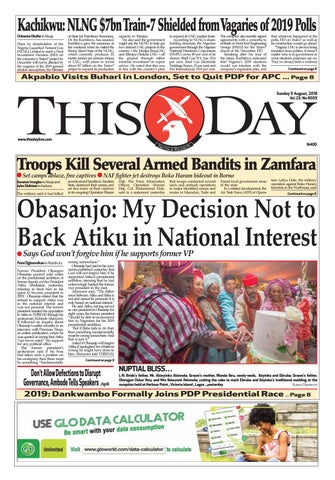
Kachikwu: NLNG $7bn Train-7 Shielded from Vagaries of 2019 Polls
Chineme Okafor in Abuja
Plans by shareholders of the Nigeria Liquefied Natural Gas (NLNG) Limited to reach a Final Investment Decision (FID) on the company’s Train-7 project by December will not be affected by the vagaries of the 2019 general election atmosphere, the Minister
of State for Petroleum Resources, Dr. Ibe Kachikwu, has assured. Kachikwu gave the assurance at the weekend when he visited the Bonny Island base of the NLNG, which currently produces 22 metric tonnes per annum (mtpa) of LNG, with plans to invest about $7 billion on the Train-7 project to expand its production
capacity to 30mtpa. He also said the government might ask the NLNG to help get two delayed LNG projects in the country – the 10mtpa BrassLNG and 20mtpa Olokola LNG – off the ground through either minimal investment or expert advice. He noted that this was in line with the country’s plan
to expand its LNG market share. According to NLNG’s shareholding structure, the Nigerian government through the Nigerian National Petroleum Corporation (NNPC) owns 49 per cent of its shares; Shell Gas B.V. has 25.6 per cent; Total Gaz Electricite Holdings France, 15 per cent; and Eni International, 10.4 per cent.
The company also recently signed agreements with a consortia to embark on Front End Engineering Design (FEED) for the Train-7 ahead of the December FID. Speaking after his tour of the plant, Kachikwu indicated that Nigeria’s 2019 elections would not interfere with the company’s expansion plan, and
that whatever happened at the polls, FID on Train-7 as well as its construction would go ahead. “Nigeria LNG is always being insulated from politics, it doesn’t matter who is in government or what elections purposes are on. They’ve always been a well-run Continued on page 8
Akpabio Visits Buhari in London, Set to Quit PDP for APC ... Page 8 Sunday 5 August, 2018 Vol 23. No 8509
www.thisdaylive.com TR
UT H
& RE A S O
N400
N
Troops Kill Several Armed Bandits in Zamfara Set camps ablaze, free captives
Senator Iroegbu in Abuja and John Shiklam in Kaduna The military said it had killed
NAF fighter jet destroys Boko Haram hideout in Borno
several armed bandits in Zamfara State, destroyed their camps, and set free many of their captives in its on-going Operation Sharan
Daji. The Force Information Officer, Operation Sharam Daji, Col. Muhammad Dole, said in a statement yesterday
that troops conducted several raids and ambush operations in major identified camps and routes in Maradun, Tsafe and
Zurmi local government areas of the state. In a related development, the Air Task Force (ATF) of Opera-
tion Lafiya Dole, the military operation against Boko Haram terrorists in the North-east, said Continued on page 8
Obasanjo: My Decision Not to Back Atiku in National Interest Says God won't forgive him if he supports former VP
Femi Ogbonnikan in Abeokuta Former President Olusegun Obasanjo poured cold water on the presidential ambition of former deputy, ex-Vice President Atiku Abubakar, yesterday, refusing to back him in his quest to become president in 2019. Obasanjo stated that his refusal to support Atiku was in the national interest and was not personal. The former president restated his opposition to Atiku to THISDAY through his spokesman, Kehinde Akinyemi. It followed an inquiry about Obasanjo’s earlier remarks in an interview with Premium Times, an online publication, where he was quoted as saying that Atiku “can never enjoy” his support for any political office. The former president’s spokesman said if his boss had taken such a position on his ex-deputy, then there must be something “fundamentally
wrong somewhere.” Obasanjo had said in his comments published yesterday that God will not forgive him if he supported Atiku’s presidential ambition, stressing that he had unknowingly backed the former vice president in the past. Akinyemi said, “The differences between Atiku and Baba is not and cannot be personal. It is only based on national interest." He said Atiku, having served as vice president to Obasanjo for eight years, the former president “should be able to recommend him to Nigerians for his 2019 presidential ambition. "But if Baba fails to do that, then something fundamentally must be wrong somewhere. And that is just it.” Asked if Obasanjo will forgive Atiku if apologised for whatever wrong he might have done to him, Akinyemi told THISDAY, Continued on page 8
Don't Allow Defections to Disrupt Governance, Ambode Tells Speakers ...Page 86
NUPTIAL BLISS… L-R: Bride's father, Mr. Akinyinka Akinnola; Groom's mother, Wanda Ibru, newly-weds, Ibiyinka and Ebruba; Groom's father, Olorogun Oskar Ibru; and Mrs Ibiwunmi Akinnola; cutting the cake to mark Ebruba and Ibiyinka's traditional wedding at the reception held at Harbour Point , Victoria Island , Lagos ...yesterday Kunle Ogunfuyi
2019: Dankwambo Formally Joins PDP Presidential Race ... Page 8
2
T H I S D AY ˾ ͳ˜ ͰͮͯͶ
T H I S D AY ˾ SUNDAY AUGUST 5, 2018
3
4
T H I S D AY ˾ ͳ˜ ͰͮͯͶ
T H I S D AY ˾ SUNDAY AUGUST 5, 2018
5
6
T H I S D AY ˾ ͳ˜ ͰͮͯͶ
T H I S D AY ˾ SUNDAY AUGUST 5, 2018
7
8
ͽ˜ ͺ ˾ T H I S DAY, T H E S U N DAY N E W S PA P E R
PAGE EIGHT
Akpabio Visits Buhari in London, Set to Quit PDP for APC Meets Osinbajo Olawale Olaleye All things being equal, former Senate Minority Leader, Senator Godswill Akpabio, may leave the Peoples Democratic Party (PDP) this week and join the ruling All Progressives Congress (APC), a presidential aide has disclosed. Special Assistant on Prosecution to President Muhammadu Buhari, Okoi Obono-Obla, posted on Facebook, Saturday night, a message saying Akpabio will be received into APC on Thursday by Acting President Yemi Osinbajo and other top leaders of the party at a rally in Ikot Ekpene, Akwa Ibom State. Obono-Obla also posted a photo of Akpabio with APC national leader, Bola Tinubu. Akpabio, who has already taken some conscious steps as regards his anticipated defection, was said to have met with Buhari in London, where the president is currently spending a 10-day vacation. The former Akwa IIbom State governor
had earlier met with Osinbajo in Abuja last week, in what is believed to be to a move to properly situate his defection plan. But sources within the PDP, which appeared not to be disturbed by the development, dismissed Akpabio as one big mole it had to deal with over time, noting that he has divulged virtually all the party’s plans and strategies to the opposition in an alleged attempt to secure protection from prosecution. THISDAY gathered last night that the speculation about Akpabio’s imminent exit from the PDP was beyond rumour, as he was said to have met with practically everyone that matters in the party. Sources hinted that baring any last minute change, the defection ceremony had already been slated to hold this week, not later than mid-week at the Godswill Akpabio International Stadium in Uyo, the state capital. Although sources hinted that the former governor of Akwa Ibom
State had tried to leave the PDP with some senators from the state, everyone he approached was said to have rebuffed his advice, because according to them, the APC stood no chance in the state, let alone the region. THISDAY gathered that the APC government had shown Akpabio a dossier on some of his alleged atrocities as governor, including monies said to have been stashed in different places, through the EFCC. Joining the ruling party was alleged to be a condition given to him to avoid prosecution for corruption. The former governor was said to have reluctantly accepted the condition. However, disappointed PDP leaders, who spoke to THISDAY on condition of anonymity, said they had since known about Akpabio’s predicament and encouraged him to fight on and not give in to the APC threat. “But because his hands, too, are not clean, they were able to box him to a very bad corner,” the
source said, adding, “His options, we believe, were limited. But he had done so much damage to us. He was our biggest mole. He held strategy meetings with us and went back to divulge all to the APC just to save face. We won’t miss him; he can go. “However, the one thing that his defection will prove to Nigeria is the hypocrisy of the ruling party. We will see their reaction and that of their supporters, who almost killed those who left the APC to join the PDP recently. We are waiting to see the fallout and this is, indeed, interesting.” One of PDP sources said they started noticing Akpabio’s double agent moves, when he started making a case for the reconvening of the National Assembly, as being pushed by the APC. The source said Akpabio had already agreed to do a letter of the opposition agreeing to the reconvening, which is one of the requirements, before the PDP leaders
told him they would deny him if he went ahead to write such a letter on behalf of the opposition, knowing full well it was not in the national interest. But Akpabio, sources said, immediately travelled to see the president to personally seal his defection deal and secure assurances of non-prosecution from him. It added that he was not very satisfied with his meeting with Osinbajo, even though it was said to be productive. He was said to have contended that personally meeting with the president was important to him before taking the option of defection to the APC, adding that such a meeting would help to sufficiently arm him to talk to others, who might be disposed to defecting with him. It was as a result of this that some of the close aides of the president, including a top and prominent security person in the presidency, who is believed
to be coordinating the current engagement with the National Assembly, facilitated the meeting between him and the president in London. Although still in London, Akpabio is expected back in the country this week to perfect his defection arrangement and ceremony before the end of the week. Meanwhile, THISDAY has gathered that Akwa Ibom State Governor Udom Emmanuel did not receive the news of the proposed defection of his godfather well but has resolved to move on regardless. Sources noted that the relationship between the two leaders was not very cordial, as they have had to expose their differences over political and financial matters. THISDAY learnt that other PDP governors in the South-south had also promised to rally round Emmanuel, saying they would not allow the federal government to intimidate him through Akpabio.
2019: Dankwambo Formally Joins PDP Presidential Race Says time is ripe for N’East to produce president Gboyega Akinsanmi Gombe State Governor, Dr. Ibrahim Dankwambo yesterday declared intention to contest presidential race on the platform of the Peoples Democratic Party (PDP), making him the fifth aspirants the indicated interest in the party nomination. Dankwambo, a former Accountant-General of the Federation, noted that the people from the North-east geo-political zone should not lobby to ascend to the highest
political office in the country. He formally declared his intention in a tweet yesterday, noting that he would be contesting for the highest seat on the platform of the Peoples Democratic Party. Before he tweeted yesterday, Dankwambo had addressed a of the delegates of the party from the North-east geopolitical zone, canvassing for their support ahead of the party's presidential primary election. The governor, who addressed the meeting at the new Banquet
Hall of the State House, Gombe, noted that consultation “is ongoing on the need for the party to pick its candidate from the zone.” He is the fifth aspirant to announce his candidacy in the PDP. Others are former Vice President, Alhaji Atiku Abubakar, former Kaduna State Governor, Sen. Ahmed Makarfi, former Jigawa State Governor, Alhaji Sule Lamido, former Sokoto State Governor, Alhaji Attahiru Bafarawa and former Jigawa State Governor,
Alhaji Tanimu Turaki. Other party stalwarts, who may declare to contest the presidential race, are Sen. Rabiu Kwankwaso, Sen. Bukola Saraki and Sokoto State Governor, Alhaji Aminu Tambuwal. At the meeting yesterday, Dankwambo canvassed for their support ahead of the party's presidential primary election, though acknowledged that he was still consulting across the federation on the need for the party to pick its candidate from the zone.
TROOPS KILL SEVERAL ARMED BANDITS IN ZAMFARA they conducted a successful attack on a Boko Haram hideout in Daban Masara, Borno State. Director of Public Relations and Information (DOPRI), Air Commodore Ibikunle Daramola, disclosed this in a statement yesterday. Daramola said the surgical air strikes on August 3 were conducted on the strength of credible intelligence, which indicated that remnants of Boko Hatam on the Lake Chad Islands were hiding in settlements at the southern part of the lake. Dole said during a recent clearance operation along Mashema, Kwadi, kalage, Gambiru and Kagara axis, heavy fight ensued between troops and bandits. He noted that due to overwhelming military fire power, a reasonable number of bandits were neutralised and their camps were set ablaze. He said the successful feat had brought about relative peace and spurred massive returns of Internally Displaced Persons (IDPs) to their villages in Zurmi local government.
According to Dole, "Likewise, during another encounter at Daban-Doka village near Dansadau, Zamfara State, troops laid ambush along bandits' identified routes where 20 bandits were neutralised. "Some bandits escaped with gunshot wounds and several motorcycles were burnt. In one of the troops’ encounter with the bandits, two notorious bandits, Bello Danboko and Sani Maza, were eliminated in Yanwari ward near Yankuzo and Mai Tukunya village near Dansadau all in Zamfara State. "In another development, the troops commenced aggressive day and night fighting patrols around Kyaranke and Giwabawa villages in Kanoma District of Maru LGA, following a tipoff on imposition of One Million Naira (N1m) levy each on the two villages. Another tipoff led to the rescue and recovery of kidnapped victims and the sum of Five Hundred Thousand Naira (N500, 000.00) ransom from kidnappers in Subulu
forest.” Dole also said the troops in their recent exploits apprehended two notorious bandits, who were known for terrorising Maradun town and its environs. He named the suspects as Muhammad Aminu and another one popularly called Yellow at Tashan Udda in Maradun local government. According to him, the bandits are undergoing interrogation with some weapons, ammunitions, motorcycles, phones and herds of cows recovered. Dole said Force Commander, Operation Shatam Daji, Maj-Gen. Mohammed Mohammed, assured the law abiding citizens that the troops were poised to ensure quick restoration of peace and safety in all the vulnerable areas in Kaduna and Zamfara states. He also urged the populace to continue to give credible information to the security agencies for the success of the operation. General Mohammed said the recent successes recorded were as a
result of collaborative efforts between the troops and the locals. Meanwhile, Daramola said the Boko Haram hideout, including Daban Masara, was where the terrorists were amassing in some buildings for a meeting. According to him, an air interdiction mission was planned and executed to destroy two out of the green roofed buildings within Daban Masara that were identified as Boko Haram meeting points. He said on receiving the intelligence, the ATF dispatched a NAF Alpha Jet aircraft, along with an Intelligence, Surveillance and Reconnaissance (ISR) platform, to attack the two buildings where the BHTs were gathered with bombs. The DOPRi said overhead the area of interest the Alpha Jet successfully released its bombs on the targets in successive strikes, leading to massive destruction of the target buildings as well as the neutralisation of several Boko Haram terrorists.
OBASANJO: MY DECISION NOT TO BACK ATIKU IN NATIONAL INTEREST “Coming to beg Baba is far from it. To beg him for what? It is like saying, when you write stories badly and you say you want to come and beg me, as an editor, to recommend you for a higher and sensitive post, how is that possible?" “It does not mean, when he wants personal assistance, and it is in Baba's power to do it, he will surely do it. “God will not forgive Baba if he fails to render such assistance. So, it is purely two different things; national interest and personal interest.” Akinyemi said Obasanjo might never change his position on his former deputy,
underscoring suggestions that the ex-president could shift his ground to a consideration of certain circumstances, like Atiku entreating him to support his ambition. Atiku was vice president to Obasanjo during his two terms’ presidency from 1999 to 2007, though the former had sought to succeed his boss in 2003. They fell apart ahead of the 2007 presidential election, which Atiku contested on the platform of another political while still vice president. Their disagreement was exacerbated by Obasanjo’s alleged third term agenda, which Atiku fiercely opposed. Obasanjo said in the interview
that he had no personal hatred against Atiku but was only interested in working with anyone “working for the good of Nigeria. “If I support Atiku for anything, God will not forgive me. If I do not know, yes. But once I know, Atiku can never enjoy my support,” Obasanjo was quoted as saying. He added, “It is not a question of working with or not working with an individual. If you are working for the good of Nigeria, I am working with you. If you are not working for the good of Nigeria, it does not matter who you are, I am not working with you.
“I do not have personal grudges with anyone. If you do not do well for Nigeria, you do not do well for all of us.” He said his opposition to Atiku’s political ambition was only at the realm of politics. “If my children are getting married, he has sent representatives. If his children are getting married, I have sent representatives. That is social. That is not political,” he said. “On political ground,” however, Obasanjo said, “My position has not changed. If I support Atiku for a political office other than the one I supported him in the past when I did not know him … God will not forgive me.”
He said: “We have been making consultations and that consultations are ongoing. We felt this time around, our zone should be giving opportunity to conduct and preside over the affairs of the country. “We have send delegations to
various zones so that they can have the taste of the North-east this time. On this note, I think all of us in this room are on the same page. Do we continue to lobby that North East should produce the next president of this country?
KACHIKWU: NLNG $7BN TRAIN-7 SHIELDED FROM VAGARIES OF 2019 POLLS company, independent, strong shareholders, strong board, strong management. In many ways I think this island is insulated from the shenanigans of party politics and all that,” said Kachikwu. He further explained, “What is more important, however, is that the president and the current government fully support them, they have been a good go-to point for us when there is problem. They’ve managed the resources that they hold for the government very well, they’ve been very accountable, very transparent. “At a very critical moment of this regime, early 2015, when we needed help, we went there, that seed money was very essential at getting governors out of the difficulties we had. So, I know every government has always supported them, but we have, I think, supported them a lot more and will continue to support them. So it really shouldn’t matter.” The minister equally said, “I look at Train-7 and that is fantastic but that’s not a good history after nearly 30 years of operation. I think the first meeting I had with the board, I told them Train-7 is no longer going to be an illusion. “It is still not where we need to be. I did challenge you that you need to look at Train-8 because we need to do catch up. The transition to cleaner energy is going to be faster than we think.” On plans to ask NLNG to help Brass and Olokola LNG projects, he said, “What I have said to them is, obviously, they’ve been fantastic in terms of their comfort zone. You probably could give them 100 per cent in terms of their performance, but I’m saying the world is bigger than this island. “We have opportunities that are stranded everywhere – BrassLNG in terms of shareholding and financing; OKLNG in terms of even taking off the ground – I am saying, as the grandfather of this business,
they built six trains, looking at seven, hopefully potentially more, let’s begin to look at where through minimal investments, through structures and designs and reconfiguration and expert advice, you can actually handhold some of those trains that are beginning to lag behind so that the whole founding father concept of ‘take this all over the place’ can happen. “We are going to be reaching out to them, not from an imposition point of view, but from a collaborative point of view, to see what we can do and learn from what they have done well.” The minister praised NLNG for helping to stabilise the financial condition of the government when it came on board in 2015, saying, “We were looking for how to raise money and I said there is one entity that has done well and can tell us what is in the coffer. I came to you guys to help us release money and your management was gracious to tell us what was in there and we were able to transparently put our hands in there.” In a similar vein, Executive Secretary of the Nigerian Content Management Development Board (NCDMB), Mr. Simbi Wabote, disclosed that his agency had moved to ensure the Train-7 project would be built with ample consideration of Nigeria’s local content law in the industry. Wabote said, “We worked with them conscientiously to ensure that the FEED contract was signed within record time and we have a clear service level agreement between ourselves and NLNG to ensure that we fast-track the contracting cycle, which is also very important to ensure that we take FID at the end of the year as soon as we finish FEED work. “We are going to focus more with them to ensure that the letters of the law are properly interpreted in terms of construction phase of the plant as well as its management phase.”
T H I S D AY, T H E S U N D AY N E W S PA P E R ˾ AUGUST 5, 2018
9
SUNDAY COMMENT
Editor, Editorial Page PETER ISHAKA Email peter.ishaka@thisdaylive.com
LEADERSHIP IN A TIME OF INSECURITY Lack of leadership is endangering lives and harming the country’s economic interests
T
he spate of violence across the country has prompted several critical stakeholders, including the Nigeria’s Governors Forum (NGF) and the National Assembly, to call for an urgent review of the national security architecture. From north to south, there is a consensus that the Nigerian state has lost the capacity to safeguard the lives and property of citizens. Unfortunately, those whose primary responsibility it is to keep the nation safe are preoccupied with regime protection and no one is calling them to order even as the inability of the federal government to have a grip on the situation by bringing perpetrators to justice remains The pervasive a major cause for nature of the concern. The security security challenge challenge in Nigeis in part due ria is such that only to failure of recently, members intelligence of the British gathering and House of Lords debated sharing among the issue while expressing concerns that the killings security chiefs who have not only pose a grave danger to the corporate existence of the overstayed their country. On 28th June this welcome but are year, parliamentarian Denis generally known Tunnicliffe made damaging to be working at accusations against the federal government on the cross-purposes killings. Another lawmaker, Elizabeth Berridge disputed the continuous portrayal of the violence as farmers-pastoralists feud, using the pattern of killings to reject the narrative. There has been no official reaction to the stinging indictment by the British parliament. This crisis is pronounced in the northern half of the country over rights for grazing land between subsistent farmers and roving pastoralists and has led to the death of hundreds of citizens, particularly women, children and the aged. This is aside the escalating banditry in Zamfara which recently prompted the state governor Abdulazi Yari to abdicate his position as the chief security officer of the state. “This is Nigeria’s forgotten conflict. The
Letters to the Editor
authorities’ failure to act has left villagers in Zamfara at the mercy of armed bandits, who have killed hundreds of people,” lamented Osai Ojigho, Director of Amnesty International Nigeria.
M
S U N DAY N E W S PA P E R EDITOR SHAKA MOMODU DEPUTY EDITORS OLAWALE OLALEYE, TOBI SONIYI MANAGING DIRECTOR ENIOLA BELLO DEPUTY MANAGING DIRECTOR KAYODE KOMOLAFE CHAIRMAN EDITORIAL BOARD OLUSEGUN ADENIYI EDITOR NATION’S CAPITAL IYOBOSA UWUGIAREN MANAGING EDITOR JOSEPH USHIGIALE
T H I S DAY N E W S PA P E R S L I M I T E D EDITOR-IN-CHIEF/CHAIRMAN NDUKA OBAIGBENA GROUP EXECUTIVE DIRECTORS ENIOLA BELLO, KAYODE KOMOLAFE, ISRAEL IWEGBU, IJEOMA NWOGWUGWU, EMMANUEL EFENI DIVISIONAL DIRECTORS BOLAJI ADEBIYI , PETER IWEGBU, ANTHONY OGEDENGBE DEPUTY DIVISIONAL DIRECTOR OJOGUN VICTOR DANBOYI SNR. ASSOCIATE DIRECTORS ERIC OJEH, PATRICK EIMIUHI ASSOCIATE DIRECTOR SAHEED ADEYEMO CONTROLLERS ABIMBOLA TAIWO, UCHENNA DIBIAGWU, NDUKA MOSERI DIRECTOR, PRINTING PRODUCTION CHUKS ONWUDINJO TO SEND EMAIL: first name.surname@thisdaylive.com
eanwhile, the same bunch of marauders let off the reign of terror when they gruesomely murdered no fewer than 50 villagers in Rabah local government of Sokoto State. Yet, the pervasive nature of the security challenge is in part due to failure of intelligence gathering and sharing among security chiefs who have not only overstayed their welcome but are generally known to be working at crosspurposes. There are several questions that we have posed in the past yet remain unanswered: How do you put a price on the thousands of people dislodged from the jobs and their homes? Or on children, men and women whose lives had been cut short? Or of more people slipping into the poverty net or indeed, on nervous investors? Or the cost of mobilising and deploying military troops in practically all the 36 states of a country that is not at war with any country but itself? How can the deepening insecurity crisis be tamed? How can we reverse the shrinking investments and restore confidence in the economy? Evidently the present strategy of drafting the military to every crisis location is no longer effective, as the criminal gangs that now spring up all over the country have also learnt how to engage them. Sadly, there has been no new framework that will enable the country to effectively respond to any crisis and safeguard lives and property without which there can be no development. .That those who superintend the security apparatus of state have lost ideas about how to tackle the challenges that grow by the day is no longer in doubt. But the ultimate responsibility lies with the president whose agents have promised at different times that he would make the requisite changes. That he has not done anything to redress the situation indicates either that he cannot appreciate the gravity of the problem or that he feels incapacitated from taking decisions, especially given that he once sensationally declared that his Inspector-General of Police defied his order and to date, there have been no consequences. President Muhammadu Buhari must understand that he has a constitutional responsibility to restore peace and order to the country and the earlier he does that the better.
TO OUR READERS Letters in response to specific publications in THISDAY should be brief (150-200 words) and straight to the point. Interested readers may send such letters along with their contact details to opinion@thisdaylive.com. We also welcome comments and opinions on topical local, national and international issues provided they are well-written and should also not be longer than (950- 1000 words). They should be sent to opinion@thisdaylive.com along with the email address and phone numbers of the writer.
An Open Letter to Eunice Atuejide
T
he first time I came across the National Interest Party was last year when I got an invitation to 'the first online-oriented political party'. I was not only impressed that after the rumble in the polity in a bid to secure a space for the youth in politics, for once, not only was a youth oriented party formed but was created by a woman! Both ideas of youth in power and female pioneering leadership were totally rare but a welcome twist in our present day gerontocratically chauvinist Nigeria! I cannot count how many times I have search your name through Google and Wikipedia so as to follow the activities of a budding symbol of liberation. I once saw a picture of you wear-
ing a dark coat, your degrees as high as thermometers, listed beside your image and my fascination at the reflection of a specimen to look up to. So imagine my awe today opening a blog just in time to see your vituperations or should we be more specific in calling them tweets, now denouncing 'the devil and all its works', more accurately, feminism. In your tweet ma, you identified gender inequality as an inimical problem even to generations yet unborn in our dear Nigeria, going further to highlight the sexism you encountered at the aspirant's summit; however clearly repeating your loathe for feminism. It is submitted with due respect ma, that your words contradict each other and I think to some
extent I can diagnose what the problem is: Feminism is not an 'egbe ki loko o se' or a 'lagidigba', it is not a movement that seeks to 'devilise' the society, it is not a scourge, a sex-tape to be vehemently and recurrently denied/disclaimed but a movement for the emancipation of women around the globe; the one just birthed a minute ago, the one that exists in this world and even the one breathing their last as I write you from inequality of bargaining strength, unequal pay, unfair treatment and gender bias at work, objectification, genderbased violence (GBV), rape, etc. I make bold to say that if you believe in equality you are a feminist, so sorry to tell you (quote from Emma Watson) with the knowledge of your
intent to raise the issue of choice highlighting the Chimamandagate; but allow me to prescribe the Yoruba adage (I am aware you speak the language), "Orisa bi oo le gbe mi, fimile boo ti bami". We proud feminists already have a tough time fighting off chauvinist members of the opposite sex, who themselves loathe the exposure that comes with equality and the idea of having to cook their own food and do their own laundry. Kindly exercise your choice of 'not being a feminist' without creating an image of disgust on the movement simply because you want to be marketable to your electorate. I believe that your apathy is not only a thing of the mind but a mechanism of societal expectations of you as 'a woman in a man's shoes.' As even Judith Butler opined, "Masculine and feminine roles are not biologically fixed but socially
constructed" even though we know many feminists in the political scene thriving and flourishing, an example being Erelu Bisi AdeleyeFayemi, a longterm feminist who even as a political spouse embraced the movement as a sustainable development goal. (Kindly see her two autobiographies, “Speaking Above a Whisper” and more recently, “Loud Whispers” for more exposition). Or even Olamide Falana, a female gubernatorial aspirant in Ondo state. The legal profession in Nigeria is already challenging for an average female lawyer because of the 'open secret' called sexism and you as a role model to many (I believe) can do better than dissuading your followers just to be acceptable to a few patriarchal figures. ––Mosopefoluwa Ruby Fayeun, rubyempress1@gmail.com
10
T H I S D AY, T H E S U N D AY N E W S PA P E R ˾ AUGUST 5, 2018
NEWS Dockworkers to Shut Ports over Disagreement with IOCs, NNPC tSay oil firms misleading presidency Eromosele Abiodun The atmosphere of peace that currently pervades the country’s ports may not last, if a threat by dockworkers is anything to go by.
The dockworkers have threatened to embark on a strike to press home their disagreement with the Nigerian National Petroleum Corporation (NNPC) and International Oil Companies
(IOCs) over the appointment of stevedoring companies. The threat of strike is coming after the recent restoration of peace at the ports following an industrial action by truckers in Apapa
to protest alleged extortion by security agencies, which paralyzed activities. Stevedoring companies and dockworkers under them allege that certain business interests are work-
PRESIDENTIAL DECLARATION
R-L: Gombe State Governor, Dr. Ibrahim Damkwambo, Director-General of Dankwambo Presidential Campaign Council, Prof. Terhamba Shija, and other personalities at Dankwambo’s presidential declaration in Gombe...yesterday
ing against their ability to effectively carry out their functions and legally earn a living. They allege further that these moves, which may have received the support of powerful forces on the board of the NNPC, are bound to cause a lot of unease in the sector. Dockworkers, who spoke to THISDAY on condition of anonymity, explained that the peaceful labour atmosphere that reigned in the maritime sector may soon be disrupted by the undue delay in the appointment of Stevedoring companies by the Nigerian Ports Authority (NPA). Stevedoring companies are firms licensed by the government of a country to engage dockworkers and supervise the loading and offloading of cargoes on vessels. THISDAY learnt that until recently, when the NPA drew the federal government’s attention to the existence and provisions of a Stevedoring Regulations, 2014, which domiciled the appointment of stevedoring agents with the federal government, IOCs and PMS Jetty operators in the country, had taken over the responsibility of appointing stevedoring agents. This they did by contracting companies that hired and supervised dockworkers without any revenue accru-
ing to the federal government from this service. In addition to this, dockworkers allege that the IOCs do not protect their interest, as conditions of service under the companies given these contracts are below global industry standard. Recently, however, the NPA has reversed the role, arguing that the Nigerian Ports Authority Act 2004, CAP 126, LFN made stevedoring a statutory duty of the Authority and granted it right to perform the whole of its statutory functions through the engagement of third parties. It had embarked on a transparent process to seek expression of interest from qualified companies with the intention of performing its regulatory functions. This process has remained incomplete for a while and the stakeholders in the sector have become uncomfortable with the lack of clarity as to the operation of the stevedoring services henceforth. A source within the NPA told THISDAY that although the NPA had gone through all the necessary tender requirements of the Procurement Act, 2004 for the accreditation of contractors for this kind of service, there had been a recent presidential directive for the suspension of the process.
Oshiomhole: Herdsmen Not Responsible for Killings in Nigeria Benjamin Nworie in Abakaliki The National Chairman of the All Progressive Congress (APC), Mr. Adams Oshiomhole yesterday exonerated the marauding herdsmen from the killings in some parts of the country. Oshiomhole, former governor of Edo State, also said some people were turning the
truth upside down to portray the administration of President Muhammadu Buhari in bad light by linking all the killings in some states in the country as the handwork of herdsmen. He exonerated the herdsmen at a rally he addressed in Abakaliki yesterday to receive some defectors to the APC, assuring Nigerians
PDP Can’t Secure Victory through Back Door, Says Fayemi Victor Ogunje in Ado Ekiti The Kayode Fayemi Campaign Council yesterday described an election petition filled by the Peoples Democratic Party (PDP) candidate, Prof. Kolapo Olusola in the just concluded governorship contest as an exercise in futility. The Deputy Director General of the council, Hon. Bamidele Faparusi said this in a statement yesterday, appealing to the party members in the state “to be peaceful and see the present legal challenge as one that will not yield any fruitful result.” Olusola, Ekiti State Deputy Governor, had dragged the governor-elect before the Election Petition Tribunal, asking it the tribunal to declare him winner of the poll and claiming that he scored the highest
number of lawful votes cast. He had also urged the tribunal to set aside the victory of Fayemi, who was declared winner by the Independent National Electoral Commission (INEC). In the contest, Fayemi polled 197, 459 to defeat Olusola, who got 178, 121 votes. Olusola submitted a 700page petition at the tribunal registry within the State High Court premises at about 5.30 pm. The statutory 21-day grace allowed by the Electoral Act 2010 (as amended) to file a petition by any candidate aggrieved with the outcome expired on Friday. In a statement he issued yesterday, Faparusi said the election reflected the will of Ekiti people and that not even the petition filed by Olusola or any other party can upturn the verdict.
that President Muhammadu Buhari and security agencies were working hard to end insecurity in the country. Some of the defectors include Sen. Sunny Ogboji, former Minister of Power and Steel, Mr. Goody Ogbaga, former Secretary to Ebonyi State Government, Mr. Ifeanyi Odoh and former Speaker of Ebonyi State House of
Assembly, Hon. Augustine Nwankwegu. At the rally, the national chairman urged Nigerians not “to allow themselves to be deceived by the antics of selfish politicians in the country who are trying to give the security challenges in the country an ethnic colouration in other to score cheap political points.”
FG, UNITAR Sign MoU to Empower Ex-Niger Delta Agitators The federal government and United Nations Institute for Training and Research (UNITAR) has signed a memorandum of understanding (MoU) to empower and train former Niger Delta agitators. The agreement was signed by Special Adviser to the President on Niger Delta and Coordinator, Amnesty Programme, Prof. Charles Dokubo and Country Representative, UNITAR Office in Nigeria, Dr. Lawrence Boms at the weekend. After signing the agreement, Dokubo said the initiative was to fast-track the training and empowerment of ex-Niger Delta agitators enlisted in the Presidential
Amnesty Programme. He said the project partnership “is for a period of three years. It was designed for transforming beneficiaries of the amnesty programme. It is linked to the Sustainable Development Goals (SDGs) which is to reduce poverty by 2030. Dokubo described it as a very auspicious moment to work with UNITAR, which had the required capacity in the training and empowerment of beneficiaries of the amnesty programme. He noted that the agreement covered training in subsea welding, agribusiness, sea-faring as well as empowerment and job placements for trained delegates.
He stressed that the security challenges were a ploy “to portray the government of President Muhammadu Buhari in bad light by portraying all the killings in some states in the country as the handwork of herdsmen. “Let me urge you to be more careful because this season people are spreading untruth. People are being hired to turn
the gospel upside down. They want us to believe that every problem should be explained in ethnic and religious terms. “We have a problem and we must confront those problems. Criminals must be dealt with individually as criminals and government at all levels must work hard to protect every Nigerian regardless of tribe or religion.”
Shun Violence, Embrace Peace, Akwa Ibom Tells Cultists, Militants Okon Bassey in Uyo The Akwa Ibom State Government has warned militants and cultists fomenting crisis in Ukanafun and Etim Ekpo Local Government Areas to shun violence and embrace peace. The state governor, Mr. Udom Emmanuel, who visited the violence-torn local government areas of the state at the weekend, offered amnesty to the youth in the local councils to enable peace reign and the natives and visitors go about their daily activities freely. During his visit, Emmanuel warned that the state government had no tolerance to violence and cultism related clashes, hence the need for the youths to sheathe their sword and come out for rehabilitation
and amnesty programmes the state government had worked out. He also presented relief materials to the displaced persons in the affected communities, calling on sponsors of the gangsters to see the need for peace and normalcy in the two council areas to forestall further bloodshed and destruction of properties. “It is not our wish that anyone should die, it is our wish that everyone repent and live in accordance with biblical principle. Let’s there be peace,” Emmanuel said. He noted that crises did not allow development to thrive in the state, thereby tasking parents to encourage their children to desist from those violent crimes and embrace his amnesty overture.
T H I S D AY ˾ SUNDAY AUGUST 5, 2018
11
12
T H I S D AY ˾ ͳ˜ ͰͮͯͶ
T H I S D AY ˾ SUNDAY AUGUST 5, 2018
13
14
ͳ˜ ͰͮͯͶ ˾ THISDAY, THE SUNDAY NEWSPAPER
OPINION Charter for Restructuring Nigeria Chris Okotie canvasses a government of national reconciliation and reconstruction to right the accumulated wrongs of the federation
A
s we approach another election cycle, the prognosis for a national crisis coveys a reality of frightening proportions. We are confronted by existential threats that seek to engender the fragmentation and disintegration of our nation as a holistic entity. Nigeria has become a divided and segregated society like never before. We have become polarised by ethnicity; balkanised by religious fundamentalism. We have become fractured by political insensitivity and leadership disability. The advent of the Boko Haram insurgents and the ubiquitous Fulani herdsmen phenomenon has further exacerbated social insecurity and cast nebulous clouds over the viability of our union. The concentric arrangements of the WAZOBIA alliances have been a disaster; engendering the marginalisation of the smaller ethnic units, thus, perforating the canopy of the federalism under whose aegis we co-exist. The dream of a great Nigeria which flowered at independence, the yearnings and aspirations of the people and the Nigerian brotherhood whose ensign dominated the political horizon at independence have all been consigned to oblivion. The worrisome symptoms indicative of the restiveness signalling the preamble to the civil war of the past have re-emerged in more definite configuration and now form a circadian rhythm which must be addressed immediately. We must act now to avert the manifestation of the inevitable. Times like these require the recruitment of patriotic gladiators who must now take up the gauntlet to defend the Nigerian dream. I believe we are conditioned by our circumstances to rise to the occasion of our reality. Please permit me to reminisce, for a moment, in Romanic antiquity. There were incessant wars between Rome and Carthage in those days. In one of such military campaigns, the Roman General Regulus was captured and taken to Carthage. He was brought before the ruling council and promised liberty if he would return to Rome and persuade the Romans to enter into a peace treaty with Carthage. The people of Carthage were war weary and envisaged that this strategy would provide a tactical leverage to negotiate a cease-fire with Rome. However, there was a proviso that if General Regulus was unable to do
so, he was to return to Carthage to face execution. The general agreed and was set free based on the integrity of his word as a Roman. General Regulus returned to Rome and passionately appealed to the Roman Senate not to make peace with Carthage. He posited that Rome could never achieve true greatness as long as Carthage existed as a formidable adversary. The Roman Senate agreed with him. General Regulus left the Senate, went home, kissed his wife and little baby; and returned to Carthage. He did not have to go back to Carthage but he was propelled by the irresistible summons of honour and integrity as a Roman general. He was publicly executed in Carthage in a most horrendous manner. It was not the potent Roman sword called the machaira that gave Rome universal supremacy. Rather, it was the courage and patriotic zeal of men like General Regulus that inspired Rome to the apogee of universal greatness. Destiny summons us today to the same pedestal of patriotic sacrifice. I am fully persuaded that Nigeria needs a man who is credible, dependable and trustworthy. A God-fearing man who is embroidered with compassion and love for country. A man who will be readily accepted as a symbol of national unity, who can bring genuine reconciliation and guarantee peace and tranquility in our nation. A man who is completely insulated from the variegated conflicts that mark the antecedents of our major political
Nigeria is in dire need of restructuring. Our federalism is simply terminological in exactitude. It is a realistic piece of fakery. The Constitution of the Federal Republic of Nigeria is obsolete, retrogressive and subversive to the Nigerian cause
actors. A man who can apply the principles of malice towards none and charity for all; who can invoke a pan- Nigerian philosophy that rejects the partisan provincialism of finger pointing at this time when Nigeria is threatened by existential adversaries. A man with the requisite intellectual capacity and moral perpendicularity. Nigeria is in dire need of restructuring. Our federalism is simply terminological in exactitude. It is a realistic piece of fakery. The Constitution of the Federal Republic of Nigeria is obsolete, retrogressive and subversive to the Nigerian cause. It can no longer subsist as the legal protocol that guarantees the peaceful co-existence of autonomous ethnicities. No extant or subsisting government can right these aberrations, for obvious reasons of parochial party considerations and entrenched partisan rivalries within the polity. My mandate, therefore, will be to set up an interim government which I have christened Government of National Reconciliation and Reconstruction as the mechanical instrumentality for the crystallisation of the new Nigeria of our dreams. It would be predicated on a new concept of aboriginal democracy. Our current democracy has been hijacked by elitism, mysticism and Satanism. Aboriginal democracy will focus on cultural historicity, evolutional modernity and global relativity as the necessary ingredients of our evolutional political indigenisation. Under this system, the current legislature would merge with the judiciary to create a unique judicature that administers justice and shares the enactment of legislative responsibilities with the Presidency. This would save us the huge cost of running the National Assembly and obviate all the paralysing debates that often stalled the passage of bills. There is an intrinsic resilience embedded in our national psyche which must now be summoned to strengthen the feeble hands of discouragement and re-ignite hope in the Nigerian fraternity. This is our reasonable service. This is the season. This is the time to demonstrate our love for Nigeria. Indeed, love is coterminous with sacrifice. I am fully persuaded that when posterity recalls our voluntary capitulations for the love of our great country, it shall be said that there were giants in Nigeria in those days. ––Rev. Okotie is the Pastor of The Household of God Church Lagos.
Addressing Education Inequity in Nigeria Access to quality education is a prerequisite for poverty alleviation, argues Folawe Omikunle Access to quality education for all is an imperative for any nation that wishes to make any significant progress in reducing or eradicating poverty among its citizens.
R
ecently, the world Poverty Clock, a web tool produced by World Data Lab indicated that Nigeria has now overtaken India as the ‘poverty capital’ of the world with nearly 87 million Nigerians purported to be living in extreme poverty and about half of the entire population living on less than $1:90 a day. This is surely a sad turn of events for the people of this great nation, so abundantly blessed with human and natural resources. Sadly, Nigeria’s poverty indices have been terrible for decades and successive governments have come up with diverse poverty alleviation measures to stem the gruesome tide, but poverty is a stubborn thing that will not be easily carried away in a Keke Napep or a wheel barrow or some of the other ineffective poverty reduction initiatives that have been embarked upon in the past. Indeed, multiple factors often contribute to a community or nation becoming impoverished, and conversely, many factors are often responsible for pulling a people out of poverty, of which education plays no small part in this mix. Access to quality education for all is an imperative for any nation that wishes to make any significant progress in reducing or banishing poverty from within its borders. It is important to understand the intertwined relationship between poverty and education and how each reinforces the other to perpetuate a vicious cycle of poverty. Although we measure poverty in monetary terms, poverty is not merely the absence of money, but is in fact, mostly a function of an individual’s low earning potential and lack of opportunities that enhance human capabilities to lead an acceptable standard of life; which is where the role of education becomes vital. Simply put, education has a direct correlation with income. The higher the level of education, the less likely the person is to fall below the poverty
line. The Organisation for Economic Co-operation and Development (OECD), Education at a Glance 2017 report found that 85% of young adults (aged 25 to 34), on average, have attained upper secondary education in OECD nations; it is, therefore, no surprise that OECD nations are also the most prosperous nations in the world. Education remains the most potent and formidable tool for breaking the cycle of poverty and exclusion, and the more we act like this is not the case and allow our children, in their millions, go uneducated, the more our people will sink deeper into poverty. Unfortunately, the quality of education in Nigeria has continued to deteriorate, and access to what poor education we have remains an insurmountable hurdle for millions of Nigerian children. We know that over 10.5 million Nigerian children are out of school. It is also the case that most of the children who make it to school are not learning and nearly six out of 10 Primary six pupils in Nigeria cannot read at all. In this fast-changing global economy, fuelled by technology and globalisation, it is now, more than ever, important for Nigeria to invest in human capital development (education) to ensure that every one of our citizens has the skills necessary to thrive. All of us - the government, the private sector and well-meaning individuals - must take appreciable steps to ensure that the right measures and investments are made to improve the quality of education for every Nigerian from pre-primary school to tertiary level, otherwise Nigeria will continue on this path towards an increasingly untenable and unjust future with a youth population that does not have the necessary foundation to contribute meaningfully to the growth of the economy, but have incredible capacity to do damage to society. Putting bandages on the current broken system is not working. To solve this crisis, it is important to note that there can be no single solution to a problem as systemic and complex as educational inequity. We will require many integrated solutions by diverse actors coming at the problem from different directions to meaningfully address this crisis. The private sector has a critical role to
play as nation-building is not a task for the government alone, substantial investments must be made to support the actions and plans of the government to achieve the standard of education that we deserve. We need to deploy our brightest minds to the education sector and channel more of our society’s most outstanding, well-educated and capable human resources against this problem and foster their leadership as a force for change inside and outside the system. The country also needs to develop a strong, collaborative network of determined leaders who understand the root causes of the challenges facing our public education system and are committed to challenging them with innovative solutions. Fortunately, citizens are already taking direct action in this regard via Teach For Nigeria. Teach For Nigeria (TFN) is focused on developing a movement of leaders across the nation who are committed to ending educational inequity. In the short term through a two-year fellowship, TFN recruits Nigeria’s most outstanding university graduates, existing teachers and young professionals of all academic disciplines to teach as full-time teachers (as fellows) in high-need schools, in poor communities. Through this experience, our fellows gain exposure to the realities of Nigeria’s education system and begin to identify their role in building a wider movement for educational equity. In the long term, TFN supports its alumni – equipped with the experience, conviction, and insight that come from leading children to fulfil their potential – to be a force for change, working from across sectors to expand educational opportunity. In 2017, we deployed our first cohort of 45 fellows to teach in 25 high need schools in low income communities across Ogun and Lagos States. This year we are expanding to the northern region and scaling our programme across Lagos and Ogun States, by placing an additional cohort of 200 fellows to teach in high need schools. We plan to be present in all six geo-political zones in Nigeria by our 10th year with a view to making our vision a reality, that one day, every Nigerian child will have access to an excellent education.
15
T H I S D AY, T H E S U N D AY N E W S PA P E R ˾ AUGUST 5, 2018
LETTERS
RE-GARBAGE, GARBAGE, EVERYWHERE
I
n a democracy, the government is accountable to the people, to whom it owes its existence. It is on this ground that the Ambode administration renders a quarterly account of its stewardship to the people. Since democracy is primarily about the people, it is imperative that the people be consistently informed about how their mandate is being utilised. However, no matter how transparent, accessible and well-intentioned a government is, for various reasons and interests, it still has to contend with divergent views on certain issues from time to time. This, of course, is the beauty of democracy. It is from this perspective that one views a recent piece titled: ‘Garbage, Garbage, Everywhere’, by Chika Amanze Nwachuku and published in THISDAY newspaper of August 31, 2018. It is important to shed light on some of the issues raised in the piece in order to set the records straight and further enlighten as well as educate members of the public. To start with, like every rational government, the Lagos State government recognises the place of a healthy environment in accomplishing its vision of turning Lagos into a safe, secure, functional and productive state. This is clearly evident in its several environmental regeneration schemes such as the Cleaner Lagos Initiative (CLI), refurbishment of Transfer Loading Stations (TLS), in Agege, Oshodi, Lagos Island (Tapa) as well as waste depots at Mushin and Ogudu,
Ambode
creation of the Lagos State Environmental Sanitation Corps (LAGESC), establishment of new parks such as the Johnson Jakande Tinubu (JJT) Park at Alausa, Ikeja; Rafiu Jafojo Park in Shasha, Alimosho and Badagry Recreational Park, planting of various species of trees across the state, landscaping and beautification of various sites, regular clearing of drains and channels, etc. Now, concerning the alleged resurgence of waste on major roads and streets of Lagos alluded to in the piece, it is vital to maintain that in the past few months all stakeholders in the sector have joined hands together, working round the clock to improve waste
collection in the state. Cheerfully, reports from various parts of the state indicate that the situation is rapidly improving. It is, thus, rather curious that Nwachuku painted a quite horrible picture of a city overtaken by filth. As clearly expounded by Nwachuku in the piece, the Ambode administration came up with the CLI primarily to provide a holistic solution to waste management in the state. Having identified the various challenges bedevilling the sector, it became evident that the existing system lacked required capacity to deal with Lagos’ ever-growing waste. This explains the necessity for a fresh structure that promotes the
involvement of global players that could provide answers to apparent missing links in the sector. It was based on this that Visionscape Sanitation Solutions came on board. However, as a result of interplay of several factors, the scope of Visionscape involvement had to be redefined along the line. Naturally, this has a significant impact on the efficiency of the overall CLI initiative. But then, the state government had to opt for the present arrangement in which private sector participants (now known as Waste Collection Operators, (WCOs) are jointly working with Visionscape to ensure a cleaner Lagos. To broaden the scope of their activities, 300 WCOs were recently licensed by the state government. The point, however, is that the WCOs need to step up their operational capacity in order to meet up with the challenge of cleaning up a rising African megacity like Lagos. A recent report puts the waste generated daily in Lagos at 10,000 metric tonnes, almost three times higher than what the whole of Ghana generates daily. Considering the enormity of equipment required, waste collection evidently requires a huge capital outlay. Part of the issues is that WCOs operate with malfunctioning compactors which often slows down operation, thereby creating avoidable hiccups. A recent certification exercise carried out in Alimosho Local Government Area showed that only 17 out of 44 compactors presented for the exercise were in good working condition.
The Ban on Scavengers in The FCT
T
he recent ban on scavengers popularly known as Baban Bolas in the Federal Capital Territory Territory has once again brought to the fore the dictum that every malfeasance has an end date. For scavengers in the FCT, the end game has simply come to their unwholesome activities because the Federal Capital Territory Administration (FCTA) has proscribed illegal refuse collection from residential and other areas, limiting the group to only the approved dump sites in both the city and the area councils. Handing down the ban, Secretary, FCTA's Social Development Secretariat (SDS), Mr Oladimeji Ali Hassan, in a meeting held in his office with the leadership of Abuja chapter of Association of Bola-Bola and Craftsmanship, said negative reports reaching the FCTA necessitated the meeting and the decision of government to restrict the activities of members of the association. He stated that members of the group were to be restricted to the approved dump sites located at Idu and Jabi as well as those in the area councils. Much as there have been mixed feelings over this development, it is pertinent to point out here that scavenging
the world over has grown past going from house to house to scatter people's bins. It is done only at dump sites around the world and there is nothing wrong in the FCT deciding to also follow suit in this world best practice. So the FCTA is right in this instance and should be commended. Abuja residents are witnesses to how the activities of these scavengers have posed a threat and making life difficult for the residents. Under the guise of scavenging from refuse bins in neighbourhoods across the city, the Baban Bolas have been involved in many criminal activities from petty stealing to armed robbery, vandalizing public utilities and other forms of crime and criminality. Kudos must therefore be given to the FCTA for responding to the outcries of many FCT residents and imposing this ban because many valuables have been lost to scavengers in the territory. The FCTA by this action has swiftly moved to ensure that every member of the society has the right to live and associate freely without fear, injury or any form of molestation. Where one's activity is posing a threat to other resident's life, property, freedom and peace, it has to be checked and
regulated. The FCTA also deserves commendation for the way it went about this ban by first of allowing the association to inform their members of this decision as well as the series of public announcements through the mass media done by the administration before the Abuja Environmental Protection Board (AEPB) will commence public enforcement and, perhaps, possible prosecution of defaulters. Regarding the criticisms that this development has elicited, especially those arguing that scavengers help in removing refuse from people's residences and so help keep the environment clean, I think it needs to be pointed out that there is a well-organised system of refuse collection in the FCT put in place by FCTA that ensures that refuse is taken from business and residential premises to dumpsites. Abuja is a planned city and so dumpsites cannot be created anyhow. The planned dumpsites at Idu and Jabi are more than enough for over 100,000 scavengers to conveniently carry out their activities daily, and the six area councils of FCT also have temporary dumpsites. Those against this ban also need to understand that government is not trying to
stop the business of scavengers but merely moving to bring sanity and orderliness to the business. It is also to the benefit of the scavengers themselves because going to the approved dumpsites will save the baban bolas time and reduce the laborious task of moving from place to place and sometimes getting knocked down by moving vehicles. However, the government also needs to do lot more to encourage this group of people as scavenging business has turned out to become lucrative business around the world. It now serves as a source of materials for recycling companies, creates employment, generates income and ensures a cleaner, safer environment. Government needs to put policies in place to allay the fears expressed by this group about the ripple effect the decision will have on their members such as loss of jobs and shortage of supply of scrap metals to iron smelting companies both at home and abroad. Government should also endeavour to always carry them along in any new development as regards the practice of their trade. ––Danladi Akilu, Durumi II, Gudu District, Abuja.
To tackle the challenge, the state government is making available a facility of N2.5b which WCOs could access to upscale their operations. Equally, government has also opened another channel through the Employment Trust Fund (ETF), for loan facilities at a reasonable interest rate of not more than 12% per annum. Presently, the possibility of turning waste into wealth is being explored through the Stare’s Landfill Gas Recovery and Utilisation Project. The idea is to make dumpsites become usable resources from which methane will be extracted for electricity generation in Lagos State. Revolving waste into energy is an established technology that could help provide a major amount of domestic energy needs. A waste-towealth project will, no doubt, transform waste management into a more lucrative venture that will attract more investors into the sector. It is, however, pertinent to state that no matter the level of public and private sectors’ investment in waste management, the result will amount to little except every stratum of the society plays its part. Most cities of the world experience
environmental abuse as a result of ignorance of the citizens. Hence, the citizenry needs to come to terms with the significance of an improved environmental habit. In an effort to mop up black spots, Visionscape reportedly carted away over 80,000 tonnes of waste in more than 1000 illegal dumpsites across the state within six months. The figure will be staggering by the time the intervention efforts of other government agencies are added. Thus, filling the Knowledge Attitude and Practice (KAP) gap is also very vital, especially in our clime where many are still flippant in their treatment of the environment. The environment, being key to healthy, secure and peaceful living, is so important that all stakeholders must pay close attention to it. Therefore, the Lagos environment requires more change agents to rise in championing the cause of sustainable environment by spreading the message of good sanitary behaviour among our people in their various communities. ––Tayo Ogunbiyi, Ministry of Information & Strategy, Alausa, Ikeja.
The Plight of Rape Victims
R
ape,accordingto Wikipedia,canbe definedasatypeof assaultinvolving sexualintercourse or otherformsofsexualpenetration carriedout against a person withoutthatperson’sconsent.Itis basicallyjustsexyoudon’tagree toor that isagainst your willand canhappen tomalesorfemales, children or adults. Rapehasbeenanissuefora whileandnotmuchhasbeen done about it. The disheartening part ismanyvictimsdeliberately refusetoreportincidentsfor fear of stigmatisation. Meanwhile,somerape casesreportedtolawenforcement agencieshardlygetimmediate convictions inthe court. Researcheshaveshownthatmore thanathirdofNigerianwomen havebeensubjectedtosomekind of sexualassault,andonein 10 raped,accordingtotheMums netsocialnetworkingsite.Barely a third ofvictims goto the police, and another third tellno one atall, noteven closefriends. Arapevictimislikelyto suffer physicaland psychological trauma. Other feelingswhich rape victims commonlyexperience are hurtfeeling and anger.The hurtstemsfromtheinabilityto understandwhat wouldmotivate someonetocommitsuchan attack.Itiscommonforvictims to ask,“What did I dothatwould makehimwant todothat tome?” Anger about the personalviolation isprobablythehealthiestreaction, becauseitturnsthepainoutward instead ofinward, but itoften takes timeforavictimtoacknowledge suchfeelings.Sometimestoo,fear becomesaprobleminthelifeof thevictim;thevictimbecomes scaredoftheir environment, their health,peoplearoundthemand eventheir personalrelationships
generally.Thevictimsstoptalking to everybodyand become loners andsometimesthiscanevenlead topsychologicalproblems. There was recentlya trending storyontweetercallingonvictims ofrapetospeakoutandname therapists.Themovementand the campaign, to some extent weresuccessfulasit encouraged women to speak upabout boys or menwhohaverapedthem.Along list was compiledand postedwith thenamesoftherapistsandsome ofthe men denieditevenafter morethanonewomanmentioned theirnames. Eveniftheissueofrapecannot bekilledtotally, I think there shouldbemoreawareness about rape.Mosttimes,theyspeakto womenabouttryingtoavoid beingraped,notgoingtolonely or desertedplacesaloneatnight, beingcarefulwiththekindofmen theymovewith,buttheyforgetto speak to the men about respecting women. AsHarding pointsout, girlsareoftentaughthowtotry toprotectthemselveswhilenot enoughfocusisgiventoteaching boys not to rape. Ifpossible, a death penaltyshouldalsobeimposed onrapiststoavoidmorepeople frominvolvinginthiscrime. Rape victimsshouldbeshownmore loveandlessof rejectionand stigmatisation. Manypeopledon’t know what rapedoestoan individual.Rape victims often wantto commit suicideespeciallyiftheyhave anSTD after the incident, while other victims wish to transfer their STDstootherinnocentpeopleout ofanger and hatred. They’ll feel thatallhopeislostbutalittlelove cangoalongwayinthelifeofa victim.Startshowinglovetothem today! Joy –Bankong, Department of Mass Communication, Covenant University Ota
16
T H I S D AY ˾ ͳ˜ ͰͮͯͶ
ADVERTORIAL
T H I S D AY ˾ SUNDAY AUGUST 5, 2018
17
18
ͳ˜ ͰͮͯͶ ˾ THISDAY, THE SUNDAY NEWSPAPER
INTERNATIONAL The Election of President Muhammadu Buhari as ECOWAS Chairman and Regional Issues and Questions
P
resident Muhammadu Buhari (PMB) of Nigeria was, on Tuesday, 31st July, 2018 elected the new Chairman of the ECOWASAuthority of Heads of State at the 53rd Ordinary Session of theAuthority, held in Lomé, Togo, after a closed-door meeting. The chairmanship, which lasts for the next one year, cannot but raise several questions on good governance. In other words, the election not only came on the heels of many national and regional problems, but also has the potential to largely shape the international image of PMB in his quest to garner popular support for his candidature for the 2019 presidential election in Nigeria The election can also prompt suspicions about the extent to which Nigeria, as a founding member of ECOWAS, will be ready to continue to sustain the organisation. Put differently, Nigeria is on record to have been disregarding rules of law, which has damaged PMB’s national and international image. PMB can therefore take advantage of his election as ECOWAS chairman to make a redress, by using regional environmental conditionings to address some of his domestic questions. In this regard, the understanding of the election has to be put in context and its analysis should also be located at the two levels of domestic and international. The word, ‘international,’ is used here to also imply both regional and global contexts. Consequently, we submit that the election is of importance to PMB’s survival, and more as a militician, than as a professional politician, in the political governance of Nigeria. More important and under normal circumstance, there is no way PMB would have been elected on the basis of his individual person, especially in light of his refusal to obey some judgments of the ECOWAS Court. The refusal can be interpreted to mean a refusal by the Government of Nigeria.And if we admit that the refusal by PMB means he had acted on behalf of Nigeria, and therefore it is Nigeria that had actually disobeyed the judgment of the ECOWAS court, that, again, does not speak well on the part of Nigeria, in particular, and other Member States of the regional organisation, that have not ensured respect for the supranational authority of the court. It should simply be recalled that the ECOWAS Court of Justice gave a judgment on Tuesday, October 4, 2016 in the case brought before it by Mr. Sambo Dasuki, the National SecurityAdviser under the Dr. Goodluck Jonathan administration. The PMB administration was pursuing Mr. Dasuki for having diverted about $2.1 billion earmarked for the acquisition of weapons to fight the Boko Haram insurgency. Mr Dasuki was also accused of being in possession of arms illegally. True, the ECOWAS Court was not much bothered about the allegations but more concerned with the fact that his arrest and detention was unlawful and arbitrary. In fact, a three-man panel led by Justice Friday Nwoke and set up to look into the matter submitted that the Nigerian government erred in law by arresting Mr. Dasuki without any search warrant, and by so doing, the arrest contravened Section 28 of the Nigeria PoliceAct, which subjects the authorisation by a superior police officer of any search of a residence belonging to a suspect to possession of a search warrant. Apart from this, Section 143 of theAdministration of Criminal JusticeAct (ACJA) requires that whenever there is a proposal by the police or other authorities for the search of a residence, an application must first be made to a court of law and must be granted after due consideration of the application in compliance with Section 144 of the (ACJA). The government ignored all these provisions. Perhaps more interestingly, the ECOWAS court sanctioned the Government of Nigeria by ruling that the sum of N15 million be paid to Sambo Dasuki for the unlawful, arbitrary and violation of local and international rights to liberty.Again, it is not clear whether this judgment has been complied with. Without jot of doubt, it can be assumed that the Government of Nigeria is not on record to have complied with the court judgment, whereasArticle 15(4) of the Revised ECOWAS Treaty stipulates that ‘judgment of the Court of Justice shall be binding on the Member States, the institution of the Community and on individuals and corporate bodies.’ In other words, every Community Citizen can have access to the Court. Besides, such access is in spite of whether or not there had been exhaustion of all local remedies and whether or not there are ongoing court cases before seeking redress at the ECOWAS Court. In light of this, there is the challenge of how not to continue disregarding the rule of law, on the one hand, and still
VIE INTERNATIONALE with
Bola A. Akinterinwa Telephone : 0807-688-2846
e-mail: bolyttag@yahoo.com
year of his chairmanship is largely going to be also defined by what obtains at the level of domestic politics in Nigeria. And perhaps more disturbingly, there is now a new insecurity phenomenon: Nigerian state terrorism. Government appears to be using the security forces, particularly the paramilitary forces, for purposes of political intimidation. In the public glare of the security forces during the recent elections in Ekiti State, vote-buying took place at polling units and the security force only remained on lookers, there was no reaction. In Benue State, the members of staff of the House ofAssembly, including the Clerk, were chased out of the Assemby by the police. As claimed by the Clerk, Dr. ToryeseAngenor, on Tuesday, July 31, he was told that ‘the Commissioner of Police had ordered them (policemen at the House) to tell us (Assembly men) to leave the complex. No reason was given and no definite time was given to us to come back. The implication of this is that we were not allowed to do our job and that is going to impede the work of the legislature and it is going to affect all the people of Benue.’ What is particularly apparent about the sacking of the Benue State House ofAssembly is that the incumbent Governor of the State, Samuel Ortom, defected from the ruling party,APC, to the main opposition party, PDP, and efforts were consequentially made to remove him from office through impeachment, but without going through the rules of procedure.As a result, people are not only talking about treason by APC members in the House, anger is increasingly also shown visà-vis PMB who has denied any involvement in the illegal sack. The act has been generally condemned and the image of PMB has been seriously tainted and he is no longer seen as a believer in democratic governance. Second, the foregoing environmental conditionings of domestic politics in Nigeria are not currently favourable to the re-election of PMB in 2019. There is the question of party defection virus, gradually spreading like wild fire and catalysed by unguarded statements of some of theAPC stalwarts, likeAdams Oshiomole.
International Dimensions
Buhari
expecting other countries to respect the same rule of law under the chairmanship of PMB, on the other.
Domestic Dimensions It is important to begin with one clarification, and that is that, it was not PMB as an individual person, that was elected, but the Federal Republic of Nigeria, to which one seat is allocated and which PMB, on behalf of the people of Nigeria, has to occupy. In this regard, many national and international observers often consider the personality of PMB, especially in terms of his being a man of integrity in his quest to contain corruption and acts of serious misconduct in Nigeria. Thus, the personality of PMB is quite different from Nigeria’s own personality in the comity of nations. However, both personalities can be brought together to address domestic challenges. First, there is no certainty about any political stability surrounding the 2019 general elections in Nigeria for various reasons. Political governance is currently fraught with insecurity of life and property: boko haram insurgency, struggle for the sovereign state of Biafra, Niger Delta agitation for resource control, Fulani herdsmen and farmers’ war, deepening kidnapping and killings, armed robberies and killings, etc. The recent report of the International Crisis Group, given on Thursday, July 26, 2018, is quite apt at this juncture. It says ‘violence related to grazing rights has occurred for decades but threatens Buhari’s popularity in swing states as herders are mainly from the Fulani ethnic group, as is the president. Deaths have been politicised as his critics say he has not cracked down on the nomads, which he has denied. Now claiming about six times more civilians lives than the Boko Haram insurgency, the conflict poses a great threat to the country’s stability and unity, and it could affect the 2019 general elections.’ Thus, it can be seen that the domestic setting in Nigeria is not as friendly as the ECOWAS regional setting. What the ECOWASAuthority may want to have PMB do in the next one
Finally,the issue of fairness and equity for Nigerians working as functionaries in the ECOWAS ought to be looked into now that PMB has the unique opportunity to investigate their well known problems. Many Nigerians accredited to the organisation who ought to be given appropriate diplomatic status commensurate with their experience and responsibilities should be looked into.Even at the more junior level, Nigeria is not on record to be having a fair share of the dividends of regional cooperation for Nigerians, even though Nigeria is contributing financially more than any other member to the assessed budget of the ECOWAS. It has therefore now become necessary to set aside the afrocentric character of Nigeria’s foreign policy in favour of promotion of Nigeria-centric foreign policy
First, the International Criminal Court (ICC), thanks to the President of the Court, Justice Chile Eboe-Osuji, a Nigerian by ius sanguinis, invited PMB to give the keynote address at the opening session of the 20th anniversary celebration of the Court on Tuesday, 17th July, 2018 at the Hague. At the celebrations, PMB not only noted the unflinching support for the ICC, even though theAfrican Union has been much suspicious of the ICC and even though Nigeria refused to arrest the Sudanese leader, President al-Bashir of Sudan when he came to Nigeria on the platform of anAU meeting, but also requested that the ICC should ‘include serious cases of corruption by state actors that severely compromise the development efforts of countries and throw citizens into greater poverty.’ This position of Nigeria is consistent with the wishes of the court, as well as with those of the larger international community. Thus, PMB cannot but be internationally seen to be doing well as an anti-corruption crusader. However, at the national level of Nigeria, opinion is still divided on his integrity as an unbiased anti-corruption crusader. In fact, the observation is already being eroded and tainted by several domestic political contradictions back home. In this regard, ECOWAS agenda, which PMB will be required to deal with as ECOWAS chairman may be difficult for him to handle because of the very domestic questions that have implications for ECOWAS regional interests as explicated under domestic dimensions above. Second, there is the problem of free movement and right of establishment of Community Citizens in any Member State of the regional organisation.As defined in the ECOWAS Supplementary Protocol numberA/SP.2/7/85 on the Code of Conduct for the Implementation of the Protocol on Free Movement of Persons, the Right of Residence and Establishment, is ‘the right granted to a citizen who is a national of one Member State to reside in a Member State other than his State of origin which issues him with a Residence Card or Permit, enabling him to hold employment or otherwise.’ This right of residence and establishment, which is to be implemented in phases, includes the right to ‘apply for jobs effectively offered, to travel for this purpose, freely in the territory of Member States, to reside in one of the Member States in order to take up employment in accordance with the legislative and administrative provisions governing employment of national workers, and to live in the territory of a Member State according to the conditions defined by the legislative and administrative provisions of the host Member State, after having employment there,’ (videArticle 1 of the Supplementary protocolA/SP.1/7/86 on the Second Phase (Right of Residence) of the Protocol on Free Movement of Persons, the Right of Residence and Establishment). It was for this reason that the Authority’s DecisionA/Dec.2/5/90 established a ‘residence Card in ECOWAS Member States.’ The problem is not with the desire and implementation of the foregoing protocols but with the perceptions and suspicions of Community Citizens as new possible agents of insecurity in Nigeria. There have been several calls on the Government of Nigeria to review the application of ECOWAS Protocol on Right of Residence and Establishment in Nigeria, but Government has not yet responded to the calls. Will PMB respond now that he is chairman or avail himself of the opportunity to nail in the bud such a dream? Whatever is the case, the problem still remains unattended to. (See concluding part on www.thisdaylive.com)
19
T H I S D AY, T H E S U N D AY N E W S PA P E R ˾ AUGUST 5, 2018
BUSINESS
Editor Kunle Aderinokun 08033204315, 08111813084 Email: kunle. aderinokun @thisdaylive.com
Customers transacting business in a banking hall
Africa’s Retail Banking Revenue to Hit US$53 Billion by 2022 Nigeria, South Africa among growth drivers Bamidele Famoofo Africa’s retail banking revenue has been estimated to grow to US$ 53billion (about N19.08trillion) by 2022. The figure represents 41 per cent of the total banking revenue in the region in the next four years. According to 2018 African banking report recently released by McKinsey, the expected growth in revenue will come from South Africa, Egypt, Nigeria, Morocco, Ghana and Kenya. McKinsey, in its report, noted that Africa’s banking markets are among the most exciting in the world as the continent’s overall banking is the second fastest-growing and second most profitable of any global region, and a hotbed of innovation. “Africa’s banking revenue pools to grow at 8.5 percent a year between 2017and 2022, bringing the continent’s total banking revenue to US$129billion”, McKinsey said. McKinsey added: “Africa’s retail banking markets are ripe with potential and present huge opportunities for innovation and growth”. However, Nigeria, the most populous nation in Africa, has a herculean task before it to speedily expand its retail banking market as report showed that is lagging behind. According to available information, financial institutions in Nigeria provide less than 10 percent of its credit facilities to consumers and MSMEs compared to other emerging economies. Indonesia provides 18 percent of its bank-
ing sector credit facilities to consumers and MSMEs while Brazil has grown to 33 per cent and South Africa far ahead of them all at 45 per cent. Managing Director/Chief Executive Officer, CRC Credit Bureau Limited, Mr. Tunde Popoola, gave the assurance that Nigeria would soon take its place in the comity nations as regards consumer lending. He made this known on the occasion of the CRC-2018 Industry Forum held in Lagos on Thursday. His words: “Following the enactment of the Credit Reporting Act, 2017 and our launch of a global scoring platform, it is expected that the value of consumer loan would grow exponentially.” Popoola disclosed that CRC Credit Bureau was positioned to help banks and other institutions successfully manage their retail lending business on a scale that enables exponential financial growth. “From just over one thousand customer base in 2009, repository records show that it has grown to about 17million in Nigeria”. He mentioned that the targets of CRC were millions of Nigerian consumers and tremendous untapped opportunity to grow asset size and profits “Our goal is to grow bank assets and profitability in a healthy way, prevent systemic risk by diversifying loan portfolio and grow Nigeria’s GDP”, he added. In addition, the World Bank has projected that, by the year 2020, one billion adults currently
excluded from traditional financial systems will gain access to some form of banking services. The bank, however, noted that the future of retail lending was in embracing financial technology for financial inclusion. “Today and tomorrow belong to those who are able to play in retail banking. The drivers of any sustainable retail lending business model include digitisation and data-driven decisions” the World Bank said. Meanwhile, the International Finance Corporation (IFC), the financing arm of the World Bank, also in a separate report disclosed that credit bureaus (in emerging markets) had the capacity of expanding credit financing by $1,256billion, touching 613million more people and reducing transaction cost by about 30-40 percent. According to IFC, credit bureaus play an important role helping consumers and small businesses obtain financing. “The credit information on individuals or small business borrowers they provide to lenders helps remove uncertainty that has traditionally been associated with lending. Accurate and timely credit information also allows financial institutions reduce risks, loan processing times, costs, and default rates,” IFC said. IFC added: “For borrowers, detailed credit information and a modern credit reporting system often lead to lower interest rates, making loans more affordable and more available.
Credit bureaus also support responsible lending practices, and help borrowers avoid over-indebtedness. These benefits all combine to support broad economic growth”. Advanced credit reporting systems make a major contribution to increasing access to finance, which is fundamental to the growth of small and medium enterprises (SMEs). A lack of access to finance is often cited as one of the major obstacles hindering economic growth in sub Saharan Africa. On how IFC is supporting the growth of credit bureaus, it disclosed that the IFC’s Africa Credit Bureau Programme is providing advisory services to central banks, national bankers associations, and other private sector stakeholders. Meanwhile, IFC’s specific interventions in credit reporting include, but are not limited to advisory support to help develop and implement credit information sharing systems (private credit bureaus, public credit registries or mixed credit credit-reporting models), with an emphasis on microfinance institutions and small and medium enterprise credit reporting; advisory support to governments to develop the appropriate legal and/ or regulatory framework for credit information sharing (at times in collaboration with the World Bank); public and private sector education campaigns on the benefits of credit information sharing and support for the development of value-added services in markets with more mature credit information sharing systems.
20
T H I S D AY, T H E S U N D AY N E W S PA P E R ˾ AUGUST 5, 2018
BUSINESS/BRANDS&MARKETING
Brands War: When Nigerian Banks Took to Twitter Raheem Akingbolu
T
he twitter war among banks, which was originally triggered by Sterling Bank, has no doubt exposed the underbelly of the cut-throat competition between banks in the country and how their communications and campaigns would have been if not for regulations and requirements of banks advertising campaign. On one hand, the spats have provided a comic relief for those, who have been following the exchanges even if they would wish they continue until further notice. It all started when Sterling Bank tweeted that, “In shooting for the moon, men become stars” with the kicker: “choose a partner that takes you higher.” To make the message sink in and be more discernible to bromide of the Lagos skyline showing choreographed pictures of big banks like Union Bank, UBA and First Bank. Not to be outdone, Union Bank reminded Sterling that if it went to the space without spacesuit, it would be best of luck. First Bank also admonished that it would be “straight to the trashcan” and also advised it to respect its elders. First Bank was not done. Waxing cultural, it stated that what an elder sees while sitting down, a toddler cannot view even with a ladder. It was obviously exploiting the gulf between it and Sterling. Using a motif of a puppy and its mother, Union Bank also said that when elders speak, naturally, youngsters should hold their peace and
the mother puppy used her hand to cover the mouth of the garrulous younger one. Access Bank stated that even if it was a micro-finance bank with just a branch and ten million customers, they would rather bring the galaxy to their customers than take them to the moon. These exchanges, as comical as they look, have brought out the creativity of goose behind these Twitter exchanges. Wale Adigun, a customer with Stanbic IBTC Bank, whose bank was not part of the online battle said it was a spat that was unnecessary. To him, the bank that started the spat
was actually looking for attention in the first place. “It was unnecessary,” Adigun told THISDAY. “They didn’t need such exchanges in the first place. They have only provided free comic show for onlookers.” Meanwhile, the current development has only reminded customers of the happenings at the peak of the consolidation and the postconsolidation era, when banks were churning out different strategies to show their market relevance. It was the time the banking public understood the import of the age-old aphorism that ‘Customer is king’. Aside from innovative campaigns,
promoters of various banks were coming out with consumer-centric innovations and campaigns that would enable them win more patrons. At least, not less than 10 banks came out with one strategy or the other to make their positioning statements. However, with the nature of the recent campaigns and their acerbic pun, it is believed in many quarters that the trend is fast running contrary to the principle of fair competition. To this end, pundits have called on regulatory authorities to nip the ugly development in the bud.
Will New Agency Engagement Give Mitsubishi an Edge? Raheem Akingbolu
T
he competition in Nigeria’s auto market may take a new leaning soon as players are beginning to re-strategise to increase market share. From Hyundai to Toyota, Honda to KIA brand, the story is the same – repositioning to win consumer loyalty. In a fresh development to unsettle the market, another competitor, Mitsubishi Motors Corporation, is set to boost its market acceptability in line with its ongoing global strategy for repositioning. Barely a year after it selected Amsterdam Worldwide as its lead global brand agency without a review, the auto brand has appointed SO&U, a leading full service creative agency in Nigeria to reposition the Japanese brand in Nigeria. According to a source at Massilia Motors Limited, representative of Mitsubishi Motors in Nigeria, SO&U clinched the account after participating in a pitch recently organised by the company among some top creative agencies in the country. Meanwhile, the Amsterdam-based agency that oversees the global account, with offices in Paris and Berlin, was tapped for a confidential brief over a year ago to develop and propose a new brand strategy. Mitsubishi introduced that strategy, “Ambition to Explore,” at the Tokyo Motor Show and creative from Amsterdam Worldwide centering around the tagline “Drive Your Ambition” also debuted at the event before it was rolled out globally. With the new assignment, SO&U and its team of creative eggheads are expected to
work and justify the various tagline of the brand in the Nigerian market. The taglines are; Wake up and drive; Driven to thrill; Love that car; Pursuing the Origins of Car Engineering. The agency is also expected to position the brand to the main target market; the young executives from the upper-middle income bracket. Above all, the Nigerian agency is as well expected to sustain the global creative tempo of the Mitsubishi brand, which makes it one of the most popular brands in the automobile industry with excellent advertising and brand presence. From any angle one chooses to look at it, SO&U is not new to the terrain, given its exploits on top brands like Guaranty Trust Bank, Guinness Nigeria, Procter & Gamble and many others. As a well grounded agency with full understanding of the market, it is expected that the agency will reposition the brand and make it Nigeria’s delight. Among other successful campaigns, the agency has continued to enjoy commendation for its work on the GTBank brand and ‘My Friend Udeme’ a campaign that was conceptualised for Guinness few years ago, which resonated with consumers almost immediately. For SO&U, the journey began few months ago, when Massilia Motors Limited, thrown open the pitch to agencies as part of its plan to further project the image of Mitsubishi vehicles, including popular Pajero in the market. After presentations and evaluations by various agencies, Udeme Ufot-led SO&U marketing approaches and its 360 execution plan, was said to have impressed the
management of Massilia Motors Limited and therefore settled for the agency. Some of the platforms to explore are; TVCs, Print, Out-of-Home and Digital marketing. Massilia Motors Limited, established early last year, is a joint venture between CFAO and KewalramChanrai Group. In the past, Mitsubishi brands were marketed by the two distributors – CFAO and Kewalrams, which created challenges on how to create a common ground to nurture the brand and make it very attractive to its target market. The two companies resolved this challenge by coming together to form Massilia as sole distributor of Mitsubishi vehicles in Nigeria. With the complete range of Mitsubishi Motors vehicles now available in Nigeria with compact cars, sports utility vehicles and pick-up trucks with renowned models such as the Pajero or L200, handlers of the brand appear to be more confident and determined to increase market share in Nigeria. Known for the reliability and ruggedness of its products, the Japanese car manufacturer has indicated through many platforms that it aims at exceeding customers’ expectations through skilled technicians, expansion of its authorised dealer network and provision of service centres nationwide. Reacting to the new deal, the Executive Director, Brand Management, SO&U, Mr. Biodun Adefila, confirmed the business and promised to redefine the status of the brand in the market. On the way to perceive the brand in the years ahead, she urged patrons of the brand in this part of the world to be on the look-out for a definite change in the way they perceive and have related with
Mitsubishi brands thus far. According to her, the Mitsubishi brands have a lot of advantages when compared with others, pointing out that not much of these great stories about the Mitsubishi were coming out in the past. “As a new agency on the brand, the task before us is to pick up the exciting stories of performance, ruggedness, durability, attractiveness and dependability about Mitsubishi and build new personae for it. Let people know that here is an absolutely reliable and beautiful vehicle and very importantly, the pricing is unbelievable,” she said. Speaking on how SO&U won the multimillion naira account, Adefila emphasised the fact that the agency has the clear understanding of the brief as well as familiar with local and global trend in the automobile industry. While pointing out that the agency’s victory in the pitch has further shored up its profile, the executive director revealed that the creative firm won the account by evaluating the position of the brand in the market by the current users of the brand, those who like it, those who have heard about it and experts in the auto industry. “We got all the data, but the clincher was how we interpreted the data and information to become authentic insight. Even the presentation demonstrated the passion and excitement we felt about the brand. We didn’t just present. We delivered the message,” she said As things are, the stage appears set for stiff competition among auto brands in the market. The next few months will surely dictate who will win the game among the top players.
21
T H I S D AY, T H E S U N D AY N E W S PA P E R ˾ AUGUST 5, 2018
BUSINESS/MONEY
With Funding Alternatives, Corporate Bond Suffers Raising capital through issuance of corporate bonds to fund their businesses appear to have become unpopular among private companies in Nigeria as activities in the corporate bond segment of the capital market have suffered a big setback in recent times, according to recent figures from the Debt Management Office. Bamidele Famoofo unveils the alternative funding source for the big corporations in this report The Reality
R
ecent figures from the Debt Management Office (DMO) showed that Nigerian companies are increasingly reducing their patronage of debt instrument, available in the corporate bond section of the Nigerian capital market, to finance their operations. The DMO, in its 2017 annual report published recently, showed that less number of companies visited the capital market in 2017 to raise money compared to 2016. Specifically, the report from DMO showed that only three companies which are Dufil Prima Foods Plc, Viathan Funding Plc and LAPO Micro Finance Bank SPV Plc, accessed the domestic bonds market to raise capital in 2017 with a total issuance of only N23.15 billion, representing 78.6 percent decline from N108.04 billion in 2016. Nine corporate organisations as against three in 2017 visited the capital market to seek funding for their businesses in 2016. Dufil Prima Foods, producers of Indomie, approached the debt market in August 2017 to raise N10.0billion in a Serie One five years tenor bond that will mature by September 2022 while Microfinance Bank LAPO sought N3.15billion five years tenured financing in December 2017. Viathan Funding Plc was the third corporate entity to visit the local bond market to access N10.0billion that will mature in 10 days. The firm visited the bonds market December 15, 2017 to make the issuance,- which will mature on December 14, 2027. Meanwhile, DMO disclosed that corporate bonds issuance by corporate entities in 2015 amounted to N226.15billion. The Clog “High cost of borrowing prevalent in the domestic capital market in 2017 was a major disincentive to corporate organisations which normally would have approached the local debt market for capital,” the DMO suggested. It, however, said it expected corporate bonds issuances would increase in the near term with the easing of inflationary pressure and reduction in yields of sovereign benchmark. Meanwhile, Nigerian capital market sources have queried the impact of federal government policy pronounced in March 2010 on waiver of income taxes on interest on all bonds including corporate and sub- national bonds. The waiver was designed to encourage more activities in the bond market, and ensure cheaper and stable long-term source of funds for project finance and economic development in general. A reduction in stamp duty by 80 per cent was approved for debenture re-issues. Analysts had hoped that the removal of taxes on corporate and sub-national bonds will put them at par with federal government bonds, which are already exempt from tax. Also, the waiver was meant to effectively extend the tax incentive to treasury bills and other short-term government borrowings which did not previously enjoy tax waivers. “Potentially, the tax waivers will impact the companies’ income tax and personal income tax revenue accruing to governments at the federal and state levels especially in the short run,” capital markets analysts with PriceWaterCoopers (PWC) had hoped when the policy was announced. Notwithstanding the apparent setback the corporate bonds market has witnessed in terms of patronage by corporations, capital market experts believe it is a place to make good profit for investors. For instance, analysts at FSDH Merchant Bank Limited, in their second quarter review of the capital market, predicted that investors would take profit on some of their investments in FGN Eurobonds and move their investments to some of the corporate Eurobonds with higher yields. It noted that some of the corporate bonds trading in Nigeria also have attractive yields, which investors could take position in, stating that such an investment strategy would create liquidity in the Nigerian corporate
Marina Lagos bond market, though, it warned that the declining inflation rate may lead to a further drop in the yields on fixed income securities, particularly at the short-end of the yield curve. Alternative Funding Source Whilst the corporate bond market is losing out, the Commercial Paper market is gaining as big corporate organisations have turned to the short- term debt market for financing. Recently, Dangote Group, known to be the largest indigenous industrial conglomerate in Sub-Saharan Africa, through its subsidiary, Dangote Cement PLC, Africa’s largest cement producer, successfully raised from the Nigerian Commercial Paper (CP) market, N50billion worth of CP notes. With due diligence provided by its Board Listings, Markets and Technology Committee, FMDQ OTC Securities Exchange admitted on its platform, the largest CP issuance by a non-financial institution – the Dangote Cement PLC N50.0 billion Series 1 & 2 CP Notes under its N150.0 billion Domestic CP Issuance Programme. “Following the resuscitation of the Nigerian CP market by FMDQ in 2014, transparency, price discovery, liquidity, efficient quotation processes, amongst others, have been established in the market, paving the way for issuers and investors to effectively and sustainably meet their funding needs, as well as contribute to the development of the nation’s debt markets”, a source at FMDQ OTC Securities disclosed . Directorate Head, Capital Markets, FMDQ, Ms. Tumi Sekoni, said the decision of Dangote to raise funds from the debt markets was testament to the restoration of confidence in the Nigerian CP market, which had been marked by an extended period of dearth of activity, significantly weakened issuer interest and diminished investor confidence. She expressed confidence that the issuance by Dangote would encourage other corporates and commercial entities to effectively tap the potential burgeoning CP market to finance their short-term funding needs, thereby adding deepening the depth of the Nigerian debt capital markets (DCM). She concluded by adding that the quotation of the CPs would undoubtedly pave the way for the establishment of a globally recognised non-financial corporate benchmark for the Nigerian CP market, owing to the associated rating and reputation garnered by the Dangote conglomerate and encouraged the issuer to continue to tap the debt markets to ensure the actualisation of the desire for a
corporate benchmark in the Nigerian debt markets. Group Chief Executive Officer of the Dangote Cement PLC, Mr. Joseph Makoju, during the issuer’s special address, stated, “This is the largest commercial Paper issuance of any Nigerian company and we are delighted to list it on FMDQ, which has significantly contributed to the development of the domestic debt capital market in Nigeria. By promoting transparency, governance, integrity and efficiency in the CP market, FMDQ is encouraging issuers like ourselves to explore alternative funding sources in the Nigerian capital markets.” Besides Dangote, players in other sectors of the economy which includes those in banking have taken advantage of the CP market to raise financing capital. For instance in June 2018, FMDQ approved the successful quotation of the Coronation Merchant Bank Limited N20.00 billion Series 1 & 2 CPs under its N100.00 billion CP Programme. The CP is expected to enhance liquidity buffers of Coronation Merchant Bank Limited, a key player in the Nigerian banking industry. In 2018, UACN Property Development Company (UPDC) Plc, Nigerian Breweries Plc and Sterling Bank Plc have raised N12.34 billion, N16.43billion and N18.69billion respectively through CPs among others. The Monetary Policy Committee (MPC) of the Central Bank of Nigeria at its July meeting suggested that big Nigerian corporations stick to their decision to patronise the CP Market for funding. “Consequently, credit constrained businesses, particularly the large corporations are encouraged to issue commercial paper to meet their credit needs and the Central Bank of Nigeria may, if need be, buy those instruments to complement the efforts of the DMBs”, Governor of the Central Bank of Nigeria, Godwin Emefiele, said. The communiqué issued at the end of the meeting added: “In addition, as a way to incentivise deposit money banks to increase lending to the manufacturing and agriculture sectors, a differentiated dynamic cash reserves requirement (CRR) regime would be implemented, to direct cheap long-term bank credit at 9 per cent, with a minimum tenor of seven years and two years moratorium to employment elastic sectors of the Nigerian economy. Details of this framework are being worked out by the Banking Supervision, Monetary Policy and Research Departments of the Bank and would be released soon.” CBN’s Intervention To leapfrog the economy by means of bridging the
funding gap, which the lull in the corporate bond market has created, the CBN has created different intervention funds for corporates that operate in key sectors of the economy. The apex bank said it has disbursed a total sum of N1.181 trillion through its several intervention schemes in an effort to help grow the Nigerian economy as at June 2017, through its several intervention schemes. The Financial Stability Report for the period ended June 2017, released by the apex bank showed that N472.98 billion used for 513 projects had been disbursed through the Commercial Agriculture Credit Scheme (CACS) since its inception. In the first half of last year, the sum of N79.56 billion had been disbursed to 11 banks for 23 projects compared to N35.99 billion disbursed to 13 banks for 39 projects in the preceding period. This reflected an increase of N43.57 billion and a decrease of 16 projects. Repayments under the scheme during the first half of 2017 stood at N19.78 billion through 17 banks for 185 projects, bringing the repayments to N244.79 billion from inception. Also, a total of 21,073 loans valued at N3.03 billion had been guaranteed under the Agricultural Credit Guarantee Scheme (ACGS) in the first half of 2017 for two commercial and 36 microfinance banks as against 34,774 loans valued at N4.47 billion for three commercial and 37 microfinance banks in the second half of 2016. This indicated a decrease of 39.40 per cent and 32.21 per cent in the number and value of loans guaranteed. Cumulatively, 1.08 million loans valued N107.04 billion had been guaranteed from inception to end-June 2017 under the scheme. There was also a decline in loan repayment under the ACGS as the sum of N2.94 billion involving 18,600 projects was repaid compared to N5.55 billion for 34,083 projects in the corresponding period of 2016. Under the N220 billion Micro, Small and Medium Enterprises Development Fund (MSMEDF), only N1.59 billion was disbursed in the first half of last year, compared to N15.15 billion in the second half of 2016. Total disbursement from inception stood at N77.06 billion. A total of 113,077 female and 78,411 male micro-enterprise owners as well as 410 SMEs (commercial bank projects) had benefited from the fund since inception in 2013. In the first half of last year, the sum of N12.58 billion was disbursed to 56,430 farmers in 17 states, compared to N12.09 billion that was disbursed to 49,658 farmers in 16 states in the preceding half of 2016, bringing the cumulative disbursement to N31.52 billion.
22
T H I S D AY, T H E S U N D AY N E W S PA P E R ˾ AUGUST 5, 2018
INTERVIEW
Adetayo
Adetayo: Fixing Ailing Transport System Essential to Job Creation, Economic Growth Mr. Adewale Adetayo is General Manager and Head of Sifax Haulage & Logistics Company Ltd, an arm of the Sifax Group. He tells Kunle Aderinokun and Bamidele Famoofo that solving Nigeria’s transportation problems is the surest way to create jobs and grow the economy. Excerpts:
H
ow has the experience been since your appointment in the last three months to direct the affairs of this subsidiary of the Sifax Group?
It’s been a familiar terrain because l didn’t just start the logistics business at Sifax. I think my reputation and past achievements in the industry was part of the things that got me this job. So, the challenges and the potential are there, but we are more encouraged by the potential than focusing on the challenges. And of course, as l use to say, challenges are the opportunities we have to make money. Because l have discovered that money hides inside problems. Therefore, we have to go through the challenges to make money. For me, it’s been good because the environment is
good. I have a fantastic workforce to work with. Sifax, from what l have seen so far, has its reputation working for it. It is a company that does not compromise on quality and values. You can see that from the choice of equipment that we use. I can say Sifax is like home to me considering the enabling environment for performance that is in place. I resume here early and close late because of passion for the work. I have been in banking, insurance, and other places, but believe me, l only can’t say those period in my career life was wasted, considering the satisfaction l derive in the transport business, because we are solving problems. I have realised that mobility is the key to wealth creation as immobility propels poverty. We are therefore creating an enabling environment for people to move around to do business and to make
money.
What are the challenges you encounter in delivering your services? There are several challenges, some are internal while others are external. But the external factors pose more serious threats to the business. Those external factors are those that you only pray that God will use our government to fix. I will start by addressing the external factors that are challenges to our business. You can see that we have inadequate transport infrastructure in the country. In some cases, they are not even in existence at all. For instance, the roads that were built in the 50s are still in use today. We still expect those dilapidated infrastructure to still carry the growing human and vehicular movements today. That will not work. We are growing in number on a daily basis and government is not planning
alongside the growth pattern in population. The challenges of infrastructure have been the most difficult one we face in this industry. You can see the gridlocks coming from the Ikorodu corridor inward Apapa. From Ojuelegba, you will see articulated trucks queuing for several days on the road before they can access the Apapa terminal, which is the gateway to the economy. Ironically, this Apapa feeds the nation besides oil. For government to have neglected this very important sector of the economy is what l have not been able to relate with. It’s is quite surprising to anybody. The challenge with this is the man-hour daily wasted on this route. If we must place value on the wasted man-hour, you would be shocked as to what we are losing in monetary term everyday as a nation. Talking about government, the ease
23
T H I S D AY, T H E S U N D AY N E W S PA P E R ˾ AUGUST 5, 2018
INTERVIEW Fixing Nigeria’s Ailing Transport System, Essential to Job Creation, Economic Growth
various transport system, what the impact will be on the economy.
of doing business programme of government can’t be achieved in isolation of many factors. For example, l want to buy trucks, the initial capital outlay of this business is high, l must go to the bank to borrow money. Banks lend to you at double- digit, and then you have the obligation to fulfill to the bank every month, but it’s based on your turnaround time that you can pay back what you borrowed from the bank. Now, you are to spend five days on the road just to access the port, you have not even carried the load, and your destination is Ibadan. The estimated journey time for Ibadan is 24 hours to and fro. But already, you have wasted five days on the road to access the port, besides having to confront Customs for clearance of your goods. You know, l was in the port this morning and l began to wonder why the scanning machines were not working. But I was at the port inTogo recently, and l saw the way things are done. Again, for any vehicle to enter Ghana through the Aflao border, all trucks must be driven through the scanner. That saves time and man-hour for you in Ghana. Meanwhile, the port in Lagos, which is the largest in sub-Saharan West Africa does not have a functional scanner. So what is the problem? Is it that we cannot afford it or we don’t want it to work because of some selfish interests. But we fail to consider the multiplier effect of selfish interests on the part of a few people on the lives of the majority ordinary Nigerians. So, when you consider all that, where is the ease of doing business that we are talking about in the country? And this scenario l have just painted is threatening the economy, because transport drives the entire economy.
But you have internal factors?
How is the investment of about N1.5 billion on new trucks by your company affecting its bottom line? Let me start from addressing the why. People say ants are naturally attracted to where they can find sugar. Sifax is just like that. We have been able to prove to people in the business sector that we are not here to joke. We have been able to add value to people’s businesses. So, when your supply is no longer meeting up with your demand, you should know that that is a big challenge. So, when we discovered how seriously people need our services, being the only terminal in Apapa that owns its own trucks, we decided to invest in more trucks as our customers are bent on our taking their goods from the bonded terminals to their various destinations in the country. That means expansion to us. Now we are expecting an increase in revenue generation to cushion our cost as a result of this investment.
What’s your profit forecast in five years? I’m not sure I’m permitted to make public our forecast for profit. But l can tell you that the addition of the new trucks to our fleet of trucks, will at least double our profit.
Sifax will be 30 years old by November. How will you rate its achievements?
not talked about the
Drivers contribute to 80 per cent of the challenges we face in this business internally. So, what’s their mentality like? What’s their level of education you want to find out? Do you train staff on the know-how of equipment handling? And the safety measure put in place by the company, among others are challenges that we battle with in the industry. Even sourcing of spare parts for your equipment is another major challenge in the country. But for spare parts, we have resolved in Sifax to buy them from overseas, because you hardly can find original spare parts anywhere in the country. You only get it if you are familiar with the market and you know exactly what you want to buy and insist on having it. Again, genuine spare parts are very expensive and it affects the price you charge your customers in transporting their goods. But because rate in the industry is generic, customers compare you to your competitors, not minding the cost you incur in maintaining your vehicles. For instance, we just bought trucks worth N50million per unit. These are not Chinese vehicles but European Standard trucks for us to play in this industry as a leading company. If you expect me to charge the same amount charged by someone with a truck of N15million, it won’t work. The cost model cannot be the same. The overhead cost of running the business is huge.
What is the solution to the current infrastructural deficit? Nigeria should be a transport-driven economy as you have rightly observed. We have overrelied on road as means of transportation with about 90 per cent of goods being transported by road. They are complaining about the number of vehicles on our roads, but it is not even enough, considering the size of our economy. What we have on our roads now can even compete with Texas, a State in the United States has. All we need to do is to develop the other modes of transportation in the country. For instance, we don’t have any business transporting oil products from either Port Harcourt or Kaduna by road to Lagos, before distributing the products to other parts of the country if government has developed the pipeline transportation Mode. Let’s look at import of petroleum products into the country too. . We import from outside the country through the Apapa port where the product is discharged into the various tank farms. Ideally, we don’t need any truck to come to Apapa to load this product from the tank farms; all we need is to establish the pipeline transport system to move the products to every part of the country. Agreed, the cost may be high at the initial stage, but on the long run, the multiplier effect on the economy is huge.
Cont’d from Pg. 22
Adetayo
One of the advantages is safety of the product. I spent like seven days in Ghana recently, I noticed that l didn’t see trucks moving fuel to petrol stations, yet there was no scarcity. So, l became curious and tried to find out what was happening, and l was told the means of supplying the stations has been controlled such that you will never find trucks struggling the road with other vehicles in the day time. So, pipeline transportation, like l said earlier, guarantees quality of the product as human interference is reduced to the barest minimum while man-hour and cost of labour are reduced. For instance, Nigeria recently signed a bilateral agreement with Morocco to supply it gas, which will be done through pipeline transportation. If that would be done, why can’t we do it for ourselves internally? I believe something is wrong with us as a people. And apart from that, we still run a mono-rail system from Lagos to Kano. One of the disadvantages of this system is that it gives priority to passenger train against commodity. For instance, if you are coming from Ilorin, the first stop is Osogbo and Ibadan is the next. If another train is coming from Lagos and heading to Ilorin, a cargo train from Ilorin will have to stop in Osogbo for the passenger train from Lagos to have an interchange, and that amounts to waste of man-hour. So, how much will it cost to lay a standard rail gauge? Also, you can see that our coastlands are just a waste. If l am coming from Ikorodu to Apapa, l don’t have to use the road. Look at this scenario. I left Okota recently after a management meeting for Apapa via the waterways and it took me only 10 minutes.
But the same journey took my driver one hour to meet me in our head office at Apapa. And that is why we at Sifax have decided to invest heavily in the water transportation system. Already the Group has two boats from Ebute Ojo to the Island.
What do you say concerning plans by the present regime to revive the rail system? If government did not allow it end up the same way other projects with huge projects had ended in the past, it will be a beginning of a greater Nigeria. In fact, l will even give the government of the day a pass mark for conceiving the idea. If we can solve the problems of transportation in Nigeria, we are headed for greatness. It would interest you to know that the Federal Government controls about 18 percent of all roads in Nigeria. About 60 per cent belongs to states while the local governments are in charge of the rest. Meanwhile, 70 per cent of vehicular traffic is on the federal government roads. Transport generates huge employment in any nation, if well taken care of. For purchasing just 20 trucks recently in our company, we needed to employ additional 70 people to join our workforce. Remember that each of these persons we have just employed represents a family and they have dependants. So, you can then imagine the number of people that will benefit from the jobs we have just created in the country. There are people who supply diesels, tyres, and other things to this company, who are indirectly employed. So, you can imagine if government will fix every issue in the nation’s
If l am coming from Ikorodu to Apapa, l don’t have to use the road. Look at this scenario. I left Okota recently after a management meeting for Apapa via the waterways and it took me only 10 minutes. But the same journey took my driver one hour to meet me at our head office inApapa. And that is why we at Sifax, have decided to invest heavily in the water transportation system. Already, the group has two boats from Ebute Ojo to the Island
Though I’m still young in the group, my position has given me access to some privileged information. You need to know we are into many sectors of the economy. As a matter of fact, l had admired this group from a distance. So, when l was applying to KPMG for a job, little did l know l was indirectly applying to Sifax. But based on what l have seen, Sifax is a company that adds value to the lives of people. This company does not owe salary. This is a company that places value on the lives of its people. Besides, we are solid, we are liquid. It is a forward-looking company. We are a complete supplying chain company. You can see that we have our presence in aviation, maritime, transport and oil & gas. We are virtually everywhere.
What value have you brought to this company? l want to say Sifax does not lack people before my emergence. But there must be a missing link somewhere. That was the reason l was employed. I think they have seen value since l came in. We have started expanding. We have bought new trucks after my arrival to expand the business. My vision is to increase our fleet of trucks from the 55 l met to 200 in one year. I have the backing of the management to achieve this and all l need to do is turn in the proposal for us to fly. What you’ve just seen is a tip of the iceberg. We have so much business on ground now that we are beginning to have doubts, if the 20 newly acquired trucks are adequate at the moment. We want to help Dangote transport its flours and we are already having talks with Olam to do business with them. Besides, l have been able to cut down the cost of doing business by five percent since l came in. I also have the native intelligence to know what things to do handle difficult situations. Let me add one more to it, it is the ability to manage human being. For me, it is God-given. I have it.
Who are your business partners? Internally alone, l have so many. Sifax Shipping, Cargo, Aviation etc. They do the clearing while l do the forwarding. We also deal with multinationals like NBC and BAT. World Food is one of our biggest clients too. We have the solution, if government cares to listen to us. For instance on the Ibadan-Lagos expressway, rather allow religious organisations to acquire all the parcels of land available there, can’t we establish a dry port in that corridor? We can create a rail line from Apapa to evacuate the containers to the dry ports. On one side, you are creating jobs and on the other side, better value is given to landed properties whilst the lifespan of our people increases. The truth is that, we know the right things to do, but nobody seems to be interested in doing them for some selfish reasons, especially a few individuals that are benefiting from the unstructured ways we do things in this country. It is very unfortunate.
T H I S D AY, T H E S U N D AY N E W S PA P E R ˾ AUGUST 5, 2018
24
TRAVEL
Edited by Demola Ojo Email demola.ojo@thisdaylive.com
From Russia with Love After a month of excitement, the 2018 FIFA World Cup is over with nothing but great memories to keep us company. THISDAY Photo Editor Abiodun Ajala travelled to several Russian cities during the course of the competition and presents pictures from Moscow, St Petersburg, Kaliningrad and Volgograd, with words from Demola Ojo…
T
he life of a journalist sometimes has elements of a James Bond movie: you get a call, sometimes out of the blue, with a mission (an event to be covered, an interview with a personality, a destination to be experienced and described) and little time to prepare. You must be ready to be deployed immediately, in some cases to locations you wouldn’t ordinarily consider going to, while making the best of resources – and contacts – at your disposal. On other occasions, the mission is one undertaken by self, to help shed light, inform and sometimes, entertain. Unlike Bond in the Cold War thriller From Russia with Love, whose closest contact to Russia was in the form of a beautiful clerk seeking defection from the Soviet Consulate in Turkey, Mr Abiodun Ajala was in Russia, taking shots and capturing images, with his camera. The mission: to discover, and make an attempt at relaying what is being observed and experienced, and in the process, help reshape old perceptions, change preconceived notions, debunk existing stereotypes and perhaps, help in shaping a new reality. The pictures open a window to a new world, from a known and trusted source, not drawn from the internet but from someone with a relatable background. For many Nigerians who - to a large extent - grew up shaped by Western education and values, Russia (or in its extended form, the Soviet Union) is the antithesis to America; communism as against capitalism, closed rather than open, cold instead of warm. Many Nigerians grew up watching movies where Russians where the villains to the American or British hero, like Bond. It meant that this mission, more than any other, had a lot more riding on it. Thousands, including the one undertaking the mission, may never see things the same way again. Behind every shot is a story and history that goes back centuries at locations that have witnessed events with global consequences. Like Kaliningrad, the venue which hosted Nigeria’s opening World Cup match against eventual finalists, Croatia. It’s a Russian exclave between Poland and Lithuania on the Baltic Sea. A city with Prussian (German) roots from as far back as the 1200s. Kaliningrad was heavily damaged during World War II and its population fled or was removed by force when it became a Russian city. An East Prussian provincial capital known as Königsberg, it was renamed Kaliningrad in 1946 after the death of Chairman of the Presidium of the Supreme Soviet of the USSR, Mikhail Kalinin, one of the original Bolsheviks. The city’s language of administration was changed from German to Russian. The city was rebuilt, and as the westernmost territory of the USSR, became a strategically important area during the Cold War. Because of its strategic importance, Kaliningrad was closed to foreign visitors. After the collapse of the Soviet Union in 1991, the Kaliningrad Oblast (Oblast is a state or province in a
Rapid transit train from Vnukovo lnternational Airport to Kievsky Rail Terminal in Moscow City Centre federal structure) became an exclave, geographically separated from the rest of Russia. This isolation from the rest of Russia became even more pronounced politically when Poland and Lithuania became members of NATO and subsequently the European Union in 2004. All military and civilian land links between the region and the rest of Russia have to pass through members of NATO and the EU. Special travel arrangements for the territory’s inhabitants have been made through the Facilitated Transit Document (FTD) and Facilitated Rail Transit Document (FRTD). For others, a Schengen visa is needed. Alternatively, you fly in, like Mr Ajala did. While in the 1990s many Soviet-era city names commemorating Communist leaders were changed (for example Leningrad reverting to St Petersburg), Kaliningrad remains named as it was. Volgograd (Stalingrad) Volgograd formerly Tsaritsyn from 1589 to 1925,
Community group named Volklore entertaining fans
Mayakovskaya Metro Station, St Petersburg
Recreation area in Volgograd
ABIODUN AJALA
25
T H I S D AY, T H E S U N D AY N E W S PA P E R ˾ AUGUST 5, 2018
TRAVEL From Russia with Love
Cont’d from Pg. 24
Kaliningrad city centre
Volgograd Arena, where Nigeria defeated Iceland 2-0
An electronic bus in St Petersburg
Soldiers at the Kaliningrad for Nigeria vs Croatia
and Stalingrad (named after Joseph Stalin from 1925–1961) is an important industrial city in Russia and venue of the largest and bloodiest battle in the history of warfare. The Battle of Stalingrad had the greatest casualty figures of any single battle in the history of warfare (estimates are between 1,250,000 and 1,798,619). The battle became a titanic struggle between Hitler and Stalin as both saw it of great propaganda value, each keenly aware of the name of the city. In 1961, Nikita Khrushchev’s administration changed the name of the city to Volgograd (Volga City after the Volga River) as part of his program of de-Stalinization following Stalin’s death, as he was trying to reduce the“cult of personality”. This action was and remains somewhat controversial, given Stalingrad’s importance as a symbol of resistance during the war. The Nigerian football team was victorious in its battle against Iceland in this city, and Mr Ajala was on hand to capture images. Multiple Hour Train Rides Russia is the largest country in the world by area, covering more than one-eighth of the Earth’s inhabited land area and spans eleven time zones, with a population of 144 million. From northwest to southeast, Russia shares land borders with Norway, Finland, Estonia, Latvia, Lithuania and Poland (both with Kaliningrad Oblast), Belarus, Ukraine, Georgia, Azerbaijan, Kazakhstan, China, Mongolia and North Korea. It means travelling from one city to another takes hours, but thankfully, Russia has a well-developed and world acclaimed rail system as Ajala confirmed on his approximately 10-hour trip from the St Petersburg subway to the Moscow Metro. Due to the city’s unique geology, the St Petersburg subway is one of the deepest metro systems in the world and the deepest by the average depth of all the stations. The system’s deepest station, Admiralteyskaya, is 86 metres below ground. Serving about two million passengers daily, it is also the 19th busiest metro system in the world. As one of the modern cities of Russia, as well as
One of the newly comissioned apartments in Ulitsa Berezovaya, Moscow its cultural capital, St Petersburg is home to some of the largest art museums in the world. Its importance to Russia can only be equaled by Moscow, the largest city (both by population and by area) entirely on the European continent. Moscow is also one of the fastest growing tourist destinations in the world according to the MasterCard Global Destination Cities Index. The Moscow Metro is one of the deepest
underground rapid transit systems in the world, the fourth-largest, and largest outside Asia in terms of passenger numbers, and the busiest in Europe. It is recognised as one of the city’s landmarks due to the rich architecture of its 200 stations. Following the success of the Russian Revolution of 1917, Vladimir Lenin, fearing possible foreign invasion, moved the capital of Russia from St Petersburg back to Moscow. The Kremlin once
again became the seat of power and the political centre of the new state. However, this precipitated a serious housing crisis, solved by the construction of high-rise apartments. There are over 11,000 of these standardised and prefabricated apartment blocks, housing the majority of Moscow’s population, and jostling with Seoul (in South Korea) for the title of city with the most high-rise buildings in the world.
26
T H I S D AY, T H E S U N D AY N E W S PA P E R ˾ UGUST 5, 2018
BIZ/PERSPECTIVE
Understanding APC and the Crisis of Defections Reuben Abati
C
omrade Adams Oshiomhole, the “factional” leader of the ruling All Progressives Congress (APC) has reportedly asked Senate President Abubakar Bukola Saraki to resign his position as Senate President. What exactly does the Comrade want Saraki to resign from- the Senate Presidency or even his membership of the Senate having won election into the Assembly in the first place on the platform of the APC? Oshiomhole also probably expects that other members of the APC who are occupying elective and appointive positions will also tender letters of resignation, having defected from the ruling APC. It is either the embattled party Chairman has not adverted his mind to the provisions of the Nigerian Constitution on party matters or the party’s legal adviser is not doing his job. The gale of defections from the ruling APC - 16 Senators, including the Senate President, three Governors, 37 members of the House of Representatives, the Nigerian Ambassador to South Africa, the National Publicity Secretary of the APC, and looks like more to come in the days ahead, including Ministers who may be preparing their letters of resignation, their political principals having deserted the party – raises a number of questions, political, moral and legal. I intend to address some of these in order to assist the leaders of the APC to stop acting as cry-babies and to attempt a clarification of the nature and character of the tsunami that seems now certain, if unchecked, to sweep the APC out of power. With regard to the Saraki defection, the language of the Constitution is very clear and specific in Section 50(1) (a) wherein it is stated that there shall be “a President and a Deputy Oshiomhole President of the Senate, who shall be elected by the members of the House from among themselves”. The same expression is retained in Section 50 (1)(b) as applicable to the House of Representatives, and the emphasis is on the phrase – “from among themselves.” The Constitution thus does not say that the Senate President or the Speaker and their Deputies must come from the ruling or majority party; indeed any of the members of the Assembly can occupy the mentioned positions once their colleagues choose them “from among themselves.” Saraki does not therefore have to resign his Senate Presidency because he has left the APC, that party also cannot order him to resign. The only way he or the Speaker of the House of Representatives can be removed is stated in Section 50 of the Constitution and in the present circumstance Section 50(2)(c) is of particular interest - it prescribes removal only “by the votes of not less than two-thirds majority of the members of that House”. Can the APC at the moment muster up to “two-thirds majority” in either the Red or the Green Chamber to remove the Senate President or the Speaker and their Deputies? I don’t think so. There are probably more persons in both Houses who have also resolved to defect from the APC but who are still physically identifying with the party in order to stay behind as fifth columnists, or simply because of a lingering lack of clarity about their fortunes in their local political environments should they defect at a wrong time. I think Comrade Oshiomhole also needs to be reminded that Nigeria is not running a parliamentary system; the agenda of party supremacy that he has been pushing, and which probably makes him sound like a cane-welding party chairman - dishing out Stalin-like instructions to other party members, is only bound to alienate others, and effectively turn him into an undertaker. A Constitutional democracy such as we run requires greater inclusion, horse-trading and statesmanship rather than the dominant rhetoric of arrogance. Those who have defected from the APC also need not lose any sleep, particularly members of the legislative houses. Specifically, Section 68 of the 1999 Constitution outlines the circumstances under which a member of the Senate or House of Representatives shall vacate his seat; the most relevant to this commentary being Section 68 (1) (g) which permits defections from one political party to the other in the event of a division in the political party of which a person is a member, or the merger of two or more political parties or factions. Those APC members who are protesting the defection of the Senate President and others cannot deny that there is a division within the APC or that the party is now divided into factions – the Oshiomhole-led faction, the Engr. Buba Galadima-led faction better known as the Reformed APC and the Saraki faction, which has now returned to the PDP. However, whereas Section 68(1) (g) offers such protection to defecting members of the National Assembly, the Nigerian
Constitution is silent on the matter of Governors who come to power and office on the platform of one political party and who while still in office choose to cross to another political party. This is the dilemma that is thrown up by the phrasing of Section 221, and perhaps the basis for Oshimohole’s request for Saraki’s resignation, even if the provision does not apply to him in the light of a reading of other sections. Section 221 states that: “No association, other than a political party shall canvass for votes for any candidate at any election or contribute to the funds of any political party or to the election expenses of any candidate at an election.” In other words, for the purposes of elections, the Constitution recognizes only political parties as the vehicle through which any candidate may seek elective office. In the absence of any provision for independent candidacy, nobody can seek office except through a political party, and hence the votes belong to the party and not the individual. It is political parties that canvass for votes. The Governor or rather the candidate is therefore a trustee of the party. The question then is: can a trustee run away with the fundamental object of the trust, namely the position that he occupies? If and when he does so, it will appear that he has shortchanged his political party and the electorate. The only way to determine this, however, is through the court of law, and not the kind of self-help tactics that the APC seems to prefer. There have been reports that some members of the Senate are plotting to take over the National Assembly and Nicodemously impeach Senator Bukola Saraki. The leadership of the APC is advised to commit to due process, and not to encourage any illegal conduct. In Benue state, the Governor, Samuel Ortom has also complained that he is being harassed, and there has been an attempt by eight out of the 30 members of the State House of Assembly to impeach the Governor. The matter is now before the court. The level of persecution, harassment and injury to character over the matter of defections from the APC is most strange. After all, the APC itself was a beneficiary of a similar development in 2013-2014, when members of the new PDP and APGA defected from their parties to join the APC coalition. Aminu Tambuwal, then Speaker of the House of Representatives received fulsome praise from then Presidential candidate Muhammadu Buhari for leading many PDP lawmakers to join the APC. Comrade Adams Oshiomhole also deployed his “eloquence” to encourage members of the PDP to join the APC. Since the APC got to power in 2015, many more members of the PDP have defected to the ruling party. APC leaders did not see anything wrong in this; they did not accuse the defecting PDP members of anti-party activities, so why should they complain now that they are being served a dose of their own medicine? Or are there other issues, within the ruling party, such as post-2015
financial reconciliation or the sharing of spoils, that the public needs to know so that we can be better informed? I say this because when you read the statements that have been made by those who have just defected from the party, you can only but be shocked. Engr. Galadima who was a major engineer of the 2015 APC victory is now engineering contempt and odium against the party. Governor Ortom has pointed to a failure of leadership within the party. Governor Tambuwal sounded very harsh as he talked about corruption, mismanagement of the economy, the spread of national insecurity and what he calls “prison-yard democracy.” The former APC National Publicity Secretary, Bolaji Abdullahi also issued a statement dripping with venom and contempt for a political party, which he had defended only a week earlier. Saraki’s anger is perhaps on the face of it, understandable – here was a man who from day one was not given any respite by the Buhari Presidency, here was a man who was criminalised by the same party he helped to build; he had to be saved by the Supreme Court of Nigeria, only to be labeled “an armed robber” subsequently. Like Saul on the way to Damascus, Saraki and others have now seen the light; like the Biblical prodigal son, they are all returning to the PDP, which Dino Melaye calls their “home”. It took the People’s Democratic Party (PDP) 16 years to implode; it has taken the APC less than four years to reach the same point. In 2014, the PDP was divided, and confused as to how to handle the same situation such as this that has now arisen with the APC. There were members of the party who advised that the then Attorney General of the Federation should be asked to take the defecting five Governors of the time to court, and if that would be a long process, the President should declare a state of emergency in the affected states and have the Governors removed or impeached and sole administrators appointed in their place. Mohammed Bello Adoke, AGF and Minister of Justice, as he then was, insisted that it was not the duty of his office to dabble into partisan politics and that if anybody should go to court, it should be the political party, the owner of the trust in contention and not the Federal Government of Nigeria. The party didn’t want to go to court. It wanted the five Governors punished. The President didn’t buy into their idea. Those whose views prevailed eventually were those who argued that the five Governors could go if they wanted. They said it was God himself cleansing the party by removing the bad eggs within. They were sure that the defection of the Governors and some members of the National Assembly would not affect the party in any way in the 2015 general elections. As we all know, the PDP paid dearly for this. The APC is about to suffer the same fate. Oshiomhole Is not helping matters with his rhetoric. The President is also aloof. He went to inspect the campaign headquarters for his re-election bid and then jetted off to London for a 10-day vacation. If I were in President Buhari’s shoes, I would not consider this a right time to go on vacation. He would have nobody to blame if by the time he returns, there have been more defections from his party and government. The situation is more worrisome moreso as the President, realizing the brewing crisis within the party, a few months ago, set up a Reconciliation Committee led by the party’s national leader, Asiwaju Bola Ahmed Tinubu. What happened to that Reconciliation Committee? Did it ever submit any report? And if it did, who and who did it reconcile? It is quite curious that in the face of the on-going crisis within the APC, Asiwaju Bola Tinubu, the Chairman of the Presidential Reconciliation Committee has been silent. His silence is too pregnant with meaning. Is it a cautious admission of the failure of the Committee he led, or an admission that the crisis is not resolvable? In all of this, we are left with two things. The first is that our politicians are not principled at all. They can belong to the PDP in the morning, the APC by noon and within 24 hours, they could join a completely new party and advance strong arguments to justify their nomadism. The political parties are not built on any concrete principles or ideology either; they are vehicles for political survival and access to power by ambitious politicians. The second thing is that we, the people, are the ones who are short-changed. By now, governance has more or less stopped within Nigeria’s ruling party; the politics of 2019 has taken over. Bad politics results in bad economics and the crisis of growth and progress. With a National Assembly that has suspended key legislative work, and an Executive that is seeking a second term in office, and whose President is on holiday, while the party is on fire, international investors have also put Final Investment Decisions on hold, the market is in the grips of uncertainty, GDP ratings are stagnant, creeping stasis is imminent, and all of that, until Nigeria’s political drama is resolved. The only thing that is not on hold is the people’s frustration and the rising cost of being Nigerian.
T H I S D AY ˾ SUNDAY AUGUST 5, 2018
27
28
AUGUST 5, 2018 ˾ THISDAY, THE SUNDAY NEWSPAPER
PERSPECTIVE A Momentous Month of Oshiomhole’s Chairmanship Sufuyan Ojeifo
S
ince he resumed office on June 26 after his emergence as national chairman of the governing All Progressives Congress (APC) on June 23, 2018, Comrade Adams Oshiomhole has put his nose to the grindstone in practical demonstration of his avowed commitment to reposition the party, strengthen internal cohesion and promote democratic ideals that will make it exempli gratia in political party administration. That exemplification will be reinforced through a deliberate policy of bolstering party supremacy. Oshiomhole had said while receiving a handover note from his predecessor, Chief John OdigieOyegun, that all party stalwarts, including the president, would be bound by party decisions. And to underscore the seriousness of his declaration, he said meetings of the various organs of the party, at which decisions would be taken for the purpose of administration, would now be regular. For a man who has clear ideas of how the governing party should be run and who enjoys the support of President Muhammadu Buhari to tend to the wellbeing and success of the party in its political and electoral voyages, his recent directive that all ministers should inaugurate the boards of agencies under their ministries had a magisterial tinge to it and could not have been misguided. He spoke with journalists in the Presidential Villa after a closed-door meeting with the president. The import of Oshiomhole’s position is that the purpose of appointments into the boards of agencies would be defeated and could, in fact, be counterproductive if appointees are left at the mercy of supervising ministers who decide when to inaugurate them. They can even decide not to inaugurate so that superintending and approving authority of the boards is put in abeyance in furtherance of some pecuniary interests. Oshiomhole’s righteous anger is thus justified in the context of the possible scenario painted supra and against the backdrop of looming effluxion of time. With the general elections some seven months away, it would amount to political imprudence to shut out leaders of the governing party who had been appointed simply because their boards had not been inaugurated by ministers. The appointees can resort to self help to secure their political future amid the atmosphere of uncertainty created by defections by elective office holders from the APC to the opposition parties. This is the mischief that the Oshiomhole’s leadership impatiently wants to cure. Having just taken over the position of national chair, he must have realised that stakeholders want result and not excuses. He
must have decided to go for result, no matter whose ox is gored. It is significant that his actions in the first thirty days in office are quite evident. They show that he does not want the party to liquidate under his leadership. He keeps ventilating the space with the positions of the party on issues of reconciliation of crises that arose from the congresses and national convention and the unfortunate storm of defections buffeting the party. In just a month in the saddle, Oshiomhole’s equanimity and resilience have been stretched to their limits. Except for the culture of resistance, as typified by the unconscionable riposte by the Minister of Labour and Productivity, Dr. Chris Ngige, to Oshiomhole’s directive that all the boards of the four agencies under the ministry should be inaugurated within a week, there was no sense in which it could be rationalised that the national chairman was condescending in the manner in which he issued the directive. I understand the direction Oshiomhole is coming from. He believes in the building of a strong party that is supreme and whose supremacy can moderate tendencies and address disparateness within its fold. For the supremacy of the party to ring true, everybody, including the president and the national chairman, will be guided by party dictates and decisions. So, it is not about Oshiomhole’s individuality, perceived arrogance of power, diktat and independent-mindedness. I do not think these are the essential motivations. Oshiomhiole’s evangelical exertion about party supremacy is about laying the administrative infrastructural substructure of the reinforcing authority of the party so that, once the institution of the party is built and strengthened, authority will continue to flow from it as a matter of political mores and norms. The Oshiomhole paradigm draws requisite historical validation from the Second Republic where the supremacy of the ruling National Party of Nigeria (NPN) was a matter of fact. The National Chairman, Chief Meredith Adisa Akinloye, superintended over a powerful party, which in the exercise of his functions as chairman, conferred supreme authority on him. President Shehu Shagari was answerable to the party. It was not about Akinloye. Any other person, as party chairman, would have enjoyed the same panache and authority. South Africa’s African National Congress (ANC) is supreme in determining the fates of the president that its platform produces and not the other way round. The Peoples Democratic Party (PDP) was primed to re-enact the NPN exemplar, but President Olusegun Obasanjo, whose dictatorial temperament was known to some founding leaders, ensured that it did not happen. The expected emergence of Chief Sunday Awoniyi as national chairman would have brought
about a strong party that was supreme but Obasanjo had worked against his candidature and had, instead, supported a pliant Barnabas Gemade as national chairman. Obasanjo pocketed the party, moved to subjugate the legislature, tried to dominate the entire governmental sphere and, unfortunately, ensconced a culture of weak party under the PDP presidency. Oshiomhole’s proclivity towards enthroning party supremacy in the APC is a change process that should be supported by President Buhari. Once the president buys into it, the shenanigans of other party leaders and members will be undercut. Never again will elected and appointed officials be able to hold the party to ransom or openly, and in a gangsterish manner, challenge the party’s positions, articulated by Oshiomhole, as Ngige did. The party will be able to ensure party discipline, superintend the process of internal democracy and the entrenchment of other values that strengthen internal cohesion. That Oshiomhole has been able to take on so many issues simultaneously in the last one month that he has been in the saddle without caving under the dialectics of political goals is a measure of his strength of character and commitment to the task of taking the party to the next level. He had given Obasanjo some sideswipes in respect of the humongous $16 billion that his administration allegedly spent on power project as president without commensurate result and had called for his prosecution in accordance. He had also, even though arguably, attacked the PDP as a rigging machine and reminded it that the era of writing election results was over. Significantly, he called for removal of PDP members who are still enjoying appointments into positions that should be given to APC members. He said he believed that the party must now consciously work to ensure that sinners were replaced with cardcarrying believers of the APC change philosophy. He argued that where it becomes necessary to appoint people outside the APC, it must be that the particular expertise is lacking in the party; and, that the experts must take the party card to demonstrate loyalty. Besides, he had engaged with members of the Reformed APC who, according to him, were sincere in their complaints and demands, and having been pacified, decided to stay back in the party, Conversely, he said those who had other agendas which they did not bring to the table had left the party. Significantly, his reaction, which is moot, was that he would not lose sleep over their defections. Oshiomhole, in his momentous thirty days in office, had been rambunctious; and, for good reasons. ––––Ojeifo, a journalist, writes via ojwonderngr@ yahoo.com
Gauging Current Counter -Terrorism And Counter - Insurgency Efforts Colonel Timothy Antigha
operations across the North East theatre. Similar reorganizations carried out by the Nigerian Navy and NigerianAir Force helped to shape the battle space for effective joint operations. For instance, the Nigerian Navy established a naval operations base in Fish Dam, Baga, while the NigerianAir Force upgraded its formation in Maiduguri to a division equivalent and established a Forward Operational Base in Munguno, among others.At the Multinational level, the Multinational Joint Task Force commanded by Major General Lucky Iraborcontinued to coordinate and intensify multi - sectoral operations against Boko Haram terrorists in Chad, Cameroon, Niger and Nigeria, including ungoverned spaces in the Lake Chad Basin. Earlier efforts to analyse Boko Haram insurgency have been hampered by fixation on assessment metrics developed for conventional wars. Such approaches have been largely irrelevant to the situation at hand and accounts for the inaccurate and misleading conclusions regarding efforts to deal with Boko Haram in the North East. Therefore, in seeking to put forward a realistic assessment of current Counter –insurgency operations, it is essential to reference the pioneering work of S.Bjelajac, developed during the Vietnam War. Though articulated decades ago, the indices remain valid and applicable to similar insurgencies, such as the Boko Haram Insurgency. Some of the indices for carrying out a realistic evaluation include the following:
R
ecently, public information channels were awash with news and messages of the resurgence of Boko Haram insurgency and the lack of progress in the efforts of the Armed Forces of Nigeria to deal with the crisis. A few reports and commentaries recognized the nuances and ramifications of counter–terrorism and counter-insurgency, and offered holistic and balanced assessments of the situation. Others, unfortunately, a majority rendered platitudes and sensationalized reports on the crisis. These have seriously confused the situation and added little value to efforts at understanding the dimensions of the crisis which is in its seventh year. An opportunity therefore arises for this write-up to assess what has been achieved in the counter–insurgency efforts in the general sense and the military line of operation in particular. Before examining the efforts of the military in the North East, it is relevant to facilitate a deeper understanding of the Boko Haram phenomenon.At its outbreak, Boko Haram insurgency represented what Combs describes as “a synthesis of war and theatre, a dramatization of the most proscribed kind of violence – that which is perpetrated on innocent victims – played before an audience in the hope of creating a mood of fear, for political purposes’’. It is also relevant to note that apart from being religious fundamentalists, Boko Haram group is a terrorist social movement. Like all social movements, Boko Haram represents groups that are on the margins of society, and from outside the structures ofinstitutional power they seek to change the system in fundamental ways through a mix of dogma, criminality and terror. From available literature and communication from Boko Haram leadership, the strategic end state of the insurgency is the establishment of an Islamic State in the Sahel covering parts of Cameroon, Chad, Niger and Nigeria, in the likeness of what ISIS envisioned for Iraq and Syria. Without doubt, 2011 to 2014 was Boko Haram’s most active and successful years. During this period, the public lost confidence in the ability of the military to defend Nigeria’s territorial integrity. At a point, the three North-eastern states ofAdamawa, Borno and Yobe were placed under a state of emergency. Some commentators even called for the removal of service chiefs. However, this order of events was not entirely strange. Extant literature on the life cycle of terrorist organizations suggests that terrorist groups are most violent at the initial stages of their campaign. In this regard, Peter Phillips argues that “at the centre of the life cycle sits the grassroots support for the terrorist organisation. Competition for grassroots
Military/ Paramilitary Operations And Activities Buratai, Chief of Army Staff support shapes the timing and intensity of the terrorists’ competition with the government. The grassroots support that is captured during the early stages of conflict will eventually shape the life cycle of the terrorist organization”. Therefore, the priorities and behaviour of Boko Haram leadership could be rationalized within this thesis. However, the emergence of a new government and leadership in the NigerianArmy in 2015 resulted in a new operational framework and design for the North East. The restructuring directed by the Chief ofArmy Staff, Lt-Gen. Tukur Buratai brought about the creation of the Theatre Command and 8 Task Division, as well as Logistics and Forward Operational Bases.Additionally, the concept of Mobile Strike Teams enhanced troop’s capacity to undertake fast strike operations to suppress Boko Haram Terrorists. These efforts gave traction to full spectrum and logistics supported kinetic
The latitude which a nation’s security forces enjoy in the conduct of military operations, Military operations other than War and civic duties within a contested territory (the 3 States of the North-east were considered contested territory following Boko Haram’s declaration of a Caliphate) is a huge indicator of its firm standing during a counter – insurgency war. From a position where in 2015 troops were barely able to hold positions in Damaturu, Maiduguri and Yola, to a situation where troops currently hold and conduct offensive operations in border towns like; Mallam Fatori, Damasak, Baga, Bama, Bani, Gwoza, ChikunGudu, amongst others, clearly show that theArmed Forces of Nigeria have made considerable gains in its counter – insurgency operations against Boko Haram. It is also important to note that paramilitary organizations are also re-establishing authority in these localities. ––Colonel Timothy Antigha is the Chief of Military Public Information at the Headquarters Multinational Joint Task Force, N’Djamena Chad. (See concluding part on www.thisdaylive.com)
29
T H I S D AY, T H E S U N D AY N E W S PA P E R ˾ AUGUST 5, 2018
IMAGES
U
nited African Methodist Evangelical Church, Abule Ijesha, Yaba, Lagos, celebrated its 70th Year Founders’ Thanksgiving Service and later a grand reception. Here are the faces of personalities that graced the occasion. L-R: Dr. Funke Adebajo, Rt. Revd Zaccheus Sanyaolu, Lt. Gen. Oladipupo Diya (rtd), Elder Folorunso Kayode Oladepo, Host Bishop, Rt. Revd Oladipo Timothy, a Patron, Senator Anthony Adefuye and Olori Mojisola Abass
L-R: Elder Rowland Ikwenobe, Elder Adeboye Odunsi, Elder Folahanmi Thomas, Bishop Zaccheus Sanyaolu, Bishop Oladipo Timothy, Elder Beatrice Odende, Elder Comfort Adeyanju and Elder Dorcas Fadeyi
L-R: Revd Idowu Oloyede, Revd Joel Ogungbayi, Rt. Revd Zaccheus Sanyaolu, Rt. Revd Oladipo Timothy and Revd Ezekiel Ogunyombo
L-R: Elder Sam Amuka and Dame Maiden Alex-Ibru
Elder Deborah Folasade Diya, leading the resident Choir of the Church
L-R: Elder Tola Noibi (PR and Media consultant) and Gen. Oladipupo Diya L-R: Senator Anthony Adefuye presenting an award to Elder Adebola Sobowale and Mrs. Oriyomi Anifowoshe
L-R Sis. Victoria Timothy, Sis. Juliana Ogungbayi and Sis. Yetunde Sanyaolu
L-R: Lt. Gen. Oladipupo Diya (rtd) GCOM, receiving an award from Hon. Kayode Omiyale
30
T H I S D AY ˾ ͳ˜ ͰͮͯͶ
A
WEEKLY PULL-OUT
29.07.2018
Darcy Zotter
Nigerian Women Are Dynamic and Traditional
ASSISTANT EDITOR OLUFUNKE OLAODE/funkola2000@gmail.com
32
T H I S DAY, T H E S U N DAY N E W S PA P E R ˾ Ͱͷ, ͰͮͯͶ
COVER
Darcy Zotter
I’m Thinking of Setting up Ankara Store in the US Darcy Zotter, a foreign service officer and the outgoing Public Affairs Officer at the United States consulate in Lagos, in this interview with Bayo Akinloye, talks about her fascination with Nigerians and frustration about Nigeria
T
ime seems to fly. It certainly does. My two years (in Nigeria) here have gone really quickly. What memories will you leave with when you go back to the United States? There will be many memories. The positive memories are going to include just having a good time with the people I work with because we have already been entertaining ourselves – having lively debates about politics and then, just like the Nigerians like yourself that I meet in the course of my job – like the alumni that I’ve met and the creative people that I have met. I like those people’s energy. What will you say are your negative memories about Nigeria? The biggest negatives for me – or, let me put it this way: there are two things that I find very frustrating. One is Nigerians’ sense of time. The second aggravation is when the power goes off.
I have learnt to sit there in the dark and keep acting like everything is normal. When you return to the US what will you like to tell Americans about Nigeria? I will tell Americans about Nigeria: First of all, I will tell them that Nigeria isn’t just a monolith. For instance, the North is different from the South; the South-west is different from the Southeast. So, if you talk about these problems when many Americans think about Nigeria they think about Boko Haram. I will want people to know – is there a problem? There is a problem. But it’s largely relegated to one area of the country. So down in Lagos, you can move freely about; lots of things are going on. It’s just a big city where people go about their daily life. That will be one thing – it’s not a monolith. Two, the other thing I will like people to know is how deeply religious Nigerians are. That actually took me aback. You know
what I mean? I mean it’s kind of funny: I remember I went for something at a public school. The principal stood up and she began to talk about Jesus. I’m like, ‘This is a public school!’ because in the United States we don’t do that. And so I think many Americans don’t realise how deeply religious Nigerians are. Then, the third thing I will want Americans to know about Nigeria is that there is a significant cohort of Nigerians who are committed to improving Nigeria. And that you see those people in American universities – they went there to study and they’re committed to going back. You see different people like that and I will encourage Americans to sort of become more familiar with Nigeria. I do think there are a lot of ways that Americans can support Nigeria. I will give you an example: sickle cell. Sickle cell in the United States was something we talked about in the 1970s and 1980s. But we don’t really talk about it too much anymore. Now, I am in Nigeria and I
I will tell Americans about Nigeria: First of all, I will tell them that Nigeria isn’t just a monolith. For instance, the North is different from the South; the South-west is different from the South-east. So, if you talk about these problems when many Americans think about Nigeria they think about Boko Haram
57
AUGUST 5, 2018 ˾ T H I S DAY, T H E S U N DAY N E W S PA P E R
DARCY ZOTTER
COVER
I Love Wearing Ankara and Admire Nigeria’s Arts become more aware of sickle cell again. So, I have met with different doctors here and different people who focus on sickle cell. And I have learnt that, in fact, there is a lot of research and development that we’ve done with different treatments, different drugs that, in fact, could be used here in Nigeria if the people are aware of them and have the money to get them. So, it’s those kinds of things that Americans can support what Nigerians are doing. Nigerians are working on this issue but for various reasons, they may be hindered in their efforts. So, that is an example. There are other examples like that whether you want to support Nigeria to a church or to a non-governmental organisation, or something like that – that’s what I will do; those three things. You seem to be in love with African attire. I love ankara. So, I am thinking about what I’m going to do when I retire; running around trying to figure out, OK. So, how could I have like a department store in Pittsburgh? I’ll tell you a story: In Pittsburgh, Pennsylvania, many years ago, there were very few Africans and probably 12 Nigerians – I don’t really know. They held a pop-up fashion show of ankara. Now, we do not have a large African population. But regular Americans – Pittsburgh is kind of midwest city – liked
it so much the fashion show sold out the first day. They had to open up the second day that people had to pay to come. Can you tell us about your experience in Nigeria as regards the country’s fashion, art, culture, food, language and entertainment? In terms of fashion, because I actually spent a lot of time getting to know the different designers – one of the ways I have is through the pages of your newspapers THISDAY Style especially on Sundays. You guys have a style section – you should do more of this. This is how I found this dress (points at the dress she’s wearing). I go online looking for the designer and the address and then I go find them. So, that’s been a way for me to find out about fashion. In terms of art, I appreciate some African arts but I have to be frank in saying I could have done more. I could have done more on the visual arts. Recently, I was in Osogbo (in Osun State) and I was privileged to go see Chief Buraimoh and I love his paints. Luckily, the public affairs staff (of the US Lagos consulate) got together and gave me one of his paintings – I love it. I look at it every day. It’s just so beautiful. I must be honest; I have learnt none of the Nigerian languages. I’m language-shy. About four years ago, I began the Afghan language training in preparation for going
to Afghanistan. That was one of the worst experiences of my entire adult life: the teacher would look at me blah-blahblah…she would say it five thousand times and then she turned around and said, ‘How do you say turn off the light?’ ‘I don’t know. I don’t remember.’ I wanted to come to Nigeria because people speak English. I hear Yoruba and I hear Ibo but I can’t speak them. I blame it on my age – I’m just too old. If you have to live in Nigeria where will it be? Good question because I think about this. I go around and I meet at these universities and OK I’m like I remember this face when I retire I’ll come back here. I’m not sure – my favourite place used to be OAU in Ile Ife. That was my favourite. Then, I went to Ilorin (in Kwara State). The drive between Osogbo and Ilorin – that area is very, very nice. And then when I got to Ilorin, I was like maybe this is where I want to come back. Are you actually thinking of coming back to Nigeria when you retire? Absolutely; what I will like to do is I’ll like to come back and teach in a Nigerian university for one semester – about four months and then I’ll spend the rest of the time in the US. If I spend the whole
time here my family will be very upset. It’s time for me to go back but I’ll like to come here for four months. How will you describe Nigerian women when it comes to entrepreneurship and their relentless efforts at breaking the glass ceiling? Good question because I gave a couple of talks and women in Nigeria, and I’ve met many women in Nigeria. Nigerian women in a way interest me: because on the one hand, they’re dynamic and they’re out there and they’re doing all kinds of things in the business space and the academic world. And then, on the other hand, they kind of hold on to this traditional values, very traditional roles – you know, a lot of Nigerian women still feel like ‘OK, we’ve got to have kids; we’ve got to do this….’ I feel kind of bad for Nigerian women in the sense that they’re trying to do all. I think in the United States, I’d say my generation, we tried to do it all but we couldn’t. So, I’d say the generation that’s come after us – I think of my daughter and I think of my daughter-in-law – they’re like, ‘Hey, we can’t just do it all!’ So, if you choose to get married, your spouse or whatever got to step up and help more. Therefore, generally speaking, Nigerian women are very, very dynamic, but also kind of traditional. Do you think it’s something they should hold on to? Speaking as an American, I just don’t think – I know this is controversial – you can’t do it all. I think it’s extremely difficult. I think women get worn out and I think they have to talk to their partners and their kids and realise that ‘hey, we’re all in this together’. Speaking for myself, I taught my son how to cook. Now my son is married; my son and his wife they share the cooking responsibilities. He’s much more involved.
Zotter
In terms of fashion, because I actually spent a lot of time getting to know the different designers – one of the ways I have is through the pages of your newspapers THISDAY Style especially on Sundays. You guys have a style section – you should do more of this. This is how I found this dress (points at the dress she’s wearing). I go online looking for the designer and the address and then I go find them. So, that’s been a way for me to find out about fashion. In terms of art, I appreciate some African arts but I have to be frank in saying I could have done more. I could have done more on the visual arts
58
T H I S DAY, T H E S U N DAY N E W S PA P E R ˾ AUGUST 5, 2018
GLITZ PERSONALITY
Ann Adeniyi
Beaming Light of Hope on Nigeria’s Dark Days Her mission is more than serendipity. With an ingenious and ess creativity creeatiivityy and humanity contemplative mind, Ann Adeniyi exudes in one piece. Dramatic in delivery, pragmatic maatic in approach, approach, she has makin ng money mon neyy and gracing held her own in Nigeria’s film industry, making the silver screen. However, there is more than than meets meets the thhe eye about this Nigerian actress. Her newly releasedd movie, movie, Dark Dark Days, will offer the first glimpse into the very deep mind of this youngster. Then, an interview with Ann n fleshes fleshhes out aode the depth of her soul, writes Funke Olaode
N
ot many 25-years-olds boast of the mind-boggling intensity and ingenuity that Ann Adeniyi possesses. An unsung Nollywood actress with a creative and transcendent mind, Ann has metamorphosed – from being an actress – to being a filmmaker. Her debut effort, Dark Days, is a testament to the industrious actress’ unrelenting imagination and dedication. The movie offers a peek into the depth of her mind and soul. Few Nigerian youngsters combine being brainy and beautiful – almost effortlessly – like Ann does. A deep-thinking young lady, she says about what motivated her to produce Dark Days: “Aggression is inborn. Every crisis is decided, started and fuelled from the individual’s mind. Movies have great impacts on the mind. They affect your brain in ways you may not be able to detect. Everything I do today is as a result of my passion and resolution, and sense of purpose. No one will make them happen for me but me.” With more than a decade’s experience in Nigeria’s entertainment industry, Ann offers more than the industry’s staple in terms of performance and techniques. Her new movie – Dark Days – is auspicious as it was released at the time Nigeria is grappling with various security challenges like the farmers-herders violence, Boko Haram’s insurrection and the menace of kidnapping. But there is more to what inspired her to produce the film. “Going into this kind of movie is not like playing to the gallery. I got the inspiration from the story of a young girl who was a victim of violence. She lost her home, family and everything during one of the crises in the northern part of the country. Until this moment, she’s yet to hear from her family members. She does not know if they’re dead or alive. I have watched ‘Hotel Rwanda’, ‘Sunset in Africa’. These movies left a strong
message with me. “Rather than justt ma m making king g a movie for entertainment that at will just j g go to to the cinemas, I decided ed to create a movie that will affectt people’s p p lives positively. One of the ways we can preventt violence is to becomee a conscript in the advocacy ocacy for peace. We should d always put ourselvess in the shoes of otherss and ask ourselves how the outcomes off the things we say will be perceived by others. We’re often ignorant of the consequences of what we say or do. In the politicall sphere, together with h the politicians, we should d think of how we can promote mote justice j – because justice is the foundation of a peace and harmonious ious society,” Ann pointed out philosophically. phically. p y Dark Days is a war story. y According g to the actress, it portrays ys the g y gory y picture p of war and the havoc it causes ses humanity, y especially p y to women and children. ren. What is the movie’s message? Ann explains: “War War is not, and will never be, a solution to conflicts – and that vengeance, aggression on and intolerance have no benefit to the people ple who engage p g g in them. In Nigeria, there are a lot of ethno-religious g sentiments and differences. rences. The central message in this movie ie is that we should be tolerant to other people’s ple’s religion p g and way y of living. The movie, Dark Days, y is basically a peace-building project oject j that is helping p g to create a new consciousness usness on the need for all and sundry to become me agents of peace in the society.” To kick start her campaign, Ann is taking
War is not, and will never be, a solution to conflicts – and that vengeance, aggression and intolerance have no benefit to the people who engage in them. In Nigeria, there are a lot of ethno-religious sentiments and differences. The central message in this movie is that we should be tolerant to other people’s religion and way of living. The movie, Dark Days, is basically a peace-building project that is helping to create a new consciousness on the need for all and sundry to become agents of peace in the society
59
AUGUST 5, 2018 ˾ T H I S DAY, T H E S U N DAY N E W S PA P E R
GLITZ PERSONALITY
An Actress’ Dark Days and Passion for Peace A the movie to fi five cities across Nigeria, with tthe tour kickin kicking off on July y 29 at Saatof Hotel and a Suites, Lokoja in Kogi g St State. She aadded: “We are p presently running ga campaign p g called ‘a heart of llove for an eye’. y This means that reasonab reasonable reconciliation can be reached thro through dialogue g when o one party has been hurt by y another without having g to resort to violence. Beyond y the cinemas and TV p pro projections of this movie, we are hoping to do a movie tour ro round the country, y hosting gap pro programme where we will bring g religious, r political, traditional, aand p security y leaders, along g with youth groups y g p and oth other stakeholders to have a dialogue on the horrors of war and a the beauty y of p peace.” Continuing, g she disc disclosed: “We have selected five st states for this p purpose p which in includes Kogi g because of its diverse ethnic groups g p and religions. g The tr train will also be in Abuja j – the Federal C Capital Territory y – that can stand for eve every other state in the country; y Kaduna, a sstate that has experienced p several viol violence in the past. p We will also be in Lagos g a state Lagos, that has people p p of diverse ethnic g groups, religions g and backgrounds g as resid residents and the best state that can represen p represent the South-west. And Benue, a state tha that has experienced p g gruesome violence in rrecent time and remains a volatile place. p Pla Plateau state would have been the sixth state in our
I have heard people say to me from my teenage years that: ‘You are too young for your thoughts’. ‘You ask too many questions. You bite more than you can chew – try realistic dreams instead.’ I could have listened to their advice if that crazy thing in me would stop driving me tour plan, but for the security challenge. Due to the ongoing crisis, it has been withheld for security reasons.” Ann has the fervent belief that her movie has the potency to drive people’s emotions, affecting their thoughts and philosophies afterwards. For the young actress, passion for Nigeria is her driving force. Despite her passion, not a few people have doubted her capacity to take on a task as challenging as conflict-peace resolutions. However, that did not start today for her. “I have heard people say to me from my teenage years that: ‘You are too young for your thoughts’. ‘You ask too many questions. You bite more than you can chew – try realistic dreams instead.’ I could have listened to their advice if that crazy thing in me would stop driving me. I know many other young ladies like me who don’t have to go through all the stress I go through because they don’t dip their necks in my kind of project and sometimes, I admire their pleasure. But each time I’m out of the rave for a period of
time, I would feel as though I’m useless and wasting.“ Going into a huge task like this is often costly. Where did she get the fund to execute her project? “I haven’t really got any major support. Most of the things I do are based on the passion I have for the industry. If I am to base things on people’s support, I would have given up a long time ago. I invested the proceeds from my previous films and my savings in shooting this film. The grace of God and sincere passion for positive impact in the society is what has kept me going. The fact is that life has become a sweepstake. Millions of people, who have lost the sense of being able to make anything of the collective effort of shaping their society, now expect fortune to descend like pie from the sky,” she said. Expressing her disappointment in seeking collaboration, she stated: “I really wished to work with as many well-meaning individuals and organisations as I could get. I had approached a lot of bigwigs in the industry. But somehow, some only showed initial interest and along the line, lost the passion probably because they wanted to wait till I got major sponsors. I see impact, they see cake. Unfortunately, it takes someone who understands the vision behind this concept and is moved to effect change to join the train. Thank God my team members have been wonderfully and tirelessly working which is a big encouragement for me. “Out of all the celebrities I already approached, only 20 per cent seem to identify with it wholeheartedly. Others are worried that people might easily misinterpret their involvements as a biased course against a certain group or religion even as it’s originally not. While some others are waiting till the project starts oozing so much cake. However, I will keep up the dream and good work until I get people of like minds. The show must go on.” A self-driven individual, Ann is not averse to getting some support from the government. It has been a long journey for the intrepid actress and her path to the release of the new movie was never paved with gold. “We encountered a lot of challenges. This film has more than a hundred actors. I sponsored this movie project on my own
with the little revenue I generated from my previous movies. As a young girl, I chose this sacrifice over using the money made from my previous movies to live a lavish lifestyle because of how passionate I am about telling stories that will make impacts on the society positively through my movies. We had a lot of challenges in the course of production. “It wasn’t easy to be responsible for the well-being of more than a hundred people on set for many weeks. At a point we lost some files. We had to spend more money, time and energy by coming back onset to shoot those files we lost. We shot it and I thank God that the movie is here today and ready for its premiere,” Ann added. With Dark Days in her kitty and the message of hope it preaches, one may conclude that Ann is an activist in the making. “No,” she said. “This cause is for impact in an unbiased way. I’m not a critic like an activist is known for. I’m not protesting either. I’m only advocating for love, tolerance and unity amongst humanity – a solidarity duty that I owe my nation.”
TEAM ASSITANT EDITOR OLUFUNKE OLAODE REPORTER VANESSA OBIOHA DESIGNER WAHAB AKINTUNDE THISDAY ON SUNDAY EDITOR SHAKA MOMODU DEPUTY EDITORS WALE OLALEYE TOBI SONIYI THISDAY NEWSPAPERS EDITOR-IN-CHIEF/CHAIRMAN NDUKA OBAIGBENA MANAGING DIRECTOR ENIOLA BELLO DEPUTY MANAGING DIRECTOR KAYODE KOMOLAFE
August 5, 2018 ˾ T H I S D AY, T H E S U N D AY N E W S PA P E R
60
High Life
WITH LANRE ALFRED 08076885752
...Amazing lifestyles of Nigeria’s rich and famous
To Whom Honour is Due… Turbaning Ibrahim Francis Ogboro as the “Dan Darman Kabi”
M
ore than any day in recent memory, every corner in the city of Argungu, Kebbi State, last Friday, heaved, creaked and pulsated with excitement and festivity as top businessman and Polo President, Alhaji Ibrahim Francis Ogboro was turbaned as Dan Darman Kabi by Alhaji Samaila Mohammadu Mera, His Royal Highness the Emir Of Aegungu. According to the Emir, Ogboro epitomises merit and affluence with indescribable allure. He’s got a heart of gold too. He is astoundingly generous too. He lives to improve the lot of others, the underprivileged in particular hence the contents of his pockets are often emptied to better the lives of impoverished, ragged families of the boondocks. Predictably, the celebration was a high-class event that attracted the crème de la crème of Nigeria’s high society. In appreciation, Ogboro beamed with smiles and heartily mingled with dignitaries and friends at his star-studded event. However, unlike too many individuals stuck in the role of minor casts or fleeting characters in their own stories, Francis Ogboro leaps from the pages of history as a fully formed and rounded character; he conceived, wrote and stars in this breakthrough masterpiece, cementing his place as one of the most daring and phenomenal creative minds of his time. Ogboro is the sort of man that lives for others. His exertions in the interest of underlings and peers, resonate like a nourishment passing from earth to breathless nature’s blooming meadows.
Beyond his passion for industry, Ogboro nurtures a fluorishing love for Polo, widely known as the exclusive sport of aristocrats. Polo has traditionally been an elite sport of maharajahs, marquises and billionaires and the game’s star players tend to be the rich. However, its advent and rapid growth in the country cannot be appreciated without acknowledging the contributions of Ogboro, the incumbent President of Nigeria Polo Federation (NPF). Ogboro’s contributions have improved the sport and attracted the patronage of corporate sponsors. However, Ogboro’s Midas touch exceeds Polo’s green turf. The NPF President has recorded remarkable success across the local and international business sectors thus making him one of the shining stars of Nigeria’s high society. Blessed with a razor-sharp intellect, a startling candor, and homespun wit, Ogboro is the brains behind major giant enterprises. For instance, he is the Chairman of Rockshell International, a consultancy outfit; he is also the Managing Director (MD) of Options International, which has stakes in telecoms and has built exchanges for NITEL in the past. Ogboro is also the chairman of a trading outfit that imports generators and air-conditioners. One of the companies is called HBM and the other is RS. Ogboro is also the Chairman of Bimbo Detergent, and the owner of intimidating stakes in the oil and gas, pharmaceuticals, leisure, and FMCG sector. A well-established and successful businessman, Ogboro has always been close to many Nigerian presidents notably, Ibrahim Babangida.
NOT AGAIN, INTRIGUES AS AISHA BABANGIDA CONTENDS WITH DESPERATE SUITORS If Aisha Babangida weren’t a businesswoman, she would have been a mariner. You could be forgiven for likening her to a pirate but she simply flaunts the skills of a maverick surfer. Like a sea-hardened sailor, she understands the language of the wind and the temper of unpredictable coasts. Hence Aisha, the first daughter of General Ibrahim Babangida, always comes out of matrimonial turbulence unscathed. She would not drown with any sinking ship, not even the
Dan Darman Kabi
capsized vessel of most beloved ones. The dark-hued woman evolves faster than anyone could imagine in marriage and character. She knows when to change horses midstream; likewise she understands the fine art of hopping off lover’s carriages particularly while they are headed towards steep cliffs. However, from a wedding ceremony that halted the nation to a standstill when her hand was given in marriage to Basheer Garba, Aisha spent her next five years in a harrowing matrimonial experience before she eventually let go of it where her differences with Basheer became irredeemable. Life offered her
what looked like a second chance in 2008 when a former Governor of Zamfara, Aliyu Shinkafi, dangled a consoling offer to make her his fourth wife. Her acceptance of it was viewed from some quarters as pathetic as the eventual collapse of the second marriage barely three years into it due to what insiders tagged Aisha’s unbridled desire to be Shinkafi’s preferred choice as First Lady. Today, Aisha has put the emotional trauma and all the baggage of marital heartbreaks behind her in order to focus on more important endeavours like her late mother’s pet project, Better Life for Rural Women. She has tried to achieve
Cont’d on pg. 62
Aisha Babangida
From Lagos To Marbella: Daisy Danjuma Celebrates 66th Birthday in Spain Ageless fashionista and one of high society’s most enduring names and faces, Daisy Ukpomwan Ehanire Danjuma, has inadvertently broken the hearts of many of her friends and social butterflies as she decided to celebrate her 66th birthday today in Marbella, Spain. As the only pebble on the beach of a primus inter pares among Nigeria’s billionaires, General Theophilus Yakubu Danjuma (rtd), the ravishingly beautiful ‘birthday girl’ decided to ferry very few friends and family members to Spain and throw a party befitting her status. Unlike her 65th birthday at the prestigious Eko Hotel last year where fame met fortune and flamboyance as some of Nigeria’s most prominent and powerful thronged the grand ball to celebrate her. And she didn’t just have a
birthday party to show off how wealthy her husband is; it was more a celebration of her dazzling life, her dedication to friends and family and commitment to the upliftment of humanity. And everywhere around the sprawling premises of the hotel, the pervasive smell of power and money hovered in the air as billionaires and political heavyweights were all in attendance. Yes, the prospective guests and regular fixtures on high society scenes would be having a marvellous time tonight. A destination birthday celebration would come as no surprise to mere mortals. After all, when her son, Yuki Ehime Omenai, from her first marriage, got married in May 2014, it was to the idyllic city of Marbella, Spain, where they have a stately home that they took about 300 guests. Forever fresh as
a daisy, the elegantly tall former senator is the one who adds plenty sheen to the septuagenarian general’s glowing and glorious being. And no amount of money from his vast, reportedly limitless, wealth would be too much to spend for his beloved wife’s birthday. Indeed, it promises to be a celebration of love and enduring partnership. Daisy was born on the 6th of August 1952 in Benin City, Edo State. A law graduate of the Ahmadu Bello University, Zaria, with over 35 years postcall experience, is currently the executive vice chairman of the family-owned South Atlantic Petroleum (SAPETRO), an indigenous oil and gas exploration and production company, focused on creating value in the pursuit of rewarding exploration, development and production opportunities in Africa.
Daisy Danjuma
61
August 5, 2018 ˾ T H I S D AY, T H E S U N D AY N E W S PA P E R
HIGHLIFE
Pageantry and Charm At Greg Uanseru’s 60th Anniversary Oil Mogul Basks in The Love of Friends as he attains another milestone
W
hen Greg Uanseru, the billionaire oil mogul behind GCA Energy, clocked 6O, guests trooped to the venue, the grand ball hall of Eko Hotel, Lagos, in high spirits, the way the early sunshine weaves its light through darkness for the celebrations. The event was indeed a memorable one; business associates, friends and family members of the oil magnate deserted the humdrum of their daily lives to celebrate with one of their own. The celebrant’s heart of course was full of enchanting song. It pulsated pleasantly at the outward show of care and zealous love he encountered by his guests. He could not help but lose the breath in his lungs momentarily. Thus as he added another milestone to his blessed years on earth, Greg shuffled his feet with his closest friends and family through joyous daylight and a fairytale night. Step by step, hand in hand, he unlocked new-found bliss in his generous heart. As the party kicked off, the Eko Hotel shook from the base to the rafters as the deluge of encomiums and applause caused its hallowed chambers to tilt in his honour. The elaborate event, which paraded top politicians, respected monarchs, society bigwigs and captains of industry had the Edo State governor, Godwin Obaseki, in attendance. Other dignitaries at the event included Nigeria’s powerbrokers, oil magnates, bank chiefs, and industry titans with stakes across the country’s business sectors. The celebrant treated
Oba Ogunwusi
Uanseru
his guests to good and delightful music. As the woofers belted out familiar, evergreen tunes, their hair stood on end and they tipped over in merriment - their joy spilling from their souls into the air and sky high. Enthralled, the guests moved in gaiety, tap dancing and swaying to the beat as if they meant to enact a madhouse jamboree with the tenacity and agility of veteran dance and music buffs. Greg’s birthday was no doubt a convergence zone for the high and mighty from different parts of the country. Guests at the party were treated to the choicest liquor and sumptuous meals made by the finest
caterers. It no doubt warmed the cockles of the celebrant’s heart to see dignitaries at the event smack their lips in pleasure as they devoured the sumptuous meals and drinks offered to them at his anniversary. At 6O, the boss of GCA Energy’s love for the good life is reflective in his taste for luxury cars. Greg loves the grandeur of Bentley and the royalty of Rolls Royce. However, unlike most of his peers, Greg’s journey to affluence is not shrouded in mystery. He is a man that knew what he wanted very early in life and he pursued it.
Fortune and Governor’s Heiress: Bisola Daisi, Develops the Money Habit
Ajimobi’s daughter flaunts riches like confetti, parties like a drunken sailor If Abiola Ajimobi sometimes forgets that he is the governor of Oyo State, his fun-loving daughter, Bisola Kola-Daisi, never forgets that she is Ajimobi’s daughter. Like the proverbial merry damsel who believes that she perpetually owes something to extravagance, Bisola covets luxury, scorns thrift and colours her days with adventure. Yes, Bisola lives on the fast lane; everyday is a ball to the fun-loving wife of Kolapo Kola-Daisi, as she throws money around like confetti and parties like a drunken sailor. So popular is she in high society circuits that social butterflies of several shades and colour continually flock around her, feverishly seeking a taste of her wanton freebies. Be it a ride in her state-of-the-art cars or a seat at her table during her spending sprees, everybody seeks their share of the money and freebies Bisola throws around. It would be recalled that the fashion connoisseur, who is friends with a number of international celebrities including Kelly Rowland, made quite a statement when she was spotted
at Kim Kardarshian’s much-talked-about wedding some years ago, wearing an haute couture Givenchy gown. The pretty mother of three, who is married to Kolapo KolaDaisi, also generated a buzz recently when she dressed in a N1.5m mini dress to a party. The dress, Miu Miu embellished Printed twill mini dress. The mini dress is patterned with three key prints from the label’s Resort’16 collection— bold red stripes, swallows and a repeat illustration of a posed nude woman. Pundits argue that Abisola’s display of wealth seems inappropriate for the daughter of a public office holder, who is unable to pay civil servants’ salaries even as you read. Critics of her extravagant lifestyle also wonder why her father, who is widely known for his generosity and meticulous handling of funds, would allow his daughter to become a spendthrift. But that is simply hogwash in the charmed, privileged world of Bisola. Whether anybody likes it or not, her father is extremely loaded and Bisola, like the covetous heiress, has got the money habit.
Bisola Daisi
Tope Adesegun
After Marital Storm, Ooni Of Ife, to Pick Tope Adesegun, as New Bride
O
nly a rapscallion or brute from the bay of crooks could fault a king for exhibiting his divine right to love. Thus with no attempt at mischief, it couldn’t be wrong or distasteful for the Ooni of Ife, Oba Adeyeye Ogunwusi, to fall head over heels in love again. And if the subject of his affection is none other than a dropdead beauty, Tope Adesegun, so be it. If it is indeed true that Oba Ogunwusi is smitten over Tope, then the kingdom of Ile Ife and high society are undeniably in for a long, interesting haul of romance and intrigues, characteristic of love in royal and celebrity circles. You couldn’t fault Oba Ogunwusi for falling in love e, and you couldn’t hate him for seeking her hand in marriage, even if you tried. The pressure to get the Ooni to marry another wife is therefore predicated on the need to avoid any case of accidental discharge that might rubbish the traditional institution he represents. Soon after his second marriage to ex-wife, Wuraola Otiti Obanor, crashed to irreconcilable differences, Ooni seems to have rediscovered love in Tope Adesegun. Though separated from his two estranged wives, Olori Adebukola and Wuraola, the Ooni is reckoned to be at an impressionable age, his level of power, influence and street cred nevertheless, to actually take his eyes off fine females. As of now, surreptitious moves are being made to get the respectable king to fill his multi-million naira palace with as many women as can satisfy His Royal Majesty’s libido. In Africa, especially in this part, kings enjoy massive royal influence so much that if they choose to teem their palaces with as many women as they so wish, they are not expected to be questioned by any human, rather, they should be given all the support to make their wishes come to fruition; this overriding influence is so pronounced in the South West that the Yoruba call kings ‘Kabiyesi,’ which literally translates to ‘he whose actions cannot be questioned’.
T H I S D AY, T H E S U N D AY N E W S PA P E R ˾ ßÑßÝÞ ͳ˜ ͰͮͯͶ
ʹͰ
HIGHLIFE
Oscar Ibru Set to Throw High-Octane 60th Birthday Party in Accra Next Weekend
I
f you ask Olorogun Oscar Ibru, he would tell you that clocking 6O does not feel horrible rather it feels like an ecstasy which only he and his new age group could experience. At 60, Oscar, the heir of the powerful Ibru clan, thus attains that proverbial threshold of existence where fate deigns him a promising glance, and happiness becomes something more than a mad and futile experiment. Oscar is truly happy and fulfilled. Turning 60, is undoubtedly epochal for him. It means a whole lot of
things. It means he’s been through thick and wild. It also means he has skimmed the rough storms and tamed the wildest of fate’s afflictions to advantage. Thus come August 11, the entire high society will be standing in line to honour the fun-loving dude in Accra, Ghana as he waltzes with effortless grace into the diamond age of 60. Predictably, a lot of top socialites and fortune-seekers are planning to be part of the event. Though Oscar is known to be a party man, he doesn’t do parties in half measures. He goes through the whole
hog! In spite of the storms some of his businesses have been buffeted with in the last few years, Oscar still has reasons to throw a party that would remain on the lips of guests for some time to come. Oscar must prove to bookmakers that he knows his way around the labyrinth of high society. Oscar is the first son of Olorogun Michael Ibru and he controls several businesses with interests in shipping, oil and gas, real estate among others. Many years ago, he contested the governorship election in Delta State but lost to Dr. Emmanuel Uduaghan.
Not Again, Aisha Babangida Cont’d from pg.. 60
colourful fabric of ‘till death do us part.’ But unlike most mortal friends, Aigboje and Herbert neither rip apart nor plow through the great, deep, tightly woven fabric of loyalty that defines their friendship. Aig and Herbert are truly friends like brothers. They have come a long way as buddies and business partners. It would be recalled that when they started Access Bank years ago, pundits in the banking sector believed the bank would not thrive and survive the gruesome years, but the smart, focused men weathered the storms of contemporary banking and today, they occupy enviable positions in the league of Nigeria’s most gifted and seasoned financial Czars. Aig and Herbert proved bookmakers wrong as they painstakingly forged Access Bank’s path to its esteemed heights as one of the country’s top three banks today. However, typical of his selfeffacing nature, when Herbert Wigwe clocks 52 this August, he won’t roll out the drums, neither would he throw a big party in typical Nigerian big man fashion. He has refused to deify licentiousness and scorn wisdom. That is why he has refused to throw
a lavish party in celebration of his birthday. More important, Herbert firmly impressed it upon his closest friends and associates to ditch any idea and plans to host him to any lavish birthday party. After all, even for his landmark 50th birthday, the society did not quake in celebration of a highachieving young man. It is his style. He wears his badge of temperance and humility in the shape of a subtly hued bowtie thus affirming that he isn’t what many of his disparagers make him out to be. Though he has friends across all spheres of the society, the MD of Access Bank Plc is a reserved man. But there would be cause to celebrate him on all his birthday because of the turnaround of Access Bank which he has propelled to dizzying heights. The seasons pass but Herbert remains grand, like the nurturant guardian whose tenderness and warmth blesses the land. In 52 years, he has blossomed into a man of affluence and integrity. Fifty two years may be a tiny fraction of time, yet the miracle-working banker looms large across generations into eternity. The story of his exquisite manhood resonates with a pleasant peal. To his
even more than her mother did. The new leadership of the non-governmental organisation (NGO), headed by Aisha, shares and respects the vision and mission of the organisation as founded by her late mother. Whether she will eventually remarry one of the men crowding her pouch, or not, only time would tell.
THROW ME NO FEAST…HERBERT WIGWE SHUNS 52ND BIRTHDAY CELEBRATIONS Few days from now, precisely August 15, the MD of Access Bank, Herbert Wigwe, one of Nigeria’s finest and miracle-working bankers, would add a year. Hebert has done well for himself in the banking sector, no doubt. Yes, Herbert is something of a visionary. But at the core of his vision is a deep sense of scale; a profound passion for industry and respect for the universe, in their separate immensities. Thus it was hardly surprising that he earned the good graces of his partner and brother, Aig Imoukhuede. You could be forgiven for thinking the threads of their friendship was woven in the
Ibru
staff, family, friends, beneficiaries and other loved ones, his smiles have been their anchor, his shoulders their rampart of comfort. This is one of the reasons Herbert deserves all the garlands and bouquets on his birthday.
WEEKS AFTER SON’S DEMISE, DBANJ’S BACK ON THE GRIND There is no man so bound to grief and the lattices of disaster that he would not relish the hope of rediscovering bliss and re-emerging stronger from his wounds. In the same vein, popular singer, Dbanj, has rediscovered his joy and the eternal brightness of hope and fulfilment soon after his beloved son’s death. When he lost his only son recently, many thought it would take him sometime to regain his groove. But like the phoenix that rises from its ashes, the extravagantly talented singer has moved on. According to him, ‘the past few weeks have been incredibly trying and difficult. “But God’s love has kept me and my family going. I can’t thank my team enough and the incredible love from you all. May God keep us all. #StrongerTogether,” he wrote.
Second Time’s A Treat... Again, Titi Oseni Steps Out With New Husband, Wale Gomez Like a bitterness and distrust wracked the once influential Speaker of the Ogun State House of Assembly, Titi Oseni’s marriage to Kunle Oseni, leaving her empty and disillusioned. Contrary to her dreams of matrimony, the sweet, passionate love that endeared her and estranged husband, Kunle to each other, suddenly turned sour. While she struggled to save it, it evaporated into thin air. In the highest boughs of her marriage, love rustled like branches of a dying oak with roots falling off and like several other couples whose passion and affection extinguished in the raging inferno of mid-life crises and love-gone-sour, Titi and Kunle’s marriage died amid trials. That was too much for Titi; so disenchanted was she with marriage that she flinched whenever it was mentioned to her; anger curdled with regret and leapt out of her distressed soul, like knives from the sleeves of a medieval Samurai. But rather than resort to vengefulness, Titi strove to rediscover the magnanimity of Titi Oseni with husband
love. Ever since she made history by becoming the first (and only) female speaker of the Ogun State House of Assembly, Titi has remained in the eye of the public. Wale has been seen all over town with Titi in recent times. So smitten are they with each other that they have aroused speculations about the future of their new-found love. Yes, Wale is in love with Titi. He arrived in her life like a gladiator from an ancient age, to rescue her from the pit of depression. They got married at a small family Introduction not too long ago, so we heard. Now she’s enjoying the best of the good life with Wale who spares no expense in taking care of her. Some days ago, she stormed Greg’s 60th birthday party with her new husband, Wale Gomez. Frank Wale Gomez was Managing Director of Oylex Petroleum Limited, He is the Chief Executive Officer of Legends Care Agency Limited in London, UK and presently a senior partner at HCA, UK.
T H I S D AY ˾ SUNDAY AUGUST 5, 2018
63
64
T H I S D AY, T H E S U N D AY N E W S PA P E R ˾ AUGUST 5, 2018
Adebayo Adeoye bayoolunla@gmail.com; 08054680651
SOCIETY WATCH
Dr. Hajio Sani Eats The Humble Pie
W
Pedro
Femi Pedro In The Cold
T
oday, the thinking in some quarters is that if Femi Pedro, a former deputy governor of Lagos State, had remained faithful to his first love, banking, he would have saved himself the current travails he is enmeshed in. He had a meteoric rise in his banking career. As the then managing director of First Atlantic Bank, now defunct, the dark-complexioned and handsome Pedro was the toast of many in private and public sectors. Suddenly, his name began to reverberate across the political circle in Lagos State, courtesy of the then Governor of Lagos State, Asiwaju Bola Ahmed Tinubu. By fate or design, he later became the deputy governor. The rapport between him and his former boss had set tongues wagging in some quarters. However, Lagosians were alarmed to the news of a crack in the much-envied relationship, a development that was received with mixed feelings in the political circle in the state. The former banker was alleged to have disagreed with his boss over his choice of successor, in the twilight of his administration. While Tinubu, now a national leader of the ruling All Progressives Congress, APC, was scheming for young but brilliant Babatunde Raji Fashola, SAN, who was then his Chief of Staff, Pedro was nursing a personal agenda. He had allegedly allowed his personal ambition to bring him in conflict with powerful Tinubu. Many said he was under some illusion over the dummy sold to him by some sycophants or political hangerson. And he paid dearly for it. Frustrated, he resigned his appointment and pitched his tent with the Peoples Democratic Party, PDP. Critics maintained that he took the decision, believing that his bread would be buttered in that party. But sadly, the party machinery refused to grant him the much-expected ticket to contest the governorship election in the state then. A few years after, certainly after some introspection, he retraced his way back to the Asiwaju camp, following consultations with some party heavyweights who had the APC’s chieftain’s listening ears. This was shortly before the 2015 general election with the belief that he would be considered for a post. Although he was compensated with the chairman of Small and Medium Enterprise Development Agency of Nigeria (SMEDAN), as well as the pioneer chairman of the Lagos State Sports Trust Fund, those in the know disclosed that he is not quite happy about this which he believes should be for ‘small fry’ and not a person like him. However, his political career has never been the same, it has been a long walk to regaining his relevance in the political circle.
hen Dr. Hajio Sani was appointed as Senior Special Assistant to the Office of the First Lady, a number of people, particularly in the corridors of power, had described it as well deserved, given her antecedents. But soon after her elevation to the coveted position, she became a pain in the neck of many, including those who hailed her appointment. She was said to have had a different agenda, as some friends and top staff in the office of the First Lady complained about her overbearing influence -she allegedly hindered them from having access to the First Lady. It was also gathered that as soon as she wormed her way into the
JAMES IBORI, NYESOM WIKE’ S POWER PLAY For some time now, Nigerians have watched with mixed feelings the unending power tussle between two top politicians and gladiators of the Peoples Democratic Party, PDP: James Onanafe Ibori, the power behind the politics of Delta State and Nyesom Wike, Governor of Rivers State. Both are at each other’s throats over who controls the South-South political structures of the party as the 2019 election
Presidency, she manipulated the First Lady and drove a wedge between her and many of her friends who stood by her and her husband during the electioneering. While the forgoing may not be news, especially to those who know her story too well, the joy in the hearts of those she had allegedly traumatised is that she has reportedly done herself in. How? A source disclosed that she has fallen out of favour with her boss. Another source claimed that she was ‘working’ for other cabals in the Presidency, especially Mamman Daura. ‘’She escaped being sacked by the Presidency for her arrogance. Many top and respected friends of the president came to her rescue,’’ the source said. approaches. At the moment, both are seriously enmeshed in an intense power struggle that may soon take a ‘dangerous’ dimension if care is not taken. Wike is said to have adopted the position of the leader, while ibori was serving a jail term abroad. Things took a different turn when Ibori returned to the country and positioned himself as the leader of the party. However, Wike ,who is described as the major sponsor of the party, especially
Hajio Sani
in his region, is said to have refused to defer to the former. Things were said to have become worse when Wike, with the support of other PDP governors, brushed aside Ibori and others to install Uche Secondus as the PDP national chairman. In the light of this, Ibori is said to be making efforts to come back to reckoning with the support of his old comrades to take over the control of the party.
WALE TINUBU REMEMBERS LATE BROTHER On January 25, Deji Tinubu, elder brother of the billionaire businessman, Wale Tinubu, GMD, Oando Plc, passed on, during a novelty football match in Epe, Lagos at the retreat of the Lagos
Ibori and Wike
Wale Tinubu
Igbinedion’s Daughter, Imade, Troubled
Anyone who knows Imade, daughter of Sir Gabriel Igbinedion, very well would easily admit that she is troubled. For some days now, she has been unhappy, since her husband of two years, Osmond Eweka, was alleged to have been involved in a job scam. The handsome young man allegedly duped New York job-seekers thousands of dollars for non-existent employment. The Benin Prince, alongside his friend, Kamel McKay, allegedly created bogus employment agency firms and usedIndeed.com to find their victims. They were said to have collected between $300 and $700, promising the
victims high-paying jobs in New York. However, many of the job-seekers were reportedly turned away because the employers did not know anything about it. ‘’They have allegedly pocketed $54,000 and never provided a single job to their victims,’’ a source said. It was also disclosed that Eweka appeared in a Manhattan court last Thursday, where he pleaded not guilty to charges of larceny and scheme to defraud. Some of the jobs Eweka and McKay promised their victims were for hotel housekeeping and front-desk receptionists. According to court documents, Eweka and McKay used office space in the
Empire State Building and another building on Fifth Avenue to run two bogus employment agency firms, Stamford Consulting Firm and Howard Consulting Group. A source revealed that their modus operandi was that they operated by fake names. While Eweka posed as Sean Jackson, McKay reportedly presented himself as Tyrone Hayes. The daughter of the Esama of Benin Kingdom married Prince Osmond in 2016 in an elaborate wedding that attracted top personalities from across the world. Imade 26, a trained lawyer from a South African university is also a popular female rap artiste with the sobriquet, Spaydez.
65
AUGUST 5, 2018 ˾ T H I S D AY, T H E S U N D AY N E W S PA P E R
SOCIETY WATCH
Oyewale Opeyemi
State Executive Council. Though his death came as a shock to his family and children, his memories live on. The Bible says, “The memory of the righteous is blessed, but the name of the wicked will rot.” Last Tuesday, the Oando boss remembered his late brother, a former Special Adviser to Akinwunmi Ambode, on his birthday . Writing about his deceased brother, who would have turned 52 that Tuesday, Tinubu posted on his Twitter handle and instagram saying , “Happy Birthday Brother. Trust it’s a fun day in Heaven.” This generated lots of reactions from his followers, who also paid tributes to him. Recall that the former chairman of the Lagos State Sports Commission was celebrated even in death with sweet and kind words during his burial. The engineer-turned football analyst gained recognition as a radio and television sports analyst as one of the founders of sports broadcast organisation, SportsVision, with his business partners, Deji Omotoyinbo and Bode Oguntuyi. He served as the chairman of the Lagos State Sports Commission before he was elected as a member of the NFF executive committee. He later became the Special Adviser on Sports and Chairman of the State’s Sports Commission and eventually Commerce and Industry.
HARRY IGHODAKPO’S DARING SPIRIT Dr Harry Ighodakpo, a businessman, has his finger in many pies: real estate,
Igbinedion’s daughter and former hubby
Yusuf Babalola’
automobile, import and export and tourism. His success story is evidence of one who is blessed with the proverbial magic wand. Unlike some of his competitors, he has fared better in all his business interests so much so that one wonders if the maxim, “Jack of all trades master of none” can be said to be absolutely true. It was said that this Emevor, Isoko North-born Deltan started out with a chain of small businesses in Warri Delta State until fortune smiled on him and he struck gold. With time, he simply outgrew the businesses and moved further afield, and has since sailed into the international arena. Little wonder, he had to shift his base of operation to Dubai, United Arab Emirates, where he pulls the strings, while maintaining balance at home in Lagos. In spite of his wealth and international connections, he doesn’t put on airs around him. Ever gentle and welcoming, he is also passionate about contributing to humanity.
TECHEFFECTS BOSS, OYEWALE OPEYEMI’S GENEROSITY Again, Oyewale Opeyemi, the CEO, Techeffects Web Graphics, a Nigerian leading information technology services company, wowed recently when he put smiles on the faces of over 10,000 youths during a special edition of Youths Digital Skill Empowerment (10,000 YDSE) programme held at the Federal University of Technology Akure, FUTA. At the well-attended programme, Opeyemi exposed the Nigerian youths to a variety of opportunities everyone could tap into on the Web.
In particular, Opeyemi, aka Opeyemi Sugar, spoke extensively on using digital skills to enhance talents and knowledge acquired while in school. In his remark, he stated that the 10,000 Youth Digital Skill Empowerment programme aims at delivering 10,000 youths from the state of unemployment into a life and sphere of financial independence per phase of the project. The CEO reiterated that his dream is to see students from every field of study to be able to reach out to their communities and Africa at large with their expertise, adding that “the project, at the moment, focuses on the youth because this is the core and very deep passion of the visionary. “ The launch featured special visits to notable personalities in FUTA and a brief tour around the school environment.
YUSUF BABALOLA’S NEW MOVE Those in the murky waters of business, especially in these hard times, will come to the reality that it is not easy to sustain a business and remain undeterred, let alone grow the business into an empire. One man, however, that has successfully done this is the enigmatic and consummate businessman, Yusuf Owolabi Babalola. This young man has against all odds, built his vast and still expanding business from the scratch into an empire of note. His conglomerate, Yozooph Nigeria Limited is a flourishing Nigerian company of international repute, and arguably one of the fastest-growing Nigerian companies, purportedly leading the country’s march to global economy, capable of competing with some of the world’s thriving economies. The group consists of subsidiaries that are playing big in their respective concerns. Enterprising Yusuf, a man with humble beginnings, has not only built a strong brand name, but has impressively molded his many companies into major players in some of Nigeria’s key economic sectors. Topping the chain is Yozooph Nigeria Ltd., a brand reputed for its leading status in property and oil gas, and is the oxygen, breathing life into this group of thriving businesses like Coolmine Nig Ltd, Builders Nigeria Ltd, Eleven07 Nigeria Ltd and Mobivation Nigeria Ltd., with automated construction, unconventional hospitality provision, on-line business and service agency, and other ancillary services as their core areas, and by extension easing the feverish height and tension in the alarming ratio of the unemployment market, by providing gainful jobs for the vast unemployed youths and capable hands in their various fields of endeavours.
Iluyomade’s
Siju Iluyomade’s Ostentatious Lifestyle
P
astor (Mrs) Siju Iluyomade, wife of Pastor Idowu Iluyomade of the Redeemed Christian Church of God, City of David Parish in Victoria Island has always been very stylish and great fashionista with a penchant for good jewelry laced with gold and very expensive diamond. During any service at the church considered as the richest parish in Nigeria, the stunningly beautiful is always the cynosure of all eyes, and she incessantly causes a stir whenever she steps out. Though she is the wife of a pastor, the elegant woman is an epitome of glamour and panache. Her wardrobe contains the best collection of the most expensive lace fabrics. She takes her time to ensure that no one matches her in that aspect and she has become a role model in that sector. Society Watch gathered that the well-travelled lady has a passion for shopping in the world’s most expensive shops. The woman is simply a reference point in the fashion world, she leads while others follow at the distant. The light-complexioned lady is either not mindful, or she is unaware of the bible injunction in Timothy 2 verse 9 which says, ‘’In like manner also that the women adorn themselves in an honest manner, with shyness and modesty, not with ostentatious hair or gold or pearls or costly clothing.’’ To her being a Christian or pastor should not take the shine off your ostentatious lifestyle. A lawyer by training and believed to be rich and privileged, Iluyomade’s love for high fashion, especially diamond, is said to be legendary. As the wife of the senior pastor of what has arguably been rated as one of the richest RCCG parishes in Nigeria; attended by rich and elegant women who adorn pricey designer couture to church, Iluyomade has not been found wanting. Sophisticated and highly respected within and outside the church, the pastor’s wife matches the high-end congregants with her designer clothes and other accessories –which are top-notch as well. We also gathered that she is also influential and powerful in the society.
ARTS & REVIEW A
AINA-SCOTT RETURNS WITH AFROCENTRIC PAINTINGS PAGE 68
PUBLICATION
05.08.2018
SHARING THE PRECEPTS OF KRYDZ IKWUEMESI’S CREATIVE CREDO EDITOR OKECHUKWU UWAEZUOKE/ okechukwu.uwaezuoke@thisdaylive.com
67
THISDAY, THE SUNDAY NEWSPAPER Ëž ST 5, 2018
ʜ ˺˺
SHARING THE PRECEPTS OF KRYDZ IKWUEMESI’S CREATIVE CREDO
ĂšĂ–Ă‹Ă˜Ă˜Ă?ĂŽ ĂœĂ?ĂžĂœĂ™Ă?ĂšĂ?Ă?ÞÓà Ă? Ă?ÙÖÙ Ă?Ă˘Ă’Ă“ĂŒĂ“ĂžĂ“Ă™Ă˜ Ă“Ă? Ă”Ă&#x;Ă?Ăž Ă™Ă˜Ă? Ă™Ă? ÞÒĂ? Ă—Ă‹Ă˜ĂŁ Ă‹Ă?ÞÓà ÓÞÓĂ?Ă? ÞÒËÞ Ă•Ă?Ă?Ăš ÞÒĂ? Ă?âÚÖÙÓÞĂ? Ă™Ă? ÞÒĂ? Ă˜Ă“Ă Ă?ĂœĂ?ÓÞã Ă™Ă? Ă“Ă‘Ă?ĂœĂ“Ă‹Ëœ Ă?Ă&#x;Ă•Ă•Ă‹Ě‹ĂŒĂ‹Ă?Ă?ĂŽ Ă‹ĂœĂžĂ“Ă?Ăž Ă‹Ă˜ĂŽ Ă–Ă?Ă?ĂžĂ&#x;ĂœĂ?ĂœËœ ĂœĂŁĂŽĂ¤ Ă•ĂĄĂ&#x;Ă?Ă—Ă?Ă?Ă“Ëœ Ă?ĂœĂ?Ă?Ă’ Ă“Ă˜ ÞÒĂ? Ă“Ă˜ĂŽĂ&#x;Ă?ĂžĂœĂŁËŞĂ? Ă?Ă™Ă˜Ă?Ă?Ă“Ă™Ă&#x;Ă?Ă˜Ă?Ă?Ă?Ëœ Ă?Ă‹ĂŁĂ? Okechukwu Uwaezuoke
Letter to My Countrymen, oil on board, 1993
Dike, the poet
D
ecades after, Krydz Ikwuemesi still smarts from the unpleasant consequences of an academic staff union strike in 1996. Then a graduate assistant of the University of Nigeria, Nsukka’s Fine and Applied Arts Department, he was among the lecturers sacked by the authorities in response to the strike. Before his eventual recall, in December 1998, along with 11 others after 32 months out in the cold, many among the approximately 200 lecturers sacked by the then Sole Administrator of the university, Professor Umaru Gomwalk, had caved in to pressure and either apologised or even begged to be reabsorbed. “Eleven of us, including the then ASUU (Academic Staff Union of Nigerian Universities) President, Professor Assisi Asobie refused to apologise and, thus, were left in the cold until an untimely death snatched Abacha away from Aso Rock,� he recalled in an interview with Femi Oloidi. “General [Abdulsalami] Abubakar ordered that all lecturers sacked in Nigerian universities over the strike should be recalled, and so we were recalled paid all our entitlements. Those 32 months was the period I tagged ‘the Golgotha Years’, because I actually went through Golgotha in a figurative sense...� Those “Golgotha� years would inspire exhibitions like the one he held at the National Museum in Enugu, which he titled, Take these Chains from Heart, after a song by the late blind African-American singer Ray Charles Jr. as well another exhibition, he titled On the Road to Golgotha, which he held in both Enugu and Lagos. Born in 1967, shortly after the 30-month-long Nigerian Civil War had started, Ikwuemesi saw conflict and sorrow. “I have seen people suffer, I have also suffered,� he said, alluding to his immediate post-war experiences. “I know what it is for people to bite sand.�
Professor the Miserable Egghead, pen and ink, 1997
Losing his mother, years later, at the tender age of 12 further intensified his path of suffering and helped him develop a sense of justice. “I am not saying that I am a saint,� he told him. “But I try as much as possible to recognise right when I see it and wrong when I see it. And I want as much as possible to see that things are done the way they should. We must recognise that we live in an imperfect world and that indeed we are all conditioned souls seeking to attain perfection through the imperfect means available to the ordinary person in the material world. So things will always go wrong, but how we resolve issues at the end is what really matters. What actions we take at the point we find ourselves at particular times is very important.� Living in a dysfunctional society like Nigeria does
something to the sensibilities of any committed artist. For Ikwuemesi, it sustains his interest in resistance art. This, in his opinion, is what should be expected of any sensitive artist. For indeed, it would be hard, if not impossible, for artists not to respond to the trending issues in the society. Yet, the artist does not want to leave anyone with the impression that his art is just about resistance. “At times, I look at other issues. There is so much for one to play with in terms of creative resources. The only thing I am saying is that you cannot continue to chase rat all the time while your house burns. So, from time to time, I try to listen to the rhythms of the land, and to capture those rhythms through the images and imageries that make up my work; but that does not mean that I am a totally unhappy or pessimistic artist.â€? Once likened in a review by Peter Ezeh to the Angry Young Men of Britain, Ikwuemesi had argued that his mood oscillated between being happy and being angry. This was while acknowledging that the tendency to be angry “may be more frequent here, given the social reality of our countryâ€?. A “kind of bitter-sweet trajectoryâ€?, he called it, “a kind of bitter-sweet experience that defines the kind of themes that I paint or write aboutâ€?. True, the exhibition, On the Road to Golgotha – held at the Alliance Française, Enugu from November 29 to December 3, 2005 and at the Protea Hotel, Enugu from December 17 to 26, 2005 as well as in Lagos from February 11 to 18, the following year at the Pendulum Art Centre in Lekki – defined the theme song of his artistic odyssey. Yet, it was just one among several solo exhibitions he has held so far. It featured works, most of which were rendered in pastel, ink, water colour or oil and had titles like “On Oracles and Dictatorsâ€?, “To Steal and Persecute with Impunityâ€?, “So Help Us Godâ€?, “A Parliament of Vulturesâ€?, “In the Heart of Golgothaâ€? and “And the Elephants Pounded the Earthâ€?, among others. On that exhibition, Okey Nwafor – then, a lecturer
at the Nnamdi Azikiwe University’s Fine and Applied Arts Department – wrote: “What evolve as titles of Ikwuemesi’s paintings are corrosive testimonies of phrases that sound like Golgotha itself. We see words that have macabre sounds of apocalypse. No mellifluous sounds.� Ikwuemesi, whose last-known solo exhibition The Village Square, from May 7 to May 27, 2015, lit up the International Institute for Creative Development in Abuja, has not only initiated, but also participated in several group and joint exhibition since January 1990 when he first featured in the group show, Visual Orchestra Inaugural Exhibition, at the French Centre, Enugu. Perhaps, most memorable among these group exhibitions are the Pan-African Circle of Artists biennial and commemorative exhibitions, which have drawn participants mainly from the French-speaking and English-speaking African countries and have been held in several venues in Nigeria. Another memorable group show was the Nsukka at 50 commemorative exhibition, titled Nkolika, which held in Nsukka, Abuja and Lagos. In addition to the group shows, he has organised several conferences and symposia under different platforms. Indeed, his numerous activities have impacted on the art scene like a catalyst. Meanwhile, a retrospective show scheduled for sometime later this year promises a lean, compact recap of his creative credo. But there is more to this credo than his anti-establishment posturing. There is also his lyrical appropriation of the Igbo traditional uli motifs, which has not only distinguished his creative style but has also inspired workshops, symposia, conferences and publications. Unarguably one of the most energetic artists of the Nsukka Art School, Ikwuemesi’s creative future gleams before him with promise. “I do not hope to retire as an artist,� Krydz Ikwuemesi once told Femi Oloidi. “Does an artist retire? I do not think that an artist retires. When you are an artist it is like you are married to art, the same way you are married to your real wife. You do not retire from your wife until ‘death do us part,’ as they say. So, I hope to continue to be an artist until the very last day of my life. That is just the way it is.�
68
AUG ͳ˜ ͰͮͯͶ ˾ THISDAY, THE SUNDAY NEWSPAPER
ARTS & REVIEW\\EXHIBITION
AINA-SCOTT RETURNS WITH AFROCENTRIC PAINTINGS Stories by Yinka Olatunbosun
T
he show titled 'And She Persevered,' which opens onAugust 4 at Weave & Co Gallery, Moorhouse, Ikoyi is the second solo exhibition by RonkeAina-Scott.As the title suggests, it is an exhibition with a body of works, telling the story of theAfrican woman and her existential attributes. The show, which will be declared open by MD,Arise News Channel, Ijeoma Nwogwugwu, parades over 30 pieces of paintings and mixed-media expressions by the artist, who once worked as a graphic artist at a print media organisation before veering into the banking sector. It’s interesting to discover thatAina-Scott is the only female artist showcased this year by the Ikoyi-based gallery. Since she left the banking job six years ago, she has embraced a life of a studio rat, waking up in the early hours of the morning to paint. For her, everyone who is passionate about something will be woken by the thought of it. The result of her restless nights was seen at the preview of her works recently. The exhibition theme,And She Persevered is a visual journey of the life of women punctuated by the demands of motherhood such as pregnancy and delivery, parenting and wifely duties.Aina-Scott believes that consistency is the key to tacking challenges associated with one’s quest for success. “If you are doing something consistently for 10,000 hours, definitely you will make a headway,” she explained in an exclusive interview. “That is 10 hours a day for 10 years. But the problem with us is that we try something, it doesn’t work out and we lose hope. If you believe in what you are doing, you have to continue.’’ Aina-Scott also loves to multi-task. She’s a horticulturist apart from being an artist. For her being a female artist is never easy with so much personal baggage to go with it. But the success stories of the likes of NjidekaAkunyiliCrosby are inspiring.Aina-Scott was involved in a group exhibition in 2014, titled Pastiche, at Moorhouse where her paintings, mostlyAfrocentric, were displayed for the first time. She admitted that she taps fromAfrican motifs and fabric designs to make her state-
BRIEFLY UNIBADAN ARTS THEATRE BECOMES "WOLE SOYINKA THEATRE" The Council and Senate of the University of Ibadan have renamed the arts Theatre of the university after Prof. Wole Soyinka in recognition of his global status as a writer-activist and also the first African head of the department of Theatre Arts which was founded in 1963. The ceremony was done alongside the 2nd Geoffrey Axworthy Lecture, instituted in honour of Geoffrey Axworthy, the founding head of the department of Theatre Arts on July 31, 2018. The arts theatre is a historical structure. Apart from being one of the oldest buildings in the university, having been constructed in 1955 with a generous grant from the Rockefella Foundation, it has assisted - being a major laboratory to the department - in producing an enoumous size of human resource for the Nigerian nation's and indeed, Africa's creative and culture industry, not to talk of the media, civil service, banking, oil and gas, etc. sectors. It is no doubt the oldest institutional theatre in Nigeria and most likely in Africa since the Department which it houses is the oldest on the African continent. Following the unveiling immediately was the lecture by Prof. Ahmed Yerima of the Redeemers University. The first in the series of the lecture was delivered in 2013 by Prof. Soyinka on the occassion of the 50th anniversary of the department.
ment on canvas. It is also important to her to document fading indigenous structures in the urban Nigeria. “I like to use my art to document history,” she added. “Atime will come when technology and development will overtake them.As artists, we are supposed to preserve our culture. These are things we can also export. We need to let the world know how rich our culture is.” Some of the works for the exhibition include “Glorious Homecoming’’, which is a portrayal of women radiating with the joy of harvesting. Aina-Scott compared that joy to that of a woman who safely delivers a baby. The work also holds some socio-economic relevance, hinging on women’s contribution to the home and the nation at large.Another piece, titled “Fashion Sense”, was done on the premise thatAfrican women are fashionable. It is a portraiture of a woman using the technique of pointillism. One of her works which fuelled the conversation on contemporary women as breadwinners is titled “And She Provides”. Though the artist wasn’t trying to suggest that women should take on their husband’s responsibilities at the home front, the work certainly characterises the typical situation in many homes where husband and wives collaborate financially to sustain the family needs. The show will run tillAugust 17.
Ronke Aina-Scott
The Inverted Pyramid; Adapted from a novel by Emeka Dike
THISDAY, THE SUNDAY NEWSPAPER Ëž ST 5, 2018
69
ʜ ˺˺
THE MEDIOCRE TRUTHS OF FALZ’S 'THIS IS NIGERIA' VIDEO Oris Aigbokhaevbolo
A
round the time of Falz’s ascent into the mainstream, I wrote that he would never be rated as one of Nigeria’s great rappers. The reason was simple: he is too funny to be taken seriously. His talent will be acknowledged; but no one will call him the greatest of his time. But the man obviously takes himself seriously. He has put in work to release three albums, a sign that he is after cultural prestige in this age of singles. He has acted in movies and appeared on television. On his last album,27, he tells us he does what he does for several reasons, including winning awards. And if we go by social media reaction following the release of the video for This Is Nigeria, we could give him the award for Best Political Commentary. He would deserve the award but that is only because there is no competition. Wizkid and Davido will not sing it, sequestered as they are in some club or festooned to a fluffy bed by a buxom broad. And yet for all of Falz’s good intentions, his new video has its problems. The major aesthetic one is in how much it leaves for the viewer to complete: in part this is the trouble with Nollywood. You might know a Nollywood film or two that shows a person go to a bank with a blue shirt and come out with a green one. The excuse given by Nollywood sympathisers used to be that, well, the viewer knows it is the same character. But, of course, someone has neglected his job. A director’s duty becomes the viewer’s unrewarding puzzle. Childish Gambino made a video that while politically important, realised it was also necessary to be artistically astute. Otherwise, how is the artist different from a politician? So what you get from the American rapper is a pretty realistic depiction of a close-range execution. What you get from Nigeria’s Falz, to take one example, is blood on the floor and a beheaded man’s intact neck. The similarity is the seriousness of politics. The difference is Falz
A scene from Falz video permits mediocrity; Childish Gambino aimed for excellence. Who can forget the shock of the head shot first she saw the This Is America video? I know I can’t. The camera movement and editing of the new video is equally inferior. Still, if the video’s aesthetics are rather poor, what about its politics? This Is Nigeria shows that Falz, besides watching the music video of his American colleague, has other habits: He reads the news in a country where perhaps the strangest thing you expect a Nigerian pop musician to do is read. There are generators, Boko Haram allusions, and references to the Chibok Girls. It is not that we forgot, but it seems fair to remind us of our lives. But if This Is America was content with presenting the problems of American society, it worked because it went first. Childish Gambino’s layering of a groovy beat with an ominous one works still for Falz, whose song contains what is surely a great line: “This is Nigeria. Everybody na criminal.� If the
video consisted of all the ways this is true, I’d join the social media town-criers applauding the Falz genius. But the video isn’t quite as thoughtful or insightful. Considering that this is a second take, one might expect a bit of commentary to go with Falz’s Nigerian recreation of Gambino’s concept. Instead it takes from the original and not very well as pointed out earlier. The new video doesn’t exactly add to Gambino’s except for the raising up of his hands—in a gesture of resistance, in the manner of Fela. That point of defiance is immediately ruined when the camera pulls out and you see most of all that have gone past in the last shot. At that point, the This Is Nigeria video began to seem like a gratuitous take on serious events, pop star Falz finally remembering he is an entertainer after all and thinks to pose for a photograph with his politicised loot. It is very near unforgivable—especially when you consider the wild desperation that closes the original. Is Falz
saying Nigerians are passive creatures? Then isn’t it contradictory to strike a defiant pose at the end? If, as one American art dealer told Vulture, “Posting on Instagram isn’t resistance; it just means that you pose as resistance,� then it is fair to ask: Is Falz reading news publications or is he merely following trending hashtags on Twitter? These questions might be good for debate that would lead to more mentions on social media in a way that Falz can consolidate any claims he might have to being a political “influencer�, but these questions also seriously undermine what was a chance for Falz to marry his ideas about the turmoil in his country to a deserving artistic vision. As it stands, in some ways, the video comes off wholly as sensationalism, a culture product in the service of likes and retweets than in the service of either politics or art. Great political art has both politics and great art entwined. This one has married a stale political position with sometimes shoddy art. The video suggests Falz didn’t really think his idea through. The ready excuse anyone might want to proffer for any one of the video’s missteps is that Falz is constrained by budget. I don’t buy it. The trouble here is one of geography. The hint is in the respective titles use by Donald Glover and Falz: Childish Gambino is from America, a land of glory hunters where excellence is usually rewarded; Falz, despite his best intentions, is Nigerian, a land where the eternal conundrum is how you can get the most from an endeavour, an employee, an idea, a citizen, with the smallest of efforts or investment—as some of our churches might put it: “Sow like an ant and reap like an elephant.� But Falz deserves some praise because even his shortcomings come to pass along a message: In its hasty failures, Falz’s This Is Nigeria video is itself an example of his country’s mediocrity. All that is left is for Nigeria, through some silly government official, to ban the video and in doing so give its online citizens a chance to cheer Falz to living martyr status. ––Aigbokhaevbolo , editor at Music In Africa, writes from Lagos
BOOK LAUNCH
Cultural Revival in Ogunlana’s Collection of Short Stories Yinka Olatunbosun
M
usic was in the air. Call and response sounds of the bata drums by Muri Ayangbola reverberated in the hall at the Civic Centre in Victoria Island, Lagos, which was the venue for the launch of the book, Out of the Black Pot and Selected Tales. Written by Olabode Ogunlana, the book is described as a collage of short stories with deep roots in Yoruba culture and ideology. Many had been weaned on the Bible and other holy books and as a result, they lack the requisite appreciation for cultural entities like Esu, Esudeyi, Obatala, Abure, Elegbera, Orita Esu, amongst others. The author sought to draw parallels between the biblical episodes and the metaphorical characters in his stories. In his remarks, Ogunlana bemoaned the Nigerian socio political climate as well as the destruction of the middle class and humanity in general. Clearly, his remarks were insight into the ideological context of his stories and characterisations. One of the reviewers of his book, a consultant surgeon, Prof. Afolabi Olumide, noted “The Power of Love�, “A Mother’s Dilemma’’ and other stories, drawing out the moral lessons imbued in each. He made reference to the author’s expose on church and its materialistic outlook.
born and he died. Nothing else about him was known. He left no footprints in the sands of time. End of Sermon.’’ He added that the character of Mr Cole portrayed in the book didn’t match up to today’s church’s indices of righteousness, as he was not “sowing seeds’’ of ill-gotten wealth in church. Though he was a hard-working family man with decent living, he made no mark in the eyes of his church. In his conclusion, Olumide noted that the book “a significant contribution to the promotion and preservation of age-old stories that parents can read for pleasure and discuss with their children. Prof. Olukunle Iyanda, who also appraised the book, described it as a “didactic cultural instrument’’ which is rich in satire. “Storytelling has Sir Remi Omotoso, Director, Standard Chartered Bank Nigeria, Mr. Fola Adeola, Former Managing Director, Guaranty always been a powerful tool Trust Bank, Olola Olabode Ogunlana, Author and Chairman of Scib Nigeria & Co. Ltd and Mr. Akin Yusuf, one of the in the Yoruba acculturation chief Launchers at the Launch of two books: Out of the Black Pot and Selected Tales by Ogunlana at Civic Centre, process. This book preserves Lagos on Thursday, July 12 the stories in their pristine form, without suffering the losses and distortions “Much more than footprints seems to church. In the case of a Mr Cole, his funeral that are usually inherent in an endlessly satirise the church today where the length sermon was in four sentences: Every human long line of communicating the stories by of a man’s birthday celebration or even his being was sent into the world to fulfil a oral narration from generation to generafuneral sermon correlates positively with the certain purpose. Of our brother, whose body tion,� he observed. magnitude of his financial contribution to the lies before us, all we know was that he was
70
AUGUST 5, 2018 ˾ THISDAY, THE SUNDAY NEWSPAPER
INFOGRAPH
ADVERTISEMENT
4%, !"#" 1&,+ "--
0")# 0"/3&+$ ,/ &1&7"+ "+1/&
1BSUZ EFGFDUJPO JT DPNNPO JO /JHFSJBO QPMJUJDT 1PMJUJDJBOT EFGFDU UP PQQPTJUJPO QBSUJFT XIFO UIFJS JOUFSFTUT BSF UISFBUFOFE PS BSF OP MPOHFS QSPUFDUFE CZ UIFJS QPMJUJDBM QBSUZ 3FDFOUMZ UIFSF XBT NBTT EFGFDUJPO PG MBXNBLFST BOE HPWFSOPST GSPN UIF "MM 1SPHSFTTJWFT $POHSFTT "1$ UP UIF 1FPQMFhT %FNPDSBUJD 1BSUZ 1%1 5IF SFWFSTF PG XIBU IBQQFOFE JO
1"35: #3&",%08/ 0' 4&/"5& .&.#&34 1PMJUJDBM 1BSUZ
.FNCFST
0"+ 1,/0
1FSDFOUBHF
EFGFDUFE GSPN UIF "MM 1SPHSFTTJWF $POHSFTT "1$ PO 5VFTEBZ +VMZ UI
EFGFDUFE UP UIF 1FPQMFhT %FNPDSBUJD 1BSUZ 1%1
EFGFDUFE UP UIF "GSJDBO %FNPDSBUJD $POHSFTT "%$
YDFDQW VHDWV GXH WR GHDWK
1RBPA>V
#VLPMB 4BSBLJ 4FOBUPS ,XBSB $FOUSBM 4FOBUF 1SFTJEFOU BMTP EFGFDUFE GSPN UIF "1$ UP 1%1
'RIV PQ
1"35: #3&",%08/ 0' )064& 0' 3&14 .&.#&34
*"* "/0 %,20" ,# /"-/"0"+1 1&3"0
1PMJUJDBM 1BSUZ
EFGFDUFE GSPN UIF "MM 1SPHSFTTJWF $POHSFTT "1$ PO 5VFTEBZ +VMZ UI
EFGFDUFE UP UIF "GSJDBO %FNPDSBUJD $POHSFTT "%$
EFGFDUFE UP UIF 1FPQMFhT %FNPDSBUJD 1BSUZ 1%1
.FNCFST
1FSDFOUBHF
1"35: #3&",%08/ 0' (07&3/034 1PMJUJDBM 1BSUZ
.FNCFST
1FSDFOUBHF
(PWFSOPS PG #FOVF 4UBUF
4BNVFM 0SUPN (PWFSOPS PG ,XBSB 4UBUF
"CEVMGBUBI "INFE (PWFSOPS PG 4PLPUP 4UBUF
"NJOV 5BNCVXBM
"1$ 1%1 "1$ 1%1 "1$ 1%1
4IJOF ZPVS FZF $JUJ[FOT CF XJTF 6RXUFH 3UHPLXP 7LPHV 3XQFK 1HZVSDSHU
71
T H I S D AY, T H E S U N D AY N E W S PA P E R ˾ AUGUST 5, 2018
CICERO
Editor:Olawale Olaleye Email:wale.olaleye@thisdaylive.com, SMS: 08116759819
IN THE ARENA
The Face of Change? Three years of the All Progressives Congress is utter letdown, writes Olawale Olaleye
T
he last three and a half years of the regime of the All Progressives Congress (APC) at the centre have been short of expectations, to say the least. With its brutish approach to politics, the gradual failure of other sectors of the system has become impossible. Apart from a few ministries – not more than two or three – the record of failure of the Muhammadu Buhari government is already public knowledge, no matter how hard its spin doctors try to undo these palpable public records. Take away the ministries of Transportation and that of Power, Works and Housing - the government of Buhari is generally believed to have failed to live up to billings and rather than sit up to review its inadequacies with a view to fixing them, it has descended further into mediocrity. Particularly disappointing but directly pointing to these failings are some of the events that occurred last week – both in the politics and governance of the country. What these events have also indicated is the tendency for impunity by successive governments, but with differing propensity. A coupe of weeks ago, there was a rapprochement between President Buhari and Senate President Bukola Saraki. The meeting showed promises. But less than 24 hours after, those who run government on Buhari...the anti-climax behalf of Buhari, showed their hands, when social life of the nation. they attempted to change the leadership of The decision by the Nigerian people to tag the Senate in a sense that exposed the partialong with APC in 2015 after assessing the 16 sanship of the police. years of the Peoples Democratic Party (PDP) It was apparent that those who conceived leadership, which was demystified by former the plan, had envisaged that Saraki would President Goodluck Jonathan’s presidency leave the party, APC and had also planned was an informed one. to impeach him through a back-door plot. Although the choice between Buhari and That too failed and stoked more high-profile was a totally impossible one, to defections, including that of the Sokoto State Jonathan settle for Buhari was the only option. While, governor, Aminu Tambuwal. the hope in the Buhari administration may Since then, the flurry of activities that folactually be staggering, the president’s inabillowed showed deficiency in the management ity to deliver profound leadership has made a capacity of the current government. complete mess of the journey so far. From the instigated, coordinated and Not only has his government failed in actiplanned impeachment of the Benue State vating the principle of sanction and reward as governor, Samuel Ortom, by eight out of 30 an effective instrument in building a decent lawmakers to the failed installation of a new and sane society, his drive towards sectionaldeputy governor in Imo State in one of the ism and favouritism has exposed the fears most condescending approaches as well as that some had about his personal disposition the unrelenting moves to forcibly reopen the in the days leading to his election. National Assembly and effect a change of its The fact is that the president presents leadership, have all combined to constitute the face of someone, who has created a freehuge danger to the political, economic and for-all environment in the corridor of power
as people with selfish and ulterior motives have since seized the initiative on his behalf, creating more problems than they have the capacity to solve and leaving him to deal with the backlash since the buck stops with him. With a recalcitrant security situation, limping economy and inherently defective leadership, the current look on the face of CHANGE as proposed by the APC is not a pleasant sight to behold. There is not just a disharmony in the working relationship amongst top government functionaries in the cabinet, there is a worrisome disconnect between the government and the governed. Therefore, it is baffling how a government that came on board with a rare goodwill lost its head within three years. Currently characterised by integrity deficit, the APC has a lot of explaining to do to the voting populace on why the beautiful pictures it flashed during the 2015 campaigns are not the same as the ugly face it now wears. For sure, it is going to be their record posting against the people’s verdict!
P O L I T I CA L N OT E S
Saraki’s Uncanny Calmness
A Saraki
t some point in the political history of this country, there will be the need for a dedicated study of the current President of the Senate, Dr. Bukola Saraki, not just in terms of his political wisdom or native intelligence, but the nature of his demeanour, which allows him to remain extremely calm and calculated in the face of crisis, no matter the extent of provocation. Strangely calm with smiley face, Saraki has always offered himself as an unusual lesson
in leadership, although debatable, a disposition that has consistently made it impossible for his opponents to accurately read him and be able to devise a counter-strategy in the seemingly unending power struggle. It is a matter of public knowledge that Saraki, perhaps, the most persecuted public office holder hitherto in the same party as his traducers. He has proven that he was not just born into a politically grounded family, but that he directly learnt from the best. His uncanny calmness genuinely offers an instructive lesson in leadership.
T H I S D AY, T H E S U N D AY N E W S PA P E R ˾ AUGUST 5, 2018
72
BRIEFINGNOTES BetweenOkorocha’sIberiberismandTinubu’sHegemony Imo State Governor, Rochas Okorocha’s iron-fist approach to power and governance is an all-time low, writes Olawale Olaleye
F
or once in the political evolution of the country, Lagos and Imo states have something to share, albeit politically. In fact, with the way the scripts have turned out, it was as if the Imo State Governor, Rochas Okorocha, stole the lines wholesale. From the plot to the setting and even the storyline, some of the recent developments in Imo State as they relate to the impeachment of the embattled Deputy Governor of the state, Eze Madumere share very closely with some of the markers of the administration of former Lagos State governor, Bola Tinubu, between 1999 and 2007, when he held sway. When Tinubu assumed office in 1999, elected with him as deputy governor was Senator Kofoworola Bucknor-Akerele. She was the candidate of Afenifere, a pan-Yoruba sociopolitical group, which made it possible for Tinubu to emerge as the governor at the time. It was, therefore, natural that she was loyal to the group that threw her up and then led by the late Senator Abraham Adesanya. After a while, when it was established that Tinubu had gained relative stability as the governor, he started to allege overbearing interference of Afenifere and eventually resolved to tame their alleged excesses in the business of the state. Not unexpectedly, Bucknor-Akerele was going to be a collateral damage. Tinubu did not just run down the Afenifere leadership, he made his deputy, Bucknor-Akerele to suffer indignities before she was eventually pushed out of the system through a carefully organised impeachment process. In her place, a former banker, Otunba Femi Pedro, was appointed to replace BucknorAkerele. But towards the end of Tinubu’s second term, disaffection began to set in between him and Pedro because Tinubu had sensed Pedro was nursing the ambition of succeeding him – Tinubu did not fancy that happening. Thus, the animosity intensified and just as Pedro was to tender his resignation, he was impeached about the same time. This, of course, made it impossible for him to enjoy any post-office entitlements due a former deputy governor of the state. In his place, an old Lagos politician, Abiodun Ogunleye, was appointed and ran the rest of the race with Tinubu before Babatunde Fashola, now Minister of Power, Works and Housing became the successor. But nine years later, the Lagos State House of Assembly reversed Pedro’s impeachment on the grounds that “…the allegation that led to his impeachment, bordering on disloyalty to the party, an affront to constituted authority and insubordination among others, (should) be forgiven.” In Okorocha’s Imo, however, the situation is very striking. When Okorocha assumed office in 2011, he was elected with Jude Agbaso, the younger brother of Martin Agbaso, as his deputy. Not long after they assumed office,
Okorocha...a governor’s desperation
there was an accusation of bribery against Agbaso, which thus set in motion, his impeachment process. Although there were wild speculations then that Okorocha came up with the move so that he would not honour the understanding between him and the senior Agbaso, it changed nothing ultimately. According to sources, Agbaso senior who made it possible for Okorocha to emerge governor had an understanding that he would yield the seat to him as his successor. But this Okorocha was no longer prepared to do after wearing the full regalia of power and therefore, went after his younger brother, in a way that left the Agbasos fighting more to clear their family name than fighting to stay in power through the office of the deputy governor. By a vote of 25 to one, the Imo State House of Assembly removed Agbaso from office. As the embattled deputy governor, Agbaso had declined the invitation of the panel set up to re-investigate him after a committee of the House probing him over an allegation of
receiving N458 million-bribe from a contractor, J-Pros, had indicted him. A Federal High Court sitting in Owerri, the Imo State capital had cleared the way for the investigation and eventual impeachment of Agbaso over the bribe allegation. Agbaso did not, however, bother to attend the sitting of the seven-man panel already constituted by the Chief Judge of the state, Justice Benjamin Njemanze, to re-investigate the matter after his indictment by the committee of the state House of Assembly and thus, his absence made his removal easy. He was, however, replaced by Eze Madumere, who was at the time the Chief of Staff to Okorocha. Agbaso, who doubled as Commissioner for Works, was accused of collecting bribe from the contractor handling the Sam Mbakwe Road in the state capital and the contractor reportedly abandoned the road due to this. But in the bid to clear their family name, the Agbasos engaged the services of private investigators, who reportedly traced the money to UAE with an alleged link to the governor. But in spite of their determination to get justice,
no one listened to them even though the younger Agbaso was eventually cleared of the allegations by a competent court of law some years later. Like the proverbial cane kept on the rooftop for the younger wife, Madumere, who replaced Agbaso, recently had his share of Okorocha’s iron-fist treatment against anyone opposed to him. Madumere was impeached by 19 out of the 37 members of the Imo Assembly. The lawmakers had earlier received a report by a panel set up by the state chief judge, which allegedly indicted Madumere of gross misconduct. But the truth is that Madumere too has been having a running political brawl with Okorocha, who has openly supported his son-in-law, Uche Nwosu, to succeed him because he (Madumere) is nursing a governorship ambition. The impeachment proceedings against him kicked off on July 10, when the Deputy Speaker, Ugonna Ozuruigbo, moved a motion accusing him of abandoning his duties and failing to carry out official duties assigned to him by the governor, among others. The house then set up a six-man committee headed by Kennedy Ibe, the member representing Obowo Local Government Area, to probe the allegations and report back within seven days. The takeaway is that Madumere’s governorship ambition had pitted him against Okorocha. The fact that Madumere and others, including Senator Osita Izunaso, almost succeeded in taking the party away from Okorocha, safe for President Muhammadu Buhari’s intervention, had further incensed the governor, who became more determined to deal with everyone involved. As a result, it is public knowledge that Okorocha and Madumere now belong to two different factions of the All Progressives Congress (APC) in the state. However, the situation took a different turn, when at the swearing-in of Imo Head of Service, Mr. Callistus Ekenze, as the new deputy governor, the state’s High Court suspended the ceremony pending the determination of the case challenging the impeachment, and which has been adjourned until August 13. Okorocha’s desperation to make his son-inlaw, who is currently his chief of staff, the next governor of the state has continued to attract public opprobrium as the height of abuse of power and office – a development many strongly feel might work against APC in the state. This has also been made difficult by the president’s bullish interference in the politics of Imo APC which brazenly took over the leadership from those who outwitted Okorocha in the power game and handed it over to the governor. Without much ado, it will be interesting to watch the denouement of the power play in Imo, especially as Okorocha brashly elevates iberiberism (the sheer act of foolishness) as recently coined by him in the administration and political leadership of the state.
NOTES FOR FILE
Unending Scramble for Survival
Akpabio
In the midst of the gale of defections that has since rented the political atmosphere of the country, there was a near-balancing speculation of the mood with the purported defection of some prominent Peoples Democratic Party (PDP) members, including about three governors, which had already created a bag of mixed feelings on the horizon. Prominent amongst the names being touted is a former governor of Akwa Ibom State, Senator Godswill Akpabio, who would have been the new Senate Majority Leader by the new numbers. Although other heavyweights like the Governors of Cross River State, Prof Ben Ayade; Ebonyi State, Dave Umahi and their Enugu State counterpart, Ifeanyi Ugwuanyi, had shaken the atmosphere a little bit, that of Akpabio took a dimension that elicited concerns even amongst his PDP folks and sympathisers. The story was that out of the desperation by the APC, Akpabio was being blackmailed with the
Economic and Financial Crimes Commission (EFCC) over some of his ending financial malfeasance as governor and the condition for playing balls with the ruling party was stashed on the table for him. Whilst others had carefully denied any such development, including the PDP leadership itself, the Akpabio speculation has continued to grow stronger. But this has not changed the perception of a majority of the observing public, who not only sense desperation on the party of the ruling party, but also spotted the scramble for survival in the choice made by Akpabio. What this means, therefore, is that the last has not been heard of the developing moves by politicians to cross for survival, bearing in mind that the tsunami that recently hit the APC is not exclusive to it; the PDP too might have its time soon if the extrapolations do not sufficiently sit well with the ultimate goals of its members.
T H I S D AY, T H E S U N D AY N E W S PA P E R ˾ AUGUST 5, 2018
73
CICERO/ REPORT
The Day Atiku Struck the Right Chord in the South-East Former Vice-President Atiku Abubakar and presidential hopeful on the platform of the Peoples Democratic Party, recentlygave his campaign someboost when he visited the South-east region,writesEmmanuel Ugwu
F
ormer Vice-president, Alhaji Atiku Abubakar came to the South-east with a message of sunshine. Abia State got the message, when he came “to confer” with the leadership of the Peoples Democratic Party (PDP), delegates and stakeholders of the party on his presidential ambition. Atiku did not disappoint as he played the right tunes for his listeners. Thousands of people were on hand to welcome him with various women and youth groups displaying banners proclaiming their support and love for the presidential aspirant. It was hard not to conclude that Atiku was already a presidential candidate. The size of the crowd that came to see and hear him was overwhelming considering that it was not a campaign rally. From the Sam Mbakwe Airport Owerri, where he touched down, to the PDP secretariat, where he conferred with party leaders and delegates; and down to the Michael Okpara Auditorium, where he held an interactive session with party members, Atiku was cheered like a world-class movie or football star. The former VP said he was in Abia “to confer” with the leadership, delegates and other stakeholders of the Peoples Democratic Party (PDP) on his desire to pick the presidential ticket of the PDP in order to save Nigeria from the APC maladministration. He said he has the capacity to pull Nigeria out of the morass the country has been dragged into by the ruling party. Atiku’s message was clear and consistent: Nigeria must be restructured. This particular tune easily synchronizes with the demand Atiku with Ikpeazu when the former visited Abia State of the mainstream Igbo leaders, notably the struggle. The Biafra Zionists (BZF) has equally been deeply Ohanaeze Ndigbo and the Igbo leaders of thought (ILT). involved in the struggle for Biafra self-determination. Indeed, it was among the position paper submitted by the Atiku blamed an unjust federal structure for the South-east during the 2014 national confab. resurgent separatist sentiments in the South-east decades Except for those politicians, whose sense of judgment after Nigeria had emerged from civil war, which could has been blunted by partisan considerations, the Ndigbo have led to the dismemberment of the country. He believes have a consensus of opinion on the issue of restructuring. that if the right things are done and enthroned, the desire So, Atiku found a listening ear not just in Abia but in the by any component part to pull out of Nigeria would other states of the South-east zone where he visited to seek eventually wane. This is because, according to him, with support for his aspiration. too much power and resources concentrated at the centre Unlike other presidential aspirants, the former VP has the federating units are stifled and the struggle for control been an advocate of restructuring and has never shied of the centre would continue to intensify and hamper away from expressing his views on critical national issues development and the quest to build a cohesive nation. without equivocation. His position is already known and “I am one of those who believe that our country should should he shift at any point in time, people would readily have a lean federal government because if more power remind him of what he had said and where he had stood and resources were devolved to the federating units, there in the past. Some presidential aspirants are mute and would be more development, peace and unity in Nigeria it’s hard to pin them down on any contentious national and separatist agitations would fizzle out,” the former VP discourse hence they would always slip away from taking said. responsibility. Not so with Atiku. “Since 2004, I’ve been an He was later to explain to journalists that, contrary to advocate of restructuring. I’m one of those who believe our the belief in some quarters, he is not a lone voice in the country should have a lean federal government,” he said. North on this nagging issue of restructuring. He said the As he later explained while fielding questions from North has no aversion to the idea of restructuring Nigeria, journalists, Atiku said a lean federal government would be citing various workshops and public lectures held across so unattractive that people would readily decline to ascend the zone, which produced a consensus of opinion. For the position of president if offered the post. This is because this reason, Atiku said it would only take a leader, who the enormous power and resources that are presently believes in this cause to galvanise Nigerians and get the concentrated at the centre would have been whittled job done. down considerably to enable the federating components As he spoke, the presidential aspirant left no one in to flourish and become more attractive as centres of good doubt that he was unhappy with the way the country was leadership and governance. being run by the ruling party. In fact, he was alarmed that To assure Nigerians that he believes in what he’s been Nigeria has continued to move in reverse gear, a sentiment saying, Atiku has gone further to compile his views and which also pervades the South-east. What with the rising position on the restructuring of the country. In a way, wave of killings by Boko Haram terrorists, herdsmen he has given Nigerians the guarantee that he would militias and criminal bandits in some parts of the country, not in future jettison his views or change his position. including the hitherto peaceful states like Sokoto and The presidential aspirant presented a copy of his book Zamfara. on restructuring to the Abia State Governor, Dr. Okezie The insecurity in the land is compounded by the Ikpeazu. economic hardships as Nigerians continue to groan under On a visit to a part of the country where feelings of the weight of apparently intractable economic downturn. perceived marginalisation are very high, Atiku sought to Atiku could not help lamenting the plight of his fellow reassure the people that things would change for the better countrymen and women. under his watch. He was not unmindful of the separatist “There is insecurity and now we have the greatest agitations in the South-east mostly championed by the economic decline in the history of Nigeria,” he said, Indigenous People of Biafra (IPOB), Movement for the pointing out that over 11 million Nigerians are out of jobs Actualisation of the Sovereign State of Biafra (MASSOB), while industrial and commercial activities are nose-diving Biafra Independent Movement (BIM-MASSOB) formed unabated. Based on this, he concluded that Nigeria has by Ralph Uwazurike after he lost out in the leadership
been recording “negative indices” since the inception of the Buhari administration. Nonetheless, Atiku did not leave his fellow party men and women with the impression that Nigerians should indulge in endless lamentation and self-pity. Something must be done to change the situation. He, therefore, made a clarion call for a concerted action by all patriotic and well-meaning Nigerians to reverse the negative indices being churned out by the Buhari administration. He said: “It has become imperative for us to put our heads together and elect someone to reverse the negative trends before the country is completely destroyed,” assuring that he was ready and has what it takes to pull Nigeria out of the morass the ruling APC has dragged the country into. He noted that he would renew the country and put it back on the path of progress. In the course of the interaction, Atiku’s dissection of the problems with Nigeria and the way out of the suffocating political structure was quite in sync with the widely held views in the Southeast zone. Thus, the Abia governor, Ikpeazu, said he was “thrilled” at Atiku’s deep understanding of Nigeria’s problems and the solutions needed to overcome them, noting that he remains optimistic that the country would rise again. He said Nigeria has reached the “precipice” hence “we’ve come to a point in the life of our country, where we should engage in sober reflection and take critical decisions” that would impact positively on the future of the country. Ikpeazu noted that Atiku has over the years made his marks as a leader, businessman, educationist, civil servant and a patriot, adding that such qualities and experience “would not be forgotten” when the time comes to elect the presidential standard-bearer of PDP. The governor was not the only one impressed by Atiku. Delegates who spoke to THISDAY did not hide their feelings either. “With Atiku, I don’t think our party (PDP) shouldn’t look any further in the search for our presidential candidate, who will rescue Nigerians from the merciless onslaught by the ruling party,” said one of the Abia PDP delegates, who preferred not to be named. However, he expressed the hope that primordial sentiments and selfish political interests would not “becloud our party’s sense of judgment when the time comes to make the decision on the person who will lead our party to challenge and defeat Buhari and his APC.”
74
T H I S D AY, T H E S U N D AY N E W S PA P E R ˾ AUGUST 5, 2018
CICERO/ONTHEWATCH
Ortom: From a Red Card to A New Party From being a given a red card, the Benue State Governor, Samuel Ortom, left the APC and pitch for his former ‘Club’, the PDP writes George Okoh examines the intrigues involved in Ortom’s defection
A
lthough Governor Samuel Ortom had initially put up front despite clear indications of what was to come. Ortom currently faces a herculean task of keep his job beyond 2019. Making matters worse for the governor is the internal wrangling the APC has continued to experience. A few weeks ago, Ortom and his erstwhile godfather, Senator George Akume, allegedly had a spat over the financial accountability of the state. Shortly after the clash between the two, the governor reshuffled his cabinet – and kicked out staff loyal to Akume. Even though the governor said the reshuffling was carried out to inject new ideas into his cabinet, it was seen by political watchers as an attempt to spite Akume, as well as weaken his stranglehold on his government. But in retaliation, Akume is said to be forming an alliance with the Managing Director of Nigeria Export Promotion Zone Authority (NEPZA), Emmanuel Jime, who was coasting home to victory in the 2015 governorship primary of the APC before he was substituted with Ortom. It was in this state of affair that the governor surprised his supporters with the news of his exit from the APC. He explained that he had been given a red card by the ruling APC and that he was only floating and waiting for the party that would admit him into its fold. He gave the hint during the inauguration of his Special Adviser to the Bureau of Local Government and Chieftaincy Affairs, Jerome Torshimbe. “Many people have been asking that as we dedicated the state to God, we are still facing challenges but God made the Israelites pass through the wilderness, where there are giants, wild animals and other things that are harmful and took them to the Promised Land. “All these challenges that we see today, we shall see them no more. All that we are required to do is not to begin to be wayward in our conduct but to move to the righteous side of God. Once we do that, things will work out for our good. Looking at what is happening to us, sometimes, I am tempted to think that we are dying like people who do not have God. “But we must choose the path of working with God, obeying and serving him. If we do that and ensure that his values get into our hearts and we work with him, development will be inevitable. Let us work and encourage those things that can develop us. “We need to come together. Let party or ethnicity not divide us. As for party, I have been given red card and I’m outside the pitch. So, if I have been given red card and I’m standing outside, I’m a free man. So, I don’t know what will happen next but I’m waiting. If anyone approaches me, then I will tell the Benue people that I’m joining another football club. I’m a child of destiny and it’s only God that will decide what I will be,” Ortom had said. Against this backdrop, political observers have suggested that the actual rift between was not unconnected to the governor’s standoff with the Presidency over the state’s anti-open grazing and ranching bill. Some top members of the President Muhammadu Buhari regime had openly condemned the bill. According to Ejimbi Oloja, a political analyst, this group of people led by the Inspector General of Police and the Minister of Defence felt that the law was not the solution to the crisis. He noted: “You can see that the duo and many others within the regime do not buy into the idea of the law and they are resisting it.” Akume and some APC stakeholders in Benue felt the approach of the governor to the implementation of the law could have been different but were afraid to speak out for fear of being pitted against the masses that already see the law as the solution to the wanton
President Muhammadu Buhari with Governor Samuel Ortom after a meeting at the State House, Abuja killings by herdsmen. To complicate the matter further, the governor gave mass burial to the 73 victims of the New Year day attack by herdsmen and which was supported by stakeholders in the state. This singular act was the climax of the frosty relationship between Ortom and the APC and by extension, the Presidency. The party’s top-notch members in the state and Abuja were uncomfortable with his action. They felt he was either deliberately or inadvertently de-marketing the party with his action. They were of the view that the open confrontation was unnecessary and that dialogue would have resolved the farmersherders crisis. A source hinted that the governor decided to be confrontational because of the attitude of the federal government not to contain the killings in the state and arrest the perpetrators. Ortom was further peeved, when he was accused in some quarters for arming militia groups. In the end, the governor no longer felt comfortable within the APC, because of the hostility towards him. Yet, another issue that led to the frosty relationship between the governor and his party was the last congress, where the governor completely lost the control of the party to Akume. Akume insisted on returning all the old executive members of the party from the ward to the state level. The same executive members, who were elected before the governor joined the party in 2015 are loyalists of Akume and were instrumental to the victory of the governor. Akume had his way and the governor could not bring in his own men. However, reacting to the governor’s intent to dump the APC, the state chapter of the party had said it did not at any point give a red card to Ortom or any other member of the party. Rather, it said the party at its last congress in Makurdi endorsed the governor and leader of the party in the state, Senator George Akume, for another terms in office. It said the endorsement of the governor and leader of the party was meant to further unite the party in the state and provide a stable political atmosphere for the governor and the leader of the party to deliver better dividends of democracy to the people of the state.
In return of the endorsement by the state chapter of the party, the party demanded from Ortom and on behalf of the people of Benue, an improved welfare package. The demands became necessary due to the fact that despite several interventions by the federal government in the form of bailouts, Paris Club refunds, budgetary supports coupled with the huge borrowings by Ortom’s administration, amongst others, the party said the state was still burdened with huge salary arrears and unpaid pensions of retired civil servants, huge deficits of basic infrastructure and porous security situation bedevilling the state. It was consequent upon this that the party demanded explanations on the handling of affairs especially issues bordering on security in the state. The party then urged its stakeholders, supporters and fans to remain calm in the face of the turn of events, reiterating its commitment to good governance. This development also compelled the new National Chairman of APC, Comrade Adams Oshiomhole to meet with the governor in Abuja as part of efforts geared towards prevailing on him not to go. The whole scenario, however, climaxed, when a group of youths prevented Ortom from attending any reconciliatory meeting in Abuja. They insisted he must defect from to the PDP. But the meeting with Oshiomhole was reportedly positive with the chairman showering praises on Ortom. Oshiomhole, who addressed journalists at the party secretariat in Abuja, shortly after meeting with Ortom, described the governor as one of the star performers of the APC. He also said he was an honourable man and that the party would do everything to keep him within its fold like a highly valued diamond and not let him defect to another party. “Governor Ortom is not going anywhere. He is a very very prominent member of our party. We appreciate his leadership in Benue and we will do everything possible to help those, who have issues to have those issues resolved. Anything we would do, I would do.” But none of these swayed Ortom, who last week defected to the PDP. Unfortunately, since the development, the governor had come under attack from his party, including Oshiomhole who had earlier praised him. He
now called him a failure. “I am relieved as national chairman, and I believe that the leadership of the party in Benue is also relieved that Ortom has left the party and returned to the club he belongs – a club whose philosophy is to share the money and not develop communities. We now have a clean platform to search for a clean and credible candidate from Benue, a candidate that can provide leadership that the great people of Benue state deserves. And not someone, who seeks to make political capital out of human graves and celebrating the death of his own people,” he said. Disturbed by this attack, the Ortom camp too fired back. In a statement by Ortom’s Chief Press Secretary, Terver Akase, the governor said he was shocked that a man who few days ago poured encomiums on the governor could turn around 180 degrees. “The APC National Chairman’s sudden aggression towards Governor Ortom has revealed among other things, the true oppressive intentions of the ruling party, APC against Nigerians. Oshiomhole appears to be flying a kite of an agenda to intimidate and suppress Nigerians, who desire freedom from a party which has clearly failed to secure lives and property, thereby ushering in an orgy of violence never before witnessed in the history of the country. “Adams Oshiomhole’s diatribe against Governor Ortom has also revealed the plot hatched by APC leaders within and outside Benue to throw the state into political crisis ahead of the 2019 elections. Comrade Oshiomhole ought to be telling Nigerians why they should vote for APC next year instead of embarking on a voyage of attacks on perceived opponents. His unprovoked attack on Governor Ortom and other members of the opposition has not translated to a single vote for the APC.” Ortom’s media office however, said Oshiomhole appeared to be in a hurry to justify his moniker as an ‘undertaker’ who had come to evacuate what is left of the once popular APC into oblivion as recently observed by PDP’s National Chairman, Uche Secondus. Certainly, with Ortom now in the PDP, the equation has palpably changed in the Middle Belt and environ and this, of course, promises to have its own effect on the elections of the president next year.
75
A ͽ˜ ͺ ˾THISDAY, THE SUNDAY NEWSPAPER
PERSPECTIVE
Apapa at the Mercy of Leadership The unabated Apapa gridlock crippling the economic hub of the nation in Lagos State is a leadership problem, writes Bennett Oghifo
P
eople who live and work in Apapa know that it is one big jungle out there, with zero government presence. It is every man for himself, and the fittest survive on Apapa roads. Those who must be in Apapa for whatever reason, go in and out with a lot of trepidation, because they never know what they will meet. The situation in Apapa is a bad reason for residents and workers to have heart diseases and uncontrollable blood pressures. The roads to and in Apapa are rough and tough. Daily, it gets worse in Apapa. The once pristine community will likely shut down any time soon. Curiously, the Lagos State Governor, Akiwunmi Ambode is not oblivious of the dire situation in Apapa. This is confirmed by his recent Town Hall meeting, during which he expressed concern about the state of Apapa and also sought alternative means of transporting petroleum products from Lagos to other parts of the country. Pray it is all not rhetoric. Once upon six years ago, when the rot began, the state government boasted that all it needed was three days only to clear it, if the federal government allowed it. It is history now that nothing happened, even after a highpowered delegation of the federal government and Lagos State top officials assessed the situation. But Apapa is Ambode’s town now, and as governor, it is his responsibility to set things straight, which perhaps informed his Town Hall meeting essentially on how to deal with the situation. Though he is known to always keep his promise as he did with the ongoing reconstruction of the International Airport Road that was designated as a federal government property, he has not done anything he told Lagos people he would do right in Apapa. The governor should realise that the federal government would not fix Lagos, particularly Apapa, for him, because of limited funds and because other parts of the nation demand equal recognition and intervention projects. For instance, the Tin Can Trucks and Trailer Park is still uncompleted five years after the construction began and the rail transportation there operates in fits and starts. The Ministries of Power, Works and Housing and Transportation are cash strapped and definitely, cannot rescue Apapa from going down the drain and becoming a ghost town. Besides, danger looms, as some of the bridges that Lagos is so proud of could collapse from dead weight exerted by immobile high-capacity trucks. If and when this happens, Ambode, the first responder, would be blamed and left holding the bag. It is his town, at least for now. The governor must therefore take a cue from business mogul and President of the Dangote Group, Alhaji Aliko Dangote, who felt it necessary to reconstruct the Wharf Road in Apapa using concrete, because of the heavy loads coming out of the Ports. He knows that if Apapa shuts down it would hurt his businesses and other smaller businesses and he did not want that to happen. Regrettably, Apapa residents, particularly those of the GRA Association, have shouted themselves hoarse for the government to correct the situation. Their conclusion is that the government is likely deaf. The residents of Apapa, under the umbrella of Apapa GRA Residents Association (AGRA), have over the years, appealed to the state government to provide necessary infrastructure and get rid of unwanted non-residents, who pose security risks to the well-being of the residents, according to its Chairman, Brig-Gen Sola Ayo-Vaughan (Rtd). He said: “AGRA had to seek enforcement of the statutory laws governing Apapa in court. The court ruled in April 2013 compelling the Lagos State to enforce the law within a month after the judgment. Till date, Lagos State is yet to act.” Apapa is also not immune to fire, said Vaughan. “With the nation’s poor safety record, ill-equipped firefighting outfits and slow
Secretary to the State Government, Mr. Tunji Bello; Governor Akinwunmi Ambode of Lagos and other officials of the state government during one of their recent visits to Apapa
A typical sight of Apapa on a ‘good day response to disasters, if a fire of high magnitude breaks out from the freighters, land and sea, the calamity that will ensue will be highly devastating. “The disaster will not be limited to one area. It will form a ring from Kirikiri waters through Tin Can Island, Apapa to Ijora. The residents of these locations will be trapped. The ring will form a furnace in which the populace may be incinerated. The Navy Town and the Naval Base in Apapa may not be spared. The catastrophe will be worse than the havoc wrecked by the volcanic eruption from Mt Tambora in present day Indonesia in 1812. For residents of Apapa, there may be no escape; even through the creeks.” The ports located in Apapa and Tin Can Island, he said are major revenue earners for the federal government and second only to the NNPC. Yet, the access roads to these ports are in a poor state due to lack of maintenance. “They are full of potholes and, in some places, the asphalt has disappeared. Broken down trailers, fuel tankers and other heavyduty vehicles are a common sight and form a permanent feature. They constitute obstacles to vehicular movement, and attempts to avoid these obstacles often cause heavy-laden tankers and trailers to keel over, occasionally resulting in the spilling of their contents as was the case on January 7. “These unfortunate incidents occur almost on a daily basis on Tin Can Island-Oshodi-Isolo
expressway and the bridge linking Apapa with the other parts of Lagos Mainland. In some cases, people are crushed in their cars when containers fall off their carriers often resulting in fatalities.” The roads leading to the ports are Federal Roads situated in Lagos State. Residents of Apapa and environs are domiciled in Lagos. Lagos State provides and maintains street lights for roads linking all parts of the mainland to Lagos Island but at night, Apapa is in darkness. There are no street lights. The major, arterial and minor roads are not lit at night. The safety of the bridge linking Apapa from Ijora and Costain needs evaluation. The exit to Mobil Road and the Naval Base has been closed for over 10 years, perhaps, to avoid imminent collapse. The joints on the bridge keep widening. There is urgent need to carry out repairs on the whole bridge. The Third Mainland Bridge, constructed 20 years after, with less tonnage crossing it, has been closed down twice for evaluation and repairs. Road mishaps and calamities are not caused by bad roads and the lack of maintenance and infrastructure alone. Most of the vehicles, including private vehicles, are not roadworthy. Less than 20% of tankers and trailers plying Apapa roads are roadworthy. This is why brake failure is prevalent. Some vehicles ply the roads without headlamps while about 90% of heavy-duty vehicles are without rear lights. Lagos State attempted to introduce the issuance of “Certificate of Road
Worthiness” to deter non-roadworthy vehicles from plying the roads some years ago but rescinded the decision, perhaps for fear of the electorate or blackmail from NUPENG/ NURTW and other stakeholders. Yet, the state government owes the populace a duty pertaining to safety on the roads by preventing all categories of non-roadworthy vehicles from plying the roads. Most of the disasters in Nigeria are manmade, induced by warped religious beliefs or depravity, greed and poverty. There are terrorists in the North, kidnappers and pirates in the East and South-south while that of the South-west is confined mostly to Apapa. While security forces are needed to prevent or stop the carnage in other parts, the federal and state governments only need to direct the relevant ministries and other agencies responsible for the provision and maintenance of infrastructure in Apapa and environs to do their job properly and caringly. With effective maintenance of law and order, the Apapa area could be more conducive to residency and the conduct of business. The dynamism of business should be a blessing to the populace and not a curse, Vaughan explained further. As things stand, Ambode must take charge of Apapa to avert any form of tragedy and to restore the confidence of residents and investors in the ability of the government to have positive impact on their lives.
76
T H I S D AY, T H E S U N D AY N E W S PA P E R ˾ AUGUST 5, 2018
SUNDAYINTERVIEW Okezie Ikpeazu
Ikpeazu...PDP has learnt its lesson
We Have Raised the Bar of Governance in Abia Abia State Governor, Dr. Okezie Ikpeazu, in this interview addresses issues revolving around governance and development. He is of the opinion that leaders in Nigeria and elsewhere in Africa often fail to succeed because they alienate the people they are elected to govern. He spoke to Tobi Soniyi. Excerpts:
W
hat are your achievements in the past three years? My greatest achievement in the past three years is what I will regard as being able to mobilise my people socially. They understand my vision and they have keyed into that vision and they see what I see. This is important to me because the tragedy of leadership in Africa is that more often than not, we fail to carry the people along. And it gets to a point where it looks like the high-speed train is moving at a high speed but the coaches are not part of it. So, you arrive at your destination but you haven’t arrived with either the passengers or the goods. And then, it makes it difficult to lead the people if they are not mobilised. But the only way you can mobilise the people socially, going forward, is to be able to be a man of your words. Your vision must be clear and then you must be able to keep to your words, then you must speak to the quality of infrastructure you are delivering, so, they can say that if this man is willing to eat from the same pot with us, then, he is not likely to poison us. Today, there seems to be some disconnect here and there. People destroy infrastructure and you end up looking back to see that whatever you delivered to the people had been vandalised within one month. What it means is that there is a rejection of that infrastructure as in this is not good enough. In 2015, we were clear-minded about the direction we were going to take. We defined what we wanted to do to create a better life for Abia people, leveraging on those things we can do better than other people. And then, looking at the vision, we were able to craft our five pillars of development. We can’t do everything at the same time but we must focus on the things that are tangible, attributes that can give us a comparative and competitive advantage over other states especially when we were not going to have the kind of money we required. We were able to have some logical basis for prioritisation. So, the five pillars were agriculture, because Abia has the most fertile soil in the world and I prove it by asking
people to just enjoy your mango fruit and throw it through your window and you get a mango tree; if you throw pawpaw, you get a pawpaw tree, orange the same thing. So, agriculture for us is one of the pillars. The other one is the Small and Medium Enterprise; Small and Medium Manufacturing. Today, Abia exports about two million pairs of shoes to the rest of African countries and you cannot ignore that. We do the best shoes, bags, belt and everything that is leather-based and we are also very strong in garments. So, the World Bank recorded 250,000 people doing this. And when we did a deep study, we found that each of the 250,000 people the World Bank recorded had four people in their employ. So, simply, about a million people are involved in one kind of manufacturing or the other. As I speak today, I am proud to invite you to the Presidential Villa on Thursday where we are expected to receive an award as SME Governor in Nigeria. Beyond SME is oil and gas because we have oil deposits in one or two of our local governments in the southern part of Abia. Education, for us, is also key – a pillar and we regard education not only as a pillar but also as an enabler. So, the things you look at are those things that facilitate or enable the pillars to stand and become economic relevance to the people. So, our enablers are roads infrastructure, security and all of that and if you come to roads, we are active on about 150 to 160 roads but we have delivered over 80 roads completed and all the roads we have delivered, even the ones we commissioned within the first 100 days are still standing without one pothole. I stand to be challenged. From Aba which is at the heart of Abia South to Arochukwu in Abia North, what it means is that today, we are beginning to do a few things differently from how it was done before. We run a research and data-based government. We must do an analysis of the soil. The treatment we deployed in Aba for road construction is different from the one we deploy in other parts of Abia and that’s why we started the cement pavement technology in Aba, which comes on a road that has had water sitting on them for between five and seven years.
Some were abandoned for ten years, so, if you come and want to recover that road, the best thing to do is to do cement pavements technology. We have done a couple of roads in Aba. We pioneered it using cement pavement technology. But the roads we were set to do and most of which we have done today are around Aba and some people, those who are not deep enough in terms of developmental strategy or not deep enough in terms of the philosophy of the government find it difficult to understand that Aba is at the confluence of South-east and South-south. You can’t ignore Aba. It is 30 minutes from Ekott Ekpene and Port Harcourt to Aba and about 45 minutes from Owerri and there is a catchment business population of about 25 million people coming to do things from Delta, Bayelsa, from everywhere – coming to do business in Aba with 15 markets and one of those markets has about 100,000 shops. So, the economy of my state, if I want to speak in terms of internal revenue, is Aba. So, if I get Aba right, I probably would be able to generate enough revenue to develop other parts of the state. Again, the roads we have been doing in Aba are short roads, streets and all that. But the roads in Abia north are long roads. You can do 25km, 11km of roads and all of that. But we have concentrated on Aba because we think that if we unlock Aba, it will have a multiplier effect and it had worked. So, if you come to Aba, we targeted roads that lead to specific economic hubs. For instance, Ariaria International Market. Why should I be talking about trade and commerce which is the last pillars? Why should I be talking about the development of trade and commerce or small and medium scale enterprises without alluding to the roads that lead to Ariaria? If I am unable to unlock Ariaria, then, I am not serious about trade and commerce, because the essence is to oil the wheel that moves personnel and goods from one location to another. Nothing drives somebody away from a marketplace as much as traffic jams. So, we decided to create access and that is what brought us to Faulks road. Faulks road was one of the worse streets in Aba, you couldn’t access the Port Harcourt-Enugu expressway from the beginning, which is Brass Street, but today,
T H I S D AY, T H E S U N D AY N E W S PA P E R ˾ AUGUST 5, 2018
77
SUNDAY INTERVIEW t ‘WE HAVE RAISED THE BAR OF GOVERNANCE IN ABIA’ tContinued from Pg. 76 in Ama Ikonne axis they said there were a huge mermaid and another mermaid around Ukwu Mango axis; all the mermaids along that road are a thing of the past now courtesy of Setraco. But what people are enjoying today is that every part of Aba is about 15 minutes to Ariaria but the rigour and thought and planning deployed into that road is something else. So, a lot of people were saying you took two years, three years to deliver that road, it took too much time and we would have delivered it like this and I said yes, you were delivering like this before and it was failing like this. So, today we had to start by planning and we did a six and a half kilometre tunnel to the waterside and installed three pumps, pumping water intermittently from a collection point we call Ifeobara and that is why the road will not fail in the next 10 to 20 years. Do you intend to seek a second term in office? I will take that decision in two weeks’ time. This question is coming because your major opponent in 2015, Dr. Alex Otti, has already declared his intention to contest the governorship election and his posters are everywhere. I will tell you then but for us in Abia, we don’t think Alex is a formidable opponent, because contemporary politics today is about your track records and what you have done. We have things that we will show people that we have done and we would challenge anybody coming to show us what he has also done. Otti is not an opponent to worry about. What exactly is Enyimba Economic City? Enyimba economic city is an alternative city located between Aba and Port Harcourt. It will take a piece of some chunks of lands from three local governments. This city is borne out a need to recreate Dubai and that is the concept I am working towards and we are designing it to work for the best in the world. The idea is to create an efficient technology-driven digital city for light and heavy manufacturing and we have done all the surveys and we found out that it is the choicest and the best economic city today in Africa. There is none like it because it is 30 minutes away from two seaports. One is in Abonima and the other one is in Onne. It has a rail line straight from there to Kano. Again, it has gas for energy, because that is where we have our gas belt but most importantly, it is beside the highly skilled and energetic Aba manpower. So the energy and the skilled manpower that will drive whatever activity in that city are available. Already, in 2018, the federal government committed N10billion. That is a far cry from what we require for infrastructure. We have an anchor company coming in from China. That is coming with $20billion. They are prepared to underwrite the one hundred and twenty something million naira, which Geometrics requires to provide electricity in which case Aba will become the first city to enjoy uninterrupted power supply in Nigeria and that will come before the end of this year. That is our vision and that is our prayer. A lot of people worry that I have been to China more times than many people have been around there in their lifetime. It is because they don’t understand. The future of Abia is the Enyimba economic city. We are targeting employment for about 70,000 youths. And we are targeting, first of all, a garment factory that will occupy 200 hectares of land, which will put a stop to our people frequenting China for the raw materials they use for their garment business. So, we have it all planned out and it doesn’t take one trip to achieve that. But I am proud to say that the MoU has been signed between Enyimba economic city and some core investors such that one investor is bringing in $20 billion. How were you able to execute these projects despite the economic down turn? Did you borrow? I will tell you the truth. In Nigeria, today, whether you qualify to borrow or not, it is a function of an index DMO will calculate to determine your ability to pay. If you are heavily and seriously geared, you won’t be given because you can’t even borrow without DMO. We have a subnational government but our tail is tied to the centre in the ministry of finance. Yes, I had reasons to borrow a few times which no borrower will give you money beyond your tenure. So it gives me the opportunity to challenge my IGR. For instance, if my IGR is N800 million and I owe a bank 800 million and I need to pay N800 million every month to liquidate what I borrowed. If I borrowed N8 billion and I need 10 months to pay up what I owe which means N800 million every month, it means I will go and tax my IGR people to move it to N1 billion so that government recurrent expenditure can run also. So, it helps me keep my eyes on the target and that is the only way I can come up with a huge chunk of money to deploy to solid infrastructure. I cannot borrow to pay salary but I can borrow to do infrastructure and I will borrow and pay back within my tenure. Most states are weighed down by salary issue. How have you been able to navigate this terrain? Yes, it hasn’t been easy anyway, because I inherited issues around pension. It’s been there but I’m lucky that we were able to deploy the various inflows from Paris refund and so on. We do not owe any ministry today. We are back with the pension for some few months and some parastatals. The problem with parastatals is that the policy of this administration if you are a revenueyielding parastatal, you should be able to pay. Why should I give subvention to Abia Line whereas Izuchukwu and ABC transports operate without subvention? So, if you are the general manager of Abia line, for crying out loud, you should be able to pay. In fact, you should be able to bring in revenue but they are not bringing and they are expecting the government to pay and we said there is no time for free lunch anymore and this policy is yielding results in our university. Abia State University has run for three years and
no strike. It is the fourth on the scale of employment and it has moved from number 90 to number 30 and up to speed in salary. This is what we preach. If you are a higher institution and you teach people economics and business management, you should be able to teach by example. I don’t subscribe to parastatals sitting back and then you spoon-feed them. That era is gone. Today, we are retooling our internal revenue board and we are going to recruit first class, 2.1 graduates to run that place like a business. And you will be paid like a private sector person but you must be able to deliver and not to come to work by 8 a.m. and go under the tree to enjoy your snuff by 9 till you go back that day. No. We must run an efficient government and that is my thinking. But there is an outcry in Abia State Polytechnic. The members of staff have not been paid for some time now. How are you addressing that issue? I will tell you what happened. When I came in, I gave Abia State Polytechnic N2 billion, which is one year salary and I was just three months old when I gave the N2 billion, because they owed a bank N2 billion and the bank was taking N70 million every month and how will they get N70 million every month when students don’t pay school fees every month? So, I saw that they were running into trouble and I paid that N2 billion. And I said to them that I’m going to give you between two and three months subvention of N140 million each for crying out loud, you should stand up on your feet because from the projection of students, they have indicated that they collect N2.1 billion or thereabouts every year and their salaries are in the region of N1.8 billion. So, they should have clear N200 million to play with as overhead. So, why should they owe and yet they teach accounting, economics? So, when we did a little forensic audit, we discovered that they had about 42 different accounts. So, I cannot fund fraud. I do not believe in political expediency, I do what is right. If I see something that is fraudulent, if I want to improve it, my hand won’t even allow me to do so. You have defections here and there, the recent siege on the Senate president and deputy senate president’s residences. Then, the impeachment moves in Benue State that involved eight out of 22 lawmakers. Could you say democracy is under threat? I will say two things. The greatest achievement of democrats from all shades and colour, talk about Ndubuisi Kanu of NADEC, Tinubu who went to exile at some point, Eziuche Ubani, the late Chima Ubani, a civil rights activist, talk about Femi Falana and Mike Ozekhome and narrow it down to even the late Olusola Saraki and the son that is now the Senate president, Lateef Jakande, Gani Fawehinmi, the totality of all their efforts and the icing on the cake was the platform called the PDP. PDP failed in many respects. One is that they became arrogant and complacent. Two, they took Nigerians for granted but they did something remarkable, which was to build and deepen democracy. They had the patience to allow the democratic process take its course, process and procedure to run. For you to be a democrat, it requires a lot of patience, because a lot of things that will require you wielding the big hammer and you ask yourself what platform you’re playing on. This is a democracy. There is no quick fix. If it doesn’t come out the way you want it, then you might say, it is the will of the people. Nobody happens upon any place without the will of the people and then it culminated in the 2015 election, where a sitting president lost the election and he handed over. That was the best moment for Nigeria. So, we should all hold that sacrosanct and build on it. So, for every democrat, wherever you find yourself, it doesn’t matter the platform or the colour of your flag, if you see things that will undermine that spirit, it then means you have to be cautious. With all that is happening, do you think the opposition is set to reclaim power in 2019? I have not done that assessment. But if I want to do the
assessment I will do it in piecemeal – state by state, zone by zone, issues by issues. Sincerely speaking, I don’t wallow in self-patronage because I want to believe that the kind of democracy that I like a lot is a kind that is performance-driven. If you like, be an independent candidate but let it be that you have something to show the people. This is my past. This is my pedigree. These are my footprints and it is the same footprints that I bring to bear. If you’re running for a political office and you don’t have a good past, I expect you to have the courage to say I have made mistakes in the past but now I want to correct myself and do better. That is the minimum standard. So, the level of preparedness of the PDP as an opposition against the party in power will be determined by an aggregation of the efforts from one area to the other; from one zone to the other. There cannot be one answer. Anybody who stands up to say we are ready is not being fair to the question and anybody who also says we are not ready is also not being fair to the question. So, I would like to be academic about it. I would like to do a deeper study about it, and then I will be able to know the accumulation of those efforts, whether they can give them a fair chance to take a shot at the centre. There have been many endorsements for you to run for a second term. Are you accepting those calls? I am humbled by the outpouring of support, especially from the clergy. To tell you the truth, coming from the pulpit is quite humbling. To tell you, all the endorsements, juxtapose it with what we have done, it will help me take a decision. I am a simpleminded person and what I mean by that is that I have yet to wear my toga in politics. I am still in the trenches working. For instance, we just said if there are few parastatals that have met the minimum standard in terms of closing frivolous accounts, correcting their books and coming onto our platform so that we can see what we are doing, then, we can help them deal with the issues of salary and all that. So, I have drawn a matrix that will enable us to bring parastatals that are supposed to be paying salaries and pay money to the government up to speed because we don’t want anyone to feel worried. You see our opponent lacks what to say now. You can never hear anybody say that the quality of jobs we are doing in Abia is not good enough. Nobody has said that. You know some opponents suffer selective amnesia; they only remember what they want to remember, otherwise they won’t remember what they don’t want to remember. But the jobs we have done in many places speak for themselves. Most of them are something that has defeated all previous attempts. For example, what we are doing on Aba road in Umuahia. That road has been like that for 16 years. Nobody could fix it. But we deployed all kinds of technology and capillarisation of underground water. We have to make capillaries to allow water to move freely so that so that it won’t undermine it. People don’t have the capacity to solve problems but they should see. So, I am saying by the way we put all these together will help me take a decision. But I’ve yet to see people that are contesting because we have been able to raise the bar to tell Abia people in this election you must put your poster on your handwork. If you have done your own on Facebook, go and put it on your phone. But don’t go and put your poster on the flyover that I am doing in Aba.
THISDAY, THE SUNDAY NEWSPAPER ˾ AUGUST 5, 2018
78
CICERO/INTERVIEW
John Campbell
Campbell
Buhari Should Do More Tackling Corruption and Improving Nigerians’Confidence in His Government A former American Ambassador to Nigeria and the Ralph Bunche Senior Fellow for Africa Policy Studies at the Council on Foreign Relations, speaks from Washington D.C with Bayo Akinloye on the crisis of confidence President Muhammadu Buhari is grappling with in the face of farmers-herders’ violent conflict, Boko Haram insurrection, deep-rooted corruption in Nigeria and the uneasy calm in the Niger Delta. Excerpts:
Y
ou just published a new book,‘Nigeria: What Every Needs to Know.’What’s the intention? The book is intended to answer questions that non-specialists and non-experts in Nigeria have. What Matthew Page and I did is we penned down and we made a list of 72 questions about Nigeria. We developed that list of questions people have asked us and also questions we wished they had asked us. We also thought very hard about what outsiders – people who don’t know Nigeria – what they really needed to know about the country. Not just what is interesting about the country, but what others need to know about Nigeria. So, we came up with a list of about 72 questions and we divided the questions in half – Matthew would answer 36 of them and I’d answer 36 of them. We then swapped our drafts; commented and criticised each other’s drafts. And then, we circulated the drafts amongst various experts in Nigeria and we ended up with a book which we hope will help people who have never had any particular contact with Nigeria. We hope that it will help them understand – what in my view is – Africa’s most important and most fascinating country. What is the most critical aspect of the book? Well, for example, some of the questions that we posed and then tried to answer are found under the part, ‘Nigeria and the World’. How does Nigeria view its role in the world and in Africa? What are Nigeria’s relations like with Washington and London? Is China a big player in Nigeria? Does Nigeria have a
human rights problem? What is the Nigerian Diaspora and why is it so influential? And how does Nigeria contribute to world culture? So, you see, we have several big topics and under each topic, we break it down into questions. The big topics are: the historical background; the economics of oil; religion, politics, Nigeria’s security challenges; Nigeria and the world; and Nigeria of the future. It’s curious to note that just about a year to the 2011 presidential election in Nigeria, you published the book, ‘Nigeria: Dancing on the Brink’ – which led to the urban myth that you predicted the disintegration of the country in 2015. Today, about a year to another presidential poll in Nigeria, you’ve authored another book still about the country. Is this deliberate and does it have anything to do with the 2019 poll? No. It is not. Oxford University Press approached me about doing a book like this – about two years ago – and it literally took that long to get the book edited and then published. So the fact that it is appearing a year before next national election is purely coincidental. Now, what I hope is that, the fact that Nigeria is having an election I hope that more people will focus on Nigeria. One of the issues I’ve always had is to try to get Americans to understand just how important Nigeria is and so with the upcoming election I hope they’ll be paying attention to Nigeria and if so, this book may give hope to them. Why should America pay more attention to Nigeria? It is because of the country’s size and importance. I mean, the
estimates are that the country already has a population of more than 200 million. And by the middle of the century, the population would be somewhere between 400 million and 450 million. Nigeria has the potential to be a great power. It is already now by far the largest country in Africa in terms of population. Its economy is probably the largest on the continent. What happens in Nigeria impacts on what happens in Africa and what happens in Africa impacts on the United States. So, not to pay attention to Nigeria is not very wise. If you have the opportunity to meet President Trump, what will you tell him? If you remembered that President Trump invited President Buhari to Washington – shows he had actually met President Buhari and learnt the meeting went very well. If I would have had five minutes President Trump, I would make the following points to him: The first is that Africa is of increasing importance to the world stage. Secondly, that Nigeria is the most important country in Africa. Thirdly, there are more than 50 countries in Africa and therefore, it is a great mistake to over-generalise about the continent. Yes, there are areas of considerable instability on the continent, but there are other areas that are really quite stable. If – for example – we look at Nigeria itself, there are certain areas, I’m thinking of Lagos-to-Ibadan corridor, other areas like Port Harcourt where the economy is booming; growth is very rapid. You can actually see the development on the ground. The other parts of Nigeria – the North-east – are still combating the Boko Haram insurrection; in the Middle Belt there continues to be strife; and this is all in one country. It’s very important not
79
THISDAY, THE SUNDAY NEWSPAPER ˾ AUGUST 5, 2018
CICERO/INTERVIEW t ‘NIGERIA’S LOOTED FUNDS END UP IN LOS ANGELES, NEW YORK AND LONDON REAL ESTATES, BANKS’tContinued from Pg. 78 It will appear that the anti-corruption is being waged based on the strength of the acclaimed integrity of the president with no genuine institutional framework – even though the EFCC and the ICPC exist – some have claimed. How do you see it? I guess the way I’ll see it is that to address fundamentally corruption, will require Nigerians to become intolerant of corruption. In other words, every Nigerian will have to join the struggle against corruption, refuse to give or take bribe and call out corrupt officials, which is why I see relationship between addressing corruption and greatly improving the educational system in the country.
to over-generalise about Africa and also about Nigeria. In your book you said President Buhari has taken concrete steps against corruption but with little effect. Why did you come to that conclusion? I think the issue is what exactly can a government do? President Buhari has taken concrete steps to recover loot abroad and the Economic and Financial Crimes Commission has taken steps against specific individuals but corruption is deeply structured in Nigeria. It affects a wide range of activities. It is also very long-standing so that addressing corruption at its most fundamental level is something that’s going to take a very long time. That’s why the effect of what the current government has done over the years is limited.
Despite Buhari’s claim to being a true democrat, his government has been accused of gross abuse of human rights and violation of the rule of law. Does that bother you? Yes, of course, it does. It also bothers me that relatively large number of civilian population accused of being Boko Haram, who are held in prisons without having gone through any judicial process. Of course, this situation undermines popular support for the rule of law and the judicial system.
But do you think the Buhari administration is addressing the issue of corruption the way it should? It’s a question of how much can a government do in a limited period of time and with limited resources. By resources – I don’t just mean that oil revenue, not that kind of resources. To address corruption it’s going to require reform of the educational system. It’s going to require the development of a much stronger civil service; a system of policing and justice that earns a popular respect. These are all issues that take a long time address. Nigeria’s 2015 presidential election got everybody worried, including the US and the UK wondering if the country would successfully transition from a democratic government to another. There was also the urban myth linked to your previous book, Nigeria: Dancing on the Brink, that you predicted the disintegration of the country by 2015... (Cuts in) There’s an important point here: It is said that I predicted Nigeria would collapse in 2015. I never did. I never made such a prediction. And, I never made such a prediction because I never believed it. I have always that Nigeria faced with immense challenges is also fundamentally very resilient and that fundamentally it’s strong enough to address the challenges that it faces. Where the myth came from that I was predicting the disintegration of Nigeria I have no idea. I never said anything along those lines. …In the run-up to the 2015 presidential election, which was characterised by hate speech, there was immense tension with many fearing an outbreak of violence in its aftermath. Today, some people believe the country is on the cusp of collapse because of the state of insecurity and political agitations across the country, ahead of 2019 elections. What is your view? I don’t think the country is in the same degree of danger going into the next elections as it was going into the last elections. So, one thing: every time there is an election and is better than the previous election, the election process gets stronger. The fact that in 2015 the opposition came to power and the fact that Goodluck Jonathan conceded defeat that strengthened the whole system of governance in Nigeria. The stronger governance and elections become over time, the more stable the country becomes. You noted in your book that Nigeria is far from being the dystopia that the international and local media portray it to be. Do you think the country will weather every storm? I think it will weather the storm – I do. The challenges are very real. A lot of things could go wrong. But on the other hand, a lot of things could go right.
I don’t think the country is in the same degree of danger going into the next elections as it was going into the last elections. So, one thing: every time there is an election and is better than the previous election, the election process gets stronger.The fact that in 2015 the opposition came to power and the fact that Goodluck Jonathan conceded defeat that strengthened the whole system of governance in Nigeria.The stronger governance and elections become over time, the more stable the country becomes
What gives you this optimism about the country you described as the troubled giant of Africa? What’s the basis of my optimism from? Several: First of all, Nigeria has already endured the same since 1960. It has already been through civil war, coups, and military dictatorships and yet it has at present a civilian democratic government. Nigeria in lots of different areas shows resilience and the ability to address problems – that it’s really quite commendable. I don’t mean to minimise the challenges that the country faces. We can continue to reel them off: economic issues, conflicts in the Middle Belt, dissatisfaction in the (Niger) Delta and of course, the issue of Boko Haram in the North-east. Nevertheless, back to the Lagos-Ibadan corridor, the fundamental strength of the country is really quite clear. Concerning the ongoing fight against the Boko Haram insurgency, what do you think is missing? Really, I do think about it in two different ways. First of all, addressing Boko Haram is extraordinarily difficult. It’s extraordinarily difficult because and to really address the drivers of Boko Haram that means addressing issues of mis-governance, poverty, and poor educational services. But to address those issues require a degree of security. And, of course, it’s well known that there have been security service abuses. Security service’s abuses have at least in some cases been the driver of recruitment for Boko Haram. The dilemma is: How do you bring about the social and economic change that is necessary when you don’t have security? Thus, to get security, how do you do that and avoid security service abuses of civilian population? This is a very difficult problem to try to unravel. State governors in Nigeria have been accused of being part of the country’s problems in terms of mis-governance and corruption. What do you think? I think it’s a big issue. I think the detachment of the state and local governments from the needs and concerns of the people that they are ostensibly trying to govern is a major problem for Nigeria to overcome. If after all people on the ground are disaffected from state and local governments, it becomes much harder to address social and economic issues. Despite President Buhari being described as ‘Mr. Integrity’, there are allegations of large-scale corruption taking place under his watch. It is interesting as noted in your book that ‘if Nigeria is a democracy, it is also a kleptocracy.’ What exactly does that involve? What is involved is down to the ubiquitousness of corruption in so many different aspects of Nigerian life. Yes, there’s corruption in the government. But there’s also corruption in the educational system, in the medical system, in part of the army. Corruption is very deeply rooted and addressing corruption of that sort particularly when it is deeply rooted is going to take a long time.
A couple of years ago, former British Prime Minister, David Cameron, described Nigeria as ‘fantastically corrupt.’ Do you see President Buhari’s re-election as helping in stamping out corruption in high places? Stamping out corruption in high places ultimately is something that Nigerians themselves are going to have to do. Friends of Nigeria can help at the margins. Friends of Nigeria can help by doing things right – trying to track down the looted funds from Nigeria and end up and used as real estates in Los Angeles and New York or end up being laundered through US banks. That’s really at the margins. The bulk of the looted assets in Nigeria end up being squirrelled away in all kinds of different places like London and New York. What do you make of the fact that despite the Nigerian Army receiving training from the American and British armed forces, cases of rights abuse continue to rise? That’s because the amount of training provided is quite small. I mean, the transformation of the Nigerian security services – which in many respects I think is necessary – that’s going to be huge, huge efforts. And, certainly the American training programmes in Nigeria are very small. There are fears being expressed that the farmers-herders violence can snowball into a bigger crisis if the government of Buhari continues to address the crisis the way it is doing at the moment. How best do you think the conflict can be resolved? Well, it’s going to be extremely difficult. There are all kinds of issues that have to be looked at. All kinds of issues that are difficult for the government to address. The conflict in the Middle Belt reflects in part climate change. The desertification – the way the Sahara is moving south that this places herders to then move south in which they collide with the farmers. You also have a huge increase in population which means the territory involved is more crowded. The traditional ways by which farmers and herders lived together is not really as it used to due to due to climate change and the increase in population. The issues are very wide. It’s easy at all. Looking at Nigeria as it is today do you think it is attractive to the world? Attractive to the world? Aspects of it certainly are. I’m thinking for example, the towering feats in Nigerian literature, Nollywood, music, and the fact that despite all the challenges and the generation of military rule, the fact that the country’s political trajectory is towards democracy – those things are extremely attractive to the rest of the world. Conflicts that seem to be based on religious or related to ethnic and religious rivalries obviously that’s not attractive. Similarly, the brutality of the fight against Boko Haram in the North-east – brutality on both sides, that certainly is not attractive to the rest of the world. If you have five minutes with President Buhari what will you tell him? Five minutes with President Buhari, what will I tell him? I will emphasise the necessity to reform the security services; the need to take concrete steps to increase Nigerians’ confidence in the government. I will congratulate him on the steps he has been taking against corruption and I will urge him to do more. I will also urge him to devote more resources to the judicial system – because in fact, the courts move too slowly. And, when the courts move too slowly people tend to take justice into their own hand – and when that happens justice is not done. In fact, too many people are in prisons awaiting trials.
80
T H I S D AY, T H E S U N D AY N E W S PA P E R ˾ AUGUST 5, 2018
SOCIALMEDIABITS Last week, Wole Soyinka was a staple on social media for different reasons, Bukola Saraki for obvious reasons, and Asaba 2018 for the wrong reasons...
E
arly last week, Nobel Laureate Wole Soyinka was enshrined by two of his alma maters. The University of Ibadan and the Obafemi Awolowo University Ife respectively honoured him in separate moves; one named its arts theatre after him, the other converted his former abode to a museum. Not one to shy away from baring his mind, he had his say on contemporary political issues, as well as dropping what could be considered a bombshell: an incident that happened 15 years ago between former President Olusegun Obasanjo and his the Vice-President Atitku Abubakar. We haven’t heard the last of this surely. In Latin, alma mater literally means bountiful mother, which is one of the ways Nana Otedola was described by her daughters in celebration of her birthday. You can add beautiful to that. To Femi Otedola, she is simply ‘wifey’. A week is a long time in politics. This wellworn saying is attributed to the late British Prime Minister, Harold Wilson. In essence, the quote encapsulates the fact that the fast-changing pace
of the political landscape means the fortunes of a politician or political group can change drastically in the course of a single week. Last week was an example. With a tweet at exactly 5:59 p.m. on Tuesday, July 31, 2018, Nigeria’s Senate President and number three citizen, Bukola Saraki, announced his defection from the APC to the PDP. It was one of many but it was extremely significant. The leader of the legislative arm of government will belong to a different party to that of the executive. As usual, there was a back and forth on social media, with a particular tweet suggesting that the EFFCC will soon beckon at Saraki, just like it did at Benue Governor Samuel Ortom who also announced his defection during the week. While Ortom is getting no love from the EFCC, he’s been given a shoulder of support by ‘commonsense’ senator Ben Bruce of the PDP. The shoulder might come in handy if he needs one to cry on. By the way, the Presidency denied any Cont’d on pg 81
with DEMOLA OJO demola.ojo@thisdaylive.com
AUGUST 5, 2018 ˾ T H I S D AY, T H E S U N D AY N E W S PA P E R
81
SOCIALMEDIABITS influence over Ortom’s coincidental invitation by the EFCC and the notice of impeachment served on him by a minority of his state legislature just after his defection. “These insinuations should be wholly disregarded” the Presidency tweeted. Social media commentator (yes, people go by that title) JJ Omojuwa made light of the issue by suggesting the EFCC can be deployed to use on any issue, no matter how trivial, while also making a pass at Juliet Ibrahim, we reckon. Two birds, one stone. Meanwhile, the EFCC’s partner in crimeprevention was at it again. This time, indigenous rapper Ill Bliss was the one to feel its wrath. Will there ever be an end to the SARS menace? By all indications however, President Buhari is unbothered, both by SARS and the gale of political defections. Not so long after the senate president’s departure from the party, the Nigerian president announced plans to go on
vacation in London. Maybe it’s down to the advice he’s getting. At least that’s what Reno Omokri inferred after presidential spokesman Garba Shehu compromised his job by transmitting a compromising tweet via twitter. Social media is a double-edged sword; you can reach thousands, millions in fact in seconds. But you need to get it right the first time, as among those numbers are many who will use your words against you. Probably reason why Segun the Pundit suggests home training for anyone using social media. The African Athletics Championships being held in Asaba has thrown up the good and bad. But you know what they say about bad news, especially in the era of social media. To put it mildly, it has been a logistical nightmare. Ebuka thinks heads should roll. Tolu Ogunlesi finds the fiasco funny.
82
T H I S D AY, T H E S U N D AY N E W S PA P E R ˾ AUGUST 5, 2018
NEWSXTRA Four Killed, Eight Injured in Renewed Taraba Clashes Òs‚ºresh‚øßßøúÚ‚úÛøØÜs‚ßhree‚Øn‚{Ûøßeøà‚ Wole Ayodele in Jalingo and Seriki Adinoyi in Jos Four persons have been confirmed killed and eight others injured in a renewed communal clash at Kunini village in Lau local government area of Taraba State. Likewise, three persons were shot dead Friday night at Jebbu Miango, Bassa Local Government Area of Plateau State by unknown gunmen suspected to be Fulani herdsmen. In a statement by its Public Relations Officer, Mr. David Misal, the Taraba State Police Command confirmed the clashes, noting that two of the victims were killed in a gun duel by policemen who ran into an ambush laid by the gunmen. Apart from those who were killed and injured in the clashes, several houses and other properties worth millions of naira were also destroyed in the clashes which broke out on Thursday between the Kuninis and Fulani ethnic stock. The statement said the command received a distress call on August that a fracas erupted between the leaders of the festival in Wailawa and some people in the community who are of Fulani extraction during a traditional masquerade festival initiation in Wailawa. Consequently, the statement noted that two persons sustained injury during the clash
and were immediately taken to hospital for treatment. It explained that the Commissioner of Police, Mr. David Akinremi deployed additional patrol teams to the area“to complement the effort of the divisional police officer. When the patrol teams arrived, the statement noted that a peace meeting involving community leaders from both sides of the ethnic groups in the area was called. It said: “While the meeting was about to start, a gunshot was heard from the surrounding communities which heightened tension amongst residents. “The teams promptly brought the situation under control but some houses had been burnt from both sides with two people killed and six injured.” The statement said the police received information while the peace efforts were still ongoing that Garin Tafida village had been attacked by some hoodlums in a reprisal attack. It said: “While effort to restore peace was ongoing, information was received that Garin Tafida Village came under attack by some hoodlums in a reprisal attack and patrol team were drafted to the area. “While on their way, they were ambushed by armed men on motorcycles who engaged the team in a gun battle. The team confronted the hoodlums and shot two of them to death
Osinbajo Canvasses Use of Local Technology to Mitigate Climate change The Acting President, Prof. Yemi Osinbajo has said the development, deployment and transfer of locally relevant climate technologies remain the best solution to climate change challenges, In a statement by the Senior Special Assistant to the President on Media & Publicity yesterday, Mr Laolu Akande Osinbajo said the Nigeria Climate Innovation Centre “is a public-private partnership involving the federal government, the World Bank Group and the Pan-Atlantic University.” He said the centre would provide holistic, country-driven support to accelerate the development, deployment and transfer of locally relevant climate and clean energy technologies. Osinbajo said the task of advancing climate action was crucial, especially for Nigeria, in the view of the challenge of climate change and the need for the adoption of an innovative approach. “The pressure for livelihoods and food for a huge population will put tremendous pressure on natural resources and the implications for climate change
will be dire indeed. “The creation of an enabling environment for climate-smart businesses to thrive is simply the only way to go,’’ he said. Osinbajo said he had visited several start-ups, technology hubs and innovation spaces around the country and seen innovativeness, creativity and drive of Nigerians. He said Nigerians were “constantly developing and deploying solutions in many sectors’’, including “agriculture, health, transport, security, climate action and many more locally relevant climate technologies’’. According to him, one of the key sectors where there is potential for high impact interventions by green technologies is the off-grid solar sector. Osinbajo said the Solar Home Project and Energising Economies Initiative were some of the private-sector-driven efforts targeted at providing offgrid power to homes, markets and economic clusters across the country. He said that so far, 13,000 shops at Sabon-Gari Market in Kano were currently being powered through high-capacity stand-alone solar systems.
while two were arrested.” In Plateau, unknown gunmen suspected to be Fulani
herdsmen killed three persons in Jebbu Miango, Bassa Local Government Area Friday night.
The attackers were said to have struck at about 8:30 pm, a few hours after the visit of the
new Commander of Special Task Force (STF), Maj.-Gen. Augustine Agundu to the area.
TOWARDS SUSTAINABLE PEACE
L-R: Special Adviser to the President on Niger Delta Affairs and Coordinator, Presidential Amnesty Programme, Prof. Charles Dokubo, Legal Adviser to Amnesty Office, Mrs. Patricia Ojakovo, and Country Head & Representative, United Nations Institute for Training & Research (UNITAR), Dr. Larry Boms, at the signing of MOU on the training of former Niger Delta agitators in Abuja ...Friday
Wamakko: PDP No Longer Alive in Sokoto Mohammed Aminu in Sokoto Former Sokoto State Governor, Sen. Aliyu Wamakko yesterday said the Peoples Democratic (PDP) was already dead in the state, noting that those who joined the opposition party would soon regret their action. Wamakko, also the Chairman of Northern Senators Forum, stated that he had no reason to fight Governor Aminu Tambuwal, despite his decision to defect to the
opposition party. He expressed the view while addressing a crowd of supporters at his residence in Sokoto yesterday, describing the PDP as a dead party in the state. He emphasised that the people of Sokoto “are solidly behind the All Progressives Congress (APC) and President Muhammadu Buhari.” He explained that politics “is local. The people of Sokoto will not associate with a dead party in the state. As
Ekiti Labour Leaders Disagree over Industrial Action Victor Ogunje in Ado Ekiti Crisis is gradually brewing in Ekiti State chapter of the Nigerian Labour Congress (NLC), as leaders are divided over a plan to declare industrial action to compel the state governor, Mr. Ayodele Fayose to pay up all salaries and benefits. Currently, the civil servants are owed five month salary arrears while pensioners, local government workers and primary school teachers are owed eight months. The Ekiti Workers’ Rescue Team under the leadership of former Chairman of Nigeria Labour Congress (NLC), Mr. Ayo Aluko and his Trade Union Congress (TUC) counterpart, Mr. Kolawole Olaiya, had issued a strike threat to the state government over inability to pay workers. The union leaders described the present occupants of the
seat as docile and compromising, noting that they would not have allowed the situation of workers degenerated to owing of eight month salaries before taking action. In a statement yesterday, Olaiya urged Ekiti workers “to promptly embark on strike to press home their demands to prevent a situation whereby they would be dying in silence. At a session with journalists in Ado-Ekiti yesterday, the incumbent Chairman of NLC, Mr. Ade Adesanmi exonerated the labour leaders from any compromise in the payment of salary, saying workers would have been sacked, but for their efforts. Adesanmi said it was quite unfortunate that the organised labour could not ascertain the actual amount accruing to the state as internally generated revenue.
far as I am concerned, PDP is dead in Sokoto. Politics is local and people of Sokoto are solidly behind APC. “We have two senators while PDP has only one. We also have seven members of House of Representatives while PDP has three. Most of our people especially women and youths do not associate with the PDP.” Wamakko posited that he had no reason whatsoever “to fight Tambuwal. The battle now is between APC
and a dead PDP in the state.” He expressed satisfaction with the large turnout of supporters at his residence, saying those who left APC would soon regret it. He said: “I must say without fear that those who left APC will regret their actions and I really pity them. I have no reason to abuse my opponents or those who left us but I am assuring you that they are wasting their time.”
Auto Crash Claims Five in Ondo James Sowole inAkure A fatal accident involving two vehicles at Agbabu junction along Ore- Okitipupa Road in Odigbo Local Government Friday evening left five persons dead and several others injured. The Police Public Relations Officer (PPRO) of the Ondo State Police Command, Mr. Femi Joseph confirmed the situation, noting that the accident occured at about 6.30 p.m. Joseph said the accident was as result of a head-oncollision between a Toyota Privia bus with registration number Lagos MT 138KJA and a Toyota Avensis car with regiatration number Ondo BDR 599 AA. He said the two vehicles “were going on the opposite direction. Five people died in the accident, three females and two males. From the information we got from
one of the survivors, it was the driver of the Privia Bus, known as Daniel that caused the accident as he left his lane to collide with the other vehicle coming from the Okitipupa. “We were told that the driver was drinking alcohol while he was driving so he mistakenly swerved to the other lane to collide with the car and immediately the accident occured, he ran away. We are still looking for him.” However, an official of the Federal Road Safety Corps (FRSC) stated that three people died in the accident. The Head of Operation of the FRSC in the state, Mr. Ogungbemile Olusegun said that the crash claimed three lives. It was gathered that the remains of the deceased had been deposited at the Ore General Hospital while the injured passengers were still receiving treatment.
83
AUGUST 5, 2018 ˾ THISDAY, THE SUNDAY NEWSPAPER
THE COVER
Buhari (middle) with security chiefs at a meeting
National Security under Siege
NIGERIA
Nigeria’s security personnel have on many occasions been the victims of a dysfunctional system. With an unfriendly environment, poor work conditions, humiliating welfare regime, insufficient training and out-dated weaponry as well as the lack of personal pride in national service, being a member of one of Nigeria’s security forces has become unsalutary. Nonetheless, the nation’s security agents discharge the arduous task of keeping the society safe from all manner of crimes. Lately, Nigeria’s security forces have been under siege. The spate of violent attacks on the uniformed men has exposed them as ‘endangered species’. Counting from a recent report of missing soldiers in the North-east to the reported attacks on naval officers, and sometimes mindless onslaughts on the air force personnel – including the almost daily killings of policemen – it is apparent Nigeria’s security forces have become easy preys of criminal and subterfuge predators. In a nation that part of it is already riddled with a violent insurgency and farmersherders, crisis persistent onslaughts on its security agencies can spell doom. The President Muhammadu Buhari administration must as a matter of necessity and urgency provide what is needed to safeguard the security forces and thus allow Nigerians to go to bed not with one eye closed, writes Olawale Olaleye
I
2019
n November of 2015, about 105 soldiers belonging to the 157 Battalion, including their commanding officer, were reported missing after an attack by Boko Haram insurgents at Gudunbali, Borno State. Reports had it that the terrorists also captured a T-72 tank as well as several artillery weapons from the unit, including eight vehicles, a truck loaded with 60,000 rounds ofAAammunition and three artillery pieces. The T-72 tank was later recovered after a prolonged fight with the insurgents. But gunner and tank commander were however injured in the process. When an online news portal, which broke the news, contacted then spokesperson for the Nigerian Army, Sani Usman, a colonel, he, in turn, directed enquiries on the matter to officials of 7 Division, Maiduguri. However, the spokesperson for 7 Division, Tukur Gusau, declined to also comment on the matter, because according to him, the commander of the division would hold a press conference on the issue and that it was not proper for him to pre-empt his commanding officer. A year later, another set of soldiers were reportedly dislodged from their base in Gashigar, also in Borno State by Boko Haram terrorists. The attack also left many of the Army personnel missing. Some of the soldiers reportedly drowned in River Yobe and at least, 83 troops went missing including K. Yusuf, a lieutenant colonel, who led the operation.
The troops were on deployment in Gashigar, which sits on the northernmost edge of Borno State, as part of the ‘Operation Gama Aiki’ aimed at displacing insurgents hibernating around the Nigerian border with Niger and Chad. The operation was launched in June 2016. They were said to be manning the Forward Operation Base, when Boko Haram terrorist pushed towards them with superior firepower. But after the initial resistance, the troops finally abandoned their base and scampered to safety. At dawn the next day, the leadership of the Nigerian Army was informed that Boko Haram had attacked the troops, which forced them to jump into River Yobe after the sect opened fire and left an unknown number of them fatally wounded. Twenty-two of the fleeing soldiers were reportedly rescued by the Nigerien troops and transported to a hospital in Diffa, southern Niger, for treatment, the Army also learnt at the time. Unfortunately, for many days running, then Army’s spokesman, Sani Usman, maintained that the report about missing soldiers was false. But on the same day that he spoke, the Theatre Commander of Operation Lafiya Dole in the North-east, Major General Lucky Irabor, had claimed that only 39 soldiers were missing, although the army also opened a secret inquiry into the attack after some brigade commanders raised questions about the conduct of the soldiers.
Cont’d on Pg. 84
84
T H I S D AY, T H E S U N D AY N E W S PA P E R ˾ AUGUST 5, 2018
SUNDAYCOVER
National Security under Siege
Continued from Page 83
Men of the Nigerian police at a parade “The report is not only untrue but misleading as the said report is blown out of proportion.” He said there was indeed “an attempted attack on troops at Kwakwa and Chingori communities in Bama area of Borno State by suspected Boko Haram Terrorists as a result of difficult terrain, where our vehicles bogged down.” For this, he said “the terrorists also attempted to cart away troops operational vehicles, but were successfully repelled by our gallant troops with the support of the Nigerian Air Force. About 22 members of Boko Haram terrorists were neutralised while several others escaped with gunshot wounds. “Efforts are being intensified by the troops to get the fleeing members of the Boko Haram terrorists. Unfortunately, one officer and a soldier sustained injuries and are currently receiving medical attention at the military medical facility.” Perhaps, it is the military tradition to not always accept situations like this especially, when it supposedly impugns on its capacity as well as tends to reduce its stature. Such a position does not, however, change the fact that lives were involved in the attacks especially those in which many people were reportedly missing.
NIGERIA Are 600 Soldiers Really Missing?
In this midst of the swirling apprehension, there is yet a bizarre report that trended for many days over alleged missing of no fewer than 600 soldiers. Although it sounds preposterous, it is however not impossible that 600 soldiers could be missing given the recent experience. If they have been missing in ‘trickles’, they can as well be taken in their bunch. Unfortunately, rather than address the menace that confronts it as a body and prevent further decent into the abyss, the Nigerian Army prefers to launder its image and put up front, because it understands the import of any report that authoritatively confirms that about 600 of its men were missing from any attacks whatsoever. This particular situation was said to have stemmed from a second major assault, which happened within two days by Boko Haram jihadists, who overran a military base in Yobe State on July 14, thus leaving about 600 Nigerian troops missing. The attack, typically, was said to have caught the troops napping and at the oddest of hours as everyone scampered to unknown safety. Whilst this is hard to believe, it does not change the fact that the Nigerian troops are constantly under attacks in a government led by a retired military officer, more so a general, except of course, the president would rather blame was shifted to politicians as he is wont to do in other cases of clear failure or outright ineptitude.
2019
Nigerian troops waltz through Sambisa forest in search of insurgents The commanders, for instance, said it was difficult to explain how utility trucks were used to dispossess soldiers of their armoured vehicles especially, when the soldiers said they were alerted in their various positions. Senior military officials, therefore, found it curious that some of the soldiers were rescued by their Nigerien counterparts with their bullets still largely unspent. Five weeks after denial, the Nigerian Army officially declared one officer and 45 soldiers missing in a major Boko Haram attack. The army authority immediately informed the families of the 46 personnel of the fate of their loved ones and requested that their next of kin forward bank details for onward remittance of accrued payments. The declaration and notification, reports stated, were contained in a notice sent by M. Jimoh, Commander of the Nigerian Army 145 Task Force Battalion in Damasak, Borno State. He sent the signal to the 145 Battalion base in Ohafia, Abia State, and copied the Army 7 Division Headquarters in Maiduguri and 82 Division Garrison in Enugu. Also copied were 5 Battalion in Kano; 20 Battalion in Serti, Taraba State; 103 Battalion in Enugu and 119 Battalion in Malam Fatori, Borno State. In receipt of the signal were 143 Infantry Battalion for Special Forces in Borno State; 144 Battalion in Asa, Abia State; and 146 Battalion in Calabar, Cross River. Each of the battalions copied in the signal had soldiers that were part of the missing 83. Jimoh went on to announce the replacement of Yusuf, who was the commander, 145 Task Force Battalion, and among the missing soldiers. About two weeks ago, no fewer than 23 Nigerian soldiers were yet to be accounted for after Boko Haram insurgents reportedly
ambushed a military convoy at Boboshe village in Bama Local Government Area (LGA) of Borno State. According to the breakdown, five officers, 18 soldiers and eight trucks were missing after the attack, which occurred that weekend. The News Agency of Nigeria (NAN) learnt that the military, acting on intelligence, had mobilised troops in a convoy of 11 trucks to clear the insurgents from the deserted village. But the attacking insurgents were believed to have been those that escaped the ongoing offensive by the military to flush out the Boko Haram terrorists in the fringes of Sambisa Forest and the Lake Chad region. A reliable military source said the insurgents in their hundreds ambushed the troops, and in the process, many of them were missing. He disclosed that only three of the 11 trucks deployed in the area returned to base in Maiduguri, the state capital, after suffering huge loss in the battle with the insurgents. “There was a quick response by the army when they received reports that hundreds of the insurgents gathered at Boboshe on Maiduguri-Konduga-Bama road. The gallant soldiers were ambushed by the insurgents, only three of the 11 trucks returned to the base. It is not clear what happened but it was assumed the soldiers were missing, following the ambush,” he added. Although some days later, unconfirmed reports announced the discovery of about 10 bodies, suspected to be those of the missing soldiers, the army has however insisted that the reports about missing soldiers were not correct. The remains had since been buried. In a statement issued by the Director of Army Public Relations, Brig Gen Texas Chukwu on the Force Twitter handle, it claimed that
Disdain for the Police Whilst attacks on soldiers were often by the ‘enemies’ given the nature of their assignments, those that often come the way of the police are both from friends and foes. The average citizen does not like the guts of the policeman and therefore, the tendency to attack them at the slightest provocation is high – from civil to violent attacks. The slogan, ‘Police is Your Friend’, has never sat well with the citizen. Truth be told, whilst the police often indulge in excesses under the guise of keeping the streets safe, incidences of unprofessionalism that are daily recorded are staggering hence the people too are more often than not intolerant of the sight of the police, a disposition the police too distastefully react to.
85
ͳ˜ ͰͮͯͶ ˾THISDAY, THE SUNDAY NEWSPAPER
SUNDAYCOVER
National Security under Siege
The navy in a routine workout Yet, none of these justifies the recent attacks on these men, which has forced the police to record some personnel losses in matters of days. On July 2, 2018, some bandits, who were obviously on a rampage, killed seven police officers, who were on stop-and-search duties in Galadimawa Roundabout in Abuja, the nation’s capital. Some 24 hours earlier to that attack, gunmen other than those mentioned above had also murdered two officers at a checkpoint in Abaji, Abuja, taking away their weapons. Also, about two weeks ago, four officers said to be attached to the Sabongida-Ora Division were reportedly killed in cold-blood at a road intersection between Oke-Ora and Avbiosi, Owan Local Government Area of Edo State. Their corpses were set ablaze in their patrol vehicle. Last Tuesday, the Kaduna Police headquarters was alarmed after two of its men were shot dead in a gun battle at Tabani village, along Brinin Gwari-Funtua road. The policemen were reportedly ambushed and killed by unidentified gunmen while on routine patrol at Tabani village.
NIGERIA Navy, Air Force Heave Partial Relief
Although reports of attacks on the navy and the air force have been very minimal, they are not, however, completely free or immune from the fast-spreading menace. In June of 2015, armed men suspected to be pirates reportedly shot and killed a naval officer, at Ogbokiri along Akassa River in Brass Local Government Area of Bayelsa State. The attack on the naval security post, said to have occurred at noon, was at a landing jetty under the jurisdiction of the Forward Operating Base (FORMOSO) of the navy in Brass and carried out by three pirates, who opened fire on the naval crew during a routine check. A not-so-lucky officer of the Nigerian Air Force, also in Yenagoa, Bayelsa State, was killed in May 2018, by unknown gunmen, who attacked the force’s helipad. The attack which happened in the early hours of Sunday, May 13, 2018, was carried out by a group of unknown gunmen in Igbodene, Yenagoa. In June 2012, two air force men were reportedly killed by gunmen suspected to be Boko Haram members. The air force personnel were driving in a car on Zaria Road, Kano early afternoon before they were attacked. A driver and an orderly of a senior air force officer were confirmed by an Air Force commander in Kano as the victims of the attack. Two men riding on a motorbike reportedly appear beside the air force men close to the flyover and shot at the service car, before reportedly fleeing through a farmland in the area. The airmen were on their way to Kaduna to pick up a senior officer.
A typical navy parade
not a lot is being done to tame the challenge, which could fester with time.
Going Forward
current security architecture and stop pandering to the political imperative of keeping practically ineffective security architecture. What is at stake is far greater than the narrow interest of one man or a few individuals at collective expense. The extension of the tenure of the current service chiefs has not failed to achieve any good. Importantly, the nation’s security personnel cannot continue to die or be declared missing in the sense that exposes the inadequacies of the entire architecture. That should naturally worry any leader, who is worth his salt and can weigh his options based on the implications that each presents before him. Above all, the security institutions must start to treat their people better than they currently do. For example, some days ago, the Army allegedly sent a signal saying it would no longer tolerate ‘flimsy excuses’ from its men at the war front. What does it mean by flimsy excuses? So, when officers complain about insufficient man power and poor weaponry, they are flimsy excuses? Such a thought alone by the Army leadership is inhuman. Again, what do you make of this? Recently, there was a Court Marshal, which allegedly stripped a Major-General of his seniority for six months over comments on the social media. That the Army now restrains its men from their right to freedom of expression, under the guise of measured views on the social media is a major cause for concern as they are said to being closely monitored. What about the review of its ranking? Apart from being taken up from four to five years to get a new rank, such also comes with mandatory 26 years of experience. How on earth does a security institution deliberately close the chances of certain people to rise to certain positions for purely narrow interest and alleged ethnic stream-lining? Ironically, these are some of the motivations needed for these men to function optimally and go to the war front, knowing that their patriotism is both justifiable and defensible. Attacks on the nation’s security forces are a disturbing development at the juncture in the life of the nation and must be reined in as quickly as possible.
2019
Is Nigeria a New ISIS Province?
In the midst of these, however, is the fear that the current wave of attacks might be linked to ISIS, one of the world deadliest terrorist organisations, which the United States government recently warned the federal government about, that it might be sneaking some of its hardened fighters into the country. This is however plausible, because when the mode of operation of the local terrorists is reviewed, it shows a level of sophistication that tends to support the interrogation currently being woven around the possibility of ISIS infiltration. But could it be, really, that the country is not a new ISIS province? Even if by the most insignificant chances, there is a link between the increasing attacks on the nation’s security forces and ISIS, it means the authority must do a holistic review and analysis of the entire security formation, with a view to re-enforcing and strengthening it. The ISIS connection is fast becoming a common theory amongst stakeholders especially security experts, whose major concern is that
Such mindless attacks are scary for anyone, because of what they point to – collapsing security architecture. If security personnel could be targets of cheap attacks, what then becomes of the ordinary citizen or visitors? It is a growing situation that is not acceptable and which must be addressed with all the seriousness it deserves. It is therefore not unexpected that this had raised concerns amongst the teeming populace as the enemies continue to break through their first, second, third and last line of defence (Police, Navy, Air Force and Army) as the case in any sane society. And given their training that is not readily available to an ordinary citizen, these agents of the state are not supposed to be taken down so cheaply by an otherwise ‘untrained’ bandits. This is why in developed climes, criminals, who wittingly attack or take down state agents, are hunted down too and brought to book as soon as possible with such speed that sends subliminal messages to others. There is, therefore, a compelling need for an urgent security overhaul, complemented by up-to-date training and more recent equipment. It is also important to look into the recruitment process in the various security agencies, because experience has shown that a majority of those leading attacks against the security personnel were members of the various forces, who were sacked, retired maliciously or dismissed on many grounds. For instance, the recent robbery in Offa, Kwara State, which claimed nine police officers, was reportedly led by an angry officer, Michael Adikwu, who felt he was unjustly dismissed after judiciously serving the force. That is worthy of note. Certainly, there are many sides to this unfortunate trend and the security agencies must rise to the challenge. Indeed, the president, Muhammadu Buhari, must see the wisdom in reviewing the
86
T H I S D AY, T H E S U N D AY N E W S PA P E R ˾ AUGUST 5, 2018
NEWSXTRA Don’t Allow Defections to Disrupt Governance, Ambode Tells Speakers Ôønáøsses‚ÜàßàøÛ‚àn¸ersßøn¸Øn»‚¸esœØße‚‚œ›ÛØßØúøÛ‚¸Øººerenúes‚‚‚ |eeÚs‚ø¸herenúe‚ß›‚ú›re‚›ùÙeúßØáes‚›º‚ÑÊÊÊ‚Ô›nsßØßàßØ›n Gboyega Akinsanmi Lagos State Governor, Mr. Akinwunmi Ambode at the weekend urged speakers of the 36 houses of assembly in the federation not to allow the defection of some political leaders disrupt governance. Ambode, equally, canvassed mutual understanding between the executive and legislative arms in the federation irrespective of their party affiliations, political differences or what might have happened in the last three and half years. He gave the advice at the second quarterly general meeting of the Conference of Speakers of State Legislatures in Nigeria held at Lagos House in Alausa, Ikeja Friday night.
Chaired by the Speaker of Kebbi State House of Assembly, Hon. Ismalia Kamba, the speakers convened in the country’s commercial capital to discuss issues of national importance with focus on financial autonomy and state police. Across the party lines, Ambode explained that political leaders should be reminded that the essence of politics, as enshrined in the 1999 Constitution, was to ensure the protection of lives and property and welfare of the people. In the wake of movement of people across political parties in recent times, the governor noted that speakers of the 36 state houses of assembly were in Lagos to discuss issues of national importance. He, therefore, expressed
optimism that the lawmakers would come up with further measures to deepen democracy and advance the welfare of the citizenry. As political leaders, Ambode said: “We must ensure that the electorate continues to believe and trust in the principles of equity and the rule of law. No arm of government must be a clog in the wheel of progress on the basis of partisan differences. “Irrespective of our political affiliations or what has hap-
pened, we are still here to find a common-ground to discuss national issues that relate to autonomy and that relate to state police. “That is the message that we have been sending in the last three and half years. The whole essence of us being called politicians is to be able to give service to our people. “When we do the road, bridge or the hospital, it does not ask whether you are PDP or APC; neither does it ask whether you are Igbo, Hausa
or Yoruba before you can climb on the Third Mainland Bridge. “So, the whole essence is to ensure that we give back to our people. Like I always to say, there are two reasons we are in politics. These are enshrined in the 1999 Constitution. We are in it to ensure protection of lives and property and welfare of our people. “No matter what strategy or path or geographical landscape we use, what is important is that we should
be able to achieve those two objectives. I believe strongly that this conference and meeting will focus on those objectives and ensure that we are able to arrive at something very lucrative to our people,” he said. He said no arm of government can exist without the other. As such, there must be collaboration and mutual understanding across party lines for effective governance to take place. Legislature is vital to sustaining democracy.
Makarfi: I Will Not Leave PDP Laleye Dipo in Minna Ahead of the Peoples Democratic Party (PDP) presidential primary, a presidential aspirant, Alhaji Ahmed Mohammed Makarfi, has vowed not to defect from the party if eventually he does not win the ticket. “I will not defect from PDP. If I leave PDP, I will leave politics. If I were to defect from PDP I would have defected before now,” Makarfi said in Minna, Niger State yesterday. Answering a question from newsmen on what he would do should he lose the presidential ticket, the aspirant said he would accept whatever happened in good faith. He however told the leadership of the party to make the system of nomination of candidates “less strenuous”, adding that the recent defections into the PDP “is a challenge to the leadership.” “If we manage it (nomination) well, there is enough room for everybody, we should work out a nomination system that
will accommodate everyone,” he said. Makarfi, a former Kaduna State governor and national caretaker committee chairman of the party, also suggested a roundtable dialogue between all the aspirants for president and other positions so that an amicable solution would be found to the issue of selection of candidates. “I don’t have special right than anybody, we are equally qualified, we should discuss among ourselves and come out with a position that will be acceptable to all “We should not put personal interest forward,” Makarfi declared. He told the PDP leadership that it should expect more defectors into its fold and should therefore be prepared for “what will follow.” Commenting on the alleged plan to remove the Senate President Bukola Saraki, his deputy Ike Ekweremadu, and the Speaker of the House of representatives Yakubu Dogara, Makarfi said such a plan would fail.
Patricia Unveils Innovative e-Commerce Service Nseobong Okon-Ekong Information and communications technology firm, patricia.com.ng has introduced a new e-commerce solution into the Nigerian market. The innovative service allows individuals to swap gift cards for cash while also giving them the opportunity to send gift items to loved ones in the United Kingdom, United States of America, Canada and selected African and European countries. The ICT company, which recently opened an online luxury clothing store Rooom19, has been described by industry watchers as one
of the fastest growing ecommerce firms in Africa. At the launch of the new service in Lagos, CEO and Founder of Patricia, Hanu Agbodje, said the company was poised to do things differently, question the norms and come up with innovations tailored to make life easier for Nigerians through technology. He said, “At Patricia we will change the world but if we are to succeed we have to change how online businesses are perceived in Nigeria. Our vision is to make the ecommerce system safe for all and to offer peace of mind in to business.”
WORTHY RECOGNITION
L-R: MD/CEO, Pazino Home & Gardens, Patrick Agbaza, presenting a document to Africa’s Female Footballer of the Year, Asisat Oshoala, after Pazino signed her as its Brand Ambassador, while the company’s Director of Operations, Soji Ogunbanwo, looks on
Amid Uncertainty, APC, PDP Chieftains Scramble for ADC Tickets Femi Ogbonnikan InAbeokuta As the gale of defections continues across the federation, aggrieved chieftains of the All Progressives Congress (APC) and Peoples Democratic Party (PDP) in Ogun State have turned to African Democratic Congress (ADC) to pursue their aspiration. Apart from an APC chieftain, Chief Jamiu Omoniyi that announced his defection yesterday, Prince Gboyega Nasir Isiaka (Ogun PDP) and Dr. Gbolade Oshinowo (Ogun APC) among others had joined the ADC to pursue their political ambition. Likewise, former Oyo State Governor, Chief Rasheed Ladoja (Oyo PDP) as well as Chief Fatai Akinbade (Osun PDP) had equally defected to the ADC due to what they ascribed to intractable intraparty crisis. The ADC, which has former President Olusegun Obasanjo as its arrowhead, had scores of political bigwigs due to political uncertainty
and internal wrangling that beclouded their political aspiration, especially in the APC and PDP. The influx of political bigwigs to the ADC has already caused panics in the ranks of the APC and PDP, though the party still has a lot of work to do if it must make good impact in the 2019 elections. Declaring his defection yesterday, Omoniyi indicated intention to contest for Yewa North and Imeko Afon Federal Constituency, Ogun State, in the 2019 general elections. Omoniyi, a chartered accountant, pledged commitment to a process of giving new definition “to political representation in his ambition. “Having been part of the electorates for long, voting for political office holders, I have not been satisfied enough with the quality of representation by successive lawmakers, especially in his Federal Constituency, Yewa North/Imeko Afon.”
Lagos Lawyer Donates Borehole to Ogun Community Femi Ogbonnikan In Abeokuta A Lagos-based legal practitioner, Mr. Kayode Adegbola, has provided a borehole for use of Igan-Okoto, a community in Yewa North Local Government Area, Ogun State that has been without portable water for decades. The monarch of Igan-Okoto, Oba Mukaila recently unveiled the borehole, which he said, had capacity to produce capable of producing 5,000 litres of water per hour and would work for six hours daily to produce 30,000 litres. After unveiling the project, the monarch said the community had suffered lack of potable water for many years. The monarch noted that the nearest source of portable water before the construction of the borehole was over two kilometres away. He, therefore, commended the donor for his gesture while urging the beneficiaries to ensure proper maintenance of the water borehole. In his remark, Adegbola explained his decision to provide the borehole for the commu-
nity, noting that portable water was a recipe for healthy living and cleanliness in Nigeria. Adegbola, donor, who is aspiring to contest the state legislative election on the platform of the All Progressive Congress (APC), said water “is an essential nutrient to human cell. “The borehole is capable of producing 5,000 litres of water per hour. It can work for six hours daily. By implication, the borehole can produce 30,000 litres. I am sure that the 30,000 litres of water from this borehole will conveniently serve a minimum of 1000 people daily.” He stated that a community without pipe - borne water “will be infected with various kinds of diseases.” Adegbola, also, presented scholarship for a male student, Samson Ayomide from Holy Trinity Anglican Primary School, Iboro and a girl, Olabode Sukura from Roman Catholic Missionary Primary School, Aiyetoro, Ogun state. He said the beneficiaries “will be attending The Vale College Ibadan on a fully funded secondary school scholarship.
T H I S D AY, T H E S U N D AY N E W S PA P E R ˾ AUGUST 5, 2018
87
SUNDAYSPORTS
Edited by Demola Ojo Email demola.ojo@thisdaylive.com
AFN to Bid for 2025 World Athletics Championships Femi Solaja
Following the ‘successes’ recorded at the African Athletics Championships inAsaba, strong indications emerged last night that Nigeria intends to bid for the hosting right for the World Athletics Championships to hold in 2025. The President of Athletics Federation of Nigeria (AFN), Ibrahim Gusau at a World press conference held yesterday in Asaba said the country is very much in strong contention to stage the games in 2025 following the gains of the African elite event which would be rounded up tomorrow inAsaba. The quest to stage the global event was fuelled by the decision of International Association of Athletics Federation (IAAF) President, Sebastian Coe to allow an African city to stage the event on the continent and going by the permutations, five countries including Nigeria are in the running to stage the global event. This was the reason why the AFN boss, Gusau, decided to throw Nigeria’s bid into the ring. “With the gains of what we have done here (Asaba 2018), we have all it takes to stage the global event in 2025 and perhaps any other major sporting event on a large scale,” the AFN boss assured last night at the Stephen Keshi stadium in Asaba. Thisday sports reliably gathered at the ongoing championships that other countries that will vie to host the event asides Nigeria are South Africa, Kenya and Morocco. It is however not clear if Asaba will contest or try to edge out Abuja whom the Sports Ministry intends to put forward as the country’s city to bid for the global event. Meanwhile, after four days of intensive competi- Blessing Okagbare, Joy Udo-Gabriel, Rosemary Chukwuma and Tobi Amusan celebrate after winning the 4x100m relay at Asaba 2018 on Friday tion among the 52 countries that competed for honours at the ongoing African Championships, to catch up with South Africa on the overall each but the ‘Rainbow Nation’ have more silver 800 metres female final looks set to pick the gold the CAAAsaba 2018’s flag would be lowered this medals table. and bronze medals to their advantage. More so, just as they hope to win in the 4x400 metres relay evening with Nigeria still in touching distance As at last night, both countries have 10 gold medals Caster Semenya who will be competing in the final tonight.
Community Shield: Sarri Baptism as Chelsea, Man City Lock Horns tTime: 3pm Maurizio Sarri will make his competitive bow as Chelsea head coach when the Blues take on Manchester City in the Community Shield today. The Italian took over from compatriotAntonio Conte last month after nearly wrestling the Serie A title from Juventus with old club Napoli last season. He could become the first Premier League manager since David Moyes in 2013 - in the same competition - to win a trophy in his first game. Sarri said: “First of all I’m looking forward to playing at Wembley, because it’s my first time. The match will be very difficult for us. “I want to win, because it’s very important to have immediately a trophy. But in this moment of the season it’s very important, the performance. We have to improve, of course.” City manager Pep Guardiola is looking forward to starting a new rivalry with Sarri, and says his style will adapt quickly to the Premier League - having himself struggled with implementing his own style of play before City cruised to the title last season. “I am happy that he (Sarri) is here in the Premier League,” Guardiola said. “I will learn a lot to see his team every weekend. I saw three games. He gets it, the team in a short time plays like he wants. “I think it will be a good game, always Chelsea is a big rival. Antonio was, Maurizio will be too. The style of play will be perfect for English football.” As usual, there will be no extra time if the scores are level after 90 minutes, and the penalty shootout is once again theABBAsystem, rather than the standard ABAB that every other competition uses (including those that trialed the ABBA thing recently). Each team can use six of their seven named substitutes. Manchester City summer signing Riyad Mahrez is available after overcoming the ankle injury he sustained last weekend. Kevin De Bruyne and Raheem Sterling are the only players not to return to the group after the World Cup, with Guardiola planning to go on condition over quality. England midfielder Ruben Loftus-Cheek returned to full Chelsea training this week and could feature, while Willian has now returned from his extended
Chelsea have a new manager in Sarri break. Callum Hudson-Odoi looks set to continue on the left of a front three following his impressive performance against Arsenal in midweek. Chelsea are looking to win the Community Shield for the first time since 2009, when they beat Manchester United 4-1 on penalties. They’ve failed to win any of their last four appearances in the Community Shield. Manchester City last lifted the Community Shield in 2012, defeating this year’s opponents Chelsea 3-2 in a fixture that was played at Villa Park.
This will be the third meeting between Chelsea and Manchester City at Wembley, with City winning the most recent one in April 2013 (2-1 in the FACup semi-final). Chelsea have lost each of their last two games against Manchester City - they haven’t lost three in succession against them since September 2010. Manchester City boss Pep Guardiola has previously managed on four occasions at Wembley (W3 D1), with all four games coming in a different competition (Champions League in 2011, FACup in 2017, League Cup and Premier League in 2018). The last four editions of the Community Shield have been won by reigning FA Cup champions, with Manchester United in 2013 the last reigning league champion to do so. Manchester City have won their last two matches at Wembley, both in 2017-18 - beating Spurs 3-1 inApril andArsenal 3-0 in the League Cup final in February. Manchester City forward SergioAguero has scored five goals in his last five appearances against Chelsea, includingahat-trickinApril2016.NoManchesterCity player has scored more goals at Wembley Stadium than Sergio Aguero (3 - level with Yaya Toure).
Cameroon Appoint Seedorf as Manager, Kluivert Assistant Clarence Seedorf has been appointed Cameroon’s new manager after a deal for Sven-Goran Eriksson fell through. Former Real Madrid, AC Milan and Netherlands midfielder Seedorf will be assisted by his former international teammate Patrick Kluivert. The length of Seedorf’s contract with the fivetime African champions will be announced later this month. Seedorf, 42, has previously managed AC Milan, Chinese club Shenzhen and Deportivo La Coruna. He lasted less than six months in all three roles. Seedorf, who replaces Hugo Broos, will have at least a year to work with the team before the 2019 Nations Cup tournament starts on Seedorf ands Kluivert in their playing days home soil.
Neymar Returns as PSG Pummel Monaco 4-0 Neymar came on as a late substitute for Paris St-Germain as his side beat Monaco 4-0 in the French Super Cup. The match in China was the Brazilian’s first game since the World Cup and first for PSG since February, when he suffered a foot injury. Neymar came on after 75 minutes in a game where Angel Di Maria scored twice while Christopher Nkunku and Timothy Weah got the other PSG goals. In front of a 41,237 crowd at the stadium in Shenzhen, Argentine Di Maria broke the deadlock with a free-kick after 32 minutes before Nkunku and Weah - the son of ex-PSG and AC Milan forward and Liberia president George - struck. PSG’s new manager Thomas Tuchel then brought on Neymar before Di Maria scored in injury time to seal a dominant victory and give the league champions their eighth French Super Cup win.
Trump Insults Lebron James US President Donald Trump has taunted US basketball player Lebron James and suggested that he prefers Michael Jordan. It came after the LA Lakers star accused Mr Trump of being divisive in a CNN interview. The president responded on Twitter by saying: “Lebron James was just interviewed by the dumbest man on television, Don Lemon. He made Lebron look smart, which isn’t easy to do.” The president implied that he preferred basketball star Michael Jordan, perhaps a reference to the debate over whether Jordan or James were the better player. In his interview with Don Lemon, James said that sport had offered him the opportunity to meet people of different backgrounds and race, adding: “Sports has never been something that divides people. It’s alwaysbeensomethingthatbringssomeonetogether. “He is dividing us and what I noticed over the last fewmonthsthathe’skindausedsporttodivideusand that’s something I can’t relate to, because I know that sport was the first time I was ever around someone white.”Trumphastakenaharshstanceontheongoing debate over players in the National Football League (NFL) who refuse to stand for the national anthem in protest against racial injustice and police brutality. He has repeatedly said that anyone who kneels during the anthem should be fired.
Sunday August 5, 2018
TR
UT H
& RE A S O
N
Price: N400
MISSILE
MakarďŹ to the Peoples Democratic Party “Any little issue they will run away and a little while when they are not comfortable they will come back. “But we must be careful so that we don’t create the impression that it does not pay to be loyal or committed because it would discourage people from doing so and that will destroy the party.â€? – Former Chairman of the PDP Caretaker Committee, Ahmed MakarďŹ while advising PDP to be careful with defectors who returned to the party from the All Progressives Congress
ATIKUABUBAKAR GUEST COLUMNIST
What Nigeria Can Learn From Apple’s Trillion-Dollar Status
T
oday, Apple Inc became the first private company in the world to be worth in excess of $1 trillion. To put things in perspective, let us note that this amount is more than the combined Gross Domestic Products of Nigeria, South Africa and Kenya. Becoming a trillion-dollar company is a landmark achievement because, by this feat, Apple has proved that a knowledge-driven company has much more potential than a mineral or a commodity-based industry. Whereas in the past, oil companies, such as Mobil, BP and Chevron, dominated global markets, today, the most successful and world-changing businesses are knowledge-driven ventures originated, promoted and stabilised by men with ideas rather than men with connections to governments. Companies lik e Apple, Alphabet Inc (parent company of Google) and Microsoft are today worth more than Royal Dutch Shell, Kellogg and De Beers. The reverse was the case just decades ago. What does this mean for the world? Even more importantly, what does it mean for Nigeria? For almost twenty years, I have invested heavily in education because Nigeria needs jobs and businesses. You might ask what the connection is between education and business growth, and my response would be that nations can only create jobs and businesses by exploiting what is between the ears of their citizens rather than by what is beneath the grounds of their landmass. At the American University of Nigeria in Yola and other schools that I founded, we teach Nigerian youths that education is not a tool that simply empowers you to find a job. The average graduate from our institutions is brought up with the mindset that he or she has what it takes to create the job or business of their dreams. That is how Apple Inc came into being. Steve Jobs and Steve Wozniak started Apple on April Fools’ Day of 1976 and proved that when you have and utilise your education, you are nobody’s fool. Today, as we celebrate Apple becoming a trillion-dollar company, we also celebrate the vindication of the words of the renowned educator, Peter Drucker, who said, “The most valuable assets of a 20th-century company were its production equipment. The most valuable assets of a 21st-century institution, whether business or nonbusiness, will be its knowledge, workers, and their productivity.�
Tim Cook
To be able to compete in the twenty-first century, Nigeria must equip her population with knowledge. The more a people learn, the more those people earn. The aim of the Nigerian education system must be to churn out graduates armed not just with certificates, but with knowledge. We must build a knowledge-based economy.
To be able to compete in the twenty-ďŹ rst century, Nigeria must equip her population with knowledge. The more a people learn, the more those people earn. The aim of the Nigerian education system must be to churn out graduates armed not just with certiďŹ cates, but with knowledge. We must build a knowledge-based economy
As John Dewey said, ‘Education is not preparation for life; Education is life itself.’ The reason why the quality of life in Nigeria has deteriorated over the years is not that the value of crude oil has dipped, as the current wielders of power would want us to believe. No. It is actually because the quality of our public education system has gone down. As a nation, we must be conscious of the principle that investment in education yields the highest interest possible. I have spent the last 40 years of my life creating jobs and I have 50,000 direct employees and indirect employees numbering in the hundreds of thousands and I can attest to the truism of the principle immediately above and first propounded by Benjamin Franklin, himself a great educator and inventor. If we want Nigeria to be a nation that matters, we must improve our education sector and make it up to date. In fact, we must go even one step higher and make it up to tomorrow because, in this modern era, knowledge becomes outdated in as little as a year’s time. So if you aim to be up to date, the knowledge may become obsolete by the time your graduates are preparing to enter the workforce.
Every year, Nigerians troop to foreign embassies to try to get visas to a better life in The West, but if we can give our people the best education money can buy, they would already have in their possession the only visa to the best life possible they would ever need. In 1993, Chief MKO Abiola, my friend and political partner, wanted Nigerians to bid farewell to poverty. I shared in that vision and I still believe in it today. The only way we can permanently bid farewell to poverty is through quality education. That is why I pledge that if I am chosen by my party, the Peoples Democratic Party, to be its presidential standard-bearer, and if I am subsequently elected president by Nigerians, I will go above and beyond the United Nations recommendations and ensure that a minimum of 21% of the federal budget is devoted to education. Beyond that, I will reserve 10% of that amount to further and continuous education for our public school teachers. Nigeria’s education sector must progress from creating jobseekers. We must train our teachers to train our children to be job creators as well. Every year, at least 600,000 Nigerian youths enter the labour market. They will be joining the 7.9 million Nigerians that became jobless in the 21 months just before December 2017, as published by the National Bureau of Statistics last year. We already have an unemployment crisis on our hands. Unless we do something radical, Nigeria is going to move from crisis to catastrophe. If we can teach these youths how to use their ideas and knowledge to create value, we will incubate the enabling environment that allowed Steve Jobs and Steve Wozniak to create Apple almost out of nothing. I believe in Nigeria. I believe in education. I believe in job creation. I have demonstrated my belief by investing my time and money in each of these three beliefs of mine. If you give me the opportunity, I can do the same for Nigeria. The causative factor of almost all of Nigeria’s challenges, from terrorism to corruption, to unemployment and poor infrastructure, is inadequate investment in education by the government. I can make the difference in this area. I am not talking about what I can do. I am talking about what I have done. t "CVCBLBS JT B GPSNFS 7JDF 1SFTJEFOU PG /JHFSJB
Printed and Published in Lagos by THISDAY Newspapers Limited. Lagos: 35 Creek Road, Apapa, Lagos. Abuja: Plot 1, Sector Centre B, Jabi Business District, Solomon Lar Way, Jabi North East, Abuja . All Correspondence to POBox 54749, Ikoyi, Lagos. EMAIL: editor@thisdaylive.com, info@thisdaylive.com. TELEPHONE Lagos: 0802 2924721-2, 08022924485. Abuja: Tel: 08155555292, 08155555929 24/7 ADVERTISING HOT LINES: 0811 181 3085, 0811 181 3086, 0811 181 3087, 0811 181 3088, 0811 181 3089, 0811 181 3090. ENQUIRIES & BOOKING: adsbooking@thisdaylive.com