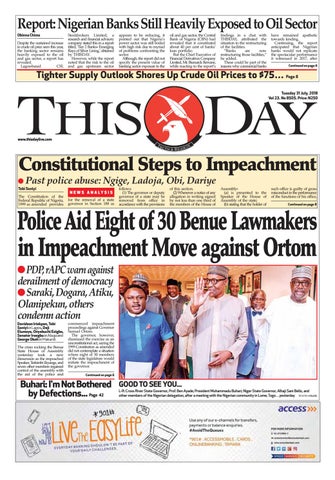
Report: Nigerian Banks Still Heavily Exposed to Oil Sector Obinna Chima Despite the sustained increase in crude oil price seen this year, the banking sector remains heavily exposed to the oil and gas sector, a report has revealed. Lagos-based CSL
Stockbrokers Limited, a research and financial advisory company stated this in a report titled, 'Tier 2 Banks- Emerging Rays of Silver Lining,' obtained by THISDAY. However, while the report noted that the risk to the oil and gas upstream sector
appears to be reducing, it pointed out that Nigeria’s power sector was still boded with high risk due to myriad of problems confronting the sector. Although, the report did not specify the present value of banking sector exposure to the
oil and gas sector, the Central Bank of Nigeria (CBN) had revealed that it constituted about 40 per cent of banks’ loan portfolio. But the Chief Executive of Financial Derivatives Company Limited, Mr. Bismarck Rewane, while reacting to the report’s
findings in a chat with THISDAY, attributed the situation to the restructuring of the facilities. “Banks are now restructuring those facilities,” he added. These could be part of the reasons why commercial banks
have remained apathetic towards lending. Continuing, the report anticipated that Nigerian banks would not replicate the spectacular performance it witnessed in 2017, after Continued on page 6
Tighter Supply Outlook Shores Up Crude Oil Prices to $75… Page 8 Tuesday 31 July, 2018 Vol 23. No 8505. Price: N250
www.thisdaylive.com TR
UT H
& RE A S O
N
Constitutional Steps to Impeachment Past police abuse: Ngige, Ladoja, Obi, Dariye Tobi Soniyi The Constitution of the Federal Republic of Nigeria, 1999 as amended provides
N E W S A N A LY S I S for the removal of a state governor in Section 188 as
follows: (1) The governor or deputy governor of a state may be removed from office in accordance with the provisions
of this section. (2) Whenever a notice of any allegation in writing signed by not less than one third of the members of the House of
Assembly(a) is presented to the Speaker of the House of Assembly of the state; (b) stating that the holder of
such office is guilty of gross misconduct in the performance of the functions of his office, Continued on page 8
Police Aid Eight of 30 Benue Lawmakers in Impeachment Move against Ortom PDP, rAPC warn against derailment of democracy Saraki, Dogara, Atiku, Olanipekun, others condemn action Davidson Iriekpen, Tobi Soniyi in Lagos, Deji Elumoye, Onyebuchi Ezigbo, Senator Iroegbu in Abuja and George Okoh in Makurdi The crisis rocking the Benue State House of Assembly yesterday took a new dimension as the impeached Speaker, Terkimbi Ikyange, and seven other members regained control of the assembly with the aid of the police and
commenced impeachment proceedings against Governor Samuel Ortom. The governor, however, dismissed the exercise as an unconstitutional act, saying the 1999 Constitution as amended did not contemplate a situation where eight of 30 members of the state legislature would initiate the impeachment of the governor. Continued on page 6
Buhari: I'm Not Bothered by Defections... Page 42
GOOD TO SEE YOU... L-R: Cross River State Governor, Prof. Ben Ayade; President Muhammadu Buhari; Niger State Governor, Alhaji Sani Bello, and other members of the Nigerian delegation, after a meeting with the Nigerian community in Lome, Togo…yesterday state house
2
T H I S D AY ˾ ͱͯ˜ ͰͮͯͶ
T H I S D AY ˾ TUESDAY JULY 31, 2018
3
4
T H I S D AY ˾ ͱͯ˜ ͰͮͯͶ
T H I S D AY ˾ TUESDAY JULY 31, 2018
5
6
TUESDAY, ͻ˜ ͺ ˾ T H I S D AY
PAGE SIX POLICE AID EIGHT OF 30 BENUE LAWMAKERS IN IMPEACHMENT MOVE AGAINST ORTOM Ortom received support from a legion of politicians yesterday who warned the ruling All Progressives Congress (APC) not to derail democracy in the country and asked the party to rein in its members who are behind the ongoing drama in Benue State. Politicians who rose to the occasion yesterday included Senate President, Bukola Saraki and House of Representatives Speaker, Yakubu Dogara, who issued a joint statement; former vice president, Alhaji Atiku Abubakar and his fellow presidential aspirants on the platform of the PDP, Mr. Taminu Turaki and Senator Ahmed Makarfi. The PDP and its ally, the reformed All Progressives Congress (rAPC), also took turns to upbraid the APC even as the ruling party was mum on the development as its National Publicity Secretary, Malam Bolaji Abdullahi, pleaded with THISDAY to give him time to study the situation. "We are still studying the situation and as soon as we get the full report of what transpired, we will make the position of the party known,” he said. The leadership of the APC seemed to have avoided any discussion about the incident in Benue State. At the meeting of the National Working Committee of the party held yesterday, THISDAY gathered that the matter was not discussed. Efforts to get the national chairman to speak on the issue failed as journalists were told that the meeting had issued a statement on resolutions reached, which was on the dissolution of the Kwara State executive of the party. The police that were variously accused, by Ortom and 22 members of the state House of Assembly loyal to him, of complicity in the proceedings that lead to the passage of the notice of impeachment, also kept quite yesterday, dodging THISDAY’s enquiry about their alleged role in the drama. The Police Public Relations Officer (PPRO), Benue State Command, Moses Yamu, told THISDAY yesterday that he could not speak as he was still making inquiries and would get back to the newspaper. He responded after several calls and text messages, saying: "In a
meeting now, will get back to you soon." He had not at press time. Ortom had defected from the APC to PDP last week, setting off a chain of hostile verbal exchanges between him and the National Chairman of the APC, Mr. Adams Oshiomhole. Ikyange, who led yesterday’s move in the House, had been impeached as the speaker, weeks back, but was reportedly helped to convene the meeting with seven of the other lawmakers by a battery of policemen. THISDAY gathered that as early as 5a.m., over 300 youths, nine vehicles belonging to the state livestock guards and state vigilante service with their officials blocked the entrance to the House of Assembly Complex in Makurdi, the state capital. Subsequently, police personnel from the state command and Abuja reportedly arrived and dispersed the crowd with teargas. It was gathered that this enabled the eight lawmakers to gain full control of the assembly complex to commence the impeachment proceedings against the governor. While briefing journalists after their sitting, Ikyange said 12 members of the assembly reconvened for legislative duty. He said a motion was moved for the impeachment of the governor for corruption and gross misconduct. He added that a letter had been transmitted to the state Chief Judge and the governor to give reasons for their action. Ikyange insisted that he remained the speaker of the assembly together with other members of his leadership, pointing out that anybody parading himself or herself as the speaker or member of the leadership was only impersonating and should not be taken seriously. The former speaker and the other seven members also suspended the 15 others who had earlier impeached and suspended him. According to Ikyange, the governor has a question to answer over the fraudulent deduction of N50 million each month for over three years from the 23 local government areas of the state, amounting to 33 billion.
He also accused the governor of embezzling N22 billion security votes in three years, among others. Ikyange disclosed that 15 members who participated in the impeachment proceedings against him were suspended for six months. However, in yet another twist, the other 22 members of the assembly who were earlier denied access to the chamber, swiftly moved over to the Government House, Makurdi where they held their own sitting. The new Speaker, Hon. Titus Uba, drew the attention of Nigerians to what transpired at the assembly. He said the police and other security operatives refused 22 of them access to the assembly while the eight others were protected into the chamber. The assembly’s spokesman, Hon. Paul Biam, said a state High Court judge had barred Ikyange from parading himself as speaker and was also suspended for six months. He said the former speaker had no business at the assembly, adding that he was an illegal speaker. According to Biam, the police were ordered by the court last Friday to vacate the assembly complex but he said they refused and were acting Ikyange's script. He added that the assembly had further suspended the seven members that went to the chamber with Ikyange for six months. In his reaction to the planned impeachment against him, Ortom said the APC and the presidency were bent on truncating democratic process in the state. He condemned the role of security agencies in the state assembly dispute. He added that the police and security agencies took side by allowing the impeached speaker to gain access to the assembly while the new speaker and other members were prevented. He said the attempts being made to impeach him was as a result of his stand for the people of the state over herdsmen activities. He accused Senator George Akume, the Director General of Department of Security Service (DSS) and the Inspector General of Police of being behind the plot.
Ortom also denied the charges against him.
PDP, rAPC Warn against Derailment of Democracy Reacting to the impeachment move, the PDP deplored the alleged role of the APC, saying removal bid was a misadventure that was dead on arrival. Addressing a press conference in Abuja, the party’s National Publicity Secretary, Mr. Kola Ologbondiyan, said the PDP's National Working Committee strongly condemned the alleged promotion of illegality by the APC using the security apparatus. He also said the party deplored the action of the Economic and Financial Crimes Commission (EFCC) whose intention it said was to harass and destabilise the Benue State administration and to trigger crisis that would be used as an excuse to declare state of emergency in the state. "The NWC condemns in its entirety the purported sitting of eight APC members including the impeached and suspended Speaker; (in a 30-member House) wherein they illegally claimed to have served an impeachment notice on Ortom. "PDP also condemns the use of the EFCC and DSS to harass and intimidate officials of the Benue State government," the party said. On its part, rAPC said it was shocking to note that despite all the illegalities being perpetrated in Benue State Buhari had not deemed it fit and proper to respond and condemn the outright illegalities. A statement by the group’s National Publicity Secretary, Prince Kassim Afegbua, said the action of the president suggested that he had been the “Chief promoter” of undemocratic illegalities that had consistently undermined the nation’s democratic engagements in the last three years. “It is astounding to note that despite all the infractions in the political process; the polity is consciously charged to ridicule us and make us a laughing stock in the comity of nations before the very eyes of a president who preaches anti- corruption,”
it said.
Saraki, Dogara, Atiku, Others Condemn Action Similarly, the Senate President Saraki and Speaker Dogara, described the impeachment move as "a desecration of the legislative sanctity." In a statement jointly signed by their aides in charge of media, Saraki and Dogara also called on President Muhammadu Buhari to call the police to order and stop them being used to achieve political purposes. They said, "We have monitored closely the development in Benue State in which the impeached Speaker, Terkimbi Ikyange, led seven other members to serve impeachment notice on Ortom, while the 22 other members who constitute more than twothird majority have been prevented from having access to the chamber. “We believe this is illegality and does not conform to parliamentary procedure on impeachment. "We also note with surprise the role of the police in this undemocratic event in which the minority is seeking to impeach a governor against the position of the majority. We believe it is the sacred institution of the legislature that is being desecrated and rubbished in all these negative developments." Former Vice President Atiku, Turaki and Makarfi condemned the impeachment move. Atiku said the proceedings were unconstitutional and must be aborted. According to him, any attempt to disregard the rule of law and constitution in the impeachment of a governor is a recipe for anarchy and officially sanctioned lawlessness. Atiku regretted that for a state facing security challenges like Benue, the introduction of lawlessness in the impeachment process could only complicate an already bad situation. He urged the police to remain politically neutral and avoid aiding lawlessness, adding that partisanship could professionally destroy the image of police. Turaki expressed apprehension about the survival of democracy in
REPORT: NIGERIAN BANKS STILL HEAVILY EXPOSED TO OIL SECTOR the economy exited a biting recession. The report stated, “Increasing levels of nonperforming loans (NPLs) in the books of some banks in the aftermath of the recession amid poor macro-economic conditions caused most banks to put a rein on credit growth in 2017. “As at first quarter 2018, the tier-2 banks within our coverage reported decline in loans by an average of three per cent. “Most banks deployed more funds to the high yielding and less risky fixed income market. However, based on communication from the banks, moderating fixed income yields should
compel banks to create more risk assets.” It projected an average loan growth of about 11 per cent for the tier-2 banks within our coverage and we expect most of the loan growth to take place in the second half of the year. “We do not expect significant deterioration in asset quality this year as oil prices appear to be favourable and foreign exchange liquidity remains robust following the introduction of the Investors and Exporters’ (I&E) window last year,” it added. The Nigerian Banking sector adopted the International Financial Reporting Standard (IFRS) in 2012.
IFRS 9 prescribes new guidelines for the classification and measurement of financial assets and liabilities, making fundamental changes to the methodology for measuring impairment losses, by replacing the “incurred loss” methodology with a forward-looking “expected loss” model. For the tier-2 banks, the report noted attempts by many of them to raise debt capital to shore up their capital base, saying it was expected to result in an increase in funding costs this year. According to it, “The trend in non-interest income growth has been southwards over the last three years during
which the CBN implemented a gradual phase-out of commission on turnover (CoT). “Interestingly, some of the banks, especially the larger ones, have managed to claw back commissions through other channels. The mid-tier banks on the other hand have found it more difficult to do same. “Card fees also took a hit on account of restriction on dollar card transactions. Nigerian banks were forced to reduce (and in some cases suspend) forex transactions on their Automated Teller Machine cards (debit and credit) in the face of acute dollar shortage precipitated by shrinking petrodollars,
tighter FX policies and reduced portfolio inflows. “Capital adequacy is a persistent issue for a number of Nigerian banks. Regulatory capital ratios were impacted by the depreciation of the naira given the extent of dollar lending in the sector. They were also hit by a sharp rise in impairments in some cases.” The CBN requires that banks with international subsidiaries maintain a capital adequacy ratio (CAR) of 15 per cent, while banks without international subsidiaries maintain a CAR of 10 per cent. The minimum requirement for systemically important banks is 16 per cent.
Nigeria, considering the manner in which it was being held at gunpoint by the Buhari administration without remorse. Makarfi called on Nigerians to, within lawful means, stand up to the brazen attempt to stifle the democratic space by APC, a party, he said, was the biggest beneficiary of defections that had become jittery and clearly uncomfortable at the prospect of getting a dose of its own medicine.
Olanipekun: It’s an Aberration Former President of the Nigerian Bar Association, Chief Wole Olanipekun (SAN), said it was an aberration for eight lawmakers to attempt to impeach a state governor in an assembly that has 30 members. He advised the lawmakers to immediately withdraw the notice of impeachment purportedly served on Ortom in the interest of the country’s democracy. The senior lawyer appealed to lawmakers to carefully read the judgments of the Supreme Court on the impeachment of Rashidi Ladoja of Oyo State, Joshua Dariye of Plateau State and Peter Obi of Anambra State, after which, they would know that their exercise is in futility. He said, “The action portends grave danger to democracy. They want to unnecessarily heat up the polity. I will advice them to withdraw it. “My advice to them is that they should carefully read the respected decisions of the Supreme Court on the impeachment of Rashidi Ladoja of Oyo State, Joshua Dariye of Plateau State and Peter Obi of Anambra State, which is very detailed and outlines how to remove a governor. These decisions are all unanimous.” Another senior lawyer, Mr. Godwin Obla (SAN), said the eight lawmakers were embarking on a shameful expedition. He contended that, apart from the fact that their number did not meet the constitutional quorum required to remove a governor, their action and conduct fell short of the conditions required by the constitution.
TOP GAINERS MUTUAL BENEFITS SEPLAT NNFM NEIMETH OANDO TOP LOSERS CONOIL PHARMDEKO MEDVIEW AIR
NGN NGN 0.03 0.33 62.50 687.50 0.65 7.20 0.04 0.46 0.50 5.75 NGN 2.70 24.30 0.22 1.98 0.21 1.93 REDSTAREX 0.60 5.60 TRANSCORPHOT 0.70 6.75 HPE Nestle Nig Plc ₦ 1,502.00 Volume: 319.404 million shares Value: N3.048 billion Deals: 4,091 As at yesterday 30/07/18 See details on Page 31
% 10.0 10.0 9.9 9.5 9.5 % 10.0 10.0 9.8 9.6 9.4
T H I S D AY ˾ TUESDAY JULY 31, 2018
7
TUESDAY, ͻ˜ ͺ ˾ T H I S D AY
8
NEWS
Tighter Supply Outlook Shores up Crude Oil Prices to $75 Ejiofor Alike with agency reports Crude oil prices rose yesterday with the global benchmark, Brent crude settling at $75 per barrel, as traders kept the focus on global supply disruptions and the effects of the United States’ sanctions on Iran. The price of Brent crude was actually up 76 cents at $75.52 per barrel, while the US West Texas Intermediate (WTI) crude rose by $1.51 to settle at $70.21 per barrel. Despite the hike in crude oil production by 70,000 barrels per day to 32.64 million barrels per day in July, the highest in 2018, the price of oil has risen in recent weeks. Reuters reported that the prices remain buoyed by a tight supply outlook, with global inventories down from record highs in 2017 and US inventories at a three-year low. The supply of crude oil to the international market
has suffered disruptions in the Middle East. Saudi Arabia last week said it was suspending oil shipments through the Red Sea’s Bab al-Mandeb strait, one of the world’s most important sea routes for crude oil, after Yemen’s Iran-aligned Houthis attacked two ships in the waterway. Oil traders said prices pulled back after information supplier, Genscape reported that inventories at Cushing, Oklahoma, the delivery hub for US crude, rose almost 200,000 barrels, or nearly one per cent, from Tuesday to Friday last week. But the prices have rebounded from recent lows over the last two weeks, as looming sanctions on Iran have already started to curtail exports from that country. Supporting prices is the possibility that the United States might re-impose sanctions on Iran, OPEC’s
Minister of State for Petroleum Resources, Ibe Kachikwu
third-largest producer, which could result in further supply reductions
from the Middle East. OPEC had on November 27, 2015, decided to pump
allegation.
that the allegation has not been proven, there will be no further action. However, if the report is that the allegation against the governor has been proven, then the state House of Assembly will consider the report, and a resolution for the adoption of the report shall be moved.
as much as it could to defend market share, an action that sent the price of oil to a low of $27 per barrel in February 2016. But following the drop in oil price to an all-time low, OPEC and other major producers, including Russia started to withhold output in 2017 to rein in oversupply that had depressed prices since 2014. OPEC’s main objective for the cuts is to eliminate a global surplus in oil stocks and re-balance the market. OPEC, together with Russia and a group of other producers, last November extended an output-cutting deal to cover all of 2018. The initial deal, under which OPEC and non-OPEC producers are cutting supply by about 1.8 million barrels per day, had expired in March 2018. The production-cutting pact between the OPEC, Russia and other producers has given strong tailwind to oil prices
However, the cartel and its allies agreed last month to boost supply as US President Donald Trump urged producers to offset losses caused by new US sanctions on Iran and to dampen prices, which had hit $80 per barrel earlier this year, the first time since 2014. On June 22-23, OPEC, Russia and other nonmembers agreed to return to 100 per cent compliance with oil output cuts that began in January 2017, after months of underproduction in Venezuela and elsewhere pushed adherence above 160 per cent. Saudi Arabia said the decision would translate into an output rise of about one million bpd. OPEC’s collective adherence with supply targets has slipped to 111 per cent in July from a revised 116 per cent in June, the survey found, meaning it is still cutting more than agreed.
(APGA).
representatives of Obasanjo in Asaba, Delta State and then accompanied to Awka by heavy security provided by the police Mobile Unit. The House of Assembly members arrived Awka at 5a.m. and began sitting afterwards. They received the report of a panel of investigation set up to investigate the governor and, after deliberating for about an hour, decided to impeach Obi. It took many months of legal battles before he could retrieve his mandate.
CONSTITUTIONAL STEPS TO IMPEACHMENT detailed particulars of which shall be specified, the Speaker of the House of Assembly shall, within seven days of the receipt of the notice, cause a copy of the notice to be served on the holder of the office and on each member of the House of Assembly, and shall also cause any statement made in reply to the allegation by the holder of the office, to be served on each member of the House of Assembly. (3) Within 14 days of the presentation of the notice to the Speaker of the House of Assembly (whether or not any statement was made by the holder of the office in reply to the allegation contained in the notice), the House of Assembly shall resolve by motion, without any debate, whether or not the allegation shall be investigated. (4) A motion of the House of Assembly that the allegation be investigated shall not be declared as having been passed unless it is supported by the votes of not less than two-thirds majority of all the members of the House of Assembly. (5) Within seven days of the passing of a motion under the foregoing provisions of this section, the Chief Judge of the state shall at the request of the Speaker of the House of Assembly appoint a panel of seven persons who in his opinion are of unquestionable integrity, not being members of any public service, legislative House or political party, to investigate the allegation as provided in this section. (6) The holder of an office whose conduct is being investigated under this section shall have the right to defend himself in person or be represented before the panel by a legal practitioner of his own choice. (7) A panel appointed under this section shall(a) have such powers and exercise its functions
in accordance with such procedure as may be prescribed by the House of Assembly; and (b) within three months of its appointment, report its findings to the House of Assembly. (8) Where the panel reports to the House of Assembly that the allegation has not been proved, no further proceedings shall be taken in respect of the matter. (9) Where the report of the panel is that the allegation against the holder of the office has been proved, then within 14 days of the receipt of the report, the House of Assembly shall consider the report, and if by a resolution of the House of Assembly, supported by not less than two-thirds majority of all its members, the report of the panel is adopted, then the holder of the office shall stand removed from office as from the date of the adoption of the report It follows, therefore, that the following steps must be taken for any successful impeachment to take place:
Step 1
A notice of any allegation in writing alleging gross misconduct on the part of the governor. This notice must be signed by not less than one-third of the members of the state House of Assembly is presented to the Speaker of the state House of Assembly. The constitution defines gross misconduct, is defined by the as ‘…a grave violation or breach of the provisions of this Constitution or a misconduct of such nature as amounts in the opinion of the National Assembly to gross misconduct.’
Step 2
The Speaker of the state House of Assembly must within seven days, serve the governor and each member of the state House of Assembly with a copy of the notice of
Step 3
The governor has a right of reply, and any such statement in reply to the allegation must be served on each member of the state House of Assembly.
Step 4
Within 14 days of the presentation of the notice to the Speaker of the state House of Assembly, the state House of Assembly shall resolve by motion without any debate whether or not the allegation shall be investigated. This motion needs to be passed by at least two-thirds majority of all members of the state House of Assembly.
Step 5
If the motion fails to reach the required majority, the process immediately stops, and no further action will be taken. However, if the required majority is obtained and the motion is passed, then the Speaker of the state House of Assembly will within seven days of the passing of the motion, request the Chief Judge of the state to appoint a panel of seven persons who in his opinion are of unquestionable integrity to investigate the allegations. The members of the panel cannot be members of any public service, legislative house or political party.
Step 6
The panel is to report its findings within three months of being appointed. The findings will be reported to the state House of Assembly. During the proceedings of the panel, the governor shall have a right to defend himself, and shall also have the right to be defended by a legal practitioner of his/ her choice.
Step 7
Where the panel reports
Step 8
For the resolution to be adopted, it must be supported by not less than two-thirds majority of all the members of the state House of Assembly. Once adopted the governor shall stand removed from office as from the date of the adoption of the report.
PAST POLICE ABUSE Chris Ngige The first executive governor of the Fourth Republic to taste bitter side of the use of federal might was Chris Ngige. Helped to office as governor of Anambra State on the platform of the Peoples Democratic Party (PDP) by Chris Uba, a political godson of President Olusegun Obasanjo, Ngige soon fell out with his godfathers, barely two months into his tenure. On July 10, 2003, heavily armed policemen, under the command of AIG Ige from his operational base in Umuahia, invaded the Government House, Awka, the state capital and seized Ngige under the pretext that he had resigned from office. It turned out that the letter of resignation was forged and it took a huge public outcry before he could retrieve his office. He didn’t laugh last though as in August 2005, an election tribunal led by Justice Garba Nabaruma nullified Ngige's 2003 victory. He appealed to Court of Appeal, but the annulment was confirmed on March 15, 2006, in a judgment awarding victory to Peter Obi of the All Progressives Grand Alliance
Rashidi Ladoja It was the turn of Rashidi Ladoja of Oyo State in January 2006. Again, he was a PDP governor who had fallen out with Obasanjo. Using Ladoja’s erstwhile godfather, Lamidi Adedibu, a push to oust him from office began. There was a problem though. Ladoja had an upper hand in the House of Assembly and the dissident legislators were short of the numbers required to impeach him. His resistance, however, collapsed spectacularly in the face of massive police support for the dissident legislators who on January 12, 2006 removed him from office in an early dawn meeting that started by 5a.m. The entire proceedings lasted less than 20 minutes. He would later get reprieve from the Court of Appeal, which annulled the impeachment and restored him to office. But he would not get his seat back till December 12, 2006 one clear month after the Supreme Court had upheld the judgement of the appellate court below.
Peter Obi Peter Obi’s fate had a comical twist. He had displaced Ngige in March 2006 through a court judgement that awarded him the 2003 governorship election. He had hosted Obasanjo, who told him during a state visit, to forget re-election in 2007 if he did not join the PDP because he (Obasanjo) would not support a nonPDP member. And true to Obasanjo’s postulations, a day after the visit, Obi was impeached on November 2, 2006, after seven months in office. The lawmakers had reportedly met with
Joshua Dariye It was the turn of another PDP governor, Joshua Dariye of Plateau State to face unconstitutional removal from office. In early October 2006, eight of the 24 state House of Assembly members issued an impeachment notice against Dariye. In his defence, he stated that the notice was invalid as the eight did not form a quorum of the assembly. A crowd of his supporters tried to prevent the assembly members from entering the state assembly building. Riot police then fired into the crowd, killing two protesters. Again the resistance collapsed in the face of massive police deployment that aided five of the 24 legislators to impeach Dariye on November 13, 2006. On March 10, 2007 the Court of Appeal ordered him reinstated but could not return to office until 27 April 2007 when the Supreme Court affirmed his reinstatement with immediate effect.
Conclusion Since President Olusegun Obasanjo left office 11 years ago incidence of Police abuse against governors have abated, until yesterday.
T H I S D AY ˾ TUESDAY JULY 31, 2018
9
10
T H I S D AY ˾ ͱͯ˜ ͰͮͯͶ
T H I S D AY ˾ TUESDAY JULY 31, 2018
11
12
T H I S D AY ˾ ͱͯ˜ ͰͮͯͶ
T H I S D AY ˾ TUESDAY JULY 31, 2018
13
14
T H I S D AY ˾ ˜ ͱͯ˜ ͰͮͯͶ
COMMENT
Editor, Editorial Page PETER ISHAKA Email peter.ishaka@thisdaylive.com
DALUNG’S NFF RECONCILIATION FACADE There is need to respect FIFA’s universal position on the governance of football, writes Fred Edoreh
W
hile the federal government expressed desire to see Nigeria football governed in line with FIFA statutes and, thus, intervened to restore the Amaju Pinnick Executive Committee of the NFF in office, the Minister of Sports, Solomon Dalung, moved to set up a 21-member reconciliation committee to device a different road map on resolving the crisis. Dalung based his rejection of President Muhammadu Buhari’s directive on two false grounds: that there was a Supreme Court judgment sacking the Amaju board and that the ex-parte order obtained by the Chris Giwa group was still valid. For the avoidance of doubt, the Supreme Court panel led by Chief Justice Walter Onnoghen, did not give any ruling on the validity of Giwa or Pinnick as NFF President. It held that the matter should be re-listed for expeditious hearing at the lower court but declined to determine the case on its merit, pointing out that the conditions that could warrant such determination had not been met. Also, the ex-parte order obtained by Giwa on June 5 to take over the NFF has lapsed, going by the Civil Procedures Rule (2009). Whereas there is nothing wrong with the intervention of elders in any crisis, it has become obvious that Dalung’s recourse to reconciliation committees has been ineffective in the resolution of the NFF dispute and has become a mere facade. This is so because, clearly, the crux of the matter is whether the administration of Nigeria football and elections into its board should be by the provisions of FIFA statutes or by the rulings of regular courts in Nigeria by which Giwa has been seeking to claim the leadership of the NFF after he had contested and lost his claims through FIFA Courts, Appeals Committee and the Court of Arbitration for Sports. FIFA has insisted since 2014 that it rejects the Giwa election of August 26, the process being at variance with its statutes, and upheld the Pinnick election of September 30 which it supervised and endorsed. It also, in 2017, extended the ban on Chris Giwa and four others to worldwide effect, for violation of its code of ethics by dragging the NFF through regular courts and thus destabilising its operations. The matter therefore is a simple “to be or not to be”, for Nigeria football to be administered in line with FIFA rules or regulations. Whatever the elders or the courts in Nigeria decide, the response from FIFA in the event that they force Giwa’s take over of the NFF or interfere with the Pinnick board is known. The option for Nigeria in the face of FIFA’s unequivocal insistence on its standards is also known. This is why the Dalung committees will remain an exercise in futility. The genuineness of his sincerity towards resolving the crisis is also very suspect. While inaugurating the latest committee on July 24, 2018, he admitted that there was no mention of the NFF dispute in the handover note he received; that it was Giwa’s counsel that brought the matter to his attention; and that he was privy to re-listing the matter in court. This is how the crisis was exhumed after Giwa had earlier withdrawn from the court in 2014. He explained that having thus revived the crisis, he tried to resolve it by asking the Pinnick board to accommodate Chris Giwa in the running of Nigeria football as a solution. He also lamented that he asked the Pinnick board to sponsor Giwa’s men to the 2018 World Cup and sent their list to that effect but they were refused.
WHEREAS THERE IS NOTHING WRONG WITH THE INTERVENTION OF ELDERS IN ANY CRISIS, IT HAS BECOME OBVIOUS THAT DALUNG’S RECOURSE TO RECONCILIATION COMMITTEES HAS BEEN INEFFECTIVE IN THE RESOLUTION OF THE NFF DISPUTE AND HAS BECOME A MERE FACADE
How the NFF would officially send persons banned by it, CAF and FIFA, to the FIFA World Cup is indeed curious but it resonates with suggestions that, perhaps, benefits to individuals might have informed the exhumation of the dispute and the sustained attack on the NFF. Is that what the elders have been called to mediate over? It will be recalled that Dalung had, after reviving the crisis, set up a similar seven-man committee headed by former NFA Chairman, Ibrahim Galadima, in April 2016, and gave it one week to submit its report. Galadima explained then that they would focus on the reforms of the structure and legal framework for Nigeria football, to be in tune with FIFA statutes, rather than on reconciliation. “The problem of our football is that of structure and we have to restructure it. Until we do it, we will be going round in circles. Legally, we also need to know whether it is NFA or NFF. With the reforms going on in FIFA, we have to follow suit. It is left for the minister to implement our recommendations or not,” Galadima said then. Three years after, nothing was heard about the committee’s recommendations. This might not be unconnected with the fact that the Giwa group rejected the committee. “May we put it on record that the board of the NFF has no confidence in that committee and disassociates itself from its activities. We urge Nigerians to disregard this action of the minister,” Effiong Johnson, a representative of the Giwa group said then, in a public statement. It is curious therefore that, in 2018, the minister has called back same elders he gathered in 2016 - past chairmen, presidents and secretaries of the NFF among others - for same assignment while he stokes the embers. Interestingly, former Secretary General of the NFF, Tijani Yusuf who was in the 2016 and now in the 2018 committee, has re-echoed Galadima’s earlier position, that the issue should not really be about Pinnick versus Giwa but on the truth that is Germaine to the good life of Nigeria football. “We are looking beyond the problem between Pinnick and Giwa. As you are aware, there are issues on ground that led to the present crisis. The problem has been there all along. It happened during the time of Alhaji Ibrahim Galadima, Alhaji Sani Lulu Abdullahi, Alhaji Aminu Maigari and now it is happening again. So a lasting solution is what we are looking for,” Yusuf reportedly has said. The meaning of this is that they are not focusing on Pinnick and Giwa, perhaps because they know that Nigeria cannot effectively function in world football outside the precepts of FIFA; that their recommendations cannot change the stand of FIFA on the matter, neither would FIFA accept the running of its member federations through the orders of regular courts of individual nations. So, why are we deceiving ourselves? The lasting solution can only be in line with President Buhari’s directive through the Attorney General of the Federation to the Minister of Sports: the need to respect FIFA’s universal position on the governance football. The trouble, really, is whether Dalung is ready to let this be and stop breathing life into a non-existent and globally rejected Giwa mandate. Until then, like Galadima said, we may keep dancing in circles.
THE SACRIFICE WE MUST MAKE Mahmud Ibrahim enjoins all to obtain their voter cards and ensure continuation of the current administration in Taraba
H
is mission in government was thoroughly articulated and well understood from the beginning. Governor Darius Dickson Ishaku had told himself, and had assured the people, that Taraba State under his watch as governor would experience elaborate and spectacular development in various areas. In less than three years of his first tenure as governor, Ishaku has not only proved that this is possible, he has practically achieved this goal for the state and the people.
There are many areas of accomplishments by the administration but the education sector, an area dear to me as a school proprietor and because of its relevance for the future of our children, comes readily to mind. Education is the bedrock of our hope for a greater future. It is the antidote for ignorance, the everlasting weapon against poverty and disease. It unbundles our creative energies and puts us in a position to understand, explore and control our environment for the general wellbeing of society. That is the reason I was not surprised that Governor Ishaku made education a cardinal agenda of his rescue mission in Taraba State. Before his arrival on the political stage in Taraba, education in the state was in a shambles. Infrastructure was in acute state of deficit. School buildings almost everywhere were decrepit and crying for attention. Governor Ishaku’s rescue train promptly embarked on an elaborate infrastructure remediation programme that has turned the sordid
situation around for the better. Today, old school buildings in virtually all towns and communities in the state are looking bright and strong. School environments have become more teaching and learning friendly. Teachers are clapping their hands in appreciation of the rescue work accomplished by the Ishaku administration. Payment of teachers’ salaries has become a regular monthly routine. This has given the teaching profession a new attractive definition with more people falling over themselves to join. Late last year, 3000 more teachers were employed in one fell swoop by the state government, the highest number of teachers to be employed by any state government in Nigeria in a single recruitment exercise. The exercise is credited with the twin achievement of taking many young men and women off the unemployment market as well as boosting the level of teaching in the schools. Extensive and sustained training and retraining programme which was part of the remediation plan of the government has achieved more than expected results in a short time. In less than two years of the administration Taraba State’s performance in the West African Examination Council jumped from about 20 per cent to 67.3 per cent in 2016. It was a pleasant surprise to all that were familiar with the poor state of education in the state before then. The celebration over that remarkable performance had hardly stopped when the bigger one arrived. Taraba State’s performance in the 2017 WAEC was adjudged the best in the entire Northern region and the eighth best in the whole of Nigeria.
One of the steps government also took which has proved very helpful in the laudable WAEC records achieved is the establishment of the examination body’s office in Jalingo. Government had encouraged this by donating a building for use as office and a vehicle to facilitate movement of staff. For students and parents in the state, the coming of WAEC to Jalingo has ended their hardships and frustrations. Before then, WAEC candidates had to travel all the way to Yola to register and sort out all problems connected with their examinations. There is no doubt that this has contributed to the pleasant tale of immense benefits being harvested by the state today. Government’s huge investments in human capital development in the sector which was part of the Ishaku’s rescue agenda did that magic for the good of the state. Now the state is in a position to fill its quota in universities and other institutions of higher learning for which Taraba State is part of their catchment area. Before now, the state was unable to fill its quota in these institutions, including the Federal University Wukari which is on its own soil. The pleasant tale, according to the government, is that the programme to turn the sector completely around for effective and enduring legacy in education is a continuous process on the agenda of the government. My plea with Governor Ishaku is that the tempo of support for education must be sustained by his administration. As a school proprietor myself, I’m in a position to know much government’s new policy of generous development of facilities and motivation of staff
have helped in promoting teaching and learning. Teachers, students and school managers in the state owe themselves the duty of ensuring that that these do not stop. And one critical way that this can be done is to ensure that Governor Ishaku, who is the philosophical pillar behind all the good things that education in Taraba State has witnessed in just three years is returned to office for a second term. I know many of us in the education sector either as students, teachers and proprietors have already resolved to do so. But resolution alone is not enough. We must take practical steps to ensure that we qualify to vote. That means we must obtain our PVCs, come out en mass on the day of voting, then vote and wait at the polling stations to ensure that our votes are properly counted and not diverted to the undeserving candidates or political parties. This is important. Apart from ensuring the continuation of the rescue mission in the education sector, it is our own way of rewarding the good gesture of Governor Ishaku. There is no better way to reward his laudable achievements in the sector than to ensure his re-election for the office of governor in Taraba State for another four-year term. This we must resolve to do. As a stakeholder in the politics of the state, I’m aware that there will be a lot of effort on the part of unpatriotic elements in the state to frustrate our resolve but we must be courageous enough to stand our ground. It is the only way to guarantee the future of our children and our great grand children. No amount of sacrifice is too much to make for this to be achieved.
15
T H I S D AY TUESDAY, JULY 31, 2018
EDITORIAL THE SIEGE ON THE POLICE The police authorities could do more to put their house in order
I
n a move which underlines the widespread concerns about the wave of violent attacks on officers and men of the Nigeria Police, the Inspector-General of Police (IGP), Mr Ibrahim Idris, recently offered a N5 million reward to anyone with useful information that could lead to the arrest of the criminal gangs taking out his officers and men. No doubt, the spate of violent attacks on law enforcement agents across the country deserves such desperation. Within a space of two weeks, no fewer than 11 policemen were gunned down by hoodlums. It started on 2nd July when seven policemen on patrol duty were brutally murdered at the Galadimawa roundabout, Abuja, by bandits in an incident described as target killings. Few days later, four other members of the force on patrol in Edo State were ambushed and killed by gunmen. Also in this bloody month of July, four policemen were felled in Kaduna just as two policemen were killed by some criminal gangs in Lokoja during an alleged failed assassination attempt on controversial Senator Dino Melaye. So dreary has IF THOSE WHO ARE the situation TRAINED TO PROTECT become that the THE PUBLIC COULD BE police authorities in SO CASUALLY BROUGHT Nasarawa last week DOWN, WHAT IS THE had to engage the FATE OF THE ORDINARY services of vigilance groups to help MAN ON THE STREET? apprehend some bandits who allegedly killed one of their men in the Wamba Council Area of the state, the same week some herdsmen in Ardo Kola Council in Taraba State killed a policeman along with six others. It is unfortunate that gang attacks and general banditry has now become commonplace across the country in addition to the security challenges created by the Boko Haram insurgency in the North East. Yet the rate at which police blood is being spilled is becoming increasingly alarming. Only
Letters to the Editor
recently, during the coordinated robbery attacks on six banks in Offa, Kwara State, no fewer than nine policemen were murdered in cold blood. By the time these are added to hundreds of others savagely brought down by militants, suicide-bombers and others felled in the heat of battle against the Islamic militants in the North East, the weight of the brazen assault on law enforcement agents can really be worrying.
T T H I S DAY EDITOR BOLAJI ADEBIYI DEPUTY EDITOR DAVIDSON IRIEKPEN MANAGING DIRECTOR ENIOLA BELLO DEPUTY MANAGING DIRECTOR KAYODE KOMOLAFE CHAIRMAN EDITORIAL BOARD OLUSEGUN ADENIYI EDITOR NATION’S CAPITAL IYOBOSA UWUGIAREN MANAGING EDITOR JOSEPH USHIGIALE
T H I S DAY N E W S PA P E R S L I M I T E D EDITOR-IN-CHIEF/CHAIRMAN NDUKA OBAIGBENA GROUP EXECUTIVE DIRECTORS ENIOLA BELLO, KAYODE KOMOLAFE, ISRAEL IWEGBU, IJEOMA NWOGWUGWU, EMMANUEL EFENI DIVISIONAL DIRECTORS BOLAJI ADEBIYI, PETER IWEGBU, ANTHONY OGEDENGBE DEPUTY DIVISIONAL DIRECTOR OJOGUN VICTOR DANBOYI SNR. ASSOCIATE DIRECTOR ERIC OJEH ASSOCIATE DIRECTORS PATRICK EIMIUHI, SAHEED ADEYEMO CONTROLLERS ABIMBOLA TAIWO, UCHENNA DIBIAGWU, NDUKA MOSERI DIRECTOR, PRINTING PRODUCTION CHUKS ONWUDINJO TO SEND EMAIL: first name.surname@thisdaylive.com
hese killings have raised a lot of worries not only about the capacity and capability of the force, they also undermine the security of the nation and indeed the democratic process. Some of the pertinent questions are: How long can this go on for a country that has one of the poorest civilian-police ratio in the world? If those who are trained to protect the public could be so casually brought down, what is the fate of the ordinary man on the street? But then, why should we expect so much from a police we give so little? Why should we entrust the security of the nation to a force that is ill-trained, ill-equipped and badly motivated? Unfortunately, while the rot in the police continues, the IGP seems more interested in the politics of 2019 for the incumbent government. Yet, earlier in the month police officers at the heart of the war against Boko Haram in Maiduguri, Borno State, took to the streets to protest five months of unpaid allowances. When he assumed duty in 2016, Idris vowed that he would do everything possible to ensure that “our streets, neighbourhoods and communities remain safe.” Three years on, the country is enveloped in pervasive fear and insecurity. Armed robberies, kidnappings and other allied crimes have become a routine affair. Even the police whose officers and men are supposed to protect the people and restore law and order are under siege. In case the IGP has forgotten his core mandate, we hereby restate for him: to restore a measure of order not only for the ordinary citizen but also within the rank and file.
TO OUR READERS Letters in response to specific publications in THISDAY should be brief (150-200 words) and straight to the point. Interested readers may send such letters along with their contact details to opinion@thisdaylive.com. We also welcome comments and opinions on topical local, national and international issues provided they are well-written and should also not be longer than (9501000 words). They should be sent to opinion@thisdaylive.com along with the email address and phone numbers of the writer.
EKITI AND DELUSIONAL CORRUPTION FIGHT
I
n the past three years, Nigerians lived with a veiled notion that the nation has attained political maturity where the people’s will prevails. Such a feeling, no doubt stemmed from wisdom born through the experience of 2015 general elections. But contrary to this belief, the recent gubernatorial contest in Ekiti State has revealed that the above table of ideology may not be completely true – as it was astonishingly glaring that we are not matching forward but groping and stumbling, politically divided and confused while our moral confidence sinks. When you boil down precisely on what went wrong with the election, you discover without labour that the people were reacting to the government (state and federal)’s past demonstration of contempt for people-purposed leadership and their pursuit of policies that have benefitted only their friends and supporters. Though a ‘winner’ has since emerged, available reaction explains that baggage of doubt and creditability burden pervades the state. And at a more significant level, the obvious irony associated with the exercise is that instead of eliciting celebration, it caused the nation embarrassment at the global stage and blew harsh wind into our political arena- posturing Ekiti State, the playing field as the serious loser, and the indigenes as democracy- conscious people without democratic attitude. Looking at commentaries, one unhappy lesson that comes to the fore is that the exercise barefacedly showcased the country’s unbelief in the saying that the ‘means must be pure as the end we seek’. Deplorably, while Nigerians wrestle with this pressing reality, the exercise has again opened a new vista of apprehension and further
underlined the challenge of money politics/vote buying with many doubting the possibility of the President Muhammadu Buhari’s led administration winning the war against corruption. And such fears cannot be described as unfounded as what took place in the state was antithetical with, and runs contrary to the global tenets for building an honest government which demands that ‘a precondition for an honest government is that the candidate must not need large sums to get elected, or it must trigger off the circle of corruption. Having spent a lot of money to get elected, winners must recover their costs and possibly accumulate funds for the next election as the system is self-perpetuating’. Further supporting the above is the remark credited to Malte Liewerscheidt, vice-president of the London-based risk advisory group, Teneo Intelligence as reported by Bloomberg Media group; ‘Both parties engaged in bribery. The APC used “large-scale vote buying and the use of security forces” to protect buying agents. The recipe used by the APC to win in Ekiti might well serve as a blueprint for the upcoming nationwide ballot, with potentially severe implications for public finances. What is more? No hope for the future. Without minding what others may say, the Ekiti saga has eloquently proved that the Executive Order 6 as proposed by Mr. President may not provide the needed solution to the corruption fight in the country as it can only attempt curing the effects while leaving the root-cause to flourish. The primary concern of executive order as proposed is to track/ monitor corrupt transactions and ensure temporary/permanent forfeiture of such proceeds; but, it will be more gratifying in my view
if the federal government first rework the propeller/enabler- our faulty electoral process that is hugely perceived as capital intensive. Such a step will be a little beginning that will translate into a huge result. In the same token, the electoral outing has further painted our politics as responsibility-free where the ‘consent of the governed’ is considered a commodity to be purchased by the highest bidder. Consequentially, the promises of our political leaders can never be fulfilled since they have paid for votes and do not have the responsibility to deliver on their pledges. Unlike other nations, Nigeria has again demonstrated its lack of culture for accommodation and tolerance which makes a minority genuinely accepts majority’s right to have its way until next election, and wait patiently and peacefully for its turn to become the government by persuading more voters to support its views. Curiously, it’s conspicuous that the list of actions not taken by the government remains lengthy and worrisome. For instance, the people could not fathom the rationale for casting their votes for leaders whose vision is not serving the interest of the general constituencies. Whatever the true position maybe, Mr. President’s inability to organise a free and fair election has further lent credence to the belief in some quarters that though he started off with high moral standards, strong convictions and determination to beat down corruption, it has recently become obvious that he cannot live up to those good intentions as he lacks the determination to deal with all transgressors, and without exception. Jerome-Mario Utomi, Jeromeutomi@yahoo.com
18
T H I S D AY ˾ ˜ ͱͯ˜ ͰͮͯͶ
FEATURES
Group Features Editor: Chiemelie Ezeobi Email chiemelie.ezeobi@thisdaylive.com, Tel: 07010510430
Seeing Beyond Impossibilities in Digital World The United Bank forAfrica’s position asAfrica’s most innovative financial institution was further cemented recently when it was honoured at the Euromoney Award in London as the continent’s leading digital banker. Rachael Wanogho reports
Group Managing Director/CEO, United Bank for Africa Plc, Mr. Kennedy Uzoka (2nd right) with Africa’s Best Digital Bank award conferred by Euromoney. Uzoka is flanked from left by Managing Director, Euromoney, Mr. John Orchard; General Manager, Energy Bank, Mr. Ebele Ogbue; and 1966 England World Cup winner, Sir Geoff Hurst, at the Euromoney Award for Excellence in London…recently
I
Growth is the application of revealed principles and means. It cannot be suddenly stumbled upon. Success is worked for and obtained through hard work and the application of principles that have, overtime, been used and put to good use by individuals, organisations and corporate bodies. Euromoney is one of such bodies that possess principles surrounding quantitative and qualitative data and they seek to honour institutions that have brought the highest levels of service, innovation, and expertise to their customers. Recently, at their awards ceremony held in London, Euromoney conferred on the United Bank for Africa (UBA), one of Africa’s leading financial institutions, “The Best Digital Bank Award”. The award was received by the Group Managing Director, Mr. Kennedy Uzoka. Uzoka appreciated Euromoney, taking pride in the fact that UBA’s dedication to hard work and provision of quality services
to customers are being acknowledged and recognised. He said this feat should serve as an example and encouragement to other financial institutions that impossibilities can become possible and attainable once your mind is set on it.
The formulation of this product is consistent with the bank’s customer-first philosophy, where we are doing things not the way we like, but focusing on what the customers want, where they want it, and in the exact platform they want it
Leo Editor of Euromoney’s magazine, Clive Horwood, also had his thoughts concerning the award conferred on UBA. Horwood explained that despite the fierce competition among financial institutions for digital banking, UBA stood out with the introduction of Leo. Strangely, Leo is not human, neither an animal. UBA is one of Africa’s leading banks with operations in 20 African countries and in London and New York, with presence in Paris. It is acclaimed for its pioneering role in banking and organisational change. The bank bagged the award of excellence by introducing Leo, who is also known as the Chat Banker. Leo is an e-chat service that makes use of artificial intelligence to help customers execute transactions on Facebook. Apart from its technological features, Leo possesses the physical human characteristics of the average African man, dark-skinned with a seemingly large nose and a clean
haircut. Leo’s dress sense also targeted the demographics of a youthful population with his pair of dirty jeans trousers, t-shirt and sneakers. Leo is social, tech-savvy and smart when it comes to financial transactions. Leo is well deserving of accolades as it has been proved in Nigeria and launched in 15 African countries, including Cameroon, Zambia, Cote D’Ivoire, Senegal, and Congo, and this is set to change the face of e-banking in the key markets and countries. There is no backing down now as the world is revolutionising and taking more daring steps in technology and digital platforms. Leo has so many advantages, and as such, it beats what troubles the minds of its average client and can be used by non-customers, which makes it an honourable platform. Leo is a banking buddy that any customer and money-minded individual can bank on, anytime of the day and in any city. The client can make use of social media accounts across any device – phones, tablets, laptops, and palmtops. He also
19
T H I S D AY ˾ ˜ ͱͯ˜ ͰͮͯͶ
FEATURES
Zuckerberg with Leo
comes with new features that enable the user to derive vital information, such as important names of global personalities in key market areas that can be used personally. The Chat Banker interacts with the customers, answering questions such as the current time and weather conditions in and across cities, which is imperative for traveller and business individuals that go through cities for either business purpose or personal trips. One of the most important advantages of Leo is its ability to address banking concerns raised by the customers. They include but not limited to opening new accounts, receiving instant transactions notification, transfer funds and airtime top-up but this is just the tip of the iceberg. The crux is its ability to confirm cheques, pay bills, apply for loans (amazingly), freeze accounts – of course, not too soon – and request for mini-statements in case of emergencies. For those who like to make suggestions or monitor complaints, Leo also provides an opportunity to handle transactions speedily and timely. To enjoy the service fully, every user must have a Facebook account, although there is a plan in the nearest future for Leo to show up on other social platforms.
‘Artificial Intelligence Personality’ During the launch of Leo, Group Head of Online Banking at UBA, Mr. Austine Abolusoro, said Leo was an artificial intelligence personality meant to address any type of banking concerns raised by customers. “Leo is ready and waiting to help with most transactions and to deliver any form of banking services,” Abolusoro said. “Leo is operating a lifestyle banking platform on Facebook messenger to assist with your transactions while chatting with your friends and business partners. The security with this platform is that for every transaction, an OTP (One Time Password) is generated to the phone number that is registered on your account.” Horwood also mentioned that UBA recently added retina and fingerprint recognition
At UBA, we have been working with technology giants that have the global capacity to ensure not only seamless but also effortless banking for millions of our customers across Africa
and technology to reduce business travel greenhouse emissions. There is without an iota of doubt, that if UBA fulfils their ambitions to partner with financial technology companies, they will continue to lead African banks in digitisation. Facebook's Recognition Uzoka said UBA bagged the award for excellence due to its strong management and unmatched commitment to service excellence. Even though they have been around since 1949, UBA has moved beyond the traditional methods of banking and introduced platforms, initiatives and strategies that other organisations can follow, Uzoka said. Their accomplishments thus far, have been endorsed by President Emmanuel Macron of France and CEO Facebook, Mark Zuckerberg, focusing on the values that come with UBA’s leading digital opportunities. UBA is the first bank in Africa to come up with this kind of solution and the reason it is phenomenal is that it helps to simplify the way customers interact. Discussions certainly took place with Facebook and the collaboration was sealed that birthed a new initiative in the digital world. Before the awards took place, the Chat Banker was given due recognition by the CEO of Facebook, Mark Zuckerberg, at a conference he attended recently.
Appraisal Group Managing Director, UBA, Uzoka, who received the Euromoney award, had so many things to say concerning the feat. He said the launch of Leo was part of initiatives aimed at putting the bank’s customers first with UBA continuously developing strategies aimed at easing transactions for the bank’s numerous users while ensuring utmost safety of their transactions. “The formulation of this product is consistent with the bank’s customer-first philosophy, where we are doing things not the way we like, but focusing on what the customers want, where they want it, and in the exact platform they want it,” Uzoka stated. “At UBA, we have been working with technology giants that have the global capacity to ensure not only seamless but also effortless banking for millions of our customers across Africa. We at UBA have collaborated with Facebook to come up with this innovation that is capable of revolutionising the way banking is done in Africa.” Uzoka said the recognition would spur the bank to do more in providing excellent banking experiences and meeting the needs of customers with unrivalled services. He said UBA had on its agenda the objective of digital creativity and they would not relent in their pursuit of excellent service but continually lead the new digital age within the financial services industry.
20
T H I S D AY ˾ ͱͯ˜ ͰͮͯͶ
21
T H I S D AY ˾ ˜ ͱͯ˜ ͰͮͯͶ
BUSINESSWORLD
Group Business Editor Obinna Chima Email obinna.chima@thisdaylive.com 08024557078, 08091152219
Ͱ ͵ ˜ Ͱ ͮ ͯ Ͷ MONEY MARKET OBB OVERNIGHT
REPO ͵˛Ͱͳ ϱ ʹ˛Ͷͱ ϱ
CALL 1-MONTH 3-MONTH
S & P INDEX INDEX LEVEL 1-DAY MONTH-TO-DATE
͵˛ͯ͵ϱ ͷ˛ͲͲ ϱ ͯͮ˛ʹͲϱ
ͱͳͱ˛ͷͯ ϱ ̋ͮ˛ͯʹϱ ̋ͮ˛ͮͶϱ
S & P INDEX 1/4 TO DATE YEAR TO DATE
̋̋ͮ˛ͮͶϱ ͵˛ͲͰϱ
EXCHANGE RATE N305.901US DOLLAR* ̩
Quick Takes Overland Increases Abuja-Jalingo Flights
DISCUSSING FEDERATION ACCOUNT
L-R: President, Institute of Chartered Accountants of Nigeria (ICAN), Razak Jaiyeola; Past President, Ismaila Zakari and Commissioner for Finance in Cross River State, Chris Nyong, during a presentation by ICAN at the Federation Account Allocation Committee (FAAC) meeting in Abuja…recently
BPE Recommends Body to Tackle Power Sector Challenges Chineme Okafor in Abuja
The Bureau of Public Enterprises (BPE) has disclosed that it recently recommended the setting up of a central body to act as a clearing house for all the challenges faced by operators and stakeholders in Nigeria’s privatised electricity market. It, however, pointed out that the recommendation of such an impartial body would not take away the regulatory jobs of the Nigerian Electricity Regulatory Commission (NERC), but complement its mediatory responsibilities.
ENERGY Speaking on the back of the renewed brickbats between the Minister of Power, Works and Housing and the electricity distribution companies (Discos) in the country, in which both parties made suspicious allegations against each other, BPE’s Director General, Mr. Alex Okoh, indicated at a meeting in Abuja that the privatisation agency was having robust conversations with stakeholders in the industry on how to tackle the challenges. Okoh, noted the setting up of such central body to act as a clearing house and perhaps
storekeeper of suggestions on how to move past the sector’s challenges was one of the proposals the agency had made. He did not state if the recommendation had been accepted but added the BPE considered this a good option because it was more in the centre of the relationship between the power operators and the government. “We are having very robust engagements with the Discos especially because we sold the assets and hold the government’s 40 per cent interest in all of the Discos. “We see our role as collaborative and to also engage
our government counterparts for them to see the realities of the Discos businesses and accommodate a consideration of appropriate pricing or tariff for power. “Cross sectorally, all the agencies that are involved in supervising the power sector are discussing to ensure that we are able to build a framework that allows for efficient service delivery and cost recovery for the investors in the sector. “We’ve proposed that there should be a coordinating body for all of those agencies Continued on page 22
Kachikwu: Nigeria’s Refining Demand Could Stretch Oil Production Capacity The Minister of State for Petroleum Resources, Dr. Ibe Kachikwu, has suggested that upcoming petroleum refining plants in Nigeria could place a lot of demand on the country’s oil production soon, such that it may find it difficult to meet the request of the soon-to-be completed refineries. Kachikwu, also said the imminent recovery of refining capacity of the four refineries owned and operated by the Nigerian National Petroleum Corporation (NNPC) in Warri, Kaduna, and Port Harcourt, were part of the expected exert pressure on the country’s oil production which is currently around 2.3 million barrels per day (mb). Government’s statistics had
ENERGY indicated Nigeria currently has a 445,000 barrels a day refining capacity solely accounted for by the NNPC’s four refineries. This number is however projected to rise with the coming on stream of refineries such as the 650,000 barrels a day Dangote refinery; the Omsa Pillar Astex Company (OPAC) refinery in Delta; as well as the 12,000 barrels a day Azikel refinery, amongst others. Kachikwu, however stated at a recent meeting at the State House in Abuja, where Nigeria and Niger Republic penned agreements to build a 150,000 barrels a day refinery in Katsina, that with crude supplies from
Niger, as well as other refineries coming up, there would be little for exports. He specifically predicted Nigeria could have challenges providing crude oil for the refineries when they all become operational. His predictions were however supported by industry experts who suggested an immediate passage of the Petroleum Industry Governance Bill (PIGB) currently with President Muhammadu Buhari for assent, and other associate bills would pave the way for investments into more oil production and reserves increase. “First you have the Agip refinery that studies are ongoing in Bayelsa that should cover the South-south corridor. You have
the Port Harcourt refinery which when they finish refurbishing covers South-south and Southeast. “The Warri and Kaduna are all there including the Dangote in Lagos. About three marginal refineries with two coming on stream and seven with a potential of coming on stream over the next two years. Very soon our problem would be finding sufficient crude to match the requirements of a lot of these refineries,” said Kachikwu, in response to a question on refineries’ projects in the country. He also spoke about the decision by Nigeria to partner Niger in the new border Continued on page 22
Overland Airways has announced an increase in its Abuja-Jalingo flights to six times a week. The airline said it would fly all the days of the week, except Saturdays. Overland Airways started with initial three times weekly flights on the route. According to a statement from the airline, Overland Airways’ flights would depart Abuja to Jalingo at 11 a.m. on Mondays,Tuesdays, Wednesdays, Thursdays, Fridays and Sundays. Also, flights would depart Jalingo to Abuja at 1 p.m. on Mondays,Tuesdays,Wednesdays, Thursdays, Fridays and Sundays. The Chief Operating Officer of Overland Airways, Mrs. Aanu Benson, explained that the increased flight frequency between the two cities became necessary considering the traffic demand on the route, adding that it was an evidence of quality service, passengers’ confidence and trust in the airline. “With excellent services, increased patronage, it is only natural to increase frequency, and this has been our story since the inception of Overland Airways. “The flight frequency will enable more business travels and connectivity between Taraba State and the country’s capital, thus, allowing for the development of tourism and trade in both locations,” she said. Benson said Overland Airways flights were designed to consistently provide effective support to Taraba State’s economy, especially the robust agricultural base with outstanding potential in the production of fresh farm produce and other agricultural products. “Importantly, Overland Airways will launch the first pilot project in Taraba State to fly farm fresh vegetables from Jalingo to Abuja and other destinations. We are excited and committed to this remarkable project to support the production and consumption of healthy farm fresh vegetables. Taraba State is endowed with arable land and has recently invested in greenhouse farming and other activities to boost food production and employment,” she said.
Ecobank Launches Promo Ecobank Nigeria has commenced its ‘Xpress Account Giveaway’ promotion.The campaign offers cash back to customers as reward for onboarding and using the bank’s Xpress account and instant gifts for transacting at any of Ecobank Xpress Point across Nigeria. The promo, according to the bank, was expected to run for three months. Announcing the commencement of the promotion in Lagos, the Head of Direct Banking, Philip Sonibare, said the campaign provides incentives for all customers that have Xpress account, opened via Ecobank mobile App for customers by smartphones or the bank’s USSD code by customers with feature phones. According to him to qualify, the customer simply needs to transact with Xpress Account, stating that the more a customer transacts, the higher his / her chances of winning. Furthermore, Sonibare said, “the reward is in two categories. Cash back and instant prizes at Xpress points. To be eligible for the cash back, customers need to make 3 transactions a week (cumulative minimum of N3, 000) to get cash back of N500 at the start of the following week.
IFAD Supports G20 Initiatives
The President of the United Nations International Fund for Agricultural Development (IFAD), Gilbert F. Houngbo has offered the institution’s full support for efforts to increase the sustainable production of nutritious foods. He said this in an address at the Group of Twenty (G20) Ministers of Agriculture Meeting last week. “Sustainably feeding a growing population will take collective action and IFAD stands ready to partner with the G20 to achieve this,” Houngbo said. “With small family farms supplying up to 80 per cent of the food produced in developing countries, it has never been more critical to invest in these farmers, providing the tools for them to better manage their land and ensure the health and productivity of their soil in the face of a changing climate.”
“IIn order to complement the effort of the banks, we will expect that these commercial papers will come at low rate at single digit of nine per cent or below that, and for long tenor at a period of seven years with a specific purpose for that loan”
CBN Governor Godwin Emefiele
22
T H I S D AY ˾ ˜ ͱͯ˜ ͰͮͯͶ
BUSINESSWORLD BPE RECOMMENDS BODY TO TACKLE POWER SECTOR CHALLENGES
in government responsible for the power sector reforms and that the agency should be in constant conversation with operators,” Okoh said. Following repeated calls on the government from different quarters to revoke and resell shares of core investors in companies it had privatised like the Discos, which were allegedly not doing well, Okoh, said that option was off the table. He said, “We cannot resell, it is not re-privatisation, it is already owned by the core investors, but if they make that strategic decision to admit additional investors, that will be fine. And, if they admit that liquidity is the challenge and the way they want to solve it is through equity and not debt, then they can admit investors, but if it is a debt solution, then we can approach the banks - BoI and others.” KACHIKWU: NIGERIA’S REFINING DEMAND COULD STRETCH OIL PRODUCTION
refinery project, as well as considerations for security in northern Nigeria, which has had terrorists’ attacks across its states in the last few years. “The decision is to do a pipeline from Niger Republic into a Nigerian border town and construct a refinery with capacity probably between 100,000 and 150,000 barrels a day but it is all dependent on the Nigerien crude volumes. “It depends on what they find, currently their number is enough to support about 60 to 70,000 barrels per day but lots of field that have been capped will be opened. We hope that as the project goes over the next two years, we will probably have more feed-stock to power a much bigger refinery,” the minister said. He added: “It is Katsina and there is a potential for extension to Kaduna. Bear in mind this started first from wanting to build a pipeline from Niger to Kaduna refinery. At the board of NNPC we shut that down because the asset quality of the crude from Niger was not the same as our own quality crude.
NEWS
DPR: Power Generation to Improve by 3,000MW through Zero Gas Flare Peter Uzoho Nigeria’s current power generation capacity can be ramped up with additional 3,000 megawatts of electricity if the federal government can harness the amount of gas being flared at 139 flare locations of the Niger Delta, the Department of Petroleum Resources (DPR) has said. This is just as the agency in one of its report disclosed that in 2017, it contributed N748 billion to the national treasury, from oil tax and royalties, representing 83 per cent of its target for the year. With the country sitting at the seventh position in the global gas flaring index, with 11 per cent of its gas production flared routinely and non-routinely, the federal government through the National Gas Flare Commercialisation programme (NGFC) is targeting to achieve a zero gas flaring milestone by 2020. Delivering a paper at the just concluded workshop for energy correspondents in Lagos, organised by the DPR, an official from the agency’s Gas Monitoring and Regulation unit, Mr. Olawoleola Ogunsola, pointed out that Nigeria’s potential to light up Africa was realistic if it can leverage its gas resources.
He said, “As at January one, 2017, our national gas reserve was 198.74 trillion cubic feet (tcf). We are trying to meet the 600tcf in future. 11 per cent of our national gas production is flared which is about 888 tonnes of standard cubic feet per day.” According to him, the
solution to gas flaring is for government to construct pipelines to bring the gas being flared into one position for commercialisation; find markets for gas flared in the country, stressing that, that was the purpose and mission of the NGFC programme. “We made a mistake with
the programme in the past because we allocated flare sites to companies without both technical and financial capacity to harness them. “However, things have changed because DPR is now making sure those who got earlier allocations have everything it takes to take
the gas into the market for sale”, he said. He noted that government would be responsible for finding market for gas currently being flared unlike in the past, and harped on the need to make gas exploration in the country more attractive to investors.
TALENT MANAGEMENT PLATFORM
L-R: Director of Human Resources, Transcorp, Mr Napoleon Esemudje; Group HR Director, Coca Cola, Mrs Enitan Oyenuga; Partner, Human Capital, Deloitte West Africa, Joseph Olofinsola; Group Head, Human Capital, First Bank of Nigeria, Mrs Rosie Ebe-Arthur; Mrs Ugochi Okafor of United Bank for Africa and Head, Professional Standards and Regulations, Chartered Institute of Personnel Management (CIPM), Mr Charles Ugwu., at the Deloitte talent management platform forum in Lagos…recently ETOP UKUTT
NNPC: How Engineers Can Help Reposition Renewable Energy in Nigeria Chineme Okafor in Abuja The Nigerian National Petroleum Corporation (NNPC) has suggested that engineers in Nigeria could play vital roles in repositioning the country’s renewable energy potential. NNPC’s Group Managing Director, Dr. Maikanti Baru, said this recently in Abuja, where he challenged mechanical engineers in the country with interest in renewable energy technology to raise their games and support the corporation’s current initiative to create a non-fossil fuel driven economy. Delivering a lecture at the 12th Mechanical Engineers Distinguished Lecture, which
was organised by the Nigerian Institution of Mechanical Engineers, a division of the Nigerian Society of Engineers (NSE), Baru, noted the NNPC was favourably disposed to institutional collaboration and academic partnership with universities and research centres in promoting research and innovation aimed at diversifying the country’s energy sector. He traced the advent of the consciousness for the development of bio-fuel technology in the country, to the establishment of the renewable energy division of the NNPC in August 2005 and the subsequent formulation of a renewable energy master plan.
According to him, through the years, the NNPC had remained consistent in its pursuit of alternative energy sources to complement Nigeria’s massive hydrocarbon resource base. He also said ongoing efforts to create a diversified energy base could benefit from in-country capabilities and ingenious technological support of experts in the areas of mechanical and electrical engineering. He listed the fields of competence the industry requires to transition to include, system reliability; control theory and modelling stimulation; mechanics-mounting heavy components; designing for shock and vibration; heavy power equipment, as well as
skills in enclosure and packing designs. Other competences required, he noted were skills in magnetics design common in every single solar; wind, electric vehicle and power distribution box; skills in thermodynamics involving thermal and airflow designs; as well as ability to handle rotating machinery and monitor materials reliability and cost. He said at this stage, the world needed a clean energy revolution in order to break its inordinate dependence on fossil energy fuels, adding that such a revolution would enhance global energy security; promote enduring economic growth; and tackle environmental
challenges, as well as break the long-standing link between economic growth and carbon dioxide emission levels. “Nigeria on its part is endowed with tremendous prospects of growth in renewable technologies on account of readily available hydroelectric potentials, longer hours of sunshine in the northern part of the country and impressive wind speeds in the coastal and mountainous regions and land mass for the cultivation of energy crops like cassava, sugar cane,” Baru said. He said the NNPC as Nigeria’s leading energy entity was ready to partner with the country’s engineers to advance the country’s renewable energy market.
Why Manufacturers are Opposed to AfCFTA Jonathan Eze
Group Business Editor
Obinna Chima
Capital Market Editor
Goddy Egene
AgriBusiness/Industry Editor
Jonathan Eze
Comms/e-Business Editor
Emma Okonji
Senior Correspondent
Raheem Akingbolu (Advertising) Correspondents
Chinedu Eze (Aviation) Linda Eroke (Labour) Eromosele Abiodun (Cap Mkt) Ejiofor Alike (Energy) James Emejo (Nation’s Capital) Reporters
Nume Ekeghe (Money Market)
The Manufacturers Association of Nigeria (MAN) recently urged the federal government not to sign the African Continental Free Trade Area (AfCFTA) agreement until the concerns of its members are addressed. MAN insisted that its concerns were yet to be addressed, while pointing out that the recently conducted and launched study by the Nigerian Office for Trade Negotiations (NOTN) was yet to address the lapses it had identified. This was disclosed by the President of MAN, Mr. Frank Jacobs, in Lagos. The association said it was worrisome to observe that the
study failed to address the concerns of manufacturers, stressing that the outcome of the NOTN sponsored independent study on the potential benefits of AfCFTA on Nigeria fell short of standards and lacked the much-needed information required to take an informed decision adding that MAN has since commissioned a study and it expects to have the report about a month from now. It expressed optimism that Nigeria may become a big player and key driver of improved volume of intraAfrican trade in an African Free Trade Area with the right market offer mix, rules of origin, countervailing measures, dispute settlement
mechanism, non-tariff and technical barriers provisions, amongst other protocols and annexures, but stated that the only way to guarantee this positive proposition is to ensure that its negotiating team is guided by a credible and strategic country specific study. MAN argued that there was no wisdom in signingon upfront only to end up struggling to find space in the accompanying protocols and annexures. The association said there was need to ascertain whether the agreement was in sync and not constraining the nation’s extant economic policies, including the Nigeria Industrial Revolution Plan (NIRP) and
the Economic Recovery and Growth Plan (ERGP). He stated that the pact has no credible country specific study to show the potential impact of the AfCFTA; “no specific attention was given to determine the cost and benefit analysis of the agreement; the sectors/sub-sectors that would benefit or be worse off as a result of the agreement are unknown; no clear-cut recommendation on strategies that government would adopt to enhance the capacity of the manufacturing sector to compete effectively.” According to him, “In the light of recent developments, we considered it necessary to intimate you that an insignificant number of non-real sector
operators in the private sector are tactfully recommending that the president should sign the agreement under the camouflage that majority of Nigerians and the organised private sector agrees with their position. “They are essentially not at home with the technicalities of a trade agreement of this magnitude. The pronouncement of this group of actors is not representative of the views of the Organized Private Sector of Nigeria.” stated that the Nigerian market is not ready for the Common External Tariff (CET) for countries in Economic Community of West African States (ECOWAS).”
23
T H I S D AY ˾ ˜ ͱͯ˜ ͰͮͯͶ
BUSINESSWORLD
BeyondtheBeat CHIKA AMANZE-NWACHUKU
Tel: 08033294157, 08057161321 Email: chika.amanzenwachukwu@thisdaylive.com
Garbage, Garbage, Everywhere At the recent “Lagos Means Business” forum, a platform, where captains of industry, top government officials and other stakeholders meet to chat a path for the future of Lagos, Governor Akinwunmi Ambode had declared that Lagos would by 2025, become Africa’s megacity, a global, economic and financial hub that is safe, secure, functional and productive. However, many have argued that these goals and aspirations can be accomplished only in a healthy environment. A clean environment means a healthy economy clean. It is a cornerstone of development, while ill-health and disease are major barriers to economic growth and development. According to the Universal Declaration of Human Rights, health is an inalienable human right. Good health allows people to reach their full potential, children to be better able to learn; workers to be more productive and parents to care for their children better. It is a key indicator of a country’s progress; a state/nation with a healthy population is more likely to experience sustained growth. Little wonder that the resurgence of waste on major roads and streets of Lagos state has become a source of concern. In recent months, there are heaps of refuse indiscriminately strewn all over the ‘Centre of Excellence’, infested with flies and maggots and, posing a great health hazard, especially in this rainy season. Not only that the putrid piles of garbage all around the city is not pleasing to the sight, it is also a public health threat, serving as a prime habitat for mosquitoes and rodents that can spread malaria, lassa fever, cholera, etc. Everywhere along Agege, Ogba, Alimosho, Ojo, Mushin, Apapa, Abule Egba, Lagos Island, Okokomaiko, Orile, there are heaps of refuse dumped all over the place. Aside that the piles of trash either in the middle of some dual carriage way and on the sidewalks, obstruct free movement of vehicles, the unbearable stench of diapers, and rotting food, have forced some residents to vacate their homes to temporarily reside in other parts of the state. Since many residents depend on wells for their drinking water owing to persistent water shortage, it is feared that the indiscriminate garbage dumps could result in contamination of the groundwater. Lagos garbage troubles, no doubt, stemmed from its rapid population, economic growth and overcrowding; with current population put at about 23 million, the state is said to be one of the fastest growing cities in the world. Although, Lagos is one of the few states in Nigeria that have made significant progress in the areas of economic development, security and improved infrastructure, waste management has been a herculean task for successive administrations in the state. Therefore, on assumption of office, Governor Ambode, had made cleaner environment a priority, and came up with the Cleaner Lagos Initiative (CLI). The focus was on improving the environment to make it cleaner, safer and healthier for all Lagosians by promoting a harmonised and holistic approach to the challenges; and as a result, improving operational efficiency. It was also geared towards addressing, enforcing and regulating the challenges in the solid waste management systems within Lagos State, while also aiming to protect the environment, human health and social living standards of Lagos State residents. Prior to the launch of CLI, the PSP operators were handling the waste management in conjunction with the Lagos Waste Management Agency (LAWMA). But to ensure efficient waste management,
Ambode in line with global best practice, Visionscape Sanitation Solutions, an environmental utility company was awarded the waste management contract under guarantee backed public-private partnership with the Lagos State government which commenced in June 2017. Some of the key deliverables included: Provision of an engineered sanitary landfill; the upgrade and management of three transfer loading stations- Oshodi, Simpson, and Agege; the upgrade and management of
Aside that the piles of trash either in the middle of some dual carriage way and on the sidewalks, obstruct free movement of vehicles, the unbearable stench of diapers, and rotting food, have forced some residents to vacate their homes to temporarily reside in other parts of the state. Since many residents depend on wells for their drinking water owing to persistent water shortage, it is feared that the indiscriminate garbage dumps could result in contamination of the groundwater
Irvine waste depots - Ogudu, Mushin, and Tapa and residential waste collection. The decision to contract the waste management to Visionscape had elicited the ire of the PSP operators, who hitherto were handling waste disposal in the state, culminating in a legal action against the Lagos State government and the contractor -Visionscape Sanitation Solutions. Also, Ambode was criticised for awarding the contract to Visionscape despite barrage of concerns that the company lacked the necessary experience for the job. The crisis that greeted the contract award, had prompted the state government to make some changes to the CLI. Under the new arrangement, community sweeping was placed under the supervision of the state Ministry of the Environment, while mechanised street sweeping would be managed by three private companies – Avatar, Wastecare and Corporate Solutions. On the other hand, the PSPs, now the Waste Collection Operators (WCO), were assigned to manage residential and general waste collection, while Visonscape Sanitation Solutions got the mandate of implementing waste management infrastructure development across the state. The government also stated that “Visionscape will also intervene in public waste collection to cover any service lapses that may occur.” The Lagos State Public Works Corporation, according to the CLI, will oversee drainage management across the state as handled by these three private entities, Quality Sanctuary Nigeria Limited, Jane Rin Nigeria Limited and Blue Bridge Nigeria Limited. The division of labour, the government explained, was to ensure that all aspects of the integrated waste management plan in the state received optimum attention. But in a recent interview published by one of the dailies, the Managing Director of Visionscape, Mr. John Irvine was quoted as saying the company is only a very small component of a larger initiative and its core responsibility is to manage the waste which is being generated by the residents. “Our mandate is to manage that waste stream to deliver a coherent and transparent remedy
to the existing waste that is being generated in that sector.” On the heaps of refuse all over the streets of Lagos, Irvine declared: “We have done our study and analysis, the waste you see on the street, over 75 per cent of it is commercial waste. Visionscape’s real mandate under the CLI project is to manage the flow and efficient process and final disposal on residential waste. You have to make that clear to your readers. What you see on the streets is predominantly commercial waste and not residential waste and that is where the confusion is.” What this simply means is that waste collection is not part of the responsibility of the firm and this no doubt explains its seeming lackadaisical attitude to the worrisome situation. Interestingly, the Visionscape boss had admitted that the ultimate goal was to ensure a clean waste management in the state. “The ultimate goal was to ensure that Lagos State is given a coherent, transparent and clean waste management programme - whether it is delivered by myself or the WCOs, it doesn’t matter. Let me make this clear, I am just same as the WCOs except that I am slightly larger. I have a board of directors that is going to fund the activities, but ultimately I am a WCO interested in doing the same job as our partner WCOs to make the state clean”, he was quote to have said in the interview. Analysts therefore reason that whether residential waste collection was Visionscape’s core mandate or that of the WCOs, the bottomline is achieving the cleaner Lagos mandate through efficient waste management. Besides, the government also made it clear that “Visionscape will also intervene in public waste collection to cover any service lapses that may occur.” Given the importance of CLI, which informed the contract signing, Visionscape is duty bound to assist in waste collection especially at this critical time. Everyone wants to live and visit places that are clean, fresh and healthy. A city with poor sanitation, smelly and with waste matter all over the place does not attract good people, investors and tourists.
24
T H I S D AY ˾ ͱͯ˜ ͰͮͯͶ
T H I S D AY ˾ ͱͯ˜ ͰͮͯͶ
25
26
T H I S D AY Ëž Ëœ ÍąÍŻËœ Í°ÍŽÍŻÍś
BUSINESSWORLD
NEWS
DPR Introduces Online Registration, Application Software Ugo Aliogo and Oluchi Chibuzor The Department of Petroleum Resources (DPR) has introduced an online registration portal and application software to facilitate payment in the Offshore Safety Permit (OSP). The initiative is to reduce the stress faced by individuals who make payment manually through the West Atlantic
Energy Limited (WAEL) office. The Head, Safety Health and Environment, Department of Petroleum Resources, (DPR), Mrs. Onyebuchi Sibeudu, disclosed this recently in Lagos, at an OSP Stakeholders’ Meeting (OSP). She stated that once it is launched, the operators would be able to register online and use the application within the comfort of their homes or offices to register and go to the bank to make their payments, “and
then go to the designated area to pick their OSP cards.� She also stated that the agency was committed to tackling issues and concerns raised at the meeting. Sibeudu, further stated that the agency has achieved above 60 per cent progress in its OSP, stating that companies are fully aware of what they need to do and how DPR should progress with them. In his remarks, the Engr. Emmanuel Okpale, described the OSP as a vital
aspect in the oil and gas sector due to its role of managing the personnel (Nigerians and foreigners)details of workers. He also stated that OSP provides emergency response functionality, while focusing on giving real-time information on personnel movement to and from worksites. It also ensures that personnel at worksites have the required medical and competencies for the location and also for travel to
the location. According to him, “There is a robust Information and Communication Technology (ICT) infrastructure to support the OSP. There is also skilled and competent team of Nigerian professionals trained in the UK to ensure consistent service delivery. “The Nigerian system runs on the most current versions of ORACLE, Linux, Microsoft and Vantage. There are also built-in additional redundancies to
avoid zero downtime owing to the lack of infrastructural support in our environment. “ There is a reliable power and efficient back-up systems. We have established 17 functional embarkation points and have made continuous improvements on these locations. There is continuous sensitisation of the industry. We have developed the OSP Portal and application to enhance Registration processes.�
Benin Disco Lauds Arrest of Vandals The Benin Electricity Distribution Plc (BEDC) has commended Ovbiogie Community in Ekiadolor area of Benin, Edo State for apprehending electricity vandals. The company’s Managing Director and Chief Executive Officer, Mrs Funke Osibodu, represented by the company’s Chief State Head for Edo State Mr. Fidelis Obishai, made the commendation at the appreciation ceremony hosted by the company in Benin at the weekend. Osibodu said vandalism and other forms of electrical thefts were serious threats to the country’s sustainability and economic growth. According to her, vandalism impacts negatively on the company’s revenue, as funds that should have been used for electrical infrastructure projects, are being used to repair damaged installations and also replace stolen equipment. The vigilante groups in the Ovbiogie community had assisted BEDC in apprehending two persons who vandalised two transformers in the community. Osibodu commended the community for its vigilance over BEDC’s network, saying
the fight against electricity vandals “is a collective responsibility that can only be sustained through increased partnership.� She added that the increase in the vandalism of the company’s assets would force the company to spend money meant to improve the electricity infrastructure to repair or replace damaged and stolen installations. “If a pole is damaged, wires are carted away and transformers are vandalized, the community remains in darkness. It behoves on all of us to ensure that these equipment are protected for our common good�, she said. Osibodu further pointed out that electricity generated in the country was not sufficient to give 24 hours power supply to all customers, thus the current load shedding to ensure equitable distribution of power, so as to satisfy electrical needs of all classes of customers. “BEDC is only allocated nine per cent of what is generated from the national grid daily, still some communities were deprived of their share because of those who vandalize transformers and other installations,� she said.
NPA to Host IAPH African Conference Eromosele Abiodun The Nigerian Ports Authority will be hosting the International Association of Ports and Harbours (IAPH) Africa Regional Conference in Abuja, Nigeria between 17-19 September 2018 in Abuja. According to information obtained from the Local Organising Committee, the theme of the conference is “African Ports and Hinterland Connectivity,� and will draw key stakeholders in port and harbours from across the African continent and other parts of the world. The statement signed by Chairman of the organising committee, Mrs. Ugo Madubuike said: “The IAPH Africa Conference which will be declared open by the Vice President, Federal Republic of Nigeria will assemble key experts and stakeholders in the port logistics and transport industry to provide a deeper understanding of the concept of port hinterland connectivity, assess the present landscape of Africa’s port sector and the
challenges faced in hinterland connectivity, discuss the experiences of port hinterland connectivity in other parts of the world compared to Africa, explore possible critical solutions, and recommend best home-grown models that would enable Africa to improve on its port hinterland connectivity and intraregional trade� The statement explained that the conference theme will be discussed under four different categories namely: r $POOFDUJWJUZ BOE QPSU hinterlands: components, modal options; r 'VOEJOH PQUJPOT GPS hinterland connectivity - hard and soft infrastructure; r "GSJDB T QPSUT MBOETDBQF infrastructure, governance models, and landlocked transit corridors and r 4VTUBJOBCJMJUZ BOE GBcilitation of the logistics and transport supply chain IAPH, with headquarters in Tokyo, Japan was founded in 1955 as a global professional group for seaports operators across the world.
CAPACITY BUILDING
L-R: Lecturer, School of Media Communication, Pan Atlantic University (PAU), Mr. Chido Nwakanma; Director, Finance and Personnel Management, Nigerian Content Development and Monitoring Board (NCDMB), Mr. Isaac Iyalah; Head of Corporate Communications, Bank of Industry, Hadiza Olaosebikan; General Manager, Finance and Account, NCDMB, Mr. Obinna OďŹ li and Lecturer/Speaker, PAU, Dr. Austin Nweze, at a capacity building programme for energy and business correspondents held in Lagos‌recently sunday adigun
Ethiopian, DHL to Build Cargo Logistics Facility Chinedu Eze DHL Global Forwarding, one of the leading international provider of air, sea and road freight services, and Ethiopian Airlines have signed a new agreement to form a joint venture (JV) company: DHLEthiopian Airlines Logistics Services Limited. The aim of the partnership was to become a leading cargo logistics provider joint venture company in Africa. The company would be based in Ethiopia and do business in the entire continent of Africa, enhancing Ethiopia’s logistics infrastructure and connections. Ethiopian Airlines, which assumes a majority stake in this joint venture, will provide regulatory and operational support as DHL Global Forwarding
establishes air, ocean, and road freight connections between Ethiopia’s main trade hubs and the rest of the world. A DHL veteran with over two decades of experience in management roles within the logistics industry, Pramod Bagalwadi, has been appointed to lead the new organisation. This will be an additional portfolio for Bagalwadi, who currently leads the Industrial Projects Team for DHL in Sub-Saharan Africa and a strategic business partner for the company in the region. “With its GDP growth, Africa is stepping into the spotlight as production hub. Recent moves to open up the economy will continue to boost Ethiopia’s position as the fastest-growing economy in Africa, and under Pramod’s leadership, the com-
pany will be able to provide a scalable and durable logistics infrastructure to safely handle the sensitive needs of its core industries,� the CEO, DHL Global Forwarding Middle East and Africa, Amadou Diallo said, adding, “Logistics is key to support Africa’s fast economic growth and industrialisation drive. He said Ethiopian therefore, partnered DHL, which has a proven expertise and experience in the logistics sector, with a view to avail the right logistics solutions in terms of cost, time and quality. “We have had a longstanding and mutually rewarding partnership with DHL, and with this JV we aim to make the country a logistics hub for Africa,� the CEO of Ethiopian Airlines Group, Tewolde GebreMariam said.
The two companies said the joint venture was another step in an extended partnership between DHL Global Forwarding and Ethiopian Airlines. Since 2010, DHL Global Forwarding has been supporting the maintenance, repair, and overhaul (MRO) operations of Ethiopian Airlines’ commercial segment, extending various solutions on end-to-end Logistics Services for aircraft parts, engines and mechanical modules to textile, utensils, food and beverages – via air and ocean freight between Europe and Asia. The joint venture will provide the much-needed freight capacity and logistics infrastructure to Africa, where soaring economic growth had rapidly driven up demand for international forwarding and handling services.
Experts for African Business Summit Raheem Akingbolu Top business owners, policy makers and small and medium scale industrialists, will this week gather at Abuja for the 2018 edition of African Business Summit. The summit which was designed to be a networking and knowledge sharing platform, will also witnessed this year’s edition of the Development in Africa Merit Awards (DAMA) as well as Business Showcase and Exhibition, among other highlights. The summit is brainchild of Delta Business School Limited in partnership with many top flight corporate bodies and media organisations.
Speaking at a press briefing organised to intimate the public with what to expect at the event, a director of Delta Business School, Mr. Onyechukwu Akpotohwo, said the event was designed to showcase the best of African businesses and reward excellence performances of some business organisations and individuals. He pointed out that the organisers are passionate about the growth and opportunities in Africa despite its numerous daunting challenges. According to him, the summit is an annual conglomeration of African countries doing business, adding that it was designed to create a forum for business owners to relate,
connect and celebrate their achievements and successes. “While we recognise the opportunities around us, we also believe that Africans need to act in concert towards a commonly defined objective by ensuring the emergence of a focused and committed leadership that will be transformational, rather than transactional. “Africa can make tremendous progress if they collectively focus on building viable and growth-oriented economies, managing their productive sectors and investing hugely on education. It is against this background that the African Business Summit 2018 is hinged on�, he said.
Speaking on what participants should look forward to, Akpotohwo, said the gathering was conceived to build for and serve sustainability communications, sourcing, partnership among business practitioners, along with key government officials, civil society and associates. “Participants will learn how to create a brand of purpose that delivers positive impacts and profits. And of course, participating companies will learn how global organisations are using technology and frame work to source quality business driven data to drive her CSR agenda and strategy,� he added.
T H I S D AY Ëž Ëœ ÍąÍŻËœ Í°ÍŽÍŻÍś
27
NCDMB, BoI, Banks Meet over $200m NCI Fund Peter Uzoho The Nigerian Content Development and Monitoring Board (NCDMB) and the Bank of Industry (BoI) have scheduled meetings with oil and gas service companies, community contractors and commercial banks in a bid to address factors responsible for the slow disbursement of the $200million Nigerian Content Intervention Fund (NCI Fund). NCI Fund is a portion of the Nigerian Content Development Fund (NCDF) that was set aside by the NCDMB for the BoI to manage and lend directly to indigenous manufacturers, service providers and other key players in the oil and gas industry, to meet their funding needs. One per cent of all contracts awarded in the upstream sector of the Nigerian oil and gas industry is deducted and remitted to the NCDF as stipulated
by Section 104 of the Nigerian Oil and Gas Industry Content Development (NOGICD) Act. The Director, Finance and Personnel Management (NCDMB), Mr. Isaac Yalah confirmed the meetings recently in Lagos, during a capacity building workshop organised by the Board for energy and business editors. The consultations would hold in August and September. The engagement with oil firms, he explained, was specifically for applicants to the NCI Fund whose submissions had been incomplete for a while, to discuss the challenges they have with completing their applications. The Board and BOI would also meet community contractors to foster wider participation from them in the NCI Fund. “There is need for town hall meetings with community contractors to know why they are not applying for the loans
as expected,� he said. The session with managing directors of commercial and micro finance banks was also intended to find ways to understand their requirements for quicker issuance of Bank Guarantees (BG) needed for processing applications for the NCI Fund, he said. According to Yalah, the Board was dissatisfied with the low number of companies and community contractors that have accessed the $200m NCI Fund since it was launched in August 2017 and released to the BOI. He stated that only about $10.55 million, which was less than 10 per cent of the NCI Fund had been disbursed. “We are concerned about the poor accessibility of the NCI Fund. We will engage the companies that have tried and others seeking to apply to discuss the way around the challenges.�
Lumos Donates Solar Systems to Nigerian Army As part of its commitment to to Nigeria’s development, Lumos, a solar power and off-grid solar home systems provider and pioneers of mobile electricity service in Nigeria, has donated 100 units of customised Solar Powered Systems to the Nigerian Army. The presentation, which took place at the Monguno Army Barracks, Borno State, was part of activities to mark the 2018 Nigerian Army day celebrations. Speaking at the event recently, the Sales Director, Lumos Nigeria, Ojoma Okotie said, “today, we are proud to show our support for the men and women of the Nigerian Army through the donation of the fully functional systems. “We hope that it will contribute in whatever small way to the operational effectiveness of our troops in different theatres
of operations.� Speaking on behalf of the CEO, Lumos Nigeria, Houssam Azem, she pointed out the synergy between the Lumos Mobile electricity service and the mobility of a modern fighting force, such as the Nigerian army saying, “As a highly mobile and proficient force, we are excited that the noiseless, smokeless and solar powered systems could become part and parcel of the Nigerian Army deployment kit going forward. “This is part of our ongoing social investments into the communities where we do business, what better way to flag this off than by supporting our troops.� Also commenting at the presentation ceremony, the Chief of Army Staff, Lt. General Tukur Buratai expressed appreciation for the solar systems
provided by Lumos Nigeria, while acknowledging the role of innovation in shaping the Nigerian army. Also present at the event were the Chief of Defence Staff, General A.G Olonisakin, and the Governor of Borno. The Lumos Mobile Solar System and Electricity service, which comes with a 5-year after-sales repair service, is already being used by about 90,000 subscribers, impacting close to 450,000 across Nigeria. The system has also been lauded for helping small businesses provide affordable electricity for their basic energy needs, saving them on their cost of running and fuelling petrol generators while on the other hand, increasing their profitability because of being open for business for longer hours, cost efficiently.
FBRA Seals Deal with Lagos The Food and Beverage Recycling Alliance (FBRA), a coalition comprising CocaCola Nigeria Limited, Nigerian Bottling Company, Nestle Nigeria Plc, Seven Up Bottling Company and the Nigerian Breweries Plc, recently signed a memorandum of understanding (MoU) with the Lagos state government, through the Ministry of Transportation, to rid the state’s waterways of plastic and packaging waste. The MoU is a three-year partnership between Lagos State and the FBRA to clean-up and prevent waste pollution from plastics and other food and beverage packaging, on Lagos State’s inland waterways. The programme will focus on evacuation for recycling of packaging waste collected from the four inland waterways - Fivecowrie Creek to Lekki; Marina through Elegbata and Osborne to Oworonshoki; waterways from Apapa through Kirikiri, Mile 2, Festac to Oke-Afa and the Ikorodu Axis which covers Ipakodo, Ibeshe, Baiyeku, Ijede
and Badore. The FBRA will provide funding for equipment, gears and personnel training while the Lagos State government will be responsible for structural civil works, managing execution, personnel, waste sorting centres and enforcement. FBRA and Lagos State government will jointly fund public awareness campaign and advocacy on appropriate packaging waste disposal systems. The FBRA is an alliance of responsible and forward-looking companies united by a shared concern for the environment and a commitment to collaborate with all stakeholders to build a sustainable recycling economy for food and beverage packaging waste.Endorsed by the Association of Food, Beverage and Tobacco Employers (AFBTE), the alliance aims to foster industry partnership and engagement in its role as the food and beverage sector’s Producer Responsibility Organisation (PRO). The Chairman of the FBRA, Mrs. Sade Morgan said; “Today’s
announcement is the culmination of months of positive collaboration between the FBRA steering committee and the Lagos State Government. “Tackling one of the biggest sustainability issues the world is facing today requires a collective approach, and as leaders in the industry, we understand the responsibility that we all have, to lead the way for the good of the environment, our communities and ourselves. “This announcement is just one step in the initial phase of a long-term commitment to effective plastic waste management. We are committed to tackling one of the biggest issues threatening the sustainability of our planet and are excited about the positive impact this will have on our industry, and the nation at large.� On his part, the Commissioner for Transportation, Lagos State said, “We are truly encouraged when the private sector proactively takes responsibility for the environment.
FROM THE FARM
Dimieari Von Kemedi
Bankers: Wake Up and Smell the Manure! Big Opportunities Lie with Smallholders Africa has more than six hundred million hectares (600 ha) of uncultivated arable (farmable) land yet there is devastating poverty and hunger. Food prices are at historic highs and hundreds of billions of painfully scarce dollars are spent annually on food imports. Along with this hard currency drain, a brain drain afflicts our future as hundreds of thousands of our talented and energetic young people flee to Europe each year in search of opportunities, security and a better life. As a result, the next wave of poverty and insecurity is already under incubation. And it may be more devastating than the current wave. We can already see how our inability to feed ourselves is weighing against our individual and collective dignity and security. This struggle is becoming even more difficult as we direct more of our resources and attention to fighting insecurity ranging from street crime to insurgencies and terrorism. Many agricultural revolutions have been declared over the past decades to increase farming productivity but their outcomes, while sometimes relatively successful, have not resulted in the wholesale transformation of the sector that is urgently needed. The inherent and continual weakness lies in the absence of any private sector-led reward system to drive these revolutions with the required strength, boldness and commitment, and the dearth of competent services that would help to sustain agriculture. In the recent past there have been concerted efforts to attract foreign investors into primary production through the allocation of thousands of hectares of land but success stories are few. Many large commercial farms are struggling to fully cover and effectively utilize the vast tracts of land handed over to them. We cannot rely on mass-scale foreign owned commercial agriculture to lift fortunes in Africa. Nor can we reverse this situation through incremental progress. Due to our high population growth rates and the unbearable state of emergency that poverty has declared against our people, our response must be bold, energetic, swift and fundamentally transformative. At the core of this response must be a plan to re-energize and re-define smallholder farming – the backbone of agriculture across our continent. Smallholder farmers are responsible for more than 90 percent
By increasing the area under cultivation, doubling yields through improved techniques and by producing more frequently than an annual harvest, we can quadruple production within three years. Beyond food security, this would reduce poverty by cutting the cost of food and help to mitigate climate change through localising production
of agricultural production in most African countries including Nigeria. But most of the millions of farmers in this country plant less than a quarter of a hectare. These farmers can barely make 20,000 naira per season - and because fewer than 10 percent of smallholder farms are irrigated, they earn this only once a year as productivity stagnates. Simply providing irrigation – with no increase in the area under cultivation or improvements in agronomic practice – would enable aroundthe-year cultivation, which could double our national agricultural productivity and at least double the incomes of our farmers. But much more can be done than this. We need to produce a cadre of higher-earning, technology-supported farmers that can supply the amount of food needed as well as demand goods and services to support a diversified rural economy. To achieve middle-income levels, each farmer should manage a minimum of five to ten hectares. This can be achieved through the consolidation of farmlands into community block farms. By increasing the area under cultivation, doubling yields through improved techniques and by producing more frequently than an annual harvest, we can quadruple production within three years. Beyond food security, this would reduce poverty by cutting the cost of food and help to mitigate climate change through localising production. For any plan of this nature to be successful, it must be ambitious, scalable, simple – and led by the private sector. Entrepreneurs are missing out on the most promising economic space of our time. The scale of the problem and the gap to bridge is large, but so is the opportunity. There are almost 200 million people to feed and clothe, and then to feed still more as relative prosperity drives demand for better nutrition. And then there are the many millions more Africans to feed and clothe as the Africa Free Trade Treaty comes to effect. The first to develop a strategy of their own – with well organized and managed smallholder support business models, the right technology and infrastructure – will gain an insurmountable advantage over their peers because of the sheer scale of the opportunity. Banking is a vital cog in the wheel of agricultural enterprise that for now appears stuck. Banks must develop expertise in primary production and design products they understand – and not just reluctantly participate in government and central bank-driven initiatives. Individual banks, if they put their minds to it, can produce and implement better financing strategies than government. Economies, just like nature, abhor a vacuum – and if Nigeria’s banks are not ready, investors will find a way to sidestep them. Banks will be relegated to mere vessels holding funds, taking the remnants of fees from SMS alerts and other service charges. Organizing and enabling smallholders to increase areas under cultivation as well as yield and profitability, while bringing available funding to life, is not easy. It requires a lot of hard work and presence. The results will be astonishing – and financially and morally satisfying beyond compare. Are we ready for this in Nigeria? Yes. We can get there – and rapidly – as long as the private sector, particularly the banking and finance industry, take up this unpassable opportunity. My column will offer information, insights and analysis to support investment in agriculture, the development of suitable policy, and the practice within communities everywhere as we take this transformative journey for our nation. Dimieari Von Kemedi (kemedi@yahoo. com) works with smallholder farmers
28
T H I S D AY ˾ ͱͯ˜ ͰͮͯͶ
T H I S D AY ˾ TUESDAY JULY 31, 2018
29
A
WEEKLY PULL-OUT
31.07.2018
WHO IS AFRAID OF DEFECTIONS?
2/DASHBOARD
31.07.2018
Effect of Failure of Charge to Contain the Exact Statutory Language PAGE 4
Lagos Scores Another First, Launches Data on Criminal Suspects, Offenders PAGE 5
NBA Presidency: Agbakoba Endorses Ojukwu, Ex-Law School Deputy DG PAGE 5
Group Cautions EFCC Not Politicise the Use of its Power PAGE 5
Arbitrators Seek Better Resolution of Maritime Disputes PAGE 6
QUOTABLES
‘Lawyers Require Integrity to Succeed, and Build a Worthy Reputation’ ‘The Nigeria Press Council Bill, violates the provisions of Section 39 of the Constitution (as amended), where it states that every Nigerian shall be entitled to the freedom of expression, including freedom to hold opinions and to receive and impart ideas and information, without interference. The Bill, is an interference.’ – Prince Nduka Obaigbena, Chairman/CEO, Leaders & Company Limited, Editor-in-Chief, Chairman and Publisher, This Day Newspaper
PAGE 6
NBA Reads Riot Act to Foreign Lawyers Practicing in Nigeria PAGE 7
‘There is a political motive behind the Nigeria Press Council Bill, and it is indicative of the thinking of the National Assembly members. They are disturbed by the fact that, the Press is hammering on their excesses, on the fabulous salaries and allowances one sees that they are getting; and they are trying to hit back at the Press....We have opposed this kind of Bill before, but they have added more toxic sections to it.’ – Ray Ekpu, Veteran Journalist, Former Director, Newswatch Communications Limited
SERAP: How Citizens Can Use FOI Act to Curb Corruption in Health, Education, Water Sectors PAGE 13
ONIKEPO BRAITHWAITE EDITOR JUDE IGBANOI DEPUTY EDITOR AKINWALE AKINTUNDE REPORTER TUNDE BUSARI GROUP HEAD OCHI OGBUAKU II ART DIRECTOR
/3
Of Impediments and Hope
I
Nigeria Press Council Bill: Repugnant and Draconian really don’t know where to begin. But, with all that has transpired recently, my thought is that, I have to be brutally honest with you, my Readers. It just goes from bad, to worse. We have the Nigeria Press Council Bill, which purports to gag journalists, possibly stop people like me, who are not trained journalists, but trained in other fields, who write on those fields for the newspapers, and as someone described it, to “criminalise journalism”. Are we back in the 1996 Abacha Military days? Last time I checked, Section 39 of the 1999 Constitution of the Federal Republic of Nigeria (as amended)(the Constitution), had not been repealed, that is, the right to freedom of expression and the press. So, why such a draconian, repugnant law, with provisions for imprisonment, in 2018? Disillusionment Those that voted for President Buhari in 2015, were full of hopes and aspirations, for a new and glorious tomorrow in Nigeria, with “Change”. Unfortunately, they did not bother to ask the APC, whether it would be a change ‘for better or for worse’! During the time running up to the 2015 elections, if you made the mistake of making any statement which was perceived to paint Buhari in a negative light, or in favour of then President, Goodluck Jonathan, you would have had your head bitten off by the ‘Buharists’. Alas, 3 years on, many Buharists are disillusioned and disenchanted with the APC, and their form of governance. So much so, that several APC lawmakers have defected back to the PDP! I found it particularly amusing, when recently, the House Majority Leader, Honourable Femi Gbajabiamila, stated that, now is the time that the provisions of Section 68 of the Constitution which deal with party defection, should be tested in court. I wonder why he didn’t make that suggestion, when there was a mass defection from the PDP to APC in 2014! Shame and Incompetence Last Tuesday July 24, was a shameful day in the history of Nigeria’s nascent democracy, a day in which the Nigeria Police Force further disgraced itself and our country, to the world. A friend of mine, Mr DTG, who was hitherto a hard core Buharist, had this to say to me in a text message – “I must confess that voting for Buhari in the last election, was the biggest mistake I have ever made, since I was born. I can’t think of anything I have done in my life, which turned out to be such a monumental disaster!” A very strong statement, and indictment on President Buhari and his Administration. Mr DTG, is a very intelligent graduate of the London School of Economics and Political Science, University of London (LSE). He went on to say “Buhari learned nothing from being removed from power before. He just came back, and continued the same rubbish (excuse the language). Appointing incompetent people, from Daura and its environs. So incompetent that, they could not even prevent Saraki from reaching the Senate. Can those ones secure the
Senate President, Dr. Bukola Saraki
nation, when they were too incompetent to pull off such a simple nefarious assignment like this?” Indeed, many of us were amazed, when the Police shamelessly resurrected the issue of linking Senator Saraki to the Offa armed robbery, inviting him for further questioning. Is it because the Senate declared a vote of ‘no-confidence’ on the Inspector General of Police (IG), and Senator Saraki went on to say that, if the IG is not competent enough to secure the lives of Nigerians which is his primary constitutional duty, he should be removed and replaced with someone else who can? Mr DTG concluded that “the IG seems to be an expert in framing innocent people who are perceived to be non-Buharists, as opposed to apprehending guilty criminals!” The false asset declaration charges against Senator Saraki, failed up to the Supreme Court, the highest court of the land. The Police and other Nigerian law enforcement agencies, which seem to have a penchant for the “working to the answer’ type of justice that we now seem to have in the country, the “conviction by any means possible, whether fair or foul, at all cost” type of justice, the “guilty until proven innocent” type of justice, for those who are considered to be non-Buharists, is not just a serious cause for concern, but sends a a very wrong message to the international community. Why would any sane foreigner, come to invest their money in a country where there seems to be no justice, or justice is selective and unfair? Section 36(5) of the Constitution, provides for a presumption of innocence until proven guilty (by a court of competent jurisdiction), in a criminal offence. I am not in any way holding court for Senator Saraki. As you are well aware, in the past, on this page, I have condemned some of the actions and decisions of the Senate under his leadership, for example, the decisions to suspend Senators Ali Ndume and Ovie Omo-Agege for long periods of time, which is unconstitutional and against the decisions of the courts, the attempt to gag freedom of expression with the Hate Speech Bill, and I have complained about the exorbitant salaries which the lawmakers earn. However, the Government’s habit of trampling on the rule of law, and constant flagrant disregard and disrespect for court orders and decisions; and instead, the Executive and/or the Presidency, sitting as Judge and Jury, deciding matters in their own way, to suit themselves, in an attempt to annihilate President Buhari’s perceived enemies, can no longer be ignored. It is excessive, distressful and disturbing.
for ordering the blockades. It was rather convenient that, Senator Saraki was invited to the Police Command to answer questions at 8am last Tuesday, while Senator Ekweremadu was invited to appear at the EFCC to answer questions at 10am, the same morning, apparently both invitations given without adequate notice! Who said there is no cohesion between Government Agencies?! The theory is that, while the Senate President and his Deputy were absent from the National Assembly, undergoing their “grilling” at the two law enforcement agencies, impeachment proceedings would be taking place in the Senate. “Ori changa, babari changa” - incantations a la the late famous Nigerian Magician, Professor Peller, Presto! Senator Saraki who seemed to be missing in action, ‘beamed down’ (like in Star Trek) into the Senate! Not only was any coup attempt foiled, several APC members decamped to the PDP that day. Offa Armed Robbery Armed Robbery, is a capital offence in Nigeria. Sections 1(2)(b) and 1(3) of the Robbery and Firearms (Special Provisions) Act 1990 (RFA), impose the sentence of death by hanging on anyone convicted of armed robbery, in which weapons were used, and there was violence. In the case of the Offa robbery, the Bank video footages which made the rounds on the internet, clearly showed the robbers in action, armed with weapons. Jimoh Moshood has continuously emphasised at every given opportunity, that 33 people were killed during that unfortunate incident, including “pregnant women and children”. Section 5(b) of the RFA makes a co-conspirator in the offence, liable as a principal offender. Therefore, in such a crime as the Offa robbery, whether present at the scene of the robbery or not, any co- conspirator would be facing the death penalty, like the robbers.
Failed Coup Attempt? Many have described the events of last Tuesday, that is, the blocking/sealing up of Senators Saraki and Ekweremadu’s residences, as a failed coup attempt against the Legislature. This is quite plausible. With the widespread condemnation of the actions of the Police, I was again amused, to hear the ‘silky’ Mr Jimoh Moshood, the Police Public Relations Officer, on Sunrise Daily last Wednesday, deny that the IG had anything to do with the incidents, claiming that investigation was on-going, to discover who was responsible
Aljannah Firdaus Would it be illogical therefore, for me to conclude that, the implication of all this, is that some people do not only want Senator Saraki to be removed as Senate President, but they may possibly want him to be of blessed memory, for Muslims like himself, in the highest layer of heaven (Paradise), Aljannah Firdaus? My question is, is this not going too far, when the crime the Police is trying to frame the Senate President with, carries the death penalty? Today, it is the Senate President, tomorrow it could be you or me, being framed for one offence or the other that we did not commit. Even though President Buhari himself may not be corrupt as an individual (many have attested to this), some of those who he has chosen to surround himself with, certainly do not seem to be above board. This Administration has also proved to be a divisive, insensitive one, that does not give a hoot about feeling the pulse of the majority of Nigerians. If not, with all the cries of nepotistic and tribalistic appointments, a list of appointments that did not meet the federal character criteria of the Constitution,
Inspector-General of Police, Ibrahim Idris
Deputy Senate President, Ike Ekweremadu
ONIKEPO BRAITHWAITE
THE ADVOCATE onikepo.braithwaite@thisdaylive.com onikepob@yahoo.com
“I FOUND IT PARTICULARLY AMUSING, WHEN RECENTLY, THE HOUSE MAJORITY LEADER, HONOURABLE FEMI GBAJABIAMILA, STATED THAT, NOW IS THE TIME THAT THE PROVISIONS OF SECTION 68 OF THE CONSTITUTION WHICH DEALS WITH PARTY DEFECTION, SHOULD BE TESTED IN COURT. I WONDER WHY HE DIDN’T MAKE THAT SUGGESTION, WHEN THERE WAS A MASS DEFECTION FROM THE PDP TO APC IN 2014!” would not still be submitted to the Senate for screening, just a few days ago. Vote Wisely Nigerians are now living in a state of trepidation, during a democratic dispensation. Rather ironic. My conclusion is that, if during the Administration of a person who still has one more election to run, Nigerians are going through this type of hell, people are being murdered in droves, and not much is being done about it, what will happen when there is a second term, after which there is no more election to run for, and therefore, no more popularity contest and nothing to lose? “Iya wa, a sese bere ni o” (our suffering, will just be starting)! My candid advice to Nigerians - do not sell your inheritance for a bowl of stew, like Esau in the Bible. There is absolutely no use, in crying over spilt milk! Prevention, they say, is better than cure. This is the time, to take your destiny into your own hands. How? Vote wisely in 2019. Vote for an egalitarian society, where no tribe takes precedence over the others, where no religion is held to be more superior than others, where the lives of people are valued more than cattle, where Government officials will not be emboldened enough to call for the abrogation of laws enacted to protect people, because of cattle and their rearers. Vote for peace, economic growth and development. Vote for progress. Vote for the adherence to the rule of law. Vote for good governance. Vote for a corruption-free society. If you think that President Buhari and the APC can still deliver all this, by all means, vote for them again. Just don’t come crying to yours truly like Mr DTG, when things go further south!
4/LAW REPORT
31.07.2018
Effect of Failure of Charge to Contain the Exact Statutory Language
T
David Gary from Nigeria. All these corroborated the statements obtained from the Appellant, that a crime was committed by him. The Respondent urged the Court, to dismiss the appeal.
Facts
he Appellant, a graduate of Sociology, was alleged to have represented himself as David Gary, a British Businessman dealing in motor spare parts, with intentions to have a business relationship with a certain Pakawan Samneang from Thailand. Based on this business representation, the Appellant was said to have obtained the sum of $45,000.00 twice and another $60,000.00 from the said Pakawan Samneang. He operated through the e-mail messages originating from his e-mail address – shewngh@yahoo.com - to certain unsuspecting persons, whom he represented himself to, as a motor spare parts dealer with operation based in Malaysia. Following a Petition against the Appellant to the Economic and Financial Crimes Commission (EFCC) Zonal Office in Enugu, the Appellant was arrested when he visited Nigeria from Malaysia. He was subsequently arraigned and prosecuted on an eleven count Charge. At the end of the hearing, the trial Court found the Appellant guilty, and sentenced him to a concurrent term of seven (7) years on each of the counts. Aggrieved by the decision, the Appellant unsuccessfully appealed the judgement at the Court of Appeal; further dissatisfied with the outcome of the appeal, he appealed to the Supreme Court. Hon. Ibrahim Tanko Muhammad, JSC
Issues for Determination 1. Whether the learned Justices of the Court of Appeal, rightly affirmed the conviction and sentence of the Appellant upon an eleven count Charge of Advance Fee Fraud and possession of scam documents, when the said Charge as laid did not disclose offences cognisable under the law. 2. Whether the learned Justices of the Court of Appeal, rightly affirmed the conviction and sentence of the Appellant on each of the eight (8) counts of possession of scam documents, when there was no proof of receipt of the scam documents by those they were directed at. 3. Whether the retracted confessional statement, on the basis of which the Appellant was convicted and sentenced by the trial Court, and affirmed by the Court of Appeal was direct, positive and corroborated. Arguments In his submission on the first issue, Counsel for the Appellant argued that, the counts against the Appellant as constituted, are unknown to law, and the offences alleged under Section 6 of the Advance Fee Fraud and Other Related Offences Act, 2006, are not defined with prescribed penalty, in contravention of the provisions of Section 38(12) of the Constitution, to the effect that offences ought to be defined and penalties prescribed. Counsel argued that, Section 6 of the Act, does not have prescribed punishment for its infringement. He argued that, the preferment of the 11 count Charge, was in breach of the rule of drafting counts, and faulted the decision of the Court below which downplayed the complaint as “inelegant”, because the Appellant was not misled. Counsel distinguished between “document containing false pretence” employed in Section 6 of the Act, and the phrase – “scam document” used in the Charge. He posited that the phrases have different meanings, and cannot be used interchangeably. In response, Counsel for the Respondent noted that the Appellant was tried and convicted for the offence of obtaining money by false pretence and being in possession of scam documents, contrary to Section 6 and punishable under Section 1(3) of the Act. Counsel also relied on Sections 20 and 8(b) of the Act, which define “false pretence”, “document” and “attempt”. He submitted that, the word “scam” can be accommodated in the phrase “false pretence”, employing the ejusdem generis rule, as all the words relate to a dishonest way of making money. Regarding the alleged defect in the Charge, he submitted that, the Appellant pleaded to the Charge when it was read to him, and participated in the trial. By Section 167 of the Criminal Procedure Act, an objection to a defect in a Charge, can only be raised immediately after the Charge is read over to an accused person, but before his plea is taken. More so, it is not shown that the Appellant was misled, after the service of the Charge to which he pleaded. On the second issue, it was argued for the Appellant that, the Court below was in error when it affirmed the conviction of the Appellant for possession of scam documents, when there was no proof of receipt of the documents by persons they were directed to. Counsel posited that, by the provisions of Sections 5(1) and 6 of the Act, a material ingredient in the proof of possession of scam documents, is that those who the scam documents are directed at, received them. Responding, Counsel for the Respondent submitted that, the Appellant misconceived the provisions of Section 6 of the Act, as the offence created therein is not a complete one, but an inchoate one. Counsel drew the attention of the Court to the printed e-mail form the sent items of the Appellant, which he
In the Supreme Court of Nigeria Holden at Abuja On Friday, the 9th day of March, 2018 Before Their Lordships Ibrahim Tanko Muhammad Kumai Bayang Aka’ahs Amina Adamu Augie Paul Adamu Galinje Sidi Dauda Bage Justices, Supreme Court SC.247/2015 Between Onyia Ifeanyi .........Appellant And Federal Republic of Nigeria....Respondent (Lead Judgement delivered by Hon. Ibrahim Tanko Muhammad, JSC)
duly acknowledged. This contained the offence of attempt, as provided for in Section 8, and punishable under Section 3(1) of the Act. All the Prosecution needed to prove in the instant case, is that the document containing the false pretence was recorded by the person to whom it was directed, and the evidence show that the documents were received and acted upon, by the person to whom they were directed. On issue No. 3, Counsel for the Appellant submitted that, the confessional statements obtained from the Appellant were retracted, and the veracity was not tested by the Court. He argued that, the said statements were not direct, positive or corroborated, to secure a conviction of the Appellant. Further, Counsel pointed out that, at the time the alleged offence was said to have been committed, the Appellant was not in Nigeria. He urged the Court to hold that, it was unsafe to convict the Appellant on the confessional statements. To this, Counsel for the Respondent posited that, the confessional statements were corroborated with other exhibits. The Appellant provided his e-mail address and password, as well as made mention of a friend by the name
“....AN INDICTMENT CHARGING A STATUTORY OFFENCE, NEED NOT EXACTLY TRACK THE STATUTORY LANGUAGE, PROVIDED IT ALLEGES THE ESSENTIAL ELEMENTS OF THE CRIME CHARGED”
Court’s Judgement and Rationale Deciding the first issue, the Apex Court agreed with submission of Counsel for the Appellant, to the extent that before a person can be charged with an offence and convicted for the commission of that offence, there must be a written law enacted by the National Assembly, State House of Assembly or Local Government Authority, which can be referred to. It is not enough that the written law prohibits an act or mandates the performance of an act, there must be prescription of punishment for transgression, either in the law or in another written law. Contrary to submission of Counsel for the Appellant however, the Court held that Section 20 of the Advance Fee fraud and Other Related Offences Act, defines “document” and “false pretence”, while the punishment for the offence(s) are stipulated in Section 1(3) of the Act. Regarding the complaint about the use of the word “scam” to qualify document in the counts which the Appellant alleged breached the rule regarding drafting of counts, the Court held that going by the ejusdem generis rule of interpretation, if a general word follows a particular and specific word of the same nature as itself, it takes its meaning from the words and it is presumed to be restricted to the same genus as that word. FRN v IFEGWU (2003) 15 NWLR (Pt. 842) 113. It follows that the word - “scam” can conveniently substitute the phrase – “false pretence” which was employed in the Act, since both words connote a dishonest and clever way of making money. Further, their Lordships opined that, an indictment charging a statutory offence, need not exactly track the statutory language, provided it alleges the essential elements of the crime charged. If the words of the statute clearly set out the all the elements of the offence, the indictment must supplement the statutory language. An indictment may fail, where there is a fatal variance between its allegations and evidence introduced at trial; but for the variance to be fatal, it must pertain to an essential element of the crime charged. The main purpose of a Charge, is to give the Accused person sufficient notice of the case against him, such that once the Charge discloses an offence with the necessary particulars, such will be good in law. AKANG v STATE (1971) NSCC Vol. 7 Page 55. The Appellant in this case was not misled, by inserting the word “scam” in the counts with which he was charged, tried and convicted. Issue No. 2 relates to proof of receipt of the scam documents. Here, the Appellant challenged the findings of the trial Court, to the effect that there was no evidence of receipt of the scam documents by the recipients, especially as the Prosecution did not call the recipients of the scam or fraudulent letters, as witnesses in proof of the offence. The Justices of the Supreme Court, noted that the trial Court stated the position of the law on this issue succinctly, in line with the provisions of Section 5 of the Act. Relying on the decision in NWAKWO v FRN (2003) 4 NWLR (Pt. 809) 1 at 34, it was held that it is not mandatory to call as a witness, the recipient of the scam or fraudulent letter, in order to prove the offence of attempt to obtain property by false pretence. What is required for the Prosecution to prove, is that the letter or other document, was received by the person to whom false pretence was directed at. From the record of appeal, it is obvious that the fraudulent letters sent out by the Appellant, were indeed, received and acted on. With regard to the third issue, the Court held that, an Accused person can be convicted solely on his confessional statement, if the Prosecution can show to the satisfaction of the Court, that it was made freely and voluntarily. OMOGU v FRN (2008) 2 SCNJ 197. Retraction of statement without more, cannot render the statement inadmissible. The test for determining the veracity of a confessional statement, is to look for any other evidence, be it slight, or circumstances which make it probable that the confession was true. This, the trial Judge did, by comparing the confessional statement with other independent evidence (exhibits), as well as evidence of Prosecution witnesses, which indicated some degree of consistency on the facts. On the whole, the Court resolved the three issues against the Appellant, and affirmed the decision of the Courts below. Appeal Dismissed. Representation: Chief G. Tagbo Ike for the Appellant I.I. Mbachie for Respondent (Legal Officer, EFCC) Reported by Optimum Publishers Limited (Publishers of the Nigerian Monthly Law Reports (NMLR))
31.07.2018
NEWS/5
NBA Presidency: Agbakoba Endorses Ojukwu, Ex-Law School Deputy DG
L-R: Chairman, NBA Ikeja Branch, Mr. Dele Oloke, Lagos State Director of Public Prosecution, Ms. Titilayo Shitta-Bey, Solicitor-General and Permanent Secretary, Ministry of Justice, Mrs. Funlola Odunlami, Lagos State Attorney-General and Commissioner for Justice, Mr. Adeniji Kazeem, representative of Lagos State Chief Judge, Hon. Justice Doris Okuwobi and the Controller of Prisons, CP Tunji Ladipo at the Launch/Public Presentation of Lagos State Criminal Information System (LCIS), last Tuesday
Lagos Scores Another First, Launches Data on Criminal Suspects, Offenders Stories by Akinwale Akintunde The Lagos State Government scored another first in the area of Criminal Justice Administration reforms, as it launched an electronic system for tracking and capturing biometric details of suspects and offenders in the State. The System named: ‘Criminal Information System (LCIS)’, was launched last Tuesday by the State Attorney-General and Commissioner for Justice, Mr. Adeniji Kazeem, at the Ministry of Justice Conference Room, Alausa, Ikeja. Speaking at the launch/presentation of LCIS, Mr. Kazeem said the LCIS, which is an improvement over the Crime Data Register introduced about 10 years ago to capture biometrics of suspects and convicts, such as fingerprints and photographs, has now been enhanced to deliver an all-encompassing automated information system, and to provide a broad spectrum of information on suspects and convicts. He explained that, the system had become an indispensable tool in the administration of criminal Justice in Lagos State, which the Justice System now heavily relies upon. The Attorney-General said LCIS has revealed that, over 8,500 inmates were currently in all the prisons in Lagos State, while 71 juveniles are still in the custody of the five prison facilities in the State. Kazeem stated that, data captured so far under the LCIS, also revealed existence of 100 inmates with mental health issues. Expressing worries on the development, Kazeem said it was shameful that the juveniles have been interacting with
criminals, adding that under normal circumstances, juveniles ought not to be incarcerated with adults. “This information essentially, is to aid the implementation of reforms in the justice system. Consequently, the project has become pivotal in the administration of criminal justice in Lagos, as exhibited, especially in recent discoveries and revelations from the data capturing exercise at the prisons. A major dynamic, is its capacity to assist in planning and statistics purposes. “The Audit and census taken in the prison in its first phase, revealed some astonishing facts ranging from number of Awaiting Trial inmates in the prisons, to the current grossly overstretched prison capacity. Most outrageous, is the disparity in the maximum capacity of prisons in Lagos, vis a vis the actual number of inmates presently in those prisons. The total capacity of all the prisons in Lagos State is 4,087, while it actually accommodates 8,500 inmates", he said. According to Kazeem, through the information gathered so far, the Government had been able to identify prevalent offences and notorious crime areas, in the State. He said the project which was originally designed to capture biometric details, such as fingerprints and photographs of suspects and convicts, as well as develop a crime data management system with software that provided a database of all people who are in the criminal justice system in Lagos; had now been enhanced
to deliver an all-encompassing automated information system, and to provide a broad spectrum of information on suspects and convicts. He explained that, this remained an electronic repository of information about suspects and offenders, who passed through the State’s Criminal Justice System, “The LCIS, will utilise the Register to inform continuous restructuring of the Office of the DPP, monitor Police prosecutions in the Magistrate Courts, and identify the major causes of delay in criminal trials in the State. Beyond this, the Register will serve, as a much needed database of criminal records for the State. “It will enable stakeholders identify areas which require immediate and the earliest interventions, guide policy making, and ensure a more informed process, in various prison visits. The LCIS is obliged to produce a Quarterly Report on the number of enrolled inmates in the prisons, time taken to generate legal advice, inmates by gender, types of offences, and average time taken to complete a case in court among other things”, he noted. The in-house Technical Partner and Researcher of the Ministry of Justice, Mr. Musbau Famuyiwa, who displayed how the LCIS works, disclosed that extracts and information generated from data obtained from the prisons, revealed that over 90 per cent of the inmates are within the age of 18 and 49 years, considered as productive population, 76 per cent are awaiting trials, 80 per
cent have no legal representation. He said while 32 per cent of domestic and sexual offences are rape cases, 30 per cent are defilement, while 15 per cent accounted for sexual assaults. Famuyiwa listed five top offences as, ‘conspiracy and robbery, breach of peace, armed robbery, rape and defilement’: five top crime locations as, ‘Ikorodu, Ojo, Agege, Ikeja and Lekki’. He said 96 per cent of the inmates are male, while four per cent are female, while top offences among the females were listed as drug and child trafficking. The Chief Judge of Lagos State, Justice Opeyemi Oke, who was represented by Justice Doris Okuwobi, described the LCIS as a laudable initiative, one that is forward looking in this environment. She commended the AttorneyGeneral and his team for the in initiative, and expressed happiness that Lagos has scored another first in criminal justice administration, and moved far away from what used to obtain. Lagos State Controller of Prisons, Mr. Tunde Ladipo, described the LCIS as unique and the first of its kind in the country, and a documentation system that would enhance criminal justice administration and aid prison decongestion. Other stakeholders at the launch were Solicitor-General and Permanent Secretary, Ministry of Justice, Mrs. Funlola Odunlami, Director, Public Prosecutions, Lagos State, Ms. Titilayo ShittaBey, and NBA Chairmen of Ikeja and Badagry Branches, Mr. Dele Oloke and Mr. Chigbo Okafor.
As Lawyers of the Nigerian Bar Association (NBA) go to polls to elect their next President, who will steer the affairs of the Bar for the next two years, a former NBA President, Dr. Olisa Agbakoba, SAN, endorsed one of the candidates, Professor Ernest Ojukwu, SAN, as his choice to lead the Bar for the next two years. Agbakoba said his choice of Ojukwu, was based on the fact that the Bar needs a President who can stand as did Thomas Erskine in England, and declare that he would at all hazard, protect the independence of the Nigerian Bar and the legal profession. According to the Senior Advocate, of the list of contestants, Professor Ojukwu, SAN is the most qualified. Agbakoba described Ojukwu as an extremely resourceful person, whom he has known for his immense contributions to the success of past Presidents such as Chief Okpoko, SAN, OCJ Okocha, SAN, Prince Lanke Odogiyan, Chief Wole Olanipekun, SAN, Governor Rotimi Akeredolu, SAN etc. “In about one week, we will vote for the next President of the NBA. It is clear to me, from the list of contestants, that Prof Ernest Ojukwu,
SAN is the most qualified. “Ernest worked closely with me on many thematic subjects of reform m, when I was NBA President. He was extremely resourceful. “I also know he immensely contributed to the success of past Presidents such as Chief Okpoko, SAN, OCJ Okocha, SAN, Chief Wole Olanipekun, SAN, Bayo Ojo, SAN, Prince Lanke Odogiyan, Governor Rotimi Akeredolu, SAN etc. He has clear vision and understanding of the workings of the Bar and the legal profession, at the highest level. NBA needs Prof. Ojukwu’s leadership experience, integrity, sincerity, and courage. “I believe that the Bar needs a President, who can stand as did Thomas Erskine, in England, and declare bravely that: 'I will at all hazard, protect the independence of the Nigerian Bar and the legal profession’. “We need a man of courage and conviction, who has a full grasp of issues, not just of the Bar, but also of our nation, and will be able to speak out with courage, conviction and candour. “I have read the manifestos, of all the candidates. Prof Ojukwu's, is inspiring. I endorse him.”
Land Grabber Bags Two Year Jail Term A Lagos State Special Task Force on Land Grabbing, has convicted and sentenced one Saheed Magbe, to two years in prison for land grabbing activities in the State. Magbe’s conviction makes it the first, since the inception of the Special Task Force. Magistrate A. S. Odusanya (Mrs.), sitting in Ikoyi, sentenced Magbe, a male aged 35 years, to one year imprisonment each, in respect of the two count charge of forcible entry and forcible possession of land preferred against him. The Lagos State Government said the offence committed by the Defendant, was contrary to Sections 52 and 53 of the Criminal law of Lagos State 2011. Delivering her judgement, Magistrate Odusanya said the decision was to sound a note of warning to other land grabbers, who think they are above the law of the State. The Defendant, however,
was given an option of fine of N100,000, to be paid in lieu of the two years imprisonment. The imprisonment of one year each in respect of the two count charge, was to run concurrently. In his response, the Complainant thanked the State Government for coming to his aid, and advised others to make use of the agency. Lagos State Attorney-General and Commissioner for Justice, Mr. Adeniji Kazeem, said that obviously the Government is pleased with the conviction. Kazeem also commended the Lagos State House of Assembly, for enacting the laws and thanked the State Governor Mr. Akinwunmi Ambode, for signing the laws. While also commending the Lagos State Special Task Force on Land Grabbing for the good job, Kazeem noted, “When you secure a conviction, that shows that the law is working”.
Group Cautions EFCC Not Politicise the Use of its Power A Human Rights Advocacy Group, Access to Justice, has cautioned the Economic and Financial Crimes Commission (EFCC), not to politicise the use of its power, and avoid further erosion of its integrity. The Group gave the caution, in relation to EFCC involvement in a latest attack on the residence of the Deputy Senate President,
Ike Ekweremadu, by officers of the Anti-graft Commission. In a statement signed by Access to Justice Director, Joseph Otteh and its Programme Officer, Daniel Igiekhumhe, the Group stressed the need for the EFCC to remain politically neutral and focused exclusively on fighting corruption. The Group warned that using the Commission’s powers
to serve politically partisan ends, will represent an invidiously corrupt use of, and departure from that mandate, and will harm the perception of the Commission as an unbiased criminal justice agency. According to the Group, the EFCC made a grave mistake in its involvement in this incident, and it must
soberly reflect on how it will atone for, learn from, and put this incident behind it. “In the early hours of Tuesday, 24th July, 2018, the residence of Senator Ike Ekweremadu, Nigeria’s Deputy Senate President, was barricaded reportedly by officers of the EFCC. Simultaneously, the residence of the Senator Bukola Saraki, the Senate
President, was blockaded as well by officers from the Department of State Security (DSS) and the Nigerian Police Force. “Media reports narrate that, at about 8:00am the same day, Senator Ekweremadu was served a letter by the Commission requesting his presence for an interview with the EFCC Chairman at 10:00 am on
the same day, Tuesday the 24th of July, with regard to an investigation into a case. “As it turned out, there was a politically-orchestrated effort to forestall the sitting of the Senate on that very day, because of anticipated changes in the political party balance of CONTINUED ON PAGE 7
6/
31.07.2018
Arbitrators Seek Better Resolution of Maritime Disputes
Akinwale Akintunde
In order to boost the economy and make Nigeria a preferred destination in alternate dispute resolution (ADR) in the Africa, especially in the West and Central Africa Sub-regions, Arbitrators have called for better management and resolution of disputes in the maritime industry. They argued that, when resolutions sit well with parties involved, it would go a long way in making Nigeria a reference point in ADR, as regards the shipping sector of the economy. They stated this at the just concluded 9th Practical Maritime Dispute Resolution Seminar organised by the Maritime Arbitrators Association of Nigeria (MAAN). The two-day Seminar with the theme, “Growing Maritime Arbitration in an Emerging Economy”, took place at the Lagos Court of Arbitration Building, Lagos. Speakers at the Seminar which attracted numerous participants from the maritime industry, Judiciary, legal practitioners, students and members of the MAAN, include two legal practitioners, Dr. Paul Ananaba, SAN; and Mr. Mark Mordi; former Minister of Justice and Attorney-General of the Federation, Chief Bayo Ojo, SAN; and Maritime Lawyer and Legal Consultant to the International Maritime Organisation (IMO), Mr. Chidi Ilogu, SAN. Others were the Deputy Managing Director, Dangote Ports Operations, Mr. Simeon Akin Omole; Senior Lecturer, Federal College of Fisheries and Marine Technology, Lagos, Captain Fola Ojutalayo; and the General Manager, External Affairs, APM Terminals Apapa Limited, Mr. Daniel Odibe. While giving an overview on “Arbitration and the Choice of Law”, Ananaba drew attention to conflict and choice of law issues in arbitration agreements, and how they affect the enforcement of arbitration awards. The senior legal practitioner ended his overview,
by recommending some steps that parties could take to prevent choice of law problems in arbitration. Mordi in his paper titled “Issues in Multi Party and Multi Contract Arbitration”, highlighted the impact of both on privacy of contract and party autonomy, even as he pointed out that the major issue in multi-contract arbitration, is the tendency for inconsistent awards arising from the different arbitrations and attempted to proffer potential solutions to the issue. Mordi who is a partner in Aluko and Oyebode, identified the main issue in multi-party arbitration, as the selection of an arbitrator or constituting an arbitral panel, in situations where each of the different parties to the contract claims its right or entitlement to appoint an arbitrator. As a way of addressing the challenges arising from it, he recommended some potential solutions to this issue. In his paper on the “Finality of Arbitration in Nigeria-Myth or Reality”, Ojo reeled out the various arguments of proponents on both sides, and concluded that the debate would need to continue for some more time in the hope that in the not too distant future, a definite answer would be found. Ilogu, in his paper titled “Ship Arrest and Maritime Lien-The Nigeria Experience”, reminded participants that in Nigeria, maritime claims are generally divided into general and proprietary maritime claims any of which could lead to the arrest of a ship. The senior legal practitioner who is also the principal partner, Foundation Chambers also delved into the meaning of arrest, background to the arrest of a ship, arrest process which includes the issuance of the warrant of arrest, pre-condition for arrest, and the application for an arrest order and its effect. Omole whose paper was on “Lay Time Demurrage Disputes in Voyage Charter: Some
L-R: Immediate Past President, Maritime Arbitrators Association of Nigeria (MAAN), Dr. Omogbai OmoEboh; pioneer President, MAAN, Mrs. Adedoyin Rhodes-Vivour; President, MAAN, Mr. Adewale Jones; Justice of the Court of Appeal, Hon. Justice Y.B. Nimpar; Justice of the Court of Appeal, Hon. Justice Tijani Abubakar; and the Vice-President, MAAN, Mr. Bodunrin Adewole, at the 9th practical maritime dispute resolution seminar organised by MAAN in Lagos…recently.
Fundamental Issues”, discussed among other things, the general principles of lay time and demurrage, its commencement, interruptions and exceptions, and how to minimise charter party disputes. On his part, Ojutalayo who spoke on “Dispute Related Issues in Charter Parties: A Fuller Consideration”, covered all areas of charter parties, including its basics, just as he also discussed some of the issues that can generate disputes. These include improper handling of cargo, noncompliance with the required condition of the vessel, cargo characteristics and conditions upon loading, brokers’ commission, issues regarding off-hire events in the case of time charters, and lay time/demurrage in the case of voyage charter. Odibe who spoke on “Issues in Terminal
Operations in Nigeria-Operator’s Perspective”, highlighted the gains of port concession and the challenges being faced by terminal operators. The Seminar also attracted no fewer than five Honourable Justices of the Court of Appeal, including Hon. Justice J. S. Ikyegh, Sir Hon. Justice B.A Georgewill, Hon. Justice Y.B. Nimpar and Hon. Justice Tijani Abubakar. It also featured a question and answer session, where the speakers addressed several issues raised by the participants, on the various topics discussed. In the same vein, an interactive moot and mock arbitral process which was coordinated by the Young Members Group of the Chartered Institute of Arbitrators (UK) Nigeria Branch, was also given considerable time by the organisers, to the delight of participants.
Legal Personality of the Week Stephen Ifeanyi Azubuike
‘Lawyers Require Integrity to Succeed, and Build a Worthy Reputation’ My name is Stephen Ifeanyi Azubuike, a Legal Practitioner and Social Entrepreneur. I work closely with Dr. Abiodun I. Layonu, SAN, FCIArb., and I am a key member of the Dispute Resolution and Commercial Law Practice Group at Abiodun Layonu & Co. I also work as an external Consultant to a number of fast-rising law firms. I obtained my Bachelor of Laws Degree (as an Elf/Total Scholar) from the University of Benin. I also obtained my Master of Laws Degree from the University of Lagos, shortly after my call to the Bar. I also have certificate trainings in Mediation, Mediation Advocacy and Insolvency Practice, amongst others. I am a member of the Business Recovery and Insolvency Practitioners Association of Nigeria (BRIPAN). I am the founder of Stephen Legal, an online platform, providing innovative legal insights and easy solutions in this information age. I am passionate about capacity building and leadership development amongst young people, and so, I serve as a volunteer at Prof. Pat Utomi’s Centre for Values in Leadership. Have you had any challenges in your career as a Lawyer, and if so, what were the main challenges? Yes. I have had a couple of challenges. As a Lawyer with core litigation experience, my greatest challenge is the slow pace of the judicial process, caused by a number of factors which include insufficiency of Judges, unchecked delay tactics by some Lawyers, and the inability of some Judges to firmly ensure that the judicial process is free from abuse and unnecessary adjournments. Absence of adequate and necessary courtroom facilities, and lack of optimal use of available ones, are also part of the challenges. Other challenges I experience, include the natural rigours of the profession which sometimes affect
needless strictness in the administration of justice, which ultimately goes to the detriment of litigants and not necessarily their counsel, should be avoided. What was your most memorable experience as a Lawyer? I will never forget the day I cross-examined a senior colleague, an intelligent and experienced Lawyer, who acted as the star witness on behalf of his company, in his capacity as the Company Secretary, in a multi million Naira suit at a High Court in Lagos. It was indeed, a great outing, as ultimately, we won the case.
Stephen Ifeanyi Azubuike
the time which ought to be spent with family and loved ones. What was your worst day as a Lawyer? My worst day as a Lawyer, was the day a High Court Judge refused to accept an Affidavit of Service which I sought to tender from the Bar, to show that the Defendant’s Counsel had been adequately served with court process, so as to enable us proceed with the case. The Judge’s reason was that, the said Affidavit of Service ought to have been put into the Court’s file the day before. Nevertheless, to my utter dismay, the learned Judge preferably adjourned the matter to roughly two months time, merely for report of service – i.e., to show proof of service – same Affidavit of Service! Thus, some
Who has been most influential in your life? Permit me to mention that growing up, and up until this time, my life has been greatly influenced by wonderful people whom God brought my way, my late parents – Chief Benedict & Mrs. Benedette Azubuike (God rest their gentle souls), my favourite uncle, P. J. N. Azubuike Esq., and other mentors and role models whom I have looked up to over the years. Nonetheless, and quite significantly, my boss, Dr. Abiodun Layonu, SAN has remarkably impacted in my life, thereby harnessing my potentials and moral codes; and ensuring always, that I become the best I can be. The Learned Silk gave me wonderful opportunities at the early stages of my career, and for which I remain eternally grateful today. Why did you become a Lawyer? I strongly believe that, I was born to plead the cause of men, and to pursue the cause of justice in a decent society. Becoming a Lawyer, avails one the best opportunity, training, knowledge and the capacity, needed to embark on this great assignment. By God’s grace, my ability and potentials in this field of endeavour, were
discovered at a pretty good time, as far back as in my first year during my secondary education. I represented my school at different debating competitions and at moot court sessions, which were aired on the TV station back then, in the city of my birth, Maiduguri, Borno State, arguably one of the most peaceful cities in Nigeria, until recent times. Therefore, I became a Lawyer, to live my life dreams. What would be your advice to anyone wanting a career in Law? My advice to anyone who desires to pursue a career in Law, just like in any other life endeavour, is that such a person must develop a real passion for it, and interest too. The person must desire and work diligently, to acquire proper knowledge. Interestingly, a Lawyer is capable of working and fitting in quite well, into several industries and in various capacities. Beyond the traditional practice, there are numerous burgeoning areas of specialisation, which a 21st century Lawyer should be interested in developing and building capacity. Attention should be adequately paid, particularly on how technology is enhancing legal practice, considerably. Importantly, certain virtues, such as integrity is highly required, to successfully pursue a career in the noble profession, and to build a worthy reputation. If you had not become a Lawyer, what career would you have chosen? If I had not become a Lawyer, perhaps, I would have chosen to become a professional Footballer. Where do you see yourself in ten years? I see myself as a Thought Leader in my field of specialisation; and who knows? I sometimes see myself in the coming years, sitting as a Judge.
31.07.2018
/7
NBA Reads Riot Act to Foreign Lawyers Practicing in Nigeria Stories by Jude Igbanoi
The Nigerian Bar Association, has condemned in strong terms, the illegal act of foreign Lawyers who surreptitiously engage in legal practice in Nigeria. The NBA last Thursday, issued a warning through its General Secretary, Abiola Olagunju, to all Lawyers who are not called to the Nigerian Bar, to desist from such illegal practices or face the full force of the law. He said, “Legal practice in Nigeria by the provisions of the Legal Practitioners Act Cap L11 Laws of the Federation of Nigeria 2004 (LPA), is exclusively preserved for Legal Practitioners who have been called to the Nigerian Bar, and whose names are on the roll of legal practitioners in Nigeria. “This is expressly provided in Section 24 of the LPA which defines a ‘legal practitioner’ as a person who is entitled to practice as a Barrister and Solicitor in Nigeria, either generally or for the purpose of any particular office or proceedings.
NBA President, A.B Mahmoud, SAN
While Sections 2(1) (a) and (b) of the LPA provide that a person is only entitled to practice as a Barrister and Solicitor if his/
her name is on the roll of the Supreme Court of Nigeria, or he/she is authorised to practice as a Barrister by a warrant of the Chief Justice of Nigeria for the purposes of a particular proceeding. These provisions as pronounced in the Supreme Court case of Okafor v Nweke [2007] 10 NWLR (Part 1043) 521, 531 only means; “For a person to be qualified to practice as a legal practitioner, he must have his name on the roll, otherwise he cannot engage in any form of legal practice in Nigeria”. “Any defiance by any individual or company in contravention of the above provisions and requirements of the LPA, is unlawful and an offence under Section 22 of the LPA. “Surprisingly, Nigerian Bar Association has received information that some companies in Nigeria are in violation of the provisions of the LPA, by employing foreign Lawyers as “Director, Legal” “Head, Legal Department” or “Legal Assistants” to handle legal related matters in the company,
without enrolment. Such oversight, has prompted the need for setting measures towards enforcing the provisions of the law, in the interest of members of the NBA. “The Association has made efforts, by writing to companies. For instance, the NBA recently wrote to Dana Group of Companies Plc, to take appropriate steps towards ensuring compliance with the law, or desist from the continuous disrespect of the rule of law. At the time of this press release, the Association had not received a response to the letter. “Henceforth, the Nigerian Bar Association will not hesitate to protect the interest of its members, by monitoring and ensuring that only legal practitioners who are qualified to practice in Nigeria, are employed as such in companies. “Accordingly the NBA through the Chairman of its Section on Legal Practice (SLP), will take appropriate steps through lawful means, to enforce the provisions of the LPA against any company and foreign Lawyer found wanting in this regard.”
COSON Crisis: MPAN Cries Out Music Publishers Association of Nigeria (MPAN), has cried out over the suspension of the Association by the Nigerian Copyright Commission (NCC). MPAN is an Association of owners of interests in copyright catalogues, comprised of tens of thousands of musical works, from
the 1960s to 2018, locally and internationally. A release cosigned by the Chairman of the Association, Olumide Mustapha and Secretary, Isioma Idigbe, says “As the single largest body of music copyright owners in Nigeria, no single individual or other body has more at stake in the development of
music related copyright, and the success of the overall Copyright management system, in Nigeria. Therefore the current suspension of the Copyright Society of Nigeria (COSON) licence, to act as a Collective Management Organisation (CMO) for musical works by the NCC,
NBA 2018 Conference: Etomi Chairs TCCP The Technical Committee of Conference Planning of the Nigerian Bar Association (TCCP), headed by Mr. George Etomi, has rolled out its programme for the 2018 Annual General Conference scheduled to hold in Abuja from August 26 – 30 at the International Conference Centre. Unfolding the plans of his Committee at the monthly meeting of the Lagos Branch of NBA, Etomi said the theme of this year’s Conference is ‘Transition, Transformation and Sustainable Institutions’. Sub-themes include, Political Transition, Diversity and Inclusion, Technological Disruptions, Sustainable Economic Development and Rule of Law and Security. The Keynote Speaker for this year’s Conference, has been confirmed to be the President of Ghana, Nana Akufo Addo, while Special Guests are President Muhammadu Buhari, Vice President, Prof Yemi Osinbajo, SAN and the Chief
Justice of Nigeria, Hon, Justice Walter Onnoghen. Other Speakers include former Head of State, Gen Abdulsalami Abubakar, Aliko Dangote, Femi Falana, SAN, Philip Hackett QC, Dr. Ibe Kacchiku, Senator Ike Ekweremadu, Jim Ovia, Mrs. Ayo Obe, and many others. Major highlights in the weeklong programme are:r $POWFSTBUJPO XJUI UIF 1SFTJEFOU where Kadriya Ahmed of BBC will engage President Buhari on various aspects of the Nigerian society. r 4PDJBM &WFOUT XJMM JODMVEF B 1SFNJFSF of the blockbuster movie, The Witness Box, UnBARed Reloaded Concert and the Annual Dinner. As for Conference Materials, Mr. Etomi said there will be a Conference folder designed with Ankara/Adire fabric, that will contain branded note
pads and pens. There will also be an online Conference mobile app, which will allow delegates review each session during the Conference. He said that lunch and light refreshments would be served to all Conferees from Monday to Wednesday. There will be an Exhibition Centre, with booths that will allow law publishers (online and hardcopies), information technology companies, legal services outlets, to showcase their products for delegates to subscribe or purchase. According to TCCP Chairman, this year’s Conference will feature a high standard Friendship Centre beside the ICC, for delegates to enjoy an array entertainment, including games, music, various local dishes at affordable prices. Top on the Conference agenda, would be a raffle draw that would afford Conferees a chance to win a car, laptops, refrigerators, law books, etc.
GROUP CAUTIONS EFCC NOT POLITICISE THE USE OF ITS POWER CONTINUED FROM PAGE 5 the Senate: some Senators had planned to change their party affiliations from the ruling party. With the eventual defections of several Senators during the legislative session of the Senate on the same day, it becomes obvious that invitations given to the Senate President and Deputy, as well as the heavy presence of security and law enforcement agents at the residences of these Senators to barricade their movement, was a ploy to ensure the Senate could not conduct its proceedings on that day due to the absence of its principal officers. The Deputy Senate President – who was invited by the EFCC to appear at its office – was effectively restrained from moving out of his residence. “It is unfortunate that, as it turned out, the EFCC and the Police, were involved
in this high-stakes episode of political drama. “The need for the EFCC to remain politically neutral and focused exclusively on fighting corruption, is one that cannot be over-emphasised. Using the Commission’s powers to serve politically partisan ends, will represent an invidiously corrupt use of, and departure from that mandate, and will harm the perception of the Commission as an unbiased criminal justice agency. “We fear that the EFCC may have already lost a significant measure of public goodwill, standing and trust, following this incident, and it will be harder to rebuild its credibility after this stunt”, the group added. Access to Justice also pointed out that, the EFCC must, going forward, make a decision to follow the “straight and
narrow” path, stay above the fray and fickle of partisan politics, and stand its ground not to become puppets of any party or Government; otherwise, just like the Police Force, it will grind slowly – in a way of speaking - into its own death. “The precedent it has set with the Senator Ekweremadu incident, must be overwritten with a clear and abiding commitment never to take that route again. “A2Justice now urges the EFCC, to immediately investigate its involvement in the Senate saga, and bring to account, any persons who may have authorised and executed the misuse of the Commission’s powers in that regard. It must also apologise to Nigerians, over its role in the Senate affair, and make a public commitment that it will never again go down that lane again”, the group stated.
is one of great concern to us and our members. “MPAN recognises that, the NCC’s actions regarding COSON are well intended, especially in light of the fact that the NCC under the impressive leadership of Mr. Afam Ezekude, has been one of the biggest contributors to the significant positive developments of copyright administration in Nigeria. However, we believe that the NCC can achieve its objective - of ensuring rights owners and creators are well represented by their designated CMO - without adversely affecting COSON’s members, which we are one of. The impact of NCC’s decision to suspend COSON's licence on rights owners, is that we do not have any CMO properly and effectively representing our rights. The continued suspension, has created uncertainty about the stability of the music business in Nigeria, and is ultimately driving away much needed foreign and local investment in the music industry, as funding plans are literally having to be put on hold pending the resolution of this matter. “MPAN thus, firmly but respectfully, calls for the NCC to not throw away the baby with the bath water, and lift the suspension of COSON's licence without further delay, as MPAN, investors and thousands of helpless copyright owners across Nigeria and beyond, continue to suffer otherwise. Nigeria is rapidly approaching a critical turning point in the development of copyright (administration), and with increasing consumption of creative works by an increasing global audience, huge opportunities for value generation abound both for creators and the country's GDP alike. It is important that, the huge strides made by what is undoubtedly the leading CMO in Nigeria, are not undone due to issues that could be resolved in a much less damaging manner. The COSON success which is now gravely threatened, was built on account of huge sacrifices made by many people, over several years, including many diligent and committed officers of the NCC. “MPAN therefore, appeals to the NCC for an immediate withdrawal of the suspension in the interest of all stakeholders in the Nigerian music industry. We have earlier sent a letter to the NCC dated 20th June, 2018, wherein we made this request and also proffered other options which the NCC could exercise to achieve its aim of ensuring that rights owners and creators are well represented by their designated CMO.”
8/COVER
31.07.2018
O
p
i
n
31.07.2018
i
COVER/9
o
n
s
Who Is Afraid of Defections? Like a scene out of a Hollywood Action movie, Security Operatives barricaded the residences of the Principal Officers of the National Assembly last Tuesday, preventing them from going to perform their legislative duties. While many are of the view that, this was to ostensibly to prevent the Senate President, Dr. Bukola Saraki, and his Deputy, Ike Ekweremadu, from reaching the National Assembly, where a gale of defections was scheduled to take place, others believe that it was an attempted coup against the Legislature, and a further step towards the realisation of a totalitarian State. Chief Ferdinand Orbih, SAN, Kingsley Amaku and Jide Ojo, examine the labyrinth of issues in the saga, and posit that, what occurred, is beyond mere politics
Deconstructing the July 24 Invasion of the Residences of the Senate President and His Deputy
Unhealthy Role of Security Agencies in Our Democratic Process: Dangerous Signals Ferdinand Orbih, SAN
R Questions
ecent events in our polity, compel one to ask the question; what do we do with security agencies, when they embark on acts that are inconsistent with the roles carved out for them under the Constitution? What do we do with security agencies, whose acts are the direct antithesis of democratic ethos? Better still, what can we do in the face of blatant assault on National institutions, by those who are enjoined to protect them? These questions have arisen from the recent worrisome, if not dangerous developments, in our body polity occasioned by the actions of our security agencies. It is important to examine a few of these actions by our security agencies, with a view to demonstrating the danger they pose to our democracy. Assault on the Judiciary: DSS Raids on the Judiciary: October, 2016 About two years ago, men from one of our security agencies, the Department of State Security (DSS), putting on face masks, went in the dead of the night to raid the houses of Judges, including those of the highest court of the land (the Supreme Court). The nation kept quiet. That brazen assault on the third arm of Government, the Judiciary, was nothing but a desecration of the hallowed temple of justice. It was done under the guise of fighting corruption, but in actual fact, it was done to intimidate, humiliate and bend the knees of the Judiciary, to do the bidding of the Executive arm of Government. Two years down the line, how many of those Judges who were the victims of that scandalous and infamous attack, have been successfully prosecuted and jailed for corruption? None. In fact to justify their shameful action, one of the
Kingsley Amaku Judges was charged with being in possession of two Nigerian international passports, but he has since been discharged by a court of competent jurisdiction. Sadly, that Justice of the Supreme Court of Nigeria will live with the shame, embarrassment and psychological trauma of that invasion, for the rest of his life. Tragically, the damage done to the psyche of the Judiciary, is still living with those of us in the legal profession to date, and will live with us for a very long time to come. A direct consequence of that attack against the Judiciary, is that these days, Judges hardly entertain oral applications for bail from persons charged with offences that are ordinarily categorised as bailable offences. The defendants who ordinarily are entitled to bail, are remanded in prison custody, even when they were previously granted administrative bail by the EFCC and other agencies of Government, that charged them to court. Very few courageous Judges would give a bench ruling, on an application for bail these days. Those Judges who are courageous enough to do so, deserve commendation, while those who do not, for reason that they do not want the Executive branch to put the toga of “corrupt Judges” on them, deserve some understanding and sympathy. The most tragic consequence of that invasion, is that even when the court, in cases brought to court by the EFCC grants bail, the same EFCC is asked to verify the supporting documents of the proposed sureties. If this is not a case of the court abdicating its responsibilities, then I do not know what to call it. Rivers State Judiciary: May 2018 Another assault on the Judiciary, occurred on or about the 11th of May, 2018, when, according to media reports, operatives of the Federal Special AntiRobbery Squad (SARS) of the Nigeria Police, invaded the Rivers State High Court complex, Port Harcourt, blocked all entrances, and for hours prevented judicial workers, Judges, litigants and Lawyers, from gaining access into their offices and courtrooms, to carry out their
N
Dashed Hopes and Expectations o one could have possibly scripted the Buhari administration, and the way it is tilting towards. Even the greatest cynic of man, would not have. This opening statement by itself, bears testimony to the disappointment I feel. To put it mildly, some of us were so expectant of this administration, that what we are witnessing now, is a strange anticlimax. I still think there is time though, to begin to change things and redeem self. Our institutions were weak before, they have become even weaker, and the fabric of our unity significantly cracked.
Police Blockade at Senate President, Dr Bukola Saraki’s Residence
judicial duties and businesses. The fact that nobody was arrested, sanctioned or prosecuted for that brazen assault, is a pointer to the fact that, it was calculated to obstruct the administration of justice, and an indication that the despicable act had official imprimatur of the powers that be. Assault on the National Assembly On the 24rd of July, 2018, Nigerians woke up with the news that Police had surrounded the houses of the Senate President, Dr. Abubakar Olubukola Saraki, and that of his deputy, Chief Ike Ekweremadu. The number of Police men and weapons deployed by the Police for the exercise, suggested that it was nothing short of an invasion. The reasons for the invasion are many and varied, depending on who is telling the story. One laughable official version from the Police, was that they were in Saraki’s house to protect his wife. Saraki’s wife, swiftly and promptly
denied this, through her tweeter handle. If the Police invaded Saraki’s house to protect his wife, were they also in Ekweremadu’s house to protect him or to protect his wife too? Ekweremadu, the Deputy Senate President, speaking in Enugu to crowds who had marched through the streets to show anger over the siege laid on his residence and that of the Senate President, Bukola Saraki, gave the reasons behind
“....THERE IS A SYSTEMATIC CALCULATED ATTEMPT BY THE PRESIDENCY, TO INTIMIDATE AND EMASCULATE ALL, NOT ONLY THE OTHER ARMS OF GOVERNMENT, USING INSTRUMENTS OF STATE POWER”
the Police invasion. According to him, the siege was staged, to prevent the mass defection of the lawmakers, from the ruling APC to the opposition PDP. He also stated that, the siege was aimed at removing both the Senate President and the deputy Senate President, from office. He revealed how himself and members of his household, were put under house arrest for many hours. Obviously, the Police are being economical with the truth here. The attempt to change the leadership of Senate on the 24th of July, 2018, and/or to prevent the lawmakers from defecting from the ruling party, went beyond the invasion of the houses of the Senate President and his Deputy. The Police resurrected the Offa robbery case, and asked the Senate President to report to them at 8 am on that day, while the Deputy Senate President was invited by the EFCC to report to them at 10 am on the same CONTINUED ON PAGE 10
But, how did it get here? We are here for the same reason history repeats itself- men do not learn from history. If we did, it would have been clear that team-play, competence, deliverability, and a good understanding of how democracy works, were more important than raw passion and anger, which hinder for democracy. Democracy suffers and is unable to deliver governance, where there is little engagement, deliberation, inclusiveness, rule of law and separation of powers. These are the hallmarks, of democracy. The outcome we see today, show that history is right in discountenancing the superman leader, in favour of collaborative leadership. Events of 24/7/2018: The Meaning The events of the 24th of July, 2018, will live long in the mind of historians and scholars, for a long time. It marks a new height, in the struggle for the soul of and serve as a classical representation of, the importance of the principles of separation of powers. That day should remind us all, of the fragility of democracy, and how easily it can be upturned without military intervention. More so, it will remain one of the lowest points of the present President, Muhammadu Buhari’s administration. It showcases the danger of the strongman politics, and its impact on democracy.
No tendency emasculates separation of powers and democracy, as when one arm tries to make itself the ‘supervisor and disciplinarian-in-chief’ of the another arm. From the invasion of the houses of Judges in 2016, and now, the Police (an agent of the Executive arm), to have swooped on the two leaders of the Senate simultaneously, in a clear show of force and intimidation, we are clearly headed in the wrong direction with our politics. It would be recalled that, it had been in the news that, APC was going to be facing a gale of defections that may see it lose it place as the majority party. Clearly, an unsavoury situation it would want to bear, lying down. But, to then involve the Police in a partisan war, was most unhelpful and have grave repercussions for our democracy. Yes, there is no denying it, the evasion of the police to arrest the convoy of the Senate President, and place the Deputy Senate President under House arrest simultaneously, was aimed at achieving a change in the leadership of the Senate. The impact would have been to cow the Legislature, and reduce it to a rubber stamp for the executive. The immediate net effect of these moves, would have been the weakening of two of the most important institutions of democracy in our Constitution, the Judiciary and the Legislature. The Constitution intends that, there could be conflict of position and authority with the arms of Government. However, these conflicts are carefully structured, to engender engagement and reduce high-handedness, as no one arm can do it alone. However, the conflicts we see here, are orchestrated to intimidate and undermine the very survival of our democracy. These types of conflicts exacerbate corruption, usurpation of power, and damage the health of our institutions. They make the fight against corruption, stopping the on-going bloodletting in the country, and poverty reduction policy, all, far harder to win. The telltale signs started gathering the previous night, with the choreographing of the invitation letters to the two leaders of the Senate, followed by the commandolike invasion of the premises of the Senate President and his deputy at the same
“RATHER THAN STRENGTHEN THE INSTITUTIONS FOR SUSTAINABILITY OF THE FIGHT AGAINST CORRUPTION, PEOPLE IN GOVERNMENT ARE MORE INTERESTED IN THE IDOLISATION OF BUHARI” time (even though their houses are situated at opposing ends of the city), with such efficiency that would have cut off-guard, the most fortified fortress in the world. The only problem was that, they didn’t bother to leave anything to the imagination, as to the real purpose. Even in the most tyrannical stages of our military past, this would have been hard to conceive, the way and manner the Police carried out this invasion, was too precise and efficient. One would only hope that they exhibit half this efficiency, on matters of security, as they affect the ordinary people. July 24 has come and gone, but it leaves indelible marks on our democracy, going forward. Are there really marks or was it just a happenstance? October, 2016 DSS Raids on Judges In order to fully deconstruct these events, we must take a look back, and see if we can see patterns and linkages. It is only then, we can fully grasp their wider implications. As mentioned earlier there has been several of these moves in the past, this time on the residences of the leadership of the Judicial arm. These have been, and continue to be explained, as part of the fight against corruption. We must remember that the mainstay of this current administration, has been its avowed fight against corruption. But we have never asked what really is corruption? In my
CONTINUED ON PAGE 11
10/COVER
31.07.2018
UNHEALTHY ROLE OF SECURITY AGENCIES IN OUR DEMOCRATIC PROCESS: DANGEROUS SIGNALS
CONTINUED FROM PAGE 9
Some of the Offa Armed Robbers
day. Curiously, the same EFCC that extended the invitation to the Deputy Senate President, joined the Police to prevent him from leaving his house on that fateful day. It is clear from the two scenarios described above, that there was a grand design to prevent the two officers from getting to the Senate, on the 24th of July, 2018. The Siege on Ekiti and Benue Houses of Assembly Without waiting for the dust raised by their invasion of the houses of the principal officers of the National Assembly to settle, the Police invaded the Ekiti State House of Assembly on the 25th of July, 2018. As usual the motives behind the invasion, were far from proper. According to the Police, they went to the Ekiti House of Assembly on the invitation, by a letter from the Clerk of the House. The Clerk of the House, has since refuted the Police account of the incident, in a letter to the State Police Commissioner, wherein he stated that, the House is on recess till the 8th of October, and that no such letter emanated from his office. The Speaker of the House of Assembly held a press conference, during which he raised an alarm about the Police invasion. The Speaker alleged that the Police laid “siege on the House of Assembly, to provide cover for some miscreants to perpetrate evil and cause chaos in the House of Assembly, thus, threatening our democracy and putting the lives of our innocent staff into danger”. In what appears to be an emerging dangerous pattern, the Police also reportedly laid siege on the Benue House of Assembly, sometime last week, to interfere with the proceedings in the House, at the behest of the powers that be.
Constitutional Implications for the Polity To realise the magnitude of the tragedy that is unfolding in our body polity, it is perhaps important to point out that, under our Constitution, there are three major arms of Government; the Legislature, the Executive and the Judicial arms. Its leadership, symbolises each arm of Government. For the Executive arm, the President without doubt represents it; the Chief Justice of Nigeria, is the flag bearer of the Judicial branch, while the leadership of the National Assembly, represents the Legislative branch at the national level. At the apex of the leadership of the National Assembly, are the offices of the Senate President, the Deputy Senate President, and the Speaker of the House of Representatives. Similarly, at the State level of governance, the Speaker of the State House of Assembly, the Governor and the Chief Judge of a State, head the Legislative, the Executive and the Judicial arms of Government, respectively. The Constitution in its wisdom, created these three separate arms of government, in order to ensure that they check and balance one another, in order to avoid a situation where, one arm lords it over the other arms of government. It goes without saying that, if one arm of government is permitted to lord it over the other arms or emasculates them, the result will be a full-blown dictatorship. The major significant difference between a military dictatorship and a constitutional democracy, is that under the former form of government, both the legislative and executive powers are concentrated in the hands of one person, while under the latter form of government, the powers of the three arms of government are separated. The Police, the DSS, and indeed, the Armed Forces, are under the control of the President, who doubles as the
Commander-in-Chief of the Armed Forces of the Federal Republic of Nigeria. It is clear from the above, that there is a systematic calculated attempt by the Presidency to intimidate and emasculate all not only the other arms of government, using instruments of State power. The country, is gradually sliding into a totalitarian State. The last time that Nigeria had a dictatorship, was under the maximum rulership of General Sanni Abacha, and it wasn’t funny. We must not be deceived that, we are in a democracy. We must always bear in mind the words of Abbie Hofman that: “you measure democracy by the freedom it gives its dissidents, not the freedom it gives assimilated conformists”. If we were to use Hofman’s barometer to measure democracy in our today’s Nigeria, it will not pass the test. Saraki’s Resurfacing There are various narratives of how Saraki eventually surfaced at the National Assembly, to preside on the day some Senators defected from the APC to the PDP. One version was that, following a tip off after drinking kunu with the President the previous evening, the Senate President headed for the National Assembly Complex where he spent the night, and proceeded to preside over the business of the Senate the next day. Another version was that, he slipped out of the hands of the Police and the DSS, and trekked to the National Assembly. Yet another version was that he rode on a motorcycle from a safe haven, wearing jeans, T-shirt and a face cap, to emerge at the National Assembly. What is of concern here, is not how the Senate President got to the National Assembly on that fateful day. No. That is of no moment, in the least. What is
“THE COUNTRY, IS GRADUALLY SLIDING INTO A TOTALITARIAN STATE. THE LAST TIME THAT NIGERIA HAD A DICTATORSHIP, WAS UNDER THE MAXIMUM RULERSHIP OF GENERAL SANNI ABACHA, AND IT WASN’T FUNNY” of grave concern, is the attempt by the Executive Branch, to stop the Senate from carrying out the role assigned to it under the Constitution. That should be of grave concern to all citizens of Nigeria, and indeed, all watchers of Nigeria’s democracy. Conclusion As Thomas Jefferson once said, “the price for liberty is eternal vigilance”. The civil society groups, have gone to sleep. Those we used to regard as the conscience of the nation, have gone to sleep in the face of the unrelenting onslaught on our democracy and our national institutions. Unless Nigerians wake up from their slumber, our current pseudo democracy, will soon turn into a full-blown autocracy, reminiscent of Idi Amin’s Uganda of the 70s. May God help Nigeria. Chief Ferdinand Orbih, SAN, FCIArb, Immediate Past Chairman, Midwest Lawyers Forum
31.07.2018
COVER/11
DECONSTRUCTING THE JULY 24 INVASION OF THE RESIDENCES OF THE SENATE PRESIDENT AND HIS DEPUTY CONTINUED FROM PAGE 9 view, nothing is more corrupting of a system, than the undermining of law and the use of intimidation, to psychologically weaken the application and resolve of other arms of Government to act in independence though, and resolve internal weakness through the mechanism of the Constitution. These are the things that exacerbate corruption, undermine the rule of law, and galvanise impunity. This is why it would appear today, after three years in the saddle, that the administration has failed in its avowed fight against corruption. Idolisation of President Buhari For those who still want to argue otherwise, the events in Ekiti, serve as a major indicator. Rather than strengthen the institutions for sustainability of the fight against corruption, people in Government are more interested in the idolisation of Buhari. Leading the pack now and on the front row, is the police, and then Customscritical institutions of the State, which have become political agents for the Buhari project. It is now an anathema to diverge from this course, and leaders of other public institutions see this as their primary goal, otherwise you are labelled a rebel, enemy of the State, over ambitious, corrupt, anti- Buhari. This new ambience, has created a new political atmosphere that has subsumed “the rule of law” far below and under the “overwhelmingly better-for-us-goodintentions, of our strong leader President. The net effect, is what we see now; people are appointed to public offices, without due regard to the prerequisites of the law setting up such offices. In other cases, strategy tools are now employed to circumvent the intent of the law, by those whose solemn duty is to enforce them. The case of the current acting Chairman of the EFCC who has been in an acting capacity for three years now, after being rejected several times ove by the Senate in accordance with the law, is a clear example of how not to fight corruption. But no one seems to care about the long-term effect of this, to law and the survival of our constitutional democracy. Assuming, as in the case of Magu, for the sake of argument that he is the best of us, and his position celestially inspired, what then would be the precedent that would have been set, should a new Pharaoh that does not know God comes along and follows it, to insist that the worst pick should remain in office, irrespective of the decision of a good Senate; how can he be condemned? Would this very lofty and good intention of today, have helped to sustain our democracy or weaken it? Where does it leave us in the scheme of the constitutional directive under section 1(1) of the 1999 Constitution? In the same vein, so many have alluded to the lopsided appointments especially across the heads of the various national security services, against the Constitution injunction and State Directive principles in Chapter two, specifically Section 14(3) of the Constitution, prohibiting nepotism in Government or any part of it. It is for the fear of these outcomes, that the Constitution deliberately created for us a framework of governance, based on the rule of law and the observance of the doctrine of separation of powers, as the only way to sustain the protection of liberty and freedom, and the confidence that the law would take its course in the observation and management of our affairs as citizens, not the ‘good intentions of the “infallible” man’. Our Constitution separates powers, the Executive, the Legislative and the Judiciary, for good reason. The doctrine of separation of powers, remains the bulwark of democracy,
Senate President Bukola Saraki arriving National Assembly Building despite the Blockade
because it is potent to prevent tyranny and protect freedom. It anchors on the belief that power corrupts, and that no man born of a woman has been so inherently inoculated from the corrupting contagion of power, as to create a class of exceptions to the rule. It recognises that ‘all men have sinned and come short of the glory’, to the point that to equate to a man the power of such constant altruism to deal, do and pronounce equal justice at all times and to all men, is utopian. Concomitant to this principle, is the acknowledgement of the weakness of man to the necessity for selfpreservation, and therefore, need to limit the exposure to the inevitable consequence of that, in the form of usurpation of public resources and power that men invested with authority are wont to descend to. It is for this reason, that the Constitution circumscribed the wide powers of the Executive under section 5(1) (a-b) as follows; 5. (1) Subject to the provisions of this Constitution, the executive powers of the Federation: (a) shall be vested in the President and may subject as aforesaid and to the provisions of any law made by the National Assembly, be exercised by him either directly or through the Vice-President and Ministers of the Government of the Federation or officers in the public service of the Federation; and (b) shall extend to the execution and maintenance of this Constitution, all laws made by the National Assembly and to all matters with respect to which the National Assembly has, for the time being, power to make laws. However, it is clear to every discerning mind, that the campaign of calumny aimed at the National Assembly, is dangerous for the survival of our constitutional democracy. This is because, its implications go deeper to the integrity of the laws made under it, and how these laws are then executed and maintained by the Executive. Little wonder therefore, the diminishing care by the Executive to entrench and uphold the rule of law, including the resolutions of the National Assembly. We see these tendencies in the derisory way that the pronouncements of courts of law in the country have been treated. A case in point, is the Rtd. Col. Sambo Dasuki’s case, where over six orders have been applied for and made for his release on bail, and have been ignored and “managed” extralegally. A clear violation of the spirit of the Constitution and the tenets of constitutional democracy. The Nigerian democracy, is today, at a crossroad, and the results are stark. We invested in a mere mortal invisibility to the corrupting power of power, and ascribed to him the celestial character of sinlessness. And we are left with the corrosion we now
“THE POLITICAL DYNAMICS THAT PRODUCED MOST OF MAO'S CATASTROPHIC MISTAKES ARE HERE WITH US, THE IDEA THAT ONE MAN, STRONG ENOUGH, IS WHAT WE NEED TO SURVIVE AS A NATION”
see, where to please the man has become a State objective, even at the expense of the Constitution and the rule of law. Agencies of Government are falling over one another, to do so. The last time I witnessed the level of excitement and broad enthusiasm of Nigerians to the birth of a new administration, was during the botched June 12 elections; people voted with their hearts and hope was born. The context of this hope was one forged around freedom, unity, rule of law, development and peace. Nigerians wanted to be a democratic country not just for the epitaph, but for the essence; freedom from oppression and discrimination. In a way, this dream has remained elusive. Many have blamed it more than on any other indicator, on the crop and quality of leadership we have had. Faulty Leadership and Political Structure But it appears that, there is something more fundamental going on. More and more, I am coming to the conclusion that aside the ineptitude of leadership, there is something wrong structurally, with the way our governance and political culture is built, and it appears entrapped to continue to repeat itself again and again, so long as our parties and political leadership rallies round the individual, more than the law and institutional integrity of the democratic processes. I dare say that it is the lack of this moulding of political discuss around law and institutional norms, that have made corruption thrive, and the central reason why it will continue to thrive. It doesn’t matter how many sledgehammers you are carrying, the absence of a culture of legal observation will make whatever successes (if any) that the current anti- corruption fight achieves, unsustainable. This is because of the over- personalisation of the policy around the President, who is not a life President by the way, and whose tenure is about to end. This is because, it is anchored on excessive political idolisation and at the other extreme, undermines and minimises the legitimisation of State action on the cornerstone of legal propriety. This is one of the failings of this administration, and a case that showcases why it is hard pressing to see how a Government that has failed to minimise bloodletting across the country due to resource conflict, and at the same time not been able to raise the wellbeing of the citizens beyond where it met it when it took office, considers itself successful enough to seek re-election, as we see today. Meanwhile, this is the minimum directive under Section 17 of the 1999 Constitution. Comparison with Chairman Mao’s One- Man Rule If the strategy of the 24th of July had been successful, what we would have seen today, would have been a further concentration of the powers of the State further in the Executive, a clear recipe for disastrous policy mistakes. When I saw the way the party has embraced this attempt and the events of that day without qualms and concern, it made me believe
that we are yet to learn the painful lessons of history, especially those from Chinese Mao's one- man rule. A clear violation and undermining of Sections 1(1) and 5(1) of the Constitution. To be sure, the circumstances of the Maoist era and our current State are different, but comparable in personality terms, both leaders wanted to rid their States of the evil of corruption. Mao may have been far more brutal, a paranoid megalomaniac, but both seem driven by a radical utopian vision. The political dynamics that produced most of Mao's catastrophic mistakes are here with us, the idea that one man, will strong enough, is what we need to survive as a nation. It appears as in the days of Mao, that we do not understand the perils of one-man rule, and we are not trying to prevent the return of a Mao-like figure. One of the logical consequences of the re- concentration of power in the hands of one single top leader, is that it has dramatically raised the odds of the underlying dynamics that led to the disaster of the Maoist era. The most notable and obvious dynamic, is one that favours loyalty over competence. Although the President relied on competent men and colleagues in winning his election, he began to increasingly favour loyal sycophants, just like Mao, after his Great Leap Forward Scheme in the late 1950s produced humanity's worst famine and undercut his authority among his pragmatic colleagues. These outcomes are not impossible, if we continue in the fashion being forged. It is time to go back to asking the question, what does the law say to do? Who is to do it and how? If we do not like the intentions of the laws as we have them, including the Constitution, there is opportunity to have them changed to what we want through the constitutionally laid down structures for achieving change. No intention of man however so formed, is fit enough to rule the affairs of man. Only the impartial, impersonal and neutral application of the law, can guarantee a virile Nigeria democratic survival. Montesquieu was the one who first lucidly showed understanding through history, how the concentration of power leads inevitably to despotism. The notion is that, no matter how solidly a democratic system may be, if one man is able to concentrate all power in his own person, he will eventually undermine the Legislature, as is the current orchestration. From that point on, whatever and however so called, the outcome will be that the State is a simple autocracy. And then the sliding slop will become unstoppable, and the usual sequel would be degeneration and collapse. It is instructive that separation of powers has historically been crippled for the better part of a century, through the metastasis of the Executive branch. One of the new schemes, is laced and interwoven in the notion of a new species of law called Executive Order and the growing executive interpretation of the law, for all purposes. Kingsley Amaku, Senior Special Assistant to the Senate President on Legislative Matters and Strategy
12/COVER
31.07.2018
NASS: The Siege, Defections, and the Future of Nigeria’s Democracy Jide Ojo
the APC fold. This was as different interest groups within the party, have been alleging marginalisation. This was even before the new-PDP group wrote officially to immediate past APC Chairman John Odigie-Oyegun on Wednesday, May 9, 2018. The group which later rebranded as Reformed-APC, had listed several grievances, and demanded an emergency meeting with President Muhammadu Buhari. They complained that despite the role they played in bringing APC to power in 2015, they had been neglected in the scheme of things by the administration. It would be recalled that, on February 9, 2018, President Buhari appointed former Governor of Lagos State, Bola Ahmed Tinubu as a leader of a reconciliation team, for the party. This was part of the reason the APC did not want to conduct Congresses and Convention, before the President on March 27, 2018, asked the party to follow its own Constitution and that of the Federal Republic of Nigeria, by 6 conducting its Congresses as at when due. This was eventually held in May, before the Convention was held on June 23, 2018.
"For my friends everything, for my enemies the law" Ex-Peruvian President, Óscar Raymundo Benavides Larrea (March 15, 1876 – July 2, 1945)
T
The Siege
uesday, July 24, 2018 was a sad day for democracy in Nigeria. On that day, a detachment of Police and operatives of Economic and Financial Crimes Commission (EFCC), laid siege on the official residences of both the Senate President, Dr Bukola Saraki and his deputy, Ike Ekweremadu. While the Senate President was able to outsmart the Police, by allegedly sneaking out of his residence by personally driving himself through another route, the DSP was not that lucky. He was not allowed to leave his residence. It beggars belief, that Saraki whom the Police had invited to appear before the Intelligence Response Team of the Nigeria Police Force in Guzappe, Abuja that same morning, would be prevented from leaving his residence. I cannot also fathom the rationale behind the siege on the official residence of the Deputy Senate President, who should ordinarily preside over the sitting of the red chamber, in the event of absence of the Senate President. According to his Special Adviser, Media, Uche Anichukwu, there was no prior invitation to the Senator by any of the security agencies or the EFCC. If there was none; then why the siege on his official residence? Grapevine sources said the plot was actually to prevent the two principal officers of the Senate, from attending plenary that fateful Tuesday, in order to pave way for their impeachment by some Senators. There was also another version that said that, the siege was to thwart efforts of some Senators to defect from the ruling All Progressives Congress (APC) to opposition political parties. Whatever was the motive of the arrowheads and masterminds of the siege on the homes of the SP and the DSP; it was tantamount to a civilian coup, and is condemnable. Saraki’s and Ekweremadu’s Political ‘Sins’ It will be recalled that since the emergence of the duo of Saraki and Ekweremadu on June 9, 2015, there have been several attempts to demonise them, and get them removed from their exalted positions. This is because; they allegedly went against the wish of the APC, who had penciled down the exalted seat of Senate President for Senator Ahmed Lawan from Yobe State. Saraki was dragged before the Code of Conduct Tribunal, for alleged false asset declaration, almost ten years after leaving office as Executive Governor of Kwara State. He has been discharged and acquitted on this, by the Supreme Court on Friday, July 6, 2018. When his traducers saw that they will not be able to secure his conviction on that count, he was in April, 2018, fingered as the sponsor of a gang of dare-devil armed robbers who killed over 30 people in a Bank raid in Offa. It was this allegation on which Dr Saraki is being investigated, that made the Police extend an invitation to him to appear in person at 8am on Tuesday, July 24, 2018, albeit a short/no notice invitation. Allegation of economic crimes, have also been levelled against Senator Ekweremadu. APC leadership, have been very bitter with his emergence as the Deputy Senate President, because he is from the opposing, Peoples Democratic Party (PDP). Police Denial With the failed attempt to prevent the Senate President from sitting on June 24,
Jimoh Moshood, Police PRO
the Police was quick to distance itself from the siege on the Senate President and Deputy Senate President’s residences. DCP Jimoh Moshood, Spokesman of the Nigeria Police Force, said the siege at the residence of Senate President Bukola Saraki was “stagemanaged for public sentiments”. According to Moshood, “We have the responsibility to protect him, so we can’t block him. If we were expecting him at 8am, why should we block him?” He further volunteered that, over 140 security personnel of the Police are attached to the National Assembly, “and about 40 are attached to the Senate President, including other units”. Well, he said the IGP has directed an investigation into the incident. If the Police know nothing about the incident at the Senate President’s house, what about the one that happened at the residence of the Deputy Senate President? Were the two mere coincidences, or orchestrated? Why was Saraki invited at about 8pm on Monday, July 23, 2018, and asked to report the following morning at 8, more so as he had previously obliged the police with a written statement on what he knew about the Offa robbery? How could the detachment of Police attached to the Senate President, collude with him to create a scene of blockade against the person they were meant to protect? Why did the Police not send the investigators to meet with Saraki on Tuesday as they eventually did on Thursday, July 26? It will be recalled that, there has been no love lost between the Nigerian Senate and the Inspector General of Police, Ibrahim Idris (IG), who on three occasions this year, had rebuffed Senate’s invitation to come and explain what he is doing with the worsening security situation in the country, as well as the harassment and molestation of Senator Dino Melaye.
April 18 Invasion of NASS and Theft of Senate Mace Force PRO, Jimoh Moshood is telling Nigerians, that there were 140 Police men on guard duty at the National Assembly Complex, where and when hoodlums led by a serving Senator, invaded the hallowed chamber of the National Assembly on Wednesday, April 18, 2018, and carted away the mace? What has happened to the Senator? Indeed, as quoted in the opening paragraph of this piece, the law if for your enemies, the exemptions are for your friends. APC Hemorrhages, July 24, 2018 Mass Defections In spite of the siege on the homes of the two principal officers of the Senate, the defections that the powers-that-be didn’t want to take place, did happen. On Tuesday, July 24, 2018, 51 lawmakers comprising 14 Senators and 37 Members of the House of Representatives, did cross-carpet from the governing APC to opposition political parties PDP, African Democratic Congress (ADC), All Progressives Grand Alliance (APGA) and United Peoples Party (UPP). It would be recalled that, on Monday, July 9, 2018, the PDP, ADC, the Reformed All Progressives Congress (R-APC) and 36 other political parties, signed a Memorandum of Understanding (MOU) in a grand alliance to form a government of national unity in 2019. Though some of the Senators who were alleged to have defected, such as Senators Adesoji Akanbi from Oyo State and Lanre Tejuosho from Ogun State later recanted, it is noteworthy that the APC chances of remaining in power in 2019, is seriously being threatened. Many political watchers, know that all has not been well within
“IT WILL BE RECALLED THAT, SINCE THE EMERGENCE OF THE DUO OF SARAKI AND EKWEREMADU ON JUNE 9, 2015, THERE HAVE BEEN SEVERAL ATTEMPTS TO DEMONISE THEM, AND GET THEM REMOVED FROM THEIR EXALTED POSITIONS”
Crack in APC Before and After Congresses The fallout of the Congresses and the Convention, led to holding of several parallel congresses, as well as a litany of litigations. During the Congresses, the Governors were largely pitted against their Senators in many States. Last Tuesday’s defections of some lawmakers and the Benue State Governor, Samuel Ortom who decamped to PDP from APC, is reminiscent of what happened in 2014/2015, when there was exodus of Governors and Lawmakers from the then ruling PDP to APC. It shows the nomadic nature of Nigerian politicians, just as it bears being stated that defection of politicians is not peculiar to Nigeria or Africa. It is a global phenomenon. A member of House of Representatives who was among the recent defectors, said on a TV programme that, both former President Ronald Reagan and the incumbent US President, Donald Trump, were both former members of the Democratic Party before deciding to pitch their tent with the Republican Party, under which they were both elected President. President Buhari’s Cross-Carpeting It is noteworthy that, our incumbent President started off his quest to become Nigeria’s civilian President in 2003 under the auspice of All Nigerian Peoples Party. He later left the party to co-found Congress for Progressive Change, which then teamed up with Action Congress of Nigeria, ANPP and a faction of APGA, to form the governing APC in February, 2013. Right from the Nigeria’s First Republic, there have been defections, as politicians are perpetually in search of where their interests will be best served. After all, it is said that in politics, there is no permanent friend or enmity, but permanent interests. When Hon. Femi Gbajabiamila who is the House of Representatives Majority Leader kicked against defection last Tuesday, and asked his party APC to go to court to seek interpretation of section 68 (1) (g) of the Constitution of the Federal Republic of Nigeria on the issue, I wondered why his voice was mute when APC was the beneficiary of the defections in 2014/15. Though he has a point to say those who defected are ticket hunters, is that a crime in politics? It’s all about interests. Quite unfortunately, Nigeria’s interest is being sacrificed on the altar of this gale of defections, and shutting down of the National Assembly till September 25, 2018 when many vital national issues have not been attended to. The one that worries me most, is the non-approval of the request of President for virement of N164.10 billion, to enable the Independent National Electoral Commission begin preparations for the 2019 General Election, which is less than 200 days away. Jide Ojo, Legal Practitioner, Abuja
31.07.2018
THE LIGHTER SIDE/13
LEGAL HUMOUR
We Hold Your Brief JUDE IGBANOI jude.igbanoi@thisdaylive.com Dear Counsel, My son sold his old laptop to his friend for N35,000 when I bought him a new one. His friend made a deposit of N28,000, and promised to pay the balance after one week. Five weeks later, the friend still had not paid the balance, and continued to use the laptop. This resulted in a scuffle between my son and his friend, in which his friend sustained a very small cut on his back. His friend’s father, promptly had my son arrested. I went to the Police Station to ask for his release, the Police bluntly refused, saying that a woman cannot stand bail for anybody. This made my son spend three days in the Police cell, until I got his father from whom I have been separated from for many years, to come and secure his bail. I am a business woman, and I felt so insulted by this. My elder sister who lives in Abuja, told me that she stood bail for her driver, who was arrested for assault, by his Landlord. Why then, did the Police in Lagos deny my son bail, on the ground that I am a woman? One of my Church
Members, also had a similar experience as mine. Kindly, shed some light on this. Mrs M.E., Oshodi, Lagos. Dear Mrs. M.E., The position of the law, that women cannot stand bail, has changed. It was an archaic colonial provision, which has been repealed, by subsequent statutes, our Constitution, and various State legislations. Section 118(3) of the Administration of Criminal Justice Law of Lagos State, provides that no person shall be denied or prevented or restricted from entering into any recognisance or standing as a surety, or providing any security, on the ground that the person is a woman. The above provision, has evidently put an end to the issue of discrimination against women, when it comes to issues of bail in Nigeria. There is absolutely no contention of over this, as at now. The overzealous Police Officer, who wrongfully denied you this right, may have acted in ignorance.
A snake and a rabbit were racing along a pair of intersecting forest pathways one day, when they collided at the intersection. They immediately began to argue with one another, as to who was at fault for the mishap. When the snake remarked that he had been blind since birth, and thus, should be given additional leeway, the rabbit said that he, too, had been blind since birth. The two animals then forgot about the collision, and began commiserating concerning the problems of being blind. The snake said that his greatest regret, was the loss of his identity. He had never been able to see his reflection in the water, and for that reason did not know exactly what he looked like, or even what he was. The rabbit declared that he had the same problem. Seeing a way that they could help each other, the rabbit proposed that one feel the other from head to toe, and then try to describe what the other animal was. The snake agreed, and started by winding himself around the rabbit. After a few moments, he announced, "You've got very soft, fuzzy fur, long ears, big rear feet, and a little fuzzy ball for a tail. I think that you must be a bunny rabbit!" The rabbit was much relieved to find his identity, and proceeded to return the favour to the snake. After feeling about the snake's body for a few minutes, he asserted, "Well, you're scaly, you're slimy, you've got beady little eyes, you squirm and slither all the time, and you've got a forked tongue. I think you're a Lawyer!" ˾˾˾ A man took a trip out West after a harrowing divorce proceeding. He stopped in a bar, and after a few drinks, stated to no one in particular, "Lawyers are horses' asses." One of the locals spoke up on hearing this: "Mister, you'd better watch what you say. You're in horse country”.
SERAP: How Citizens Can Use FOI Act to Curb Corruption in Health, Education, Water Sectors Akinwale Akintunde A Report, which revealed how Nigerians can use the Freedom of Information Act (FOI) to curb corruption and improve access to public services, particularly education, healthcare and water in the country, was last Tuesday launched in Lagos. The Report titled: ‘Using Your Right to Information to Challenge Corruption in the Health, Education and Water Sectors’, is the latest research work of the Socio-Economic Rights and Accountability Project (SERAP). The 46 paged Report, raises “concerns that 57 million Nigerians still lack access to clean water, and a significant amount of the country’s disease burden is linked to the lack of access. 59,500 children under 5 die yearly in Nigeria, due to poor water and sanitation. Nigeria ranks 187th out of 190 countries in the world, on the health index, which means that the Nigerian health sector is one of the world’s worst in terms of healthcare delivery. The major problems affecting the health, education and water sectors, are mismanagement of funds appropriated for these sectors, embezzlement, diversion of public resources, and other forms of corruption”. The Report, presented to the media by Professor Ayo Atsenuwa, Dean, Faculty of Law, University of Lagos, simplifies the Freedom of Information Act 2011 (FOI Act) and explains “how citizens can take advantage of the Act, to challenge allegations of corruption in the health, education and water sectors, which they witness and/or directly affect them”. The Report, published with support from Omidyar Network, a philanthropic investment firm, defines ‘information’, explains why the FOI Act targets Government and public institutions, and the duties of public institutions to keep and maintain records and facilitate access to Information. It also identifies the categories of people that can make request for information under the FOI Act, and how any such request can be made, as well as the timeframe within which people can expect to get information or the record requested for. The Report also explains, why the citizens need access to information on public services; gives specific examples of the types of records that can be requested for; addresses the issue of whether citizens are required to pay to access information, and if citizens can be refused access to information, as well as the grounds for any such refusal. The Report launch, was also attended by Ade-Adams Seyi and Tope Egunjobi from the Independent Corrupt Practices and other Related Offences Commission (ICPC); David Ukagwu, Department for International Development (DFID); Dinwanbor Eloho, Lagos
State Ministry of Justice; and representatives of trade unions, market women associations, civil society groups, and the media. The Report highlights “Indices relating to health that may be monitored/tracked, using FOI Act to include: level of realisation of the right to safe, clean, accessible and affordable drinking water and sanitation; all level of funding provided for ensuring safe, clean, accessible and affordable drinking water and sanitation; all budget performance on water and sanitation-related goals, and level of implementation of Government obligations under the Partnership for Expanded Water, Supply, Sanitation and Hygiene (PEWASH) Programme Strategy (2016-2030)”. The Report makes clear that, “Wrongful denial of a request for information or record is a criminal offence. Both the officer(s) who wrongfully denies access, and the institution that he/she represents, are criminally liable for wrongful denial, and will be liable on conviction to a fine of N500,000. Anyone who willfully destroys any records kept in his/her custody, or attempts to doctor or otherwise alter same before they are released to any person, entity or community applying for it, commits a crime and faces a minimum of one-year imprisonment”. It explains that, “the FOI Act applies to the Government of the Federation, as well as to State Governments, to monitor Government funding of health and management of the funds and other critical decision-making, which affects service delivery in the sector”. The Report also contains useful addresses and contact details of the relevant agencies and authorities to contact, to demand transparency and accountability, and address corruption in the education, health and water sectors in Nigeria. The Report read in part: “Indices relating to health that may be monitored/tracked using FOI are: level of realisation of the right to health affirmed by the African Charter on Human and Peoples’ Rights (Ratification and Enforcement) Act 1990; level of funding provided for health budget performance on health-related goals; level of implementation of specific programmes committed to such as NHIS, NPI, HIV-prevention; prevention of maternal and child mortality and morbidity; and information on health service delivery in general”. “Information on these issues can be obtained from the Federal Ministry of Health or any of its parastatals, such as National Health Insurance Scheme (NHIS), National Programme on Immunisation (NPI), National Agency for the Control of AIDS (NACA), or the Ministry of Health in any State and their parastatals.” “Corruption and abuse of power, have been identified as the bane of good governance. To address these twin problems, citizens must have access to information, to exercise judgement on propriety or
impropriety of governmental decisions and action. The FOI Act provides access to information, upon which citizens can engage in evidence-based advocacy with government.” “With the FOI Act, citizens can expose and fight corruption. They can request for information or documents relating to budgets, financial allocation, procurement and projects implementation. The information will enable citizens to track what is being done. If citizens identify impropriety through the search of records, such findings can be forwarded to the Police and Anti-corruption agencies, for further investigation, and where appropriate, prosecution.” “Education, health, and water, are basic needs of all human beings, and they are major areas of our lives that drive national growth and development. The primary purpose of Government, is to make policy and implement actions that ensure that, citizens have access to education, health and water. Government is not infallible, and it is the duty of citizens to serve as watchdogs of Government decision-making.” “Using the FOI Act, helps prevent wastage of public resources. A major problem in Nigeria, is wastage of public resources through ineptitude, corrupt practices, neglect and non-accountability. FOI Act enables citizens to get factual evidence, which they can use to take legal and/or political action. By tracking information on various aspects of public spending, citizens can identify specific instances of public funds wastage, and call the relevant actors to account.” “By relying on the FOI Act, citizens can become involved in the management of the education, health, and water sectors. They will be able to track and monitor the use of resources within the sectors, as well as make their complaints heard through direct engagement with Government officials, such as law enforcement officers, civil and public servants, either by means of petition or through direct demand for accountability of Government officials at all levels; and indirectly, through media, civil society and representatives.” “Indices relating to education that may be monitored/tracked using the FOI Act are: level of realisation of the right to basic education affirmed by the African Charter on Human and Peoples’ Rights (Ratification and Enforcement) Act 1990, indicated by enrollment, drop-out and completion statistics up to basic level; level of implementation of the Universal Basic Education (UBE) Programme; performance level for realisation of Education For All strategies and goals; level of implementation of NHGSFP benchmarked against enrollment, drop-out and completion levels up to basic level; level of realisation of SDG goals benchmarked against SDG specified indicators; level of funding provided for education and budget performance, on education-related goals.”
14/
31.07.2018
How Claims in Construction Projects can Arise and be Resolved This article by Foluke Akinmoladun discusses construction contracts and how claims in construction projects can arise, the various types of construction claims and dispute resolution mechanisms
C
onstruction is a complex and risky process requiring extensive planning, engineering, procurement, and construction management. When all of these activities operate in concert with each other, the result is a successful project. However, when any one of these activities falls short, the result can be a troubled project, often resulting in construction claims. Claims in construction contracts are unavoidable, to deal with the difficulty of the claims successfully, it is essential for both parties to have a better understanding of the foundation and general principles of contract, and therefore, of the rights and obligations of both parties. It is required for professional representatives of either party, to have a clear understanding of the commercial aspect of the construction industry, in order to recognise the full worth of the circumstances in which the contractor conducts the risks in which he can properly and contractually be expected to undertake, and the financial consequences, if there are mishaps. If there are misfortunes or misadventures by reason of any default on the part of contractor, it must remain his concern. However, if the breach emanates from the employer or his administration team, then the employer or the owner of the project is compelled to bear the financial consequences, and settle the claims without any loss of time, to avoid any adverse effect on progress of work. So, for better understanding, first what is a construction contract? What is a Construction Contract With strong emphasis on construction, the most behoving definition of a contract, was posited in MODERN ENGINEERING (BRISTOL) LTD v GILBERT-ASH NORTHERN [1974] AC 689. Lord Diplock defined a building contract as: “An entire contract for the sale of goods and work and labour for a lump sum price payable by instalments, as the goods are delivered and the work done. Decisions have to be made from time to time about such essential matters as making variation orders, the expenditure of provisional sums and prime cost sums and extension of time for the carrying out of the work under the contract�. There are a plethora of standard-contract forms and regulating documents in Nigeria, and the most common standard-contract forms used for construction and design are: r +PJOU $POUSBDU 5SJCVOBM +$5 r '*%*$ DPOUSBDU SVMFT *OUFSOBUJPOBM 'FEFSBUJPO PG $POTVMUJOH &OHJOFFST BOE r 'FEFSBM .JOJTUSZ PG 8PSLT $POUSBDU WBSJBOU PG UIF +$5 r /&$ &OHJOFFSJOH BOE $POTUSVDUJPO DPOUSBDU r 4'#$/ m 4UBOEBSE 'PSN PG #VJMEJOH $POUSBDU /JHFSJBO &EJUJPO r *DF 'PSN .JOJTUSZ PG 8PSLT 'PSN *OTUJUVUJPO PG $JWJM &OHJOFFST 'PSN
What is a Construction Claim? Quite simply, a construction contract claim is understood to be a demand asserted by one party on another party, relating to the services or products specified in the contract. The most DPNNPO DMBJN PO DPOTUSVDUJPO QSPKFDUT DPODFSOT QBZNFOU PS OPOQBZNFOU GPS XPSL QFSGPSNFE VOEFS UIF HFOFSBM DPOUSBDU A claim, basically boils down to monetary relief sought by one or more of the parties. The following key questions are usually addressed: r )PX NVDI NPOFZ EPFT UIF DMBJN JOWPMWF r 8IP JT HPJOH UP QBZ r 8IZ TIPVME UIF DMBJN CF QBJE Types of Construction Claims Knowledge of the different construction claim types, allows claimants to recognise potential claims situations. This recognition can protect the owners from incurring losses, and assist in SFDPWFSJOH DPNQFOTBUJPO .BOZ PG UIF DMBJN UZQFT EJTDVTTFE BSF interrelated, and frequently more than one of them may pertain UP B QBSUJDVMBS TJUVBUJPO 'PS UIF QVSQPTF PG UIJT XSJUF VQ XF have divided claims into eight different types.
“.... TO EFFECTIVELY RESOLVE CONSTRUCTION CLAIMS, THE OWNER AND CONTRACTOR MUST KNOW AND UNDERSTAND THE CONTRACT, AND THE VARIOUS ISSUES THAT CAN OCCUR ON A CONSTRUCTION PROJECT, THAT CAN LEAD TO A CLAIM�
of all facts related to the claim situation, is an imperative aspect of equitable resolution of the dispute. Proper records should be maintained throughout the project to avoid the necessity to recreate and remember the details of the problems that resulted in the claim.
A Construction Site
Directed Change: This claim type, may warrant that the contractor carry out his work in consonance with the terms of the contract. Change might be an addition or deletion of work or the use of different methods, materials, or designs. #Z EFĂ OJUJPO UIF PXOFS SFDPHOJTFT UIF FYJTUFODF PG B EJSFDUFE change, but there may be disagreement regarding the amount of compensation due the contractor. A directed change involves either a written or verbal instruction, to change some aspect of the work. Differing Site Conditions: Also known as "changed conditions," this claim type usually involves variations from subsurface or foundation conditions as stated in the contract. Differing site conditions, can be any site conditions that detrimentally affect work performance and that could not have been known or reasonably anticipated, at the time the parties entered into the contract. Defective & DeďŹ cient Contract Documents: This claim type is also known as Errors & Omissions, and usually concerns errors and omissions in the contract drawings, specifications, or the contract language. If the contractor is directed to proceed according to the owner's plans and specifications, the contractor is not responsible for the consequences of defects in those plans and specifications. Superior Knowledge: This type of claim is used to support allegations that the owner knew facts that were not disclosed at the pre-contract stage, and that had a significant impact on the contractor's performance. The contractor must be able to support, in writing, that facts were knowingly withheld, and must demonstrate the effect it had on the project. Constructive Change: A claim for constructive change applies to contract modifications that develop gradually, and are created without notice or knowledge. Constructive change is difficult to document, since the effects of such changes do not manifest themselves until after the project has been completed or is near completion. Delay: A delay situation, is one in which the activity of one party is impeded by the inactivity, inability, or constraint of another party. When a delay occurs, the impacted party should go on record and, if possible, document any resulting effects connected to the delay. In ADECENTRO (NIGERIA) LTD v COUNCIL OF OBAFEMI AWOLOWO UNIVERSITY 4 $ JU XBT IFME UIBU XIFO B DPOUSBDUPS IBT CFFO HVJMUZ of inordinate delay occasioned by late mobilisation, indolence, lack of seriousness, persistent shoddy work and in the same vein, under a pretence that the employer should have paid him the sum in respect of a certificate for a miserly sum of money vis-Ă -vis the sum total, and purported to terminate the contract, the court should ignore the pretences and repudiate the so called determination, and in its stead affirm a termination made by the employer on the basis of the contractors abandonment of work. Acceleration: Acceleration normally occurs when the work scope is increased but the schedule is not modified to accommodate this increase. Acceleration also applies to situations in which the contractor is required to complete work in advance of the agreed schedule. In CORDON INVESTMENTS PTY LTD v LESDOR PROPERTIES PTY LTD it was held that “Completionâ€? if left undefined in the contract, may mean “full completionâ€?, not “substantial completionâ€? or “practical completion. Interference: This claim situation frequently involves third party constraints or disruptive influences imposed by the owner's contract administration. Contractors should be able to expect to provide efficient and productive performance without interference from the owner. 'PS BMM UIF DMBJN TJUVBUJPOT EFTDSJCFE BCPWF UIF QBSUJFT NVTU OPUJGZ FBDI PUIFS BT TPPO BT B DMBJNT TJUVBUJPO BSJTFT 'BJMVSF to notify the concerned parties, merely delays the resolution of the claim issue. Likewise, clear and sufficient documentation
Construction Laws in Nigeria r 1VCMJD 1SPDVSFNFOU "DU r *OGSBTUSVDUVSF $PODFTTJPO 3FHVMBUPSZ $PNNJTTJPO &TUBCMJTINFOU FUD "DU r 5IF &OWJSPONFOUBM *NQBDU "TTFTTNFOU "DU -BXT PG UIF 'FEFSBUJPO PG /JHFSJB $IBQUFS &
r 5IF 'BDUPSJFT "DU r 5IF )BSNGVM 8BTUF 4QFDJBM $SJNJOBM 1SPWJTJPOT FUD "DU r /BUJPOBM &OWJSPONFOUBM 4UBOEBSET BOE 3FHVMBUJPOT &OGPSDFNFOU "HFODZ /&43&" &TUBCMJTINFOU "DU r #VJMEFST 3FHJTUSBUJPO &UD "DU r &OHJOFFST 3FHJTUSBUJPO &UD "DU r 2VBOUJUZ 4VSWFZPST 3FHJTUSBUJPO &UD "DU r "SDIJUFDUT 3FHJTUSBUJPO &UD "DU Parties 5IF QBSUJFT UP B DPOTUSVDUJPO DPOUSBDU BSF UIF PXOFS FNQMPZFS PS client, contractor, subcontractor and the professionals. In some cases, there is also a funder of the construction project. In a construction contract claim, not all parties may be involved at a time. Dispute Resolution The parties must agree on how their disputes will be resolved. They may resolve their disputes by a meeting between their representatives, or by negotiations between them within a stated period. If the parties include a valid arbitration clause in the Contract, they will avoid the technicalities associated with litigation, when negotiation breaks down. In DOWNER EDI MINING PTY LTD v WAMBO COAL PTY LTD 24$ <BO Australian Case] it was held that a party to a contract may be prevented from commencing proceedings, until the dispute resolution procedure under the contract has been complied with. The Courts are willing to imply terms into the dispute resolution procedure, where there is some uncertainty and arguing that compliance with the dispute resolution procedure would be futile, is unlikely to be an acceptable excuse. Avenues for resolving construction claims are: Litigation r 'FEFSBM )JHI $PVSU GPS EJTQVUFT CFUXFFO B DPOUSBDUPS BOE UIF 'FEFSBUJPO
r 4UBUF )JHI $PVSUT GPS EJTQVUFT CFUXFFO B DPOUSBDUPS BOE B 4UBUF
Arbitration r -BHPT .VMUJ EPPS $PVSUIPVTF r $IBSUFSFE *OTUJUVUF PG "SCJUSBUPST 6, /JHFSJBO #SBODI r *OUFSOBUJPOBM $IBNCFS PG $PNNFSDF *$$ r *OUFSOBUJPOBM $FOUSF GPS 4FUUMFNFOU PG *OWFTUNFOU %JTQVUFT *$4*% r -POEPO $PVSU PG *OUFSOBUJPOBM "SCJUSBUJPO -$*" r -BHPT 3FHJPOBM $FOUSF GPS *OUFSOBUJPOBM $PNNFSDJBM "SCJUSBUJPO r -BHPT $IBNCFS PG $PNNFSDF *OUFSOBUJPOBM "SCJUSBUJPO $FOUSF Burden of Proof Early recognition of a claim, is a critical factor affecting entitlement and subsequent quantification. The affected party must be able to present a convincing cause-and-effect relationship between the claim type and the damages claimed, to obtain a successful resolution of the disputed issue. Although knowledge of construction contract law is beneficial to both the owner and the contractor, the critical elements for recovery of compensation remain the identification, notification, and documentation of the facts of the claim situation When a party has established evidence in his favour, which is sufficiently strong and would be enough to render a favourable decision unless contradicted and overcome by the other party, the party against whom the claim is raised, either has to come forward with a concrete counter fact to challenge the claim or consider negotiating the claim. Therefore the party claiming must bring out concrete evidence while raising the claim, which will not be easily refuted by the other party. In conclusion, to effectively resolve construction claims, the owner and contractor must know and understand the contract, and the various issues that can occur on a construction project, that can lead to a claim. Knowing the types of claims and how to document, present, and evaluate them, is paramount to effective claim resolution. Foluke Akinmoladun, Managing Solicitor, Trizon Law Chambers, Lagos
T H I S D AY ˾ TUESDAY JULY 31, 2018
15
16
T H I S D AY ˾ ͱͯ˜ ͰͮͯͶ
T H I S D AY ˞ ˜ JULY 31, 2018
30
BUSINESS/MONEYGUIDE
W’Bank Highlights Logistics Gaps in Global Trade Advanced economies remain the global leaders in trade logistics, a new World Bank Group report has disclosed. The report titled: ‘Connecting to Compete,’ noted that across board, most countries had pursued logistics-related reforms and investments to build infrastructure, facilitate transportation and trade, or develop modern services. Despite this progress, the sixth edition of the report revealed a mixed picture. High-income countries scored on average, 48 per cent higher than low-income countries when it comes to logistics performance. “Logistics services are the backbone of international trade,� the Director of the Macroeconomics, Trade & Investment (MTI) Global Practice at the World Bank Group, Caroline
Freund said. “Good logistics reduce trade costs, but supply chains are only as strong as their weakest link. For developing countries, getting logistics right means improving their infrastructure, customs, skills and regulations.� The report, which contained the Logistics Performance Index (LPI), is a bi-annual report that scores 168 economies on how efficiently supply chains connect firms to domestic and international opportunities. The 2018 LPI highlighted emerging concerns with the resilience of supply chains, their environmental footprint, and the need for qualified workers. “Germany has the highest aggregate score over the past four LPI editions. High-income countries that are dominant
players in the supply chain have ranked highest in logistics performance. Countries that rank lowest tend to be those that are low-income, isolated, fragile, or facing conflict or unrest. Among the lower-middle-income group countries, large economies such as India and Indonesia and emerging economies such as Vietnam and Cote d’Ivoire stand out as top performers. “With international trade becoming more dispersed through global value chains, good logistics are more important than ever. Small disruptions to a supply chain can spread rapidly to other countries and regions,� an Economist with the World Bank Group’s Macroeconomics, Trade & Investment Global Practice and the report co-author, Christina Wiederer said.
Fidelity Bank Partners WorldRemit WorldRemit has gone into collaboration with Fidelity Bank Plc to provide instant money transfers to customers of the bank. A statement from the bank explained that the new partnership further expands WorldRemit’s footprint in the country and allows the 15 million-Nigerian Diaspora to send money directly from their phones to recipients in Nigeria. According to the statement, the deal supports WorldRemit’s plan to serve 10 million customers connected to emerging markets by 2020.
It also noted Fidelity Bank’s commitment to digital innovation as well as the provision of convenience for its customers. Commenting on the partnership, the Regional Director of Africa and the Middle East at WorldRemit, Andrew Stewart said: “Nigeria remains our largest and fastest growing market in Africa, and WorldRemit’s second biggest market globally. “We are delighted to be partnering with Fidelity, a leading bank in Nigeria and a major player in the remittance business, to introduce its customers to our best in class
online money transfer service, which offers a safer, faster and more cost-effective way to send and receive funds.� On his part, the Chief Executive Officer of Fidelity Bank, Nnamdi Okonkwo said: “WorldRemit offers a low-cost way to send and receive money. The opportunity for our customers to receive money from over 50 countries in a quick, affordable and convenient manner with WorldRemit is in line with our promise to deliver a new standard of service in the financial services industry.�
BEDC Inaugurates 1,694 Transformers to Boost Power Supply As part of efforts to improve power supply in Edo State, the Benin Electricity Distribution Plc (BEDC) has inaugurated a total of 1,694 distribution transformers in the state since the new management take over in 2013. The company, which disclosed this in a customer information update on Edo State it released recently, also added that power availability has also improved from two hours in 2013 to between 6-10hours in some locations within Edo state, with severe infrastructure limitations in areas that included Okada, Oluku, part of Sokponba, Evbuotubu, Oliha and Siluko. BEDC equally asserted that improved power was also recorded from 8 hours to between 12-15hours for locations with more improved infrastructure such as Auchi, Government Reserved Areas
(GRA), Ugbowo, Okhoro and new Benin in Benin City. According to the report, “some of these improvements can be seen in large companies, hotels, teaching hospital, central hospital, universities, government establishments including Government House, High court and State House of Assembly�. The company said further that “most importantly several customers can now predict when they will have power supply based on our regimented load management schedule which are published.� On power supply to communities, BEDC disclosed that it had connected 12 communities which were without power supply before the takeover. These included Aduhanhan, Orhua, Evbuehkhae, Evbuovbuke, Ogbekpen, Ekuobore and Ikhueniro among others in Edo. The distribution company
(Disco) also said 16 communities have had their transformers replaced, while 11 transformers donated to communities have also been commissioned. Shedding more light on the Ossiomo power project, the BEDC said: “To the extent permitted by applicable legal and regulatory framework, BEDC has been and continues to be willing to work with all such third parties including Ossiomo Power and Infrastructure Company to increase power supply within the ambit of the law, without compromising quality of power supply, affordability and safety of our customers.� It affirmed that it has achieved over 65 per cent metering of customers and was committed to closing the gap in its coverage areas and also committed to ensuring credible billing for power consumed.
More Winners Emerge in FCMB Promo First City Monument Bank (FCMB) has disclosed that it recently rewarded another set of 644 lucky customers in its ongoing reward scheme tagged, “FCMB Millionaire Promo Season 5.� The second set of winners emerged at the second draws of the promo held across Nigeria. This made it a total of 1,288 customers of the bank who have so far won cash and other gifts since the promotions commenced in March this year. The promo which runs
till November this year, is an extension of the bank’s previous promotions. According to a statement, the promo was designed to give extra value and reward to our customers, while encouraging financial inclusion and savings culture in the country. It was targeted at all segments of the society, especially existing and potential savings account customers of the bank. This however, excludes salary and domiciliary account holders. While four lucky customers
won N1 million each, a total of 640 other account holders smiled home with LED television sets, generating sets, decoders, tablets, smart phones and other consolation prizes, at the end of the electronic selection exercise. At the Lagos Regional draw held at Gbagada, Lagos, Mercy Ailekhue was the lucky winner of N1million, while Hulera Zubairu won the same amount at the Abuja & North regional draw which took place in Kano.
L-R: President, Association for the Advancement of the Rights of Nigerian Shareholders (AARNS), Dr. Faruk Umar and a Director of Dangote Cement Plc, Mrs. Cherie Blair, at the company’s annual general meeting (AGM) in Lagos‌recently
MARKET INDICATORS MONEY AND CREDIT STATISTICS
(MILLION NAIRA)
MARCH 2018 Broad Money (M2)
24,303,049.86
-- Narrow Money (M1)
10,912,604.10
---- Currency Outside Banks
1,668,378.21
---- Demand Deposits
9,244,225.90
-- Quasi Money
13,390,445.76
Net Foreign Assets (NFA)
15,619,134.18
Net Domestic Assets(NDA)
8,683,915.68
-- Net Domestic Credit (NDC)
26,267,136.53
---- Credit to Government (Net)
3,823,345.45
---- Memo: Credit to Govt. (Net) less FMA
5,433,209.43
---- Memo: Fed. and Mirror Accounts (FMA)
-1,609,863.98
---- Credit to Private Sector (CPS)
22,443,791.08
--Other Assets Net
-17,583,220.85
Reserve Money (Base Money)
6,746,646.49
--Currency in Circulation
1,668,378.21
--Banks Reserves
4,357,551.58 Ëž Ă™Ă&#x;ĂœĂ?Ă? Ě‹
Money Market Indicators (in Percentage) Month
March 2018
Inter-Bank Call Rate
15.16
Minimum Rediscount Rate (MRR) Monetary Policy Rate (MPR)
14.00
Treasury Bill Rate
11.84
Savings Deposit Rate
4.07
1 Month Deposit Rate
8.82
3 Months Deposit Rate
9.72
6 Months Deposit Rate
10.93
12 Months Deposit Rate
10.21
Prime Lending rate
17.35
Maximum Lending Rate
31.55
Ëž Ă™Ă˜Ă?ĂžĂ‹ĂœĂŁ ÙÖÓĂ?ĂŁ Ă‹ĂžĂ? Ě‹ ͯ͹Ϲ
OPEC DAILY BASKET PRICE AS AT FRIDAY JULY 26, 2018
The price of OPEC basket of ďŹ fteen crudes stood at $73.69 a barrel on Friday, compared with $73.62 the previous day, according to OPEC Secretariat calculations. The OPEC Reference Basket of Crudes (ORB) is made up of the following: Saharan Blend (Algeria), Girassol (Angola), Djeno (Congo), Oriente (Ecuador), ZaďŹ ro (Equatorial Guinea), Rabi Light (Gabon), Iran Heavy (Islamic Republic of Iran), Basra Light (Iraq), Kuwait Export (Kuwait), Es Sider (Libya), Bonny Light (Nigeria), Qatar Marine (Qatar), Arab Light (Saudi Arabia), Murban (UAE) and Merey (Venezuela SOURCE: OPEC headquarters, Vienna
31
T H I S D AY ˾ ˜ ͱͯ˜ ͰͮͯͶ
MARKET NEWS
FBN Holdings, Sterling Bank Post Improved Six-month Profits Goddy Egene FBN Holdings Plc and Sterling Bank Plc have announced their results for the half year (H1) ended June 30, 2018, showing higher profits. Sterling Bank Plc recorded a higher profit growth. A breakdown of the results indicated that the bank’s profit after tax (PAT) grew by 63 per cent. Specifically, Sterling Bank Plc recorded gross earnings of
N77.637 billion, up 34 per cent from N57.1017 billion posted in the corresponding period of 2017. Net interest income (NII) fell from N27.018 billion to N25.547 billion, while fees and commission income rose from N5.902 billion to N6.896 billion. Credit loss reduced from N4.081 billion to N1.844 billion, while total expenses increased from N25.676 billion to N32.388 billion.Despite the increase in expenses, Sterling Bank Plc
P R I C E S MAIN BOARD
F O R DEALS
ended the H1 with profit before tax of N32.388 billion, up from N4.334 billion to N6.388 billion showing an increase of 48 per cent. PAT grew faster by 63 per cent from N3.802 billion to N6.214 billion in 2018. On the other hand, FBN Holdings Plc profit went up by 13.7 per cent. FBN Holdings Plc posted gross earnings of N293.3 billion in 2018, up from N288.8 billion. NII fell from N164.1 billion to N149.6 billion, while
S E C U R I T I E S
MARKET PRICE
QUANTITY TRADED
VALUE TRADED ( N )
non-interest income rose from N50.5 billion to N61.3 billion. Impairment charges fell by 15.4 per cent from N62.4 billion to N52.8 billion. Consequently, FBN Holdings Plc closed the period with a PBT of N38.9 billion, up 9.3 per cent from N35.6 billion. PAT stood at N33.5 billion, up 13.6 per cent from N29.5 billion in the corresponding period of 2017. A further analysis of the FBN Holdings performance showed
T R A D E D MAIN BOARD
A S
that non-performing loan(NPL) improved from 22 per cent to 20 per cent, while customers’ deposits increased from N3.1 trillion as at December 2017 to N3.3 trillion in June 2018. Loans and advances to customers fell from N2.0 trillion to N1/9 trillion. Commenting on the results, the Group Managing Director, FBN Holdings, UK Eke said, “FBN Holdings continues to make steady progress towards
O F
delivering on its strategic targets. This has been demonstrated with a 13.7% y-o-y increase in profit after tax, 21.4 per cent year-on-year (y-on-y) growth in non-interest and 15.4 per cent y-o-y decline in impairment charge. Clearly, the Group is on its way to delivering its promises on asset quality, enhancing revenue generating capacity through non-interest income and driving further efficiencies.
2 5 / 0 7 / 2 0 1 8 DEALS
MARKET PRICE
QUANTITY TRADED
VALUE TRADED ( N)
˾ TUESDAY, JULY 31, 2018
32
Nigeria Daily Stock Market Report:
d,/^ z &Z/Es ^d ϰϬ > ^ d, E^ ^/ Θ E^ ϯϬ /E y
THISDAY AFRINVEST 40 INDEX
dŚĞ dŚŝƐ ĂLJ ĨƌŝŶǀĞƐƚ ϰϬ ŝŶĚĞdž ǁĂƐ ĐƌĞĂƚĞĚ ŽǀĞƌ Ă LJĞĂƌ ĂŐŽ ;:ƵŶĞ ϱƚŚ ϮϬϭϳͿ ĐŽŶƐŝƐƟŶŐ ŽĨ ϰϬ ƐƚŽĐŬƐ ǁŚŝĐŚ ĐƵƚ ĂĐƌŽƐƐ ƚŚĞ ǀĂƌŝŽƵƐ ƐĞĐƚŽƌƐ ŽŶ ƚŚĞ EŝŐĞƌŝĂŶ ^ƚŽĐŬ džĐŚĂŶŐĞ͘ dŚĞƐĞ ƐƚŽĐŬƐ ǁĞƌĞ ƐĞůĞĐƚĞĚ ďĂƐĞĚ ŽŶ ƚŚĞŝƌ ůŝƋƵŝĚŝƚLJ͕ ƚƌĂĚĂďŝůŝƚLJ ;ŇŽĂƚͿ ĂŶĚ ƐŝnjĞ ;ŵĂƌŬĞƚ ĐĂƉŝƚĂůŝnjĂƟŽŶͿ͘ ŽůůĞĐƟǀĞůLJ͕ ƚŚĞƐĞ ƐƚŽĐŬƐ ĂĐĐŽƵŶƚ ĨŽƌ ϵϰ͘Ϭй ŽĨ ƚŽƚĂů ŵĂƌŬĞƚ ĐĂƉŝƚĂůŝnjĂƟŽŶ ĂŶĚ ĂƉƉƌŽdžŝŵĂƚĞůLJ ϰϮ͘Ϭй ŽĨ ƚƌĂĚĂďůĞ ŇŽĂƚ͘ Ɛ Ăƚ DŽŶĚĂLJ͕ ϯϬƚŚ ŽĨ :ƵůLJ ϮϬϭϴ͕ ƚŚĞ ĨƌŝŶǀĞƐƚ ϰϬ ŝŶĚĞdž ŝŶĐƌĞĂƐĞĚ ϭ͘ϮϮй ƚŽ ƐĞƩůĞ Ăƚ ϭ͕ϱϮϳ͘ϴϵ ƉŽŝŶƚƐ ǁŚŝůĞ zd ƌĞƚƵƌŶ ŝŵƉƌŽǀĞĚ ʹϭ͘Ϭй͘ dŚĞ zd ƌĞƚƵƌŶ ŽĨ ƚŚĞ dŚŝƐ ĂLJ ĨƌŝŶǀĞƐƚ ϰϬ ƐƵƌƉĂƐƐĞƐ ƚŚĞ zd ƌĞƚƵƌŶ ŽĨ ƚŚĞ E^ ůů ^ŚĂƌĞ /ŶĚĞdž ĂŶĚ ƚŚĂƚ ŽĨ ƚŚĞ E^ ϯϬ ǁŚŝĐŚ ĂƌĞ ŶĞŐĂƟǀĞ ŽĨ ʹϯ͘ϰй ĂŶĚ ʹϰ͘ϴй ƌĞƐƉĞĐƟǀĞůLJ͘ zĞƐƚĞƌĚĂLJ͛Ɛ ƉŽƐŝƟǀĞ ƉĞƌĨŽƌŵĂŶĐĞ ŝŶ ƚŚĞ dŚŝƐĚĂLJ ĨƌŝŶǀĞƐƚ ϰϬ ǁĂƐ ĚƵĞ ƚŽ ŝŶĐƌĞĂƐĞ ŝŶ 'h Z Edz ;Ϯ͘ϰйͿ͕ E/' Z/ E Z t Z/ Z^ ;Ϭ͘ϱйͿ ĂŶĚ E ^d> ;Ϭ͘ϭйͿ ǁŚŝĐŚ ĐƵŵƵůĂƟǀĞůLJ ĂĐĐŽƵŶƚ ĨŽƌ ϰϬ͘ϴй ŽĨ ƚŚĞ ŝŶĚĞdž͘ ƵLJ /ŶƚĞƌĞƐƚ ŝŶ ĞůůǁĞƚŚĞƌƐ hƉůŝŌƐ DĂƌŬĞƚ ĨŽƌ dŚŝƌĚ ŽŶƐĞĐƵƟǀĞ ^ĞƐƐŝŽŶ ͙ E^ ^/ ƵƉ Ϭ͘ϴй ƚ ƚŚĞ ƐƚĂƌƚ ŽĨ ƚŚĞ ǁĞĞŬ͕ ƚŚĞ ďĞŶĐŚŵĂƌŬ ŝŶĚĞdž ƌŽƐĞ Ϭ͘ϴй ƚŽ ƐĞƩůĞ Ăƚ ϯϲ͕ϵϰϲ͘ϭϴ ƉŽŝŶƚƐ ǁŚŝůĞ zd ůŽƐƐ ŵŽĚĞƌĂƚĞĚ ƚŽ ϯ͘ϰй ĂƐ ƉŽƐŝƟǀĞ ƐĞŶƟŵĞŶƚ ĨƌŽŵ ƚŚĞ ƉƌŝŽƌ ǁĞĞŬ ĮůƚĞƌĞĚ ŝŶƚŽ LJĞƐƚĞƌĚĂLJΖƐ ƐĞƐƐŝŽŶ͘ Ɛ Ă ƌĞƐƵůƚ͕ ŝŶǀĞƐƚŽƌƐ ŐĂŝŶĞĚ Eϭϭϭ͘ϵďŶ ĂƐ ŵĂƌŬĞƚ ĐĂƉŝƚĂůŝnjĂƟŽŶ ŐƌĞǁ ƚŽ Eϭϯ͘ϰƚŶ͘ zĞƐƚĞƌĚĂLJ͛Ɛ ƉŽƐŝƟǀĞ ƉĞƌĨŽƌŵĂŶĐĞ ǁĂƐ ƚƌĂĐĞĂďůĞ ƚŽ ŐĂŝŶƐ ŝŶ ^ W> d ;нϭϬ͘ϬйͿ͕ 'h Z Edz ;нϮ͘ϯйͿ ĂŶĚ ^d E / ;нϮ͘ϲйͿ͘ ,ŽǁĞǀĞƌ͕ ĂĐƟǀŝƚLJ ůĞǀĞů ǁĂƐ ŵŝdžĞĚ ĂƐ ǀŽůƵŵĞ ƚƌĂĚĞĚ ƌŽƐĞ Ϯ͘ϲй ƚŽ ϯϭϵ͘ϰŵ ƵŶŝƚƐ ǁŚŝůĞ ǀĂůƵĞ ƚƌĂĚĞĚ ĚĞĐůŝŶĞĚ ϭϮ͘ϲй ƚŽ Eϯ͘ϬďŶ͘ dŚĞ ƚŽƉ ƚƌĂĚĞĚ ƐƚŽĐŬƐ ďLJ ǀŽůƵŵĞ ǁĞƌĞ D s/ t /Z ;ϭϬϬ͘ϬŵͿ͕ ^d Z>/E' ;ϯϰ͘ϬŵͿ ĂŶĚ h ;ϯϮ͘ϱŵͿ ǁŚŝůĞ E ^d> ;Eϭ͘ϮďŶͿ͕ 'h Z Edz ;Eϰϭϭ͘ϱŵͿ ĂŶĚ h ;Eϯϭϲ͘ϭŵͿ ǁĞƌĞ ƚŚĞ ƚŽƉ ƚƌĂĚĞĚ ƐƚŽĐŬƐ ďLJ ǀĂůƵĞ͘ E^ Kŝů Θ 'ĂƐ /ŶĚĞdž ŵĞƌŐĞƐ dŽƉ WĞƌĨŽƌŵĞƌ ĐƌŽƐƐ ƐĞĐƚŽƌƐ͕ ƉĞƌĨŽƌŵĂŶĐĞ ǁĂƐ ŵŝdžĞĚ ĂƐ ϯ ŽĨ ϱ ŝŶĚŝĐĞƐ ƵŶĚĞƌ ŽƵƌ ĐŽǀĞƌĂŐĞ ƚƌĞŶĚĞĚ ŶŽƌƚŚǁĂƌĚƐ͘ dŚĞ Kŝů Θ 'ĂƐ ŝŶĚĞdž ĞŵĞƌŐĞĚ ƚŽƉ ƉĞƌĨŽƌŵĞƌ͕ ƵƉ ϱ͘Ϭй ŽŶ ƚŚĞ ďĂĐŬ ŽĨ ďƵLJ ŝŶƚĞƌĞƐƚ ŝŶ ^ W> d ;нϭϬ͘ϬйͿ͕ &KZd ;нϰ͘ϰйͿ ĂŶĚ d ZE ;нϯ͘ϰйͿ͘ ^ŝŵŝůĂƌůLJ͕ ƚŚĞ ĂŶŬŝŶŐ ĂŶĚ ŽŶƐƵŵĞƌ 'ŽŽĚƐ ŝŶĚŝĐĞƐ ƌŽƐĞ ϭ͘ϱй ĂŶĚ Ϭ͘ϲй ƌĞƐƉĞĐƟǀĞůLJ ĂƐ Ă ƌĞƐƵůƚ ŽĨ ŐĂŝŶƐ ŝŶ 'h Z Edz ;нϮ͘ϯйͿ͕ h E ;нϱ͘ϰйͿ͕ h ;нϭ͘ϬйͿ͕ E'^h' Z ;нϯ͘ϬйͿ͕ &>KhZD/>> ;нϴ͘ϭйͿ ĂŶĚ E/' Z/ E Z t Z/ ^ ;нϬ͘ϱйͿ͘ KŶ ƚŚĞ ŇŝƉ ƐŝĚĞ͕ ƚŚĞ /ŶƐƵƌĂŶĐĞ ĂŶĚ /ŶĚƵƐƚƌŝĂů 'ŽŽĚƐ ŝŶĚŝĐĞƐ ĨĞůů Ϭ͘ϲй ĂŶĚ Ϭ͘Ϯй ƌĞƐƉĞĐƟǀĞůLJ ĨŽůůŽǁŝŶŐ ƉƌŽĮƚ ƚĂŬŝŶŐ ŝŶ h^dK / E ;ͲϮ͘ϬйͿ͕ D E^ Z ;Ͳϯ͘ϬйͿ͕ t W/ ;Ͳϵ͘ϭйͿ ĂŶĚ EE ;Ͳϰ͘ϯйͿ͘ /ŶǀĞƐƚŽƌ ^ĞŶƟŵĞŶƚ ^ŽŌĞŶƐ /ŶǀĞƐƚŽƌ ƐĞŶƟŵĞŶƚ ĂƐ ŵĞĂƐƵƌĞĚ ďLJ ŵĂƌŬĞƚ ďƌĞĂĚƚŚ ;ĂĚǀĂŶĐĞͬ ĚĞĐůŝŶĞ ƌĂƟŽͿ ƐŽŌĞŶĞĚ͕ ĂůďĞŝƚ ƐƟůů ƐƚƌŽŶŐ͕ ƚŽ ϭ͘ϰdž ĨƌŽŵ ϯ͘ϯdž ƌĞĐŽƌĚĞĚ ŝŶ ƚŚĞ ƉƌĞĐĞĚŝŶŐ ƐĞƐƐŝŽŶ ĂƐ ϯϭ ƐƚŽĐŬƐ ĂĚǀĂŶĐĞĚ ĐŽŵƉĂƌĞĚ ƚŽ ϮϮ ĚĞĐůŝŶĞƌƐ͘ dŚĞ ƚŽƉ ƉĞƌĨŽƌŵŝŶŐ ƐƚŽĐŬƐ ǁĞƌĞ ^ W> d ;нϭϬ͘ϬйͿ͕ D E &/d ;нϭϬ͘ϬйͿ ĂŶĚ EE&D ;нϵ͘ϵйͿ ǁŚŝůĞ W, ZD <K ;ͲϭϬ͘ϬйͿ͕ KEK/> ;ͲϭϬ͘ϬйͿ ĂŶĚ D s/ t /Z ;Ͳϵ͘ϴйͿ ǁĞƌĞ ƚŚĞ ǁŽƌƐƚ ƉĞƌĨŽƌŵŝŶŐ ƐƚŽĐŬƐ͘ /Ŷ ůŝŶĞ ǁŝƚŚ ŽƵƌ ĞdžƉĞĐƚĂƟŽŶ͕ ƚŚĞ ďƵůůŝƐŚ ƚƌĞŶĚ ǁĂƐ ƐƵƐƚĂŝŶĞĚ ŝŶ LJĞƐƚĞƌĚĂLJ͛Ɛ ƐĞƐƐŝŽŶ͘ dŚƵƐ͕ ǁĞ ďĞůŝĞǀĞ ƚŚŝƐ ƉŽƐŝƟǀĞ ƌƵŶ ǁŝůů ƉĞƌƐŝƐƚ ĂƐ ŝŶǀĞƐƚŽƌƐ ĐŽŶƟŶƵĞ ƚŽ ƚĂŬĞ ƉŽƐŝƟŽŶ ŝŶ ĂŶƟĐŝƉĂƟŽŶ ŽĨ ŵŽƌĞ ,ϭ͗ϮϬϭϴ ĞĂƌŶŝŶŐƐ͘
Afrinvest Securities Limited (RC 603 315) (A Dealing Member of the Nigerian Stock Exchange)
Tuesday, July 31, 2018
Fundamental Performance Metrics for THISDAY AFRINVEST 40 Index
Ticker
THISDAY AFRINVEST 40
Current Price
Price Price Previous Current Change Change Price Weightin YTD Index to Change g Date
ROE
ROA
P/E
P/BV
Divinden Earnings d Yield Yield
1,527.89
1.22%
-1.0%
52.8%
18.5%
6.6%
6.8x
0.9x
5.5%
1
Guaranty Trust Bank PLC
40.55
2.4%
21.5%
-0.5%
0.0%
32.6%
5.2%
6.6x
2.3x
6.7%
11.6% 15.2%
2
Zenith Bank PLC
23.70
0.0%
12.2%
-7.6%
-8.6%
26.3%
3.6%
4.0x
1.0x
11.3%
25.2%
3
Nigerian Brew eries PLC
4
Nestle Nigeria PLC
104.50
0.5%
7.1%
-22.5%
-22.6%
17.4%
n
30.0x
4.4x
4.0%
3.3%
1,502.00
0.1%
7.9%
-3.5%
-3.5%
73.3%
18.9%
30.8x
22.3x
2.8%
3.2%
234.00
0.0%
6.4%
1.7%
1.7%
21.7%
9.9%
23.9x
5.6x
4.5%
4.2%
5
Dangote Cement PLC
6
FBN Holdings Plc
10.05
0.5%
6.4%
14.2%
14.3%
6.7%
0.8%
6.6x
0.5x
2.5%
15.2%
7
Access Bank PLC
10.05
0.0%
4.4%
-3.8%
-5.2%
12.7%
1.5%
4.9x
0.6x
6.5%
20.2%
8.7%
8
United Bank for Africa PLC
9.80
1.0%
4.2%
-4.9%
-5.9%
15.9%
1.9%
4.3x
0.7x
9
Ecobank Transnational Inc
20.50
-0.2%
4.0%
20.6%
26.0%
12.2%
1.0%
6.7x
0.8x
10
SEPLAT Petroleum Development C
687.50
10.0%
3.4%
9.8%
9.8%
22.3%
13.2%
3.2x
0.7x
2.6%
31.2%
11
Stanbic IBTC Holdings PLC
49.90
2.6%
3.5%
20.2%
22.0%
30.8%
4.1%
9.5x
2.6x
1.0%
10.6%
23.1% 15.0%
12
Unilever Nigeria PLC
52.55
0.0%
3.3%
28.2%
30.7%
20.4%
8.7%
29.0x
3.8x
1.0%
3.4%
13
Guinness Nigeria PLC
96.00
0.0%
2.4%
2.1%
2.1%
15.4%
6.1%
18.3x
2.4x
0.7%
5.5%
14
Lafarge Africa PLC
27.50
0.0%
1.0%
-38.7%
-38.7%
-54.0%
-10.1%
1.7x
5.5%
-32.7%
15
Fidelity Bank PLC
2.00
2.6%
1.0%
-18.7%
-22.5%
10.4%
1.4%
1.6x
0.3x
5.4%
16
Oando PLC
5.75
9.5%
1.3%
-4.0%
-4.0%
10.3%
1.5%
5.1x
0.4x
63.6% 19.7%
17
Dangote Sugar Refinery PLC
16.95
5.6%
1.0%
-15.3%
-16.7%
41.5%
18.1%
5.7x
2.0x
7.4%
17.4%
18
Okomu Oil Palm PLC
83.00
0.0%
1.4%
22.6%
22.6%
35.8%
26.6%
8.9x
2.9x
4.0%
11.2%
19
International Brew eries PLC
35.00
-5.4%
0.5%
-35.8%
-36.4%
24.6%
7.4%
36.6x
8.3x
20
Flour Mills of Nigeria PLC
29.40
8.1%
0.7%
1.4%
1.4%
10.4%
2.8%
6.4x
0.8x
3.4%
15.6%
1.29
5.7%
0.5%
-11.6%
-12.8%
12.9%
2.8%
6.6x
0.8x
1.6%
15.1%
21.5x
0.6x
4.9%
2.7%
21
Transnational Corp of Nigeria
22
UAC of Nigeria PLC
13.20
0.0%
0.5%
-21.9%
-21.9%
1.5%
0.6%
23
Diamond Bank PLC
1.40
0.0%
0.5%
-6.7%
-10.8%
-5.8%
-0.7%
-20.4%
-20.4%
25.0%
5.3%
6.8x
2.1x
9.3%
14.6%
26.6%
5.8%
0.9%
3.3x
0.2x
5.0%
30.4%
4.4%
16.2%
24
Total Nigeria PLC
25
FCMB Group Plc
26
11 PLC
27
0.1x
4.7% -61.5%
183.00
-8.4%
0.4%
2.00
-2.0%
0.6%
180.00
0.0%
0.5%
-7.5%
-7.5%
40.2%
16.0%
6.2x
2.2x
Forte Oil PLC
24.50
2.1%
0.3%
-43.7%
-41.7%
17.6%
1.6%
13.2x
2.1x
28
PZ Cussons Nigeria PLC
16.00
5.6%
0.3%
-22.3%
-24.3%
10.7%
5.0%
15.2x
1.5x
3.1%
6.6%
29
Cadbury Nigeria PLC
10.10
-2.9%
0.3%
-35.5%
-35.3%
2.0%
0.8%
37.0x
1.6x
1.6%
2.7%
30
Presco PLC
59.55
0.0%
0.3%
-13.1%
-13.1%
35.8%
24.8%
2.5x
0.8x
3.3%
40.5%
31
NASCON Allied Industries PLC
20.00
-2.4%
0.4%
8.1%
4.1%
62.4%
20.6%
9.5x
5.4x
7.2%
10.5%
0.8x
8.4%
32
UPDC Real Estate Investment Tr
9.00
0.0%
0.3%
-10.0%
-10.0%
33
Union Bank of Nigeria PLC
5.90
5.4%
0.3%
-24.4%
-21.4%
5.3%
1.1%
8.9x
0.6x
34
Julius Berger Nigeria PLC
25.00
0.0%
0.3%
-10.7%
-10.7%
17.3%
1.8%
6.9x
1.1x
3.7x
35
Sterling Bank PLC
1.42
-2.1%
0.3%
31.5%
25.7%
10.7%
1.0%
36
Dangote Flour Mills Plc
8.90
-0.6%
0.2%
-26.7%
-26.7%
0.0%
0.0%
37
GlaxoSmithKline Consumer Niger
17.00
10.4%
0.2%
-21.3%
-21.3%
4.4%
2.8%
38
Chemical and Allied Products P
34.00
-2.9%
0.2%
0.0%
-4.8%
66.2%
39
Beta Glass PLC
78.00
0.0%
0.2%
52.0%
52.0%
17.7%
40
Transcorp Hotels Plc
6.75
-9.4%
0.1%
-6.4%
-6.4%
5.3%
2.9%
T o p 10 G a i n e r s T ic k er
T o p 10
P ric e
P ric e C hg %
687.50
10.0%
M B EN EF IT
0.33
NNFM
11.2% 4.0%
14.4% 26.9%
0.4x
1.4%
1.1x
2.2%
24.4x
1.2x
44.1%
30.2%
15.9x
10.6x
6.0%
6.3%
11.5%
9.5x
1.6x
1.4%
10.6%
18.8x
0.9x
1.8%
5.3%
T ra de s
T ic k er
SEP LA T
7.6%
by V o lum e
Vo lum e
P ric e C hg %
M ED VIEWA IR
1 00.0
-9.8%
ST ER LN B A N K
34.0
-2.1 %
UB A
32.5
1 .0%
T R A N SC OR P
29.3
5.7%
FB NH
1 2.5
0.5%
F ID ELIT YB K
1 2.0
2.6%
1 0.2
2.3%
10.0%
7.20
9.9%
N EIM ET H
0.46
9.5%
OA N D O
5.75
9.5%
UN ION D A C
0.24
9.1%
J A IZ B A N K
0.64
8.5%
GUA R A N T Y
F LOUR M ILL
29.40
8.1%
UN ION D A C
9.5
9.1 %
SOVR EN IN S
0.28
7.7%
Z EN IT H B A N K
8.4
0.0%
0.30
7.1%
A C C ESS
8.2
0.0%
J A P A ULOIL
T o p 10 L o s e r s T ic k er P H A R M D EKO C ON OIL
T o p 10
P ric e
P ric e C hg %
1.98
-10.0%
24.30
4.1%
-10.0%
M ED VIEWA IR
1.93
-9.8%
R ED ST A R EX
5.60
-9.7%
T R A N SC OH OT
6.75
-9.4%
WA P IC
0.40
-9.1%
T OT A L
183.00
D EA P C A P SKYEB A N K H ON YF LOUR
1.77
T ra de s
by V a lue
T ic k er
Value
N EST LE
1 21 0.6
0.1 %
41 1 .6
2.3%
GUA R A N T Y
P ric e C hg %
UB A
31 6.1
1 .0%
Z EN IT H B A N K
200.1
0.0%
M ED VIEWA IR
1 93.0
-9.8%
NB
1 35.4
0.5%
-8.4%
FB NH
1 24.9
0.5%
0.44
-8.3%
A C C ESS
82.1
0.0%
0.65
-7.1%
ST ER LN B A N K
47.2
-2.1 %
-6.3%
T R A N SC OR P
37.6
5.7%
Investment Research
Brokerage Ayodeji Ebo | aebo@afrinvest.com
Robert Omotunde | romotunde@afrinvest.com
Bolaji Fajenyo | bfajenyo@afrinvest.com
Eronmosele Aziba | eaziba@afrinvest.com
33
T H I S D AY ˾ ˜ ͻ˜ ͺͶ
MARKET NEWS
Diamond Bank Records N75bn Gross Earnings, N2.9bn Profit Goddy Egene Diamond Bank Plc yesterday reported gross earnings of N74.967 billion and profit after tax (PAT) of N2.919 billion for the half year ended June 30, 2018. The gross earnings showed a decline of 2.1 per cent compared with N76.538 billion recorded in the corresponding period of 2017. Similarly, the PAT in 2018 is 69.6 per cent lower than the N8.062 billion in 2017. However, the bank
emphasised its strong focus on the Nigerian market, especially the retail business segment through its digital penetration strategy. An analysis of the performance showed that the bank’s digital strategy is paying off as it recorded a milestone figure of three million digital customers as well as a significant increase in its mobile platform transaction fees. Non-interest income of the bank went up 6.4 per cent
A Mutual fund (Unit Trust) is an investment vehicle managed by a SEC (Securities and Exchange Commission) registered Fund Manager. Investors with similar objectives buy units of the Fund so that the Fund Manager can buy securities that willl generate their desired return. An ETF (Exchange Traded Fund) is a type of fund which owns the assets (shares of stock, bonds, oil futures, gold bars, foreign currency, etc.) and divides ownership of those assets into shares. Investors can buy these ‘shares’ on the
to N18.8 billion on higher fees from retail transactions on mobile platform while customers loan volume decreased by 3.6 per cent to N728.7 billion as maturities exceeded new loans during the period. Commenting on the result, Chief Executive Officer of Diamond Bank Plc, Mr. Uzoma Dozie said: “At a macro level the Nigerian economy continued to record improvements because of stable, higher than anticipated
floor of the Nigerian Stock Exchange. A REIT (Real Estate Investment Trust) is an investment vehicle that allows both small and large investors to part-own real estate ventures (eg. Offices, Houses, Hospitals) in proportion to their investments. The assets are divided into shares that are traded on the Nigerian Stock Exchange. GUIDE TO DATA: Date: All fund prices are quoted in Naira as at 27Jul-2018, unless otherwise stated.
oil prices. We have witnessed 15 months of expansion reflected in monthly PMI data, but investor sentiment has remained mixed caused in part by the election season factor. We have capitalised on the positive macro environment to sustain interest income in the short run with positive prospects for growth and have made progress in growing non-interest income.” According to him, the bank has continued to build awareness in the
wider financial ecosystem to develop new frontiers in retail banking. “Amongst this activity were the Beauty Souk and TechFest events, targeted at entrepreneurs and emerging businesses in the fashion and technology sectors respectively. Our partnership with Lagos Business School’s Enterprise Development Centre to support young entrepreneurs continued with the seventh season of the Building Entrepreneurs Today programme. “In addition to retail
banking, we are investing more resources in our mid-market business banking services to seize the opportunities emerging in that segment. In the second half of 2018, these investments will lead to improved profitability overall. Despite a tough six months being reported, the outlook for 2018 remains bright for the Bank as we continue to focus on a return to strong profitability and improvement in other key performance indicators.”
Offer price: The price at which units of a trust or ETF are bought by investors. Bid Price: The price at which Investors redeem (sell) units of a trust or ETF. Yield/Total Return: Denotes the total return an investor would have earned on his investment. Money Market Funds report Yield while others report Year- to-date Total Return. NAV: Is value per share of the real estate assets held by a REIT on a specific date.
DAILY PRICE LIST FOR MUTUAL FUNDS, REITS and ETFS MUTUAL FUNDS / UNIT TRUSTS AFRINVEST ASSET MANAGEMENT LTD aaml@afrinvest.com Web: www.afrinvest.com; Tel: +234 1 270 1680 Fund Name Bid Price Offer Price Yield / T-Rtn Afrinvest Equity Fund 179.79 180.04 1.04% Nigeria International Debt Fund 262.18 262.42 13.25% ALTERNATIVE CAPITAL PARTNERS LTD info@acapng.com Web: www.acapng.com, Tel: +234 1 291 2406, +234 1 291 2868 Fund Name Bid Price Offer Price Yield / T-Rtn ACAP Canary Growth Fund 0.84 0.84 1.60% ACAP Income Funds 0.63 0.63 4.00% AIICO CAPITAL LTD ammf@aiicocapital.com Web: www.aiicocapital.com, Tel: +234-1-2792974 Fund Name Bid Price Offer Price Yield / T-Rtn AIICO Money Market Fund 100.00 100.00 12.50% ARM INVESTMENT MANAGERS LTD enquiries@arminvestmentcenter.com Web: www.arm.com.ng; Tel: 0700 CALLARM (0700 225 5276) Fund Name Bid Price Offer Price Yield / T-Rtn ARM Aggressive Growth Fund 18.58 19.14 1.71% ARM Discovery Fund 395.38 407.30 1.62% ARM Ethical Fund 28.69 29.55 5.00% ARM Money Market Fund 1.00 1.00 12.57% AXA MANSARD INVESTMENTS LIMITED investmentcare@axamansard.com Web: www.axamansard.com; Tel: +2341-4488482 Fund Name Bid Price Offer Price Yield / T-Rtn AXA Mansard Equity Income Fund 144.77 145.79 -4.56% AXA Mansard Money Market Fund 1.00 1.00 12.05% CHAPELHILL DENHAM MANAGEMENT LTD investmentmanagement@chapelhilldenham.com Web: www.chapelhilldenham.com, Tel: +234 461 0691 Fund Name Bid Price Offer Price Yield / T-Rtn Chapelhill Denham Money Market Fund 100.00 100.00 10.64% Paramount Equity Fund 11.87 12.18 7.08% Women's Investment Fund 102.90 105.54 2.26% NAV Per Share Fund Name Nigeria Infrastructure Debt Fund 105.44 CORDROS ASSET MANAGEMENT LIMITED assetmgtteam@cordros.com Web: www.cordros.com, Tel: 019036947 Fund Name Bid Price Offer Price Yield / T-Rtn Cordros Money Market Fund N/A N/A N/A CORONATION ASSEST MANAGEMENT investment@coronationam.com Web:www.coronationam.com , Tel: 012366215 Fund Name Bid Price Offer Price Yield / T-Rtn Coronation Money Market Fund 1.00 1.00 12.29% Coronation Balanced Fund 1.16 1.19 11.09% Coronation Fixed Income Fund 1.14 1.17 9.69% FBNQUEST ASSET MANAGEMENT LTD invest@fbnquest.com Web: www.fbnquest.com/asset-management; Tel: +234-81 0082 0082 Fund Name Bid Price Offer Price Yield / T-Rtn FBN Fixed Income Fund 1,175.46 1,176.19 8.68% FBN Heritage Fund 144.93 146.04 3.35% FBN Money Market Fund 100.00 100.00 12.08% FBN Nigeria Eurobond (USD) Fund - Institutional 113.85 114.26 3.23% FBN Nigeria Eurobond (USD) Fund - Retail 113.71 114.12 3.22% FBN Nigeria Smart Beta Equity Fund 164.68 167.05 2.87% FIRST CITY ASSET MANAGEMENT LTD fcamhelpdesk@fcmb.com Web: www.fcamltd.com; Tel: +234 1 462 2596 Fund Name Bid Price Offer Price Yield / T-Rtn Legacy Equity Fund 1.31 1.34 1.05% Legacy Debt Fund 3.10 3.10 7.51% FSDH ASSET MANAGEMENT LTD coralfunds@fsdhgroup.com Web: www.fsdhaml.com; Tel: 01-270 4884-5; 01-280 9740-1 Fund Name Bid Price Offer Price Yield / T-Rtn Coral Growth Fund N/A N/A N/A Coral Income Fund N/A N/A N/A GREENWICH ASSET MANAGEMENT LIMITED assetmanagement@gtlgroup.com Web: www.gtlgroup.com ; Tel: +234 1 4619261-2 Fund Name Bid Price Offer Price Yield / T-Rtn Greenwich Plus Money Market Fund 100.00 100.00 12.35% Nigeria Entertainment Fund 102.73 104.12 2.96% INVESTMENT ONE FUNDS MANAGEMENT LTD enquiries@investment-one.com Web: www.investment-one.com; Tel: +234 812 992 1045,+234 1 448 8888 Fund Name Bid Price Offer Price Yield / T-Rtn Abacus Money Market Fund 1.00 1.00 12.20% Vantage Balanced Fund 2.15 2.17 1.77%
Vantage Guaranteed Income Fund 1.00 1.00 14.21% Kedari Investment Fund (KIF) 120.88 121.20 5.08% LOTUS CAPITAL LTD fincon@lotuscapitallimited.com Web: www.lotuscapitallimited.com; Tel: +234 1-291 4626 / +234 1-291 4624 Fund Name Bid Price Offer Price Yield / T-Rtn Lotus Halal Investment Fund 1.18 1.21 3.40% Lotus Halal Fixed Income Fund 1,063.35 1,063.35 5.50% MERISTEM WEALTH MANAGEMENT LTD info@meristemwealth.com Web: http://www.meristemwealth.com/funds/ ; Tel: +234 1-4488260 Fund Name Bid Price Offer Price Yield / T-Rtn Meristem Equity Market Fund 12.82 12.93 -2.01% Meristem Money Market Fund 10.00 10.00 11.15% PAC ASSET MANAGEMENT LTD info@pacassetmanagement.com Web: www.pacassetmanagement.com/mutualfunds; Tel: +234 1 271 8632 Fund Name Bid Price Offer Price Yield / T-Rtn PACAM Balanced Fund 1.33 1.35 11.64% PACAM Fixed Income Fund 11.75 11.81 6.40% PACAM Money Market Fund 10.00 10.00 11.84% SCM CAPITAL LIMITED info@scmcapitalng.com Web: www.scmcapitalng.com; Tel: +234 1-280 2226,+234 1- 280 2227 Fund Name Bid Price Offer Price Yield / T-Rtn SCM Capital Frontier Fund N/A N/A N/A SFS CAPITAL NIGERIA LTD investments@sfsnigeria.com Web: www.sfsnigeria.com, Tel: +234 (01) 2801400 Fund Name Bid Price Offer Price Yield / T-Rtn SFS Fixed Income Fund 1.62 1.62 9.12% STANBIC IBTC ASSET MANAGEMENT LTD assetmanagement@stanbicibtc.com Web: www.stanbicibtcassetmanagement.com; Tel: +234 1 280 1266; 0700 MUTUALFUNDS Fund Name Bid Price Offer Price Yield / T-Rtn Stanbic IBTC Balanced Fund 2,322.24 2,341.03 3.52% Stanbic IBTC Bond Fund 181.62 181.62 2.93% Stanbic IBTC Ethical Fund 1.01 1.02 0.50% Stanbic IBTC Guaranteed Investment Fund 241.72 241.77 9.76% Stanbic IBTC Iman Fund 172.35 174.29 -3.76% Stanbic IBTC Money Market Fund 100.00 100.00 11.88% Stanbic IBTC Nigerian Equity Fund 9,309.56 9,434.88 -3.73% Stanbic IBTC Dollar Fund (USD) 1.07 1.07 1.41% UNITED CAPITAL ASSET MANAGEMENT LTD unitedcapitalplcgroup.com Web: www.unitedcapitalplcgroup.com; Tel: +234 803 306 2887 Fund Name Bid Price Offer Price Yield / T-Rtn United Capital Balanced Fund 1.21 1.22 1.67% United Capital Bond Fund 1.52 1.52 6.90% United Capital Equity Fund 0.76 0.77 -1.38% United Capital Money Market Fund 1.00 1.00 11.50% United Capital Eurobond Fund 104.20 104.20 4.17% United Capital Wealth for Women Fund 1.08 1.08 3.28% ZENITH ASSETS MANAGEMENT LTD info@zenith-funds.com Web: www.zenith-funds.com; Tel: +234 1-2784219 Fund Name Bid Price Offer Price Yield / T-Rtn Zenith Equity Fund 12.64 12.83 0.97% Zenith Ethical Fund 13.21 13.34 0.25% Zenith Income Fund 20.62 20.62 8.95% Zenith Money Market Fund 1.00 1.00 11.50%
REITS NAV Per Share
Yield / T-Rtn
N/A 136.81 51.45
N/A 3.28% 1.22%
Bid Price
Offer Price
Yield / T-Rtn
12.08 139.70 106.38
12.28 142.61 108.33
0.03% -2.21% -2.64%
Fund Name FSDH UPDC Real Estate Investment Fund SFS Skye Shelter Fund Union Homes REIT
EXCHANGE TRADED FUNDS Fund Name Lotus Halal Equity Exchange Traded Fund SIAML Pension ETF 40 Stanbic IBTC ETF 30 Fund
VETIVA FUND MANAGERS LTD Web: www.vetiva.com; Tel: +234 1 453 0697 Fund Name Vetiva Banking Exchange Traded Fund Vetiva Consumer Goods Exchange Traded Fund Vetiva Griffin 30 Exchange Traded Fund Vetiva Industrial Goods Exchange Traded Fund Vetiva S&P Nigeria Sovereign Bond Exchange Traded Fund
funds@vetiva.com Bid Price
Offer Price
Yield / T-Rtn
4.56 8.53 17.02 17.73 145.29
4.60 8.61 17.12 17.93 147.29
-3.80% -10.85% -2.74% -9.83% 6.17%
The value of investments and the income from them may fall as well as rise. Past performance is a guide and not an indication of future returns. Fund prices published in this edition are also available on each fund manager’s website and FMAN’s website at www.fman.com.ng. Fund prices are supplied by the operator of the relevant fund and are published for information purposes only.
34
T H I S D AY ˾ ͱͯ˜ ͰͮͯͶ
T H I S D AY ˾ TUESDAY JULY 31, 2018
35
36
T H I S D AY ˾ ͱͯ˜ ͰͮͯͶ
T H I S D AY ˾ TUESDAY JULY 31, 2018
37
38
T H I S D AY ˾ ͱͯ˜ ͰͮͯͶ
T H I S D AY ˾ TUESDAY JULY 31, 2018
39
40
T H I S D AY ˾ ͱͯ˜ ͰͮͯͶ
˜ ͻ˜ ͺͶ ˾ T H I S D AY
41
FOREIGN/DIPLOMATIC AFFAIRS
Editor: VINCENT OBIA vincent.obia@thisdaylive.com 0805 468 1757
In Brief Vote Counting Under Way in Zimbabwe
Greek Prime Minister Alexis Tsipras.
Photo credit: REUTERS/Grigory Dukor.
Greek Fire: Predatory Political Economy behind a Recurring Human Disaster Ioannis Glinavos
A
fter wildfires struck coastal resorts and suburbs around Athens, the images of the destruction show the trail of devastation and death left behind. The world is understandably shocked. But fires – albeit smaller ones and with fewer deaths than on this occasion – are quite regular and seen as an unpleasant yet predictable summer occurrence in Greece. These fires have generally been treated with resignation, and ultimately
one has now led to huge disaster. The following offers a glimpse into a very Greek tragedy. Greece, despite being a European Union member state and a developed economy, exhibits many of the institutional deficiencies and cultural traits found in less developed nations. A large, centrally-controlled state can be a source of secure employment (as in Greece), yet is often grossly inefficient. State power, wrongly exercised, can inhibit legitimate business, and its regulatory functions have little effect in
societies where illegality and a shadow economy are prevalent. Look at post-communist countries that suffer from a legacy of a large yet weak state. Greece may never have been part of the Soviet bloc, but successive weak governments, coping badly with the country’s underdevelopment, have created a series of distortions that are unseen in Western Europe, but common in the East. Does Greece’s problematic historical development contribute to this particular type of disaster? The short answer is yes, it does. The explanation for how areas of Greece burst into flame each year is not simply a question of poor ecological management, building standards, fire prevention and fire-fighting capabilities. This explanation rests with the law and its enforcement. In Greece, there is a lot of unused land classed as agricultural or forest. Greece has a complex, antiquated and incomplete legal land title system, where efforts to create a land registry (or cadastre) have been on-going since the early 2000s and are still not even close to completion. Add in the pervasive corruption of land registry offices, forestry commissions and relevant state administration, and what you get is an opportunity for real estate development. In Western Europe, it is generally not possible to build without first obtaining appropriate permits. Those who try to do so without permission are frequently discovered, stopped, fined, and even forced to alter or demolish what they’ve built. The severe legal and financial implications of building illegally make this only a very limited problem. In Greece, however, you could clear up a bit of brushland or cut down a section of forest, put down the foundation for a building, connect utilities by bribing local officials, and then wait for the amnesty for illegal buildings that tends to come around periodically, usually close to a general election. The latest legalisation effort has been lauded as a revenue raising exercise, regardless of consequences in other areas such as – coincidentally – ecological management and fire security. And so enterprising sorts take advantage of fire to the forest, removing the barrier so that they can build homes, without care for regulations, in inaccessible areas, on land they often do not own. The forest burns, people die, developers build, and votes are won. On what grounds could the political class justify turning a blind eye to such illegality? The usual excuses are that illegal building are family homes constructed by the poor living on the city fringes – the unavoidable consequence of antiquated zoning laws, and so the fault of the state (of previous governments, naturally). An amnesty, the argument goes, legalises existing situations that the state has tolerated for years, that it would be inequitable not to recognise. Never mind that many of these builds aren’t favelas, but villas with pools. We do not know, yet, whether this new fire is the result of arson or accidental. But we do know that it fits a pattern, one that needs to be recognised and broken. In 2007, fires hit the Peloponnese, for example, claimed a high death toll, and led to a manhunt for alleged arsonists.
Vote counting has started in Zimbabwe’s first general election since long-term President Robert Mugabe was pushed out of office last year. Electoral officials said turnout at Monday’s vote averaged 75 per cent, Al Jazeera reported. More than five million people registered to take part in the closely-contested elections. The electoral body said 90 per cent of the polling stations had opened on time by 8am local time (05:00 GMT). In the capital, Harare, long queues of voters were formed for several hours prior to the opening of the polls, before easing by mid-afternoon. Polls closed at 17:00 GMT. Twenty-three candidates are competing for the presidency, with incumbent President Emmerson Mnangagwa, 75, of ZANU-PF facing stiff competition from the youthful Nelson Chamisa, the 40-year-old leader of the Movement for Democratic Change (MDC).
Trump Says Ready to Meet Iran’s Rouhani President Trump has offered to meet Iran’s leaders with “no preconditions” and “any time they want”, according to BBC. “I’d meet with anybody. I believe in meetings,” Mr Trump added at a White House news conference with Italy’s PM. The US president’s conciliatory approach comes after he and Iranian President Hassan Rouhani traded hostile warnings earlier this month. In May, the US left a deal which curbed Iran’s nuclear activities in return for the lifting of international sanctions. Washington is preparing to re-impose sanctions on Tehran within days - despite objections from the UK, France, China, Russia and Germany, who all signed the 2015 agreement. The US is deeply suspicious of Iranian activity in the Middle East and is an ally of Israel and Saudi Arabia, two of Iran’s foes.
Modi and Khan Discuss Regional Peace Indian Prime Minister Narendra Modi called Imran Khan on Monday to congratulate him on his party’s victory in the Pakistan general election, with both men discussing regional peace, according to Reuters. It was their first call since Khan’s Pakistan Tehreek-e-Insaf (PTI) party emerged victorious from the July 25 vote that has been marred by claims of pre-election rigging and irregularities on the day. Relations between the nuclear-armed rivals have frayed in the last couple of years, with direct talks stalled amid diplomatic rows and military firing across the Line of Control frontier that divides the disputed region of Kashmir. Khan, widely seen as Pakistan’s prime minister-in-waiting, is now courting independent candidates and minor parties to form a coalition government in a nation that has fought three wars with India.
Syria Talks Revived In Sochi Delegations from the Syrian government and the political opposition arrived in the Russian city of Sochi on Monday for talks on the war in Syria, which are spearheaded by Russia, Turkey and Iran, Al Jazeera reported. The meetings, which began on Monday and will end on Tuesday, are held within the framework of the Astana diplomatic track, which is sponsored by the three nations and is separate to UN-led efforts in Geneva. Among those attending the 10th round of the Astana-format talks in the Black Sea resort of Sochi are Staffan de Mistura, the United Nations’ special envoy for Syria, and officials from Jordan. Ahmed Tumah, the former head of the Syrian interim government, is representing the High Negotiations Committee, the main opposition bloc. Bashar Jaafari, Syria’s ambassador to the UN, is present on behalf of the Syrian government led by President Bashar al-Assad.
TUESDAY, JULY 31, 2018Ëž T H I S D AY
42
NEWS
ĂœĂ™Ă&#x;Ăš Ă?ĂĄĂ? ĂŽĂ“ĂžĂ™Ăœ Ejiofor Alike Ă—Ă‹Ă“Ă– Ejiofor.Alike@thisdaylive.com, 08066066268
Buhari: I Am Not Bothered by Defections APC dissolves Kwara State executive committee
Omololu Ogunmade Ă‹Ă˜ĂŽ Onyebuchi Ezigbo Ă“Ă˜ ĂŒĂ&#x;ÔË President Muhammadu Buhari at the weekend in Lome, the Togolese capital, said he was not bothered by the gale of defections going on in his ruling All Progressives Congress (APC). The president’s calling off of the bluff of some of his party men that abandoned ship for the opposition Peoples Democratic Party (PDP) last week, received boost from the APC National Working Committee (NWC) yesterday as it dissolved the executive committee of Kwara State, manned by the loyalists of Senate President Bukola Saraki. Buhari, according to a statement by Senior Special Assistant to the President on Media and Publicity, Malam Garba Shehu, was responding to a question during an interactive session with the Nigerian community in Togo at the Nigerian Embassy, saying most Nigerians appreciated the performance of his administration. He quoted him as saying, “I am not bothered about the defections. Ordinary Nigerians have developed confidence in us and are defending us. I assure you, majority of Nigerians back home are appreciative of our efforts.â€? The statement said Buhari expressed delight in seeing the Nigerians who had travelled from the five regions of Togo to welcome him in Lome, adding that he was pleased to be commended on the performance of his administration. It also said the president assured them that his administration had remained
steadfast by living up to its three campaign promises on provision of security, improvement of the economy and fighting corruption. According to Shehu, the president said if the past administrations had utilised even 25 per cent of the huge oil revenue available to them, Nigerians would not be complaining today, “citing the $16 billion allegedly spent on electricity and yet Nigerians could not see the power.� He also said the president restated his administration’s commitment to providing critical infrastructure and provision of loans to farmers, which he said had helped in cutting rice importation by more than 90 per cent, adding that all recovered illegally acquired assets would now be sold and the money paid into the treasury in the administration’s renewed anti-graft campaign. “I assure you that we are making progress in security as some displaced farmers are returning to their farms. We will continue to work very hard for our dear country,� he was further quoted. The statement also said the Nigerian Ambassador to Togo, Ambassador Joseph Iji, in his welcome address, submitted that close to 2 million Nigerians in Togo were law-abiding and peaceful but drew the attention of the president to the inability of the Nigerian Mission in Lome to issue Nigerian passports and compelling applicants to go to Ghana or Benin Republic to obtain passports. The statement added: “While representatives of top bank executives commended the
Bandits Kill Three, Abducts Nursing Mothers, Five Others in Kaduna John Shiklam Ă“Ă˜ Ă‹ĂŽĂ&#x;Ă˜Ă‹
in their farms. “The attackers are using Three people were reportedly corridors of Kamuku forest and killed while seven others, Kuyambana forest in Zamfara including two nursing mothers, State to terrorise farming were abducted when bandits communities in Birnin-Gwari stormed Unguwar Dan-Baki, ocal government territories.� Sabon-Layi village in BirninThe statement called on the Gwari Local Government Area federal government for the of Kaduna State last Sunday. deployment of more security One of the nursing mothers personnel to stop the influx of was said to have been abducted bandits who are being chased alongside her eight-day-old baby. from Zamfara State by the Chairman of the Birnin-Gwari military to the Birnin Gwari area. Vanguards for Security and “As the military and police Good Governance, Ibrahim personnel are advancing to Abubakar Nagwari, in a secure many parts of our statement yesterday said territories from bandits and the incident occurred at kidnappers especially along about7:00p.m. Birnin-Gwari-Kaduna road The statement said the as well as Birnin-Gwarigunmen had a field day as Funtua road, we are calling they carted away cattle used on the federal government to for traction by the villagers in deploy more security forces to their farms. Birnin-Gwari to prevent influx of  The statement quoted an these bandits escaping military eye witness, Garba Tanko, as onslaught in Zamfara State to saying that the attack took place Birnin-Gwari,� the group said. during the ‘Maghreb’ (evening) The spokesman of the prayers. Kaduna State Police Command, According to the statement, Mukhtar Aliyu, could not be “The attackers had a field day reached to react on the incident carting away cattle use for as his mobile phone was not animal traction by the villagers connecting.
economic policies of the Federal Government, especially the Ease of Doing Business, agricultural revolution and anti-corruption campaign, various leaders of the Nigerian Community also lauded the discipline, transparency and accountability that the current administration has introduced into governance. “They also called for government assistance towards the completion of community’s on-going school building project in order to overcome the lack of good English schools in that country. “On its part, the APC Togo Chapter, told President Buhari not to be worried about the defections from the party, assuring him of its support in
the 2019 presidential election.� APC Dissolves Kwara State Executive Committee Meanwhile, the NWC has dissolved the state executive committee of the party in Kwara State. In a resolution signed by the National Chairman, Mr. Adams Oshiomhole, and the National Secretary, Alhaji Mai Mala Buni, the party said a caretaker committee led by Hon. Bashir Bolarinwa would be appointed to head the state executive committee of the party in the state, while caretaker committees would be constituted in the wards and local government areas (LGAs). According to the resolution, “The NWC at its meeting of July
30, 2018, examined the unfolding developments within the party in Kwara State, specifically the irregularities that characterised the conduct and outcome of the congresses that produced the leadership of the party at all levels.� The party said the committee also reviewed the actions of some of the leaders of the party that emerged from the above congress, who participated in an open rally calling on Saraki to decamp to the PDP. A statement by the Chief Press Secretary to the national chairman of the APC, Mr. Simon Ebegbulem, said, “The NWC after a careful and exhaustive deliberation on this and other developments in the state
chapter of the party, and pursuant to the provisions of article 13.4 (xvi) and (xvii) of the party’s constitution, invoked its powers as enshrined therein and hereby resolve to dissolve all the party organs from ward, local government and state executive of the party in Kwara State. “To constitute caretaker committee at all levels of the party organs at ward, local government and state executive committees. “That Hon. Bashir Bolarinwa shall and is hereby appointed as the chairman of the caretaker committee of the state executive committee of the APC in Kwara State.� The decision, it said, took immediate effect.
INAUGURATION
L-R: Deputy Governor of Bayelsa State, Rear Admiral Gboribiogha John Jonah, (rtd); Governor Seriake Dickson; former Governor of Jigawa State and Peoples Democratic Party (PDP) presidential aspirant, Sule Lamido, cutting the tape to inaugurate the Bayelsa State Secretariat Annex 4, executed by the Restoration Government in Yenagoa...recently
Senator Adamu is a Deceptive, SelďŹ sh, Latter Day Supporter of Buhari, Says Saraki Deji Elumoye Ă“Ă˜ ĂŒĂ&#x;ÔË The Senate President, Dr. Bukola Saraki, yesterday described Senator Abdullahi Adamu representing Nasarawa West in the National Assembly as a latter day selfish supporter of President Muhammadu Buhari The Senate president also described him as a deceptive and desperate liar who can do anything to achieve his aim. Saraki was reacting to a claim by Adamu that he (Saraki) once referred to Senator Dino Melaye as a “clownâ€? in a recent private chat between the two. The Senate president emphasised that Adamu became a latter day supporter of President Buhari when operatives of the Economic and Financial Crimes Commission (EFCC) moved against him and his son. “I urge people to check Adamu’s contributions on the floor before the EFCC moved against him and his son and they
will see that this is a latter day, selfish supporter of President Muhammadu Buhari. “We know what he was saying about the president and his administration and what should happen in 2019 before then during discussions with our colleagues, particularly the former governors in the Senate. I specifically recall some statements he made on the president and his administration during an official trip we made together to Morocco in March last year. At the appropriate time, we will give more details,� Saraki said. Saraki described Adamu as a compulsive liar and an unreliable man who will do or say anything to suit his situation at any point in time. According to him, Senator Adamu has been peddling insults and lies about him (Saraki) but he ignored him out of respect for his age. “I have deliberately ignored the antics of Senator Adamu,
especially his constant media attack on me and the Senate since the EFCC dusted his file on alleged case of corruption and also went ahead to arraign his son. So far, I had refrained from responding in kind out of respect for his age. “However, it seems he has misread my maturity and respect for docility. He feels the best way to play his self-survival game and ingratiate himself to the government in order to save his skin is for him to be seen to be fighting Saraki, even if that would require him to tell brazen lies and peddle mischief in his old age. The Senate president in comparing the performance of Senator Adamu with that of Senator Melaye said they were miles apart, adding that from available records, “Senator Melaye has so far outshined and has performed better than Senator Adamu in terms of the number of bills sponsored, motion raised and contributions
to debate on the floor. “Clearly, Adamu’s seven years cannot be compared to Senator Melaye’s three years. Senator Adamu is free to challenge this assertion by showing his contributions on the floor of the Senate.� Saraki further advised that Senator Adamu’s statements should not be relied upon “as he is a deceitful fellow who says what suits the situation that he finds himself. So, it is now he knows the Senate has a bad leadership after three years? “Well, since Senator Adamu became the attack dog of the executive in the Senate, using language unbecoming of a man of his age against me and other colleagues who he perceived he needs to disparage to reassure his handlers in the presidency, I have realised that he simply deserve our sympathies. I am sure those he thinks he is working for know he is a man who is only useful for the present moment,� he stated.
43
TUESDAY, JULY 31, 2018˾ T H I S D AY
NEWSXTRA
West, Central African Leaders Decry Herders’ Violence against Farmers Resolve to jointly tackle insecurity Buhari seeks inter-regional collaboration Omololu Ogunmade ÓØ ÌßÔË Heads of states and governments of the West and Central African regions yesterday in Lome, the Togolese capital, decried the violence being unleashed on farmers in the regions by herders, blaming it on adverse effects of climate change. The is coming as President Muhammadu Buhari has strongly appealed for inter-regional collaboration on maritime security, fight against terrorism and other crimes through effective border control. The position of the heads states was contained in a communiqué issued at the end of the joint summit of the Economic Community of West African States (ECOWAS), and the Economic Community of Central African States (ECCAS), which
was issued last night. According to the communiqué, known as ‘Lome Declaration’, the heads of states resolved to cooperate with one another in the efforts to prevent conflicts and promote peace and stability in the two regions. According to them, security challenges that bedeviled the West and Central Africa, such as terrorism, human, drugs and arms trafficking, money laundering and cybercrimes have continued to be on the increase. ECOWAS Chairman and Togolese President, Faure Gnassingbe, reportedly told his colleagues at the opening of the summit that the geographical proximity of Western and Central Africa had made cooperation on security and trade relations inevitable. “The borders we share make us
vulnerable to external influences; it is imperative that we find a common approach to protecting our people from the dangers of these influences by writing a new page to work together for better living for our people. The cross - border nature of the security threats we face should not hinder our trade relations and other beneficial interventions,” he said. Also speaking at the event, Special Representative of the United Nations (UN) Secretary General and Head of the UN Office for West Africa, Muhammad Ibn Chambers, said Africa must work hard to address the root causes of insecurity and terrorism. Chambers also reportedly called for increased efforts by the leaders to save the Lake Chad
region from drought with a view to reducing the incessant herders’ violence across West Africa. Meanwhile, President Buhari yesterday in Lome, strongly appealed for inter-regional collaboration on maritime security, fight against terrorism and other crimes through effective border control. Senior Special Assistant to the President on Media and Publicity, Malam Garba Shehu said Buhari made the call while contributing to the consideration and adoption of the draft declaration by the Economic Community of Central African States (ECCAS) and the Economic Community of West African States (ECOWAS) on peace, security, stability and the fight against terrorism and violent
extremism in the Togolese capital. “Respect for rule of law, democracy and promotion of human rights are also vital as they are attributes of good governance, which would enhance the socio-economic development of the two regions,” he stated. According to the statement, Buhari said “it is also noteworthy to state that the subsisting collaboration among Nigeria, Chad, Cameroun, Niger and Benin in the fight against transnational crimes and proliferation of small arms and light weapons is exemplary.” The president, the statement added,said “Nigeria’s collaboration with the Lake Chad Basin Commission (LCBC), which is mandated
to protect our environment, is existential because of the imperative to preserve the Lake Chad.” Furthermore, it said Buhari observed that the Lake which had shrunk by 90 per cent,” has directly led to economic hardship in the region, which has in turn created the enabling environment for the radicalisation of the youth.” The statement also said the president called for greater focus on the refilling of the Lake Chad “as a long-term solution to one of the root causes of this existential threat.” According to the statement, the joint West, Central African summit was long overdue given the shared history and cultural ties of the two sub-regions and the common challenges facing them.
Southern, Middle Belt Leaders Blame Buhari for Benue Crisis Shola Oyeyipo Leaders drawn from the Southwest, South-south, South-east and the Middle Belt regions under the aegis of Southern and Middle Belt Leaders Forum have said any breakdown of law and order in Benue State should be blamed on President Muhammadu Buhari. The group, in a press statement jointly signed by Mr. Yinka Odumakin (Southwest); Senator Bassey Henshaw (South-south); Prof. Chigozie Ogbu (South-east) and Dr. Isuwa Dogo (Middle Belt), said President Buhari was instigating anarchy in Benue State by deploying policemen to the state to assist minority members take over the state House of Assembly. “We want to let President Buhari know in advance that he will be held responsible for any breakdown of law and order in Benue State and any possible
loss of lives. “We call on the international community to pay particular attention to the on-going subversion of the democratic process in Benue State by the Buhari’s government. “It has been reported that a ruthless and desperate plot was hatched this morning (yesterday), which involved drafting policemen from Abuja and neighbouring states to force the majority 22 members of the state House of Assembly out of the assembly complex to pave way for the impeached Speaker, Hon Terkimbi Ikyange and six others to sit. “It is shameful that President Buhari who realised after about four months that his Inspector General of Police did not obey his directive to go and secure lives in Benue State and has done nothing to him, is so eager to deploy policemen to the state to enforce illegality for political calculations,” the leaders said.
EFCC Arraigns Three INEC Officials for Alleged N179.8m Fraud Davidson Iriekpen The Economic and Financial Crimes Commission (EFCC) yesterday arraigned three officials of the Independent National Electoral Commission (INEC) before a Federal High Court in Lagos on an alleged fraud of N179. 8 million. The three accused who are from Ogun State INEC office are: Yemi Akinwonmi, Dickson Atiba and Ogunmodede Oladayo. They were arraigned before Justice Sule Hassan on an eight-count charge bordering on conspiracy, benefitting from proceeds of crime, receiving various cash sums without going through financial institutions and accepting various cash sums exceeding amount authorised
by the law. The three accused persons were said to have received the said money from Guaranty Trust Bank (GTB), United Bank for Africa (UBA), Stanbic/IBTC, Diamond Bank Plc, First City Monument Bank (FCMB) Skye Bank Plc and Diamond Bank Plc, sometimes in March 2015 during the general elections. The offences, according to the prosecution led by Rotimi Oyedepo, are contrary to section 18 (a), 15(2)(d), 16 (d) 1(a), 16 (1) (d), and 16 (d) of the Money Laundering (Prohibition) Act 2011 as amended and punishable under 15 (3)(4) and 16 (2)(b) of the same Act. The accused however pleaded not guilty to all the charges.
BRIEFING ON ORTOM’S DEFECTION
National Chairman, All Progressives Congress (APC), Adams Oshiomhole (right), addressing journalists on the misunderstanding between the party and Governor Samuel Ortom of Benue State, while APC’s Director of Organisation, Abubakar Kary (left) looks on at APC Secretariat in Abuja... recently
House Asks IG to Prosecute Obono-Obla Urges body of benchers to withdraw his bar certificate Tobi Soniyi ÓØ ËÑÙÝ An adhoc committee of the House of Representatives which investigated the legality of the operations of the Special Presidential Investigation Panel for the Recovery of Public Property has called on the Inspector General of Police (IG), Ibrahim Idris, to immediately arrest the Chairman of the panel, Mr. Okoi Obono-Obla, and prosecute him for alleged forgery and misrepresentation. While urging the Body of Benchers to withdraw his bar certificate, the committee also called on President Muhammadu Buhari to dissolve the panel in view of the arbitrary use of power and abuse of office by the chairman. In the report of the panel, which was obtained by THISDAY, the
committee also recommended that the Recovery of Public Property (Special Provision) Act, Cap R4, Laws of the Federation of Nigeria, 2004 be repealed because it has become spent. The report said: “The chairman and members of the panel were observed to be flying business class air tickets at the expense of public funds despite the restrictions on such class of tickets in public service for appointees in their category. “This was in defiance to an order by the president vide Establishment Circular with ref. no SGF/OP/I/S/X1856 dated 2/11/2016.” The report also found that Obono-Obla was reckless in granting advances to the project accountant for the operations of the panel. “Policy of government such as
e-payment which ensures control and transparency in transactions was totally disregarded in virtually all transactions,” the report added. The committee noted that the duties assigned to the panel were duties constitutionally assigned to the Code of Conduct Bureau. It therefore, suggested that, “the Code of Conduct Bureau should be strengthened to fill the gap that the panel seek to fill in the current anti-corruption drive.” In the course of the investigatiin, the panel received the report of the auditor general of the federation, which revealed that the chairman of the panel did not comply with extant laws in spending public funds. The committee called on the Independent Corrupt Practice Commission (ICPC) to investigate the allegations of corruption contained in the audit report on
the financial transactions of the panel by the Auditor-General of the Federation and prosecute the culprits. “The law degree obtained by Chief Okoi Obono-Obla having been done fraudulently should be withdrawn by the University of Jos,” the report stated. The panel also called in the Body of Benchers to withdraw the Law School Certificate awarded to Ofem, Okoi Ofem (now known as Chief Okoi Obono-Obla) as this was based on the degree which he obtained from the University of Jos through fraud. It further called on President Buhari to discharge Okoi Obono-Obla of his responsibility as Special Adviser and as Chairman of the Special Presidential Investigation Panel (SPIP).
44
TUESDAY, JULY 31, 2018˾ T H I S D AY
NEWSXTRA
Imo Deputy Gov, Madumere Impeached State APC’s crisis deepens as court halts congresses Alex Enumah ÓØ ÌßÔË ËØÎ Amby Uneze ÓØ áÏÜÜÓ The Imo State House of Assembly has finally impeached the Deputy Governor, Prince Eze Madumere, for alleged “misconduct and constitutional breach.” However, the action of the state’s lawmakers was in disobedience of an order of the Imo State High Court, which had yesterday restrained parties in the suit instituted by Madumere, including the Chief Judge of the state, the states lawmakers and the seven-man panel constituted by the Chief Judge of the state, Justice Paschal Nnadi, from further action on the matter until the determination of the substantive case by the state high court presided over by Justice Benjamin Iheka. This is coming as the crisis that hit the state chapter of the All Progressives Congress (APC) deepened yesterday as the Federal High Court in Abuja ordered the Independent National Electoral Commission, (INEC) as
well as the APC and its National Chairman, Adams Oshiomholes, not to conduct any congress in the state until August 21. Justice Babatunde Quadri, who gave the order in a short ruling, on an application brought by Senator Osita Izunaso and four others, also ordered all parties in the suit to maintain status quo until the next adjourned date. M e a n w h i l e , T H I S D AY correspondent who was at the Imo State House of Assembly complex to cover the day’s proceedings, noted that all journalists were barred from entry except those from state government-owned media organisations. It was gathered that while the impeachment was ongoing, the State Governor, Rochas Okorocha, immediately forwarded the name of the Head of Service, Mr. Callistus Ekenze, who hails from the same Mbaitoli Local Government Area (LGA)with Madumere for confirmation as the new deputy governor, a request which the assembly members obliged him. Our correspondent could not
confirm whether the required 18 number of lawmakers were present to carry out the impeachment. In a related development,
Justice Babatunde Quadri gave the order stopping fresh congresses in APC in the state in a short ruling following an application brought by Senator Osita Izunaso
and four others. The judge also ordered all parties in the suit to maintain status quo until the next adjourned date.
Plaintiffs in the suit are Izunaso, Sen. Ben Uwajimogu, Mr. Mathew Omegara, Mr. Hilary Ekeh and Mr. Patrick Uzoukwu.
Ganduje: I Have No Hand in Speaker’s Impeachment Ibrahim Shuaibu ÓØ ËØÙ Kano State Governor, Abdullahi Umar Ganduje has denied having a hand in yesterday’s impeachment of the Speaker of the state House of Assembly, Hon. Abdullahi Ata and described the impeachment as a product of internal democracy. The state House of Assembly impeached Ata and re-elected Alhaji Kabiru Alhassan Rurum, the immediate past speaker of the house, who was also impeached over allegations of
corruption. The motion for Ata’s removal was moved by Malam Labaran Madari, representing Warawa Constituency. The speaker was also impeached alongside two other Principal Officers of the assembly. Speaking when the new speaker and other principal officers visited him at the Kano State Government House, the governor denied knowledge of the impeachment plot. “I was not aware of what
was going on at the state assembly; I was informed by top members of our great party that the speaker of the house has been impeached by the members of the house. “As you know, there has been and they would be different interpretations to what has happened, but one thing is certain, that is, we in Kano believe in internal democracy” “I urge you to embrace all those who lost their seats and ensure that there is no faction within the assembly members,”
he said. “I welcome you to the state government House, your house, and I want to reassure you that there shall be synergy between the state government and the assembly for the greater development of the state” “For eight years, I was the deputy governor, and we have been together with virtually all of you for the past sixteen years, so am familiar with the antics of the assembly and issues of internal democracy”
India Trains 22 Nigerian Diplomats A total of 22 Nigerian diplomats are currently undergoing a special training programme at the Foreign Service Institute (FSI), New Delhi, India. This two-week training programme from July 30, (yesterday) to August 10, 2018 is part of the ongoing cooperation and collaboration between the Ministry of External Affairs of India and the Ministry of Foreign Affairs of Nigeria to improve capacity building under the South-South Cooperation. According to a statement by the High Commission of India in Abuja, this is also part of India’s commitment to its friendly countries in sharing the knowledge and expertise acquired in the field of diplomats’ training through specialised training programmes under the decisions taken at the third India-Africa Forum Summit (IAFS-III) held in New Delhi in October 2015. “Nigerian diplomats have been attending training programmes in FSI for courses like Professional Course for Foreign Diplomats (PCFD). However, this is for the first time, FSI is organising a specialised training programme exclusively for Nigerian diplomats. The specialised training programme for 22
Nigerian diplomats is fully funded by the Government of India,” the statement explained. The objective of this special training programme, according to the statement, is to enrich Nigerian diplomats’ appreciation and understanding of critical international and regional issues world is confronting with, to acquaint with political, economic, social and cultural realities those sway the foreign relations, to acquaint them about India’s history and culture, to make participants aware of India’s view on contemporary issues and to hone diplomatic skills “India and Nigeria stand as the two largest democracies in the world and Africa, respectively. As the two countries march ahead in their quest for economic and social development, collaborative efforts both at bilateral as well as at the regional and multilateral front are of immense importance. In this regard, the ongoing Special Training Programme for Nigerian diplomats at the Foreign Service Institute in India provides an excellent platform to build bonds of friendship between the diplomats of the two countries,” the statement added.
AWARD OF EXCELLENCE
L-R: Treasurer, Rotary Club of Lagos Island, District 9110 Nigeria, Rotarian Kishore Bendre; Secretary, Mamta Debroy; President, Sanjeev Tandon, and Club’s public relations guru and media consultant, Mr. Aramide Tola Noibi, during the presentation of an award of excellence to Noibi at the clubs’ distinguished excellence awards night to round off their tenure in Lagos...recently
Stone Allusion: Omokri Condemns Minister’s Choice of Words Sunday Okobi Former aide of President Goodluck Jonathan, Reno Omokri, yesterday expressed disappointment over the choice of language used by the Minister of Information and Culture in describing politicians who defected from All Progressives Congress (APC) to Peoples Democratic Party (PDP). Mohammed had stated that APC defectors are the stone that
David will use to slay Goliath He referred to former members of the APC who left the party as ‘stones’. According to Mohammed, “God has removed stones from our rice and sands in our garri.” Omokri noted that “it is unfortunate that the official spokesman of the Federal Republic of Nigeria and the chief image maker of the Buhari administration will stoop so low to use such pedestrian language.
“Mohammed has obviously not made the cross over from being the spokesman of the APC to being the spokesman of the government.” The former social media aide to Jonathan stated further that “those who cross carpeted from the APC to the PDP are Nigerians who must still be represented by the government irrespective of their political party. To cast aspersions on them is a negative stain on the
government that Mohammed serves rather than the persons he attacked.” Omokri said speaking of stones though, “what Mohammed does not understand is that some stones are precious while others are common. Diamonds are stones. But they are precious. Lai Mohammed’s problem is that he and the government he represents cannot distinguish a stone from a precious stone!
An independent body, New Watch for Assessment and Monitoring Initiative (NWAMI), formed for the evaluation of the effective implementation or otherwise of governments’ projects, has commended the federal government’s National Social Investment Programme (N-SIP). The group, at its quarterly meeting recently at Ikeja in Lagos, said the government has done relatively well in touching lives through the investment initiative, which
was established in 2016 to tackle unemployment, poverty and hunger across the country. The National Secretary of NWAMI, Mr. Olajide Michael Ogundiran, told journalists that the assessment was conducted between January 2017 and June 2018, and it was discovered that people across the 36 states including the Federal Capital Territory (FCT) Abuja, are the direct and indirect beneficiaries of N-SIP. He maintained that the selection process of beneficiaries was
transparent, unbiased, efficient and all-inclusive irrespective of tribal, religious or political affiliations. According to him, the testimonies being shared by those who benefited from the scheme was a testament to the fact that lives are being affected positively and are in turn contributing to the socio-economic development of the country. He applauded the present administration of President Muhammadu Buhari for initiating the N-Power programme and other similar schemes which he said had
gone a long way in addressing the rate of unemployment among the teeming Nigerian youths. “We spoke with people across Nigeria to sample their views on the investment programme. The beneficiaries we interviewed were selected from the educational, health and agricultural sectors,” he said. Also, the FG’s initiative on a meal per day is to cover a minimum of 5.5 million school children in primary 1-3, under the National Home Grown School Feeding Programme (NHGSFP).
Emerald Schools Appoint Group, Beneficiaries Laud FG’s Social Investment Programmes New Administrator Emerald Schools have announced the appointment of Mr. Jacob Olufemi Apata as the new School Administrator. He is to oversee the two campuses of Emerald High School and Emerald Nursery and Primary Schools located in Lagos and Ogun States. Apata is a former Principal of Trinity International College, Ofada, Ogun State, where he left indelible marks in school discipline, external and national examinations and as well as
international competitions. According to the school, he is a seasoned administrator who has made exceptional impact in the field of education; he is often referred to by his colleagues as ‘Principal of Principals’, being the former Secretary General and later the President of Association of Principals of Private Secondary Schools (APPSS), Obafemi-Owode Zone, Ogun State, from 2012 to 2017.
45
TUESDAY, JULY 31, 2018˾ T H I S D AY
NEWSXTRA
NBS: National Disposable Income Declined by 1.52% in 2017 Ndubuisi Francis ÓØ ÌßÔË The National Disposable Income ( NDI) in Nigeria declined by 1.52 per cent in 2017, largely due
to the continuous decline in the operating surplus, which recorded a negative annual growth rate of –2.11 per cent, the National Bureau of Statistics (NBS) has
Dogara Decries Electricity Tariff Hike Amid Poor Services James Emejo ÓØ ÌßÔË˿ The Speaker of the House of Representatives, Hon. Yakubu Dogara yesterday expressed concern, that despite the federal government’s N123 billion intervention in the power sector, there was still some measures of injustice to the electricity consumers through continuous increment of electricity tariff by the Distribution Companies (Discos). He described the increase as unpleasant, adding that this prompted the House to examine the possibility of redressing the trend. Speaking at the National Assembly during a public hearing organised by the House’s Ad-Hoc Committee to Interface with The Nigerian Electricity Regulatory Commission (NERC) and other stakeholders to critically examine and re-assess all inputs and assumptions in the Multi-Year Tariff-Order (MYTO) system in the electricity industry in Nigeria, the Speaker said the probe was aimed at putting an end to the trend. “There has been a prolonged public outcry over the continuous increase in the unit price of electricity, which many believe is not in tandem with the current realities in electricity supply,” he said. “The tariff has continued to increase from an average
of N10 per kilowatt hour (kw/h) in 2007 to an average of N24.20 kw/h in 2017 without substantial improvement in power supply. Despite the N123 billion Nigerian Electricity Market Stabilisation Fund (NEMSF) provided by the federal government as subsidy to the sector operators, the situation still remains unpleasant. The House is concerned about the seeming injustice to the Nigerian public, and wishes to examine the possibility of redressing the trend,” Dogara said. In a statement issued by speaker’s special adviser on media and public affairs, Mr. Hassan Turaki, the speaker said:”It is needless to say that adequate electricity supply in our country will stimulate economic activities and reduce unemployment, which will invariably ameliorate youth restiveness and the high crime rate. As stakeholders, we must all join hands to find a lasting solution to the challenge of unstable electricity supply in the country, and in particular, the issue of excessive electricity tariff that seems to be incongruous with the quality and quantity of electricity supplied,” he added. He charged the committee and the other stakeholders to come up with a draft realistic tariff regime that would address public outcry against the current tariff system.
reported in the ‘Nigerian Gross Domestic Product Report’ (Expenditure and Income Approach). NDI measures all the income available for use by residents and companies in Nigeria. The report indicated that real household consumption and government consumption expenditures generally declined in 2017 by –0.99 per cent. It, however, noted that this was an improvement compared with the -5.71 per cent posted in 2016. “Household final consumption in 2017 fell by -0.99 per cent from 2016 in real terms, although it increased by 9.77 per cent, nominally. “The decline in real household consumption was an improvement on the –5.71 per cent recorded in 2016. Weak household consumption growth indicates weak recovery of the domestic economy, while the nominal growth reflects the increase in prices over the year of 2017. This
component accounted for 58.93 per cent of real GDP in 2017,” said the report. The report added that in the first two quarters of 2017, real household final consumption recorded both year-on-year and quarter-on-quarter growth. “However, consumption declined sharply in the third quarter (-11.88 per cent) in real terms on a year-on-year basis. The positive growth in consumption in the last quarter of 2017 was not enough to offset the decline in the third quarter,” the report said. According to the NBS, final consumption expenditure of Not-for-Profit-InstitutionsServing-Households (NPISH) Consumption witnessed a steady growth through the year 2017 in both real and nominal terms, although the growth in the second quarter was relatively weaker than the increase in the other three quarters of the year. The full year growth rate of NPISH recorded 6.02 per cent
in real terms compared to –2.98 per cent recorded a year earlier. This expenditure component accounted for 0.36 per cent of the Gross Domestic Product (GDP) expenditure in real terms in 2017. In the review year, general government expenditure accounted for 4.11 per cent of GDP (expenditure) in real terms, split between individual and collective consumption each of which accounted for 1.58 per cent and 2.53 per cent of GDP respectively. The report showed that the real government expenditure in 2017 fell by -7.99 per cent over the preceding year, mainly caused by the decline in collective government consumption (a 10.41 per cent decline rate in real terms). This indicated a slower growth when compared with the double digit growth recorded in 2016 (23.42 per cent year-on-year) The NBS report also noted
that the real individual governmental expenditure in the first quarter recorded a year-on-year growth of 14.69 per cent. However, both individual and collective governmental consumptions in three quarters declined on a year-on-year basis. On compensation of employees, the report noted that employees’ compensation grew by 11.14 per cent in real terms in 2017, the first positive year-on-year annual growth rate recorded since 2015. “In 2016, compensation of employees, in real terms, had declined by –9.68 per cent year- on -year. This component expanded steadily throughout the year, and with year-on-year growth rate reaching double digit from the second through fourth quarters of the year,” the report stated. But on real operating surplus, the report noted that in the review period, it fell by 2.11 per cent , after a 0.79 per cent marginal increase recorded in 2016.
ENDORSEMENT RALLY No Hiding Place for Human L-R: Enugu State Chairman of the Peoples Democratic Party (PDP), Augustine Nnamani; Governor Ifeanyi Ugwuanyi; Senator representing North senatorial district, Chukwuka Utazi and state Deputy Chairman, PDP, Innocent Ezeoha, during the civic reception/endorsement Traffickers in Edo, Says Obaseki Enugu rally for the governor by Nkpologu community, Uzo Uwani Local Government Area...yesterday. The Edo State Governor, Mr. Godwin Obaseki, has vowed that his administration, in collaboration with stakeholders in the fight against human trafficking and illegal migration, will ensure the ugly trend is reduced to the barest minimum. He also declared that there is no hiding place for traffickers in the state. Obaseki made the vow at a conference organised by the Edo State Taskforce against Human Trafficking to examine and proffer solutions to the root causes of human trafficking in the state. According to him, the major reasons people take to irregular migration are economic and family pressure and unemployment, and assured the state that his administration is working tirelessly to create jobs for Edo citizens. “As a governor, I have vowed to reduce irregular migration in the state to the barest minimum before the end of my tenure with your help. “My administration has put in place measures which include resettling victims of
human trafficking after they are rescued. We provide medical assistance to the returnees as well as training to assist them to acquire skills,” he said. The governor restated that his administration is committed to taking governance directly to the people to provide them with opportunities, which is one of the reasons people embarked on illegal migration. He listed Uhunmwode and Orhionmwon as the local government areas with the highest numbers of persons engaged in irregular migration, and assured them that measures have been put in place to boost economic activities in the areas. The governor commended the Oba of Benin, Oba Ewuare II, for his support in the fight against the menace, stressing that the monarch’s intervention has hugely discouraged many Edo people from embarking on the risky journeys. Social justice activist, Dr. Ayode Alakija, in her keynote address, said a total of 1,037 people travel from Kano State to Tripoli, Libya, daily.
Ekweremadu Urges Supporters to Remain Calm Tobi Soniyi ÓØ ËÑÙÝ The Deputy President of the Senate, Senator Ike Ekweremadu, has assured his supporters that his current travails in the hands of the All Progressives Congress (APC)-led federal government would end in praise, saying he had absolute faith in God. He said he had done nothing
wrong to warrant the continued harassment by the security agencies and the Economic and Financial Crimes Commission, (EFCC). He stated this when the Archbishop of Enugu Province, Anglican Communion, Most Rev. Emmanuel Chukwuma, led a delegation of clergies of Enugu Diocese of the Church on a
solidarity visit to his Enugu residence on Sunday evening. He said: “When people say they are not sure there is God, I say, ‘Come, let me tell you my story; when I finish my story, you will know whether there is God or not’. My story is one of those that establish actually that there is God. So, what you are seeing now will also pass because there is no battle that God cannot
fight for me. “There have been several attempts to remove me as the Deputy President of the Senate, but, I am not worried because it is God that gives power and it is only Him that can take it. Ekweremadu recalled that he had never been in a position to manage public finances or award contracts all through his political career.
Civil Defence Boss Commends Halogen Security on Digital Innovation Sunday Okobi The Commandant General of Nigeria Security and Civil Defence Corps (NSCDC), Abdullahi Gana Muhammadu, has expressed satisfaction at the ‘tremendous growth’ of Nigeria’s private security operations. He described it as a collaborative industry capable of contributing meaningfully to tackling national security challenges. The Commandant made this claim after a visit to the
technology hub and fusion centre at the Lagos State Headquarters of Halogen Security Company Limited, as part of his official visit to Lagos. Abdullahi, in the company of two Assistant Commandants General and two Zonal Commanders of the Corps, said: “I am impressed with what I have seen here today at Halogen Security Company. “There is no doubt, some private security companies in Nigeria have outpaced expectations and are moving
the industry forward.” The commandant whose organisation, the Nigeria Security and Civil Defence Corps (NSCDC), is the statutory regulatory body for private guard companies in Nigeria, noted with satisfaction that the industry has come of age. “I am very impressed with your facilities and operations,” he said. The NSCDC Commandant General added that his visit is aimed at deepening collaboration, growth, innovation, lawful and best practices in the operations of
private security firms in Nigeria. According to him, “I value the private guard industry. I know where they are and I know where I want them to be. Above all, I look forward to a formidable industry driven by expertise and integrity.” In his response, the Group Managing Director of Halogen Security Company Limited, Mr. Wale Olaoye, described the commandant general’s visit as historic and encouraging for the company and the industry at large.
ͻ˜ ͺ ˾ T H I S D AY
46
TUESDAYSPORTS
Group Sports Editor Duro Ikhazuagbe Email duro.ikhazuagbe@thisdaylive.com 0811 181 3083 SMS ONLY
Make Me Number One Choice or I Leave, Uzoho Tells Deportivo Femi Solaja with agency report Aftermath of his ‘brilliant’ debut for Super Eagles of Nigeria at the last World Cup finals in Russia, Francis Odinaka Uzoho, has threatened to leave his current Spanish club, Deportivo La Coruna unless they can meet his conditions. According to owngoalnigeria. com, the young Nigerian goal stopper will probably leave relegated LaLiga side before the end of the current transfer window if his conditions are not met. Uzoho is unhappy with the club as they are yet to confirm
him as first choice ahead of the start of the season with coach Natxo Gonzalez insisting on maintaining him as third choice goalkeeper, something that hasn’t gone down well with Uzoho. The soon to be 20 years old feels alternating between the first team and the second team who are in the third division is a step down from the height of representing Nigeria at the World Cup, where he was up against some of the best players in the world. However the coach explained that the Nigerian isn’t quite what he wants as his first choice as he doesn’t play with his legs like
Francis Uzoho at the last World Cup finals in Russia
one of his goalkeepers Adrian Ortola, and not as experienced as new signing Dani Gimenez.
Coupled with the fact that the second division in Spain is not in accordance with the
FIFA window for international games, making Uzoho who is sure to be involved with Nigeria
in their race to qualify for the 2019 African Cup of Nations first choice could be counter productive as he might be away for crucial games. In order to protect his international career Uzoho is now thinking of other options and he is exploring a move away from the club and some teams in Europe are already in talks with him representatives over a deal possibly a loan deal. Uzoho at the last World Cup finals conceded four goals in three matches including the one by Lionel Messi in the 2-1 win by the Argentina in the last group D match at Saint Pertersburg.
ASABA 2018: Okowa, Hoists Flags of Participating Countries Less than 24 hours to the commencement of the 21st Africa Senior Athletics Championships (CAA) Asaba 2018, Delta State Governor, Dr Ifeanyi Okowa has performed the symbolic hoisting of flags of participating nations at the Stephen Keshi Stadium, Asaba.Performing the brief but, colourful ceremony yesterday the Governor heaved sigh of relief that after months of strident efforts to make the stadium ready for the event, everything that will make the championship hitch-free has been put in place. “This championship means a lot to the people of Asaba, Delta State, Nigeria, but, particularly, to us as government, Asaba is agog as we look forward to host a successful championship. “In the last several months, we have been on our toes, working to make the stadium
ready, we thank God that we are ready and I want to commend members of the local organising committee for their commitment to see that everything is in place for the championship. “It is a thing of joy that most of our guest have already arrived and from tomorrow August 1, 2018, the championship will commence,” he remarked during the ceremony yesterday. The Chairman of LOC for the championship, Solomon Ogba disclosed that out of the 54 African countries billed to participate in the championship, 52 have already arrived Nigeria. Ogba stated that the hoisting of the flags signalled, “the commencement of the championship, visitors will enjoy the events and it is worthy to note that championships are hosted by cities, not countries, that is why we have Asaba 2018.”
...Kwesé Free Sports to Provide Live Coverage of Events Millions of Nigerians across the country who will not be in Asaba for the 21st African Senior Athletics Championship but want to share in the excitement of the championship will be able to catch the full coverage of the events from 1 – 5 August, on 24-hour sports TV station, Kwesé Free Sports. Asaba 2018 will play host to Nigeria’s celebrated Blessing Okagbare, Yinka Ajayi, Queen Obisesan, Seye Ogunyele among others, and hundreds of African athletes who will participate in a variety of sport including short and long-distance races, relays, high jump, long jump, short put and javelin, and the five-day event will be televised live on the Kwesé Free Sports (KFS) Nigeria channel which can be accessed on Kwesé TV channel 290 or UHF channel 32 in Lagos. Kwesé Free Sports’ has lined-up a mix of international presenters and analysts including; multi-talented sportscaster and presenter, Mimi Fawaz, fourtime Olympic medallist, World Champion, IAAF ambassador and former Trinidad and Tobago athlete, Ato Boldon, track and
field analyst and sports reporter, Lewis Johnson, former Nigerian sprinter, Olympic Gold medallist and sports management expert, Enefiok Udo-Obong and Nigeria’s premier radio sports presenters, Femi & The Gang, will provide play-by-play commentary and analyse the games live from the Kwesé studios at the Stephen Keshi Stadium in Asaba. General manager, Kwesé Free Sports Nigeria, Chichi Nwoko said that “viewers should look forward to a world class coverage of the 21st African Senior Athletics Championship on Kwesé Free Sports”. “Wherever you are in Nigeria, you can watch the games at home on our satellite TV platform, Kwesé TV, which covers the entire country. And for P Lagos residents, simply tune your television sets to KFS on UHF channel 32,” Nwoko added. Kwesé Free Sports (KFS) Nigeria is a Lagos-based television station that broadcasts on UHF channel 32. It is also a part of the largest and only pan-African Free-to-Air (FTA) television network available in more than 24 countries in Africa.
L-R: CAA Secretary General, Lamine Fatty; LOC Chairman, Solomon Ogba; CAA President, Kalkaba Malboum; Delta State Commissioner for Information, Patrick Ukah; and Nigerian and Commonwealth Games gold medalist, Tobiloba Amusan at the final
Rohr, Bewarang, Amuneke for FIFA Football Conference in London Super Eagles Technical Adviser, Gernot Rohr, and Nigeria’s ex international, Emmanuel Amuneke, have been invited by world governing body FIFA to attend a FIFA Football Conference scheduled to hold on September 23, 2018 in London. Technical Director of the Nigerian Football Federation (NFF), Bitrus Bewarang, is also listed along with other head coaches and technical directors of all FIFA member associations for the football
talk-shop in London. Amuneke who led the Golden Eaglets class of 2015 to win the FIFA Under-17 World Cup for Nigeria a record sixth time in Chile three years ago was a member of FIFA’s Technical Study Group (TSG) of the 2018 World Cup in Russia last month. The FIFA Football Conference is aimed at analyzing FIFA’s flagship competition from a technical and tactical point of view, identify trends and compare the main findings with previous editions of the FIFA
World Cup based on the report by FIFA’s TSG, which is due to be presented at the conference according to a statement from the official website of FIFA. The event will also comprise discussions about the implementation of VAR and its impact on the game. FIFA’s Deputy Secretary General (Football), Zvonimir Boban, stressed that the aim of the conference is to further discuss the main findings identified on the pitch. “The 2018 FIFA World Cup
was a huge success on and off the pitch. Through this conference, we aim to present and discuss the main findings identified on the pitch by our experts while listening to the feedback from our member associations,” the statement quoted Boban. “The World Cup should be seen as a learning platform that could have a positive impact on football’s technical development around the world. By having a single conference, we can engage with all our member associations
GOtv Boxing Night 15: Joe Boy Retains ABU Title As Oyekola Wins N1m Nigeria’s Oto “Joe Boy” Joseph, on Sunday night, retained his African Boxing Union (ABU) lightweight title by defeating Ghana’s Nathaniel Nukpe. The encounter was the headline bout at GOtv Boxing Night 15, which held at the Indoor Sports Hall of the Obafemi Awolowo Stadium, Ibadan. Also on the night, Ridwan “Scorpion” Oyekola, a product of GOtv Boxing NextGen Search, won
N1million for emerging the best boxer of the night. Oyekola, who was voted second best boxer at GOtv Boxing Night 13 last December, defeated Prince “Lion” Nwoye in a thrilling lightweight challenge bout. He was wildly cheered by the capacity crowd. Another GOtv NextGen Search graduate, Michael “Lion Heart” Godwin knocked out Idowu “ID Cabasa” Okusote in a cruiser-
weight contest. Ibadan’s cult boxing hero, Akeem “Dodo” Sadiku, knocked out Franc Houanevgbe of the Republic of Benin in a middleweight duel. Olaide “Fijaborn” Fijabi, ABU light welterweight champion, defeated Kazeem “Iberu” Ariyo in a national challenge contest. Daniel “Big Shark” Emeka defeated Sulaimon “Olags” Adeosun in the light heavyweight division.
The light welterweight duel between Vincent “Dada” Essien and Segun “Show Boy” Olalehin was declared a no-contest. Among dignitaries at the event were the Alaafin of Oyo, Oba Lamidi Adeyemi 111; Mr. Wale Oke,Oyo State Sports Commissioner who represented Governor Abiola Ajimobi; and Mr. Toys Arulogun, Oyo State Information Commissioner.
Unilag Marines Host Uniben Royals in Exciting Opening Fixture All roads lead to Akoka, Lagos, as the Unillag Marines take on Uniben Royals in the opening fixture of the 2018 Higher Institutions Football League tomorrow. Scheduled to hold on the
1st of August 2018 at the University of Lagos Sports Complex, by 4pm, the star match promises great excitement as Executives of NUGA, NUC and NFFalongside Renowned Ex-Internationals
and top football administrators prepare to grace the exciting duel with their presence. The Fixtures were released at the draws for the 2018 edition of the Higher Institutions Football League, which
held in Lagos recently. In another exciting fixture, two top universities in the country, University of Ibadan and Obafemi Awolowo University, will lock horns with each other in a battle of supremacy.
T H I S D AY ˾ TUESDAY JULY 31, 2018
47
Tuesday July 31, 2018
TR
UT H
& RE A S O
N
Price: N250
MISSILE Mohammed to Saraki Supporters “They cannot continue to enjoy the political appointment of a party they have dumped, while those who are our genuine members, still in the party don’t have such benefits” – The Minister of Information and Culture, Alhaji Lai Mohammed, ordering all the members of the Reformed All Progressives Congress (rAPC) in Kwara State, who are in the camp of the Senate President, Dr. Bukola Saraki, currently occupying boards of parastatals at the federal level to resign with immediate effect or risk being sacked.
TUESDAY WITH REUBENABATI abati1990@gmail.com
The APC Ship is Sinking... W
hen we wrote much earlier that the All Progressives Congress (APC), Nigeria’s ruling party was a coalition of strange bedfellows and a one-chance special purpose vehicle to get rid of President Goodluck Jonathan by all and any means possible, we were accused of sour grapes. When we argued even much earlier that Nigeria’s Presidential seat of power was jinxed and that there was and there is a spiritual side to power and politics in Nigeria, we were asked to shut up. The new power brokers were so much at home with their taken authority they boasted that no demons could touch them and that they were so self-secure, they were even snoring inside the Villa. Al- hamdulillahi, they have been snoring since then. They have allowed the demons to take charge and they have stubbornly refused to listen. When we wrote again that the APC was going to implode most certainly, and that the implosion was an accident waiting to happen, they turned round after the 2018 APC Convention to say that the analysis had been proven wrong. They got a new chairman whose stock-in-trade is propaganda and volubility, but now, a few weeks later, we have been proven right. The APC is imploding, it has in fact imploded, its sins have caught up with it, its nemesis is on grand display and some characters are learning very bitter lessons. It is not for me to gloat over this but to do my duty as a professional critic of the Nigerian condition. This, then, is not a partisan piece; it is a subtle reminder of facts. But I don’t pity the APC and its members. Their hubris is selfmade, self-inflicted and self-mismanaged. They over-promised, they have under-delivered. When President Muhammadu Buhari assumed office in 2015, the majority of Nigerians looked up to him as the miracle man, the messiah who would help to straighten Nigeria, and who with the force of his integrity will sort out Nigeria’s moral and governmental crisis. It was some kind of mass hypnotism that brought him to power because as we have seen, Nigerian was not even facing any major social, political and economic crisis of today’s proportions. The majorities – Yoruba and Hausa/Fulani - were just tired of having a President from a minority group in power and they ganged up, gave him a bad name and got rid of him. You can argue with me over this, but I think on the whole since then, Nigeria’s minority groups have been expected to admit that their man had his own issues and so, lick their wounds and seek how they can be re-accommodated into the country’s power game, not on their own terms but on the terms of the majorities. This game plan would have worked perfectly except that Buhari who was raised to the level of a moral and leadership icon could not live up to the bill. Nigerians have been taught one bitter lesson, through him, about power and leadership: no man can give that which he does not have. President Buhari has not been able to give what he does not have. His government has thrown up more contradictions
Oshiomhole than ever. His party is disemboweling. And I don’t pity him. I don’t sympathize with him either. What a man sows, he shall reap. The APC ship that he captains is sinking, and some of us are giggling, for we have been proven right. Very soon, we may have the captain himself, screaming SOS and Ahoy, calling for help. In the last week, 15 Senators and 37 members of the House of Representatives jumped ship. They swam across the sea to join another political party, the same party that they abandoned in 2014, that is the PDP, in what is clearly a demonstration of should I say - contrition?. I know - you don’t need to remind me, that our politicians of course don’t subscribe to any ideology other than the ideology of self and stomach, and that is why these politicians always behave strangely. The new APC Chairman, Adams Oshiomhole, for example, likes to talk, and he has been talking as if his Chairmanship of the ruling party puts him in charge of Nigeria. He has dismissed the obvious implosion of the APC as a non-event and I think he is just playing the ostrich. Oshiomhole talks too much. He must be reminded that he is not in an Edo village anymore as a Governor and he is no longer a labour leader. He is occupying centre stage, and he has to learn to talk like a man of the centre not as someone who a return to the village has robbed of cosmopolitan values. He would have plenty of time to talk politics, as we move towards 2019, but the manner in which he has been chewing his fingers and feet and uttering drivel is part of the problem with the APC. His drivel alone is enough to sink the APC ship. Unfortunately, President Buhari has also been behaving as if he does not know or he does not care about the utter cluelessness of his team. I suspect he knows, but his arrogance is perhaps his hubris. He doesn’t care because he does not think that Nigerians are important enough. He projects a vision, an image, and optics of power in contradistinction to the objectives of democratic governance. How on earth would a sitting and presentminded President allow the festering of the Saraki problem, to cite one obvious example? Senate President Bukola Saraki is the biggest
problem Buhari has today. As a No. 3 citizen who has been abused, harassed and intimidated by the Executive arm of government, after he was taken to the Code of Conduct tribunal and other courts, and called a thief publicly and labeled a godfather of armed robbers, Saraki is now taking his pound of flesh and he has proven that he is a master of the game. Foreign diplomats now meet with him regularly and those who believe that the Buhari myth is over and ended are clustering around him. He helped to create the APC; he is helping to destroying it and he will. One lesson here is that those who come to power on the wings of conspiracy must realize, early enough, that the same conspiracy can consume them. President Buhari is a victim of the same conspiracy that brought him to power. He is at this sorry point because he burned the bridge that brought him to power. His failure to manage and sustain that conspiracy has resulted in the defection of Saraki and his supporters, (of course Saraki would soon defect), members of the National Assembly and the likes of Buba Galadima, who boast confidently that they and others brought Buhari into politics. Let it be remembered that in 2014/15, Buhari was indeed a strong force in his own constituency and in the South West. The combined force of his successful marketing in those two strongholds made his ascendancy unstoppable. But today, those who voted for him in Kano are burning the broom, the symbol of the party; and in the South West, the main man who carried him on his back, that is Asiwaju Bola Ahmed Tinubu has lost significant advantages. Across Nigeria, the ordinary man is no longer impressed by the Buhari persona. In the arena of politics, at least three Governors have more or less deserted the APC, namely the governors of Kwara, Sokoto and Benue and the dubious attempt to impeach he latter, that is the Governor of Benue State can only strengthen his resolve and the anger of his people. Playing the ostrich would not make the problem lighter. Please tell Oshionhole and co. There are probably more fifth columnists in the APC today than there were at any other time in the displaced PDP. History in a sense, is repeating itself. President Muhammadu Buhari in case anyone has forgotten is the second military leader to return to power under a civilian dispensation; before him was General Olusegun Obasanjo. The symbolism and meaning of military exit and re-entry in Nigerian politics is that in spite of democracy, we are reminded of the continuing place of, or the intrusion of the military in Nigerian politics. Obasanjo may have kept that story alive, but Buhari has ruined whatever is left of it. The mood today is that no retired soldier is good enough for the biggest job in the land. The moral high ground that the officers claimed, the high horse that they climbed, their sanctimonious claims of being more disciplined, patriotic, and honest, in or out of uniform, has been exploded. President Buhari for example came to power on the wings of the claim that he will fight and
end corruption, and punish corrupt persons. Barely three years later, some of the worst scams ever in Nigerian history have been witnessed under his watch: his Minister of Finance, the equivalent of a Chancellor of the Exchequer in the UK, and Secretary of the Treasury in the United States has been implicated in an unexplained case of forgery, misrepresentation and perjury. His Minister of State for Petroleum and the Group Managing Director of the country’s oil company, NNPC got into an ego-driven argument about NNPC finances and made some disturbing revelations - nobody is looking into those disclosures. A former Secretary to the Government of the Federation was caught in a state of compromise and abuse; he got a mere slap on the wrist, he lost his position and appointed his own successor- and he has since returned to the corridors of favour; and so on and so forth. Now, even a Special Adviser to the President on Prosecutions has been accused of forging his secondary school level certificate. And these are all APC men, the party that promised paradise and delivered hell, even within its own quarters. Some members of the party have been boasting that whether Nigerians like it or not, the APC will win the 2019 general elections and President Buhari will be re-elected. It is most strange that members of a party leading the most populous country in the Black World in an age of democracy would step forward to make such a statement. So, why are we all obtaining, keeping and securing our voters’ cards if the APC elite is so sure that our votes mean nothing? The only explanation can only be that they are politicians and not democrats. They want Buhari back, because they are using him to serve their own interests and they are ready to commit any atrocity in his name. As I have argued before now, President Buhari’s biggest protection lies in the legacy that he leaves behind. The people he listens to, those who claim to be his managers or handlers, those who speak for or claim to speak for him, have done incalculable damage to the minimum legacy that he can lay claim to - being the second former military Head of State to serve as Nigeria’s civilian President. They insist after a fashion that he will be back in 2019 and that his legacy can be reconstructed. But here is what I think: If Buhari wins in 2019, he may have the big challenge of legitimacy to deal with. This is my point given the tragedy of the APC ship that has capsized. But I also think that the PDP or whatever other opposition groups that may emerge can only displace Buhari or take advantage of the failure of the APC, if they come up with a credible and acceptable Presidential candidate. The APC may be sinking with Buhari as Captain but the opposition will need a strong alternative candidate and better ideas to change the game. For now, Nigerians are still where they have been in the last three years… in the valley of uncertainty. NOTE: Read Governor Ortom and The Herdsmen in the online edition on www.thisdaylive.com
Printed and Published in Lagos by THISDAY Newspapers Limited. Lagos: 35 Creek Road, Apapa, Lagos. Abuja: Plot 1, Sector Centre B, Jabi Business District, Solomon Lar Way, Jabi North East, Abuja . All Correspondence to POBox 54749, Ikoyi, Lagos. EMAIL: editor@thisdaylive.com, info@thisdaylive.com. TELEPHONE Lagos: 0802 2924721-2, 08022924485. Abuja: Tel: 08155555292, 08155555929 24/7 ADVERTISING HOT LINES: 0811 181 3085, 0811 181 3086, 0811 181 3087, 0811 181 3088, 0811 181 3089, 0811 181 3090. ENQUIRIES & BOOKING: adsbooking@thisdaylive.com