Delayed Results: 17 Insurance Firms Get N62m NSE, NAICOM Fine Ebere Nwoji The Nigerian Stock Exchange (NSE) has fined 17 insurance firms for the delay in the submission of their 2017 full year results, THISDAY learnt yesterday. The affected firms also
risk stiffer sanction from the National Insurance Commission (NAICOM) with few days to the commission’s June 30th deadline for the submission of their results. This is in line with the Insurance Act 2003. According to a reliable
industry source, the affected firms are to pay the NSE N62.3 million for late submission of their 2017 annual reports and accounts. Some of the insurance companies that were affected, THISDAY learnt included Mutual Benefits Assurance
Plc, Great Nigeria Insurance, Niger Insurance, African Alliance Insurance Plc, and Sovereign Trust. The Deputy Commissioner for Insurance (Technical), NAICOM, Mr. Sunday Thomas, in response to enquiries from THISDAY, disclosed that as of
June 20th, 41 insurance firms out of 58 firms had submitted their 2017 financial results to the commission. He said out of this, the commission had approved the report of 32 firms while 10 were at various stages of approval.
Thomas said there was no going back by the commission in the enforcement of penalty for late submission, stressing that there would not be an extension of the deadline for submission of their results. Continued on page 6
Court Refuses to Stop APC National Convention… Page 6 Thursday 21 June, 2018 Vol 23. No 8463. Price: N250
www.thisdaylive.com TR
UT H
& RE A S O
N
Presidency Accuses Opposition of Sponsoring Widespread Killings Omololu Ogunmade in Abuja and Eromosele Abiodun in Lagos The presidency yesterday attributed the widespread killings in the country to the
political enemies of President Muhammadu Buhari, saying they were the sponsors of the killing machines that have sent many Nigerians to their untimely graves. According to the Special
Adviser to the President on Media and Publicity, Mr. Femi Adesina, who spoke on Arise TV, a THISDAY sister broadcast network, the president’s enemies resorted to the bestial act to discredit his
scorecard on security, which he said was one of the threeprong plank Buhari ascended the presidency. He stressed that the killings across the country were being instigated and sponsored by
the opposition to weaken the incumbent government as much as possible. The presidential spokesman said security agencies were investigating those behind the killings in the country, warning
that once they were identified, they would be dealt with. He also stated that the protests around the country over the killings were driven Continued on page 8
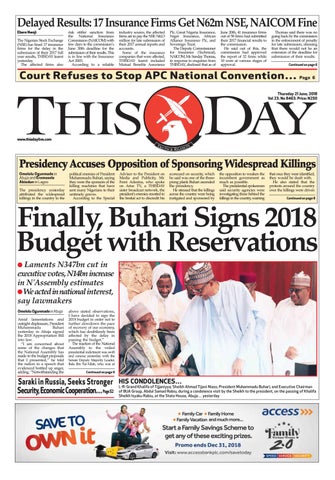
Finally, Buhari Signs 2018 Budget with Reservations Laments N347bn cut in executive votes, N14bn increase in N'Assembly estimates We acted in national interest, say lawmakers Omololu Ogunmade in Abuja Amid lamentations and outright displeasure, President Muhammadu Buhari yesterday in Abuja signed the 2018 Appropriation Bill into law. “I am concerned about some of the changes that the National Assembly has made to the budget proposals that I presented,” he told the nation in a speech that evidenced bottled up anger, adding, “Notwithstanding the
above stated observations, I have decided to sign the 2018 budget in order not to further slowdown the pace of recovery of our economy, which has doubtlessly been affected by the delay in passing the budget.” The reaction of the National Assembly to the veiled presidential indictment was swift and concise yesterday with the Senate Deputy Majority Leader, Bala Ibn Na’Allah, who was at Continued on page 6
Saraki in Russia, Seeks Stronger Security, Economic Cooperation… Page 52
HIS CONDOLENCES…
L-R: Grand Khalifa of Tijjaniyya, Sheikh Ahmad Tijani Niass; President Muhammadu Buhari; and Executive Chairman of BUA Group, Abdul Samad Rabiu, during a condolence visit by the Sheikh to the president, on the passing of Khalifa Sheikh Isyaku Rabiu, at the State House, Abuja… yesterday
2
T H I S D AY ˾ Ͱͯ˜ ͰͮͯͶ
T H I S D AY ˾ THURSDAY JUNE 21, 2018
3
4
T H I S D AY ˾ Ͱͯ˜ ͰͮͯͶ
T H I S D AY ˾ THURSDAY JUNE 21, 2018
5
6
Ëœ Í°ÍŻËœ ͺ͸͚͜ Ëž T H I S D AY
PAGE SIX
Court Refuses to Stop APC National Convention Governors defer decision on consensus list Onyebuchi Ezigbo and Alex Enumah in Abuja An attempt to truncate the National Convention of the All Progressives Congress (APC) scheduled for Saturday, collapsed yesterday as a Federal Capital Territory (FCT) High Court refused a request in that regard by an aggrieved member. Delivering ruling in an originating summons filed by an aggrieved member of the party, Udo Ibe from Abia State, Justice Sylvanus Oriji held that stopping the national convention would do injustice to others who were not parties in the dispute brought by the plaintiff. Ibe had dragged the APC and the Independent National Electoral Commission (INEC) before the court, praying for an order of mandatory Injunction, compelling INEC to stop recognising APC as a political party under the 1999 Constitution or the Electoral Act 2010 as amended for any purpose stipulated under the said constitution or the electoral act. The plaintiff also prayed the court for an order of perpetual injunction, stopping APC and its agents from excluding him as a contestant to the office of the Chairman of Ania Ward, Ohafia Local Government Area of Abia State, through the process of "guided Congress" or any manner inconsistent with the constitution of the party. The grouse of the plaintiff was
that the tenure of officers of Ania Ward had expired at the time they planned the congress and as such the ward congress was illegal and unlawful. Besides, Ibe also felt aggrieved with his alleged exclusion from participating as a chairmanship aspirant for the ward. When the matter came up yesterday, counsel to APC, Ayotunde Ogunleye, informed the court that the court processes had just been served on the APC and that he needed time to peruse the papers and respond to them accordingly. Ogunleye, therefore, applied for an adjournment to enable him file his response on behalf of APC as required by law. However, counsel to the plaintiff, Kalu Kalu, who did not object to the request for an adjournment, prayed the court to order parties in the matter to maintain status quo, pending the resolution of the originating summons of his client. Kalu drew the attention of the court to the fact that the APC as the 1st defendant had slated its national convention for this Saturday and that the case of his client would be destroyed if status quo was not maintained by the parties. But counsel to the APC urged the court to decline granting the request on the grounds that it would affect others who are not parties in the suit.
Ogunleye, further argued that the order requested by the plaintiff is not related to the main suit. Justice Oriji, however, disagreed with him on the request for status quo, adding that the order sought if granted would affect the parties who are not parties in the suit. The judge subsequently adjourned the matter till July 5 for hearing of the originating summons. In a related development, the Abuja division of the Federal High Court, also refused to stop the Hon Babatunde Balogun-led executive committee (Exco) of Lagos branch of APC from participating in the forthcoming national convention. Justice Binta Nyako, who declined to stop the Balogun group said that the principle of fair hearing would be breached since only one person instituted the court action. Delivering ruling in an ex-parte motion filed by an aggrieved contestant in the May 12, 2018 Lagos APC Congress, Bunmi Tayo Church, Justice Nyako said that it would be unfair to stop the Balogun faction in view of the limited time to the convention, slated for June 23, 2018 in Abuja. In declining to grant the exparte motion, the Judge held that the plaintiff was just one out of 1, 885 aspirants vying for positions during the congress. Justice Nyako said that the plaintiff did not help himself in his claim that
he was prevented from participating at the state congress, adding that it is the law that anyone who did not participate in an election cannot challenge the outcome of that election. The court held that, Church, having not participated in the May 12 Lagos State APC congress, cannot use the ex-parte application to challenge the outcome of the congress. Besides, Justice Nyako said that hundreds of others who participated in the congress will be denied fair hearing if the application is granted because they were not brought before the court by the applicant (Church), who instituted the court action in his personal capacity. Justice Nyako therefore ordered that the Originating Summons filed by the plaintiff/applicant, through his counsel, Chief Akin Olujimi (SAN) will be given accelerated hearing. However, Justice Babatunde Quadri, who read the ruling on behalf of Justice Nyako, who was said to be bereaved, however, did not give a definite date for the hearing of the Originating Summons, saying that Justice Nyako will fix a convenient date for the matter to be heard.
in principle to form a consensus on the choice of the next leaders of the party at the convention. They, however, differed the decision on the consensus list of officers, saying it would be finalised today. Speaking to journalists shortly after their meeting that lasted about two hours yesterday in Abuja, the Governor of Nasarawa State, Tanko Al-Makura said, "I want to assure you that we governors have agreed to work for consensus so that the election will rancour free for the betterment of the country," he said. With regard to the issue of adoption of unity list of aspirants, the governor said the matter was being fine-tune and that it would be ready by Thursday. Also speaking on the outcome of the meeting, the chairman of the APC national convention committee, Alhaji Abubakar Badaru said the governors resolved that they would go back to their respective zones to consult and produce a consensus list. On the outcome of screening appeal, Badaru said only 17 persons were dropped, adding that the Governor Rochas Okorocha-led committee has also submitted its report on the petitions written against some National Working Committee members seeking re-election
for final deliberation by the convention committee. Eighteen governors and two deputy governors attended the meeting. Meanwhile, frontline chairmanship aspirant for the office of National Chairman, Adams Oshiomhole, has vowed to ensure that all party men, including the president and other elected office holders subject themselves to the dictates of the party when he becomes the national chairman of the APC. The former governor of Edo State who decried the intra party disputes in APC, said the present situation where the party appeared to be the opposition to itself will not be acceptable. Speaking yesterday in Abuja when he held an interactive session with young stakeholders of APC, Oshiomhole said there was the need to be very clear on the fact that "anyone elected on our platform, including the president will be expected to conduct government and governance in a way that promote the core values of progressive governance". He assured that when he emerges the next national chairman, his leadership would be very clear on the issues of economy and governance in a way that promote core values of progressives governance.
have spent much on training their employees abroad for the purpose of getting it right. According to NAICOM in a statement titled, "Status of 2017 financial statements of insurance companies as at April 19, 2018," the companies whose accounts have been approved are Continental Reinsurance Plc, Custodian Life Assurance, Custodian and Allied Insurance, FBN General Insurance Limited, FBNLife Insurance, AXA Mansard Plc and Regency Alliance Insurance. Others are Law Union &Rock
Insurance Plc, Wapic Insurance Plc, NEM Insurance, LASACO Assurance Plc, Prestige Assurance, Consolidated Hallmark Plc, Ensure Insurance Plc, AIICO Insurance, Guinea Insurance,Wapic Life Insurance Plc and Leadway Assurance. Among the 14 firms whose reports were withheld by the commission, one is at the stage of its response to query still under review, while two other firms’ results were under supervisory review. Also, three companies' results
were queried while the reports of four firms were placed under review. Another four set of firms have their reports placed under supervisory review by the commission. The commission recently said the decision to impose sanctions on defaulting companies became necessary because their action deprived the regulators, policy holders, insurance intermediaries, analysts and other stakeholders of the relevant information about their performance and financial results.
governments, explaining that they had added to federal government's burden. The president then proceeded to list such projects removed by the national as well as their importance to the economy. "The provisions for some nationally/regionally strategic infrastructure projects such as counter-part funding for the Mambilla Power Plant, Second Niger Bridge/ancillary roads, the East-West Road, Bonny-Bodo Road, Lagos-Ibadan Expressway and Itakpe-Ajaokuta Rail Project were cut by an aggregate of N11.5 billion,� he said of one the critical projects. He added, "Similarly, provisions for some ongoing critical infrastructure projects in the FCT, Abuja especially major arterial roads and the mass transit rail project, were cut by a total of N7.5 billion. The provision for Rehabilitation and Additional Security Measures for the United Nations Building by the FCT, Abuja was cut by N3.9 billion from N4 billion to 100 million; this will make it impossible for the Federal Government of Nigeria to fulfil its commitment to the United Nations on this project.� Saying the cuts would make the projects almost impossible to implement, he served notice that he
would be approaching the legislature with a supplementary proposal to rectify the lapses he had identified. "However, it is my intention to seek to remedy some of the most critical of these issues through a supplementary and/ or amendment budget which I hope the National Assembly will be able to expeditiously consider," the president added. He said he was, however, glad that N1.5 trillion was spent on capital projects in the 2017 fiscal year, adding that the administration would work very hard to generate the revenues required to finance projects and programmes in the 2018 budget. He also said a deficit budget, which he described as the borrowing plan of the government would be forwarded to the National Assembly very soon and urged the National Assembly to give the document a speedy consideration and approval.
issues he raised. According to him, it was impossible to have returned the budget to the executive the way it was submitted, explaining that the National Assembly had the responsibility to ensure that allocations in the budget were evenly distributed across the six geo-political zones of the country. Promising that the National Assembly would treat the
Governors Defer Decision on Consensus List Meanwhile, APC governors yesterday said they had agreed
DELAYED RESULTS: 17 INSURANCE FIRMS GET N62M NSE, NAICOM FINE According to Thomas, for now, 17 firms were yet to submit their results. Going by the laws of the sector, if the firms fail to submit their results on or before June 30th, they would be liable to a daily fine of N5,000 until the day they submit their reports. But NAICOM is of the view that the fine should be reviewed upward and has been pushing for the amendment of the Insurance Act in that regard. For some years now, insurance firms have been falling victim of
the regulators' punitive fines, a situation which had caused uproar among their shareholders. In fact, some shareholders had alleged that their returns on investments were being diverted to payment of fines to regulators instead of paying dividends to their investors. So far, Universal Insurance Company has paid the highest fine of N51.4 million to SEC for late returns in 2016. THISDAY learnt that some insurance firms had not submitted even their 2015 annual accounts
and have been paying to NAICOM N5,000 punitive fines every day. Since the adoption of the International Financial Reporting Standards (IFRS) by the industry, insurance firms unlike banks have been battling to get it right each year, a situation which has been delaying their submission of their reports and holding of their annual general meetings. This is despite the fact that the regulator has on several occasions organised training programmes for auditors and account officers of operating firms while some firms
F I N A L LY, B U H A R I S I G N S 2 0 1 8 B U D G E T W I T H R E S E RVAT I O N S signing ceremony, saying the legislature did its job in national interest, explaining that not being a rubber stamp of the executive, its estimates could not have returned to it without adjustments. The president had presented N8.6 trillion estimates with $45 per barrel of oil bench mark price to the National Assembly in November last year, but the federal legislators increased the figures to N9.1 trillion having revised the oil price benchmark upwards to $51. The president had hinted his objection to the upward review, preferring that the upward swing in oil price and its attendant extra cash to the national treasury ought to be used to reduce the budget deficit rather than increase expenditure since the shortfall was going to be financed by borrowing any way. This conceptual disagreement had tactically delayed presidential assent to the appropriation bill. But fearing that the impasse could slow down the already sluggish economic recovery, the president’s economic advisers urged him to sign the money bill with a caveat. This was what Buhari did yesterday, lamenting, loudly, the decision of the National Assembly to unilaterally increase its own budget from N125 billion to over
N139 billion, while cutting off N347 billion from the executive’s votes, promising to send a supplementary proposal to the legislature to rectify identified problem areas in the estimates. The budget signing ceremony, which took place in the State House, was witnessed by Vice-President Yemi Osinbajo; Secretary to the Government of the Federation (SGF), Boss Mustapha; Chief of Staff, Abba Kyari; and ministers as well as National Assembly members. Senate President, Bukola Saraki and Speaker of the House of Representatives, Yakubu Dogara, who were absent at the event, were represented by the Deputy Senate Leader, Bala Na'Allah, and House Chief Whip, Ado Doguwa, respectively. Buhari, who lamented the failure of the National Assembly to pass the budget before the end of last year in accordance with the executive plan to return the country to January - December budget cycle, observed that the development had a very significant accelerator effect on the financial plans of other tiers of government, and even more importantly, the private sector, which mostly operates on a January-December financial year. However, he said the setback
notwithstanding, he remained committed to the course of improving Nigeria's budgeting process and sustain the vision to return the country to January-December budget cycle. Buhari lamented that the National Assembly made budget cuts to the tune of N347 billion for critical 4,700 projects from the original proposal and introduced fresh 6,403 projects at the cost of N578 billion into the budget, which he said would be difficult to implement. According to him, such budget cuts and fresh introductions would hamper the government's plan to deploy the 2018 budget for the consolidation of the achievements of previous budgets and simultaneously deliver on Nigeria’s Economic Recovery and Growth Plan (ERGP) 2017-2020. Regretting that the fresh projects introduced by the National Assembly into the budget neither had any cost placed on them nor were they conceptualised and designed hitherto, Buhari said the new projects were added to the budgets of ministries, departments and agencies (MDAs) without bearing in mind their capacity to implement them. He also said a lot of the new projects were supposed to be executed by both the state and local
National Assembly Reacts But in a swift reaction to the president's criticism of the handling of the budget by the National Assembly, Deputy Senate leader, Bala Na'Allah, said the federal legislature was not disturbed by
Continued on page 8
TOP GAINERS NGN NGN PRESTIGEASSURE 0.06 0.66 C & I LEASING 0.17 1.99 ETERNA 0.59 7.20 JAPAUL 0.03 0.43 MUTUALBENEFITS 0.02 0.34 TOP LOSERS NGN NGN SEPLAT 37.7 717.20 CUSTODIAN 0.26 5.01 LIVESTOCK 0.04 0.83 UNITYBANK 0.04 0.88 UNIONBANK 0.25 5.70 HPE Nestle Nig Plc â‚Ś1,495.00 Volume: 267.764 million shares Value: N 3.827 billion Deals: 4,786 As at 20/6/18 See details on Page 41
% 10.0 9.3 8.9 7.3 6.2 % 4.9 4.9 4.6 4.3 4.2
T H I S D AY ˾ THURSDAY JUNE 21, 2018
7
8
Ëœ Í°ÍŻËœ ͺ͸͚͜ Ëž T H I S D AY
PAGE EIGHT
We Remain Committed to Advancing Change, Says Buhari I would like to thank the leadership of the National Assembly, particularly the Senate President and the Speaker of the House of Representatives, as well as all the Distinguished Senators and Honourable Members, for passing the 2018 Appropriation Bill, after seven months. When I submitted the 2018 Budget proposals to the National Assembly on 7th November 2017, I had hoped that the usual legislative review process would be quick, so as to move Nigeria towards a predictable JanuaryDecember financial year. The importance of this predictability cannot be overemphasized. While the Federal Government’s budget represents less than 10% of aggregate yearly expenditures in the economy, it has a very significant accelerator effect on the financial plans of other tiers of government, and even more importantly, the private sector, which mostly operates on a January-December financial year. Notwithstanding the delay this year, I am determined to continue to work with the National Assembly towards improving the budgeting process and restoring our country to the January-December fiscal cycle. I note, with pleasure, that the National Assembly is working on the enactment of an Organic Budget Law, so as to improve the efficiency of the nation’s budgetary process. As I mentioned during the presentation of the 2018 Appropriation Bill, we intend to use the 2018 Budget to consolidate the achievements of previous budgets and deliver on
Nigeria’s Economic Recovery and Growth Plan (ERGP) 2017-2020. It is in this regard that I am concerned about some of the changes that the National Assembly has made to the budget proposals that I presented. The logic behind the Constitutional direction that budgets should be proposed by the Executive is that, it is the Executive that knows and defines its policies and projects. Unfortunately, that has not been given much regard in what has been sent to me. The National Assembly made cuts amounting to 347 billion Naira in the allocations to 4,700 projects submitted to them for consideration and introduced 6,403 projects of their own amounting to 578 billion Naira. Many of the projects cut are critical and may be difficult, if not impossible, to implement with the reduced allocation. Some of the new projects inserted by the National Assembly have not been properly conceptualized, designed and costed and will therefore be difficult to execute. Furthermore, many of these new projects introduced by the National Assembly have been added to the budgets of most MDAs with no consideration for institutional capacity to execute them or the incremental recurrent expenditure that may be required. As it is, some of these projects relate to matters that are the responsibility of the States and Local Governments, and for which the Federal Government should therefore not be unduly burdened. Such examples of projects from which cuts were made
are as follows: r 5IF QSPWJTJPOT GPS TPNF nationally/regionally strategic infrastructure projects such as Counterpart funding for the Mambilla Power Plant, Second Niger Bridge/ancillary roads, the East-West Road, Bonny-Bodo Road, LagosIbadan Expressway and Itakpe-Ajaokuta Rail Project were cut by an aggregate of 11.5billion Naira. r 4JNJMBSMZ QSPWJTJPOT GPS TPNF ongoing critical infrastructure projects in the FCT, Abuja especially major arterial roads and the mass transit rail project, were cut by a total of 7.5billion Naira. r 5IF QSPWJTJPO GPS Rehabilitation and Additional Security Measures for the United Nations Building by the FCT, Abuja was cut by 3.9 billion Naira from 4 billion Naira to 100 million Naira; this will make it impossible for the Federal Government of Nigeria to fulfill its commitment to the United Nations on this project. r 5IF QSPWJTJPOT GPS WBSJPVT Strategic Interventions in the health sector such as the upgrade of some tertiary health institutions, transport and storage of vaccines through the cold chain supply system, provision of anti-retroviral drugs for persons on treatment, establishment of chemotherapy centres and procurement of dialysis consumables were cut by an aggregate amount of 7.45 billion Naira. r 5IF QSPWJTJPO GPS TFDVSJUZ infrastructure in the 104 Unity
Schools across the country were cut by 3 billion Naira at a time when securing our students against acts of terrorism ought to be a major concern of government. r 5IF QSPWJTJPO GPS UIF 'FEFSBM Government’s National Housing Programme was cut by 8.7 billion Naira. r "U B UJNF XIFO XF BSF working with Labour to address compensation-related issues, a total of 5 billion Naira was cut from the provisions for Pension Redemption Fund and Public Service Wage Adjustment. r 5IF QSPWJTJPOT GPS &YQPSU Expansion Grant (EEG) and Special Economic Zones/ Industrial Parks, which are key industrialization initiatives of this Administration, were cut by a total of 14.5 billion Naira. r 5IF QSPWJTJPO GPS $POTUSVDUJPO of the Terminal Building at Enugu Airport was cut from 2 billion Naira to 500 million Naira which will further delay the completion of this critical project. r 5IF 5BLF PGG (SBOU GPS UIF Maritime University in Delta State, a key strategic initiative of the Federal Government, was cut from 5 billion Naira to 3.4 billion Naira. r "CPVU TFWFOUZ OFX SPBE projects have been inserted into the budget of the Federal Ministry of Power, Works and Housing. In doing so, the National Assembly applied some of the additional funds expected from the upward review of the oil price benchmark to the Ministry’s
vote. Regrettably, however, in order to make provision for some of the new roads, the amounts allocated to some strategic major roads have been cut by the National Assembly. Another area of concern is the increase by the National Assembly of the provisions for Statutory Transfers by an aggregate of 73.96 billion Naira. Most of these increases are for recurrent expenditure at a time we are trying to keep down the cost of governance. An example of this increase is the budget of the National Assembly itself which has increased by 14.5 billion Naira, from 125 billion Naira to 139.5 billion Naira without any discussion with the Executive. Notwithstanding the above stated observations, I have decided to sign the 2018 Budget in order not to further slowdown the pace of recovery of our economy, which has doubtlessly been affected by the delay in passing the budget. However, it is my intention to seek to remedy some of the most critical of these issues through a supplementary and/ or amendment budget which I hope the National Assembly will be able to expeditiously consider. I am pleased with the success recorded in the implementation of the 2017 Budget. A total sum of N1.5 trillion has been released for the implementation of capital projects during the 2017 fiscal year. In response to this and other policy measures implemented, we have observed significant improvement in the
performance of the Nigerian economy. To achieve the laudable objectives of the 2018 Budget, we will work very hard to generate the revenues required to finance our projects and programmes. The positive global oil market outlook, as well as continuing improvement in non-oil revenues, make us optimistic about our ability to finance the budget. However, being a deficit budget, the Borrowing Plan will be forwarded to the National Assembly shortly. I crave the indulgence of the National Assembly for a speedy consideration and approval of the Plan. The 2018 Budget I have just signed into law provides for aggregate expenditures of 9.12 trillion Naira, which is 22.6% higher than the 2017 Appropriation. Further details of the approved budget will be provided by the Minister of Budget and National Planning. I thank the Ministers of Budget and National Planning, the Budget Office of the Federation, and everyone who worked tirelessly and sacrificed so much to bring us to this day. However, the job is only partly done. I am sure you will remain committed to advancing our Change Agenda, not only in the preparation of the national budget, but also in ensuring its effective implementation. I thank you and may God bless Nigeria. r 5FYU PG UIF TQFFDI PG 1SFTJEFOU .VIBNNBEV #VIBSJ EVSJOH UIF TJHOJOH PG "QQSPQSJBUJPO #JMM JO "CVKB ZFTUFSEBZ
the content. He echoed Na'Allah that the delay in passing the budget was necessary because the legislature was not expected to merely return the Appropriation Bill as presented to it. In its formal reply, the House of Representatives insisted the parliament was not a rubber stamp that could not exercise its constitutional powers to vet the budget proposal as presented to it by the executive. Its spokesman, Abdulrazaq Namdas, in a statement, said, "We have to remind Mr. President
that we are representatives of our people and wish to state that even the common man deserves a mention in the budget by including projects that will directly affect his life positively. Some of the projects designed by the executive, as high-sounding as their names suggest, do not meet the needs of the common man.� Saying the legislative inputs were justifiable, he urged the president to ensure that the executive send the annual estimates to the legislature early enough. "We are on the same page
with Mr. President in his desire to return our budget cycle to January-December. By the provisions of the Fiscal Responsibility Act, 2007, the budget estimates should be with the National Assembly around September of the year,� he said, pointing out that the 2018 estimates came behind schedule in November 2017. The Senate in a statement by its spokesman, Sabi Abdullahi, associated itself with the submissions of the House, promising a fuller statement in due course.
Abuja said his administration's commitment to rapid development of Nigeria goes beyond ethnicity, religion and geographical space. The president, according to a statement by his Senior Special Assistant on Media and Publicity, Malam Garba Shehu, made this remark while receiving Sheikh Ahmed Tijjani Ibrahim Inyass, the Grand Khalifa of Tijjaniya, from Senegal at the Presidential Villa. The statement said the president expressed the overwhelming support of Nigerians and their confidence in his administration and told the Sheikh that he was "very pleased with the prayers and support of the Tijjaniya for this administration." It quoted the president as saying ‘‘I know you are praying for the stability and prosperity of this country,’’ adding that the president thanked the religious leader for the visit, saying it
"underscored the importance of the religious group in promoting good governance in the country." The statement added that the Sheikh commended the president for what he described as the good job he's doing in Nigeria, adding: ‘More than 40 million Tijjanyia’s are praying for your success because we believe the Almighty Allah has chosen you to lead Nigeria at this time and to actualise the dream of a great country." It also disclosed that the Grand Khalifa, who was in Nigeria to commiserate with the late Isyaku Rabiu family in Kano, paid tribute to the memory of Rabiu, describing him as a great man and nationalist who was dedicated to knowledge, Islam and prosperity of Nigeria. It also said the Sheikh offered prayers for the progress and prosperity of the nation as well as the good health, wisdom, strength and success of the President.
F I N A L LY, B U H A R I S I G N S 2 0 1 8 B U D G E T W I T H R E S E RVAT I O N S supplementary budget being proposed by the president with dispatch, Na'Allah also said if the National Assembly had approved allocations as proposed in the budget without looking at the merit, the legislature would not have been seen to have done its job as required. Na'Allah also said delay in its passage as raised by the president could not be blamed on the National Assembly alone, recalling that the MDAs failed to appear for their budget defence until they were given marching orders by the president. According to him, "The job of parliamentarians is a very difficult
one. The way the budget came, if we had allowed it to go that way, we would have been in trouble with those who elected us. You have to balance between the six geo-political zones. "It is the balancing efforts by the National Assembly that led to those observations and happily enough, he himself has said he is coming with a supplementary budget which will be dealt with as quickly as possible. I assure you about that one.� On passage delays, he said, "The president is right, but at the same time, if you remember,
you were here. The president had to order some MDAs to appear before the National Assembly for the purpose of defending their budgets.� In his own reaction, Ado Doguwa, the Chief Whip of the House of Representatives, said Buhari had the freedom to raise the issues he brought up while signing the budget, observing that such issues were critical. According to him, when the president eventually submits the proposed supplementary budget, the National Assembly will also have the freedom to examine
PRESIDENCY ACCUSES OPPOSITION OF SPONSORING WIDESPREAD KILLINGS by political motives. According to him, “You have the true herders and farmers who are clashing and you have hidden hostile hands who have crept in under that umbrella to play what the president has described as irresponsible politics. “This farmers – herders’ clash has been going on for a long time. When I say long time, I mean far long before this administration. Like the president said, the issue is even older than anybody living today. What you have today are being sponsored because they know security is one of the strongest points of the administration.� Adesina added, “The president said so in a national broadcast. He also said the security agencies are investigating and has warned that once they are identified, they will be dealt with. The intension of the opposition in any democracy is to weaken the incumbent as much as possible
and the opposition in Nigeria has identified security as one of the strong points of the Buhari administration. So they decided to go to that area finding the soft under belly and stick a knife into it.� He regretted that though people were being killed, adding that security should be the concern of everyone. “When our president met United States President, Donald Trump, recently, even Trump said security is a collective thing,� he said, adding, “What we see in Nigeria is that people expect security to come from the top, rather it should be bottom up.� On the need to allow for state police to address the security situation in the country, he said the president could not do it alone because it was a party matter. He said the Buhari administration had improved the Nigerian economy, adding that the kind of change that
Nigerians envisaged in certain areas would not come in the short term. The presidential spokesman said government’s spending had created jobs and denied that more Nigerians had lost jobs as a result of Buhari’s policies. He said, “Those statistics you have of unemployment are from white collar jobs that is not all that make an economy. We have a record of blue collar jobs. For example, rice farmers, when this administration came were only five million. As at today, they are over 12 million, that is seven million additional rice farmers. When you heard that Nigeria cut rice importation by 90 per cent, it was not just from the blues.� Speaking about the economic growth of over six per cent that the country recorded before the administration of Buhari as against the 0.8 per cent today, he said Nigeria was running a bubble economy that was
unsustainable. “Now the foundation of the economy is being changed,� he said, adding, “If you look at the figures you will see what manufacturing has contributed, what agriculture is being contributed and what the solid minerals sector has contributed.� He also denied that the electricity situation in the country was getting worse, saying, “Comparatively, it is not getting worse. If you had less than 3,000MW of electricity in 2015 and now you have over 7,000MW that is an improvement. When people say the power outages have been on for a long time, they mean far long before this administration.� On the doubts over the Buhari’s health, Adesina contended that it is human nature to have doubts, adding that it was also human nature to express belief and faith. In a related development, President Buhari yesterday in
THURSDAY JUNE 21, 2018 ˾ T H I S D AY
9
NEWS
Group News Editor Ejiofor Alike Email Ejiofor.Alike@thisdaylive.com, 08066066268
Kachikwu: NNPC Could Sign Refineries’ Revamp Agreements by October Says Nigeria’s refining industry about to become Africa’s bastion Chineme Okafor in Abuja The Nigerian National Petroleum Corporation (NNPC) is expected to sign agreements with third-party financiers and contractors for the revamp of its 445,000 barrel per day (bpd) combined capacity refineries in Kaduna, Warri and Port Harcourt by October, the Minister of State for Petroleum Resources, Dr. Ibe Kachikwu, has disclosed. Kachikwu also stated that Nigeria could become a continental hub for refined petroleum products in Africa if the federal government succeeds with its reforms of the country’s local refining industry. He stated these in a podcast message he delivered on the state of the government’s efforts at reorganising Nigeria’s domestic petroleum refining industry. The podcast was obtained by THISDAY
in Abuja. In the podcast, the minister stated that the processes to ensure that the NNPC moves on to revamp the refineries to take it to 90 per cent combined production capacities were largely concluded. He added that the signing of the agreements would follow. The minister also explained that the government had to engage an external consultant to review the status of the refineries to enable it negotiate good deals for the agreements. According to him, the corporation has identified the relevant people it would work with on this, including the Original Refineries Builders (ORBs). “In this edition, we are going to focus on something that interests virtually every Nigerian-the refineries. It was one of the areas
Nigeria’s Debt Rises to N22.7trn, Says DMO CBN injects $210m into forex market Nigeria’s total public debt increased by 4.52 per cent in the first three months of 2018, the Debt Management Office has revealed. The public debt increased from N21.73 trillion in December 2017 to N22.71 trillion at the end of the first quarter of 2018. According to a circular issued yesterday by the DMO, the increase was largely as a result of the increase in the domestic debts of states, and the Federal Capital Territory, Abuja. The agency added that the $2.5 billon Eurobond issued in February 2018, with its proceeds still being deployed to redeem maturing domestic debt, was also responsible for the increase in the total public debt. “The debt figures show that the implementation of the debt management strategy, which entails an increase in the external debt stock through new external borrowing and the substitution of high-cost domestic debt with low-cost external debt, is achieving the desired results in several areas.
Some of these areas are: the share of the external debt stock in the total public debt, which rose to 30 per cent as of March 31, 2018, compared to 17 per cent in 2015, 20 per cent in 2016 and 27 per cent in 2017; a decline in market interest rates from 13 to 14 per cent per annum in December 2017, to 11 to 13 per cent per annum in the first quarter of 2018 due to the redemption of N279.67bn of Nigerian Treasury Bills using some of the proceeds of the $2.5bn Eurobond issued in February 2018,” the DMO explained. In another development, the Central Bank of Nigeria (CBN) has made available the sum of $210 million to meet customers’ requests in various segments of the foreign exchange market. The CBN said in a statement yesterday that $100 million was offered to authorised dealers in the wholesale segment of the market, while the Small and Medium Enterprises segment got boosted with the sum of $55 million.
US Deports 34 Nigerians Chinedu Eze The United States has deported 34 Nigerians who arrived at the Murtala Muhammed International Airport (MMIA), Lagos yesterday afternoon aboard a chartered Omni Air International aircraft with Registration Number: W342AX. The deportees who claimed most of them were forced back to their motherland for minor infractions comprised 32 males and two females who were sent back home on various offences bothering on homicide, fraud, distributing prohibited items, impersonation among other offences. The spokesman of the Lagos Airport Police Command, DSPJoseph Alabi, confirmed the development. Alabi said: “At about 14.30 hours (2.30p.m. Nigerian time), we received 34 Nigerians who were brought back from the United States. They were made up of 32 males and two females. “
He said the 25 of deportees were alleged to have committed criminal offences, one was allegedly involved in narcotics while the others were alleged to have committed immigration-related offences. Alabi said the deportees were received by officers of the Nigerian Immigration Service (NIS), the National Agency for the Prohibition of Trafficking in Persons (NAPTIP) and the Police. Also on groundtoreceivethemwere officialstheFederalAirportsAuthorityof Nigeria(FAAN)andtheNationalDrug Law EnforcementAgency (NDLEA). Alabisaidthedeporteeswereprofiled bytherelevant authorities and were allowed to depart to their various destinations. The deportees claimed that the US government wrongly deported them and explained that most of them were forced back to Nigeria for minor offences, which should not have warranted deportation.
we were very concerned with when we started and continued to remain a key focus area,” said Kachikwu. He further stated: “Our refining capacity was less than 10 per cent, we managed to elevate it to about 15 per cent and that is where substantially it has remained. “We’ve continued to import most of our refined petroleum products into this country; the effect of that is all the challenges in terms of pricing of petroleum products and the under-recovery or subsidy as the case maybe that has been subject of very may interests.” Kachikwu noted that he inherited “unsustainable refineries that were not performing, and fairly ballooned contractual models that were costing the government so much money,” adding that “we had our work cut out for us.,” Kachikwu said. Continuing, he said: “We decided that we will intervene in this sector in four main particulars-the first is to see how we can revamp our refineries; we wanted to look at modular refineries, not just for the benefits it brings in terms of refining but the benefits it brings in terms of
Niger Delta concerns. “We also looked at Greenfield refineries which are brand new refineries, and how we should encourage private sector to go in on their own.” Listing out how far the government had gone with this, Kachikwu said President Muhammadu Buhari had approved that a third-party funding through a debt structure model be found for the repairs of the refineries. “So, we decided to get a third-party who would put in money, work with the NNPC in a joint operational model and get these refineries from a 10 per cent capacity to about 90 per cent capacity performance. “Today, the concept has been agreed and approved. Financing structure is largely being agreed. The financiers have largely been identified. Contractual processes are ongoing to reach the terms of those financing, we have also identified the initial builders of the refineries to be the contractors using the financing that will be raised from the third-party financiers,” he stated. According to him, “That process
is largely almost done and we are hoping that really, by the end of October, we should be in a position to have signed all the requisite agreements and be able to charter people to be able to move in and begin work. “If we can, by the end of the year, get to a point where we can at least begin the process of actual work-shutdown the refineries and begin-then I think we have achieved the objectives of this refineries maintenance and revamp,” the minister added. He said the government had issued licences for 40 new modular refineries, and that two with 17,000bpd capacity each had gone as far as attempting to commission their plants between the last quarter of 2018 and first quarter of 2019. He also said apart from the 650,000bpd Dangote refinery in Lagos expected to come on stream in 2020, the Nigeria Agip Oil Company (NAOC) planned to build a 150,000bpd refinery in Bayelsa State. Kachikwu, stated that he expected all these to result to Nigeria becoming a destination for crude oil refining in Africa,
ASSENT WITH RESERVATIONS…
President Muhammadu Buhari signing the 2018 Appropriation Bill at the State House, Abuja…yesterday
adding that this would ensure that the country takes over and dictates the continent’s oil refining market. He equally added that at that time, the country would enact a policy to de-emphasise on export of crude oil, and focus on providing for domestic refining. “Dangote refinery is also there, and we have continued to work with them, and projected to commence in 2020. If we succeed in getting that, the 650,000bd will capture close to 70 per cent of our present consumption, and then succeed in getting the 450,000bpd combined refining capacity that we have by then, we would have met the national expectation in terms of 100 per cent refining capacity and then begin to look at the export model. “All these will change the dynamics of the refining industry in Nigeria. I can tell you, as we go through the crude oil sales policy of this country, we must get to a point where even those who produce crude oil as joint venture partners must take a responsibility in providing crude first for the local refineries.
Godwin Omoigui
DHQ: No Evidence to Suggest ISIS Training Boko Haram Terrorists Boko Haram attacks Borno military barracks Senator Iroegbu in Abuja The Nigerian military yesterday said there is no evidence that suggests that Islamic State (ISIS) has sneaked in fighters from Syria to support the Boko Haram terrorists in Nigeria, as recently reported by some sections of the media. The Director of Defence Information (DDI), Brig-Gen. John Agim, in a statement also assured Nigerians that the Nigerian Armed Forces will ensure that no part of the country will be under threat. “The Defence Headquarters
(DHQ) wishes to respond to a report making the round that ISIS has been sending her members to Nigeria to train Boko Haram Terrorists (BHT) members. It is pertinent to state categorically that there is no concrete evidence on the ground to back their claim,” he said. He however, recalled that the Ali Musab AI-Barnawi faction of Boko Haram in 2016 pledged allegiance to the ISIS as a result of the “troops’ fire power which dislodged them from Sambisa forest and other surrounding areas in
the Northeast. The DDI said the Nigerian army is aware that there is collaboration between terrorist groups, stressing that “the activity of one group in a country influences other groups in other countries and because of this knowledge, activities of other terrorist groups usually affect the military strategy. Agim also accused the Amnesty International (AI) of aligning its interests with those of the terrorists with the ultimate aim of isolating the Nigerian Armed Forces. Meanwhile, suspected Boko
Haram insurgents struck yesterday at a market inside 33 Army Artillery Barracks on the outskirts of Maiduguri, Borno State. A military source told The Cable, that the incident occurred around 9:30pm. The source said suicide bombers sneaked into the barracks in a tricycle, and detonated their explosives at a relaxation spot. “The attackers took advantage of the high influx into the mammy market as a result of the demolition of brothels in the city,” the source said.
10
THURSDAY JUNE 21, 2018 ˾ T H I S D AY
NEWSE
2019: Atiku Visits Jonathan, Expresses Optimism on PDP’s Chances Says he never diverted public funds Ernest Chinwo Forner President, Dr. Goodluck Jonathan and former Vice President Atiku Abubakar have expressed optimism that the Peoples Democratic Party (PDP) has what it takes to return to power in 2019, stressing that the main opposition party which lost the presidential election in 2015, is getting stronger. Both leaders stated this yesterday while speaking with journalists as the ex-president welcomed Atiku to his house in Yenagoa, Bayelsa State. The former vice president has also declared that he has never diverted public funds to invest in his private business, and challenged anybody with evidence to make it public. Speaking on the chances of PDP returning to power at the federal level, Jonathan noted that the party is getting stronger, affirming that PDP is now better poised to win the 2019 presidential election. He said further: “Yes, we had some issues in 2015. But as you know, politics is a very dynamic business. I believe PDP is coming back and getting stronger. Even though we are in the opposition with fewer governors, PDP is still the strongest and largest party.” Jonathan said he was pleased that the former vice president who came to Bayelsa to inaugurate state
government projects, was able to pay him a visit. He added that he had enjoyed a long relationship with Atiku, beginning from when he was a Deputy Governor in Bayelsa State. In the same vein, Atiku insisted that only the PDP has the strength and structure to win the presidential election and return to Aso Rock in 2019. His words: “It is actually the Peoples Democratic Party (PDP) that has the strength and structure to get back to Aso Rock. There is no other party that has the structure and strength like the PDP. Without PDP, All Progressives Congress (APC) should not have been in Aso Rock.” While expressing his disappointment with the state of affairs in the country Atiku raised several posers, saying: “Have we ever had this rate of unemployment and poverty in Nigeria? Have we ever had five sets of exchange rate before in this country? Have we ever had so much insecurity like this before? No! Have we ever been this divided before in this country? No!” Atiku pointed out that his presence in President Jonathan’s house had nothing to do with the forthcoming 2019 elections, adding that he only came to pay his respects to the former President while on a visit to Bayelsa State.
Call Your Aide, Onochie to Order, CAN Advises Buhari Refutes claim of endorsing president Paul Obi in Abuja The Christian Association of Nigeria (CAN) yesterday urged President Muhammadu Buhari to call his Special Assistant on New Media, Lauretta Onochie, to order over her penchant for ‘’recklessness and embarrassing character.’’ The christian body has also debunked claims that it has endorsed President Buhari for the 2019 presidential election, dissociating itself from endorsement of Buhari by a political group, Change Advocates of Nigeria, using similar CAN acronym with the christian body. CAN’s demand came on the heels of Onochie’s recent twitter attack against CAN, accusing the body of spreading hate. Onochie had twitted that “Prime Minister Theresa May, a Christian, is in a mosque doing what humans go to do in a place of worship; she knows that her God is the same one also called Allah. Christian Association of Nigeria, CAN of worms, here’s a great lesson in love and godliness, not hatred and anger!” Advising President Buhari to take action against Onochie, the CAN President, Rev. Supo Ayokunle, explained that the association, “at first, decided not to dignify her recklessness with a response, thinking she may not be speaking for President Buhari, but the failure of the presidency to call her to order is capable of making us to believe that she is expressing the mind of the presidency, her employer.’’ The Christians group added that Onochie, from all indications, shares a lot of things in common with the
biblical Esau who sold his birthright for a single meal, saying she is also like Eliab, who was not ready to stand up against Goliath who had defied the God of Israel, but was burning with anger at David, who would not allow Goliath to continue insulting God and His people. CAN added: “Instead of asking CAN leadership to borrow a leaf from the British Prime Minister, Onochie should have directed her advice to her principal to emulate his British counterpart, who gives all the citizens under her watch a sense of belonging and adequate security, irrespective of their religious, ethnic and political persuasions. “Instead of being a liability to the Church in the corridors of power, we counsel her to learn from the likes of Moses, Esther, Daniel and the other three Hebrew children, who sacrificed their conveniences and risked their influential opportunities to defend the interest of God’s people against the imperial orders.’’ The religious group further stated that the problem of “irritants like Onochie’’ in the corridors of power, is that the truth cannot be buried forever, especially in today’s world where no government has monopoly of the media with the emergence of the global technological communication CAN has also debunked claims that it has endorsed President Buhari for the 2019 presidential election. It dissociated itself from endorsement of Buhari by a political group, Change Advocates of Nigeria, using similar CAN acronym with the christian body.
“I cannot visit Yenagoa in Bayelsa State without coming to see the former president,” he said. Atiku has also declared that he has never diverted public funds to invest in his private business and challenged anybody with evidence to make it public. He further stated that he performed excellently as vice president, explaining that by the letters of the Nigerian Constitution, that he was limited in his official powers to execute projects of his own initiative.
Speaking to journalists last Tuesday on arrival at the Port Harcourt International Airport in continuation of his consultations to Bayelsa and Rivers States for his 2019 presidential bid, Atiku said he was piqued by insinuations and allegations that he used public funds to establish the American University in Nigeria (AUN). He said allegations that funds meant for road projects in his native Adamawa State were diverted to build the American University of Nigeria in Yola was being unfair
to him, and that “it shows lack of understanding of how government runs on the part of the people making such allegations. “Government does not run on such pedestrian level, it is a process,” he said. He maintained that all the money usedforsettingupthefirstdevelopment university in Africa came from private sources. “To set the records straight, no public funds were involved in all my investments in several sectors that have continued to provide jobs and enhance educational and socio-
economic wellbeing of Nigerians. I have always been contented with what God has given to me in all its ramifications and I thank Him for using me to better the lot of the people. Without being immodest, I was a successful businessman before going into politics and subsequently becoming the Vice President by Allah’s Grace. I was not desperate to be in government in order to make money but to serve the people in my own little way and contribute my quota to its overall development,” he said.
ON THE WORLD STAGE
President of the Senate, Dr. Abubakar Bukola Saraki, addressing the Upper Chamber of the Russian Parliament known as the Federation Council of the Federal Assembly of the Russian Federation, in Moscow…yesterday
Southern, Middle Belt Leaders Give FG Knocks, Kudos over Ranching Policy Shola Oyeyipo The federal government has received rare kudos from members of the Southern and Middle Belt Leaders Forum (SMBLF) for embracing ranching for cattle as against open grazing it initially proposed. The group has, however, opposed government’s proposal to spend N179 billion of public funds to build the ranches. SMBLF said in statement by Yinka Odumakin, Senator Bassey Henshaw (South-west/ South-south), Prof. Chigozie Ogbu, Dr. Isuwa Dogo (South-east/ Middle Belt), that the federal government’s decision to ignore the recommendation of the 2014 National Conference is responsible
for the unnecessary deaths occasioned by farmers-herders clashes. “The decision to ignore this sensible recommendation has led to a situation where untold terror has been unleashed on farming communities with needless loss of hundreds of lives in the last three years with not a soul under prosecution and top functionaries of the administration making excuses for the killers. We however object to the federal government decision to spend N179 billion of public funds to build these ranches over ten years starting with N70 billion under this administration. Cattle rearing is a private business in which individuals make billions of naira with no record of what
they pay as taxe.” “It is unfortunate that the federal government was making this vexatious declaration while receiving the Chief Executive Officer of Friesland Campina of Netherlands without bothering to find out that it was put together by cooperatives with roots going back to 1879 and is one of the world’s top five dairy companies with annual revenue of 11billion Euro.” “It is only reasonable that those who want to engage in the business should approach the states where they want to build ranches and acquire land to build such with firm commitment to abide by the rules of host communities,” SMBLF said. The group said rewarding the
herders with public funds to build ranches would only mean that they have killed enough to beat the country into pacification mode. According to the leaders, this can only encourage other people to arm themselves to cause sufficient killings in order to get undue concession. “What would our society become if fishermen,.farmers and people in other trades begin to cause bloodbath so that the federal government could give them special consideration? We call on the federal government to shelve the idea of committing public funds on ranches and allow the owners of the business to attend to their business needs in the spirit of ‘I belong to everybody’ mantra of the president,” the leaders explained .
Poll Reveals Mixed Reactions over Declaration of June 12 as Democracy Day Obinna Chima A new survey by NOIPolls has highlighted mixed reactions that trailed President Muhammadu Buhari’s recent declaration of June 12 as Nigeria’s new Democracy Day. The latest poll of 1,000 respondents nationwide, which was conducted from June 11, 2018, revealed that 56 per cent of Nigerians were in support of the president’s declaration,
while 44 per cent expressed their disapproval of the declaration. The findings highlighted a number of socio-demographic differences. The data showed that while the North-east (75 per cent), Southwest (69 per cent) and North-west (60 per cent) geo-political zones constituted the zones with the highest level of support for the President’s declaration; the Southeast (70 per cent) and South-south (61 per cent) regions constituted
the bulk of respondents that were not in support of the declaration. Similarly, while respondents between the ages of 18 and 60 years (average of 56 per cent) were more in support of the declaration; senior citizens above 60 years (53 per cent) did not seem particularly in support. The poll further probed respondents to better appreciate the reasons behind the mixed level of support towards the declaration, and the responses threw more light on the issue.
On the part of 56 per cent of respondents in support of the declaration, half of them were of the opinion that late Chief MKO Abiola, the presumed winner of the June 12, 1993, election, deserved the honour (50 per cent). This was followed by 20 per cent who affirmed their support for the declaration because they believed that June 12, 1993, election was the freest and fairest election Nigeria has ever had since independence in 1960.
T H I S D AY ˾ THURSDAY JUNE 21, 2018
11
T H I S D AY ˾ Ͱͯ˜ ͰͮͯͶ
12
%DUEDUD 7ULRQȴ Ζ3Ζ ([HFXWLYH 'LUHFWRU
3UHVLGHQW )HGHUDO 5HSXEOLF RI 1LJHULD
'$<
SP
&RQYHUVDWLRQ ZLWK WKH *RYHUQPHQW RI 1LJHULD
'DWH
ZLWK 7KH +RQRUDEOH .HPL $GHRVXQ 0LQLVWHU RI )LQDQFH VW -XQH 7KH +RQRUDEOH $EGXOUDKPDQ 'DPED]DX 0LQLVWHU RI ΖQWHULRU 9HQXH 7KH +RQRUDEOH 5RWLPL $PDHFKL 0LQLVWHU RI 7UDQVSRUWDWLRQ DQG 6WDWH +RXVH &RQIHUHQFH 7KH +RQRUDEOH 2NH\ (QHODPDK 0LQLVWHU RI 7UDGH DQG ΖQYHVWPHQW &HQWUH 3UHVLGHQWLDO 9LOOD +RVWHG E\ -RKQ 0RPRK &(2 &KDQQHOV 79 $VRNRUR $EXMD SP
&RFNWDLO 3DUW\
*XHVW WR EH VHDWHG E\ SP SURPSW
+RVWHG E\ )&7 0LQLVWHU 0DOODP 0XKDPPDG 0XVD %HOOR 5693 1GXND 2EDLJEHQD &KDLUPDQ /2& Ζ3Ζ :RUOG &RQJUHVV $EXMD
)&7 3($&(
ɷɿɼɽ
6WULFWO\ E\ LQYLWDWLRQ
13
T H I S D AY ˾ THURSDAY JUNE 21, 2018
%DUEDUD 7ULRQȴ Ζ3Ζ ([HFXWLYH 'LUHFWRU
'$<
'$<
DP 5HJLVWUDWLRQ
DP 5HJLVWUDWLRQ
DP 7RZQ +DOO 0HHWLQJ
DP &RQJUHVV FRQWLQXHV
SP /XQFK
DP 6KRUW %UHDN
SP $IULFD 0HGLD )RUXP
DP &RQJUHVV FRQWLQXHV
SP &RHH %UHDN
SP /XQFK
SP $IULFD 0HGLD )RUXP FRQWLQXHV
SP &RQJUHVV FRQWLQXHV
SP *DOD 'LQQHU $ZDUG &HUHPRQ\ SP &RQYHUVDWLRQ ZLWK :ROH 6R\LQND
)&7 3($&(
ɷɿɼɽ
SP Ζ3Ζ ([HFXWLYH %RDUG 0HHWLQJ SP &ORVLQJ 'LQQHU
'$< 'DWH -XQH 9HQXH 7UDQVFRUS +LOWRQ +RWHO $EXMD
14
T H I S D AY • THURSDAY, JUNE 21, 2018
COMMENT
Editor, Editorial Page PETER ISHAKA Email peter.ishaka@thisdaylive.com
I N T HE E YE O F T HE S TORM The demand by Minister of Defence, Dan-Ali, that the open grazing prohibition law be suspended is unacceptable, writes Danasabe Michael
O
nce again, Alhaji Mansur Dan-Ali, Minister Defence has demonstrated his characteristic insensitivity to the feelings of thousands of people who lost relations, homes and other material belongings to the murderous adventures of the herdsmen militia groups in some states in the North. On Tuesday, June 5, 2018, Dan-Ali shocked Nigerians, particularly, the traumatised survivors of the mass attacks and killings by herdsmen with the suggestion that the law prohibiting open grazing passed by Taraba, Benue and Ekiti States governments be suspended as precondition for the killings to stop. He offered the suggestion on his way out of a security meeting held at the Presidential Villa in Abuja, suggesting, perhaps, that this may have been the decision taken at the meeting. Whether the minister was speaking for himself or for the meeting where he was coming from is not really the issue now. The issue, and which is the subject of this article, is the need to draw the minister’s attention to the lessons that he ought to learn from the loud voice of rejection of his suggestion by Nigerians. The minister deserves all the not-so- honorable names he was called in the national and state assemblies and by many other groups in the process for daring to make a suggestion that gives the impression that he is enjoying the mass killing of innocent people in Taraba, Benue, Adamawa, Plateau, Kaduna, Zamfara, Nasarawa and Kogi States by Fulani herdsmen. The minister’s suggestion was meant to mislead the public into accepting that the open grazing prohibition and establishment of ranches law passed by Taraba, Benue and Ekiti States is the reason for the massive attacks and killings of people by herdsmen in some Northern states. This is a fallacy. The truth which the minister laboured fruitless to turn on its head is that the law on open grazing prohibition is not the reason for the killings. It is rather the solution for the problem, a step taken by the states that passed the law to end the crises between farmers and herders. The motive of the killings belong somewhere else. That is the reason the killings are also being carried out in states such as Kaduna, Plateau, Adamawa, Nasarawa, Kogi and Zamfara, the minister’s home state, which have no such law in place. It is therefore not surprising that the National Assembly, state legislatures and the governments and people in almost all states in the federation rose with a unanimous voice of condemnation and rejection of the minister’s obvious attempt to distort facts that are in the public domain in favour of the murderers who have sent about 14,000 people to their early graves since 2012. It is this insincerity on the part of those who should provide the right leadership to end the crises that has helped to encourage the killings. The Ministry of Defence under the watch of Dan-Ali has only paid lip-service to the problem of insurgency in the country. The minister has been unable to do something really meaningful to stop the killings. On several occasions, the Taraba State Government drew his attention to the deteriorating state of security in the state through letters sent to him from the Governor’s Office in Jalingo. He never acknowledged the letters nor
THE OPEN GRAZING PROHIBITION LAW IS NOT AGAINST THE INTEREST OF HERDERS OR THEIR TRADE. IT IS A PIECE OF LEGISLATION AIMED AT MODERNISING THE OLD AND DEHUMANISING HABITS OF WANDERING THROUGH THE FORESTS IN SEARCH OF PASTURE FOR ANIMALS
took any step to protect people from being killed. Complaints about the conduct of soldiers deployed to the state were ignored by the Ministry of Defence, only for the minister to come out several months later to deny ever receiving any of the letters. His present suggestion on the open grazing law is an attempt to trade off a law duly passed by the Houses of Assembly of the three states for the herdsmen’s acts of lawlessness and brutality against the country and its people. This is wrong and unacceptable. It shows that he does not even see anything wrong with the killings being carried by the herdsmen. That is the reason the killings are unlikely to stop soon. It is good that the National Assembly, some state governments and the general public reacted the way they did to his suggestion. They have spoken very loudly against the obviously wrong and unpopular suggestion. Dan-Ali should take the message back to those who sent him with the hideous and obnoxious idea. The generality of Nigerians want him and his security council members to do the right things now to stop the killings. Nigerians want them to show a lot more sincerity and commitment towards ending the killings. These have been in deficit on the part of the present leadership of the country. That is the reason the herdsmen move around with large cache of arms and ammunition without being detected. That is also the reason planes loaded with arms drop them for the herdsmen in designated areas and the planes are never arrested. It is also the reason herdsmen are never arrested even after their attacks and killings. All of these point to one fact that those who should stop the killings are enjoying it and encouraging it. The demand which the minister has made as precondition for stopping the killings is unacceptable to the generality of Nigerian and they have said so very loudly. My own suggestion is that the minister and others seeking to protect the interests of herders on this matter should spend some time to study the contents of the open grazing prohibition law as passed by Taraba and other states. The law, contrary to those who have been on a mission to demonise it, is not against the interest of the herders or their trade. It is rather a piece of legislation aimed at modernising the old and dehumanising habits of wandering through the forests for thousands of kilometres in search of pasture for their animals. Ranches which the law provides for is today the best globally acceptable method of pastoralism. The old ways of the herdsmen are now obsolete and a big burden on land resources that have become inadequate due to the growth in population. The Fulani elite should not keep away these truths from the herdsmen. They should help in liberating their people from the old and tortuous methods of grazing that have denied the herders and their family members of even the most basic social facilities such as education, health facilities and good drinking water. Members of the Fulani elite groups who are, in fact, the real owners of the animals that the herders move around for grazing, should do something to improve the conditions of these poor herders they are exploiting. They must not continue to suffer eternally for their masters – the elite owners of the flocks.
YAKUBU AS THE NEW SCAPEGOAT
Emma Agu argues that INEC Chairman, Mahmood Yakubu, is eminently qualified for his position
L
ast week, the Southern and Middle Belt Leaders’ Forum (SMBLF) demanded the removal of Professor Mahmood Yakubu as chairman of the Independent National Electoral Commission (INEC). Giving reasons for their demand, the joint secretary of the forum, Mr. Yinka Odumakin noted that President Muhammadu Buhari had violated a fundamental convention whereby sitting presidents appointed INEC chairmen from outside their own geopolitical zones. He explained that Yakubu’s case was made worse by the touted overarching presence of a federal commissioner, Hajiya Amina Zakari who, before Yakubu, was acting chairman of the commission. Yakubu’s other sin, according to Odumakin, is his failure to release the report of the investigation into allegations of under-aged voting during the last local government elections in Kano State. It is important to acknowledge that, as critical stakeholders in the Nigeria project, members of the forum are perfectly entitled to weigh in on INEC, even to demand a reordering of the system that determines a winner, including the umpire. Such liberty is the more imperative at a time like this when, as many believe, the outcome of the 2019 national elections, promises to mark a defining moment in Nigeria’s quest, not just to entrench democracy but to ensure the very survival of the country. I want to believe that as elders and patriots, members of the forum would have subjected their demand, to sack the INEC boss, to the highest level of circumspection before going public with it. I take the view that, with elections in Ekiti and Osun States around the corner and with the general elections only eight months away, any disruption of the system, to the extent of removing the INEC chairman, can only be justified by the discovery in him of provable character flaws, violation of the electoral act or indisputable evidence of partisanship.
That being the case, in considering their demand, we should address our minds to the following questions: First, is Professor Yakubu qualified to hold the position? Second, although he comes from the north as the president, are there precedents to justify his appointment? Third, on balance, does the performance of INEC so far lend credence to suspicion of bias or evidence of a grand plan to rig the elections? Fourth, if such evidence exists, would his replacement provide sure-fire guarantee that rigging can be completely foreclosed? Talking about rigging, is INEC the cause, promoter or just a willing instrument, a symptom or indeed a victim? Fifth, should Yakubu or any other federal appointee for that matter, suffer loss of his or her job on account of the actions and/or inaction of the president? I raise these posers not necessarily to defend Professor Yakubu but to remind us that we have walked this road several times over, often times burning our fingers in the process. By extension, the point needs to be made that, in spite of the crisis of confidence bedeviling our polity, with the benefit of hindsight, we must guard against falling into the dilemma of throwing the baby away with the bath water or, worse still, jumping from the frying pan straight into the fire! We need not look too far into the past to understand the point that is being made here. That said, I would respectfully request that we consider the following: First, placed side by side with his predecessors, Professor Yakubu is eminently qualified to hold the post. An alumnus of the University of Sokoto where he bagged a first class in history and Oxford University where he bagged a Masters degree as well as a doctorate in philosophy, Yakubu, who hails from Bauchi State, has a solid academic background, an impressive record of service and in-depth knowledge of Nigerian history. Second, the fact that he (north east) comes from the same latitudinal divide (north) as President
Muhammadu Buhari (north west) cannot and should not disqualify him from the INEC chairmanship just as the fact that the late Dr. Abel Guobadia (south south) came from the same latitudinal divide (south) as former President Olusegun Obasanjo (south west) did not disqualify him from conducting the 2003 elections. On the fear of possible partisanship, going by the elections already conducted by INEC under Yakubu’s leadership, it is safe to say that there is no evidence or incidence, so far, to support the view that INEC is poised to truncate the will of the people. It did not disappoint in Anambra where the candidate of the All Progressive Grand Alliance (APGA) Dr. Willie Obiano, defeated all other candidates including the president’s party/candidate. That election was widely commended by various individuals and interest groups, among them, the former APGA chairman, Chief Victor Umeh, now a senator who was highly effusive in his commendation. In the failed recall of Senator Dino Melaye of Kogi State, INEC again demonstrated its readiness to uphold the will of the electorate. Prior to that exercise, speculations were rife that INEC had been charged to act out a script by the presidency to yank off the loquacious senator from the Red Chambers. In the end, the recall plot collapsed like a pack of cards. Reason: it could not stand INEC’s rigorous integrity test and the determination of members of Melaye’s constituency to defend the mandate they freely gave to the beleaguered senator. INEC ensured that the will of the people prevailed. Did the commission receive any plaudits for that job? I doubt that. That is not to suggest that INEC is without its fair share of shortcomings. For instance, while I have read Professor Yakubu’s detailed statement on the Kano under-aged voters’ episode, which can be found on the portal of Sahara Reporters under the headline: ALLEGED KANO UNDER-AGED VOT-
ERS, INEC IS NOT CULPABLE BY MAHMOOD YAKUBU, it appears that not all stakeholders are privy to the detailed and, I dare say, very candid explanation which, to some extent, actually leaves the Kano State Government with some questions to answer. The matter is not helped by the ‘threat’ by the Kano State Governor, Alhaji Abdullahi Ganduje, to deliver five million votes to President Buhari in the 2019 elections. The implication of this is the need for rigorous and continuous stakeholder engagement so that some of these nagging doubts are not allowed to fester. Another moot point is the need to ensure a level playing field, all over the country, with respect to voter registration. INEC should ensure that no eligible voter is denied the opportunity to vote. Again, sustained public enlightenment is very important. What this means is that, rather than dismiss the demand of the SMBLF, INEC should consider it as a wake-up call to address the various misgivings, restore confidence in the system and establish the environment for pervasive stakeholder buy-in without which 2019 could turn into the nightmare Nigeria dreaded. Before then, INEC does not need any telling that the Ekiti and Osun elections will be the litmus test of its preparedness to conduct credible and acceptable elections in 2019. Professor Yakubu and his commissioners should never underestimate the magnitude of that responsibility. To understand it, they should not only refresh their minds on but see if there are parallels between the situation, today, and the period preceding the western regional elections of 1964 as well as the Ondo State gubernatorial elections of 1983; in the case of later, the candidate of the National Party of Nigeria (NPN), Chief Akin Omoboriowo, fled the state, never to assume office, after he was announced the winner! In either case, what followed shortly thereafter was a coup d’état. History can be very stubborn if we fail to learn its lessons.
15
T H I S D AY • THURSDAY, JUNE 21, 2018
EDITORIAL ENOUGH OF THE JTF KILLINGS Security agencies should work within the rules of engagement
T
he recent killing of four persons, including a mother and her sixmonth-old baby in Oluasiri, Nembe Local Government of Bayelsa State, reportedly by soldiers of the Joint Task Force (JTF) Operation Delta Safe (OpDS) is another sad reminder of the prevalence of extra-judicial killings in the country. According to available reports, the tragic end for the victims came as soldiers shot indiscriminately while purportedly searching for suspected militants. While there has been no reaction from the authorities, what particularly rankles is that the Olusari tragedy was not the first, and may not be the last of such unfortunate killing of innocent citizens. The Ijaw Youth Council (IYC) has rightly expressed anger over the killings, maintaining that “the victims were evidence of BY RESORTING TO constant harassINDISCRIMINATE SHOOTING ment of innocent OF PEOPLE, JTF MAY Ijaw people and HAVE SUBSTANTIALLY communities by DESTROYED THE TRUST IT the JTF”. The IYC HAD LABOURED TO BUILD added that the frequent attacks AND FURTHER ALIENATED ITSELF FROM THE PEOPLE in the Niger Delta WHOSE SUPPORT IS VITAL were designed to ensure increased TO ITS SUCCESS security budget and that “violence against the Ijaw people was being deliberately promoted to de-market us for economic reasons.” While we would not in any way oppose the mission and mandate of the JTF and similar interventionist security bodies, we however hasten to admonish them to execute their operations with utmost circumspection. It is particularly sad that even military checkpoints across the country have become centres of coercion where soldiers brazenly extort motorists. One of such notorious checkpoints is in Umudike-Umuahia, Abia State. We therefore call on the military authorities to insist that their men adhere to rules of engagement and introduce
Letters to the Editor
fool-proof checks and balances to contain the excesses of those on special operations across the country. Meanwhile there are reports that most of the attacks by the military are reprisals for earlier attacks on their men. While an attack on any military or security personnel saddled with the arduous task of defending our nation and ensuring our common safety must be condemned in the strongest possible terms, the shooting of innocent civilians by security agencies is unacceptable and must never be tolerated. A security outfit that embarks on indiscriminate use of force, after an attack on its personnel cannot be said to have achieved an enviable level of professionalism and discipline which is the hallmark of such institutions in other climes, where similar security challenges are being tackled effectively.
I T H I S DAY EDITOR BOLAJI ADEBIYI DEPUTY EDITOR DAVIDSON IRIEKPEN MANAGING DIRECTOR ENIOLA BELLO DEPUTY MANAGING DIRECTOR KAYODE KOMOLAFE CHAIRMAN EDITORIAL BOARD OLUSEGUN ADENIYI EDITOR NATION’S CAPITAL IYOBOSA UWUGIAREN MANAGING EDITOR JOSEPH USHIGIALE
T H I S DAY N E W S PA P E R S L I M I T E D EDITOR-IN-CHIEF/CHAIRMAN NDUKA OBAIGBENA GROUP EXECUTIVE DIRECTORS ENIOLA BELLO, KAYODE KOMOLAFE, ISRAEL IWEGBU, IJEOMA NWOGWUGWU, EMMANUEL EFENI DIVISIONAL DIRECTORS BOLAJI ADEBIYI, PETER IWEGBU, ANTHONY OGEDENGBE, DEPUTY DIVISIONAL DIRECTOR OJOGUN VICTOR DANBOYI SNR. ASSOCIATE DIRECTOR ERIC OJEH ASSOCIATE DIRECTORS PATRICK EIMIUHI, SAHEED ADEYEMO CONTROLLERS ABIMBOLA TAIWO, UCHENNA DIBIAGWU, NDUKA MOSERI DIRECTOR, PRINTING PRODUCTION CHUKS ONWUDINJO TO SEND EMAIL: first name.surname@thisdaylive.com
nstructively, one of the major challenges facing Nigerian security agencies, including JTF, is the lack of public trust. This has led to a situation in which Nigerians who live in the affected communities refuse to volunteer information to the various security agencies, thereby denying them vital intelligence needed to effectively carry out their mandate of ridding our society of violent criminals. JTF and the various security agencies can therefore not be said to be oblivious to the importance of the support of the society in their operational areas. Therefore, by resorting to indiscriminate shooting of people, JTF may have substantially destroyed the trust it had laboured to build and further alienated itself from the people whose support is vital to its success. Besides, embarking on such brutal reprisal attack is not only capable of destroying any crime scene evidence, it can only help draw support for the criminals who are clever at exploiting public emotions that usually follow such tragedies. While the battle against the criminal elements in the Niger Delta and indeed all forces of disintegration in the country is a war which the Nigerian state must win, the military authorities must be well aware that such a victory cannot be achieved with a reckless display of brutality.
TO OUR READERS Letters in response to specific publications in THISDAY should be brief (150-200 words) and straight to the point. Interested readers may send such letters along with their contact details to opinion@thisdaylive.com. We also welcome comments and opinions on topical local, national and international issues provided they are well-written and should also not be longer than (9501000 words). They should be sent to opinion@thisdaylive.com along with the email address and phone numbers of the writer.
CERVICAL CANCER: KNOWYOUR STATUS TODAY
D
ying of cancer of whatever part of the body is one of the worst ways to part with life. The victim experiences excruciating pains while he or she watches the body wither away slowly. A lot of people just want to end the endless pains, but parting from loved ones is even more painful than the disease itself. I lost a good friend of mine and a 23 years old client recently to uterine cancer and another 20 years old had her uterus removed because of cervical cancer, although the latter is fortunate to have had two kids before the hysterectomy was performed. Cancer is an abnormal growth or replication of abnormal cells in any organ of the body which can invade other organs or tissues (metastasis) causing malfunctioning of the organs and subsequently resulting in death. When this abnormal growth affects the cells of the cervix, it’s known as cervical cancer. One uncanny thing is that a good number of ladies do not know where their cervix is located and have never heard of cervical cancer. The cervix is a very small part of the body, but is a vital organ in the female reproductive system. It is the lower part of the uterus that opens into the vagina, connecting the uterus to the vagina. If you insert a finger into the vagina, it feels like the bridge of the nose. In the world today, it is the fourth most common cancer in women, with 2017 estimation of 527,624 new cases and 265,672 deaths yearly. Cervical cancer is the second leading cause of female cancer in women aged 15 – 44 years in Nigeria, with
14,089 new cases and 8,240 deaths annually ( averagely one woman dies every hour) . A 10-year study in Kano by Sule and Ochicha published in 2017 revealed that the mean age of women affected by it is 48.3: in Zaria, 44.5; in Sokoto 48 and 42 in Ibadan. This surprisingly is only a fraction of people captured as lack of health insurance coverage, poverty, ignorance and illiteracy militates against health seeking behaviour of many women. Someone might be wondering how this deadly cancer can develop especially at a very young age. Yes, it is caused majorly by a virus called human papillomavirus (HPV), which is contacted through sexual intercourse. There are about 40 types of HPV that can infect the genitals of men and women, most of which causes no symptoms but type 16 and 18 are responsible for 70% of all cervical cancers. These viruses may infect men without any significant harm, though it has been discovered lately that some throat, anal and penile cancers in men are linked to them. Also, HPV infections are long lasting; a man can be a carrier as a boy and infect a woman many years after. Women who had early exposure to sex before 18 years, multiple sexual partners (or who have sex with men who have had many other partners), second wives of men whose first wives had died from cervical cancer and female sex workers are at a greater risk. Persistent exposure to this viral infection and other factors such as, smoking, high parity, long term ingestion of contraceptive pills and weakened immune system ensures progression from cervical infection to cervical cancer.
When a woman notices abnormal vaginal bleeding in between periods, or after having sex, vaginal bleeding after menopause, increased vaginal discharge tinged with blood, pain during sex or pelvic pain, then she should be aware of the likely presence of cervical cancer. However, many women can have the virus for years (10-15) before it result in these symptoms. So the only remedy is to find precancerous cells and treat it early. Even though deadly, cervical cancer is the most preventable form of cancer if detected early. In April 2018, the Federal Ministry of Health developed a four-year National Cancer Control Plan (2018 - 2022) in which prevention remains the first priority area of action. In preventing cervical cancer, vaccination and cervical screening is paramount and it’s unfortunate that presently, about eight out of 10 women have never screened for cervical cancer. Centres for Disease Control and Prevention recommend that every young girl from nine -26 years should receive HPV vaccine (Gardasil or Gardasil 9) and every woman must be screened for cervical cancer (PAP SMEAR) every three years from 21 to 65 years. This test is done in the clinic and takes less than 30 minutes. From 30 years and above, one may choose to have HPV TEST along with PAP SMEAR. Furthermore, precancer cells can be controlled by certain behaviour modification such as delaying first sexual intercourse until the late teens or older, limiting the number of sex partners and avoiding sexual intercourse with people who have had many partners, and quitting smoking. Obi Lois Amarachukwu, tasielois360@gmail.com
16
T H I S D AY ˾ Ͱͯ˜ ͰͮͯͶ
T H I S D AY ˾ THURSDAY JUNE 21, 2018
17
18
T H I S D AY • THURSDAY, JUNE 21, 2018
POLITICS
Group Politics Editor NSEOBONG OKON-EKONG Email nseobong.okonekong@thisdaylive.com 08114495324 SMS ONLY
PERSONALITY INTERVIEW
‘Nigeria is not Yet a Nation’ Coming into the presidential race with interdisciplinary knowledge in international economics, international law and diplomacy, and a global network of contacts, Professor of Economics and former deputy governor, Central Bank of Nigeria, Kingsley Moghalu, is optimistic that he will emerge president in 2019. Shola Oyeyipo was at a session where he articulated his dreams for a better Nigeria. Who is Kingsley Moghalu? I am normal Nigerian professional leader. I am also a global leader. I lived half of my life in Nigeria. I am 55, so, that is at least between 20 and 25 years. So, I know this country. I am also somebody who has lived outside Nigeria by the virtue of my career. I did not emigrate out of Nigeria. My family background is well known. My father was in the civil service. My father had a very important influence in my life for two reasons; ethics and morality. I remember him as a very jovial man but he would always say certain things. He would beat his chest and say, “35 years as a civil servant I never took bribe.” I grew up knowing that being a son of Isaac Moghalu meant something - you don’t mess around. That influenced my public service career. Two, because he spent his life in public service, my own aspiration was also in public service. I never aspired to be a wealthy businessman. I love world affairs. I had a worldview right from when I was a child. I always had a large dream. I was 13 years when I made up my mind that I would have an international career in the United Nations (UN). I was in secondary school. My family is a family of five children. I was the first child. I grew up being a leader. In those days, my father gave me a delegated authority to discipline my siblings and they used to call ‘Mr Okoli,’ the headmaster. I had my cane on behalf of my parents and if you messed up, I will say give me you hand and cane you. You have to maintain probity. Those things shaped my worldview. You had to sacrifice because you are a leader. You had to live up to that expectation from your parents and your younger ones. I became interested in not just international affairs but in the position of the black man under the sun. Why is Africa poor? It always occupied my mind and as I went around in the service of the UN, I kept observing why certain societies prosper and why some did not. Why were some societies in conflict and the UN officials are there to fix it? How do you fix a broken nation? I learnt that practically. Nation Building 101, I learnt that over 17 years. From Angola to Croatia, Rwanda to former Yugoslavia. Many people don’t know it, I was Political Officer at the UN during the Rwanda genocide and I was on the Rwanda desk. We brought to justice the perpetrators of Rwanda genocide - the big men who felt they were untouchable and whose impunity led to the genocide. We tracked them around the world, tried them and sent them to prisons in various countries. The rule of law is something I am familiar with. Then my career took another dimension. I moved into Global Fund to Fight AIDS and Tuberculosis. I moved to development financing. My eyes opened to how the international community was shifting. The power of the private sector was becoming more than the power of the diplomats in stripe suits. Private capital flow overtook foreign aids flow. Again, I was part of the trend and as a senior officer at the global funds where I was director for global partnership, I helped to raise over $20 billion for the fund from the G8 countries and other countries, to make social investments in Asia, Latin America, Africa, including Nigeria. I took a doctorate from the London School of Economics, studied Risk Management at the Institute of Risk Management. My mind began to move to the private sector. After a while, I set up a consulting firm in Switzerland on Global Strategy and Risk Management. We were advising multinationals
and wards. What is that? Structure. They are working. You may not see them on national television, but when the votes are counted in 2019 you will see the result of what they are doing. When people ask, ‘how are you going to win election?’ I laugh. Do you think I just woke up, drank a bottle of wine and said, ‘I want to be president?’ We are working to win. The first Kingsley Moghalu Foundation that was set up that has gone to the ward level is that of Katsina State. Others are coming. How realistic is it to achieve your ambition on Young Peoples Party (YPP) platform? The first thing we are telling our people is that the individual is more important than the party. If you believe the individual has the track record then follow him to his party. We are publicising the party also. That is why I was silent on the party, at first, to force Nigerians to focus on what I am saying, not the platform. Since I announced my entry into YPP, I can tell you, a lot of Nigerians are very interested in that party. We are getting people from different parties who want to join the party or have joined the party. We will continue until it becomes a household name. A number of people are going to run on the YPP platform for Senate, governorship and others, for the fact that I have joined. Coming almost less than 12 months to the election, how can you catch up? Ten months is a very long time in politics. When Jonathan was taken out in 2015, it happened less than six months. That is the truth. When people begin to identify their enlightened self-interest with something else, that is new, different, bold and not the old, they will shift to something new. A lot will happen between September and October. APC was built under one year, but PDP had been in existence for 16 years. That is exactly what will happen in 2019.
Moghalu
that want to do business in Africa on how to enter, manage their risks and gain market share. I was doing that when I was invited back to Nigeria by the late President Umar Yar’ Adua and Lamido Sanusi Lamido, who was then the Governor of the Central Bank. I am giving you the trajectory that saw me return as the Deputy Governor of the CBN in charge of Financial Stability, because of my Risk Management background that was very attractive to them. We did a lot of reforms. We are still enjoying many of those reforms today. I believe that this country has a lot of potentials, but absence of
I believe that this country has a lot of potentials, but absence of leadership grounded Nigeria. Nigeria is not poor. Nigeria is impoverished
leadership grounded Nigeria. Nigeria is not poor. Nigeria is impoverished. It is obvious you are equipped with requisite knowledge to enable you lead Nigeria well but there are so many factors that influence the outcome of elections. These factors could include ethnicity, religion, political structure and all that, because when you don’t have a structure it becomes very problematic to win an election, no matter how brilliant you are. So, what is your strategy? My strategy revolves around political education of Nigerians. You talked about some Nigerians who are politicking. I am also politicking. I am going round the country doing town hall meetings. Nobody else is doing that. It is part of my strategy. They are playing their old game. I am playing a different game. You have to do things differently and create a different brand that people will identity with. If I am following the old politicians I am not competitive. I don’t have their money and I don’t have their 20-year structure. So, I must do something differently. I am educating people on why they should act on their realisation that things are not working. That is a strategy! I am telling them how to do that is by getting their PVCs, because most of the people that are registering to vote are doing are not doing it to vote for the status quo. People are more aware. Another part of the strategy is that I have set up the Kingsley Moghalu Foundation in all the 36 states of the federation. In each state, they are going down to all the local governments
Are you considering coalition with other parties? That will happen but it will not be with strange bed-fellows like the APC. We will align ourselves with those who think the way we think. What is your view on restructuring? Restructuring is more than the national question. National question means what does Nigeria mean? Is Nigeria a conglomeration of ethnic nationalities - almost 400 of them or is Nigeria because of the political identity of citizenship? That is the national question. Nigeria is not yet a nation. It is a country. Nigeria should become a nation. With the kind of leadership I promise, we will turn Nigeria into a nation; not on the basis of ethnic nationalities, but on the basis of political identity of citizenship. Why our ethnic nationalities are dragging us back is because we lack leadership. Precisely, we lack a leadership that has a worldview. Restructuring is a core part of my vision. Nigeria has to be constitutionally restructured in order to make progress. There is no alternative to restructuring because Nigeria is not making progress but there are people who want to pretend that Nigeria is working because of their vested interests. But we all know that it is not and we continue to suffer because we are living in denial. NOTE: Interested readers should continue in the online edition on www.thisdaylive.com
19
T H I S D AY • THURSDAY, JUNE 21, 2018
POLITICS
Why Civil Servants Champion Lalong’s Re-Election Seriki Adinoyi engages Mr. Yakubu Dati, Plateau State Commissioner of Information and Communication on a wide of issues including the chances of Governor Lalong at re-election Would you, in all honesty, say that Lalong has done well to deserve a second tenure? Yes, Gov. Lalong’s administration has done very well in the past three years. We have restored peace. People are going about their businesses. Plateau State is gradually becoming conference capital of Nigeria. You will recall that National Association of Travel Operators (NATO) had their first meeting in the north in Jos. These are people who influence the movement of tourists across the country. The Nigerian University Theatre Art Students (NUTAS) also had their festival here in Jos where about 25 universities across the country, including their lecturers participated. All these show that confidence has returned and people are trooping back to Plateau. To us, that is huge. Secondly, the civil servants are receiving their salaries promptly and the backlog has been paid. It is not just about payment of salary. It also means that about N2 billion which is the salary that is being paid is poured into the economy of the state. That has stimulated economic activities because people have money to operate. Thirdly, a lot has been achieved in the area of agriculture. The Fertilizer Blending Plant has been opened, tractors have been purchased and distributed to farmers; fertilizer was launched and distributed at highly subsidized rate. Plateau has been selected for the Potato Value Chain programme. We are about to secure about USD11 million from African Development Bank midwifed by the federal government. All these are indications that we have put certain structures in place. The federal government has also approved a refund of N12 billion as money spent on federal roads. Apart from the Miango junction/Dung/ Rafiki road, which the governor started and completed, which other road project has Lalong’s administration executed? Road construction works are currently going on in every local government of the state. These include Dilimi Street, Angwan Rogo/ Masalachi Juma Bridge. Our priority remains the payment of civil servants. Its after the civil servants are paid that the remaining of the lean resources are distributed to other areas like infrastructure. One aspect we feel is more important that infrastructure is the issue of peace. If you have the block and bricks in place and there is no peace, it is useless. Therefore, so much has gone into peace building, including the launch of about 50 vans recently for security agencies, the launch of Early Signal System done in collaboration with the United Nations is also very key. These are things that are huge because they help to sustain the peace that has been achieved. I must say this, the government believes that every project is meant for the Plateau people, and that what is important is continuity so long as it is relevant to the people of the state; the government is not concerned about whether its Mr. A’s project or Mr. B’s project. That is why this government decided to continue with the projects that were started by the last administration. For instance, Highland Bottling Company which has been abandoned for over twenty years has now been resuscitated and reopened, and its currently producing water. Lalong believes that we have to move away from the archaic idea of personalizing projects. We have to look at what developed nations do; they have 20 years development plans. With that projects that of benefits to the people are completed by any government in power, because in the first place the money belongs to the people and the projects are also for the people. Lalong recently said that the new government house is built on grazing route. We hear it might be demolished. What is government’s position on this, and on every issue regarding grazing? Government’s position has remained consistent,
Yakubu Dati
and as we approach elections there is bound to be a lot of misinformation mischievously picked and played out of context. He was explaining that modernity has taken over the relevance of grazing such that the routes for grazing have been taken over by primary schools, highways, people’s farms and so on. And as an example he included Government House. But people have now quoted him out of context. The point he was trying to make is that population growth has expanded to disrupt grazing routes. Government position is that ranching is the answer. There are insinuations that the governor falsely hiked the number of tractors to give credit to himself. The tractors are 400, and we have even started to distribute them. At first, it was said that there were no tractors at all. When the tractors arrived, they said they were not up to
Don’t forget that we inherited a state that had a backlog of seven months of unpaid salaries. And the governor did not only pay the backlog, but also paid pensions to those that have served the state.
the number. When they saw that the tractors were packed at the Government House and some other places, they now changed and said there were no implements. When the implements came, they now said they will not be distributed. Now that the distribution has started, we are waiting to hear what next they will say. We understand that these are political era, and these things cannot be separated from politics. Is it true that the state government supplied adulterated and toxic fertilizers to farmers? No, it is not true. I know that I discussed with some of the chairmen, and they said they were waiting for NPK and other combinations, and I also know that the process of distribution has started. And the Commissioner of Agriculture also set up a task force to ensure that there is no diversion of the products. There is peace in Jos, the state capital, but not so in the rural communities where there are still pockets of killings. What is the state government doing about this? It takes the resolve of a people to live in peace. That is why the greatest strategy we are using is the Peace Building Agency. This is because the peace we are enjoying in Jos is because the people have agreed to live together in peace. The agency is now working round the clock to ensure that the peace is extended to these communities. Secondly, we are strengthening security agencies. We have also opened two Mobile Police Force units in the state; one in Shendam, and another one in Plateau Central zone. Wd have strengthened the capacity of Operation Rainbow for intelligence gathering. We are definitely sad even if its only one community that is affected because government
has the responsibility of protecting all lives and property, even in the rural community. As 2019 approaches, where does Lalong have his strengt, where does he fear that his challenges are high? We have our strength where people are receiving their salaries, and that cuts across the whole state. Don’t forget that we inherited a state that had a backlog of seven months of unpaid salaries. And the governor did not only pay the backlog, but also paid pensions to those that have served the state. I mean, if you go and ask those people they will tell you. That is why the workers are championing the re-election of the governor. That is why they nickname him ‘Governor Alert’. Other Governors who received such monies were not able to meet up with such obligation. Following the zoning arrangement in the state, Joshua Dariye from the Central zone has done two tenures; Jang from the Northern zone has done two tenures; so automatically as the system is developed, Lalong from the Southern zone will also do his second tenure for fairness. Supposing another person is coming from the Southern zone to complete the second tenure? The concern most of people is that if a new person comes, he will want to do two tenures because the constitution gives the right to two tenures and does not recognizes zoning. So, most people are concerned that if you bring in a new person from the Southern zone, the person is entitled to two tenures and you can’t stop him because it his constitutional right. By the time you start giving three tenures to a zone, you’ll dislocate the arrangement, which is the basis for the peaceful co-existence
20
THURSDAY, JUNE 21, 2018 • T H I S D AY
FEATURES
Group Features Editor: Chiemelie Ezeobi Email chiemelie.ezeobi@thisdaylive.com
A Crusade Against Illegal Migration, Human Trafficking In order to get its message into the consciousness of the society, a non-governmental organisation recently took their crusade against illegal migration and human trafficking to churches and schools, writes Adibe Emenyonu
B
lessing Idogbo is one of the illegal migrants who recently returned back to Edo State. The indigene of Iguobazuwa, Ovia South West local government area was repatriated from Russia where she worked as a prostitute in the cities of Moscow, St. Petersburg and Kaizan. According to the 25-year-old returnee, she had left the shores of Nigeria at the age of 19 in 2012 to Russia, where she stayed until her return on April 21, 2018. As a body hawker in the three aforementioned cities, she narrated how she slept with at least 30 men everyday in order to meet up with the payment of 64,000 dollars to her madam who sponsored her to Russia. She said, "It is not a life I had wished for nor one that I will wish anyone. I however opted for this journey owing to the hardship in my family. My father, a pensioner, was bedridden following an accident he had in 2011. Meanwhile, my mother was not doing anything then. Being the fourth child in the family of five and already in Senior Secondary School Two (SSS2), I was recruited through my church pastor who told me of a sister overseas that helped girls who are in difficulty. "It was not as if I was not told of what I will be doing while there, but I opted for it because of what my parents were passing through. Upon arrival in Russia in 2012, I worked hard and finished paying my madam 60,000 dollars and 2,000 dollars each to her agent as well as the native doctor who administered the oath before I left. All amounted to 64,000. "Things however took a downward turn after I finished the payment in 2015. I could hardly make money to even pay for my rent and to take care of myself. It was so bad that I started relying on money from the people who were the reason I had left the country. The most painful aspect of it is that I lost my dad in the midst of all this." Like her, she said a lot of Nigerians girls, who are having things rough over there in Russia wants to come back home, but cannot because they do not have the money for ticket. She said her return home was made possible through a Nigerian owned Non-Governmental Organization (NGO) that have helped a lot of Nigerians to secure their return back to Nigeria in the past. She said, "These girls are finding it a lot
As a body hawker in Russia, I worked as a prostitute in the cities of Moscow, St. Petersburg and Kaizan, where I slept with at least 30 men everyday in order to meet up with the payment of 64,000 dollars to my madam who sponsored me to Russia
A cross section of students of Word of Truth Group of Schools, Benin City
Another section of students
difficult there and our government must help them return home. There is need for our government to assist this people to come back home. Prostitution is no longer profitable there and we constantly live in danger of being killed all the time by our clients. I was kidnapped on three occasions while working as a prostitute in Russia and
raped for several days by my abductors before releasing me. This is just what they do when they don't want to pay. There are times when your client will will either force you to sleep with him without condom or beat the hell out of you to sleep with you through the anal canal." When asked how they go about without
the necessary papers, she narrated that there were times they got arrested by the Russian Police but always have a means of securing their freedom, adding, "When they arrest us, the police usually asked for money or on the alternative, demand to sleep with you to secure your freedom." Recently, an alarm was raised during an
21
• T H I S D AY THURSDAY, JUNE 21, 2018
FEATURES advocacy programme of a particular secondary school in Ikpoba -Okha Local Government Area of the state by the Senior Special Assistant to Governor Godwin Obaseki, Mr. Solomon Okoduwa. According to him, the school has become a haven for recruitment of young boys and girls for the purpose of illegal migration. Okoduwa said the fact was disclosed to him by some teachers in the school, who narrated how the institution had become the harvesting ground for traffickers. Lamenting the situation, he said the government will not fold its arm to allow the evil to continue to thrive in the state. While noting that there would be increased awareness against this vice he said the state Task Force Against Human Trafficking will be on the trail of the suspected human traffickers. He thereafter admonished the students to be wary of the antics of the traffickers who are bent on deceiving them into illegal journey. He therefore admonished the students to henceforth, report anyone who tells them to travel to Europe. "They are simply taking you through Sahara Desert and the Mediterranean Sea and you may eventually end up in Libya. The number of students that have been trafficked from your school in this short period is overwhelming. The truth is that many of them might have been imprisoned there or facing one challenge or the other", Okoduwa averred. Although the veracity of this particular report is still in doubt, it however signifies the fact that most recruitments for human trafficking, illegal migration, work slavery and prostitution takes place in churches and schools. This has undeniably been the major reason why potential victims of human trafficking find it difficult to resist the temptation when they are lured. Against the above narratives, a group decided to take the campaign against human trafficking and illegal migration to churches and schools. The NGO, Re-educating Africans on the Risk and Dangers in Unplanned Journey Abroad (RARDUJA), recently took its sensitisation message on the dangers inherent in unplanned journey abroad. Addressing worshippers on the theme: "Say No To Unplanned Journey Abroad" at the Glorious Power of God Assembly in Benin City, the Coordinator of RARDUJA, Mr. Eddy Duru, said the dangers associated when embarking on unplanned journey to Europe countries are enormous and as such, should not be encouraged in the Church of Christ. Duru, who also visited the Redeemed Christian Church of God (RCCG), Turning Point Parish, Idunmowina, also in the state capital, said the church has the responsibility to enlighten their congregation on the dangers of risking their lives in the Mediterranean sea and Sahara desert all in the name of seeking for greener pastures abroad. He said: "Our quest is to continue to reeducate our people on the risks and all the hazards that are associated with this traveling through the sea and the desert, especially unplanned, even through the air. Many who are there right now are frustrated." Duru said although there is a lot to achieve in Nigeria, what Nigerians need is the ability to look inward and find something meaningful to do, adding that while some Nigerians are leaving the country for the fear of Boko Haram in the recent past, other foreigners are trooping into the country for businesses just
Our quest is to continue to re-educate our people on the risks and all the hazards that are associated with this traveling through the sea and the desert, especially unplanned, even through the air. Many who are there right now are frustrated
Worshippers at the Glorious Power of God Assembly in Benin City
Duru with some RCCG members in Benin City
Coordinator RARDUJA, Duru
because they were able to see what others could not see in the country. He said RARDUJA is not against anybody traveling abroad but should anyone wants to travel, he or she should follow due process to avoid the risk of loosing ones life in a bid to travel out of the country. Also addressing students of Word of Truth Group of Schools and Unicoach Group of
Schools in Benin on the same theme, RARDUJA coordinator, enumerated the dangers associated with embarking on unplanned journey to Europe country, saying such should not be encouraged in any schools either by the teachers or the proprietors. Also speaking, the zonal commander, NAPTIP, Benin zone, Mr. Nduka Nwenwene said in Edo State, Ikpoba Okha LGA has the
highest number of those who have embarked on such a dangerous trip. Adding that though the government has failed in their part to provide jobs for her citizens, it is still not enough reason for people to embark on such a journey. He went on to call on Nigerians to report any case of human trafficking to NAPTIP adding, "the battle can only be worn collectively".
20
IMAGES
R-L: Chief Investment Officer, Africa Finance Corporation, Oliver Andrews; President/Ceo, Africa Finance Corporation, Andrew Alli And Publisher, Emea Finance, Christopher Moore, During The Chief Investment Officer 2017 Champion Of Finance Award On Afc Leader In London….. Recently
R-L: Chief Host and Deputy Governor, Lagos State, Dr. Oluranti Adebule; former Deputy Governor, Lagos State, Alhaja Sinatu Ojikutu; Special Adviser to the Lagos State Governor on Arts & Culture, Mrs. Aramide Giwanson and Alhaja Aminat Oyegbola, during the year 2018 Sallah celebration Organised by the deputy governor, at her Ikoyi Official Residence….recently
L-R: Director General, Manufacturers Association of Nigeria (MAN), Mr. Segun Ajayi Kadiri; Chairman, Distillers and Blenders Association of Nigeria (DIBAN), Mr. Patrick Anegbe and Secretary General, Mr. Fatai Odesile, at a press conference organized by Association and MAN, on the proposed new hike on duty by the government on Alcoholic beverages, in Ikeja, Lagos……recently.
T H I S D AY • TUESDAY, JUNE 19, 2018
Photo Editor Abiodun Ajala Email abiodun.ajala@thisdaylive.com
Ooni of Ife, HRM Oba. Adeyeye Enitan Ogunwusi (right) with the Heritage Ambassador and Yeye Olokun of Nigeria, Princess Latifat Wuraola Momodu, during a thanksgiving service to mark the 2018 Olokun day festival, in Ile-Ife, Osun State........recently
L-R: General Manager, West Africa, Kweséiflix, Ngozi Madueke-Dozie; Kwesé Strategic Partner, Busola Adeogun-Phillips; General Manager, Kwesé TV, Elizabeth Amkpa; Business Development Director, Advapro Limited and Designer of Kwesé Experience Centre, Helen Ofili and Head of PR, Efe Obiomah, at the opening of the Kwesé Experience Centre, in Victoria Island, Lagos.....weekend DAN UKANA
L-R: Marketing Manager, Home and Hygiene, RB West Africa, Mrs. Omotola Bamigbaiye-Elatuyi; Director of Public Health, Ogun State Ministry of Health, Dr. Qundus Yusuff and Ogun State Malaria Programme Officer, Mrs. Olamide Adeyinka with students of Itoki Secondary School, Ifo, winner of the 2018 Mortein Malaria Quiz Competition, in Ogun State…..recently
President General, Awomamma Development Forum, Chief Toni Akuneme; with his Vice, Sir Louis Orioha; led other Members of Awomamma Patriotic Union, led by Chief Nickols Nkemdeme; Police CP (rtd) and Prof. Vin Duru with other participants, to the first all Awomamma Traditional rulers forum, in Owerri, Imo State..... recently
T H I S D AY • THURSDAY, JUNE 21, 2018
23
BUSINESSWORLD R A T E S MONEY MARKET OBB OVERNIGHT
A S
A T
REPO 4.83 5.33
J U N E
Group Business Editor Obinna Chima Email: obinna.chima@thisdaylive.com 08024557078, 08091152219
1 5 ,
S & P INDEX
CALL 1-MONTH 3-MONTH
4.13 8.25 8.50
INDEX LEVEL 1-DAY MONTH-TO-DAY QUARTER-TO-DAY YEAR-TO-DAY
2 0 1 8 EXCHANGE RATE
357.18 - 0.20% -0.23% 3.23% 8.41%
N305.95/1US DOLLAR AS AT LAST FRIDAY
Quick Takes Kaspersky Announces New Internet Security
Kaspersky Lab has announced the availability of the new version of its flagship security solution, Kaspersky Internet Security – multidevice in Nigeria. It provides users with additional opportunities to manage their Internet protection and to ensure the safety of their data. The system 2017 is a security solution for the whole family; that protects Windows, Mac, and Android users against malware, dangerous sites, online tracking, fraud and money theft. This year, Kaspersky Lab products for windows have integrated several new functions. Now users can protect their data from being intercepted during an unsafe Internet connection with the help of ‘Secure Connection,’
Google Launchpad Accelerator Opens
Nigeria Maintains Teledensity Growth for Nine Consecutive Months
Google announced last week that applications for the class two of its Launchpad Accelerator Africa program have been opened. Google also announced it was extending the program to include start-ups from a further 12 African countries. With this, the global telecom company said it has started accepting applications from start-ups in 18 countries across the continent including Egypt, Tunisia, Algeria, Morocco, Zimbabwe, Rwanda, Cameroon, Botswana, Sénégal, Ethiopia, Cote d’Ivoire, Algeria and the existing six - Ghana, Kenya, Nigeria, South Africa, Tanzania, Uganda . Applications for class two will close on 8 July. To qualify, start-ups have to be a technology firm based in subSaharan Africa, targeting the African market, and have raised seed funding. Google additionally considers the problem the start-up is trying to solve, how it creates value for users, and how it addresses a real challenge for its home city, country or Africa broadly. Head, Start-up Success and Services, Launchpad Accelerator Africa, Google, Folagbade Olatunji-David, said: “The three months programme has connected the 12 participating start-ups with more than 20 teams from Google as well as 40 mentors from nine countries including India, the UK, USA and Jamaica.”
Emma Okonji
Ericsson, MTS To Boost Experience in Russia
BOOST FOR FINANCIAL INCLUSION
L-R: Managing Director/Chief Executive Officer, Communication Facilitator Limited, Adewole Ayara; Head, Service Delivery, Seamfix, Olamide Ajah; Managing Director, Seamfix, Chimezie Emewulu; and Executive Director, Chibuzor Onwurah, at the New Business opportunities with KYC registrations in emerging economies in Lagos...recently ABIODUN AJALA
The Nigerian telecoms sector achieved steady teledensity growth in the last nine months to reach 114.66 per cent in April this year. The Nigerian Communications Commission (NCC) revealed this in a report posted on its website. According to the NCC, the growth was driven by the rise in telecoms subscribers number, which reached 160,524,590 across all networks as at April. The country had experienced a slide in its teledensity between January and July 2017, before picking up in August 2017 and maintained a steady growth up till April 2018, where it
ICT reached its highest peak of 114.66 per cent. Teledensity is the number of active telephone connections per one hundred inhabitants living within an area and is expressed as a percentage figure. Precisely, the report showed that after a slide in teledensity between January and July 2017, from 110.8 per cent to 99.39 per cent respectively, it picked up again from 99.39 per cent in July 2017, to 99.60 per cent in August same year. Furthermore, it increased to 99.93 per cent in September and 100.55 per cent in October. It grew again to 101.66 per cent in November, 103.61 per
cent in December same year, 105.21 per cent in January 2018, 106 per cent in February 2018, 106.64 per cent in March 2018, until it reached 114.66 per cent in April 2018, which was the highest ever since the inception of GSM network rollout in 2001. According to the NCC’s figures, the over 160 million subscriber number was a clear indication of a steady growth of subscriber base across networks. The report showed the market share of each operator, revealing that MTN still leads the Nigerian telecoms market with a total of 65.2 million active subscribers on its network, with a market share of 41 per cent. It was closely followed by Globacom, with an active
subscriber number of 39.5 million, and a market share of 25 per cent. Airtel held on to the third position with total number of 39.2 million active subscribers on its network and a market share of 24 per cent. 9mobile, the fourth GSM company to roll out its services on October 23, 2008, which is also undergoing some transformational changes in terms of ownership and rebranding, has a total number of 16.1 million active subscribers on its network, with a market share 10 per cent. ntel, the fifth GSM company to roll out its services in 2016, after acquiring NITEL and MTel, Continued on page 24
Leverage ICT Infrastructure to Sustain Electoral Process, NCS Tells FG The Nigeria Computer Society (NCS), the umbrella body of all practicing computer professionals in the country has called on the federal government to as a matter of urgency, leverage on information and communications technology (ICT) tools for all electoral process. This is to enable the country catch up with the rest of the world’s advanced democracies. The President of NCS, and Co-centre Leader, World Bank Designated Centre of Excellence in Software Engineering, Professor Adesola Aderounmu, who made the call while delivering a keynote lecture at the 5th
ICT Covenant University Conference on e-Governance in Nigeria, said the country’s polity is currently in a bad shape, marred by election rigging, falsification of election results, scheming, forming of alliances, defecting from one party to another for lack of trust, and attacking one another with propaganda, among others. According to him, “As the 2019 elections are building up, the federal government, through the Independent National Electoral Commission (INEC), must adopt the use of technology
for all electoral processes for transparency.” “The 2019 elections are still in a future time frame and we have the opportunity to get it right in order to protect our democracy and transform governance, while leveraging on ICT to guarantee the integrity of our electoral process and the credibility of the outcomes, Aderounmu said. “The kind of electoral process we cultivate determines the kind of elections we get. So, if we are going to have credible elections in Nigeria of the future, our electoral process must be wholesomely redeemed, in-line with modern practices at the centre
of which is the application and institutionalisation of Information and Communications Technology,” Aderounmu further said. To achieve this, government must put in place, the relevant ICT infrastructure for the application of adaptable technology in our electoral processes. For instance, the application of technology for biometric registration of voters, the issuance of smart permanent voters card (PVCs) to voters and voter verification and authentication using the smart card reader, could help the infiltration of Continued on page 24
Ericsson and Russian service provider, MTS have teamed up to provide mobile broadband experience for hundreds of thousands of football fans attending the global soccer tournament in Russia, through the deployment of Multiple Input, Multiple Output (MIMO). Whether in the stadia, in fan zones, selected transportation hot spots, or at some of Russia’s most famous landmarks, fans will be able to enjoy higher data speeds in seven of the 11 tournament cities. In Moscow alone, the deployment covers two stadiums and fan zones, Sheremetyevo airport, Red Square, Tverskaya Street and Gorky Central Park. Saint Petersburg coverage includes stadium and fan zones, Dvortsovaya Square, and Moskovsky railway station. The other covered cities are Yekaterinburg, Kazan, Niznny Novgorod, Samara and Rostov-on-Don.
StepCraft COO Joins NIPR Exco
StepCraft Nigeria, a marketing communication and consulting firm based in Lagos has congratulated her Senior Consultant/ Chief Operating Officer, Mrs. Eniola Mayowa, who was recently elected as the Vice-Chairman of Lagos Chapter of the Nigerian Institute of Public Relations. At the institute’s annual general meeting and election 2018, Mr. Olusegun Macmedal was also reelected as the chairman of the chapter after his first tenure. Other elected members of the executive include Mrs. Thelma Okoh (General Secretary), Dr Fatimah Binta Ahmadu (Assistant General Secretary), Mr. Asuquo Iquoh (Financial Secretary) and Mrs. Modinat Olowoesin Tosin (Treasurer).
“The real wealth of a nation lies in the heads and minds of human beings and as Nigerians, we must continue to support and patronise indigenous software”
President, Institute of Software Practitioners of Nigeria (ISPON), Dr. Yele Okeremi
24
T H I S D AY •THURSDAY, JUNE 21, 2018
BUSINESSWORLD
NEWS
NIGERIA MAINTAINS TELEDENSITY GROWTH FOR NINE CONSECUTIVE MONTHS
Expert Advocates Ministry of Innovation and Digitalisation
is still battling to find its feet in the telecoms sector. Since its rollout, the telecoms company has been faced with funding challenge that is threatening its speed of network rollout and its ability to compete with other GSM operators. For this reason, its data statistics have not been recorded by the NCC to show its level of performance. Giving reason for the steady growth in teledensity and subscriber number in the last nine months, the Chairman, Association of Licensed Telecoms Operators of Nigeria (ALTON), Mr. Gbenga Adebayo, attributed it to better regulatory functions, availability of telecoms services, improved reliability of telecoms services and steady economic growth of the country.
African leaders have been advised to further embrace disruptive technology that would transform the continent and help it survive in the fourtth industrial revolution that is currently sweeping across the globe. Founder/CEO, Future Software Resources, Mrs. Nkemdilim Begho, gave the advice while delivering a paper in Belgium recently, centred around Africa and the 4th Industrial Revolution. According to her, Nigeria and Africa need a future proof of national/continental strategy that is driven by innovation, technology and digitalisation that would form the cornerstone of all economic development plans and policies of the continent. To achieve this quickly, Begho said African governments must create Ministry of Innovation and Digitalisation that would drive the fourth Industrial Revolution in Africa, which must be led by a young minister from the tech industry. She insisted that all technology acquisitions, deals and developments should be vetted by this ministry to ensure complete alignment with the national strategy. She said local investors should be encouraged to invest in locally created technologies, tech and driven companies. They must also be educated on disruptive technologies and the potentials in order to ensure that local investors revise their investment strategy in line with the national strategy. “Our educational systems need to be reformed - making technology and innovation the cornerstone of learning and not just another subject. Without a skilled digital
LEVERAGE ICT INFRASTRUCTURE TO SUSTAIN ELECTORAL PROCESS, NCS TELLS FG ICT into the electoral process. “With the pervasive influence of technology in society today, educating and cultivating the Nigerian voters can be done better with the leverage of digital media like the mobile phone with bulk SMS, bulk voice call or inbound interactive voice response, and the use of web-portals from pre-election polls. “Using the internet for voter engagement is a step forward in accommodating technologically advanced voters of today. But for the voters without access to the internet, the technological innovations are considered useless,” Aderounmu said. Another way to leverage ICT for Nigeria’s electoral process, according to him, was through constituency delimitation, using digital maps and charts for proper voter registration. He said new ICT innovations could be used to replace traditional paper ballots by using direct electronic devices, or using machine-readable ballots, that could help remove the need to count ballots manually and greatly speed up the vote counting process, as well as guarantee accuracy.
Emma Okonji
workforce we will not only depend on the West, but also remain in poverty. We must use technology to create enabling environments and teach practical skills. Virtual reality offers a huge potential to teaching practical skills without heavy investment in infrastructure/labs or equipment. “Online learning environments and content from both the educational sector and the private sector are key. Heavy investments in
Research and Development facilities are key. We must also ensure that lecturers are fit for purpose. Any lecturer who cannot produce digital lecture notes should not be teaching or must be up skilled with a matter of urgency,” Begho said. She further explained that policy makers in Africa must create policies that would accelerate the growth of the tech and tech driven economic ecosystem and spur digitalisation, not hamper it.
“Our aim should be to scale existing tech and tech driven businesses to create more jobs. Part of these policies should focus on tax breaks, elimination of additional charges/ unnecessary license fees, establishment of minority bids for government procurement, provision of infrastructure through tech hubs/innovation centres, support of locally made technology solutions, grants, among others,” she said. African governments, she said, must engage the local
tech ecosystem and hand-inhand, create a digitalisation plan that is sustainable and most importantly future proof. Intimate private-public partnerships will be required to leapfrog our nation into the future. Addressing the role of women in nation building, Begho said African governments must ensure that women and youth inclusive policies were empowered to exploit and fully embrace technology and the opportunities it brings.
STAKEHOLDERS’ MEETING
L-R: Permanent Secretary Ogun State Ministry of Commerce and Industry, Jonathan Onajobi; Special Adviser on Commerce and Industry, Mrs Funmi Ajayi; Commissioner for Commerce and Industry, Bimbo Ashiru, and Permanent Secretary Ministry of Finance, Mrs Olufunmilayo Dada, during a meeting on Ease of Doing Business in Ogun state...recently
Truecaller Acquires Indian Payment Company, Eyes Africa Emma Okonji Truecaller, a global company that offers unique services like spam detection, messaging and more, has acquired Chillr, a payment company in India, just as it eyes the sub-Sahara Africa’s mobile payment space for more acquisition. Last year in March, Truecaller had announced its foray into the digital payments segment in India. The company has now announced a strategic investment into the payment
space by acquiring Chillr, India’s first multi-bank payments app that was launched in 2014 to further boost growth. According to Truecaller Co-founder and Chief Strategy Officer, Nami Zarringhalam, “since launching Truecaller Pay in India in 2017, we have seen an increasing number of use cases to make the lives of our users in India easier. We see a lot of synergies and growth patterns in Sub-Sahara Africa, therefore we think it make sense to explore the
digital payment space more seriously.” With the launch of Truecaller Pay 2.0, the company has brought banking and payments features to the forefront of its app, and in the coming months Truecaller is planning on rolling out credit and other financial services to the masses in a mobile-first way in India. The company is now looking at ways to enter the payment space in sub-Sahara Africa. Earlier this year, Truecaller opened up its first office in
Nairobi to expand in subSahara Africa and recruited Zakaria Hersi as Director of Partnerships for Africa. In his position, Zakaria has been spearheading Truecaller’s expansion in the region and forging partnerships with various eco-system players. Truecaller started as a caller ID and spam blocking app for smartphones. But over the years, it has transformed to a full fledge communication app and has become one of the fastest growing consumer apps
in Africa and has consistently been topping the App Store Charts across the continent. People use Truecaller to stay ahead. It helps them know who is getting in touch, filter out unwanted calls and SMS, and focus on what really matters. The company provides a suite of unique services such as a dialer that offers caller ID, spam detection, messaging and more. Truecaller’s mission is to build trust everywhere by making communication safe and efficient.
IFAD Distributes Farm Inputs to 4,000 Farmers in Taraba Group Business Editor
Obinna Chima
Capital Market Editor
Wole Ayodele in Jalingo
AgriBusiness/Industry Editor
The International Fund for Agricultural Development (IFAD) assisted Value Chain Development Programme (VCDP) on Tuesday distributed farm inputs to over 4000 farmers in Taraba State to boost cassava and rice farming in the state. The programme, which is being implemented in six states of the federation is a tripartite arrangement between IFAD, the federal government and the states, and its being implemented in five local government areas of
Goddy Egene Jonathan Eze
Comms/e-Business Editor
Emma Okonji
Senior Correspondent
Raheem Akingbolu (Advertising) Correspondents
Chinedu Eze (Aviation) Linda Eroke (Labour) Eromosele Abiodun (Maritime) Ejiofor Alike (Energy) James Emejo (Nation’s Capital) Chineme Okafor (Energy) Reporters
Nume Ekeghe (Money Market) Nosa Alekhuogie (Cap Mkt)
Taraba State. Among the inputs distributed to the farmers by VCDP, which is being implemented in the state by the State Ministry of Agriculture and Natural Resources includes sprayers, fertilizers, power tillers and seedings. Flaging off the distribution exercise which is meant for the 2018 wet season at Sunkani, headquarters of Ardo Kola local government area of the state, the state Commissioner of Agriculture and Natural Resources, Dr David Kassa
commended the success of VCDP since its inception in the state. Kassa, noted the state government was committed to the growth and development of the programme in the state just as he pledged continuous support of the state government to the programme to guarantee food security and sufficiency. The commissioner, who expressed the state government’s preparedness to ensure Nigeria emerges as one of the largest producers of rice in the world enjoined the beneficiaries to
utilize the inputs effectively and for the purposes they were intended. Also speaking, the VCDP State Coordinator, Mr Irimiya Musa expressed appreciation to the Taraba state government for the prompt payment of counterpart funds which according to him, had been responsible for the successes of the programme in the state. The coordinator, who revealed that the programme has helped immensely to empower farmers in the state through the provision of needed inputs and
infrastructure, further explained that the programme was aimed at equipping farmers to achieve better yields as well as explore better opportunities. Stressing that the distribution of inputs was a routine exercise, Musa however warned the beneficiaries against selling the inputs but make judicious use of them to achieve bumper harvest. The distribution exercise would be carried out in the five pilot local government areas of Wukari, Ardo-Kola, Gassol, Karim-Lamido and Takum.
25
T H I S D AY •THURSDAY, JUNE 21, 2018
BUSINESSWORLD
E-BUSINESS
Enhancing Mobile Money Penetration The recent GSMA report showed that although the adoption of mobile money globally is on the increase, the situation is not the same with Nigeria, writes Emma Okonji 2017, saw a number of new trends in mobile money, ranging from the accelerated growth of bank-to-mobile interoperability, to the emergence of South Asia as the fastest growing region, coupled with innovations designed to reach the most underserved. However, the recent financial report on mobile money from GSMA, showed that the global mobile money industry is now processing a billion dollars a day and generating direct revenues of over $2.4 billion. With 690 million registered accounts worldwide, mobile money has evolved into the leading payment platform for the digital economy in many emerging markets. According to the report, several factors underpinned the success of a growing number of providers: a sustained focus on activity rates, the digitisation of platforms and measures to reduce the net cost of the agent network. On each of these fronts, the trends in 2017 were positive. A growing number of mobile money services are achieving activity rates of over 50 per cent. While average industry activity rates grew modestly to 36 per cent in December 2017, a closer look reveals significant variation among providers. Many successful providers are seeing a higher number of their customers using the service regularly. The GSMA report showed that these providers have strong distribution networks, enjoy enabling regulation, and rely more on an account-based business model. But in Nigeria, the situation is different, where mobile money adoption and growth rate are still dragging, thus making Nigeria a cash nation, which negates the Central Bank of Nigeria (CBN)’s efforts to make the country a cashless economy by 2020. Global growth More funds are entering and leaving the global mobile money ecosystem in digital form. Cases such as bulk disbursements, bill payments and bank-to-mobile transactions have been the main drivers of this trend. As mobile money becomes more digital, it is connecting the wider economy and, in turn, becoming more profitable for providers and more useful to consumers. Whereas nearly 12 per cent of incoming funds were digital in 2012, the figure rose to nearly 25 per cent in 2017, according to GSMA report that was released recently. Many successful providers are decreasing the net cost of the agent network. Agents remain a crucial and distinguishing asset of mobile money providers. According to the report, in recent years, economies have seen growth in the number of active agents and average values processed by agents. At the same time, the inflow of digital funds is reducing provider costs, by alleviating the need for subsidised cash-in agent commissions. As the context changes, so mobile money providers are working to adapt. Important trends include the spread of smartphones and Fintech companies, the digitisation of new sectors of the economy, and renewed efforts by companies and governments alike to reach the underserved and unserved communities. The most successful providers are integrated with a wide range of third parties. As a burgeoning Fintech community seeks to marry start-up innovation with mobile money scale, these connections and the potential to serve as the gateway to the digital economy will become increasingly central to the story of mobile money. Regulation According to GSMA report, policy objectives and government regulation would play an increasingly important role, as the scope of mobile money regulation broadens. The pace of core regulatory reform slowed in 2017, as the total number of markets with enabling regulatory frameworks rose from 52 to 54 across globe. “This, however, marked two important trends: the growth of new areas of digital
CBN Governor, Godwin Emefiele financial services regulation and the spread of national financial inclusion policy frameworks. As regulators confront questions around data protection, regulatory sandboxes, and more, the policy trend game of greater inclusion must remain at the fore,” the report said. “Amidst this changing landscape, many traditional tools remain relevant. The persistence and scale of the cash economy in emerging markets means that complex distribution networks remain crucial for digital services to interface with physical lives. In a business that relies deeply on trust, the role of longstanding brands and the understanding of local contexts is integral to the engagement of people outside of the
More funds are entering and leaving the global mobile money ecosystem in digital form. Cases such as bulk disbursements, bill payments and bank-to-mobile transactions have been the main drivers of this trend. As mobile money becomes more digital, it is connecting the wider economy and, in turn, becoming more profitable for providers and more useful to consumers.
Finance Minister, Kemi Adeosun formal system. As governments and regulators take a broader approach to digital financial services, providers and national authorities must continue to work in concert to strike a balance that ensures sustainable and responsible market growth, the report added. By leveraging these enduring assets and finding new ways to connect scale with innovation, mobile money providers can serve as a gateway to the widening array of digital services in emerging markets,” the report said. Trends shaping mobile money Analysing the global trends shaping mobile money from the survey report, the Director General, GSMA, Mr. Mats Granryd, said: “Strong growth in customer registrations in 2017 led to the addition of over 136 million new registered accounts, bringing the global total to 690 million mobile money accounts, a 25 per cent increase from 2016. “With mobile money now available in 90 countries, including three quarters of low- and lower-middle-income countries, it has become the leading payment platform for a digital economy in emerging markets.” He said sub-Saharan Africa had long been the epicentre of mobile money, and that growth in this region shows no sign of slowing. Yet, as the mobile money industry has matured, it has taken hold in other parts of the world, too. In 2017, for the first time, most industry growth came from outside Africa. South Asia saw the highest year-on-year growth in accounts of any region, reaching 47 per cent and now represents 34 per cent of registered accounts globally.” Granryd explained that the spread of mobile money beyond traditional footholds grew within sub-Saharan African countries in 2017, such as Kenya, Ghana, Côte d’Ivoire and Cameroon. For example, M-Pesa in Kenya, contributed over 27.3 per cent of Vodacom’s revenue in Kenya and Tanzania. Accessibility/channels Granryd, who attributed the growth of mobile money to the increased adoption of mobile phones, said the percentage of operators who offer mobile money through a smartphone app had increased from 56 per cent in 2015 to 73 per cent as of June 2017. “While smart phones are the future of the industry, feature phones and Unstructured Supplementary Service Data (USSD) transactions continue to be the choice for the vast majority of mobile money users. This is likely a reflection
of the role the service has played in including those at the base of the economic pyramid,” Granryd said. Mobile money usage According to GSMA global report, the industry continued to experience high growth in mobile money transactions. Total transaction values grew by 21 per cent from $26 billion in December 2016 to over $31.5 billion in December 2017. On average, an active customer moved $188 per month, primarily cashing in and out and sending person-to-person (P2P) transfers. Increasingly, customers are also paying bills, topping up airtime and conducting other transactions through their mobile money accounts. 2017 saw the beginning of a potentially significant shift for mobile money to serve as a tool for saving money and earning interest. The Nigerian challenge While mobile money growth is increasing globally, Nigeria, as a nation, still relies heavily on physical cash transactions as against digital cash transactions, where money is transmitted electronically via the Internet, Mobile Phones, Point of Sale (PoS) machines and other mobile devices, for the payment of goods and services. In order to change the situation in line with global standard in today’s digital era, CBN, the financial services regulator, introduced cashless policy, in order to encourage Nigerians to do more of electronic transactions for payments of goods and services. To achieve this, CBN set a target to reduce the number of financial excluded Nigerians from 46 per cent in 2010 to 20 per cent in 2020, but only succeeded in reducing the number to 41 per cent as at the last count in 2018, which is a five per cent reduction in eight years. This situation has made Nigeria to become a predominant cash nation. In addressing the Nigerian challenge in mobile money transactions, experts at a recent 2018 Digital PayExpo, identified obstacles impeding the growth of mobile money in Nigeria to include poor infrastructure, lack of trust, poor training, poor awareness, inadequate consumer protection, high cost of transaction, distance of bank customers, and complexities in payment system. They stressed that the challenges must be addressed, to enable Nigeria deepen its growth in financial inclusion through mobile money transactions.
26
T H I S D AY •THURSDAY JUNE 21, 2018
BUSINESSWORLD
E-BUSINESS
Kwesé TV Opens Customer Experience Centre in Lagos, Launches App Stories by Emma Okonji Kwesé TV, a satellite payTV network, has opened its first ultramodern customer experience centre in Victoria Island Lagos. The opening of the customer experience centre enhances Kwesé’s retail footprint, joining over 600 Kwesé dealers’ outlets across Nigeria, and it is appropriately timed to manage the frenzy that comes with the ongoing FIFA World Cup. In order to further boost customers’ experience at the
ongoing FIFA World Cup, Kwese TV last year, partnered Iflix on its mobile app and last week, the Kwese Iflix app was re-launched to enable customers watch football matches in the FIFA World Cup from their mobile phone devices and other mobile devices, from any location outside the home or office, even when in traffic. General Manager, Kwese Iflix, Ngozi Madueke-Dozie, said the Kwesi Iflix app comes as mobile app that could be downloaded from either the Google Play Store or Apple Play Store, which connects Kwese digital
television contents to mobile phones to enable customers view different contents that cut across sports, education, entertainment, among others. “The Kwese Iflix app is live on both android and iOS. The app comes with free contents and once it is downloaded on the mobile phone or mobile device, the customer can start watching the contents on the go. Subscription however comes with more contents. Of the 64 matches that the World Cup is offering, Kwese is offering 32 free of charge in its free to air sports channel,” Madueke-Dozie
said. At the Kwesé Experience Centre, consumers can purchase Kwesé TV decoders, renew their subscriptions, get assistance with Kwesé apps’ download and resolve queries. Designed by integrated marketing communications agency, Advapro Limited, the Kwesé Experience Centre look and feel combines Kwesé’s signature purple which is symbolic for its premium quality, with a touch of orange to represent its Kwesé Sports’ brands. Beyond the physical design of the customer experience centre,
Advapro’s in-store branding solution incorporates a customer satisfaction tool called “Do You Like Us” (DULU), which is a turnkey solution for retail and service chain organisations, that provides continuous customer satisfaction and intelligent reporting services. The solution is built to give real-time customer feedback to Kwesé TV. The Kwesé Experience Centre is also equipped with an interactive area branded “FreeZone” where subscribers can perform self-service. Also in the FreeZone, prospective customers get a feel of Kwesé
TV’s over 70 entertainment and sports channels as well as other Kwesé products such as Kweséiflix and Kwesé Play. During the launch of the centre, General Manager, Kwese TV, Elizabeth Amkpa, said: “Our Experience Centre is a one-stop shop designed to support our multi-platform offering delivered via satellite TV, mobile and digital platforms. Whether you are interested in purchasing a Kwesé TV decoder, renewing your subscription or downloading the Kwesé TV or Kweséiflix apps, we are here for you.”
itel A32F Pocket Friendly Smartphone Launched In order to put smartphones in the hands of every Nigerian, itel Mobile has launched its A32F smartphone, which comes relatively cheap, without any form of compromise with the cost. For a budget-friendly smartphone, the new itel A32F is nothing short of exceptional. It offers great specifications with a good performance to back it up, giving a good value for money even when compared with other flagships with high-end specs, sold at a high-rate price tag, the phone manufacturer said in a statement. Giving details of its design and display the phone manufacturer said as with many of itel’s recent smartphones, the itel A32F bears a decent design yet crafted in a stylish matte unibody. “The fingerprint sensor is at the back rather than at the front, a design choice I prefer over a front-mounted sensor, and it’s accompanied at the rear by a 5-megapixel rear camera and around the front. The smartphone flaunts a 5-inch FWVGA big Screen
display with 8.2mm body size. The A32F’s display has decent viewing angles and reproduces natural and vivid colors; The itel A32F runs on the latest Android 8.1 Oreo (Go edition) and is powered by 1.3GHz quad-core processor. This optimised operating system (OS) is coming as the result of a recent partnership between itel mobile and Google. The new OS offers reimagined apps like Google Go, YouTube Go and Google Maps Go, which have smaller app size and also help to consume less space while making a big reduction in data consumption,” the company said. Also, for a low-budget smartphone, itel made it a point of duty not to leave out the security feature as the itel A32F dons a rear-mounted multi-functional fingerprint scanner that unlocks the phone in just 0.3 seconds while allowing customers to answer calls, take pictures easily, quick launch apps, as their finger is always on that spot while holding the phone.
Uber Introduces Safety Tips to Prevent Drowsy Driving Uber has announced that it would be introducing a new hours policy for driver-partners across sub-Saharan Africa, including Nigeria to help enhance driver and passenger safety. Drowsy driving is an issue for all who share the road and Uber is committed to doing its part to help prevent drowsy driving. With this new feature, Uber will be taking another step forward by launching a feature across the country that prompts drivers to go offline for six straight hours after a total of 12 hours of driving time. Drivers who do not take a long enough break will not be able to log into the app and take trips before that period expires. Uber already has features like an in-app notification that reminds drivers to take a break when feeling tired on the road and advises drivers with their community guidelines to take breaks if they are feeling tired. The new driving hours policy is an additional feature that will help improve safety on the roads for all.
General Manager for Uber West Africa, Lola Kassim, said: “We want to promote safe and responsible use of the Uber app and this feature has tremendous potential to protect not only Uber driver-partners, but also their passengers and, ultimately, all road users. Driver-partners in Nigeria are already driving responsibly but safety is one of our key pillars and we believe this new feature will be adding one more safety layer. “Driver-partners will be able to track the time they spend on Uber trips and will be reminded when they’ve reached their maximum time on the Uber app. It provides periodic notifications when drivers are approaching the 12-hour driving time limit and then will automatically go offline for six straight hours when their max has been reached, but drivers will be able to finish any trip they’re currently on. After the six hours, driving time resets and drivers can go online again to receive trip requests. This will be a phased roll out and not all driver-partners will see this right away,” she said.
PROMOTING DIGITAL PAYMENT
L–R: Head, Competition and Tariff, Nigerian Communications Commission, Bashiru Idris; Deputy Director, Banking and Payment System, CBN, Mr. Musa Jimoh; Executive Director, Diamond Bank, Chizoma Okoli; Founder, Geosansar, Nish Kotecha; and Managing Director, Microsave, Africa, Isaac Ondieki, at the Digital Pay Expo 2018 held in Lagos...recently
Vodacom Supports Generation of ICT Girls In fulfilling its mandate to encourage gender equality in the Information and Communication Technology (ICT) sector, Vodacom Business Nigeria organised a one-day industrial visit for female students from Grace High School, Gbagada and Lagoon Secondary School, Lekki as part of planned activities for the celebration of the recently concluded 7th edition of the International Girls in ICT Day. Female students from the schools participated at the celebration where they won the Coding and STEM quiz competitions, respectively. The International Girls in ICT Day Celebration was organised by e-Business Life Communication Limited, publishers of e-Business Life Magazine. The event, which took place in Lekki, Lagos, forms part of a global campaign that seeks to encourage young girls to consider ICT as a profession and to contribute their quota to the growth of the industry in Nigeria while also actualising self-development. International Girls’ in ICT Day is an initiative launched through the Information Technology University (ITU) with the idea of creating a global environment that will
Next Diamond Bank Partners CBN, Others on Financial Inclusion
empower and encourage girls and young women to consider careers in the ICT field. With the number of school girls opting to study technology-related disciplines in decline in most countries worldwide, ITU has committed itself towards championing the mindset change required to open the minds of young women to the role a career in tech can play in creating exciting, far-reaching opportunities for women. In fulfilment of goal five of its Sustainable Development Goals, Vodacom Business has created various empowerment programs such as the Women in Leadership Programme aimed at creating leadership and personal capacity in women across all employee levels; the #ConnectedSheCan campaign, a socially driven campaign aimed at celebrating the accomplishments of women within the Vodacom Business Nigeria workforce; and the youth empowerment programme, the ‘Power to You’ project under the umbrella of which the Girls in ICT Day is activated, to enable both girls and technology companies to reap the benefits of greater female participation in the ICT sector.
The need to bridge the gap in the country’s digital inclusion was the focus of the 2018 Digital Pay Expo, that was recently organised by Intermarc Consulting in Lagos with Diamond Bank as the platinum sponsor. Speaking at the forum, which was attended by executive directors from the Central Bank of Nigeria (CBN), the Chief Executive Officer of Diamond Bank, Mr. Uzoma Dozie, who was represented by the Executive Director, Business Development, Chizoma Okoli, highlighted the importance of identifying the key requirements of the unbanked and unserved market segment as this will enable financial institutions to develop and create products targeted at meeting those needs. She stated that the bank was already thinking along these lines and listed some of the steps Diamond Bank has taken to ensure that financial services are available to all. According to Okoli, “Part of our activities in this space include the development of products such as the BETA and CLOSA accounts. “BETA targets market traders and also supports small and medium enterprises (SMEs). The BETA account employs agents
(called BETA friends) who go to the areas of comfort of these market traders and offer them all the financial services they need without impacting on their way of life, whilst the CLOSA account was created for those without banks in their areas. “People of influence in the community were selected to act as agents of the bank to ensure trust and those in the community were assured that the bank would assume responsibility for their money once it was deposited with the agents.” Themed: “Innovative Financial Services for the Vast Unserved Segments,” the conference was designed as an inclusive series addressing different segments of digital financial services with focus on how such services can leverage on technology to bring access to the markets at the bottom of the pyramid. Speaking on behalf of the Executive Vice Chairman of the Nigerian Communications Commission (NCC), Prof. Umar Garba Danbatta, Head, Competition and Tariffs at NCC, Mr. Bashiru Idris, noted that the commission had been in the forefront of promoting financial inclusion through the provision of proper information technology infrastructure.
T H I S D AY •THURSDAY, JUNE 21, 2018
27
BUSINESSWORLD
ADVERTISING
Deepening Local Content Raheem Akingbolu, who witnessed the inauguration of a youth-focused creative training academy, powered by Multichoice Nigeria, surmises that it can provide the platform for stakeholders in the African advertising and film industry who are clamouring for local content Over the years, regulatory bodies and other stakeholders in the African creative industry have expressed dissatisfaction with the non-promotion of local content in creative works emanating from local ad agencies and film makers. Advocates of the campaign for increase local content in creative works meant for exposure in Nigeria media and television commercials often wonder why the setting, cast and even voice over in some commercials have been entirely foreign - a situation, which they argue, has denied Nigerian talents from being engaged by local practitioners. By extension, it is also believed that highest percentage of what is accruing to ad spending go to foreign hands. On the other hand, ad practitioners have argued that shortage of required technology and at times manpower forced agencies to look elsewhere for shooting of commercials. In the last few years, South Africa, Dubai and the United Kingdom are said to be the most visited sites for shooting of TVC. Few years ago, the Advertising Practitioners Council of Nigeria (APCON), through its Committee on Advertising Practice Reforms (ACARP) reeled out a new guideline for advertising practice in Nigeria. Top on the new reform was the resolute use of local production of commercial films intended for the Nigerian market. The council based this on the need to ensure stricter professionalism within the advertising industry and practice. The council had emphasised the need for all corporate firms to be licensed and that all practitioners, whether individual or corporate, should consider Nigerian content as an important element of their overall business management, project development and execution. It went further to state that qualified Nigerian practitioners shall be given first consideration in any advertising project. Multichoice intervention Despite consistent moves for the promotion of local content, a major factor militating against it is lack of adequate manpower and technology to support the local industry. Aside the fact that the industry relies mostly on obsolete technology, there is also limited training for film makers. However, what looked like a solution to the perennial challenge happened last week, when the leading Pay TV operator, Multichoice unveiled its Talent Factory in Lagos with the promise that it would enhance the actualisation of local content in the country. According to the company, the MTF, a continent-wide programme, is conceived to create a conveyor belt of young and highly skilled professionals in television and filmmaking. This is with a view to equipping the next generation of creative industry people across Africa with acumen to make them create wealth and jobs by being entrepreneurs as well. Speaking at the programme’s launch in Lagos, Managing Director, Multichoice Nigeria, John Ugbe, said the MTF will help mould young people in television and filmmaking into accomplished professionals via professional training in all the aspects of their craft. “It is great to have passionate and young self-taught individuals, but we need to connect them to opportunities to acquire skills and experience to make it big in the industry. Others may have relevant qualifications but lack the practical experience and work readiness. “Those with the skills and experience are hard to find, yet there are passionate and talented young people who cannot access skills “The MTF, therefore, aims to make sure that those with the right skills and practical experience are easily accessible by the industry,” he said. Ugbe also explained that the MTF is an opportunity for African filmmakers to take advantage of the MultiChoice brand to tell the story of Africa to Africans and the world from an African perspective. “The MTF is an opportunity to leverage the MultiChoice brand to create a platform
Ugbe for African film creatives to showcase their talent, access skills development opportunities and stay current with industry trends and developments. “We need to tell African stories, made by Africans for Africa”, he said. The multi-level programme, which runs for two semesters, is open to applicants between the ages of 18 and 25 and kicks off on 1 October in three countries in three different African regions. Nigeria is the West African hub, while Kenya is for East Africa and Zambia for Southern Africa. Each academy will have 20 students and be headed by an accomplished local industry expert. It will
Despite consistent moves for the promotion of local content, a major factor militating against it is lack of adequate manpower and technology to support the local industry. Aside the fact that the industry relies mostly on obsolete technology, there is also limited training for film makers
MTF Director for Africa, Cheryl Uys-Allie also operate in partnership with recognized institutions to ensure credibility. The academy for the West African region will be located in Nigeria and will feature 16 Nigerian students and four Ghanaians. It will have as director, Femi Odugbemi, an accomplished filmmaker and cinematographer. Curriculum At the unveiling of the factory, film producers and critics who attended the event were curious about the curriculum and they sought to know the package. The organisers however explained that the curriculum was being developed, adding that it would combine theoretical knowledge of production skills and management with practical experience. It was also stated that the academies will also function in partnership with local channels, studios and content providers, who are placed to directly impact beneficiaries’ career development. In addition to the academies, the MTF Portal is another component of the project. The portal was said to have been designed to provide a platform for beneficiaries to showcase their works, access opportunities available and network in the industry. Among its functionalities are MTF Call to Entry (CTE), which kicked off on 30 May; individual/ company profiles, skill-specific profiles, social media sign-on with Twitter and Facebook for sharing content and ‘refer a peer’ invitations, opportunities notice boards, regulatory profiles, industry news and new releases. The third leg of the initiative, according to the company, is the MTF Master classes. On this note, the Managing Director stated that the workshops were designed to equip established film and television personnel with advanced skills in cinematography, audio and storytelling. He stated that the MTF Master classes, as with the academies, would feature local and international producers, scriptwriters, directors, audio experts, MTF Academy Directors and MultiChoice staff. Ugbe also pointed out that they are designed to remedy the age-long challenge of accessibility and opportunity for under-represented communities on DStv and GOtv platforms.
“We are excited and inspired by the many stories yet to be told. As we prepare to welcome the most deserving, young emerging, passionate filmmakers into these academies are assured that MultiChoice Africa remains committed to ensuring that quality storytelling and story making, contributes positively to the economies we serve. This is long overdue in Africa and MultiChoice Africa is proud to champion this movement,” said Ugbe. The MTF, explained MultiChoice, is part of the its new strategy of furthering its investments through creating shared value by using its core business resources, people, skills and networks to bring about positive societal changes that yield both ways-for the business and society. Other interventions For over two decades, MultiChoice has continued to invest in the development of original African programming and showcasing such on its DStv and GOtv platforms across 49 sub-Saharan African countries. It pioneered and popularised the African Magic channels in Nigeria and across Africa as well as making it known around the world. The company has facilitated the creation of stories into hit shows across the continent. These include Tinsel, Battleground, Hotel Majestic and Hush. Aside from ensuring that African stories are told with fidelity and by Africans, MultiChoice’s investments in local content, as evidenced with the 2015 rebasing of the Nigerian economy, formed part of the 13 per cent contribution to the GDP by the entertainment industry. To deepen competition that would enhance originality and quality production, the Pay TV company, had in 2013, launched the Africa Magic Viewer’s Choice Awards (AMVCAs), a premium awards for filmmakers in Africa, to recognise outstanding achievements in the African film and TV industry. This was in addition to the company’s periodical workshops and foreign exposure for practitioners to share the best content production practice around the continent. With the new academy, it is believed that film makers and other professionals, have again gotten a better platform to raise their stakes and horn their creative skills.
28
T H I S D AY • THURSDAY, JUNE 21, 2018
BUSINESSWORLD
INTERVIEW
Adinde: Nigeria Must Invest in ICT Education for Youth Empowerment Dr. Ikechukwu Adinde is the Administrator, Digital Bridge Institute, an information and communications technology capacity building institute. He spoke with Emma Okonji on the need for government to invest more in technology to enhance capacity building among youths that will continue to be of relevance. Block chain technology is what is driving crypto currency and Nigeria has to understand what it takes. This said, for Nigeria to be competitive globally Nigeria as the largest populated black nation can only but take a lead in ICT.
Nigerian youths are technology savvy. How can their skills be channelled to positive use? If you look at the demographics of our young people you will find out that they are very savvy, entrepreneurial and talented but I think there are a number of environmental factors that also limit opportunities which is why some of them, in a bid to survive, deploy these talents negatively. Some of them make use of the right technology tools to do negative things because they are looking for short cuts. India was able to identify the need to mainstream the talents and skills of their young people positively by consciously building a structure and framework to enable them acquire these skills and it became an export product for India and the rest of the world and that is what Nigeria has not done. If we are able to harness the potential of these young people, especially in the area of information communication technology (ICT), it will amaze you how much they will unleash. Many of the Africa economies are waiting for Nigeria. A lot of our young people can go into Sub-Saharan countries in West, East and North Africa by exporting their skills to do things but that has not happened because there has not been a conscious effort to actually develop these things and tap into them. What is the mandate of Digital Bridge Institute (DBI) and how can the institution address the challenges of Nigerian savvy youths? The mandate of the institute keeps evolving with time; the original mandate is essentially to build ICT capacity for the economy. DBI has continuously and deliberately invested in fulfilling that mandate by building that manpower and infrastructure requirement, to a large extent that mandate is being focused on very strongly. Over the last one decade or more that the institute has been in place it has been the major thrust to fulfil that mandate, particularly in the wake of the ICT revolution that is happening across the world where today all economies are going digital. DBI sees itself increasingly challenged to fulfil its original mandate and it’s doing so well in that regard. How has DBI been achieving this? We have been involved in a whole lot of activities in that direction. We have deployed a lot of capacity building programmes across professional areas in the ICT sector. We have been involved in doing a lot of capacity building programme for the telecoms sector. DBI launched an academic programme called the National Innovation Diploma programme which essentially builds middle level skills; practical usable skills for the sector, with the goal that the graduates of the programme will be able to be absorbed in the ICT sector as people who have functional ICT skills. These courses are in the areas where we believe the demand is today and will continue to be in the future and that is in hard and software engineering, multimedia in telecommunications and other related disciplines. DBI has also developed strong affiliations with some universities such ad University of Nigeria Nsukka, (UNN). We have academic programmes that have helped young people who are also seeking to acquire higher level professional education. The affiliation works in such a way that the programmes are run jointly with the universities. We have one with UNN where we offer Masters Degree in ICT, Telecommunications Economics and Policy and Telecommunications Engineering. These are run partly in DBI and UNN. In these three areas we have graduated students at Masters Level over the last one decade and quite a number of them are doing well in the industry. We also have an affiliation with the University of Ibadan, which is essentially also to professionalise the telecommunications
How will you describe the National Occupational Standard? The National Occupational Standard (NOS) seeks to harness talents of our young people. Many of the people you see doing very impressive things in ICT have not even gone to formal schools but they have got talent and skills. The NOS seeks to identify these skills rate and grade them such that these people will be recognised as acquiring and possessing certain skills at certain levels that are equivalent to someone who has gone through a higher institution and earned a BSc, OND or PhD and then become employable within certain sectors of the economy, within the public and private sector. It is to give relevance to these pull of people who have skills and competencies that are outside the main academic programmes that universities run, but whose contributions are making impact and contributing significantly to our Gross Domestic Product (GDP). Adinde
and ICT education. We run a Master in Business Administration in telecommunications management; that is essentially for people who are looking at becoming administrators or managers in the telecoms sector without getting involved in the technicalities, but they understand the environment and the business of telecommunications as business people and they can make contributions and we also have MBA and PGD programmes in telecommunications management in the University of Ibadan. Having developed educational programmes for DBI, how will you rate the quality of its graduates on the global scale? Based on our curriculum, we would say that our graduates can compete favourably anywhere they find themselves in the world, because the way we have designed the curriculum in the last three years is to focus more on building practical capacity. Our course curriculum is designed in such a way that it has 70 per cent practical and 30 per cent theory. We have deployed labs and workshops where the students can get hands-on-experience, so that way when they graduate they’re able to get employed. We are looking at the next couple of years that DBI graduates will actually be in hot demand in the market, giving the way that we have redesigned and refocused the contents our programmes both at the professional and academic levels. What category of students does DBI offer admission? We have a mix of people who want to take on our programmes. We have young people who have just finished from the secondary school and are looking to pursue a career in ICT. They join our National Innovation Diploma programme, which is a two year programme in Telecommunications Technology, Multimedia Technology, Networking and Systems Security and Computer Hardware and Software Engineering. After the training, they can move on or if they want to continue at a higher level they can pursue a degree in any higher institution of learning. Within the NID programme we have people with degrees who come into the programme because the course is practical based, where the students are mostly in the lab. We have computer science graduates who are currently taking this programme in Lagos and in Kano.
The reason they’re in the programme is because they want to get hands-on-experience from our labs and workshops. We also have professors, PhD graduates and those in the public sectors with us; our programmes attract participants from across wide range of the market. How will you rank Nigeria in the area of digital economy development? If you look at the global ICT ranking, Nigeria will not come among the top 10 in the world. The reason is not that we are not doing a lot, but in terms of the pace at which other countries are moving, especially countries in Asia, Europe and America, we are still far behind. There are a lot that requires to be done and today we find that a lot of the software we use are not developed by Nigerians and we still source for software from outside the country, we hire expertise from outside the country. There is a lot more that needs to be done and our young people are eager, they are ICT savvy but huge investment is required to consciously prepare them through a structured programme supported by government and other organisations to ensure that we mainstream very quickly into the global ICT arena. One would be looking at a day when a young Nigerian will come up with a disruptive technology like we have found in Facebook and Google. That is yet to happen but Nigeria has the demographics of young people who have ICT background and there’re a lot of them out there doing a lot. How can government and the private sector help to address the skills gap between Nigeria and developed countries of the world? We have recognised that it is an important agenda for the government, private sector and the individual who lives in the society to make conscious efforts in bridging existing skills gap. They know that the digital economy is a reality and that in a couple of years many of the things that we are doing today, if you are not digitally aware, knowledgeable or skilled then businesses will be out of business. Take for example we are talking of digital currency today, so these are the kind of things that technology does. A whole lot of areas are emerging, using Artificial Intelligence, Internet of Things (IoTs), Machine Learning, Big Data, among others, to drive technology development. These are things
Do we have enough funding for ICT programmes in Nigeria? There are two ways to fund ICT: infrastructure side and soft side (skills and knowledge). On the hard side which is the infrastructure side, it is easy to perceive the investment that is being made and often times that is what the government talk about such as buying computers, equipment, installing gadgets among others, but the most important part is the skills and the knowledge that people need to even harness the potentials in those investments. We had made a case sometime in 2016 at the capacity building symposium organised by the International Telecommunications Union (ITU) that the investments in Universal Service Provision Fund (USPF) across Africa, that some of those skills instead of being channelled wholly and exclusively to ICT infrastructure, should be dedicated to ICT skills development, in that if someone is investing $10 million to ICT infrastructure, for instance, 10 per cent of the money should go for ICT skills development especially targeted at the youths who are called the millennials. They are the ones who will use the infrastructure to innovate, create and develop the things that will make the future happen, but as long as we don’t make that investment then it means that you’ll put a piece of ICT equipment in an office and nobody is using it because the skills are not there. A typical phone for example, can do a lot for us but because the knowledge of the use of the phone is not available, minimal features of the phone are put to use, meanwhile we have invested a lot of money buying this device. There is a critical need and that need is urgent for a country like Nigeria to invest in building ICT capacity for the young people and that’s why DBI continues to innovate programmes that target the young people so that we fulfil our mandate in that area. How will you project development in DBI in the next five years? Last year we developed a five year strategic plan and we engaged PricewaterhouseCoopers to relook DBI’s entire mandate from a strategic point of view, given the context of today’s market and where we want to be. In the next five years DBI would have a radical transformation given the strategy that we are deploying. We are planning to become a functional ICT capacity developing institute. In the next five years DBI would have produced graduates
T H I S D AY ˾ THURSDAY JUNE 21, 2018
29
30
T H I S D AY ˾ Ͱͯ˜ ͰͮͯͶ
T H I S D AY •THURSDAY, JUNE 14, 2018
31
BUSINESSWORLD
NEWS
Argentine Embassy Hosts Wine Summit Raheem Akingbolu Wine consumers in Nigeria have been urged to pitch their tents with Argentine brands to experience the best of wine culture, the message was contained in a statement issued after a three-day wine-tasting summit held in celebration of World Malbec Day in Lagos. The event, which aimed at introducing Argentine wines to Nigerians, was attended by the Ambassador of Argentina, Elena Mikusinski; Emiliano Stratico, who runs the oldest cellar and wine bar in Monaco; Commissioner of Tourism, Arts and Culture in Lagos, Steve Ayorinde, wine connoisseurs and importers. At the event, the first in a series to celebrate Argentina’s independence, Emiliano Stratico introduced its famous Malbec wine to the Nigerian market. The wines, rich in quality, are a friendly market in respect to the currency used. Ayorinde expressed his excitement that the event was held in Lagos since it is the hub of importation and consumption of wines and spirits in West Africa. He appreciated the attention drawn to the state by the event since wine importers are based in Lagos and the market is here. He noted that due to our climate, Nigeria could not produce its own wines but the VATs and consumption taxes would be used to develop the state. The advantage of the event,
he said was on two levels, economic, for job creation and Public Relations for destination branding where Lagos is portrayed in a positive light. He also said it would be a friendly market for importers if policies are respected meaning they can enjoy the incentives as promoters of luxury brands. The malbec wines present were Finca Las Moras, Alba en los andes Estate reserve, Andrean vineyards, Vinyescults, Trumpeter, Andrean vineyards reserve. Others were Alba en los andes finca, Antonio Mas, La Mascota and Rutini. Malbec is a purple grape variety used in making red wine. Its plump, dark fruit flavours and smoky finish are what makes it popular. It is originally from Cahors region in France, but could not be sustained due to the humid weather of France. In 1853, Aime Pouget a French soil expert took the malbec vine amongst others to Mendoza region in Argentina. The region has 3000 hours worth of sun in a year, which is good for the grapes. This region produces 70 per cent of wine in the country having 80 per cent as malbec wines, which has 60 per cent of their entire export. 80 per cent of their export is red wine and white wine has 20 per cent. Argentina is said to be the 6th largest wine producing country, 7th in consumption and 9th in wine exportation Guinness Under-age Campaign Impacts 5,000 Students In further demonstration of
PZ Cussons Rewards Customers with Cash, Gifts The fifth edition of Cussons Baby Moments ended recently in Lagos with baby Zoe Ekwegh emerging Cussons Baby of the Year 2018. The grand finale tagged: ‘The Magic Finale,’ which held in Lagos, saw over 4,000 participants entering the race to win the ‘Baby of the Year’ award. The event was hosted by popular comedian, singer and actress, Chigul. With over one million votes received from family, friends and the members of the public during the voting stages and careful assessment by the celebrity judges in each of their screening stages, the grand finale saw the emergence of the top 10 finalists. Following tough deliberations by the independent panel of judges, comprising notable fashion designer, Mai Atafo, Nollywood actress, Mercy Aigbe, and popular photographer, Yetunde Ayeni-Babaeko, baby Ekwegh won the coveted prize, going home with N1 million educational grant and a year’s supply of Cussons Baby products. The first and second runnersup were Chiemezikam Royalty Mackalunta and Busolami Odugbemi who smiled home with cash prize of N750,000 education grant and a year’s supply of Cussons Baby products N350,000 education grant and a year’s supply of Cussons Baby products respectively. Speaking on the occasion,
PZ Cussons Nigeria MD, Alex Goma said this year’s event provided an opportunity for the Cussons’s Baby Moments Competition to further establish itself as the most recognised Nigerian family competition. “The Cussons Baby Moments Competition has grown with each year and today you can see how much, we have not only expanded to include the families, we have also created an award statuette that symbolises the bond the brand has helped these families build. Congratulations to all this year’s winners,” he said. Also speaking on the occasion, Brand Manager, Cussons Baby, Tobi Oyenekan congratulated all the winners and thanked everyone who was part of the anniversary as well as all the contestants. In the special categories, Oluwatuase Oluwatimilehin won Baby Gat Swag, Arthur Efemena won Best Concept, Godson Akhaba won award for Best Costume, Munachimso Chinagorom won Baby Trendy and Nathan Kingsley went home with the award for Toothy Smile. These special category winners each received N50,000 gift vouchers and a three months’ supply of Cussons Baby products. The second edition of the Best Video category this year saw Baby Bryan Kasakwe emerge winner with N150,000 cash prize and three months’ supply of Cussons Baby products.
its commitment to the responsible use of alcohol in society, 28 schools in Lagos, Nigeria, have benefitted from an innovative corporate social responsibility project by Guinness Nigeria Plc tagged SMASHED. The SMASHED Project is a live theatre/drama performance delivered to 14 – 17 year olds (SS1 – SS3 students) in government and private schools across Lagos State by professional actors, along with follow-up interactive workshops. The initiative took into consideration the Nigerian culture by
engaging young people in a safe and motivational learning environment, enabling them to understand the consequences of underage and binge drinking. Speaking at the event, Managing Director/Chief Executive Officer, Guinness Nigeria Plc, Mr. Peter Ndegwa, stated that the company’s Underage Alcohol education programme is aimed at reducing the incidence of alcohol related harm amongst young people. “Between the ages of 14 and 17, young people are most vulnerable to different societal burdens such as peer
pressure and the need to fit in; this sometimes causes them to make uninformed decisions ,” Ndegwa said. According to him, schools are an important setting for interventions aimed at shaping behavior among youths because no other community institution has as much continuous and intensive contact with young people. “And this is why Guinness Nigeria decided to implement the SMASHED programme in 28 government and private schools across Lagos state,” Mr. Ndegwa
reiterated. He added: “In every country, Diageo works with reputable local organizations to deliver the SMASHED programme as our Diageo Marketing Code restricts us from engaging with persons under the legal purchase age of 18+. As a result, Guinness Nigeria did not interface directly with any of the schools during the implementation of the SMASHED programme as we partnered with Collingwood Learning and Rue 14 Studios in Nigeria to deliver the programme.”
BUSINESS EXPANSION
L-R: Head, HR, X3M Ideas, Olasunkanmi Atolagbe; Team Lead, Brands, X3M Ideas, Adenike Odutola; Group CEO, X3M Ideas, Steve Babaeko; Head, Finance, X3M Ideas, Folahan Salam and Director, Ginger Pictures, Johannesburg, Manu Lapière, at the inauguration of X3M Marketing Ideas (PTY) Limited in Johannesburg, South Africa...recently
NB Rebrands Gulder As part of efforts at repositioning the Gulder brand for growth in the market place in the face of searing competition, Nigerian Breweries Plc, has reworked the neck, back and front labels of its Gulder brand, to be more in tune with the aspirations and desire of the youth market segment. Coming bolder and more daring, the label which presents a simpler and more appealing look and feel, the brewer explained, lends itself to youthful look and modernity in its various presentations. Gulder, respected for its unique flavour and taste, was first launched in a brown bottle with a unique label design over four decades ago and has gone through a couple of modernisation processes to keep with the times as the labels and bottle designs have been tinkered with a view to appeal better to consumers. One of the most outstanding and visible part of the current label make-over is Gulder’s strongest brand assets, ‘The Gulder Knight’, which now faces forward, giving the Gulder brand a more progressive outlook. “This change also symbolizes Gulder as the drink of the modern man”. This one decisive move will
also help in disabusing some consumers’ age-old misconceptions which include “Gulder inducing pot belly” and the notion that the brand is for old fellas, however they may be successful in their own rights. The new design and positioning will allow the leading beer brand to take its daring and ultimate living mantra to another level. According to the presentation on the new design, the brand’s credo, “Ultimate” will no longer be determined by some macho looking men or strenuous jungle exercises but it will be determined by the loyal consumer of the brand. In all, he new label is a brilliant combination of the beer’s brand credentials and creative sagacity aiming to change the perception of the non Gulder drinker, from ‘Gulder is the beer for my father’ to ‘Gulder is my beer’, while also giving existing Gulder consumers another reason to be proud of their beer. Commenting on the new label design, The Portfolio Manager, National Premium Lager, Nigerian Breweries, Olayinka Bakare explained the reason behind the new label and the brand proposition. “Gulder has always been big on transformation and consumer satisfaction.
Hollandia Soya Milk Unveils 100ml Sachet Packs In order to further provide an accessible dairy alternative, Hollandia Soya Milk has introduced a new 100ml convenient pack which retails at N50. While offering the nutritious benefits of soya milk, the new Hollandia Soya Milk sachet pack, according to a statement, proves to be an innovative way to deliver value by making the product more affordable and accessible. “Evident in the 100ml sachet pack design is the brand’s traditional strong blue colour combination along with an assortment of small icons that typify various sporting activities – an effort by the brand to resonate with health conscious consumers keen on a daily nutritional soya milk drink for an active lifestyle and healthy heart devoid of a cholesterol build up,” the statement added. Endorsed by the Nutrition Society of Nigeria as a healthy drink, Hollandia Soya Milk is cholesterol free and a powerhouse of Protein, Calcium, Vitamins A, C & D. At N50, the new Hollandia Soya Milk 100ml sachet pack offers competitive pricing and walks the fine line of making a high quality product, affordable and valuable. According to a nutritionist,
Mrs. Temi Obiaya, soya milk comes recommended because it not only offers nourishment but naturally helps lower cholesterol levels in the body to keep the heart healthy. “Soya milk possesses a lot of nutritional benefits; hence, it is important that more and more people begin to embrace soya milk as a dairy alternative. With very few brands seeing the value in providing soya milk as a product offering, I have come to cherish Hollandia Soya Milk not only for its zero cholesterol, but also its smooth texture and delicious taste,” the statement quoted her to have said. Chi Limited’s Managing Director, Mr. Deepanjan Roy, stated that the rationale behind introducing the Hollandia Soya Milk 100ml sachet pack was to create a consumer culture of taking soya milk by making it more affordable and accessible. “Although Hollandia Soya Milk has always been available in bigger pack sizes, we believe that having 100mL sachet packs at N50 will enable consumers have access to high quality nutrition and a healthier dairy alternative in a ready-to-drink form which can be consumed anywhere and anytime, at an affordable and convenient price,” he said.
32
T H I S D AY • THURSDAY, JUNE 21, 2018
BUSINESSWORLD
DEVELOPMENT
Agitating for ACDEG Domestication ActionAid Nigeria, a non-profit international organisation, recently organised a two-day training programme for journalists in Lagos, to mobilise support for the implementation of the African Charter on Democracy, Elections and Governance (ACDEG). Adedayo Akinwale writes African Democracy For more than two decades, the African continent has been plagued with various problems including terrorism, civil war, leadership problems, poverty, human rights abuse, corruption, tenure elongation and political instability, which is more pronounced. Unlike the developed countries that have grown over hundreds of years to have flawless democratic processes which have now become reference points, the 1990’s wave of democratisation in Africa brought the emergence of liberal democracy in the continent. This however marked a shift in most African countries from military rule to electoral democracy with increasing transformative agenda by continental and regional inter-governmental bodies to strengthen democratic institution in the continent. However, despite the African countries’ effort to entrench good democratic process, tenure elongation has emerged as one of the strongest sources of threat to democratic stability in Africa. Between 2001 and 2010, Africa recorded 14 attempts to prolong tenure in office against the constitution, six of which were in West Africa and now in Nigeria. Since the turn towards civil rule in the early 1990s, military coup has ceased to be the main source of political instability in Africa. Although, isolated cases still occur in the Central Africa Republic (CAR) in 2003; Guinea in December 2008; Guinea Bissau in 2003, March 2009 and May 2012; Mali in May 2012; Mauritania in 2005 and August 2008; Niger in May 2009 and February 2010; and Togo in 2005. AU Intervention The African Union (AU) having acknowledged the challenges facing the continent and the need to promote democratic principles and good governance, certain institutions, mechanisms and processes have been put in place since early 2000. For example, the Pan-Africa Parliament (PAP), which aspired to become a fully-fledged legislative body, the African Peer Review Mechanism (APRM), a Court System as well as a Commission on Human and Peoples Rights were launched. This list also includes the African Charter on Democracy, Elections and Governance (ACDEG) and African Governance Architecture (AGA). AGA & ACDEG The African Charter on Democracy, Elections and Governance (ACDEG) was adopted by the AU during the 8th Ordinary Session of the Assembly of Heads of State and Government convened in Addis Ababa, Ethiopia on 30th January, 2007. Just like any other Charter, Treaties, convention and declaration that the federal government of Nigeria is signatory to, Nigeria also adopted ACDEG in 2007 and ratified it in January 2007.
The AU 33rd Ordinary Session in Addis Ababa, Ethiopia Though not a document, it is a platform that brings everyone together to promote democratic tenets. As such, its ratification means Nigeria has given consent to it as a valid official document and for which it has been implemented. Sadly, since its ratification, Nigeria has refused to domesticate it. Concerned Response Baffled with the refusal of the federal government to domesticate the ACDEG therefore, ActionAid Nigeria organised a-two day media training in Lagos on mobilising support for its implementation. The intention was to train the media who would help bring the issue to the fore, create a discourse and also ensure those in authority saw the need for its domestication. Presenting a paper on Africa Union Structure, AGA, ACDEG, Arome Agenyi said It unequivocally seeks to establish a political culture of change, based on holding regular election, free, fair and transparent elections conducted by competent, independent and impartial national electoral bodies. It essentially institutionalises, strengthens and reinforces previous AU mechanisms and procedure such as the African Peer Review Mechanism (APRM). Agenyi said the Charter came into force on 16th February 2012, five years after its adoption by the African Union and after prolonged and persistent engagement by the AUC’s Department of Political Affairs, the Pan African Parliament, the Special Rapporteur of Freedom of Expression
in Africa, and a long advocacy campaign by civil society organisations, which ultimately pushed it through the ratification threshold. He explained further that AGA was entailed by a decision of the AU Assembly of Heads of States in 2011 to provide stakeholders including government, CSOs, media, e.t.c, who are mandated to promote good governance and strengthen democracy in Africa. “AGA seeks to implement African shared values which are contained in AU’s Constitutive Act and the ACDEG. The shared values include human rights and rule of law, democratic governance, gender equality, constitutionalism, youth empowerment, development, environmental protection, popular participation in democratic election and durable ablutions to humanitarian crises. “These are significant to achieving AU 2063 Agenda (a framework for the socio-economic transformation of the continent over the next 50 years) and the Africa we want,” he said. ACDEG Objectives Apart from the fact that ACDEG provides a very strong legal basis for the operation of AGA, it also seeks to eliminate all forms of discrimination, while also promoting popular participation through universal adult suffrage. It promotes fundamental freedom and human rights including Persons With Disabilities (PWDs), women, minority, migrants, refugees, IDPs, and other marginalised social groups’ rights. It further promotes ethnic, religious and cultural diversity; while also promoting supremacy of
AFRICAN UNION the Constitution; constitution amendment and national consensus. Nigeria’s Ratification As at March 2017, 45 out of 54 African member States had signed up the ACDEG, out of which 29 have ratified it on January 2012. Nigeria has given consent to it as a valid official document and for which it shall implement. With Nigeria being a State party to the instrument, the country is bound to adhere to its core principles by domesticating them in the country. By domestication, this means national laws should be formulated if not available and certain action should be taken by the government to promote them in the country. Domestication Need Domestication of the ACDEG will encourage transparent and accountable administration. It will also promote conduct of regular transparent, credible and fair elections through establishment of Electoral Management Bodies (EMBs), existence of mechanisms for redress, equitable access to electoral process among others. It encourages provision of assistance to strengthen electoral process and institutions. It also seeks a right to and existence of independent and impartial national monitoring and election observation mission - both international and domestic. NOTE: Interested readers should continue in the online edition on www.thisdaylive.com
RANDOM THOTS Lifestyle Audit Some examples just cannot be ignored. Especially when such examples can radically improve this administration’s avowed war against corruption in high places. Recently, Kenya’s President, Uhuru Kenyatta announced that all public servants will undergo a compulsory lifestyle audit to account for their sources of wealth; following financial scandals that have rocked the country with revelations that millions of dollars were
lost through corrupt deals that involved government officials. Kenyatta, according to a report, offered himself to be the first leader to undergo the audit. He said public servants would be required to explain their sources of wealth in a bid to weed out those found to have plundered government funds. “You have to tell us, this is the house you have, this is your salary, how were you able to afford it? This car that you bought, (don’t try to put it under your
wife’s name or son’s name, we will still know it is yours), where did you get it? You must explain and I will be the first person to undergo the lifestyle audit. This issue of people stealing what belongs to Kenyans, I swear to God it has to come to an end in Kenya,” he said. If only Nigeria’s anti-corruption agencies can carry out such a lifestyle audit on the nation’s opulent public officials, the riddles created by beneficial ownership and proxies concerning huge as-
sets would soon be resolved. Kenya, like Nigeria, scored 28 points out of 100 in the 2017 Corruption Perception Index released recently by Transparency International. The similarity should not end there. If Kenya can rally to fight against a national scourge in such a radical manner, Nigeria can also do same. Such an audit can only bode well for this administration’s war against corruption...best practice -Abimbola Akosile
33
T H I S D AY • THURSDAY, JUNE 21, 2018
BUSINESSWORLD
DEVELOPMENT/ISSUESINBOX
An association agitating for financial autonomy
Will Financial Autonomy Boost LGs? The President (PMB) recently signed into law a bill granting financial autonomy to State Judiciaries and State Houses of Assembly; a move which was widely hailed. However, some analysts also want financial autonomy granted to Local Governments, to bring development to the people at the grassroots level. To you, should the local councils be granted financial autonomy to ensure good governance? Abimbola Akosile * Yes, financial autonomy will really boost LGs as finance is the bedrock of true development. LGs are the closest tier of government to the masses. The best thing that can happen here is to promptly empower local governments financially. Money, to a genuine leader quickens development and growth. - Mr. Apeji Onesi, Lagos State * Granting financial autonomy to Local Government will enable the administrators, and other stakeholders to appreciate their roles as developmental agents and to harness their various resources to ensure grassroots development to benefit the populace. - Mr. Michael Adedotun Oke, Founder Michael Adedotun Oke Foundation, Federal Capital Territory, Abuja *Yes, it would to a long extent because it would bring governance closer to the people and more persons would have interests in politics at the grassroots. - Mr. Feyisetan Kareem, Delta State * Yes, financial autonomy can improve the lives of people at the grassroots. The only snag is that local governments are the business of the federating units. Restructuring should come first where states should have the liberty to create local governments and fund them. The idea of financial autonomy should come from the states. - Mr. Austine Nwanya, Solid Minerals consultant, Abuja * President Buhari should have done the needful by signing local government financial autonomy too, because governors are using local government allocations for their personal use instead of making it for rural development and other sundry issues. - Mr. Gordon Chika Nnorom, Public Commentator, Umukabia, Abia State Not only financial autonomy, but full autonomy, if credible, visionary youth are voted into office, devoid from interference from the States Governors. Misappropriation of funds intended for development breeds economic under-performance. There should be stringent punishment for breaches of policies as enshrined in the constitution for defaulters, to serve as deterrent. - Mr. Dogo Stephen, Kaduna * It is very unfortunate that the president didn’t
THE FEEDBACK Yes, it would:
15
No, it wouldn't:
0
Others:
4
Radical tip:
Track the money!
Total no of respondents:
19
Male:
16
Female:
3
Highest location:
Abuja (7)
give local government their own autonomy to control their resource, because governors divert their funds for personal use. - Mrs. Ijeoma Nnorom, Lagos State * Financial autonomy for local governments is a sine qua non for rapid socio-economic cum political development of our country. If granted, there will be more action at the grassroots and employment opportunities will be created. Feedback from the electorates all over the country shows that the masses want this autonomy, but the problem lies with the minority few who are the ruling class. They are opposed to it for selfish interest. - Mr. JohnKen Ogwuegbu, Owerri, Imo State * Financial autonomy will boost performance of LGs. But first, you need to boost capacities of the personnel. They need to know what sustainable development means. There have to be strong institutions in place to enthrone transparency and accountability. These are minimum conditions before financial autonomy is granted to councils. - Mr. Anonymous, Lagos State * As the third tier of government, and the nearest to the people, financial autonomy to the LGAs will bring development to the grassroots. Furthermore, they shall be held responsible for in-action(s), mis-application, embezzlement, mis-appropriation, or any other vice capable of undermining their oath of office, unlike now that their monies have to go through the ‘Emperors’, sorry, Governors. - Mr. U.S. Ladan (Snr), Human Right Activist, Conflict Manager, Abuja
* Local Government financial autonomy would foster rural infrastructural development. This would in turn result in the rapid delivery of the dividends of good governance in our nation. - Ms. Nkeiruka Abanna, Lagos State * Yes, financial autonomy will really boost LGs as finance is the bedrock of true development. LGs are the closest tier of government to the masses. The best thing that can happen here is to promptly empower local governments financially. Money, to a genuine leader quickens development and growth. Undue interference, fund starvation, etc have stagnated potentials and success of local governments. Remember the saying that money answers all things. - Miss Apeji Patience Eneyeme, Lagos State * Financial autonomy should be granted to the Local government council for better development. - Mr. Aaron Zachariah, C&I Leasing PLC, Abuja * Financial autonomy will surely boost Local governments. Besides being the eye of the people, they have nowhere to hide their loots. Also, it is the concern of the electorates to elect God-fearing leaders who have the people at heart. You are there with them and know the good and bad among them. There would be fear of cheating your people because you can’t desert your family. So I see greater development, when financial autonomy is granted to the local councils. - Hon. Babale Maiungwa, U/Romi, Kaduna * I think the matter of financial autonomy for Local Governments is one that should be handled carefully. Yes, local governments need it to further democratise the third tier of government, but a commission to closely monitor spending shouldn’t be omitted otherwise tin-gods will emerge. - Mr. Iheanyi Chukwudi, B.A.R. Apo, Abuja * Framers of the Nigerian constitution recognise the importance of Local government as that tier of government that is closest to the grassroots to impact on their lives. Unfortunately, chief executives of states have financially emasculated local government administrators to the level that they are glorified houseboys. Granting them financial autonomy will help us hold the leaders at that level accountable. - Mr. Paul Jideofor, Dept. of Languages, FCT COE, Zuba, Abuja * Yes, Local governments should be granted
financial autonomy like the State Assemblies. Enough of tying them to the apron strings of the state governments. But such financial freedom must be tracked by the citizens, to prevent corruption and diversion. - Mr. Olumuyiwa Olorunsomo, Lagos State * Yes, financial autonomy would boost Local Governments with proper supervision, monitoring and evaluation. The current situation where Local Governments allocation is channelled through the state governments has helped to stunt development at the local level. The right time has come for them to be granted financial autonomy for the rapid progress and accelerated development of the LGs, which are also very important organs of government. God bless Nigeria. - Mr. Odey Ochicha, Leadership Specialist, Abuja * Lack of financial autonomy is debilitating the local government in terms of rural development. But before it is granted it should provide the appropriate means that can tame the endemic corruption at that level to monitor the spending of local government funds. - Mr. Bello Shehu Shuni, Sokoto State
Next Week: Can Lifestyle Audit Help Curb Corruption? Recently, the President of Kenya announced that all public servants would undergo a compulsory lifestyle audit to account for their sources of wealth; starting with himself. Public servants would be required to explain their sources of wealth, in an audit which seeks to identify corrupt officials. Can such a lifestyle audit help to curb corruption, if applied in Nigeria? Please make your response direct, short and simple, and state your full name, title, organisation, and location. Responses should be sent between today (June 21 & Monday, June 25) to abimbolayi@yahoo. com, greatbimbo@gmail.com, AND abimbola.akosile@thisdaylive.com. Respondents can also send a short text message to 08023117639 and/or 08188361766 and/or 08114495306. Collated responses will be published on Thursday, June 28
34
T H I S D AY • THURSDAY, JUNE 21, 2018
BUSINESSWORLD
DEVELOPMENT
Ravaging effects of erosion in Nigeria
Obaseki Tasks World Leaders on Sustained Collaboration to Fight Desertification, Drought Edo SUBEB introduces marking, open days in public schools
Adibe Emenyonu in Benin City The Governor of Edo State, Mr. Godwin Obaseki, has called for sustained collaboration among world leaders, donor groups and environmental right activists among other stakeholders in the sector, to tackle the twin challenge of desertification and drought. Obaseki gave the charge on the occasion of the commemoration of the International Day to combat Desertification and Drought. According to him, “Drought and Desertification are both national and regional problems that require concerted response for sustained outcomes and creative reforestation solutions will check the frequent farmer-herder clash in parts of the country.” He noted that the negative impact of climate change is not restricted to any one state or country and urged “transnational synergy in policy formulation and execution to mitigate its effect.” While calling for “radical effort to re-green areas prone to desertification,” the governor noted that “policy makers must embrace proactive strategies to check practices that exploit the land and render it vulnerable.”
He urged leaders to be alive to the impact of climate change across the world, and come up with creative ways to cut back on the human factors that are fueling climate change and exacerbating its impact. Obaseki said: “In Edo State, strategies are being deployed to boost afforestation across the state, through the promotion of plantation agriculture, green parks and gardens. The state government has been working with stakeholders in the oil and gas industry to stop flaring gas in line with global best practice. “We are working with private investors to invest in plantation agriculture; the most recent is the N5 billion Urhonigbe rubber plantation, coming weeks after Okomu and Presco began their expansion programmes.” The United Nations notes that “Desertification is the degradation of land in arid, semi-arid and dry sub-humid areas. It is caused primarily by human activities and climatic variations. It occurs because dryland ecosystems, which cover over one third of the world’s land area, are extremely vulnerable to over-exploitation and inappropriate land use. Poverty, political instability, deforestation, overgrazing and bad irrigation practices can all undermine the
productivity of the land.” The governor said this year’s theme ‘Land has True Value-Invest in it’, dovetails with his administration’s “conviction that land as a resource for development must be efficiently managed for the good of everyone.” He enumerated the reforms in land administration in the state to include the creation of Edo Geographic Information Service Agency Edo (GIS); the repositioning of Edo Development and Property Agency (EDPA), the Law on the protection of private property and the scrapping of Community Development Associations, amongst others. The World Day to Combat Desertification and Drought is observed on June 17, every year to promote public awareness of international efforts to combat desertification. Meanwhile, as part of Obaseki’s ongoing reforms in the Edo State basic education sector, the State Universal Basic Education Board (SUBEB), has commenced the observance of special days as Marking and Open Days in public schools. In a statement, Special Adviser to the Governor on Basic Education and Acting Chairman, Edo SUBEB, Dr. Joan Osa Oviawe, said Marking and
Open Days “are part of the Edo Basic Education Sector Transformation (BEST) initiative, which are aimed at improving quality of education in public schools.” Oviawe said, “The Marking Day would be observed on Wednesday, June 20th, 2018. It will be a day set aside after examinations have been completed for teachers to mark and record scores obtained by the pupils during examinations. “On the day, all pupils would be expected to be in the schools without any form of teaching taking place. The pupils may play outside during school hours. “After completing examination markings, the teachers would use the day to enter examination scores for each pupil on electronic devices distributed to teachers. They would also use the day to update all report books,” she added. The SUBEB acting Chairman explained that the activities on the Marking Day, would “prepare the teachers for the Open Day which would be held on Thursday, June 21.” NOTE: Interested readers should continue in the online edition on www.thisdaylive.com
Nigeria Risks Collapse if Skill Acquisition is Not UK-based Group Decries High Rate of Starvation Prioritised, ITF Warns in IDP Camps Seriki Adinoyi in Jos Director General of Industrial Training Fund (ITF), Sir Joseph Ari has declared that Nigeria stands the risk of collapse if the nation does not prioritise skills acquisition and entrepreneurship among Universities graduates to address youth restiveness in the country. He said recent studies postulated that the country’s population will grow up to 500 million by 2050 and if drastic action is not taken now by policy makers to engage Nigerians into one trade or another, the country would
become a shadow of itself in the near future. Ari gave the warning during an interaction with members of the Correspondent Chapel of the Nigerian Union of Journalists (NUJ), Plateau State in Jos. He said, “We must drum into the ears of government, drum into the ears of policy makers and drum into the ears of critical stakeholders that the country will collapse if urgent action is not taken to encourage the provision of skills acquisition and entrepreneurship among students and idle Nigerians. “I will be very glad if my
son says he wants to be a mechanic; we should not only encourage paper qualification but skills development. That is the only away Nigeria can be maneuvered out of unemployment and turbulent economy.” He explained that ITF has trained 60,000 Nigerians from 2,300 organisations, and over 50,000 youths and other vulnerable groups were equipped with skills for employment and entrepreneurship through the National Industrial Skills Development Programme (NISDP) and the Women Skills Empowerment Programme (WOSEP) among others.
Paul Obi in Abuja A United Kingdom-based NonGovernmental Organisation (NGO), the Royal Initiatives against Poverty and Starvation (RIAPS) has decried the high level of starvation in Internally Displaced Persons (IDP) camps across the country. RIAPS Chief Executive Officer, Mr. James Okpanachi stated this while distributing relief materials to IDPs at the Kuchingoro IDP camp and the City of Refuge Orphanage in Abuja recently. He explained that the growing cases of starvation in IDP camp
have become worrisome, leading to poor nutrition and other health hazards in the camps. “We believe we should partner the government to raise the living standards of the IDPs and Nigerians generally. The federal government is doing its bit and has to be supported by the private sector,” he observed. Speaking further, Okpanachi stressed that the federal government must collaborate with the private sector “to accomplish the Sustainable Development Goals (SDGs) with a focus on eradicating extreme hunger and poverty,
encourage child education as well as improve school enrolment in Nigeria.” He added that “there are plans to employ teachers to come and manage the school-age children in the IDPs camp. We also want to bring computers, books, desks and other logistics to the school. We partner donors from the United Kingdom to achieve these objectives. “If 70 per cent of the population is living below one dollar or 63 pence per day, I think that is an extreme situation. It is hard to be productive at that level”, Okpanachi said.
35
T H I S D AY • THURSDAY, JUNE 21, 2018
BUSINESSWORLD
DEVELOPMENT QUOTE OF THE WEEK
“The extractive sector remains not just the most critical sector of national life, but the collective property of all Nigerians. It doesn’t belong to the government, it doesn’t belong to a few Nigerians, it doesn’t belong to some Nigerians, and it is the collective property of all Nigerians. And, Nigerians not only have the right to know but to truly own it by knowing it” - EXECUTIVE SECRETARY OF THE NIGERIA EXTRACTIVE INDUSTRIES TRANSPARENCY INITIATIVE (NEITI), MR. WAZIRI ADIO, SPEAKING IN ABUJA
Delta Schools Benefit from Chevron-DLA Initiative Sylvester Idowu in Warri
IFAD: Remittances Can Spur Global Growth Tambuwal advocates rainy season farming Abimbola Akosile in Lagos and Aminu Mohammed in Sokoto The International Fund for Agricultural Development (IFAD) has noted that remittances are a “critical lifeline” for millions globally, while the direct benefits of money sent home by migrant workers touch the lives of one in every seven persons on the planet – over one billion people. According to the President of the United Nations rural development agency, Mr. Gilbert Houngbo, “Remittances are vital for millions of families, helping them to address their own development goals, but we can help them do more and build their longer-term future.” Last year, 200 million migrants sent $481 billion to remittances-reliant countries. Of this amount, $466 billion went to developing countries and there are estimates that between 2015 and 2030, remittances sent to developing countries could cross $6.5 trillion, according to a UN release. It is estimated that family remittances - the money sent back by migrant workers to their relatives - support 800 million people worldwide. According to IFAD, after spending remittances on basic needs such as food, housing, education and health, a sizable amount - over $100 billion, still remains - presenting a large pool of resources, which can then be invested in financial and tangible assets such as savings or small business development that help families build their future. These productive activities can also create jobs and transform economies, in particular in rural areas, added IFAD. “Given appropriate investment options, customised to their circumstances and goals, remittance families will invest more and become agents of change in their communities,” urged Houngbo. The IFAD President’s call comes against the backdrop of the recent designation, by the UN General Assembly, of 16 June as the International Day of Family Remittances, originally created by the IFAD Governing Council. Proclaiming the International Day, the General
Rice farming in the North Assembly also recognised the “transformative impact” of remittances, including those from migrants, for the implementation of the Sustainable Development Goals and in supporting long term development strategies. Meanwhile, Sokoto State Governor, Alhaji Aminu Tambuwal, has called on farmers in the state to engage actively in rainy season farming. Tambuwal made the plea recently when he paid Sallah homage to the Sultan of Sokoto, Alhaji Muhammad Sa’ad Abubakar in his palace in Sokoto. He said participation in the farming activities would go a long way in boosting food production in the state. According to him, this would greatly assist in cushioning the effect of lack of dry season farming due to short fall in the volume of water at the Goronyo Dam. Tambuwal stated that the Goronyo Dam,
SOURCE: GIZ which has the capacity of storing one billion cubic litres of water, has drastically reduced to 200 cubic litres. The governor further said the state government purchased enough fertiliser which would soon be sold to farmers at subsidised rate. He commended the Consultative Committee on Education headed by the monarch for a job well done. Responding, the Sultan thanked Governor Tambuwal for the visit. He expressed his determination to continue to work hard for the benefit of the society. The Sultan stressed the need for unity among the people of the state and called on former leaders to continue to support the present administration in the state. He assured the governor that the monies of the consultative committee on education are safe and would be used judiciously for the purpose intended.
As part of Chevron’s social investment initiative for its host communities, 10 public schools in Delta state have benefited from the Chevron-Discovery Learning Alliance (DLA) Initiative, a Chevron -sponsored interactive learning programme for public primary school children in the state. The General Manager, Policy, Government and Public Affairs, Chevron Nigeria Limited, Mr. Esimaje Brikinn, while speaking at a ceremonial handing over of the learning centres to the 10 schools, disclosed that 13,123 pupils and 789 teachers have benefitted from the Chevron-DLA learning centre initiative. Esimaje, who was represented by the Senior Government Affairs Advisor, CNL, Mr. Happy Appai, said Chevron has an unwavering commitment to the development of education, health delivery and economic development in its area of operation and beyond. Brikinn disclosed that the video in the classroom project was a demonstration of Chevron’s commitment in strategic partnership and programmes that improve the socio-economic situation of communities in the areas and countries where they are. He commended the support of the Delta State government, through the ministry of Basic and Secondary Education, Chevron’s implementing partners, DLA and other stakeholders for making the completion of the project, which started five years ago, a reality. “In keeping with our values, for this programme, Chevron Corporation has partnered DLA to enhance the level of education in our schools. Partnership is at the heart of our Social Investment initiatives. “Through our partnership, we leverage on our own and our partners expertise, skills, technical knowledge and financial resources to add value to the lives of the people in the communities around which we operate”, he said. Giving a brief history of the Chevron-DLA Learning Centre Initiative in Delta State, Brikinn said the goal of the project, which started in Lagos State and was later brought to Delta, is to improve educational opportunities for children and communities through school-based Learning Centres, improve student learning and motivation, increase teacher’s effectiveness and increase parent/community involvement in schools. While noting that several thousands of community members have benefited indirectly from the initiative, Brikinn added that an external Evaluator’s report has showed significant improvement in State- administered school-leaving exams, effectiveness of teachers in the classroom, student participation and performance in the classroom, rate of student attendance, parental and community participation and involvement in school activities, amongst others. He added that as Chevron is handing over the project to the schools, the educational videos, the DVD Players as well as the television sets used for the project, would remain with the schools to support the continuity and sustainability of the project. Delta State Commissioner for Education (Basic and Secondary) Mr. Chinedu Ebie, who also spoke at the event, commended Chevron for the initiative, appealing to private and corporate organisations to emulate Chevron’s initiative and think of ways to partner the state government under its Support-a-School Programme and look at areas where they can develop education in the state. Education, according to reports, is one of the development priorities of the Delta State government, in a bid to ensure literacy and better livelihood to the people of the state.
36
T H I S D AY THURSDAY, JUNE 21, 2018
HEALTH & LIFESTYLE
Group Features Editor: Chiemelie Ezeobi Email chiemelie.ezeobi@thisdaylive.com
Overcoming Infertility through Multiple IVF Cycles While one in every four Nigerian couples experience delay in achieving conception, experts say with multiple IVF the challenge can be addressed. Martins Ifijeh chronicles the lives of couples who through the assisted reproductive technology are now proud parents
Ajayi
H
ope, they say is the pillar of life and theatre where dreams become reality. It is the instrument that makes anything possible even in the face of failure. But what happens when that hope is gone and life becomes gloomy? How then can life stand without the pillar of hope? This was the situation Rose and her husband, Lanre found themselves in January 2016 after undergoing their first ever In-vitro Fertilization (IVF) without success. It was a time they spent midnights counting their loses and pondering on why life has been unfair to them. They almost lost the only thing that binds them together – hope. They had believed that 11 years as an infertile couple would come to an end after accessing fertility treatment in one of the centres in Lagos. It was their last hope of having a child of their own. “When we finally decided we can end our infertility with IVF, I became hopeful that at last I will become pregnant and end the mystery associated with ‘barrenness’. It was a time I began to imagine what name my baby was going to have, and how much love I was going to show him or her,” says Ruth, during a chat with THISDAY. “The fertility centre did a series of basic hormonal screenings and other diagnosis on me, which showed I had Polycystic Ovarian Syndrome (PCOS). The quality of Lanre’s sperm was also tested, but they found him healthy enough to father a child.” PCOS, according to health experts, is one of the commonest causes of infertility. They say patients with the disorder have multiple small cysts in their ovaries that occur when the regular changes of a normal menstrual cycle are disrupted, leading to enlargement of the ovary and production of excessive amount of androgen and estrogenic hormones. “I went through treatments, including the correction of hormonal imbalance in my body. After which, egg retrieval was done along with other processes. The fertility specialist certified me okay with the belief that within
Multiple IVF cycles increase success rate
the next 14 days I may end up being pregnant. “Of all the explanations he gave me, the part I didn’t want to hear was his constant use of ‘may’, suggesting the possibility of either the pregnancy may be successful or not.” But reality dawned on her two weeks after the treatment, as no sign of pregnancy was noticed. By the time she went back to the centre, the treatment was declared unsuccessful. She got home and broke down in tears. It was about the darkest periods of the couple’s lives, as the only hope they believed they had crumbled like packs of cards. They did not prepare for the eventual outcome. “During those times, I and Lanre would spend lonely nights wondering why nature and science had suddenly find limits in our homes. We were almost resigning to fate since both the natural and artificial methods have been tried without success. We weren’t prepared for the reality that hit us,” she said. No wonder in the recent Failed IVF Cycle Open Forum organised by Nordica Fertility Centre in Lagos, the Managing Director of the centre, Dr Abayomi Ajayi, emphasised that many couples do not prepare for treatment beyond the first IVF, thereby getting disappointed if the cycle is unsuccessful, as the probability of attaining higher successes occurs when a plan for multiple cycles is put in place rather than the one off treatment. Ruth said few months later, they eventually resorted to undergoing another treatment. This time, they were already armed with information on the various benefits associated with multiple cycles, hence they settled for two more IVF sessions in Nordica Fertility Centre. Among benefits associated with multiple cycles, according to experts, include high possibility of treatment success, cheaper to pay for multiple cycles than a single IVF, among others. “By February last year, the first treatment from the multiple cycles commenced. Like the very first one we did, this one was not successful. But knowing that we still had one more try to make since our arrangement was for a multiple cycle of two, I didn’t let
the failure bother me.” By the time they accessed the last IVF, Ruth became pregnant. It was a dream come-through, as her perseverance eventually paid off. She is currently a proud mother of twin boys. Mrs. Nkechi Sylvanus did not believe she could ever breastfeed her own child. She got married early in life and the joy of motherhood was all she craved for, but eight years passed without holding her child. Even though she was not disturbed by her husband and his people, the pressure from the society overwhelmed her, as she was not comfortable being associated with bareness; a title the society place on women who are yet to have their own babies years after marriage. She made several efforts to get pregnant but unfortunately she was unable, even though doctors constantly told her that nothing was wrong with her womb. Along the tumultuous journey of uncertainty, she heard about IVF; a process by which a woman’s egg is fertilised by a man’s sperm outside the body, usually done through a laboratory procedure involving high monitoring and stimulation of the reproductive elements. Nkechi gave it a thought and decided to approach one of the clinics in Lagos providing such service. “By the year 2010, I approached a fertility expert to know my possibility of getting pregnant through the assisted technology, and how much it was going to cost me. “The doctor who attended to me explained that it was not a 100 per cent guaranteed process and that all they do is try to enhance chances of couples becoming fertile. ‘’We were advised to go for the multiple cycle category as it was cheaper with a high probability of success rate than the single IVF cycle. My husband bought into the idea and we settled for three cycles. What this meant was that if we do the first treatment and it didn’t work, we will continue to try until we reach the third cycle.” While the first cycle ended in miscarriage, Nkechi was however lucky with the second. “Six months after the first cycle failed, we
tried again, and this time it was successful. We didn’t have to complete the third cycle,” she added. The happy couple tried again after two years of nursing their two year old daughter, and they had one more addition to the family. “At this time, I decided to stop IVF since I already had two lovely kids. But one day, I started feeling somehow; it was pregnancy again, but this time, I wasn’t assisted through IVF. It came naturally even though I wasn’t expecting it. Today, I am a proud mother of three within the space of eight years,” she added. Ruth and Nkechi are among the lucky few who never gave up after the first trial. Their persistence and belief in the assisted reproductive technology eventually paid off, but many Nigerian couples have lost hope in having their own babies after first taking the leap of faith to try IVF. Research has shown that women who undergo multiple cycles are more likely to have their babies. A study published in the Medical Journal of Australia shows that for women over the age of 40, the success rates for having a live baby rose from 10 per cent at the first cycle of IVF to around 40 per cent at the end of the seventh cycle. The study confirms that women who are undergoing IVF do have a ‘reasonable’ chance of getting pregnant, noting that rates of success are higher for younger women. It also added that IVF can never guarantee a 100 per cent chance of success. At the Failed Cycle Open Forum, Dr. Ajayi explained that couples who have had a failed cycle should not give up, as there usually is a bright light at the end of every tunnel. “The more couples understand how IVF works, the easier it would be for them to understand what to do when a cycle fails,” remarked Ajayi. “The role of the fertility centres and experts is to lay the foundation for a successful pregnancy, but when the sperm and egg have been fused, what happens within the next two weeks remains a mystery. The implantation at that time is like a black box.
37
T H I S D AY THURSDAY, JUNE 21, 2018
PERSPECTIVE
DGWHO’sVisittoNCDCandItsImplication for Nigeria
Ghebreyesus (4th right), Ihekweazu(m), and members of the global health team
NCDC plays host to Ghebreyesus
Dr. Chikwe Ihekweazu
O
n the 11th April 2018, the Director General, World Health Organisation (WHO), Dr Tedros Adhanom Ghebreyesus visited the Nigeria Centre for Disease Control (NCDC). This was his first visit to Nigeria since assuming the role of DG. It was the first time the NCDC would be hosting such a high-level visitor from the United Nations. This was an extremely significant event for us. I remember my encounter with him in May 2017, the night he was elected DG of WHO. I was part of the Nigerian delegation that attended the World Health Assembly (WHA) in Geneva. For the first time, an African was elected to serve as the head of the WHO. It was a moment of pride for many of us. Of course, it was not just that Dr. Tedros (as he is fondly called) is African, but that he came with a great pedigree of achievements at the national and international level. Yet, we knew that he came into office with extremely high expectations, especially in a post Ebola world. We were elated by the African spirit of brotherhood and unity, and discussed within our circles, what his election meant for the region. For me, it meant an increased responsibility to rise to the challenge of health security issues in Nigeria. I felt an additional burden of responsibility to our new leader in global health, not to let the continent down. The year that followed would be very challenging, as we managed outbreaks of Lassa fever, monkeypox, Cerebrospinal Meningitis (CSM) and others in Nigeria. However, more than ever before, I was confident of the support coming from the WHO, as it supports a national institution that
is itself growing in capacity and confidence. Sometime in March 2018, I received a call from the country representative of the WHO in Nigeria, Dr Wondi Alemu, informing me of the choice of Nigeria to host the WHO global policy group meeting. This meant the country would host the Director-General, Deputy Director-General, six Regional Directors including, critically the Director of the new WHO Emergencies Programme – Dr Peter Salama. In the same week, we would host a historic meeting to launch the ‘Ending Yellow fever Epidemics’ strategy for the African region. He also informed me that Dr Tedros had chosen NCDC as one of the few places he wanted to visit in Nigeria. While it seemed like a lot of pressure at the time, it illustrated the strategic position Nigeria and the NCDC had begun to take, in the global health space. Our preparations to host the delegation started in earnest. There is great mutual benefit in the partnership between the WHO and national public health institutes in Africa. WHO’s long-term mandate of providing strong technical assistance to national response structures was best demonstrated in the Nigerian-led response to the Ebola outbreak in 2014. We demonstrated how strong political leadership and a team of field epidemiologists was the perfect receptacle for WHO support. Years after the outbreak, Nigeria continues to take proactive steps in strengthening its national public health institute; increasing its preparedness and response capacity to similar outbreaks. I was therefore very proud that the Director General chose to visit the NCDC. Despite a longstanding prior appointment, I had the pleasure of welcoming Dr Tedros to the NCDC and showing him and his colleagues how far we had come since 2014. Tedros’ visit to the NCDC also served in
drawing global attention to the unique challenges of a country the size of Nigeria and the work being done at the NCDC. It showed that we not only play a strong role for Nigeria, but also for the global community. In the last two years, our work has been at the centre of many health security discussions. The re-emergence of yellow fever and monkeypox in 2017, as well as the unprecedented outbreak of Lassa fever in 2018, has elicited several discussions globally. In response to all these outbreaks, the WHO has been a strong partner, supporting the national institution with the responsibility for leading the response. Dr. Tedros’ visit served to encourage many members of the team that had spent many weeks in the field, often with WHO colleagues. “There has been a Nigeria CDC in existence for many years, but what we now have is an agency with the capacity to respond to outbreaks. Thank you for all you do”- these were the encouraging words of the WHO Regional Director for Africa, Dr Moeti Matshidiso, who has herself been an inspiration to all of us. There is no doubt that the visit of the Director General and his delegation was very motivating to the staff of the NCDC, who continue to work tirelessly to protect the health of Nigerians. Often, the focus of success (or absence of it) is in the leadership of the organisation. However, at the NCDC, most of our success has come from the hard work, diligence, dedication and commitment of my colleagues - from the drivers to the directors who have led from the front. For these colleagues, the visit of the DG was exciting and a reminder of the important role they play. This was obvious in the push for selfies with the global health leaders who came visiting. As part of the Director General’s visit, I
had the privilege of travelling to Borno State together with Dr Tedros and his delegation. Despite some scepticism about the security situation, Dr Tedros showed great leadership and commitment by insisting on this visit to the Northeast of Nigeria. In Borno, the WHO has gone above and beyond its normal call of duty in supporting the rebuilding of the state health system since the insurgency began. In 2017, we worked with WHO to support the state in responding to an outbreak of cholera, mostly affecting internally displaced persons. In collaboration with our sister agency - the National Primary Healthcare Development Agency (NPHCDA), we implemented the first oral cholera vaccination campaign in the country. At present, we are working closely with the WHO in Northeast of Nigeria to strengthen our capacity in disease surveillance and outbreak response. It has not been an easy journey, but the strength in collaboration has made a difference. There is no doubt that the challenges we face in ensuring health security in Nigeria are daunting. However, the support from the WHO at the global, regional and country level has proven to be a valuable asset to us. For us at NCDC, where we have a small team of dedicated colleagues, the Director General’s visit to the NCDC has created a greater sense of purpose that is hard to describe. Tedros’ leadership has been very inspiring and we will push to make this a progressive era for health security in Nigeria, changing the narrative about outbreak response and ensuring that the NCDC demonstrates a heightened level of preparedness to disease outbreaks. Ihekweazu is an infectious disease epidemiologist and Director General/CEO, Nigeria Centre for Disease Control
T H I S D AY THURSDAY, JUNE 21, 2018
38
NEWS
UNICEF: Water Sanitation, Hygiene Can Address Malnutrition in Nigeria Martins Ifijeh The United Nations Children’s Fund (UNICEF) has stated that access to portal water, improved sanitation and hygiene can prevent children from diarrhea and malnutrition. It said poor access to portable water, open defecation and lack of proper hygiene have been linked to increase diarrheal diseases, which in turn affects the nutritional status of children, especially those below five years of age. Stating this during a Media Dialogue on Water Sanitation and Hygiene (WASH), organised by the Child Rights Information Bureau (CRIB) of the Federal Ministry of Information in collaboration with UNICEF with support from European Union (EU), in Awka recently, a WASH Specialist, UNICEF, Ms Mainga Banda said five bouts of diarrhea could result in under-nutrition. She said WASH has a critical role to play not only in reduction of diarrhea disease but, in prevention of Neglected Tropical Diseases (NTD) which she described as a silent killer of While emphasising that Nigeria is doing well in areas of water supply, she said the major concern should be on addressing sanitation as millions of homes in rural areas in the
country still lack latrine, TP taps, basic hand washing tools, among others. “Poor WASH can cause myriads of problems, including death. A mother who just delivered can infect her baby by mere carrying the baby if her hands are not properly washed. With proper hygiene, the woman can help prevent the baby from sepsis or deaths by about 15 per cent. “Poor WASH can affect school attendance because a child who is infected with bouts of diarrhea can end up becoming undernourished, and on the long run may lead to stunting, poor attendance in school. It can also lead to poor learning in school.” She also explained that with good sanitation women and girls gain their dignity, adding that girls lose self esteem and avoid school because of difficulty in managing their menstrual cycle. Bemoaning the impact of poor WASH on children’s health and development, she stressed that the problem is a multi-sectoral one which requires multi-faceted approach to tackle. She therefore noted that UNICEF will continue to pay special attention to WASH and health facilities in its focus areas.
Meanwhile, the Programme Manager, Rural Water Supply and Sanitation Agency, Ministry of Public Utilities and Water Resources, Anambra State, Ezekwo Victor said the state government was committed to
WASH, adding that Governor Willie Obiano has rehabilitated 116 non functional boreholes across the state. “We have also completed 33 water supply schemes, the compilation of phase 11
rehabilitation works for non functional boreholes, among others.” Also,the Deputy Director, Child Right Information Bureau of the Federal Ministry of Information and Culture,
Mr. Olumide Osanyinpeju commended UNICEF and EU for their support in ensuring that safe water, sanitation and hygiene were brought to rural people of Nigeria through the WASH Programme.
L-R: National Director/CEO, Sickle Cell Foundation of Nigeria, Dr. Annette Akinsete; Chairperson, Coalition of Sickle Cell Disorder NGOs, Lagos & Executive Director, Sickle Cell Advocacy and Management Initiative (SAMI), MS Toyin Adesola; Head CSR and Sustainability, Fidelity Bank, Chris Nnakwe; and Member, Lagos State House of Assembly, Hon. Desmond Eliot at the flag off of the Red Umbrella Charity Walk to commemorate 2018 World Sickle Cell Awareness Day in Lagos...recently
Organisation Proffers Verve Champions Fight Against Non Communicable Diseases, Solution to Wrong Holds Fitness Session Diagnosis in Nigeria been able to achieve as you can fitness challenges and master they were guided on exercise Martins Ifijeh Rebecca Ejifoma With a commitment to provide affordable diagnostics solutions to both clinical and industry practitioners especially adaptable to the Nigerian environment, BioMerieux officially launched its presence in the country with testing solution for infectious diseases like meningitis, among others. The launch featured microbiology systems, molecular biology using next generation syndromic testing solution from BioFire, and the VIDAS automated immunoassay platform famous for its reliability, robustness, and ease of operation. According to the organisation, the system has the capacity to run up to 80 different parameters for infectious diseases, fertility, cancer and other biomarkers. BioMérieux Area Business Manager for English West Africa, Dr. Charles Sokei, stated that many Nigerians have suffered treatment failures primarily due to lack of access to proper and accurate diagnosis. “Our platforms are here to help reduce cases of wrong diagnosis, thereby avoiding preventable deaths,” he said. According to him, “with Immunoassay, Microbiology and Molecular Diagnostic Solutions from Biomérieux, Nigerian healthcare professionals have a chance to join their global counterparts in providing improved clinical diagnosis to their patients using systems which are designed according
to international standards. The Chairman, DCL Group, local partners to BioMérieux in Nigeria, Charles Okechukwu Anyanwu, said that a strong collaboration with BioMérieux was aligned with DCL’s vision of providing advanced technology and affordable solutions for diagnosis in Nigeria. “I am confident that this strategic collaboration equips us better than ever before in assisting with disease diagnosis and will catalyse DCL’s role in reducing healthcare burden in the country.” Adding, he said that the BioMérieux diagnostics platforms use ground-breaking, state-of-the-art technology with innovative software which are very reliable and also easy to operate. In his presentation, the Vice President for the Africa Cluster, Mr. Sinde Chekete, told health practitioners that BioMérieux was really excited to bring its unique clinical and industry diagnostics solutions to Nigeria. “Our vision is to improve public health and consumer safety with our unique solutions and our collaboration with DCL provides us with an established and experienced partner. Together, we can better serve the Nigeria healthcare market.” He added that the company would achieve partnership with the government through their distributors to ensure “We make best use of our equipment especially in the government sector,” he said.
As part of plans to curb NonCommunicable Diseases (NCDS) and improve fitness level among Nigerians, Pan-African payment card company, Verve International has engaged citizens in one of the largest single fitness session in the country. The event, tagged ‘Verve Life 2.0’ and held in Lagos last weekend, brought together fitness enthusiasts, stakeholders in the entertainment industry, Nigerians who have lived sedentary lives, and customers of the payment platform, for the sessions. Speaking , the Group CEO, Interswitch, Mitchell Elegbe said exercise can help address some of the diseases affecting Nigerians, adding that the idea behind the fitness programme was to awaken the consciousness of the people on the benefits attached to exercise. He said: “As Verve, we are concerned about not only our customers’ wellbeing and health status; we are equally concerned about the wellbeing of Nigerians. We started this campaign last year, and as you can see, it is getting better. Over 5000 persons registered to attend. “Many of us are guilty of giving excuses when it comes to picking up our gym bags and staying fit against the constraints of the everyday hustle, particularly in a city like Lagos where there is hardly time for exercise. “So we decided that this edition will be about inspiring people to get rid of those excuses and live the Verve Life. That is exactly what we have
see from the number of people here today. The Verve Life, in our view is not an event, it is a movement, and we are keen to continue to nurture this conversation and community,” he added. While calling on Nigerians to make it a routine to exercise daily, he said sedentary lifestyle, lack of exercise, poor nutrition, among others have been fingered as major causes of ill health. He described Verve as a payment lifestyle card that offers banks, cardholders and organisations comprehensive payment card products and solutions, providing instant, seamless and safe access to funds and enabling users adopt positive lifestyle choices. “Verve is the first chip card accepted across all payment channels in Nigeria and can also be used in over 185 countries across the globe,” he said. On his part, a former winner of the Big Brother Africa reality programme, Mr. Uti Nwachukwu said it was not compulsory that for Nigerians to exercise, they must book sessions at fitness centres, adding that for those who are unable to afford that, climbing down the staircase on itself and other forms of domestic exercises can be of great help. “Changing television stations manually instead of using the remote is also important. Walking, jogging, and running keeps the body fit. “ He said since he started working out about three years ago, his health has improved. All attendees were treated to a delightful morning with
classes on boxing, strength and conditioning, dance, yoga, zumba, martial arts and nutrition. Pregnant women were not left out of the fitness session, as
needed for ease of delivery. The children also had a variety of games to play as well as exercises that will improve their intellectual development.
Stakeholders to Address Lack of Sustainable Healthcare in Nigeria Ayodeji Ake Stakeholders in the healthcare sector are set for a roundtable discussion to address lack of sustainable healthcare in Nigeria and to proffer solutions to the myriads of challenges faced in the sector. Stating this in a press briefing in Lagos recently, the Chief Executive Officer, Hygeia Healthcare Maintenance Organisation Ltd, Mr. Obinnia Abajue said the conference, tagged: ‘Sustainable Healthcare, The Road Map’, will focus on challenging hospitals to deliver better care by strengthening their capacity while giving insight into funding solutions. “The conference will also discuss options for achieving Universal Healthcare Coverage (UCH) as well as optimizing Private Public Partnership (PPP) initiatives to enhance reach to healthcare solutions. “The conference is a platform we created to support the thinking of healthcare in Nigeria. What we realise is that our goal in helping people access quality healthcare is not what we can do alone but what every Nigerian must play their part in.
this requires stakeholders, policy makers, pharmacists and others in the chain to come together to discuss way forward,” he said. On opportunities of the event, Obinnia noted there will be networking opportunities, which is designed to yield significant impact in healthcare delivery by providing practical solutions and benefits to all stakeholders. “The event will be attended by major players from every stakeholder group in the Nigerian healthcare space, represented by the public and private sectors” he added. Special guests expected to grace the event include; Minister of Health, Prof. Isaac Adewole, Commissioner for Health, Lagos State, Dr. Olajide Idris; Chairperson , National Health Insurance Scheme (NHIS) Board, Dr. Enyantu Ifenne; the Executive Director, CEO, National Primary Health Care Development Agency, Dr. Faisal Shuaib and the Director General, Lagos State Health Management Agency (LASHMA), Dr. Peju Adenusi. Over 300 participants and over 1000 exhibition visitors are expected at the event.
39
T H I S D AY THURSDAY, JUNE 21, 2018
HEALTH NEWS
Provide Fathers With Paternity Leave, Nigeria, Others Urged Martins Ifijeh A new study by the United Nations Children’s Fund (UNICEF) has shown that Nigeria and 91 other countries do not have policies for paternity leave. The study says despite high infant populations in many of the countries, fathers do not get adequate paid time-off with their new borns. The analysis also revealed that almost two-thirds of the world’s children under oneyear-old (nearly 90 million) live in countries where their fathers are not entitled by law to a single day of paid paternity leave. In a statement signed by UNICEF Nigeria’s Communication Officer, Eva Hinds, which was made available to THISDAY, the agency called for investment in familyfriendly policies that support early childhood development. The statement reads, ”UNICEF calls for investment in family-friendly policies that support early childhood development including paid paternity and maternity leave, free pre-primary education, and paid breastfeeding breaks. “Ninety-two countries do not have national policies in place that ensure new fathers get adequate paid time off with their newborn babies, including India and Nigeria – which all have high infant populations. “In comparison, other countries with high infant populations, including Brazil and the Democratic Republic of the Congo, all have national paid paternity leave policies albeit offering relatively short-term entitlements. This contrasts with just eight countries (including the United States) that do not have a policy on paid maternity leave. It says positive and meaningful interaction with mothers and fathers from the very beginning helps to shape children’s brain growth and development for life, making them healthier and happier, and increasing their ability
to learn. “Evidence suggests that when fathers bond with their babies from the beginning of life, they are more likely to play a more active role in their child’s development.” Research also suggests that when children positively interact with their fathers, they have better psychological health, self-esteem and life-satisfaction in the long-term”, the statement read. Mohamed Malick Fall, Representative of UNICEF Nigeria observed, “By implementing national family-friendly policies that support early childhood development, including paid paternity leave, the Government can provide parents the time, resources and information they need to care for their children”. Acccording to him, “The Government’s recent commitment to extend maternity leave from 12 to 16 weeks indicates to me that the momentum for family-friendly policies in Nigeria is growing,” Fall added. “Investments in the provision of support services to caregivers as well as quality pre-primary education and good nutrition for children are investments in healthy and productive future Nigerian generations.” The new analysis forms part of UNICEF’s Super Dads campaign, now in its second year, which aims to break down barriers preventing fathers from playing an active role in their young children’s development, the statement said. The campaign moment celebrates Father’s Day on 17 June and focuses on the importance of love, play, protection and good nutrition for the healthy development of young children’s brains. “Advances in neuroscience have proven that when children spend their earliest years – particularly the first 1,000 days from conception to two years old – in a nurturing, stimulating environment, new neural connections form at optimal speed. “These neural connections help to determine a child’s
Lagos, Save the Children Task Residents on Plastic Polution Martins Ifijeh As part of efforts to improve healthy living, the Lagos State government and the Save the Children International have called on Lagosians to control plastic pollution. They said plastic pollution causes serious environmental and health hazards. Speaking during the commemoration of the World Environmental Day in Lagos recently, the Commissioner for Environment, Mr. Babatunde Durosinmi-Etti, appealed to residents of the state to collaborate it’s efforts of curbing environmental hazards. The event was sponsored by Save The Children International. Durosinmi-Etti, who was represented by Mr. Babatunde Hunpe, the Special Adviser to Gov. Akinwunmi Ambode on Environment, stressed that stakeholders have
a role to play in attaining a cleaner and healthier environment. “We need to encourage bagging of wastes to prevent indiscriminate dumping of refuse, especially plastics. According to him, this year’s WED is a day set aside to address numerous environmental concerns and problems that threaten not just the human race, but planet as a whole. Corroborating the World Economic Forum report, Durosinmi-Etti alerted that the ocean may contain more plastics than fish by 2050 unless problems associated with plastic pollutants are adequately addressed. He said, “It is already a well-known fact that marine life is threatened by plastic pollution. Aquatic animals are hurt when they get trapped in the web of plastic wastes or feed on these wastes, which often lead to their death.
cognitive ability, how they learn and think, their ability to deal with stress, and can even influence how much they will earn as adults, the statement added.
The Lancet’s Series, Advancing Early Childhood Development: from Science to Scale, launched in October 2016, revealed nearly 250 million children under five were
at risk of poor development due to stunting and extreme poverty. The series further showed that programmes promoting nurturing care – health, nutri-
tion, responsive caregiving, security and safety, and early learning -can cost as little as 50 cents per capita per year when combined with existing health services.
BUILDING CAPACITY FOR DISEASE RESPONSE
Cross section of participants at the training of staff of the newly established Public Health Emergency Operations Centres by the Nigeria Centre for Disease Control in Bayelsa State recently
Teka Set to Drive Mental Health Foundation Creates Medical Bank for Nigerians Crusade inAfrican Countries Ayodeji Ake As an advocate of African women, Queen Misker Kassahun Teka from Ethiopia has revealed plans of kick-starting campaign on mental issues, educating women across at least five African countries (including Nigeria), on causes and prevention, as her prime project. Queen Teka who emerged the winner of African Beauty Queen 2018, in an interaction with journalists recently in Lagos, said mental illness is one of the most common illness mostly caused by stressed and depression, adding that such health issue should be addressed by supply of adequate information on mental illness. “One thing about mental illness is that you can’t really know you have it until someone sees you and notices. I also plan to have panel discussions and public lectures so that everyone can attend and know about it. I also plan to do a media campaign. October is actually mental illness month; I am hoping by the time I finish my project before October I can show my projects using the media. “I will like to have rehabilitation centers in my country where people can come and get free treatment and recover from mental illnesses. I also want to become a successful business woman because I want to show women that you can be both beautiful and an entrepreneur, you can be a leader and just have that personality that women can look at me and say I want to
be like her” she said. Teka, a psychiatry student in one of Ethiopian universities, speaking on her interest on mental illness noted that her dream while growing up was to sanitise the public on mental illness. She said: “The reason I choose mental health is because I have always been fascinated about human mind. Since I was a child I have been always reading about how minds work so growing up I discovered we lack a lot on that area especially in my country I see people with depression, people are committing suicide, people not being treated like humans so I think what I saw made me to work on mental illness”. Revealing plans on African countries crusade on mental illness, she said she “plans to print a pocket size magazine of the common mental illness in my country like major depressive disorder, bipolar disorder, autism, mental illnesses and others. “I will like to take these common diseases in a very simple way and just distribute to everyone especially to universities and high schools so that at least these people can go and share with their parents. “People don’t even consider depression as an illness, so I want people to know the signs and symptoms of at least the common diseases. I am trying to do a documentary showing how people leave this mental illness and how psychiatrists handle it and how we can spot mental illness”.
Rebecca Ejifoma A group of medical experts have created a healthcare marketplace, My Medical Bank, for Nigerians to have easy and cheaper access to healthcare services in the country using technology. Founder and Chief Executive Officer of the firm, Dr. Ayo Adebamowo, said this at the health symposium and launch of My Medical Bank Home care in Lagos recently. “This is to give the common man access to cheaper healthcare services in Nigeria. My Medical Bank Homecare is Nigeria’s first healthcare marketplace to enable health facilities, healthcare professionals and individual users to store essential health information from desperate locations,” he added. He further noted that the platform allows the generation of health intelligence, facilitate virtual clinical consultation and enable the exchange of health information securely through any web enabled-device. Continuing, the CEO said, “The conversation about the Nigerian health sector is anything but encouraging. It’s time we began to consciously shift the narratives to those focused on finding and implementing practical solutions to these challenges.” Meanwhile, Registrar, Medical and Dental Council of Nigeria, Dr. Tajudeen Sanusi, urged the government to deploy more medical
personnel to the rural areas to assist the doctors in carrying out simple examinations and attend to more patients. He said: “I will advocate the deployment of health officers who will work under the doctor ’s supervision using standard operating protocols as required by the Code of Medical Ethics in Nigeria. “They will help doctors carry out simple physical examinations like checking for polar, dehydration, pulse and blood pressure. In some cases these medical practitioners are overburdened.” With the theme, ‘Improving Healthcare Access for Every Nigerian’, the Founder, Flying Doctors Nigeria, Dr. Ola Brown, said the only way to provide healthcare to the common man was to make it accessible, cheap and technology-driven. “The major challenges facing healthcare delivery are uncontrolled population growth and poor funding of healthcare,” she told participants. According to Brown, the cost of healthcare needs to be reduced while striving to ensure increase in government allocations to the nation’s health facilities. She added: “One way to improve healthcare to the common man is to make it financially accessible. Healthcare is expensive anywhere in the world. Nigeria can do more and better with less if we can focus on preventive healthcare.”
T H I S D AY ˾ THURSDAY JUNE 21, 2018
35
T H I S D AY ˾ THURSDAY JUNE 21, 2018
39
T H I S D AY ˞ ˜ JUNE 21, 2018
40
BUSINESS/MONEYGUIDE
Naira Gains as CBN Injects $210m into FX Market Obinna Chima The naira appreciated to N359.5 to a dollar on the parallel market yesterday, compared with the N360 to a dollar it closed on Tuesday. Also, on the Investors’ and Exporters’ (I&E) window, the nation’s currency strengthened to N361.06 to the dollar, as against the N361.18 to the dollar it closed the previous day. On the Bureau De Change (BDC) segment, the naira
closed at N360 to a dollar yesterday. This is just as the Central Bank of Nigeria (CBN), once more, made available the sum of $210 million, to meet customers’ requests in various segments of the foreign exchange market. In its desire to meet customers’ needs in the various segments of the market, the CBN offered $100 million to authorised dealers in the wholesale segment of the market, while the small and
medium scale enterprises (SMEs) segment got boosted with the sum of $55 million. According to figures made available by the bank yesterday, customers needing foreign exchange for invisibles such as tuition fees, medical payments and Basic Travel Allowance (BTA), among others, were also allocated the sum of $55 million. The CBN had last Thursday intervened to the tune of $343.06 million to cater for requests in the retail segment of the forex market.
Fidelity Bank Unveils New Payment Solution Fidelity Bank Plc has announced the launch of a payment solution designed primarily to allow customers send money and pay bills using their phone keyboards without recourse to the online banking platform installed on their mobile devices. The solution known as ‘Flashkey,’ according to the bank, was a ground-breaking initiative, a first its kind in the Nigerian banking industry. It explained that the solution was designed to enable customers and members of the banking public initiate payments and effect transfers using their phone keyboard in an easy and convenient manner. Speaking on the product, Chief Executive Officer of the
bank, Mr. Nnamdi Okonkwo said: “We are constantly innovating to better serve our customers and the banking public. Flashkey allows carry out transactions whilst on any social media platforms. That is not all, using this product, you can at the same time generate and deliver instant message notifications to the fund recipients.� According to him “It does not matter if you are chatting, sending a mail, or browsing on your phone, this solution ensures that you do a transaction in a flash without having to log into your Online Banking app.� Customers only need to follow a simple process to activate the solution, the bank’s
Divisional Head e-Banking, Mrs. Ifeoma Onibuje explained. “To activate this solution simply log into your Online Banking app with your Username and Password. Navigate to settings & select “Activate Flashkey�. Set up is completed by setting Flashkey as default keyboard and entering the Online Banking username� she stated. She further explained how to effect a transaction with Flashkey. “Tap on the Fidelity Bank icon on your keyboard, select ‘Send Cash’ option; input your online banking password; select beneficiary bank and details; input amount to be transferred; input your PIN or token and send to beneficiary,� she said.
Stanbic IBTC Launches New Brand Campaign Nume Ekeghe Stanbic IBTC Holdings Plc has launched a new campaign aimed at reinforcing the brand’s focus that it enables ‘you to be’ and ‘be all you can be.’ According to the financial services organisation, the campaign would run on radio, television, press, outdoor, advertising, and digital, among other channels of communication. It exposes the main business pillars on which the Stanbic IBTC brand stands - a full service financial institution with a clear focus on corporate and investment banking, personal and business banking and wealth management. The brand campaign comes against the backdrop of the sixth anniversary of Stanbic IBTC’s adoption of a holding company structure in line with the Central Bank of Nigeria (CBN)’s directive for separation of core commercial banking activities from other financial activities
such as stockbrokerage, asset management and pension, among others. Speaking in Lagos, Chief Executive of Stanbic IBTC Holdings, Mr. Yinka Sanni, said: “The pivotal message here is first and foremost that of appreciation, encouragement and guarantee for our esteemed customers that we are their partner at every stage through life’s journey, to make progress real by enabling people and businesses.� He noted that enormous improvements have been made across the businesses in terms of product and service offerings, access channels and customer care, as well as innovation and technological application. He added: “Over the last couple of years, we have expanded our footprint across the country by establishing our presence in all states of the federation and the FCT. In addition, we have established Nigeria’s first self-service digital bank branch, a very robust mobile banking
app, an innovation hub, the personal teller machine, and various hybrid products and services targeted at different market segments. All these are designed to deliver on our goal of being an institution for everyone.� Sanni added that the new brand campaign was in line with the financial services group’s on-going strategy and efforts aimed at increasing its retail product and service offerings especially in niche financial services focus areas like personal and business banking, and wealth and investment management. “Our main goal is to continue to render best in class service to our customers who cut right across Nigeria’s socio-economic spectrum and play a leading role in supporting individuals, businesses and the Nigerian economy. At Stanbic IBTC, our deepest commitment is to offer flawless customer service,� he added.
Wema Introduces Agent Banking in Kano Wema Bank Plc has introduced agent banking in Kano as it seeks to deepen its retail footprint across the North-western states and to drive financial inclusion within the entire northern region of the country. Agent bank is a cost-effective medium employed by banks to provide financial access to unbanked, underbanked, and branch-starved communities. It is the provision of basic financial services such as account opening, cash deposit, cash withdrawal, fund transfer, bills payment, airtime recharge, among others, through third
parties. Wema Bank explained in a statement that it was keen to rapidly expand its presence across the state and capture the larger market by employing agent banking to recruit at least one agent in each LGA. It stated that already, 13 fixed agents had been engaged and trained by the bank. “These agents will support the bank’s aggressive push to capture the retail market by banking small and micro businesses as well as informal workers and rural dwellers,� the statement added.
According to the Head of Retail Banking at Wema Bank, Dotun Ifebogun, Kano offers the bank a strategic inroad into an attractive economic region in the North-west. “Leveraging agent banking helps the bank to meet two strategic objectives; support the central bank’s financial inclusion drive while using a cost-effective medium to rapidly expand the bank’s presence and capture a largely untapped market of those operating in informal business sectors across the country,� he said.
L-R: Chief Executive, Stanbic IBTC Pension Managers Limited, Mr. Eric Fajemisin; Legal Adviser, Stanbic IBTC Holdings Plc, Angela Omo- Dare; Chief Executive , Stanbic IBTC Holdings, Mr. Yinka Sanni and Head, Marketing/Communications, Nkiru Olumide-Ojo, at the media brieďŹ ng on bank’s new brand campaign in Lagos‌ recently Ç€Ç?ÇŠÇ‹ Ç?džÇ?Ç?Ç?
MARKET INDICATORS MONEY AND CREDIT STATISTICS
(MILLION NAIRA)
MARCH 2018 Broad Money (M2)
24,303,049.86
-- Narrow Money (M1)
10,912,604.10
---- Currency Outside Banks
1,668,378.21
---- Demand Deposits
9,244,225.90
-- Quasi Money
13,390,445.76
Net Foreign Assets (NFA)
15,619,134.18
Net Domestic Assets(NDA)
8,683,915.68
-- Net Domestic Credit (NDC)
26,267,136.53
---- Credit to Government (Net)
3,823,345.45
---- Memo: Credit to Govt. (Net) less FMA
5,433,209.43
---- Memo: Fed. and Mirror Accounts (FMA)
-1,609,863.98
---- Credit to Private Sector (CPS)
22,443,791.08
--Other Assets Net
-17,583,220.85
Reserve Money (Base Money)
6,746,646.49
--Currency in Circulation
1,668,378.21
--Banks Reserves
4,357,551.58 Ëž Ă™Ă&#x;ĂœĂ?Ă? Ě‹
Money Market Indicators (in Percentage) Month
March 2018
Inter-Bank Call Rate
15.16
Minimum Rediscount Rate (MRR) Monetary Policy Rate (MPR)
14.00
Treasury Bill Rate
11.84
Savings Deposit Rate
4.07
1 Month Deposit Rate
8.82
3 Months Deposit Rate
9.72
6 Months Deposit Rate
10.93
12 Months Deposit Rate
10.21
Prime Lending rate
17.35
Maximum Lending Rate
31.55
Ëž Ă™Ă˜Ă?ĂžĂ‹ĂœĂŁ ÙÖÓĂ?ĂŁ Ă‹ĂžĂ? Ě‹ ͯ͹Ϲ
OPEC DAILY BASKET PRICE AS AT TUESDAY JUNE 19, 2018
The price of OPEC basket of fourteen crudes stood at $71.87 a barrel on Tuesday, compared with $71.09 the previous day, according to OPEC Secretariat calculations. The OPEC Reference Basket of Crudes (ORB) is made up of the following: Saharan Blend (Algeria), Girassol (Angola), Oriente (Ecuador), ZaďŹ ro (Equatorial Guinea), Rabi Light (Gabon), Iran Heavy (Islamic Republic of Iran), Basra Light (Iraq), Kuwait Export (Kuwait), Es Sider (Libya), Bonny Light (Nigeria), Qatar Marine (Qatar), Arab Light (Saudi Arabia), Murban (UAE) and Merey (Venezuela) SOURCE: OPEC headquarters, Vienna
41
T H I S D AY Ëž Ëœ Í°ÍŻËœ Í°ÍŽÍŻÍś
MARKET NEWS
Dangote Cement’s N179 Billion Dividend Excites Shareholders Goddy Egene Shareholders of Dangote Cement Plc (DCP) yesterday approved the N178.9 billion dividend recommended for the year ended December 31, 2017 and commended the board and management for the impressive performance despite the challenging operating environment. The cement company, which is the biggest firm listed on the Nigerian Stock Exchange (NSE)
ended 2017 with a profit after tax of N204.2 billion, up by 43 per cent from N142.9 billion in 2016. Based on that improved bottom-line, the board recommended a dividend of N178.9 billion, which translated to N10.50 per share, up from N8.70 the previous year. Speaking at the 7th annual general meeting (AGM) of the company in Lagos, the excited shareholders said DCP had continued to create value for them, urging the board
P R I C E S MAIN BOARD
F O R DEALS
and management to maintain that leading performance going forward. Specifically, DCP recorded a revenue of N805.6 billion, up by 31 per cent from N615.1 billion in 2016. Profit before tax rose by 60.1 per cent from N180.9 billion to N298.6 billion, while profit after tax grew by43 per cent to N204.2 billion, from N142.9 billion in 2016. In his address to shareholders, Chairman of DCP, Alhaji Aliko Dangote said the board
S E C U R I T I E S MARKET PRICE
QUANTITY TRADED
VALUE TRADED ( N )
believed that the recommended dividend is at an appropriate level and was consistent with the company’s aim of delivering superior returns to shareholders, while at the same time balancing the company’s need to invest in growth. He said as a company, DCP was accorded international credit ratings that were actually higher on a standalone basis than the sovereign country of Nigeria. “This recognition should
T R A D E D MAIN BOARD
A S
assure you, our shareholders, that our long-term view and prudent management are serving us well at a time when others in our industry are facing difficulties that challenge their independence and only serve to erode shareholder value,� he said. Also speaking, the Acting Chief Executive Officer of DCP, Joseph Makoju said he was pleased with the way the company adapted to marketing efforts to the challenges in the
O F
Nigerian economy in 2017. Looking ahead, Makoju said the company would return to volume growth, particularly in Nigeria as the economy recovers and the higher oil price brings more cash into the country. “We will continue to focus on improving sales and logistic so we are well prepared for when the market picks up, which we are confident it will in 2018 as infrastructure investment begins to accelerate,� Makoju said.
2 0 / 0 6 / 2 0 1 8 DEALS
MARKET PRICE
QUANTITY TRADED
VALUE TRADED ( N)
Ëœ ÍşÍšËœ ͺ͸͚͜ Ëž T H I S D AY
42
Nigeria Daily Stock Market Report:
THISDAY AFRINVEST 40 INDEX
d,/^ z &Z/Es ^d Ď°ĎŹ KEd/Eh dK KhdW Z&KZD E^ ^/ Θ E^ ĎŻĎŹ /E y dŚĞ dĹšĹ?Ć? ĂLJ Ä¨ĆŒĹ?ŜǀĞĆ?Ćš Ď°ĎŹ Ĺ?ŜĚĞdž Ç Ä‚Ć? Ä?ĆŒÄžÄ‚ĆšÄžÄš Ä‚ Ç‡ÄžÄ‚ĆŒ Ä‚Ĺ?Ĺ˝ Íž:ƾŜĞ ϹƚŚ ĎŽĎŹĎϳͿ Ä?ŽŜĆ?Ĺ?Ć?Ć&#x;ĹśĹ? ŽĨ Ď°ĎŹ Ć?ƚŽÄ?ĹŹĆ? Ç ĹšĹ?Ä?Ĺš Ä?ƾƚ Ä‚Ä?ĆŒĹ˝Ć?Ć? ƚŚĞ Ç€Ä‚ĆŒĹ?ŽƾĆ? Ć?ÄžÄ?ĆšĹ˝ĆŒĆ? ŽŜ ƚŚĞ EĹ?Ĺ?ÄžĆŒĹ?Ä‚Ĺś ^ƚŽÄ?ĹŹ džÄ?ŚĂŜĹ?Ğ͘ dŚĞĆ?Äž Ć?ƚŽÄ?ĹŹĆ? Ç ÄžĆŒÄž Ć?ĞůĞÄ?ƚĞĚ Ä?Ä‚Ć?ĞĚ ŽŜ ƚŚĞĹ?ĆŒ ĹŻĹ?Ć‹ĆľĹ?ÄšĹ?ƚLJ͕ ĆšĆŒÄ‚ÄšÄ‚Ä?Ĺ?ĹŻĹ?ƚLJ ͞ŇŽĂƚͿ ĂŜĚ Ć?Ĺ?njĞ ÍžĹľÄ‚ĆŒĹŹÄžĆš Ä?ĂƉĹ?ƚĂůĹ?njĂĆ&#x;Ĺ˝ĹśÍżÍ˜ ŽůůĞÄ?Ć&#x;ǀĞůLJ͕ ƚŚĞĆ?Äž Ć?ƚŽÄ?ĹŹĆ? Ä‚Ä?Ä?ŽƾŜƚ Ä¨Ĺ˝ĆŒ ĎľĎ°Í˜ĎŹĐš ŽĨ ƚŽƚĂů ĹľÄ‚ĆŒĹŹÄžĆš Ä?ĂƉĹ?ƚĂůĹ?njĂĆ&#x;ŽŜ ĂŜĚ Ä‚Ć‰Ć‰ĆŒĹ˝Ç†Ĺ?žĂƚĞůLJ Ď°ĎŽÍ˜ĎŹĐš ŽĨ ĆšĆŒÄ‚ÄšÄ‚Ä?ĹŻÄž Ĺ‡Ĺ˝Ä‚ĆšÍ˜
Thursday, June 21, 2018
Fundamental Performance Metrics for THISDAY AFRINVEST 40 Index
Ticker
Current Price
Previous Current Price Weighting Change
Price Change YTD
Price Change Index to Date
ROE
ROA
P/E
P/BV
Divinden Earnings d Yield Yield
THISDAY AFRINVEST 40 1,598.92
-0.07%
3.6%
59.9%
19.4%
7.0%
7.6x
0.9x
5.2%
10.8%
1
Guaranty Trust Bank PLC
40.65
-0.9%
20.6%
-0.2%
0.2%
32.6%
5.2%
6.6x
2.3x
6.6%
15.2%
2
Zenith Bank PLC
26.00
2.0%
12.7%
1.4%
0.3%
26.3%
3.6%
4.4x
1.1x
10.4%
23.0%
3
Nigerian Brew eries PLC
109.00
-1.0%
7.0%
-19.2%
-19.3%
17.4%
8.3%
27.3x
4.6x
3.8%
3.7%
4
Nestle Nigeria PLC
1,495.00
0.0%
7.5%
-3.9%
-3.9%
73.3%
18.9%
34.9x
22.2x
2.8%
2.9%
239.00
0.0%
Ć? Ä‚Ćš tĞĚŜĞĆ?ĚĂLJ͕ ώϏƚŚ ŽĨ :ƾŜĞ ĎŽĎŹĎĎ´Í• ƚŚĞ Ä¨ĆŒĹ?ŜǀĞĆ?Ćš Ď°ĎŹ Ĺ?ŜĚĞdž ĆŒÄžÄ?Ĺ˝ĆŒÄšÄžÄš Ä‚ ĹŻĹ˝Ć?Ć? ŽĨ ĎŹÍ˜ĎŹĎłĐš ƚŽ Ä?ĹŻĹ˝Ć?Äž ĹŻĹ˝Ç ÄžĆŒ Ä‚Ćš ĎÍ•ĎąĎľĎ´Í˜ĎľĎŽ ƉŽĹ?ŜƚĆ? Ç ĹšĹ?ĹŻÄž Ĺ?ĆšĆ? zd ĆŒÄžĆšĆľĆŒĹś ĨĞůů ƚŽ ĎŻÍ˜Ď˛ĐšÍ˜ dŚĞ zd ĆŒÄžĆšĆľĆŒĹś ŽĨ ƚŚĞ dĹšĹ?Ć? ĂLJ Ä¨ĆŒĹ?ŜǀĞĆ?Ćš Ď°ĎŹ Ć?ĆľĆŒĆ‰Ä‚Ć?Ć?ÄžĆ? ƚŚĞ zd ĆŒÄžĆšĆľĆŒĹś ŽĨ ƚŚĞ E^ Ͳ ĹŻĹŻ ^ĹšÄ‚ĆŒÄž /ŜĚĞdž Ç ĹšĹ?Ä?Ĺš Ĺ?Ć? ĎŹÍ˜ĎľĐš ĂŜĚ ƚŚĂƚ ŽĨ ƚŚĞ E^ ĎŻĎŹÍ• Ç ĹšĹ?Ä?Ĺš Ĺ?Ć? Ͳ ĎŹÍ˜ĎĐšÍ˜
5
Dangote Cement PLC
6.2%
3.9%
3.9%
22.7%
12.0%
20.7x
4.8x
4.5%
4.8%
6
FBN Holdings Plc
10.70
-0.5%
6.5%
21.6%
21.7%
6.7%
0.8%
7.7x
0.6x
2.3%
13.0%
7
Access Bank PLC
10.30
-0.5%
4.3%
-1.4%
-2.8%
12.7%
1.5%
5.1x
0.7x
6.3%
19.7%
8
United Bank for Africa PLC
10.75
1.4%
4.4%
4.4%
3.3%
15.9%
1.9%
4.8x
0.8x
7.9%
21.1%
20.20
1.0%
3.8%
18.8%
24.2%
12.9%
1.0%
6.7x
0.9x
717.20
-5.0%
3.4%
14.5%
14.5%
22.3%
13.2%
3.7x
0.8x
2.5%
27.1%
9
Ecobank Transnational Inc
10
SEPLAT Petroleum Development C
11
Stanbic IBTC Holdings PLC
49.00
0.5%
3.3%
18.1%
19.8%
30.8%
4.1%
9.3x
2.6x
1.0%
10.8%
zÄžĆ?ĆšÄžĆŒÄšÄ‚Ç‡Í›Ć? ŜĞĹ?Ä‚Ć&#x;ǀĞ Ć‰ÄžĆŒÄ¨Ĺ˝ĆŒĹľÄ‚ĹśÄ?Äž Ĺ?Ĺś ƚŚĞ dĹšĹ?Ć?ĚĂLJ Ä¨ĆŒĹ?ŜǀĞĆ?Ćš Ď°ĎŹ Ç Ä‚Ć? ĚƾĞ ƚŽ ĹŻĹ˝Ć?Ć?ÄžĆ? Ĺ?Ĺś 'h Z Edz ÍžÍ˛ĎŹÍ˜ĎľĐšÍżÍ• E/' Z/ E Z t Z/ ^ ͞ͲĎÍ˜ĎŹĐšÍż ĂŜĚ & E, ÍžÍ˛ĎŹÍ˜ĎąĐšÍż Ç ĹšĹ?Ä?Ĺš Ä?ƾžƾůĂĆ&#x;ǀĞůLJ Ä‚Ä?Ä?ŽƾŜƚĆ? Ä¨Ĺ˝ĆŒ ĎŻĎ°Í˜ĎĐš ŽĨ ƚŚĞ Ĺ?ĹśÄšÄžÇ†Í˜
12
Unilever Nigeria PLC
53.00
0.0%
3.2%
29.3%
31.8%
19.2%
8.0%
28.4x
3.9x
1.0%
3.5%
13
Guinness Nigeria PLC
97.00
0.0%
2.3%
3.2%
3.2%
15.4%
6.1%
18.5x
2.5x
0.7%
5.4%
39.00
0.0%
ÄžÄ‚ĆŒĆ? ŽžĹ?ŜĂƚĞ ÄžĆ?ƉĹ?ƚĞ ĂŜŏĹ?ĹśĹ? ^ÄžÄ?ĆšĹ˝ĆŒ ZÄžÄ?ŽƾŜĚ͙ E^ ^/ ÄšĹ˝Ç Ĺś ĎŹÍ˜ĎŽĐš dŚĞ ŜĞĹ?Ä‚Ć&#x;ǀĞ Ć‰ÄžĆŒÄ¨Ĺ˝ĆŒĹľÄ‚ĹśÄ?Äž ŽĨ ƚŚĞ ĹŻĹ˝Ä?Ä‚ĹŻ Ä?Ĺ˝ĆľĆŒĆ?Äž ĹŻĹ?ĹśĹ?ÄžĆŒÄžÄš LJĞĆ?ĆšÄžĆŒÄšÄ‚Ç‡Í• ĹľÄ‚ĆŒĹŹĹ?ĹśĹ? ƚŚĞ Ä¨Ĺ˝ĆľĆŒĆšĹš Ä?ŽŜĆ?ÄžÄ?ĆľĆ&#x;ǀĞ ĚĞÄ?ĹŻĹ?ŜĞ Ä‚Ć? ƚŚĞ ĹŻĹŻ ^ĹšÄ‚ĆŒÄž /ŜĚĞdž Íž ^/Íż Ć?ŚĞĚ ĎŹÍ˜ĎŽĐš ƚŽ ĎŻĎ´Í•Ď˛ĎŹĎąÍ˜ĎŹĎł ƉŽĹ?ŜƚĆ? Ç ĹšĹ?ĹŻÄž ƚŚĞ zd ĆŒÄžĆšĆľĆŒĹś ĆŒÄžÄšĆľÄ?ĞĚ ƚŽ ĎŹÍ˜ĎľĐšÍ˜ Ä?Ä?Ĺ˝ĆŒÄšĹ?ĹśĹ?ůLJ͕ Ĺ?ŜǀĞĆ?ĆšĹ˝ĆŒĆ? ĹŻĹ˝Ć?Ćš EĎĎ˛Í˜ĎŽÄ?Ĺś Ä‚Ć? ĹľÄ‚ĆŒĹŹÄžĆš Ä?ĂƉĹ?ƚĂůĹ?njĂĆ&#x;ŽŜ ĚĞÄ?ĹŻĹ?ŜĞĚ ƚŽ EĎĎŻÍ˜ĎľĆšĹśÍ˜ WĆŒĹ˝ÄŽĆš ƚĂŏĹ?ĹśĹ? Ĺ?Ĺś ĹľÄ‚ĆŒĹŹÄžĆš Ä?ÄžĹŻĹŻÇ ÄžĆšĹšÄžĆŒĆ? Ͳ ^ W> d ÍžÍ˛ĎąÍ˜ĎŹĐšÍżÍ• 'h Z Edz ÍžÍ˛ĎŹÍ˜ĎľĐšÍż ĂŜĚ E/' Z/ E Z t Z/ ^ ͞ͲĎÍ˜ĎŹĐšÍż Ͳ Ç Ä‚Ć? ĆŒÄžĆ?ƉŽŜĆ?Ĺ?Ä?ĹŻÄž Ä¨Ĺ˝ĆŒ LJĞĆ?ĆšÄžĆŒÄšÄ‚Ç‡Í›Ć? Ä?ÄžÄ‚ĆŒĹ?Ć?Ĺš Ć‰ÄžĆŒÄ¨Ĺ˝ĆŒĹľÄ‚ĹśÄ?Ğ͘ ^Ĺ?ĹľĹ?ĹŻÄ‚ĆŒĹŻÇ‡Í• Ä‚Ä?Ć&#x;Ç€Ĺ?ƚLJ ůĞǀĞů Ç ÄžÄ‚ĹŹÄžĹśÄžÄš Ä‚Ć? ǀŽůƾžĞ ĂŜĚ ǀĂůƾĞ ĆšĆŒÄ‚ÄšÄžÄš ĨĞůů ĎŻĎÍ˜Ď°Đš ĂŜĚ ĎŻĎłÍ˜Ď°Đš ƚŽ ĎŽĎ˛ĎłÍ˜Ď´Ĺľ ƾŜĹ?ĆšĆ? ĂŜĚ EĎŻÍ˜Ď´Ä?Ĺś ĆŒÄžĆ?ƉĞÄ?Ć&#x;Ç€ÄžĹŻÇ‡Í˜ zÄžĆ?ĆšÄžĆŒÄšÄ‚Ç‡Í›Ć? ƚŽƉ ĆšĆŒÄ‚ÄšÄžÄš Ć?ƚŽÄ?ĹŹĆ? Ä?LJ ǀŽůƾžĞ Ç ÄžĆŒÄž E/d, ÍžĎ°Ď°Í˜Ď´ĹľÍżÍ• & E, ÍžĎŻĎ´Í˜ĎłĹľÍż ĂŜĚ ^^ ÍžĎŽĎąÍ˜Ď´ĹľÍż Ç ĹšĹ?ĹŻÄž E/d, ÍžEĎ͘ĎÄ?ŜͿ͕ 'h Z Edz ÍžEĎ°ĎľĎ°Í˜ĎŻĹľÍż ĂŜĚ E ^d> ÍžEĎ°ĎĎ°Í˜Ď´ĹľÍż Ç ÄžĆŒÄž ƚŚĞ ƚŽƉ ĆšĆŒÄ‚ÄšÄžÄš Ć?ƚŽÄ?ĹŹĆ? Ä?LJ Ç€Ä‚ĹŻĆľÄžÍ˜ DĹ?džĞĚ ^ÄžÄ?ĆšĹ˝ĆŒ WÄžĆŒÄ¨Ĺ˝ĆŒĹľÄ‚ĹśÄ?Äž Ä?ĆŒĹ˝Ć?Ć? Ć?ÄžÄ?ĆšĹ˝ĆŒĆ?Í• Ć‰ÄžĆŒÄ¨Ĺ˝ĆŒĹľÄ‚ĹśÄ?Äž Ç Ä‚Ć? ĹľĹ?džĞĚ Ä‚Ć? ĎŽ ŽĨ Ďą Ĺ?ŜĚĹ?Ä?ÄžĆ? Ç Äž ĆšĆŒÄ‚Ä?ĹŹ Ä?ĹŻĹ˝Ć?ĞĚ Ĺ?Ĺś ƚŚĞ Ĺ?ĆŒÄžÄžĹśÍ˜ dŚĞ /ĹśĆ?ĆľĆŒÄ‚ĹśÄ?Äž ĂŜĚ ĂŜŏĹ?ĹśĹ? Ĺ?ŜĚĹ?Ä?ÄžĆ? ĆšĆŒÄžĹśÄšÄžÄš ĹśĹ˝ĆŒĆšĹšÇ Ä‚ĆŒÄšĆ?Í• ƾƉ ĎÍ˜Ď°Đš ĂŜĚ ĎŹÍ˜ĎŽĐš ĆŒÄžĆ?ƉĞÄ?Ć&#x;ǀĞůLJ Ä‚Ć? Ä‚ ĆŒÄžĆ?ƾůƚ ŽĨ Ä?ƾLJĹ?ĹśĹ? Ĺ?ĹśĆšÄžĆŒÄžĆ?Ćš Ĺ?Ĺś E D ÍžĐ˝Ď°Í˜ĎľĐšÍżÍ• WZ ^d/' ͞нĎĎŹÍ˜ĎŹĐšÍżÍ• t W/ ÍžĐ˝Ď°Í˜ĎŻĐšÍżÍ• E/d, ÍžĐ˝ĎŽÍ˜ĎŹĐšÍżÍ• h ͞нĎÍ˜Ď°ĐšÍż ĂŜĚ d/ ͞нĎÍ˜ĎŹĐšÍżÍ˜ KĹś ƚŚĞ ŇĹ?ƉĆ?Ĺ?ĚĞ͕ ƚŚĞ KĹ?ĹŻ Θ 'Ä‚Ć? Ĺ?ŜĚĞdž Ç Ä‚Ć? ƚŚĞ Ç Ĺ˝ĆŒĆ?Ćš Ć‰ÄžĆŒÄ¨Ĺ˝ĆŒĹľÄžĆŒÍ• ÄšĹ˝Ç Ĺś ĎŽÍ˜Ď˛Đš ĚƾĞ ƚŽ ĹŻĹ˝Ć?Ć?ÄžĆ? Ĺ?Ĺś ^ W> d ÍžÍ˛ĎąÍ˜ĎŹĐšÍżÍ˜ ƋƾĂůůLJ͕ ƚŚĞ ŽŜĆ?ĆľĹľÄžĆŒ ĂŜĚ /ŜĚƾĆ?ĆšĆŒĹ?Ä‚ĹŻ 'ŽŽĚĆ? Ĺ?ŜĚĹ?Ä?ÄžĆ? ĨĞůů ĎŹÍ˜ĎŻĐš ĂŜĚ ĎŹÍ˜ĎŽĐš ĆŒÄžĆ?ƉĞÄ?Ć&#x;ǀĞůLJ ŽŜ ƚŚĞ Ä?Ä‚Ä?ĹŹ ŽĨ Ć‰ĆŒĹ˝ÄŽĆš ƚĂŏĹ?ĹśĹ? Ĺ?Ĺś E/' Z/ E Z t Z/ ^ ͞ͲĎÍ˜ĎŹĐšÍżÍ• E'&>KhZ ͞ͲĎÍ˜Ď°ĐšÍżÍ• E ^ KE ÍžÍ˛ĎŹÍ˜ĎŽĐšÍż ĂŜĚ EE ÍžÍ˛ĎŻÍ˜ĎĐšÍżÍ˜ ͘ /ŜǀĞĆ?ĆšĹ˝ĆŒ ^ĞŜĆ&#x;žĞŜƚ ^ĆšĆŒÄžĹśĹ?ƚŚĞŜĆ? /ŜǀĞĆ?ĆšĹ˝ĆŒ Ć?ĞŜĆ&#x;žĞŜƚ Ä‚Ć? žĞĂĆ?ĆľĆŒÄžÄš Ä?LJ ĹľÄ‚ĆŒĹŹÄžĆš Ä?ĆŒÄžÄ‚ÄšĆšĹš ͞ĂĚǀĂŜÄ?Ğ͏ ĚĞÄ?ĹŻĹ?ŜĞ ĆŒÄ‚Ć&#x;ŽͿ Ć?ĆšĆŒÄžĹśĹ?ƚŚĞŜĞĚ ƚŽ ĎÍ˜ĎŽÇ† ͞ώϯ Ć?ƚŽÄ?ĹŹĆ? ĂĚǀĂŜÄ?ĞĚ Ä?Ĺ˝ĹľĆ‰Ä‚ĆŒÄžÄš ƚŽ ĎŽĎŹ ĚĞÄ?ĹŻĹ?ĹśÄžĆŒĆ?Íż Ä¨ĆŒĹ˝Ĺľ ĎŹÍ˜Ď°Ç† Ĺ?Ĺś ƚŚĞ Ć‰ĆŒÄžÄ?ĞĚĹ?ĹśĹ? Ć?ÄžĆ?Ć?Ĺ?Ĺ˝ĹśÍ˜ dŚĞ Ä?ÄžĆ?Ćš Ć‰ÄžĆŒÄ¨Ĺ˝ĆŒĹľĹ?ĹśĹ? Ć?ƚŽÄ?ĹŹĆ? Ç ÄžĆŒÄž WZ ^d/' ͞нĎĎŹÍ˜ĎŹĐšÍżÍ• /> ^/E' ÍžĐ˝ĎľÍ˜ĎŻĐšÍż ĂŜĚ d ZE ÍžĐ˝Ď´Í˜ĎľĐšÍż Ç ĹšĹ?ĹŻÄž ^ W> d ͞Ͳ ĎąÍ˜ĎŹĐšÍżÍ• h^dK / E ÍžÍ˛Ď°Í˜ĎľĐšÍż ĂŜĚ >/s ^dK < ÍžÍ˛Ď°Í˜Ď˛ĐšÍż Ç ÄžĆŒÄž ƚŚĞ Ç Ĺ˝ĆŒĆ?Ćš Ć‰ÄžĆŒÄ¨Ĺ˝ĆŒĹľĹ?ĹśĹ? Ć?ƚŽÄ?ĹŹĆ?͘ /Ĺś ĹŻĹ?ŜĞ Ç Ĺ?ƚŚ Ĺ˝ĆľĆŒ ĞdžƉĞÄ?ƚĂĆ&#x;ŽŜ͕ Ć‰ĆŒĹ˝ÄŽĆš ƚĂŏĹ?ĹśĹ? Ä‚Ä?ĆŒĹ˝Ć?Ć? ĹľÄ‚ĆŒĹŹÄžĆš Ä?ÄžĹŻĹŻÇ ÄžĆšĹšÄžĆŒĆ? Ä?ŽŜĆ&#x;ŜƾĞĚ LJĞĆ?ĆšÄžĆŒÄšÄ‚Ç‡ ĚĞĆ?ƉĹ?ƚĞ Ĺ?ĹľĆ‰ĆŒĹ˝Ç€ÄžÄš Ĺ?ŜǀĞĆ?ĆšĹ˝ĆŒ Ć?ĞŜĆ&#x;ĹľÄžĹśĆšÍ˜ tÄž ĞdžƉĞÄ?Ćš ƚŚĹ?Ć? Ä?ÄžÄ‚ĆŒĹ?Ć?Ĺš ĆšĆŒÄžĹśÄš ƚŽ Ä?Äž Ć?ĆľĆ?ƚĂĹ?ŜĞĚ Ĺ?Ĺś ƚŚĞ ŜĞdžƚ ĆšĆŒÄ‚ÄšĹ?ĹśĹ? Ć?ÄžĆ?Ć?Ĺ?ŽŜ ĂůƚŚŽƾĹ?Ĺš Ç Äž ĚŽ ŜŽƚ ĆŒĆľĹŻÄž Žƾƚ ƚŚĞ ƉŽĆ?Ć?Ĺ?Ä?Ĺ?ĹŻĹ?ƚLJ ŽĨ Ä‚ ĆŒÄžÄ?ŽƾŜĚ Ä?LJ Ç ÄžÄžĹŹ ÄžĹśÄšÍ˜
Afrinvest Securities Limited (RC 603 315) (A Dealing Member of the Nigerian Stock Exchange)
14.9%
14
Lafarge Africa PLC
1.4%
-13.1%
-13.1%
-36.8%
-7.7%
2.2x
3.8%
-15.8%
15
Fidelity Bank PLC
2.18
0.9%
1.1%
-11.4%
-15.5%
10.4%
1.4%
1.7x
0.4x
5.0%
58.4%
16
Oando PLC
6.75
1.5%
1.4%
12.7%
12.7%
10.3%
1.5%
8.4x
0.5x
17
Dangote Sugar Refinery PLC
19.40
0.0%
1.1%
-3.0%
-4.7%
45.0%
20.0%
5.8x
2.2x
13.0%
17.3%
18
Okomu Oil Palm PLC
90.20
0.0%
1.4%
33.3%
33.3%
39.7%
29.4%
9.0x
3.1x
3.3%
11.1%
19
International Brew eries PLC
44.00
0.0%
0.6%
-19.3%
-20.0%
24.6%
7.4%
46.1x
10.5x
20
Flour Mills of Nigeria PLC
31.35
0.6%
0.7%
8.1%
8.1%
13.1%
3.0%
6.5x
0.8x
2.9%
15.3%
21
Transnational Corp of Nigeria
1.49
2.8%
0.6%
2.1%
0.7%
11.2%
2.5%
9.1x
0.9x
1.3%
11.0%
22
UAC of Nigeria PLC
14.60
-0.7%
0.5%
-13.6%
-13.6%
1.5%
0.6%
23.8x
0.6x
4.5%
23
Diamond Bank PLC
1.56
1.3%
0.5%
4.0%
-0.6%
-5.8%
-0.7%
24
Total Nigeria PLC
193.30
0.0%
0.4%
-15.9%
-15.9%
25.0%
5.3%
9.3x
2.2x
8.5%
10.7%
2.19
0.0%
0.7%
38.6%
5.8%
0.9%
4.2x
0.2x
4.6%
23.9%
183.00
0.0%
0.5%
-6.0%
-6.0%
38.8%
15.7%
6.6x
2.2x
4.4%
15.2%
11.9%
2.2%
0.2x
4.2% -46.9%
25
FCMB Group Plc
26
11 PLC
27
Forte Oil PLC
35.80
1.8%
0.4%
-17.7%
-14.8%
17.6%
1.6%
19.3x
3.0x
28
PZ Cussons Nigeria PLC
20.75
0.0%
0.4%
0.7%
-1.9%
10.7%
5.0%
19.7x
2.0x
2.4%
29
Cadbury Nigeria PLC
13.00
0.0%
0.3%
-17.0%
-16.7%
2.0%
0.8%
60.7x
2.1x
1.2%
1.6%
30
Presco PLC
72.00
0.0%
0.4%
5.1%
5.1%
35.8%
24.8%
3.0x
0.9x
2.8%
33.5%
31
NASCON Allied Industries PLC
22.75
-0.2%
0.4%
23.0%
18.4%
52.3%
19.7%
10.7x
4.8x
6.6%
9.3%
32
UPDC Real Estate Investment Tr
10.00
0.0%
0.3%
0.0%
0.0%
0.8x
7.2%
33
Union Bank of Nigeria PLC
5.70
-4.2%
0.2%
-26.9%
-24.1%
5.3%
1.1%
8.2x
0.6x
34
Julius Berger Nigeria PLC
27.50
0.0%
0.3%
-1.8%
-1.8%
17.3%
1.8%
7.6x
1.2x
3.6%
13.1%
35
Sterling Bank PLC
1.36
-0.7%
0.3%
25.9%
20.4%
10.7%
1.0%
4.1x
0.4x
1.5%
24.5%
36
Dangote Flour Mills Plc
10.40
-1.4%
0.2%
-14.4%
-14.4%
1.3x
1.9%
5.2% 5.1%
12.2%
37
GlaxoSmithKline Consumer Niger
19.20
0.0%
0.2%
-11.2%
-11.2%
4.4%
2.8%
30.3x
1.3x
39.1%
3.3%
38
Chemical and Allied Products P
36.80
0.0%
0.2%
8.2%
3.1%
66.2%
30.2%
17.2x
11.5x
5.9%
5.8%
39
Beta Glass PLC
86.30
0.0%
0.2%
68.2%
68.2%
18.4%
11.9%
12.2x
2.1x
1.2%
8.2%
7.45
0.0%
0.1%
3.3%
3.3%
5.3%
2.9%
19.5x
1.0x
1.8%
5.1%
40
Transcorp Hotels Plc T o p 10 G a in e r s T ic k er
T o p 10 T r a d e s b y V o l u m e
P ric e
P ric e C hg %
P R EST IGE
0.66
10.0%
Z EN IT H B A N K
44.8
2.0%
C ILEA SIN G
1.99
9.3%
FB NH
38.7
-0.5%
ET ER N A
7.20
8.9%
A C C ESS
25.8
-0.5%
J A P A ULOIL
0.43
7.5%
UB A
14.2
1.4%
M B EN EF IT
0.34
6.3%
T R A N SC OR P
13.6
2.8%
N EM
2.77
4.9%
LA SA C O
12.8
-2.7%
IKEJ A H OT EL
3.13
4.7%
F ID ELIT YB K
12.4
0.9%
WA P IC
0.49
4.3%
GUA R A N T Y
12.2
-0.9%
J OH N H OLT
0.57
3.6%
FCM B
11.6
0.0%
T R A N SC OR P
1.49
2.8%
IKEJ A H OT EL
10.6
4.7%
T ic k er
Vo lum e
P ric e C hg %
T o p 10 T r a d e s b y V a l u e
T o p 10 L o s e r s T ic k er
P ric e
P ric e C hg %
T ic k er
Value
SEP LA T
717.20
-5.0%
Z EN IT H B A N K
1146.2
2.0%
C UST OD IA N
5.01
-4.9%
GUA R A N T Y
494.3
-0.9%
LIVEST OC K
0.83
-4.6%
N EST LE
414.8
0.0%
UN IT YB N K
0.88
-4.3%
FB NH
UB N
5.70
-4.2%
A C C ESS
P ric e C hg %
411.8
-0.5%
266.7
-0.5%
0.73
-3.9%
UB A
151.7
1.4%
25.20
-3.1%
ST A N B IC
105.3
0.5%
VER IT A SKA P
0.32
-3.0%
SEP LA T
103.7
-5.0%
J A IZ B A N K
0.67
-2.9%
F LOUR M ILL
102.0
0.6%
LA SA C O
0.36
-2.7%
CCNN
83.9
-3.1%
SKYEB A N K CCNN
Investment Research
Brokerage Ayodeji Ebo | aebo@afrinvest.com
Robert Omotunde | romotunde@afrinvest.com
Bolaji Fajenyo | bfajenyo@afrinvest.com
Eronmosele Aziba | eaziba@afrinvest.com
43
˾ THURSDAY, JUNE 21, 2018
MARKET NEWS
CAP Plc Assures Stakeholders of Improved Performance Goddy Egene CAP Plc, a subsidiary of UAC of Nigeria Plc is poised to take advantage of structural reforms of the federal government that will have positive impact on the housing and real estate sector of the economy so as to record better performance going forward. The Chairman of CAP Plc, Mr. Larry Ettah stated this at the annual general meeting (AGM) of the company in Lagos on Tuesday. According
to him, given the fact the outlook for the Nigerian real estate market in the current year will be largely dependent on the overall performance of the economy, the company is closely following developments at all levels and is prepared to key into the opportunities that will be created. He said CAP Plc would respond appropriately to the emerging paint market trends and different economic scenarios by growing its market share, increasing
A Mutual fund (Unit Trust) is an investment vehicle managed by a SEC (Securities and Exchange Commission) registered Fund Manager. Investors with similar objectives buy units of the Fund so that the Fund Manager can buy securities that willl generate their desired return. An ETF (Exchange Traded Fund) is a type of fund which owns the assets (shares of stock, bonds, oil futures, gold bars, foreign currency, etc.) and divides ownership of those assets into shares. Investors can buy these ‘shares’ on the
product and service offerings, expanding trade channels, implementing impactful and aggressive marketing initiatives and continuing to build people capabilities. Speaking on the performance for the year ended December 31, 2017, Ettah said the manufacturer of Dulux paint brand, did well considering the extremely challenging economic and business environment. He said the company recorded a turnover of N7.11
floor of the Nigerian Stock Exchange. A REIT (Real Estate Investment Trust) is an investment vehicle that allows both small and large investors to part-own real estate ventures (eg. Offices, Houses, Hospitals) in proportion to their investments. The assets are divided into shares that are traded on the Nigerian Stock Exchange. GUIDE TO DATA: Date: All fund prices are quoted in Naira as at 19-June-2018, unless otherwise stated.
billion representing a growth of four over previous the N6.814 billion in 2016. Profit after tax fell to N1.498 billion in 2017, compared with N1.603 billion in 2016. “On the strength of this performance, the board has recommended a dividend of N1.435billion representing 205 kobo for every 50 kobo ordinary share to shareholders on the register of members at close of business on May 25, 2018 for consideration and approval,” he said. He disclosed that the
company expanded its distribution channels by opening five Dulux Colour Shops and appointed nine Caplux distributors in the open market. “The successful inauguration our automated in-plant tinting factory was a noteworthy achievement in 2017. The automated factory will ensure that emulsion paints are promptly and readily available to customers. The colour retention attribute of emulsion paints was also enhanced as a result of the
in-plant tinting formulation,” he added. The chairman stated that the company retained its ISO 9001:2008 and achieved recertification of ISO 14001:2004 on Quality and Environmental Management Systems, respectively, noting that it would continue to offer high quality products and services to customers while complying with regulatory requirements and conduct our operations in a healthy and safe manner, ensuring minimal impact on the environment.
Offer price: The price at which units of a trust or ETF are bought by investors. Bid Price: The price at which Investors redeem (sell) units of a trust or ETF. Yield/Total Return: Denotes the total return an investor would have earned on his investment. Money Market Funds report Yield while others report Year- to-date Total Return. NAV: Is value per share of the real estate assets held by a REIT on a specific date.
DAILY PRICE LIST FOR MUTUAL FUNDS, REITS and ETFS MUTUAL FUNDS / UNIT TRUSTS AFRINVEST ASSET MANAGEMENT LTD aaml@afrinvest.com Web: www.afrinvest.com; Tel: +234 1 270 1680 Fund Name Bid Price Offer Price Yield / T-Rtn Afrinvest Equity Fund 186.89 188.52 5.41% Nigeria International Debt Fund 245.58 247.25 6.50% ALTERNATIVE CAPITAL PARTNERS LTD info@acapng.com Web: www.acapng.com, Tel: +234 1 291 2406, +234 1 291 2868 Fund Name Bid Price Offer Price Yield / T-Rtn ACAP Canary Growth Fund 0.84 0.84 1.55% ACAP Income Funds 0.65 0.65 7.16% AIICO CAPITAL LTD ammf@aiicocapital.com Web: www.aiicocapital.com, Tel: +234-1-2792974 Fund Name Bid Price Offer Price Yield / T-Rtn AIICO Money Market Fund 100.00 100.00 13.13% ARM INVESTMENT MANAGERS LTD enquiries@arminvestmentcenter.com Web: www.arm.com.ng; Tel: 0700 CALLARM (0700 225 5276) Fund Name Bid Price Offer Price Yield / T-Rtn ARM Aggressive Growth Fund 19.58 20.17 7.15% ARM Discovery Fund 412.85 425.29 6.11% ARM Ethical Fund 29.36 30.24 7.45% ARM Money Market Fund 1.00 1.00 13.13% AXA MANSARD INVESTMENTS LIMITED investmentcare@axamansard.com Web: www.axamansard.com; Tel: +2341-4488482 Fund Name Bid Price Offer Price Yield / T-Rtn AXA Mansard Equity Income Fund 150.23 151.29 -0.96% AXA Mansard Money Market Fund 1.00 1.00 12.94% CHAPELHILL DENHAM MANAGEMENT LTD investmentmanagement@chapelhilldenham.com Web: www.chapelhilldenham.com, Tel: +234 461 0691 Fund Name Bid Price Offer Price Yield / T-Rtn Chapelhill Denham Money Market Fund N/A N/A N/A Paramount Equity Fund N/A N/A N/A Women's Investment Fund N/A N/A N/A CORDROS ASSET MANAGEMENT LIMITED assetmgtteam@cordros.com Web: www.cordros.com, Tel: 019036947 Fund Name Bid Price Offer Price Yield / T-Rtn Cordros Money Market Fund 100.00 100.00 13.46% CORONATION ASSEST MANAGEMENT investment@coronationam.com Web:www.coronationam.com , Tel: 012366215 Fund Name Bid Price Offer Price Yield / T-Rtn Coronation Money Market Fund N/A N/A N/A Coronation Balanced Fund N/A N/A N/A Coronation Fixed Income Fund N/A N/A N/A FBNQUEST ASSET MANAGEMENT LTD invest@fbnquest.com Web: www.fbnquest.com/asset-management; Tel: +234-81 0082 0082 Fund Name Bid Price Offer Price Yield / T-Rtn FBN Fixed Income Fund 1,165.59 1,166.29 7.82% FBN Heritage Fund 148.39 149.67 5.50% FBN Money Market Fund 100.00 100.00 12.95% FBN Nigeria Eurobond (USD) Fund - Institutional $111.62 $112.07 1.31% FBN Nigeria Eurobond (USD) Fund - Retail $111.47 $111.92 1.28% FBN Nigeria Smart Beta Equity Fund 176.53 179.21 9.81% FIRST CITY ASSET MANAGEMENT LTD fcamhelpdesk@fcmb.com Web: www.fcamltd.com; Tel: +234 1 462 2596 Fund Name Bid Price Offer Price Yield / T-Rtn Legacy Equity Fund 1.37 1.40 5.24% Legacy Debt Fund 3.06 3.06 6.14% FSDH ASSET MANAGEMENT LTD coralfunds@fsdhgroup.com Web: www.fsdhaml.com; Tel: 01-270 4884-5; 01-280 9740-1 Fund Name Bid Price Offer Price Yield / T-Rtn Coral Growth Fund N/A N/A N/A Coral Income Fund N/A N/A N/A GREENWICH ASSET MANAGEMENT LIMITED assetmanagement@gtlgroup.com Web: www.gtlgroup.com ; Tel: +234 1 4619261-2 Fund Name Bid Price Offer Price Yield / T-Rtn Greenwich Plus Money Market Fund 100.00 100.00 12.99% Nigeria Entertainment Fund 103.16 104.21 3.22% INVESTMENT ONE FUNDS MANAGEMENT LTD enquiries@investment-one.com Web: www.investment-one.com; Tel: +234 812 992 1045,+234 1 448 8888 Fund Name Bid Price Offer Price Yield / T-Rtn Abacus Money Market Fund 1.00 1.00 12.62% Vantage Balanced Fund 2.19 2.21 3.90% Vantage Guaranteed Income Fund 1.00 1.00 15.56% Kedari Investment Fund (KIF) 120.58 120.94 4.84%
LOTUS CAPITAL LTD fincon@lotuscapitallimited.com Web: www.lotuscapitallimited.com; Tel: +234 1-291 4626 / +234 1-291 4624 Fund Name Bid Price Offer Price Yield / T-Rtn Lotus Halal Investment Fund 1.20 1.22 4.33% Lotus Halal Fixed Income Fund 1,072.97 1,072.97 6.40% MERISTEM WEALTH MANAGEMENT LTD info@meristemwealth.com Web: http://www.meristemwealth.com/funds/ ; Tel: +234 1-4488260 Fund Name Bid Price Offer Price Yield / T-Rtn Meristem Equity Market Fund 13.73 13.84 4.43% Meristem Money Market Fund 10.00 10.00 11.13% PAC ASSET MANAGEMENT LTD info@pacassetmanagement.com Web: www.pacassetmanagement.com/mutualfunds; Tel: +234 1 271 8632 Fund Name Bid Price Offer Price Yield / T-Rtn PACAM Balanced Fund 1.34 1.37 12.90% PACAM Fixed Income Fund 11.77 11.85 6.70% PACAM Money Market Fund 10.00 10.00 12.12% SCM CAPITAL LIMITED info@scmcapitalng.com Web: www.scmcapitalng.com; Tel: +234 1-280 2226,+234 1- 280 2227 Fund Name Bid Price Offer Price Yield / T-Rtn SCM Capital Frontier Fund 131.27 133.42 1.87% SFS CAPITAL NIGERIA LTD investments@sfsnigeria.com Web: www.sfsnigeria.com, Tel: +234 (01) 2801400 Fund Name Bid Price Offer Price Yield / T-Rtn SFS Fixed Income Fund 1.59 1.59 7.24% STANBIC IBTC ASSET MANAGEMENT LTD assetmanagement@stanbicibtc.com Web: www.stanbicibtcassetmanagement.com; Tel: +234 1 280 1266; 0700 MUTUALFUNDS Fund Name Bid Price Offer Price Yield / T-Rtn Stanbic IBTC Balanced Fund 2,394.11 2,413.59 6.73% Stanbic IBTC Bond Fund 186.76 186.76 5.84% Stanbic IBTC Ethical Fund 1.06 1.07 5.45% Stanbic IBTC Guaranteed Investment Fund 237.41 237.47 7.80% Stanbic IBTC Iman Fund 186.39 188.40 4.05% Stanbic IBTC Money Market Fund 100.00 100.00 12.34% Stanbic IBTC Nigerian Equity Fund 9,981.55 10,117.87 3.23% Stanbic IBTC Dollar Fund (USD) 1.10 1.10 3.44% UNITED CAPITAL ASSET MANAGEMENT LTD unitedcapitalplcgroup.com Web: www.unitedcapitalplcgroup.com; Tel: +234 803 306 2887 Fund Name Bid Price Offer Price Yield / T-Rtn United Capital Balanced Fund 1.32 1.33 -1.59% United Capital Bond Fund 1.66 1.66 5.74% United Capital Equity Fund 0.96 0.98 4.43% United Capital Money Market Fund 1.00 1.00 12.51% United Capital Eurobond Fund 106.42 106.42 3.42% United Capital Wealth for Women Fund 1.14 1.15 5.05% ZENITH ASSETS MANAGEMENT LTD info@zenith-funds.com Web: www.zenith-funds.com; Tel: +234 1-2784219 Fund Name Bid Price Offer Price Yield / T-Rtn Zenith Equity Fund 13.15 13.35 5.48% Zenith Ethical Fund 13.87 14.02 5.01% Zenith Income Fund 20.37 20.37 7.41% Zenith Money Market Fund 1.00 1.00 12.48%
REITS NAV Per Share
Yield / T-Rtn
11.41 136.09 103.70 51.30
1.01% 2.74%
Bid Price
Offer Price
Yield / T-Rtn
12.48 152.87 113.31
12.58 156.05 115.38
2.94% 7.00% 3.70%
Fund Name FSDH UPDC Real Estate Investment Fund SFS Skye Shelter Fund Nigeria Infrastructure Debt Fund Union Homes REIT
0.92%
EXCHANGE TRADED FUNDS Fund Name Lotus Halal Equity Exchange Traded Fund SIAML Pension ETF 40 Stanbic IBTC ETF 30 Fund
VETIVA FUND MANAGERS LTD Web: www.vetiva.com; Tel: +234 1 453 0697 Fund Name Vetiva Banking Exchange Traded Fund Vetiva Consumer Goods Exchange Traded Fund Vetiva Griffin 30 Exchange Traded Fund Vetiva Industrial Goods Exchange Traded Fund Vetiva S&P Nigeria Sovereign Bond Exchange Traded Fund
funds@vetiva.com Bid Price
Offer Price
Yield / T-Rtn
4.78 9.05 17.98 20.00 146.47
4.82 9.13 18.18 20.20 148.47
0.84% -5.41% 2.93% 1.67% 6.95%
The value of investments and the income from them may fall as well as rise. Past performance is a guide and not an indication of future returns. Fund prices published in this edition are also available on each fund manager’s website and FMAN’s website at www.fman.com.ng. Fund prices are supplied by the operator of the relevant fund and are published for information purposes only.
44
T H I S D AY ˾ Ͱͯ˜ ͰͮͯͶ
T H I S D AY ˾ THURSDAY JUNE 21, 2018
45
46
T H I S D AY ˾ Ͱͯ˜ ͰͮͯͶ
T H I S D AY ˾ THURSDAY JUNE 21, 2018
47
48
THURSDAY JUNE 21, 2018 ˾ T H I S D AY
NEWSEXTRA
Court Orders Shell to Pay $3.6bn Fine Oil Spill The Federal High Court in Lagos has dismissed a suit by Shell Nigeria Exploration and Production Company Limited, challenging the impostion of $3.6 billion fine on it by the federal government. Justice Mojisola Olatoregun resolved all the issues in the defendant’s favour and dismissed the suit. Shell sued the National Oil Spill Detection and Response Agency (NOSDRA), challenging its powers to impose levies or fines over oil spills. The plaintiff prayed the court to declare that NOSDRA cannot, in the light of Section 1, 3, 4, 5 and 6 of the 1999 Constitution, validly exercise any powers under Section 5, 6, 7 and 19 of the NOSDRA Act. Shell, through its lawyer, Chief Wole Olanipekun (SAN), said the sections’ provisions encroached on judicial powers vested exclusively in the courts. The oil giant argued that it is the
Federal High Court that is vested with the jurisdiction to determine liability and to assess, impose and direct the payment of any sum as penalty, damages or compensation in connection with an incidence of oil spillage, particularly the Bonga Oil Spill of December 20, 2011. Shell urged the court to declare that the decision leading to the imposition of $3,600,191,206.00 on it by NOSDRA was in breach of its right as enshrined in Section 36, 43 and 44 of the 1999 Constitution. It also urged the court to nullify NOSDRA’s powers to impose such levies over oil spills. But NOSDRA, through its counsel, Mr D. A. Awosika, argued that the cause of action arose on March 25, 2015 when it served Shell with a notice of sanction over the Bonga Oil Spill. Awosika contended that Shell was enjoined to exercise its right of litigation if it felt aggrieved by the letters within three months from
FG to Repatriate over 91,000 Nigerian Refugees from Cameroon in July The federal government has said it will commence the voluntary repatriation of over 91,000 Nigerian refugees from Cameroon in July. The Federal Commissioner, National Commission for Refugees, Migrants and Internally Displaced Persons, Sadiya Farouk, disclosed this yesterday at the occasion to commemorate the 2018 World Refugees Day in Abuja. She said the federal government, Cameroon and UNHCR had signed a Tripartite Agreement in March 2, 2017, which inaugurated the Tripartite Commission with an advanced Technical Working Group (TWG) to ensure the modality for their return. According to her, President Muhammadu Buhari in his efforts to address the plight of refugees has commenced robust interventions geared toward a safe and voluntary return of refugees and Internally Displaced Persons (IDPs) to their abode. “Tripartite Agreement was aimed at the voluntary repatriation of over 91,000 Nigerians refugees
from Cameroon. “Let me state here that the TWG has concluded concrete operational modalities and support measures, including setting the timetable and procedures to ensure the safe, dignified, voluntary return and sustainable reintegration of Nigerian refugees from Cameroon. “All things being equal, the voluntary repatriation should commence in July, 2018,” she said. Farouk according to the News Agency of Nigeria (NAN) further said that Nigeria hosted 1960 urban refugees, 809 Asylum seekers persons from Africa, Middle East, Asia and Europe respectively. Jose Antonio-Canhandula, Country Representative, United Nations High Commissioner for Refugees (UNHCR), Nigeria, said Nigeria has more IDPs than refugees in the country. He urged all humanitarian partners to find durable solutions to put an end to human want, stating that human beings should not be eternally dependent on humanitarian assistance.
Buhari Approves Appointment of 28 Judicial Officers Alex Enumah in Abuja President Muhammadu Buhari, yesterday, finally approved the appointment of 12 justices for the Court of Appeal, several months after their recommendations by the National Judicial Council (NJC). Also approved were nine others for the Federal High Court and seven for the Federal Capital Territory High Court respectively. According to a statement signed by the Director of Information at the NJC, Mr. Soji Oye, the 12 new Justices of the Court of Appeal are Justice P. A. Mahmud, Justice F. O. Ojo, Justice I. A. Andenyangsto, Justice G. O. Kolawole, Justice B. B. Aliyu, Justice Ebiowei Tobi, Justice J. G. Abundaga, Justice A. S. Umar, Justice A. M. Talba, Justice A. M. Bayero, Justice A. M. Lamido and Justice M. B. Idris. Those elevated to the Federal
High Court bench are: Sunday Bassey Onu, Mrs. Adefunmilola Adekemi Demi-Ajayi, Peter O. Lifu, Obiora Atuegwu Egwuata, Sa’adatu Ibrahim Mark, Mobolaji Olubukola Olajuwon, Aminu Bappa Aliyu, Tijjani Garba Ringim and Nkeonye Evelyn Maha. While Binta Mohammed, Modupe Osho-Adebiyi, Gaba Venchak Simon, Babangida Hassan, Akobi Iyabeni Anna, Samirah Umar Bature and Asmau Akanbi Yusuf were appointed judges of the FCT High Court. The statement added that while the new justices of the appellate court will be sworn-in by the Chief Justice of Nigeria (CJN), Justice W. S. N. Onnoghen, on Friday, those appointed for the Federal High Court will be sworn-in on June 25, while swearing-in of the new judges of the FCT High Court will take place at the Supreme Court on June 26.
March 25, 2015 and not beyond. “The plaintiff waited for more than 13 months to institute this action against the defendant,” NOSDRA said, adding that Shell’s action was caught by the statute of limitation. Besides, NOSDRA said it did not act outside its powers in imposing the fine on Shell. In her May 24 judgment, a copy of which was obtained yesterday, Justice Olatoregun held that NOSDRA acted in line with its
powers and did not violate Shell’s rights in any manner. The judge also found that Sections 5, 6 and 7 of the NOSDRA Act which empowers it to impose penalties do not violate the Constitution. “I find no conflict with the duties conferred on NOSDRA by law and the power of the court to adjudicate in this matter…I find no violation of the 1999 Constitution within these sections,” the judge held. Justice Olatoregun further held
that NOSDRA’s demand letters to Shell were not in conflict with Section 44 of the 1999 Constitution. The judge said: “The plaintiff had notice and opportunity to fair hearing. The plaintiff ought to have had recourse to the court for the determination of its civil rights and a proper adjudication on the issues if it felt its rights were infringed or about to be infringed. “I do not find the two letters ultra vires the duties and functions of the defendant.
“I have no reason to set both letters aside as well as the sums ordered, as parties did not make evaluation of the assessed damage an issue for consideration in the questions raised for determination. No evidence upon which an evaluation could be made was also proffered. “In the final analysis, all the questions raised by the plaintiff are resolved in favour of the defendant. The only thing left to do is make an order dismissing the suit. Same is dismissed.”
Enugu Airport Terminal’ll Be Delayed, Says Buhari Chinedu Eze President Buhari has stated that the completion of the international terminal at the Akanu Ibiam International Airport, Enugu would be delayed as a result of reduction in the cost of construction in the 2018 budget.
The president made this known through his twitter handle, saying, “The provision for construction of the terminal building at Enugu airport was cut from N2 billion to N500 million, which will further delay the completion of this critical project.”
The project, which was being executed directly by the federal government, started in 2012 before the new terminals at the four major airports in Lagos, Abuja, Kano and Port Harcourt kicked off in 2013. The four terminals in the aforementioned airports are being
built by the Chinese under the $500 million loan from Chinese Exim bank with $100 million from the federal government as counterpart fund. The initial completion date for these projects was end of 2015 but this was deferred to 2018.
T H I S D AY ˾ THURSDAY JUNE 21, 2018
49
THURSDAY JUNE 21, 2018 ˾ T H I S D AY
51
NEWSEXTRA
Police, Shiite Members Injured in Kaduna Clash John Shiklam in Kaduna Two policemen and some members of the Islamic Movement in Nigeria (IMN) were yesterday injured in Kaduna during a clash. The IMN members, also known as Shiites, were protesting the continuous detention of their leader, Shiekh Ibraheem Zakzaky, and his wife, Zeenat, when the police and other security operatives went in to disperse them. The Shiite leader and his wife had been in detention since December 2015 following a clash between his members and the Nigerian Army in Zaria, Kaduna State. Members of the Islamic group have been staging several protests in some northern cities and Abuja to demand the release of their leader. The Shiites members, mostly women and children, in their numbers, stormed the busy Ahmadu Bello Way and Lagos Street Roundabout in the heart of Kaduna city, carrying placards, demanding the release of Zakzaky. Business and commercial activities in the city centre were grounded as traders and shop owners closed their shops and offices and deserted the area for
fear of any outbreak of violence. Vehicular movements through those areas were disrupted as the Shiite members took over the roads, forcing motorists to divert to alternative routes. However, the protest became violent when the police and other security operatives were deployed in the area to disperse them. The police were said to have fired teargas to disperse them, but the Shiite allegedly responded by attacking the police. The two policemen were said to have been injured during the fracas. Some of the protesting members of the group were said to have been arrested by the police. The spokesman of the state police command, Aliyu Muktar, who spoke on the incident, said the police men sustained various degree of injuries and were taken to the hospital. Mukhtar said: “The Shiites in their usual procession came with many women and children and blocked the major road in the city and denying other citizens their right to use the road. “But this time around, they came fully armed. Two of our men were critically injured and
they are now receiving treatment at a hospital here in Kaduna. But I don’t know if there is any causality on their part. “As I speak with you, we have been able to disperse them and brought the situation under control. The police will not condone any form of lawlessness in the state,” Mukhtar warned. However, the spokesman of the IMN, Ibrahim Musa, dismissed allegations by the police that the Shiites were armed. He also said many Shiite members were injured by the police who swooped on them while they were on a peaceful protest to demand the release of their leader. “It is actually not a clash. We were on our peaceful ‘Free Zakzaky’ protest today (yesterday) from Leventis Roundabout to Oriapkpata, where the police fired at us, injuring many with gunshots. “They also arrested many, though we’re yet to have any specific figure. “We condemned what the police did to us, firing at a peaceful protesters as if we are not in a democratic government. This will not deter us from seeking the freedom of our leader,” Musa said.
Abdulmumin, MKO Abiola’s Son, Joins APC NationalYouth Leadership Contest Gboyega Akinsanmi The youngest son of the presumed winner of the June 12, 1993 presidential election, Bashorun MKO Abiola, Abdulmumin Abiola, yesterday said he would contest for the office of National Youth Leader of All Progressives Congress (APC) next Saturday. Abdulmumin, the last child of the June 12 martyr, Alhaja Kudirat Abiola, equally dissociated his aspiration from the recent decision of the federal government to declare June 12 Democracy Day and accord his father with the highest national
honour. He declared his intention at a session with select journalists in Lagos yesterday, noting that he joined the race with a plan to revive the youth wing of the APC. The ruling party will hold its national convention next Saturday amid controversies over the unity list, which may pitch the APC governors against the National Working Committee (NWC) if the consensus list is eventually thrown out. Amid the controversie s, Abdulmumin declared interest in the APC national youth leadership position, ascribing it
to his belief in the APC and that he had requirements “to give the youths the much needed direction to move Nigeria forward. “Since I returned to Nigeria in 2007, I have been thinking about how to contribute to Nigeria’s political system. I have been thinking of how I can make a difference in the country’s political space. The next convention presents good opportunity.” He explained that he had always been working hard “to bridge the gap between the youths and the political leadership. I have been working to enable the Nigerian youths contribute their quota to the development of Nigeria.”
Umahi Confirms Discovery of Bomb in Ebonyi PDP Secretariat Benjamin Nworie in Abakaliki Ebonyi State Governor, Chief David Umahi, yesterday confirmed the discovery of an explosive device suspected to be an Improvised Explosive Device (IED) at the Peoples Democratic Party (PDP) secretariat on Abakaliki Enugu expressway in the state. The bomb was discovered by the Ebonyi State police command. The discovery of the bomb resulted in an emergency security meeting summoned by the state Governor, David Umahi, at the State Executive Council chambers of Government House in Abakaliki. Addressing journalists after the security council meeting, the governor disclosed that the discovery of the IED came to him as a shock, and expressed concern over desperation of the opposition to cease power at all cost. Umahi alleged that all available security briefs from the Commissioner of Police and other security chiefs in the state pointed
to desperation of some persons in the opposition party. He said: “The police discovered a bomb in our PDP secretariat, and from all indications, the information from the state commissioner of police, the IED was a little bit old, showing that it must have been planted by the desperate opposition politicians in one of the days I was at the secretariat for a meeting but God did not allow it to detonate, and God will never allow it to happen to us. “Our suspects are the desperate opposition politicians who have become jobless and aggressive ahead of the 2019 general election because they think they can cease power by all means. I have directed the security chiefs to make full scale investigation into the incident and report to their various headquarters while we as a government will report to the president.” Umahi further decried the spate of killings in the state by militias suspected to have come from Cross River State, urging the people of the
affected areas to defend themselves in the face of helplessness from various quarters. The governor lamented that despite his peaceful disposition to maintain peace between the people of Edda in Afikpo South and Ofenekpe in Ikwo Local Government Areas of the state between their Cross River State counterparts, the later have been consistent in killing of their Ebonyi brothers. Umahi also called on Governor Willie Obiano of Anambra State to rescind his decision on renaming the Abakaliki street in Awka in the interest of unity and love which Anambra and Ebonyi States have shared. The governor also constituted a special committee to be headed by the Secretary to the State Government (SSG), Dr. Hyginus Nwokwu, to have an interface with Obiano on the matter on how best to reconcile the controversy, urging the people of Ebonyi State living in Anambra State to remain calm that the issue will be settled amicably.
52
THURSDAY JUNE 21, 2018 ˾ T H I S D AY
NEWSEXTRA
NERC Suspends Board of Ibadan Disco over Virement of N6bn CBN Loan We have instructed our bankers to pay April, May installments, says core investor Chineme Okafor in Abuja The Nigerian Electricity Regulatory Commission (NERC) yesterday announced the suspension of the entire management board of the Ibadan electricity distribution
company (Discos) for failing to recover about N6 billion loan the Disco allegedly transferred to its core investor, the Integrated Energy Distribution and Marketing Group (IEDMG) Limited from a loan the Central Bank of Nigeria
Saraki in Russia, Seeks Stronger Security, Economic Cooperation Deji Elumoye in Abuja Senate President, Dr. Bukola Saraki, has called for stronger security and economic cooperation between Nigeria and Russia, saying this is particularly important at these times of rising challenge of new terrorism in Nigeria. He, therefore, canvassed for the support of Russia in the drive towards eradicating the new terrorism challenge facing Nigeria. Saraki who spoke yesterday in Moscow, while addressing the Upper Chamber of the Russian Parliament known as the Federation Council of the Federal Assembly of the Russian Federation, said the new terrorism challenge was real in the country. He cited the farmers and herdsmen clashes as one of the menace of new terrorism in Nigeria, which required necessary attention and support from Russia in a bid to nip it in the bud. He said, “New terrorism challenges are rising and one of these being the herdsmen, farmers crisis that constitutes a threat to national security.” According to him, Nigeria and Russia need to collaborate more to develop common strategies for tackling the problem of terrorism
as their contribution to sustainable peace in the larger world. The senate president added, “Terrorism is a global threat. What affects one, affects all; and we look to Russia to join us in building stronger collaboration for the fight against this common enemy. Terrorism, most significantly in the shape of the Boko Haram sect, has continued to pose a serious challenge to the internal security of Nigeria.” He recalled that at the height of the Boko Haram crisis, when Nigeria had difficulty obtaining international support, Russia memorably saved the day by supplying military equipment and assisting with the training of her personnel. “We are grateful that you did not abandon us in our hour of need. While Boko Haram is largely decimated now, the threat remains,” he said, adding, “We hope for your continued cooperation and partnership towards combating the threat; and with your support, I have no doubt that Nigeria will prevail,” he said. Saraki further called for a stronger economic and cultural cooperation between Nigeria and Russia and thanked the Chairperson of the Federation Council, Ms. Valentina Matviyenko, for the invitation to visit the Russian Parliament.
(CBN) gave to it to upgrade its operations. But in a swift reaction, IEDMG said in a statement by its Vice Chairman, Mr. JO Ayeni that it had instructed its bankers to effect the payment of N300 million to cover the installments due in April and May, stressing that the letter of instruction to Stanbic IBTC Bank Plc, dated June 14, 2018, was acknowledged by the bank on the same date. “Indeed, we had acted with the aim that the required repayments would be received by IBEDC on June 15, 2018 but for the public holidays of June 15 and June 18, 2018, which stalled the process. We have also effected the payment of the N20 million being the balance of the March installement. Right now, IBEDC is in receipt of the total sum of N320 million, which brings our total installment payments up to date,” the company said. However, in a statement signed by NERC’s Head, Media Unit, Mrs. Vivian Mbonu and sent to THISDAY in Abuja, the regulator said it took the decision after Ibadan Disco failed to recover the N6
billion loan. “The Nigerian Electricity Regulatory Commission (NERC) has, vide its Order No: NERC/181/2018 of June 19, 2018, suspended the Board of Directors and other key management staff of Ibadan Electricity Distribution Company (IBEDC) on account of the company’s default in the recovery of an inappropriate shareholder loan of N6 billion granted to Integrated Energy Distribution and Marketing Group (IEDMG) Ltd by the utility,” Mbonu said. “IEDMG is the core investor in IEBDC following the privatisation of electricity distribution companies by the federal government. The loan was granted by IBEDC from funds released to all Discos by the CBN under the Nigeria Electricity Market Stabilisation Funds (NEMSF) for the purpose of improving the networks and reducing aggregate technical, commercial and collection losses. The commission had earlier fined IBEDC a sum of N50 million on the September
18, 2017 for non-compliance with Order No NERC/173/2017 directing the company to fully recover the outstanding sum of N5.7 billion being the balance of the loan granted by the utility to IEDMG,” Mbonu explained. However, in a seperate reaction, the Company Secretary of IBEDC, Mr. Seye Alayande said in a statement that the company and the regulatory agency had agreed that the repayment of over N 5.7billion and the interest would be made from the refund of the sum due from the federal government on the stalled Yola Electricity Distribution Company transaction. According to Alayande, this position was to the knowledge of the Bureau of Public Enterprises (BPE). “The understanding from BPE, which was conveyed to NERC was that the refund which had been due to IEDMG as far back as 2015, could only be made after the 2018 Appropriation Bill is signed into law.To demonstrate commitment and good intention,IEDMG reached an understanding with NERC
to pay 150 million monthly to IBEDC beginning from January 2018, while awaiting the refund from BPE in respect of Yola transaction. It is true, as NERC claimed, that as at April 20, 2018, the payment for January February and an additional 130 million had been effected. More importantly, however, is the fact that as at June 14, 2018, IEDMG had made all outstanding payment up till May 2018, in respect of the monthly 150 million commitment,” Alayande explained. IBEDC said it was for this reason that the Board of IBEDC was at a loss over this seemingly hasty decision to suspend the directors, who had not only demonstrated willingness and commitment to fulfilling its financial obligations to IBEDC, but have collectively shown dedication to the cause of the company. “It is our hope that NERC will take a second look at the issue in contention and reverse this decision in the interest of all the stakeholders and the nation,” the company added.
Sex-for-Marks: OAU Sacks Lecturer Yinka kolawole inOsogbo and Peter Uzoho inLagos For sexual misconduct, authorities of the Obafemi Awolowo University, Ile-Ife, Osun State, has dismissed Professor Richard I. Akindele of the Department of Accounting, Faculty of Administration, from the service of the institution. Akindele, a senior lecturer, was dismissed after he was found liable on the allegation of sexually harassing his student, Miss Monica Osagie. Speaking with journalists at the institution yesterday, the Vice Chancellor, Professor Eyitope Ogunbodede, disclosed that the university arrived at the dismissal option following the recommendation of the Joint Committee of Council and Senate constituted to probe the allegation. The vice chancellor noted that the professor had an inappropriate relationship with Osagie as established through their conversations in the audio recording. According to him, he had acted in a manner that is seen to have compromised his position as a teacher and
examiner, adding that his conversations with Osagie were about examination scores and inducement of favour for the alteration of examination scores. According to him, “He offered to change Osagie’s purported 33 per cent result to a pass mark in consideration for sexual favours; this was established in the audio recording, which he admitted.” “His claim that Osagie knew that she had passed with a score of 45 per cent but was seeking to score an ‘A’ and that this led to him being sexually harassed by Miss Osagie cannot be supported by any evidence. “Professor Akindele’s action in requesting sexual favour from Osagie to change her examination score was scandalous behaviour that has brought ridicule to the name of the university and has tarnished the reputation of the university, as it portrays the university as an institution where its teachers and examiners trade mark for sex.” Ogunbodede disclosed that the university is creating awareness and disseminating information on what constitute sexual harassment within the university.
STOCK TAKING
L-R: Chairman, Dangote Cement Plc, Aliko Dangote; Group Managing Director/CEO, Mr. Joseph Makoju; Non-Executive Director, Olakunle Alake; and Group Chief Financial Officer, Brian Egan, during the 9th Annual General Meeting (AGM) of the company held in Lagos... yesterday
Iran Signals Compromise for Modest Rise in OPEC Output Trial of Shell, Eni over OPL 245 resumes Iran signalled yesterday that it could compromise on a small increase in OPEC oil output when the group meets this week, as Saudi Arabia scrambled to convince fellow members of the need for a larger rise in production. This is coming as the Italian court yesterday resumed thetrialofShelland Eni executives over alleged corruption in thesaleofNigeria’sOilProspectingLease (OPL245). Italy’sSupremeCourthadearlierthrown outanappealfromShellandfourformer Shell managers to stymie a trial. The Organisation of the Petroleum Exporting Countries (OPEC) meets on Fridaytodecideoutput policy amid calls from major consumers such
as the United States and China to cool down oil prices and support the global economy by producing more crude. Reuters quoted Iran as saying that OPEC was unlikely to reach a deal, setting the stage for a clash with kingpin Saudi Arabia and nonmember Russia, which are pushing to raise production steeply from July to meet growing global demand. But yesterday, Iranian Oil Minister Bijan Zanganeh said OPEC members that had overdelivered on cuts in recent months should comply with agreed quotas. That would effectively mean a modest boost from producers such as Saudi Arabia that have
been cutting more deeply than planned despite production outages in Venezuela and Libya. OPEC Secretary-General Mohammad Barkindo said he was confident there would be a deal when the producer group meets in Vienna on Friday. Russia has proposed OPEC and non-OPEC producers raise output by 1.5 million barrels per day (bpd), effectively wiping out existing production cuts of 1.8 million bpd that have helped rebalance the market in the past 18 months and lifted oil to $75 per barrel. Oil traded as low as $27 in 2016. Saudi Energy Minister Khalid al-Falih also said on Wednesday
that the market demanded more oil in the second half of this year and that OPEC was moving towards “a good decision”. Meanwhile, Italy’s court yesterday resumed the long-running graft case over the 2011 purchase by Eni and Shell of Nigeria’s OPL 245 offshore oilfield for about $1.3 billion.The trial kicked off last month, with the next hearing set for yesterday. Nine current and former executives or contractors, including Eni Chief Executive Claudio Descalzi, have been accused by Italian prosecutors of paying bribes to secure the licence to explore OPL 245. But the accused denied any wrongdoing.
50
T H I S D AY ˾ Ͱͯ˜ ͰͮͯͶ
T H I S D AY ˾ THURSDAY JUNE 21, 2018
53
Ëœ ÍşÍšËœ ͺ͸͚΀ Ëž T H I S D AY
54
THURSDAYSPORTS WORLD CUP 2018‌
Group Sports Editor Duro Ikhazuagbe Email duro.ikhazuagbe@thisdaylive.com 0811 181 3083 SMS ONLY
JUNE 14 TO JULY 15
Iceland Will Be Tough, Rohr Warns Eagles Super Eagles Technical Adviser, Gernot Rohr, has confessed that Nigeria’s next Group D match against Iceland will not be a stroll in the park for his wards but to expect a tough game. At the Volgograd Arena here on Friday, Nigeria is to meet Iceland who held two-time champions and runners up at Brazil 2014, Argentina, to a oneall draw in the opening game of the group last Saturday. “It will be a tough game. We have to be at our best and be more professional with our defending especially set pieces. “We have to be fully focused and not lose concentration all through the game. I believe with hard-work we can get a good result,� stressed the
Franco-German gaffer at Eagles’ session with reporters in Essentuki yesterday ahead of the trip to the Volgograd. He said he was not under
any pressure from anywhere beyond what any coach who wants positive result from his wards to feel. “The pressure I feel now
is the same as I have always felt. It is the usual pressure to win and do well for Nigeria. There is no need to add to this pressure.�
Rohr however warned that too much pressure on the team like the vent of anger some Nigerians have been pouring on the players in the social medial space will not translate to positive result. “More pressure on the team will not translate to better results. We have watched the game  (against Croatia) again to see our mistakes so we can correct them. “I also observed that Croatia’s only shot at goal was in the 71st minute when they scored their penalty...that is football,� stressed the coach who remains lively ahead of the battle with Iceland that may define how long Nigeria will remain in the competition. Croatia on top of the Group
D on three points will take on Argentina today in a make or mar clash for the Albiceleste in Novgorod, Eagles will have no choice but to aim to pick maximum points against Iceland to hope any hope of making it to the group stage. Like Rohr, the Iceland coach, Heimir Hallgrimsson, has also warned his wards not to expect any easy game against the three-time African champions despite the lost to Croatia. “We are not of the opinion that we are at all better than Nigeria. We know our strengths, and need to make the best of them,� Hallgrimsson warned in an interview on Russian Television, RT on Tuesday.
Ronaldo Grabs Winner as Morocco Becomes Second African Team Eliminated For the second game running Cristiano Ronaldo was voted Budweiser Man of the Match after scoring the only goal in Portugal’s hard-fought 1-0 win against Morocco in Group B at the 2018 FIFA World Cup in Russia on Wednesday. Egypt became the first African team to crash out after the Pharaohs lost a second game to Russia 3-1 on Tuesday night after similarly been beaten 1-0 in her opening match against Uruguay.  Morocco also lost her opening game to Iran 1-0. Ronaldo claimed the award in Portugal’s thrilling 3-3 draw against Spain where he netted a hat-trick in their first group game last weekend. The current FIFA World Player of the Year headed in a cross just four minutes into Wednesday’s game to give his side the vital win. Aside from scoring the only goal, Ronaldo went close a couple of occasions to add to his tally and also tried to set up his teammates to get on the score sheet as well. He is now on four goals at this year’s World Cup and is currently the top scorer so far. Morocco played their part in an
Ronaldo enthralling match, their vociferous fans cheering their side on for consistent waves of attack against the stern Portuguese defence. Younes Belhanda came closest for the Atlas Lions, but his header was superbly kept out by Rui Patricio. In the end, it was the decisive header from Ronaldo that claimed the win, his strike coming after just four minutes. Portugal will come up against a familiar face in Carlos Queiroz in their final Group B fixture, while Morocco will have purely pride to play for when they face Spain.
Iceland players in solidarity with ailing Super Eagles’ goalkeeper, Carl Ikeme. The hands of fellowship will take back stage tomorrow when they face o with Nigeria at Volgograd Arena in Russia
Mikel: I Am Ready to Play Any Role for Nigeria Says things will work out fine for us against Iceland on Friday In apparent reaction to criticism of his poor offensive midfield role in the Super Eagles at the ongoing 2018 World Cup here in Russia, John Mikel Obi, insisted yesterday that he was ready to play in any department for the overall glory of the team. Mikel who admitted to be aware of the feelings of Nigerians because of Super Eagles loss to Croatia, said that the team has trained hard and taken conscious notes of the areas that needed corrections. “I have played in this advanced role for close to two years now and people never complained until we lost this game to Croatia. “Personally, I am ready to play anywhere the coach wants me to play. I am comfortable with any of the roles, whether
in a more offensive or defensive role. The most important thing is for the team to get positive result,� observed the Nigerian captain at the team’s session with sports journalists in Essentuki yesterday. Despite the poor pass-mark awarded him by Jose Mourinho, his former manager at Chelsea, Mikel remains unperturbed, stressing that having played under the Portuguese gaffer for years, he understands what he was driving at. “I have worked with Mourinho for a long time and he knows me very well. I understand what he’s talking about,� he remarked without feeling offended that Mourinho who converted him to a defensive midfielder considered him a poor No.10.
The Super Eagles captain however remains positive that Nigeria will make it to the knock out stage with Iceland and Argentina as next opponents. “We have not given up hope in spite of the disappointment of that loss (to Croatia). We are training hard to make it out of the group. Hopefully, things will work out fine for us on Friday.� Mikel said he would love Eagles to continue to remain in the competition as they have loved the atmosphere here. “We have enjoyed Russia so far. We have been able to work and train well. “The training facilities, hotel and the people have been great. We hope to qualify and stay longer here so we can get to know more places in Russia,� concludes the Nigerian captain.
Iceland Won’t Change Approach in Clash with Eagles Iceland’s status as the underdog team has gradually been fading away after the team’s performances in recent years. The Vikings narrowly missed the chance to qualify for the FIFA World Cup in Brazil after a playoff loss against Croatia, but have since then qualified for two consecutive tournaments, the UEFA European Championship in 2016 and now Russia 2018, for which they topped their qualification group. After Iceland’s draw against two-time World Cup winners Argentina, one might think that this tiny island in the North Atlantic is not an underdog any more, and will not be considered as such in its upcoming match against Nigeria, even though the latter country has 556 times the population of Iceland, and players that play in more
well-known teams and leagues around the world. “We are not of the opinion that we are at all better than Nigeria. We know our strengths, and need to make the best of them,� Iceland coach Heimir Hallgrimsson told FIFA TV here in Russia. But even if this underdog reputation is fading away, how will Iceland cope with their new role? Will they take control of games, and look to keep possession? If we look at the team’s average possession in 26 competitive matches from 2014 to 2018, the Icelandic team has had 44 per cent possession on average, a little over 45 per cent when it wins and 47 per cent when it loses. When Iceland suffered its biggest loss in nine years in a competitive match, going down 5-2 to France in the
UEFA Euro quarter finals, it had 47 per cent possession, higher than its average over recent years. When the team has achieved its best results in recent times, against Argentina, England, Austria and Portugal, it averaged scarcely 27 per cent. “We knew (Argentina) would have the possession, they have many of the best attacking players in the world. But we have a team that is at its best when we have the opposition in front of us, and we have clinical attacking players when we attack,� Icelandic keeper Hannes Halldorsson said after the draw against Argentina. “We were happy with that match. It was not a thundering offensive display, but we knew how the game would unfold and we were ready to defend for 90 minutes. The boys did that well.�
T H I S D AY ˾ THURSDAY, JUNE 21, 2018
55
THURSDAYSPORTS
W O R L D C U P 2 0 1 8 … JUNE 14 TO JULY 15
WORLD CUP 2018…
Under Pressure Sampaoli Stakes Argentina’s Prestige against Croatia These are not, indeed, the best of time for Argentina Coach, Jorge Sampaoli. After starting the 2018 World Cup Group D opening round with a draw against debutant Iceland last Saturday, pressure mounts on the gaffer as the Albiceleste takes on Croatia that defeated Nigeria 2-0 to lead the group this night in Novgorod. Already, Argentina’s football legend, Diego Armando Maradona, has spoken the minds of the football loving South American nation, warning that inability of Sampaoli to qualify the 2014 runners-up in Brazil from the group will not be a welcomed development. And the statistics of Argentina’s last three games at the Mundial have not been good. Albiceleste’s last win four years ago was the 1-0 quarter-final defeat of Belgium. This was followed by the penalty shootout victory over The Netherlands in the semi-finals. Can La Albiceleste break the sequence as they take on the Croatians who have been bolstered by the win over Nigeria? Last Saturday’s unexpected draw with Iceland has left Sampaoli’s men with much to do ahead of what looks to be their toughest assignment in the section. A win is vital if they are to avoid a nerve-wracking final match. Yet if there is one thing that Argentina proved on their tortuous journey to Russia it is that they can respond when under pressure. Sampaoli is expected to ring the changes, both in terms of tactics and personnel against Croatia. His aim is to fashion a starting line-up that remains competitive but which can also play better football and penetrate the opposition defence down the flanks.
RESULTS
GROUP A
Team Russia Uruguay Egypt Saudi
GROUP B
Team Portugal Spain Iran Morocco
GROUP C
Russian defender, Denis Cheryshev, outpaced Egyptian Mohammed Salah in the 3-1 win for the host nation on Monday night at Saint Petersburg abiodun ajala Speed of response and the game, Mario Mandzukic said fewer against the Argentines or ability to keep their shape will Croatia’s objective was to perform to put the emphasis on keeping also be crucial for the Argentines well and, if they could, emulate possession by sending out more at the back, as will the need to the nation’s run at France 1998, creative players. The Vatreni are the only occasion on which they unlikely, however, to adopt the sharpen their finishing. After making their best start advanced beyond the group phase same defensive strategy pursued to a World Cup in 20 years with in their previous four world finals by Iceland. POSSIBLE LINE-UPS: the defeat of Nigeria, Croatia appearances would be fantastic. ARGENTINA: Caballero; on the other hand is in relaxed Judging by Croatia’s last mood ahead of this meeting with few training sessions, coach Mercado, Otamendi, Tagliafico; Argentina. Zlatko Dalic will be making Salvio, Mascherano, Meza, Acuna; Messi, Aguero, Pavon. Any kind of result against some changes. CROATIA: Subasic; Vrsaljko, After deploying four Argentina will allow the Vatreni to take a big step towards the Round midfielders against the Lovren, Vida, Strinic; Rakitic, of 16. Nigerians, he is said to be Badelj; Brozovic, Modric, Perisic; Speaking after the Nigeria considering whether to field Mandzukic.
Kante: Midfield Secrets under Wraps as France Takes on Peru
Ngolo Kante won his first cap for France against Russia on 29 March 2016. Two years and 25 caps later, he is making his FIFA World Cup debut as an indispensable part of Les Bleus line-up. And he has achieved that status by doing what he has always done, wherever he has played: by winning and recovering possession, all without saying a word. Kante came in through the door, shook hands, and took a seat, a typically discreet smile on his face. Describing his first taste of the World Cup, the 27-year-old midfielder told FIFA: “Arriving in Russia was special. It’s taken a lot of work and effort to get here and I feel very proud.” When it comes to work, Kante, who hails from Paris’ tenth arrondissement, is not afraid to roll up his sleeves and get stuck in, especially when it comes to
dispatching his midfield duties. An example of that came in the 2014/15 season. Still at Caen at the time, he racked up an average of 5.3 tackles per match during the French league campaign, more than any other player in Europe’s five major championships. If ball-winning were an art form, Kante would be a museum piece.
The English Premier League’s Player of the Season for 2016/17 was at his ball-winning best against Australia, regaining possession 14 times in all, though he was quick to play down that statistic. “What matters to me is winning. It was vital for us to come away with three points,” he
said, before heaping praise on one of his team-mates: “Sometimes there are vital defensive situations that can change the outcome of a match. And on Saturday, without Hugo Lloris, we’d have gone 1-0 down in the 20th minute. We were all grateful to him.” Speaking in a low voice and almost apologetic tone, the Chelsea player continued to deflect attention away from himself: “I’m just a defensive player. It’s the lowest position. I’ve got the ball-carriers in front of me, and it’s our job as midfielders to link up with the defence and pick out the forwards so we can create chances.” Described by Frank Lampard as the best midfielder in the world, Kante is reluctant to say any more about his art. Up next for France is Peru this afternoon in Ekateringurg, a side he has been keeping an eye on: “They play with a lot of intensity and commitment and give it all they’ve got.”
Uruguay, Russia Hit Knockout Phase Uruguay and host nation Russia progressed to the World Cup knockout rounds yesterday even as Cristiano Ronaldo took an early lead in the race for the Golden Boot. A single goal from Luis Suarez was enough to give Uruguay victory against Saudi Arabia, leaving them on six points along with Russia and condemning Egypt and the Saudis to an early exit. Russia and Uruguay will face one of the top two from Group B in the last 16 – either Portugal, Spain or Iran. Suarez took advantage of a goalkeeping error by Mohammed
TODAY’S FIXTURES
Portugal 1 – 0 Morocco Uruguay 1 – 0 S’Arabia Iran 0 – 1 Spain
Al-Owais in Rostov-on-Don to put his side ahead midway through the first half and the Saudis could not respond. Barcelona forward Suarez has exited the last two World Cups in disgrace after being sent off for a goal-line handball against Ghana in 2010, and he infamously sank his teeth into Italy defender Giorgio Chiellini in 2014. In the earlier game, in Group B, Ronaldo netted his fourth goal of the tournament in a 1-0 win against Morocco for European champions Portugal, ending the north Africans’ chances of progress. The five-time world player
of the year scored with an early header to go with his hat-trick for the European champions against Spain in their tournament opener. The Real Madrid player, who won his fifth Champions League crown last month, now has 85 international goals – a record for a European player. “I’m happy I scored the goal but the most important thing is that we won the game. We have to think match by match in order to progress,” he said. Disappointed Morocco coach Herve Renard said his side could take pride from their performances in Russia despite being out of the running to qualify for the last 16.
“We qualified for a World Cup after 20 years and we’ve showed that we can play football,” he said. “We do play football.” Hosts Russia beat Egypt 3-1 in Saint Petersburg on Tuesday, a result which paved the way for them to move into the next round despite pre-tournament expectations that they would struggle to get out of their group. After a goalless first half, Egypt captain Ahmed Fathi scored an own goal before Denis Cheryshev struck and Artem Dzyuba added a third. Mohamed Salah scored a consolation penalty late on but it was not enough for the Pharaohs.
Team France Denmark Aust Peru
GROUP D
Team Croatia Argentina Iceland Nigeria
GROUP E
Team Serbia Brazil S’land C’Rica
GROUP F
Team Mexico Korea Rep Sweden Germany
GROUP G
Team Belgium England Tunisia Panama
GROUP H
Team Japan Senegal Colombia Poland
Denmark Vs Australia 1pm France Vs Peru 4pm Argentina Vs Croatia 7pm
P 2 2 2 2
W 2 2 0 0
D 0 0 0 0
L 0 0 2 2
GF 8 2 1 0
GA 1 0 4 6
GD 7 2 -3 -6
Pts 6 6 0 0
P 2 2 2 2
W 1 1 1 0
D 1 1 0 0
L 0 0 1 2
GF 4 4 1 0
GA 3 3 1 2
GD 1 1 0 -2
Pts 4 4 3 0
P 1 1 1 1
W 1 1 0 0
D 0 0 0 0
L 0 0 1 1
GF 2 1 1 0
GA 1 0 2 1
GD 1 1 -1 -1
Pts 3 3 0 0
P 1 1 1 1
W 1 0 0 0
D 0 1 1 0
L 0 0 0 1
GF 2 1 0 0
GA 0 1 1 2
GD 2 0 0 -2
Pts 3 1 1 0
P 1 1 1 1
W 1 0 0 0
D 0 1 1 0
L 0 0 0 1
GF 1 1 1 0
GA 0 1 1 1
GD 1 0 0 -1
Pts 3 1 1 0
P 1 1 1 1
W 1 1 0 0
D 0 0 0 0
L 0 0 1 1
GF 1 1 0 0
GA 0 0 1 1
GD 1 1 -1 -1
Pts 3 3 0 0
P 1 1 1 1
W 1 1 0 0
D 0 0 0 0
L 0 0 1 1
GF 3 2 1 0
GA 0 1 2 3
GD 3 1 -1 -3
Pts 3 3 0 0
P 1 1 1 1
W 1 1 0 0
D 0 0 0 0
L 0 0 1 1
GF 2 2 1 1
GA 1 1 2 2
GD 1 1 -1 -1
Pts 3 3 0 0
ACCESS BANK/UNICEF POLO
Rubicon, Tila Farms in Impressive Start The much-awaited 2018 Access Bank/UNICEF Charity Shield Polo Tournament took galloped off to a flying start at the Fifth Chukker Polo and Country Resort in Kanjimi, Kaduna with two open-ended games in the UNICEF Cup series. Team Rubicon began their campaign on a positive note in defeating DeeBee Farms 71/2 - 4 in the opening of the prestigious charity polo event that pits a record 15 teams this year. Parading the Badamasi and the Sirika brothers, Rubicon jumped in front right from the first chukker with two quick goals, holding back the hard-fighting DeeBee farmers to a 51/2-3 lead at the half way mark of the fiercely fought encounter. Though DeeBee Farms pivot player Dawule Baba scored two field goals in the third chukker to reduce the margin, it was not enough to tie the board as Malik Badamasi converted two penalty goals in the last chukker to give Rubicon a deserved victory. Tila Farms, skippered by Rabiu Mohammed also earned
full points in their opening game with a 91/2-5 win over team Ibah to share the lead with Rubicon in their quest to win the UNICEF cup this year. Team Ibah with the likes of Khalifa Ibrahim and Yusuf Garba could not rise to the challenge from the rampant Tila side who led 5-0 in the first chukker to dictate the pace till the end of the encounter that was watched by a huge opening day crowd. Minister of Aviation, Senator Hadi Sirika and diplomats were amongst thousands of polo buffs that watched the opening ceremony of this edition. Expectedly, the grand fiesta picked speed yesterday as the campaigns for the glittering Access Bank Cup and the Charity Shield take centre stage. Revered as one of the biggest charity polo tournaments in the world, the Charity Shield has been enjoying the exclusive sponsorship of Access Bank for more than a decade. It offers three major prizes, the UNICEF Cup, Access Bank Cup and the high goal Charity Shield.
Thursday, June 21, 2018
TR
UT H
& RE A S O
N
Price: N250
MISSILE Samuel Ortom to Mansur Dan-Ali “I wonder if the Minister of Defence has time to read newspapers, watch and listen to electronic media. If he did, he would have felt the feelings of Nigerians on these killings. He should not be the mouthpiece of Miyetti Allah in a conflict involving Nigerians, especially when it is not directly under his technical supervision” – Governor Ortom scolding Brig-Gen Mansur Dan-Ali, for his provocative statements on the Benue State killings
OLUSEGUNADENIYI THE VERDICT
olusegun.adeniyi@thisdaylive.com
The Criminals in Police Uniform T
here is a video circulating on WhatsApp that calls to question the integrity of the Nigeria Police Force and highlights the challenge of national security in our country. Given the frequency with which the four-minute video clip is being passed around, it is inconceivable that the attention of the authorities has not been drawn to it. But in the unlikely event that the Inspector General of Police, Mr Ibrahim Idris to whom it was directed, is not aware of the video, below is the scary information as provided by the young lady: Nigerians, I am greeting you. Please, don’t be angry that I covered my face to speak to you. I covered my face because the information I want to share with you is beyond whistle, it is trumpet. And I don’t know what will happen to me if my face is exposed. This man (displays photograph of a young man) is (name withheld); that is the name he is known by and that is what he uses as his car plate number. There is nobody who goes to nightclub on Lagos Island who can say they don’t know him and any nightclub he enters, the place will ‘shut down’. Just last month, this guy celebrated his 30th birthday at (club name withheld) in Ikoyi and almost all the well-known big men and celebrities (displays the photograph of the guy with a popular artiste) were there. His house in GRA Ikeja is worth over N250 million. But let me shock you: I travelled to Owerri last week to see my uncle at MOPOL 18 Barrack and that was where I saw this same guy in the uniform of a police sergeant, carrying AK47. If this guy is truly a police sergeant, since when have police sergeants in Nigeria started being worth over N2 billion? But if this guy is not a police sergeant, how come he is wearing a police uniform with the rank of a sergeant and armed with AK47?... Coming a few weeks after the Offa armed robbery massacre in which a dismissed police officer was arrested as one of the kingpins and the shooting in Ado-Ekiti by a policeman who was hired from his duty post in Lagos by a yet-to-be-named politician, the IGP
Police IG, Ibrahim Idris and his men must respond not only to the questions posed by the lady in the video but also to the growing allegations that many of the men and officers in the uniform of police are neck deep in criminal activities, including armed robbery. Before I go further, let me say very quickly that the presence of criminals in the police is not peculiar to Nigeria, it is a global phenomenon. In the United States, for instance, the report of a study released in June 2016 revealed that on annual basis, about 1,100 police officers, averaging about three per day, are charged with committing crimes. In the course of the study, said to be the first in the history of the United States, the researchers compiled 6,724 cases involving about 792 officers per year out of which 674 officers were arrested more than once. According to the lead researcher, Philip M. Stinson, “Police crimes are not uncommon…Our data directly contradicts some of the prevailing assumptions and the proposition that only a small group of rotten apples perpetrate the vast majority of police crime.”
Adieu Emmanuel Egbogah
I
was about to board my flight in Abuja when I got a call from the Chairman of Caverton Offshore Support Group Plc, Mr Remi Makanjuola, informing me about the death on Tuesday in Chicago, United States, of his friend, Dr Emmanuel Egbogah. And all through my journey to Bamako, Mali where I arrived yesterday, in furtherance of my research into the dangerous aspect of irregular migration for my coming book, ‘From Frying Pan to Fire’, I could not but reflect on the loss of Egbogah. Right from the moment in 2007 when the late Egbogah and I were sworn in as Special Advisers (along with three others) by the late President Umaru Musa Yar’Adua, we hit it off. The relationship was to continue after we both left office such that when his son, Emeka married his heathrob, Nancy (nee Gardiner) in Calgary, Alberta, Canada on 12th October
2013, I travelled to attend the ceremony. Meanwhile, the late petroleum engineer not only had deep knowledge about the Nigerian oil and gas industry, he was also very much concerned about the rot that has not allowed our country to maximise its potentials. Aside his role in the enactment of the Petroleum Industry Bill (PIB), it was Egbogah who designed for my late principal the ‘Equity Matrix’ for Niger Delta, a proposal to give host communities a stake in the ownership of petroleum assets through payments of dividends similar to landowner royalty. Sadly, the illness and death of the president that followed ensured that the report was never discussed. And those who took over the industry in the era that followed never really cared about such matters. I wish Mrs Chirota Egbogah and the children the fortitude to bear his loss.
In yet another report published on 1st October last year, the ‘Star Tribune’ revealed that there were hundreds of police officers in the state of Minnesota who had been convicted of criminal offenses yet still kept their law enforcement licenses. “Jared Taylor choked a man until he blacked out. Steven Brown fired a .38 Special during a confrontation with his fiancée. Tom Bernardson punched a man so viciously that he put him in the hospital with a concussion. All three were convicted in Minnesota courts…Dozens of them are still on the job with a badge, a gun and the public’s trust that they will uphold the law”, according to the report. I have highlighted the foregoing not to justify the criminality that has become prevalent in the Nigeria Police Force but to preface the point I am going to make. From his @ segalink Twitter handle, Mr Segun Awosanya, a passionate young man with a commitment to social justice, has for almost one year spearheaded the #EndSARS social media campaign that has accumulated hundreds of cases and data on the impunity-—extra judicial execution, armed robbery, extortion, rape, torture, abduction/kidnap and coercion of innocent citizens to write incriminating testimony against themselves etc—involving men of the Special Anti-Robbery Squad (SARS).
Anybody who has followed the campaign and the testimonies of victims can only come to one inescapable conclusion: impunity and criminal activities are rampant in the Nigerian police. Yet, when the agitation started late in 2015, according to Awosanya, ”we thought we were dealing with a few bad eggs until further revelations indicated that we have a full blown organized crime syndicate. We went further to prepare a public online petition which garnered over 36,391 (and counting) signatures from September 2017 till date.” To the extent that there is a strategic relationship between the well-being of the police and security of citizens, the total neglect of the rank and file may have resulted in a situation in which they practically have to fend for themselves and their families and with guns in their hands, the temptation to go rogue is so huge that many have fallen into it. That is a growing challenge the authorities will have to deal with but in the meantime, Mr Idris must address the immediate issue of the ‘billionaire police sergeant’. If the young man is a real policeman, where did he come about the loot he is spending so recklessly? And if he is not, how did he obtain his police uniform and AK-47 and to what end has he been deploying them?
June 12 Story: The Other Side M. T. Usman
D
ear Segun, while your piece last week on ‘June 12: A Complicated Story’ was quite revealing, President Muhammadu Buhari’s decision can stand on its own merit since it may help provide the much needed closure to a protracted national crisis. But it also cannot be divorced from the politics of the 2019 elections; after all, the opportunity was there in 2016 and 2017. But you are on point that Buhari’s traditional support base will see nothing amiss in this climactic presidential decision. Triumphalism unfortunately is already evident in the way the decision is being interpreted, if not celebrated, especially in the South-west. Now, every two-bit Yoruba group is issuing demands for one thing or the other. The closure sought may not be achieved, after all. For those who may have forgotten, the Yoruba people appropriated June 12 only after the fact of victory. Before the election, they were largely indifferent, if not hostile, to the late M.K.O Abiola on account of his anti-Awolowo credentials dating back to the Second Republic. Yes, he did garner Yoruba votes but that was because the political arrangement then admitted only two political parties. When the opportunity arose in 1999, the Yoruba people floated first, the Alliance for Democracy (AD) and later, the Action Congress of Nigeria (ACN). Meanwhile, after the annulment of the presidential election, Abiola didn’t recoil into his ethnic-group shell but was willy-nilly
sucked into it by a Yoruba establishment looking for a casus beli. In June 1993, prominent figures of the Northern political establishment denounced the annulment whose sole purpose was to extend the tenure of the military government then in office. That administration would still have voided the results of the election whoever emerged the winner. The miscalculation was that the “winner” and the rest of the political class would then quietly acquiesce. It didn’t happen that way. Afenifere promptly interpreted the action of the military government as the wish and desire of the North and proceeded to engage in a campaign of demonisation that subsists to this day. The registration of AD as well as the contrivance which produced two Yoruba candidates were intended to instal a Yoruba man in Aso Rock as president, but it produced “the wrong Yoruba man” in General Olusegun Obasanjo who wasn’t a darling of the Southwest because he was accused of robbing the late Chief Obafemi Awolowo of victory in the 1979 presidential election. It’s a safe bet therefore that if Chief Olu Falae had won in 1999, his victory would have gone down well in the region. All said, President Buhari has done well for the country by righting the wrong of the annulment of the June 12, 1993 presidential election and recognising Abiola as the winner. The worry is that those who insist on ‘June 12 or nothing’ may not stop its regular exhumation for their own selfish political ends. r 6TNBO XSPUF JO GSPN ,BEVOB
Printed and Published in Lagos by THISDAY Newspapers Limited. Lagos: 35 Creek Road, Apapa, Lagos. Abuja: Plot 1, Sector Centre B, Jabi Business District, Solomon Lar Way, Jabi North East, Abuja . All Correspondence to POBox 54749, Ikoyi, Lagos. EMAIL: editor@thisdaylive.com, info@thisdaylive.com. TELEPHONE Lagos: 0802 2924721-2, 08022924485. Abuja: Tel: 08155555292, 08155555929 24/7 ADVERTISING HOT LINES: 0811 181 3085, 0811 181 3086, 0811 181 3087, 0811 181 3088, 0811 181 3089, 0811 181 3090. ENQUIRIES & BOOKING: adsbooking@thisdaylive.com