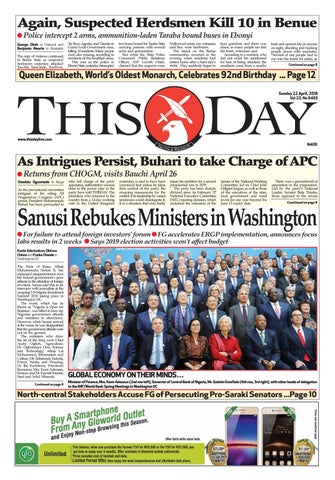
Again, Suspected Herdsmen Kill 10 in Benue Police intercept 2 arms, ammunition-laden Taraba bound buses in Ebonyi George Okoh in Makurdi and Benjamin Nworie in Abakaliki The orgy of violence continued in Benue State as suspected herdsmen yesterday attacked Tse-Abi, Tse-Ginde, Tse-Peviv,
Tse Ikyo, Agenke, and Gbenke in Guma Local Government Area, killing 10 residents. Many people were also missing, according to residents of the troubled areas. This was as the police in Ebonyi State yesterday intercepted
two buses bound for Taraba State carrying persons with several arms and ammunition. But while the State Police Command Public Relations Officer, ASP Loveth Odah, claimed that the suspects were
Nollywood actors, eye witnesses said they were herdsmen. The attack on the Benue communities occurred in the evening when residents had retired home after a hard day’s work. They suddenly began to
hear gunshots and there was chaos, as many people ran into the bush, witnesses said. According to a resident, who did not want his mentioned for fear of being attacked, the assailants came from a nearby
bush and opened fire on anyone on sight, shooting and hacking people down with machetes. “Several of our people had to run into the forest for safety, as Continued on page 8
Queen Elizabeth, World’s Oldest Monarch, Celebrates 92nd Birthday ... Page 12 Sunday 22 April, 2018 Vol 23. No 8403
www.thisdaylive.com TR
UT H
& RE A S O
N400
N
As Intrigues Persist, Buhari to take Charge of APC Returns from CHOGM, visits Bauchi April 26 Omololu Ogunmade in Abuja As the pre-national convention intrigues of the ruling All Progressives Congress (APC) persist, President Muhammadu Buhari has been persuaded to
take full charge of the party apparatus, authoritative sources close to the power play in the party have told THISDAY. The president, who returned to the country from a 12-day working visit to the United Kingdom
yesterday, is said to have been convinced that unless he takes firm control of the party, the on-going manoeuvres for the control of its leadership by varied tendencies could disintegrate it. It is a situation that may badly
injure his ambition for a second presidential run in 2019. The party has been sharply divided since its February 27 National Executive Committee (NEC) meeting decision, which endorsed the extension of the
tenure of the National Working Committee, led by Chief John Odigie-Oyegun, as well as those of the executives at the state, local government and ward levels for one year beyond the June 13 expiry date.
There was a groundswell of opposition to the proposition. Led by the party’s National Leader, Senator Bola Tinubu, those opposed to the tenure Cosntinued on page 8
Sanusi Rebukes Ministers in Washington For failure to attend foreign investors’ forum FG accelerates ERGP implementation, announces focus labs results in 2 weeks Says 2019 election activities won't affect budget Kunle Aderinokun, Obinna Chima and Funke Olaode in Washington DC The Emir of Kano, Alhaji Muhammadu Sanusi II, has expressed disappointment over the federal government’s poor attitude to the attraction of foreign investors. Sanusi said this in an interview with journalists at the on-going US-Nigeria Investment Summit 2018 taking place in Washington DC. The event, which has its theme as "Nigeria is Open for Business", was billed to have top Nigerian government officials and ministers in attendance. However, when Sanusi arrived at the venue, he was disappointed that the government officials were not on the ground. The ministers who drew the ire of the king were Chief Audu Ogbeh, Agriculture; Dr. Ogbonnaya Onu, Science and Technology; Alhaji Lai Mohammed, Information and Culture; Mr. Babatunde Fashola, Power, Works and Housing; Dr. Ibe Kachikwu, Petroleum Resources; Mrs. Kemi Adeosun, Finance; and Dr. Kayode Fayemi, Steel and Solid Minerals. Continued on page 8
GLOBAL ECONOMY ON THEIR MINDS… Minister of Finance, Mrs. Kemi Adeosun (2nd row left), Governor of Central Bank of Nigeria, Mr. Godwin Emefiele (4th row, 3rd right), with other heads of delegation to the IMF/World Bank Spring Meetings in Washington DC
North-central Stakeholders Accuse FG of Persecuting Pro-Saraki Senators ...Page 10
2
T H I S D AY ˾ ͰͰ˜ ͰͮͯͶ
T H I S D AY ˾ SUNDAY APRIL 22, 2018
3
4
T H I S D AY ˾ ͰͰ˜ ͰͮͯͶ
T H I S D AY ˾ SUNDAY APRIL 22, 2018
5
6
T H I S D AY ˾ ͰͰ˜ ͰͮͯͶ
T H I S D AY ˾ SUNDAY APRIL 22, 2018
7
8
ͺͺ˜ ͺ ˾ T H I S DAY, T H E S U N DAY N E W S PA P E R
PAGE EIGHT SANUSI REBUKES MINISTERS IN WASHINGTON Also absent were Governor of Central Bank of Nigeria (CBN), Mr. Godwin Emefiele; and Executive Secretary of Nigerian Investment Promotion Commission, Mrs. Yewande Sadiku. According to him, "We have a meeting today with investors, we were supposed to start at 9am, but we started at 10am. When I came in, they took me to the Ambassador’s office to sit down, while investors were waiting down there. We had a list of people who were to be there – the Vice President, minsters, and some of them are in town. But they haven’t come up! “You invite top investors, your ministers are in Washington, and they do not come to talk to the investors about Nigeria. That is not how you attract investors. If you have this forum in the Rwandan Embassy, I assure you that President Paul Kagame himself would be there telling people to come. "Sometimes, it is about how we market ourselves, how we package ourselves. There is absolutely no reason for the Nigerian embassy to arrange a
‘Nigeria is Open for Business’ forum with ministers in town, with governors in town and not have the coordination that they are actually here to meet with these investors. “There is no reason why we should start one hour late, and there is no reason why the public address system should not work. “At the end of the day, this is the first point of contact of the country. He (the investor) hasn’t even come to Nigeria. So, what will be his experience in Abuja and he is saying, if I am having this experience in Washington, what will happen when I go to Abuja, when I go to Kano? “How do I get to see the governor? Will it take me 10 hours? “And for these people who are in Washington, they have investors to meet, they have Heads of State to meet, they have the World Bank to meet. So, one hour is a lot of time for them to be sitting down waiting for you. “I think we need to just look at those kind of things that investors look at and have a very honest
conversation – sector by sector, region by region, state by state – and what do we need to do to make those areas attractive." However, earlier, the former Central Bank of Nigeria (CBN) Governor told his audience that the country had a lot of growth opportunities. He pointed out that diversifying the economy would protect it from shocks, whenever they occur. “If you look at all the things being done by Dangote Refinery, they would reduce our import, particularly petroleum imports, and conserve our foreign exchange,” Sanusi said. The Emir noted that countries, such as Ghana, Ivory Coast, Kenya, Rwanda, and Ethiopia, had taken steps to make their environments attractive to investors. Sanusi said: “We have to realise that the problems we have, from herdsmen/farmer clashes to the security situation, actually have their roots in not focusing on the productivity of agriculture. “The second is the power sector. Many people here today do not know that Nigeria today can produce 12,000 megawatts of
electricity, we need to improve on how to evacuate and distribute.” FG Accelerates ERGP Implementation Meanwhile the federal government has said it is putting measures in place to ensure the Economic Recovery and Growth Plan (ERGP) achieves the desired results, just as it disclosed that in the next two weeks, it would make the results of its Focus Lab public. The Minister of Budget and National Planning, Senator Udoma Udo Udoma, stated this in an interview with journalists on the side lines of the on-going IMF/World Bank Spring meetings in Washington DC. The ERGP was launched by the President Muhammadu Buhari in April 2017. The plan is the administration’s comprehensive medium-term plan and it runs from 2017 to 2020. However, the ERGP focus labs, which is one of the initiatives undertaken to ensure the full and effective implementation of the plan, was launched last month. It is a Malaysian model. The focus labs involve stakeholders from the public and
private sectors working together in a single environment to think out practical and workable solutions for delivering results that would propel the ERGP implementation. Udoma explained: “At the moment, the focused labs are being conducted in agriculture, transportation, power and gas, manufacturing and processing. The response has been very good. “We are looking forward to organising an open day in which we will share the results with the Nigerian public. That should be in the next one or two weeks and I am very encouraged by it. “We just need to accelerate the ERGP a bit on some of our measures. We have a lot of measures in the ERGP and we need to accelerate on them.” He reiterated that the government had set a target of seven per cent growth for the economy by 2020. Besides, Udoma said he was encouraged by the fact that positive developments in Nigeria, especially the country’s exit from recession, strong accretion in external reserves, and drop in inflation, were recognised by the multilateral institutions at
the meetings. He said: “As you know, the focus of the ERGP is to generate more revenue. As you are aware, we have the tax amnesty to try to increase tax revenues. We are looking at some of our excise duties and so the focus is to generate more revenues. “Our problem is not a debt problem, our problem is a revenue problem and so we are focused on generating much more revenues.” According to the minister, the federal government’s delegation met with some investors that expressed interest in the country’s agriculture and transportation sectors. Commenting on the delayed passage of the 2018 budget, Udoma said: “The signals we are getting from the National Assembly is that they are now working hard to get this budget out in the next few weeks. That is very positive signals and we are encouraged.” Also speaking, the DirectorGeneral, Budget Office of the Federation, Mr. Ben Akabueze, said the MDAs had submitted all that was required to ensure the passage of the budget.
once again pacify all sides. “He has to do the right thing by asking Odigie-Oyegun to step aside without them being disadvantaged at the same time,” the source said. THISDAY learnt that the days ahead would, however, see the president taking firmer decisions on the party and enforcing them. President Returns, to Visit Bauchi Meanwhile, the president yesterday returned to Nigeria 12 days after he left the country for London for various engagements, including the Commonwealth Heads of Government Meeting (CHOGM), which ended on Friday. The president, who left Nigeria on April 9, departed London after 12 noon yesterday and arrived Nigeria about 6pm. He is also scheduled to pay an official visit to Bauchi State on April 26 before leaving for the United States on April 29 for a meeting with United States President Donald Trump. While in the United Kingdom, the president met with British Prime Minister Theresa May at her N0 10, Downing Street office in London on April 16 for a bilateral talk. During the meeting, Buhari stated that he was more concerned about the state of Nigerian security and economy than the 2019 re-election bid. He also told the prime minister that his administration was heralded by a three-point campaign agenda, which included security, anticorruption fight, and economic
revival, emphasising that as 2019 elections draw nearer, politicians were pre-occupied with the forthcoming polls, whereas he was more bothered by the state of the nation's security and economy. He also commended British companies, such as Unilever, Cadbury, and many others, which he said "stood with Nigeria through thick and thin; even when we fought a civil war, they never left." The president did not mince words to say, like Oliver Twist, Nigeria was requesting more investments from Britain as he thanked May for the support Britain had offered Nigeria on training and equipping of its military as well as the fight against terrorism. "But like Oliver Twist, we ask for more investments. We are encouraging more British companies to come to Nigeria. We appreciate the support you have given in training and equipping our military, particularly in the war against insurgency, but we want to also continue to work with you on trade and investment," the president said. Buhari also briefed May on what he described as the giant strides Nigeria had recorded through massive investment in agriculture, disclosing that rice import has been reduced by 90 per cent, a situation he said had helped to put Nigeria on the path of food self-sufficiency. "I am very pleased with the successes in agriculture," he said, adding: "We have cut rice importation by about 90 per cent, made lots of savings of foreign exchange, and generated employment. People had rushed to the cities to get oil money, at the expense of farming. But luckily, they are now going back to the farms. Even professionals are going back to the land. We are making steady progress on the road to food security." On Wednesday, while delivering a key note address at the Commonwealth Business Forum at Guildhall, London, Buhari identified trade and investment facilitation to generate resources for sustainable development; ease of doing business and regional interaction that expands markets with safeguards against injurious trade practices from third parties; and more inclusive growth with the empowerment of women and the youth, as factors that had the potential to make business among Commonwealth countries
easier. He also listed the provision of a platform for small and medium enterprises (SMEs), radical expansion of human capital for the 21st century, and provision of hard and software infrastructure for the 21st century digital economy to boost e-commerce, increase efficiency, solve development problems and enhance cyber security, as other factors necessary for an easier business environment. The president also said Nigeria had already started championing this cause with events such as the "High-Level Trade and Investment Facilitation Forum for Development" convened by Nigeria in November 2017 in Abuja in partnership with the Economic Community of West African States (ECOWAS): According to him, “The Abuja statement from this forum: ‘Deepening Africa's Integration in the Global Economy through Trade and Investment Facilitation for Development,’ has become a global and multilateral reference point. We believe that the Commonwealth should lend its support to these types of activities, as a sound model for making business easier amongst Commonwealth countries. “To underscore Nigeria’s commitment to spreading prosperity throughout the Commonwealth, in the past six months, Nigeria co-chaired with the United Kingdom the ‘UK AllParliamentary Group for Trade out of Poverty' (APPG-TOP).’ The report of this Commonwealth Inquiry Report was launched on 3rd April, 2018. “Nigeria affirms its commitment to the principal message from this Commonwealth Inquiry Group that Nigeria co-chaired with the UK. The surest, most sustainable way to lift millions of people out of poverty across the Commonwealth is through boosting trade and investment. We believe that we, as leaders in the Commonwealth, should grasp the opportunity and agree a major new focus on trade and investment for inclusive development." The president, who also met officials of Shell Petroleum Development Company, was informed by the Shell officials that the company had put machinery in place to invest a fresh $20 billion in Nigeria’s economy. The president will formally resume work on Monday April 23.
AS INTRIGUES PERSIST, BUHARI TO TAKE CHARGE OF APC extension argued that it was a grave violation of the APC constitution and the 1999 Constitution of the Federal Republic of Nigeria, as altered, which stipulate periodic elections for party leadership. With three cases challenging the tenure extension in court within a week of the NEC decision, the president waded in a month later when at another NEC meeting held on March 27, he stood behind the opponents of tenure elongation. He said he had been made aware that the proposition was unconstitutional and could be injurious to the future electoral interest of the party. Bewildered by the sudden turnaround by the president, the pro-tenure elongation group, populated by governors, some serving ministers, and the NWC, attempted to resist Buhari’s suggestion that the tenure elongation be reversed. They set up a technical committee to advise on the president’s position. As the technical committee led by Governor Simon Lalong of Plateau State began its work, Buhari’s close aides began to sense some level of effrontery among the pro-tenure elongation backers and began to tell the president that he needed to put his foot down. By the NEC meeting of April 9, Buhari took his aides’ advice and with a mixture of carrot and the stick, firmly told the party to forget the tenure elongation
and prepare for the election of new officers for the party. However, at the meeting where he also announced his intention to seek the party’s nomination for a second term, he ensured all the gladiators went home with something: there would elective congresses and national convention, but there would also be waivers for the current party leaders who would have had to step down before they could re-contest their positions, as required by the APC constitution. Although the president was said to have taken the middle of the road course in order to be fair to both sides, some his aides, THISDAY learnt, thought his ambivalence would give the impression that he lacked the capacity to be firm, warning that this could be exploited. According to multiple THISDAY sources close to the Presidency, some of the manoeuvrings while the president was in the UK attending the Commonwealth Heads of Government Meeting (CHOGM) proved them right, as the Odigie-Oyegun-led NWC was accused of not only populating the convention organising committee with its sympathisers but also attempting to foist on the party an affirmative rather than elective convention. “The NWC has been scheming to frustrate an elective convention by not only deliberately slowing down the processes for the convention, but also scheduling a
tight timetable that would make it difficult for new entrants into the race to compete,” a source said, explaining that this was contrary to the firm instruction of the president for a fair and elective convention. The NWC had last week announced that ward, local government and state congresses would hold on May 2, 5, and 9, respectively, while the national convention would take place on May 14. The challenge, however, said another THISDAY source, was that for a process that normally took six weeks to be crammed into two weeks, it would task new comers. “Clearly, the intention is to crowd out competitors, and this is happening because those who have interests in contesting are in charge of the process,” he said. THISDAY learnt that Buhari’s aides had told him that there were inherent dangers in allowing the Odigie-Oyegun NWC, whose members are interested in running, to midwife the convention process, as it could raise a fundamental question of fairness. “Already, there are three matters in court, one is coming up on May 3 and the other is on May 14, the day of the convention, and anything could happen. So the president is being told to intervene because the issue of fairness is fundamental and justiciable,” a source said. However, Buhari is said to be in a dilemma on how to
AGAIN, SUSPECTED HERDSMEN KILL 10 IN BENUE there was no security protection for us,” he said. He added that many of the residents were missing while more than 15 bodies were recovered. Confirming the killings, the press secretary to Governor Samuel Ortom of Benue State, Mr. Terver Akase, said 10 corpses had so far been recovered and many people were injured. Akase said the armed herdsmen also burnt several houses, shops and other belongings of the natives. “This mindless attack was unprovoked, and we urge security agencies to arrest the herdsmen behind the killings for prosecution,” Akase said. All attempts to confirm the killings from the police proved abortive, as calls made to the Benue State Commissioner of Police, Mr. Fatai Owoseni, were not answered.
Meanwhile, in Ebonyi State yesterday, there was confusion, as the state police command alleged that the persons intercepted in two buses load with arms and ammunition, which was travelling towards Taraba State, were Nollywood actors. But eye witnesses said the arrested persons were herdsmen. “Yes, we intercepted buses carrying some persons with arms and ammunition going to Taraba, but they are not herdsmen, they are Nollywood actors. They were wearing army uniforms and we are investigating the matter. I will give details of the matter as soon as we get every detail,” the Benue State police PRO said. The Toyota buses, THISDAY gathered, were intercepted after Onu-Ebonyi Bridge, along Abakaliki-Ogoja Federal Highway, by policemen on duty.
An eyewitness claimed seven herdsmen were in one of the seized buses. He said: “It was the policemen on Safer Highway Operations that stopped the buses. In their normal stop and search operation, they found firearms and Army uniforms stocked in three big sacks. “Also found were uncountable ammunition, rifles, which are above 16 in number, including explosives, local charms, and fresh blood in 2 litres gallon.” Senior Special Adviser to Ebonyi State Governor Dave Umahi on Internal Security, Dr. Kenneth Ugballa, said he heard of the interception of the two buses and was coming to town to know details of the incident. “l heard the story while l was away from the state, but right now I am entering the state and
in a few minutes l will be at the command to find out the truth about the incident,” Ugballa said. The two buses are currently at the State Police Headquarters, Abakaliki. Benue and Taraba states have had the worst experience of the killer herdsmen menace currently ravaging communities across the country. Hundreds of natives have been killed in the two states in the last few months. Their governments enacted laws banning opening grazing of cattle in an effort to limit contact between the mainly crop-farming communities and the herders, to try to stop the attacks. But the violent assaults have continued, with the security agencies drafted to the state to safeguard the communities constantly being accused of complicity in the attacks.
T H I S D AY, T H E S U N D AY N E W S PA P E R ˾ APRIL 22, 2018
9
SUNDAY COMMENT
Editor, Editorial Page PETER ISHAKA Email peter.ishaka@thisdaylive.com
THE FRACAS IN THE SENATE The invasion of the Senate by thugs is wrong, shameful and reprehensible
A
lthough majority of Nigerians have always viewed the National Assembly and its members in less-thanflattering terms, the sordid drama last Wednesday in the Senate--when some hoodlums sneaked in through a glass barricade to steal the mace in broad daylight--represents a new low. The hoodlums, alleged to have been procured by a suspended senator, not only took away the legislative symbol of authority without which no legitimate plenary can hold (although it was found several kilomeTheimplicationsof tres away under theshowofshame a bridge the next attheSenateare day), they also morefarreaching. caused a serious security breach Itdiminishesthe that should not integrityofthe legislature.Itfurther escape the attenof President reducesthecohesion tion Muhammadu oftheNational Buhari. Assemblyandrenders Whatever we may say about the Nationtheprincipleof separationofpowers al Assembly, where there lameasanincoherent are all sorts of characters, nobody should condone andtrivialised the brigandage on the legislaturecannot Senate floor which raises makecrediblelawsfor several pertinent questions. One, every member thegovernanceofa of the National Assembly decentsociety has at least a policeman on guard duty and the premises also has several security personnel, including men of the Directorate of State Services (DSS). Yet, five unarmed men entered the Senate chambers and carried away the mace in broad daylight. Who allowed these hoodlums to park their vehicle conspicuously at the Senate foyer? Who authorised the opening of the security gate at the back of the assembly complex which leads directly to the Villa (and always manned by DSS operatives) for the hoodlums to escape with the mace? These are some of the serious questions for which
Letters to the Editor
G
answers must be provided for Nigerians to know what actually happened and why. Meanwhile, if the statement by the Senate following the incident is correct, and there is no reason to doubt it, we find it difficult to comprehend why a senator would take the law into his own hands in such an irresponsible manner. What motivated his action and are there other forces behind him? Why is he being treated with kid gloves by the authorities?
H
S U N DAY N E W S PA P E R EDITOR BOLAJI ADEBIYI DEPUTY EDITORS VINCENT OBIA, OLAWALE OLALEYE MANAGING DIRECR ENIOLA BELLO DEPUTY MANAGING DIRECTOR KAYODE KOMOLAFE CHAIRMAN EDITORIAL BOARD OLUSEGUN ADENIYI EDITOR NATION’S CAPITAL IYOBOSA UWUGIAREN
T H I S DAY N E W S PA P E R S L I M I T E D EDITOR-IN-CHIEF/CHAIRMAN NDUKA OBAIGBENA GROUP EXECUTIVE DIRECTORS ENIOLA BELLO, KAYODE KOMOLAFE, ISRAEL IWEGBU, IJEOMA NWOGWUGWU, EMMANUEL EFENI DIVISIONAL DIRECTORS PETER IWEGBU, ANTHONY OGEDENGBE DEPUTY DIVISIONAL DIRECTOR OJOGUN VICTOR DANBOYI SNR. ASSOCIATE DIRECTORS ERIC OJEH, PATRICK EIMIUHI ASSOCIATE DIRECTOR SAHEED ADEYEMO CONTROLLERS ABIMBOLA TAIWO, UCHENNA DIBIAGWU, NDUKA MOSERI DIRECTOR, PRINTING PRODUCTION CHUKS ONWUDINJO TO SEND EMAIL: first name.surname@thisdaylive.com
owever, while we must condemn a situation where a senator would behave like a political tout, we must also note the manner in which the Senate as an institution is violating the rights of its members thus becoming more like an assemblage of mobsters than people invested with the powers to make laws for the good governance of the country. In case they are not aware, suspending members whenever they air views that go against the grain does violence to the image of the National Assembly. What is more worrisome is that at practically all levels in our country today, there seems to be a misconception about what governance is all about. The tragedy of that misconception could be seen in the score cards of many of the office holders either within the executive or legislature who celebrate the building of perimeter walls around government structures, distribution of foodstuff during festivities and donation of vehicles to traditional rulers as landmark achievements. They are of course oblivious of the fact that good governance is that which is focused on the people, their safety and welfare as well as the optimal allocation of scarce resources and the effective implementation of policies for service delivery. While the authorities must get to the root of what happened on the Senate floor last week, apprehend and punish the culprits while working to ensure it does not happen again, it is also our hope that the current politics of acrimony between the legislature and the executive will give way to common sense so that both can work together to give the economy a direction. The 2018 appropriation bill has been with the National Assembly since last November and none of the two arms seems to be in a hurry to get it passed. Yet, as we keep saying on this page, the message such tardiness sends is that people in positions of authority in our country do not exude as much care and attention as is required on matters of urgent national importance. On the whole, the implications of the show of shame at the Senate are more far reaching. It diminishes the integrity of the legislature. It further reduces the cohesion of the National Assembly and renders the principle of separation of powers lame as an incoherent and trivialised legislature cannot make credible laws for the governance of a decent society.
TO OUR READERS Letters in response to specific publications in THISDAY should be brief (150-200 words) and straight to the point. Interested readers may send such letters along with their contact details to opinion@thisdaylive.com. We also welcome comments and opinions on topical local, national and international issues provided they are well-written and should also not be longer than (950- 1000 words). They should be sent to opinion@thisdaylive.com along with the email address and phone numbers of the writer.
Lagos and The Revival of Public Education
ood and wellstructured educational system is one of the vital factors in the socioeconomic development of any nation. Education is regarded as critical instrument in the battle against poverty and ignorance. It empowers the individual with necessary knowledge and set of skills to actualise potential and maximise opportunities in life. It is for this reason that governments across the world devote a good chunk of available resources to the development of the educational sector. In Nigeria, Lagos is arguably the state with the highest number of public schools, students and teachers. It has consistently been churning out the highest number of candidates for public examinations in Nigeria since 1967. As a melting point with a bourgeoning population in excess of 24 million, provision
of qualitative education in Lagos State has been a daunting task. However, one peculiarity about Lagos as with other mega cities is that work and investment on infrastructure as well as human and physical development is always work in progress. The current administration in the state clearly understands that the task of making Lagos State “the model of excellence in the provision of education in Africa” requires meticulous attention. To this end, the sum of N92.4 billion, representing 11.37 was allocated to education sector in the state budget for 2017. Presently, Lagos provides free education to over one million pupils/students in 1,010 primary schools with a population of about 497,318 pupils; 670 Junior and Senior Secondary Schools with a population of about 564,758 students and five technical and
vocational schools across the state. There is nothing we are competent in that does not require deliberate effort, sacrifice or quality time to succeed. The Akinwunmi Ambode- led administration has shown total commitment to the development of the education sector in Lagos State since it came on board in 2015. The result has been quite visible in the area of infrastructure development in public schools across the state. Presently, new model schools are being constructed across the state with facilities such as football pitch, basketball and lawn tennis courts, classrooms, laboratories, multipurpose halls, libraries and spacious car parks. Some of these new model colleges are Angus Memorial High School, Somolu, Awori College, Ojo and Lagos City College, Sabo-Yaba. The main aim of bringing them on board is to improve teaching and
learning in Lagos State. Similarly, the state government is equally working assiduously to construct new blocks of classrooms in public schools across the state. This is being done along with construction of perimeter fence, construction of watch tower as well as lighting up of schools at night in all the model colleges. Quite a number of these projects had been completed while others are in progress. A few of these new projects has been launched. These include Girls Junior Model College, Agunfoye and a newly constructed block of 20 classrooms at the Anglican Primary School, Isawo in Ikorodu. Meanwhile, government has directed a policy towards ensuring equal educational opportunity in the state, encouraging parents who might otherwise neglect their children’s education to send their children to school and making education affordable for everyone. In line with the commitment of the present administration to expand
access to knowledge for Lagosians, the state’ science laboratories are now better equipped and the enthusiasm of students to be science inclined has become very high with a lot of success recorded. Equally, the state government has completed the renovation and upgrade of public libraries in 18 secondary schools across the state with top class facilities. Lagos Digital Library, an online repository of education content, was commissioned in 2017. Governor Akinwunmi Ambode himself had the second best result in WAEC in 1981. It is thus not surprising that his administration is according education the utmost priority in the scheme of things. Cheerfully, the investment of the state government in education is steadily paying off as evident in the performance of the pupils of Lagos state public schools in external and internal examinations and competitions. ––Aladeotan Adeola, Lagos State Ministry of Education, Alausa, Ikeja
10
T H I S D AY, T H E S U N D AY N E W S PA P E R Ëž PRIL 22, 2018
SUNDAYNEWS
News Editor ĂŒĂ“Ă—ĂŒĂ™Ă–Ă‹ Ă•Ă™Ă?Ă“Ă–Ă? E-mail: Ă‹ĂŒĂ“Ă—ĂŒĂ™Ă–Ă‹Ë›Ă‹Ă•Ă™Ă?Ă“Ă–Ă?̜ÞÒÓĂ?ĂŽĂ‹ĂŁĂ–Ă“Ă Ă?Ë›Ă?Ă™Ă—Ëœ ͸΀͚͚͟͟Πͽ͝͸͞ Ě™Ă?Ă—Ă? Ă™Ă˜Ă–ĂŁĚš
North-central Stakeholders Accuse FG of Persecuting Pro-Saraki Senators t $POEFNO IPPEMVNT JOWBTJPO PG 4FOBUF Onyebuchi Ezigbo Ă“Ă˜ ĂŒĂ&#x;ÔË
A political group, North-central Stakeholders Forum, has accused the federal government of persecutingsenatorssupporting Senate President Bukola Saraki, warning that unless this was discontinued, it could trigger a chain of reactions that could disintegrate the ruling All
Progressives Congress (APC). Insisting that the invasion of the Senate by hoodlums, allegedly led by suspended Senator Ovie Omo-Agege, last week, was part of the grand plan to intimidate and discredit Saraki, the group condemned the attack on the upper chamber and called for the immediate arrest and prosecution of the culprits.
“We condemn in an unequivocal term, the assault and desecration of the hallow chambersoftheNigerianSenate byhiredhoodlums,thatresulted in the stealing of the mace, the symbol of authority of the Senate,� it said in a statement at the weekend in Abuja by the NationalChairman,AdamuAliyu, and the National Secretary, Paul
Nsong. It said the invasion was intended to discredit Saraki and the entire leadership of the 8th Senate, nothing that the sponsors of the attack never hid their hatred for the Senate president from the moment he mounted the saddle against their wishes. The forum said as part of the efforts to muzzle Saraki, they had subjected him to all forms of harassments, including put-
ting him on trial on trumped up charges. “We are not unmindful of the humiliation of Dr. Bukola Saraki at the Code of Conduct Tribunalallinthebidtodiscredit, intimidate him and eventually isolate him and have his followers abandon and consequently leave him in the cold,� it said. To weaken the Senate president,thegroupsaid,government had resorted to using its anticorruption agencies to harass his supporters in the upper chambers. “It is common knowledge that Senator Aliyu Wamakko, aformergovernorofSokotoState; and Senator Rabiu Kwankwaso, a former governor of Kano State; and another senator from the South-south are under threat by the Economic and Financial Crime Commission (EFCC) because of their support for Dr. Saraki,� it said. It expressed worry that this washappeningtowardsthe2019 general elections and warned that its members from all the states in the North-central zone of the country would resist the
intimidation of Saraki by the powers that be. Warning the President Muhammadu Buhari administration to be mindful of the implication of its action for the unity of the APC, it referred to the pre-2015 general election experience of the Peoples Democratic Party (PDP), saying it was the attempt to muzzle internal opposition that split it and eventual led to its loss of power. “Sometimes between 2013 and 2014, preceding the election year in 2015, the then ruling party PDP was being accused of impunity, lawlessness, oppression and lack of respect for due process and rule of law. This eventually led to the fractionalisation of PDP and gave birth to the New PDP,� the forum said, adding: “Ironically, the same script is been played out now, if not even worse.� Declaring its support for Saraki, it cautioned that unless thegovernmentstoppedharassing him, it would mobilise the North-central to reconsider its support for the APC.
Democracy Network Kicks
BUSINESS HOSTING L-R: US Consul General, John Bray; US Commercial Counselor, Brent Omdahl; Country Manager, Johnson & Johnson, Michelle Akande; and President, American Business Council/ CEO General Electric, Business Operations, Nigeria, Lazarus Angbazo, during hosting of the Council members by US Consulate in Lagos...recently
Ă?Ă—Ă™Ă?ĂœĂ‹Ă?ĂŁ Ă?ĂžĂĄĂ™ĂœĂ•Ëœ Ă‹ ĂšĂ‹Ă˜Ě‹ Ă“Ă‘Ă?ĂœĂ“Ă‹ ĂšĂœĂ™Ě‹ĂŽĂ?Ă—Ă™Ă?ĂœĂ‹Ă?ĂŁ Ă‘ĂœĂ™Ă&#x;ĂšËœ Ă’Ă‹Ă? Ă”Ă™Ă“Ă˜Ă?ĂŽ Ă—Ă“Ă–Ă–Ă“Ă™Ă˜Ă? Ă™Ă? Ă?Ă™Ă˜Ă?Ă?ĂœĂ˜Ă?ĂŽ Ă?ÓÞÓäĂ?Ă˜Ă? ÞÙ Ă?Ă™Ă˜ĂŽĂ?Ă—Ă˜ ÞÒĂ? ĂœĂ?Ă?Ă?Ă˜Ăž ĂŒĂœĂ‹Ă¤Ă?Ă˜ ËÞÞËĂ?Ă• Ă™Ă? ÞÒĂ? ÒËÖÖÙåĂ?ĂŽ Ă?Ă˜Ă‹ĂžĂ? Ă’Ă‹Ă—ĂŒĂ?ĂœĂ? ĂĄĂ’Ă“Ă?Ă’ ĂœĂ?Ă?Ă&#x;Ă–ĂžĂ?ĂŽ Ă“Ă˜ ÞÒĂ? à ÓÙÖĂ?Ă˜Ăž ĂœĂ?×Ùà ËÖ Ă™Ă? ÞÒĂ? Ă—Ă‹Ă?Ă? Ă?ĂœĂ™Ă— ÞÒĂ? Ă‹ĂžĂ“Ă™Ă˜Ă‹Ă– Ă?Ă?Ă?Ă—ĂŒĂ–ĂŁ ĂŒĂŁ ÒÙÙÎÖĂ&#x;Ă—Ă?Ë› Ă˜ Ă‹ Ă?ÞËÞĂ?Ă—Ă?Ă˜Ăž Ă“Ă?Ă?Ă&#x;Ă?ĂŽ ĂŒĂŁ ÞÒĂ? Ă™Ă˜Ă Ă?Ă˜Ă?Ăœ Ă’Ă“Ă?Ă? Ă?Ă’Ă? ÙÑĂ&#x; Ă‹Ă˜ĂŽ Ă—Ă‹ĂŽĂ? Ă‹Ă Ă‹Ă“Ă–Ă‹ĂŒĂ–Ă? ÞÙ ÞÒĂ? ĂšĂœĂ?Ă?Ă?Ëœ ÞÒĂ? Ă‘ĂœĂ™Ă&#x;Ăš ĂĄĂ™Ă˜ĂŽĂ?ĂœĂ?ĂŽ ÒÙå ÞÒĂ? ÞÒĂ&#x;Ă‘Ă? ĂĄĂ?ĂœĂ? ËÖÖÙåĂ?ĂŽ ÞÙ Ă“Ă˜Ă Ă‹ĂŽĂ? ÞÒĂ? Ă?Ă˜Ă‹ĂžĂ? Ă’Ă‹Ă—ĂŒĂ?ĂœĂ? Ă&#x;Ă˜Ă’Ă“Ă˜ĂŽĂ?ĂœĂ?ĂŽË› Ă’Ă? Ă‘ĂœĂ™Ă&#x;Ăš ÞÒĂ?ĂœĂ?Ă?Ă™ĂœĂ?Ëœ Ă?Ă‹Ă–Ă–Ă?ĂŽ Ă™Ă˜ ÞÒĂ? Ă?ĂŽĂ?ĂœĂ‹Ă– Ùà Ă?ĂœĂ˜Ă—Ă?Ă˜Ăž ÞÙ Ă?ĂšĂ?Ă?ĂŽĂ“Ă–ĂŁ Ă‹Ă˜ĂŽ ĂžĂ’Ă™ĂœĂ™Ă&#x;Ă‘Ă’Ă–ĂŁ Ă“Ă˜Ă Ă?Ă?ÞÓÑËÞĂ? ÞÒĂ? Ă“Ă˜Ă?ĂœĂ‹Ă?ĂžĂ“Ă™Ă˜ Ă‹Ă˜ĂŽ ĂŽĂ?Ă‹Ă– ĂŽĂ?Ă?Ă“Ă?Ă“Ă Ă?Ă–ĂŁ åÓÞÒ ÞÒÙĂ?Ă? ĂŒĂ?Ă’Ă“Ă˜ĂŽ ÓÞ˛
Nigeria to Secure $300m Loan to Finance National Malaria Strategy t To distribute 15m mosquito nets Abimbola Akosile
To help eliminate the malaria scourge in Nigeria, the Federal Government will be securing $300 million in new financing from the World Bank, Islamic Development Bank and African Development Bank. The country also committed to efforts to elevate malaria on the national priority list, and
pledged an additional $18.7 million to leverage $37million from the Global Fund to distribute 15 million mosquito nets and to supportthelocalmanufactureof essential malaria commodities. This is coming ahead of the World Malaria Day, which is commemorated every year on April 25 and recognises global efforts to control malaria, with Nigeria having approximately
51 million cases, while the disease reportedly causes about 207,000 deaths annually. Various commitments were also made by Nigeria and other Commonwealth leaders to halve malaria across the Commonwealthwithinthenext five years; according to a statement from the African Leaders Malaria Alliance (ALMA) on the Commonwealth Heads of Government Meeting 2018 held in Dar es Salaam, Tanzania weekend.0
The commitment, according to ALMA, followed the recent Malaria Summit, where leaders frommalaria-affectedcountries, businesses, donors and the international community made new commitments and urged Commonwealth leaders to get ‘Ready to Beat Malaria’. According to the statement, obtained by THISDAY, the commitment from the Commonwealth has the potential to prevent 350 million malaria cases and save 650,000 lives. 90
per cent of global malaria cases and deaths occur on the African continent and the impact of this renewed focus to eliminate malaria will be felt across the continent, it noted. African leaders had earlier affirmed their determination to eliminate malaria, with 12 African countries in the Commonwealth including Nigeria announcingnewcommitments. In addition, the African Leaders Malaria Alliance, in line with the African Union’s
(AU) Catalytic Framework to end AIDS, TB and Eliminate Malaria by 2030, committed to supporting member countries to introduce and strengthen the use of national and sub-national malaria scorecards and action trackers, with robust community engagement; to support increased domestic funding from both the public and private sector; and to continue its work with Heads of State and Government in Africa to monitor progress towards this goal.
Military Repels Boko Haram Insecurity: Senator Seeks 47 Illegal Arms, 172 Live Ammunition Recovered in A’Ibom Attack, Kills One Insurgent Removal of Immigration Boss Okon Bassey Ă“Ă˜ ĂŁĂ™
Following the order by the Inspected General of Police, Ibrahim Idris on the recovery of prohibited firearms and weapons across the country, 47 illegal arms and 172 live ammunition and cartridges have been recovered by the Police in Akwa Ibom State. The Police Public Relations Officer of the Akwa Ibom State Police Command, DSP Odiko Macdon, revealed this yesterday while fielding questions from reporters at the State Police headquarters Ikot Akpan Abia, Uyo. He also disclosed that 17 suspects have been arrested within the month of April by security operatives for various crimes committed in the state. Macdon said, the State Police
Commandundertheleadership of CP Adeyemi Ogunjemilusi was more determined to make the state of the safest in the country and a destination of choice for tourists. The arms recovered, the image maker of the State Police Command listed, include three AK 47 rifles, one G3 rifle, three pump action guns, three singlebarrel guns and 37 locally-made pistols. According to him, the arms were recovered from suspected bandits, vigilante groups and individuals in the state. His words: “Today again, the Commissioner of Police has been able to showcase arms that have been recovered. Most of these arms were returned while some were seized during the mop up operations.
Michael Olugbode Ă“Ă˜ Ă‹Ă“ĂŽĂ&#x;Ă‘Ă&#x;ĂœĂ“
The Senator Emmanuel Bwacha representing Taraba South on the platform of PDP has asked President Muhammadu Buhari to sack the Comptroller General of Nigeria Immigration Service over the influx of armed militia from the Maghreb into the country. Addressing journalists at Wukari weekend shortly after flagging off the rehabilitation of the 36.5 km Wukari-Ibi road, the SenatorinsistedthattheImmigration boss must take responsibility for the unhindered influx of militiamenfromtheMaghrebinto thecountrytoperpetratekillings. Speakingagainstthebackdrop of recent revelation by the President that those perpetrating killings across the country are from Libya, Bwacha maintained that
the CG must answer questions on how the borders became so porousforpeopletocomeinfrom other countries to kill Nigerians at will. “How come militia from the Maghreb are penetrating our borders?WhatistheComptroller of Immigration doing and how come our borders are so porous and people are coming into the countrytokillNigerians.Hemust answerthesequestions,�hesaid. The lawmaker, who is the deputy Senate minority leader, noted that the statement made by the President in London that those perpetrating killings in Nigeria are those trained by formerPresidentGaddafiofLibya was a confirmation of his earlier stancethatthosekillingacrossthe countryarenottheherdsmenthat are familiar to Nigerians.
Wole Ayodele Ă“Ă˜ Ă‹Ă–Ă“Ă˜Ă‘Ă™
Senator Emmanuel Bwacha representing Taraba South on the platform of PDP has asked President Muhammadu Buhari to sack the Comptroller General of Nigeria Immigration Service over the influx of armed militia from the Maghreb into the country. Addressing journalists at Wukari weekend shortly after flagging off the rehabilitation of the 36.5 km Wukari-Ibi road, the SenatorinsistedthattheImmigration boss must take responsibility for the unhindered influx of militiamenfromtheMaghrebinto thecountrytoperpetratekillings. Speakingagainstthebackdrop of recent revelation by the President that those perpetrating killings across the country are from Libya, Bwacha maintained that
the CG must answer questions on how the borders became so porousforpeopletocomeinfrom other countries to kill Nigerians at will. “How come militia from the Maghreb are penetrating our borders?WhatistheComptroller of Immigration doing and how come our borders are so porous and people are coming into the countrytokillNigerians.Hemust answerthesequestions,�hesaid. The lawmaker, who is the deputy Senate minority leader, noted that the statement made by the President in London that those perpetrating killings in Nigeria are those trained by formerPresidentGaddafiofLibya was a confirmation of his earlier stancethatthosekillingacrossthe countryarenottheherdsmenthat are familiar to Nigerians.
T H I S D AY ˾ SUNDAY APRIL 22, 2018
11
12
T H I S D AY, T H E S U N D AY N E W S PA P E R ˾ ͺͺ˜ ͺ
NEWSXTRA NAEE: With PIGB in Place, NNPC’ll Have No Excuses for Under-recovery, Losses t Asks Buhari to assent to bill before beginning his re-election campaign Chineme Okafor in Abuja The Nigerian Association for Energy Economics (NAEE) yesterday stated that the imminent promulgation of the Petroleum Industry Governance Bill (PIGB) which the
two chambers of the National Assembly have harmonised for presidential assent would take away every excuse proffered by the Nigerian National Petroleum Corporation (NNPC) as reasons for its loss-making streaks and under-recoveries
for importing petrol in the country. NAEE, which stated this in Abuja at a pre-briefing on its forthcoming annual conference scheduled for this week, also asked President Muhammadu Buhari to immediately assent
to the PIGB before he begins his 2019 re-election bid. The body’s president, Prof. Wumi Iledare, explained that the continuous loss-making records of the NNPC would be curtailed once the PIGB becomes effective, adding that
at that time, very clear business demands would be made of its management by its shareholders who would give to it some key performance indicators (KPIs) to meet. Iledare, stated that the NAEE had in 2015 warned the Buhari
ADIEU MAMA L-R: Mr. Fred Akokhia; Chairperson, Nigeria Women Football League, Aisha Falode; Deputy Governor Edo State, Rt. Hon Phillip Shaibu; Mrs. Sumbi Awobuluyi; Dr. Suleiman Akokhia; Isah Akokhia; and Hauwa Bolodeoku; at the forty days fidau for their late mother Princess Ketumi Akokhia, in Edo State...recently
administration to avoid the temptation of regulating the downstream petroleum sector of the country, and instead deregulate it to escape the current challenges that are currently overwhelming it. He inferred that if the government had listened to the association’s advice, the country would perhaps not have under-recoveries in petrol supply which the Minister of State for Petroleum Resources, Dr. Ibe Kachikwu, recently said had shot up to N1.4 trillion per annum. “I think also that if you look at the industry, we are not in any way operating a deregulated downstream, what we have is what I will call a price ceiling that has been misinterpreted as a price floor. “That means that when you have a price ceiling, you do not want the price to go beyond that, yet the equilibrium price is somewhere high because when you have a price floor, equilibrium is supposed to be below the price floor, and that is more or less a misinterpretation. “We warned the government then, at that particular time there was an opportunity not to put any price because the price on the seat was already N200 (per litres of petrol) and you just say that you are out, unfortunately, you cannot recover what you pay for in dollar using naira when the exchange rate is unstable and that is what we have,” said Iledare.
FG, Health Workers Trade Barbs as Strike Paralyses National Hospital, Others Senator Iroegbu inAbuja The Federal Government and the Joint Health Sector Unions have engaged in blame game over who is responsible for the ongoing strike by health workers, which has threatened the lives of Nigerians across the country. This is coming as activities in the National Hospital Abuja and other secondary health institutions across Nigeria have been paralysed following the industrial action.
Speaking to THISDAY yesterday, the National Chairman of JOHESU, Mr. Biobelemoye Josiah blamed the federal government for insensitivity over the plight of their members. Josiah singled out the Ministers of Health, Prof. Isaac Adewole as well as that of Labour and Employment, Sen. Chris Ngige, as the biggest culprit in the alleged scheme to frustrate efforts of the health workers to get fair treatment. He accused the duo of Adewole
and Ngige of intimidation and discrimination against JEHOSU members instead of engaging the union to resolve the issue. According to him, the Minister of Health is trying to use divide and rule tactics to break their ranks, but assured listeners that they remain resolute in their quest to get justice. He said: “To the best of my knowledge, the federal government has failed to reach out to us and the Ministry of Health in its cruelty is now applying the
method of intimidation to also divide us but we are not affected. “Two years ago the Ministry of Health adopted the policy of intimidation of ‘no work, no pay’. As we speak, our members at the FMC Owerri have not been paid for over four months.” Speaking further, the JOHESU President also said the Ministries are working contrary to the anti-corruption drive of the President Muhammadu Buhari administration that authorised the Whistle-Blower policy.
According to him, some of their members are being punished for exercising the rights of whistleblower policy to expose the rots in the system. “They threatened those who want to insist and comply with the whistle-blower policy and isolate them from the others they were able to intimidate. This is simply ‘divide and rule’ tactics but we are not deterred at all,” he said. On Ngige, he also accused the minister of taking sides with
members of the Nigerian Medical Association (NMA) and ARD over JOHESU According to Josiah, “the NMA and ARD behave as trade unions and enjoy recognition and patronage of the federal ministry of health and sit with government to negotiate for the federal ministry of labour and employment just because the minister of labour, who should be an arbiter but chooses to close his eyes to such illegality, is himself a medical doctor.”
Investigation on Former Govs Who Decamped to APC Not Stopped, Says EFCC
KAD-SIECOM Officials Escape Queen Elizabeth, World’s Oldest Monarch, Celebrates 92nd Birthday Death as Fire Guts Offices
Paul Obi in Abuja
Abimbola Akosile with agency report
As 2019 general election draws near, the Economic and Financial Crimes Commission yesterday insisted that the investigations on former state governors who decamped from the Peoples’ Democratic Party (PDP) and other parties to the All Progressives’ Congress (APC) have not stopped. There has been public outcry against the dilly-dally approach adopted by the federal government in prosecuting former governors who defected from the PDP to the APC. Also, some investigations by anti-graft agencies have
rather targeted mostly opposition members and former governors of the PDP and some APC ex-governors who are opposed to President Muhammadu Buhari’s 2019 presidential ambition. Chief among the former governors opposed to Buhari’s 2019 ambition is former governor of Kano State, Rabiu Kwankwaso, who alongside some former governors have been on the EFCC radar over allegation of corruption and diversion of public funds during their tenure as governors. The EFCC had last week hinted about extending invitation to Kwankwaso and former governor of Sokoto State, Sen. Aliyu Wammako.
The world’s oldest and longestreigning living monarch, Britain’s Queen Elizabeth, yesterday attended a star-studded special concert as she celebrated her 92nd birthday. According to a Reuters report, Welsh singer Tom Jones kicked off the show with his hit “It’s not Unusual” before Elizabeth appeared in the royal box of London’s Albert Hall, flanked by her family. Kylie Minogue, Sting, Ladysmith Black Mambazo and Shaggy were among those on the bill, along with stars of the stage and screen. The event, according to the report, was a break in tradition for
the queen who usually spends her birthday privately with little public celebration, although there were nationwide events to mark her 90th version. The concert came at the end of a week in which leaders and dignitaries from 53 countries came to London for the Commonwealth Heads of Government Meeting, and featured performers from the network of mostly former British colonies. The queen is head of the Commonwealth. The major beneficiary of yesterday’s event, televised live on BBC TV and radio, was the Queen’s Commonwealth Trust youth charity, of which her grandson Prince Harry was appointed president this week.
John Shiklam inKaduna Officials of the Kaduna state Independent Electoral Commission (KAD-SIECOM), yesterday escaped death following a fire incident that gutted the offices of the commission located along Sokoto road, Kaduna. Chairman of the commission, Dr. Saratu Dikko while briefing newsmen about the incident, said no life was lost and no one sustained injuries. She said the fire occurred at about 10:30am on Saturday when members of the commission were holding an emergency meeting in her office. The unfortunate incident occurred barely 20 days to the conduct of local government elections, slated for May 12.
Dikko said the fire started on the second floor and affected all the offices on the floor, including offices of the Chairman, Legal Department, Finance Department and the Conference room. She said the cause of the incident was yet to be ascertained, adding that the State Fire Service and the police had commenced investigations. “The offices of Kaduna State Independent Electoral Commission this morning (yesterday), at about l0:30am, went up in flame on the 2nd floor. “The cause of the fire is not yet known. The fire affected all the offices on the second floor, including the offices of the Chairman, the Legal Department, Finance Department and the Conference room. “
T H I S D AY ˾ SUNDAY APRIL 22, 2018
13
14
ͰͰ˜ Ͱͮͯ ˾ THISDAY, THE SUNDAY NEWSPAPER
OPINION Ogun And The New Age at Dawn Raheem Ajayi canvasses the need for a well-articulated blueprint on Southwest regional integration
I
t is the earnest desire of all genuine stakeholders in a secured future that guarantees hopes and aspirations for present and future generations that the lofty ideas which coalesced into Development Agenda for Western Nigeria (DAWN) would become reality soonest. Recently, stakeholders in the six southwest states of Ekiti, Lagos, Oyo, Ondo, Osun and Ogun led by the governors and their representatives converged on Lagos in continuation of the efforts at fine-tuning modalities for the implementation of the much-awaited regional socio-economic integration under the aegis of the DAWN Commission which was conceived and birthed a couple of years back. It is therefore pleasant to note that a new age beckons at DAWN and appears to be taking firm footing after the incubation period that elicited so much expectation. To this extent, there is indeed a renewed assurance that the initiative would soon blossom into reality with prospects of mutual cooperation amongst actors in governance across the southwest which will ultimately translate into limitless socio-economic opportunities for states and peoples of the southwest. But much more gratifying however is that the new age at DAWN is coming at such an auspicious period Ogun State has been repositioned to adequately translate opportunities of regional integration to bolster developments in all ramifications. Without doubt, lack of vision towards harnessing the boundless economic potential across the southwest to trigger mutual developmental opportunities in the region has for too long a time featured as a major failure of politics; and as well as a huge disservice to corporate entities as well as the interest of individuals across the region. It is often a thing of pride, as much as it is incontrovertible, to recall the developmental strides of the western region in the short spell of postindependent era. The defunct western region was already on the threshold of greatness that seemed unassailable but for the political crises of the era. But for the political crises that terminated Nigeria’s first republic, the defunct western region was set on the momentum and pace that was bound to change perception regarding the capacity of the black race to provide leadership long before the 20th century receded into the bowel of history. Notwithstanding, the impact of developmental pace of the old western region still remains vivid, to some extents, in the six states that make up the present day southwest geopolitical zone as well as in parts of the present day Edo, Delta, Kogi and Kwara States. Considering the present day reality in Nigeria, the
prospects of economic integration are, no doubt strategic to deploying human and material resources to engaging emerging challenges of governance. The quest for engaging with the dynamics of plural societies which is at the core of the complexities of development within the context of Nigeria’s troubled federal arrangement could hardly be addressed without commitment to exploring and harnessing mutual opportunities amongst contiguous states in the country. Inevitably, the quest of providing enduring antidote to the vagaries of social upheavals manifesting in the tortuous paths of evolving an enduring nation makes commitment to socio-economic integration imperative to engender the deployment of comparative advantages in stimulating growths and development within and across the regions of the federation. It should be instructive to note that prior to the recent reawakening of the desire to realise the mission of DAWN, Ogun State in demonstration of commitment to southwest integration had in 2012 ceded 1000 hectares of land situated at Eggua to Lagos State for rice cultivation in addition to clearing about 500 hectares of the land under an existing Memorandum of Understanding (MoU). However, the story today is that Lagos State is partnering with Kebbi State to produce LAKE Rice while Ogun is pursuing another initiative with MITROS Rice. It must be emphasised that while collaboration on all fronts will help the southwest region and by extension grow the Nigerian
It is important that the new age at DAWN be founded on renewed commitment to actualising objective of integration beyond mere convenience of proclamation or political exigencies
economy, it is however important that the new age at DAWN be founded on renewed commitment to actualising objective of integration beyond mere convenience of proclamation or political exigencies. The desire to pursuing mutual agenda under the DAWN Commission should be such that portends prosperity for all on the basis of commitment to shared values and accord by political authority. However, while regional integration is desirable, it would be worthwhile for states within the southwest to be genuinely and faithfully committed to mutual agenda that not only recognises potential and opportunities but also seeks to deploy collective strength into growing the commonwealth in the overall interest of all and sundry. With the recent coming on board of Lagos State as a bonafide partner in the Oodua Economic Community, it has become even more compelling to evolve enduring blueprint for the operational model of integration to avail member states the road map for strengthening the cooperation that will expand the boundaries of opportunities. Going forward with the agenda of DAWN, the need for a well-articulated blueprint is pertinent and could not be further delayed as it represents an important step in realising the goals of integration. It could not also be overemphasised that the integration plan should seek to focus attention on how the cooperation will translate into benefits in the short and long run in such a way that the trickledown effects will become visible in the lives of the mass of the people across the southwest. It is to this extent therefore that it has become pertinent to reiterate that ongoing massive infrastructural developments in Ogun State offer ample windows for the expansion of opportunities within the frameworks of southwest regional integration. It is anticipated that the foundation of economic growth that has been laid in Ogun State through the creation of enabling environments within the multiple investment corridors emerging across the gateway state would be leveraged upon to boost economic integration in the southwest. The proximity of Ogun State to Lagos which is Nigeria’s commercial hub centre as well as its vantage location as the main artery to the southwest in particular and as well as other states in Nigeria in general further underscores the wisdom in the ambitious pursuits of infrastructural renewal by the current administration of Senator Ibikunle Amosun which would now readily advance the cause of southwest regional integration. Ajayi is Senior Special Assistant to Ogun State Governor on Public Affairs
It’s Time to Speak Out The continued closure of the Peace Corps’ office is unlawful, writes Rogers Edor Ochela “In Germany, they first came for the Communist and I did not speak out because I was not a Communist; then they came for the Jews and I did not speak out because I was not a Jew; then they came for the Trade Unionists and I did not speak out because I was not a Trade Unionist; then they came for the Catholics and I did not speak out because I was a Protestant. Then they came for me and by that time, there was no one left to speak out” -German Poet
T
hat the history of several Third World countries is replete with stories of injustices occasioned largely by lack of fidelity to rule of law is no longer news. But like it is generally acknowledged, injustice to one is injustice to all. And from whichever angle it is looked at, the continuous illegal closure of the new corporate headquarters of the Peace Corps of Nigeria (PCN) in Jabi, Abuja, since Tuesday, February 28, 2017, by the Police is a case of man’s inhumanity to man. For want of a better expression, it is a monumental injustice. As a matter of fact, one will merely be stating the obvious to assert that the numerous brushes or better still, face-offs between Peace Corps and the Police over the years bear eloquent testimony to the above quoted statement by a distinguished German poet and above all, it is equally very instructive. It would be recalled that Justices Gabriel Kolawole and John Tsoho of different Federal High Courts in Abuja had on November 9, 2017 and January 15, 2018 respectively, declared as patently illegal and subversive the continuous closure of the office. But in a move that defies rational comprehension, the Nigerian Police has flagrantly disobeyed all these judgments. To make matters worse, the Inspector -General of Police has also allegedly thumbed up his nose at five different letters written to him by the Attorney-General of the Federation (AGF) and Minister of Justice, Shehu Malami urging him to comply with these judgments. Surprisingly, the AGF seems to have thrown up his hands in utter surrender to this wilful spitting on the hallowed temple of justice, a development that
has ensured that the office of Peace Corps, a legal entity in Nigeria remains under lock and key based on the whims and caprices of an individual. This ugly development automatically triggers some salient questions, which are urgently begging for answers. What is Nigeria turning into? Where are the numerous human rights activists and their ubiquitous organisations? Where are the once powerful Civil Society Organisations (CSOs) that used to be the conscience of the nation? Why are they not speaking out now against this grave injustice that is being perpetrated against a peaceful and law-abiding organisation? What makes this matter quite worrisome is that even some respected highly placed Nigerians, whose voices are usually accorded respect and recognition, have decided to keep sealed lips as the bully called the police continue to recklessly trample on the fundamental rights of Peace Corps without sanction or any form of reprimand. Is this the same country that our founding fathers bequeathed to us? It might interest Nigerians to know that from 2010 till date, Peace Corps has won 12 landmark judgments against the police and other security agencies. The import of these judicial victories is symptomatic of the fact that the activities of the corps are in sync with the rule of law, a development that has ensured that the organisation keeps a reasonable distance from breaching the laws of the land. And what resonates from this entire ugly episode is the sad reality that Peace Corps has lost a whopping sum of N13.5 million annual rental fee it paid on the property in question as a result of its illegal closure by the police. Little wonder, Nigerians are in agreement that it is this kind of wicked attitude of the police that has succeeded in alienating it from a high preponderance of the citizenry. Ignorance, it is often said, is no excuse in law. For a supposedly law-enforcement agency like the police to flagrantly disobey valid court judgments and break the laws of the land with impunity calls for serious concern from all well-meaning Nigerians. The current police action against the Peace Corps of Ni-
geria (PCN) is not new considering the fact that the Force had similarly visited similar unspeakable atrocities on the Nigerian Security Organisation (NSO), the precursor of the present Department State Services (DSS); the Federal Roads Safety Corps (FRSC); the National Drug Law Enforcement Agency (NDLEA) and most recently, the Nigerian Security and Civil Defence Corps (NSCDC). Even when the enabling law to empower the Nigeria Immigration Service (NIS) and Nigerian Customs Service (NCS) to bear arms was about to be passed, the police equally rose up in anger against these organisations. So, Nigerians do not expect a different treatment for the Peace Corps. The only surprise is that apart from being a bully, the police have turned itself into a breaker of the law, which it is statutorily mandated to enforce. Similarly, to further justify their patently unjustifiable action against the corps, these jackboot oppressors have engaged in all manner of ‘alawada’ propaganda couched in primitive falsehood with the hope that ordinary Nigerians will swallow up such lies hook, line and sinker. Unfortunately for them, these lies do not cut any ice with millions of discerning Nigerians. At this juncture, it is pertinent to sound a note of warning to the powers operating behind the scene and urging the police to continue with its insidious action not to unseal the Peace Corps office in compliance with the orders of the courts. They should profit from the lessons of history and must be told in no uncertain terms that worse agents of oppression have passed through this land in the past and had left people highly traumatised by their acts. When they spoke or acted, it was simply to trample on the sensibilities of Nigerians. Some even boasted (just like the current oppressors of Peace Corps) that no power, not even the presidency could rein them in or render them irrelevant. But when denouement came like a whirlwind, they were swept into the dustbin of history. So, history is like gallows, it hangs those who ignore its poignant lessons. Ochela is media consultant to Peace Corps of Nigeria
15
T H I S D AY, T H E S U N D AY N E W S PA P E R ˾ APRIL 22, 2018
LETTERS
W
IMO’S RENEWED HOPE FOR 2019
ords making the round is that Governor Rochas Okorocha is shocked that the people of Imo State are unhappy that he is planning to foist his son-in-law on the state as his successor come May 2019. For the governor who believes he has done his best to serve his people well, all he is expecting from them is gratitude and nothing less. But only a man with the mind-set of Owelle Okorocha will be shocked that the people want nothing more to do with his style of governance, especially not through a puppet or proxy after he failed to deliver on the improved welfare he promised Imo people before he was elected. A sore point for the people of Imo State is the way and manner government under Okorocha has handled road construction in the state and the issue of compensation to owners of damaged property. The Okorocha years made road development an ecological issue causing damage in the affected areas and worse still, damage to private property and the necessary compensation that should follow has not been properly administered; thus, making such matters subject of nebulous speculations and road construction a near unwelcome development feature for most communities. For instance, did road construction not become a thing to dread in Orji/Okigwe
Okorocha
road, Orlu road, Egbu road, Mbaise road and Egbeada road? When the old owners of the Egbeada market who had market stalls, demanded a proper documentation of the owners/occupants of stalls at the market prior to demolition and reconstruction, did all entreaties to the governor not fall on deaf ears for alleged private interests in the allocation of the proposed reconstructed stalls? When the people bemoaned their plight, including the Ekeukwu market catastrophe, did the governor not aggravate it by deliberately abandoning the evacuation of refuse on Douglas Road, and to rub in
the insult, the spokesperson of government was on radio boasting thus: “Government deliberately abandoned the refuse along Douglas Road, Owerri to get back at Owerri people who have been battling the state government over the relocation of the market.” Was the same puppet/proxy that the Owelle is planning to foist on Imo people not one of the chief executors in all these miseries that befell the people of Imo State? The hope which surrounded the euphoria with which Imo people mandated Owelle Okorocha to improve their welfare and provide them with an ambiance that should enable them enhance their capabili-
ties have been dashed. From hope, the welfare of Imo people has declined into chronic cumulative regression. Instead of the promises of better pay and improved welfare, Okorocha delivered delayed and diminished wages and turned pensions, from a dignified retirement for long and diligent service to one’s state into a curse where deserving retirees are subjected to the indignity of negotiating to collect fractions of benefits that others had previously taken for granted. The Imo people do not owe Okorocha or his proxies an extended followership. They are well in their rights from the benefit of experience to reject and denounce any attempts to extend the miseries they currently endure. Imo people, therefore, have the right to the hope of an audacious new beginning in May 2019 and willing to make new bold plans to reach for greater development heights and the top of their potential. An audacious hope for a new beginning in May 2019, distant from any proxy links, tied to the apron strings of the outgoing governor will ensure that the complete subordination of local governments will recede into the past, from the current practices where the constitution is defied and local government elections were not conducted for seven years. It will be a complete departure from executive recklessness which purported to have monarchical powers to sack the head of the judicial arm in Imo
Arsene Wenger: Time To Say Goodbye
I
t is the news that most traumatised Arsenal FC fans across the world have always been eager to hear. When it eventually came, it was of great relief. For several fans, who are reasonably devastated by recent developments from the hitherto inspirational football club, the news came so suddenly that it was too difficult to believe. But then, it is now official, Arsenal Football Club and English Premiership longest serving manager, Arsene Wenger, will be leaving the team at the end of the current season. An official message by Wenger on the club website stated: “After careful consideration and following discussions with the club, I feel it is the right time for me to step down at the end of the season. I am grateful for having had the privilege to serve the club for so many memorable years. I managed the club with full commitment and integrity. I want to thank the staff, the players, the directors and the fans that make this club so special.” The French born tactician, who joined the club in October 1996, is no doubt, the most
successful manager in the club’s history. He introduced a fascinating pattern of playing that quickly relegated the hitherto boring and highly physical English ‘kick and follow’ approach into oblivion. This actually made the English premiership to attract more foreign players and managers and also enhanced the popularity of the League. Under his watch, Arsenal won the Premier League title in 1998, 2002, and 2004 as well as seven FACups, including three in the past four years. In the 1998 and 2002 seasons respectively, Arsenal won League and FACup Double. One of the major highlights of Wenger’s coaching career in Arsenal was recorded in the 2003-2004 season when the team was nicknamed “The Invincibles” after it went through the Premier League season undefeated with 26 wins and 12 draws. For 20 consecutive seasons, Arsenal under Wenger finished in the top four bracket of the Premier League log. In the 2005/2006 season, Wenger’s Arsenal played out the UEFAChampions League final but was edged out 2-1 by a Lionel Messi inspired FC Barcelona.
When he arrived England, as the only third foreign manager to coach a Premier League team, Wenger revolutionised his side’s playing philosophy. He introduced new ideas about nutrition, training and tactics and established a track record for signing players who became global stars, notably Dennis Bergkamp, Patrick Vieira, Thierry Henry, Cesc Fabregas, Nwankwo Kanu, Marc Overmass and Robin van Persie. For his innovative approach to the game, Wenger was nicknamed the “Professor”. With a degree in Economics, the French-born tactician was not only interested in bringing laurels to the team; he was equally keenly concerned about bringing financial stability to the club. Perhaps, one of his most enduring legacies at Arsenal was his role in the construction of the team’s new playing ground, the £390m Emirates Stadium which they moved into in 2006. But then, in the past few seasons, there has been a gradual decline in the club’s performance. Currently sixth in the 20-teamPremier League, Arsenal is 14 points off fourth placed bitter North London rival, Totteham Hotspur. Last
season, for the first time in 22 seasons, the team failed to qualify for the lucrative Champions League competition as it finished 5th on the premiership log. Since its loss to Barcelona in 2006 Champions League final, Arsenal has struggled endlessly in the Europe elite football championship. They were eliminated at the last-16 stage for the seventh successive season on their last appearance in the competition in 2017, scandalously losing 10-2 on aggregate to Bayern Munich. Thus, fans have become plausibly disillusioned and Wenger had been under increasing pressure to step down by some fans, having failed to win the League for 14 years and with the club set to miss out on Champions League qualification for the second consecutive season. Of late, there is no other way that the fans’ anger has best been demonstrated other than deliberate boycott of the team’s home matches. Currently, Arsenal is 33 points behind champions Manchester City, which have 87 points. ––Tayo Ogunbiyi, Lagos State Ministry of Information & strategy, Alausa, Ikeja
State without reference to the constitutional and other statutory positions which are clearly laid out. It will bring an end to the indignity of lack of full-time employment for Imo youths. It will end the agony over how Imo State will overcome its water supply issues which the current government has only paid lip-service to. It will indeed usher in a renewed hope that the extortionist levies and taxes currently administered by the state will wear a human face and there will be value for money for what will be paid. After the sub-optimal delivery of the outgoing government in Imo State, the people do not want to remain in perpetuated anguish bemoaning the lengthy list of failed promises and embarking on another journey of deceit through a proxy. They want renewed hope, however audacious. They want a fresh start that will surely make the Okorocha years bygone years. This is why the people now wish to look beyond the Okorocha compound for new aspirants. The people of Imo State want to encourage people with new but workable vision who are forthright and with a track record of diligence and honesty that can be tracked, like Sir Stanley Amuchie. I was very excited to find that
such a credible man will be one of the possible choices for Governor of Imo State for the 2019 race. I recall his exceptional brilliance years ago in the University of Benin which earned him a First Class degree. Over the years, he has carried on that diligence and excellence into the financial sector, where he has risen to the top echelon of management. I have also observed over the years similar endeavours on his part in philanthropy in the Church and town unions and social causes at grassroots level. That is the type of clean break the people of Imo State will be hoping to make in 2019, having people with private sector values and orientation in service delivery to assume leadership positions. Let the failed promises, dashed hopes be a thing of the past so that Imo people can expand their possibilities in a new horizon. Such revival of hope cannot occur with those who have a track record embedded in the outgoing government. The people of Imo State must look beyond these tainted hands who have demonstrated by their performance that their best is not good enough for Imo people and therefore look up to others with renewed hope and promise. ––Dr. Maecus Iheanyi, Owerri, Imo State
M ILITARY CHECKPOINTS A S M ARKET P LACE A S M ARKET P LACE
M
ilitary or security checkpoints are distinguishable from border or frontier checkpoints in that they (checkpoints) are erected and enforced within contiguous areas under military control. Military checkpoints have been employed within conflict-ridden areas all over the country or state to monitor and control movement of people and materials in order to prevent violence. In Borno State, since the terrorists (Boko Haram jihadists) bombings in Maiduguri, they are widely seen across all over the Borno State capital, especially at entrance and exit points of the city. In Borno State military checkpoints are almost everywhere due to the insecurity in the state, since 2009. But now the military checkpoints are gradually turning into market places where buying and selling take place. It is now very difficult for a traveller and motorists to identify military checkpoints because by mere observation the checkpoints are filled with many people especially children (hawkers) selling things to motorists and passengers; one can also find minors and disabled people begging around the checkpoints without knowing the risk or negative effects of staying close to them. Now for every group of ter-
rorists planning to invade a city or town must first pass through military checkpoint. That is where the issue of militant attacking and bombing military checkpoints occurred. In April 2017, there was reported military checkpoint attacked by some suspected Boko Haram jihadists where they killed a soldier outside Maiduguri. Also two-male suicide bombers denoted their explosives at a checkpoint in Dalori, a village on the outskirts of Maiduguri near a camp for internally displaced people. At the same time, other militants opened fire on the checkpoint, killing a soldier and injuring a policeman. Now think of what will happen or how the result will be if the checkpoint was full of people, especially children and minors when the militant attacked the checkpoint. Military checkpoints are erected purposely to control how people enter a city or leave so that security personnel (be it governmental or civilian) can screen entrants to identify troublemakers (be they criminals, terrorists or simple rabble-rousers) and locate contraband items, and not for the gathering of people who will engage in selling and begging. ––Ezra Musa, Department of Mass Communication, University of Maiduguri.
16
THISDAY, THE SUNDAY NEWSPAPER ˾ ͰͰ˜ ͰͮͯͶ
INTERNATIONAL Muhammadu Buhari and Donald Trump in NigeriaUS Relations: A Prolegomena to their April 30 Meeting
M
any factors defined Nigeria’s relationships with the United States before the advent of Muhammadu Buhari and Donald Trump as elected presidents of Nigeria and the United States. The factors included trade, especially crude oil; African Growth and Opportunity Act (AGOA); multi-party democracy; presidential system of government; regional security cooperation; dependency syndrome; and development assistance. Speaking generally, Nigeria’s relationship with the United States is warm but characterised by mutual suspicions. These mutual suspicions have been heightened under President Muhammadu Buhari (PMB) and President Donald Trump, who both constitute new and special dynamics in Nigeria-United States. In this regard, how do they impact on the bilateral ties between their two countries? What are the two presidents likely to discuss at the meeting scheduled for April 30, 2018 in Washington? As revealed by Sarah Sanders, the spokesperson of the White House on Sunday 15th April, 2018, ‘President Trump looks forward to discussing ways to enhance our strategic partnership and advance our shared priorities,’ that is, ‘promoting economic growth and reforms, fighting terrorism and other threats to peace and security, and building on Nigeria’s role as a democratic leader in the region.’ Additionally, the United States believes that if there is security and economic growth in Nigeria, as well as leadership in Africa, the strong and deep relationship between the United States and Nigeria ‘will advance our mutual prosperity.’ From the statement of Sarah Sanders, there is no disputing the fact that greater emphasis is much likely to be placed on how to better conduct the war on terror, how to consolidate democratic values, and how to foster better economic ties. In light of this expectation, what is the likely impact of the would-be meeting? Will it really lead to improvement in bilateral understanding? Vie Internationale believes, and strongly too, that not much would change following the scheduled meeting for various reasons: the main dynamics of Nigeria-US relations are constant until now and they are much likely to remain so for a long time to come. The main dynamic is competing sovereign equality and mutual suspicion, largely predicated on vertical dependence. Secondly, the domestic perception of the two leaders cannot be helpful to the development of better understanding. While Donald Trump’s attitudinal disposition to the maintenance of multilateral diplomacy, global peace and security is nothing to write home about, President Buhari is being accused of selectivedriven anti-corruption war, nepotism, and ill health. Donald Trump is promoting national protectionism to the detriment of protection of collective interest, while Muhammadu Buhari is seriously challenged by deepening threats to Nigeria’s survival. The mania of foreign policy management under Donald Trump is another problem entirely: it is without extension of diplomatic courtesies to other sovereign leaders, but with use of arrogant foul language. In the eyes of Donald Trump, other elected presidents can be talked to, and not necessarily talked with. Donald Trump addresses the Nigerian leader as a subpresident, and this has precisely been a major dynamic of the relationship between Donald Trump and Muhammadu Buhari in their individual capacities as leaders of their two countries. In fact, how does Donald Trump see Nigeria and PMB? How does the perception affect or likely to affect Nigeria-US relationship in the foreseeable future? In responding to the foregoing questions, it is useful to explicate the current situational reality of the relationship, and then put the challenges of mutual perception in it with the ultimate objective of articulating the possible
Trump
VIE INTERNATIONALE with
Bola A. Akinterinwa Telephone : 0807-688-2846
e-mail: bolyttag@yahoo.com
direction of the relationship.
Nigeria-US Relationship underTrump United States foreign policy under President Donald Trump is largely predicated on the principle of ‘America First’ within the framework of global concentricism. In the possible thinking of President Trump, there is no need differentiating between or among many foreign policy concentric circles. At best, we can talk about two, inner and outer circles. In this regard, the inner circle is America or the United States, while the outer circle is the rest of the world. Unlike in Nigeria where Professor Ibrahim Gambari talks about geo-political foreign policy concentricism and Ambassador Oluyemi Adeniji also talks about beneficial and constructive concentricism, both of whom talk about prioritisation of concentric circles and the protection of the national interest in each concentric circle, President Trump only has one priority, and that is ‘anything American’, that is, anything with American character, and anything considered to be American. The principle of ‘American First’ is not at all different from Ambassador Adeniji’s beneficial and constructive concentricism: he agrees with Professor Gambari that there is goodness in prioritising Nigeria’s foreign policy areas, but also adds that the goodness will be more if Nigeria’s national interest is first articulated within each prioritised concentric circle. When compared to Donald Trump’s ‘America First,’ the whole world is one concentric circle, meaning that Donald Trump is talking about ‘global-centricism’ as the epicentre of US foreign policy. The immediate implication of this for the tête-à-tête between Trump and Buhari scheduled for April 30 is to expect the rigid application of the principle of ‘America First’ at the various levels of the bilateral talks. Explained in other words, President Trump should not be expected to negotiate away any US interest, implying that Nigeria has been boxed to the corner before negotiations even begin. But put interrogatively, has Nigeria any policy or principle of ‘Nigeria First’ to serve as a counter-philosophy? Where Nigeria’s national interest conflicts with that of the United States, what are the likely bargaining factors on which Nigeria can capitalise during such bilateral talks? Secondly, the visit of Rex Tillerson, former US Secretary of State to Africa also raises questions about Donald Trump’s attitude towards Africa. Tillerson made a tour of some African countries with the ultimate objective of helping to build a new and better image for Donald Trump in Africa. His visit to Nigeria was the last in the series. It was quite brief as Tillerson had to rush back home to be sacked as Secretary of State. Why was his sack immediately following his visit to Nigeria? True, Donald Trump had, before then, told all Americans, particularly his close collaborators, not to abuse or condemn Russia on any matter. Tillerson was on record to have breached this directive. Was this the factor that explains his sack? Was
Buhari
there anything Tillerson did during his short stay in Nigeria that infuriated Donald Trump? It is our belief that, contrary to popular diplomatic belief, Nigeria’s relationship with the United States under president Donald Trump and President Buhari is neither warm nor deep. Before the advent of the two leaders, the relationship was fairly warm in attitudinal disposition and deep in scope of areas of cooperation. Beyond that, the relationship has been that of crises and conflicts. Third, on the basis of Trump’s animosity vis-a-vis Buhari, the 2019 re-election agenda of PMB may not be ruled out in the expected tête-à-tête on April 30. In other words, does Donald Trump really want PMB re-elected? Why would Muhammadu Buhari be invited to Washington only to be told not to contest? Why should it be the responsibility of Donald Trump to encourage Buhari to contest? Article 2:7 of the UN Charter prohibits unnecessary interference and intervention in the domestic affairs of other sovereign states, meaning that the re-election of Buhari should not be a major preoccupation of the United States. However, is US interference preventable if the issue of democracy comes up? Is it preventable when the questions of corruption and Chibok or Dapchi girls are raised? Is it preventable in light of the allegation by former Minister of Defence, Lt-General Theophilus Danjuma, an allegation of ethnic cleansing by the Nigerian military, and his advice that Nigerians now owe it a responsibility to defend themselves? As General Danjuma put it when he noted on Saturday, March 24, 2018 at the inaugural convocation of the Taraba State University, ‘there is an attempt at ethnic cleansing in the state, and, of course, some rural states in Nigeria. We must resist it. We must stop it. Everyone of us rise up.’ More important, General Danjuma observed that ‘our armed forces are not neutral. They collude with the bandits to kill people, kill Nigerians. The armed forces guide their movements; they cover them. If you are depending on the Armed Forces to stop the killings, you will all die one by one.’ Consequently, he advised everyone ‘to be alert and defend your country (Nigeria), defend your territory and defend your state because you have no other place to go.’ With this public statement, which has been widely reported and which, without jot of doubt, would have been duly reported by all accredited diplomatic missions to Nigeria back home, PMB must prepare more cautiously for the response, even if it is not directly raised by Donald Trump. The important implication of the observation is that it has been raised by a Nigerian with credibility and integrity, an altruist and patriot, Theophilus Danjuma, and not by a foreigner. And perhaps more disturbingly, PMB will need to also prepare for another allegation by the Taraba State Government that it informed the Federal Government about the security threats and the soldiers’ misconduct, but the Federal Government opted to keep silent about it. This is an allegation that may not be separated from that of General Danjuma. Both allegations are issues any US president would want to be interested in. Fourth, there is the issue of alleged support of Donald trump for the proponents of a sovereign state of Biafra. The MASSOB (Movement for the Actualisation of the Sovereign State of Biafra) and the IPOB (Indigenous People of Biafra) expressed open support for Donald Trump’s election, reportedly because of his sympathy for oppressed people. On which side is the United States in matters of national unity, national restructuring? Without doubt, Buhari is more experienced as a statesman and president, having been a military head of state and also an elected president. However, Buhari cannot be said to have the exposure of the president of a superpower with all the attendant political intrigues involved in it. President Buhari will need to factor into his discussions the physiognomic factors. In many developed democracies, physiognomy is taken seriously. In Nigeria, it is not a big deal most unfortunately. Fifthly, one of the foreign policy objectives of Nigeria is the respect for international treaties and other agreements. This is consistent with the principle of sanctity of agreements or pacta sunt servanda. The principle does not any longer mean anything to Donald trump as he has been reneging on many of US obligations on the basis of ‘America First.’ To what extent will PMB be able to also behave irrationally like Donald Trump? What the United States is basically interested in is consolidation of democratic values, regional peace and security, conducive business environment, and, of course, a Nigeria that will not become a challenge to US foreign policy interests in international relations. In other words, the goodness in, and development of, the bilateral ties must not be to the extent of enabling Nigeria to be strong enough to be able to effectively challenge the directives or positions of the United States in inter-state relations. This is true of the foreign policy interest of the great powers. No country wants any other country that will be able to challenge it. In fact, this is why admission of new members into the UN Security Council has not been favourably entertained. In the same vein, the current political challenge with which the whole of the European Union countries are faced is the new and more militant Russia, which has reportedly been undermining European strategic interests. Thus, the new strength of Russia and the technological capacity with which it is springing surprises is the main issue now. (See concluding part on www.thisdaylive.com)
17
T H I S D AY, T H E S U N D AY N E W S PA P E R ˾ APRIL 22, 2018
BUSINESS
Editor Vincent Obia 08054681757 Email vincent. obia @thisdaylive.com
LAST WEEK GDP
The International Monetary Fund said Nigeriawouldgrowby2.1percentthis year, matching the lender’s estimate released in January. In its Africa Pulse report released on Wednesday, the Washington-based Fund said South Africa, the world’s biggest source of platinum,wouldexpandby1.5percent, more than the 0.9 per cent prediction it released three months ago.The two economiesaccountforalmosthalfofthe Sub-Saharan Africa’s Gross Domestic Product. However,theWorldBank,inthe report,raisedthealarmoverrisingdebts in African countries, including Nigeria. World Bank’s Chief Economist, Africa, AlbertZeufack;LeadEconomist,Africa, Punam Chuhan-Pole; and Research Manager, Michael Toman, said the continent had been showing positive growth but warned that its debt was increasing at a very high rate.
Tax
The Federal Inland Revenue Service sealed 19 companies over alleged failure to fulfil their tax obligations. In Lagos, the FIRS enforcement team onWednesdaysealedthepremisesof Seabulk Offshore Operations Nigeria Limitedat11A,GraceAnjosDrive,Lekki over an alleged tax debt of N34.546 million. It also sealed De Rembrandt Hotel (formerly Renaissance Hotel), Ikeja, which allegedly owed N30.60 million. The tax agency’s team, led by Bukar Umar, had on Tuesday sealed the premises of Associated Port and Marine Development Company at 7B, OranyanStreet,Apapa,overanalleged N12.5 million tax default.
Trade
Central Bank of Nigeria Headquarters, Abuja
With Far-reaching Measures, Economy Now on Positive Track, Says CBN Kunle Aderinokun and Obinna Chima in Washington DC The Central Bank of Nigeria (CBN) has said measures taken so far to stimulate growth in the country have put the economy on the right track. The Acting Director, Corporate Communications, CBN, Mr. Isaac Okoroafor, said this during an interview with journalists on the side lines of the IMF -World Bank meetings in Washington DC. Okoroafor recalled that about a year ago, when the country’s delegation attended same meetings in Washington, the story was different, as almost all economic indicators were negative. He pointed out that since the second half of last year, the story had changed, with measures such as the Investors’ and Exporters’ (I&E) window, aggressive development finance intervention, among others. “If you recall, then, the Nigerian economy was going through one of its worst moments,” Okoroafor stated. “Inflation was high, the foreign exchange market was in turmoil and the economy was in recession. Also,
we faced a crunchy foreign exchange scarcity, and everybody swooped on Nigeria. Our reserves were down and the whole situation was ominous. I can recall that at that time, we said we knew what we were doing and everybody was saying we were wrong. But we waited for time to play out.” Okoroafor added, “Today, I am happy to report that time has proved that we were right, and they (the IMF and World Bank) were wrong about our economy. We have our reserves strong, over $47 billion, inflation has gone down to 13.34 per cent, foreign exchange market is now very stable, and growth has taken off -we are out of recession. “It’s all positive news. We needed to underscore this top, say that, yes, we were right, we knew our economy and we have done what was then wrong which we believed is the right thing and we are happy to report that everything we have done proved to be right and we will continue to do that.” The central bank spokesman assured that the bank would fund the real sector more vigorously, saying the
issue of productivity is very important. He explained, “We have launched the Agri-business, Small and Medium Enterprises Investment Scheme (AGSMEIS), which will support production by small and medium enterprises. We have launched the Accelerated Agriculture Development Scheme, which will further boost employment, We know we are on the right track, we will continue to build up reserves. We have maintained stability in the foreign exchange market for the past nine months. Industrial production has improved because we have steadily supplied the manufacturing sector with foreign exchange for their raw materials and machinery
especially youth employment. “We know we are on the right track, we will continue to build up reserves. We have maintained stability in the foreign exchange market for the past nine months. Industrial production has improved because we have steadily supplied the manufacturing sector with foreign exchange for their raw
materials and machinery. So, we are happy that this year, not a negative mention has been said about Nigeria. It is left for them to admit that we were right and they were wrong.” Furthermore, Okoroafor noted that the CBN had achieved a considerable level of exchange rate stability, pointing out that since its introduction, the I & E window has continued to attract foreign exchange inflows. “We have achieved stability in a significant way and we are working towards a time when all the sectors of the market converge at one point. As time goes on, we will see it play out as we promised last year,” he said. Responding to a question on why the central bank has left interest rate high, he said: “Like the CBN Governor said, it is the opinion of the Monetary Policy Committee (MPC) that will determine where the rates will be. “We will look at the needs of the economy and continue to see how the rates will be adjusted. Members of the MPC will look at the sectors of the economy and adjustments will be done accordingly.”
PresidentMuhammaduBuharionsaid thesurestandmostsustainablewayto liftmillionsofpeopleoutofpovertywas boostingtradeandinvestment.AccordingtoastatementbyhisSpecialAdviser onMediaandPublicity,Mr.FemiAdesina, the President said this in his keynote addressattheCommonwealthBusiness ForumatGuildhall,London.Theforum, withthetheme,“MakingBusinessEasier between Commonwealth Countries”, was part of the events at this year’s CommonwealthHeadsofStateMeeting holding in the British capital.
Funding
TheFederalExecutiveCouncilapproved contractstotallingN6billionforprojects at four airports in the country. The Minister of State for Aviation, Hadi Sirika,disclosedthistoStateHousecorrespondentsattheendofthecouncil’s meetingpresidedoverbyVicePresident YemiOsinbajoatthePresidentialVilla, Abuja. President Muhammadu Buhari is currently on an official visit to the United Kingdom. Sirika explained that N2.588 billion was approved for aeronautical information system that would give accurate information, includingweatherinformation,topilots and other aviators.
9mobile
AnAbujaFederalHighCourthaltedthe planned sale of 9mobile, following oppositiontothemovebysomeaggrieved shareholders.Theshareholders–Afdin Ventures Limited and Dirbia Nigeria Limited – who claimed to be major investors, complained that they were beingleftoutinthefirm’sdecisionmakingprocessanddemandedarefundof $43,330,950investedinthetelco.The suit,markedFHC/ABJ/CR/288/2018, hasKarlingtonTelecommunicationsLtd, PremiumTelecommunicationsHoldings NV, First Bank of Nigeria Plc, Central Bank of Nigeria, Etisalat International NigeriaLtd,andNigerianCommunicationCommission(NCC)asdefendants.
18
T H I S D AY, T H E S U N D AY N E W S PA P E R ˾ APRIL 22, 2018
BUSINESS/ECONOMY
Kaduna’s Bold Move to Realise its Huge Investment Potentials The annual Kaduna Investment Summit has great economic potentials, but its fulfilment rests heavily on how well government is able to manage the alarming security situation in the state, reports John Shiklam
K
aduna State aspires to be a leading commercial and industrial centre in the North, after Kano. The state has all the ingredients to attract businesses and investments. But what seems to be lacking is the political will to create the enabling environment for investment. The Governor Nasir El-Rufai administration is trying to change the narrative. To change the fortunes of the state blessed with abundant mineral, agricultural and human resources, ElRufai, in 2016, initiated the Kaduna Investment Summit (KADINVEST) to open up the state to investors. The first edition of the summit attracted prominent business men and women from within and outside the country. Result The summit seeks to highlight the abundant untapped resources in the state. After three successful editions of KADINVEST, it seems to be yielding some results. According to the then Executive Secretary of Kaduna Investment Promotion Agency (KADIPA), the agency charged with promoting business and investment in the state, Alhaji Gambo Hamza , the summit has boosted the profile of the state’s economy within the international community. The third edition of the summit held on April 4 and 5 and was attended by many local and international businesses men and women, including a former President of Tanzania, Dr. Jakaya Kikwete. Speaking on the dividends of the summits, El-Rufai said his desire was to make Kaduna a state of abundant economic opportunities for citizens. “Our hope is by 2020, Kaduna would be a destination for business investment and the food basket of northern Nigeria, where all citizens will have access to quality education, so we are investing in human capital,” he said. The governor said in the last two years since KADINVEST was launched, investors had responded positively by setting up businesses in Kaduna. One of such investments is the establishment of the largest integrated poultry farm and animal feed mill in Sub-Saharan Africa worth $150 million by Olam, a Singaporean firm, creating about 10,000 direct and indirect jobs. The N20 billion facility, located along Abuja road, was commissioned by President Muhammadu Buhari in September 2017. “We have so far attracted investment and affordable housing equivalent to about a $100 billion,” the governor said. Vicampro, another agro business, is building a large potato farm and processing plant in Kaduna State, an investment of about a $100 billion. “We also attracted an investment of nearly $40 million to build neighbourhood centres and markets across the state with potential jobs of over 2, 000,” El-Rufai said. Other investments that have been attracted to the state, according to the governor, include Mahindra tractor assembly plant, an Indian business that would be assembling tractors in Kaduna for Nigeria and the West African market; Sunseed feed mill in Zaria, a $10 million investment, creating about 300 jobs; and Tomato-Jos, which has relocated to Kaduna. According to him, “We also have the Kaduna ICT hub, which houses the largest business processing operations in Nigeria. It is a $5 million investment. Blue Camel Energy Assemble Solar panel in Kaduna is a $200,000 investment. “We have these investment opportunities and businesses that are on-going since we unveiled Kaduna Investment Summit.” He said the first edition of the summit in 2016 focused on the Kaduna State development
Aerial view of Olam Grains, an integrated poultry farm and animal feed mill in Kaduna
plan, a five-year plan that focused on delivery of jobs, social justice and prosperity. “Our hope is that by 2020, Kaduna would be a destination for business investment and the food basket of northern Nigeria where all citizens will have access to quality education,” El-Rufai said. He projected that going by the five-year economic plan, investments worth over N800 billion was expected. “I will say with all sense of modesty that our investment summit is not a talk shop.” He disclosed that about 79 per cent of the investments attracted to the state were foreign investments while 21 per cent were local. “We want to focus on domestic investors and get more domestic investments for Kaduna. We have to embark on activities aimed at building human capital in the state,” he stated. Expectation El-Rufai said other investments on the way were from a Dutch textile company. He said, “We are in touch with Velisco, the Dutch company that produces African prints, to build a textile park in Kaduna. We are also working with Alam, one of the dairy companies in the world, to start a dairy farm and ranches in Kaduna. “We are working with Zailani Aliyu to establish Automotive village. We are also establishing Kaduna Produce Marketing Company, so that our farmers can market their products. “We are working with investors to build two Five Star hotels in Kaduna. We have nearly concluded arrangements to start the construction of the 200 beds Kaduna Hilton hotel. We are working with Dangote and Peugeot to get a new Dangote-PAN assembly plant.” According to the governor, Kaduna needs about $65.6 billion investment in infrastructure from now to 2050.
IGR Over the past two years, internal revenue generation has shown some improvement. For instance, N26.53 billion was generated in 2017. Chairman of the Kaduna State Internal Revenue Service, Mukhtar Ahmed, said the figures represented 52 per cent of the N50.2 billion targeted for the year and an increase of N3.5 billion from N23 billion generated in 2016. Ahmed added that the state targeted N42 billion as internal revenue in 2018. The former Tanzanian President Kikwete noted that a conducive investment environment was a critical factor, stressing that if the environment is not conducive no investor will come. Equally speaking at the summit, Minister of Transport Chibuike Amaechi urged investors not to be dismayed by the kidnappings in parts of the country, saying investments can provide jobs and end crime. Insecurity However, many critics are not impressed with the investment submit, as they view it as a mere jamboree and waste of public resources. Spokesman of a faction of the ruling All Progressives Congress (APC) in the state, Murtala Abubakar, while admitting that investments drive the economy, however, said the state government had not created the enabling environment to attract investors. Abubakar noted that the increasing crime rate, especially the activities of kidnappers, cattle rustlers and armed bandits were enough to scare investors. “For you to attract investments, you need to create the enabling environment,” he said. “You need to have a secured society so that investors will not have issues of insecurity when they come with their money. Kaduna is a state that seemed to be under siege. Go to Southern Kaduna, it is not secured, go to Birnin Gwari,
Kajuru, Abuja road and other axes, people are being kidnapped day in day out. So under such atmosphere, there is no investor that will come.” He added, “Apart from Olam, I challenge them to show us any serious investment that has taken off in the state. What we actually need is not investment submit, but security submit to deal with issues of insecurity – kidnapping, cattle rustling, farmers/herders clashes. Until the environment is secured before you attract investors.” According to Murtala, the Vicampo Potatoes investment, which the governor talked about, is yet to take off. Investigation revealed that the project was stalled because the host community raised issues over the land. However the acting state secretary of APC, Yahaya Baba Pate, said the investment forum had been most beneficial to the state. “We have multimillion dollar investments by Vocampo in Kaura local government. We have another multimillion dollar investment by Olam in Chikun local government. It is about $150 million chicken feed investment in Africa. We have a solar power company, to mention but a few. All are investments brought about by the investment as a result of the summits,” Pate said. He explained, “We have tackled the issue of kidnapping, the issue of yan shara. We have tackled the issue of crime generally in Kaduna State. We have tried our best to see that the state is crime free.” Nevertheless, insecurity remains a big challenge to the state. There are rampant cases of kidnapping and killings, especially along the Abuja road, Birnin Gwari, and the southern part of the state. The emergence of street gangs in some parts of Kaduna metropolis also poses a serious security problem. It is believed that more investors would be attracted to the state if the issue of insecurity is addressed.
19
T H I S D AY, T H E S U N D AY N E W S PA P E R ˾ APRIL 22, 2018
BUSINESS/ECONOMY
Minister of Finance Kemi Adeosun
Director-general, DMO, Patience Oniha
Immediate past DG, DMO, Dr. Abraham Nwankwo
Concerns as Nigeria’s Debt Burden Mounts Nigeria’s total public debt stock grew to N21.73 trillion at the end of 2017, representing 78 per cent increase in 30 months. Bamidele Famoofo notes that it seems the trend may not stop soon, as interest payment escalates
N
igeria’s total debt stock rose to N21.73 trillion by December 31, 2017, from N12.2 trillion in June 2015, a staggering 78.11 per cent increase. In six months only, from June 2017 to end of December 2017, the nation’s debt stock jumped by 10.6 per cent, from N19.67 trillion to N21.73 trillion. The World Bank says the rate at which the debt portfolio of Africa’s second largest economy is rising is worrisome, as interest payment has been high. World Bank Lead Economist, Africa, Punam Chuhan-Pole, while making specific comments on Nigeria’s rising debt portfolio at the on-going World Bank meeting in Washington D.C on Wednesday, said, “Interest payment as a share of government revenue is quite high. It raises issue of sustainability.” Although Chuhan-Pole acknowledged that the country’s debt remained low, going by the debt to Gross Domestic Product ratio, she said interest payment had been high. Burden Figures provided by the Debt Management Office (DMO) recently confirmed the fears of the World Bank, as the Nigerian government has spent a total of N3.72 trillion to service local debt in the past three years. According to DMO, the Federal Government spent a total of N1.48 trillion on actual debt servicing in 2017. With a total of N1.23 trillion and N1.02 trillion spent in 2016 and 2015, respectively, on domestic debt servicing, these add to a total of N3.72 trillion spent on domestic debt servicing in the last three years. Government’s Strategy But contrary to the position of the World Bank on the high interest on loan, the Minister of Finance, Mrs Kemi Adeosun, says there is nothing to fear about the rising debt. Adeosun said the Federal Government’s revenue and debt management strategy would mitigate the country’s debt service risk and fast-track development.
The minister, who welcomed the advice of Nigeria’s international development partners, including the International Monetary Fund, said the strategy would achieve a number of objectives. They include, according to the minister, mobilising revenue while reducing the debt burden by lengthening the maturity profile, increasing foreign exchange reserves, reducing crowding-out of the private sector, and creating savings in debt service cost. Adeosun argued that a key element of the economic reform strategy was the mobilisation of revenue to improve the debt service to revenue ratio. “This is being undertaken through a number of initiatives, including the plugging of leakages and the deployment of technology in revenue management,” she said. Adeosun added, “The difference in our economic strategy is that we are changing the mix of revenue sources available to government from the traditional oil or debt to a combination of oil, debt and domestic revenue. This is a long term strategic reform which is critical to our future economic growth and in the short term will enable our debt service to revenue ratio to improve.” In addition, the minister noted that the government was refinancing its inherited debt portfolio and this will lead to significant benefits, particularly a reduction in costs of funds. The immediate past Director-General of DMO, Dr. Abraham Nwankwo, commenting on Nigeria’s public debt, said the domestic and external components were conditioned and governed by considerably different dynamics. “Indeed, it is pertinent
to note that in spite of the drastic drop in the country’s foreign exchange earnings, following the oil-price shock since mid-2014, the external debt liability hardly constitutes a source of vulnerability,” Nwankwo stated. Refinancing The DMO has unveiled a plan to refinance the country’s debt. “The planned external financing of USD2.50 billion is for the refinancing of maturing domestic debt obligations of the Federal Government,” a statement from the DMO said. DMO explained that the US$2.50 billion refinancing plan was not a new or incremental debt because it will not lead to an increase in the public debt stock. “The purpose is to rebalance the federal government’s debt portfolio by increasing the external component while reducing the domestic component in line with Nigeria’s Debt Management Strategy, which has a target of a 40:60 ratio for external to domestic debt from the current position of about 25:75, respectively” DMO hinted. The DMO explained that proceeds of the planned USD2.50 billion will be converted to Naira and used to redeem relatively more expensive domestic debt. This is expected to save about N64 billion per annum in interest cost which will help to reduce the Debt Service/Revenue ratio and free up the fiscal space for other priorities of government. “In December 2017, the government redeemed matured Nigerian Treasury Bills (NTBs) with proceeds of USD500 million Eurobonds issued in November 2017.
Despite Nigeria’s rising debt profile, IMF predicted a growth from 0.8 per cent in 2017 to 2.1 per cent by the end 2018, while warning of possible crash in crude oil prices.The fund predicted that Nigeria would grow by 1.9 per cent in 2019
Apart from saving about N17 billion per annum in debt service cost, there was also a significant drop in the Bid Rates at the Auctions of both NTBs and FGN Bonds in December 2017 and January 2018 from a range of 16 per cent to about 13.5 per cent,” DMO revealed. Moody’s It would be recalled that global rating agency, Moody’s, downgraded Nigeria from a B1 stable to a B2 stable rating in 2017. This is equivalent to Nigeria’s existing B/Stable Outlook rating from S&P and slightly lower than Nigeria’s B+/Negative Outlook rating from Fitch. But the key government agencies, which include the Central Bank of Nigeria, Federal Ministry of Finance, and the DMO, faulted the position of Moody’s. They noted that since Nigeria was last rated by Moody’s (as B1 stable) in December 2016, the country had successfully emerged from a protracted recession and recorded important improvements across a broad range of indices. Growth Prospect Despite Nigeria’s rising debt profile, IMF predicted a growth from 0.8 per cent in 2017 to 2.1 per cent by the end 2018, while warning of possible crash in crude oil prices. According to its latest World Economic Outlook (WEO) Report launched in Washington DC on Tuesday, the fund predicted that Nigeria would also grow by 1.9 per cent in 2019. IMF, however, advised oil-dependent economies, including Nigeria, to intensify economic diversification, saying it foresees the crash of crude oil prices in the near future. A breakdown of the total indebtedness of both the federal and state governments in Africa’s most populous and second largest economy showed that domestic debt for the federal government was N12.59 trillion, while the domestic debt of states and the FCT was N3.35 trillion. The external debt of the federal government, states and the FCT was N5.79 trillion. The Total Public Debt as at December 31, 2017 was N21.73 trillion.
20
T H I S D AY, T H E S U N D AY N E W S PA P E R ˾ APRIL 22, 2018
BUSINESS/ENERGY
IOCs Shiver as Supreme Court Rejects Statoil’s Quest for Fresh Evidence Last week’s rejection by the Supreme Court of an attempt by a Norwegian oil firm, Statoil Nigeria Limited, to introduce fresh evidence in its lingering breach of contract dispute with an indigenous firm, Inducon Nigeria Limited, reports Davidson Iriekpen, has sent jitters down the spines of IOCs
C
an fresh evidence be introduced when a case had been decided? This was what the Supreme Court determined last week when it heard the first leg of the appeal on breach of contract dispute filed by a Norwegian oil firm, Statoil Nigeria Limited, against the two judgements of the Federal High Court and Court of Appeal, both in Lagos, delivered in favour of an indigenous company, Inducon Nigeria Limited, and its promoter, Dr. John Abebe, in 2010 and 2012, respectively. Appeal In the appeal, which was interlocutory, the Norwegian oil firm sought to introduce fresh evidence in the case. But in dismissing the application, the apex court upheld the decision of the Court of Appeal in Lagos, which had equally rejected the appeal. The lower court had confirmed that Inducon and Abebe were entitled to 1.5 per cent net profit interest in any and all oil and gas interests granted to Statoil in the Nigerian oil and gas industry. In a unanimous decision, the panel of justices at the apex court described the interlocutory appeal as frivolous and an abuse of court process. They held that the fresh evidence, which Statoil sought to present, were available to it during the proceedings at the trial court but it did not exercise due diligence to produce them. The court, consequently, awarded the cost of N500, 000 each to the two respondents for wasting their time and that of the court with a frivolous application. THISDAY gathered that with the interlocutory appeal out of the way, the apex court can now concentrate on the substantive appeal, which has been fixed for October 22. The last time the case came up last January in Abuja, the court had asked the Norwegian oil firm to respect the decisions of the lower courts, which ordered it not to move monies out of the country pending the final determination of the substantive suit. Justice Tanko Mohammed, who led four other justices of the court, ordered parties in the suit to put all the applications they had filed in the suit in abeyance pending the appeal. He said the best option was to hear the substantive appeal, which would resolve the case. Mohammed directed parties in the suit to try and maintain the status quo ante bellum till the judgement is delivered on the substantive appeal. He stated, “The appeal will be held on October 22, 2018. Meanwhile, all applications from both sides are put in abeyance until appeal. Parties should try and maintain the status quo ante bellum. This is the best option for now.” Issue The substantive suit started when the indigenous company, Inducon, and its promoter, Abebe, filed an action against Statoil at the Federal High Court in Lagos, contending that in April 1990, he was informed by British Petroleum (BP) that it was interested in pursuing opportunities in the Nigerian oil industry together with its partner, Statoil of Stavanger, Norway, with whom it had entered into an alliance agreement. According to him, the alliance, as it was represented to him, would present the first ever opportunity for Statoil, then an indigenous Norwegian company, to operate outside its home base, Norway, and to venture into West Africa, among others. In his statement of claim, Abebe argued that at all material times, he was told that
Chief Justice of Nigeria, Justice Walter Onnoghen
BP and Statoil would be equal partners on a 50:50 basis in the alliance and that although the alliance would not be set up as a separate legal personality, the two companies would operate as one. He added that he was also instrumental to ensuring that the production sharing contracts for the blocks were signed with the Nigerian National Petroleum Corporation (NNPC) and the Department of Petroleum Resources (DPR). The businessman said much of the achievements the two companies made in Nigeria then were due to his extensive contacts in government and the oil and gas sector. He argued that Statoil was granted those blocks because of the policy of indigenous participation and transfer of technology in the oil industry and that since Statoil entered Nigeria as a result of that policy, it denied that the policy existed and had failed to live up to its undertaking to encourage the promotion of indigenous participation in the Nigerian oil industry. Even the witnesses from the DPR and others
corroborated Abebe’s statement of claim. But in its defence, Statoil described Abebe’s claims as unfounded, adding he and his company were retained by the company throughout most of the 1990s and that the contract had long been terminated. It stated that the role of the businessman was to offer advice and assistance in connection with its business in Nigeria and that for a period, he had a seat on the board of Statoil’s Nigerian subsidiary until the alliance it had with BP was dissolved in 1999. Statoil wondered that if there was actually an oral agreement as claimed by Abebe, why did he not use his position as the vice-chairman of the oil firm from 1991 to 1997 to regularise it, stating that from the plaintiffs’ own evidence, there was no conceivable evidence to show that there was an agreement between them. Judgement In its judgement, the Federal High Court affirmed Abebe’s submissions and held that there was, indeed, an agreement between
The lower court had confirmed that Inducon and Abebe were entitled to 1.5 per cent net profit interest in any and all oil and gas interests granted to Statoil in the Nigerian oil and gas industry. In a unanimous decision, the panel of justices at the apex court described the interlocutory appeal as frivolous and an abuse of court process
him, BP, and Statoil, contrary to the claim of the oil firm, which must be honoured. The court ordered the oil firm to pay the plaintiff and his company a 1.5 per cent net profit interest accruable to it from the three oil blocks allocated to them for bringing the firm to Nigeria to explore oil resources. Dissatisfied with the judgement, Statoil headed to the Court of Appeal, which later dismissed its appeal and upheld the judgement of the Federal High Court. Since the substantive appeal was filed in 2012, not much has come out of the case due to alleged delay tactics by the appellant to frustrate the matter. Investigation by THISDAY revealed that part of the ploy by the appellant to delay the case was the frequent change of counsel. So far, the Norwegian company has employed the services of the seven law firms to prosecute the case, with Abebe and company holding on to Uche Nwokedi (SAN). THISDAY also discovered that Statoil had rebuffed the request by some International Oil Companies (IOCs) to amicably resolve the matter. It was gathered that the IOCs, sensing that the case could boomerang on their own operations in Nigeria if the Supreme Court ruled in favour of Inducon, had on many occasions sought to resolve the case, with Statoil refusing to yield to their out-of-court settlement. The Norwegian oil firm has been accused of trying to muzzle an indigenous company and deprive it of its rights. All eyes are now on the Supreme Court. The expectation is that the apex court would carefully examine the matter and come up with a sound judgement.
21
T H I S D AY, T H E S U N D AY N E W S PA P E R ˾ APRIL 22, 2018
TRAVEL
Edited by Demola Ojo Email demola.ojo@thisdaylive.com
Memories from Mandela House, 8115 Vilakazi Street, Soweto Demola Ojo
“I
n judging our progress as individuals, we tend to concentrate on external factors such as one’s social position, influence and popularity, wealth and standard of education…but internal factors may be even more crucial in assessing one’s development as a human being: humility, purity, generosity, absence of vanity, readiness to serve your fellow men – qualities within the reach of every human soul.” The above words are excerpts of a letter written from jail in Robben Island by Nelson Mandela to Winnie Mandela in 1977. Constrained to two letters and one visit a year, many of Mandela’s words are preserved as commemorative plaques on the walls of Mandela House, a museum on 8115 Vilakazi Street, Soweto. One of South Africa’s more popular tourist attractions, Mandela House was where Nelson Mandela lived between 1946 and 1962. It was also home to the Mandela family till the 1990s. Following Nelson Mandela’s marriage to Winnie Mandela in 1958, the couple took up residence in the home, where Winnie raised their two daughters, prior to her banishment to Brandfort in 1977 while Mandela was incarcerated. Mandela came back to the house after his release from prison in 1990. At a rally welcoming him home to Soweto his opening words were, “I have come home at last.” However, after 11 days back at the house he moved out again. He later wrote in his autobiography: “That
night I returned with Winnie to No. 8115 in Orlando West. It was only then that I knew in my heart I had left prison. For me No. 8115 was the centre point of my world, the place marked with an X in my mental geography.” Mandela House and by extension, Vilakazi Street, have once again come into focus with the recent passing and interment of Winnie Mandela, who later lived close by at Masedi Street. Both streets are in Orlando West, Soweto. Today, the Mandelas’ humble abode in Vilakazi houses memorabilia dating back to the 1950s. Apart from honorary doctorates conferred on Mandela and his family, there are works of art, photographs, mementos and various awards. The displays include gifts like Sugar Ray Leonard’s world championship belt, while a pair of Mandela’s old boots lies on a shelf. Especially notable for this writer was a certificate of conferment of a traditional chieftaincy title from Akwa Ibom State in Nigeria. The honourary warrior title of “Otuekong” was conferred on May 14, 1990. A red-brick ‘matchbox’ house built in 1945, bullet holes can be seen in the walls of Mandela House, as are scorch marks from petrol bombs thrown at the house while Mandela was in prison. The house was declared a national heritage site in 1999, and was placed in the hands of the Soweto Heritage Trust. It has since been refurbished and renovated and includes a visitors’ centre and various exhibits. Just about every tour through Soweto stops at Vilakazi Street. This because, apart from Nelson Mandela, Archbishop Desmond Tutu grew up here, making it one of the few places, if not the only one, that can lay claim to two Nobel Prize winners living same street. There is more to Vilakazi Street. Around the corner is the Hector Pieterson Memorial, where the 1976 students’ uprising began. Even closer to the Mandela home is the actual spot where Pieterson was felled by police bullets.
“We who are confined within the grey walls of the Pretoria regime’s prisons reach out to our people. With you we count those who have perished by means of the gun and the hangman’s rope. We salute all of you – the living, the injured and the dead. For you have dared rise up against the tyrants might…” The above - also on a plaque – are excerpts of another letter written by Mandela from Robben Island, in response to the Soweto uprising of 1976. Dr BW Vilakazi, after whom the street is named, was a poet, novelist and intellectual, who wrote in numerous indigenous languages.
An image of Mandela outside Mandela House(left) and commemorative plaques showing Mandela’s prison letters He was also the first black man to teach at Wits, the University of the Witwatersrand, even if he had to be employed as a ‘language assistant’ because of bureaucracy that did not allow black lecturers. Later, armed with a PhD in literature, he helped develop the written form of both isiZulu and siSwati, and helped put together the isiZulu dictionary. Now, because of Vilakazi Street’s popularity, it includes a couple of well-known restaurants that serve local cuisine to tourists, help spread the local culture and benefit the local community economically. Nambitha, Sakhumzi and the Wine Shop are a few of them. The latter was where the group I travelled with had lunch and - you
guessed right - lots of South African wine. There’s a feel-good air on Vilakazi Street which contrasts with the Apartheid Museum in Johannesburg. Our party visited the Apartheid Museum right before proceeding to Mandela House. The Apartheid Museum focuses on the history of South Africa and events of the apartheid. The displays include film, pictures, posters, and vehicles. While also a great history lesson, it is an extremely sobering and humbling experience. Vilakazi though, has a more upbeat and positive vibe. Brightly-coloured pimped out cars cruise slowly by, blasting trap music from loud speaks. Bikers and cyclists too, as well as pedestrians,
PHOTOS: Demola Ojo
including Europeans, taking a leisurely walk. According to our tour guide, Vilakazi Street and much of Soweto is very safe, even more than Johannesburg. The reason is obvious; Mandela House and the other attractions here means there’s special attention paid to security. The host community benefits from the influx of visitors though, so they help keep the peace. Over the past month, tourists visiting Vilakazi Street have also been going to Masedi Street where Winnie Mandela lived. Knowing how well South Africa preserves and recounts its history, warts and all, it wouldn’t be surprising if Masedi Street also becomes a famous tourist spot in the mould of Vilakazi.
Sudan, 20 other African Countries for Africa’s Travel Indaba
T
ourism businesses from 21 African countries and 12 African tourism authorities have already confirmed their attendance at the largest global travel trade show for the continent, the Travel Indaba in Durban, South Africa. “Tourism in Africa is growing – it’s a sunrise sector for many African countries, and this is reflected in the wider range of exhibitors we are seeing at the show each year, “said Sisa Ntshona the CEO of SA
Tourism and organisers of Africa’s Travel Indaba. African countries are taking tourism seriously based on 2017 figures which show that 8.1% of Africa’s total GDP was generated from the sector (USD 177 billion). Tourism is also driving job creation in Africa with an estimated 6.5% of all employment on the continent being in the sector. These figures are based on Africa currently attracting just 5% of global travellers. “The future success of tourism as an economic driver depends on the abilities of
all players from across the continent to meet, engage and support initiatives and the threeday Africa’s Travel Indaba is one of the key places to start that conversation,” Ntshona said. “There is no reason why the continent cannot double its share of the global tourism market in the next decade with a collaborative approach to the destination.” African country products confirmed for this year include established tourism players as well as developing destinations such as the Central African Republic, Sudan and the DRC.
New York World’s Most Expensive Business Travel Destination
T
he average cost of a business trip to New York City is $866 (£611) daily, making the city the priciest in the world for business travellers, according to a new report by global mobility experts ECA International. “The high demand for hotels in New York is reflected in the premium rate that rooms are currently charged at, averaging $556 (£392) per night at a 4-star hotel,” said Simon Franklin, daily rates manager at ECA International. “The high cost of hotels and transport,
as well as mandatory 15-20 per cent tipping policies during meals out, contribute to the US city being the most expensive in the world for business travel.” Geneva, Switzerland was the second costliest business-travel destination in the world and the most expensive in Europe, costing an average of $786 (£554) per night. Close behind was Zurich ($729/£514), followed by a few unexpected destinations — Luanda, Angola and Bridgetown, Barbados — and then Paris, Nassau (Bahamas), Washington, DC, Basel, and Monaco.
“Swiss cities once again dominate the most expensive places for business trips in Europe, with five different locations in the top 10 (and three of the top 10 globally),” noted Franklin. “Switzerland has always been an expensive nation for business travel, and this year is no different as the Swiss franc has performed very strongly.” The report noted that while a strong Euro also has kept business travel costs comparably high in other parts of Europe, the cost of doing business in London, Aberdeen, and other cities in the UK has declined.
22
T H I S D AY ˾ ͰͰ˜ ͰͮͯͶ
T H I S D AY ˾ SUNDAY APRIL 22, 2018
23
24
T H I S D AY, T H E S U N D AY N E W S PA P E R ˾ APRIL 22, 2018
$ & !
tŽƌůĚ ĐŽŶŽŵŝĐ KƵƚůŽŽŬ͗/D& ZĞŝƚĞƌĂƚĞƐ džƉĞĐƚĂƟŽŶ ŽĨ ^LJŶĐŚƌŽŶŝnjĞĚ 'ƌŽǁƚŚ džƉĂŶƐŝŽŶ
^ƚƌŝƉƉŝŶŐ ŐůŽďĂů ŐƌŽǁƚŚ ďLJ ƌĞŐŝŽŶƐ͕ Ɛ ĂƌĞ ƉƌŽũĞĐƚĞĚ ƚŽ ŐƌŽǁ ŚŝŐŚĞƌ ƚŚĂŶ ŝŶŝƟĂů ĨŽƌĞĐĂƐƚ ŝŶ ϮϬϭϴ ;ƌĞǀŝƐĞĚ ƚŽ Ϯ͘ϱй ŝŶ ϮϬϭϴ ǀƐ͘ ĂĐƚƵĂů ŽĨ Ϯ͘ϯй ŝŶ ϮϬϭϳͿ͕ ĚƌŝǀĞŶ ďLJ ƐƚƌŽŶŐĞƌ ĂĐƟǀŝƚLJ ŝŶ ƚŚĞ h^ ĂŶĚ ƵƌŽ ƌĞĂ ǁŚŝĐŚ ǁŽƵůĚ ŽīƐĞƚ ƚŚĞ ƐůŽǁĞƌ ŐƌŽǁƚŚ ŝŶ ƚŚĞ h<͕ :ĂƉĂŶ ĂŶĚ ĂŶĂĚĂ͘ WŽƐŝƟǀĞ h^ ŽƵƚůŽŽŬ ŝƐ ŽŶ ƚŚĞ ďĂĐŬ ŽĨ ĞdžƉĂŶƐŝŽŶĂƌLJ ĮƐĐĂů ƉŽůŝĐLJ͕ ǁŚŝůĞ ƚŚĞ ƐƵƐƚĂŝŶĞĚ ƌĞĐŽǀĞƌLJ ŝŶ ƚŚĞ ĞƵƌŽ ĂƌĞĂ ŝƐ ĂŶĐŚŽƌĞĚ ŽŶ ƐƚƌŽŶŐĞƌ ĚŽŵĞƐƟĐ ĚĞŵĂŶĚ͕ ƐƵƉƉŽƌƟǀĞ ŵŽŶĞƚĂƌLJ ƉŽůŝĐLJ ĂŶĚ ŝŵƉƌŽǀĞĚ ĞdžƚĞƌŶĂů ĚĞŵĂŶĚ ƉƌŽƐƉĞĐƚƐ͘ /Ŷ DƐ Θ Ɛ͕ ŐƌŽǁƚŚ ŝƐ ƉƌŽũĞĐƚĞĚ ƚŽ ĂĐĐĞůĞƌĂƚĞ ϭϬďƉƐ ƚŽ ϰ͘ϵй͕ ĚƌŝǀĞŶ ďLJ ŝŵƉƌŽǀĞĚ ĞdžƚĞƌŶĂů ĚĞŵĂŶĚ ŽƵƚůŽŽŬ ŝŶ ŚŝŶĂ͕ ƐƚƌŽŶŐ ƉƌŝǀĂƚĞ ĐŽŶƐƵŵƉƟŽŶ ŝŶ /ŶĚŝĂ ĂŶĚ ƌĂnjŝů ĂƐ ǁĞůů ĂƐ DĞdžŝĐŽ ǁŚŝĐŚ ǁŝůů ĨĞĞĚ Žī ƉŽƐŝƟǀĞ ŐƌŽǁƚŚ ŝŶ ƚŚĞ h^͘ dŚĞ /D& ŝƐ ĂůƐŽ ŽƉƟŵŝƐƟĐ ŽŶ ^Ƶď ^ĂŚĂƌĂŶ ĨƌŝĐĂ ĂƐ ŝƚ ĞƐƟŵĂƚĞĚ ŐƌŽǁƚŚ ŝŶ ƚŚĞ ƌĞŐŝŽŶ ƚŽ ŝŵƉƌŽǀĞ ĨƌŽŵ Ϯ͘ϴй ŝŶ ϮϬϭϳ ƚŽ ϯ͘ϰй ŝŶ ϮϬϭϴ ;ƉƌĞǀŝŽƵƐ ĞƐƟŵĂƚĞ͗ ϯ͘ϯйͿ͕ ůĂƌŐĞůLJ ŽŶ ƚŚĞ ďĂĐŬ ŽĨ ŐƌŽǁƚŚ ƉƌŽƐƉĞĐƚƐ ŝŶ ŬĞLJ ĞĐŽŶŽŵŝĞƐ ʹ ^ŽƵƚŚ ĨƌŝĐĂ͕ ŶŐŽůĂ ĂŶĚ EŝŐĞƌŝĂ͘ /Ŷ EŝŐĞƌŝĂ͕ ƌŝƐŝŶŐ Žŝů ƉƌŝĐĞƐ ĂŶĚ ƉƌŽĚƵĐƟŽŶ ǀŽůƵŵĞƐ ŚĂǀĞ ůĞĚ ƚŽ ŝŵƉƌŽǀĞŵĞŶƚƐ ŝŶ ĮƐĐĂů ƌĞǀĞŶƵĞ ĂŶĚ ĨŽƌĞŝŐŶ ĞdžĐŚĂŶŐĞ ůŝƋƵŝĚŝƚLJ͖ ŚĞŶĐĞ͕ ƚŚĞ /D& ĞdžƉĞĐƚƐ ŐƌŽǁƚŚ ƚŽ ĞdžƉĂŶĚ ƚŽ Ϯ͘ϭй ĨƌŽŵ Ϭ͘ϴй͘ ĨƌŝŶǀĞƐƚ ZĞƐĞĂƌĐŚ ƉƌŽũĞĐƟŽŶ ŝƐ ŵŽƌĞ ŽƉƟŵŝƐƟĐ Ăƚ Ϯ͘ϲй ĂƐ ǁĞ ĞdžƉĞĐƚ Ă ŐƌŽǁƚŚ ƚŽ ďĞ ĚƌŝǀĞŶ ďŽƚŚ Kŝů Θ EŽŶ Kŝů ƐĞĐƚŽƌ ŝŶ ϮϬϭϴ͘ Kŝů ƐĞĐƚŽƌ ůŽǁ ďĂƐĞ ƉƵƐŚ ǁŝůů ůŝŬĞůLJ ůĂƐƚ Ɵůů Yϰ͗ϮϬϭϴ ʹ ƉĂƌƟĐƵůĂƌůLJ ŐŝǀĞŶ ƚŚĂƚ Žŝů ƉƌŽĚƵĐƟŽŶ ĚŝƐĂƉƉŽŝŶƚĞĚ ŝŶ Yϰ͗ϮϬϭϳ ĂŶĚ ŶĞǁ ďĂƌƌĞůƐ ĂƌĞ ĞdžƉĞĐƚĞĚ ĨƌŽŵ dŽƚĂů͛Ɛ ŐŝŶĂ ĮĞůĚ ďLJ Yϰ͗ϮϬϭϴ͘ tŚŝůƐƚ ƐƚƌƵĐƚƵƌĂů ĐŽŶƐƚƌĂŝŶƚƐ ƚŽ ŶŽŶ Žŝů ƐĞĐƚŽƌ ŐƌŽǁƚŚ ʹ ƌĞĐƵƌƌŝŶŐ ĞŶĞƌŐLJ ƐĐĂƌĐŝƚLJ͕ ǁĞĂŬ ŝŶĨƌĂƐƚƌƵĐƚƵƌĞ ĂŶĚ ƉŽƌƚ ĐŽŶŐĞƐƟŽŶ ƌĞŵĂŝŶ ŚĞĂĚǁŝŶĚƐ͕ ǁĞ ŶŽƚĞ ƚŚĂƚ ƚŚĞ ĐLJĐůŝĐĂů ĐŚĂůůĞŶŐĞƐ ǁŝůů ƐƚĂƌƚ ƚŽ ĂďĂƚĞ ĨƌŽŵ ϮϬϭϴ ĂŐĂŝŶƐƚ ƚŚĞ ďĂĐŬĚƌŽƉ ŽĨ ĂŶƟĐŝƉĂƚĞĚ ĞdžƉĂŶƐŝŽŶ ŝŶ ĮƐĐĂů ƐƉĞŶĚŝŶŐ ĂƐ ĮƐĐĂů ďĂůĂŶĐĞ ƐƚĂďŝůŝnjĞƐ ĂŶĚ ƉŽůŝƟĐĂů ƉĂƌƟĞƐ ƐƉĞŶĚ ĂŚĞĂĚ ŽĨ ƚŚĞ ĞůĞĐƟŽŶ͕ ĨƵƌƚŚĞƌ ĚĞĐĞůĞƌĂƟŽŶ ŽĨ ŝŶŇĂƟŽŶ ƌĂƚĞ ǁŚŝĐŚ ǁŝůů ĚŝƌĞĐƚůLJ ĂīĞĐƚ ' W ƉƌŝĐĞ ĚĞŇĂƚŽƌ ĂŶĚ ƐƵƉƉŽƌƚ ƌĞĂů ŐƌŽǁƚŚ͕ ŝŶĐƌĞĂƐĞ ŝŶ ƉƌŝǀĂƚĞ ŝŶǀĞƐƚŵĞŶƚƐ ĚƵĞ ƚŽ ĨĂǀŽƵƌĂďůĞ ĂŐŐƌĞŐĂƚĞ ĚĞŵĂŶĚ ŽƵƚůŽŽŬ ĂŶĚ ƐƚĂďůĞ &y ƌĂƚĞ ĂŶĚ ůŽǁ ďĂƐĞ ĞīĞĐƚ ŽĨ / d ƐĞĐƚŽƌ ǁŚŝĐŚ ĐŽŶƚƌĂĐƚĞĚ ŝŶ &z͗ϮϬϭϳ ĚƵĞ ƚŽ Ă ϲ͘ϭй z Ž z ĚĞĐůŝŶĞ ŝŶ ĐƟǀĞ sŽŝĐĞ ƐƵďƐĐƌŝďĞƌƐ͘ >ŝŬĞǁŝƐĞ͕ ŝŵƉƌŽǀŝŶŐ Žŝů ƉƌŝĐĞƐ͕ Ă ŬĞLJ ĚĞƚĞƌŵŝŶĂŶƚ ŽĨ ďƵƐŝŶĞƐƐ ƐĞŶƟŵĞŶƚ ĨŽƌŵƐ ƚŚĞ ďĂĐŬďŽŶĞ ŽĨ ĂŶ ƵƉǁĂƌĚ ƌĞǀŝƐŝŽŶ ŽĨ ŶŐŽůĂ͛Ɛ ŐƌŽǁƚŚ ƚŽ Ϯ͘Ϯй͘ ^ŝŵŝůĂƌůLJ͕ ŝŶ ^ŽƵƚŚ ĨƌŝĐĂ͕ ƚŚĞ /D& ƌĂŝƐĞĚ ŝƚƐ ƉƌŽũĞĐƟŽŶ ďLJ ϲϬďƉƐ ƚŽ ϭ͘ϱй ĂƐ ŝŵƉƌŽǀŝŶŐ ŝŶǀĞƐƚŽƌ ĐŽŶĮĚĞŶĐĞ ĨŽůůŽǁŝŶŐ ƚŚĞ ƌĞƐŽůƵƟŽŶ ŽĨ ŝƚƐ ƉŽůŝƟĐĂů ĐƌŝƐŝƐ ŝƐ ĂŶƟĐŝƉĂƚĞĚ ƚŽ ďƵŽLJ ŐƌŽǁƚŚ ŝŶ ϮϬϭϴ͘ zĞƚ͕ ƚŚĞ /D& ďĞůŝĞǀĞƐ ƚŚĂƚ ƐƚƌƵĐƚƵƌĂů ďŽƩůĞŶĞĐŬƐ ƌĞŵĂŝŶƐ Ă ďĂƌƌŝĞƌ ƚŽ ŐƌŽǁƚŚ ƉƌŽƐƉĞĐƚƐ͘ tĞ ŶŽƚĞ ƚŚĂƚ ƐŽŵĞ ŽĨ ƚŚĞƐĞ ďĂƌƌŝĞƌƐ ĂƌĞ ĐƵƌƌĞŶƚůLJ ďĞŝŶŐ ĂĚĚƌĞƐƐĞĚ ǁŝƚŚ ƚŚĞ ĐƵƌƌĞŶƚ ĂĚŵŝŶŝƐƚƌĂƟŽŶ͛Ɛ ĚƌŝǀĞ ƚŽ ƚĂĐŬůĞ ĐŽƌƌƵƉƟŽŶ͕ ŝŶĐƌĞĂƐĞ ŐŽǀĞƌŶŵĞŶƚ ƚƌĂŶƐƉĂƌĞŶĐLJ ĂŶĚ ĂƩƌĂĐƚ &ŽƌĞŝŐŶ ŝƌĞĐƚ ŝŶǀĞƐƚŵĞŶƚ ;& /Ϳ͘
DĂƌŬ ĂƌŶĞLJ͕ ƚŚĞ 'ŽǀĞƌŶŽƌ ŽĨ ƚŚĞ ĂŶŬ ŽĨ ŶŐůĂŶĚ ; Ž Ϳ ŽŶ dŚƵƌƐĚĂLJ ŚŝŶƚĞĚ ƚŚĂƚ ƚŚĞ ĞdžƉĞĐƚĞĚ ŝŶƚĞƌĞƐƚ ƌĂƚĞ ŚŝŬĞ ƐƉĞĐƵůĂƚĞĚ ĨŽƌ DĂLJ ƌĞŵĂŝŶƐ ƵŶĐĞƌƚĂŝŶ͕ ƐƚĂƟŶŐ ĨƵƌƚŚĞƌ ƚŚĂƚ ƚŚŝƐ ŚŝŬĞ ŵĂLJ ŽĐĐƵƌ ŝŶ ĂŶLJ ŽĨ ƚŚĞ ƐƵďƐĞƋƵĞŶƚ ŵŽŶĞƚĂƌLJ ƉŽůŝĐLJ ŵĞĞƟŶŐƐ ŝŶ ƚŚĞ LJĞĂƌ͘ ůƐŽ͕ WƌĞƐŝĚĞŶƚ dƌƵŵƉ ĂŶŶŽƵŶĐĞĚ ŝŶ ƚŚĞ ǁĞĞŬ ƚŚĂƚ ŚĞ ŚĂĚ ƚĂŬĞŶ ŝŶƚŽ ĐŽŶƐŝĚĞƌĂƟŽŶ ƉŽƐƐŝďŝůŝƟĞƐ ŽĨ ƚŚĞ hŶŝƚĞĚ ^ƚĂƚĞƐ ƌĞ ĞŶƚĞƌŝŶŐ ƚŚĞ dƌĂŶƐ WĂĐŝĮĐ WĂƌƚŶĞƌƐŚŝƉ ĨŽůůŽǁŝŶŐ ŚŝƐ ŵĞĞƟŶŐ WƌĞƐŝĚĞŶƚ ^ŚŝŶnjŽ ďĞ͘ /Ŷ ƚŚĞ ŐůŽďĂů ĐŽŵŵŽĚŝƟĞƐ ŵĂƌŬĞƚ͕ Žŝů ƉƌŝĐĞƐ ƌĂůůŝĞĚ ĨƵƌƚŚĞƌ ƚŽ h^Ψϳϯ͘ϴϮ ;ĂƐ Ăƚ ϮϬƚŚ Ɖƌŝů͕ ϮϬϭϴͿ Ă ϯ LJĞĂƌ ŚŝŐŚ ĨŽůůŽǁŝŶŐ ŝŶĚŝĐĂƟŽŶƐ ƚŚĂƚ Žŝů ŝŶǀĞŶƚŽƌLJ ƐƵƌƉůƵƐ ǁŚŝĐŚ ǁĂƐ ŝŶ ĞdžĐĞƐƐ ŽĨ ϯϯϳ͘Ϭŵ ďĂƌƌĞůƐ ŝŶ :ĂŶƵĂƌLJ ϮϬϭϳ ŚĂĚ ďĞĞŶ ĐƵƚ ďLJ ĂƉƉƌŽdžŝŵĂƚĞůLJ ϵϳ͘Ϭй ƚŽ ϭϬ͘Ϭŵ ďĂƌƌĞůƐ ďLJ :ĂŶƵĂƌLJ ϮϬϭϴ ĂƐ Ă ƌĞƐƵůƚ ŽĨ Žŝů ƉƌŽĚƵĐƟŽŶ ĐƵƚƐ ĂŐƌĞĞĚ ƵƉŽŶ ďLJ ŵĞŵďĞƌ ĐŽƵŶƚƌŝĞƐ ŽĨ ƚŚĞ KƌŐĂŶŝnjĂƟŽŶ ŽĨ WĞƚƌŽůĞƵŵ džƉŽƌƟŶŐ ŽƵŶƚƌŝĞƐ ;KW Ϳ ĂŶĚ ŝƚƐ ĂůůŝĞƐ ůĞĚ ďLJ ZƵƐƐŝĂ ƐŝŶĐĞ ĞĐĞŵďĞƌ ϮϬϭϲ͘ ĐƌŽƐƐ ŐůŽďĂů ĞƋƵŝƟĞƐ ŵĂƌŬĞƚƐ͕ ƚŚĞƌĞ ǁĂƐ ĂŶ ŝŶĐƌĞĂƐĞĚ ƌĂůůLJ t Ž t͕ ĂƐ ŵŽƐƚ ŝŶĚŝĐĞƐ ƵŶĚĞƌ ŽƵƌ ǁĂƚĐŚ ƚƌĞŶĚĞĚ ŶŽƌƚŚǁĂƌĚƐ͘ /Ŷ ƚŚĞ ĚĞǀĞůŽƉĞĚ ŵĂƌŬĞƚƐ͕ ƚŚĞ h^ ^ΘW ϱϬϬ ƌŽƐĞ ϭ͘ϭй t Ž t ǁŚŝůĞ ƚŚĞ E ^ Y ƉƌŝŶƚĞĚ Ă ϭ͘ϰй ŐĂŝŶ t Ž t ŽŶ ƚŚĞ ďĂĐŬ ŽĨ ƉŽƐŝƟǀĞ ŝŶǀĞƐƚŽƌ ƐĞŶƟŵĞŶƚ ĨŽůůŽǁŝŶŐ ƚŚĞ ĐŽŵŵĞŶĐĞŵĞŶƚ ŽĨ Yϭ͗ ϮϬϭϴ ĞĂƌŶŝŶŐƐ ƐĞĂƐŽŶ͘ ^ŝŵŝůĂƌůLJ͕ ƚŚĞ h< &d^ ůů ^ŚĂƌĞ ƌŽƐĞ ϭ͘ϯй t Ž t ĚƵƌŝŶŐ ƚŚĞ ǁĞĞŬ ĚĞƐƉŝƚĞ ƚŚĞ h͛Ɛ ĚŝƐĂŐƌĞĞŵĞŶƚ ǁŝƚŚ h<͛Ɛ ƌĞdžŝƚ ƉůĂŶƐ ĨŽƌ ƚŚĞ /ƌĞůĂŶĚ ďŽƌĚĞƌ͘
" # $ % & ' ( ) * "!
" # $ % & ' ( ) * "!
* ' ! *& #( " #( ' )& # '# ! $ ' &# "* & # &"
! % "# ! ! ! # !&
%%&!! %#&!! %!&!! $)&!! $'&!!
$* "") )"% *"% %* '* #( "' !' !& *-
ĐƌŽƐƐ ĨƌŝĐĂŶ ŵĂƌŬĞƚƐ ǁĞ ƚƌĂĐŬ͕ ǁĞ ŽďƐĞƌǀĞĚ Ă ŵŝdžĞĚ ƉĞƌĨŽƌŵĂŶĐĞ ĂƐ Ϯ ŽĨ ϰ ŝŶĚŝĐĞƐ ƵŶĚĞƌ ŽƵƌ ĐŽǀĞƌĂŐĞ ĐůŽƐĞĚ ŝŶ ƚŚĞ ŐƌĞĞŶ͘ 'ŚĂŶĂΖƐ '^ ŽŵƉŽƐŝƚĞ ĂŶĚ ŐLJƉƚ͛Ɛ 'y ƌŽƐĞ Ϯ͘ϴй ĂŶĚ Ϭ͘ϵй t Ž t ƌĞƐƉĞĐƟǀĞůLJ͘ ƵƌŝŶŐ ƚŚĞ ǁĞĞŬ͕ ŐLJƉƚ ƌĞƉŽƌƚĞĚ Ă ĚĞĐůŝŶĞ ŝŶ ŝŶŇĂƟŽŶ ƌĂƚĞ ƚŽ ϭϯ͘Ϭй ĨŽůůŽǁŝŶŐ ƌĞŵŽǀĂů ŽĨ ƐƵďƐŝĚŝĞƐ ĂŶĚ ŇŽĂƟŶŐ ŽĨ ŝƚƐ ĞdžĐŚĂŶŐĞ ƌĂƚĞ ŝŶ ƚŚĞ ƉƌĞǀŝŽƵƐ LJĞĂƌ ǁŚŝůĞ ŝŶǀĞƐƚŽƌƐ ŝŶ 'ŚĂŶĂ ĐŽŶƟŶƵĞ ƚŽ ŝŶĐƌĞĂƐĞ ƉŽƐŝƟŽŶƐ ŝŶ ůŽĐĂů ƐƚŽĐŬƐ͘ KŶ ƚŚĞ ŇŝƉƐŝĚĞ͕ <ĞŶLJĂ͛Ɛ E^ ϮϬ ƐƵƐƚĂŝŶĞĚ
'! $#$ %% #% "* ' % ($ % # !"* $& &-
'! $*! ! $ '"$* '#! #&( ) %! !'! '"% ('* '-
% $ ( & "# $ % * $ & % # ( % & $
! ! ! # " ! #
! && "(# ! #* ! $" '' # &) ! )$ ! %* " (& #! #&
! '% #!! ! $$ ! $% (# # ) ! * ! &$ " )* #" &
"% " "% ! "# " ) ) ) $ ( * ( ) ( & ( % & )-
"( * ( % "% ( ) ) ) $ ") " ( ) "! * # # $ '-
#" % "" ' %# ! $) ! $ ' ( &! ! # !#& !* &-
) & *$ * # '
' % $ ' "! !
" ! ! " " # ! # " " " % ! % ! ( ! ( ! $
! # ! " ! $ ! " " $ " # ! $ ! ! ! & ! $
! $ # $ ! $ ! $ ! * ! # " # ! #
! " ! & ! # & ! $ ! " ! ! # ! "
% (
# !
#! ")
!) ")
#( ")
!$ ")
/Ŷ ƚŚĞ ƵƌŽ ƐŝĂ ƌĞŐŝŽŶ͕ :ĂƉĂŶ͛Ɛ EŝŬŬĞŝ ŐƌĞǁ ϭ͘ϴй͕ ƚŚĞ ŚŝŐŚĞƐƚ t Ž t ŐĂŝŶ͕ ĂƐ ŝŶǀĞƐƚŽƌƐ ƌĞĂĐƚĞĚ ƉŽƐŝƟǀĞůLJ ƚŽ ƉŽƐƐŝďŝůŝƟĞƐ ŽĨ ŝŵƉƌŽǀĞĚ ďŝůĂƚĞƌĂů ƚƌĂĚĞ ĂŐƌĞĞŵĞŶƚƐ ĂŶĚ Ă ƐƚƌŽŶŐĞƌ ƌĞůĂƟŽŶƐŚŝƉ ďĞƚǁĞĞŶ :ĂƉĂŶ ĂŶĚ ƚŚĞ hŶŝƚĞĚ ^ƚĂƚĞƐ͘ &ƌĂŶĐĞ͛Ɛ ϰϬ ĂŶĚ 'ĞƌŵĂŶLJ͛Ɛ y dZ y ĂůƐŽ ŝŶĐŚĞĚ ϭ͘ϲй ĂŶĚ Ϭ͘ϲй ŚŝŐŚĞƌ t Ž t ƌĞƐƉĞĐƟǀĞůLJ ŽŶ ƚŚĞ ďĂĐŬ ŽĨ ĞĂƐĞ ŝŶ ƚŚĞ ŐůŽďĂů ŵĂƌŬĞƚƐ ĐŽƵƉůĞĚ ǁŝƚŚ ƚŚĞ ĨĂǀŽƵƌĂďůĞ ĞƵƌŽ njŽŶĞ ŝŶŇĂƟŽŶ ŶƵŵďĞƌƐ ƌĞůĞĂƐĞĚ ĞĂƌůŝĞƌ ŝŶ ƚŚĞ ǁĞĞŬ͘ ĞƐƉŝƚĞ ƚŚĞ ďƌŽĂĚůLJ ƉŽƐŝƟǀĞ ƉĞƌĨŽƌŵĂŶĐĞ ŝŶ ƚŚĞ ƌĞŐŝŽŶ͕ ,ŽŶŐ <ŽŶŐ͛Ɛ ,ĂŶŐ ^ĞŶŐ ŝŶĚĞdž ǁĂƐ ĨĞůů ϭ͘ϯй t Ž t͘ ůƐŽ͕ ƚŚĞƌĞ ǁĂƐ Ă ůĂƌŐĞůLJ ďƵůůŝƐŚ ƉĞƌĨŽƌŵĂŶĐĞ ŝŶ ƚŚĞ Z/ ^ ŵĂƌŬĞƚ ĂƐ Ăůů ŝŶĚŝĐĞƐ ƚƌĞŶĚĞĚ ŶŽƌƚŚǁĂƌĚƐ ƐĂǀĞ ĨŽƌ ŚŝŶĂ͛Ɛ ^ŚĂŶŐŚĂŝ ŽŵƉŽƐŝƚĞ ǁŚŝĐŚ ĨĞůů Ϯ͘ϴй t Ž t͘ ZƵƐƐŝĂ͛Ɛ Zd^ ƉŽƐƚĞĚ ƚŚĞ ŚŝŐŚĞƐƚ ǁĞĞŬůLJ ŐĂŝŶ͕ ƌŝƐŝŶŐ ϯ͘ϱй Ă ƌĞďŽƵŶĚ ĨƌŽŵ ƚŚĞ ϭϬ͘ϲй ĚĞĐůŝŶĞ ŝŶ ƚŚĞ ƉƌĞǀŝŽƵƐ ǁĞĞŬ͘ ^ŽƵƚŚ ĨƌŝĐĂ͛Ɛ ůů ^ŚĂƌĞ ĞĚŐĞĚ ŚŝŐŚĞƌ ϭ͘ϲй ǁŚŝůĞ ƌĂnjŝů͛Ɛ /ďŽǀĞƐƉĂ ƌŽƐĞ ϭ͘ϲй ĨŽůůŽǁŝŶŐ ŝŵƉƌŽǀŝŶŐ ŐĞŽƉŽůŝƟĐĂů ĐĂůŵ͘
$# ! ! # " ! #
' * ! ) #$ & " "" ' #& # % ! #) ' "& ") % # $(
"& ")
$%&!! "* ")
ĞƐƉŝƚĞ ƚŚĞ ďƌŽĂĚůLJ ƉŽƐŝƟǀĞ ŶĞĂƌ ƚĞƌŵ ŐůŽďĂů ĞĐŽŶŽŵŝĐ ŽƵƚůŽŽŬ͕ ƚŚĞ /D& ŶŽƚĞĚ ƚŚĂƚ ŝŶ ƚŚĞ ŵĞĚŝƵŵ ƚĞƌŵ͕ ŐůŽďĂů ŐƌŽǁƚŚ ŝƐ ĞdžƉĞĐƚĞĚ ƚŽ ĚĞĐůŝŶĞ ĚƵĞ ƚŽ ůŝŵŝƚĞĚ ŽƵƚƉƵƚ ŐĂƉƐ ŝŶ Ɛ͕ ŵŽŶĞƚĂƌLJ ƉŽůŝĐLJ ŶŽƌŵĂůŝnjĂƟŽŶ ďLJ ƐLJƐƚĞŵŝĐ ĐĞŶƚƌĂů ďĂŶŬƐ ĂŶĚ ĂŶƟĐŝƉĂƚĞĚ ĮƐĐĂů ĐŽŶƐŽůŝĚĂƟŽŶ ŝŶ DƐ Θ DƐ͘ dŚĞ &ƵŶĚ ĂůƐŽ ŝĚĞŶƟĮĞĚ ĚŽǁŶƐŝĚĞ ƌŝƐŬƐ͕ ǁŚŝĐŚ ŝŶĐůƵĚĞ ƚŚĞ ƐŚŝŌ ƚŽǁĂƌĚƐ ŝŶǁĂƌĚ ůŽŽŬŝŶŐ ƉŽůŝĐŝĞƐ ǁŚŝĐŚ ĚŝƌĞĐƚůLJ ĂīĞĐƚ ŝŶƚĞƌŶĂƟŽŶĂů ƚƌĂĚĞ͕ ǁŽƌƐĞŶŝŶŐ ŐĞŽƉŽůŝƟĐĂů ĐŽŶĚŝƟŽŶƐ ĂŶĚ Ă ĨƵƌƚŚĞƌ ďƵŝůĚƵƉ ŽĨ ĮŶĂŶĐŝĂů ǀƵůŶĞƌĂďŝůŝƟĞƐ ǁŚŝĐŚ ĐŽƵůĚ ůĞĂĚ ƚŽ ƌĂƉŝĚ ƟŐŚƚĞŶŝŶŐ ŽĨ ŐůŽďĂů ĮŶĂŶĐŝĂů ĐŽŶĚŝƟŽŶƐ ǁŝƚŚ ĨĞĞĚďĂĐŬ ĞīĞĐƚ ŽŶ ĐŽŶĮĚĞŶĐĞ ĂŶĚ ŐƌŽǁƚŚ͘ dŚĞƐĞ ƌĞŝŶĨŽƌĐĞƐ ƚŚĞ ŶĞĞĚ ĨŽƌ ĐŽŵŵŽĚŝƚLJ ĚĞƉĞŶĚĞŶƚ ĐŽƵŶƚƌŝĞƐ ƐƵĐŚ ĂƐ EŝŐĞƌŝĂ ƚŽ ůĞǀĞƌĂŐĞ ŽŶ ƚŚĞ ĐƵƌƌĞŶƚ ĨĂǀŽƌĂďůĞ ĞdžƚĞƌŶĂů ĞŶǀŝƌŽŶŵĞŶƚ ĂŶĚ ĐŽŵŵŽĚŝƚLJ ƉƌŝĐĞ ƚĂŝůǁŝŶĚ ƚŽ ŐƌŽǁ ĮŶĂŶĐŝĂů ďƵīĞƌƐ͕ ŝŶǀĞƐƚ ŝŶ ŝŶĨƌĂƐƚƌƵĐƚƵƌĞ ĂŶĚ ŝŵƉůĞŵĞŶƚ ƐƚƌƵĐƚƵƌĂů ƌĞĨŽƌŵ ŝŶ ŽƌĚĞƌ ƚŽ ďƵŝůĚ ůŽŶŐ ƚĞƌŵ ŵĂĐƌŽĞĐŽŶŽŵŝĐ ƌĞƐŝůŝĞŶĐĞ ĂŶĚ ƐƚƌĞŶŐƚŚĞŶ ĂďŝůŝƚLJ ƚŽ ĞŶŐĂŐĞ ŝŶ ĐŽƵŶƚĞƌ ĐLJĐůŝĐĂů ƉŽůŝĐŝĞƐ͘ 'ůŽďĂů ƋƵŝƟĞƐ DĂƌŬĞƚƐ͗ 'ůŽďĂů DĂƌŬĞƚƐ ZĂůůLJ ŽŶ ŚĞĂƉĞƌ ^ƚŽĐŬ sĂůƵĂƟŽŶ
!( ")
tŽƌůĚ ĐŽŶŽŵŝĐ KƵƚůŽŽŬ͗ /D& ZĞŝƚĞƌĂƚĞƐ džƉĞĐƚĂƟŽŶ ŽĨ ^LJŶĐŚƌŽŶŝnjĞĚ 'ƌŽǁƚŚ džƉĂŶƐŝŽŶ /Ŷ ŝƚƐ Ɖƌŝů ϮϬϭϴ tŽƌůĚ ĐŽŶŽŵŝĐ KƵƚůŽŽŬ ;t KͿ ƌĞƉŽƌƚ ƌĞůĞĂƐĞĚ ĂŚĞĂĚ ŽĨ ^ƉƌŝŶŐ DĞĞƟŶŐƐ ĐƵƌƌĞŶƚůLJ ŽŶŐŽŝŶŐ ŝŶ tĂƐŚŝŶŐƚŽŶ͕ ͘ ͕ ƚŚĞ /ŶƚĞƌŶĂƟŽŶĂů DŽŶĞƚĂƌLJ &ƵŶĚ ;/D&Ϳ ƌĞƚĂŝŶĞĚ ŝƚƐ ϮϬϭϴ ĂŶĚ ϮϬϭϵ ŐůŽďĂů ŐƌŽǁƚŚ ĨŽƌĞĐĂƐƚƐ Ăƚ ϯ͘ϵй ĂƉŝĞĐĞ͕ ϭϬďƉƐ ĂďŽǀĞ ĂĐƚƵĂů ŐƌŽǁƚŚ ŽĨ ϯ͘ϴй ŝŶ &z͗ϮϬϭϳ͘ DŽƌĞ ŝŵƉŽƌƚĂŶƚůLJ͕ ŐƌŽǁƚŚ ŝƐ ĞdžƉĞĐƚĞĚ ƚŽ ƌĞŵĂŝŶ ďƌŽĂĚ ďĂƐĞĚ ĂĐƌŽƐƐ ƌĞŐŝŽŶƐ͕ ĞdžƚĞŶĚŝŶŐ ƚŚĞ ƐLJŶĐŚƌŽŶŝnjĞĚ ĞdžƉĂŶƐŝŽŶ ŽďƐĞƌǀĞĚ ƐŝŶĐĞ ϮϬϭϳ ĂŐĂŝŶƐƚ ƚŚĞ ďĂĐŬĚƌŽƉ ŽĨ ĨĂǀŽƌĂďůĞ ŵĂƌŬĞƚ ƐĞŶƟŵĞŶƚ͕ ĂĐĐŽŵŵŽĚĂƟǀĞ ĮŶĂŶĐŝĂů ĐŽŶĚŝƟŽŶƐ ĂŶĚ ƉŽƐŝƟǀĞ ŬŶŽĐŬ ŽŶ ĞīĞĐƚƐ ŽĨ ĞdžƉĂŶƐŝŽŶĂƌLJ ĮƐĐĂů ƉŽůŝĐLJ ŝŶ ƚŚĞ hŶŝƚĞĚ ^ĂƚĞƐ͘ /Ŷ ƚŚĞ ĨŽƌĞĐĂƐƚ LJĞĂƌƐ͕ ĚǀĂŶĐĞĚ ĐŽŶŽŵŝĞƐ ; ƐͿ ĂƌĞ ĞdžƉĞĐƚĞĚ ƚŽ ŐƌŽǁ ĨĂƐƚĞƌ ƚŚĂŶ ƉŽƚĞŶƟĂů ǁŚŝůĞ ĞdžĐĞƐƐ ĐĂƉĂĐŝƚLJ ŝƐ ĞdžƉĞĐƚĞĚ ƚŽ ŶĂƌƌŽǁ ŝŶ ƚŚĞ ƵƌŽ ƌĞĂ͘ ^ŝŵŝůĂƌůLJ͕ ŐƌŽǁƚŚ ŝŶ ŵĞƌŐŝŶŐ DĂƌŬĞƚƐ ; DƐͿ Θ ĞǀĞůŽƉŝŶŐ DĂƌŬĞƚƐ ; DƐͿ ŝƐ ĞdžƉĞĐƚĞĚ ƚŽ ƐƚƌĞŶŐƚŚĞŶ ĨƵƌƚŚĞƌ ĨŽůůŽǁŝŶŐ ƚŚĞ ƌĞďŽƵŶĚ ŝŶ ŐůŽďĂů ƚƌĂĚĞ ĂŶĚ ƌŝƐŝŶŐ ĐŽŵŵŽĚŝƚLJ ƉƌŝĐĞƐ͘
ŶĞŐĂƟǀĞ ƉĞƌĨŽƌŵĂŶĐĞ ĨƌŽŵ ƚŚĞ ƉƌŝŽƌ ǁĞĞŬ ĨƵƌƚŚĞƌ ĚĞĐůŝŶŝŶŐ Ϯ͘ϱй t Ž t ǁŚŝůĞ ƚŚĞ EŝŐĞƌŝĂ͛Ɛ ůů ^ŚĂƌĞ /ŶĚĞdž ĨĞůů ŵĂƌŐŝŶĂůůLJ ďLJ Ϭ͘ϯй ĂƐ ŝŶǀĞƐƚŽƌƐ ĐŽŶƟŶƵĞĚ ƚŽ Ŭ ƉƌŽĮƚƐ ŽŶ ŽǀĞƌǀĂůƵĞĚ ƐƚŽĐŬƐ͘
ŽŵĞƐƟĐ ƋƵŝƟĞƐ DĂƌŬĞƚ ZĞǀŝĞǁ ĂŶĚ KƵƚůŽŽŬ͗ ĂƌŐĂŝŶ ,ƵŶƟŶŐ ƚŽ ƌŝǀĞ DĂƌŬĞƚ WĞƌĨŽƌŵĂŶĐĞ WĞƌĨŽƌŵĂŶĐĞ ŽĨ ƚŚĞ ůŽĐĂů ďŽƵƌƐĞ ǁĂƐ ďĞĂƌŝƐŚ ƚŚŝƐ ǁĞĞŬ ĂƐ ƚŚĞ ďĞŶĐŚŵĂƌŬ ůů ^ŚĂƌĞ /ŶĚĞdž ; ^/Ϳ ƐŚĞĚ Ϭ͘ϯй t Ž t ƚŽ ƐĞƩůĞ Ăƚ ϰϬ͕ϴϭϰ͘ϴϵ ƉŽŝŶƚƐ ǁŚŝůĞ zd ƌĞƚƵƌŶ ĨƵƌƚŚĞƌ ŵŽĚĞƌĂƚĞĚ ƚŽ ϲ͘ϳй͘ Ɛ Ă ƌĞƐƵůƚ͕ ŝŶǀĞƐƚŽƌƐ ůŽƐƚ Eϰϭ͘ϭďŶ ŝŶ ǀĂůƵĞ ĂƐ ŵĂƌŬĞƚ ĐĂƉŝƚĂůŝnjĂƟŽŶ ĨĞůů ƚŽ Eϭϰ͘ϳƚŶ͘ dŚĞ ďĞĂƌŝƐŚ ƉĞƌĨŽƌŵĂŶĐĞ ƚŚŝƐ ǁĞĞŬ ǁĂƐ ůĂƌŐĞůLJ ĚƵĞ ƚŽ ůŽƐƐĞƐ ŝŶ E' D ; ϰ͘ϬйͿ͕ E/' Z/ E Z t Z/ ^ ; ϯ͘ϬйͿ ĂŶĚ ϭϭW> ; ϭϰ͘ϬйͿ͘ ,ŽǁĞǀĞƌ͕ ĂĐƟǀŝƚLJ ůĞǀĞů ƐƚƌĞŶŐƚŚĞŶĞĚ ĂƐ ĂǀĞƌĂŐĞ ǀŽůƵŵĞ ĂŶĚ ǀĂůƵĞ ƚƌĂĚĞĚ ƐƵƌŐĞĚ ϭϭϮ͘ϲй ĂŶĚ ϱϰ͘Ϯй ƚŽ ϲϬϭ͘ϱŵ ƵŶŝƚƐ ĂŶĚ Eϲ͘ϭďŶ ƌĞƐƉĞĐƟǀĞůLJ͘ dŚĞ ŵŽƐƚ ƚƌĂĚĞĚ ƐƚŽĐŬƐ ďLJ ǀŽůƵŵĞ ƚŚŝƐ ǁĞĞŬ ǁĞƌĞ & D ;ϭ͘ϭďŶͿ͕ h ;ϰϬϳ͘ϮŵͿ ĂŶĚ K E K ;ϭϴϳ͘ϭŵͿ ǁŚŝůĞ͕ 'h Z Edz ;Eϳ͘ϵďŶͿ͕ h ;Eϰ͘ϱďŶͿ ĂŶĚ E/d, ;Eϰ͘ϮďŶͿ ǁĞƌĞ ƚŚĞ ƚŽƉ ƚƌĂĚĞĚ ƐƚŽĐŬƐ ďLJ ǀĂůƵĞ͘ ƚ ƚŚĞ ƐƚĂƌƚ ŽĨ ƚŚĞ ǁĞĞŬ͕ ƚŚĞ ^/ ĨĞůů ϵϳďƉƐ͕ ƉĂƌŝŶŐ ŐĂŝŶƐ ĨƌŽŵ ƚŚĞ ƉƌĞǀŝŽƵƐ ƐĞƐƐŝŽŶ͘ ,ŽǁĞǀĞƌ͕ ŽŶ dƵĞƐĚĂLJ͕ ďĂƌŐĂŝŶ ŚƵŶƟŶŐ ŝŶ ďĞůůǁĞƚŚĞƌƐ ʹ ^ W> d͕ E/d, ĂŶĚ h ĚƌŽǀĞ ƚŚĞ ^/ ŶŽƌƚŚǁĂƌĚƐ͘ WƌŽĮƚ ƚĂŬŝŶŐ ŝŶ ƚŚĞ ƐƵďƐĞƋƵĞŶƚ ƐĞƐƐŝŽŶ ĚƌĂŐŐĞĚ ƉĞƌĨŽƌŵĂŶĐĞ ďĞĨŽƌĞ ƌĞďŽƵŶĚŝŶŐ ŽŶ dŚƵƌƐĚĂLJ ĨŽůůŽǁŝŶŐ ƉƌŝĐĞ ĂƉƉƌĞĐŝĂƟŽŶ ŝŶ E' D͘ dŽ ĐůŽƐĞ ƚŚĞ ǁĞĞŬ͕ ƚŚĞ ^/ ĨĞůů ϭϰďƉƐ͘ WĞƌĨŽƌŵĂŶĐĞ ĂĐƌŽƐƐ ƐĞĐƚŽƌƐ ǁĂƐ ůĂƌŐĞůLJ ďĞĂƌŝƐŚ t Ž t ĂƐ ϯ ŽĨ ϱ ŝŶĚŝĐĞƐ ƵŶĚĞƌ ŽƵƌ ĐŽǀĞƌĂŐĞ ƚƌĞŶĚĞĚ ƐŽƵƚŚǁĂƌĚƐ͘ dŚĞ /ŶƐƵƌĂŶĐĞ ŝŶĚĞdž ĚĞƉƌĞĐŝĂƚĞĚ ƚŚĞ ŵŽƐƚ͕ ĨĂůůŝŶŐ ϭ͘Ϯй t Ž t ŽŶ ĂĐĐŽƵŶƚ ŽĨ ƉƌŝĐĞ ĚĞƉƌĞĐŝĂƟŽŶ ŝŶ KEd/E^hZ ; ϳ͘ϰйͿ͕ t W/ ; ϯ͘ϲйͿ ĂŶĚ E/' Z/E^ ; ϴ͘ϴйͿ͘ ^ŝŵŝůĂƌůLJ͕ ůŽƐƐĞƐ ŝŶ E/' Z/ E Z t Z/ ^ ; ϯ͘ϬйͿ͕ &>KhZD/>>^ ; ϰ͘ϵйͿ ĂŶĚ /Ed Z t ; ϱ͘ϬйͿ ƉƵůůĞĚ ƚŚĞ ŽŶƐƵŵĞƌ 'ŽŽĚƐ ŝŶĚĞdž Ϭ͘ϵй ůŽǁĞƌ t Ž t ǁŚŝůĞ ƚŚĞ /ŶĚƵƐƚƌŝĂů 'ŽŽĚƐ ŝŶĚĞdž ĐůŽƐĞĚ ŇĂƫƐŚ ĂůďĞŝƚ ŶĞŐĂƟǀĞ ; ϰďƉƐͿ͕ ĚƌĂŐŐĞĚ ďLJ ůŽƐƐĞƐ ŝŶ E' D ; ϰ͘ϬйͿ͘ KŶ ƚŚĞ ŇŝƉƐŝĚĞ͕ ƚŚĞ ĂŶŬŝŶŐ ŝŶĚĞdž ǁĂƐ ƚŚĞ ƚŽƉ ƉĞƌĨŽƌŵĞƌ͕ ŝŶĐŚŝŶŐ Ϯ͘ϯй ĂƐ ŐĂŝŶƐ ŝŶ ďĞůůǁĞƚŚĞƌƐ ʹ h ;нϱ͘ϮйͿ͕ E/d, ;нϯ͘ϰйͿ ĂŶĚ 'h Z Edz ;нϭ͘ϴйͿ ďƵŽLJĞĚ ƉĞƌĨŽƌŵĂŶĐĞ͘ dŚĞ Kŝů Θ 'ĂƐ ŝŶĚĞdž ĂůƐŽ ĂƉƉƌĞĐŝĂƚĞĚ͕ ƵƉ Ϭ͘ϳй t Ž t͕ ƉƌŽƉƉĞĚ ďLJ ƵƉƟĐŬƐ ŝŶ K E K ;нϯϵ͘ϭйͿ ĂŶĚ ^ W> d ;нϱ͘ϲйͿ͘
/ŶǀĞƐƚŽƌ ƐĞŶƟŵĞŶƚ ĂƐ ŵĞĂƐƵƌĞĚ ďLJ ŵĂƌŬĞƚ ďƌĞĂĚƚŚ ;ĂĚǀĂŶĐĞͬĚĞĐůŝŶĞ ƌĂƟŽͿ ƐƚƌĞŶŐƚŚĞŶĞĚ ƚŽ ϭ͘ϭdž ĨƌŽŵ ϭ͘Ϭdž ƌĞĐŽƌĚĞĚ ƚŚĞ ƉƌŝŽƌ ǁĞĞŬ ĐŽŶƐĞƋƵĞŶƚ ŽŶ ϯϰ ƐƚŽĐŬƐ ĂĚǀĂŶĐŝŶŐ ĂŐĂŝŶƐƚ ϯϮ ĚĞĐůŝŶĞƌƐ͘ dŚĞ ƚŽƉ ƉĞƌĨŽƌŵŝŶŐ ƐƚŽĐŬƐ ƚŚŝƐ ǁĞĞŬ ǁĞƌĞ K E K ;нϯϵ͘ϭйͿ͕ ^<z ;нϭϴ͘ϴйͿ ĂŶĚ : Z' Z ;нϭϰ͘ϵйͿ ǁŚŝůĞ '> s Ed ; ϭϰ͘ϭйͿ͕ ϭϭ W> ; ϭϰ͘ϬйͿ ĂŶĚ D E &/d ; ϭϮ͘ϭйͿ ǁĞƌĞ ƚŚĞ
25
T H I S D AY, T H E S U N D AY N E W S PA P E R ˾ APRIL22, 2018
ǁŽƌƐƚ ƉĞƌĨŽƌŵŝŶŐ͘ ĞƐƉŝƚĞ ƚŚĞ ǁĞĂŬĞƌ ƉĞƌĨŽƌŵĂŶĐĞ ƚŚĞ ĞƋƵŝƟĞƐ ŵĂƌŬĞƚ ĐŽŶƟŶƵĞƐ ƚŽ ƌĞĐŽƌĚ͕ ĂĐƟǀŝƚLJ ůĞǀĞů ĂŶĚ ŝŶǀĞƐƚŽƌ ƐĞŶƟŵĞŶƚ ŝŵƉƌŽǀĞĚ t Ž t͘ ,ĞŶĐĞ͕ ǁĞ ƌĞŵĂŝŶ ŽƉƟŵŝƐƟĐ ŽŶ Ă ƌĞďŽƵŶĚ ŝŶ ƚŚĞ ŶĞĂƌ ƚĞƌŵ͘ Ɛ Yϭ͗ϮϬϭϴ ĞĂƌŶŝŶŐƐ ďĞŐŝŶ ƚŽ ƚƌŝĐŬůĞ ŝŶ͕ ǁĞ ĂŶƟĐŝƉĂƚĞ ŝŵƉƌŽǀĞĚ ƐĞŶƟŵĞŶƚƐ ŝŶ ƚŚĞ ŵĂƌŬĞƚ ĂƐ ŝŶǀĞƐƚŽƌƐ ǁŽƵůĚ ƐĞĞŬ ďĂƌŐĂŝŶ ŚƵŶƟŶŐ ŽƉƉŽƌƚƵŶŝƟĞƐ ŝŶ ĨƵŶĚĂŵĞŶƚĂůůLJ ƐŽƵŶĚ ƐƚŽĐŬƐ ǁŝƚŚ ĂƩƌĂĐƟǀĞ ĞŶƚƌLJ ƉƌŝĐĞƐ͘ DŽŶĞLJ DĂƌŬĞƚ͗ >ŝƋƵŝĚŝƚLJ dƌĞĂƐƵƌLJ ŝůůƐ DĂƌŬĞƚ ƵůůŝƐŚ ĂŵŝĚƐƚ ^LJƐƚĞŵ >ŝƋƵŝĚŝƚLJ LJŶĂŵŝĐƐ /Ŷ ƚŚĞ ŵŽŶĞLJ ŵĂƌŬĞƚ͕ ƚŚĞ KƉĞŶ ƵLJ ĂĐŬ ;K Ϳ ĂŶĚ KǀĞƌŶŝŐŚƚ ;KsEͿ ƌĂƚĞƐ ĚĞĐůŝŶĞĚ t Ž t ŽŶ ƚŚĞ ďĂĐŬ ŽĨ ĐŚĂŶŐĞƐ ŝŶ ƐLJƐƚĞŵ ůŝƋƵŝĚŝƚLJ ĨŽůůŽǁŝŶŐ KDK ƌĞƉĂLJŵĞŶƚƐ ĂŶĚ WƌŝŵĂƌLJ DĂƌŬĞƚ ƵĐƟŽŶƐ ;WD Ϳ͘ dŚĞ ǁĞĞŬ ŽƉĞŶĞĚ ŇĂƚ ĂƐ ƚŚĞ K ĂŶĚ KsE ƌĂƚĞƐ ĐůŽƐĞĚ Ăƚ Ϯ͘ϯй ĂŶĚ ϯ͘Ϭй ƌĞƐƉĞĐƟǀĞůLJ͕ ĚĞƐƉŝƚĞ ƐLJƐƚĞŵ ůŝƋƵŝĚŝƚLJ ĚĞĐůŝŶĞ ŽĨ ϯϱ͘ϲй ;EϴϲϬ͘ϳďŶͿ ƚŽ Eϰϳϲ͘ϰďŶ ĨƌŽŵ Eϭ͘ϯƚŶ ƌĞĐŽƌĚĞĚ ƚŚĞ ƉƌĞǀŝŽƵƐ ǁĞĞŬ ĚƵĞ ƚŽ ƚŚĞ ƐƉŝůůŽǀĞƌ ĞīĞĐƚ ŽĨ E͛Ɛ KDK ŵŽƉ ƵƉ ŽĨ EϱϬϬďŶ͘ KŶ dƵĞƐĚĂLJ͕ K ĂŶĚ KsE ƌĂƚĞƐ ĚĞĐůŝŶĞĚ Ϭ͘ϯƉƉƚƐ ĂŶĚ Ϭ͘ϰƉƉƚƐ ƚŽ ĐůŽƐĞ Ăƚ Ϯ͘ϭй ĂŶĚ Ϯ͘ϲй ƌĞƐƉĞĐƟǀĞůLJ ĂƐ ƐLJƐƚĞŵ ůŝƋƵŝĚŝƚLJ ŵŽĚĞƌĂƚĞĚ ďLJ Eϳ͘ϵďŶ͘ dŚŝƐ ĚŽǁŶǁĂƌĚ ƚƌĞŶĚ ǁĂƐ ŵĂŝŶƚĂŝŶĞĚ Ɵůů ŵŝĚǁĞĞŬ ĂƐ K ĂŶĚ KsE ƌĂƚĞƐ ĨƵƌƚŚĞƌ ĨĞůů ƚŽ ϭ͘ϴй ĂŶĚ Ϯ͘ϯй ƌĞƐƉĞĐƟǀĞůLJ ĐŽŶƐĞƋƵĞŶƚ ŽŶ ƐLJƐƚĞŵ ůŝƋƵŝĚŝƚLJ ǁŚŝĐŚ ŝŶĐƌĞĂƐĞĚ ďLJ EϮϲ͘ϴďŶ ƚŽ Eϰϵϱ͘ϯďŶ͘ ,ŽǁĞǀĞƌ͕ ŽŶ dŚƵƌƐĚĂLJ K ĂŶĚ KsE ƌĂƚĞƐ ŝŶĐŚĞĚ Ϯ͘ϯƉƉƚƐ ĂƉŝĞĐĞ ƚŽ ĐůŽƐĞ Ăƚ ϰ͘ϭй ĂŶĚ ϰ͘ϳй ƌĞƐƉĞĐƟǀĞůLJ ĚƌŝǀĞŶ ďLJ KDK ĂŶĚ WƌŝŵĂƌLJ DĂƌŬĞƚ ƌĞƉĂLJŵĞŶƚƐ ŽĨ EϮϳϲ͘ϭďŶ ĂŶĚ Eϭϭϲ͘ϵďŶ ƌĞƐƉĞĐƟǀĞůLJ ĚĞƐƉŝƚĞ ƉƌŝŵĂƌLJ ŵĂƌŬĞƚ ƐĂůĞƐ ŽĨ Eϱϲ͘ϱďŶ ŽŶ dŚƵƌƐĚĂLJ͘ ,ŽǁĞǀĞƌ͕ ƚŚĞ ƐLJƐƚĞŵ ůŝƋƵŝĚŝƚLJ ƐƵƌŐĞĚ ďLJ ϭϭϬ͘ϭй ;Eϱϰϱ͘ϱďŶͿ ƚŽ Eϭ͘ϬƚŶ ĨƌŽŵ Eϰϵϱ͘ϯďŶ ŝŶ ƚŚĞ ƉƌĞǀŝŽƵƐ ƐĞƐƐŝŽŶ͘ ƚ ƚŚĞ KDK ĂƵĐƟŽŶ͕ ƚŚĞ E ŝƐƐƵĞĚ ϭϬϱ ĚĂLJ ;KīĞƌĞĚ͗ EϭϬϬ͘ϬďŶ͕ ^ĂůĞ͗ EϯϬ͘ϯďŶͿ ĂŶĚ Ϯϰϱ ĚĂLJ ;KīĞƌĞĚ͗ EϯϬϬ͘ϬďŶ͕ ^ĂůĞ͗ Eϴϱϲ͘ϳďŶͿ ŝŶƐƚƌƵŵĞŶƚƐ Ăƚ ϭϬ͘ϵй ĂŶĚ ϭϮ͘Ϭй ƌĞƐƉĞĐƟǀĞůLJ͘ dŚĞ K ĂŶĚ KsE ƌĂƚĞƐ
ĐůŽƐĞĚ ůŽǁĞƌ͕ ĚŽǁŶ ϭ͘ϭƉƉƚƐ ĂŶĚ Ϭ͘ϵƉƉƚƐ ƚŽ ĐůŽƐĞ Ăƚ ϯ͘Ϭй ĂŶĚ ϯ͘ϴй ƌĞƐƉĞĐƟǀĞůLJ͘ /Ŷ ƚŚĞ dƌĞĂƐƵƌLJ ŝůůƐ ŵĂƌŬĞƚ͕ ƉĞƌĨŽƌŵĂŶĐĞ ǁĂƐ ďƵůůŝƐŚ ĂƐ ĂǀĞƌĂŐĞ ƌĂƚĞ ĂĐƌŽƐƐ ƚĞŶŽƌƐ ƚƌĞŶĚĞĚ ůŽǁĞƌ ŽŶ Ăůů ƚƌĂĚŝŶŐ ƐĞƐƐŝŽŶƐ͘ Ɛ Ă ƌĞƐƵůƚ͕ ƚŚĞ ǁĞĞŬ ŽƉĞŶĞĚ ŽŶ Ă ƉŽƐŝƟǀĞ ŶŽƚĞ ĂƐ ƚŚĞ ĂǀĞƌĂŐĞ ƌĂƚĞ ĂĐƌŽƐƐ ďĞŶĐŚŵĂƌŬ ŝŶƐƚƌƵŵĞŶƚƐ ĨĞůů ϯϯďƉƐ ƚŽ ϭϮ͘ϵй ĨƌŽŵ ϭϯ͘ϯй ŝŶ ƚŚĞ ƉƌĞǀŝŽƵƐ ƚƌĂĚŝŶŐ ƐĞƐƐŝŽŶ͘ KŶ dƵĞƐĚĂLJ͕ ĂǀĞƌĂŐĞ ƌĂƚĞ ĨƵƌƚŚĞƌ ƚƌĞŶĚĞĚ ƐŽƵƚŚǁĂƌĚƐ ĚĞĐůŝŶŝŶŐ ƚŽ ϭϮ͘ϲй͘ dŚĞ ďƵůůŝƐŚ ƐĞŶƟŵĞŶƚ ƉĞƌƐŝƐƚĞĚ Ɵůů ŵŝĚǁĞĞŬ ǁŝƚŚ ĂǀĞƌĂŐĞ ƌĂƚĞ ĂĐƌŽƐƐ ďĞŶĐŚŵĂƌŬƐ ŵĂƌŐŝŶĂůůLJ ĨĂůůŝŶŐ ďLJ ϭďƉ ƚŽ ƐĞƩůĞ Ăƚ ϭϮ͘ϲй͘ EĞǀĞƌƚŚĞůĞƐƐ͕ ƚŚĞ ƉĞdž ďĂŶŬ ĐĂƌƌŝĞĚ ŽƵƚ Ă WƌŝŵĂƌLJ DĂƌŬĞƚ ƵĐƟŽŶ ;WD Ϳ ǁŚĞƌĞ ƚŚĞ ϵϭ ĚĂLJ ;ŽīĞƌĞĚ͗ Eϱ͘ϴďŶ͕ ^ƵďƐĐƌŝƉƟŽŶ͗ Eϭϴ͘ϱďŶ͕ ůůŽƩĞĚ͗ Eϱ͘ϴďŶͿ͕ ϭϴϮ ĚĂLJ ;ŽīĞƌĞĚ͗ EϮϵ͘ϮďŶ͕ ^ƵďƐĐƌŝƉƟŽŶ͗ Eϰϲ͘ϱďŶ͕ ůůŽƩĞĚ͗ EϮϵ͘ϮďŶͿ ĂŶĚ ϯϲϰ ĚĂLJ ;ŽīĞƌĞĚ͗ EϮϯ͘ϰďŶ͕ ^ƵďƐĐƌŝƉƟŽŶ͗ Eϯϳϰ͘ϬďŶ͕ ůůŽƩĞĚ͗ EϮϯ͘ϰďŶͿ ǁĞƌĞ ĂůůŽƩĞĚ Ăƚ ƐƚŽƉ ƌĂƚĞƐ ŽĨ ϭϬ͘ϵй͕ ϭϮ͘Ϭй ĂŶĚ ϭϮ͘ϭй ƌĞƐƉĞĐƟǀĞůLJ͘ ǀĞƌĂŐĞ ƌĂƚĞƐ ĂĐƌŽƐƐ ďĞŶĐŚŵĂƌŬ ƚĞŶŽƌƐ ŽŶ dŚƵƌƐĚĂLJ ĐůŽƐĞĚ ĚŽǁŶ ϭϳďƉƐ ƚŽ ϭϮ͘ϰй ďĞĨŽƌĞ ƐĞƩůŝŶŐ Ăƚ ϭϭ͘ϴй ŽŶ &ƌŝĚĂLJ ĚŽǁŶ ϭ͘ϰϲй t Ž t͘ ĂƐĞĚ ŽŶ ŽƵƌ ĞdžƉĞĐƚĂƟŽŶƐ͕ ǁĞ ĞdžƉĞĐƚ ƚŚĞ ƉŽƐŝƟǀĞ ƉĞƌĨŽƌŵĂŶĐĞ ŝŶ ƚŚĞ dƌĞĂƐƵƌLJ ŝůůƐ ŵĂƌŬĞƚ ƚŽ ďĞ ƐƵƐƚĂŝŶĞĚ ŝŶ ƚŚĞ ŶĞĂƌ ƚĞƌŵ ĂƐ ƌĂƚĞƐ ĐŽŶƟŶƵĞ ƚŽ ŵŽĚĞƌĂƚĞ ĂŶĚ E͛Ɛ ƉŽůŝĐLJ ďŝĂƐ ĨŽƌ ĞĂƐŝŶŐ͘
&ŽƌĞŝŐŶ džĐŚĂŶŐĞ DĂƌŬĞƚ͗ ZĂƚĞƐ džƉĞĐƚĞĚ ƚŽ dƌĂĚĞ ǁŝƚŚŝŶ dŝŐŚƚ ĂŶĚƐ /Ŷ ŝƚƐ ďŝĚ ƚŽ ƐƵƐƚĂŝŶ ƐLJƐƚĞŵ ůŝƋƵŝĚŝƚLJ ĂŶĚ ŵĂŝŶƚĂŝŶ ƐƚĂďŝůŝƚLJ ĂĐƌŽƐƐ ƚŚĞ ĚŝīĞƌĞŶƚ ƐĞŐŵĞŶƚƐ ŽĨ ƚŚĞ &ŽƌĞŝŐŶ ĞdžĐŚĂŶŐĞ ŵĂƌŬĞƚ͕ ƚŚĞ E ĐŽŶƟŶƵĞĚ ŝƚƐ ǁĞĞŬůLJ ŝŶƚĞƌǀĞŶƟŽŶ ŝŶũĞĐƟŶŐ h^ΨϮϭϬ͘Ϭŵ ǀŝĂ ƚŚĞ tŚŽůĞƐĂůĞ ^/D^ ;^ĞĐŽŶĚĂƌLJ DĂƌŬĞƚ /ŶƚĞƌǀĞŶƟŽŶ ƵĐƟŽŶͿ͘ ŐĂŝŶƐƚ ƚŚŝƐ ďĂĐŬĚƌŽƉ͕ ƚŚĞ ŶĂŝƌĂ ƚƌĂĚĞĚ ǁŝƚŚŝŶ ƟŐŚƚ ďĂŶĚƐ ĚƵƌŝŶŐ ƚŚĞ ǁĞĞŬ͘ dŚĞ E ƐƉŽƚ ƌĂƚĞ ŽƉĞŶĞĚ ƚŚĞ ǁĞĞŬ Ăƚ EϯϬϱ͘ϲϬͬ h^Ψϭ͘ϬϬ ĂŶĚ ƌĞŵĂŝŶĞĚ ƵŶĐŚĂŶŐĞĚ ƚŚƌŽƵŐŚŽƵƚ ƚŚĞ ǁĞĞŬ͘ WĂƌĂůůĞů ŵĂƌŬĞƚ ƌĂƚĞƐ ŽƉĞŶĞĚ ƚŚĞ ǁĞĞŬ Ăƚ EϯϲϮ͘ϬϬͬh^Ψϭ͘ϬϬ ĂƉƉƌĞĐŝĂƟŶŐ ďLJ Eϭ͘ϬϬ ĨƌŽŵ ůĂƐƚ &ƌŝĚĂLJ͘ ,ŽǁĞǀĞƌ͕ Ăƚ ƚŚĞ ĐůŽƐĞ ŽĨ ƚŚĞ ǁĞĞŬ͕ ŝƚ ĨĞůů ƚŽ
Eϯϲϯ͘ϬϬͬh^Ψϭ͘ϬϬ͘ ƚ ƚŚĞ /ŶǀĞƐƚŽƌƐ ĂŶĚ džƉŽƌƚĞƌƐ͛ ;/Θ Ϳ tŝŶĚŽǁ͕ ƚŚĞ E & y ŽƉĞŶĞĚ ƚŚĞ ǁĞĞŬ ŇĂƚ Ăƚ EϯϲϬͬh^Ψϭ͘ϬϬ͕ ƚŚĞ ƐĂŵĞ Ăƚ ƚŚĞ ĐůŽƐĞ ŽĨ ƚŚĞ ƉƌĞǀŝŽƵƐ ǁĞĞŬ͘ LJ dŚƵƌƐĚĂLJ͕ ŝƚ ŚĂĚ ĚĞƉƌĞĐŝĂƚĞĚ ϮϱďƉƐ ƚŽ ĐůŽƐĞ EϯϲϬ͘Ϯϱͬh^Ψϭ͘ϬϬ ďĞĨŽƌĞ ĐůŽƐŝŶŐ ƚŚĞ ǁĞĞŬ Ăƚ EϯϲϬ͘Ϯϱͬh^Ψϭ͘ϬϬ͘ ĐƟǀŝƚLJ ůĞǀĞů ŝŶ ƚŚĞ /Θ tŝŶĚŽǁ ƐƚƌĞŶŐƚŚĞŶĞĚ͕ ŝŶĐŚŝŶŐ ϭϬ͘Ϭй ;h^ΨϭϬϵ͘ϯŵͿ ŚŝŐŚĞƌ t Ž t ƚŽ h^Ψϭ͘ϮďŶ ĨƌŽŵ h^Ψϭ͘ϭďŶ ƌĞĐŽƌĚĞĚ ƚŚĞ ƉƌŝŽƌ ǁĞĞŬ͘ ƚ ƚŚĞ &D Y Kd ĨƵƚƵƌĞƐ ŵĂƌŬĞƚ͕ ƚŽƚĂů ǀĂůƵĞ ŽĨ ŽƉĞŶ ĐŽŶƚƌĂĐƚƐ ŽĨ ƚŚĞ EĂŝƌĂ ƐĞƩůĞĚ Kd ĨƵƚƵƌĞƐ ƌŽƐĞ ďLJ h^Ψϰϰ͘ϲŵ ƚŽ h^Ψϯ͘ϱďŶ ĂƐ ĐŽŵƉĂƌĞĚ ǁŝƚŚ h^Ψϯ͘ϰďŶ ƉŽƐƚĞĚ ůĂƐƚ &ƌŝĚĂLJ ǁŚŝĐŚ ĐŽŶŶŽƚĞƐ ĂŶ ŝŶĐƌĞĂƐĞ ŽĨ ϭ͘ϯй ŝŶ ŵĂƌŬĞƚ ƐŝnjĞ͘ dŚĞ WZ ϮϬϭϴ ŝŶƐƚƌƵŵĞŶƚ ǁĂƐ ƚŚĞ ŵŽƐƚ ƐƵďƐĐƌŝďĞĚ ǁŝƚŚ Ă ƚŽƚĂů ǀĂůƵĞ ŽĨ h^ΨϲϲϬ͘ϰϵ ǁŚŝůĞ ƚŚĞ D Z ϮϬϭϵ ŝŶƐƚƌƵŵĞŶƚ ǁĂƐ ƚŚĞ ůĞĂƐƚ ƐƵďƐĐƌŝďĞĚ ǁŝƚŚ Ă ƚŽƚĂů ǀĂůƵĞ ŽĨ h^Ψϯϭ͘ϳϯ͘ dŚĞ Ɖƌŝů ϮϬϭϴ ŝŶƐƚƌƵŵĞŶƚ ǁŽƵůĚ ďĞ ŵĂƚƵƌŝŶŐ ŝŶ ƚŚĞ ĐŽŵŝŶŐ ǁĞĞŬ ĂŶĚ ŝŶ ůŝŶĞ ǁŝƚŚ ƚƌĞŶĚ͕ ǁĞ ĞdžƉĞĐƚ ƚŚĞ E ƚŽ ƌĞƉůĂĐĞ ŝƚ ǁŝƚŚ Ă ŶĞǁ ŝŶƐƚƌƵŵĞŶƚ͘ /Ŷ ƚŚĞ ĐŽŵŝŶŐ ǁĞĞŬ͕ ǁĞ ĞdžƉĞĐƚ ƌĂƚĞƐ ƚŽ ĐŽŶƟŶƵĞ ƚŽ ƚƌĂĚĞ ǁŝƚŚŝŶ ƟŐŚƚ ďĂŶĚƐ ĂĐƌŽƐƐ ĚŝīĞƌĞŶƚ ƐĞŐŵĞŶƚƐ ŽĨ ƚŚĞ &y ŵĂƌŬĞƚ ĂƐ ǁĞ ƌĞŵĂŝŶ ĐŽŶĮĚĞŶƚ ŽĨ ƚŚĞ E͛Ɛ ĂďŝůŝƚLJ ƚŽ ƐƵƐƚĂŝŶ ŝƚƐ &y ŝŶƚĞƌǀĞŶƟŽŶƐ ĂƐ ǁĞůů ĂƐ ƐƚĞĂĚLJ ĂĐĐƌƵĂůƐ ŝŶ ĞdžƚĞƌŶĂů ƌĞƐĞƌǀĞƐ ;h^Ψϰϳ͘ϭďŶͿ͘
ŽŶĚ DĂƌŬĞƚ ZĞǀŝĞǁ ĂŶĚ KƵƚůŽŽŬ͗ > z ŽŶĚƐ ŽŶƟŶƵĞ ƵůůŝƐŚ ZƵŶ ĂƐ zŝĞůĚƐ DŽĚĞƌĂƚĞ͖ ^Ƶď ^ĂŚĂƌĂŶ ^ŽǀĞƌĞŝŐŶ ƵƌŽďŽŶĚƐ ^ƵƐƚĂŝŶ ĞĂƌŝƐŚ WĞƌĨŽƌŵĂŶĐĞ dŚĞ ďƵůůŝƐŚ ƉĞƌĨŽƌŵĂŶĐĞ ŝŶ ƚŚĞ ůŽĐĂů ďŽŶĚ ŵĂƌŬĞƚ ǁĂƐ ƐƵƐƚĂŝŶĞĚ ĨƌŽŵ ƚŚĞ ƉƌŝŽƌ ǁĞĞŬ ĂƐ ĂǀĞƌĂŐĞ LJŝĞůĚ ĨĞůů t Ž t ĚƵĞ ƚŽ ŝŶǀĞƐƚŽƌƐ͛ ƌĞĂĐƟŽŶ ƚŽ ƚŚĞ ĐƵƌƌĞŶƚ ŵŽĚĞƌĂƟŶŐ ĞŶǀŝƌŽŶŵĞŶƚ͘ ĐĐŽƌĚŝŶŐůLJ͕ ƚŚĞ ĂǀĞƌĂŐĞ LJŝĞůĚ ĂĐƌŽƐƐ ďĞŶĐŚŵĂƌŬ ƚĞŶŽƌƐ ǁĂŶĞĚ ϯϲďƉƐ ŽŶ DŽŶĚĂLJ ƚŽ ĐůŽƐĞ Ăƚ ϭϮ͘ϵй ĨƌŽŵ ϭϯ͘ϯй ƌĞĐŽƌĚĞĚ ƚŚĞ ƉƌĞǀŝŽƵƐ ǁĞĞŬ ĐŽŶƐĞƋƵĞŶƚ ŽŶ ďƵLJŝŶŐ ŝŶƚĞƌĞƐƚ ĂĐƌŽƐƐ ƚŚĞ ƐŚŽƌƚ͕ ŵĞĚŝƵŵ ĂŶĚ ůŽŶŐĞƌ ƚĞŶŽƌĞĚ ŝŶƐƚƌƵŵĞŶƚƐ͘ ǀĞƌĂŐĞ LJŝĞůĚ ĨƵƌƚŚĞƌ ŵŽĚĞƌĂƚĞĚ ϯϵďƉƐ ŽŶ dƵĞƐĚĂLJ ƚŽ ϭϮ͘ϲй ďĞĨŽƌĞ
ƌĞǀĞƌƐŝŶŐ ƚŚĞ ĚŽǁŶƚƌĞŶĚ ďLJ ŵŝĚǁĞĞŬ͕ ŝŶĐŚŝŶŐ ϭϰďƉƐ ŚŝŐŚĞƌ͕ ƚŽ ϭϮ͘ϳй͘ KŶ dŚƵƌƐĚĂLJ͕ ƚŚĞ LJŝĞůĚ ĨĞůů ϭϳďƉƐ ƚŽ ĐůŽƐĞ Ăƚ ϭϮ͘ϱй͘ ,ŽǁĞǀĞƌ͕ ĂǀĞƌĂŐĞ LJŝĞůĚ ĐůŽƐĞĚ ƚŚĞ ǁĞĞŬ Ăƚ ϭϮ͘ϱй ŽŶ &ƌŝĚĂLJ ŝŶĚŝĐĂƟŶŐ Ă ϳϴďƉƐ ĚĞĐůŝŶĞ t Ž t͘ /Ŷ ƚŚĞ ŶĞĂƌ ƚĞƌŵ͕ ǁĞ ĂŶƟĐŝƉĂƚĞ ƚŚĞ ďƵůůŝƐŚ ƉĞƌĨŽƌŵĂŶĐĞ ŝŶ ƚŚĞ ƉƌĞƐĞŶƚ ŵŽĚĞƌĂƟŶŐ LJŝĞůĚ ĞŶǀŝƌŽŶŵĞŶƚ ƚŽ ďĞ ƌĞĂƐŽŶĂďůLJ ƐƵƐƚĂŝŶĞĚ ĂƐ ŝŶǀĞƐƚŽƌƐ͛ ŝŶƚĞƌĞƐƚ ŝŶ ůŽŶŐĞƌ ĚĂƚĞĚ ŵĂƚƵƌŝƟĞƐ ƐƚĂLJƐ͘ ^Ƶď ^ĂŚĂƌĂŶ ĨƌŝĐĂŶ ^ŽǀĞƌĞŝŐŶ ƵƌŽďŽŶĚƐ ďĞĂƌŝƐŚ ƉĞƌĨŽƌŵĂŶĐĞ ĐŽŶƟŶƵĞĚ ĨŽƌ ƚŚĞ ϮŶĚ ĐŽŶƐĞĐƵƟǀĞ ǁĞĞŬ ĂƐ ϭϵ ŽĨ ϮϮ ŝŶƐƚƌƵŵĞŶƚƐ ƌĞĐŽƌĚĞĚ ƵƉǁĂƌĚ ƚƌĞŶĚ ŝŶ LJŝĞůĚƐ t Ž t ǁŚŝůĞ ^Khd, &Z/ ;ϮϬϭϵ͕ ϮϬϮϬ Θ ϮϬϮϮͿ ŝŶƐƚƌƵŵĞŶƚƐ ĨĞůů t Ž t͘ ĞƐƉŝƚĞ ƚŚĞ ƐƵƐƚĂŝŶĞĚ ƌĂůůLJ ŝŶ ŐůŽďĂů Žŝů ƉƌŝĐĞƐ͕ ĞŵĞƌŐŝŶŐ ŵĂƌŬĞƚ ĂƐƐĞƚƐ ƌĞĐŽƌĚĞĚ ƚŚĞ ďƵůŬ ŽĨ ƐĞůů ŽīƐ ǁŚŝůĞ ƚŚĞ zd ƉƌŝĐĞ ĂůƐŽ ƌĞĐŽƌĚĞĚ ĂŶ ĂǀĞƌĂŐĞ ĚĞĐůŝŶĞ ŽĨ Ϯ͘ϰй ĂĐƌŽƐƐ Ăůů ŝŶƐƚƌƵŵĞŶƚƐ ƉƌŽƉƉŝŶŐ ƚŚĞ ďĞĂƌŝƐŚ ƐĞŶƟŵĞŶƚ͘ ŽŶƐĞƋƵĞŶƚůLJ͕ ĂǀĞƌĂŐĞ LJŝĞůĚ ĂĐƌŽƐƐ ƚŚĞ EŝŐĞƌŝĂŶ͕ 'ŚĂŶĂŝĂŶ͕ 'ĂďŽŶĞƐĞ͕ /ǀŽƌŝĂŶ͕ <ĞŶLJĂŶ͕ ĂŵďŝĂŶ ĂŶĚ ^ĞŶĞŐĂůĞƐĞ ŝŶƐƚƌƵŵĞŶƚƐ ƌŽƐĞ ϴďƉƐ͕ ϭďƉƐ͕ ϲďƉƐ͕ ϵďƉƐ͕ ϭϯďƉƐ͕ ϴďƉƐ͕ ĂŶĚ ϭϭďƉƐ ƌĞƐƉĞĐƟǀĞůLJ ǁŚŝůĞ ƚŚĞ ^ŽƵƚŚ ĨƌŝĐĂŶ ŝŶƐƚƌƵŵĞŶƚƐ ĐůŽƐĞĚ ƚŚĞ ǁĞĞŬ ƉŽƐŝƟǀĞ ĂƐ ĂǀĞƌĂŐĞ LJŝĞůĚ ĨĞůů ϮďƉƐ t Ž t͘ KŶ ƚŚĞ ŇŝƉƐŝĚĞ͕ ƉĞƌĨŽƌŵĂŶĐĞ ŽĨ ƚŚĞ EŝŐĞƌŝĂŶ ŽƌƉŽƌĂƚĞ ƵƌŽďŽŶĚƐ ŵŝdžĞĚ ĂƐ LJŝĞůĚƐ ŽŶ ϲ ŽĨ ϭϮ ŝŶƐƚƌƵŵĞŶƚƐ ƚƌĞŶĚĞĚ ƐŽƵƚŚǁĂƌĚƐ t Ž t ǁŚŝůĞ ƚŚĞ ŽƚŚĞƌƐ ĐůŽƐĞĚ ŝŶ ƚŚĞ ŐƌĞĞŶ͘ dŚĞ / DKE ϮϬϭϵ ŝŶƐƚƌƵŵĞŶƚ ƌĞĐŽƌĚĞĚ ƚŚĞ ŵŽƐƚ ďƵLJŝŶŐ ŝŶƚĞƌĞƐƚ ;ĚŽǁŶ ϰϱďƉƐ ƚŽ ϴ͘ϰйͿ ǁŚŝůĞ ^^ ϮϬϮϭ ŚĂĚ ƚŚĞ ŵŽƐƚ ƐĞůů ŽīƐ ;ƵƉ ϯďƉƐ ƚŽ ϲ͘ϯйͿ͘ KŶ ƚŚĞ ŽƚŚĞƌ ŚĂŶĚ͕ ƚŚĞ ďĞƐƚ ƉĞƌĨŽƌŵŝŶŐ ŝŶƐƚƌƵŵĞŶƚƐ zd ƌĞŵĂŝŶĞĚ ƚŚĞ / DKE ϮϬϭϵ ĂŶĚ & E ϮϬϮϭ͕ ƵƉ ϯ͘ϳй ĂŶĚ ϯ͘Ϯй ƌĞƐƉĞĐƟǀĞůLJ͘ ĞƐƉŝƚĞ ƚŚĞ ďĞĂƌŝƐŚ ƉĞƌĨŽƌŵĂŶĐĞ ƚŚŝƐ ǁĞĞŬ͕ ǁĞ ĞdžƉĞĐƚ ƚŚĞ ƉĞƌĨŽƌŵĂŶĐĞ ŽĨ ƚŚĞ ^Ƶď ^ĂŚĂƌĂŶ ĨƌŝĐĂŶ ^ŽǀĞƌĞŝŐŶ ƵƌŽďŽŶĚƐ ƚŽ ƌĞďŽƵŶĚ ŝŶ ƚŚĞ ŶĞĂƌ ƚĞƌŵ ĂƐ ŝŶǀĞƐƚŽƌƐ͛ ĂƉƉĞƟƚĞ ĨŽƌ ĞŵĞƌŐŝŶŐ ĂŶĚ ĨƌŽŶƟĞƌ ƵƌŽďŽŶĚƐ ƌĞŵĂŝŶ ƵƉďĞĂƚ ŽŶ ƚŚĞ ďĂĐŬ ŽĨ ŚŝŐŚĞƌ LJŝĞůĚƐ͘
% $ ) # ' $% ( 4/&$.'/3$- '1(01.$/%' '31+%2 (01 # ! /&'6
411'/3 1+%'
1'5+042 1+%' *$/)'
411'/3 "'+)*3+/)
# ! >+;+8=B %;><= +85 "
*/83=2 +85 " 31/;3+8 ;/@/;3/< " /<=6/ 31/;3+ " +819=/ /7/8= " 96.381< "6 --/<< +85 " &83=/. +85 09; 0;3-+ " -9,+85 %;+8<8+=398+6 8 $ " % "/=;96/>7 /?/69:7/ $=+8,3- % 96.381< " &836/?/; 31/;3+ " >388/<< 31/;3+ " +0+;1/ 0;3-+ "
3./63=B +85 " !+8.9 " +819=/ $>1+; #/038/;B "
!597> !36 "+67 " 8=/;8+=398+6 ;/@/;3/< " 69>; 366< 90 31/;3+ " %;+8<8+=398+6 9;: 90 31/;3+
& 90 31/;3+ " 3+798. +85 " %9=+6 31/;3+ " ;9>: "6 " 9;=/ !36 " "* ><<98< 31/;3+ "
+.,>;B 31/;3+ " ";/<-9 " $ ! 663/. 8.><=;3/< " &" #/+6 <=+=/ 8?/<=7/8= % &8398 +85 90 31/;3+ " >63>< /;1/; 31/;3+ " $=/;6381 +85 " +819=/ 69>; 366< "6 6+A9$73=2 638/ 98<>7/; 31 2/73-+6 +8. 663/. ";9.>-=< " /=+ 6+<< " %;+8<-9;: 9=/6< "6
+%,'1
(1+/5'23 '%41+3+'2 +.
#
/+6381 /7,/; 90 =2/ 31/;3+8 $=9-5 A-2+81/
1+%' *$/)' #
1+%' *$/)' /&'6 30 $3'
ƌŽŬĞƌĂŐĞ B9./43 ,9 C +/,9 +0;38?/<= -97 96+43 +4/8B9 C ,0+4/8B9 +0;38?/<= -97
!
6 A
A A A
A A A
A A
A A
A A
A A A
A A A A
A
6
A A A
A A A A A A A
A
A
A A A A A A A A A A A
A A
A A
A
A A
A A A A A A
A A A A
A A A A A A A
A A A
A A A
A A A A
+5+/&'/& #+'-&
$1/+/)2 #+'-&
/ŶǀĞƐƚŵĞŶƚ ZĞƐĞĂƌĐŚ #9,/;= !79=>8./ C ;979=>8./ +0;38?/<= -97 !79=96+ ,37,96+ C 9+,37,96+ +0;38?/<= -97
26
T H I S D AY, T H E S U N D AY N E W S PA P E R ˾ ͺͺ˜ ͺ
MARKET NEWS
Nigerian Breweries Shareholders Approve N33 Billion Dividend Goddy Egene Shareholders of Nigerian Breweries Plc on Friday approved the N33 billion dividend proposed by the Board of Directors for the year ended December 31, 2017. The shareholders, who gave the approval at the 72nd annual general meeting(AGM) of the company in Lagos, also hailed the positive performance in spite of the very challenging operating environment.
According to them, the 2017 results and the dividend pay-out are strong signals of the resilience of the company in the face of the apparent challenges of the economy. For instance, Alhaji Gbadebo Olatokunboh congratulated the company for good showing in 2017 and rewarding the shareholders with impressive dividend. Another shareholder, Mr. Shotunde Shopeju expressed confidence that the company
A Mutual fund (Unit Trust) is an investment vehicle managed by a SEC (Securities and Exchange Commission) registered Fund Manager. Investors with similar objectives buy units of the Fund so that the Fund Manager can buy securities that willl generate their desired return. An ETF (Exchange Traded Fund) is a type of fund which owns the assets (shares of stock, bonds, oil futures, gold bars, foreign currency, etc.) and divides ownership of those assets into shares. Investors can buy these ‘shares’ on the
remained in good stead to deliver good returns to shareholders in the future and congratulated the company for remaining strong even in the midst of economic challenges. Similarly, Mr. Theophilus Adegboye commended the Nigerian Breweries for improving the fortunes of shareholders. In his response, Chairman of the company, Chief Kola Jamodu explained that the 100 per cent dividend pay-out
floor of the Nigerian Stock Exchange. A REIT (Real Estate Investment Trust) is an investment vehicle that allows both small and large investors to part-own real estate ventures (eg. Offices, Houses, Hospitals) in proportion to their investments. The assets are divided into shares that are traded on the Nigerian Stock Exchange. GUIDE TO DATA: Date: All fund prices are quoted in Naira as at 19-Apr-2018, unless otherwise stated.
was a reflection of its strong balance sheet and overall health. He added that the N33 billion dividend pay-out was a considerable increase over the N28 billion paid the previous year. Jamodu maintained that the operating environment in 2017 was very challenging especially from an input cost, foreign exchange and purchasing power perspectives. The leading brewing firm
recorded a revenue of N334.6 billion in 2017, up 6.6 per cent from N313.7 billion posted in 2016. Other income jumped by 266 per cent to N2.2 billion from N600 million, while net finance cost fell by 21 per cent from N13.2 billion to N10.5 billion. Profit before tax rose from N39.7 billion to N46.6 billion, just as profit after tax improved to N33 million, compared to N28.4 million in 2016. Based on the performance, the directors have
recommended a total dividend of N33 billion, that translate to N4.13 per share. The recommended dividend is inclusive of interim dividend of N8 billion, which is N1.00 per share earlier paid by the company in November 2017. The company had said it remained confident that the it had a clear strategy to deliver good return on investment to shareholders going forward as part of its commitment to “winning with Nigeria.”
Offer price: The price at which units of a trust or ETF are bought by investors. Bid Price: The price at which Investors redeem (sell) units of a trust or ETF. Yield/Total Return: Denotes the total return an investor would have earned on his investment. Money Market Funds report Yield while others report Year- to-date Total Return. NAV: Is value per share of the real estate assets held by a REIT on a specific date.
DAILY PRICE LIST FOR MUTUAL FUNDS, REITS and ETFS MUTUAL FUNDS / UNIT TRUSTS AFRINVEST ASSET MANAGEMENT LTD aaml@afrinvest.com Web: www.afrinvest.com; Tel: +234 1 270 1680 Fund Name Bid Price Offer Price Yield / T-Rtn Afrinvest Equity Fund 189.34 190.39 6.62% Nigeria International Debt Fund 244.40 245.40 5.86% ALTERNATIVE CAPITAL PARTNERS LTD info@acapng.com Web: www.acapng.com, Tel: +234 1 291 2406, +234 1 291 2868 Fund Name Bid Price Offer Price Yield / T-Rtn ACAP Canary Growth Fund 0.86 0.87 4.47% ACAP Income Funds 0.66 0.66 8.75% AIICO CAPITAL LTD ammf@aiicocapital.com Web: www.aiicocapital.com, Tel: +234-1-2792974 Fund Name Bid Price Offer Price Yield / T-Rtn AIICO Money Market Fund 100.00 100.00 14.20% ARM INVESTMENT MANAGERS LTD enquiries@arminvestmentcenter.com Web: www.arm.com.ng; Tel: 0700 CALLARM (0700 225 5276) Fund Name Bid Price Offer Price Yield / T-Rtn ARM Aggressive Growth Fund N/A N/A N/A ARM Discovery Fund N/A N/A N/A ARM Ethical Fund N/A N/A N/A ARM Money Market Fund N/A N/A N/A AXA MANSARD INVESTMENTS LIMITED investmentcare@axamansard.com Web: www.axamansard.com; Tel: +2341-4488482 Fund Name Bid Price Offer Price Yield / T-Rtn AXA Mansard Equity Income Fund N/A N/A N/A AXA Mansard Money Market Fund N/A N/A N/A CHAPELHILL DENHAM MANAGEMENT LTD investmentmanagement@chapelhilldenham.com Web: www.chapelhilldenham.com, Tel: +234 461 0691 Fund Name Bid Price Offer Price Yield / T-Rtn Chapelhill Denham Money Market Fund 100.00 100.00 13.91% Paramount Equity Fund 12.33 12.65 11.22% Women's Investment Fund 103.42 106.07 2.77% CORDROS ASSET MANAGEMENT LIMITED assetmgtteam@cordros.com Web: www.cordros.com, Tel: 019036947 Fund Name Bid Price Offer Price Yield / T-Rtn Cordros Money Market Fund 100.00 100.00 14.08% CORONATION ASSEST MANAGEMENT investment@coronationam.com Web:www.coronationam.com , Tel: 012366215 Fund Name Bid Price Offer Price Yield / T-Rtn Coronation Money Market Fund N/A N/A N/A Coronation Balanced Fund N/A N/A N/A Coronation Fixed Income Fund N/A N/A N/A FBNQUEST ASSET MANAGEMENT LTD invest@fbnquest.com Web: www.fbnquest.com/asset-management; Tel: +234-81 0082 0082 Fund Name Bid Price Offer Price Yield / T-Rtn FBN Fixed Income Fund 1,148.30 1,149.46 0.04% FBN Heritage Fund 149.75 151.06 7.42% FBN Money Market Fund 100.00 100.00 14.04% FBN Nigeria Eurobond (USD) Fund - Institutional $112.44 $112.92 -0.44% FBN Nigeria Eurobond (USD) Fund - Retail $112.42 $112.90 -0.36% FBN Nigeria Smart Beta Equity Fund 181.44 183.93 12.57% FIRST CITY ASSET MANAGEMENT LTD fcamhelpdesk@fcmb.com Web: www.fcamltd.com; Tel: +234 1 462 2596 Fund Name Bid Price Offer Price Yield / T-Rtn Legacy Equity Fund 1.38 1.41 5.94% Legacy Debt Fund 3.00 3.00 4.09% FSDH ASSET MANAGEMENT LTD coralfunds@fsdhgroup.com Web: www.fsdhaml.com; Tel: 01-270 4884-5; 01-280 9740-1 Fund Name Bid Price Offer Price Yield / T-Rtn Coral Growth Fund N/A N/A N/A Coral Income Fund N/A N/A N/A GREENWICH ASSET MANAGEMENT LIMITED assetmanagement@gtlgroup.com Web: www.gtlgroup.com ; Tel: +234 1 4619261-2 Fund Name Bid Price Offer Price Yield / T-Rtn Greenwich Plus Money Market Fund N/A N/A N/A INVESTMENT ONE FUNDS MANAGEMENT LTD enquiries@investment-one.com Web: www.investment-one.com; Tel: +234 812 992 1045,+234 1 448 8888 Fund Name Bid Price Offer Price Yield / T-Rtn Abacus Money Market Fund 1.00 1.00 14.00% Vantage Balanced Fund 2.18 2.20 3.24% Vantage Guaranteed Income Fund 1.00 1.00 15.63% Kedari Investment Fund (KIF) 119.61 120.03 4.02%
LOTUS CAPITAL LTD fincon@lotuscapitallimited.com Web: www.lotuscapitallimited.com; Tel: +234 1-291 4626 / +234 1-291 4624 Fund Name Bid Price Offer Price Yield / T-Rtn Lotus Halal Investment Fund 1.18 1.20 2.88% Lotus Halal Fixed Income Fund 1,046.16 1,046.16 3.88% MERISTEM WEALTH MANAGEMENT LTD info@meristemwealth.com Web: http://www.meristemwealth.com/funds/ ; Tel: +234 1-4488260 Fund Name Bid Price Offer Price Yield / T-Rtn Meristem Equity Market Fund 16.14 16.28 14.49% Meristem Money Market Fund 10.00 10.00 14.00% PAC ASSET MANAGEMENT LTD info@pacassetmanagement.com Web: www.pacassetmanagement.com/mutualfunds; Tel: +234 1 271 8632 Fund Name Bid Price Offer Price Yield / T-Rtn PACAM Balanced Fund 1.32 1.34 10.92% PACAM Fixed Income Fund 11.59 11.64 4.95% PACAM Money Market Fund 10.00 10.00 14.02% SCM CAPITAL LIMITED info@scmcapitalng.com Web: www.scmcapitalng.com; Tel: +234 1-280 2226,+234 1- 280 2227 Fund Name Bid Price Offer Price Yield / T-Rtn SCM Capital Frontier Fund 140.03 142.59 8.77% SFS CAPITAL NIGERIA LTD investments@sfsnigeria.com Web: www.sfsnigeria.com, Tel: +234 (01) 2801400 Fund Name Bid Price Offer Price Yield / T-Rtn SFS Fixed Income Fund 1.55 1.55 4.62% STANBIC IBTC ASSET MANAGEMENT LTD assetmanagement@stanbicibtc.com Web: www.stanbicibtcassetmanagement.com; Tel: +234 1 280 1266; 0700 MUTUALFUNDS Fund Name Bid Price Offer Price Yield / T-Rtn Stanbic IBTC Balanced Fund 2,371.17 2,391.69 5.73% Stanbic IBTC Bond Fund 185.08 185.08 4.89% Stanbic IBTC Ethical Fund 1.07 1.09 6.93% Stanbic IBTC Guaranteed Investment Fund 232.06 232.15 5.38% Stanbic IBTC Iman Fund 192.49 194.50 7.44% Stanbic IBTC Money Market Fund 100.00 100.00 14.09% Stanbic IBTC Nigerian Equity Fund 10,205.32 10,344.21 5.54% Stanbic IBTC Dollar Fund (USD) 1.08 1.08 2.34% UNITED CAPITAL ASSET MANAGEMENT LTD unitedcapitalplcgroup.com Web: www.unitedcapitalplcgroup.com; Tel: +234 803 306 2887 Fund Name Bid Price Offer Price Yield / T-Rtn United Capital Balanced Fund 1.33 1.34 -0.49% United Capital Bond Fund 1.63 1.63 4.18% United Capital Equity Fund 0.97 0.99 5.77% United Capital Money Market Fund 1.00 1.00 13.00% United Capital Eurobond Fund 105.28 105.28 2.32% United Capital Wealth for Women Fund 1.13 1.13 3.57% ZENITH ASSETS MANAGEMENT LTD info@zenith-funds.com Web: www.zenith-funds.com; Tel: +234 1-2784219 Fund Name Bid Price Offer Price Yield / T-Rtn Zenith Equity Fund 13.42 13.62 7.03% Zenith Ethical Fund 14.17 14.34 7.46% Zenith Income Fund 19.90 19.90 5.20% Zenith Money Market Fund 1.00 1.00 12.70%
REITS NAV Per Share
Yield / T-Rtn
10.00 134.63
-11.35% 1.64%
Bid Price
Offer Price
Yield / T-Rtn
12.48 160.60 118.64
12.58 164.01 120.81
2.94% 12.44% 8.57%
Fund Name FSDH UPDC Real Estate Investment Fund SFS Skye Shelter Fund
EXCHANGE TRADED FUNDS Fund Name Lotus Halal Equity Exchange Traded Fund SIAML Pension ETF 40 Stanbic IBTC ETF 30 Fund
VETIVA FUND MANAGERS LTD Web: www.vetiva.com; Tel: +234 1 453 0697 Fund Name Vetiva Banking Exchange Traded Fund Vetiva Consumer Goods Exchange Traded Fund Vetiva Griffin 30 Exchange Traded Fund Vetiva Industrial Goods Exchange Traded Fund Vetiva S&P Nigeria Sovereign Bond Exchange Traded Fund
funds@vetiva.com Bid Price
Offer Price
Yield / T-Rtn
5.08 9.56 18.80 21.71 160.01
5.12 9.64 18.90 21.91 162.01
7.19% -0.08% 5.85% 10.32% 7.65%
The value of investments and the income from them may fall as well as rise. Past performance is a guide and not an indication of future returns. Fund prices published in this edition are also available on each fund manager’s website and FMAN’s website at www.fman.com.ng. Fund prices are supplied by the operator of the relevant fund and are published for information purposes only.
T H I S D AY ˾ SUNDAY APRIL 22, 2018
27
28
APRIL 22, 2018 ˾ THISDAY, THE SUNDAY NEWSPAPER
INFOGRAPH
ADVERTISEMENT
'LQR5HFDOO 8SGDWH 0U 'LQR 0HOD\H 6HQDWRU .RJL :HVW KDV EHHQ GHOLEHUDWHO\ VWDOOLQJ KLV UHFDOO SURFHVV ZLWK DSSHDOV DQG FRXUW LQMXQFWLRQV 7KH UHFDOO SURFHVV ZRXOG KDYH HQGHG RQ 6HSWHPEHU GD\V IURP WKH EHJLQQLQJ RI WKH SURFHVV DV VWLSXODWHG E\ WKH &RQVWLWXWLRQ LI WKH SURFHVV KDG QRW EHHQ GLVUXSWHG PRQWKV DIWHU UHFHLYLQJ QRWLFH WKH ΖQGHSHQGHQW 1DWLRQDO (OHFWRUDO &RPPLVVLRQ Ζ1(& LV \HW WR FRPSOHWH WKH UHFDOO SURFHVV WK
ΖQ D MXGJHPHQW GHOLYHUHG E\ WKH &RXUW RI $SSHDO LQ $EXMD RQ )ULGD\ 0DUFK Ζ1(& ZDV RUGHUHG WR SURFHHG ZLWK 0U 0HOD\HȇV UHFDOO SURFHVV +H KDV UHMHFWHG WKH UXOLQJ RI WKH &RXUW RI $SSHDO DQG SURPLVHG WR FKDOOHQJH WKH MXGJHPHQW DW WKH 6XSUHPH &RXUW -XQH
-XQH
-XQH
-XQH &2857
0U 0HOD\H UHVXPHV RɝFH DV 6HQDWRU UHSUHVHQWLQJ .RJL :HVW 6HQDWRULDO 'LVWULFW
6RPH UHJLVWHUHG YRWHUV LQ .RJL :HVW 6HQDWRULDO 'LVWULFW VXEPLWWHG D SHWLWLRQ WR Ζ1(& VLJQHG E\ RI UHJLVWHUHG YRWHUV WR LQLWLDWH 0U 0HOD\HȇV UHFDOO SURFHVV
Ζ1(& ZURWH 0U 0HOD\H LQIRUPLQJ KLP RI WKH SHWLWLRQ UHFHLYHG IRU KLV UHFDOO
0U 0HOD\H ȴOHG D ODZVXLW DW WKH )HGHUDO +LJK &RXUW $EXMD WR GHFODUH KLV UHFDOO SURFHVV XQODZIXO DQG XQFRQVWLWXWLRQDO
-XO\
-XO\
-XO\
-XO\
Ζ1(& DQQRXQFHG WKH WLPHWDEOH DQG VFKHGXOH RI DFWLYLWLHV IRU 0U 0HOD\HȇV UHFDOO
-XVWLFH -RKQ 7VRKR )HGHUDO +LJK &RXUW $EXMD GLUHFWHG Ζ1(& RWKHU SDUWLHV LQYROYHG LQ WKH UHFDOO WR PDLQWDLQ VWDWXV TXR WLOO WKH GHWHUPLQDWLRQ RI 0U 0HOD\HȇV VXLW
Ζ1(& FRPSOLHG ZLWK WKH FRXUW RUGHU DQG WRRN LPPHGLDWH VWHSV IRU WKH PDWWHU WR EH KHDUG DQG GHWHUPLQHG H[SHGLWLRXVO\
7KH .RJL 6WDWH FKDSWHU RI WKH $OO 3URJUHVVLYHV &RQJUHVV $3& DVNHG D )HGHUDO +LJK &RXUW LQ $EXMD WR VWRS Ζ1(& IURP FRPPHQFLQJ WKH UHFDOO SURFHVV RI 0U 0HOD\H
-XO\
6HSWHPEHU
6HSWHPEHU
6HSWHPEHU
Ζ1(& DVNHG -XVWLFH 1QDPGL 'LPJED )HGHUDO +LJK &RXUW $EXMD WR VHW DVLGH WKH HDUOLHU FRXUW RUGHU VXVSHQGLQJ 0U 0HOD\H V UHFDOO SURFHVV
-XVWLFH 'LPJED GLVPLVVHV 0U 0HOD\HȇV DSSOLFDWLRQ DJDLQVW KLV UHFDOO SURFHVV DQG GHFODUHG WKDW WKH GD\ EHQFKPDUN IRU WKH UHIHUHQGXP RQ KLV UHPRYDO IURP RɝFH FRQWLQXHV
-XVWLFH 'LPJED DOVR RUGHUHG WKDW 0U 0HOD\H EH VHUYHG SHUVRQDOO\ ZLWK WKH UHFDOO SHWLWLRQ DQG RWKHU DFFRPSDQ\LQJ GRFXPHQWV DV D SUHFRQGLWLRQ IRU FRPPHQFHPHQW RI WKH YHULȴFDWLRQ H[HUFLVH
0U 0HOD\H ȴOHG DQ DSSHDO DJDLQVW -XVWLFH 'LPJEDȇV MXGJHPHQW DW WKH &RXUW RI $SSHDO $EXMD
6HSWHPEHU
6HSWHPEHU
6HSWHPEHU
6HSWHPEHU
(QG RI GD\V VWLSXODWHG E\ WKH &RQVWLWXWLRQ IRU D UHFDOO SURFHVV
Ζ1(& DVNHG -XVWLFH 'LPJED WR DOORZ LW VHUYH 0U 0HOD\H WKH SHWLWLRQ UHTXHVWLQJ KLV UHFDOO DQG RWKHU DFFRPSDQ\LQJ GRFXPHQWV WKURXJK VXEVWLWXWHG PHDQV
Ζ1(& RɝFLDOV FRXOGQȇW GHOLYHU WKH QRWLFH RI UHFDOO WR 0U 0HOD\H DV KLV RɝFH LQ WKH 1DWLRQDO $VVHPEO\ ZDV ORFNHG 7KH EDJV ZHUH GURSSHG DW KLV RɝFH GRRU
-XVWLFH 'LPJED VWUXFN RXW D PRWLRQ H[ SDUWH VHHNLQJ VXEVWLWXWHG VHUYLFH RQ 0U 0HOD\H DQG GLUHFWHG WKDW DOO DSSOLFDWLRQV UHODWLQJ WR WKH SHWLWLRQ EH KHQFHIRUWK UHVROYHG DW WKH &RXUW RI $SSHDO
0DUFK
0DUFK
$SULO
0D\
-XVWLFH 7XQGH $ZRWR\H DQG WZR RWKHU MXVWLFHV RI WKH $SSHDO &RXUW GLVPLVVHG 0U 0HOD\HȇV DSSHDO DQG RUGHUHG Ζ1(& WR FRQWLQXH ZLWK WKH UHFDOO SURFHVV
7KH .RJL 6WDWH ΖQGHSHQGHQW 1DWLRQDO (OHFWRUDO &RPPLVVLRQ DQQRXQFHG GDWHV IRU WKH FRPPHQFHPHQW RI WKH UHFDOO SURFHVV RI 0U 0HOD\H
Ζ1(& ZLOO YHULI\ WKH VLJQDWXUHV RI WKRVH ZKR VLJQHG WKH UHFDOO SHWLWLRQ
5HIHUHQGXP ZRXOG EH FRQGXFWHG WR HLWKHU YRWH Ȇ\HVȇ RU ȆQRȇ IRU 0U 0HOD\HȇV UHFDOO
ΖI YRWH Ȇ\HVȇ 0U 0HOD\H ZLOO EH UHFDOOHG DQG D E\H HOHFWLRQ ZLOO EH FRQGXFWHG WR UHSODFH KLP 2WKHUZLVH WKH SURFHVV VWRSV 2SHQ1$66 5693
2ɝFH2I7KH&LWL]HQ
ZZZ HLHQLJHULD RUJ
LQIR#HLHQLJHULD RUJ
(,(1,*(5,$
T H I S D AY ˾ SUNDAY APRIL 22, 2018
53
A
WEEKLY PULL-OUT
KOKWE YEBOVI HER WORRIES ABOUT AFRICA
Trading her law degree for a new trade in art, craft and interior dĂŠcor may only have made sense to her alone at the time. But more people are coming to terms with her decision as Kokwe Yebovi moves surefootedly towards a cultural renaissance of sorts, starting from her small space. Nseobong Okon-Ekong reports
22.04.2018
55
APRIL 22, 2018 ˾ T H I S DAY, T H E S U N DAY N E W S PA P E R
COVER
KOKWE YEBOVI HER WORRIES ABOUT AFRICA
W
e had been talking for a couple of minutes at the Pool Bar of the Eko Hotel and Suites in Victoria Island, Lagos when Akin Adeoya, a writer, hotelier and businessman, walked by with a friend. I interrupted the conversation with Kokwe Yebovi to hail him with his recent alias which points to one of his hotels, ‘Prince of Anthony’. Coming closer, he acknowledged my greeting but extended his hand to Kokwe for a shake, while saying he recently learnt that women should be asked if they preferred a handshake or a hug. Showing warmth and friendliness, Kokwe returned the gesture. More compliment followed from Adeoya’s friend who unreservedly admired Kokwe’s dress-a Woodin type with intricate patterns. It was another stimulus for her to continue (with greater vehemence) the subject matter of our discourse. “That’s exactly what I am talking about,” she said of the remark made by the departing lady that she will look odd in that Kokwe-typeof-dress which she appreciated. “If I had a few minutes, I will explain to her why it is important to wear African fabrics. I know she works in the corporate p world where she is g given a dress code. The point p is that she can have these fabrics sew sewn wn to smart business wears. With that, she will emphasize p her
individuality and everybody would remember meeting her.” In the past 20 years, Kokwe has become a consummate promoter of the African heritage. For so long has she also kept her distance from the wig and gown trade, preferring to open an art gallery and direct a festival. Once she chose to wear her hair in dreadlock, many friends and family members knew it was a matter of time before she tucked her degree in Law under a pile. The dreadlock grew long and thick, becoming the source of discomfort aggravated by the often humid Nigerian weather. This led her to trim the mat of hair to a shocking lowcrop, which she also dyed to achieve a new look she proudly calls her style. Turning her back to the legal profession may have been a tough decision, but it was one she weighed thoroughly. Kokwe views her passion of celebrating the African mores as a summons to service, which she has embraced, not minding the challenges. She said she is resolved to face the trials. “It is a lonely path. I would say it is a calling. I have been doing this since 2004. That is when I established ‘Enye’ (her art gallery). I left the legal profession and started this. I had to do something. I started talking to people and bringing things like pots and mirrors from Ghana because I also do interior design, g with African th theme hem eme like what we did at the Murtala Mohammed Mo d International IInt n ernational Airport, p Sky y Lounge. g Luckily L uckily y the client wanted something g African, wee did that in 2008. It is a daunting w g task. I iiss something that I feel I cannot but It do.” d .” do I is no surprise It p that Kokwe became became an Afrocentric. As the child c ild of Togolese ch g parents born p in in Nigeria, g she was faced with a season of bullying y g which cconfused onfused her y young g mind. Why was she was not accepted p like everybody y y else? Though g she llived ived among g the Yoruba (and actually actually y has a claim to some Yoruba Y Yo ruba heritage), g her Ewe g genes was w as always y itching g to find an expression. expression. p This p personality y battle b attle raged g inside her for long, g but b ut not anymore. y She explained. p ““Growing Growing g up p in Nigeria g with a name like Kokwe. You know Nigerians Nigerians g can be q quite p possessive, particularly particularly y the Yoruba. I was often taunted ta with statements like “e ma pada pada lo si ilu y yin. ‘Eyin y aganyin’ g y (We would would send y you Togolese g back to y your homestead). h mestead). That was all I ever heard. ho As As a child, it was confusing. g You see yourself yourself the same as everybody y y else, but but the society y thought g otherwise. My y father had to start using g my Yoruba names, ‘Olufunmilayo Abimbola’ A imbola’ because my Ab
grandmother is half-Abeokuta, half-Badagry; so that is my Nigerian side. He had to start using my Yoruba names in order to make me acceptable as part of the quota system. We used to have quota system when we were in school. I had to be a Yoruba, which I believe I am, as well as Ewe, but the blood that runs in my vein is Ewe intrinsically. I identify with that place more. I don’t really like nations-Nigeria, Togo, Ghana, because, for me, they are colonial constructs. They were not created for the benefit of the people. They were created for the benefit of the people who governed-that is the foreign powers. I do not think of myself as a Nigerian or Togolese. I think of myself as an Ewe. If I meet you and you tell me your name. I ask, ‘where do you come from?’ I look at people from their ethnic background. I think that it is very important that we celebrate and emphasize our origins so that we don’t lose them.” We had many candid moments during the interview. Kokwe is not one of those vain ladies who make a fuss about age and ancestry. From her perspective, she is essentially an Ewe woman. “My name is Kokwe Oluwafunmilayo Abimbola Yebovi. If you look at those names you find out that the first one is a Togolese name. The two others are Yoruba and the last one is also Togolese. g The reason being that I was born and brought brough g up in Lagos, but my ancestry is Togolese. I have Ewe grandparents who came here and had th their children. I am second generation Nigerian, Nigeri g but I am very much an Ewe woman that is what I like to think of myself. I was born on May Ma 11, 1962 at the Island Maternity Hospital in Lag Lagos. g My trade name, Enye, is something that I really y gave a lot of thought to because I wanted a name that would express exactly what I am trying y g to do. It means ‘I’ in Ewe language. Enye meaning ‘I’ is giving your identity to the world meanin as an A African, as an Ewe, as an original person; in thou thought, in dress, in language, as much as possible. It expresses everything that I am trying possib p to do, w which is to bring heritage and culture to the for forefront of our live as Africans because what we hav have done so far is being enslaved. A lot of us are stil still mentally in that space. We are trying to bring gp people out from thinking of themselves as anything anythi y but African. This is what Enye is about and by y extension, the Alkebulan Festival.” According to Kokwe, the idea of the festival Ac was or originally conceptualized for Ghana’s 50th independence indepe p anniversary, she lived in that country at the time, until her daughter stumbled countr on her notebook and persuaded her to activate it, but tthis time, in Nigeria. A few tweeks here and th there, set the stage for the first edition of the Alk Alkebulan Festival last November at the Freedom Park in Lagos. The second edition will Freedo hold at the same venue between November 23 and 25 25. The Alkebulan Festival is a summation
WE ARE TRYING TO RE-EDUCATE PEOPLE. WE ARE PEO TRYING TO RETR ENGINEER THEIR EN MIND. THEY HAVE M BEEN TOLD THAT B THEY ARE NOT T GOOD ENOUGH; G THAT WHATEVER T IIS AFRICAN IS SUBSTANDARD, IINCLUDING THE PEOPLE. THIS P NARRATIVE N HAS BEEN H SOLD TO US IN THE PAST 500 T YEARS. IT IS NOT Y SOMETHING THAT CAN BE T ERASED EASILY E
of what Kokwe lives for. “It is an affirmation of who we are. Looking at the past, Alkebulan came from what they call the sub-Saharan region. In those days, this area used to called Alkebulan-land of the blacks. As a collective, we couldn’t find a suitable name for the festival. I wasn’t happy about Africa. I wanted something new. Alkebulan describes all of us. It is the Ewe, the Tiv, the Twi, the Kalabari, the Yourba, the Hausa and the Ibibio. It is everybody as an African. It is all of us a collective. It is a way of bringing to mind that we had a great history. We had a civilization. We brought civilization to the world. A lot of things done in Africa had never been seen. We have the oldest university in Timbuktu. We have the Pyramids. Till today, with all the technology in the world, scientists don’t know how the Pyramids of Egypt were built. They were built by black people. These are the kind of things we are trying to bring to mind. That is why I used Alkebulan to bridge the knowledge gap between what we did then and how we are now.” According to Kokwe, her consciousness as an Ewe was heightened during the 15-year period she lived and schooled in England. “When you say I am a Nigerian, then the fact that you are a Kalabari person or a Fulani person or a Tiv person is in the background, whereas these are the important things. Our culture, our heritage, our languages, we have to resuscitate them. We have to make them the fulcrum of our lives. We are having this conversation in English. I speak it well. I lived in England. I went to school in England. I have a degree in Law. I am very Anglophone, as they say, but to me, it is a shame. I have an art gallery called Enye. What I do now is promote our own. Within that space, we have art, we have goods that are made in Nigeria. We are trying to promote locally made artefacts, accessories and all that. I encourage people to buy local things so that the money goes back to our pockets. When we buy foreign goods, we are helping those countries that are well advanced. We still running way behind them because we are not putting the money in our pockets. They see us as impoverished. All the major resources, whether it is oil or gold or diamond, anything that comes from our soil is actually being controlled by foreign powers and this is not a secret. The majority of what comes from our ground is taken abroad. We are not getting anything from it. It hardly even trickles down to the person in the village. I know that if we take hold of our little economic space, everybody has to wear a dress; everybody has to wear shoes, everybody has to put furniture in his house, if we are conscious of these things, our local economy will be better. Buy furniture from me. Go to Nike Art Gallery, she makes fabrics; put the money back in our pockets so that we can grow.” Despite the daunting task, Kokwe seems to have tamed some of the prevailing adverse conditions and she looks to the future with great hope. “We had very big dreams for the first edition of the Alkebulan festival. Luckily we were able to bring a lot to fruition. We had over 25 different acts. Over 300 performers. We had two theatre plays. We had traditional dancers. We had contemporary dance. We had art exhibition, both contemporary and traditional art exhibition. Because it was the first one, it wasn’t so well attended, but it was good. This year, we are trying to bring in some international acts as well. I went to Abidjan and I saw the Masa Festival. It is fantastic. We are trying to bring people from the diaspora as well to come and be a part of the festival. We are driving towards an international festival. Of course, Togolese were there, the Agbaja people of Togo were there. We had a lady from Cameroon, she was one of the contemporary art exhibitors. We had South Africa, one of the vendors was from South Africa. We have some international participation already. They have shown interest already for this year’s festival. People are beginning to get into this cultural appreciation. We are hoping that the Alkebulan festival will do that. We want to be on the level of international art festivals of the world. We want to be the destination to go every year. We are going to have amazing acts. We are going to have music. We are trying to promote African classical music as well. We have brought all the art together-we have fine art, we have performing art, we have theatre, we have music. We have vendor-vendors are a very important part of Alkebulan festival.” To an African who sees nothing good in himself or his ethnic group, Kokwe thinks the liberation of that mind-set is not going to happen overnight. “It is miseducation. This is the problem. We are trying to re-educate people. We are trying to reengineer their mind. They have been told that they are not good enough; that whatever is African is substandard, including the people. This narrative has been sold to us in the past 500 years. It is not something that can be erased easily,” Kokwe added.
56
T H I S D AY, T H E S U N D AY N E W S PA P E R Ëž Í°Í°, Í°ÍŽÍŻÍś
with Ě“ ÍŽÍśÍŻÍŻÍ˛Í˛ÍˇÍłÍąÍ°Í˛Ëœ nseobong.okonekong@thisdaylive.com
Freshly Ground at LIJF2008
Courtney Pine at LIJF2008
Lagos International Jazz Festival Honours Hugh Masekela
O
n its 10th anniversary, Nigeria’s premier jazz festival –Lagos International Jazz Festival (LIJF) scheduled to hold on Monday, April 30 which is globally recognized as International Jazz Day will honour the memory of South African trumpeter, Hugh Masekela. The one-day multistage event takes
place at the Freedom Park, Lagos. LIJF founder and festival director, Ayoola Sadare said “it’s with great pleasure that on our 10th anniversary, we are able to honor the memory of the late legendary international icon, cultural statesman and father of South African Jazz, Hugh Masekela on the LIJF platform. Bra Hugh was an inspiration to the Jazz community
locally and globally, though he never performed on the LIJF stage, we believe we owe him a duty to be celebrated for his long and positively impactful life through his music. Hugh Masekela’s spirit lives on through his music which will be with us for a long time.� The maiden edition of the Lagos International Jazz Festival (LIJF) took place in 2008 at Studio 868 in Victoria
Island headlined by South Africa’s Award winning group, Freshly Ground & UK’s Courtney Pine. The Annual Lagos International Jazz Festival organized by Inspiro Productions is part of the Lagos Tourism Arts & Culture Calendar and is supported by the Lagos State Government amongst others.
NET Reveals Nominees for People’s Choice Awards Nigerian Entertainment Today has announced nominees for its second annual NET Honours People’s Choice Awards. The nominees for the 2017 edition were listed using data from the year under review. It is the way by which NET recognizes the top performers in the entertainment industry using the data found in our report of trends and searches, using website and social media analytics. Davido, Wizkid, Tekno, Mr Eazi and Olamide are nominated in the ‘Most Popular Male Musician’ category while Tiwa Savage will face stiff competition from Yemi Alade, Simi and Chidinma for ‘Most Popular Female Musician’. Another keenly contested category is ‘Most Popular Couple’. This year’s
nominees are power couples 2Baba and Annie Idibia, Banky W and Adesua Etomi, Peter and Lola Omotayo Okoye as well Funke Akindele and JJC. The recipients of NET Honours do not completely comprise entertainers; media personalities Gbemi Olateru-Olagbegi, Toke Makinwa, Daddy Freeze and Toolz are also recognized. Spread over sixteen categories, winners will be announced at the annual NET event, Nigerian Entertainment Conference on April 25 2018. The sixth annual Nigerian Entertainment Conference holds at the Landmark Event Centre, Lagos with a stellar line-up which features leading figures in entertainment, technology, and broadcasting will address
IYANYA DROPS AUDIO AND VISUALS OF BIKO Sin Temple Music singer and performer, Iyanya, has released the audio and visuals of his new single, Biko. The spectacular video which was shot in Calabar, Cross River state by Temple Motion Pictures showcases a creative blend of the rich Efik culture and style. Also known as the ‘Kukere Master’, Iyanya who rose to fame after winning the first season of Project Fame West Africa in 2008 is currently signed to Temple Music. Biko is the
latest single from Iyanya in addition to three successful albums released in 2009, 2013, 2015 and an EP in 2017. In 2008, released his well-received debut album, My Story. He is known for hits including “Kukere,� “Ur Waist� and “Oreo.� Iyanya signed to Mavin Records in 2016 and released the critically acclaimed Signature EP featuring the hits “Up 2 Sumting� and “Hold On� in 2017. He ended 2017 with the release of hit single, “Iyanu (Holy Water),� paving the way for a big 2018.
Iyanya and the Biko cast
how the creative industry can study, understand and access opportunities in emerging markets by leveraging the tools, trends and possibilities that technology provides, and how to build a totally new world of impact, locally and globally. The featured speakers which include Dapo ‘Dbanj’ Oyebanjo, Jason Njoku, Iyin Aboyeji, Martin Mabutho, Daddy Freeze, Sir Shina Peters, Kelvin Orifa, Colette Otusheso, Ubi Franklin, Bada AkintundeJohnson, Richard Nnadi, Simi, Brymo and Lamide Akintobi, Bizzle Osikoya, Lily Aninyei, Jika Atoh, Lasisi Elenu, Seun Okinbaloye, Lydia Idakula Sobogun, Jide Taiwo, Morayo Afolabi Brown and Oladotun Kayode represent a blend of music, technology, broadcasting, and
marketing. “We have carefully selected a group of speakers and panelists who will shape conversations on how the creative industry can study, understand and access opportunities in emerging market segments,� said Ayeni Adekunle, founder of the conference. “This conference will help professionals, supporters and regulatory bodies in the entertainment industry better understand how to exploit the tools, trends and possibilities that technology provides, and how to build a totally new world of impact, locally and globally.� He added. NEC LIVE 2018 is themed Understanding Emerging Markets, Trends and Opportunities.
FELABRATION 2018: ‘OVERTAKE DON OVERTAKE OVERTAKE’ Organisers of Felabration, the annual festival to honour the legacy of Afrobeat creator, Fela Anikulapo-Kuti have announced activities that will begin on October 15-his posthumous, 80th birthday. This year’s event holds between October 15 and 21, 2018. And the theme song is Fela’s hit tune, ‘Overtake Don Overtake Overtake’. The event kicks-off on that Monday 15, with its traditional symposium- ‘The FELA Debates’. This is a segment of the annual festival which provokes intellectual discourse around topical contemporary African issues. The debates seek to engage people in espousing ideas and ideals towards solving the myriad of problems confronting the African continent. However, the secondary school debates which is built around children’s competitiveness in logic, comes a few weeks before the main festival commences. It is usually a contest between the private and public schools in Lagos state. The main event is the seven-day music concerts which commences on the night of the opening day, October 15. This year, all top Nigeria artistes have indicated willingness to perform at the festival. Plans are also in top gear to bring in some international musicians. Felabration Art and Afrobeat Dance competitions will make their second appearance this year. The art competition is a contest on Fela related issues. While the Afrobeat dance competition seeks to bring out the best in the dancing prowess of the youths.
Fela
Ëž MARCH 22, 2018
57
Overscenes
with LEKAN FATODU 08060140882
‌Happenings Around the Diaspora
Aisha Ahmed’s ConďŹ rmation Excites Young Diaspora Professionals Lekan Fatodu
W
here great role models are in short supply and genuine mentorship uncommon, any appearance of these two necessities usually provides a strong sense of hope and excitement. And that’s exactly the mood right now with a group of young Nigerian professionals in the UK, mostly young women, over the confirmation of the appointment of Ms. Aisha Ahmed as deputy governor of the Central Bank of Nigeria (CBN). Aisha, a young but experienced financial expert, was appointed by President Muhammadu Buhari as deputy governor of CBN months ago. But such a crucial appointment is never complete without the firm confirmation of the Senate. That said, all is now fully settled as Aisha, a holder of a Master of Science degree in Finance and Management from the Cranfield School of Management in the UK, who has received the nod of the Senate and can now undertake all official duties as her new position
Aisha
demands. It’s indeed cheery news that is making meaning beyond the shores of Nigeria. A member of XcelNigeria, UK, a body that is made up of mostly young female
Nigerians who are drawn from different walks of life, said: “ It’s worth stating that this is just one of the ways Nigeria can prove that it’s truly committed to “Press for Progress� on gender parity
in line with the theme of International Women’s Day 2018 as marked a few weeks ago. “The efforts towards bridging the gender gap in the country shouldn’t be left on the strength of the women who are striving to break barriers and create paths for others, the institutions of state and policies of government should also work to push for progress in similar direction�, “Aisha is a beacon of hope for many young Nigerians home and away. She has proven herself on many fronts as a role model and what the government and its institutions have just done is putting her up there for better service to the nation and to inspire more Nigerian women both within and outside of the country�. The 41-year-old-banker, Aisha, was, prior to her appointment, the Executive Director (Retail Banking) at Diamond Bank Plc and chairperson of the executive council of Women in Management, Business and Public Service, WIMBIZ, a Nigerian non-profit organisation focused on addressing issues affecting the interest of women professionals in business, with particular attention on promoting leadership development and building capacities to engender growth.
US-based Nigerian Journalist, Bukola Oriola, Reappointed US Council Member
T
here is a common saying that if the system is working well, there is no need to change it. And this notable line has just played out in the news of the reappointment of recognisable US-based Nigerian journalist, Bukola Oriola, as a member of the United States Advisory Council on Human Trafficking by President Donald Trump. The celebrated female rights advocate first got appointed into the council by President Barack Obama in 2015. So, she had previously served for two years on the council and acquitted herself creditably before the latest renewal of her mandate on the influential council. Oriola, former Education reporter with the defunct National Interest and
Oriola
New Age newspapers, was appointed along with seven others for a two-year
term according to a White House statement from the office of the Press Secretary. “I’m excited about the reappointment, which is an opportunity to continue the advocacy against human trafficking,� Oriola said. The Minnesota-based journalist is a survivor of labor trafficking whose gripping travails with the perpetrator of the ill has continued to draw emotions and fuelled her passion to fight to emphasise its danger to humanity and society as a whole. She is therefore committed to helping others by sharing her story, and offering practical solutions to service providers, clinics, community members, and law enforcement agencies on how to help
victims of human trafficking. Oriola studied Mass Communication at The Polytechnic, Ibadan and was a recipient of the Cadbury National Award for Education Reporters in 2005. She is also a fellow of the International Institute for Journalism, Germany. She is the founder of The Enitan Story, a nonprofit organization with a mission to advocate for victims and empowers survivors of human trafficking and domestic abuse. The astute development enthusiast is also an author and has some captivating books to her credit. Amongst her literary efforts are “Imprisoned: The Travails of a Trafficked Victim� and “A Living Label: An Inspirational Memoir and Guide�.
How Nigeria Can Attract Oluyinka Olutoye, Others
N
igeria is not only in need of basic necessities of which one is the absence of good medicare, the country is also in shortage of excellent hands to deliver the care. Some of the reasons for this can be found in several reports stating that over 60 per cent of Nigerian trained doctors are plying their trades abroad due to obsolete facilities at home and poor remuneration amongst other challenges. Little wonder many people can’t help but marvel at the exploits of some Nigerians in different professions abroad. A good example is Dr. Oluyinka Olutoye, a paediatric surgeon, who first had his medical study at Obafemi Awolowo University, Ile-Ife before moving
to the US to further his education. There, he obtained a Ph.D. in Anatomy from Virginia Commonwealth University. Olutoye caught the attention of the world through the global media for leading a team that conducted some remarkable medical surgeries. Perhaps the most outstanding of all by Olutole and his team was when they removed sacrococcygeal teratoma — a rare tumour that appears at the base of a baby’s tailbone — and returned the child to the mother’s womb. Twelve weeks after that unprecedented operation, the baby was born normally earning the tagline, “a baby that was born twice�. Following the wide reports generated by the feat, many have said that the Nigerian
government needs to do more to attract great hands like Olutoye and others to help revive Nigeria’s ailing health sector. But the respectable surgeon has given a simple thought into how Nigeria can harness her pool of talents. “Nigerians are a talented people. If they decide to apply themselves, they can achieve much. When they then have access to resources and infrastructure, they can attain even greater heights�. Recall, this is similar to the constant cry of medical practitioners and union members who are working in different units within Nigeria’s health sector . Hopefully, the government will hear the cry and put the right infrastructure and resources in place to preserve both the human and economic lives of the nation.
Dr. Olukoya
58
T H I S D AY, T H E S U N D AY N E W S PA P E R Ëž Í°Í°Ëœ Í°ÍŽÍŻÍś
High Life
͎͎͜;ʹ͜͜ͳ;ͳͰ
...Amazing lifestyles of Nigeria’s rich and famous
After the Storm...Intrigues as Femi Gbajabiamila and Nnenna Ukeje Bury the Hatchet
F
ew months ago, they lunged and tore at each other like heat-crazed feral cats, but as you read, the bitterness and angst that seized their souls and drove them apart have dissipated, without trace. Thus Femi Gbajabiamila and Nnenna Ukeje are wiser now. Having experienced the motions of the action and counteraction that ignites the reciprocal struggle of discordant powers, they have settled their beef and achieved harmony with the universe. Indeed, in politics, there is no permanent friend or enemy - only permanent interests. The closeness of the House Leader, Gbajabiamila, and the Chairman, House Committee on Foreign Relations, Ukeje, these days, is generating increased attention on the floor of the House of Representatives. The two now work together, consult each
other and are usually seen sitting together on the floor while proceedings are going on. Ironically, Gbajabiamila is an All Progressives Congress lawmaker from Lagos State, while Ukeje is a member of the opposition Peoples Democratic Party from Abia State. Before now, the two lawmakers were known to be sworn enemies. Ukeje was said to have once vowed never to be on talking terms with the outspoken and energetic Lagos lawmaker. Their quarrel dated back to events that happened before the June 9, 2015 speakership election, which was eventually won by Yakubu Dogara. Gbajabiamila was a contestant and was positioned to get the seat. However, Ukeje was a staunch supporter of Dogara. The reason for her backing Dogara was that Gbajabiamila ‘humiliated’ her by dismissing the elegant Ukeje over issues relating to committee chairmanship positions.
SCARS OF WAR‌ FORMER MINISTER NENADI USMAN RECUPERATES FROM BREAST CANCER Beneath the swagger and bumbling finesse of the former Minister Finance, Dr. Nenadi Usman, lies the tough and unyielding soul of a combatant. It takes the tenacity and strength of such an unyielding soul no doubt to stare cancer ’s perfect pain and misery in the eyes and conquer it in a terrifying battle between life and death. Yes, Nenadi is battling breast cancer and she is been living with it over certain dreary number of years until she travelled to the United States last year for proper medical attention. She made the shocking revelation not too long ago, during her trial when she asked Justice Muslim Hassan of the Federal High Court in Lagos to permit her to travel abroad to receive treatment for breast cancer.
Nenadi Usman
Nnenna Ukeje
Femi Gbajabiamila
She said doctors at the National Hospital in Abuja recommended that she receives further treatment abroad after suffering a relapse following a surgery. The Economic and Financial Crimes Commission (EFCC) arraigned Usman alongside a former Minister of Aviation, Chief Femi Fani-Kayode. However, very few people are aware she once took a trip down Death Boulevard while she battled life-threatening cancer. According to her, the fight against cancer was a struggle she would never forget. But with unprecedented faith and towering resilience, she has emerged wiser and stronger like a piece of gold whose value and quality increases by every second it spends in the intensity of a hot forge.
FATHERHOOD ACCORDING TO DELE FAJEMIROKUN
Ëž Since he fell a thousand depths into her arms and fell out of love again with Priscilla Soyemi, Chief Dele Fajemirokun, Chairman of Xerox Company, has rediscovered joy and contentment in family. Like a forlorn knight craving filial warmth and eager for love to move beyond her throne and encroach on his bed, Fajemirokun has re-established bond with his Priscilla and their beautiful daughter, Bisola. Fajemirokun used to be married to Pricilla, the mother of his daughter, Bisola Fajemirokun-Folawiyo, but when love turned awry and wedlock became intolerable by both parties, the Xerox boss left his estranged wife and she took custody of their baby girl. According to an insider, Pricilla single-handedly raised the child. Now Bisola who is properly
Dele Fajemirokun groomed by her mother is married to Bolaji Folawiyo and like it is always the case with the female child, regardless of all acerbic information the mother fed her with about her father, Bisola was led by filial love to reunite with her father. As you read, Bisola is now a director in her father ’s company, Xerox. Findings revealed that Fajemirokun has made peace with his ex-wife and has taken further measures to install his daughter, Bisola in charge of his business empire as age is no longer by his side. Fajemirokun is veteran socialite and loves expensive cars.
in circuits of pride. For reasons best known to her, the daughter of billionaire magnate and chairman of Dangote Group, Aliko Dangote, has refused to adopt the name of her husband, Sulaiman Bello. She prefers to answer to the name of her father hence she introduces herself as Halima Aliko Dangote over eight years after she tied the nuptial knots with her husband in a grand wedding ceremony in Kano state. Halima reportedly met her husband while schooling in the United Kingdom (UK). The duo fell in love with each other and subsequently got married. But since they married in 2008, Halima has stuck her father ’s name at business and social functions. The heiress to an expansive empire allegedly introduces herself as Halima AlikoDangote in her business and social interactions. Pundits believe that
IN THE NAME OF THE FATHER... REAL REASON HALIMA DANGOTE ANSWERS TO FATHER’S NAME YEARS AFTER SHE GOT MARRIED Beyond vanity, beneath pride, Halima Dangote treasures the name of her father. Perhaps because it carries her through curtains and clouds of prestige to haloed moons
Halima Dangote
59
T H I S D AY, T H E S U N D AY N E W S PA P E R Ëž Í°Í°Ëœ Í°ÍŽÍŻÍś
Lagos Socialite, Vivienne Chiologi, Gives Birth to First Baby at 52
A
s veteran socialite, Vivienne Chiologi, gave birth to a baby girl, last Thursday, in London, at the age of 52, she clings to the gift of life and a second chance, like dependable friars on the Alp. Having attained that curve in her life when words can no longer varnish her deeds to make up for her misdeeds, she hangs on to acquiescence to guide her across the moors and uncertain expanse of her twilight. As you read, gaiety and joy have taken root in the household of the Chiologis. Predictably, the arrival of the baby, has thrown her best friends, notably, Mo Abudu, Ruth Osime, Marian Omatsone, Pat Faniran , Debbie Oghene, Grace Osime and many others, into a frenzy of celebration. It will be recalled that Vivienne, 52, got married to John Shittu, a player agent, at the 5-star Dorchester Hotel on Park Lane, London, in 2016. Interestingly, like a practiced maiden eventually coming to bloom just before her rosebuds wilts from full exploits, the Lagos socialite quit the dating circuit to the advantage of Lagos city’s young, desperate spinsters.
Before she quit the game to marry John Shittu, Vivian had a notable presence in the coastal city’s high society. But as she inched towards 50, Vivian began to feel the pressure, loneliness and cold comfort of staying single. Luckily, she met Shittu and married him the year she clocked 50. Shittu lives life on the fast lane, having lost his wife to untimely death few years ago. Even the wife of Pastor Odumbaku, Simi, had a daughter for Shittu. It would be recalled that Odumbaku is a very close friend and conďŹ dant of All Progressives Congress (APC) National Leader and two-term governor of Lagos State, Bola Tinubu. And immediately Simi had a child for Shittu, tongues began to wag as the Lagos high society wondered where and how Simi and Shittu encountered each other and engaged in romantic liaison - given their far-ung social trajectories. But wait a minute, if the news doing the rounds is anything to go by, then, Vivienne is not totally enjoying her marriage with John. We would give you an update after this time out.
a woman should ditch her father ’s name and adopt her husband’s name immediately after she marries the man of her dreams but Halima apparently disagrees with such cultural norms. She would rather stick to her father ’s name perhaps because it imbues her with greater prestige and sense of pride. Being the daughter of a billionaire is enough fame already. When you are now the daughter of one of the richest black men in the world, the entire black race should literally worship the grounds that you tread. Men should bow and women should genuflect when you as much as look in their direction. If you were ostentatious, unruly and wild a la Paris Hilton, the world would wave it off as a non-issue; it comes with the terrain, they would say just to cover up for your excesses. But Dangote’s daughters are not moulded like other billionaire’s kids. They are modest and cool, almost
Fred Igbinedion and Dunni Bisiriyu
Spartan and deeply religious.
FRED IGBINEDION’S MARRIAGE TO DUNNI BISIRIYU HITS THE ROCKS
˞ Hardly anyone knew when sour music stole into the wedlock of Fred Igbinedion and his wife, Dunni Bisiriyu. But everybody knows when their marriage crashed. It was the worst thing ever. Friends and family watched in dismay as the harsh notes intruded the couple’s joy leaving them a mess of a peculiar mess. When they got married few years ago, many people thought that their wedding was made in heaven; but they were wrong, they were not compatible. Besides their irreconcilable differences, Fred lived on his father ’s glory while Dunni had her eyes out. Even if she has not completely got over it or plainly told the world that her marriage has gone south, Dunni is
Vivian Chiologi
learning to live happily with her single status. Married to Fred, the son of the Esama of Benin, Gabriel Igbinedion, at an elaborate wedding years back, Dunni’s nuptial was a union bordering on the utopian – a fantastic business, a successful hubby, a luminous presence on the Lagos high society and an easily recognisable name that can turn a cage fight into a cocktail party -among other perks. They were the envy of many couples. Together, they put concerted efforts and conspicuous energy into making the marriage work. They were supposed to live happily ever after or so the world thought. But when cracks began to surface in the marriage, starting with the abrupt reversal to her maiden name, tongues began to wag conjectures and presuppositions. The rumour mill went into overdrive. From blogs to the mainstream media, the news of her suspected marriage upheavals travelled at Internet speed when they stopped attending events together. Yet, she did not bother to counter all that with explanations. Life must go on, she must have reckoned. For Dunni, the Fred chapter, with all the good memories that will come with it, may have been closed at least for now, if not forever. Interestingly, Fred met Dunni at the University of Ibadan while he attended a Polo tournament in the Oyo State capital city with a friend. It was love at first sight for the couple. So smitten were they with each other that they couldn’t bear to part at their first encounter and afterwards. It was hardly surprising, therefore, that their brief encounter in Ibadan, culminated in wedlock. That marriage is no more now, and the once dashing couple with an enviable love story are estranged from each other. Sad!
JOY OF A MOTHER‌YEARS AFTER HER SONS WERE MURDERED, IJAW LEADER, EDWIN CLARK’S WIFE, BISOLA, FINDS JOY IN SALEWA Like a practiced pugilist, impervious to death’s dreary sting, Dr. Abisola Sodipo-Clark has shrugged off the hurt of losing her two sons to the grim reaper. After all the cobwebs and dreariness of pain lifted from her shoulders, she encountered peace in the reality of joy and abiding love in her beautiful daughter, Salewa. Yes, Abisola has a surviving daughter but very few people are aware of this fact. A lot of people thought Abisola had been rendered childless after she lost her two sons, Adeife and Akintola, to the cold hands of death. In 2003, her sons were brutally murdered by gun men in a car belonging to the former president, Olusegun Obasanjo’s daughter, Iyabo Obasanjo, in Ogun
Abisola Sodipo-Clark
T H I S D AY, T H E S U N D AY N E W S PA P E R Ëž Í°Í°Ëœ Í°ÍŽÍŻÍś
Í´ÍŽ
HIGHLIFE
Class Act‌Glo-Sponsored African Voices Features African Entertainers Ëž Ùå ĂžĂ?Ă–Ă?Ă?Ù×Ă? Ă‘Ă“Ă‹Ă˜Ăž Ă“Ă—ĂšĂœĂ™Ă Ă?Ă? ÞÒĂ? ÖÙÞ Ă™Ă? Ă?ĂœĂ“Ă?Ă‹Ă˜ ĂŁĂ™Ă&#x;ÞÒ
Y
es, Globacom dazzles like emerald atop a crypt of gold. Its visions and exertions are laced with sparkles thus emitting a blaze that captivates like colourful neon lights. Like a necessary angel of earth, Globacom, the telecoms giant, lives for the glory of the industrious. The intercontinental mobile phone network provider, like the proverbial archangel and guardian of mortal dreams, adds value to artistry and protects the interests of the productive. Ask Nigeria’s multi-talented singer, song writer, model and actor, Nonso Bassey; Mampi Mukape, a Zambian; and musician and a stand-up comedian from Johannesburg, South Africa, Loyiso Madinga; they will conďŹ rm this. Bassey, alongside these two outstanding artistes including Mukape and Madinga were featured on African Voices on CNN, sponsored by Globacom, recently. The show focused on the story of African entertainers who have been delighting the people across the continent and beyond on television and in the music industry. Bassey’s proďŹ le has been on steady rise especially for his role in Battleground, the popular TV soap on DSTV sponsored by the National telecoms company, Globacom, as well as his debut single, 411, which was released in February.
Also, the R&B singer, Mukape, was a celebrity housemate in season 7 of Big Brother Africa. She answered questions on her music, kwaito, especially on how it was inspired by Reggae. The third guest, Madinga, is the new correspondent of The Daily Show. Madinga who won the Graca Comedy Show and the Savanna Newcomer Award was selected to join The Daily Show for his award-winning comedy and conversational skills. It was indeed a great show. African Voices has generated a lot of buzz and excitement amongst the young and the old, male and female vying to be part of the history Globacom is making with the show. There is no gainsaying Globacom helps African youths by also making them its ambassadors and giving them mouth-watering contracts/endorsement deals, gifts and street credibility to go with it. Glo has indeed touched so many lives more than any indigenous company in Nigeria nay Africa. From sports to music and movies. For Globacom, Nigerian telecommunication giant, the passage of a decade and half, (Glo is 15 years in August), symbolizes much more than a ower in a border, it represents the victory of human will, the manifestation of vision borne of resolve and an overwhelming capacity to excel, whatever the odds.
State. Abisola mourned her loss to the extent that many thought they were her only children. However, the Iyalaje of Oke-Ona and daughter of late Chief Joshua Sodipo, has so many reasons to be thankful as her daughter, Salewa, a chartered accountant and overseer of the Adeife Akintola Foundation established in memory of her late brothers, remains her source of joy. Salewa also runs a beauty parlour in the heart of Victoria Island. She has grown to a beautiful woman that any man will love to behold. It would be recalled that when her mother, Abisola, decided to marry Ijaw national leader, Clark, a lot of people jeered at the popular medical doctor. They wondered what she wanted in a second marriage with an 86-year-old man. Regardless of what people said or thought, the couple got married in March 2013. Unknown to the naysayers, Abisola saw what they couldn’t see in the aged politician.
affection of the most influential and beautiful women. Just less than five years after the billionaire businessman lost Moji, his better half of many years, to the cold plots of death, he has become the hottest and most eligible widower in Nigeria’s high society as hordes of women are engaged in a frantic jostle to win his love and attention. Most of them are professing their noble intent to offer him ‘emotional support’ and take his mind off the loss of his late wife. So desperate are these women that when they see him at high society parties, unbeknownst to him, they now engage in a battle of wits to outsmart one another to get Dewunmi’s attention. While some are direct in their approach by dangling the marriage card before him, others tactfully offer themselves as readily available caregivers to Dewunmi’s kids.
FOR LOVE OR MONEY? INTRIGUES AS MULTICHOICE CHAIRMAN, DEWUNMI OGUNSANYA, CONTENDS WITH DESPERATE WOMEN
˞ ̓ Money, of course, is never just money. It’s always something else, and it’s always something more, and it always has the last word. In the life of Dewunmi Ogunsanya, money plays a wondrous role; it is the root of unsolicited love. As it does to most of his wealthy peers, money attracts to Dewunmi, the love and patronage of the most beautiful women. The Chairman of DSTV/ Multichoice Nigeria Limited, is at the moment, the object of lust and
Dewunmi Ogunsanya
Nonso Bassey
However, when Ogunsanya completed his fetching fortress on Queen’s Drive, Ikoyi, Lagos, he envisaged that he and his beautiful wife, Moji, have a sumptuous, befitting place they would grow grey together in. Death had other more sinister plans as it snatched Moji through a debilitating cancer in March 2014. The Ogunsanya home, with its expansive outlay and expensive finishing, is regarded as one of the most beautiful houses in the elite neighbourhood and it underscores the foremost lawyer ’s taste in luxury properties.
LOVE ACTUALLY! PRESIDENT BUHARI’S DAUGHTER, FATIMA, RELISHES HER MARRIAGE TO FORMER BANK MD Second wife is a treat. Ask Malam Gimba Yaukumo, who recently took Fatima Buhari as his second wife. The high society was agog as the former Managing Director of the Federal Mortgage Bank of Nigeria got married to President Muhammadu Buhari’s second daughter. It was indeed more like a political gathering then when Fatima married Gimba in Katsina. Fatima and her lover had been dating for many years even before Buhari became the president. Yes, Gimba was married before and Fatima is now his second wife. Several months on, she has every reason to be grateful as her marriage to Gimba has turned out to be more blissful than she had ever dreamed. The love and affection she enjoys from her husband deadened the agony she suffered in the wake of her last marriage. Gimba wiggled his way into Fatima’s 18-yard box. Like a goal bound fox-in-the-box, he made
dazzling runs into the penalty area and laced a volley that pirouetted into her heart as Cupid’s bow settles amid the ventricles of the enamoured. The couple’s love story is indeed a lovers’ delight devoid of the vanities and foibles of the much hackneyed postmodern romance that have always been such an integral part of every couples’ story. Their union is about something simple yet profound, something cosmic yet common. What cannot be denied is that in their union, there was majesty, that fascinating natural resource of the romantic enterprise, a gift celebrated by Jane Austen, one of the greatest bards as “a truth universally acknowledged.� Still, majesty is a concept that requires re-enchantment every generation or so — and in this time the spell was the couple
Fatima Buhari
ARTS & REVIEW A
DOMESTIC ABUSE AS CORE OF DISOWNED BOOK READINGPAGE 64
PUBLICATION
22.04.2018
IBE ANANABA AND THE SHADOWS HE SEES... Ananaba
EDITOR OKECHUKWU UWAEZUOKE/ okechukwu.uwaezuoke@thisdaylive.com
62
APRI ͰͰ˜ ͰͮͯͶ ˾ THISDAY, THE SUNDAY NEWSPAPER
ARTS & REVIEW\\EXHIBITION
Give us this day Our daily Fuel (series)
IBE ANANABA AND THE SHADOWS HE SEES... Survival in a crises-plagued society leaves a bitter aftertaste on Ibe Ananaba’s palate and inspires his fifth solo exhibition in Lagos. Okechukwu Uwaezuoke reports
A
re these carefully-lined up jerrycans extending the message of the paintings looming above them? Obviously. At first, they convey the impression that this exhibition, titled Long-drawn Shadows, is all about fuel queues. But this impression soon dissipates when the viewer moves on to the other parts of the exhibition hall. Talking about the exhibition’s title, it was a product of a prolonged cerebration. The artist Ibeabuchi (better known to his friends as Ibe) Ananaba was mulling over recent poignant personal experiences. And these experiences were the inevitable consequences of living in a dysfunctional society. It was when he decided to communicate them visually to his audience that he discovered that a ghastly writer’s block was standing between him and the choice of an appropriate guiding title. It was then that Professor Frank Ugiomoh came to his rescue. Ananaba had reached out to him, because – besides being “a dear friend”, whose views he respected – the University of Port Harcourt-based professor of history of art and theory had also witnessed the spectacular progress of his studio practice. “I poured out my heart, had a deep conversation and after a few deliberations, Long-drawn Shadows was birthed as the title of the show with the help of Professor Ugiomoh,” Ananaba recalls. The title, he thought, was apt for the message he had planned to visually communicate with the audience. “I went with the title because of the metaphorical approach I toed while titling the pieces and how I wanted or envisaged the audience to receive the message. This was intentional, because I thought going satirical with a tinge of humour would be a good way to communicate the heavy heart-felt pain of a concerned citizen, because I've always wondered
'for how long would we live with these age-old issues that seem unresolvable?'” Back to the exhibition, which opened on Friday, April 13 at Art Twenty-one Gallery within the Eko Hotel and Suites premises in Victoria Island, Lagos. As the artist’s fifth solo show, it lifts a corner of the veil on the ever-shifting kaleidoscope of his creative dispositions. Indeed, the works on display could have been mistaken for works taken from the different stages of his artistic development. But this is not so. They only represent the “bits” of what he has always been doing and are clustered in such subtitles as “Give Us This Day, Our Daily Fuel”, “Cabal”, “Forced Crown,” “Waiting till infinity”, Hustle in the Dark”, “This Houses Are Not For Sale”, “Shay Na Like Dis WE Go Dey Dey?”, “Rise Again”, “No More Empty Promises” and “Forlorn Hopes” series, among others. “Perhaps having the pieces all in a show creates a different kind of experience...I respond to how the feelings come and what the mood at the time presents.” Then, there are the jerrycan installations. Isn’t their inclusion an overkill? Didn’t his paintings – and drawings – sufficiently convey his message? “The array of paintings (including the drawings), on their own, did justice in proclaiming the desired message but I believe in going the extra mile to bring the idea to life,” he says. “So, I accompanied the series with installation so as to help deepen my message. The reason is that it makes the message easily relatable. People saw it and it resonated with them and I'd like to believe that it'll make the exhibition memorable. On the other hand, it's a bit disruptive, which also helps in driving the desired message home to the audience's consciousness.” But, conspicuously missing in this exhibition, which ends on Friday May 11, are his masterly ballpoint-pen on paper drawings, which were featured at his last major outing in 2009, titled Against All Odds and held at the former Goethe-Institut premises along Ozumba Mbadiwe Street in Victoria Island. “The absence of the ballpoint-pen works was
intentional because, first, it requires some extra time and attention to create,” the 1999 Institute of Management and Technology graduate says. “Secondly, I felt I was being a bit boxed with the label of 'that pen-drawing artist'. So, I thought to show the other sides of me. This isn't the first time I'm exhibiting with the pen drawing series absent. I believe an artist has the right to explore and try out new things. That way, one gets to discover some hidden things and grow in the practice. I thought to pause on the pen-drawing series so I can deepen my love and learn more about paints, colours and their usage.” Ananaba is highly optimistic about the future of his studio practice. While he confesses not being able to predict what the future holds in store for him, he senses it would be “blissful”. “In the next five years, I hope to have inspired as many souls across globe as I can with my art. Thankfully, there's technology at our fingertips to help achieve that… I see my art practice as ministry. I remain extremely thankful that God blessed me with the gift of creativity. So, it's my main responsibility to nurture it and use it to challenge, question and reshape thoughts as well as inspire people through many art projects and ventures. The creative mind never sleeps. My next artistic project could be anything, so far it's creative.” The Belgian-born artist, who was raised in the south-eastern commercial city, Aba, is constantly seeking new ways to hone his skills. Currently, he is engaged with an “International Watercolour Portrait face-off” with a Californiabased art professor David Lobenberg. “It's our joint portrait challenge initiative where we both exchange images of ourselves and paint. So he paints me and I paint him. The exercise shines a new light on how borderless and interactive art can be. Social media brought us together, though we are based in different
continents and have not physically met each other. Interestingly, what seemed like a casual idea has gradually morphed into an incredible cross-cultural discourse. “For both of us, it has been a privilege to study and paint each other’s personality from a different culture in many sessions. Also, it's been a great way in strengthening each other’s courage and confidence in using a delicate medium (watercolour) as the major tool for this cultural exchange. Asides the above and the future exhibitions that would come, initiatives to engage communities and our social spaces with the arts are being put in place.” Ananaba’s artistic odyssey started from his childhood years. That was the first time he noticed the magic a pencil or crayon could perform on paper. His elder brother Ugo was at that time “pulling visual stunts on paper as he recreated Super Heroes”. He must have been three years old or so. All he could recollect about that experience was that it was lovely and that he soon joined his brother in the doodling spree. This was also how it occurred to him that he could become a successful artist. Thankfully, he grew up in a family that encouraged art. “My mother was the first art supporter. I knew from childhood that she was the one buying all materials and I needed to bring my ideas to life. I'm lucky to have siblings and relatives who operate in the creative field.” Thus, he traipsed through an exciting world that has seen him work at top-notch advertising firms and feature in several group exhibitions and art projects. Looking back years later, he owes a debt of gratitude to a host of creative kindred spirits like his brother Ugo, Okechukwu Iwundu, Chima Etu, Henry Morkah, Chamberlin Ukenedo, the late Damian Onyekuru, Uche Iroha, Kelechi AmadiObi, Nsikak Essien, Duke Asidere, Edosa Ogiugo, Sam Ovraiti, Abiodun Olaku, Segun Adejumo, Rom Isichei, Kainebi Osahenye and Uche Joel Chima, among others.
63
THISDAY, THE SUNDAY NEWSPAPER Ëž IL 22, 2018
ʜ ˺˺
VETERANARTISTFASUYIMARKS83RDBIRTHDAYWITHEXHIBITION Yinka Olatunbosun
T
he veteran art scholar and a leading artist from the Zaria Art School tradition, Chief Banjo Fasuyi was the centre of attention all week as the Lagos art community celebrated his 83rd birthday with loads of art-related activities. One of them was an art exhibition, titled Egun Nla which was simultaneously held at TAFAS Gallery in Ikeja, Quintessence Gallery in Ikoyi and Yemoja Gallery, which opened on his birthday, April 19. The exhibits included 20 sculptures made of calabash, plastics and plaster of paris. They are a result of Fasuyi’s experiment which began in 1984 during his solo exhibition at the Institute of International Affairs, Paris with Total Oil as his sponsor. The exhibition was preceded by drama presentations and service of praise songs at the TAFAS Art Centre, which had been the hub of cultural activities for decades. TAFAS Art Centre was conceived in 1971 by Fasuyi when he was a Federal Art Adviser to the Nigerian Government. The centre was designed to curate Nigerian art and artists and its gallery section was formally opened in 1978. The gallery suffered a major set-back with the establishment of the National Theatre, Lagos. Artists and collectors seemed to have migrated from the mainland to the island. Asides that, in both pre-colonial and post-colonial Nigeria, the Nigerian elites who were interested in the art were mostly residents in the Ikoyi neighbourhood of Lagos, where colonial masters and their business partners also lived. Back to TAFAS Gallery, the centre went through a series of transformation. First, it was converted to a cultural education and a pre-varsity education centre. Af-
POETRY PLATFORM The Defence of Democracy Gaddafi: foul-mouthed soldier. He worked a desert into a paradise, turned Sand to gold. But he was not democratic, you see? His was more welfarist (perhaps) Than many in the West. But damn it: The dude did not know democracy, you see? And if you cannot spell a simple word Like democracy, you are a rat for cats. Okay: I see the query in your eyes. There are friends of ours who cannot spell Democracy. But they are our friends, you see? If you cannot spell a simple word Like democracy, you ought to know how To beg for our friendship, you see? There was discontent in his paradise. We found the unhappy angels, stoked a fire And positioned our tanks as extinguishers. Once we decide your fate inWashington, London and Paris, your case is lost, you see? It did not matter that the big Frenchman Owed him some money, you see? The best way to cancel a bad debt is to kill The creditor, you see? Believe me: that mad dude had vaults of gold. He flaunted them badly, sought to ruin The Dollar Standard, you see? How cocky of that fool – being an African And an Arab – to have dreamt of setting A New World Order, you see? A lesson for uppity minions. Might is right. The world is better without him, you see? And Libya too: under the hail of fire. – Obari Gomba ––Dr Gomba, an Honorary Fellow inWriting of the University of Iowa, teaches Literature and Creative Writing at the University of Port Harcourt.
terwards, the centre was converted into a resource centre sponsoring art exhibition. At 80, Fasuyi laid to rest those educational programmes and concentrated on full studio practice. Currently, the gallery holds over 200 works consisting of paintings, sculptures and collected crafts. The centre still has a functional library, a store and an arts shop. Last year, at his 82nd birthday, Fasuyi honoured seven distinguished Nigerians who have contributed largely to the art community either as an artist, teacher or collector. The awardees were Prince Yemisi Shyllon, Dr. Bruce Onabrakpeya, Mrs Melinda Akinlami, Dr. Kunle Adeyemi, Mr Jerome Elaiho, Nike Okundaiye, Wale Fasuyi and Fred Udoaka. In the same spirit, more Nigerians will be honoured this year. These include Prof Jerry Buhari, Prof Ola Oloidi, Prof Simon Ipkakronyi, Chief Joe Musa, Ozolua Uhakheme, Dr. Ola Balogun, Prof. Peju Layiwola,and Otun Abaoyin Adedeji. The birthday celebration will be concluded by the National Gallery of Art’s public presentation of his biography at TAFAS Gallery, Ikeja.
Fasuyi
The Inverted Pyramid; Adapted from a novel by Emeka Dike
64
APRIL 22, 2018 ˾ THISDAY, THE SUNDAY NEWSPAPER
ARTS & REVIEW\\LITERARY CAFÉ
DOMESTIC ABUSE AS CORE OF DISOWNED BOOK READING Yinka Olatunbosun
Yinka Olatunbosun
T
he cozy atmosphere inside the little library at Terra Kulture was charged as the conversations began around the issues raised in the collection of five short stories titled, Disowned. Set as a book reading, the event was a small gathering of big giants in Nollywood which had as host, seasoned actor, Richard Mofe-Damijo. Written by an actress, Nina Iphechukwude Anyianuka,Disowned was conceived in an unexpected circumstance. The author was waiting for her flight at a Lagos airport, which had been delayed for two hours. To kill time, she decided to write a story.Afriend, Papa, stumbled upon the story and encouraged her to write more. She later met with a non-governmental organisation in the course of developing plots for the story and discovered real-life shocking episodes of girls who have been sexually-abused at tender ages by their relatives, domestic staff or la- enforcement agents. Mofe-Damijo, who also had suffered abuse as a child, decided to make the book a public knowledge. Damijo expressed his concern on the rising trend of sexual abuse of young children. “These are very frightening times," he said. "It’s very disturbing. I was talking to a gynaecologist who is called in to repair the damage. Children as little as two and three months are getting abused." The book addresses issues such as prostitution, childlessness, widowhood, sexual abuse and child molestation. Excerpts from the book were read by Tope Oshin, BolaAtta, BiolaAlabi, Chiamaka Uwadoka, Michelle Dede andAdesuwa Onyenokwe. Tope Oshin, a movie director, described the stories in the book as “dark’’ and promises to use a video production to tell similar dark stories, defying popular cinema thirst for comedy. BolaAtta, a frequent traveller, had thought reading to be a luxury until she got a copy of Disowned. She found the stories "extremely powerful". The room went silent as movie director, BiolaAlabi read the moving story of a grandmother, who discovers that her grandchild has been molested and impregnated by her father. The founder of the NGO that gave Nina the raw materials for her creative fiction, Mercy Makinde, recounts her personal story that led to
the establishment of “Touch Me Not Campaign". “My father gave me away at 18 to a man older than hiself," she recalled. "I couldn’t have friends. Sex was always forced. I was married for 11 years. I started the NGO because I didn’t want anyone to go through what I went through. It was a life of misery. I couldn’t visit relatives or shop on my own. He was a pilot and earned salaries in dollars." Later, she ran away from the unhappy marriage. She remarried and as a therapy of sorts, she started the NGO to spread awareness on the dangers of domestic abuse. “There are lots of sick people everywhere," she continued. "When we started last year on March 8, I cried the life out of me. It’s been an eye-opener. I didn’t know what I was going into. We are now in 16 states and we have growing number of volunteers. It’s hard for me to call this book a work of fiction because it is true. I have seen girls that their fathers are sleeping with them and their mothers
keep mum about it. I have left my business and I am more involved in this advocacy." One of the abused girls that she encountered when she started a television series titled, Break the Silence was invited to share the true story of how she grew up in a dysfunctional household where she was abused by her father, step mother’s sister, teachers and how her father shut the mouths of the elders in the family with good money. The impunity and culture of silence that accompanies sexual abuse were highlighted during the panellists’ session that succeeded the reading sessions.Anchored by Joke Silva, the panellists agreed that parents should set useful priorities, teach their children defences against abusers and contact NGOs that can help in case of abuse. The publisher, BookKraftAfrica, Bankole Olayebi in his remarks described the book as an “incredibly passionate story".
EXIBITION
ALEXIS Galleries Showcases Six Emerging Artists Yinka Olatunbosun
E
stablished eight years ago, ALEXIS Galleries is launching a formidable comeback series starting with an exhibition titled, “Faces and Places.’’ The exhibition which opened on Saturday April 21 features six emerging artists namely Joseph Matthew Bidemi, Seye Morakinyo, Adedotun Fashina, Adeyemi Uthman, Oyelusi Olasunkanmi and Afeez Adetunji. At a recent press preview, the gallery owner, Patty Chidiac revealed that the exhibition will feature two works from each artist which address the theme. She said also that emerging artists have been the focus of most of her shows to create a platform for fresh talents to earn collectors’ interest. Each of the artists presents a unique body of works. They predominantly capture landscapes and portraits and all the works are on large canvasses. For Seye Morakinyo, whose painting portfolio had developed along linear painting, it is a different technique that he prepares for this show. He has two neatly executed collage paintings where he appropriates ankara fabric and acrylic. His brings to the show the expertise he must have garnered during his art residency programme at the Aina Onabolu Studio at the National Theatre, Iganmu. One of his works for the show is “Aquatic Splendour’’ which captures the aquatic life in Lagos.
MUSIC Lagos Int’l Jazz Festival Marks 10 Years, Honours Hugh Masekela
At The Beach - 120 cm x 120 cm - Acrylic on canvas - 2018
Olasunkanmi Oyelusi, who has participated in five group exhibitions also brings landscape and portrait paintings to the show. His works titled, “Blue Hat" and “Beauty" are the articles of his artistic expression at the show. From oscillating between hues, his detailed paintings recreate emotions on the faces of his subjects, mostly women. Adedotun Fashina, a self-taught artist, is preoccupied with the buzzy side of Lagos and every day scenario in the mega city. He presents abstract realism in “City in Distress" what with his converging forms that created the picture of a congested city, lacking proper order in urban planning, filled with slums and shanties. With the other piece titled, “Mixed Feelings", Fashina seeks to evaluate the varying temperament of the
Fewless I - 120 cm x 120 cm - Oil on canvas - 201
city people as each goes about his business. It could have been Oshodi, Mushin or Mile 12. One thing this bird-eye-view-painting didn’t miss is that busy Lagos spirit. Joseph Bidemi’s love of the palette knife will be seen in his paintings that touch on tactile realism. Although the youngest of the lot, Bidemi’s strong pedigree in visual art goes back to his undergraduate days at the Ahmadu Bello University, Zaria. Also at the show is the full time studio artist, Adeyemi Uthman who studied Fine and Applied Art at the Institute of Textile Technology, Arts and Design, Lagos. The show which runs till April 28 is sponsored by Art Café and The Homestores Limited, Nederburg, Choclate Royal, The Avenue Suites, Pepsi, Delta Airline, Amarula, Arra Wines, Cool FM and Cobranet.
The 10th year anniversary of Nigeria’s Premiere Jazz Festival, Lagos International Jazz Festival (LIJF) is set to hold on Monday April 30 which is globally recognised as International Jazz Day. The festival, which usually lasts for three days, will be a “one-night stand” at this edition. The multistage event will take place at the Freedom Park in the heart of Lagos and is dedicated in memory of the father of South African Jazz, Hugh Ramapolo Masekela, who died earlier this year. In a statement by the Founder and Festival Director of LIJF, Ayoola Shadare, the festival will stick to the tradition of honouring a very revered jazz personality. “Bra Hugh was an inspiration to the Jazz community locally and globally, though he never performed on the LIJF stage, we believe we owe him a duty to be celebrated for his long and positively impactful life through his music,” he said. “Hugh Masekela’s spirit lives on through his music which will be with us for a long time.” The maiden edition of the Lagos International Jazz Festival (LIJF) took place in 2008 at Studio 868 in Victoria Island which was headlined by South Africa’s Award winning Freshly Ground and UK’s Courtney Pine. The Annual Lagos International Jazz Festival organised by Inspiro Productions is part of the Lagos Tourism Arts and Culture Calendar events and is supported by the Lagos State Government and Lagos Tourism amongst others.
ART RESIDENCY Three Artists for 2018 Lagos-Berlin Residencies Yinka Olatunbosun In 2018,theGoethe-InstitutNigeria,in partnership with theCentrefor Artand Urbanistics(ZK/U) in Berlin,theculturalofficeoflocal governmentBerlin Mitte,SAVVYContemporary ArtSpaceBerlin and theArthouseFoundation in Lagos,hasselected threeartistsfor itsresidency programmefor artistsand curators.Theselected artistsareOjudunTaiwo Jacob (Nigeria) and Natalia Orendain delCastillo and Jumoke Adeyanju (Germany). Founded in 2015,theaimofArtist’sand Curator’sResidency//Berlin-Lagosisto strengthen thedialoguebetween Germany and Nigeria.It providesan individualised offer in order to get an insightinto theartand culturesceneofthe respectivecity and thepartner institutions.They willoffer possibilitiesofexchange,mentoring, making contactsand thepresentation ofwork results. Thefirstto participatein thisprojectin 2015wastheartistand curator FolakunleOshun from Lagos,Nigeria.Hesupported Nigerian artist Emeka Ogboh atworking on hissolo exhibition No Food for theLazy Man atGalerieWedding in Berlin.Thefollowing year,performanceand video artist,Tito Aderemi-Ibitola presented her projects thathavebeen dealing with topicslikefemale identity,gender rolesand racism. For thefirsttime,two artists,living and working in Berlin,havetheopportunity to cometo Lagos for a six-week stay each in theculturalcapitalof western Africa.Two juriesin Germany and Nigeria selected theresidency holdersamong morethan 60applications. Natalia Orendain delCastillo,a Mexican-born visualartistand scenographer,and Jumoke Adeyanju,an all-round-artist,dancer and poet,will travelto Lagosin autumn.Ataboutthesametime, TheNigerian artistOjudunTaiwo Jacob willstarta three-month residencein Berlin. OjudunTaiwo Jacob isa multimedia performanceartistfrom Lagos.Helivesand worksas a performer,chorographer and curator in the Bariga districton themainland ofLagos.In 2012, hefounded theIlluminateTheatreLagos,whose artistic director hehasbeen since.Hereceived his choreographic and artistic /conceptualtraining through hismany yearsofcollaboration in the CrownTroupeofAfrica in Bariga,Lagos.
65
T H I S D AY, T H E S U N D AY N E W S PA P E R ˾ APRIL 22, 2018
CICERO
Editor Olawale Olaleye Email wale.olaleye@thisdaylive.com, SMS: 08116759819
IN THE ARENA
Releasing Leah from the Den of Terrorists Thirty-two days after the release of the kidnapped Dapchi girls by Boko Haram terrorists, Leah Sharibu, the only Christian amongst the girls has remained in the captivity of her abductors, a situation fast raising intense concerns, writes Abimbola Akosile
T
orah, the doctrine of Judaism, had introduced Leah by describing her with the phrase: “Leah had tender eyes”, Wikipedia says. There is, however, a subsisting argument as to whether the adjective: “tender” should be taken to mean “delicate and soft”or “weary”. That debate is unending. But the story of the interpretation of how Leah’s eyes became weak, Torah stated, is that Leah was destined to marry Jacob’s older twin brother, Esau, both of whom were polar opposites. While Jacob was a God-fearing scholar, Esau being a hunter, indulged in idolatry and adultery. But since Laban, her father, had two daughters and his sister, Rebekah, also had two sons, the practice then was that they would be paired in order of seniority. By tradition, therefore, the older daughter (Leah) was to marry the older son (Esau), and the younger daughter (Rachel) would marry the younger son, Jacob.” Knowing this, Leah, the Bible recorded, spent most of her time, weeping and praying to God to change her destined mate, the idolater and adulterer. This was why Torah described Leah’s eyes as “soft”from weeping. Indeed, the Bible further recorded that God hearkened to Leah’s tears and prayers and allowed her to marry Jacob even before Rachel, who was destined to marry him, did. Dapchi’s Leah Sharibu appears to share something close with the Biblical Leah and that is faith – trusting God to intervene in her case, regardless of the challenges. Even when forsaking one’s faith in the face of death would have been considered smart and biblical (if the story of Peter is worthy of sharing), Leah Sharibu stood her grounds and would rather she was killed instead. On Monday, February 19, 2018, at about 5:30pm, 110 schoolgirls, aged between 11 and 19 years, were reportedly kidnapped by the notorious Boko Haram terrorist from their school, the Government Girls Science and Technical College (GGSTC), Dapchi, located in Bulabulin,Yunusari Local Government Area of Yobe State. The federal government immediately deployed the Nigerian Airforce and other security agencies to search for the schoolgirls and ensure their return, even though the governor of Yobe State, Ibrahim Gaidam, had blamed the Nigerian soldiers for having removed a military checkpoint from the town. Immediately, the news hit the airwave, the rage and disappointment that followed were expected, coming four years after the appalling experience of the Chibok girls, some of whom are still stuck with their abductors. Some are also believed to have caught the Stockholm syndrome. Luckily, however, a month and two days after, the presidency on March 21, announced that 109 of the girls had been released. The announcement made during an ongoing Federal Executive Council (FEC) meeting in Abuja, however, noted that whilst five of the girls were allegedly killed during the process of their
Leah Sharibu...fate unknown kidnap, a certain Leah Sharibu was not left off the hook because she refused to renounce her faith. Leah is a Christian. Days after the release of some of the girls, the Inspector General of Police, Ibrahim Idris, reportedly raised false hope that negotiations on the release of Leah was ongoing, adding also that she would soon join other girls and reunite with her family. At some point, he was even quoted as saying she had been released. But as at the time this edition of Sunday THISDAY went to bed last night, Leah was still very much with her abductors except she was just released this morning. Suffice it to say, however, that the police too had since denied the alleged statement by their principal, saying he might have been misquoted. It was two months yesterday that some of the Dapchi girls were released and there are no signs yet that Leah would be home soon with the rest of her family. Whilst it is important to acknowledge some of the efforts of the federal government and its resolve to bring Leah
back home, perhaps, it is equally important to establish that government might have rested its oars as far as her case is concerned. As it is, if sufficient care isn’t taken, hers might be like those of the now ‘forgotten’ Chibok girls, whose plight, unfortunately, formed the fulcrum of the debate that brought the Muhammadu Buhari government into office. Even more niggling is the fact of the grounds upon which Leah has been allegedly held back, a situation which makes the possibility of her release a lot more complicated, knowing the stand of this anti-social group – Boko Haram – on religion and western education. Perhaps, for this one lost sheep, it would not be a bad idea if the shepherd doubled the effort it took to release over a hundred others. The task of releasing Leah from these terrorists should be taken seriously, because of the religious slant her being held back has taken. Government should double its stripes and get even tougher. It is one assignment it cannot afford to fail.
P O L I T I CA L N OT E S
Buhari’s Campaign Begins from Overseas
A
Buhari with the support group
t least, everyone now knows that the road to 2019 has been declared open, although not by the official body saddled with the responsibility of conducting election, but by the one who pays the piper and could also afford to dictate the tune. President Muhammadu Buhari had days back told member of his party, the All Progressives Congress (APC) that he would seek re-election, saying it was a decision made to dispel rumours of his intention. Immediately, he did this, he left for London,
the United Kingdom, for a working visit. But typical of the usual pretence of presidents seeking re-election in Nigeria, some persons have been visiting the president in London, clearly to support his re-election with campaign materials already made. They did this to former Presidents Olusegun Obasanjo and Goodluck Jonathan. It is Buhari’s turn. No doubt, the campaign has started in earnest, albeit from overseas and more of such orchestrated supports would be witnessed in days to come. You are welcome to the world of Buhari’s re-election campaign series, home and abroad.
T H I S D AY, T H E S U N D AY N E W S PA P E R ˾ APRIL 22, 2018
66
BRIEFINGNOTES
Shiites protesting their leader’s detention
Disturbing Police, Shiite Battles John Shiklam writes on the constant protests by the Islamic Movement in Nigeria otherwise known as Shiite and the allegations that the group has no regards for constituted authorities
F
or most of last week, members of the Islamic Movement in Nigeria (IMN) popularly known as Shiite clashed with the police in Abuja during the group’s protest of the detention of their leader, Sheikh Ibrahim Zakzaky and his wife, Zainab. The protest started on Tuesday and was supposed to be a peaceful procession to demand for Zakzaky’s release, but it later turned violent when the police attempted to disperse them. One member of the Shiite was said to have been killed during the ensuing chaos with several people injured, but the police claimed that no life was lost. Trouble started Tuesday when the police attempt to disperse the protesters to avoid what they described as imminent breakdown of law and order, but the protesters resisted the police. The police were said to have used teargas and hot water to disperse the protesters, who included some human rights activists. The IMN members were said to have responded by throwing stones at the police and hitting an armoured personnel carrier with sticks. Some vehicles were reported to have been damaged as the protesters threw stones around. There was pandemonium in parts of the city centre, with many motorists forced to use alternative routes. It was gathered that 115 members of the IMN were arrested while several policemen reportedly sustained injuries. Spokesman of the FCT Police Command, Anjuguri Manzah, said in a statement that 22 police personnel were injured during the incident. He said catapults, iron bars, stones, ball bearings and pink head bands were recovered from those arrested. The police spokesman added: “Joint team of detectives from the command in conjunction with operatives from the IGP Monitoring Unit have commenced investigation into the incident,” adding that those arrested would be charged to court upon the conclusion of investigation. But IMN spokesman, Ibrahim Musa, blamed security agents for the breakdown of law and order during the protest.
Musa maintained: “It was purely a show of shame by the police and other security services that were hell bent on forcibly stopping our legitimate campaign for the government to obey the orders of its courts by freeing Sheikh Zakzaky.” He insisted that the security agents started the chaos by firing at unarmed protesters. “We have confirmed massive arrests of persons numbering about 230. Many of them have injuries consequent on the police aggression,” Musa said, stressing that the IMN would not be deterred in demanding for the release of Zakzaky and his wife. The Abuja incident is not the first time the Shiite would be clashing with security personnel. Since the detention of Zakzaky, the group has been staging several protests across many northern states demanding for his release. Many of such protests always resulted in bloody clashes with security agents. The travail of the IMN leader too was a result of such confrontation with security agents. In December 2015, members of the group clashed with the Nigerian Army over a simple issue that could have been amicably resolved. The clashes lasted two days and over 300 Shiites were allegedly killed while several others were injured. Zakzaky was arrested and kept in detention till date for illegally blocking a major road in Zaria. The Chief of Army Staff (COAS), Lt. Gen. Tukur Buratai, and his convoy had arrived Zaria on that day, December 12, 2015, for the Passing Out Parade of the Nigerian Military School in the city, only to be stranded as members of the IMN had blocked the major road that passes by their shrine, called Hussainiyya Baqiyyatillah, on the occasion of their “hoisting of the ceremony flag”. Efforts were said to have been made to make them see reason and allow the COAS pass, but they were said to have insisted that only their leader, Sheikh Zakzaky could instruct them to grant access to the COAS and his convoy. Top army officers, including the Director Military Intelligence (DMI) and the Provost Marshall (Army), among others as well as senior Police and other security officers took steps and turns to persuade the IMN
members, but they remained adamant. Video clips of the incident showing how very senior military officers were pleading with members of the group to open the road for the COAS went viral on the social media after the bloody clashes. The result of this recalcitrant attitude was the loss of innocent lives and property and the subsequent arrest and detention of their leader. In its report, which was released in 2016, a judicial commission of inquiry constituted by the Kaduna State government to investigate the clashes, described the IMN as lawlessness, confrontational and has no regard for constituted authorities. The commission was chaired by Justice Mohammed Garba, Justice of the Court of Appeal, Port Harcourt Division. “The evidence before the commission, from the testimonies and memoranda submitted to it by the various interest groups and stakeholders, clearly shows that IMN has become a law unto itself; disregarding the authority of the Nigerian state as vested in the police and other security agencies, which many a time leads to several confrontations such as the one of 12th to 14th December, 2015 between it and the Nigerian Army,” the report said. The report stated further: “The IMN has also been castigating other Muslims for their supposed failure to rebel against what they see as the ungodly power of the secular state and its man-made laws and by this act it appears hostile to the Muslim communities in which it exists. “Other acts that the Movement is accused of,” according to the report, “include but not limited to attacks on other citizens, who do not share their views on or understanding of Islam; refusal to recognise the Nigerian State, its constitution, flag, National Anthem and its authority; incessant breaking of the law and often taking laws into their hand and provocative preaching with a view to incite their members against other Muslims.” The report further maintained: “These and many more made the IMN unwelcome in the majority Muslim communities and always brings about confrontations, usually with lethal result.” The report, while noting the evidence presented before it, stressed that “very many
infractions of the law have been committed by members of the IMN and most of the cases have not been investigated or prosecuted by the police.” The report noted: “members of the IMN owe absolute loyalty to Sheikh Ibraheem El-Zakzaky. He therefore bears responsibility for all the acts of lawlessness committed by the organisation and should therefore be held responsible, fully investigated and prosecuted.” It, therefore, recommended: “The federal government should direct the Inspector General of Police to set up task forces in State Commands to compile, investigate and prosecute lawless acts committed by the IMN.” The IMN did not appear before the panel throughout its public hearings. However, its spokesman, Musa, insisted that the IMN is not lawless or confrontational. According to him: “It is not that we are confronting the security agents, but rather it is the security agents that attacked our peaceful protest. Remember we have the right to assemble freely and peacefully without the permit of the security agents. This is enshrined in the constitution as a right to any citizen. “Moreover the attack on us by the security agents is needless because for the past almost hundred days since we started the protest, it has been ending without any incident. But, probably because the protest has begun to grow in number hence they resorted to using brutal force against us. However, we will continue with our peaceful protest until our demands are met – freedom for Sheikh Zakzaky.” While many human rights groups have condemned detention of Zakzaky without trial is condemnable because it is the constitutional right of the IMN to profess their beliefs, government has insisted that the security agents also have a constitutional duty to ensure law and order in the society. Clearly, the frequent clashes between the group and security agencies which often lead to the disruption of other people’s business and economic activities do not augur well for the economy and analysts say a middle ground must be found to stem the fights.
T H I S D AY, T H E S U N D AY N E W S PA P E R ˾ APRIL 22, 2018
67
CICERO/ISSUE
Buhari addressing APC National Executive Committee
Intrigues as APC Prepares for its Make or Mar Convention The ongoing intrigues in the ruling All Progressives Congress promise to make its planned National Convention a tough one that may test the party’s unity, writes Onyebuchi Ezigbo
F
inally, the All Progressives Congress (APC) has settled for an elective national convention. The national leadership of the party, last week, released an approved list of activities leading to its national convention scheduled for May 14. It also laid to rest intrigues and speculations over who is to head the convention organising committee. An approved schedule of activities made public last Wednesday by the National Organising Secretary, Osita Izunaso, fixed the national convention for May 14. The party said the process leading to the exercise would start with the ward congress on Wednesday, May 2nd, followed by local government congress on Saturday, May 5 and state congress on Wednesday, May 9, ending up with the National Convention on May 14. Just before it came up with date for the national convention, the ruling party had earlier announced a 68-member national convention planning committee headed by the Jigawa State Governor, Mohammed Badaru. The list had the Ondo State Governor, Rotimi Akeredolu, as vice chairman, and Senator Ben Uwajumogu as secretary. Other members include Senator Ken Nnamani, Governors Rochas Okorocha, Kashim Shettima, Aminu Masari, Abiola Ajimobi, Ibrahim Gaidam, Nasir Ahmed El-Rufai, Simon Lalong, Bindow M.U. Jibrilla, Yahaya Bello and Godwin Obaseki. Also in the committee are Senators Ahmed Yerima, Adamu Aliero, Danjuma Goje, Abdullahi Adamu, George Akume, Chris Ngige and Ibrahim Gobir, Danjuma Attah and Ovie Omo Agege. But before the organising secretary issued the schedule of activities, a letter written by the National Secretary, Mala Buni, to the Independent National Electoral Commission (INEC), which contained the convention date as well as the dates for various congresses, had been leaked to the media. In the letter to INEC dated April 9, and signed by Buni,
a copy of which THISDAY obtained, the party said it was notifying the electoral body in compliance with the law. The leakage of INEC’s notification letter showed that there were still divergent forces in the party seeking to outwit each other. The interest groups include those who preferred the elongation of tenure of the current leadership of the party and the other group, who are stoutly opposed to it and who are ready to do anything possible to ensure their ouster through an elective national convention. Perhaps, it was this group that are bent on having fresh electoral contest to decide who leads the party for the next four years that was behind the rush to publicise the timetable for congresses and convention. It is correct to infer that the ruling party has not yet recovered from the sharp division arising from the clash of interests by various political gladiators in APC. Despite the pretence to the contrary, the intriguing battle for the control of party structure is yet to abate. What happened was that after the intervention of President Muhammadu Buhari to resolve the logjam over leadership succession plan, these individuals have regrouped and are mapping out strategies to achieve their targets. The party had decided at its reconvened NEC meeting in March to reverse its position on tenure elongation and to go with the president’s advice to hold an elective convention as a way of avoiding litigations and getting suits filed by members withdrawn. In reaching the truce, the party adopted some proposals including an aspect that granted waiver to incumbent party executives not to resign before putting themselves forward to re-election as stipulated in the APC constitution. Another aspect of the resolution reached at the last National Executive Committee meeting of the party states that: “If for reasons of inability to fulfil constitutional or legal conditions requisite for the conduct of a valid elective congress or convention, then the party may as a last resort leverage on the NEC resolution of February 27, 2018 which
in our view is lawful in the circumstance”. While this may sound very good alibi to avoid running into constitutional crisis as a result of time constraint, some of the APC stakeholders saw the resolution as a ploy to smuggle tenure elongation back into contention. As if to give credence to these fears, there was a report last week which said the National Chairman, Chief John Odigie-Oyegun, and other members of his executive were planning a strategy to secure a new tenure by affirmation at the party’s convention on May 14. According to the report, the new plan is to push for a convention by affirmation and not election. The plan is to ensure that executives at all levels retain their positions by affirmation. At a meeting of the Northcentral zone of the party held last weekend in Plateau, Jos, at the office of the Plateau State Governor, Lalong, some loyalists of Oyegun allegedly pushed the suggestion that the election be by affirmation. Another danger sign on the way to the APC convention is that those who took the party to court on account of the tenure elongation were yet to withdraw their cases. Considering the short time frame, it is unlikely that the ruling party will witness a robust and competitive campaign that is expected of a party of its size and status. Curiously, however, less than three weeks to the convention, activities are yet to pick up as it concerns aspirants to various elective offices in the party. Although some names are already being canvassed for the office of the national chairman, including that of a former governor of Edo State, Adams Oshiomhole, and his Cross River State counterpart, Clement Ebri, including Oyegun himself, none has yet come out openly to declare such intention. As it is, the convention is not an end in itself but rather, a controversial means to an uncertain end. But whatever it is, whether by affirmation or election, the proposed national convention of the APC is already a make or mar exercise and certainly, a major precursor to the elections of next year.
68
T H I S D AY, T H E S U N D AY N E W S PA P E R ˾ APRIL 22, 2018
CICERO/ONTHEWATCH
‘I Want to Change the Status Quo in Lawmaking’ In 2015, his first shot at the Senate on the platform of the Peoples Democratic Party failed unexpectedly. Undeterred, Kesimbah Joseph Jedy Agba is again set to create an upset as he tells Sunday Okobi his plan to change the status quo and provide quality and effective representation in Obanliku, Obudu and Bekwara federal constituency area of Cross River State
D
uring a recent routine consultative meeting with his constituency in Obanliku, Obudu and Bekwara federal constituency area of Cross River, a Peoples Democratic Party (PDP) House of Representatives aspirant, KesimbahJoseph Jedy Agba got a huge surprise, when his constituents unanimously passed a confidence vote, describing him as the oga patapata of Bekwara politics. The endorsement was unique in the sense that the ground upon which it took place was the home ground of the incumbent representative of that constituency, Hon. Legor Idagbo. Given this scenario, it was obvious there was an imminent upset in the constituency if Idagbo was determined to come back. Although rumours are making the rounds about his perceived ambition given the fact that Agba is still consulting and is yet to officially declare his intention to run for office, he however clarified to THISDAY that what was being perceived as a rumour was for real, because he was set to throw his hat into the ring soon. According to him, what people perceive as rumour “is not a rumour, it can’t be said to be a rumour. My intentions, my aspirations to represent the people of my constituency are now in the public space. Besides, I have consulted widely within and outside my constituency. “So, at this point, it would be inappropriate to describe it as a rumour. It is confirmed, KJ Jedy Agba is running for Federal House in 2019 with the burning desire to effectively represent his people, the people of Bekwara, Obudu and Obanliku federal constituency.” Agba went on to explain that his desire to serve his people was behind his aspiration, pointing out that in the course of his consultations, he had discovered that constituents desire quality service. “Of course my aspiration is to provide quality service to my people. Like I said earlier, I have a burning desire to bring quality and effective representation to my people. “Nobody, and I’m serious about this, who has genuine love for his people can say that he is happy or comfortable with the trend of things as they stand today where hardship and poverty stare at my people everywhere they turn. So, to be sure, I am driven by my sheer quest to effect change and make a difference in the polity.” Agba is not new in the game. In 2011, he contested for Senate to represent the Cross River Northern senatorial zone, comprising Obanliku, Obudu, Bekwarra, Ogoja and Yala alongside Governor Ben Ayade of the state and Senator Musa Adede. He lost to Ayade, who won and went on to represent the zone at the Senate and later emerged governor in 2015. Thus, when asked why he was stepping back to vie for a lower position, Agba said “as a politician, one must be able to feel the pulse of his people at any given time. You are very right that I aspired in 2011 to represent the Northern Senatorial district at the upper legislative chambers. I went full circle and participated in the primaries, but the political hierarchy at that time felt it should go to Ben Ayade, our incumbent Governor. “I had no other option than to agree with our leaders. He vacated the seat, just about three years ago to take the mantle of leadership as Governor. In the spirit of brotherliness, I can’t ask that I be allowed to go to Senate again at this time. We must allow the Senate seat to rotate among the Local Government Areas of the north.” Asked about his chances and if he had the capacity to unseat the present occupier of the office, Agba answered in the affirmative, arguing that he was not in a personality or popularity contest but that his was a direct response
Agba
to a call by his people to represent them effectively. “This is a political contest for an elective office and not a battle of wits. Therefore, I’m not in the race for reasons of anybody. I’m running for this office in direct response to the call by my people to rescue them. But you need to understand how our democracy operates. That after four years, an office becomes vacant, hence the preparations to conduct elections to fill the vacancy. So, my good friend, Hon Legor and I (if he so desires to re-contest), or any individual who so desires to contest, they are welcome. Our people shall decide. Responding to a recent pronouncement by a governor’s aide, who hinted that the position may not be vacant after all, Agba said as far as he was concerned, those were rumours that had no credibility or any iota of truth and therefore dismissed it as inconsequential. “Well you have qualified it appropriately yourself, a rumour. I haven’t heard it. I don’t know where that came
from. His Excellency hasn’t said that to me and I have not seen anyone either, who has come to me to say he has it as a direct message from the state helmsman. So, I take it too as a rumour and I should treat it as such.” Agba however assured his people that his mandate would provide a remarkable difference from the past and when pressed further to expatiate on what difference to expect, he said, “You don’t expect that KJay Agba will approach the mandate of his people in the same manner someone else did. But to answer your question directly, I will say it won’t be business as usual. “With my team that will be put in place, we will showcase a very robust approach to legislative representation in our constituency. This is why we are adopting a mantra that is befitting of our planned programme of office – effective representation. I won’t say more than this so you don’t make me let the cat out of the bag,” he concluded.
NOTES FOR FILE
Taking the Peace for Granted
Senator Omo-Agege
There is something about some people’s DNA that is irredeemably impossible. They never learn from anything and increasingly make it obvious they are unable to deliver leadership especially at a most crucial and demanding period. Nigeria, at every point in time, always offers itself a lucid example of these impossible people. Dating back to 1999, when the country newly returned to civil rule, democracy has been tested in a lot of disruptive manners that could easily fall any other feeble institutions. But Nigeria has continued to savour uncommon grace, wobbling and waltzing through the challenges as well as patching up what it then termed the learning process of her fledgling democracy. Sadly, almost 20 years after, Nigeria has continued to make the
same mistakes under the guise of learning and thinking things would sort themselves out. Perhaps not! If deliberately taking the peace of the land for granted is what is considered a learning process, then, that equally comes with its consequences. What happened in the Senate on Wednesday is genuinely a cause for concern. That a suspended senator, Ovie Omo-Agege, stormed the National Assembly in company with thugs, having accessed the premises from the Villa gate and made away in a commando style, the staff of authority of the legislature – the mace – is weird. If anyone thinks this can continue without consequences, such a person needs to go back to his or her history books. Democracy is not inelastic, albeit very patient. It may snap too! Circumspection is the watchword.
69
T H I S D AY, T H E S U N D AY N E W S PA P E R ˾ APRIL 22, 2018
CICERO/ISSUE
Buhari
Ishaku
Danjuma
When Silence is Not Golden Documents available to THISDAY indict the federal government for slow response to the killings in Taraba State, reports Chineme Okafor
T
he phrase ‘silence is golden’ has overtime become a universal way of helping people navigate through the everyday challenges of life with dignity and demeanour. It always suggests that it is a lot better to be silent than to be quick to speak in times of trouble or great difficulties, expecting that the wisdom of meticulous judgment would allow for a dignified expression. It was the Greek philosopher, Plato, who reportedly stated that, ‘wise men speak because they have something to say; fools because they have to say something,” because he perhaps believed that when words are many, they could become prone to destructive expressions. In Nigeria, words have been spoken about the repeated murder of Nigerians, mostly farmers in villages in Taraba State, allegedly by cattle herders of the Fulani ethnic stock. The herders have also been accused of enjoying some sort of backing from the federal authorities, including alleged protection by the Nigerian military as recently claimed by a former Minister of Defence, Lt. Gen. Theophilus Danjuma (rtd.). Danjuma, at a public function in Taraba, alleged that the country’s military was complicit in its response to cases of militia attacks in the state and elsewhere. He specifically claimed that the military was helping to keep the killings going, adding that, “the armed forces are not neutral,” and that, “they collude” with the armed bandits to kill Nigerians. A retired lieutenant-general and civil war veteran, Danjuma’s words bore some elements of disquiet and to some extent, helped amplify earlier claims by state actors in affected parts of Taraba that the federal government had been curiously silent about the killings. Calm and usually meticulous in his dealings, Danjuma is not known to be flippant in his personal expressions or assessments of issues bothering on the Nigerian nation, yet his outburst raised key questions on the commitment of stakeholders especially the federal government which is expressly in charge of securing Nigeria and its people from homeland and external attacks. He had also reportedly asked Nigerians to defend themselves and homesteads against the attacks that have left thousands of people dead within months. According to him, rather than protect the people, the country’s security forces “facilitate” the movement of armed attackers, in addition to allegedly providing them cover to engage in such maleficent killings. “If you wait for the armed force to stop the killing, you all will die one-by-one. The ethnic cleansing must stop in Taraba State and other parts of Nigeria, otherwise, Somalia will be a child’s place,” Danjuma warned, adding: “I urge all of you to be at alert and defend your country. Defend your territory, defend your state.” His claims were, however, denied by both the federal government and the military who described Danjuma’s call for self-defence as insensitive, inflammatory and should be ignored
by Nigerians. Mr. Tukur Gusau, spokesman for the Defence Ministry said: “This is highly uncalled for and is invitation to anarchy and should be disregarded by well-meaning Nigerians.” Mansur Dan-Ali, Minister of Defence, stated: “The efforts of the Nigerian military towards restoration of peace, security and order in Nigeria are evidently clear and Nigerians should continue to show appreciation for changing the security environment from what it was before. “Therefore, if anyone has evidence of wrongdoing or dereliction of duty against our troops (the person) should please bring forward such evidence through the channel for necessary action.” In the same vein, the military through its spokesperson, Texas Chukwu, stated that the claims against it were unfair and sad. “The public is notified that Nigerian Army personnel have had to pay the supreme price for ensuring the sustenance of security in Taraba State. For instance, a gallant non-commission officer of the Nigerian Army was beheaded on 16 March 2018 in Takum, Taraba State by criminal elements,” it said. Chukwu, equally alleged that the military was being attacked by politicians whom he claimed were forcing it to become partisan in its operations in Taraba, a push it has declined. “It is noteworthy to state that at the inception of ‘Exercise Ayem Akpatuma’ or ‘Cat Race’ in Tiv, the Taraba State Government did not cooperate with the Nigerian Army due to the Army’s stance to remain absolutely neutral in the herdsmenfarmers’ crisis. The Nigerian Army will continue to remain as such,” Chukwu claimed. Documents speak otherwise With regard to claims by the military that the government of Taraba had been indifferent to the security exercise it initiated to restore peace in the state, as well as its alleged preference for a prejudiced containment of the killings, THISDAY obtained documents that suggest the state government warned of an imminent security threat to the state and called for security support. Filed as far back as January 2016 and August 2017, the documents, which contained letters allegedly from the state Governor, Mr. Darius Ishaku, to President Muhammadu Buhari and the National Security Adviser (NSA), Mr. Babagana Monguno, called the attention of the president to the security threats. Another document called the attention of Monguno to an alleged unsatisfactory conduct of the Commanding Officer 83 Battalion, Ada Barracks in Takum, Lt. Col. Ibrahim Gambari. In the letters to Buhari, Ishaku requested the president to reclassify and designate the state as one of the states in the North-east that needs improved security cover. He claimed that while Taraba was not directly impacted by the activities of the Boko Haram terrorists, its challenges with communal conflicts between cattle herders and farming communities had assumed a different dimension.
According to him, the conflict which was usually between local herders and farmers, and always contained with minimal security commitments, had now become too difficult to deal with following security reports that it now has the backing of some foreign herders. He listed communities that had been sacked from their homesteads, as well as intelligence security reports submitted by the Department of State Service (DSS) on the new intrusions, which he said were also derailing the efforts of the government to resettle people that had been displaced from their homes. Similarly, in his protest letter to Monguno, against Gambari, Ishaku, claimed the army officer had released without recourse to his office, about 224 cows allegedly abandoned by Fulani herders who were subdued by the military when they invaded Takum and Ussa communities on May 6, 2017.The governor told Monguno that the military overpowered the armed herders and their abandoned cows left with the state government as bait to eventually get whoever would come to claim them. He, however, noted that Gambari, without recourse to him, released the cows to an unknown group, thus raising doubt about his neutrality. He also alleged that Gambari engaged in a military invasion and killing of people in communities in the Kashimbila area of the state, in addition to engaging in illegal lumbering in the state, and thus asked for his transfer. Notwithstanding these complaints to both Buhari and Monguno, the state government indicated that no form of response came its way while the killings continued in Taraba. Deadly killings need proactive response While it is almost impossible to place an accurate figure on the number of Nigerians that had been killed in the herders versus farmers conflicts across the country, it would, however, be clear and accurate to report that the tempo of deadly killings recorded in several states across Nigeria had increased in the last couple of months with the government almost looking stranded with finding and prosecuting culprits. At the last count, hundreds of people had been killed in attacks on villages in Benue, Kogi, Adamawa, Zamfara, Kaduna and Taraba in 2018 alone. In Benue about 100 people were killed in two local government areas on January 1. Similarly in Taraba, about 55 people were reportedly killed by Fulani herdsmen in Lau Local Government in the early days of January, while reprisal attacks in Numan Local Government Area of Adamawa State between Fulani and Bachama communities also resulted in multiple deaths in January. Also in January, Kaduna reportedly had about 38 persons killed in two villages - Ankpon Village in Nandu and Kabamu Village in Fadan Karshi, all in Sanga Local Government Area. The killings according to the Council Chairman, Emmanuel Adamu, in his conversation with journalists, were simultaneously coordinated. Unfortunately till today, the killings are still on, with the security agencies apparently confused on what to do.
70
T H I S D AY, T H E S U N D AY N E W S PA P E R ˾ APRIL 22, 2018
CICERO/ISSUE
In a Blaze of Controversy Some of President Muhammadu Buhari’s recent statements that are very critical of the country and the youth attract caustic reactions from a bewildered public, writes Iyobosa Uwugiaren
F
or those who rallied round and supported President Muhammadu Buhari’s aspiration in the 2015 general election, his reputation for good character and resounding goodwill, were some of the attributes they considered, even when many of his critics said the testimonial was a makeshift. But, even if Buhari’s cult-like-followers will swear that his reputation for astuteness, personality and favour were some of the resilient attributes the president won over the years, events of the last few months have shown that he is fast losing these attributes more quickly. Debatably, the swelling opinion among political monitors for Buhari’s dwindling approval rating is that he appeared to have let down many people’s belief in his character and judgment. And to be sure, going by the feedbacks from Nigerians day after day, it does appear that the president is now finding it very difficult to persuade Nigerians to accept his statements. If you like, the remarkable words of Great Cicero resonate in Buhari’s present difficulty. “We give no credit to a liar even when he speaks the truth.” In countless attempts to rationalise his seeming failure or refusal to act on several burning national issues that don’t go down well with Nigerians, Buhari and his spin-doctors have recently resorted to what literary experts refer to as ‘’Ad Populum’’ (Latin), a plea to the biases of the people, presumptuously that their claim could be sufficiently defended without further support if they emphasise a belief or attitude that the people share with them, by regularly appealing to patriotism of people, whenever they mess up. Many instances abound about this fallacy. For example, Buhari recently told British Prime Minister Theresa May that while politicians were preoccupied with the forthcoming general elections, he was more concerned about the security of the people and the growth of the Nigerian economy. The president stated this when he held a meeting with the British Prime Minister at 10, Downing Street, London. According to a statement by the presidential spokesman, Mr. Femi Adesina, the three-pronged focus of Buhari’s administration resonated through the conversation. “We campaigned on three major issues, to secure the country, revive the economy and fight corruption. We have elections next year, politicians are already preoccupied with the polls, but I am bothered more about security and the economy,” the president said. However, less than 24 hours later, the president put lies to his own declaration to the UK Prime Minister, when he announced Festus Keyamo (SAN) as his official spokesman for his 2019 re-election presidential campaign organisation. Still in London, the Buhari also told the Archbishop of Canterbury, …, that the herdsmen killing Nigerians were foreign assassins trained by former Libya President Mammar Ghaddafi. But many, going by their reactions, wondered what informed Buhari’s appeal to citizens in Benue State, some weeks back to accommodate the same people as brothers. A political analysts and public affairs commentator, Mr. Faruk Adejoh-Audu, was pissed-off with Buhari’s doublespeak: “If indeed they are serious in their claim that our president is a man of integrity, then, it’s time for them to start advocating for him to undergo psychiatric examination.” He wondered what kind of man of integrity lies and contradicts himself, so casually on every count, without even realising it. He added, “If in the course of this presidency, his character has undergone such fundamental alteration, different from what they sold to us, then it’s time to call in a shrink except of course they are now willing to admit that their original claim about his pristine integrity is like all other promises of the APC – false or at best dubious.’’ While that double-speak of the president in the UK was still generating huge controversy, especially on social media, Buhari on Wednesday made another incredible statement, criticising the attitude of some Nigerian youths, and stated that they were only shoving to get on the gravy train. “More than 60 per cent of the Nigerian population is below 30, a lot of them haven’t been to school and they are claiming that Nigeria is an oil producing country, therefore, they should sit and do nothing, and get housing, healthcare, education free,” the president was quoted as saying in a panel appearance with world leaders at the Commonwealth Business Forum in London. Those familiar with Buhari’s previous rating of the Nigerian youths said that the president’s comment further re-echoed his earlier one he made criticising Nigerian youth. In an interview with UK Telegraph in February 2016, Buhari said some Nigerians in the UK, mostly youths, were
Buhari
disposed to criminality and should not be granted asylum there. The president was ferociously panned by Nigerians for the seeming ridiculous comment, with many of them saying he failed to send the representativeness of Nigerian youth’s adventures. Clearing Buhari’s mess, Adesina, few hours later said his boss didn’t say “all Nigerian youths, but “most Nigerian youths” were lazy, illiterates, who want free life. Buhari’s latest outlandish comment has attracted impulsive and strict reactions from the public, including members of his ruling political party, APC. The Deputy National Publicity Secretary of APC, Comrade Timi Frank, has asked the president to apologise to Nigerian youths over his comments that the country’s young population is lazy but wanted free things. The APC chieftain believed that the government had not given the youths opportunity to serve, hence no need to de-market them at an international event like the Commonwealth Business Forum. The APC chieftain said the country had the best brains in the world, adding that Nigerian leaders had refused to create enabling environment for the young population to excel. “If Nigerian youths are lazy, you won’t find them all over the world seeking greener pastures. Again, we have so many Nigerian young entrepreneurs, who are doing well all over the world without support from the government,” the APC chieftain stated, adding: “So I disagree with Mr. President on this particular comment. Nigerian youths are hard-working. We have best brains in entertainment industry, sports, medicine, to mention a few, and I think they deserve an apology.” On his part, a foreign university don, Professor Farooq Kperogi, wondered: “Buhari supervises a government that serially engages in secretive, illegal employment of the children and relatives of high-ranking political elites (including his) in well-oiled, high-paying government agencies, while millions of brilliant, hardworking but underprivileged young people vegetate in agonising misery. Yet, he goes to London and called young Nigerians lazy, uneducated, and entitled; as people who want to sit and do nothing, and get housing, healthcare, education free.” The renowned scholar added: “These are not the young people I see when I travel to Nigeria; they are not the young people I interact with on social media. Maybe Buhari is describing his children and himself. If he insists he is describing most Nigerian youths, then, his disconnect from reality is more severe than we had previously imagined.” Mr. Reno Omokri, a media assistant to former President Goodluck Jonathan, also hit Buhari for his comment. “Ten million jobs lost since 2015. It is not laziness that makes Nigeria’s youth jobless, it is Buhari’s incompetence that makes them jobless.” Like other critics, the Peoples Democratic Party said Nigerian youths, by their demonstrated industry, cannot in
any way be described by anybody as lazy. The major opposition party said Nigerians find it exceptionally shocking that Buhari could make such comment, describing it as “false, derogatory and unpatriotic comment,” against Nigerian citizens at a time the nation was looking up to him to properly present its potentials to the global business community. In a statement by its National Publicity Secretary, Mr. Kola Ologbondiyan, the PDP described the president’s outburst as alarming and shocking. “It is alarming that at every international event, the president makes it a favourite pastime to de-market, paint and denigrate our dear nation and her citizens in very negative light. This is an indication that he has stopped believing in Nigeria,” the PDP spokesman said. But as usual, the presidency has rationalised Buhari’s comment about the Nigerian youths, saying every country has its own share of idle population. Adesina, in yet a different statement released to journalists said the president’s comments about Nigerian youths being ‘lazy’ did not apply to all Nigerian youths. “Indeed, every country has its share of idle population, and it is the bounden duty of government at all levels, to create an enabling environment for them to actualise their potential. That is what President Buhari is committed to doing,” the presidential spokesman contended. He claimed that the storm over the President’s comment was the handiwork of “manipulators and twisters. Adesina said: “Typical of their stock in trade, manipulators, and twisters of statements of Mr. President, who lie in wait to make mischief, interpreted the comment to mean that President Buhari had taken all Nigerian youths to the cleaners. “But elementary English recognises a wide gulf between ‘a lot of’ and the word ‘all.’ How can ‘a lot of them,’ suddenly transmogrify to mean ‘all of them?’ Mischievous and unconscionable! “There is no way President Buhari, father of the Nigerian nation in every sense of the word, who equally has biological children of his own in the youths’ age bracket, passed a vote of no confidence on all youths. It can only exist in the imagination of those who play what the president has described as ‘irresponsible politics’ with everything.” Adesina further said the President was focused on creating opportunities for Nigerian youths to excel, adding that “the focal areas of the administration: securing the country, reviving the economy, and fighting corruption are actually intended to give youths a future and a hope.” According to him, this much was emphasised in an April 5, 2018 comment by President Buhari, while receiving Letter of Credence from the Head of Delegation of the European Union to Nigeria, when he said that insistence on probity was to encourage people to be accountable, and accept honesty as a lifestyle so as to secure the future of the nation’s youths.
71
T H I S D AY, T H E S U N D AY N E W S PA P E R ˾ APRIL 22, 2018
CICERO/TRIBUTE
Adebanjo,aManofPrinciples,WorthyofEmulation Femi Fani-Kayode
I
f there were ever a man that were worthy of celebration in the context of Nigerian history, power and politics that man is Baba Ayo Adebanjo. I must confess that I find it difficult to write about him simply because I’ve mentioned him so many times in write-ups over the years and there is so much to say. I am, however, honoured and delighted to be able to share a few words about this great and profoundly good man who is not only one of the founding fathers of our nation but also a great patriot and nationalist and an outstanding elder statesman. Baba Adebanjo is one of those that fought for democracy and justice for the oppressed from day one. He is one of those that has stood firmly on his principles, displayed great fidelity and commitment to his cause and shown the world that Africa has men and women of courage that are consistent, true to their word and loyal to their leaders. This is a man that began his political career as one of those that founded, formed and led the Action Group Youth Wing in the late 1940’s and early 1950’s. I am aware of the vital role he played because my late father of blessed memory, Chief Remilekun Fani-Kayode Q.C. S.A.N, was the leader of that youth wing and Baba Adebanjo was right there by his side. They, more than any other group, fought against the British to ensure that we got independence 10 years later. In those heady early days they marched down Adebanjo the streets of Lagos wearing black shirts, black berets, black sunglasses, black trousers and black leather boots demanding independence and antagonising the British colonial masters and authorities. They were a sight to be seen. They chanted as they marched with their fists clenched and held up high in the air in tight formation and large numbers rather like Adolf Hitler’s “Brown Shirts” and Waffen SS. Their symbol was the mosquito which was pasted and printed on their flags and shirts because the mosquito was a terror to the white man, used to bite them and more often than not caused their premature deaths. This was particularly so in West Africa. This was the symbol of the Action Group Youth Wing and they were very militant indeed. On many occasions they were arrested and detained by our erstwhile British colonial masters and they were branded as a great “security risk” by the authorities. These were not just ordinary youths but were highly educated and responsible family men that had attended some of the best universities in the world like London, Oxford and Cambridge. They were very bright and they knew precisely what they were doing. Baba Adebanjo was part and parcel of that group. Throughout that period one thing that he did which stood him out and made him different to most was that he never showed any form of inconsistency. From the time he was in the Action Group Youth Wing right up until the time that the erstwhile leader of the Action Group, the late Chief Obafemi Awolowo S.A.N, passed on in 1987, Adebanjo was totally and completely loyal to him, to his principles, to his vision, to his family and to his cause. Indeed he remains loyal to Awolowo till today! In the history of our country few Nigerian politicians have displayed such loyalty to their leaders. Adebanjo’s example has taught many of us one thing: that at the end of the day it is not about just blindly following your leader but it is about following the principles that that leader has espoused and established and building on his foundation. That is precisely what Chief Ayo Adebanjo has done and in doing so he has inspired millions of youth all over the country and millions of new breed, new- generation leaders that seek to emulate him. Even though Chief Awolowo passed on and even though there were a lot of divisions within the ranks of those that supported him in the years after his passing, Baba Adebanjo was hardly involved in any scandalous and acrimonious feud or any form of bitter division with any of the others. He simply focused on fighting injustice and tyranny and ensuring that Nigeria was set in the right direction. For example, he more than anybody else, together with the late Chief Abraham Adesanya and other great Yoruba leaders, stood up when it mattered the most and insisted that military rule under the late General Sani Abacha had to be brought to an end. He also insisted that our country had to be restructured and that the late Chief MKO Abiola, the winner of the June 12th 1993 presidential election, had to be sworn in as the President of Nigeria. Unlike so many of us that fought in the trenches under the proud banner of NADECO at that time, that stood behind them during that fight and that were killed, detained and driven into exile, Baba Ayo Adebanjo and Chief Abraham Adesanya refused to go into hiding, to go underground or to go into exile. They remained in their respective homes and they did not run anywhere despite numerous threats and attempts on their lives and despite being locked up on various occasions. There was a time I went to see them at Adeniji Adele Police
Station in Lagos because they had been falsely accused of murder and detained. Of course this was a frame up and not only that, on many occasions the government of that day tried to destroy their reputations and good names forgetting that they were dealing with hardened and strong veteran warriors of the pre-independence struggle against colonial rule. These were men that simply could not be brow-beaten or intimidated. They stood shoulder-to-shoulder with great men like Chief Anthony Enahoro, Chief Ayo Rosiji, Chief Obafemi Awolowo, Chief Bode Thomas, Chief Remilekun Fani-Kayode, Chief S.L. Akintola, Chief Oduola Osuntokun, Chief D.K. Olumofin, Alhaji S.O. Gbadamosi, Chief Frederick Alade Rotimi-Williams, Chief Samuel Shonibare, Chief Matthew Adekoya Okupe, Alhaji Dauda Adegbenro and so many others in the 1950’s that made a difference. These were key members of the old Action Group who led with courage and faith and who inculcated the spirit of strength, power and excellence in everything that they did. Baba Adebanjo carried that over as all these other great men passed on at some point or the other having served their nation and their people as best as they could in different capacities. They may have had differences but they were all great men. Chief Ayo Adebanjo continued that struggle into the next generation and they became the new leaders of the Yoruba nation. I am referring to men like himself, Baba Fasoranti, the late Chief Adekunle Ajasin, the late Alhaji Lam Adesina, Professor Banji Akintoye, the late Chief Bola Ige, the late Chief Abraham Adesanya, Chief Amos Akingba, Alhaji Lateef Jakande, Baba Bisi Akande, Chief Cornelius Adebayo, Dr. Omololu Olunloyo, the late Chief Alfred Rewane and many others. Throughout the years, they continued the struggle and they consistently fought for justice and equity. They stood against military rule, they stood for June 12th, they stood for NADECO, they stood against civilian dictatorship and they stood for the restructuring of the country and the establishment of true federalism. Most importantly many of their projections and words over the years appear to have been prophetic because everything that they warned us would happen in our country if we did not do the right thing and heed their counsel have ended up happening. The truth is that nothing beats foresight and wisdom and it usually comes with age. Baba Adebanjo is not just a leader but he is also a seer and a visionary. He is a gifted man that can see deep and far into the future and he is a man that literally defied death, defied danger, defied fear, defied the odds and stood up like the great and strong colossus that he is and showed us the way. At times when challenges come my way, I always say to myself that if Baba Adebanjo could have gone through all he has gone through in life, simply because of his political beliefs, and despite it, has managed to remain strong, happy and has stood to the end, then why on earth would I not be able to do so as well? Over the years I have garnered courage from his strength. I have learnt to drink from his waters, to tap from his wisdom and, like him, to stand firm in my beliefs and my cause, if necessary, unto death. He may not know it but there are millions of youths, young men and women, new and emerging leaders and indeed present leaders all over this country, like me, that he inspires. After Baba Abraham Adesanya passed on, Baba Adebanjo continued the struggle and others gathered around him and built up Afenifere to make it an even stronger voice.
Through the years Baba has raised the alarm about our collective oppressors. When the military came, he raised the alarm. When civilian dictators came, he raised the alarm. When the Fulani herdsmen came, he raised the alarm. When Boko Haram came, he raised the alarm. And throughout the years, he boldly told the world who was behind these terror groups, what they were trying to achieve and how best to counter them and take them on. Not many people could do so but he spoke out even when it was unfashionable and dangerous to do so. Today everybody is singing the same tune that he has been singing for the last forty to fifty years. This is a great man, a man that is worthy of emulation, a man that deserves our respect, a man that we are constrained to honour and obey. He is a man that many of us love deeply and a man that means everything to the Yoruba nation. I say this without any fear of contradiction because this feeling goes across party political lines and it is self-evident whether you are in the APC, PDP, SDP or anywhere else. Baba Adebanjo is our father and he will always be our father. He is a father of the Yoruba nation, he is an elder statesman of Nigeria and he is a man that we revere and that we will never forget. What he has managed to achieve in the last few years has been absolutely astounding in terms of building bridges with other ethnic nationalities from outside Yoruba land. This is particularly so in the case of the good people of the South-east, the South-south and the Middle Belt. The noble initiative of the famous “handshake across the Niger,” which took place on January 11th 2018 in Enugu was an Afenifere initiative and Baba Adebanjo was one of those, together with Pa Fasoranti, the leader of Afenifere, that managed to effect it in collaboration with Chief John Nnia Nwodo, Ohanaeze, Nzukor Umunna and all the other individuals and groups that participated. He has set into motion similar initiatives with the leaders of the South-South and the people of the Middle Belt. What he and Afenifere have managed to do is to essentially capture the constitutional principles that he had espoused since 1949 and propose them as a solution to the challenges that we face as a nation today. He believes that just as the Action Group proposed in 1951, that the Yoruba must work together in peace, harmony and fellowship with the other oppressed ethnic nationalities in the country with a view to restructuring our nation and to ensuring that we have fair reasonable and equitable rules, laws, governance and leadership. He believes that every Nigerian, regardless of his or her faith, tribe or circumstances of birth, must have a sense of belonging and equal opportunities. He rejects the ‘born to rule’ philosophy and ethos and he believes that every Nigerian must be made to feel as if they are equal citizens and not that some are more equal than others. He has also stood up to the hegemony of the core north and northern adventurism more than any other Yoruba man in the last 20 years and certainly more than any other Nigerian over many years. He has spoken up clearly and consistently that he is not a slave, that his children and grandchildren are not slaves and that his people, the Yoruba people of South Western Nigeria, can never be slaves. That is the essence of his message and it is something that I have drawn great strength from given the fact that most Nigerians have been beaten into submission by the circumstances that they have found themselves in. It is left for those of us in the new generation of leadership to continue where and when he stops. We will follow him until the day that he passes the baton to us and I for one will never forget Chief Ayo Adebanjo. I will never forget how he touched my soul, how he stirred my spirit, how he moved my heart and how I looked to him for strength even when he didn’t know that I was looking. I will never forget how I read his essays and watched his interviews over and over again. I will never forget how I watched him on television, recorded him and watched it repeatedly. When people say “FFK you seem to be so courageous and strong,” they have no idea that I drew my strength and courage from men like Baba Ayo Adebanjo, Baba Abraham Adesanya, Dr. Amos Akingba, Chief Olu Falae, Chief Bola Ige, General Alani Akinrinade and many others who saw all these things over and over again and who refused to flinch even in the storm. –––Fani-Kayode, former Minister of Aviation, wrote from Abuja (See concluding part on www.thisdaylive.com)
72
T H I S D AY, T H E S U N D AY N E W S PA P E R ˾ PRIL 22, 2018
PERSPECTIVE
Ambode’s Emerging Lagos Face-lift Projects Niyi Anibaba
L
ast week, Lagos State Governor, Mr Akinwunmi Ambode, embarked on an extensive inspection tour of major ongoing projects across key sectors of the state, including education, health, tourism and road infrastructure. The iconic projects, many of which the contractors have assured would be completed before the end of the year, were conceived and implemented to transform the landscape of the state and make life comfortable for residents, as well as improve on the ranking of Lagos as the fifth largest economy in Africa. Since he came to office, Ambode has not hidden his desire to grow the economy of the state to be the third largest in Africa and many projects and policies to achieve same are being implemented in quick succession. In two years, the governor has inaugurated several projects, including two bridges in Abule Egba and Ajah, which were hitherto bedevilled by traffic snarl; scaled up security and emergency rescue operations with state of the art facilities and equipment; constructed several inner roads to open up the hinterland and multiple laybys to ease traffic, among other gigantic projects. At the last count, over 100 projects are currently ongoing across all the sectors, and the projects, upon completion, would change the face of Lagos and set it on sound pedestal. To monitor the progress of work, Ambode and top members of his cabinet, visited some of the sites of the projects last week. The first point of call was the Oworonshoki Lagoon reclamation project, which is designed to transform the blighted area to major tourism, transportation and entertainment hubs. At the site, Ambode clarified that contrary to some reports in the media, the project was not a housing scheme but part of the overall programme for Lagos to emerge as the entertainment hub for Africa. “I have read some reports in the papers insinuating that this project is a housing scheme or whether we want to sell the reclaimed land. That is not the situation and this project is a special one designed to make the state emerge as the tourism hub of Africa,” he said. According to him, 30 hectares of land have been reclaimed out of the 50 planned for the scheme, while upon completion, the project would end the perennial flooding in the area, and would also accommodate boutique hotel, event centres, cinema, clubs, bars, bus/ferry terminal, parking space with capacity for about 1000 vehicles, among others. From the Oworonshoki Lagoon reclamation site, the governor and his team moved to Ilaje and Bariga axis where the network of roads were being upgraded in Ilaje, Odunsi and Ariyo streets. A modern jetty is also being constructed. Receiving Ambode and his entourage, Chairman of Bariga Local Council Development Area (LCDA), Hon Kolade Alabi, said his constituents were indeed grateful to the state government for the projects being implemented to make their life comfortable and boost their commerce. Responding, the governor commended the contractor handling the roads and new jetty projects, Messrs Avatar Global Resources Limited, for the level of work done so far and the assurance that the projects would be delivered by July. He recalled the deplorable conditions of the
Oshodi Interchange Terminal building roads before the decision of the government to intervene, saying it was gratifying that the projects were progressing as planned and would soon be commissioned. “I want to commend the contractors for a job well done so far so good. We have been assured that the roads and the new jetty through which other parts of the state can be linked through the waterways will be ready by July. In a bid to further continue with the development of this axis and cater for the growth in economic activities that the projects would facilitate to the area, we are going to immediately commence the construction of a comprehensive health centre in Ashogbon,” the governor said. At the inspection of new Model College, Sabo in Yaba, which is billed to be delivered in December alongside that of Angus Model College in Shomolu, the Ambode said the intention of his administration was to scale up infrastructure in public schools across the state, starting with the commencement of massive rehabilitation of public schools. He said: “What we are seeing here is our new concept of what a model college should look like and that is why in this complex we have about 36 classrooms, nine laboratories, and because of the land space here, we don’t really have a recreational facility around but the ones we are building in Ojo and Shomolu, they have all the necessary recreation facilities that should actually go with a modern secondary school. “The idea is that we want to increase the number of model colleges that we have; we also want to create a new template of how public secondary school should look like moving forward.” The governor added that his administration accepted the fact that a lot of public schools in the state were not in proper shape and that in addressing the challenge, the government would soon commence massive rehabilitation of public
schools. Ambode was also at the Oshodi Transport Interchange being constructed by an indigenous firm, Messrs Planet Projects. The interchange, which is designed to redefine public transportation not only in Lagos but in Nigeria, seeks to create a world class central business district with focus on transportation, security, environment and urban renewal. The interchange has 3-multi-storey bus terminals with waiting area, loading bays, ticketing stands, drivers lounge, parking areas, conveniences, surveillance tower and CCTV gadgets. Other features include accessible walkways, pedestrian bridges/sky-walks to link the three terminals, shopping malls with street lighting and a dedicated security team on ground. Upon completion, the project would bring about organised transport system, boost intra-tourism for Oshodi, bequeath iconic city gateway to the state, and ensure secured and comfortable environment, as well as economic growth and job creation. After the brief of the contractor and Managing Director, Planet Projects, Mr. Biodun Otunola, on the level of work, Ambode said it was gratifying that such gigantic project was being constructed by a Nigerian firm with 100 per cent Nigerian workers. “This is a good development for Nigeria. The engineers and workers here are solely Nigerians and it shows that the future prosperity of Nigeria is assured,” he said. The interchange is expected to be delivered by September, 2018. At the 10-lane Airport Road project the governor was assured by the contractors handling the project that it would be delivered in December. The governor, it would be recalled, had approved the extension of the project to Ladipo International Market axis along Oshodi Apapa Expressway, as well as the construction of a pedestrian bridge at Toyota Bus Stop in response to the yearnings of traders and residents of the area. Speaking at the U-turn flyover point along
Airport Road after being briefed by Messrs Hi-Tech Construction Company, the governor appealed to residents to bear with the government for the inconvenience being experienced because of the construction work, saying that the project was designed to change the face of Lagos for good and improve on the economy. While urging those whose structures gave way for the project to bear with the government, Ambode assured the people that he would soon commence payment of compensation to them once the necessary paper works are concluded. The design of the Airport, include the reconstruction and expansion of the existing carriage to three-lane expressway on both directions; construction of two-lane service road in both directions; construction of Ramp Bridge to provide a U-turn from Ajao Estate to Airport; construction of a flyover at NAHCO/Toll Gate, and drainage works. Others include the removal of existing pedestrian bridge at Ajao Estate and construction of pedestrian bridges at Ajao Estate and NAHCO/ Hajj Camp, construction of Slip Road to provide access to Ajao Estate, construction of Lay-bys and installation of street lights, among others. The governor was also inspected the Maternity Centre in Lagos State University Teaching Hospital (LASUTH), Ikeja popularly known as Ayinke House. Ayinke House is a 162-bed space facility, which is expandable to 250, with other features such as 22 neo-natal intensive care units, 16 intensive care units for adults, five fully equipped theatres, laboratory, common ward, maternal and child care centre, among others. Ambode said it was gratifying that Ayinke House designed to be the major baby factory of the state, would be delivered in June and commissioned for public use by July. The Ambode administration had earlier inaugurated a helipad for medical emergency at LASUTH and also constructed alternative road to LASUTH to facilitate easy and prompt access to the facility, among other major projects within the health sector. The last point of call for the day was the ongoing Pen Cinema Flyover which is also designed to significantly address the traffic snarl associated with the area, boost commerce and improve on the aesthetics of Agege and environs. After receiving briefings from the Commissioner for Works and Infrastructure, Mr. Adebowale Adesanya, and the construction firm handling the project, Ambode expressed satisfaction with work done, and explained the rationale behind the project. He said: “When you add the total length of the Pen Cinema Bridge together, it is equivalent of Ajah and Abule Egba Bridges. In terms of the width, it is wider. We are impressed with the progress of work here. “We believe this flyover will change forever the economic landscape of the Agege axis because it comes with its economic value.” With these and other projects spread across the state, including the J.K Randle Centre and reconstructed Onikan Stadium, expected to be completed by December 2018, the people’s joy could only be fuller than the one expressed during Ambode’s inspection tour. –––Anibaba, a journalist, wrote in from Ikorodu
What Does IBB Really Want? Tobi Soniyi
D
epending on who you ask, the name Ibrahim Badamasi Babangida evokes different memories. For a General, who enjoys being called Maradona (remember Argentine football legend Diego Maradona?), no one should be surprised that even after his retirement, Babangida has largely remained a dribbler. Lately, he was in the news after his spokesperson, Kazeem Afegbua issued a statement on his behalf. Babangida, who thrives in controversies, once again reminded Nigerians that he remains essentially IBB when a counter statement emerged claiming that the former military ruler did not authorise Afegbua to issue the statement.
Babangida Another version of the denial said Afegbua tampered with the original statement. There were other versions as well
and it became such a mess that even security operatives suspected that a crime might have been committed and declared Afegbua wanted. Today, no one, except Babangida himself knows the truth about that statement. That is typical IBB. It is IBB being IBB. After all, a couple of months earlier, former President Olusegun Obasanjo had issued a similar statement and no one doubted he issued it. After maintaining a dignifying silence for a while, Babangida has chosen to step into the spotlight. Many are wondering what messages he is trying to put across. In a recent interview with Channels Television, Babangida, who should be grateful to Nigeria for how the annulment of the June 12, 1993 presidential election ended, has continued to defend the indefensible. He said: “Nobody has ever sat down to say the two persons are friends. What went
wrong? We tried to rationalise why we had to do what we did but nobody is prepared to listen to us. “I have never seen anybody write anything on this to try to give people a different version altogether. He (Abiola) knew my feeling; I knew his feeling about the country generally because I do talk about Nigeria with the presumed winner of the truly democratically freest election. We even talked about it during the crisis itself.” The former military ruler, perhaps, is not aware of the fact that most of the people who voted for Abiola did not know he was IBB’s friend. So, it was not an issue in the election or after the election. People voted according to their conscience. May be IBB needs to learn better, because nobody is too old to learn. (See concluding part on www.thisdaylive.com)
73
T H I S D AY, T H E S U N D AY N E W S PA P E R ˾ APRIL 22, 2018
GAVEL TO GAVEL
Edited by Wale Olaleye Email wale.olaleye@thisdaylive.com
Omo-Agege being led away by policemen
The Limit of Defiance
Senator Ovie Omo-Agege’s defiance of his suspension from the Senate, last week, writes Damilola Oyedele, casts a question mark on his respect for the rule of law
W
ednesday, April 18, 2018, began like every other day at the Senate, but by midday, events from there, were riding the news waves. In a story that left more questions than answers, Nigerians were reading, (or watching) an invasion of the hallowed chambers by thugs, and the abduction of the sacred mace. As confusion spread, the story started to take a shape. Senator Ovie Omo-Agege, who was suspended for 90 legislative days last week, had entered the chamber with thugs while plenary was ongoing. In a spate of minutes, his thugs had assaulted some legislative security officials and escaped with the mace. People watched in disbelief at the commotion, which saw the thugs run through the supposedly secured building, into waiting vehicles, and left the premises of the National Assembly. Why the Mace? The mace is the symbol of authority of the Senate or House of Representatives as the case may be. Without it being present, the legislative body cannot sit as any decisions taken, would be invalid. It, therefore, pre-supposed that the plan may have been to prevent the Senate from holding its plenary, which had scheduled, the contentious Electoral Amendment Bill, 2018 for debate. The bill may have been at the root of the invasion of the chamber. The National Assembly, last February, had altered the order of elections and proposed that the presidential poll to be conducted last after the National Assembly and governorship and state Houses of Assembly elections. But President Muhammadu Buhari vetoed the bill, forcing the National Assembly to consider a veto-override. However, THISDAY reported exclusively last week that the federal legislators in an attempt to pacify state governors has decided
to drop the veto-override and introduce a new amendment bill that takes care of the interest of the governors. Subsequently, the National Assembly in the section 25 of the new bill, revised the sequence of elections and provides that the governorship and state Houses of Assembly election holds first, while the National Assembly poll follows with the presidential poll bringing up the rear. But Omo-Agege and some senators, who later metamorphosed into the Parliamentary Support Group, led by Senator Abdullahi Adamu, had kicked against the amendment in February. Addressing the press, Omo-Agege had claimed the motive was to weaken Buhariin the 2019 polls and that the Senate and the House did not follow laiddown procedures for amending the bill. The Senate thereafter mandated its Committee on Ethics, Privileges andPublic Petitions to investigate Omo-Agege over his remarks. A few daysafter the resolution of the Senate to investigate him, Omo-Agege apologisedat plenary. But in a new twist in the saga, he turned around and sued theSenate. At his appearance before the committee, of which he is a member, hedeclined to respond to any questions. Consequently, the Senate, last Thursday, adopting the recommendations of the committee, suspended him. Background Omo-Agege is the son of late Justice James Omo-Agege, who was Chief Judge of Delta State from 1993-1998. He studied Law at the University of Benin and later studied and passed his LLM at Tulane University Law School, New Orleans, US. He was called to the Nigerian Bar in 1986. He had his mandatory one year service at the Directorate of Criminal Investigation and Intelligence of the Kwara State Command of the Nigerian Police Force in 1987, before his engagement as a litigation officer at the law firm of Pat Okupa & Co.
He founded his own practice, Agege & Co., in 1989 to specialise in corporate banking and commercial litigation. He, however, moved to the United States and practised as a foreign associate in Charles O. Agege Law Office, Los Angeles. In 1992, he was admitted into the Bar of California, and the US Supreme Court, after which he founded his own firm, Agege & Associates, with emphasis on professional malpractice, insurance, domestic international commercial arbitration, criminal defence litigation, admiralty and marine litigation practices and suits against foreign entities under the Foreign Sovereign Immunity Act (FSIA). He joined politics at the state level in 2002, and served in the administration of former Governor James Ibori in different capacities. Omo-Agege contested for the Senate seat on the platform of the Labour Party in 2015, after challenges in the Peoples Democratic Party, and won. He, however, defected to the ruling All Progressives Congress (APC) last year. It was, however, expected that Omo-Agege, with his legal background, should have known better. Most Nigerians consider him one of the calm and cool headed politicians. His Defence Following the invasion and theft of the mace, the senator was arrested and whisked away by the police. He was, however, released some hours later. In a statement by his aide, Lucky Ajos, Omo-Agege denied having anything to do with the theft of the mace, saying he only went to the Senate to perform his constitutionally duty. “We are aware of several media reports suggesting that Senator Omo-Agege personally removed or encouraged anyone to remove the Mace of the Senate,” he said, but added: “This weighty allegation is not true at all.” According to him: “Following the said media reports on the Mace issue, the Police authorities decided to hear from
Senator Omo-Agege. He has told the Police his perspective to help them carry out a proper investigation. He has since left the Police. Senator Omo-Agege trusts them to thoroughly investigate this very serious matter.” He denied a statement by Senate spokesman, Senator Sabi Abdullahi, that he was the mastermind of the invasion of the upper chamber and the theft of its mace and expressed the hope that subsequent police investigations would bear him out. Posers for Omo Agege But watchers of the drama in the Senate have picked holes in Omo-Agege’s defence. They wondered why he did not come to the Tuesday plenary where his colleagues debated the serious issues of insecurity and killings by herdsmen, and called for the sack of defence chiefs. They queried his approach of the mace without taking a bow and asked for the identity of the five men that escorted him into the chambers and eventually snatched the mace. Analyst felt Omo-Agege being a lawyer, and having gone to court to challenge his suspension from the Senate, ought to have waited for the due process of the law to restore his rights instead resorting to self-help. Resolution The coming weeks would certainly see more unfolding drama. The police, which was believed to have arrested Omo-Agege at the end of Wednesday plenary, had issued a statement denying the arrest, saying it only took the lawmaker into protective custody and released him thereafter. Meanwhile the Senate and the House of Representatives had indicated a possible showdown with the executive except the perpetrators of the invasion of the Senate were brought to book. For now, the executive has met the legislators half way, ordering an investigation into the incident and promising to take the perpetrators to the law.
74
T H I S D AY, T H E S U N D AY N E W S PA P E R Ëž APRIL 22, 2018
IMAGES
T
he 90th birthday anniversary of Chief Samuel Ayodele Adebanjo took place on Tuesday, 10th April, 2018. The ceremony started with a service of Thanksgiving and Praise at the St Philips Anglican Church, lsanya Ogbo, ljebu ode, Ogun State to celebrate him. The entertainment of guests follows immediately at the family compound. Here are the faces of some of the personalities that graced the occasion. Photographs by Abiodun Ajala L-R: Celebrant, Chief Ayo Adebanjo and wife, Christiana cutting the 90th birthday cake
L-R: Governor Ibikunle Amosun of Ogun state and Vice President Yemi Osinbajo
L-R: Chief Reuben Fasoranti and Chief Olu Falae
L-R: Chief Graham Douglas; Sam Amuka Pemu and Gen. Alani Akirinade(Rtd)
L-R: Bala Takaya and Chief Edwin Clarke
L-R: Chief Emeka Anyaoku and Mrs Olanihun Ajayi
L-R: Oyo State Governor Abiola Ajimobi; Dame Abimbola Fashola and Osun State Governor Rauf Aregbesola
L-R: Senator Femi Ojudu and Chief John Nwodo
L-R: Olori Ladun Sijuwade; Pastor Tunde Bakare and Dr. Tunde Ayeni
T H I S D AY, T H E S U N D AY N E W S PA P E R Ëž APRIL 22, 2018
75
IMAGES
L-R: Folasade Ayo Adebanjo; Mama Christiana Adebanjo and Oyindamola Azeez
L-R: Former Governors Otunba Gbenga Daniel and Dr. Olusegun Mimiko. Behind them is Odein Ajumogbia
L-R: Ambassador Tokunbo Awolowo-Dosunmu and Senator Femi Okunrounmu
L-R: Emeritus Professor Oladipo Akinkugbe and wife, Sade
L-R: Otunba Bimbo Ashiru and Dr. Yemi Ogunbiyi
L-R: Prof. Pat Utomi and Pastor ltuah lghodalo
L-R: Mrs. Deola Azeez and Mrs. Yewande Zaccheaus
L-R: Aremo Olusegun Osoba and Otunba Niyi Adebayo
R-L: Dr. Ben Magnus-Lawson and wife, Gloria
L-R: L-R; Alhaji Najeem Jimoh and Mrs Funmi Egbuche
76
T H I S D AY ˾ ͰͰ˜ ͰͮͯͶ
T H I S D AY ˾ SUNDAY APRIL 22, 2018
77
78
T H I S D AY, T H E S U N D AY N E W S PA P E R ˾ ͺͺ˜ ͺ
NEWSXTRA 2019: No Political Tsunami Can Shake Okowa, Says Ibori t Uduaghan, Wike, Ekweremadu, Secondus grace Anioma reception for Okowa Omon-Julius Onabu ÓØ ÝËÌË
Former Delta State Governor, Chief James Ibori, has said Governor Ifeanyi Okowa has done so well in his current term in office and the people of the state are so solidly behind him that no political tsunami can be conjured up by any opposition party to shake him in his second term
bid in 2019. He stressed that the unity of the different ethnic groups in the state under the umbrella of the Peoples Democratic Party (PDP) since 1999 has remained a formidable force that would effectively neutralise any challenge to Okowa’s second term ambition. Ibori stated this while addressing a mammoth crowd
during the grand solidarity reception for Governor Okowa organised by the people of Anioma ethnic nationality, comprising Delta North Senatorial District, in Asaba yesterday. National Chairman of the PDP, Prince Uche Secondus; Deputy President of the Senate, Dr. Ike Ekweremadu; Governor of Rivers State, Mr. Nyesom
Wike; Okowa’s immediate predecessor, Dr. Emmanuel Uduaghan; and environmentalist, Chief Newton Jibunor, among others, also endorsed Okowa for second term at the occasion. Former Chief Economic Adviser to ex-president Olusegun Obasanjo, Chief Philip Asiodu, was chairman at the event, which was also attended by former Deputy Governor of Delta State, Chief Benjamin Elue; the Ide of Ahaba, Chief Sunny Odogwu, ex-information minister, Prof
Sam Oyovbaire, traditional rulers, religious leaders and president-generals of different ethnic nationalities across the state. Ibori disclosed that he had resolved with his family and generality of the people of his hometown, Oghara, as well use his span of influence as a traditional chief in Urhoboland whose mother hails from Itsekiri ethnic nation, to garner votes for Okowa in 2019. He said for pockets of votes that would be expected from a few people in the democratic
spirit, Okowa could be rest assured of total support of the voting people of Delta State in 2019, urging the people to begin preparing for the election in earnest as the governor was too busy with the demands of his office to have much time for electioneering. Ibori mesmerised the thousands gathered at the Cenotaph Asaba, venue of the event, and charged every eligible voter in the state to obtain their permanent voter’s card (PVC) in preparation for especially the 2019 general election in Nigeria.
Experts Call for Introduction of Election Tax Buhari Eulogises Gani on 80th Posthumous Election Management Bodies dential elections in a spate of two Birthday as Lagos Unveils New Statue Today Abimbola Akosile (EMBs) designed to ensure months in 2017 currently holds Electoral experts from West and Southern Africa have strongly called for the introduction of Election Tax on corporate entities as part of their stake to guarantee a stable democracy. This, they reasoned, would be part of the effort at reducing the huge cost of elections on government which are usually confronted with how to respond to other competing demands. Apart from the cost of review of voters register which gulps between 40 to 50 per cent of their rising budgets, the increasing deployment of technology by
“the sanctity and integrity of the ballot”, according to chairman, Independent National Electoral Commission (INEC) Prof. MahmoodYakubu,isadducedforthe spirallingcostsofelectionsonthe continent. “Giventhedeficitofinfrastructureandexpertiseinmanycountries in our sub-regions and the regularity with which elections are conducted, concerns have beenraisedaboutcost,choiceand effectiveness of technology”, he explained. At the cost of $25 per voter, Kenya which had two presi-
the ace of conducting the most expensive election in Africa. The Democratic Republic of Congo (DRC)conductedits2011election atastaggering$44pervoterwhile Ghana’s2016electioncost$18per voter.Nigeria’swatershedelection in 2015 which led to the defeat of incumbent President Goodluck Jonathan was $8.5 per voter. “The corporate organisations need to share the debilitating cost of elections. They are not presently investing in elections but you need elections to sustain democraticstabilityinNigeriaor any other African country.
Omololu Ogunmade
President Muhammadu Buhari yesterday paid tribute to Nigeria’s late foremost social critic and selfless legal luminary, Chief Gani Fawehinmi, on today’s occasion of his posthumous 80th birthday, describing the late legal icon “as a true conscience of the nation, defender of democracy and people’s rights advocate.” In a statement, Senior Special Assistant to the President on Media and Publicity, Malam
Garba Shehu, said as the world posthumously marks the 80th birthday of Fawehinmi today, the president fondly remembers Gani, whom he described as the legendary patriot for his altruistic services to the nation, which he said continued to be sorely missed. He added: ‘The late Senior Advocate of the Masses was not an arm chair-critic, nor a rabble rouser who fomented trouble for its sake; but a serious minded, articulate, cerebral and compassionate promoter of fundamental
human rights, social justice, equity, fair play and national development. “Gani was an extraordinary human being and a great reference for all progressive elements in society. He dared death and incarceration and was forced into prison 40 times without bowing to intimidation and molestation. He fought for and stood by democracy with every ounce of his blood and immense intellect. He deserves a lingering respect,” the president was quoted as saying.
T H I S D AY, T H E S U N D AY N E W S PA P E R ˾ APRIL 22, 2018
79
SUNDAYSPORTS FA Cup: United through to Final after Comeback Win over Spurs
Edited by Demola Ojo Email demola.ojo@thisdaylive.com
A
nder Herrera’s winner yesterday sent Manchester United into a record-equalling 20th FA Cup final and condemned Tottenham to their eighth successive defeat at this stage of the competition. Spurs started at a ferocious pace at Wembley and fully deserved the early lead they took after only 11 minutes when Dele Alli slid home a finish from Christian Eriksen’s cross after Davinson Sanchez’s long pass opened up Manchester United’s defence. Jose Mourinho’s side survived the siege and levelled on 24 minutes, Wembley specialist Alexis Sanchez rising to direct an athletic header across Spurs keeper Michel Vorm from Paul Pogba’s perfect cross for his eighth goal in eight appearances at the stadium. Eric Dier’s deflected shot hit the post on the stroke of half-time but Spurs had lost vital momentum and Herrera’s crisp low finish just after the hour set up an FA Cup final date for United with Chelsea or Southampton on May 19. It left Spurs suffering more FA Cup semi-final pain and with a losing sequence stretching back to their win in the last four against Arsenal here in 1991 - and Pochettino still without a trophy after four seasons at the club. Manchester United’s style has been criticised on a number of levels this season - but the character and resilience in Jose Mourinho’s side is beyond question. In recent weeks alone, they have come from behind to beat Chelsea at Old Trafford then recovered from 2-0 deficits to win at Crystal Palace and, most notably, at Premier League champions Manchester City. And they needed to call on all those reserves in the face of an opening salvo from Spurs that was fierce in its intensity and pressing, as well as bringing that opening goal from Dele Alli. United held on, with moments of good fortune, and grasped the lifeline that came with a cheap concession
Sanchez scored an athletic header to equalise for United yesterday of possession from Spurs, a perfect cross from Paul Pogba and an athletic header from Sanchez to beat Michel Vorm in the 24th minute. Spurs were still left cursing their luck when Eric Dier’s shot deflected off Chris Smalling to
hit the foot of the post - and when ruthlessness and a clinical edge was required it was United who provided it. It came courtesy of Ander Herrera’s low finish and gave United an advantage they never seriously looked like relinquishing.
Mourinho, now on course for another trophy after lifting the League Cup and Europa League in his first season at Manchester United last term, prides himself on his ability to inject the strengths winners require into his players. And his Manchester United players showed that at Wembley. Tottenham must wonder when they will ever win another FA Cup semi-final - or indeed be rewarded with a trophy for all the obvious fine work manager Mauricio Pochettino has done. This was their eighth successive FA Cup semifinal defeat, the longest sequence of losses in the history of the competition and stretching back to the victory over Arsenal at the old Wembley in 1991. And as expectations rise and Pochettino’s side progresses, so those losses get more painful and this will feel as bad as any others coming after the way they also lost here to Chelsea 12 months ago. The usual “Spursy” argument will be made - the team that somehow never gets across the line - and there will come a point when this undoubtedly talented side must back up the bouquets it gets with actual trophies, the true currency of success. Pochettino’s side flew out of the blocks but simply could not put United away and there was an air of desperation and frustration about their work once Herrera put Mourinho’s side in front and time started to ebb away. Questions must also be asked of Pochettino’s decision to persist with Michel Vorm in goal and keep first-choice Hugo Lloris on the bench. It is harsh to place defeat solely at Vorm’s door but he certainly could have done better with Herrera’s winner. Harry Kane could not find his usual sure touch and Son Heung-min, superb this season, had one of those days when nothing went right. The wait goes on without a trophy for both Spurs and Pochettino, who has now had four full seasons at the club.
Kwese TV Hit by Cash Flow Problems, Falana on Course as Teams Misses Payments for World Cup Rights Battle for BOA Lawyers Q/Final Pan-African pay-television service provider, Kwese TV, has been hit by a cash crunch, forcing it to default on payments to rights holders to some of the content it seeks to broadcast. Arecent report published by TV Sports Market listed rights holders to whom Kwese TV owes financial obligations to include football’s governing bodies, FIFA and UEFA as well as National Basketball Association (NBA) of the United States of America. According to the report, Kwese TV has missed out on payment for rights to the 2018 World Cup holding in Russia. It has also delayed in paying to UEFA for the rights to Euro 2020, European qualifiers and the Nations League. The report added that the pay-television provider has also missed out on payments to ESPN for a package including rights to many US sports properties, use of the ESPN brand name and the creation of bespoke content for an ESPN-branded channel from 2017 to 2024. Similarly, payment has not been made to the NBA for exclusive platform-neutral rights to the league from 2016-17 to 2020-21. The report quoted senior staff of Kwese as saying they were reasonably optimistic about the funding rounds. Joseph Hundah, Chief Executive of Kwesé’s parent company, Econet Media, was quoted by TV Sports Markets as saying that building the pay-television company’s portfolio of sports rights had “required more investment than initially forecast”. “To ensure transparency during this process we have been in continuous communication with our partners who remain extremely supportive and have shown great belief in our business,” Hundah told TVSports Markets. The publication quoted a source at one of the rights holder owed money by Kwesé as saying the panAfrican pay-television company had variously promised payment in January, February and March,
but did not deliver. “There’s no change in the relationship though. We do believe the money will come through,” he was quoted as saying. The slow roll-out of Kwesé’s pay-television operation across sub-Saharan Africa, gradual subscriber growth and its considerable expenditure on rights are believed to be responsible for the serious cash-flow problems. Kwesé is thought to have 120,000 subscribers across the 13 territories in sub-Saharan Africa in which it currently operates. Hundah, however, declined to comment on the subscriber numbers, saying: “We are extremely happy with our progress on subscription numbers across our markets considering that we only launched in the last quarter of 2016.” A Kwese source told TV Sports market that the company’s future could depend on two rounds of funding, one thought to have been recently concluded, and one to begin in June. Senior members of the company are said to be “optimistic” about the funding rounds. Rights holders have been promised payment by the end of April, the report reveals and goes further to claim that right holders are ready to give Kwese a chance despite its inability to meet payment deadlines, with the belief the company will eventually come through and meet its commitments.
RESULTS & FIXTURES Copa Del Rey Final Barcelona 5-0 Emirates FA Cup Man United 2-1 Chelsea v
Sevilla Tottenham Southampton 3pm
Coming into today’s second leg of the Round of 16 stage of the 2018 Bankole Olumide Aluko (BOA) Lawyers’ Football Tournament with a 4-0 advantage the law firm of Falana & Falana is as good as qualified for the quarter-final. Except Jackson Etti/Edu is able to conjure some sort of magic today at the AstroTurf2000 venue of the competition in Ikoyi, Lagos to overturn the deficit, Falana will be through to the quarterfinals. Another mouth-watering clash appears to be the tie between Olisa Agbakoba Legal and the Lagos State Ministry of Justice (LSMJ) which first leg ended goalless. Both teams are past champions of the competition and only one of them will be left to
continue pursuing the trophy after today’s clash. Rickey Tarfa was held to a 2-2 draw by ACAS/ UUBO, who they will enter the pitch to sort themselves out, just as SOOB/NICCOM and WiseView/ Grey Chapel will also battle for a quarterfinal final ticket. Their first encounter ended goalless. BALaw/Probitasholda1-0advantageoverPunuka going into the decider, while ADVOCAAT and Templars will begin on a clean slate as their first leg ended goalless. Pinheiro and Babalakin have the arduous task of overcoming their 0-2 deficits when they meet ALP/SPA and Banwo & Ighodalo respectively in the battle for the last eight tickets.
Nadal, Nishikori Play Monte Carlo Final Rafael Nadal produced another clay-court masterclass to beat Bulgarian fourth seed Grigor Dimitrov and reach his 12th Monte Carlo Masters final. The Spaniard, 31, has won 34 straight sets on his favoured surface after a 6-4 6-1 semi-final victory. Nadal will play Kei Nishikori in the final after the Japanese world number 36 beat Germany’s Alexander Zverev. Victory for Nadal will be a record-extending 11th triumph at the event and keep him at world number one. Nadal needs to win the Masters 1000 tournament, one of the highest-ranked ATP Tour titles after the Grand Slams, to prevent Roger Federer overtaking him. And few would back him to lose today’s final after another ruthless display against an opponent expected to push him closer. Dimitrov pushed him all the way in an hourlong opening set but was unable to maintain the high levels of mental concentration needed
Nadal has won 13 matches in a row on clay to beat Nadal as the Spaniard ran away with the second set. The 28-year-old Nishikori is yet to win a Masters title in three previous final appearances, including one against Nadal in Madrid four years ago when he led by a set and a break before retiring injured.
Sunday April 22, 2018
TR
UT H
& RE A S O
N
Price: N400
MISSILE
Ekweremadu to Security Agencies “It is an embarassment to Nigeria before the international community, for someone to drive all the way into the National Assembly Complex, enter the hallowed chamber, and cart away its symbol of authority.� – Deputy Senate President Ike Ekweremadu lamenting the security breach at the Senate last week
!"$$$$$ #!
SIMONKOLAWOLE SIMONKOLAWOLELIVE!
simon.kolawole@thisdaylive.com, sms: 0805 500 1961
Shall We Tell the President?
D
ear President Muhammadu Buhari, I hope this meets you well. I don’t know if you remember me. My name is Simon. Simon Kolawole. Never mind. We will come to that later. Let us briefly journey into history for proper context into why I have chosen to openly write you this morning. I first heard of your name in the evening of December 31, 1983 when you were named the military head of state. Earlier in the day, Brigadier Sani Abacha had woken us up with the announcement of the overthrow of the civilian government of Alhaji Shehu Shagari. The economy had been in bad shape. Prices of basic commodities had gone out of hand. Life was so hard. We were tired of Shagari. And we were happy to see his back. You passionately preached patriotism, Your Excellency, and for once we were proud to display the Nigerian flag everywhere without being coaxed. We also started singing the second stanza of the national anthem. Commercial drivers plastered your image on their vehicles as if you were some Michael Jackson or Bob Marley. You passionately preached discipline, Your Excellency, and queuing became part of our culture -- even if enforced with a bit of koboko. Open defecation and open urination became a rare sight, even in the remotest of villages. I remember politicians being sentenced to 500 years in prison for corruption. We loved you to bits. But things soon took a terrifying turn as journalists and activists were being arrested and detained under gruesome conditions. By the time they came out of detention a year later, they were in poor health, most of them looking like 3D images of skeletons. The detention cells of the National Security Organisation (called the NSO, the forerunner of today’s SSS/DSS) were like concentration camps. Human rights abuses became normal. To be honest, Mr. President, I began to dislike you. When Brigadier Joshua Dogonyaro announced your ouster on August 27, 1985, I’d be honest, I jumped for joy. Don’t be offended: I just couldn’t help it. But I was soon in regrets, Your Excellency, after the initial euphoria that greeted the ascension of Gen. Ibrahim Babangida to power. It took a couple of years for me to realise it is not all that shines that is star. Gradually, corruption became a way of life. We used to be discreetly corrupt but it soon became an across-the-counter culture. Our values were completely eroded as Babangida ran a laissez faire government and entrenched a “settlementâ€? culture. In the words of Ike Okonta, the revered prose artist, “Babangida democratised corruption and corrupted democracy.â€? I started thinking of what might have been if you had stayed a bit longer and finished the moral foundation you were laying. Something happened that made me walk my way back to you. TheNews magazine interviewed you in 1994 and you said something that melted my heart. You confessed that you made mistakes while you were head of state “but they were genuine mistakes‌ we were in a hurry to change Nigeriaâ€?. Your Excellency, that was the day you won me back. Four years later, with all the work you had done at the Petroleum (Special) Trust Fund (PTF), I started dreaming of a Buhari presidency again. I wrote an article in THISDAY sometime in 1998, virtually asking you to become president again. My late friend, Chuks Ehirim, teased me afterwards, demanding: “Simon, tell me how much Buhari paid you for that last line.â€? Then in February 2001, I finally met you. I had been appointed the editor of TheWeek to re-launch the now rested magazine owned by then Vice-President Atiku Abubakar. I was looking for a great interview. You came to mind. I got
Buhari your number, called you and promptly got an appointment. I met you at your house in Jabi, Kaduna, and we had a very good interview. Remember me now? You said something that reinforced my belief in you. You said what Nigeria lacked was leadership. You promised to provide that leadership. I became a self-appointed volunteer and started fighting your cause in the media. You were not the darling of the so-called Lagos-Ibadan press, but I never make my decisions based on the crowd. When you finally won the presidential election in 2015 after several tries, I had only one expectation from you: to offer leadership as you had promised me in Jabi in 2001. I never expected you to be Lee Kwan Yew as many of your latter-day supporters on Twitter were painting you. The only thing I expected was leadership. My expectation was that you would pick a team of competent people, allow them to come up with a blueprint and then be their political backbone for the implementation. That was all I desired. I did not expect you to be an inventor like Graham Bell or make a Martin Luther King Jnr kind of speech. I had been your close “friend� for 14 years. I knew what to expect and what not to expect. One trait of leadership is swift and decisive action. The herdsmen/farmers had claimed hundreds of lives before you showed up. Leadership entails emotional presence and motivation. Where are you, Mr. President? I need to be blunt with you, Your Excellency. You know very well that I am not looking for a job. I will be a journalist for life, never to be found anywhere in government either by election or appointment. I know how many “juicy� offers I have turned down in my life. That puts me in a very good position to talk to you without fear or favour. All I want is for you to offer Nigeria the leadership you promised me in Jabi. I am neither PDP nor APC. I’m not among those who hate you because you are Muslim or Fulani. You know me well; I don’t need to justify myself. I will now list three of your failings. One, you are too soft with corrupt government officials, especially those seen to be close to you. Many of them carry on as if they have your backing. The foundation of your moral authority, Mr. President, is being eroded before your very eyes. I understand that you can’t convict anyone, but you can at least fire them! It took you decades to fire Babachir Lawal. The Maina affair remains a baggage. Premium Times has just exposed a N10 billion scandal involving your officials. TheCable recently exposed the sleaze around Abacha Loot recovery. Sadly, nobody is expecting you to act -- which shows how expectations have been lowered. Not good, Mr. President, not good.
Remember, Your Excellency, that this is your government. Long after you have gone, nobody will remember who your ministers were. I know that a leader cannot do everything but he must take responsibility for the people he chooses. He must prune when necessary. Most of your ministers are not pulling their weight. But it seems you find it difficult to ask people to go. You appear to be rewarding people with beats based on loyalty -- not that they are fit for purpose. Mr. President, your cabinet is long overdue for a shake-up. This is injury time and if you don’t throw the deadwoods in your cabinet overboard, they will sink your ship. It is your name and your legacy that are at stake. Two, you are not in control of the security agencies. The security chiefs are fighting their own civil war. Last year, two of your service chiefs were not on speaking terms because they were competing to become chief of defence staff. In the process, they refused to co-operate and this helped Boko Haram re-possess Sambisa forest. Where is the leadership you promised, Mr. President? Your EFCC acting chairman, DSS DG, NIA DG, army chief, minister of interior and national security adviser are at one another’s throat. Can’t you call them to order, Mr. President? Where is the leadership you promised me in Jabi? How can Nigeria be at peace when the security chiefs are at war? Three, Your Excellency, can you please stop running down Nigerians before foreigners? By your position, you are the chief marketer of Nigeria. Why did you say what you said about “a lot of� Nigerian youth at the Commonwealth meeting? That they don’t go to school and only want freebies because of oil money? Who says that about their own people? In the UK where you were talking, young people receive weekly benefits from the government -- in addition to free education and free healthcare. And you know what? This is taxpayers’ money, not even free oil money. I know you said “a lot of the youth� not “all� but anybody who tells you that you said the right thing is a boot licker. Quote me, Your Excellency. There are a dozen other issues, such as human rights abuses by the police and DSS, Mr. President, but I lack space. If you noticed, I did not even talk about your second term bid. I have seen enough to know that those angling to take over from you may not be any better. I have seen it all. In every election, politicians play on our intelligence and ride on our emotions. When they get power, they become something else. So I don’t have any appetite for politicking. My resolve is to always constructively engage with whoever is in power and proffer ideas for national development. If you get a second term, I won’t relent. If you don’t, I will engage with whoever succeeds you. All I desire is a better Nigeria. By the way, Mr. President, I almost forgot to tell you that there are some things I still admire in you. I still trust your personal integrity – I am yet to hear that you are collecting money from businessmen and ministers; and nobody has yet hinted me that you have a private jet held in trust by some banker. This still gladdens my heart. I will also say the economy is steadily picking up after some initial missteps. On infrastructure, things are looking up. I am also heartened that you are blocking many loopholes in government, even if your anti-corruption war can be better executed and more encompassing. Of course, I know Nigeria is not going to change overnight – I’ve been saying that for ages – but, Your Excellency, all the failings I have listed today do not require divine intervention. It is all about leadership. Thank you for your attention and please accept, Mr. President, the assurances of my highest esteem.
And Four Other Things‌ AMAZING MACE The suspended Senator Ovie Omo-Agege and his thugs allegedly invaded the senate chamber on Wednesday – unobstructed by the police – and made away with the mace – again unobstructed by the police. He was then “arrestedâ€? by the police, although he told us while he was being led away by two oďŹƒcers that “it is for my protectionâ€?. They later escorted him to his mansion, conďŹ rming that he was never under arrest. And now he has secured an injunction restraining the police from arresting him in connection with the brigandage. Anybody who believes that Omo-Agege acted this script without police complicity will believe anything. In fact, I am the Queen of Somalia. Nonsense. SAI SARAKI! The most brilliant senate president we have had since 1999, in my opinion, was Dr. Chuba Okadigbo. Intellectually grounded and oratorically endowed, he looked like a big departure from the norm in Nigerian politics. But he lost it. His reign was the shortest. Why? He saw himself more as God than a senator and lorded it over his colleagues, forgetting that he was just ďŹ rst among equals. While I think Dr. Bukola Saraki, the current senate president, is certainly better than Okadigbo in managing his colleagues, he has to watch the potentially damaging dictatorial aspect. You cannot be suspending your colleagues at the slightest hint of dissent. No. It will boomerang at some point. Tact. WENGER OUT Arsenal manager Arsene Wenger did the unthinkable on Friday: he announced he was leaving the club that had become synonymous with him since 1996. Even some Arsenal fans who had wanted him out all along became emotional. Wenger himself must be very sad leaving a club he had helped turn into a global brand in two decades. The tough truth, though, is that all things, good or bad, must come to an end someday. Unable to challenge for the coveted league title since the 2004 unbeaten run and with no European title to his name yet, Wenger was clearly in decline. This season is set to be his worst in 22 years, though he is still ďŹ ghting for the Europa League trophy. Whatever, he is a legend. Adieu. AND FINALLY‌ Owelle Rochas Okorocha, governor of Imo state, has ordered all “leviable adultsâ€? in his domain to pay N3,000 each as “development levyâ€?. The money, his government said, is to be used for “autonomous community adult developmentâ€?. The state has registered 2,000 leviable adults in each of the 637 autonomous communities. The recognised communities will serve as the collectors. They are to pay at least N6 million each. Traditional rulers of defaulting communities will have their allowances or salaries suspended if they don’t enforce the levy. With his tenure ending May 2019, I won’t be surprised if Okorocha uses the levy to “developâ€? statues of himself all over the communities. Comical.
Printed and Published in Lagos by THISDAY Newspapers Limited. Lagos: 35 Creek Road, Apapa, Lagos. Abuja: Plot 1, Sector Centre B, Jabi Business District, Solomon Lar Way, Jabi North East, Abuja . All Correspondence to POBox 54749, Ikoyi, Lagos. EMAIL: editor@thisdaylive.com, info@thisdaylive.com. TELEPHONE Lagos: 0802 2924721-2, 08022924485. Abuja: Tel: 08155555292, 08155555929 24/7 ADVERTISING HOT LINES: 0811 181 3086, 0811 181 3087, 0811 181 3088, 0811 181 3089, 0811 181 3090. ENQUIRIES & BOOKING: adsbooking@thisdaylive.com