Presidency, PDP Bicker over Cambridge Analytical Scandal Omololu Ogunmade and Onyebuchi Ezigbo in Abuja The Presidency and the Peoples Democratic Party (PDP) on Saturday exchanged harsh words over a recent report, which revealed that a loyalist of former President
Goodluck Jonathan in 2015 paid Cambridge Analytical, a London based-firm, €2 million to hack into the email of President Muhammadu Buhari, who was then the All Progressive Congress presidential candidate. While the Presidency asked the PDP to explain its role in the unfolding scandal, the leading
opposition party retorted that the report was a fabrication of the Buhari administration to divert the people’s attention from its failure to secure the country and revive its economy. Responding to the allegation by the PDP that the APC and the Independent National Electoral Commission (INEC)
were plotting to rig the 2019 general elections, the Presidency in a statement by Malam Garba Shehu, Senior Special Assistant to the President on Media and Publicity, accused the opposition party of raising false alarm to divert attention from the international scandal to cover up its shortcomings.
Shehu, who said nothing undermines democracy like unfair practices, recalled how such a trend compelled former United States President Richard Nixon to resign when he faced impeachment process. According to him, it is the same reason the alleged interference in the US 2016
presidential poll by Russia is currently being investigated. Describing PDP's decision to drag the APC and Independent National Electoral Commission (INEC) to the United Nations over allegation of plot to rig 2019 polls as laughable, Shehu Continued on page 8
Jubilations in Dapchi as IG Confirms Expected Release of Leah Sharibu ... Page 71 Sunday 25 March, 2018 Vol 23. No 8375
www.thisdaylive.com TR
UT H
& RE A S O
N400
N
Danjuma Accuses Armed Forces of Complicity in Killings Across Nigeria DHQ: We will investigate allegation put Nigeria on precipice Olawale Olaleye, Shola Oyeyipo, Gboyega Akinsanmi, Anayo Okolie in Lagos, Paul Obi in Abuja and Wole Ayodele in Jalingo
In a rare outburst, former Chief of Army Staff and Minister of Defence, Lt. Gen. Yakubu Danjuma, on Saturday raised alarm that there was an attempt at ethnic cleansing in the
Nwabueze, Adebanjo, Yakassai warn massacres
country and asked Nigerians to rise up to resist it. He spoke in Jalingo at the maiden convocation ceremony of Taraba State University and said Nigerians must be alert to
defend themselves and their country, pointedly accusing the military of complicity in the killing of farmers by herdsmen. But in a swift response, the Nigerian Defence
Headquarters (DHQ) said Danjuma’s allegation would be investigated and any of its personnel found culpable would be brought before the law.
The Director of Defence Information, Brig. Gen. John Agim, in an interview with THISDAY, on Saturday, said Continued on page 8
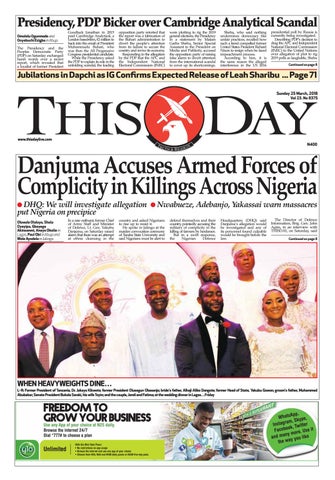
WHEN HEAVYWEIGHTS DINE… L–R: Former President of Tanzania, Dr. Jakaya Kikwete; former President Olusegun Obasanjo; bride's father, Alhaji Aliko Dangote; former Head of State, Yakubu Gowon; groom's father, Muhammed Abubakar; Senate President Bukola Saraki, his wife Toyin; and the couple, Jamil and Fatima; at the wedding dinner in Lagos…Friday
2
T H I S D AY ˾ Ͱͳ˜ ͰͮͯͶ
T H I S D AY ˾ SUNDAY MARCH 25, 2018
3
T H I S D AY ˾ Ͱͳ˜ ͰͮͯͶ
4
RQ $FFHVV 0RELOH $SS %ORFN DQG XQEORFN \RXU FDUGV )RU EORFNLQJ DQG XQEORFNLQJ \RXU FDUG LQ HPHUJHQFLHV DOO \RX QHHG LV \RXU $FFHVV 0RELOH DSS
3HUIRUP TXLFN WRS XSV DQG WUDQVIHUV ZLWKRXW VLJQLQJ LQWR WKH DSS
<28 &$1
0DNH 'RPLFLOLDU\ $FFRXQW 7UDQVIHUV 7KLV VHUYLFH DOORZV \RX PRYH PRQH\ IURP \RXU GRPLFLOLDU\ DFFRXQW WR RWKHU DFFRXQW KROGHUV
<RX GRQ W KDYH WR VLJQ LQ WR VHQG PRQH\ RU WRS XS \RXU SKRQH 6LPSO\ FOLFN RQ 4XLFN 6HUYLFH RQ WKH $FFHVV 0RELOH DSS WR SHUIRUP WKHVH IDVWHU
5HVHW \RXU IRUJRWWHQ 3,1
7KH $FFHVV 0RELOH DSS DOORZV \RX WR UHVHW \RXU 3,1 LI IRUJRWWHQ ZLWKRXW WKH KDVVOH RI TXHXLQJ XS DW WKH EUDQFK
0DNH &DUGOHVV :LWKGUDZDOV
&RQYHQLHQWO\ SD\ PRUH XWLOLW\ ELOOV 3+&1 '679 'DWD /&& WROO IHHV DQG PRUH <RXU $FFHVV 0RELOH DSS LV KHUH WR KHOS \RX WDNH FDUH RI WKHP
7KLV VHUYLFH DOORZV \RX PDNH FDVK ZLWKGUDZDOV IURP WKH $70 VLPSO\ ZLWK \RXU $FFHVV 0RELOH DSS
$OO RQ WKH XSJUDGHG 0RELOH $SS
7+( $&&(66 02%,/( $33 ,6 $9$,/$%/( 21
T H I S D AY ˾ SUNDAY MARCH 25, 2018
5
6
T H I S D AY ˾ Ͱͳ˜ ͰͮͯͶ
RC 103022
T H I S D AY ˾ SUNDAY MARCH 25, 2018
! # $ % % && % & " '
! ( % )* +& , )-.," /0 % & & "
2 "% " % " 1
7
8
ÍşÍ˝Ëœ ͺ͸͚΀ Ëž T H I S DAY, T H E S U N DAY N E W S PA P E R
PAGE EIGHT DANJUMA ACCUSES ARMED FORCES OF COMPLICITY IN KILLINGS ACROSS NIGERIA the DHQ was taking the former defence minister’s comment seriously in view of his personality. Agim said: "We take that statement seriously because of the personality of the person of Gen TY Danjuma. "The military will investigate, and any military personnel that is found to be colluding with the herdsmen would be punished accordingly." Danjuma’s admonition came just as some elder statesmen warned on Saturday that unrestrained killings by herdsmen could undermine the unity of the country. Those that spoke exclusively to THISDAY were a leader of the Yoruba socio-cultural group, Afenifere, Chief Ayo Adebanjo; legal luminary and former Minister of Education, Professor Ben Nwabueze; and a leader of the Arewa Consultative Forum (ACF), Alhaji Tanko Yakassai. Danjuma, who was visibly enraged by the incidences of killings across the country accused the Nigerian Armed Forces of being partisan and colluding with armed bandits to perpetrated carnages across the length and breadth of the country. He said: "When I arrived this arena, I saw rich cultural display, and I was amazed at the rich cultural heritage of our people. Taraba is a mini Nigeria with diverse ethnic groups living together relatively peacefully. But the peace in this state is under assault. "There is an attempt at ethnic cleansing in the state and of course, in some riverine and rural states in Nigeria. We must resist it. We must stop it. Every one of us must rise up. "Our Armed Forces are not neutral. They collude with the armed bandits to kill people, kill Nigerians. The Armed Forces guide their movements. They cover them. If you are depending on the Armed Forces to stop the killings, you will all die one by one.� The philanthropist, who donated N100m to the
university's endowment fund enjoined Nigerians to rise up to defend themselves, saying Somalia would be a child's play if they failed to act. "This ethnic cleansing must stop in Taraba State and other rural states of Nigeria, otherwise Somalia will be a child's play. I ask every one of you to be alert and defend your country, defend your territory and defend your state. Defend yourselves because you have no other place to go...God bless our country," he said. Danjuma's comment is coming on the heels of allegations of complicity raised against Army personnel involved in Exercise Ayema Kpatuma (Exercise Cat Race) by communities in the Southern zone of Taraba State, particularly in Ussa and Takum Local Government Areas including Yangtu Developmental Area. Speaking in separate interviews, the Chairmen of Ussa and Takum, Mr. Rimansikwe Karma and Mr. Shiban Tikari respectively, accused the army officials of brutality, extortion and colluding with herdsmen to displace rural dwellers and take over their farmlands. They said they had received several complaints of molestations, tortures and extortion of innocent victims, from their constituents. One of those extorted, according to them, was a widow, Mrs. Jummai Andeyaba, whose N150, 000 got missing after soldiers on the exercise allegedly stormed her residence in search of arms and ammunitions. According to Tikari: "It is sad to note that the soldiers of Excise Cat Race are harassing our people in the towns, while herdsmen are attacking and killing others in the rural communities. "We expect the soldiers to go into the bush and help us flush out killer herdsmen and kidnappers instead of beating up people in the town. "The herdsmen that are
coming into our community now with machine guns are not the traditional herdsmen we know and lived with over the years, I suspect they may the released Boko Haram members." Also speaking in the same vein, Karma said: "The operation was causing more harm than good to the council. The soldiers were searching peoples’ houses and seizing knives, cutlasses and harassing them while heavily armed herdsmen were burning houses and killing our people. "The herdsmen that followed the army to our council are not friendly with our people, they are strange faces to us and they are killing people." Meanwhile, perturbed by growing insecurity in different parts of the country, prominent Nigerians, on Saturday, warned of impending danger to national security as it appeared that the spate of killings by herdsmen might have overtaken those by the Boko Haram terrorists in recent days. In separate exclusive interviews with THISDAY, these prominent opinion leaders hinged their positions on some of the reported killings by herdsmen in the last few weeks and expressed worry that if such continues, then, national security might not just be compromised, Nigeria herself would slip off the precipice. Nigeria’s foremost constitutional lawyer and Chairman, Southern Leaders of Thought, Prof. Nwabueze, grieved at the devastating activities of herdsmen, which he said had claimed over 600 lives and displaced thousands between January and March of this year alone, warning that the killings were capable of bringing the nation down if not arrested decisively. According to him, the herdsmen killings had two fundamental objectives, which were tailored “to re-establish political hegemony and religious supremacy based
on the religion of Islam with its peculiar ideology,� even as he expressed disappointment at the failure of the federal government to arrest the situation. Nwabueze further lamented the consequence of the herdsmen violence for the country’s national security and unity, noting that all the killings and the inability of the federal authorities to arrest and prosecute suspects could further “complicate the problem of the National Question.� Maintaining that the killings showed why the unity of Nigeria was still problematic, he maintained that the herdsmen invasions evidently complicate the problems of Nigeria as a state. He said: “Nigeria as a state has been classified as a failed state. The Google Failed State Index ranked Nigeria the 15th worst failed state in the world. “Nigeria is a state where over 600 citizens were killed between January and March alone. Nigeria is a state where thousands of citizens were displaced between January and March alone. That is serious security failure, which portends danger to our national security and national unity. It is capable of bringing down this country.� Faulting the defence by federal government officials who described the herdsmen-farmers conflict as mere communal clashes and those who likened the killings to ethnic cleansing, the constitutional lawyer reiterated that it was sheer misconception or misrepresentation to describe herdsmen-farmers conflicts as communal clash. “It is not communal in nature at all. And it cannot be communal, because Fulani herdsmen do not constitute a community, a community being a group of people living together in the same locality under the same laws and regulations,� he argued. Rather, he said the Fulani herdsmen “are itinerant
PRESIDENCY, PDP BICKER OVER CAMBRIDGE ANALYTICAL SCANDAL said Buhari would never be part of any plot, which undermines democracy, citing various elections conducted since he assumed office as evidence. He also said the outbreak of Cambridge Analytical scandal showed that PDP lacked any moral right to make allegation of rigging, advising the party to rather work hard to win the people's trust instead of engaging in false accusation. Shehu said: “Nothing undermines the country's democracy such as unfair practices. That is why President Nixon resigned to avoid impeachment when they hacked into the opposition, Democratic Party’s records; and this is why a Special Counsel is investigating the alleged Russian interference in the US presidential election, and if President Donald Trump’s campaign is complicit in the attempted subversion of democracy in that country. “The PDP’s decision to drag the All Progressives Congress (APC) and INEC to the United Nations over alleged plan or plot to rig the 2019 general elections are not only laughable and puerile, but they also demonstrate the level of desperation that is haunting the opposition leaders. “President Muhammadu Buhari is passionately committed to free and fair elections in the country and for a man who joined forces with local and international observers to ensure a free and fair election, which brought him
to power in 2015, the president would under no circumstances tolerate any attempt to derail constitutional democracy. “The outcome of the gubernatorial elections in Edo, Ondo and Anambra States stand as clear examples of President Buhari’s commitment to free and fair elections in the country, and Nigerians should indeed be wary of PDP’s desperate propaganda. “For the PDP to be preaching free and fair elections is like a street-walker preaching about chastity. “We must recall that the PDP postponed the 2015 general elections in the guise of national security challenges because defeat was staring it starkly in the face. Despite the delay tactics, it was resoundingly defeated when the polls finally held. “The PDP has lost every moral ground and it is mortally afraid of facing the 2019 general elections because Nigerians will always remember their past and punish them one more time for economically plundering the country. In its reaction, the PDP the Presidency for falsely accusing it of hacking into Buhari’s personal data in the run up to the 2015 general election. It said the president’s handlers decided to concoct the fabrications just to divert public attention from the overwhelming national and international rejection of his administration, particularly the Bill Gates’ verdict on the
economy. The party’s National Publicity Secretary, Mr. Kola Ologbondiyan, in a statement, said the Presidency, in its haste to dish out lies, failed to realize that contrary to its claims, the report they relied upon did not even mention the PDP or any of its officials and that it even exonerated Jonathan as having no knowledge of the alleged scam. The PDP said: “Since the PDP has never been involved in hacking into any person’s data, we decided to peruse the documents and publications in the UK Guardian, relied upon by President Buhari’s Senior Special Assistant, Mallam Shehu Garba, only to discover that none of them alluded to any involvement of the PDP or any of our officials or members, directly or indirectly of being in any way whatsoever a part of the said saga. "It is incontrovertible that the documents had clinically stated that, ‘there is no suggestion that Jonathan knew of the covert operation.’ Nigerians must therefore be shocked at the extent the Buhari-led presidency can go in its penchant for beguiling, contrivance, deceit, fabrication and lies. "Like a bunch of famished broom, it is clear that the sinking Buhari presidency has become desperate in its bid to divert public attention from its multifarious failures and damning verdicts from national and international figures.
“Furthermore, it is laughable for the Presidency to say that the PDP is afraid of elections. This is the same Presidency that recently informed Nigerians that President Buhari was delaying his declaration for 2019 for fear of political opponents. “Who is afraid of election? Is it the PDP or the President’s All Progressives Congress (APC) that has failed to conform with its constitutional provision of constituting a Board of Trustees (BOT); a party, which is so afraid to conduct even internal election and had to extend the tenure of its executives because its stuck 2019 presidential candidate is even afraid of other possible contestants within its fold? "From the actions of the APC, it is manifest that the party is not only mortally afraid of elections but engaging in all manner of shenanigans to suppress opposition in our nation. "Nigerians are aware of the show of shame in Kano state, earlier today, when the APC Federal Government, out of fear of our soaring support from Nigerians, used the police to attack our members and stopped our mega rally in Gaya Local Government Area of the state. "Our message to the Presidency and the APC is that lies, propaganda and use of force will not save them from the looming electoral disgrace as Nigerians are tired of their misrule and are now rallying on our repositioned PDP to salvage our nation come 2019.�
herdsmen roaming all over the country with their cattle. Farmers, on the other hand, are a community of people living in various states of the federation on land that belongs to them from time immemorial,� saying unlike farmers that constitute communities across various states of the federation, Fulani herdsmen “only belong to and represent a tribe or ethnic group in Nigeria – the Fulani ethnic group; they are everywhere in Hausaland.� While making lucid the distinction, he said it was “important to help appreciate that we are not dealing with communal clash at all, but with something more serious – the National Question – something concerning the over 300 tribes or ethnic groups in Nigeria, of which the Fulanis are one, and how to coalesce all of them into one.� Another leading voice in Nigeria, a prominent member of the pan-Yoruba socio-political organisation, Afenifere, Chief Adebanjo, was not hopeful that there could be any meaningful improvement to the situation under the current administration of President Muhammadu Buhari. He said: "I am annoyed with you people (media). The president is aiding and abetting the thing (herdsmen attacks) and you are all side-tracking to condemn him. He is one of the patrons of herdsmen. They wrote to him that they (herdsmen) are doing this and he has not done anything, and he has been supporting them from years back. “He went to Lam Adeshina in Ibadan, before he died, when he was governor in Oyo State, to complain that they were troubling his herdsmen. How can you now say the man doesn't know?� Asked what he thought could be the way out of the quagmire, Adebanjo retorted: "The way out is for him to come out to say he is no longer supporting them. How can you say people are killing people in day light and there is no arrest? We have security; we have Army and we have Police. He gave an instruction in January, he didn't know it was not obeyed in March and his Inspector-General of Police is still there. What other way to condone is more than that? "They killed them in Agatu; they went back again there, not a single word of sympathy. It happened in Adamawa; all over the country. At a time they denied that they are not Fulani. Remember, at the beginning of this thing (herdsmen attacks) they were saying 'why are you calling them Fulani; that they are coming from another country? "Under normal circumstances, law and order would have broken down in Nigeria and Buhari must be told. How many people did IPOB kill before he declared them as terrorists? They are people who are shouting for their own autonomy in their own territory. He didn't hesitate to declare them as terrorists but these are people that are known now - they are all over the country. "If you see the video of how they kill people; are they human beings!? After killing them, then they shock them like animals. Have you seen the video? Or the government has not seen that? Is it not a shame to be connected with such kinds of people? No decent man will like to live with such kinds of people and yet, there is no rounding up of any group. If they had been rounded up on one occasion, it would not happen again. "And the question is, as
Commander-in-Chief and the Chief Security Officer, where do these cattle people get their arms from? Is AK 47 an instrument of cattle rearing? Why are we all deceiving ourselves by pretending?� On whether it is a hopeless situation for Nigeria, Adebanjo, who has hit 90 years, said: "Well, I will say it is a hopeless situation, because people like me warned you against Buhari. What is happening now, I said so before and he said all that happened then was during the military. The man has no respect for the rule of law. How many times has he disobeyed court orders? He obeys the ones he likes." Speaking also on the issue, politician, right activist and erstwhile liaison officer to former President Shehu Shagari, Alhaji Tanko Yakassai, was somewhat hopeful that if the administration would seek relevant opinions from stakeholders and put them to use, the situation could be reversed. He said: "Whatever problem you find yourself in, it is either you generate mechanism to deal with it or you invite wide range of opinions to galvanise and get them to develop some ideas as to how to handle the problem. "My opinion is that since this thing (herdsmen violence) has persisted for so long like Boko Haram. I think the government ought to organise a stakeholders meeting involving the farmers, herders, the governors, National Assembly, academics, political class, traditional rulers and public opinion moulders, like you the media people. You will put them together. "You see, the tradition in governance is that – this is why the president is required to do a state-of-the-nation address and therefore, the members of the National Assembly will debate the address. During the debate of various aspects of the address, ideas are generated. There will be 1000 ideas out of which you can get 10, 20, 100 concrete ones that you can pick and apply them to solving the problem. "So, my opinion is that it is not too late for the government to now organise a stakeholders meeting comprising all the people I mentioned before, including students, women – all of them. Let them generate ideas and put those ideas to writing by way of summary of the debate. "The government will set up a small committee to sample these ideas, and advise the government on which ones are practicable. I think we will be able to get some ideas. Then we can have trajectory emerging from the discussion. This is my thinking, because it is a problem, including the problem of Boko Haram that we are yet to find solution to.� Sometime in January, renowned playwright, Prof. Wole Soyinka, had said the federal government was responsible for the wanton killings perpetrated by Fulani herdsmen in the country. In a statement titled, ‘Holy Cow: Impunity Rides Again,’ Soyinka said the government was “looking the other way� as the herdsmen went on the rampage across the country, insisting that, “Yes, indeed the government is culpable, definitely guilty of ‘looking the other way. Indeed, it must be held complicit.� According to the Nobel Laureate, history was repeating itself with the herdsmen’s case, noting that Boko Haram was still at that stage of “putative probes, when cries of alarm emerged.�
T H I S D AY ˾ SUNDAY MARCH 25, 2018
9
10
MARCH 25, 2018 ˾ T H I S D AY, T H E S U N D AY N E W S PA P E R
SUNDAY COMMENT
Editor, Editorial Page PETER ISHAKA Email peter.ishaka@thisdaylive.com
ISSUES IN THE RETURN OF DAPCHI GIRLS The security agencies could do more to safeguard the people
W
100 girls without asking for anything in return? If, as President Muhammadu Buhari and his officials repeatedly claim, Boko Haram has been ‘technically defeated’ and every inch of Nigerian territory restored under effective federal control, how come that these terrorists are still roaming freely unchallenged in the North East? Besides, it ought to concern the federal government that the motorcade of Boko Haram that returned the girls to Dapchi was hailed into and out of town by jubilant residents.
hether voluntary or induced, the return of the Dapchi school girls by their captors is a welcome development. While we rejoice with the families of the freed girls and commiserate with the families of those who lost their loved ones to the madness, we must also point out that the manner in which the whole episode was handled by the federal government raises several questions. Even then, the authorities must interrogate the circumstances surrounding the death of five of the girls while everything must be done to ensure the return of the one still held back by Boko Haram on account of the Ininformingcitizens aboutissuesofpublic refusal to renounce her Christian faith.
good,government mustbecredible, sensibleand minimallylogical.Ina democracy,themost unpardonablecrime agovernmentcan commitistoinsultthe intelligenceoftheelite asthisgovernment hasdoneseveral times.Thatexplains whymanyNigerians arecynicalaboutthe officialversionof whattranspiredinthis sordidDapchisaga
In disputing media reports that ransom was paid to secure the release of the girls, Information and Culture Minister, Alhaji Lai Mohammed said: “It is not true that we paid ransom for the release of the Dapchi girls, neither was there a prisoner swap to secure their release. What happened was that the abduction itself was a breach of the ceasefire talks between the insurgents and the government, hence it became a moral burden
on the abductors.” The questions arising from that claim are many and some of them include: When did criminals, which we insist the Boko Haram insurgents are, start to develop ‘moral burden’? At what point did the federal government enter into a ceasefire agreement with Boko Haram and what is the nature of this ‘truce’ given the potentially explosive case of Leah Sharibu who was left behind with the insurgents? What terrorist gang will let go of over
Letters to the Editor
T
I
S U N DAY N E W S PA P E R EDITOR BOLAJI ADEBIYI DEPUTY EDITORS VINCENT OBIA, OLAWALE OLALEYE MANAGING DIRECR ENIOLA BELLO DEPUTY MANAGING DIRECTOR KAYODE KOMOLAFE CHAIRMAN EDITORIAL BOARD OLUSEGUN ADENIYI EDITOR NATION’S CAPITAL IYOBOSA UWUGIAREN
T H I S DAY N E W S PA P E R S L I M I T E D EDITOR-IN-CHIEF/CHAIRMAN NDUKA OBAIGBENA GROUP EXECUTIVE DIRECTORS ENIOLA BELLO, KAYODE KOMOLAFE, ISRAEL IWEGBU, IJEOMA NWOGWUGWU DIVISIONAL DIRECTORS PETER IWEGBU, ANTHONY OGEDENGBE DEPUTY DIVISIONAL DIRECTOR OJOGUN VICTOR DANBOYI SNR. ASSOCIATE DIRECTORS ERIC OJEH, PATRICK EIMIUHI ASSOCIATE DIRECTOR SAHEED ADEYEMO CONTROLLERS ABIMBOLA TAIWO, UCHENNA DIBIAGWU, NDUKA MOSERI DIRECTOR, PRINTING PRODUCTION CHUKS ONWUDINJO TO SEND EMAIL: first name.surname@thisdaylive.com
f there is anything that the current administration is yet to understand, it is that accountability in government is not just about dodgy book keeping or dishing out cheap propaganda. In informing citizens about issues of public good, government must be credible, sensible and minimally logical. In a democracy, the most unpardonable crime a government can commit is to insult the intelligence of the elite as this government has done several times. That explains why many Nigerians are cynical about the official version of what transpired in this sordid Dapchi saga. While we give the federal government the benefit of the doubt on the claim that no money was paid Boko Haram to secure the release of the girls, we nonetheless state very clearly that appeasement and negotiation with terrorists as an official policy devalues the state. Once terrorists and their sponsors know they can easily arm-twist a government, they have a ready source of money with which to reinvest in new arms supplies for the next escapade. In societies where governments negotiate and pay ransom for kidnapping, the insurgency label is not only a selling point for organised crime, it can also become self-perpetuating. More disturbing is that repeated attacks on schools by the insurgents have created fear in many vulnerable students and their parents and is affecting the attitude to education with Boko Haram (whose guiding philosophy is ‘western education is sinful’) winning the psychological war. So emboldened were the insurgents who returned the abducted Dapchi girls that they took time to lecture their parents never to send the children back to school. Yet, according to the United Nations Children’s Fund (UNICEF), when children are denied opportunity for education “not only are their lives shattered, the future of the nation is stolen.” While we urge a quick resolution of the Leah Sharibu dilemma, what the Dapchi tragedy has shown very clearly is that the insurgents still possess sufficient capacity to capture as many of our school girls as they want, which then means we have left our children at the mercy of violent predators who hide under the guise of Islamic religion to perpetrate evil.
TO OUR READERS Letters in response to specific publications in THISDAY should be brief (150-200 words) and straight to the point. Interested readers may send such letters along with their contact details to opinion@thisdaylive.com. We also welcome comments and opinions on topical local, national and international issues provided they are well-written and should also not be longer than (950- 1000 words). They should be sent to opinion@thisdaylive.com along with the email address and phone numbers of the writer.
INEC And Election Reordering Bill
he bill of the parliament seeking to reorder the sequence of elections which intriguingly hit the brick wall remains confusing. President Muhammadu Buhari recently withheld his assent over purported conflicts and interference in the administrative duties of the Independent National Electoral Commission (INEC). Statutorily, powers to make laws for the federation are vested in the National Assembly; nonetheless, the powers are relative and not absolute. Some argue that if the legislature has powers to make laws, it can also amend the laws. No doubt, this is factual but also largely systematic. It is trite that acts of a parliament have a red line. Thus, the reordering bill if vetoed will prima facie become laws, though defective. However, the position may likely be altered by a judge’s gavel on account of inde-
pendence of the electoral body as provided in Section 158 of the 1999 Constitution of the Federal Republic of Nigeria, as amended. Generally, democracy is a game of numbers and the same principle guides legislative tasks. Nonetheless, the benchmark of quality in lawmaking is the repugnancy test. For example, a bill albeit endorsed by majority as required may in the end not see a green light if convincingly repugnant to social justice, equity and good conscience, as the ultimate lawmaker is the court. Hypothetically, a barbaric law seeking to eliminate newly born-twins as in the olden days though may have been successfully passed and vetoed with two-thirds majority will inevitably be knocked out by the court. It is therefore imperative to underline that legislative matters go beyond numbers but alongside prudence,
realism and reasonableness. By the controversial bill, it implies that where a particular election is postponed over critical unpredictable circumstances or annulled for a repeat over fundamental flaws by the court, all other elections will be annulled since elections must hold as ordered. What a blunder! The second element is the object or purpose of a bill. A bill that is deficient in goals and objectives is good-for-nothing. It is insufficient to hit the gavel over numerical strength in support of a bill. Emphatically, bills must be devoid of conflicts with existing laws. Where such occurs, even if overwhelmingly endorsed alongside all ECOWAS parliaments, the court will notwithstanding, inevitably set it aside. Primarily, a bill seeking for amendments must show clearly the mischiefs it intends to remedy.
Incidentally, the contentious reordering of elections, perceptibly, lacked any clear objectives. Above all, it is conventionally the administrative duties of the electoral umpire to plan and conduct elections globally. The constitution repetitively, generally guides INEC on the salient issues vis-à-vis time of elections in Sections 132, 76, 178 and 116 for President, National Assembly, governors and House of Assembly respectively. The powers vested in the National Population Commission (NPC), a comparable body to make appointments in Section 158(2) supra commonsensically extends to INEC by rules of ejusdem generis, that is; same classification in the preceding subsection. Literarily, appointments include schedules and arrangements of events. As a matter of fact, even if INEC elects to review the draft-timetable over and over, perhaps to schedule National Assembly election as the last in sequence, it is absolutely within its powers and
no institution can query it. Electoral umpires are strictly independent and any attempts to interfere into its affairs will be ultra vires. INEC has unfettered powers to present any timetables approved by the commission apart from complying with the above cited necessary minimum period prior to elections as no harm is done to any candidate or political party on who contests first, middle or last. Certainly, the court cannot allocate its precious times to aimlessly sit over who contests first or last. The National Assembly (NASS) for example, by act of parliament established federal universities whilst National Universities Commission (NUC) accredits academic programmes and provides coursecontents and guidelines. However, neither NASS nor NUC has powers to produce examination timetables for students but university’s management. –– Carl Umegboro, Abuja
T H I S D AY ˾ SUNDAY MARCH 25, 2018
11
12
T H I S D AY ˾ Ͱͳ˜ ͰͮͯͶ
T H I S D AY ˾ SUNDAY MARCH 25, 2018
13
14
Í°ÍłËœ Í°ÍŽÍŻÍś Ëž THISDAY, THE SUNDAY NEWSPAPER
OPINION Buhari’s Albatross In 2019 Buhari’s trump card for the 2019 election is weak opposition, contends, Nnamdi Ebo
“A
lbatross� is a metaphor used to describe a constant and inescapable burden, a psychological burden that feels like a curse. It is a source of frustration or guilt; an encumbrance. President Muhammadu Buhari ran his 2015 Presidential campaigns on a three-pronged platform: “Economy, Security and Anticorruption� (ESA). The last platform was built around his image as a staunch anti-corruption fighter and his incorruptible and honest reputation. In a country massively populated by politicians who are criminally-minded, fraudulently-disposed and latently-deceptive, Buhari’s reputation was likened to that of an angel. As 2019 looms, nobody knows whether the president will contest. If he decides to run, he will emerge as the presidential candidate with the most constant and inescapable burden on the campaign trail. It is unlikely that the presidency is unaware that the president has an inescapable burden, a duty, to explain the success or failure of his three-pronged ESA platform to the Nigerian people, come 2019. It is a given that angels are supposed to do angelic things. Has Buhari done angelic things? Many pundits contend that an angel can only do angelic things if the angel is surrounded by fellow angels. Is Buhari surrounded by fellow angels? How this administration came to power must be examined before any postulation on angelic deeds. Major Gen. Muhammad Buhari (rtd.) came to power on a multi-layered, multi-dimensional, multidifferentiated, multi-faceted and multi-partied platform glued together by very strange bedfellows – with the sole purpose of sending Dr. Goodluck Jonathan back to Otueke. It will be recalled that the angel had craved Aso Rock three times before. Under such despairing cravings, who cares about angelica with its aromatic smell? The abodes of the strange bedfellows were devoid of angels – just fellow travellers. It is unfortunate that an angelic candidate cannot make it to Aso Rock without political influencers, ardent followers and stalwart supporters. The truism that you get what you pay for is apt because the strange bedfellows were not non-profiteering angels. They were angel investors. How has ESA faired? On the economy, an attractive choice to many Nigerian voters because of his perceived incorruptible character, Buhari may have disappointed many who voted for him in 2015. In
his first year in office, Nigeria suffered a decline in commodity prices triggering economic slowdown. In order to close shortfall in revenue and fund an expansionary capital budget, Buhari travelled to many countries seeking loans. Naira depreciated in the black market creating a gulf between official exchange rate and black-market rate. In 2016, the economy tanked leading to inflation. From 2017 to the present, recession enveloped Nigeria and the economy fell into a comatose state impoverishing millions of Nigerians, while federal lawmakers maintained their first position as the most overpaid and underworked legislature in the world. On security, Boko Haram had a mini-Islamic State with its own captured territories. In his inaugural speech, Buhari ordered the army boss to relocate to Maiduguri signalling a shift in the war against Islamic insurgency in the northeast. Boko Haram started losing captured territories (“caliphates�). The war progressed and both the military and the presidency claimed success. It was short-lived, as the terror group started hit and run and suicide bombings. Conflicting claims of defeating and/or degrading Boko Haram surfaced. Most of the 110 “Abducted� DapchiGirls were released in mysterious and controversial circumstances by Boko Haram (similar to “ChibokGirls conspiracy theories�) with the terror group allegedly acting out a script. Fulani herdsmen marauded with impunity hitting the mark with the Benue massacre. As a result of the callous indifference and lukewarm response to the Benue tragedy, Buhari’s APC lost the Middle-Belt in the equation for 2019. On anti-corruption, Buhari constituted the Presidential Advisory
Grading ESA, 2015-2018, Buhari scored the following: economy, three over 10; security, five over 10; and corruption, two over 10. From dialectical reasoning, it becomes clear that Buhari cannot bring up economy, security and anti-corruption campaign slogans on which his 2015 successful campaigns were hinged
Committee Against Corruption (PACAC). PACAC commenced work on August 10, 2015 with the mandate to, inter alia – promote a reform agenda on the anti-corruption effort, advise the administration in the prosecution of the war against corruption and implement required reforms in Nigeria’s criminal justice system. Anti-corruption agencies began clampdowns with accusations of crackdowns on opposition elements. The anti-corruption crusade stalled with lingering court cases and EFCC couldn’t secure any high-profile conviction. Alleged corrupt political/bureaucratic elite, either out of power, in power or walking the corridors of power survived and the anti-corruption crusade lost its luster. Grading ESA, 2015-2018, Buhari scored the following: economy, three over 10; security, five over 10; and corruption, two over 10. From dialectical reasoning, it becomes clear that Buhari cannot bring up economy, security and anti-corruption (ESA) campaign slogans on which his 2015 successful campaigns were hinged. This is because the three-pronged platform has collapsed under the weight of economic depression, wanton insecurity and ineffective anti-corruption crusade – epitomised by hungry Nigerian masses; unrestrained Fulani herdsmen killings; and pervasive corruption, respectively. The president has few and far between catchy recruiting slogans to choose from, for his 2019 presidential campaigns. With elections due in February 2019, Buhari’s trump card is weak opposition. The PDP remains divided, scarred by past voter anger, stoking calls for a third force. This administration is overseeing the most severe economic slump in 25 years, failing to end security threats and unable to stop daily power cuts and fuel shortages – enough shortcomings for a landslide electoral defeat at the 2019 presidential election. Surprisingly, there’s no sign of a significant opposition threat. PDP has not been able to shake-off the perception of a fundamentally corrupt party built on rent-seeking. That the socalled third force can organise successful campaigns across 36 states is a tall order. As a result of inept opposition, Buhari may yet win the 2019 vote. Again, no Nigerian politician can match Buhari’s enduring cult-figure image in his core-north base – an advantage. However, if he persists on using economy, security and anti-corruption as his campaign slogans, again, it will not sell. ESA has become an encumbrance, Buhari’s albatross in 2019. –––Ebo is a political scientist and lawyer
The Case for Local Police The time is ripe for Nigeria to reintroduce the local police, argues Bukar Usman
M
aybe the best way to start making my case for local police is to remind us that local and independent police formations once existed in Nigeria before their integration into the Nigeria Police Force (NPF). And going by the low rate of crime and the communal peace generally experienced across the nation in those days, the local police formations, from the benefit of hindsight, can be said to have performed better than its unitary replacement, the Nigeria Police Force. The NPF is one of those experiments Nigeria embarked on as an extension of her interpretation and application of the uneasy concept of federalism. Several years after, with corruption and criminality threatening the peaceful co-existence we once took for granted during the era of the local police, isn’t it time we jettisoned the NPF experiment? As an experiment, the NPF has outlived its usefulness. The time is ripe for Nigeria to reintroduce the local police. Please note that I use the term “local police� for lack of a better expression as “state police� currently seems to evoke considerable anxiety in the minds of some people. Such people can’t imagine how such awesome coercive instrument as state police could be reposed in the hands of our powerful executive governors. Whichever name we give it, let us decentralise the policing of the country by reintroducing local police forces as they are naturally in a better position to police their familiar environment. I must confess that I am somewhat nostalgic about the local police as I cast my mind back to the days of the Native Authority police of the 50s and 60s. As a primary school pupil in my home town, Biu, I had admired, from a distance, the strict duties of the “Charge Office,� the revered name the local divisional police headquarters in Biu was called by the local folks. The “Charge Office� occupied one end of the “Central Office,� which was simply a mud building with only a couple of offices to house the police establishment. Only the chief warder, the local police head, had a secluded office; the other ranks merely reported to the Duty Room to be deployed to their beats. “You are not obliged to say anything but whatever you say may be taken into evidence and may be used against you.� Those words were written in chalk on the blackboard in the charge office, a practice in human rights awareness one hardly sees these days in NPF police posts. The local police considered themselves members of the community they were policing. Indeed, those were the days of community policing in the real sense. The police went out of their way to add value to the community. For
instance, in emergencies such as fire outbreak or escape of prisoners, they blow the eerie bugle alarm and the whistle to alert the people of danger and mobilise communal assistance. The police constable on duty also doubled as the time-keeper for the township as he hourly struck the iron gong once, twice or thrice... according to the hour. The sound resonated throughout the town and helped those who had no time piece to be mindful of the time. Many people found that police iron-gong sound more helpful than the alternative practice of relying on the movement of the sun to know the time of the day. The police were only a handful. Every Monday morning, neatly dressed, they mounted parades, inspected by the royal father, in front of the Emir’s palace. I saw no barracks. Every one of them was accommodated in their houses among other members of the community. Their operational tools were also simple and bare. The main ones appeared to be a baton and a shield made from bamboo-like material with which they practised crowd control. They had no vehicle. Police expenditure was minimal; yet, the local police was effective in policing the community. We slept literally with our eyes closed. We had mainly petty thieves. We also had occasional cases of burglary, assault and elopement. There were a few daring robbers, the most notorious of whom was Malam Gulani. He operated in the style of the legendry Robin Hood, but he was tracked down by the local police. News of the police nabbing that elusive robber brought relief to the community. That was the era of community policing at its best: simple, inexpensive and yet effective. Some of the dare-devil crimebusters among them operated with so much bravado. They struck terror in people to believe they were bullet-proof and iron-proof or even invisible and invincible. The local police operated largely in that manner until they were fully integrated in 1972 into the country-wide force called the Nigeria Police Force. Subsequent developments saw the NPF structured into zone, state, area and divisional commands, with the smallest administrative units being the local police stations. This arrangement subsists today, but is it serving the nation well? In view of the general state of insecurity in the country, there have been calls for a review of the current manner of policing the nation. The suggestion for the creation of state police, which for long has been on the card, has been revived. Apparently in response to this, during a recent visit to Kwara State, the president was quoted as saying that it was the consensus at the National Council of State that state police should not be allowed
until our political development reaches the stage it would not be abused. Shortly after, the Governor of Yobe State reportedly said that only two of the state governors voted for state police when the proposal was put before the Nigerian Governors’ Forum. The position of the state governors was particularly surprising. I am of the strong opinion that in spite of these high-level reservations, there is need for a serious review of the current policing arrangement in the country. Population is growing by leaps and bounds. There is no way effective policing can be assured by the current unified system which, to a large extent, violates the principle of federalism we all profess. And it is questionable to say that state or local police will be more open to abuse than the current unified system. Nor should the state or zone structure of the NPF be considered alternatives to local or state police. The present zone structure of the Nigeria Police Force, which incurs heavy administrative overheads, merely provides promotion posts, as decision-making is still largely centralised. There are two main arguments against state police: the fear of political vendetta; and the natural resistance to loss of territorial power by the NPF police establishment. But it is high time these and other excuses advanced over the years gave way to effective policing at the grassroots, the lack of which is responsible for the proliferation of armed groups across the country. Putting a high premium on the vital place of “local knowledge� in any effective fight against crime, the Babangida administration initiated the practice of deploying certain levels of policemen to their ethnic, linguistic or cultural areas. I am not sure the police sustained that initiative. State police should be instituted and the sooner the better. For sure, some interests may be inconvenienced. However, on balance the security of the generality of the community will be better assured, and the risk is worth taking now. Delay would result into greater loss of lives and properties as our security situation deteriorates further. Given its current revenue challenges, the federal government’s ability to provide adequate decent barracks as well as the logistic needed to sustain the unified police structure appears to have significantly diminished. –––Dr Usman, a retired Federal Permanent Secretary in the Presidency, wrote from Abuja (See concluding part on www.thisdaylive.com)
15
T H I S D AY, T H E S U N D AY N E W S PA P E R ˾ MARCH 25,2018
LETTERS A NATION SADDLED BY CORRUPTION AND STEALING
W
hen former President, Dr. Goodluck Jonathan affirmed a few years back that “corruption is not stealing”, he was crucified and vilified. Perhaps, among other things, that statement cost him the presidency. Also, once upon a time, a former British Prime Minister of Britain referred to Nigeria as “a fantastically corrupt nation”. Angered, by this declaration, many came out to condemn the former prime minister’s frank assessment of our country’s corruption status. As if to further validate the truth about the nation’s corruption situation, the Nigeria’s National Bureau of Statistics’ recently reported that a total sum of N400 billion is spent on bribes each year since 2015. According to Transparency International’s Corruption Perceptions Index (CPI) for 2014, Nigeria is up eight places to 136 out of 175 countries ranked by the index. As a matter of fact, Nigeria shares 136th position with well-known corrupt countries like Cameroon, Kyrgyzstan, Iran, and Lebanon The CPI ranks countries on a scale from 0 (perceived
Magu, EFCC Chairman
to be highly corrupt) to 100 (perceived to be very clean). More than two-thirds of the 175 countries surveyed, including Nigeria, scored below 50. Nigeria is clearly not the country with the lowest score on the index (its score was 27%), but according to Transparency International, any country that scores below 50% on the index is still considered
“highly corrupt. Stealing is just one of the branches of corruption just like gynaecology is a branch of medicine. Corruption is an abuse of power; it is the father of stealing. Werlin described corruption as the “diversion of public resources to non-public purposes,” in which the public office holder illegally appropriates public resources for personal use.
Earl J. Friedrich called corruption a deviant behaviour associated with selfish gains at the public expense. In Nigeria, corruption manifests in diverse ways. For instance, it could come in the garb of a policeman demanding for bribe from offenders or a public officer trying to cut corners in awarding a public contract or even a religious leader or body soliciting for favour from public office holders towards building a mega cathedral. Corruption in Nigeria is a national culture, a way of life that has been endorsed by institutions and supported by all and sundry. It does not matter how you make your money in the country whether you are a drug baron or ex-agitators, traditional rulers would offer you chieftaincy titles, religious leaders will offer you prominent roles and even make prominent mention of your name from time to time as a pillar in the ‘House of God’. Among all countries of the world, the cost of construction of road in Nigeria is the most expensive. A careful assessment of road projects in Nigeria shows that averagely a kilometre of road costs N1bn. Road projects
Lagos EnvironmentAnd Public Health
T
he waste reengineering processes which commenced in 2005, at the tailend of Asiwaju Bola Ahmed Tinubu’s administration, through Governor Fashola’s tenure, was quite successful to a large extent in changing the face at the environment in the ‘Centre of Excellence’. Like an Eagle, the Akinwunmi Ambode administration decided to rejuvenate the system. This is partly what gave birth to the promulgation of the Lagos State Environmental Protection Law 2017, which established the Cleaner Lagos Initiative, concessionaire domestic waste, street sweeping and landfill management services, while the Private Sector Participants (PSPs) retain commercial waste collection services. The law equally delegated oversight of waste management sector to the Ministry of the Environment (MOE), Lagos Waste Management Authority (LAWMA) and Public Utilities Monitoring and Assurance Unit (PUMAU). To ensure holistic waste management services with local import, whilst also meeting the state’s policy on employment, the government, through the group’s partner, Messrs Visionscape Nigeria, employed 27,000 community services workers for street sweeping, partnered local truck manufacturers and builders, as well as interested local waste-management
companies and commenced the process of integrating certified waste operators through its association, in order to widen the level of collaborative waste collection and employment. Waste management is a collective responsibility of government and residents with worthy principal being prepared to set the pace. To induce public and corporate participation, therefore, the government had to introduce covered waste collection bins for households, commercial properties, roads and streets wastes, and distributed some onto the highways, under the tenement and public-waste collection arrangement. This is with a view to capturing, at different levels, solid and flight wastes, prevent indiscriminate waste dumping, prevent stench and odour, guarantee aesthetics for the environment and, confer good health and reduced mortality-rate of the state, its indigenes and visitors, alike. Governance is a social contract between government and the governed. Hence, committing public fund into the environment is to challenge the general public and corporate bodies towards responsible waste disposal; as they owe the society and its environment that responsibility, of cooperating and ensuring proper patronage and adequate usage of the waste facilities, under the social contact. The success of any institution resides more in the viability of its human and material resources, just as
promotion of a clean, aesthetic and healthy environment is strategic to attaining sound and sustainable health for the people. And, except mutual collaboration is deliberately and jointly ensured by all the stakeholders in the environment, improper management of waste could rob-off negatively on the people’s lifespan. In fact, it could lead to public-health issues, which could give birth to epidemics, ill-health and death. It is, thus, imperative that all stakeholders, namely government, residents, corporate bodies, visitors, NGOs, CDA/CDC, the media and general public, should lend a hand and cooperate with each other in the management of the waste stream, including marine waste; in the interest of the health and wellbeing of people and the society. Instructively, every individual resident and corporate body owe the society and its environment the responsibility to monitor and do away with “the not in my backyard syndrome”; as such would not only complement government monitoring, but would help to eradicate indiscriminate waste dumping, prevent emergence of waste blackspots within the community and guarantee good health for all, including visitors. It will equally reduce mortality or death rate, bequeath an aesthetic environment and ensure a better tomorrow for the children. We equally owe the society and the environment adequate
and prompt payment for services, in order to ensure maintenance and sustainability of infrastructure provided for the welfare of indigenes, corporate bodies and visitors to the state. The implication is that any support, collaboration or cooperation given to the government in the management of the environment, especially in the area of waste collection and disposal, is a collaboration and cooperation with our health, our life and our future. For the environment to adequately reflect the enormous government investment on it, both the government and the governed must be mutually involved. Japan did not get to the enviable position of having the cleanest cities in the world by leaving the business of environmental rehabilitation to the government alone. No! It really began when Japanese began to take responsibility over their environment. Hence, with the needed discipline and conscious determination, we could also turn most of our environment into a clean haven. This could begin with a simple habit of not throwing dirt in unauthorised places. It could be as simple as not urinating in public places. It could also be as simple as not patronising illicit waste disposal agents. It could be as simple as not turning parks and gardens into cattle ranches or party spots. ––Musbau Sulaiman,Lagos State Ministry of Information & Strategy, Ikeja, Lagos
are also constantly being reviewed with government increasing the contract sums either biannually or once in five years. A recent report indicates that even in Africa, the cost of constructing roads in Nigeria is far higher than what is spent on constructing roads in other nations on the continent. The minimum wage as at now is #18,000 but our lawmakers are paid huge sums of money that makes other hardworking compatriots cringe. But the truth is that almost every segment of the country is corrupt. From the least to the greatest, the young to the old, Nigerians have become fantastically corrupt people, almost without conscience. This is why it is sometimes amusing to see so-called analysts and critics always blaming political elite for our corruption status. The reality on ground is that almost every professional in the country has one or two things to do with corruption. Teachers in higher institutions either sleep with female students or demand for financial inducement before they could scale through in examinations. Parents connive with officials to procure admission into tertiary institutions for their wards. Personnel in public hospitals either hoard or illegally sell drugs that are procured by government for patients. Members of informal sector such as tailors, mechanics, builders, plumbers, painters, etc., end up buying inferior materials when they were actually given money for ‘original’ products. And they swear to high heavens that what they have is original. The list is endless. There is also the high incidence of “ghost workers,” in the public service which was estimated at 60,000 in 2014, in addition to 50,000 fictitious workers in 2013. Undaunted by the anti-corruption credentials of the current government, civil servants, in connivance with politicians and cronycontractors, have continued to “pad” the federal budget. Sadly, in our tertiary institutions of higher learn-
ing, where ‘future leaders’ are being produced, the situation is even more alarming as student union elections have become bloodbaths. Unlike in those days when student unionism was quite vibrant, the reverse is now the case. Student union leaders have somehow mastered the art of corruption more than their seniors across the country. They give phantom awards to political and economic elite in the country with the sole intent of collecting from the (suspecting?) awardees their own part of the commonwealth. It is that bad. Money is now our God in Nigeria. And unsurprisingly, animals in the country are closely watching. From the look of things, it won’t be long before snakes, monkeys, fowls, lizards and other animals in the country would outdo their human counterparts in the area of undue love and craze for money. On a serious note, every Nigerian must understand the corrosive effect of corruption on the country as a whole. We need to understand that the current trend of unbridled theft, greed, selfishness and illegal acquisition of wealth would lead us to nowhere. We must take a cue from other countries in the world where common resources are judiciously used for the good of all. For instance, to really drive its economic miracle that has made it the fifth least corrupt country in the world with per capita GDP of $53,053, Singapore made the elimination of corruption from its public service a top priority, kick start reforms that raised pay, attracted the best hands and punished graft with zero tolerance. If we want the Singapore results in our country, we must be ready to go the Singapore way. We cannot make omelets without breaking eggs; we cannot eradicate corruption without sacrifice. I hope in our generation we will witness the day when we can truly say, “corruption, not in our country”. ––Tunde Omisore, Ikeja, Lagos
WEAPONS FASHIONED AGAINST MELAYE
T
ruth is, Daniel (Dino) Jonah Melaye is Nigeria’s living Statue of Liberty. By speaking out against widespread injustice in Kogi State and by being at the forefront to check executive excesses Dino has been in hot water lately. The combination onetwo, one-two punches from the executive and the judiciary would crack many a less fearless man but Senator Melaye ploughs on anyhow. Now, imagine this latest charade by the Nigeria Police Force (NPF) to the effect that it has apprehended a couple of
gunrunners for Senator Melaye. How refreshingly timely efficient the NPF can be when it comes to tainting President Muhammadu’s Buhari’s opponents and how annoyingly disobedient the NPF can be when it comes to carrying out orders to disarm killer Fulbe tribesmen in Benue (unless, like we all now suspect, that order was not issued at all). Dino Melaye should be spared the wrath of all these weapons fashioned against him. –Sunday Adole Jonah, Department of Physics, Federal University of Technology, Minna, Niger State
T H I S D AY ˾ Ͱͳ˜ ͰͮͯͶ
16
6HFUHWDULDW 5RDG ,NHMD
6HYHQ 8S ,NHMD
6KRSULWH ,NHMD
*RYHUQRUőV 2IŵFH 5RDG ,NHMD
.Dŵ 6WUHHW ,NHMD
.Dŵ 6WUHHW *RYHUQRUőV 5RDG ,NHMD
$JLQGLQJEL -XQFWLRQ ,NHMD
$OOHQ 5RXQGDERXW ,NHMD
&OD\ 2UHJXQ
0RWRUZD\V 7ROOJDWH
,NHMD )LUH 6WDWLRQ
0 . 2 $ELROD *DUGHQ 5RDG ,NHMD
0RERODML %DQN $QWKRQ\ :D\ E\ /$687+
.XGLUDW $ELROD :D\ ,NHMD 0DVKD 5RDG 6XUXOHUH
$EXOH 2QLJERQJER %XV 6WRS ,NHMD
:H ZLOO &RQWLQXH WR :RUN 7RZDUGV D &OHDQHU /DJRV IRU $OO 9LVLW ZZZ FOHDQHUODJRV FRP IRU PRUH LQIRUPDWLRQ _ )ROORZ XV RQ #FOHDQHUODJRV _ 3OHDVH UHSRUW LOOHJDO GXPSLQJ WR WKH &OHDQHU /DJRV KHOSOLQH &/($1(5
T H I S D AY ˾ SUNDAY MARCH 25, 2018
17
18
THISDAY, THE SUNDAY NEWSPAPER Ëž Í°ÍłËœ Í°ÍŽÍŻÍś
INTERNATIONAL Foreign Policy Making in Nigeria: The Challenge of Preaching Good Governance and Acting Contrarily
F
oreign policy making is essentially the business of government. It is public-institution-driven in Nigeria as it is also done in the developed world and elsewhere. The Ministry of Foreign Affairs, being the most relevant institution in any foreign policy making process, is necessarily the middleman between foreign countries and national public institutions at the municipal level. It is from this perspective that formulation of policy decisions begin before the level of ultimate policy making. The procedure of foreign policy making varies from one country to the other. But, grosso modo, it is necessarily and largely first predicated on consultative investigation. In this regard, there are always research input and considerations of geo-political background. The viewpoints of stakeholders who are likely to be first and directly affected are also sought. This is why any Ministry of Foreign Affairs has to be at the epicentre of the making of foreign policy for purposes of coordination of positions in many countries. In Nigeria, however, the Ministry of Foreign Affairs, not Federal Ministry of Foreign Affairs, as many public officials often wrongly call it, cannot, stricto sensu, be said to be at the epicentre. Many empirical experiences have not lent good credence to the Foreign Ministry being the pivot. Even when the Ministry of Foreign Affairs is considered to be at the epicentre, the resultant foreign policy has always been, at best, controversial. Nigeria’s policy attitude towards Morocco’s quest for membership of the ECOWAS is a case in point. Government adopted a policy in support of Morocco’s membership, emphasizing the warmth in Nigeria’s bilateral ties with Morocco. However, the foreign policy elite in Nigeria was vehemently opposed to it, rejecting the myopic interpretation and view of the national interest by insisting on the need to consider the long-term implications for Nigeria’s economic growth, development, and survival beyond the ECOWAS region. As a result, representation of the Government and people of Nigeria at the ECOWAS summit reviewing Morocco’s application was at the lowest level. This was a case of Government not doing what is right at the right time or doing what is wrong at the right time and vice versa, and that is wide consultations. Put differently, the truth of the matter is simply the gap in communication between Government and the foreign policy elite in the making of policy in Nigeria. The Ministry of Foreign Affairs, as the pivotal institution in the making of foreign policy, hardly remembers that there is an Association of Retired Career Ambassadors of Nigeria (ARCAN) which is an indisputable collective depository of knowledge on Nigeria’s diplomatic activities over the years, particularly in the making of policy. The Ministry does not bother about research centres on international relations that can provide alternative futures to policy making. Presidential speeches are often put to the public as if they are personal. In fact, information on foreign policy is not only very dry and not educating, but always directed at the international community as if the domestic setting is not relevant. This situation partly explains why many government departments and ministries have the opportunity to seek engagement directly in international relations without going through the Ministry of Foreign Affairs. This has to be so because virtually all the Federal Ministries in Nigeria are also involved in one way or the other in foreign policy. Many are the times public officials of some ministries will arrive at a foreign capital and the Nigerian embassy there would only know about the meeting which the official visitor from Nigeria has come to attend on arrival. Probably again, this has to be so because there is no aspect of human endeavour that does not have its international dimensions. But this does not mean that the Ministry of Foreign Affairs should not be informed in order to guide the visitor. It is generally when such visitors run into some difficulties or they are asking for reception assistance at the airport that people often recognise the importance of the Foreign Ministry
VIE INTERNATIONALE with
Bola A. Akinterinwa Telephone : 0807-688-2846
e-mail: bolyttag@yahoo.com
Onyeama, Minister of Foreign Aairs
and its poorly funded diplomatic missions. For instance, the Federal Ministry of Education is involved through its engagement with the UNESCO (United Nations Educational, Scientific, and Cultural Organisation) headquartered in No. 7, Place Fontenoy, in Paris. The Federal Ministry of Health is involved through the World Health Organisation (WHO). The Federal Ministry of Agriculture relates with the FAO (Food and Agriculture Organisation). The Federal Ministry of Trade similarly relates with the World Trade Organisation, etc. Even at the nongovernmental levels, professionals and associations do relate with their international counterparts. This is what is generally referred to as involvement in international life. In all these cases, the Ministry of Foreign Affairs is supposed to be the coordinator. But more disturbingly, this is hardly the case. Other government ministries and agencies often bypass the Foreign Ministry, and thereby creating loopholes at the level of contributions to international meetings and gaining nothing from such meetings. Perhaps most disturbingly, foreign policy making is necessarily made difficult through non-harmonisation of purpose and non-proper-articulation of the national interest involved. The unfortunate implication is that one government official is making a pronouncement along one direction, while another official takes a parallel direction simply doing the contrary. This is not
What is clear based on the complaints to the Government of the Federation,beginning with the meeting held on lastThursday,15th March,2018withtheMinistryofForeignAffairs,isthattheprivatesector stakeholders had not been carried along in the various negotiations on the CFTA.Explained differently,one major reason for the constant gap in communication is always the intra-governmental political intrigues surrounding estacode (travel allowance for international trips which are dollarised).People who should normally travel and cover official meetings are hardly allowed to travel.Those who will not even be allowed entry into halls of meeting but who would be smuggled in, to warm the benches, will simply flood the place.This is not ideal and helpful
ideal. To avoid this type of situation might have been considered well in advance in the postulations of Professor Ibrahim Agboola Gambari, Ambassador Oluyemi Adeniji, and Professor Bolaji Akinyemi. While Professor Gambari advocated foreign policy geopolitical concentricism on the basis of prioritisation, and Ambassador Adeniji agreed but wanted the national interest at stake to be first articulated before its pursuit in whichever concentric circle being considered, Professor Akinyemi provides an instrumental framework for both the articulation and implementation of the policy. This is what he has called Concert of Medium Powers. In other words, a country can still impact considerably on the world without necessarily having the basic required attributes of a great power in international relations. What is most disturbing is the fact that every government coming to power in Nigeria comes up with one foreign policy thrust: Ibrahim Babangida came up with economic diplomacy but it has been thrown into the dustbin of diplomatic history. Hopefully, it will be re-launched on April 5, 2018. Ojo Maduekwe’s citizen diplomacy is not being talked about at all, and yet, it is currently the most relevant and needed policy. Government does not appear to know how to take advantage of it. Instead of seeking to improve on it, the Buhari administration is talking about economic diplomacy, a concept that was first used in the 16th century and then referred to as ‘development diplomacy’ and ‘diplomacy of development’ (vide our article, “External Response to Nigeria’s Economic Diplomacy,� Nigerian Journal of International Studies, Volume 15, Nos. 1 and 2, pp.112-135 (Lagos: NSIA, 1991) and the NIIA’s special issue of the Nigerian Journal of International Affairs) on economic diplomacy (Lagos: NIIA, 1991). The main foreign policy challenge here is the fact that Government is always preaching the gospel of good governance, on the one hand, but also acting contrarily, on the other. True, as good governance sermons can project Nigeria in good light internationally but so does acting contrarily to the sermons also taint Nigeria’s international image. It makes Nigeria non-credible, and by so doing, frightening away credible potential international investors. This is one of the major reasons explaining the vicious circles in which development policies are implemented in Nigeria. A good illustration of this observation is the proposed inauguration of another economic diplomacy reportedly scheduled to take place on April 5, 2018. What does this really mean? Is it really a new policy different from the one posited by Major-General Ike Nwachukwu in the 1990s, when he was Minister of External Affairs? If it is a new policy, what will be the basis of its inauguration or re-inauguration? Will there be a re-conceptualisation? If so, what will be the conceptual ingredients? Before embarrassing the general public again, will it not be advisable for Government to engage in prior hard thinking? And more important, to what extent will the economic diplomacy as a new policy a resultant of general public input? What is the input of the National Institute for Policy and Strategic and Studies, for instance? What is the position of the private sector on the making of the policy? The foreign policy image of Nigeria under Foreign Minister Geoffrey Onyeama is nothing to write home about. Only the Ministry of Foreign Affairs knows where it is heading to. All other Nigerians do not know and cannot know. Something must be fundamentally wrong with the workings and informationdissemination system of the Foreign Ministry. The foregoing questions and observations are germane because the main reason given by President Muhammadu Buhari for not going to Kigali, Rwanda to take part in the signing ceremony of the CFTA is the need for consultations with the private sector stakeholders back home. Indeed, the case of the CFTA is another good illustration of how policies are made without preliminary investigations on the dynamics and implications. Nigeria did not participate in the signing of the Continental Free Trade Area (CFTA) agreement done in Kigali, Rwanda on Wednesday, 21st March, 2018 by other African Union leaders, but took active part in the making of the agreement since 2012 for reasons of domestic challenges. Why did Nigeria not participate in the signing ceremony at the last minute, especially that Nigeria is on record to strongly believe in integration as an important instrument of economic development in Africa. For instance, the pursuit of economic diplomacy as a technique of economic development in Nigeria and Nigeria’s interest in the CFTA are best explained by the fact that Nigeria, under the Ibrahim Babangida regime, sees ‘regional economic integration as a necessary complementary strategy to national economic development policies,’ to borrow the words of General Ibrahim Badamasi Babangida, CFR in 1985 (vide George A. Obiozor et al, Nigeria and the ECOWAS Since 1985: Towards a Dynamic Regional Integration (Enugu: NIIA/Fourth Dimension, 1991). In fact, the establishment of the ECOWAS on May 28, 1975 was largely informed by the considerations that big population could not but be a major source of mobilisation of considerable internal resources for industrialisation, attraction of foreign direct investments, as well as development of regional cooperation. In the same vein, the consideration of Africa’s big population and objective of removing all barriers to intra-African trade and development of cooperation prompted the discussions on CFTA in 2012. (See concluding part on www.thisdaylive.com)
19
T H I S D AY, T H E S U N D AY N E W S PA P E R ˾ MARCH 25, 2018
BUSINESS
Editor Vincent Obia 08054681757 Email vincent. obia @thisdaylive.com
LAST WEEK CBN
TheSenaterejectedthenominationof Dr. Asheikh Maidugu as a member of theMonetaryPolicyCommitteeofthe CentralBankofNigeriabasedonreservations about his ability to take independentdecisionsoncrucialeconomic matters.Theupperchamber,however, confirmedfiveothernominees,including two deputy governors of the apex bank and three members of MPC.The confirmed deputy governors are Mrs. AishahAhmadandMr.EdwardLametek Adamu,whileProfessorAdeolaFestus Adenikinju,Dr.AliyuRafindadiSanusi, andDr.RobertChikwenduAsogwawere confirmed as members of MPC. The approval of the nominees followed theadoptionofareportbytheSenate CommitteeonBanking,Insuranceand other Financial Institutions.
Activities on the floor of the Nigerian Stock Exchange, Lagos
Investors Splash N12.56 Trillion on Fixed Income, Currency Instruments in February Bamidele Famoofo Trading activities in Nigeria’s Fixed Income and Currencies (FIC) markets in February enjoyed a boost as investors, mostly banks, increased their stake by N860 billion. Transaction turnover for February increased to N12.56 trillion, from N11.71 trillion recorded in January, representing a 7.34 per cent growth month on month (MoM) and 3.46 per cent or N420 billion increase year on year (YoY). In contrast, the markets recorded a drop in turnover to the tune of N150 billion in January, representing 1.28 per cent decrease compared to the value recorded in December 2017. Year on year, however, turnover was up by 28.17 per cent in January 2018 or N2.57 trillion. Three segments – Treasury Bills, Foreign Exchange and the Money Market (Repurchase Agreements/ Buy-Backs and Unsecured Placements/Takings) – contributed 94.47 per cent to the total turnover in the FIC markets in the review month. As usual, activities in the Treasury Bills (T.bills) market were more robust than others, as it accounted for 44.44 per cent of market turnover in February, compared to 39.24 per cent in January. The Foreign Exchange (FX) market accounted for 33.13 per cent of the total turnover (37.50 per cent in January). Transactions in the FX market settled at $12.92 billion (N4.16 trillion) in February, a decrease of 7.78 per cent ($1.09 billion) when compared with the value recorded in January ($14.01 billion).
In the month under review, the naira depreciated at the Investors’ and Exporters’ (I&E) FX Window, closing the month at $/N360.41 (from $/N360.00 as at January 31, 2018), while also trading at a discount to the parallel market, which closed at $/N363.00 (from $/N364.00 as at January 31, 2018). The CBN4 Official Spot rate depreciated slightly, losing N0.20 to close at $/N305.90 (from $/ N305.70 as at January 31, 2018). Total value traded at the I&E FX Window in February settled at $3.90billion, a decrease of 25.71 per cent ($1.35 billion) relative to the value recorded in January ($5.25 billion). This brings the total value traded at the Window Year to Date to $9.15 billion. Inter-Member trades recorded $1.36 billion in February, an increase of 23.64 per cent ($0.26 billion) relative to the trades recorded in January ($1.10 billion), and a 63.86 per cent ($0.53 billion) increase year on year. Member-Client trades stood at $7.45 billion, a decrease of 14.65 per cent ($1.27 billion) from the previous month and a 30.02% ($1.72 billion) increase year on year. Member-CBN trades recorded $4.11 billion in February ($4.18 billion in January), representing a decrease of 1.67 per cent ($0.07 billion) MoM and a 204.44 per cent ($2.76 billion) increase YoY ($1.35 billion), as the effect of the Secondary Market Intervention Sales (SMIS) continued to boost activity in the FX markets. The 19th Naira-settled OTC FX
accounting for a turnover of N2.23 trillion in February while shortterm yields on the sovereign yield curve increased by an average of 29 basis points (bps) and yields in the medium- and long-term spectrum gained an average of 0.34bps and 0.21bps, respectively. The spread between 10-year and 3-month benchmark yields closed negative at 1.17 basis points for February 2018 (0.49 bps in January) Activities in the secured Money Market (i.e. Repos/Buy-Backs) settled at N2.03 trillion in February, 9.14 per cent (N0.17 trillion) higher than the value recorded in January (N1.86 trillion). Year on year, turnover on Transaction turnover Repos/Buy-Backs recorded a 21.02 for February per cent increase (N0.35 trillion) increased to N12.56 from the value recorded in February trillion, from N11.71 2017 (N1.68 trillion). trillion recorded in Unsecured Placements/Takings January, representing a 7.34 per cent closed the month at a turnover of growth month on N93.75 billion, a 22.27 per cent month and 3.46 per decrease (N26.85 billion) from cent or N420 billion increase year on year the figure recorded in January (N120.61 billion) and a 33.6 per cent decrease (N47.51 billion) on (N11.47 trillion in January), an YoY basis (N141.27 billion as at increase of 9.56 per cent MoM ( 1.91 February 2017). Average O/N8 NIBOR9 for the trillion). FGN bonds outstanding value also increased marginally close period under review stood at 19.91 at N7.73 trillion, from N7.64 trillion per cent (11.24 per cent in January), indicating a decrease in inter-bank in January. Trading intensity in the fixed liquidity. The number of executed trades income market for the month under review settled at 0.44 and captured on the E-Bond Trading 0.09 for T.bills and FGN bonds, System in February amounted to respectively, from 0.40 and 0.10 16,325 as against 17,041 recorded respectively recorded the previ- in January while executed T.bills ous month. T.bills between the six trades decreased by 3.69 per cent and 12 months maturity buckets (539), similarly FGN bonds decreased became the most actively traded, by 7.22 per cent (177).
Futures contract, NGUS FEB 28, 2018, worth $353.26 million, matured and settled in February, while a new 12-month contract – NGUS FEB 27, 2019 – for $1 billion was introduced by the CBN at $/N362.09. Turnover in the Fixed Income market for the month under review settled at N6.27 trillion, a 17.63 per cent increase MoM (0.93 trillion). Transactions in the T.bills market accounted for 89.06 per cent of the overall Fixed Income market, an increase from the 86.11 per cent recorded in January. Outstanding T.bills at the end of the month stood at N12.56 trillion
NEXIM The federal government appointed a former CBN Deputy Governor, Dr JosephNnanna,asChairmanofBoardof NigeriaExportImportBank(NEXIM).A statementbyNEXIM’sHeadofStrategy and Communications, Tayo Omidiji, said other appointed board members included Dr Mudashiru Olaitan, Mrs Olubunmi Siyanbola, Mr Ochapa Ogenyi, Hon Adesina Adegbenro, and Hajiya Ramatu Ahmed.The newly appointeddirectorswilljointheexecutive managementteamofthebankheaded by Abba Bello, who is the Managing Director/Chief Executive, assisted by ExecutiveDirector,Corporateservices, BalaBello,andExecutiveDirector,Business Development, Stella Okotete. Switzerland Swiss Economy Minister Johann Schneider-Ammann ended a two-day visittoNigeriaonFriday,withapromise toexploreopportunitiestostrengthen economic cooperation between the two countries. Schneider-Ammann, who also holds the education and researchportfolios,wasaccompanied toAbujaandLagosbyagroupofSwiss parliamentarians,membersofcantonal governments,andbusinessrepresentatives.Switzerlandanditspartnersinthe EuropeanFreeTradeAssociation,which includesNorway,IcelandandLiechtenstein, signed a common statement of intentinDecembertoboosteconomic cooperation with Nigeria. Revenue The federal government received N3.532 trillion as petroleum profits tax and royalties from oil companies betweenthethirdquarterof2015and thirdquarterof2017,accordingtodata from the Central Bank of Nigeria. Oil producingstatesinNigeriaalsoreceived N103.46billionas13percentderivation during the third quarter of 2017, with government’s gross oil revenue withintheperiodunderreviewstanding atN7.357trillion.CBNequallyrevealed inthethirdquarter2017EconomicReportthatthecountry’sgrossoilreceipt inthirdquarter2017wasN1.27trillion. Gates Chairman of Bill and Melinda Foundation, Bill Gates, said in Abuja that the Nigeriangovernment’sEconomicRecoveryandGrowthPlanmerelyidentified investmentinpeoplewithoutreflecting feasible implementation strategies. Gates stated this while attending an expanded meeting of the National Economic Council at the State House, Abuja,withthetheme,“HumanCapital InvestmentinSupportingPro-poorand EconomicGrowthAgenda.”Themeeting was also attended by the president of DangoteGroup,AlikoDangoteandother members of the business community, the academia, traditional rulers, and some multilateral organisations.
20
T H I S D AY, T H E S U N D AY N E W S PA P E R ˾ MARCH 25, 2018
BUSINESS/ECONOMY
Former Mexican President, Mr Felipe Calderón (second left); Vice President Yemi Osinbajo (third left); Governor Ibikunle Amosun (middle); his wife, Olufunso (fourth right); Minister of Finance Kemi Adeosun (second right); and Minister of Agriculture Audu Ogbeh (right); at the Ogun State Investors’ Forum
Unveiling Ogun State’s Economic Promise Femi Ogbonnikan, who covered the recent Ogun State Economic Forum, writes on the two-day event, showcasing the economic potentials of the South-west heartland
O
gun State is a major industrial hub of Nigeria and the West African sub-region. To showcase the state’s economic potentials, the Governor Ibikunle Amosun administration initiated a forum for investors from across the world, the fourth edition of which was held on Tuesday and Wednesday in Abeokuta, the state capital. Amosun, who is doing his second term, has since the inception of his government in 2011 pursued an economic development agenda predicated on three key areas, namely, industry, agriculture, and technology. He has aimed to turn the state, which ranked 35th out of the 36 states of the federation on the World Bank ease of doing business rating in 2011, from a public sector driven economy to a private sector focused one. The state government says the mission has been largely fulfilled. Turnaround At the Ogun State Investors’ Forum 2018 press conference held on March 13, 2018 in Abeokuta, the Commissioner for Commerce and Industry, Otunba Bimbo Ashiru, disclosed that from a paltry N730 million monthly Internally Generated Revenue in 2011, the state currently boasted N7 billion. Ashiru said between 2014 and 2015, Ogun State recorded 54.5 per cent growth in direct investment. The Amosun administration says it is targeting a monthly IGR of N10 billion before the expiration of the governor’s second tenure on May 29, 2019. It reveals that over 300 new industries have been established in the state between 2011 and 2018. Open for Business The Ogun State Investors’ Forum 2018, the fourth edition of the forum, was tagged, “open for business”, and themed, “Consolidation the gains, accelerating growth.” It was held on March 20 and 21 at the June 12 Cultural Centre, Abeokuta. In his address at the event, Amosun stated that the state government’s approach to agriculture was both holistic and futuristic. He stated, “This administration streamlined the process of land allocation and offered incentives to serious prospective investors. In order to complement available agricultural land belonging to the government, the state government continuously collaborates
with host communities, to make more agricultural land available for large-scale commercial farming. “We also remain committed to infrastructural investment as a catalyst for economic growth and transformation. As a result of our concerted efforts, Ogun State becomes a reference point among the comity of states in Nigeria. “Our improved business environment remains a solid foundation for our new status as the industrial capital of Nigeria. This is not just a claim, but one that is corroborated by the Manufacturers Association of Nigeria (MAN). Data collated by MAN revealed that between 2014 and 2016, Ogun State attracted 75 per cent of the total foreign direct and local investment into the manufacturing sector. This was the period between the second and third editions of our investors’ forum.” The governor said Ogun State, as rated by MAN in terms of the value of investment, had N515 billion (i.e., 26.9 per cent) of total manufacturing investment in Nigeria in 2016 and, as certified by the Nigeria Investment Promotion Council (NIPC), a five-star rating as an “investment friendly state” on Nigeria Investment Certification Programme for States (NICPS). According to Amosun, “We have taken strides to harmonise taxes and levies within the state. The road haulage laws, policies and regulations have been harmonised and relevant levies and taxes rolled into a single payment. This will ease movement of goods and services across the highways in the state. In addition, our land use and amenities charge has also harmonised related levies, such as tenement rates and amenities charged, into a single payment.” He also talked about the “Youth entrepreneurship training at the Technology Incubation Centre (TIC), Onijanganjangan, facilitated by the Foreign Trade and Investment Services Africa (FTAISA) in partnership with our administration and, establishment of an Export Promotion Council smart office in the Ministry of Commerce and Industry to coordinate and facilitate exportation of local commodities.” Based on the recent efforts, Ogun State was ranked the second most viable state in the country in terms of fiscal sustainability in the 2017 BudgIT report. Infrastructure The governor said, “On infrastructure, we have undertaken the following projects, amongst oth-
ers, a total of 357.11km of Ogun Standard Roads constructed; maintenance/rehabilitation of a total of 3,125 km of roads throughout the three senatorial districts; and a total of 15 flyover bridges have been completed to resolve traffic conflicts on the Ogun Standard Roads in the three senatorial districts, while three others are at various stages of completion, and three more will be constructed, making a total of 21. “A total of 13 bridges constructed over various rivers in the three senatorial districts of the state, while 10 more are on-going in the state. In addition to these, several roads construction projects have been earmarked for this year. They include: construction of an additional 100km of Ogun Standard Roads; construction of 25 Ogun Standard Semi-Urban Roads, spanning a total distance of 293.34km throughout the state; construction of another 171 Ogun Standard Rural Feeder Roads spanning 1.282.50km in all the 20 local governments and 37 local council development areas (LCDAs) in the state; and rehabilitation/maintenance of additional 5,000km of Rural Roads across the state.” On transportation, Amosun stated, “We believe that an inter-modal transportation network is essential for maximising economic growth.” He said the state had developed “strategically placed railways and an airport” integral to the state’s development agenda. “This will go a long way in promoting the Regional Integration Programme of the South-west. The first phase of the Ogun Light Rail Network is approximately 102.3km and consists of two lines: Abeokuta (Panseke)-Sagamu Interchange-Sagamu town (49.8km); and Ogere town-Sagamu Interchange-Berger (52.5km),” he stated. Amosun added, “The federal government has committed funds in the 2018 budget for the development of an international airport in Wasimi, in Ogun Central Senatorial District, and construction work at the site has actually begun. In fact, we have always paid compensation to the affected villagers. This strategically located international airport will be used for passenger and cargo transportation, serving as an alternative to the Murtala Muhammed International Airport in Lagos. The airport will strengthen our state’s position as an inter-modal logistics hub for the West African sub-region, promoting commercial activities
around the state. It will support our aspirations to be an exporter of high value agricultural produce, enhance the tourism potentials, and allow us to offer greater flexibility to private investors across Nigeria and beyond.” Economic Collaboration Vice President Yemi Osinbajo urged Lagos and Ogun states to exploit the proximity between them to achieve regional economic integration. Speaking at the forum, Osinbajo said, “Apart from being an industrial hub, Ogun State ought to be a business preference of choice for anybody that wants to do business in Nigeria. “There ought to be a deliberate collaboration between Lagos and Ogun states for future economic benefits. Recently, I attended a collaborative economic summit between Kano and Lagos states, but I wonder why such could not be reciprocated here, especially between and among Lagos and Ogun states, and Republic of Benin because of the proximity. They should come together, so that the potentials that abound can be exploited. There should be a sub-regional meeting and cooperation between and among Lagos, Ogun, and the Republic of Benin.” Osinbajo disclosed that the federal government had made available N1.91 trillion to support states in three key areas, namely, anchor-borrowing, social investment, and budget support. Prudence In her own remarks, Minister of Finance, Kemi Adeosun, explained how the administration of President Muhammadu Buhari, upon assumption of office on May 29, 2015, resisted the pressure to sack civil service workers during the last recession, owing to the sharp drop in government revenues. Adeosun said the government had two options. “The first option was either to rebalance its books by cutting down on expenses through massive sacking of workers, or to invest massively in infrastructure and the economy,” she stated. “But we chose to stimulate the economy with massive investments on roads, power, rails, and other infrastructure as part of the deliberate efforts to grow the economy. We have invested over N2.5 trillion in infrastructure between 2015 and 2017.” see concluding part on www.thidaylive.com
21
T H I S D AY, T H E S U N D AY N E W S PA P E R ˾ MARCH 25, 2018
BUSINESS/ECONOMY
Growth In Spite of Losses Despite losing two million customers in two years, according to data from the Nigeria Inter-Bank Settlement System, bank deposits from customers have risen, with earnings looking good, reports Bamidele Famoofo
S
tatistics released by the Nigeria Inter-Bank Settlement System (NIBSS), a 24 years old company responsible for handling inter-bank payments in Nigeria, revealed that banks in the most populous African nation lost two million customers within two years. On the average, the banking industry in Nigeria lost one million customers in the financial years 2016 and 2017. Besides the shrink in the number of customers, active bank accounts dropped by 1.5 million, from 65 million in 2016 to 63.5million in 2017. Ease In spite of the two million shrink recorded in customer base, the industry does not appear to be under any pressure in terms of mobilising deposits, as quoted banks that have so far submitted their full year 2017 financial results to the Nigerian Stock Exchange (NSE) attracted more funds from customers. “It would ordinarily be expected that the value of deposits from customers will go down considering the fact that banks are losing customers, with about 1.5 million hitherto active accounts becoming dormant,” a source close to the industry said. But deposits recorded an increase. THISDAY analysis based on three key financial performance indices of five top commercial banks, which have made available their audited full year 2017 financial results to the NSE as at Thursday, suggests that the exit of two million customers from the industry does not have any visible negative impact as at the end of the 2017 financial year. On the average, deposits from customers in the industry increased by 15 per cent as at end of the 2017 financial year. Likewise, average gross earnings (revenue) grew by 24 per cent, while profit rose by 31 per cent on the average. Breakdown Stanbic IBTC Holdings Plc grew deposit from customers by 34 per cent at the end of the 2017 financial year, from N560.97 billion on December 31, 2016 to N753.64 billion as at December 31, 2017, while Gross Earnings shot up to N212.43 billion from N156.43billion in December 2016, representing 36 per cent growth. The bank recorded a 70 per cent increase in profit, from N28.52 billion in 2016 to N48.38 billion in the audited 2017 financial year period. Zenith Bank Plc, arguably Nigeria’s largest bank by assets and capitalisation, increased its customer deposit portfolio to N3.44 trillion, from N2.98 trillion in 2016, representing about 15 per cent increase. The bank grew its earnings by 47 per cent, from N508 billion in 2016 to N745.19 billion in 2017, while profit was up 37 per cent to about N178 billion, from about N130 billion posted in 2016. Ecobank Transnational Incorporated (ETI), a pan-African financial institution listed on the Nigerian Stock Exchange, followed Zenith Bank closely with a 13 per cent growth in customers deposit base in 2017. The bank with a larger deposit base compared to Zenith increased its portfolio to N4.65 trillion, from N4.12 trillion recorded in 2016. Gross earnings grew by 15 per cent, from N655 billion in 2016 to N764 billion in 2017. While Access Bank, one of Nigeria’s TierOne banks, recorded a decline in profit to the tune of -13.28 per cent in the review financial year ended December 31, 2017, it managed a seven per cent deposits growth, from N2.09 trillion in 2016 to N2.24 trillion, as earnings also improved by 20.4 per cent to N459.08 billion. Meanwhile, growth was tight for Guaranty Trust Bank Plc, which grew earnings only by 1.11 per cent, from N414.62 billion to N419.23 billion in 2017. The bank, however, increased
Bank customers queuing to use ATM machines
customer deposits marginally by 3.52 per cent to N2.06 trillion, from N1.99 trillion in 2016. Apparently, due to cost cut, profit went up by 29 per cent to N170.47 billion in the review period. Cause The reduction in bank customers has largely been attributed to the anticorruption fight by the federal government. A source in one of the banks was quoted as saying, “When Buhari assumed office, many people abandoned their accounts, especially civil servants, because of fear of investigation. While some outrightly closed down their accounts, others opted for gradual withdrawal so as not to raise alarm.” The source, who works at one of the top five banks in the country, also blamed the BVN for the low patronage of banking products, especially in the rural areas, where awareness was very low. However, a bank customer, Mr Olaitan Alagbe, stated that he closed some of his accounts due to unnecessary and illegal charges by banks. “First of all, the interest rate is next to nothing, so there is little reason to keep your money at the bank when you can turn it over doing other businesses,” he said. Another customer, who preferred to remain anonymous, said he opened several accounts during the Ponzi scheme boom in the country, but was forced to abandon them after the scheme’s crashed in late 2016 and early 2017. But a source at the Central Bank of Nigeria said the reduction in the number of bank customers was caused mainly by the introduction of BVN. The source said, “The reduction may not necessarily be a bad thing. For example, many people opened accounts using different variations of their names. A person bearing Musa Salisu Mohammed may have other accounts as Salisu Mohammed or
Musa Salisu. So with the introduction of BVN, such customers were forced to regularise their names. However, some opted to close down their accounts, which resulted in the reduction of active bank accounts and customers.” Financial Inclusion Nevertheless, the CBN is optimistic that its financial inclusion strategy would succeed in bringing in more people into the formal banking system. The financial inclusion strategy aims to ensure that the bulk of the money in the economy remains within the banking sector. But a major challenge in the financial inclu-
In spite of the two million shrink recorded in customer base, the industry does not appear to be under any pressure in terms of mobilising deposits, as quoted banks that have so far submitted their full year 2017 financial results to the Nigerian Stock Exchange (NSE) attracted more funds from customers
sion process is how to ensure that the poor rural dwellers are carried along, considering the lack of financial sophistication among this segment. The CBN, money deposit banks, micro finance banks, and other stakeholders are currently implementing different policies designed to enhance financial inclusion in the country. The CBN, Abuja Branch Controller, Elizabeth Agu, said the apex bank was targeting to bring in fresh 8.4 million and 8.6 million adult Nigerians into the formal financial sector by 2019 and 2020, respectively. Agu said banks operating in the Federal Capital Territory (FCT) had a target to open a minimum of 1,500 new accounts and offer fresh credit facility to at least 1,000 customers before the end of 2018. The CBN Deputy Governor, Financial System Stability, Okwu Nnanna, said at a regional capacity building programme in Abuja recently that all stakeholders were important in achieving the set target. Nnanna said the vulnerable segments in Nigeria remained a major concern for financial inclusion, as they constitute a large proportion of the excluded population. “For instance in Nigeria, the proportion of females without access to formal financial services was 46.3 per cent in 2016 compared to 36.8 per cent of men,” he stated. “In addition, a world disability study on people living with disability showed that 25 million Nigerians were living with one form of disability or the other and this acts as a hindrance to accessing basic financial products and services.” Nnanna recommended that to improve access to financial services, affordable savings, credit payment, insurance, and pension products should be designed and targeted at the vulnerable groups in the society. He also urged commercial banks and micro finance banks to increase sensitisation to rural areas on the use of Point of Sale (POS), ATMs, and Cashless mobile money services.
22
T H I S D AY, T H E S U N D AY N E W S PA P E R ˾ MARCH 25, 2018
BUSINESS/AVIATION
First Impression Counts Chinedu Eze looks at recent changes at the country’s airports
Passengers picking their luggage from an airport conveyor belt
M
any regular travellers form their first set of opinion about a country, state or region from what happens at the airport. It is their first contact with the new place in situ. First impression lasts for a very long time. The visitor comes in contact with the first set of people from the destination at the airport. He is able to assess the friendliness, the level of organisation, attitude to security, maintenance culture and, to some extent, the level of technological advancement at the destination. Overall, the opinion of the newcomer about doing business in a particular place picks a life from the airport. For a long time, Nigeria has been rated low on this benchmark. Many travellers complained about the confusion at the airports. Of major concern then was touting. For some unclear reasons, people who did not have any business at the airports loitered there. Such people often engaged in sharp practices, parading themselves as airline agents with the aim of swindling unsuspecting newcomers. The matter was made worse by officials of the airports who were not properly identified on and off duty. For international travellers, it was more complicated. The inefficiency of the system stared them in the face every time, especially through numerous checks by different port control agencies. The travellers moved from one checkpoint to another, with strangers fumbling through their personal luggage at each point. “They made me feel like a criminal with the way I had to open my bags at every point,” said Grace Teuku, a Malaysian lady who visits Nigeria frequently. “And the officers
would poke around as if it was normal. I felt exposed.” All the complaints and their effect on the perception of travellers did not go unnoticed by the authorities. The executive orders signed by Vice President Yemi Osinbajo on May 18, 2017 were the first line of action in the bid to make Nigerian airports worthy vistas for the country and its different states. The three executive orders signed in summary involved the promotion of transparency and efficiency in the business environment to facilitate ease of doing business in Nigeria; support for local content in public procurement by the government, and timely submission of annual budgetary estimates by all statutory and non-statutory agencies. The Federal Airports Authority of Nigeria (FAAN) rode on the wings of the executive orders to re-organise the airports and position them for efficiency. Part of the order that spoke directly to loitering at the airports and proper identification of officials was among the first issues to be addressed. The order prohibited touting in all its forms at the airport. It also specified clearly that on-duty members of staff should be properly identified by uniform and official cards, while off-duty members of staff were to stay away from the ports, except with the express approval of the agency head. No wonder FAAN Aviation Security (AVSEC) are now more visible in their uniforms and other airports officials wear reflective jackets with ID cards positioned visibly on their dresses. To further underline the ease of doing business in the country right from the airport’s arrival area, FAAN Customer Service desks have been positioned strategically at the airports where travellers can easily access them. The signs and directions at the lobbies and lounges were also made clearer and more legible to
facilitate movement and reduce confusion to the barest minimum. The checkpoints, too, have been unified, such that travellers’ luggage are checked only at one point, except there is a compelling suspicion that warrants a more thorough check. “I was pleasantly surprised when I came back to the country in January 2018 to see that there was just a single check point. Getting my luggage at arrival was also easier. The broken conveyor belts at the arrival have all been fixed and there are even more carousels. This is a big leap from where it was before,” Grace Teuku observed when she returned to Nigeria. The result of the transformation efforts, including the process of implementing the visa on arrival policy in Nigeria, was reflected in the World Bank’s Ease of Doing Business Report for 2018. According to the report, Nigeria is now ranked 145th, 24 steps higher than its 169th position in 2017. Of course, the objective of FAAN is to tap into the potential of airports as generators of economic growth and jobs and facilitate international trade and tourism. So it is also using its position as a member of the Airports Council International (ACI) to consolidate its gains so far. Apart from the on-going certification process of Nigerian airports, experts and investors from all over the world are coming to the country for the 59th ACI-Africa Board and Committees Meetings & Regional Conference and Exhibition. MD/CEO, FAAN, Engr. Saleh Dunoma, restated recently that the agency, which is currently managing over 22 airports across the country on behalf of the federal government, was seeking to consolidate its achievement in improving ease of doing business in the country by hosting the ACI-Africa event.
Dunoma said, “In line with the presidential mandate on ease of doing business in Nigeria, this conference will bring together professionals who will bring together their wealth of experience to come up with positions that will ensure the ease of doing airport business in Nigeria and Africa. This conference will bring together investors from all over the world.” The conference is scheduled to take place from April 14 to 20 in Lagos. ACI-Africa, an association of Africa’s airports, is part of Airports Council International, the global trade representative of airport authorities throughout the world. With over 50 members operating 250 airports in 47 countries throughout the continent, it is the voice of African airports – leading, representing and serving the African airport community. With less than 20 per cent of commercial revenue, airports in Africa must transform themselves from being just public service providers, to commercial enterprises that generate profits. The conference will highlight the importance of industry partners and public-private partnership for innovative project creation, leadership and strategic planning as tools to achieve these goals. Dunoma said, “This conference will afford investors first-hand information about the needs and opportunities in the Nigerian aviation sector.” In the end, proper management of the airports, including investment in its non-aeronautical assets, does not only serve the purpose of perception management, but also constitutes a large chunk of the airport’s revenue stream and bottom line. Like the theme of the ACIAfrica conference, “Business transformation for sustainable development of African airports,” paying attention to these assets will contribute significantly to making the airports sustainable.
23
T H I S D AY, T H E S U N D AY N E W S PA P E R ˾ MARCH 25, 2018
BUSINESS/BRANDS
L-R: Singer and song writer, Jaywon; veteran Juju musician, Sir Shina Peters; Portfolio Manager, Mainstream Lager and Stout Brands NB Plc., Emmanuel Agu; Fuji musician, King Wasiu Ayinde Marshal; and Senior Brand Manager, Regional Mainstream Brands, NB Plc, Funso Ayeni; at the 2018 edition of Goldberg Ariya Repete Roundtable Discussion in Abeokuta...recently
Boosting Brand Equity with Culture Raheem Akingbolu writes that the recent roundtable on Yoruba culture and practices, sponsored by Nigerian Breweries, could help to boost the affinity between the Goldberg brand and its consumers in the South-west
B
efore modern civilisation infiltrated the culture of many tribes and ethnic communities, the Yoruba people of South-west Nigeria had their own ways of entertainment. At a recent roundtable, where stakeholders dwelt on the beauty and trends in Juju and Fuji music, promoters of contemporary music were tasked on originality and effective use of the Yoruba language. Sponsored by Nigerian Breweries, manufacturers of Goldberg Larger beer, the symposium was a springboard for the 2018 AriyaRepete, a platform created to deepen Yoruba music. As experts and music promoters took turns to detail various challenges facing the traditional music industry, it was clear from their arguments that music was an important factor in brand building. This explains why top brands ride on this platform to extend their frontiers in various markets. In Nigeria, music has for a long time remained a strong connecting tool between brands and consumers, and many brands have ridden on the platform of music to woo consumers. From Fuji T’o Bam to AriyaRepete However, when handlers of Goldberg announced few years ago the commencement of Fuji T’o Bam, a talent hunt initiative, it seemed to sound unusual. This was so because the trend in the market then was promoting of hip-hop and other classical music. Aside creating entertainment ground for consumers, the initiative was also designed for young talented Nigerians who wanted to hone their skills in Fuji Music. Last year, the initiative was modified to accommodate Juju. The company notched up another feat with the intellectual dimension introduced to it to deepen their relationship with the patrons of the beer brand in the South-west. With this, the exercise didn’t only achieve its aims and objectives; it opened a new chapter for Fuji and Juju music. According the company, the exercise is designed to put Fuji music on the global map as well as reconnect the brand with its consumers. The initiative, which is in its fourth edition, is a talent hunt show and also serves as an indigenous music activation platform for the brand. In the last six years, winners of the contest have been
crowned and given mouthwatering cash prizes. According to Corporate Affairs Adviser of Nigerian Breweries Plc, Mr. Kufre Ekanem, the competition, which usually takes place across key cities in the South-west, is also designed to attract notable Yoruba actors, musicians, and other stakeholders in the entertainment industry. 2018 Edition At the 2018 Roundtable, held recently in Abeokuta, the Ogun State capital, promoters of the initiative maintained that the primary objective of the annual cultural discourse was to identify with the culture, tradition and beliefs of their consumers, especially those in the southwestern part of Nigeria, the Yoruba. According to them, Goldberg Lager has been cleverly chosen as a platform to promote cultural activities in the South-west because the brand essence typifies cultural edification in all ramifications. The annual intervention, the company argued, had become imperative to enable it provide a platform for culture renaissance and ensure that the once vibrant and rich traditional beliefs and heritage of the Yoruba people are sustained, in line with the lager brand’s essence of culture, respect, and enjoyment. Interestingly, the theme for this year’s discourse was woven around Fuji, Juju and other traditional genres of the Yoruba traditional music and the impact of today’s technology on the different categories of Yoruba music. It was a way of promoting the culture of the people of the southwestern part of the country. The audience at the event comprised intellectuals, culture enthusiasts, and artistes from the Yoruba ethnic stock, including the Fuji maestro, WasiuAyinde Marshal, and juju crooner, Sir Shina Peters. Curiously, the consensus among the audience was that there need to do more for the Yoruba culture to prevent it from going into extinction. Boost for Goldberg’s Profile Commending the Goldberg brand for coming up the initiative, Wasiu Ayinde Marshal noted that such platform would go a long way in giving the Yoruba language and culture the much-needed impetus to take its pride of place in the midst of other Nigerian languages. He attributed the
decline in the fortunes of the Yoruba language in the past few decades to its relegation by the Yoruba people themselves. Wasiu, popularly known as KWAM 1, however, believed that for the cultural renaissance, which Nigerian Breweries had initiated to be effective, artistes from the Yoruba ethnic stock desirous of eking out a living from playing Fuji, Juju or other genres of Yoruba music must be well-groomed in Yoruba language. He stated, “I think what this brand has done by organising this roundtable is highly commendable. And I also think the organisers deserve some kudos by making Fuji, Juju and other key genres of Yoruba music the talking point here today; since those genres of music are part and parcel of the Yoruba culture. “Interestingly, the advent of technology has begun to take its toll on some of this music; since many of the present-day musicians are not really versed in the language. That is why I tell the younger musicians that want to eke
The symposium was a springboard for the 2018 AriyaRepete, a platform created to deepen Yoruba music. As experts and music promoters took turns to detail various challenges facing the traditional music industry, it was clear from their arguments that music was an important factor in brand building
out a living playing any of this Yoruba music and making a name, to always make it a point of duty to learn the language and learn it well.” In his remarks at the event, Afro Juju musician, Sir Shina Peters, stated that the continued slide in the fortunes of Juju music and the increasing popularity of the Fuji music informed his decision to introduce fast-tempo Juju music. While stressing the need for the younger generation of musicians to be creative and innovative, the Juju musician noted that his music career would have died a natural death if he had not changed the beat of his music and made it appeal to the teeming youth population. Objectives Giving reasons for the introduction of the roundtable concept, the Portfolio Manager, Regional Mainstream, Lager and Stout brands, Emmanuel Agu, stated that the initiative was designed to foster unity among all the traditional genres of Yoruba music and culture, and to preserve the music heritage of the Yoruba people in a more contemporary way. “As a brand that respects the culture and way of life of the Yoruba race, with deep root in the west, it is only sacrosanct that preserving our heritage and music is one unifying element that crosses all boundaries and makes us who we are,” he stated. Agu added that the campaign, which started four years ago with Fuji To Bam, had been able to accommodate other types of Yoruba music, while describing artistes’ response to the programme as quite overwhelming. Meanwhile, observers have described the decision of Nigerian Breweries to create the platform as a step in a right direction, especially now that the federal government is trying to promote local content. Agu also confirmed this when he noted the importance of music to countries and peoples. According to him, the role of music in nation-building is monumental, as it fuels the minds and the creativity of listeners. As an activation platform that tends to touch on the emotions of millions of Juju and Fuji followers, the Nigerian Breweries initiative seems sure to be a real boost to the Goldberg brand in the South-west.
24
T H I S D AY, T H E S U N D AY N E W S PA P E R ˾ MARCH 25, 2018
BUSINESS/MEDIA/PERSPECTIVE
Daily Trust Looks to Digital Future at 20 Celebrating its 20th Anniversary last week, Daily Trust, one of the country’s mainstream news outlets, says it plans to explore the digital world soon. Olawale Ajimotokan and Omotayo Olaleye report
M
edia Trust Limited, the publisher of Daily Trust is considered one of the leading newspaper outfits in Nigeria. Three days ago, the organization which is based in Abuja, commemorated its 20th anniversary with a ceremony that was graced by media tycoons and distinguished members of the society. But Daily Trust did not become a celebrated brand overnight. It had a humble beginning in a boys quarters in Kaduna in 1998, and two decades down the lane, it now operates from a six-story complex in Abuja. Apart from Abuja it is also prints from Lagos, Maiduguri and Kano even as it plans to incorporate Sokoto before the end of the year. It has also established the Daily Trust Foundation, which has grown past N130 million from company fund and donations, to provide services to Internally Displaced Persons (IDPs) in the four North-east states, and spends 2.5 percent of its annual corporate profit on Corporate Social Responsibility. From a single newspaper, which it started publishing in 1998, Media Trust now publishes Daily Trust, Daily Trust Saturday and Sunday, Aminiya, Tambari, Kilimanjaro, Teen Trust, Trust Sports, Golf Icons. Media Trust CEO/Editor-in-Chief, Mannir DanAli, reflected on the challenges encountered in the past two decades. He said the organization weathered the challenges through hard work and by remaining focused on its mission.
‘’We had different challenges evolving and some are taking a new nature. In the early beginning, if I recall, the problem was even getting enough capable journalists to start a weekly newspaper. The Daily Trust title started with a weekly paper called Weekly Trust that was published on Fridays in 1998,” Dan-Ali recalled. In 2001, the organization started the Daily Trust which is a Monday to Friday publication and then much later, the Sunday paper. In between, there was also the weekly Hausa newspaper called Aminiya. Apart from the challenge of getting good journalists in terms of the senior hands to mentor other journalists to make sure that the newspapers were produced, the organization was also presented with the hassles of circulating its products to the market. Dan-Ali said some distributors were rejecting the papers as they had doubts in its prospects to be accepted by readers and advertisers. He recalled: “Then we were challenged regarding how far we can go. As you know in Nigeria, newspaper distribution is a major issue. Media Trust did not have a single vehicle of its own. Rather it relied on the goodwill of some distributors, who somehow were convinced it has a life. But the vast majority of the distributors had this habit of rejecting our papers because they would say they did not want to carry a load that wouldn’t sell. “But the challenges kept changing. Of course the company did not start with its own printing press. It started printing outside. It took many years before it could actually own its own press
and now continue to the present day where we have press in Lagos, Abuja, Kano and in Maiduguri with plans for possibly one more in Sokoto.” He stressed that in spite of the harsh business environment, the paper’s survival was largely owed to prudent management of the little resources it was able to garner, adding that from the outset, Media Trust was run as a very transparent business. According to Dan-Ali, the organization ensured that any money earned from advertising or circulation copies was ploughed into the running of the company. ‘’So, that is why from the beginning, when we started paying salary, staff were paid as at when due and to this day, there has never been a time when it would get to the last day of the month before salaries are being paid, And of course, we ensure we remit our taxes and also pay our contributions to pensions for our staff and what have you. So for me, I would say that the very prudent management of the little resources showed that even newspapers can be run as a good business,” he said. On how the company is responding to the threat of the New Media, the Editor-in-chief conceded that it is real threat. He said no media organization could pretend that the challenge, which he summed as a big disruption is not there, adding like any business, they had been strategizing on how best to take advantage of it. Dan-Ali explained: “Because of New Media, it
is now possible for people that are flying early in the morning into Lagos and Abuja on the Emirate business class to be given a copy of Daily Trust, that has been transmitted electronically to a vendor, who in turn sells to them and they print to passengers in business class taking advantage of the New Media. Of course the New Media has disrupted our advert revenue rate and the circulation numbers, but then you have to keep trying to tweak your model so as to fit into current realities and also see where, may be, expenses are too much and cut them down.” He expressed delight that some Nigerian newspapers are beginning to find the answer, which in some cases is to erect pay walls, and to have electronic subscription to read the paper. “So we are doing all of that and are also thinking that we should not just be a newspaper company, we should be a media platform that does so many other things that could keep us in business so that we can continue to do the good journalism that we very well believe in,” he said. On his projection for the paper in the future, Dan-Ali said he envisioned Media Trust Limited evolving to be a more fully digital company that also happens to be printing with the hardcopy aspect of the newspaper being just an aspect of the business they do. “Obviously we have four printing press going to five. So we will be doing printing business not just for our newspaper but other newspapers and for other public bodies that are into printing but do not have their own press. Principally I see us going fully digital and exploring all the possibilities that are available there,” he said.
Can Internet Replace Pay Television in Nigeria? Dele Bajomo
B
ack in 1996, when the Nigerian Communications Commission (NCC) licenced 38 internet service providers to sell internet services in Nigeria, many ICT experts expressed the view that the development would lead to the end of traditional television as a medium of influence. I do not think there is anybody in the modern age with a doubt that the internet is a powerful medium of communication. The belief that internet will replace traditional television is not peculiar to Nigeria. When the internet was launched in America, many in the industry thought that television viewing, as we still know it here, had reached its end. Locally, fears for traditional television heightened in January 2016, when Netflix announced its global expansion to 130 additional countries, including Nigeria. What followed was huge excitement in the country. This was mostly on account of the pricing, which many consumers assumed was way lower than for pay television. The claim on the street was that traditional television was on its last leg. A little over a month later, the excitement had drained. Netflix’s basic plan, which gives the subscriber to all the content, costs $7.99 (N2,916.35). The next tier, standard plan, costs $9.99 (N3,646.35), while the premium plan, which comes with improved audio-visual quality costs $11.99 (N4,376.35) monthly. Compared with a satellite television package, Netflix, on the surface, is a bargain heaven. The lowest bouquet on MultiChoice’s DStv (Access) platform, for example, costs N1,900 Naira ($5.21) monthly. DStv premium bouquet, which provides access to all the channels, costs N14, 700 ($40.27). This implies that the higher a subscriber pays, the wider the access to premium content. It is the same with all the country’s pay television companies. A major allure of Netflix and other on-demand services is that even the lowest plan offers access to all its content. That, however, is as good as it gets. It took Nigerians a very short time to realise that there are associated costs and challenges. Payment to Netflix, as they would find out, was only for content and access. It does not cover internet services, which are not exactly cheap. Etisalat’s videopak, which costs N400
Students at a cyber cafe
for two hours of unlimited streaming at four hours of video viewing daily, will cost N24,000. The cost is some way lower than the DStv premium bouquet at N14,700. Airtel’s unlimited video streaming comes slightly cheaper at N180 per hour. At N720 for four hours of viewing, the subscriber would incur a bill of N21,600 in addition to the cost of access. For now, there are no hints that cheaper data plans are coming soon. Next is the challenge of internet capacity, which we all know is anything but reliable. What this implies is that payment for data offers no guarantee that you will watch your favourite content. Nigeria’s internet penetration is estimated to be at 50 per cent, a development that excludes half of the population, especially in rural areas, from whatever benefits internet-based on-demand services provide. With satellite television, a clear sky is the basic requirement. The truth is that television has become even more
important because it is the destination for big-ticket, big-event, heart-of-the-nation programming. This is unlikely to change any time soon. MultiChoice-owned SuperSport channels are the go-to platform for live sports, especially matches of the prestigious European football leagues. No on-demand service offers that yet. Hard to see Nigerians thinking an on-demand service is a substitute for the joys of the English Premier League or Spanish La Liga, for example. Matches of the 2018 World Cup will not be watched live on any on-demand service. The prediction that it would kill off the television networks has proved to be unfounded. What has happened is that both services have co-existed in Nigeria, with traditional television still way ahead in terms of audience. While reports indicate that more people are watching television via the internet in developed countries, where internet
capacity and other infrastructure are top-notch, traditional television is still a long way from the predicted demise. In It is hard to see the demise happening in Nigeria any time soon, given that television viewing is more or less a family thing or with our attachment to things we are used to. The death of radio was predicted was predicted when music streaming platforms like Spotify arrived on the scene. I am yet to see the signs of a grim future for radio in Nigeria, just as I do not see it for traditional television in the country vis-à-vis the internet. The internet is here and always will be, but it will not replace traditional television any time soon. Pay television providers like MultiChoice will for a long time remain insulated from the presumed threat of the internet.
Bajomo writes from Badagry
25
T H I S D AY, T H E S U N D AY N E W S PA P E R ˾ MARCH 25, 2018
& ( #
ĨƌŝĐĂŶ ŽŶƟŶĞŶƚĂů &ƌĞĞ dƌĂĚĞ ƌĞĂ ŐƌĞĞŵĞŶƚ͗ WĂŝŶƐ ĂŶĚ 'ĂŝŶƐ ŽĨ >ŝďĞƌĂůŝnjĂƟŽŶ
tŝƚŚ ƚŚĞ ŝŵƉůĞŵĞŶƚĂƟŽŶ ŽĨ ƚŚĞ &ƌĞĞ dƌĂĚĞ ŐƌĞĞŵĞŶƚ͕ hŶŝƚĞĚ EĂƟŽŶƐ ĐŽŶŽŵŝĐ ŽŵŵŝƐƐŝŽŶ ĨŽƌ ĨƌŝĐĂ ;hE Ϳ ĞƐƟŵĂƚĞƐ ƚŚĂƚ ƚŚĞ Ĩ d ĐŽƵůĚ ďŽŽƐƚ ŝŶƚƌĂ$ ĨƌŝĐĂ ƚƌĂĚĞ ďLJ Ψϯϱ͘ϬďŶ ďLJ ϮϬϮϮ ĂŶĚ ĂůƐŽ ůĞĂĚ ƚŽ Ă ϲ͘Ϭй ƌŝƐĞ ŝŶ ĐŽŶƟŶĞŶƚĂů ĞdžƉŽƌƚ͘ Ŷ ŝŶĚĞƉĞŶĚĞŶƚ ĂƐƐĞƐƐŵĞŶƚ ĐĂƌƌŝĞĚ ŽƵƚ ďLJ hE d ŝŶ &ĞďƌƵĂƌLJ ϮϬϭϴ ĞƐƟŵĂƚĞĚ ƚŚĂƚ͕ ďĂƐĞĚ ŽŶ Ă ƉĞƐƐŝŵŝƐƟĐ ƐĐĞŶĂƌŝŽ ŽĨ ĞdžĞŵƉƟŽŶ ŽĨ ƐĞŶƐŝƟǀĞ ƉƌŽĚƵĐƚƐ ĨƌŽŵ ůŝďĞƌĂůŝnjĂƟŽŶ͕ Ĩ d ǁŝůů ďƵŽLJ ŝŶƚƌĂ$ ĨƌŝĐĂ ƚƌĂĚĞ ďLJ Ϯϰ͘Ϭй͕ ƐŚƌŝŶŬ ƚƌĂĚĞ ĚĞĮĐŝƚ ďLJ ϯ͘ϴй͕ Ɛƚ ŐƌŽǁƚŚ ĂŶĚ ĞŵƉůŽLJŵĞŶƚ ;ďLJ ϭ͘Ϭй ĂŶĚ ϭ͘Ϯй ƌĞƐƉĞĐƟǀĞůLJͿ ĂŶĚ ĐŽŶƚƌŝďƵƚĞ h^ΨϭϬ͘ϱďŶ ƚŽ ĞĐŽŶŽŵŝĐ ǁĞůĨĂƌĞ͘ ŵŽƌĞ ŽƉƟŵŝƐƟĐ ƐĐĞŶĂƌŝŽ͕ ǁŚŝĐŚ ĂƐƐƵŵĞƐ ĨƵůů ŝŵƉůĞŵĞŶƚĂƟŽŶ͕ ĞƐƟŵĂƚĞƐ Ĩ d ǁŝůů ŝŶĐƌĞĂƐĞ ĞĐŽŶŽŵŝĐ ǁĞůĨĂƌĞ ďLJ h^Ψϭϲ͘ϭďŶ͕ ŝŶĐƌĞĂƐĞ ' W ŐƌŽǁƚŚ ďLJ Ϭ͘ϳй͕ ƌĞĚƵĐĞ ƵŶĞŵƉůŽLJŵĞŶƚ ďLJ Ϭ͘ϴй͕ Ɛƚ ŝŶƚƌĂ$ ĨƌŝĐĂ ƚƌĂĚĞ ďLJ ϯϯ͘Ϭй ĂŶĚ ŚĂůǀĞ ƌĞŐŝŽŶĂů ƚƌĂĚĞ ĚĞĮĐŝƚ͘ ĞƐƉŝƚĞ ƚŚĞ ƐƵďƐƚĂŶƟĂů ĞƐƟŵĂƚĞĚ ďĞŶĞĮƚƐ ŽĨ ƚŚĞ ĂŐƌĞĞŵĞŶƚ͕ hE d ͕ ŝŶ ƚŚĞ ƐĂŵĞ ƌĞƉŽƌƚ ƉƵďůŝƐŚĞĚ ŝŶ &ĞďƌƵĂƌLJ ϮϬϭϴ͕ ŚŝŐŚůŝŐŚƚĞĚ ƐŽŵĞ ƐŚŽƌƚ ĂŶĚ ůŽŶŐ ƚĞƌŵ ĐŚĂůůĞŶŐĞƐ ŽĨ ĂĚŽƉƟŶŐ Ă ĨƌĞĞ ƚƌĂĚĞ ĂƌĞĂ ŝŶ ĨƌŝĐĂ͘ /Ŷ ƚŚĞ ĂŌĞƌŵĂƚŚ ŽĨ ƚƌĂĚĞ ůŝďĞƌĂůŝnjĂƟŽŶ͕ ŵĂŶLJ ƉĂƌƟĐŝƉĂƟŶŐ ĞĐŽŶŽŵŝĞƐ ŵĂLJ ƐƚƌƵŐŐůĞ ƚŽ ŐƌĂƉƉůĞ ǁŝƚŚ ƚŚĞ ƌĞĂůŝƟĞƐ ŽĨ ƐŚŽƌƚ$ƚĞƌŵ ƉĂŝŶƐ ŽĨ ĂĚŽƉƟŶŐ ĨƌĞĞ ƚƌĂĚĞ ƐƵĐŚ ĂƐ ƌĞĚƵĐĞĚ ŐŽǀĞƌŶŵĞŶƚ ƌĞǀĞŶƵĞ ĨƌŽŵ ŝŵƉŽƌƚ ƚĂƌŝīƐ ʹ ǁŚŝĐŚ ĂĐĐŽƵŶƚƐ ĨŽƌ ƐŝŐŶŝĮĐĂŶƚ ƉƌŽƉŽƌƟŽŶƐ ŽĨ ŐŽǀĞƌŶŵĞŶƚ ďƵĚŐĞƚƐ $ ĂŶĚ ĐŚĂŶŐĞƐ ŝŶ ĚŝīĞƌĞŶƚ ƐĞĐƚŽƌƐ ŽĨ ƚŚĞ ĞĐŽŶŽŵLJ ƉŽƐƐŝďůLJ ůĞĂĚŝŶŐ ƚŽ ƐƉŝŬĞƐ ŝŶ ƵŶĞŵƉůŽLJŵĞŶƚ ĂŶĚ ƵŶĚĞƌĞŵƉůŽLJŵĞŶƚ ƌĂƚĞƐ͘ &Žƌ ŝŶƐƚĂŶĐĞ͕ hE d ĞƐƟŵĂƚĞĚ ƚŚĂƚ ƵƉ ƚŽ ϳ͘Ϯй $ ϵ͘ϭй ŽĨ ĐƵƌƌĞŶƚ ƌĞǀĞŶƵĞ ;ƚƌĂŶƐůĂƟŶŐ ƚŽ h^Ψϯ͘ϮďŶ $ h^Ψϰ͘ϭďŶ ŽĨ ƚĂƌŝī ƌĞǀĞŶƵĞͿ ǁŽƵůĚ ďĞ ůŽƐƚ ĚĞƉĞŶĚŝŶŐ ŽŶ ƚŚĞ ƐĐĂůĞ ŽĨ ŝŵƉůĞŵĞŶƚĂƟŽŶ͘ ,ŽǁĞǀĞƌ͕ ĐŽƵŶƚƌŝĞƐ ǁŽƵůĚ ŝŶ ƚŚĞ ůŽŶŐ ƚĞƌŵ͕ ŚĂǀĞ ŐƌĞĂƚĞƌ ŝŶĐĞŶƟǀĞ ƚŽ ĂĚŽƉƚ ƐƉĞĐŝĂůŝnjĂƟŽŶ ƐƚƌĂƚĞŐŝĞƐ ŝŶ ƉƌŽĚƵĐƟŽŶ ŽĨ ĐĞƌƚĂŝŶ ŐŽŽĚƐ ŝŶ ǁŚŝĐŚ ƚŚĞLJ ŚĂǀĞ ĐŽŵƉĞƟƟǀĞ ĂĚǀĂŶƚĂŐĞ͕ ƚŚƵƐ ĂůůŽǁŝŶŐ ĨŽƌ ďĞƩĞƌ ƵƐĞ ŽĨ ĞĐŽŶŽŵŝĐ ƌĞƐŽƵƌĐĞƐ͘ /Ŷ ĂĚĚŝƟŽŶ͕ ƚƌĂĚĞ ůŝďĞƌĂůŝnjĂƟŽŶ ǁŽƵůĚ ůĞĂĚ ƚŽ ůŽǁĞƌ ŝŵƉŽƌƚ ĂŶĚ ĐŽŶƐƵŵĞƌ ƉƌŝĐĞƐ͕ ǁŚŝůĞ ĂůƐŽ ƉƌŽǀŝĚŝŶŐ ďƌŽĂĚĞƌ ĐŚŽŝĐĞ ŽĨ ƉƌŽĚƵĐƚƐ ǁŝƚŚ ŝŵƉƌŽǀĞĚ ƋƵĂůŝƚLJ͘ &ƵƌƚŚĞƌŵŽƌĞ͕ ůŽĐĂů ĐŽŵƉĂŶŝĞƐ ĂŶĚ ƉƌŽĚƵĐĞƌƐ ǁŽƵůĚ ŚĂǀĞ ƵŶƌĞƐƚƌŝĐƚĞĚ ĂĐĐĞƐƐ ƚŽ ďŝŐŐĞƌ ŵĂƌŬĞƚƐ ĂŶĚ ĂƐ ƐƵĐŚ͕ ŐĂŝŶ ĨƌŽŵ ĞĐŽŶŽŵŝĞƐ ŽĨ ƐĐĂůĞ͘ tŚŝůĞ ĐŽŵƉĞƟƟŽŶ ůĞŌ ƵŶĐŚĞĐŬĞĚ ĐŽƵůĚ ďĞ Ă ĐĂƵƐĞ ŽĨ ĐŽŶĐĞƌŶ͕ ĐŽŵƉĞƟƟǀĞ ƉƌĞƐƐƵƌĞƐ ǁŽƵůĚ ƌĞƋƵŝƌĞ ĐŽŵƉĂŶŝĞƐ ƚŽ ďĞĐŽŵĞ ŵŽƌĞ ĞĸĐŝĞŶƚ ŝŶ ƌĞƐŽƵƌĐĞ ĂůůŽĐĂƟŽŶ ĂŶĚ ŝŶŶŽǀĂƟŽŶ͘ /Ŷ ƐƉŝƚĞ ŽĨ ƚŚĞ ǁĞůů ĚŽĐƵŵĞŶƚĞĚ ďĞŶĞĮƚƐ ŽĨ ƚŚĞ ŐƌĞĞŵĞŶƚ ĨŽƌ ƚŚĞ ZĞŐŝŽŶ ĂŶĚ ŝŶĚŝǀŝĚƵĂů ĞĐŽŶŽŵŝĞƐ͕ ϭϬ ŽĨ ϱϱ h ŵĞŵďĞƌ$ƐƚĂƚĞƐ ; ĂŵďŝĂ͕ EŝŐĞƌŝĂ͕ ŽƚƐǁĂŶĂ͕ >ĞƐŽƚŚŽ͕ EĂŵŝďŝĂ͕ ƵƌƵŶĚŝ͕ ƌŝƚƌĞĂ͕ ZĞƉƵďůŝĐ ŽĨ ĞŶŝŶ͕ ^ŝĞƌƌĂ >ĞŽŶĞ ĂŶĚ 'ƵŝŶĞĂ
WĞƌŚĂƉƐ͕ ƚŚĞ ƐŬĞƉƟĐŝƐŵ ƚŽǁĂƌĚƐ ĞŶƚĞƌŝŶŐ ƚŚĞ ƚƌĂĚĞ ĚĞĂů ƐƚĞŵƐ ĨƌŽŵ ĨĞĂƌƐ ŽĨ ĞdžƉůŽŝƚĂƟŽŶ ŽĨ ƚŚĞ ĨƌĞĞ ƚƌĂĚĞ ĐŽƌƌŝĚŽƌ ďLJ ĐŽŵƉĞƟƟǀĞ ƐŝĂŶ ĐŽƵŶƚƌŝĞƐ ƚŽ ŝŶĚŝƌĞĐƚůLJ ĂĐĐĞƐƐ ƚŚĞ EŝŐĞƌŝĂŶ ŵĂƌŬĞƚ͖ LJĞƚ͕ ŶĞŐŽƟĂƟŽŶƐ ĨŽƌ Ă ĐŽŵŵŽŶ ĞdžƚĞƌŶĂů ƚĂƌŝī ǁŚŝĐŚ ŝƐ ĞdžƉĞĐƚĞĚ ƚŽ ƚĂŬĞ$Žī ƐƵďƐĞƋƵĞŶƚ ƚŽ ƐŝŐŶŝŶŐ ƚŚĞ Ĩ d ǁŝůů ƉĂƌƚůLJ ĂĚĚƌĞƐƐ ƚŚŝƐ͘ hůƟŵĂƚĞůLJ͕ ǁĞ ƚŚŝŶŬ ƚŚĞ ƐƚƌĂƚĞŐŝĐ ŝŵƉŽƌƚĂŶĐĞ ŽĨ ƚŚĞ ƌĞŐŝŽŶĂů ŵĂƌŬĞƚ ǁŝůů ŐĞƚ EŝŐĞƌŝĂ ďĂĐŬ ƚŽ ƚŚĞ ŶĞŐŽƟĂƟŶŐ ƚĂďůĞ͕ ďƵƚ ƚŚĞ ĐŽƵŶƚƌLJ ŵŝŐŚƚ ƉƵƐŚ ŝƚƐ ůƵĐŬ ƚŽŽ ĨĂƌ ŝĨ ŽƚŚĞƌ ƌĞŐŝŽŶĂů ƌŝǀĂůƐ ƵŶŝƚĞ ďĞĨŽƌĞ ŝƚ ũŽŝŶƐ͘
( ) * + , . / 0 ('
( ) * + , . / 0 ('
'#+/ '#,+ )#. )#-0 )#') ,#), (#( '#,* )#.* '#,,
++,'' +),'' +','' */,'' *-,''
(+#*3 ()#,3 ((#-3 0#/3 0#)3 .#(3 ,#/3 *#03 *#/3 *#/3
'#0. )#0/ (#.) , '#*, '#++ ( '#, *#.0 )*#0
$*'#03 $))#,3 $)(#,3 $)'#)3 $)'#'3 $(/#)3 $(/#'3 $(-#'3 $(,#/3 $(,#,3
^ŝŵŝůĂƌůLJ͕ ĂĐƌŽƐƐ ŵĂƌŬĞƚƐ ŝŶ ƵƌŽƉĞ ĂŶĚ ƐŝĂ͕ ƉĞƌĨŽƌŵĂŶĐĞ ǁĂƐ ĞƋƵĂůůLJ ďĞĂƌŝƐŚ ĂƐ Ăůů ŝŶĚŝĐĞƐ ĐůŽƐĞĚ ŝŶ ƚŚĞ ƌĞĚ t$Ž$t͘ :ĂƉĂŶ͛Ɛ EŝŬŬĞŝ ǁĂƐ ƚŚĞ ďŝŐŐĞƐƚ ůŽƐĞƌ͕ ĚŽǁŶ ϰ͘ϵй͕ ǁŚŝůĞ ƚŚĞ ,ŽŶŐ <ŽŶŐ ,ĂŶŐ ^ĞŶŐ ƚƌĂŝůĞĚ ǁŝƚŚ Ă ϯ͘ϴй t$Ž$t ůŽƐƐ ĚƵĞ ƚŽ ŽŶŐŽŝŶŐ h^ ƚƌĂĚĞ ƉŽůŝĐLJ ƌĞǀŝĞǁ ǁŚŝĐŚ ŝƐ ƚĂƌŐĞƚĞĚ Ăƚ ĂůƚĞƌŝŶŐ ƚĞƌŵƐ ŽĨ ƚƌĂĚĞ ĚLJŶĂŵŝĐƐ ďĞƚǁĞĞŶ ƚŚĞ h^ ĂŶĚ ƐŝĂŶ ĞdžƉŽƌƚĞƌƐ͘ ŶŽƚŚĞƌ ůĂƌŐĞ ĞdžƉŽƌƚĞƌ ƚŽ ƚŚĞ h^͕ 'ĞƌŵĂŶLJ͕ ƌĞĐŽƌĚĞĚ Ă ϯ͘ϱй t$Ž$t ůŽƐƐ ŝŶ ŝƚƐ ŵĂŝŶ ďĞŶĐŚŵĂƌŬ ŝŶĚĞdž͘
WĞƌĨŽƌŵĂŶĐĞ ǁĂƐ ůĂƌŐĞůLJ ďĞĂƌŝƐŚ ĂĐƌŽƐƐ ŵĂƌŬĞƚƐ ŝŶ ƚŚĞ Z/ ^ ƌĞŐŝŽŶ ĂƐ ϰ ŽĨ ϱ ŝŶĚŝĐĞƐ ĐůŽƐĞĚ
**#*3 /#'3 )/#-3 (+#,3 /#-3 0#-3 +#/3 )*#*3 $'#.3 *#/3
$+#'3 /#'3 -)#.3 **#/3 -(#-3 +(#03 ),#'3 -#'3 +(#,3 *#/3
)#)" .#0" .#*" .#-" ),#'" *#," -#0" (*#."
)+#(3 $))#.3 $)+#)3 $(,#/3 $+(#.3 0#(3 $(.#)3 $(-#'3 $)(#'3 $/#)3
*+#'3 $-#(3 (,+#.3 $,#,3 $++#'3 $)/#'3 ,.#.3 $(-#'3 $0#-3 0#)3
'#," '#(" (#0" (#." '#0" (#)" '#*" '#)" (#-" '#-"
)#'" (*#(" +#-" *#*" )#/" ((#("
'#*" '#)" (#/" '#*" '#*" '#-"
+#+" ('#'"
(#(" +#-"
'#(" '#(" (#+" '#," (#+" (#'" '#+" '#(" (#," '#-"
(#+" '#)" '#(" *#," '#*" '#," (#+" (#(" )#'"
(-$ $(/
'+$ $(/
)'$ $(/
'/$ $(/
).$ $(/
(,$ $(/
'*$ $(/
))$ $(.
('$ $(.
KŶ dŚƵƌƐĚĂLJ͕ ĐŽŶĐĞƌŶƐ ŽĨ Ă ƉŽƐƐŝďůĞ ƚƌĂĚĞ ǁĂƌ ďĞƚǁĞĞŶ ƚŚĞ h^ ĂŶĚ ŚŝŶĂ ǁĞƌĞ ĨƵƌƚŚĞƌ ĞůĞǀĂƚĞĚ ĨŽůůŽǁŝŶŐ ĂŶ ĂŶŶŽƵŶĐĞŵĞŶƚ ďLJ WƌĞƐŝĚĞŶƚ dƌƵŵƉ ƚŽ ƚŚĞ ŝŵƉŽƐĞ ƚĂƌŝīƐ ŽŶ ƵƉ ƚŽ h^ΨϲϬ͘ϬďŶ ǁŽƌƚŚ ŽĨ ŚŝŶĞƐĞ ŝŵƉŽƌƚƐ ĞƐƉĞĐŝĂůůLJ ŝŶ ƚŚĞ ĂĞƌŽƐƉĂĐĞ͕ ŝŶĨŽƌŵĂƟŽŶ Θ ĐŽŵŵƵŶŝĐĂƟŽŶ ƚĞĐŚŶŽůŽŐLJ ĂŶĚ ŵĂĐŚŝŶĞƌŝĞƐ ĐĂƚĞŐŽƌŝĞƐ͘ dŚŝƐ͕ ĂůŽŶŐƐŝĚĞ ƚŚĞ h^ &ĞĚ͛Ɛ ŽƉƟŵŝƐƟĐ ŽƵƚůŽŽŬ ĨŽƌ ƚŚĞ h^ ĞĐŽŶŽŵLJ ĂŶĚ Ă ŚŝŶƚ ƚŚĂƚ ƉŽůŝĐLJ ƌĂƚĞ ŚŝŬĞ ĐŽƵůĚ ďĞ ŵŽƌĞ ĂŐŐƌĞƐƐŝǀĞ ĨƵƌƚŚĞƌ ƐƉŽŽŬĞĚ ŵĂƌŬĞƚƐ͘ ŽŶƐĞƋƵĞŶƚůLJ͕ ƚŚĞ h^ ^ΘW ϱϬϬ ĞdžƚĞŶĚĞĚ ůŽƐƐĞƐ ƚŽ ƚŚĞ ƐĞĐŽŶĚ ǁĞĞŬ͕ ĚŽǁŶ ϯ͘ϵй t$Ž$t ĂƐ ŽĨ ǁƌŝƟŶŐ͘ /Ŷ ĂĚĚŝƟŽŶ͕ ƌĞĐĞŶƚ ƌĞǀĞůĂƟŽŶ ŽĨ Ă ͞ƚƌƵƐƚ ďƌĞĂĐŚ͟ ďLJ ƐŽĐŝĂů ŵĞĚŝĂ ŐŝĂŶƚ$ &ĂĐĞŬ͕ ƚŚĞ ϱƚŚ ŵŽƐƚ ĐĂƉŝƚĂůŝnjĞĚ ƐƚŽĐŬ ŽŶ ƚŚĞ h^ E ^ Y ĚƌĂŐŐĞĚ ƚŚĞ ŝŶĚĞdž ϰ͘ϭй ůŽǁĞƌ t$Ž$t͘
!" #" # !# %! $ !# %
'#-. )#*( (#*, *#00 '#)/ '#*'#/) '#+) *#(0 )'#)
)/$ !$(.
'ůŽďĂů DĂƌŬĞƚƐ ZĞǀŝĞǁ ĂŶĚ KƵƚůŽŽŬ͗ dƌĂĚĞ tĂƌ &ĞĂƌƐ ^ƉĂƌŬ ^Ğůů Žī ĂĐƌŽƐƐ 'ůŽďĂů DĂƌŬĞƚƐ
!" &%" # !# %! $ !# %
'#+) '#+/ )#+) )#+, (#/, +#0 (#'+ '#,( )#-* '#,*
(-$ !$(.
*+,'' '+$ !$(.
EŝŐĞƌŝĂ͛Ɛ ůĂƐƚ ŵŝŶƵƚĞ ǁŝƚŚĚƌĂǁĂů ŝƐ ƉĂƌƟĐƵůĂƌůLJ ƐƵƌƉƌŝƐŝŶŐ ŐŝǀĞŶ ƚŚĞ ůĞĂĚŝŶŐ ƌŽůĞ ŝƚ ŚĂƐ ƉůĂLJĞĚ ŝŶ ƚŚĞ ŶĞŐŽƟĂƟŽŶ ƉƌŽĐĞƐƐ ƚŚƵƐ ĨĂƌ͘ EŝŐĞƌŝĂ͛Ɛ ŚŝĞĨ dƌĂĚĞ EĞŐŽƟĂƚŽƌ͕ ŵďĂƐƐĂĚŽƌ ŚŝĞĚƵ KƐĂŬǁĞ ĐŚĂŝƌƐ ƚŚĞ ϱϱ$ŵĞŵďĞƌ EĞŐŽƟĂƟŶŐ &ŽƌƵŵ͕ ǁŚŝůĞ ƚŚĞ DŝŶŝƐƚĞƌ ŽĨ /ŶĚƵƐƚƌLJ͕ dƌĂĚĞ ĂŶĚ /ŶǀĞƐƚŵĞŶƚ ƌ͘ KŬĞĐŚƵŬǁƵ ŶĞůĂŵĂŚ͕ ĐŚĂŝƌĞĚ ƚŚĞ ĨƌŝĐĂŶ DŝŶŝƐƚĞƌƐ ŽĨ dƌĂĚĞ ; DKdͿ ŵĞĞƟŶŐ ǁŚŝĐŚ ĂƉƉƌŽǀĞĚ ƚŚĞ ĨƌĂŵĞǁŽƌŬ ĂŐƌĞĞŵĞŶƚ ĞƐƚĂďůŝƐŚŝŶŐ Ĩ d ͘ ƚ ƚŚĞ ϯϬƚŚ ƐƐĞŵďůLJ ŽĨ ĨƌŝĐĂŶ hŶŝŽŶ ; hͿ ,ĞĂĚƐ ŽĨ ^ƚĂƚĞ ŝŶ :ĂŶƵĂƌLJ͕ WƌĞƐŝĚĞŶƚ ƵŚĂƌŝ ƉŽƉƵůĂƌůLJ ĚĞĐůĂƌĞĚ ŚŝƐ ƐƵƉƉŽƌƚ ĨŽƌ ƚŚĞ dƌĂĚĞ ŐƌĞĞŵĞŶƚ͕ ƌĞŇĞĐƟŶŐ ƚŚĂƚ͕ ͞/Ŷ Ă ƌĂƉŝĚůLJ ĐŚĂŶŐŝŶŐ ŐůŽďĂů ĞĐŽŶŽŵLJ͕ ǁŝƚŚ ŵƵĐŚ ƵŶĐĞƌƚĂŝŶƚLJ͕ ǁĞ ďĞůŝĞǀĞ ƚŚĂƚ ƚŚĞ ĞƐƚĂďůŝƐŚŵĞŶƚ ŽĨ Ă ŽŶƟŶĞŶƚĂů &ƌĞĞ dƌĂĚĞ ƌĞĂ ǁŽƵůĚ ƉƌŽǀŝĚĞ ĨƌŝĐĂ ǁŝƚŚ ƚƌĞŵĞŶĚŽƵƐ ŽƉƉŽƌƚƵŶŝƚLJ ƚŽ ĂĐŚŝĞǀĞ ƐŝŐŶŝĮĐĂŶƚ ŐƌŽǁƚŚ ĚƌŝǀĞŶ ďLJ ŝŶƚƌĂ$ ĨƌŝĐĂ ƚƌĂĚĞ ǁĞƌĞ ƌĂŝƐĞĚ͘͟ 'ŝǀĞŶ ƚŚĞ ŝŵƉŽƌƚĂŶĐĞ ŽĨ ƚŚĞ ƌĞŐŝŽŶĂů ŵĂƌŬĞƚ ƚŽ EŝŐĞƌŝĂ͕ ǁĞ ƚŚŝŶŬ ƚŚĞ ĐŽƵŶƚƌLJ͛Ɛ ŶŽ$ƐŚŽǁ Ăƚ ƚŚĞ h ŵĞĞƟŶŐ ĐŽƵůĚ ďĞ ĐŽƵŶƚĞƌƉƌŽĚƵĐƟǀĞ͘ ZĞƉŽƌƚĞĚ ŵĞƌĐŚĂŶĚŝƐĞ ƚƌĂĚĞ ;ŝŵƉŽƌƚƐ н ĞdžƉŽƌƚƐͿ ďĞƚǁĞĞŶ EŝŐĞƌŝĂ ĂŶĚ ĨƌŝĐĂ ƌĞĂĐŚĞĚ EϮ͘ϬƚŶ ;h^Ψϲ͘ϱďŶͿ ŝŶ ϮϬϭϳ ĂůƚŚŽƵŐŚ ĂĐƚƵĂů ŶƵŵďĞƌƐ ĐŽƵůĚ ďĞ ŵƵĐŚ ŚŝŐŚĞƌ ĚƵĞ ƚŽ ƚŚĞ ŚƵŐĞ ǀŽůƵŵĞ ŽĨ ƌĞƉŽƌƚĞĚ ƐŵƵŐŐůŝŶŐ ĂĐƟǀŝƟĞƐ ŝŶ EŝŐĞƌŝĂ͛Ɛ ^ŽƵƚŚĞƌŶ ;ƉĞƚƌŽůĞƵŵ ƉƌŽĚƵĐƚƐ ĂŶĚ ƉƌŽĐĞƐƐĞĚ ĨŽŽĚͿ ĂŶĚ EŽƌƚŚĞƌŶ ďŽƌĚĞƌƐ ;ĂŐƌŝĐƵůƚƵƌĂů ĐŽŵŵŽĚŝƟĞƐ ĂŶĚ ƉĞƚƌŽůĞƵŵ ƉƌŽĚƵĐƚƐͿ͘ ĂƐĞĚ ŽŶ ƌĞƉŽƌƚĞĚ ƚƌĂĚĞ ĮŐƵƌĞƐ͕ EŝŐĞƌŝĂ ŚĂƐ ƚŚĞ ƵƉƉĞƌ ŚĂŶĚ ŝŶ ƚĞƌŵƐ ŽĨ ƚƌĂĚĞ ďĂůĂŶĐĞ ǁŝƚŚ Ă ƚƌĂĚĞ ƐƵƌƉůƵƐ ŽĨ Eϭ͘ϮƚŶ Žƌ h^Ψϰ͘ϮďŶ ǁŝƚŚ ŝƚƐ ĨƌŝĐĂŶ ŶĞŝŐŚďŽƵƌƐ ŝŶ ϮϬϭϳ͘ dŚĞ ƌĞŐŝŽŶ ŝƐ ĂůƐŽ ƚŚĞ ůĂƌŐĞƐƚ ĚĞƐƟŶĂƟŽŶ ĨŽƌ EŝŐĞƌŝĂ͛Ɛ ŵĂŶƵĨĂĐƚƵƌŝŶŐ ĞdžƉŽƌƚ ;ϯϴ͘Ϭй ŽĨ ƚŽƚĂů ŵĂŶƵĨĂĐƚƵƌĞĚ ŐŽŽĚƐ ĞdžƉŽƌƚ ŝŶ ϮϬϭϳ ʹ EϭϬϴ͘ϱďŶ Žƌ h^Ψϯϱϱ͘ϳŵͿ ĂŶĚ ŵŽƌĞ ƌĞĐĞŶƚůLJ ƐŽůŝĚ ŵŝŶĞƌĂů ĞdžƉŽƌƚƐ ;ϱϯ͘ϱй ŽĨ ƚŽƚĂů ʹ EϮϮ͘ϲďŶ Žƌ h^Ψϳϰ͘ϭŵͿ
# ' $%!# # # %!#(
)*$ $(.
KŶ tĞĚŶĞƐĚĂLJ ϮϭƐƚ DĂƌĐŚ ϮϬϭϴ͕ ĨƌŝĐĂŶ >ĞĂĚĞƌƐ ŐĂƚŚĞƌĞĚ Ăƚ ĂŶ ĞdžƚƌĂŽƌĚŝŶĂƌLJ ƐƵŵŵŝƚ ŽĨ ƚŚĞ ĨƌŝĐĂŶ hŶŝŽŶ ; hͿ ŝŶ <ŝŐĂůŝ͕ ZǁĂŶĚĂ ƚŽ ƐŝŐŶ ĂŶ ĂŐƌĞĞŵĞŶƚ ǁŚŝĐŚ ĞƐƚĂďůŝƐŚĞĚ ƚŚĞ ĨƌŝĐĂŶ ŽŶƟŶĞŶƚĂů &ƌĞĞ dƌĂĚĞ ƌĞĂ ; Ĩ d Ϳ͘ dŚĞ ĚĞĐŝƐŝŽŶ ƚŽ ĞƐƚĂďůŝƐŚ ƚŚĞ ĨƌĞĞ ƚƌĂĚĞ ĂƌĞĂ͕ ǁŚŝĐŚ ŝƐ ƉŽŝƐĞĚ ƚŽ ďĞ ƚŚĞ tŽƌůĚ͛Ɛ ůĂƌŐĞƐƚ ĨƌĞĞ ƚƌĂĚĞ ĂƌĞĂ ŝŶ ƚĞƌŵƐ ŽĨ ƉĂƌƟĐŝƉĂƟŶŐ ŵĞŵďĞƌƐ ƐŝŶĐĞ ƚŚĞ ĐƌĞĂƟŽŶ ŽĨ ƚŚĞ tŽƌůĚ dƌĂĚĞ KƌŐĂŶŝnjĂƟŽŶ͕ ƐƚĞŵƐ ĨƌŽŵ ƚŚĞ ϭϴƚŚ KƌĚŝŶĂƌLJ ƐĞƐƐŝŽŶ ŽĨ ƚŚĞ h ŝŶ ϮϬϭϮ ǁŚĞƌĞ ŵĞŵďĞƌ ŶĂƟŽŶƐ ĂŐƌĞĞĚ ƚŽ ĞƐƚĂďůŝƐŚ ƚŚĞ ĨƌĞĞ ƚƌĂĚĞ ĂƌĞĂ ďLJ ϮϬϭϳ͘ dŚĞ Ĩ d ǁŽƵůĚ ĞīĞĐƟǀĞůLJ ĐƌĞĂƚĞ Ă ƐŝŶŐůĞ ĐŽŶƟŶĞŶƚĂů ŵĂƌŬĞƚ ĨŽƌ ŐŽŽĚƐ ĂŶĚ ƐĞƌǀŝĐĞƐ͕ ƚŚƌŽƵŐŚ ƚŚĞ ƌĞĚƵĐƟŽŶ Žƌ ƉŽƐƐŝďůĞ ĞůŝŵŝŶĂƟŽŶ ŽĨ ƚƌĂĚĞ ďĂƌƌŝĞƌƐ ƐƵĐŚ ĂƐ ƚĂƌŝīƐ ĂŶĚ ŝŵƉŽƌƚ ĚƵƟĞƐ͕ ŚĞŶĐĞ ĂůůŽǁŝŶŐ ĨƌĞĞ ŵŽǀĞŵĞŶƚ ŽĨ ŐŽŽĚƐ͕ ƐĞƌǀŝĐĞƐ ĂŶĚ ƉĞŽƉůĞ ďĞƚǁĞĞŶ ŵĞŵďĞƌ ƐƚĂƚĞƐ ǁŝƚŚ ƚŚĞ Ăŝŵ ŽĨ ƐƟŶŐ ƌĞŐŝŽŶĂů ďƵƐŝŶĞƐƐ ŝŶƚĞŐƌĂƟŽŶ ĂŶĚ ŐƌŽǁƚŚ ŝŶ ƚŚĞ ƌĞŐŝŽŶ͘ ĐĐŽƌĚŝŶŐ ƚŽ ƚŚĞ hŶŝƚĞĚ EĂƟŽŶƐ ŽŶĨĞƌĞŶĐĞ ŽŶ dƌĂĚĞ ĂŶĚ ĞǀĞůŽƉŵĞŶƚ ;hE d Ϳ͕ ŝŶƚƌĂ$ ĨƌŝĐĂ ƚƌĂĚĞ ŝƐ ĂŵŽŶŐƐƚ ƚŚĞ ůŽǁĞƐƚ ŝŶ ƚŚĞ tŽƌůĚ Ăƚ ϭϲ͘Ϭй ŽĨ ƚŽƚĂů ƌĞŐŝŽŶĂů ƚƌĂĚĞ͘ KĨ ƚŚĞ ƚŽƚĂů ĐŽŶƟŶĞŶƚĂů ƚƌĂĚĞ͕ ZĞŐŝŽŶĂů ĐŽŶŽŵŝĐ ŽŵŵƵŶŝƟĞƐ ;ƐƵĐŚ ĂƐ Kt ^ ĂŶĚ ^ Ϳ ĂĐĐŽƵŶƚ ĨŽƌ ϴϬ͘Ϭй ǁŚŝůĞ ĮǀĞ ĐŽƵŶƚƌŝĞƐ $ ůŐĞƌŝĂ͕ ŽƚĞ Ě͛/ǀŽŝƌĞ͕ ŐLJƉƚ͕ EŝŐĞƌŝĂ ĂŶĚ ^ŽƵƚŚ ĨƌŝĐĂ $ ĐŽŶƚƌŝďƵƚĞ ŽǀĞƌ ϲϬ͘Ϭй ŽĨ Ăůů ŝŶƚƌĂ$ ĨƌŝĐĂ ƚƌĂĚĞ ǀŽůƵŵĞƐ͘
ŝƐƐĂƵͿ ĚĞĐůŝŶĞĚ ƚŽ ƐŝŐŶ ƚŚĞ ƚƌĞĂƚLJ ǁŚŝůĞ ^ŽƵƚŚ ĨƌŝĐĂ ĚĞůĂLJĞĚ ĂƐĐĞŶƚ ƚŽ ĂůůŽǁ ůŽĐĂů ĂŐĞŶĐŝĞƐ ĐĂƌƌLJ ŽƵƚ ŶĞĐĞƐƐĂƌLJ ƌĞǀŝĞǁƐ͘ WƌĞƐŝĚĞŶƚ DŽŚĂŵŵĞĚ ƵŚĂƌŝ ŚĂĚ͕ ƉƌŝŽƌ ƚŽ ƚŚĞ h ƐƵŵŵŝƚ͕ ĂŶŶŽƵŶĐĞĚ ƚŚĂƚ EŝŐĞƌŝĂ ǁŽƵůĚ ŶŽƚ ďĞ ƐŝŐŶŝŶŐ ƚŚĞ ƚƌĞĂƚLJ ĚƵĞ ƚŽ ĐŽŶĐĞƌŶƐ ŽĨ ĚƵŵƉŝŶŐ ĂŶĚ ƉƌŽƚĞƐƚƐ ĨƌŽŵ ŵĂŶƵĨĂĐƚƵƌŝŶŐ ĂŶĚ ůĂďŽƵƌ ƵŶŝŽŶƐ ƐĞĞŬŝŶŐ ŐƌĞĂƚĞƌ ƐƚĂŬĞŚŽůĚĞƌ ĐŽŶƐƵůƚĂƟŽŶ͘
(($ $(.
ĨƌŝĐĂŶ ŽŶƟŶĞŶƚĂů &ƌĞĞ dƌĂĚĞ ƌĞĂ ŐƌĞĞŵĞŶƚ͗ WĂŝŶƐ ĂŶĚ 'ĂŝŶƐ ŽĨ >ŝďĞƌĂůŝnjĂƟŽŶ
ƐŽƵƚŚǁĂƌĚƐ͘ ZƵƐƐŝĂ͛Ɛ Zd^ ǁĂƐ ƚŚĞ ůŽŶĞ ŐĂŝŶĞƌ͕ ƵƉ Ϭ͘ϰй t$Ž$t ĨŽůůŽǁŝŶŐ WƌĞƐŝĚĞŶƚ WƵƟŶ͛Ɛ ůĂŶĚƐůŝĚĞ ǀŝĐƚŽƌLJ Ăƚ ƚŚĞ ƌĞĐĞŶƚůLJ ĐŽŶĐůƵĚĞĚ ĞůĞĐƟŽŶ ǁŚŝĐŚ ŝŵƉĂĐƚĞĚ ƉŽƐŝƟǀĞůLJ ŽŶ ŝŶǀĞƐƚŽƌ ƐĞŶƟŵĞŶƚ͘ hŶƐƵƌƉƌŝƐŝŶŐůLJ͕ ŚŝŶĂ ^ŚĂŶŐŚĂŝ ŽŵƉŽƐŝƚĞ ůĞĚ ǁŝƚŚ ůŽƐƐĞƐ͕ ƐŚĞĚĚŝŶŐ ϯ͘ϲй ĂƐ ŝŶǀĞƐƚŽƌƐ ĞdžŝƚĞĚ ƉŽƐŝƟŽŶƐ ŝŶ ƚŚĞ ŵĂƌŬĞƚ ĨŽůůŽǁŝŶŐ h^ ƚĂƌŝī ĂŶŶŽƵŶĐĞŵĞŶƚƐ ŽŶ dŚƵƌƐĚĂLJ͘ ^ŽƵƚŚ ĨƌŝĐĂ͛Ɛ &d^ ĨŽůůŽǁĞĚ͕ ƉŽƐƟŶŐ Ă Ϯ͘ϳй ĚĞĐůŝŶĞ t$Ž$t͘ /Ŷ ĨƌŝĐĂ͕ ϯ ŽĨ ϰ ŝŶĚŝĐĞƐ ǁĞ ƚƌĂĐŬ ĐůŽƐĞĚ ƉŽƐŝƟǀĞ͕ ŝŶĚŝĐĂƟŶŐ Ă ůĂƌŐĞůLJ ƉŽƐŝƟǀĞ ƉĞƌĨŽƌŵĂŶĐĞ͘ dŚĞ 'ŚĂŶĂ '^ ŽŵƉŽƐŝƚĞ ƌĞďŽƵŶĚĞĚ ƚŚŝƐ ǁĞĞŬ ƚŽ ůĞĂĚ ƚŚĞ ŐĂŝŶĞƌƐ ĐŚĂƌƚ͕ ƵƉ ϭ͘ϵй t$Ž$t͕ ĂƐ ƐĞŶƟŵĞŶƚ ƌĞŵĂŝŶƐ ĂŶĐŚŽƌĞĚ ďLJ ŝŵƉƌŽǀŝŶŐ ŵĂĐƌŽĞĐŽŶŽŵŝĐ ĞŶǀŝƌŽŶŵĞŶƚ͘ ^ŝŵŝůĂƌůLJ͕ <ĞŶLJĂ͛Ɛ E^ ϮϬ ĐůŝŵďĞĚ ϭ͘ϯй t$Ž$t ĨŽůůŽǁŝŶŐ Ă ϱϬďƉƐ ĐƵƚ ŝŶ ďĞŶĐŚŵĂƌŬ ƌĂƚĞ ĞĂƌůŝĞƌ ŝŶ ƚŚĞ ǁĞĞŬ ĂŶĚ ĞdžƉĞĐƚĞĚ ƌĞǀŝĞǁ ŽĨ ŝŶƚĞƌĞƐƚ ƌĂƚĞ ĐĂƉ ƉŽůŝĐLJ͘ KŶ ƚŚĞ ŇŝƉƐŝĚĞ͕ EŝŐĞƌŝĂ͛Ɛ ůů ^ŚĂƌĞ /ŶĚĞdž ǁĂƐ ƚŚĞ ůŽŶĞ ůŽƐĞƌ͕ ĚŽǁŶ ϭ͘ϭй t$Ž$t͘
ŽŵĞƐƟĐ DĂƌŬĞƚ ZĞǀŝĞǁ͗ ŚĞĂƉĞƌ sĂůƵĂƟŽŶ ƚŽ ƌĞĂƚĞ ĂƌŐĂŝŶ ,ƵŶƟŶŐ KƉƉŽƌƚƵŶŝƟĞƐ ŝŶ ^ƵďƐĞƋƵĞŶƚ dƌĂĚŝŶŐ ^ĞƐƐŝŽŶƐ WĞƌĨŽƌŵĂŶĐĞ ŽĨ ƚŚĞ ĚŽŵĞƐƟĐ ĞƋƵŝƚLJ ŵĂƌŬĞƚ ǁĂƐ ůĂƌŐĞůLJ ďĞĂƌŝƐŚ ƚŚŝƐ ǁĞĞŬ ĨŽůůŽǁŝŶŐ ƚŚĞ ĐŽŵďŝŶĞĚ ŝŵƉĂĐƚ ŽĨ ƐĞůů ŽīƐ ŝŶ ďĞůůǁĞƚŚĞƌƐ $ E' D ;$ ϯ͘ϰйͿ͕ E/' Z/ E Z t Z/ ^ ;$ϰ͘ϵйͿ͕ E ^d> ;$ ϰ͘ϲйͿ ĂŶĚ ^ W> d ;$ϱ͘ϬйͿ ʹ ĂŶĚ ǁĞĂŬ ƐĞŶƟŵĞŶƚ ĨŽƌ ƌŝƐŬ ĂƐƐĞƚƐ ŐůŽďĂůůLJ͘ Ɛ Ă ƌĞƐƵůƚ͕ ƚŚĞ ůů ^ŚĂƌĞ /ŶĚĞdž ĨĞůů ϭ͘ϭй t$Ž$t ƚŽ ϰϭ͕ϰϳϮ͘ϭϬ ƉŽŝŶƚƐ ǁŚŝůĞ zd ŐĂŝŶ ĐŽŶƚƌĂĐƚĞĚ ƚŽ ϴ͘ϰй ĂŶĚ DĂƌŬĞƚ ĂƉŝƚĂůŝnjĂƟŽŶ ĚĞĐůŝŶĞĚ EϮϬ͘ϯďŶ ƚŽ Eϭϱ͘ϬƚŶ ŽŶ &ƌŝĚĂLJ͘ ,ŽǁĞǀĞƌ͕ ĂĐƟǀŝƚLJ ůĞǀĞů ǁĂƐ ŵŝdžĞĚ ĂƐ ĂǀĞƌĂŐĞ ǀŽůƵŵĞ ŽĨ ƐƚŽĐŬƐ ƚƌĂĚĞĚ ŝŶĐƌĞĂƐĞĚ ďLJ ϭϯ͘ϰй ƚŽ ϰϲϯ͘Ϯŵ ƵŶŝƚƐ ǁŚŝůĞ ǀĂůƵĞ ƚƌĂĚĞĚ ĚĞĐůŝŶĞĚ ďLJ ϴ͘ϳй ƚŽ Eϱ͘ϴďŶ͘ &Žƌ ƚŚĞ ǁĞĞŬ͕ E/d, ;ϮϱϬ͘ϬŵͿ͕ ^^ ;ϭϰϱ͘ϬŵͿ ĂŶĚ &Z/E^hZ ;ϭϯϬ͘ϭŵͿ ǁĞƌĞ ƚŚĞ ƚŽƉ ƚƌĂĚĞĚ ƐƚŽĐŬƐ ďLJ ǀŽůƵŵĞ ǁŚŝůĞ E/d, ;Eϲ͘ϵƚŶͿ͕ 'h Z Edz ;Eϰ͘ϰƚŶͿ ĂŶĚ ^^ ;Eϭ͘ϲƚŶͿ ǁĞƌĞ ƚŚĞ ƚŽƉ ƚƌĂĚĞĚ ďLJ ǀĂůƵĞ͘ dŚĞ ůŽĐĂů ďŽƵƌƐĞ ŽƉĞŶĞĚ ƚŚĞ ǁĞĞŬ ŽŶ Ă ŶĞŐĂƟǀĞ ŶŽƚĞ ĂŶĚ ƚŚŝƐ ƚƌĞŶĚ ǁĂƐ ƐƵƐƚĂŝŶĞĚ Ɵůů tĞĚŶĞƐĚĂLJ ĂƐ ƚŚĞ ůů ^ŚĂƌĞ /ŶĚĞdž ůŽƐƚ ϭϬϱďƉƐ ŽŶ ƚŚĞ ĮƌƐƚ ƚŚƌĞĞ ƚƌĂĚŝŶŐ ĚĂLJƐ͘ dŚĞ ĞdžƚĞŶĚĞĚ ƐĞůů Žī ĐƌĞĂƚĞĚ ĂƩƌĂĐƟǀĞ ĞŶƚƌLJ ŽƉƉŽƌƚƵŶŝƟĞƐ͖ ƚŚƵƐ͕ ǁĞ ƐĂǁ ŝŶǀĞƐƚŽƌƐ ƚĂŬŝŶŐ ƉŽƐŝƟŽŶ ŝŶ ďůƵĞ ĐŚŝƉ ĂŶŬŝŶŐ ĂŶĚ ŽŶƐƵŵĞƌ ŐŽŽĚƐ ƐƚŽĐŬƐ ʹ E/d,͕ E/' Z/ E Z t Z/ ^ ĂŶĚ 'h Z Edz $ ŽŶ dŚƵƌƐĚĂLJ ĂŶĚ &ƌŝĚĂLJ͘ ,ŽǁĞǀĞƌ͕ ůŽƐƐĞƐ ŝŶ E' D ƉƵůůĞĚ ƚŚĞ ŝŶĚĞdž ϯϵďƉƐ ůŽǁĞƌ Ăƚ ǁĞĞŬ ĐůŽƐĞ͕ ŽīƐĞƫŶŐ ƚŚĞ ƌĂůůLJ ŝŶ ŽƚŚĞƌ ůĂƌŐĞ$ ƚŽ ŵŝĚ$ĐĂƉ ƐƚŽĐŬƐ͘ WĞƌĨŽƌŵĂŶĐĞ ĂĐƌŽƐƐ ƐĞĐƚŽƌƐ ǁĂƐ ůĂƌŐĞůLJ ďĞĂƌŝƐŚ ĂƐ ϰ ŽĨ ϱ ŝŶĚŝĐĞƐ ĐůŽƐĞĚ ŶĞŐĂƟǀĞ t$Ž$t͘ dŚĞ /ŶƐƵƌĂŶĐĞ ŝŶĚĞdž ĚĞƉƌĞĐŝĂƚĞĚ ƚŚĞ ŵŽƐƚ͕ ĚŽǁŶ ϯ͘ϭй ĂƐ D E^ Z ;$ϲ͘ϲйͿ ĂŶĚ E/' Z/E^ ;$ϭϲ͘ϳйͿ ƌĞĐŽƌĚĞĚ ůŽƐƐĞƐ͘ dŚĞ /ŶĚƵƐƚƌŝĂů 'ŽŽĚƐ ŝŶĚĞdž ĨŽůůŽǁĞĚ ĐůŽƐĞůLJ ƐŚĞĚĚŝŶŐ Ϯ͘ϴй ĂƐ ŝŶǀĞƐƚŽƌƐ ƐŽůĚ Žī ƉŽƐŝƟŽŶƐ ŝŶ E' D ;$ϯ͘ϰйͿ ĂŶĚ t W K ;$ϱ͘ϳйͿ͘ ^ŝŵŝůĂƌůLJ͕ ƚŚĞ ŽŶƐƵŵĞƌ 'ŽŽĚƐ ĂŶĚ Kŝů Θ 'ĂƐ ŝŶĚŝĐĞƐ ĨĞůů Ϯ͘Ϯй ĂŶĚ Ϯ͘ϭй ĚƵĞ ƚŽ ƉƌŽĮƚ ƚĂŬŝŶŐ ŝŶ E/' Z/ E Z t Z/ ^ ;$ϰ͘ϵйͿ͕ E ^d> ;$ϰ͘ϲйͿ ĂŶĚ ^ W> d ;$
T H I S D AY ˾ Ͱͳ˜ ͰͮͯͶ
26
$LUSRUW 5RDG ,NHMD
2SHEL 5RXQGDERXW 2SHEL
.LQJV :D\ %XV 6WRS ,NHMD
7R\LQ 6WUHHW ,NHMD
$EXOH 2QLJERQJER %XV 6WRS ,NHMD
,NHMD )LUH 6WDWLRQ 0DVKD 5RDG 6XUXOHUH
2MRWD %XV 6WRS 2XWZDUG .XGLUDW $ELROD
1LJHULD 3ROLFH $QWL %RPE (2' ,NHMD
1LJHULDQ &XVWRP 6HUYLFH ,NHMD
$LUSRUW 5RDG E\ ,NHMD %XV 7HUPLQDO
$OOHQ 5RXQGDERXW ,NHMD
.XGLUDW $ELROD :D\ 2MRWD
2SHEL /LQN %ULGJH 2UHJXQ 5RDG
2MRWD %XV 6WRS 2MRWD
:H ZLOO &RQWLQXH WR :RUN 7RZDUGV D &OHDQHU /DJRV IRU $OO 9LVLW ZZZ FOHDQHUODJRV FRP IRU PRUH LQIRUPDWLRQ _ )ROORZ XV RQ #FOHDQHUODJRV _ 3OHDVH UHSRUW LOOHJDO GXPSLQJ WR WKH &OHDQHU /DJRV KHOSOLQH &/($1(5
27
T H I S D AY, T H E S U N D AY N E W S PA P E R ˾ MARCH 25, 2018
ϱ͘ϬйͿ͘ KŶ ƚŚĞ ŇŝƉ ƐŝĚĞ͕ ďĂƌŐĂŝŶ ŚƵŶƟŶŐ ŝŶ E/d, ;нϵ͘ϰйͿ ĂŶĚ 'h Z Edz ;нϰ͘ϱйͿ ĚƌŽǀĞ ƚŚĞ ĂŶŬŝŶŐ ŝŶĚĞdž ϯ͘ϯй ŚŝŐŚĞƌ DĂƌŬĞƚ ďƌĞĂƚŚ ;ĂĚǀĂŶĐĞͬĚĞĐůŝŶĞ ƌĂƟŽͿ ǁŚŝĐŚ ŵĞĂƐƵƌĞƐ ŝŶǀĞƐƚŽƌ ƐĞŶƟŵĞŶƚ ƐƚƌĞŶŐƚŚĞŶĞĚ ƚŽ Ϭ͘ϳdž ĨƌŽŵ Ϭ͘ϰdž ƌĞĐŽƌĚĞĚ ƚŚĞ ƉƌŝŽƌ ǁĞĞŬ ĂƐ ϯϯ ƐƚŽĐŬƐ ĂĚǀĂŶĐĞĚ ƌĞůĂƟǀĞ ƚŽ ϰϲ ƚŚĂƚ ĚĞĐůŝŶĞĚ͘ dŚĞ ƚŽƉ ƉĞƌĨŽƌŵŝŶŐ ƐƚŽĐŬƐ ǁĞƌĞ '> yK^D/d, ;нϮϭ͘ϰйͿ͕ &/ >/dz ;нϭϳ͘ϳйͿ ĂŶĚ / DKE ;нϭϮ͘ϬйͿ ǁŚŝůĞ &dE K K ; Ϯϭ͘ϰйͿ͕ E/' Z/E^ ; ϭϲ͘ϳйͿ ĂŶĚ hE/dz< W ; Ϯϭ͘ϰйͿ ůĞĚ ƚŚĞ ůĂŐŐĂƌĚƐ͘ dŚĞ ƐĞůů ŽīƐ ĞdžƉĞƌŝĞŶĐĞĚ ŝŶ ƚŚĞ ůŽĐĂů ďŽƵƌƐĞ ƐŽ ĨĂƌ ĐĂŶ ůĂƌŐĞůLJ ďĞ ĂƩƌŝďƵƚĞĚ ƚŽ ƉƌŽĮƚ ƚĂŬŝŶŐ ŝŶ ƐƚŽĐŬƐ ƚŚĂƚ ŚĂĚ ƌĂůůŝĞĚ ƐŝŐŶŝĮĐĂŶƚůLJ ďĞĨŽƌĞ ƚŚĞ ďĞŐŝŶŶŝŶŐ ŽĨ ƚŚĞ ĞĂƌŶŝŶŐƐ ƐĞĂƐŽŶ ĂƐ ǁĞůů ĂƐ ĐŽŶƚĂŐŝŽŶ ĞīĞĐƚ ŽĨ ƚŚĞ ƌŽƵƚ ŝŶ ĞƋƵŝƟĞƐ ĂĐƌŽƐƐ ŐůŽďĂů ŵĂƌŬĞƚƐ͘ tŝƚŚ ŝŶǀĞƐƚŽƌƐ ƐŬĞƉƟĐĂů ŽĨ ĨŽƌǁĂƌĚ ĞĂƌŶŝŶŐƐ ǀŝƐ ă ǀŝƐ ĞůĞǀĂƚĞĚ ǀĂůƵĂƟŽŶƐ͕ ƐĞŶƟŵĞŶƚ ŚĂƐ ƚƵƌŶĞĚ ďĞĂƌŝƐŚ ŝŶ ƌĞĐĞŶƚ ǁĞĞŬƐ͘ tĞ ďĞůŝĞǀĞ ĚĞĐůŝŶŝŶŐ ůĞǀĞů ŽĨ ǀĂůƵĂƟŽŶ ŚĂƐ ƉƌĞƐĞŶƚĞĚ ŝŶǀĞƐƚŽƌƐ ǁŝƚŚ ĂƩƌĂĐƟǀĞ ĞŶƚƌLJ ŽƉƉŽƌƚƵŶŝƚLJ͖ ŚĞŶĐĞ͕ ǁĞ ĞdžƉĞĐƚ Ă ƌĞǀĞƌƐĂů ŽĨ ƚŚĞ ďĞĂƌŝƐŚ ƚƌĞŶĚ ŝŶ ƚŚĞ ŶĞĂƌ ƚĞƌŵ͘
DŽŶĞLJ DĂƌŬĞƚ ZĞǀŝĞǁ ĂŶĚ KƵƚůŽŽŬ͗ /ŶƚĞƌďĂŶŬ ZĂƚĞƐ DŽĚĞƌĂƚĞƐ ŽŶ KDK Θ d ďŝůůƐ DĂƚƵƌŝƟĞƐ /Ŷ ƚŚĞ ŵŽŶĞLJ ŵĂƌŬĞƚ ƚŚŝƐ ǁĞĞŬ͕ KƉĞŶ ƵLJ ĂĐŬ ;K Ϳ ĂŶĚ KǀĞƌŶŝŐŚƚ ;KsEͿ ƌĂƚĞƐ ĨĞůů t Ž t ĂƐ ƐLJƐƚĞŵ ůŝƋƵŝĚŝƚLJ ŝŵƉƌŽǀĞĚ ƚŽǁĂƌĚƐ ƚŚĞ ĞŶĚ ŽĨ ƚŚĞ ǁĞĞŬ ĨŽůůŽǁŝŶŐ KDK Θ d ďŝůůƐ ŵĂƚƵƌŝƟĞƐ ǁŚŝĐŚ Śŝƚ ƚŚĞ ƐLJƐƚĞŵ͘ ƚ ƚŚĞ ƐƚĂƌƚ ŽĨ ƚŚĞ ǁĞĞŬ͕ K ĂŶĚ KsE ƌĂƚĞƐ ƌŽƐĞ ϭϬ͘ϳƉƉƚƐ ĂŶĚ ϭϮ͘ϭƉƉƚƐ ƚŽ ƐĞƩůĞ Ăƚ ϮϮ͘ϱй ĂŶĚ Ϯϱ͘Ϭй ƌĞƐƉĞĐƟǀĞůLJ ;ĨƌŽŵ ϭϭ͘ϴй ĂŶĚ ϭϮ͘ϵй ƌĞĐŽƌĚĞĚ ƚŚĞ ƉƌŝŽƌ ǁĞĞŬͿ ĂƐ ƚŚĞ ŝŵƉĂĐƚ ŽĨ E KDK ĂƵĐƟŽŶ ĂŶĚ ǁĞĞŬůLJ &y ŝŶƚĞƌǀĞŶƟŽŶ ŽīƐĞƚ Eϴϳ͘ϬďŶ ďŽŶĚ ĐŽƵƉŽŶ ƉĂLJŵĞŶƚ͘ ƚ ƚŚĞ KDK ĂƵĐƟŽŶ͕ ƚŚĞ E ŝƐƐƵĞĚ ϭϬϭ ĚĂLJ ;KīĞƌĞĚ͗ EϱϬ͘ϬďŶ͕ ^ĂůĞ͗ Eϱ͘ϯŵͿ ĂŶĚ ϮϮϳ ĚĂLJ ;KīĞƌĞĚ͗ EϭϬϬ͘ϬďŶ͕ ^ĂůĞ͗ Eϭϭϭ͘ϮďŶͿ ŝŶƐƚƌƵŵĞŶƚƐ Ăƚ ϭϮ͘ϲй ĂŶĚ ϭϰ͘ϰй ƌĞƐƉĞĐƟǀĞůLJ͘ KŶ dƵĞƐĚĂLJ͕ ƚŚĞ K ĂŶĚ KsE ƌĂƚĞƐ ŝŶĐƌĞĂƐĞĚ ϳ͘ϱƉƉƚƐ ĂŶĚ ϳ͘ϯƉƉƚƐ ƚŽ ϯϬ͘Ϭй ĂŶĚ ϯϮ͘ϯй ƌĞƐƉĞĐƟǀĞůLJ͕ ĂƩƌŝďƵƚĂďůĞ ƚŽ Ă ĨƵƌƚŚĞƌ ƐƋƵĞĞnjĞ ŝŶ ƐLJƐƚĞŵ ůŝƋƵŝĚŝƚLJ ǁŚŝĐŚ ŽƉĞŶĞĚ Ăƚ Eϰϱ͘ϭďŶ͘
dŚĞ ƚƌĞŶĚ ƌĞǀĞƌƐĞĚ ŵŝĚ ǁĞĞŬ ĂƐ ƚŚĞ K ĂŶĚ KsE ƌĂƚĞƐ ŵŽĚĞƌĂƚĞĚ ϭϬ͘ϬƉƉƚƐ ĂŶĚ ϭϬ͘ϮƉƉƚƐ ƚŽ ĐůŽƐĞ Ăƚ ϮϬ͘Ϭй ĂŶĚ ϮϮ͘ϭй͘ dŚŝƐ ǁĂƐ ƐƵƐƚĂŝŶĞĚ Ɵůů dŚƵƌƐĚĂLJ ĂƐ ƌĂƚĞƐ ĨƵƌƚŚĞƌ ĞĂƐĞĚ ƚŽ Ăƚ ϲ͘ϴй ;K Ϳ ĂŶĚ ϴ͘ϭй ;KsEͿ͕ ĂƩƌŝďƵƚĂďůĞ ƚŽ ŝŵƉƌŽǀĞŵĞŶƚ ŝŶ ƐLJƐƚĞŵ ůŝƋƵŝĚŝƚLJ ǁŚŝĐŚ ŝŶĐƌĞĂƐĞĚ ĨŽůůŽǁŝŶŐ KDK ;Eϭϱϭ͘ϭďŶͿ ĂŶĚ d ďŝůůƐ ;EϭϬϳ͘ϵďŶͿ ŵĂƚƵƌŝƟĞƐ ǁŚŝĐŚ Śŝƚ ƚŚĞ ƐLJƐƚĞŵ͘ K ĂŶĚ KsE ƌĂƚĞƐ ĐůŽƐĞĚ ƚŚĞ ǁĞĞŬ Ăƚ ϲ͘ϴй ĂŶĚ ϴ͘ϭй͕ ϱ͘ϬƉƉƚƐ ĂŶĚ ϰ͘ϴƉƉƚƐ ůŽǁĞƌ t Ž t ƌĞƐƉĞĐƟǀĞůLJ͘ WĞƌĨŽƌŵĂŶĐĞ ŝŶ ƚŚĞ dƌĞĂƐƵƌLJ ŝůůƐ ŵĂƌŬĞƚ ǁĂƐ ůĂƌŐĞůLJ ďƵůůŝƐŚ ĂƐ ĂǀĞƌĂŐĞ ƌĂƚĞ ĂĐƌŽƐƐ ƚĞŶŽƌƐ ƚƌĂĚĞĚ ůŽǁĞƌ ŽŶ ϯ ŽĨ ϱ ƚƌĂĚŝŶŐ ĚĂLJƐ͘ dŚĞ ǁĞĞŬ ƐƚĂƌƚĞĚ ŽŶ Ă ƌĞůĂƟǀĞůLJ ŇĂƚ ŶŽƚĞ ĂůƚŚŽƵŐŚ ĂǀĞƌĂŐĞ ƌĂƚĞ ĂĐƌŽƐƐ ďĞŶĐŚŵĂƌŬ ƚĞŶŽƌƐ ĚĞĐůŝŶĞĚ ϮďƉƐ ƚŽ ϭϯ͘ϵй͘ ZĂƚĞƐ ƌĞŵĂŝŶĞĚ ŇĂƚ ŵŝĚǁĞĞŬ ĞǀĞŶ ĂƐ ƚŚĞ E ĐĂƌƌŝĞĚ ŽƵƚ Ă WƌŝŵĂƌLJ DĂƌŬĞƚ ƵĐƟŽŶ ;WD Ϳ ŝŶ ǁŚŝĐŚ ƚŚĞ ϵϭ ĚĂLJ ;ŽīĞƌĞĚ͗ Eϱ͘ϰďŶ͕ ƐƵďƐĐƌŝƉƟŽŶ͗ Eϱ͘ϲďŶ͕ ůůŽƩĞĚ͗ Eϱ͘ϰďŶͿ͕ ϭϴϮ ĚĂLJ ;ŽīĞƌĞĚ͗EϮϲ͘ϵďŶ͕ ƐƵďƐĐƌŝƉƟŽŶ͗Eϭϯ͘ϳďŶ͕ ĂůůŽƩĞĚ͗Eϴ͘ϰďŶͿ ĂŶĚ ϯϲϰ ĚĂLJ ;ŽīĞƌ͗ EϮϭ͘ϲďŶ͕ ƐƵďƐĐƌŝƉƟŽŶ͗ EϲϬ͘ϳďŶ͕ ĂůůŽƩĞĚ͗ EϰϬ͘ϮďŶͿ ƚĞŶŽƌƐ ǁĞƌĞ ĂůůŽƩĞĚ Ăƚ ƐƚŽƉ ƌĂƚĞƐ ŽĨ ϭϭ͘ϵϱй͕ ϭϯ͘ϬϬй ĂŶĚ ϭϯ͘ϭϱй ƌĞƐƉĞĐƟǀĞůLJ͘ dŚĞ ϭϴϮ ĚĂLJ ŝŶƐƚƌƵŵĞŶƚ ǁĂƐ ƚŚĞ ŽŶůLJ ƵŶĚĞƌƐƵďƐĐƌŝďĞĚ ĂŶĚ ƵŶĚĞƌ ĂůůŽƩĞĚ ŝŶƐƚƌƵŵĞŶƚ͘ ǀĞƌĂŐĞ d ďŝůůƐ ƌĂƚĞ ĐůŽƐĞĚ ƚŚĞ ǁĞĞŬ Ăƚ ϭϯ͘ϲй͕ ĚŽǁŶ ϭďƉ t Ž t͘ /Ŷ ƚŚĞ ĐŽŵŝŶŐ ǁĞĞŬ͕ EϭϰϬ͘ϬϭďŶ ŽĨ KDK ďŝůůƐ ǁŝůů ďĞ ŵĂƚƵƌŝŶŐ͘ KƵƌ ƐŚŽƌƚ ƚĞƌŵ ŽƵƚůŽŽŬ ĨŽƌ d ďŝůůƐ ƌĞŵĂŝŶƐ ďƵůůŝƐŚ ĂŐĂŝŶƐƚ ƚŚĞ ďĂĐŬĚƌŽƉ ŽĨ ƌĞůĂƟǀĞůLJ ůŽǁĞƌ &'E ĚŽŵĞƐƟĐ ďŽƌƌŽǁŝŶŐƐ ĂŶĚ E ƉŽůŝĐLJ ĞĂƐŝŶŐ ďŝĂƐ͘
&ŽƌĞŝŐŶ džĐŚĂŶŐĞ DĂƌŬĞƚ ZĞǀŝĞǁ ĂŶĚ KƵƚůŽŽŬ͗ EĂŝƌĂ DĂŝŶƚĂŝŶƐ ZĞƐŝůŝĞŶĐĞ ĂƐ ZĂƚĞƐ ƚƌĂĚĞ tŝƚŚŝŶ dŝŐŚƚ ĂŶĚƐ /Ŷ ůŝŶĞ ǁŝƚŚ ƚƌĞŶĚ͕ ƚŚĞ E ĐŽŶƟŶƵĞĚ ŝƚƐ ǁĞĞŬůLJ ŝŶƚĞƌǀĞŶƟŽŶƐ͕ ŝŶũĞĐƟŶŐ h^ΨϮϭϬ͘Ϭŵ ǀŝĂ ƚŚĞ tŚŽůĞƐĂůĞ ^ƉĞĐŝĂů /ŶƚĞƌǀĞŶƟŽŶƐ ƵĐƟŽŶƐ ǁŝƚŚ ƚŚĞ Ăŝŵ ŽĨ ŵĂŝŶƚĂŝŶŝŶŐ ƐƚĂďŝůŝƚLJ ĂĐƌŽƐƐ ƚŚĞ ĚŝīĞƌĞŶƚ ƐĞŐŵĞŶƚƐ ŽĨ ƚŚĞ ŵĂƌŬĞƚ͘ ŐĂŝŶƐƚ ƚŚŝƐ ďĂĐŬĚƌŽƉ͕ ƌĂƚĞƐ ƚƌĂĚĞĚ ŇĂƫƐŚ ǁŝƚŚŝŶ ƟŐŚƚ ďĂŶĚƐ Ăůů ǁĞĞŬ͘ dŚĞ E ƐƉŽƚ ƌĂƚĞ ŽƉĞŶĞĚ ƚŚĞ ǁĞĞŬ Ăƚ EϯϬϱ͘ϳϬͬh^Ψϭ͘ϬϬ ĂŶĚ ƌĞŵĂŝŶĞĚ ƵŶĐŚĂŶŐĞĚ ƚŚƌŽƵŐŚŽƵƚ ƚŚĞ ǁĞĞŬ͘ ƚ ƚŚĞ ƉĂƌĂůůĞů ŵĂƌŬĞƚ͕ ƚŚĞ EĂŝƌĂ ĂƉƉƌĞĐŝĂƚĞĚ Eϭ͘ϬϬ Ăƚ ƚŚĞ ƐƚĂƌƚ ŽĨ ƚŚĞ ǁĞĞŬ ƚŽ ĐůŽƐĞ Ăƚ EϯϲϮ͘ϬϬͬh^Ψϭ͘ϬϬ
ĂŶĚ ƚƌĂĚĞĚ Ăƚ ƐŝŵŝůĂƌ ůĞǀĞů Ăůů ǁĞĞŬ͘ ƚ ƚŚĞ /ŶǀĞƐƚŽƌƐ͛ ĂŶĚ džƉŽƌƚĞƌƐ͛ ;/ Θ Ϳ ǁŝŶĚŽǁ͕ ƚŚĞ E & y ƌĂƚĞ ŽƉĞŶĞĚ Ăƚ ƉƌŝŽƌ &ƌŝĚĂLJ͛Ɛ ĐůŽƐĞ ;EϯϲϬ͘ϭϲͬh^Ψϭ͘ϬϬͿ ĂŶĚ ƚƌĂĚĞĚ ŇĂƚ Ɵůů ŵŝĚ ǁĞĞŬ ďĞĨŽƌĞ ĂƉƉƌĞĐŝĂƟŶŐ ϭϯ ŬŽďŽ ŽŶ dŚƵƌƐĚĂLJ ƚŽ ĐůŽƐĞ Ăƚ EϯϲϬ͘Ϭϯͬh^Ψϭ͘ϬϬ͘ dŚĞ ƌĂƚĞ ĚĞƉƌĞĐŝĂƚĞĚ ϱ ŬŽďŽ ŽŶ &ƌŝĚĂLJ ĂŶĚ ĐůŽƐĞĚ ƚŚĞ ǁĞĞŬ Ăƚ EϯϲϬ͘Ϭϴͬh^Ψϭ͘ϬϬ͕ ƵƉ ϴ ŬŽďŽ t Ž t͘ ĐƟǀŝƚLJ ůĞǀĞů ŝŶ ƚŚĞ / Θ ǁŝŶĚŽǁ ǁĞĂŬĞŶĞĚ ĂƐ ĐƵŵƵůĂƟǀĞ ǁĞĞŬůLJ ƚƵƌŶŽǀĞƌ ŵĞĂƐƵƌĞĚ ŽŶ dŚƵƌƐĚĂLJ ƐƚŽŽĚ Ăƚ h^Ψϴϯϵ͘ϯŵ͕ ĚŽǁŶ ϰϬ͘ϳй ;h^Ψϱϳϲ͘ϳŵͿ ĨƌŽŵ h^Ψϭ͘ϰďŶ ƌĞĐŽƌĚĞĚ ƚŚĞ ƐĂŵĞ ƉĞƌŝŽĚ ŽĨ ƚŚĞ ƉƌŝŽƌ ǁĞĞŬ͘ /Ŷ ƚŚĞ &D Y Kd ĨƵƚƵƌĞƐ ŵĂƌŬĞƚ͕ ƚŚĞ ƚŽƚĂů ǀĂůƵĞ ŽĨ ŽƉĞŶ ĐŽŶƚƌĂĐƚƐ ŽĨ ƚŚĞ EĂŝƌĂ ƐĞƩůĞĚ Kd ĨƵƚƵƌĞƐ ƐƚƌĞŶŐƚŚĞŶĞĚ ďLJ h^Ψϭϵϴ͘ϵŵ͕ ŝŶĚŝĐĂƟǀĞ ŽĨ Ă Ϯ͘ϴй t Ž t ĞdžƉĂŶƐŝŽŶ ƚŽ h^Ψϯ͘ϲďŶ͘ dŚĞ ŵŽƐƚ ƐƵďƐĐƌŝďĞĚ ƌĞŵĂŝŶƐ WZ ϮϬϭϴ ŝŶƐƚƌƵŵĞŶƚ ǁŝƚŚ ƚŽƚĂů ŵĂƌŬĞƚ ǀĂůƵĞ ŽĨ h^Ψϲϱϵ͘ϵŵ ;ĐŽŶƚƌĂĐƚ ƉƌŝĐĞ͗ EϯϲϬ͘ϱϵͿ ǁŚŝůĞ ƚŚĞ : E ϮϬϭϵ ŝŶƐƚƌƵŵĞŶƚ ǁĂƐ ƚŚĞ ůĞĂƐƚ ƐƵďƐĐƌŝďĞĚ ǁŝƚŚ Ă ƚŽƚĂů ŵĂƌŬĞƚ ǀĂůƵĞ ŽĨ h^Ψϰϳ͘ϱŵ ;ĐŽŶƚƌĂĐƚ ƉƌŝĐĞ͗ Eϯϲϭ͘ϵϰͿ͘ D Z ϮϬϭϴ ŝŶƐƚƌƵŵĞŶƚ ǁŝůů ďĞ ŵĂƚƵƌŝŶŐ ŶĞdžƚ ǁĞĞŬ ĂŶĚ ŝŶ ůŝŶĞ ǁŝƚŚ ƚŚĞ ƚƌĞŶĚ͕ ǁĞ ĞdžƉĞĐƚ ƚŚĞ ŝŶƐƚƌƵŵĞŶƚ ƚŽ ďĞ ƌĞƉůĂĐĞĚ ǁŝƚŚ Ă ŶĞǁ ĐŽŶƚƌĂĐƚ͘ /Ŷ ƚŚĞ ŶĞĂƌ ƚĞƌŵ͕ ǁĞ ĞdžƉĞĐƚ ƌĂƚĞƐ ƚŽ ĐŽŶƟŶƵĞ ƚƌĂĚŝŶŐ ǁŝƚŚŝŶ ƟŐŚƚ ďĂŶĚƐ ĂƐ ǁĞ ƌĞŵĂŝŶ ĐŽŶĮĚĞŶƚ ŽĨ ƚŚĞ ƉĞdž ďĂŶŬ͛Ɛ ĂďŝůŝƚLJ ƚŽ ƐƵƐƚĂŝŶ &y ŝŶƚĞƌǀĞŶƟŽŶƐ͕ ĐŽŶƐŝĚĞƌŝŶŐ ƐƵƐƚĂŝŶĞĚ ŝŶĐƌĞĂƐĞ ŝŶ ĞdžƚĞƌŶĂů ƌĞƐĞƌǀĞƐ ;h^Ψϰϱ͘ϰďŶ ĂƐ Ăƚ tĞĚŶĞƐĚĂLJ ƚŚŝƐ ǁĞĞŬͿ ĂŶĚ ƐƚƌŽŶŐ ĂƵƚŽŶŽŵŽƵƐ ĐĂƉŝƚĂů ŝŶŇŽǁƐ͘ /Ŷ ƚŚĞ ĐŽŵŝŶŐ ǁĞĞŬ͕ ǁĞ ĞdžƉĞĐƚ ƌĂƚĞƐ ƚŽ ĐŽŶƟŶƵĞ ƚƌĂĚŝŶŐ ǁŝƚŚŝŶ ƟŐŚƚ ďĂŶĚƐ ŽŶ ƐƵƉƉŽƌƟǀĞ E ůŝƋƵŝĚŝƚLJ ĂŶĚ ĂƵƚŽŶŽŵŽƵƐ &y ŇŽǁƐ͘
ŽŶĚ DĂƌŬĞƚ ZĞǀŝĞǁ ĂŶĚ KƵƚůŽŽŬ͗ KƵƚůŽŽŬ ĨŽƌ > z zŝĞůĚƐ ƵůůŝƐŚ ŽŶ džƉĞĐƚĂƟŽŶ ŽĨ DŽŶĞƚĂƌLJ WŽůŝĐLJ ĂƐŝŶŐ ĂŶĚ &'E Ğďƚ ^ƚƌĂƚĞŐLJ dŚĞ ƉĞƌĨŽƌŵĂŶĐĞ ŽĨ ƚŚĞ ĚŽŵĞƐƟĐ ďŽŶĚ ŵĂƌŬĞƚ ǁĂƐ ůĂƌŐĞůLJ ŇĂƫƐŚ ƚŚŝƐ ǁĞĞŬ ĂƐ ĂǀĞƌĂŐĞ LJŝĞůĚ ĂĐƌŽƐƐ ƚĞŶŽƌƐ ĐůŽƐĞĚ Ăƚ Ă ƐŝŵŝůĂƌ ůĞǀĞů ƚŽ ƉƌŝŽƌ ǁĞĞŬ͘ zŝĞůĚƐ ĨĞůů ďLJ Ă ŵĂƌŐŝŶĂů ϮďƉƐ t Ž t ƚŽ ĐůŽƐĞ Ăƚ ϭϯ͘ϱй͘ KŶ tĞĚŶĞƐĚĂLJ͕ ƚŚĞ DK ŚĞůĚ ŝƚƐ ŵŽŶƚŚůLJ ŽŶĚ
WƌŝŵĂƌLJ DĂƌŬĞƚ ƵĐƟŽŶ ;WD Ϳ͘ ƚ ƚŚĞ ĂƵĐƟŽŶ͕ ƚŚĞ ϱ LJĞĂƌ ϭϰ͘ϱй :h> ϮϬϮϭ ĂŶĚ ϭϬ LJĞĂƌ ϭϯ͘ϵϴй & ϮϬϮϴ ďŽŶĚƐ ǁĞƌĞ ƌĞŽƉĞŶĞĚ ǁŚŝůĞ Ă ŶĞĂƌ ϭϬ LJĞĂƌ ϭϯ͘ϱϯй D Z ϮϬϮϱ ďŽŶĚ ǁĂƐ ŽīĞƌĞĚ͘ /Ŷ ůŝŶĞ ǁŝƚŚ ĞdžƉĞĐƚĂƟŽŶ͕ ĚĞŵĂŶĚ ĨŽƌ ƚŚĞ ůŽŶŐĞƌ ĚĂƚĞĚ ϭϬ LJĞĂƌ ŝŶƐƚƌƵŵĞŶƚ ǁĂƐ ƐƚƌŽŶŐĞƌ ŝŶ ĂŶƟĐŝƉĂƟŽŶ ŽĨ ĨƵƌƚŚĞƌ ŵŽĚĞƌĂƟŽŶ ŝŶ ƚŚĞ ŝŶƚĞƌĞƐƚ ƌĂƚĞ ĞŶǀŝƌŽŶŵĞŶƚ͘ dŚĞ ϭϬ LJĞĂƌ ϭϯ͘ϵϴй & ϮϬϮϴ ŝŶƐƚƌƵŵĞŶƚ ƌĞĐĞŝǀĞĚ ƚŚĞ ŚŝŐŚĞƐƚ ƐƵďƐĐƌŝƉƟŽŶ͕ ϯ͘ϯdž ƚŚĞ ĂŵŽƵŶƚ ŽīĞƌĞĚ ;ĂŵŽƵŶƚ ŽīĞƌĞĚ͗ EϯϬ͘ϬďŶ͕ ƐƵďƐĐƌŝƉƟŽŶ͗ Eϵϴ͘ϴďŶ͕ ĂůůŽƚŵĞŶƚ͗ EϭϬ͘ϬďŶ ĂŶĚ ŵĂƌŐŝŶĂů ƌĂƚĞ͗ ϭϯ͘ϲйͿ͘ /ŶǀĞƐƚŽƌ ƐĞŶƟŵĞŶƚ ƚŽǁĂƌĚƐ ƚŚĞ ϱ LJĞĂƌ ϭϰ͘ϱй :h> ϮϬϮϭ ŝŶƐƚƌƵŵĞŶƚ ǁĂƐ ĂůƐŽ ƉŽƐŝƟǀĞ ǁŝƚŚ Ă ƐƵďƐĐƌŝƉƟŽŶ ŽĨ ϭ͘ϵdž ;ĂŵŽƵŶƚ ŽīĞƌĞĚ͗ EϭϬ͘ϬďŶ͕ ƐƵďƐĐƌŝƉƟŽŶ͗ Eϭϴ͘ϵďŶ͕ ĂůůŽƚŵĞŶƚ͗ EϭϬ͘ϭďŶ ĂŶĚ ŵĂƌŐŝŶĂů ƌĂƚĞ͗ ϭϯ͘ϰйͿ͘ ,ŽǁĞǀĞƌ͕ ƚŚĞ ϳ LJĞĂƌ ŶĞǁ ŝƐƐƵĞ ǁŚŝĐŚ ǁĂƐ ĂůůŽƩĞĚ Ăƚ Ă ŵĂƌŐŝŶĂů ƌĂƚĞ ŽĨ ϭϯ͘ϱй ǁĂƐ ƵŶĚĞƌƐƵďƐĐƌŝďĞĚ ĂƐ ƚŚĞ ƚŽƚĂů ƐƵďƐĐƌŝƉƟŽŶ ŽĨ EϮϱ͘ϮďŶ ǁĂƐ ďĞůŽǁ EϯϬ͘ϬďŶ ŽīĞƌĞĚ͘ DĂƌŐŝŶĂů ƌĂƚĞƐ ŽĨ ƚŚĞ ϱ zĞĂƌ ĂŶĚ ϭϬ zĞĂƌ ďŽŶĚƐ ǁĞƌĞ ϯϬďƉƐ ĂŶĚ ϯϴďƉƐ ůŽǁĞƌ ƚŚĂŶ &ĞďƌƵĂƌLJ ĂƵĐƟŽŶ͘ KƵƌ ŽƵƚůŽŽŬ ĨŽƌ LJŝĞůĚƐ ƌĞŵĂŝŶ ďƵůůŝƐŚ ŽŶ ĞdžƉĞĐƚĂƟŽŶ ŽĨ ŵŽŶĞƚĂƌLJ ƉŽůŝĐLJ ĞĂƐŝŶŐ ĂŶĚ &'E ĚĞďƚ ƐƚƌĂƚĞŐLJ͘ WĞƌĨŽƌŵĂŶĐĞ ŽĨ ^Ƶď ^ĂŚĂƌĂŶ ĨƌŝĐĂ ^ŽǀĞƌĞŝŐŶ ƵƌŽďŽŶĚƐ ǁĂƐ ůĂƌŐĞůLJ ďĞĂƌŝƐŚ ĂƐ LJŝĞůĚ ŽŶ ϮϬ ŽĨ ϮϮ ŝŶƐƚƌƵŵĞŶƚƐ ƵŶĚĞƌ ŽƵƌ ǁĂƚĐŚ ĂĚǀĂŶĐĞĚ t Ž t͘ dŚŝƐ ǁĂƐ ĂŐĂŝŶƐƚ ƚŚĞ ďĂĐŬĚƌŽƉ ŽĨ ŐůŽďĂů ƌŝƐŬ Žī ƚƌĂĚĞƐ ǁŚŝĐŚ ůĞĚ ƚŽ Ă ƌŽƵƚ ŝŶ ĞŵĞƌŐŝŶŐ ŵĂƌŬĞƚ ĂƐƐĞƚƐ ĂƐ ǁĞůů ĂƐ h^ &ĞĚ ŐƵŝĚĂŶĐĞ ŽŶ ƉŽƐƐŝďůĞ ĂĐĐĞůĞƌĂƟŽŶ ŽĨ ƉĂĐĞ ŽĨ ŵŽŶĞƚĂƌLJ ƉŽůŝĐLJ ƟŐŚƚĞŶŝŶŐ͘ /Ĩ ƚŚĞ &ĞĚ ŵŽǀĞƐ ĨĂƐƚĞƌ ƚŚĂŶ ĞdžƉĞĐƚĞĚ ŝŶ ŶŽƌŵĂůŝnjŝŶŐ ŵŽŶĞƚĂƌLJ ƉŽůŝĐLJ͕ ǁĞ ĞdžƉĞĐƚ ĨƵƌƚŚĞƌ ƌĞƉƌŝĐŝŶŐ ŽĨ ^^ ĨƌŽŶƟĞƌ & z ďŽŶĚƐ͘ WĞƌĨŽƌŵĂŶĐĞ ŽĨ EŝŐĞƌŝĂŶ ŽƌƉŽƌĂƚĞ ƵƌŽďŽŶĚƐ ǁĂƐ ĞƋƵĂůůLJ ďĞĂƌŝƐŚ ĂƐ LJŝĞůĚ ĂĐƌŽƐƐ ϭϭ ŽĨ ϭϮ ŝŶƐƚƌƵŵĞŶƚƐ ĂĚǀĂŶĐĞĚ t Ž t ǁŝƚŚ & E, ϮϬϮϮ ƌĞĐŽƌĚŝŶŐ ƚŚĞ ŵŽƐƚ ƐĞůů ŽīƐ ;zdD ƌŽƐĞ ϰϬďƉƐ ƚŽ ϵ͘ϮйͿ͘ dŚĞ ďĞƐƚ ƉĞƌĨŽƌŵŝŶŐ ŝŶƐƚƌƵŵĞŶƚƐ zd ĂƌĞ / DKE ϮϬϭϵ ĂŶĚ & E, ϮϬϮϭ͕ ƵƉ ϯ͘ϵй ĂŶĚ ϯ͘ϭй zd ƌĞƐƉĞĐƟǀĞůLJ͘
" ! & $ !" % 3.%#-&.2#, &0'/0-#.$& &20*$1 '/0 " .%&5
300&.2 0*$&
0&4*/31 0*$& )#.(&
300&.2 !&*()2*.(
" :(7(49> "7:89 (41
',409/ (41 0.,70(4 7,<,70,8 ,892, 0.,70( (4.59, ,3,49
52+04.8 2* **,88 (41 #409,+ (41 -57 -70*( *5)(41 "7(484(9054(2 4* ! " ,9752,:3 ,;,2563, !9(4)0* " 52+04.8 :044,88 0.,70( (-(7., -70*( 0+,209> (41 (4+5 (4.59, !:.(7 ,-04,7> 153: 02 (23 #402,;,7 0.,70( 49,74(9054(2 7,<,70,8 25:7 0228 5- 0.,70( "7(484(9054(2 576 5- 0.,70( # 5- 0.,70( 0(354+ (41 "59(2 0.,70(
75:6 2* 579, 02
' :88548 0.,70( (+):7> 0.,70( 7,8*5 ! 220,+ 4+:8970,8 # ,(2 89(9, 4;,893,49 " #4054 (41 5- 0.,70( :20:8 ,7.,7 0.,70( !9,7204. (41 (4.59, 25:7 0228 2* 2(=5!309/ 204, 548:3,7 0. /,30*(2 (4+ 220,+ 75+:*98 ,9( 2(88 "7(48*576 59,28 2*
*$+&0
$ ,(* *)+% $ ! %
0*$& )#.(& "
0*$& )#.(& .%&5 2/ #2&
ƌŽŬĞƌĂŐĞ
5 =
= = = = =
=
=
=
= = =
= = = = = = = =
= = = =
= = = =
= = =
= =
= = = =
5 = =
= = = = = = = = = = = = = = = = = = = = = = = =
= = = =
= = = = = = = = = =
*4*.%&.% "*&,%
#0.*.(1 "*&,%
" & ' #
/ŶǀĞƐƚŵĞŶƚ ZĞƐĞĂƌĐŚ & ' #
" & " ' #
& ' #
28
T H I S D AY, T H E S U N D AY N E W S PA P E R Ëž ÍşÍ˝Ëœ ͺ͸͚΀
MARKET NEWS
Rights Issue Shares Lift Lafarge Africa’s Market Cap to N434bn Goddy Egene The market capitalisation of Lafarge Africa Plc hit  N433.671 billion last week following the listing of additional shares from the conclusion of its Rights Issue.  Specifically an additional 3,097,653,023 shares of  the cement manufacturing company listed on Thursday to  bring the outstanding shares to  8,673,428,240. And with closing price of N50.00, Lafarge Africa’s market capitlisation stood at N433.671
billion as at last Friday.  The company had last year made the Rights Issue to raise N132 billion fresh capital.  Shareholders of the cement manufacturing firm had in June approved the proposal by the company to raise about N140 billion. However,   the company is raising   raise about  N132 billion through  the issuance  of  3,097,653,023 ordinary shares of 50 kobo each at  N42.50 per share on the basis of five  new ordinary share for every nine  ordinary
A Mutual fund (Unit Trust) is an investment vehicle managed by a SEC (Securities and Exchange Commission) registered Fund Manager. Investors with similar objectives buy units of the Fund so that the Fund Manager can buy securities that willl generate their desired return. An ETF (Exchange Traded Fund) is a type of fund which owns the assets (shares of stock, bonds, oil futures, gold bars, foreign currency, etc.) and divides ownership of those assets into shares. Investors can buy these ‘shares’ on the
share s held as at November 1, 2017. Shareholders of the company had given the approval for the rights issue with a charge to the directors that the company would remain listed on the NSE. The Chairman of Lafarge Africa, Mr.  Bolaji Balogun, had said that the rights issue, which is the first since 2005,  represents an important step in resolving the company’s foreign currency  exposure  and impact on its earnings.
floor of the Nigerian Stock Exchange. A REIT (Real Estate Investment Trust) is an investment vehicle that allows both small and large investors to part-own real estate ventures (eg. Offices, Houses, Hospitals) in proportion to their investments. The assets are divided into shares that are traded on the Nigerian Stock Exchange. GUIDE TO DATA: Date: All fund prices are quoted in Naira as at 22-Mar-2018, unless otherwise stated.
According to him, apart from reducing debt of the company, the right issue provides all shareholders opportunity to increase their investment in the company. “The recapitalisation is positive and our largest shareholder, LafargeHolcim has committed to subscribing to their rights in full through a conversion of existing shareholder loans. This investment is a strong indication of the groups’ continued belief in the Nigerian story. It is the largest right issue
and the largest investment in a listed company by an investor. It reduces our foreign currency exposure by approximately half, improves our cash flow and positions the company for our future capacity expansion plans,� he said. Responding to request by the shareholders that the company should not be delisted after the right issue, Balogun said if the LafargeHolcim was considering that option, it would not commit to make such huge investment in the company.
Speaking on the company’s turn-around plan launched in the third quarter of 2016, the chairman said it has started yielding results. “The plan revolves around  achieving  high reliability  across our production facilities, increasing the use of alternative fuel(biomass) and locally sourced coal as a way to mitigate  disruption of production by gas supply shortages and the impact of devaluation on cost of gas,� Balogun said.
Offer price: The price at which units of a trust or ETF are bought by investors. Bid Price: The price at which Investors redeem (sell) units of a trust or ETF. Yield/Total Return: Denotes the total return an investor would have earned on his investment. Money Market Funds report Yield while others report Year- to-date Total Return. NAV: Is value per share of the real estate assets held by a REIT on a specific date.
DAILY PRICE LIST FOR MUTUAL FUNDS, REITS and ETFS MUTUAL FUNDS / UNIT TRUSTS AFRINVEST ASSET MANAGEMENT LTD aaml@afrinvest.com Web: www.afrinvest.com; Tel: +234 1 270 1680 Fund Name Bid Price Offer Price Yield / T-Rtn Afrinvest Equity Fund 187.66 188.39 5.58% Nigeria International Debt Fund 241.64 242.38 4.44% ALTERNATIVE CAPITAL PARTNERS LTD info@acapng.com Web: www.acapng.com, Tel: +234 1 291 2406, +234 1 291 2868 Fund Name Bid Price Offer Price Yield / T-Rtn ACAP Canary Growth Fund 0.86 0.87 4.56% ACAP Income Funds 0.63 0.63 4.68% AIICO CAPITAL LTD ammf@aiicocapital.com Web: www.aiicocapital.com, Tel: +234-1-2792974 Fund Name Bid Price Offer Price Yield / T-Rtn AIICO Money Market Fund 100.00 100.00 15.55% ARM INVESTMENT MANAGERS LTD enquiries@arminvestmentcenter.com Web: www.arm.com.ng; Tel: 0700 CALLARM (0700 225 5276) Fund Name Bid Price Offer Price Yield / T-Rtn ARM Aggressive Growth Fund 19.67 20.26 7.64% ARM Discovery Fund 415.32 427.84 6.75% ARM Ethical Fund 28.60 29.47 4.69% ARM Money Market Fund 1.00 1.00 15.26% AXA MANSARD INVESTMENTS LIMITED investmentcare@axamansard.com Web: www.axamansard.com; Tel: +2341-4488482 Fund Name Bid Price Offer Price Yield / T-Rtn AXA Mansard Equity Income Fund 162.51 163.65 7.13% AXA Mansard Money Market Fund 1.00 1.00 15.16% CHAPELHILL DENHAM MANAGEMENT LTD investmentmanagement@chapelhilldenham.com Web: www.chapelhilldenham.com, Tel: +234 461 0691 Fund Name Bid Price Offer Price Yield / T-Rtn Chapelhill Denham Money Market Fund 100.00 100.00 14.95% Paramount Equity Fund 12.66 13.00 2.48% Women's Investment Fund 103.17 105.81 2.52% CORDROS ASSET MANAGEMENT LIMITED assetmgtteam@cordros.com Web: www.cordros.com, Tel: 019036947 Fund Name Bid Price Offer Price Yield / T-Rtn Cordros Money Market Fund N/A N/A N/A CORONATION ASSEST MANAGEMENT investment@coronationam.com Web:www.coronationam.com , Tel: 012366215 Fund Name Bid Price Offer Price Yield / T-Rtn Coronation Money Market Fund 1.00 1.00 15.64% Coronation Balanced Fund 1.12 1.13 6.07% Coronation Fixed Income Fund 1.09 1.13 5.65% FBNQUEST ASSET MANAGEMENT LTD invest@fbnquest.com Web: www.fbnquest.com/asset-management; Tel: +234-81 0082 0082 Fund Name Bid Price Offer Price Yield / T-Rtn FBN Fixed Income Fund 1,195.40 1,196.57 4.14% FBN Heritage Fund 147.23 148.58 5.63% FBN Money Market Fund 100.00 100.00 15.10% FBN Nigeria Eurobond (USD) Fund - Institutional $114.87 $115.32 1.69% FBN Nigeria Eurobond (USD) Fund - Retail $114.90 $115.34 1.81% FBN Nigeria Smart Beta Equity Fund 177.66 180.41 10.45% FIRST CITY ASSET MANAGEMENT LTD fcamhelpdesk@fcmb.com Web: www.fcamltd.com; Tel: +234 1 462 2596 Fund Name Bid Price Offer Price Yield / T-Rtn Legacy Equity Fund 1.38 1.41 5.94% Legacy Debt Fund 2.97 2.97 3.07% FSDH ASSET MANAGEMENT LTD coralfunds@fsdhgroup.com Web: www.fsdhaml.com; Tel: 01-270 4884-5; 01-280 9740-1 Fund Name Bid Price Offer Price Yield / T-Rtn Coral Growth Fund 3,129.81 3,162.86 4.85% Coral Income Fund 2,549.64 2,549.64 4.21% GREENWICH ASSET MANAGEMENT LIMITED assetmanagement@gtlgroup.com Web: www.gtlgroup.com ; Tel: +234 1 4619261-2 Fund Name Bid Price Offer Price Yield / T-Rtn Greenwich Plus Money Market Fund 100.00 100.00 12.18% INVESTMENT ONE FUNDS MANAGEMENT LTD enquiries@investment-one.com Web: www.investment-one.com; Tel: +234 812 992 1045,+234 1 448 8888 Fund Name Bid Price Offer Price Yield / T-Rtn Abacus Money Market Fund 1.00 1.00 14.98% Vantage Balanced Fund 2.18 2.21 3.45% Vantage Guaranteed Income Fund 1.00 1.00 16.42% Kedari Investment Fund (KIF) 118.27 118.63 2.83%
LOTUS CAPITAL LTD ďŹ ncon@lotuscapitallimited.com Web: www.lotuscapitallimited.com; Tel: +234 1-291 4626 / +234 1-291 4624 Fund Name Bid Price Offer Price Yield / T-Rtn Lotus Halal Investment Fund 1.16 1.19 1.22% Lotus Halal Fixed Income Fund 1,061.44 1,061.44 2.93% MERISTEM WEALTH MANAGEMENT LTD info@meristemwealth.com Web: http://www.meristemwealth.com/funds/ ; Tel: +234 1-4488260 Fund Name Bid Price Offer Price Yield / T-Rtn Meristem Equity Market Fund 16.33 16.48 15.85% Meristem Money Market Fund 10.00 10.00 14.17% PAC ASSET MANAGEMENT LTD info@pacassetmanagement.com Web: www.pacassetmanagement.com/mutualfunds; Tel: +234 1 271 8632 Fund Name Bid Price Offer Price Yield / T-Rtn PACAM Balanced Fund 1.31 1.33 9.85% PACAM Fixed Income Fund 11.46 11.50 3.71% PACAM Money Market Fund 10.00 10.00 13.46% SCM CAPITAL LIMITED info@scmcapitalng.com Web: www.scmcapitalng.com; Tel: +234 1-280 2226,+234 1- 280 2227 Fund Name Bid Price Offer Price Yield / T-Rtn SCM Capital Frontier Fund 142.28 144.78 10.48% SFS CAPITAL NIGERIA LTD investments@sfsnigeria.com Web: www.sfsnigeria.com, Tel: +234 (01) 2801400 Fund Name Bid Price Offer Price Yield / T-Rtn SFS Fixed Income Fund 1.53 1.53 3.36% STANBIC IBTC ASSET MANAGEMENT LTD assetmanagement@stanbicibtc.com Web: www.stanbicibtcassetmanagement.com; Tel: +234 1 280 1266; 0700 MUTUALFUNDS Fund Name Bid Price Offer Price Yield / T-Rtn Stanbic IBTC Balanced Fund 2,362.60 2,382.04 5.33% Stanbic IBTC Bond Fund 180.43 180.43 2.26% Stanbic IBTC Ethical Fund 1.07 1.09 6.93% Stanbic IBTC Guaranteed Investment Fund 229.17 229.26 4.07% Stanbic IBTC Iman Fund 192.51 194.67 7.49% Stanbic IBTC Money Market Fund 100.00 100.00 14.79% Stanbic IBTC Nigerian Equity Fund 10,280.89 10,421.59 6.32% Stanbic IBTC Dollar Fund (USD) 1.08 1.08 1.89% UNITED CAPITAL ASSET MANAGEMENT LTD unitedcapitalplcgroup.com Web: www.unitedcapitalplcgroup.com; Tel: +234 803 306 2887 Fund Name Bid Price Offer Price Yield / T-Rtn United Capital Balanced Fund 1.34 1.36 0.73% United Capital Bond Fund 1.61 1.61 3.02% United Capital Equity Fund 1.01 1.03 9.94% United Capital Money Market Fund 1.00 1.00 13.58% United Capital Eurobond Fund 104.85 104.85 1.90% United Capital Wealth for Women Fund 1.12 1.13 3.10% ZENITH ASSETS MANAGEMENT LTD info@zenith-funds.com Web: www.zenith-funds.com; Tel: +234 1-2784219 Fund Name Bid Price Offer Price Yield / T-Rtn Zenith Equity Fund 13.31 13.51 5.83% Zenith Ethical Fund 13.97 14.14 5.59% Zenith Income Fund 19.67 19.67 3.98% Zenith Money Market Fund 1.00 1.00 13.50%
REITS NAV Per Share
Yield / T-Rtn
10.00 134.17
-11.35% 1.29%
Bid Price
Offer Price
Yield / T-Rtn
12.44 158.67 118.31
12.54 162.08 120.53
2.63% 11.10% 8.30%
Fund Name FSDH UPDC Real Estate Investment Fund SFS Skye Shelter Fund
EXCHANGE TRADED FUNDS Fund Name Lotus Halal Equity Exchange Traded Fund SIAML Pension ETF 40 Stanbic IBTC ETF 30 Fund
VETIVA FUND MANAGERS LTD Web: www.vetiva.com; Tel: +234 1 453 0697 Fund Name Vetiva Banking Exchange Traded Fund Vetiva Consumer Goods Exchange Traded Fund Vetiva GrifďŹ n 30 Exchange Traded Fund Vetiva Industrial Goods Exchange Traded Fund Vetiva S&P Nigeria Sovereign Bond Exchange Traded Fund
funds@vetiva.com Bid Price
Offer Price
Yield / T-Rtn
5.19 9.66 19.00 22.50 155.36
5.23 9.74 19.10 22.70 157.36
9.43% 0.92% 6.94% 14.29% 4.54%
The value of investments and the income from them may fall as well as rise. Past performance is a guide and not an indication of future returns. Fund prices published in this edition are also available on each fund manager’s website and FMAN’s website at www.fman.com.ng. Fund prices are supplied by the operator of the relevant fund and are published for information purposes only.
A
WEEKLY PULL-OUT
MBADIWE TWINS
STAMP THEIR INDIVIDUALITY
25.03.2018
54
T H I S DAY, T H E S U N DAY N E W S PA P E R Ëž Í°Íł, Í°ÍŽÍŻÍś
COVER
The Mbadiwe twins - Ocee (l) and Ozee
MBADIWE TWINS STAMP THEIR INDIVIDUALITY Ozuomba and Oseloka, a third generation Mbadiwe, who are better known as Ozee and Ocee have been catapulted to a fresh wave of fame after featuring in a UK documentary about young Nigerians who are flourishing in London. Titled: ‘From Lagos to London: Britain’s New Super Rich,’ it captures the luxury lifestyle of the twins and other children of Nigerian elites in the UK. Nseobong Okon-Ekong and Vanessa Obioha report “The Lord said to her, “Two nations are in your womb, and two peoples from within you will be separatedâ€? Ă?Ă˜Ă?Ă?Ă“Ă? Í“Í–Ë?Í“Í” Ě™ Ă?ĂĄ Ă˜ĂžĂ?ĂœĂ˜Ă‹ĂžĂ“Ă™Ă˜Ă‹Ă– Ă?ĂœĂ?Ă“Ă™Ă˜Ěš
T
he religious imagery conveyed in this scripture aptly describes the strong individuality of the twins born over three decades ago to Ambassador Greg Mbadiwe. While they are identical, certain physical attributes and character traits mark a clear distinction between them. To some, Ozuomba and Oseloka Mbadiwe need no introduction. They come from a family with a rich political, business and social heritage. Their grandfather, the late Hon. Kingsley Ozuomba Mbadiwe, was a respected politician in the first and second republics. He was an impressive wordsmith who gave the Mbadiwe name a larger-than-life status. Their father, Greg, is no exception. Like his father, Greg who is a lawyer is deeply interested in social engineering. He also has a copious penchant for photography. This is clearly displayed on the walls of King Celia Hotel, which he opened last year to honour the memory of his dear parents-Kingsley and Cecilia. The vibrant life and times of his father are vividly captured in images-some of them in black and white, others coloured- adorning the walls of the hotel. More than a personal reflection on the life journey of the late Mbadiwe,
the photos capture a good chunk of colonial and post-independence history of Nigeria, as Mbadiwe was in the thick of it all. The building that is now King Celia Hotel has an interesting record as the headquarters of the ruling National Party of Nigeria (NPN) in the second republic. Interestingly, Ambassador Mbadiwe has ensured all his six children attended the same secondary school he graduated from in London, St Edmund’s College. At a time he could easily afford sending the children to other private schools in Nigeria, he threw all in the ring to ensure that his children got the quality of education he received from his alma mater. But that is not all he has bequeathed to them. Along with his wife who is also a lawyer, Greg may have unwittingly scored a Guinness World Records double hattrick by raising an all-lawyer family. “We are a legal family,� said Ocee in a display of wonderful repartee. In the most restrained tone possible, the twins explained their huge physique as opposed to their father who is on the short side. “We take after our mother’s family. They are the tall ones and they are not know to be
(you may say) as loud as the Mbadiwes. Even in our attitudes there is a good mix of the two families.� Speaking with the twins was a cheerful session filled with amusement as they kept a string of clever retorts coming. Named after their paternal and maternal grandfathers Ozuomba Mbadiwe and Oseloka, they are better known as Ozee and Ocee. The twins left Nigeria when they were 12 years old to further their secondary school education in the UK. Ozee and Ocee strike a lot of similarities. They are of the same height and almost of the same build, though Ozee, the older one (even if by a few minutes) is slimmer. He is also the outspoken one. Like most twins, they share a peculiar bond. They understand each other and have only been separated once in their lives during their secondary school days, before the move to London. Now in their adulthood, they are still doing things together. It’s like one cannot work without the other. Does this mean, they will wed the same day or perhaps get married to a set of twins? “Hell no!� exclaimed Ozee. “No, we wouldn’t. Why would I want to wait for him to find a wife before I marry mine?� asked Ocee. “We tried it once and I received the short end of the stick. There is no way we are doing that,� said Ozee. Looking back now, the twins believe that sending them to study in the UK was a huge sacrifice on their father’s part. “I was already attending Igbinedion
secondary school here,� said Ozee. “That was in 1996. It was new and one of the best schools you could find around. But my father insisted that we get the best of education and exposure. I know the sacrifice he made to send us to the school. Going to that school at that time was ridiculous. It would have been easy for him to enroll us in a school here and easily sort out the fees. But over there, he had to pay the fees as well as sort out accommodation. The Naira was already weak. Imagine the foreign exchange rate converting it to pounds. Now in my adult life, I’m beginning to seriously understand why those sacrifices were made to send us there. You get exposed to different cultures across the globe. You can’t take me to any international function and I will be uncomfortable because those are the kind of things I grew up with. Being in the kind of environment we grew up in easily reflects on your thoughts and makes you think outside the box, drawing from different cultural influences. I can see why my father made that sacrifice just to give us these tools for survival.� It was while studying in London that the twins were approached to feature in the famous UK documentary about young Nigerians who are flourishing in London. Titled: ‘From Lagos to London: Britain’s New Super Rich’, the documentary captured the luxury lifestyle of the twins and other children of the Nigerian elites in the UK. “When they approached us, there was no title. We were happy to get involved with what will portray Nigeria in a positive light, away
55
MARCH 25, 2018 ˾ T H I S DAY, T H E S U N DAY N E W S PA P E R
COVER
The Mbadiwe brothers
from anything about corruption, politics and what have you. This was trying to celebrate successful Nigerians. What better way to be involved than to talk about Nigeria being successful from my family perspective, from the days of my granddad and all the things he did, his relationship with the first lady of USA then, Eleanor Roosevelt, down to my dad who also had the British culture ingrained in him. In our narrative, it wasn’t really about our parents per se. We were thankful to them for availing us the opportunity to get that kind of education.” In the documentary, the twins visited St Edmund’s College and showed the crew their dorms. Back in Lagos, the crew visited the Mbadiwe home in Victoria Island where the twins displayed their father’s large collection of cars, photographs of their father and grandfather, as well as took the crew on a ride to the opulent Banana Island neighbourhood in Ikoyi. Evidently, they were proud of their heritage and acknowledged the responsibility it foists on them to work harder in order to maintain the family legacy. However, the controversial documentary drew equal dose of ire, envy and admiration from the Nigerian audience. Some believed that the twins should have contributed to poverty alleviation in Nigeria than showing off their cars. And yet others showed admiration to the twins for being successful in their own right. Ozee and Ocee who were back in Nigeria when the documentary aired in 2016, said they were not happy with the title because that wasn’t what the producers offered them when they were approached. “We understand that they have to make the title and the narrative interesting because rating was the only way they could get their money back. We weren’t in control of the narrative.” Regardless of the controversial headline, the documentary cast the spotlight on them afresh. Suddenly, people were reading about them, writing heroic letters to them, as well as waving at them when they drive by. They also had the opportunity to walk the runway for Mai Atafo at the Lagos Fashion and Design Week. With the new fame, came added responsibility. “People walk up to us on the streets, they say they are proud of us and we should keep representing Nigeria well. They easily recognise us. There are others who see us as their role model and we try as much as we can to tell them they have to work hard to be successful,” said Ocee.
Unfortunately, the new celebrity status also came with scandals. A Kenyan lady, who identified herself as Sheila Wetangula, claimed that she was swindled by the twins. “None of us dated Sheila. I can show you messages on my phone, with Sheila pleading with me to beg my brother Ocee that she is sorry, and misses him. I feel very awkward because she caused a lot of embarrassment to me and my family, not my brother alone.” Given the disgust surrounding the Sheila episode, he showed these reporters messages from the Kenyan lady. In the attempt, he mistakenly dialled her number. Regretting the action, he exclaimed in apparent remorse, ‘What have I done?’ “She is not going to let me rest now.” True to his concern, his phone immediately began to ring. And he raised it to show us the caller. It was Sheila! Of course, he ignored the calls. But she was persistent. Eventually, he had to switch the phone off; so we would not be distracted. “You see what I told you?” According to Ozee, Sheila had walked up to them at a gig and got talking with his brother. After a while, they exchanged numbers out of courtesy. That act of modesty would later led to an invasion of his privacy, as she bombarded him with calls when they returned to London. Along the line, Sheila who claimed to be in Nigeria for business wanted to introduce a brother of hers who was into some equipment business in Sweden to Ocee. She went as far as setting up an all-expense paid business meeting in Sweden which he attended. However, Sheila apparently wanted more from him. When it became obvious that Ocee wasn’t ready to give in to her demands, she decided to play dirty by paying a blogger to write defamatory stories about the twins. Luckily for the twins, her first contact was a friend of theirs who hinted them on her devious plans. Now, the third generation of Mbadiwes, Ozee and Ocee are faced with the responsibility to continue the legacy of their family. They are not relying on their family name to be successful. In fact, according to the twins, the name often shut doors at them. They sometimes see the name as a disadvantage. “The fact that people think I’m a big man is a disadvantage to me because it means that they think I don’t have needs. I haven’t seen any privilege that I have had that didn’t come from me crying metaphorically speaking to
get things done. If the name really works in our favour, then we shouldn’t have wants and needs.” The twins who are graduates of law are towing a different path, which is tilting towards entertainment and tourism. They currently run a tourism company called ‘Enjoy Africa’ with the main objective to promote tourism in every city in Africa, but first from their home country, Nigeria. Initially, the concept was limited to promoting tourism in Lagos but a chance encounter with the former Director General of the Nigerian Tourism Development Corporation (NTDC), Mrs. Sally Mbanefo expanded their vision. “The initial idea was ‘Enjoy Lagos.’ We have seen it in other countries and it is mostly city aimed at particular cities. For instance, there is ‘Enjoy Spain,’ under which you may have specific target at cities like Barcelona or Madrid. That was what we came up with until we met Sally Mbanefo who coincidentally is a family friend. I had no idea that who she was at the time and being that she also had a background in law, we got talking. We exchanged a couple of emails and she told me that she was looking at things from a federal perspective and suggested we broadened our vision to accommodate the entire Nigeria. So we bought into the idea and decided to do ‘Enjoy Nigeria.’ Since Lagos is like the trailblazing state in Nigeria, we started with it. There will be other destinations like Abuja, Cross River, will followCalabar and so on.” With this new idea, the twins took a step further by making the concept a continental one, thus the birth of ‘Enjoy Africa,’ which they registered as a company with N10 million shares. In order to bring their vision into fruition, they needed partners who also bought into the idea. At the time they started the project, they had nothing but an idea on paper. They relied on their various skills acquired from their different citadels of learning for successful negotiations The ‘Enjoy Lagos’ project was launched at a time when Nigeria was feeling the pangs of recession. “It was in paper format when we launched because everywhere was tight. Companies weren’t giving out funds and we needed generosity of these companies to prosper. Those were really difficult times. For some reason, we decided not to give up. We were convinced that we were on the right
path. In the process of launching the second edition, we struck a partnership with UBA. That shot ‘Enjoy Lagos’ up from being a paper based format or a discount coupon to the digital format. We now have an ‘Enjoy Lagos’ app. We have information about tourism in Nigeria. It’s like an information directory. We have information on Lagos, from the weather to news, updates on things that the government is doing, the geotags on the app show you the nearest police station, banks, and other information. We also have buses that pick tourists from their hotels to any tourist site in Lagos. There are honeymoon packages. The whole idea is to show people that Nigeria can make money from the tourism industry. We are beginning to realise that the tourism industry is worth N1 billion. It has taken us so long. Other countries like Kenya are surviving on their tourism.” From that humble beginning, ‘Enjoy Lagos’ has taken a life of its own. It is now the official partner for Africa Fashion Week, and also part of the organising team of the Global Management Challenge. They also intend to use the platform to encourage people to get their voters card. Since their return to Nigeria, they have joined their father’s latest business, hospitality where they fucntion as non-executive directors. This requires them to take part in the board meetings of KingCelia Hotel every Monday and Thursday with other siblings who are executive directors. Usually after the meetings, they stay back or return to their office in Lekki. It is a sure sight to see them having lunch with their mother (who can pass for a woman half her age and nothing close to one who has six grown-ups), siblings or guests on either of these days. On this particular Thursday afternoon, the meeting was already over when we arrived. They had just finished lunch and were having a conversation with their younger brother at the restaurant when their father walked in with these reporters in tow. Courteously, they greeted us as their father beckoned on them to sit. “Ozee and Ocee, these are gentlemen of the press. They will like to speak with you guys,” said the former Nigerian Ambassador to Congo, Greg Mbadiwe. The curious expression on their faces disolved into a clear excitement. The Ambassador had earlier mentioned that they barely grant interviews to the media.
56
T H I S DAY, T H E S U N DAY N E W S PA P E R Ëž Í°Íł, Í°ÍŽÍŻÍś
FOCUS
Gov. Ugwuanyi (r) with Igwe Frederick Odo and Nnemuruoha
ÒÙÞÙĂ?Ë? Ă‹Ă˜ Ă•Ă‹Ă˜Ă‹
Double Blessing For Eha-Etiti, As Autonomous Community Welcomes New Monarch Nseobong Okon-Ekong reports the flag-off of Eha-Etiti, a new autonomous community in Enugu State and the coronation of its first monarch, Igwe Frederick Odo
“T
here are many dignitaries going in the same direction,� Ejike Ekwegbalu told me, struggling with a bag he was trying to sling properly on his shoulder. “We are the early batch, there are other guests coming on another flight from Lagos and Abuja. Some are expected to
come in tomorrow.� We just arrived the Akanu Ibiam International Airport in Enugu and Ejike, Prince Emeka Odo’s longtime associate whom he took a personal interest in since their days as journalists with the Daily Times and later as bankers at the defunct Intercontinental Bank was in-charge of Odo’s corporate image. Odo is now the Chairman, Enugu State Internal Revenue Services. As Ejike
L-R: Chief (Mrs.) Oby Ihyembe, Chief (Mrs.) Njideka Anyanwu and Arc Ehimare Ehizele
spoke, his competence as a protocol personnel and his reverence for Odo who had been his boss at different times and helped to pull him up the ladder of success more than once was evident. “I was SA to the Group Managing Director of Intercontinental Bank for many years,� he continued. “I had early morning assignments back-to-back, not once was I late.� He was referring to the anxious moments earlier at the domestic
wing of the Murtala Mohammed Airport when journalists he was scheduled to fly to Enugu with had not arrived. More cars and buses were pooling what was becoming a large convoy. Another plane had landed and there were a few passengers who had to join us. Soon we were on our way to Nsukka, a town that is majorly known for being the host community of the University of Nigeria Nsukka, that leading citadel of learning founded by Nigeria’s first president, Dr. Nnamdi Azikiwe. The flurry of movements heading to Nsukka on this particular day was to heed Odo’s call to witness the coronation and presentation of staff of office to his father, His Royal Highness Igwe Frederick Agbo Odo, Etiti I of EhaEtiti by Governor Ifeanyi Ugwuanyi of Enugu State. Odo was ready for his guests when they arrived. He shook hands with everyone. Depending on the degree of familiarity, the courtesies lingered with exchange of banters and boisterous laughter. Uniformed caterers were waiting behind a table arrayed with assorted foods in a corner of his expansive living room. The buffet was a mix of breakfast and lunch-kind-ofmeals, as it was that bridge period of the day-nearing, but not quite afternoon. For good measure, palm wine was on the menu. Ejike and a couple of guests made a fetish of it, going on and on about the superiority of palm wine from Nsukka. Of course, the arguments endured as others gave an undertaking that palm wine from their communities
57
MARCH 25, 2018 ˾ T H I S DAY, T H E S U N DAY N E W S PA P E R
FOCUS was better. The squabble only petered out when the guests were taken to their lodgings. Incidentally, we ended up at the university guest house. There was going to be one last drama in Odo’s house. We were back there, later in the night. This time, the party was out-door. It rained earlier in the evening, but the stream of people pouring into the courtyard could not be deterred. There was so much food and drinks. A band was dishing out highlife music from the stage. A few people stood up to dance, but the dance space became more populated when the band took a break and the DJ filled the air with modern Nigerian pop. The party which continued into the night was like a dress rehearsal of the coronation the next day. The road leading to His Royal Highness, Igwe Frederick Agbo Odo’s palace in Akwari, Eha-Alumona was previously a bush path. The freshly cut tree branches and clearing hacked by earthmovers to create a wider earth road for the stream of people going to honour the new royalty. Blaring
sirens from escort vehicles of highly placed government officials rent air, multiplying a growing din by different groups of cultural troupes, musical bands-Cornerstone Band led by James Song and Commanders Band led by Ulaga and DJ Ice Wonder. Billows of red dust rose in a thick cloud in the air from stomping feet and speeding vehicles; heading in the direction of the palace. Cultural dances came from as far as Delta State-Ebu Wonder and Benue State. The later had one her illustrious daughters elevated as a chief in the cabinet of the new Igwe. The different groups showcasing the cultures of Beune attested to the popularity of Chief (Mrs.) Mimi Orubibi Adzape. Incidentally, she was the only woman honoured with a chieftaincy title by Igwe Odo. The composition of other chieftaincy recipients reflected a diversity of ethnic cultures, professionals and experiences being brought to Igwe Odo’s cabinet. The new chiefs were Chief Patrick Okebie, Chief Bola Sodipo, Dr. Clem Nwogbo, Engr. Keen Franklin Uyanwune,
Dr. Chukwuemeka B. Eze, Dr. Femi Banbalola, Hon. Chinedu Nwamba, Chief Samson Ugwuanyi, Chief Ugochukwu Ude, Chief Willie Okwor, Chief Pius Ugwunnadi, Chief Anthony Ossai and Barr. Ernest Ngene. The gathering was the first of its kind in Eha-Etiti. The fanfare that was witnessed at the coronation of Igwe Odo is not likely to be repeated in that community in a long time. This was the landmark day that the community had long prayed for. It was an event that promised much and delivered, by far beyond expectation, in terms of the eminence of dignitaries who descended on the community from all over the country, the abundance of food and drinks and variety of cultural and musical entertainment. Therefore, every strata of the society; from primary school pupils to children in secondary schools, youth groups, women groups and different categories of male age grade groups put their best foot forward to register their presence in a colourful manner. Governor Ugwuanyi, Senate
L-R: Chief Oseni Elamah, Executive Secretary, Joint Tax Board, Mr. Emeka Obiagwu, Director of Enforcement, Federal Inland Revenue Service and Gab Anajekwu, Finanace Director, Orient Petroleum
L-R: Mr. Tony Okpanachi, MD, Development Bank of Nigeria, Mr. Maduka Ezekwesili, Director, Fidelity Union Securities Ltd, Prince Emeka Odo, Chairman, Enugu State Board of Internal Revenue and Mr. Austine Warikoru, retired Deputy Comptroller General, Nigeria Customs Service
President Ike Ekweremandu and the other two senators representing Enugu State were present. There were members of the House of Representatives representating different constituencies in the state, commissioners and local government chairmen, including, Mr. Malachy Agbo. The governor arrived to a warm welcome by the community. He was praised in glowing terms in a speech by Igwe Odo, particularly for making the dream of the people to have an autonomous community come true. They were even more grateful to him for installing their traditional ruler and honouring him with a staff of office. Expectedly, Ugwuanyi was beset with a few requests chief of which was construction of the major road leading into the community. “You turned our collective dream into an abiding reality. You transformed what had seemed unattainable into a perpetual actuality,” said Igwe Odo in his speech to the governor. Citing Section 7 of the Traditional Rulers Act of Enugu State, Ugwuanyi said the creation of the autonomous community and the installation of the Igwe were in line with his government’s rural development agenda for the state and the need to bring government closer to the people. He said the elevation of Igwe Odo was well deserved. As each group danced in front of the Igwe to pay obeisance and tribute, he smiled and waved in acknowledgement. Igwe Odo, the 96 year-old retired headmaster is reputed to be the oldest man in the community. He became the pioneer secretary of Eha-Alumona Development Committee in 1987, a position he held till 1997. He was also a pioneer member of Igwe Charles Abangwu (Eze Igwe’s) cabinet. On January 24, 2009 he was installed as the Onyishi Ugbele Akwari and by implication Onyishi Akwarinato. In recognition of his selfless service and devotion to his community, the people of Akwarinato, Nguru, Amanato, Isiakpu and Ugwuezegwu unanimously elected him as the Igwe of Eha-Etiti. The dream of Eha-Etiti Autonomous Community came true in September 2017 with the approval of the request for an autonomous community. Married to Nnemuruoha Theresa Odo and blessed with 11 children Eha-Etiti community was carved out from Eha Ulo and Eha Ndiogu communities respectively in EhaAlumona Nsukka local government area, Enugu State. Eha-Etiti is bounded in the north by Orba community, in the east by EhaNdiogu community, in the south by Agu Umabor and the in the west by Eha-Una community. Six major villages make up Eha-Etiti community: Ugbele Akwari, Elugwu Akwari, Akwari Ani, Ngwuru, Isi-Akpu/Ugwuezegwu and Amanata. Eha-Etiti community is famous for its coal deposit in commercial quantity and for the production of cashew and yellow pepper. Igwe Odo hails from the Ugbele Akwari ruling house. He was selected by the kingmakers of Ugbele Akwari and unanimously endorsed by the entire Eha -General Assembly. There are six ruling houses, reflecting the six major villages, that make up Eha Etiti. There aEha-Etiti is the latest of the over 400 autonomous communities in Enugu State The kingship is expected to rotate among the six ruling houses in the community in line with the Eha-Etiti General Assembly Constitution. After the rule of Igwe Frederick Odo, it will rotate in accordance with the seniority of the ruling house At his installation, Igwe Odo took the title ‘Etiti I’. Explaining the significance of the title, one of his sons, Prince Emeka Odo said, “Etiti means the centre. As the Igwe, the king is the centre of gravity of the community. Everything in the community revolves around him.” He also explained that the Igwe’s cabinet members are chosen for variety of reasons. “Some represent the royal families from the ruling houses. Others represent those that perform specific traditional functions in the communitysecurity, information/publicity. Others are chosen because they have distinguished themselves in various areas of endeavor-academic, trading, public service and business.”
58
T H I S DAY, T H E S U N DAY N E W S PA P E R ˾ Ͱͳ, ͰͮͯͶ
EVENT
Getting a Slice of Islamic Finance Funke Olaode
I
t was classy gathering of accomplished Muslim leaders who have done well for themselves in their various endeavours. They were gaily dressed in corporate attires. Looking very successful, they trooped out in large numbers to tap from the knowledge of seasoned professionals on how to grow their finance, assist the nation economy and help and humanity. The venue was Metropolitan Club on Kofo Abayomi Street in Victoria IslandLagos. The event was the annual business luncheon organized by Forum for Islamic Education and Welfare with the theme: Islamic Financial System: A Panacea for National Economic Development. Featuring a distinguished assembly dignitaries including the successful business man and President, Muslim Ummah of South West Nigeria (MUSWEN), Alhaji Sakariyau Babalola, Executive Secretary of MUSWEN, Prof. Dawud Noibi, former Executive Director of Thisday, Mr. Deji Mustapha, Managing Director of Istabaraqim Nigeria Limited, Alhaji Rafiu Ebiti and wife, Bisi, MD/CEO, CRC Credit Bureau, Alhaji Tunde Popoola, former Minister for Agriculture, Alhaji Raheem Awodele, group head, noninterest banking, Sterling Bank Plc, Dr. Basheer Oshodi, Member, CBN, Financial Regulations Advisory Council of Experts, Dr. Bashir Aliyu Umar, Managing Director, Arabel, Mrs. Shareefah Abiola Andu, Director, Brains and Hammers, Mr. Adbulmalik Mahdi, Managing Director/ CEO, Jaiz Takaful Insurance Plc, Momodou Musa Joof, representatives from the Pakistani Association of Nigeria and other corporate titans. Founded in 1994 by a group professionals from diverse backgrounds, Forum for Islamic Education and Welfare is a platform for the improvement of the knowledge and practice of Islam by members and the Muslim host community through seminars, workshops, and formal Qura’nic session. As the name indicates, it also serves to promote the welfare of the people especially that of the under-privileged and striving Muslim youths seeking opportunities to better their lot. However, the major goal is to enhance moral, religious, economic and physical wellbeing through charitable activities. In line with the association’s vision, it has secured a 4,000 square meter land within the Lekki Phase ll Scheme from the Lagos State government
to build an Islamic Centre with an estimated cost of N2 Billion (about $15 million). The centre will comprise of a mosque, multi-purpose hall, educational and recreational facilities, ICT resource center, well equipped library and other welfare facilities. Speaking on the efforts of the forum, Alhaji Babalola said the promotion of socio-political economy of a nation cannot be overemphasized. He also sounded his opinion on the sustained commendable effort at bridging the gap between Muslim elites and the larger Ummah. Taking a cursory look at the state of economy at both national and global levels, Babalola argued that humanity yearns for an alternative to
unbridled capitalism that is ravaging the world as not a few of the world’s leading economic thinkers and as well as business leaders have pointed to the Islamic financial system or Shari’ah compliant and ethical financial system as the hope of humanity. The adoption and promotion of Islamic financial system by many non-Muslim global institutions is reassuring while the positive disposition of the leading global financial institutions such as the World Bank and International Monetary Fund make Islamic financial system an indispensable pillar of the modern global economic system. According to him, more and more people now see the Islamic financial
system as important tool that could help the nation’s drive towards economic recovery. He noted that the success recorded during the recent N100 billion Suku bond issue by the federal government which was over-subscribed further confirms that the Islamic financial system has come of age and has come to stay. Babalola rounded up his address by seizing the opportunity to call the attention of Muslim stakeholders at the forum to the imperative of the participation of Muslims in the economic development of the region in particular and the nation in general. In his lecture titled, ‘The Islamic Financial System:
A Panacea for National Economic Development’, the guest lecturer, Dr. Bashir Aliyu Umar described Islamic finance as a financial system that is based on adherence to the Shariah or Islamic laws because it offers services, products and instruments based on compliance to divine laws. He stressed that all commercial and financial transactions should be free of Riba, which is usury or interest and gharar which means lack of uncertainty which could be caused by the lack of information or control in a contract or its conditional ties. These prohibitions combined together he said form the bed rock of Islamic finance. Throwing more light on the alternative to interest-
based lending, Islamic finance he said adopts asset-backed financing which uses a number of instruments ranging from Musharakah which involves partners providing funds for ventures, with profits shared according to their investment capital, and the loss is borne by them in the same way. Mudarabah financing is when one partner gives money and the other party provides his entrepreneurship to invest and manage the project while Salam is another model of financing in Islam. It is like a sale where seller undertakes to supply some specific goods to the buyer at a future date. (See concluding part on www.thisdaylive.com)
3Z&Å‚V )XWXUH RI :RUN &RQIHUHQFH %UDLQV ERWV 3UHSDULQJ IRU WRPRUURZ V ZRUNIRUFH WRGD\ 7KH :HVWLQ 3DODFH 0DGULG +RWHO 6SDLQ -XQH
6DYH WKH GDWH :HOFRPH UHFHSWLRQ -XQH &RQIHUHQFH -XQH
&RPH WKLQN ZLWK XV 6KDUH ,PDJLQH ,QQRYDWH :H DUH OLYLQJ WKURXJK D IXQGDPHQWDO WUDQVIRUPDWLRQ LQ WKH ZD\ ZH ZRUN $XWRPDWLRQ DQG WKLQNLQJ PDFKLQHV DUH UHSODFLQJ KXPDQ WDVNV DQG MREV DQG XSGDWLQJ WKH VNLOOV WKDW RUJDQLVDWLRQV DUH ORRNLQJ IRU LQ WKHLU SHRSOH ,W LV D KLJK VWDNHV JOREDO JDPH RI GLJLWDO GLVUXSWLRQ 7HFKQRORJ\ LV FKDQJLQJ EXVLQHVV PRGHOV DQG LV VHW WR UHGHILQH WKH IXQGDPHQWDO UHODWLRQVKLS EHWZHHQ HPSOR\HU DQG ZRUNHU 7KHVH PRPHQWRXV FKDQJHV UDLVH KXJH RUJDQLVDWLRQDO WDOHQW DQG +5 FKDOOHQJHV +RZ FDQ RUJDQLVDWLRQV SUHSDUH IRU D IXWXUH WKDW IHZ RI XV FDQ GHILQH" +RZ ZLOO \RXU WDOHQW QHHGV FKDQJH" +RZ FDQ \RX DWWUDFW NHHS UHVNLOO DQG PRWLYDWH WKH SHRSOH \RX QHHG" :KDW GRHV DOO WKLV PHDQ IRU +5" .LFN VWDUW \RXU WKLQNLQJ DW RXU )XWXUH RI :RUN &RQIHUHQFH 7KLV LQYLWDWLRQ RQO\ HYHQW LV IRU &(2V +5 /HDGHUV DQG IRUZDUG WKLQNLQJ GHFLVLRQ PDNHUV IURP DURXQG WKH ZRUOG 'XULQJ WKH FRQIHUHQFH ZH ZLOO H[SORUH WKH LVVXHV ZLWK DQ LQWHUHVWLQJ DQG YDULHG SURJUDPPH DQG WKRXJKW SURYRNLQJ NH\QRWH VSHDNHUV :H ZLOO DOVR EULQJ \RX IUHVK SHUVSHFWLYHV DQG DFWLRQDEOH LQVLJKWV WR KHOS \RX GHDO ZLWK \RXU PRVW SUHVVLQJ SHRSOH DQG RUJDQLVDWLRQ FKDOOHQJHV DV \RX ORRN DKHDG
6WULFWO\ %\ ,QYLWDWLRQ
)RU PRUH LQIRUPDWLRQ DQG \RXU SHUVRQDO LQYLWDWLRQ SOHDVH HPDLO
0RUHQLNH /DQUH 2ORJXQ PRUHQLNH ODQUH RORJXQ#SZF FRP RU 2OXZDWR\LQ (NKDLQH ROXZDWR\LQ HNKDLQH#SZF FRP
Å• 3Z& $OO ULJKWV UHVHUYHG 3Z& UHIHUV WR WKH 3Z& QHWZRUN DQG RU RQH RU PRUH RI LWV PHPEHU ILUPV HDFK RI ZKLFK LV D VHSDUDWH OHJDO HQWLW\ 3OHDVH VHH ZZZ SZF FRP VWUXFWXUH IRU IXUWKHU GHWDLOV
ARTS & REVIEW A
PUBLICATION
INVERTED PYRAMID PAGE 61
25.03.2018
A TWIST IN THE SHOW
Da'ara and Akoni in performance
EDITOR OKECHUKWU UWAEZUOKE/ okechukwu.uwaezuoke@thisdaylive.com
60
MARC Ͱͳ˜ ͰͮͯͶ ˾ THISDAY, THE SUNDAY NEWSPAPER
ARTS & REVIEW\\LAGOS THEATRE FESTIVAL
A TWIST IN THE SH
The six-day Lagos Theatre Festival, an initiative of British Council, Nigeria was founded five yea shows in multiple venues across the city of Lagos. Yinka Olatunbosun reports on the unconve edition, which berthed on the mainland for the first time since inception
"U
nconventional” was inscribed on the straw fedora hats that were given to most of the journalists at the opening ceremony of the long-anticipated Lagos Theatre Festival. Very likely, it was meant to prepare heads for the scorching sun and their hearts for the nature of the festival which featured 110 shows from 47 theatre producers drawn from the Island and the Mainland. Indeed, Lagos Mainland was included for the first time this year. For years, Lagos residents on the mainland have complained about being excluded from major shows, which are mostly held at venues on the Island. But are the Mainlanders really ready for action? The performances were not limited to drama; other genres like spoken word, cabaret, dance and comedy were included in the 2018 production. The festival, growing ever so popular each year, had over 5,500 attendees in the previous year. This fact may have contributed to the LTF being rated as one of the top 20 festivals in the world. As many would agree, the last edition was filled with lots of experimental pieces, while gearing towards audience development even within the unconventional spaces. Besides the lead shows at the main venue for the festival, Freedom Park, fringe shows were distributed across the city in very unusual, if not shocking venues. There were performances in Oaks Garden Cultural Centre, IsheriIdimu, Igando, University of Lagos, Yaba; Maplewood Garden, Agege; and Gig House, Ogba. It was an unusual encounter in Ogba, designated as Venue 20 in the LTF programme of events. First, the venue is a residential apartment. Secondly, the neighborhood is quite secluded. Without the security personnel at the gate leading into the street, it could have been a lone search for the venue. Pulling over right in front of Gig house, it didn’t look like any activity was taking place in and around it. The building next door looked quite deserted and every instinct would have advised, “Run’’. There was nothing scary about the venue. A visitor might have been assailed by the disconcerting thought that something about the venue evoked a kidnappers’ den. In 21st century Nigeria, artists seek after similar places as venues for rehearsals and now, performances. Brushing the worry aside, one of the performing artists opened the gate to usher in his guests. A little notice was pasted at the gate to authenticate the venue as one of the destinations for LTF. That was the assurance needed to follow his lead into the hall which already had a handful of audience members. The venue was a boys’ quarter-apartment converted into a tidy performance space. The sound system had been mounted in front of the suspended television screen which displayed some information about the performance and the performers. The show was a performance poetry with acoustic and vocal accompani-
Da'ara and Akoni
Da'ara ments. Titled, “Beautiful Nigeria,’’ it was one of the five fictional poetic tales weaving narrations with vocal performance. Olajide Akoni, the performance poet delivered his easy yet thought-provoking lines alongside his music associate, Da’ara after being introduced with flourish by the emcee, Omonor. Da’ara’s high pitches were reminiscent of
John Legend’s with his echoing “Naija will live’’ hook on the lips of many among the audience. Through the lines of “Beautiful Nigeria”, Akoni romanticises the character of the Nigerian state as a female. He popped the question as a man would propose to a lady, “Can I spend the rest of my life with you?’’ But this was with a view to examining whether it is still worthwhile to continue to live in Nigeria under inhospitable conditions such as poverty, nepotism, corruption, bad leadership and dilapidated infrastructures, amongst others. Clad in green-white-green accessories, Akoni had prepared for the fringe show with the seriousness of a lead show. He’s not new to the game, having been in performance for 10 years. When the call for entries for the festival was made, he saw it as an opportunity to showcase some of his long existing works on a platform that is talent-oriented. Though March 21 has been set aside by UNESCO to mark the World Poetry Day, the literature genre is still missing a big spot on Nigeria’s cultural landscape. Yes, performance poets are gradually earning performance spots but they are often used as supporting artists in major events. Recently, when
performance poets infused other theatrical elements such as dance and music, they became listed as headliners. In an electronic chat, Akoni expressed his view on the play of poetry in Nigerian cultural sphere and performing arts. “I think it is still at a minority position. Sincerely, I believe that ‘seeing through the eyes of a poet’’ is essential to building a foundation of creativity and innovation for all the arts, other industries and the rest of society,’’ he said. Another unconventional twist to LTF 2018 was Yolanda Mercy’s performance of the monologue, “Quarter Life Crisis’’. Hers was one of the curated shows at the festival. Playing the sole character of Alicia, Yolanda is one of the international artists based in the UK who performed a very worded play with multi-media support. The plot revolves around a young female character, Alicia, a confused Londoner on a search for love. As strongly as Alicia wishes to relish her youthfulness, the cultural interference that imposes certain expectations on a female within her age bracket constantly gets in the way. The voice-over, emanating from a place of deep emotional concern, was from her grandmother in Lagos. It was quite significant too that the voice over was rendered in Yoruba to properly situate
61
THISDAY, THE SUNDAY NEWSPAPER Ëž CH 25,2018
ʜ ˺˺
HOW
Ă‹ĂœĂ? Ă‹Ă‘Ă™ ÞÙ Ă‹Ă?ÞÓà ËÞĂ? ÞÒĂ?Ă‹ĂžĂœĂ? Ă?Ă˜ĂžĂ“Ă™Ă˜Ă‹Ă– ÞåÓĂ?ĂžĂ? ÞÙ ÞÒĂ? Ă–Ă‹Ă?Ăž
the cultural context within which the drama is played. Although the issues around finding love and marrying at a socially acceptable age is a global one, it is more profound when it is given a traditional treatment. That is the basis for quarter-life crisis. In terms of technicality, the voiceover played more than one function in the monologue. It allowed Yolanda to catch her breath and rest in this fast-paced imaginative drama. It was also the cue for late arrivals to enter the performance space as frequent entrances and exits would have distracted the sole character in this very challenging monologue. Most of the monologues performed at the LTF included role playing by the audience. It was unusual but very interesting. Some members of audience proved to be great acts themselves while others were incredibly shy when drawn out to play. Next year, the LTF will transit from being British Council’s pet project into a Nigerian organisation run by a board of trustees to be chaired by a former commissioner Olasupo Shasore . Also on the board are four other members namely Joke Silva, Bolanle Austen-Peters, David Evans and Tosin Oshinowo.
The Inverted Pyramid; Adapted from a novel by Emeka Dike
62
T H I S D AY ˾ Ͱͳ˜ ͰͮͯͶ
63
T H I S D AY, T H E S U N D AY N E W S PA P E R ˾ MARCH 25, 2018
CICERO
Editor Olawale Olaleye Email wale.olaleye@thisdaylive.com, SMS: 08116759819
IN THE ARENA
Who Wants to Sabotage Buhari? President Muhammadu Buhari should worry about his performance record and not assume he is being sabotaged, writes Olawale Olaleye
P
residential spokesperson, Mr. Femi Adesina, last week, treated an already wearied voting population to some comic relief, when he said the reason President Muhammadu Buhari had not made known his intention for a re-election was because some people might sabotage him. Adesina, who spoke to State House correspondents, however, said the president would continue to keep his intentions close to his chest, because those opposed to his re-election could exploit his declaration to sabotage the country. He also went on to say by declaring his ambition about a year to the next election, the president could only give such saboteurs a lot of time to undo the country economically and politically, among others. Read him again: “You know the peculiarity of Nigeria, particularly now. If the president speaks too early, it’s a problem. There is a lot of sabotage in the country. You have also heard so many have said, ‘don’t run,’ because they know that if the president runs, other people would just run away because they don’t have the foggiest chance in hell of beating him. So, they want to discourage him from running. “Now, if he tells you, ‘I’m going to run,’ and elections are still one year away, it gives them one year to sabotage the entire country from all fronts – politically, socially, economically – they would throw everything at him just to dissuade him from running. So, when you know that, why then speak early? I think it makes a lot of sense for you to keep things close to your chest till it is time for you to then say, ‘ok, I’m running’ by which time they can do less damage.” Perhaps, it is most ideal to describe Adesina’s principal as a ‘reluctant candidate,’ because knowing that the forces against his re-election are a lot more than those in support, especially with his already vanishing mystique, an early gamble might be counterproductive, not because there are saboteurs really but because the facts would play out well enough to actually place him where he truly belongs in the equation. The truth is that the president in his heart of hearts badly desires another term, but the problem is that he is not oblivious of the reality as it were. He has practically lost it all in less than three years. A few instances would easily give him away as wanting another term as much as he did the last time even after publicly renouncing his intention to be Nigeria’s president again. He hinted at his interest to seek another term in 2019 during a recent visit to Kano State last year, when he said, “Kano is in my pocket,” apparently counting on the fact that Kano massively voted for him in the 2015 elections, where he posted 1.903 million of the 2.13 million valid votes cast. But before the Kano visit, he had also visited Abidjan, Cote d’Ivoire for a summit on terrorism, where he hinted at a possible presidential run in 2019. On that occasion, he claimed to have arrived late to a meeting with the Nigerian community, because he wanted to come with two governors, because doing so could be a vote for him in the future. What other future are there for Buhari if not 2019? And then, the icing is that without declaring his intention to run yet, Buhari has already appointed the Minister of Transportation, Mr. Rotimi Amaechi, his campaign DirectorGeneral, the same man who delivered him in 2015 as his campaign chief. To, therefore, think that some of these developments had elicited serious discontent within his party, the All Progres-
Buhari...still keeping 2019 card close to his chest sives Congress (APC), compounded by the growing call by senior citizens that he should forget the idea of re-election, it is expected that he would exercise a lot of caution, if not restraint before throwing his hats in the ring, knowing full well that these were some of the people on whose strength he struggled to defeat former President Goodluck Jonathan with some paltry votes. These aside, there are other reasons believed to have combined to stall the early declaration of the president in another term as against the theory of sabotage currently being sold. For example, the president is unable to jump the ship of re-election if the issue of the 2018 budget is not resolved. He and his team are of the belief that taking up a re-election campaign now could make the passage of the 2018 budget more difficult than it is already. They are of the opinion that it might stoke needles politics, which invariably would stall the process of the budget passage. This, they reckon, owes largely to an inter-play of interests, which is ever present. There is yet another factor of who the opposition is likely to field. The truth is that the APC and the presidency are not naïve to have dismissed the opposition wholesale, regardless
of their challenges. They are mindful of their inadequacies, exacerbated by the growing discontents in the country about the government’s failure to deliver change as promised, therefore, the Buhari team is seriously interested in who is to be fielded by the opposition parties to enable them come up with a better strategy. Thus, when this whole gamut is strung together, it is not difficult for the discerning to identify that the theory of sabotage is misplaced. Buhari can only run on his record of performance, which no one can undo. Therefore, rather than worry about imaginary saboteurs and continue to keep what he badly desires to his chest, it is smart to allude to the factor of timing as the reason he is yet to make his plans known since there is still an active mandate he is struggling to deliver. Importantly, the presidency should refocus its communication strategy: play less on propaganda; desist from being hostile and start to market its product on the strength of his record (if any). But playing the victim is cheap and defeatist. Rather, let them prove they earned their current mandate. Period!
P O L I T I CA L N OT E S
Kukah’s Divisive Utterances
I Bishop Kukah
n his characteristic style, the Bishop of the Catholic Diocese of Sokoto, Matthew Kukah, last week, accused the Northern Muslim elite of using religion to hold onto power to the detriment of their people and the larger society. He went on to criticise Governor Nasir el-Rufai of Kaduna State over his handling of the bloody violence and destruction of property in Southern Kaduna in 2017, which resulted in the deaths of several people in that part of the state. Whatever the Bishop has said may not be far from the truth, but the truth is that he is coming from a place he must not be seen as partisan in certain
issues especially given the sensitivity of religion in the life of the nation. What anyone else would say and would not be accorded any seriousness for status sake, Kukah cannot get away with such. It is for such reasons that as a religious leader, people like Bishop Kukah must be mindful of their utterances. They must not be seen as fanning the embers of discord or stoking the fire of crisis in the country. The situation in many parts of the country, let alone the north is so tense right now that it could further explode at the slightest provocation. Bishop Kukah’s latest vituperation is disturbing and could have been properly guided. He was too emotional, typically!
T H I S D AY, T H E S U N D AY N E W S PA P E R ˾ MARCH 25, 2018
64
BRIEFINGNOTES
An AK47-wielding herdsman
Aren’t Herdsmen Terrorists in Nigeria? Judging from the number of lives already claimed in their various attacks as well as the quantum of property and farmlands destroyed, what other criteria are required for herdsmen to be designated terrorists? Asks Shola Oyeyipo
I
t may be difficult to come up with a correct number of casualties in the various attacks by the marauding herdsmen, it is, however, obvious that thousands of human lives have been taken by the supposed cattle rearers and this phenomenon is becoming more difficult to understand. Taking a cue from Benue State, where a timeline of herdsmen attacks released by the state government roughly pegged the numbers of deaths recorded between 2013 and 2017 alone at 1284 (which is obviously less than actual figure), and considering the recorded deaths in Taraba, Adamawa, Nasarawa, Enugu, Kwara, Plateau, Ogun, Ondo, Kogi and other states that have experienced their wrath, it is not out of place to conclude that the nomadic cattle rearers and the dreaded Boko Haram sect are both competing for top spot on the ranking table of killers in Nigeria. No wonder the 2014 Global Terrorism Index considered that only Boko Haram, ISIS, and al-Shabaab were deadlier than the otherwise unknown militant group from West Africa. Yet since 2013, when the herdsmen killed about 80 people, the deaths have continued to increase each passing year. In 2014, they killed 1, 229. Though the 2015 figure was relatively lower, an estimated death toll of approximately 2,500 people in 2016 still made the group as deadly as they were. In fact, some surveys suggested that the fatalities may have attained an annual average of more than 2,000 from 2011 to 2016, and in some years, exceeded the death toll from the Boko Haram insurgency. Aside the dramatic escalation of their blood thirstiness, just as it is almost impossible to pinpoint the actual number of deaths arising from herdsmen attacks, it is practically impossible to know the number of people displaced. But it is safe to say thousands had been forcibly displaced, with property, crops and livestock worth billions of naira destroyed, and of course, with serious consequences for the economy. Worried by the mindless and incessant killings and the impacts on affected communities, there is now a growing call on the Federal Government of Nigeria and other relevant international organisations to designate the killer group as a terrorist organisation. The Socio-Economic Rights and Accountability Project (SERAP), in a letter dated March 16, 2018, sent to the Unites Nation (UN) Security Council and its members, asked them to urgently hold a special session on Nigeria and to also visit the country to press the authorities to end continuing killings and destruction of property by suspected herdsmen across Nigeria, particularly in the North-central of the country. According to SERAP, the UN should “treat the atrocities by herdsmen as terrorist acts, in line with the UN Security Council resolution 2349 (2017), which addresses Boko Haram’s presence in the Lake Chad Basin and calls on all states to combat all forms and manifestations of terrorism,” adding that “Declaring attacks by herdsmen as terrorist acts would help wake up the authorities to seriously address the threats posed by herdsmen and combat the crimes against humanity being committed against Nigerians SERAP’s Deputy Director, Timothy Adewale, who signed the letter said: “There is serious concern that the government of President Muhammadu Buhari is failing to uphold its responsibil-
ity to protect the citizens from increasing atrocities by the herdsmen, which if not urgently addressed would pose serious threat to regional peace and security, and by extension, international peace and security.” Nigerian Nobel Laureate, Prof Wole Soyinka, shares SERAP’s sentiments and has continued to tell the Nigerian authority to label the killer herdsmen as terrorists. The renowned social critic again used the opportunity of a dialogue session organised by Ripples Nigeria in Lagos, to drum it to the ears of the Buhari government that there was no reason why the umbrella body of herdsmen in Nigeria, Miyetti Allah should not be tagged terrorist group just as the government did with the Indigenous People of Biafra (IPOB). In an hour-long speech titled: “Miyetti to Haiti; Notes from a Solidarity Visit,” Soyinka could not hide his disgust over what he considered excuses being made for the killer herdsmen like the drying up of the Lake Chad. Just as Nigerians are not able to comprehend why the herdsmen are not sanctioned, two Igbo groups, the Igbo Peoples Congress (IPC) and the Igbo Aborigines (AB), while expressing anger and demanding a probe of the killing of some Igbo Youths at Isiala Ngwa junction, Umuahia and Aba by men of the Operation Python Dance of the Nigerian Army, declared herdsmen as terrorist organisation. IPC, AB and the Adamawa United Forum (AUF) too has asked Buhari to declare herdsmen as terrorists. Their concern is the incessant killings perpetrated by the herders across the nation. According to AUF spokesman, Musa Jekeko, who feared that Nigeria risked the wrath of other militia groups, the recent killings in Numan local council of the state and other parts of the country had shown that the herdsmen were deadlier than Boko Haram. “Looking at their operations from the prism of objectivity, it is high time government designated them as terrorists to check the emergence of other militia groups in our communities. Adamawa must remain a peaceful territory, and that depends on the effective handling of security issues in the states,” Jekeko warned. President General of the Ohaneze Ndigbo, John Nwodo, has also maintained that the herdsmen deserved the terrorist label and not IPOB. “In Nigeria, we have Fulani herdsmen and terrorism tracking organisations have ranked them as the fourth deadliest terrorist organisation, that kind of organisation which has ravaged farmlands in Nigeria, killed quite a number of people, has not been classified as a terrorist organisation,” he said.. Last September while explaining why Nigeria has not designated herdsmen as terrorists despite having killed hundreds of people and destroying property worth several billions, the Minister for Information, Alhaji Lai Mohamed, said it was because their activities were criminal and not terror-related. Mohammed told a foreign media organisation that the criticism of Nigeria’s designation of IPOB as a terrorist organisation was flawed, noting that the separatist group and the deadly herdsmen have different agendas. According to him, “Acts of criminality should not be confused with terrorism acts.” Contrary to the federal government’s position as enunciated
by Mohammed, Afenifere’s National Publicity Secretary, Yinka Odumakin, said designating the herdsmen as terrorists is the best option available to Nigeria if their activities must be curtailed. “It is the right thing to do because they have become more ferocious than Boko Haram. Declaring them terrorists would allow the full weight of law to curtail their murderous activities. To allow them to continue with their nefarious activities poses danger to the corporate existence of Nigeria,” he stated. A Lagos-based stalwart of the ruling APC, Tunde Ajibulu, was of the opinion that while it is important to take drastic measures to address the nefarious activities of the herders, it is equally of essence to ensure that innocent people are not wrongfully labelled terrorists. According to him: “It’s a dicey situation, because one has to be very objective and remove sentiments. My major issue is, are we sure of the real identities of the people that perpetuate this carnage? There are different schools of thoughts. They could be dispersed members of the Boko Haram sect. They could be from neighbouring African countries like Mali, Chad, and Niger. “Who knows if they are cattle herdsmen? Are they members of Miyetti Allah? If the people that perpetuate these atrocious, senseless and wanton killings are confirmed members or are tied to Miyetti Allah, then they should not only be labelled a terrorist organisation, they should be labelled number one public enemy.” For the likes of the President General, Urhobo Progress Union (UPU), Olorogun Moses Taiga, when he spoke with THISDAY on the activities of herdsmen in Urhoboland and their negative effects on the communities, the activities of the herders across Nigeria pose threats to the unity of Nigeria, so the menace must be addressed urgently by government. Taiga suggested that: “Nigeria must first look inwards, if it must give the necessary solutions to the challenge, otherwise we will continue to make noise and at the end of the day nothing concrete will come out. It is a critical issue that deserves serious attention from all the stakeholders in Nigeria otherwise it is dangerous enough to jeopardise our unity and corporate existence if the menace is not carefully and tactically addressed before it gets out of hand from the way it is going. “We need to go back to the automation system whereby we used rail and Lorries to transport cattle to the South. In those days, herdsmen used to bring their cattle to the South through the Nigerian railway lines. For example, in Sagamu, they used to bring cattle by train and take back kolanut to the North through the same means. We need to reactive that. “I learnt that Ajaokuta-Warri rail line would be commissioned before the end of this year. They are also working on the LagosIbadan rail line. With pockets of such projects, I believe the situation will improve. Besides, the roads are not too bad for trailers to bring cattle down to the South. During Christmas, I used to send people as far as Sokoto to buy cows for me to distribute to my communities, which they bring in lorries. “So, we cannot abandon what has worked for us before. There are trailers coming to buy diesel and petrol all the way from the North. They are there in Apapa, Warri and Port Harcourt to carry the products up North. So, what is the problem using the rail and the roads for cattle transportation?”
65
T H I S D AY, T H E S U N D AY N E W S PA P E R ˾ MARCH 25,2018
CICERO/ONTHEWATCH
Sani’s Last Minute ‘Credibility Card’ In this report, Damilola Oyedele raises pertinent questions on Senator Shehu Sani’s ‘revelation’ that N13.5 million is received monthly by senators as running costs
S
enator Shehu Sani made his name and mark from his days of activism. It is, however, well known that most radical activists are hardly able to attain political power, even as a majority of them are unable to explain the source of their wealth. Often, activists fail at attaining political power in this part of the world usually because they cannot or would not indulge in the shenanigans of Nigerian politics and politicking. But that was before some of them started committing ‘class suicide’. Ask the late Chief Gani Fawehinmi, who tried many times to harness his human rights activism records into garnering electoral votes. To, therefore, not acknowledge that Sani achieved a feat, albeit it was through the sweeping tsunami of the All Progressives Congress (APC), which also empowered persons without the appropriate skills for representation, would be an aberration. It is not clear if he indulged in the electoral practices antithetical to his activist posturing and beliefs, but many agreed that his victory is one that would be good for the people of Kaduna Central. At inception of this Eighth Senate, he towed the path of activism, by publicly declaring his assets. Thus, while his action was applauded, it was expected of a man like Sani to live true to type. In a statement he issued September 4, 2015, Sani declared he has N22 million in three bank accounts, some cars, alongside houses in Abuja, Kaduna, Katsina and Niger State. “There are no saints and angels in politics, but the citizenry deserve to know the moral truth behind the facade of uprightness. A clean broom is needed to clean a dirty space. I chose to publicly declare and be pelted than to walk with the stain of suspicion and mistrust splashed on all public office holders by a generation of curious citizenry,” he said then. His action was applauded by a majority, but several also dismissed it as one playing to the gallery (at the time anyway, when the APC government anti-
Sani corruption fight still seemed genuine). As a senator, Sani has been up and doing. His manner of handling the investigations into the grass cutting contracts of the former Secretary to the Government of the Federation, Mr. Babachir Lawal, earned him further applause. His sum-
It would be absurd if Sani assumes he still adorns the ‘comradeship’ toga. Having been part of the system, benefitting from it, without plans to relinquish the perks of being a senator, his epiphany is Janus faced, to say the least. He cannot absolve himself of whatever sins he has inadvertently accused his colleagues of, no matter how much deodorant he uses
mary of the ‘deodorant and insecticide’ approach of the Buhari government towards corruption has been deployed by others. That Shehu Sani has earned his name, which has made it bland to use one without the other, is not in doubt. However, his latest action, which has generated controversy in the polity is a curious one. He recently ‘revealed’ that senators receive N13.5 million monthly as running costs, in addition to their N700,000 salary. In an interview with the British Broadcasting Corporation (BBC), Sani said it was necessary to stop the N13.5 million monthly running costs, to make the National Assembly attractive to only people who have ideas. He also accused the National Assembly of being one of the most non-transparent organs of the government. “I decided to burst it open. It was a moral issue. The National Assembly is
one of the most non-transparent organs of government. It pricked my conscience and I decided to burst the bubble and open the National Assembly to public scrutiny. If the expenses payment system was ended then parliament would only be attractive to people who contribute ideas,” the senator had said. Admittedly, in a country where about 64 per cent live below poverty line, the revelation is bound to cause outrage. The earnings are part of what make governance expensive in Nigeria, and make political offices attractive to all manner of desperados, who would do whatever to attain position. But that is not the crux of this piece. While the accolades are pouring in for him, it is necessary to interrogate this messenger and his motives? Sani would, therefore, do well do provide answers to these questions. What informed the epiphany after almost three years of having been a beneficiary of the same running costs expense system? As at February 2018, Sani had been in the Senate for 33 months, which means he had collected N445.5 million (N13.5 million x 33) for running costs, in addition to N23.1 million (N700, 000 x 33) as salary. Did he collect these monies or not? Or did he just take his due salary and run his office from his pocket? Did he donate the funds to charity? Will he collect the next due allowance at the end of March, 2018? Or since he has now been pricked by his conscience, decline the allowance? How steadfast has he been in retiring his expenses, after all there are expense forms to be filled out? Barring unforeseen circumstances, Sani would still be in the Senate for the next 15 months; that is another N202.5 million in running costs. Will he take it or decline? He should also tell Nigerians whether he is a beneficiary of the Toyota Land Cruiser 2015 VXR official vehicles given to senators? As at the last count, all senators had received theirs and none, including him turned theirs down. Did he collect his, or choose to deploy some of his personal cars listed in his public asset declaration? At the end of his tenure in May 2019, will he return the car, or leave with it, as is the practice? Is he just pushing to appeal to the sentiments of the voting masses of Kaduna in his re-election bid being countered already by his state governor, Malam Nasir el-Rufai? It would be absurd if Sani assumes he still adorns the ‘comradeship’ toga. Having been part of the system, benefitting from it, without plans to relinquish the perks of being a senator, his epiphany is Janus faced, to say the least. He cannot absolve himself of whatever sins he has inadvertently accused his colleagues of, no matter how much deodorant he uses.
NOTES FOR FILE
Community Policing as Misplaced Priority
IG, Ibrahim Idris
Inspector General of Police (IG), Ibrahim Idris, recently bought into the idea of community policing when he said at the graduation of officers from the Advanced Detective Course, Police Staff College, Jos, Plateau State, that community policing would ensure low crimes in communities. He also held the view that if the scheme was achieved, it would be a perfect force to stamp out hate speeches, insurgency and other societal ills. Vice-President Yemi Osinbajo had last August ordered Idris to
start implementing community policing as an effective means of preventing crime. Whilst there are no indications that he obeyed that order the way he recently disobeyed President Muhammadu Buhari, he seems to have bought into the idea already. But the truth is that canvassing community policing is like putting the cart before the horse, when a simple support for a multi-level policing would have long put paid to such a debate and more importantly, crime prevention. They can
talk about the community policing from now till ‘thy kingdom come,’ it is unlikely to have any meaningful effect, because the structure, modus operandi and the perception are still the same. Community policing is a good and sure way to rid the society of petty crimes as well as providing solid tip-off on other major crimes but it must be allowed to sit properly within the framework of multi-level policing if it must yield desired result. Mr. IG should take note.
66
T H I S D AY, T H E S U N D AY N E W S PA P E R ˾ MARCH 25,2018
CICERO/SPECIAL REPORT
Some of the abducted girls
Dapchi, Not Their Dapchi! On Wednesday, March 23, 2018, the Boko Haram sect, in a brokered deal with the federal government, released 104 of the abducted 110 schoolgirls. This development, of course, was relieving to the grieving parents and the community. But that was not all. Their tale of woes soon took a different dimension, when the news came that five of the girls had died and that the sole Christian victim amongst them, Leah Sharibu was held back, because of her faith. After interacting with parents of some of the girls and others, Senator Iroegbu and Michael Olugbode, who were part of theTHISDAY and the Arise News Network International Teams that monitored events in Dapchi, give fresh insight into the kidnap story and the subsequent release of the girls
N
ot because they had some special protection arrangement by the federal government or that the invaders of their neighbouring communities had promised to “pass over” whenever they were unleashing their terror, Dapchi, a sleepy town in the Northeast of Yobe State had always maintained the impression that it was far away from the reach of the ‘locusts’. And because of this assumption, it had always gone about its businesses, unperturbed about the incidences around it. But as it has turned out, the terrorists, perhaps, had ‘saved the best for the last’ as they took the lid off the Dapchi cover on February 19, with an invasion that recorded the abduction of 110 girls of the Government Girls Science and Technical College (GGSTC), Dapchi. Like the Chibok experience of 2014, the development literally set the country on fire, attracted international outrage and put the federal government under pressure to facilitate the release of the girls. Much more disturbing to an average observer was that with the Chibok experience about four years ago and the political capital that the ruling All Progressives Congress (APC), then the opposition party, made from it, no one would have thought that another heist of schoolgirls would come with so much ease especially that the man now in authority is a known retired general. However, still unlike Chibok, which had taken four years and all the girls are yet to be rescued, over 100 of the Dapchi girls had been rescued, albeit through alleged trade-off, for which the APC forbade the Goodluck Jonathan administration. “We feel helpless yet hopeful but lack the experience on how to go about the rescue of our girls. This is why we called on the Chibok parents to tell us how they went about resolving the similar predicament and were able to attract global attention to their plight”, said one of the fathers of the abducted Dapchi girls. This was the collaboration, between parents of the Chibok schoolgirls, Borno State and the Dapchi schoolgirls, that journalists went to the town to witness, not knowing that much bigger news was yet to come.
When THISDAY and Arise News teams arrived at the sleepy town of Dapchi, Yobe State on Tuesday, March 20, 2018, the mood was sombre yet charged. Apart from the upsurge in the deployment of security personnel, the people of the town were totally unaware of what the federal government had in stock for them. But they had queried why the soldiers increased in numbers when just one could not be found at their desperate moment of need. The mood was pensive and all that the parents could do was to learn from the Chibok parents how to pressurise the governments, both at the state and the federal, to act as well as draw the attention of the international community to their plight, oblivious of the fact that their problem was just hours from being solved. They all gathered at the centre of the town and wore their sorrow and disappointment like a badge of recognition. They had turned to the supreme being for hope as they had little or none in the government. All they could do was pray to God for help. Some of the relatives of the girls wasted no time in opening up to journalists about their pains and helplessness. “We invited the Chibok parents to identify what roles we should play to get our daughters back. We want to learn from their experience how they were able to attract global attention to their plight, because for us, it has been a painful experience. We don’t know why government caged us here that we cannot even go near Damaturu (Yobe State Capital) let alone Abuja (nation’s capital) to express ourselves. We don’t know how to go about this and that is why we welcome the solidarity visit,” said Mr. Goni Ali, whose younger sister was among the 110 girls abducted. According to Ali, what happened was new to Dapchi town, which they considered very safe until February 19, 2019. He explained that prior to the abduction the community had been left untouched by the vagaries of terrorism and insurgency that had ravaged most parts of the North-east since 2008. The Mass Communications students narrated the pain
his mother had been subjected since the disappearance of his 17 years old younger sister, Zarahu, whose dream, according to him, was to become a nurse. “Since her abduction, we have been in a very painful situation. My younger sister is very lovely, homely, hardworking and endearing. I have not been myself since they took her away. Do you know that up till now my mother is yet to eat? She stopped cooking and has lost her appetite while her younger sister has quit school since the incident out of fear,” he said. Ali further informed the THISDAY and the Arise News teams that he spoke with Zarahu a day before she was kidnapped alongside other girls. “She told me how she wanted to be a nurse and whenever I remember that her dream was about to be truncated, it makes me sad.” Apart from the fact that they were pained by the abduction of their daughters and sisters, the villagers were more disappointed at the government, particularly the security agencies. One of the angry Dapchi fathers, who pleaded anonymity, accused the security agents, especially the Nigerian Army of sabotage and irresponsibility. He also alleged that the District Police Officer (DPO) of Dapchi, Kabir Satomi, made several ‘mysterious calls’ and was informed before the terrorists struck, “but curiously, he ran away and never returned several hours after the abduction.” The concerned father also narrated the events that led to the abduction of the girls and wondered why the soldiers were redeployed to the community after the deed had been done. Some of the parents even asked for the immediate withdrawal of the soldiers if their presence could not guarantee the safety, let alone release of the abducted girls and the already terrified community. “The coming of the soldiers after the abduction of the girls is too late and a waste of time. Why come after the head has been cut off? They should take their soldiers away,” one of the parents said. Most of those who spoke with the THISDAY and the Arise News teams said the terrorists struck around 6.30pm, when a majority of them were praying in the
67
T H I S D AY, T H E S U N D AY N E W S PA P E R ˾ MARCH 25,2018
CICERO/SPECIAL REPORT t DAPCHI, NOT THEIR DAPCHI! t Continued from Page 66 Mosque. After the initial confusion that engulfed the community, many of the villagers including security personnel abandoned their homes, businesses and duty posts, realising that Boko Haram had come to town. One of the elders in Dapchi, Mr. Adamu Gashuama, whose 12-year old daughter, Aisha Gashuama was among the abducted, gave his account of what transpired that fateful day. “I lost my daughter, Aisha Gashuama, whom I saw last on the day she was abducted. In fact, she gained admission to JSS 1 and I sent her off to school and that was it. What happened that fateful day was like a film as we heard gunshots but initially thought it was transformer that blew but when the sound became louder and more frequently, we realised it was Boko Haram and ran to the bush including the security men. Unfortunately, we returned the following day only to realise that our daughters were taken by the terrorists,” he said. The concerned father viewed the incident, which he though considered painful, as an act of God. “I feel miserable and helpless,” he said. He also confirmed the fact that some of the Chibok parents had been invited to help them with the rescue efforts but pleaded with the government to double their rescue initiative. However, little did he know that his prayers would be answered the following day! Having waited in vain and with 6.30pm curfew approaching rapidly, the THISDAY and the Arise News teams were informed that the eagerly expected Chibok parents could not make it that day as their scheduled arrival were delayed by faulty vehicles that kept breaking down on the road. Disappointed, the THISDAY and Arise News team left for Damaturu with plans to return to Dapchi the following day, Wednesday, March 20, 2018 to capture the interaction between the Chibok and Dapchi parents. As scheduled, the THISDAY and the Arise News teams had arrived the town early on Wednesday, to cover the solidarity visit of Chibok schoolgirls’ parents at about 8:00am only to be turned back by stern looking soldiers. The military, which were apparently aware of the deal to release the girls, had stationed a large detachment of soldiers in the village since Tuesday and prevented the media teams from going into the school to take pictures. One of the soldiers said they have been informed that the town might be attacked by insurgents any moment, feigning to be unaware of what was to come. He even showed some people fleeing from the town as an indication that there was likely going to be attack. But at about 10 minutes later, a Boko Haram convoy of about 10 Hilux vehicles was seen driven on high speed through the desert part into the town. At about 8.20am, the news wafted through that most of the girls had been released. In what seemed like a dramatic but cheerful end to the February 19, 2018 heist, about 110 students from Government Girls Science and Technical College (GGSTC), Dapchi, Yobe State were returned. Some of the parents also hinted that they had been told to gather to pick their children as the insurgents would be dropping them off, so, they waited at a weighed distance for the event to unfold. However, the reality at Jumbam village, which is a-15 minute drive from Dapchi, reflected mixed feelings that oscillated between joy and sadness. This was where one of the six girls released to the village, Khadija Grema, narrated the sad experience of the abducted girls despite breathing air of freedom. Grema, who is an SS1 student, revealed that five girls died due to the stress they were made to go through during their transportation after their abduction. She noted that she was lucky to be alive but lamented that five of her fellow students were suffocated to death. She also revealed that the five girls, who died were buried
President Buhari behind his security aide during his visit to Yobe State
An officer helps a weak Dapchi girl
in the bush and that two of them were from Jumbam. Sadly, father of one of those who died, Mr. Abdullahi Hassan, was on hand to unbundle his pain to the THISDAY and Arise News team, saying it was quite unfortunate to lose her daughter to the insurgents. Hassan, who said the name of her daughter is Maimuna Hassan, noted that: “I feel sad because my daughter is one of the two girls that died. Her name is Maimuna Hassan and the second girl is Aisha Adamu.” It was, however, a different story for Alhaji Aliyu Maina, whose daughter, Aisha Maina returned alive. He said: “Those we have found we are happy for their release but still very sad over the lost girls.” The bitter-sweet scenario also continued for the parents at the General Hospital, Dapchi, where the joyous relief of those whose daughters were freed was punctured by the pains of those who lost theirs, including one student, a Christian,
Leah Sharibu, who was not returned for refusing to denounce her faith as demanded by the terrorists. An elated Aliyu, who spoke to the THISDAY and the Arise News teams on his abducted younger sister, whose dream was to be a nurse, showed the now trending still picture he took of the Boko Haram terrorists when they came to drop the girls. He expressed joy that his sister came back alive, while commending both the government and security agencies for the efforts. According to him, “Now, my sister can continue her dream of becoming a nurse and we can share in the joy of having our sister living to achieve her dream.” On the other hand, the sorrow of those who lost their loved ones was compounded by the actions of some of the overzealous soldiers, who either mishandled some journalists or intimidated some of the villagers, who were in great spirit and even chanted, “Sai Buhari,” in the name of enforcing the order.
Some three women, who were apparently heartbroken from the loss of their girls and were brought to the hospital for treatment, were turned back by the arms-wielding soldiers. While they shared in the joy of those released, the parents whose daughters were reportedly dead or yet-to-be released still savoured forlorn hope. The girls were later taken to Abuja for the usual ‘political ritual’, which could prevent the parents from being with them for some time. But at least, they are able to sleep well now, because their daughters were no longer in the dungeon of the Boko Haram terrorists but in the ‘safe house’ of the government. However, for Dapchi which had lived with the impression that it was untouchable by any of the crises that had been decimating the beauty of most parts of the North-east, the event of February 19, had undone that impression and rewritten its story for good. For, if it wasn’t their Dapchi, then, whose?
68
T H I S D AY, T H E S U N D AY N E W S PA P E R ˾ MARCH 25, 2018
CICERO/UPDATE
The Unusual Politician Cerebral, diligent, thorough and fastidious about details, the Abia State Governor, Dr. Okezie Victor Ikpeazu, is fast changing the face of Abia politics and this is evident in some of the intrigues already preceding his re-election, writes Olawale Olaleye
I
n discussing leadership in Nigeria, two issues cannot be thrown overboard: a non-existent leadership recruitment process and a zero penchant for planning. With these two nearly permanently present in the artery of the nation’s body polity, what is left thereof is the firebrigade approach to development and leadership, which unfortunately is not failsafe but certainly bereft of the total make-up of a properly situated initiative, comparative anywhere in the world. However, not all Nigerian leaders slip into this all-time trap. Those whose worldviews are shaped by their enviable background, education, exposure and thoughtful philosophy have always tried to sidestep this trap. One of such persons is the Abia State Governor, Dr. Okezie Ikpeazu. With a background in Biochemical Pharmacology up to doctorate, it is known to all that Ikpeazu bestrode the political firmament of Abia with a lot of panache, often predicated on the precision of science and the sociology of human relations. In practically every development ideology, he is able to identify the science angle and fittingly so. The last three years or less have been challenging for the Abia State governor. With a disputed victory, Ikpeazu landed into a multi-dimensional crisis, which stood astride between the validity of his mandate and the challenge of taking the state to an all-new level. That he would fight to retrieve his mandate in court for another two years was the one thing he didn’t see coming let alone prepare for. Thus, it was a major distraction that almost undid his government in those beginner years. But, not only did he pull and grow through the legal fireworks that would later become messy by the time it degenerated into a character debate, he took the challenge of development very seriously and that was the distinguishing bit in his entire fight for survival and affirmation. It is no wonder, when sometime in January this year he said he would only seek re-election in 2019, after he must have successfully completed all the projects initiated by his administration. Always ahead of time in terms of capacity to think, he knew with the time wasted in court trying to defend the mandate handed him by his people that his only path to 2019, would be to ride on his record. Excuses might be valid, but certainly untenable to a people, who may not comprehend the politics of the distractions. Speaking on a programme “Osinachi”, at the state’s Broadcasting Corporation, the governor said, “There are a few things, which I am saying if we are able to finish by the grace of God, in the future I would think that we can answer the call to seek re-election in 2019.” Of course, he identified some of those projects believed to be dear to him, which included the construction of Ifeobara basin, the reconstruction of Arochukwu road, the Osisioma interchange and the revival of the School of Nursing, Aba. His belief is that since leadership is directly connected to achievements in office, he would be sure to stand shoulder-to-shoulder with any
The Abia governor is an unusual politician in office and this is evident in many ways. Not only is his style peculiar to him, his capacity for throwing up ideas not known to anyone is unmatched, how much more his ability to elevate existing initiatives to a level of envy and emulation?
Ikpeazu....redefining leadership and governance
other candidate if he was able to complete the projects since he would be expected to run on his record. Talking about his disposition for paying attention to details and making sure all ends are clinically situated – the governor corroborated this position recently, when he said all the roads constructed by his administration were products of careful and thorough research. “We run a research-based government. All our projects, especially roads, are products of thorough research. After a careful research, we resolve to construct a cement-based technology roads leading to most of our economic hubs. We are partnering Council of Registered Engineers in this direction,” Ikpeazu said. It was from that point, he started to ‘take the 2019 walk’, having rest assured that all was well. But he didn’t go that far without scoring a resounding political goal. And what was it? He facilitated the reconciliation of the political leaders of Umuahia South Local Government Area of the state. This, he reckoned, would make the road to 2019 much easier. When he received stakeholders from the local government area, who had paid him a solidarity visit at the Government House, Umuahia, recently, he told them the result of their action was for greater achievements, which is only feasible in an atmosphere peace. “Now that you have come together, the sky will be the limit for Umuahia South. I want to assure you that I will be your ally. You should continue to hold together and I want you to continue in this trajectory and path…I give God the glory for the maturity shown by the leadership. It is the spirit to attract political harmony and other incentives in a place.” Soon after this, endorsements started to pour in for Ikpeazu, a development which has eventually set the stage for 2019 without any
equivocation. First was the endorsement by the UkwaNgwa people, who make up nine of the 17 local government areas of the state. These crucial local governments are Aba North, Aba South, Isialangwa North, Isialangwa South, Osisioma, Obingwa, Ugwunagbo, Ukwa West and Ukwa East. They hinged their endorsement on Ikpeazu’s performance in office, and called on all sons and daughters of the area to work for his 2019 victory. Moving the motion for the endorsement, former Senate President, Senator Adolphus Wabara, said “Our son and our brother, Governor Okezie Ikpeazu is a silent achiever and performer. He has performed creditably and that confers on him the right to lead once more. Our people today speak with one voice to make a proclamation in support of the governor, asking him to contest again as governor in 2019.” Seconding the motion, a former DirectorGeneral of the National Directorate of Employment (NDE), Chief Chukwu Wachukwu said “Abia North was governor for eight years with Orji Uzor Kalu, Abia Central governed for eight years with Senator Theodore Orji. Abia South is completing four years with Governor Ikpeazu, therefore, we as a people unanimously, through a voice vote declare our support for the re-election of Dr. Okezie Ikpeazu as Governor of Abia State in 2019, because he has done well and also because he must complete the eight years tenure of Abia South people.” On his part, Elder statesman, Emmanuel Adaelu, explained that the governor has the constitutional right to seek re-election in 2019, and as such, deserves the support of his people and the generality of Abians. “We have seen governors in Abia State and I will boldly state that there has not been any like Governor Ikpeazu. He has done so well and the
evidence of his great work are everywhere in Abia State for the world to see. So, we are boldly and eloquently declaring our support for him to re-contest in 2019”, he said. Not long after, the chairman, Ukwa Ngwa Traditional Rulers Council, Eze Nwabiaraije Enogwe, reaffirmed the endorsement by the nine council areas of Ukwa Ngwa, when he said the endorsement was because of his performance in less than three years in office, adding that their resolve that no other Ukwa Ngwa person should contest the governorship position in 2019 remains binding. And of course, taking the endorsement politics to another realm entirely, the Aba House Owners Association recently came out to ask Ikpeazu to re-contest in 2019. In a communique, the association, whose membership is believed to cut across people from various states in the South-east region, took theirs a notch up, when they passed a vote of confidence on Ikpeazu. The communique was signed by the leadership of the association representing those from Anambra, Imo, Enugu, Ebonyi and Abia States and they are: HRM Eze C.B.C Ajuzieogu, President; Sir Onyeso Nwachukwu, Vice President; HRM Eze S.N Njoku, Trustee; Hon. John O. Orji, Secretary; and Hon. Chinyere Goddy George-Maduagba, PRO. “This Communique was issued after the two enlarged executive meetings of the Aba House Owners Association held on Thursday, 14 December, 2017 at the palace of HRM Eze (Dr) S.N. Njoku (JP), and on Thursday, 25th January, 2018 at the residence of Sir. Onyeso Nwachukwu (OFR), respectively. “After a critical appraisal of the performance of the present administration of Governor Okezie Ikpeazu, since inception in 2015 in the face of a litany of electoral litigations, which finally came to an end on the 12th day of July 2017, the Aba House Owners Association gave the government of Governor Okezie Ikpeazu a pat on the back, and passed a vote of confidence on the administration by moving a motion for its continuity beyond 2019.” Although it might sound somewhat immodest to infer that Abia has never had it so good with development-focused leadership, which not only boasts the temperament for the job at hand but has the intellectual capacity and the gravitas to drive the ship of state, it is however what it is. Ikpeazu has changed the tenor in terms of focus-driven leadership and has set the bar for the kind of development that can only see Abia where it should be as a federating unit. The Abia governor is an unusual politician in office and this is evident in many ways. Not only is his style peculiar to him, his capacity for throwing up ideas not known to anyone is unmatched, how much more his ability to elevate existing initiatives to a level of envy and emulation? What about his ‘Made in Abia’ now ‘Make in Abia’? What would you say of his partnership with China, which has seen hundreds of his people trained by the Asian tigers? You have no idea his concept of personal pension, which is still in the embryo. Ikpeazu is simply in a class of his own! With the spree of endorsements which have yet to cease, it is the belief of many that such is one smart decision to concede to the Abia people for not allowing unbridled animosity becloud their reasoning and putting their common development forward. This is not to say, however, that 2019 is going to be a walkover for Governor Ikpeazu,; what it means is that he is one man, who would gladly run on the strength of his record and not the type usually patched into office just because his people deserve to run their full constitutional eight years of two terms like the other parts of the state. In the finally analysis, if and when Ikpeazu finally secures his re-election, it is not going to be because of the endorsements from the different parts of the state; it would be because he earned it by sheer dint of hard work and a leadership style that sets itself apart in all the boxes of expectations.
69
T H I S D AY, T H E S U N D AY N E W S PA P E R ˾ MARCH 25, 2018
SUNDAYINTERVIEW Kemi Adeosun
Adeosun
Our $1 Billion Target fromVAIDS on Course Less than one week to March 31, when the Voluntary Assets and Income Declaration Scheme (VAIDS) will end, the federal government remains confident of meeting its target of realising $1 billion from the scheme by the deadline. But the government also seems set for a showdown with tax offenders, as it has declared that there is no hiding place for tax evaders. Minister of Finance, Mrs. Kemi Adeosun, in this exclusive interview, tells Kunle Aderinokun that in trying to expand the tax revenue base, the government is also working hard to rebuild trust in its management of funds by improving accountability and transparency. Excerpts
H
ow far has the Federal Ministry of Finance gone with the Voluntary Assets and Income Declaration Scheme (VAIDS)? I would rather start to answer your question with why we are undertaking the VAIDS initiative in the first place and how it fits into our economic plans. It arises because we really need to increase public investment in infrastructure in order to grow the economy and create jobs. In the short term, in order to reverse the recession, we funded our capital investment and our budget by increased borrowings, but our long-term
economic growth acceleration, as outlined in the ERGP, is based on improved revenue mobilisation. We are already seeing the signs that we can join the more rapidly growing economies, but there is work to be done on a number of fronts and we need to create the fiscal space to act. This is being done by our investments to drive gross capital formation, our focus on efficiency in recurrent spending and our revenue drive. Our current budget size of N7.441 trillion is larger than under previous governments, but in reality needs to be even larger to meet the needs of our growing population and the missing link is revenue collection. VAIDS is just one initiative among many
that are part of our Medium Term Revenue Strategy that will ensure that government finances are predictable, sustainable and less dependent on oil. We analysed the economy and saw that tax collection from both individuals and companies was very low. In fact, it is one of the lowest in the world. This is not something we are proud of as it is a key factor in our underdevelopment. When we collected the data and realised the extent of the non-compliance, we saw that there was a major challenge. This was evidenced by the fact that we could only find 241 Nigerians paying more than N20 million in taxes despite some very lavish lifestyles and huge personal wealth that we decided to
offer an ‘amnesty’ to enable people to come forward and regularise. By contrast, South Africa has over 900,000 people paying the equivalent of N20 million or more and they have a lower population and statistically a smaller economy than ours. So, we felt a need to act and do so decisively So, VAIDS programme offers a grace period of nine months from July 1, 2017 to March 31, 2018, for tax defaulters to declare and regularise their tax status. In exchange for full and honest declaration, the government promises to waive penalties that should have been levied and the interest that should have been paid on overdue taxes. Continued on Pg. 70
70
THISDAY, THE SUNDAY NEWSPAPER ˾ MARCH 25, 2018
SUNDAY INTERVIEW t ‘TAX CONSCIOUSNESS AMONG NIGERIANS HAS BEEN SIGNIFICANTLY RAISED’
Continued from Pg. 69
Based on the feedback and responses we are getting now, we are very confident about the $1 billion target by the time all the declarations are collated by the different tax authorities. The outlook is bright and we are very optimistic in achieving our target by the end of March, 2018 We have raised the level of consciousness and discussion regarding taxes to a whole new level that we have not seen in the country before. Nigerians are beginning to understand that payment of taxes is not just a civic responsibility but it is also a moral obligation. Secondly, we have been able to gather significant intelligence on Nigerian tax payers, using data from several sources such as records of land registries, bank accounts, tax payment history, etc. We are using this information to nudge tax payers to take advantage of the on-going Tax Amnesty initiative before the window of opportunity closes. Thirdly, the federal government and state governments are coming together to share vital information on tax payers in a way we have not done before. By working together with the state governments and different tax authorities, we will block all the loopholes that tax evaders have been using. In summary, there is no hiding place for tax evaders. Currently, we are reviewing data of over 130,000 high net worth individuals and companies with potential tax underpayments. The data are being compiled by Project Lighthouse in preparation for the closure of the VAIDS programme by 31st March, 2018. The data were received from a number of sources including land registries of the governments of Lagos, Kaduna, Kano and Ogun States as well as the Federal Capital Territory. Other States are also in the process of submitting data to the data mining project. We have also requested data from a number of foreign jurisdictions including traditional tax havens under the exchange of information protocols. This information relates to bank records and financial filings for tax purposes and is obtained from tax havens, who are signatories to the information sharing agreements such as British Virgin Islands and Mauritius. The data received from overseas countries would only be used for taxation purposes in line with the protocols governing the exchange of information What have you observed as the common violations from defaulting tax payers? The most common finding has been total under-declaration of income. For example, we found someone, who in the last 10 years purchased overseas property, luxury cars, which he registered in his personal name, shares in listed companies and has four children schooling abroad for which he purchased forex and yet the same person paid taxes of just N5 million in the last 10 years, suggesting that his income is less than N25 million per annum. This is very common and it applies to women as well as men. In the past, it was hard for government to track people’s assets, but with technology and with cooperation from overseas’ Governments, everything is now very visible. Another very common tax evasion strategy is using offshore vehicles in tax havens like British Virgin Islands and Mauritius to hide the true ownership of assets. In those cases, the true owner of a property or asset could be concealed, but now those nations have signed up to the Exchange of Information and are obliged to share with Nigeria the financial and other information relating to such structures, which means that taxable income that was transferred out and hidden overseas is now visible. The third most common is total non-registration and compliance. There are still many people who are doing business in Nigeria, including business with government, who are not even registered or even conscious that they have an obligation to pay anything in the form of tax. We are working hard to increase our number of tax payers and the amount of tax collected and we are also working hard to rebuild trust in government’s handling of the funds by improving accountability and transparency. We know that tax must go alongside improved services and better value for money. Ahead of the deadline, we would like to know the level of compliance – the number of Nigerians both at home and abroad that have taken advantage of the initiative? It is too early to say, because we know that people are waiting until the last minute. How much have been collected by the federal government in tax revenue since the launch of the
VAIDS? The tax authorities are still collating the declarations and undertaking the assessments to determine the taxes to be paid by the tax payers. However, as at last month, the federal government through the Federal Inland Revenue Service has received about 262 applications from tax payers and the sum of N20 billion has been collected under the tax amnesty programme, but just more than one week another N13 billion declaration came in so the figures will move up rapidly and we are interfacing with some people who have very large sums to pay and we are talking to the state governments to allow them time to pay. But as I said when our team went on the study tour, they found that in Amnesty programmes all over the world, many people leave their decisions to the very last minute and as such we are confident of meeting our target. We expect more people within the next two few days to take advantage of the scheme. Has the feedback from VAIDS impacted on the operations of the government positively? We are getting very positive feedback from the public about the need for more people to comply with the tax laws and that each of us need to pay our fair share of taxes so that governments can have the resources to build the required infrastructure, schools, hospitals, and also secure lives and properties, etc. This is very exciting for us because the people have understood the message and have increased their level of consciousness; they have understood the link between tax and public services. Yes, we still get some skeptical people who ask what government is going to do with the money, but it is obvious if you drive around the nation. For example, we have increased our spending on roads from the N19 billion level that we inherited in 2015 to N307 billion in 2016 and so far this year we have released
N284 billion in 2017. Transport, especially rail and airports is even more significant from N6.4 billion to N143 billion in 2016 and N123 billion so far in the 2017 budget year. All this major capital expenditure is what will attract businesses to open and create jobs. Also, for the vulnerable, it is instructive that just N1 million feeds over 14,000 children every day on our school feeding programme. When you see the videos of these little kids from very poor homes and their joy at being fed, it is incredible and with better revenues we would love to do more. Then if you consider the fact that over 90 per cent of current tax payers are salary earners and some of them are the lower income earners, it means that the burden is being carried by some of the people who earn the least. So, there is a sense of injustice, if we are seen to allow those with more income to evade their fair share of paying for public services. How optimistic is the federal government with regard to realising the target set for VAIDS, especially the $1 billion mark, by the March 31 deadline? Based on the feedback and responses we are getting now, we are very confident about the $1 billion target by the time all the declarations are collated by the different tax authorities. The outlook is bright and we are very optimistic in achieving our target by the end of March, 2018. How is the Ministry of Finance working with the judiciary to actualise the proposed special courts to prosecute tax offenders under the VAIDS initiative? Many States are working on an accelerated process of specialised courts to speedily dispense with personal tax crimes. I believe this is working well for some environmental offences in certain states and I know that there are plans to replicate this for tax.
We have raised the level of consciousness and discussion regarding taxes to a whole new level that we have not seen in the country before. Nigerians are beginning to understand that payment of taxes is not just a civic responsibility but it is also a moral obligation. Secondly, we have been able to gather significant intelligence on Nigerian tax payers, using data from several sources
T H I S D AY, T H E S U N D AY N E W S PA P E R Ëž ARCH 25, 2018
SUNDAYNEWS
71 News Editor Abimbola Akosile E-mail: abimbola.akosile@thisdaylive.com, 08114495306 (sms only)
On Restructuring We Stand, N’Delta, Middle Belt, Yoruba, Igbo Leaders Insist t Jonathan, Falae say 2014 Confab report key to Nigeria’s future t Adebanjo: Buhari has to convince Nigerians he’s not backing killer herdsmen Emmanuel Addeh in Yenagoa
In what could easily pass for one of the single largest gatherings of ethnic nationalities in recent times, leaders drawn from the Niger Delta, South West, South East and the Middle Belt, converged on Yenagoa, the Bayelsa State capital,
to drive home their demand for immediate restructuring of the Nigerian Federation. Most of those who spoke highlighted the need for the current President Muhammadu Buhari-led government, to expedite action and begin the process of renegotiating the cur-
rent federal structure, or on the alternative, allow the country to drift by allowing the status quo. Former President Goodluck Jonathan, who is currently on a mission to Sierra Leone as an electionobserverinthatcountry, in a prepared speech read on his behalf by Senator Nimi Barigha
Amange, maintained that the 2014 confab report spearheaded by him remains the most inclusive roadmap to pulling Nigeria from the brink. Some other leaders from all parts of the country, except the ‘core north’ who were present during the event organised by
EXECUTIVE FORUM L–R: CentralBankofNigeriaGovernor,Mr.GodwinEmefiele;Founder,MicrosoftCorporation,Mr.BillGates;ExecutiveDirector,NigerianCommunications Commission, Mr. Sunday Dare; and former Chairman, Access Bank, Gbenga Oyebode; after a meeting with Gates in Abuja‌weekend
thePanNigerDeltaForum(PANDEF)were:elderstatesman,Chief Edwin Clark; President-General of the Ohanaeze Ndigbo, Chief John Nwodo Jnr, and a chieftain of the pan Yoruba socio-cultural group, Chief Ayo Adebanjo. Former Secretary to the Government of the Federation, Chief Olu Falae; former governor of Plateau state, Senator Jonah Jang; Leader of the middle belt group, Dr. Bala Takaya; Senator Stella Omu, Walter Ofonagoro, Asari Dokubo and representatives of governors from the region also spoke during the event. Recalling the efforts he made as President to change the current trajectory of the country, Jonathan said: “I am delighted that Nigerians of various ages, classes and trade and of diverse faith and different zones are showing deep commitment to this spirit-lifting debate towards arriving at a practical and acceptable solution that will guarantee a better future for our country and our hardworking citizens. “Iamevenmoredelightedthat this geopolitical zone, the Niger Delta is quite upbeat about the public consultation and debate going on across the country. This is heart-warming because it’s a pointer to the fact that the Niger Delta has come a long way from the time of unease and militancy tothepresentsituationwherethe people of the zone can gather to hold a peaceful dialogue and conversation on how best to
move our federation forward�. He added: “Last month Hon Seriake Dickson, my state governor, who is playing a role in this consultationledadelegateofkey NigerDeltaleaderstomyofficein Yenagoa to brief me on the work being done by the committee set up by this group. I consider today’s event as the culmination of those efforts. “Ibelievethatthisisthewayto go in order to avoid the opposite action which could bring about destruction to lives, property and the very thing that holds us together as members of the Nigerian federation. “For a long time, citizens of this nation had felt the need to reappraise, reform, restructure our federation to make it work for all Nigerians. I convened the 2014 national conference as my own answer to that national yearning. I always explained to people that in convening the confab I had my mind trained on establishing a polity that could work for our people and further unite our country, one that could close the gap among tribal, ethnic, or religious lines. “It seems that until we come up with a more generally acceptable way of running our country,thereiseverylikelihood that our nation will continue to witness agitations and protests from groups and nationalities that believe rightly or wrongly theyhavebeenhandedtheshort end of the stick�.
(See concluding part on www.thisdaylive.com)
JubilationsinDapchiasIGConfirmsExpectedReleaseofLeahSharibu Michael Olugbode Ă“Ă˜ Ă‹Ă“ĂŽĂ&#x;Ă‘Ă&#x;ĂœĂ“
The Inspector General of Police, Ibrahim Idris said the federal government has brokered an agreement for the release of Leah Sharibu, the lone Dapchi schoolgirl still held by Boko Haram. It was reported that the insurgentsheldontoLeahSharibufor thereasonofherfaith,Christianity and her insistence not to convert to Islam. The IGP said yesterday evening that Leah was on her way
to Dapchi following her release by her captors. The IGP who paid a courtesy visitSaturdaytotheTheatreCommanderofoperationLafiyaDole, Maj Gen Rogers Nicholas at the CommandandcontrolCentreof theTheatreCommandinMaiduguri,theBornostatecapital,saidhe hadearlierplannedtovisitDapchi as part of his on the spot assessmentofdeploymentofPersonnel toschoolsintheNortheast,butcut off the visit to soften the ground onhearingthattheschoolgirlwas
on her way back to Dapchi. He appreciated the Theatre Commander and his officers for their loyalty to the nation as well as their effort at fighting the war againstinsurgencytoalogicalend. “IwastobeinDapchiaspartof my on the spot assessment tour of deployment of personnel to schools around the Northeast forenhancedsecurity,�Idrissaid. HeinformedtheTheatreCommanderoftheExplosiveordinance trainingSchoolsunderconstruction for the training of personnel
on demining of landmines and other explosives that might have beenplantedbytheBokoHaram terroristspreviouslybeforeliberation of various Communities. Headdedthatthepolicemobile training school in Gwoza which wasdestroyedbytheBokoHaram terroristsis undergoingrehabilitation to become one of the best training schools in Africa and the world. In his response, the Theater CommanderofOperationLafiya Dole, Maj Gen Rogers Nicholas
thanked IGP for finding time to visit the Theatre Command. He said the Explosive Ordinance Device (EOD) training school when completed will be ofusetotheNigerianMilitarywho might be the first beneficiaries of the Institution. “Wewillbeworkingasateam, synergiseandrespectoneanother for effective service to the people and Nigeria at large. I appreciate you for the steps you have taken to reposition the Nigeria police since your assumption of duty,�
Maj Gen Nicholas said. However, when THISDAY called the Secretary of Association of Parents of Dapchi missing schoolgirls, Kachalla Bukar around 10 pm yesterday, hesaidLeahwasyettobebrought to them. He said: “I cannot rule out that she might be on her way asittooktheothergirlsthreedays totravelfromtheircaptivityback to Dapchi. We are expecting the same experience with the last girl. We pray she gets here soon enough�.
Lagos Maintains Lead as States’ Kaduna Factional APC God Does No Wrong, Obasanjo Counsels Chibok Parents, Appeals Chairman Reported Missing IGR Climbs to N931bn in 2017 Accordingtothereport,31states John Shiklam in Kaduna unsuccessful. According to him, Ndubuisi Francis in Abuja for Calm for Girls’ Safe Return ofthefederationpostedapositive his father went to the mosque Femi Ogbonnikan in Abeokuta Former President Olusegun Obasanjo, yesterday in Abeokuta, Ogun State capital, played host to some parents of the Chibok girls, who are still kept in an undisclosed location by suspected members of the dreaded Boko Haram terrorist sect since their abduction from the Government Secondary School, Chibok, Borno State, in July 2014. The Chibok parents made up of 17 women and 13 men stormed the Abeokuta country home of the former Nigerian President to intercedeontheirbehalfandplead withboththeFederalgovernment andtheinternationalcommunityto expediteactionforthereleaseofthe 112childrenthatarestillbeingheld captive by the terrorist sect. The ex-President who received
thedistraughtparentsattheGreen LegacyResortwithinhisOlusegun Obasanjo Presidential Library (OOPL), Abeokuta, expressed confidence in President Muhammadu Buhari’s administration’s abilitytorescuetheremaininggirls. Citing Biblical passages from John:16:33andJames1:2,headmonishedtheparentsnottodespairany longer,preachingthatGodwhodoes noevilunderstandstheirplightand iscapableofbringingsuccourtothem in no time. Obasanjo also reminded them that as Christians, it should not be forgottenthattheywouldexperience tribulations and fiery trials in the world such as the one burdening theminthelastfouryearsnow,and addedthatGodwhoallowedit,also has a good purpose for it.
The chairman of the Senator Suleiman Hunkuyi led faction of the All Progressives Congress (APC) in Kaduna state, Alhaji Danladi Wada has been reported missing, THISDAY has learnt. Wada was said to have left his Angwan Rimi GRA resident, Kaduna yesterday at about 5:30am for prayers in a nearby mosque and did not return. The family is suspecting that Wada may have been abducted. One of his sons, Abdulmumuni Wada, who confirmed the incident on telephone, said since his father left home for the morning prayersandneverreturnedhome. He said the family has been very apprehensive about his whereabouts as all efforts to trace his whereabouts had been
without his phones and that makes it very difficult to locate him. Abdulmumuni said the APC factional chairman may have been abducted on his way home after the prayers, as those who were in the mosque confirmed that they saw him during the morning prayers. He said initially the family had suspected that he may have been arrested by the DSS (Department of State Security), but the DSS reportedly told associates of the politician who visited their Kaduna office that he was not with them. Wada was the one who signed the statement announcing the relocation of the APC secretariat to No. 11A, Sambo road last month.
Lagos State led the pack with N333.96 billion as the 36 states of the federation posted a total of N931.23billion internally generated revenue (IGR) in the 2017 fiscal year, the National Bureau of Statistics (NBS) has revealed in its just-released IGR 2017 report. The latest figure represents a N100 billion rise over the 2016 figure of N831.19 billion, the NBS report explained. Part of the report said, “The full year 2017 states IGR figure hits N931.23 billion compared to N831.19billionrecordedintheyear 2016. This indicates a growth of 12.03 per cent year-on-year (yoy). Attheendofthesecondhalfof2017, total revenue generated by states wasputatN432.65billionasagainst N409.09 billion in the first half.�
growthinIGRwhilefive,including Akwa Ibom, Anambra, Bauchi, OsunandTarabastatesrecorded a fall at the turn of 2017. Lagos State’s IGR of N333.96 billionin2017representsaN31.54 billion increase over the N302.42 billionpostedayearearlier(2016). Rivers and Ogun States trailed Lagos with N89.48 billion and N74.83 billion as against N85.27 billion and N72.98 billion in 2016 respectively. Deltawasnextwith N51.88billionin2017comparedto N44.05billionin2016justasKano generated N42.41 billion in 2017 as against N30.95 billion in 2016. However,theNBSreportindicatedthatYobeStatetooktherear withatotalofN3.59billionIGRin 2017asagainstN3.24billioninthe 2016 fiscal year.
72
T H I S D AY, T H E S U N D AY N E W S PA P E R Ëž ÍşÍ˝Ëœ ͺ͸͚΀
NEWSXTRA Military Reopens Maiduguri-Bama-Banki Road t FG begins enforcement of compliance with road usage regulations, Monday Olawale Olaleye and Michael Olugbode in Maiduguri The Nigerian military on Saturday reopened Maiduguri-BamaBanki road closed at the peak of Boko Haram insurgency in the North East. The road, which passed through fringes of Sambisa forest was closed on 1st September,
2013 by the military to reduce carnage and allow for unimpeded attack on the terrorist group. The road is strategic to the region as it leads into three neighbouring countries of Cameroon, Chad and Niger and passes through Bama and Gwoza, which were both held by Boko Haram at the peak of the insurgency. Declaring the road
reopened, Borno State Governor, Alhaji Kashim Shettima, who was represented by the deputy governor, Alhaji Usman Durkwa, said Borno people would continue to pray for the successes of the Nigerian President and Military in the fight against Boko Haram insurgency. He said the state government would continue to support the
federal government rebuild the North-east and ensure the return of the IDPs back to their original homes. He noted that security was the job of everybody, urging all and sundry to support and cooperate with the security agencies to return peace permanently to the state. He said he was not in any
doubt that the reopening of the road would boost socio economic activities of the area, calling on the people to carefully use the road. The head of counter-military operation in the North East (Operation Lafiya Dole), Maj. Gen. Rogers Nicholas, said following improved security in the area since he assumed office and degradation of the Boko Haram insurgents, the Nigerian military deemed it fit for residents of the area to start returning back home and resettle down in their communities to continue their peaceful livelihood. He said it was also aimed at returning the commercial activities of the area. He however advised the Boko Haram insurgents to embrace peace and surrender so that they can return to their people and live in harmony. Nicholas urged the road users to be careful and watchful
while plying the road, promising that the military will still provide security to motorists plying the road for now depending on when it is deemed fit for the motorists to ply the road freely and alone. The Chairman National Union of Road Transport Workers (NURTW), Borno State, who was represented by the State Secretary of the Union, Alhaji Ahmadu Musa thanked the Federal government, President Muhammadu Buhari and the Nigerian Armed forces for reopening the road which he described as a unique commercial route for the Sahara trade since time immemorial that has been closed since 2013. He said the closure of the road had paralyzed commercial activities in the area and rendered most businessmen and women jobless and hopeless. (See concluding part on www.thisdaylive.com)
Police Security in Yobe Schools
CELEBRATING ALE L-R: Commissioner for Finance, Mr. Wale Akinterinwa; Chairman, Ondo State Agency for Road Maintenance, Engr. Kehinde Osinkoya;
the Celebrant and Chief of Sta to Governor Rotimi Akeredolu, SAN, Chief Joel Olugbenga Ale; and Chairman, OSOPADEC, Hon. Olugbenga Edema, at the 60th birthday of Ale and thanksgiving service held for him at the Lord New Church Cathedral, Owo, Ondo State‌ recently
The Inspector General of Police (IG-P) Ibrahim Idris has directed police to embark on a 24-hour security surveillance in schools in Yobe state. Ă? ÞÙÖÎ Ă?ĂžĂ&#x;ĂŽĂ?Ă˜ĂžĂ? Ă™Ă? Ùà Ă?ĂœĂ˜Ă—Ă?Ă˜Ăž Ă“ĂœĂ–Ă? Ă?Ă?Ă™Ă˜ĂŽĂ‹ĂœĂŁ Ă?Ă’Ă™Ă™Ă–Ëœ Ă‹Ă—Ă‹ĂžĂ&#x;ĂœĂ&#x;Ëœ Yobe that the new measure would provide students with security and enable them to pursue their studies and realise their dreams. “We will deploy additional policemen to the schools to see to your ĂĄĂ?Ă–Ă?Ă‹ĂœĂ?Ëœ Ă?Ă‹Ă?Ă?Þã Ă‹Ă˜ĂŽ Ă?Ă?Ă?Ă&#x;ĂœĂ“ĂžĂŁË› Ă’Ă?ĂŁ ĂĄĂ“Ă–Ă– ĂŒĂ? Ă’Ă?ĂœĂ? ͰͲ Ă’Ă™Ă&#x;ĂœĂ? Ă‹Ă˜ĂŽ ĂĄĂ‹Ă˜Ăž ĂŁĂ™Ă&#x; ÞÙ Ă?ÙÙÚĂ?ĂœĂ‹ĂžĂ? åÓÞÒ ÞÒĂ?Ă—Ëœ Ă‘Ă“Ă Ă? ÞÒĂ?Ă— Ă“Ă˜Ă?Ă™ĂœĂ—Ă‹ĂžĂ“Ă™Ă˜ Ă™Ă˜ Ă?ĂžĂœĂ‹Ă˜Ă‘Ă? Ă?Ă‹Ă?Ă?Ă? Ă‹Ă˜ĂŽ ×Ùà Ă?Ă—Ă?Ă˜ĂžĂ? Ă?Ă™Ăœ ×ËâÓ×Ă&#x;Ă— Ă?Ă?Ă?Ă&#x;ĂœĂ“ĂžĂŁËœËŹ Ă’Ă? Ă?Ă‹Ă“ĂŽË› Ă? ĂŽĂ™Ă˜Ă‹ĂžĂ?ĂŽ ÍŻÍŽ ĂŒĂ‹Ă‘Ă? Ă™Ă? ĂœĂ“Ă?Ă? and a bull to the students. Idris later told journalists that his visit to the liberated areas was to put appropriate measures in place preparatory to the total withdrawal of the military.
ACF, NEF, 16 Others Carpet Northern Politicians for Region’s Underdevelopment John Shiklam in Kaduna Rising from a crucial summit in Kaduna, the political headquarters of the North, no fewer than 18 northern groups, including the Arewa Consultative Forum (ACF) and the Northern Elders’ Forum (NEF), yesterday criticised northern politicians for the poor state of the region’s security and economy. In a communiquÊ issued at the end of the summit held
at the Arewa House, Kaduna, the groups said the region’s political leaders had failed to lift its people from poverty and want, saying they needed to be replaced at the next general elections in 2019. They said: “No northern politician should expect to be voted for in the next general election unless they demonstrate a willingness to champion a massive assault on poverty and underdevelopment in the
North. “In this regard, most political office holders from the North are hereby served notice that they have failed the test to lead the region towards economic recovery and growth.� The communique, which was read by the Chief of Staff to the Senate President, Dr. Hakeem Baba-Ahmed, was signed, by Prof. Ango Abdullahi, Dr. Yima Sen, Ambassador Ibrahim Mai Sule, Alhaji Bello
Suleiman, Mr. Mataimaki Maiyashi, Zannah Boguma, Nafiu Baba-Ahmed and Dr. Ibrahim Yakubu Lame. Others are Alhaji Yerima Shettima, Arewa Youth Consultative Forum (AYCF); Pastor Aminchi Habu, United Christian Leaders Eagle Eye Forum (UCLEEF); Balarabe Rufai, Coalition of Northern Groups; Isa Tijjani, Labour Veterans Association; Rev. Bitrus Dangiwa, CAN Northern Chapter;
Umar Ahmed, Zaria Jama’atu Nasiril Islam (JNI); Alhaji Buba Adamah, Arewa People Unity Association; Hassan ElAdamu, Arewa Initiative For Good Governance; Abdulazeez Suleiman, Northern Emancipation Network; and Bilkisu Oniyangi, Arewa Initiative for Good Governance. They, however, called for unity among northerners in order to overcome the challenges facing the region.
“There must be vigilant scrutiny of opportunities for manipulation by outsiders of our present challenges. We must stand up and unite against those who kill villagers in Kogi, in Zamfara, in Benue, in Adamawa, in Borno, in Kaduna and in every village or town. No northern blood is more precious than others, and we can only heal if we adopt common positions to finding solutions to our problems,� the groups declared.
Thousands March against Gun Violence in U.S, Call for Safety in Schools
Police to Declare Sen. Dino Caverton Helicopters Unveils Melaye Wanted through Interpol New Fleet
Chiemelie Ezeobi from Denver, Colorado
The Nigerian Police yesterday warned Chairman, Senate Committee on FCT, Sen. Dino Melaye to honour Police invitation or risk being declared wanted through Interpol. Melaye had been accused by the Police of gun running and sponsoring political thugs to cause harm ahead of 2019 general elections in Kogi State. The senator on his part, accused the Police and the Governor of Kogi State, Yahaya Bello of framing him up for political reasons. But according to the Police Public Relations Officer, Assistant Commissioner of Police, ACP Jimoh Moshood, “as we speak, Sen. Dino Melaye despite the letter sent
Following the recent spike in fatal shootings at schools across America, thousands yesterday gathered at the Civic Centre park, Denver in Colorado, as part of the nationwide protest against gun violence. The rally, which was followed by a March, was influenced by last month’s shooting at Stoneman High School in Parkland, Florida that claimed 17 lives. Themed ‘March for Our Lives’, the protesters included children, teenagers, pregnant women, the old and not excluding the disabled who rolled over on their wheel chairs.
Chanting protest songs, the protesters called for gun control as well as a strict law against gun violence of any kind. Bearing placards, the protesters called on the congress, comprising the senate and House of Representatives, to not just disarm gun owners but to put out a proper gun control that will checkmate illegitimate gun ownership. Some of the placards read, ‘Guns don’t kill, people kill people’, ‘Guns don’t kill until it’s your child’, ‘Their rights to live trumps your right to an assault weapon’, ‘Books and not guns’, ‘Protect us from guns and its violence since the National Rifle Association (NRA) will not’.
Paul Obi in Abuja
to the Senate President as mentioned, refused to honour Police invitation till date and also refused to appear in court and has also continued to evade the service of criminal summon on him to appear before the Federal High Court, Lokoja on the 28th March, 2018 to answer to the charge of Criminal Conspiracy and unlawful possession of prohibited firearms against him and Mohammed Audu. “The Nigeria Police Force is therefore using this medium to advise Senator Dino Melaye and Mohammed Audu in their interest to comply with the order of the court and appear on 28th March, 2018 before Federal High Court, Lokoja to answer to the criminal charges against them.�
Following its recent selection as the air transport provider for the Nigerian National Petroleum Corporation/Chevron Nigeria Limited Joint Venture, Caverton Helicopters Limited has unveiled a fleet of brand new helicopters designed to service the NNPC/CNL JV outfit based in Escravos. Caverton (CHL) was last year awarded a five-year logistics support contract by CNL, operator of the NNPC/CNL JV, for the provision of aviation services with a two-year renewable option. The firm is being supported by US aviation giant, Bell Helicopters; the new fleet comprises of the Bell 407 GXP with executive interior design options, fitted with Rolls-Royce engines and the industry workhorse Bell 412 EP, for optimal performance in
adverse conditions. At a recent business luncheon hosted at its Executive Flight facility at the Murtala Muhammad International Airport, Lagos, Managing Director, Sales, Middle East and Africa, Bell Helicopters, David Sale, remarked on being very proud to partner Caverton, having been in Nigeria since 1964. CHL Chairman, Adeniyi Makanjuola remarked on the achievements being the result of an extended skills transfer to an indigenous work force over an 8-year period, in line with the national content policy. According to him, Caverton was fasttracking the national content policy by ensuring that more Nigerians were trained and given priority in recruitment for high technician management positions.
73
T H I S D AY, T H E S U N D AY N E W S PA P E R Ëž ÍşÍ˝Ëœ ͺ͸͚΀
NEWSXTRA Appeal Court Dismisses Justice Olotu’s Objection Challenging Extension of Time to Reply Cross Appeal Adibe Emenyonu in Benin City The Court of Appeal in Benin City, Edo State has dismissed the objection of Justice Gladys Olotu, challenging the extension of time sought by Leaders and Company, Ltd to file its reply to the cross appeal by the respondent. The appellate court panel headed by Justice P. M. Ekpe, however reserved ruling on the second motion by Chief Aghimien (SAN), to amend the grounds of appeal which sought to set aside the ruling and judgment by the High Court in Benin which awarded N100 million against Leaders & Company, publishers of THISDAY, in a libel suit brought before it by Justice Olotu. The lower court in Benin City, had in 2015 dismissed the objection of Counsel to Leaders
Amosun, Olajide Mourn Death of YCE President Sofola, Condole with Family Femi Ogbonnikan inAbeokuta withagencyreport Ogun State Governor, Senator Ibikunle Amosun has commiserated with the family of the late former President of the Nigerian Bar Association (NBA), Chief Idowu Sofola, describing his death as a great loss to Ogun and the country at large. Sofola, an illustrious son of Ikenne, in Ikenne Local Government Area of Ogun State, died late on Friday night in Lagos. Amosun, who was at the Ikenne family home of the late Senior Advocate of Nigeria (SAN) yesterday, described the late jurist as an icon, who served his community, town, Ogun state and the country in so many capacities, meritoriously. The governor noted that the deceased lived a good life and should not be mourned, but rather celebrated, while enjoining his widow and family members to be grateful for the life well spent by the octogenarian. He, therefore, prayed the Almighty God to grant the deceased an eternal rest. One of the deceased’s children, Barrister Shina Sofola, on behalf of the family, appreciated the governor for creating time out of his busy schedule to honour the late Sofola. According to the Secretary General of the YCE, Dr. Kunle Olajide, who confirmed the death of the prominent Nigerian jurist, bencher and former NBA President, the YCE was grieved and shocked over the sudden death of the octogenarian who took over the mantle of leadership of the council from late Gen Adeyinka Adebayo (rtd), adding that he was neither ill nor bedridden. “I spoke with him few days ago, congratulating him on the appointment of his son as a High Court judge and we were planning an event to host him. The icon is leaving us at a critical time, particularly in Yorubaland as the country prepares for the 2019 general elections.
and Co Ltd, that the firm cannot be separated from THISDAY because it is the publisher of the newspaper titles, saying Aghimien only argued for THISDAY and not Leaders and Company which Justice Olotu sued. It was these two issues (the ruling and judgment) by the High Court in Benin within three months it was brought before it that prompted THISDAY media to file an appeal against the ruling and judgment of the lower court. The first motion by Aghimien seeks for an extension of time to reply the cross appeal filed by the lawyer to Olotu, asking that the appeal court
dismiss THISDAY media’s grounds of appeal. The second motion seeks to amend the grounds of appeal challenging the judgment of the High Court against THISDAY, published by Leaders and Co. Ltd. Arguing his motions, Aghimien stated that in the cross appeal filed by Evbobamen (SAN), he was not copied and so, needed an extension of time to give his reply. He said “there are two separate motions of which judgment was given the same day and we have to appeal that it was not proper. So we had to file this motion.� But in his preliminary
objection, Chief Evbobamien (SAN) said a careful perusal of the motion shows that there are three names against the document without an indication of actually who signed it. He said the law says it must be sustained that failure to properly sign a document makes the process incompetent. He relied his argument on a Supreme Court ruling between GTBank Plc and Innoson Ltd, as well as Chief Gabriel Igbinedion and 2 Others Umoh Asuquo Antia, SC 96/2016. But in his counter argument, Aghimien said the name of who signed the document was conspicuously ticked in the document he supplied.
Ararume Vows Not to Leave APC, Drums Support for Buhari Iyobosa Uwugiaren in Abuja An Imo State governorship aspirant, Senator Ifeanyi Ararume, has urged his supporters and leaders of the All Progressive Congress (APC) to ignore the speculation about his plan to leave the party, saying he was rather working seriously with his allies to deliver the South-east geo-political zone to the party and President Muhammadu Buhari. Reaffirming his absolute loyalty to the party and the president, Ararume, who is a national commissioner in the Nigeria Communications Commission (NCC), said he would not quit the APC for Governor Rochas Okorocha,
saying those spreading the falsehood were afraid and worried that they had lost control of the party’s structures and were spreading the speculation to discredit him. He said his current major assignment in the state was to reorganise APC and rekindle the hope of members that the party and the president mean well for the country. The aspirant said in spite of the anti-people policies and programmes of the state government, the party would win future elections at all levels. According to him: ‘’I am one of the founders of APC; it is my party and I am very much rooted in it, both at the national, zonal and state levels.
74
MARCH 25, 2018 ˾ THISDAY, THE SUNDAY NEWSPAPER
INFOGRAPH
ADVERTISEMENT
ÂǔǷƬʁǔŘȭ ñɁǚǔǜǔƋʊƕ ÂɁ ñƬʁȧŘȭƬȭǜ FȭƬȧǔƬʊ Žˁǜ ñƬʁȧŘȭƬȭǜ ȭǜƬʁƬʊǜʊ ñŘʁǜ˿ ƞƬnjƬƋǜǔɁȭ ǔʊ Ř ƋɁȧȧɁȭ ǜʁƬȭƞ ǔȭ ÂǔǷƬʁǔŘȭ ɡɁǚǔǜǔƋʊƖ ñɁǚǔǜǔƋǔŘȭʊ ƞƬnjƬƋǜ ǜɁ ɁɡɡɁʊǔǜǔɁȭ ɡŘʁǜǔƬʊ ˹ǒƬȭ ǜǒƬǔʁ ǔȭǜƬʁƬʊǜʊ ŘʁƬ ǜǒʁƬŘǜƬȭƬƞ Ɂʁ ŘʁƬ ȭɁ ǚɁȭǷƬʁ ɡʁɁǜƬƋǜƬƞ Ž˿ ǜǒƬǔʁ ɡɁǚǔǜǔƋŘǚ ɡŘʁǜ˿Ɩ łƬǜƙ ŘʁƞƬȭǜ ʊˁɡɡɁʁǜƬʁʊ ˹Ɂˁǚƞ ǒŘ˸Ƭ ǚɁʊǜ ǜǒƬǔʁ ǚǔ˸Ƭʊ ǜɁ ƬǚƬƋǜǔɁȭ ˸ǔɁǚƬȭƋƬ ƞˁʁǔȭǷ ǜǒƬ ƬǚƬƋǜǔɁȭƬƬʁǔȭǷ ɡʁɁƋƬʊʊƖ ďǒƬ ɡɁǚǔǜǔƋǔŘȭʊ ǜǒƬ˿ ƞǔƬ njɁʁ ǜɁƞŘ˿ ˹ǔǚǚ ŽƬƋɁȧƬ njʁǔƬȭƞʊ ˹ǔǜǒ ǜǒƬǔʁ ɁɡɡɁȭƬȭǜʊ ǜɁȧɁʁʁɁ˹Ɩ ³3ROLWLFV FDQ GDPDJH DQ\ IULHQGVKLS H[FHSW WKH IULHQGVKLS RI SROLWLFLDQV WKHPVHOYHV ´ 7ROX 2JXQOHVL :ULWHU -RXUQDOLVW
Ï˿Ɂ ăǜŘǜƬ
Fǘǔǜǔ ăǜŘǜƬ
ÄƞƬŽŘ˿Ɂ ÄǚŘɁȊÄǘŘǚŘƙ ďƬʊǚǔȧ hɁǚŘʁǔȭ ū ÄŽǔɁǚŘ ÄǖǔȧɁŽǔ
ÄƞƬŽŘ˿Ɂ ÄǚŘɁȊÄǘŘǚŘ ɤ³ñɦƙ ďƬʊǚǔȧ hɁǚŘʁǔȭ ɤñ<ñɦ Řȭƞ ÄŽǔɁǚŘ ÄǖǔȧɁŽǔ ɤÄñ,ɦ ƋɁȭǜƬʊǜƬƞ ƞˁʁǔȭǷ ǜǒƬ ʹ̋ɍǣ ǷɁ˸ƬʁȭɁʁʊǒǔɡ ƬǚƬƋǜǔɁȭƖ ÀʁƖ ÄŽǔɁǚŘ ÄǖǔȧɁŽǔ ˹Ɂȭ ǜǒƬ ƬǚƬƋǜǔɁȭƖ ȭ ʹ̋ɍʕƙ ÀʁƖ ÄǚŘɁȊÄǘŘǚŘ Řȭƞ ÀʁƖ hɁǚŘʁǔȭ ƞƬnjƬƋǜƬƞ ǜɁ Äñ,Ɩ
°Ř˿ɁƞƬ hŘ˿Ƭȧǔ
ÏǚˁʊƬǷˁȭ Ïȭǔ
ÏǚˁʊƬǷˁȭ Ïȭǔ ɤñ<ñɦ Řȭƞ °Ř˿ɁƞƬ hŘ˿Ƭȧǔ ɤÄ,ɦ ƋɁȭǜƬʊǜƬƞ ƞˁʁǔȭǷ ǜǒƬ ʹ̋̋ʕ ǷɁ˸ƬʁȭɁʁʊǒǔɡ ƬǚƬƋǜǔɁȭƖ ÀʁƖ Ïȭǔ ˹Řʊ ƞƬƋǚŘʁƬƞ ˹ǔȭȭƬʁ Ɂnj ǜǒƬ ƬǚƬƋǜǔɁȭƖ ǔʊ ˸ǔƋǜɁʁ˿ ˹Řʊ ƋǒŘǚǚƬȭǷƬƞ ǔȭ Řȭ ƬǚƬƋǜǔɁȭ ǜʁǔŽˁȭŘǚ Ž˿ ÀʁƖ hŘ˿ƬȧǔƖ ÀʁƖ hŘ˿Ƭȧǔ ˹Řʊ ƞƬƋǚŘʁƬƞ ǜǒƬ ʁǔǷǒǜnjˁǚ ˹ǔȭȭƬʁ Ɂnj ǜǒƬ ʹ̋̋ʕ ƬǚƬƋǜǔɁȭ ǔȭ ʹ̋ɍ̋Ɩ ȭ ʹ̋ɍǮƙ ÀʁƖ Ïȭǔ ǖɁǔȭƬƞ ÀʁƖ hŘ˿Ƭȧǔ ǔȭ Äñ, Řȭƞ ʊˁɡɡɁʁǜƬƞ ǒǔȧ ƞˁʁǔȭǷ ǜǒƬ ʹ̋ɍǮ ǷɁ˸ƬʁȭɁʁʊǒǔɡ ƬǚƬƋǜǔɁȭƖ
Ïʊˁȭ ăǜŘǜƬ
ÏȭƞɁ ăǜŘǜƬ
ÏǚŘǷˁȭʊɁ˿Ƭ Ï˿ǔȭǚɁǚŘ
õŘˁnj ÄʁƬǷŽƬʊɁǚŘ
ÏǚŘǷˁȭʊɁ˿Ƭ Ï˿ǔȭǚɁǚŘ ɤñ<ñɦ Řȭƞ õŘˁnj ÄʁƬǷŽƬʊɁǚŘ ɤÄ,ɦ ƋɁȭǜƬʊǜƬƞ ƞˁʁǔȭǷ ǜǒƬ ʹ̋̋ʕ ǷɁ˸ƬʁȭɁʁʊǒǔɡ ƬǚƬƋǜǔɁȭƖ ÀʁƖ Ï˿ǔȭǚɁǚŘ ˹Řʊ ƞƬƋǚŘʁƬƞ ˹ǔȭȭƬʁ Ɂnj ǜǒƬ ƬǚƬƋǜǔɁȭƖ ǔʊ ˸ǔƋǜɁʁ˿ ˹Řʊ ƋǒŘǚǚƬȭǷƬƞ ǔȭ Řȭ ƬǚƬƋǜǔɁȭ ǜʁǔŽˁȭŘǚ Ž˿ ÀʁƖ ÄʁƬǷŽƬʊɁǚŘƖ ÀʁƖ ÄʁƬǷŽƬʊɁǚŘ ˹Řʊ ƞƬƋǚŘʁƬƞ ǜǒƬ ʁǔǷǒǜnjˁǚ ˹ǔȭȭƬʁ Ɂnj ǜǒƬ ʹ̋̋ʕ ƬǚƬƋǜǔɁȭ ǔȭ ʹ̋ɍ̋Ɩ ȭ ʹ̋ɍǮƙ ÀʁƖ Ï˿ǔȭǚɁǚŘ ǖɁǔȭƬƞ ÀʁƖ ÄʁƬǷŽƬʊɁǚŘ ǔȭ Äñ, Řȭƞ ʊˁɡɡɁʁǜƬƞ ǒǔȧ ƞˁʁǔȭǷ ǜǒƬ ʹ̋ɍǮ ǷɁ˸ƬʁȭɁʁʊǒǔɡ ƬǚƬƋǜǔɁȭƖ
ÏǚˁʊɁǚŘ ÏǘƬ
õɁǜǔȧǔ ÄǘƬʁƬƞɁǚˁ
ÏǚˁʊɁǚŘ ÏǘƬ ɤñ<ñƙ Ä<ɦ Řȭƞ õɁǜǔȧǔ ÄǘƬʁƬƞɁǚˁ ɤÄ,Âƙ Äñ,ɦ ƋɁȭǜƬʊǜƬƞ ƞˁʁǔȭǷ ǜǒƬ ʹ̋ɍȴ ǷɁ˸ƬʁȭɁʁʊǒǔɡ ƬǚƬƋǜǔɁȭʊƖ ÀʁƖ ÄǘƬʁƬƞɁǚˁ ˹Ɂȭ ǜǒƬ ƬǚƬƋǜǔɁȭƖ ȭ ʹ̋ɍƶƙ ÀʁƖ ÏǚˁʊɁǚŘ ÏǘƬ ƞƬnjƬƋǜƬƞ ǜɁ Äñ,Ɩ
*Ř˿ƬǚʊŘ ăǜŘǜƬ
³ŘǷɁʊ ăǜŘǜƬ
°ƬȧƬǚŘ ÏǘŘʁŘ Àˁʊǔǚǔˁ ÏŽŘȭǔǘɁʁɁ
*ŘŽŘǜˁȭƞƬ hŘʊǒɁǚŘ
Àˁʊǔǚǔˁ ÏŽŘȭǔǘɁʁɁ ɤñ<ñɦ Řȭƞ *ŘŽŘǜˁȭƞƬ hŘʊǒɁǚŘ ɤÄ,ɦ ƋɁȭǜƬʊǜƬƞ ƞˁʁǔȭǷ ǜǒƬ ʹ̋̋ʕ ǷɁ˸ƬʁȭɁʁʊǒǔɡ ƬǚƬƋǜǔɁȭƖ ÀʁƖ h ŘʊǒɁǚŘ ˹Ɂȭ ǜǒƬ ƬǚƬƋǜǔɁȭƖ ÀʁƖ ÏŽŘȭǔǘɁʁɁ ˹Ƭȭǜ Ɂȭ ǜɁ ʊƬʁ˸Ƭ Řʊ Ř ȧǔȭǔʊǜƬʁ ˁȭƞƬʁ ñʁƬʊǔƞƬȭǜ ɁɁƞǚˁƋǘ ɁȭŘǜǒŘȭ ɤñ<ñɦƖ ȭ ʹ̋ɍʕƙ ÀʁƖ ÏŽŘȭǔǘɁʁɁ ǖɁǔȭƬƞ ÀʁƖ hŘʊǒɁǚŘ ǔȭ Äñ,Ɩ
ăɁˁʁƋƬƕ FǔF õƬʊƬŘʁƋǒ
ăƬʁǔŘǘƬ <ǔƋǘʊɁȭ
°ƬȧƬǚŘ ÏǘŘʁŘ ɤÄ,Âɦ Řȭƞ ăƬʁǔŘǘƬ <ǔƋǘʊɁȭ ɤñ<ñɦ ƋɁȭǜƬʊǜƬƞ ƞˁʁǔȭǷ ǜǒƬ ʹ̋ɍʹ ǷɁ˸ƬʁȭɁʁʊǒǔɡ ƬǚƬƋǜǔɁȭƖ ÀʁƖ < ǔƋǘʊɁȭ ˹Ɂȭ ǜǒƬ ƬǚƬƋǜǔɁȭ Řȭƞ ǒƬɸʊ ǜǒƬ ƋˁʁʁƬȭǜ ǷɁ˸ƬʁȭɁʁ Ɂnj *Ř˿ƬǚʊŘ ăǜŘǜƬƖ ÀʁƖ ° ƬȧƬǚŘ ʊƬʁ˸Ƭƞ Řʊ ,ɁȧȧǔʊʊǔɁȭƬʁ Ɂnj ďʁŘƞƬƙ ȭƞˁʊǜʁ˿ Řȭƞ ȭ˸ƬʊǜȧƬȭǜ ɤʹ̋ɍǮȊʹ̋ɍʕɦƖ ʁƖ °ƬȧƬǚŘ ǔʊ ƋˁʁʁƬȭǜǚ˿ ăƬƋʁƬǜŘʁ˿ ǜɁ ǜǒƬ ăǜŘǜƬ À Ɂ˸ƬʁȭȧƬȭǜƙ *Ř˿ƬǚʊŘ ăǜŘǜƬƖ
ăǒǔȭƬ ˿Ɂˁʁ Ƭ˿ƬNJ ,ǔǜǔ˘Ƭȭʊ ŽƬ ˹ǔʊƬNJNJNJ ȿĴɁǜƬÂÏďhǔǷǒǜ ȿFǚƬƋǜǔɁȭÂɁ*ƬĶŘʁ ,
127
),*+7
75
T H I S D AY, T H E S U N D AY N E W S PA P E R Ëž MARCH 25,2018
IMAGES
I
t was all pomp and pageantry at Eha Etiti Autonomous Community in Nsukka Local Government Area of Enugu State, when the state governor, Rt. Hon. (Dr.) Ifeanyi Ugwuanyi presented the Staff of Office to the traditional ruler of the town, HRH, Igwe Frederick Agbo Odo recently. Below are some of the pictures of the dignitaries at the even Photos: Dan Ukana L-R: Governor Ugwuanyi presenting the Staff of Office to Igwe Fredrick Agbo Odo
L-R: Senator Chukwuka Utazi,Senator representing Enugu North Senatorial District, speaking at the event and Princess Chinyere Odo
L-R: Chief Patrick Okebie, Mrs. Grace Okebie & Mrs. Shimike Ajufo
L-R: HRH Igwe Fredrick Odo, Lolo Theresa Odo and Enugu State Governor Ifeanyi. Ugwuanyi
L-R: Engr. T.A.B. Adu, Chief (Dr). Femi Babalola & Chief Bola Sodipo
L-R: Mr. Emmanuel Coker, Mrs. Teniola Jaiyeola and Mr. Bob Osaghae
L-R:Mrs. Obie Ihyembe, Mrs. Njideka Anyanwu and Arch. Ehimare Ehizele
L-R: Prof. Agbo Anike, Vice Chancellor, Enugu State University of Technology, Sir Chinyeaka Ohaa, Permanent Secretary, Federal Capital Territory and Hon. Henry Okenwa, Chairman, Nkanu West Local Government Area
L-R: HRH, Igwe Moses Ohaa of Amangwu ObuoďŹ a, Hon. John Ogbodo and Chief Ifeanyi Nwodo
76
T H I S D AY, T H E S U N D AY N E W S PA P E R ˾ MARCH 25, 2018
SUNDAYSPORTS After Poland Victory, Super Eagles Arrive London for Serbia Friendly
Edited by Demola Ojo Email demola.ojo@thisdaylive.com
Demola Ojo
A
fter Friday’s hard-fought victory against Poland in Wroclaw, Nigeria’s Super Eagles yesterday arrived London in preparation for a friendly match against anotherWorldCup-boundteam,Serbia. The three timeAfrican Champions, still basking in the victory over Poland which was the second consecutive win over a top 10 team in the world (Poland are 6th in the FIFA rankings while Argentina which the Eagles beat in their last match in December are 4th), will be looking to inflict a second successive defeat on Serbia who lost 2-1 to Morocco on Friday also. The Eagles have been lauded for their “professional” victory against a well-oiled Poland side. Scoring with their only goal on target, which was a penalty won and converted by Chelsea winger Victor Moses, Nigeria’s victory was built on aggression and defensive solidity. Arsenal forward Alex Iwobi admitted that the Polish team were a tough nut to crack which made the victory sweeter. The 21 year old forward tweeted after the win: “Na Sooo, Victory against A Tough Poland Side…Up Naijaaa.” His teammate, Shehu Abdullahi who’s is already looking towards the next game against Serbia on Tuesday. The right back also took to his Twitter handle to say: “Big win tonight against Poland. Massive performance from the squad. Serbia next in London.” Meanwhile Super Eagles coach Gernot Rohr has said that the trio of Mikel Agu, Junior Ajayi and Oghenekaro Etebo are expected in London for the Serbia. The three players were not part of the squad that outsmarted Poland. “We will love to have other players who can arrive and replace our injured players, especially players New-look Eagles are in London to play Serbia like Mikel Agu, Junior Ajayi who will come from Egypt, he had a problem with visa but he can come all of them will be okay.” to London,” Rohr said at the press conference after He also went on to thank the Polish Football the Poland game. Federation for their hospitality, saying: “I want to “So we have at least two players perhaps Etebo thank officials of the Polish Football Federation also, but Etebo was injured, we are waiting for the for the warm welcome they gave us. It was a diagnosis of the doctor. If he comes, it will be interest- very good atmosphere we had in our hotel and ing for us to have one player more to look ahead to in also our training sessions.” another good match against Serbia.” Going further he praised the performance Reacting to Friday’s result, Rohr hailed play- of his boys but also sounded a note of caution. ers of the Super Eagles and Poland for being very “This team is a young team but also a team competitive. of leaders. If we stay humble and continue to He added: “The game against Poland, though work hard to improve our play we have huge a friendly match, the two teams wanted to win but potentials, but beating two FIFA top 10 teams it was not so much friendly. We had a lot of duels, in friendlies doesn’t mean we are now World there were no gifts. It was good like that because it Cup favourites.” was good preparation. I hope the injuries are not Serbia, ranked 34 by FIFA, will pose another bad, even the injuries to the Polish players, I hope solid test for the Eagles who are still outside the
top 50 in the world at 52. Nigeria’s opponents in the group stage are all in the top 20 with Croatia and Iceland ranked 15th and 18th respectively. Led by Roma defender Aleksander Kolarov, Serbia possess a few other household names like ex-Chelsea stalwart Branislav Ivanovic at the back, Manchester United star Nemanja Matic, Southampton’s Dusan Tadic, Torino’s Adem Ljajic and Lazio’s Sergej Milinkovic-Savic in midleid, and Fulham’s on-loan battering ram Aleksandar Mitrovic in attack. However, the new found optimism and can-do spirit in the Eagles’ camp suggests that once again, the FIFA rankings will not be an accurate guide to guessing which way the match will go. Rather, the form book indicates another successful outing for a Nigerian team growing in confidence.
Flying Eagles off to Cairo Kroos: Brazil Better than 2014 on Two–match Tour
N
igeria’s U20 men’s football team, the Flying Eagles, yesterday left for Cairo for a two –match tour of Egypt as part of the team’s preparations for the qualifying series of the 2019 Africa U20 Cup of Nations. Head Coach, Paul Aigbogun will lead the new group that is being put together with the mandate not only to return the Flying Eagles to the Africa U20 finals which they missed last year, but also to qualify for the FIFA World Cup and go one better than the Class of 1989 and Class of 2005 that won the silver medals. The trio of Elkanemi Warriors’ Nur Mohammed, Ikouwem Utin of Enyimba FC and Plateau United’s Eneji Moses, who impressed with the Super Eagles B at the African
Nations Championship in Morocco earlier in the year, are in the 23 –man squad that will face the Junior Pharaohs. Kano Pillars’ Nazifi Yahaya, Nasarawa United’s Douglas Achiv and Akwa United’s duo of Duarw Nuhu and Adeshina Gata are also in the contingent. Team Administrator Aliyu Ibrahim Lawal told thenff.com that the Flying Eagles will take on the Junior Pharaohs on Tuesday, 27th March and Thursday, 29th March, with both matches to hold in Alexandria. The seven –time African champions will be up against the winner of the preliminary fixture between Sierra Leone and Guinea Bissau in the first round of the qualifiers, with the first leg to hold in either Bissau or Freetown in mid-May. Niger Republic will host the 2019 Africa U20 Cup of Nations.
T
oniKroosratesBrazil“two grades” higher than when Germany hammered the ‘Selecao’ 7-1 at the 2014 World Cup. Kroos scored twice in the BeloHorizontesemifinal at Brazil 2014 when Germany blitzed the hosts, who were missing superstar forward Neymar, with five goals in a dramatic opening 30 minutes of what became the heaviest home defeat in Brazil’s history. Ahead of the teams’ meeting on Tuesday, Germany midfielder Kroos is not expecting a repeat: “When I look at the current team in comparison to 2014, they are two grades better. “They have really good people, my (Real Madrid) teammate Casemiro is doing well – they have come together well. Brazil is definitely one of the World Cup favourites.” Germany face Brazil at Berlin’s Olympic Stadium after the Selecao beat Russia 3-0 in Moscow on Friday, withNeymaragainsidelinedbyinjury.
Second-half goals by Miranda, Paulinho and a Philippe Countinho penalty sealed the win at Moscow’s Luzhniki stadium, which hosts the World Cup final on July 15. The Germans warmed up with a 1-1 draw against Spain in Duesseldorf to extend their unbeaten run to 22 matches. Rodrigo Moreno’s goal after just six minutes was cancelled out by Thomas Mueller’s superb first-half strike on Friday. With one eye on their World Cup defence, Joachim Loew consoled himself with the “very, very important lessons”Germanylearnt,buthissenior stars were unhappy. Centre-back Jerome Boeteng said “everything” was wrong with the opening 20 minutes when Andres Iniesta gave the German midfield a masterclass as Spain dominated. “Our pressing didn’t work, then they played cat and mouse with us,” Boateng fumed. “We wanted to play better from the back, use our chances, pass well, not lose the ball so fast.
Lagos Judiciary Battles ALS/ SP Ajibade in BOA Lawyers Football League Lagos State Ministry of Justice (LSMJ) stand the chance of extending the leadership of Group Aof the 2018 BOALawyers League this afternoon if it succeeds in picking maximum points from ALS/ SP Ajibade this afternoon. Rickey Tarfa, LSMJ and Wiseview/ Grey Chapel are all tied on four points apiece from the first three matches played in the group with ALS/SPAjibade andAluko & Oyebode occupying the fourth and fifth spots. The Lagos judiciary team would definitely want to improve on the goalless draw it pulled against Aluko & Oyebode last weekend. In the group’s other match of the evening, Rickey Tarfa and Wiseview/ Grey Chapel are up in arms for the three points at stake. Also today, Banwo & Ighodalo will battle Templars while Jackson Etti & Edu tackle ADVOCAAT. In Game four of the evening, Pinheiro is expected to take on ACAS/UUBO. Tayo O/B Osipitan and Punuka are also in the fray for late evening clash. Last weekend, run away leader of Group D, Falana & Falana consolidated on its determination to retain the BOA Lawyers League title by crushing Tayo O/ B Osipitan 5-0. Tayo Fashesin scored a brace with Rasheed Ibrahim, Akin Dada and Kelvin Omoke contributing one goal each. Falana leads Group D on maximum nine points from three matches. BALaw/Probitas similarly hammeredADVOCAAT 4-0 with Deji Sanyaolu scoring a hattrick in the encounter. Lekan Ayinla got the fourth goal for BALaw/Probitas. Babalakin defeatedAELEX 1-0 with Lawrence Ochulor scoring the lone goal. The 16th edition of the annual BOA Football Tournament for law firms is taking place at the Astroturf 2000 Facility in Ikoyi, Lagos. The tournament is held in memory of the late notable lawyer, Mr. Bankole Olumide Aluko, a founding partner in the law firm of Aluko & Oyebode (A & O).
T H I S D AY, T H E S U N D AY N E W S PA P E R Ëž Í°ÍłËœ Í°ÍŽÍŻÍś
High Life
77 ͎͎͜;ʹ͜͜ͳ;ͳͰ
˛˛˛ Ă—Ă‹Ă¤Ă“Ă˜Ă‘ Ă–Ă“Ă?Ă?Ă?ÞãÖĂ?Ă? Ă™Ă? Ă“Ă‘Ă?ĂœĂ“Ă‹ËŞĂ? ĂœĂ“Ă?Ă’ Ă‹Ă˜ĂŽ Ă?Ă‹Ă—Ă™Ă&#x;Ă?
One Wedding and Royal Treat...When Aliko Dangote Shut Kano and Lagos Down Ëž Ă?ĂœĂ“Ă?Ă‹ËŞĂ? ĂœĂ“Ă?Ă’Ă?Ă?Ăž ĂŒĂ“Ă–Ă–Ă“Ă™Ă˜Ă‹Ă“ĂœĂ? Ă‘Ă“Ă Ă?Ă? Ă™Ă&#x;Ăž ĂŽĂ‹Ă&#x;Ă‘Ă’ĂžĂ?ĂœËœ Ă‹ĂžĂ“Ă—Ă‹Ëœ Ă“Ă˜ Ă?ÞãÖĂ?
K
ano won’t forget in a hurry, the day Jamil Abubakar and Fatima Dangote got married. On that day, the ancient city convulsed to the true power of wealth and celebrity. Kano submitted to the grace of Nigeria’s most powerful figures, like a vessel tilting to the splendorous splatter of the Pacific. The city paid homage to Nigeria’s most powerful figures as they united to celebrate the union of Jamil and Fatima. The wedding which was hosted by Emir of Kano, HRH Sanusi Lamido Sanusi II was undoubtedly an exhibition of pageantry and class; the Dangotes and Abubakars notable by their reputation for being subtle threw subtlety overboard, in honour of their children’s blissful ceremony. Jamil, son of former police Inspector General (IG), Muhammad Abubakar, was ecstatic as he tied the nuptial knots with Fatima, daughter of Africa’s richest billionaire and chairman of Dangote Group, Aliko. The couple could find no words to express their joy but their eyes and their smiles radiated all the happiness they could not put into words. Their marriage will indeed dominate public discourse at home and abroad, for a long while. The joy of the newlywed couple knew no bounds as they swooned with joy and excitement at the altar and on the dance floor. The pair waltzed across the reception hall like two royal scions at the threshold of their dreams. Every detail about their wedding was undeniably gorgeous. The rich and enviable social contacts and affiliations of both families were fully displayed and amply felt by
BACK FROM THE BRINK‌ JIDE OMOKORE MOVES OUT OF SUNNY ODOGWU’S HOUSE
Yes, his phones are no longer buzzing like high-pitched alarums. Indeed, friendship is overrated. Oftentimes it leaves a man vulnerable to the elements. It was a firm belief
Sunny Odogwu
Jamil and Fatima Abubakar
everyone present at the occasion as the hall was packed full with the crème of the pack of Nigeria’s business and political high societies. There were fever pitch dances and splatters of beautifully dressed men and women as they began their matrimonial odyssey. Even as the night wore on, the merriment did not lose its lustre neither did the ecstasy of the new couple wane. The star-studded occasion was a crowd puller that had in attendance, President Muhammadu Buhari, Senate President, Bukola Saraki, among other
political and business titans that flew into Kano from within and outside the country on 22 private jets. Those who could find no space on the private jets flew in on commercial airlines. Everybody wanted to be part of the August occasion. Glamour and class dominated the ornamented expanse of the wedding celebration; the wedding took place at 12 noon at the Kano Emir’s palace and it was conducted by the Emir of Kano, Muhammadu Sanusi II, and supported by the Chief Imam of Kano, Sani Zaharaddeen. Buhari, in his capacity as
in friendship that cost the legendary Julius Caesar his life; eventually, he was betrayed by Brutus, his bosom friend and confidant. Likewise, a trust in friendship has left Jide Omokore, the Chairman of Atlantic Energy Drilling Concepts Nigeria Limited, an easy mark for treacherous friends. Today, the gallant, civilised and generous man is betrayed and subjected to a ruthless heartache courtesy his friends. In the same vein, billionaire businessman, Jide Omokore’s knack for thinking on his feet and plying a visionary course may be described as suitable for the times. The good times seem to have started rolling in for Omokore. You would recall that the Kogi State-born billionaire was said to be involved in multi-billion dollar oil deals, including a kerosene scam that reportedly dented Nigeria’s treasury by over $3billion. Omokore, one of the allies of former Minister of Petroleum Resources, Mrs. Diezani Allison-Madueke, reportedly benefitted immensely from the relationship. He was subsequently arrested by the Economic and financial Crimes Commission, EFCC, and now facing a four-count charge of money laundering. What his detractors
didn’t know was that a blunted sword need only come into contract with a whetstone and it will become sharp again. Jide Omokore has emerged from his travails, bruised and battered but not broken. He has learned to numb the pain in his heart as he slowly gathers the scattered fragments of his broken reputation. Things are gradually looking up for the Kogiborn businessman. Not too long ago, he put his determination to begin afresh into action. His old office on Glover Road, Ikoyi, owned allegedly owned by Chief Sunny Odogwu, was swiftly abandoned in favour of a new, aesthetically pleasing edifice on Jide Oki Street, also in Ikoyi. The new structure is a beauty to behold.
NOTTOO OLD TO LOVE‌. JAMES IBORI’S ELDER BROTHER, WILLIAM, MARRIES YOUNGER LOVER
Delta listed like a cruise ship penultimate Saturday, when the elder brother of the former governor of Delta State, Chief James Ibori, William Ibori, married his younger lover in Ogharefe, Ethiope West Local Government Area of Delta state.
the bride’s father, received N500,000 dowry from the representative of the groom at the occasion. Also, last Friday a big reception was held in the honour of the latest couple in town at the prestigious Eko Hotel, Lagos. It was a star-studded event that had World richest billionaire, Bill Gates in attendance. The event which was also attended by prominent Islamic scholars and other well-wishers from across the country also witnessed a large turnout of workers from various companies owned by the renowned business mogul. Yes, no longer for William are the lonely cold nights and lonelier days. In fact, now, you can have a horse ride inside his bowels without galloping. The new bride, Princess Ibori, like the fabled enchanteur from the renaissance era, has got William forever pacing the Hadrian’s wall of her shoulder and dreaming of her maiden castle. In the same breadth, she has got him perpetually hooked on her cocktail of love. Since his eyes held with hers and they experienced their first touch, she sent shockwaves of love through his veins like radiant energy. Thus the elderly man became a string to be played by the nimble fingers of his new beloved wife. Meanwhile, in 2010, HRM Oreki II, the Ovie of Oghara Kingdom, derobed the former Unugbrogodo of Oghara Kingdom, William Ibori, as an Okakuro (Chief) of Oghara Kingdom. According to reports, he was derobed as a result of ‘gross acts of disloyalty and disrespect’ to monarch and the traditional institution. He was said to have unlawfully installed 48 persons as chiefs in Ogharefe. On two occasions, he was summoned by the traditional rulers
T H I S D AY, T H E S U N D AY N E W S PA P E R Ëž Í°ÍłËœ Í°ÍŽÍŻÍś
78
HIGHLIFE
Inspiring Mileage‌Tony Elumelu Celebrates 55 Ëž Ă’ĂŁ Ă’Ă‹Ă“ĂœĂ—Ă‹Ă˜ Ă?âĂ?Ă“ĂžĂ?Ă? Ă‹ĂĄĂ? Ă™Ă? Ă‘Ă–Ă™ĂŒĂ‹Ă– Ă–Ă?Ă‹ĂŽĂ?ĂœĂ? Ëž Ă’ĂŁ Ă’Ă?ËŞĂ? Ă?Ă‹Ă–Ă–Ă?ĂŽ ÞÒĂ? Ă–Ă“Ă™Ă˜ Ă™Ă? Ă‹Ă?ĂœĂ“Ă?Ă‹
T
he nightingales are singing near the convent of Tony Elumelu’s sacred heart as you read. This is because he lived to celebrate his 55th birthday last Thursday in good health and great riches. The billionaire magnate and Chairman of Heirs Holdings treated his beloved to a good time at his Ikoyi oďŹƒce, Lagos. There, the sound of music fused with the melody of souls made gleeful by great company and exotic treats as his sta wined and dined to their hearts delight. It is often more convenient to possess the ashes of great men than to possess the men themselves in their lifetime. But in Tony Elumelu’s case, the reality is remarkably dierent; Nigeria is extremely lucky to possess Elumelu. This is because the maverick banker and chairman of United Bank of Africa (UBA) elevates ďŹ scal management and entrepreneurship to an art form, for the beneďŹ t of the country. However, it’s often said that if entrepreneurship were an art, you may call Tony, Michelangelo; and if it were classical music, call him Mozart. Unlike the owl of Minerva that only spreads its wings and y at dusk, he had his entrepreneurial epiphany early in life. By the time he was in his late teens, his entrepreneurial streak had germinated fully and he was ready to take on the world. Becoming n top businessman however, is not mere lip service. It requires consistent eort and focus to grow from just being an entrepreneur with interest in a
particular business to becoming a respected and renowned empire builder. Nigeria is blessed with many of such men who started from the scratch, kept their nose to the grindstone and turned seemingly insigniďŹ cant ideas into behemoth industries. These are the risk-taking individuals that struck out on new paths, rather than travel the worn paths of accepted success, to prosper themselves and their society. They are the group of people that would be sent to Mars and still treat it as a stepping stone to Saturn – the quality of constant invention and self-improvement that has earned them worldwide acclaim and prosperity. Tony is no doubt one of these men. The excellence of his art however, lies in its intensity; Elumelu is specially gifted at taming the odds and making all disagreeable evaporate like mountain dew on grains of sand. And he does not have to force it; he simply faces challenges with courage, matchless equanimity and devotion to beauty and truth. Predictably, his ascent to the top was never a walk in the park. It required paying his dues and shunning the frivolous. Hence you would never ďŹ nd Elumelu concentrating on anything beyond business and philanthropy. So committed is he to industry that so many observers believe that with his regular presence at high proďŹ le international business fora, and the recognition he receives, Elumelu is fast becoming the most inuential business ambassador for the
William Ibori and his wife
of the 23 Kingdoms in Urhoboland to defend himself , but allegedly chose to snub the royal fathers.
JOHN ABEBE LOSES FATHER
Nobody makes a lovely corpse. Not even your aged and once handsome father. Ask John Abebe, the top businessman. On Thursday, John, the younger brother of late Stella Obasanjo, felt the cold pang of death as it invaded his world; albeit rudely, to claim his father, Dr. Christopher Abebe at 99. However, John’s grief knows no end as he still believes that there is a lot he could have done to prolong his father’s stay in the mortal world. Pa Abebe, without doubt, lived a fulfilled life and was even luckier to depart for yonder gracefully without having to suffer the weakness and ailments of feeble old
age. Devastating as the sad occurrence was, John maintains his composure; he shook off his grief and attempted to do the manly thing by maintaining a stiff upper lip even as the rest of his family yielded to the agony in their hearts. However, President Muhammadu Buhari has extended heartfelt condolences to the Abebe family as well as the government and people of Edo State on the death of Dr Christopher Abebe. President Buhari, in a statement by the Special Adviser on Media and publicity, Femi Adesina, also commiserated with the in-laws, friends, the organised private sector and the Iruekpen community in Edo State over the passage of the astute and dedicated community leader and business mogul. He believed that as the Odionwere (community leader) of Iruekpen,
Tony Elumelu
country. Just recently, the UBA head honcho who is also the chairman of Heirs Holding, became the ďŹ rst African to receive the Dwight D. Eisenhower Global Entrepreneurship Award in its 33 years of existence. The progenitor of the award, Dwight, was the 34th the first indigenous Chairman and Managing Director of United Africa Company (UAC), Pro-Chancellor and Chairman of Council of three Nigerian Universities (Benin, Nsukka and Calabar), Dr Abebe was a shining light and worthy example of hardwork, positive influence and patriotism to his local community, the private sector and the nation. The President urged family members, business associates and the Catholic Church in Nigeria where he served committedly as Papal Knight of St Gregory and Supreme Knight of St. Mulumba to honour Dr Abebe’s memory by upholding his lifelong dedication and passion to human development. He prayed that Almighty God will grant the soul of the departed eternal rest and comfort all who mourn him.
President of the United States of America. The award was presented to the chairman of the United Bank of Africa, UBA, at an award gala in New York by another former US President, George W. Bush. It was well attended by other recognized world leaders. sheet dated February 16,2018 (find attached the charge sheet), Awosedo fraudulently sold several landed properties belonging to the Asset Management Corporation of Nigeria (AMCON) to 26 unsuspecting buyers in contravention of section 8 (1) (b) of the Lagos State Properties Protection Law, 2016 popularly known as the Land Grabbers’ Law. If convicted, Awosedo could spend up to 21 years in jail. Mr. Awosedo has been variously described as a serial debtor (http://thenewsnigeria.com. ng/ 2017/12/amcon-responds-toallegations-from-grant-propertiespromoter-olajide-awosedo/) indebted, according to reports, to nothing less than nine banks in the sum of N22 billion. Most Awosedo’s housing projects have failed due to his inability
AND HE GOT SERVED! LAGOS STATE GOVERNMENT CHARGES OLAJIDE AWOSEDO TO COURT FOR LAND GRABBING
Like a sewer rat fleeing the onslaught of an unrelenting charwoman, the controversy-prone businessman, Jide Awotedo, is running hither, thither as you read. Now that comeuppance stares him in the face, the dark menace of retribution makes a coward of him. So sad! A 26-count charge has been filed by the Attorney- General of Lagos State against the controversial property developer and politician, Mr. Olajide Awosedo, at the Lagos State Special Offences Court, Bolade, Oshodi, Lagos State. According to the charge
Olajide Awosedo
T H I S D AY, T H E S U N D AY N E W S PA P E R Ëž Í°ÍłËœ Í°ÍŽÍŻÍś
79
HIGHLIFE
Revealed! Access Bank Chieftains, Herbert Wigwe and Aig Imoukhuede’s Secret Fetish Ëž Ă‹Ă˜ĂŽ Ă?Ă’Ă‹Ă“ĂœĂ—Ă‹Ă˜ Ă?Ă’Ă‹ĂœĂ? Ă‹ Ă—Ă&#x;ĂžĂ&#x;Ă‹Ă– ÖÙà Ă? Ëž Ă’Ă‹Ăž ĂŁĂ“Ă˜ ĂŽĂ?ĂŁĂ?Ă—Ă“Ëœ ÙÖË ĂŽĂ?Ă™Ă–Ă‹Ëœ ÙÞÒĂ?ĂœĂ?Ëœ Ă’Ă‹Ă Ă? Ă“Ă˜ Ă?Ă™Ă—Ă—Ă™Ă˜ åÓÞÒ ÞÒĂ?Ă—
W
ere the Diode Jing written in contemporary times, the medieval Taoist would understand that the five colours do not necessarily make a man’s eyes blind, sometimes, it awakens the soul and opens the eyes to life’s little beauties; like the beauty in a painter’s strokes and the poetry in his flurry. There is no gainsaying Nigeria parades such men; many of them are connoisseurs of high art and ardent patrons of the most gifted talents. Their love for contemporary art is only equaled by their lust for life. Little wonder they spend great fortune on artworks and craft. These exclusive band of art enthusiasts invest heavily in modern art knowing artworks appreciate over time; they know that a painting valued
at N6million today could appreciate and command a price tag of N600million in a few years. This clique of art buffs include Access Bank Managing Director (MD), Herbert Wigwe and his predecessor and current chairman of the bank, Aig Imoukhuede. Aig’s case is particularly interesting; pundits wonder how the private jet owner, is able to commit time and a great fortune to collecting art even though he has a steady stream of income. Other art lovers include StillEarth boss, Oyin Adeyemi and ex-Guaranty Trust Bank MD, Fola Adeola. Evelyn Oputu and Lanre Ishola are also lovers and collectors of the most enthralling and pricey artworks. The best works of foremost artists including Negritude, Enwonwu, Mufu Onifade, Bruce Onabrapkeya to mention a few, excite their fancies.
to repay his debt to lenders. It is also common knowledge that almost all of Awosedo’s projects and personal properties have been seized and taken over by AMCON and banks that lent him money. Awosedo’s propensity for fraudulent, criminal and shady dealings is well known. He is said to have swindled unsuspecting purchasers of landed property of millions of Naira to whom he made false promises to sell land he did not own or to build houses he had neither intention nor means to build. Awosedo is also known to have forged several documents to perfect his fraudulent and criminal acts. It is also widely known that Awosedo who hails from Ijebu-Ode used monies borrowed from banks for housing projects to play in politics. He is said to have lavished humongous sums of borrowed monies in his unsuccessful bid for Governor of Ogun State in 2011. Surely, it is in the interest of our society that unscrupulous, fraudulent and shady individuals like Awosedo, no matter how highly placed, should be made to answer for their misdeeds. The decision of the Attorney General of Lagos State to prosecute Awosedo is therefore commendable and should be applauded. We call upon the Federal Government to sack Awosedo from
Deola Ade-ojo
Aig Imoukhuede
serving on the Board of the National Hospital, Abuja with immediate effect. To appoint the likes of Awosedo into positions of authority not only sends a signal to the international community that the current administration is not serious about the fight against corruption and might mislead citizens into believing that fraud/crime is rewarded in Nigeria.
HER MILLION NAIRA CUTS... ADEOLA ADE-OJO STRIKES GOLD WITH KOMOLE
˞ ˜ ˜ Aeons from now, when Nigerians remember their fashion’s golden years, they will probably say it was when Adeola Ade-Ojo was in them. They will remember the panache and verve she brought to tailoring, styling and design. Nobody will forget in a hurry, the brilliance of her artistry and the appeal of her classic finishes. There is no gainsaying Adeola is a game-changer, a trendsetter to be precise. That is why Nigeria’s high society covets her avant-garde clothing and chic remodelling of good old, classic designs. Silver spoon kids don’t joke with Adeola’s clothing and not a few have embraced her Komole Iro and Buba, using it for their weddings, anniversaries and other grand celebrations. The enchantment with her designs aren’t far-fetched; from the moment you set eyes on any of Adeola’s fabrics and its design, you would agree that it’s worth its price tag, which currently fluctuates between N500,000 and N1.5m per clothing. So popular is she with the aristocratic divide that the most powerful and influential families persistently seek her out. For instance, the crusader of the Komole haute couture, designed for Governor Ajimobi’s daughter-in-law, Fateema Ganduje, her wedding apparel. The dress Fatima wore for her Kamu ceremony, a peach-coloured dress, which Deola tagged, “Fulani Milk-Maid 3-piece Komole in APRICOT with Bijoux detail� cost millions of naira. The Mermaid silhouette blush
salmon embellished dress, with billowy tulle details, which Fatima wore for the traditional weddings and after-party, were also designed and tailored by Adeola’s stable. Meanwhile, not many were surprised when Fatima, daughter of Aliko Dangote, whose marriage rites kicked off with a Mothers’ Night on Sunday, wore the Komole mould Iro and Buba with funnel sleeves in Kaduna. The other Dangote daughters also adorned the Komole Iro and Buba designed in a lovely burgundy colour. Recall that Oyin Adenuga also opted for the blue coloured Komole when she got married a few months ago.
ENTER HAJIA ZAINAB DANGOTE...WHAT YOU DO NOT KNOW ABOUT ALIKO’S FORMER WIFE
˞ ˪ Hajia Dangote is a phantom of delight; like a moment’s apparition poised to become an everlasting ornament, the former wife of Africa’s richest billionaire and Chairman of Dangote Group, Aliko Dangote, generates a buzz on the social media as you read. Hajia pulsates the essence of glamour, elegance and unrestrained aura even from her pictures. Since images of her surfaced on the social media, she has been trending. Thousands of folk spanning different social divides, have been engaged in a mad rush to see the face of the woman that once commanded the love and attention of the continent’s wealthiest magnate and philanthropist. There is no gainsaying Hajia once made Dangote’s heart quiver and palpitate. The ravishing woman is the mother of Aliko’s beautiful daughters including the one that is getting married to Jamil, the son of a former Inspector General (IG) of Police. Hajia is undoubtedly a woman to treasure. Unlike many a rich, privileged woman who totter into wealth via meticulous planning, cunning and mischief, Hajia won her ex-husband’s heart fair and square. She nurtured
Herbert Wigwe
no desperation to marry into money; having emerged from enviable pedigree, she personifies the girth and depth of nobility, wealth and sophistication. It was therefore, a rude shock to friends and family of the Dangotes when Aliko and Hajia went their separate ways. But even in their separation, there are lessons to be learnt; there was no sludge fest. The couple didn’t wash their dirty linen in public; neither party played to the gallery or attempted to smear the other in the mainstream or new media. They were civil in separation as they were in matrimony thus offering priceless lessons to peer about the demands and responsibilities of adult engagements like marriage and its aftermath. Hajia’s daughters apparently take after her in humility, tact, sophistication and godliness, traits she shares with her former husband and Africa’s richest billionaire. While she hasn’t been really visible on the social radar since her separation from her husband, Hajia’s on the social media indicates a fresh resolve to be seen and heard in high society circuits, according to pundits. Whatever the case, the social space will continue to celebrate Hajia Dangote, for her beauty, humility, and elegance.
Zainab Dangote
Sunday March 25, 2018
TR
UT H
& RE A S O
N
Price: N400
MISSILE
Bill Gates to FG “The Nigerian government’s Economic Recovery and Growth Plan identiďŹ es investing in our people as one of three strategic objectives. But the execution priorities don’t fully reect people’s needs, prioritising physical capital over human capital. To anchor the economy over the long term, investments in infrastructure and competitiveness must go hand in hand with investments in people.â€? – Chair of Bill and Melinda Gates Foundation, Bill Gates, saying the Economic Recovery and Growth Plan (ERGP) of the present administration does not reect the needs of Nigerians
!##### "
SIMONKOLAWOLE SIMONKOLAWOLELIVE!
simon.kolawole@thisdaylive.com, sms: 0805 500 1961
Clearing the ‘Peculiar Mess’ in Lagos
W
hen it rains, it pours. Recently, I wrote an article on the marathon of development-focused governance, which I described as a “relay race�. I used the performance of Mr. Akinwunmi Ambode, the governor of Lagos state, as the reference point. I said though there were issues “here and there�, he had done well in several areas in less than three years. At the time I wrote, the waste management issue in the state was just rearing its head. As if that was not enough trouble, Ambode approved an upward review in land use charge. I have also seen documents showing incredible increases in vehicle licensing fees as well as heart-rending taxes for sinking boreholes. Suddenly, the relatively controversy-free Ambode is engulfed by crises. Not one crisis, but a series. Protests have multiplied online and on the streets. Many are so angry they have gone to the extent of vowing to vote him out in 2019, even when they don’t yet know his opponent. What this tells me is that losing goodwill is sometimes much easier than putting butter on bread. For a governor who worked so hard to gain the respect and admiration of Lagosians to suddenly become a subject of harsh criticism, something has gone really sour. Although he might read political motives to some of the attacks against him, he also handed the bullets to his critics. The messy waste situation in Lagos was the first to put Ambode on the cross. It is quite understandable. In any mega city, such as Lagos, there are certain failings that will attract immediate attention. One is sanitation. In the short run, you can paper over failings in housing, power, education and transportation, but you cannot cover up poor sanitation. The moment people start seeing refuse piling up like mountains, you don’t need any expert to tell them there is a problem. The eyesore is there for everyone to see and there is no amount of explanation that can suffice, especially when the state has been significantly refuse-free for years. I have recently taken interest in the waste management logjam. Here is my summary. One, Ambode launched the Cleaner Lagos Initiative last year, unveiling an ambitious, comprehensive reform that extends to recycling, sorting and dumpsite management — beyond mere refuse collection and disposal. This, if I’m not mistaken, is meant to be an extension of the environmental policies of the administrations of Asiwaju Bola Tinubu and Mr. Babatunde Fashola between 1999 and 2015. I used to hear phrases like “waste to wealth� when Tinubu was in office, and I remember Fashola phased out the cart pushers, making waste collection better organised and more efficient. Two, until now, private sector operators (called PSPs) managed both residential and commercial wastes. They majored on collecting and disposing refuse. They were reportedly getting paid two ways every month — from the customers and the state government. I won’t dwell on that today. Now, the Lagos state government has divided the franchise, granting the residential licence to Visionscape and the commercial one to the PSPs. Under the new system, as I understand it, only customers would pay the refuse collectors. Any other payment from the state government
Makanjuola
will be based on performance milestones (the banks call it targets). Three, and not to be unexpected, the PSPs were un happy with the new arrangement. Although there was bigger value on offer — more transfer loading stations, recycling facilities, new landfill sites and waste-to-energy facilities — the PSPs were about to part with a guaranteed government payout of at least N300 million a month. There were unconfirmed reports that although 350 PSPs were officially registered and receiving payments from the state government, only 100 existed in the real sense. If true, nobody loses N300 million bonanza and keeps quiet just like that. The PSPs should be expected to take the “rational� decision of setting the house on fire. They downed tools, went to court and the wastes began to pile up. Then the massive media carnage began, particularly on Twitter, and a new narrative took over. It became a dire situation. Visionscape was then directed by the government to clear all the mess. But as the obviously overwhelmed Visionscape was clearing the refuse, fresh piles were surfacing overnight. I can really understand the pushback, or apparent sabotage. Many of the “saboteurs� were arrested, along with their PSP trucks. I saw a few pictures of those arrested in the media, although I’m not sure the suspects are currently facing the music. That’s a different matter. Let’s now look at Visionscape, the company in the eye of the storm. It was co-founded and promoted by Mr. Adeniyi Makanjuola, a young Nigerian entrepreneur. Makanjuola is one of those guys who run away from the media. I had never seen his face until I started doing some Google research for this article a few days ago. He is a scion of Mr. Remi Makanjuola, chairman of the Caverton Group. According to his brief profile on the website of Visionscape, the younger Makanjuola is a product of Financial Economics from the University of Essex, UK, and also has an M.Sc in Urban Planning and Development from the University College London.
At the age of 23, he launched a successful helicopter charter service under the umbrella of his father’s marine support business, the Caverton Offshore Support Group. He eventually stepped out of his father’s shadows and, in 2014, moved on to UAE to co-found Visionscape — an environmental utility company — alongside Harry Ackerman, a Briton, and Ali Ahli, an emirati, with focus on emerging markets. Ironically, Visionscape was not even the company that won the bid for Lagos waste management. Averda, Suez, Veolia and Visionscape vied for the job. Averda and Veolia, owned and managed by Lebanese entrepreneurs, were shortlisted. Visionscape lost out. However, when the Lagos state government insisted on a naira-denominated payment agreement, the shortlisted companies backed out, and Visionscape came back into reckoning. It is relatively new but currently operates in parts of UAE and Belgium. It pulled out of Sierra Leone when the Ebola epidemic broke out. Despite the Lagos setback, it is already in talks with authorities in Ghana, Kenya, Mali and FCT, according to reports. It only recently got a foothold in the UK with the acquisition of Gelpack Excelsior. Visionscape is also constructing transfer loading stations across Lagos and building a landfill in Epe — said to be the first of its kind in West Africa. I will now give my opinion. It appears to me that the government did not do its homework very well before reforming the waste management system. There is nothing wrong with Ambode’s Cleaner Lagos Initiative, in my opinion, but I have this impression that he did not do enough consultation before changing what he met on ground. Things are more nuanced that they appear. Lagos has become a shining example across the nation. However, if the government and the powerful politicians do not manage their affairs with tact and wisdom, they will be the losers in the end. Ambode must take another look at stakeholder management. Everybody still can be a winner. As I always say, the political management of reform is as important as the reform itself. But while the waste management crisis can be easily resolved (as soon as the streets are free of waste and efficiency sets in, the rest becomes history), the revenue drive of the government is a different kettle of fish. The underlining assumption that Lagos is the economic nerve centre of Nigeria where real business is done and real money is made, and so the state should leverage on that to raise tax revenue. A mere N100 increase in any tax handle automatically guarantees the government billions of naira in extra revenue. Therefore, the temptation to keep milking the populace is hard to resist. But as much as Lagos wants to continue to set the pace, there is a price to pay. There is a level of taxation that will inevitably activate resistance from the citizens. This has its own socio-political implications. There is, of course, the other side of the coin: if Lagos cannot raise tax revenue to finance its projects, it is either the projects are stalled or the state piles up more debts to execute them. It’s very tricky — and Ambode must beat a retreat to find a neat balance. He is facing a baptism of fire and how he wades through these challenges is yet another test of his leadership skills. We are watching. Keenly.
And Four Other Things‌ LIYA SHARIBU It seems Christians are more willing to suffer for their faith in places where they are minorities. Liya (Leah) Sharibu, the only Christian among the kidnapped Dapchi schoolgirls, was held back by Boko Haram reportedly because she refused to be forcefully converted to Islam. A little girl is willing to pay the ultimate price for her faith. This is a country where Christians have reduced their faith to collecting anointing oil and anointed handkerchiefs for “miraclesâ€?. We are more fired up by prayers and testimonies over contracts, cars and mansions. Liya has thrown a challenge: there is something deeper worth living and dying for. Vanities. DAPCHI DRAMA There is so much scepticism about the Dapchi saga. Many critics think everything was a game: the conduct of security agencies prior to the abductions, the confident pronouncements of government officials that the girls would “soonâ€? return because Buhari is better than Jonathan, the fact that Boko Haram never claimed responsibility or released videos as they normally do, the “triumphantâ€? return ride given to the girls by Boko Haram, and the claim that no ransom was paid (not even “fuel moneyâ€? for the long trip). Parents of the released girls wouldn’t bother about the scepticism anyway. Whatever, their daughters are back. My condolences go to the bereaved parents. Heartbreaking. RELOOTING? President Buhari must hear this! Any moment from now, the federal government will pay $16.9 million to two lawyers for their “servicesâ€? in the imminent return of $321 million Abacha loot to Nigeria. What services? The loot was recovered from Luxemburg in 2014 through the services of a Swiss lawyer, Enrico Monfrini. He was fully paid for the job. The money was then domiciled with the Swiss attorney-general pending when Nigeria would sign an undertaking of “good behaviourâ€? before its return to the country’s coffers. In 2016, the Nigerian attorney-general suddenly engaged new lawyers to do absolutely nothing — for a cool fee of N6 billion only. Nigeria!!! PRIVATE POLICE When the inspector-general of police announced the “immediateâ€? withdrawal of police officers attached to VIPs (and their girlfriends, presumably), I laughed as if my favourite comedian, Okey Bakassi, was at full throttle. I must have heard the “immediate withdrawalâ€? pronouncements at least a dozen times in the last 19 years. It is usually reversed. This time around, it took the IGP less than 24 hours to reverse the order (“for now,â€? he said — and that is what they usually say). In truth, Nigeria belongs to the elite. They own us. In case you don’t know, having a police orderly in Nigeria is not just a security measure; it is more of a status symbol. Twisted.
Printed and Published in Lagos by THISDAY Newspapers Limited. Lagos: 35 Creek Road, Apapa, Lagos. Abuja: Plot 1, Sector Centre B, Jabi Business District, Solomon Lar Way, Jabi North East, Abuja . All Correspondence to POBox 54749, Ikoyi, Lagos. EMAIL: editor@thisdaylive.com, info@thisdaylive.com. TELEPHONE Lagos: 0802 2924721-2, 08022924485. Abuja: Tel: 08155555292, 08155555929 24/7 ADVERTISING HOT LINES: 0811 181 3086, 0811 181 3087, 0811 181 3088, 0811 181 3089, 0811 181 3090. ENQUIRIES & BOOKING: adsbooking@thisdaylive.com